
Question-by-question working
Read the prompt, attempt it, then check each step
Every exercise subpart and table row is a separate item. Shared figures and table headings are repeated whenever they are needed to understand the question.
Detailed worked answers
Textbook page 32
Textbook page 32 · solved item 1
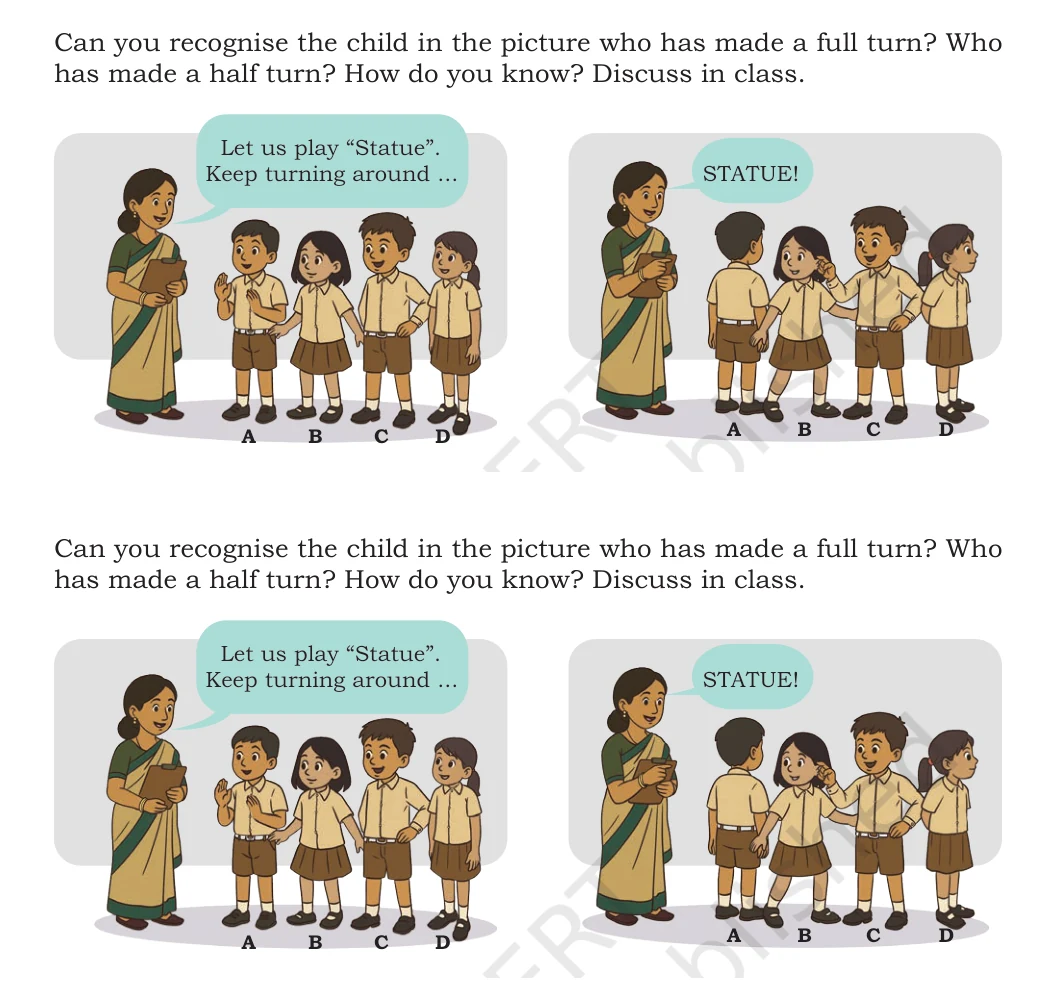
Which child made a full turn in the Statue game?
Show detailed solution
- Step 1: Compare how each child is facing before and after the turn.
- Step 2: A full turn brings a person back to the same facing direction.
- Answer: Child C made a full turn because C faces the same way at the end.
Textbook page 32 · solved item 2
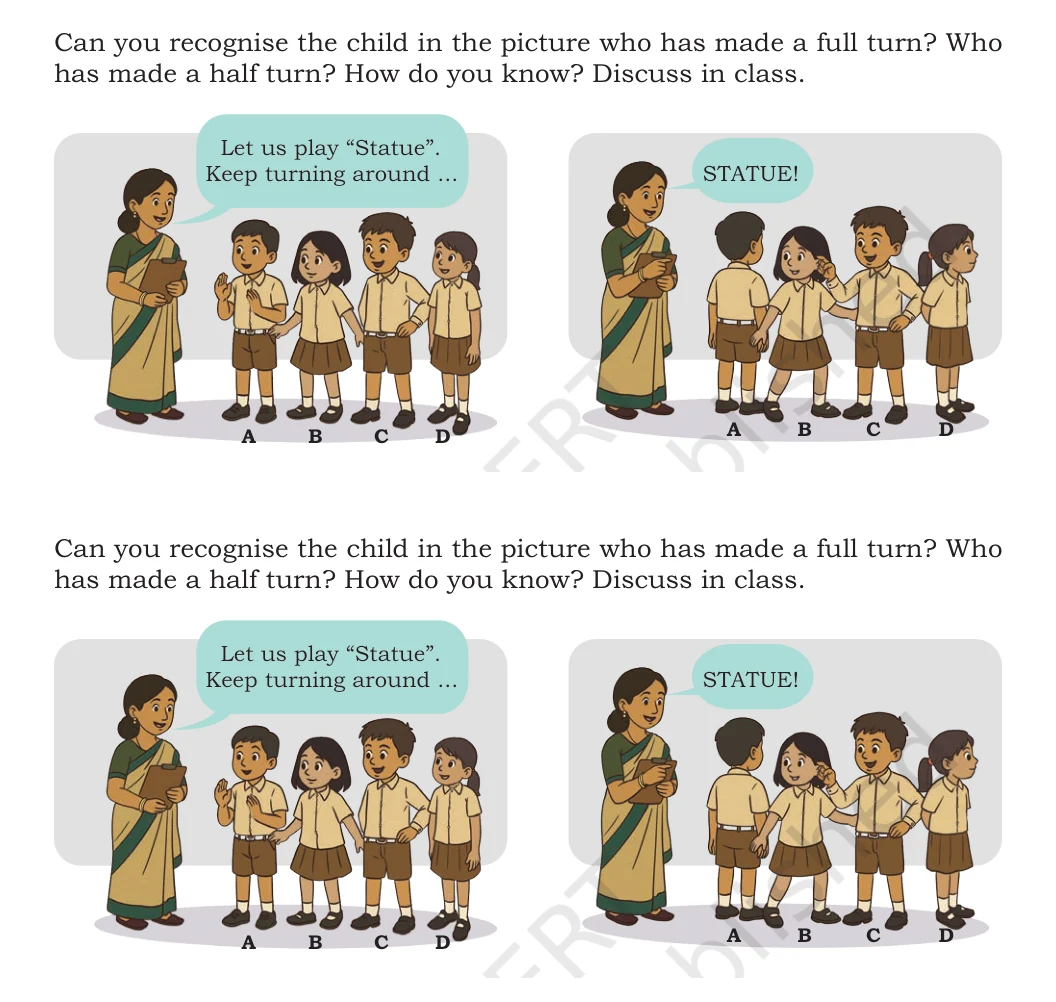
Which child made a half turn in the Statue game?
Show detailed solution
- Step 1: A half turn makes a person face the direction exactly opposite to the start.
- Step 2: Compare the first and second pictures of Child A.
- Answer: Child A made a half turn because A faces the opposite way at the end.
Textbook page 32 · solved item 3
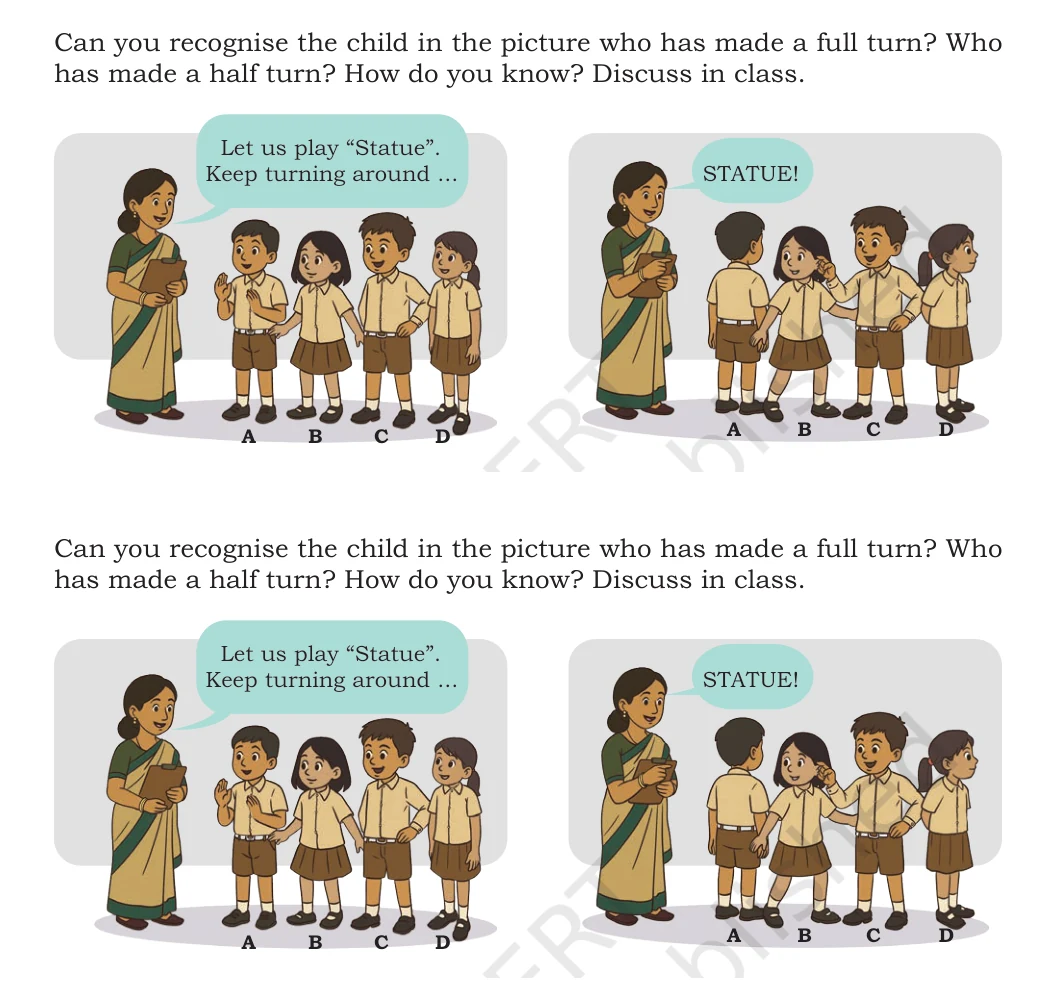
How can you tell a full turn from a half turn?
Show detailed solution
- Step 1: Mark the direction in which the person faced at the start.
- Step 2: After a full turn the person faces that same direction; after a half turn the person faces the opposite direction.
- Answer: Same final facing means a full turn, while opposite final facing means a half turn.
Textbook page 32 · solved item 4

Give examples of real-life situations in which you observe turns.
Show detailed solution
- Step 1: Think of objects that rotate around a fixed point.
- Step 2: A door turns at its hinge, a key turns in a lock, and a bottle cap turns around its neck.
- Sample answer: Clock hands, wheels, taps, door handles, keys, bottle caps, and merry-go-rounds all show turns.
Detailed worked answers
Textbook page 33
Textbook page 33 · solved item 5

Two half turns in the same direction are like what kind of turn?
Show detailed solution
- Step 1: The first half turn makes Reema face the opposite direction.
- Step 2: The second half turn brings her back to the starting direction.
- Answer: Two half turns make one full turn.
Textbook page 33 · solved item 6

Two quarter turns in the same direction are like what kind of turn?
Show detailed solution
- Step 1: One quarter turn is one of 4 equal parts of a full turn.
- Step 2: Two such parts cover half of the circle.
- Answer: Two quarter turns make one half turn.
Textbook page 33 · solved item 7

Four quarter turns in the same direction are like what kind of turn?
Show detailed solution
- Step 1: Count 4 equal quarter-turn parts around the circle.
- Step 2: All 4 parts bring Reema back to the starting direction.
- Answer: Four quarter turns make one full turn.
Textbook page 33 · solved item 8

Name five everyday objects, besides taps, that involve turns.
Show detailed solution
- Step 1: Look for objects that rotate around a centre, joint, or hinge.
- Step 2: Choose familiar examples whose movement you can observe.
- Sample answer: A door knob, steering wheel, bottle cap, key, and bicycle wheel involve turns.
Textbook page 33 · solved item 9
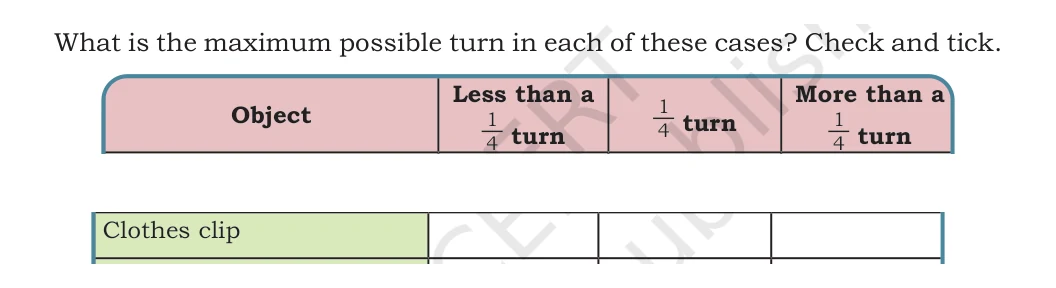
What is the maximum possible turn of a clothes clip?
Show detailed solution
- Step 1: Keep the joint or hinge fixed and move the free part as far as it normally goes.
- Step 2: Its two arms open only a small amount around the spring.
- Answer: Tick less than a quarter turn.
Textbook page 33 · solved item 10
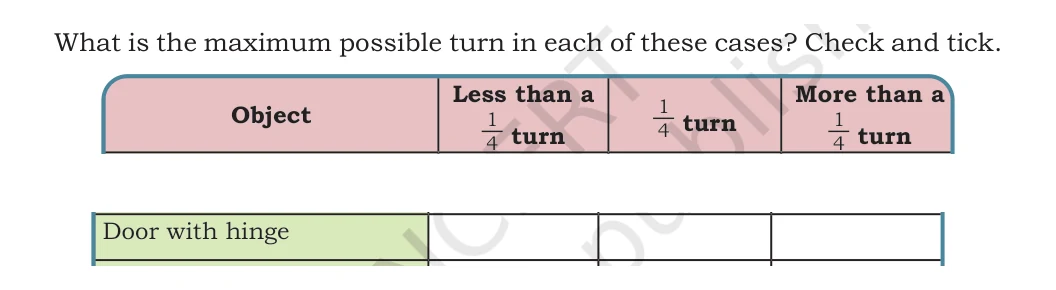
What is the maximum possible turn of a door with hinge?
Show detailed solution
- Step 1: Keep the joint or hinge fixed and move the free part as far as it normally goes.
- Step 2: A door can open beyond a right-angle or quarter turn when there is space.
- Answer: Tick more than a quarter turn.
Textbook page 33 · solved item 11
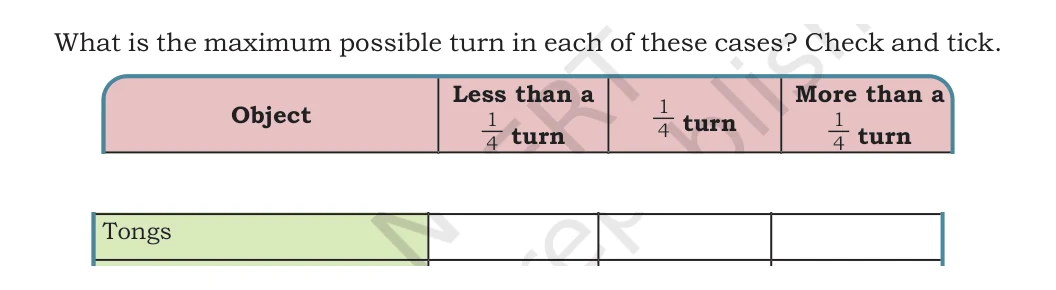
What is the maximum possible turn of a tongs?
Show detailed solution
- Step 1: Keep the joint or hinge fixed and move the free part as far as it normally goes.
- Step 2: The handles usually separate by less than a quarter turn.
- Answer: Tick less than a quarter turn.
Textbook page 33 · solved item 12
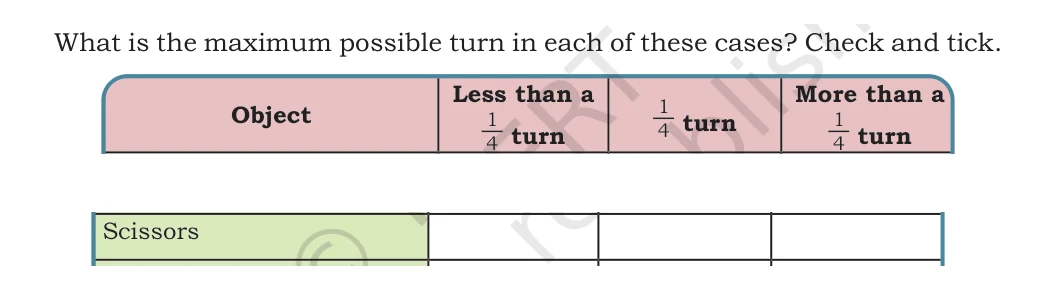
What is the maximum possible turn of a scissors?
Show detailed solution
- Step 1: Keep the joint or hinge fixed and move the free part as far as it normally goes.
- Step 2: The blades can open to about a right angle, or one quarter turn.
- Answer: Tick a quarter turn.
Textbook page 33 · solved item 13
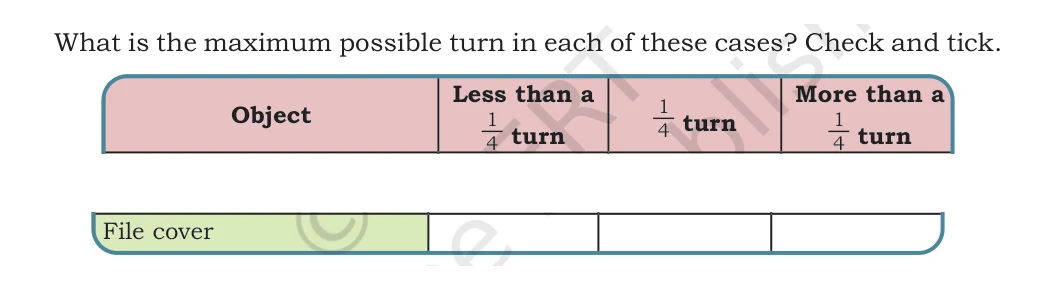
What is the maximum possible turn of a file cover?
Show detailed solution
- Step 1: Keep the joint or hinge fixed and move the free part as far as it normally goes.
- Step 2: A flexible cover can open past a quarter turn.
- Answer: Tick more than a quarter turn.
Textbook page 33 · solved item 14

Do any of the listed objects make a half turn?
Show detailed solution
- Step 1: A half turn opens through the same amount as a straight angle.
- Step 2: Try the real objects because the exact maximum can depend on their design.
- Sample answer: A flexible file cover can make a half turn. A door may also reach a half turn if no wall stops it.
Textbook page 33 · solved item 15

Do any of the listed objects make a full turn?
Show detailed solution
- Step 1: A full turn must go all the way around and return to the starting direction.
- Step 2: The hinges and joints of the listed objects normally stop before that happens.
- Sample answer: None of these objects normally makes a full turn around its joint.
Textbook page 33 · solved item 16
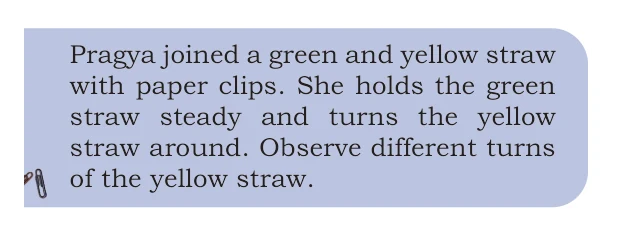
Use two joined straws to show different turns while keeping one straw fixed.
Show detailed solution
- Step 1: Hold the green straw still at the paper-clip joint.
- Step 2: Move the yellow straw through a small turn, a quarter turn, a half turn, and a full turn.
- Answer: The fixed straw is the starting arm, and the moving straw shows the size of each turn.
Detailed worked answers
Textbook page 34
Textbook page 34 · solved item 17
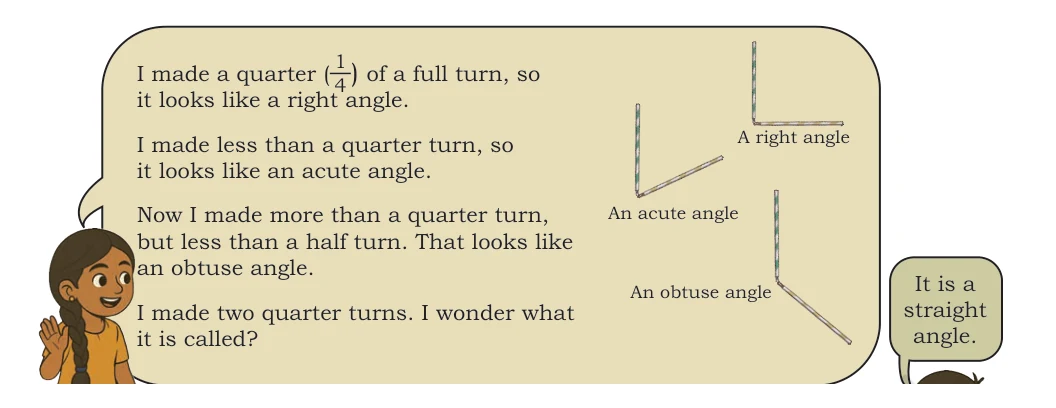
What is an angle made by two quarter turns called?
Show detailed solution
- Step 1: Two quarter turns make one half turn.
- Step 2: A half turn makes the two arms point in opposite directions along one line.
- Answer: It is called a straight angle.
Textbook page 34 · solved item 18
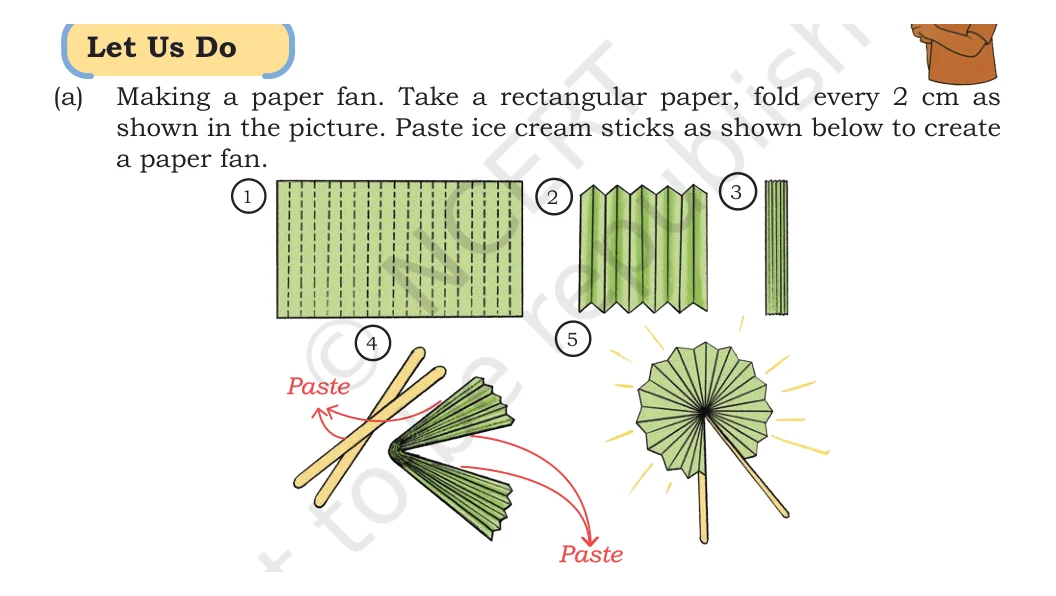
Make the paper fan shown in the activity.
Show detailed solution
- Step 1: Fold a rectangular sheet back and forth at every 2 cm mark.
- Step 2: Fold and paste the pleated sheet as shown, then attach the ice-cream sticks.
- Answer: Keep one stick fixed and move the other stick to use the fan as an angle model.
Textbook page 34 · solved item 19
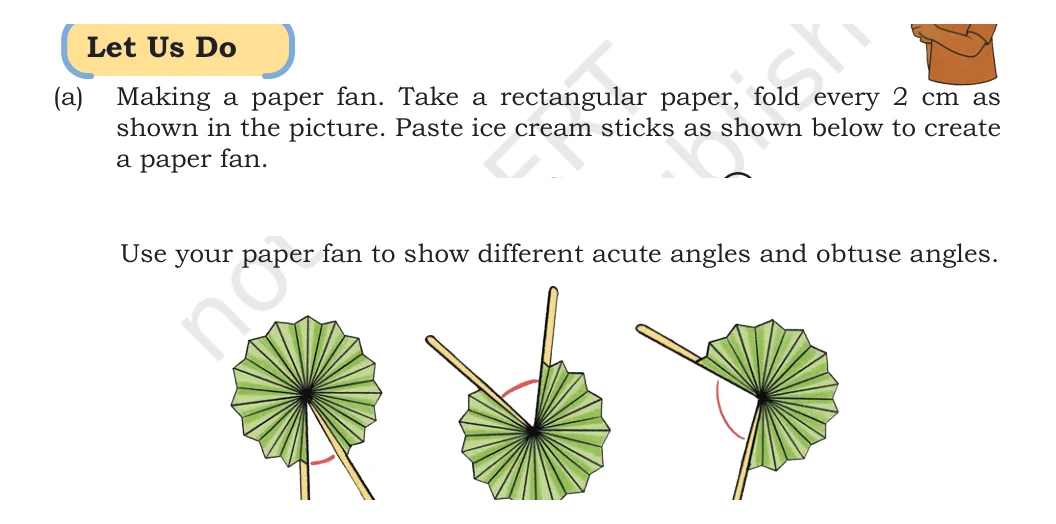
Use the paper fan to show an acute angle.
Show detailed solution
- Step 1: Start with the two sticks together and keep one stick fixed.
- Step 2: Open the moving stick by less than a quarter turn.
- Answer: The smaller opening is an acute angle.
Textbook page 34 · solved item 20
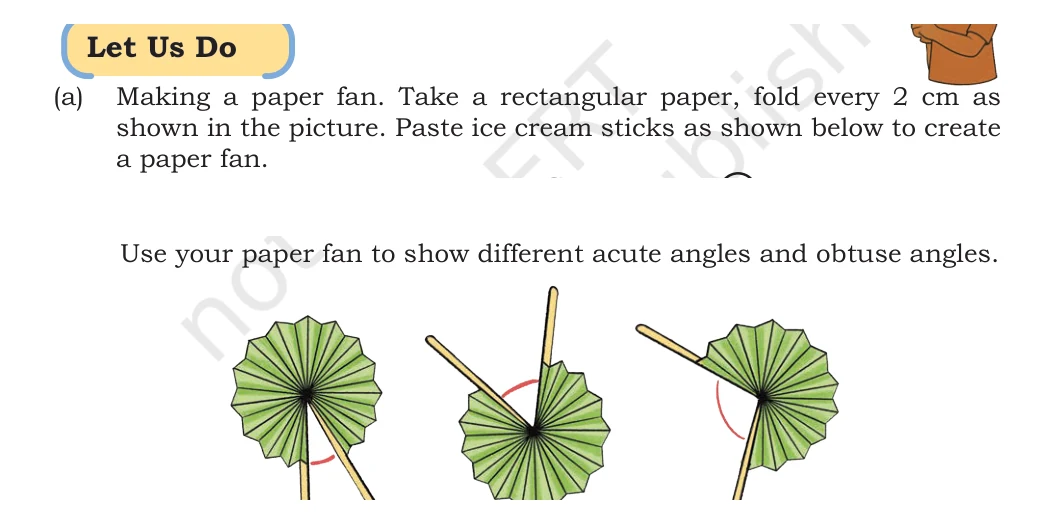
Use the paper fan to show an obtuse angle.
Show detailed solution
- Step 1: Begin at a quarter turn, which is a right angle.
- Step 2: Open the fan farther than a quarter turn but not as far as a half turn.
- Answer: This wider opening is an obtuse angle.
Detailed worked answers
Textbook page 35
Textbook page 35 · solved item 21
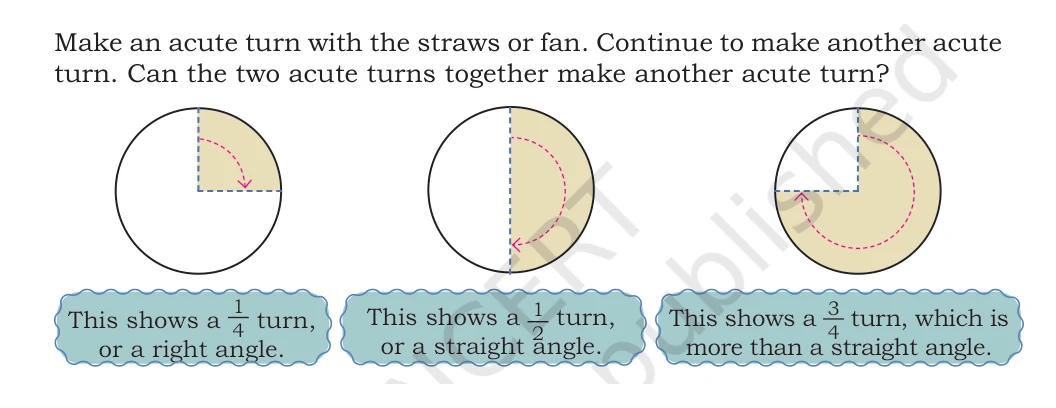
Can two acute turns together make another acute turn?
Show detailed solution
- Step 1: Each acute turn is smaller than a quarter turn.
- Step 2: If both turns are small enough, their total can still be smaller than a quarter turn. Larger acute turns can instead make a right, straight, or even larger turn.
- Answer: Yes, they can, but not always. It depends on the sizes of the two acute turns.
Textbook page 35 · solved item 22
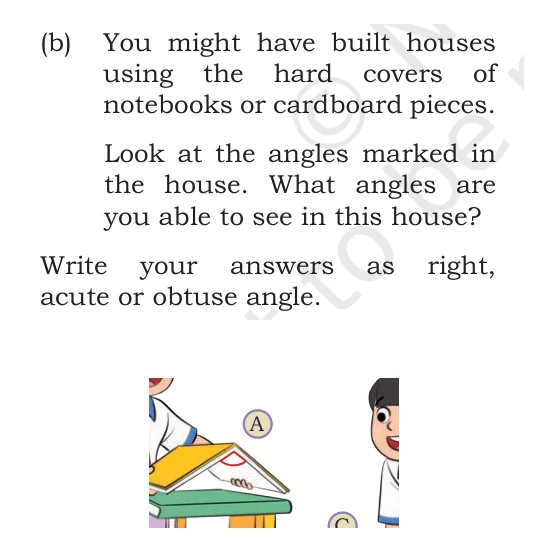
Identify angle A in the model house.
Show detailed solution
- Step 1: Compare the marked opening with a quarter-turn right angle.
- Step 2: It is wider than a right angle but smaller than a straight angle.
- Answer: Angle A is an obtuse angle.
Textbook page 35 · solved item 23
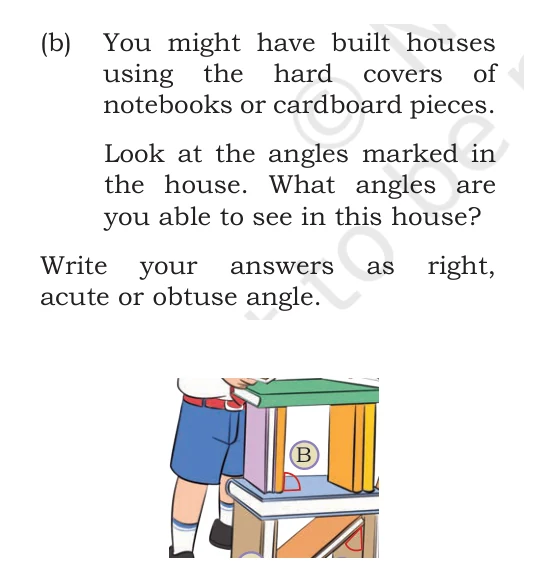
Identify angle B in the model house.
Show detailed solution
- Step 1: Compare the marked opening with a quarter-turn right angle.
- Step 2: Its arms make a square-corner shape.
- Answer: Angle B is a right angle.
Textbook page 35 · solved item 24
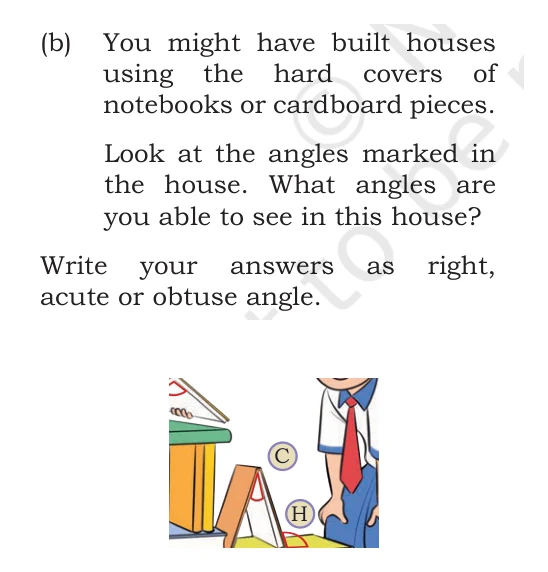
Identify angle C in the model house.
Show detailed solution
- Step 1: Compare the marked opening with a quarter-turn right angle.
- Step 2: It is smaller than a right angle.
- Answer: Angle C is an acute angle.
Textbook page 35 · solved item 25
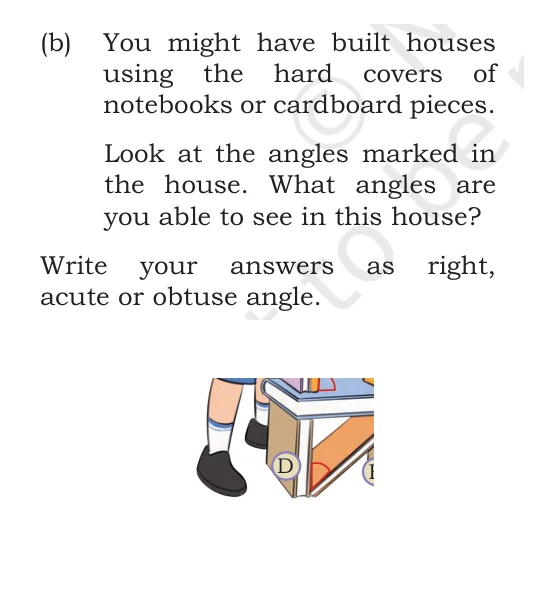
Identify angle D in the model house.
Show detailed solution
- Step 1: Compare the marked opening with a quarter-turn right angle.
- Step 2: It is smaller than a right angle.
- Answer: Angle D is an acute angle.
Textbook page 35 · solved item 26
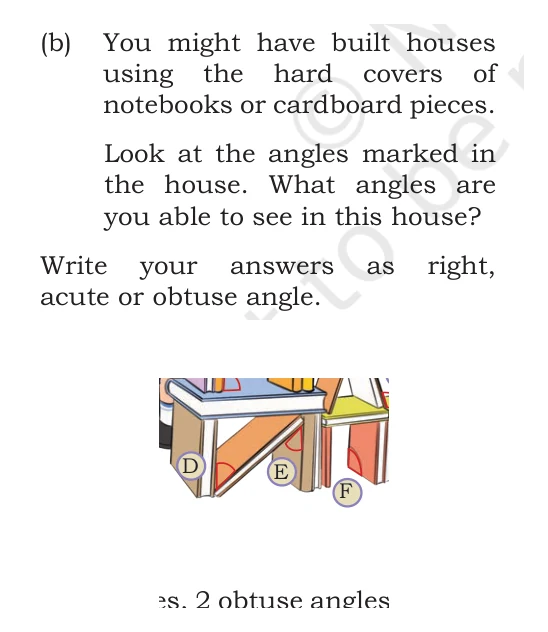
Identify angle E in the model house.
Show detailed solution
- Step 1: Compare the marked opening with a quarter-turn right angle.
- Step 2: It is smaller than a right angle.
- Answer: Angle E is an acute angle.
Textbook page 35 · solved item 27
Identify angle F in the model house.
Show detailed solution
- Step 1: Compare the marked opening with a quarter-turn right angle.
- Step 2: Its arms meet like the corner of a book.
- Answer: Angle F is a right angle.
Textbook page 35 · solved item 28
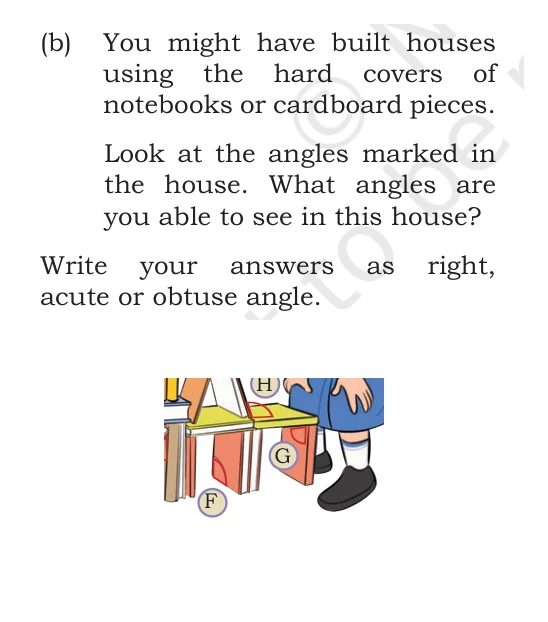
Identify angle G in the model house.
Show detailed solution
- Step 1: Compare the marked opening with a quarter-turn right angle.
- Step 2: Its arms make a square corner.
- Answer: Angle G is a right angle.
Textbook page 35 · solved item 29
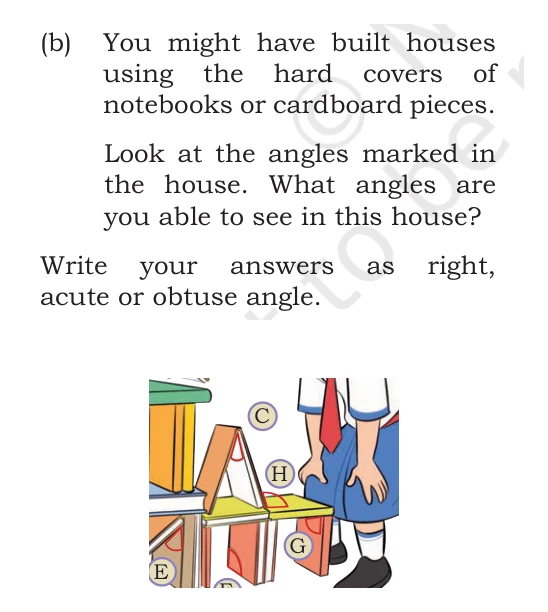
Identify angle H in the model house.
Show detailed solution
- Step 1: Compare the marked opening with a quarter-turn right angle.
- Step 2: It is wider than a right angle but smaller than a straight angle.
- Answer: Angle H is an obtuse angle.
Textbook page 35 · solved item 30

Draw a 5-sided shape with 2 right angles, 2 obtuse angles, and 1 acute angle.
Show detailed solution
- Step 1: Draw two neighbouring sides with square corners at their lower ends to make the 2 right angles.
- Step 2: Slant the remaining three sides so that one corner is narrow and two corners are wide.
- Answer: Label the narrow corner acute, the two square corners right, and the two wide corners obtuse. More than one drawing is possible.
Detailed worked answers
Textbook page 36
Textbook page 36 · solved item 31
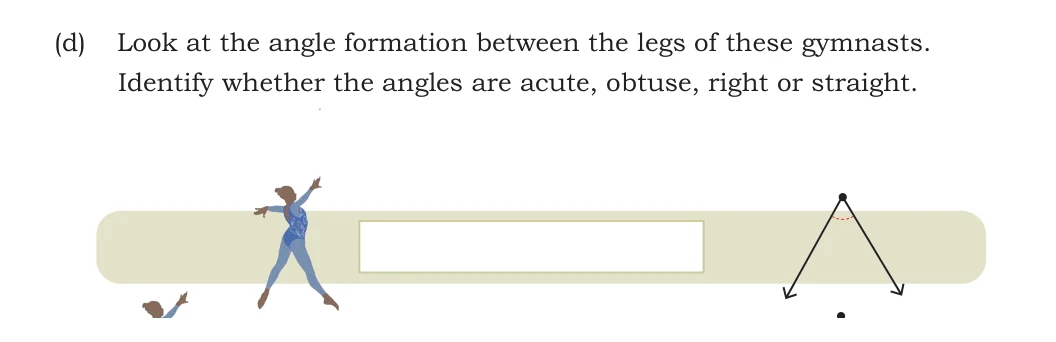
Identify the angle between the legs of the first gymnast.
Show detailed solution
- Step 1: Compare the opening with a quarter-turn right angle and a half-turn straight angle.
- Step 2: The legs make an opening smaller than a right angle.
- Answer: The first gymnast shows an acute angle.
Textbook page 36 · solved item 32
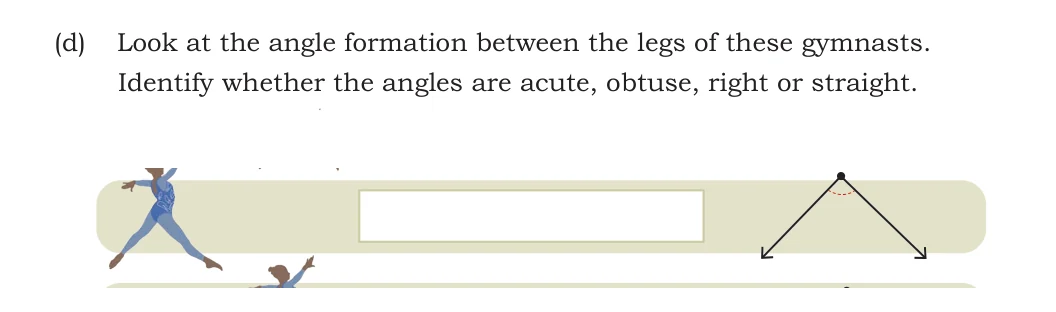
Identify the angle between the legs of the second gymnast.
Show detailed solution
- Step 1: Compare the opening with a quarter-turn right angle and a half-turn straight angle.
- Step 2: The legs make about one quarter turn.
- Answer: The second gymnast shows a right angle.
Textbook page 36 · solved item 33
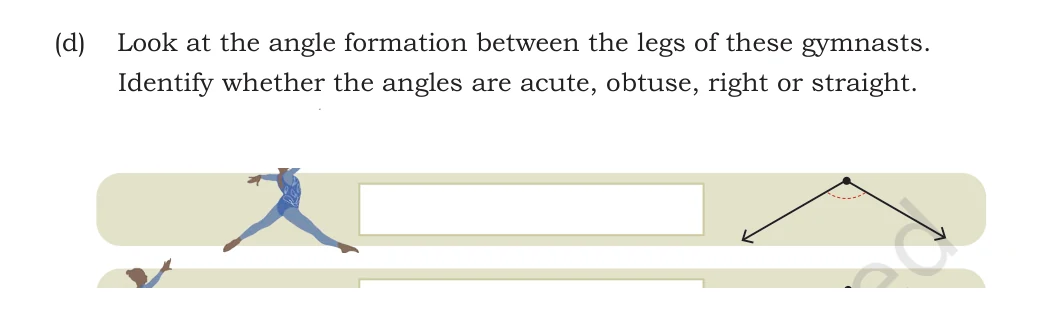
Identify the angle between the legs of the third gymnast.
Show detailed solution
- Step 1: Compare the opening with a quarter-turn right angle and a half-turn straight angle.
- Step 2: The opening is wider than a right angle but not straight.
- Answer: The third gymnast shows an obtuse angle.
Textbook page 36 · solved item 34
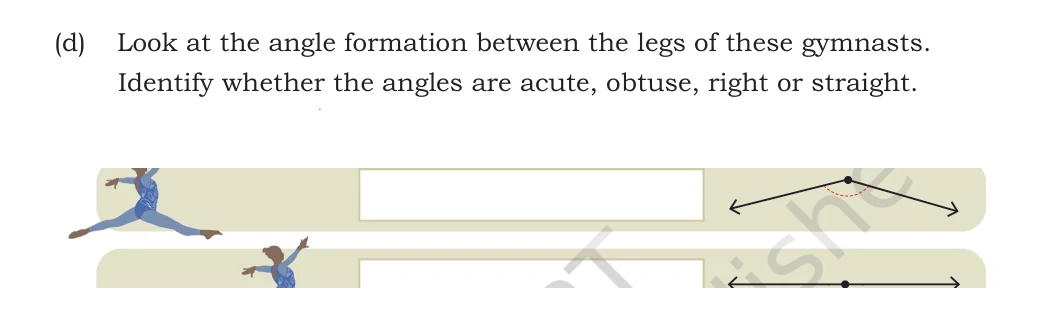
Identify the angle between the legs of the fourth gymnast.
Show detailed solution
- Step 1: Compare the opening with a quarter-turn right angle and a half-turn straight angle.
- Step 2: The opening is very wide but still smaller than a straight angle.
- Answer: The fourth gymnast shows an obtuse angle.
Textbook page 36 · solved item 35
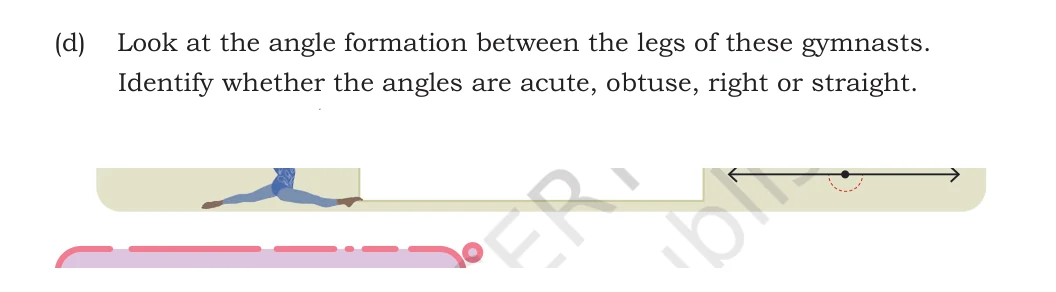
Identify the angle between the legs of the fifth gymnast.
Show detailed solution
- Step 1: Compare the opening with a quarter-turn right angle and a half-turn straight angle.
- Step 2: The legs point in opposite directions along one line.
- Answer: The fifth gymnast shows a straight angle.
Textbook page 36 · solved item 36
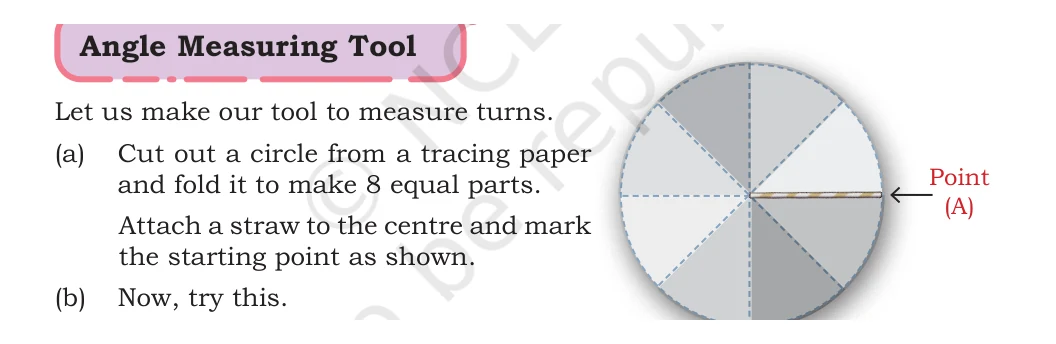
Make an angle-measuring tool divided into 8 equal parts.
Show detailed solution
- Step 1: Cut a tracing-paper circle and fold it in half, then in half again, and once more.
- Step 2: Open it to see 8 equal parts, attach a straw at the centre, and mark point A as the start.
- Answer: Each small part of the circle measures one-eighth of a full turn.
Textbook page 36 · solved item 37
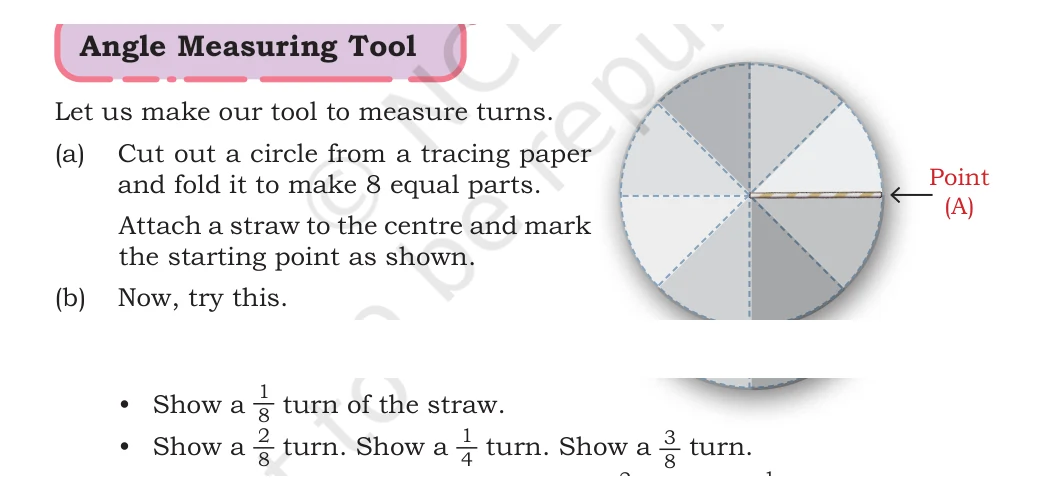
Show a one-eighth turn of the straw.
Show detailed solution
- Step 1: Place the straw at the marked starting point A.
- Step 2: Count one small section in one direction.
- Answer: Move the straw from A through 1 of the 8 equal sections.
Textbook page 36 · solved item 38
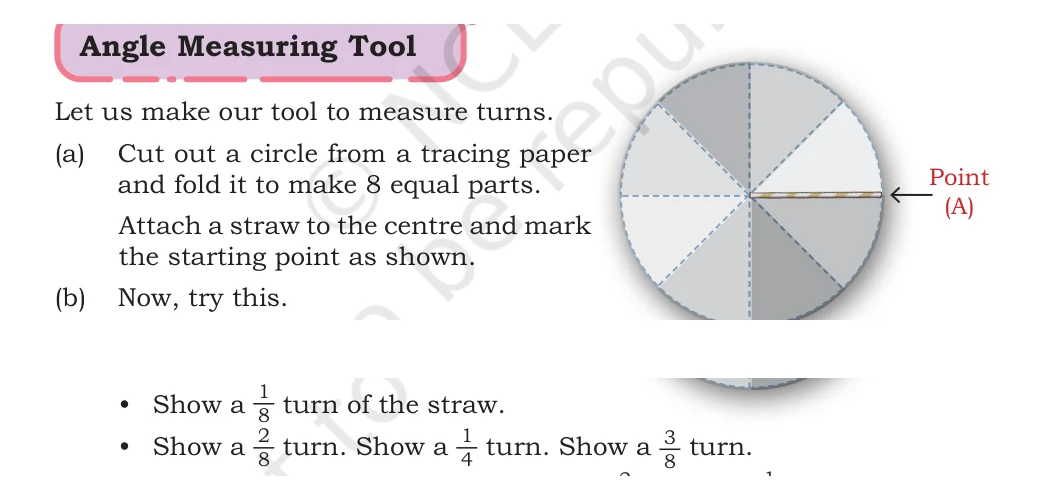
Show a two-eighth turn of the straw.
Show detailed solution
- Step 1: Place the straw at the marked starting point A.
- Step 2: Count two small sections in one direction.
- Answer: Move the straw through 2 of the 8 sections.
Textbook page 36 · solved item 39
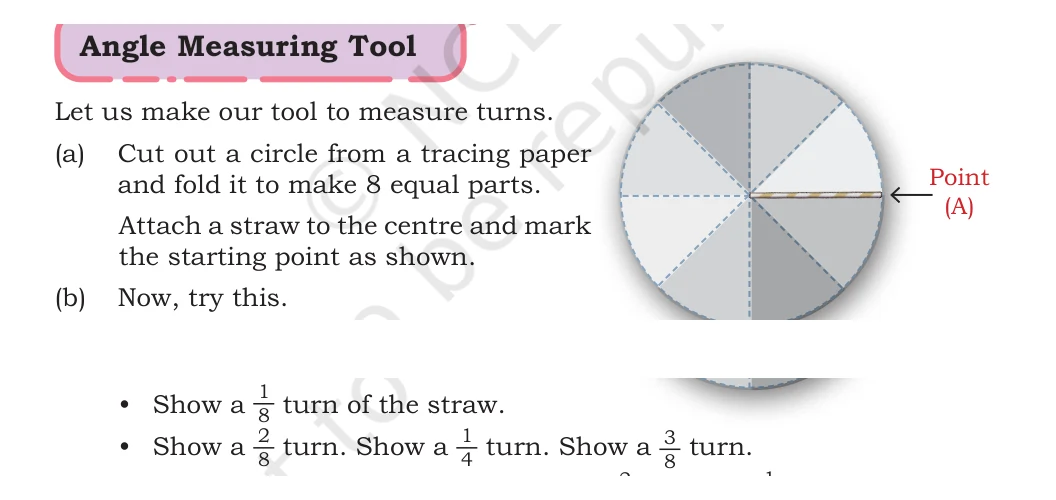
Show a one-quarter turn of the straw.
Show detailed solution
- Step 1: Place the straw at the marked starting point A.
- Step 2: Count the same two sections as one quarter turn in one direction.
- Answer: Move the straw through 2 of the 8 sections because two-eighths is one-quarter.
Textbook page 36 · solved item 40
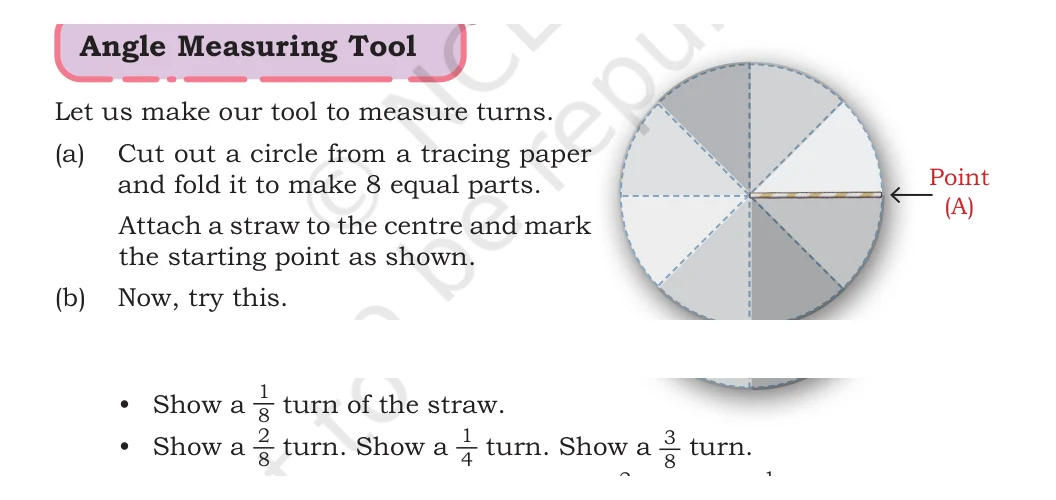
Show a three-eighth turn of the straw.
Show detailed solution
- Step 1: Place the straw at the marked starting point A.
- Step 2: Count three small sections in one direction.
- Answer: Move the straw through 3 of the 8 sections.
Textbook page 36 · solved item 41
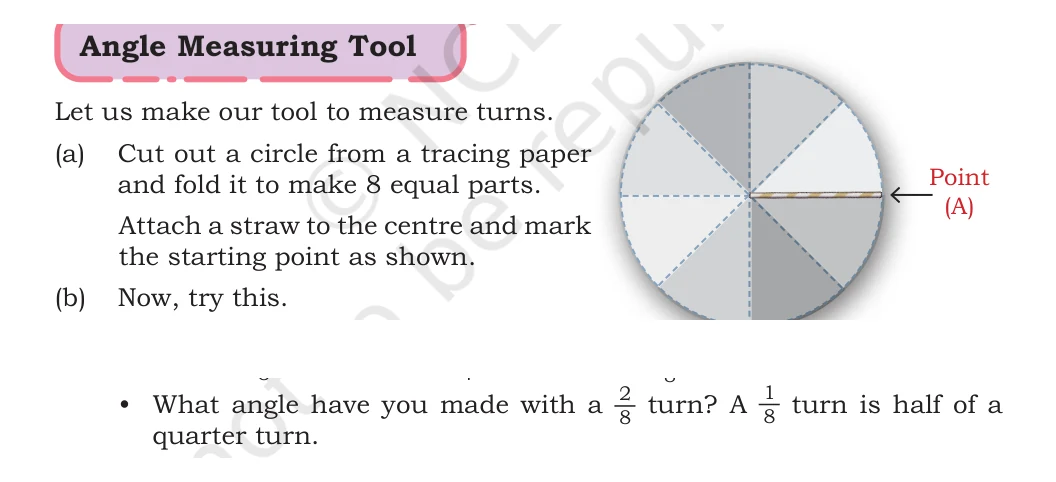
What angle is made by a two-eighth turn?
Show detailed solution
- Step 1: Two of the 8 equal sections make \frac{2}{8} of a full turn.
- Step 2: Two-eighths covers the same amount as one-quarter.
- Answer: A two-eighth turn makes a right angle.
Textbook page 36 · solved item 42
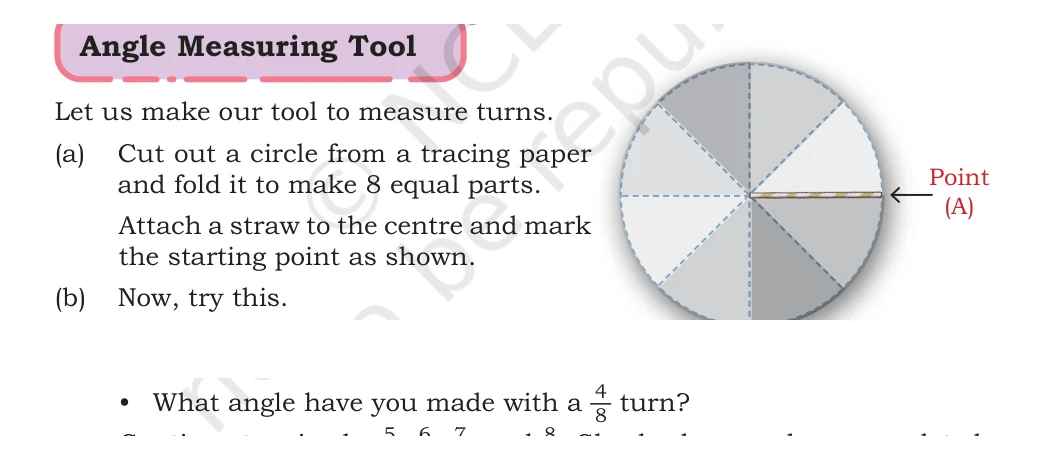
What angle is made by a four-eighth turn?
Show detailed solution
- Step 1: Four of the 8 equal sections make half of the circle.
- Step 2: A half turn makes the two arms point in opposite directions.
- Answer: A four-eighth turn makes a straight angle.
Textbook page 36 · solved item 43
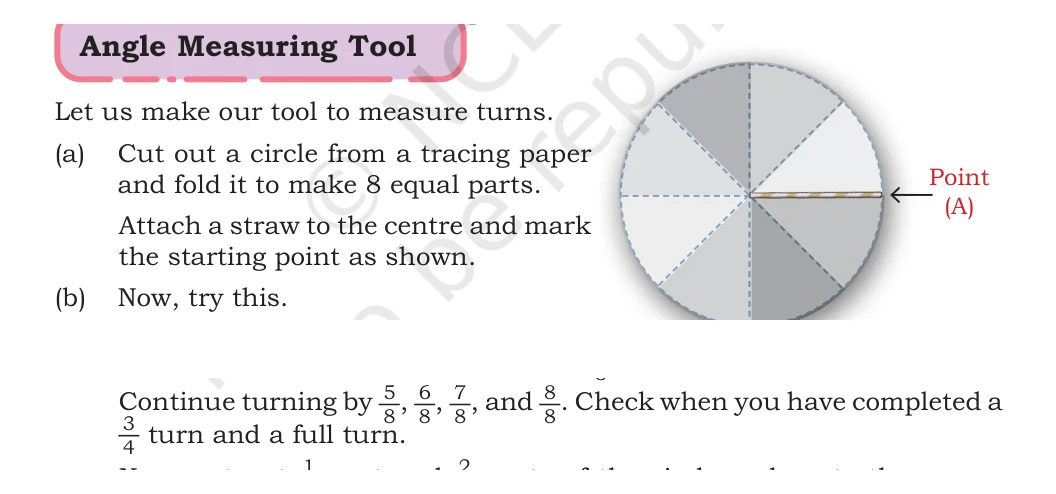
Continue the straw to a 5-eighth turn.
Show detailed solution
- Step 1: Begin at A and count equal eighth-turn sections in the same direction.
- Step 2: After 5 sections, the straw is one-eighth beyond a half turn.
- Answer: \frac{5}{8} is more than a straight angle.
Textbook page 36 · solved item 44
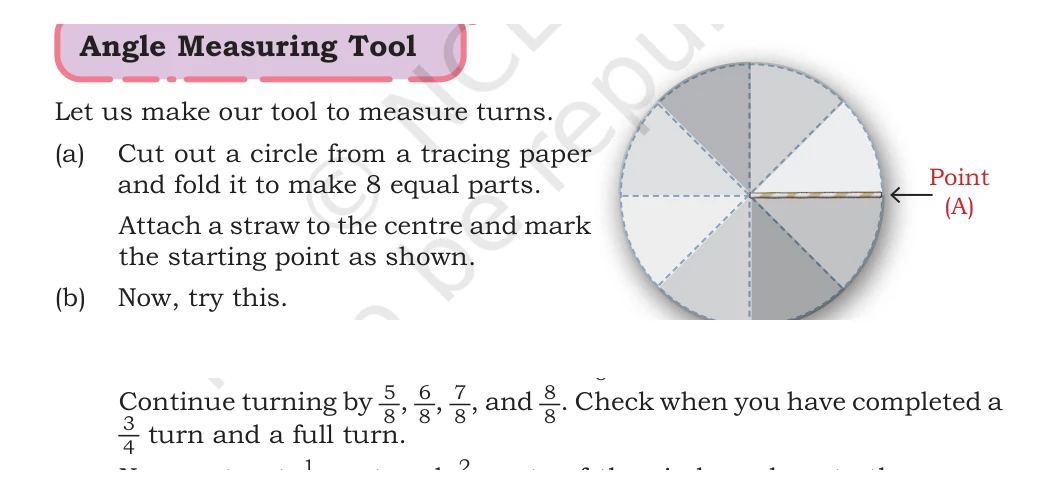
Continue the straw to a 6-eighth turn.
Show detailed solution
- Step 1: Begin at A and count equal eighth-turn sections in the same direction.
- Step 2: After 6 sections, the straw is six of 8 sections, the same as three-quarters.
- Answer: \frac{6}{8} is a three-quarter turn.
Textbook page 36 · solved item 45
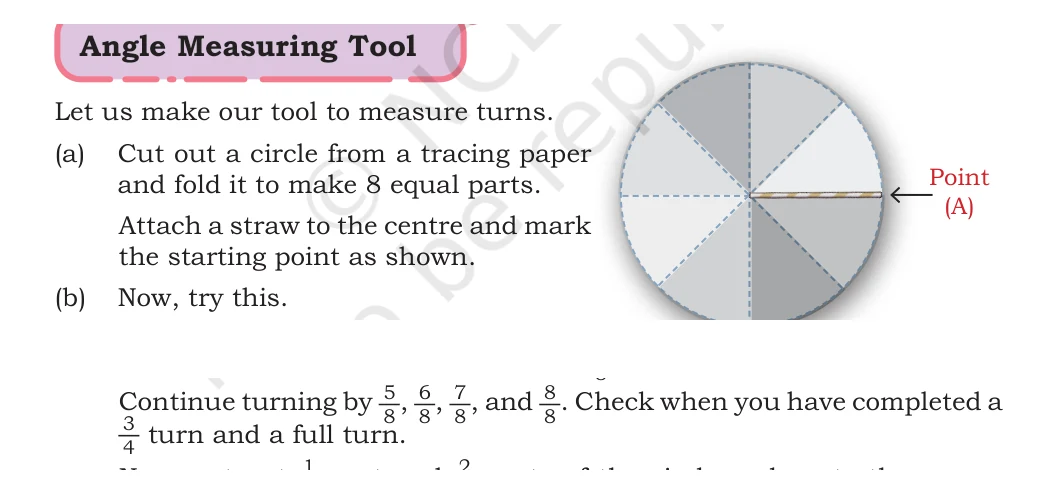
Continue the straw to a 7-eighth turn.
Show detailed solution
- Step 1: Begin at A and count equal eighth-turn sections in the same direction.
- Step 2: After 7 sections, the straw is one section short of the starting point.
- Answer: \frac{7}{8} is a seven-eighth turn.
Textbook page 36 · solved item 46
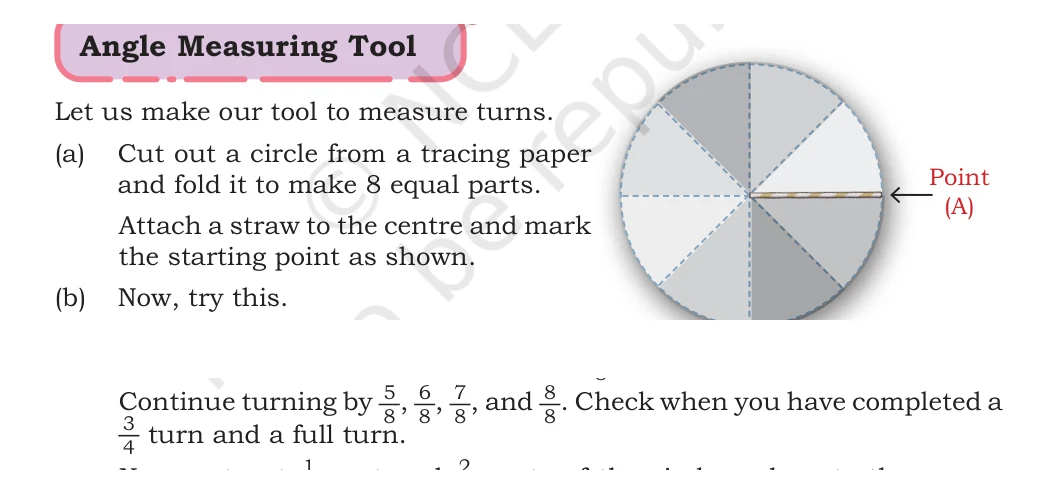
Continue the straw to a 8-eighth turn.
Show detailed solution
- Step 1: Begin at A and count equal eighth-turn sections in the same direction.
- Step 2: After 8 sections, the straw is all 8 sections and return to point A.
- Answer: \frac{8}{8} is a full turn.
Textbook page 36 · solved item 47

Make separate one-eighth and two-eighth angle-measuring pieces.
Show detailed solution
- Step 1: Cut one 1-part sector and one 2-part sector from copies of the folded circle.
- Step 2: Paste each sector on thick paper or board without changing its shape.
- Answer: Use the smaller piece for one-eighth turns and the larger piece for two-eighth or one-quarter turns.
Detailed worked answers
Textbook page 37
Textbook page 37 · solved item 48
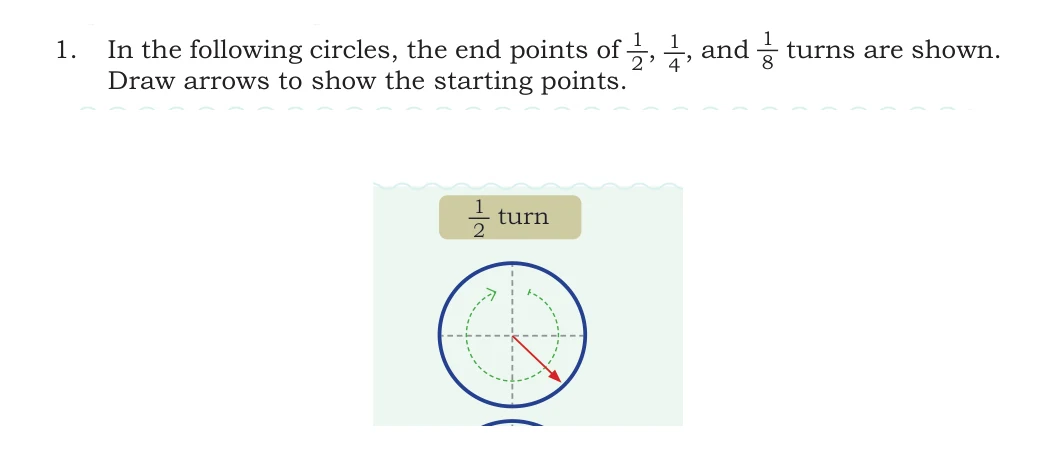
Draw the starting arrow in the top half-turn circle.
Show detailed solution
- Step 1: Follow the green dotted direction to the red endpoint.
- Step 2: The starting arrow must be opposite the red lower-right endpoint.
- Answer: Draw the starting arrow pointing towards the upper-left position shown by the circle.
Textbook page 37 · solved item 49
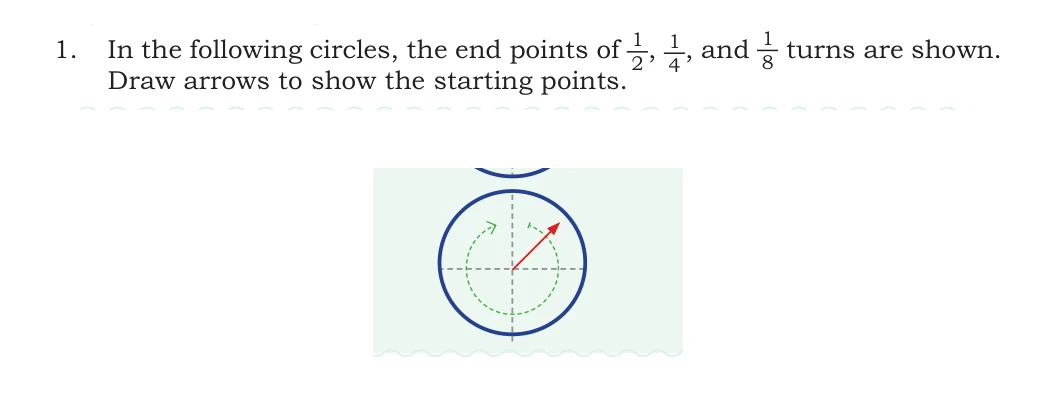
Draw the starting arrow in the bottom half-turn circle.
Show detailed solution
- Step 1: Follow the green dotted direction to the red endpoint.
- Step 2: The starting arrow must be opposite the red upper-right endpoint.
- Answer: Draw the starting arrow pointing towards the lower-left position shown by the circle.
Textbook page 37 · solved item 50
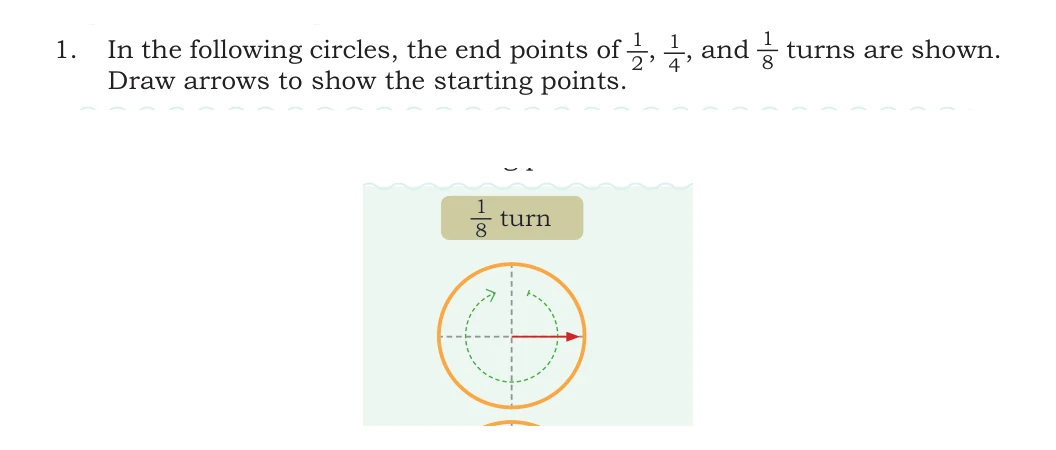
Draw the starting arrow in the top one-eighth-turn circle.
Show detailed solution
- Step 1: Follow the green dotted direction to the red endpoint.
- Step 2: Move one small eighth-turn step back from the red right-hand endpoint.
- Answer: Draw the starting arrow pointing towards the upper-right position shown by the circle.
Textbook page 37 · solved item 51
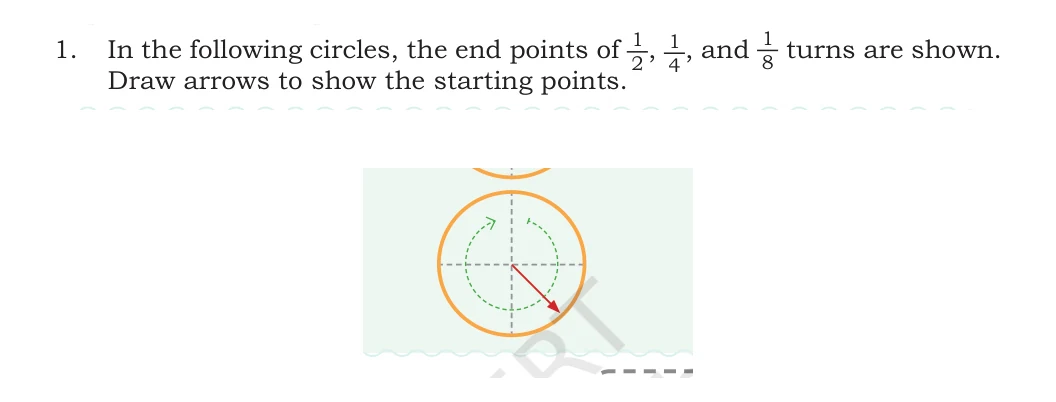
Draw the starting arrow in the bottom one-eighth-turn circle.
Show detailed solution
- Step 1: Follow the green dotted direction to the red endpoint.
- Step 2: Move one small eighth-turn step back from the red lower-right endpoint.
- Answer: Draw the starting arrow pointing towards the right position shown by the circle.
Textbook page 37 · solved item 52
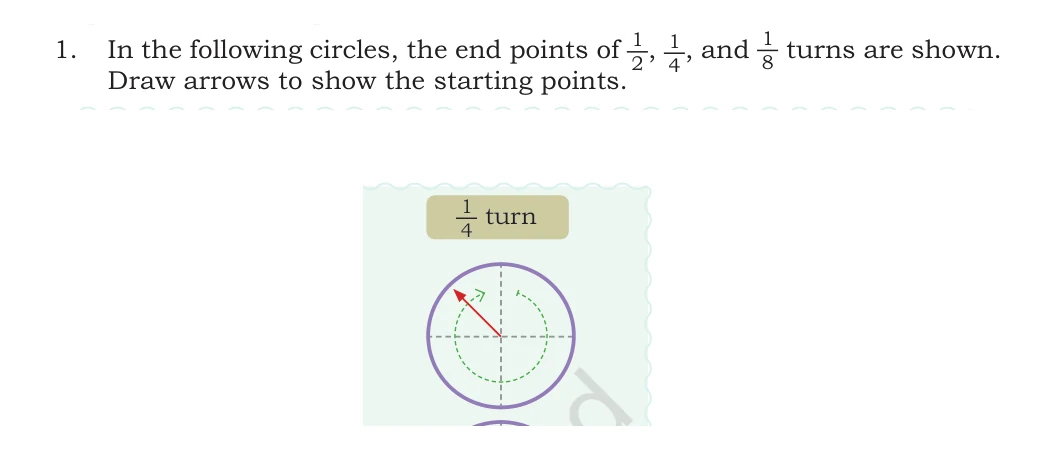
Draw the starting arrow in the top quarter-turn circle.
Show detailed solution
- Step 1: Follow the green dotted direction to the red endpoint.
- Step 2: Move one quarter turn back from the red upper-left endpoint.
- Answer: Draw the starting arrow pointing towards the lower-left position shown by the circle.
Textbook page 37 · solved item 53
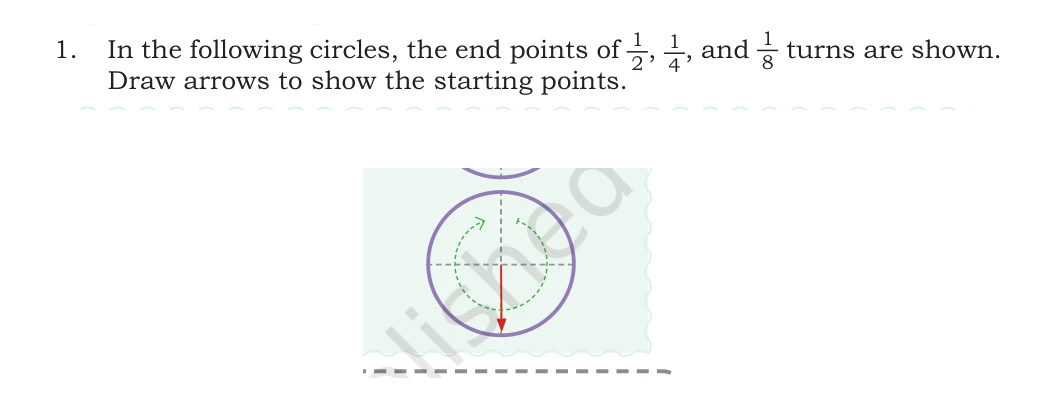
Draw the starting arrow in the bottom quarter-turn circle.
Show detailed solution
- Step 1: Follow the green dotted direction to the red endpoint.
- Step 2: Move one quarter turn back from the red bottom endpoint.
- Answer: Draw the starting arrow pointing towards the right position shown by the circle.
Textbook page 37 · solved item 54
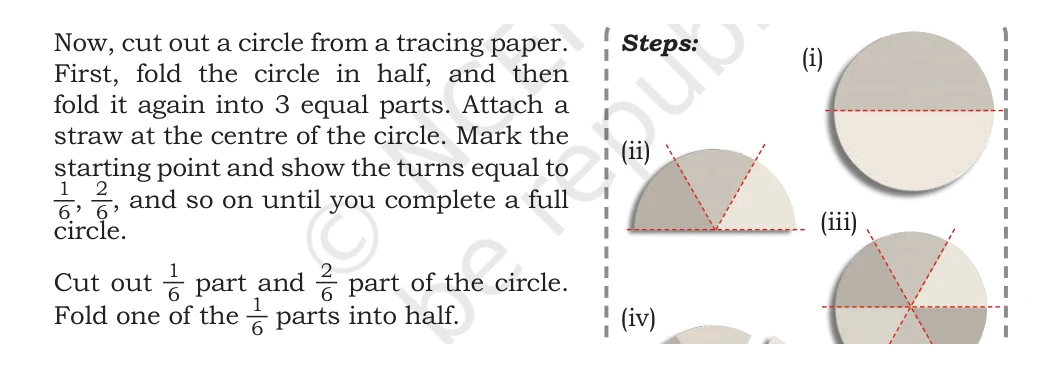
Make a circle tool for sixth turns and show turns from one-sixth to a full turn.
Show detailed solution
- Step 1: Fold a circle in half and then divide the half into 3 equal parts, giving 6 equal parts altogether.
- Step 2: Starting at the mark, move the straw by 1, 2, 3, 4, 5, and finally all 6 parts.
- Answer: The positions show \frac{1}{6},\frac{2}{6},\frac{3}{6},\frac{4}{6},\frac{5}{6}, and \frac{6}{6}, which is a full turn.
Textbook page 37 · solved item 55
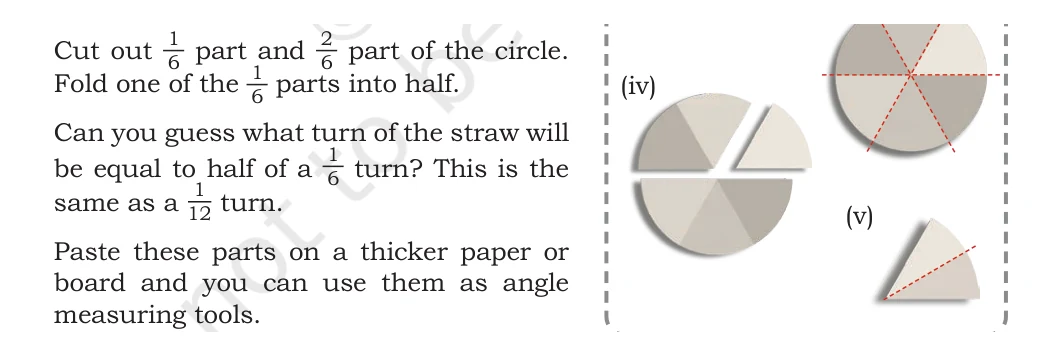
What turn is equal to half of a one-sixth turn?
Show detailed solution
- Step 1: Cut one of the 6 equal sectors from the circle.
- Step 2: Fold that one-sixth sector into 2 equal halves, so the full circle now has 12 such small parts.
- Answer: Half of a one-sixth turn is a one-twelfth turn.
Detailed worked answers
Textbook page 38
Textbook page 38 · solved item 56
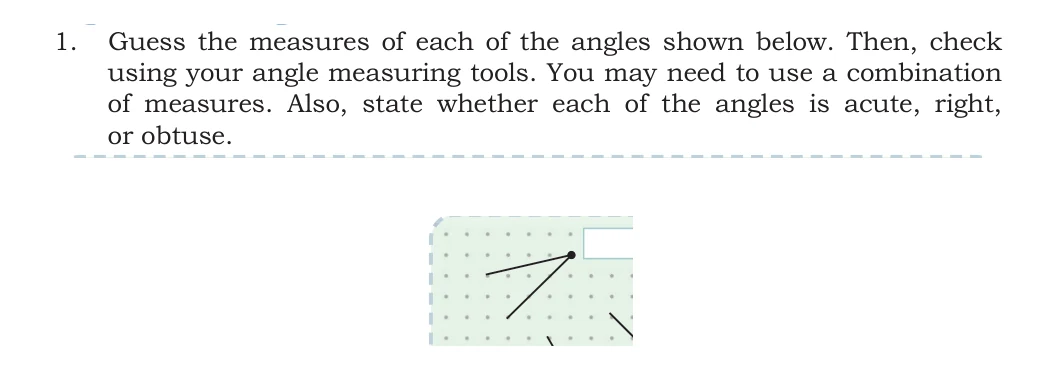
Measure and classify the first angle in Question 1.
Show detailed solution
- Step 1: Put the centre of the angle tool on the black vertex and line up one edge.
- Step 2: It is much smaller than a quarter turn.
- Answer: The angle is about 30^\circ, or \frac{1}{12} turn, so it is acute.
Textbook page 38 · solved item 57
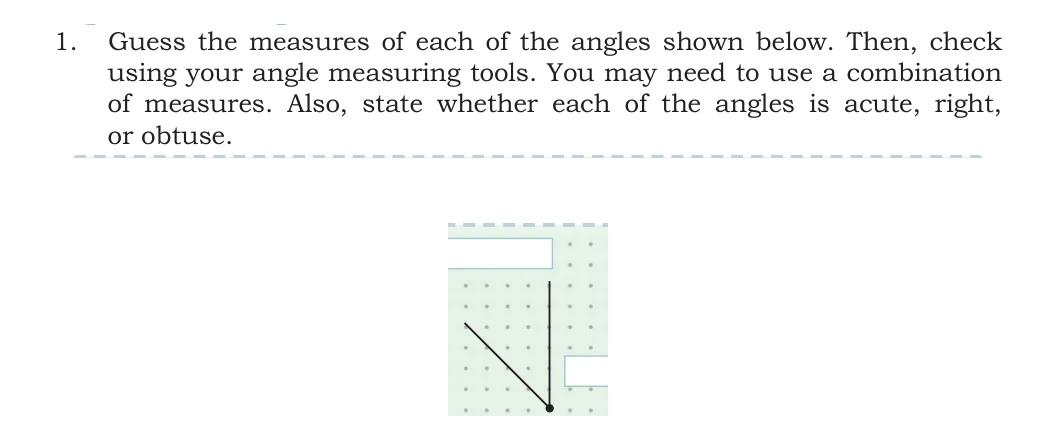
Measure and classify the second angle in Question 1.
Show detailed solution
- Step 1: Put the centre of the angle tool on the black vertex and line up one edge.
- Step 2: It is a little wider than a one-eighth turn but still smaller than a quarter turn.
- Answer: The angle is about 50^\circ, so it is acute.
Textbook page 38 · solved item 58
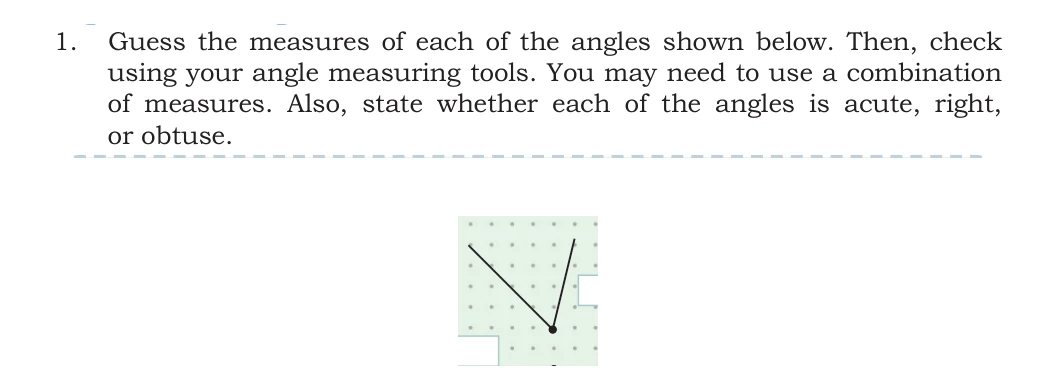
Measure and classify the third angle in Question 1.
Show detailed solution
- Step 1: Put the centre of the angle tool on the black vertex and line up one edge.
- Step 2: It matches one eighth-turn piece.
- Answer: The angle is 45^\circ, or \frac{1}{8} turn, so it is acute.
Textbook page 38 · solved item 59
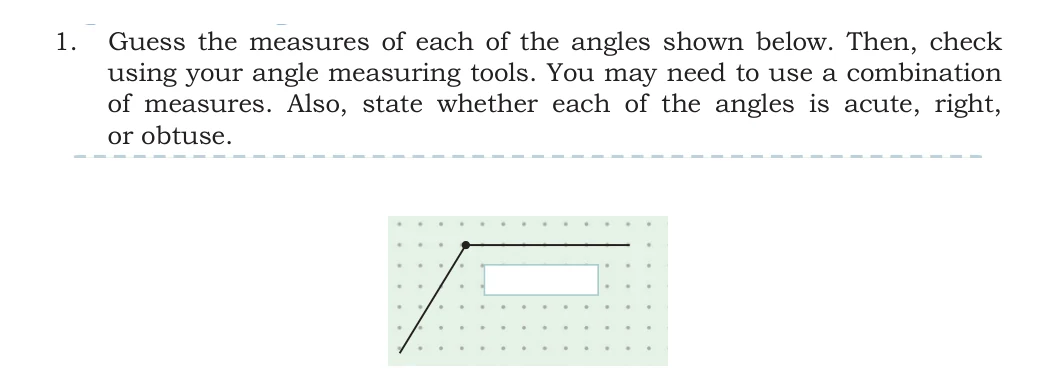
Measure and classify the fourth angle in Question 1.
Show detailed solution
- Step 1: Put the centre of the angle tool on the black vertex and line up one edge.
- Step 2: It is wider than a quarter turn but smaller than a half turn.
- Answer: The angle is about 110^\circ, so it is obtuse.
Textbook page 38 · solved item 60
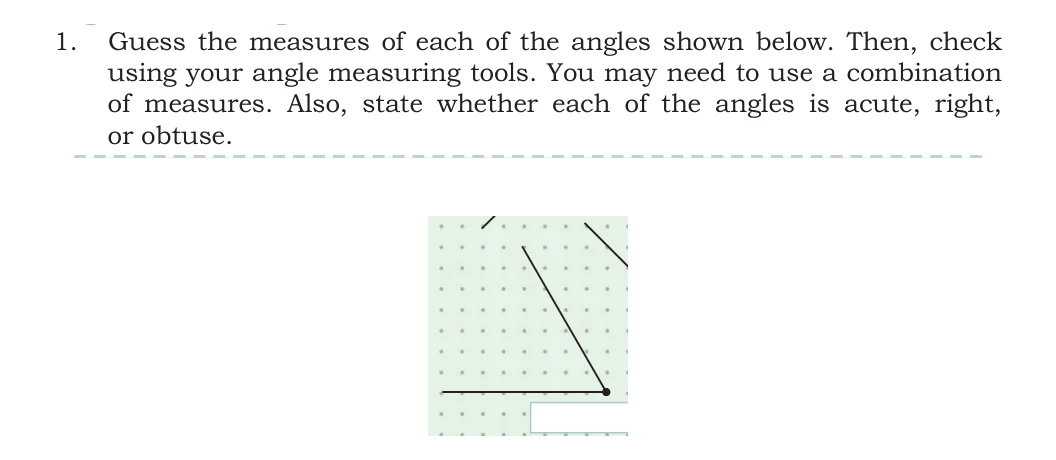
Measure and classify the fifth angle in Question 1.
Show detailed solution
- Step 1: Put the centre of the angle tool on the black vertex and line up one edge.
- Step 2: It is smaller than a quarter turn.
- Answer: The angle is about 70^\circ, so it is acute.
Textbook page 38 · solved item 61
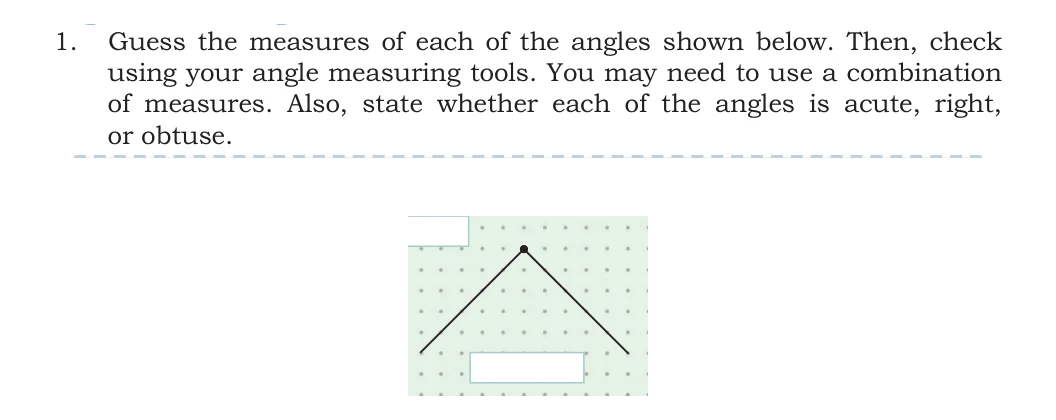
Measure and classify the sixth angle in Question 1.
Show detailed solution
- Step 1: Put the centre of the angle tool on the black vertex and line up one edge.
- Step 2: It matches the square corner of the quarter-turn tool.
- Answer: The angle is 90^\circ, or \frac{1}{4} turn, so it is right.
Textbook page 38 · solved item 62
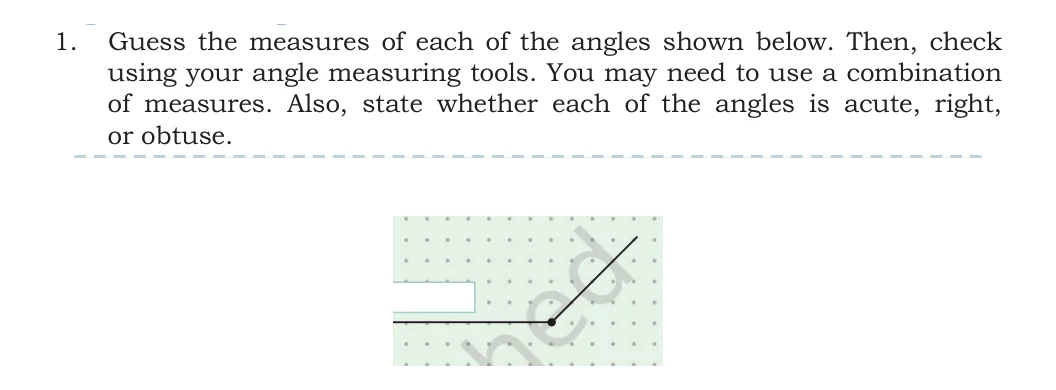
Measure and classify the seventh angle in Question 1.
Show detailed solution
- Step 1: Put the centre of the angle tool on the black vertex and line up one edge.
- Step 2: It is wider than a quarter turn and matches two one-sixth pieces.
- Answer: The angle is 120^\circ, or \frac{1}{3} turn, so it is obtuse.
Textbook page 38 · solved item 63
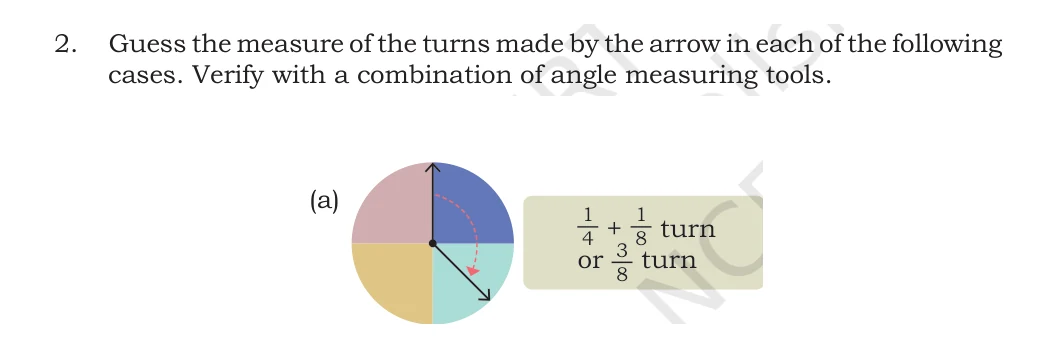
Find the turn made by the arrow in diagram (a).
Show detailed solution
- Step 1: Follow the pink arrow from its starting ray to its ending ray.
- Step 2: The arrow passes one quarter turn and then one more eighth turn.
- Answer: The arrow makes a \frac{3}{8} turn.
Textbook page 38 · solved item 64
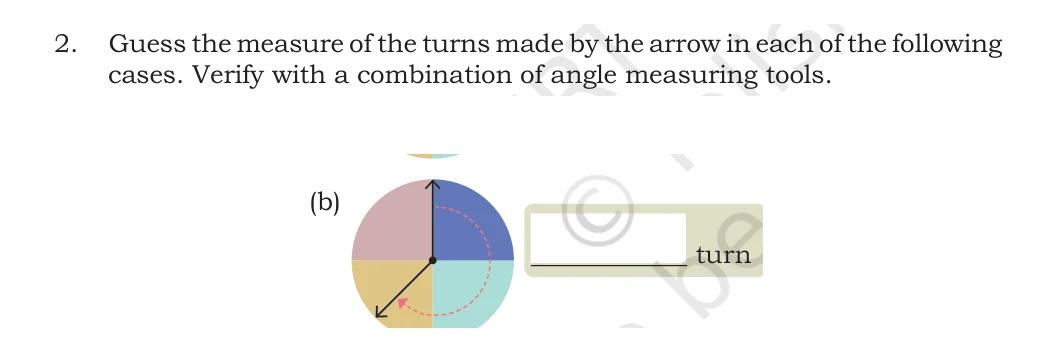
Find the turn made by the arrow in diagram (b).
Show detailed solution
- Step 1: Follow the pink arrow from its starting ray to its ending ray.
- Step 2: The arrow passes a half turn and then one more eighth turn.
- Answer: The arrow makes a \frac{5}{8} turn.
Textbook page 38 · solved item 65
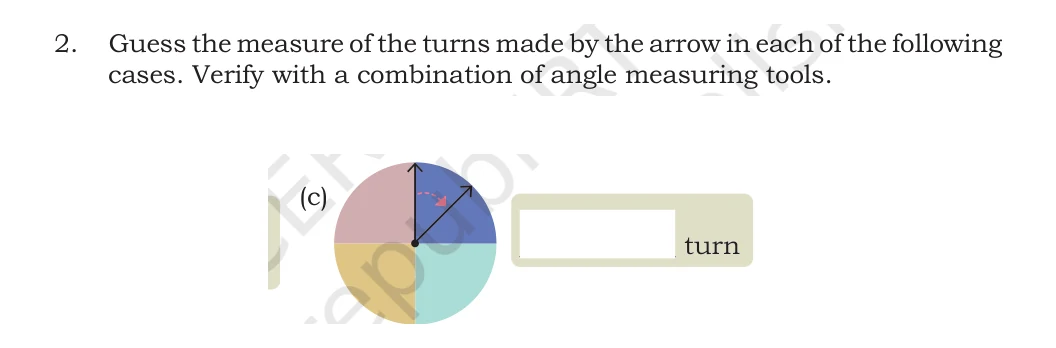
Find the turn made by the arrow in diagram (c).
Show detailed solution
- Step 1: Follow the pink arrow from its starting ray to its ending ray.
- Step 2: The arrow moves through one of 8 equal sections.
- Answer: The arrow makes a \frac{1}{8} turn.
Textbook page 38 · solved item 66
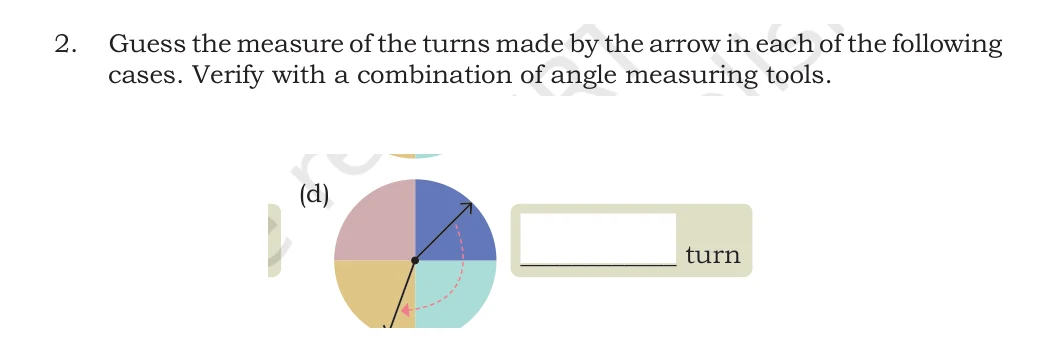
Find the turn made by the arrow in diagram (d).
Show detailed solution
- Step 1: Follow the pink arrow from its starting ray to its ending ray.
- Step 2: The turn covers 7 small sixteenth-turn sections, just under a half turn.
- Answer: The arrow makes a \frac{7}{16} turn.
Textbook page 38 · solved item 67
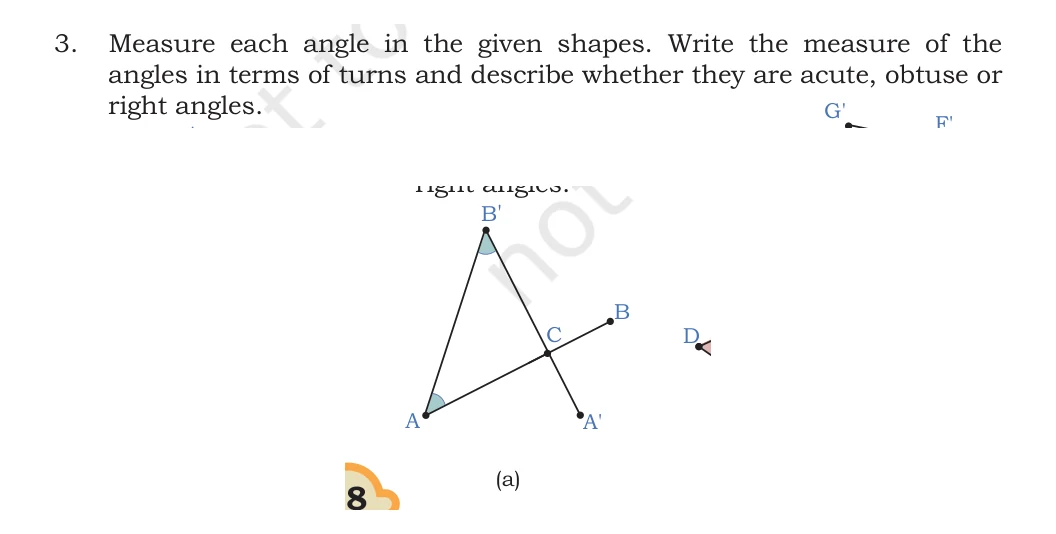
Measure and classify angle A in shape (a).
Show detailed solution
- Step 1: Line up an edge of the turn tool with one arm of the marked angle.
- Step 2: It matches one eighth-turn piece.
- Answer: The angle is \frac{1}{8} turn and is acute.
Textbook page 38 · solved item 68
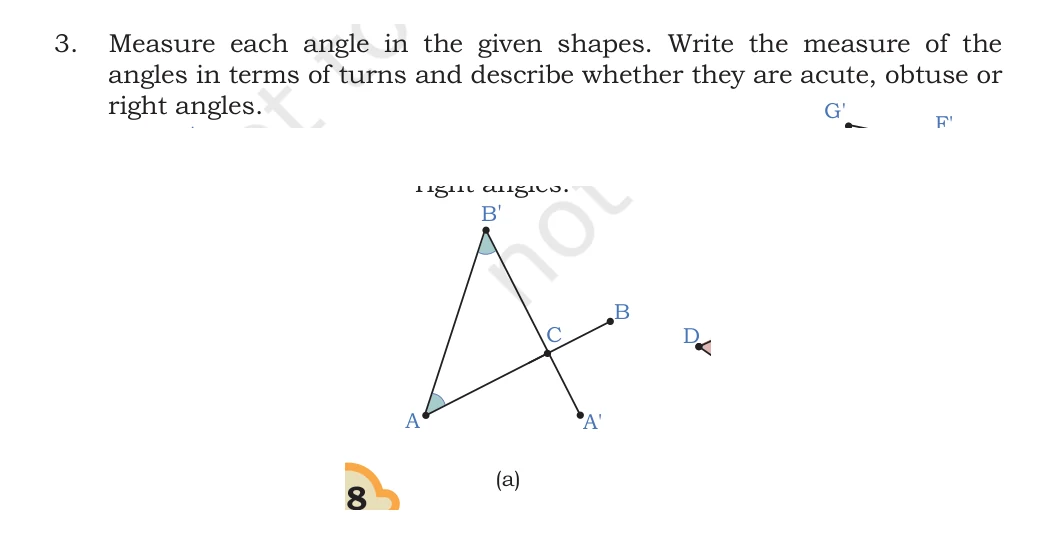
Measure and classify angle B' in shape (a).
Show detailed solution
- Step 1: Line up an edge of the turn tool with one arm of the marked angle.
- Step 2: It matches one eighth-turn piece.
- Answer: The angle is \frac{1}{8} turn and is acute.
Textbook page 38 · solved item 69
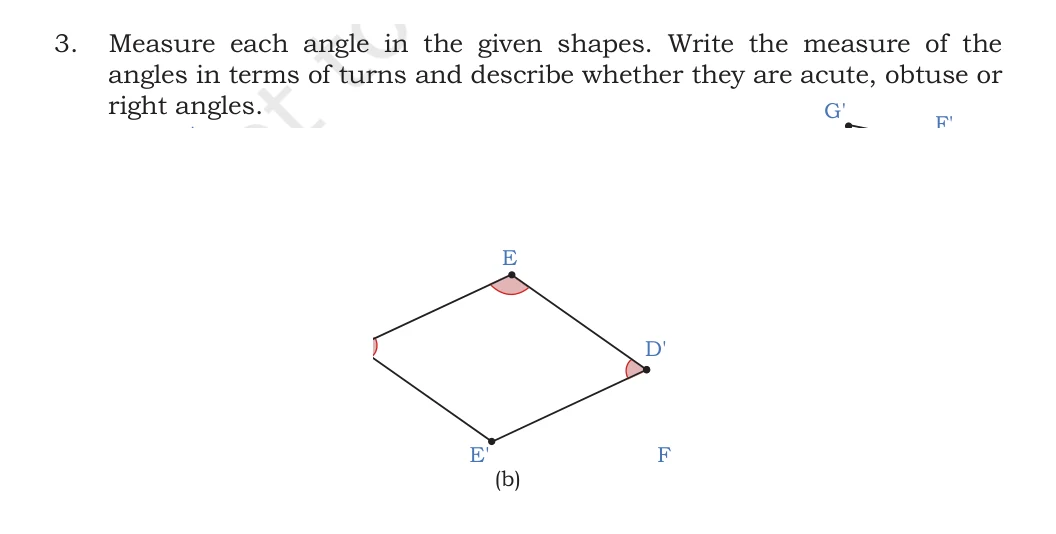
Measure and classify angle D in shape (b).
Show detailed solution
- Step 1: Line up an edge of the turn tool with one arm of the marked angle.
- Step 2: It matches one sixth-turn piece.
- Answer: The angle is \frac{1}{6} turn and is acute.
Textbook page 38 · solved item 70
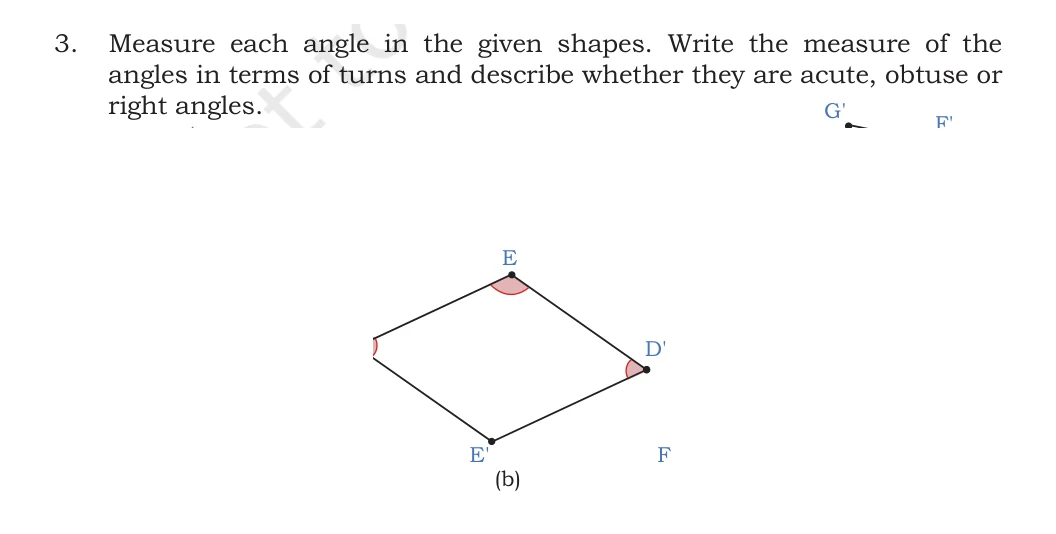
Measure and classify angle E in shape (b).
Show detailed solution
- Step 1: Line up an edge of the turn tool with one arm of the marked angle.
- Step 2: It matches two sixth-turn pieces, which together make one-third turn.
- Answer: The angle is \frac{1}{3} turn and is obtuse.
Textbook page 38 · solved item 71
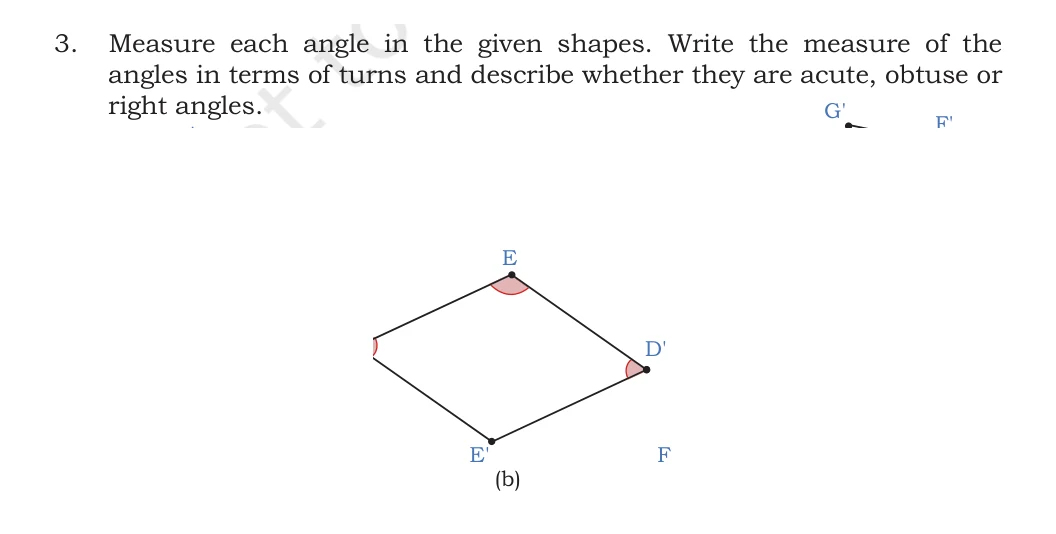
Measure and classify angle D' in shape (b).
Show detailed solution
- Step 1: Line up an edge of the turn tool with one arm of the marked angle.
- Step 2: It matches one sixth-turn piece.
- Answer: The angle is \frac{1}{6} turn and is acute.
Textbook page 38 · solved item 72
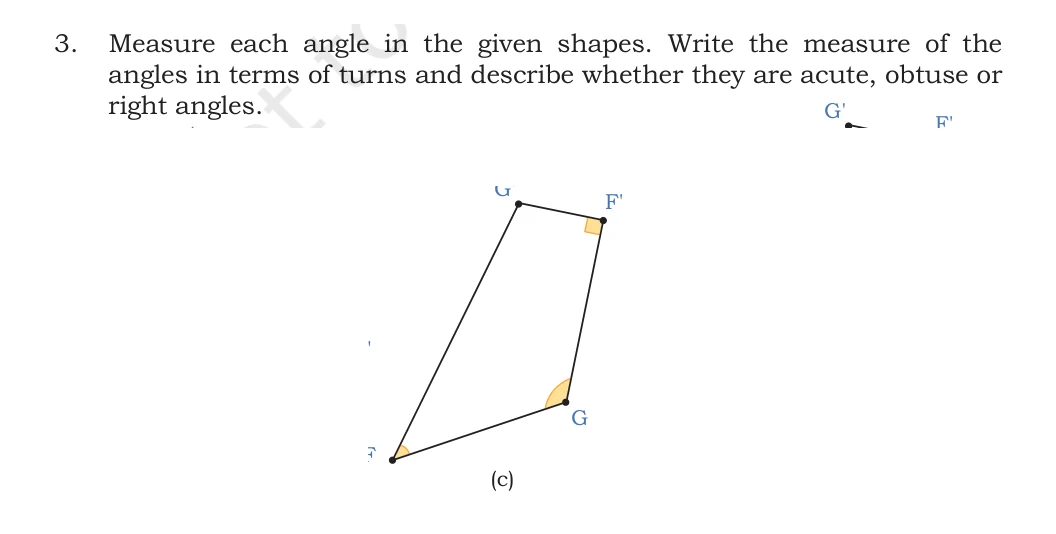
Measure and classify angle F in shape (c).
Show detailed solution
- Step 1: Line up an edge of the turn tool with one arm of the marked angle.
- Step 2: It matches one eighth-turn piece.
- Answer: The angle is \frac{1}{8} turn and is acute.
Textbook page 38 · solved item 73
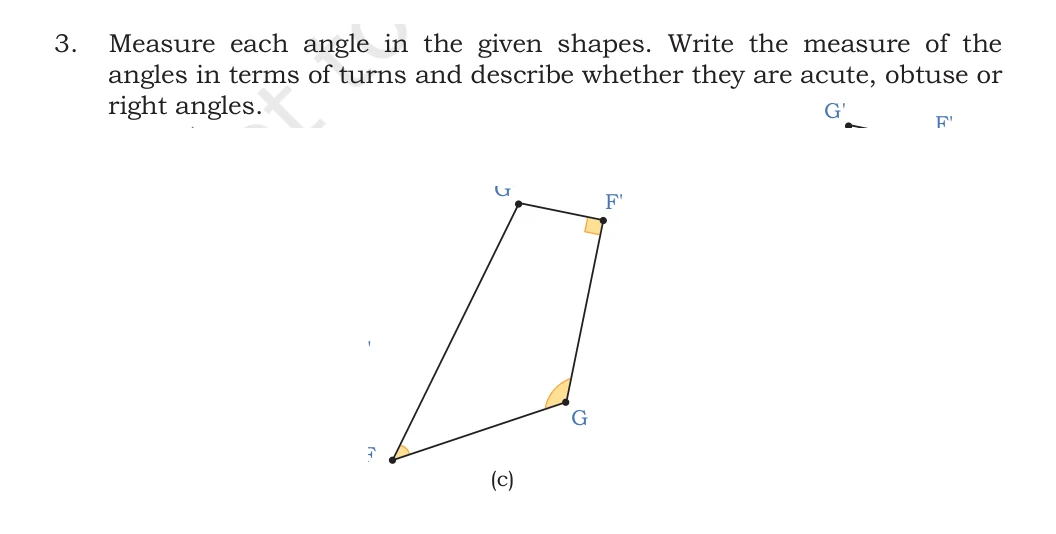
Measure and classify angle G in shape (c).
Show detailed solution
- Step 1: Line up an edge of the turn tool with one arm of the marked angle.
- Step 2: It matches two sixth-turn pieces, which make one-third turn.
- Answer: The angle is \frac{1}{3} turn and is obtuse.
Textbook page 38 · solved item 74
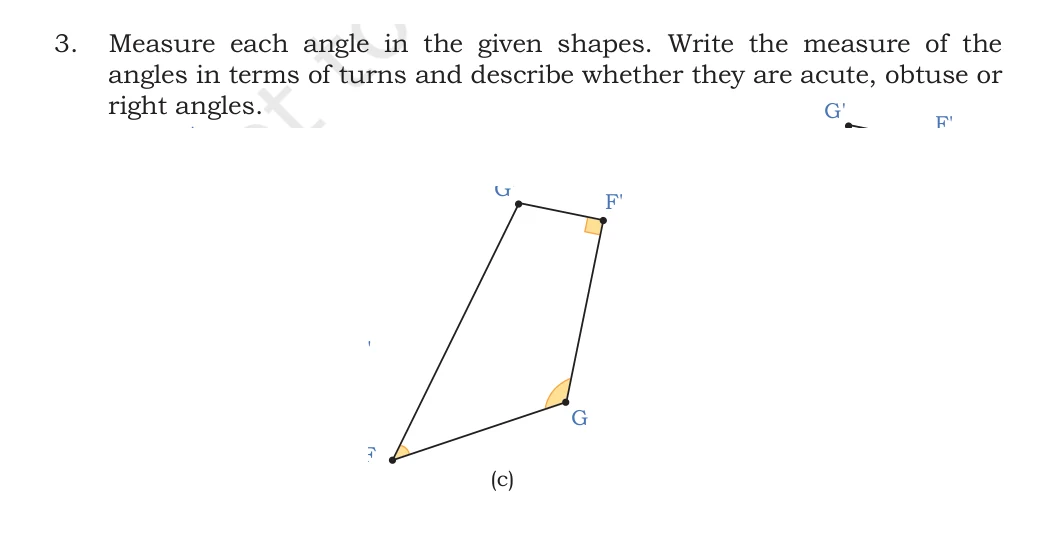
Measure and classify angle F' in shape (c).
Show detailed solution
- Step 1: Line up an edge of the turn tool with one arm of the marked angle.
- Step 2: The small square shows a quarter-turn corner.
- Answer: The angle is \frac{1}{4} turn and is right.
Detailed worked answers
Textbook page 39
Textbook page 39 · solved item 75
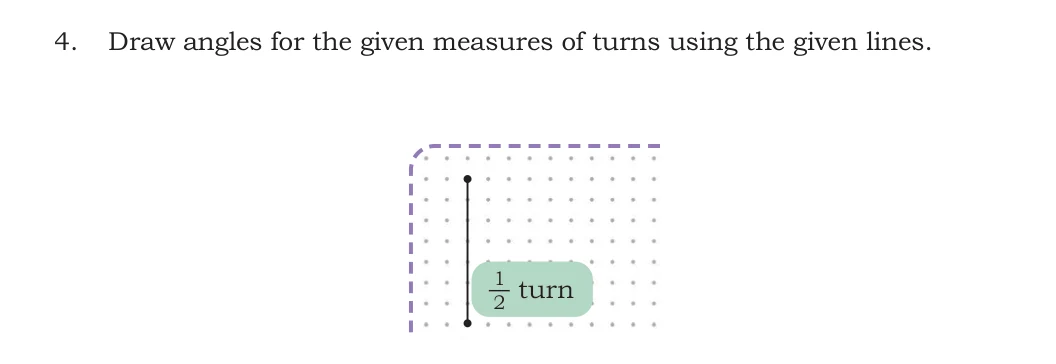
Complete the given line to draw a one-half turn.
Show detailed solution
- Step 1: Use the black dot as the vertex and the printed line as the first arm.
- Step 2: Draw the second arm opposite the given ray so the two rays make one straight line.
- Answer: The opening between the two arms now shows a one-half turn.
Textbook page 39 · solved item 76
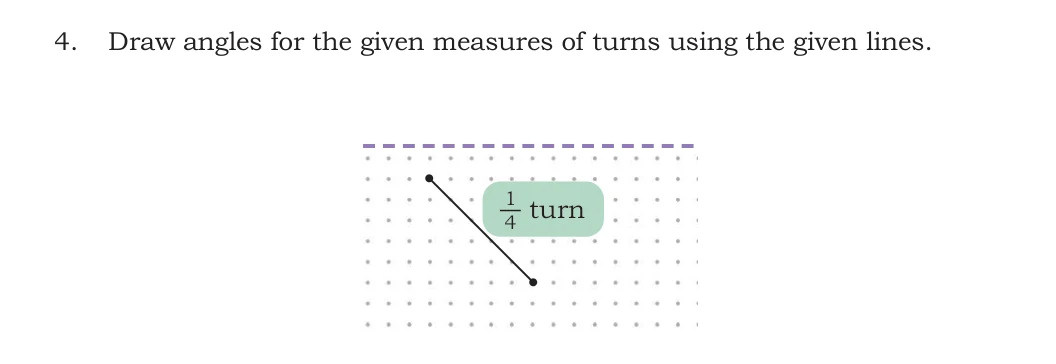
Complete the given line to draw a one-quarter turn.
Show detailed solution
- Step 1: Use the black dot as the vertex and the printed line as the first arm.
- Step 2: Draw the second arm at a square corner to the given slanting ray.
- Answer: The opening between the two arms now shows a one-quarter turn.
Textbook page 39 · solved item 77
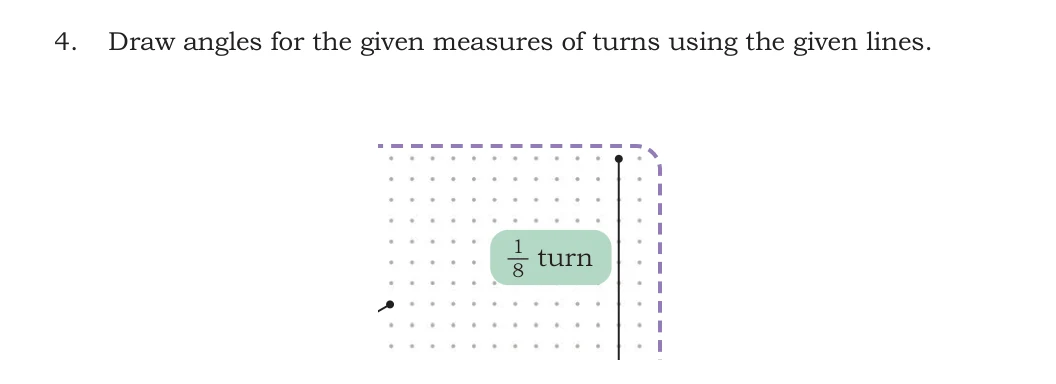
Complete the given line to draw a one-eighth turn.
Show detailed solution
- Step 1: Use the black dot as the vertex and the printed line as the first arm.
- Step 2: Draw the second arm halfway between a straight-up ray and a side ray.
- Answer: The opening between the two arms now shows a one-eighth turn.
Textbook page 39 · solved item 78
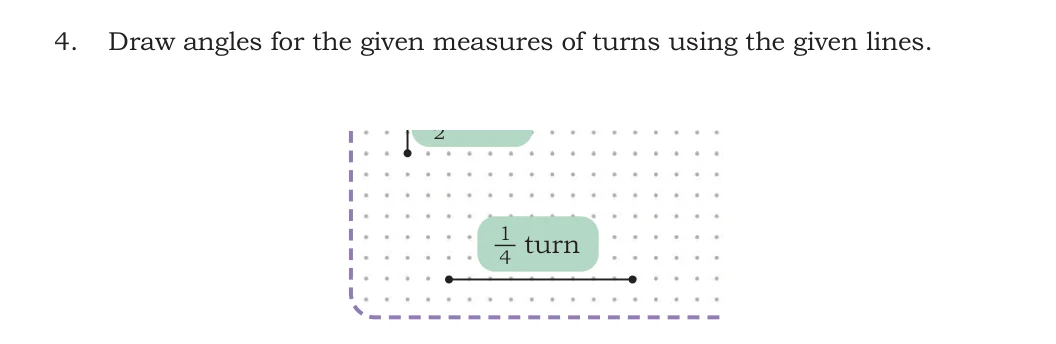
Complete the given line to draw a one-quarter turn.
Show detailed solution
- Step 1: Use the black dot as the vertex and the printed line as the first arm.
- Step 2: Draw the second arm straight up from the left end of the horizontal line.
- Answer: The opening between the two arms now shows a one-quarter turn.
Textbook page 39 · solved item 79
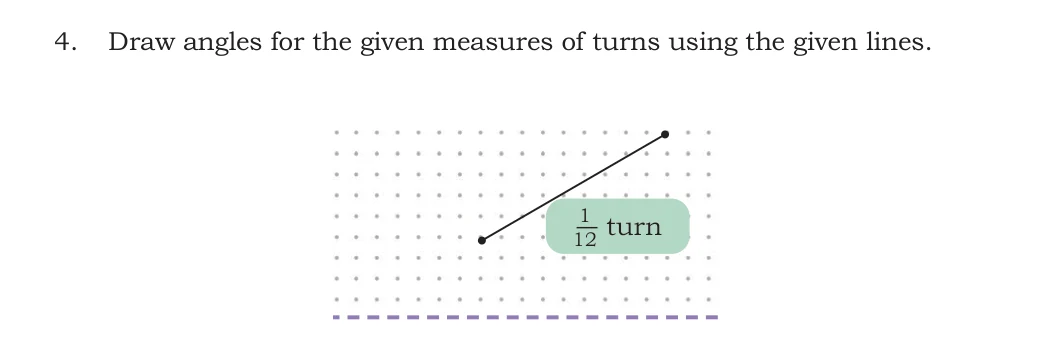
Complete the given line to draw a one-twelfth turn.
Show detailed solution
- Step 1: Use the black dot as the vertex and the printed line as the first arm.
- Step 2: Draw the second arm a small 30-degree opening from the given slanting ray.
- Answer: The opening between the two arms now shows a one-twelfth turn.
Textbook page 39 · solved item 80
Draw the angle formed by one-half turn in your notebook.
Show detailed solution
- Step 1: Draw one ray and mark its endpoint as the vertex.
- Step 2: Use the turn tool to move through \frac{1}{2} of a full circle and draw the second ray.
- Answer: The drawing shows a straight angle.
Textbook page 39 · solved item 81
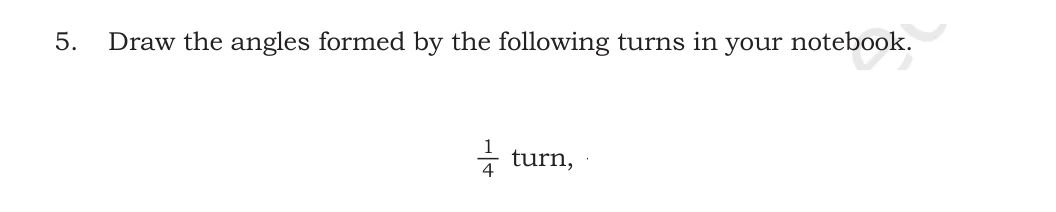
Draw the angle formed by one-quarter turn in your notebook.
Show detailed solution
- Step 1: Draw one ray and mark its endpoint as the vertex.
- Step 2: Use the turn tool to move through \frac{1}{4} of a full circle and draw the second ray.
- Answer: The drawing shows a right angle.
Textbook page 39 · solved item 82
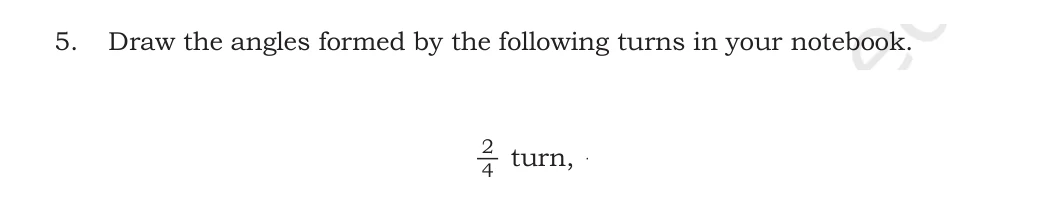
Draw the angle formed by two-quarters turn in your notebook.
Show detailed solution
- Step 1: Draw one ray and mark its endpoint as the vertex.
- Step 2: Use the turn tool to move through \frac{2}{4}=\frac{1}{2} of a full circle and draw the second ray.
- Answer: The drawing shows a straight angle.
Textbook page 39 · solved item 83
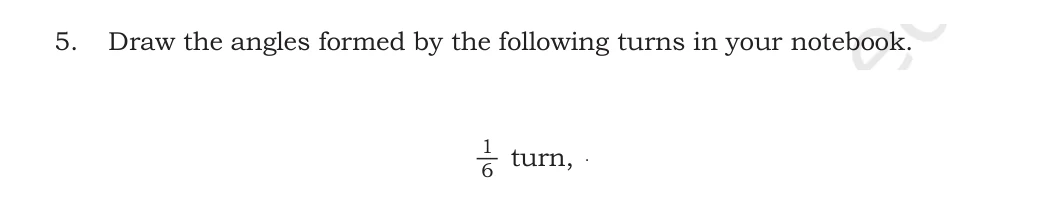
Draw the angle formed by one-sixth turn in your notebook.
Show detailed solution
- Step 1: Draw one ray and mark its endpoint as the vertex.
- Step 2: Use the turn tool to move through \frac{1}{6} of a full circle and draw the second ray.
- Answer: The drawing shows an acute angle.
Textbook page 39 · solved item 84
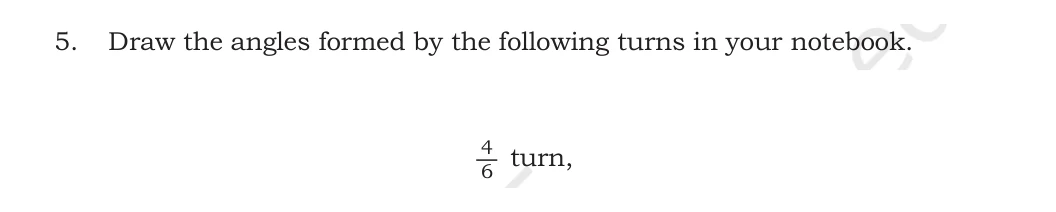
Draw the angle formed by four-sixths turn in your notebook.
Show detailed solution
- Step 1: Draw one ray and mark its endpoint as the vertex.
- Step 2: Use the turn tool to move through \frac{4}{6} of a full circle and draw the second ray.
- Answer: The drawing shows more than a straight angle.
Textbook page 39 · solved item 85
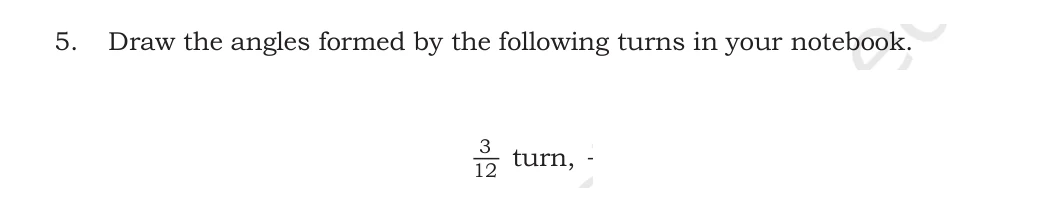
Draw the angle formed by three-twelfths turn in your notebook.
Show detailed solution
- Step 1: Draw one ray and mark its endpoint as the vertex.
- Step 2: Use the turn tool to move through \frac{3}{12}=\frac{1}{4} of a full circle and draw the second ray.
- Answer: The drawing shows a right angle.
Textbook page 39 · solved item 86
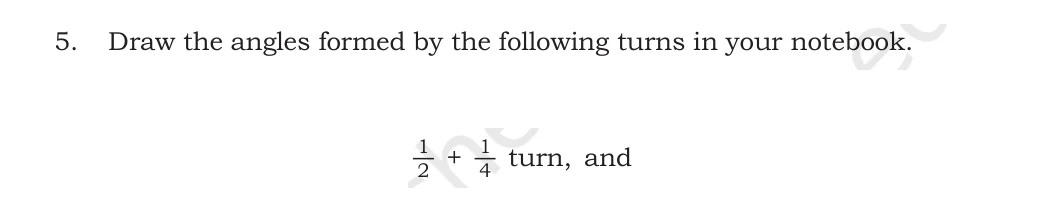
Draw the angle formed by one-half plus one-quarter turn in your notebook.
Show detailed solution
- Step 1: Draw one ray and mark its endpoint as the vertex.
- Step 2: Use the turn tool to move through \frac{1}{2}+\frac{1}{4}=\frac{3}{4} of a full circle and draw the second ray.
- Answer: The drawing shows a three-quarter turn.
Textbook page 39 · solved item 87

Draw the angle formed by one-eighth plus one-sixth turn in your notebook.
Show detailed solution
- Step 1: Draw one ray and mark its endpoint as the vertex.
- Step 2: Use the turn tool to move through \frac{1}{8}+\frac{1}{6}=\frac{7}{24} of a full circle and draw the second ray.
- Answer: The drawing shows an obtuse angle.
Textbook page 39 · solved item 88
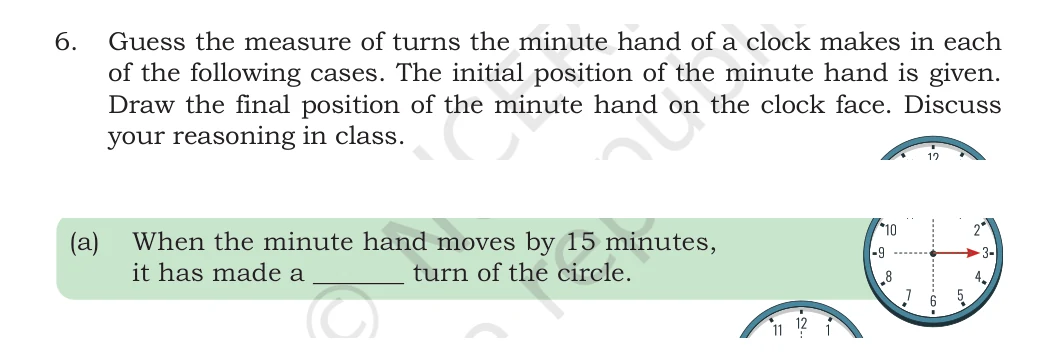
Complete the clock question for 15 minutes.
Show detailed solution
- Step 1: One complete trip around the clock is 60 minutes.
- Step 2: \frac{15}{60}=\frac{1}{4}. Draw the minute hand at the matching final position.
- Answer: one-quarter turn.
Textbook page 39 · solved item 89
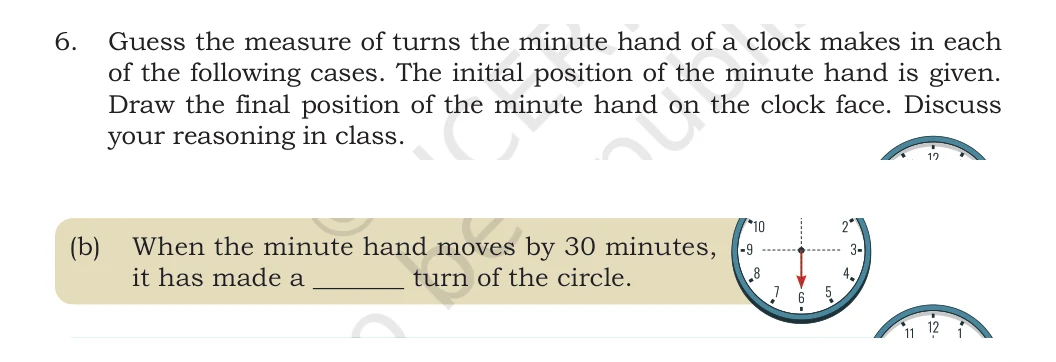
Complete the clock question for 30 minutes.
Show detailed solution
- Step 1: One complete trip around the clock is 60 minutes.
- Step 2: \frac{30}{60}=\frac{1}{2}. Draw the minute hand at the matching final position.
- Answer: one-half turn.
Textbook page 39 · solved item 90
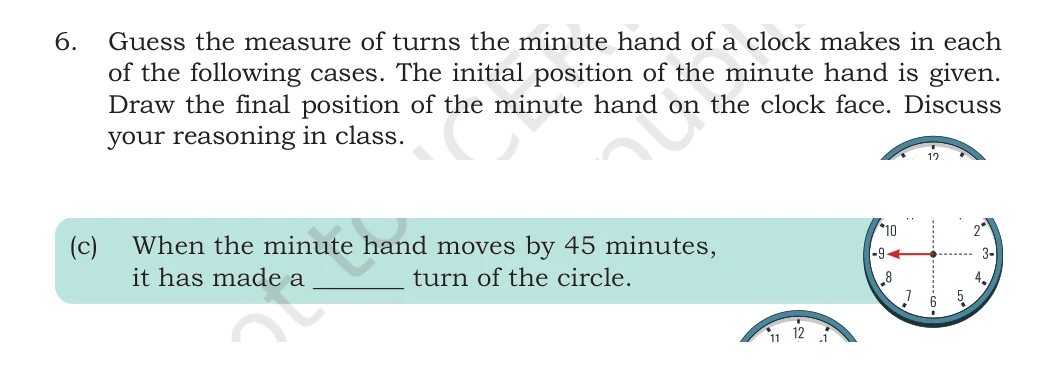
Complete the clock question for 45 minutes.
Show detailed solution
- Step 1: One complete trip around the clock is 60 minutes.
- Step 2: \frac{45}{60}=\frac{3}{4}. Draw the minute hand at the matching final position.
- Answer: three-quarter turn.
Textbook page 39 · solved item 91
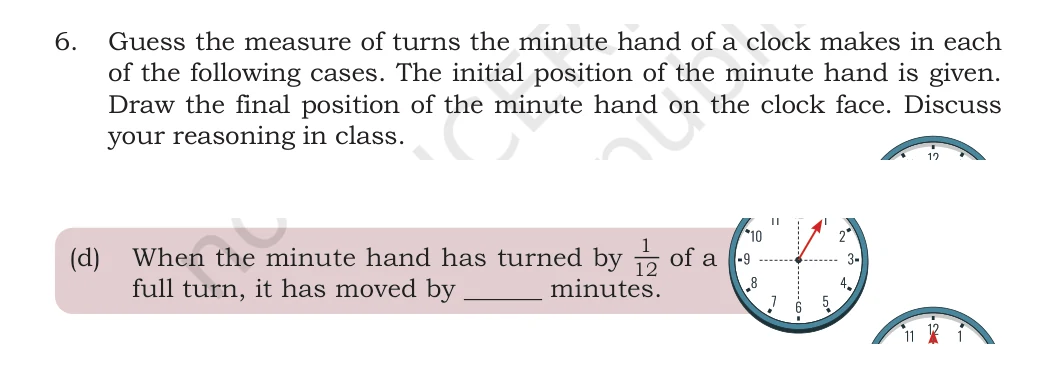
Complete the clock question for one-twelfth of a full turn.
Show detailed solution
- Step 1: One complete trip around the clock is 60 minutes.
- Step 2: 60\div12=5. Draw the minute hand at the matching final position.
- Answer: 5 minutes.
Textbook page 39 · solved item 92
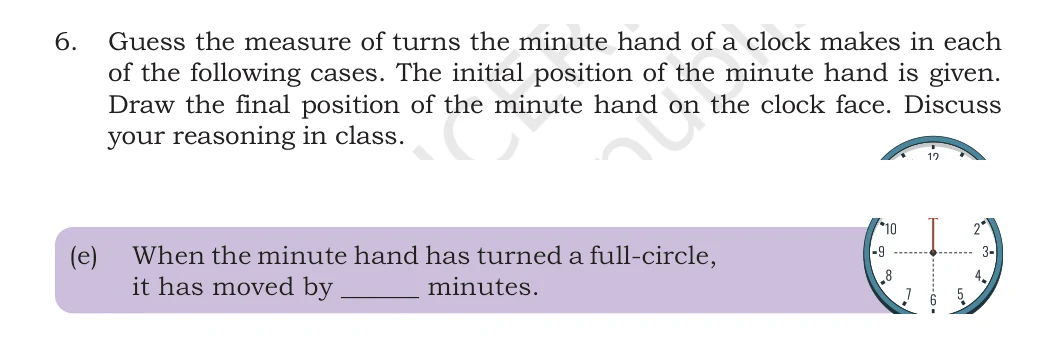
Complete the clock question for one full turn.
Show detailed solution
- Step 1: One complete trip around the clock is 60 minutes.
- Step 2: 60\div1=60. Draw the minute hand at the matching final position.
- Answer: 60 minutes.
Detailed worked answers
Textbook page 40
Textbook page 40 · solved item 93

How many minutes are in one-sixth of a full turn of the minute hand?
Show detailed solution
- Step 1: A full turn of the minute hand takes 60 minutes.
- Step 2: Split 60 minutes into 6 equal parts: 60\div6=10.
- Answer: One-sixth of a full turn is 10 minutes.
Textbook page 40 · solved item 94

How many minutes are in four-twelfths of a full turn of the minute hand?
Show detailed solution
- Step 1: One-twelfth of 60 minutes is 60\div12=5 minutes.
- Step 2: Four such parts take 4\times5=20 minutes.
- Answer: Four-twelfths of a full turn is 20 minutes.
Textbook page 40 · solved item 95
In which direction do the hands of a clock move?
Show detailed solution
- Step 1: Watch the hands move from 12 towards 1, 2, and 3.
- Step 2: This familiar direction is used as the name for the movement.
- Answer: Clock hands move clockwise. The opposite direction is anti-clockwise.
Textbook page 40 · solved item 96
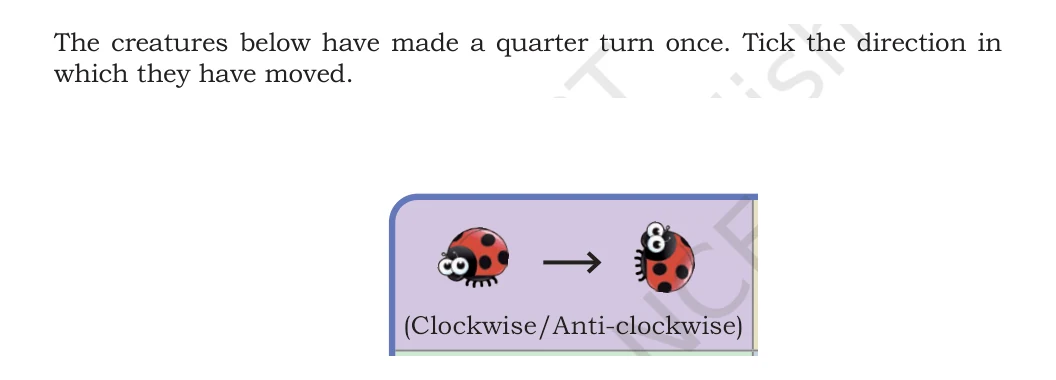
Did the ladybird make its quarter turn clockwise or anti-clockwise?
Show detailed solution
- Step 1: Compare the creature's starting and ending orientations.
- Step 2: Its head moves from the left side to the top.
- Answer: Tick clockwise.
Textbook page 40 · solved item 97
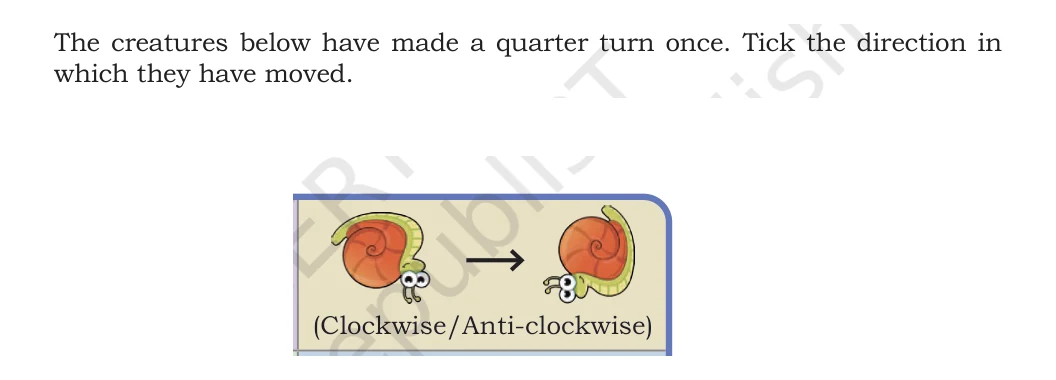
Did the snail make its quarter turn clockwise or anti-clockwise?
Show detailed solution
- Step 1: Compare the creature's starting and ending orientations.
- Step 2: Its head moves from the bottom to the left.
- Answer: Tick anti-clockwise.
Textbook page 40 · solved item 98
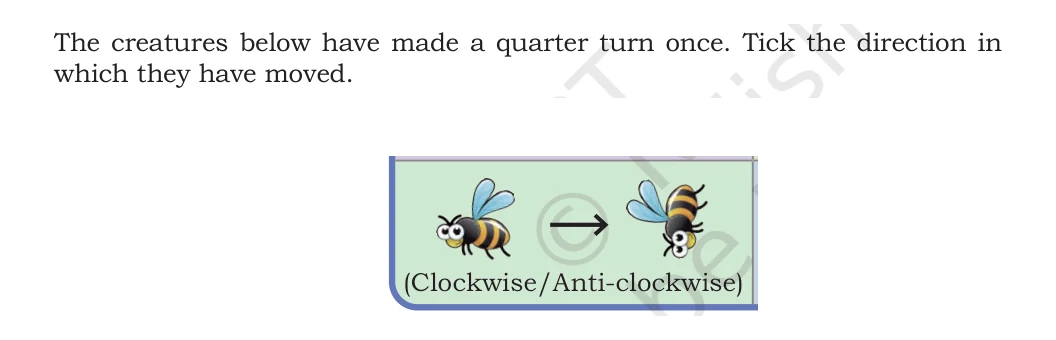
Did the bee make its quarter turn clockwise or anti-clockwise?
Show detailed solution
- Step 1: Compare the creature's starting and ending orientations.
- Step 2: Its head moves from the left side to the bottom.
- Answer: Tick anti-clockwise.
Textbook page 40 · solved item 99
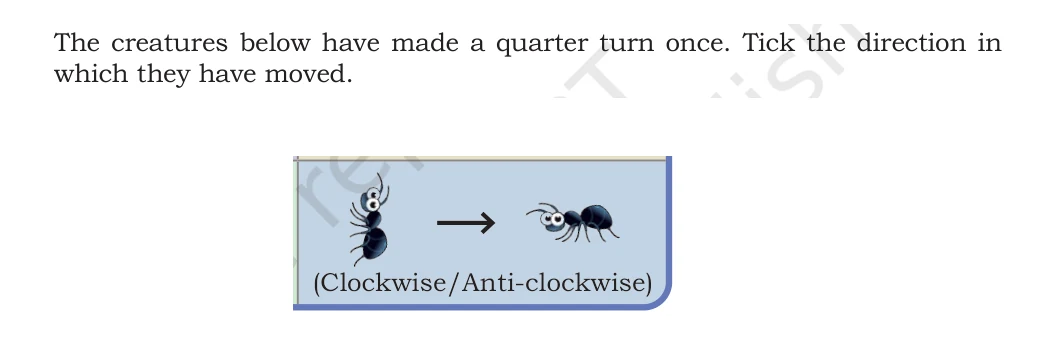
Did the ant make its quarter turn clockwise or anti-clockwise?
Show detailed solution
- Step 1: Compare the creature's starting and ending orientations.
- Step 2: Its head moves from the top to the right.
- Answer: Tick clockwise.
Textbook page 40 · solved item 100
Is opening a usual screw-type tap a clockwise or anti-clockwise movement?
Show detailed solution
- Step 1: Look down at the object from the side on which you turn it.
- Step 2: Turning left loosens the tap mechanism.
- Answer: It usually moves anti-clockwise. Some specially made fittings can work differently.
Textbook page 40 · solved item 101
Is unscrewing a usual lid a clockwise or anti-clockwise movement?
Show detailed solution
- Step 1: Look down at the object from the side on which you turn it.
- Step 2: Turning left releases the lid from its thread.
- Answer: It usually moves anti-clockwise. Some specially made fittings can work differently.
Textbook page 40 · solved item 102
Is loosening a usual nut a clockwise or anti-clockwise movement?
Show detailed solution
- Step 1: Look down at the object from the side on which you turn it.
- Step 2: Turning left moves the nut along the thread and loosens it.
- Answer: It usually moves anti-clockwise. Some specially made fittings can work differently.
Detailed worked answers
Textbook page 41
Textbook page 41 · solved item 103
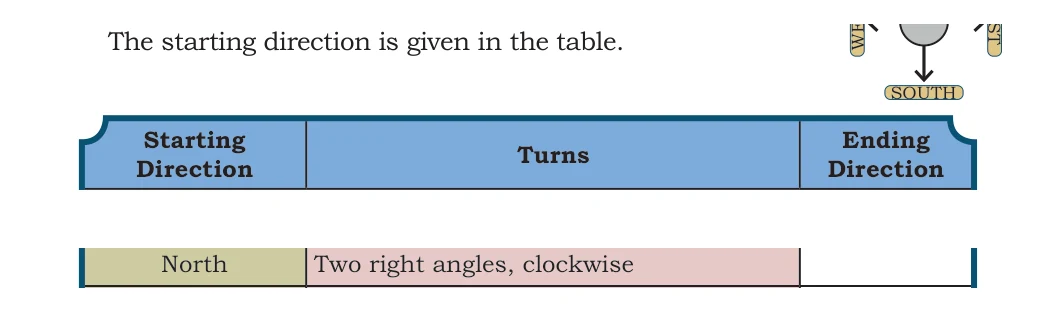
Starting from North, which direction will you face after two right angles clockwise?
Show detailed solution
- Step 1: Trace every turn on the North-East-South-West direction guide.
- Step 2: North to East is one right turn; East to South is the second.
- Answer: The ending direction is South.
Textbook page 41 · solved item 104
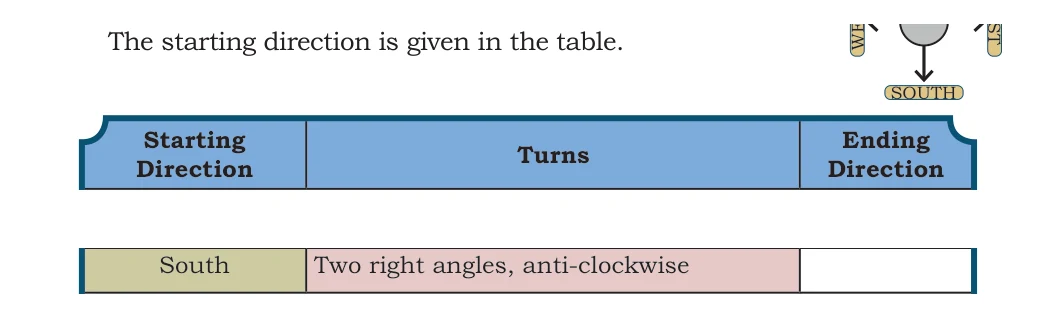
Starting from South, which direction will you face after two right angles anti-clockwise?
Show detailed solution
- Step 1: Trace every turn on the North-East-South-West direction guide.
- Step 2: South to East is one left turn; East to North is the second.
- Answer: The ending direction is North.
Textbook page 41 · solved item 105
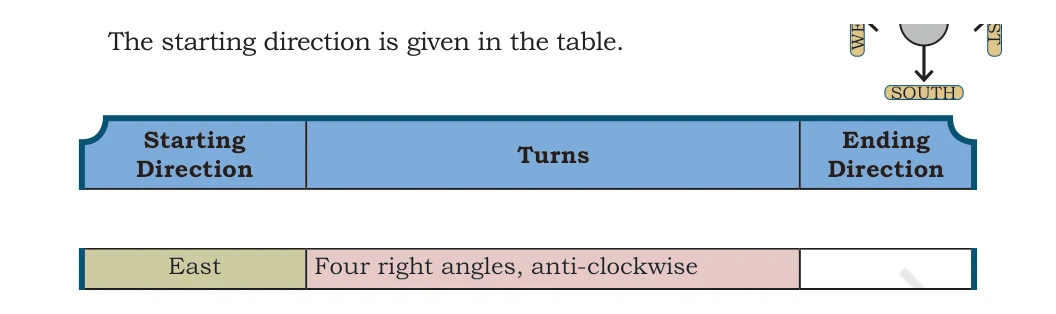
Starting from East, which direction will you face after four right angles anti-clockwise?
Show detailed solution
- Step 1: Trace every turn on the North-East-South-West direction guide.
- Step 2: Four right-angle turns make one full turn.
- Answer: The ending direction is East.
Textbook page 41 · solved item 106
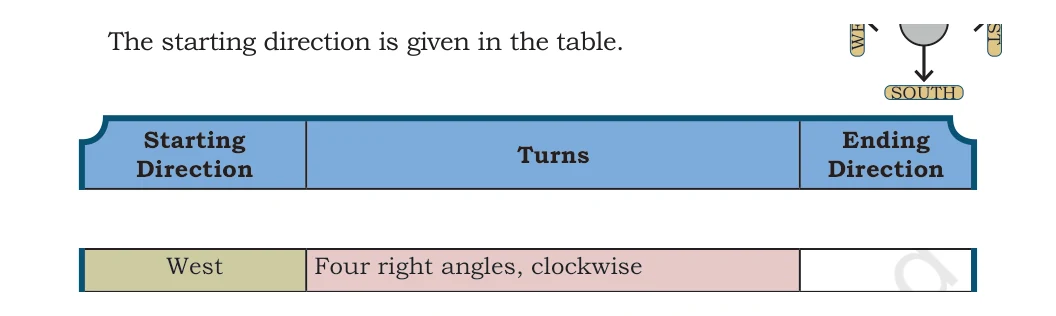
Starting from West, which direction will you face after four right angles clockwise?
Show detailed solution
- Step 1: Trace every turn on the North-East-South-West direction guide.
- Step 2: Four right-angle turns make one full turn.
- Answer: The ending direction is West.
Textbook page 41 · solved item 107
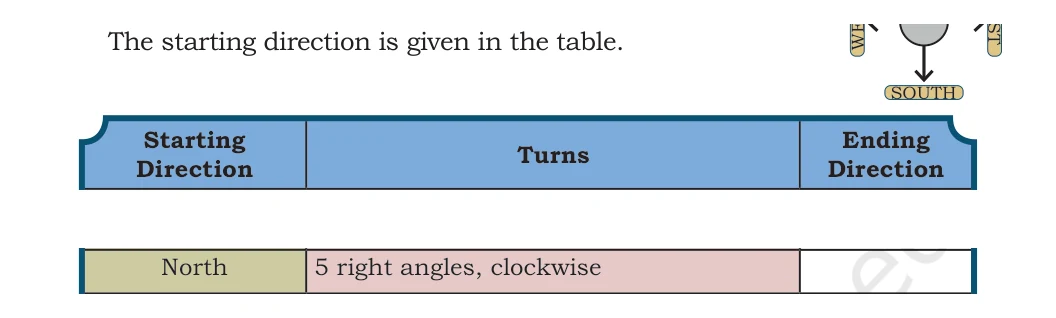
Starting from North, which direction will you face after five right angles clockwise?
Show detailed solution
- Step 1: Trace every turn on the North-East-South-West direction guide.
- Step 2: Four turns return to North, and the fifth turn points East.
- Answer: The ending direction is East.
Textbook page 41 · solved item 108
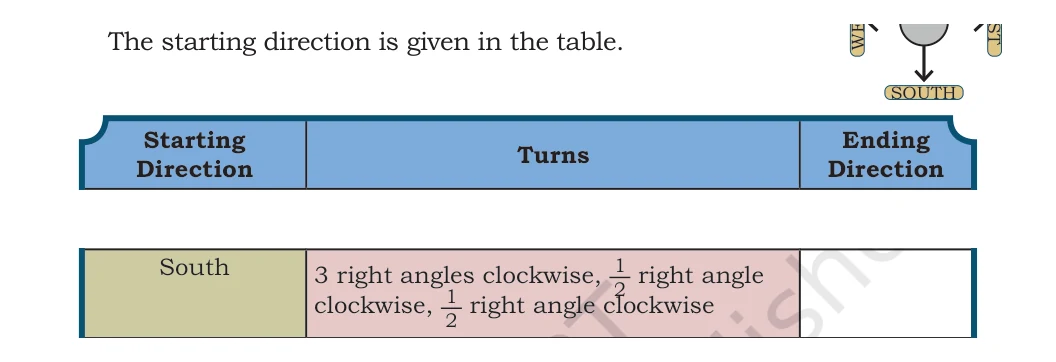
Starting from South, which direction will you face after three right angles and two half-right-angle turns clockwise?
Show detailed solution
- Step 1: Trace every turn on the North-East-South-West direction guide.
- Step 2: The two half-right-angle turns make one more right angle, so the total is four right angles.
- Answer: The ending direction is South.
Textbook page 41 · solved item 109
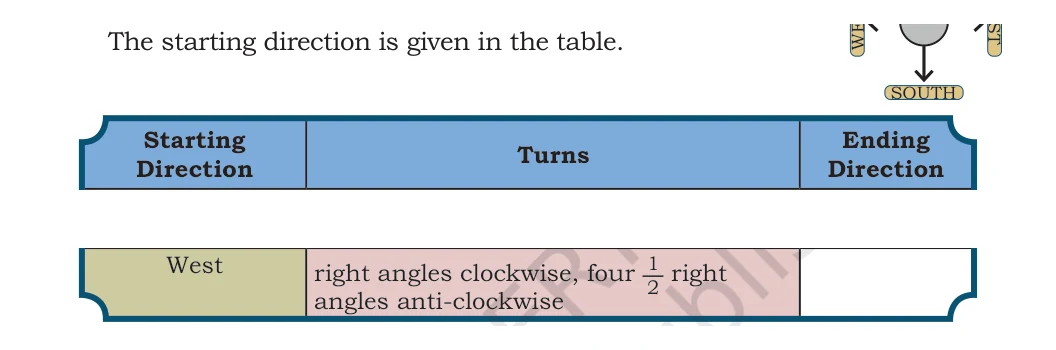
Starting from West, which direction will you face after one right angle clockwise and four half-right-angle turns anti-clockwise?
Show detailed solution
- Step 1: Trace every turn on the North-East-South-West direction guide.
- Step 2: First face North. Four half-right-angle turns make two right angles anti-clockwise, taking North to South.
- Answer: The ending direction is South.
Textbook page 41 · solved item 110
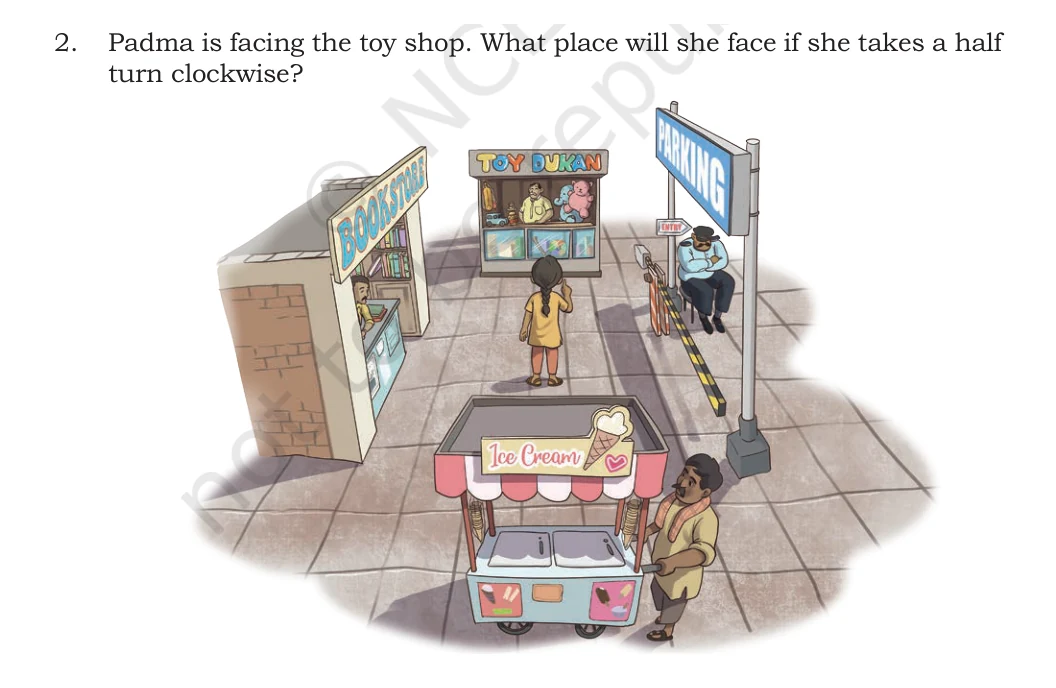
Padma is facing the toy shop. What place will she face after a half turn clockwise?
Show detailed solution
- Step 1: The toy shop is directly in front of Padma.
- Step 2: A half turn makes her face the place directly behind her.
- Answer: She will face the ice-cream cart.
Textbook page 41 · solved item 111
What other turn can Padma make to face the same place?
Show detailed solution
- Step 1: A half turn covers the same amount whichever direction she turns.
- Step 2: Turning anti-clockwise through half a circle also points her directly behind.
- Answer: She can make a half turn anti-clockwise.