
Question-by-question working
Read the prompt, attempt it, then check each step
Every exercise subpart and table row is a separate item. Shared figures and table headings are repeated whenever they are needed to understand the question.
Detailed worked answers
Textbook page 164
Textbook page 164 · solved item 1

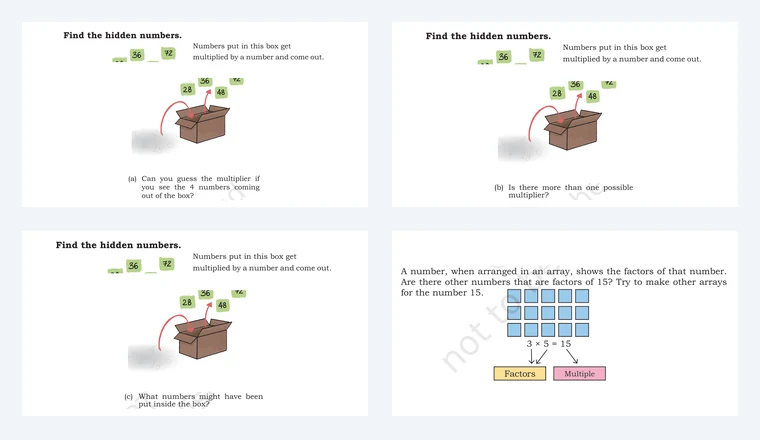
Guess the multiplier when 28, 36, 48, and 72 come out of the box.
Show detailed solution
- Step 1: A possible multiplier must divide every output exactly.
- Step 2: 1, 2, and 4 divide each of 28, 36, 48, and 72.
- Step 3: No larger number divides all four outputs because the common factors of 28 and 36 are only 1, 2, and 4.
- Answer: The multiplier can be 1, 2, or 4.
Textbook page 164 · solved item 2
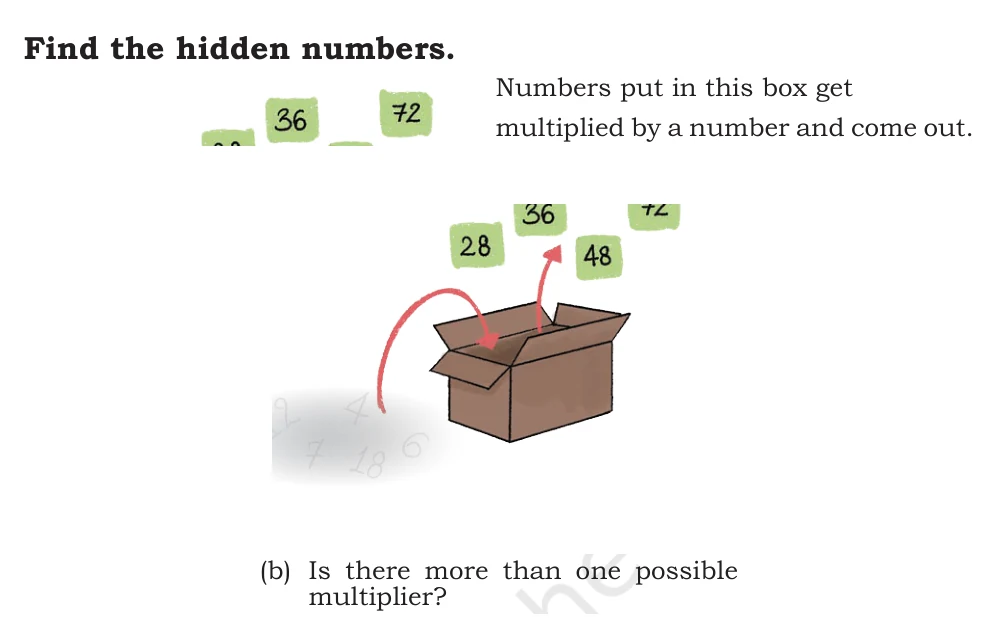
Is there more than one possible multiplier for the box?
Show detailed solution
- Step 1: Check multiplier 1: every output can be made by multiplying a whole number by 1.
- Step 2: Check multipliers 2 and 4: all four outputs divide exactly by both.
- Step 3: That gives three different multipliers that work.
- Answer: Yes. The possible multipliers are 1, 2, and 4.
Textbook page 164 · solved item 3
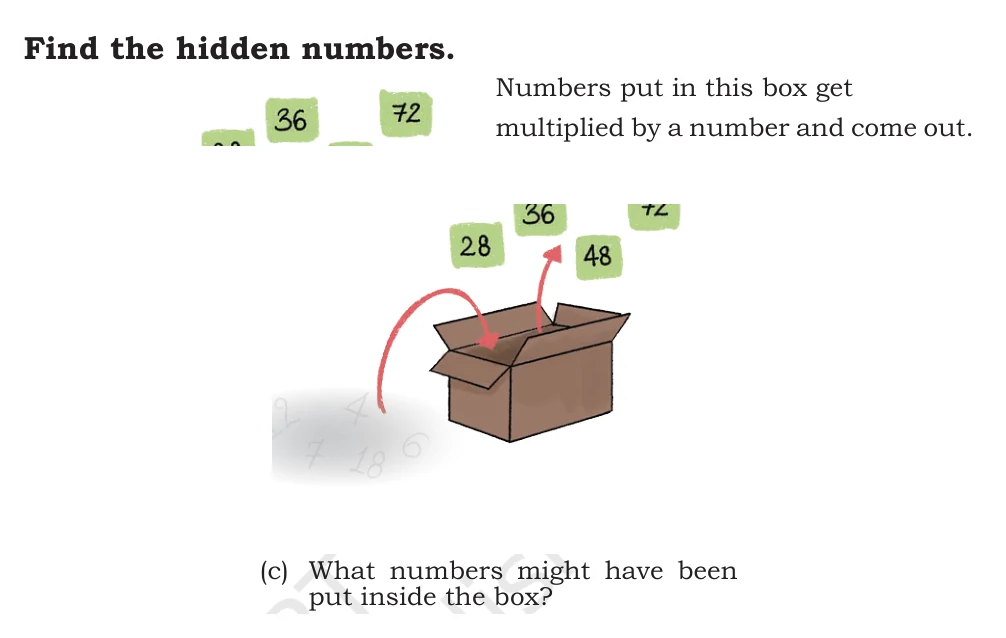
What numbers might have been put inside the multiplier box?
Show detailed solution
- Step 1: If the multiplier is 1, the inputs are 28, 36, 48, and 72.
- Step 2: If the multiplier is 2, divide each output by 2: the inputs are 14, 18, 24, and 36.
- Step 3: If the multiplier is 4, divide each output by 4: the inputs are 7, 9, 12, and 18.
- Answer: Any one of these three input sets works with its matching multiplier.
Textbook page 164 · solved item 4
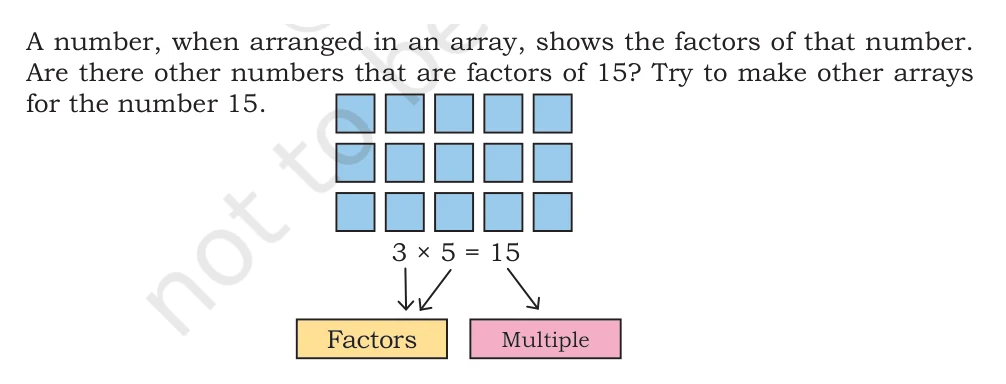
Find the other factors of 15 and make other arrays for 15.
Show detailed solution
- Step 1: The shown array has 3 rows of 5, so 3\times5=15.
- Step 2: Turn it around to get 5 rows of 3, so 5\times3=15.
- Step 3: We can also make 1 row of 15, or 15 rows of 1.
- Answer: The factors of 15 are 1, 3, 5, and 15.
Detailed worked answers
Textbook page 165
Textbook page 165 · solved item 5
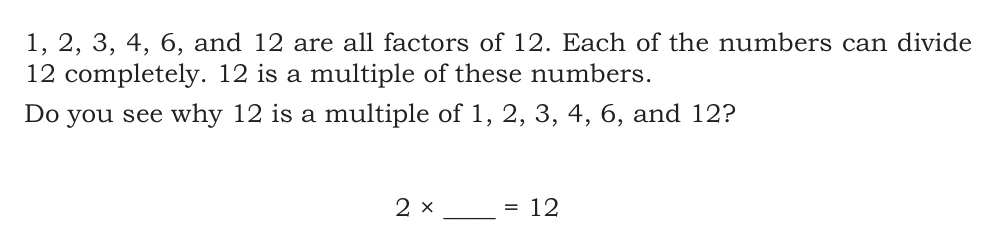
Fill the blank in 2\times\square=12.
Show detailed solution
- Step 1: Count how many groups of 2 make 12.
- Step 2: 2+2+2+2+2+2=12, so there are 6 groups.
- Step 3: Check by multiplying the two completed factors.
- Answer: 2\times6=12, so the missing number is 6.
Textbook page 165 · solved item 6
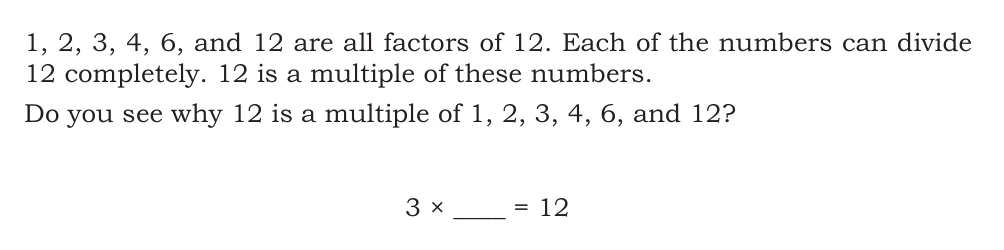
Fill the blank in 3\times\square=12.
Show detailed solution
- Step 1: Count in threes: 3,6,9,12.
- Step 2: It takes 4 jumps of 3 to reach 12.
- Step 3: Check by multiplying the two completed factors.
- Answer: 3\times4=12, so the missing number is 4.
Textbook page 165 · solved item 7
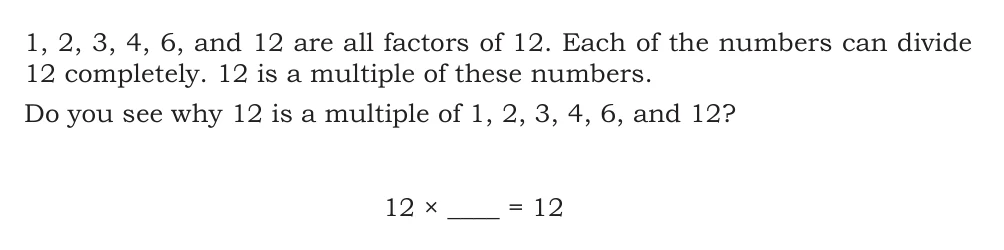
Fill the blank in 12\times\square=12.
Show detailed solution
- Step 1: One group of 12 already contains 12.
- Step 2: So 12 needs to be taken only once.
- Step 3: Check by multiplying the two completed factors.
- Answer: 12\times1=12, so the missing number is 1.
Textbook page 165 · solved item 8
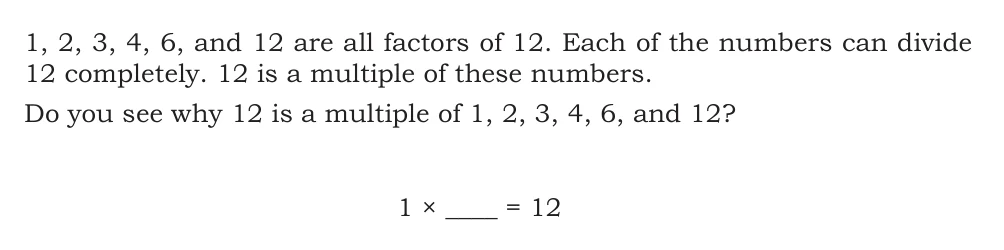
Fill the blank in 1\times\square=12.
Show detailed solution
- Step 1: Multiplying by 1 keeps a number unchanged.
- Step 2: The number that stays 12 is 12 itself.
- Step 3: Check by multiplying the two completed factors.
- Answer: 1\times12=12, so the missing number is 12.
Textbook page 165 · solved item 9
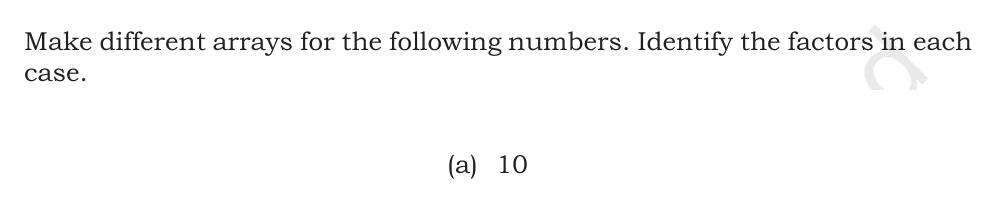
Make different arrays for 10 and identify its factors.
Show detailed solution
- Step 1: Begin with one row of all the objects: 1\times10=10.
- Step 2: The different rectangular arrays are 1\times10, 2\times5.
- Step 3: Read both the row number and the column number from every array.
- Answer: The factors of 10 are 1,2,5,10.
Textbook page 165 · solved item 10
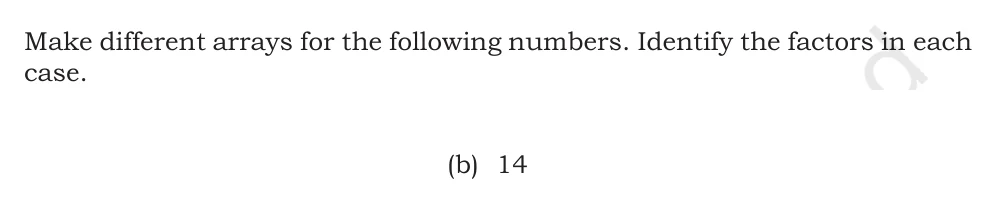
Make different arrays for 14 and identify its factors.
Show detailed solution
- Step 1: Begin with one row of all the objects: 1\times14=14.
- Step 2: The different rectangular arrays are 1\times14, 2\times7.
- Step 3: Read both the row number and the column number from every array.
- Answer: The factors of 14 are 1,2,7,14.
Textbook page 165 · solved item 11

Make different arrays for 13 and identify its factors.
Show detailed solution
- Step 1: Begin with one row of all the objects: 1\times13=13.
- Step 2: The different rectangular arrays are 1\times13.
- Step 3: Read both the row number and the column number from every array.
- Answer: The factors of 13 are 1,13.
Textbook page 165 · solved item 12
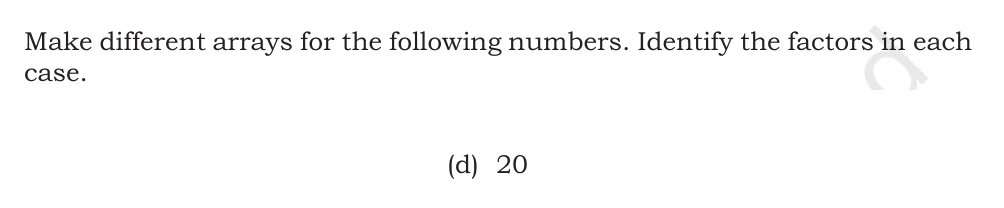
Make different arrays for 20 and identify its factors.
Show detailed solution
- Step 1: Begin with one row of all the objects: 1\times20=20.
- Step 2: The different rectangular arrays are 1\times20, 2\times10, 4\times5.
- Step 3: Read both the row number and the column number from every array.
- Answer: The factors of 20 are 1,2,4,5,10,20.
Textbook page 165 · solved item 13
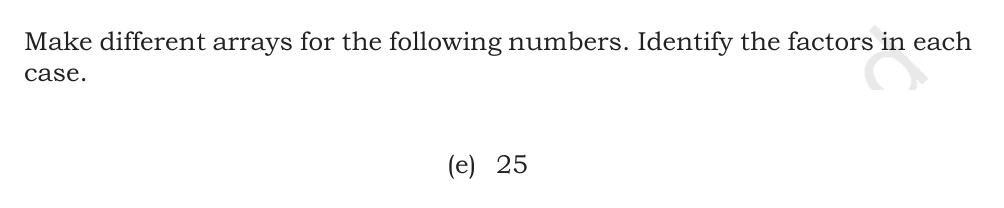
Make different arrays for 25 and identify its factors.
Show detailed solution
- Step 1: Begin with one row of all the objects: 1\times25=25.
- Step 2: The different rectangular arrays are 1\times25, 5\times5.
- Step 3: Read both the row number and the column number from every array.
- Answer: The factors of 25 are 1,5,25.
Textbook page 165 · solved item 14
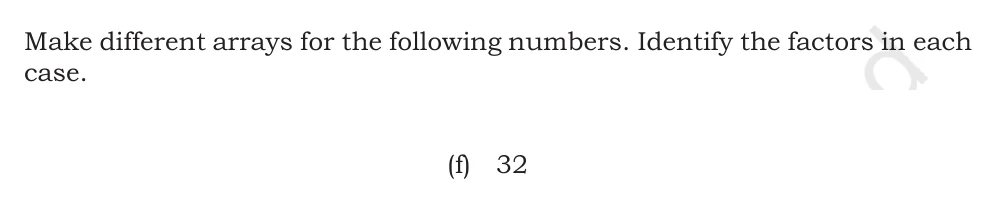
Make different arrays for 32 and identify its factors.
Show detailed solution
- Step 1: Begin with one row of all the objects: 1\times32=32.
- Step 2: The different rectangular arrays are 1\times32, 2\times16, 4\times8.
- Step 3: Read both the row number and the column number from every array.
- Answer: The factors of 32 are 1,2,4,8,16,32.
Textbook page 165 · solved item 15
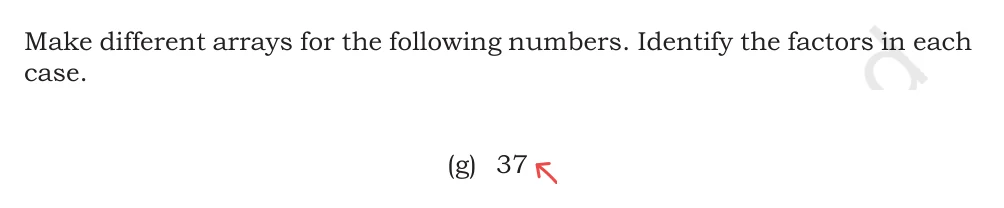
Make different arrays for 37 and identify its factors.
Show detailed solution
- Step 1: Begin with one row of all the objects: 1\times37=37.
- Step 2: The different rectangular arrays are 1\times37.
- Step 3: Read both the row number and the column number from every array.
- Answer: The factors of 37 are 1,37.
Textbook page 165 · solved item 16
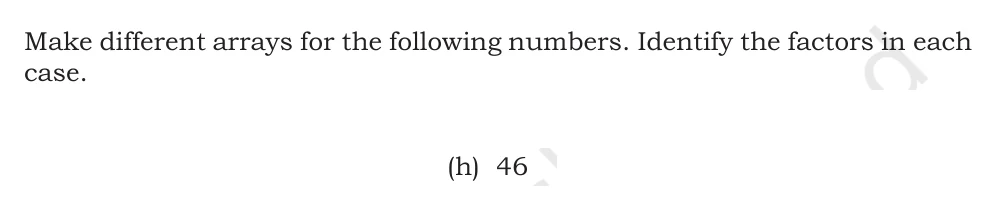
Make different arrays for 46 and identify its factors.
Show detailed solution
- Step 1: Begin with one row of all the objects: 1\times46=46.
- Step 2: The different rectangular arrays are 1\times46, 2\times23.
- Step 3: Read both the row number and the column number from every array.
- Answer: The factors of 46 are 1,2,23,46.
Textbook page 165 · solved item 17
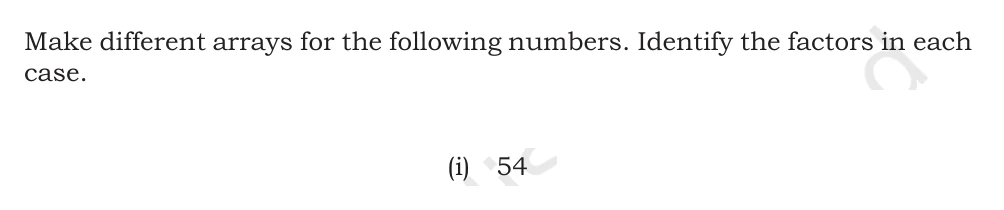
Make different arrays for 54 and identify its factors.
Show detailed solution
- Step 1: Begin with one row of all the objects: 1\times54=54.
- Step 2: The different rectangular arrays are 1\times54, 2\times27, 3\times18, 6\times9.
- Step 3: Read both the row number and the column number from every array.
- Answer: The factors of 54 are 1,2,3,6,9,18,27,54.
Textbook page 165 · solved item 18
Why are numbers such as 13 and 37 called prime numbers?
Show detailed solution
- Step 1: Try to make equal-row rectangular arrays for 13. Only 1\times13 works.
- Step 2: Do the same for 37. Only 1\times37 works.
- Step 3: Each number has exactly two factors: 1 and the number itself.
- Answer: They are prime numbers because they have exactly two factors.
Textbook page 165 · solved item 19
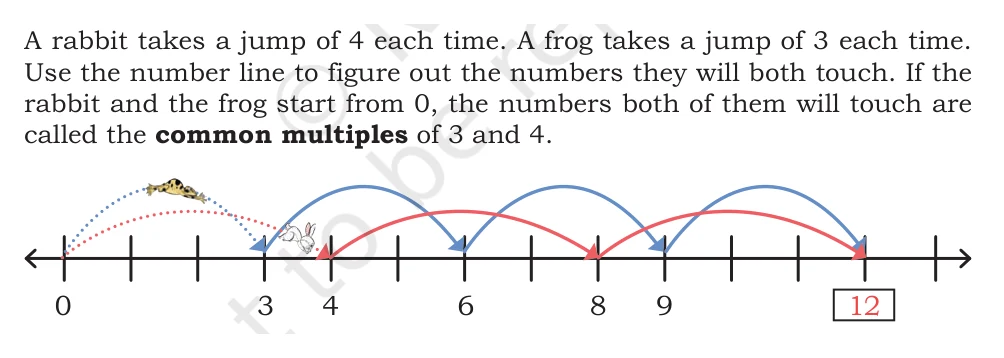
Which number on the shown number line is touched by both the rabbit jumping 4 and the frog jumping 3?
Show detailed solution
- Step 1: The frog touches 3,6,9,12.
- Step 2: The rabbit touches 4,8,12.
- Step 3: Compare the two lists. The first positive number in both is 12.
- Answer: Both touch 12.
Textbook page 165 · solved item 20
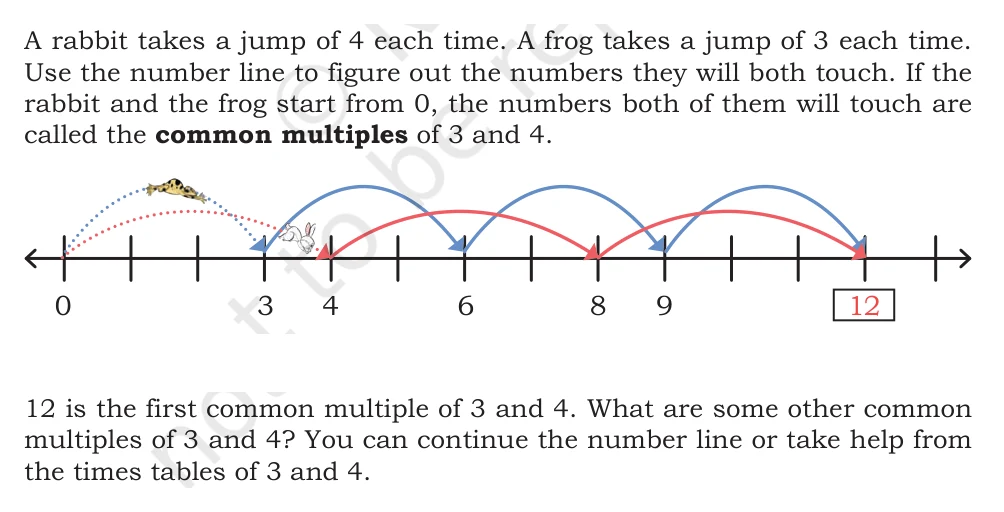
Find some other common multiples of 3 and 4 after 12.
Show detailed solution
- Step 1: Continue the multiples of 3: 15,18,21,24,27,30,33,36,\ldots.
- Step 2: Continue the multiples of 4: 16,20,24,28,32,36,\ldots.
- Step 3: Pick the numbers that appear in both lists.
- Answer: Some other common multiples are 24,36,48, and 60.
Textbook page 165 · solved item 21
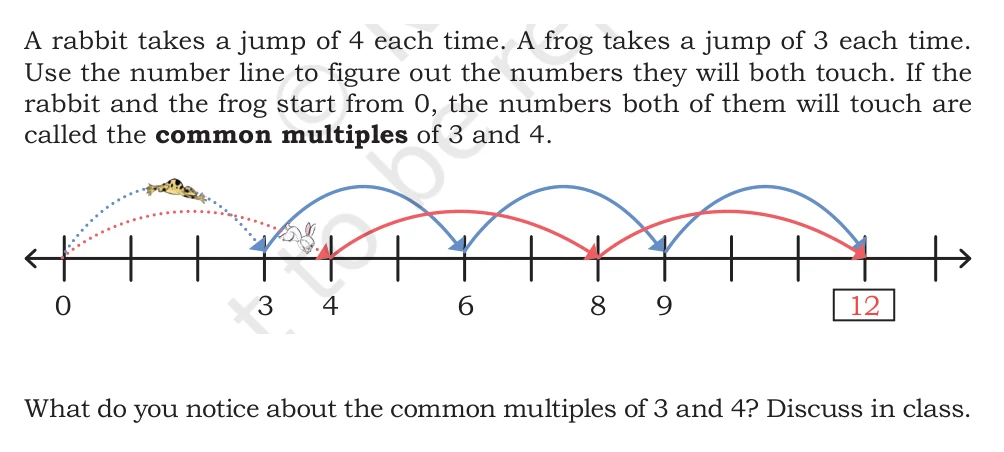
What do you notice about the common multiples of 3 and 4?
Show detailed solution
- Step 1: The common multiples begin 12,24,36,48,60,\ldots.
- Step 2: The difference between neighbouring numbers is always 12.
- Step 3: Each number in the list is also in the 12 times table.
- Answer: Every common multiple of 3 and 4 is a multiple of 12.
Detailed worked answers
Textbook page 166
Textbook page 166 · solved item 22
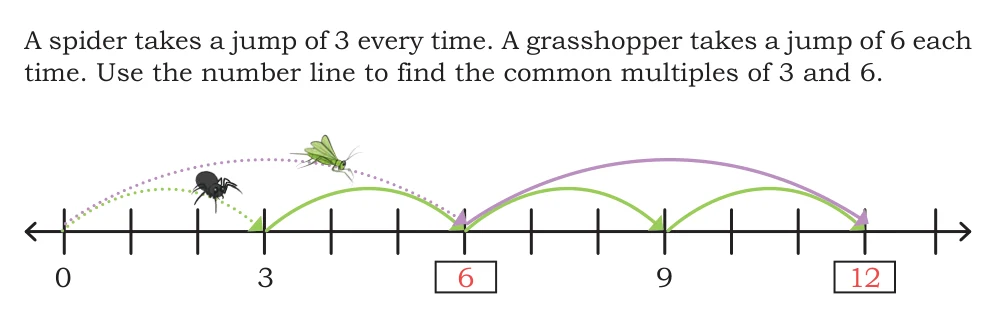
Use the number line to find the common multiples touched by jumps of 3 and 6.
Show detailed solution
- Step 1: Jumps of 3 touch 3,6,9,12,\ldots.
- Step 2: Jumps of 6 touch 6,12,18,24,\ldots.
- Step 3: On the shown line, 6 and 12 appear in both lists.
- Answer: The shown common multiples are 6 and 12.
Textbook page 166 · solved item 23
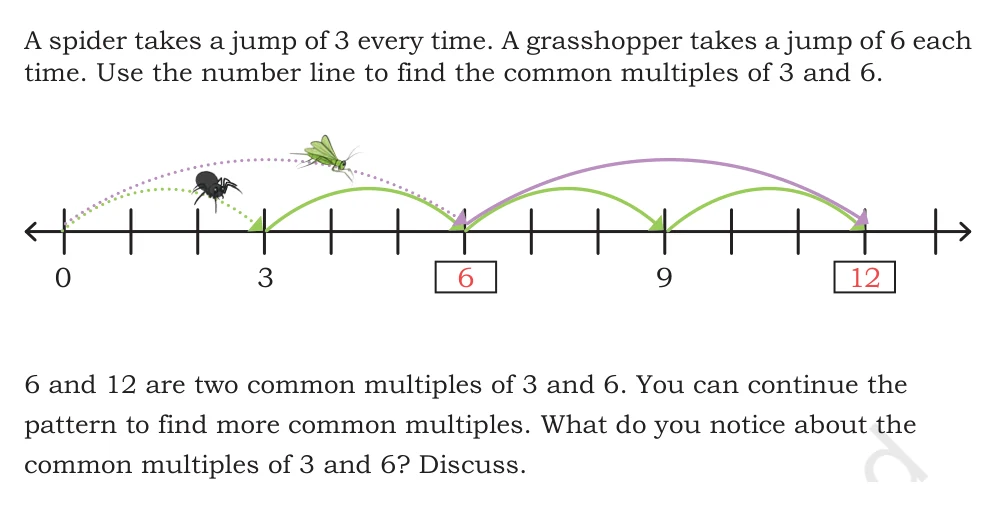
What do you notice about the common multiples of 3 and 6?
Show detailed solution
- Step 1: Write a few: 6,12,18,24,30,\ldots.
- Step 2: Every one of these numbers is reached by a jump of 6.
- Step 3: Since every multiple of 6 is also a multiple of 3, both jumpers touch it.
- Answer: The common multiples are exactly the multiples of 6.
Textbook page 166 · solved item 24
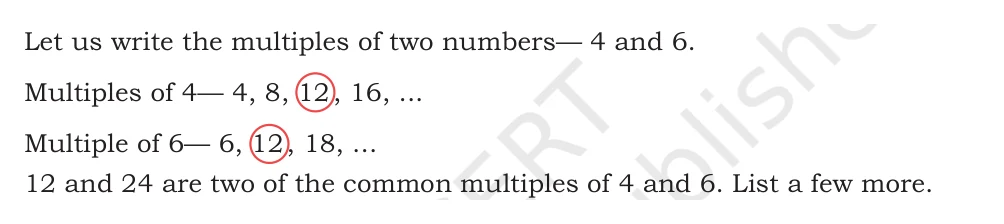
List a few more common multiples of 4 and 6 after 12 and 24.
Show detailed solution
- Step 1: Continue the 4 times table and the 6 times table.
- Step 2: The next number in both lists after 24 is 36.
- Step 3: Keep adding 12 to find more numbers in both lists.
- Answer: A few more are 36,48,60, and 72.
Textbook page 166 · solved item 25
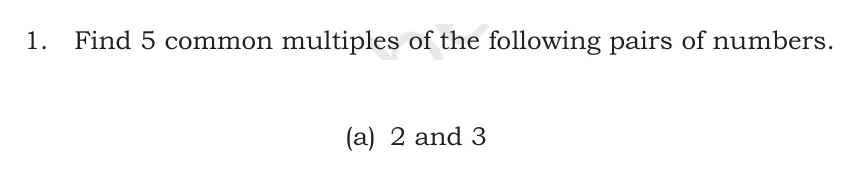
Find five common multiples of 2 and 3.
Show detailed solution
- Step 1: Write the times table of 2.
- Step 2: Write the times table of 3 beside it.
- Step 3: Circle the first five positive numbers that occur in both lists.
- Answer: 6,12,18,24,30.
Textbook page 166 · solved item 26
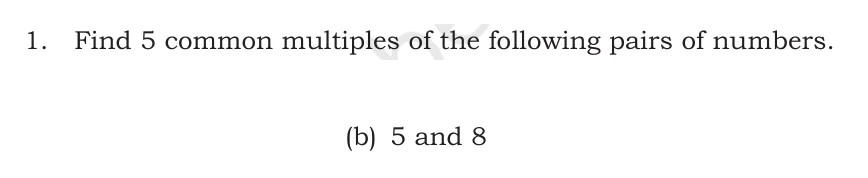
Find five common multiples of 5 and 8.
Show detailed solution
- Step 1: Write the times table of 5.
- Step 2: Write the times table of 8 beside it.
- Step 3: Circle the first five positive numbers that occur in both lists.
- Answer: 40,80,120,160,200.
Textbook page 166 · solved item 27
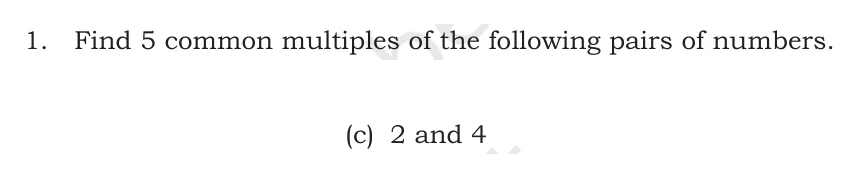
Find five common multiples of 2 and 4.
Show detailed solution
- Step 1: Write the times table of 2.
- Step 2: Write the times table of 4 beside it.
- Step 3: Circle the first five positive numbers that occur in both lists.
- Answer: 4,8,12,16,20.
Textbook page 166 · solved item 28
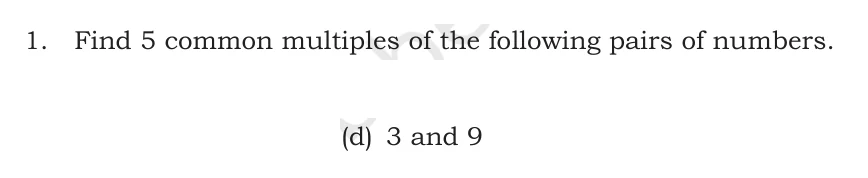
Find five common multiples of 3 and 9.
Show detailed solution
- Step 1: Write the times table of 3.
- Step 2: Write the times table of 9 beside it.
- Step 3: Circle the first five positive numbers that occur in both lists.
- Answer: 9,18,27,36,45.
Textbook page 166 · solved item 29
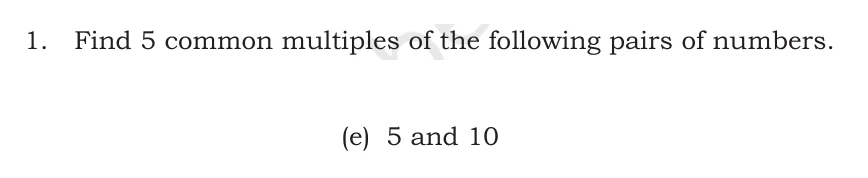
Find five common multiples of 5 and 10.
Show detailed solution
- Step 1: Write the times table of 5.
- Step 2: Write the times table of 10 beside it.
- Step 3: Circle the first five positive numbers that occur in both lists.
- Answer: 10,20,30,40,50.
Textbook page 166 · solved item 30
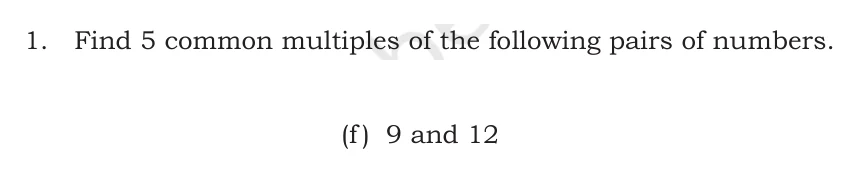
Find five common multiples of 9 and 12.
Show detailed solution
- Step 1: Write the times table of 9.
- Step 2: Write the times table of 12 beside it.
- Step 3: Circle the first five positive numbers that occur in both lists.
- Answer: 36,72,108,144,180.
Textbook page 166 · solved item 31
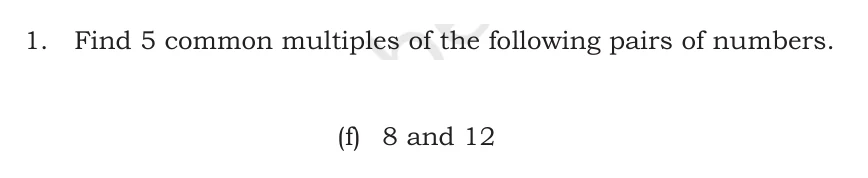
Find five common multiples of 8 and 12.
Show detailed solution
- Step 1: Write the times table of 8.
- Step 2: Write the times table of 12 beside it.
- Step 3: Circle the first five positive numbers that occur in both lists.
- Answer: 24,48,72,96,120.
Textbook page 166 · solved item 32
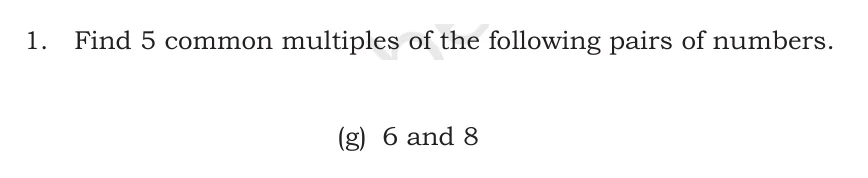
Find five common multiples of 6 and 8.
Show detailed solution
- Step 1: Write the times table of 6.
- Step 2: Write the times table of 8 beside it.
- Step 3: Circle the first five positive numbers that occur in both lists.
- Answer: 24,48,72,96,120.
Textbook page 166 · solved item 33
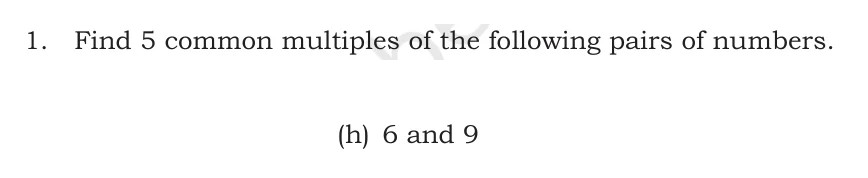
Find five common multiples of 6 and 9.
Show detailed solution
- Step 1: Write the times table of 6.
- Step 2: Write the times table of 9 beside it.
- Step 3: Circle the first five positive numbers that occur in both lists.
- Answer: 18,36,54,72,90.
Textbook page 166 · solved item 34
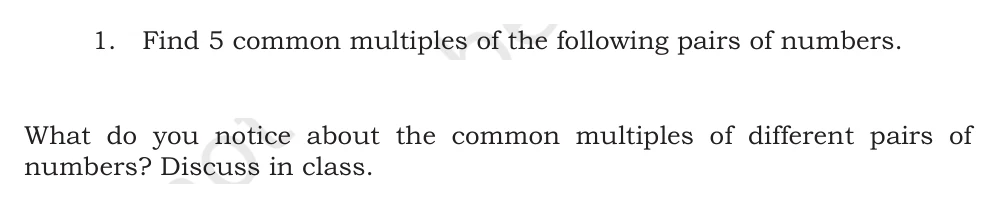
What do you notice about the common multiples of different pairs of numbers?
Show detailed solution
- Step 1: Every pair has common multiples, and the list keeps going.
- Step 2: The first common multiple depends on the pair. For 2 and 3 it is 6, but for 5 and 8 it is 40.
- Step 3: Later common multiples are made by repeatedly adding the first common multiple.
- Answer: Common multiples repeat in a regular pattern for each pair.
Detailed worked answers
Textbook page 167
Textbook page 167 · solved item 35

Will both Robby and Deeku reach the food, and who reaches it first?
Show detailed solution
- Step 1: The food is at 64. Robby's jumps of 4 include 60,64, so he reaches it.
- Step 2: Deeku's jumps of 6 include 60,66, so he jumps past 64 and does not land on the food.
- Step 3: Because only Robby lands exactly on 64, the two animals do not both reach the food.
- Answer: Robby reaches the food; Deeku does not, so Robby is the one who reaches it.
Textbook page 167 · solved item 36
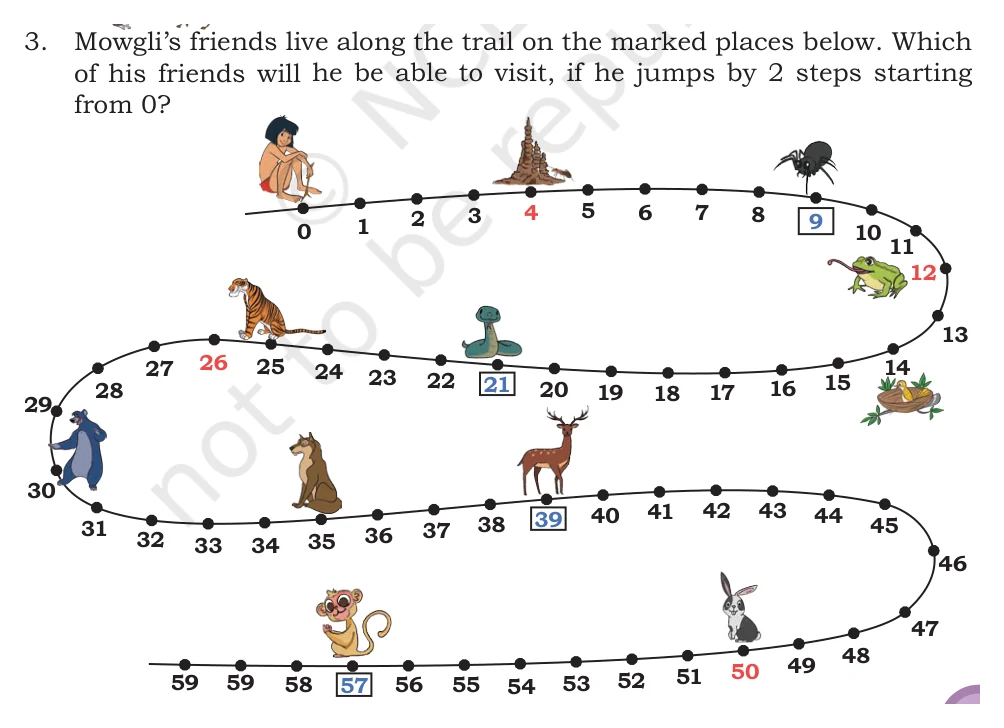
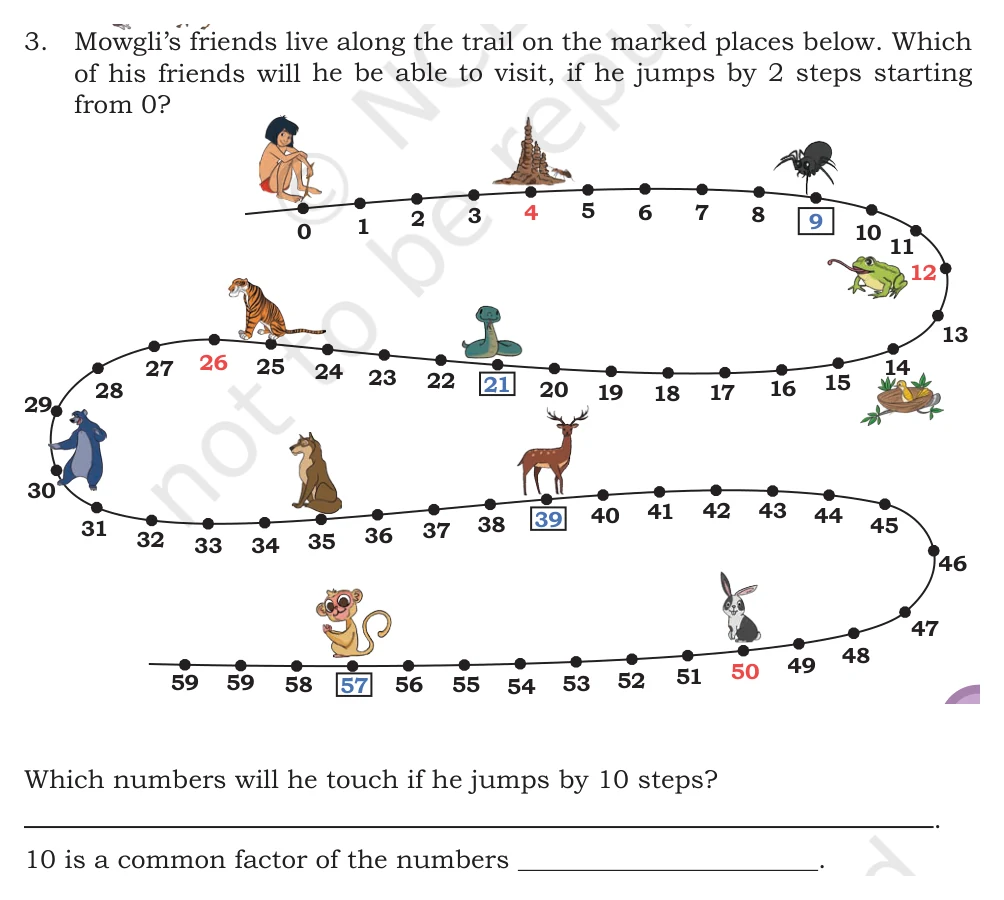
Which of Mowgli's friends can he visit by jumping 2 steps from 0?
Show detailed solution
- Step 1: Jumps of 2 land on the even numbers 2,4,6,8,\ldots.
- Step 2: The marked friend positions 4,12,14, and 50 are all even.
- Step 3: Mowgli therefore lands exactly on each of those four positions.
- Answer: He visits the ant at 4, frog at 12, bird at 14, and rabbit at 50.
Detailed worked answers
Textbook page 168
Textbook page 168 · solved item 37
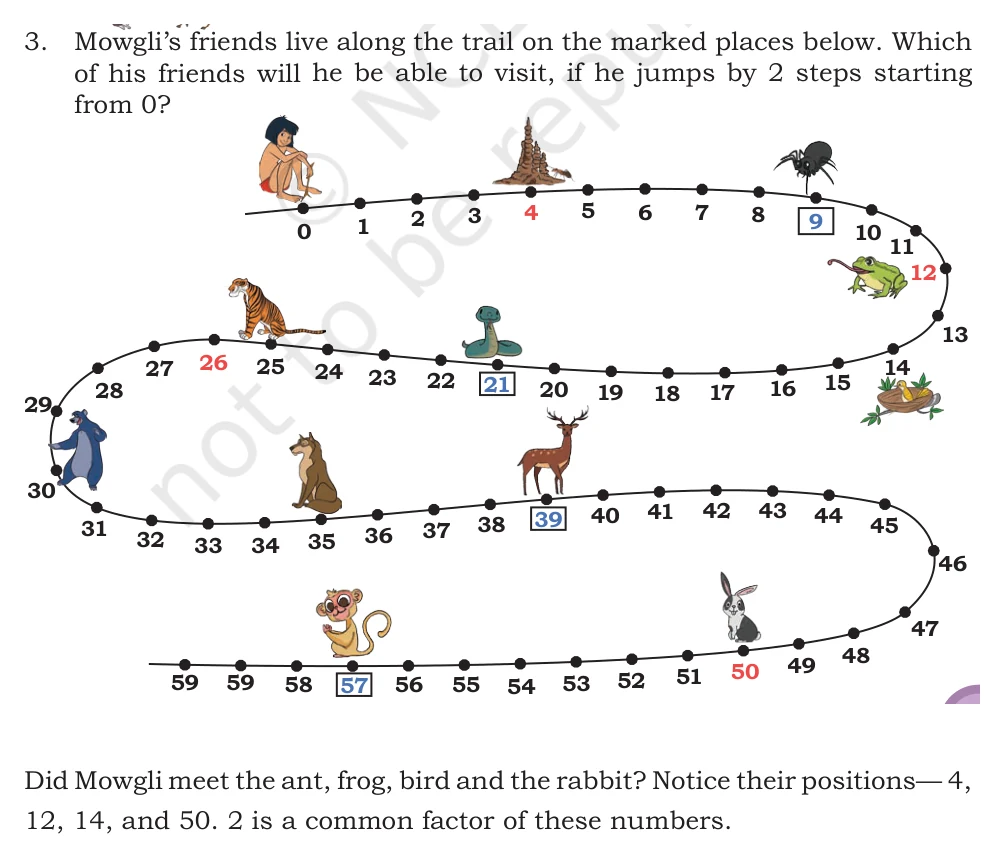
Did Mowgli meet the ant, frog, bird, and rabbit when jumping 2 steps?
Show detailed solution
- Step 1: Their positions are 4,12,14, and 50.
- Step 2: Each position is even, so each can be reached by repeated jumps of 2.
- Step 3: This means 2 is a factor of all four position numbers.
- Answer: Yes, Mowgli met all four.
Textbook page 168 · solved item 38

Which friends can Mowgli meet if he jumps 3 steps at a time?
Show detailed solution
- Step 1: Jumps of 3 land on 3,6,9,12,15,18,21,\ldots.
- Step 2: Compare this pattern with the marked positions on the trail.
- Step 3: The marked positions reached exactly are 9,21,39, and 57.
- Answer: He meets the friends at 9,21,39, and 57.
Textbook page 168 · solved item 39
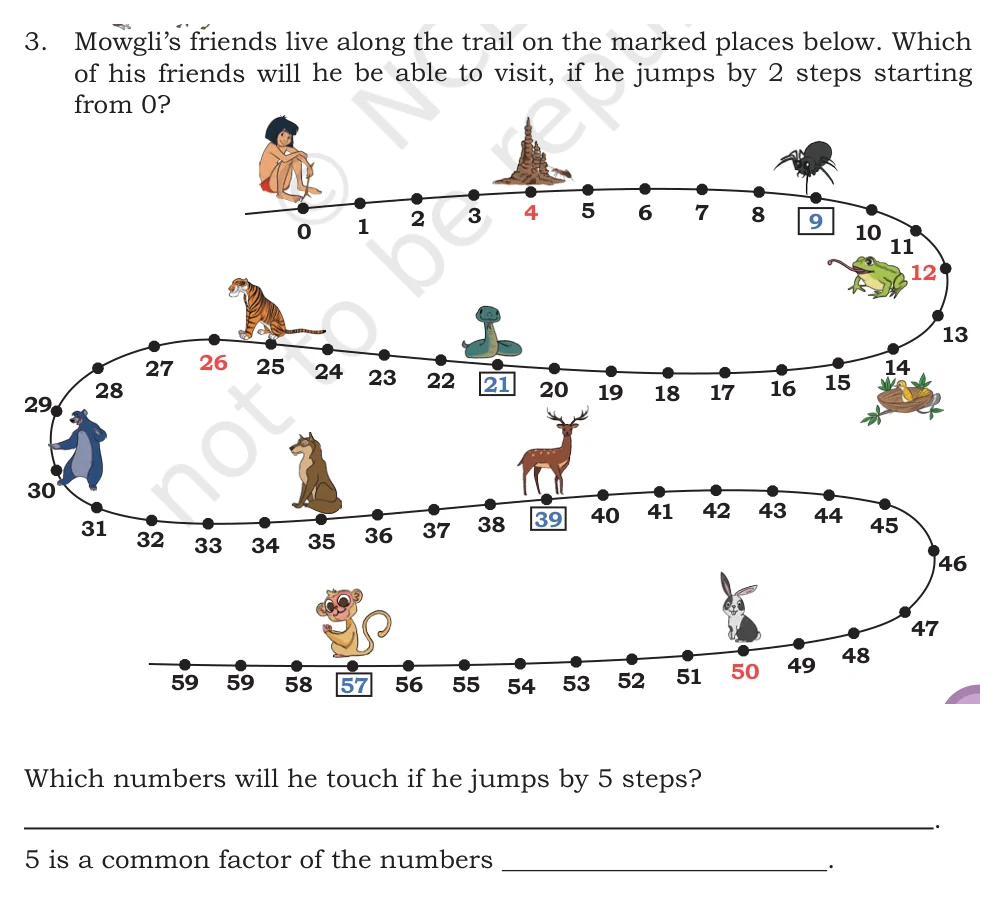
Which numbers will Mowgli touch if he jumps 5 steps at a time?
Show detailed solution
- Step 1: Begin at 0 and add 5 for every jump.
- Step 2: The trail continues to 59, so stop before the next jump to 60.
- Step 3: The positive landing numbers are 5,10,15,20,25,30,35,40,45,50,55.
- Answer: 5 is a common factor of 5,10,15,20,25,30,35,40,45,50, and 55.
Textbook page 168 · solved item 40
Which numbers will Mowgli touch if he jumps 10 steps at a time?
Show detailed solution
- Step 1: Begin at 0 and add 10 for every jump.
- Step 2: The landings on the trail are 10,20,30,40, and 50.
- Step 3: Each landing divides exactly by 10.
- Answer: 10 is a common factor of 10,20,30,40, and 50.
Textbook page 168 · solved item 41

Can jumps of 2 reach both 24 and 36?
Show detailed solution
- Step 1: 24\div2=12 and 36\div2=18.
- Step 2: Both divisions have no remainder.
- Step 3: A jump size is a common factor only when it reaches both numbers exactly.
- Answer: Yes. 2 is a common factor of 24 and 36.
Textbook page 168 · solved item 42
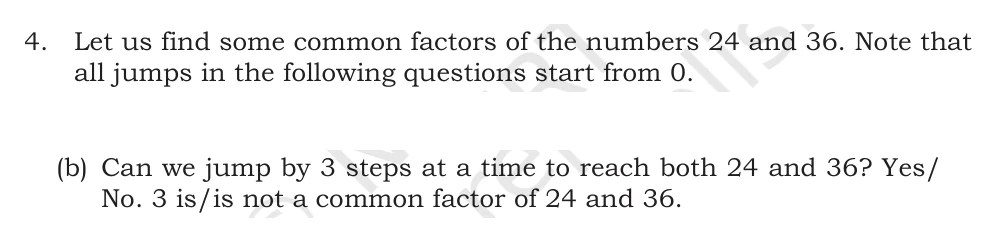
Can jumps of 3 reach both 24 and 36?
Show detailed solution
- Step 1: 24\div3=8 and 36\div3=12.
- Step 2: Both divisions have no remainder.
- Step 3: A jump size is a common factor only when it reaches both numbers exactly.
- Answer: Yes. 3 is a common factor of 24 and 36.
Textbook page 168 · solved item 43
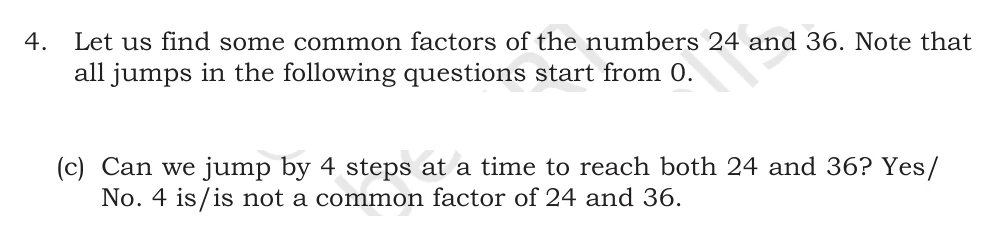
Can jumps of 4 reach both 24 and 36?
Show detailed solution
- Step 1: 24\div4=6 and 36\div4=9.
- Step 2: Both divisions have no remainder.
- Step 3: A jump size is a common factor only when it reaches both numbers exactly.
- Answer: Yes. 4 is a common factor of 24 and 36.
Textbook page 168 · solved item 44
What other jump sizes can reach both 24 and 36?
Show detailed solution
- Step 1: List the factors of 24: 1,2,3,4,6,8,12,24.
- Step 2: List the factors of 36: 1,2,3,4,6,9,12,18,36.
- Step 3: A jump size is a common factor only when it reaches both numbers exactly.
- Answer: Besides 2,3, and 4, jumps of 1,6, and 12 also reach both.
Textbook page 168 · solved item 45
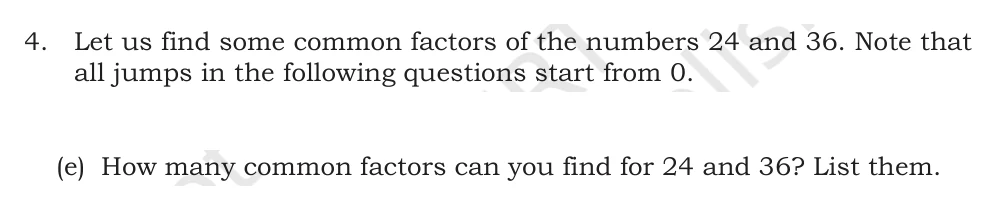
How many common factors do 24 and 36 have? List them.
Show detailed solution
- Step 1: Compare the factor lists of 24 and 36.
- Step 2: The shared numbers are 1,2,3,4,6, and 12.
- Step 3: A jump size is a common factor only when it reaches both numbers exactly.
- Answer: There are 6 common factors: 1,2,3,4,6,12.
Textbook page 168 · solved item 46

Can jumps of 1 reach both 24 and 36?
Show detailed solution
- Step 1: Jumps of 1 touch every whole number.
- Step 2: They therefore touch both 24 and 36.
- Step 3: A jump size is a common factor only when it reaches both numbers exactly.
- Answer: Yes. 1 is a common factor of 24 and 36.
Textbook page 168 · solved item 47

What are the common factors of 12 and 13?
Show detailed solution
- Step 1: The factors of 12 are 1,2,3,4,6,12.
- Step 2: The factors of 13 are only 1 and 13.
- Step 3: Compare the lists and keep the number found in both.
- Answer: The only common factor of 12 and 13 is 1.
Detailed worked answers
Textbook page 169
Textbook page 169 · solved item 48
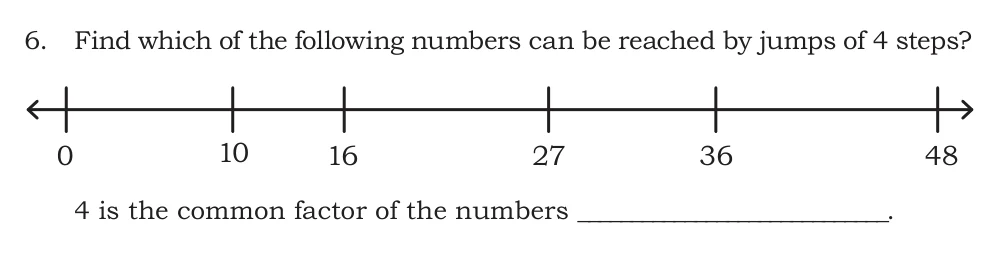
Which shown numbers can be reached by jumps of 4 steps?
Show detailed solution
- Step 1: Check the shown numbers 10,16,27,36,48 against the 4 times table.
- Step 2: 16=4\times4, 36=4\times9, and 48=4\times12.
- Step 3: 10 and 27 are not multiples of 4.
- Answer: Jumps of 4 reach 16,36, and 48, so 4 is their common factor.
Textbook page 169 · solved item 49
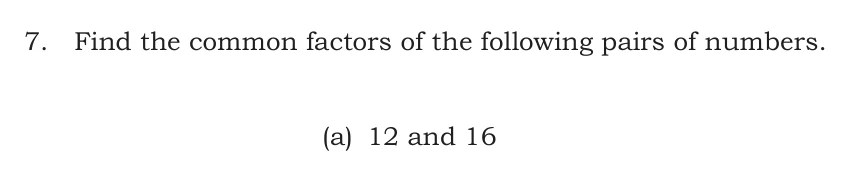
Find the common factors of 12 and 16.
Show detailed solution
- Step 1: List every factor of 12.
- Step 2: List every factor of 16.
- Step 3: Keep only the numbers that appear in both factor lists.
- Answer: The common factors are 1,2,4.
Textbook page 169 · solved item 50
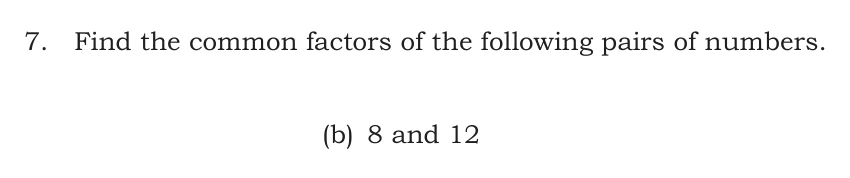
Find the common factors of 8 and 12.
Show detailed solution
- Step 1: List every factor of 8.
- Step 2: List every factor of 12.
- Step 3: Keep only the numbers that appear in both factor lists.
- Answer: The common factors are 1,2,4.
Textbook page 169 · solved item 51

Find the common factors of 4 and 16.
Show detailed solution
- Step 1: List every factor of 4.
- Step 2: List every factor of 16.
- Step 3: Keep only the numbers that appear in both factor lists.
- Answer: The common factors are 1,2,4.
Textbook page 169 · solved item 52
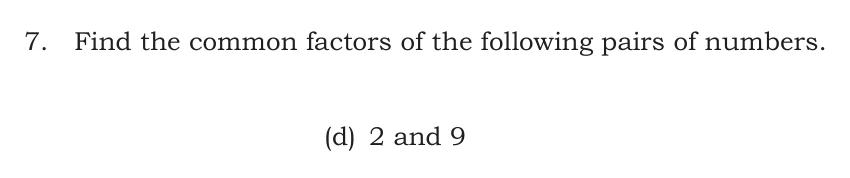
Find the common factors of 2 and 9.
Show detailed solution
- Step 1: List every factor of 2.
- Step 2: List every factor of 9.
- Step 3: Keep only the numbers that appear in both factor lists.
- Answer: The common factors are 1.
Textbook page 169 · solved item 53
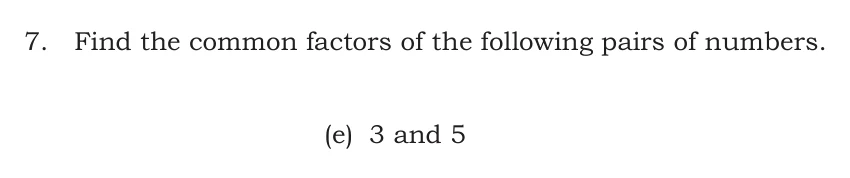
Find the common factors of 3 and 5.
Show detailed solution
- Step 1: List every factor of 3.
- Step 2: List every factor of 5.
- Step 3: Keep only the numbers that appear in both factor lists.
- Answer: The common factors are 1.
Textbook page 169 · solved item 54
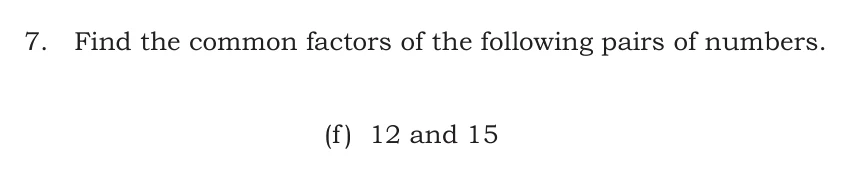
Find the common factors of 12 and 15.
Show detailed solution
- Step 1: List every factor of 12.
- Step 2: List every factor of 15.
- Step 3: Keep only the numbers that appear in both factor lists.
- Answer: The common factors are 1,3.
Textbook page 169 · solved item 55

Find the common factors of 20 and 5.
Show detailed solution
- Step 1: List every factor of 20.
- Step 2: List every factor of 5.
- Step 3: Keep only the numbers that appear in both factor lists.
- Answer: The common factors are 1,5.
Textbook page 169 · solved item 56

Find the common factors of 9 and 21.
Show detailed solution
- Step 1: List every factor of 9.
- Step 2: List every factor of 21.
- Step 3: Keep only the numbers that appear in both factor lists.
- Answer: The common factors are 1,3.
Textbook page 169 · solved item 57

Find the common factors of 6 and 27.
Show detailed solution
- Step 1: List every factor of 6.
- Step 2: List every factor of 27.
- Step 3: Keep only the numbers that appear in both factor lists.
- Answer: The common factors are 1,3.
Textbook page 169 · solved item 58

What do you notice about the common factors of different pairs of numbers?
Show detailed solution
- Step 1: Every pair in the exercise has 1 as a common factor.
- Step 2: Some pairs, such as 2 and 9, have only 1 in common.
- Step 3: Other pairs have more common factors, such as 12 and 16, which share 1,2,4.
- Answer: Every pair shares 1, but the number of other common factors can differ.
Textbook page 169 · solved item 59

State true or false: (a) Factors of even numbers must be even.
Show detailed solution
- Step 1: Read the statement carefully and test it with a small number.
- Step 2: 1 is an odd factor of every even number; for example, 1 is a factor of 8.
- Step 3: Use that example or fact to decide whether the statement always works.
- Answer: False.
Textbook page 169 · solved item 60

State true or false: (b) Multiples of odd numbers cannot be even.
Show detailed solution
- Step 1: Read the statement carefully and test it with a small number.
- Step 2: An odd number times an even count can be even; for example, 3\times2=6.
- Step 3: Use that example or fact to decide whether the statement always works.
- Answer: False.
Textbook page 169 · solved item 61

State true or false: (c) Factors of odd numbers cannot be even.
Show detailed solution
- Step 1: Read the statement carefully and test it with a small number.
- Step 2: An even factor would make an even product, so it cannot divide an odd number exactly.
- Step 3: Use that example or fact to decide whether the statement always works.
- Answer: True.
Textbook page 169 · solved item 62
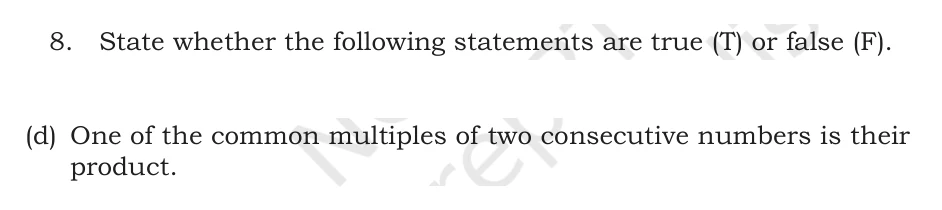
State true or false: (d) One common multiple of two consecutive numbers is their product.
Show detailed solution
- Step 1: Read the statement carefully and test it with a small number.
- Step 2: For example, 4\times5=20, and 20 is in both the 4 and 5 times tables.
- Step 3: Use that example or fact to decide whether the statement always works.
- Answer: True.
Textbook page 169 · solved item 63

State true or false: (e) The only common factor of any two consecutive numbers is 1.
Show detailed solution
- Step 1: Read the statement carefully and test it with a small number.
- Step 2: For example, 8 and 9 share only 1; neighbouring numbers cannot be divided exactly by the same larger number.
- Step 3: Use that example or fact to decide whether the statement always works.
- Answer: True.
Textbook page 169 · solved item 64

State true or false: (f) 0 cannot be a factor of any number.
Show detailed solution
- Step 1: Read the statement carefully and test it with a small number.
- Step 2: We cannot divide a number into groups of size 0, and multiplying 0 by a whole number always gives 0.
- Step 3: Use that example or fact to decide whether the statement always works.
- Answer: True.
Textbook page 169 · solved item 65

On which days will Sher Khan and Bagheera hunt together?
Show detailed solution
- Step 1: Sher Khan's hunting days are 3,6,9,12,15,18,\ldots.
- Step 2: Bagheera's hunting days are 5,10,15,20,25,30,\ldots.
- Step 3: The days appearing in both lists are multiples of 15.
- Answer: They hunt together on days 15,30,45,60,\ldots.
Textbook page 169 · solved item 66

What jump sizes let Mowgli reach Baloo at 30 without landing on Sher Khan's house at 25?
Show detailed solution
- Step 1: Jump sizes that reach 30 exactly are its factors: 1,2,3,5,6,10,15,30.
- Step 2: Jumps of 1 and 5 also land on 25, so remove them.
- Step 3: The remaining jumps reach 30 but skip 25.
- Answer: Mowgli can jump 2,3,6,10,15, or 30 steps at a time.
Textbook page 169 · solved item 67
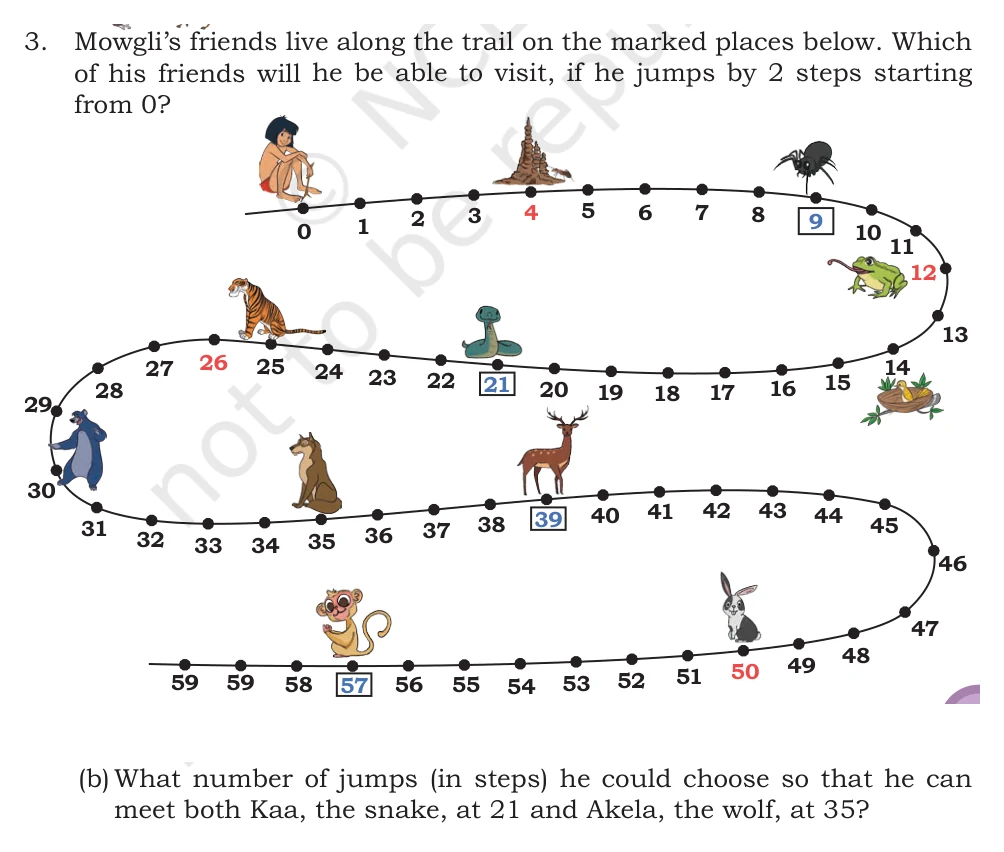
What jump sizes let Mowgli meet both Kaa at 21 and Akela at 35?
Show detailed solution
- Step 1: The factors of 21 are 1,3,7,21.
- Step 2: The factors of 35 are 1,5,7,35.
- Step 3: The jump sizes found in both lists are 1 and 7.
- Answer: He can jump 1 step or 7 steps at a time.
Detailed worked answers
Textbook page 170
Textbook page 170 · solved item 68
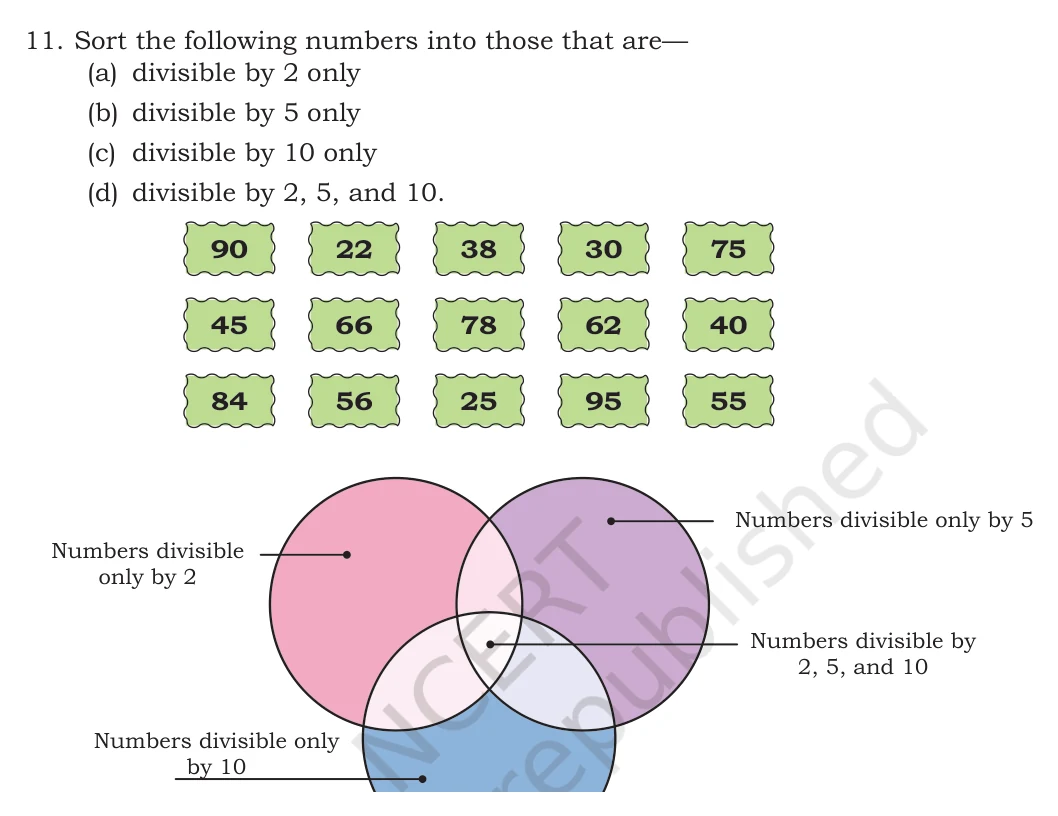
Which numbers are divisible by 2 only?
Show detailed solution
- Step 1: Look for even numbers, because numbers divisible by 2 end in 0,2,4,6, or 8.
- Step 2: Remove 30,40, and 90 because they are also divisible by 5 and 10.
- Step 3: Place each selected number in the matching labelled part of the diagram.
- Answer: 22,38,56,62,66,78,84.
Textbook page 170 · solved item 69

Which numbers are divisible by 5 only?
Show detailed solution
- Step 1: Numbers divisible by 5 end in 0 or 5.
- Step 2: Keep the numbers ending in 5; those ending in 0 are also divisible by 2 and 10.
- Step 3: Place each selected number in the matching labelled part of the diagram.
- Answer: 25,45,55,75,95.
Textbook page 170 · solved item 70
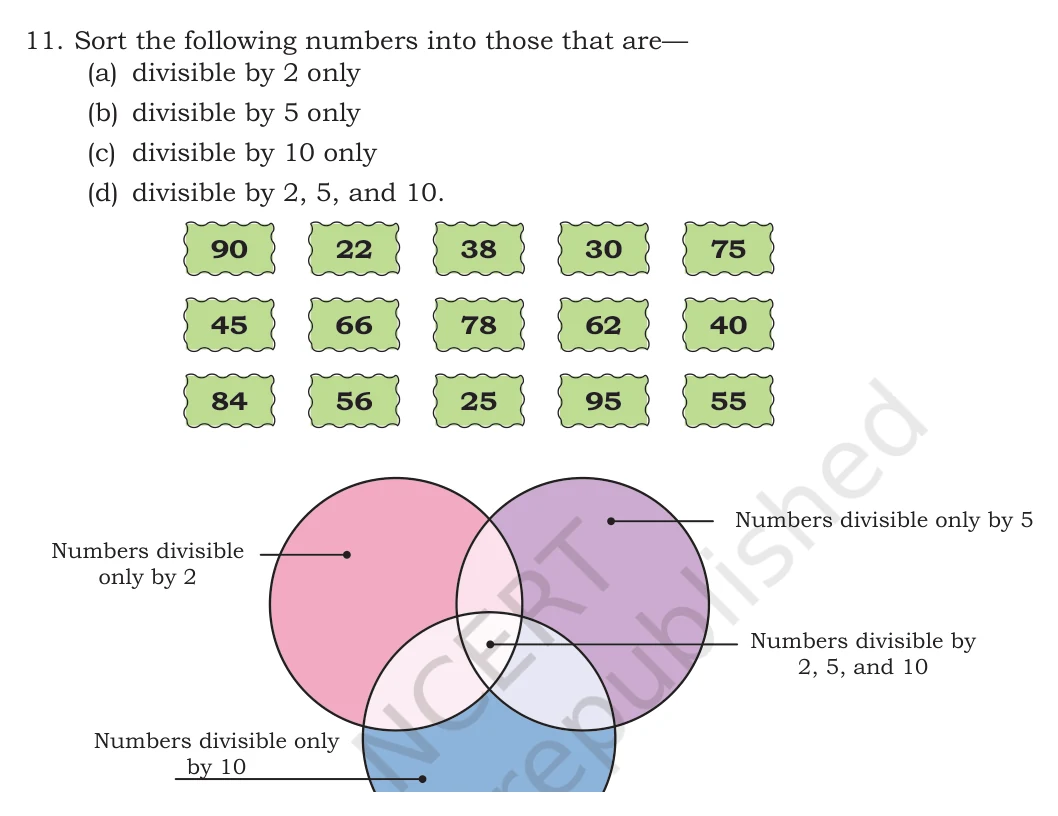
Which numbers are divisible by 10 only?
Show detailed solution
- Step 1: A number divisible by 10 must end in 0.
- Step 2: Every number ending in 0 is also divisible by both 2 and 5.
- Step 3: Place each selected number in the matching labelled part of the diagram.
- Answer: There are no numbers in the 'divisible by 10 only' part.
Textbook page 170 · solved item 71
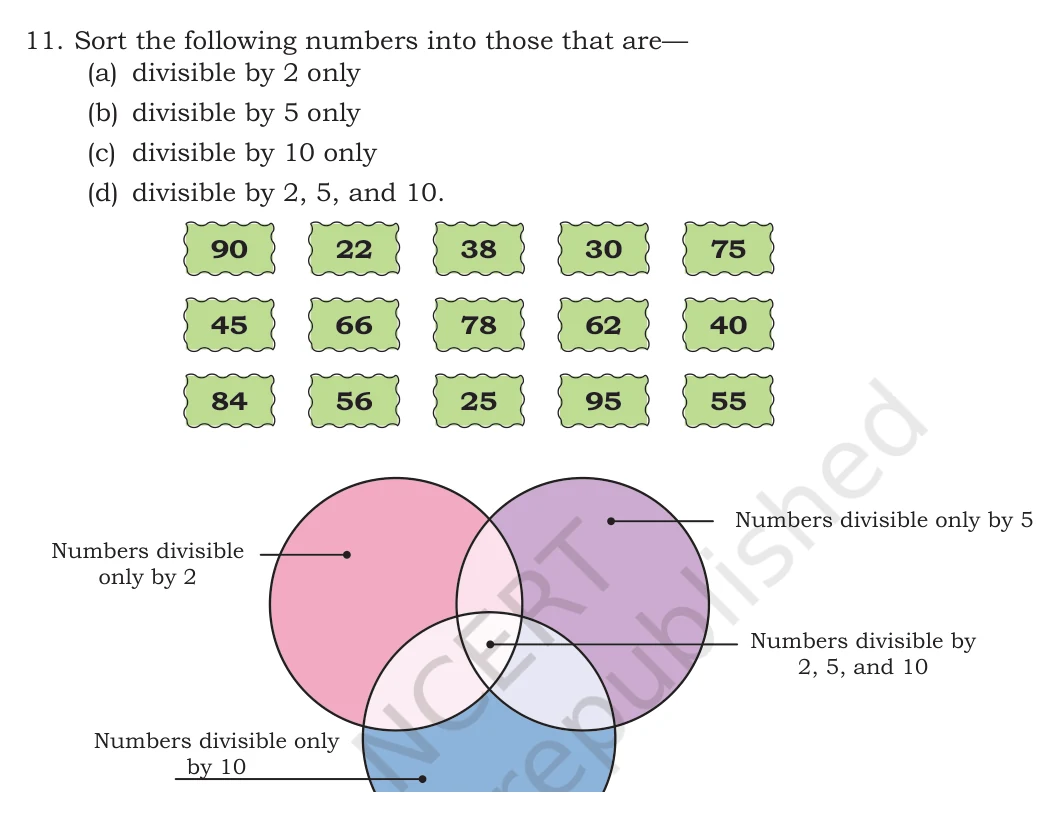
Which numbers are divisible by 2, 5, and 10?
Show detailed solution
- Step 1: Numbers divisible by 10 end in 0.
- Step 2: The numbers in the bank ending in 0 are 30,40, and 90.
- Step 3: Place each selected number in the matching labelled part of the diagram.
- Answer: 30,40,90.