
Question-by-question working
Read the prompt, attempt it, then check each step
Every exercise subpart and table row is a separate item. Shared figures and table headings are repeated whenever they are needed to understand the question.
Detailed worked answers
Textbook page 119
Textbook page 119 · solved item 1
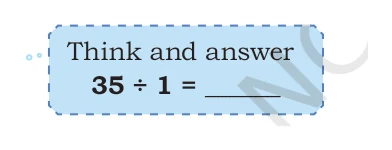
Complete 35 divided by 1.
Show detailed solution
- Step 1: Dividing by 1 asks how many groups of 1 make 35.
- Step 2: There are 35 such groups because every coconut can form its own group.
- Step 3: Any whole number divided by 1 stays unchanged.
- Answer: 35\div1=35.
Textbook page 119 · solved item 2
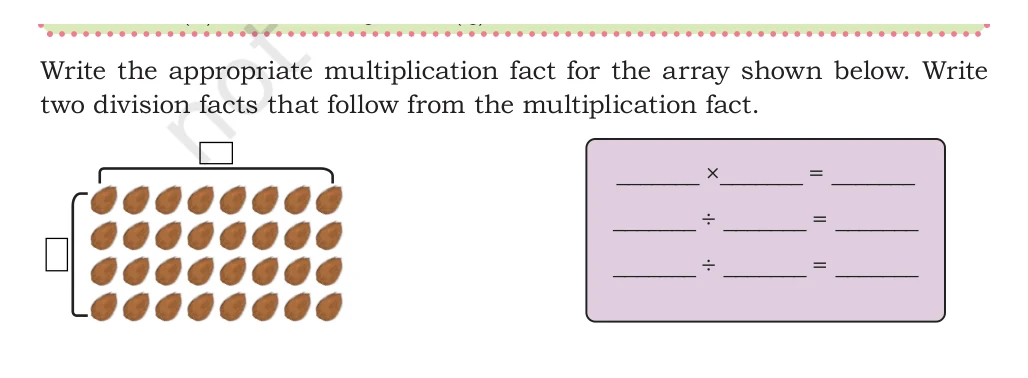
Write the multiplication fact and the two related division facts for the bottom coconut array.
Show detailed solution
- Step 1: Count 4 horizontal rows with 8 coconuts in each row.
- Step 2: The multiplication fact is 4\times8=32.
- Step 3: Splitting 32 into 4 equal rows gives 32\div4=8.
- Step 4: Splitting 32 into 8 equal columns gives 32\div8=4.
- Answer: 4\times8=32,\ 32\div4=8,\ 32\div8=4.
Detailed worked answers
Textbook page 120
Textbook page 120 · solved item 3
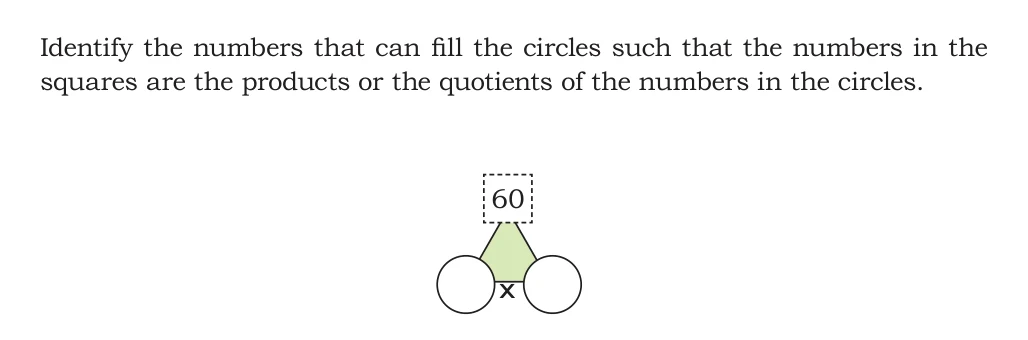
Fill the two circles whose product is 60.
Show detailed solution
- Step 1: Think of a multiplication fact that makes 60.
- Step 2: 6\times10=60.
- Step 3: Put one factor in each circle; their order can be exchanged.
- Answer: One correct pair is 6 and 10.
Textbook page 120 · solved item 4
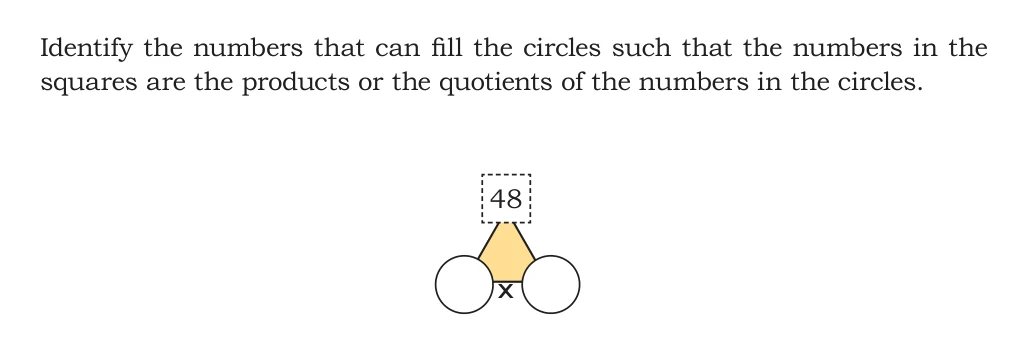
Fill the two circles whose product is 48.
Show detailed solution
- Step 1: Think of a multiplication fact that makes 48.
- Step 2: 6\times8=48.
- Step 3: Put one factor in each circle; their order can be exchanged.
- Answer: One correct pair is 6 and 8.
Textbook page 120 · solved item 5
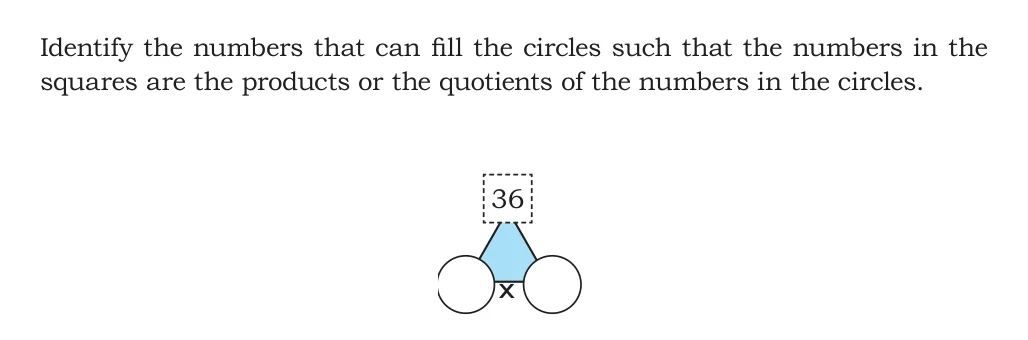
Fill the two circles whose product is 36.
Show detailed solution
- Step 1: Think of a multiplication fact that makes 36.
- Step 2: 6\times6=36.
- Step 3: Put one factor in each circle; their order can be exchanged.
- Answer: One correct pair is 6 and 6.
Textbook page 120 · solved item 6
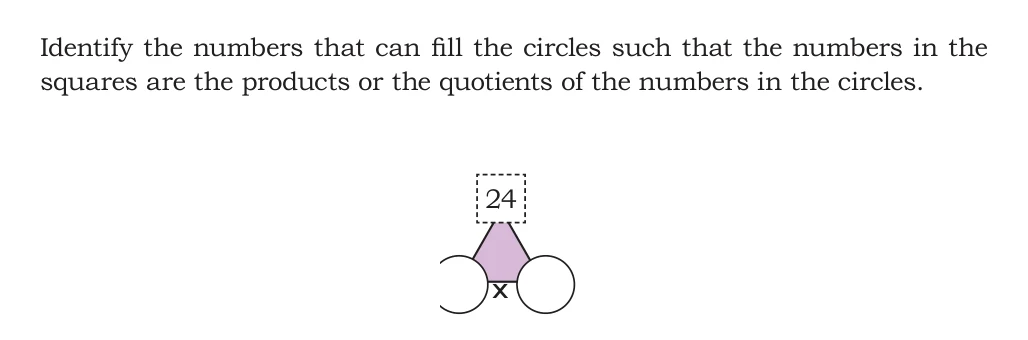
Fill the two circles whose product is 24.
Show detailed solution
- Step 1: Think of a multiplication fact that makes 24.
- Step 2: 4\times6=24.
- Step 3: Put one factor in each circle; their order can be exchanged.
- Answer: One correct pair is 4 and 6.
Textbook page 120 · solved item 7
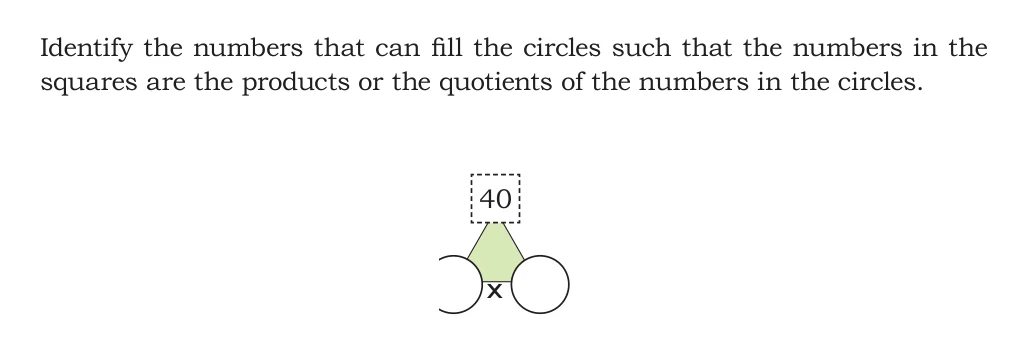
Fill the two circles whose product is 40.
Show detailed solution
- Step 1: Think of a multiplication fact that makes 40.
- Step 2: 5\times8=40.
- Step 3: Put one factor in each circle; their order can be exchanged.
- Answer: One correct pair is 5 and 8.
Textbook page 120 · solved item 8
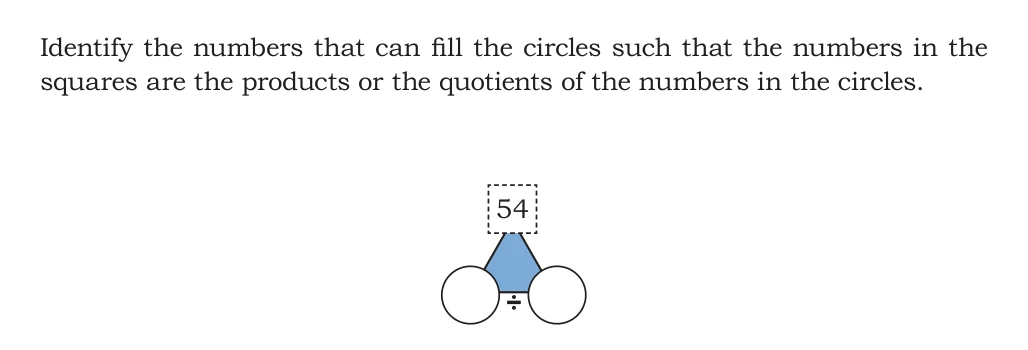
Fill the circles so their quotient is 54.
Show detailed solution
- Step 1: The left circle is the dividend and the right circle is the divisor.
- Step 2: 324\div6=54.
- Step 3: Check with multiplication: 54\times6=324.
- Answer: Use dividend 324, divisor 6, and quotient 54.
Textbook page 120 · solved item 9
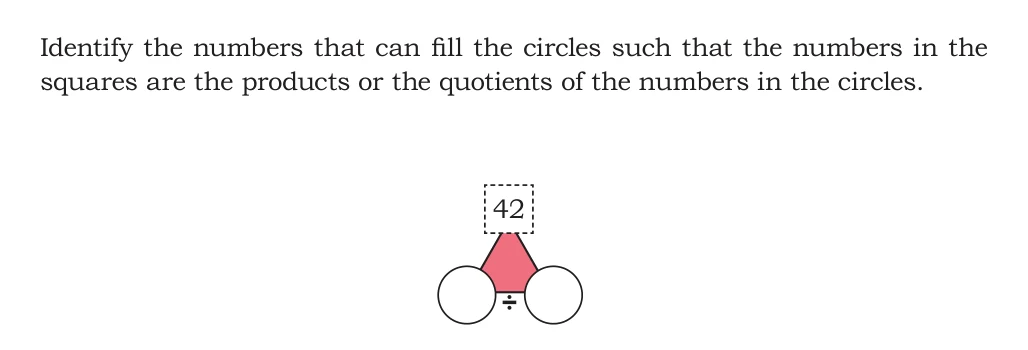
Fill the circles so their quotient is 42.
Show detailed solution
- Step 1: The left circle is the dividend and the right circle is the divisor.
- Step 2: 252\div6=42.
- Step 3: Check with multiplication: 42\times6=252.
- Answer: Use dividend 252, divisor 6, and quotient 42.
Textbook page 120 · solved item 10
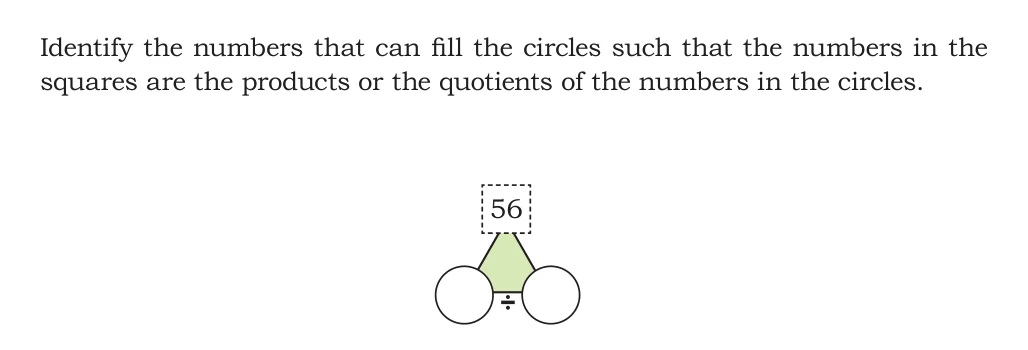
Fill the circles so their quotient is 56.
Show detailed solution
- Step 1: The left circle is the dividend and the right circle is the divisor.
- Step 2: 392\div7=56.
- Step 3: Check with multiplication: 56\times7=392.
- Answer: Use dividend 392, divisor 7, and quotient 56.
Textbook page 120 · solved item 11
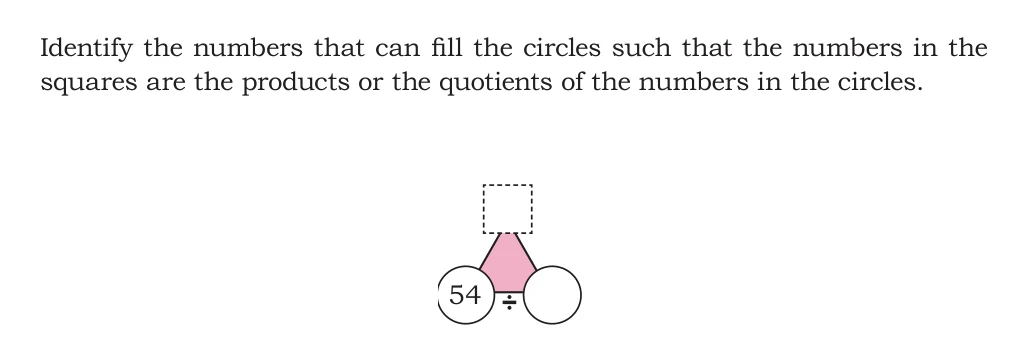
Complete the triangle that begins with 54 as the dividend.
Show detailed solution
- Step 1: The left circle is the dividend and the right circle is the divisor.
- Step 2: 54\div6=9.
- Step 3: Check with multiplication: 9\times6=54.
- Answer: Use dividend 54, divisor 6, and quotient 9.
Textbook page 120 · solved item 12
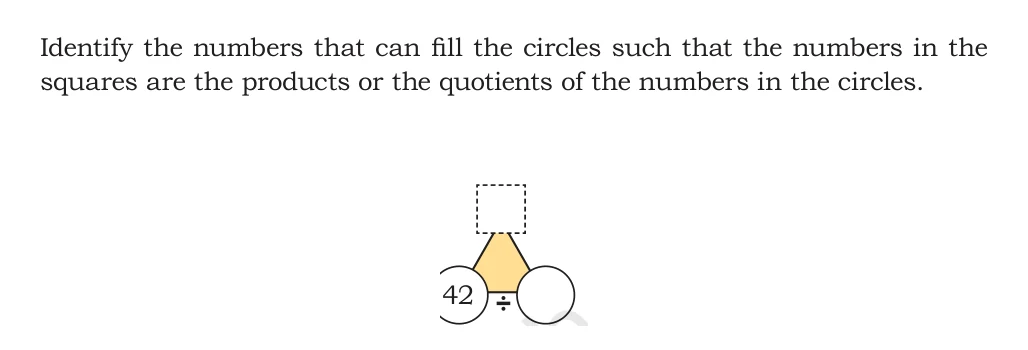
Complete the triangle that begins with 42 as the dividend.
Show detailed solution
- Step 1: The left circle is the dividend and the right circle is the divisor.
- Step 2: 42\div6=7.
- Step 3: Check with multiplication: 7\times6=42.
- Answer: Use dividend 42, divisor 6, and quotient 7.
Textbook page 120 · solved item 13
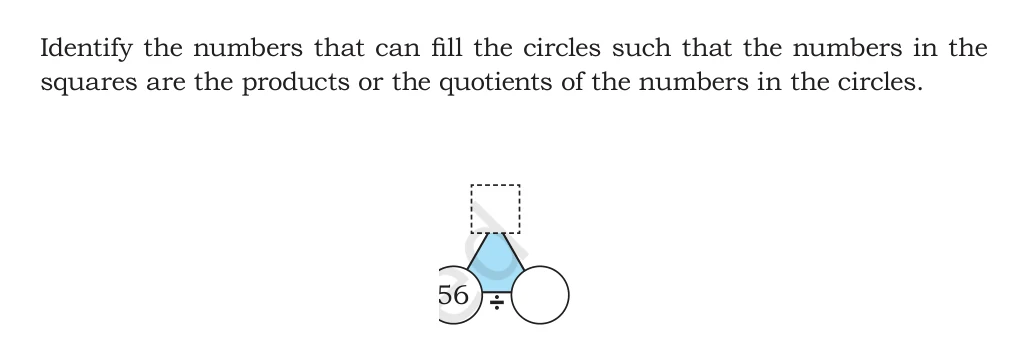
Complete the triangle that begins with 56 as the dividend.
Show detailed solution
- Step 1: The left circle is the dividend and the right circle is the divisor.
- Step 2: 56\div7=8.
- Step 3: Check with multiplication: 8\times7=56.
- Answer: Use dividend 56, divisor 7, and quotient 8.
Textbook page 120 · solved item 14
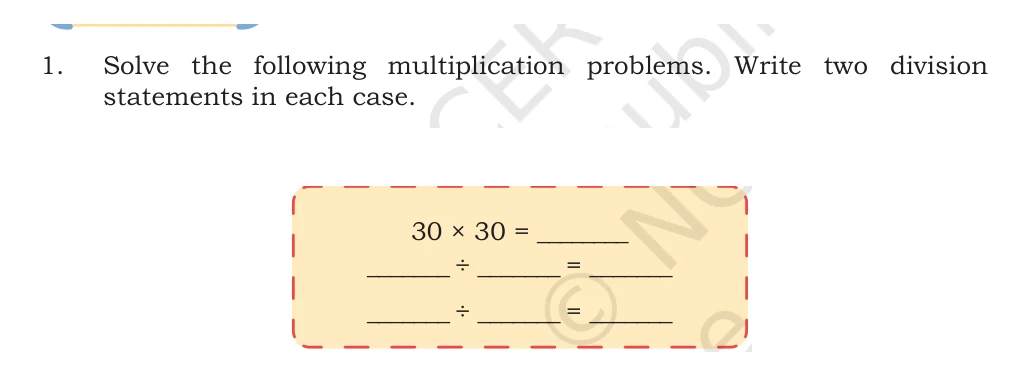
Solve 30 times 30 and write the two related division statements.
Show detailed solution
- Step 1: Multiply to get 30\times30=900.
- Step 2: Divide the product by the first factor: 900\div30=30.
- Step 3: Divide the product by the second factor: 900\div30=30.
- Answer: 30\times30=900, 900\div30=30, and 900\div30=30.
Textbook page 120 · solved item 15
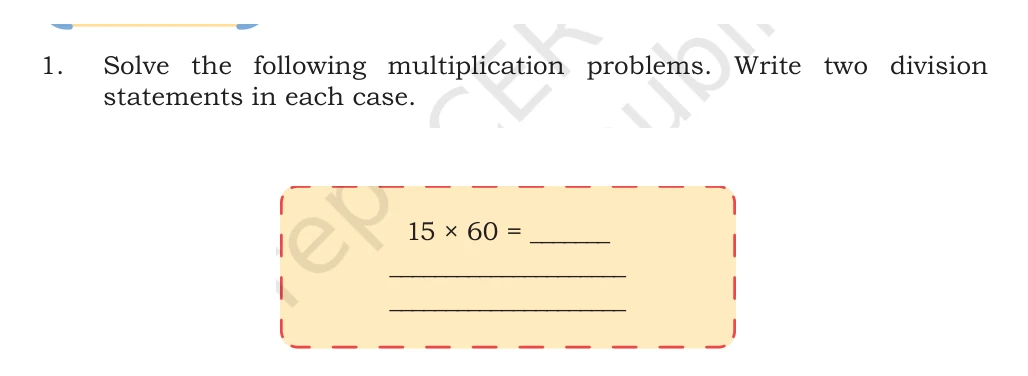
Solve 15 times 60 and write the two related division statements.
Show detailed solution
- Step 1: Multiply to get 15\times60=900.
- Step 2: Divide the product by the first factor: 900\div15=60.
- Step 3: Divide the product by the second factor: 900\div60=15.
- Answer: 15\times60=900, 900\div15=60, and 900\div60=15.
Textbook page 120 · solved item 16
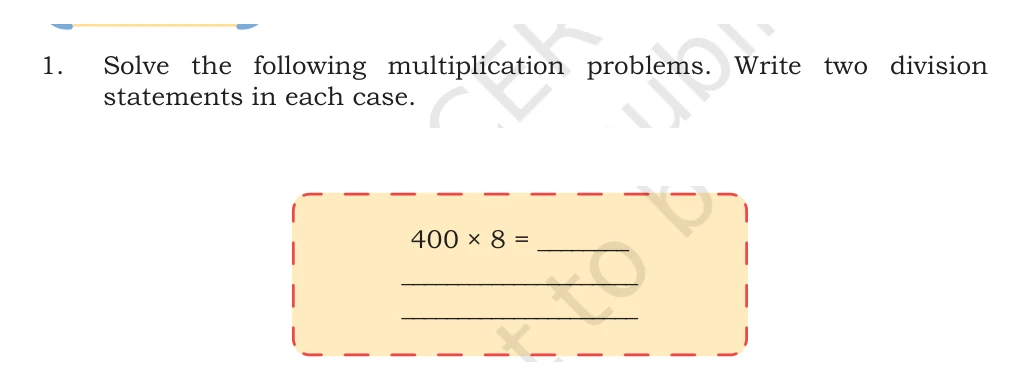
Solve 400 times 8 and write the two related division statements.
Show detailed solution
- Step 1: Multiply to get 400\times8=3,200.
- Step 2: Divide the product by the first factor: 3,200\div400=8.
- Step 3: Divide the product by the second factor: 3,200\div8=400.
- Answer: 400\times8=3,200, 3,200\div400=8, and 3,200\div8=400.
Textbook page 120 · solved item 17
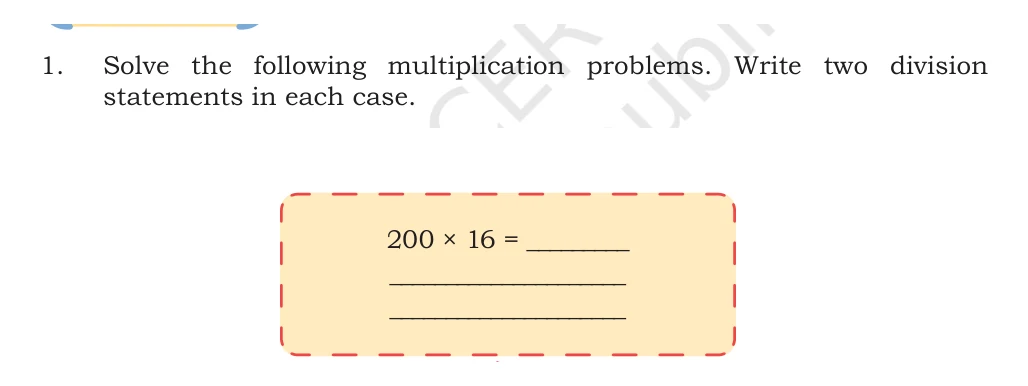
Solve 200 times 16 and write the two related division statements.
Show detailed solution
- Step 1: Multiply to get 200\times16=3,200.
- Step 2: Divide the product by the first factor: 3,200\div200=16.
- Step 3: Divide the product by the second factor: 3,200\div16=200.
- Answer: 200\times16=3,200, 3,200\div200=16, and 3,200\div16=200.
Detailed worked answers
Textbook page 121
Textbook page 121 · solved item 18
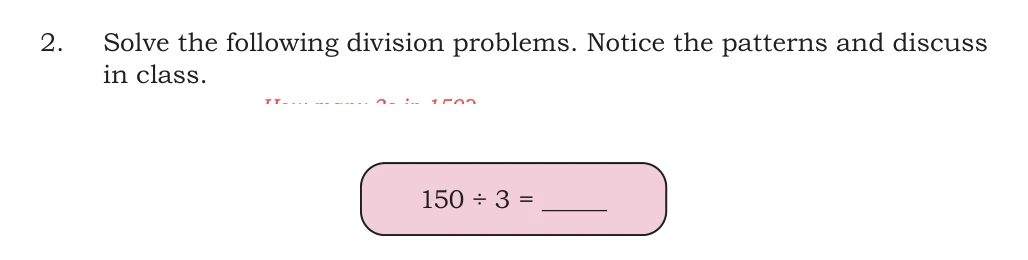
Divide 150 by 3 and identify the remainder, if any.
Show detailed solution
- Step 1: Look for the largest whole-number multiple of 3 that does not pass 150.
- Step 2: 3\times50=150, so there are 50 complete groups.
- Step 3: 150-150=0. The division ends with no remainder.
- Step 4: Check: 3\times50+0=150.
- Answer: 150\div3=50.
Textbook page 121 · solved item 19
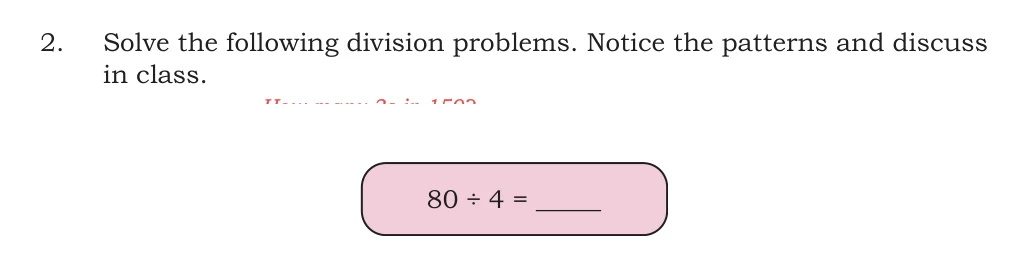
Divide 80 by 4 and identify the remainder, if any.
Show detailed solution
- Step 1: Look for the largest whole-number multiple of 4 that does not pass 80.
- Step 2: 4\times20=80, so there are 20 complete groups.
- Step 3: 80-80=0. The division ends with no remainder.
- Step 4: Check: 4\times20+0=80.
- Answer: 80\div4=20.
Textbook page 121 · solved item 20
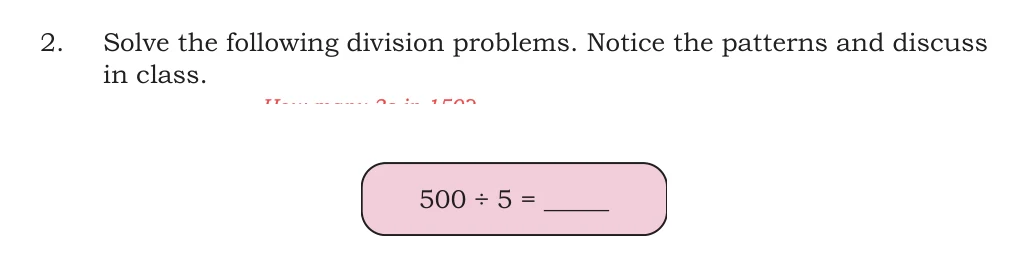
Divide 500 by 5 and identify the remainder, if any.
Show detailed solution
- Step 1: Look for the largest whole-number multiple of 5 that does not pass 500.
- Step 2: 5\times100=500, so there are 100 complete groups.
- Step 3: 500-500=0. The division ends with no remainder.
- Step 4: Check: 5\times100+0=500.
- Answer: 500\div5=100.
Textbook page 121 · solved item 21
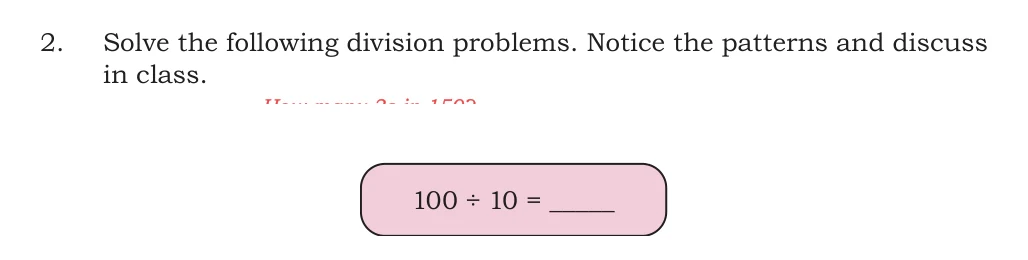
Divide 100 by 10 and identify the remainder, if any.
Show detailed solution
- Step 1: Look for the largest whole-number multiple of 10 that does not pass 100.
- Step 2: 10\times10=100, so there are 10 complete groups.
- Step 3: 100-100=0. The division ends with no remainder.
- Step 4: Check: 10\times10+0=100.
- Answer: 100\div10=10.
Textbook page 121 · solved item 22
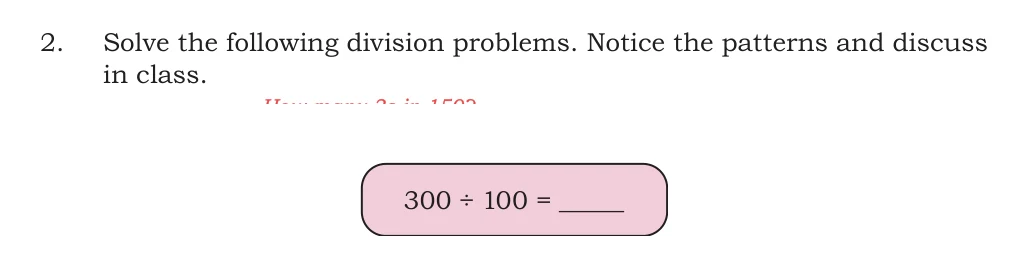
Divide 300 by 100 and identify the remainder, if any.
Show detailed solution
- Step 1: Look for the largest whole-number multiple of 100 that does not pass 300.
- Step 2: 100\times3=300, so there are 3 complete groups.
- Step 3: 300-300=0. The division ends with no remainder.
- Step 4: Check: 100\times3+0=300.
- Answer: 300\div100=3.
Textbook page 121 · solved item 23
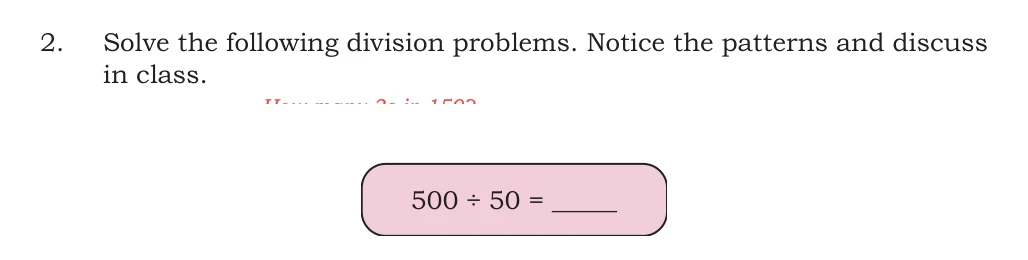
Divide 500 by 50 and identify the remainder, if any.
Show detailed solution
- Step 1: Look for the largest whole-number multiple of 50 that does not pass 500.
- Step 2: 50\times10=500, so there are 10 complete groups.
- Step 3: 500-500=0. The division ends with no remainder.
- Step 4: Check: 50\times10+0=500.
- Answer: 500\div50=10.
Textbook page 121 · solved item 24
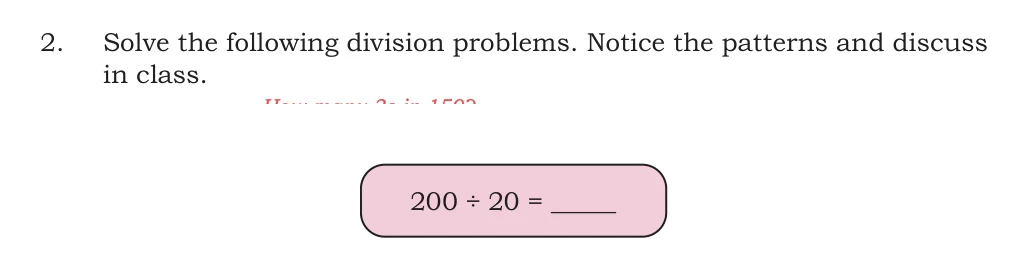
Divide 200 by 20 and identify the remainder, if any.
Show detailed solution
- Step 1: Look for the largest whole-number multiple of 20 that does not pass 200.
- Step 2: 20\times10=200, so there are 10 complete groups.
- Step 3: 200-200=0. The division ends with no remainder.
- Step 4: Check: 20\times10+0=200.
- Answer: 200\div20=10.
Textbook page 121 · solved item 25
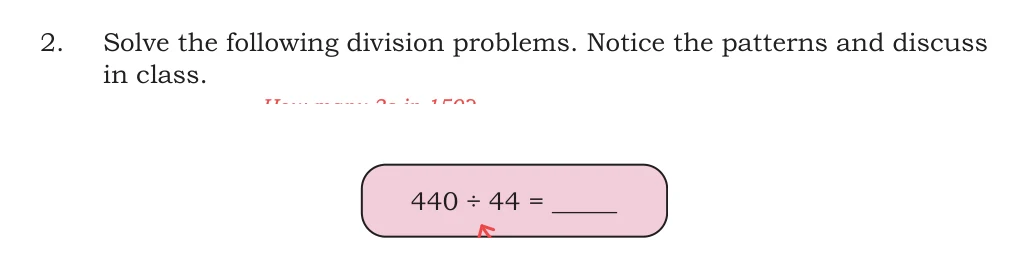
Divide 440 by 44 and identify the remainder, if any.
Show detailed solution
- Step 1: Look for the largest whole-number multiple of 44 that does not pass 440.
- Step 2: 44\times10=440, so there are 10 complete groups.
- Step 3: 440-440=0. The division ends with no remainder.
- Step 4: Check: 44\times10+0=440.
- Answer: 440\div44=10.
Textbook page 121 · solved item 26
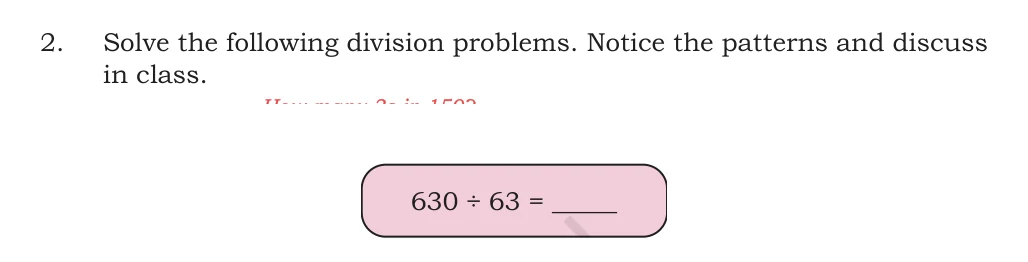
Divide 630 by 63 and identify the remainder, if any.
Show detailed solution
- Step 1: Look for the largest whole-number multiple of 63 that does not pass 630.
- Step 2: 63\times10=630, so there are 10 complete groups.
- Step 3: 630-630=0. The division ends with no remainder.
- Step 4: Check: 63\times10+0=630.
- Answer: 630\div63=10.
Textbook page 121 · solved item 27
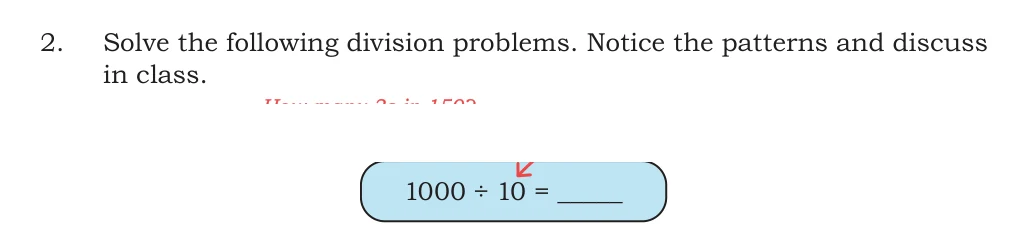
Divide 1,000 by 10 and identify the remainder, if any.
Show detailed solution
- Step 1: Look for the largest whole-number multiple of 10 that does not pass 1,000.
- Step 2: 10\times100=1,000, so there are 100 complete groups.
- Step 3: 1,000-1,000=0. The division ends with no remainder.
- Step 4: Check: 10\times100+0=1,000.
- Answer: 1,000\div10=100.
Textbook page 121 · solved item 28
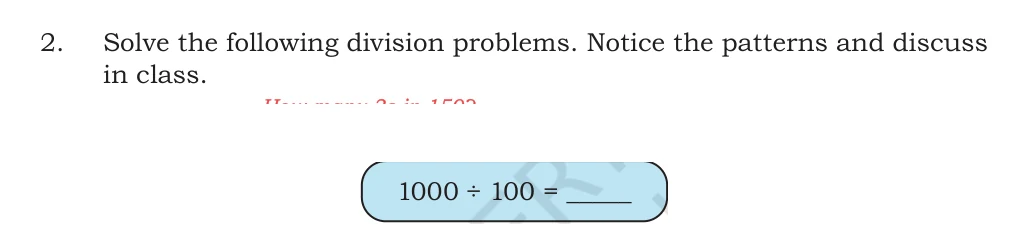
Divide 1,000 by 100 and identify the remainder, if any.
Show detailed solution
- Step 1: Look for the largest whole-number multiple of 100 that does not pass 1,000.
- Step 2: 100\times10=1,000, so there are 10 complete groups.
- Step 3: 1,000-1,000=0. The division ends with no remainder.
- Step 4: Check: 100\times10+0=1,000.
- Answer: 1,000\div100=10.
Textbook page 121 · solved item 29
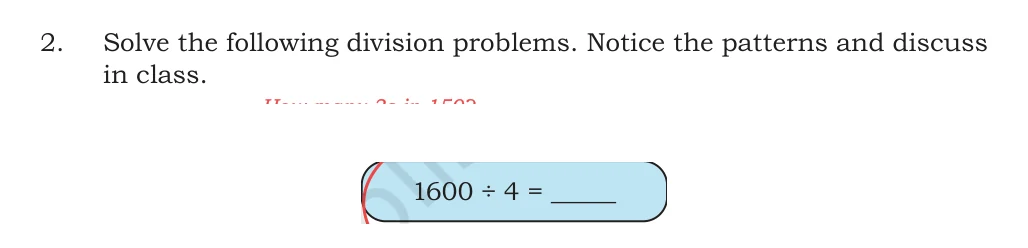
Divide 1,600 by 4 and identify the remainder, if any.
Show detailed solution
- Step 1: Look for the largest whole-number multiple of 4 that does not pass 1,600.
- Step 2: 4\times400=1,600, so there are 400 complete groups.
- Step 3: 1,600-1,600=0. The division ends with no remainder.
- Step 4: Check: 4\times400+0=1,600.
- Answer: 1,600\div4=400.
Textbook page 121 · solved item 30
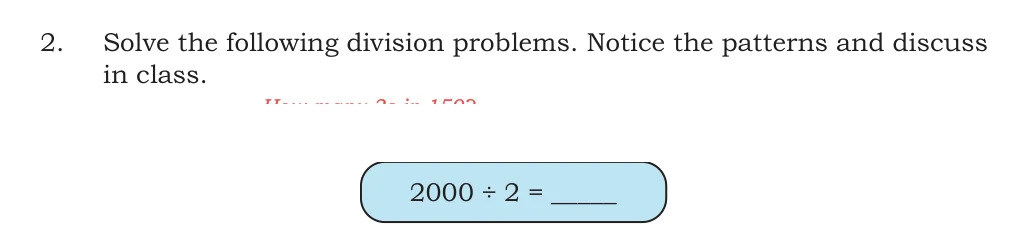
Divide 2,000 by 2 and identify the remainder, if any.
Show detailed solution
- Step 1: Look for the largest whole-number multiple of 2 that does not pass 2,000.
- Step 2: 2\times1000=2,000, so there are 1000 complete groups.
- Step 3: 2,000-2,000=0. The division ends with no remainder.
- Step 4: Check: 2\times1000+0=2,000.
- Answer: 2,000\div2=1000.
Textbook page 121 · solved item 31
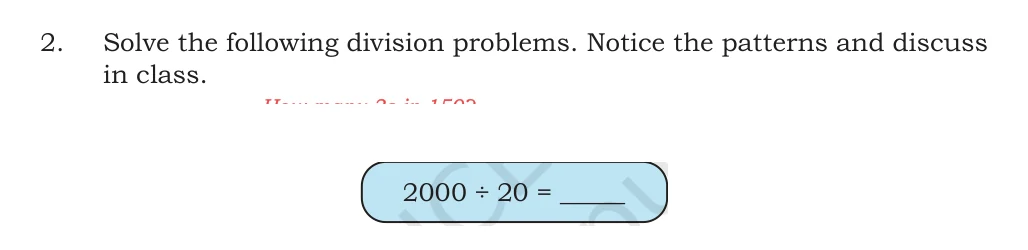
Divide 2,000 by 20 and identify the remainder, if any.
Show detailed solution
- Step 1: Look for the largest whole-number multiple of 20 that does not pass 2,000.
- Step 2: 20\times100=2,000, so there are 100 complete groups.
- Step 3: 2,000-2,000=0. The division ends with no remainder.
- Step 4: Check: 20\times100+0=2,000.
- Answer: 2,000\div20=100.
Textbook page 121 · solved item 32
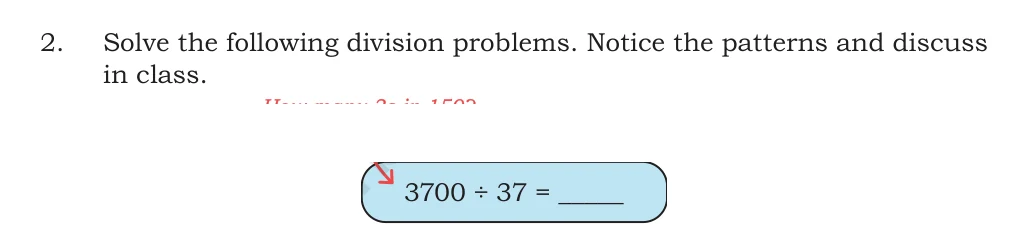
Divide 3,700 by 37 and identify the remainder, if any.
Show detailed solution
- Step 1: Look for the largest whole-number multiple of 37 that does not pass 3,700.
- Step 2: 37\times100=3,700, so there are 100 complete groups.
- Step 3: 3,700-3,700=0. The division ends with no remainder.
- Step 4: Check: 37\times100+0=3,700.
- Answer: 3,700\div37=100.
Textbook page 121 · solved item 33
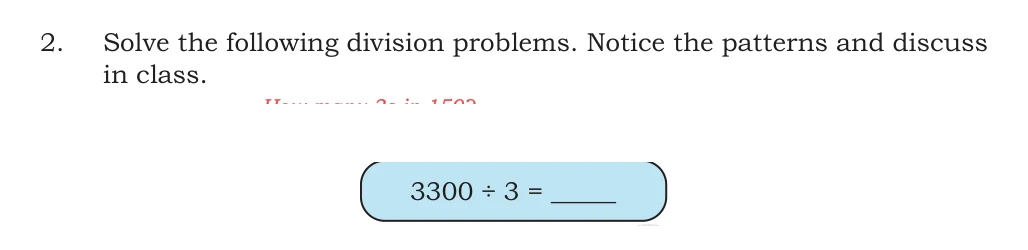
Divide 3,300 by 3 and identify the remainder, if any.
Show detailed solution
- Step 1: Look for the largest whole-number multiple of 3 that does not pass 3,300.
- Step 2: 3\times1100=3,300, so there are 1100 complete groups.
- Step 3: 3,300-3,300=0. The division ends with no remainder.
- Step 4: Check: 3\times1100+0=3,300.
- Answer: 3,300\div3=1100.
Textbook page 121 · solved item 34
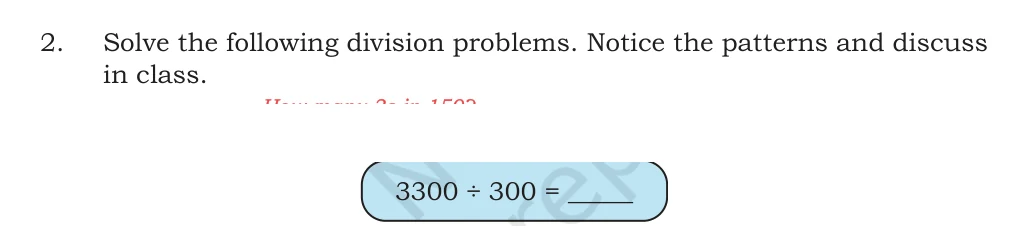
Divide 3,300 by 300 and identify the remainder, if any.
Show detailed solution
- Step 1: Look for the largest whole-number multiple of 300 that does not pass 3,300.
- Step 2: 300\times11=3,300, so there are 11 complete groups.
- Step 3: 3,300-3,300=0. The division ends with no remainder.
- Step 4: Check: 300\times11+0=3,300.
- Answer: 3,300\div300=11.
Textbook page 121 · solved item 35
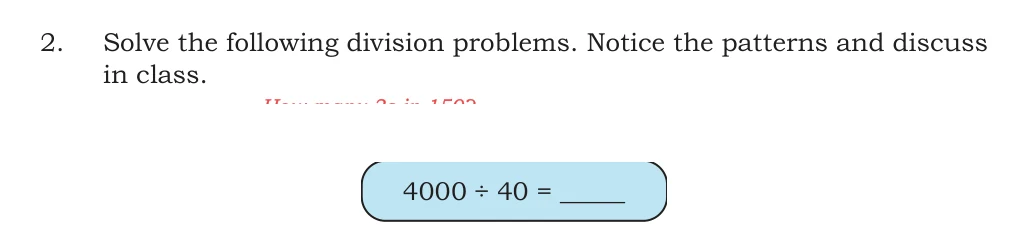
Divide 4,000 by 40 and identify the remainder, if any.
Show detailed solution
- Step 1: Look for the largest whole-number multiple of 40 that does not pass 4,000.
- Step 2: 40\times100=4,000, so there are 100 complete groups.
- Step 3: 4,000-4,000=0. The division ends with no remainder.
- Step 4: Check: 40\times100+0=4,000.
- Answer: 4,000\div40=100.
Textbook page 121 · solved item 36
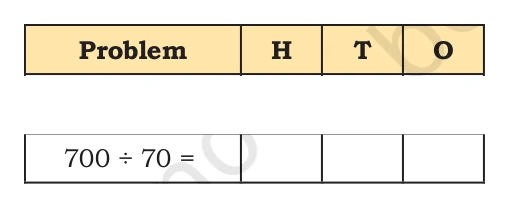
Complete the place-value table row for 700 divided by 70.
Show detailed solution
- Step 1: Look for the largest whole-number multiple of 70 that does not pass 700.
- Step 2: 70\times10=700, so there are 10 complete groups.
- Step 3: 700-700=0. The division ends with no remainder.
- Step 4: Check: 70\times10+0=700.
- Answer: 700\div70=10.
Textbook page 121 · solved item 37
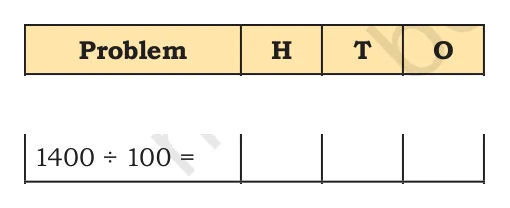
Complete the place-value table row for 1,400 divided by 100.
Show detailed solution
- Step 1: Look for the largest whole-number multiple of 100 that does not pass 1,400.
- Step 2: 100\times14=1,400, so there are 14 complete groups.
- Step 3: 1,400-1,400=0. The division ends with no remainder.
- Step 4: Check: 100\times14+0=1,400.
- Answer: 1,400\div100=14.
Textbook page 121 · solved item 38
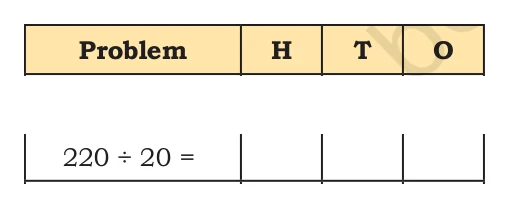
Complete the place-value table row for 220 divided by 20.
Show detailed solution
- Step 1: Look for the largest whole-number multiple of 20 that does not pass 220.
- Step 2: 20\times11=220, so there are 11 complete groups.
- Step 3: 220-220=0. The division ends with no remainder.
- Step 4: Check: 20\times11+0=220.
- Answer: 220\div20=11.
Textbook page 121 · solved item 39
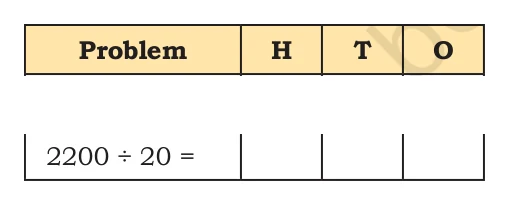
Complete the place-value table row for 2,200 divided by 20.
Show detailed solution
- Step 1: Look for the largest whole-number multiple of 20 that does not pass 2,200.
- Step 2: 20\times110=2,200, so there are 110 complete groups.
- Step 3: 2,200-2,200=0. The division ends with no remainder.
- Step 4: Check: 20\times110+0=2,200.
- Answer: 2,200\div20=110.
Textbook page 121 · solved item 40
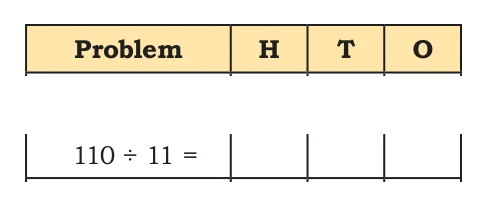
Complete the place-value table row for 110 divided by 11.
Show detailed solution
- Step 1: Look for the largest whole-number multiple of 11 that does not pass 110.
- Step 2: 11\times10=110, so there are 10 complete groups.
- Step 3: 110-110=0. The division ends with no remainder.
- Step 4: Check: 11\times10+0=110.
- Answer: 110\div11=10.
Textbook page 121 · solved item 41
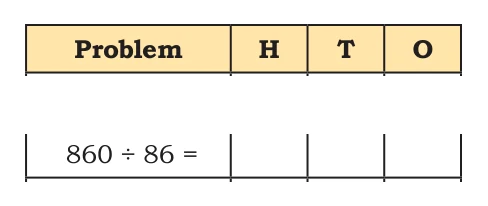
Complete the place-value table row for 860 divided by 86.
Show detailed solution
- Step 1: Look for the largest whole-number multiple of 86 that does not pass 860.
- Step 2: 86\times10=860, so there are 10 complete groups.
- Step 3: 860-860=0. The division ends with no remainder.
- Step 4: Check: 86\times10+0=860.
- Answer: 860\div86=10.
Textbook page 121 · solved item 42
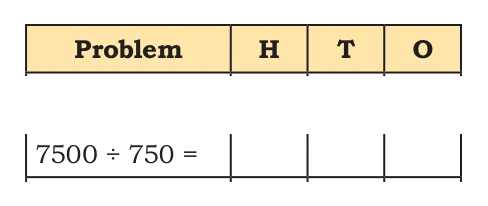
Complete the place-value table row for 7,500 divided by 750.
Show detailed solution
- Step 1: Look for the largest whole-number multiple of 750 that does not pass 7,500.
- Step 2: 750\times10=7,500, so there are 10 complete groups.
- Step 3: 7,500-7,500=0. The division ends with no remainder.
- Step 4: Check: 750\times10+0=7,500.
- Answer: 7,500\div750=10.
Textbook page 121 · solved item 43
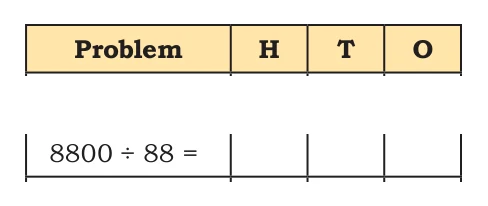
Complete the place-value table row for 8,800 divided by 88.
Show detailed solution
- Step 1: Look for the largest whole-number multiple of 88 that does not pass 8,800.
- Step 2: 88\times100=8,800, so there are 100 complete groups.
- Step 3: 8,800-8,800=0. The division ends with no remainder.
- Step 4: Check: 88\times100+0=8,800.
- Answer: 8,800\div88=100.
Textbook page 121 · solved item 44
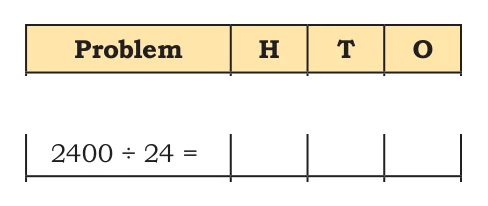
Complete the place-value table row for 2,400 divided by 24.
Show detailed solution
- Step 1: Look for the largest whole-number multiple of 24 that does not pass 2,400.
- Step 2: 24\times100=2,400, so there are 100 complete groups.
- Step 3: 2,400-2,400=0. The division ends with no remainder.
- Step 4: Check: 24\times100+0=2,400.
- Answer: 2,400\div24=100.
Textbook page 121 · solved item 45
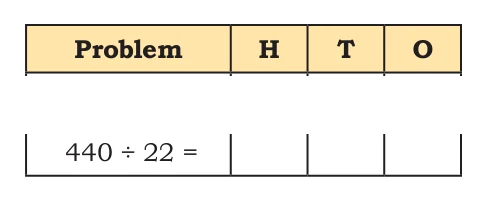
Complete the place-value table row for 440 divided by 22.
Show detailed solution
- Step 1: Look for the largest whole-number multiple of 22 that does not pass 440.
- Step 2: 22\times20=440, so there are 20 complete groups.
- Step 3: 440-440=0. The division ends with no remainder.
- Step 4: Check: 22\times20+0=440.
- Answer: 440\div22=20.
Textbook page 121 · solved item 46
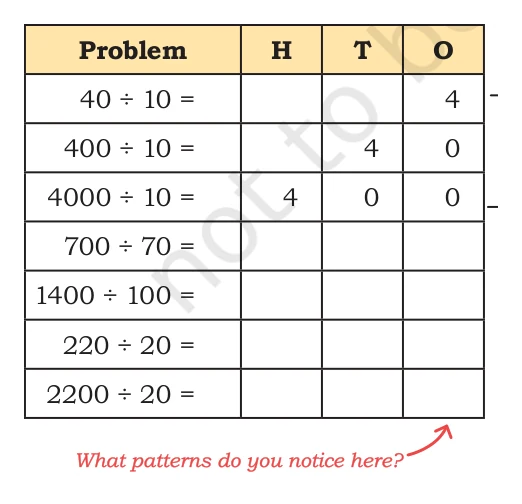
What pattern do you notice in the left place-value chart?
Show detailed solution
- Step 1: The first three rows show 40, 400, and 4,000 divided by 10.
- Step 2: Making the dividend 10 times as large makes the quotient 10 times as large when the divisor stays 10.
- Step 3: In the later rows, cancelling a common group of tens also makes the division easier, such as 700\div70=70\div7.
- Answer: Place value lets us remove matching groups of ten or track how a quotient becomes 10 times larger.
Textbook page 121 · solved item 47
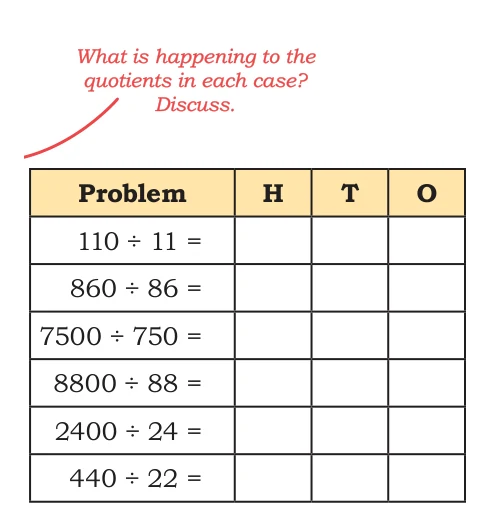
What is happening to the quotients in the right place-value chart?
Show detailed solution
- Step 1: Many rows have a divisor that is one-tenth of the dividend, so the quotient is 10.
- Step 2: If the dividend is 100 times the divisor, the quotient is 100, as in 8,800\div88=100.
- Step 3: The quotient tells how many equal divisor-sized groups fit in the dividend.
- Answer: The place values reveal whether the dividend contains 10, 20, or 100 equal groups of the divisor.
Detailed worked answers
Textbook page 122
Textbook page 122 · solved item 48

Sabina cycles 160 km in 20 days. How many kilometres does she cycle each day?
Show detailed solution
- Step 1: Look for the largest whole-number multiple of 20 that does not pass 160.
- Step 2: 20\times8=160, so there are 8 complete groups.
- Step 3: 160-160=0. The division ends with no remainder.
- Step 4: Check: 20\times8+0=160.
- Answer: 160\div20=8\text{ km per day}.
Textbook page 122 · solved item 49

How many Rs 100 notes are needed to make Rs 4,200?
Show detailed solution
- Step 1: Look for the largest whole-number multiple of 100 that does not pass 4,200.
- Step 2: 100\times42=4,200, so there are 42 complete groups.
- Step 3: 4,200-4,200=0. The division ends with no remainder.
- Step 4: Check: 100\times42+0=4,200.
- Answer: 4,200\div100=42\text{ notes}.
Textbook page 122 · solved item 50

Rs 5,500 is shared equally among 5 employees. How much does each employee get?
Show detailed solution
- Step 1: Look for the largest whole-number multiple of 5 that does not pass 5,500.
- Step 2: 5\times1100=5,500, so there are 1100 complete groups.
- Step 3: 5,500-5,500=0. The division ends with no remainder.
- Step 4: Check: 5\times1100+0=5,500.
- Answer: 5,500\div5=1100\text{ rupees}.
Textbook page 122 · solved item 51

If Rs 5,500 is shared among 10 employees, how much does each get, and is it more or less?
Show detailed solution
- Step 1: Look for the largest whole-number multiple of 10 that does not pass 5,500.
- Step 2: 10\times550=5,500, so there are 550 complete groups.
- Step 3: 5,500-5,500=0. The division ends with no remainder.
- Step 4: Check: 10\times550+0=5,500.
- Answer: 5,500\div10=550\text{ rupees}.
Textbook page 122 · solved item 52

How much money is needed so that 10 employees can each receive the earlier amount of Rs 1,100?
Show detailed solution
- Step 1: The earlier gift for one employee was Rs 1,100.
- Step 2: Ten employees need ten equal groups of Rs 1,100.
- Step 3: 1,100\times10=11,000.
- Answer: The owner must distribute Rs 11,000.
Textbook page 122 · solved item 53
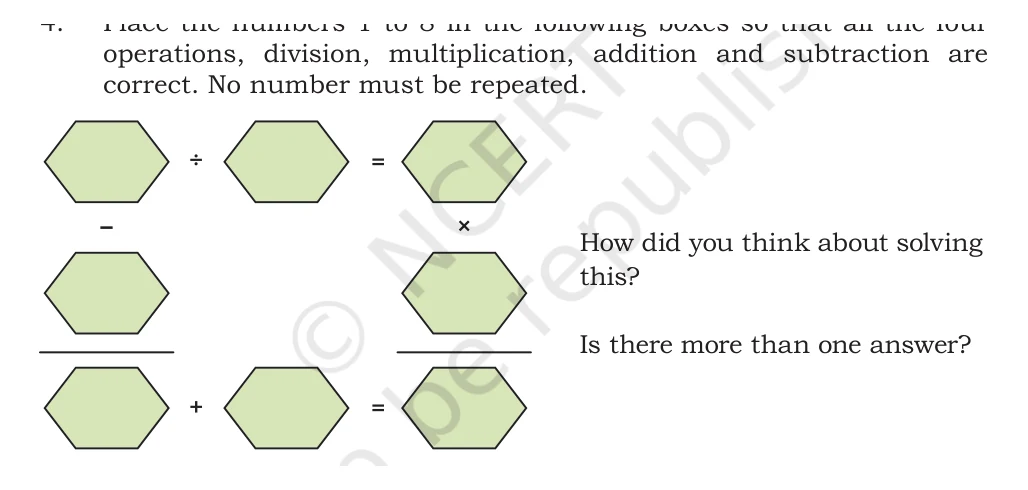
Place 1 to 8 in the diagram so all four operations are correct and no number repeats.
Show detailed solution
- Step 1: Use a division fact at the top. Choose 6\div3=2.
- Step 2: Down the left, use 6-5=1.
- Step 3: Down the right, use 2\times4=8.
- Step 4: The remaining numbers make 1+7=8. Every number from 1 to 8 is used once.
- Answer: Top row 6,3,2; middle row 5,4; bottom row 1,7,8.
Textbook page 122 · solved item 54
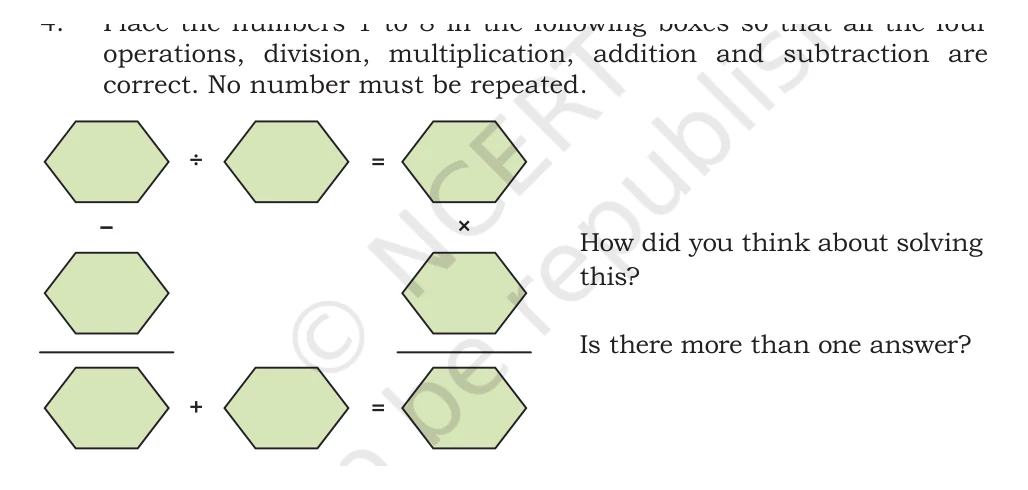
Explain a useful way to think about the four-operation puzzle.
Show detailed solution
- Step 1: Start with the top division because only a few pairs from 1 to 8 divide exactly.
- Step 2: Use the multiplication on the right to narrow the possible bottom-right result.
- Step 3: Test the subtraction and addition with the unused numbers, checking that no number repeats.
- Answer: Begin with the most restrictive facts, then use the unused-number rule to finish the subtraction and addition.
Textbook page 122 · solved item 55
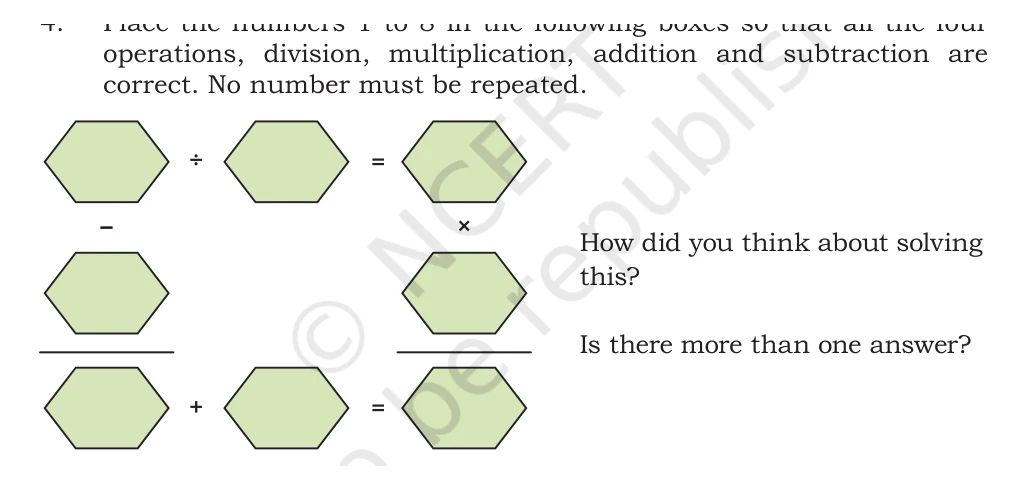
Is there more than one answer to the four-operation puzzle?
Show detailed solution
- Step 1: The first solution uses top row 6,3,2 and bottom result 8.
- Step 2: Try another exact top fact: 8\div4=2.
- Step 3: Then 8-7=1, 2\times3=6, and 1+5=6.
- Answer: Yes. Another solution is top 8,4,2, middle 7,3, bottom 1,5,6.
Textbook page 122 · solved item 56

Find the number that divided by 18 gives 100.
Show detailed solution
- Step 1: Read which part of the division statement is missing.
- Step 2: Use the related multiplication fact.
- Step 3: Because 18\times100=1,800.
- Answer: The blank is 1,800.
Textbook page 122 · solved item 57

Find the number that divided by 10 gives 610.
Show detailed solution
- Step 1: Read which part of the division statement is missing.
- Step 2: Use the related multiplication fact.
- Step 3: Because 610\times10=6,100.
- Answer: The blank is 6,100.
Textbook page 122 · solved item 58

Find the number that divided by 100 gives 72.
Show detailed solution
- Step 1: Read which part of the division statement is missing.
- Step 2: Use the related multiplication fact.
- Step 3: Because 72\times100=7,200.
- Answer: The blank is 7,200.
Textbook page 122 · solved item 59

Find the number that divided by 100 gives 10.
Show detailed solution
- Step 1: Read which part of the division statement is missing.
- Step 2: Use the related multiplication fact.
- Step 3: Because 10\times100=1,000.
- Answer: The blank is 1,000.
Textbook page 122 · solved item 60
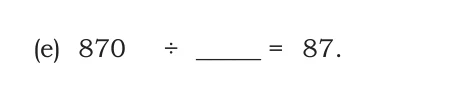
Complete 870 divided by a number equals 87.
Show detailed solution
- Step 1: Read which part of the division statement is missing.
- Step 2: Use the related multiplication fact.
- Step 3: Because 87\times10=870.
- Answer: The blank is 10.
Textbook page 122 · solved item 61
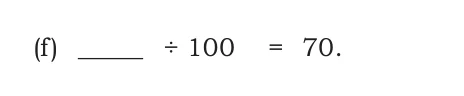
Find the number that divided by 100 gives 70.
Show detailed solution
- Step 1: Read which part of the division statement is missing.
- Step 2: Use the related multiplication fact.
- Step 3: Because 70\times100=7,000.
- Answer: The blank is 7,000.
Textbook page 122 · solved item 62
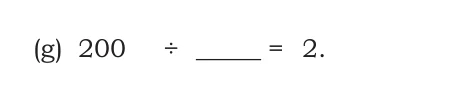
Complete 200 divided by a number equals 2.
Show detailed solution
- Step 1: Read which part of the division statement is missing.
- Step 2: Use the related multiplication fact.
- Step 3: Because 2\times100=200.
- Answer: The blank is 100.
Textbook page 122 · solved item 63
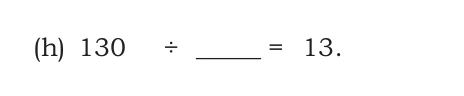
Complete 130 divided by a number equals 13.
Show detailed solution
- Step 1: Read which part of the division statement is missing.
- Step 2: Use the related multiplication fact.
- Step 3: Because 13\times10=130.
- Answer: The blank is 10.
Detailed worked answers
Textbook page 123
Textbook page 123 · solved item 64

Give five division examples where the dividend can be split into convenient parts.
Show detailed solution
- Step 1: Choose dividends that split into easy multiples of the divisor.
- Step 2: For example, 84\div4=(80\div4)+(4\div4)=20+1=21.
- Step 3: Four more examples are 96\div6=16, 155\div5=31, 248\div8=31, and 396\div9=44.
- Answer: These five examples all work by splitting the dividend into easy parts.
Textbook page 123 · solved item 65

For which other divisors and dividends can repeated halving be used?
Show detailed solution
- Step 1: Halving once divides by 2; halving twice divides by 4.
- Step 2: Halving three times divides by 8, and halving four times divides by 16.
- Step 3: Choose even dividends at every required halving, such as 192\div8: 192,96,48,24.
- Answer: Repeated halving is useful for divisors 2, 4, 8, 16, and other powers of 2 when the dividend halves cleanly.
Textbook page 123 · solved item 66
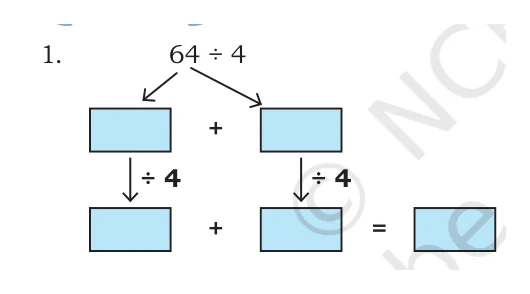
Use the shown mental strategy to find 64 divided by 4.
Show detailed solution
- Step 1: Split 64 into 40 and 24; divide each by 4 to get 10 and 6.
- Step 2: The convenient parts combine to make the quotient 16.
- Step 3: Check: 4\times16=64.
- Answer: 64\div4=16.
Textbook page 123 · solved item 67
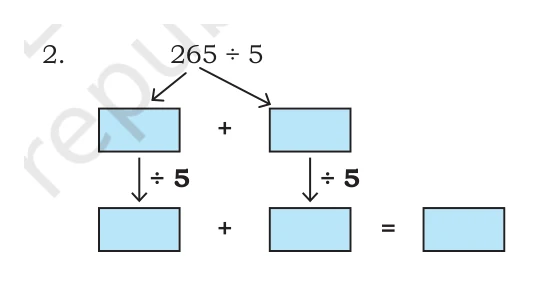
Use the shown mental strategy to find 265 divided by 5.
Show detailed solution
- Step 1: Split 265 into 250 and 15; divide by 5 to get 50 and 3.
- Step 2: The convenient parts combine to make the quotient 53.
- Step 3: Check: 5\times53=265.
- Answer: 265\div5=53.
Textbook page 123 · solved item 68
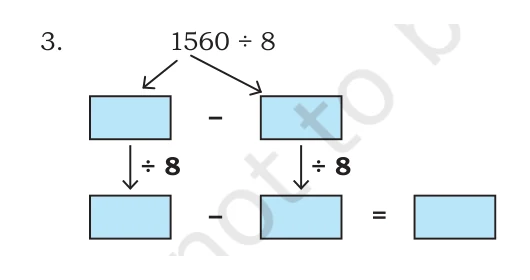
Use the shown mental strategy to find 1,560 divided by 8.
Show detailed solution
- Step 1: Write 1,560 as 1,600 minus 40; divide to get 200 minus 5.
- Step 2: The convenient parts combine to make the quotient 195.
- Step 3: Check: 8\times195=1,560.
- Answer: 1,560\div8=195.
Textbook page 123 · solved item 69
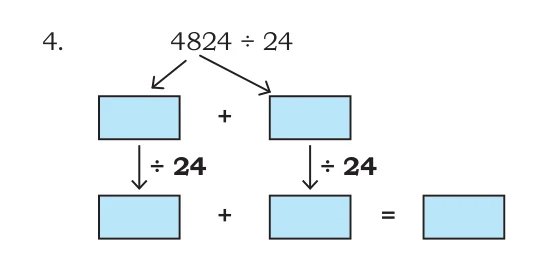
Use the shown mental strategy to find 4,824 divided by 24.
Show detailed solution
- Step 1: Split 4,824 into 4,800 and 24; divide to get 200 and 1.
- Step 2: The convenient parts combine to make the quotient 201.
- Step 3: Check: 24\times201=4,824.
- Answer: 4,824\div24=201.
Textbook page 123 · solved item 70

Use the shown mental strategy to find 168 divided by 8.
Show detailed solution
- Step 1: Halve three times: 168 becomes 84, then 42, then 21.
- Step 2: The convenient parts combine to make the quotient 21.
- Step 3: Check: 8\times21=168.
- Answer: 168\div8=21.
Textbook page 123 · solved item 71

Use the shown mental strategy to find 144 divided by 4.
Show detailed solution
- Step 1: Halve twice: 144 becomes 72, then 36.
- Step 2: The convenient parts combine to make the quotient 36.
- Step 3: Check: 4\times36=144.
- Answer: 144\div4=36.
Detailed worked answers
Textbook page 124
Textbook page 124 · solved item 72
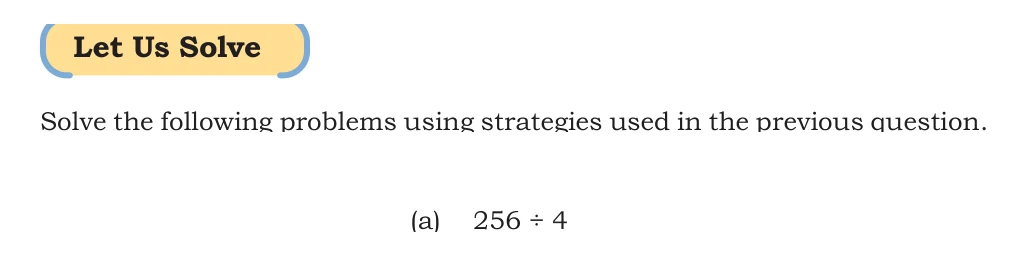
Divide 256 by 4 and identify the remainder, if any.
Show detailed solution
- Step 1: Look for the largest whole-number multiple of 4 that does not pass 256.
- Step 2: 4\times64=256, so there are 64 complete groups.
- Step 3: 256-256=0. The division ends with no remainder.
- Step 4: Check: 4\times64+0=256.
- Answer: 256\div4=64.
Textbook page 124 · solved item 73
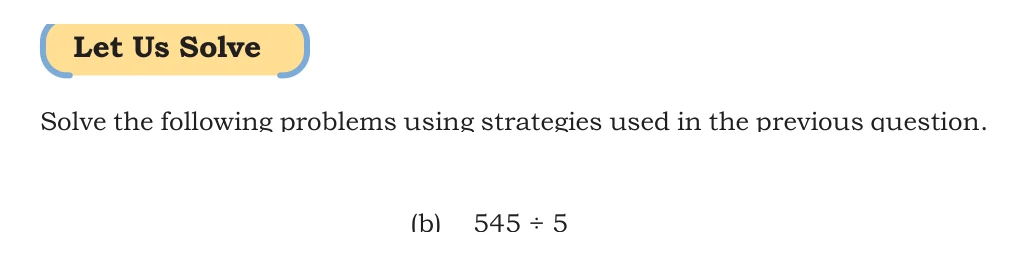
Divide 545 by 5 and identify the remainder, if any.
Show detailed solution
- Step 1: Look for the largest whole-number multiple of 5 that does not pass 545.
- Step 2: 5\times109=545, so there are 109 complete groups.
- Step 3: 545-545=0. The division ends with no remainder.
- Step 4: Check: 5\times109+0=545.
- Answer: 545\div5=109.
Textbook page 124 · solved item 74
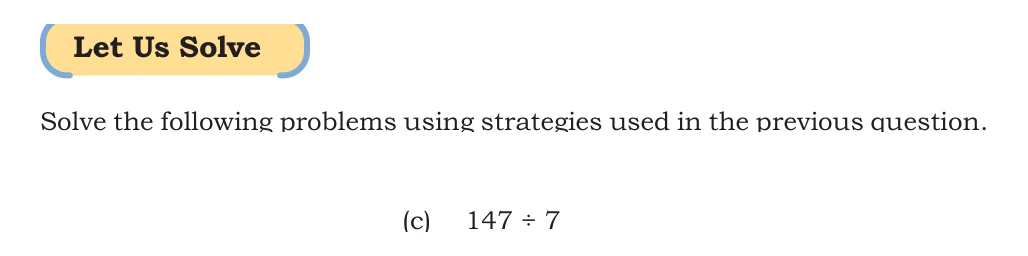
Divide 147 by 7 and identify the remainder, if any.
Show detailed solution
- Step 1: Look for the largest whole-number multiple of 7 that does not pass 147.
- Step 2: 7\times21=147, so there are 21 complete groups.
- Step 3: 147-147=0. The division ends with no remainder.
- Step 4: Check: 7\times21+0=147.
- Answer: 147\div7=21.
Textbook page 124 · solved item 75
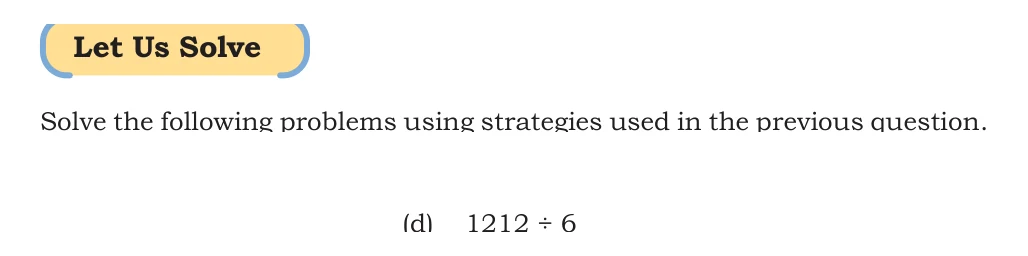
Divide 1,212 by 6 and identify the remainder, if any.
Show detailed solution
- Step 1: Look for the largest whole-number multiple of 6 that does not pass 1,212.
- Step 2: 6\times202=1,212, so there are 202 complete groups.
- Step 3: 1,212-1,212=0. The division ends with no remainder.
- Step 4: Check: 6\times202+0=1,212.
- Answer: 1,212\div6=202.
Textbook page 124 · solved item 76
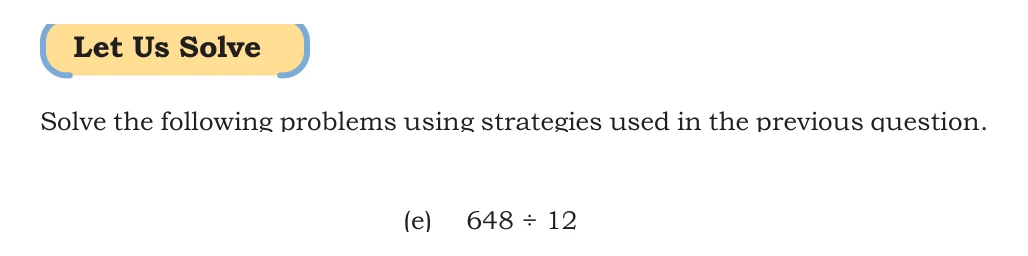
Divide 648 by 12 and identify the remainder, if any.
Show detailed solution
- Step 1: Look for the largest whole-number multiple of 12 that does not pass 648.
- Step 2: 12\times54=648, so there are 54 complete groups.
- Step 3: 648-648=0. The division ends with no remainder.
- Step 4: Check: 12\times54+0=648.
- Answer: 648\div12=54.
Textbook page 124 · solved item 77
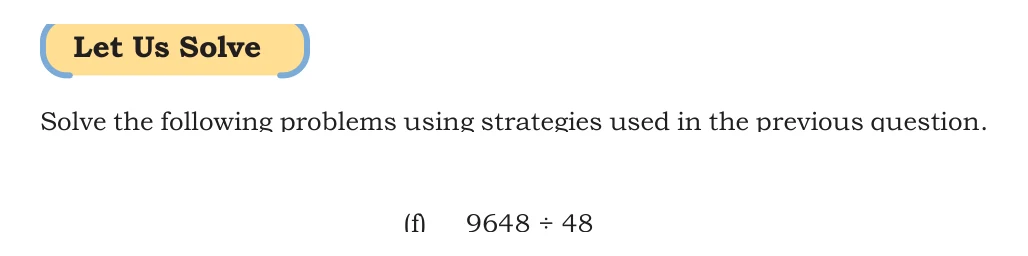
Divide 9,648 by 48 and identify the remainder, if any.
Show detailed solution
- Step 1: Look for the largest whole-number multiple of 48 that does not pass 9,648.
- Step 2: 48\times201=9,648, so there are 201 complete groups.
- Step 3: 9,648-9,648=0. The division ends with no remainder.
- Step 4: Check: 48\times201+0=9,648.
- Answer: 9,648\div48=201.
Textbook page 124 · solved item 78
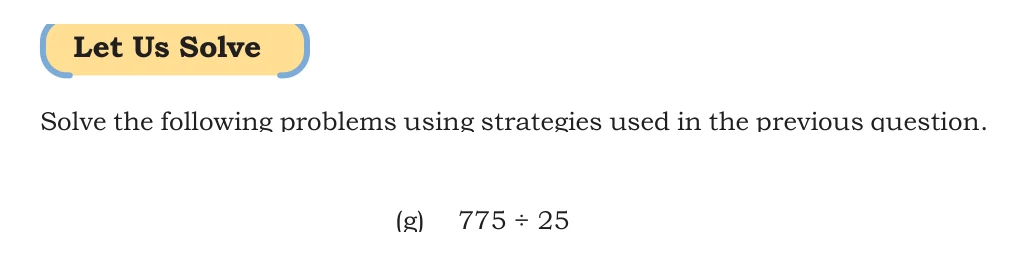
Divide 775 by 25 and identify the remainder, if any.
Show detailed solution
- Step 1: Look for the largest whole-number multiple of 25 that does not pass 775.
- Step 2: 25\times31=775, so there are 31 complete groups.
- Step 3: 775-775=0. The division ends with no remainder.
- Step 4: Check: 25\times31+0=775.
- Answer: 775\div25=31.
Textbook page 124 · solved item 79
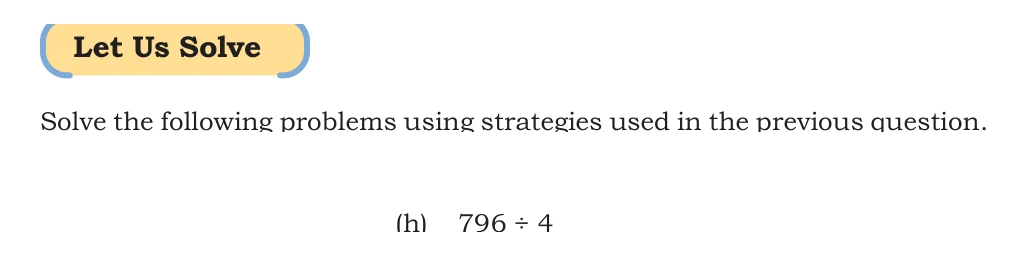
Divide 796 by 4 and identify the remainder, if any.
Show detailed solution
- Step 1: Look for the largest whole-number multiple of 4 that does not pass 796.
- Step 2: 4\times199=796, so there are 199 complete groups.
- Step 3: 796-796=0. The division ends with no remainder.
- Step 4: Check: 4\times199+0=796.
- Answer: 796\div4=199.
Textbook page 124 · solved item 80
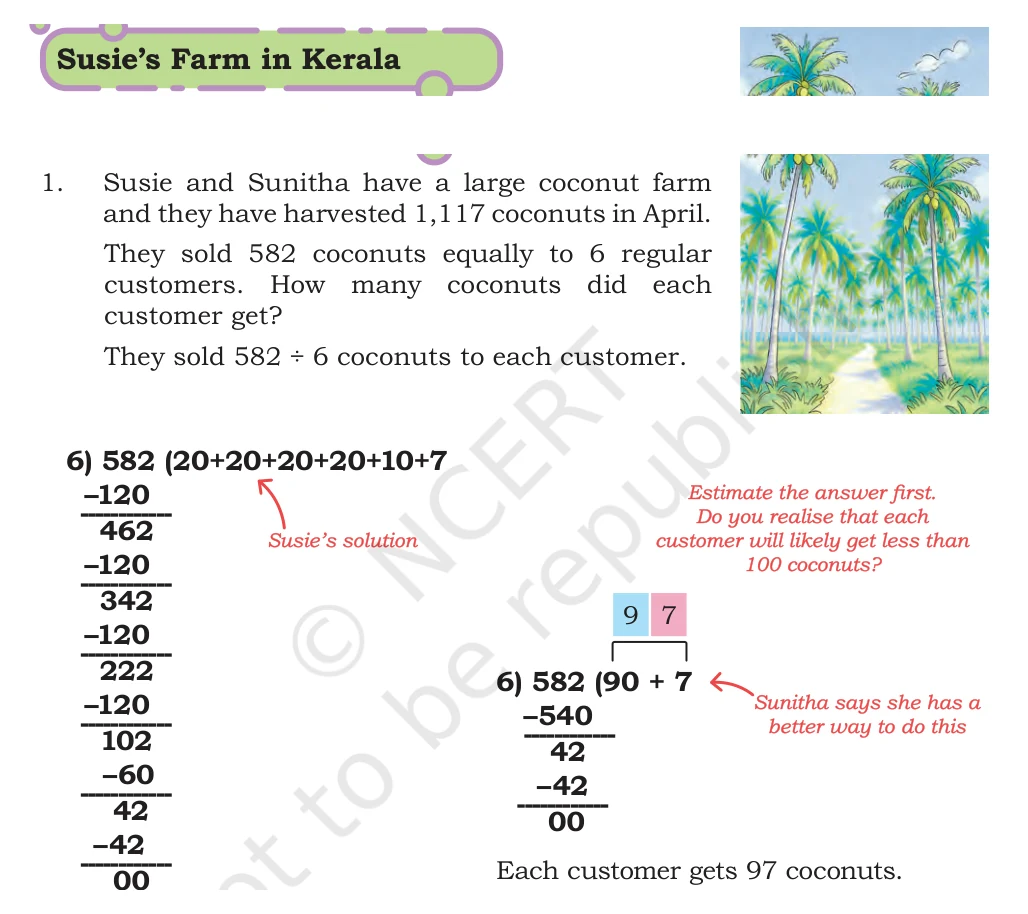
Susie and Sunitha share 582 coconuts equally among 6 customers. How many does each customer get?
Show detailed solution
- Step 1: Look for the largest whole-number multiple of 6 that does not pass 582.
- Step 2: 6\times97=582, so there are 97 complete groups.
- Step 3: 582-582=0. The division ends with no remainder.
- Step 4: Check: 6\times97+0=582.
- Answer: 582\div6=97\text{ coconuts}.
Textbook page 124 · solved item 81
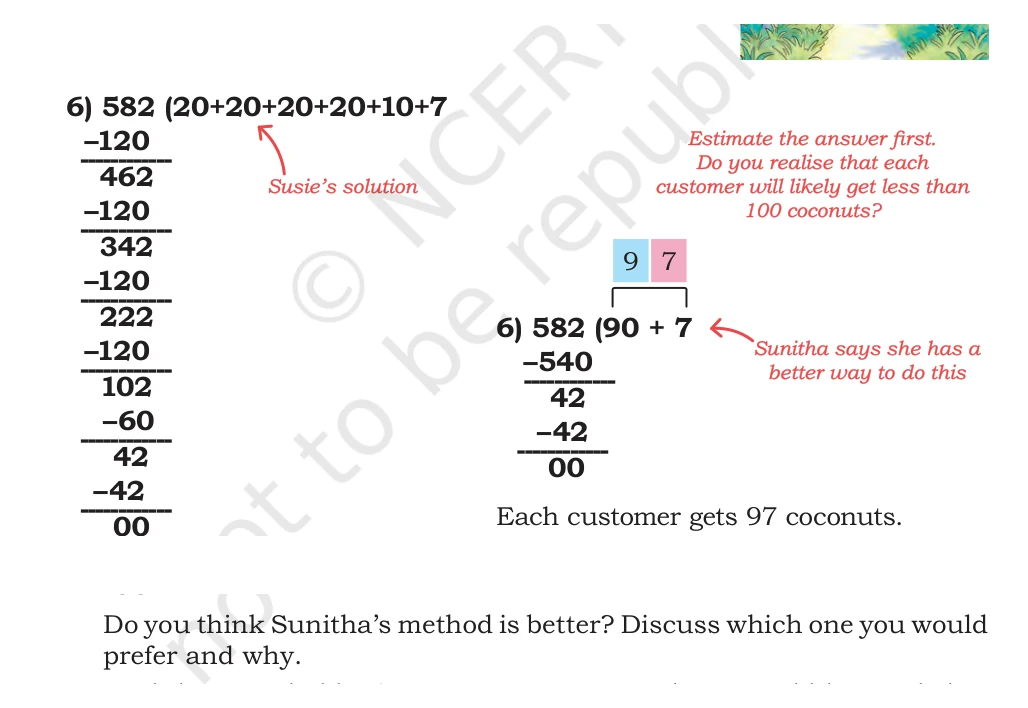
Which shown method for 582 divided by 6 would you prefer, and why?
Show detailed solution
- Step 1: Susie's method removes several groups of 120 and then smaller groups.
- Step 2: Sunitha first removes 6\times90=540, leaving only 42.
- Step 3: One more step, 42\div6=7, gives 90+7=97.
- Answer: Sunitha's method is shorter here because it reaches the answer in fewer subtraction steps.
Textbook page 124 · solved item 82
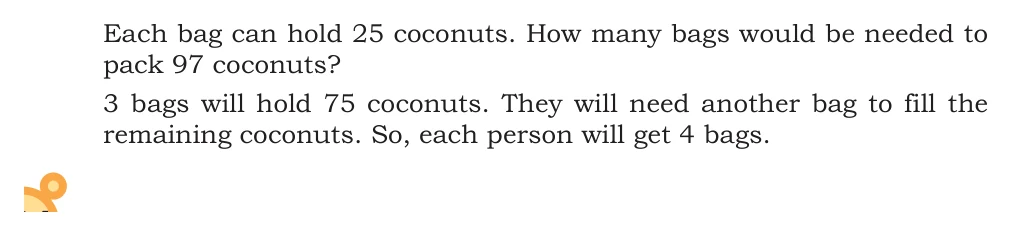
Each bag holds 25 coconuts. How many bags are needed to pack 97 coconuts?
Show detailed solution
- Step 1: Three bags hold 3\times25=75 coconuts.
- Step 2: 97-75=22 coconuts are still unpacked.
- Step 3: The remaining 22 coconuts need one more bag.
- Answer: 4 bags are needed.
Detailed worked answers
Textbook page 125
Textbook page 125 · solved item 83
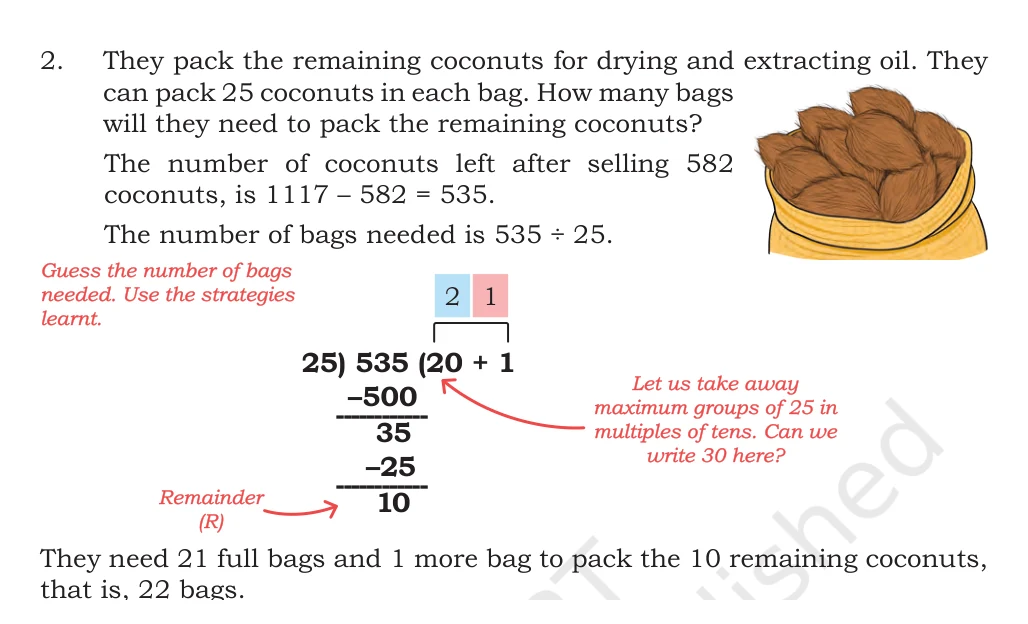
How many 25-coconut bags are needed for the coconuts left after selling 582 from 1,117?
Show detailed solution
- Step 1: Find the coconuts left: 1,117-582=535.
- Step 2: 535\div25=21 remainder 10, because 25\times21=525.
- Step 3: Twenty-one bags are full and the 10 remaining coconuts need one more bag.
- Answer: They need 22 bags in all.
Textbook page 125 · solved item 84
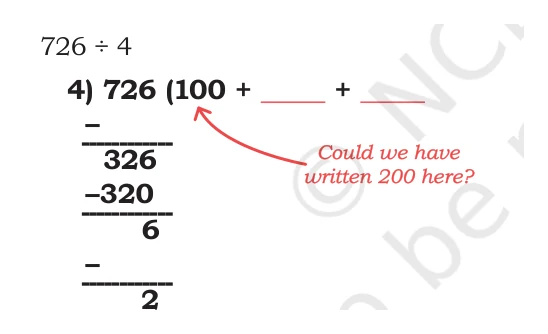
Complete the partial-quotient working for 726 divided by 4.
Show detailed solution
- Step 1: Remove 4\times100=400; 726-400=326.
- Step 2: Remove 4\times80=320; 326-320=6.
- Step 3: Remove 4\times1=4; the remainder is 6-4=2.
- Step 4: Add the partial quotients: 100+80+1=181.
- Answer: The blanks are 80 and 1; 726\div4=181 remainder 2.
Textbook page 125 · solved item 85
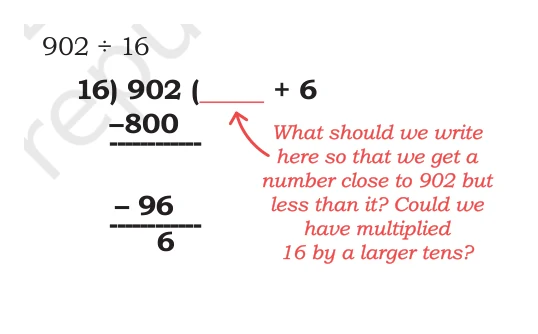
Complete the partial-quotient working for 902 divided by 16.
Show detailed solution
- Step 1: 16\times50=800, so the first blank is 50.
- Step 2: 902-800=102.
- Step 3: Remove 16\times6=96; 102-96=6.
- Answer: 902\div16=56 remainder 6.
Textbook page 125 · solved item 86

What is the relationship between dividend, divisor, quotient, and remainder?
Show detailed solution
- Step 1: Complete groups use divisor\times quotient objects.
- Step 2: Add the objects left over as the remainder.
- Step 3: The remainder must always be smaller than the divisor.
- Answer: Dividend=Divisor\times Quotient+Remainder.
Textbook page 125 · solved item 87

Check 726 divided by 4 using the quotient 181.
Show detailed solution
- Step 1: Multiply 4\times181=724.
- Step 2: Compare 724 with 726; the difference is 2.
- Step 3: 724+2=726, and 2 is smaller than 4.
- Answer: 726=4\times181+2.
Textbook page 125 · solved item 88

Check 902 divided by 16 using the quotient 56.
Show detailed solution
- Step 1: Multiply 16\times56=896.
- Step 2: Compare 896 with 902; the difference is 6.
- Step 3: 896+6=902, and 6 is smaller than 16.
- Answer: 902=16\times56+6.
Detailed worked answers
Textbook page 126
Textbook page 126 · solved item 89

For 250 guests, should Rani buy samosas in packs of 6 or packs of 8?
Show detailed solution
- Step 1: Packs of 6: 250\div6=41 remainder 4, so 42 packs give 252 samosas.
- Step 2: Packs of 8: 250\div8=31 remainder 2, so 32 packs give 256 samosas.
- Step 3: Both choices are enough, but packs of 6 leave only 2 extra instead of 6 extra.
- Answer: Buy 42 packs of 6.
Textbook page 126 · solved item 90

How many 41-seat buses are needed for 342 students?
Show detailed solution
- Step 1: 41\times8=328, so 8 buses seat 328 students.
- Step 2: 342-328=14 students still need seats.
- Step 3: A ninth bus is needed for those 14 students.
- Answer: The school needs 9 buses.
Textbook page 126 · solved item 91

Find the possible combinations of Rs 50 and Rs 20 notes that make Rs 520.
Show detailed solution
- Step 1: Try an even number of Rs 50 notes so the remaining amount can be made with Rs 20 notes.
- Step 2: The pairs (Rs 50 notes, Rs 20 notes) are (0,26),(2,21),(4,16),(6,11),(8,6),(10,1).
- Step 3: Check any pair, for example 8\times50+6\times20=400+120=520.
- Answer: There are six non-negative combinations; five of them use both kinds of note.
Textbook page 126 · solved item 92

Three friends spend Rs 157, Rs 124, and Rs 136. How much should each pay?
Show detailed solution
- Step 1: Add the first two costs: 157+124=281.
- Step 2: Add the third cost: 281+136=417.
- Step 3: Share equally: 417\div3=139.
- Answer: Each friend should pay Rs 139.
Textbook page 126 · solved item 93

Divide 887 by 3 and identify the remainder, if any.
Show detailed solution
- Step 1: Look for the largest whole-number multiple of 3 that does not pass 887.
- Step 2: 3\times295=885, so there are 295 complete groups.
- Step 3: 887-885=2. The division ends with remainder 2.
- Step 4: Check: 3\times295+2=887.
- Answer: 887\div3=295,\text{ remainder }2.
Textbook page 126 · solved item 94

Divide 283 by 8 and identify the remainder, if any.
Show detailed solution
- Step 1: Look for the largest whole-number multiple of 8 that does not pass 283.
- Step 2: 8\times35=280, so there are 35 complete groups.
- Step 3: 283-280=3. The division ends with remainder 3.
- Step 4: Check: 8\times35+3=283.
- Answer: 283\div8=35,\text{ remainder }3.
Textbook page 126 · solved item 95

Divide 745 by 5 and identify the remainder, if any.
Show detailed solution
- Step 1: Look for the largest whole-number multiple of 5 that does not pass 745.
- Step 2: 5\times149=745, so there are 149 complete groups.
- Step 3: 745-745=0. The division ends with no remainder.
- Step 4: Check: 5\times149+0=745.
- Answer: 745\div5=149.
Textbook page 126 · solved item 96

Divide 767 by 26 and identify the remainder, if any.
Show detailed solution
- Step 1: Look for the largest whole-number multiple of 26 that does not pass 767.
- Step 2: 26\times29=754, so there are 29 complete groups.
- Step 3: 767-754=13. The division ends with remainder 13.
- Step 4: Check: 26\times29+13=767.
- Answer: 767\div26=29,\text{ remainder }13.
Textbook page 126 · solved item 97

Divide 530 by 41 and identify the remainder, if any.
Show detailed solution
- Step 1: Look for the largest whole-number multiple of 41 that does not pass 530.
- Step 2: 41\times12=492, so there are 12 complete groups.
- Step 3: 530-492=38. The division ends with remainder 38.
- Step 4: Check: 41\times12+38=530.
- Answer: 530\div41=12,\text{ remainder }38.
Textbook page 126 · solved item 98

Divide 888 by 67 and identify the remainder, if any.
Show detailed solution
- Step 1: Look for the largest whole-number multiple of 67 that does not pass 888.
- Step 2: 67\times13=871, so there are 13 complete groups.
- Step 3: 888-871=17. The division ends with remainder 17.
- Step 4: Check: 67\times13+17=888.
- Answer: 888\div67=13,\text{ remainder }17.
Textbook page 126 · solved item 99
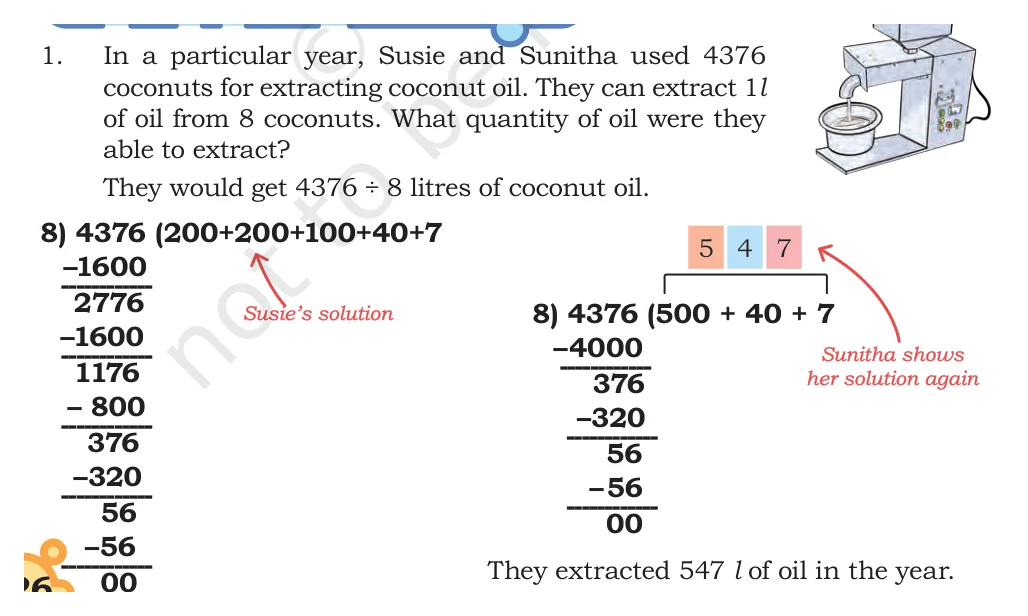
If 8 coconuts produce 1 litre of oil, how much oil comes from 4,376 coconuts?
Show detailed solution
- Step 1: Look for the largest whole-number multiple of 8 that does not pass 4,376.
- Step 2: 8\times547=4,376, so there are 547 complete groups.
- Step 3: 4,376-4,376=0. The division ends with no remainder.
- Step 4: Check: 8\times547+0=4,376.
- Answer: 4,376\div8=547\text{ litres}.
Detailed worked answers
Textbook page 127
Textbook page 127 · solved item 100
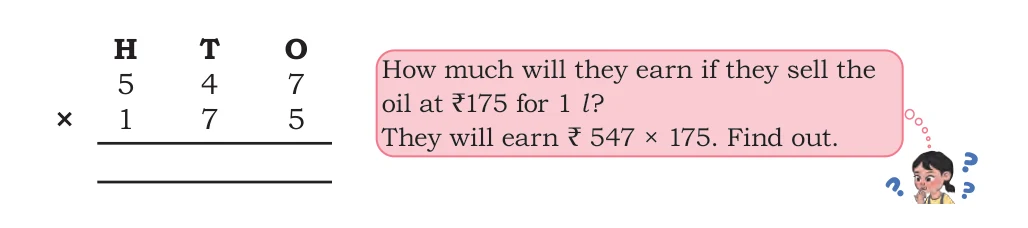
How much money is earned by selling 547 litres of oil at Rs 175 per litre?
Show detailed solution
- Step 1: Split 175 into 100+70+5.
- Step 2: 547\times100=54,700, 547\times70=38,290, and 547\times5=2,735.
- Step 3: 54,700+38,290+2,735=95,725.
- Answer: They earn Rs 95,725.
Textbook page 127 · solved item 101
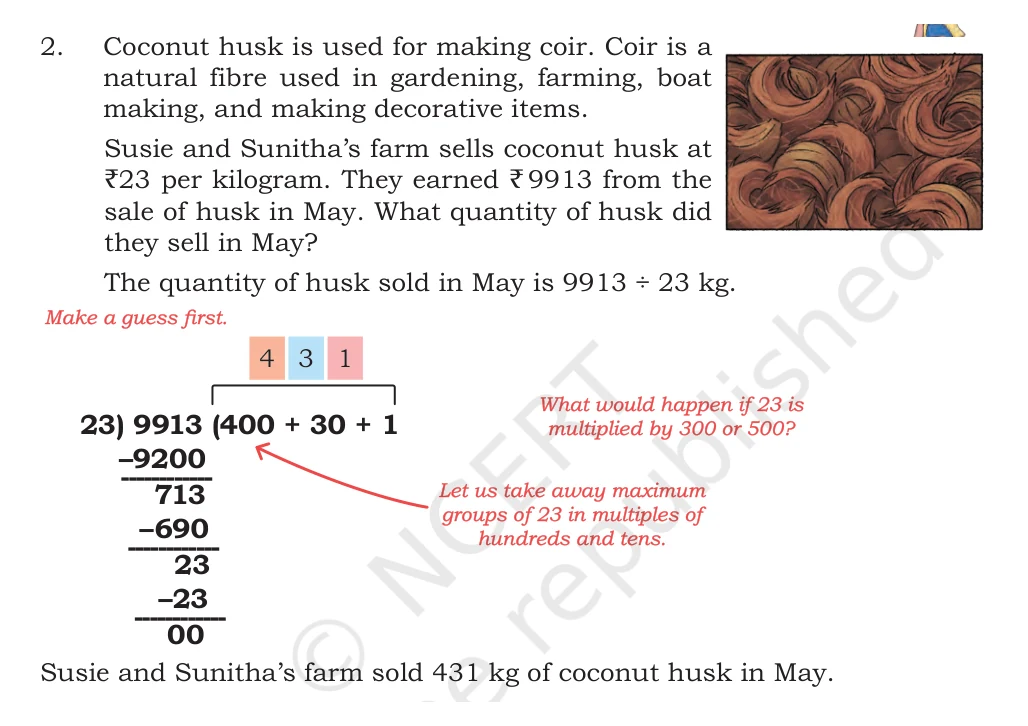
At Rs 23 per kilogram, how many kilograms of coconut husk were sold for Rs 9,913?
Show detailed solution
- Step 1: Look for the largest whole-number multiple of 23 that does not pass 9,913.
- Step 2: 23\times431=9,913, so there are 431 complete groups.
- Step 3: 9,913-9,913=0. The division ends with no remainder.
- Step 4: Check: 23\times431+0=9,913.
- Answer: 9,913\div23=431\text{ kg}.
Textbook page 127 · solved item 102
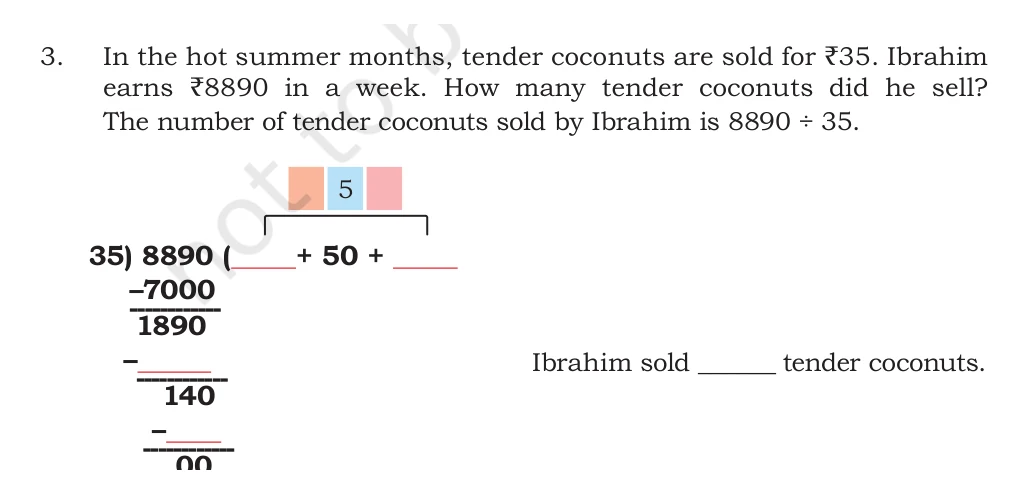
At Rs 35 each, how many tender coconuts were sold for Rs 8,890?
Show detailed solution
- Step 1: Look for the largest whole-number multiple of 35 that does not pass 8,890.
- Step 2: 35\times254=8,890, so there are 254 complete groups.
- Step 3: 8,890-8,890=0. The division ends with no remainder.
- Step 4: Check: 35\times254+0=8,890.
- Answer: 8,890\div35=254\text{ tender coconuts}.
Detailed worked answers
Textbook page 128
Textbook page 128 · solved item 103
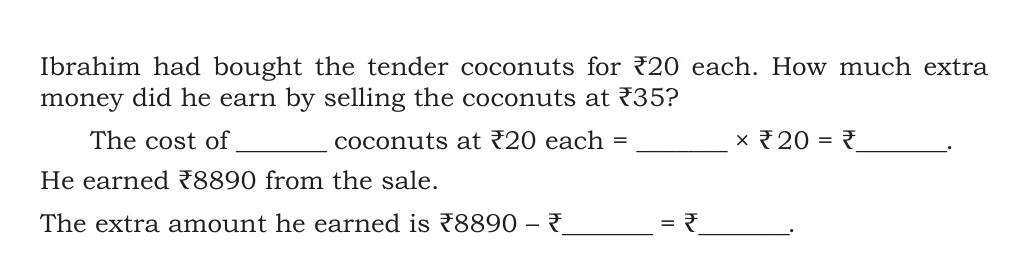
Ibrahim bought 254 coconuts for Rs 20 each and sold them for Rs 8,890. What was his extra earning?
Show detailed solution
- Step 1: Buying cost: 254\times20=5,080 rupees.
- Step 2: Selling amount: Rs 8,890.
- Step 3: Extra earning: 8,890-5,080=3,810.
- Answer: Ibrahim earned Rs 3,810 extra.
Textbook page 128 · solved item 104
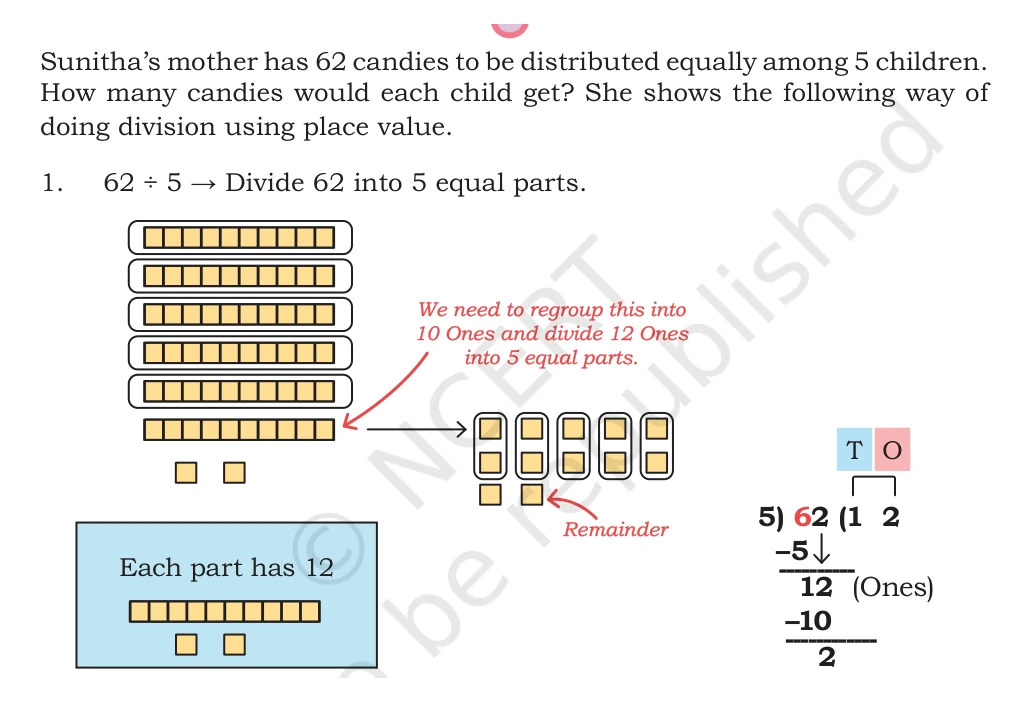
Divide 62 candies equally among 5 children using place value.
Show detailed solution
- Step 1: Regroup 6 tens and 2 ones as 62 ones.
- Step 2: Give each child 12 ones because 5\times12=60.
- Step 3: 62-60=2 candies remain.
- Answer: Each child gets 12 candies and 2 candies remain.
Textbook page 128 · solved item 105
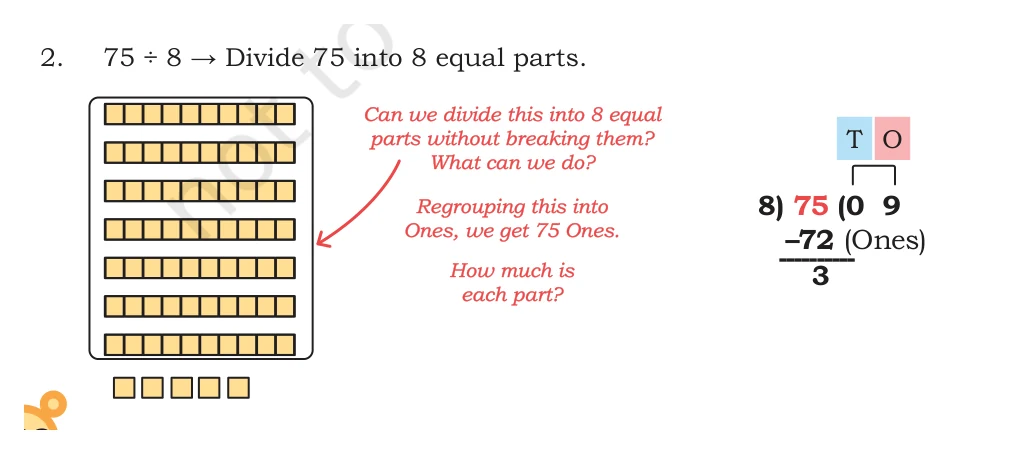
Divide 75 into 8 equal parts using place value.
Show detailed solution
- Step 1: Regroup 7 tens and 5 ones as 75 ones.
- Step 2: Eight groups of 9 use 8\times9=72.
- Step 3: 75-72=3, so 3 ones remain.
- Answer: 75\div8=9 remainder 3.
Detailed worked answers
Textbook page 129
Textbook page 129 · solved item 106
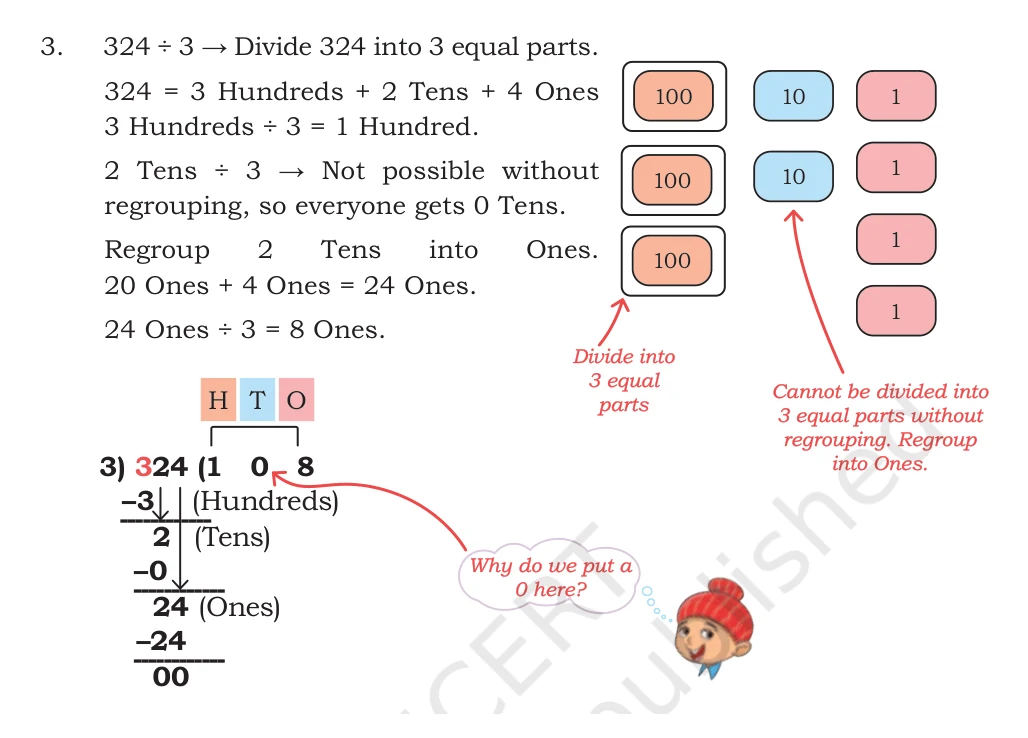
Divide 324 into 3 equal parts using place value.
Show detailed solution
- Step 1: Three hundreds divided among 3 groups gives 1 hundred each.
- Step 2: Two tens cannot be shared as whole tens, so each group gets 0 tens; regroup them as 20 ones.
- Step 3: 20+4=24 ones, and 24\div3=8 ones each.
- Answer: 324\div3=108.
Textbook page 129 · solved item 107
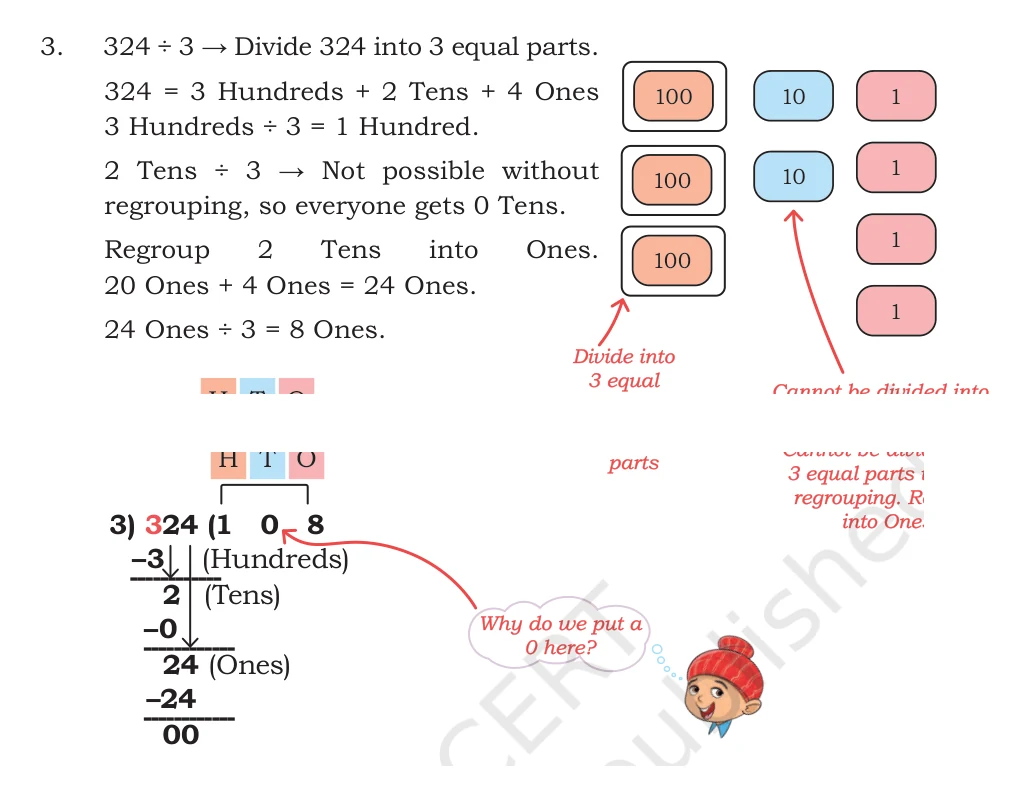
Why is a 0 written in the tens place of the quotient 108?
Show detailed solution
- Step 1: The 3 hundreds give 1 hundred to each group.
- Step 2: The 2 tens are fewer than the 3 groups, so no group receives a whole ten.
- Step 3: The 0 holds the tens place before those tens are regrouped into ones.
- Answer: The zero shows that the quotient has no tens; without it, 108 would be written incorrectly as 18.
Textbook page 129 · solved item 108
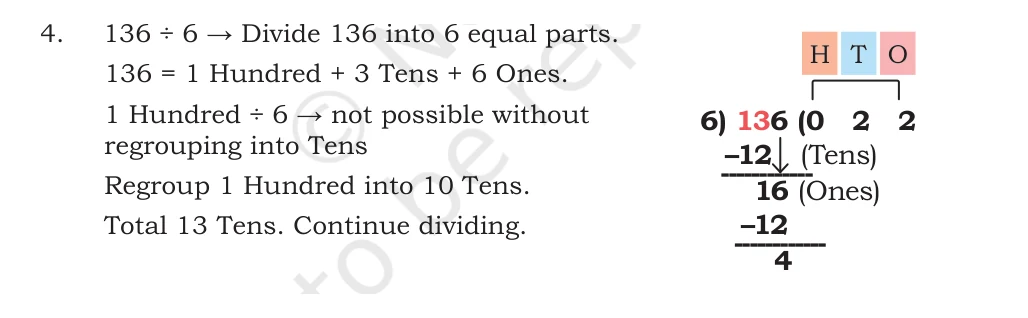
Divide 136 into 6 equal parts using place value.
Show detailed solution
- Step 1: Regroup 1 hundred as 10 tens; with 3 tens, there are 13 tens.
- Step 2: Six groups receive 2 tens each, using 12 tens and leaving 1 ten.
- Step 3: Regroup the remaining ten with 6 ones to make 16 ones; each group receives 2 ones with 4 left.
- Answer: 136\div6=22 remainder 4.
Textbook page 129 · solved item 109

Can you predict how many digits a quotient will have by looking at the divisor and dividend?
Show detailed solution
- Step 1: Compare the divisor with the first digit or first place-value part of the dividend.
- Step 2: If the divisor fits into the first digit, the quotient usually has as many digits as the dividend; for example, 324\div3=108.
- Step 3: If it does not fit, start with the first two digits, so the quotient has one fewer digit; for example, 136\div6=22.
- Answer: Yes. The first place where the divisor fits tells where the quotient begins.
Detailed worked answers
Textbook page 130
Textbook page 130 · solved item 110
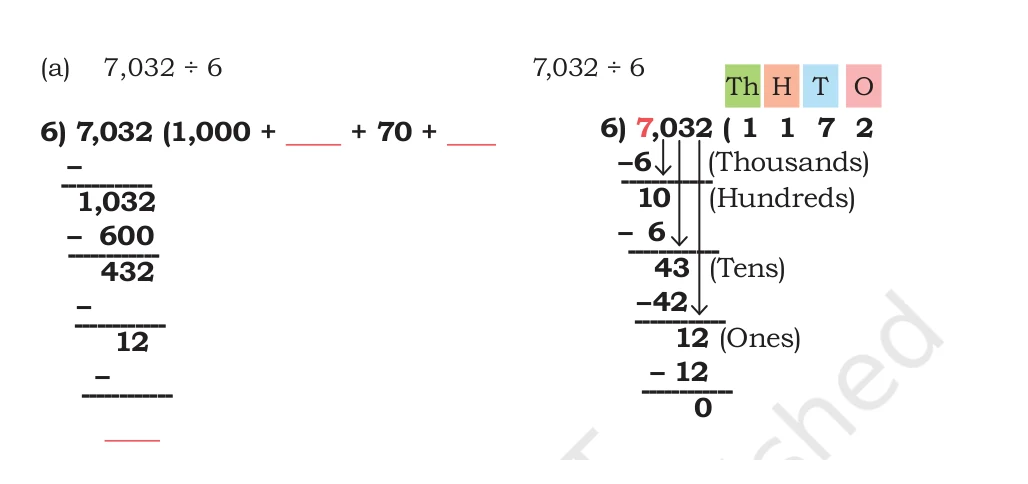
Complete both methods for 7,032 divided by 6.
Show detailed solution
- Step 1: Look for the largest whole-number multiple of 6 that does not pass 7,032.
- Step 2: 6\times1172=7,032, so there are 1172 complete groups.
- Step 3: 7,032-7,032=0. The division ends with no remainder.
- Step 4: Check: 6\times1172+0=7,032.
- Answer: 7,032\div6=1172.
Textbook page 130 · solved item 111
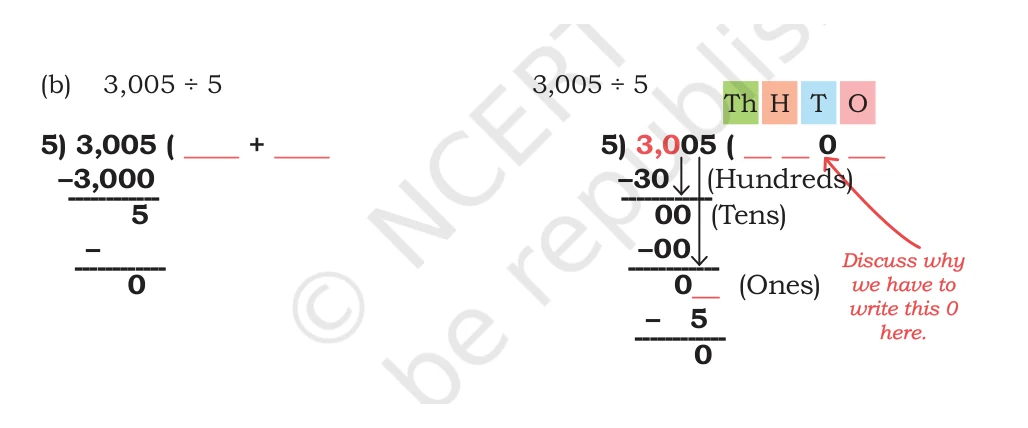
Complete both methods for 3,005 divided by 5, including the zero in the quotient.
Show detailed solution
- Step 1: Look for the largest whole-number multiple of 5 that does not pass 3,005.
- Step 2: 5\times601=3,005, so there are 601 complete groups.
- Step 3: 3,005-3,005=0. The division ends with no remainder.
- Step 4: Check: 5\times601+0=3,005.
- Answer: 3,005\div5=601.
Textbook page 130 · solved item 112
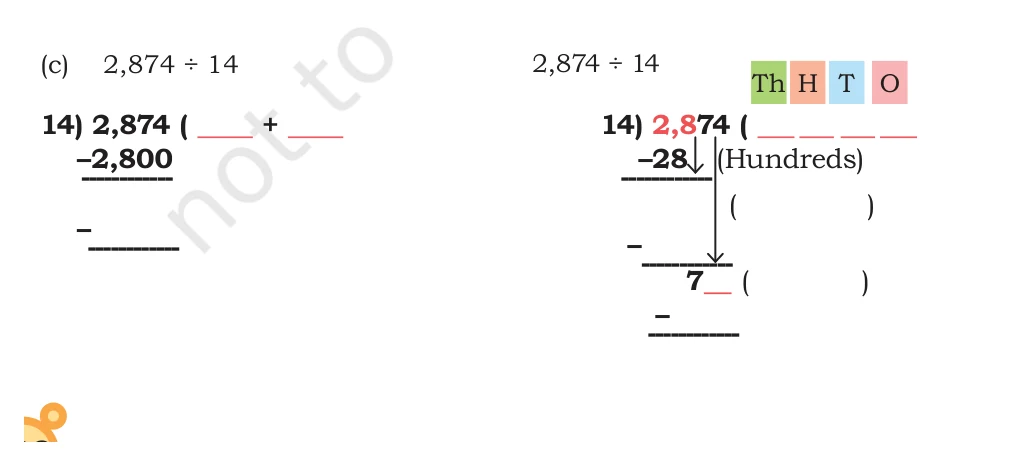
Complete both methods for 2,874 divided by 14.
Show detailed solution
- Step 1: Look for the largest whole-number multiple of 14 that does not pass 2,874.
- Step 2: 14\times205=2,870, so there are 205 complete groups.
- Step 3: 2,874-2,870=4. The division ends with remainder 4.
- Step 4: Check: 14\times205+4=2,874.
- Answer: 2,874\div14=205,\text{ remainder }4.
Detailed worked answers
Textbook page 131
Textbook page 131 · solved item 113
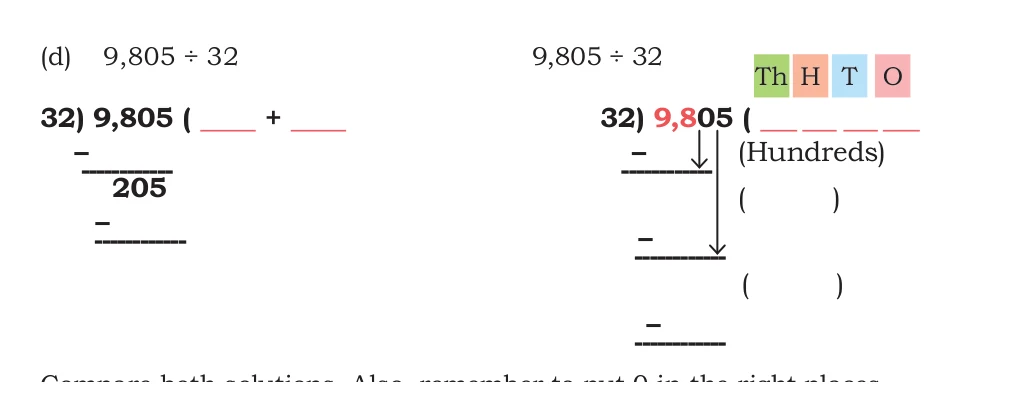
Complete both methods for 9,805 divided by 32.
Show detailed solution
- Step 1: Look for the largest whole-number multiple of 32 that does not pass 9,805.
- Step 2: 32\times306=9,792, so there are 306 complete groups.
- Step 3: 9,805-9,792=13. The division ends with remainder 13.
- Step 4: Check: 32\times306+13=9,805.
- Answer: 9,805\div32=306,\text{ remainder }13.
Textbook page 131 · solved item 114
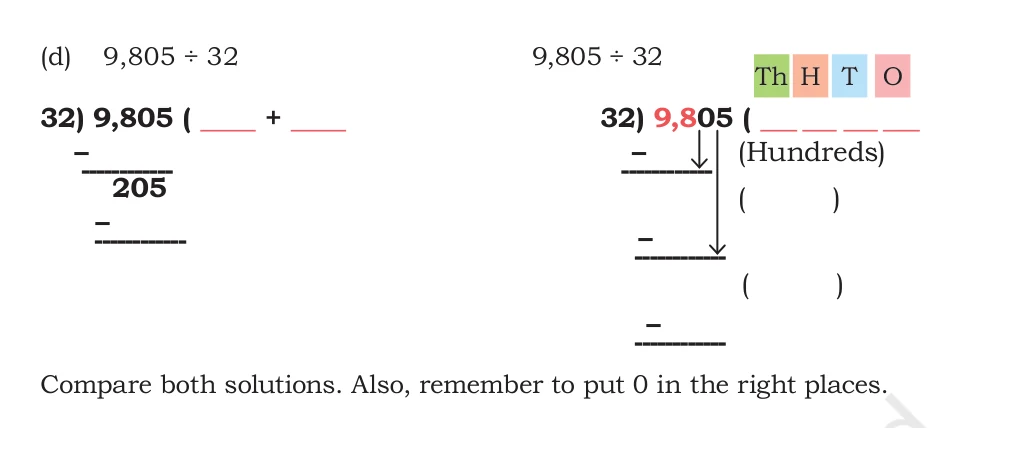
Compare the two shown methods for 9,805 divided by 32 and explain where the zero belongs.
Show detailed solution
- Step 1: Partial quotients use 32\times300=9,600 and then 32\times6=192.
- Step 2: Place-value division records 3 hundreds, 0 tens, and 6 ones in the quotient.
- Step 3: The zero must stay in the tens place so 306 is not mistaken for 36.
- Answer: Both methods give 306 remainder 13, and the place-value zero is essential.
Textbook page 131 · solved item 115
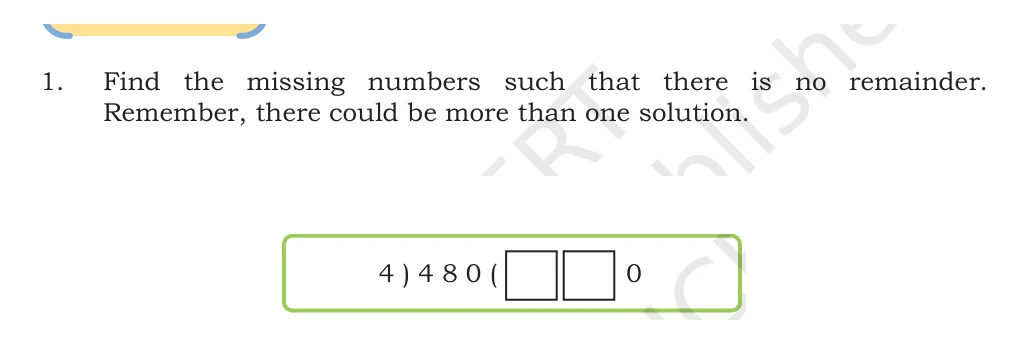
Complete 480 divided by 4 with no remainder.
Show detailed solution
- Step 1: The completed division must have no remainder.
- Step 2: The quotient is 120, so the two boxes are 1 and 2.
- Step 3: 480=4\times120.
- Answer: The displayed completion is one valid solution; some cards allow other valid choices.
Textbook page 131 · solved item 116
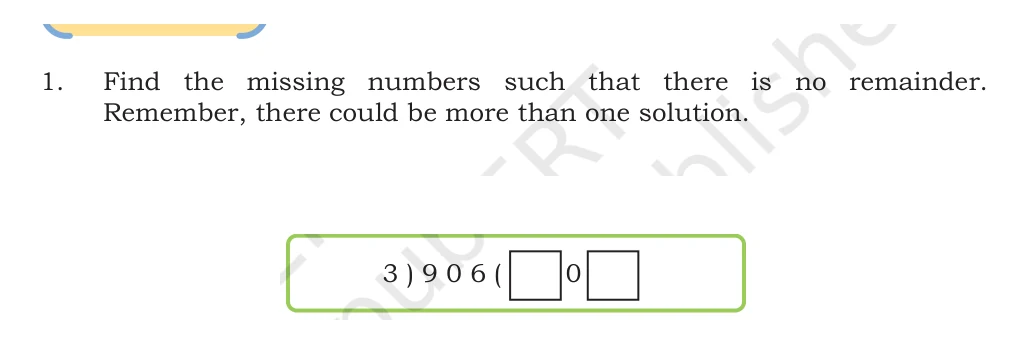
Complete 906 divided by 3 with no remainder.
Show detailed solution
- Step 1: The completed division must have no remainder.
- Step 2: The quotient is 302, so the boxes are 3 and 2 around the printed 0.
- Step 3: 906=3\times302.
- Answer: The displayed completion is one valid solution; some cards allow other valid choices.
Textbook page 131 · solved item 117
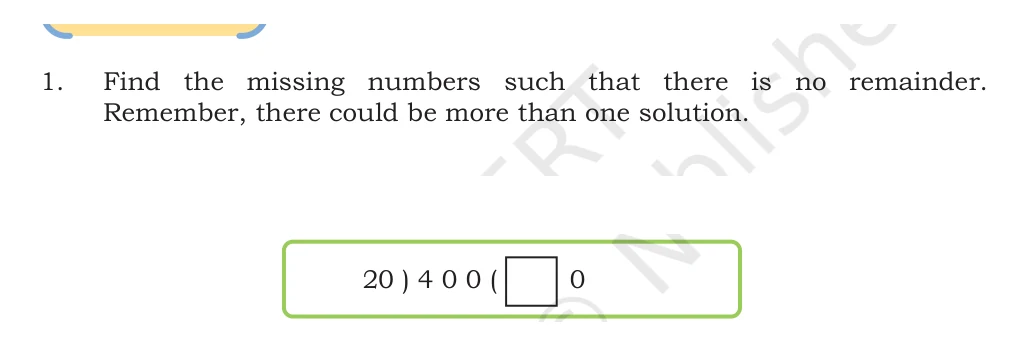
Complete 400 divided by 20 with no remainder.
Show detailed solution
- Step 1: The completed division must have no remainder.
- Step 2: The quotient is 20, so the blank is 2.
- Step 3: 400=20\times20.
- Answer: The displayed completion is one valid solution; some cards allow other valid choices.
Textbook page 131 · solved item 118
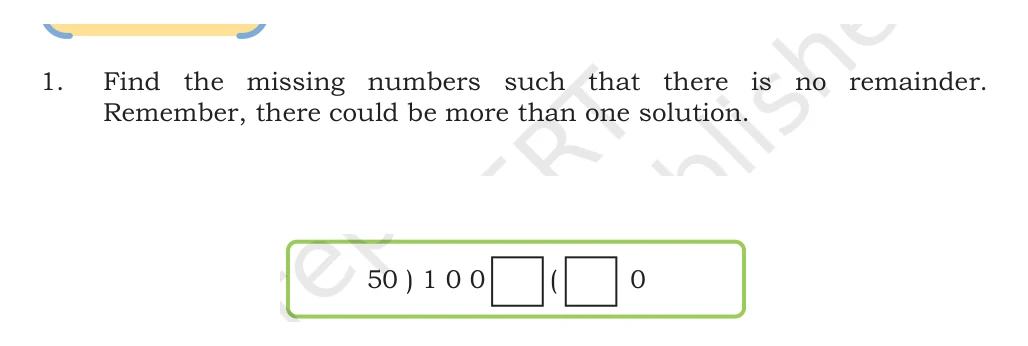
Fill the two boxes in the 1,00_ divided by 50 card.
Show detailed solution
- Step 1: The completed division must have no remainder.
- Step 2: A number divisible by 50 ends in 00 or 50; the printed form can be 1,000.
- Step 3: 1,000\div50=20, so the boxes are 0 and 2.
- Answer: The displayed completion is one valid solution; some cards allow other valid choices.
Textbook page 131 · solved item 119
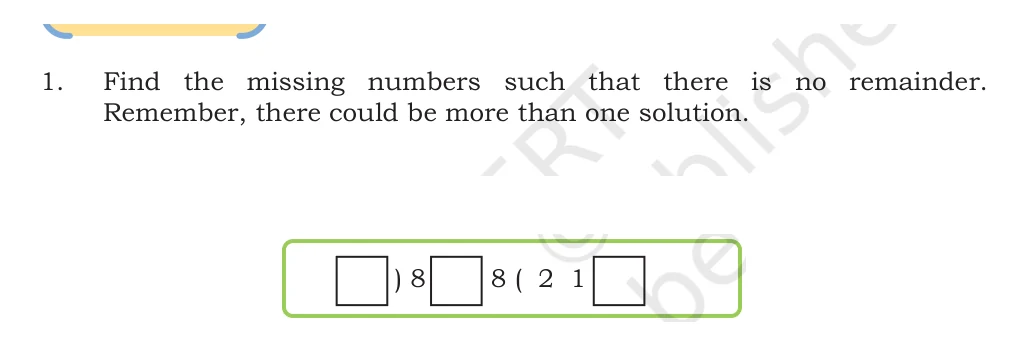
Complete the card with a one-digit divisor, 8_8 as dividend, and 21_ as quotient.
Show detailed solution
- Step 1: The completed division must have no remainder.
- Step 2: Try divisor 4. Then 4\times212=848.
- Step 3: One solution is 848\div4=212; the boxes are 4, 4, and 2.
- Answer: The displayed completion is one valid solution; some cards allow other valid choices.
Textbook page 131 · solved item 120
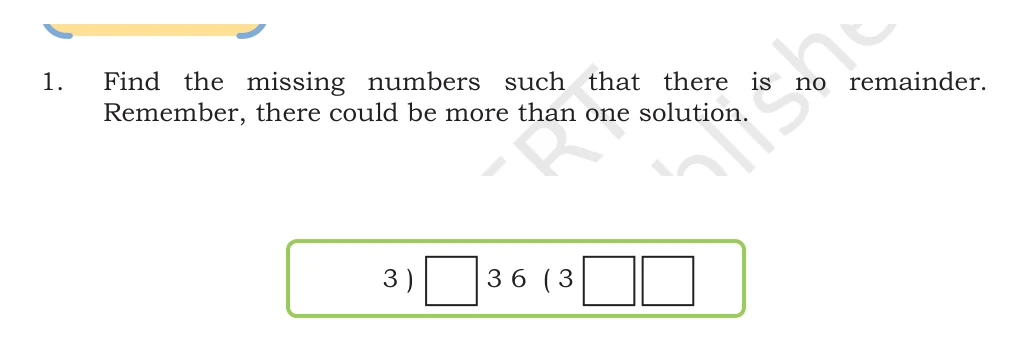
Complete the card showing a number ending in 36 divided by 3.
Show detailed solution
- Step 1: The completed division must have no remainder.
- Step 2: Choose 936 as the dividend.
- Step 3: 936\div3=312, so the boxes are 9, 1, and 2.
- Answer: The displayed completion is one valid solution; some cards allow other valid choices.
Textbook page 131 · solved item 121
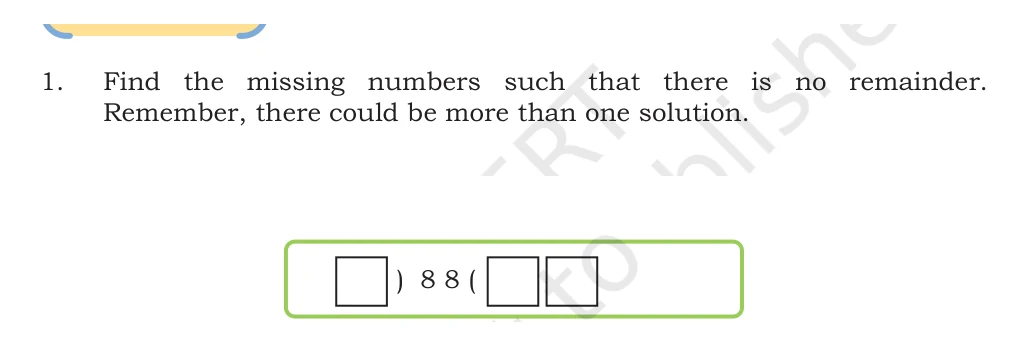
Complete the card with 88 as the dividend and no remainder.
Show detailed solution
- Step 1: The completed division must have no remainder.
- Step 2: Choose 4 as the divisor because 88 is four groups of 22.
- Step 3: One solution is 88\div4=22.
- Answer: The displayed completion is one valid solution; some cards allow other valid choices.
Textbook page 131 · solved item 122
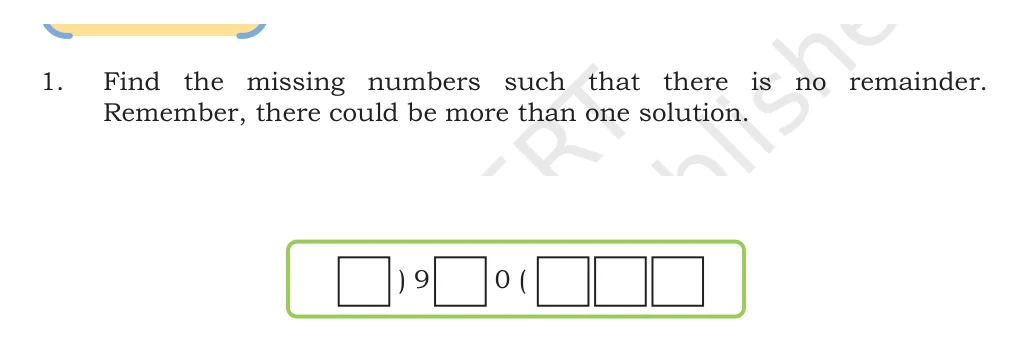
Complete the card with a dividend of the form 9_0.
Show detailed solution
- Step 1: The completed division must have no remainder.
- Step 2: Choose 950 and divisor 5.
- Step 3: One solution is 950\div5=190.
- Answer: The displayed completion is one valid solution; some cards allow other valid choices.
Textbook page 131 · solved item 123
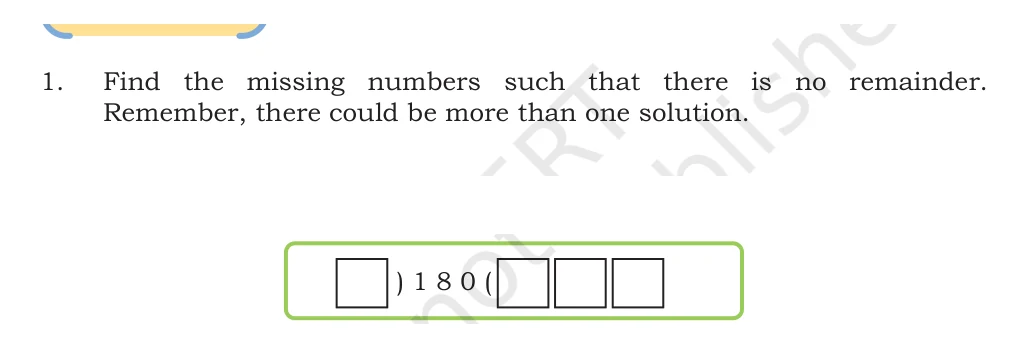
Complete the card with 180 as the dividend and a three-digit quotient.
Show detailed solution
- Step 1: The completed division must have no remainder.
- Step 2: A three-digit quotient is possible with divisor 1.
- Step 3: 180\div1=180, so fill 1, 1, 8, and 0.
- Answer: The displayed completion is one valid solution; some cards allow other valid choices.
Textbook page 131 · solved item 124
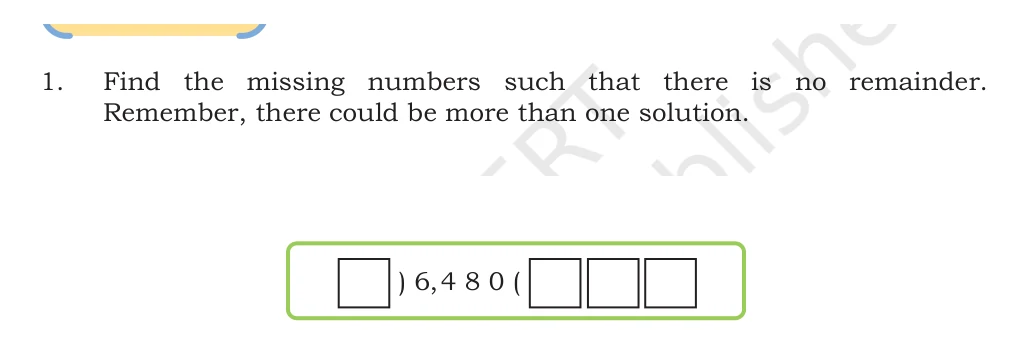
Complete the card with 6,480 as the dividend.
Show detailed solution
- Step 1: The completed division must have no remainder.
- Step 2: Choose divisor 8 and use the multiplication fact 8\times810=6,480.
- Step 3: One solution is 6,480\div8=810.
- Answer: The displayed completion is one valid solution; some cards allow other valid choices.
Textbook page 131 · solved item 125
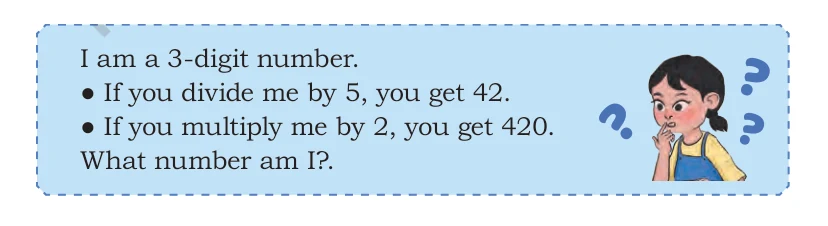
I am a 3-digit number. Dividing me by 5 gives 42, and multiplying me by 2 gives 420. What number am I?
Show detailed solution
- Step 1: Reverse the division clue: 42\times5=210.
- Step 2: Check the multiplication clue: 210\times2=420.
- Step 3: The number 210 has three digits and satisfies both clues.
- Answer: The number is 210.
Detailed worked answers
Textbook page 132
Textbook page 132 · solved item 126

A show seats 45 people. How many shows are needed for 475 people?
Show detailed solution
- Step 1: 45\times10=450, so 10 full shows seat 450 people.
- Step 2: 475-450=25 people still need seats.
- Step 3: Those 25 people need one more show.
- Answer: 11 shows are needed.
Textbook page 132 · solved item 127

If there are 2 shows each day, how many days are needed for 11 shows?
Show detailed solution
- Step 1: Five days allow 5\times2=10 shows.
- Step 2: One show is still needed after those five days.
- Step 3: That last show takes place on the sixth day.
- Answer: 6 days are needed.
Textbook page 132 · solved item 128

Naina has 5 kg of ice cream. After 23 friends share it equally, 400 g remains. How much does each friend eat?
Show detailed solution
- Step 1: Change 5\text{ kg} to 5,000\text{ g}.
- Step 2: The friends eat 5,000-400=4,600\text{ g} altogether.
- Step 3: 4,600\div23=200.
- Answer: Each friend eats 200\text{ g}.
Textbook page 132 · solved item 129

Fifteen packets contain 8 biscuits each. Six people share them over 4 days. How many can each person have each day?
Show detailed solution
- Step 1: Total biscuits: 15\times8=120.
- Step 2: Share among 6 people: 120\div6=20 biscuits per person for the trip.
- Step 3: Share each person's 20 biscuits across 4 days: 20\div4=5.
- Answer: Each person can have 5 biscuits each day.
Textbook page 132 · solved item 130
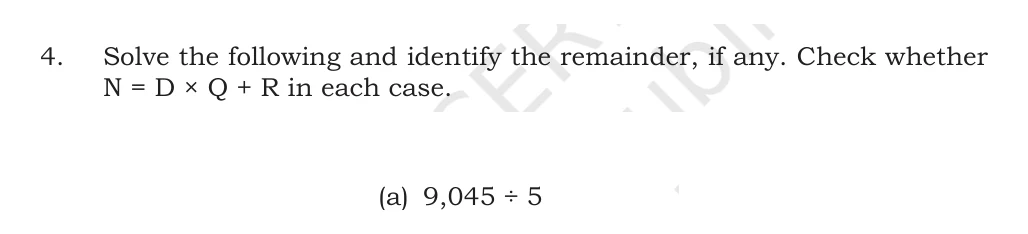
Divide 9,045 by 5 and identify the remainder, if any.
Show detailed solution
- Step 1: Look for the largest whole-number multiple of 5 that does not pass 9,045.
- Step 2: 5\times1809=9,045, so there are 1809 complete groups.
- Step 3: 9,045-9,045=0. The division ends with no remainder.
- Step 4: Check: 5\times1809+0=9,045.
- Answer: 9,045\div5=1809.
Textbook page 132 · solved item 131
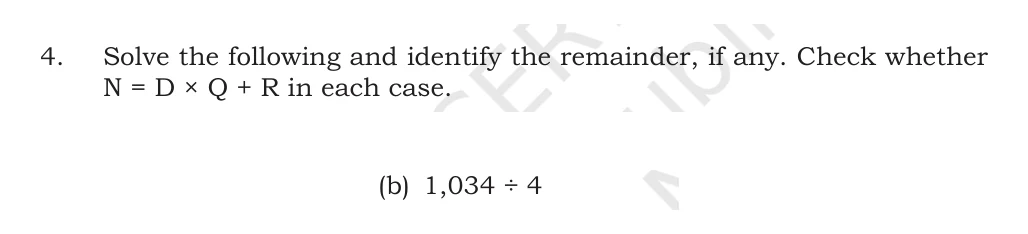
Divide 1,034 by 4 and identify the remainder, if any.
Show detailed solution
- Step 1: Look for the largest whole-number multiple of 4 that does not pass 1,034.
- Step 2: 4\times258=1,032, so there are 258 complete groups.
- Step 3: 1,034-1,032=2. The division ends with remainder 2.
- Step 4: Check: 4\times258+2=1,034.
- Answer: 1,034\div4=258,\text{ remainder }2.
Textbook page 132 · solved item 132
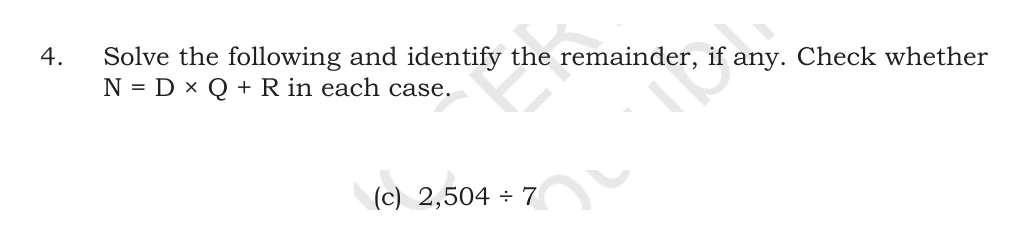
Divide 2,504 by 7 and identify the remainder, if any.
Show detailed solution
- Step 1: Look for the largest whole-number multiple of 7 that does not pass 2,504.
- Step 2: 7\times357=2,499, so there are 357 complete groups.
- Step 3: 2,504-2,499=5. The division ends with remainder 5.
- Step 4: Check: 7\times357+5=2,504.
- Answer: 2,504\div7=357,\text{ remainder }5.
Textbook page 132 · solved item 133
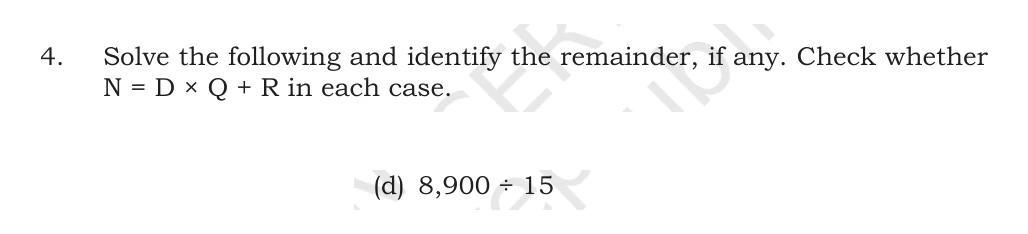
Divide 8,900 by 15 and identify the remainder, if any.
Show detailed solution
- Step 1: Look for the largest whole-number multiple of 15 that does not pass 8,900.
- Step 2: 15\times593=8,895, so there are 593 complete groups.
- Step 3: 8,900-8,895=5. The division ends with remainder 5.
- Step 4: Check: 15\times593+5=8,900.
- Answer: 8,900\div15=593,\text{ remainder }5.
Textbook page 132 · solved item 134
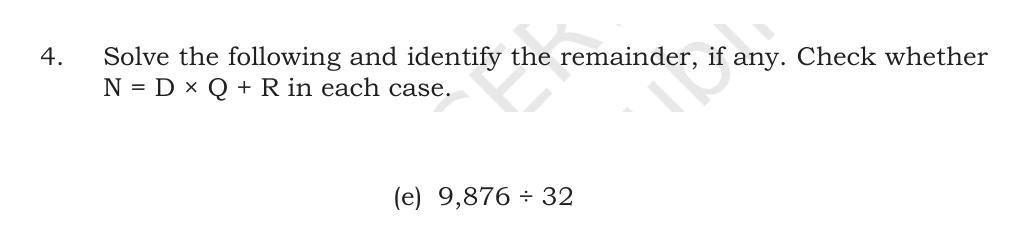
Divide 9,876 by 32 and identify the remainder, if any.
Show detailed solution
- Step 1: Look for the largest whole-number multiple of 32 that does not pass 9,876.
- Step 2: 32\times308=9,856, so there are 308 complete groups.
- Step 3: 9,876-9,856=20. The division ends with remainder 20.
- Step 4: Check: 32\times308+20=9,876.
- Answer: 9,876\div32=308,\text{ remainder }20.
Textbook page 132 · solved item 135
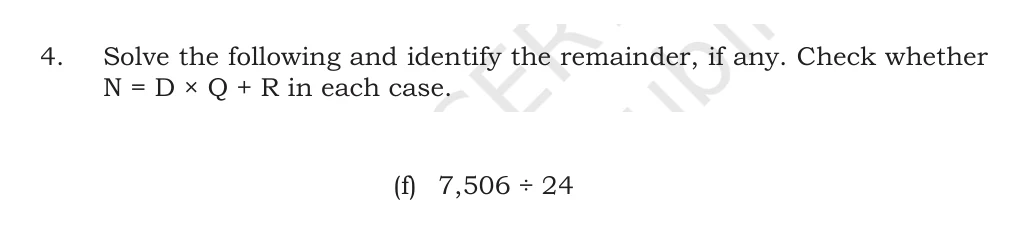
Divide 7,506 by 24 and identify the remainder, if any.
Show detailed solution
- Step 1: Look for the largest whole-number multiple of 24 that does not pass 7,506.
- Step 2: 24\times312=7,488, so there are 312 complete groups.
- Step 3: 7,506-7,488=18. The division ends with remainder 18.
- Step 4: Check: 24\times312+18=7,506.
- Answer: 7,506\div24=312,\text{ remainder }18.
Textbook page 132 · solved item 136
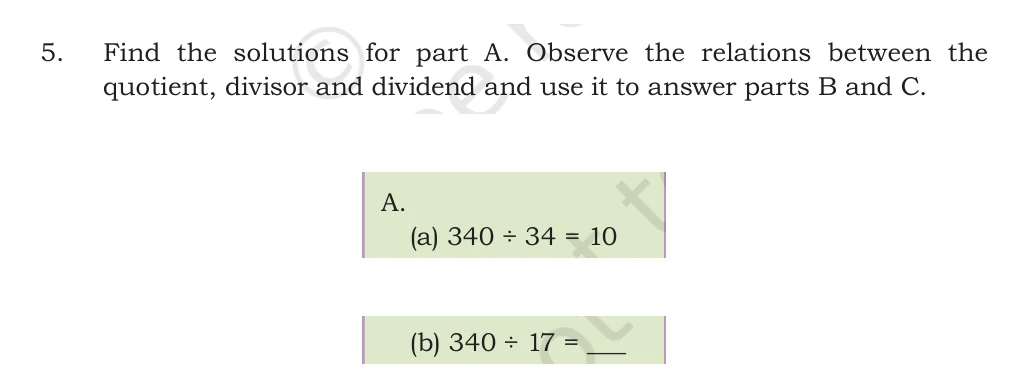
Use the table relationship to find 340 divided by 17.
Show detailed solution
- Step 1: Look for the largest whole-number multiple of 17 that does not pass 340.
- Step 2: 17\times20=340, so there are 20 complete groups.
- Step 3: 340-340=0. The division ends with no remainder.
- Step 4: Check: 17\times20+0=340.
- Answer: 340\div17=20.
Textbook page 132 · solved item 137
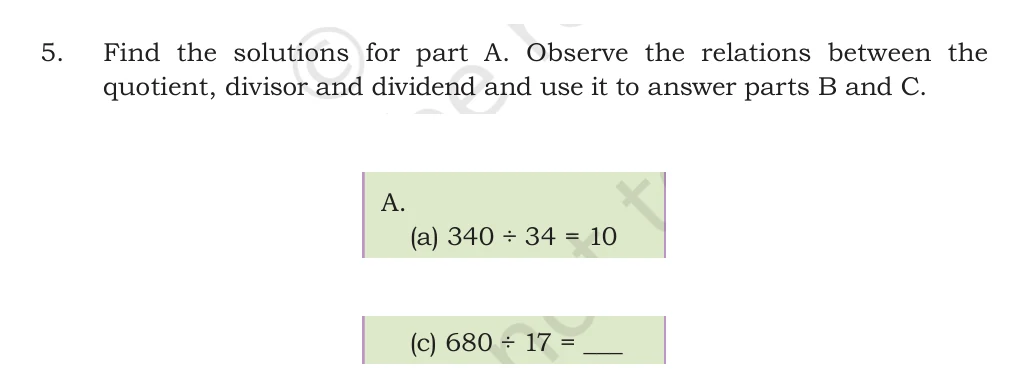
Use the table relationship to find 680 divided by 17.
Show detailed solution
- Step 1: Look for the largest whole-number multiple of 17 that does not pass 680.
- Step 2: 17\times40=680, so there are 40 complete groups.
- Step 3: 680-680=0. The division ends with no remainder.
- Step 4: Check: 17\times40+0=680.
- Answer: 680\div17=40.
Textbook page 132 · solved item 138
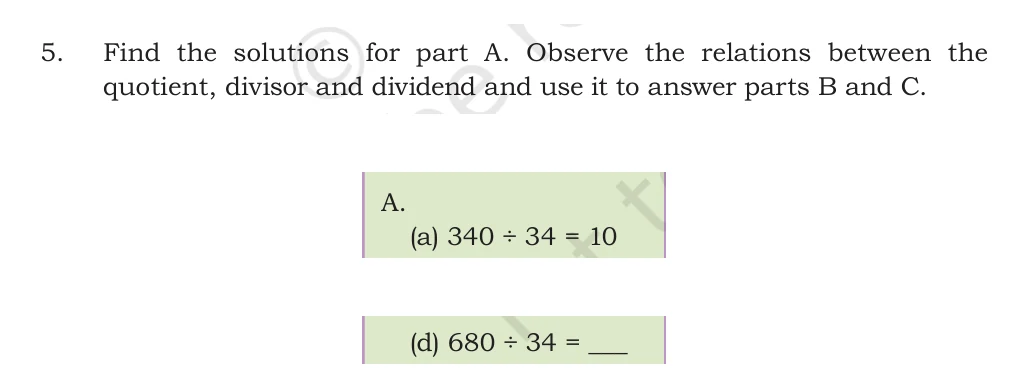
Use the table relationship to find 680 divided by 34.
Show detailed solution
- Step 1: Look for the largest whole-number multiple of 34 that does not pass 680.
- Step 2: 34\times20=680, so there are 20 complete groups.
- Step 3: 680-680=0. The division ends with no remainder.
- Step 4: Check: 34\times20+0=680.
- Answer: 680\div34=20.
Textbook page 132 · solved item 139
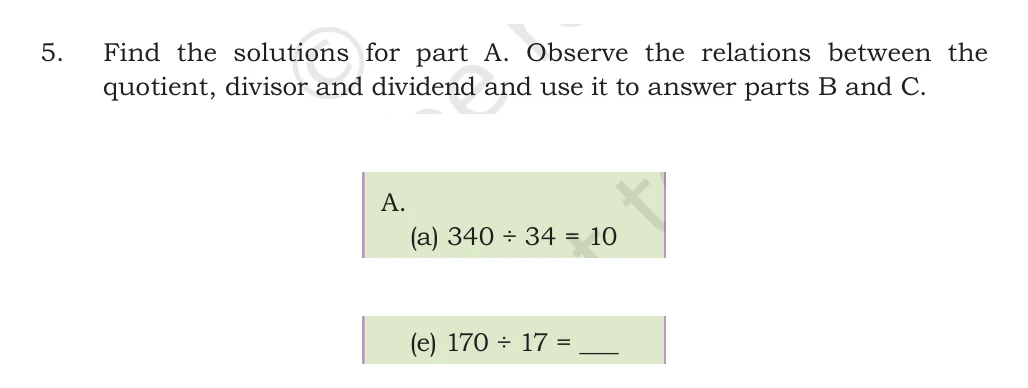
Use the table relationship to find 170 divided by 17.
Show detailed solution
- Step 1: Look for the largest whole-number multiple of 17 that does not pass 170.
- Step 2: 17\times10=170, so there are 10 complete groups.
- Step 3: 170-170=0. The division ends with no remainder.
- Step 4: Check: 17\times10+0=170.
- Answer: 170\div17=10.
Textbook page 132 · solved item 140
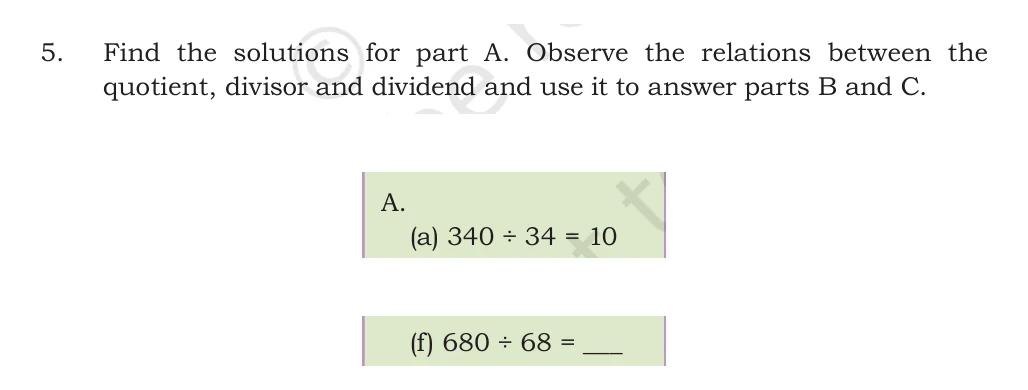
Use the table relationship to find 680 divided by 68.
Show detailed solution
- Step 1: Look for the largest whole-number multiple of 68 that does not pass 680.
- Step 2: 68\times10=680, so there are 10 complete groups.
- Step 3: 680-680=0. The division ends with no remainder.
- Step 4: Check: 68\times10+0=680.
- Answer: 680\div68=10.
Textbook page 132 · solved item 141
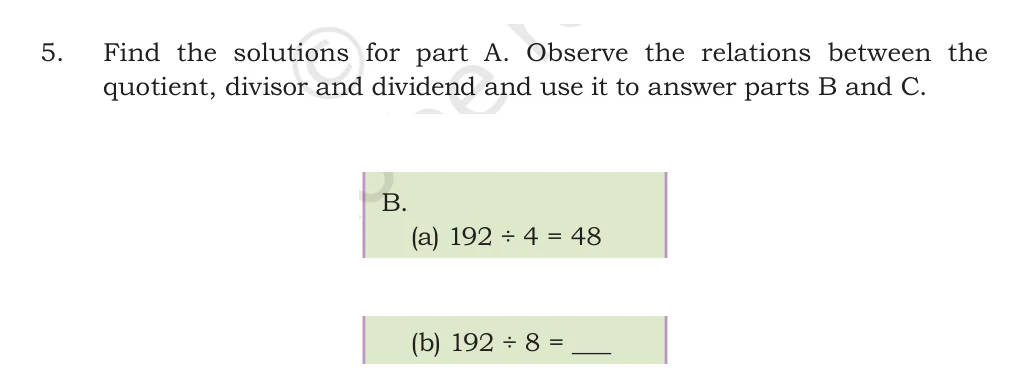
Use the table relationship to find 192 divided by 8.
Show detailed solution
- Step 1: Look for the largest whole-number multiple of 8 that does not pass 192.
- Step 2: 8\times24=192, so there are 24 complete groups.
- Step 3: 192-192=0. The division ends with no remainder.
- Step 4: Check: 8\times24+0=192.
- Answer: 192\div8=24.
Textbook page 132 · solved item 142
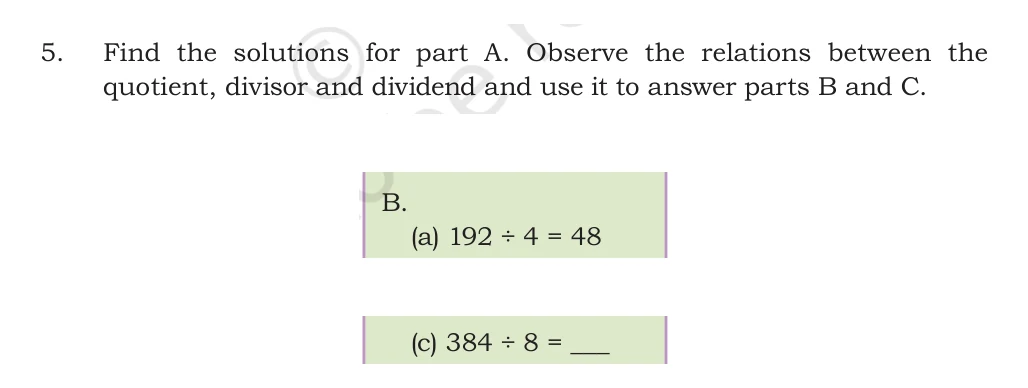
Use the table relationship to find 384 divided by 8.
Show detailed solution
- Step 1: Look for the largest whole-number multiple of 8 that does not pass 384.
- Step 2: 8\times48=384, so there are 48 complete groups.
- Step 3: 384-384=0. The division ends with no remainder.
- Step 4: Check: 8\times48+0=384.
- Answer: 384\div8=48.
Textbook page 132 · solved item 143
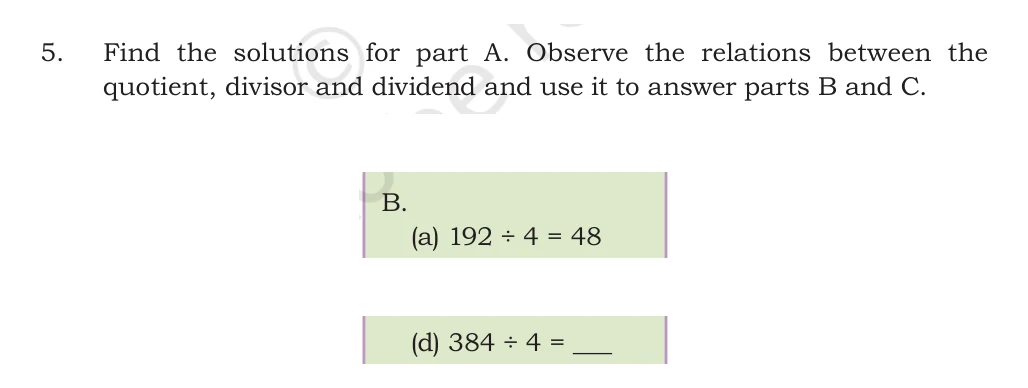
Use the table relationship to find 384 divided by 4.
Show detailed solution
- Step 1: Look for the largest whole-number multiple of 4 that does not pass 384.
- Step 2: 4\times96=384, so there are 96 complete groups.
- Step 3: 384-384=0. The division ends with no remainder.
- Step 4: Check: 4\times96+0=384.
- Answer: 384\div4=96.
Textbook page 132 · solved item 144
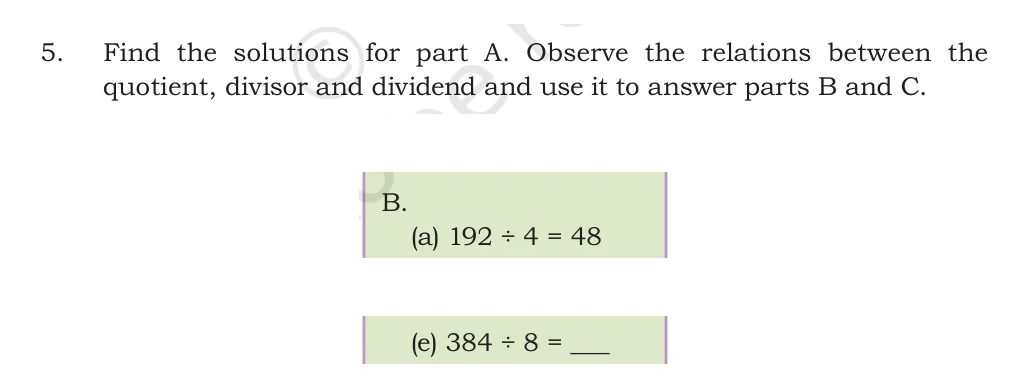
Use the table relationship to find 384 divided by 8.
Show detailed solution
- Step 1: Look for the largest whole-number multiple of 8 that does not pass 384.
- Step 2: 8\times48=384, so there are 48 complete groups.
- Step 3: 384-384=0. The division ends with no remainder.
- Step 4: Check: 8\times48+0=384.
- Answer: 384\div8=48.
Textbook page 132 · solved item 145
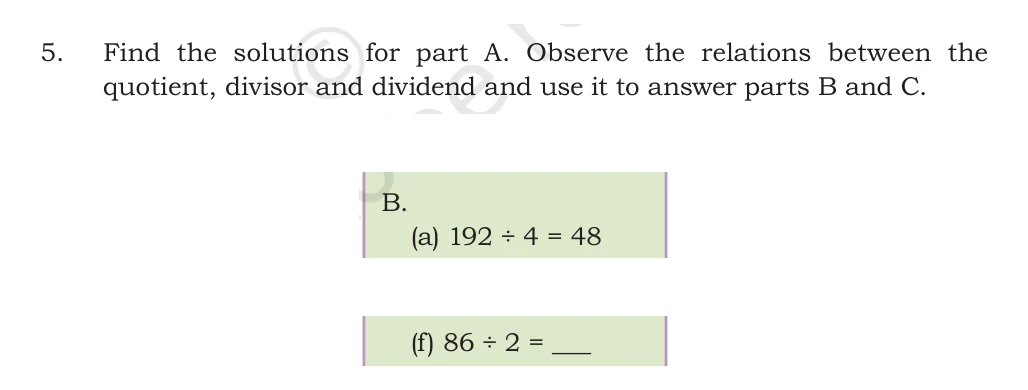
Use the table relationship to find 86 divided by 2.
Show detailed solution
- Step 1: Look for the largest whole-number multiple of 2 that does not pass 86.
- Step 2: 2\times43=86, so there are 43 complete groups.
- Step 3: 86-86=0. The division ends with no remainder.
- Step 4: Check: 2\times43+0=86.
- Answer: 86\div2=43.
Textbook page 132 · solved item 146
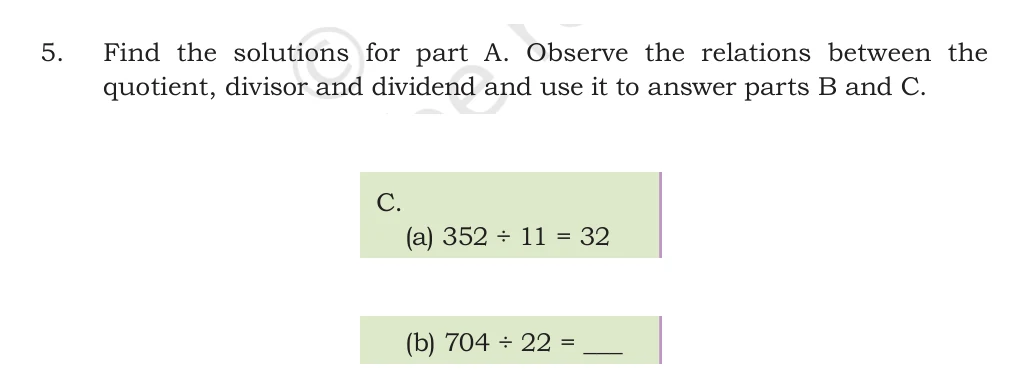
Use the table relationship to find 704 divided by 22.
Show detailed solution
- Step 1: Look for the largest whole-number multiple of 22 that does not pass 704.
- Step 2: 22\times32=704, so there are 32 complete groups.
- Step 3: 704-704=0. The division ends with no remainder.
- Step 4: Check: 22\times32+0=704.
- Answer: 704\div22=32.
Textbook page 132 · solved item 147
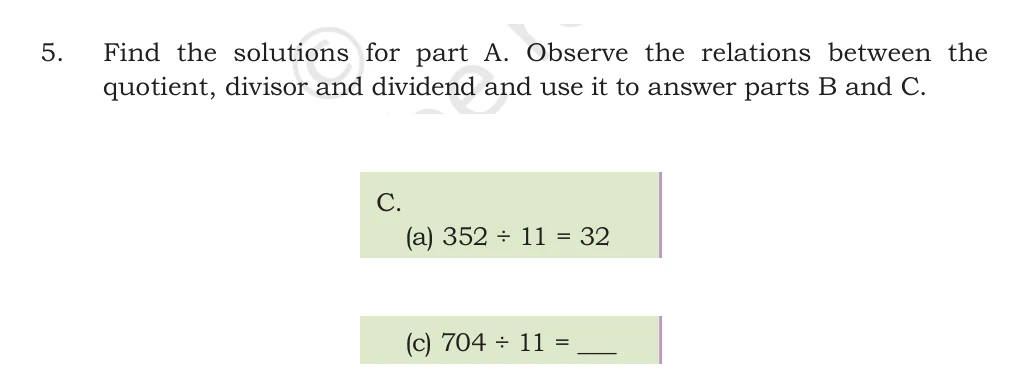
Use the table relationship to find 704 divided by 11.
Show detailed solution
- Step 1: Look for the largest whole-number multiple of 11 that does not pass 704.
- Step 2: 11\times64=704, so there are 64 complete groups.
- Step 3: 704-704=0. The division ends with no remainder.
- Step 4: Check: 11\times64+0=704.
- Answer: 704\div11=64.
Textbook page 132 · solved item 148
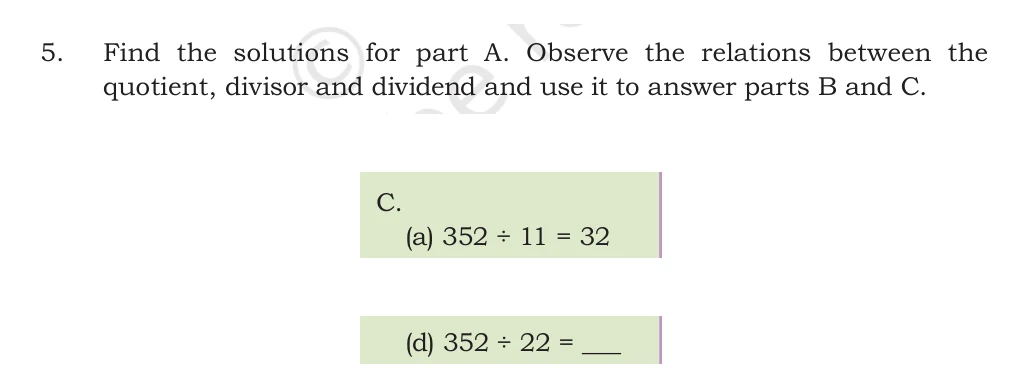
Use the table relationship to find 352 divided by 22.
Show detailed solution
- Step 1: Look for the largest whole-number multiple of 22 that does not pass 352.
- Step 2: 22\times16=352, so there are 16 complete groups.
- Step 3: 352-352=0. The division ends with no remainder.
- Step 4: Check: 22\times16+0=352.
- Answer: 352\div22=16.
Textbook page 132 · solved item 149
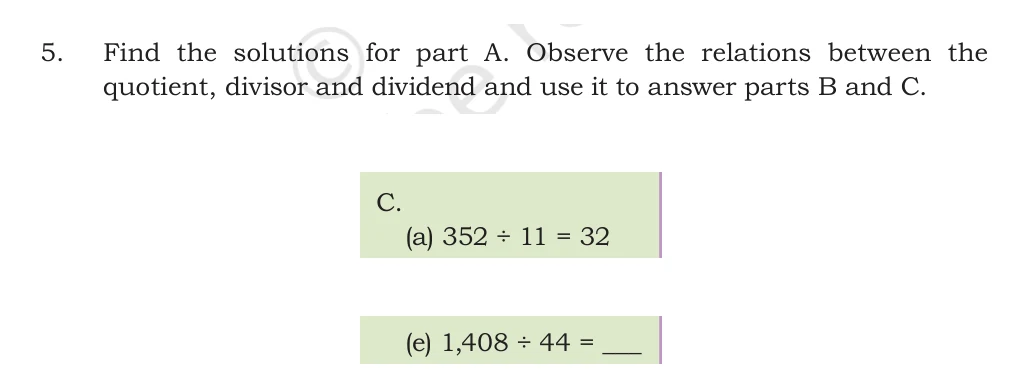
Use the table relationship to find 1,408 divided by 44.
Show detailed solution
- Step 1: Look for the largest whole-number multiple of 44 that does not pass 1,408.
- Step 2: 44\times32=1,408, so there are 32 complete groups.
- Step 3: 1,408-1,408=0. The division ends with no remainder.
- Step 4: Check: 44\times32+0=1,408.
- Answer: 1,408\div44=32.
Detailed worked answers
Textbook page 133
Textbook page 133 · solved item 150
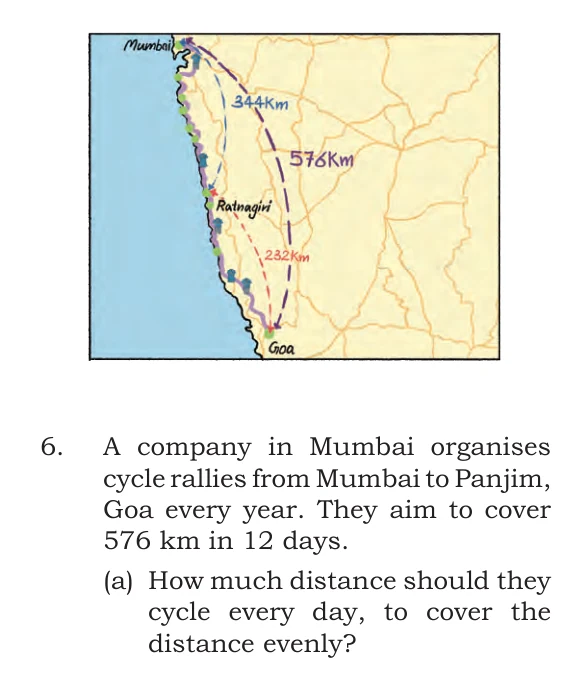
A cycle rally covers 576 km in 12 days. How far should the cyclists travel each day?
Show detailed solution
- Step 1: Divide the total distance equally across 12 days.
- Step 2: 576\div12=48, because 12\times48=576.
- Step 3: Check that 48 km repeated for 12 days gives the full route.
- Answer: They should cycle 48\text{ km} each day.
Textbook page 133 · solved item 151
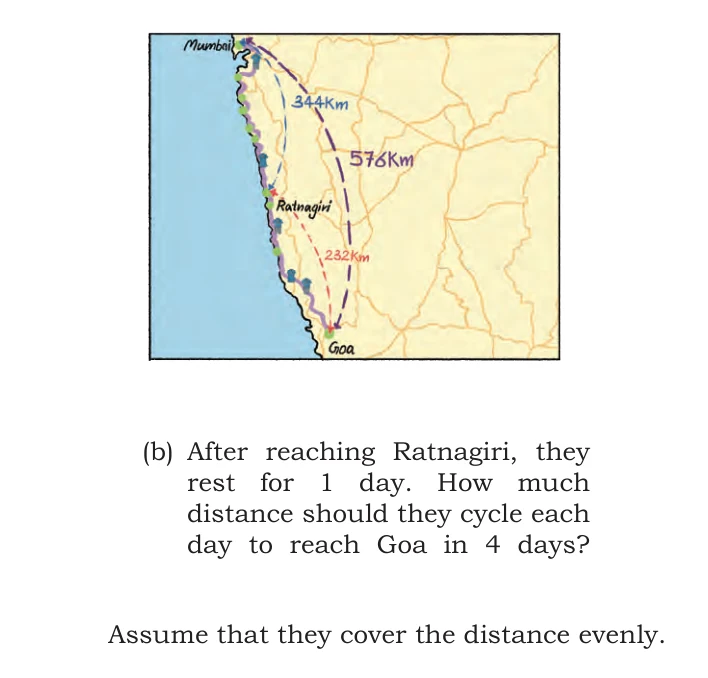
The map shows 232 km from Ratnagiri to Goa. How far per day should cyclists travel to cover it in 4 days?
Show detailed solution
- Step 1: Use the 232 km distance marked from Ratnagiri to Goa.
- Step 2: Share it equally across 4 cycling days: 232\div4=58.
- Step 3: The rest day is not one of the four cycling days.
- Answer: They should cycle 58\text{ km} per day.
Textbook page 133 · solved item 152
Six baskets contain 12 mangoes each. What information is missing before finding the total earning?
Show detailed solution
- Step 1: List the quantities that are given.
- Step 2: The price of one mango or the price of one basket is missing.
- Step 3: There are 6\times12=72 mangoes. If one mango costs Rs 10, the example earning would be 72\times10=720 rupees.
- Answer: The missing-information statement above is needed for a unique answer.
Textbook page 133 · solved item 153
A school has 8 classrooms with equal desks. What information is missing before finding desks per classroom?
Show detailed solution
- Step 1: List the quantities that are given.
- Step 2: The total number of desks in the school is missing.
- Step 3: If there were 240 desks, the example answer would be 240\div8=30 desks per classroom.
- Answer: The missing-information statement above is needed for a unique answer.
Textbook page 133 · solved item 154
Five cricket bats cost Rs 3,500. Find the cost of one bat.
Show detailed solution
- Step 1: List the quantities that are given.
- Step 2: No information is missing; both the number of bats and total cost are given.
- Step 3: 3,500\div5=700, so one bat costs Rs 700.
- Answer: The missing-information statement above is needed for a unique answer.
Textbook page 133 · solved item 155
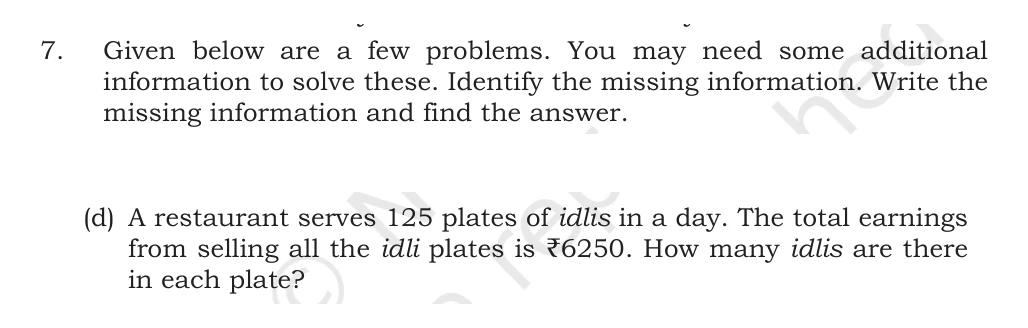
A restaurant sells 125 idli plates for Rs 6,250. What is missing before finding idlis per plate?
Show detailed solution
- Step 1: List the quantities that are given.
- Step 2: The total number of idlis served is missing.
- Step 3: The given money can tell us the price per plate, 6,250\div125=50 rupees, but not the number of idlis in a plate.
- Answer: The missing-information statement above is needed for a unique answer.
Textbook page 133 · solved item 156
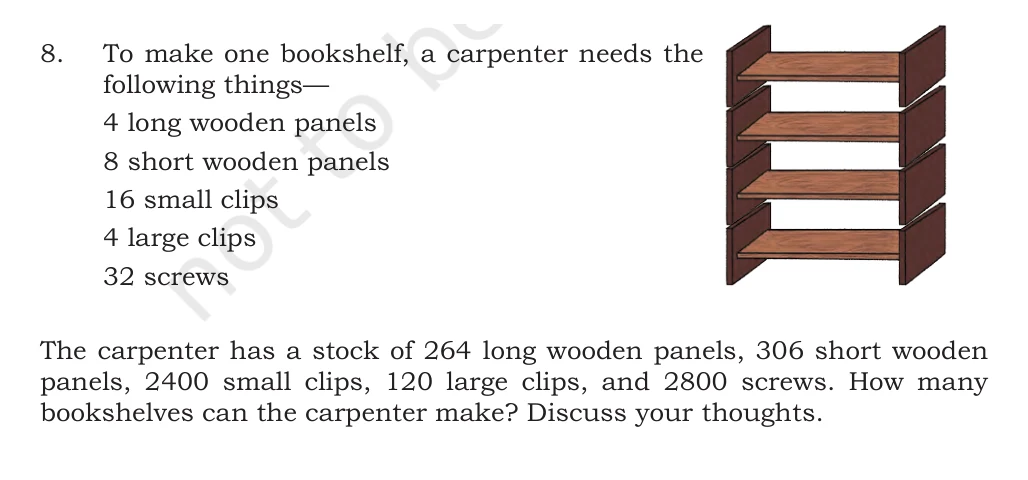
Using the available panels, clips, and screws, how many complete bookshelves can the carpenter make?
Show detailed solution
- Step 1: Long panels allow 264\div4=66 shelves; short panels allow 306\div8=38 complete shelves.
- Step 2: Small clips allow 2,400\div16=150 shelves; large clips allow 120\div4=30 shelves.
- Step 3: Screws allow 2,800\div32=87 complete shelves, with some screws left.
- Step 4: The smallest of 66, 38, 150, 30, and 87 is 30, so large clips run out first.
- Answer: The carpenter can make 30 complete bookshelves.
Detailed worked answers
Textbook page 134
Textbook page 134 · solved item 157
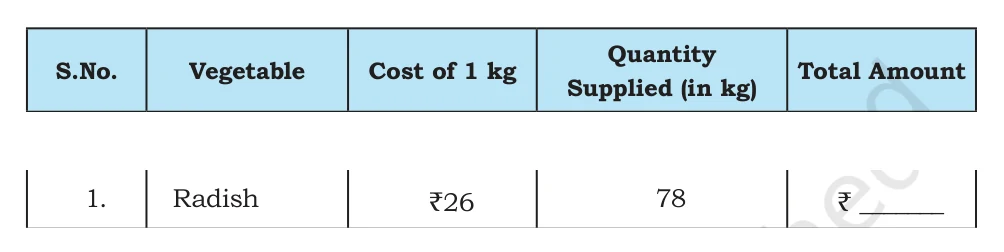
Find the missing total amount for 78 kg of radish at Rs 26 per kg.
Show detailed solution
- Step 1: Read the price, quantity, and amount columns for the row.
- Step 2: Use multiplication for an amount or division for a missing price or quantity.
- Step 3: 78\times26=78\times20+78\times6=1,560+468=2,028.
- Answer: Rs 2,028.
Textbook page 134 · solved item 158
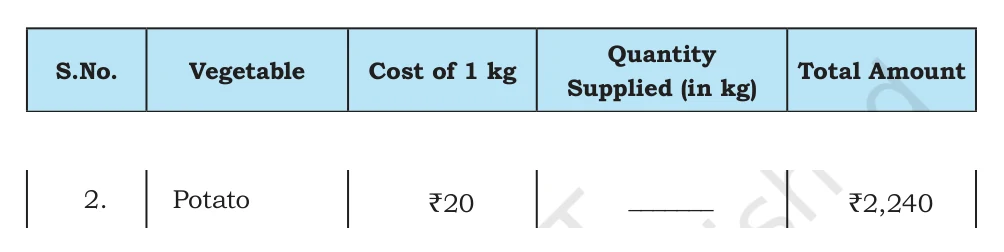
Find the missing potato quantity when Rs 2,240 is earned at Rs 20 per kg.
Show detailed solution
- Step 1: Read the price, quantity, and amount columns for the row.
- Step 2: Use multiplication for an amount or division for a missing price or quantity.
- Step 3: 2,240\div20=112.
- Answer: 112 kg.
Textbook page 134 · solved item 159
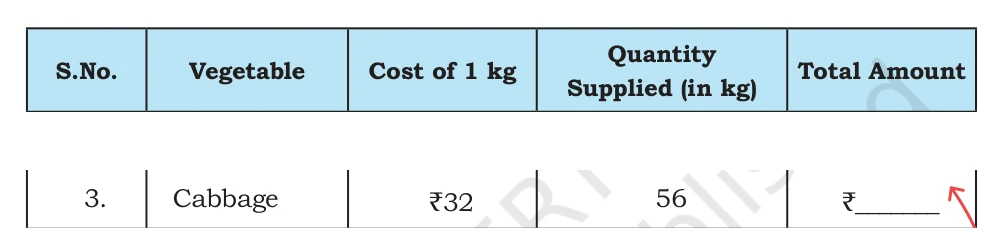
Find the missing total amount for 56 kg of cabbage at Rs 32 per kg.
Show detailed solution
- Step 1: Read the price, quantity, and amount columns for the row.
- Step 2: Use multiplication for an amount or division for a missing price or quantity.
- Step 3: 56\times32=56\times30+56\times2=1,680+112=1,792.
- Answer: Rs 1,792.
Textbook page 134 · solved item 160
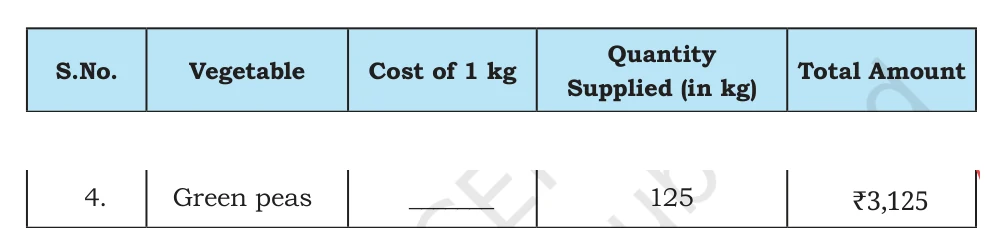
Find the missing price per kilogram when 125 kg of green peas earns Rs 3,125.
Show detailed solution
- Step 1: Read the price, quantity, and amount columns for the row.
- Step 2: Use multiplication for an amount or division for a missing price or quantity.
- Step 3: 3,125\div125=25.
- Answer: Rs 25 per kg.
Textbook page 134 · solved item 161
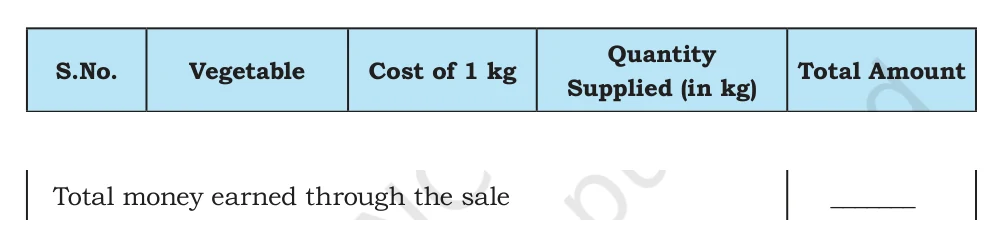
Find the total money earned from all four vegetables.
Show detailed solution
- Step 1: Read the price, quantity, and amount columns for the row.
- Step 2: Use multiplication for an amount or division for a missing price or quantity.
- Step 3: 2,028+2,240+1,792+3,125=9,185.
- Answer: Rs 9,185.
Textbook page 134 · solved item 162
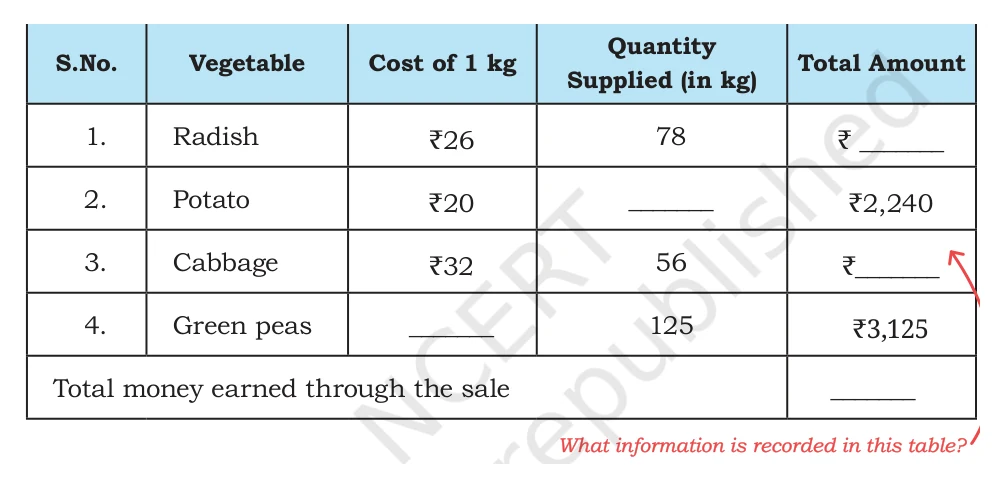
What information is recorded in the vegetable market table?
Show detailed solution
- Step 1: Each row names a vegetable.
- Step 2: It records the cost of 1 kg and the quantity supplied in kilograms.
- Step 3: It records the total amount earned for each vegetable and the total sale earning.
- Answer: The table records vegetable, unit price, quantity supplied, row amount, and overall amount.
Textbook page 134 · solved item 163
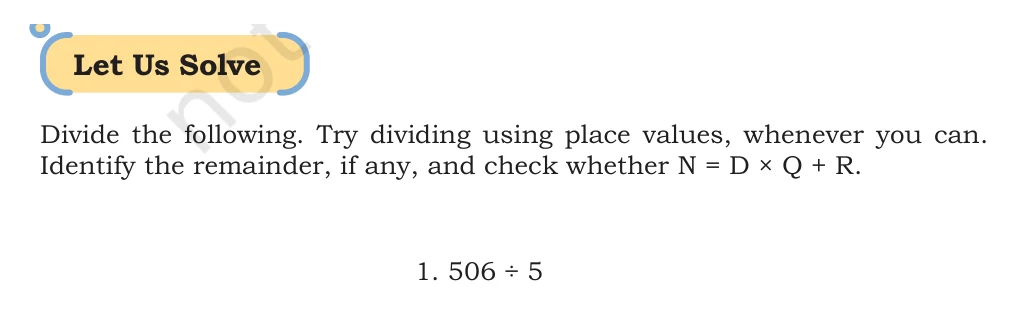
Divide 506 by 5 and identify the remainder, if any.
Show detailed solution
- Step 1: Look for the largest whole-number multiple of 5 that does not pass 506.
- Step 2: 5\times101=505, so there are 101 complete groups.
- Step 3: 506-505=1. The division ends with remainder 1.
- Step 4: Check: 5\times101+1=506.
- Answer: 506\div5=101,\text{ remainder }1.
Textbook page 134 · solved item 164
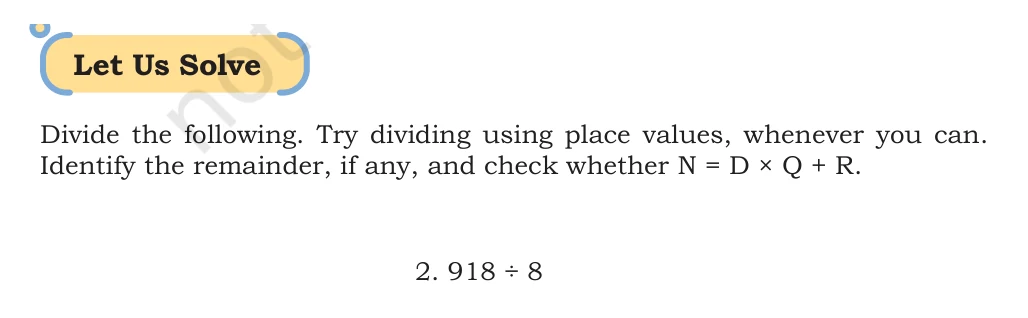
Divide 918 by 8 and identify the remainder, if any.
Show detailed solution
- Step 1: Look for the largest whole-number multiple of 8 that does not pass 918.
- Step 2: 8\times114=912, so there are 114 complete groups.
- Step 3: 918-912=6. The division ends with remainder 6.
- Step 4: Check: 8\times114+6=918.
- Answer: 918\div8=114,\text{ remainder }6.
Textbook page 134 · solved item 165
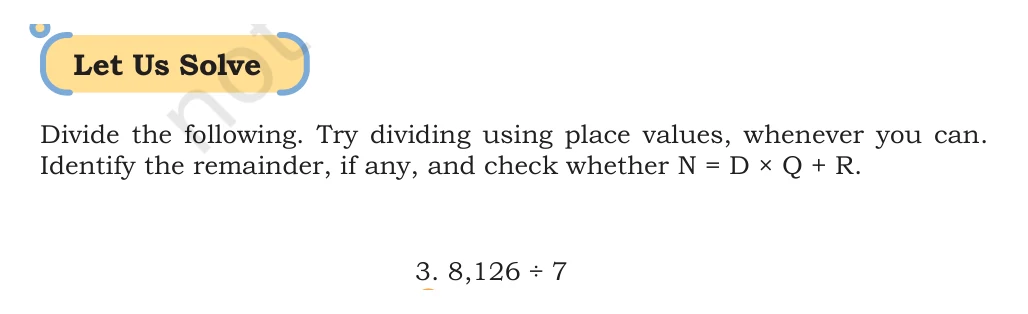
Divide 8,126 by 7 and identify the remainder, if any.
Show detailed solution
- Step 1: Look for the largest whole-number multiple of 7 that does not pass 8,126.
- Step 2: 7\times1160=8,120, so there are 1160 complete groups.
- Step 3: 8,126-8,120=6. The division ends with remainder 6.
- Step 4: Check: 7\times1160+6=8,126.
- Answer: 8,126\div7=1160,\text{ remainder }6.
Textbook page 134 · solved item 166
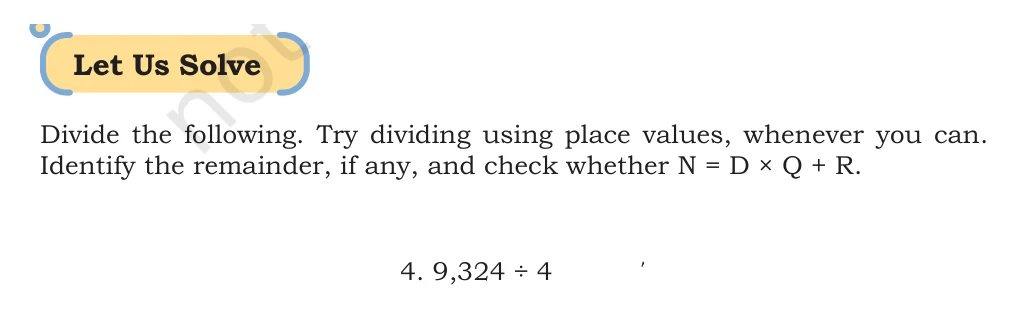
Divide 9,324 by 4 and identify the remainder, if any.
Show detailed solution
- Step 1: Look for the largest whole-number multiple of 4 that does not pass 9,324.
- Step 2: 4\times2331=9,324, so there are 2331 complete groups.
- Step 3: 9,324-9,324=0. The division ends with no remainder.
- Step 4: Check: 4\times2331+0=9,324.
- Answer: 9,324\div4=2331.
Textbook page 134 · solved item 167
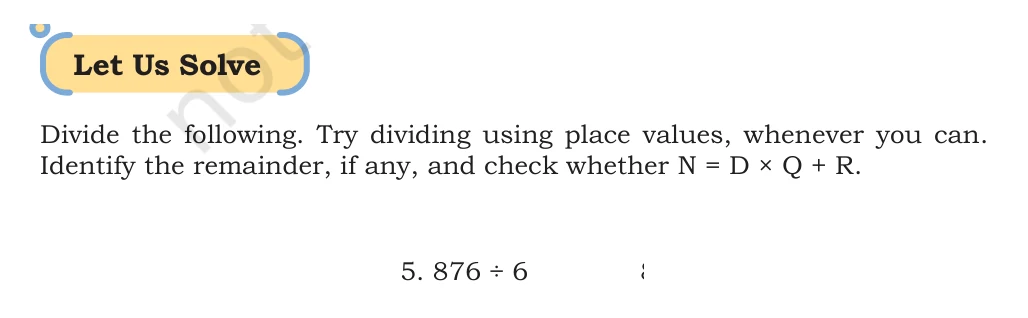
Divide 876 by 6 and identify the remainder, if any.
Show detailed solution
- Step 1: Look for the largest whole-number multiple of 6 that does not pass 876.
- Step 2: 6\times146=876, so there are 146 complete groups.
- Step 3: 876-876=0. The division ends with no remainder.
- Step 4: Check: 6\times146+0=876.
- Answer: 876\div6=146.
Textbook page 134 · solved item 168
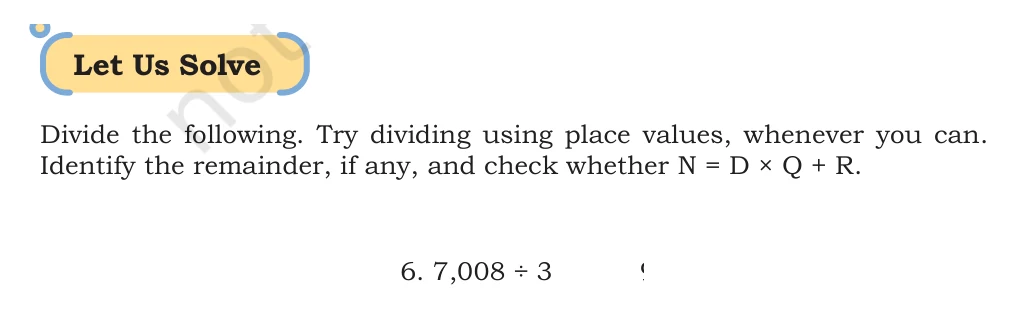
Divide 7,008 by 3 and identify the remainder, if any.
Show detailed solution
- Step 1: Look for the largest whole-number multiple of 3 that does not pass 7,008.
- Step 2: 3\times2336=7,008, so there are 2336 complete groups.
- Step 3: 7,008-7,008=0. The division ends with no remainder.
- Step 4: Check: 3\times2336+0=7,008.
- Answer: 7,008\div3=2336.
Textbook page 134 · solved item 169
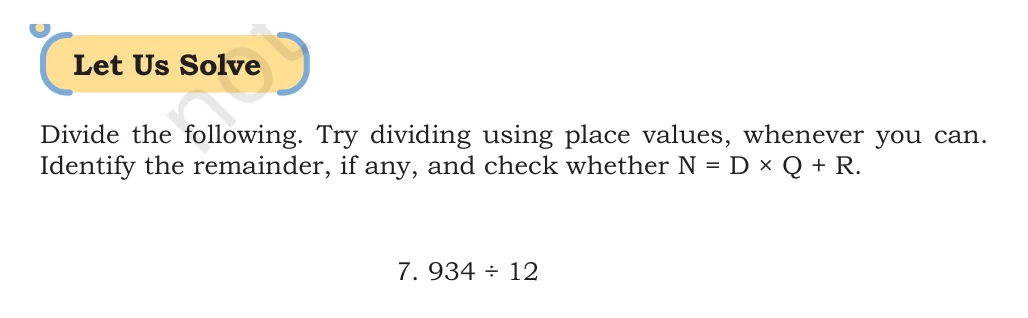
Divide 934 by 12 and identify the remainder, if any.
Show detailed solution
- Step 1: Look for the largest whole-number multiple of 12 that does not pass 934.
- Step 2: 12\times77=924, so there are 77 complete groups.
- Step 3: 934-924=10. The division ends with remainder 10.
- Step 4: Check: 12\times77+10=934.
- Answer: 934\div12=77,\text{ remainder }10.
Textbook page 134 · solved item 170
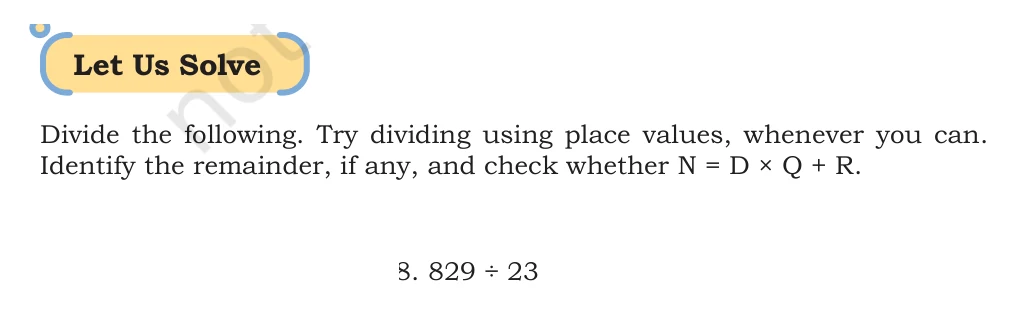
Divide 829 by 23 and identify the remainder, if any.
Show detailed solution
- Step 1: Look for the largest whole-number multiple of 23 that does not pass 829.
- Step 2: 23\times36=828, so there are 36 complete groups.
- Step 3: 829-828=1. The division ends with remainder 1.
- Step 4: Check: 23\times36+1=829.
- Answer: 829\div23=36,\text{ remainder }1.
Textbook page 134 · solved item 171
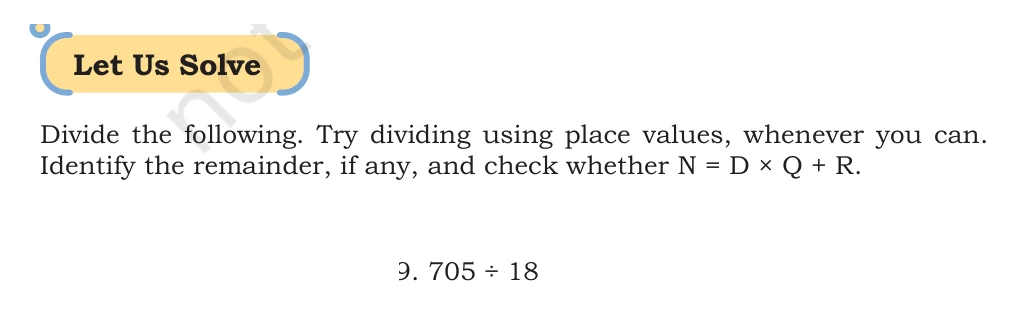
Divide 705 by 18 and identify the remainder, if any.
Show detailed solution
- Step 1: Look for the largest whole-number multiple of 18 that does not pass 705.
- Step 2: 18\times39=702, so there are 39 complete groups.
- Step 3: 705-702=3. The division ends with remainder 3.
- Step 4: Check: 18\times39+3=705.
- Answer: 705\div18=39,\text{ remainder }3.
Textbook page 134 · solved item 172
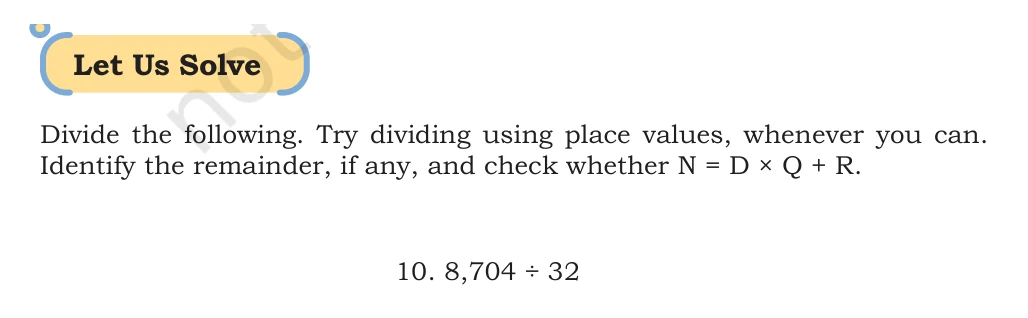
Divide 8,704 by 32 and identify the remainder, if any.
Show detailed solution
- Step 1: Look for the largest whole-number multiple of 32 that does not pass 8,704.
- Step 2: 32\times272=8,704, so there are 272 complete groups.
- Step 3: 8,704-8,704=0. The division ends with no remainder.
- Step 4: Check: 32\times272+0=8,704.
- Answer: 8,704\div32=272.
Textbook page 134 · solved item 173
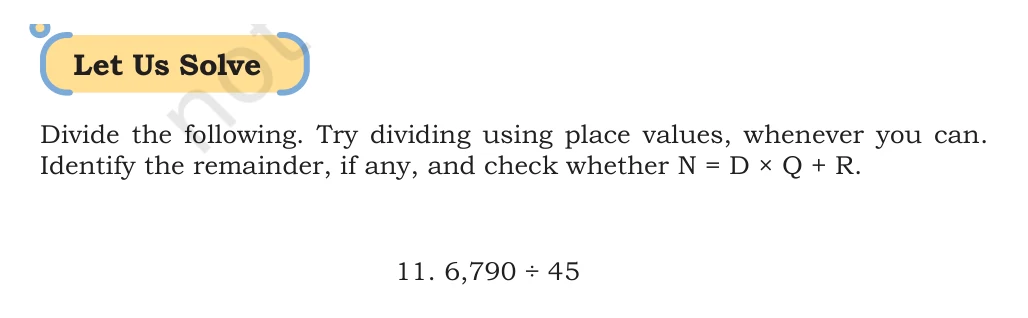
Divide 6,790 by 45 and identify the remainder, if any.
Show detailed solution
- Step 1: Look for the largest whole-number multiple of 45 that does not pass 6,790.
- Step 2: 45\times150=6,750, so there are 150 complete groups.
- Step 3: 6,790-6,750=40. The division ends with remainder 40.
- Step 4: Check: 45\times150+40=6,790.
- Answer: 6,790\div45=150,\text{ remainder }40.
Textbook page 134 · solved item 174
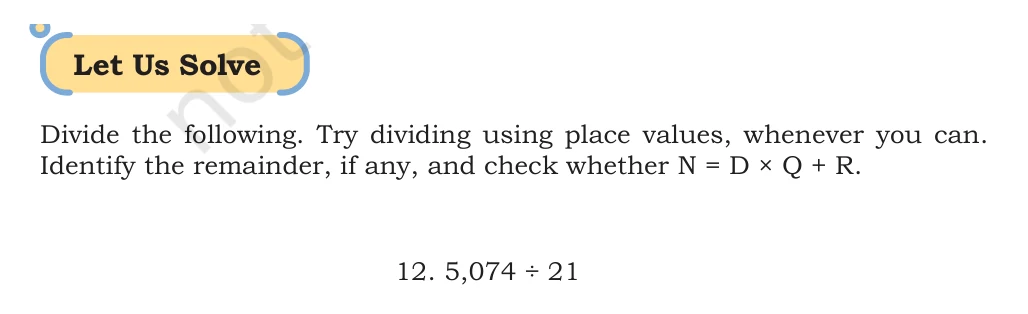
Divide 5,074 by 21 and identify the remainder, if any.
Show detailed solution
- Step 1: Look for the largest whole-number multiple of 21 that does not pass 5,074.
- Step 2: 21\times241=5,061, so there are 241 complete groups.
- Step 3: 5,074-5,061=13. The division ends with remainder 13.
- Step 4: Check: 21\times241+13=5,074.
- Answer: 5,074\div21=241,\text{ remainder }13.
Detailed worked answers
Textbook page 135
Textbook page 135 · solved item 175
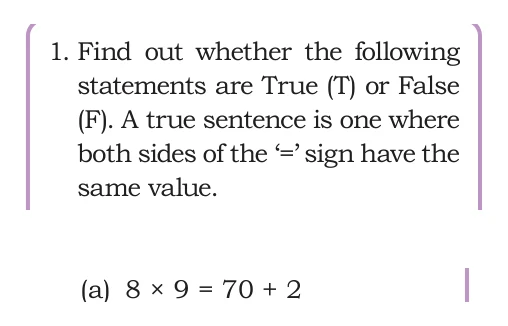
Is 8 times 9 equal to 70 plus 2?
Show detailed solution
- Step 1: Work out the value on the left side.
- Step 2: Work out the value on the right side.
- Step 3: 8\times9=72 and 70+2=72.
- Answer: The statement is True.
Textbook page 135 · solved item 176
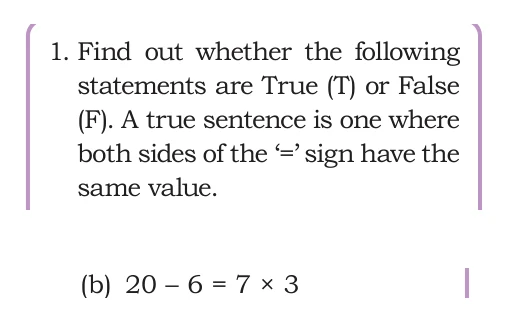
Is 20 minus 6 equal to 7 times 3?
Show detailed solution
- Step 1: Work out the value on the left side.
- Step 2: Work out the value on the right side.
- Step 3: 20-6=14, but 7\times3=21.
- Answer: The statement is False.
Textbook page 135 · solved item 177
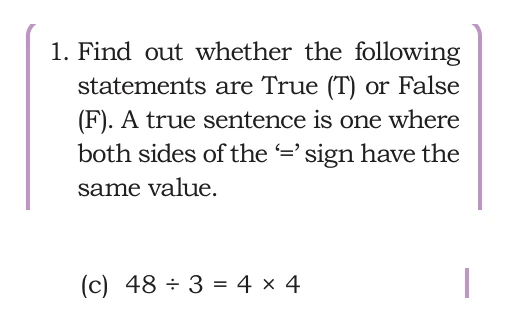
Is 48 divided by 3 equal to 4 times 4?
Show detailed solution
- Step 1: Work out the value on the left side.
- Step 2: Work out the value on the right side.
- Step 3: 48\div3=16 and 4\times4=16.
- Answer: The statement is True.
Textbook page 135 · solved item 178
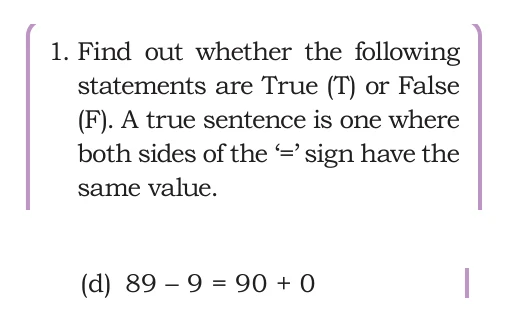
Is 89 minus 9 equal to 90 plus 0?
Show detailed solution
- Step 1: Work out the value on the left side.
- Step 2: Work out the value on the right side.
- Step 3: 89-9=80, but 90+0=90.
- Answer: The statement is False.
Textbook page 135 · solved item 179
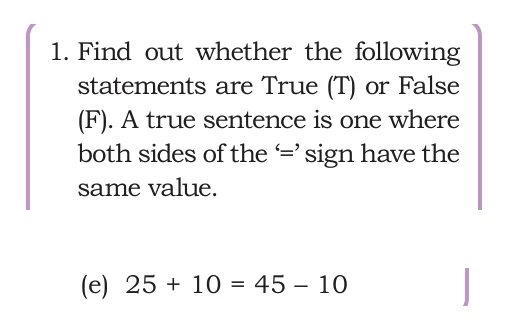
Is 25 plus 10 equal to 45 minus 10?
Show detailed solution
- Step 1: Work out the value on the left side.
- Step 2: Work out the value on the right side.
- Step 3: 25+10=35 and 45-10=35.
- Answer: The statement is True.
Textbook page 135 · solved item 180
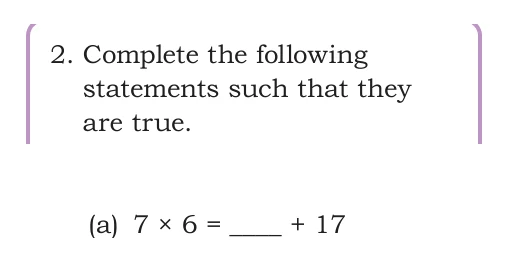
Complete 7 times 6 equals a blank plus 17.
Show detailed solution
- Step 1: Work out the complete side of the equality.
- Step 2: Use the opposite operation to find the blank.
- Step 3: 7\times6=42, and 42-17=25.
- Answer: The blank is 25.
Textbook page 135 · solved item 181
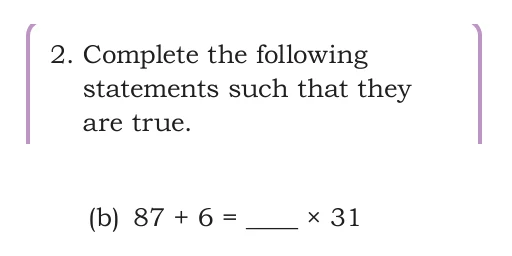
Complete 87 plus 6 equals a blank times 31.
Show detailed solution
- Step 1: Work out the complete side of the equality.
- Step 2: Use the opposite operation to find the blank.
- Step 3: 87+6=93, and 93\div31=3.
- Answer: The blank is 3.
Textbook page 135 · solved item 182
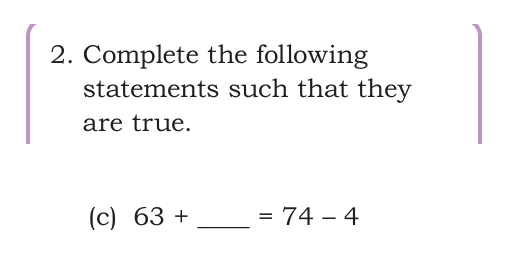
Complete 63 plus a blank equals 74 minus 4.
Show detailed solution
- Step 1: Work out the complete side of the equality.
- Step 2: Use the opposite operation to find the blank.
- Step 3: 74-4=70, and 70-63=7.
- Answer: The blank is 7.
Textbook page 135 · solved item 183
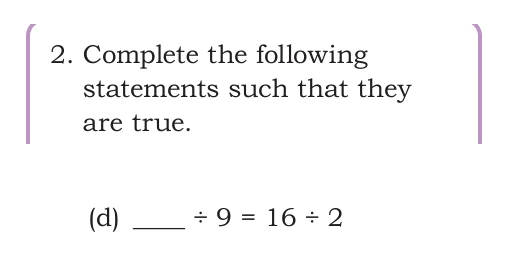
Complete a blank divided by 9 equals 16 divided by 2.
Show detailed solution
- Step 1: Work out the complete side of the equality.
- Step 2: Use the opposite operation to find the blank.
- Step 3: 16\div2=8, and 8\times9=72.
- Answer: The blank is 72.
Textbook page 135 · solved item 184
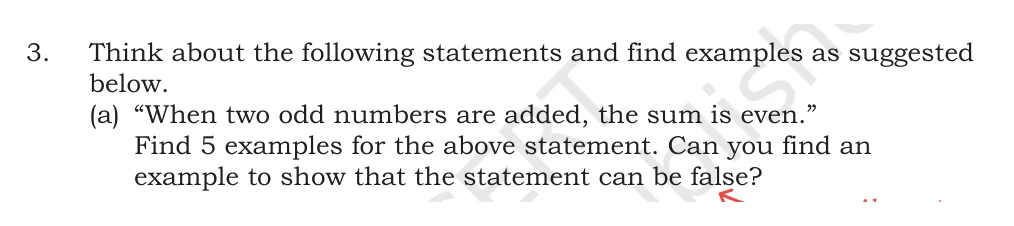
Give five examples of two odd numbers adding to an even number. Can the statement be false?
Show detailed solution
- Step 1: Examples are 1+3=4, 3+5=8, 5+7=12, 7+9=16, and 9+11=20.
- Step 2: Every odd number is one more than an even number.
- Step 3: Adding the two extra ones makes 2, which is even, so the whole sum is even.
- Answer: The statement is always true; there is no whole-number example that makes it false.
Textbook page 135 · solved item 185
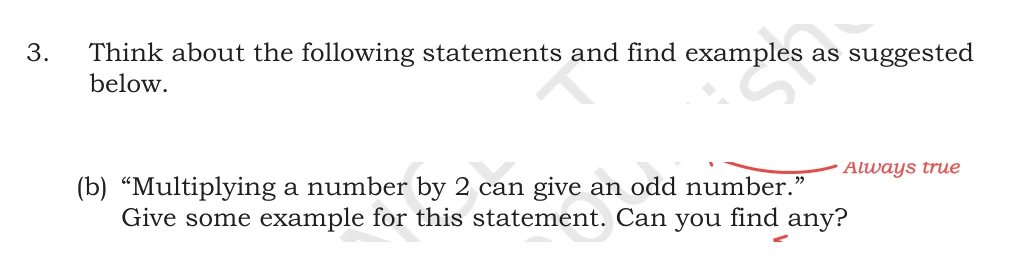
Can multiplying a whole number by 2 give an odd number?
Show detailed solution
- Step 1: Multiplying by 2 makes two equal groups.
- Step 2: Examples are 2\times3=6, 2\times7=14, and 2\times11=22.
- Step 3: Every result can be paired with nothing left over, so it is even.
- Answer: No. Multiplying a whole number by 2 never gives an odd number.
Textbook page 135 · solved item 186
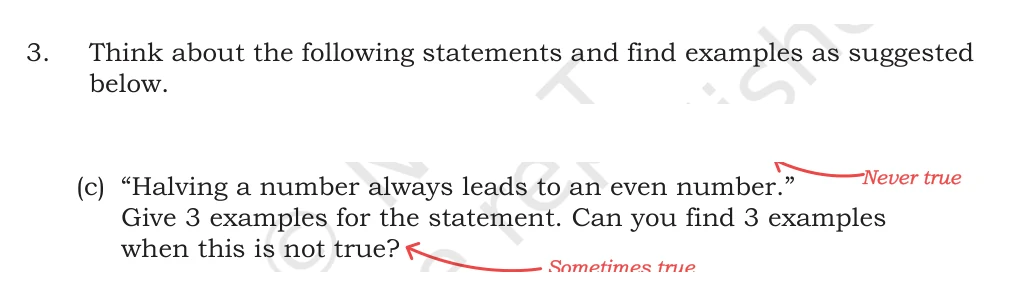
Does halving a whole number always give an even whole number? Give true and false examples.
Show detailed solution
- Step 1: True examples include 8\div2=4, 12\div2=6, and 16\div2=8.
- Step 2: False examples include 6\div2=3, 10\div2=5, and 14\div2=7.
- Step 3: The result depends on the number being halved.
- Answer: The statement is sometimes true.
Textbook page 135 · solved item 187
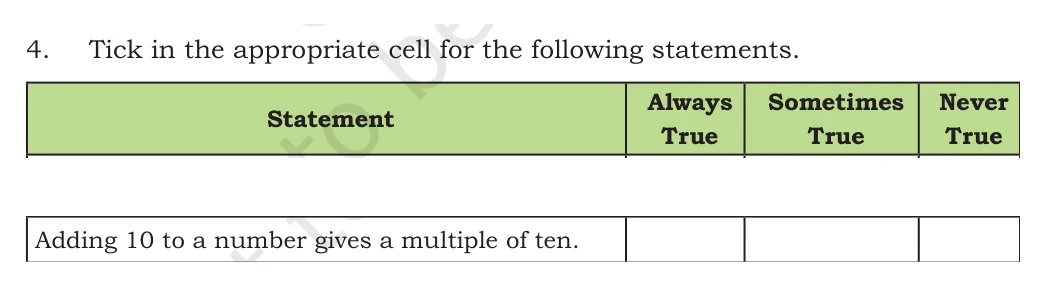
Classify this statement: Adding 10 to a number gives a multiple of ten.
Show detailed solution
- Step 1: Test the statement with more than one small whole number.
- Step 2: It is true for 20 because 20 + 10 = 30, but false for 21 because 21 + 10 = 31.
- Step 3: Decide whether it works in every case, some cases, or no cases.
- Answer: Sometimes true.
Textbook page 135 · solved item 188
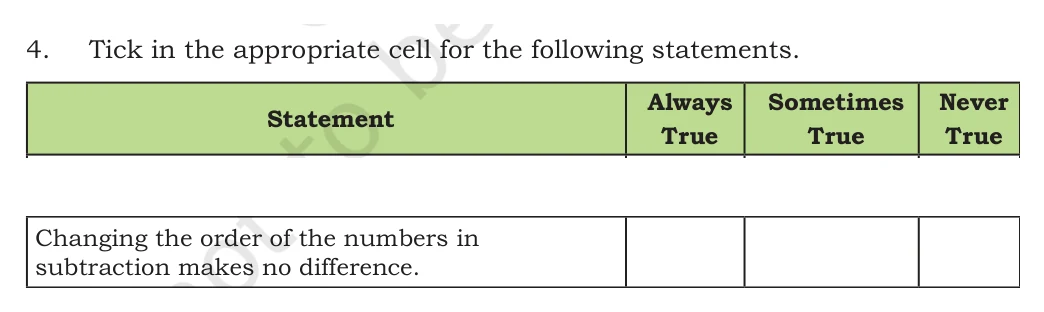
Classify this statement: Changing the order of the numbers in subtraction makes no difference.
Show detailed solution
- Step 1: Test the statement with more than one small whole number.
- Step 2: It is true for 5 - 5, but 8 - 3 and 3 - 8 do not give the same result.
- Step 3: Decide whether it works in every case, some cases, or no cases.
- Answer: Sometimes true.
Textbook page 135 · solved item 189
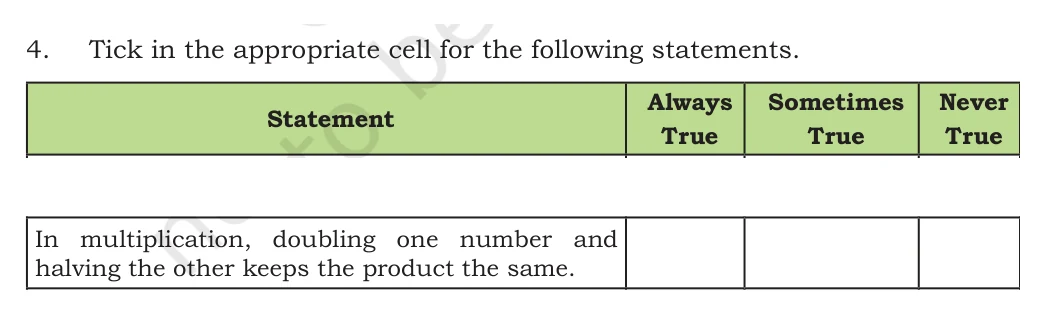
Classify this statement: In multiplication, doubling one number and halving the other keeps the product the same.
Show detailed solution
- Step 1: Test the statement with more than one small whole number.
- Step 2: For example, 6 times 8 and 12 times 4 both equal 48; one factor doubles while the other halves.
- Step 3: Decide whether it works in every case, some cases, or no cases.
- Answer: Always true.
Textbook page 135 · solved item 190
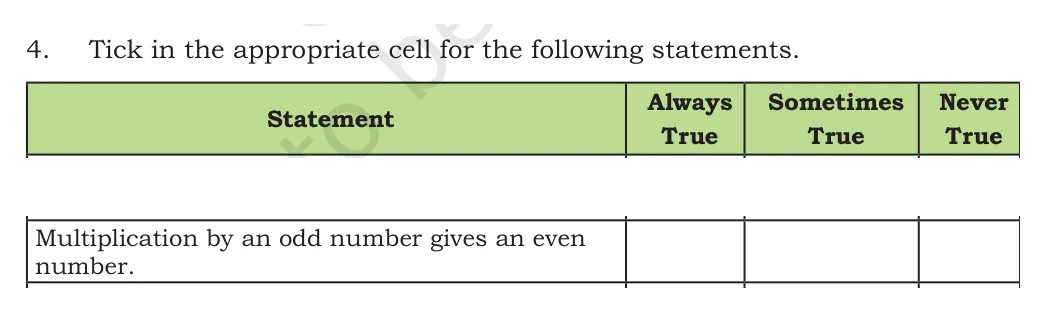
Classify this statement: Multiplication by an odd number gives an even number.
Show detailed solution
- Step 1: Test the statement with more than one small whole number.
- Step 2: Even times odd is even, such as 4 times 3 = 12, but odd times odd is odd, such as 5 times 3 = 15.
- Step 3: Decide whether it works in every case, some cases, or no cases.
- Answer: Sometimes true.
Textbook page 135 · solved item 191
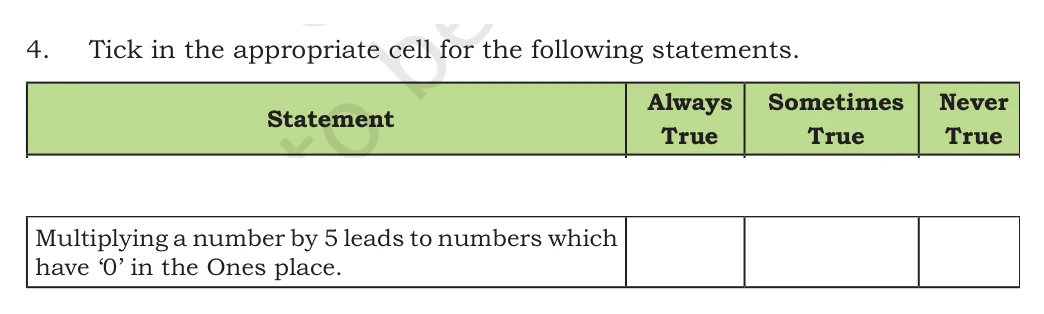
Classify this statement: Multiplying a number by 5 gives a number with 0 in the ones place.
Show detailed solution
- Step 1: Test the statement with more than one small whole number.
- Step 2: An even number times 5 ends in 0, such as 6 times 5 = 30, while an odd number times 5 ends in 5.
- Step 3: Decide whether it works in every case, some cases, or no cases.
- Answer: Sometimes true.