
Question-by-question working
Read the prompt, attempt it, then check each step
Every exercise subpart and table row is a separate item. Shared figures and table headings are repeated whenever they are needed to understand the question.
Detailed worked answers
Textbook page 57
Textbook page 57 · solved item 1
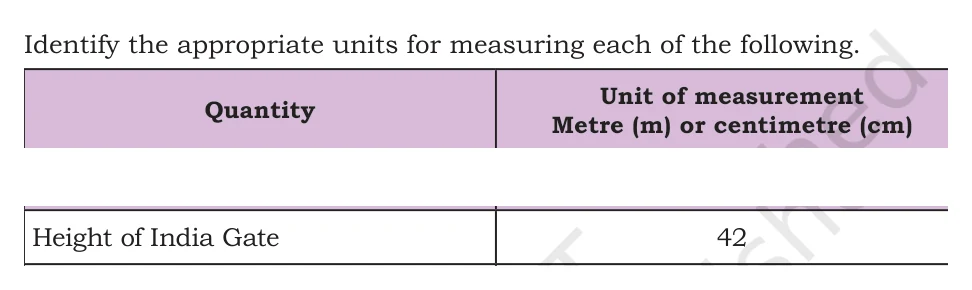
Choose metres or centimetres for the height of India Gate, shown as 42.
Show detailed solution
- Step 1: Think about the real size of the object or distance.
- Step 2: Metres are the sensible unit for this size.
- Answer: Write 42 m.
Textbook page 57 · solved item 2
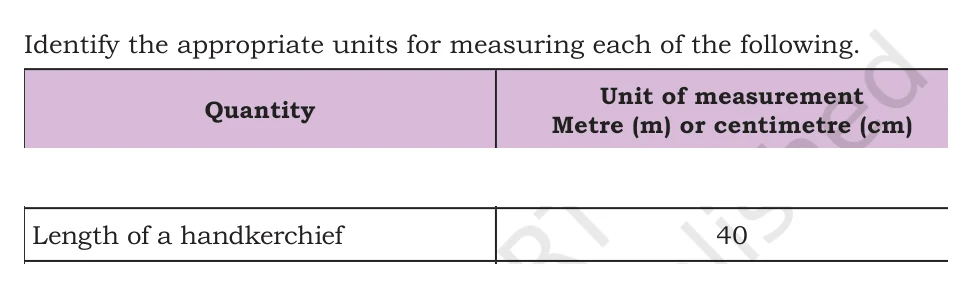
Choose metres or centimetres for the length of a handkerchief, shown as 40.
Show detailed solution
- Step 1: Think about the real size of the object or distance.
- Step 2: Centimetres are the sensible unit for this size.
- Answer: Write 40 cm.
Textbook page 57 · solved item 3
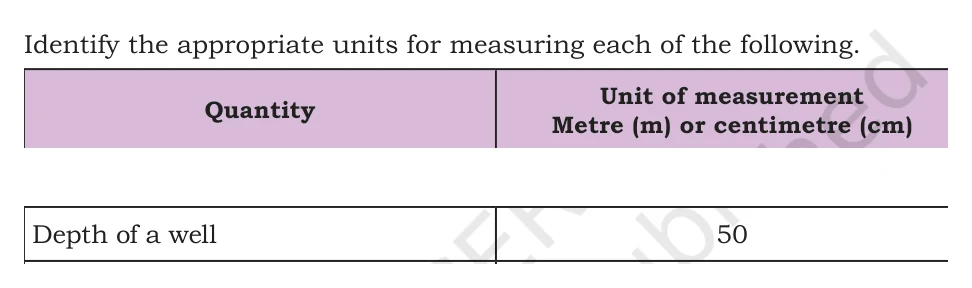
Choose metres or centimetres for the depth of a well, shown as 50.
Show detailed solution
- Step 1: Think about the real size of the object or distance.
- Step 2: Metres are the sensible unit for this size.
- Answer: Write 50 m.
Textbook page 57 · solved item 4
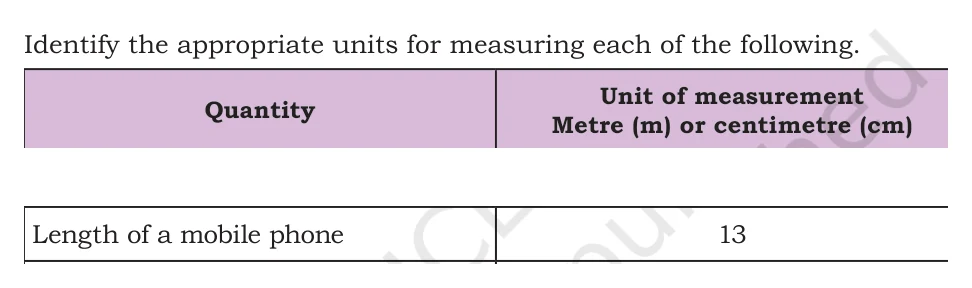
Choose metres or centimetres for the length of a mobile phone, shown as 13.
Show detailed solution
- Step 1: Think about the real size of the object or distance.
- Step 2: Centimetres are the sensible unit for this size.
- Answer: Write 13 cm.
Textbook page 57 · solved item 5
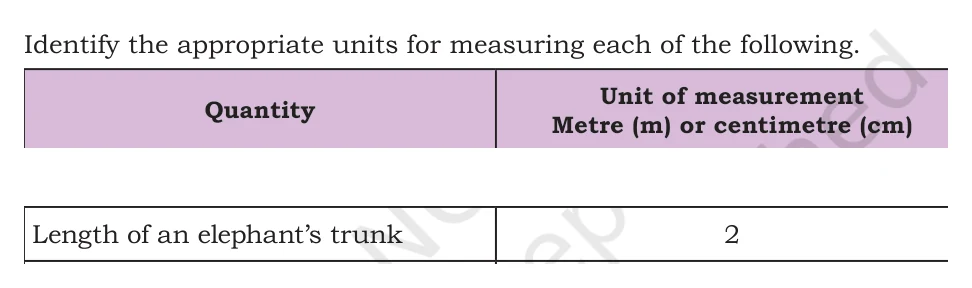
Choose metres or centimetres for the length of an elephant's trunk, shown as 2.
Show detailed solution
- Step 1: Think about the real size of the object or distance.
- Step 2: Metres are the sensible unit for this size.
- Answer: Write 2 m.
Textbook page 57 · solved item 6
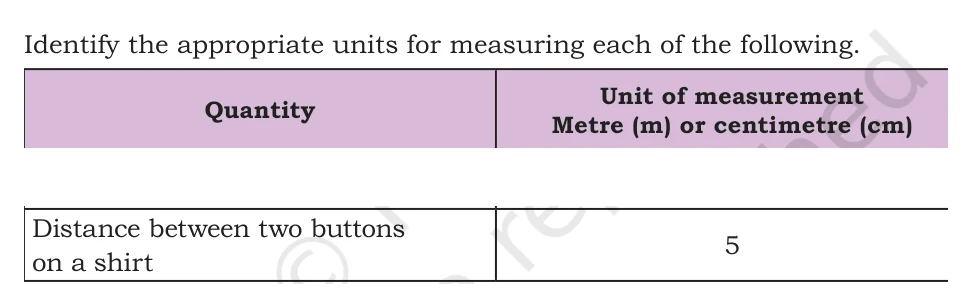
Choose metres or centimetres for the distance between two shirt buttons, shown as 5.
Show detailed solution
- Step 1: Think about the real size of the object or distance.
- Step 2: Centimetres are the sensible unit for this size.
- Answer: Write 5 cm.
Textbook page 57 · solved item 7
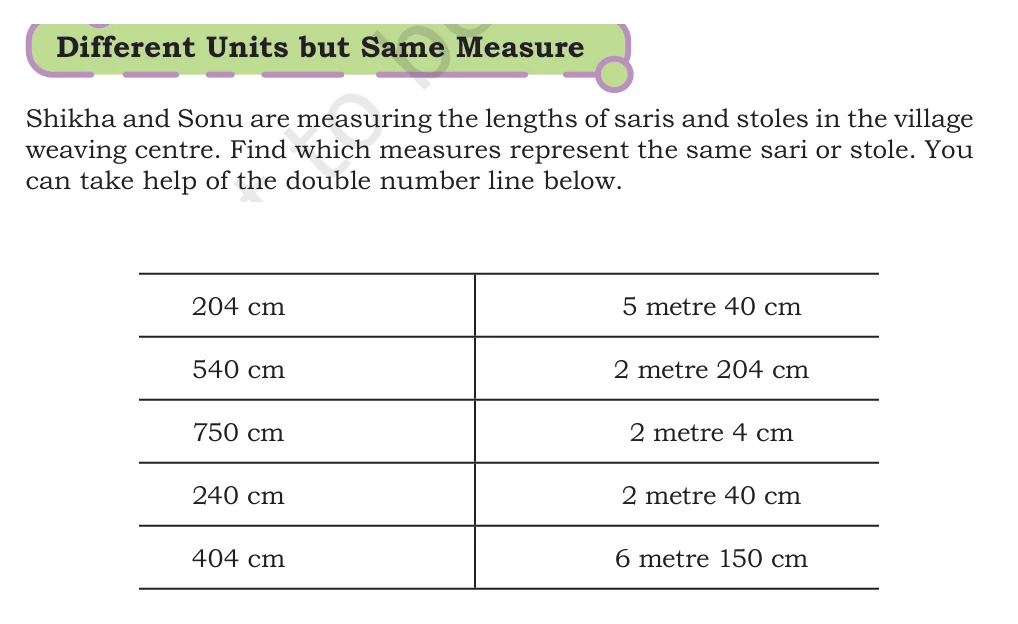
Which mixed-unit measure in the table is equal to 204 cm?
Show detailed solution
- Step 1: Use 1 m = 100 cm to put both measures in centimetres.
- Step 2: Two metres is 200 cm, and 200 cm + 4 cm = 204 cm.
- Answer: 204 cm matches 2 m 4 cm.
Textbook page 57 · solved item 8
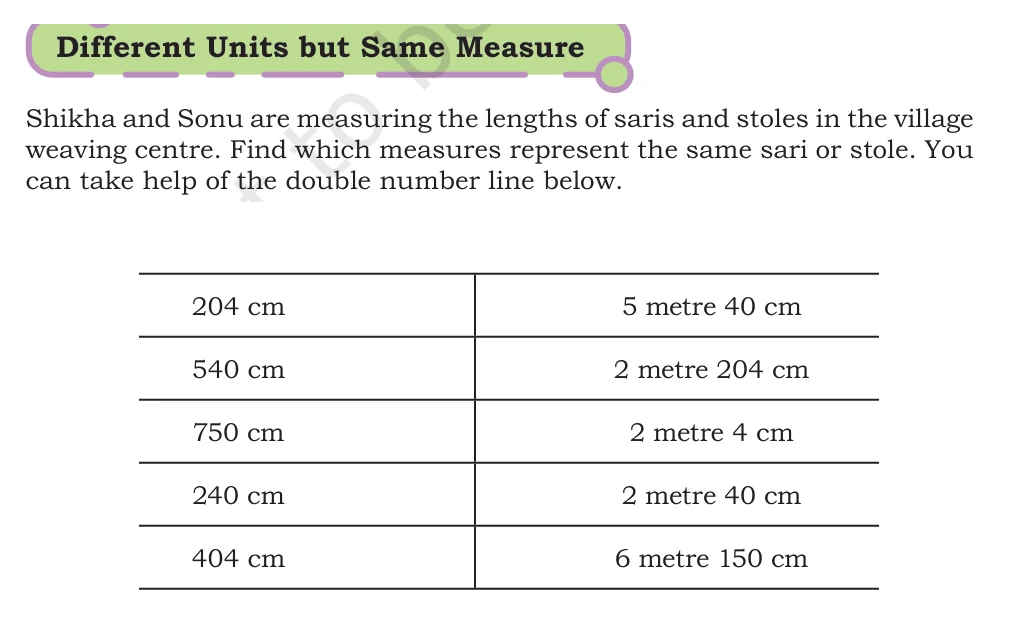
Which mixed-unit measure in the table is equal to 540 cm?
Show detailed solution
- Step 1: Use 1 m = 100 cm to put both measures in centimetres.
- Step 2: Five metres is 500 cm, and 500 cm + 40 cm = 540 cm.
- Answer: 540 cm matches 5 m 40 cm.
Textbook page 57 · solved item 9
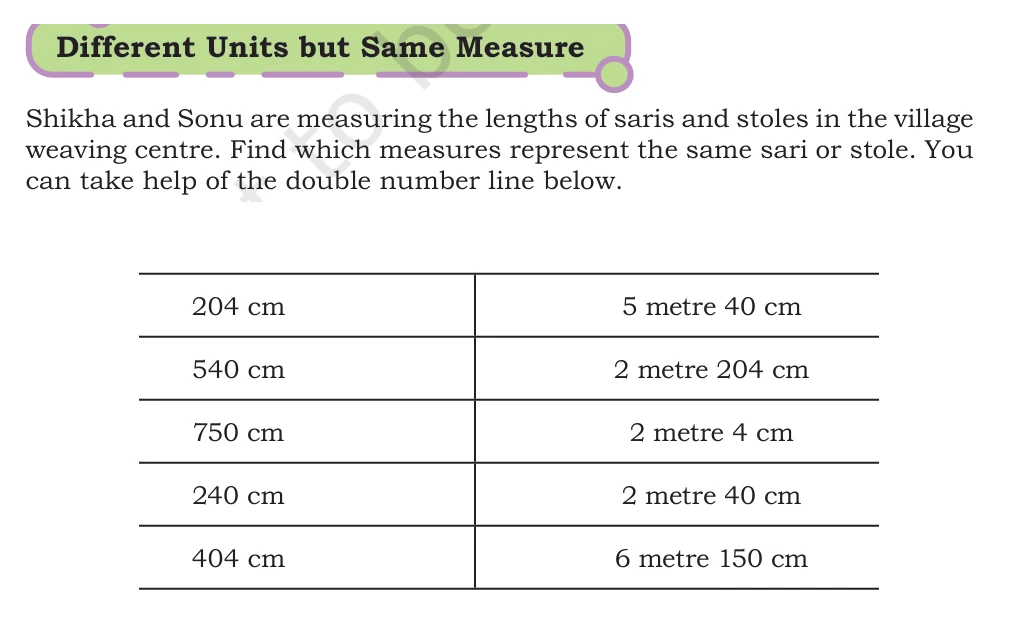
Which mixed-unit measure in the table is equal to 750 cm?
Show detailed solution
- Step 1: Use 1 m = 100 cm to put both measures in centimetres.
- Step 2: Six metres is 600 cm, and 600 cm + 150 cm = 750 cm.
- Answer: 750 cm matches 6 m 150 cm.
Textbook page 57 · solved item 10
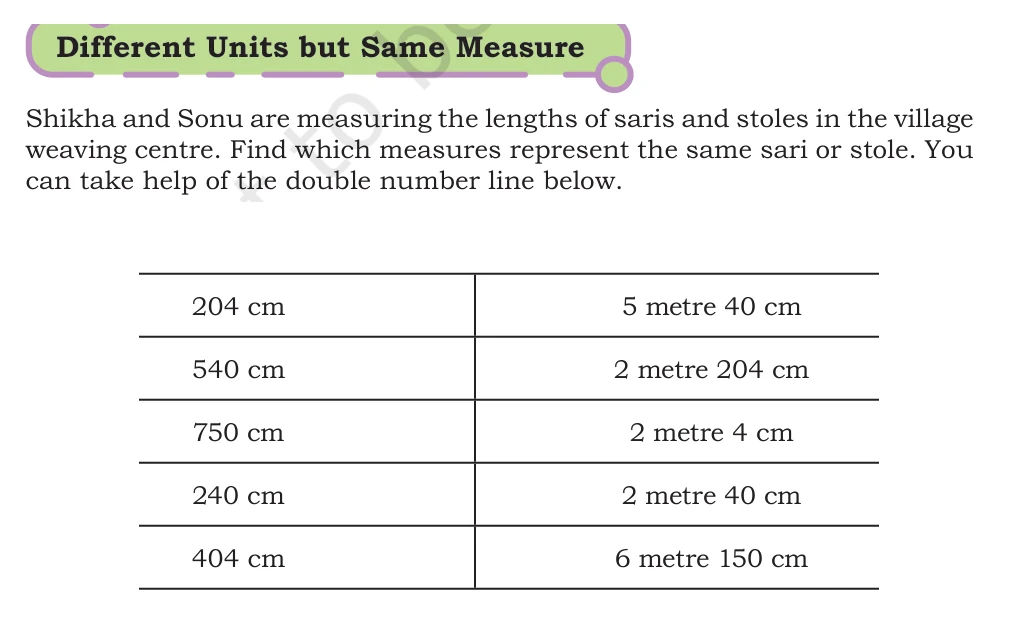
Which mixed-unit measure in the table is equal to 240 cm?
Show detailed solution
- Step 1: Use 1 m = 100 cm to put both measures in centimetres.
- Step 2: Two metres is 200 cm, and 200 cm + 40 cm = 240 cm.
- Answer: 240 cm matches 2 m 40 cm.
Textbook page 57 · solved item 11
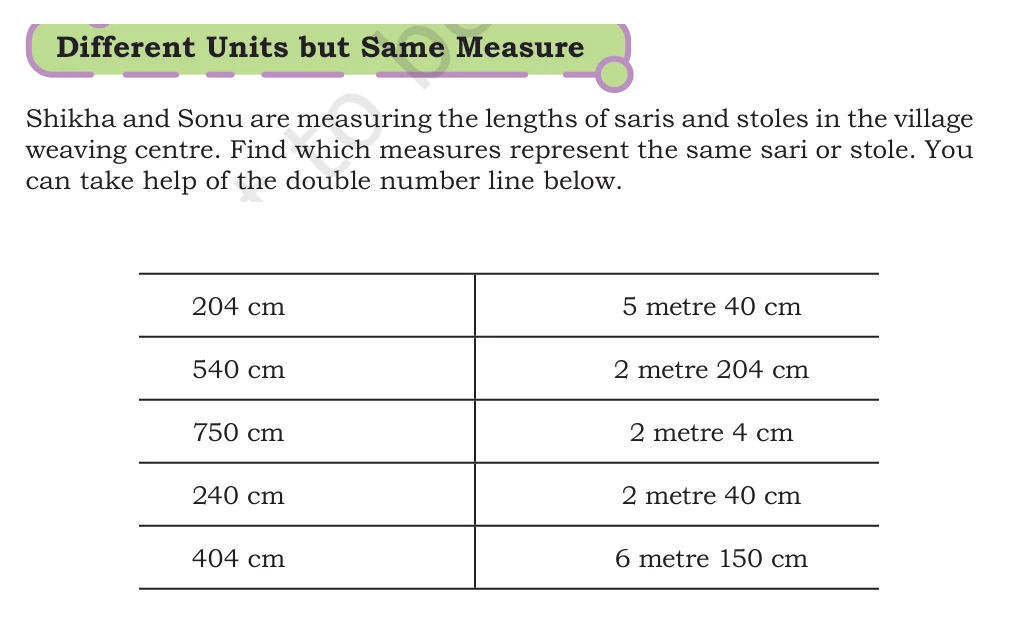
Which mixed-unit measure in the table is equal to 404 cm?
Show detailed solution
- Step 1: Use 1 m = 100 cm to put both measures in centimetres.
- Step 2: Two metres is 200 cm, and 200 cm + 204 cm = 404 cm.
- Answer: 404 cm matches 2 m 204 cm.
Textbook page 57 · solved item 12
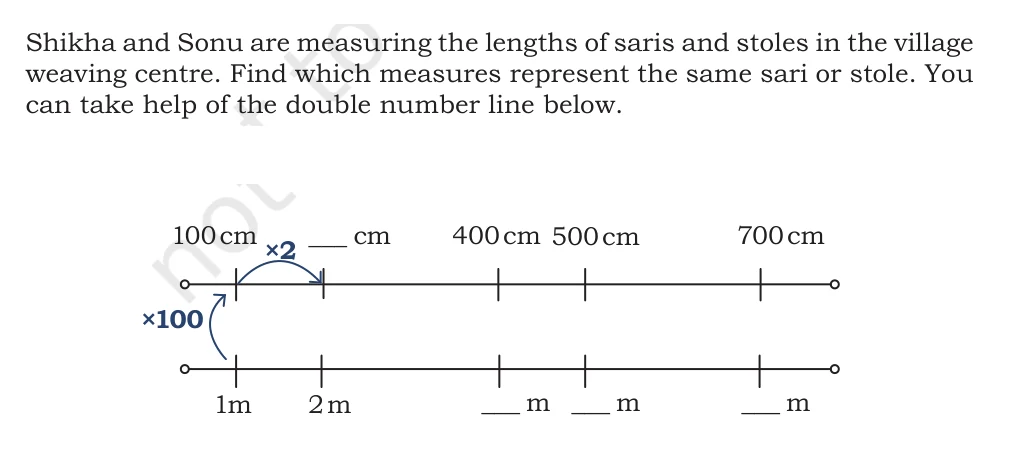
How many centimetres are equal to 2 m on the double number line?
Show detailed solution
- Step 1: Use the relationship 1 m = 100 cm.
- Step 2: 2 groups of 100 cm make 200 cm.
- Answer: Write 200 cm in the blank.
Textbook page 57 · solved item 13
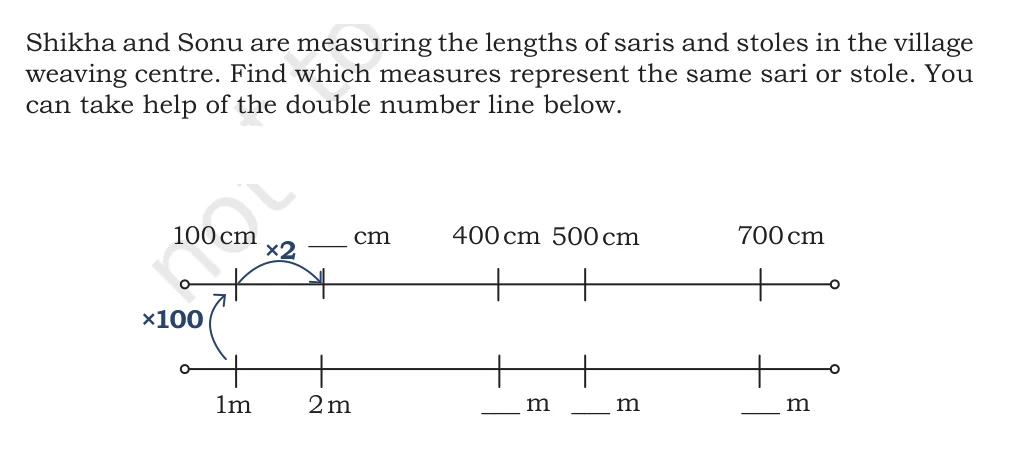
How many metres are equal to 400 cm on the double number line?
Show detailed solution
- Step 1: Use the relationship 1 m = 100 cm.
- Step 2: 400 cm contains 4 groups of 100 cm.
- Answer: Write 4 m in the blank.
Textbook page 57 · solved item 14
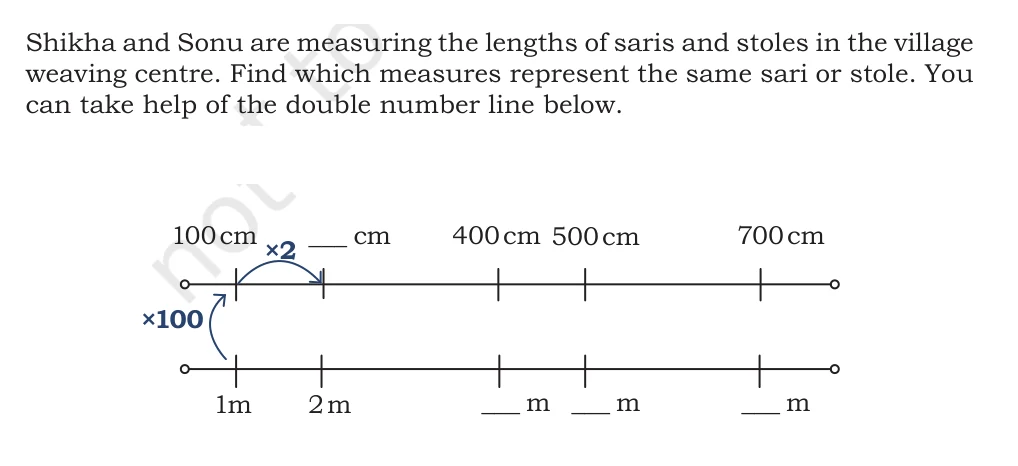
How many metres are equal to 500 cm on the double number line?
Show detailed solution
- Step 1: Use the relationship 1 m = 100 cm.
- Step 2: 500 cm contains 5 groups of 100 cm.
- Answer: Write 5 m in the blank.
Textbook page 57 · solved item 15
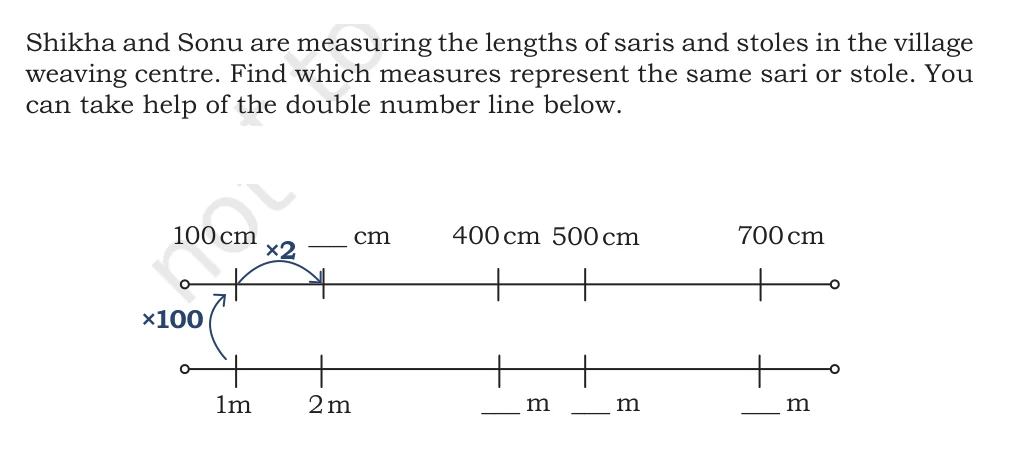
How many metres are equal to 700 cm on the double number line?
Show detailed solution
- Step 1: Use the relationship 1 m = 100 cm.
- Step 2: 700 cm contains 7 groups of 100 cm.
- Answer: Write 7 m in the blank.
Detailed worked answers
Textbook page 58
Textbook page 58 · solved item 16
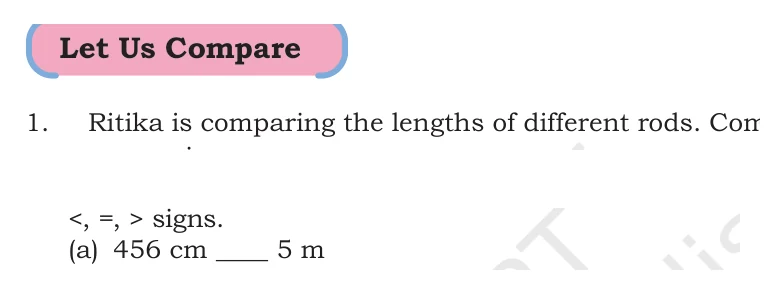
Compare 456 cm and 5 m using <, =, or >.
Show detailed solution
- Step 1: Convert metres to centimetres when the units differ.
- Step 2: 5 m is 500 cm, and 456 cm is less than 500 cm.
- Answer: 456 cm\ <\ 5 m.
Textbook page 58 · solved item 17
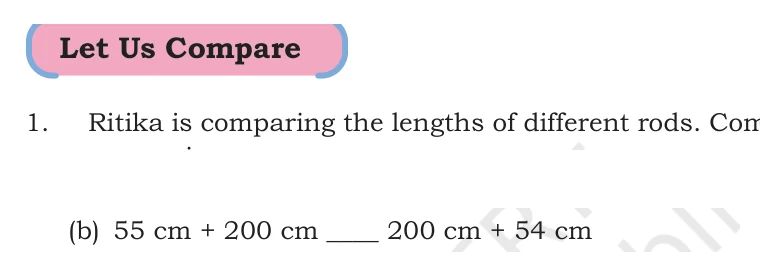
Compare 55 cm + 200 cm and 200 cm + 54 cm using <, =, or >.
Show detailed solution
- Step 1: Convert metres to centimetres when the units differ.
- Step 2: The two totals are 255 cm and 254 cm.
- Answer: 55 cm + 200 cm\ >\ 200 cm + 54 cm.
Textbook page 58 · solved item 18
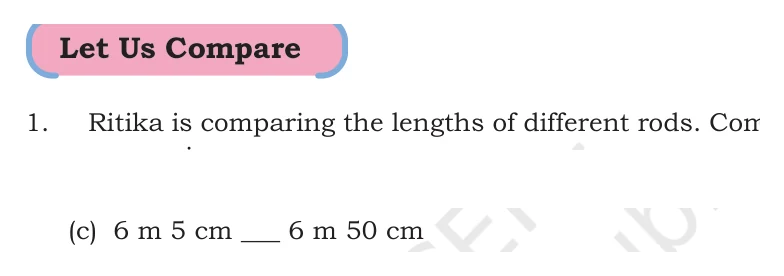
Compare 6 m 5 cm and 6 m 50 cm using <, =, or >.
Show detailed solution
- Step 1: Convert metres to centimetres when the units differ.
- Step 2: Both have 6 m, and 5 cm is less than 50 cm.
- Answer: 6 m 5 cm\ <\ 6 m 50 cm.
Textbook page 58 · solved item 19
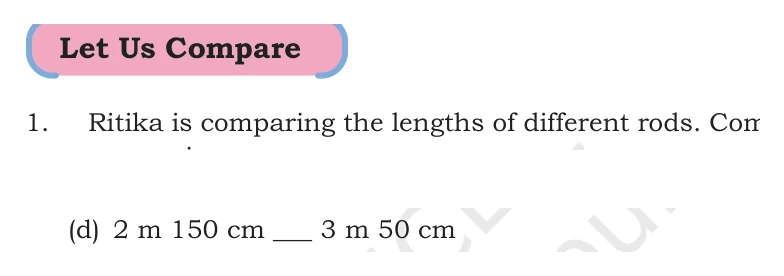
Compare 2 m 150 cm and 3 m 50 cm using <, =, or >.
Show detailed solution
- Step 1: Convert metres to centimetres when the units differ.
- Step 2: Both measures equal 350 cm.
- Answer: 2 m 150 cm\ =\ 3 m 50 cm.
Textbook page 58 · solved item 20
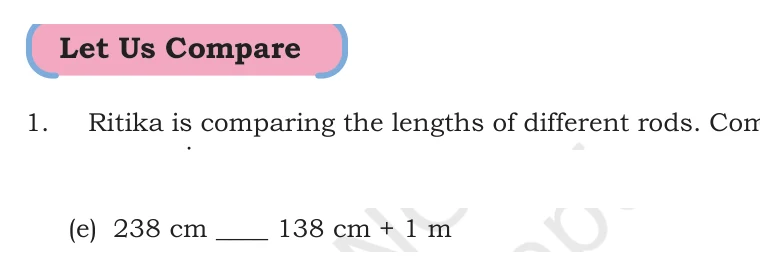
Compare 238 cm and 138 cm + 1 m using <, =, or >.
Show detailed solution
- Step 1: Convert metres to centimetres when the units differ.
- Step 2: One metre is 100 cm, so 138 cm + 100 cm = 238 cm.
- Answer: 238 cm\ =\ 138 cm + 1 m.
Textbook page 58 · solved item 21
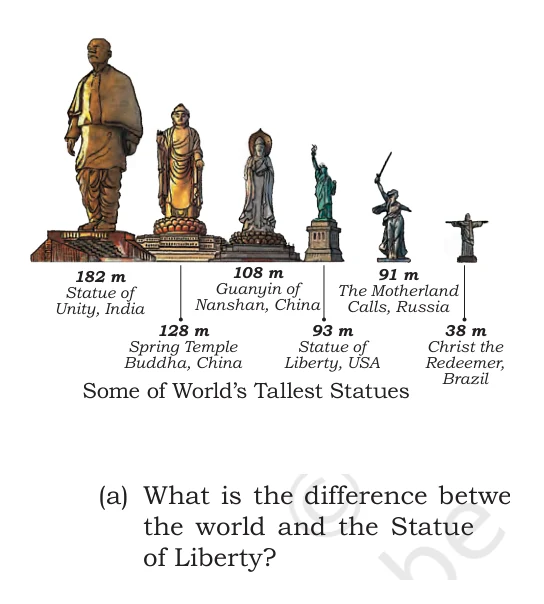
What is the difference between the height of the Statue of Unity and the Statue of Liberty?
Show detailed solution
- Step 1: The chart gives 182 m and 93 m.
- Step 2: 182-93=89.
- Answer: The difference is 89 m.
Textbook page 58 · solved item 22
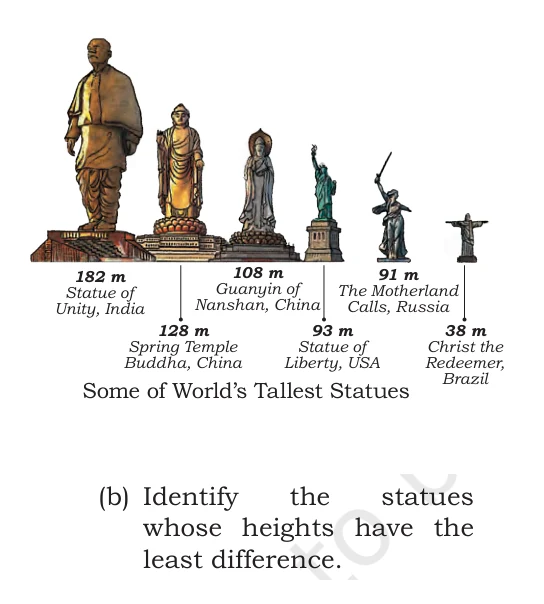
Which two statues in the chart have the least difference in height?
Show detailed solution
- Step 1: The closest heights are 91 m and 93 m.
- Step 2: 93-91=2.
- Answer: The Motherland Calls and the Statue of Liberty have the least difference, 2 m.
Textbook page 58 · solved item 23
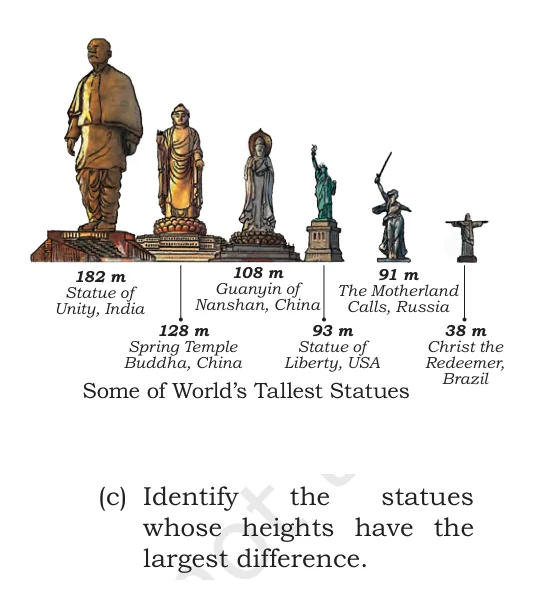
Which two statues in the chart have the largest difference in height?
Show detailed solution
- Step 1: The greatest and smallest heights are 182 m and 38 m.
- Step 2: 182-38=144.
- Answer: The Statue of Unity and Christ the Redeemer have the largest difference, 144 m.
Textbook page 58 · solved item 24
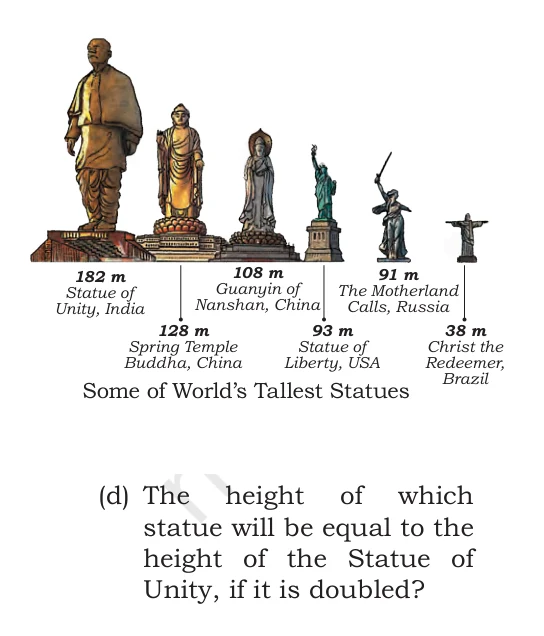
Which statue becomes as tall as the Statue of Unity when its height is doubled?
Show detailed solution
- Step 1: Half of 182 m is 91 m.
- Step 2: The chart shows The Motherland Calls at 91 m, and 91+91=182.
- Answer: The answer is The Motherland Calls.
Detailed worked answers
Textbook page 59
Textbook page 59 · solved item 25
How can you use your steps to estimate at least three distances around you?
Show detailed solution
- Step 1: Mark and walk a known distance, such as 100 m, and count your steps.
- Step 2: For another place, compare its step count with the known walk. For example, twice as many steps is about twice the distance.
- Step 3: Record at least three locations with their measured or estimated distances.
- Answer: Results will depend on your stride and chosen locations; use the same walking pace for a fair estimate.
Textbook page 59 · solved item 26
Identify the nearest and farthest locations from your home using your measurements.
Show detailed solution
- Step 1: Write each location beside its distance from home.
- Step 2: The smallest distance names the nearest location; the largest distance names the farthest.
- Answer: The two names depend on your own measurements. A sample could be: nearest, bus stop; farthest, school.
Textbook page 59 · solved item 27
Write your four measured distances in increasing order.
Show detailed solution
- Step 1: Convert all distances to the same unit, preferably metres.
- Step 2: Arrange them from the smallest number to the largest number.
- Answer: Answers vary. For example: 150 m, 420 m, 800 m, 1,200 m.
Textbook page 59 · solved item 28
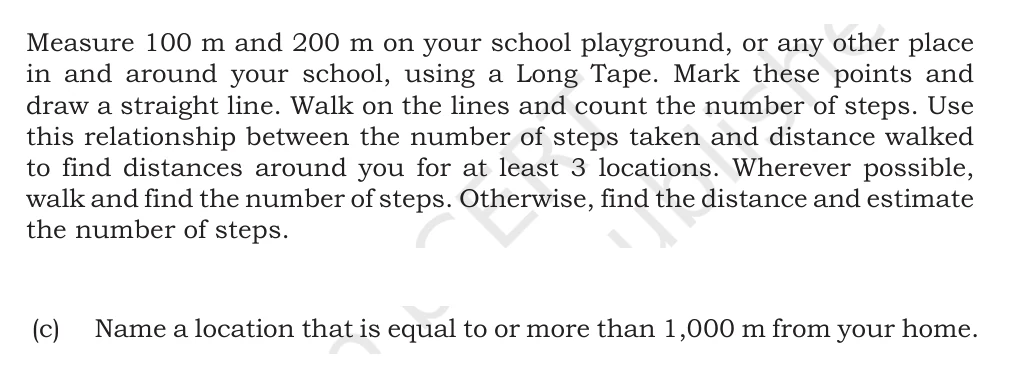
Name a measured location that is at least 1,000 m from your home.
Show detailed solution
- Step 1: Remember that 1,000 m = 1 km.
- Step 2: Look for a recorded distance of 1,000 m or more.
- Answer: The location depends on your measurements. For example, a school 1,200 m away qualifies.
Textbook page 59 · solved item 29
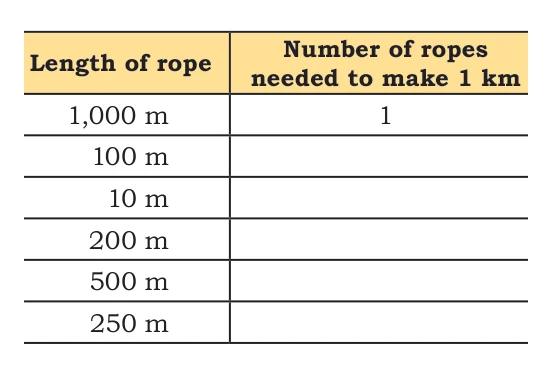
How many 100 m ropes are needed to make 1 km?
Show detailed solution
- Step 1: Change 1 km to 1,000 m.
- Step 2: Ten ropes of 100 m make 10\times100=1,000 m.
- Answer: 10 ropes are needed.
Textbook page 59 · solved item 30
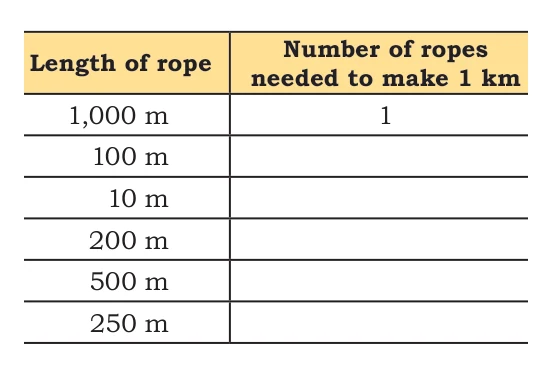
How many 10 m ropes are needed to make 1 km?
Show detailed solution
- Step 1: Change 1 km to 1,000 m.
- Step 2: One hundred ropes of 10 m make 100\times10=1,000 m.
- Answer: 100 ropes are needed.
Textbook page 59 · solved item 31
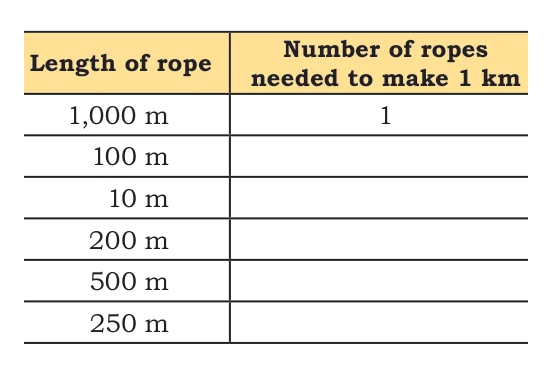
How many 200 m ropes are needed to make 1 km?
Show detailed solution
- Step 1: Change 1 km to 1,000 m.
- Step 2: Five ropes of 200 m make 5\times200=1,000 m.
- Answer: 5 ropes are needed.
Textbook page 59 · solved item 32
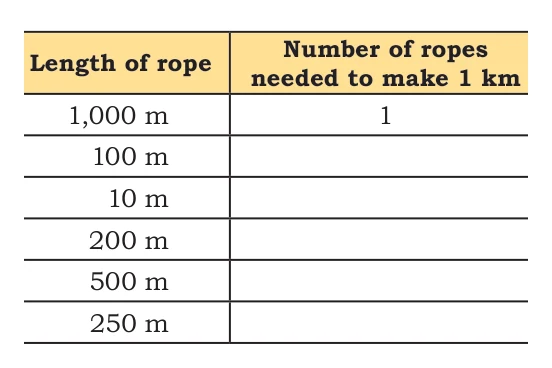
How many 500 m ropes are needed to make 1 km?
Show detailed solution
- Step 1: Change 1 km to 1,000 m.
- Step 2: Two ropes of 500 m make 2\times500=1,000 m.
- Answer: 2 ropes are needed.
Textbook page 59 · solved item 33
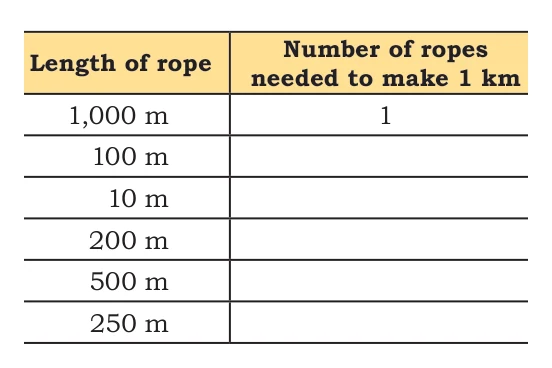
How many 250 m ropes are needed to make 1 km?
Show detailed solution
- Step 1: Change 1 km to 1,000 m.
- Step 2: Four ropes of 250 m make 4\times250=1,000 m.
- Answer: 4 ropes are needed.
Detailed worked answers
Textbook page 60
Textbook page 60 · solved item 34
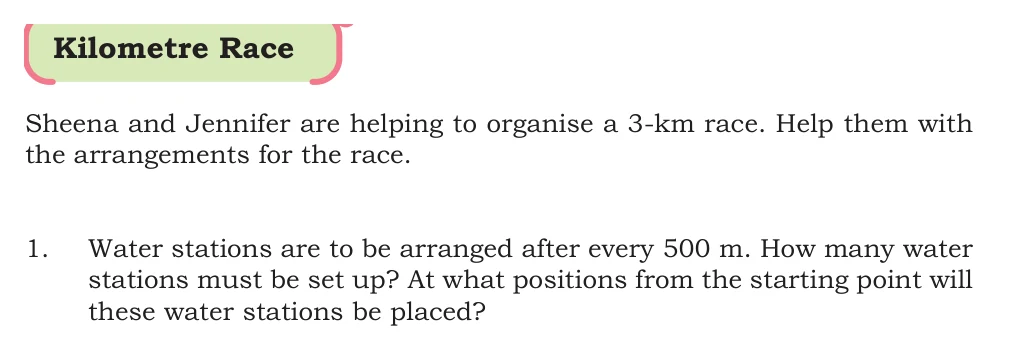
For a 3 km race, how many water stations are needed every 500 m, and where are they placed?
Show detailed solution
- Step 1: Change 3 km to 3,000 m.
- Step 2: Count by 500 m: 500, 1,000, 1,500, 2,000, 2,500, 3,000.
- Answer: Set up 6 stations at those six distances from the start.
Textbook page 60 · solved item 35
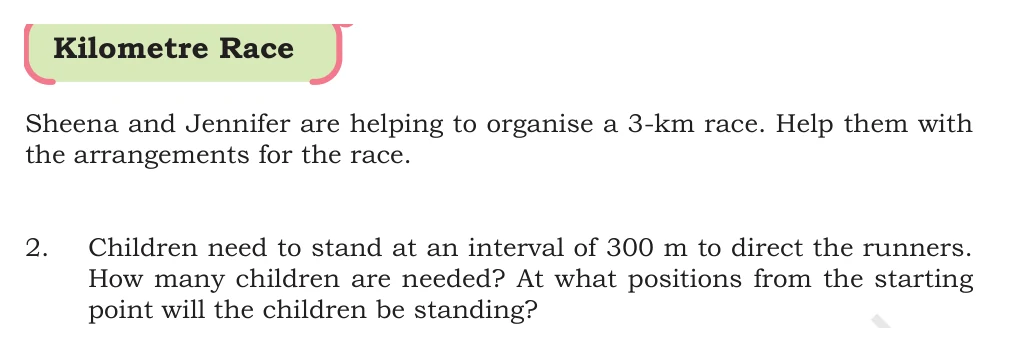
For a 3 km race, how many children are needed at 300 m intervals, and where do they stand?
Show detailed solution
- Step 1: Change 3 km to 3,000 m.
- Step 2: Count by 300 m from 300 m through 3,000 m. There are 10 positions.
- Answer: 10 children stand at 300, 600, 900, 1,200, 1,500, 1,800, 2,100, 2,400, 2,700, and 3,000 m.
Textbook page 60 · solved item 36
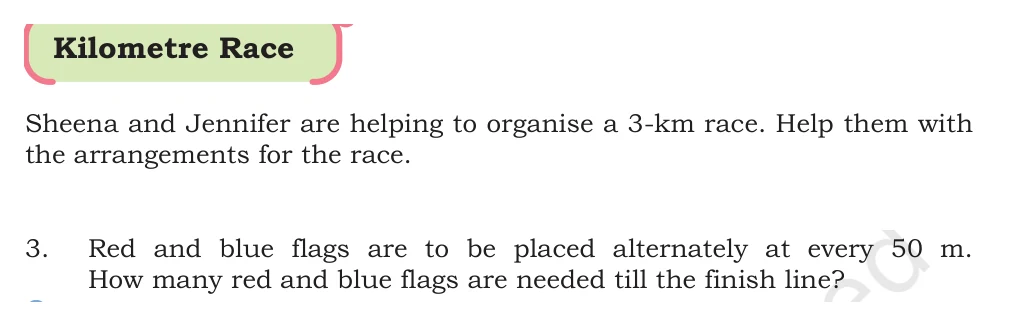
Red and blue flags alternate every 50 m along a 3 km race. How many of each colour are needed through the finish line?
Show detailed solution
- Step 1: There are 3,000\div50=60 flag positions after the start.
- Step 2: Alternating colours split the 60 positions equally.
- Answer: 30 red flags and 30 blue flags are needed.
Detailed worked answers
Textbook page 61
Textbook page 61 · solved item 37
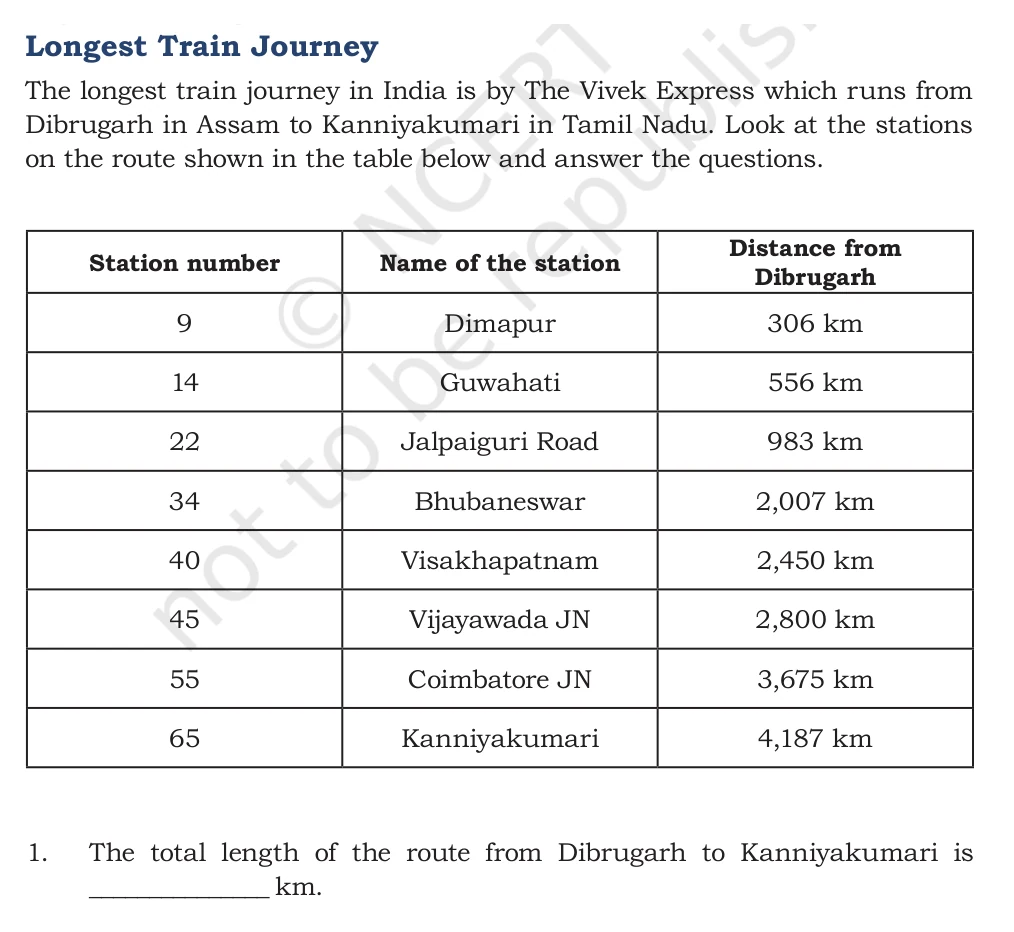
What is the total route length from Dibrugarh to Kanniyakumari?
Show detailed solution
- Step 1: Read both needed distances from the train table.
- Step 2: Kanniyakumari is shown 4,187 km from Dibrugarh.
- Answer: The route length is 4,187 km.
Textbook page 61 · solved item 38
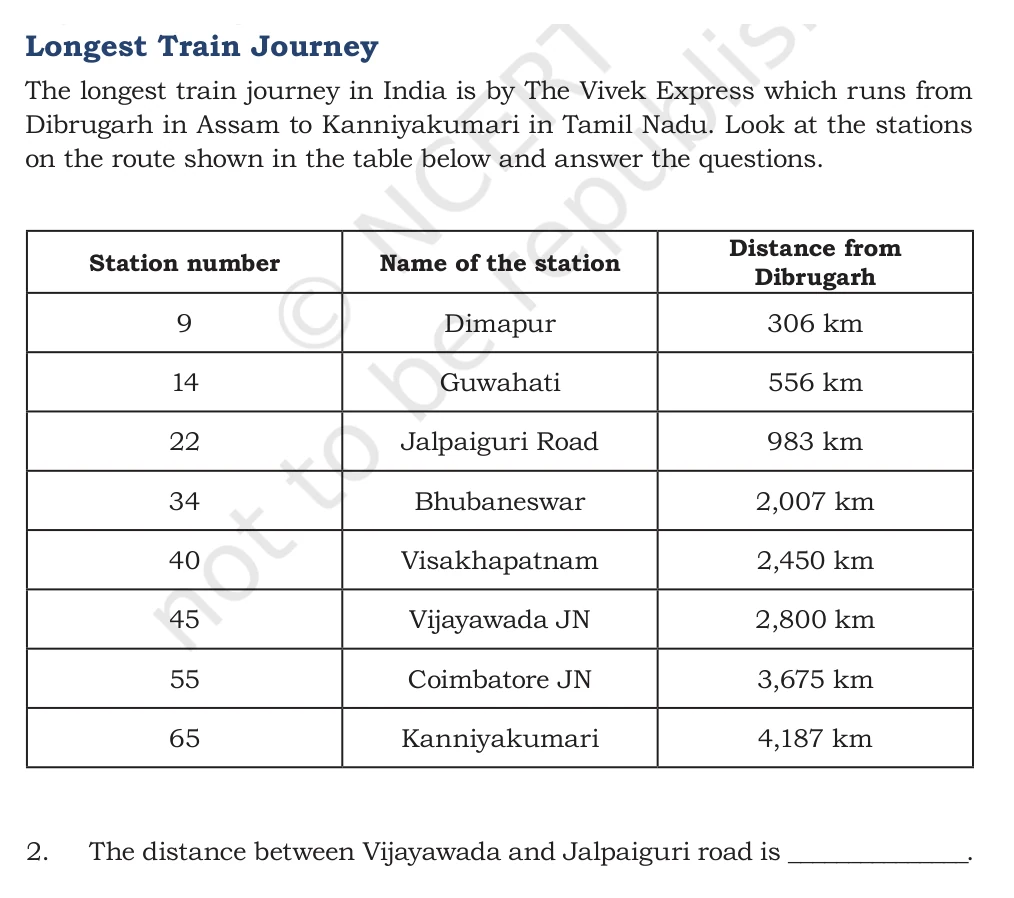
What is the distance between Vijayawada and Jalpaiguri Road?
Show detailed solution
- Step 1: Read both needed distances from the train table.
- Step 2: Subtract their distances from Dibrugarh: 2,800-983=1,817.
- Answer: The distance is 1,817 km.
Textbook page 61 · solved item 39
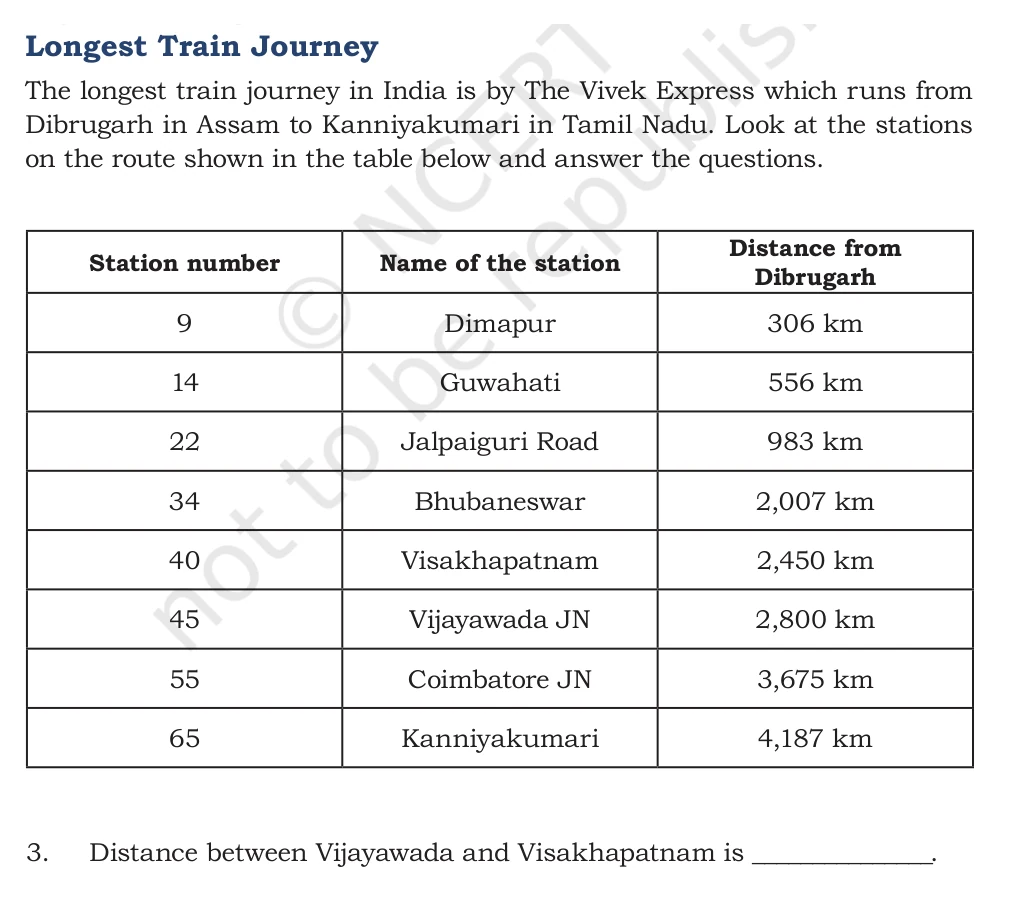
What is the distance between Vijayawada and Visakhapatnam?
Show detailed solution
- Step 1: Read both needed distances from the train table.
- Step 2: Subtract 2,800-2,450=350.
- Answer: The distance is 350 km.
Textbook page 61 · solved item 40
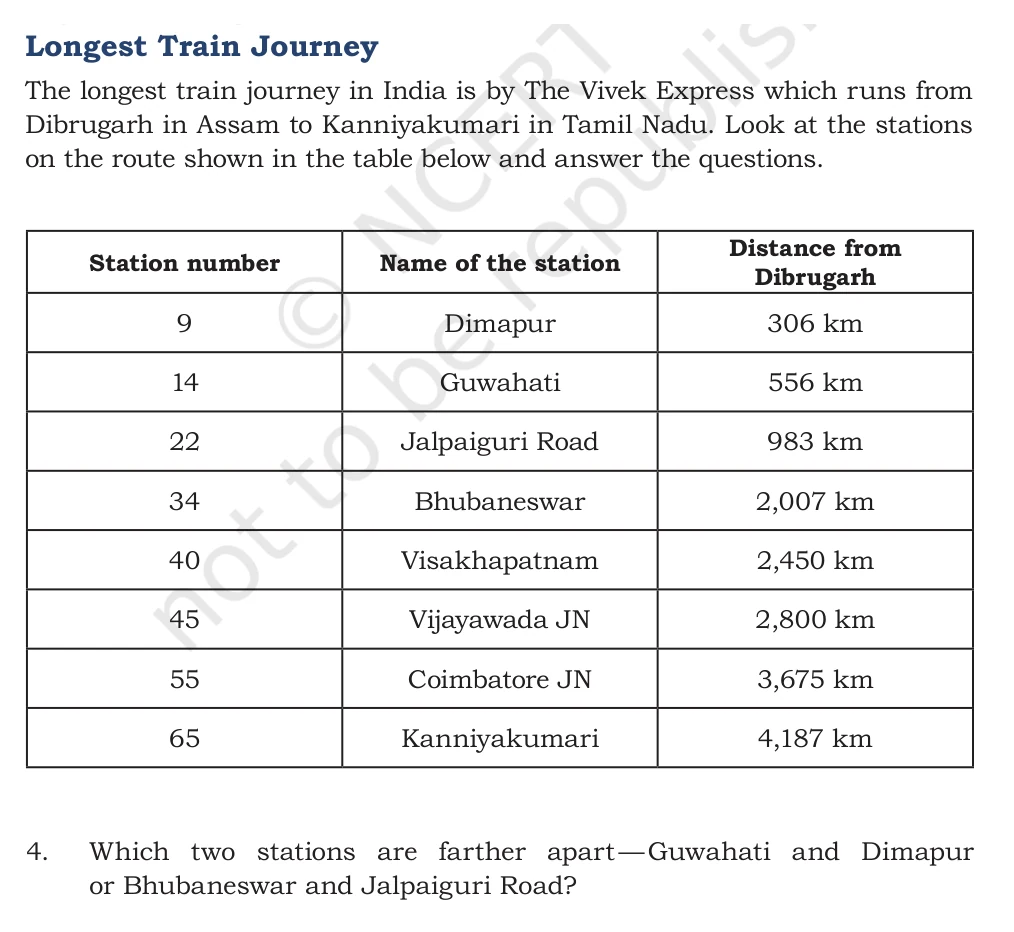
Which pair is farther apart: Guwahati and Dimapur, or Bhubaneswar and Jalpaiguri Road?
Show detailed solution
- Step 1: Read both needed distances from the train table.
- Step 2: Guwahati to Dimapur is 556-306=250 km. Bhubaneswar to Jalpaiguri Road is 2,007-983=1,024 km.
- Answer: Bhubaneswar and Jalpaiguri Road are farther apart.
Textbook page 61 · solved item 41
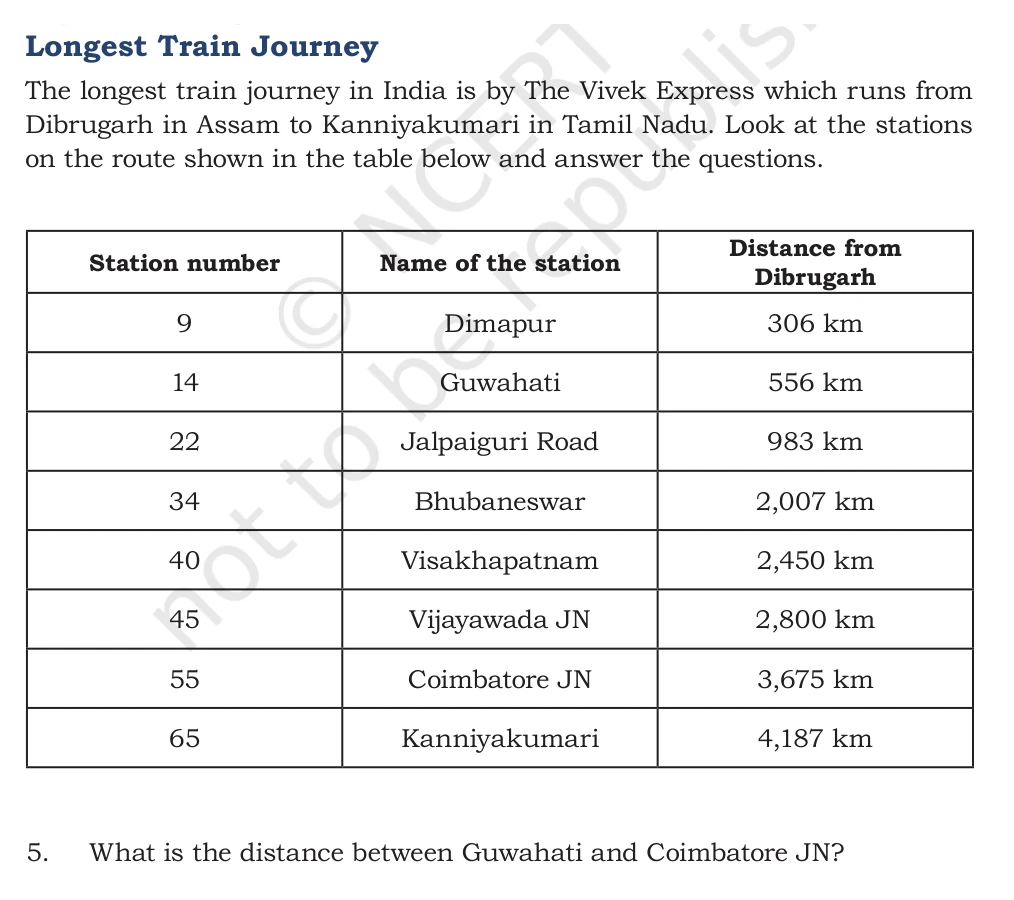
What is the distance between Guwahati and Coimbatore JN?
Show detailed solution
- Step 1: Read both needed distances from the train table.
- Step 2: Subtract 3,675-556=3,119.
- Answer: The distance is 3,119 km.
Textbook page 61 · solved item 42
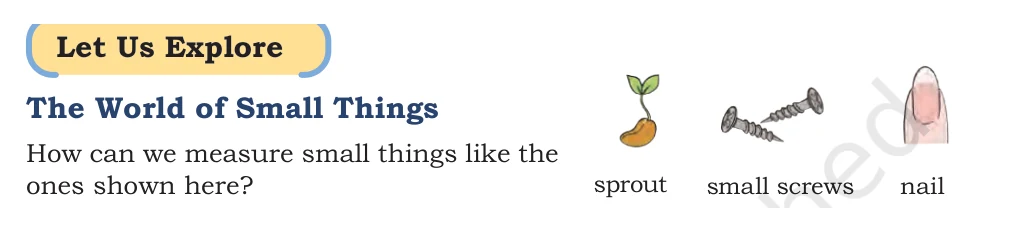
How can very small objects such as a sprout, screw, or nail be measured?
Show detailed solution
- Step 1: Use a ruler marked in centimetres and millimetres.
- Step 2: Place one end at the zero mark and read the mark reached by the other end.
- Answer: Record the length in centimetres and millimetres; millimetres give the more precise reading.
Textbook page 61 · solved item 43
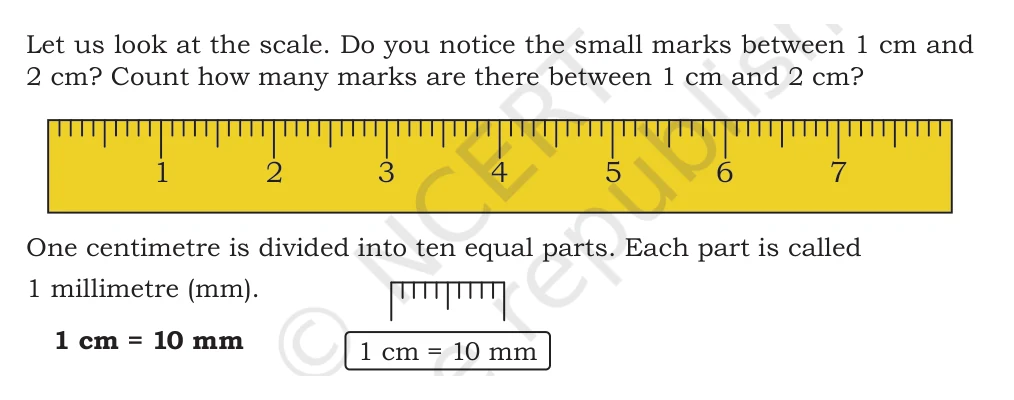
How many small marks lie between the 1 cm and 2 cm marks on the ruler?
Show detailed solution
- Step 1: One centimetre is divided into 10 equal spaces.
- Step 2: The dividing marks inside those spaces are at 1 mm, 2 mm, and so on through 9 mm.
- Answer: There are 9 small marks between the two centimetre marks, making 10 equal millimetre spaces.
Textbook page 61 · solved item 44
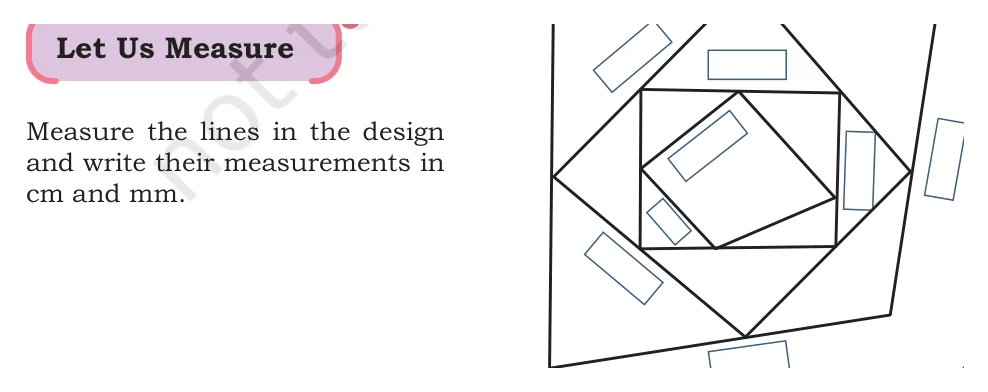
Measure the marked lines in the design and write each length in cm and mm.
Show detailed solution
- Step 1: Use the zero mark of a ruler at one end of each marked line.
- Step 2: Read the centimetre mark and then count the extra millimetres.
- Step 3: Write a reading such as 3 cm 6 mm. Measure the printed page rather than a zoomed screen because screen size can change.
- Answer: The readings depend on the size at which the page is printed; the measuring method is the assessed work.
Detailed worked answers
Textbook page 62
Textbook page 62 · solved item 45
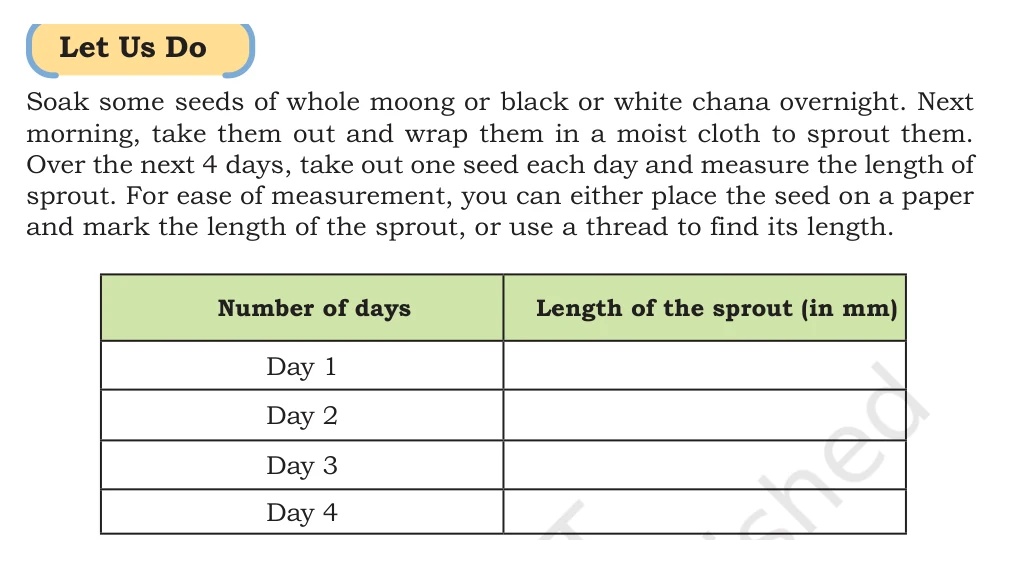
Measure and record the length of a seed's sprout on Days 1 to 4.
Show detailed solution
- Step 1: Measure from the seed to the tip of the sprout in millimetres at the same time each day.
- Step 2: Record one reading in each row. A sample record could be 3 mm, 8 mm, 15 mm, and 24 mm.
- Answer: Your four measurements will depend on the seed. Check that each entry includes mm.
Textbook page 62 · solved item 46
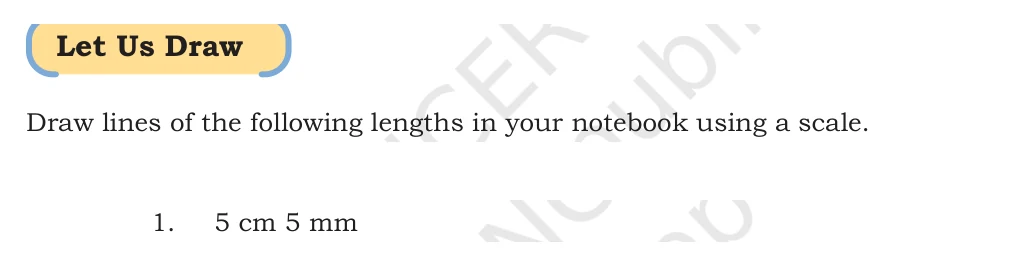
Draw a line of length 5 cm 5 mm.
Show detailed solution
- Step 1: Use 10 mm = 1 cm, so the same length can be written as 55 mm.
- Step 2: Measure 5 complete centimetres and then 5 more millimetre spaces.
- Answer: Draw the segment from zero to the 5 cm 5 mm mark.
Textbook page 62 · solved item 47
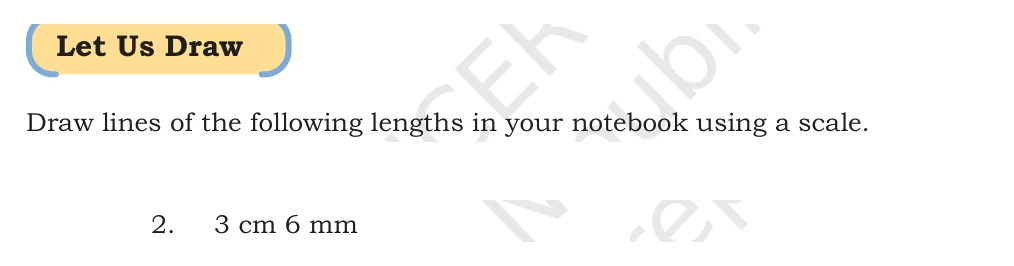
Draw a line of length 3 cm 6 mm.
Show detailed solution
- Step 1: Use 10 mm = 1 cm, so the same length can be written as 36 mm.
- Step 2: Measure 3 complete centimetres and then 6 more millimetre spaces.
- Answer: Draw the segment from zero to the 3 cm 6 mm mark.
Textbook page 62 · solved item 48
Draw a line of length 8 cm 3 mm.
Show detailed solution
- Step 1: Use 10 mm = 1 cm, so the same length can be written as 83 mm.
- Step 2: Measure 8 complete centimetres and then 3 more millimetre spaces.
- Answer: Draw the segment from zero to the 8 cm 3 mm mark.
Textbook page 62 · solved item 49
Draw a line of length 36 mm.
Show detailed solution
- Step 1: Use 10 mm = 1 cm, so the same length can be written as 3 cm 6 mm.
- Step 2: Since 30 mm is 3 cm, count 3 cm and 6 extra millimetres.
- Answer: Draw the segment from zero to the 36 mm mark.
Textbook page 62 · solved item 50
Draw a line of length 67 mm.
Show detailed solution
- Step 1: Use 10 mm = 1 cm, so the same length can be written as 6 cm 7 mm.
- Step 2: Since 60 mm is 6 cm, count 6 cm and 7 extra millimetres.
- Answer: Draw the segment from zero to the 67 mm mark.
Textbook page 62 · solved item 51
Explain how to draw lines of 36 mm and 67 mm using a centimetre ruler.
Show detailed solution
- Step 1: Split 36 mm into 30 mm + 6 mm, which is 3 cm 6 mm.
- Step 2: Split 67 mm into 60 mm + 7 mm, which is 6 cm 7 mm.
- Answer: Mark 3 cm 6 mm for the first line and 6 cm 7 mm for the second.
Detailed worked answers
Textbook page 63
Textbook page 63 · solved item 52
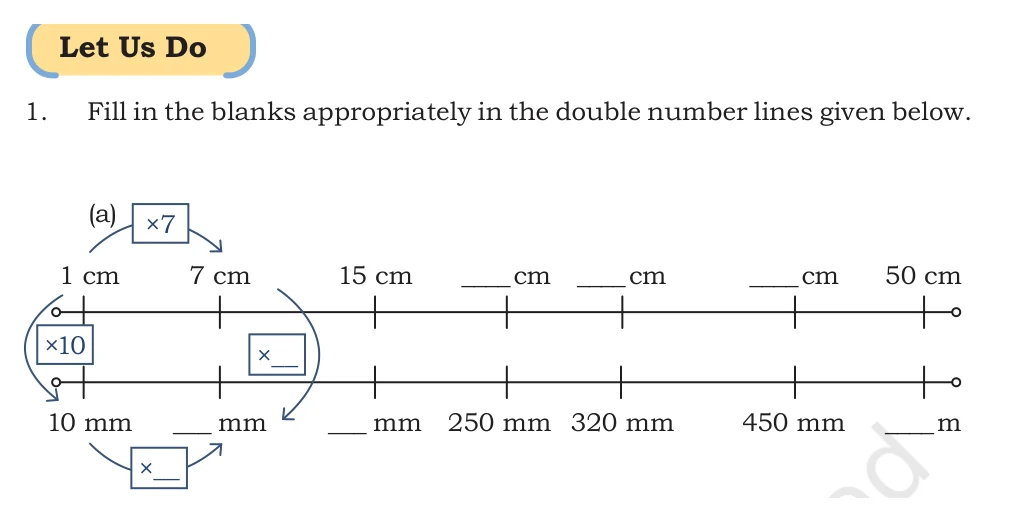
Complete double number line (a) for centimetres and millimetres.
Show detailed solution
- Step 1: Multiply every centimetre value by 10 to get millimetres.
- Step 2: The pairs are 1 cm = 10 mm, 7 cm = 70 mm, 15 cm = 150 mm, 25 cm = 250 mm, 32 cm = 320 mm, 45 cm = 450 mm, and 50 cm = 500 mm.
- Answer: Fill 70 mm, 150 mm, 25 cm, 32 cm, 45 cm, 500 mm, and 10 in each empty multiplier box.
Textbook page 63 · solved item 53
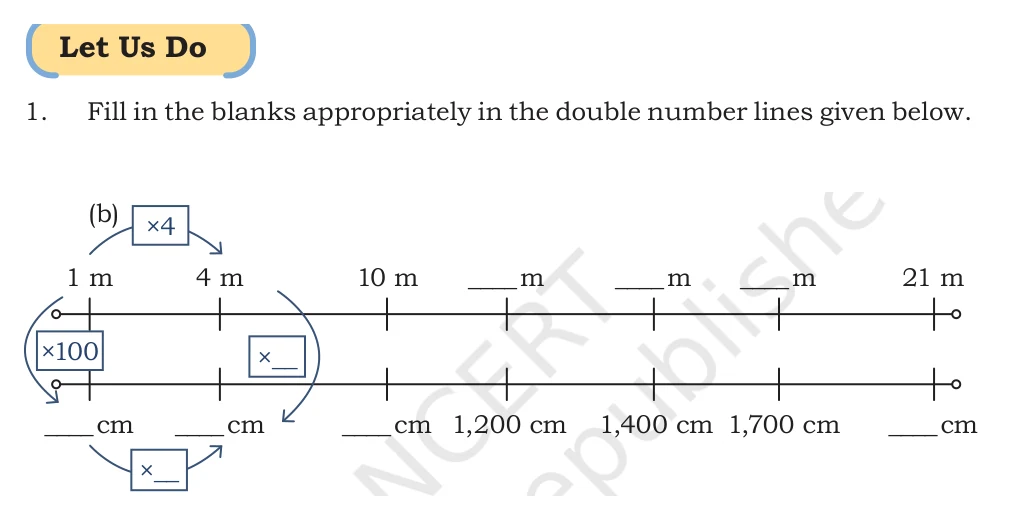
Complete double number line (b) for metres and centimetres.
Show detailed solution
- Step 1: Multiply every metre value by 100 to get centimetres.
- Step 2: The pairs are 1 m = 100 cm, 4 m = 400 cm, 10 m = 1,000 cm, 12 m = 1,200 cm, 14 m = 1,400 cm, 17 m = 1,700 cm, and 21 m = 2,100 cm.
- Answer: Fill 100 cm, 400 cm, 1,000 cm, 12 m, 14 m, 17 m, 2,100 cm, and 100 in each empty multiplier box.
Textbook page 63 · solved item 54
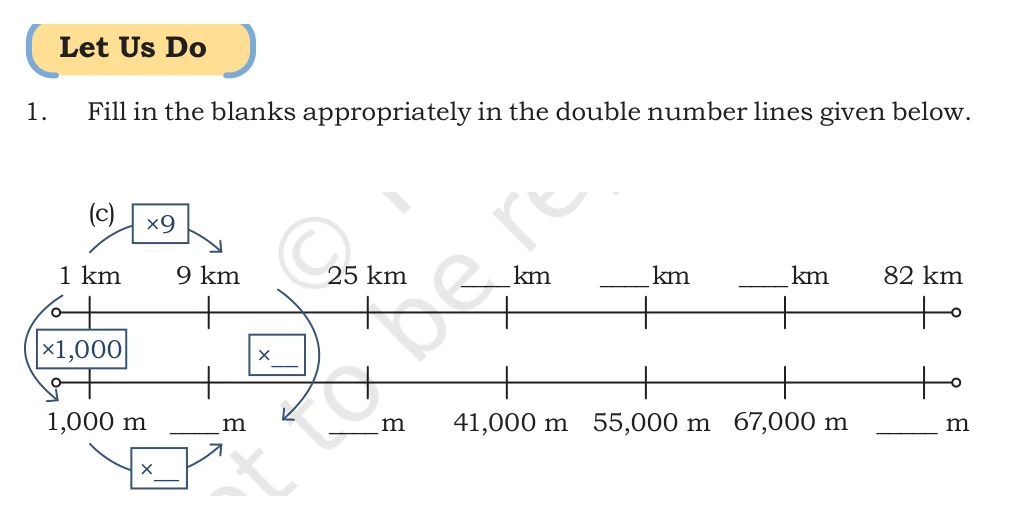
Complete double number line (c) for kilometres and metres.
Show detailed solution
- Step 1: Multiply every kilometre value by 1,000 to get metres.
- Step 2: The pairs are 1 km = 1,000 m, 9 km = 9,000 m, 25 km = 25,000 m, 41 km = 41,000 m, 55 km = 55,000 m, 67 km = 67,000 m, and 82 km = 82,000 m.
- Answer: Fill 9,000 m, 25,000 m, 41 km, 55 km, 67 km, 82,000 m, and 1,000 in each empty multiplier box.
Textbook page 63 · solved item 55

Convert 4 cm 5 mm.
Show detailed solution
- Step 1: Use 10 mm = 1 cm or 100 cm = 1 m, as needed.
- Step 2: Four centimetres is 40 mm; 40+5=45 mm.
- Answer: 45 mm.
Textbook page 63 · solved item 56

Convert 89 mm.
Show detailed solution
- Step 1: Use 10 mm = 1 cm or 100 cm = 1 m, as needed.
- Step 2: Eighty millimetres is 8 cm, with 9 mm left.
- Answer: 8 cm 9 mm.
Textbook page 63 · solved item 57

Convert 234 cm.
Show detailed solution
- Step 1: Use 10 mm = 1 cm or 100 cm = 1 m, as needed.
- Step 2: Multiply 234 by 10.
- Answer: 2,340 mm.
Textbook page 63 · solved item 58

Convert 514 mm.
Show detailed solution
- Step 1: Use 10 mm = 1 cm or 100 cm = 1 m, as needed.
- Step 2: 510 mm is 51 cm, with 4 mm left.
- Answer: 51 cm 4 mm.
Textbook page 63 · solved item 59

Convert 6 m 34 cm.
Show detailed solution
- Step 1: Use 10 mm = 1 cm or 100 cm = 1 m, as needed.
- Step 2: Six metres is 600 cm; 600+34=634 cm.
- Answer: 634 cm.
Textbook page 63 · solved item 60

Convert 20 m 12 cm.
Show detailed solution
- Step 1: Use 10 mm = 1 cm or 100 cm = 1 m, as needed.
- Step 2: Twenty metres is 2,000 cm; 2,000+12=2,012 cm.
- Answer: 2,012 cm.
Textbook page 63 · solved item 61

Convert 397 m.
Show detailed solution
- Step 1: Use 10 mm = 1 cm or 100 cm = 1 m, as needed.
- Step 2: Multiply 397 by 100.
- Answer: 39,700 cm.
Detailed worked answers
Textbook page 64
Textbook page 64 · solved item 62

Convert 5,792 cm.
Show detailed solution
- Step 1: Use 100 cm = 1 m or 1,000 m = 1 km, as needed.
- Step 2: 5,700 cm is 57 m, with 92 cm left.
- Answer: 57 m 92 cm.
Textbook page 64 · solved item 63

Convert 9,108 cm.
Show detailed solution
- Step 1: Use 100 cm = 1 m or 1,000 m = 1 km, as needed.
- Step 2: 9,100 cm is 91 m, with 8 cm left.
- Answer: 91 m 8 cm.
Textbook page 64 · solved item 64

Convert 34 km.
Show detailed solution
- Step 1: Use 100 cm = 1 m or 1,000 m = 1 km, as needed.
- Step 2: Multiply 34 by 1,000.
- Answer: 34,000 m.
Textbook page 64 · solved item 65

Convert 6,870 m.
Show detailed solution
- Step 1: Use 100 cm = 1 m or 1,000 m = 1 km, as needed.
- Step 2: 6,000 m is 6 km, with 870 m left.
- Answer: 6 km 870 m.
Textbook page 64 · solved item 66

Convert 10,552 m.
Show detailed solution
- Step 1: Use 100 cm = 1 m or 1,000 m = 1 km, as needed.
- Step 2: 10,000 m is 10 km, with 552 m left.
- Answer: 10 km 552 m.
Textbook page 64 · solved item 67

Convert 29 km 30 m.
Show detailed solution
- Step 1: Use 100 cm = 1 m or 1,000 m = 1 km, as needed.
- Step 2: 29 km is 29,000 m; add 30 m.
- Answer: 29,030 m.
Textbook page 64 · solved item 68

Convert 32 km 359 m.
Show detailed solution
- Step 1: Use 100 cm = 1 m or 1,000 m = 1 km, as needed.
- Step 2: 32 km is 32,000 m; add 359 m.
- Answer: 32,359 m.
Textbook page 64 · solved item 69
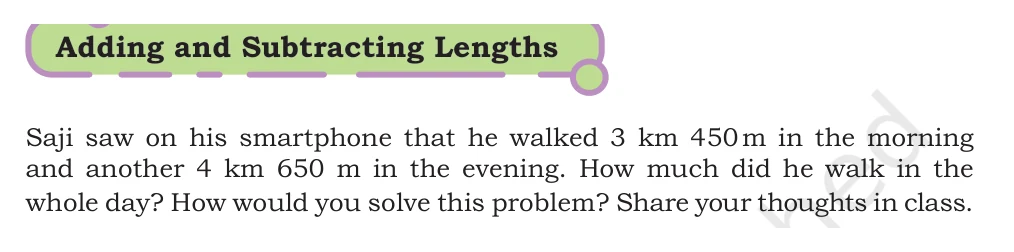
Saji walks 3 km 450 m in the morning and 4 km 650 m in the evening. How far does he walk altogether?
Show detailed solution
- Step 1: Add the metres: 450+650=1,100 m, which is 1 km 100 m.
- Step 2: Add the kilometres: 3+4+1=8 km.
- Step 3: Check in metres: 3,450+4,650=8,100 m.
- Answer: Saji walks 8 km 100 m altogether.
Detailed worked answers
Textbook page 65
Textbook page 65 · solved item 70

Electricians need 63 m of cable and use 16 m 75 cm. How much cable is left?
Show detailed solution
- Step 1: Regroup 63 m as 62 m 100 cm.
- Step 2: Subtract like units: 100-75=25 cm and 62-16=46 m.
- Step 3: Check: 46\text{ m }25\text{ cm}+16\text{ m }75\text{ cm}=63\text{ m}.
- Answer: 46 m 25 cm of cable is left.
Detailed worked answers
Textbook page 66
Textbook page 66 · solved item 71

Rani has ribbon rolls of 3 m 75 cm and 2 m 25 cm. How much ribbon does she have?
Show detailed solution
- Step 1: Add the centimetres: 75+25=100 cm = 1 m.
- Step 2: Add the metres: 3+2+1=6 m.
- Answer: Rani has 6 m of ribbon.
Textbook page 66 · solved item 72

Bhopal to Sanchi is 48 km 700 m, and the waterfall is 17 km 900 m from Bhopal. How far is Sanchi from the waterfall?
Show detailed solution
- Step 1: Regroup 48 km 700 m as 47 km 1,700 m.
- Step 2: Subtract: 1,700-900=800 m and 47-17=30 km.
- Answer: Sanchi is 30 km 800 m from the waterfall.
Textbook page 66 · solved item 73
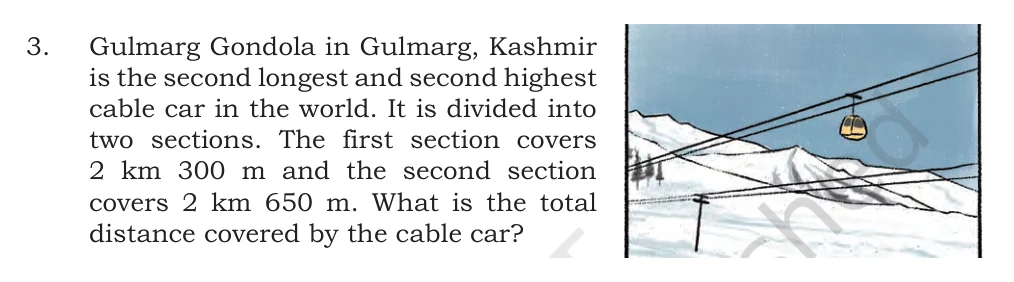
The two Gulmarg Gondola sections are 2 km 300 m and 2 km 650 m. What total distance do they cover?
Show detailed solution
- Step 1: Add the metres: 300+650=950 m.
- Step 2: Add the kilometres: 2+2=4 km.
- Answer: The cable car covers 4 km 950 m in total.
Textbook page 66 · solved item 74

Circle the bigger length and find the difference: 11 mm and 1 cm.
Show detailed solution
- Step 1: Put both lengths in the same unit.
- Step 2: 1 cm is 10 mm, so 11 mm is larger by 1 mm.
- Answer: Circle 11 mm; the difference is 1 mm.
Textbook page 66 · solved item 75

Circle the bigger length and find the difference: 26 mm and 2 cm.
Show detailed solution
- Step 1: Put both lengths in the same unit.
- Step 2: 2 cm is 20 mm, so 26 mm is larger by 6 mm.
- Answer: Circle 26 mm; the difference is 6 mm.
Textbook page 66 · solved item 76

Circle the bigger length and find the difference: 20 cm and 201 mm.
Show detailed solution
- Step 1: Put both lengths in the same unit.
- Step 2: 20 cm is 200 mm, so 201 mm is larger by 1 mm.
- Answer: Circle 201 mm; the difference is 1 mm.
Textbook page 66 · solved item 77

Circle the bigger length and find the difference: 1,020 mm and 1 m.
Show detailed solution
- Step 1: Put both lengths in the same unit.
- Step 2: 1 m is 1,000 mm, so 1,020 mm is larger by 20 mm.
- Answer: Circle 1,020 mm; the difference is 20 mm.
Textbook page 66 · solved item 78

Circle the bigger length and find the difference: 2 m and 245 cm.
Show detailed solution
- Step 1: Put both lengths in the same unit.
- Step 2: 2 m is 200 cm, so 245 cm is larger by 45 cm.
- Answer: Circle 245 cm; the difference is 45 cm.
Textbook page 66 · solved item 79

Circle the bigger length and find the difference: 5,678 m and 6 km.
Show detailed solution
- Step 1: Put both lengths in the same unit.
- Step 2: 6 km is 6,000 m, and 6,000-5,678=322 m.
- Answer: Circle 6 km; the difference is 322 m.
Textbook page 66 · solved item 80

Circle the bigger length and find the difference: 6 km 1,480 m and 7 km 479 m.
Show detailed solution
- Step 1: Put both lengths in the same unit.
- Step 2: The first is 7 km 480 m, which is 1 m more than 7 km 479 m.
- Answer: Circle 6 km 1,480 m; the difference is 1 m.
Textbook page 66 · solved item 81

A shirt needs 1 m 80 cm of cloth. How much cloth is needed for 20 shirts?
Show detailed solution
- Step 1: Twenty groups of 1 m make 20 m.
- Step 2: Twenty groups of 80 cm make 1,600 cm = 16 m.
- Answer: 20\text{ m}+16\text{ m}=36\text{ m}. The shirts need 36 m of cloth.
Detailed worked answers
Textbook page 67
Textbook page 67 · solved item 82

Five metres of cloth cost ₹100. What does 1 m cost?
Show detailed solution
- Step 1: Share ₹100 equally among 5 metres.
- Step 2: 100\div5=20.
- Answer: One metre of cloth costs ₹20.
Textbook page 67 · solved item 83
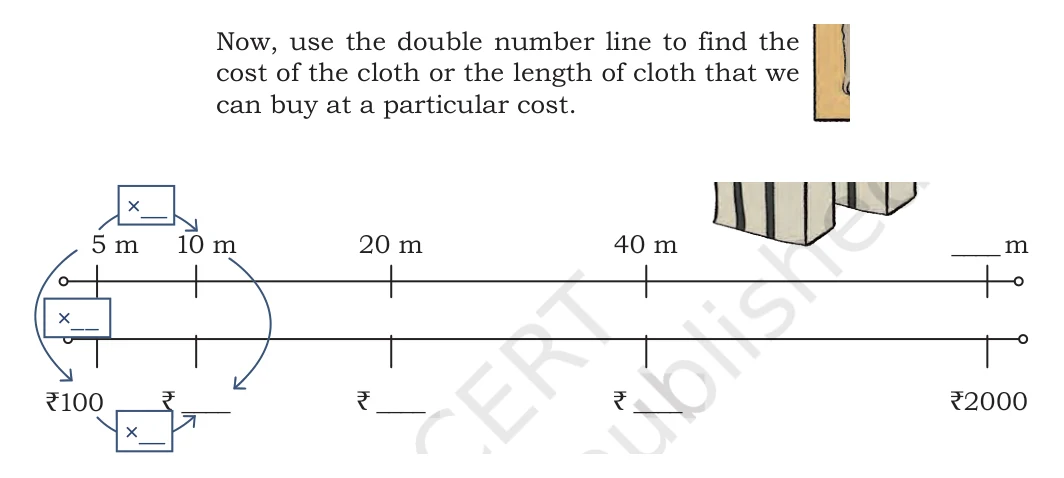
Complete the cloth double number line for 10 m.
Show detailed solution
- Step 1: Use the unit cost ₹20 for every metre.
- Step 2: Ten metres is twice 5 m, so double ₹100.
- Answer: Fill ₹200. The arrow multipliers between 5, 10, 20, and 40 m are each ×2.
Textbook page 67 · solved item 84
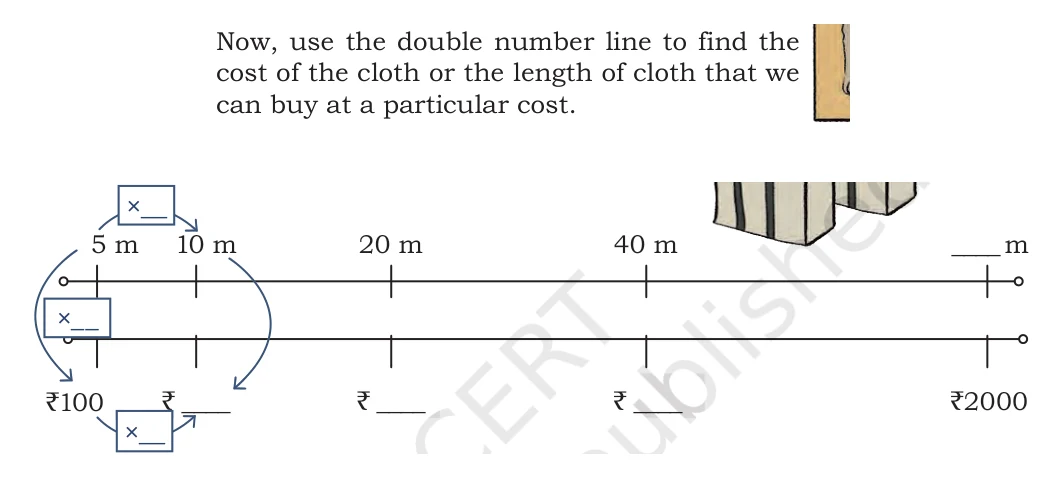
Complete the cloth double number line for 20 m.
Show detailed solution
- Step 1: Use the unit cost ₹20 for every metre.
- Step 2: At ₹20 per metre, 20\times20=400.
- Answer: Fill ₹400. The arrow multipliers between 5, 10, 20, and 40 m are each ×2.
Textbook page 67 · solved item 85
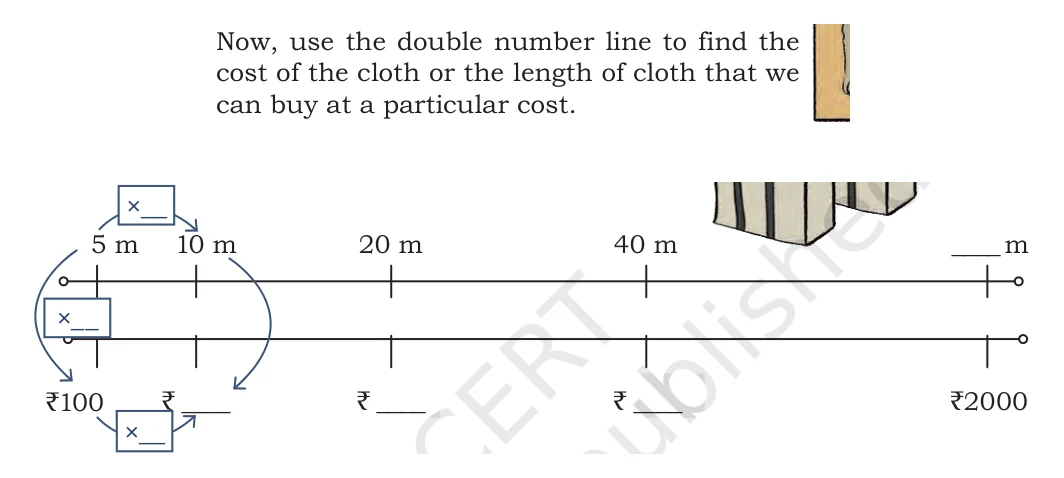
Complete the cloth double number line for 40 m.
Show detailed solution
- Step 1: Use the unit cost ₹20 for every metre.
- Step 2: At ₹20 per metre, 40\times20=800.
- Answer: Fill ₹800. The arrow multipliers between 5, 10, 20, and 40 m are each ×2.
Textbook page 67 · solved item 86
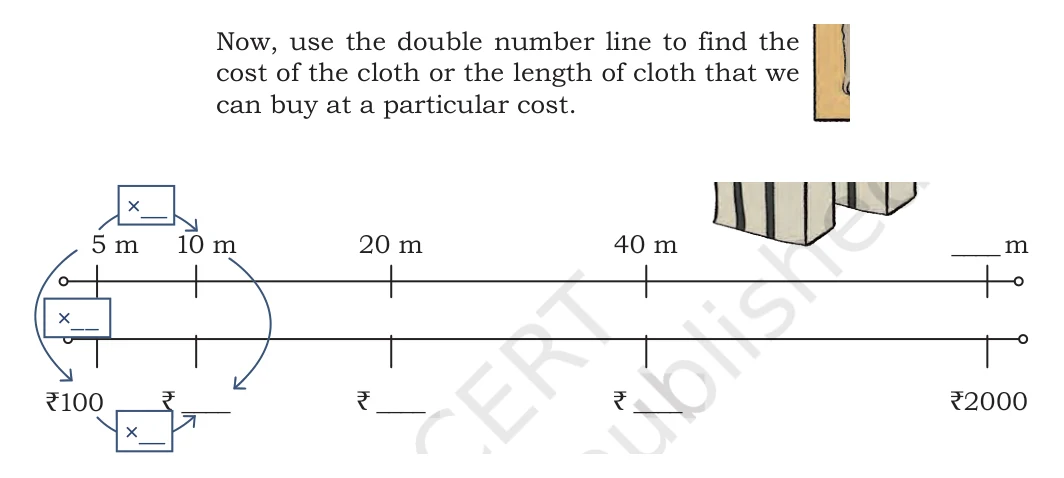
Complete the cloth double number line for ₹2,000.
Show detailed solution
- Step 1: Use the unit cost ₹20 for every metre.
- Step 2: ₹2,000 contains 100 groups of ₹20.
- Answer: Fill 100 m. The arrow multipliers between 5, 10, 20, and 40 m are each ×2.
Textbook page 67 · solved item 87
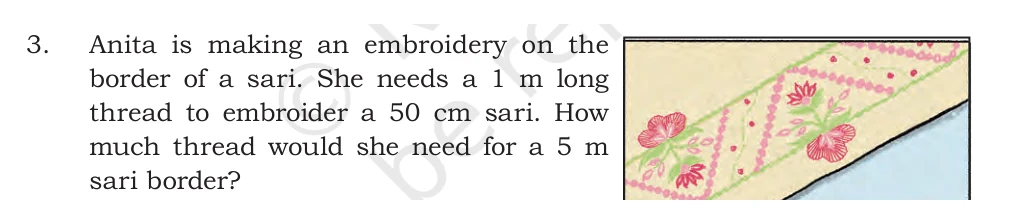
If 1 m of thread covers 50 cm of sari border, how much thread covers a 5 m border?
Show detailed solution
- Step 1: Change 5 m to 500 cm.
- Step 2: There are 500\div50=10 groups of 50 cm, so 10 groups of 1 m thread are needed.
- Answer: Anita needs 10 m of thread.
Textbook page 67 · solved item 88
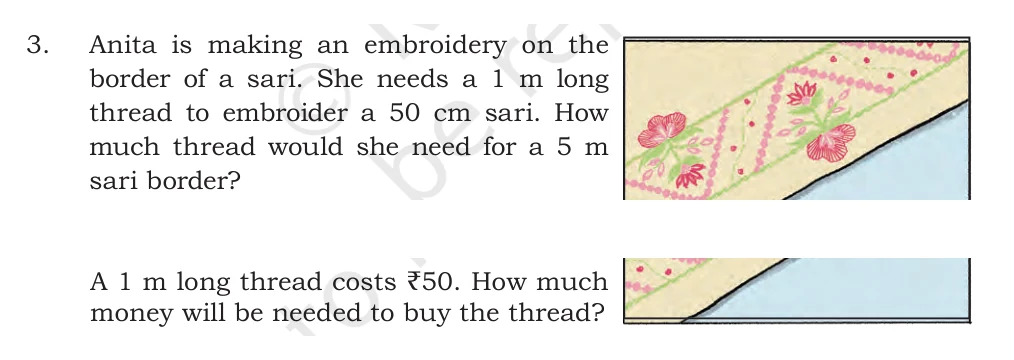
A 1 m thread costs ₹50. What will the thread for the 5 m sari border cost?
Show detailed solution
- Step 1: The border needs 10 m of thread.
- Step 2: Ten groups of ₹50 cost 10\times50=500.
- Answer: The thread will cost ₹500.
Textbook page 67 · solved item 89

Workers complete a 12 km 600 m road in 6 equal daily parts. How much road do they lay each day?
Show detailed solution
- Step 1: Change 12 km 600 m to 12,600 m.
- Step 2: 12,600\div6=2,100 m.
- Step 3: Change 2,100 m back to 2 km 100 m.
- Answer: They lay 2 km 100 m each day.
Detailed worked answers
Textbook page 68
Textbook page 68 · solved item 90
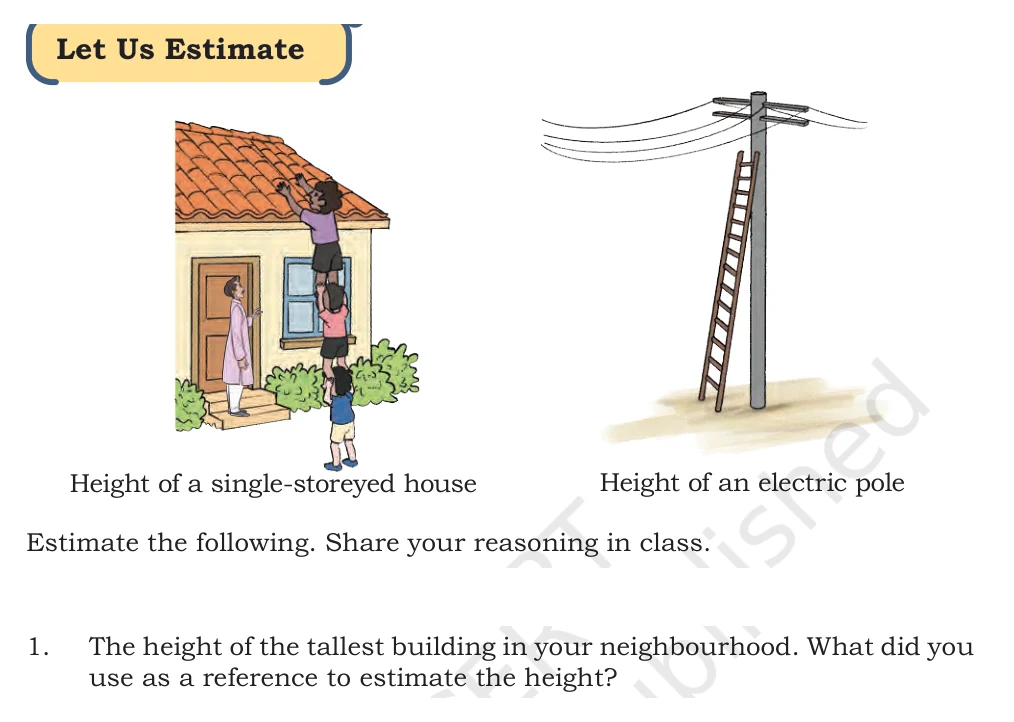
Estimate the height of the tallest building in your neighbourhood and name a reference.
Show detailed solution
- Step 1: Count its storeys and use about 3 m for one storey.
- Step 2: For example, a 5-storey building is about 5\times3=15 m tall.
- Answer: Your estimate may differ. State both the estimated height or depth and the reference used.
Textbook page 68 · solved item 91
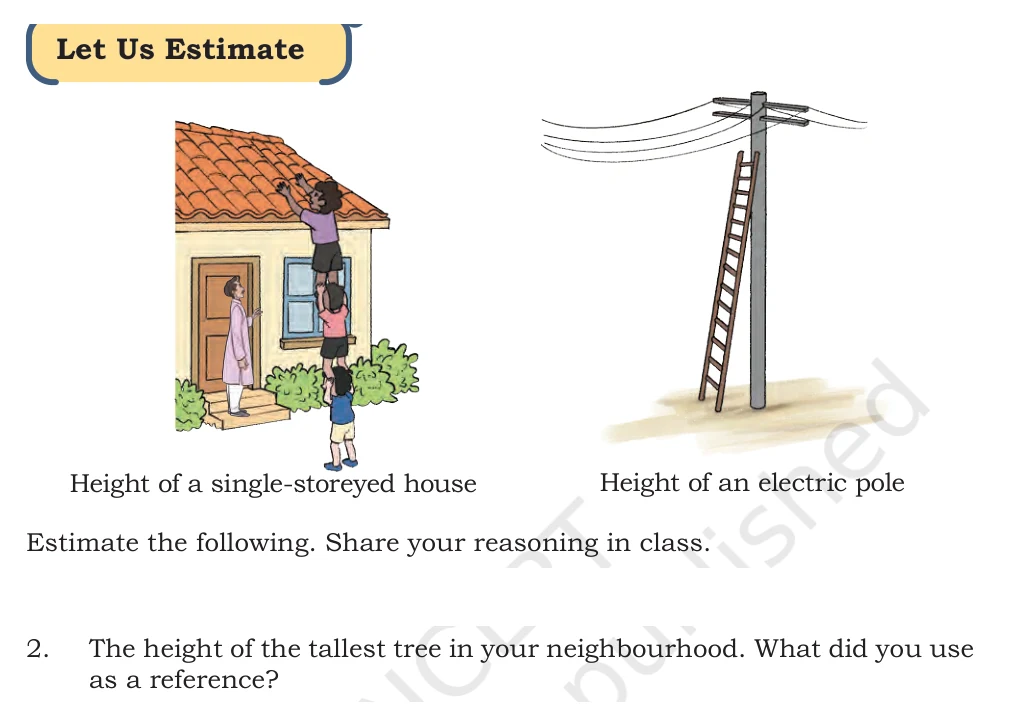
Estimate the height of the tallest tree in your neighbourhood and name a reference.
Show detailed solution
- Step 1: Compare the tree with a nearby person, room, house, or pole whose height is known.
- Step 2: For example, a tree about twice a 6 m house is about 12 m tall.
- Answer: Your estimate may differ. State both the estimated height or depth and the reference used.
Textbook page 68 · solved item 92
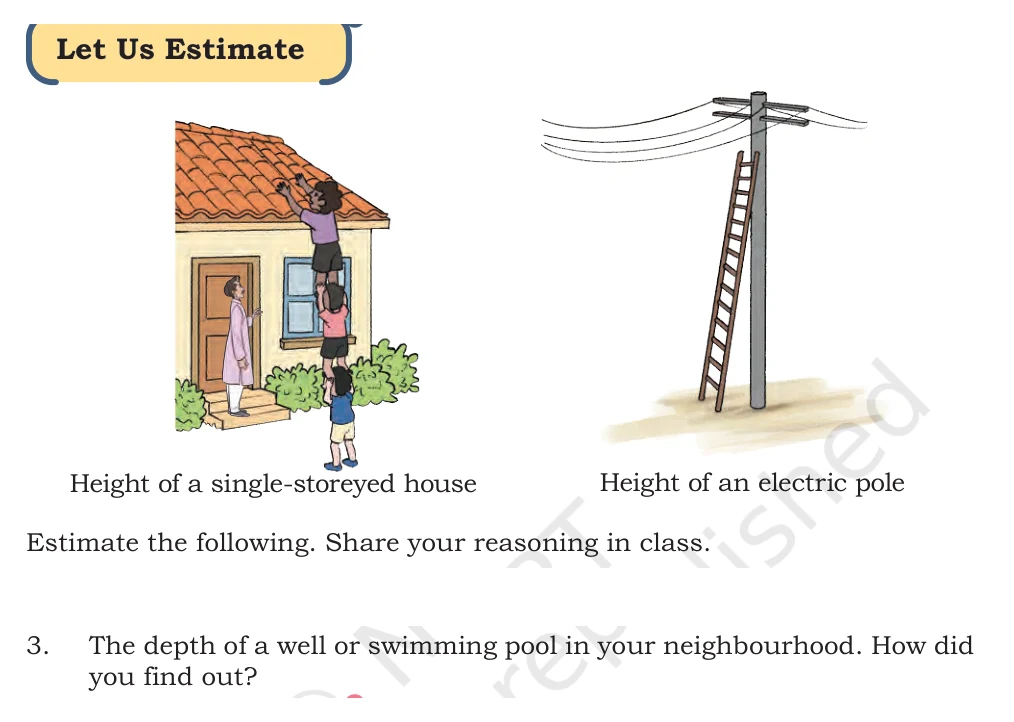
Estimate the depth of a nearby well or swimming pool and explain how you found it.
Show detailed solution
- Step 1: Use marked depth information or compare it with a known height; do not enter a well or unsafe water.
- Step 2: For example, a pool marked 2 m deep can be reported directly as about 2 m.
- Answer: Your estimate may differ. State both the estimated height or depth and the reference used.
Textbook page 68 · solved item 93
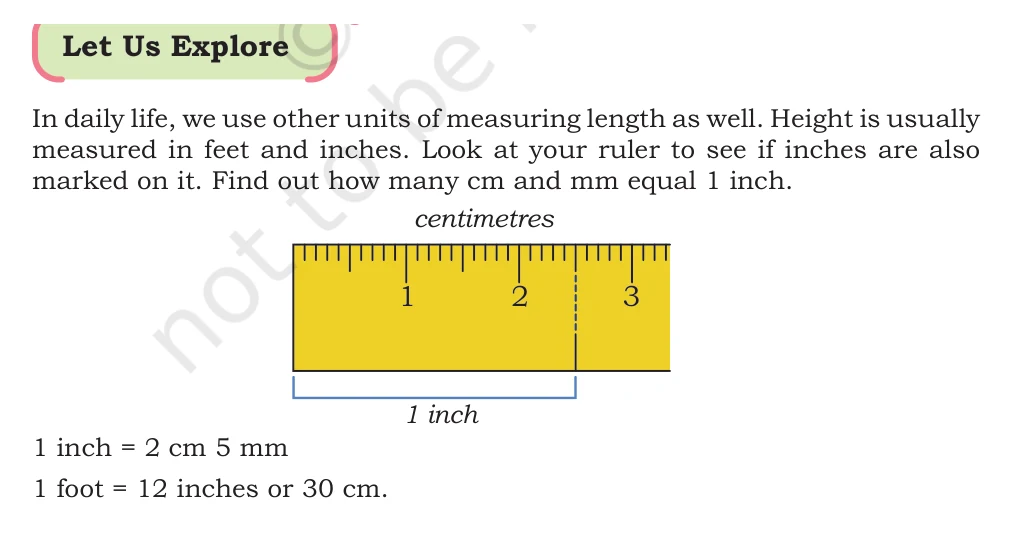
Use a ruler to find how many centimetres and millimetres are approximately equal to 1 inch.
Show detailed solution
- Step 1: Align the inch and centimetre zero marks on the ruler.
- Step 2: The 1-inch mark reaches about 2 cm and 5 mm.
- Answer: In this activity, 1 inch is approximately 2 cm 5 mm.
Detailed worked answers
Textbook page 69
Textbook page 69 · solved item 94
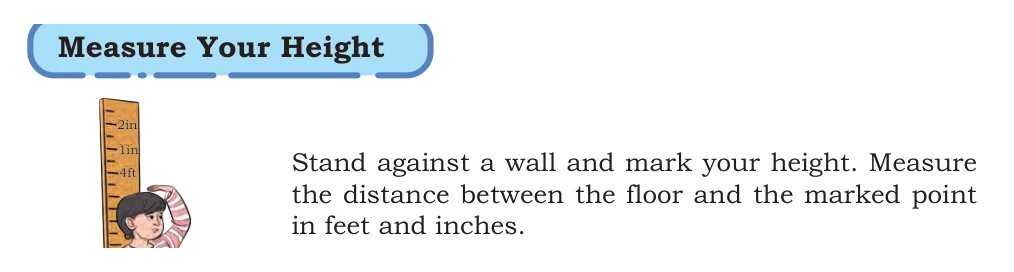
Measure your height in feet and inches.
Show detailed solution
- Step 1: Stand straight against a wall and mark the top of your head.
- Step 2: Measure from the floor to the mark, grouping every 12 inches as 1 foot.
- Answer: Your result will be personal. Write it in the form ___ ft ___ in.
Textbook page 69 · solved item 95
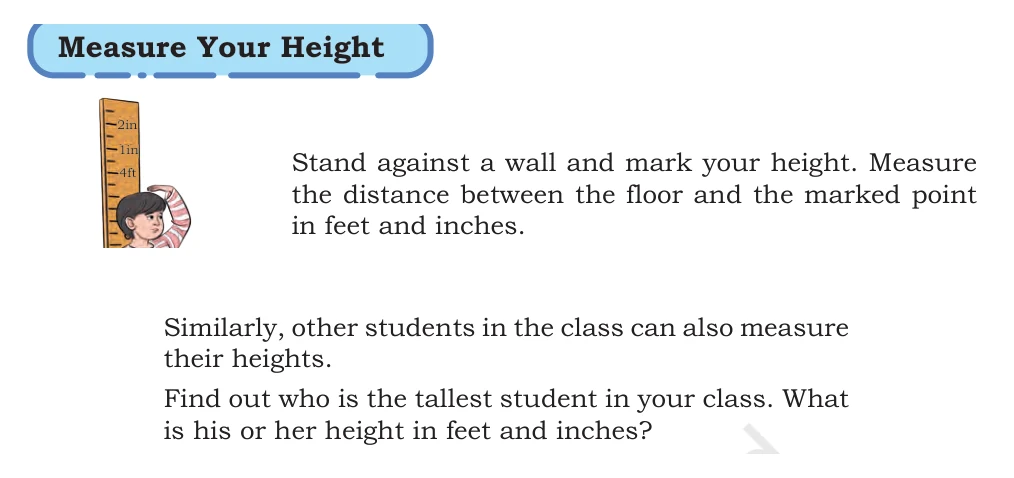
Find the tallest student in the class and record the height in feet and inches.
Show detailed solution
- Step 1: Measure every student in the same way and use the same wall or measuring tape.
- Step 2: Compare feet first; when the feet are equal, compare the extra inches.
- Answer: The student with the greatest measurement is tallest. Record the name and height from your class data.
Textbook page 69 · solved item 96
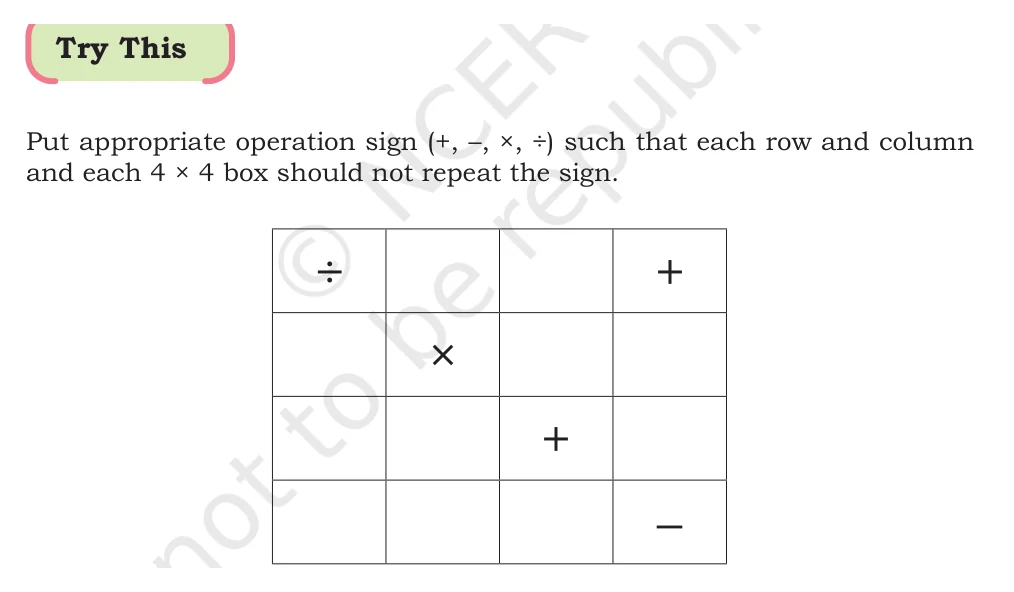
Complete the 4 by 4 operation-sign grid so no sign repeats in any row, column, or 2 by 2 box.
Show detailed solution
- Step 1: Each row and column must contain +, −, ×, and ÷ exactly once.
- Step 2: Use the printed signs first, then fill a sign only where its row, column, and small box allow it.
- Step 3: Check all four rows, all four columns, and the four 2 by 2 boxes.
- Answer: One valid completed grid is \begin{matrix} \div & - & \times & + \\ + & \times & - & \div \\ - & \div & + & \times \\ \times & + & \div & - \end{matrix}.