
Question-by-question working
Read the prompt, attempt it, then check each step
Every exercise subpart and table row is a separate item. Shared figures and table headings are repeated whenever they are needed to understand the question.
Detailed worked answers
Textbook page 1
Textbook page 1 · solved item 1
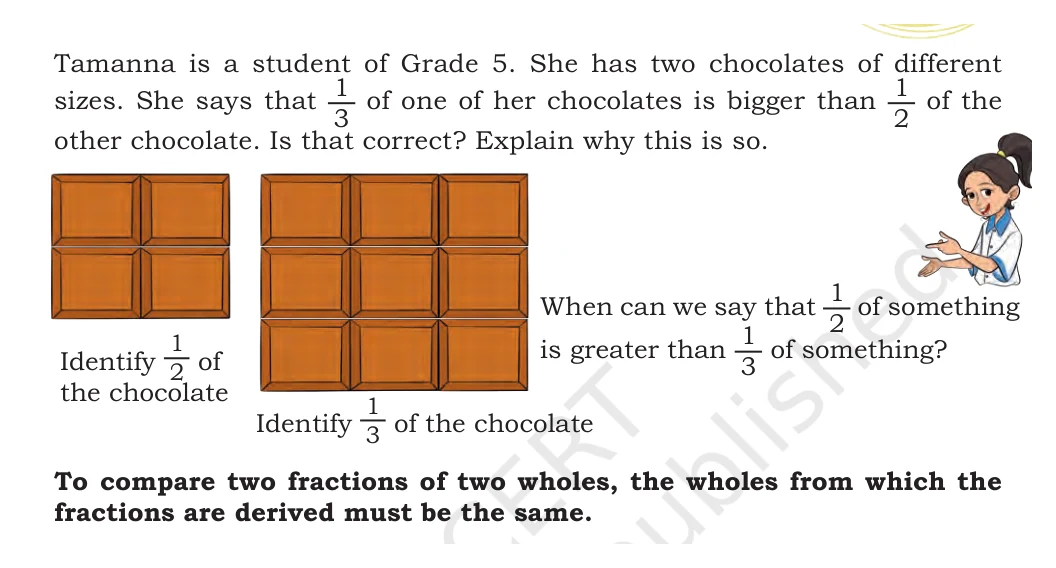
Can one-third of a chocolate be bigger than one-half of another chocolate?
Show detailed solution
- Step 1: Look at the two whole chocolates before comparing their pieces.
- Step 2: The chocolate used for one-third is much larger, so one of its three equal parts can be larger than one of the two equal parts of the smaller chocolate.
- Answer: Yes. Fractions from different-sized wholes cannot be compared by the fraction names alone.
Textbook page 1 · solved item 2
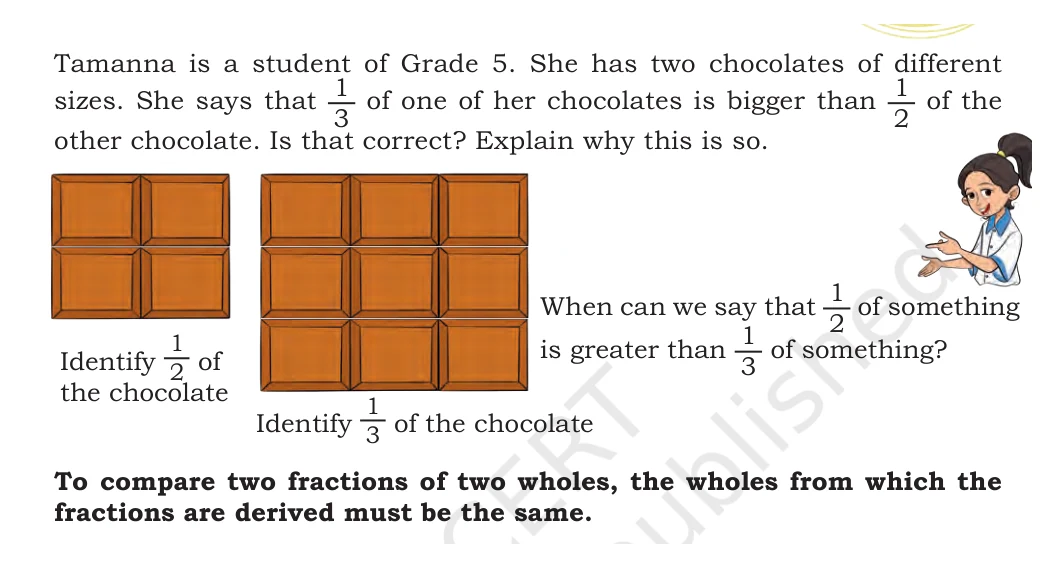
Identify one-half of the smaller chocolate.
Show detailed solution
- Step 1: The smaller chocolate has 6 equal pieces.
- Step 2: Half means 2 equal groups, so each group has 6\div2=3 pieces.
- Answer: One-half is 3 of the 6 pieces.
Textbook page 1 · solved item 3
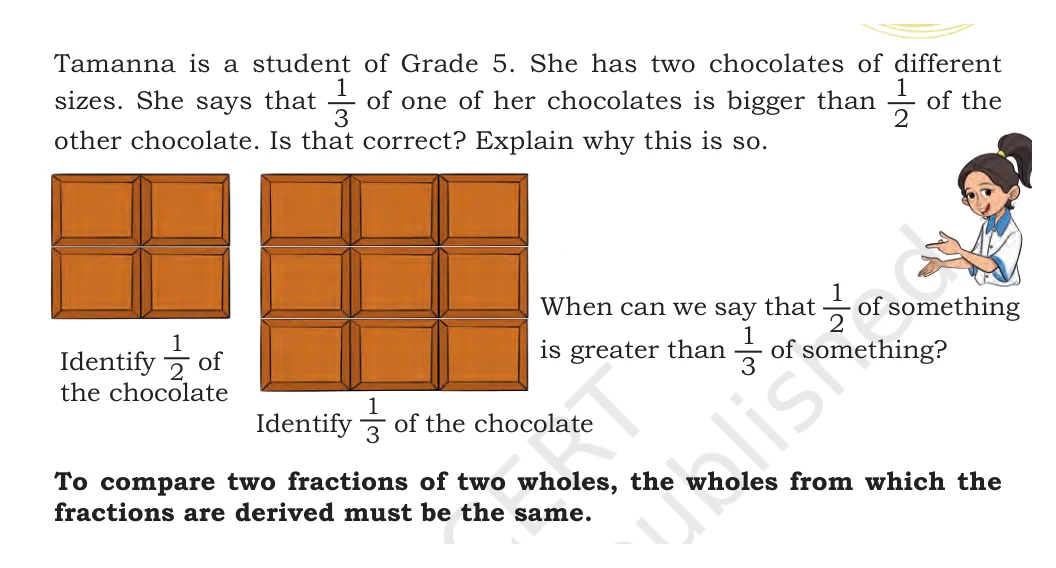
Identify one-third of the larger chocolate.
Show detailed solution
- Step 1: The larger chocolate has 15 equal pieces.
- Step 2: One-third means 3 equal groups, so each group has 15\div3=5 pieces.
- Answer: One-third is 5 of the 15 pieces.
Textbook page 1 · solved item 4
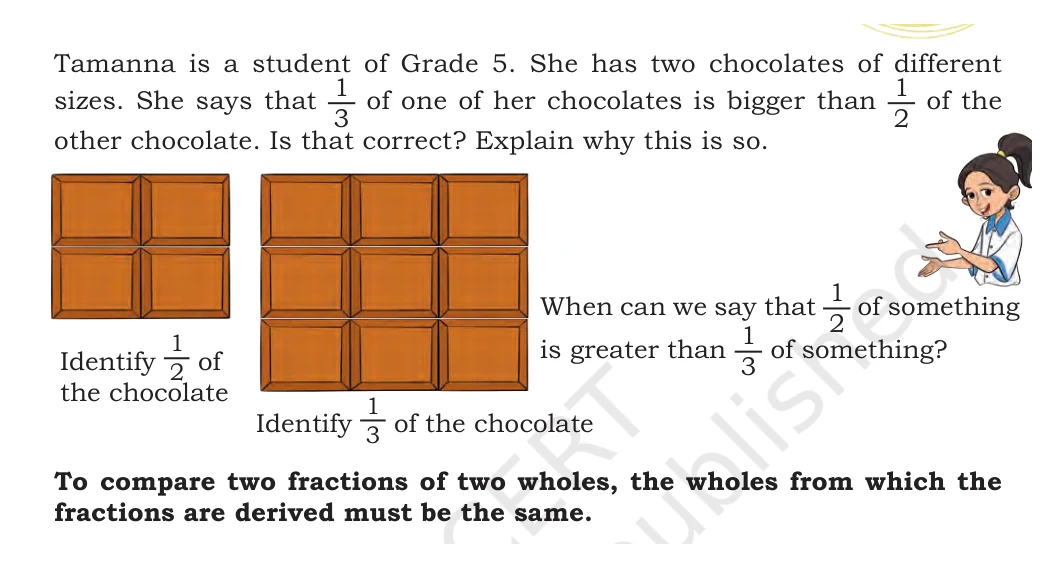
When can one-half of something be greater than one-third of something?
Show detailed solution
- Step 1: First check whether the two wholes are the same size.
- Step 2: For the same whole, one-half is always greater than one-third. For different wholes, compare the actual piece sizes.
- Answer: One-half is greater than one-third when the half-piece is physically larger; this is always true when both fractions come from the same whole.
Textbook page 1 · solved item 5
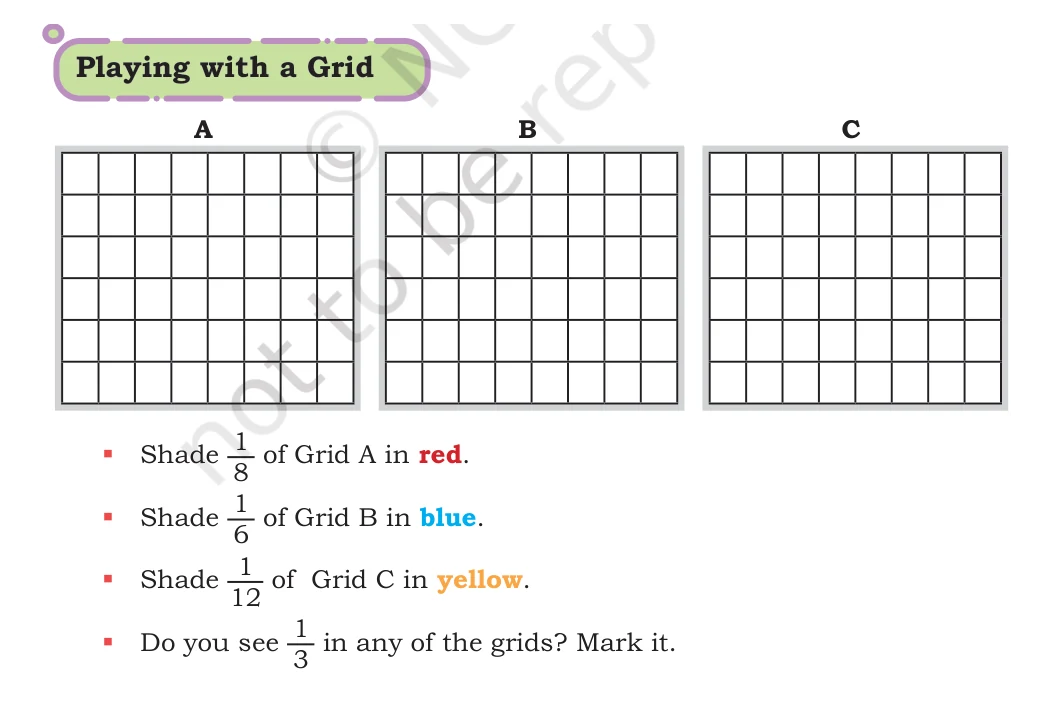
Shade one-eighth of Grid A in red.
Show detailed solution
- Step 1: Grid A has 48 small squares.
- Step 2: 48\div8=6, so one-eighth is 6 squares.
- Answer: Shade any complete group of 6 squares red, such as one full column.
Textbook page 1 · solved item 6
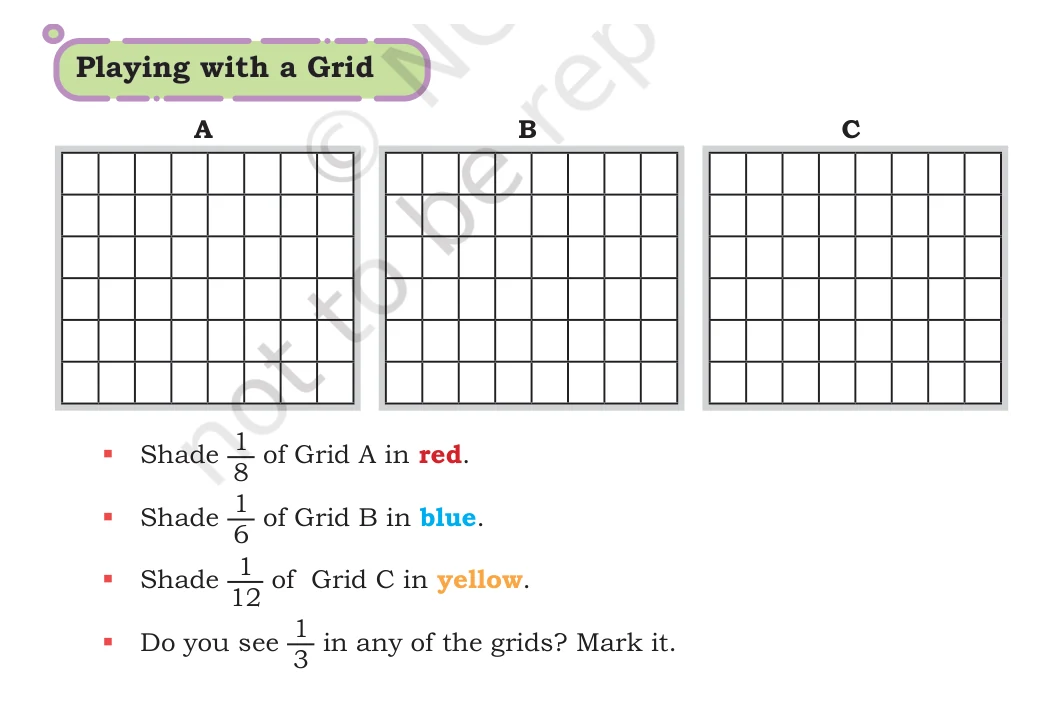
Shade one-sixth of Grid B in blue.
Show detailed solution
- Step 1: Grid B has 48 small squares.
- Step 2: 48\div6=8, so one-sixth is 8 squares.
- Answer: Shade any complete group of 8 squares blue, such as one full row.
Textbook page 1 · solved item 7
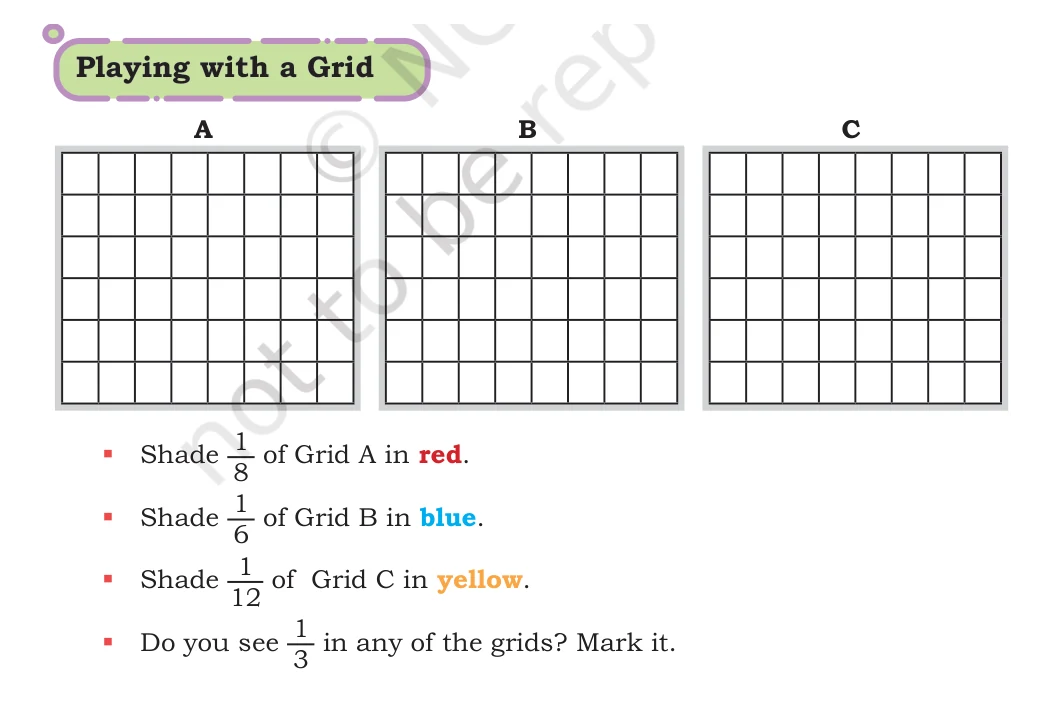
Shade one-twelfth of Grid C in yellow.
Show detailed solution
- Step 1: Grid C has 48 small squares.
- Step 2: 48\div12=4, so one-twelfth is 4 squares.
- Answer: Shade any group of 4 small squares yellow.
Textbook page 1 · solved item 8
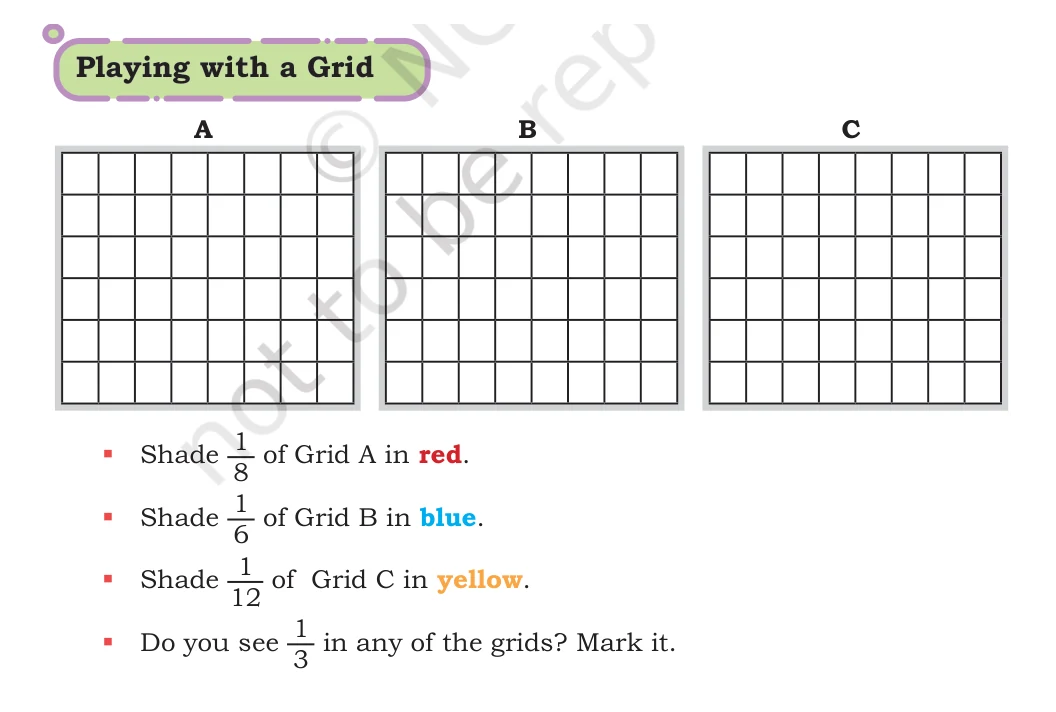
Can you mark one-third in any of the grids?
Show detailed solution
- Step 1: Each grid has 48 small squares.
- Step 2: 48\div3=16, so one-third is 16 squares.
- Answer: Yes. Mark any 16 squares that form one of 3 equal groups in a grid.
Detailed worked answers
Textbook page 2
Textbook page 2 · solved item 9
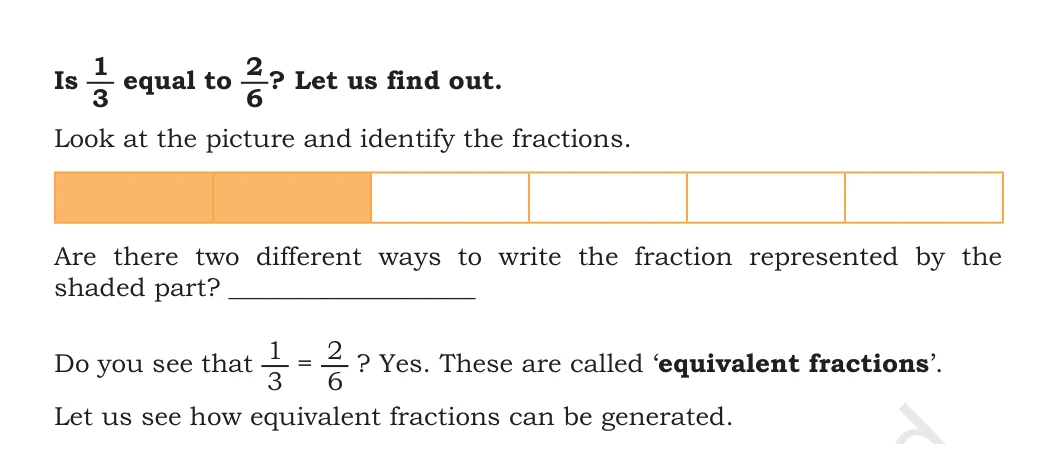
Write the shaded part in two different ways.
Show detailed solution
- Step 1: The strip is split into 3 large equal parts, and 1 large part is shaded, so the fraction is \frac{1}{3}.
- Step 2: Each large part is split again, making 6 small equal parts. Two small parts are shaded, so the fraction is \frac{2}{6}.
- Answer: The shaded part is both \frac{1}{3} and \frac{2}{6}, so they are equivalent.
Textbook page 2 · solved item 10
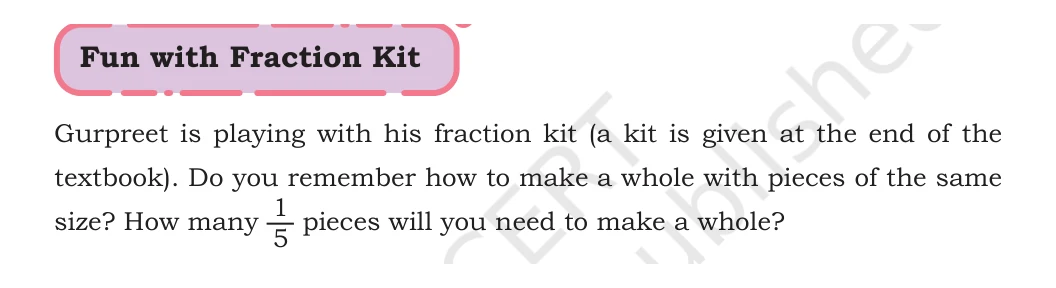
How many one-fifth pieces make one whole?
Show detailed solution
- Step 1: The denominator 5 says the whole is divided into 5 equal parts.
- Step 2: Count all 5 parts: \frac{1}{5}+\frac{1}{5}+\frac{1}{5}+\frac{1}{5}+\frac{1}{5}=\frac{5}{5}.
- Answer: Five one-fifth pieces make one whole.
Textbook page 2 · solved item 11
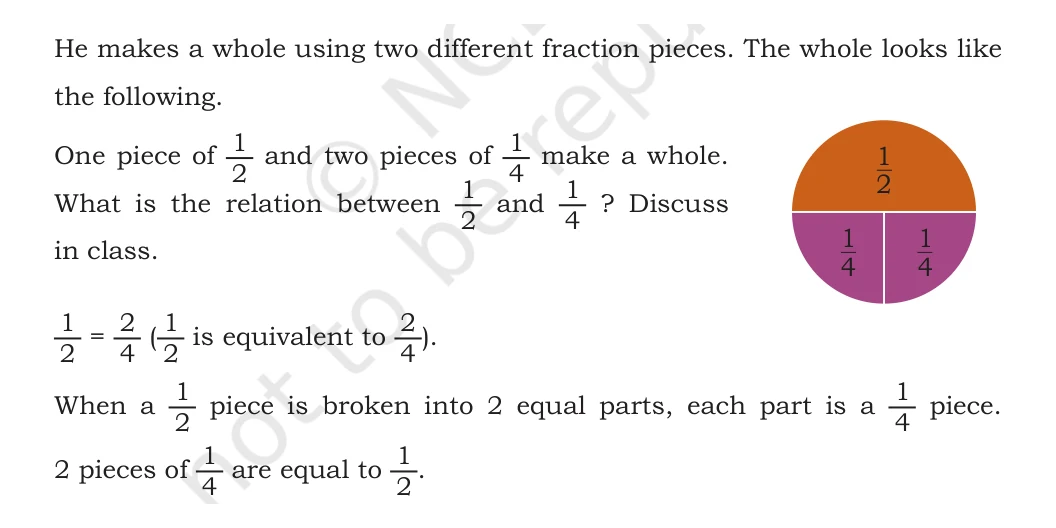
What is the relationship between one-half and one-fourth?
Show detailed solution
- Step 1: Split a whole into 4 equal quarters.
- Step 2: Two of those quarters cover the same area as one half.
- Answer: \frac{1}{2}=\frac{2}{4}. Two one-fourth pieces make one-half.
Textbook page 2 · solved item 12

Complete the equivalent-fraction chain for one-half.
Show detailed solution
- Step 1: Split each half into 3 equal small pieces to get 3 shaded pieces out of 6.
- Step 2: Repeat with 4 and 5 pieces in each half.
- Answer: One valid chain is \frac{1}{2}=\frac{2}{4}=\frac{3}{6}=\frac{4}{8}=\frac{5}{10}.
Detailed worked answers
Textbook page 3
Textbook page 3 · solved item 13
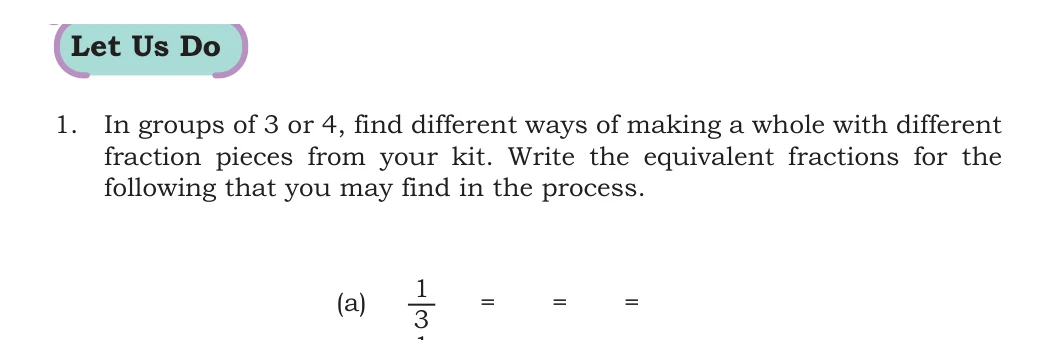
Write three fractions equivalent to one-third.
Show detailed solution
- Step 1: Split every original part into 2 smaller equal parts. The chosen part also splits into 2.
- Step 2: Repeat by splitting every original part into 3 and then 4 equal pieces.
- Answer: \frac{1}{3}=\frac{2}{6}=\frac{3}{9}=\frac{4}{12}.
Textbook page 3 · solved item 14
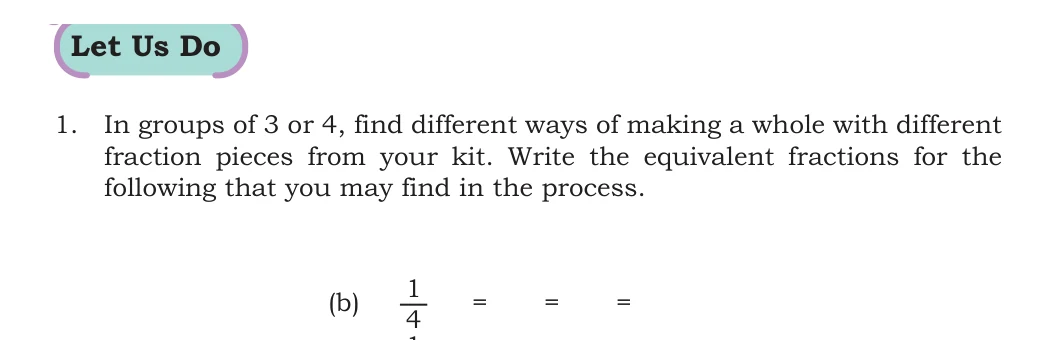
Write three fractions equivalent to one-fourth.
Show detailed solution
- Step 1: Split every original part into 2 smaller equal parts. The chosen part also splits into 2.
- Step 2: Repeat by splitting every original part into 3 and then 4 equal pieces.
- Answer: \frac{1}{4}=\frac{2}{8}=\frac{3}{12}=\frac{4}{16}.
Textbook page 3 · solved item 15
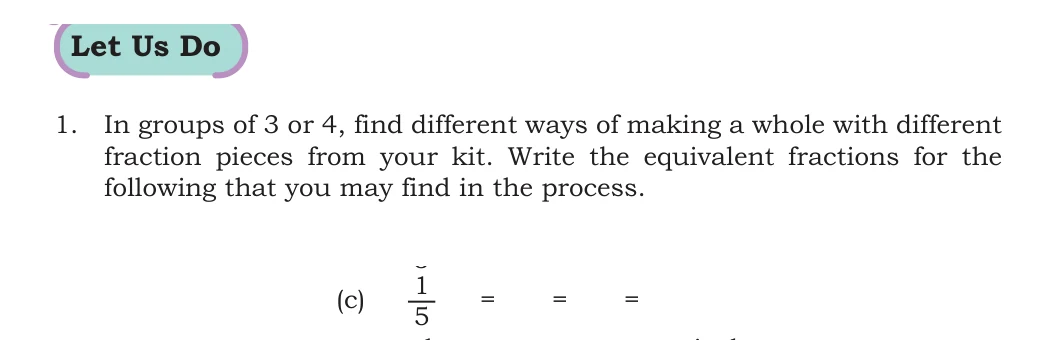
Write three fractions equivalent to one-fifth.
Show detailed solution
- Step 1: Split every original part into 2 smaller equal parts. The chosen part also splits into 2.
- Step 2: Repeat by splitting every original part into 3 and then 4 equal pieces.
- Answer: \frac{1}{5}=\frac{2}{10}=\frac{3}{15}=\frac{4}{20}.
Textbook page 3 · solved item 16
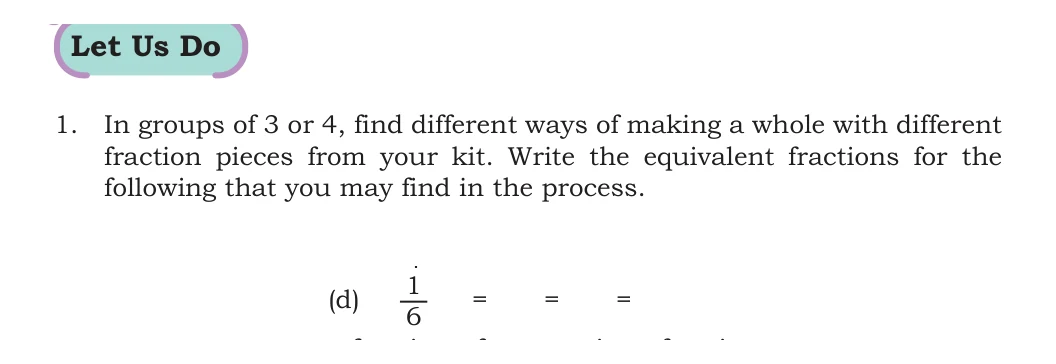
Write three fractions equivalent to one-sixth.
Show detailed solution
- Step 1: Split every original part into 2 smaller equal parts. The chosen part also splits into 2.
- Step 2: Repeat by splitting every original part into 3 and then 4 equal pieces.
- Answer: \frac{1}{6}=\frac{2}{12}=\frac{3}{18}=\frac{4}{24}.
Textbook page 3 · solved item 17

How can you generate equivalent fractions for a given fraction?
Show detailed solution
- Step 1: Start with the same whole and keep the shaded area unchanged.
- Step 2: Split every part into the same number of smaller equal pieces.
- Answer: The top and bottom numbers are both multiplied by the same number, but the shaded amount stays the same.
Textbook page 3 · solved item 18
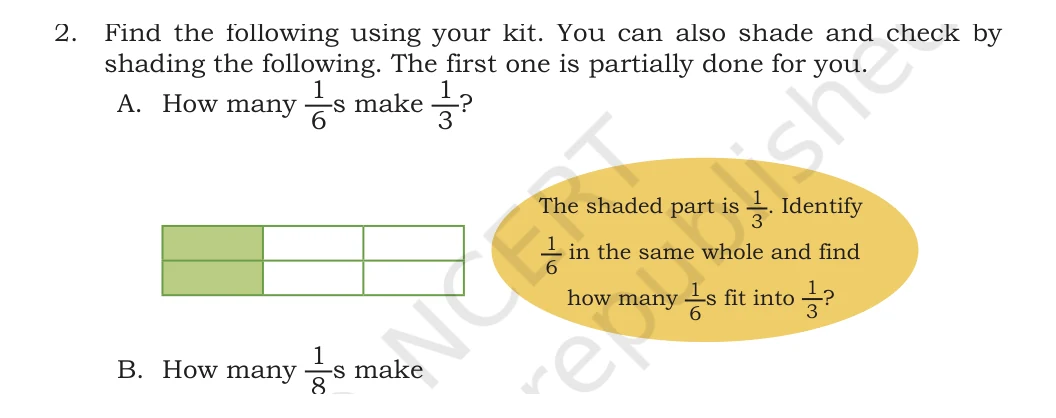
How many one-sixth pieces make one-third?
Show detailed solution
- Step 1: Divide the same whole into 6 equal pieces.
- Step 2: One-third covers 2 of those pieces because \frac{1}{3}=\frac{2}{6}.
- Answer: Two one-sixth pieces make one-third.
Textbook page 3 · solved item 19
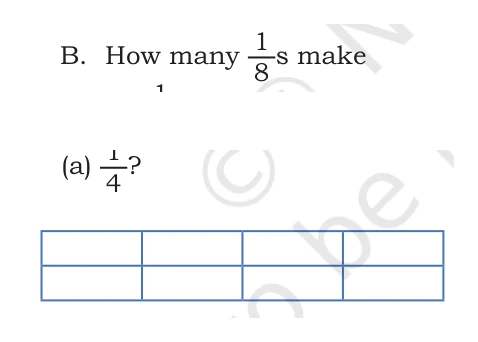
How many one-eighth pieces make one-fourth?
Show detailed solution
- Step 1: In a strip of 8 equal parts, one-fourth covers 2 parts.
- Step 2: This gives \frac{1}{4}=\frac{2}{8}.
- Answer: Two one-eighth pieces make one-fourth.
Textbook page 3 · solved item 20
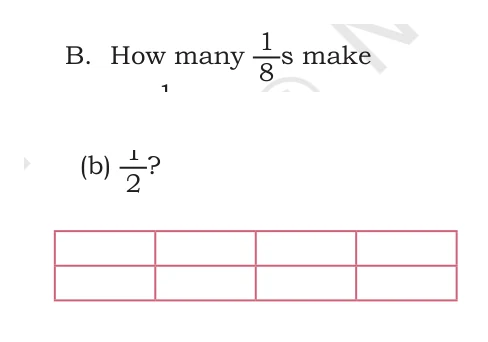
How many one-eighth pieces make one-half?
Show detailed solution
- Step 1: Half of 8 equal parts is 4 parts.
- Step 2: This gives \frac{1}{2}=\frac{4}{8}.
- Answer: Four one-eighth pieces make one-half.
Textbook page 3 · solved item 21
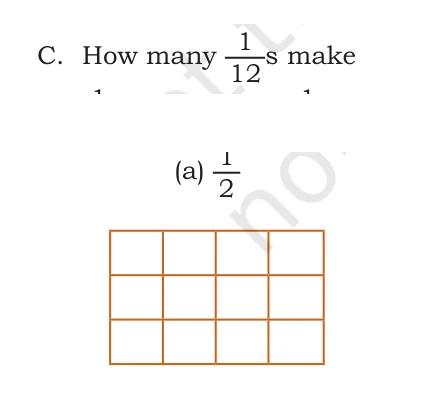
How many one-twelfth pieces make one-half?
Show detailed solution
- Step 1: Think of the whole as 12 equal pieces.
- Step 2: The target fraction is \frac{6}{12}=\frac{1}{2}.
- Answer: 6 one-twelfth pieces make one-half.
Textbook page 3 · solved item 22
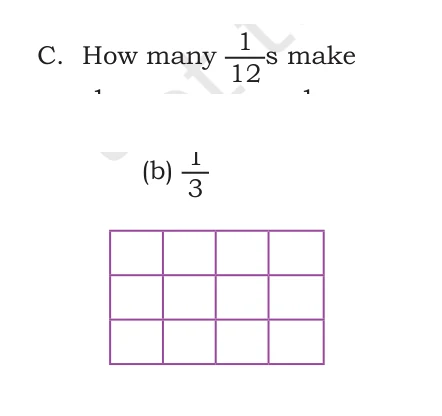
How many one-twelfth pieces make one-third?
Show detailed solution
- Step 1: Think of the whole as 12 equal pieces.
- Step 2: The target fraction is \frac{4}{12}=\frac{1}{3}.
- Answer: 4 one-twelfth pieces make one-third.
Textbook page 3 · solved item 23
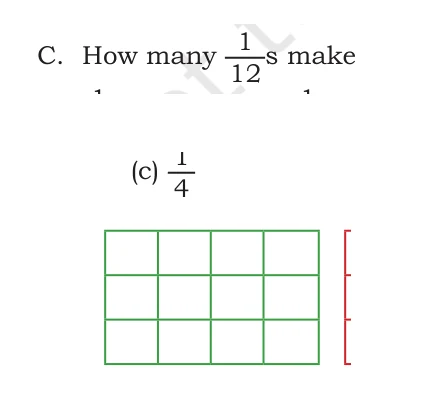
How many one-twelfth pieces make one-fourth?
Show detailed solution
- Step 1: Think of the whole as 12 equal pieces.
- Step 2: The target fraction is \frac{3}{12}=\frac{1}{4}.
- Answer: 3 one-twelfth pieces make one-fourth.
Textbook page 3 · solved item 24
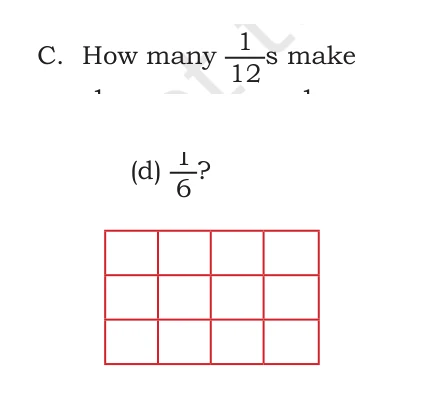
How many one-twelfth pieces make one-sixth?
Show detailed solution
- Step 1: Think of the whole as 12 equal pieces.
- Step 2: The target fraction is \frac{2}{12}=\frac{1}{6}.
- Answer: 2 one-twelfth pieces make one-sixth.
Detailed worked answers
Textbook page 4
Textbook page 4 · solved item 25
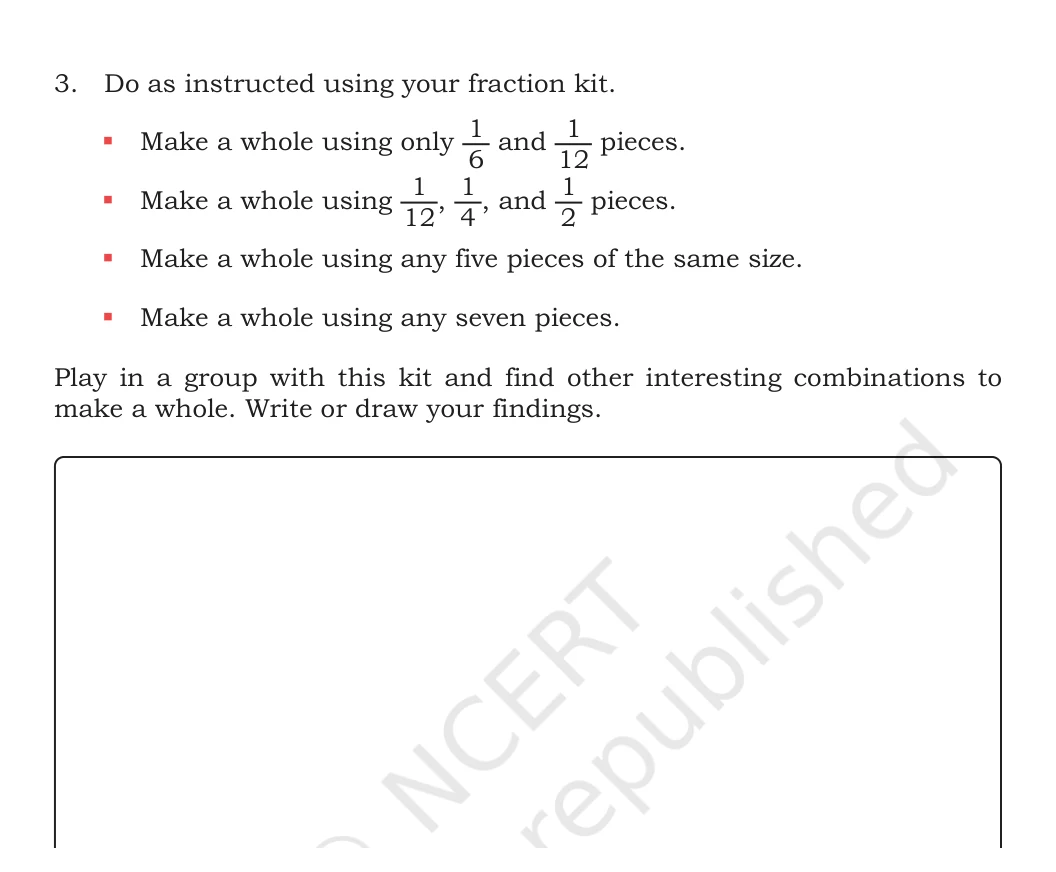
Make one whole using only one-sixth and one-twelfth pieces.
Show detailed solution
- Step 1: Three one-sixth pieces make \frac{3}{6}=\frac{1}{2}.
- Step 2: Six one-twelfth pieces make \frac{6}{12}=\frac{1}{2}.
- Answer: Three one-sixth pieces and six one-twelfth pieces make one whole. Other combinations are possible.
Textbook page 4 · solved item 26
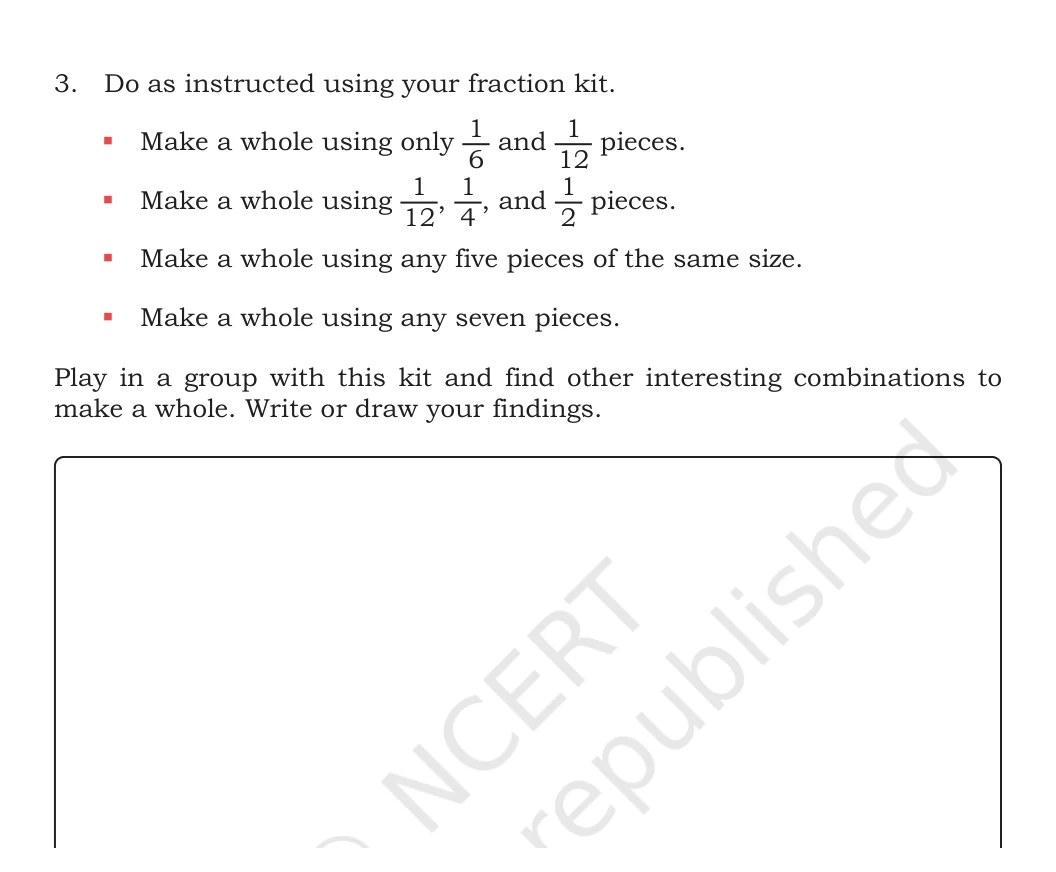
Make one whole using one-twelfth, one-fourth, and one-half pieces.
Show detailed solution
- Step 1: Use one half and one fourth; together they make three-fourths.
- Step 2: The remaining one-fourth is 3 one-twelfth pieces.
- Answer: \frac{1}{2}+\frac{1}{4}+\frac{1}{12}+\frac{1}{12}+\frac{1}{12}=1.
Textbook page 4 · solved item 27
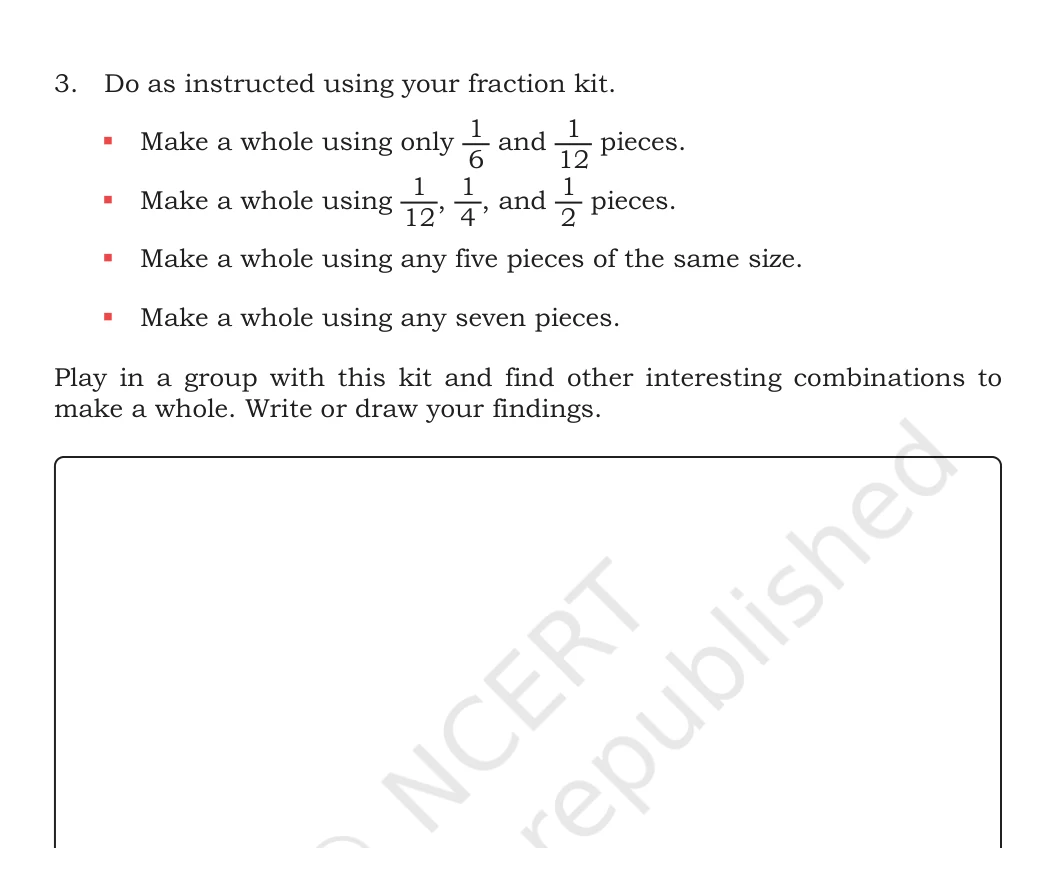
Make one whole using five pieces of the same size.
Show detailed solution
- Step 1: Divide the whole into 5 equal pieces.
- Step 2: Each piece is one-fifth of the whole.
- Answer: Five one-fifth pieces make \frac{5}{5}=1.
Textbook page 4 · solved item 28
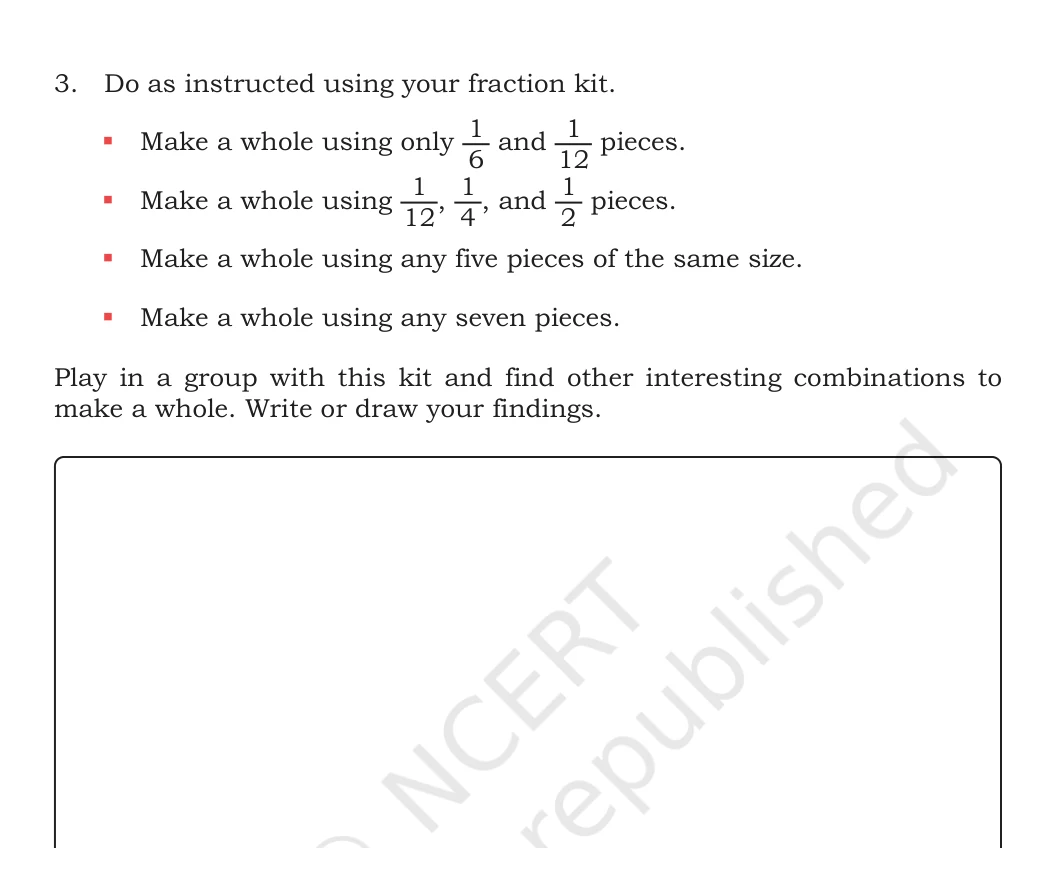
Make one whole using seven pieces.
Show detailed solution
- Step 1: Divide the whole into 7 equal pieces.
- Step 2: Each piece is one-seventh of the whole.
- Answer: Seven one-seventh pieces make \frac{7}{7}=1.
Textbook page 4 · solved item 29
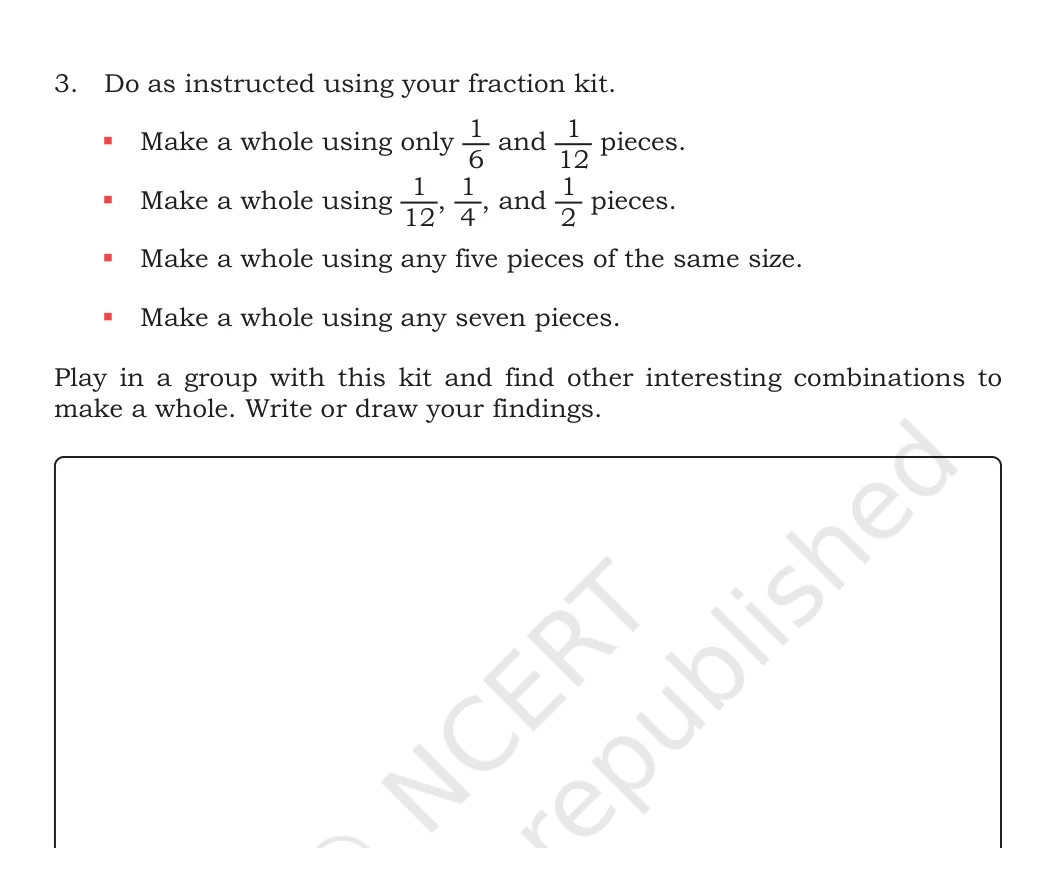
Find another combination of fraction pieces that makes one whole.
Show detailed solution
- Step 1: Start with one-half, leaving another half to fill.
- Step 2: One-third and one-sixth together make the missing half.
- Answer: \frac{1}{2}+\frac{1}{3}+\frac{1}{6}=1. Draw these three pieces covering one whole.
Detailed worked answers
Textbook page 5
Textbook page 5 · solved item 30
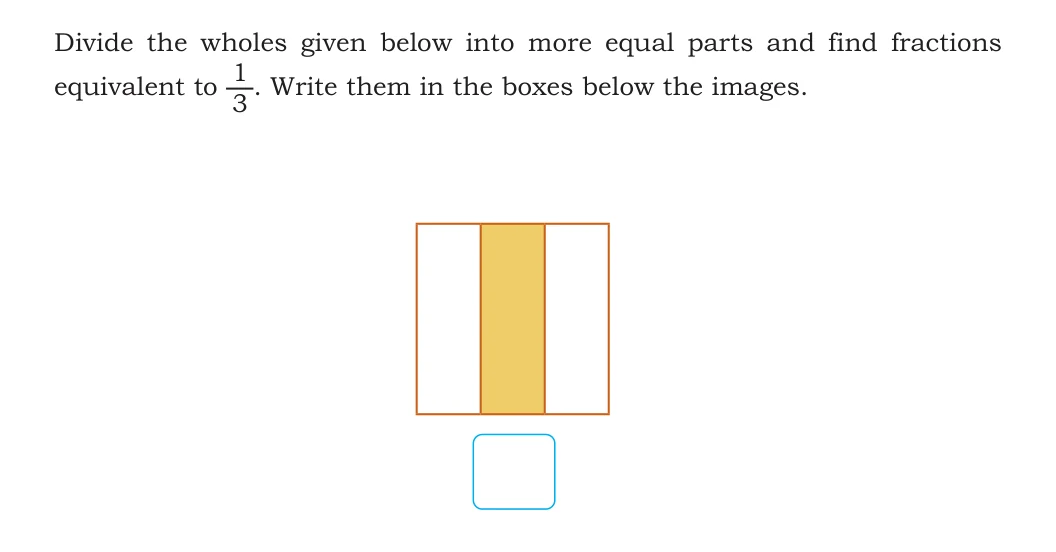
Divide the first picture into more equal parts and name the shaded fraction.
Show detailed solution
- Step 1: Keep the same one-third strip shaded.
- Step 2: Divide each of the 3 original parts into 2 equal smaller parts, making 6 parts altogether.
- Answer: The shaded region is \frac{2}{6}, which is equivalent to \frac{1}{3}.
Textbook page 5 · solved item 31
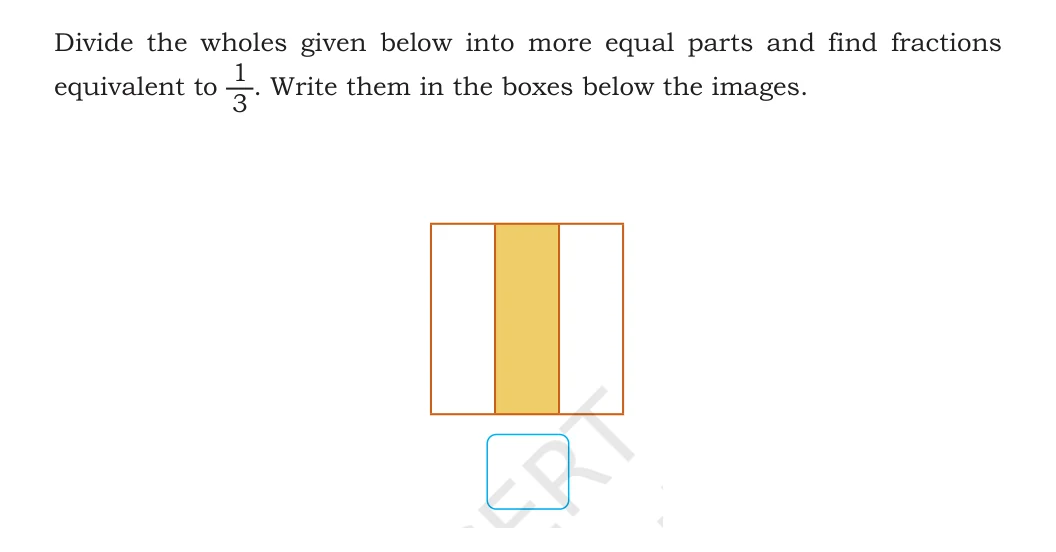
Divide the second picture into more equal parts and name the shaded fraction.
Show detailed solution
- Step 1: Keep the same one-third strip shaded.
- Step 2: Divide each of the 3 original parts into 3 equal smaller parts, making 9 parts altogether.
- Answer: The shaded region is \frac{3}{9}, which is equivalent to \frac{1}{3}.
Textbook page 5 · solved item 32
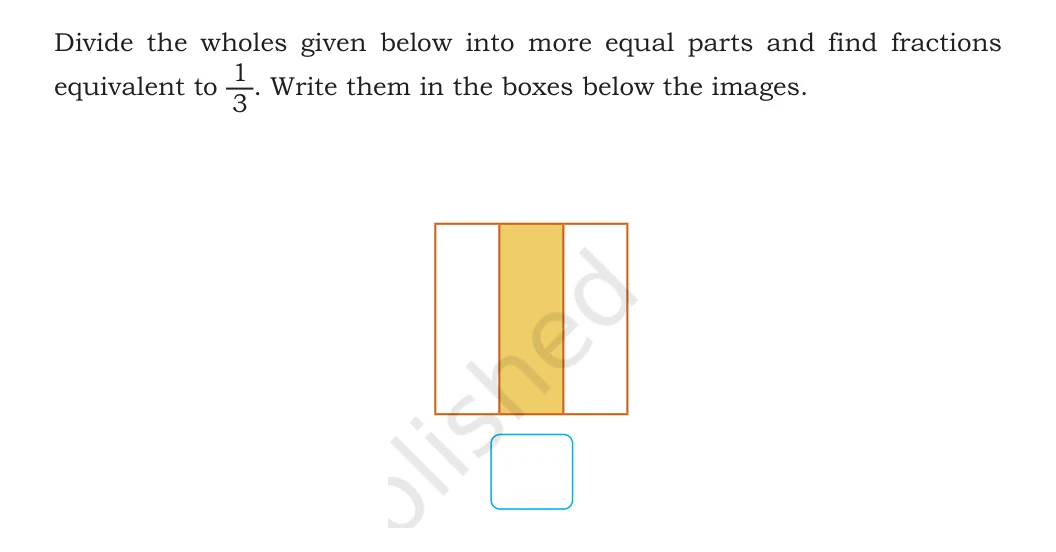
Divide the third picture into more equal parts and name the shaded fraction.
Show detailed solution
- Step 1: Keep the same one-third strip shaded.
- Step 2: Divide each of the 3 original parts into 4 equal smaller parts, making 12 parts altogether.
- Answer: The shaded region is \frac{4}{12}, which is equivalent to \frac{1}{3}.
Textbook page 5 · solved item 33

Complete the equivalent-fraction pattern for one-third.
Show detailed solution
- Step 1: Continue the top numbers after 4 with 5, 6, 7, 8, and 12.
- Step 2: Multiply each top number by 3 to get its bottom number.
- Answer: The blanks are \frac{5}{15},\frac{6}{18},\frac{7}{21},\frac{8}{24},\frac{12}{36}.
Textbook page 5 · solved item 34

What pattern appears in the equivalent fractions for one-third?
Show detailed solution
- Step 1: Read the pairs: 1 and 3, 2 and 6, 3 and 9, 4 and 12.
- Step 2: The bottom number is always 3 times the top number.
- Answer: Both numbers grow together, and every fraction still names the same one-third of the whole.
Textbook page 5 · solved item 35

How can you check whether two fractions are equivalent?
Show detailed solution
- Step 1: Draw equal-sized wholes and shade the two fractions.
- Step 2: If the shaded areas match exactly, the fractions are equivalent.
- Answer: You can also split every part of one fraction into the same number of smaller equal parts and see whether it becomes the other fraction.
Textbook page 5 · solved item 36
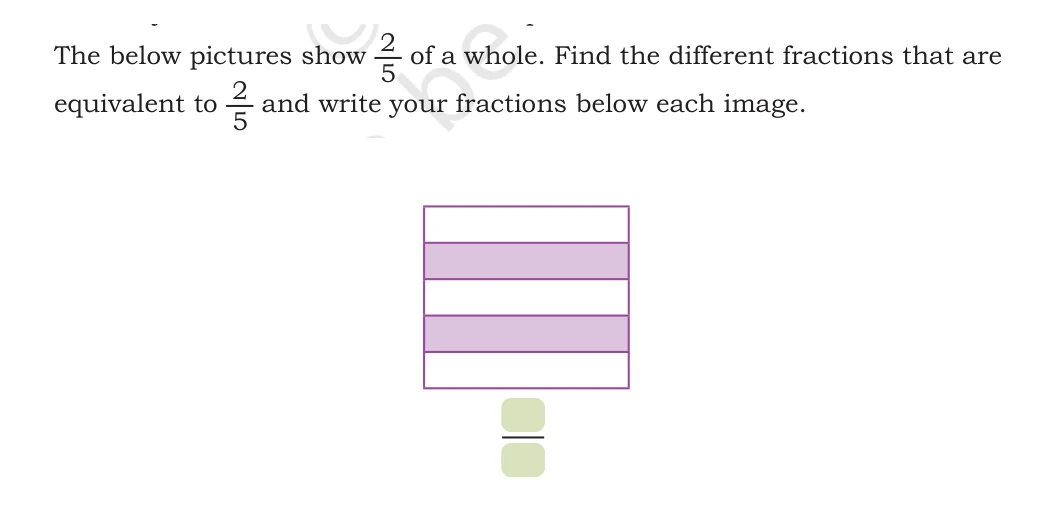
Name the shaded fraction in the third two-fifths picture.
Show detailed solution
- Step 1: The 5 original strips are each divided into 3 equal parts, making 15 parts.
- Step 2: The 2 shaded strips become 6 shaded parts.
- Answer: The shaded fraction is \frac{6}{15}, equivalent to \frac{2}{5}.
Textbook page 5 · solved item 37
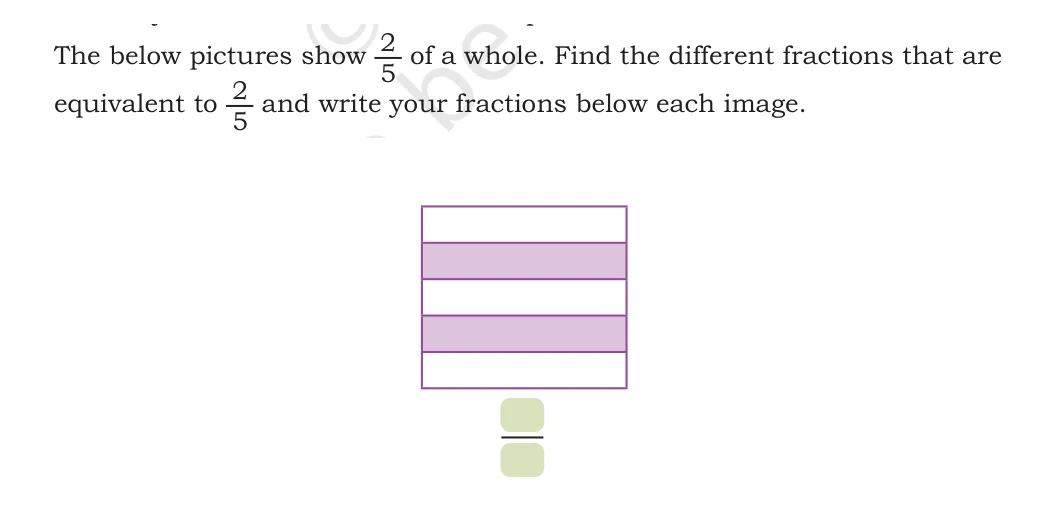
Name the shaded fraction in the fourth two-fifths picture.
Show detailed solution
- Step 1: Divide each of the 5 original strips into 4 equal parts, making 20 parts.
- Step 2: The 2 shaded strips become 8 shaded parts.
- Answer: The shaded fraction is \frac{8}{20}, equivalent to \frac{2}{5}.
Textbook page 5 · solved item 38

Complete the equivalent-fraction pattern for two-fifths.
Show detailed solution
- Step 1: Continue by splitting every fifth into 3, 4, 10, and 20 equal pieces.
- Step 2: The shaded pieces become 6, 8, 20, and 40 while the total pieces become 15, 20, 50, and 100.
- Answer: \frac{2}{5}=\frac{4}{10}=\frac{6}{15}=\frac{8}{20}=\frac{20}{50}=\frac{40}{100}.
Detailed worked answers
Textbook page 6
Textbook page 6 · solved item 39
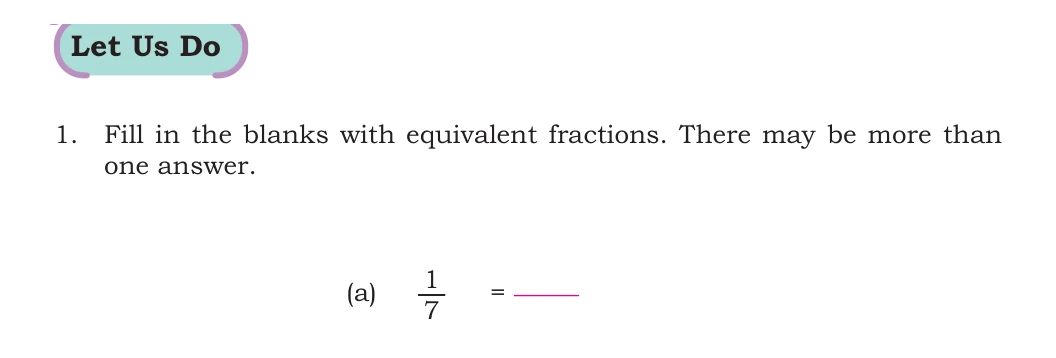
Write a fraction equivalent to \frac{1}{7}.
Show detailed solution
- Step 1: Split every original part into 2 equal smaller pieces.
- Step 2: The number of chosen pieces and total pieces both double.
- Answer: \frac{1}{7}=\frac{2}{14}.
Textbook page 6 · solved item 40
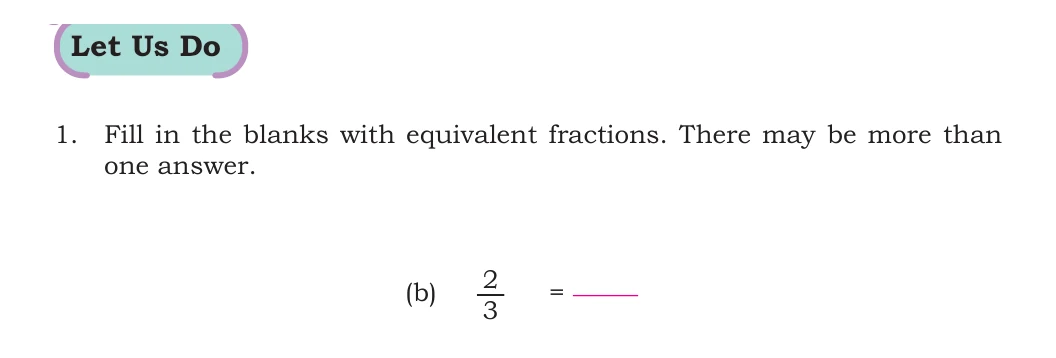
Write a fraction equivalent to \frac{2}{3}.
Show detailed solution
- Step 1: Split every original part into 2 equal smaller pieces.
- Step 2: The number of chosen pieces and total pieces both double.
- Answer: \frac{2}{3}=\frac{4}{6}.
Textbook page 6 · solved item 41
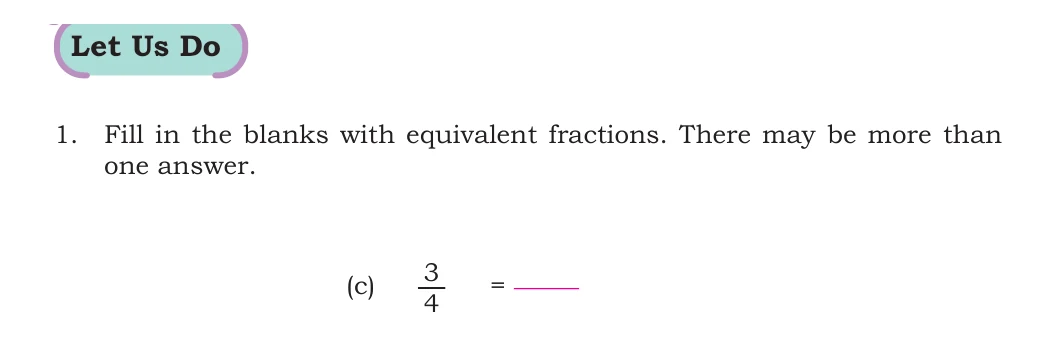
Write a fraction equivalent to \frac{3}{4}.
Show detailed solution
- Step 1: Split every original part into 2 equal smaller pieces.
- Step 2: The number of chosen pieces and total pieces both double.
- Answer: \frac{3}{4}=\frac{6}{8}.
Textbook page 6 · solved item 42
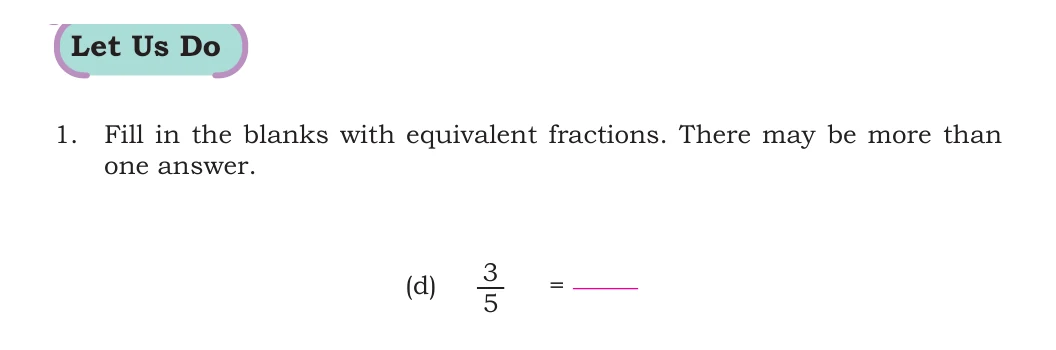
Write a fraction equivalent to \frac{3}{5}.
Show detailed solution
- Step 1: Split every original part into 2 equal smaller pieces.
- Step 2: The number of chosen pieces and total pieces both double.
- Answer: \frac{3}{5}=\frac{6}{10}.
Textbook page 6 · solved item 43

Are \frac{2}{3} and \frac{3}{4} equivalent?
Show detailed solution
- Step 1: Compare the two fractions using equal-sized wholes or matching-sized pieces.
- Step 2: In twelfths they are \frac{8}{12} and \frac{9}{12}, so they cover different amounts.
- Answer: No, do not tick this pair.
Textbook page 6 · solved item 44

Are \frac{3}{5} and \frac{6}{10} equivalent?
Show detailed solution
- Step 1: Compare the two fractions using equal-sized wholes or matching-sized pieces.
- Step 2: Splitting each fifth into 2 gives \frac{3}{5}=\frac{6}{10}.
- Answer: Yes, tick this pair.
Textbook page 6 · solved item 45
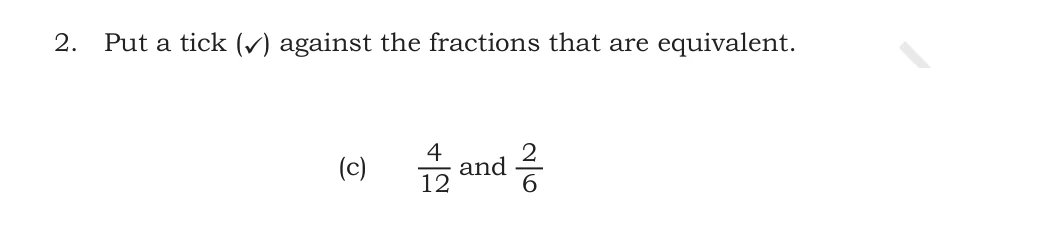
Are \frac{4}{12} and \frac{2}{6} equivalent?
Show detailed solution
- Step 1: Compare the two fractions using equal-sized wholes or matching-sized pieces.
- Step 2: Both fractions simplify by grouping pieces to \frac{1}{3}.
- Answer: Yes, tick this pair.
Textbook page 6 · solved item 46
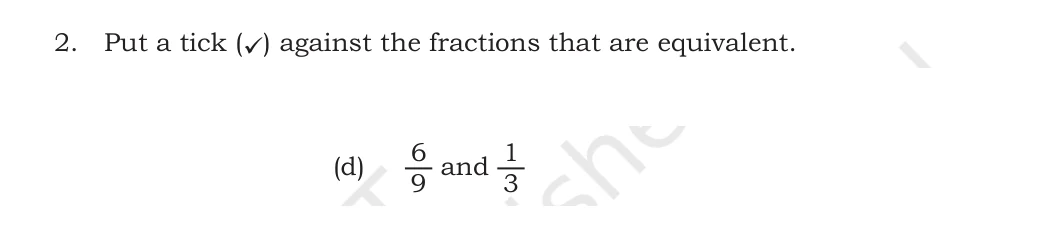
Are \frac{6}{9} and \frac{1}{3} equivalent?
Show detailed solution
- Step 1: Compare the two fractions using equal-sized wholes or matching-sized pieces.
- Step 2: \frac{6}{9}=\frac{2}{3}, which is not \frac{1}{3}.
- Answer: No, do not tick this pair.
Textbook page 6 · solved item 47
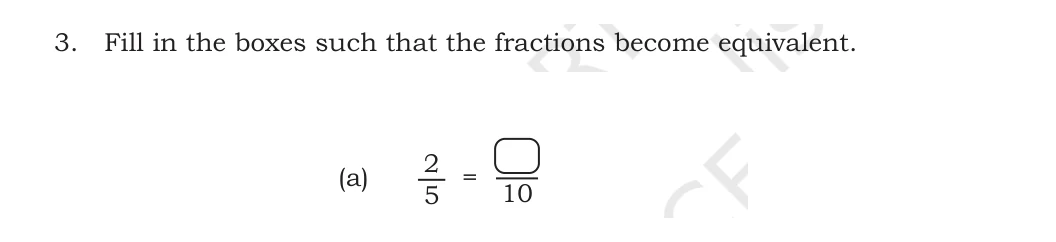
Complete \frac{2}{5}=\frac{\square}{10}.
Show detailed solution
- Step 1: Notice how the known top or bottom number changed.
- Step 2: Each fifth is split into 2 tenths.
- Answer: \frac{2}{5}=\frac{4}{10}, so the missing number is 4.
Textbook page 6 · solved item 48
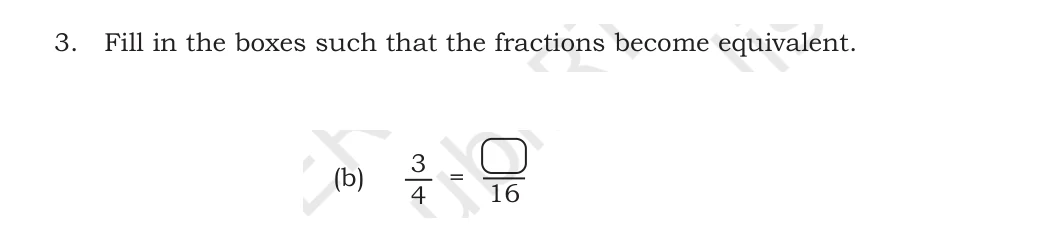
Complete \frac{3}{4}=\frac{\square}{16}.
Show detailed solution
- Step 1: Notice how the known top or bottom number changed.
- Step 2: Each fourth is split into 4 sixteenths.
- Answer: \frac{3}{4}=\frac{12}{16}, so the missing number is 12.
Textbook page 6 · solved item 49
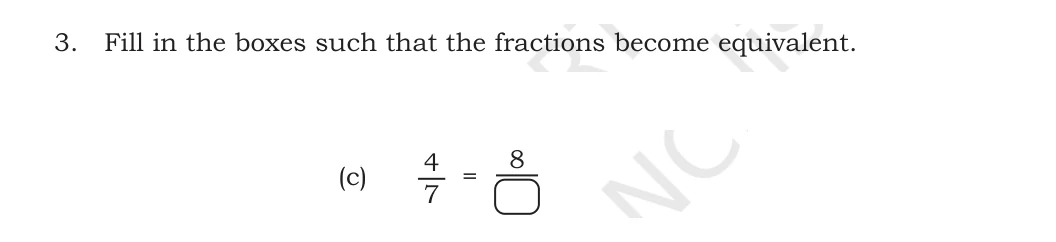
Complete \frac{4}{7}=\frac{8}{\square}.
Show detailed solution
- Step 1: Notice how the known top or bottom number changed.
- Step 2: The top number doubles from 4 to 8, so the bottom number also doubles.
- Answer: \frac{4}{7}=\frac{8}{14}, so the missing number is 14.
Textbook page 6 · solved item 50
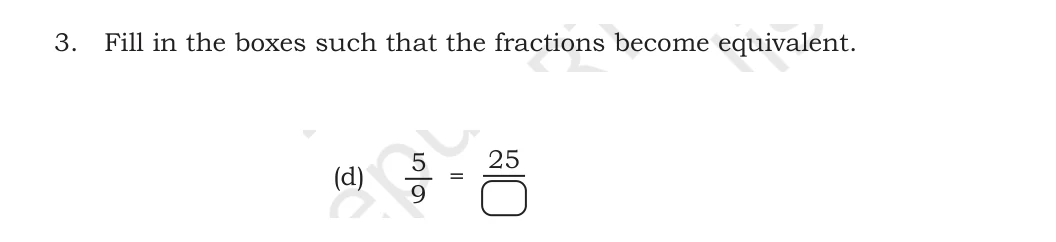
Complete \frac{5}{9}=\frac{25}{\square}.
Show detailed solution
- Step 1: Notice how the known top or bottom number changed.
- Step 2: The top number is multiplied by 5, so the bottom number is also multiplied by 5.
- Answer: \frac{5}{9}=\frac{25}{45}, so the missing number is 45.
Textbook page 6 · solved item 51
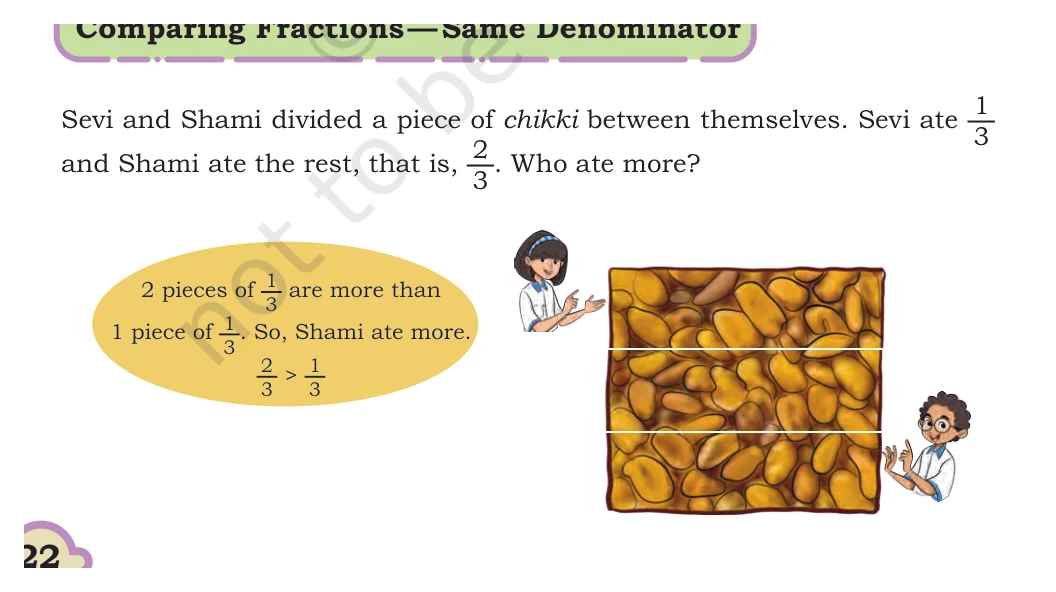
Sevi ate one-third of the chikki and Shami ate two-thirds. Who ate more?
Show detailed solution
- Step 1: Both fractions use thirds, so every piece is the same size.
- Step 2: Shami ate 2 of those pieces while Sevi ate 1.
- Answer: Shami ate more because \frac{2}{3}>\frac{1}{3}.
Detailed worked answers
Textbook page 7
Textbook page 7 · solved item 52
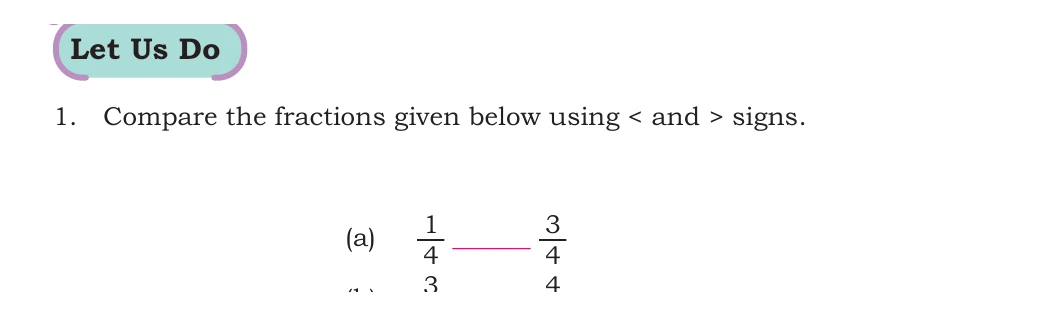
Compare \frac{1}{4} and \frac{3}{4}.
Show detailed solution
- Step 1: The bottom numbers are the same, so all the pieces are the same size.
- Step 2: Compare the number of pieces: 1 and 3.
- Answer: \frac{1}{4}<\frac{3}{4}.
Textbook page 7 · solved item 53
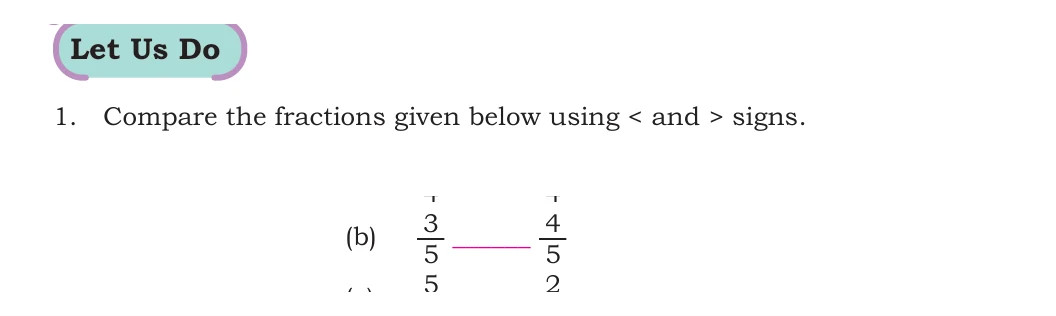
Compare \frac{3}{5} and \frac{4}{5}.
Show detailed solution
- Step 1: The bottom numbers are the same, so all the pieces are the same size.
- Step 2: Compare the number of pieces: 3 and 4.
- Answer: \frac{3}{5}<\frac{4}{5}.
Textbook page 7 · solved item 54
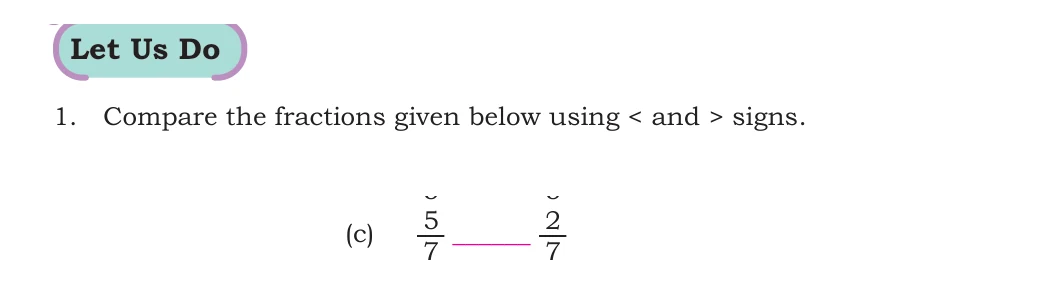
Compare \frac{5}{7} and \frac{2}{7}.
Show detailed solution
- Step 1: The bottom numbers are the same, so all the pieces are the same size.
- Step 2: Compare the number of pieces: 5 and 2.
- Answer: \frac{5}{7}>\frac{2}{7}.
Textbook page 7 · solved item 55
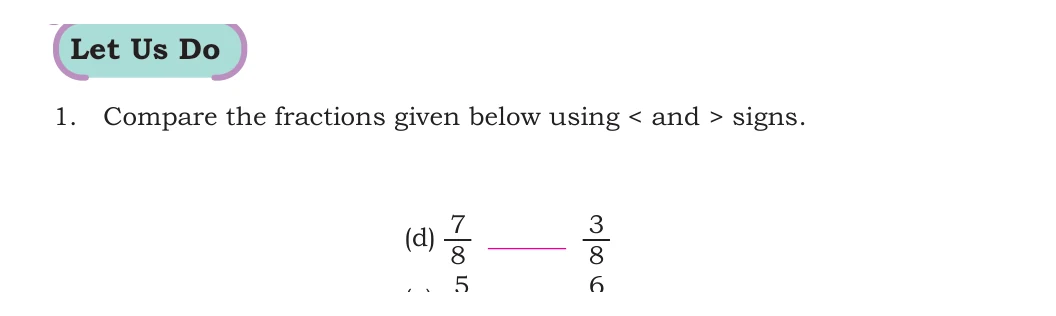
Compare \frac{7}{8} and \frac{3}{8}.
Show detailed solution
- Step 1: The bottom numbers are the same, so all the pieces are the same size.
- Step 2: Compare the number of pieces: 7 and 3.
- Answer: \frac{7}{8}>\frac{3}{8}.
Textbook page 7 · solved item 56
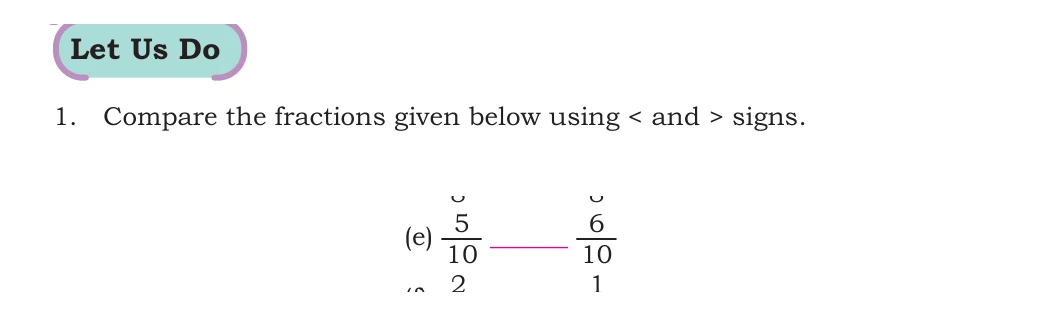
Compare \frac{5}{10} and \frac{6}{10}.
Show detailed solution
- Step 1: The bottom numbers are the same, so all the pieces are the same size.
- Step 2: Compare the number of pieces: 5 and 6.
- Answer: \frac{5}{10}<\frac{6}{10}.
Textbook page 7 · solved item 57
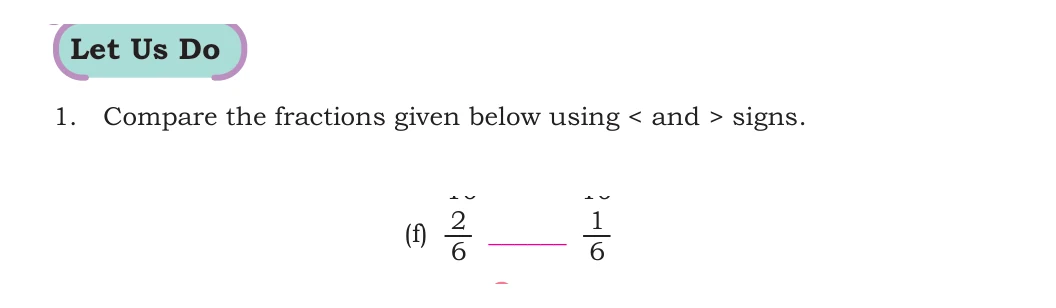
Compare \frac{2}{6} and \frac{1}{6}.
Show detailed solution
- Step 1: The bottom numbers are the same, so all the pieces are the same size.
- Step 2: Compare the number of pieces: 2 and 1.
- Answer: \frac{2}{6}>\frac{1}{6}.
Textbook page 7 · solved item 58
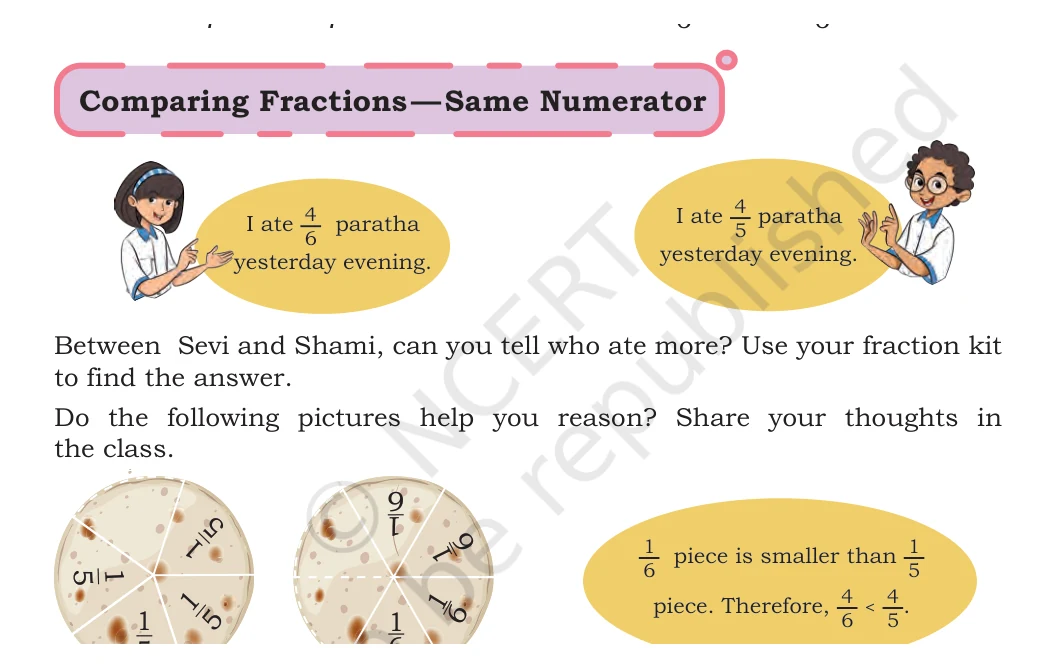
Sevi ate four-sixths of a paratha and Shami ate four-fifths. Who ate more?
Show detailed solution
- Step 1: Both ate 4 pieces, but their piece sizes are different.
- Step 2: A fifth is larger than a sixth because the same paratha is divided into fewer pieces.
- Answer: Shami ate more because \frac{4}{5}>\frac{4}{6}.
Textbook page 7 · solved item 59
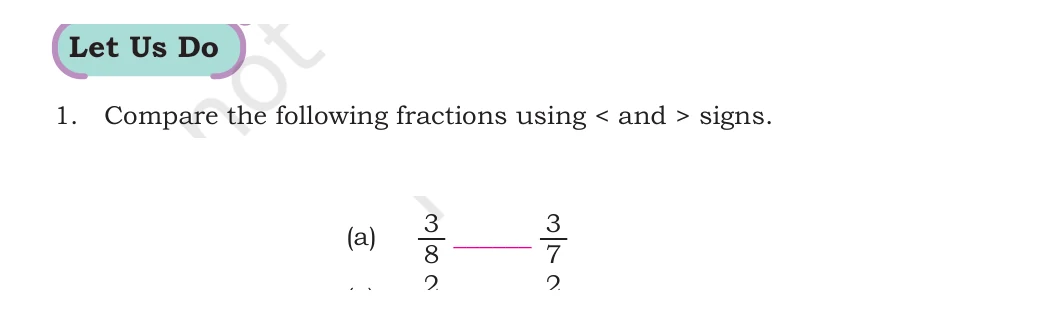
Compare \frac{3}{8} and \frac{3}{7}.
Show detailed solution
- Step 1: The top numbers are the same, so both fractions contain the same number of pieces.
- Step 2: Compare the piece sizes: a \frac{1}{7} piece is larger than a \frac{1}{8} piece.
- Answer: \frac{3}{8}<\frac{3}{7}.
Textbook page 7 · solved item 60
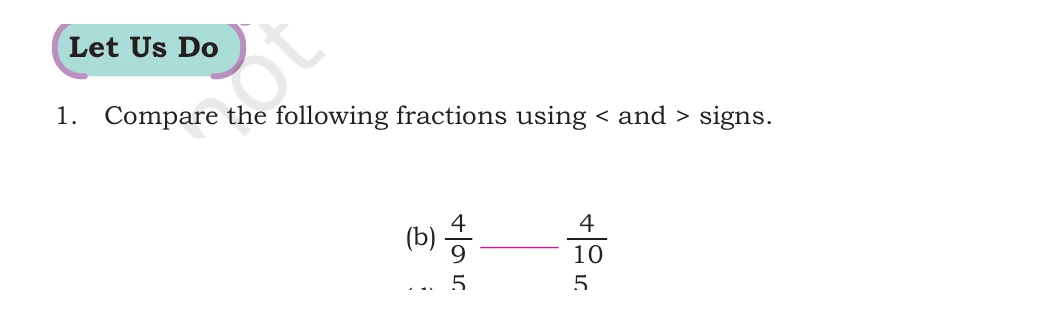
Compare \frac{4}{9} and \frac{4}{10}.
Show detailed solution
- Step 1: The top numbers are the same, so both fractions contain the same number of pieces.
- Step 2: Compare the piece sizes: a \frac{1}{9} piece is larger than a \frac{1}{10} piece.
- Answer: \frac{4}{9}>\frac{4}{10}.
Textbook page 7 · solved item 61
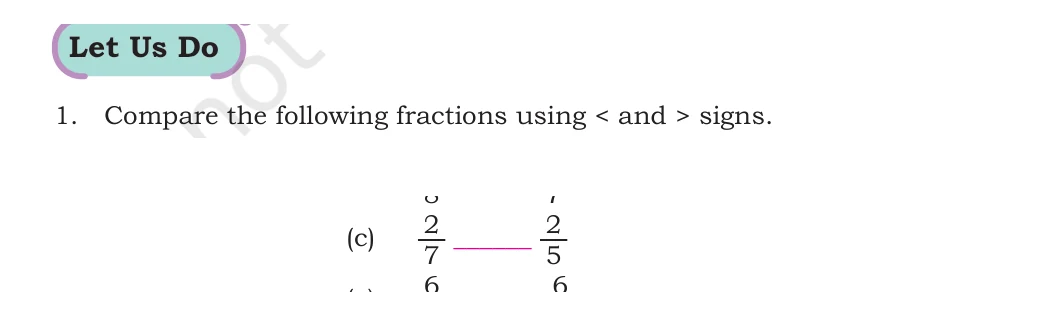
Compare \frac{2}{7} and \frac{2}{5}.
Show detailed solution
- Step 1: The top numbers are the same, so both fractions contain the same number of pieces.
- Step 2: Compare the piece sizes: a \frac{1}{5} piece is larger than a \frac{1}{7} piece.
- Answer: \frac{2}{7}<\frac{2}{5}.
Textbook page 7 · solved item 62
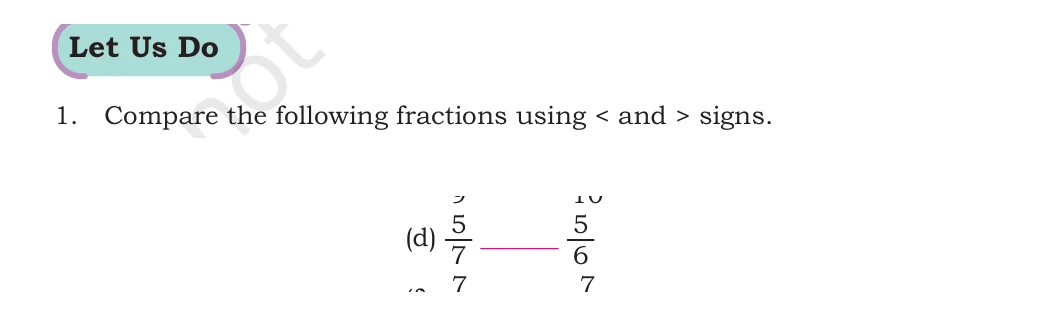
Compare \frac{5}{7} and \frac{5}{6}.
Show detailed solution
- Step 1: The top numbers are the same, so both fractions contain the same number of pieces.
- Step 2: Compare the piece sizes: a \frac{1}{6} piece is larger than a \frac{1}{7} piece.
- Answer: \frac{5}{7}<\frac{5}{6}.
Textbook page 7 · solved item 63
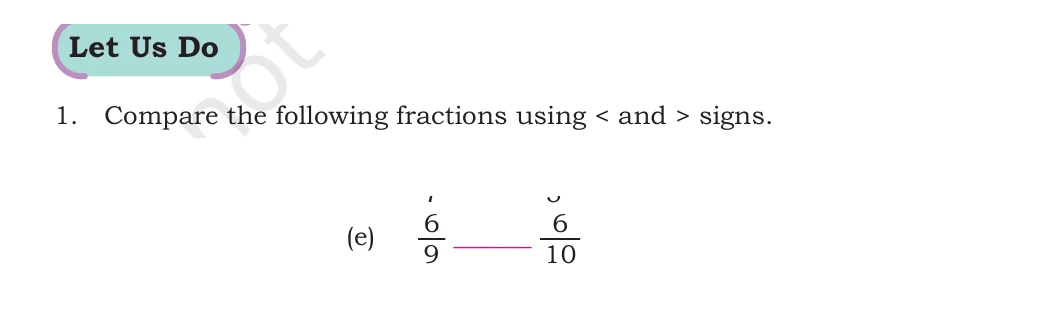
Compare \frac{6}{9} and \frac{6}{10}.
Show detailed solution
- Step 1: The top numbers are the same, so both fractions contain the same number of pieces.
- Step 2: Compare the piece sizes: a \frac{1}{9} piece is larger than a \frac{1}{10} piece.
- Answer: \frac{6}{9}>\frac{6}{10}.
Textbook page 7 · solved item 64
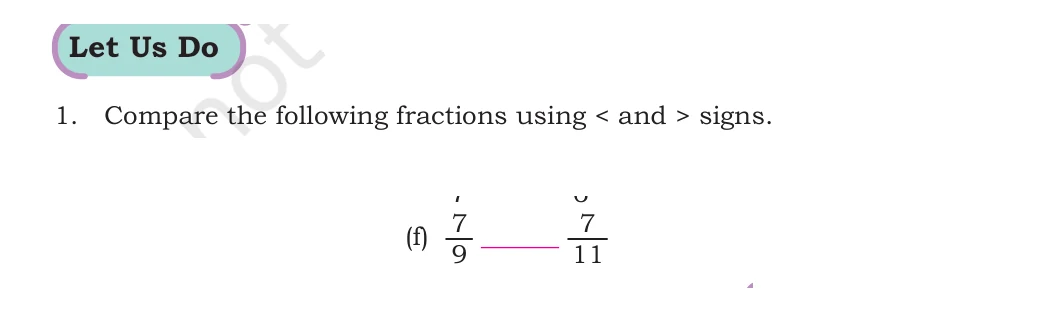
Compare \frac{7}{9} and \frac{7}{11}.
Show detailed solution
- Step 1: The top numbers are the same, so both fractions contain the same number of pieces.
- Step 2: Compare the piece sizes: a \frac{1}{9} piece is larger than a \frac{1}{11} piece.
- Answer: \frac{7}{9}>\frac{7}{11}.
Detailed worked answers
Textbook page 8
Textbook page 8 · solved item 65
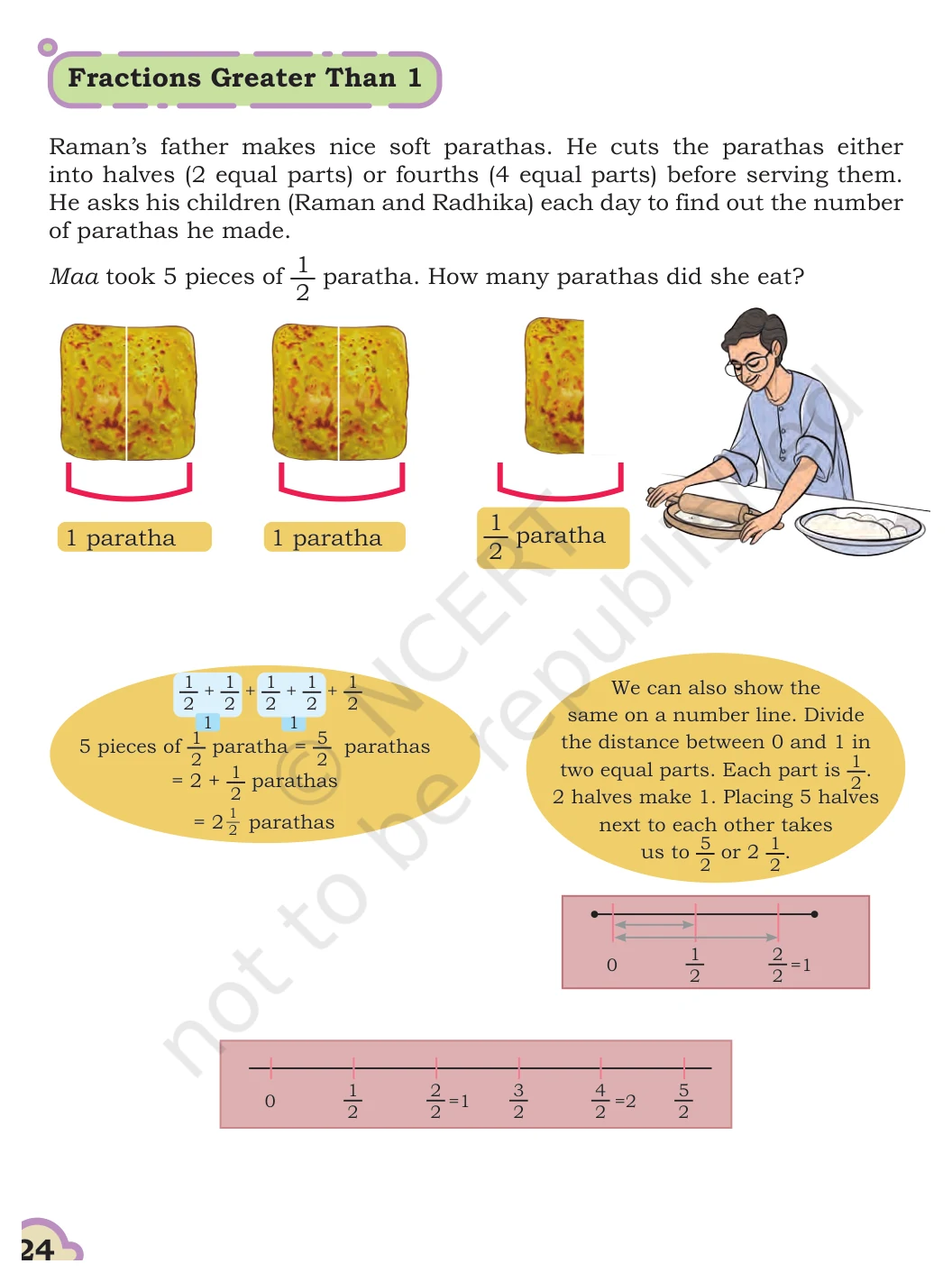
Maa took five half-paratha pieces. How many parathas did she eat?
Show detailed solution
- Step 1: Pair the half-pieces. Four halves make 2 whole parathas.
- Step 2: One half-piece remains.
- Answer: \frac{5}{2}=2\frac{1}{2}. Maa ate two and one-half parathas.
Detailed worked answers
Textbook page 9
Textbook page 9 · solved item 66
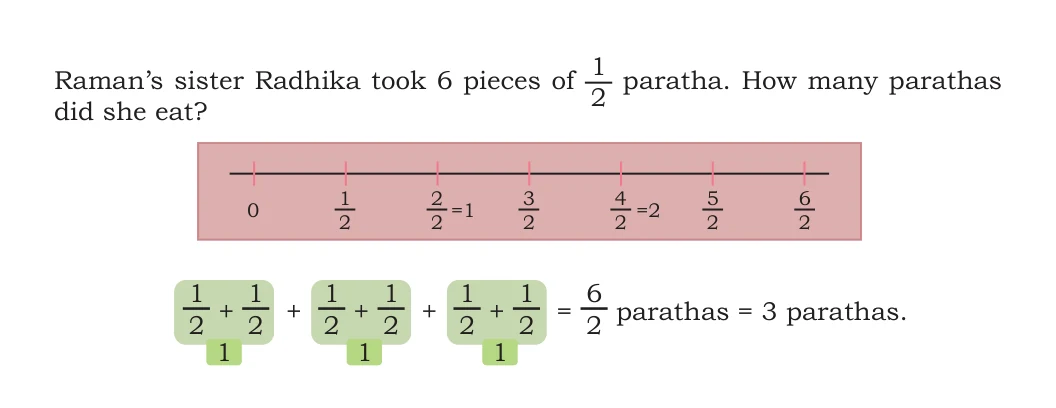
Radhika took six half-paratha pieces. How many parathas did she eat?
Show detailed solution
- Step 1: Put the 6 halves into pairs.
- Step 2: Each pair makes 1 whole, and 6\div2=3 pairs.
- Answer: \frac{6}{2}=3. Radhika ate 3 parathas.
Textbook page 9 · solved item 67
Dadiji took seven half-paratha pieces. How many parathas did she eat?
Show detailed solution
- Step 1: Six halves make 3 whole parathas.
- Step 2: One half remains after making the 3 wholes.
- Answer: \frac{7}{2}=3\frac{1}{2}. Dadiji ate three and one-half parathas.
Textbook page 9 · solved item 68
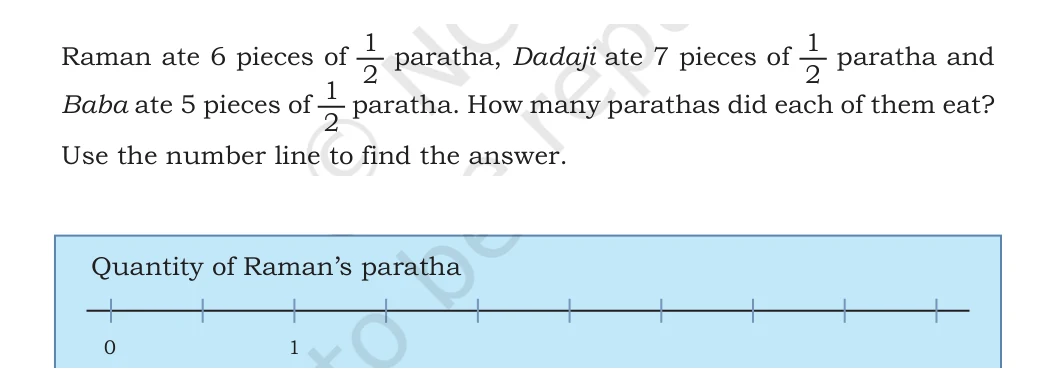
Raman ate 6 half-paratha pieces. How many parathas is that?
Show detailed solution
- Step 1: Group the half-pieces in pairs because 2 halves make 1 whole.
- Step 2: Make as many whole pairs as possible from 6 halves.
- Answer: \frac{6}{2}=3 parathas.
Textbook page 9 · solved item 69
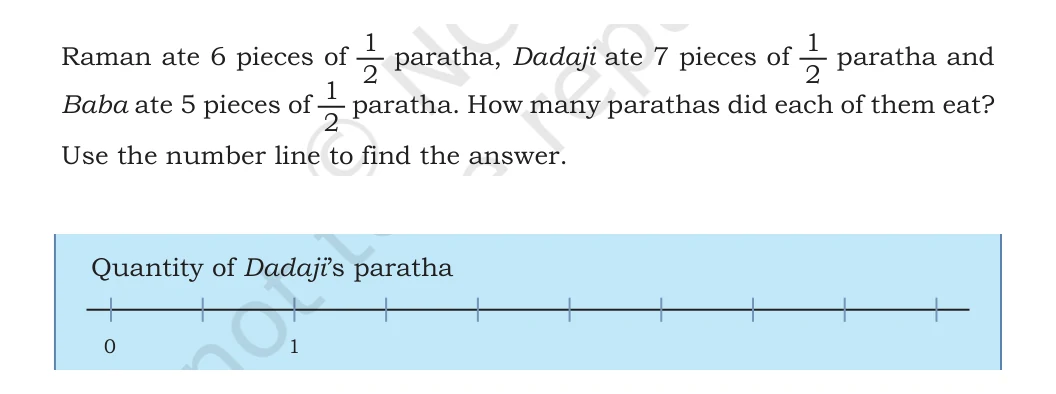
Dadaji ate 7 half-paratha pieces. How many parathas is that?
Show detailed solution
- Step 1: Group the half-pieces in pairs because 2 halves make 1 whole.
- Step 2: Make as many whole pairs as possible from 7 halves.
- Answer: \frac{7}{2}=3\frac{1}{2} parathas.
Textbook page 9 · solved item 70
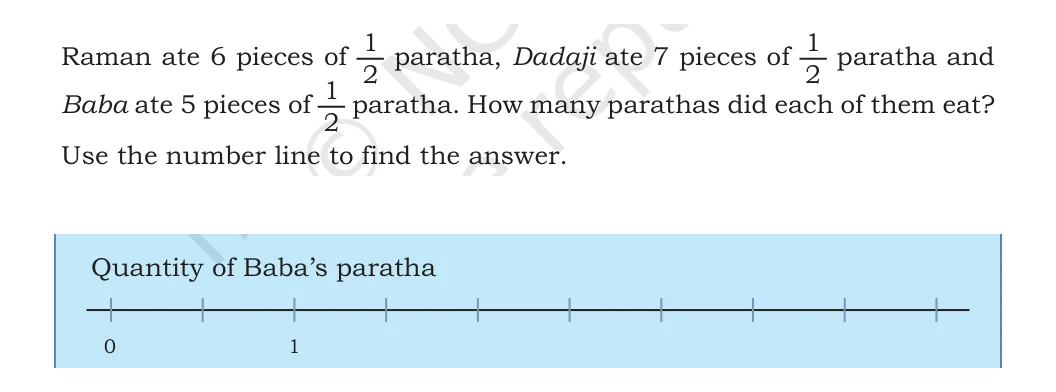
Baba ate 5 half-paratha pieces. How many parathas is that?
Show detailed solution
- Step 1: Group the half-pieces in pairs because 2 halves make 1 whole.
- Step 2: Make as many whole pairs as possible from 5 halves.
- Answer: \frac{5}{2}=2\frac{1}{2} parathas.
Detailed worked answers
Textbook page 10
Textbook page 10 · solved item 71
How many parathas were needed for Raman, Dadaji, and Baba's half-paratha pieces?
Show detailed solution
- Step 1: Add the pieces: 6+7+5=18 half-pieces.
- Step 2: Two half-pieces make 1 whole, so 18\div2=9.
- Answer: 9 parathas were needed.
Textbook page 10 · solved item 72
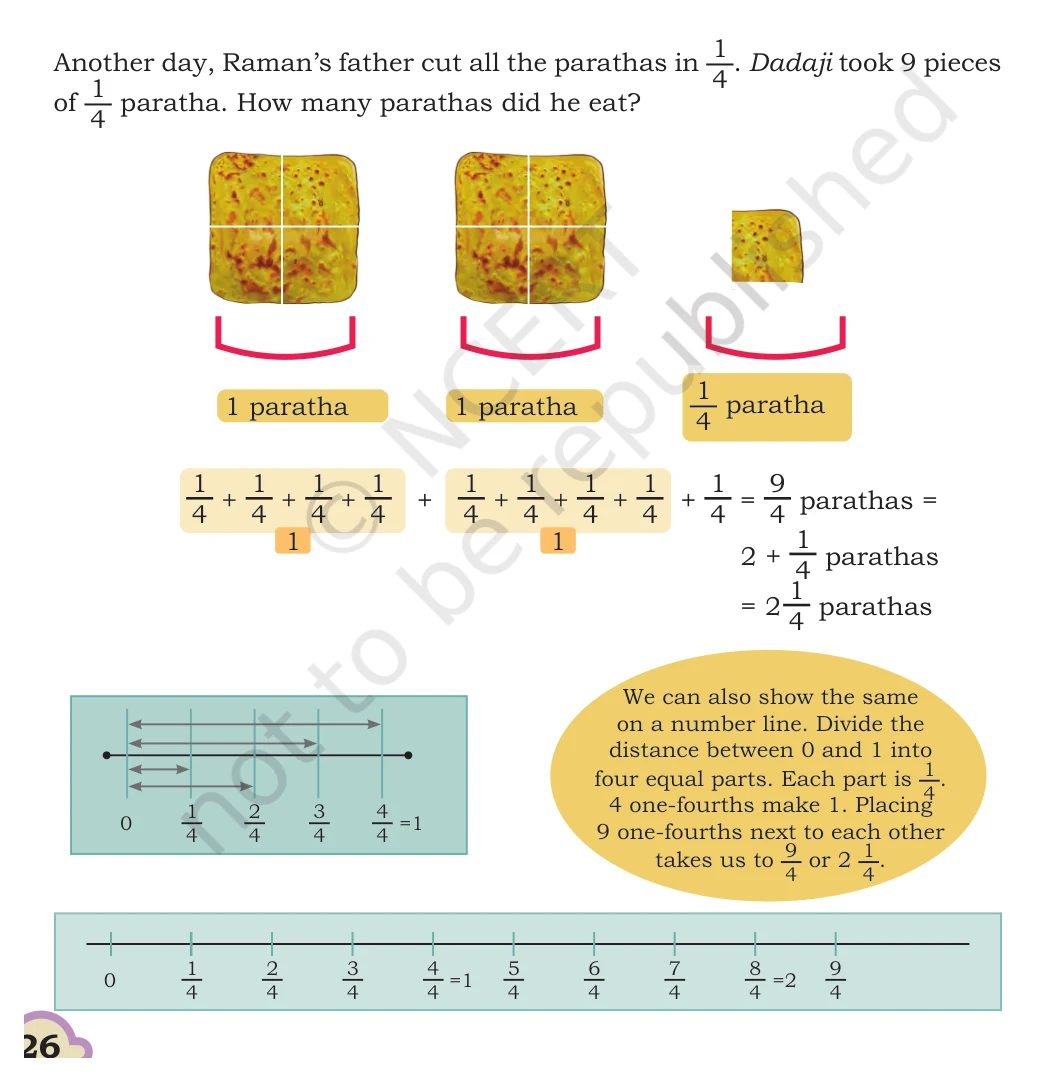
Dadaji took nine quarter-paratha pieces. How many parathas did he eat?
Show detailed solution
- Step 1: Four quarters make 1 whole. Eight quarters make 2 wholes.
- Step 2: One quarter remains after making the 2 wholes.
- Answer: \frac{9}{4}=2\frac{1}{4}. Dadaji ate two and one-fourth parathas.
Detailed worked answers
Textbook page 11
Textbook page 11 · solved item 73
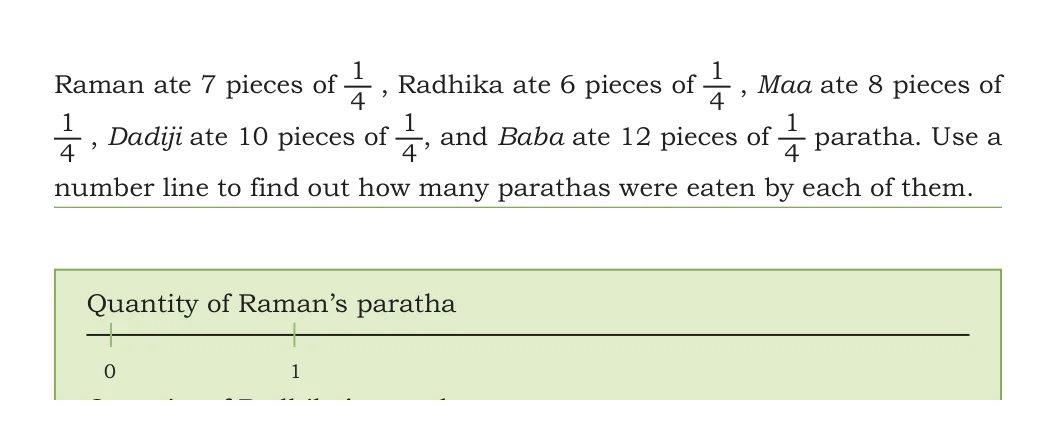
Raman ate 7 quarter-paratha pieces. How many parathas is that?
Show detailed solution
- Step 1: Group the quarter-pieces in sets of 4 because 4 quarters make 1 whole.
- Step 2: Make whole groups from 7 pieces and count any pieces left.
- Answer: \frac{7}{4}=1\frac{3}{4} parathas.
Textbook page 11 · solved item 74
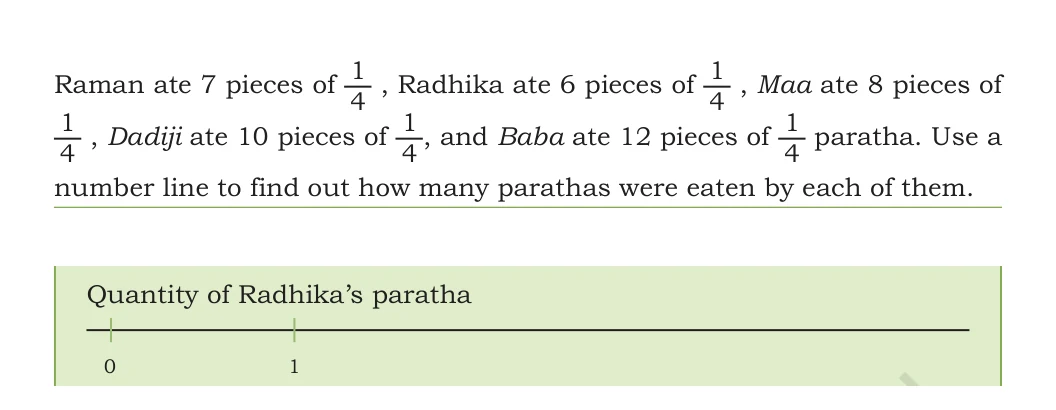
Radhika ate 6 quarter-paratha pieces. How many parathas is that?
Show detailed solution
- Step 1: Group the quarter-pieces in sets of 4 because 4 quarters make 1 whole.
- Step 2: Make whole groups from 6 pieces and count any pieces left.
- Answer: \frac{6}{4}=1\frac{1}{2} parathas.
Textbook page 11 · solved item 75
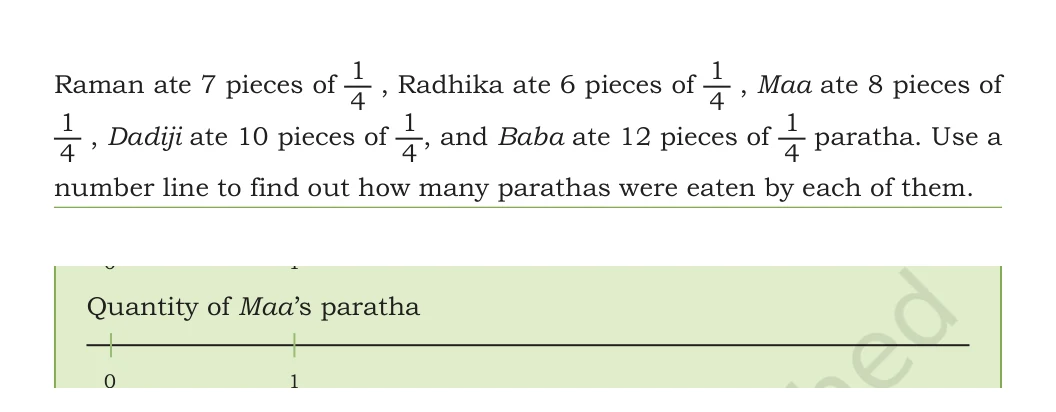
Maa ate 8 quarter-paratha pieces. How many parathas is that?
Show detailed solution
- Step 1: Group the quarter-pieces in sets of 4 because 4 quarters make 1 whole.
- Step 2: Make whole groups from 8 pieces and count any pieces left.
- Answer: \frac{8}{4}=2 parathas.
Textbook page 11 · solved item 76
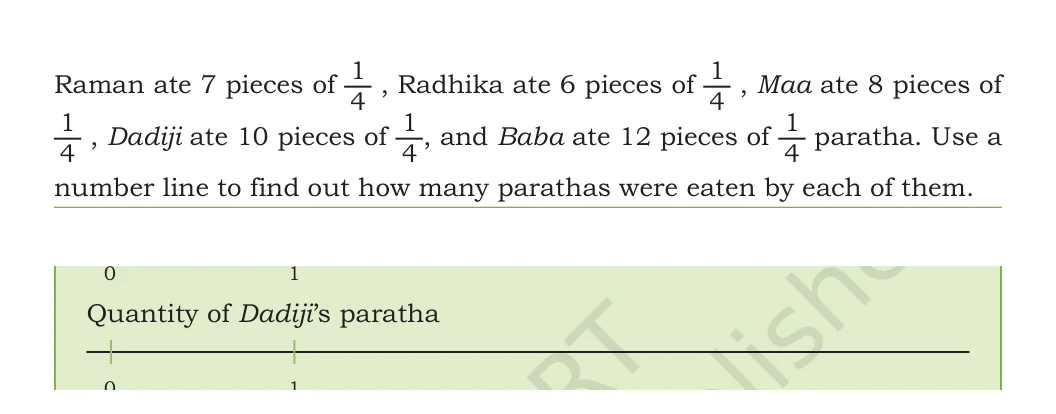
Dadiji ate 10 quarter-paratha pieces. How many parathas is that?
Show detailed solution
- Step 1: Group the quarter-pieces in sets of 4 because 4 quarters make 1 whole.
- Step 2: Make whole groups from 10 pieces and count any pieces left.
- Answer: \frac{10}{4}=2\frac{1}{2} parathas.
Textbook page 11 · solved item 77
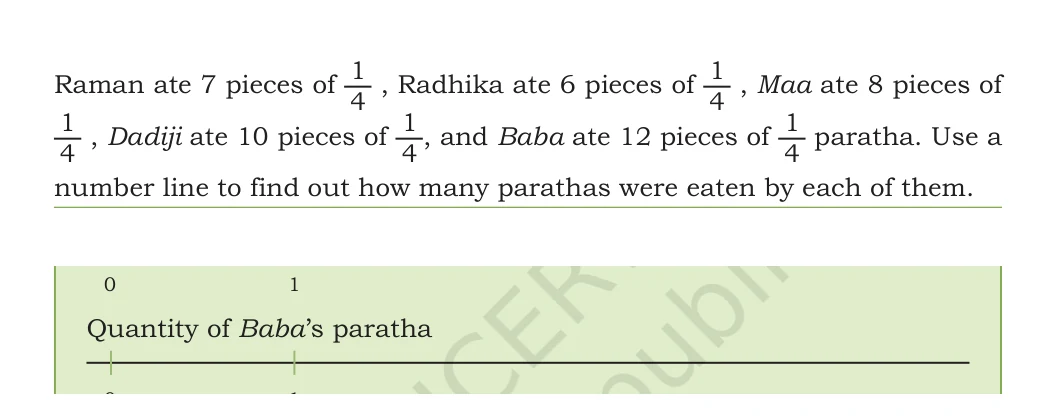
Baba ate 12 quarter-paratha pieces. How many parathas is that?
Show detailed solution
- Step 1: Group the quarter-pieces in sets of 4 because 4 quarters make 1 whole.
- Step 2: Make whole groups from 12 pieces and count any pieces left.
- Answer: \frac{12}{4}=3 parathas.
Textbook page 11 · solved item 78
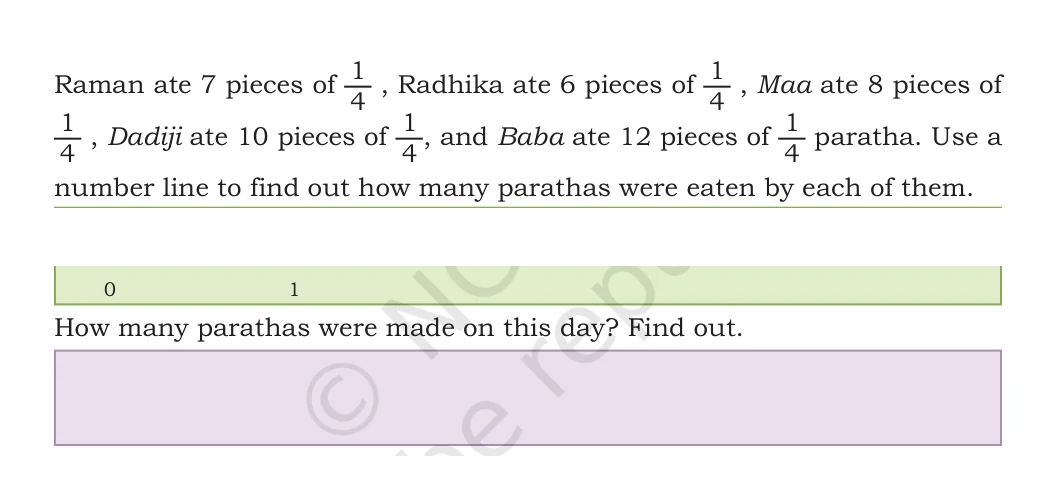
How many whole parathas had to be made for all five quarter-piece shares?
Show detailed solution
- Step 1: Add the quarter-pieces: 7+6+8+10+12=43.
- Step 2: Forty quarter-pieces make 10 wholes, with 3 quarters left. The family ate 10\frac{3}{4} parathas.
- Answer: At least 11 whole parathas had to be made, leaving one quarter if nobody else ate it.
Textbook page 11 · solved item 79
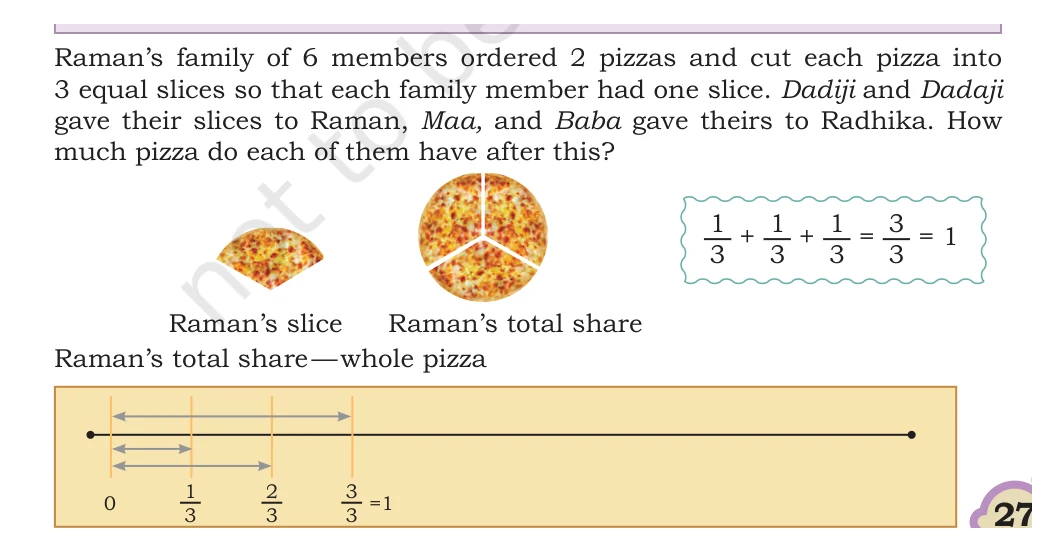
After the family shared two pizzas and gave away slices, how much pizza did each person have?
Show detailed solution
- Step 1: Each of the 6 people started with one \frac{1}{3} slice.
- Step 2: Dadiji and Dadaji gave their slices to Raman, so Raman had \frac{3}{3}=1 pizza. Maa and Baba gave their slices to Radhika, so she also had 1 pizza.
- Answer: Raman and Radhika each had 1 whole pizza. Maa, Baba, Dadiji, and Dadaji had no pizza left after giving away their slices.
Detailed worked answers
Textbook page 12
Textbook page 12 · solved item 80
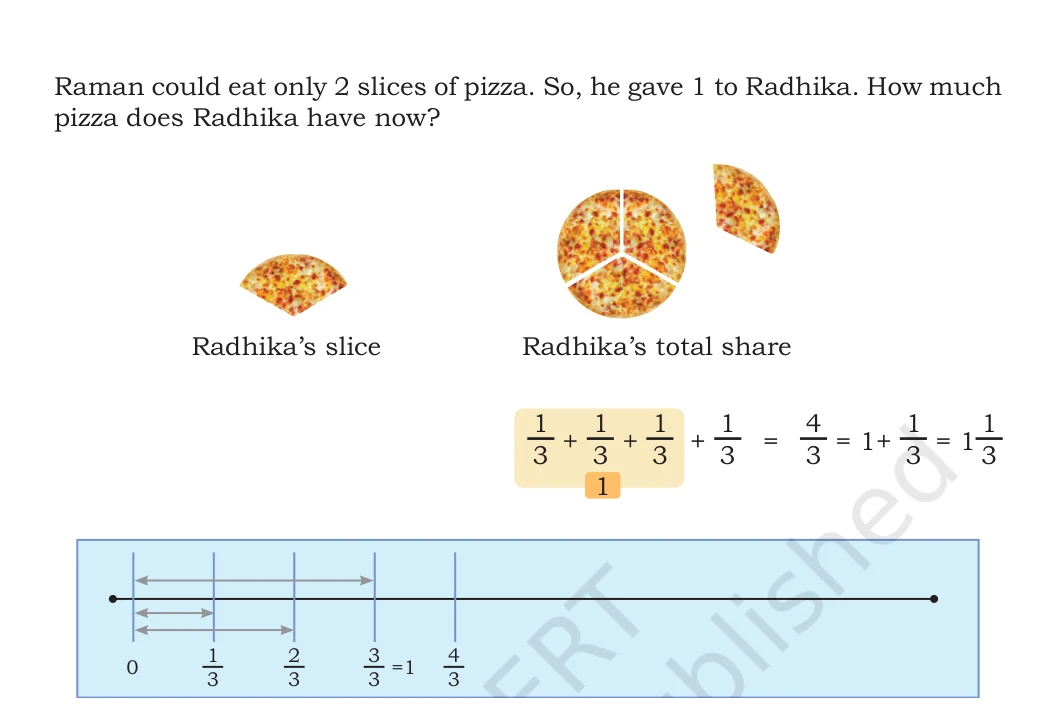
Raman gave one of his three pizza slices to Radhika. How much pizza did Radhika have then?
Show detailed solution
- Step 1: Radhika already had 3 one-third slices, which make 1 whole pizza.
- Step 2: Raman gave her 1 more one-third slice.
- Answer: \frac{3}{3}+\frac{1}{3}=\frac{4}{3}=1\frac{1}{3}. Radhika had one and one-third pizzas.
Textbook page 12 · solved item 81
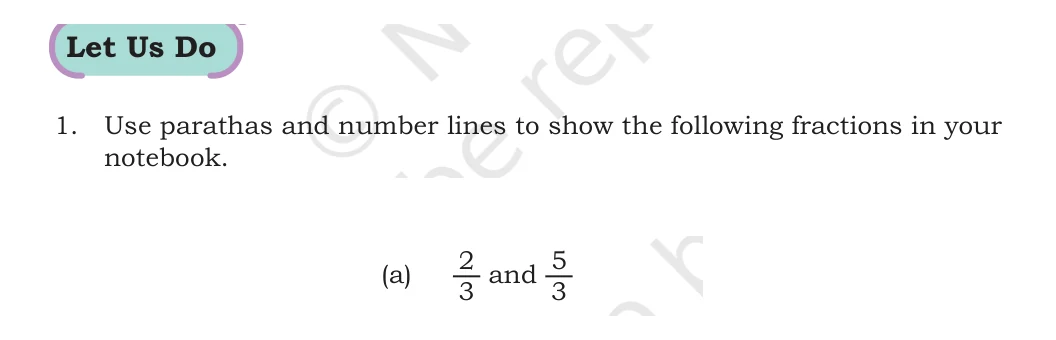
Show \frac{2}{3} and \frac{5}{3} using parathas and a number line (a).
Show detailed solution
- Step 1: Divide each whole into 3 equal parts and mark one step for each \frac{1}{3}.
- Step 2: Count 2 steps for the first fraction and 5 steps for the second.
- Answer: \frac{2}{3} is before 1; \frac{5}{3}=1\frac{2}{3} is after 1.
Textbook page 12 · solved item 82
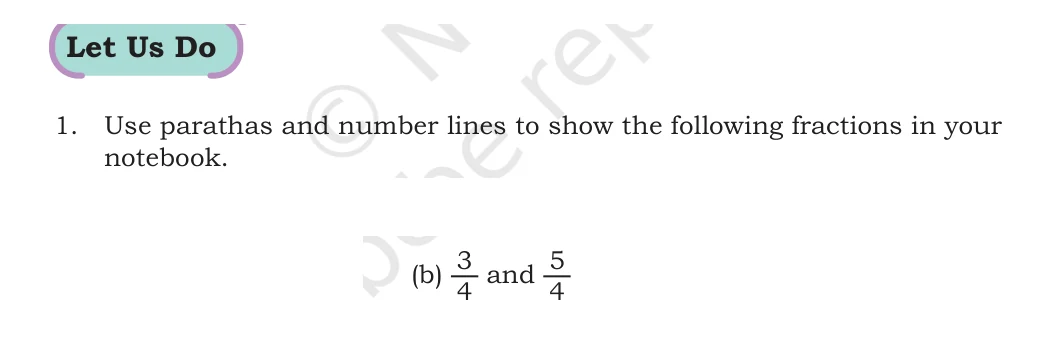
Show \frac{3}{4} and \frac{5}{4} using parathas and a number line (b).
Show detailed solution
- Step 1: Divide each whole into 4 equal parts and mark one step for each \frac{1}{4}.
- Step 2: Count 3 steps for the first fraction and 5 steps for the second.
- Answer: \frac{3}{4} is before 1; \frac{5}{4}=1\frac{1}{4} is after 1.
Textbook page 12 · solved item 83
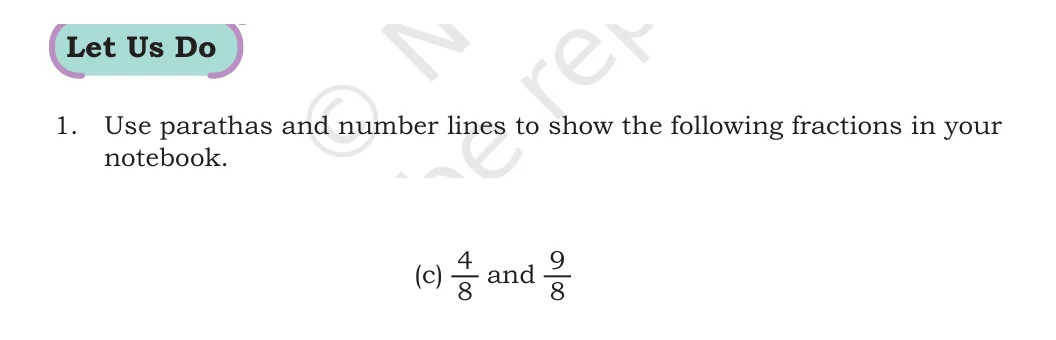
Show \frac{4}{8} and \frac{9}{8} using parathas and a number line (c).
Show detailed solution
- Step 1: Divide each whole into 8 equal parts and mark one step for each \frac{1}{8}.
- Step 2: Count 4 steps for the first fraction and 9 steps for the second.
- Answer: \frac{4}{8}=\frac{1}{2}; \frac{9}{8}=1\frac{1}{8}.
Textbook page 12 · solved item 84
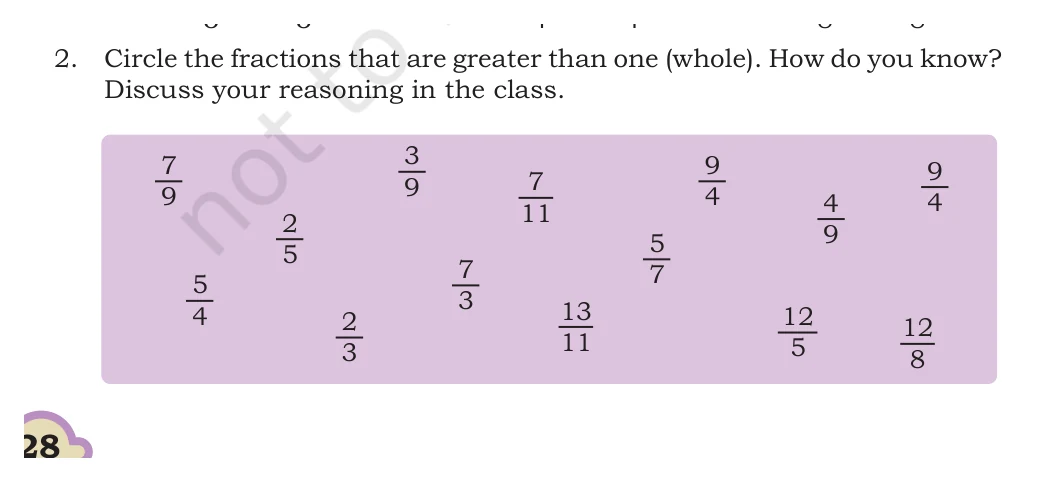
Which fractions in the box are greater than one whole?
Show detailed solution
- Step 1: A fraction is greater than 1 when its top number is greater than its bottom number.
- Step 2: Check every fraction in the box. The two copies of \frac{9}{4} must both be circled.
- Answer: Circle both \frac{9}{4} entries, \frac{5}{4},\frac{7}{3},\frac{13}{11},\frac{12}{5}, and \frac{12}{8}.
Detailed worked answers
Textbook page 13
Textbook page 13 · solved item 85
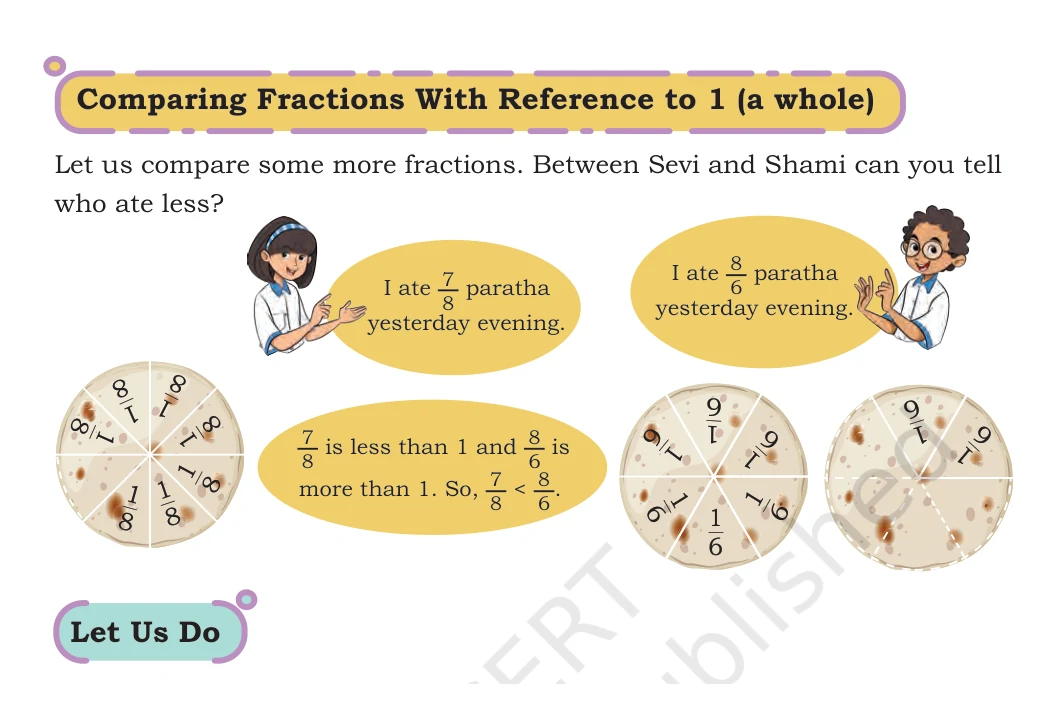
Sevi ate seven-eighths of a paratha and Shami ate eight-sixths. Who ate less?
Show detailed solution
- Step 1: \frac{7}{8} is less than 1 because one eighth is missing.
- Step 2: \frac{8}{6} is more than 1 because 8 pieces are more than the 6 pieces in a whole.
- Answer: Sevi ate less because \frac{7}{8}<\frac{8}{6}.
Textbook page 13 · solved item 86
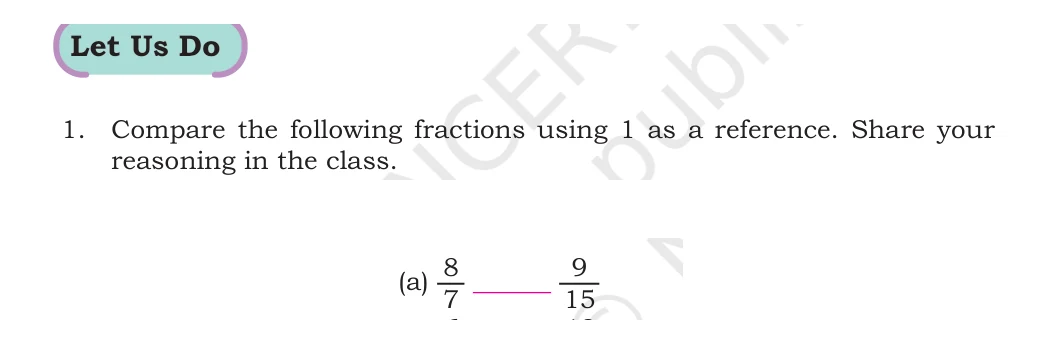
Compare \frac{8}{7} and \frac{9}{15} using 1 as a reference.
Show detailed solution
- Step 1: Compare each top number with its bottom number to decide whether the fraction is below, equal to, or above 1.
- Step 2: The first fraction is above 1 and the second is below 1.
- Answer: \frac{8}{7}>\frac{9}{15}.
Textbook page 13 · solved item 87
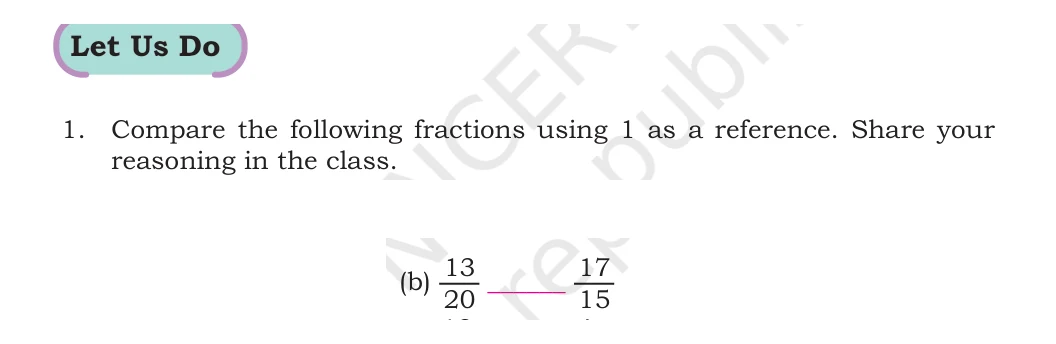
Compare \frac{13}{20} and \frac{17}{15} using 1 as a reference.
Show detailed solution
- Step 1: Compare each top number with its bottom number to decide whether the fraction is below, equal to, or above 1.
- Step 2: The first fraction is below 1 and the second is above 1.
- Answer: \frac{13}{20}<\frac{17}{15}.
Textbook page 13 · solved item 88
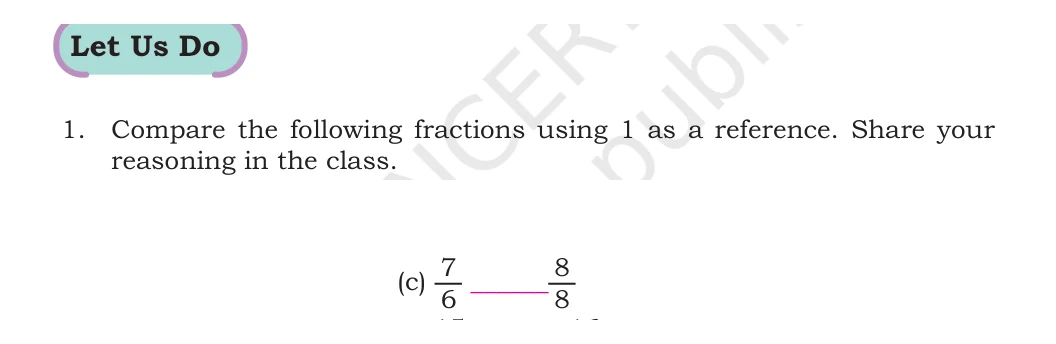
Compare \frac{7}{6} and \frac{8}{8} using 1 as a reference.
Show detailed solution
- Step 1: Compare each top number with its bottom number to decide whether the fraction is below, equal to, or above 1.
- Step 2: The first fraction is above 1 and the second equals 1.
- Answer: \frac{7}{6}>\frac{8}{8}.
Textbook page 13 · solved item 89
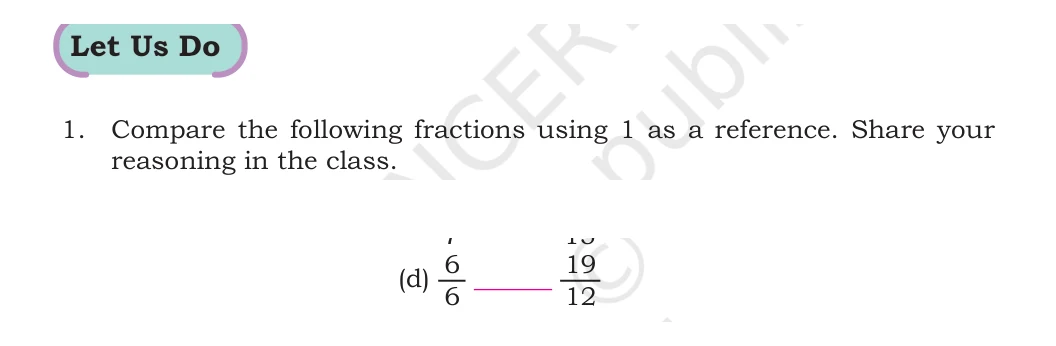
Compare \frac{6}{6} and \frac{19}{12} using 1 as a reference.
Show detailed solution
- Step 1: Compare each top number with its bottom number to decide whether the fraction is below, equal to, or above 1.
- Step 2: The first fraction equals 1 and the second is above 1.
- Answer: \frac{6}{6}<\frac{19}{12}.
Textbook page 13 · solved item 90
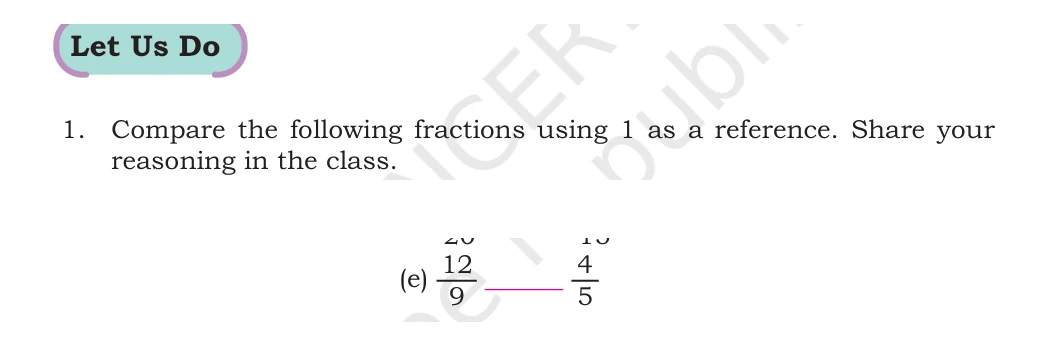
Compare \frac{12}{9} and \frac{4}{5} using 1 as a reference.
Show detailed solution
- Step 1: Compare each top number with its bottom number to decide whether the fraction is below, equal to, or above 1.
- Step 2: The first fraction is above 1 and the second is below 1.
- Answer: \frac{12}{9}>\frac{4}{5}.
Textbook page 13 · solved item 91
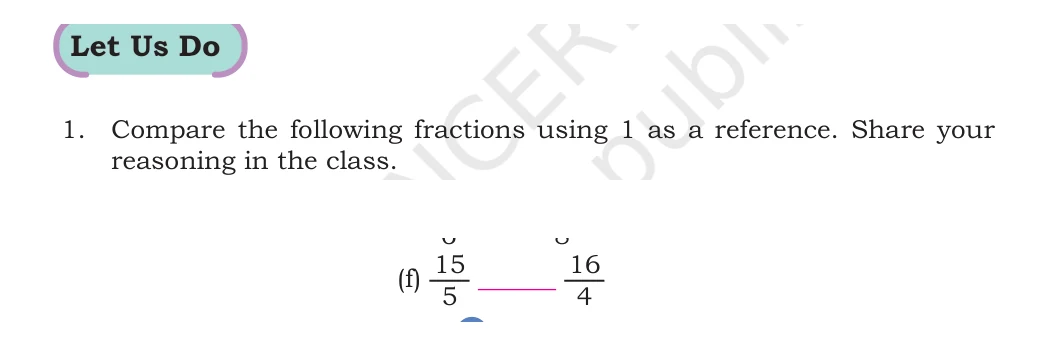
Compare \frac{15}{5} and \frac{16}{4} using 1 as a reference.
Show detailed solution
- Step 1: Compare each top number with its bottom number to decide whether the fraction is below, equal to, or above 1.
- Step 2: The fractions equal 3 and 4 wholes, and 3 is less than 4.
- Answer: \frac{15}{5}<\frac{16}{4}.
Detailed worked answers
Textbook page 14
Textbook page 14 · solved item 92
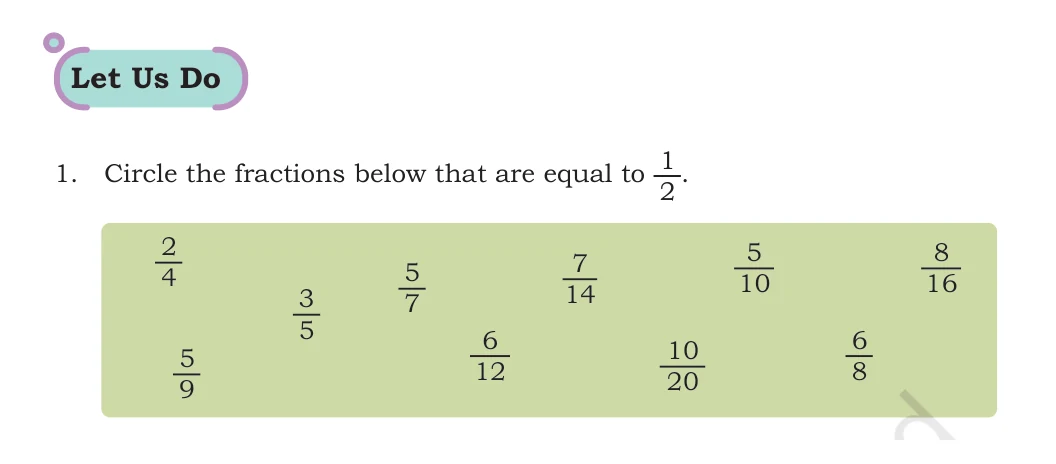
Which fractions in the green box are equal to one-half?
Show detailed solution
- Step 1: A fraction equals one-half when its top number is exactly half of its bottom number.
- Step 2: Check each fraction by pairing the total parts into 2 equal groups.
- Answer: Circle \frac{2}{4},\frac{7}{14},\frac{5}{10},\frac{8}{16},\frac{6}{12}, and \frac{10}{20}.
Textbook page 14 · solved item 93
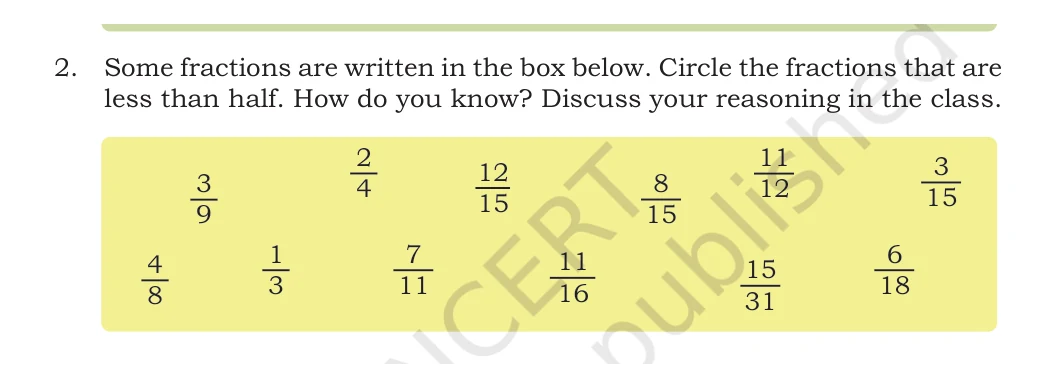
Which fractions in the yellow box are less than one-half?
Show detailed solution
- Step 1: Double the top number. If the result is smaller than the bottom number, the fraction is less than one-half.
- Step 2: Check all 12 fractions. Fractions exactly equal to one-half are not included.
- Answer: Circle \frac{3}{9},\frac{3}{15},\frac{1}{3},\frac{15}{31}, and \frac{6}{18}.
Textbook page 14 · solved item 94
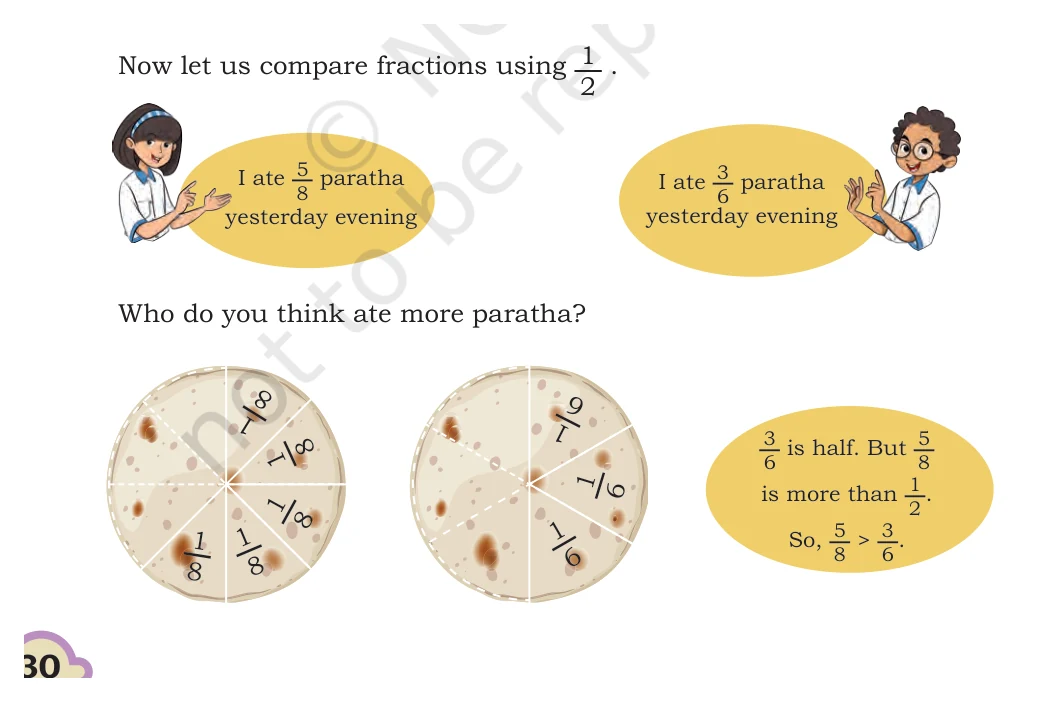
Who ate more: the student who ate five-eighths or the student who ate three-sixths?
Show detailed solution
- Step 1: \frac{3}{6}=\frac{1}{2}.
- Step 2: Half of 8 is 4, and 5 eighths is one eighth more than \frac{4}{8}=\frac{1}{2}.
- Answer: The student who ate \frac{5}{8} ate more because \frac{5}{8}>\frac{3}{6}.
Detailed worked answers
Textbook page 15
Textbook page 15 · solved item 95
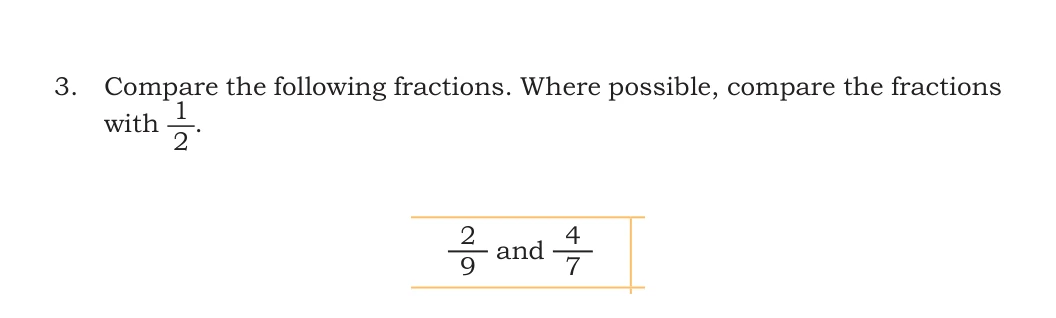
Compare \frac{2}{9} and \frac{4}{7}.
Show detailed solution
- Step 1: Compare each fraction with one-half by doubling its top number and comparing with the bottom number.
- Step 2: \frac{2}{9} is less than one-half, while \frac{4}{7} is more than one-half.
- Answer: \frac{2}{9}<\frac{4}{7}.
Textbook page 15 · solved item 96
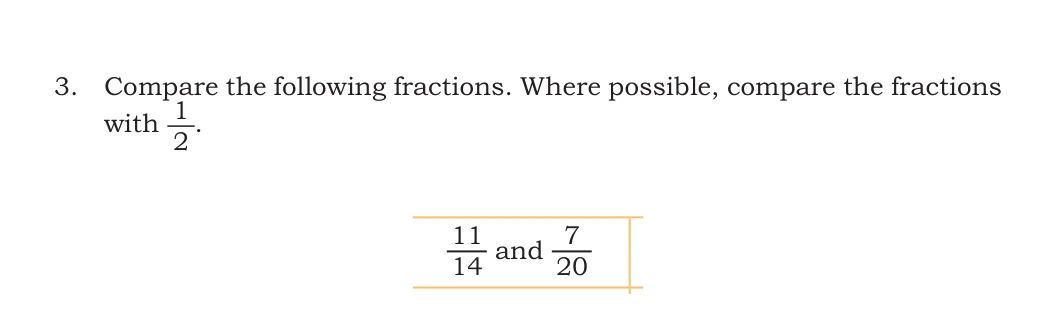
Compare \frac{11}{14} and \frac{7}{20}.
Show detailed solution
- Step 1: Compare each fraction with one-half by doubling its top number and comparing with the bottom number.
- Step 2: \frac{11}{14} is more than one-half, while \frac{7}{20} is less than one-half.
- Answer: \frac{11}{14}>\frac{7}{20}.
Textbook page 15 · solved item 97
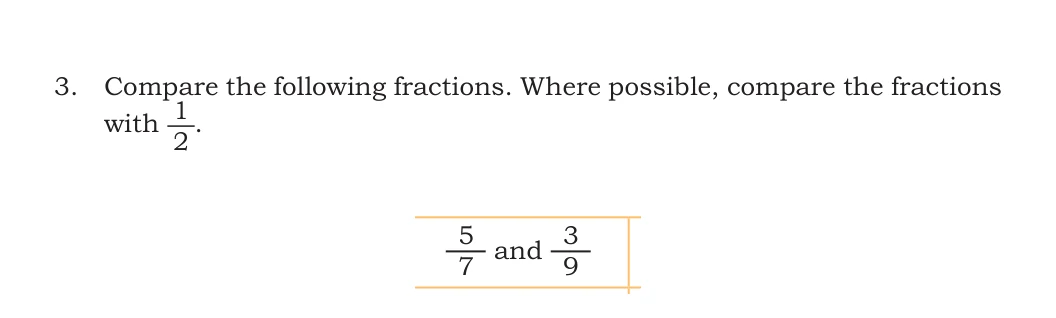
Compare \frac{5}{7} and \frac{3}{9}.
Show detailed solution
- Step 1: Compare each fraction with one-half by doubling its top number and comparing with the bottom number.
- Step 2: \frac{5}{7} is more than one-half, while \frac{3}{9} is less than one-half.
- Answer: \frac{5}{7}>\frac{3}{9}.
Textbook page 15 · solved item 98
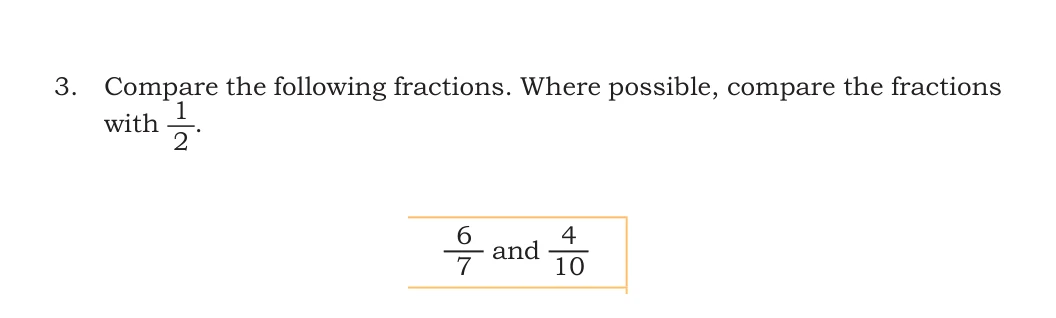
Compare \frac{6}{7} and \frac{4}{10}.
Show detailed solution
- Step 1: Compare each fraction with one-half by doubling its top number and comparing with the bottom number.
- Step 2: \frac{6}{7} is more than one-half, while \frac{4}{10} is less than one-half.
- Answer: \frac{6}{7}>\frac{4}{10}.
Textbook page 15 · solved item 99
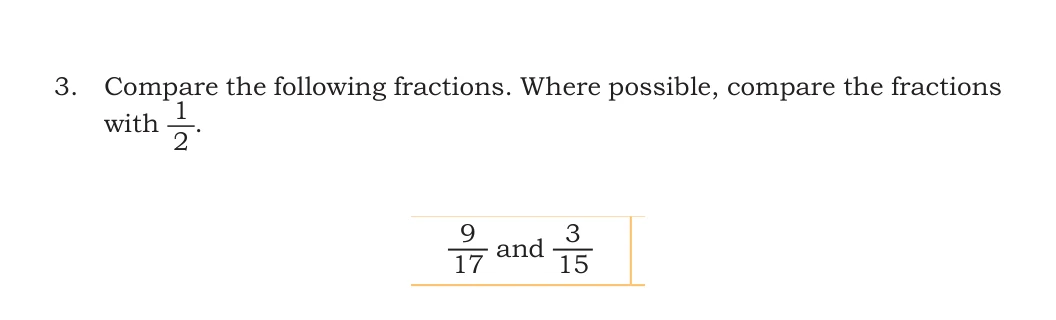
Compare \frac{9}{17} and \frac{3}{15}.
Show detailed solution
- Step 1: Compare each fraction with one-half by doubling its top number and comparing with the bottom number.
- Step 2: \frac{9}{17} is more than one-half, while \frac{3}{15} is less than one-half.
- Answer: \frac{9}{17}>\frac{3}{15}.
Textbook page 15 · solved item 100
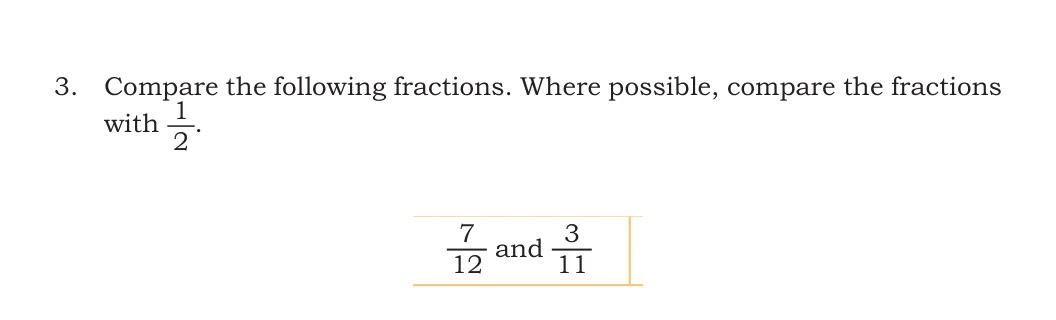
Compare \frac{7}{12} and \frac{3}{11}.
Show detailed solution
- Step 1: Compare each fraction with one-half by doubling its top number and comparing with the bottom number.
- Step 2: \frac{7}{12} is more than one-half, while \frac{3}{11} is less than one-half.
- Answer: \frac{7}{12}>\frac{3}{11}.
Textbook page 15 · solved item 101
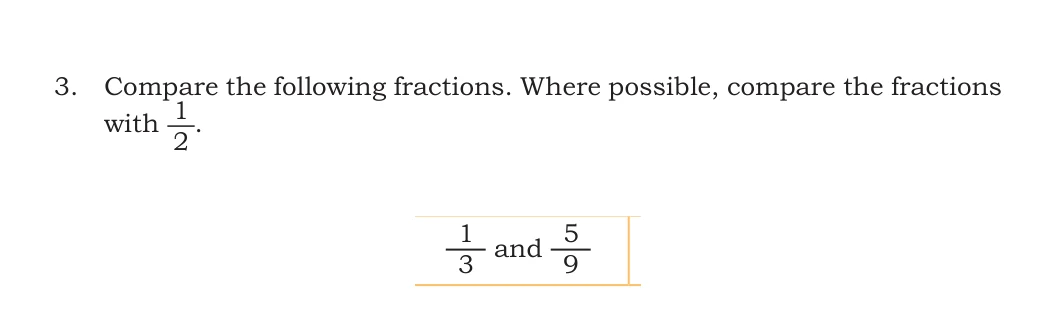
Compare \frac{1}{3} and \frac{5}{9}.
Show detailed solution
- Step 1: Compare each fraction with one-half by doubling its top number and comparing with the bottom number.
- Step 2: \frac{1}{3} is less than one-half, while \frac{5}{9} is more than one-half.
- Answer: \frac{1}{3}<\frac{5}{9}.
Textbook page 15 · solved item 102
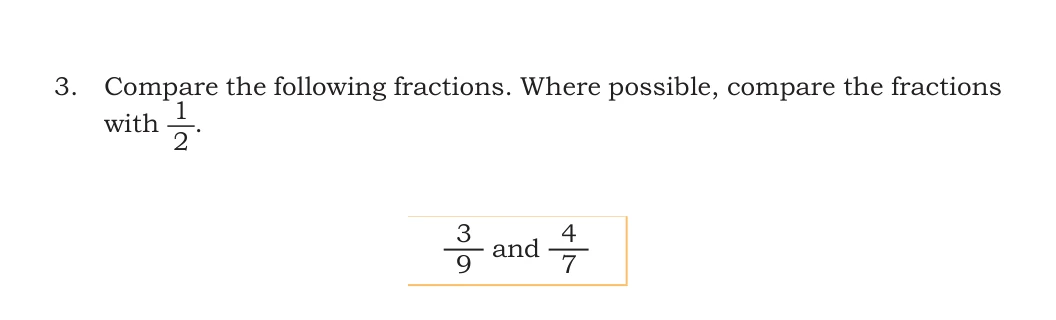
Compare \frac{3}{9} and \frac{4}{7}.
Show detailed solution
- Step 1: Compare each fraction with one-half by doubling its top number and comparing with the bottom number.
- Step 2: \frac{3}{9} is less than one-half, while \frac{4}{7} is more than one-half.
- Answer: \frac{3}{9}<\frac{4}{7}.
Textbook page 15 · solved item 103
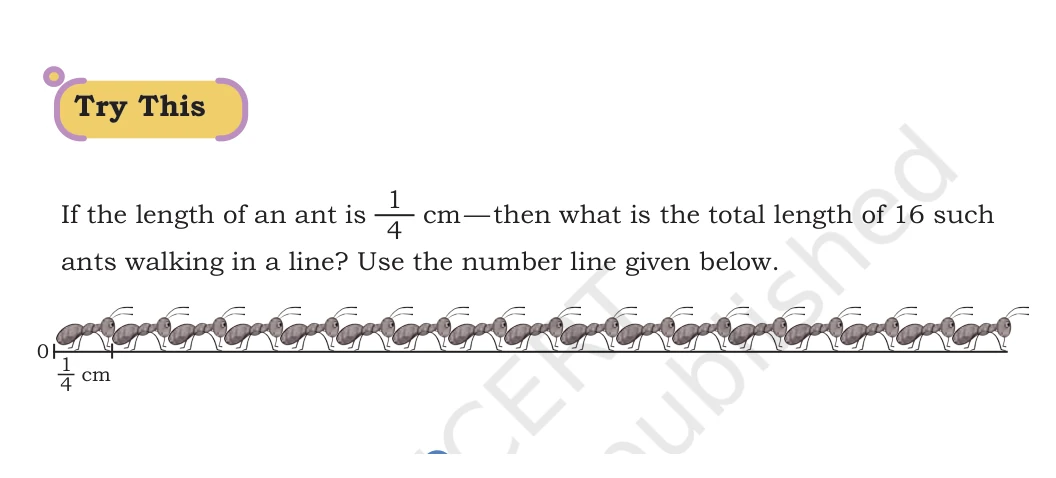
Sixteen ants are each one-fourth centimetre long. What is their total length in a line?
Show detailed solution
- Step 1: Four lengths of one-fourth centimetre make 1 centimetre.
- Step 2: Make groups of 4 ants: 16\div4=4 groups.
- Answer: 16\times\frac{1}{4}=4 cm. The line of ants is 4 cm long.
Textbook page 15 · solved item 104
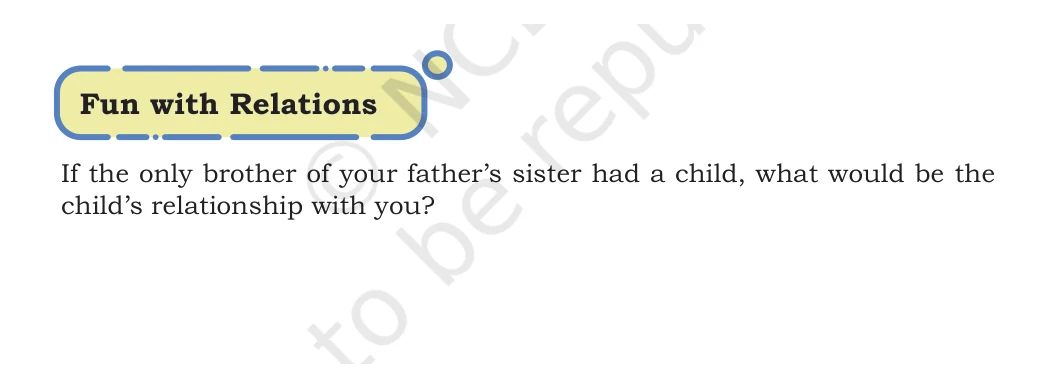
What is the child of the only brother of your father's sister to you?
Show detailed solution
- Step 1: Your father's sister is your aunt.
- Step 2: Her only brother is your father, so the child is your father's child.
- Answer: The child is you or your brother or sister. If the question means another child of your father, that child is your sibling.