
Question-by-question working
Read the prompt, attempt it, then check each step
Every exercise subpart and table row is a separate item. Shared figures and table headings are repeated whenever they are needed to understand the question.
Detailed worked answers
Textbook page 142
Textbook page 142 · solved item 1
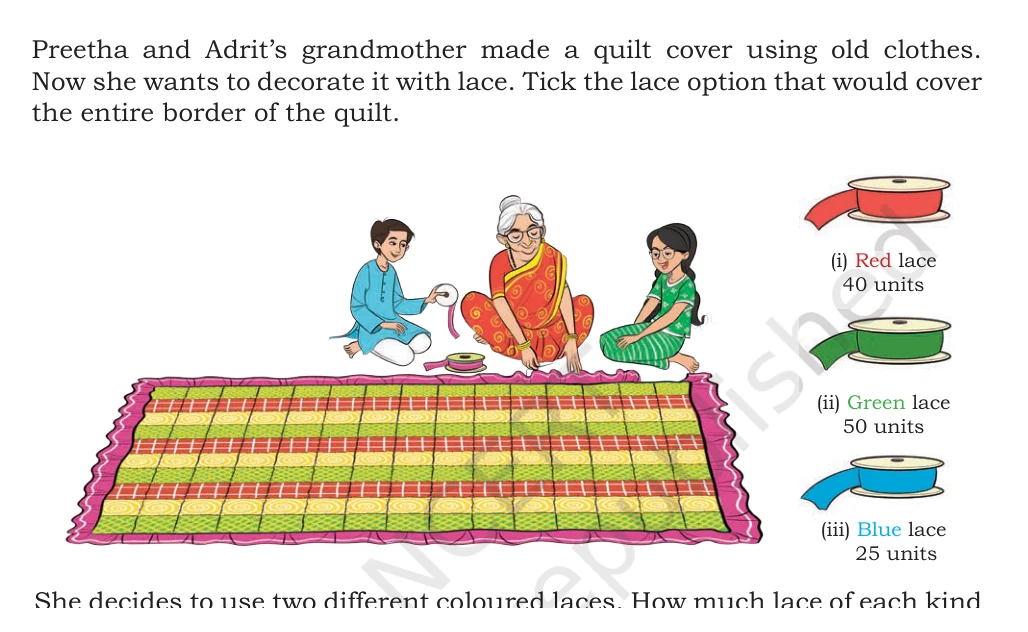
Which lace option will cover the entire border of the quilt?
Show detailed solution
- Step 1: Count the unit lengths all around the quilt, because the complete border is its perimeter.
- Step 2: The two long sides and the two short sides together measure 50 units.
- Step 3: Compare 50 units with the three choices: 40, 50, and 25 units.
- Answer: Tick the green lace of 50 units.
Textbook page 142 · solved item 2

If two different coloured laces share the entire border equally, how much of each colour is needed?
Show detailed solution
- Step 1: The entire border needs 50 units of lace.
- Step 2: Two colours share the border equally, so divide 50 into two equal parts.
- Step 3: 50 \div 2 = 25. Check: 25 + 25 = 50.
- Answer: 25 units of each coloured lace are needed.
Textbook page 142 · solved item 3

Find the perimeter of the equal-sided pentagon whose side is 4 cm.
Show detailed solution
- Step 1: A pentagon has 5 sides.
- Step 2: Every side is 4 cm, so add 4 + 4 + 4 + 4 + 4.
- Step 3: The sum is 20 cm.
- Answer: The perimeter is 20 cm.
Textbook page 142 · solved item 4

Find the perimeter of the hourglass shape when every side is 5 cm.
Show detailed solution
- Step 1: The outline is made of 6 equal sides. The two triangles meet only at one corner.
- Step 2: Add the six side lengths: 5 + 5 + 5 + 5 + 5 + 5.
- Step 3: The sum is 30 cm.
- Answer: The perimeter is 30 cm.
Textbook page 142 · solved item 5

Draw two different rectangles, each with perimeter 26 cm.
Show detailed solution
- Step 1: For the first rectangle, use sides 8 cm and 5 cm.
- Step 2: Its perimeter is 8 + 5 + 8 + 5 = 26 cm.
- Step 3: For the second rectangle, use sides 7 cm and 6 cm. Its perimeter is 7 + 6 + 7 + 6 = 26 cm.
- Answer: Rectangles 8\text{ cm} \times 5\text{ cm} and 7\text{ cm} \times 6\text{ cm} are two correct examples.
Textbook page 142 · solved item 6

Draw two different rectangles, each with perimeter 18 cm.
Show detailed solution
- Step 1: For the first rectangle, use sides 5 cm and 4 cm.
- Step 2: Its perimeter is 5 + 4 + 5 + 4 = 18 cm.
- Step 3: For the second rectangle, use sides 6 cm and 3 cm. Its perimeter is 6 + 3 + 6 + 3 = 18 cm.
- Answer: Rectangles 5\text{ cm} \times 4\text{ cm} and 6\text{ cm} \times 3\text{ cm} are two correct examples.
Detailed worked answers
Textbook page 143
Textbook page 143 · solved item 7

How many square patches were used to make the rug?
Show detailed solution
- Step 1: Count 16 patches in one row.
- Step 2: Count 5 equal rows.
- Step 3: Add 16 patches five times: 16 + 16 + 16 + 16 + 16 = 80.
- Answer: They used 80 square patches.
Textbook page 143 · solved item 8

Which first shape covers the table without gaps and overlaps?
Show detailed solution
- Step 1: Look for shapes that touch along full edges.
- Step 2: Check that there are no empty spaces and no overlapping pieces.
- Step 3: Table 1 is completely filled by triangles that meet edge to edge.
- Answer: Write triangles in the blank.
Textbook page 143 · solved item 9

Which second shape covers the table without gaps and overlaps?
Show detailed solution
- Step 1: Look for shapes that touch along full edges.
- Step 2: Check that there are no empty spaces and no overlapping pieces.
- Step 3: Table 3 is completely filled by squares that meet edge to edge.
- Answer: Write squares in the blank.
Textbook page 143 · solved item 10

Which third shape covers the table without gaps and overlaps?
Show detailed solution
- Step 1: Look for shapes that touch along full edges.
- Step 2: Check that there are no empty spaces and no overlapping pieces.
- Step 3: Table 4 is completely filled by rectangles that meet edge to edge.
- Answer: Write rectangles in the blank.
Textbook page 143 · solved item 11
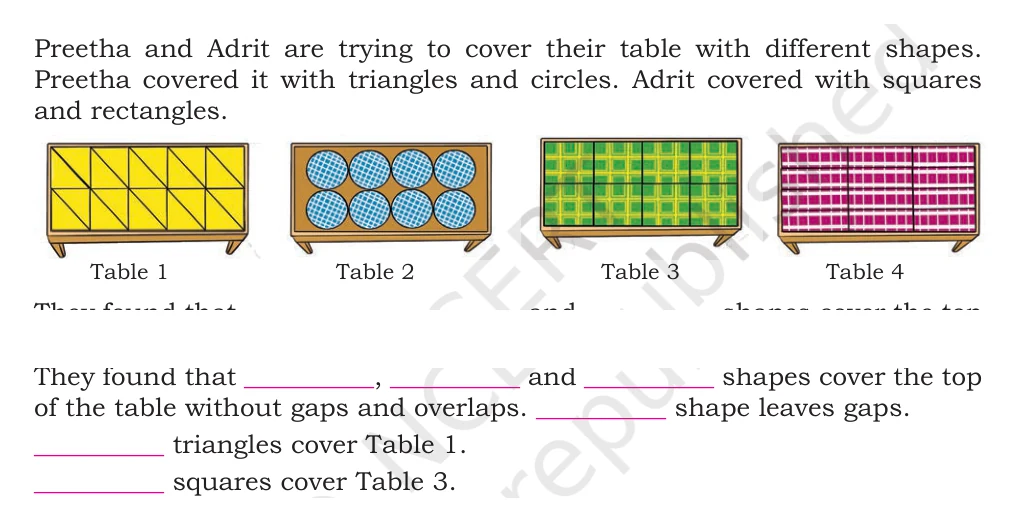
Which shape leaves gaps when it is used to cover the table?
Show detailed solution
- Step 1: Look at the spaces between neighbouring circles in Table 2.
- Step 2: Curved circle edges do not meet all the way around.
- Step 3: The small uncovered spaces are gaps.
- Answer: The circle leaves gaps.
Textbook page 143 · solved item 12

How many triangles cover Table 1?
Show detailed solution
- Step 1: There are 5 columns and 2 rows of squares.
- Step 2: Each square is divided into 2 triangles.
- Step 3: 5 \times 2 \times 2 = 20.
- Answer: 20 triangles.
Textbook page 143 · solved item 13

How many squares cover Table 3?
Show detailed solution
- Step 1: There are 4 squares in each row.
- Step 2: There are 2 rows.
- Step 3: 4 \times 2 = 8.
- Answer: 8 squares.
Textbook page 143 · solved item 14

How many rectangles cover Table 4?
Show detailed solution
- Step 1: There are 3 rectangles in each row.
- Step 2: There are 4 rows.
- Step 3: 3 \times 4 = 12.
- Answer: 12 rectangles.
Textbook page 143 · solved item 15

Do circles tile? Can circles be used by themselves to cover a region completely?
Show detailed solution
- Step 1: Place equal circles beside one another as in Table 2.
- Step 2: Their curved edges touch only at points, leaving spaces between them.
- Step 3: A tiling must have no gaps and no overlaps.
- Answer: No. Circles do not tile a region by themselves.
Textbook page 143 · solved item 16

What is the area of Table 1 in triangle units?
Show detailed solution
- Step 1: The table contains 20 equal triangles.
- Step 2: Count each triangle as one triangle unit.
- Step 3: The number of equal covering pieces gives the area in that kind of unit.
- Answer: The area is 20 triangle units.
Textbook page 143 · solved item 17

What is the area of Table 3 in square units?
Show detailed solution
- Step 1: The table contains 8 equal squares.
- Step 2: Count each square as one square unit.
- Step 3: The number of equal covering pieces gives the area in that kind of unit.
- Answer: The area is 8 square units.
Textbook page 143 · solved item 18

What is the area of Table 4 in rectangle units?
Show detailed solution
- Step 1: The table contains 12 equal rectangles.
- Step 2: Count each rectangle as one rectangle unit.
- Step 3: The number of equal covering pieces gives the area in that kind of unit.
- Answer: The area is 12 rectangle units.
Textbook page 143 · solved item 19

Which of the listed objects can cover your table completely without gaps or overlaps?
Show detailed solution
- Step 1: Arrange one kind of same-sized object at a time in straight rows.
- Step 2: Notebooks, lunch boxes, pencil boxes, and maths textbooks usually have rectangular top faces, so copies of the same size can meet edge to edge.
- Step 3: Whether they cover your particular table exactly also depends on whether whole rows fit its length and breadth without a leftover strip.
- Answer: Record what happens in the activity. Rectangular objects can tile, but the exact objects that cover the whole table depend on their size and your table's size.
Detailed worked answers
Textbook page 144
Textbook page 144 · solved item 20

How many green triangles of the shown size will cover the desk?
Show detailed solution
- Step 1: The desk grid has 9 \times 6 = 54 square spaces.
- Step 2: One green triangle is half of one square, so each square needs 2 green triangles.
- Step 3: 54 \times 2 = 108.
- Answer: 108 green triangles will cover the desk.
Textbook page 144 · solved item 21

How many red triangles of the shown size will cover the desk?
Show detailed solution
- Step 1: The red triangle covers half of a 3-by-3 square block.
- Step 2: Two such triangles make 9 square spaces.
- Step 3: The 54-square desk contains 54 \div 9 = 6 such pairs, and 6 \times 2 = 12.
- Answer: 12 red triangles will cover the desk.
Textbook page 144 · solved item 22

How many blue squares of the shown size will cover the desk?
Show detailed solution
- Step 1: Each blue square covers exactly one grid space.
- Step 2: The desk has 9 columns and 6 rows.
- Step 3: 9 \times 6 = 54.
- Answer: 54 blue squares will cover the desk.
Detailed worked answers
Textbook page 145
Textbook page 145 · solved item 23
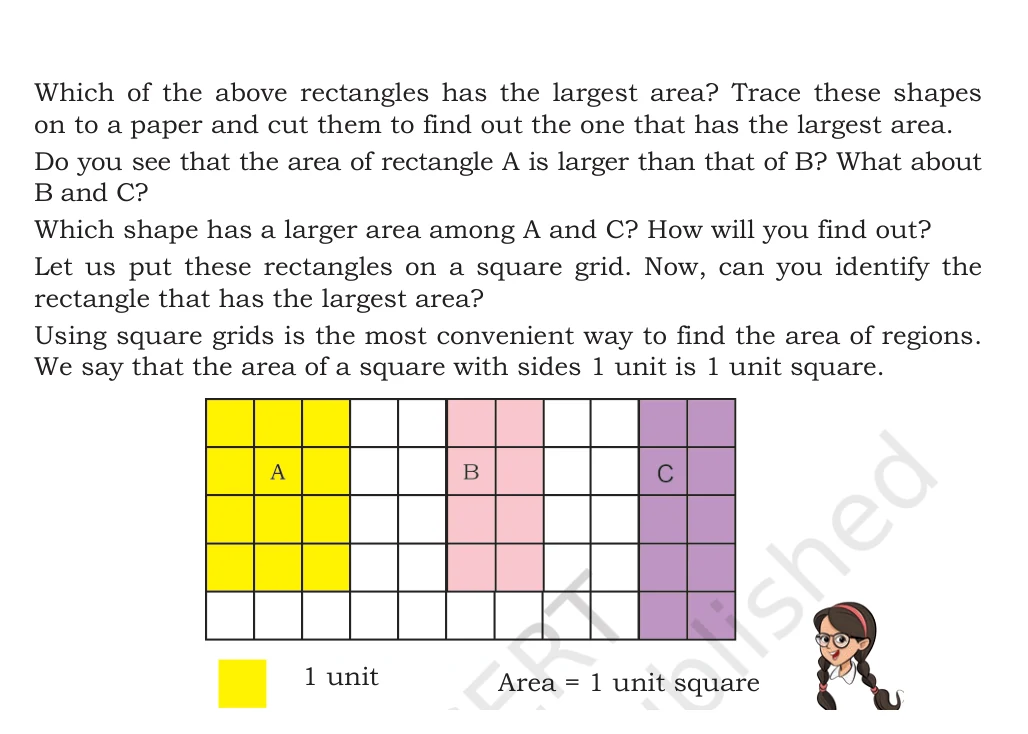
Which of rectangles A, B, and C has the largest area when traced and compared?
Show detailed solution
- Step 1: A covers 12 unit squares, B covers 8, and C covers 10.
- Step 2: The greatest of 12, 8, and 10 is 12.
- Step 3: Compare the counts using the same unit square.
- Answer: Rectangle A has the largest area.
Textbook page 145 · solved item 24

Is rectangle A larger than B, and how do B and C compare?
Show detailed solution
- Step 1: Rectangle A covers 12 squares and B covers 8.
- Step 2: Rectangle C covers 10 squares, which is 2 more than B.
- Step 3: Compare the counts using the same unit square.
- Answer: A is larger than B, and C is larger than B.
Textbook page 145 · solved item 25

Which has the larger area, rectangle A or rectangle C? How can you find out?
Show detailed solution
- Step 1: Place both shapes on the same square grid.
- Step 2: Count 12 squares for A and 10 squares for C.
- Step 3: Compare the counts using the same unit square.
- Answer: Rectangle A is larger than C by 2 unit squares.
Textbook page 145 · solved item 26

After placing the rectangles on a square grid, which rectangle has the largest area?
Show detailed solution
- Step 1: Count the coloured unit squares inside each outline.
- Step 2: A has 12, B has 8, and C has 10 unit squares.
- Step 3: Compare the counts using the same unit square.
- Answer: Rectangle A has the largest area.
Textbook page 145 · solved item 27

Find the area of Garden A on the 1 cm square grid.
Show detailed solution
- Step 1: Garden A covers 2 columns of green squares.
- Step 2: Each column contains 5 green squares.
- Step 3: 2 \times 5 = 10 square centimetres.
- Answer: The area of Garden A is 10\text{ cm}^2.
Textbook page 145 · solved item 28

Find the area of Garden B on the 1 cm square grid and compare it with Garden A.
Show detailed solution
- Step 1: Garden B covers 4 columns and 3 rows of green squares.
- Step 2: 4 \times 3 = 12 square centimetres.
- Step 3: Garden A is 10\text{ cm}^2, and 12 is 2 more than 10.
- Answer: Garden B is 12\text{ cm}^2, so it is 2\text{ cm}^2 larger than Garden A.
Detailed worked answers
Textbook page 146
Textbook page 146 · solved item 29
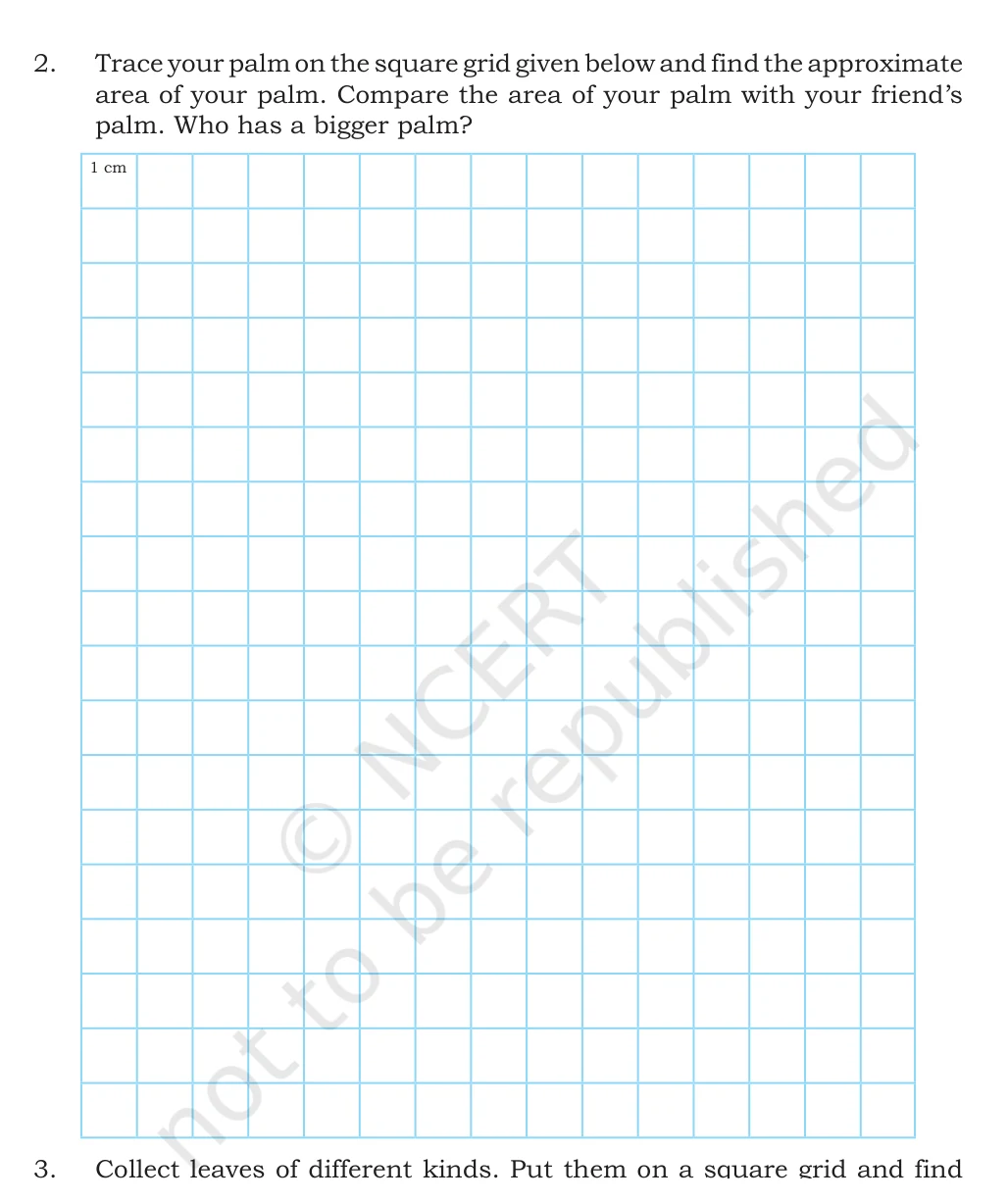
Trace your palm on the grid, estimate its area, and compare it with a friend's palm.
Show detailed solution
- Step 1: Count every square completely inside your palm tracing.
- Step 2: Pair partly covered squares to make about one whole square. Add these to the complete-square count.
- Step 3: Repeat the same method for your friend's tracing and compare the two estimates.
- Answer: Results will vary. The tracing with the greater estimated number of square centimetres is the bigger palm.
Textbook page 146 · solved item 30

Which collected leaf has the largest area?
Show detailed solution
- Step 1: Place each leaf on the same square grid and trace it.
- Step 2: Count full squares and combine partial squares in the same way for every leaf.
- Step 3: Compare the estimated square counts.
- Answer: Name the leaf with the greatest estimated number of square units. The exact leaf depends on your collection.
Textbook page 146 · solved item 31

Which collected leaf has the smallest area?
Show detailed solution
- Step 1: Trace every leaf on the same kind of square grid.
- Step 2: Estimate each area by counting full squares and combining partial squares.
- Step 3: Compare all the estimated square counts.
- Answer: Name the leaf with the least estimated number of square units. The exact leaf depends on your collection.
Detailed worked answers
Textbook page 147
Textbook page 147 · solved item 32
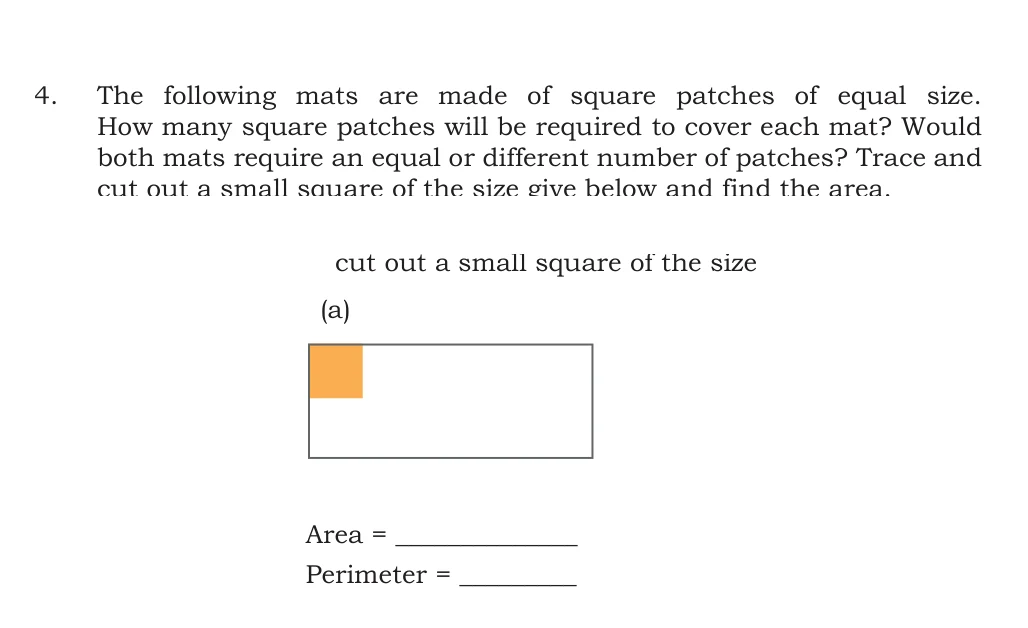
How many square patches cover mat (a), and what are its area and perimeter?
Show detailed solution
- Step 1: The sample patch fits 5 times along the length and 2 times along the breadth.
- Step 2: The number of patches is 5 \times 2 = 10, so the area is 10 square units.
- Step 3: The boundary is 5 + 2 + 5 + 2 = 14 units.
- Answer: 10 patches; area 10 square units; perimeter 14 units.
Textbook page 147 · solved item 33

How many square patches cover mat (b), and what are its area and perimeter?
Show detailed solution
- Step 1: The sample patch fits 4 times along each side.
- Step 2: The number of patches is 4 \times 4 = 16, so the area is 16 square units.
- Step 3: The boundary is 4 + 4 + 4 + 4 = 16 units.
- Answer: 16 patches; area 16 square units; perimeter 16 units.
Textbook page 147 · solved item 34

Do mats (a) and (b) require an equal or a different number of square patches?
Show detailed solution
- Step 1: Mat (a) needs 10 patches.
- Step 2: Mat (b) needs 16 patches.
- Step 3: 16 - 10 = 6, so the counts are not equal.
- Answer: They need different numbers of patches; mat (b) needs 6 more.
Textbook page 147 · solved item 35
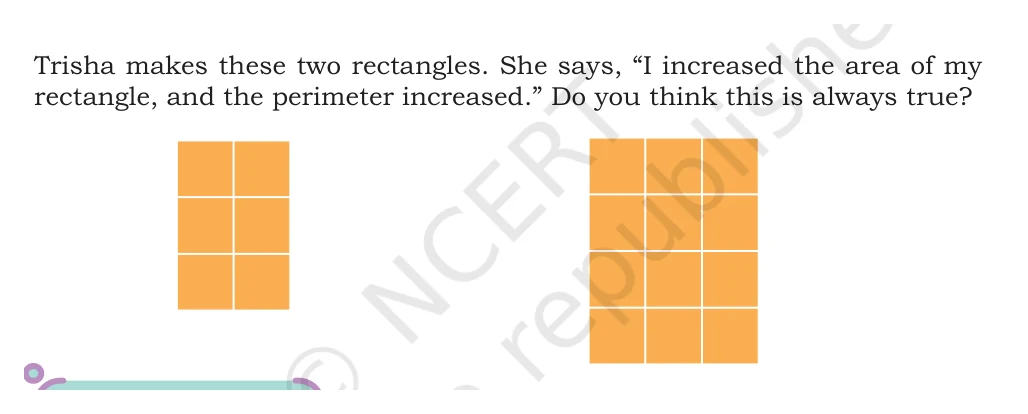
Trisha says that increasing a rectangle's area always increases its perimeter. Is this always true?
Show detailed solution
- Step 1: Her first rectangle has area 6 square units and perimeter 10 units.
- Step 2: Her second rectangle has area 12 square units and perimeter 14 units, so both increase in her example.
- Step 3: Try a 1-by-12 rectangle: its area is 12 and perimeter is 26. A 3-by-5 rectangle has the larger area 15, but the smaller perimeter 16.
- Answer: No. A larger area does not always mean a larger perimeter.
Textbook page 147 · solved item 36

For shape (a), find the area and perimeter and decide whether to tick it as having the common area.
Show detailed solution
- Step 1: It is a 6-by-2 rectangle.
- Step 2: Counting the shaded squares gives an area of 12 square units.
- Step 3: Counting the outside unit edges gives a perimeter of 16 units.
- Answer: Area 12 square units; perimeter 16 units; tick it.
Textbook page 147 · solved item 37

For shape (b), find the area and perimeter and decide whether to tick it as having the common area.
Show detailed solution
- Step 1: Count the two top squares and the ten squares in the bent strip.
- Step 2: Counting the shaded squares gives an area of 12 square units.
- Step 3: Counting the outside unit edges gives a perimeter of 18 units.
- Answer: Area 12 square units; perimeter 18 units; tick it.
Detailed worked answers
Textbook page 148
Textbook page 148 · solved item 38
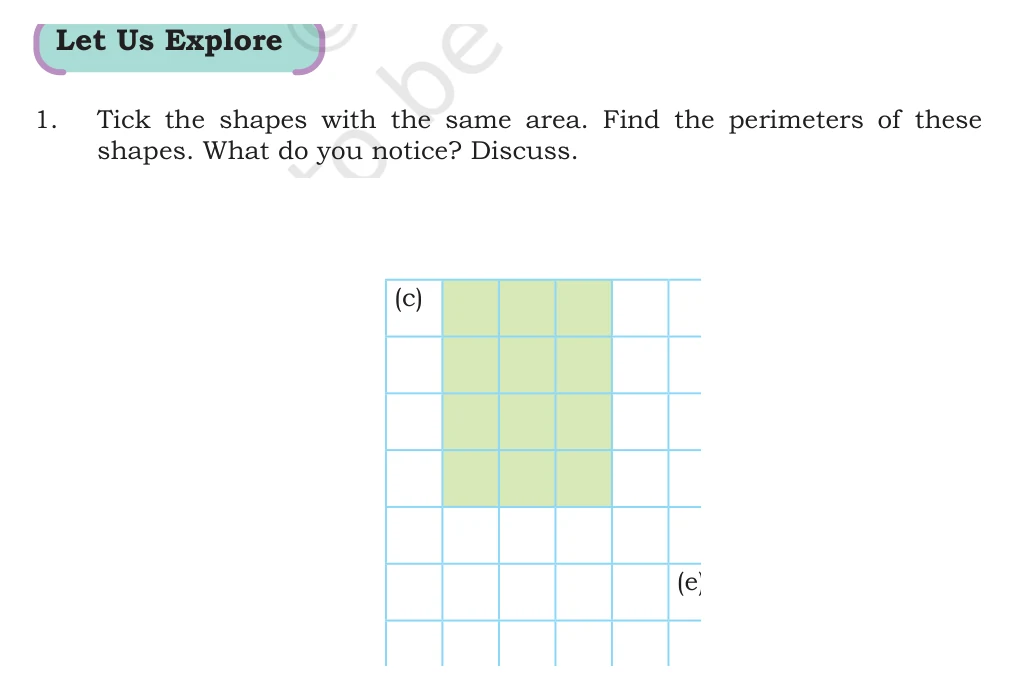
For shape (c), find the area and perimeter and decide whether to tick it as having the common area.
Show detailed solution
- Step 1: It is a 3-by-4 rectangle.
- Step 2: Counting the shaded squares gives an area of 12 square units.
- Step 3: Counting the outside unit edges gives a perimeter of 14 units.
- Answer: Area 12 square units; perimeter 14 units; tick it.
Textbook page 148 · solved item 39
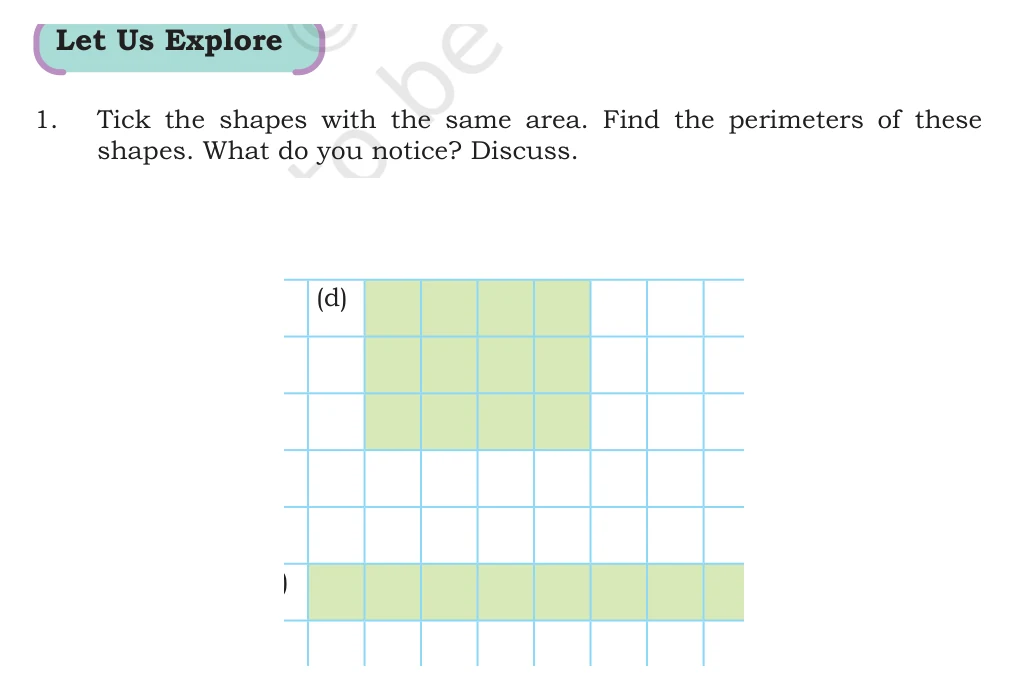
For shape (d), find the area and perimeter and decide whether to tick it as having the common area.
Show detailed solution
- Step 1: It is a 4-by-3 rectangle.
- Step 2: Counting the shaded squares gives an area of 12 square units.
- Step 3: Counting the outside unit edges gives a perimeter of 14 units.
- Answer: Area 12 square units; perimeter 14 units; tick it.
Textbook page 148 · solved item 40

For shape (e), find the area and perimeter and decide whether to tick it as having the common area.
Show detailed solution
- Step 1: It is a row of 8 squares.
- Step 2: Counting the shaded squares gives an area of 8 square units.
- Step 3: Counting the outside unit edges gives a perimeter of 18 units.
- Answer: Area 8 square units; perimeter 18 units; do not tick it.
Textbook page 148 · solved item 41

For shape (f), find the area and perimeter and decide whether to tick it as having the common area.
Show detailed solution
- Step 1: It is a row of 12 squares.
- Step 2: Counting the shaded squares gives an area of 12 square units.
- Step 3: Counting the outside unit edges gives a perimeter of 26 units.
- Answer: Area 12 square units; perimeter 26 units; tick it.
Textbook page 148 · solved item 42

What do the six green shapes show about area and perimeter?
Show detailed solution
- Step 1: Shapes (a), (b), (c), (d), and (f) all have area 12 square units.
- Step 2: Their perimeters are 16, 18, 14, 14, and 26 units.
- Step 3: Equal areas can have different boundary lengths because the same squares can be arranged differently.
- Answer: Shapes with the same area do not always have the same perimeter.
Textbook page 148 · solved item 43

For pink shape (a), find its perimeter and area and identify shapes with the same perimeter.
Show detailed solution
- Step 1: Count two rows of three squares with one extra square below the right end; the area is 7 square units.
- Step 2: Trace only the outside edges, ignoring edges shared by two squares.
- Step 3: The outside boundary contains 12 unit edges.
- Answer: Area 7 square units; perimeter 12 units; tick it with shape (b).
Textbook page 148 · solved item 44

For pink shape (b), find its perimeter and area and identify shapes with the same perimeter.
Show detailed solution
- Step 1: Count three squares on top, then two rows of two squares; the area is 7 square units.
- Step 2: Trace only the outside edges, ignoring edges shared by two squares.
- Step 3: The outside boundary contains 12 unit edges.
- Answer: Area 7 square units; perimeter 12 units; tick it with shape (a).
Textbook page 148 · solved item 45

For pink shape (c), find its perimeter and area and identify shapes with the same perimeter.
Show detailed solution
- Step 1: Count a seven-square cross-like arrangement; the area is 7 square units.
- Step 2: Trace only the outside edges, ignoring edges shared by two squares.
- Step 3: The outside boundary contains 16 unit edges.
- Answer: Area 7 square units; perimeter 16 units; tick it with shapes (d) and (e).
Textbook page 148 · solved item 46
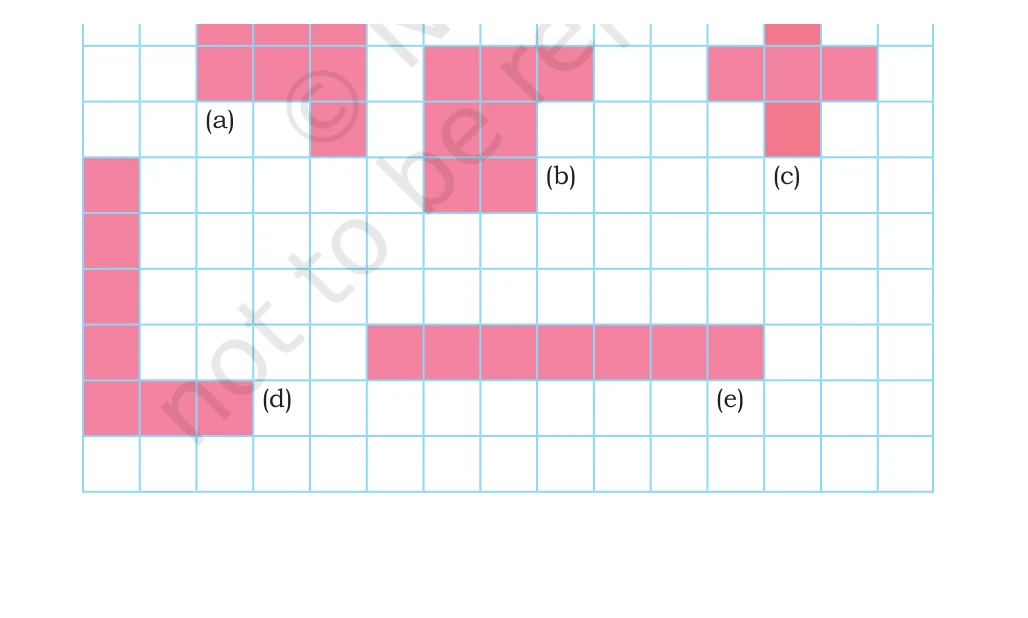
For pink shape (d), find its perimeter and area and identify shapes with the same perimeter.
Show detailed solution
- Step 1: Count five squares in a column with two more along the bottom; the area is 7 square units.
- Step 2: Trace only the outside edges, ignoring edges shared by two squares.
- Step 3: The outside boundary contains 16 unit edges.
- Answer: Area 7 square units; perimeter 16 units; tick it with shapes (c) and (e).
Textbook page 148 · solved item 47

For pink shape (e), find its perimeter and area and identify shapes with the same perimeter.
Show detailed solution
- Step 1: Count one straight row of seven squares; the area is 7 square units.
- Step 2: Trace only the outside edges, ignoring edges shared by two squares.
- Step 3: The outside boundary contains 16 unit edges.
- Answer: Area 7 square units; perimeter 16 units; tick it with shapes (c) and (d).
Textbook page 148 · solved item 48

What do the five pink shapes show?
Show detailed solution
- Step 1: Every shape uses 7 unit squares, so every area is 7 square units.
- Step 2: Shapes (a) and (b) have perimeter 12 units.
- Step 3: Shapes (c), (d), and (e) have perimeter 16 units.
- Answer: Rearranging the same area can produce different perimeters.
Detailed worked answers
Textbook page 149
Textbook page 149 · solved item 49

Draw different shapes with the same area as shape (a), find each perimeter, and say what you notice.
Show detailed solution
- Step 1: Shape (a) is 9 squares long and 2 squares wide, so it uses 18 unit squares and has perimeter 22 units.
- Step 2: Draw a 6-by-3 rectangle. It also uses 18 squares, but its perimeter is 18 units.
- Step 3: Draw a single row of 18 squares. Its area is still 18 square units, but its perimeter is 38 units.
- Answer: All three shapes have area 18 square units, but their perimeters can be different.
Detailed worked answers
Textbook page 150
Textbook page 150 · solved item 50
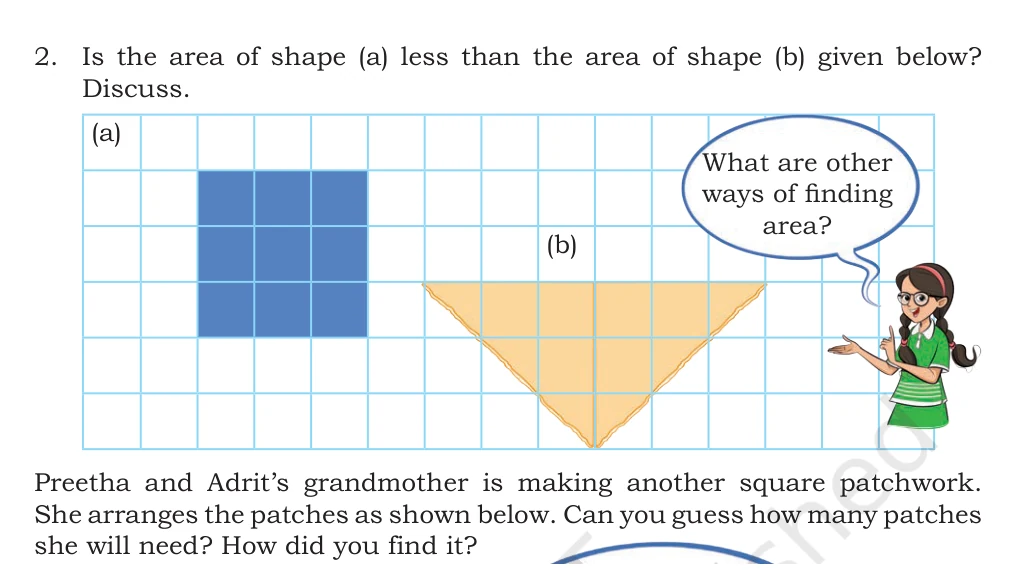
Is the area of shape (a) less than the area of shape (b)?
Show detailed solution
- Step 1: Shape (a) is a 3-by-3 square, so it covers 9 unit squares.
- Step 2: Two copies of triangle (b) join to make a 6-by-3 rectangle containing 18 squares.
- Step 3: One triangle is half of 18, and 18 \div 2 = 9.
- Answer: No. Shapes (a) and (b) have the same area, 9 square units.
Textbook page 150 · solved item 51
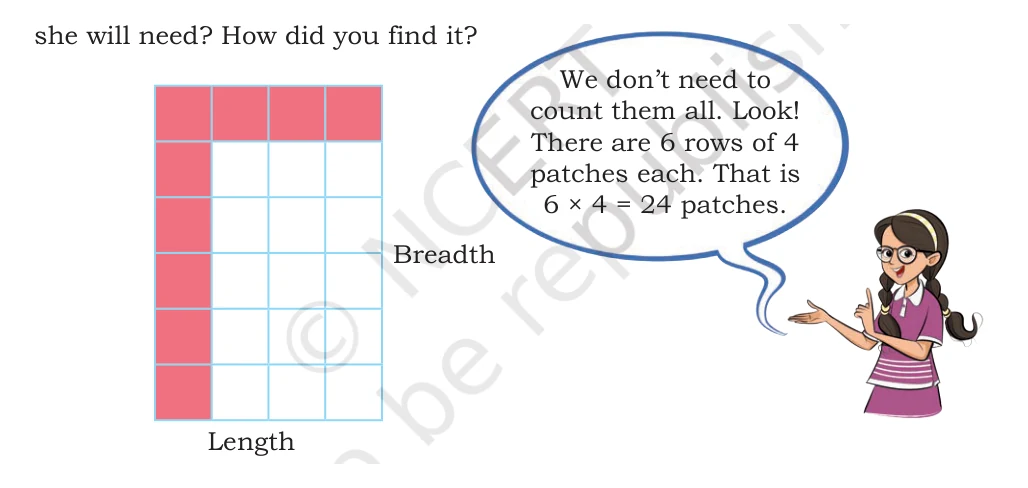
How many square patches are needed for the shown patchwork?
Show detailed solution
- Step 1: Count 6 patches down the length.
- Step 2: Count 4 patches across the breadth.
- Step 3: There are 6 rows of 4: 6 \times 4 = 24.
- Answer: 24 square patches are needed.
Textbook page 150 · solved item 52

Check whether multiplying length by breadth gives the same rectangle areas found earlier by counting squares.
Show detailed solution
- Step 1: Rectangle A on page 145 is 3 squares by 4 squares: 3 \times 4 = 12 square units.
- Step 2: Rectangle B is 2 by 4: 2 \times 4 = 8 square units.
- Step 3: Rectangle C is 2 by 5: 2 \times 5 = 10 square units. These match the counted areas.
- Answer: Yes. For a rectangle, area equals length multiplied by breadth.
Detailed worked answers
Textbook page 151
Textbook page 151 · solved item 53

What happens when all the sides of a rectangle are equal, as in a square?
Show detailed solution
- Step 1: A square has the same length on all 4 sides.
- Step 2: Its area is found by multiplying one side by the same side. For side 5 cm: 5 \times 5 = 25\text{ cm}^2.
- Step 3: Its perimeter is four copies of the side: 5 + 5 + 5 + 5 = 20 cm.
- Answer: For a square, multiply the side by itself for area and add the side four times for perimeter.
Textbook page 151 · solved item 54

Measure your classroom floor and find its area in square metres and its perimeter.
Show detailed solution
- Step 1: With your teacher, measure the classroom length and breadth in metres.
- Step 2: Multiply the two measurements to get the area in square metres.
- Step 3: Add length, breadth, length, and breadth to get the perimeter in metres.
- Answer: Measurements vary by classroom. For example, an 8-m by 6-m room has area 48\text{ m}^2 and perimeter 28 m.
Detailed worked answers
Textbook page 152
Textbook page 152 · solved item 55
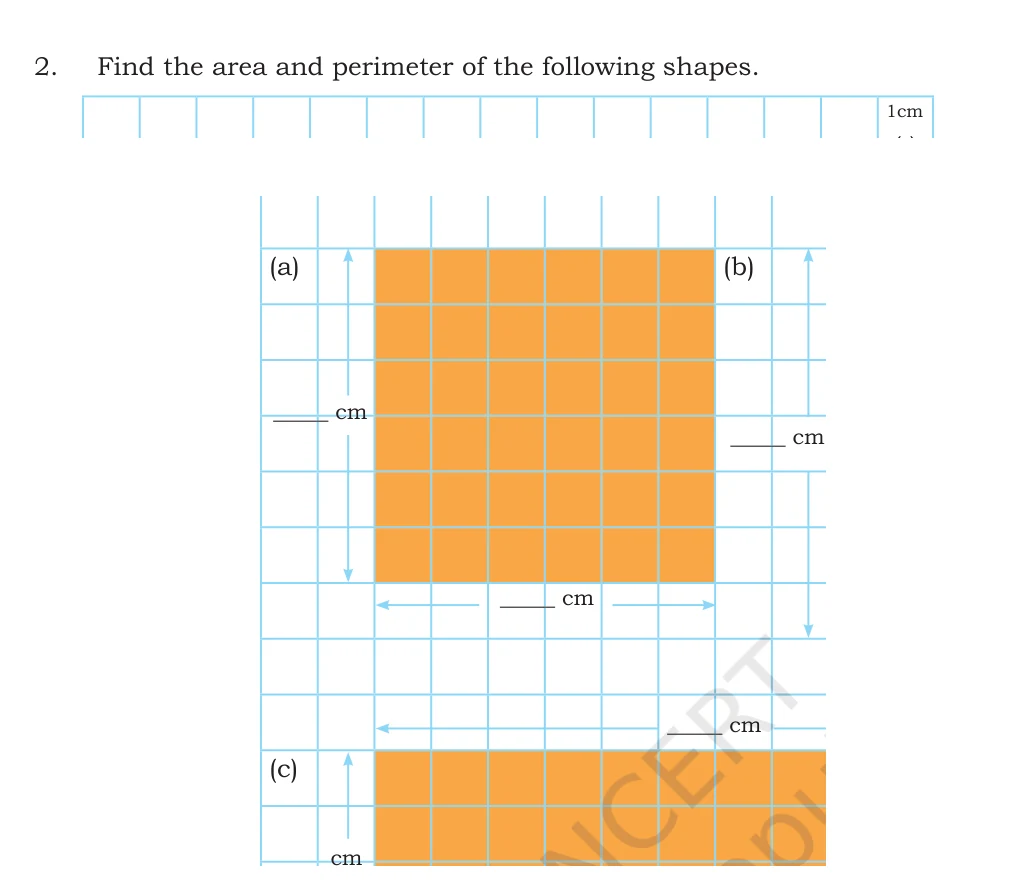
Find the side lengths, area, and perimeter of shape (a).
Show detailed solution
- Step 1: Each grid side is 1 cm. Count 6 cm along the length and 6 cm along the breadth.
- Step 2: Area is 6 \times 6 = 36\text{ cm}^2.
- Step 3: Perimeter is 6 + 6 + 6 + 6 = 24 cm.
- Answer: Length 6 cm, breadth 6 cm, area 36\text{ cm}^2, perimeter 24 cm.
Textbook page 152 · solved item 56

Find the side lengths, area, and perimeter of shape (b).
Show detailed solution
- Step 1: Each grid side is 1 cm. Count 4 cm along the length and 7 cm along the breadth.
- Step 2: Area is 4 \times 7 = 28\text{ cm}^2.
- Step 3: Perimeter is 4 + 7 + 4 + 7 = 22 cm.
- Answer: Length 4 cm, breadth 7 cm, area 28\text{ cm}^2, perimeter 22 cm.
Textbook page 152 · solved item 57

Find the side lengths, area, and perimeter of shape (c).
Show detailed solution
- Step 1: Each grid side is 1 cm. Count 12 cm along the length and 4 cm along the breadth.
- Step 2: Area is 12 \times 4 = 48\text{ cm}^2.
- Step 3: Perimeter is 12 + 4 + 12 + 4 = 32 cm.
- Answer: Length 12 cm, breadth 4 cm, area 48\text{ cm}^2, perimeter 32 cm.
Textbook page 152 · solved item 58

Find the side lengths, area, and perimeter of shape (d).
Show detailed solution
- Step 1: Each grid side is 1 cm. Count 3 cm along the length and 3 cm along the breadth.
- Step 2: Area is 3 \times 3 = 9\text{ cm}^2.
- Step 3: Perimeter is 3 + 3 + 3 + 3 = 12 cm.
- Answer: Length 3 cm, breadth 3 cm, area 9\text{ cm}^2, perimeter 12 cm.
Textbook page 152 · solved item 59
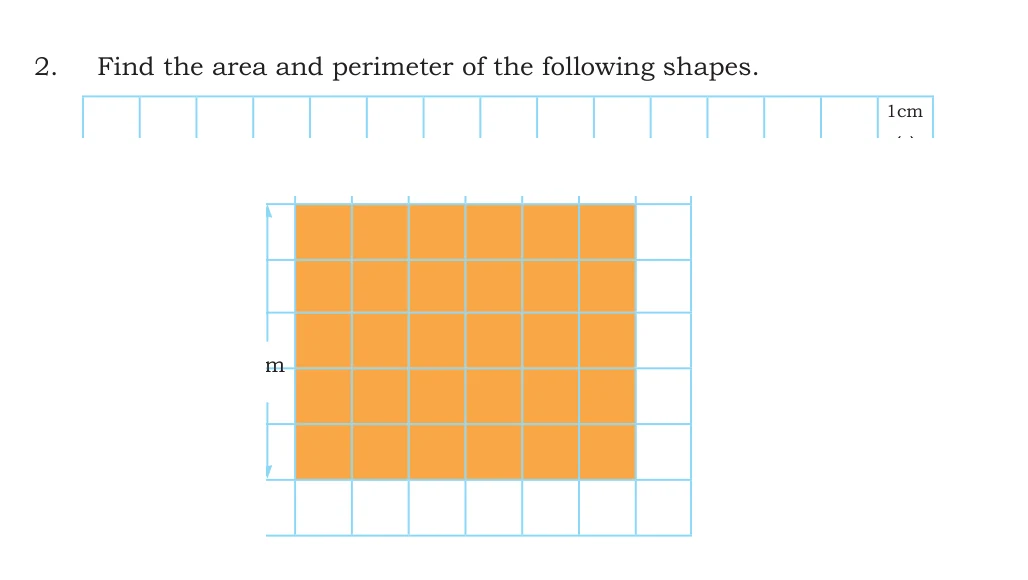
Find the side lengths, area, and perimeter of shape (e).
Show detailed solution
- Step 1: Each grid side is 1 cm. Count 6 cm along the length and 5 cm along the breadth.
- Step 2: Area is 6 \times 5 = 30\text{ cm}^2.
- Step 3: Perimeter is 6 + 5 + 6 + 5 = 22 cm.
- Answer: Length 6 cm, breadth 5 cm, area 30\text{ cm}^2, perimeter 22 cm.
Detailed worked answers
Textbook page 153
Textbook page 153 · solved item 60

Measure the notebook cover and fill its area and perimeter in the table.
Show detailed solution
- Step 1: Measure the two sides. A worked example uses 24 cm by 18 cm.
- Step 2: Example area: 24 \times 18 = 432\text{ cm}^2.
- Step 3: Example perimeter: 24 + 18 + 24 + 18 = 84 cm.
- Answer: Enter your own measurements if they differ; the example shows the correct method.
Textbook page 153 · solved item 61

Measure the newspaper and fill its area and perimeter in the table.
Show detailed solution
- Step 1: Measure the two sides. A worked example uses 56 cm by 34 cm.
- Step 2: Example area: 56 \times 34 = 1904\text{ cm}^2.
- Step 3: Example perimeter: 56 + 34 + 56 + 34 = 180 cm.
- Answer: Enter your own measurements if they differ; the example shows the correct method.
Textbook page 153 · solved item 62

Measure the blackboard and fill its area and perimeter in the table.
Show detailed solution
- Step 1: Measure the two sides. A worked example uses 300 cm by 120 cm.
- Step 2: Example area: 300 \times 120 = 36000\text{ cm}^2.
- Step 3: Example perimeter: 300 + 120 + 300 + 120 = 840 cm.
- Answer: Enter your own measurements if they differ; the example shows the correct method.
Textbook page 153 · solved item 63

Measure the Ludo board and fill its area and perimeter in the table.
Show detailed solution
- Step 1: Measure the two sides. A worked example uses 40 cm by 40 cm.
- Step 2: Example area: 40 \times 40 = 1600\text{ cm}^2.
- Step 3: Example perimeter: 40 + 40 + 40 + 40 = 160 cm.
- Answer: Enter your own measurements if they differ; the example shows the correct method.
Textbook page 153 · solved item 64

Measure the pencil box for row 5 and fill its area and perimeter in the table.
Show detailed solution
- Step 1: Measure the two sides. A worked example uses 20 cm by 8 cm.
- Step 2: Example area: 20 \times 8 = 160\text{ cm}^2.
- Step 3: Example perimeter: 20 + 8 + 20 + 8 = 56 cm.
- Answer: Enter your own measurements if they differ; the example shows the correct method.
Textbook page 153 · solved item 65

Measure the maths textbook for row 6 and fill its area and perimeter in the table.
Show detailed solution
- Step 1: Measure the two sides. A worked example uses 28 cm by 22 cm.
- Step 2: Example area: 28 \times 22 = 616\text{ cm}^2.
- Step 3: Example perimeter: 28 + 22 + 28 + 22 = 100 cm.
- Answer: Enter your own measurements if they differ; the example shows the correct method.
Textbook page 153 · solved item 66

Find the area of a rectangular field with length 42 m and breadth 34 m.
Show detailed solution
- Step 1: Area of a rectangle is length multiplied by breadth.
- Step 2: Multiply 42 \times 34 = 42 \times 30 + 42 \times 4.
- Step 3: 1260 + 168 = 1428.
- Answer: The field's area is 1428\text{ m}^2.
Textbook page 153 · solved item 67

A rectangular garden has area 64 square metres and length 16 m. What is its breadth?
Show detailed solution
- Step 1: Think: 16 multiplied by what number makes 64?
- Step 2: Count equal groups or divide: 64 \div 16 = 4.
- Step 3: Check: 16 \times 4 = 64\text{ m}^2.
- Answer: The breadth is 4 m.
Textbook page 153 · solved item 68

Find the area of the shown figure with width 32 cm and heights 6 cm and 12 cm.
Show detailed solution
- Step 1: The whole height is 6 + 12 = 18 cm.
- Step 2: The figure is a rectangle 32 cm wide and 18 cm high.
- Step 3: 32 \times 18 = 32 \times 10 + 32 \times 8 = 320 + 256 = 576.
- Answer: The area is 576\text{ cm}^2.
Detailed worked answers
Textbook page 154
Textbook page 154 · solved item 69

How do two players play the perimeter game?
Show detailed solution
- Step 1: Take square unit tiles and a die. The first player rolls and uses that many tiles to make one joined shape.
- Step 2: Find the shape's perimeter by counting only the outside unit edges. The next player leaves the tiles in place, rolls, and adds that many joined tiles.
- Step 3: Keep taking turns, recounting the outside boundary after each addition.
- Answer: The first player whose shared shape has perimeter 24 wins.
Textbook page 154 · solved item 70

Find the perimeter of the first shown four-tile shape.
Show detailed solution
- Step 1: Four separate squares have 4 + 4 + 4 + 4 = 16 unit edges.
- Step 2: The shape has 3 shared sides. Each shared side removes 2 edges from the outside count.
- Step 3: Remove 6 from 16: 16 - 6 = 10.
- Answer: The perimeter is 10 units.
Textbook page 154 · solved item 71

Find the perimeter after the second player adds tiles to make the shown five-tile shape.
Show detailed solution
- Step 1: Trace the boundary without counting lines between touching tiles.
- Step 2: The labelled outside edges have lengths 1 unit each.
- Step 3: Counting them gives 12 outside unit edges.
- Answer: The new perimeter is 12 units.
Textbook page 154 · solved item 72

Check that the final shown game shape has perimeter 24.
Show detailed solution
- Step 1: Start at the top and move once around the outside boundary.
- Step 2: Count each labelled outside edge once and do not count edges between neighbouring tiles.
- Step 3: The outside count reaches 24 unit edges.
- Answer: The perimeter is 24 units, so the player who made it wins.