
Question-by-question working
Read the prompt, attempt it, then check each step
Every exercise subpart and table row is a separate item. Shared figures and table headings are repeated whenever they are needed to understand the question.
Detailed worked answers
Textbook page 92
Textbook page 92 · solved item 1
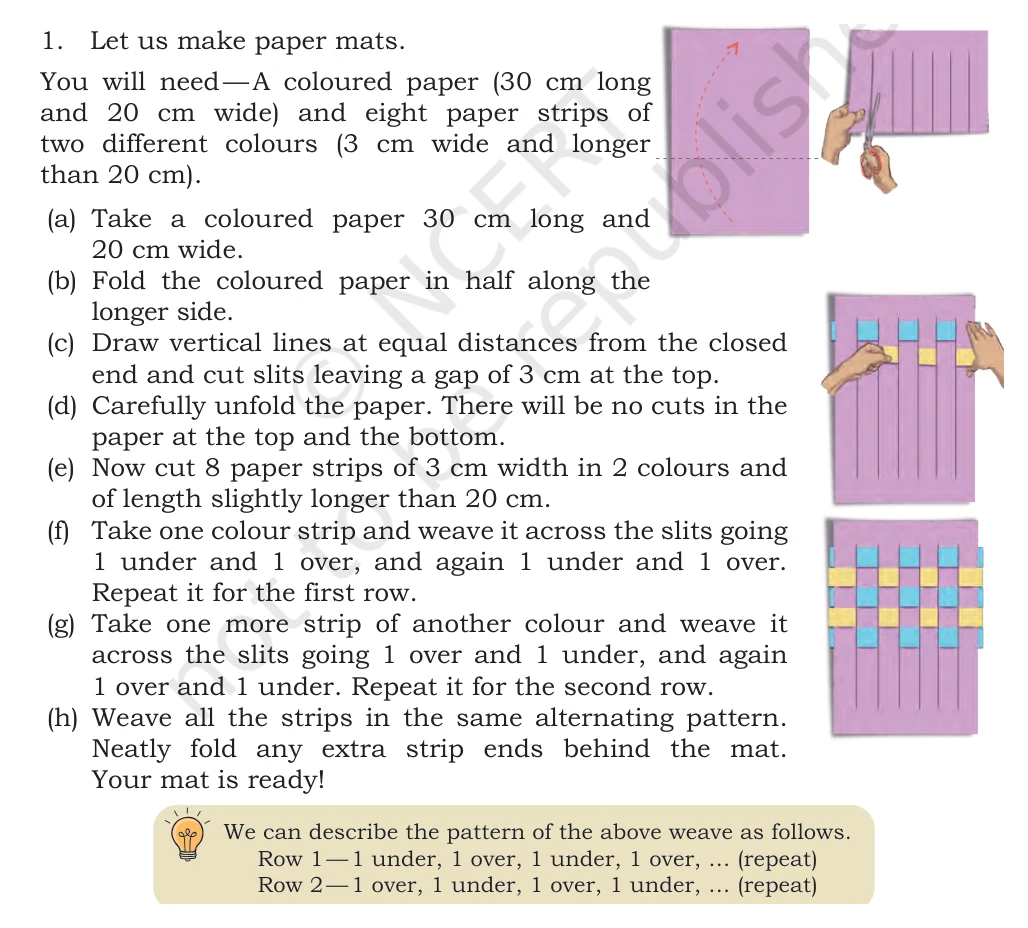
Make the alternating paper mat in Question 1 and describe its repeating rows.
Show detailed solution
- Step 1: Fold the 30\text{ cm}\times20\text{ cm} sheet, cut equally spaced slits, and leave an uncut border at the top and bottom.
- Step 2: Pass the first strip 1 under, 1 over, and repeat. Pass the next strip 1 over, 1 under, and repeat.
- Step 3: Continue by alternating those two row rules, then fold the extra strip ends behind the mat.
- Answer: Odd rows repeat 1 under, 1 over; even rows repeat 1 over, 1 under. This opposite order makes the checked weave.
Detailed worked answers
Textbook page 93
Textbook page 93 · solved item 2
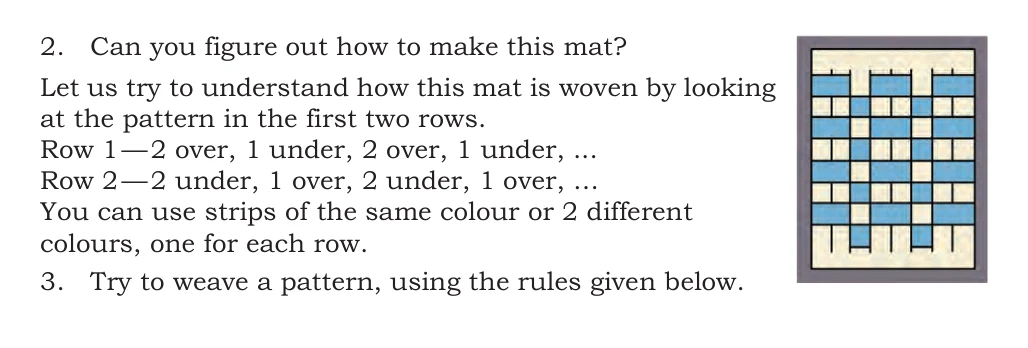
How is the mat in Question 2 woven?
Show detailed solution
- Step 1: Read the first row from left to right: 2 over, 1 under, then repeat.
- Step 2: Reverse the rule in the next row: 2 under, 1 over, then repeat.
- Step 3: Keep alternating these two rows all the way down the mat.
- Answer: Row 1 repeats 2 over, 1 under; Row 2 repeats 2 under, 1 over.
Textbook page 93 · solved item 3
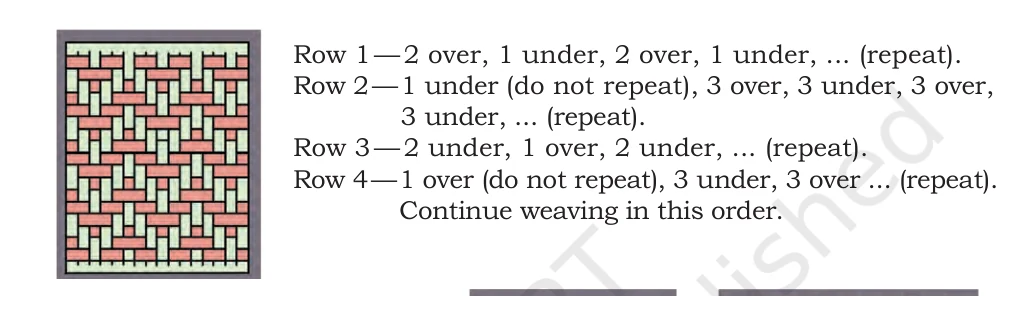
Weave the four-row pattern given in Question 3.
Show detailed solution
- Step 1: Make Row 1 by repeating 2 over, 1 under. Begin Row 2 with 1 under only once, then repeat 3 over, 3 under.
- Step 2: Make Row 3 by repeating 2 under, 1 over. Begin Row 4 with 1 over only once, then repeat 3 under, 3 over.
- Step 3: Repeat the four-row order without changing where each row begins.
- Answer: The finished mat has interlocking groups of 2 and 3 because Rows 2 and 4 are shifted in opposite ways.
Textbook page 93 · solved item 4
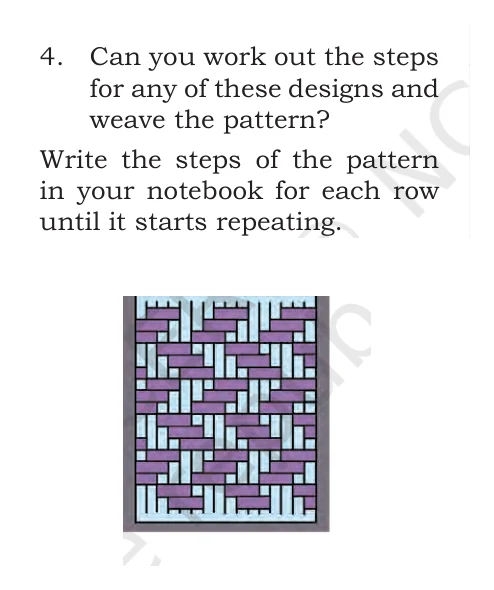
Write a repeating row rule for the left-hand purple woven design.
Show detailed solution
- Step 1: Notice that neighbouring strips form blocks three spaces long.
- Step 2: Use 3 over, 3 under for a group of rows, then reverse it to 3 under, 3 over for the next group.
- Step 3: Repeat the two groups so each new block sits beside the earlier block instead of directly on it.
- Sample answer: A 3-by-3 basket weave, alternating groups of 3 over, 3 under with groups of 3 under, 3 over, makes the shown design.
Textbook page 93 · solved item 5
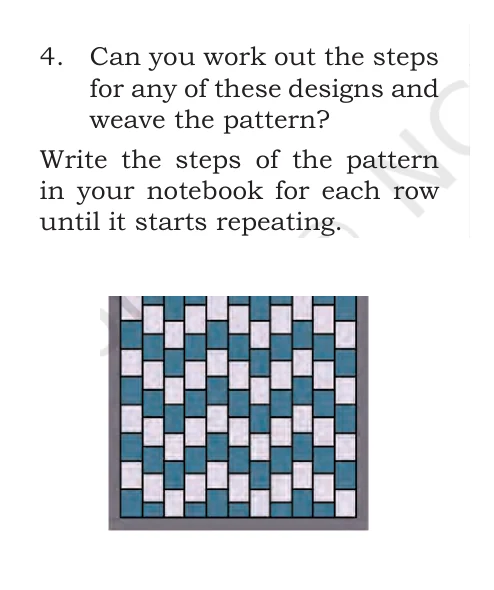
Write a repeating row rule for the right-hand blue woven design.
Show detailed solution
- Step 1: Read one row as repeating blocks of 2 over and 2 under.
- Step 2: In the next row, reverse the order to 2 under and 2 over.
- Step 3: Repeat the two rows so the light and dark blocks alternate like a checkerboard.
- Sample answer: Alternate a 2 over, 2 under row with a 2 under, 2 over row.
Textbook page 93 · solved item 6
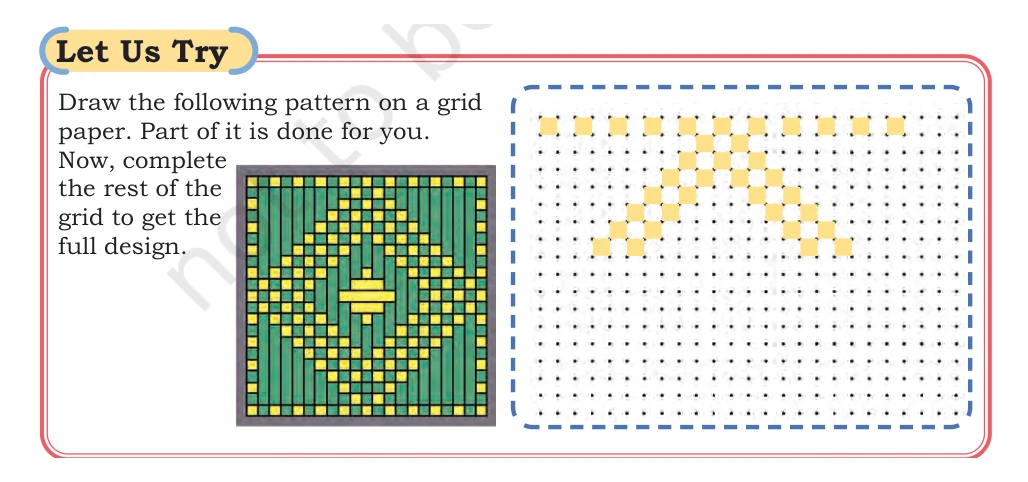
Complete the yellow-and-green design on the dot grid.
Show detailed solution
- Step 1: Continue the yellow border across the top, then copy it at equal distance along the other three sides.
- Step 2: Extend each sloping yellow stair by moving one dot sideways and one dot down at every step until the four sides form a diamond.
- Step 3: Repeat smaller diamonds towards the centre and fill all remaining columns green, matching the sample.
- Answer: The completed grid has a yellow square border, nested yellow diamonds, and a small crossed yellow centre on a green background.
Detailed worked answers
Textbook page 94
Textbook page 94 · solved item 7
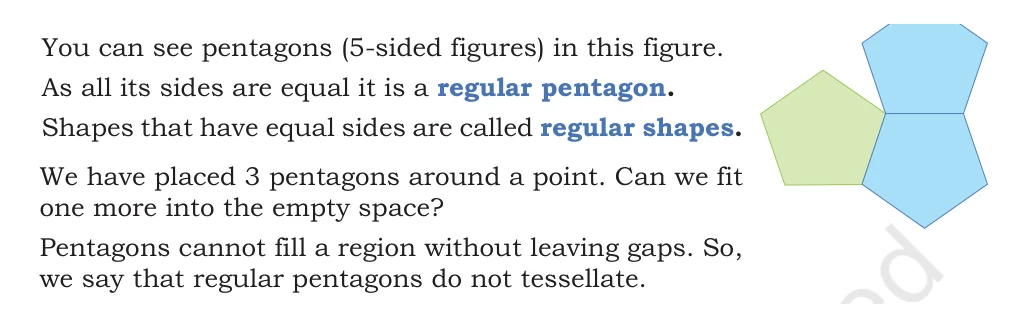
Can one more regular pentagon fit into the gap shown?
Show detailed solution
- Step 1: Place three equal pentagons so one corner of each meets at the marked point.
- Step 2: Compare the remaining gap with the corner of another pentagon; the gap is too small.
- Step 3: A fourth pentagon would overlap the others instead of filling the gap.
- Answer: No. Regular pentagons leave a gap and do not tessellate by themselves.
Textbook page 94 · solved item 8
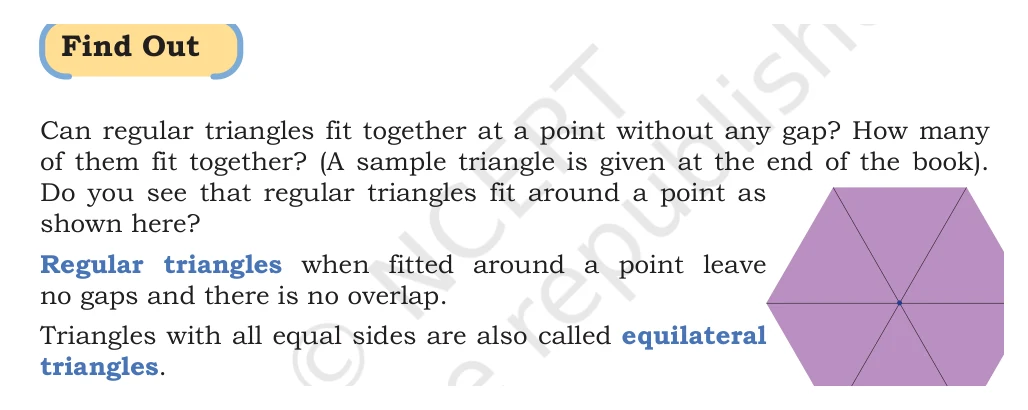
Can regular triangles fit around one point without gaps, and how many are needed?
Show detailed solution
- Step 1: Put one equal corner of each equilateral triangle at the same point.
- Step 2: Three triangles fill half a turn, so another three fill the other half.
- Step 3: The sixth triangle closes the full turn without a gap or overlap.
- Answer: Yes. Six equilateral triangles fit around one point and tessellate.
Textbook page 94 · solved item 9

Can squares fit around one point without gaps, and how many are needed?
Show detailed solution
- Step 1: A corner of a square is a quarter turn.
- Step 2: Put four square corners together: 4\times\frac14=1 full turn.
- Step 3: Their sides meet exactly, with no empty space or overlap.
- Answer: Yes. Four squares fit around one point.
Textbook page 94 · solved item 10

Can five squares fit around one point without gaps or overlaps? Why?
Show detailed solution
- Step 1: Four square corners already make one full turn around the point.
- Step 2: A fifth square needs one more quarter-turn space.
- Step 3: Since no space remains, the fifth square must overlap another square.
- Answer: No. Exactly four, not five, squares can meet at one point.
Textbook page 94 · solved item 11
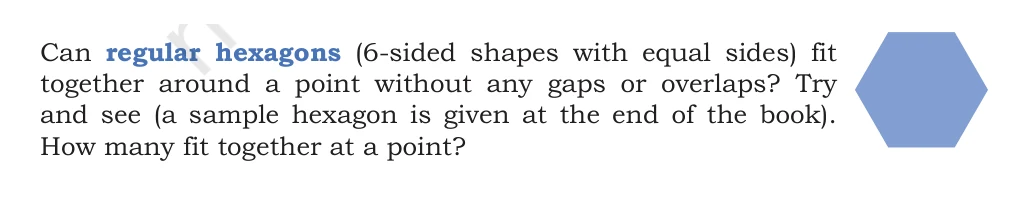
Can regular hexagons fit around one point without gaps, and how many are needed?
Show detailed solution
- Step 1: Place one corner from each regular hexagon at the same point.
- Step 2: Three such corners together complete one full turn.
- Step 3: Their neighbouring sides meet exactly, so the pattern can continue.
- Answer: Yes. Three regular hexagons fit around one point.
Detailed worked answers
Textbook page 95
Textbook page 95 · solved item 12
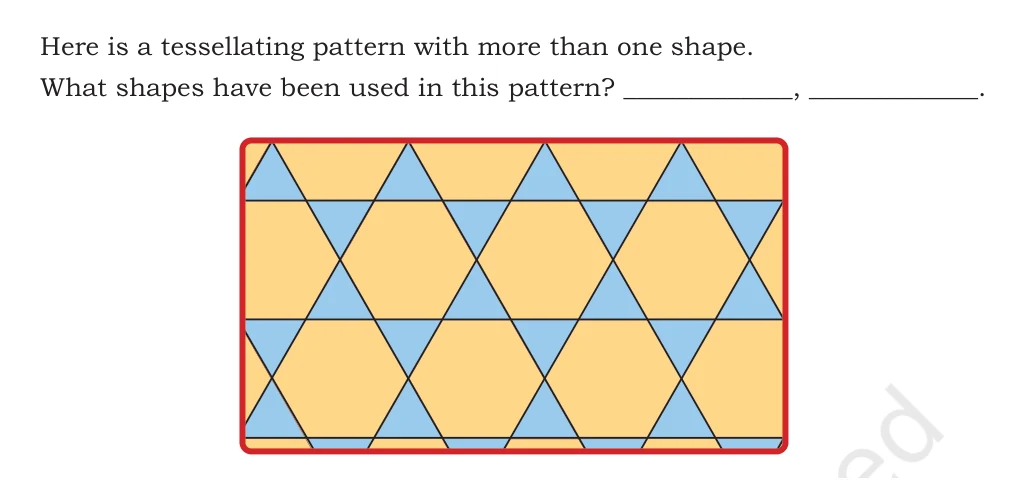
Which shapes are used in the first tessellating pattern?
Show detailed solution
- Step 1: Count the sides of a large yellow tile: it has 6 equal sides, so it is a regular hexagon.
- Step 2: Count the sides of each small blue tile: it has 3 equal sides, so it is an equilateral triangle.
- Step 3: Check that these two shapes meet without gaps.
- Answer: Regular hexagons and equilateral triangles are used.
Textbook page 95 · solved item 13
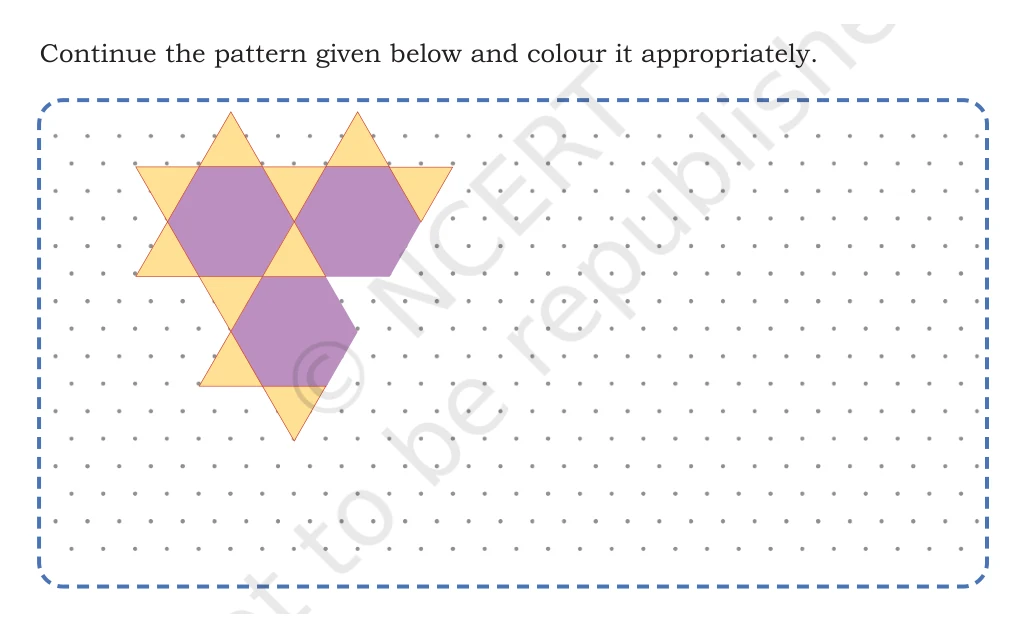
Continue and colour the purple-and-orange tessellating pattern.
Show detailed solution
- Step 1: Copy each large purple hexagon in the same orientation along the dot grid.
- Step 2: Fill each triangular space between neighbouring hexagons with an orange triangle of the same size as the starter triangles.
- Step 3: Repeat the same colours and positions across the remaining grid without gaps or overlaps.
- Answer: The completed region repeats purple hexagons separated by matching orange triangles.
Textbook page 95 · solved item 14
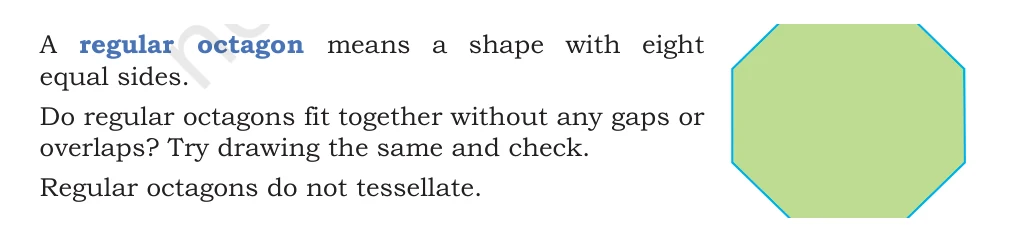
Do regular octagons tessellate by themselves?
Show detailed solution
- Step 1: Put two equal octagons side by side so one full side touches.
- Step 2: Try to place more octagons around a corner; a small four-sided gap remains.
- Step 3: Moving an octagon into that gap makes it overlap its neighbours.
- Answer: No. Regular octagons alone leave gaps, so they do not tessellate by themselves.
Detailed worked answers
Textbook page 96
Textbook page 96 · solved item 15
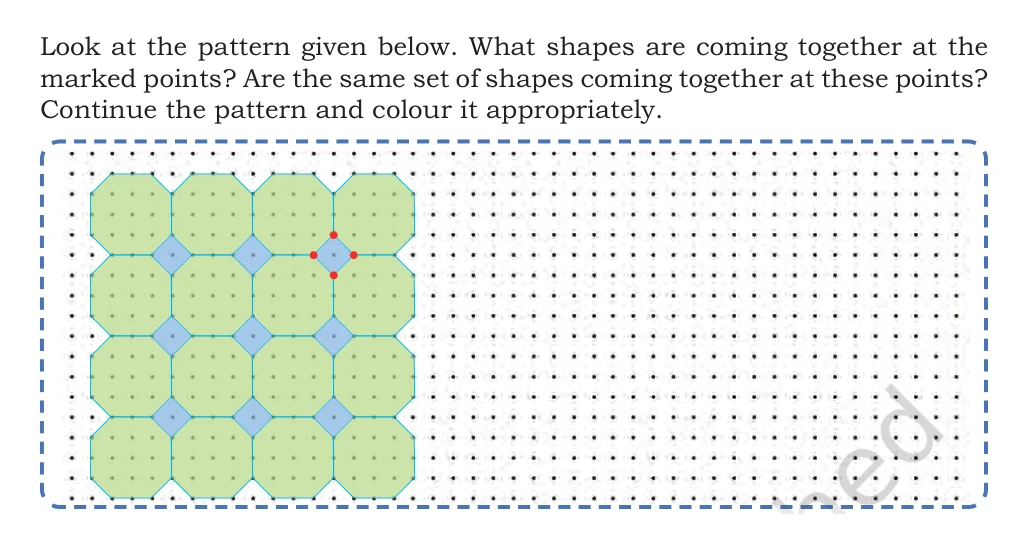
What shapes meet at each marked point in the green-and-blue pattern?
Show detailed solution
- Step 1: Follow one red point and identify every tile touching it.
- Step 2: Two large green tiles are regular octagons and the small blue tile is a square.
- Step 3: Count only shapes that touch the exact point.
- Answer: Two regular octagons and one square meet at each marked point.
Textbook page 96 · solved item 16
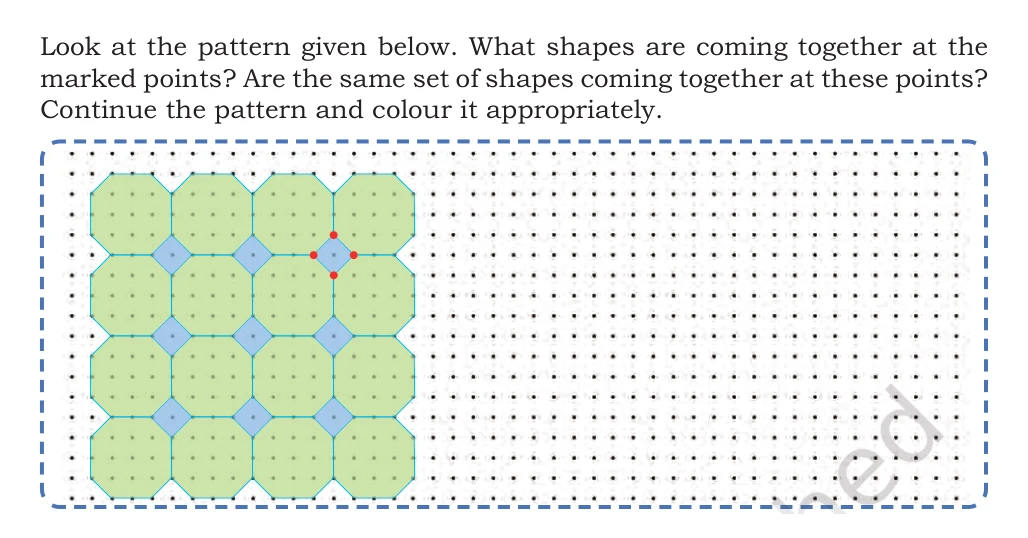
Does the same set of shapes meet at every marked point in the green-and-blue pattern?
Show detailed solution
- Step 1: Check the upper, lower, left, and right red points.
- Step 2: At every point, record two octagons and one square.
- Step 3: Since the record is unchanged, the meeting rule repeats.
- Answer: Yes. Every marked point has two octagons and one square.
Textbook page 96 · solved item 17
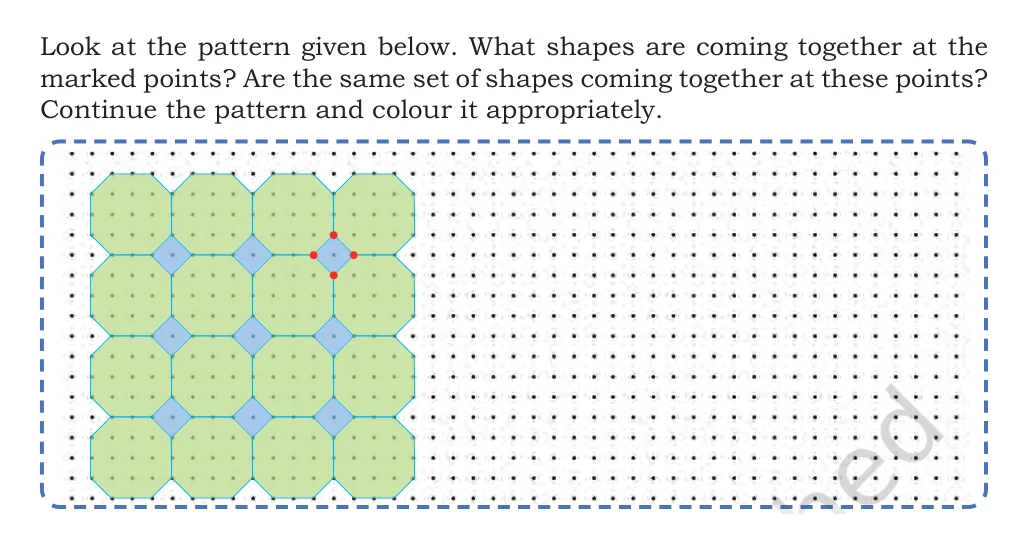
Continue and colour the green-octagon and blue-square tessellation.
Show detailed solution
- Step 1: Extend each row of green octagons to the right at the same spacing.
- Step 2: Place one small square in every gap made by four neighbouring clipped corners.
- Step 3: Repeat the original green and blue colours across the grid.
- Answer: The completed grid keeps the same two-octagon-and-one-square meeting rule at every corner.
Textbook page 96 · solved item 18
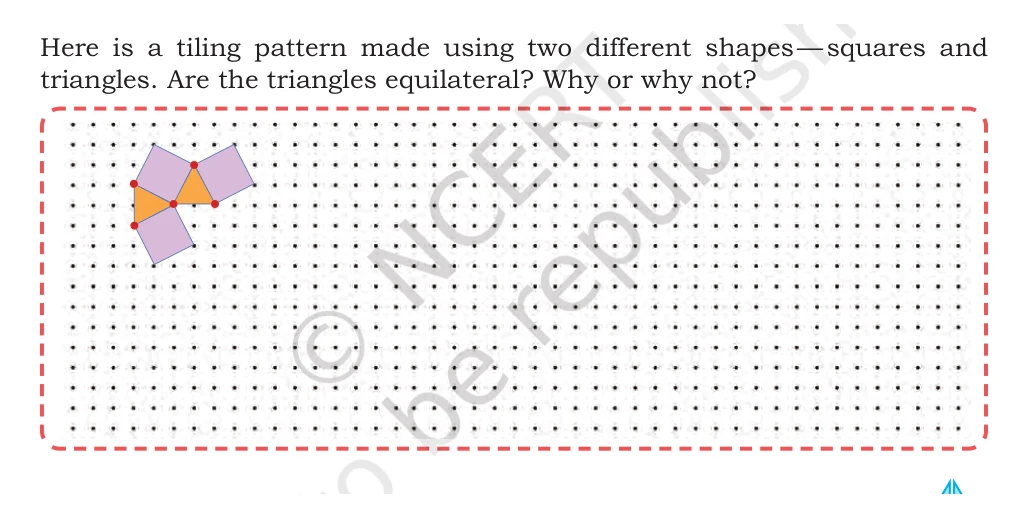
Are the triangles in the square-and-triangle tiling equilateral? Why or why not?
Show detailed solution
- Step 1: Compare all three sides of one orange triangle against the equal side of a nearby square.
- Step 2: Two triangle sides match the square side, but the third triangle side is a different length.
- Step 3: An equilateral triangle must have all three sides equal.
- Answer: No. These triangles are not equilateral because all three sides are not equal.
Textbook page 96 · solved item 19
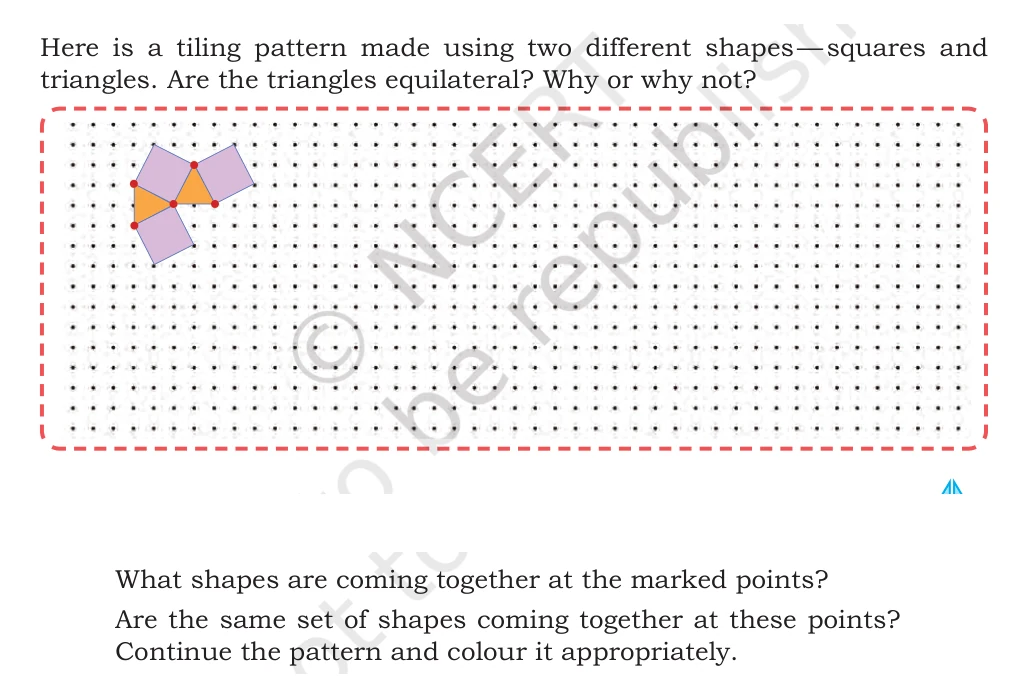
What shapes meet at each marked point in the square-and-triangle tiling?
Show detailed solution
- Step 1: Look closely at one red point in the starter design.
- Step 2: Count one purple square and two orange triangles touching that point.
- Step 3: Do not count shapes that are nearby but do not touch the point.
- Answer: One square and two triangles meet at each marked point.
Textbook page 96 · solved item 20
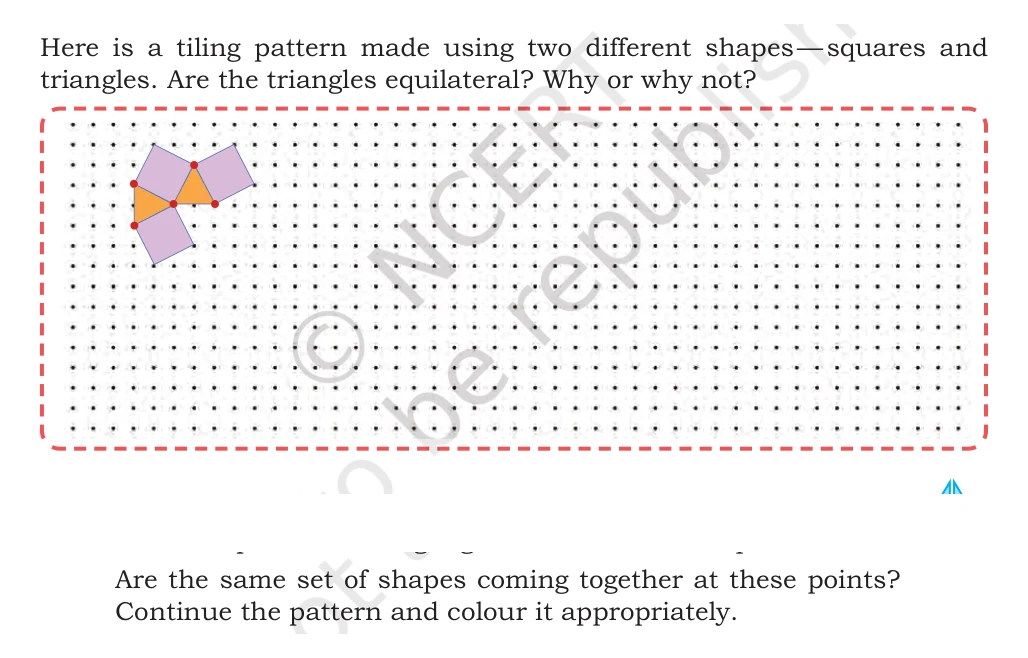
Does the same set of shapes meet at every marked point in the square-and-triangle tiling?
Show detailed solution
- Step 1: Record the shapes at the first point: one square and two triangles.
- Step 2: Check the other red points in the same way.
- Step 3: Every record is the same, so the local pattern repeats.
- Answer: Yes. One square and two triangles meet at every marked point.
Textbook page 96 · solved item 21
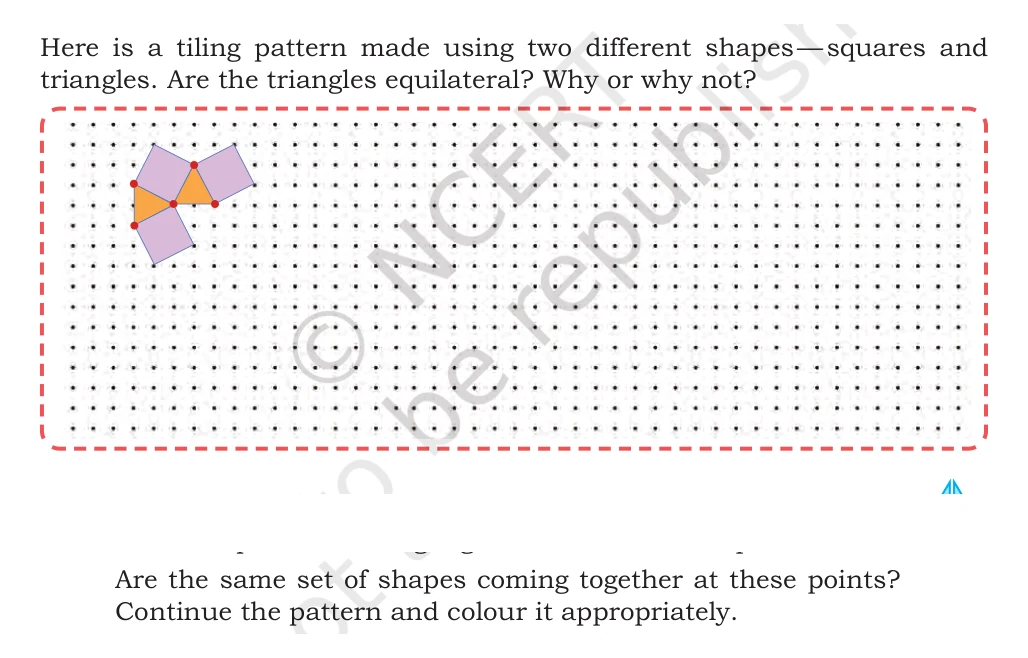
Continue and colour the square-and-triangle tiling.
Show detailed solution
- Step 1: Add squares along the exposed sides of the starter triangles.
- Step 2: Fill each next gap with a triangle in the same orientation as the matching starter triangle.
- Step 3: Repeat the purple squares and orange triangles while preserving the meeting rule.
- Answer: The completed tiling repeats one square and two triangles at each marked point.
Textbook page 96 · solved item 22
Create a similar repeating pattern with other shape cutouts.
Show detailed solution
- Step 1: Choose shapes whose corners can meet around a point without leaving a gap, such as squares and right triangles.
- Step 2: Make one small repeating unit and trace it several times in the same order.
- Step 3: Colour equal shapes alike and check that there are no gaps or overlaps.
- Sample answer: Place a square, two matching right triangles, and another square as one unit, then repeat that unit in rows.
Detailed worked answers
Textbook page 97
Textbook page 97 · solved item 23
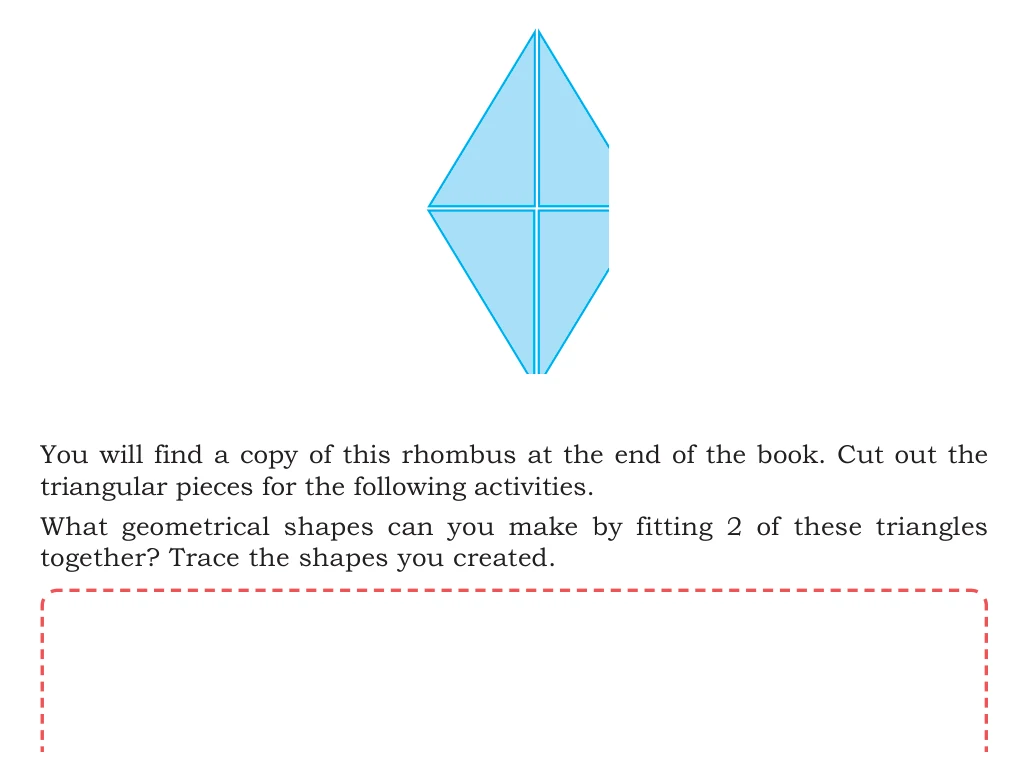
What geometrical shapes can be made by fitting two rhombus triangles together?
Show detailed solution
- Step 1: Join two complete edges of the same length; do not overlap the pieces.
- Step 2: Try joining a short edge, a long edge, and a sloping edge in turn.
- Step 3: Trace each different outside boundary and name it by its sides.
- Sample answer: The two pieces can make triangles, a rectangle, a parallelogram, or a kite, depending on which equal edges are joined.
Textbook page 97 · solved item 24

How many different types of triangles can be made with two rhombus pieces?
Show detailed solution
- Step 1: Join the two pieces along one matching leg and trace the outside.
- Step 2: Repeat using the other matching leg; the two outside triangles have different widths.
- Step 3: Turning or flipping an already made triangle does not create a new type.
- Answer: Two different triangles can be made.
Textbook page 97 · solved item 25

What do you notice after measuring the sides of the triangles made from two pieces?
Show detailed solution
- Step 1: Measure all three outside sides of each traced triangle.
- Step 2: Compare the measurements in pairs.
- Step 3: Each triangle has one pair of equal sides.
- Answer: Both are isosceles triangles because each has two equal sides.
Textbook page 97 · solved item 26

What do you notice about the angles when an isosceles triangle is folded in half?
Show detailed solution
- Step 1: Fold from the corner between the equal sides to the middle of the opposite side.
- Step 2: The two halves lie exactly on each other.
- Step 3: The two corner angles at the base also lie on each other, so they are equal.
- Answer: An isosceles triangle has two equal angles.
Textbook page 97 · solved item 27

Can two of the rhombus pieces make an equilateral triangle?
Show detailed solution
- Step 1: Try each possible pair of matching edges.
- Step 2: In every triangular outline, only two outside sides match; the third has a different length.
- Step 3: An equilateral triangle needs all three sides equal.
- Answer: No. These two pieces do not make an equilateral triangle.
Textbook page 97 · solved item 28

Can two of the rhombus pieces make a triangle with all three sides unequal?
Show detailed solution
- Step 1: Form every triangular outline possible with the pair.
- Step 2: Measure the outside sides; each finished triangle has two equal sides.
- Step 3: A triangle with all three sides unequal is scalene.
- Answer: No. Two pieces make isosceles triangles, not a scalene triangle.
Textbook page 97 · solved item 29
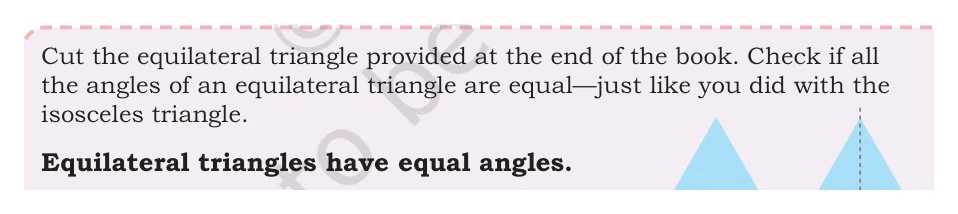
Are all the angles of an equilateral triangle equal?
Show detailed solution
- Step 1: Fold one corner onto another so two sides of the triangle match.
- Step 2: Repeat with a different pair of corners.
- Step 3: Each corner angle matches the other two under folding.
- Answer: Yes. All three angles of an equilateral triangle are equal.
Textbook page 97 · solved item 30

After cutting the equilateral triangle in half as shown, how many sides of each new triangle are equal?
Show detailed solution
- Step 1: Compare the original sloping side, half of the base, and the new cut side.
- Step 2: These three lengths are different from one another.
- Step 3: Therefore no pair of sides in either half is equal.
- Answer: Zero sides form an equal pair; each half is a scalene triangle.
Textbook page 97 · solved item 31

Does the scalene triangle made in the activity have any equal angles?
Show detailed solution
- Step 1: Fold or trace the triangle and compare its three corners.
- Step 2: No corner lies exactly on another corner.
- Step 3: Unequal sides in this triangle face unequal angles.
- Answer: No. All three angles are different.
Detailed worked answers
Textbook page 98
Textbook page 98 · solved item 32
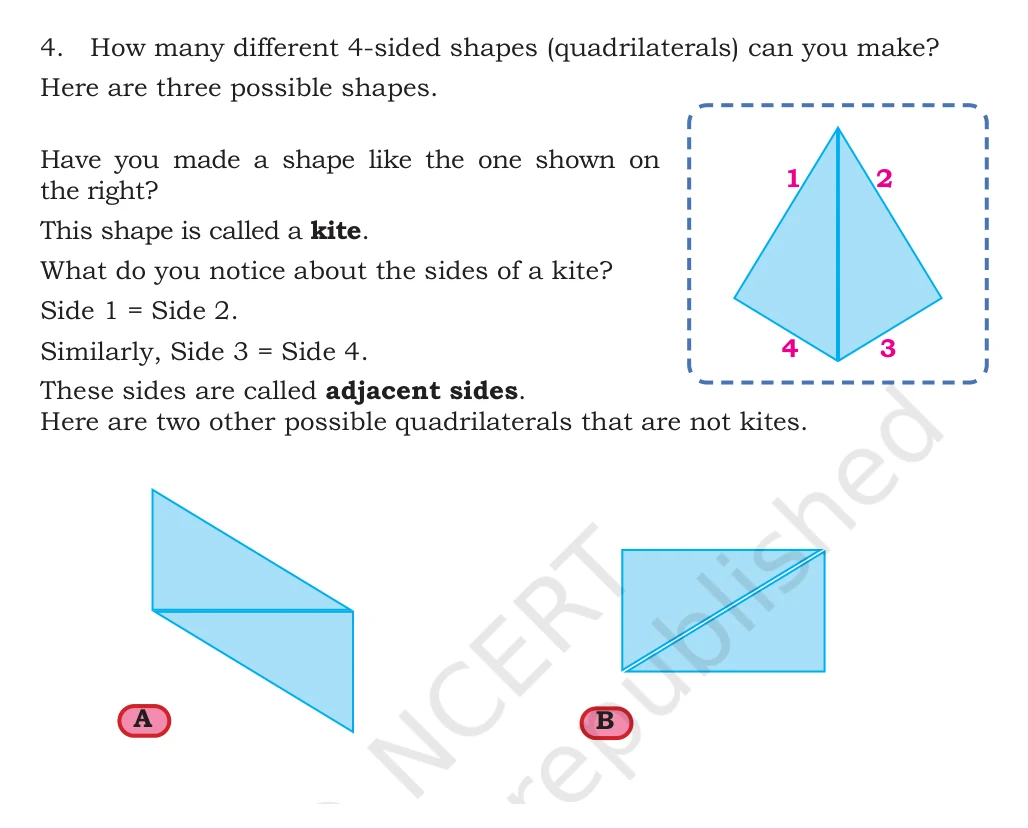
How many different quadrilaterals can be made with the rhombus triangles?
Show detailed solution
- Step 1: Join complete equal edges and trace only the outside boundary.
- Step 2: Keep arrangements whose outside boundary has exactly four sides.
- Step 3: Compare the outlines and ignore a copy that is only turned or flipped.
- Answer: Three different examples are shown or can be made: a kite and two parallelograms, one of which is a rectangle.
Textbook page 98 · solved item 33
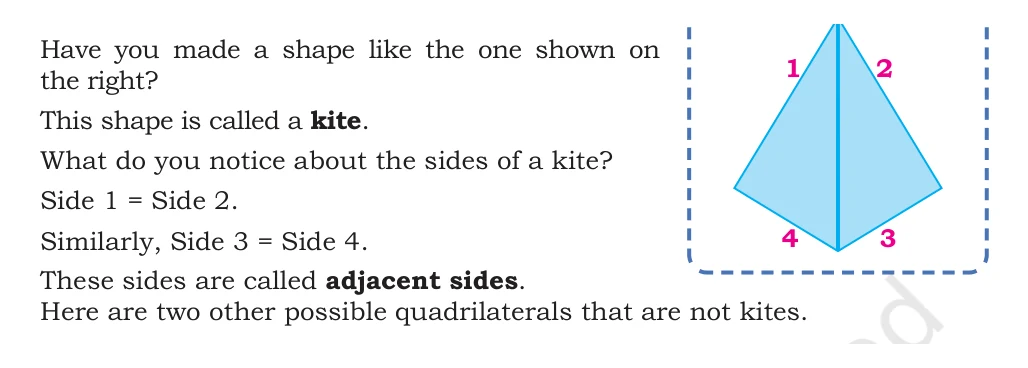
Can the pieces make the kite shown?
Show detailed solution
- Step 1: Put two matching triangle sides together along the vertical middle line.
- Step 2: Check that the upper pair and lower pair of outside sides match.
- Step 3: Trace the four-sided outside boundary.
- Answer: Yes. This arrangement makes a kite.
Textbook page 98 · solved item 34
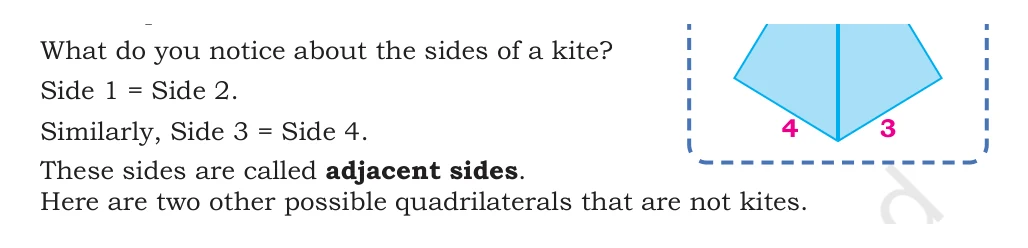
What do you notice about the sides of the kite?
Show detailed solution
- Step 1: Compare Sides 1 and 2, which meet at the top corner.
- Step 2: Compare Sides 3 and 4, which meet at the bottom corner.
- Step 3: Each equal pair shares a corner, so the sides are adjacent.
- Answer: Side 1 = Side 2 and Side 3 = Side 4. A kite has two pairs of equal adjacent sides.
Textbook page 98 · solved item 35
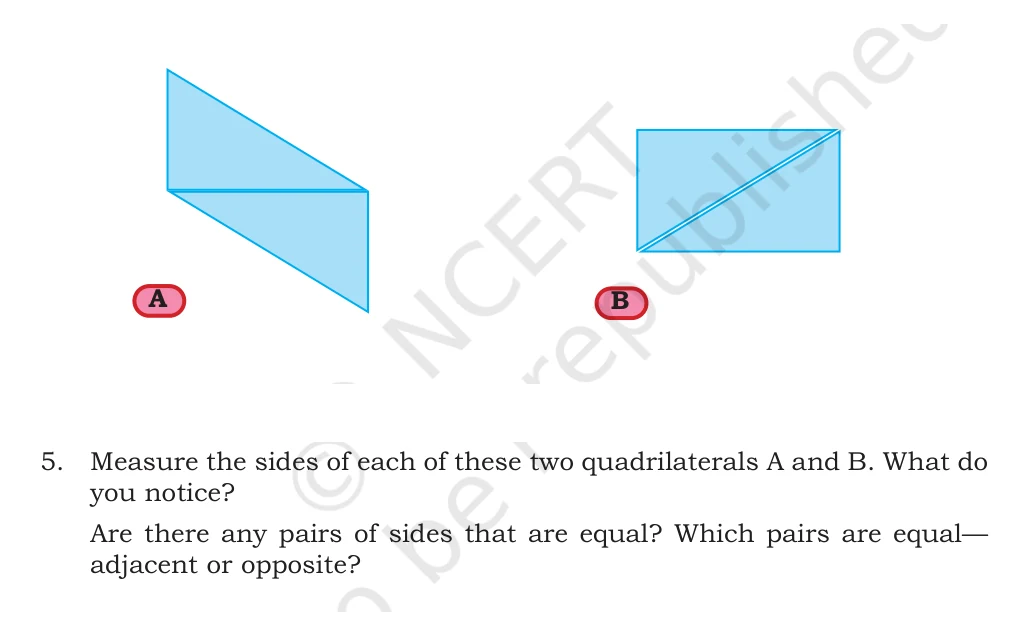
What do you notice after measuring the sides of quadrilaterals A and B?
Show detailed solution
- Step 1: Measure the top and bottom sides of each shape; they match.
- Step 2: Measure the left and right sides of each shape; they also match.
- Step 3: The matching sides are across from one another, not next to one another.
- Answer: In both A and B, each pair of opposite sides is equal. Both shapes are parallelograms.
Textbook page 98 · solved item 36
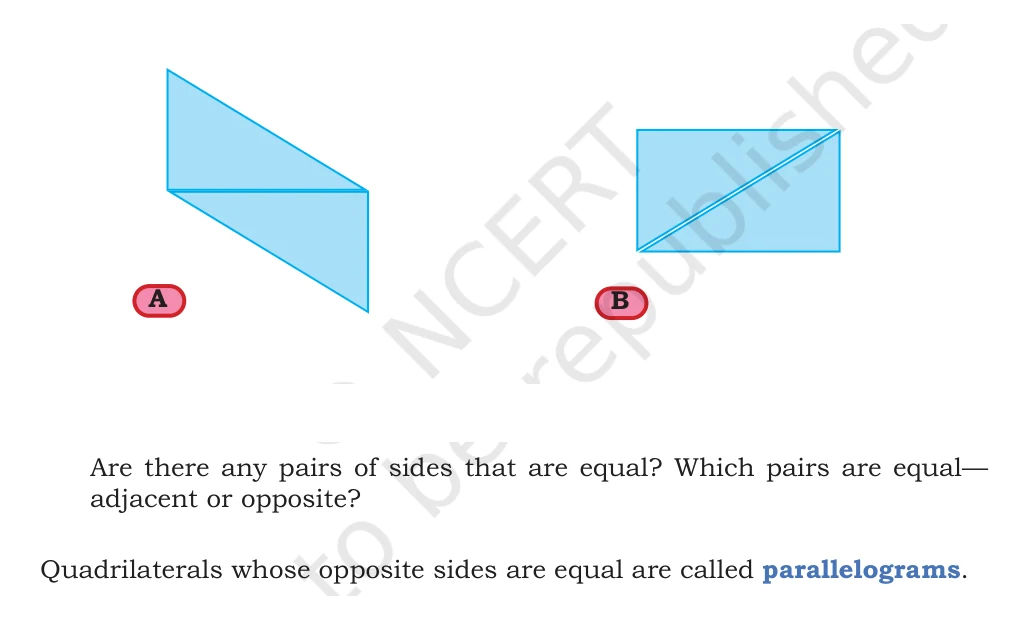
Are the equal side pairs in A and B adjacent or opposite?
Show detailed solution
- Step 1: Mark the top side and find its equal partner at the bottom.
- Step 2: Mark the left side and find its equal partner at the right.
- Step 3: Each equal partner lies across the shape.
- Answer: The equal pairs are opposite sides in both A and B.
Textbook page 98 · solved item 37
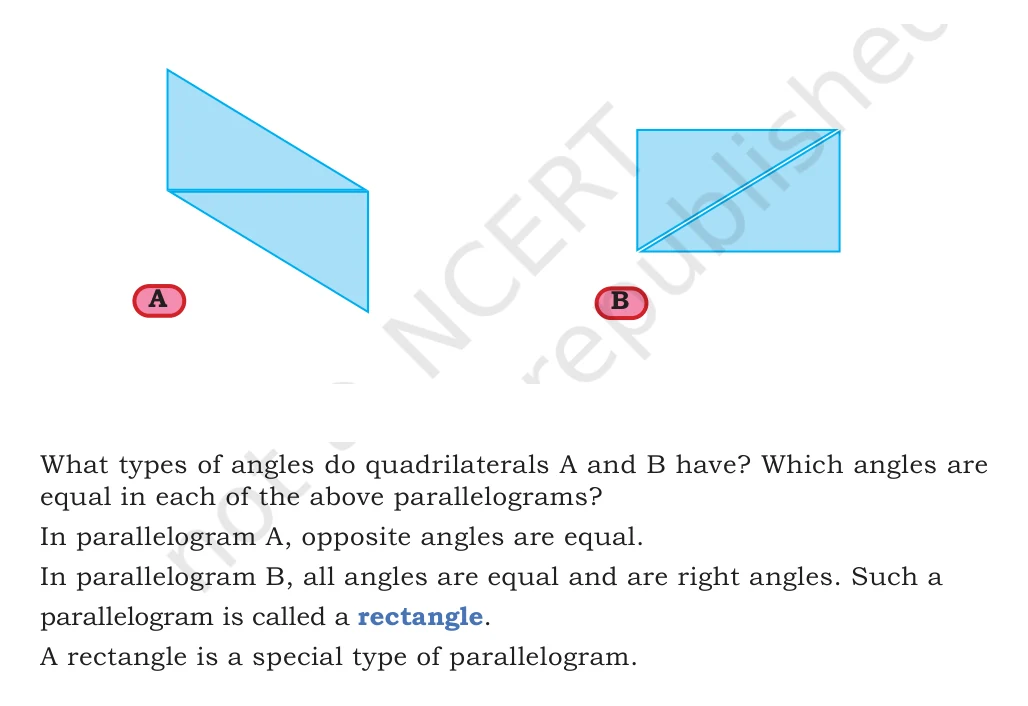
What types of angles do parallelograms A and B have, and which angles are equal?
Show detailed solution
- Step 1: In A, identify two sharp acute angles and two wider obtuse angles.
- Step 2: Opposite angles in A match: the acute pair is equal and the obtuse pair is equal.
- Step 3: In B, all four corners are right angles, so all four angles are equal.
- Answer: A has equal opposite acute and obtuse angles. B has four equal right angles and is a rectangle.
Detailed worked answers
Textbook page 99
Textbook page 99 · solved item 38
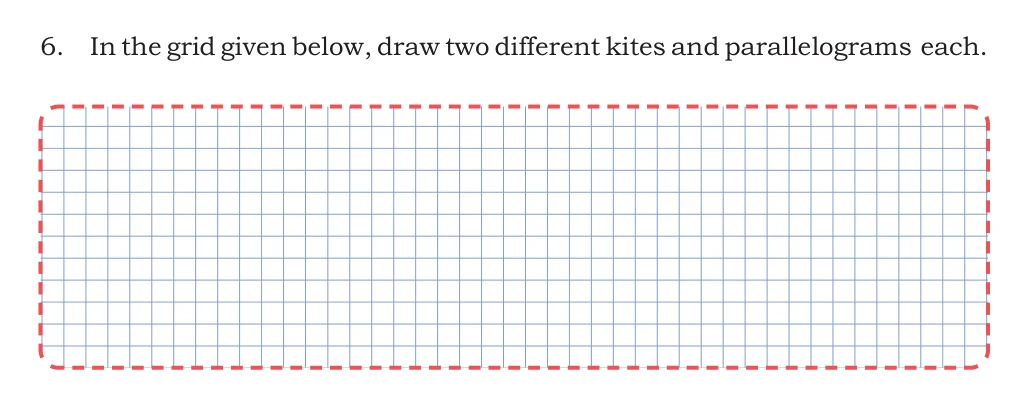
Draw two different kites and two different parallelograms on the grid.
Show detailed solution
- Step 1: For each kite, choose a vertical middle line and mark matching points on both sides, using different upper and lower lengths for the second kite.
- Step 2: For each parallelogram, draw one pair of equal parallel sides, then join them with another equal parallel pair; make one slanted and one rectangular.
- Step 3: Check the kites for equal adjacent pairs and the parallelograms for equal opposite pairs.
- Answer: Any four correct grid drawings are valid; turning or resizing a shape is allowed, but the two examples of each type should have different outlines.
Textbook page 99 · solved item 39
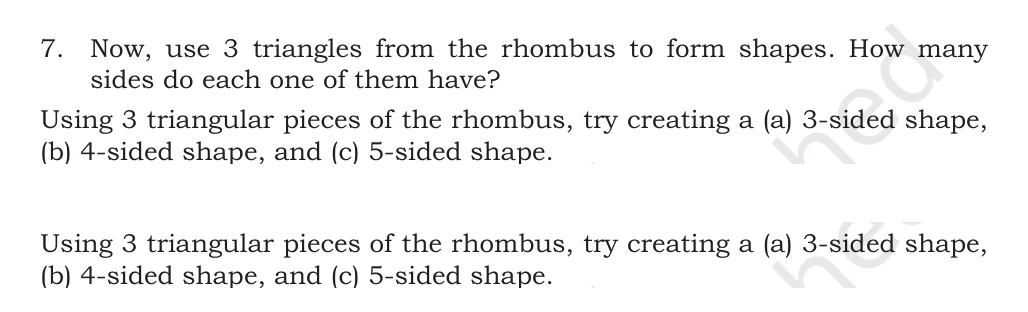
Use three rhombus triangles to make the (a) 3-sided shape.
Show detailed solution
- Step 1: Match full edges of equal length and keep the pieces from overlapping.
- Step 2: Place two pieces side by side and the third above them so the outside closes into one triangle.
- Step 3: Trace the outside only; shared inside edges are not counted.
- Answer: The completed outline has 3 sides.
Textbook page 99 · solved item 40
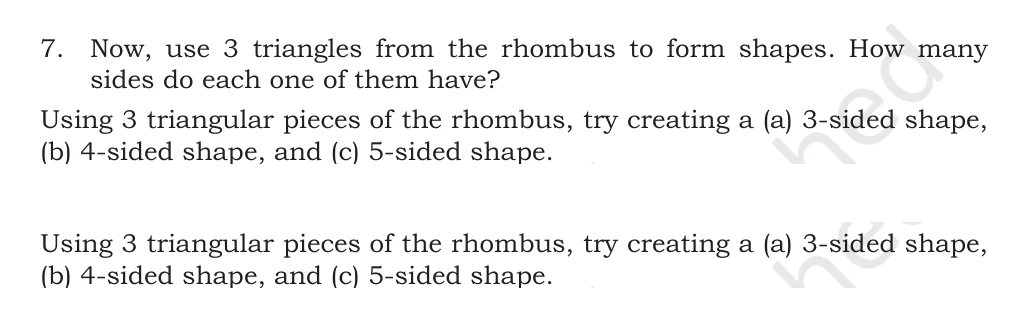
Use three rhombus triangles to make the (b) 4-sided shape.
Show detailed solution
- Step 1: Match full edges of equal length and keep the pieces from overlapping.
- Step 2: Join three pieces so one internal sloping edge disappears and the outside has four straight turns.
- Step 3: Trace the outside only; shared inside edges are not counted.
- Answer: The completed outline has 4 sides.
Textbook page 99 · solved item 41
Use three rhombus triangles to make the (c) 5-sided shape.
Show detailed solution
- Step 1: Match full edges of equal length and keep the pieces from overlapping.
- Step 2: Start from the four-sided arrangement and move one outer piece so one side becomes two sides.
- Step 3: Trace the outside only; shared inside edges are not counted.
- Answer: The completed outline has 5 sides.
Textbook page 99 · solved item 42

Can all four rhombus triangles make a (a) square?
Show detailed solution
- Step 1: Use all four pieces and join only complete edges of the same length.
- Step 2: The triangle corners cannot make four equal sides and four right corners with these exact pieces.
- Step 3: Trace and count the straight sides of the finished outside boundary.
- Answer: No.
Textbook page 99 · solved item 43

Can all four rhombus triangles make a (b) rectangle?
Show detailed solution
- Step 1: Use all four pieces and join only complete edges of the same length.
- Step 2: Pair the triangles into two matching halves, then place the two halves together along a full side.
- Step 3: Trace and count the straight sides of the finished outside boundary.
- Answer: Yes.
Textbook page 99 · solved item 44

Can all four rhombus triangles make a (c) triangle?
Show detailed solution
- Step 1: Use all four pieces and join only complete edges of the same length.
- Step 2: Every attempted triangular outline either leaves a bend in a side or fails to use all four pieces.
- Step 3: Trace and count the straight sides of the finished outside boundary.
- Answer: No.
Textbook page 99 · solved item 45

Can all four rhombus triangles make a (d) pentagon?
Show detailed solution
- Step 1: Use all four pieces and join only complete edges of the same length.
- Step 2: Joining all four complete pieces does not leave exactly five straight outside sides.
- Step 3: Trace and count the straight sides of the finished outside boundary.
- Answer: No.
Textbook page 99 · solved item 46

Can all four rhombus triangles make a (e) hexagon?
Show detailed solution
- Step 1: Use all four pieces and join only complete edges of the same length.
- Step 2: Place the four right-angle corners towards the middle and arrange the sloping sides around the outside.
- Step 3: Trace and count the straight sides of the finished outside boundary.
- Answer: Yes.
Textbook page 99 · solved item 47

Can all four rhombus triangles make a (f) octagon?
Show detailed solution
- Step 1: Use all four pieces and join only complete edges of the same length.
- Step 2: Four pieces do not provide eight separate outside corners without a gap or overlap.
- Step 3: Trace and count the straight sides of the finished outside boundary.
- Answer: No.
Textbook page 99 · solved item 48

Name the seven pieces in the tangram set.
Show detailed solution
- Step 1: Sort the pieces by the number of sides.
- Step 2: Five pieces have 3 sides, one has 4 equal sides and right corners, and one is a slanted four-sided shape.
- Step 3: Sort the five triangles by size: two large, one medium, and two small.
- Answer: Five right isosceles triangles, one square, and one parallelogram.
Textbook page 99 · solved item 49
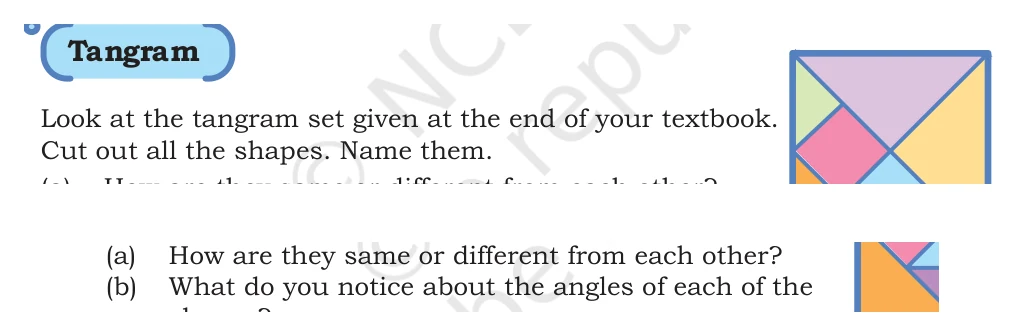
How are the tangram pieces the same or different?
Show detailed solution
- Step 1: Compare their shapes: five are triangles, one is a square, and one is a parallelogram.
- Step 2: Compare their sizes: the triangles occur in large, medium, and small sizes.
- Step 3: Match pieces by placing one over another; the two large triangles match and the two small triangles match.
- Answer: Some pieces share the same shape or size, but the complete set contains three shapes and several sizes.
Textbook page 99 · solved item 50
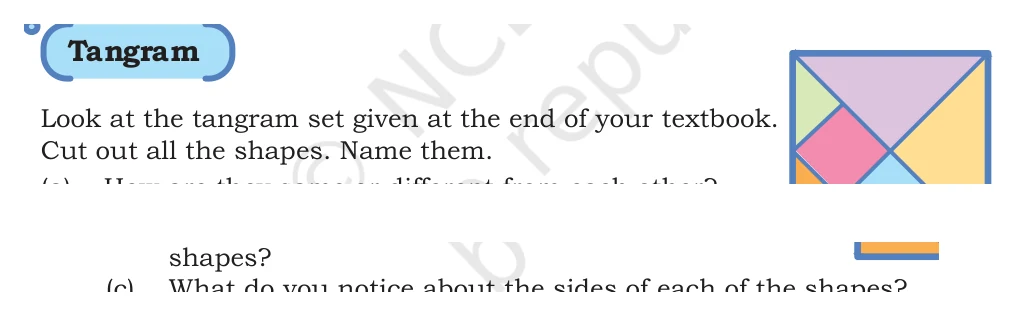
What do you notice about the angles of the tangram pieces?
Show detailed solution
- Step 1: Each triangle has one right angle and two equal smaller angles.
- Step 2: The square has four equal right angles.
- Step 3: The parallelogram has two equal sharp angles and two equal wide angles.
- Answer: Equal shapes have equal angle patterns; the square is the only piece with four right angles.
Textbook page 99 · solved item 51
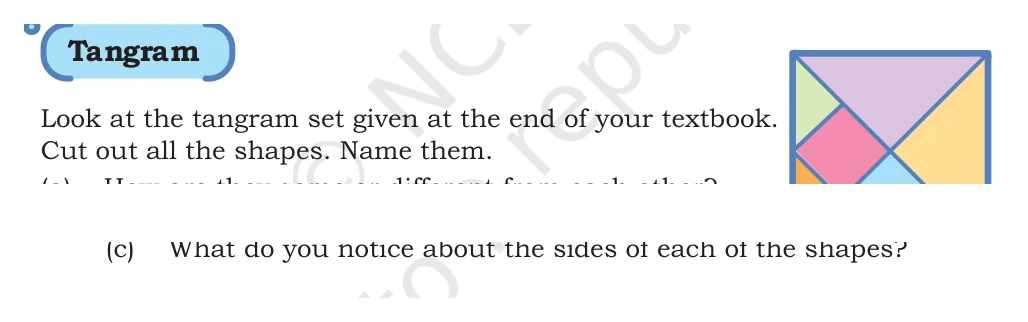
What do you notice about the sides of the tangram pieces?
Show detailed solution
- Step 1: Each triangular piece has two equal shorter sides.
- Step 2: All four sides of the square are equal.
- Step 3: Opposite sides of the parallelogram are equal.
- Answer: The triangles are isosceles, the square has four equal sides, and the parallelogram has equal opposite sides.
Textbook page 99 · solved item 52
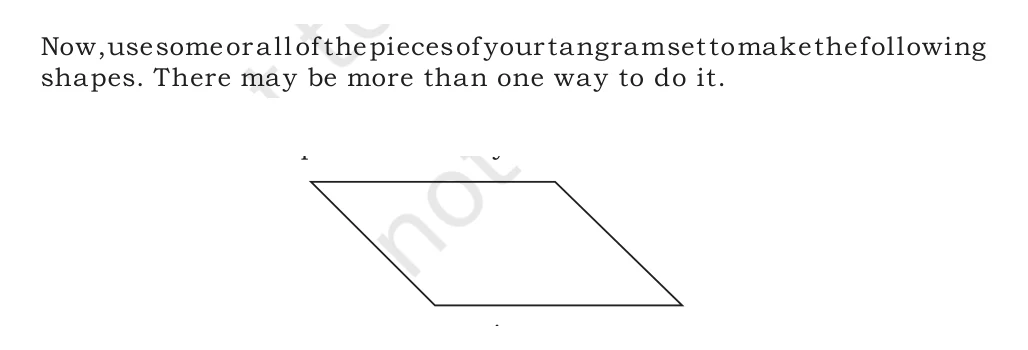
Use tangram pieces to make the outlined slanted parallelogram.
Show detailed solution
- Step 1: Match the outer corners of the chosen pieces to the printed outline.
- Step 2: Make two sloping outer sides with the large triangles, then fill the middle with the remaining pieces.
- Step 3: Turn or flip pieces until every part lies inside the outline with no overlap.
- Answer: A correct arrangement fills the whole outline and leaves no gap; more than one arrangement may work.
Textbook page 99 · solved item 53
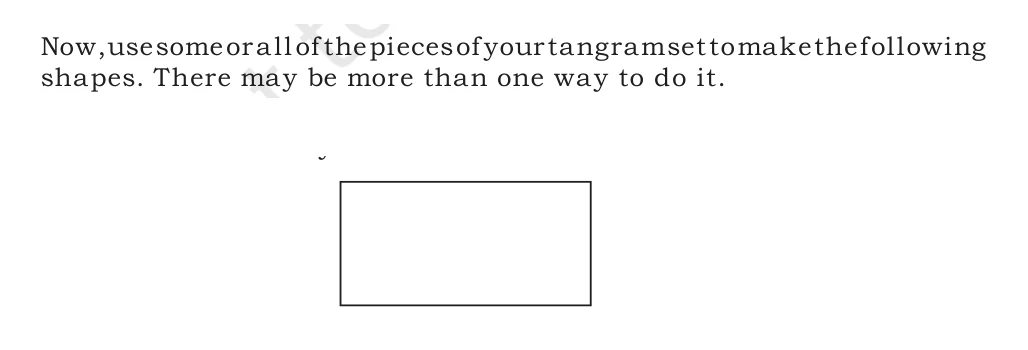
Use tangram pieces to make the outlined rectangle.
Show detailed solution
- Step 1: Match the outer corners of the chosen pieces to the printed outline.
- Step 2: Put the large triangles at opposite ends and fill the straight-sided middle with the five smaller pieces.
- Step 3: Turn or flip pieces until every part lies inside the outline with no overlap.
- Answer: A correct arrangement fills the whole outline and leaves no gap; more than one arrangement may work.
Textbook page 99 · solved item 54
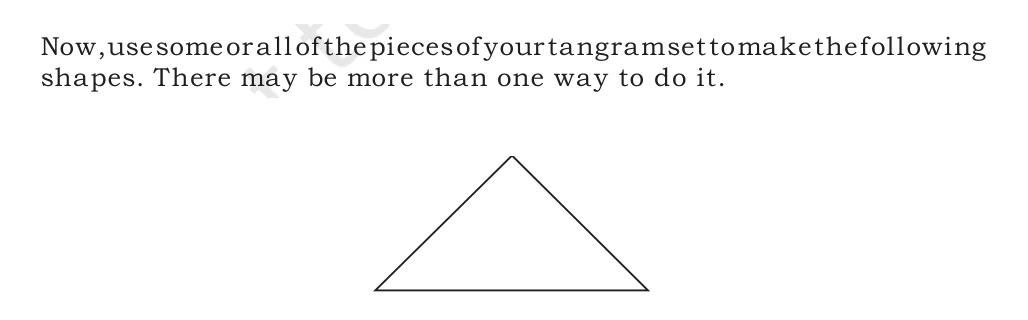
Use tangram pieces to make the outlined triangle.
Show detailed solution
- Step 1: Match the outer corners of the chosen pieces to the printed outline.
- Step 2: Use the two large triangles for the lower corners and arrange the remaining pieces to make the top corner and fill the centre.
- Step 3: Turn or flip pieces until every part lies inside the outline with no overlap.
- Answer: A correct arrangement fills the whole outline and leaves no gap; more than one arrangement may work.
Textbook page 99 · solved item 55
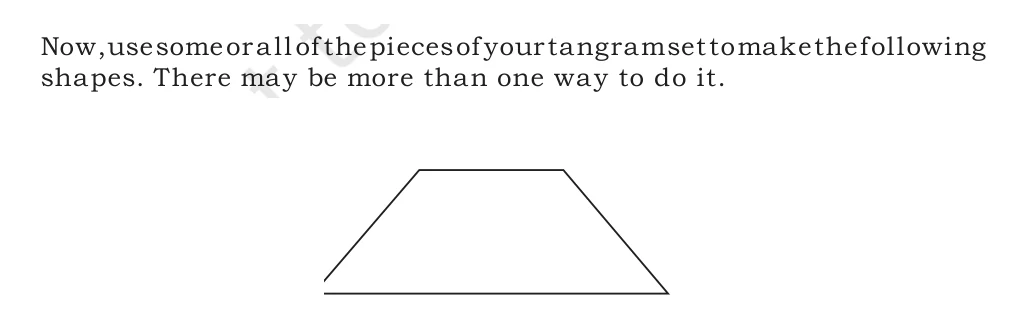
Use tangram pieces to make the outlined trapezium.
Show detailed solution
- Step 1: Match the outer corners of the chosen pieces to the printed outline.
- Step 2: Make the short top side with smaller pieces and the longer bottom side with the two large triangles.
- Step 3: Turn or flip pieces until every part lies inside the outline with no overlap.
- Answer: A correct arrangement fills the whole outline and leaves no gap; more than one arrangement may work.
Detailed worked answers
Textbook page 100
Textbook page 100 · solved item 56
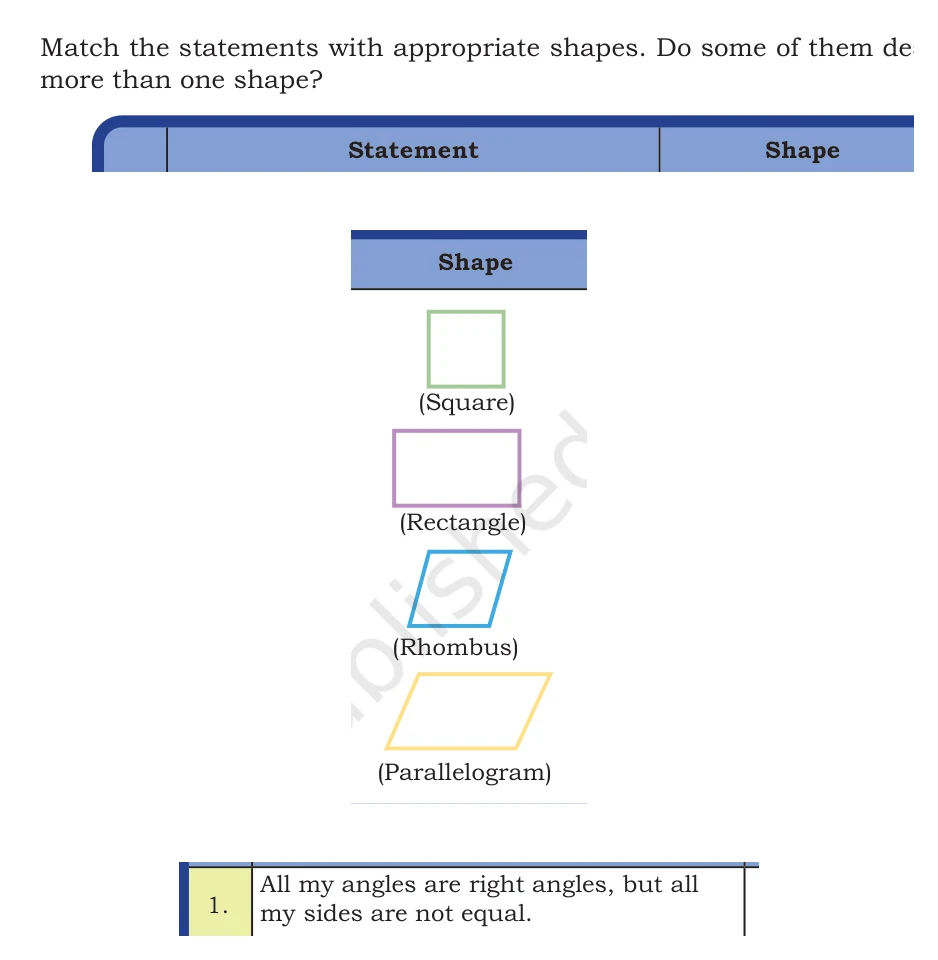
Match statement 1 in 'Which Shape Am I?' to the appropriate shape or shapes.
Show detailed solution
- Step 1: Underline the clue about sides and the clue about angles.
- Step 2: Four right angles identify a rectangle, while 'not all sides equal' rules out the square.
- Step 3: Check every listed shape because the question allows more than one match.
- Answer: Rectangle.
Textbook page 100 · solved item 57
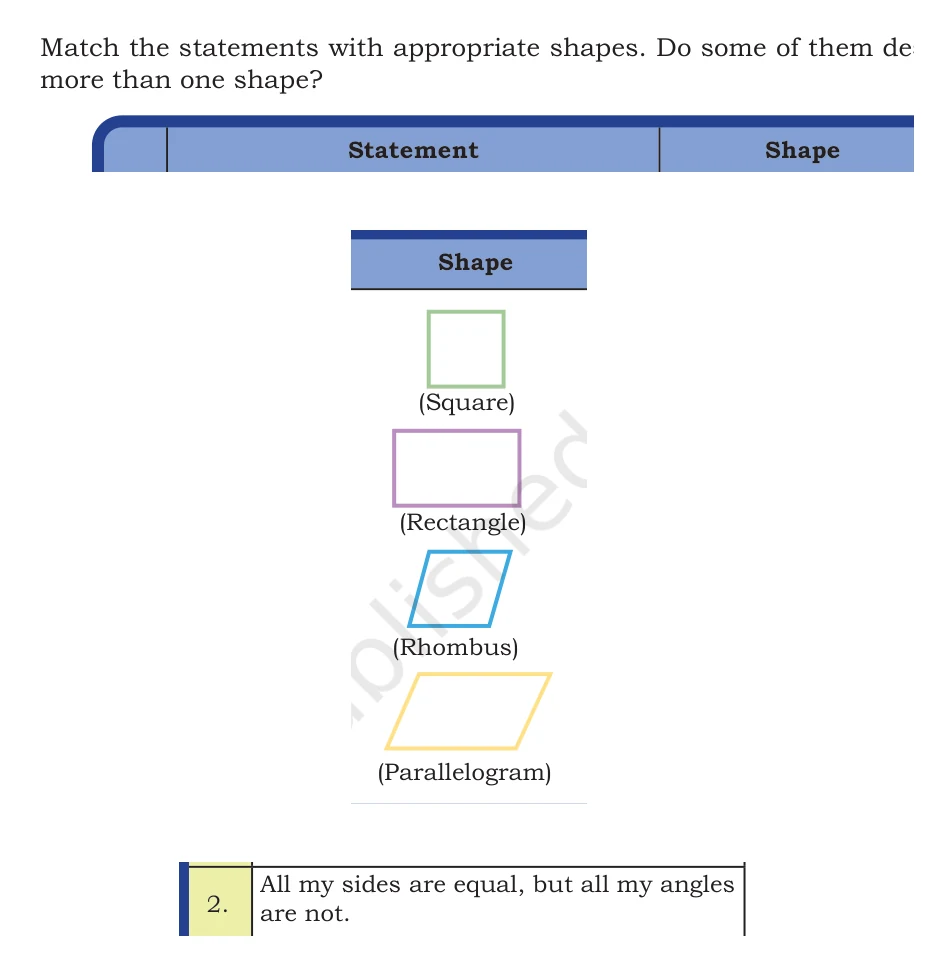
Match statement 2 in 'Which Shape Am I?' to the appropriate shape or shapes.
Show detailed solution
- Step 1: Underline the clue about sides and the clue about angles.
- Step 2: Four equal sides identify a rhombus, while unequal angles rule out the square.
- Step 3: Check every listed shape because the question allows more than one match.
- Answer: Rhombus.
Textbook page 100 · solved item 58
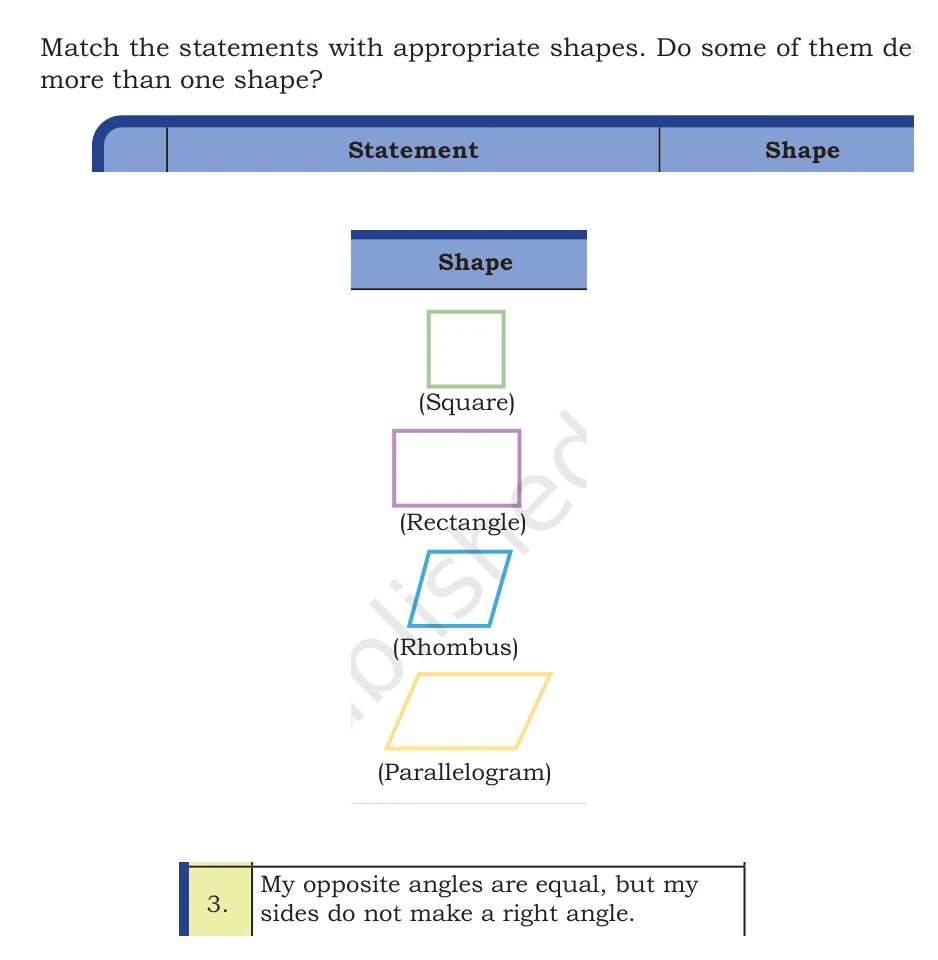
Match statement 3 in 'Which Shape Am I?' to the appropriate shape or shapes.
Show detailed solution
- Step 1: Underline the clue about sides and the clue about angles.
- Step 2: Both have equal opposite angles and neither needs a right angle.
- Step 3: Check every listed shape because the question allows more than one match.
- Answer: Rhombus And A Non-Rectangular Parallelogram.
Textbook page 100 · solved item 59
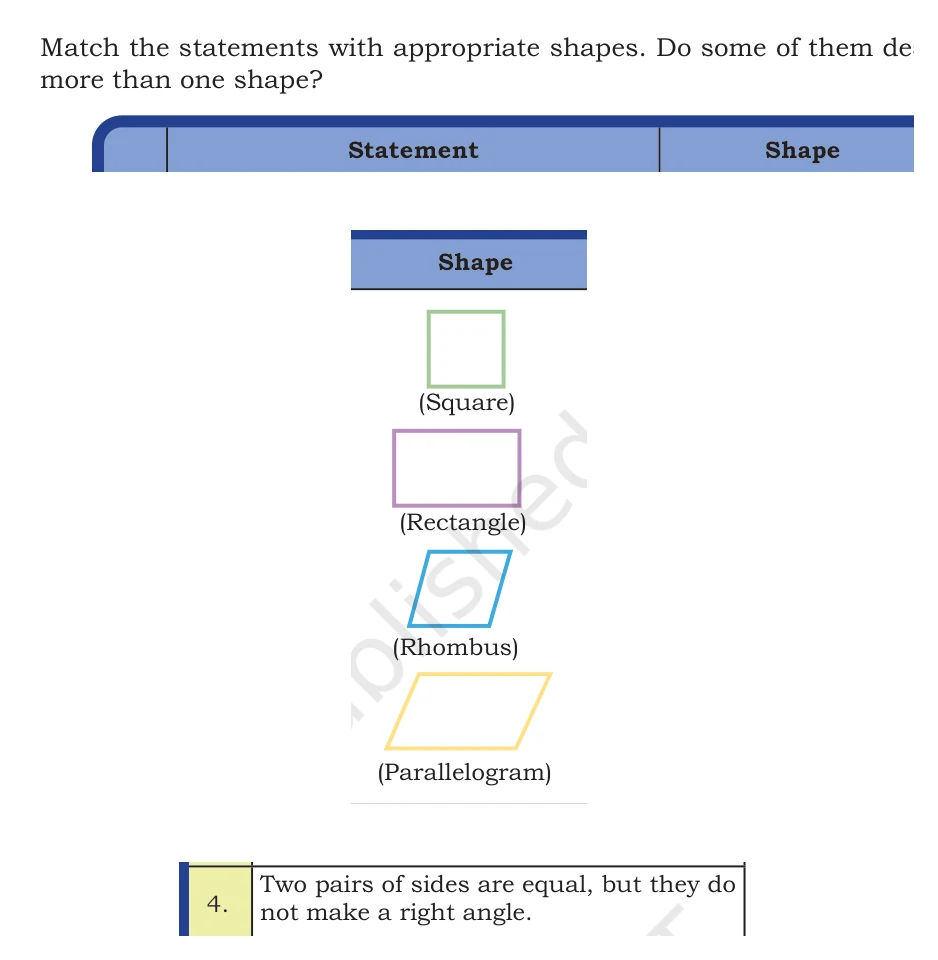
Match statement 4 in 'Which Shape Am I?' to the appropriate shape or shapes.
Show detailed solution
- Step 1: Underline the clue about sides and the clue about angles.
- Step 2: Its two pairs of opposite sides are equal and its corners need not be right angles; a non-square rhombus also fits if all four equal sides are allowed as two pairs.
- Step 3: Check every listed shape because the question allows more than one match.
- Answer: Parallelogram.
Textbook page 100 · solved item 60
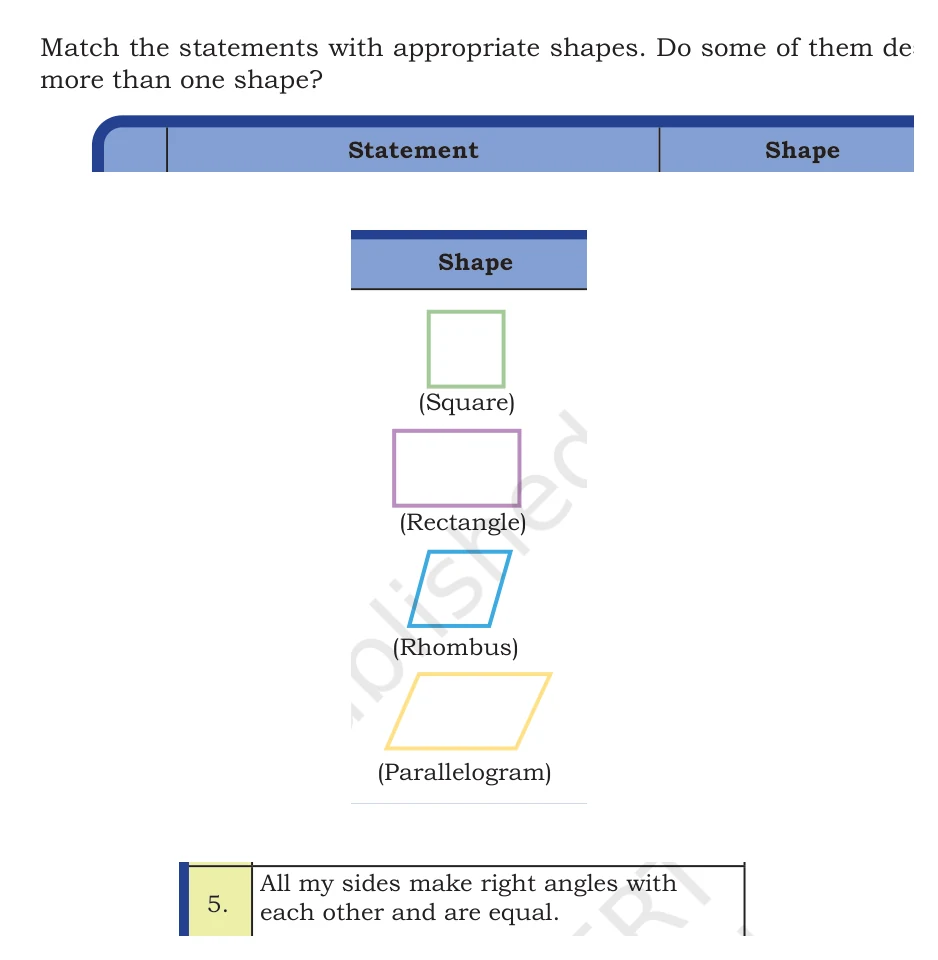
Match statement 5 in 'Which Shape Am I?' to the appropriate shape or shapes.
Show detailed solution
- Step 1: Underline the clue about sides and the clue about angles.
- Step 2: It has four equal sides and every neighbouring pair meets at a right angle.
- Step 3: Check every listed shape because the question allows more than one match.
- Answer: Square.
Textbook page 100 · solved item 61
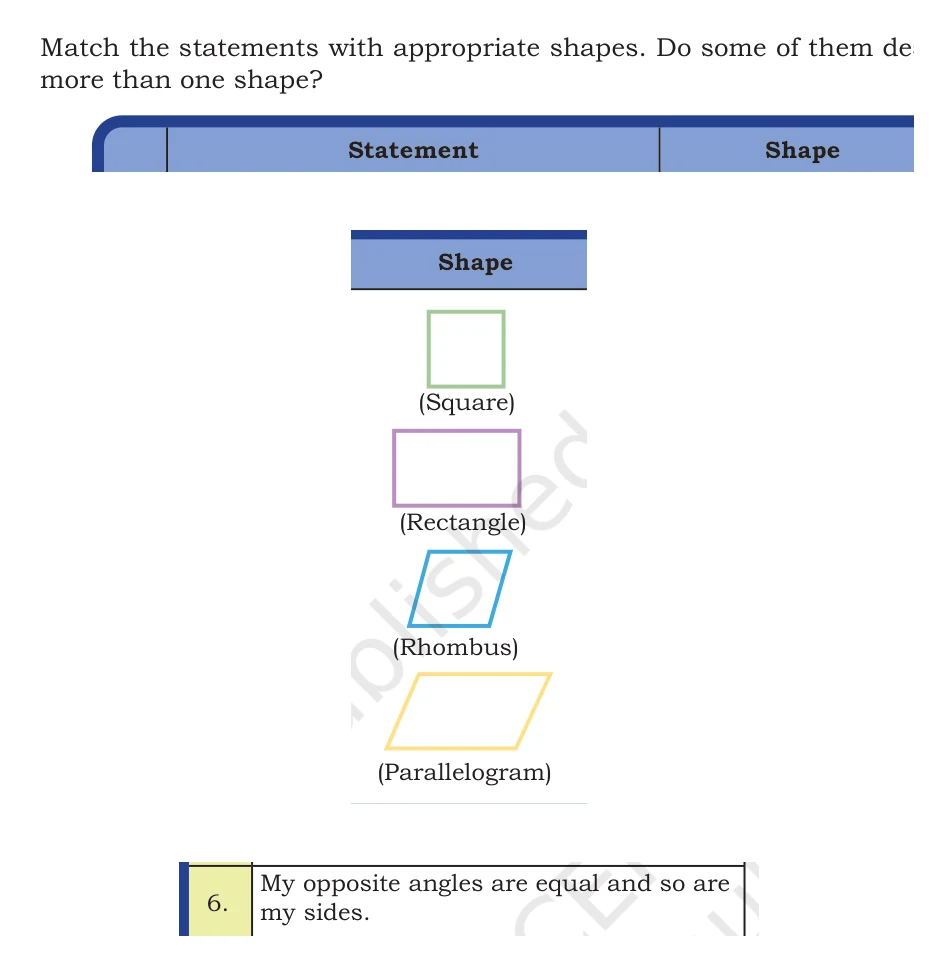
Match statement 6 in 'Which Shape Am I?' to the appropriate shape or shapes.
Show detailed solution
- Step 1: Underline the clue about sides and the clue about angles.
- Step 2: All four are parallelograms in the broad family, so their opposite angles and opposite sides are equal.
- Step 3: Check every listed shape because the question allows more than one match.
- Answer: Square, Rectangle, Rhombus, And Parallelogram.
Textbook page 100 · solved item 62
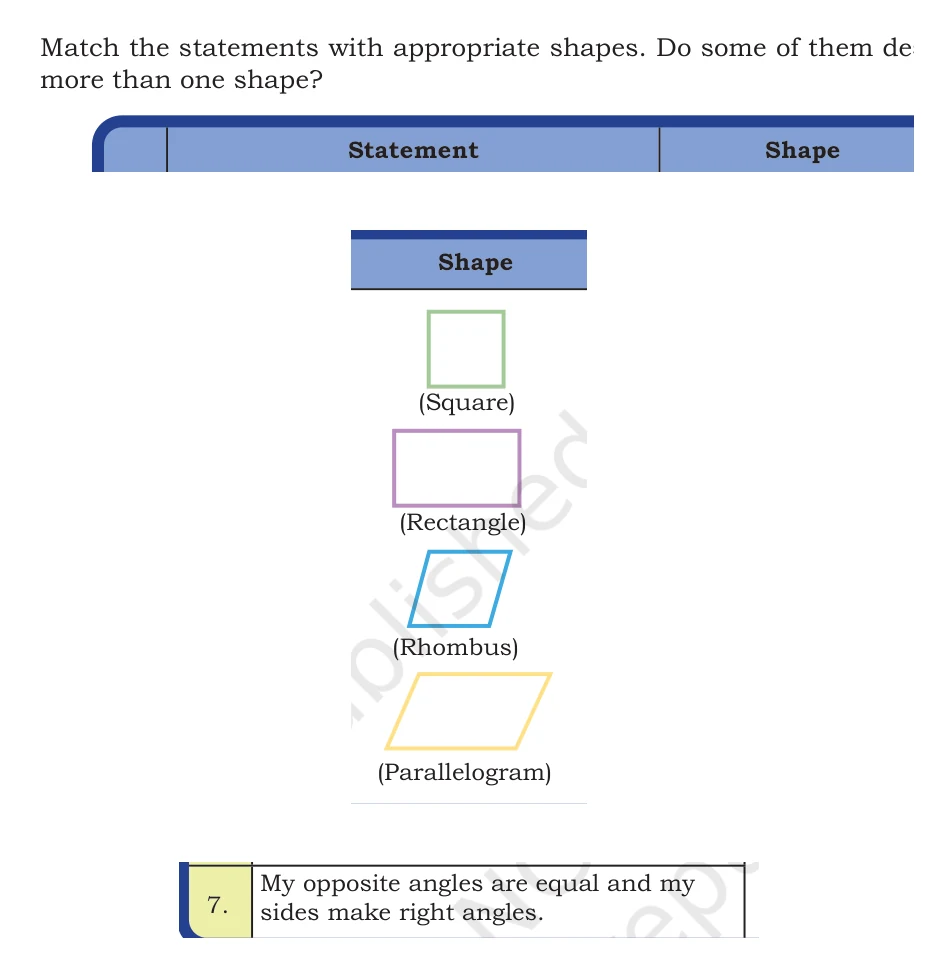
Match statement 7 in 'Which Shape Am I?' to the appropriate shape or shapes.
Show detailed solution
- Step 1: Underline the clue about sides and the clue about angles.
- Step 2: Both have equal opposite angles and four right-angle corners.
- Step 3: Check every listed shape because the question allows more than one match.
- Answer: Square And Rectangle.
Textbook page 100 · solved item 63
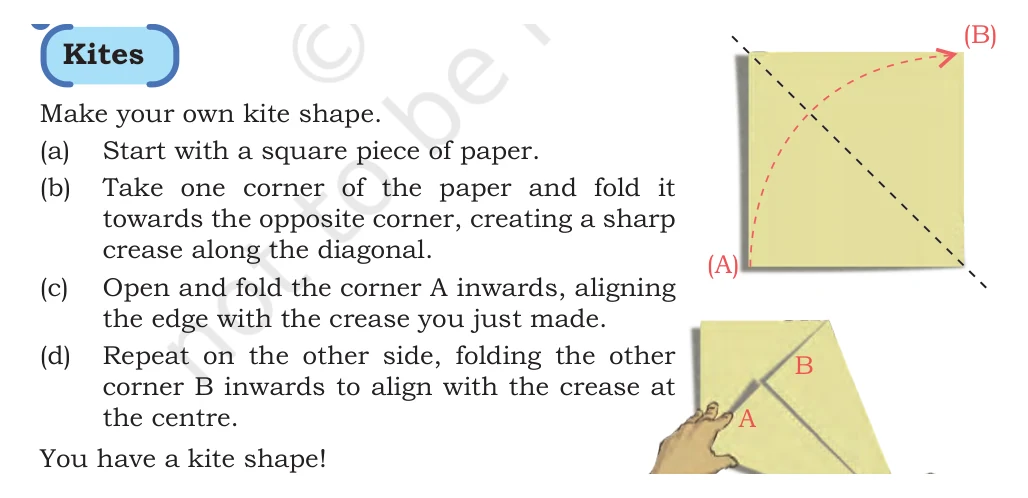
Fold the square paper to make the kite shown.
Show detailed solution
- Step 1: Fold the square along diagonal AB, crease it sharply, and open it again.
- Step 2: Fold corner A inward until its edge lies on the diagonal crease.
- Step 3: Fold corner B inward in the same way so the two folded edges meet at the centre line.
- Answer: The outside boundary now has two pairs of equal adjacent sides, so it is a kite.
Textbook page 100 · solved item 64
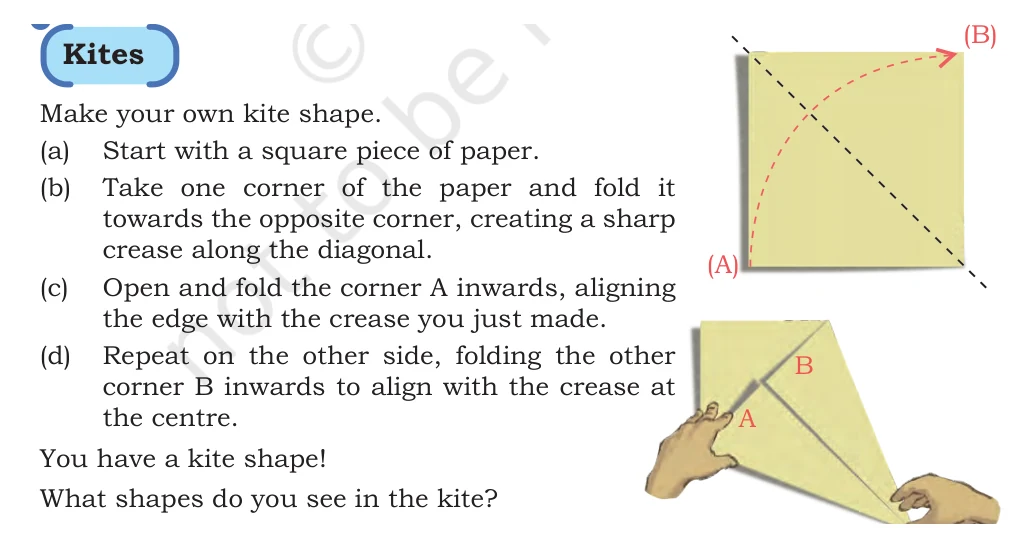
What shapes can you see in the folded kite?
Show detailed solution
- Step 1: Use the long diagonal crease to split the kite into two large parts.
- Step 2: Follow the two flap folds; they split the paper into smaller three-sided regions.
- Step 3: Count each region by tracing its three straight sides.
- Answer: The folds show triangles, arranged in matching pairs on the two sides of the kite.
Detailed worked answers
Textbook page 101
Textbook page 101 · solved item 65
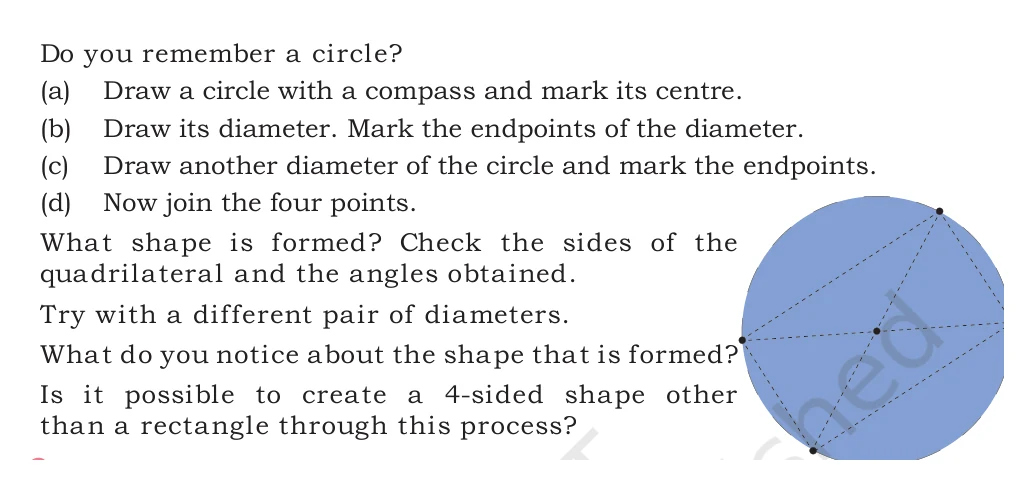
Draw two diameters of a circle and join their four endpoints.
Show detailed solution
- Step 1: Draw a circle, mark its centre, and draw one straight line through the centre to the circle on both sides.
- Step 2: Draw a different diameter through the same centre and mark all four endpoints.
- Step 3: Join the endpoints in order around the circle, not across it.
- Answer: The four joined points form a rectangle.
Textbook page 101 · solved item 66
What shape is formed, and what do you notice about its sides and angles?
Show detailed solution
- Step 1: Compare opposite sides; each opposite pair has the same length.
- Step 2: Check the four corners with a paper corner; every corner is a right angle.
- Step 3: A quadrilateral with four right angles is a rectangle.
- Answer: A rectangle is formed. Its opposite sides are equal and all four angles are right angles.
Textbook page 101 · solved item 67
What happens when a different pair of diameters is used?
Show detailed solution
- Step 1: Move one diameter while keeping both lines through the centre.
- Step 2: Join the four new endpoints in order.
- Step 3: The side lengths may change, but the four corners remain right angles.
- Answer: A rectangle is formed every time.
Textbook page 101 · solved item 68
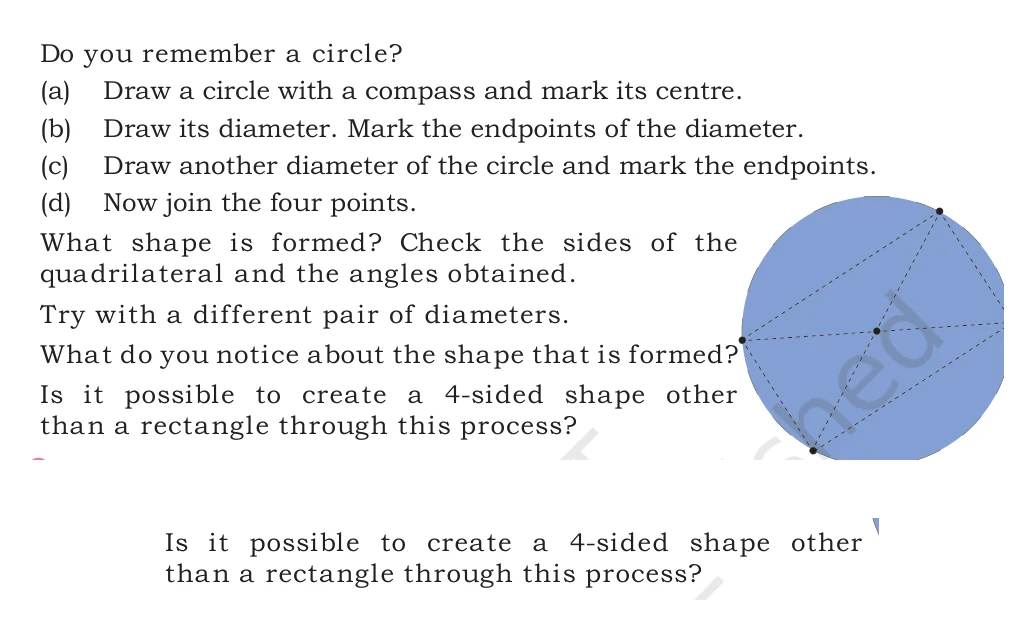
Can this process create a four-sided shape other than a rectangle?
Show detailed solution
- Step 1: Both diameters always cross at the centre and are cut into equal halves there.
- Step 2: Joining their endpoints therefore always makes four right corners.
- Step 3: Perpendicular equal-looking diameters can make a square, but a square is also a special rectangle.
- Answer: No other type is made; the result is always a rectangle, sometimes the special rectangle called a square.
Textbook page 101 · solved item 69
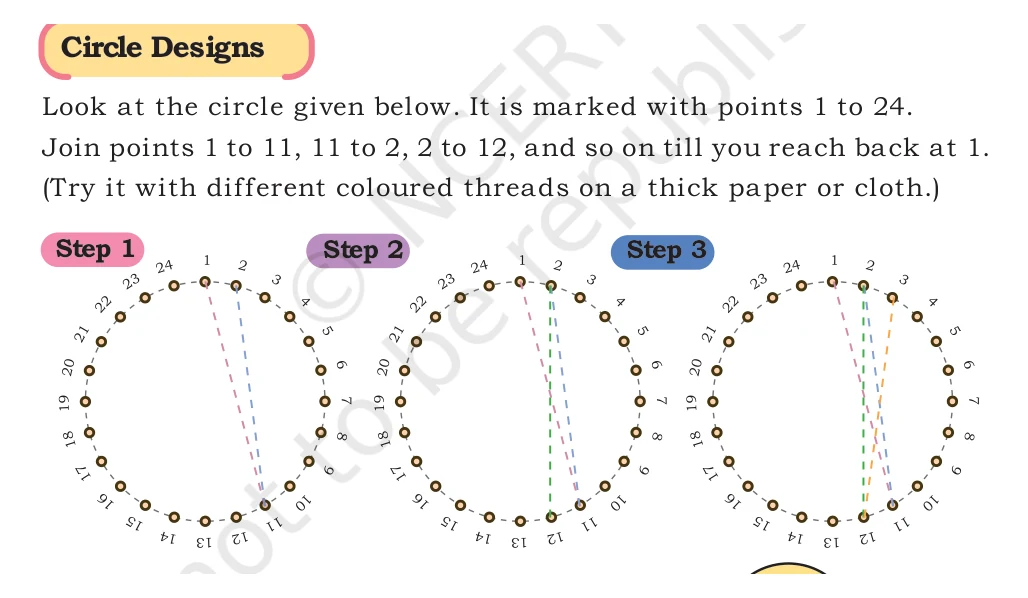
Complete the 24-point circle design by following the given joining rule.
Show detailed solution
- Step 1: Join 1 to 11, then 11 to 2, and then 2 to 12.
- Step 2: Continue by alternating the next low number with the number 10 places ahead: 12 to 3, 3 to 13, and so on.
- Step 3: Keep the same order through all 24 points until the final segment returns to point 1.
- Answer: The completed set of equal jumps makes the repeating star-like thread design shown by the first three steps.
Textbook page 101 · solved item 70

How can the overlapping-circle design at the bottom of the page be made?
Show detailed solution
- Step 1: Draw one circle and mark the top, bottom, left, and right endpoints of two crossing diameters.
- Step 2: Without changing the compass opening, use each of those four endpoints as a new centre and draw another circle.
- Step 3: Trace the visible arcs and colour matching lens-shaped regions alike.
- Answer: One central circle and four equal circles centred at its four main points make the design.
Detailed worked answers
Textbook page 102
Textbook page 102 · solved item 71
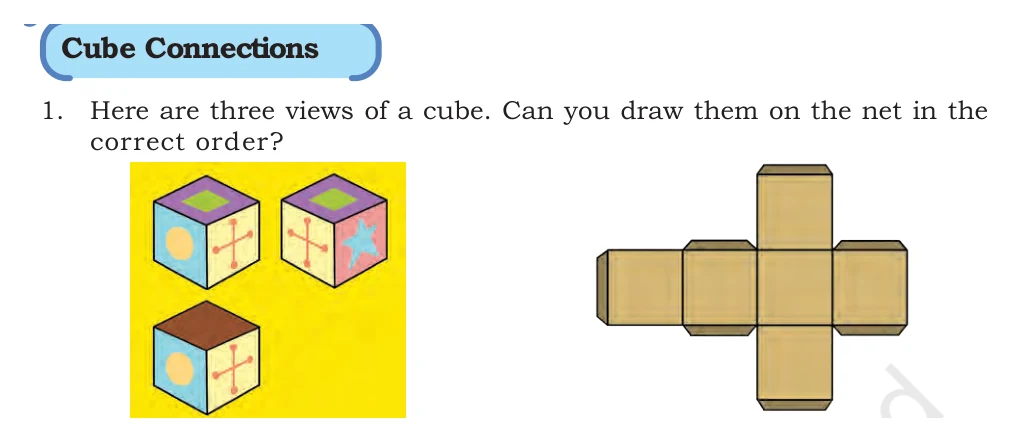
Place the pictured cube faces on the net in a correct order.
Show detailed solution
- Step 1: The green-diamond face touches the yellow-circle and pink-cross faces. The brown face also touches the circle and cross faces.
- Step 2: The blue-star face is opposite the yellow-circle face, and the brown face is opposite the green-diamond face.
- Step 3: One valid net puts the pink cross in the centre, green diamond above, yellow circle left, blue star right, and brown below; the unseen face goes on the extra square above the green diamond.
- Answer: Any rotated or flipped net with those opposite pairs is correct.
Textbook page 102 · solved item 72
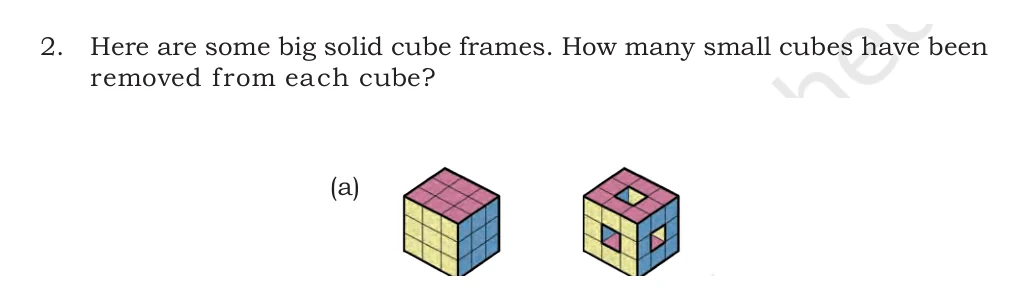
How many small cubes were removed from cube frame (a)?
Show detailed solution
- Step 1: The original cube is 3\times3\times3=27 small cubes.
- Step 2: The frame keeps 8 corner cubes and 12\times(3-2)=12 other cubes along its 12 edges, for 20 kept cubes.
- Step 3: Subtract kept cubes from the solid cube: 27-20=7.
- Answer: 7 small cubes were removed.
Textbook page 102 · solved item 73
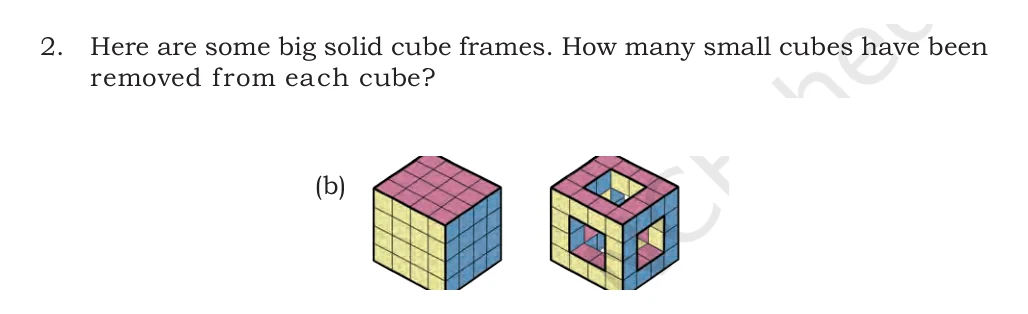
How many small cubes were removed from cube frame (b)?
Show detailed solution
- Step 1: The original cube is 4\times4\times4=64 small cubes.
- Step 2: The frame keeps 8 corner cubes and 12\times(4-2)=24 other cubes along its 12 edges, for 32 kept cubes.
- Step 3: Subtract kept cubes from the solid cube: 64-32=32.
- Answer: 32 small cubes were removed.
Textbook page 102 · solved item 74
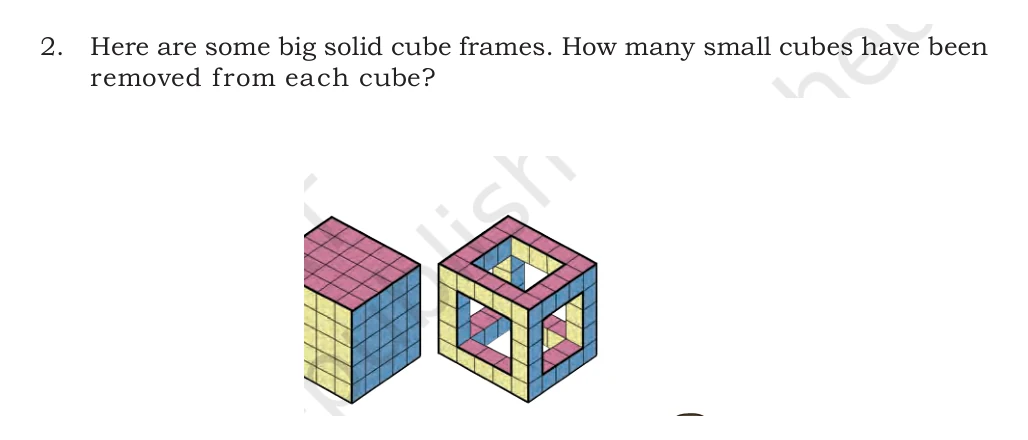
How many small cubes were removed from cube frame (c)?
Show detailed solution
- Step 1: The original cube is 5\times5\times5=125 small cubes.
- Step 2: The frame keeps 8 corner cubes and 12\times(5-2)=36 other cubes along its 12 edges, for 44 kept cubes.
- Step 3: Subtract kept cubes from the solid cube: 125-44=81.
- Answer: 81 small cubes were removed.
Textbook page 102 · solved item 75
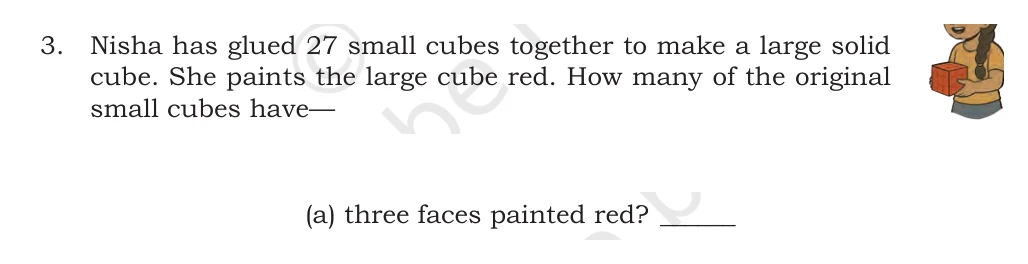
How many of the 27 small cubes have three faces painted red in part (a)?
Show detailed solution
- Step 1: Picture the large cube as 3 layers of 3\times3 cubes.
- Step 2: Only a corner cube touches three outer faces, and a cube has 8 corners.
- Step 3: Check that the four groups total 8+12+6+1=27.
- Answer: 8 small cubes.
Textbook page 102 · solved item 76
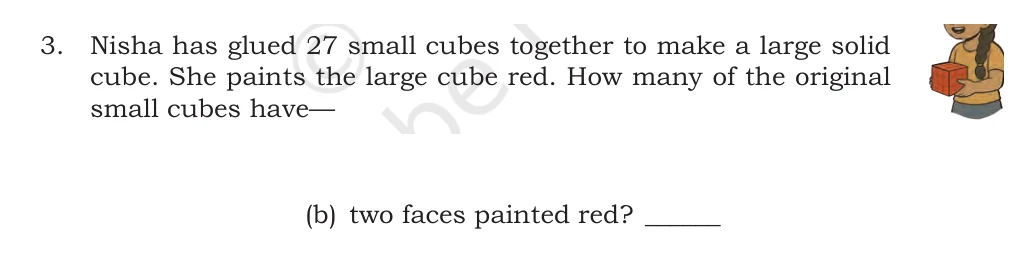
How many of the 27 small cubes have two faces painted red in part (b)?
Show detailed solution
- Step 1: Picture the large cube as 3 layers of 3\times3 cubes.
- Step 2: Each of the 12 edges has one middle cube that is not a corner.
- Step 3: Check that the four groups total 8+12+6+1=27.
- Answer: 12 small cubes.
Textbook page 102 · solved item 77
How many of the 27 small cubes have one faces painted red in part (c)?
Show detailed solution
- Step 1: Picture the large cube as 3 layers of 3\times3 cubes.
- Step 2: Each of the 6 faces has one centre cube that is not on an edge.
- Step 3: Check that the four groups total 8+12+6+1=27.
- Answer: 6 small cubes.
Textbook page 102 · solved item 78
How many of the 27 small cubes have no faces painted red in part (d)?
Show detailed solution
- Step 1: Picture the large cube as 3 layers of 3\times3 cubes.
- Step 2: Only the single cube at the very centre is hidden from every outside face.
- Step 3: Check that the four groups total 8+12+6+1=27.
- Answer: 1 small cube.
Textbook page 102 · solved item 79
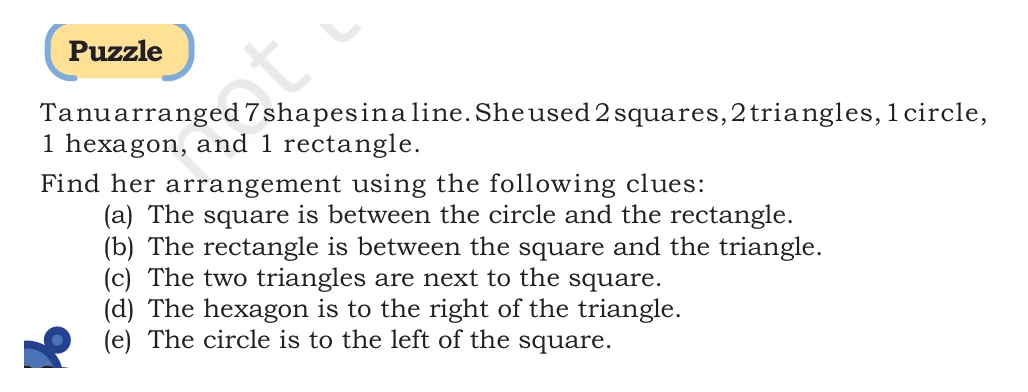
Find Tanu's seven-shape arrangement from the clues.
Show detailed solution
- Step 1: Put circle, square, rectangle in that order so the square is between the circle and rectangle and the circle is on the left.
- Step 2: Put a triangle after the rectangle. Place the second square next, with a triangle on its other side, so the two triangles are next to that square.
- Step 3: Put the hexagon to the right of the final triangle and check that two squares and two triangles were used.
- Answer, from left to right: circle, square, rectangle, triangle, square, triangle, hexagon.
Detailed worked answers
Textbook page 103
Textbook page 103 · solved item 80

What do the names icosahedron and dodecahedron mean?
Show detailed solution
- Step 1: Count or look up the number of flat faces on each model.
- Step 2: An icosahedron has 20 faces, while a dodecahedron has 12 faces.
- Step 3: The names tell the face counts of the solids.
- Answer: Icosahedron means a 20-faced solid; dodecahedron means a 12-faced solid.
Textbook page 103 · solved item 81

Make the icosahedron and dodecahedron from the supplied nets.
Show detailed solution
- Step 1: Cut exactly around the outside of each net and keep every joining flap.
- Step 2: Fold all edges inward so neighbouring faces meet neatly.
- Step 3: Paste each flap behind its neighbouring face and hold it until the model keeps its shape.
- Answer: The completed models have 20 triangular faces and 12 pentagonal faces respectively.
Textbook page 103 · solved item 82
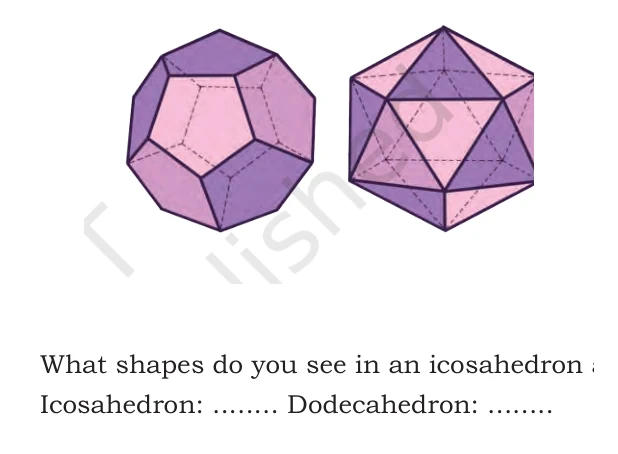
What shape is each face of the icosahedron?
Show detailed solution
- Step 1: Trace one face and count its three sides.
- Step 2: All faces match the same three-sided shape.
- Step 3: Check the same property on a second part of the model.
- Answer: Equilateral triangles.
Textbook page 103 · solved item 83
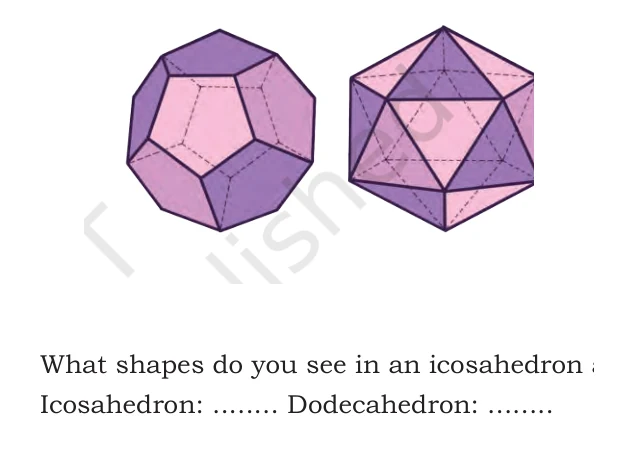
What shape is each face of the dodecahedron?
Show detailed solution
- Step 1: Trace one face and count its five sides.
- Step 2: All faces match the same five-sided shape.
- Step 3: Check the same property on a second part of the model.
- Answer: Regular pentagons.
Textbook page 103 · solved item 84
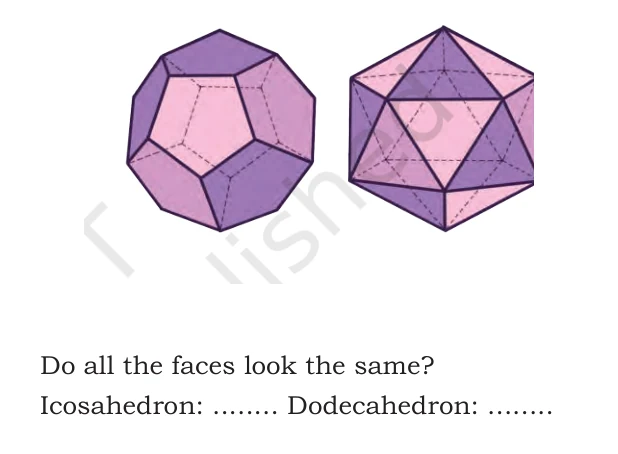
Do all the faces of the icosahedron look the same?
Show detailed solution
- Step 1: Compare several faces by shape and size.
- Step 2: Every face is an equal equilateral triangle.
- Step 3: Check the same property on a second part of the model.
- Answer: Yes, all 20 faces look the same.
Textbook page 103 · solved item 85
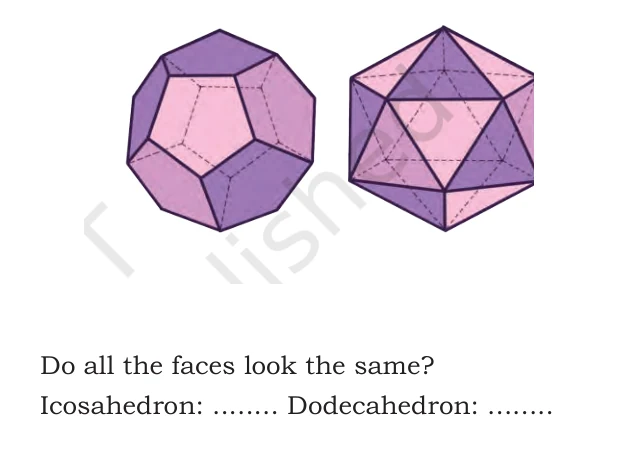
Do all the faces of the dodecahedron look the same?
Show detailed solution
- Step 1: Compare several faces by shape and size.
- Step 2: Every face is an equal regular pentagon.
- Step 3: Check the same property on a second part of the model.
- Answer: Yes, all 12 faces look the same.
Textbook page 103 · solved item 86
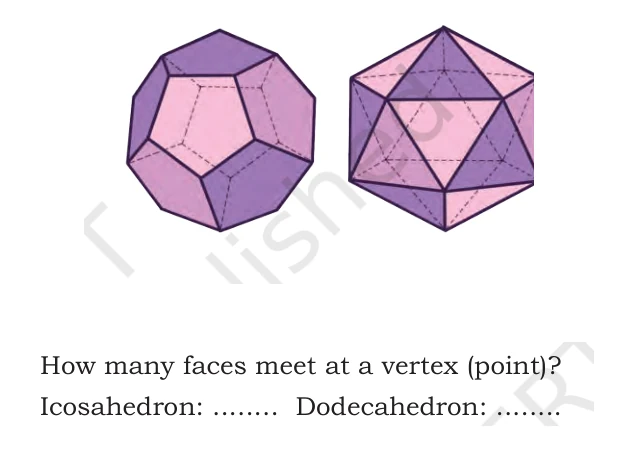
How many faces meet at each vertex of the icosahedron?
Show detailed solution
- Step 1: Choose one point and touch every triangular face ending there.
- Step 2: Repeat at another point to check the count.
- Step 3: Check the same property on a second part of the model.
- Answer: Five triangular faces meet at each vertex.
Textbook page 103 · solved item 87
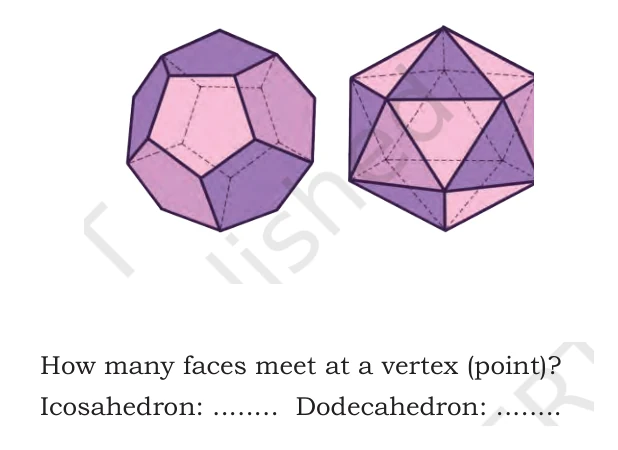
How many faces meet at each vertex of the dodecahedron?
Show detailed solution
- Step 1: Choose one point and touch every pentagonal face ending there.
- Step 2: Repeat at another point to check the count.
- Step 3: Check the same property on a second part of the model.
- Answer: Three pentagonal faces meet at each vertex.
Textbook page 103 · solved item 88
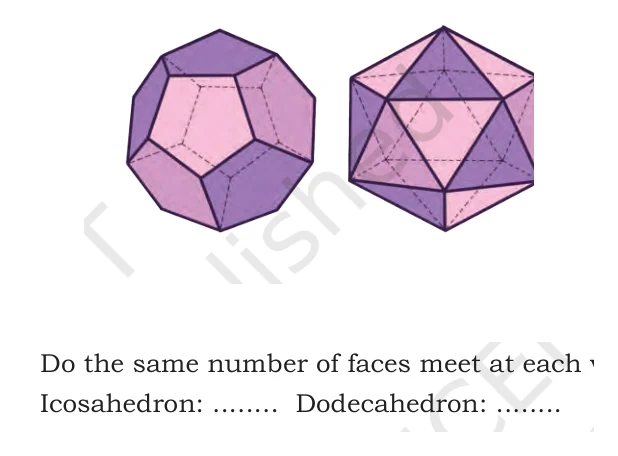
Does the same number of faces meet at every icosahedron vertex?
Show detailed solution
- Step 1: Count the faces at several different points.
- Step 2: Each check gives five triangles.
- Step 3: Check the same property on a second part of the model.
- Answer: Yes, five faces meet at every vertex.
Textbook page 103 · solved item 89
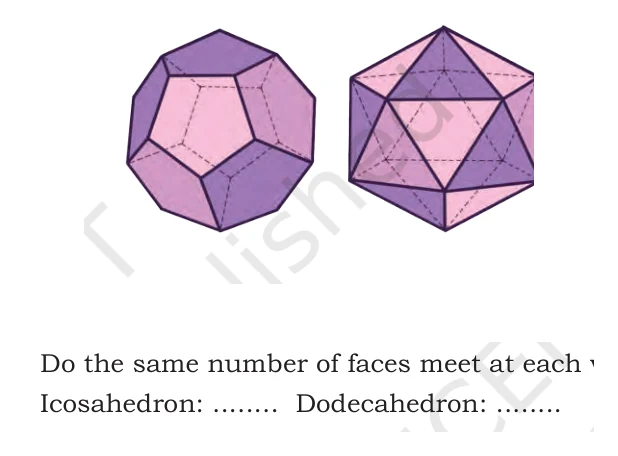
Does the same number of faces meet at every dodecahedron vertex?
Show detailed solution
- Step 1: Count the faces at several different points.
- Step 2: Each check gives three pentagons.
- Step 3: Check the same property on a second part of the model.
- Answer: Yes, three faces meet at every vertex.
Textbook page 103 · solved item 90
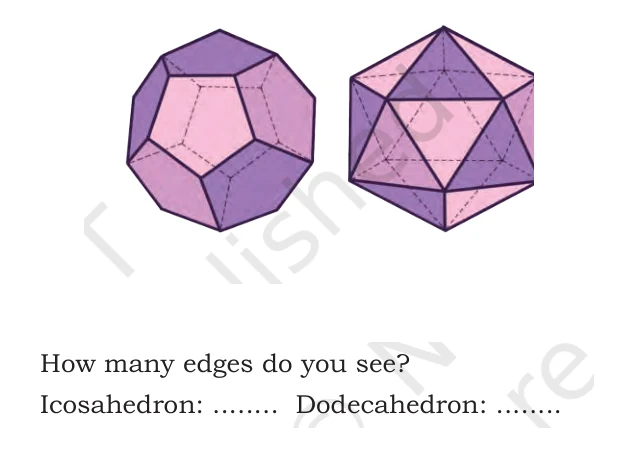
How many edges does an icosahedron have?
Show detailed solution
- Step 1: Its 20 triangles provide 20\times3=60 face-sides.
- Step 2: Each edge belongs to two faces, so divide by 2: 60\div2=30.
- Step 3: Check the same property on a second part of the model.
- Answer: 30 edges.
Textbook page 103 · solved item 91
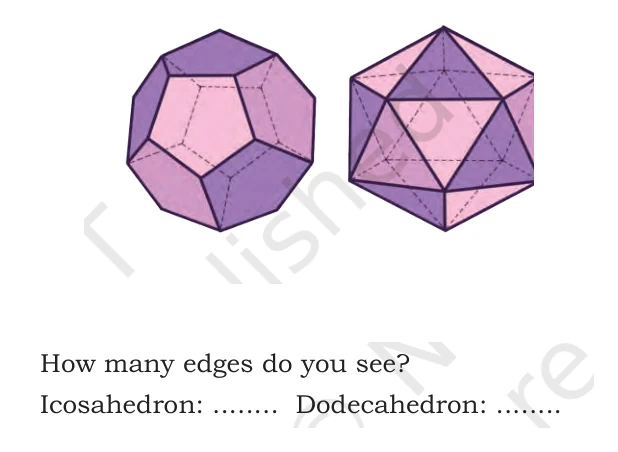
How many edges does a dodecahedron have?
Show detailed solution
- Step 1: Its 12 pentagons provide 12\times5=60 face-sides.
- Step 2: Each edge belongs to two faces, so divide by 2: 60\div2=30.
- Step 3: Check the same property on a second part of the model.
- Answer: 30 edges.
Textbook page 103 · solved item 92
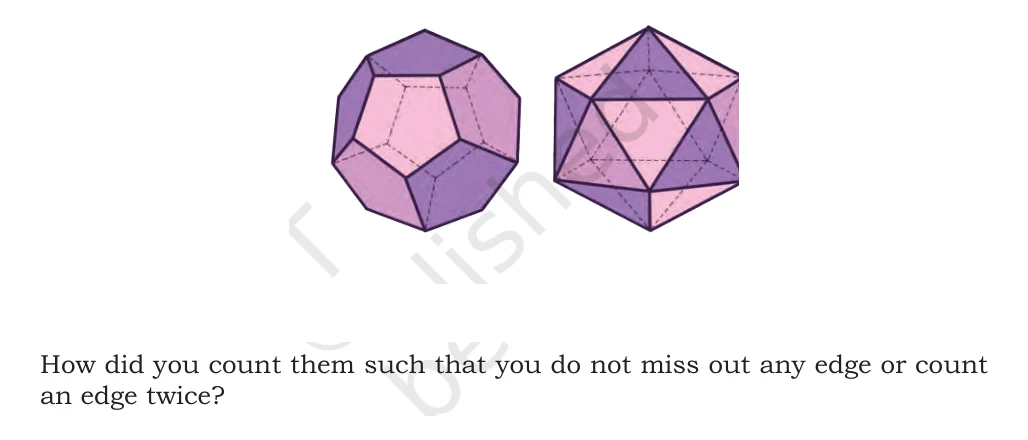
How can the edges be counted without missing or double-counting any?
Show detailed solution
- Step 1: Multiply the number of faces by the number of sides on each face.
- Step 2: This counts every shared edge once from each of its two faces.
- Step 3: Divide by 2: both 20\times3\div2 and 12\times5\div2 equal 30.
- Answer: Count all face-sides and divide by 2 because every edge is shared by two faces.
Textbook page 103 · solved item 93

Name other solid shapes whose faces all look the same.
Show detailed solution
- Step 1: Think of solids made from only one repeated regular face.
- Step 2: A cube repeats squares, while a tetrahedron and octahedron repeat equilateral triangles.
- Step 3: Check that every face on each named solid has the same shape and size.
- Sample answer: Cube, tetrahedron, and octahedron.
Textbook page 103 · solved item 94

Do the same number of faces meet at every vertex of these regular solids?
Show detailed solution
- Step 1: Count at several vertices of one model.
- Step 2: A cube has 3 squares at each vertex, a tetrahedron has 3 triangles, and an octahedron has 4 triangles.
- Step 3: The count stays unchanged from one vertex to another on each regular solid.
- Answer: Yes, the same number meets at every vertex of each regular solid.
Textbook page 103 · solved item 95

Build a three-dimensional frame with straws or sticks and clay.
Show detailed solution
- Step 1: Choose a simple solid and count the sticks needed for its edges.
- Step 2: Join the sticks at clay balls, using one ball for each vertex.
- Step 3: Compare the finished frame with the solid and check every edge and corner.
- Sample answer: Twelve equal sticks and eight clay balls make a cube frame.
Textbook page 103 · solved item 96
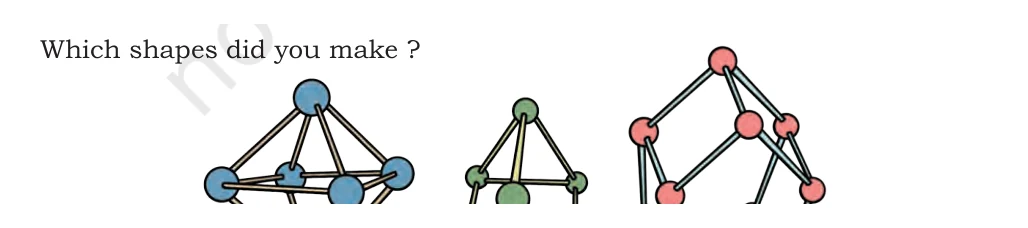
Which three-dimensional shapes can be made with sticks and clay?
Show detailed solution
- Step 1: Use sticks for straight edges and clay balls for vertices.
- Step 2: Begin with familiar frames such as a cube, cuboid, triangular prism, or pyramid.
- Step 3: Name the model by its faces and overall form after checking the frame.
- Sample answer: A cube, cuboid, tetrahedron, square pyramid, and triangular prism can be made.