
Question-by-question working
Read the prompt, attempt it, then check each step
Every exercise subpart and table row is a separate item. Shared figures and table headings are repeated whenever they are needed to understand the question.
Detailed worked answers
Textbook page 70
Textbook page 70 · solved item 1
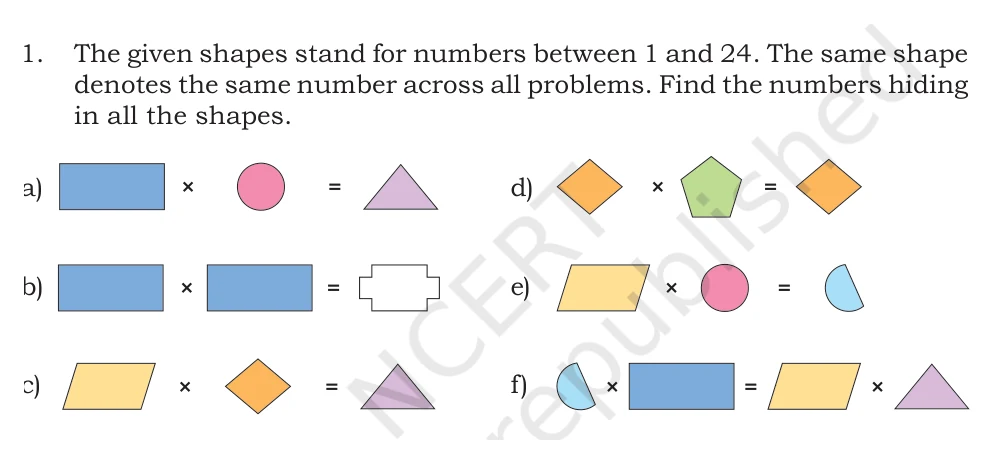
Find one set of values for all the shapes that makes equations (a)-(f) true.
Show detailed solution
- Step 1: The diamond times the pentagon equals the diamond, so a useful positive choice is pentagon = 1.
- Step 2: Choose rectangle = 4 and circle = 3. Then triangle = 4\times3=12 and the cross = 4\times4=16.
- Step 3: Choose parallelogram = 6 and diamond = 2. This also gives triangle = 6\times2=12, and the blue curved shape is 6\times3=18.
- Step 4: Check (f): 18\times4=72 and 6\times12=72, so every equation works.
- Answer: One valid set is rectangle 4, circle 3, triangle 12, cross 16, parallelogram 6, diamond 2, pentagon 1, and curved shape 18. Other valid sets may exist.
Textbook page 70 · solved item 2

Place 2, 5, and 3 in the boxes to make a product as close to 100 as possible.
Show detailed solution
- Step 1: Try the useful two-digit by one-digit products: 23\times5=115, 35\times2=70, and 53\times2=106.
- Step 2: Their distances from 100 are 15, 30, and 6.
- Step 3: A distance of 6 is the smallest.
- Answer: Put 53 on top and 2 below: 53\times2=106, which is 6 away from 100.
Textbook page 70 · solved item 3
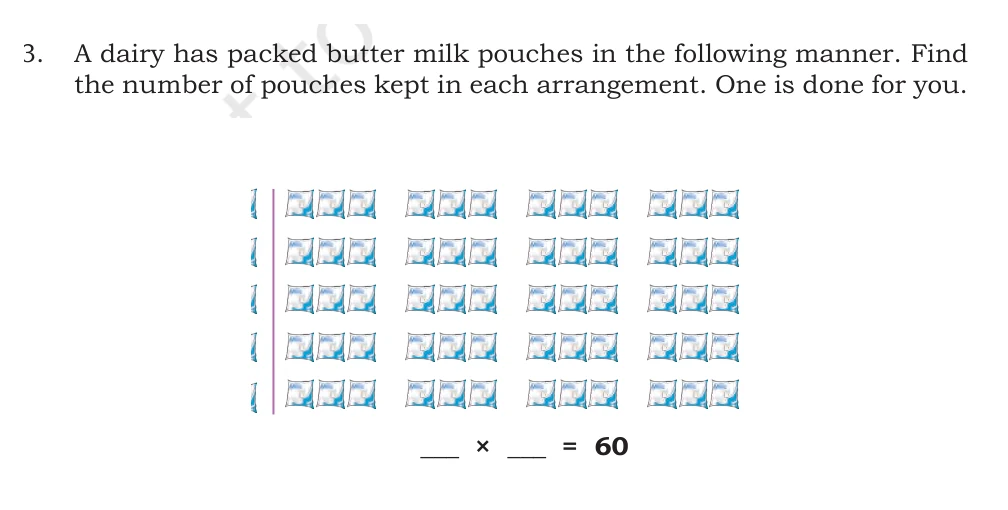
Complete the first blank arrangement of 60 buttermilk pouches.
Show detailed solution
- Step 1: Count 12 equal groups in the picture.
- Step 2: Each group contains 5 pouches.
- Step 3: 12\times5=60.
- Answer: Write 12\times5=60.
Detailed worked answers
Textbook page 71
Textbook page 71 · solved item 4
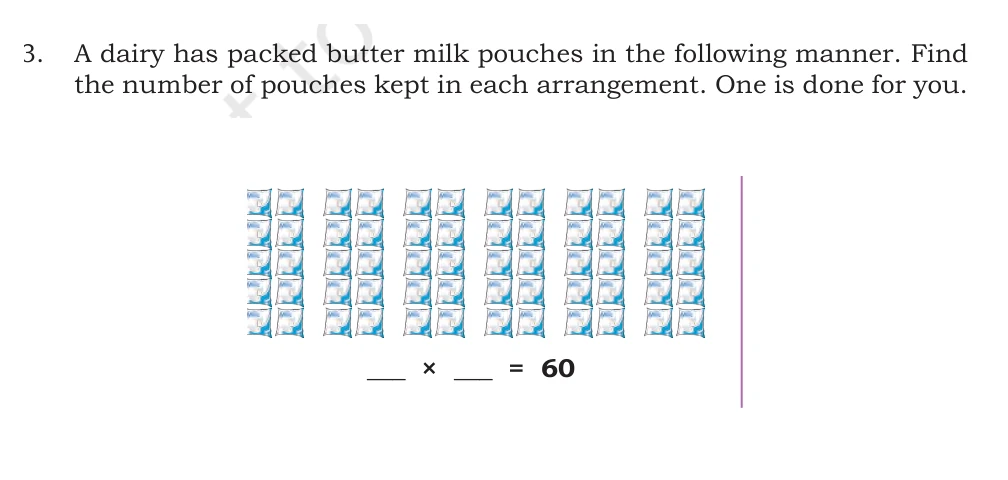
Complete the tall-group arrangement of 60 pouches.
Show detailed solution
- Step 1: Count the number of equal groups in the picture.
- Step 2: Count the pouches in one group.
- Step 3: Multiply the two counts: 10\times6=60.
- Answer: Write 10\times6=60.
Textbook page 71 · solved item 5

Complete the row arrangement of 60 pouches.
Show detailed solution
- Step 1: Count the number of equal groups in the picture.
- Step 2: Count the pouches in one group.
- Step 3: Multiply the two counts: 5\times12=60.
- Answer: Write 5\times12=60.
Textbook page 71 · solved item 6
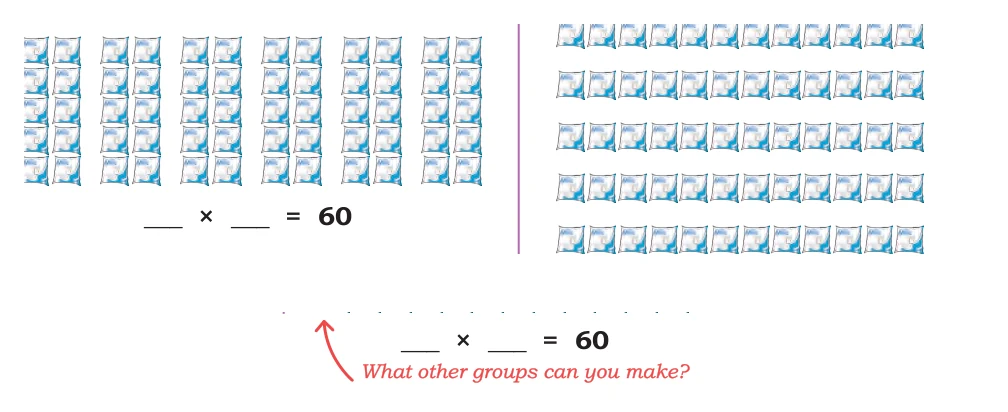
What other equal groups can be made with 60 pouches?
Show detailed solution
- Step 1: Look for factor pairs of 60.
- Step 2: Examples not already pictured are 1\times60, 2\times30, 3\times20, and 4\times15.
- Step 3: Reversing a pair also keeps the total 60.
- Answer: Possible new groupings include 3 groups of 20 or 4 groups of 15.
Textbook page 71 · solved item 7
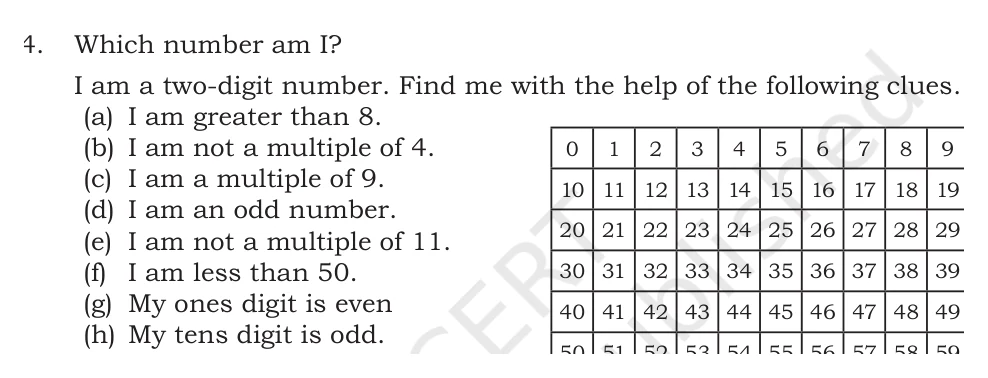
Which two-digit number satisfies all the clues in Question 4?
Show detailed solution
- Step 1: The multiples of 9 below 50 are 18, 27, 36, and 45.
- Step 2: The odd-number clue leaves 27 and 45, but the even ones-digit clue rejects both.
- Step 3: The clues 'odd number' and 'ones digit is even' cannot both be true.
- Answer: No number satisfies every printed clue. If 'odd number' was meant to say 'even number', the intended answer is 18.
Textbook page 71 · solved item 8
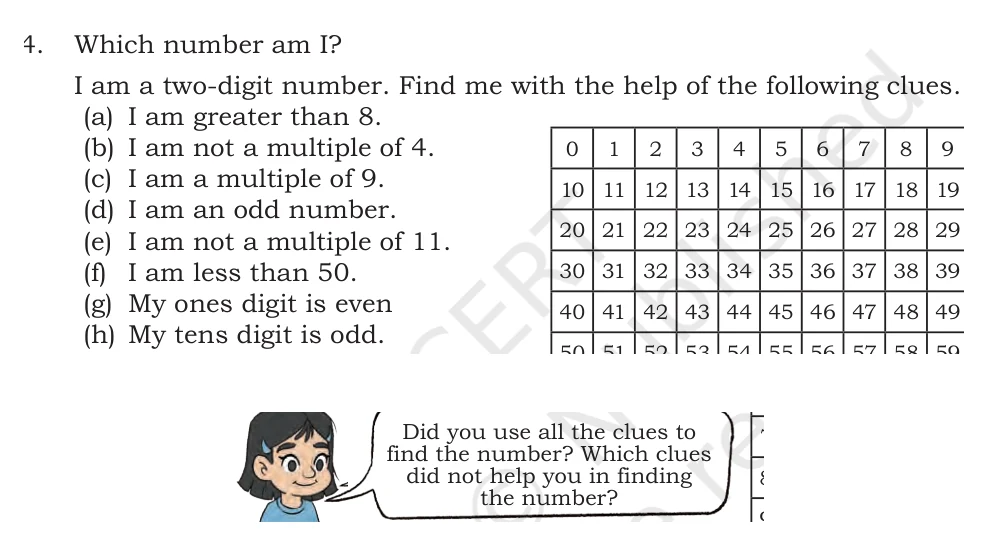
Which clues in Question 4 are unnecessary or conflicting?
Show detailed solution
- Step 1: A two-digit number is already greater than 8, so clue (a) adds nothing.
- Step 2: For the likely intended answer 18, 'not a multiple of 11' also does not narrow the remaining choices at the important step.
- Step 3: Clue (d), odd number, directly conflicts with clue (g), an even ones digit.
- Answer: Clue (a) is unnecessary, and clues (d) and (g) conflict. The page appears to contain a typo.
Textbook page 71 · solved item 9

Can the operation grid make every whole number from 0 to 20 using two different grid numbers and one operation?
Show detailed solution
- Step 1: Try addition, subtraction, multiplication, and exact division with pairs from the grid.
- Step 2: Examples include 5-4=1, 10\div5=2, 36\div12=3, and 100\div25=4.
- Step 3: Continuing through 20 makes every number except 0 and 19.
- Answer: No. Using two different grid numbers, 0 and 19 cannot be made.
Textbook page 71 · solved item 10
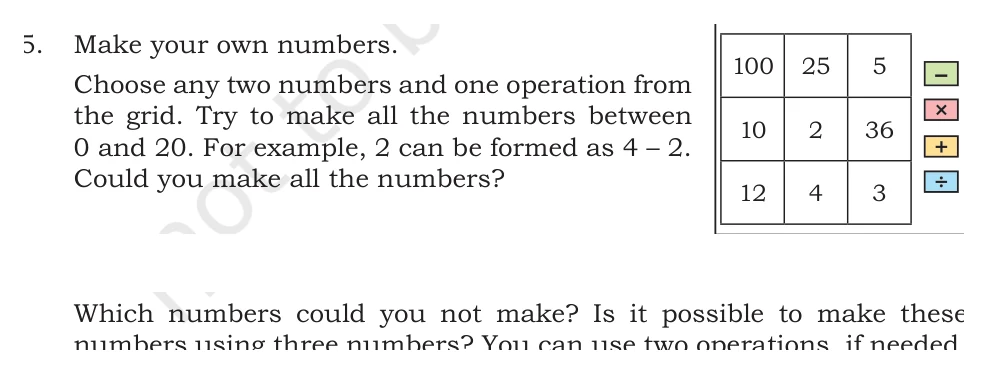
Which numbers from 0 to 20 cannot be made with two different grid numbers and one operation?
Show detailed solution
- Step 1: List each result made by a pair and keep only whole-number answers from 0 to 20.
- Step 2: The list contains 1 through 18 and 20.
- Step 3: Neither 0 nor 19 appears.
- Answer: 0 and 19 cannot be made under this rule.
Textbook page 71 · solved item 11
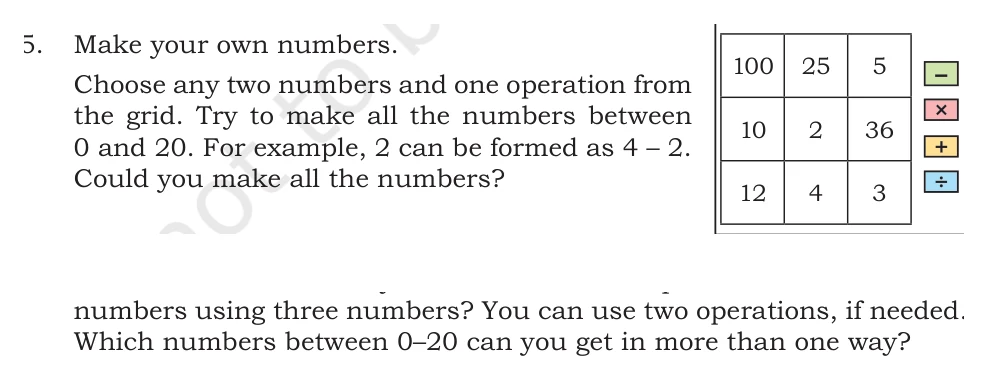
Can 0 and 19 be made using three grid numbers and two operations?
Show detailed solution
- Step 1: For 0, use 5-3-2=0.
- Step 2: For 19, use 25-4-2=19.
- Step 3: Each expression uses three numbers from the grid and two operations.
- Answer: Yes, both missing numbers can be made.
Textbook page 71 · solved item 12
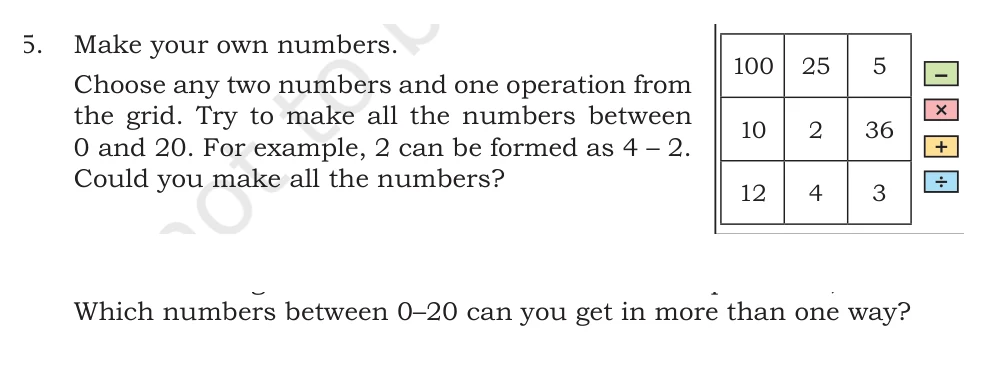
Which numbers from 0 to 20 can be made in more than one way from the grid?
Show detailed solution
- Step 1: Compare different expressions that give the same result.
- Step 2: For example, 10\div5=2, 5-3=2, and 4-2=2. Also, 5+2=7, 12-5=7, and 10-3=7.
- Step 3: Repeating this check shows many results have several constructions.
- Answer: Examples include 2, 4, 5, 6, 7, 8, 9, 10, 12, 13, 14, 15, and 20.
Detailed worked answers
Textbook page 72
Textbook page 72 · solved item 13
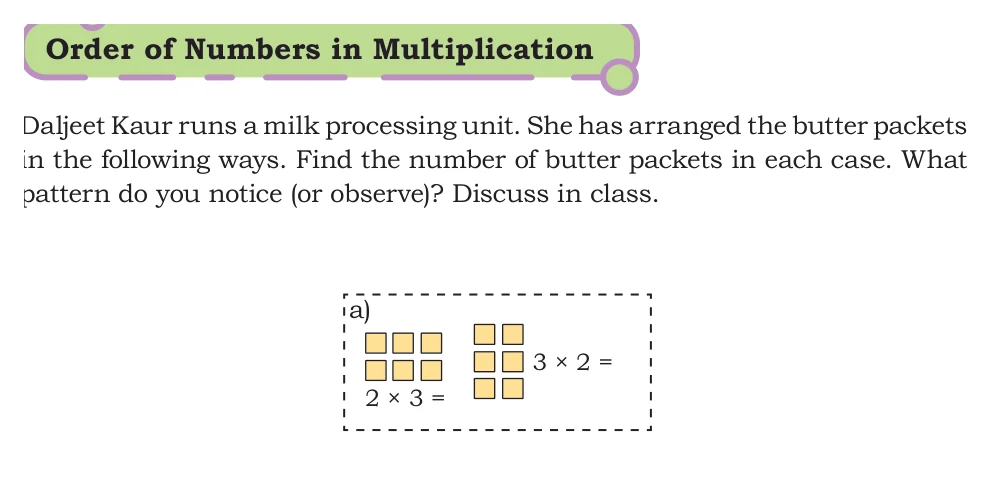
Find both 2\times3 and 3\times2.
Show detailed solution
- Step 1: 2\times3=6.
- Step 2: Interchange the group count and group size: 3\times2=6.
- Step 3: The arrangement changes direction, but the number of packets stays the same.
- Answer: Both products are 6.
Textbook page 72 · solved item 14

Find both 5\times8 and 8\times5.
Show detailed solution
- Step 1: 5\times8=40.
- Step 2: Interchange the group count and group size: 8\times5=40.
- Step 3: The arrangement changes direction, but the number of packets stays the same.
- Answer: Both products are 40.
Textbook page 72 · solved item 15
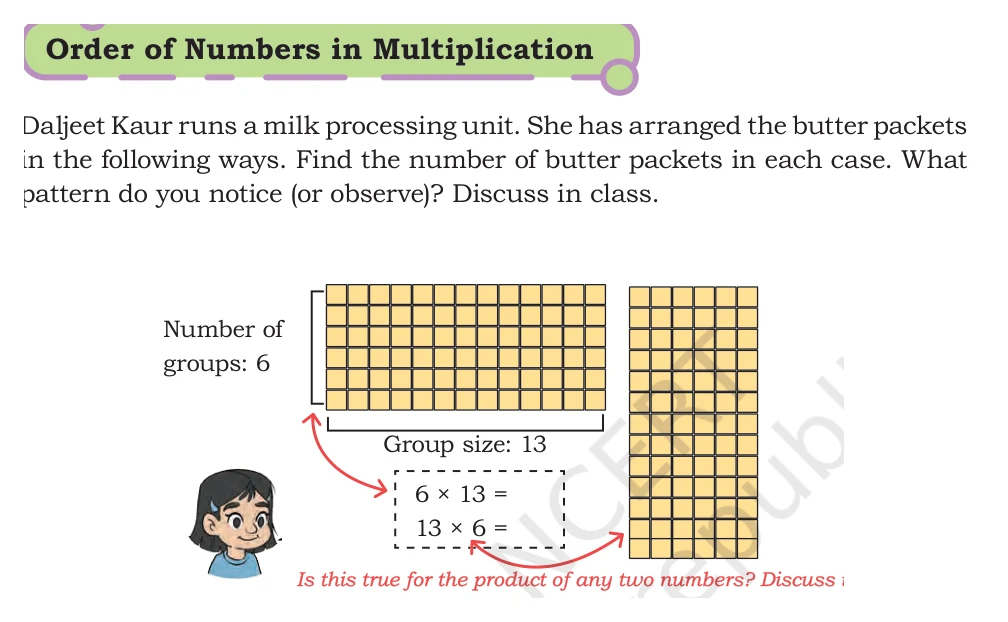
Find both 6\times13 and 13\times6.
Show detailed solution
- Step 1: 6\times13=78.
- Step 2: Interchange the group count and group size: 13\times6=78.
- Step 3: The arrangement changes direction, but the number of packets stays the same.
- Answer: Both products are 78.
Textbook page 72 · solved item 16
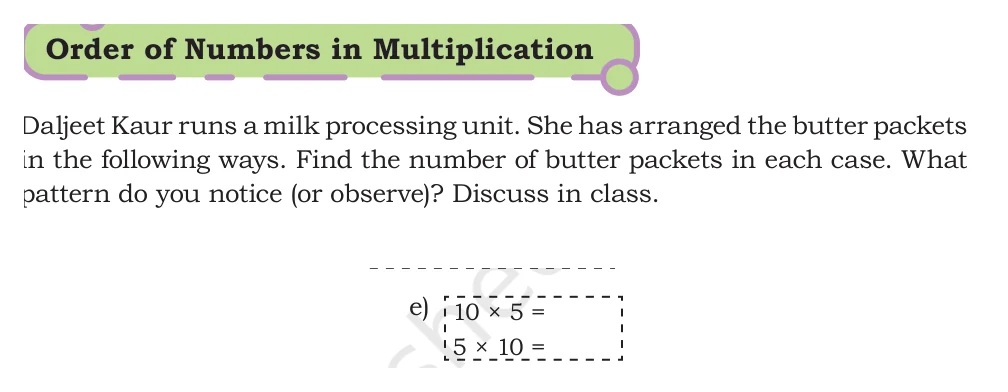
Find both 10\times5 and 5\times10.
Show detailed solution
- Step 1: 10\times5=50.
- Step 2: Interchange the group count and group size: 5\times10=50.
- Step 3: The arrangement changes direction, but the number of packets stays the same.
- Answer: Both products are 50.
Textbook page 72 · solved item 17
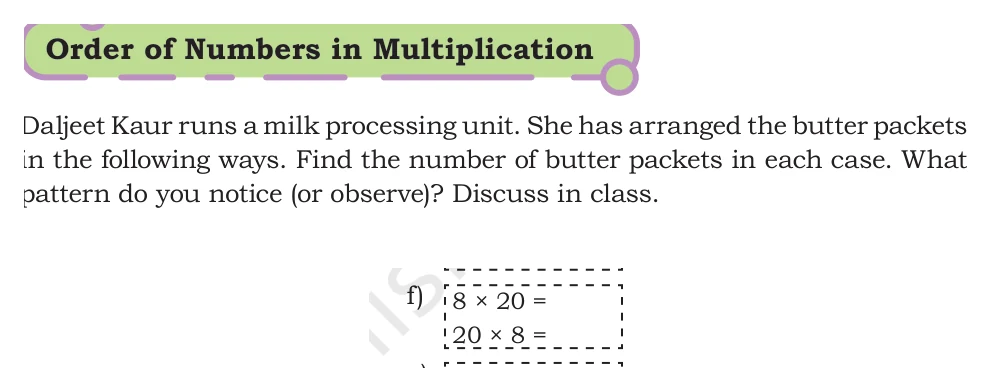
Find both 8\times20 and 20\times8.
Show detailed solution
- Step 1: 8\times20=160.
- Step 2: Interchange the group count and group size: 20\times8=160.
- Step 3: The arrangement changes direction, but the number of packets stays the same.
- Answer: Both products are 160.
Textbook page 72 · solved item 18
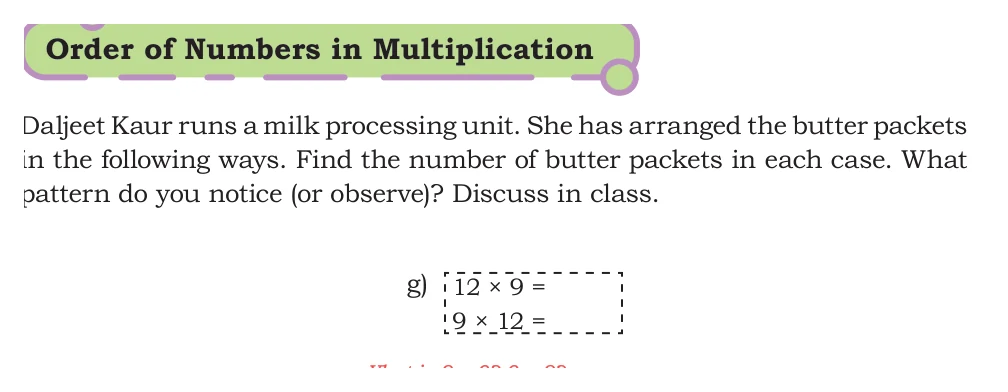
Find both 12\times9 and 9\times12.
Show detailed solution
- Step 1: 12\times9=108.
- Step 2: Interchange the group count and group size: 9\times12=108.
- Step 3: The arrangement changes direction, but the number of packets stays the same.
- Answer: Both products are 108.
Textbook page 72 · solved item 19

What are 9\times0 and 0\times9?
Show detailed solution
- Step 1: Nine groups with no object in each group contain nothing.
- Step 2: Zero groups of nine also contain nothing.
- Step 3: Changing the order does not change the product.
- Answer: Both products are 0.
Textbook page 72 · solved item 20
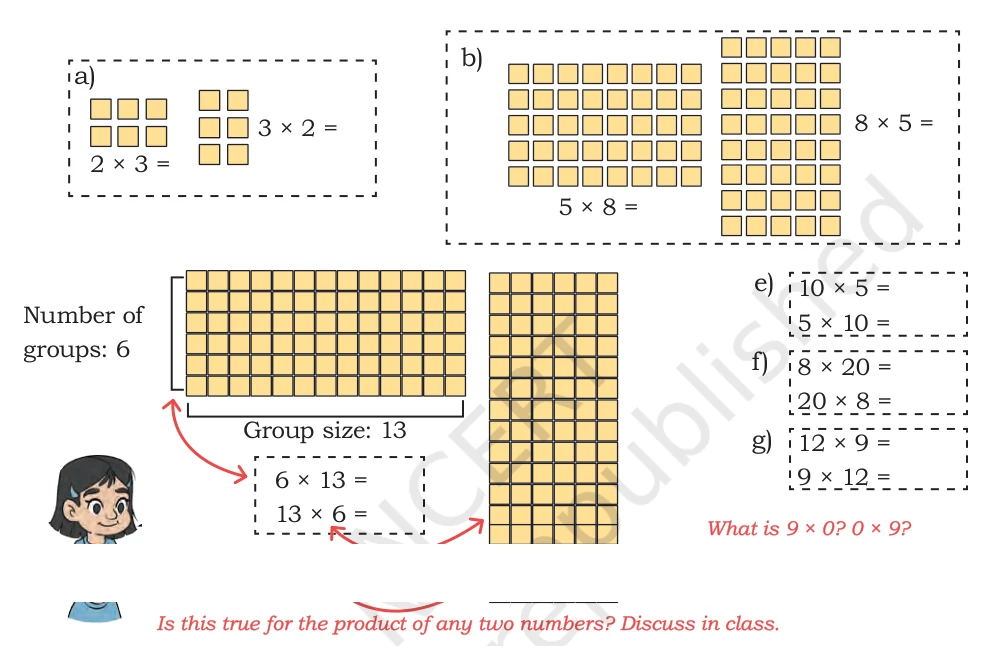
Does changing the order keep the product the same for any two whole numbers?
Show detailed solution
- Step 1: Think of multiplication as equal rows and columns.
- Step 2: Turning the array changes rows into columns without changing the number of objects.
- Step 3: This also works when one number is 0 or 1.
- Answer: Yes. The two factors can be interchanged and the product stays the same.
Textbook page 72 · solved item 21

Find 4\times 10.
Show detailed solution
- Step 1: Split 10 by place value: 10=10.
- Step 2: Multiply each part by 4: 4\times 10=40.
- Step 3: Add the partial products: 40=40.
- Answer: 4\times 10=40.
Textbook page 72 · solved item 22
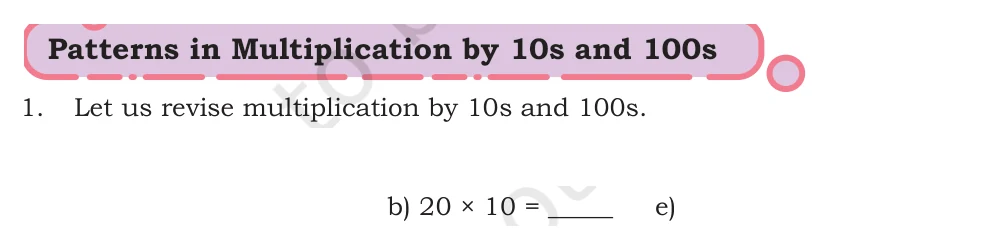
Find 20\times 10.
Show detailed solution
- Step 1: Split 20 by place value: 20=20.
- Step 2: Multiply each part by 10: 10\times 20=200.
- Step 3: Add the partial products: 200=200.
- Answer: 20\times 10=200.
Textbook page 72 · solved item 23
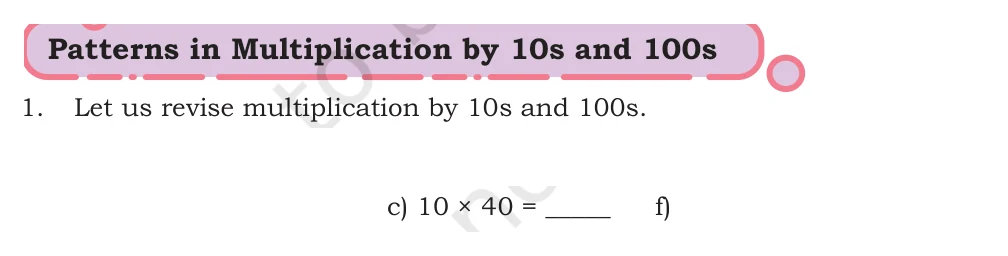
Find 10\times 40.
Show detailed solution
- Step 1: Split 40 by place value: 40=40.
- Step 2: Multiply each part by 10: 10\times 40=400.
- Step 3: Add the partial products: 400=400.
- Answer: 10\times 40=400.
Textbook page 72 · solved item 24
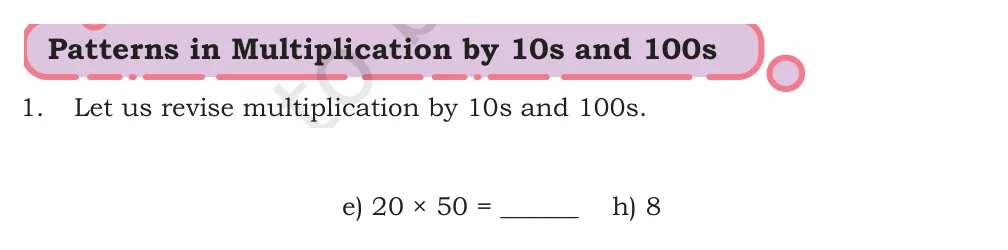
Find 20\times 50.
Show detailed solution
- Step 1: Split 50 by place value: 50=50.
- Step 2: Multiply each part by 20: 20\times 50=1,000.
- Step 3: Add the partial products: 1,000=1,000.
- Answer: 20\times 50=1,000.
Textbook page 72 · solved item 25
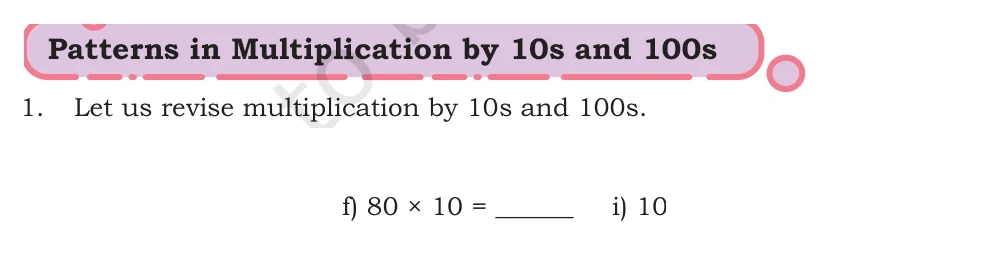
Find 80\times 10.
Show detailed solution
- Step 1: Split 80 by place value: 80=80.
- Step 2: Multiply each part by 10: 10\times 80=800.
- Step 3: Add the partial products: 800=800.
- Answer: 80\times 10=800.
Textbook page 72 · solved item 26
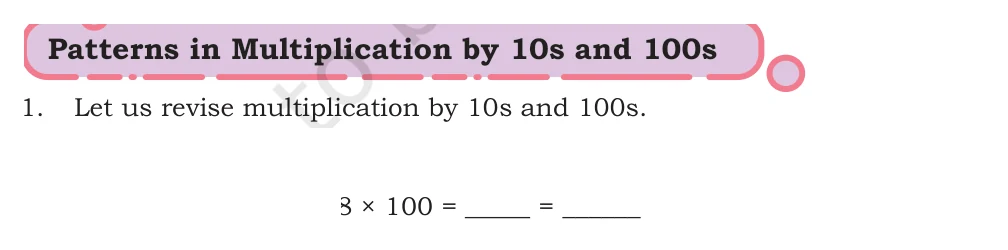
Find 8\times 100.
Show detailed solution
- Step 1: Split 100 by place value: 100=100.
- Step 2: Multiply each part by 8: 8\times 100=800.
- Step 3: Add the partial products: 800=800.
- Answer: 8\times 100=800.
Textbook page 72 · solved item 27
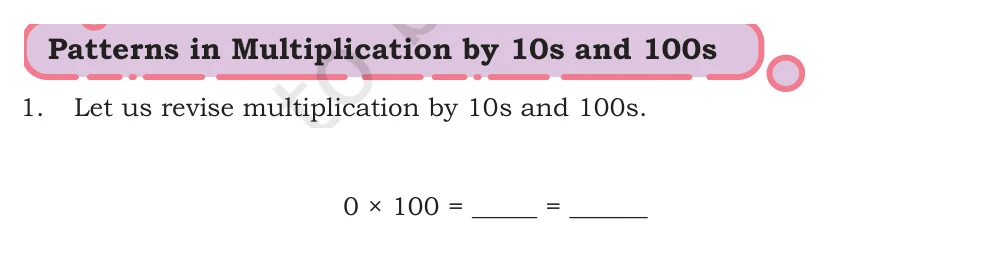
Find 10\times 100.
Show detailed solution
- Step 1: Split 100 by place value: 100=100.
- Step 2: Multiply each part by 10: 10\times 100=1,000.
- Step 3: Add the partial products: 1,000=1,000.
- Answer: 10\times 100=1,000.
Detailed worked answers
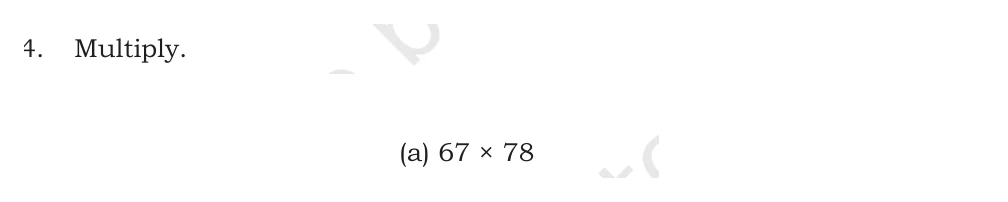
Textbook page 73
Textbook page 73 · solved item 28

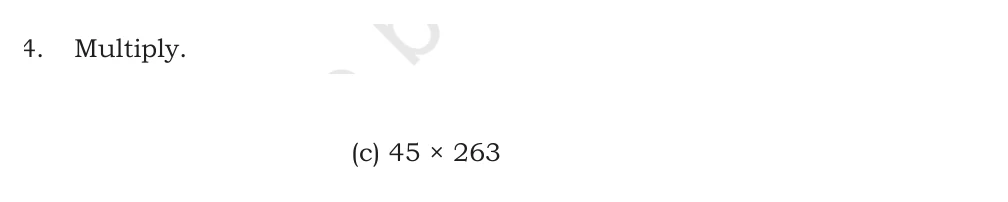
Find 100\times 90.
Show detailed solution
- Step 1: Split 100 by place value: 100=100.
- Step 2: Multiply each part by 90: 90\times 100=9,000.
- Step 3: Add the partial products: 9,000=9,000.
- Answer: 100\times 90=9,000.
Textbook page 73 · solved item 29
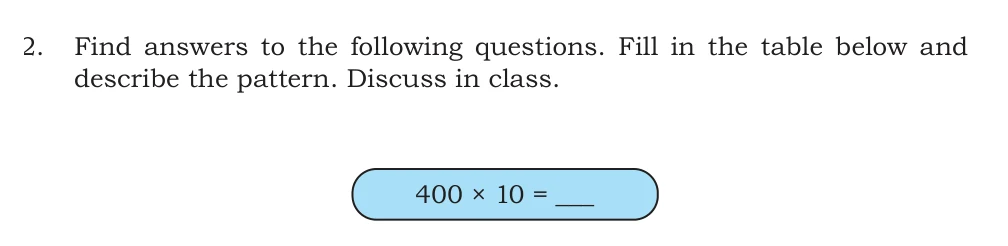
Find 400\times 10.
Show detailed solution
- Step 1: Split 400 by place value: 400=400.
- Step 2: Multiply each part by 10: 10\times 400=4,000.
- Step 3: Add the partial products: 4,000=4,000.
- Answer: 400\times 10=4,000.
Textbook page 73 · solved item 30

Find 60\times 50.
Show detailed solution
- Step 1: Split 60 by place value: 60=60.
- Step 2: Multiply each part by 50: 50\times 60=3,000.
- Step 3: Add the partial products: 3,000=3,000.
- Answer: 60\times 50=3,000.
Textbook page 73 · solved item 31
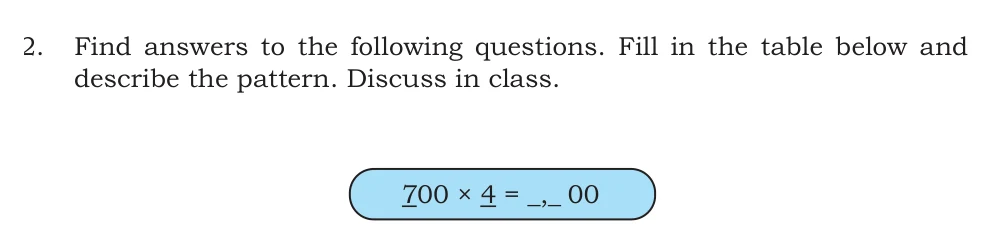
Find 700\times 4.
Show detailed solution
- Step 1: Split 700 by place value: 700=700.
- Step 2: Multiply each part by 4: 4\times 700=2,800.
- Step 3: Add the partial products: 2,800=2,800.
- Answer: 700\times 4=2,800.
Textbook page 73 · solved item 32
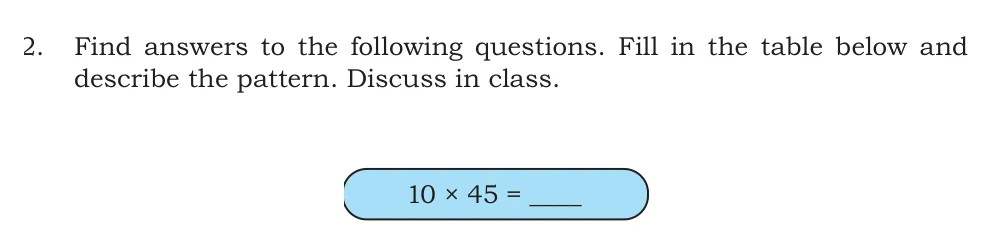
Find 10\times 45.
Show detailed solution
- Step 1: Split 45 by place value: 45=40 + 5.
- Step 2: Multiply each part by 10: 10\times 40=400, 10\times 5=50.
- Step 3: Add the partial products: 400 + 50=450.
- Answer: 10\times 45=450.
Textbook page 73 · solved item 33

Complete the place-value table row for 10\times45.
Show detailed solution
- Step 1: Split 45 by place value: 45=40 + 5.
- Step 2: Multiply each part by 10: 10\times 40=400, 10\times 5=50.
- Step 3: Add the partial products: 400 + 50=450.
- Answer: 10\times 45=450.
- Place-value check: Write 450 with one digit in each correct column.
Textbook page 73 · solved item 34
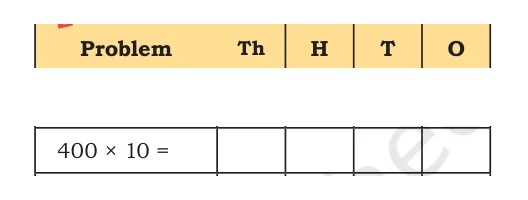
Complete the place-value table row for 400\times10.
Show detailed solution
- Step 1: Split 400 by place value: 400=400.
- Step 2: Multiply each part by 10: 10\times 400=4,000.
- Step 3: Add the partial products: 4,000=4,000.
- Answer: 400\times 10=4,000.
- Place-value check: Write 4,000 with one digit in each correct column.
Textbook page 73 · solved item 35

Complete the place-value table row for 700\times8.
Show detailed solution
- Step 1: Split 700 by place value: 700=700.
- Step 2: Multiply each part by 8: 8\times 700=5,600.
- Step 3: Add the partial products: 5,600=5,600.
- Answer: 700\times 8=5,600.
- Place-value check: Write 5,600 with one digit in each correct column.
Textbook page 73 · solved item 36
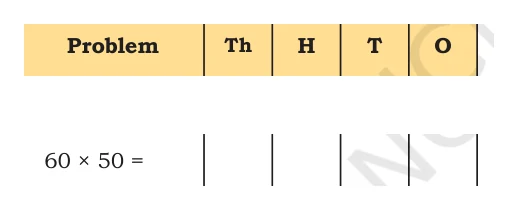
Complete the place-value table row for 60\times50.
Show detailed solution
- Step 1: Split 60 by place value: 60=60.
- Step 2: Multiply each part by 50: 50\times 60=3,000.
- Step 3: Add the partial products: 3,000=3,000.
- Answer: 60\times 50=3,000.
- Place-value check: The table should show 3,000.
Textbook page 73 · solved item 37
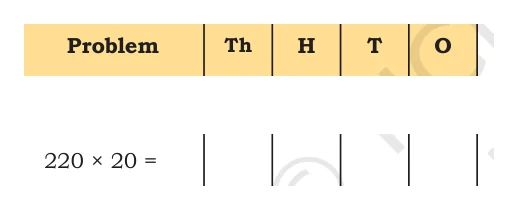
Complete the place-value table row for 220\times20.
Show detailed solution
- Step 1: Split 220 by place value: 220=200 + 20.
- Step 2: Multiply each part by 20: 20\times 200=4,000, 20\times 20=400.
- Step 3: Add the partial products: 4,000 + 400=4,400.
- Answer: 220\times 20=4,400.
- Place-value check: The table should show 4,400.
Textbook page 73 · solved item 38
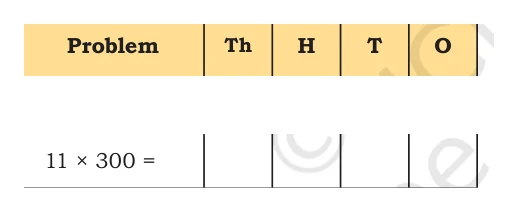
Complete the place-value table row for 11\times300.
Show detailed solution
- Step 1: Split 300 by place value: 300=300.
- Step 2: Multiply each part by 11: 11\times 300=3,300.
- Step 3: Add the partial products: 3,300=3,300.
- Answer: 11\times 300=3,300.
- Place-value check: The table should show 3,300.
Textbook page 73 · solved item 39
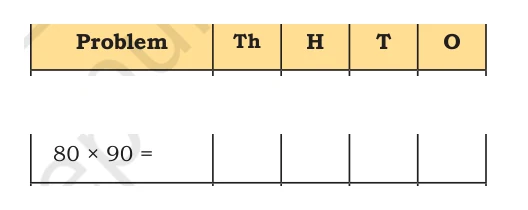
Complete the place-value table row for 80\times90.
Show detailed solution
- Step 1: Split 90 by place value: 90=90.
- Step 2: Multiply each part by 80: 80\times 90=7,200.
- Step 3: Add the partial products: 7,200=7,200.
- Answer: 80\times 90=7,200.
- Place-value check: The table should show 7,200.
Textbook page 73 · solved item 40

Complete the place-value table row for 10\times63.
Show detailed solution
- Step 1: Split 63 by place value: 63=60 + 3.
- Step 2: Multiply each part by 10: 10\times 60=600, 10\times 3=30.
- Step 3: Add the partial products: 600 + 30=630.
- Answer: 10\times 63=630.
- Place-value check: The table should show 630.
Textbook page 73 · solved item 41
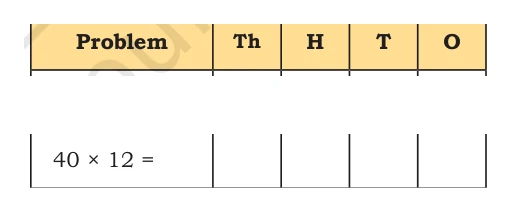
Complete the place-value table row for 40\times12.
Show detailed solution
- Step 1: Split 40 by place value: 40=40.
- Step 2: Multiply each part by 12: 12\times 40=480.
- Step 3: Add the partial products: 480=480.
- Answer: 40\times 12=480.
- Place-value check: The table should show 480.
Detailed worked answers
Textbook page 74
Textbook page 74 · solved item 42

Complete the table row for 3\times5,000.
Show detailed solution
- Step 1: Split 5,000 by place value: 5,000=5,000.
- Step 2: Multiply each part by 3: 3\times 5,000=15,000.
- Step 3: Add the partial products: 15,000=15,000.
- Answer: 3\times 5,000=15,000.
Textbook page 74 · solved item 43

Complete the table row for 8\times3,000.
Show detailed solution
- Step 1: Split 3,000 by place value: 3,000=3,000.
- Step 2: Multiply each part by 8: 8\times 3,000=24,000.
- Step 3: Add the partial products: 24,000=24,000.
- Answer: 8\times 3,000=24,000.
Textbook page 74 · solved item 44
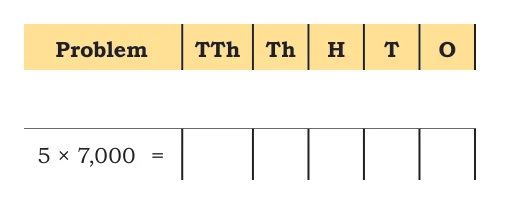
Complete the table row for 5\times7,000.
Show detailed solution
- Step 1: Split 7,000 by place value: 7,000=7,000.
- Step 2: Multiply each part by 5: 5\times 7,000=35,000.
- Step 3: Add the partial products: 35,000=35,000.
- Answer: 5\times 7,000=35,000.
Textbook page 74 · solved item 45

Complete the table row for 20\times100.
Show detailed solution
- Step 1: Split 100 by place value: 100=100.
- Step 2: Multiply each part by 20: 20\times 100=2,000.
- Step 3: Add the partial products: 2,000=2,000.
- Answer: 20\times 100=2,000.
Textbook page 74 · solved item 46
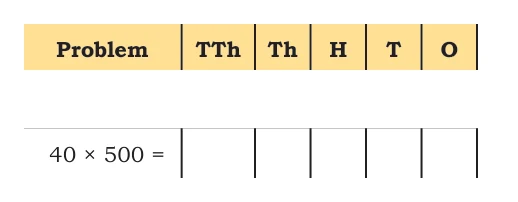
Complete the table row for 40\times500.
Show detailed solution
- Step 1: Split 500 by place value: 500=500.
- Step 2: Multiply each part by 40: 40\times 500=20,000.
- Step 3: Add the partial products: 20,000=20,000.
- Answer: 40\times 500=20,000.
Textbook page 74 · solved item 47

Complete the table row for 60\times300.
Show detailed solution
- Step 1: Split 300 by place value: 300=300.
- Step 2: Multiply each part by 60: 60\times 300=18,000.
- Step 3: Add the partial products: 18,000=18,000.
- Answer: 60\times 300=18,000.
Textbook page 74 · solved item 48

Complete the table row for 600\times30.
Show detailed solution
- Step 1: Split 600 by place value: 600=600.
- Step 2: Multiply each part by 30: 30\times 600=18,000.
- Step 3: Add the partial products: 18,000=18,000.
- Answer: 600\times 30=18,000.
Textbook page 74 · solved item 49
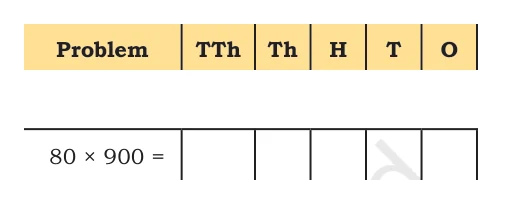
Complete the table row for 80\times900.
Show detailed solution
- Step 1: Split 900 by place value: 900=900.
- Step 2: Multiply each part by 80: 80\times 900=72,000.
- Step 3: Add the partial products: 72,000=72,000.
- Answer: 80\times 900=72,000.
Textbook page 74 · solved item 50
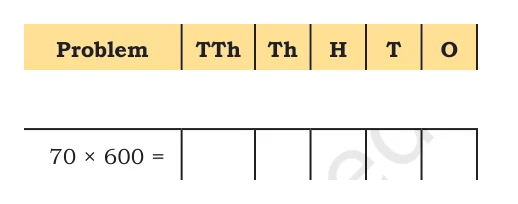
Complete the table row for 70\times600.
Show detailed solution
- Step 1: Split 600 by place value: 600=600.
- Step 2: Multiply each part by 70: 70\times 600=42,000.
- Step 3: Add the partial products: 42,000=42,000.
- Answer: 70\times 600=42,000.
Textbook page 74 · solved item 51
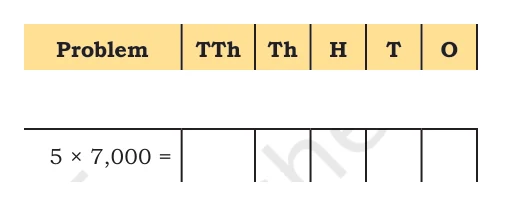
Complete the table row for 5\times7,000.
Show detailed solution
- Step 1: Split 7,000 by place value: 7,000=7,000.
- Step 2: Multiply each part by 5: 5\times 7,000=35,000.
- Step 3: Add the partial products: 35,000=35,000.
- Answer: 5\times 7,000=35,000.
Textbook page 74 · solved item 52
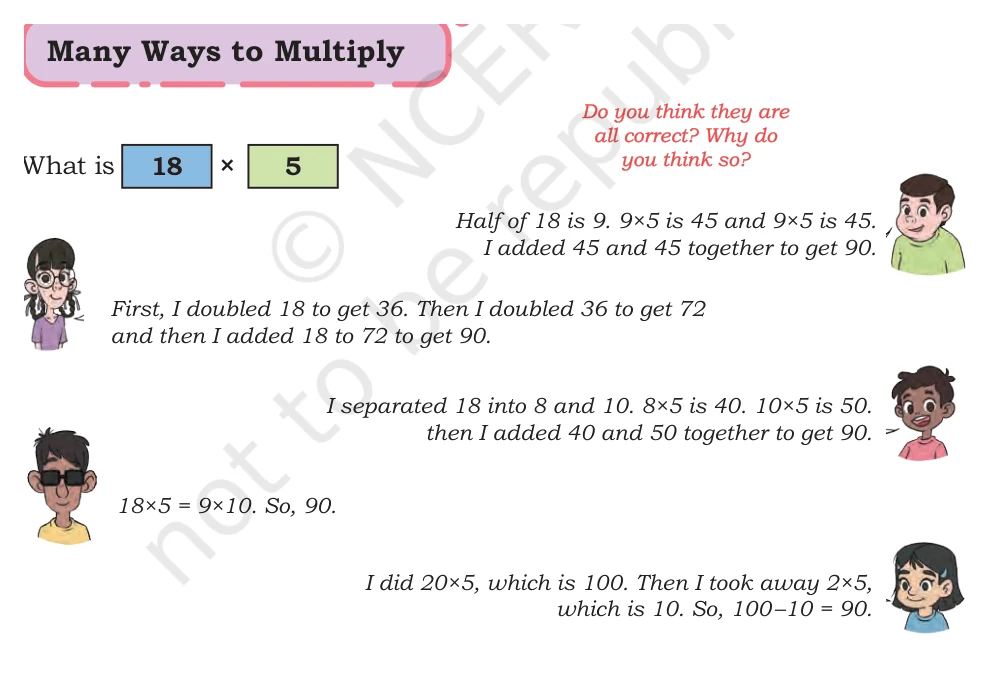
Are all five methods shown for 18\times5 correct? Explain why.
Show detailed solution
- Step 1: Every method keeps the same 18 groups of 5, but regroups them differently.
- Step 2: The methods give 72+18, 40+50, 45+45, 9\times10, or 100-10.
- Step 3: Each expression equals 90.
- Answer: Yes, all five methods are correct because each keeps the total unchanged and gives 18\times5=90.
Detailed worked answers
Textbook page 75
Textbook page 75 · solved item 53
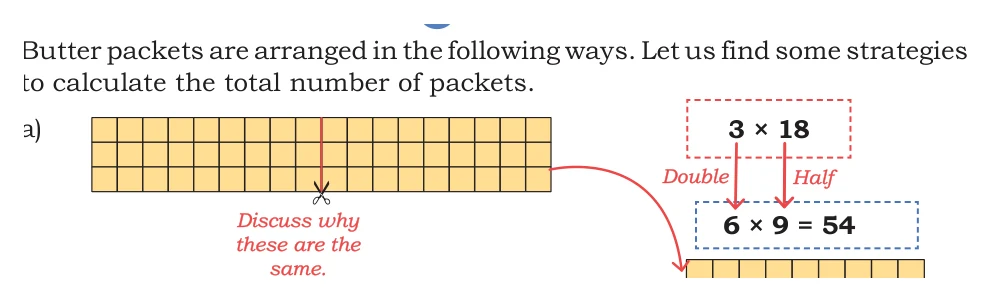
Why do 3\times18 and 6\times9 give the same total?
Show detailed solution
- Step 1: Halving 18 gives 9.
- Step 2: Doubling 3 gives 6.
- Step 3: One factor was halved while the other was doubled, so the total stays 54.
- Answer: 3\times18=6\times9=54.
Textbook page 75 · solved item 54
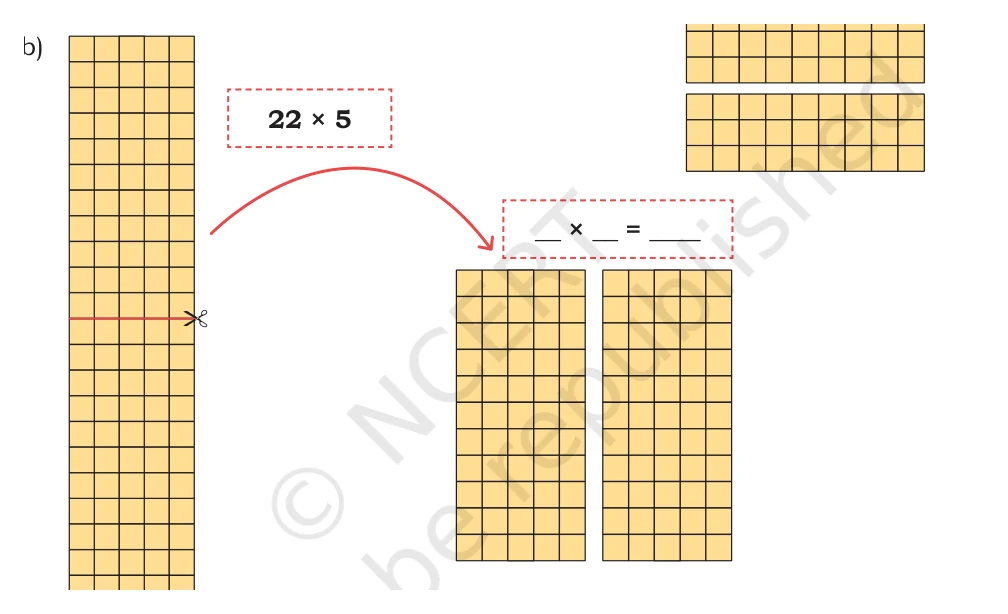
Use halving and doubling to find 22\times5.
Show detailed solution
- Step 1: Halve 22 to get 11.
- Step 2: Double 5 to get 10.
- Step 3: 11\times10=110.
- Answer: 22\times5=110.
Textbook page 75 · solved item 55
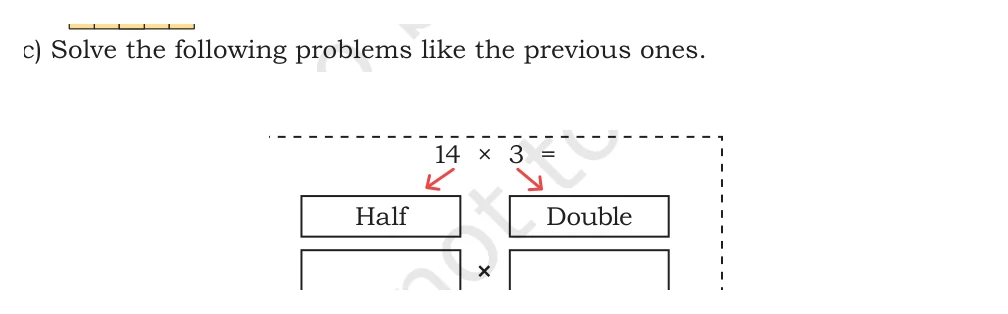
Find 14\times 3.
Show detailed solution
- Step 1: Split 14 by place value: 14=10 + 4.
- Step 2: Multiply each part by 3: 3\times 10=30, 3\times 4=12.
- Step 3: Add the partial products: 30 + 12=42.
- Answer: 14\times 3=42.
Textbook page 75 · solved item 56
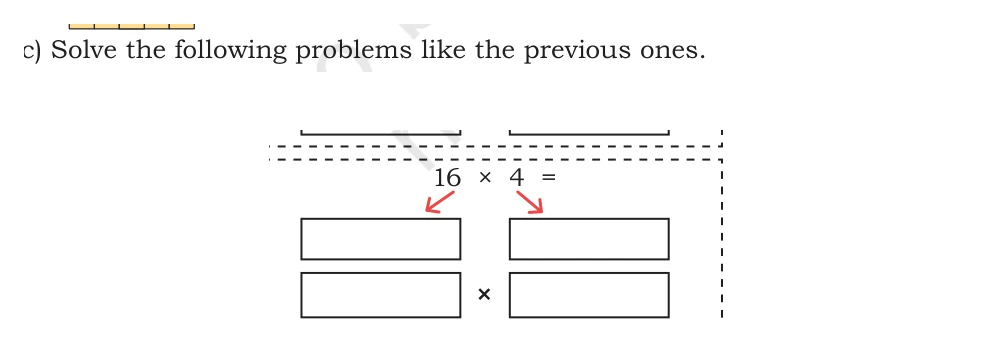
Find 16\times 4.
Show detailed solution
- Step 1: Split 16 by place value: 16=10 + 6.
- Step 2: Multiply each part by 4: 4\times 10=40, 4\times 6=24.
- Step 3: Add the partial products: 40 + 24=64.
- Answer: 16\times 4=64.
Textbook page 75 · solved item 57
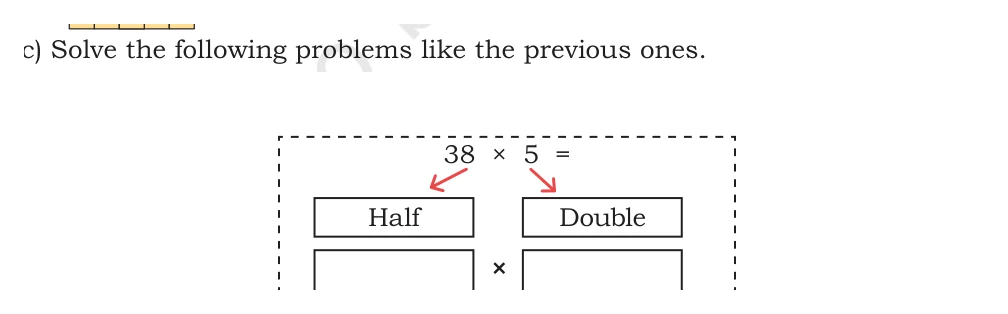
Find 38\times 5.
Show detailed solution
- Step 1: Split 38 by place value: 38=30 + 8.
- Step 2: Multiply each part by 5: 5\times 30=150, 5\times 8=40.
- Step 3: Add the partial products: 150 + 40=190.
- Answer: 38\times 5=190.
Textbook page 75 · solved item 58
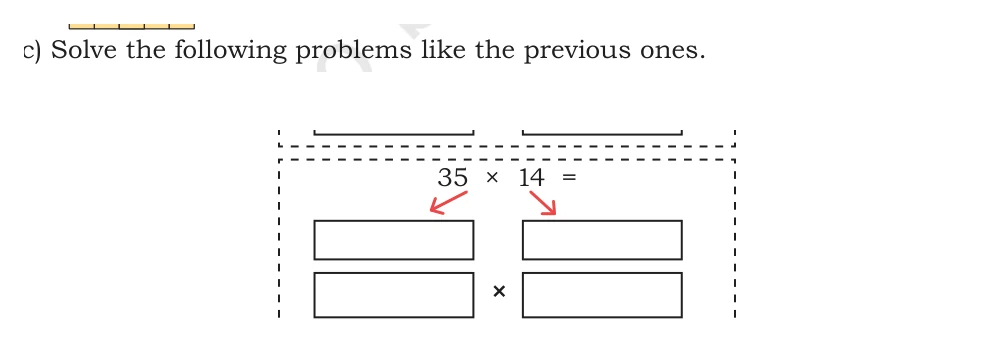
Find 35\times 14.
Show detailed solution
- Step 1: Split 35 by place value: 35=30 + 5.
- Step 2: Multiply each part by 14: 14\times 30=420, 14\times 5=70.
- Step 3: Add the partial products: 420 + 70=490.
- Answer: 35\times 14=490.
Detailed worked answers
Textbook page 76
Textbook page 76 · solved item 59

Why is halving and doubling especially useful when multiplying by 5 or 25?
Show detailed solution
- Step 1: Doubling 5 gives 10, which is easy to multiply by.
- Step 2: Doubling 25 gives 50, and doubling again gives 100.
- Step 3: Halving the other factor at the same time keeps the product unchanged.
- Answer: The strategy changes 5 or 25 into the easier factors 10, 50, or 100.
Textbook page 76 · solved item 60
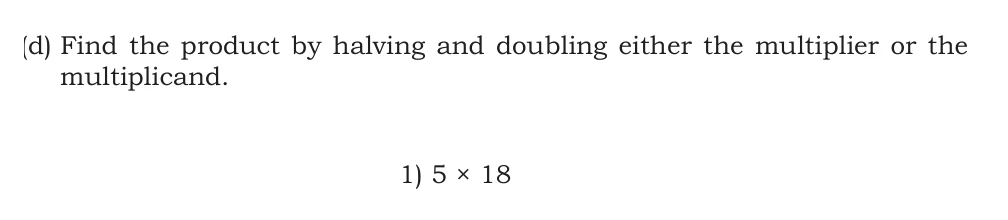
Find 5\times 18.
Show detailed solution
- Step 1: Split 18 by place value: 18=10 + 8.
- Step 2: Multiply each part by 5: 5\times 10=50, 5\times 8=40.
- Step 3: Add the partial products: 50 + 40=90.
- Answer: 5\times 18=90.
Textbook page 76 · solved item 61
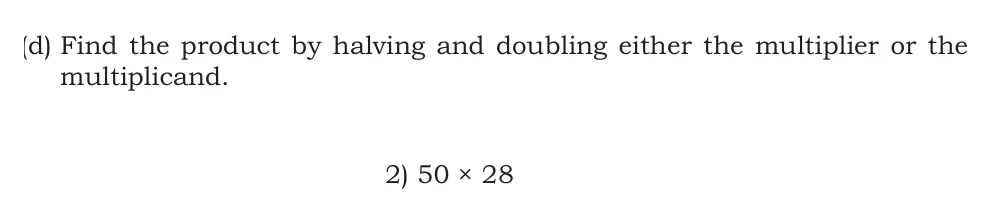
Find 50\times 28.
Show detailed solution
- Step 1: Split 50 by place value: 50=50.
- Step 2: Multiply each part by 28: 28\times 50=1,400.
- Step 3: Add the partial products: 1,400=1,400.
- Answer: 50\times 28=1,400.
Textbook page 76 · solved item 62

Find 15\times 22.
Show detailed solution
- Step 1: Split 22 by place value: 22=20 + 2.
- Step 2: Multiply each part by 15: 15\times 20=300, 15\times 2=30.
- Step 3: Add the partial products: 300 + 30=330.
- Answer: 15\times 22=330.
Textbook page 76 · solved item 63

Find 25\times 12.
Show detailed solution
- Step 1: Split 25 by place value: 25=20 + 5.
- Step 2: Multiply each part by 12: 12\times 20=240, 12\times 5=60.
- Step 3: Add the partial products: 240 + 60=300.
- Answer: 25\times 12=300.
Textbook page 76 · solved item 64
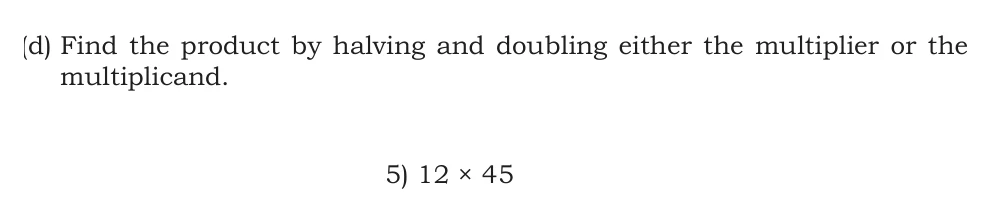
Find 12\times 45.
Show detailed solution
- Step 1: Split 45 by place value: 45=40 + 5.
- Step 2: Multiply each part by 12: 12\times 40=480, 12\times 5=60.
- Step 3: Add the partial products: 480 + 60=540.
- Answer: 12\times 45=540.
Textbook page 76 · solved item 65
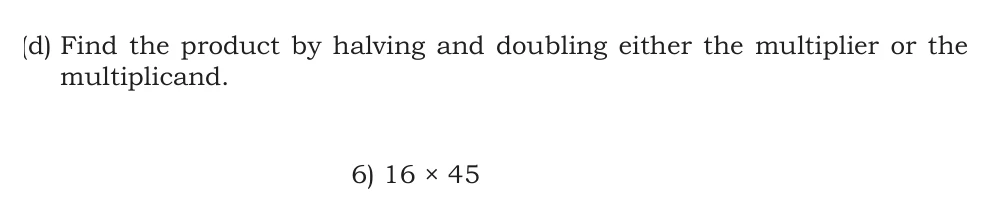
Find 16\times 45.
Show detailed solution
- Step 1: Split 45 by place value: 45=40 + 5.
- Step 2: Multiply each part by 16: 16\times 40=640, 16\times 5=80.
- Step 3: Add the partial products: 640 + 80=720.
- Answer: 16\times 45=720.
Textbook page 76 · solved item 66

Give five multiplication examples where halving and doubling makes the work easier.
Show detailed solution
- Step 1: Choose an even factor beside 5 or 25 so it can be halved exactly.
- Step 2: Examples are 24\times5=12\times10=120, 36\times5=18\times10=180, and 16\times25=8\times50=400.
- Step 3: Two more are 28\times25=14\times50=700 and 48\times25=24\times50=1,200.
- Answer: These five examples all keep the product unchanged while making one factor easier.
Textbook page 76 · solved item 67
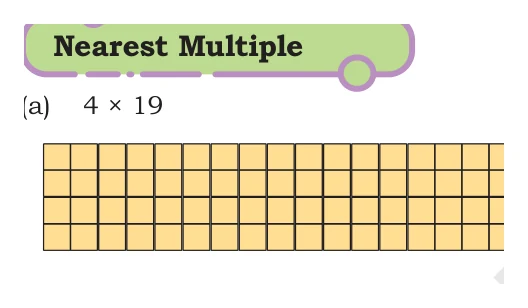
Why is 4 subtracted when using 4\times20 to find 4\times19?
Show detailed solution
- Step 1: Twenty is one more than 19.
- Step 2: Four groups of 20 contain one extra 4 compared with four groups of 19.
- Step 3: 4\times20-4=80-4=76.
- Answer: Subtract 4 because the easier product includes one extra group of 4.
Textbook page 76 · solved item 68
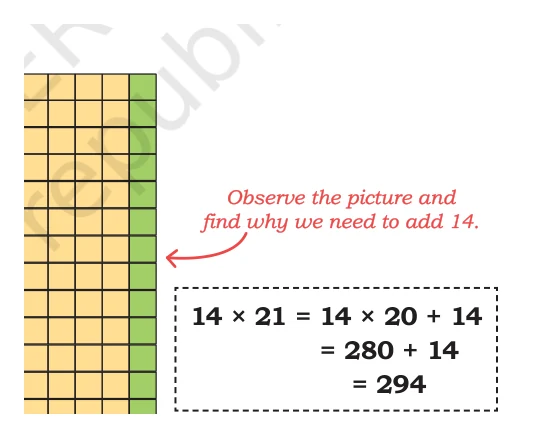
Why is 14 added when using 14\times20 to find 14\times21?
Show detailed solution
- Step 1: Twenty-one is one more than 20.
- Step 2: Fourteen groups of 21 contain one extra 14 compared with fourteen groups of 20.
- Step 3: 14\times20+14=280+14=294.
- Answer: Add 14 for the one extra group.
Textbook page 76 · solved item 69

Give five products that are easy to solve using a nearby multiple.
Show detailed solution
- Step 1: Choose a factor close to 10, 20, 50, or 100.
- Step 2: Examples are 6\times19=120-6=114, 8\times31=240+8=248, and 7\times49=350-7=343.
- Step 3: Two more are 12\times21=240+12=252 and 15\times99=1,500-15=1,485.
- Answer: Each example uses an easy nearby product and then adjusts once.
Textbook page 76 · solved item 70

Find 7\times 52.
Show detailed solution
- Step 1: Split 52 by place value: 52=50 + 2.
- Step 2: Multiply each part by 7: 7\times 50=350, 7\times 2=14.
- Step 3: Add the partial products: 350 + 14=364.
- Answer: 7\times 52=364.
Textbook page 76 · solved item 71
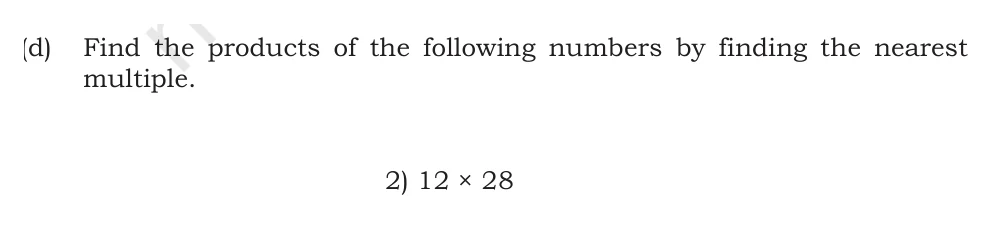
Find 12\times 28.
Show detailed solution
- Step 1: Split 28 by place value: 28=20 + 8.
- Step 2: Multiply each part by 12: 12\times 20=240, 12\times 8=96.
- Step 3: Add the partial products: 240 + 96=336.
- Answer: 12\times 28=336.
Textbook page 76 · solved item 72

Find 75\times 31.
Show detailed solution
- Step 1: Split 75 by place value: 75=70 + 5.
- Step 2: Multiply each part by 31: 31\times 70=2,170, 31\times 5=155.
- Step 3: Add the partial products: 2,170 + 155=2,325.
- Answer: 75\times 31=2,325.
Textbook page 76 · solved item 73

Find 99\times 15.
Show detailed solution
- Step 1: Split 99 by place value: 99=90 + 9.
- Step 2: Multiply each part by 15: 15\times 90=1,350, 15\times 9=135.
- Step 3: Add the partial products: 1,350 + 135=1,485.
- Answer: 99\times 15=1,485.
Textbook page 76 · solved item 74
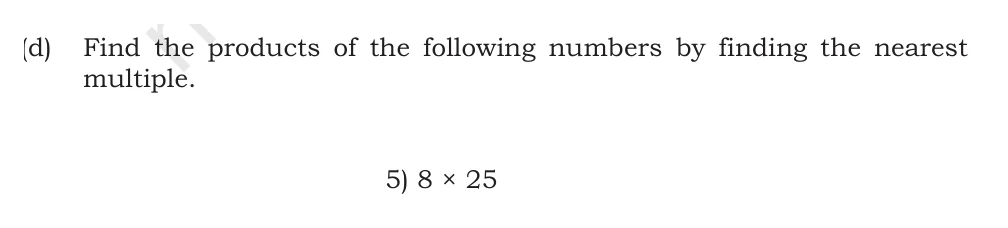
Find 8\times 25.
Show detailed solution
- Step 1: Split 25 by place value: 25=20 + 5.
- Step 2: Multiply each part by 8: 8\times 20=160, 8\times 5=40.
- Step 3: Add the partial products: 160 + 40=200.
- Answer: 8\times 25=200.
Textbook page 76 · solved item 75
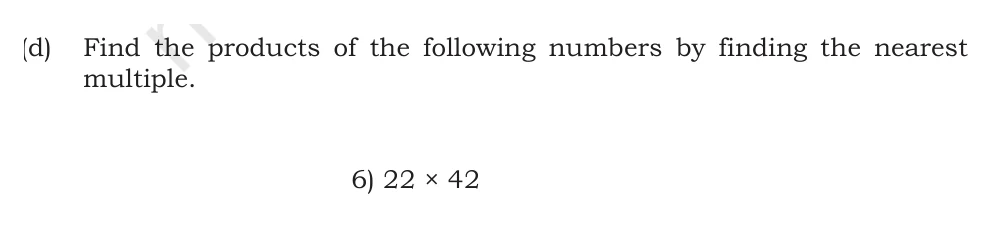
Find 22\times 42.
Show detailed solution
- Step 1: Split 42 by place value: 42=40 + 2.
- Step 2: Multiply each part by 22: 22\times 40=880, 22\times 2=44.
- Step 3: Add the partial products: 880 + 44=924.
- Answer: 22\times 42=924.
Detailed worked answers
Textbook page 77
Textbook page 77 · solved item 76
How many people can sit in 35 rows with 42 seats in each row?
Show detailed solution
- Step 1: Split 42 by place value: 42=40 + 2.
- Step 2: Multiply each part by 35: 35\times 40=1,400, 35\times 2=70.
- Step 3: Add the partial products: 1,400 + 70=1,470.
- Answer: 35\times 42=1,470 people.
Textbook page 77 · solved item 77
How far does Priya jog in 31 days at 4 km per day?
Show detailed solution
- Step 1: Split 31 by place value: 31=30 + 1.
- Step 2: Multiply each part by 4: 4\times 30=120, 4\times 1=4.
- Step 3: Add the partial products: 120 + 4=124.
- Answer: 4\times 31=124 km.
Textbook page 77 · solved item 78
How many books are in 36 boxes with 48 books in each box?
Show detailed solution
- Step 1: Split 48 by place value: 48=40 + 8.
- Step 2: Multiply each part by 36: 36\times 40=1,440, 36\times 8=288.
- Step 3: Add the partial products: 1,440 + 288=1,728.
- Answer: 36\times 48=1,728 books.
Textbook page 77 · solved item 79

If 16 m makes 4 kurtas, how much cloth is needed for 8 kurtas?
Show detailed solution
- Step 1: Split 16 by place value: 16=10 + 6.
- Step 2: Multiply each part by 2: 2\times 10=20, 2\times 6=12.
- Step 3: Add the partial products: 20 + 12=32.
- Answer: 16\times 2=32 m.
Textbook page 77 · solved item 80
How much milk do 29 cows produce if each gives 5 litres per day?
Show detailed solution
- Step 1: Split 29 by place value: 29=20 + 9.
- Step 2: Multiply each part by 5: 5\times 20=100, 5\times 9=45.
- Step 3: Add the partial products: 100 + 45=145.
- Answer: 29\times 5=145 litres per day.
Textbook page 77 · solved item 81
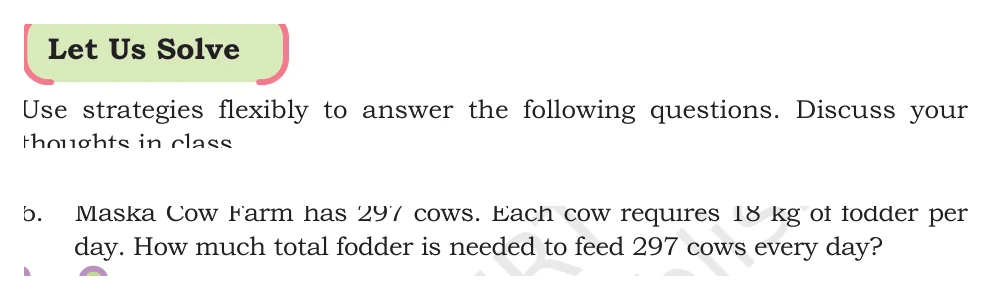
How much fodder do 297 cows need if each requires 18 kg per day?
Show detailed solution
- Step 1: Split 297 by place value: 297=200 + 90 + 7.
- Step 2: Multiply each part by 18: 18\times 200=3,600, 18\times 90=1,620, 18\times 7=126.
- Step 3: Add the partial products: 3,600 + 1,620 + 126=5,346.
- Answer: 297\times 18=5,346 kg per day.
Textbook page 77 · solved item 82

A family produces 35 kg of kitchen waste each month. How much does it produce in 12 months?
Show detailed solution
- Step 1: Ten months produce 10\times35=350 kg.
- Step 2: Two more months produce 2\times35=70 kg.
- Step 3: 350+70=420 kg.
- Answer: The family produces 420 kg of kitchen waste in a year.
Detailed worked answers
Textbook page 78
Textbook page 78 · solved item 83
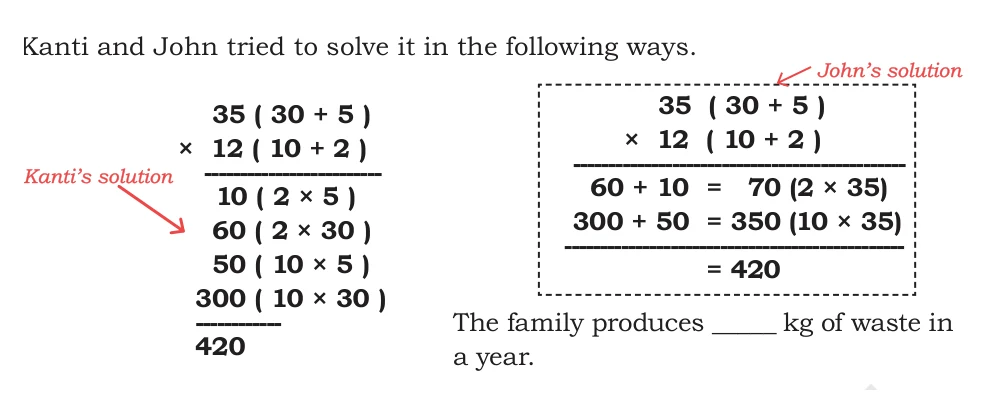
How are Kanti's and John's solutions for 35\times12 alike and different?
Show detailed solution
- Step 1: Both split 35 into 30 and 5, and 12 into 10 and 2.
- Step 2: Kanti writes four small products: 300, 50, 60, and 10.
- Step 3: John first combines the products for 2 to get 70 and for 10 to get 350.
- Answer: Both are correct and total 420; John's method uses fewer addition lines.
Textbook page 78 · solved item 84
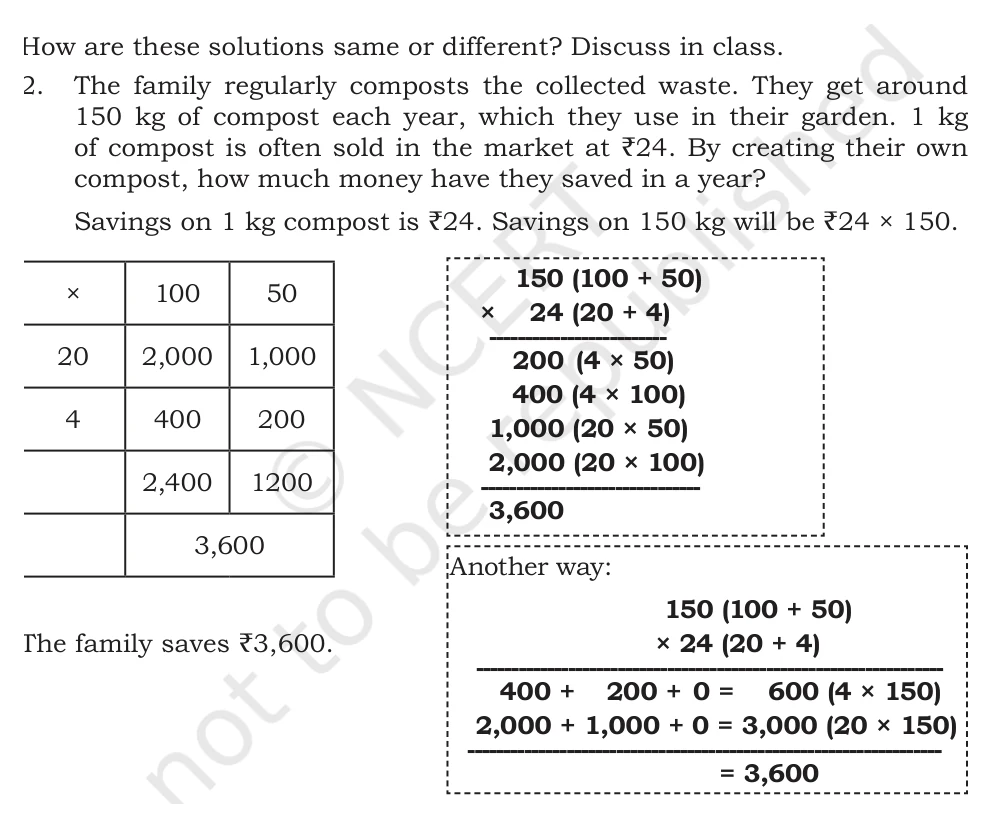
How much money does the family save by making 150 kg of compost worth Rs 24 per kg?
Show detailed solution
- Step 1: For 100 kg, the value is 100\times24=2,400 rupees.
- Step 2: For 50 kg, the value is 50\times24=1,200 rupees.
- Step 3: 2,400+1,200=3,600.
- Answer: The family saves Rs 3,600 in a year.
Detailed worked answers
Textbook page 79
Textbook page 79 · solved item 85
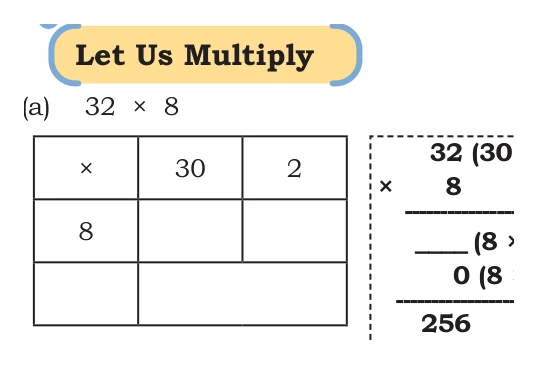
Complete the missing parts in the worked models for 32\times8.
Show detailed solution
- Step 1: Split 32 by place value: 32=30 + 2.
- Step 2: Multiply each part by 8: 8\times 30=240, 8\times 2=16.
- Step 3: Add the partial products: 240 + 16=256.
- Answer: 32\times 8=256.
Textbook page 79 · solved item 86
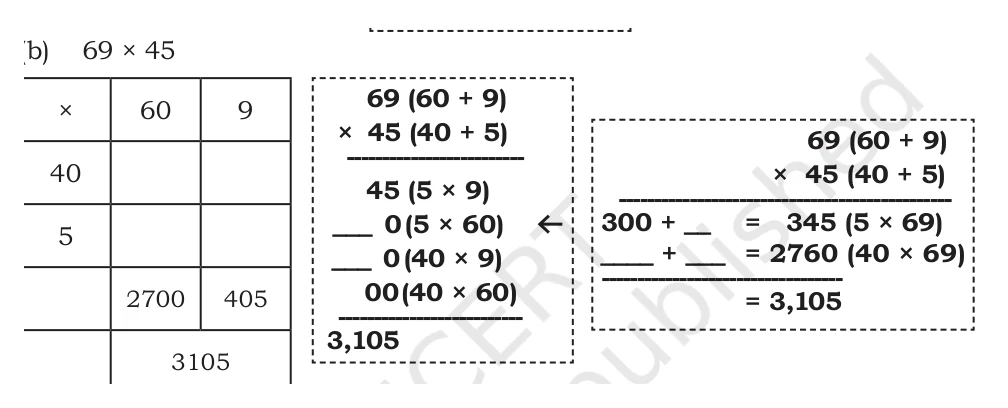
Complete the missing parts in the worked models for 69\times45.
Show detailed solution
- Step 1: Split 69 by place value: 69=60 + 9.
- Step 2: Multiply each part by 45: 45\times 60=2,700, 45\times 9=405.
- Step 3: Add the partial products: 2,700 + 405=3,105.
- Answer: 69\times 45=3,105.
Textbook page 79 · solved item 87
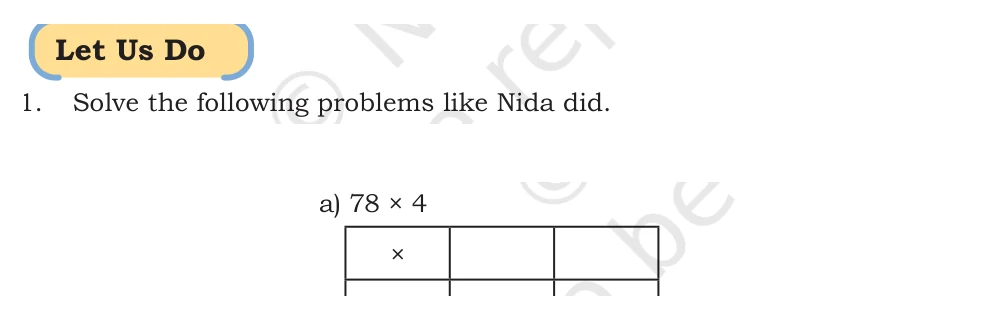
Find 78\times 4.
Show detailed solution
- Step 1: Split 78 by place value: 78=70 + 8.
- Step 2: Multiply each part by 4: 4\times 70=280, 4\times 8=32.
- Step 3: Add the partial products: 280 + 32=312.
- Answer: 78\times 4=312.
Textbook page 79 · solved item 88
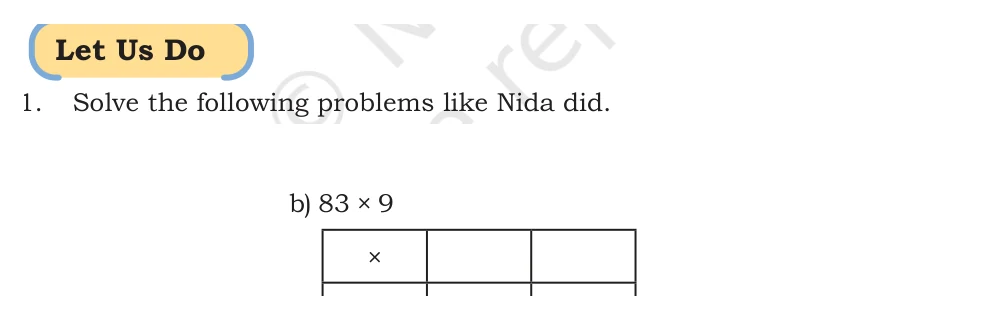
Find 83\times 9.
Show detailed solution
- Step 1: Split 83 by place value: 83=80 + 3.
- Step 2: Multiply each part by 9: 9\times 80=720, 9\times 3=27.
- Step 3: Add the partial products: 720 + 27=747.
- Answer: 83\times 9=747.
Textbook page 79 · solved item 89
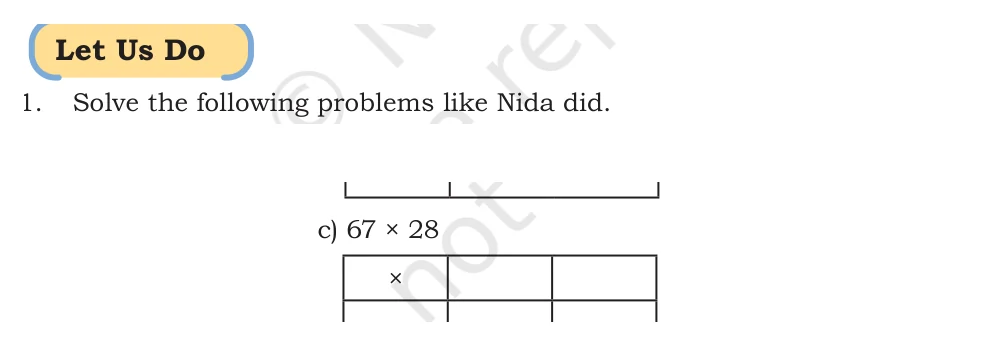
Find 67\times 28.
Show detailed solution
- Step 1: Split 67 by place value: 67=60 + 7.
- Step 2: Multiply each part by 28: 28\times 60=1,680, 28\times 7=196.
- Step 3: Add the partial products: 1,680 + 196=1,876.
- Answer: 67\times 28=1,876.
Textbook page 79 · solved item 90
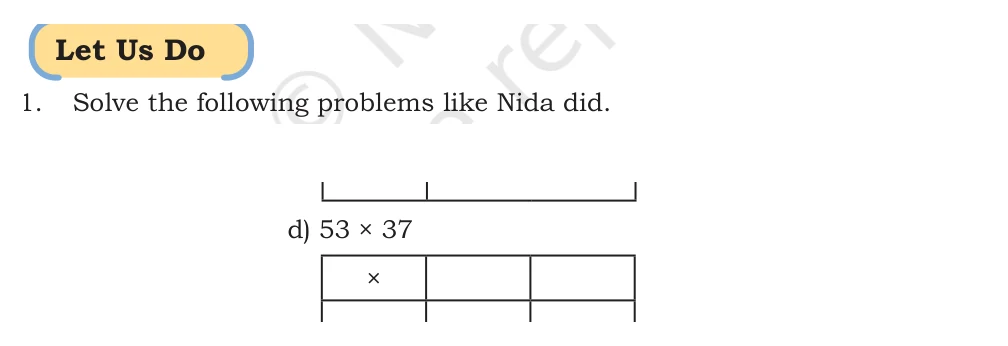
Find 53\times 37.
Show detailed solution
- Step 1: Split 53 by place value: 53=50 + 3.
- Step 2: Multiply each part by 37: 37\times 50=1,850, 37\times 3=111.
- Step 3: Add the partial products: 1,850 + 111=1,961.
- Answer: 53\times 37=1,961.
Detailed worked answers
Textbook page 80
Textbook page 80 · solved item 91

Find 94\times 5.
Show detailed solution
- Step 1: Split 94 by place value: 94=90 + 4.
- Step 2: Multiply each part by 5: 5\times 90=450, 5\times 4=20.
- Step 3: Add the partial products: 450 + 20=470.
- Answer: 94\times 5=470.
Textbook page 80 · solved item 92

Find 49\times 6.
Show detailed solution
- Step 1: Split 49 by place value: 49=40 + 9.
- Step 2: Multiply each part by 6: 6\times 40=240, 6\times 9=54.
- Step 3: Add the partial products: 240 + 54=294.
- Answer: 49\times 6=294.
Textbook page 80 · solved item 93

Find 37\times 53.
Show detailed solution
- Step 1: Split 53 by place value: 53=50 + 3.
- Step 2: Multiply each part by 37: 37\times 50=1,850, 37\times 3=111.
- Step 3: Add the partial products: 1,850 + 111=1,961.
- Answer: 37\times 53=1,961.
Textbook page 80 · solved item 94

Find 28\times 79.
Show detailed solution
- Step 1: Split 79 by place value: 79=70 + 9.
- Step 2: Multiply each part by 28: 28\times 70=1,960, 28\times 9=252.
- Step 3: Add the partial products: 1,960 + 252=2,212.
- Answer: 28\times 79=2,212.
Textbook page 80 · solved item 95

Find 86\times 3.
Show detailed solution
- Step 1: Split 86 by place value: 86=80 + 6.
- Step 2: Multiply each part by 3: 3\times 80=240, 3\times 6=18.
- Step 3: Add the partial products: 240 + 18=258.
- Answer: 86\times 3=258.
Textbook page 80 · solved item 96

Find 72\times 7.
Show detailed solution
- Step 1: Split 72 by place value: 72=70 + 2.
- Step 2: Multiply each part by 7: 7\times 70=490, 7\times 2=14.
- Step 3: Add the partial products: 490 + 14=504.
- Answer: 72\times 7=504.
Textbook page 80 · solved item 97

Find 94\times 36.
Show detailed solution
- Step 1: Split 94 by place value: 94=90 + 4.
- Step 2: Multiply each part by 36: 36\times 90=3,240, 36\times 4=144.
- Step 3: Add the partial products: 3,240 + 144=3,384.
- Answer: 94\times 36=3,384.
Textbook page 80 · solved item 98

Find 66\times 22.
Show detailed solution
- Step 1: Split 66 by place value: 66=60 + 6.
- Step 2: Multiply each part by 22: 22\times 60=1,320, 22\times 6=132.
- Step 3: Add the partial products: 1,320 + 132=1,452.
- Answer: 66\times 22=1,452.
Textbook page 80 · solved item 99

A theatre has 8 rows of 12 seats. If half the seats are filled, how many people are watching?
Show detailed solution
- Step 1: The theatre has 8\times12=96 seats.
- Step 2: Half of 96 is 96\div2=48.
- Step 3: Each filled seat represents one person.
- Answer: 48 people are watching.
Textbook page 80 · solved item 100
If 3 more rows of 12 seats fill after the theatre is half full, how many people are there?
Show detailed solution
- Step 1: The half-full theatre has 48 people.
- Step 2: Three more rows add 3\times12=36 people.
- Step 3: 48+36=84.
- Answer: There are 84 people.
Textbook page 80 · solved item 101

How many runs came from twenty-four 4s and eighteen 6s?
Show detailed solution
- Step 1: Runs from 4s: 24\times4=96.
- Step 2: Runs from 6s: 18\times6=108.
- Step 3: These are kept separate because the question asks for each kind.
- Answer: 96 runs came from 4s and 108 runs came from 6s.
Textbook page 80 · solved item 102
The team also ran 234 runs and received 23 extras. What was its total score?
Show detailed solution
- Step 1: Boundary runs total 96+108=204.
- Step 2: Add the runs completed by running: 204+234=438.
- Step 3: Add extras: 438+23=461.
- Answer: The Indian team scored 461 runs.
Textbook page 80 · solved item 103

What is the total cost of 15 bulbs at Rs 25 each and 12 tube lights at Rs 34 each?
Show detailed solution
- Step 1: Bulbs cost 15\times25=375 rupees.
- Step 2: Tube lights cost 12\times34=408 rupees.
- Step 3: 375+408=783.
- Answer: Anjali should pay Rs 783.
Textbook page 80 · solved item 104

How much does a shopkeeper earn by selling 28 rice bags at Rs 350 each?
Show detailed solution
- Step 1: Split 350 by place value: 350=300 + 50.
- Step 2: Multiply each part by 28: 28\times 300=8,400, 28\times 50=1,400.
- Step 3: Add the partial products: 8,400 + 1,400=9,800.
- Answer: 28\times 350=9,800 rupees.
Textbook page 80 · solved item 105

How many books are on 86 shelves with 162 books on each shelf?
Show detailed solution
- Step 1: Split 162 by place value: 162=100 + 60 + 2.
- Step 2: Multiply each part by 86: 86\times 100=8,600, 86\times 60=5,160, 86\times 2=172.
- Step 3: Add the partial products: 8,600 + 5,160 + 172=13,932.
- Answer: 86\times 162=13,932 books.
Detailed worked answers
Textbook page 81
Textbook page 81 · solved item 106
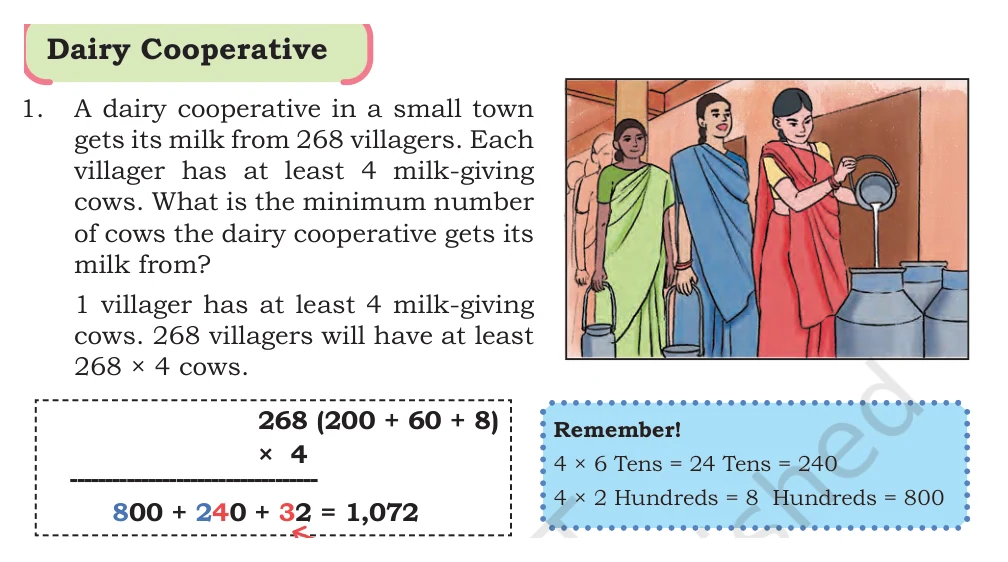
What is the minimum number of cows owned by 268 villagers if each has at least 4 milk-giving cows?
Show detailed solution
- Step 1: Multiply the hundreds: 4\times200=800.
- Step 2: Multiply the tens and ones: 4\times60=240 and 4\times8=32.
- Step 3: 800+240+32=1,072.
- Answer: The cooperative gets milk from at least 1,072 cows.
Textbook page 81 · solved item 107
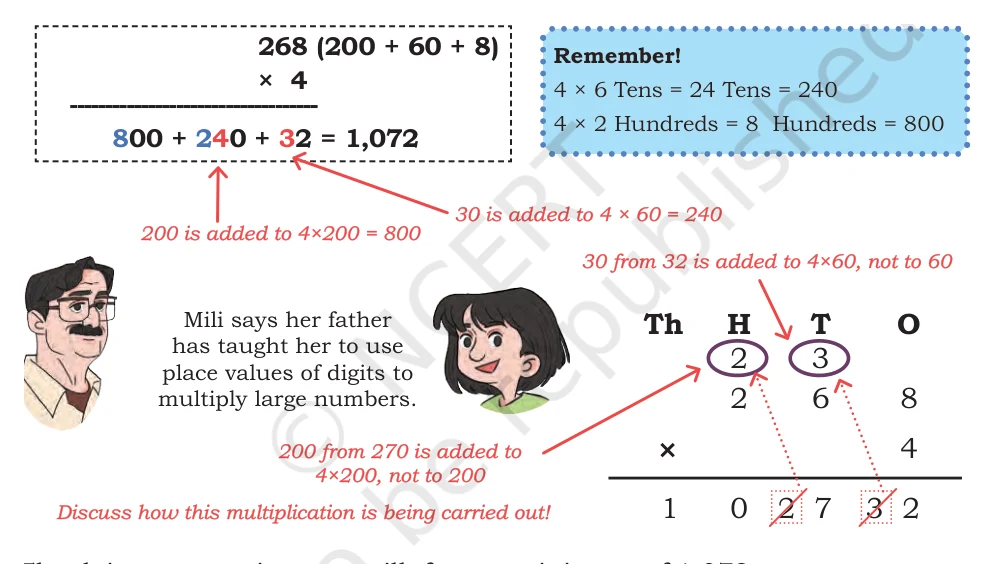
Explain how the place-value multiplication 268\times4 is carried out.
Show detailed solution
- Step 1: Four times 8 ones is 32 ones: write 2 ones and regroup 3 tens.
- Step 2: Four times 6 tens is 24 tens; with the regrouped 3 tens, that is 27 tens. Write 7 tens and regroup 2 hundreds.
- Step 3: Four times 2 hundreds is 8 hundreds; with 2 more hundreds, that is 10 hundreds.
- Answer: The digits form 1,072. The regrouped value is always added in its correct place-value column.
Detailed worked answers
Textbook page 82
Textbook page 82 · solved item 108
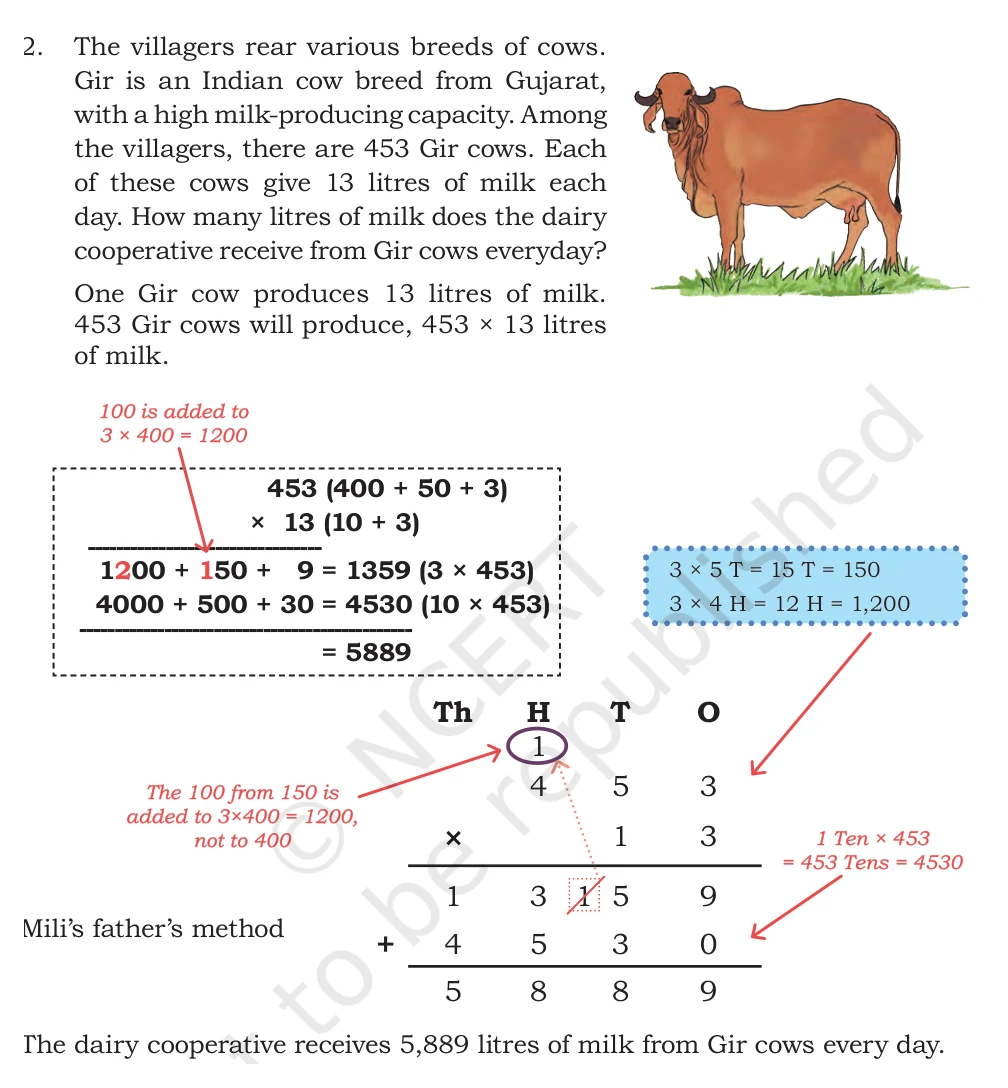
How much milk do 453 Gir cows give in a day if each gives 13 litres?
Show detailed solution
- Step 1: Three litres from each cow gives 3\times453=1,359 litres.
- Step 2: Ten litres from each cow gives 10\times453=4,530 litres.
- Step 3: 1,359+4,530=5,889 litres.
- Answer: The dairy receives 5,889 litres each day.
Detailed worked answers
Textbook page 83
Textbook page 83 · solved item 109
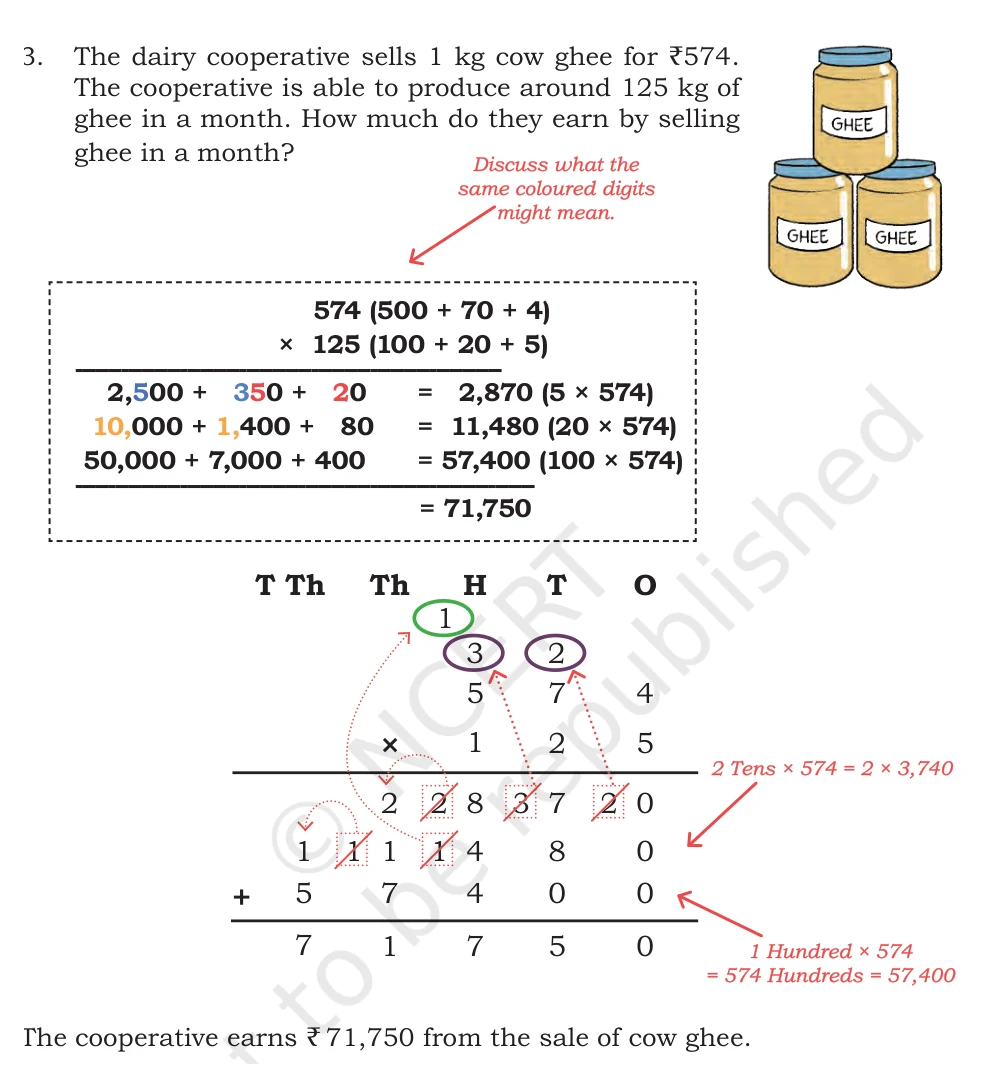
How much does the cooperative earn by selling 125 kg of ghee at Rs 574 per kg?
Show detailed solution
- Step 1: For 100 kg: 100\times574=57,400 rupees.
- Step 2: For 20 kg and 5 kg: 20\times574=11,480 and 5\times574=2,870.
- Step 3: 57,400+11,480+2,870=71,750.
- Answer: The cooperative earns Rs 71,750.
Textbook page 83 · solved item 110
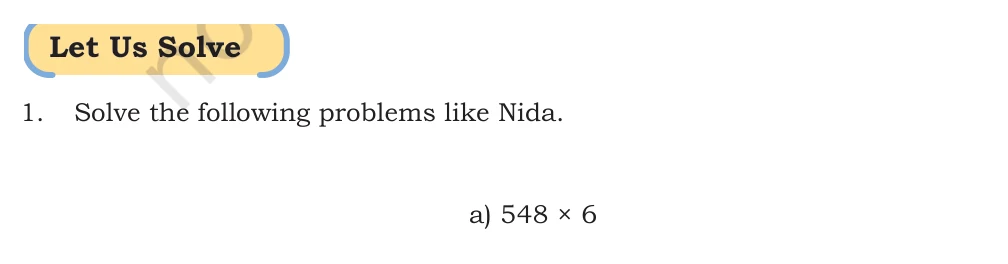
Find 548\times 6.
Show detailed solution
- Step 1: Split 548 by place value: 548=500 + 40 + 8.
- Step 2: Multiply each part by 6: 6\times 500=3,000, 6\times 40=240, 6\times 8=48.
- Step 3: Add the partial products: 3,000 + 240 + 48=3,288.
- Answer: 548\times 6=3,288.
Textbook page 83 · solved item 111
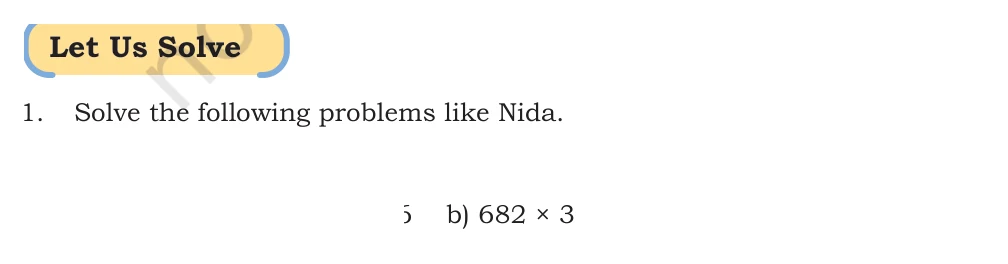
Find 682\times 3.
Show detailed solution
- Step 1: Split 682 by place value: 682=600 + 80 + 2.
- Step 2: Multiply each part by 3: 3\times 600=1,800, 3\times 80=240, 3\times 2=6.
- Step 3: Add the partial products: 1,800 + 240 + 6=2,046.
- Answer: 682\times 3=2,046.
Textbook page 83 · solved item 112
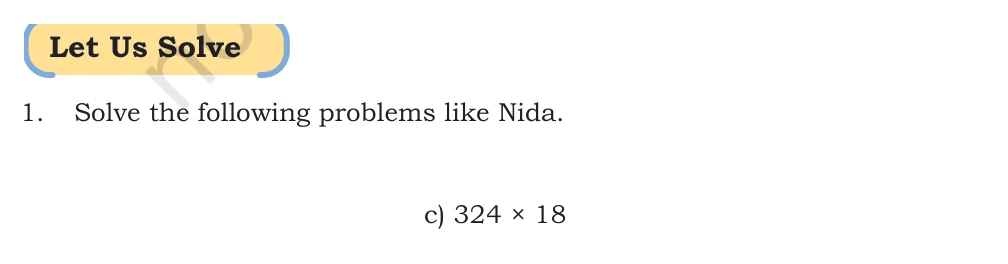
Find 324\times 18.
Show detailed solution
- Step 1: Split 324 by place value: 324=300 + 20 + 4.
- Step 2: Multiply each part by 18: 18\times 300=5,400, 18\times 20=360, 18\times 4=72.
- Step 3: Add the partial products: 5,400 + 360 + 72=5,832.
- Answer: 324\times 18=5,832.
Textbook page 83 · solved item 113
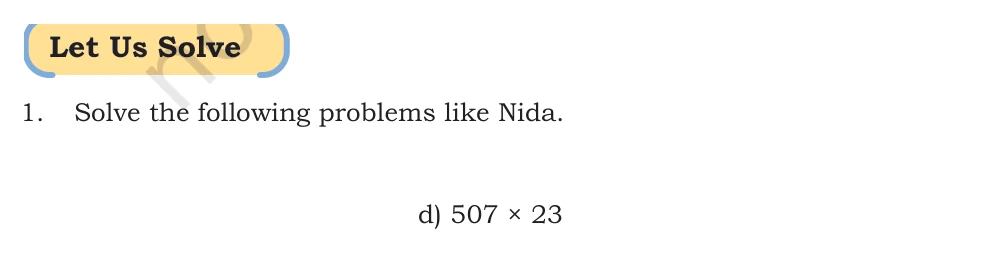
Find 507\times 23.
Show detailed solution
- Step 1: Split 507 by place value: 507=500 + 7.
- Step 2: Multiply each part by 23: 23\times 500=11,500, 23\times 7=161.
- Step 3: Add the partial products: 11,500 + 161=11,661.
- Answer: 507\times 23=11,661.
Textbook page 83 · solved item 114
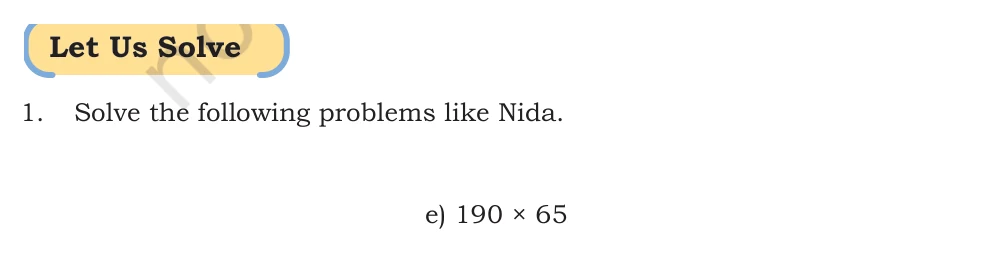
Find 190\times 65.
Show detailed solution
- Step 1: Split 190 by place value: 190=100 + 90.
- Step 2: Multiply each part by 65: 65\times 100=6,500, 65\times 90=5,850.
- Step 3: Add the partial products: 6,500 + 5,850=12,350.
- Answer: 190\times 65=12,350.
Detailed worked answers
Textbook page 84
Textbook page 84 · solved item 115

Find 123\times 84.
Show detailed solution
- Step 1: Split 123 by place value: 123=100 + 20 + 3.
- Step 2: Multiply each part by 84: 84\times 100=8,400, 84\times 20=1,680, 84\times 3=252.
- Step 3: Add the partial products: 8,400 + 1,680 + 252=10,332.
- Answer: 123\times 84=10,332.
Textbook page 84 · solved item 116

Find 368\times 32.
Show detailed solution
- Step 1: Split 368 by place value: 368=300 + 60 + 8.
- Step 2: Multiply each part by 32: 32\times 300=9,600, 32\times 60=1,920, 32\times 8=256.
- Step 3: Add the partial products: 9,600 + 1,920 + 256=11,776.
- Answer: 368\times 32=11,776.
Textbook page 84 · solved item 117

Find 159\times 324.
Show detailed solution
- Step 1: Split 324 by place value: 324=300 + 20 + 4.
- Step 2: Multiply each part by 159: 159\times 300=47,700, 159\times 20=3,180, 159\times 4=636.
- Step 3: Add the partial products: 47,700 + 3,180 + 636=51,516.
- Answer: 159\times 324=51,516.
Textbook page 84 · solved item 118

Find 239\times 401.
Show detailed solution
- Step 1: Split 401 by place value: 401=400 + 1.
- Step 2: Multiply each part by 239: 239\times 400=95,600, 239\times 1=239.
- Step 3: Add the partial products: 95,600 + 239=95,839.
- Answer: 239\times 401=95,839.
Textbook page 84 · solved item 119

Find 592\times 5.
Show detailed solution
- Step 1: Split 592 by place value: 592=500 + 90 + 2.
- Step 2: Multiply each part by 5: 5\times 500=2,500, 5\times 90=450, 5\times 2=10.
- Step 3: Add the partial products: 2,500 + 450 + 10=2,960.
- Answer: 592\times 5=2,960.
Textbook page 84 · solved item 120

Find 101\times 22.
Show detailed solution
- Step 1: Split 101 by place value: 101=100 + 1.
- Step 2: Multiply each part by 22: 22\times 100=2,200, 22\times 1=22.
- Step 3: Add the partial products: 2,200 + 22=2,222.
- Answer: 101\times 22=2,222.
Textbook page 84 · solved item 121
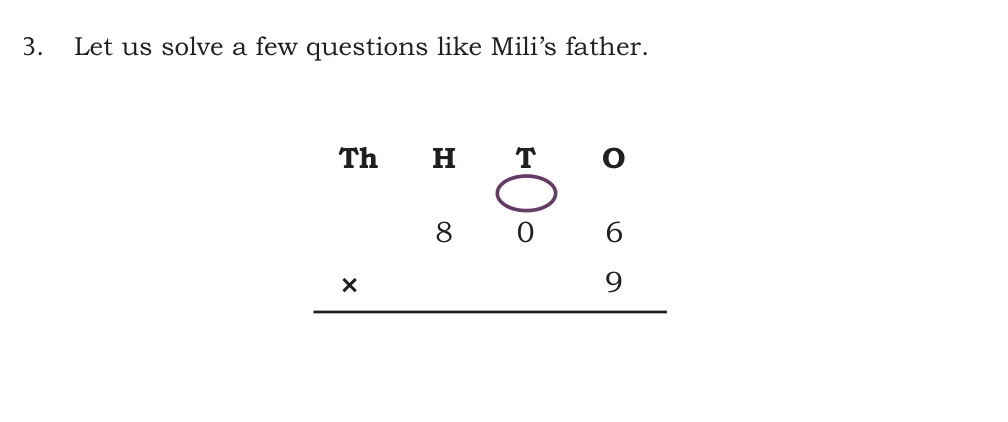
Complete the place-value diagram for 806\times9.
Show detailed solution
- Step 1: Split 806 by place value: 806=800 + 6.
- Step 2: Multiply each part by 9: 9\times 800=7,200, 9\times 6=54.
- Step 3: Add the partial products: 7,200 + 54=7,254.
- Answer: 806\times 9=7,254.
Textbook page 84 · solved item 122
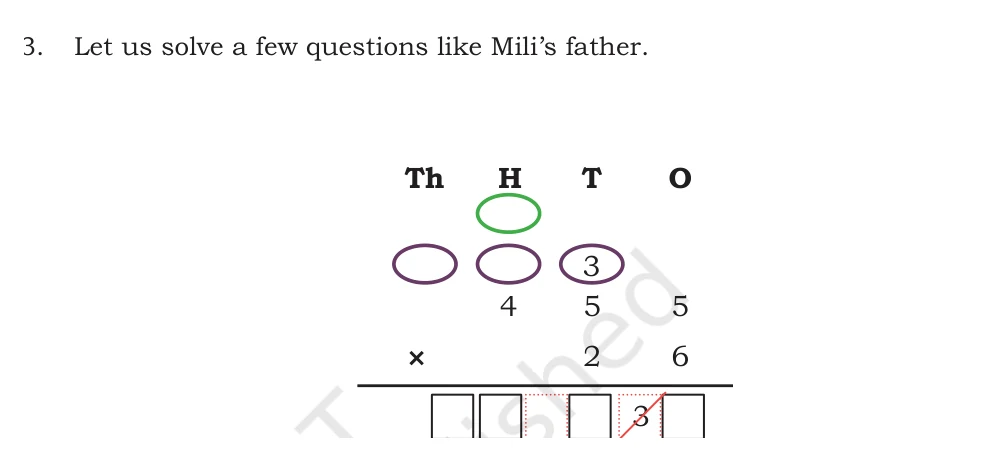
Complete the place-value diagram for 455\times26.
Show detailed solution
- Step 1: Split 455 by place value: 455=400 + 50 + 5.
- Step 2: Multiply each part by 26: 26\times 400=10,400, 26\times 50=1,300, 26\times 5=130.
- Step 3: Add the partial products: 10,400 + 1,300 + 130=11,830.
- Answer: 455\times 26=11,830.
Textbook page 84 · solved item 123
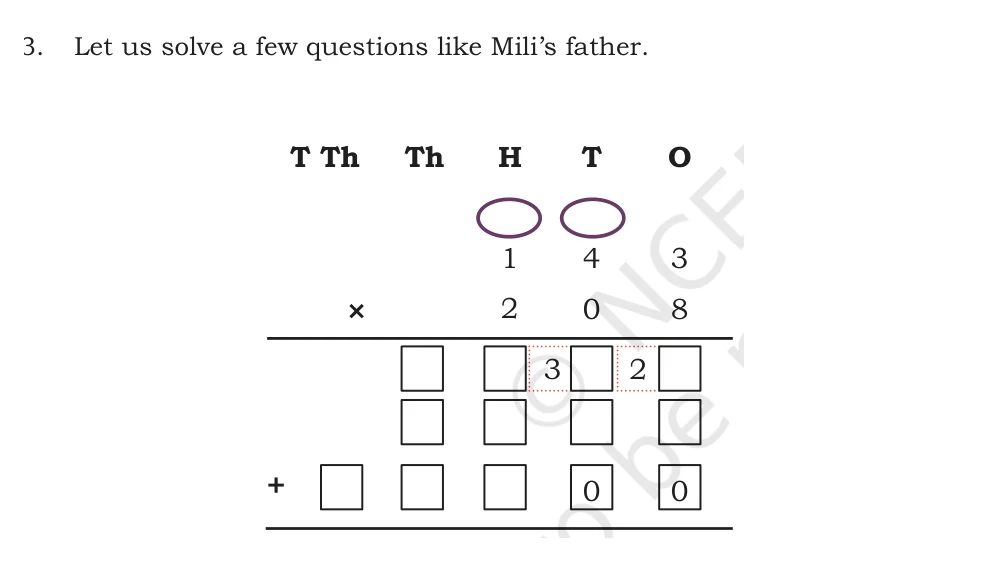
Complete the place-value diagram for 143\times208.
Show detailed solution
- Step 1: Split 208 by place value: 208=200 + 8.
- Step 2: Multiply each part by 143: 143\times 200=28,600, 143\times 8=1,144.
- Step 3: Add the partial products: 28,600 + 1,144=29,744.
- Answer: 143\times 208=29,744.
Textbook page 84 · solved item 124

Find 807\times 5.
Show detailed solution
- Step 1: Split 807 by place value: 807=800 + 7.
- Step 2: Multiply each part by 5: 5\times 800=4,000, 5\times 7=35.
- Step 3: Add the partial products: 4,000 + 35=4,035.
- Answer: 807\times 5=4,035.
Textbook page 84 · solved item 125

Find 143\times 28.
Show detailed solution
- Step 1: Split 143 by place value: 143=100 + 40 + 3.
- Step 2: Multiply each part by 28: 28\times 100=2,800, 28\times 40=1,120, 28\times 3=84.
- Step 3: Add the partial products: 2,800 + 1,120 + 84=4,004.
- Answer: 143\times 28=4,004.
Textbook page 84 · solved item 126

Find 309\times 9.
Show detailed solution
- Step 1: Split 309 by place value: 309=300 + 9.
- Step 2: Multiply each part by 9: 9\times 300=2,700, 9\times 9=81.
- Step 3: Add the partial products: 2,700 + 81=2,781.
- Answer: 309\times 9=2,781.
Textbook page 84 · solved item 127

Find 450\times 38.
Show detailed solution
- Step 1: Split 450 by place value: 450=400 + 50.
- Step 2: Multiply each part by 38: 38\times 400=15,200, 38\times 50=1,900.
- Step 3: Add the partial products: 15,200 + 1,900=17,100.
- Answer: 450\times 38=17,100.
Textbook page 84 · solved item 128

Find 584\times 23.
Show detailed solution
- Step 1: Split 584 by place value: 584=500 + 80 + 4.
- Step 2: Multiply each part by 23: 23\times 500=11,500, 23\times 80=1,840, 23\times 4=92.
- Step 3: Add the partial products: 11,500 + 1,840 + 92=13,432.
- Answer: 584\times 23=13,432.
Textbook page 84 · solved item 129

Find 302\times 13.
Show detailed solution
- Step 1: Split 302 by place value: 302=300 + 2.
- Step 2: Multiply each part by 13: 13\times 300=3,900, 13\times 2=26.
- Step 3: Add the partial products: 3,900 + 26=3,926.
- Answer: 302\times 13=3,926.
Textbook page 84 · solved item 130

Find 604\times 54.
Show detailed solution
- Step 1: Split 604 by place value: 604=600 + 4.
- Step 2: Multiply each part by 54: 54\times 600=32,400, 54\times 4=216.
- Step 3: Add the partial products: 32,400 + 216=32,616.
- Answer: 604\times 54=32,616.
Textbook page 84 · solved item 131

Find 112\times 23.
Show detailed solution
- Step 1: Split 112 by place value: 112=100 + 10 + 2.
- Step 2: Multiply each part by 23: 23\times 100=2,300, 23\times 10=230, 23\times 2=46.
- Step 3: Add the partial products: 2,300 + 230 + 46=2,576.
- Answer: 112\times 23=2,576.
Textbook page 84 · solved item 132

Find 237\times 19.
Show detailed solution
- Step 1: Split 237 by place value: 237=200 + 30 + 7.
- Step 2: Multiply each part by 19: 19\times 200=3,800, 19\times 30=570, 19\times 7=133.
- Step 3: Add the partial products: 3,800 + 570 + 133=4,503.
- Answer: 237\times 19=4,503.
Detailed worked answers
Textbook page 85
Textbook page 85 · solved item 133
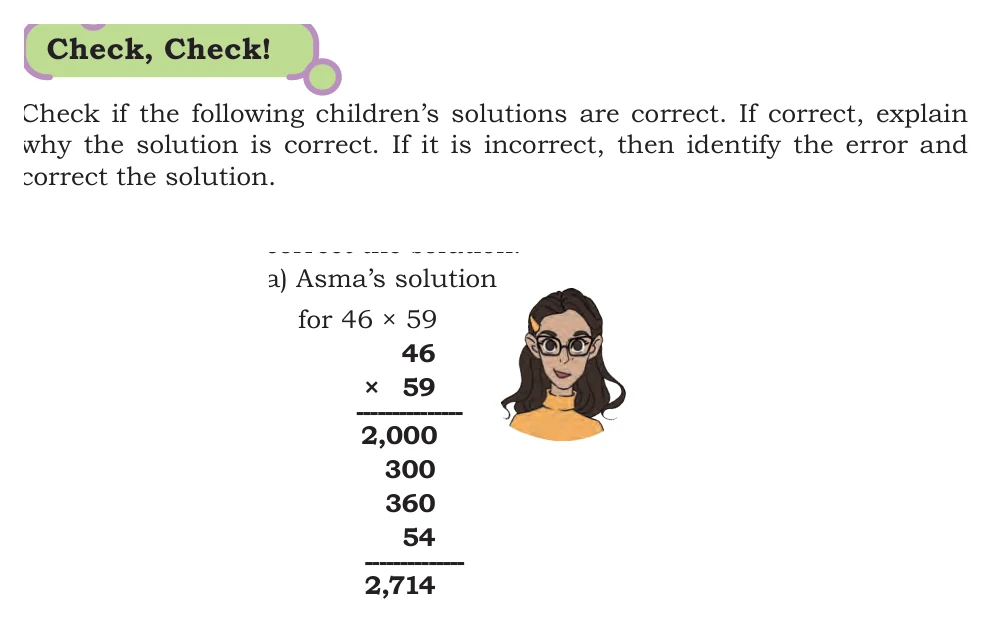
Is Asma's solution for 46\times59 correct? Fix it if needed.
Show detailed solution
- Step 1: The shown answer is 2,714.
- Step 2: The four partial products 2,000, 300, 360, and 54 add to 2,714.
- Step 3: A correct place-value calculation gives 2,714.
- Answer: The solution is correct; the correct product is 2,714.
Textbook page 85 · solved item 134
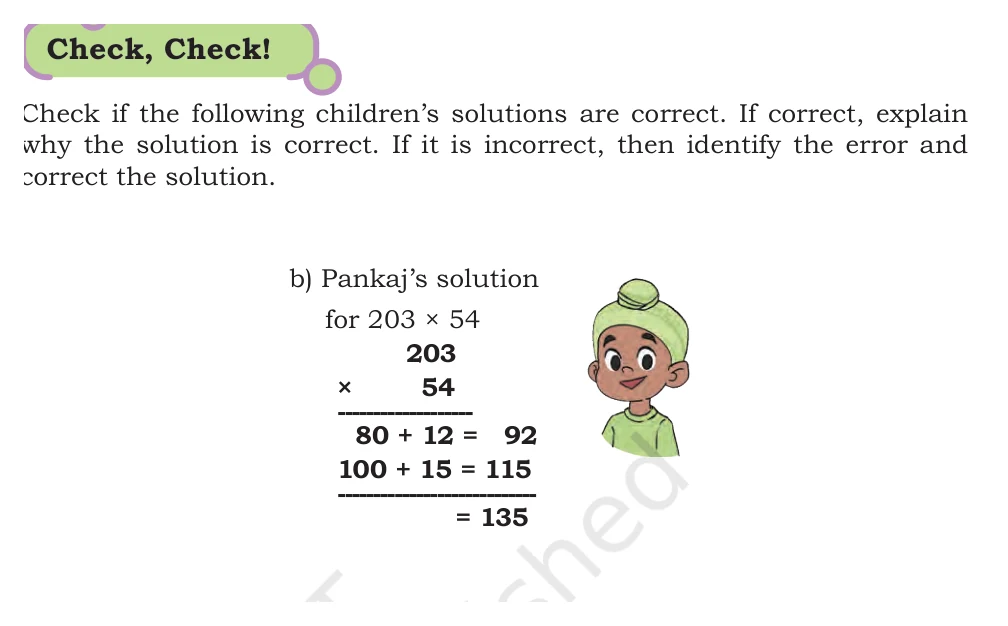
Is Pankaj's solution for 203\times54 correct? Fix it if needed.
Show detailed solution
- Step 1: The shown answer is 135.
- Step 2: He multiplied the separate digits but ignored their place values. The correct partial products are 10,150 and 812.
- Step 3: A correct place-value calculation gives 10,962.
- Answer: The solution is incorrect; the correct product is 10,962.
Textbook page 85 · solved item 135
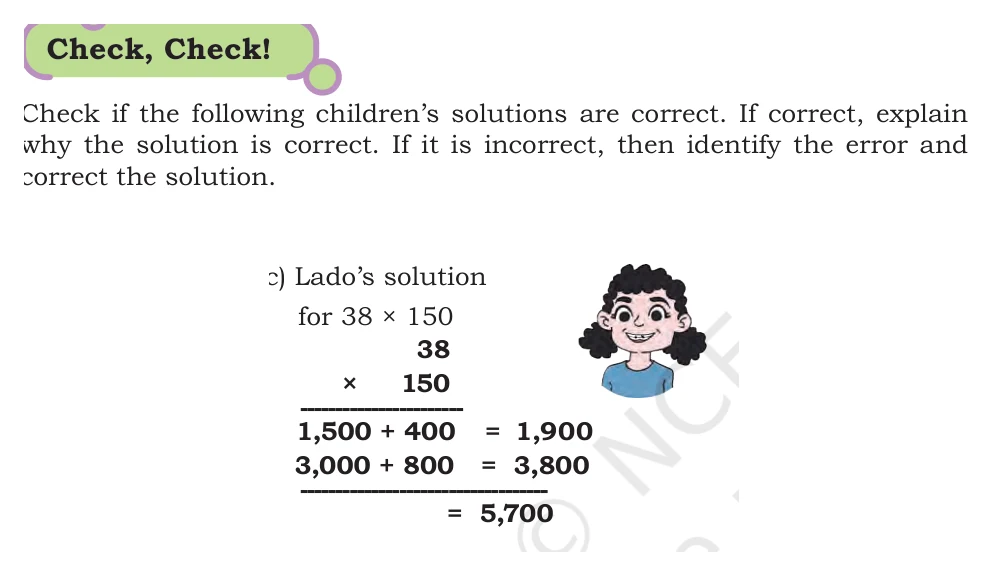
Is Lado's solution for 38\times150 correct? Fix it if needed.
Show detailed solution
- Step 1: The shown answer is 5,700.
- Step 2: The work separates 150 into 100 and 50, giving 3,800 and 1,900.
- Step 3: A correct place-value calculation gives 5,700.
- Answer: The solution is correct; the correct product is 5,700.
Textbook page 85 · solved item 136

Is Kira's solution for 193\times272 correct? Fix it if needed.
Show detailed solution
- Step 1: The shown answer is 40,337.
- Step 2: The 70-times row was written as 1,351 instead of 13,510.
- Step 3: A correct place-value calculation gives 52,496.
- Answer: The solution is incorrect; the correct product is 52,496.
Textbook page 85 · solved item 137
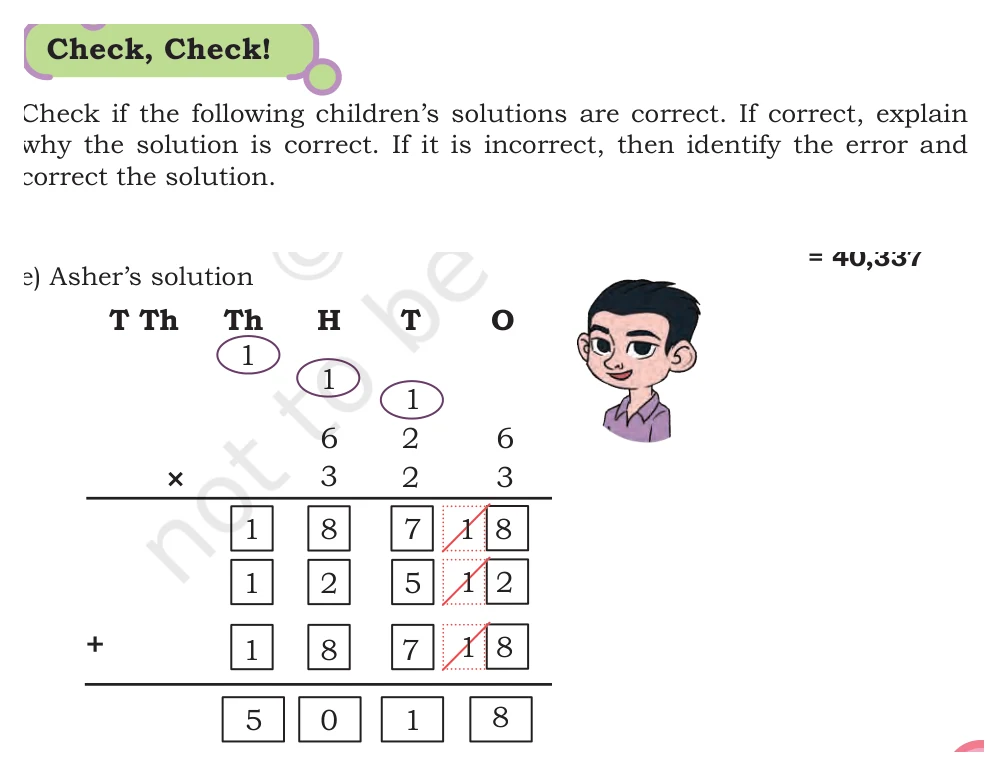
Is Asher's solution for 626\times323 correct? Fix it if needed.
Show detailed solution
- Step 1: The shown answer is 5,018.
- Step 2: The partial products were not shifted into the tens and hundreds places.
- Step 3: A correct place-value calculation gives 202,198.
- Answer: The solution is incorrect; the correct product is 202,198.
Detailed worked answers
Textbook page 86
Textbook page 86 · solved item 138
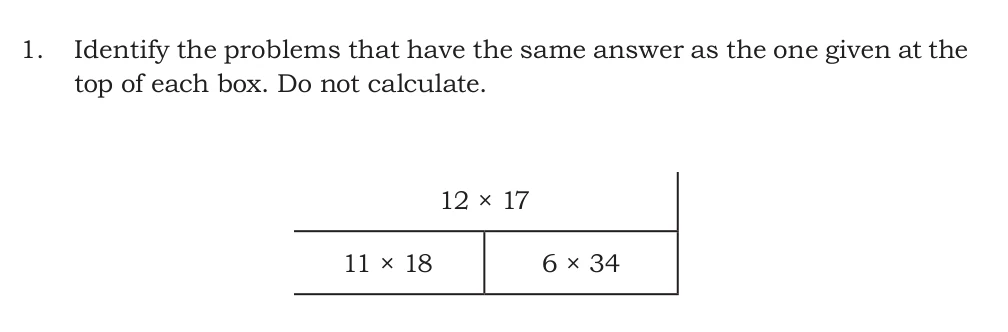
Which expression in the box has the same value as 12\times 17?
Show detailed solution
- Step 1: Compare how each choice regroups or adjusts the factors.
- Step 2: Doubling 17 while halving 12 keeps the product unchanged.
- Step 3: Reject choices that add, remove, double, or halve the wrong amount.
- Answer: 6 x 34.
Textbook page 86 · solved item 139
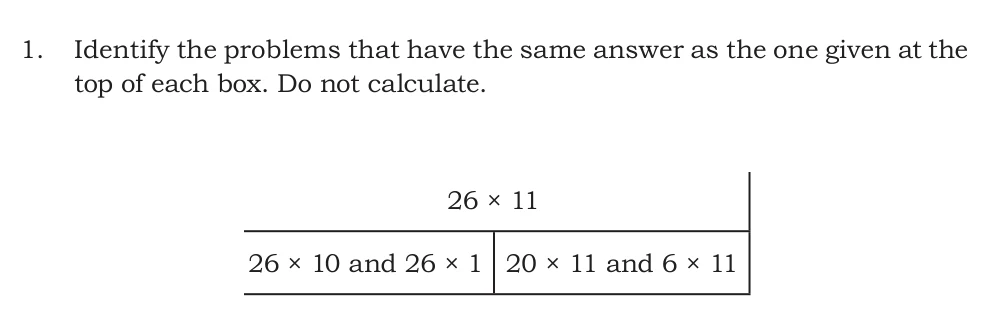
Which expression in the box has the same value as 26\times 11?
Show detailed solution
- Step 1: Compare how each choice regroups or adjusts the factors.
- Step 2: Both choices split one factor into parts and add the matching partial products.
- Step 3: Reject choices that add, remove, double, or halve the wrong amount.
- Answer: 26 x 10 and 26 x 1; 20 x 11 and 6 x 11.
Textbook page 86 · solved item 140
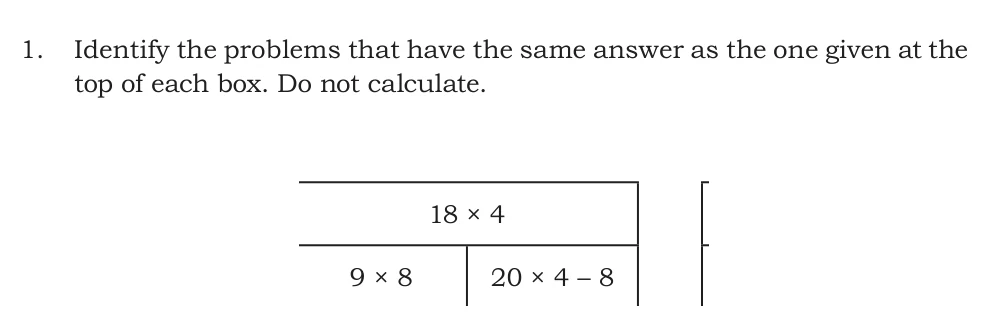
Which expression in the box has the same value as 18\times 4?
Show detailed solution
- Step 1: Compare how each choice regroups or adjusts the factors.
- Step 2: Halving and doubling gives 9 x 8, and removing two groups of 4 from 20 x 4 gives the same total.
- Step 3: Reject choices that add, remove, double, or halve the wrong amount.
- Answer: 9 x 8; 20 x 4 - 8.
Textbook page 86 · solved item 141
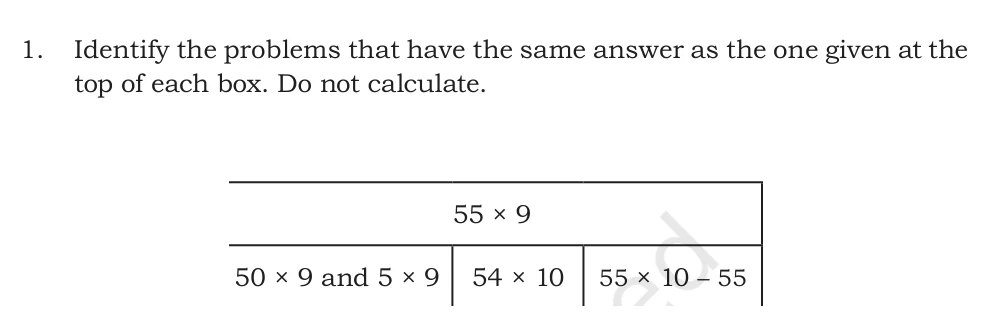
Which expression in the box has the same value as 55\times 9?
Show detailed solution
- Step 1: Compare how each choice regroups or adjusts the factors.
- Step 2: Both methods regroup 55 groups of 9 without changing the amount.
- Step 3: Reject choices that add, remove, double, or halve the wrong amount.
- Answer: 50 x 9 and 5 x 9; 55 x 10 - 55.
Textbook page 86 · solved item 142
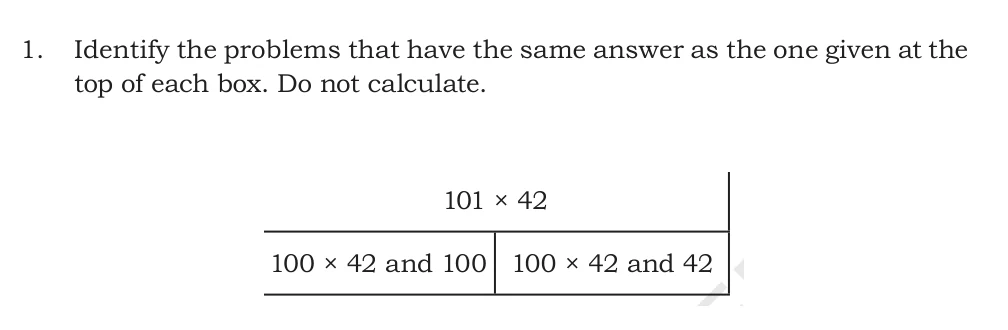
Which expression in the box has the same value as 101\times 42?
Show detailed solution
- Step 1: Compare how each choice regroups or adjusts the factors.
- Step 2: One hundred groups of 42 plus one more group equals 101 groups.
- Step 3: Reject choices that add, remove, double, or halve the wrong amount.
- Answer: 100 x 42 and 42.
Textbook page 86 · solved item 143
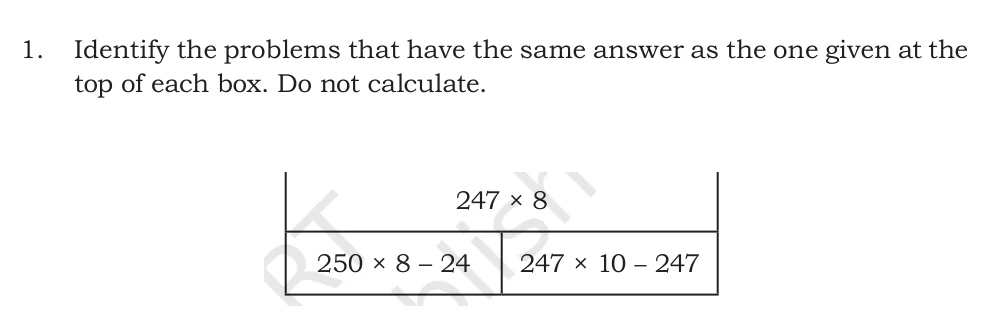
Which expression in the box has the same value as 247\times 8?
Show detailed solution
- Step 1: Compare how each choice regroups or adjusts the factors.
- Step 2: There are three extra groups of 8 in 250 x 8, so subtract 24.
- Step 3: Reject choices that add, remove, double, or halve the wrong amount.
- Answer: 250 x 8 - 24.
Textbook page 86 · solved item 144
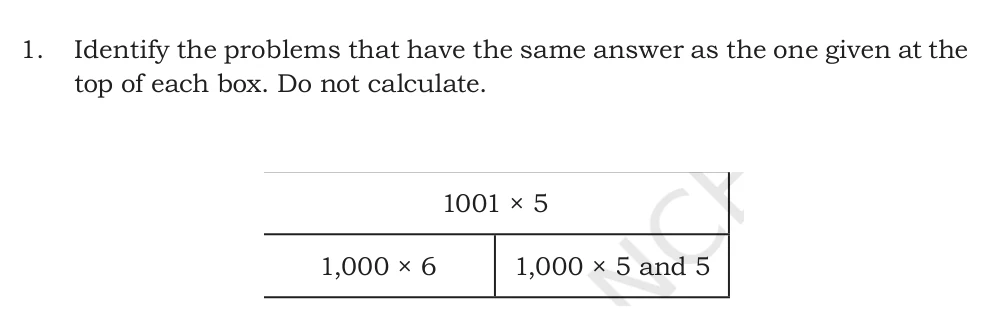
Which expression in the box has the same value as 1,001\times 5?
Show detailed solution
- Step 1: Compare how each choice regroups or adjusts the factors.
- Step 2: Split 1,001 into 1,000 and 1.
- Step 3: Reject choices that add, remove, double, or halve the wrong amount.
- Answer: 1,000 x 5 and 5.
Textbook page 86 · solved item 145
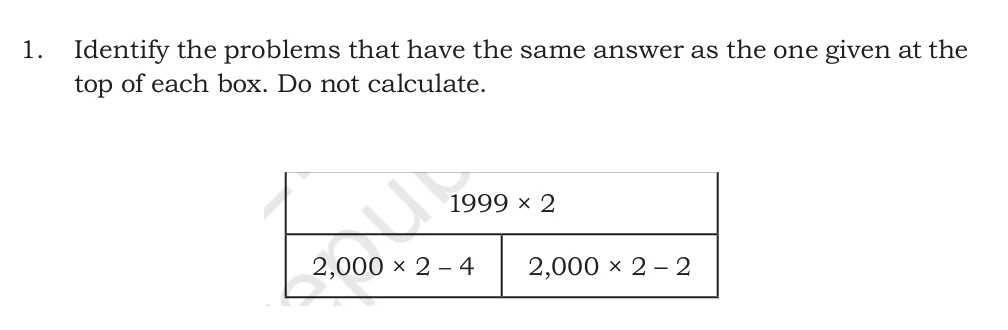
Which expression in the box has the same value as 1,999\times 2?
Show detailed solution
- Step 1: Compare how each choice regroups or adjusts the factors.
- Step 2: The easier product has one extra group of 2.
- Step 3: Reject choices that add, remove, double, or halve the wrong amount.
- Answer: 2,000 x 2 - 2.
Textbook page 86 · solved item 146

Find 16\times 25.
Show detailed solution
- Step 1: Split 25 by place value: 25=20 + 5.
- Step 2: Multiply each part by 16: 16\times 20=320, 16\times 5=80.
- Step 3: Add the partial products: 320 + 80=400.
- Answer: 16\times 25=400.
Textbook page 86 · solved item 147

Find 12\times 125.
Show detailed solution
- Step 1: Split 125 by place value: 125=100 + 20 + 5.
- Step 2: Multiply each part by 12: 12\times 100=1,200, 12\times 20=240, 12\times 5=60.
- Step 3: Add the partial products: 1,200 + 240 + 60=1,500.
- Answer: 12\times 125=1,500.
Textbook page 86 · solved item 148

Find 24\times 250.
Show detailed solution
- Step 1: Split 250 by place value: 250=200 + 50.
- Step 2: Multiply each part by 24: 24\times 200=4,800, 24\times 50=1,200.
- Step 3: Add the partial products: 4,800 + 1,200=6,000.
- Answer: 24\times 250=6,000.
Textbook page 86 · solved item 149

Find 36\times 25.
Show detailed solution
- Step 1: Split 36 by place value: 36=30 + 6.
- Step 2: Multiply each part by 25: 25\times 30=750, 25\times 6=150.
- Step 3: Add the partial products: 750 + 150=900.
- Answer: 36\times 25=900.
Textbook page 86 · solved item 150

Find 28\times 75.
Show detailed solution
- Step 1: Split 75 by place value: 75=70 + 5.
- Step 2: Multiply each part by 28: 28\times 70=1,960, 28\times 5=140.
- Step 3: Add the partial products: 1,960 + 140=2,100.
- Answer: 28\times 75=2,100.
Textbook page 86 · solved item 151

Find 300\times 15.
Show detailed solution
- Step 1: Split 300 by place value: 300=300.
- Step 2: Multiply each part by 15: 15\times 300=4,500.
- Step 3: Add the partial products: 4,500=4,500.
- Answer: 300\times 15=4,500.
Textbook page 86 · solved item 152

Find 50\times 78.
Show detailed solution
- Step 1: Split 78 by place value: 78=70 + 8.
- Step 2: Multiply each part by 50: 50\times 70=3,500, 50\times 8=400.
- Step 3: Add the partial products: 3,500 + 400=3,900.
- Answer: 50\times 78=3,900.
Textbook page 86 · solved item 153

Find 199\times 63.
Show detailed solution
- Step 1: Split 199 by place value: 199=100 + 90 + 9.
- Step 2: Multiply each part by 63: 63\times 100=6,300, 63\times 90=5,670, 63\times 9=567.
- Step 3: Add the partial products: 6,300 + 5,670 + 567=12,537.
- Answer: 199\times 63=12,537.
Textbook page 86 · solved item 154

Find 128\times 35.
Show detailed solution
- Step 1: Split 128 by place value: 128=100 + 20 + 8.
- Step 2: Multiply each part by 35: 35\times 100=3,500, 35\times 20=700, 35\times 8=280.
- Step 3: Add the partial products: 3,500 + 700 + 280=4,480.
- Answer: 128\times 35=4,480.
Textbook page 86 · solved item 155

Write five more multiplication examples that have an easy shortcut.
Show detailed solution
- Step 1: Choose numbers close to a multiple of 10 or containing 25, 50, or 100.
- Step 2: Examples: 24\times25=600, 48\times50=2,400, and 99\times32=3,168.
- Step 3: Two more are 125\times16=2,000 and 250\times12=3,000.
- Answer: Each example can be solved by regrouping, doubling and halving, or using a nearby multiple.
Detailed worked answers
Textbook page 87
Textbook page 87 · solved item 156
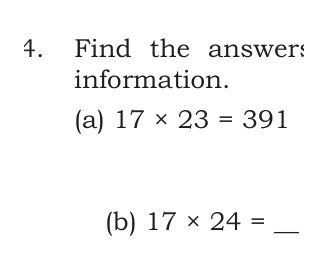
Find 17\times 24.
Show detailed solution
- Step 1: Split 24 by place value: 24=20 + 4.
- Step 2: Multiply each part by 17: 17\times 20=340, 17\times 4=68.
- Step 3: Add the partial products: 340 + 68=408.
- Answer: 17\times 24=408.
Textbook page 87 · solved item 157
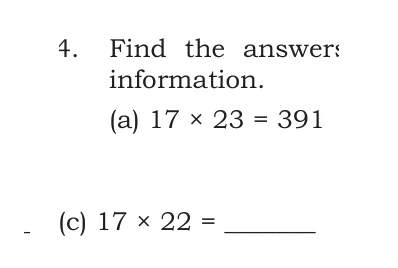
Find 17\times 22.
Show detailed solution
- Step 1: Split 22 by place value: 22=20 + 2.
- Step 2: Multiply each part by 17: 17\times 20=340, 17\times 2=34.
- Step 3: Add the partial products: 340 + 34=374.
- Answer: 17\times 22=374.
Textbook page 87 · solved item 158

Find 16\times 23.
Show detailed solution
- Step 1: Split 23 by place value: 23=20 + 3.
- Step 2: Multiply each part by 16: 16\times 20=320, 16\times 3=48.
- Step 3: Add the partial products: 320 + 48=368.
- Answer: 16\times 23=368.
Textbook page 87 · solved item 159
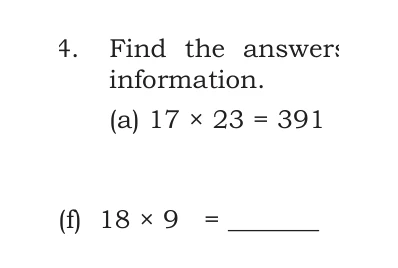
Find 18\times 9.
Show detailed solution
- Step 1: Split 18 by place value: 18=10 + 8.
- Step 2: Multiply each part by 9: 9\times 10=90, 9\times 8=72.
- Step 3: Add the partial products: 90 + 72=162.
- Answer: 18\times 9=162.
Textbook page 87 · solved item 160
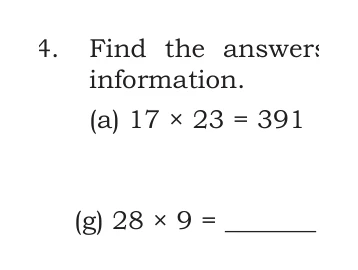
Find 28\times 9.
Show detailed solution
- Step 1: Split 28 by place value: 28=20 + 8.
- Step 2: Multiply each part by 9: 9\times 20=180, 9\times 8=72.
- Step 3: Add the partial products: 180 + 72=252.
- Answer: 28\times 9=252.
Textbook page 87 · solved item 161
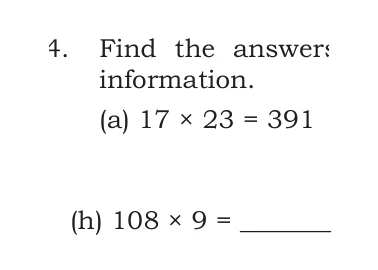
Find 108\times 9.
Show detailed solution
- Step 1: Split 108 by place value: 108=100 + 8.
- Step 2: Multiply each part by 9: 9\times 100=900, 9\times 8=72.
- Step 3: Add the partial products: 900 + 72=972.
- Answer: 108\times 9=972.
Textbook page 87 · solved item 162
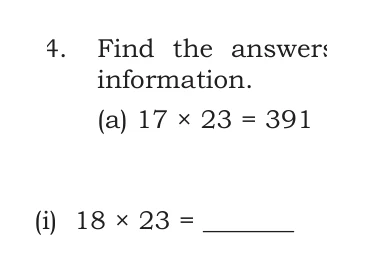
Find 18\times 23.
Show detailed solution
- Step 1: Split 23 by place value: 23=20 + 3.
- Step 2: Multiply each part by 18: 18\times 20=360, 18\times 3=54.
- Step 3: Add the partial products: 360 + 54=414.
- Answer: 18\times 23=414.
Textbook page 87 · solved item 163
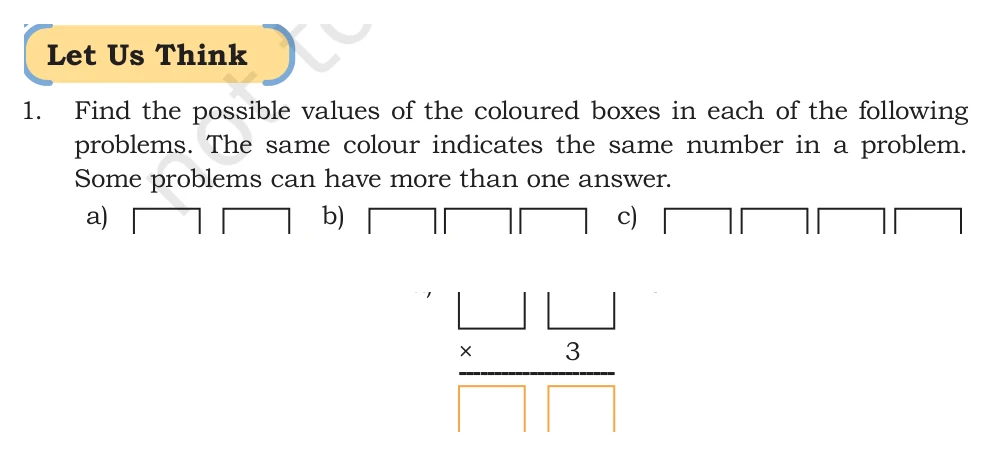
Give one possible value for every coloured box in this multiplication-by-3 puzzle.
Show detailed solution
- Step 1: Choose a number with the required number of digits.
- Step 2: Try 12 and multiply each place by 3.
- Step 3: 12\times3=36, so the product has the required number of boxes.
- Answer: One possible filling is 12 on top and 36 below.
Textbook page 87 · solved item 164
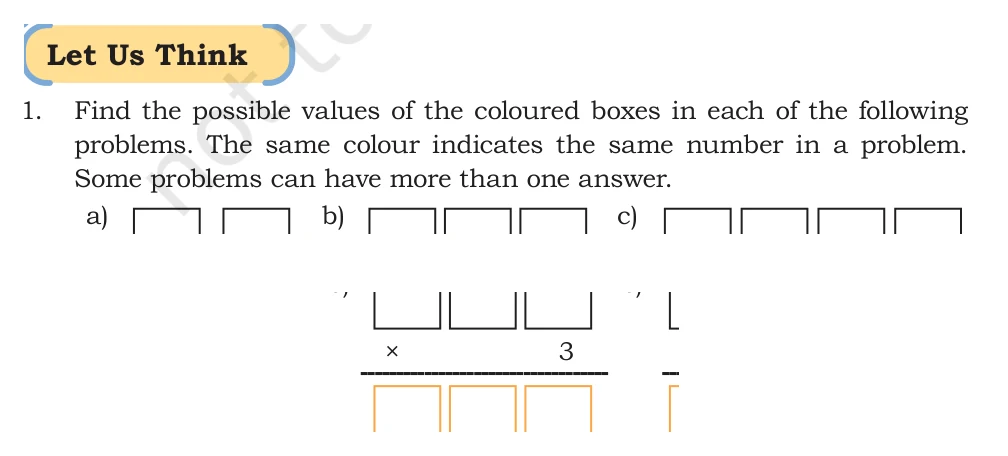
Give one possible value for every coloured box in this multiplication-by-3 puzzle.
Show detailed solution
- Step 1: Choose a number with the required number of digits.
- Step 2: Try 123 and multiply each place by 3.
- Step 3: 123\times3=369, so the product has the required number of boxes.
- Answer: One possible filling is 123 on top and 369 below.
Textbook page 87 · solved item 165
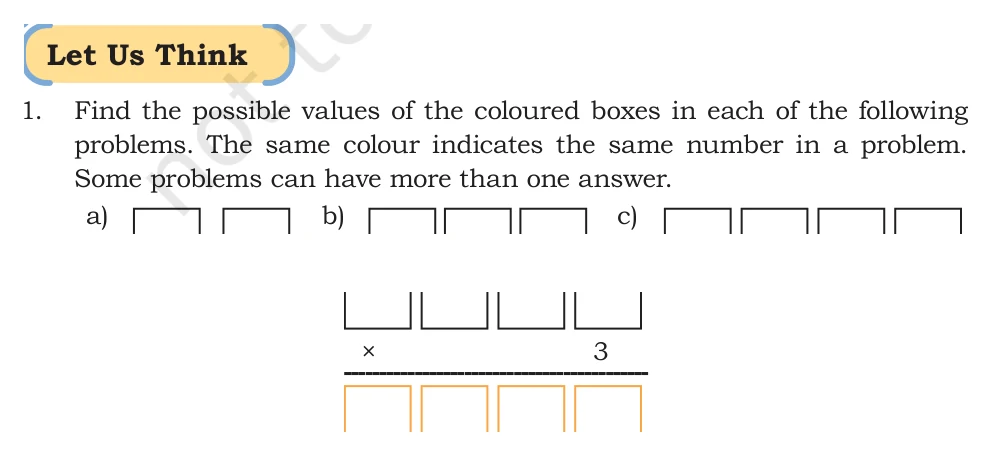
Give one possible value for every coloured box in this multiplication-by-3 puzzle.
Show detailed solution
- Step 1: Choose a number with the required number of digits.
- Step 2: Try 1,111 and multiply each place by 3.
- Step 3: 1{,}111\times3=3{,}333, so the product has the required number of boxes.
- Answer: One possible filling is 1,111 on top and 3,333 below.
Detailed worked answers
Textbook page 88
Textbook page 88 · solved item 166

For puzzle (d), find one two-digit number that gives a three-digit product ending in 0 when multiplied by 5.
Show detailed solution
- Step 1: Use the repeated colours as repeated-digit conditions.
- Step 2: Test only digits that can give the shown final digit.
- Step 3: 26 x 5 = 130.
- Answer: Put 2 and 6 on top and 3 in the middle product box.
Textbook page 88 · solved item 167
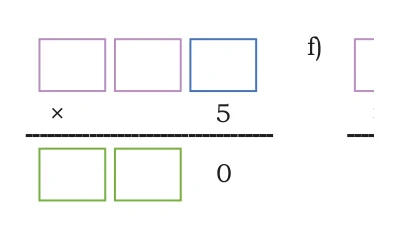
For puzzle (e), find the repeated leading digit, last digit, and repeated product digit.
Show detailed solution
- Step 1: Use the repeated colours as repeated-digit conditions.
- Step 2: Test only digits that can give the shown final digit.
- Step 3: 110 x 5 = 550.
- Answer: The boxes are 1, 1, 0 on top and 5, 5, 0 below.
Textbook page 88 · solved item 168
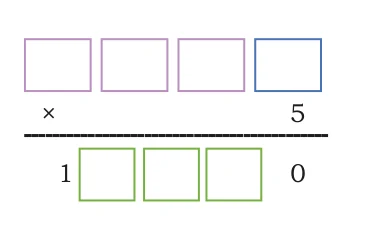
For puzzle (f), give a valid four-digit filling.
Show detailed solution
- Step 1: Use the repeated colours as repeated-digit conditions.
- Step 2: Test only digits that can give the shown final digit.
- Step 3: 2,222 x 5 = 11,110.
- Answer: Use 2 for both top colours and 1 for the repeated product colour. Another valid top number is 3,332.
Textbook page 88 · solved item 169
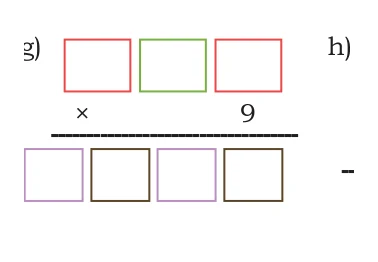
For puzzle (g), find a three-digit number of the first-second-first colour pattern whose product by 9 alternates two digits.
Show detailed solution
- Step 1: Use the repeated colours as repeated-digit conditions.
- Step 2: Test only digits that can give the shown final digit.
- Step 3: 202 x 9 = 1,818.
- Answer: Use 2, 0, 2 on top and 1, 8, 1, 8 below.
Textbook page 88 · solved item 170
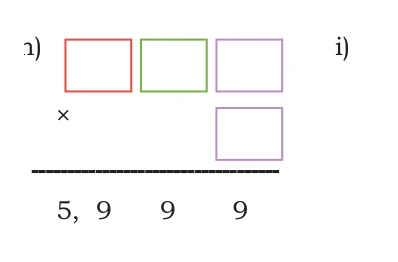
For puzzle (h), fill the boxes so the product is 5,999.
Show detailed solution
- Step 1: Use the repeated colours as repeated-digit conditions.
- Step 2: Test only digits that can give the shown final digit.
- Step 3: 857 x 7 = 5,999.
- Answer: The last digit and multiplier are both 7, so the colour rule is satisfied.
Textbook page 88 · solved item 171
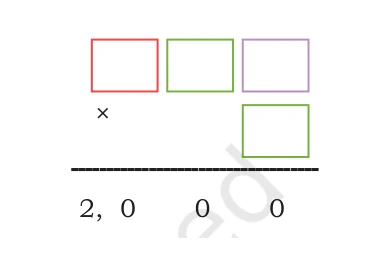
Does puzzle (i) have a filling when the middle top digit must also be the one-digit multiplier?
Show detailed solution
- Step 1: Use the repeated colours as repeated-digit conditions.
- Step 2: Test only digits that can give the shown final digit.
- Step 3: No digit from 1 to 9 works.
- Answer: Checking the factors of 2,000 shows that none has the required multiplier as its tens digit.
Textbook page 88 · solved item 172
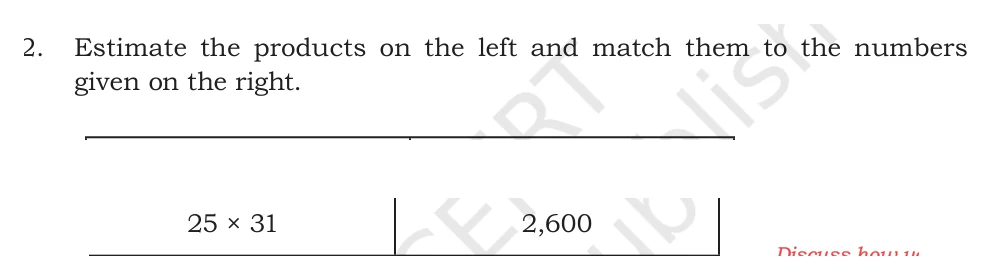
Match the estimate for 25\times31 to the correct number.
Show detailed solution
- Step 1: Round to nearby friendly numbers when useful.
- Step 2: Use 25\times30=750.
- Step 3: Compare this estimate with the choices in the right column.
- Answer: Match it to 750.
Textbook page 88 · solved item 173
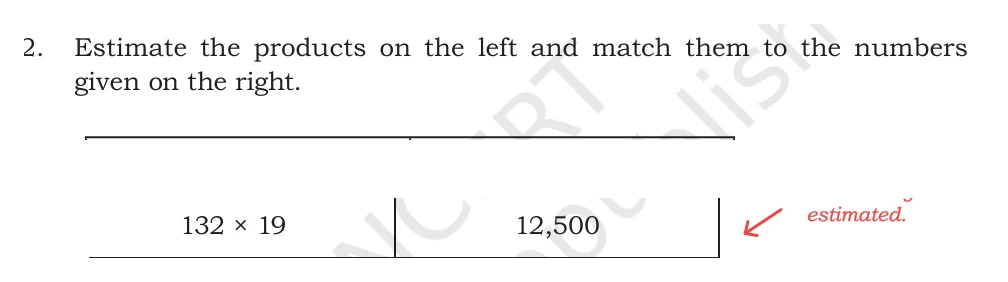
Match the estimate for 132\times19 to the correct number.
Show detailed solution
- Step 1: Round to nearby friendly numbers when useful.
- Step 2: Round to 130\times20=2,600.
- Step 3: Compare this estimate with the choices in the right column.
- Answer: Match it to 2,600.
Textbook page 88 · solved item 174
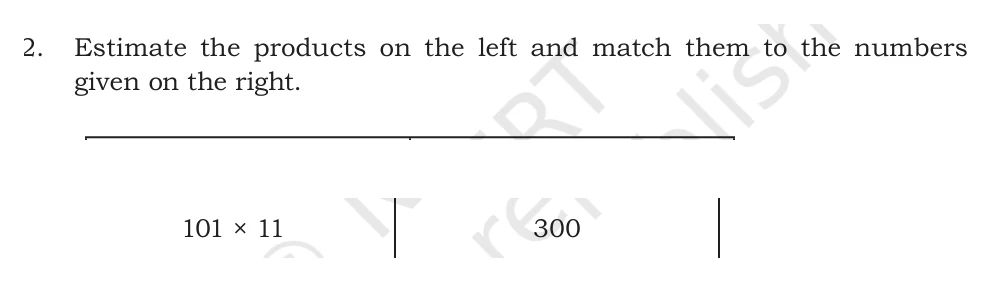
Match the estimate for 101\times11 to the correct number.
Show detailed solution
- Step 1: Round to nearby friendly numbers when useful.
- Step 2: Round to 100\times10=1,000.
- Step 3: Compare this estimate with the choices in the right column.
- Answer: Match it to 1,000.
Textbook page 88 · solved item 175
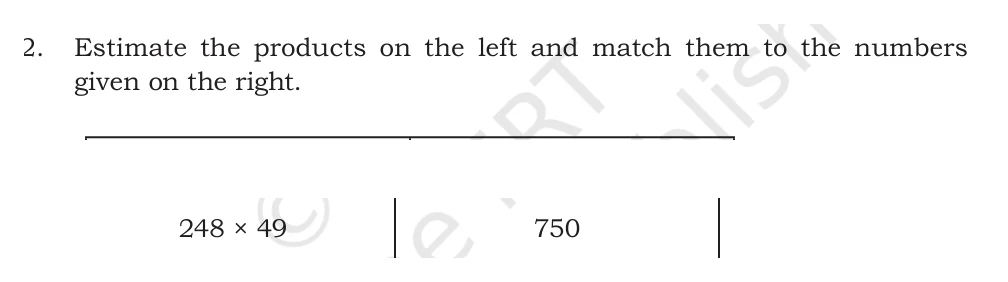
Match the estimate for 248\times49 to the correct number.
Show detailed solution
- Step 1: Round to nearby friendly numbers when useful.
- Step 2: Round to 250\times50=12,500.
- Step 3: Compare this estimate with the choices in the right column.
- Answer: Match it to 12,500.
Textbook page 88 · solved item 176
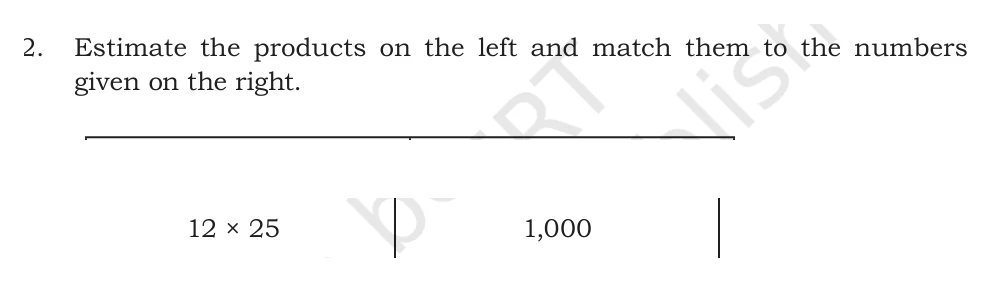
Match the estimate for 12\times25 to the correct number.
Show detailed solution
- Step 1: Round to nearby friendly numbers when useful.
- Step 2: This product is already easy: 12\times25=300.
- Step 3: Compare this estimate with the choices in the right column.
- Answer: Match it to 300.
Detailed worked answers
Textbook page 89
Textbook page 89 · solved item 177
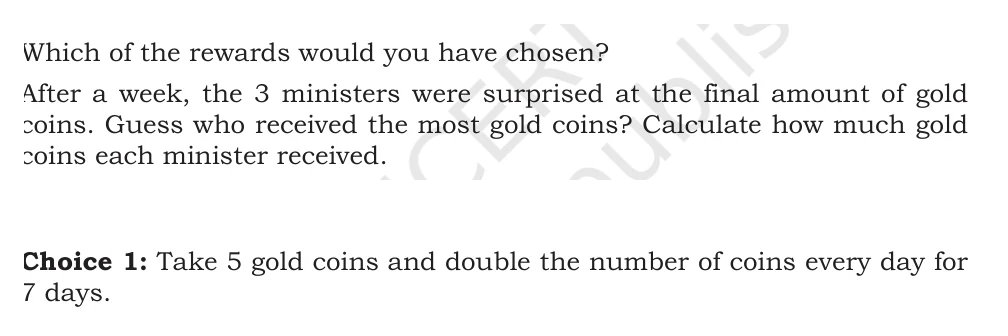
How many coins does Minister 1 have after multiplying the starting gift once each day for 7 days?
Show detailed solution
- Step 1: Begin with 5 coins before the first daily multiplication.
- Step 2: The starting amount followed by Days 1-7 is 5, 10, 20, 40, 80, 160, 320, 640.
- Step 3: Read the last number after the seventh multiplication.
- Step 4: If a class labels the starting gift as Day 1, its Day 7 entry is 320; the winning choice is unchanged.
- Answer: Minister 1 has 640 coins after 7 daily multiplications.
Textbook page 89 · solved item 178
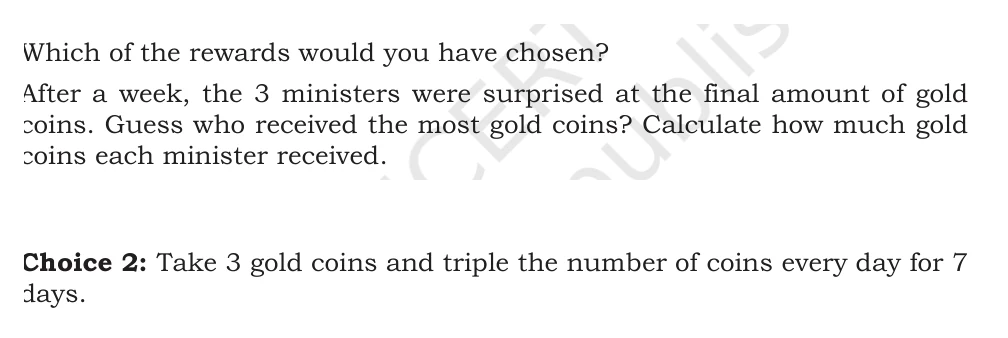
How many coins does Minister 2 have after multiplying the starting gift once each day for 7 days?
Show detailed solution
- Step 1: Begin with 3 coins before the first daily multiplication.
- Step 2: The starting amount followed by Days 1-7 is 3, 9, 27, 81, 243, 729, 2,187, 6,561.
- Step 3: Read the last number after the seventh multiplication.
- Step 4: If a class labels the starting gift as Day 1, its Day 7 entry is 2,187; the winning choice is unchanged.
- Answer: Minister 2 has 6,561 coins after 7 daily multiplications.
Textbook page 89 · solved item 179
How many coins does Minister 3 have after multiplying the starting gift once each day for 7 days?
Show detailed solution
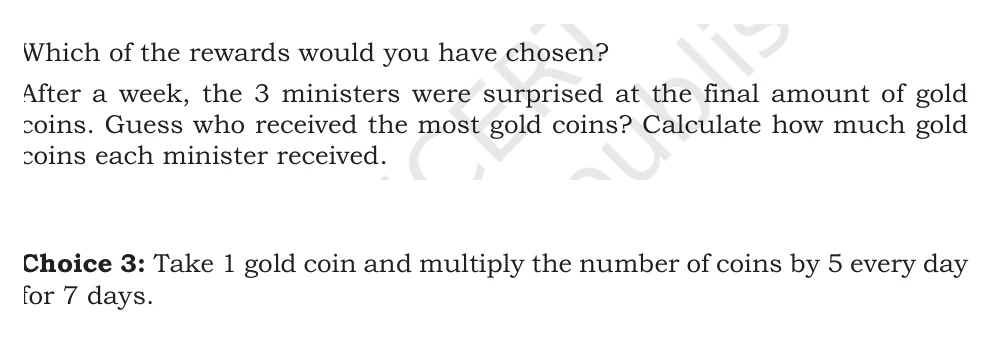
- Step 1: Begin with 1 coins before the first daily multiplication.
- Step 2: The starting amount followed by Days 1-7 is 1, 5, 25, 125, 625, 3,125, 15,625, 78,125.
- Step 3: Read the last number after the seventh multiplication.
- Step 4: If a class labels the starting gift as Day 1, its Day 7 entry is 15,625; the winning choice is unchanged.
- Answer: Minister 3 has 78,125 coins after 7 daily multiplications.
Textbook page 89 · solved item 180
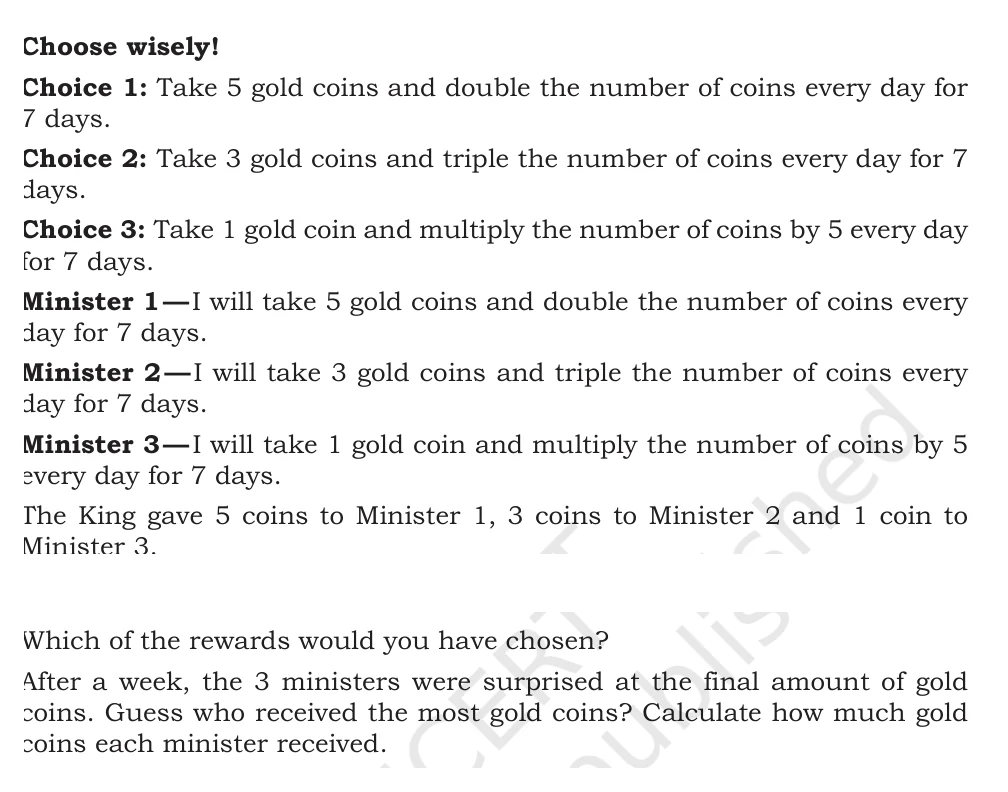
Which reward should be chosen after comparing the three Day 7 amounts?
Show detailed solution
- Step 1: Minister 1 reaches 640 coins.
- Step 2: Minister 2 reaches 6,561 coins, and Minister 3 reaches 78,125 coins.
- Step 3: Compare the three totals.
- Answer: Choose Reward 3 because 78,125 is the greatest amount.
Textbook page 89 · solved item 181
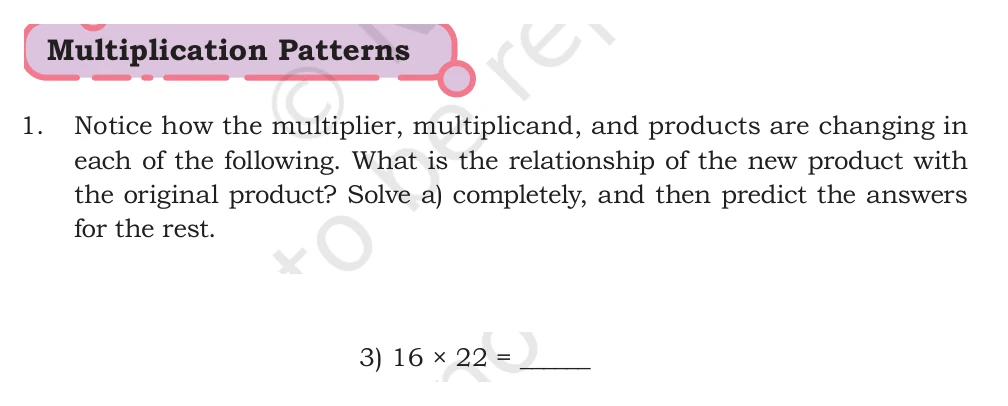
Find 16\times 22.
Show detailed solution
- Step 1: Split 22 by place value: 22=20 + 2.
- Step 2: Multiply each part by 16: 16\times 20=320, 16\times 2=32.
- Step 3: Add the partial products: 320 + 32=352.
- Answer: 16\times 22=352.
Textbook page 89 · solved item 182

Find 32\times 44.
Show detailed solution
- Step 1: Split 44 by place value: 44=40 + 4.
- Step 2: Multiply each part by 32: 32\times 40=1,280, 32\times 4=128.
- Step 3: Add the partial products: 1,280 + 128=1,408.
- Answer: 32\times 44=1,408.
Textbook page 89 · solved item 183
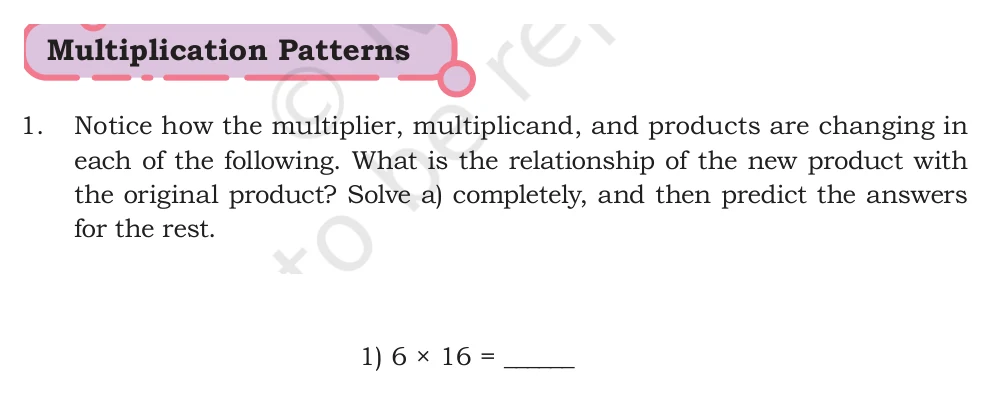
Find 6\times 16.
Show detailed solution
- Step 1: Split 16 by place value: 16=10 + 6.
- Step 2: Multiply each part by 6: 6\times 10=60, 6\times 6=36.
- Step 3: Add the partial products: 60 + 36=96.
- Answer: 6\times 16=96.
Textbook page 89 · solved item 184
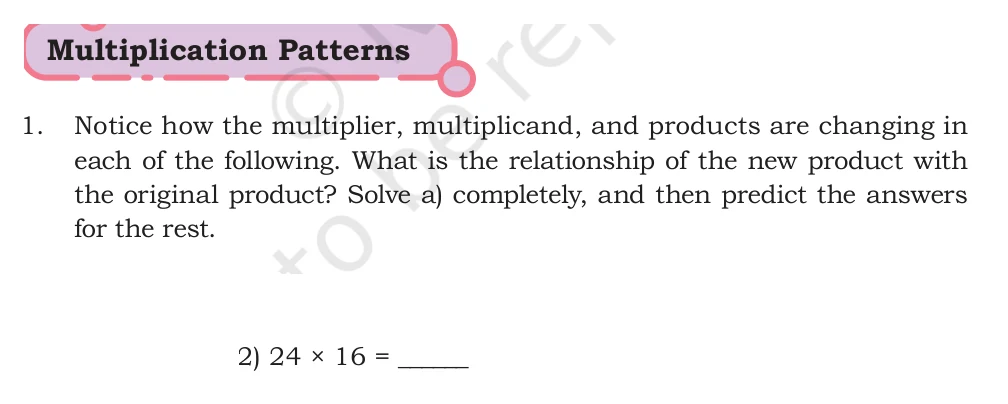
Find 24\times 16.
Show detailed solution
- Step 1: Split 24 by place value: 24=20 + 4.
- Step 2: Multiply each part by 16: 16\times 20=320, 16\times 4=64.
- Step 3: Add the partial products: 320 + 64=384.
- Answer: 24\times 16=384.
Textbook page 89 · solved item 185
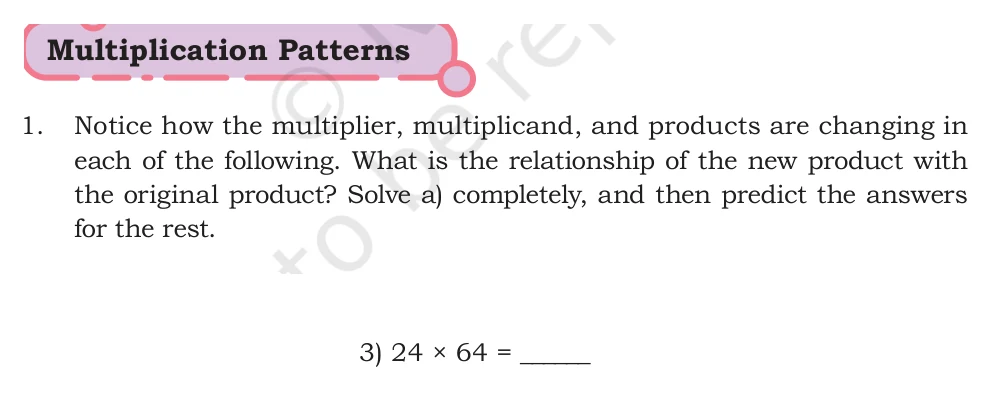
Find 24\times 64.
Show detailed solution
- Step 1: Split 64 by place value: 64=60 + 4.
- Step 2: Multiply each part by 24: 24\times 60=1,440, 24\times 4=96.
- Step 3: Add the partial products: 1,440 + 96=1,536.
- Answer: 24\times 64=1,536.
Textbook page 89 · solved item 186
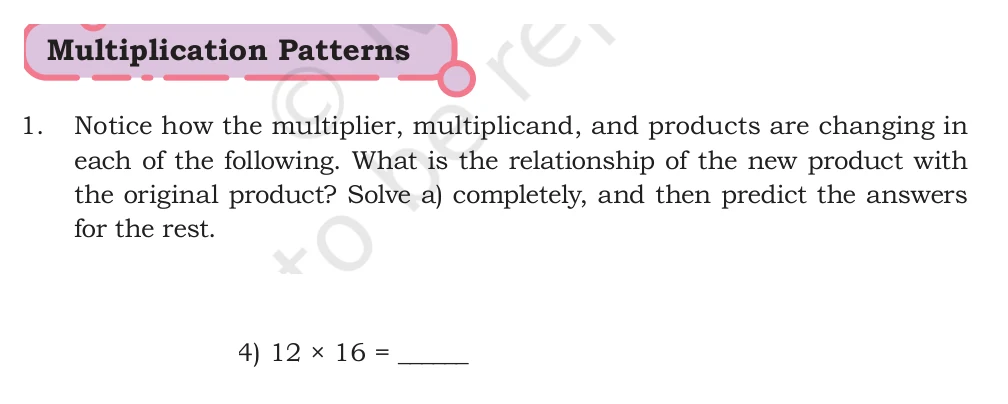
Find 12\times 16.
Show detailed solution
- Step 1: Split 16 by place value: 16=10 + 6.
- Step 2: Multiply each part by 12: 12\times 10=120, 12\times 6=72.
- Step 3: Add the partial products: 120 + 72=192.
- Answer: 12\times 16=192.
Detailed worked answers
Textbook page 90
Textbook page 90 · solved item 187

Complete 1,111\times1,111.
Show detailed solution
- Step 1: Notice the rule in the completed lines above it.
- Step 2: The products build the palindrome 1, 121, 12,321, then 1,234,321.
- Step 3: Check the place values in the result.
- Answer: 1,111\times1,111=1,234,321.
Textbook page 90 · solved item 188
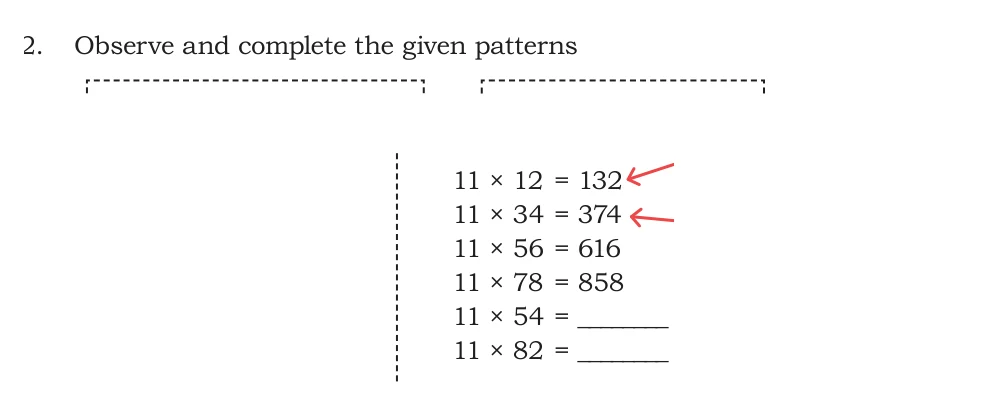
Complete 11\times54.
Show detailed solution
- Step 1: Notice the rule in the completed lines above it.
- Step 2: Use 54\times10+54=540+54.
- Step 3: Check the place values in the result.
- Answer: 11\times54=594.
Textbook page 90 · solved item 189
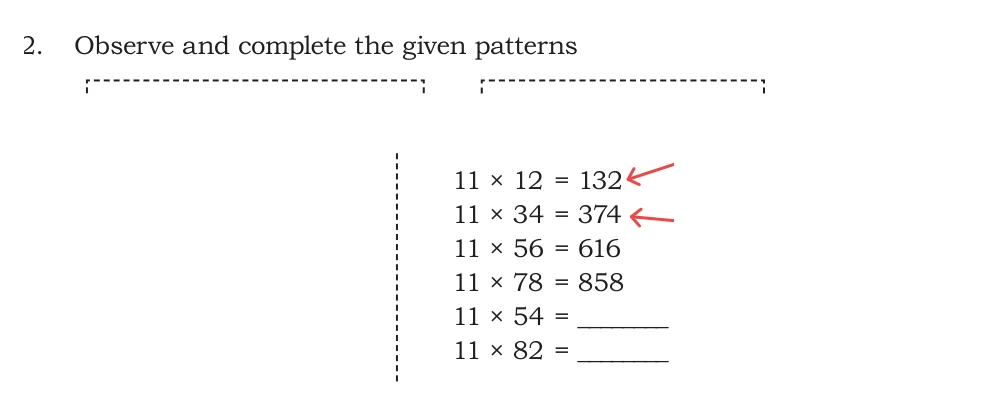
Complete 11\times82.
Show detailed solution
- Step 1: Notice the rule in the completed lines above it.
- Step 2: Use 82\times10+82=820+82.
- Step 3: Check the place values in the result.
- Answer: 11\times82=902.
Textbook page 90 · solved item 190
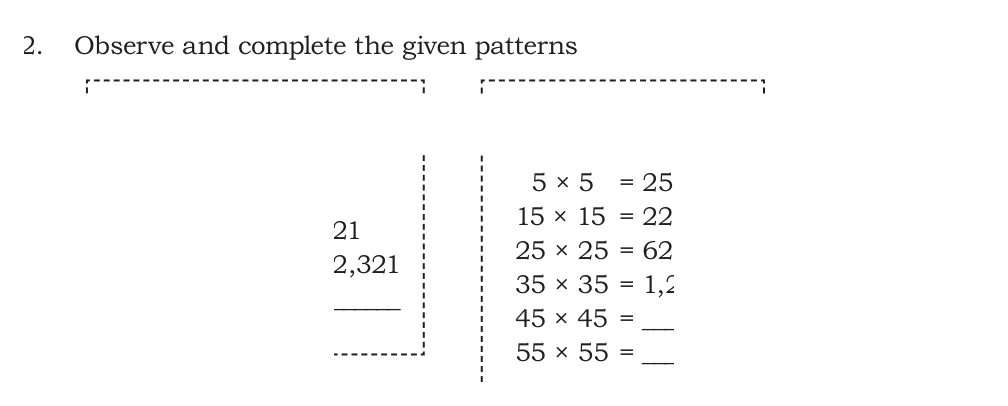
Complete 45\times45.
Show detailed solution
- Step 1: Notice the rule in the completed lines above it.
- Step 2: Use 45\times40+45\times5=1,800+225.
- Step 3: Check the place values in the result.
- Answer: 45\times45=2,025.
Textbook page 90 · solved item 191
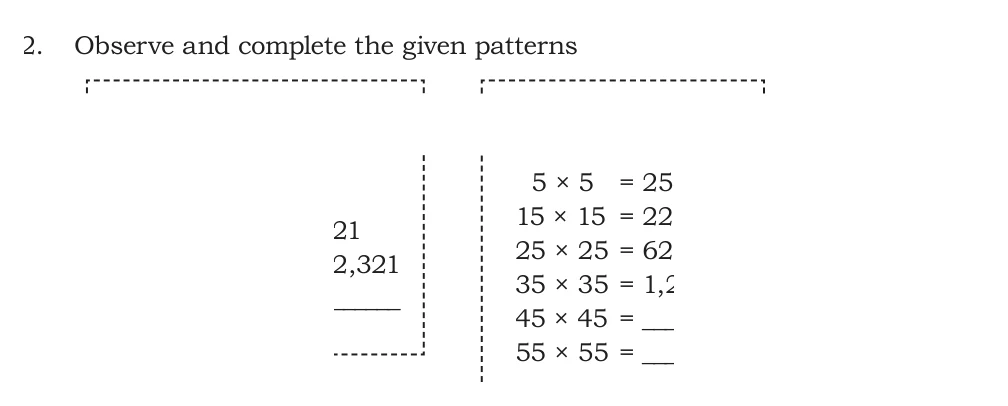
Complete 55\times55.
Show detailed solution
- Step 1: Notice the rule in the completed lines above it.
- Step 2: Use 55\times50+55\times5=2,750+275.
- Step 3: Check the place values in the result.
- Answer: 55\times55=3,025.
Textbook page 90 · solved item 192
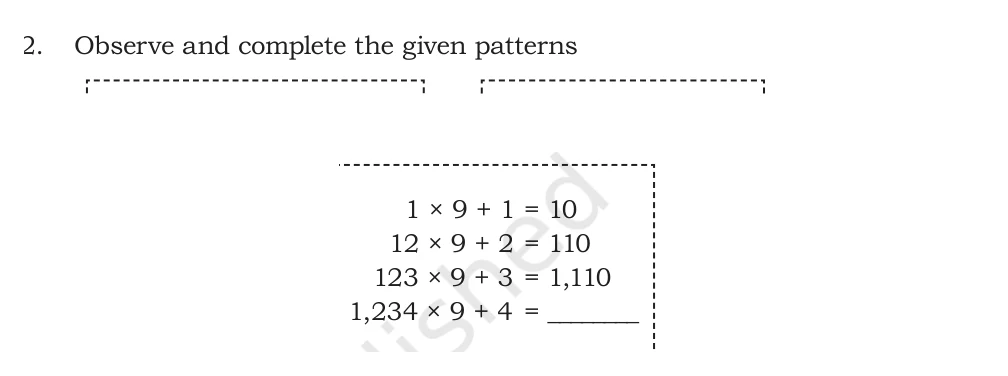
Complete 1,234\times9+4.
Show detailed solution
- Step 1: Notice the rule in the completed lines above it.
- Step 2: First, 1,234\times9=11,106. Then add 4.
- Step 3: Check the place values in the result.
- Answer: 1,234\times9+4=11,110.
Textbook page 90 · solved item 193
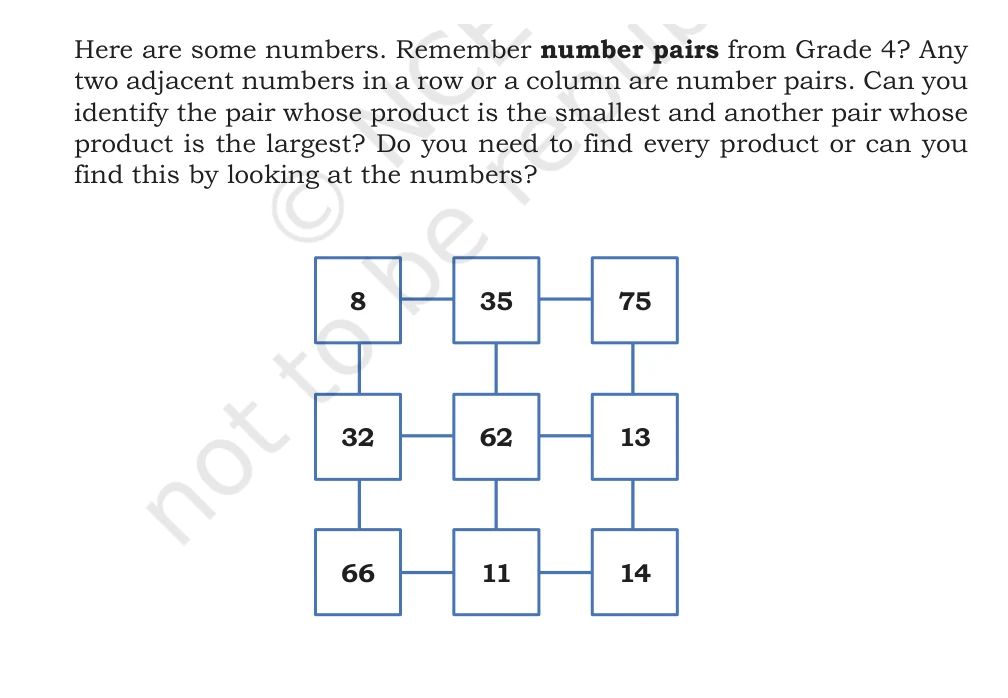
Which adjacent pair in the grid has the smallest product, and which has the largest?
Show detailed solution
- Step 1: For the smallest product, inspect the smallest nearby numbers. The useful comparison is 11\times14=154 and 13\times14=182.
- Step 2: For the largest product, inspect the largest nearby numbers. 35\times75=2,625, which is larger than the other likely pairs.
- Step 3: The two numbers in each chosen pair touch vertically in the grid.
- Answer: The smallest-product pair is 11 and 14; the largest-product pair is 35 and 75. Every product need not be calculated.
Detailed worked answers
Textbook page 91
Textbook page 91 · solved item 194

Mala buys 18 books at 3 books for Rs 150 and has Rs 20 left. How much money did she start with?
Show detailed solution
- Step 1: Eighteen books make 18\div3=6 groups of 3 books.
- Step 2: The books cost 6\times150=900 rupees.
- Step 3: Add the Rs 20 left over: 900+20=920.
- Answer: Mala had Rs 920 at the beginning.
Textbook page 91 · solved item 195
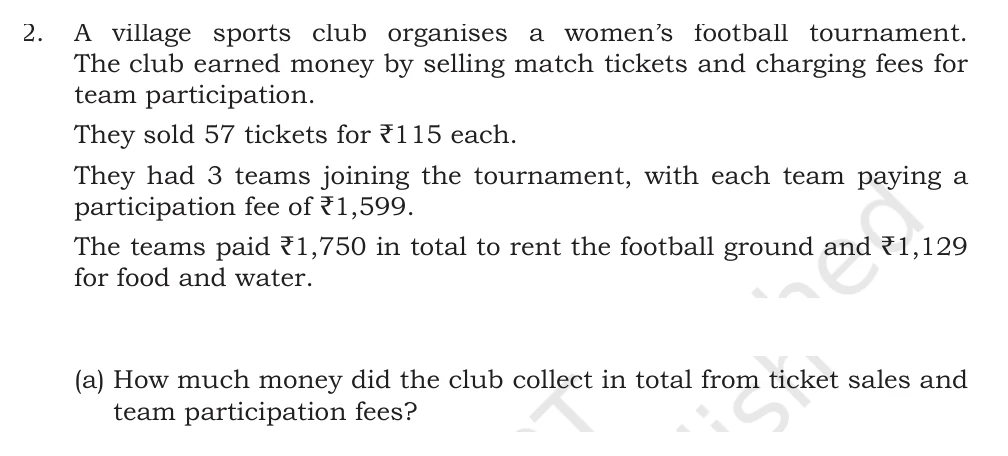
How much did the sports club collect from 57 tickets at Rs 115 and 3 team fees at Rs 1,599?
Show detailed solution
- Step 1: Ticket sales are 57\times115=6,555 rupees.
- Step 2: Team fees are 3\times1,599=4,797 rupees.
- Step 3: 6,555+4,797=11,352.
- Answer: The club collected Rs 11,352.
Textbook page 91 · solved item 196
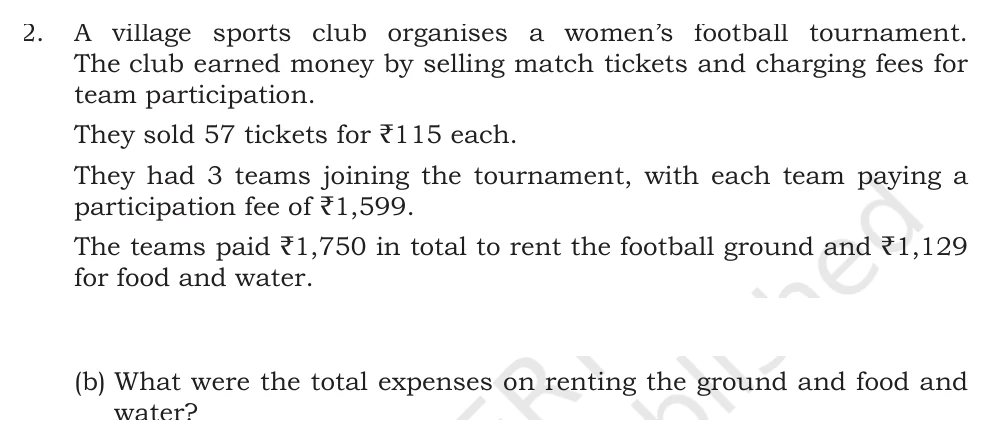
What were the club's total expenses for Rs 1,750 ground rent and Rs 1,129 food and water?
Show detailed solution
- Step 1: Line up the two amounts by place value.
- Step 2: Add 1,750+1,129=2,879.
- Step 3: Both costs are expenses, so they are added.
- Answer: The total expenses were Rs 2,879.
Textbook page 91 · solved item 197
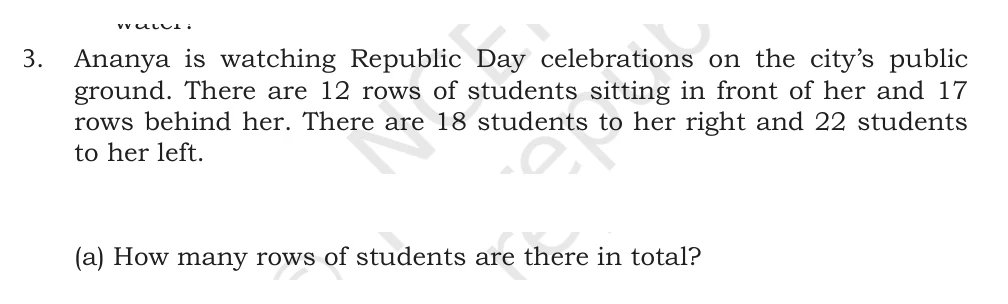
How many rows of students are there if Ananya has 12 rows in front and 17 rows behind her?
Show detailed solution
- Step 1: Add the rows in front and behind: 12+17=29.
- Step 2: Include Ananya's own row: 29+1=30.
- Step 3: This counts every row once.
- Answer: There are 30 rows.
Textbook page 91 · solved item 198
How many students are in Ananya's row if 18 sit to her right and 22 to her left?
Show detailed solution
- Step 1: Add the students on both sides: 18+22=40.
- Step 2: Include Ananya herself: 40+1=41.
- Step 3: This counts everyone in her row.
- Answer: There are 41 students in the row.
Textbook page 91 · solved item 199
What is the total number of students in 30 rows with 41 students in each row?
Show detailed solution
- Step 1: Three rows of 41 contain 3\times41=123 students.
- Step 2: Thirty rows contain ten times as many: 123\times10=1,230.
- Step 3: This is the same as 30\times41.
- Answer: There are 1,230 students.
Textbook page 91 · solved item 200
Find 67\times 78.
Show detailed solution
- Step 1: Split 78 by place value: 78=70 + 8.
- Step 2: Multiply each part by 67: 67\times 70=4,690, 67\times 8=536.
- Step 3: Add the partial products: 4,690 + 536=5,226.
- Answer: 67\times 78=5,226.
Textbook page 91 · solved item 201

Find 34\times 56.
Show detailed solution
- Step 1: Split 56 by place value: 56=50 + 6.
- Step 2: Multiply each part by 34: 34\times 50=1,700, 34\times 6=204.
- Step 3: Add the partial products: 1,700 + 204=1,904.
- Answer: 34\times 56=1,904.
Textbook page 91 · solved item 202
Find 45\times 263.
Show detailed solution
- Step 1: Split 263 by place value: 263=200 + 60 + 3.
- Step 2: Multiply each part by 45: 45\times 200=9,000, 45\times 60=2,700, 45\times 3=135.
- Step 3: Add the partial products: 9,000 + 2,700 + 135=11,835.
- Answer: 45\times 263=11,835.
Textbook page 91 · solved item 203
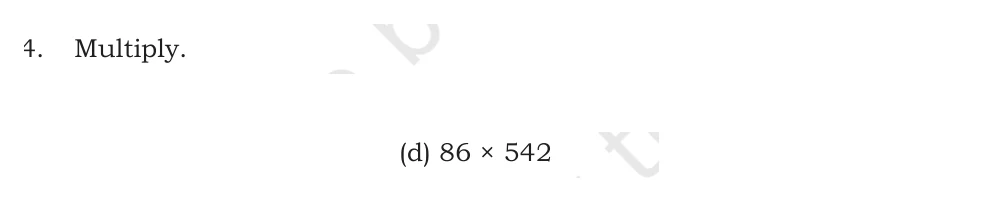
Find 86\times 542.
Show detailed solution
- Step 1: Split 542 by place value: 542=500 + 40 + 2.
- Step 2: Multiply each part by 86: 86\times 500=43,000, 86\times 40=3,440, 86\times 2=172.
- Step 3: Add the partial products: 43,000 + 3,440 + 172=46,612.
- Answer: 86\times 542=46,612.
Textbook page 91 · solved item 204
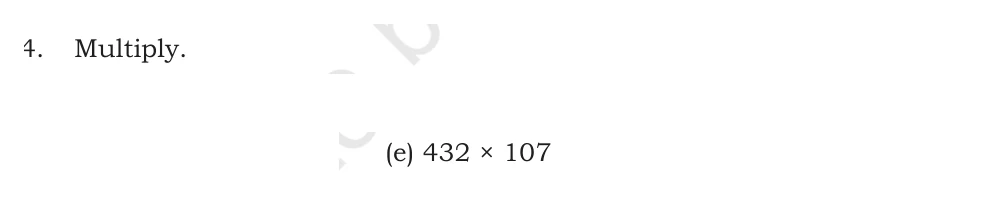
Find 432\times 107.
Show detailed solution
- Step 1: Split 432 by place value: 432=400 + 30 + 2.
- Step 2: Multiply each part by 107: 107\times 400=42,800, 107\times 30=3,210, 107\times 2=214.
- Step 3: Add the partial products: 42,800 + 3,210 + 214=46,224.
- Answer: 432\times 107=46,224.
Textbook page 91 · solved item 205

Find 310\times 120.
Show detailed solution
- Step 1: Split 310 by place value: 310=300 + 10.
- Step 2: Multiply each part by 120: 120\times 300=36,000, 120\times 10=1,200.
- Step 3: Add the partial products: 36,000 + 1,200=37,200.
- Answer: 310\times 120=37,200.
Textbook page 91 · solved item 206

Given 67\times67=4,489, find 67\times68 without multiplying from the beginning.
Show detailed solution
- Step 1: Sixty-eight is one more than 67.
- Step 2: Add one more group of 67 to the known product.
- Step 3: 4,489+67=4,556.
- Answer: 67\times68=4,556.
Textbook page 91 · solved item 207

Given 99\times100=9,900, find 99\times99 without multiplying from the beginning.
Show detailed solution
- Step 1: Ninety-nine is one less than 100.
- Step 2: Remove one group of 99 from the known product.
- Step 3: 9,900-99=9,801.
- Answer: 99\times99=9,801.