
Question-by-question working
Read the prompt, attempt it, then check each step
Every exercise subpart and table row is a separate item. Shared figures and table headings are repeated whenever they are needed to understand the question.
Detailed worked answers
Textbook page 1
Textbook page 1 · solved item 1

When was the last time you went on a long trip?
Show detailed solution
- Step 1: Recall a journey that took you well beyond your usual local travel.
- Step 2: Check the date with an elder or a ticket if you do not remember it exactly.
- Sample answer: My last long trip was during the summer holidays. Your own date or occasion will be different.
Textbook page 1 · solved item 2

Where did you go on your last long trip?
Show detailed solution
- Step 1: Name the destination rather than only the state or direction.
- Step 2: Add the starting place if that helps make the journey clear.
- Sample answer: I travelled from Delhi to Jaipur. Replace this with your own journey.
Textbook page 1 · solved item 3

How did you travel on your last long trip?
Show detailed solution
- Step 1: Identify the main means of transport used for the longest part of the journey.
- Step 2: Mention other modes too if the journey had more than one stage.
- Sample answer: I travelled mainly by train and used a bus for the final part. Your answer depends on your trip.
Textbook page 1 · solved item 4

What was the duration of your last long trip?
Show detailed solution
- Step 1: Note the departure and arrival times.
- Step 2: Subtract the departure time from the arrival time, including any change of day.
- Sample answer: A journey from 8:00 a.m. to 2:30 p.m. lasted 6 hours 30 minutes.
Textbook page 1 · solved item 5

How much distance did you cover on your last long trip?
Show detailed solution
- Step 1: Look up the route distance on the ticket, map, or vehicle display.
- Step 2: Use kilometres for a long land journey and state whether the value is exact or approximate.
- Sample answer: The journey covered approximately 280 km. Replace it with the distance for your route.
Textbook page 1 · solved item 6

How many vehicles are currently registered in your state?
Show detailed solution
- Step 1: This number changes, so identify your state and a recent official transport-department report.
- Step 2: Record the reporting date and whether the total includes all vehicle types.
- Answer: This is a research activity; use the latest official state figure rather than guessing a fixed number.
Textbook page 1 · solved item 7

How can we write a number that represents several thousand objects?
Show detailed solution
- Step 1: Group the objects into thousands, hundreds, tens, and ones.
- Step 2: Put each count in its place-value column and use a comma before the last three digits.
- Answer: For example, 12 thousands, 3 hundreds, 4 tens, and 5 ones is written as 12,345.
Textbook page 1 · solved item 8

Continue the pattern obtained by repeatedly adding 1,000 between 2,000 and 9,000.
Show detailed solution
- Step 1: The change from 1,000 to 2,000 is +1,000.
- Step 2: Keep adding 1,000 without skipping a value.
- Answer: 3,000, 4,000, 5,000, 6,000, 7,000, and 8,000.
Textbook page 1 · solved item 9

What number is 1,000 more than 9,000, and how is it written?
Show detailed solution
- Step 1: Add the thousands: 9 thousands + 1 thousand = 10 thousands.
- Step 2: Ten thousands has a 1 in the ten-thousands place and zeros elsewhere.
- Answer: 9{,}000+1{,}000=10{,}000, read as ten thousand.
Detailed worked answers
Textbook page 3
Textbook page 3 · solved item 10

Complete the token-table row named ten thousand thirty-three.
Show detailed solution
- Step 1: The tokens show one 10,000 token, three 10 tokens, and three 1 tokens.
- Step 2: Add them: 10{,}000+30+3=10{,}033.
- Answer: Number 10,033; place-value digits 1,0,0,3,3 under TTh, Th, H, T, O.
Textbook page 3 · solved item 11
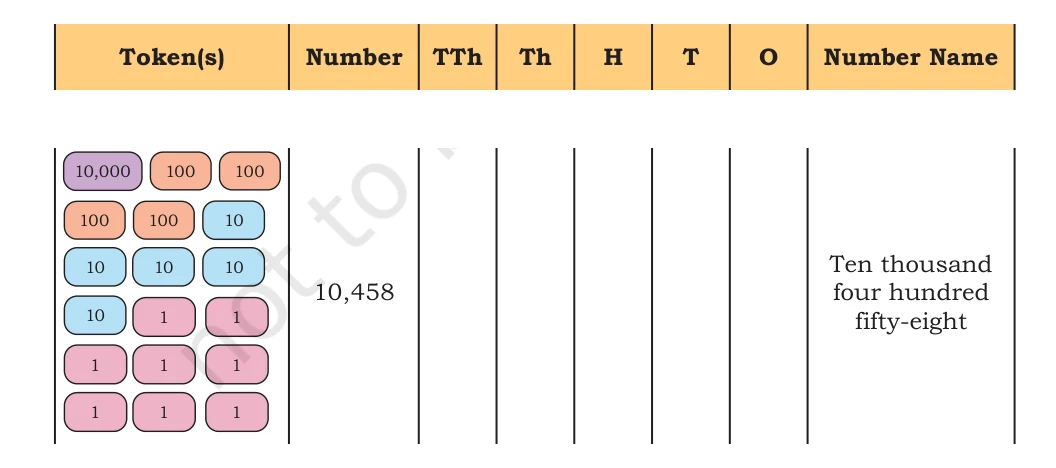
Complete the token-table place-value row for 10,458.
Show detailed solution
- Step 1: Decompose 10{,}458=10{,}000+400+50+8.
- Step 2: There are no extra thousands, so the Th digit is 0.
- Answer: TTh 1, Th 0, H 4, T 5, O 8; the name is ten thousand four hundred fifty-eight.
Detailed worked answers
Textbook page 4
Textbook page 4 · solved item 12

Complete the first token-table row on page 4.
Show detailed solution
- Step 1: Count one 10,000, one 1,000, two 100s, one 10, and four 1s.
- Step 2: Add 10{,}000+1{,}000+200+10+4=11{,}214.
- Answer: 11,214, read as eleven thousand two hundred fourteen; digits 1,1,2,1,4.
Textbook page 4 · solved item 13

Complete the place-value columns for 13,520.
Show detailed solution
- Step 1: Decompose 13{,}520=10{,}000+3{,}000+500+20.
- Step 2: The number has no ones.
- Answer: TTh 1, Th 3, H 5, T 2, O 0.
Textbook page 4 · solved item 14

Complete the place-value columns for 20,000.
Show detailed solution
- Step 1: Twenty thousand is two groups of 10,000.
- Step 2: There are no additional thousands, hundreds, tens, or ones.
- Answer: TTh 2, Th 0, H 0, T 0, O 0.
Textbook page 4 · solved item 15

Complete the place-value columns for 45,867.
Show detailed solution
- Step 1: Decompose 45{,}867=40{,}000+5{,}000+800+60+7.
- Step 2: Match each addend to its place-value column.
- Answer: TTh 4, Th 5, H 8, T 6, O 7.
Detailed worked answers
Textbook page 5
Textbook page 5 · solved item 16

Continue sequence (a) 456, 567, 678, ...
Show detailed solution
- Step 1: Compare consecutive shown terms; the repeated change is +111.
- Step 2: Apply that same change once for every arrow, including the row that turns back to the left.
- Answer: 789, 900, 1,011, 1,122.
Textbook page 5 · solved item 17

Continue sequence (b) 1,050, __, 3,150, 4,200, ...
Show detailed solution
- Step 1: Compare consecutive shown terms; the repeated change is +1,050.
- Step 2: Apply that same change once for every arrow, including the row that turns back to the left.
- Answer: 2,100, 5,250, 6,300, 7,350.
Textbook page 5 · solved item 18

Continue sequence (c) 5,501, 6,401, 7,301, ...
Show detailed solution
- Step 1: Compare consecutive shown terms; the repeated change is +900.
- Step 2: Apply that same change once for every arrow, including the row that turns back to the left.
- Answer: 8,201, 9,101, 10,001, 10,901.
Textbook page 5 · solved item 19

Continue sequence (d) 10,100, 10,200, 10,300, ...
Show detailed solution
- Step 1: Compare consecutive shown terms; the repeated change is +100.
- Step 2: Apply that same change once for every arrow, including the row that turns back to the left.
- Answer: 10,400, 10,500, 10,600, 10,700, 10,800, 11,000.
Textbook page 5 · solved item 20

Continue sequence (e) 10,105, 10,125, ...
Show detailed solution
- Step 1: Compare consecutive shown terms; the repeated change is +20.
- Step 2: Apply that same change once for every arrow, including the row that turns back to the left.
- Answer: 10,145, 10,165, 10,185, 10,205, 10,225, 10,245, 10,265, 10,285.
Textbook page 5 · solved item 21

Continue sequence (f) 10,992, 10,993, ...
Show detailed solution
- Step 1: Compare consecutive shown terms; the repeated change is +1.
- Step 2: Apply that same change once for every arrow, including the row that turns back to the left.
- Answer: 10,994, 10,995, 10,996, 10,997, 10,998, 10,999, 11,000, 11,001.
Textbook page 5 · solved item 22

Continue sequence (g) 10,794, 10,796, 10,798, ...
Show detailed solution
- Step 1: Compare consecutive shown terms; the repeated change is +2.
- Step 2: Apply that same change once for every arrow, including the row that turns back to the left.
- Answer: 10,800, 10,802, 10,804, 10,806, 10,808, 10,810, 10,812.
Textbook page 5 · solved item 23

Continue sequence (h) 73,005, 72,004, ...
Show detailed solution
- Step 1: Compare consecutive shown terms; the repeated change is -1,001.
- Step 2: Apply that same change once for every arrow, including the row that turns back to the left.
- Answer: 71,003, 70,002, 69,001, 68,000, 66,999, 65,998, 64,997, 63,996.
Textbook page 5 · solved item 24

Continue sequence (i) 82,350, 83,350, ...
Show detailed solution
- Step 1: Compare consecutive shown terms; the repeated change is +1,000.
- Step 2: Apply that same change once for every arrow, including the row that turns back to the left.
- Answer: 84,350, 85,350, 86,350, 87,350, 88,350, 89,350, 90,350, 91,350.
Detailed worked answers
Textbook page 6
Textbook page 6 · solved item 25

Write 7,209 in words.
Show detailed solution
- Step 1: Read the thousands part first.
- Step 2: Then read the hundreds, tens, and ones, omitting places whose digit is zero.
- Answer: Seven thousand two hundred nine.
Textbook page 6 · solved item 26

Write 10,599 in words.
Show detailed solution
- Step 1: Read the thousands part first.
- Step 2: Then read the hundreds, tens, and ones, omitting places whose digit is zero.
- Answer: Ten thousand five hundred ninety-nine.
Textbook page 6 · solved item 27

Write 'Ten thousand seven hundred forty-three' in numerals.
Show detailed solution
- Step 1: Put each named amount in its place-value column.
- Step 2: Write zeros for any places that were not named and insert the comma.
- Answer: 10,743.
Textbook page 6 · solved item 28

Write 13,579 in words.
Show detailed solution
- Step 1: Read the thousands part first.
- Step 2: Then read the hundreds, tens, and ones, omitting places whose digit is zero.
- Answer: Thirteen thousand five hundred seventy-nine.
Textbook page 6 · solved item 29
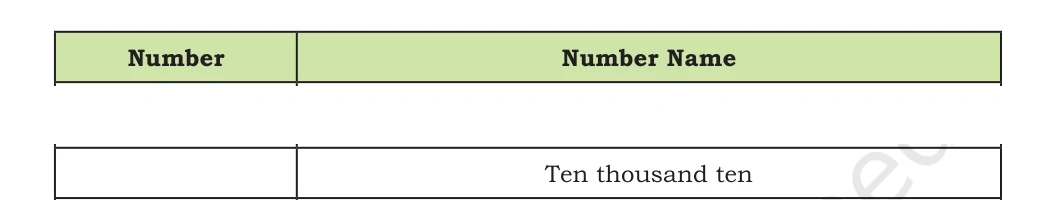
Write 'Ten thousand ten' in numerals.
Show detailed solution
- Step 1: Put each named amount in its place-value column.
- Step 2: Write zeros for any places that were not named and insert the comma.
- Answer: 10,010.
Textbook page 6 · solved item 30

Write 'Fifty-six thousand four hundred ninety-one' in numerals.
Show detailed solution
- Step 1: Put each named amount in its place-value column.
- Step 2: Write zeros for any places that were not named and insert the comma.
- Answer: 56,491.
Textbook page 6 · solved item 31

Write 45,045 in words.
Show detailed solution
- Step 1: Read the thousands part first.
- Step 2: Then read the hundreds, tens, and ones, omitting places whose digit is zero.
- Answer: Forty-five thousand forty-five.
Textbook page 6 · solved item 32
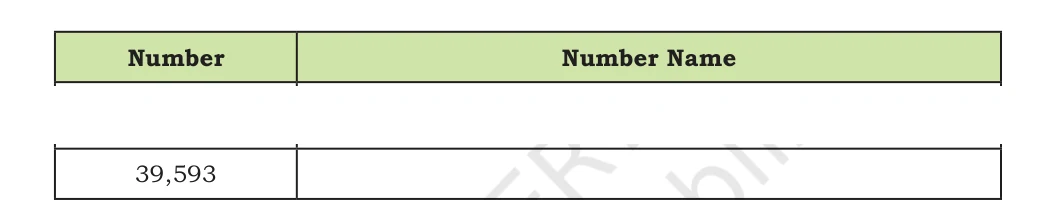
Write 39,593 in words.
Show detailed solution
- Step 1: Read the thousands part first.
- Step 2: Then read the hundreds, tens, and ones, omitting places whose digit is zero.
- Answer: Thirty-nine thousand five hundred ninety-three.
Textbook page 6 · solved item 33
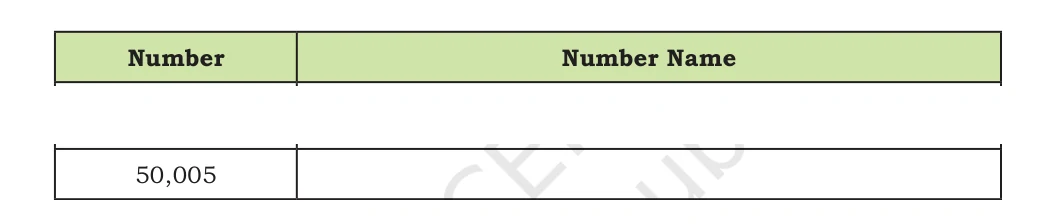
Write 50,005 in words.
Show detailed solution
- Step 1: Read the thousands part first.
- Step 2: Then read the hundreds, tens, and ones, omitting places whose digit is zero.
- Answer: Fifty thousand five.
Textbook page 6 · solved item 34
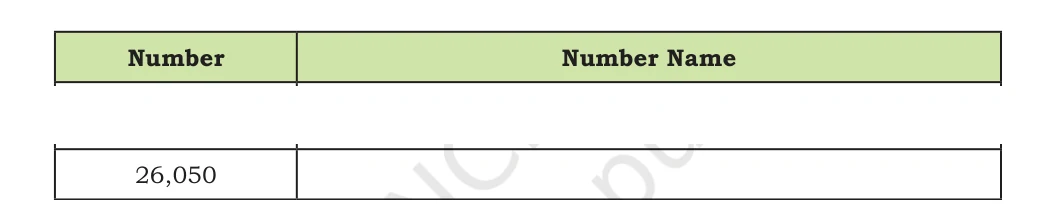
Write 26,050 in words.
Show detailed solution
- Step 1: Read the thousands part first.
- Step 2: Then read the hundreds, tens, and ones, omitting places whose digit is zero.
- Answer: Twenty-six thousand fifty.
Textbook page 6 · solved item 35

Write 81,200 in words.
Show detailed solution
- Step 1: Read the thousands part first.
- Step 2: Then read the hundreds, tens, and ones, omitting places whose digit is zero.
- Answer: Eighty-one thousand two hundred.
Textbook page 6 · solved item 36

Write 'Ninety thousand nine' in numerals.
Show detailed solution
- Step 1: Put each named amount in its place-value column.
- Step 2: Write zeros for any places that were not named and insert the comma.
- Answer: 90,009.
Textbook page 6 · solved item 37

Write 'Twenty-three thousand two hundred thirty' in numerals.
Show detailed solution
- Step 1: Put each named amount in its place-value column.
- Step 2: Write zeros for any places that were not named and insert the comma.
- Answer: 23,230.
Textbook page 6 · solved item 38
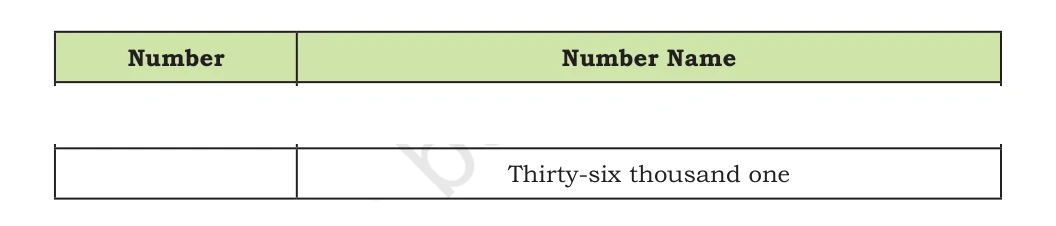
Write 'Thirty-six thousand one' in numerals.
Show detailed solution
- Step 1: Put each named amount in its place-value column.
- Step 2: Write zeros for any places that were not named and insert the comma.
- Answer: 36,001.
Textbook page 6 · solved item 39
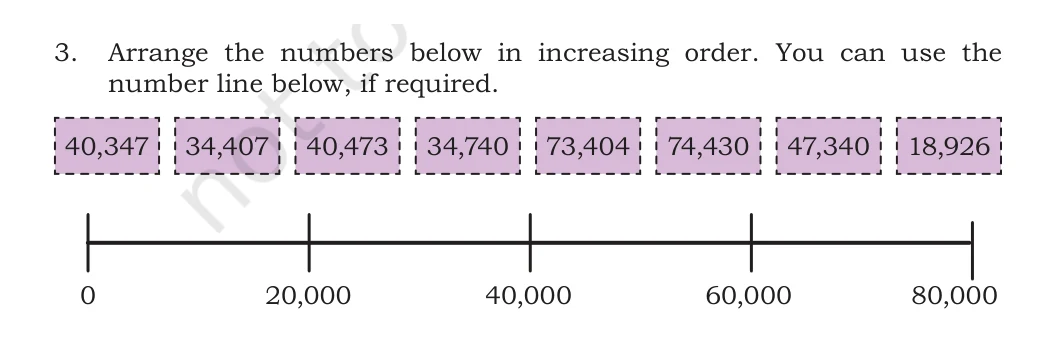
Arrange 40,347, 73,404, 34,407, 74,430, 40,473, 47,340, 34,740, and 18,926 in increasing order.
Show detailed solution
- Step 1: Compare the ten-thousands digits; 18,926 is smallest, followed by the 34-thousand values.
- Step 2: Within equal ten-thousands groups, compare thousands, hundreds, tens, and ones from left to right.
- Answer: 18,926, 34,407, 34,740, 40,347, 40,473, 47,340, 73,404, 74,430.
Detailed worked answers
Textbook page 7
Textbook page 7 · solved item 40

A student says 9,990 is greater than 49,014 because 9 is greater than 4. Is that correct? Fill the number line to justify the answer.
Show detailed solution
- Step 1: 9,990 has four digits, while 49,014 has five digits, so 49,014 is greater.
- Step 2: The number-line marks rise by 5,000: 5,000, 10,000, 15,000, 20,000, 25,000, 30,000, 35,000, 40,000, 45,000, 50,000.
- Answer: The student is incorrect; 9{,}990<49{,}014.
Textbook page 7 · solved item 41
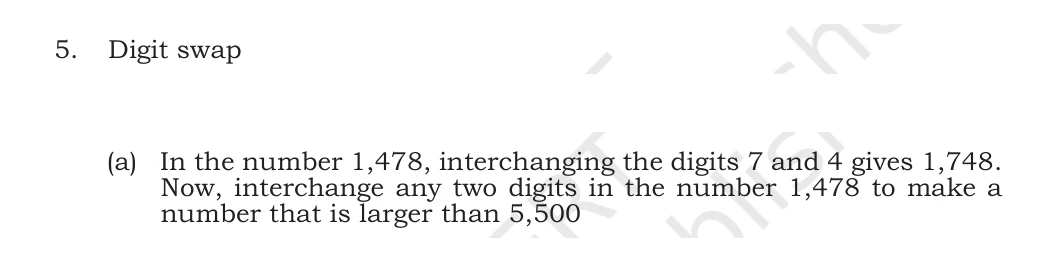
Digit swap 5(a): Swap two digits of 1,478 to make a number greater than 5,500.
Show detailed solution
- Step 1: A number above 5,500 needs a first digit of at least 5.
- Step 2: Swap the 1 and 7 to obtain 7,418.
- Answer: 7,418 is one valid result, and 7{,}418>5{,}500.
Textbook page 7 · solved item 42
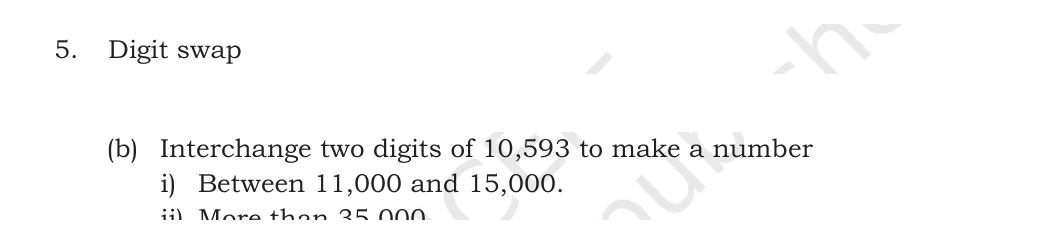
Digit swap 5(b)(i): Swap two digits of 10,593 to get a number between 11,000 and 15,000.
Show detailed solution
- Step 1: Keep 1 in the ten-thousands place so the result stays below 20,000.
- Step 2: Swap the 0 in the thousands place with the 3 in the ones place.
- Answer: 13,590, which lies strictly between 11,000 and 15,000.
Textbook page 7 · solved item 43

Digit swap 5(b)(ii): Swap two digits of 10,593 to get a number greater than 35,000.
Show detailed solution
- Step 1: Move a large digit into the ten-thousands place.
- Step 2: Swap the first digit 1 with the digit 5.
- Answer: 50,193, and 50{,}193>35{,}000.
Textbook page 7 · solved item 44
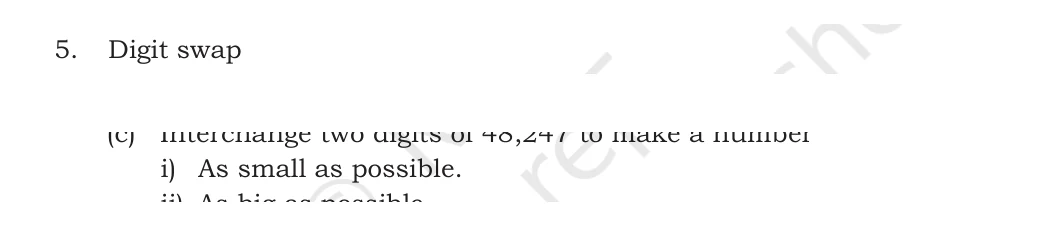
Digit swap 5(c)(i): Swap two digits of 48,247 to make it as small as possible.
Show detailed solution
- Step 1: The smallest available digit is 2, so move it to the ten-thousands place.
- Step 2: Swapping the first 4 with the 2 gives 28,447.
- Answer: 28,447 is the smallest result obtainable with exactly one swap.
Textbook page 7 · solved item 45
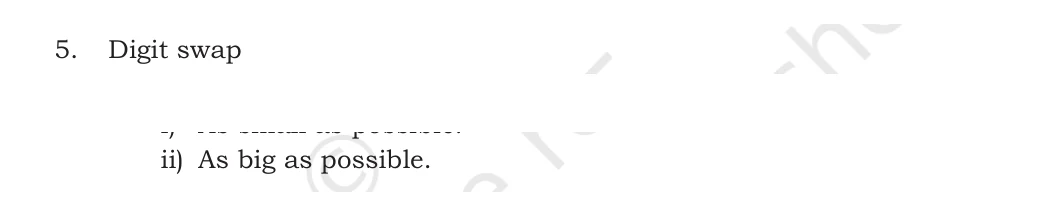
Digit swap 5(c)(ii): Swap two digits of 48,247 to make it as large as possible.
Show detailed solution
- Step 1: The largest available digit is 8, so move it to the ten-thousands place.
- Step 2: Swap the first two digits, 4 and 8.
- Answer: 84,247 is the largest result obtainable with exactly one swap.
Textbook page 7 · solved item 46
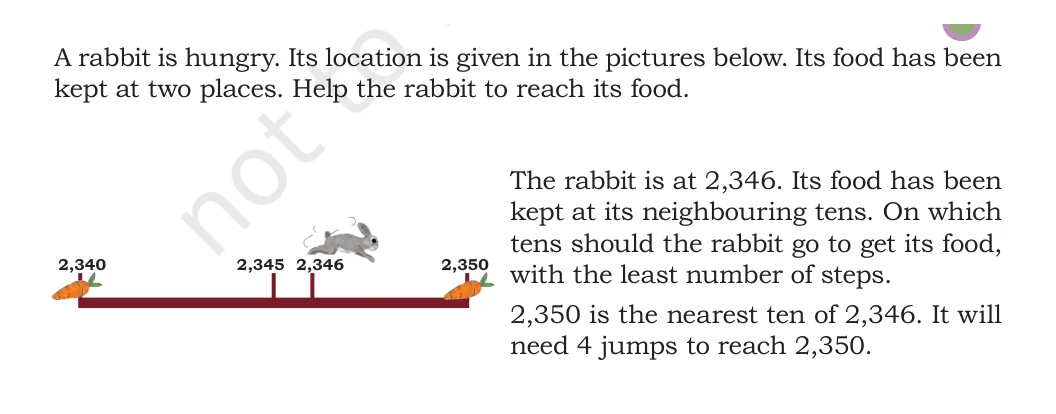
Which neighbouring ten is closest to 2,346?
Show detailed solution
- Step 1: The neighbouring tens are 2,340 and 2,350.
- Step 2: The distances are 2{,}346-2{,}340=6 and 2{,}350-2{,}346=4.
- Answer: 2,350 is the nearest ten; the rabbit needs 4 jumps.
Detailed worked answers
Textbook page 8
Textbook page 8 · solved item 47

Which neighbouring hundred is closest to 2,346?
Show detailed solution
- Step 1: The neighbouring hundreds are 2,300 and 2,400.
- Step 2: Their distances from 2,346 are 46 and 54.
- Answer: 2,300 is the nearest hundred; the rabbit needs 46 jumps.
Textbook page 8 · solved item 48

Which neighbouring thousand is closest to 2,346?
Show detailed solution
- Step 1: The neighbouring thousands are 2,000 and 3,000.
- Step 2: Their distances from 2,346 are 346 and 654.
- Answer: 2,000 is the nearest thousand; the rabbit needs 346 jumps.
Textbook page 8 · solved item 49
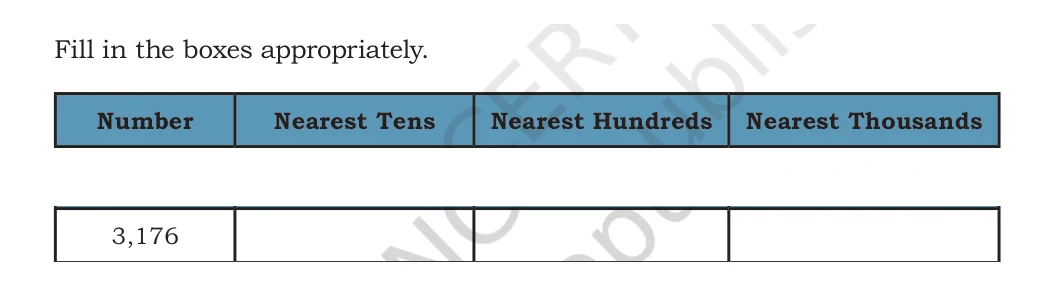
Round 3,176 to the nearest ten, hundred, and thousand.
Show detailed solution
- Step 1: For the nearest ten, compare the ones digit with 5.
- Step 2: For the nearest hundred and thousand, compare the number with the midpoint of each neighbouring pair.
- Answer: nearest ten 3,180; nearest hundred 3,200; nearest thousand 3,000.
Textbook page 8 · solved item 50
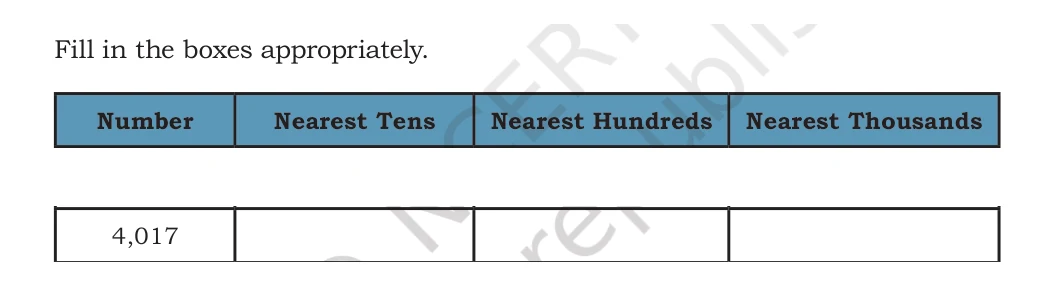
Round 4,017 to the nearest ten, hundred, and thousand.
Show detailed solution
- Step 1: For the nearest ten, compare the ones digit with 5.
- Step 2: For the nearest hundred and thousand, compare the number with the midpoint of each neighbouring pair.
- Answer: nearest ten 4,020; nearest hundred 4,000; nearest thousand 4,000.
Textbook page 8 · solved item 51
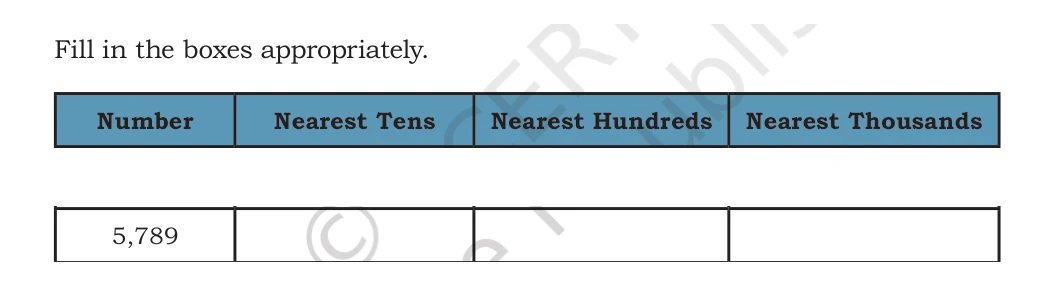
Round 5,789 to the nearest ten, hundred, and thousand.
Show detailed solution
- Step 1: For the nearest ten, compare the ones digit with 5.
- Step 2: For the nearest hundred and thousand, compare the number with the midpoint of each neighbouring pair.
- Answer: nearest ten 5,790; nearest hundred 5,800; nearest thousand 6,000.
Textbook page 8 · solved item 52

Round 8,203 to the nearest ten, hundred, and thousand.
Show detailed solution
- Step 1: For the nearest ten, compare the ones digit with 5.
- Step 2: For the nearest hundred and thousand, compare the number with the midpoint of each neighbouring pair.
- Answer: nearest ten 8,200; nearest hundred 8,200; nearest thousand 8,000.
Textbook page 8 · solved item 53

Which of 7,126, 7,835, 7,030, and 6,999 round to the same result to the nearest hundred and nearest thousand?
Show detailed solution
- Step 1: 7,030 rounds to 7,000 in both cases, and 6,999 also rounds to 7,000 in both cases.
- Step 2: 7,126 gives 7,100 and 7,000; 7,835 gives 7,800 and 8,000.
- Answer: Circle 7,030 and 6,999.
Detailed worked answers
Textbook page 9
Textbook page 9 · solved item 54

Give two numbers with the same nearest ten.
Show detailed solution
- Step 1: Choose a target multiple of 10, such as 40.
- Step 2: Pick two numbers from 35 through 44 so both round to that target.
- Answer: 41 and 43 both round to 40. Many other pairs are possible.
Textbook page 9 · solved item 55

Give two numbers with the same nearest hundred.
Show detailed solution
- Step 1: Choose a target multiple of 100, such as 500.
- Step 2: Pick numbers from 450 through 549 so both round to that target.
- Answer: 472 and 531 both round to 500.
Textbook page 9 · solved item 56

Give two numbers with the same nearest thousand.
Show detailed solution
- Step 1: Choose a target multiple of 1,000, such as 6,000.
- Step 2: Pick numbers from 5,500 through 6,499.
- Answer: 5,720 and 6,240 both round to 6,000.
Textbook page 9 · solved item 57
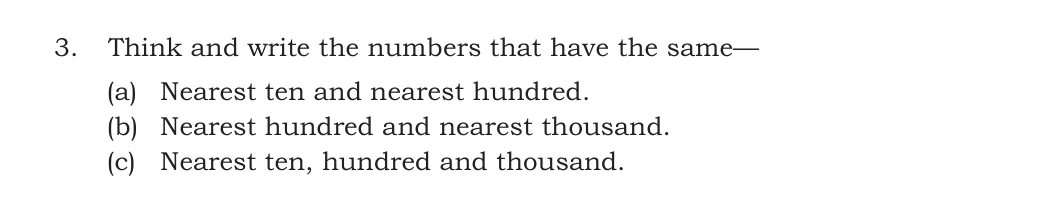
Give numbers whose nearest ten and nearest hundred are the same.
Show detailed solution
- Step 1: Choose a multiple of 100, such as 100, because it is also a multiple of 10.
- Step 2: Pick a number very close to it so both rounding operations reach 100.
- Answer: 97 and 103 each round to 100 to both the nearest ten and nearest hundred.
Textbook page 9 · solved item 58

Give numbers whose nearest hundred and nearest thousand are the same.
Show detailed solution
- Step 1: Choose a multiple of 1,000, such as 1,000, which is also a multiple of 100.
- Step 2: Pick numbers close enough that both rounding scales reach 1,000.
- Answer: 960 and 1,040 each round to 1,000 to both the nearest hundred and nearest thousand.
Textbook page 9 · solved item 59

Give numbers whose nearest ten, hundred, and thousand are all the same.
Show detailed solution
- Step 1: Use a common target such as 1,000.
- Step 2: Pick values within 5 of 1,000 so nearest-ten rounding also reaches it.
- Answer: 996 and 1,004 each round to 1,000 at all three places.
Detailed worked answers
Textbook page 10
Textbook page 10 · solved item 60

A cyclist covers 15 km in one hour. How far will she travel in 4 hours at the same speed?
Show detailed solution
- Step 1: Equal speed means 15 km is added once for each hour.
- Step 2: Calculate 15\times4=60.
- Answer: She will cover 60 km.
Textbook page 10 · solved item 61
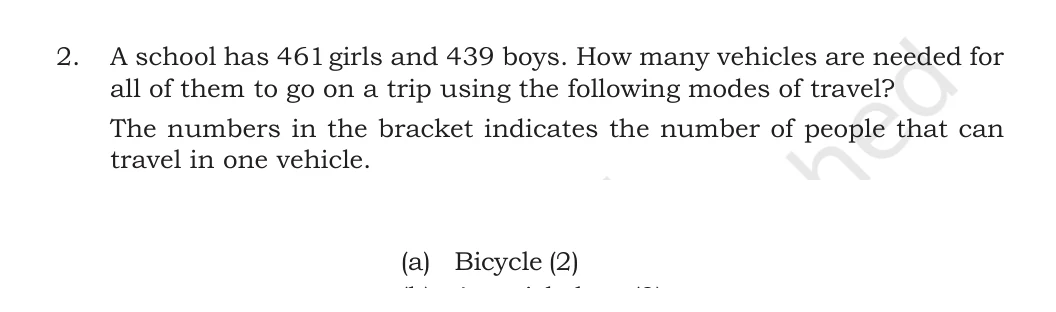
How many bicycles of capacity 2 are needed for 461 girls and 439 boys?
Show detailed solution
- Step 1: Total students =461+439=900.
- Step 2: Divide by the capacity: 900\div2=450.
- Answer: 450 bicycles are needed.
Textbook page 10 · solved item 62
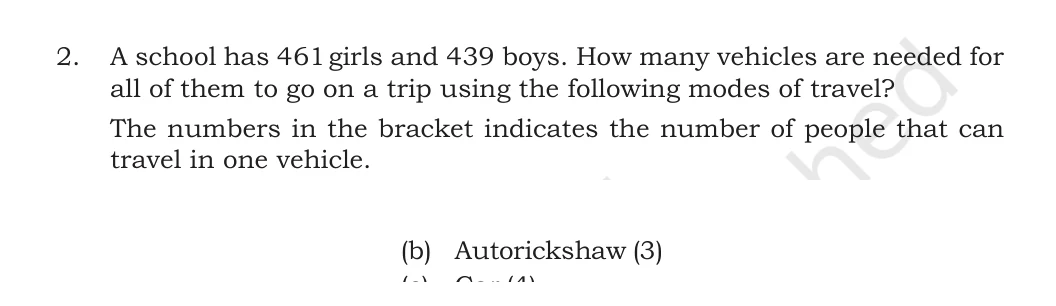
How many autorickshaws of capacity 3 are needed for 461 girls and 439 boys?
Show detailed solution
- Step 1: Total students =461+439=900.
- Step 2: Divide by the capacity: 900\div3=300.
- Answer: 300 autorickshaws are needed.
Textbook page 10 · solved item 63

How many cars of capacity 4 are needed for 461 girls and 439 boys?
Show detailed solution
- Step 1: Total students =461+439=900.
- Step 2: Divide by the capacity: 900\div4=225.
- Answer: 225 cars are needed.
Textbook page 10 · solved item 64

How many big cars of capacity 6 are needed for 461 girls and 439 boys?
Show detailed solution
- Step 1: Total students =461+439=900.
- Step 2: Divide by the capacity: 900\div6=150.
- Answer: 150 big cars are needed.
Textbook page 10 · solved item 65

How many tempo travellers of capacity 10 are needed for 461 girls and 439 boys?
Show detailed solution
- Step 1: Total students =461+439=900.
- Step 2: Divide by the capacity: 900\div10=90.
- Answer: 90 tempo travellers are needed.
Textbook page 10 · solved item 66
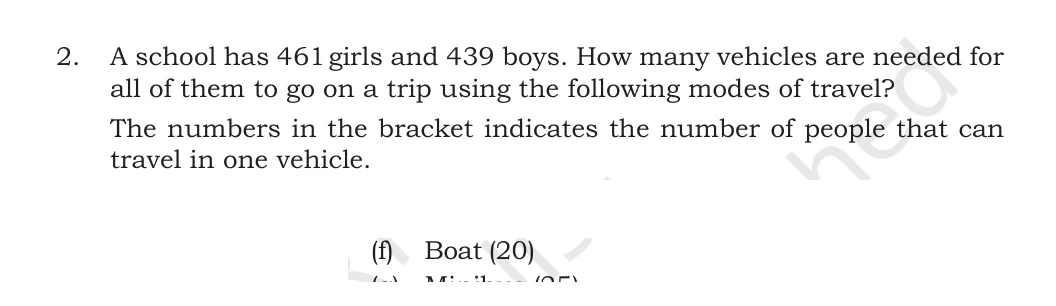
How many boats of capacity 20 are needed for 461 girls and 439 boys?
Show detailed solution
- Step 1: Total students =461+439=900.
- Step 2: Divide by the capacity: 900\div20=45.
- Answer: 45 boats are needed.
Textbook page 10 · solved item 67

How many minibuses of capacity 25 are needed for 461 girls and 439 boys?
Show detailed solution
- Step 1: Total students =461+439=900.
- Step 2: Divide by the capacity: 900\div25=36.
- Answer: 36 minibuses are needed.
Textbook page 10 · solved item 68

How many aeroplanes of capacity 180 are needed for 461 girls and 439 boys?
Show detailed solution
- Step 1: Total students =461+439=900.
- Step 2: Divide by the capacity: 900\div180=5.
- Answer: 5 aeroplanes are needed.
Textbook page 10 · solved item 69

Give another real-life context whose count may range from a 1-digit to a 5-digit number.
Show detailed solution
- Step 1: Choose something counted at both small and large scales.
- Step 2: A small shop may have 8 customers in an hour, while a large event may have 25,000 visitors.
- Sample answer: The number of people at different events can range from one digit to five digits.
Textbook page 10 · solved item 70

Find something in the textbook whose count is a 4-digit number.
Show detailed solution
- Step 1: Choose a repeated object that occurs many times, such as letters or words.
- Step 2: Estimate by multiplying a sample count per page by the number of pages in one chapter.
- Sample answer: Chapter 1 contains a 4-digit number of words; the exact estimate depends on how words are counted.
Textbook page 10 · solved item 71

How many classrooms are there in your school?
Show detailed solution
- Step 1: Count rooms used as regular classrooms or consult the school office.
- Step 2: Decide whether laboratories and activity rooms are included, and use the same rule throughout.
- Answer: This observation-based value depends on your school.
Textbook page 10 · solved item 72

How many students are there in your class?
Show detailed solution
- Step 1: Count the names on the current attendance register.
- Step 2: Include absent classmates because the question asks for total enrolment.
- Answer: Write the current class strength from your register.
Textbook page 10 · solved item 73

How many books are there in your classroom in total?
Show detailed solution
- Step 1: Count books on shelves, in shared sets, and in any class library.
- Step 2: Avoid counting the same book twice when groups report subtotals.
- Answer: Add the verified subtotals; the result depends on your classroom.
Detailed worked answers
Textbook page 11
Textbook page 11 · solved item 74

Find something in the classroom whose count is a 4-digit number.
Show detailed solution
- Step 1: Look for a large collection or use a reasonable estimate from grouped packs.
- Step 2: Confirm that the count lies from 1,000 to 9,999.
- Sample answer: A sealed box containing 5,000 staples has a 4-digit count.
Textbook page 11 · solved item 75

Find something in the classroom whose count is a 5-digit number.
Show detailed solution
- Step 1: A 5-digit count must be from 10,000 to 99,999.
- Step 2: Use a labelled bulk quantity or an estimate rather than pretending to count every tiny item.
- Sample answer: A large container may hold about 20,000 grains or beads; verify the estimate for your classroom.
Textbook page 11 · solved item 76

Name a quantity connected with a tree that can have a 4-digit or 5-digit count.
Show detailed solution
- Step 1: Think of repeated parts such as leaves, flowers, seeds, or fruits.
- Step 2: A mature tree may have thousands of leaves, so an estimate can be 4 or 5 digits.
- Sample answer: The number of leaves on a large tree may be about 12,000.
Textbook page 11 · solved item 77

Name a quantity in your village, town, or city that can have a 4-digit or 5-digit count.
Show detailed solution
- Step 1: Choose a count such as houses, students, trees, or registered vehicles.
- Step 2: Use a recent local source and state the area and date.
- Sample answer: The number of households in a small town may be a 5-digit number.
Textbook page 11 · solved item 78

How can the boatman take the lion, sheep, and grass across safely in the minimum number of crossings?
Show detailed solution
- Step 1: Take the sheep across and return alone; take the lion across, then bring the sheep back.
- Step 2: Take the grass across and return alone; finally take the sheep across again.
- Step 3: At no waiting shore are the lion and sheep or the sheep and grass left together without the boatman.
- Answer: The safe minimum is 7 one-way crossings.
Detailed worked answers
Textbook page 12
Textbook page 12 · solved item 79

With two piles of 7 pebbles, how can a player make sure they take the last pebble?
Show detailed solution
- Step 1: Ask the other player to go first.
- Step 2: If they remove some pebbles from one pile, remove the same number from the other pile. For example, if they take 3, you also take 3 from the other pile.
- Step 3: After each of your turns, the two piles will again have the same number of pebbles.
- Answer: Keep copying the other player's move on the other pile. When they empty one pile, you can empty the other pile and take the last pebble.
Textbook page 12 · solved item 80
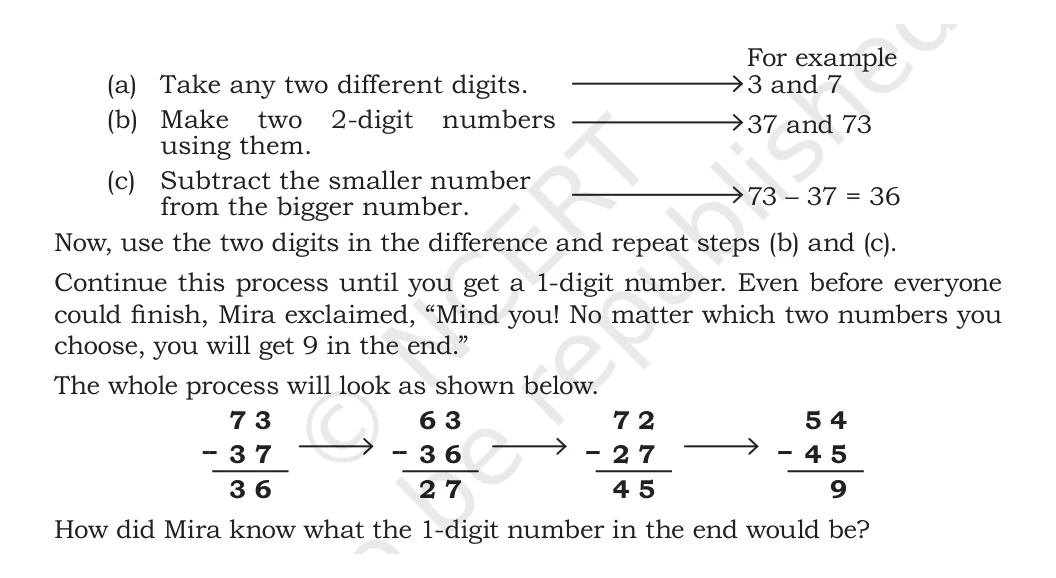
Why did Mira know that repeated reverse-and-subtract steps would end at 9?
Show detailed solution
- Step 1: Trying digits that are 1, 2, 3, 4, 5, 6, 7, or 8 apart gives only these first answers: 9, 18, 27, 36, 45, 54, 63, or 72.
- Step 2: Follow the longest route: 18\to63\to27\to45\to9. The other possible answers either start on this route or reach 9 even sooner.
- Step 3: We have checked every possible first answer, and every route reaches 9.
- Answer: Mira knew it would end at 9 because she had found and checked the complete number pattern.
Textbook page 12 · solved item 81
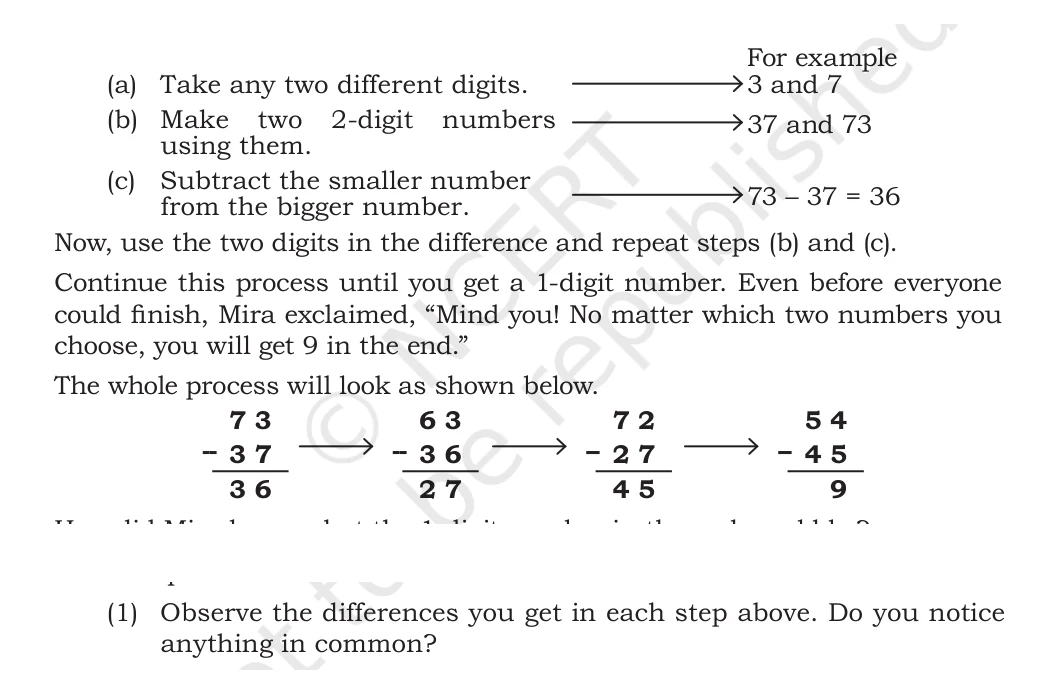
What is common to the differences 36, 27, 45, and 9 in Mira's example?
Show detailed solution
- Step 1: Write each answer using the 9 times table: 36=4\times9, 27=3\times9, 45=5\times9, and 9=1\times9.
- Step 2: So every answer appears in the 9 times table.
- Answer: 36, 27, 45, and 9 are all numbers in the 9 times table.
Textbook page 12 · solved item 82
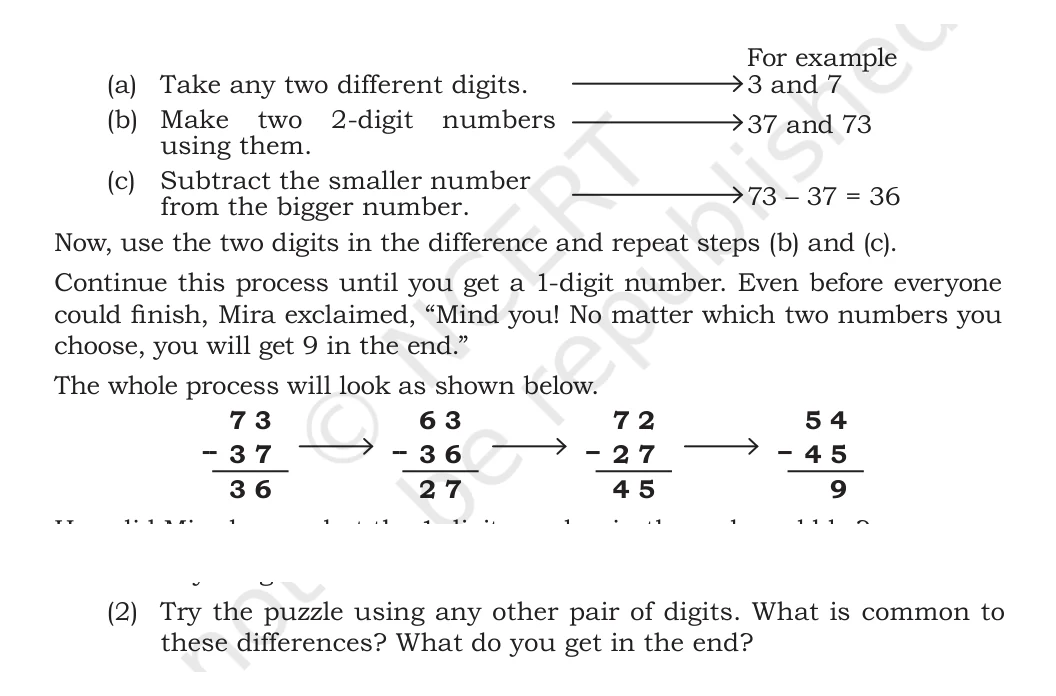
Try Mira's digit puzzle with another pair. What remains common and what is the final result?
Show detailed solution
- Step 1: Choose 2 and 6, form 62 and 26, and subtract: 62-26=36.
- Step 2: Continue: 63-36=27, 72-27=45, and 54-45=9.
- Answer: Every answer is in the 9 times table, and the final one-digit answer is 9.
Textbook page 12 · solved item 83

Which pairs of digits give a 1-digit answer in the first subtraction?
Show detailed solution
- Step 1: Try two digits next to each other, such as 3 and 4: 43-34=9.
- Step 2: If the digits are farther apart, the answer is 18 or more. For example, 53-35=18.
- Answer: Any two consecutive digits give the one-digit answer 9.
Detailed worked answers
Textbook page 13
Textbook page 13 · solved item 84

Find two different digits whose two formed numbers differ by 27.
Show detailed solution
- Step 1: Find 27 in the 9 times table: 3\times9=27.
- Step 2: Choose two digits that are 3 apart, such as 2 and 5.
- Answer: The numbers are 52 and 25, and the check is 52-25=27. Other digits 3 apart will also work.
Textbook page 13 · solved item 85

What relationship does Mira's table show between the difference of the digits and the difference of the two numbers?
Show detailed solution
- Step 1: Read the first rows of the table: digits 1 apart give 9, digits 2 apart give 18, and digits 3 apart give 27.
- Step 2: Each time the digit difference grows by 1, the answer grows by 9.
- Answer: Count that many steps in the 9 times table. The difference of the two formed numbers is 9 times the difference of the digits.
Textbook page 13 · solved item 86

Extend Mira's table with digits whose difference is 2.
Show detailed solution
- Step 1: Choose two digits 2 apart; 1 and 3 is one valid pair.
- Step 2: Form the larger and smaller two-digit numbers and subtract: 31-13=18.
- Answer: The completed row has digit difference 2 and number difference 18.
Textbook page 13 · solved item 87

Extend Mira's table with digits whose difference is 3.
Show detailed solution
- Step 1: Choose two digits 3 apart; 1 and 4 is one valid pair.
- Step 2: Form the larger and smaller two-digit numbers and subtract: 41-14=27.
- Answer: The completed row has digit difference 3 and number difference 27.
Textbook page 13 · solved item 88

Extend Mira's table with digits whose difference is 5.
Show detailed solution
- Step 1: Choose two digits 5 apart; 1 and 6 is one valid pair.
- Step 2: Form the larger and smaller two-digit numbers and subtract: 61-16=45.
- Answer: The completed row has digit difference 5 and number difference 45.
Textbook page 13 · solved item 89

Extend Mira's table with digits whose difference is 7.
Show detailed solution
- Step 1: Choose two digits 7 apart; 1 and 8 is one valid pair.
- Step 2: Form the larger and smaller two-digit numbers and subtract: 81-18=63.
- Answer: The completed row has digit difference 7 and number difference 63.
Textbook page 13 · solved item 90

What does the difference between the chosen digits tell us?
Show detailed solution
- Step 1: Look down the completed table: 1 gives 9, 2 gives 18, 3 gives 27, and so on.
- Step 2: These are consecutive answers in the 9 times table.
- Answer: Use the 9 times table. For example, a digit difference of 5 gives 5\times9=45.
Textbook page 13 · solved item 91
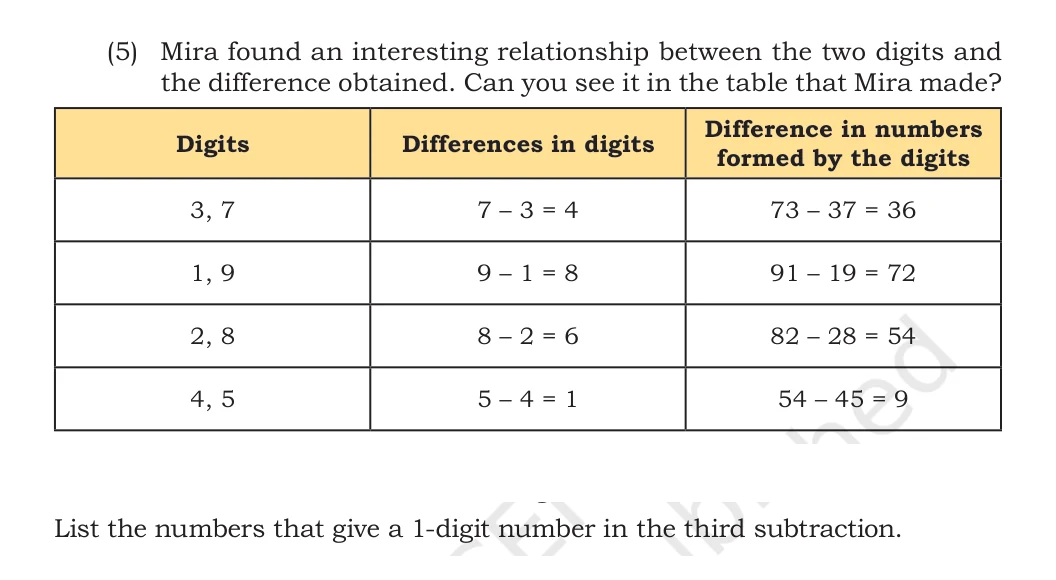
Which first differences reach a 1-digit number on the third subtraction?
Show detailed solution
- Step 1: Starting at 27 gives 27\to45\to9, reaching one digit on subtraction 3.
- Step 2: Starting at 72 gives 72\to45\to9, also reaching one digit on subtraction 3.
- Answer: 27 and 72. They come from digit gaps 3 and 8.
Textbook page 13 · solved item 92

Which non-zero digit pairs take the maximum number of subtractions to reach 9?
Show detailed solution
- Step 1: Check the eight possible first answers: 9, 18, 27, 36, 45, 54, 63, and 72.
- Step 2: The route beginning with 18 is the longest: 18\to63\to27\to45\to9.
- Answer: Choose digits 2 apart, such as 1 and 3, 2 and 4, 3 and 5, 4 and 6, 5 and 7, 6 and 8, or 7 and 9.
Textbook page 13 · solved item 93

Write five numbers strictly between 23,568 and 24,234.
Show detailed solution
- Step 1: Every answer must be greater than 23,568.
- Step 2: Check that each is also less than 24,234 and that no value is repeated.
- Answer: 23,569, 23,700, 23,900, 24,100, and 24,233.
Textbook page 13 · solved item 94

Write five numbers greater than 38,125 but less than 38,600.
Show detailed solution
- Step 1: Start above the lower boundary, so do not use 38,125 itself.
- Step 2: Stop below the upper boundary, so do not use 38,600 itself.
- Answer: 38,126, 38,250, 38,400, 38,500, and 38,599.
Textbook page 13 · solved item 95

Ravi's car has travelled 56,987 km and Sheetal's has travelled 67,543 km. Which has travelled more?
Show detailed solution
- Step 1: Compare the ten-thousands digits: 5 for Ravi and 6 for Sheetal.
- Step 2: Since 6>5, no later digit can reverse the comparison.
- Answer: Sheetal's car has travelled more.
Textbook page 13 · solved item 96
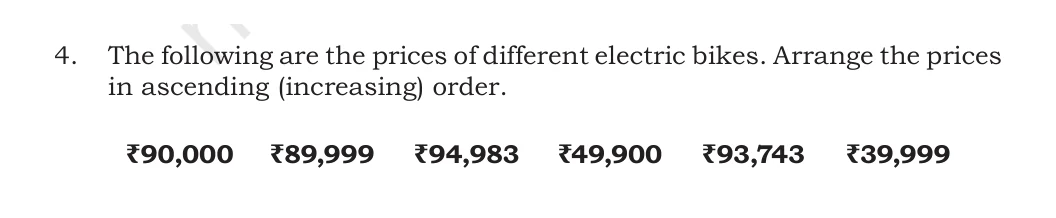
Arrange Rs 90,000, Rs 89,999, Rs 94,983, Rs 49,900, Rs 93,743, and Rs 39,999 in ascending order.
Show detailed solution
- Step 1: Order first by ten-thousands: 3, 4, 8, then the 9-ten-thousand values.
- Step 2: Among the 90-thousand values, compare the remaining digits.
- Answer: Rs 39,999, Rs 49,900, Rs 89,999, Rs 90,000, Rs 93,743, Rs 94,983.
Detailed worked answers
Textbook page 14
Textbook page 14 · solved item 97
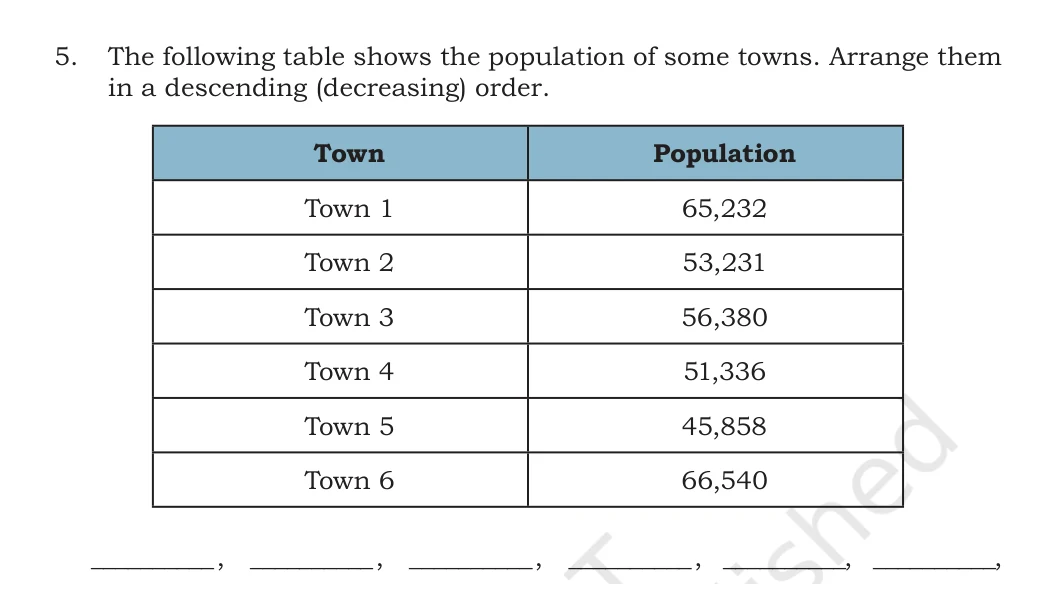
Arrange the six town populations in descending order.
Show detailed solution
- Step 1: Compare the ten-thousands digits; Towns 6 and 1 are the two 60-thousand values.
- Step 2: Sort the remaining 50-thousand values, then place Town 5 last at 45,858.
- Answer: Town 6 (66,540), Town 1 (65,232), Town 3 (56,380), Town 2 (53,231), Town 4 (51,336), Town 5 (45,858).
Textbook page 14 · solved item 98

Find all numbers between 42,750 and 53,500 whose ones, tens, and hundreds digits are 0.
Show detailed solution
- Step 1: Three ending zeros mean the number must be a whole multiple of 1,000.
- Step 2: Start with the first such multiple above 42,750 and stop before exceeding 53,500.
- Answer: 43,000, 44,000, 45,000, 46,000, 47,000, 48,000, 49,000, 50,000, 51,000, 52,000, 53,000.
Textbook page 14 · solved item 99

Write 783 in expanded form.
Show detailed solution
- Step 1: Identify the value contributed by each non-zero digit.
- Step 2: Omit zero-value places from the addition.
- Answer: 783=700+80+3.
Textbook page 14 · solved item 100

Write 8,062 in expanded form.
Show detailed solution
- Step 1: Identify the value contributed by each non-zero digit.
- Step 2: Omit zero-value places from the addition.
- Answer: 8{,}062=8{,}000+60+2.
Textbook page 14 · solved item 101

Write 9,980 in expanded form.
Show detailed solution
- Step 1: Identify the value contributed by each non-zero digit.
- Step 2: Omit zero-value places from the addition.
- Answer: 9{,}980=9{,}000+900+80.
Textbook page 14 · solved item 102

Write 10,304 in expanded form.
Show detailed solution
- Step 1: Identify the value contributed by each non-zero digit.
- Step 2: Omit zero-value places from the addition.
- Answer: 10{,}304=10{,}000+300+4.
Textbook page 14 · solved item 103

Write 23,004 in expanded form.
Show detailed solution
- Step 1: Identify the value contributed by each non-zero digit.
- Step 2: Omit zero-value places from the addition.
- Answer: 23{,}004=20{,}000+3{,}000+4.
Textbook page 14 · solved item 104

Write 70,405 in expanded form.
Show detailed solution
- Step 1: Identify the value contributed by each non-zero digit.
- Step 2: Omit zero-value places from the addition.
- Answer: 70{,}405=70{,}000+400+5.
Textbook page 14 · solved item 105
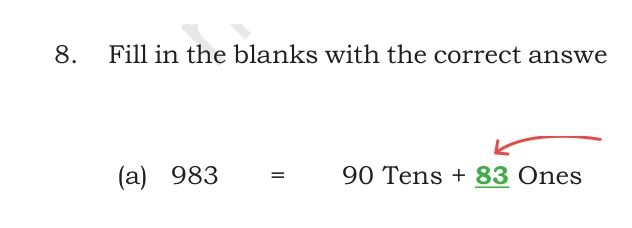
Complete: 983=90 tens + ___ ones.
Show detailed solution
- Step 1: 90 tens is 90\times10=900.
- Step 2: Subtract: 983-900=83.
- Answer: 83 ones.
Textbook page 14 · solved item 106
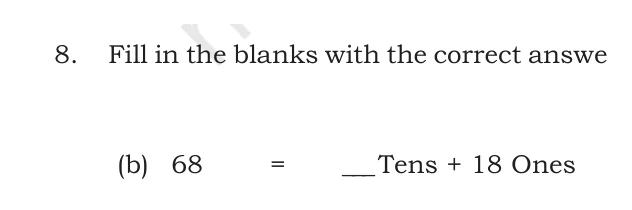
Complete: 68=__ tens + 18 ones.
Show detailed solution
- Step 1: Eighteen ones has value 18.
- Step 2: The remaining value is 68-18=50=5 tens.
- Answer: 5 tens.
Detailed worked answers
Textbook page 15
Textbook page 15 · solved item 107
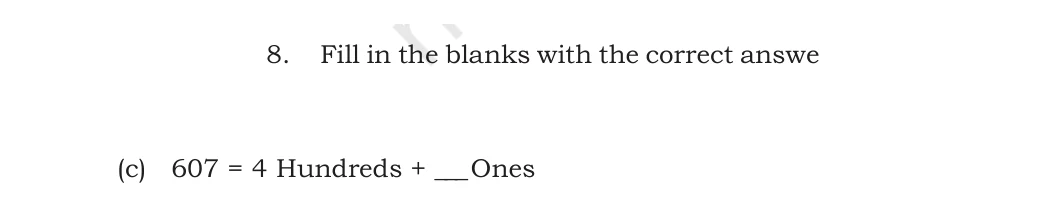
Complete: 607=4 hundreds + ___ ones.
Show detailed solution
- Step 1: Four hundreds is 400.
- Step 2: Subtract 607-400=207.
- Answer: 207 ones.
Textbook page 15 · solved item 108
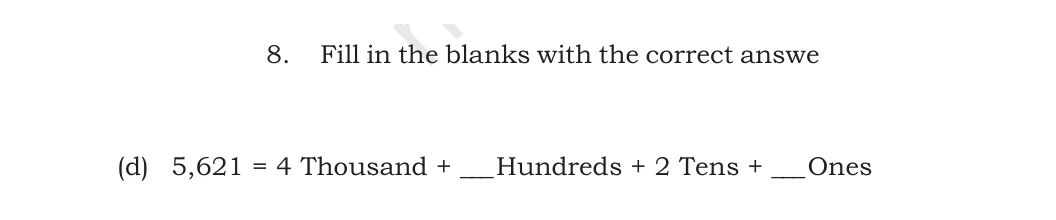
Complete: 5{,}621=4 thousand + ___ hundreds + 2 tens + ___ ones.
Show detailed solution
- Step 1: Remove 4,000 and 20: 5{,}621-4{,}020=1{,}601.
- Step 2: Write 1{,}601=16 hundreds + 1 one.
- Answer: 16 hundreds and 1 one.
Textbook page 15 · solved item 109

Complete: 7{,}069=__ thousand + 20 hundreds + ___ ones.
Show detailed solution
- Step 1: Twenty hundreds equals 2,000.
- Step 2: The remaining 5,069 is 5 thousands and 69 ones.
- Answer: 5 thousands and 69 ones.
Textbook page 15 · solved item 110

Complete: 37{,}608=__ ten-thousands + 17 thousands + ___ hundreds + 8 ones.
Show detailed solution
- Step 1: Use 2 ten-thousands and 17 thousands to make 37,000.
- Step 2: The remaining 37{,}608-37{,}000=608 is 6 hundreds and 8 ones.
- Answer: 2 ten-thousands and 6 hundreds.
Textbook page 15 · solved item 111

Complete: 43{,}001=3 ten-thousands + ___ thousands + ___ hundreds + 1 one.
Show detailed solution
- Step 1: Three ten-thousands has value 30,000.
- Step 2: The remaining 13,001 is 13 thousands, 0 hundreds, and 1 one.
- Answer: 13 thousands and 0 hundreds.
Textbook page 15 · solved item 112

How many complete Rs 10 notes can be taken from Rs 7,934?
Show detailed solution
- Step 1: Divide 7,934 by 10.
- Step 2: The quotient is 793 and the unused remainder is 4.
- Answer: 793 complete groups or notes.
Textbook page 15 · solved item 113

How many complete Rs 100 notes can be taken from Rs 7,934?
Show detailed solution
- Step 1: Divide 7,934 by 100.
- Step 2: The quotient is 79 and the unused remainder is 34.
- Answer: 79 complete groups or notes.
Textbook page 15 · solved item 114
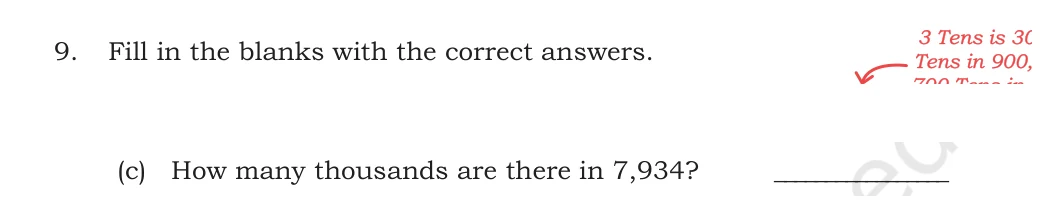
How many complete thousands are there in 7,934?
Show detailed solution
- Step 1: Divide 7,934 by 1000.
- Step 2: The quotient is 7 and the unused remainder is 934.
- Answer: 7 complete groups or notes.
Textbook page 15 · solved item 115
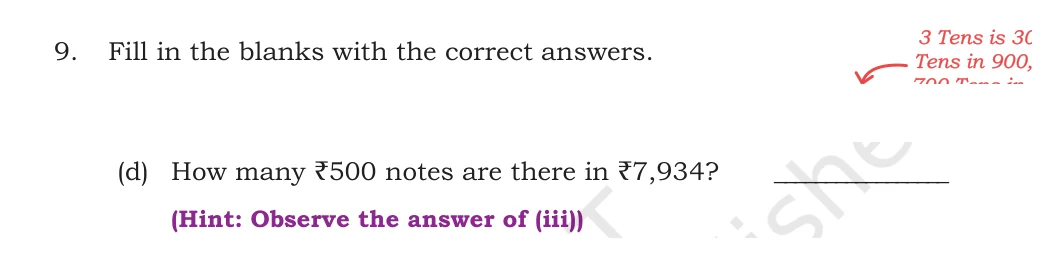
How many complete Rs 500 notes can be taken from Rs 7,934?
Show detailed solution
- Step 1: Divide 7,934 by 500.
- Step 2: The quotient is 15 and the unused remainder is 434.
- Answer: 15 complete groups or notes.
Textbook page 15 · solved item 116
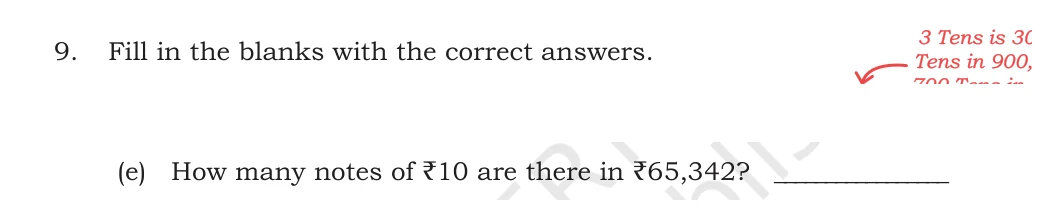
How many complete Rs 10 notes can be taken from Rs 65,342?
Show detailed solution
- Step 1: Divide 65,342 by 10.
- Step 2: The quotient is 6534 and the unused remainder is 2.
- Answer: 6534 complete groups or notes.
Textbook page 15 · solved item 117
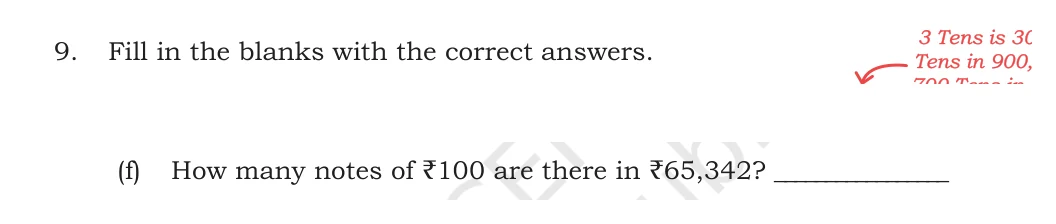
How many complete Rs 100 notes can be taken from Rs 65,342?
Show detailed solution
- Step 1: Divide 65,342 by 100.
- Step 2: The quotient is 653 and the unused remainder is 42.
- Answer: 653 complete groups or notes.
Textbook page 15 · solved item 118
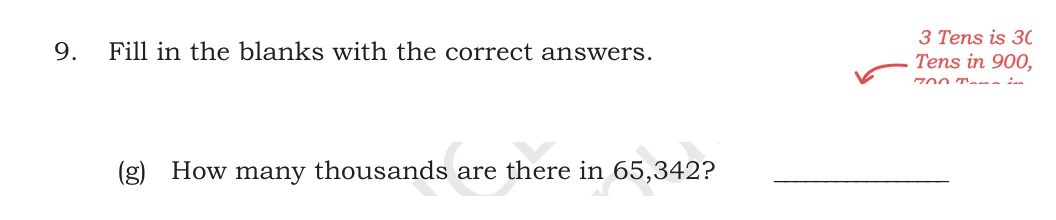
How many complete thousands are there in 65,342?
Show detailed solution
- Step 1: Divide 65,342 by 1000.
- Step 2: The quotient is 65 and the unused remainder is 342.
- Answer: 65 complete groups or notes.
Textbook page 15 · solved item 119
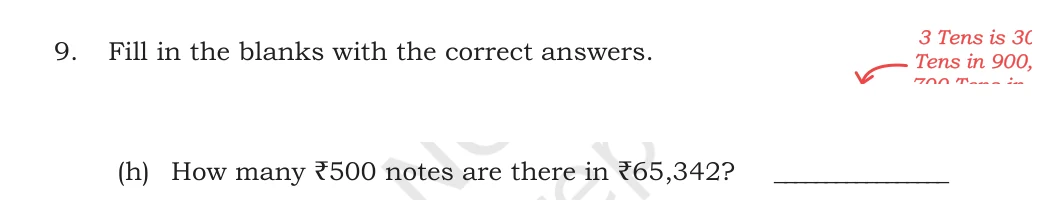
How many complete Rs 500 notes can be taken from Rs 65,342?
Show detailed solution
- Step 1: Divide 65,342 by 500.
- Step 2: The quotient is 130 and the unused remainder is 342.
- Answer: 130 complete groups or notes.
Detailed worked answers
Textbook page 16
Textbook page 16 · solved item 120
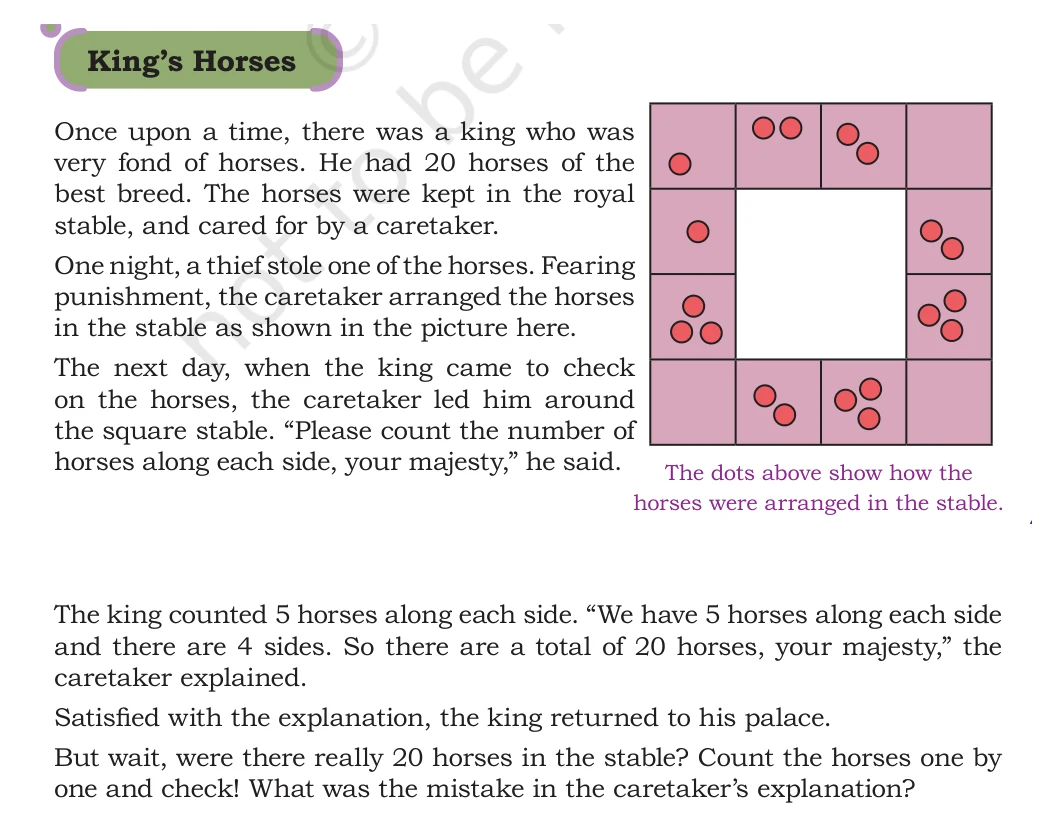
Were there really 20 horses in the shown stable arrangement, and what was wrong with the caretaker's count?
Show detailed solution
- Step 1: Counting the dots one by one gives 19 horses.
- Step 2: Counting 5 on each of 4 sides gives 20 side-counts, but a horse in a corner belongs to two sides.
- Answer: There were 19 horses. The caretaker counted the corner horse twice.
Textbook page 16 · solved item 121

Arrange 18 horses so that the king still counts 5 horses on every side of the square.
Show detailed solution
- Step 1: Put one horse in each of two opposite corners; each corner horse contributes to two sides.
- Step 2: Place four more horses along the interior part of each side, for 16 non-corner horses in total.
- Step 3: Each side now has its one corner horse plus four side horses.
- Answer: Two opposite corner horses and four non-corner horses per side use 18 horses and give 5 on each side.
Textbook page 16 · solved item 122
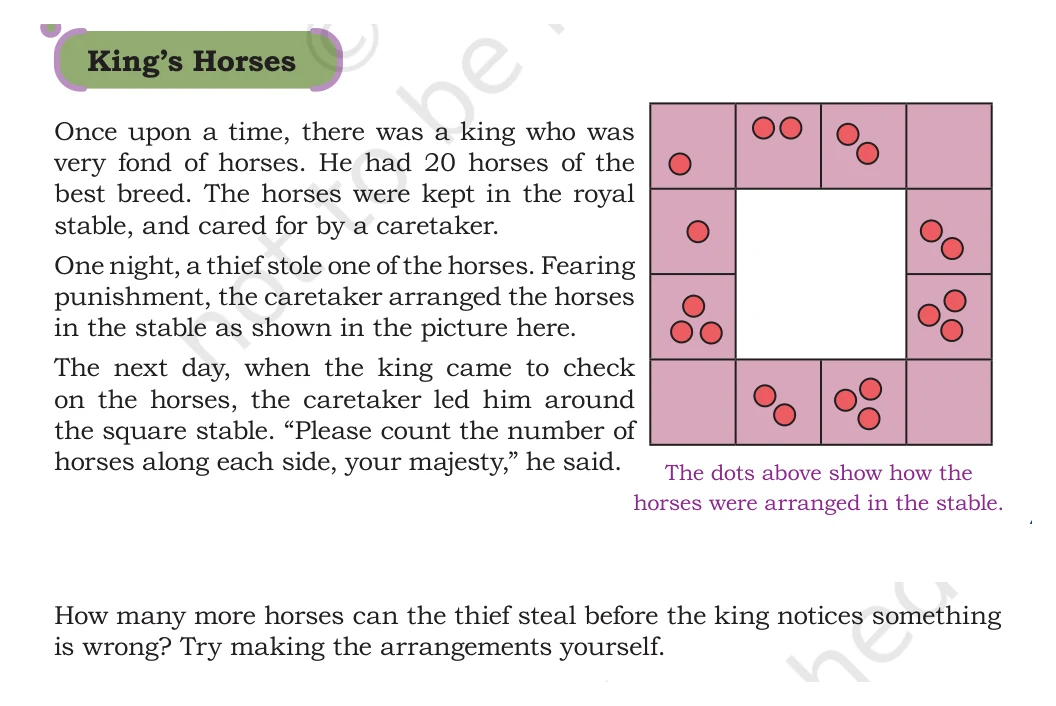
How many more horses can be stolen after 18 while still allowing 5 to be counted on each side?
Show detailed solution
- Step 1: Put 5 horses at one corner and 5 horses at the opposite corner.
- Step 2: Every side touches one of these two corners, so the king still counts 5 horses on each side. Only 10 horses are needed.
- Step 3: Starting with 18 horses, 18-10=8.
- Answer: 8 more horses can be stolen.