
Question-by-question working
Read the prompt, attempt it, then check each step
Every exercise subpart and table row is a separate item. Shared figures and table headings are repeated whenever they are needed to understand the question.
Detailed worked answers
Textbook page 104
Textbook page 104 · solved item 1
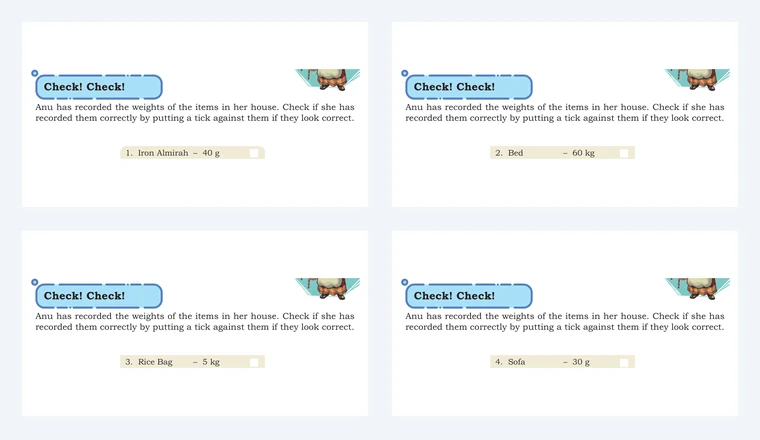
Should Iron almirah - 40 g be ticked as a sensible recorded weight?
Show detailed solution
- Step 1: Read the recorded value: Iron almirah - 40 g.
- Step 2: An iron almirah is much heavier than a small packet measured in grams.
- Step 3: Its weight should be stated in kilograms, not as 40 g.
- Answer: Do not tick it; the recorded weight is not sensible.
Textbook page 104 · solved item 2
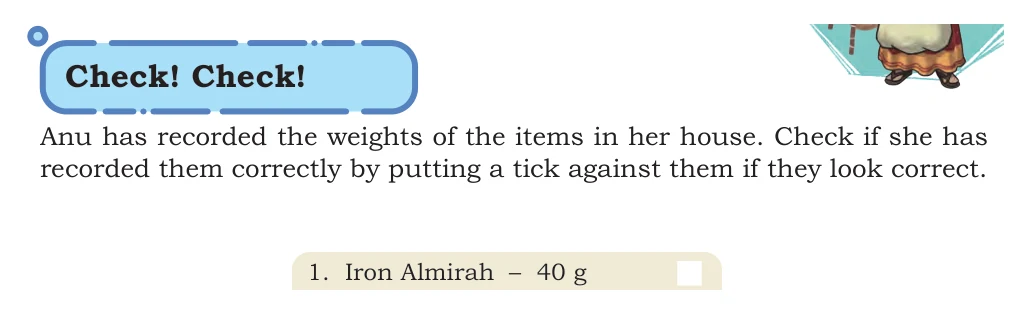
Should Bed - 60 kg be ticked as a sensible recorded weight?
Show detailed solution
- Step 1: Read the recorded value: Bed - 60 kg.
- Step 2: A bed is a heavy piece of furniture, so kilograms are suitable.
- Step 3: A weight of about 60 kg is reasonable for a bed.
- Answer: Tick it; the recorded weight is sensible.
Textbook page 104 · solved item 3
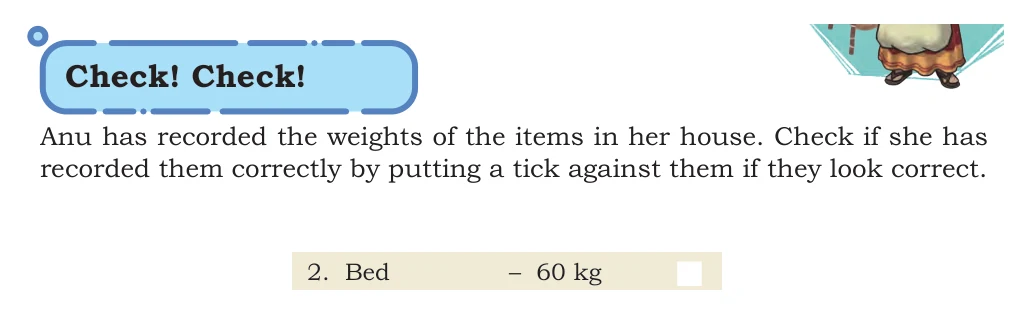
Should Rice bag - 5 kg be ticked as a sensible recorded weight?
Show detailed solution
- Step 1: Read the recorded value: Rice bag - 5 kg.
- Step 2: A household rice bag is commonly measured in kilograms.
- Step 3: A weight of 5 kg is reasonable for the bag shown.
- Answer: Tick it; the recorded weight is sensible.
Textbook page 104 · solved item 4
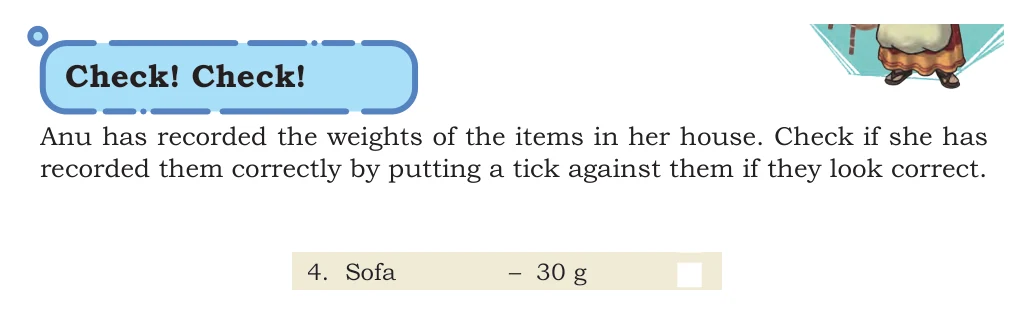
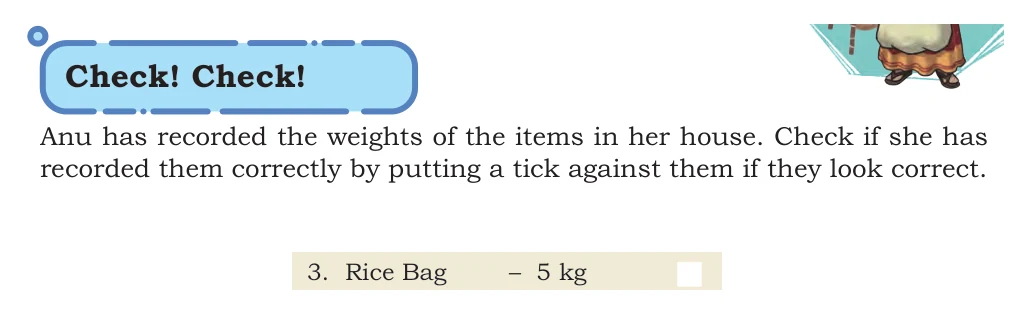
Should Sofa - 30 g be ticked as a sensible recorded weight?
Show detailed solution
- Step 1: Read the recorded value: Sofa - 30 g.
- Step 2: A sofa is far heavier than an object measured as only a few grams.
- Step 3: Its weight should be stated in kilograms, not as 30 g.
- Answer: Do not tick it; the recorded weight is not sensible.
Textbook page 104 · solved item 5
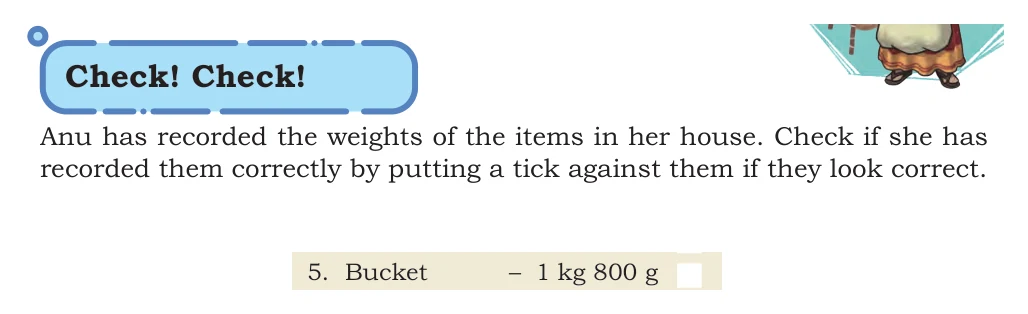
Should Bucket - 1 kg 800 g be ticked as a sensible recorded weight?
Show detailed solution
- Step 1: Read the recorded value: Bucket - 1 kg 800 g.
- Step 2: A bucket can weigh more than 1 kg but less than 2 kg.
- Step 3: The mixed weight 1 kg 800 g is reasonable.
- Answer: Tick it; the recorded weight is sensible.
Textbook page 104 · solved item 6
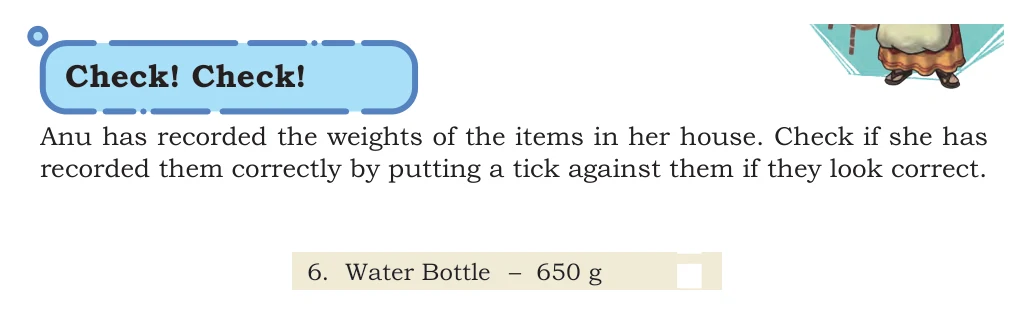
Should Water bottle - 650 g be ticked as a sensible recorded weight?
Show detailed solution
- Step 1: Read the recorded value: Water bottle - 650 g.
- Step 2: A filled or sturdy water bottle can weigh several hundred grams.
- Step 3: A weight of 650 g is reasonable.
- Answer: Tick it; the recorded weight is sensible.
Textbook page 104 · solved item 7
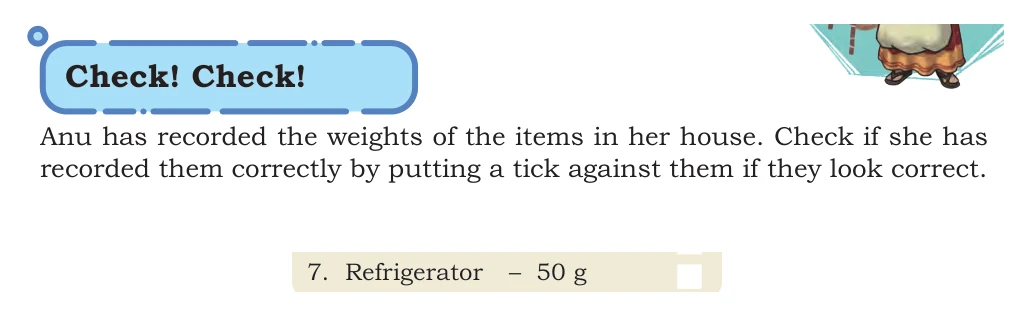
Should Refrigerator - 50 g be ticked as a sensible recorded weight?
Show detailed solution
- Step 1: Read the recorded value: Refrigerator - 50 g.
- Step 2: A refrigerator is a large appliance and cannot weigh only 50 g.
- Step 3: Its weight should be stated in kilograms, not grams.
- Answer: Do not tick it; the recorded weight is not sensible.
Textbook page 104 · solved item 8
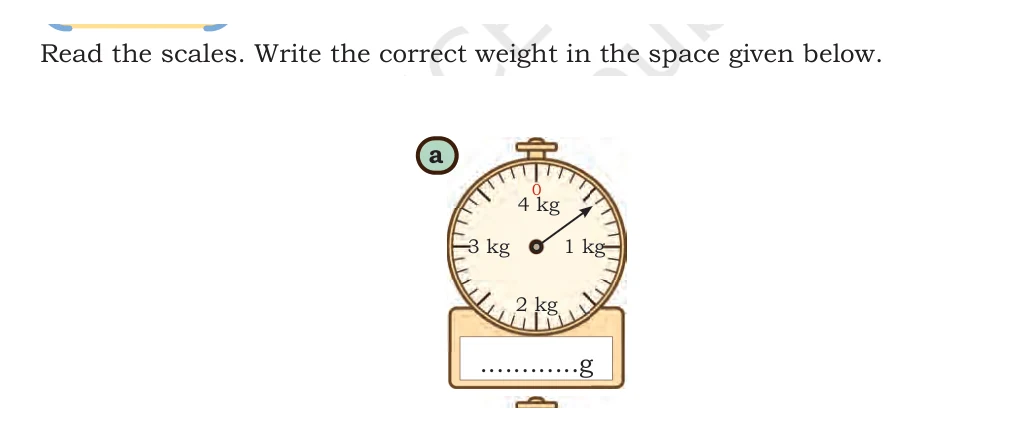
Read scale a and write its weight.
Show detailed solution
- Step 1: The 4 kg dial makes one full turn, so the 1 kg marks divide it into four equal quarters.
- Step 2: The pointer is halfway from 0 to 1 kg.
- Step 3: Half of 1 kg is 500 g.
- Answer: 500 g.
Textbook page 104 · solved item 9
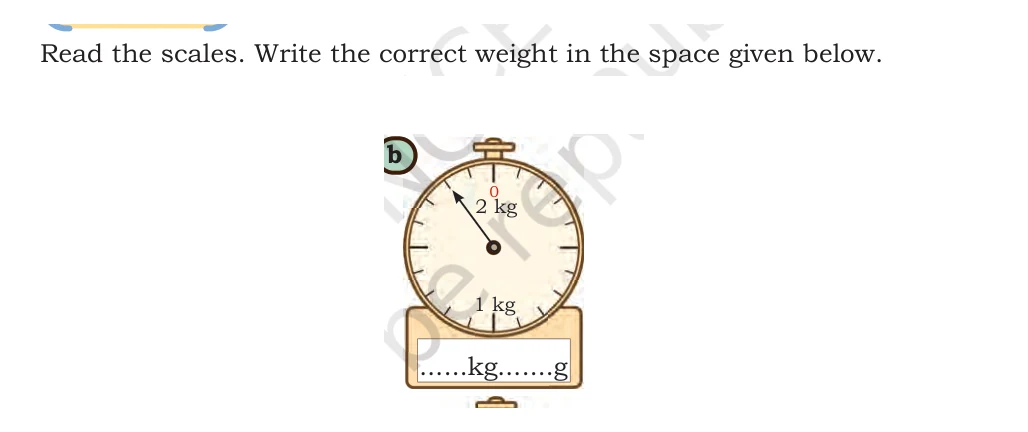
Read scale b and write its weight.
Show detailed solution
- Step 1: The 2 kg dial makes one full turn, with 1 kg at the bottom.
- Step 2: The pointer is eight small 100 g steps beyond 1 kg.
- Step 3: That is 1 kg and 800 g.
- Answer: 1 kg 800 g.
Textbook page 104 · solved item 10
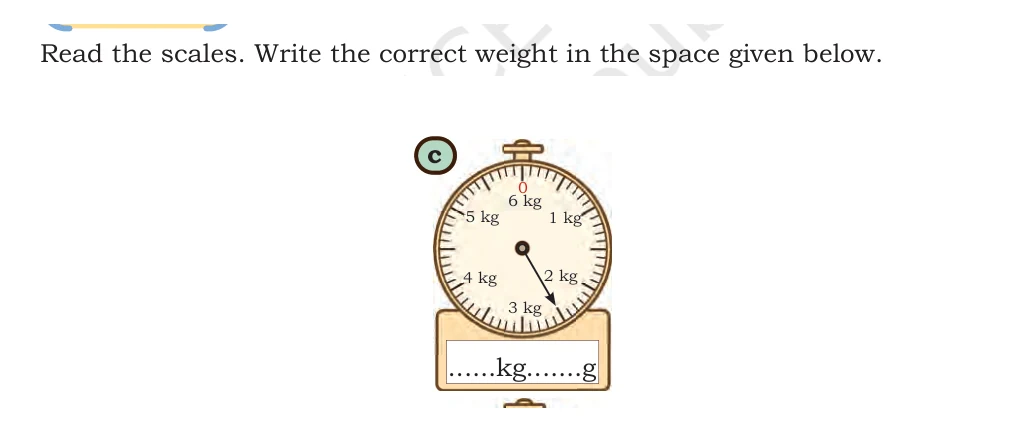
Read scale c and write its weight.
Show detailed solution
- Step 1: The 6 kg dial has six equal 1 kg sections.
- Step 2: The pointer is six small 100 g steps beyond 2 kg.
- Step 3: That is 2 kg and 600 g.
- Answer: 2 kg 600 g.
Textbook page 104 · solved item 11
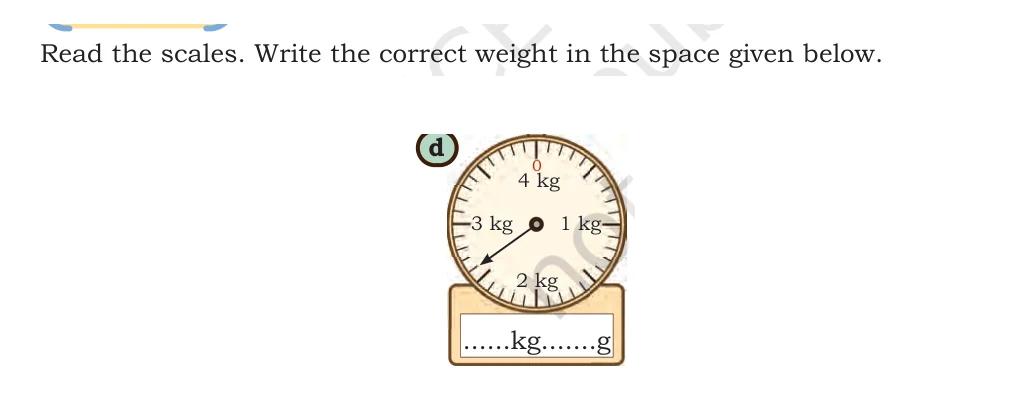
Read scale d and write its weight.
Show detailed solution
- Step 1: The 4 kg dial has a 1 kg mark at each quarter turn.
- Step 2: The pointer is six small 100 g steps beyond 2 kg.
- Step 3: That is 2 kg and 600 g.
- Answer: 2 kg 600 g.
Textbook page 104 · solved item 12
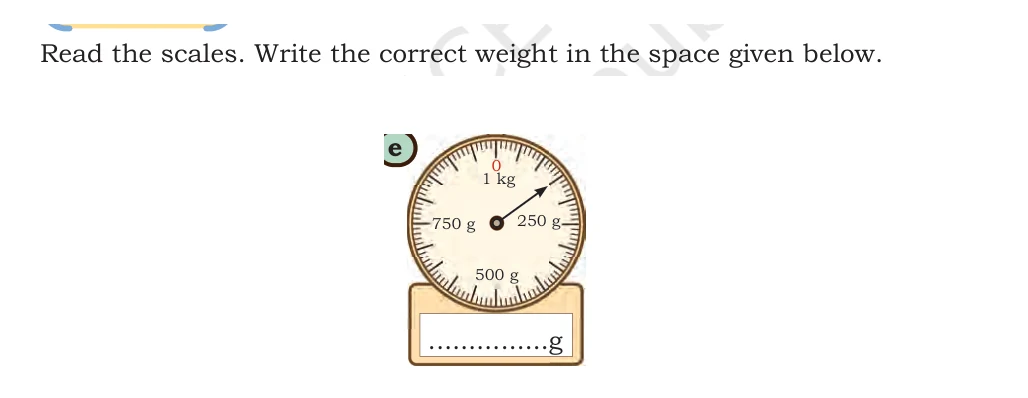
Read scale e and write its weight.
Show detailed solution
- Step 1: The 1 kg dial is marked 0, 250 g, 500 g, and 750 g around the circle.
- Step 2: The pointer is at the 150 g tick between 0 and 250 g.
- Step 3: The scale reads 150 g.
- Answer: 150 g.
Textbook page 104 · solved item 13
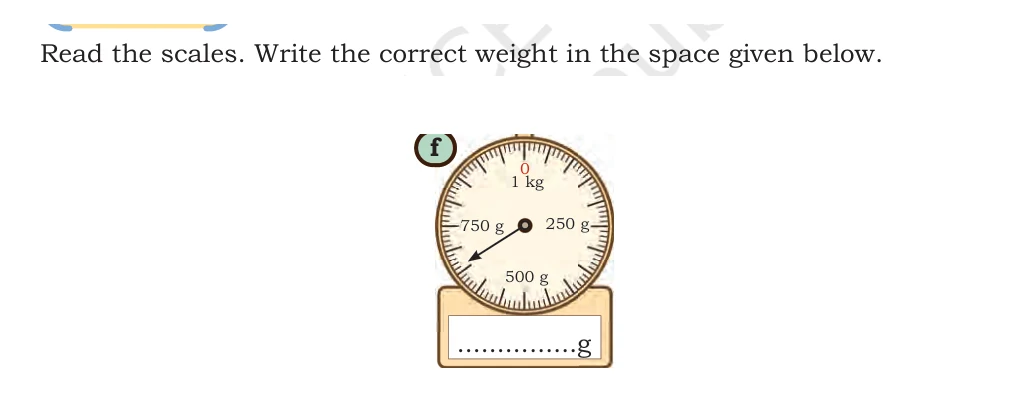
Read scale f and write its weight.
Show detailed solution
- Step 1: The pointer lies between the 500 g and 750 g marks.
- Step 2: Counting the small divisions from 500 g reaches 650 g.
- Step 3: The scale reads 650 g.
- Answer: 650 g.
Detailed worked answers
Textbook page 105
Textbook page 105 · solved item 14
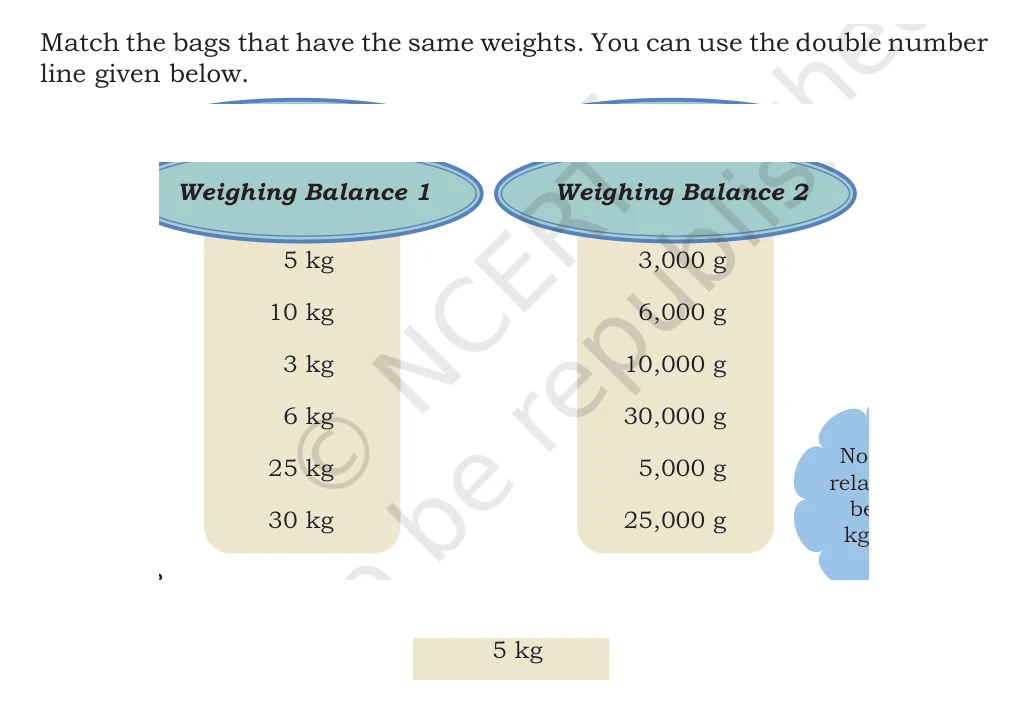
Match 5 kg from Weighing Balance 1 to its equal weight in grams.
Show detailed solution
- Step 1: Use 1 kg = 1,000 g.
- Step 2: Multiply 5 by 1,000 to change kilograms to grams.
- Step 3: 5\times1,000=5,000, so choose 5,000 g from Weighing Balance 2.
- Answer: 5 kg=5,000 g.
Textbook page 105 · solved item 15
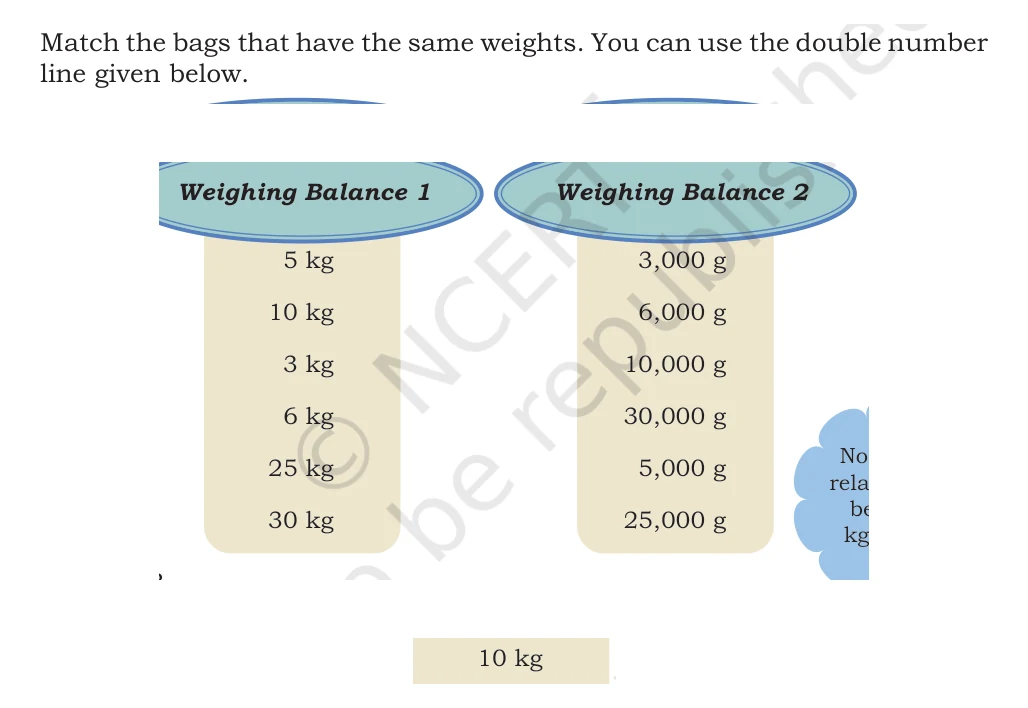
Match 10 kg from Weighing Balance 1 to its equal weight in grams.
Show detailed solution
- Step 1: Use 1 kg = 1,000 g.
- Step 2: Multiply 10 by 1,000 to change kilograms to grams.
- Step 3: 10\times1,000=10,000, so choose 10,000 g from Weighing Balance 2.
- Answer: 10 kg=10,000 g.
Textbook page 105 · solved item 16
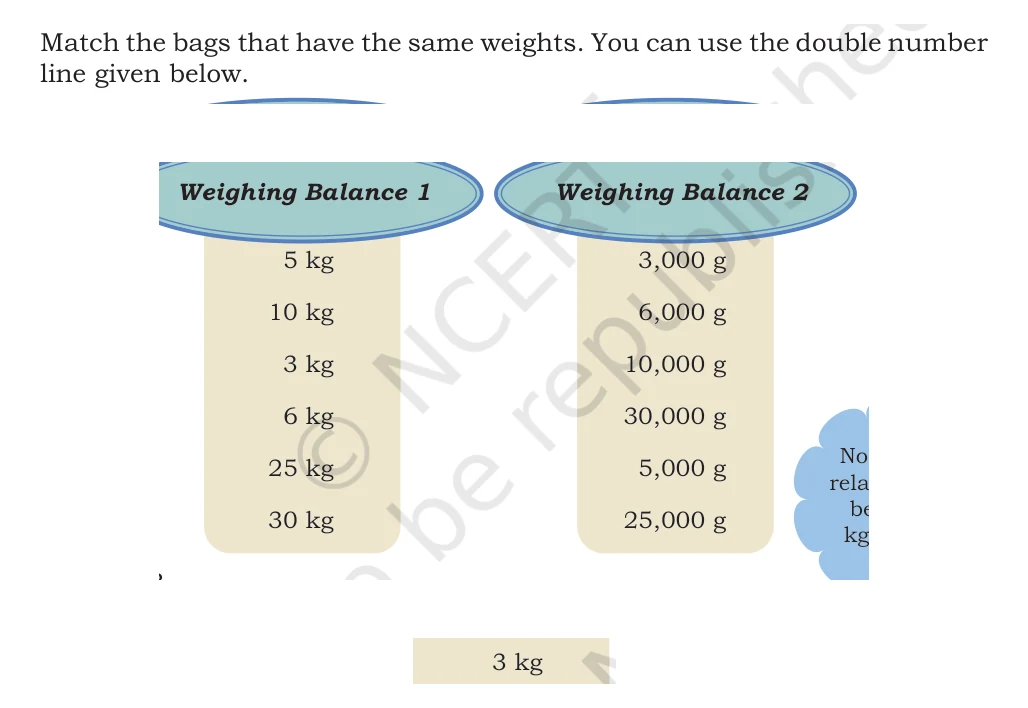
Match 3 kg from Weighing Balance 1 to its equal weight in grams.
Show detailed solution
- Step 1: Use 1 kg = 1,000 g.
- Step 2: Multiply 3 by 1,000 to change kilograms to grams.
- Step 3: 3\times1,000=3,000, so choose 3,000 g from Weighing Balance 2.
- Answer: 3 kg=3,000 g.
Textbook page 105 · solved item 17
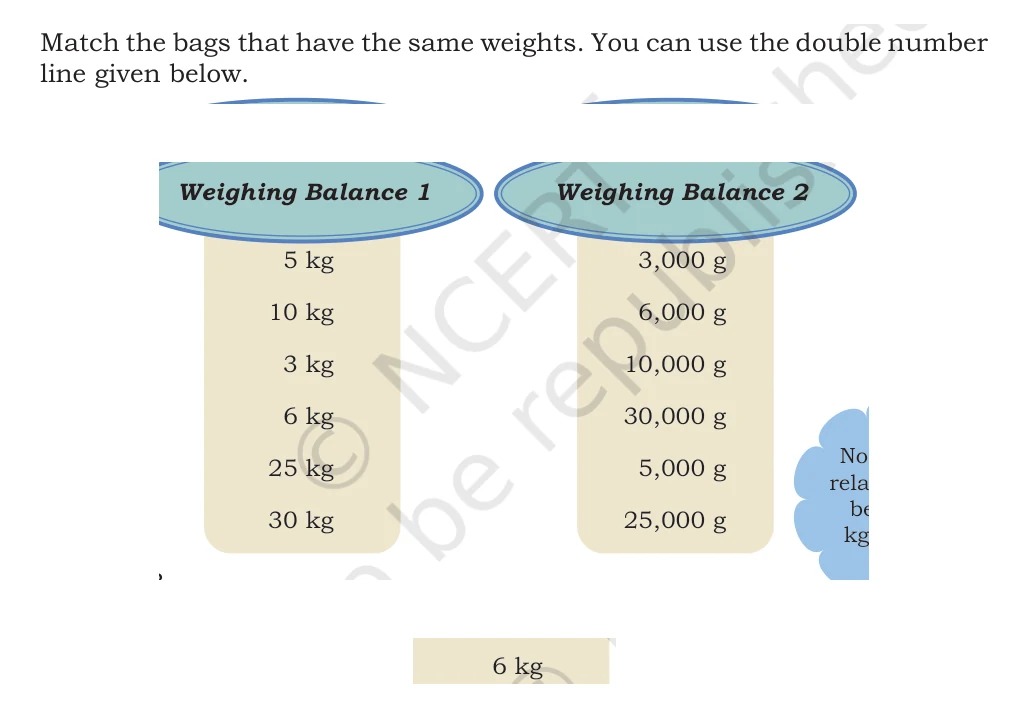
Match 6 kg from Weighing Balance 1 to its equal weight in grams.
Show detailed solution
- Step 1: Use 1 kg = 1,000 g.
- Step 2: Multiply 6 by 1,000 to change kilograms to grams.
- Step 3: 6\times1,000=6,000, so choose 6,000 g from Weighing Balance 2.
- Answer: 6 kg=6,000 g.
Textbook page 105 · solved item 18
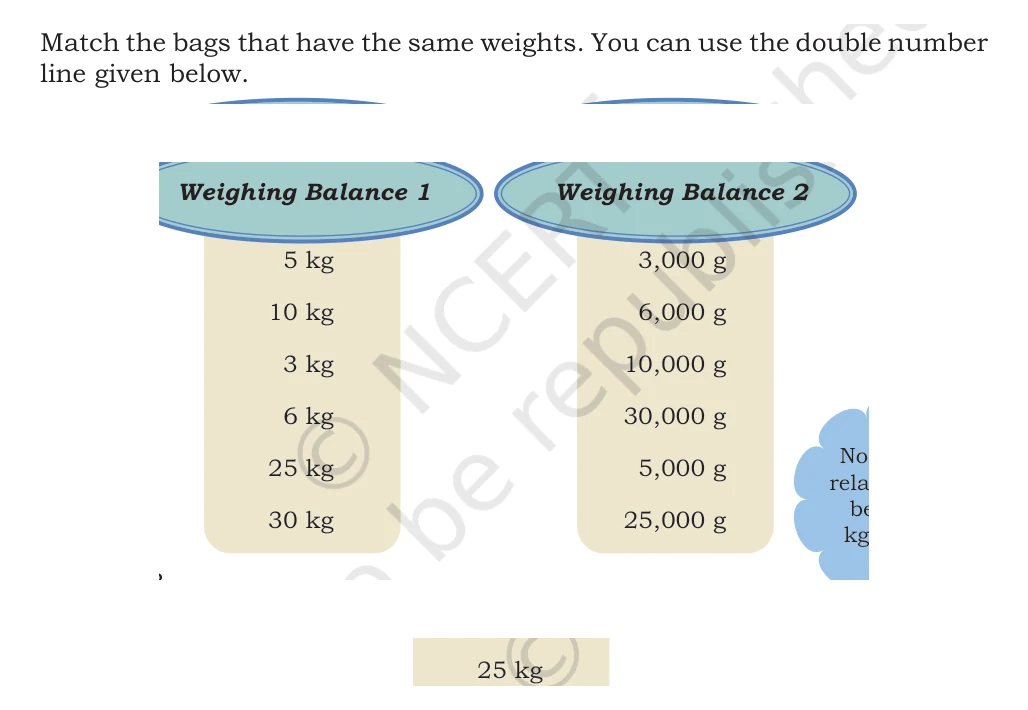
Match 25 kg from Weighing Balance 1 to its equal weight in grams.
Show detailed solution
- Step 1: Use 1 kg = 1,000 g.
- Step 2: Multiply 25 by 1,000 to change kilograms to grams.
- Step 3: 25\times1,000=25,000, so choose 25,000 g from Weighing Balance 2.
- Answer: 25 kg=25,000 g.
Textbook page 105 · solved item 19
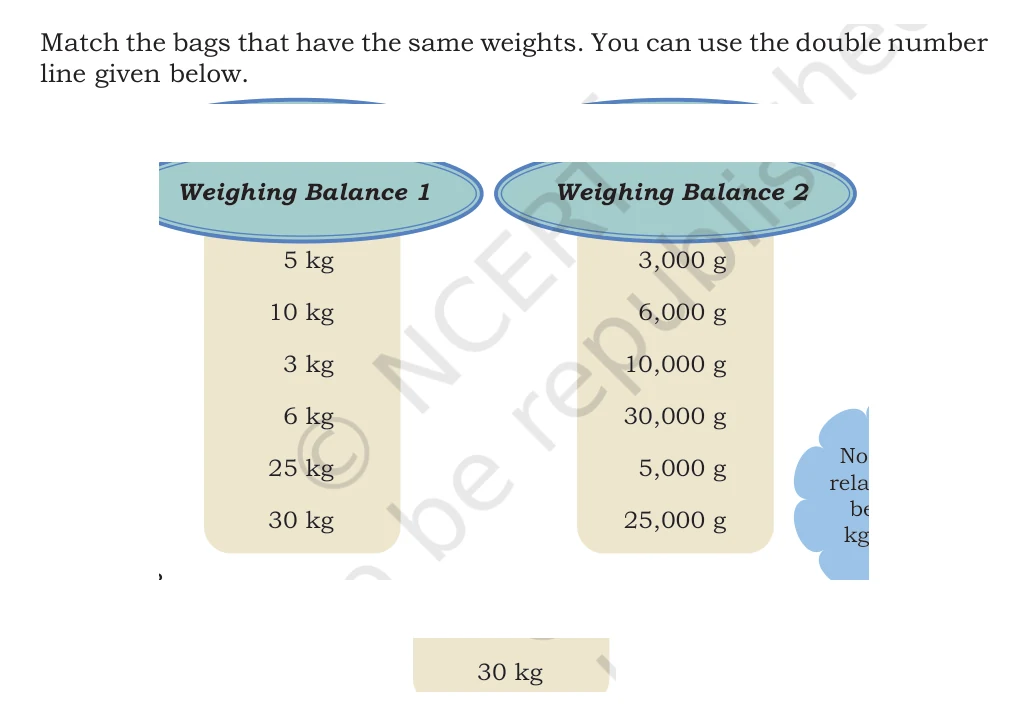
Match 30 kg from Weighing Balance 1 to its equal weight in grams.
Show detailed solution
- Step 1: Use 1 kg = 1,000 g.
- Step 2: Multiply 30 by 1,000 to change kilograms to grams.
- Step 3: 30\times1,000=30,000, so choose 30,000 g from Weighing Balance 2.
- Answer: 30 kg=30,000 g.
Textbook page 105 · solved item 20
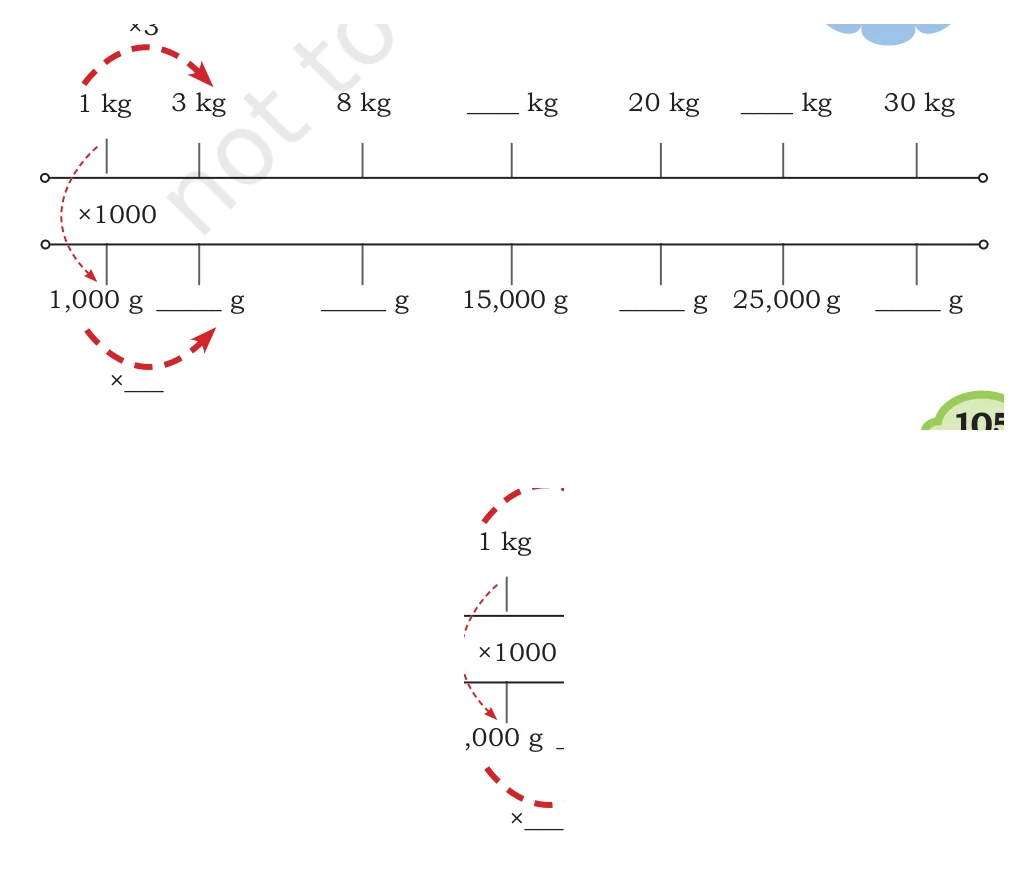
Complete the multiplier from 1,000 g to 3,000 g.
Show detailed solution
- Step 1: 1,000 g is repeated three times to make 3,000 g.
- Step 2: The kilogram line also changes from 1 kg to 3 kg.
- Step 3: Both lines are multiplied by the same number.
- Answer: 3.
Textbook page 105 · solved item 21
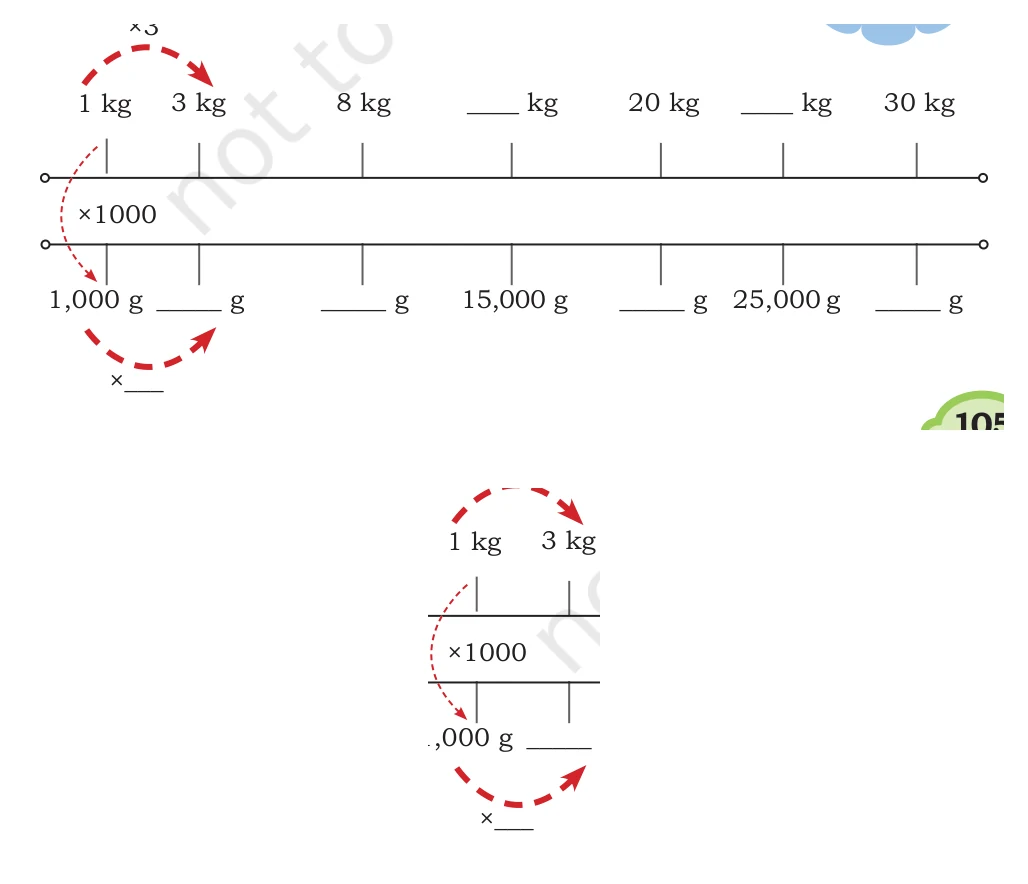
Complete the gram value below 3 kg.
Show detailed solution
- Step 1: Use 1 kg = 1,000 g.
- Step 2: Three kilograms contain three groups of 1,000 g.
- Step 3: 3 times 1,000 g is 3,000 g.
- Answer: 3,000 g.
Textbook page 105 · solved item 22
Complete the gram value below 8 kg.
Show detailed solution
- Step 1: Use 1 kg = 1,000 g.
- Step 2: Eight kilograms contain eight groups of 1,000 g.
- Step 3: 8 times 1,000 g is 8,000 g.
- Answer: 8,000 g.
Textbook page 105 · solved item 23
Complete the kilogram value above 15,000 g.
Show detailed solution
- Step 1: Every 1,000 g makes 1 kg.
- Step 2: 15,000 g contains fifteen groups of 1,000 g.
- Step 3: So the mark is 15 kg.
- Answer: 15 kg.
Textbook page 105 · solved item 24
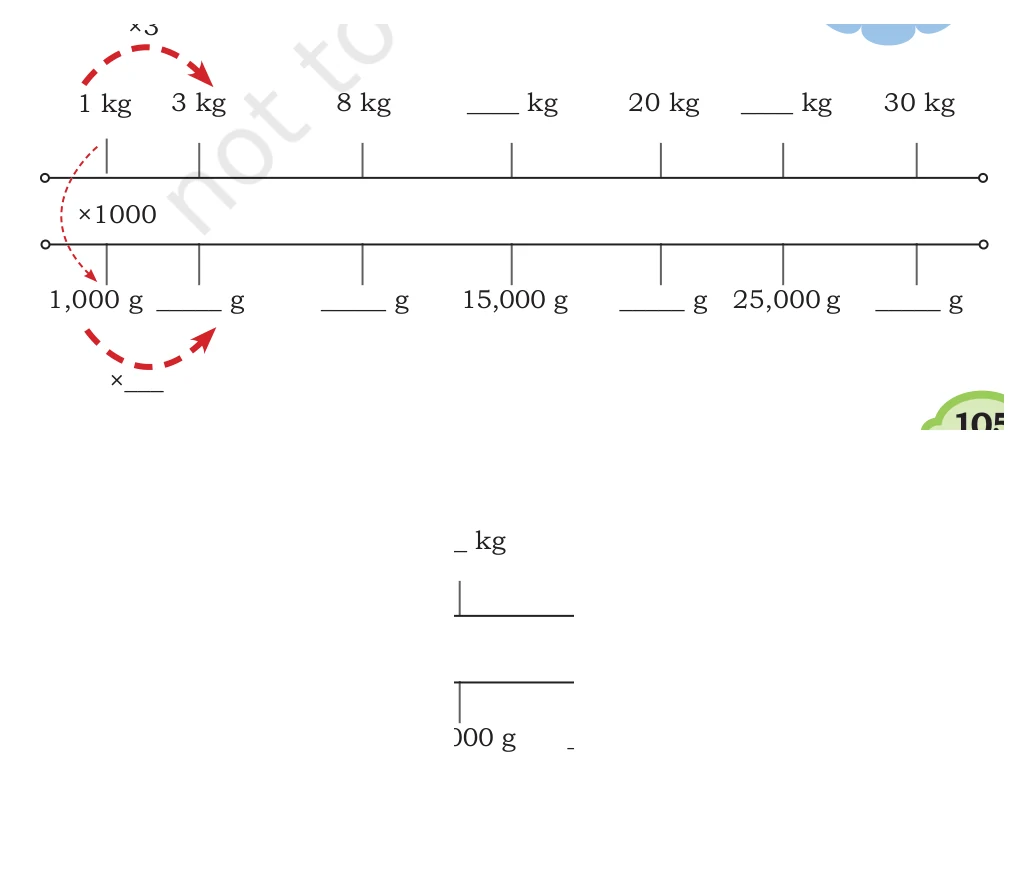
Complete the gram value below 20 kg.
Show detailed solution
- Step 1: Use 1 kg = 1,000 g.
- Step 2: Twenty kilograms contain twenty groups of 1,000 g.
- Step 3: 20 times 1,000 g is 20,000 g.
- Answer: 20,000 g.
Textbook page 105 · solved item 25
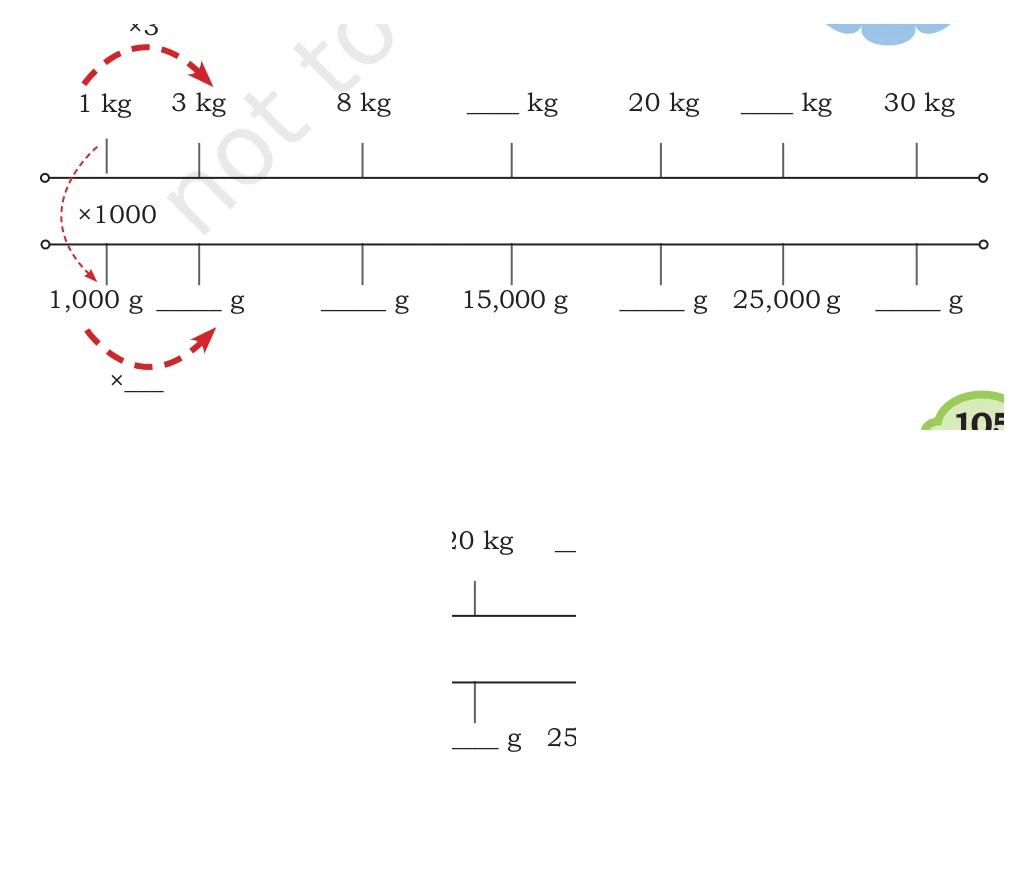
Complete the kilogram value above 25,000 g.
Show detailed solution
- Step 1: Every 1,000 g makes 1 kg.
- Step 2: 25,000 g contains twenty-five groups of 1,000 g.
- Step 3: So the mark is 25 kg.
- Answer: 25 kg.
Textbook page 105 · solved item 26
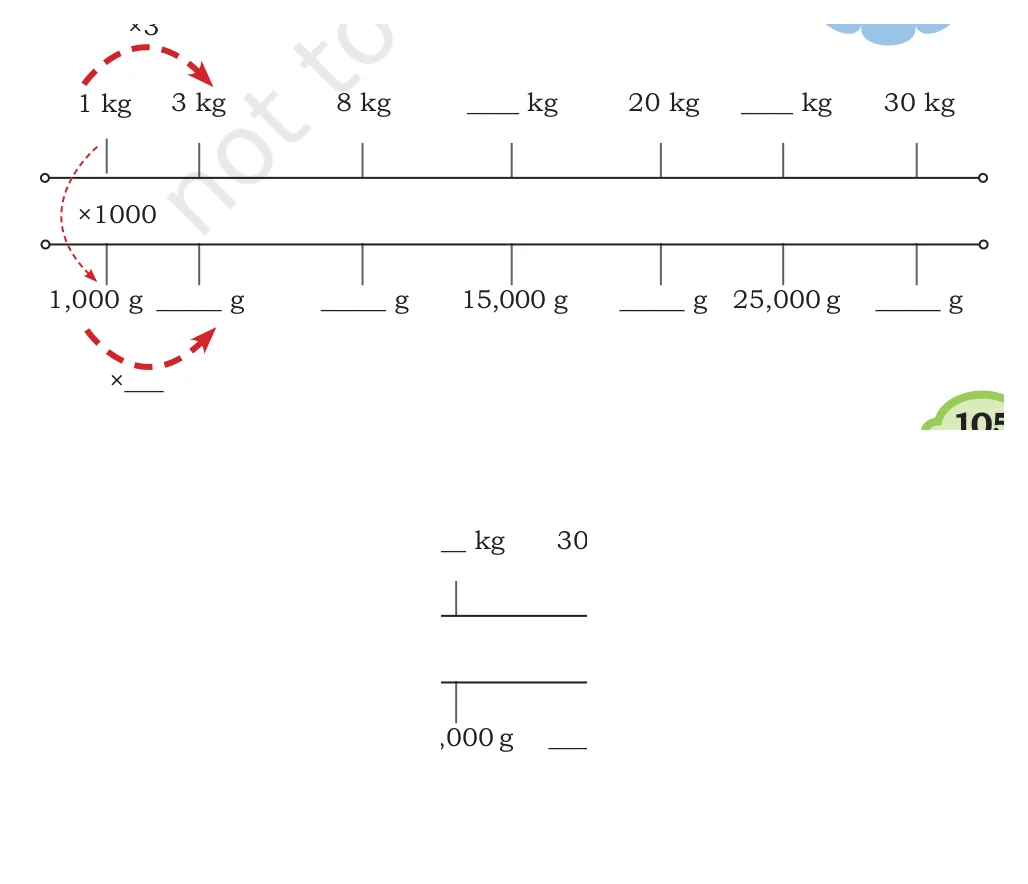
Complete the gram value below 30 kg.
Show detailed solution
- Step 1: Use 1 kg = 1,000 g.
- Step 2: Thirty kilograms contain thirty groups of 1,000 g.
- Step 3: 30 times 1,000 g is 30,000 g.
- Answer: 30,000 g.
Detailed worked answers
Textbook page 106
Textbook page 106 · solved item 27
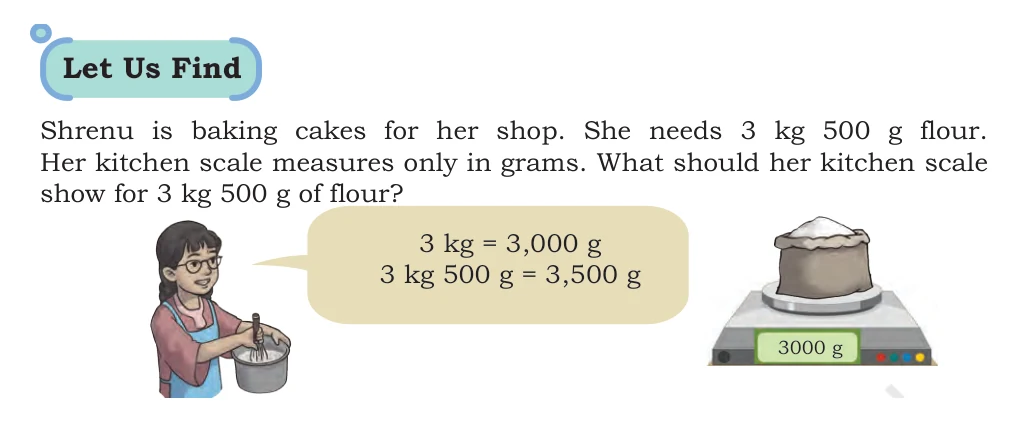
What should a gram-only kitchen scale show for 3 kg 500 g of flour?
Show detailed solution
- Step 1: Change 3 kg to grams: 3\times1,000=3,000\text{ g}.
- Step 2: Keep the extra 500 g and add it to 3,000 g.
- Step 3: 3,000\text{ g}+500\text{ g}=3,500\text{ g}.
- Answer: The scale should show 3,500\text{ g}.
Textbook page 106 · solved item 28
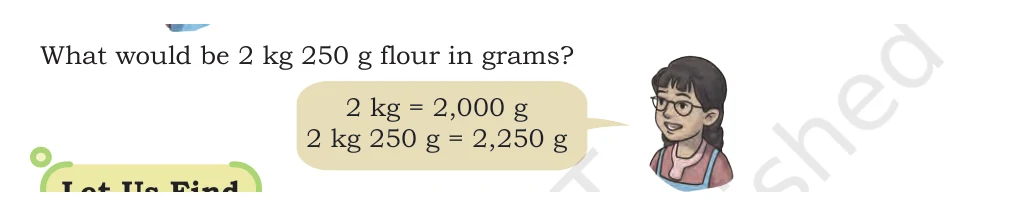
Convert 2 kg 250 g of flour to grams.
Show detailed solution
- Step 1: Change 2 kg to grams: 2\times1,000=2,000\text{ g}.
- Step 2: Add the remaining 250 g.
- Step 3: 2,000\text{ g}+250\text{ g}=2,250\text{ g}.
- Answer: 2\text{ kg }250\text{ g}=2,250\text{ g}.
Textbook page 106 · solved item 29
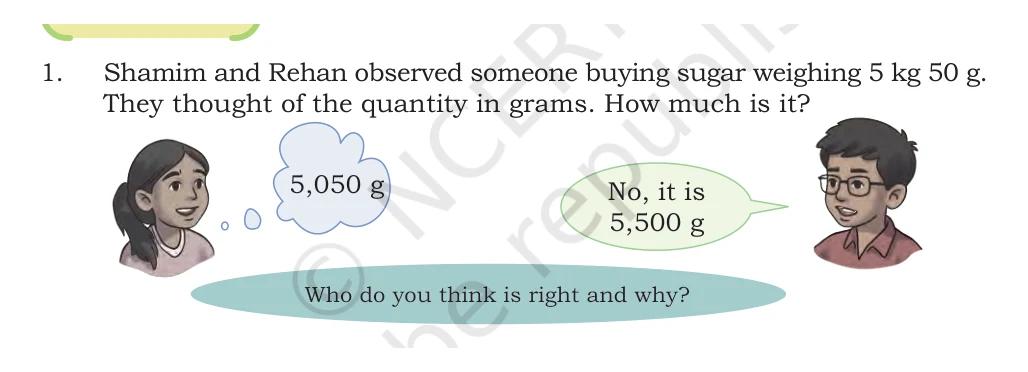
Shamim says 5 kg 50 g is 5,050 g, while Rehan says 5,500 g. Who is right and why?
Show detailed solution
- Step 1: Change 5 kg to grams: 5\times1,000=5,000\text{ g}.
- Step 2: Add the separate 50 g: 5,000+50=5,050.
- Step 3: Rehan added 500 g instead of the given 50 g.
- Answer: Shamim is right; the quantity is 5,050\text{ g}.
Textbook page 106 · solved item 30
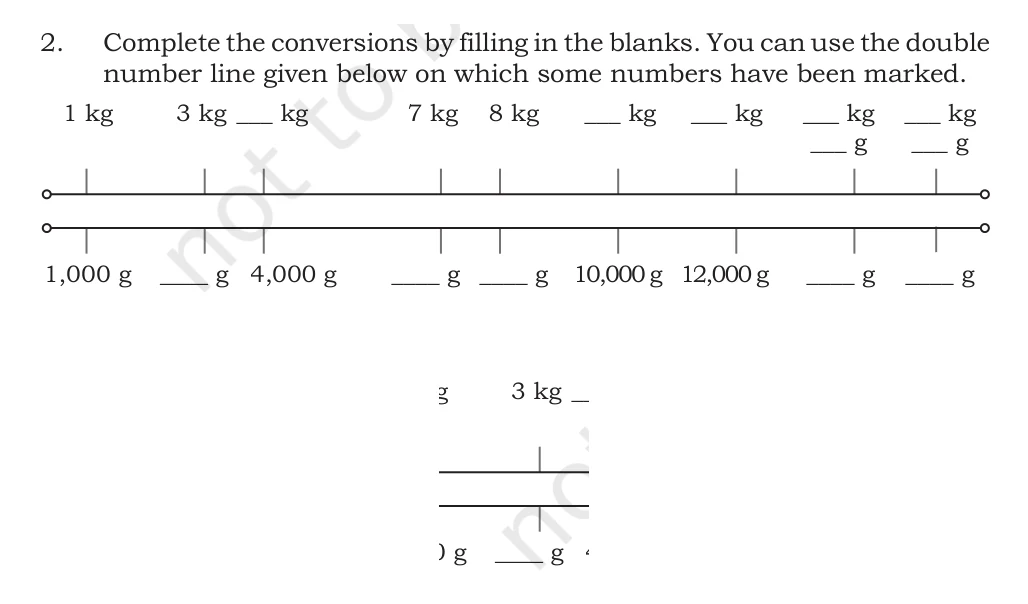
Complete the grams below 3 kg.
Show detailed solution
- Step 1: Use 1 kg = 1,000 g.
- Step 2: Three groups of 1,000 g make 3,000 g.
- Step 3: Check that the kilogram and gram descriptions name the same point on the double number line.
- Answer: 3,000 g.
Textbook page 106 · solved item 31
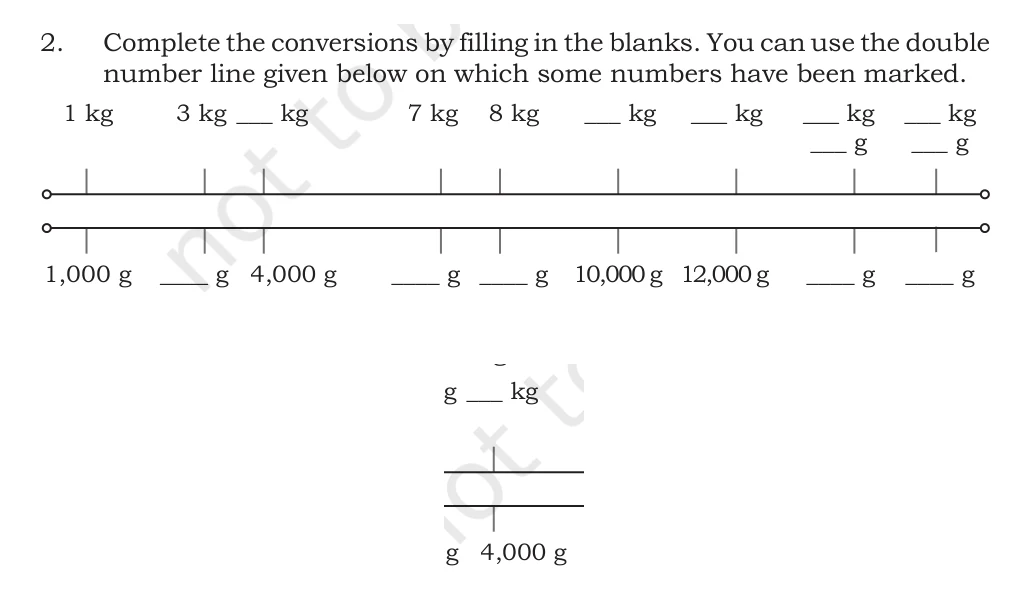
Complete the kilograms above 4,000 g.
Show detailed solution
- Step 1: Use 1 kg = 1,000 g.
- Step 2: Four groups of 1,000 g make 4 kg.
- Step 3: Check that the kilogram and gram descriptions name the same point on the double number line.
- Answer: 4 kg.
Textbook page 106 · solved item 32
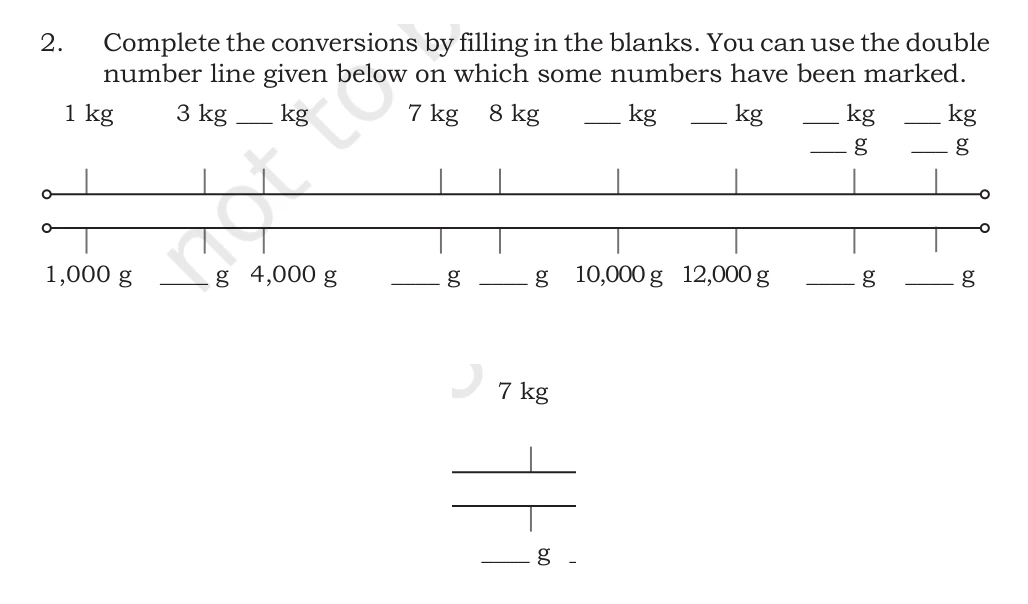
Complete the grams below 7 kg.
Show detailed solution
- Step 1: Use 1 kg = 1,000 g.
- Step 2: Seven groups of 1,000 g make 7,000 g.
- Step 3: Check that the kilogram and gram descriptions name the same point on the double number line.
- Answer: 7,000 g.
Textbook page 106 · solved item 33
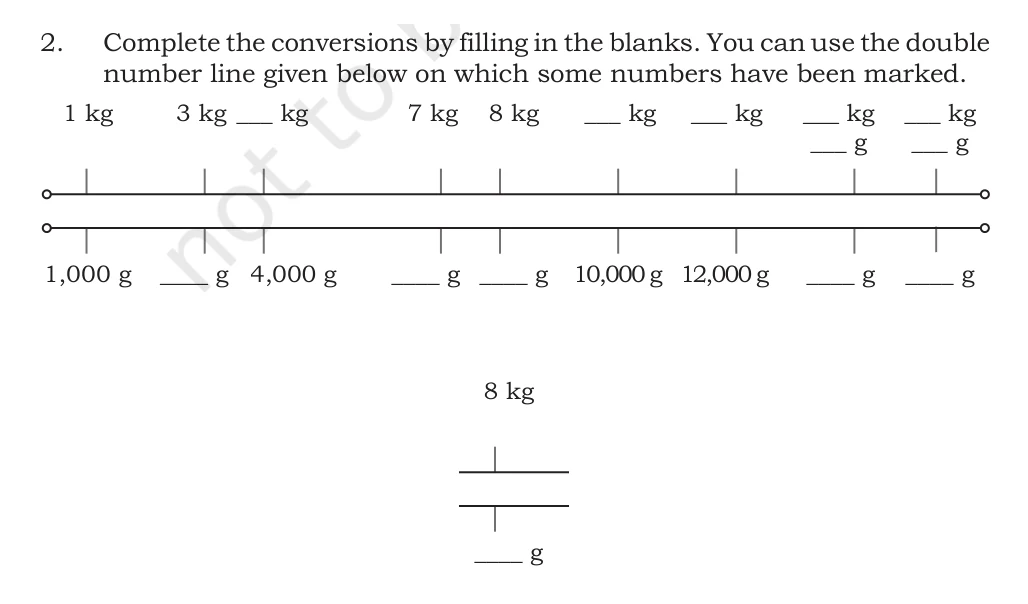
Complete the grams below 8 kg.
Show detailed solution
- Step 1: Use 1 kg = 1,000 g.
- Step 2: Eight groups of 1,000 g make 8,000 g.
- Step 3: Check that the kilogram and gram descriptions name the same point on the double number line.
- Answer: 8,000 g.
Textbook page 106 · solved item 34
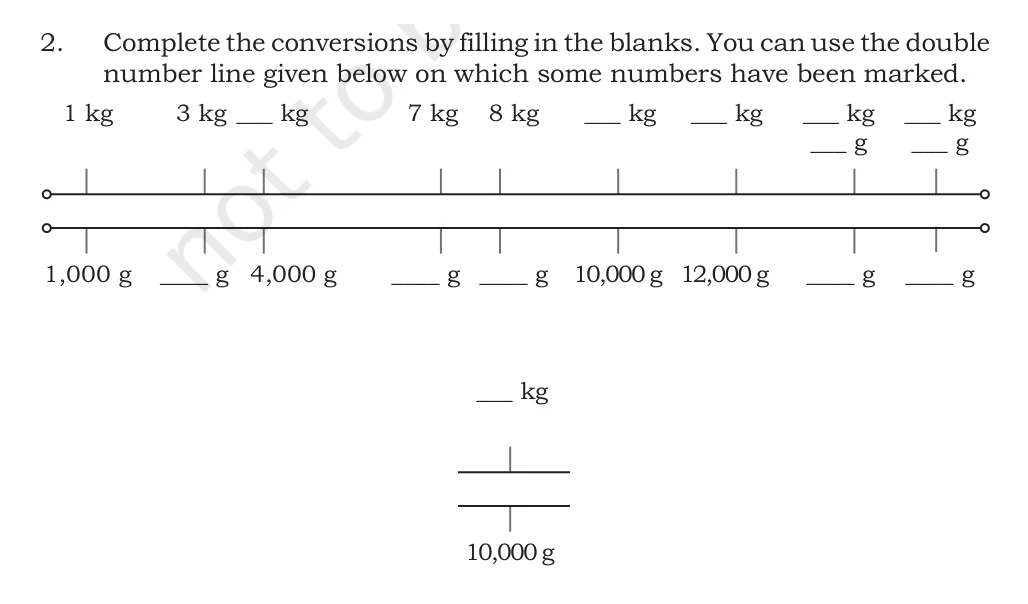
Complete the kilograms above 10,000 g.
Show detailed solution
- Step 1: Use 1 kg = 1,000 g.
- Step 2: Ten groups of 1,000 g make 10 kg.
- Step 3: Check that the kilogram and gram descriptions name the same point on the double number line.
- Answer: 10 kg.
Textbook page 106 · solved item 35

Complete the kilograms above 12,000 g.
Show detailed solution
- Step 1: Use 1 kg = 1,000 g.
- Step 2: Twelve groups of 1,000 g make 12 kg.
- Step 3: Check that the kilogram and gram descriptions name the same point on the double number line.
- Answer: 12 kg.
Textbook page 106 · solved item 36
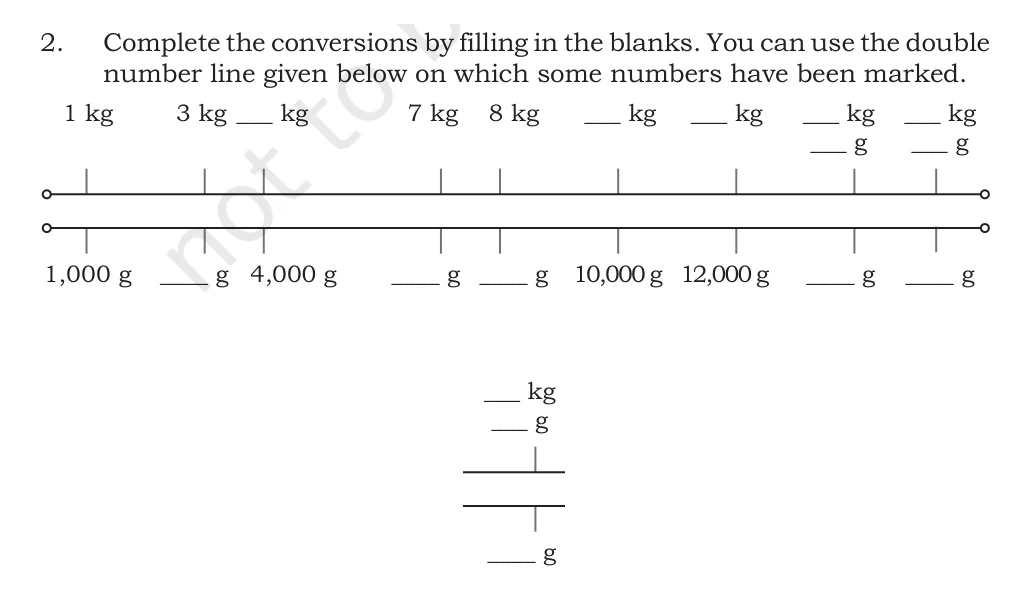
Complete the first mixed-unit mark and its gram value.
Show detailed solution
- Step 1: Use 1 kg = 1,000 g.
- Step 2: The mark is two kilograms after 12 kg, so it is 14 kg with 0 extra grams.
- Step 3: Check that the kilogram and gram descriptions name the same point on the double number line.
- Answer: 14 kg 0 g = 14,000 g.
Textbook page 106 · solved item 37
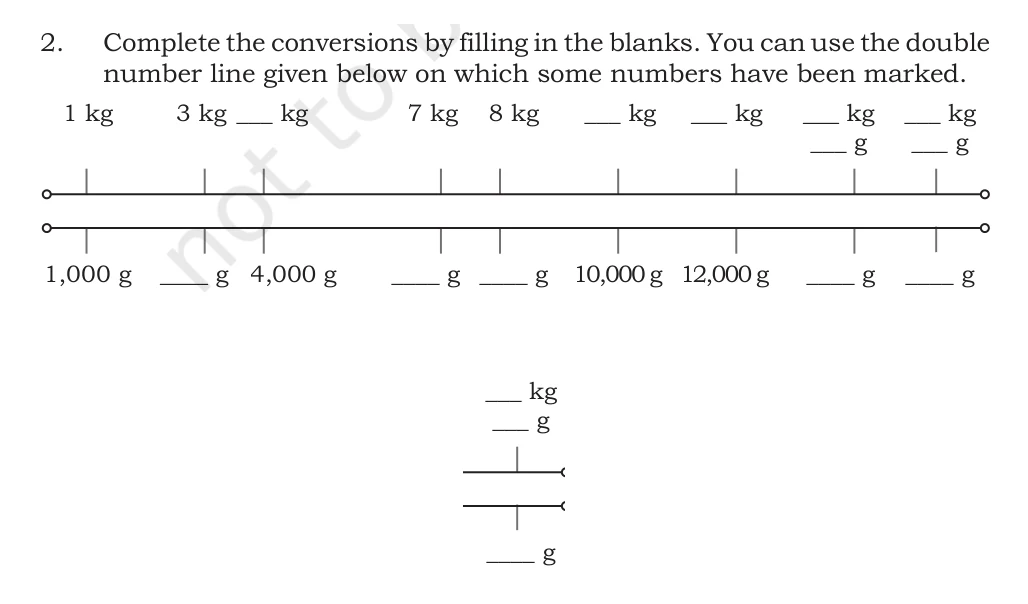
Complete the last mixed-unit mark and its gram value.
Show detailed solution
- Step 1: Use 1 kg = 1,000 g.
- Step 2: The mark is 1 kg 400 g after 14 kg, so it is 15 kg 400 g.
- Step 3: Check that the kilogram and gram descriptions name the same point on the double number line.
- Answer: 15 kg 400 g = 15,400 g.
Textbook page 106 · solved item 38

Convert 7 kg 67 g to grams.
Show detailed solution
- Step 1: Recall that 1 kg = 1,000 g.
- Step 2: 7 kg = 7,000 g.
- Step 3: 7,000 g + 67 g = 7,067 g.
- Answer: 7,067 g.
Textbook page 106 · solved item 39

Convert 3 kg 300 g to grams.
Show detailed solution
- Step 1: Recall that 1 kg = 1,000 g.
- Step 2: 3 kg = 3,000 g.
- Step 3: 3,000 g + 300 g = 3,300 g.
- Answer: 3,300 g.
Textbook page 106 · solved item 40

Convert 8 kg 69 g to grams.
Show detailed solution
- Step 1: Recall that 1 kg = 1,000 g.
- Step 2: 8 kg = 8,000 g.
- Step 3: 8,000 g + 69 g = 8,069 g.
- Answer: 8,069 g.
Textbook page 106 · solved item 41

Convert 10,760 g to kilograms and grams.
Show detailed solution
- Step 1: Recall that 1 kg = 1,000 g.
- Step 2: 10,000 g = 10 kg.
- Step 3: 10,760 g = 10,000 g + 760 g.
- Answer: 10 kg 760 g.
Textbook page 106 · solved item 42

Convert 4,080 g to kilograms and grams.
Show detailed solution
- Step 1: Recall that 1 kg = 1,000 g.
- Step 2: 4,000 g = 4 kg.
- Step 3: 4,080 g = 4,000 g + 80 g.
- Answer: 4 kg 80 g.
Textbook page 106 · solved item 43

Convert 12,042 g to kilograms and grams.
Show detailed solution
- Step 1: Recall that 1 kg = 1,000 g.
- Step 2: 12,000 g = 12 kg.
- Step 3: 12,042 g = 12,000 g + 42 g.
- Answer: 12 kg 42 g.
Detailed worked answers
Textbook page 107
Textbook page 107 · solved item 44
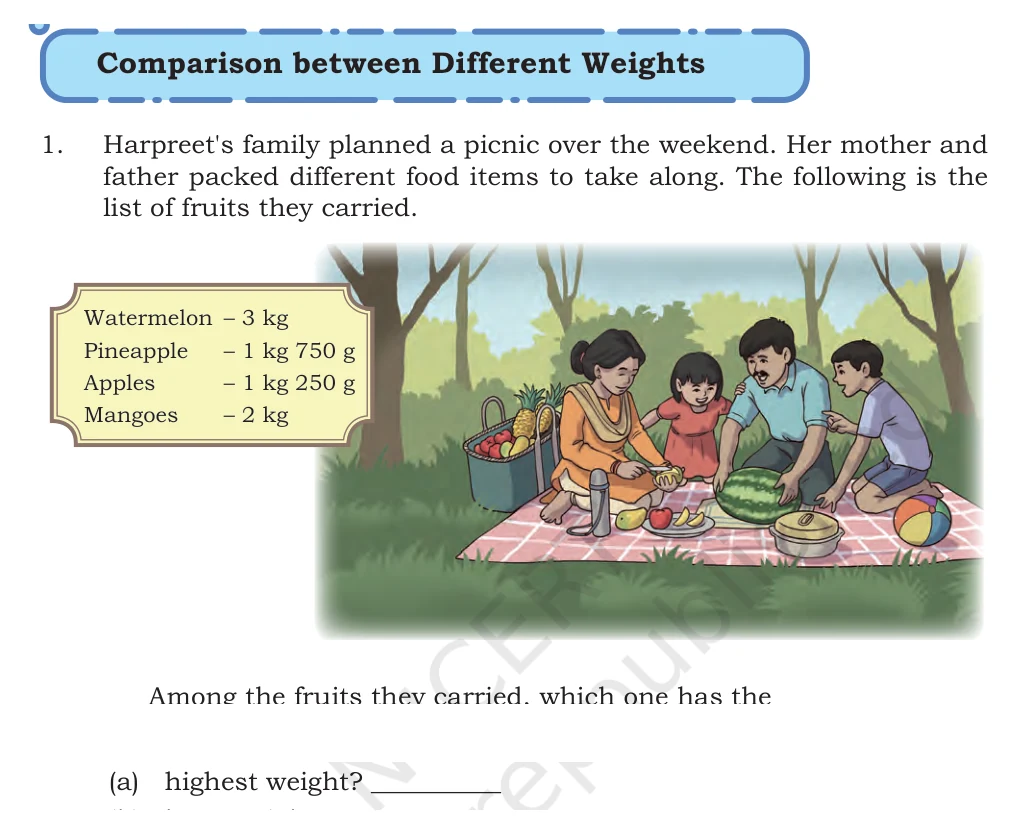
Which picnic fruit has the highest weight?
Show detailed solution
- Step 1: The fruit weights are 3 kg, 1 kg 750 g, 1 kg 250 g, and 2 kg.
- Step 2: 3 kg is greater than 2 kg and both weights beginning with 1 kg.
- Step 3: The 3 kg item is the watermelon.
- Answer: Watermelon.
Textbook page 107 · solved item 45
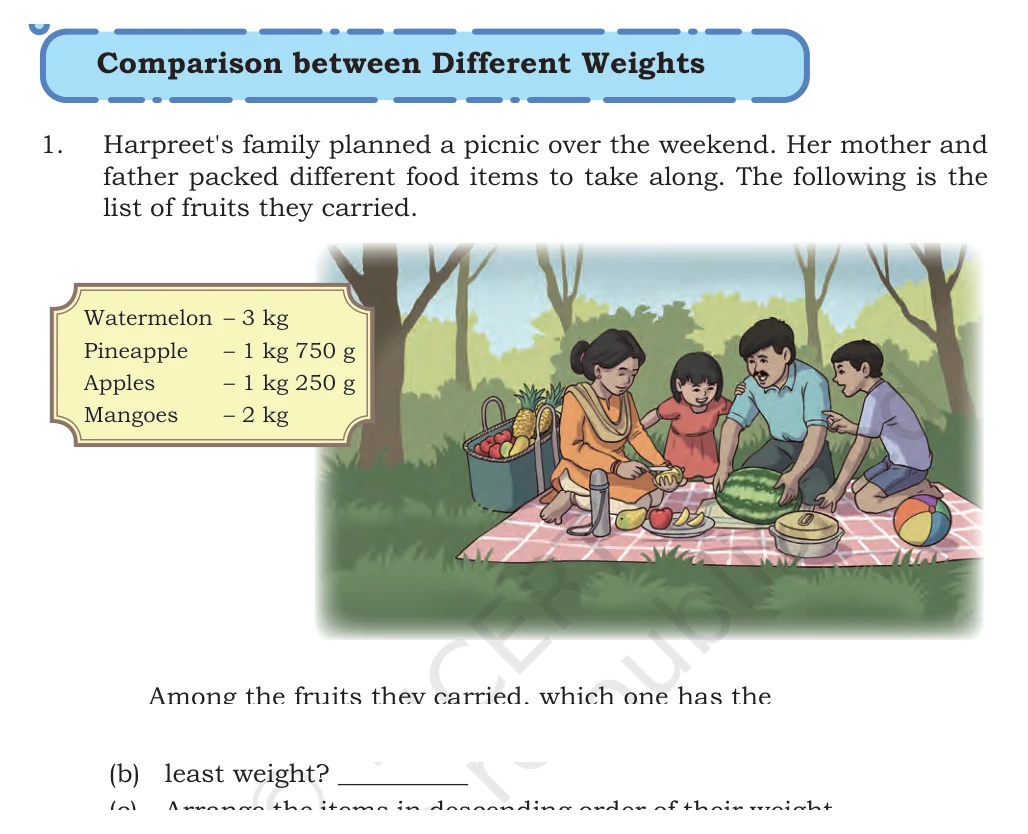
Which picnic fruit has the least weight?
Show detailed solution
- Step 1: Compare the two smallest weights: 1 kg 750 g and 1 kg 250 g.
- Step 2: Both have 1 kg, and 250 g is less than 750 g.
- Step 3: The 1 kg 250 g item is the apples.
- Answer: Apples.
Textbook page 107 · solved item 46
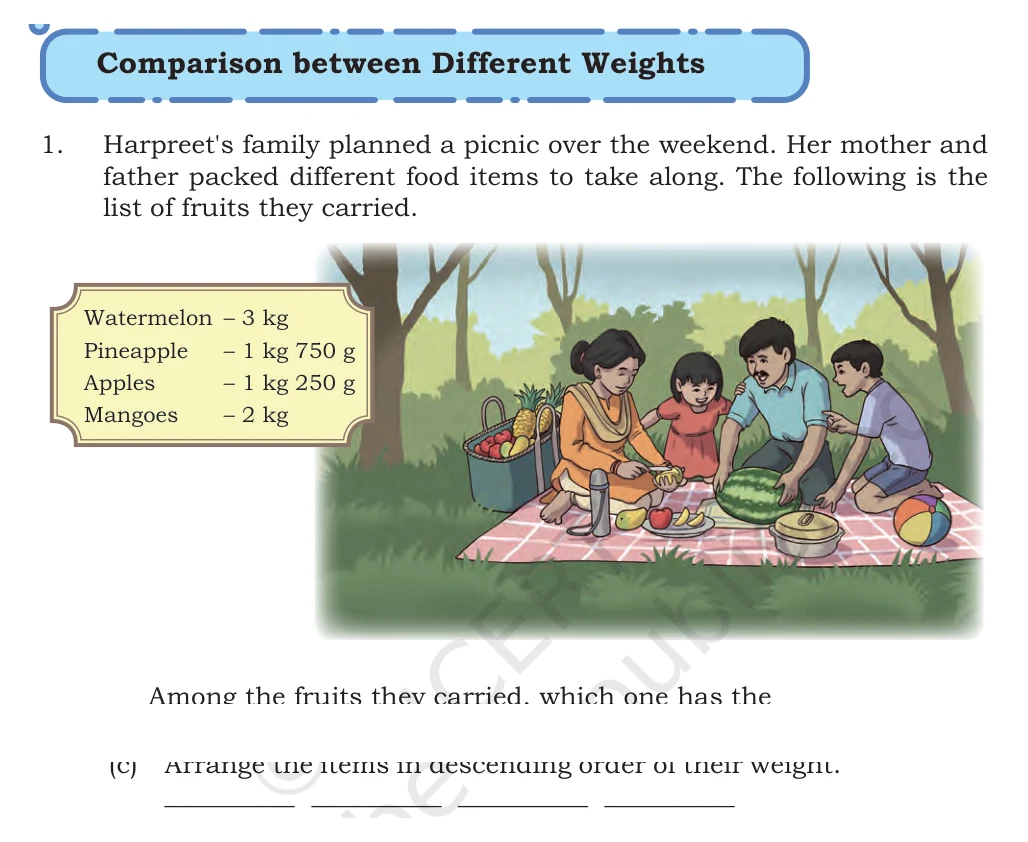
Arrange the four picnic fruits in descending order of weight.
Show detailed solution
- Step 1: Write the weights from greatest to least: 3 kg, 2 kg, 1 kg 750 g, 1 kg 250 g.
- Step 2: Match those weights to watermelon, mangoes, pineapple, and apples.
- Step 3: Check that every next weight is smaller than the previous one.
- Answer: Watermelon, mangoes, pineapple, apples.
Textbook page 107 · solved item 47
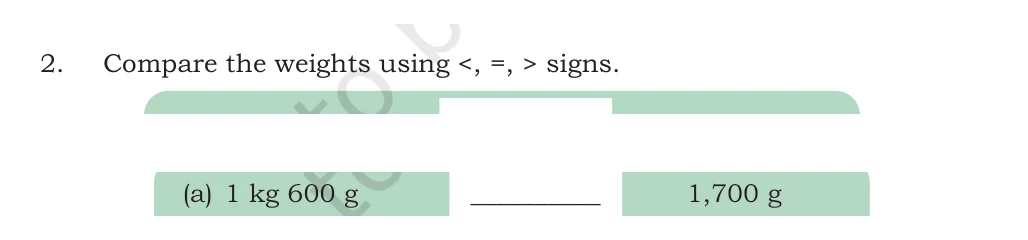
Compare 1 kg 600 g and 1,700 g using <, =, or >.
Show detailed solution
- Step 1: 1 kg 600 g is 1,600 g.
- Step 2: 1,600 g is less than 1,700 g.
- Step 3: Put the sign so its open side faces the greater quantity, or use = when they match.
- Answer: 1 kg 600 g < 1,700 g.
Textbook page 107 · solved item 48
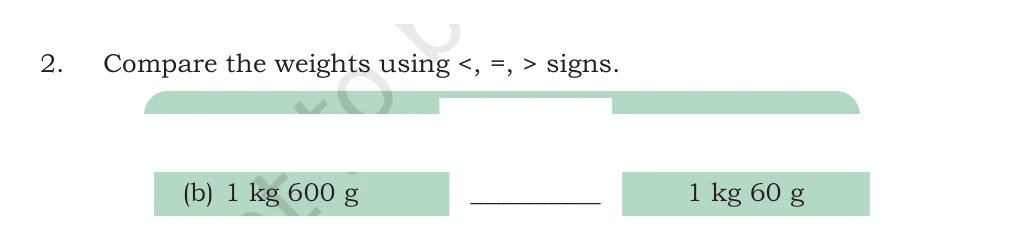
Compare 1 kg 600 g and 1 kg 60 g using <, =, or >.
Show detailed solution
- Step 1: The kilogram parts are equal.
- Step 2: 600 g is greater than 60 g.
- Step 3: Put the sign so its open side faces the greater quantity, or use = when they match.
- Answer: 1 kg 600 g > 1 kg 60 g.
Textbook page 107 · solved item 49
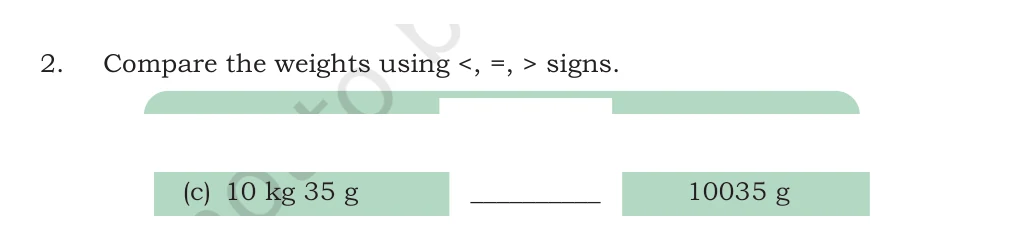
Compare 10 kg 35 g and 10,035 g using <, =, or >.
Show detailed solution
- Step 1: 10 kg is 10,000 g.
- Step 2: 10,000 g + 35 g is 10,035 g.
- Step 3: Put the sign so its open side faces the greater quantity, or use = when they match.
- Answer: 10 kg 35 g = 10,035 g.
Textbook page 107 · solved item 50
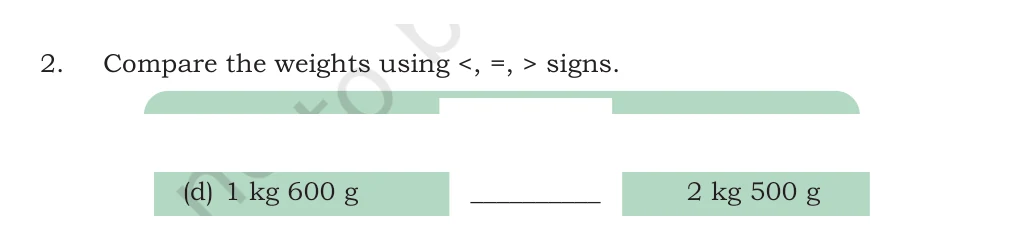
Compare 1 kg 600 g and 2 kg 500 g using <, =, or >.
Show detailed solution
- Step 1: The first quantity begins with 1 kg.
- Step 2: Any 1 kg amount here is less than 2 kg 500 g.
- Step 3: Put the sign so its open side faces the greater quantity, or use = when they match.
- Answer: 1 kg 600 g < 2 kg 500 g.
Textbook page 107 · solved item 51
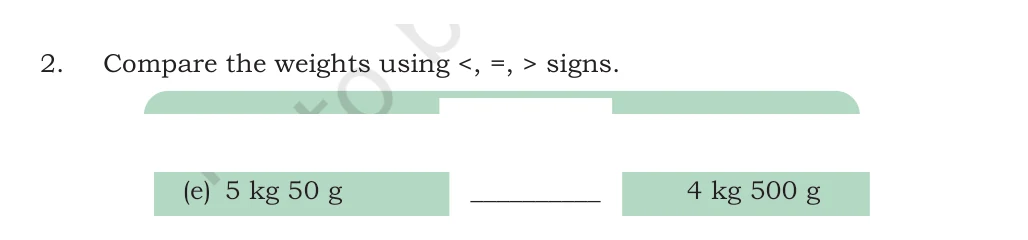
Compare 5 kg 50 g and 4 kg 500 g using <, =, or >.
Show detailed solution
- Step 1: The first quantity begins with 5 kg.
- Step 2: It is greater than a quantity beginning with 4 kg.
- Step 3: Put the sign so its open side faces the greater quantity, or use = when they match.
- Answer: 5 kg 50 g > 4 kg 500 g.
Textbook page 107 · solved item 52
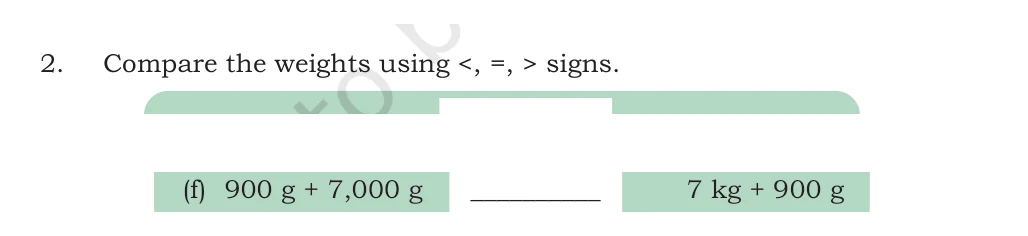
Compare 900 g + 7,000 g and 7 kg + 900 g using <, =, or >.
Show detailed solution
- Step 1: 900 g + 7,000 g is 7,900 g.
- Step 2: 7 kg + 900 g is also 7,900 g.
- Step 3: Put the sign so its open side faces the greater quantity, or use = when they match.
- Answer: 900 g + 7,000 g = 7 kg + 900 g.
Detailed worked answers
Textbook page 108
Textbook page 108 · solved item 53

A sugar sachet weighs 5 g. How many milligrams is that?
Show detailed solution
- Step 1: Use 1 g = 1,000 mg.
- Step 2: Five grams contain five groups of 1,000 mg.
- Step 3: 5\times1,000=5,000.
- Answer: The sachet weighs 5,000\text{ mg}.
Textbook page 108 · solved item 54
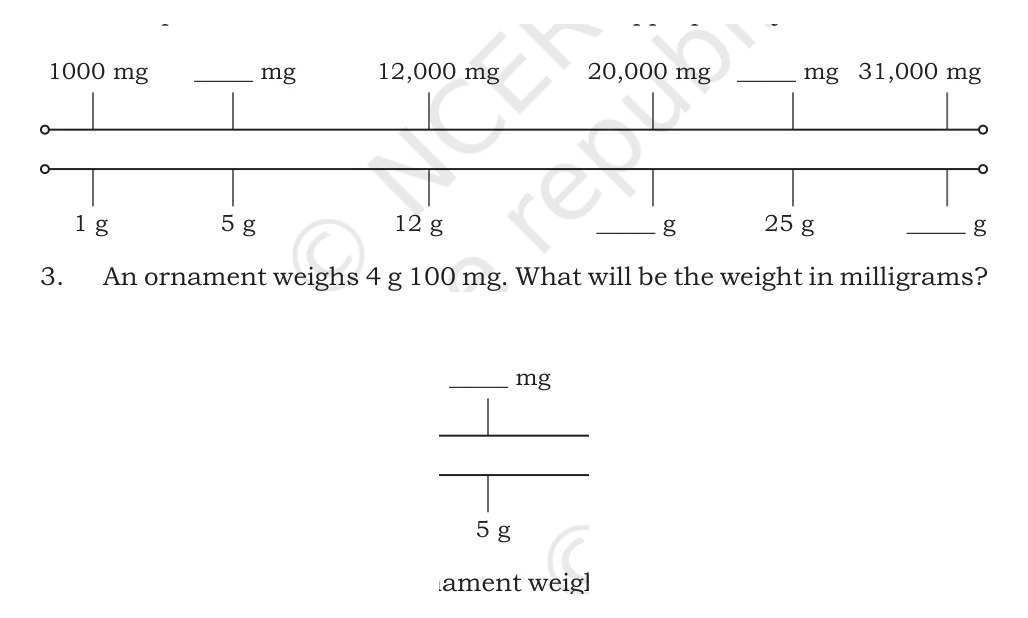
Complete the milligrams above 5 g.
Show detailed solution
- Step 1: Use 1 g = 1,000 mg.
- Step 2: Five groups of 1,000 mg make 5,000 mg.
- Step 3: Check that both labels sit at the same point on the double number line.
- Answer: 5,000 mg.
Textbook page 108 · solved item 55
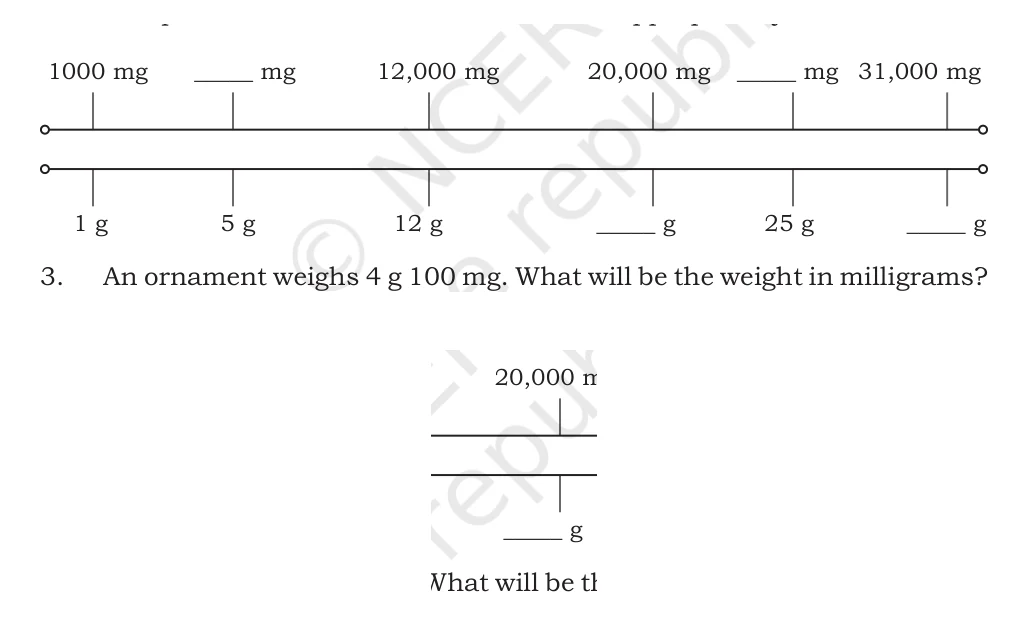
Complete the grams below 20,000 mg.
Show detailed solution
- Step 1: Use 1 g = 1,000 mg.
- Step 2: 20,000 mg contains twenty groups of 1,000 mg.
- Step 3: Check that both labels sit at the same point on the double number line.
- Answer: 20 g.
Textbook page 108 · solved item 56
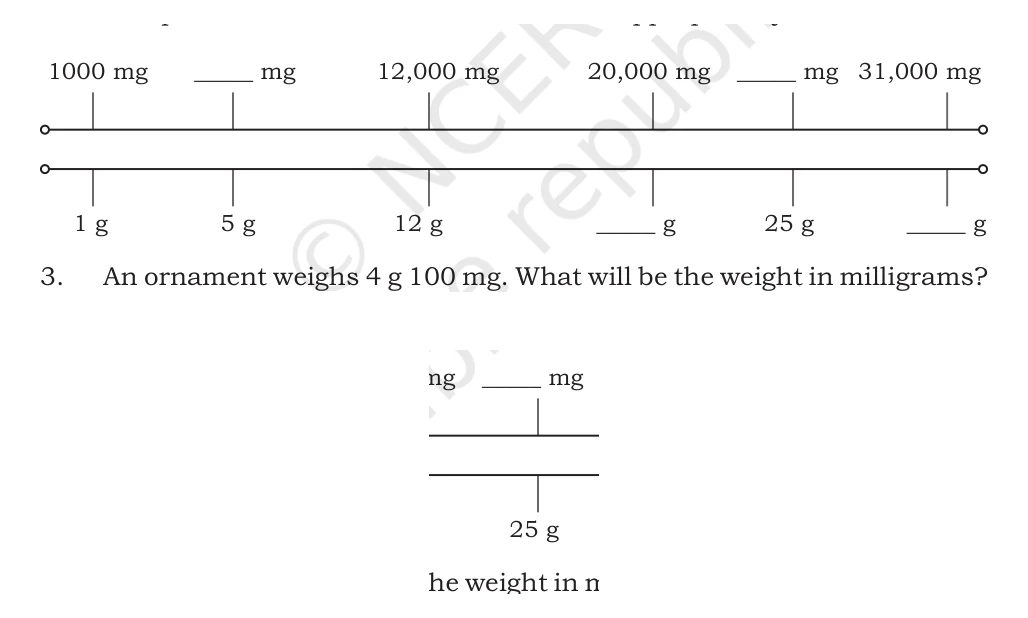
Complete the milligrams above 25 g.
Show detailed solution
- Step 1: Use 1 g = 1,000 mg.
- Step 2: Twenty-five groups of 1,000 mg make 25,000 mg.
- Step 3: Check that both labels sit at the same point on the double number line.
- Answer: 25,000 mg.
Textbook page 108 · solved item 57
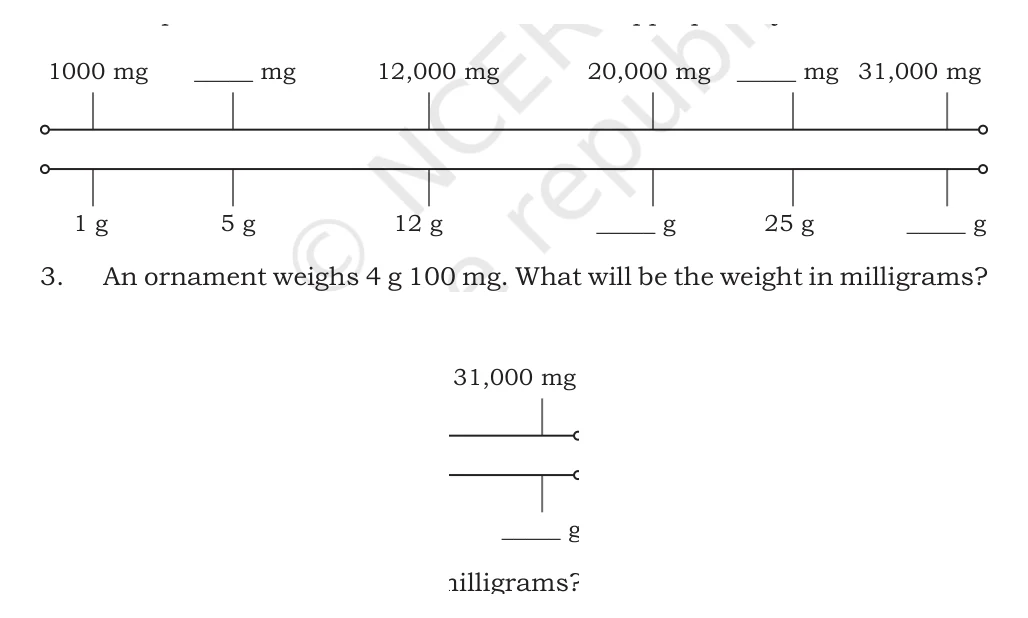
Complete the grams below 31,000 mg.
Show detailed solution
- Step 1: Use 1 g = 1,000 mg.
- Step 2: 31,000 mg contains thirty-one groups of 1,000 mg.
- Step 3: Check that both labels sit at the same point on the double number line.
- Answer: 31 g.
Textbook page 108 · solved item 58
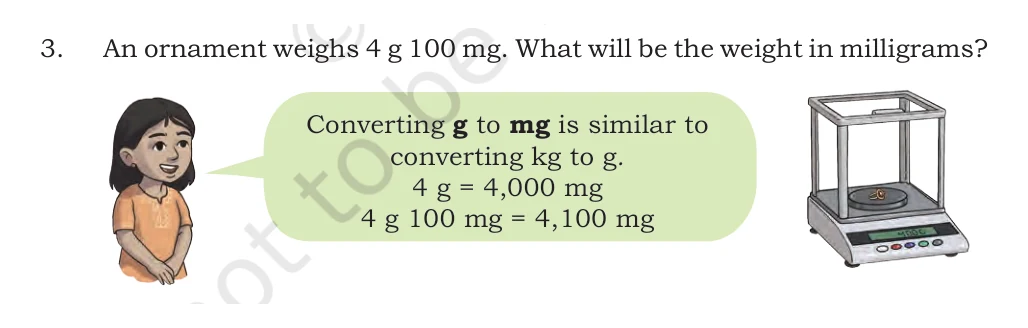
An ornament weighs 4 g 100 mg. What is its weight in milligrams?
Show detailed solution
- Step 1: Change 4 g to milligrams: 4\times1,000=4,000\text{ mg}.
- Step 2: Add the remaining 100 mg.
- Step 3: 4,000\text{ mg}+100\text{ mg}=4,100\text{ mg}.
- Answer: The ornament weighs 4,100\text{ mg}.
Textbook page 108 · solved item 59

An ornament weighs 10 g 500 mg. What is its weight in milligrams?
Show detailed solution
- Step 1: Change 10 g to milligrams: 10\times1,000=10,000\text{ mg}.
- Step 2: Add the remaining 500 mg.
- Step 3: 10,000\text{ mg}+500\text{ mg}=10,500\text{ mg}.
- Answer: The ornament weighs 10,500\text{ mg}.
Detailed worked answers
Textbook page 109
Textbook page 109 · solved item 60
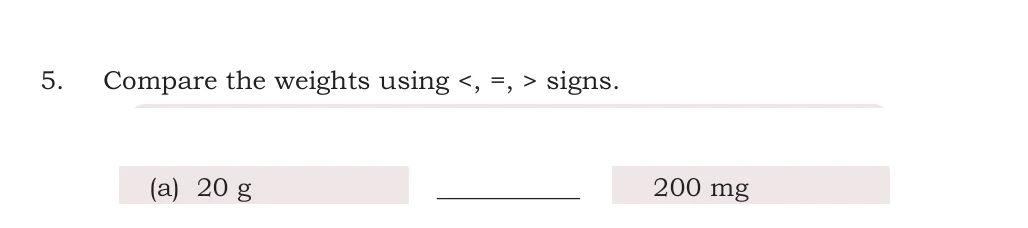
Compare 20 g and 200 mg using <, =, or >.
Show detailed solution
- Step 1: 20 g is 20,000 mg.
- Step 2: 20,000 mg is greater than 200 mg.
- Step 3: Choose the sign that matches the comparison.
- Answer: 20 g > 200 mg.
Textbook page 109 · solved item 61
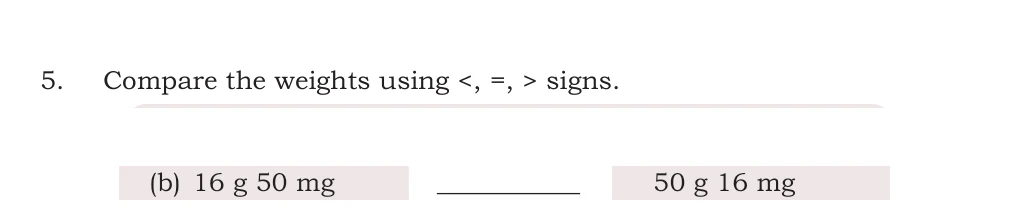
Compare 16 g 50 mg and 50 g 16 mg using <, =, or >.
Show detailed solution
- Step 1: The first quantity begins with 16 g.
- Step 2: 16 g is less than 50 g.
- Step 3: Choose the sign that matches the comparison.
- Answer: 16 g 50 mg < 50 g 16 mg.
Textbook page 109 · solved item 62
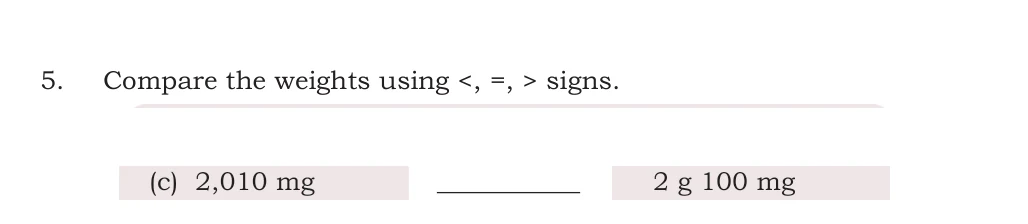
Compare 2,010 mg and 2 g 100 mg using <, =, or >.
Show detailed solution
- Step 1: 2 g 100 mg is 2,100 mg.
- Step 2: 2,010 mg is less than 2,100 mg.
- Step 3: Choose the sign that matches the comparison.
- Answer: 2,010 mg < 2 g 100 mg.
Textbook page 109 · solved item 63
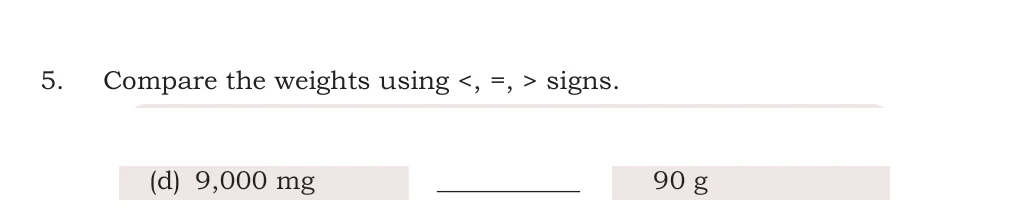
Compare 9,000 mg and 90 g using <, =, or >.
Show detailed solution
- Step 1: 90 g is 90,000 mg.
- Step 2: 9,000 mg is less than 90,000 mg.
- Step 3: Choose the sign that matches the comparison.
- Answer: 9,000 mg < 90 g.
Textbook page 109 · solved item 64
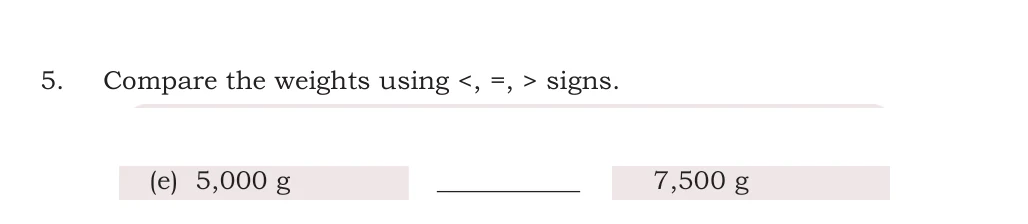
Compare 5,000 g and 7,500 g using <, =, or >.
Show detailed solution
- Step 1: Both are already in grams.
- Step 2: 5,000 is less than 7,500.
- Step 3: Choose the sign that matches the comparison.
- Answer: 5,000 g < 7,500 g.
Textbook page 109 · solved item 65
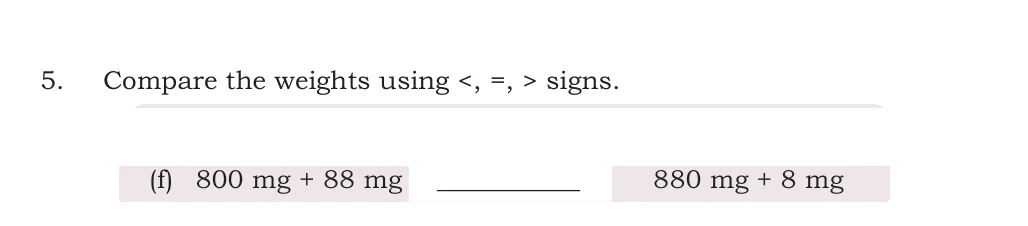
Compare 800 mg + 88 mg and 880 mg + 8 mg using <, =, or >.
Show detailed solution
- Step 1: The left side is 888 mg.
- Step 2: The right side is also 888 mg.
- Step 3: Choose the sign that matches the comparison.
- Answer: 800 mg + 88 mg = 880 mg + 8 mg.
Textbook page 109 · solved item 66
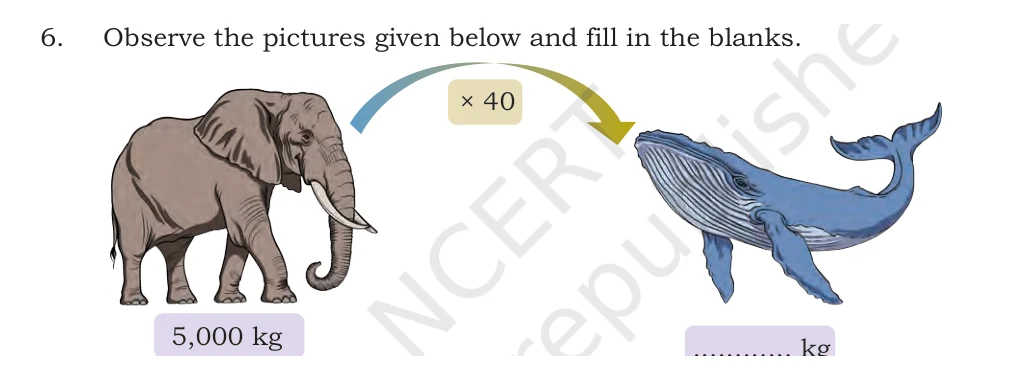
An elephant weighs 5,000 kg. A whale weighs 40 times as much. What is the whale's weight?
Show detailed solution
- Step 1: Multiply 5,000 kg by 40.
- Step 2: First calculate 5,000\times4=20,000.
- Step 3: Multiplying by 40 adds one more group of ten: 20,000\times10=200,000.
- Answer: The whale weighs 200,000\text{ kg}.
Textbook page 109 · solved item 67

Complete: 5,000 kg = ___ quintals = ___ tonne.
Show detailed solution
- Step 1: Use 100 kg = 1 quintal and 1,000 kg = 1 tonne.
- Step 2: Divide 5,000 by 100 to get 50 quintals.
- Step 3: Divide 5,000 by 1,000 to get 5 tonnes.
- Answer: 50 quintals = 5 tonnes.
Textbook page 109 · solved item 68

Complete: 9,000 kg = ___ quintals.
Show detailed solution
- Step 1: Use 100 kg = 1 quintal and 1,000 kg = 1 tonne.
- Step 2: One quintal is 100 kg.
- Step 3: 9,000 divided into groups of 100 gives 90 groups.
- Answer: 90 quintals.
Textbook page 109 · solved item 69

Complete: ___ kg = 8 tonnes.
Show detailed solution
- Step 1: Use 100 kg = 1 quintal and 1,000 kg = 1 tonne.
- Step 2: One tonne is 1,000 kg.
- Step 3: Eight tonnes contain eight groups of 1,000 kg.
- Answer: 8,000 kg.
Textbook page 109 · solved item 70
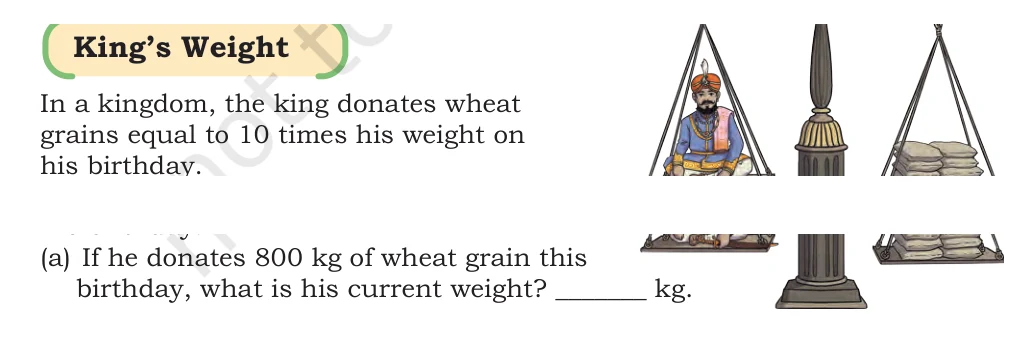
The king donates 800 kg, which is 10 times his current weight. What is his current weight?
Show detailed solution
- Step 1: The donation is 10 times the king's weight.
- Step 2: Split 800 kg into 10 equal groups.
- Step 3: 800 divided by 10 is 80.
- Answer: 80 kg.
Textbook page 109 · solved item 71
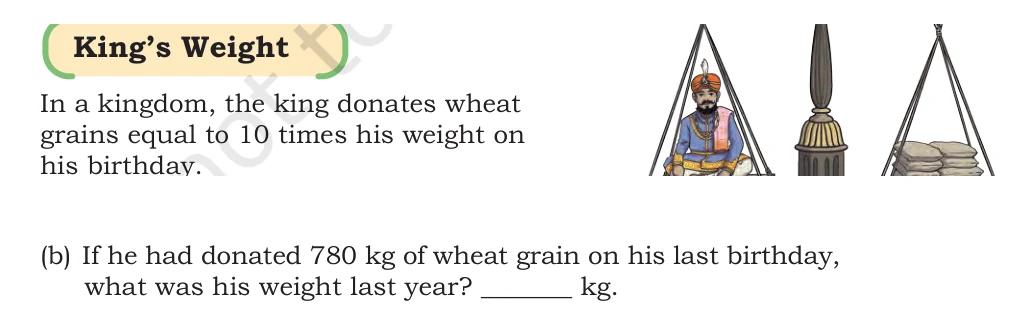
The king donated 780 kg last year, which was 10 times his weight. What was his weight last year?
Show detailed solution
- Step 1: The donation is 10 times the king's weight.
- Step 2: Split 780 kg into 10 equal groups.
- Step 3: 780 divided by 10 is 78.
- Answer: 78 kg.
Textbook page 109 · solved item 72
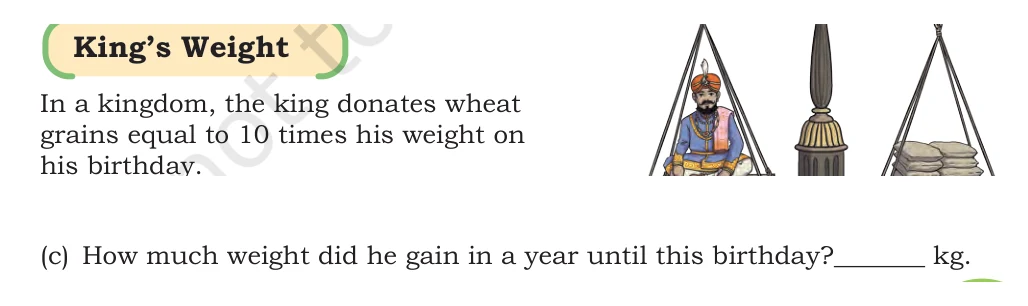
How much weight did the king gain from last year to this birthday?
Show detailed solution
- Step 1: The donation is 10 times the king's weight.
- Step 2: His current weight is 80 kg and last year's weight was 78 kg.
- Step 3: 80 kg - 78 kg = 2 kg.
- Answer: 2 kg.
Detailed worked answers
Textbook page 110
Textbook page 110 · solved item 73
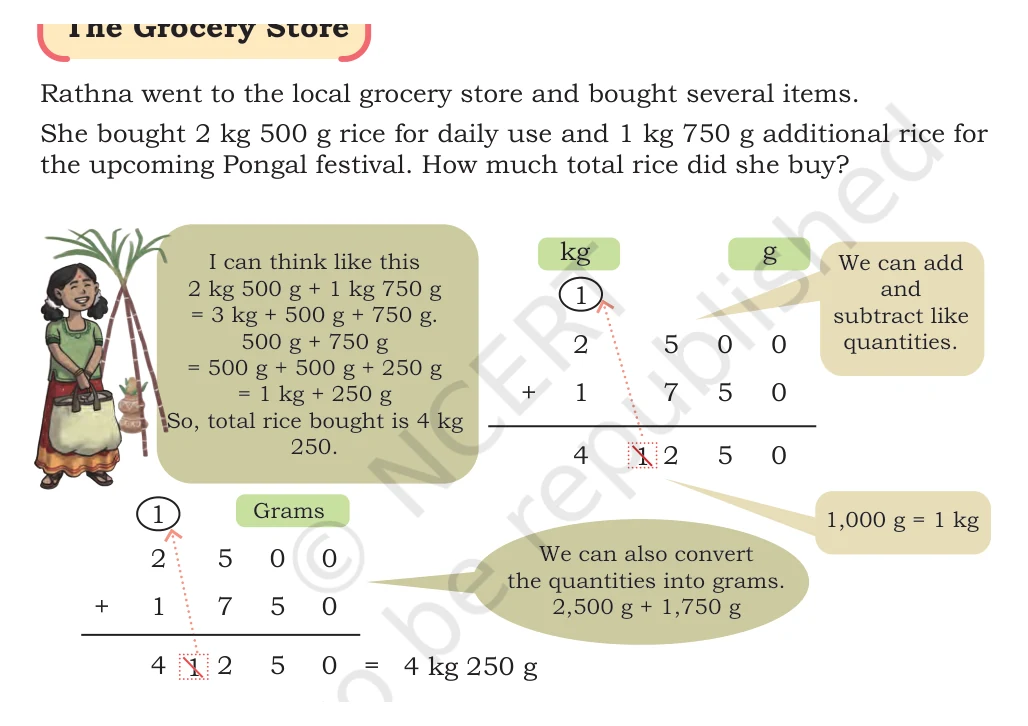
Rathna bought 2 kg 500 g rice for daily use and 1 kg 750 g for Pongal. How much rice did she buy altogether?
Show detailed solution
- Step 1: Add the kilograms: 2\text{ kg}+1\text{ kg}=3\text{ kg}.
- Step 2: Add the grams: 500\text{ g}+750\text{ g}=1,250\text{ g}=1\text{ kg }250\text{ g}.
- Step 3: Add the carried 1 kg to 3 kg: 3\text{ kg}+1\text{ kg }250\text{ g}=4\text{ kg }250\text{ g}.
- Answer: Rathna bought 4\text{ kg }250\text{ g} altogether.
Textbook page 110 · solved item 74
How much more rice did Rathna buy for household use than for the Pongal festival?
Show detailed solution
- Step 1: Subtract 1\text{ kg }750\text{ g} from 2\text{ kg }500\text{ g}.
- Step 2: Change 1 kg from the first amount into 1,000 g, giving 1\text{ kg }1,500\text{ g}.
- Step 3: 1,500\text{ g}-750\text{ g}=750\text{ g}, and 1\text{ kg}-1\text{ kg}=0\text{ kg}.
- Answer: She bought 750\text{ g} more for household use.
Detailed worked answers
Textbook page 111
Textbook page 111 · solved item 75

A restaurant uses 5 kg 200 g, 8 kg 900 g, and 12 kg 600 g of onions. Find the total.
Show detailed solution
- Step 1: Add kilograms: 5 + 8 + 12 = 25 kg.
- Step 2: Add grams: 200 + 900 + 600 = 1,700 g = 1 kg 700 g.
- Step 3: Add the carried kilogram: 25 kg + 1 kg 700 g = 26 kg 700 g.
- Answer: 26 kg 700 g.
Textbook page 111 · solved item 76

Two apple baskets weigh 2 kg 100 g and 3 kg 950 g. Find their total weight.
Show detailed solution
- Step 1: Add kilograms: 2 + 3 = 5 kg.
- Step 2: Add grams: 100 + 950 = 1,050 g = 1 kg 50 g.
- Step 3: Add the carried kilogram: 5 kg + 1 kg 50 g = 6 kg 50 g.
- Answer: 6 kg 50 g.
Textbook page 111 · solved item 77

A 10 kg sack has 4 kg 500 g of sand removed. How much sand is left?
Show detailed solution
- Step 1: Write 10 kg as 9 kg 1,000 g.
- Step 2: Subtract grams: 1,000 g - 500 g = 500 g.
- Step 3: Subtract kilograms: 9 kg - 4 kg = 5 kg.
- Answer: 5 kg 500 g.
Textbook page 111 · solved item 78

A rice sack changes from 9 kg 750 g to 3 kg 700 g. How much rice was used?
Show detailed solution
- Step 1: Subtract grams: 750 g - 700 g = 50 g.
- Step 2: Subtract kilograms: 9 kg - 3 kg = 6 kg.
- Step 3: Combine the two differences to get 6 kg 50 g.
- Answer: 6 kg 50 g.
Textbook page 111 · solved item 79

A truck delivered 17 kg 900 g in the morning and 12 kg 700 g in the afternoon. Find the total.
Show detailed solution
- Step 1: Add kilograms: 17 + 12 = 29 kg.
- Step 2: Add grams: 900 + 700 = 1,600 g = 1 kg 600 g.
- Step 3: Add the carried kilogram: 29 kg + 1 kg 600 g = 30 kg 600 g.
- Answer: 30 kg 600 g.
Textbook page 111 · solved item 80

A box changes from 14 kg 750 g to 10 kg 500 g after books are removed. What did the removed books weigh?
Show detailed solution
- Step 1: Subtract grams: 750 g - 500 g = 250 g.
- Step 2: Subtract kilograms: 14 kg - 10 kg = 4 kg.
- Step 3: Combine the differences to get 4 kg 250 g.
- Answer: 4 kg 250 g.
Textbook page 111 · solved item 81

A kitchen had 65 kg flour, used 42 kg 275 g, then bought 52 kg 500 g. How much flour is available now?
Show detailed solution
- Step 1: First subtract the used flour: 65 kg - 42 kg 275 g = 22 kg 725 g.
- Step 2: Then add the new flour: 22 kg 725 g + 52 kg 500 g.
- Step 3: The grams total 1,225 g = 1 kg 225 g, so the final total is 75 kg 225 g.
- Answer: 75 kg 225 g.
Detailed worked answers
Textbook page 112
Textbook page 112 · solved item 82
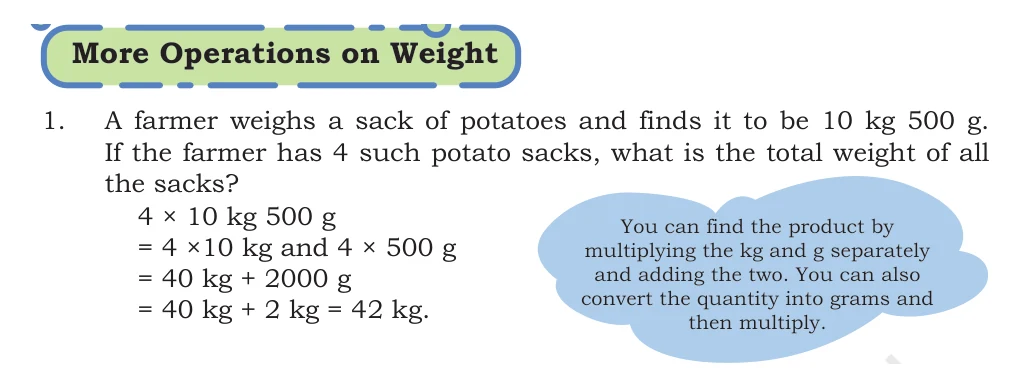
Four potato sacks each weigh 10 kg 500 g. What is their total weight?
Show detailed solution
- Step 1: Multiply the kilograms: 4\times10\text{ kg}=40\text{ kg}.
- Step 2: Multiply the grams: 4\times500\text{ g}=2,000\text{ g}=2\text{ kg}.
- Step 3: 40\text{ kg}+2\text{ kg}=42\text{ kg}.
- Answer: The four sacks weigh 42\text{ kg}.
Textbook page 112 · solved item 83
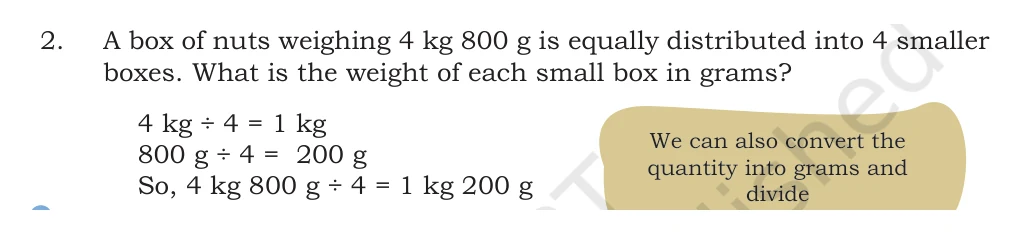
A 4 kg 800 g box of nuts is shared equally into 4 boxes. What is the weight of each small box in grams?
Show detailed solution
- Step 1: Change the full weight to grams: 4\text{ kg }800\text{ g}=4,800\text{ g}.
- Step 2: Divide 4,800 g into 4 equal groups.
- Step 3: 4,800\div4=1,200.
- Answer: Each small box weighs 1,200\text{ g}.
Textbook page 112 · solved item 84
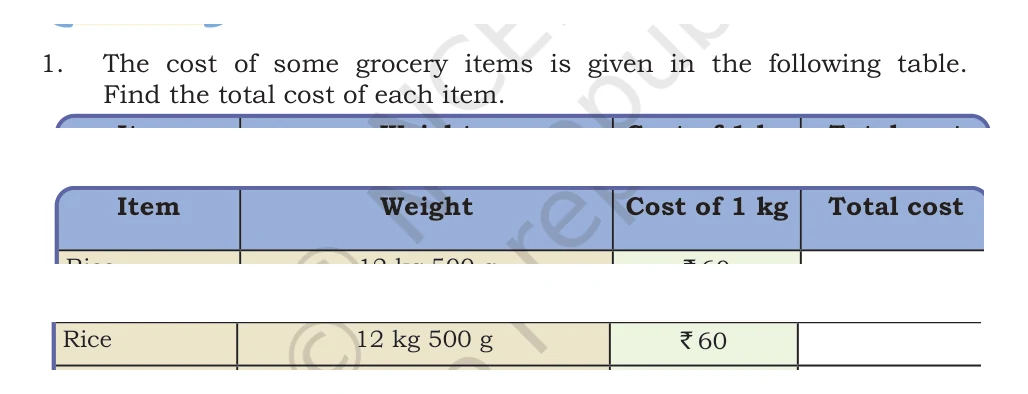
Find the total cost of 12 kg 500 g of rice when 1 kg costs Rs 60.
Show detailed solution
- Step 1: Find the cost of the whole kilograms.
- Step 2: 12 kg costs Rs 720 and 500 g costs half of Rs 60, which is Rs 30.
- Step 3: Add the whole-kilogram cost and the remaining-gram cost.
- Answer: The rice costs Rs 750.
Textbook page 112 · solved item 85
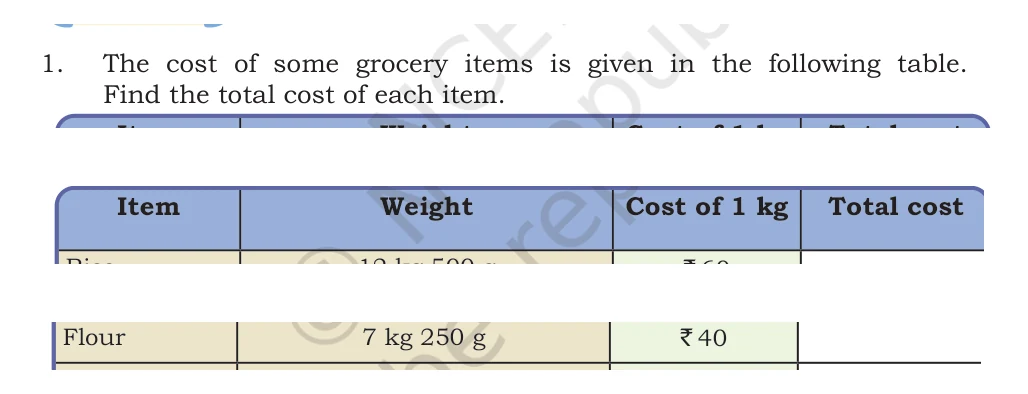
Find the total cost of 7 kg 250 g of flour when 1 kg costs Rs 40.
Show detailed solution
- Step 1: Find the cost of the whole kilograms.
- Step 2: 7 kg costs Rs 280 and 250 g is one-quarter of a kilogram, costing Rs 10.
- Step 3: Add the whole-kilogram cost and the remaining-gram cost.
- Answer: The flour costs Rs 290.
Textbook page 112 · solved item 86
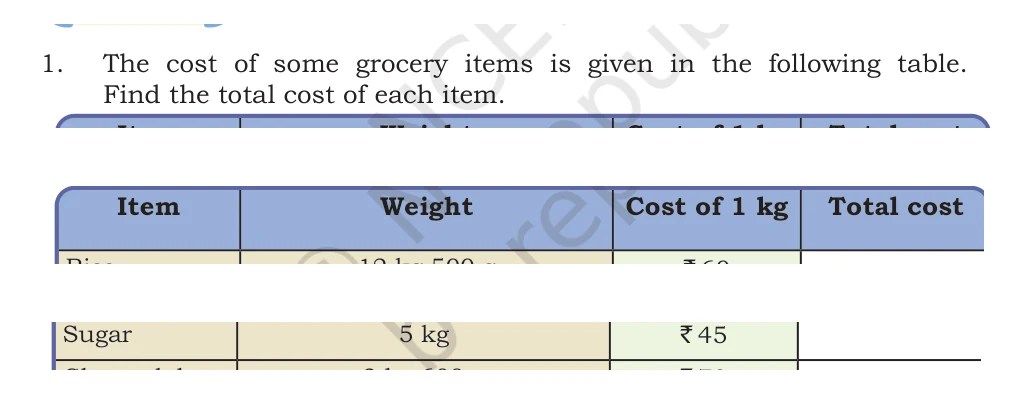
Find the total cost of 5 kg of sugar when 1 kg costs Rs 45.
Show detailed solution
- Step 1: Find the cost of the whole kilograms.
- Step 2: Five groups of Rs 45 total Rs 225.
- Step 3: Add the whole-kilogram cost and the remaining-gram cost.
- Answer: The sugar costs Rs 225.
Textbook page 112 · solved item 87
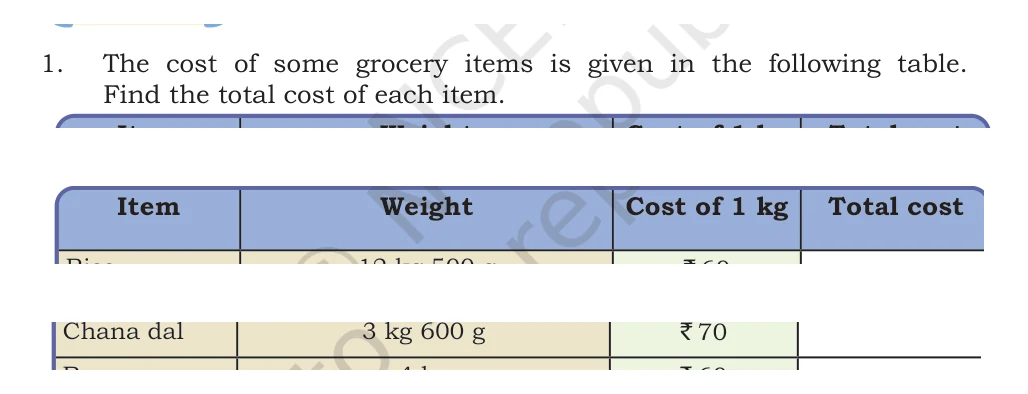
Find the total cost of 3 kg 600 g of chana dal when 1 kg costs Rs 70.
Show detailed solution
- Step 1: Find the cost of the whole kilograms.
- Step 2: 3 kg costs Rs 210 and 600 g costs six-tenths of Rs 70, which is Rs 42.
- Step 3: Add the whole-kilogram cost and the remaining-gram cost.
- Answer: The chana dal costs Rs 252.
Textbook page 112 · solved item 88
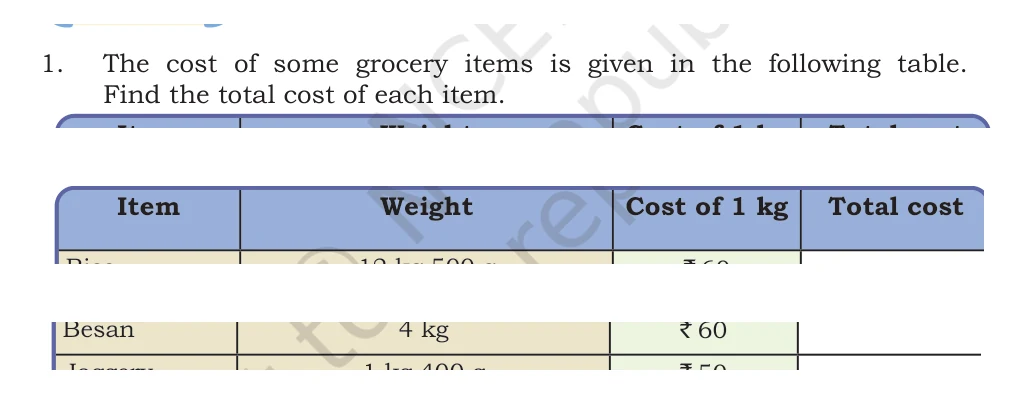
Find the total cost of 4 kg of besan when 1 kg costs Rs 60.
Show detailed solution
- Step 1: Find the cost of the whole kilograms.
- Step 2: Four groups of Rs 60 total Rs 240.
- Step 3: Add the whole-kilogram cost and the remaining-gram cost.
- Answer: The besan costs Rs 240.
Textbook page 112 · solved item 89
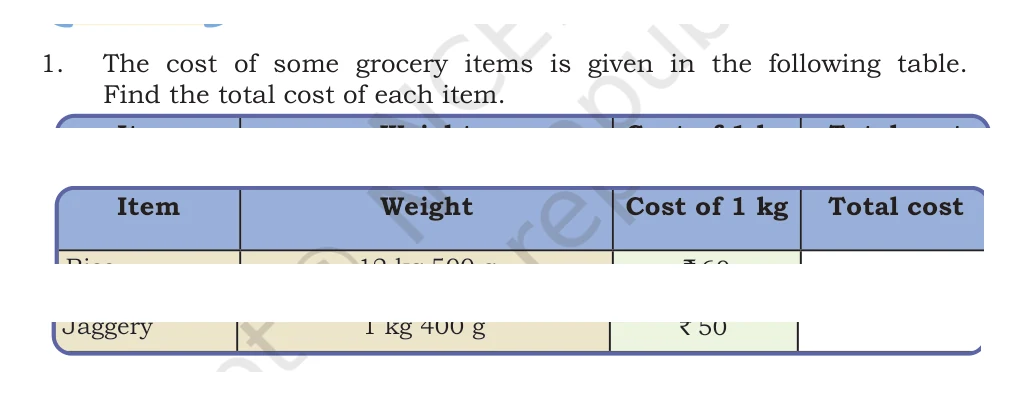
Find the total cost of 1 kg 400 g of jaggery when 1 kg costs Rs 50.
Show detailed solution
- Step 1: Find the cost of the whole kilograms.
- Step 2: 1 kg costs Rs 50 and 400 g costs four-tenths of Rs 50, which is Rs 20.
- Step 3: Add the whole-kilogram cost and the remaining-gram cost.
- Answer: The jaggery costs Rs 70.
Textbook page 112 · solved item 90
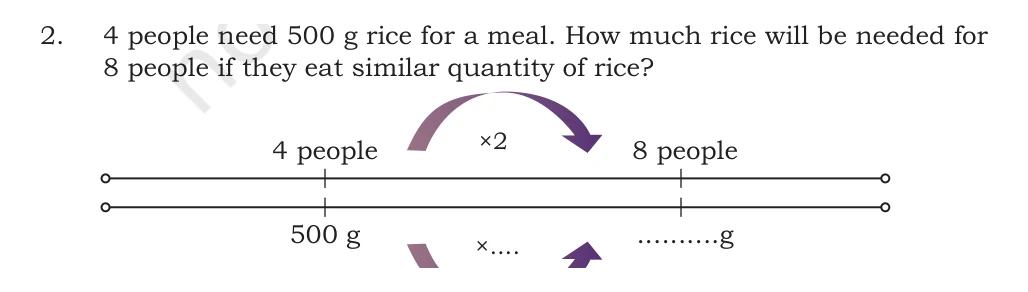
Four people need 500 g rice. How much rice will eight people need if everyone eats a similar amount?
Show detailed solution
- Step 1: Eight people are twice as many as four people.
- Step 2: Double the rice too: 500\text{ g}\times2=1,000\text{ g}.
- Step 3: The multiplier on both number lines is 2.
- Answer: Eight people need 1,000\text{ g}, or 1\text{ kg}, of rice.
Detailed worked answers
Textbook page 113
Textbook page 113 · solved item 91
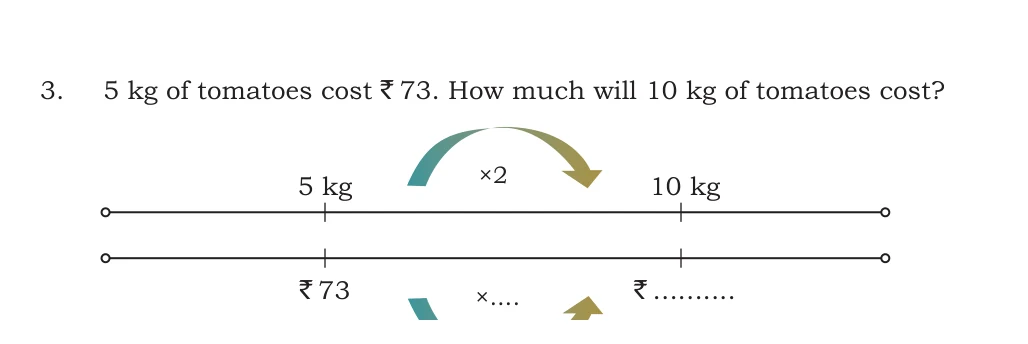
Five kilograms of tomatoes cost Rs 73. How much will 10 kg cost?
Show detailed solution
- Step 1: Ten kilograms is twice 5 kg.
- Step 2: Double the cost: 73+73=146.
- Step 3: The weight and cost both use the multiplier 2.
- Answer: Ten kilograms of tomatoes cost Rs 146.
Textbook page 113 · solved item 92
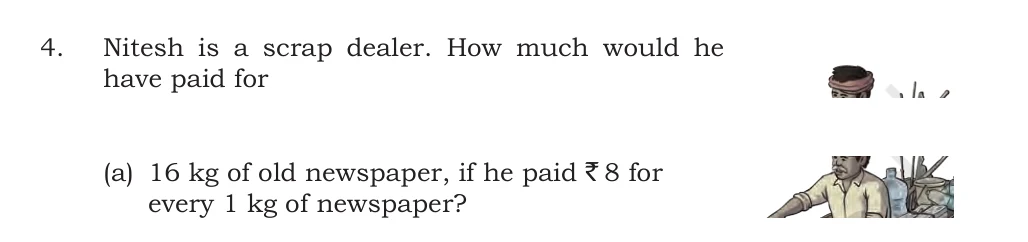
How much does Nitesh pay for 16 kg of newspaper at Rs 8 per kilogram?
Show detailed solution
- Step 1: Group the required weight using the weight named with the price.
- Step 2: There are sixteen 1 kg groups.
- Step 3: 16 times Rs 8 is Rs 128.
- Answer: Rs 128.
Textbook page 113 · solved item 93
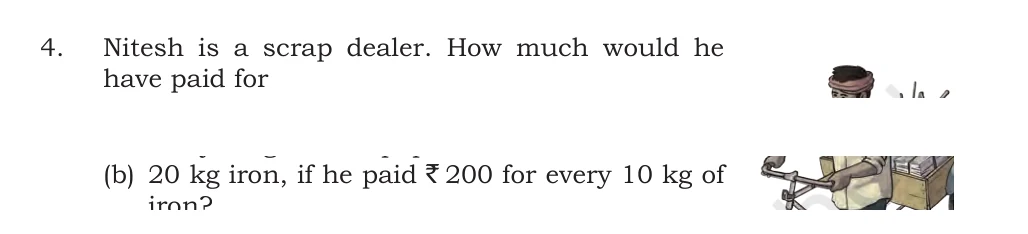
How much does Nitesh pay for 20 kg of iron at Rs 200 for every 10 kg?
Show detailed solution
- Step 1: Group the required weight using the weight named with the price.
- Step 2: Twenty kilograms contains two groups of 10 kg.
- Step 3: Two groups at Rs 200 each cost Rs 400.
- Answer: Rs 400.
Textbook page 113 · solved item 94
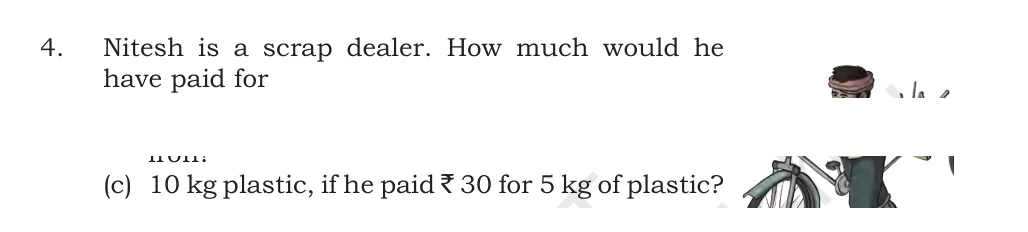
How much does Nitesh pay for 10 kg of plastic at Rs 30 for every 5 kg?
Show detailed solution
- Step 1: Group the required weight using the weight named with the price.
- Step 2: Ten kilograms contains two groups of 5 kg.
- Step 3: Two groups at Rs 30 each cost Rs 60.
- Answer: Rs 60.
Textbook page 113 · solved item 95
Estimate how much water and milk may be used to make two cups of tea.
Show detailed solution
- Step 1: Two ordinary cups together hold roughly 400 to 500 ml.
- Step 2: A recipe can divide that amount between water and milk.
- Step 3: The exact amounts can change with cup size and taste, so a sensible estimate is accepted.
- Answer: About 250 ml water and 250 ml milk is one reasonable estimate.
Textbook page 113 · solved item 96
Do we need 1 l of water to make two cups of tea?
Show detailed solution
- Step 1: One litre is 1,000 ml.
- Step 2: Two ordinary cups hold much less than 1,000 ml.
- Step 3: Using a full litre of water would make far more than two cups.
- Answer: No.
Textbook page 113 · solved item 97
Is 500 ml of water enough for two cups of tea?
Show detailed solution
- Step 1: Two ordinary cups together are usually no more than about 500 ml.
- Step 2: Five hundred millilitres can fill that total amount even before allowing for milk.
- Step 3: So it is a reasonable upper estimate for the water needed.
- Answer: Yes.
Textbook page 113 · solved item 98

A bucket can hold a maximum of 20 ml of water. Is this correct, and which unit should be used?
Show detailed solution
- Step 1: Twenty millilitres is only about four teaspoons of water.
- Step 2: A bucket holds a much larger amount.
- Step 3: Large container capacities are measured in litres.
- Answer: The statement is not correct; it should say about 20\text{ l}, not 20\text{ ml}.
Textbook page 113 · solved item 99
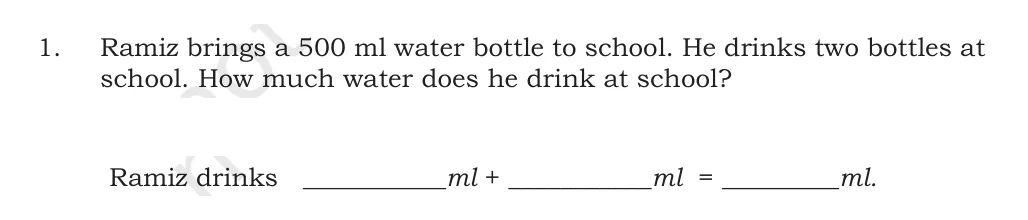
Complete Ramiz's millilitre statement after he drinks two 500 ml bottles.
Show detailed solution
- Step 1: Each bottle contains 500 ml.
- Step 2: Add the two bottles: 500\text{ ml}+500\text{ ml}=1,000\text{ ml}.
- Step 3: Write 500, 500, and 1,000 in the three blanks.
- Answer: 500\text{ ml}+500\text{ ml}=1,000\text{ ml}.
Textbook page 113 · solved item 100
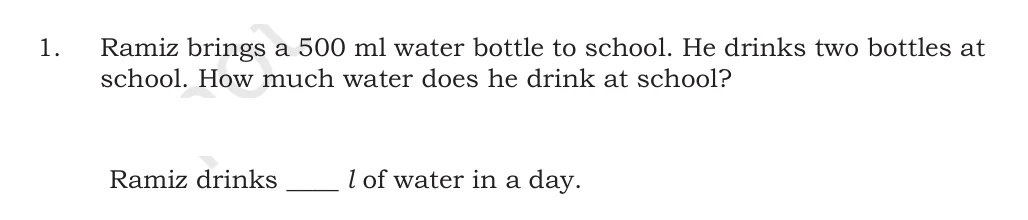
Complete Ramiz's water amount in litres.
Show detailed solution
- Step 1: Ramiz drinks 1,000 ml.
- Step 2: Use 1,000 ml = 1 l.
- Step 3: Replace 1,000 ml with its equal litre amount.
- Answer: Ramiz drinks 1\text{ l} of water.
Textbook page 113 · solved item 101

How many 500 ml bottlefuls make Muskaan's 3 l of water?
Show detailed solution
- Step 1: Change 3 l to millilitres: 3\text{ l}=3,000\text{ ml}.
- Step 2: Count groups of 500 ml in 3,000 ml.
- Step 3: 3,000\div500=6.
- Answer: She needs 6 bottlefuls in all, which means 5 refills after the bottle is first filled.
Textbook page 113 · solved item 102
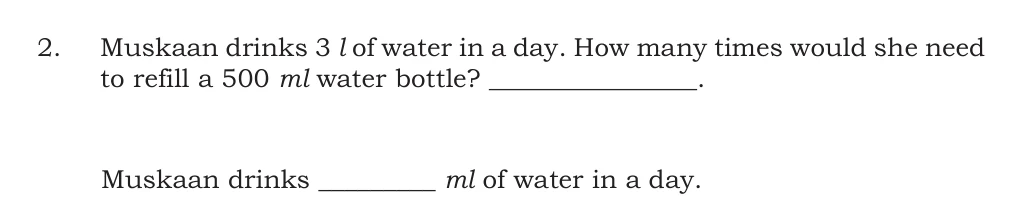
Complete Muskaan's daily water amount in millilitres.
Show detailed solution
- Step 1: Use 1 l = 1,000 ml.
- Step 2: Multiply 1,000 ml by 3.
- Step 3: 1,000\times3=3,000.
- Answer: Muskaan drinks 3,000\text{ ml} in a day.
Detailed worked answers
Textbook page 114
Textbook page 114 · solved item 103
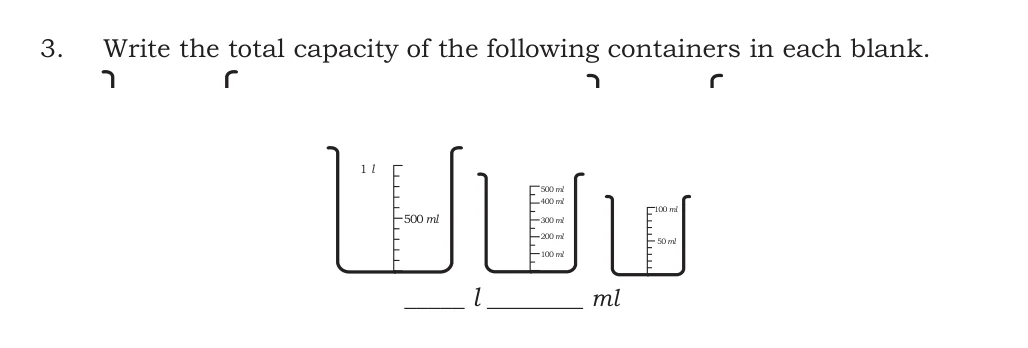
Find the total capacity of the top-left group of containers.
Show detailed solution
- Step 1: The containers are marked 1 l, 500 ml, and 100 ml.
- Step 2: Add the millilitres: 500 ml + 100 ml = 600 ml.
- Step 3: Keep the separate 1 l.
- Answer: 1 l 600 ml.
Textbook page 114 · solved item 104
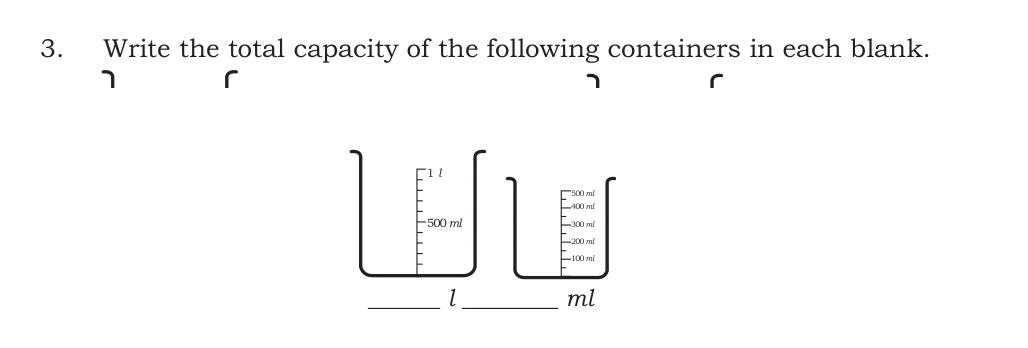
Find the total capacity of the top-right group of containers.
Show detailed solution
- Step 1: The containers are marked 1 l and 500 ml.
- Step 2: The millilitre amount is already less than 1,000 ml.
- Step 3: Combine them as 1 l 500 ml.
- Answer: 1 l 500 ml.
Textbook page 114 · solved item 105
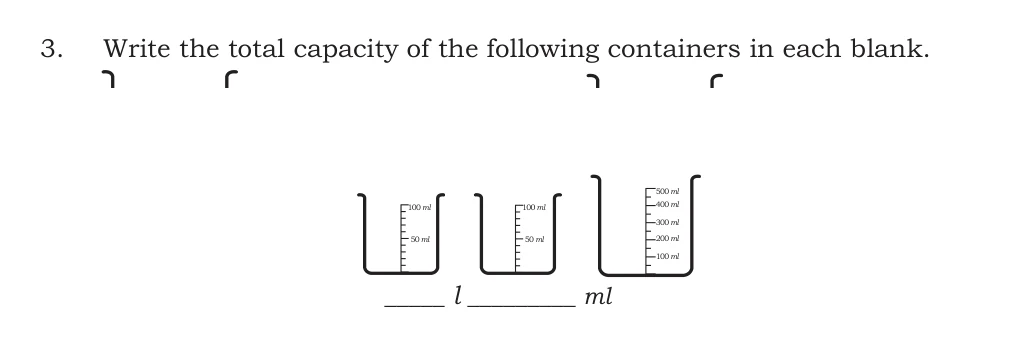
Find the total capacity of the bottom-left group of containers.
Show detailed solution
- Step 1: The containers are marked 100 ml, 100 ml, and 500 ml.
- Step 2: Add: 100 ml + 100 ml + 500 ml = 700 ml.
- Step 3: Because the total is less than 1,000 ml, it is 0 l 700 ml.
- Answer: 700 ml.
Textbook page 114 · solved item 106
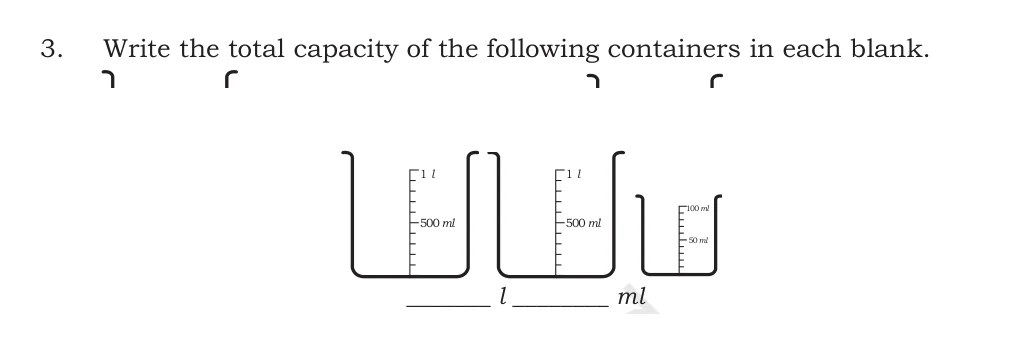
Find the total capacity of the bottom-right group of containers.
Show detailed solution
- Step 1: The containers are marked 1 l, 1 l, and 100 ml.
- Step 2: The two litre containers total 2 l.
- Step 3: Add the remaining 100 ml.
- Answer: 2 l 100 ml.
Textbook page 114 · solved item 107
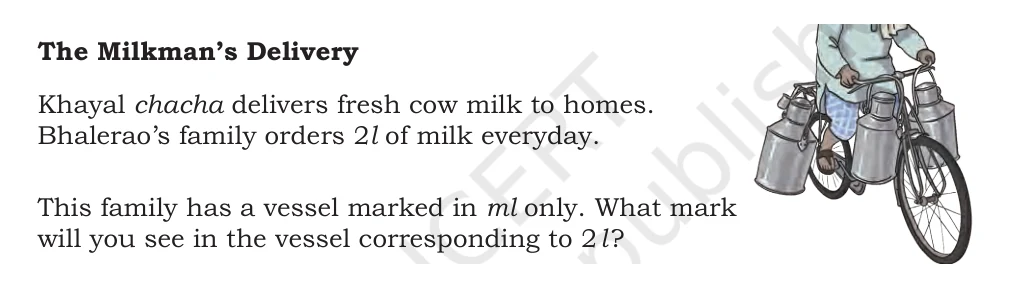
What millilitre mark corresponds to the 2 l of milk ordered by Bhalerao's family?
Show detailed solution
- Step 1: Use 1 l = 1,000 ml.
- Step 2: Two litres contain two groups of 1,000 ml.
- Step 3: 2\times1,000=2,000.
- Answer: The vessel should show the 2,000\text{ ml} mark.
Textbook page 114 · solved item 108
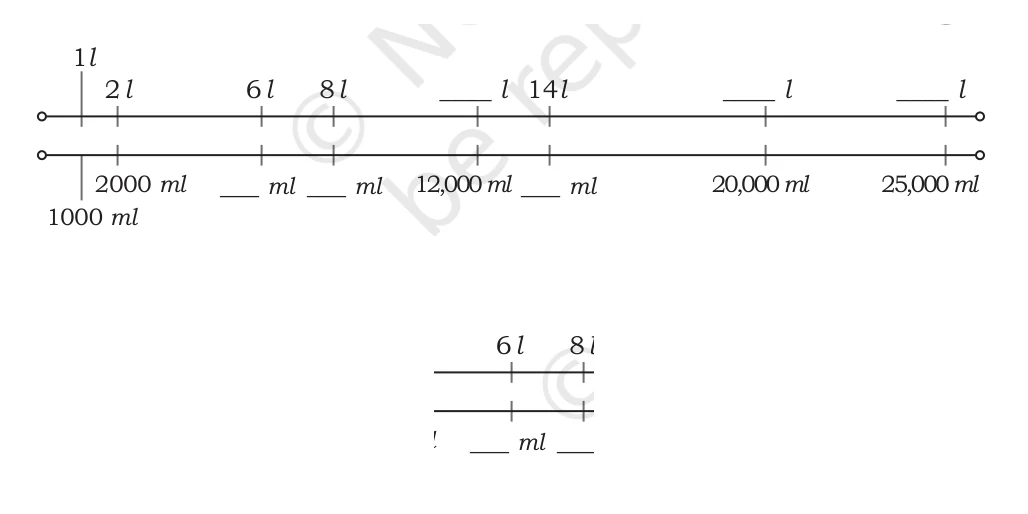
Complete the millilitres below 6 l.
Show detailed solution
- Step 1: Use 1 l = 1,000 ml.
- Step 2: Six groups of 1,000 ml make 6,000 ml.
- Step 3: Check that the litre and millilitre labels share the same number-line mark.
- Answer: 6,000 ml.
Textbook page 114 · solved item 109
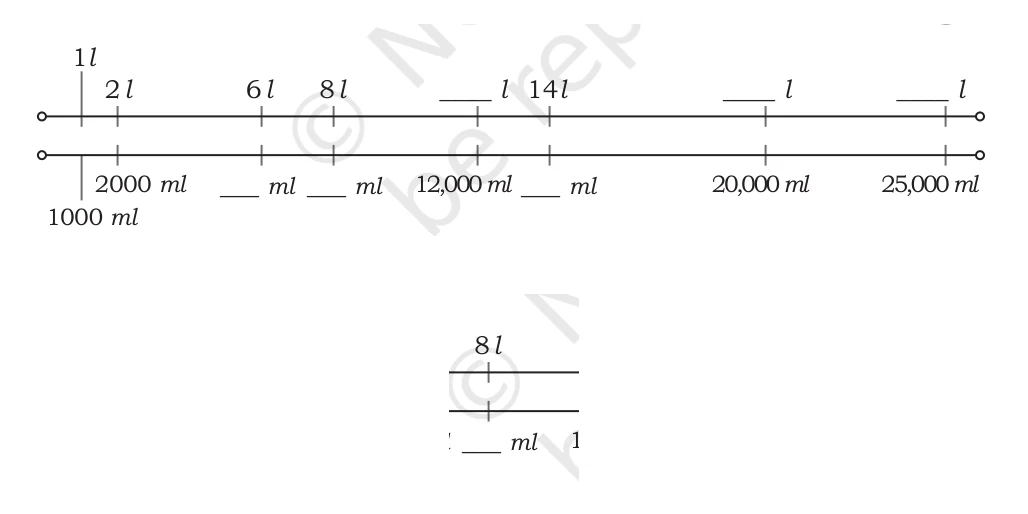
Complete the millilitres below 8 l.
Show detailed solution
- Step 1: Use 1 l = 1,000 ml.
- Step 2: Eight groups of 1,000 ml make 8,000 ml.
- Step 3: Check that the litre and millilitre labels share the same number-line mark.
- Answer: 8,000 ml.
Textbook page 114 · solved item 110
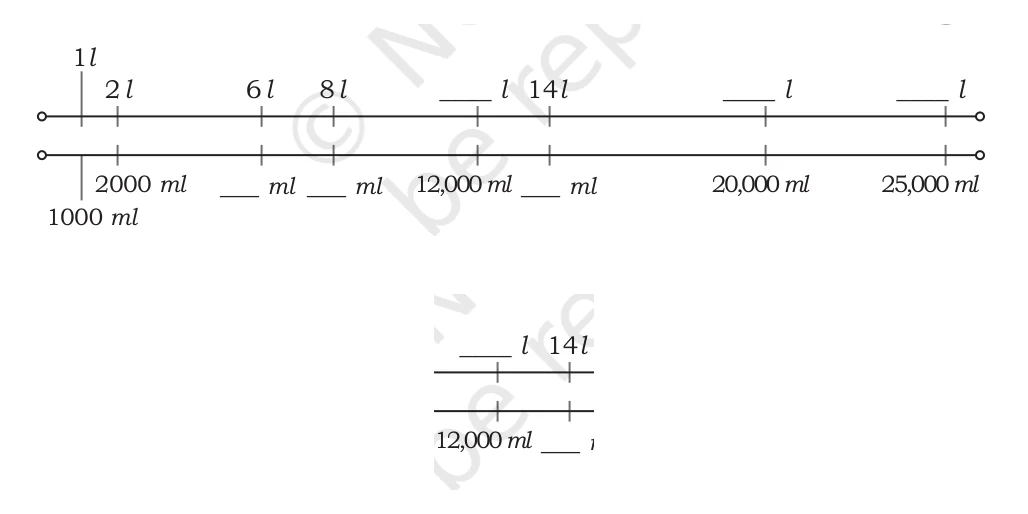
Complete the litres above 12,000 ml.
Show detailed solution
- Step 1: Use 1 l = 1,000 ml.
- Step 2: 12,000 ml contains twelve groups of 1,000 ml.
- Step 3: Check that the litre and millilitre labels share the same number-line mark.
- Answer: 12 l.
Textbook page 114 · solved item 111
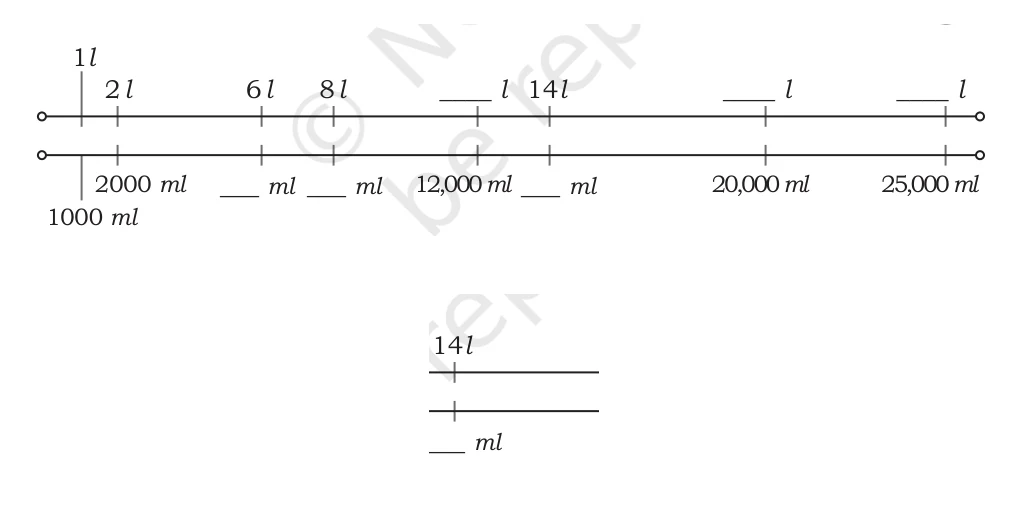
Complete the millilitres below 14 l.
Show detailed solution
- Step 1: Use 1 l = 1,000 ml.
- Step 2: Fourteen groups of 1,000 ml make 14,000 ml.
- Step 3: Check that the litre and millilitre labels share the same number-line mark.
- Answer: 14,000 ml.
Textbook page 114 · solved item 112
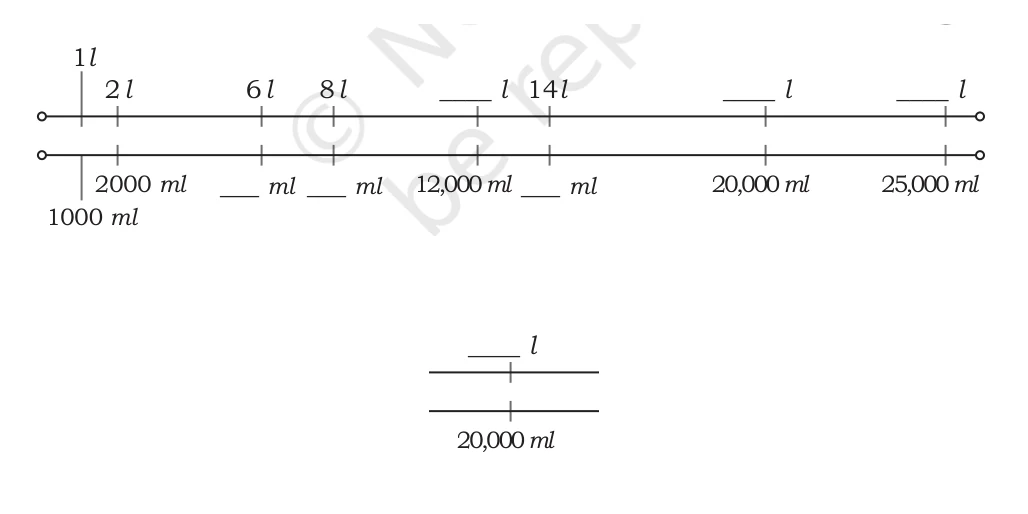
Complete the litres above 20,000 ml.
Show detailed solution
- Step 1: Use 1 l = 1,000 ml.
- Step 2: 20,000 ml contains twenty groups of 1,000 ml.
- Step 3: Check that the litre and millilitre labels share the same number-line mark.
- Answer: 20 l.
Textbook page 114 · solved item 113
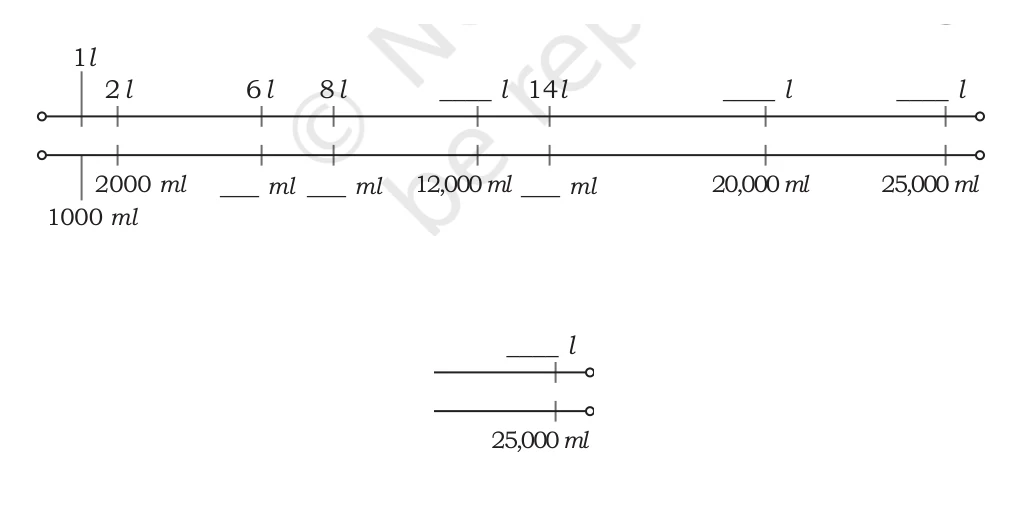
Complete the litres above 25,000 ml.
Show detailed solution
- Step 1: Use 1 l = 1,000 ml.
- Step 2: 25,000 ml contains twenty-five groups of 1,000 ml.
- Step 3: Check that the litre and millilitre labels share the same number-line mark.
- Answer: 25 l.
Textbook page 114 · solved item 114
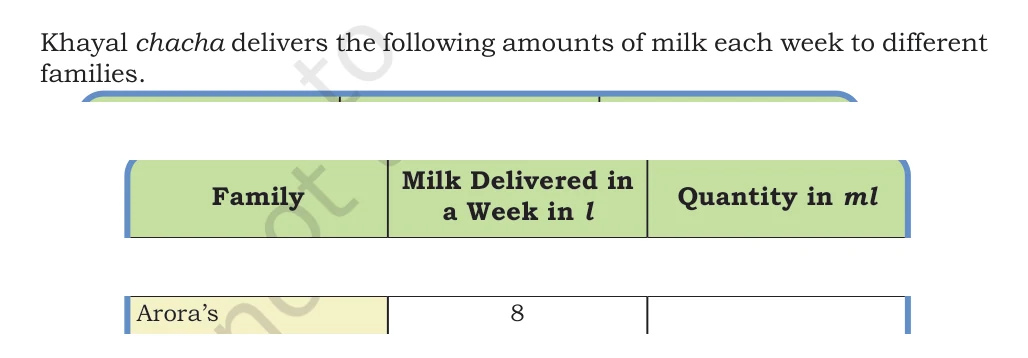
Arora's family receives 8 l. Complete the millilitre entry.
Show detailed solution
- Step 1: Use 1 l = 1,000 ml.
- Step 2: Eight litres contain eight groups of 1,000 ml.
- Step 3: Write the equal quantity in the empty table cell.
- Answer: 8,000 ml.
Textbook page 114 · solved item 115
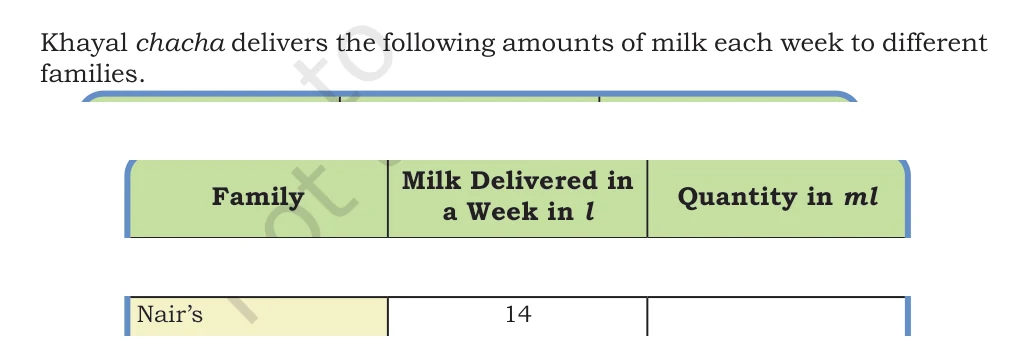
Nair's family receives 14 l. Complete the millilitre entry.
Show detailed solution
- Step 1: Use 1 l = 1,000 ml.
- Step 2: Fourteen litres contain fourteen groups of 1,000 ml.
- Step 3: Write the equal quantity in the empty table cell.
- Answer: 14,000 ml.
Textbook page 114 · solved item 116
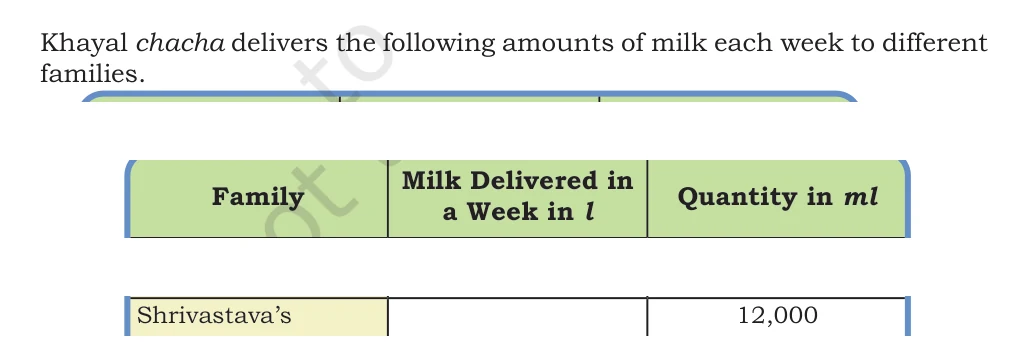
Shrivastava's family receives 12,000 ml. Complete the litre entry.
Show detailed solution
- Step 1: Use 1 l = 1,000 ml.
- Step 2: 12,000 ml contains twelve groups of 1,000 ml.
- Step 3: Write the equal quantity in the empty table cell.
- Answer: 12 l.
Textbook page 114 · solved item 117
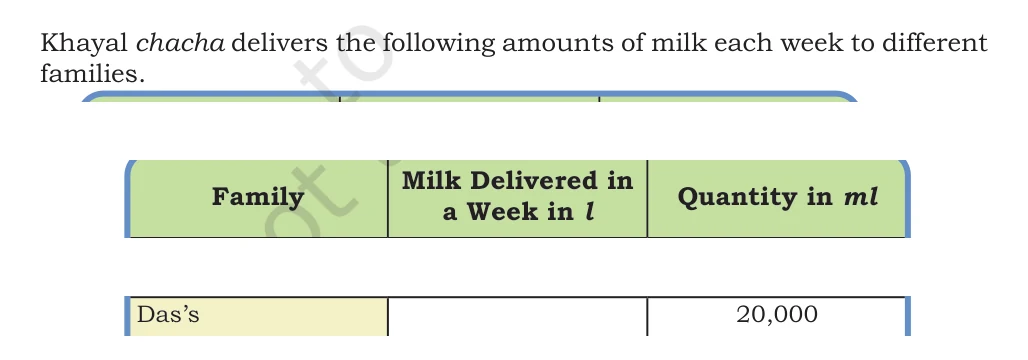
Das's family receives 20,000 ml. Complete the litre entry.
Show detailed solution
- Step 1: Use 1 l = 1,000 ml.
- Step 2: 20,000 ml contains twenty groups of 1,000 ml.
- Step 3: Write the equal quantity in the empty table cell.
- Answer: 20 l.
Textbook page 114 · solved item 118
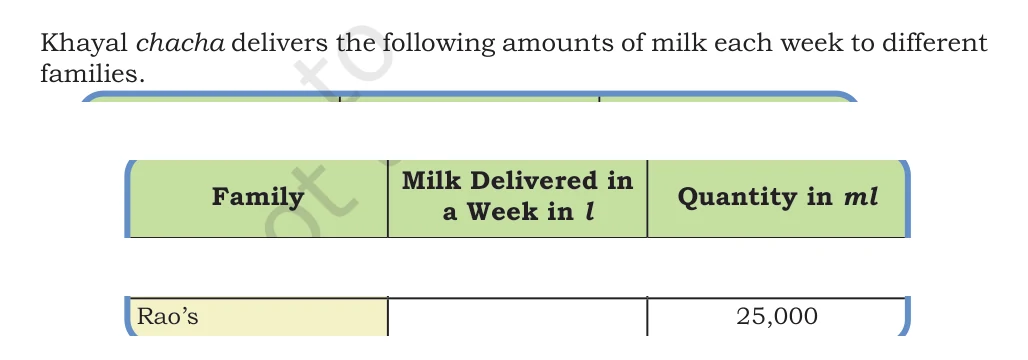
Rao's family receives 25,000 ml. Complete the litre entry.
Show detailed solution
- Step 1: Use 1 l = 1,000 ml.
- Step 2: 25,000 ml contains twenty-five groups of 1,000 ml.
- Step 3: Write the equal quantity in the empty table cell.
- Answer: 25 l.
Detailed worked answers
Textbook page 115
Textbook page 115 · solved item 119
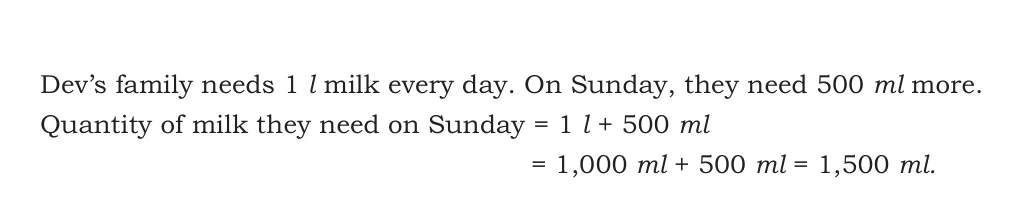
Dev's family needs 1 l of milk plus 500 ml on Sunday. How much is that in millilitres?
Show detailed solution
- Step 1: Change 1 l to 1,000 ml.
- Step 2: Add the extra 500 ml.
- Step 3: 1,000\text{ ml}+500\text{ ml}=1,500\text{ ml}.
- Answer: They need 1,500\text{ ml} on Sunday.
Textbook page 115 · solved item 120
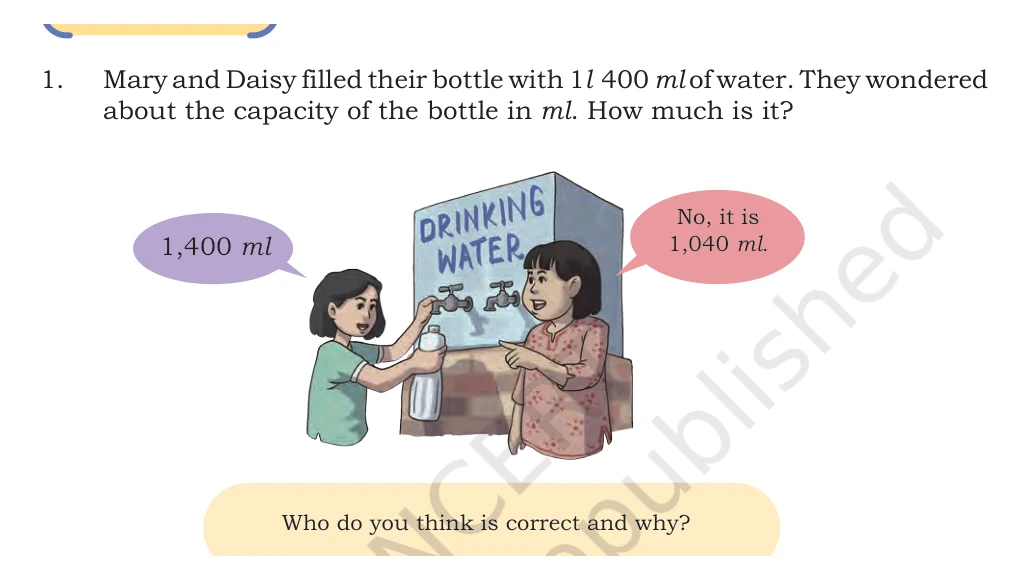
Mary says 1 l 400 ml equals 1,400 ml, while Daisy says 1,040 ml. Who is correct and why?
Show detailed solution
- Step 1: Change 1 l to 1,000 ml.
- Step 2: Add the remaining 400 ml: 1,000+400=1,400.
- Step 3: Daisy treated 400 ml as though it were only 40 ml.
- Answer: Mary is correct; the bottle holds 1,400\text{ ml}.
Textbook page 115 · solved item 121
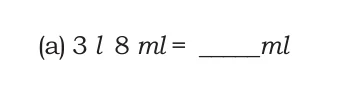
Convert 3 l 8 ml to millilitres.
Show detailed solution
- Step 1: Use 1 l = 1,000 ml.
- Step 2: 3 l is 3,000 ml.
- Step 3: 3,000 ml + 8 ml = 3,008 ml.
- Answer: 3,008 ml.
Textbook page 115 · solved item 122
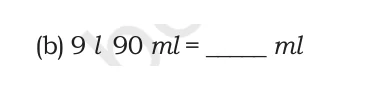
Convert 9 l 90 ml to millilitres.
Show detailed solution
- Step 1: Use 1 l = 1,000 ml.
- Step 2: 9 l is 9,000 ml.
- Step 3: 9,000 ml + 90 ml = 9,090 ml.
- Answer: 9,090 ml.
Textbook page 115 · solved item 123
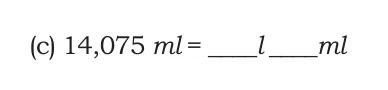
Convert 14,075 ml to litres and millilitres.
Show detailed solution
- Step 1: Use 1 l = 1,000 ml.
- Step 2: 14,000 ml is 14 l.
- Step 3: 14,075 ml = 14,000 ml + 75 ml.
- Answer: 14 l 75 ml.
Textbook page 115 · solved item 124
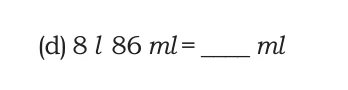
Convert 8 l 86 ml to millilitres.
Show detailed solution
- Step 1: Use 1 l = 1,000 ml.
- Step 2: 8 l is 8,000 ml.
- Step 3: 8,000 ml + 86 ml = 8,086 ml.
- Answer: 8,086 ml.
Textbook page 115 · solved item 125
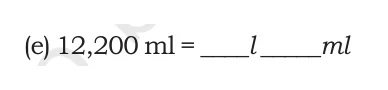
Convert 12,200 ml to litres and millilitres.
Show detailed solution
- Step 1: Use 1 l = 1,000 ml.
- Step 2: 12,000 ml is 12 l.
- Step 3: 12,200 ml = 12,000 ml + 200 ml.
- Answer: 12 l 200 ml.
Textbook page 115 · solved item 126
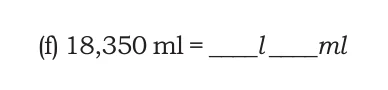
Convert 18,350 ml to litres and millilitres.
Show detailed solution
- Step 1: Use 1 l = 1,000 ml.
- Step 2: 18,000 ml is 18 l.
- Step 3: 18,350 ml = 18,000 ml + 350 ml.
- Answer: 18 l 350 ml.
Detailed worked answers
Textbook page 116
Textbook page 116 · solved item 127
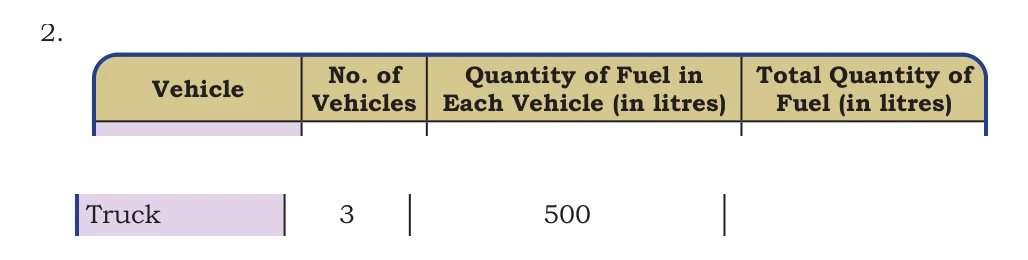
Find the total fuel filled in 3 trucks when each receives 500 l.
Show detailed solution
- Step 1: Multiply the number of vehicles by the fuel in each vehicle.
- Step 2: Add 500 l three times.
- Step 3: 500 + 500 + 500 = 1,500.
- Answer: 1,500 l.
Textbook page 116 · solved item 128
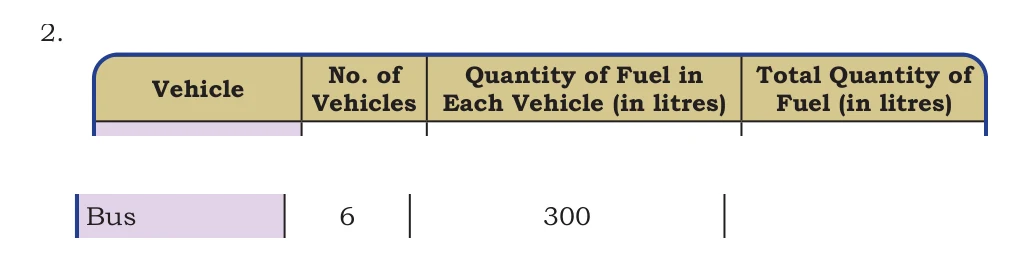
Find the total fuel filled in 6 buses when each receives 300 l.
Show detailed solution
- Step 1: Multiply the number of vehicles by the fuel in each vehicle.
- Step 2: Add six groups of 300 l.
- Step 3: 6 times 300 = 1,800.
- Answer: 1,800 l.
Textbook page 116 · solved item 129
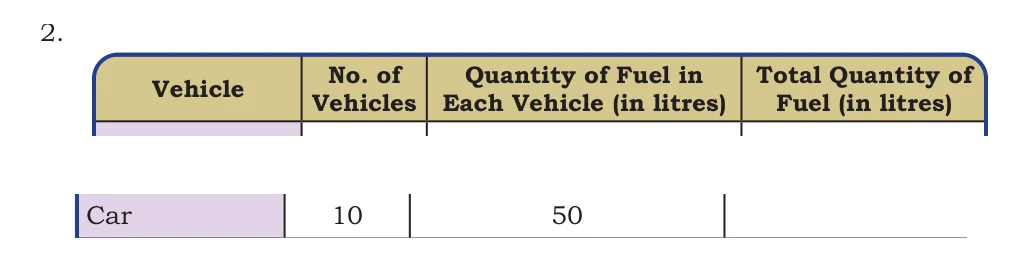
Find the total fuel filled in 10 cars when each receives 50 l.
Show detailed solution
- Step 1: Multiply the number of vehicles by the fuel in each vehicle.
- Step 2: Add ten groups of 50 l.
- Step 3: 10 times 50 = 500.
- Answer: 500 l.
Textbook page 116 · solved item 130
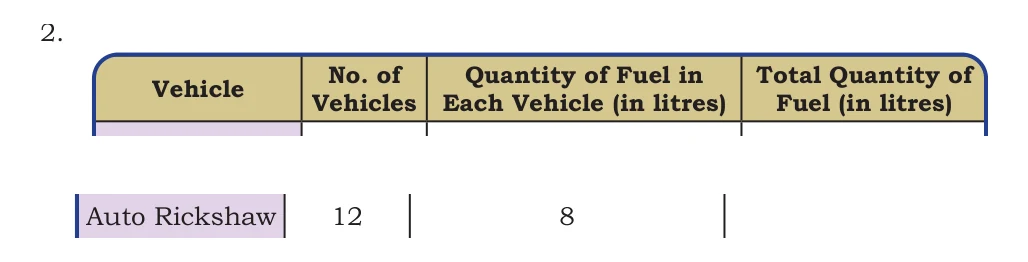
Find the total fuel filled in 12 auto rickshaws when each receives 8 l.
Show detailed solution
- Step 1: Multiply the number of vehicles by the fuel in each vehicle.
- Step 2: Split 12 groups into 10 groups and 2 groups.
- Step 3: 10 times 8 is 80 and 2 times 8 is 16, giving 96.
- Answer: 96 l.
Textbook page 116 · solved item 131
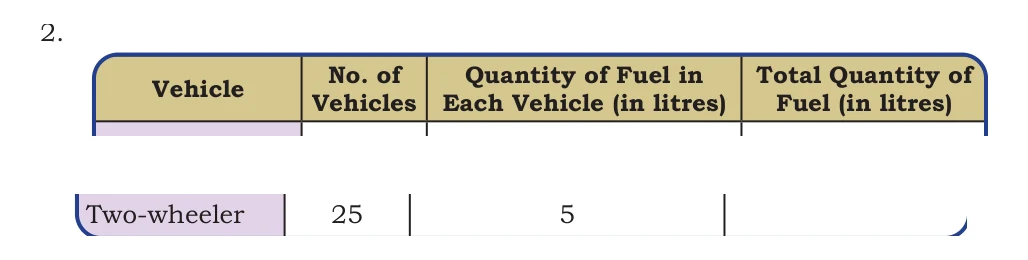
Find the total fuel filled in 25 two-wheelers when each receives 5 l.
Show detailed solution
- Step 1: Multiply the number of vehicles by the fuel in each vehicle.
- Step 2: Split 25 groups into 20 groups and 5 groups.
- Step 3: 20 times 5 is 100 and 5 times 5 is 25, giving 125.
- Answer: 125 l.
Textbook page 116 · solved item 132
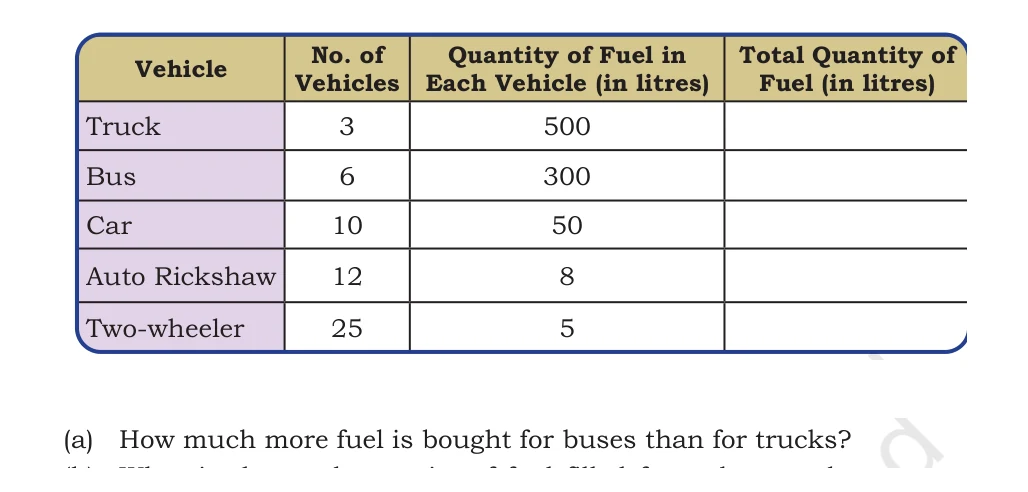
How much more fuel is bought for buses than for trucks?
Show detailed solution
- Step 1: The buses receive 1,800 l in total.
- Step 2: The trucks receive 1,500 l in total.
- Step 3: 1,800\text{ l}-1,500\text{ l}=300\text{ l}.
- Answer: Buses receive 300\text{ l} more.
Textbook page 116 · solved item 133
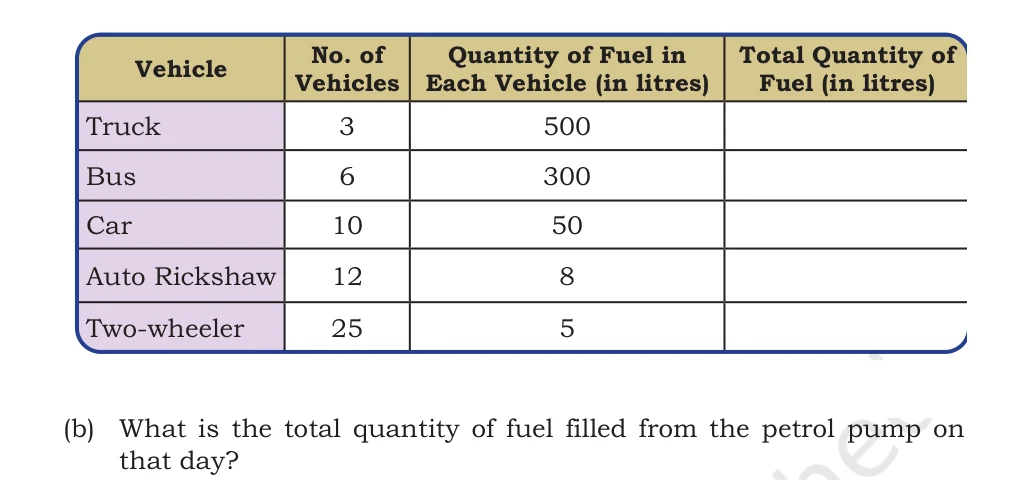
What is the total quantity of fuel filled from the petrol pump that day?
Show detailed solution
- Step 1: Add the large totals: 1,500+1,800+500=3,800\text{ l}.
- Step 2: Add the remaining totals: 96+125=221\text{ l}.
- Step 3: 3,800\text{ l}+221\text{ l}=4,021\text{ l}.
- Answer: The pump fills 4,021\text{ l} that day.
Textbook page 116 · solved item 134
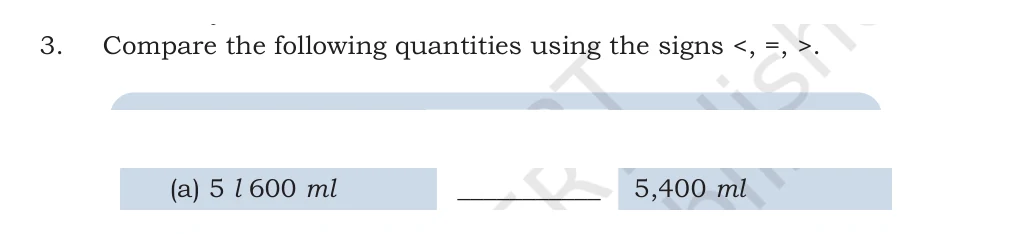
Compare 5 l 600 ml and 5,400 ml using <, =, or >.
Show detailed solution
- Step 1: 5 l 600 ml is 5,600 ml.
- Step 2: 5,600 ml is greater than 5,400 ml.
- Step 3: Choose the sign that matches the comparison.
- Answer: 5 l 600 ml > 5,400 ml.
Textbook page 116 · solved item 135
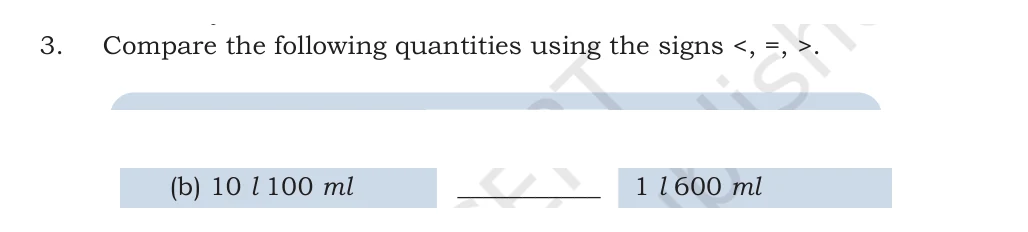
Compare 10 l 100 ml and 1 l 600 ml using <, =, or >.
Show detailed solution
- Step 1: The first quantity begins with 10 l.
- Step 2: 10 l 100 ml is greater than 1 l 600 ml.
- Step 3: Choose the sign that matches the comparison.
- Answer: 10 l 100 ml > 1 l 600 ml.
Textbook page 116 · solved item 136

Compare 190 ml + 800 ml and 800 ml + 109 ml using <, =, or >.
Show detailed solution
- Step 1: The left side totals 990 ml.
- Step 2: The right side totals 909 ml.
- Step 3: Choose the sign that matches the comparison.
- Answer: 190 ml + 800 ml > 800 ml + 109 ml.
Textbook page 116 · solved item 137
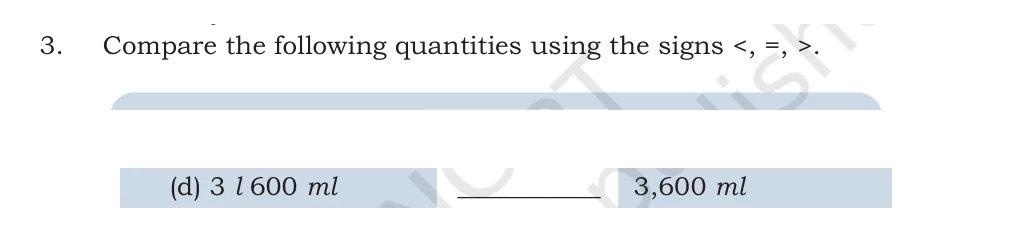
Compare 3 l 600 ml and 3,600 ml using <, =, or >.
Show detailed solution
- Step 1: 3 l is 3,000 ml.
- Step 2: 3,000 ml + 600 ml is 3,600 ml.
- Step 3: Choose the sign that matches the comparison.
- Answer: 3 l 600 ml = 3,600 ml.
Textbook page 116 · solved item 138
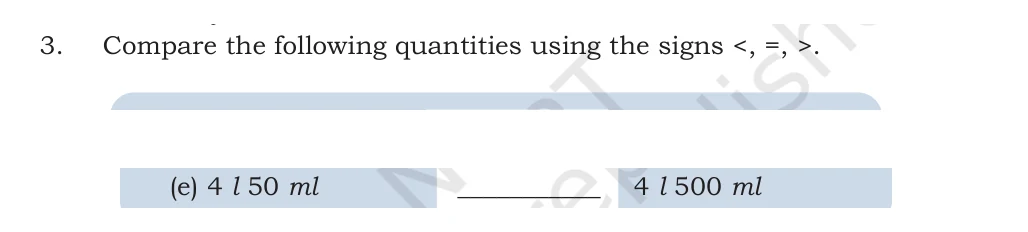
Compare 4 l 50 ml and 4 l 500 ml using <, =, or >.
Show detailed solution
- Step 1: Both quantities have 4 l.
- Step 2: 50 ml is less than 500 ml.
- Step 3: Choose the sign that matches the comparison.
- Answer: 4 l 50 ml < 4 l 500 ml.
Textbook page 116 · solved item 139
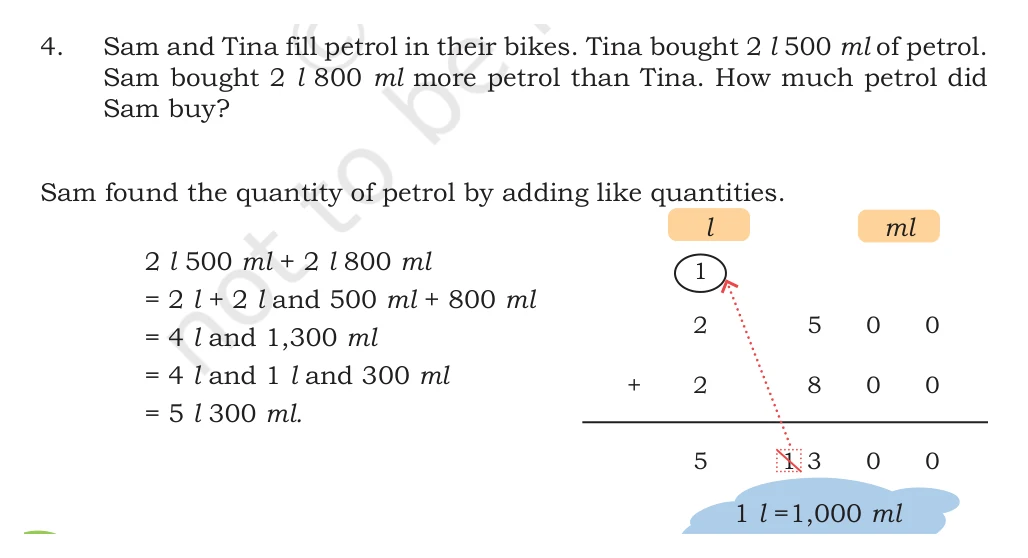
Tina bought 2 l 500 ml of petrol. Sam bought 2 l 800 ml more. How much petrol did Sam buy?
Show detailed solution
- Step 1: Add the litres: 2\text{ l}+2\text{ l}=4\text{ l}.
- Step 2: Add the millilitres: 500\text{ ml}+800\text{ ml}=1,300\text{ ml}=1\text{ l }300\text{ ml}.
- Step 3: Add the carried litre: 4\text{ l}+1\text{ l }300\text{ ml}=5\text{ l }300\text{ ml}.
- Answer: Sam bought 5\text{ l }300\text{ ml}.
Detailed worked answers
Textbook page 117
Textbook page 117 · solved item 140
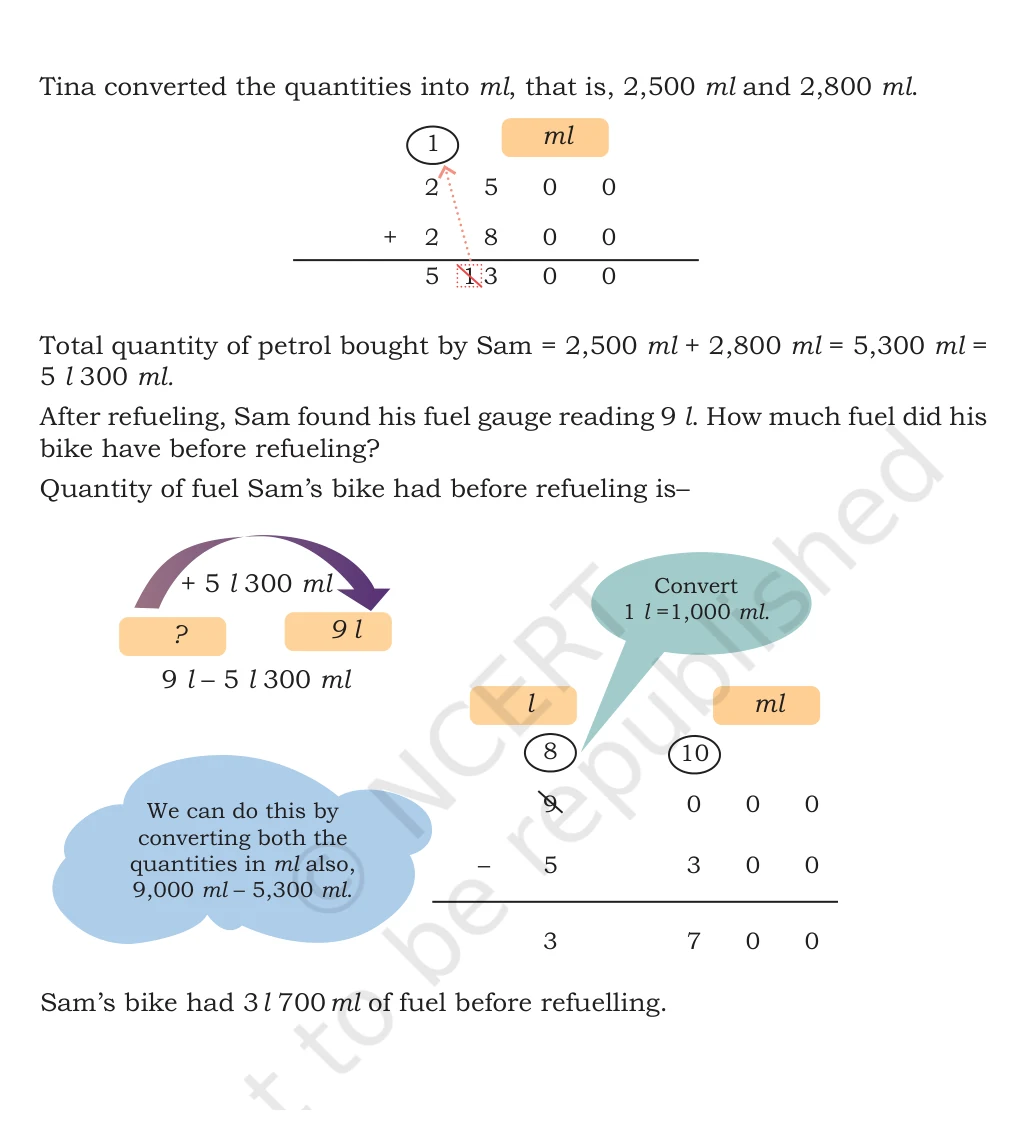
After Sam adds 5 l 300 ml, his fuel gauge reads 9 l. How much fuel was in the bike before refuelling?
Show detailed solution
- Step 1: Subtract the added petrol from the final amount: 9\text{ l}-5\text{ l }300\text{ ml}.
- Step 2: Regroup 9 l as 8\text{ l }1,000\text{ ml}.
- Step 3: 1,000-300=700\text{ ml} and 8-5=3\text{ l}.
- Answer: The bike had 3\text{ l }700\text{ ml} before refuelling.
Detailed worked answers
Textbook page 118
Textbook page 118 · solved item 141

Riya fills one 2 l bottle and four 500 ml bottles. Aarav fills three 750 ml bottles. Who fills more, and by how much?
Show detailed solution
- Step 1: Riya fills 2\text{ l}+4\times500\text{ ml}=2\text{ l}+2\text{ l}=4\text{ l}.
- Step 2: Aarav fills 3\times750\text{ ml}=2,250\text{ ml}=2\text{ l }250\text{ ml}.
- Step 3: 4\text{ l}-2\text{ l }250\text{ ml}=1\text{ l }750\text{ ml}.
- Answer: Riya fills 1\text{ l }750\text{ ml} more than Aarav.
Textbook page 118 · solved item 142
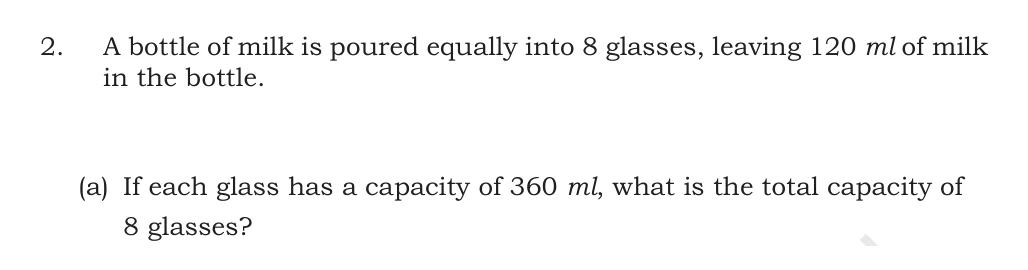
Eight glasses each hold 360 ml. What is their total capacity?
Show detailed solution
- Step 1: Multiply 360 ml by 8.
- Step 2: Eight groups of 300 ml make 2,400 ml and eight groups of 60 ml make 480 ml.
- Step 3: 2,400 ml + 480 ml = 2,880 ml.
- Answer: 2,880 ml.
Textbook page 118 · solved item 143
The eight glasses hold 2,880 ml and 120 ml remains in the bottle. How much milk was there initially?
Show detailed solution
- Step 1: The poured milk fills 2,880 ml of glass capacity.
- Step 2: Add the 120 ml left in the bottle.
- Step 3: 2,880 ml + 120 ml = 3,000 ml = 3 l.
- Answer: 3,000 ml or 3 l.
Textbook page 118 · solved item 144
If 1 l of milk costs Rs 40, how much does 3 l cost?
Show detailed solution
- Step 1: Three litres contain three 1 l groups.
- Step 2: Add Rs 40 three times.
- Step 3: 40 + 40 + 40 = 120.
- Answer: Rs 120.
Textbook page 118 · solved item 145
How many 250 ml glasses can be filled from 5 l of orange juice?
Show detailed solution
- Step 1: Change 5 l to 5,000 ml.
- Step 2: Count 250 ml groups in 5,000 ml.
- Step 3: 5,000 divided by 250 is 20.
- Answer: 20 glasses.
Textbook page 118 · solved item 146
After 10 glasses of 250 ml are served from 5 l, how much juice remains?
Show detailed solution
- Step 1: Ten glasses use 10 times 250 ml = 2,500 ml.
- Step 2: The full container holds 5,000 ml.
- Step 3: 5,000 ml - 2,500 ml = 2,500 ml = 2 l 500 ml.
- Answer: 2 l 500 ml.
Textbook page 118 · solved item 147
If each 250 ml glass sells for Rs 25, how much is earned by selling all 5 l?
Show detailed solution
- Step 1: Five litres fills 20 glasses of 250 ml each.
- Step 2: Each glass earns Rs 25.
- Step 3: 20 times Rs 25 = Rs 500.
- Answer: Rs 500.
Textbook page 118 · solved item 148

Divide 8 l 400 ml of oil equally among 7 containers. How much does each container hold?
Show detailed solution
- Step 1: Change the full amount to millilitres: 8\text{ l }400\text{ ml}=8,400\text{ ml}.
- Step 2: Divide 8,400 ml into 7 equal groups.
- Step 3: 8,400\div7=1,200\text{ ml}.
- Answer: Each container holds 1,200\text{ ml}=1\text{ l }200\text{ ml}.
Textbook page 118 · solved item 149

One container holds 1 l 75 ml of buttermilk. How much do 8 such containers hold?
Show detailed solution
- Step 1: Change one container to millilitres: 1\text{ l }75\text{ ml}=1,075\text{ ml}.
- Step 2: Multiply by 8: 1,075\times8=8,600\text{ ml}.
- Step 3: Change 8,600 ml back to litres and millilitres.
- Answer: Eight containers hold 8\text{ l }600\text{ ml}.