How to use these solutions
Match, attempt, then check
Use the source crop to match the question in your book. Attempt it first, then open the worked answer. Text remains in HTML so the page is searchable and accessible.
Reviewed source answers
Solution sheet 1
Page No. 15 · Figure it Out
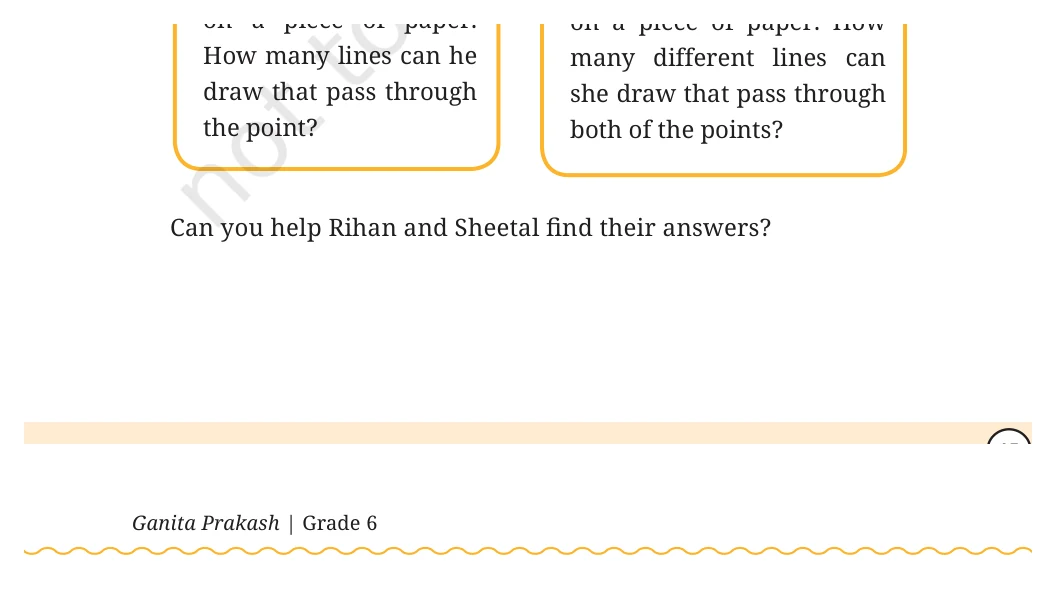
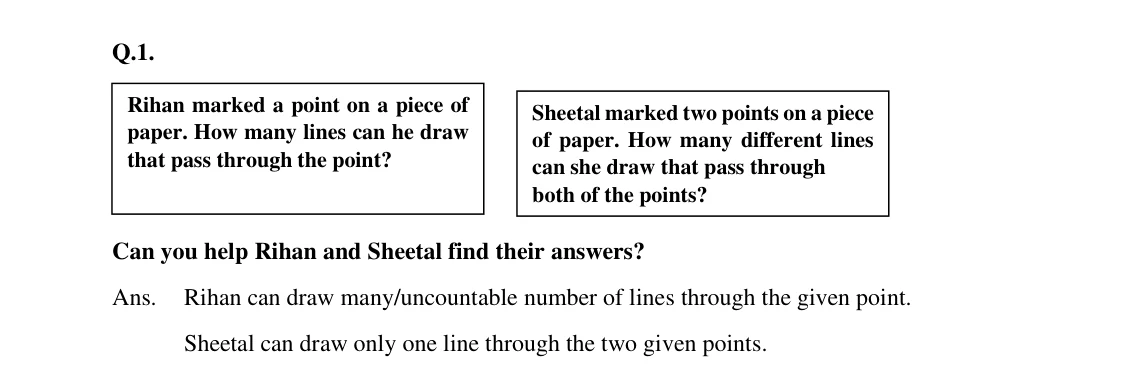
1. Rihan marked a point on a piece of paper. How many lines can he draw that pass through the point? Sheetal marked two points on a piece of paper. How many different lines can she draw that pass through both of the points? Can you help Rihan and Sheetal find their answers?
Show solution
Rihan can draw many/uncountable number of lines through the given point. Sheetal can draw only one line through the two given points.
Source solution page 43
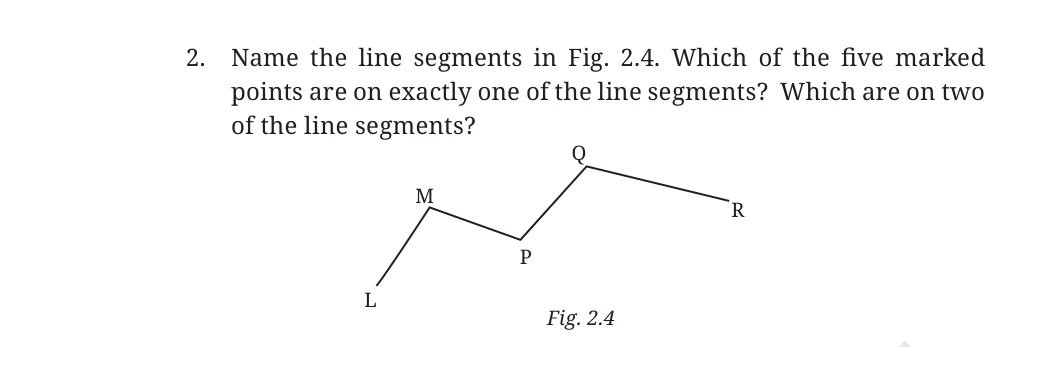
2. Name the line segments in Fig. 2.4. Which of the five marked points are on exactly one of the line segments? Which are on two of the line segments?
Show solution
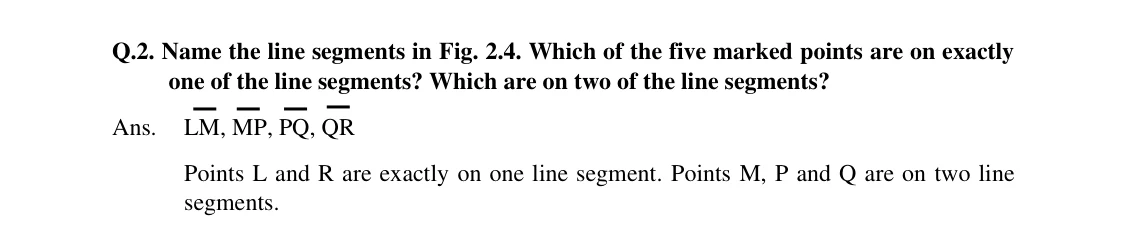
LM, MP, PQ, QR Points L and R are exactly on one line segment. Points M, P and Q are on two line segments.
Source solution page 43
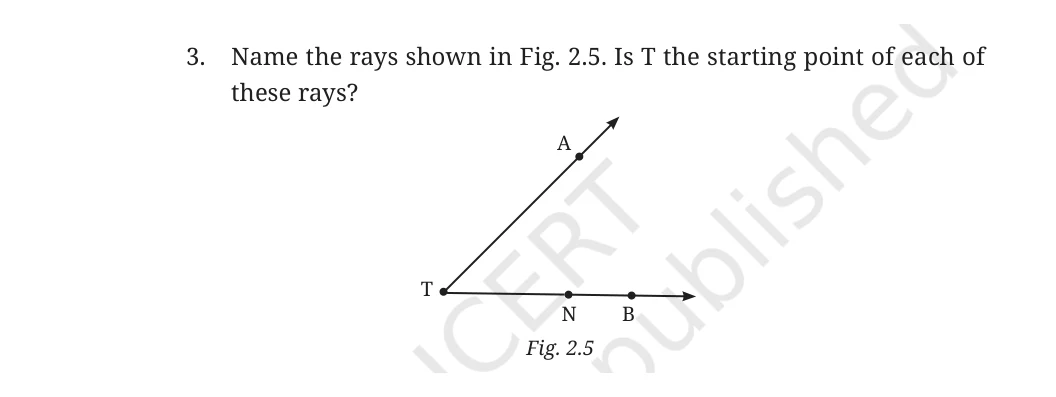
3. Name the rays shown in Fig. 2.5. Is T the starting point of each of these rays?
Show solution
TA, TB, TN and NB No, T is the starting point of TB, TN and TA but not of NB.

Source solution page 43
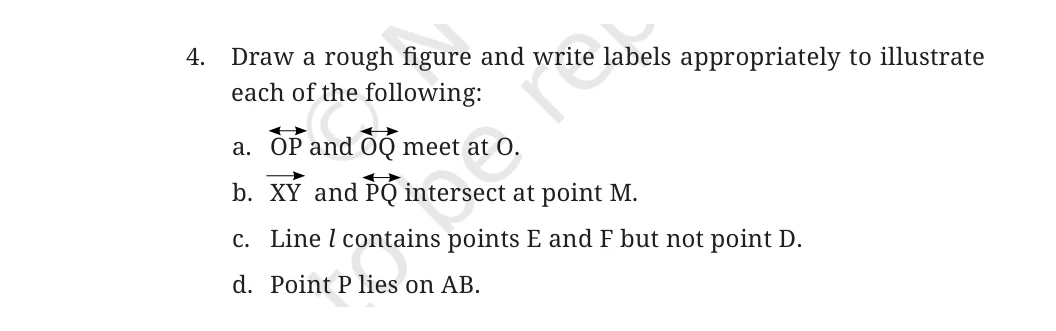
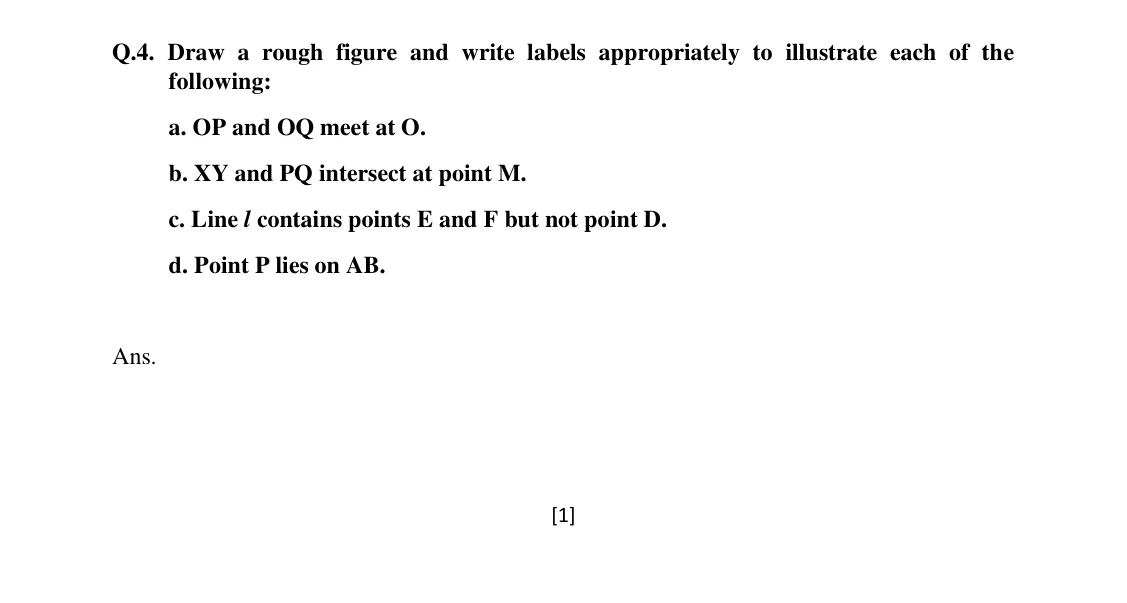
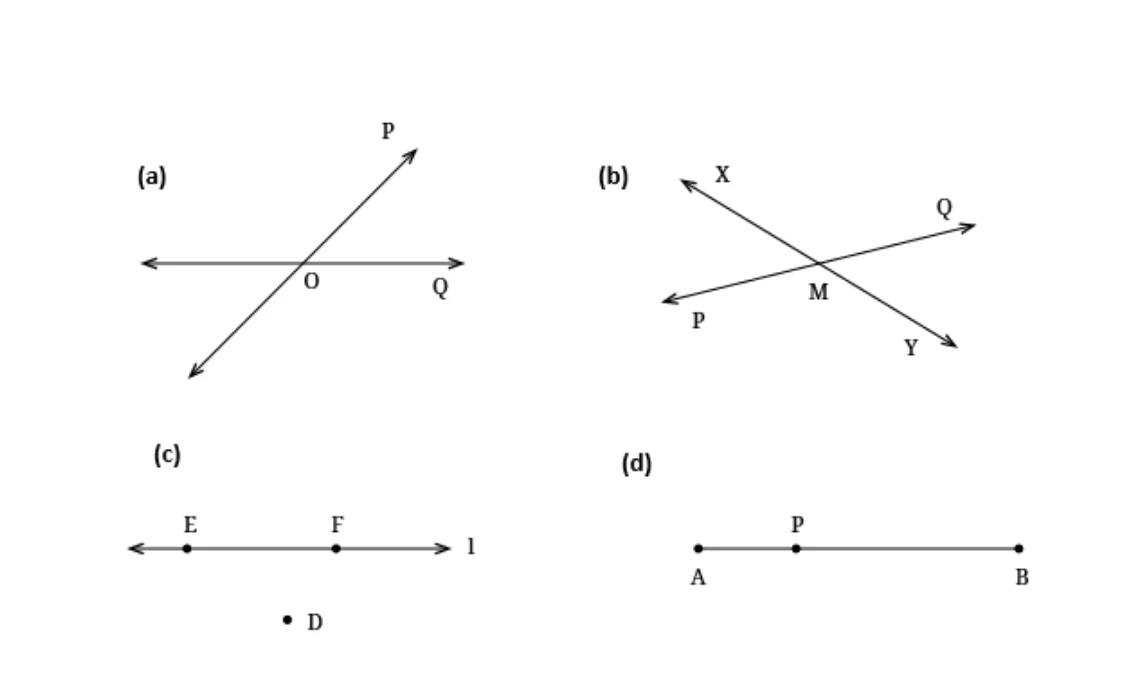
4. Draw a rough figure and write labels appropriately to illustrate each of the following: a. OP and OQ meet at O. b. XY and PQ intersect at point M. c. Line l contains points E and F but not point D. d. Point P lies on AB.
Show solution
[1]
Reviewed source answers
Solution sheet 2
Source solution page 44
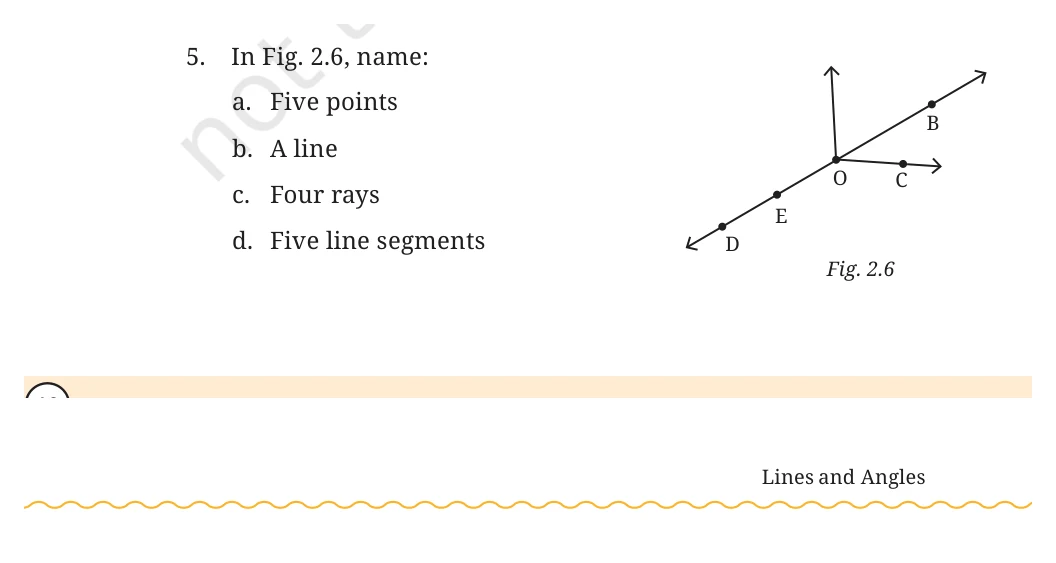
5. In Fig. 2.6, name: a. Five points b. A line c. Four rays d. Five line segments
Show solution
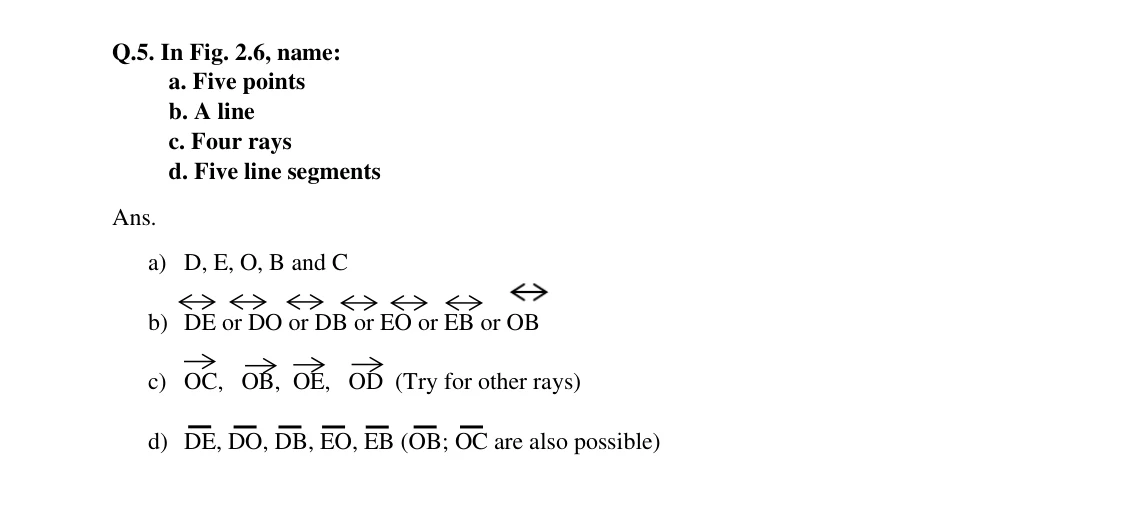
a) D, E, O, B and C b) DE or DO or DB or EO or EB or OB c) OC, OB, OE, OD (Try for other rays) d) DE, DO, DB, EO, EB (OB; OC are also possible)
Source solution page 44
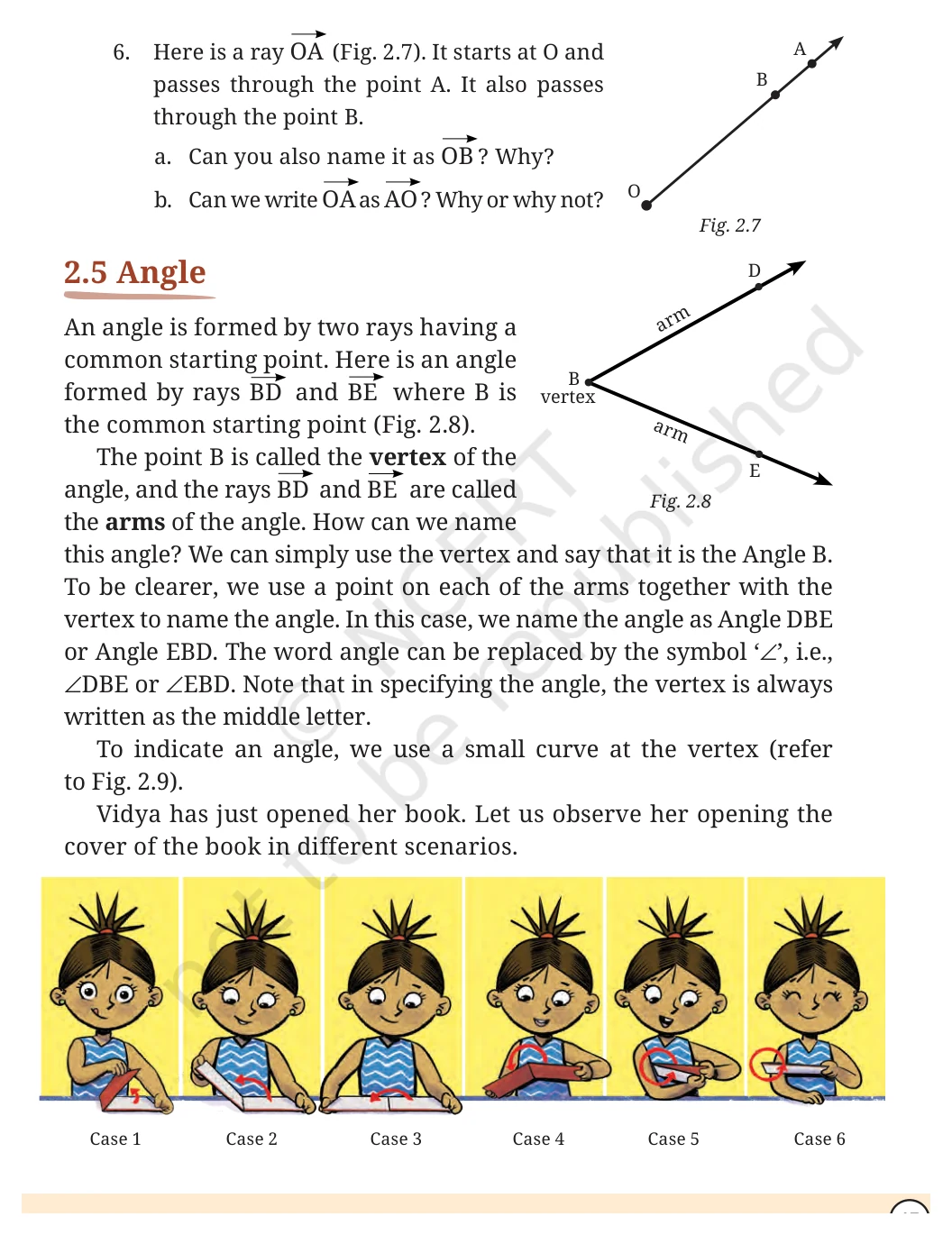
6. Here is a ray OA (Fig. 2.7). It starts at O and passes through the point A. It also passes through the point B. a. Can you also name it as OB? Why? b. Can we write OA as AO? Why or why not?
Show solution
a) Yes, O is the starting point and point B lies on the rays that goes endlessly in the direction of A. OA is the extension of OB. b) No, OA is a ray with starting point O whereas AO is a ray with starting point A. [2] Section 2.5 Page – 19 Figure it Out
Reviewed source answers
Solution sheet 3
Page – 19 · Figure it Out
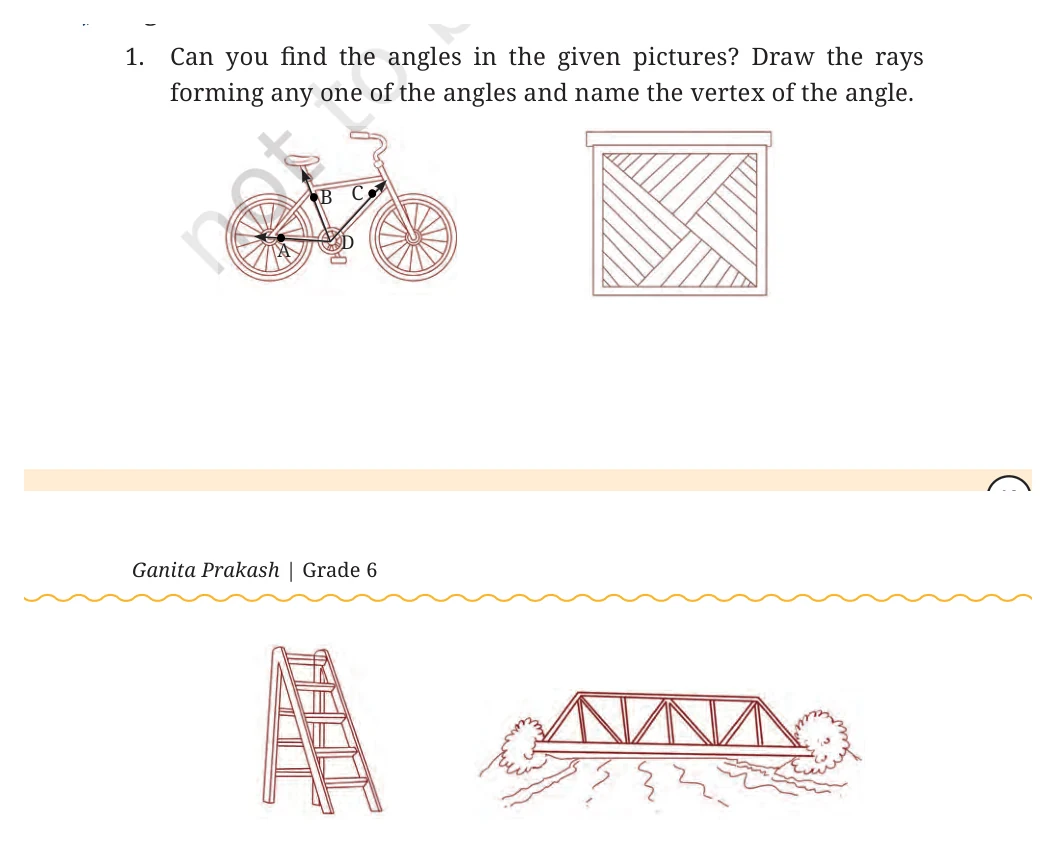
1. Can you find the angles in the given pictures? Draw the rays forming any one of the angles and name the vertex of the angle.
Show solution
Yes, one of the angles is ∠BDC. It’s vertex is D. One ray is DC and the other rays DB. Try for other pictures.

Page – 19 · Figure it Out
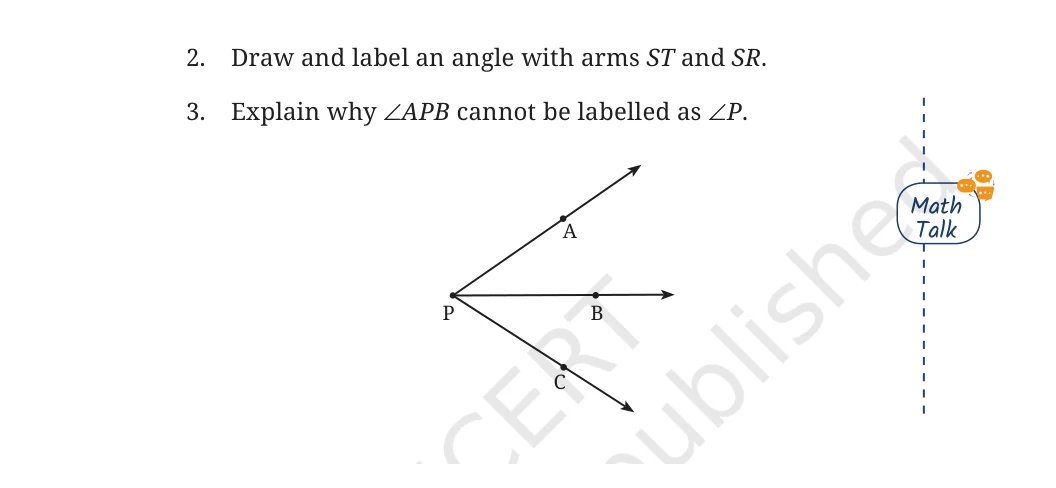
2. Draw and label an angle with arms ST and SR.
Show solution
Refer to the worked source solution below.

Page – 19 · Figure it Out
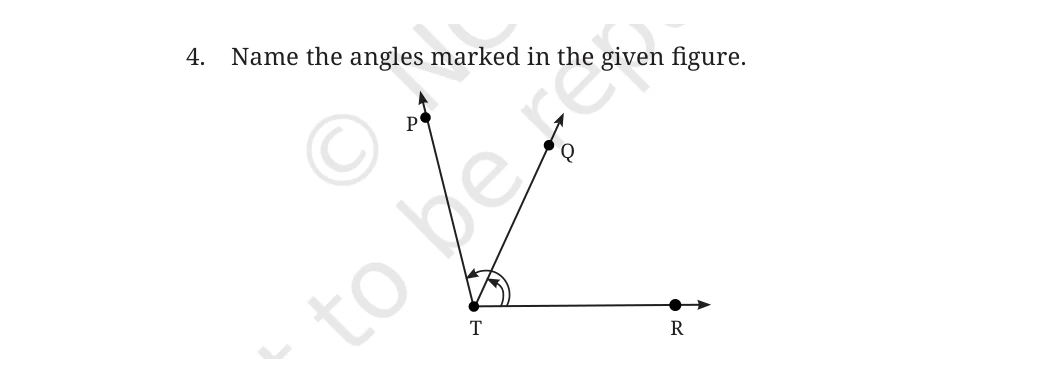
4. Name the angles marked in the given figure.
Show solution
∠RTQ, ∠RTP
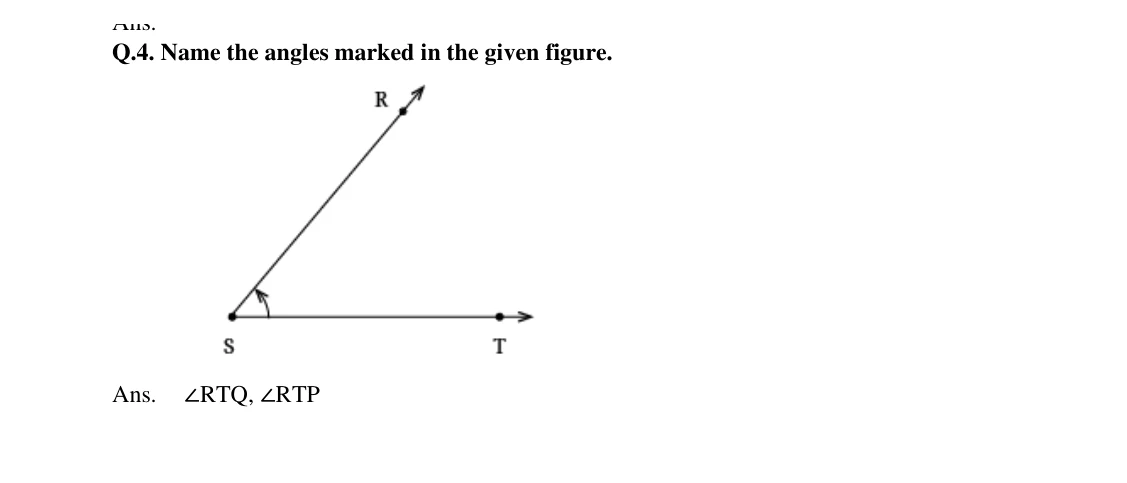
Source solution page 45
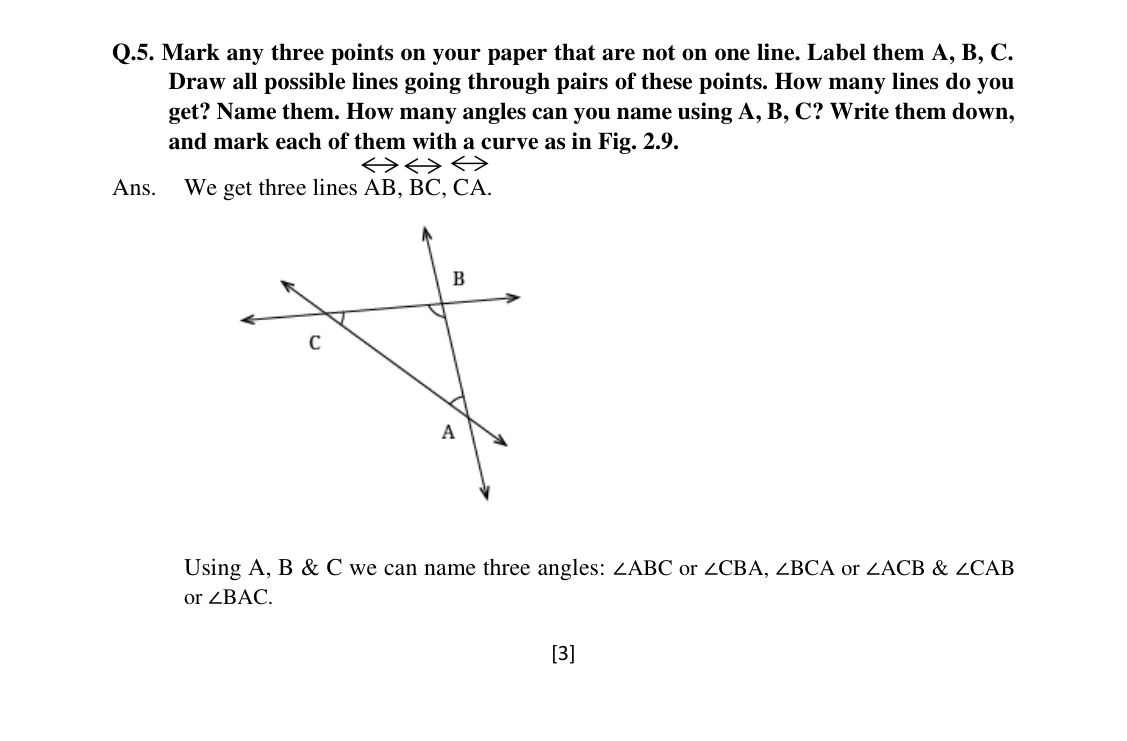
5. Mark any three points on your paper that are not on one line. Label them A, B, C. Draw all possible lines going through pairs of these points. How many lines do you get? Name them. How many angles can you name using A, B, C? Write them down, and mark each of them with a curve as in Fig. 2.9.
Show solution
We get three lines AB, BC, CA. Using A, B & C we can name three angles: ∠ABC or ∠CBA, ∠BCA or ∠ACB & ∠CAB or ∠BAC. [3]

Reviewed source answers
Solution sheet 4
Source solution page 46
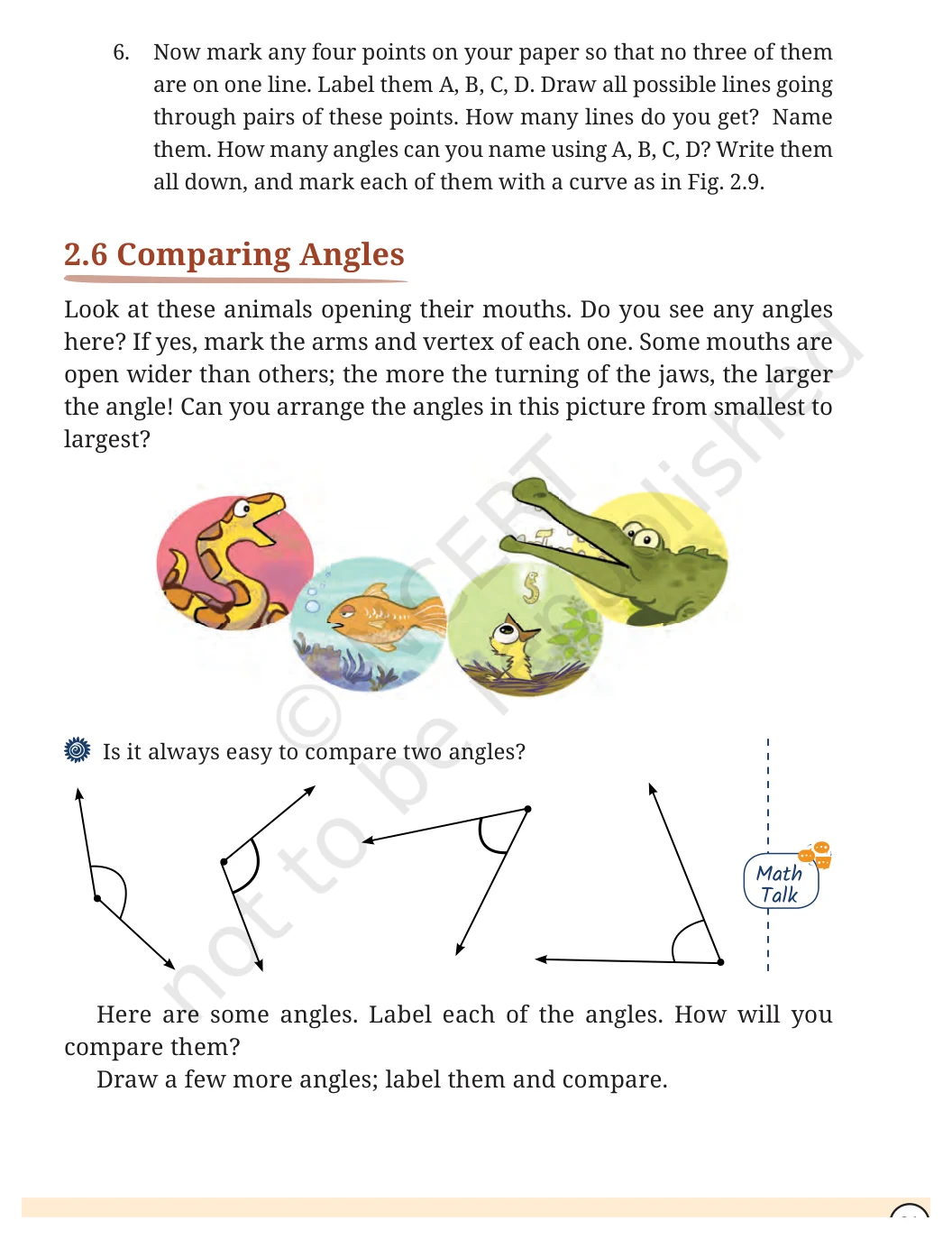
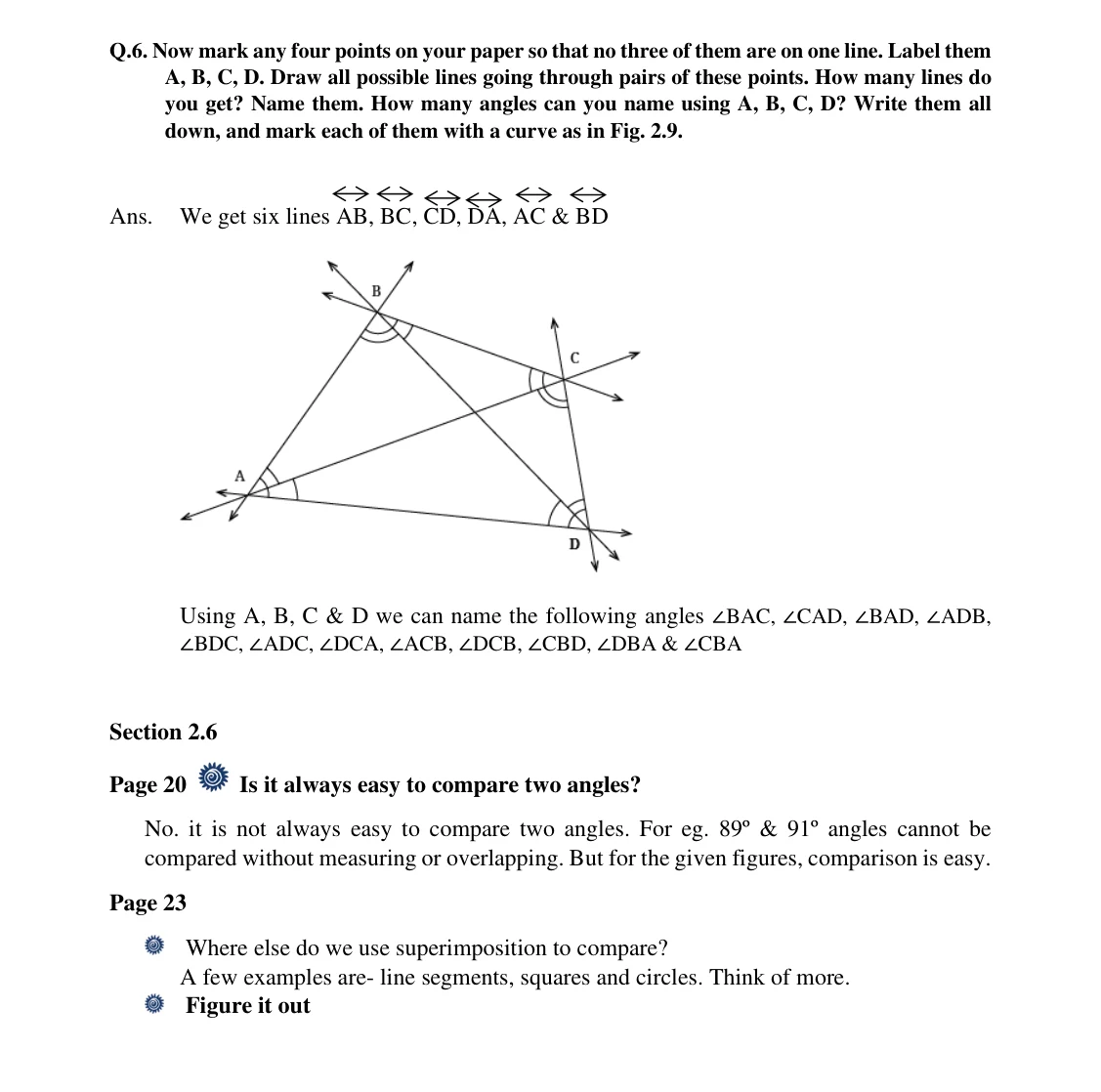
6. Now mark any four points on your paper so that no three of them are on one line. Label them A, B, C, D. Draw all possible lines going through pairs of these points. How many lines do you get? Name them. How many angles can you name using A, B, C, D? Write them all down, and mark each of them with a curve as in Fig. 2.9.
Show solution
We get six lines AB, BC, CD, DA, AC & BD Using A, B, C & D we can name the following angles ∠BAC, ∠CAD, ∠BAD, ∠ADB, ∠BDC, ∠ADC, ∠DCA, ∠ACB, ∠DCB, ∠CBD, ∠DBA & ∠CBA Section 2.6 Page 20 Is it always easy to compare two angles? No. it is not always easy to compare two angles. For eg. 89º & 91º angles cannot be compared without measuring or overlapping. But for the given figures, comparison is easy. Page 23 Where else do we use superimposition to compare? A few examples are- line segments, squares and circles. Think of more. Figure it out
A few examples are- line segments, squares and circles. Think of more. · Figure it out
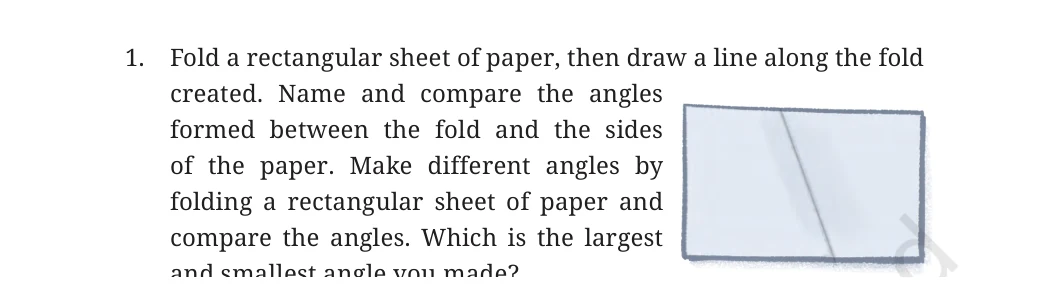
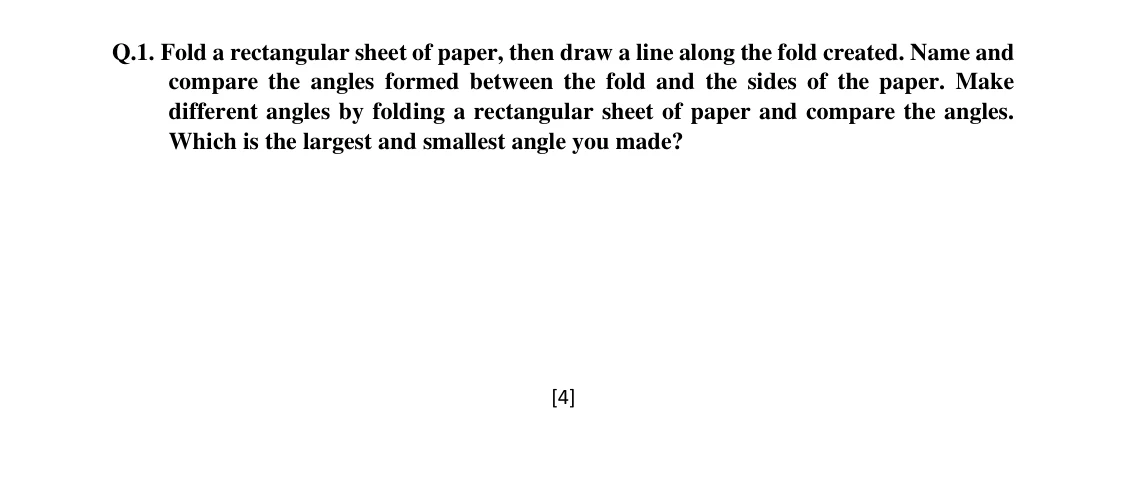
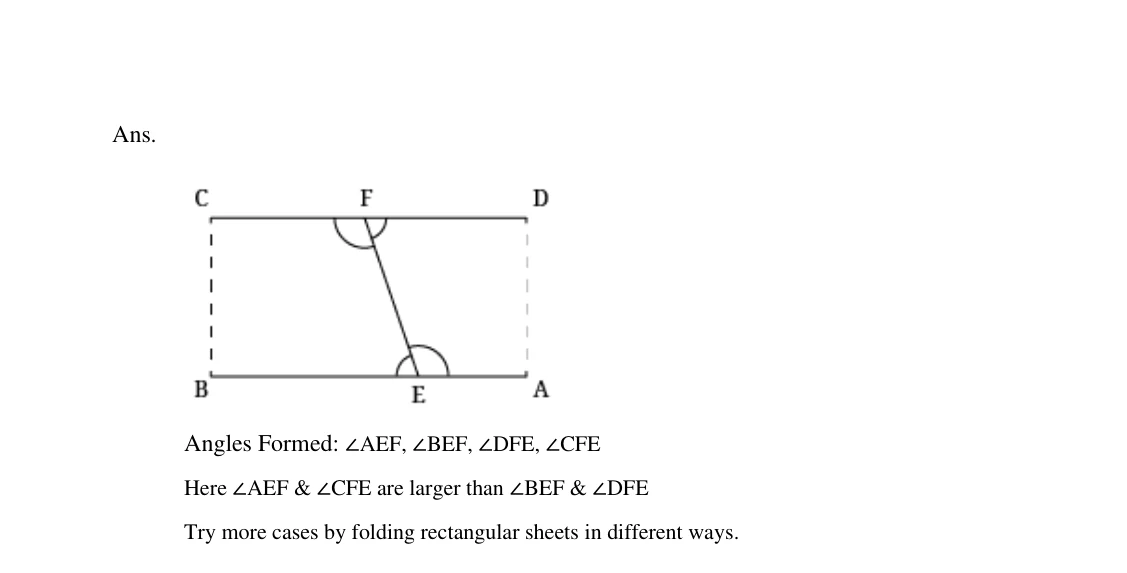
1. Fold a rectangular sheet of paper, then draw a line along the fold created. Name and compare the angles formed between the fold and the sides of the paper. Make different angles by folding a rectangular sheet of paper and compare the angles. Which is the largest and smallest angle you made? [4]
Show solution
Angles Formed: ∠AEF, ∠BEF, ∠DFE, ∠CFE Here ∠AEF & ∠CFE are larger than ∠BEF & ∠DFE Try more cases by folding rectangular sheets in different ways.
Reviewed source answers
Solution sheet 5
Source solution page 47
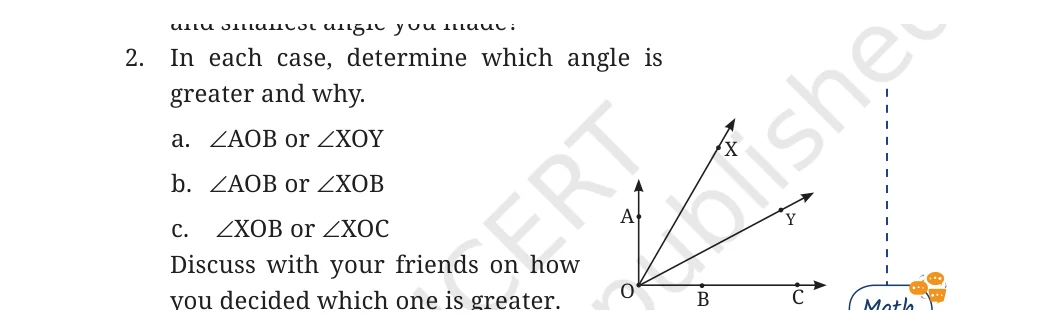
2. In each case, determine which angle is greater and why. a. ∠AOB or ∠XOY b. ∠AOB or ∠XOB c. ∠XOB or ∠XOC Discuss with your friends on how you decided which one is greater.
Show solution
(a)- ∠AOB; ∠XOY is an acute angle and ∠AOB = ∠AOX + ∠XOY+∠YOB (b)- ∠AOB (c) – None. ∠XOB = ∠XOC
Source solution page 47
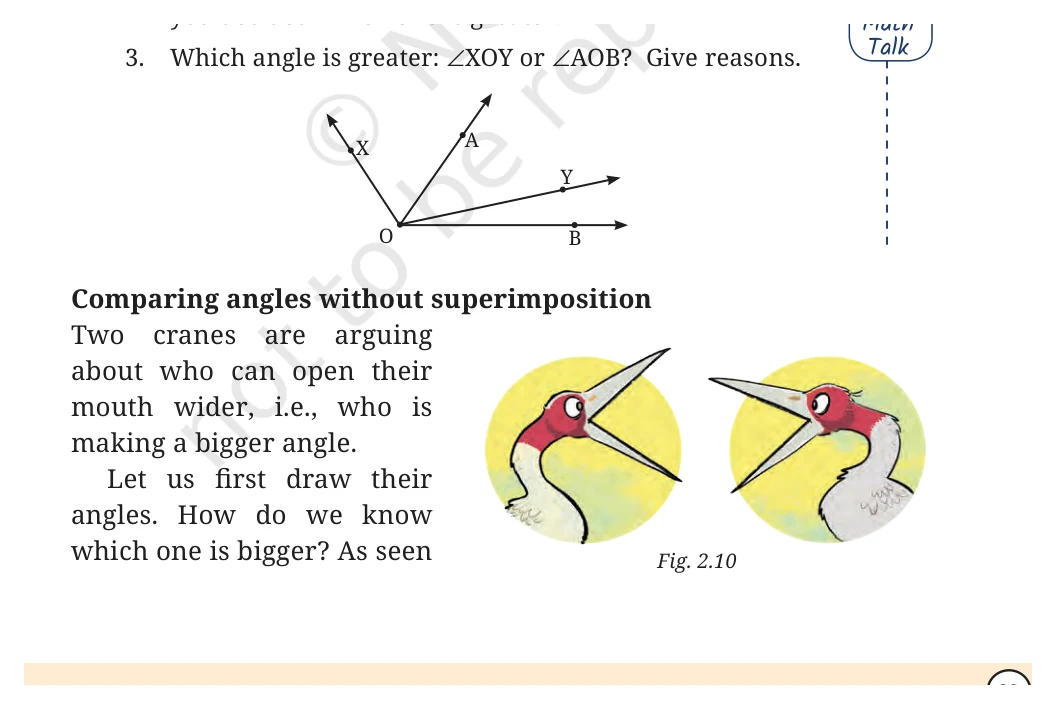
3. Which angle is greater: ∠XOY or ∠AOB? Give reasons.
Show solution
By looking at the figure we cannot say. Superimposition or measurement is necessary here. Section 2.8 Page 28
Section 2.8 · Page 28
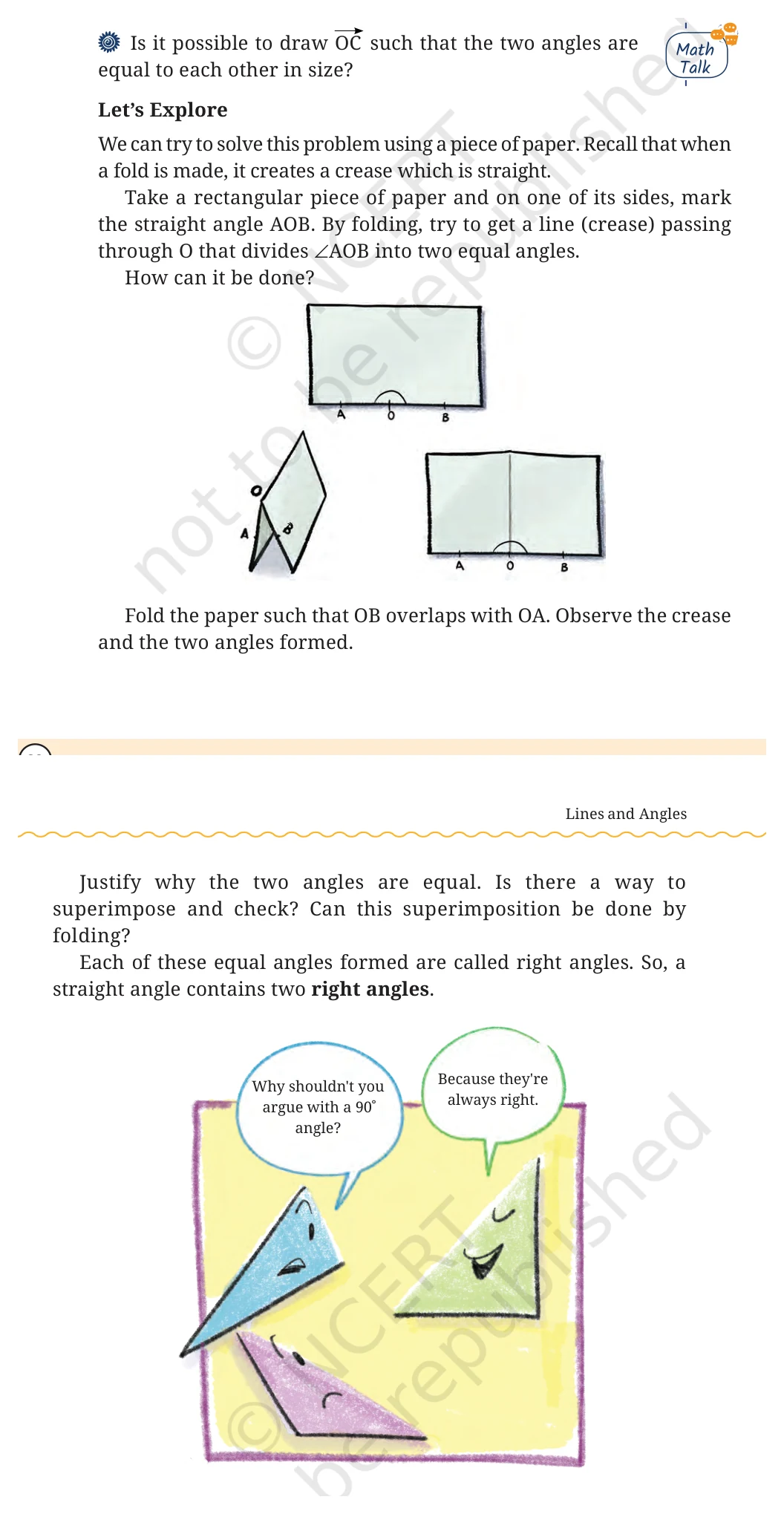
Is it possible to draw OC such that the two angles are equal to each other in size?
Show solution
Yes, when OA and OB overlap each other on folding the Vidya’s notebook, the crease OC will divide ∠AOB in two equal sized angles. Page 29
Page 28 · Page 29
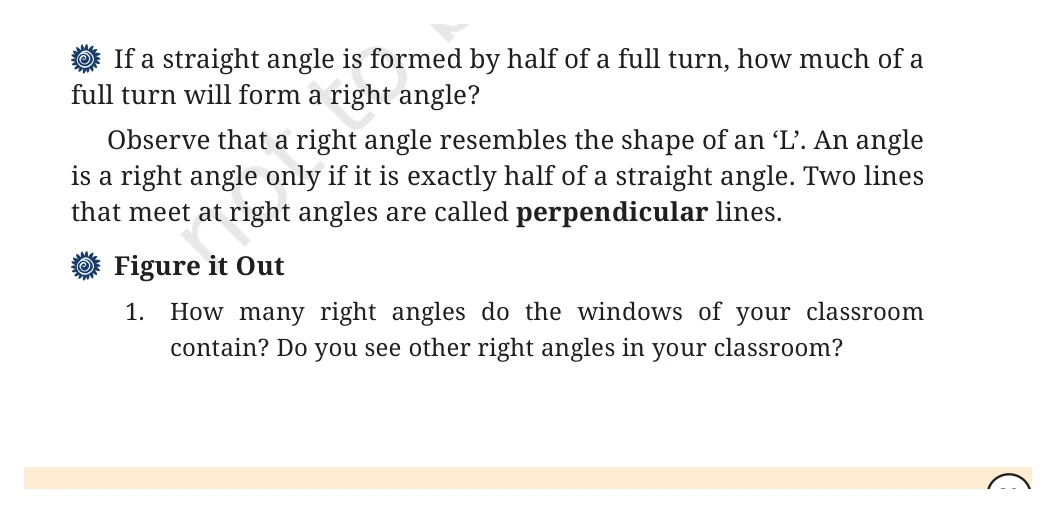
If a straight angle is formed by half of a full turn, how much of a full turn will form a right angle?
Show solution
1 4 of a full turn. [5] Section 2.8 Page No. 29 Figure it Out
Reviewed source answers
Solution sheet 6
Page No. 29 · Figure it Out
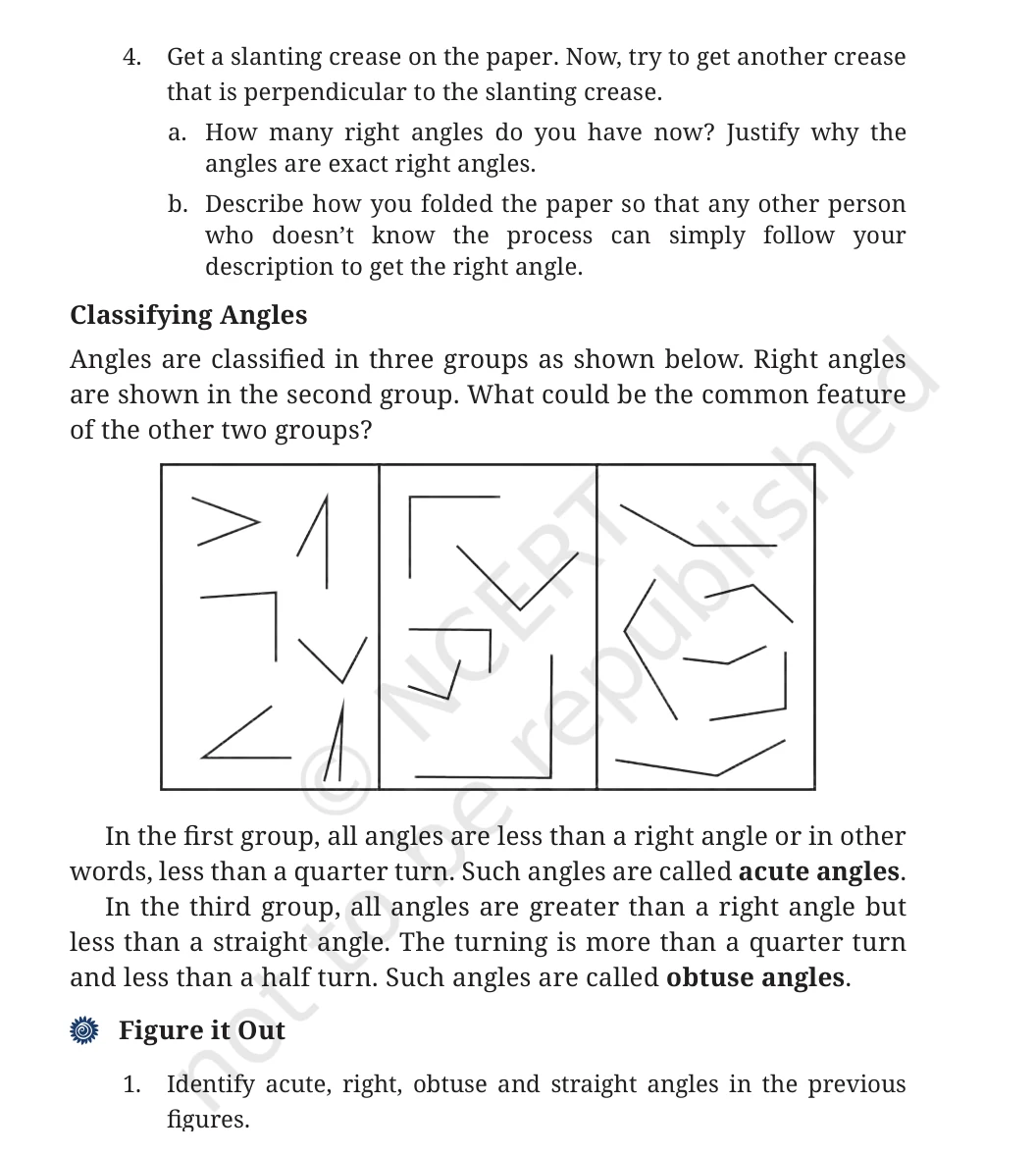
4. Get a slanting crease on the paper. Now, try to get another crease that is perpendicular to the slanting crease. a. How many right angles do you have now? Justify why the angles are exact right angles. b. Describe how you folded the paper so that any other person who doesn’t know the process can simply follow your description to get the right angle.
Show solution
a. Four right angle. Each angle is ¼ the of the complete angle. b. Explore different ways of doing it. Page 31 Figure it Out
Page 31 · Figure it Out
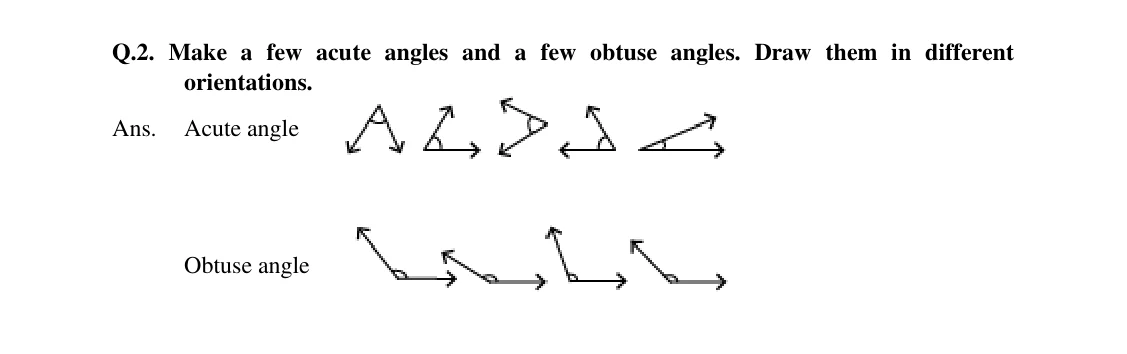
2. Make a few acute angles and a few obtuse angles. Draw them in different orientations.
Show solution
Acute angle Obtuse angle
Page 31 · Figure it Out

3. Do you know what the words acute and obtuse mean? Acute means sharp and obtuse means blunt. Why do you think these words have been chosen?
Show solution
In acute angles the opening of the edges is lesser than the obtuse angle which have larger openings.

means blunt. Why do you think these words have been chosen?
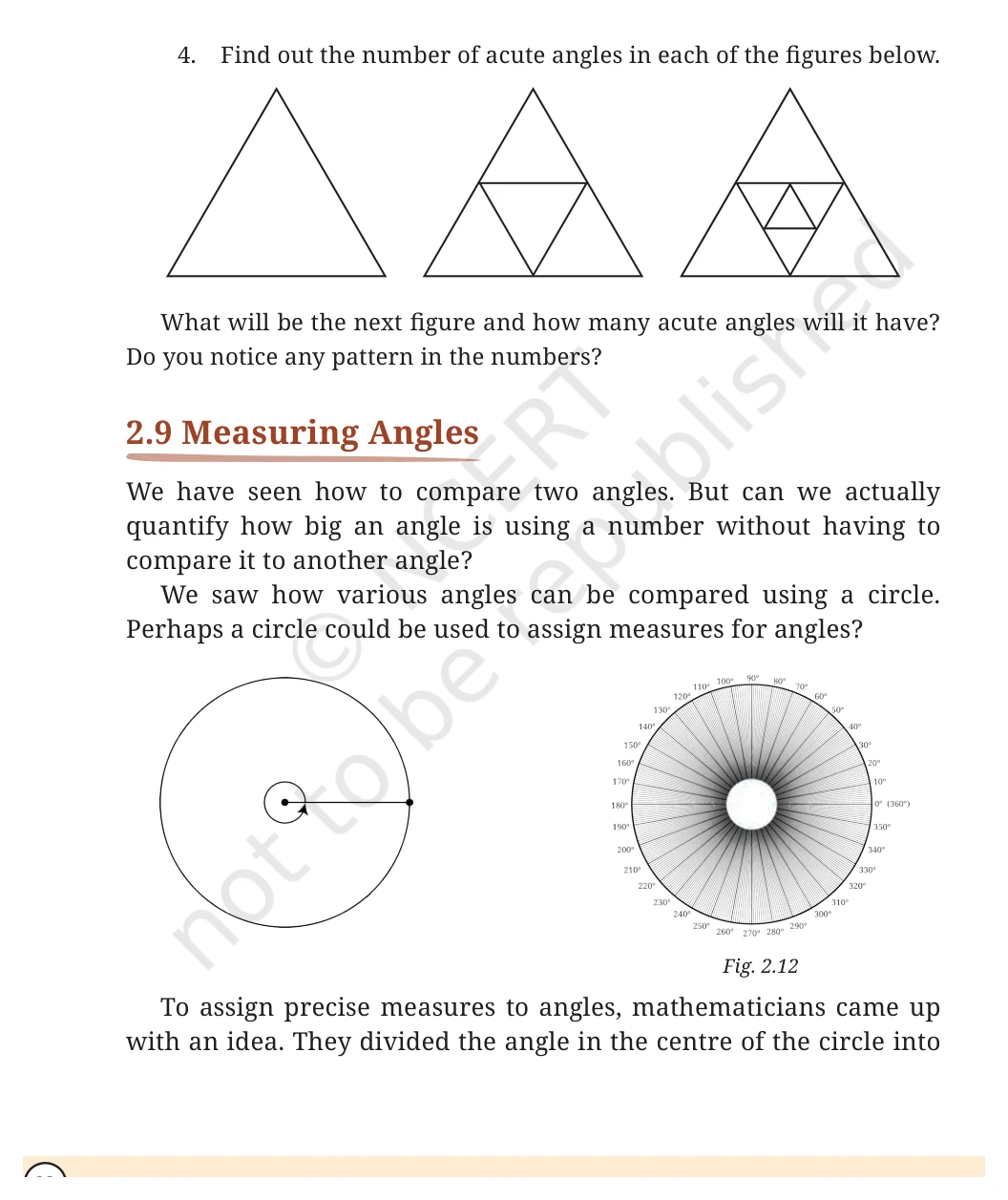
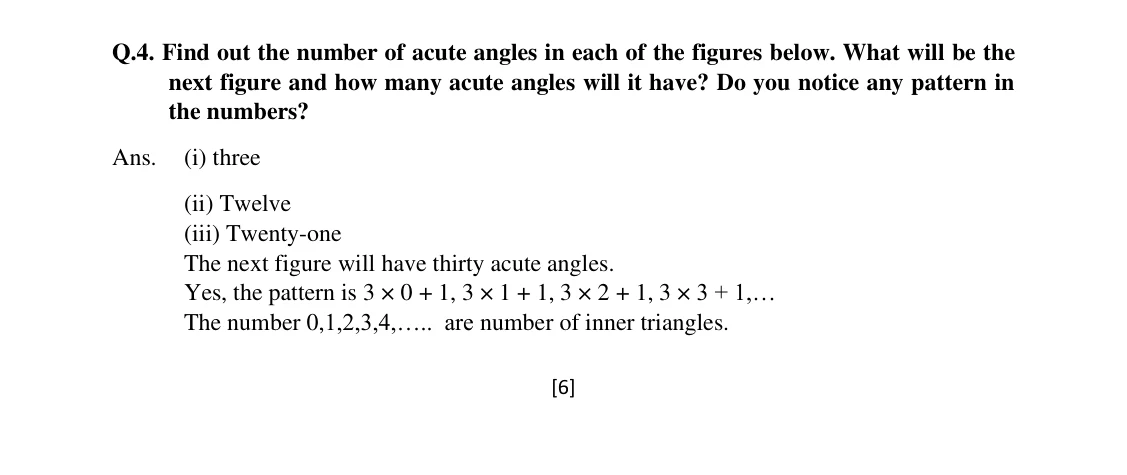
4. Find out the number of acute angles in each of the figures below. What will be the next figure and how many acute angles will it have? Do you notice any pattern in the numbers?
Show solution
(i) three (ii) Twelve (iii) Twenty-one The next figure will have thirty acute angles. Yes, the pattern is 3 × 0 + 1, 3 × 1 + 1, 3 × 2 + 1, 3 × 3 + 1,… The number 0,1,2,3,4,….. are number of inner triangles. [6] Section 2.9 Page No. 35 Figure it out
Reviewed source answers
Solution sheet 7
Page No. 35 · Figure it out
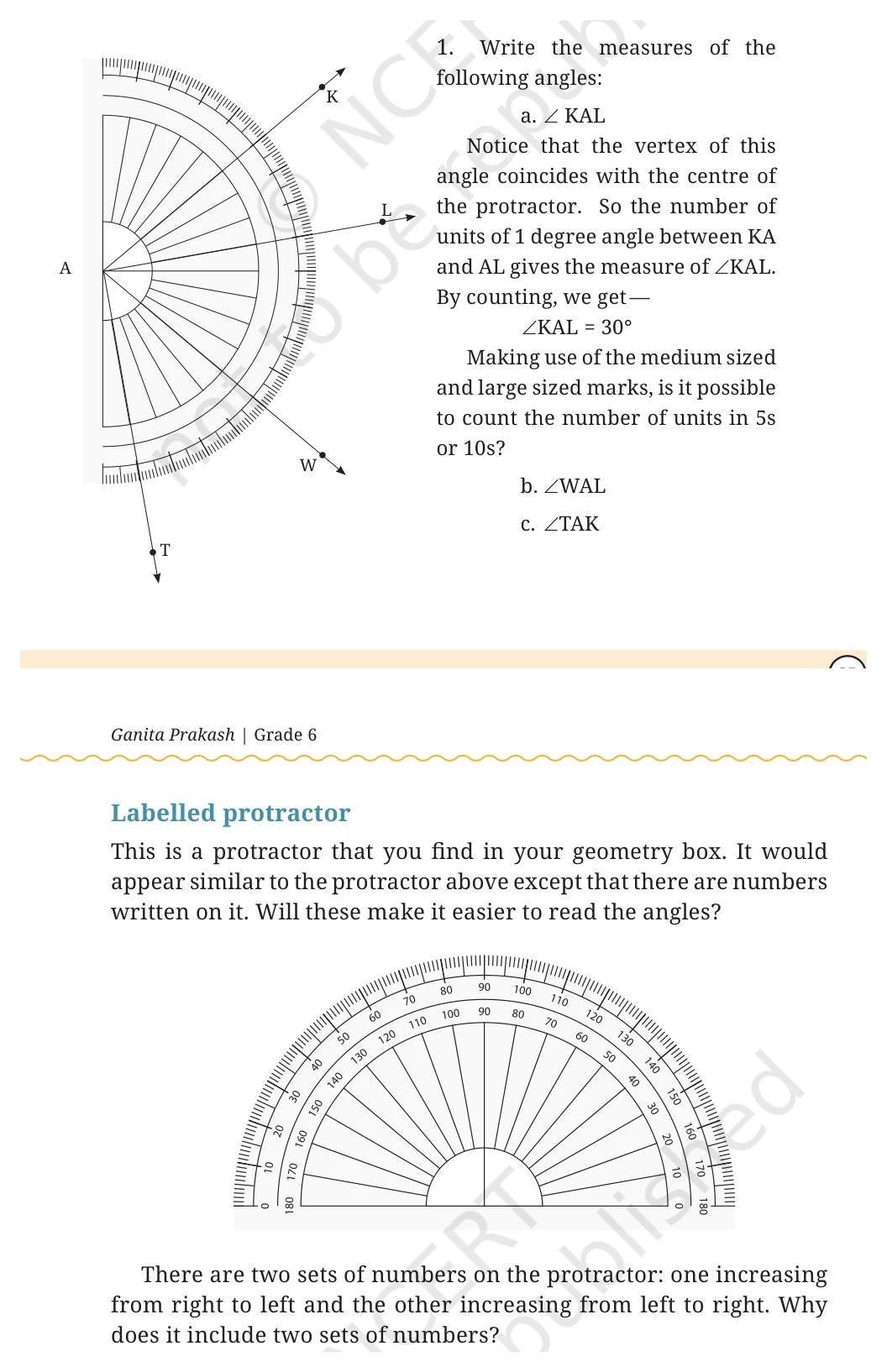
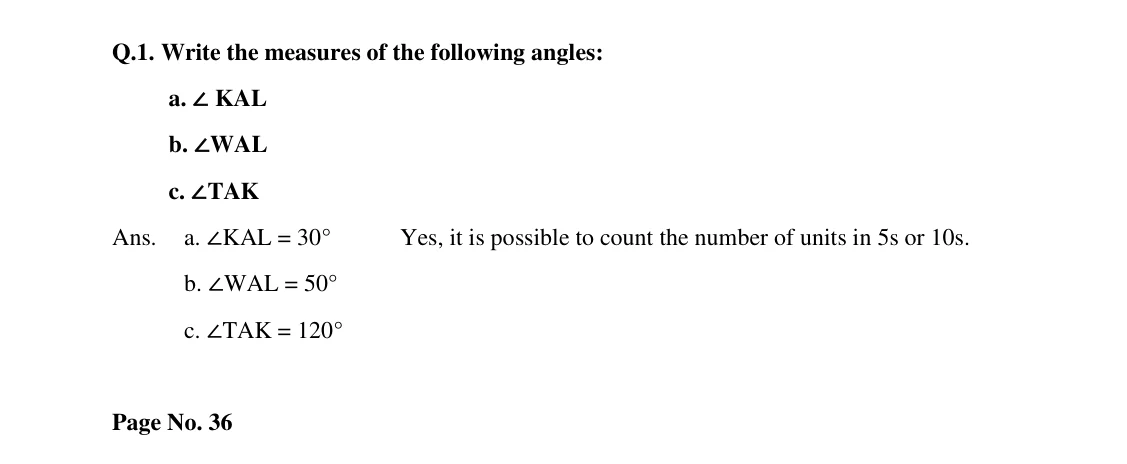
1. Write the measures of the following angles: a. ∠ KAL b. ∠WAL c. ∠TAK
Show solution
a. ∠KAL = 30° Yes, it is possible to count the number of units in 5s or 10s. b. ∠WAL = 50° c. ∠TAK = 120° Page No. 36
Page No. 36
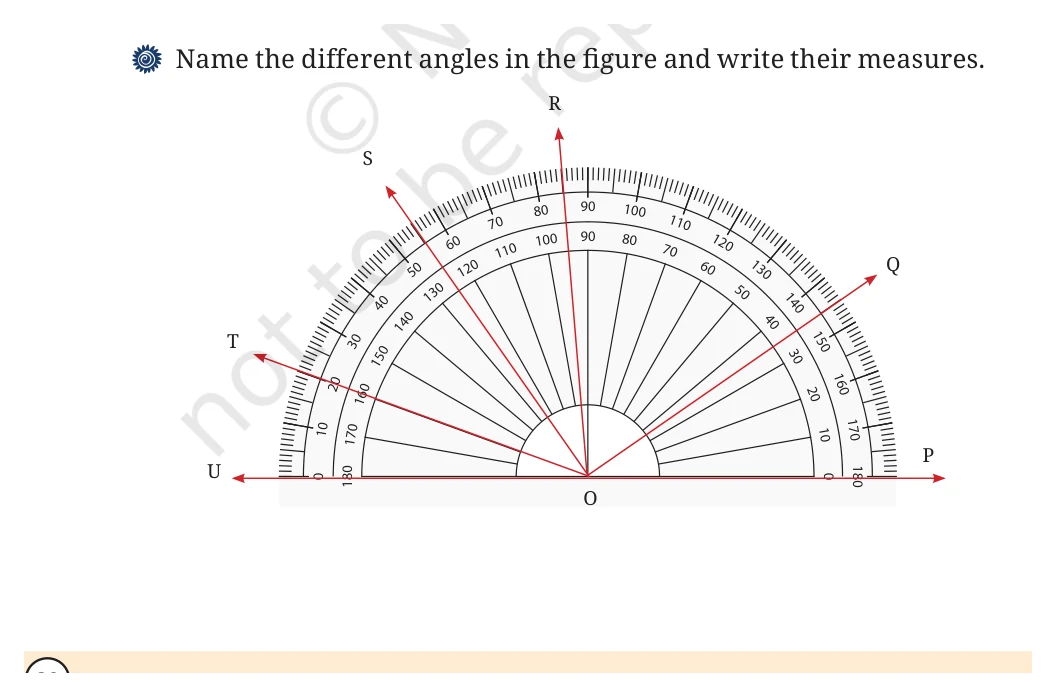
Name the different angles in the figure and write their measures.
Show solution
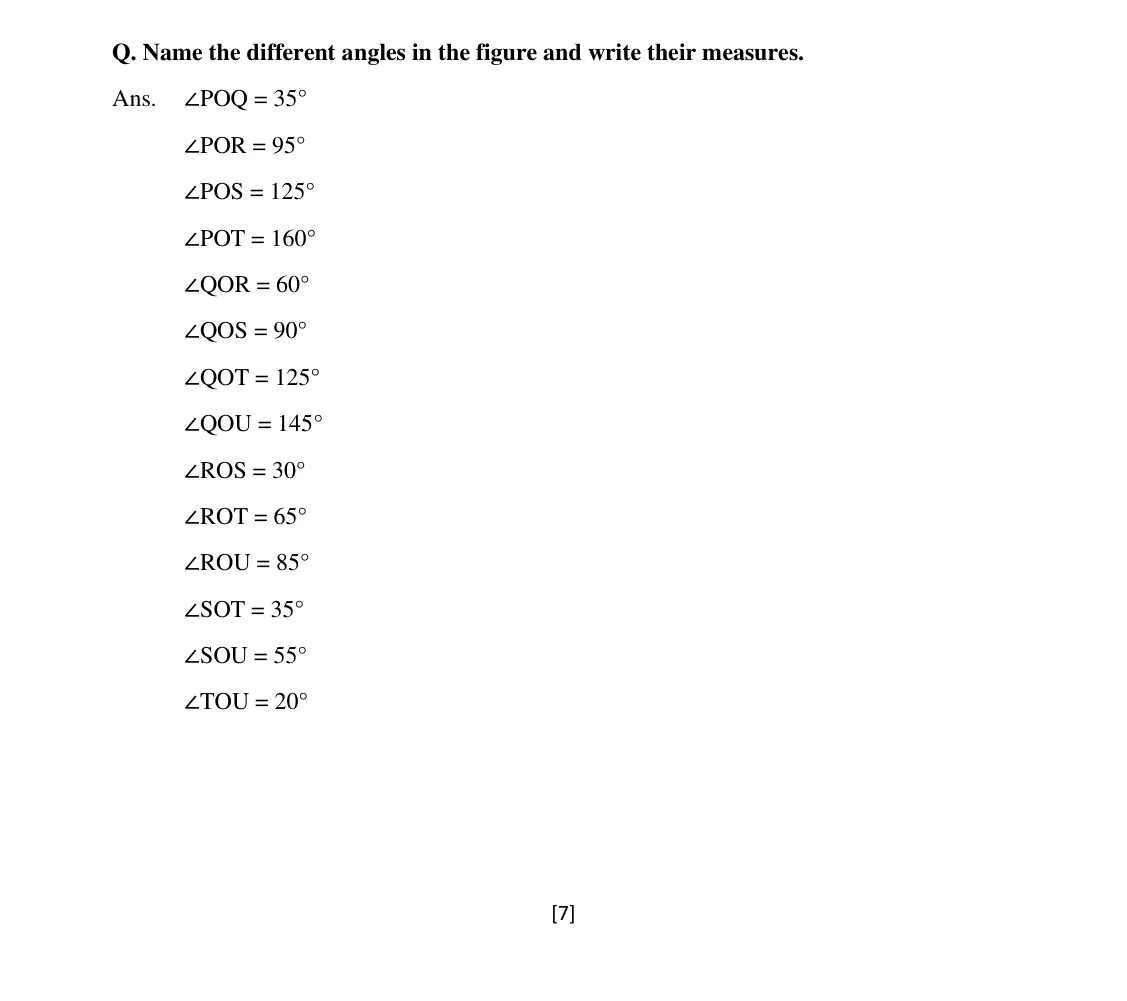
∠POQ = 35° ∠POR = 95° ∠POS = 125° ∠POT = 160° ∠QOR = 60° ∠QOS = 90° ∠QOT = 125° ∠QOU = 145° ∠ROS = 30° ∠ROT = 65° ∠ROU = 85° ∠SOT = 35° ∠SOU = 55° ∠TOU = 20° [7] Page No. 40 Think!

Reviewed source answers
Solution sheet 8
Page No. 40 · Think!
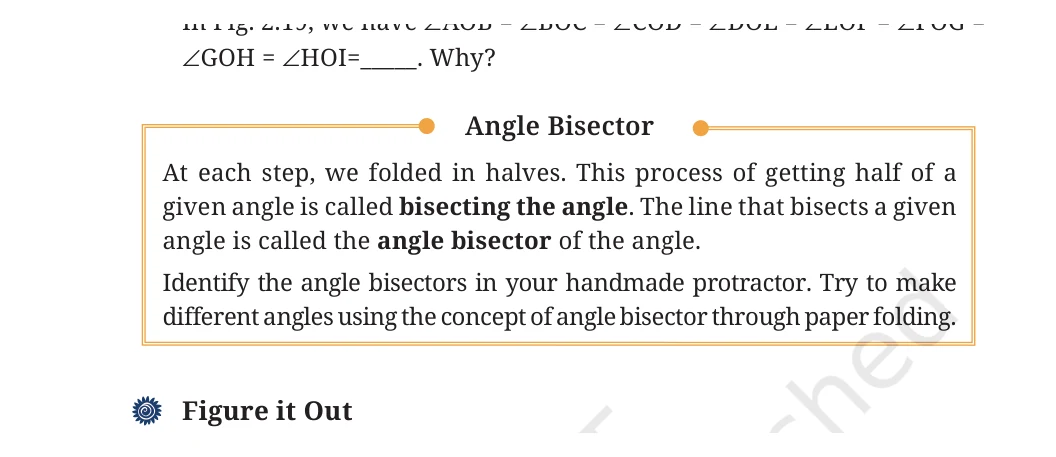
In Fig. 2.20, we have ∠AOB = ∠BOC = ∠COD = ∠DOE = ∠EOF = ∠FOG = ∠GOH = ∠HOI=_____. Why?
Show solution
Each of the angles = 22.5º As the straight angle of 180º is divided into eight equal parts so each of the right angles 180º will be of measure = 8 = 22.5º Figure it Out
Figure it Out
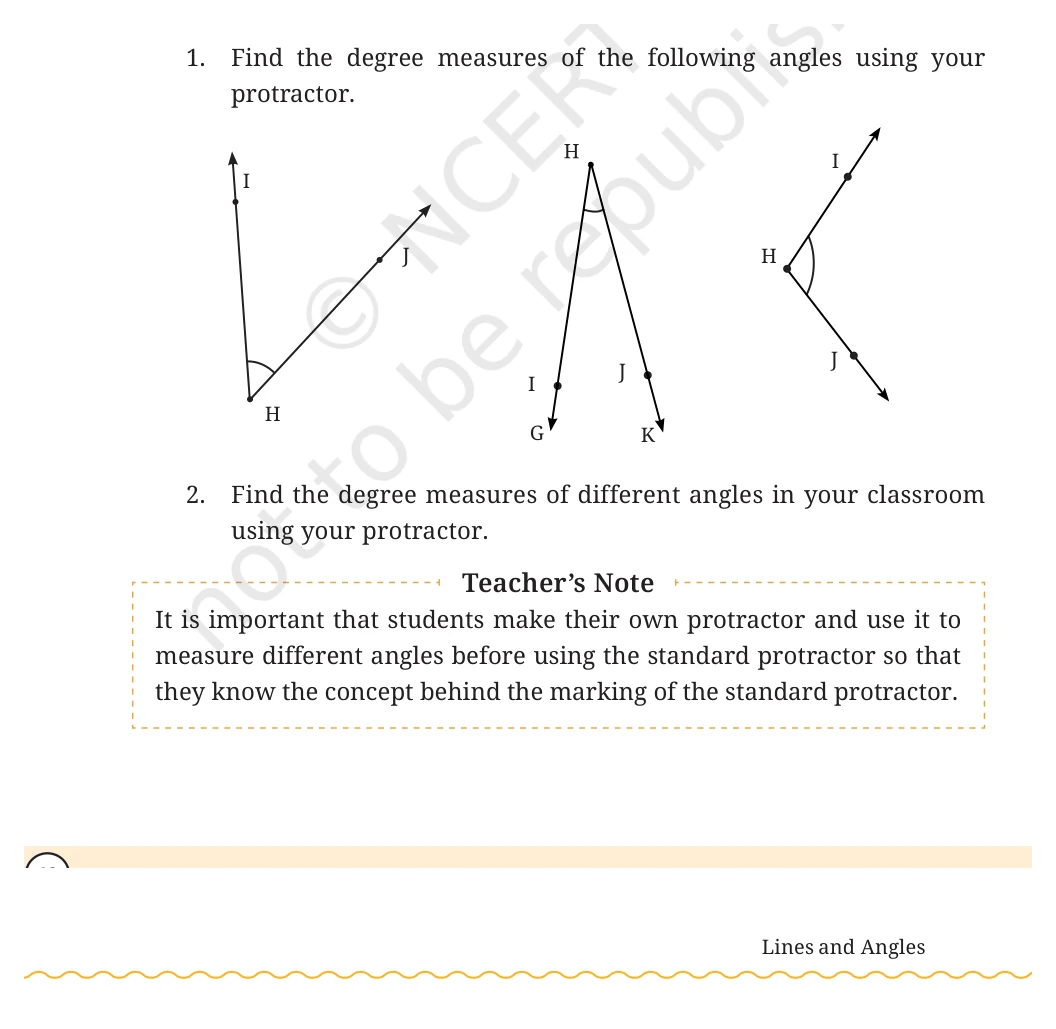
1. Find the degree measures of the following angles using your protractor.
Show solution
∠IHJ = ∠JHI = 47º ∠GHK = ∠IHJ = 23º ∠IHJ = ∠JHI = 108º
Figure it Out
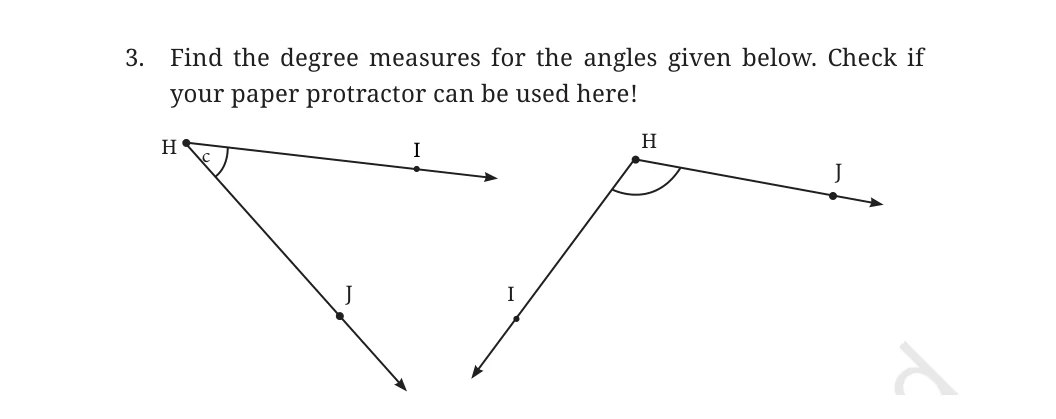
3. Find the degree measures for the angles given below. Check if your paper protractor can be used here!
Show solution
∠IHJ = 42º, ∠IHJ = 116º No, paper protractor cannot work here.

Source solution page 50
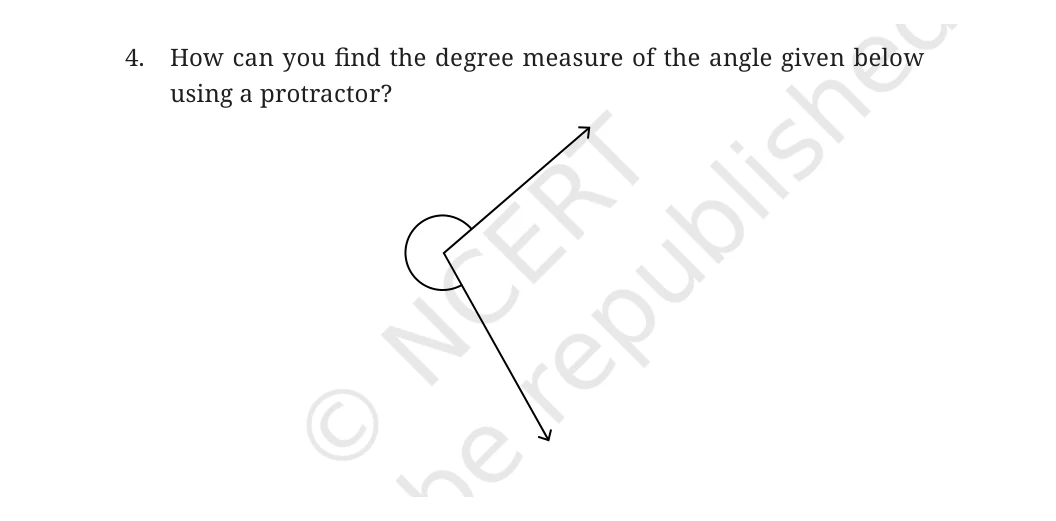
4. How can you find the degree measure of the angle given below using a protractor?
Show solution
Measure of marked angle = 360º – Measure of unmarked angle = 360º - 100º = 260º Try other ways to find the marked angle

Source solution page 50
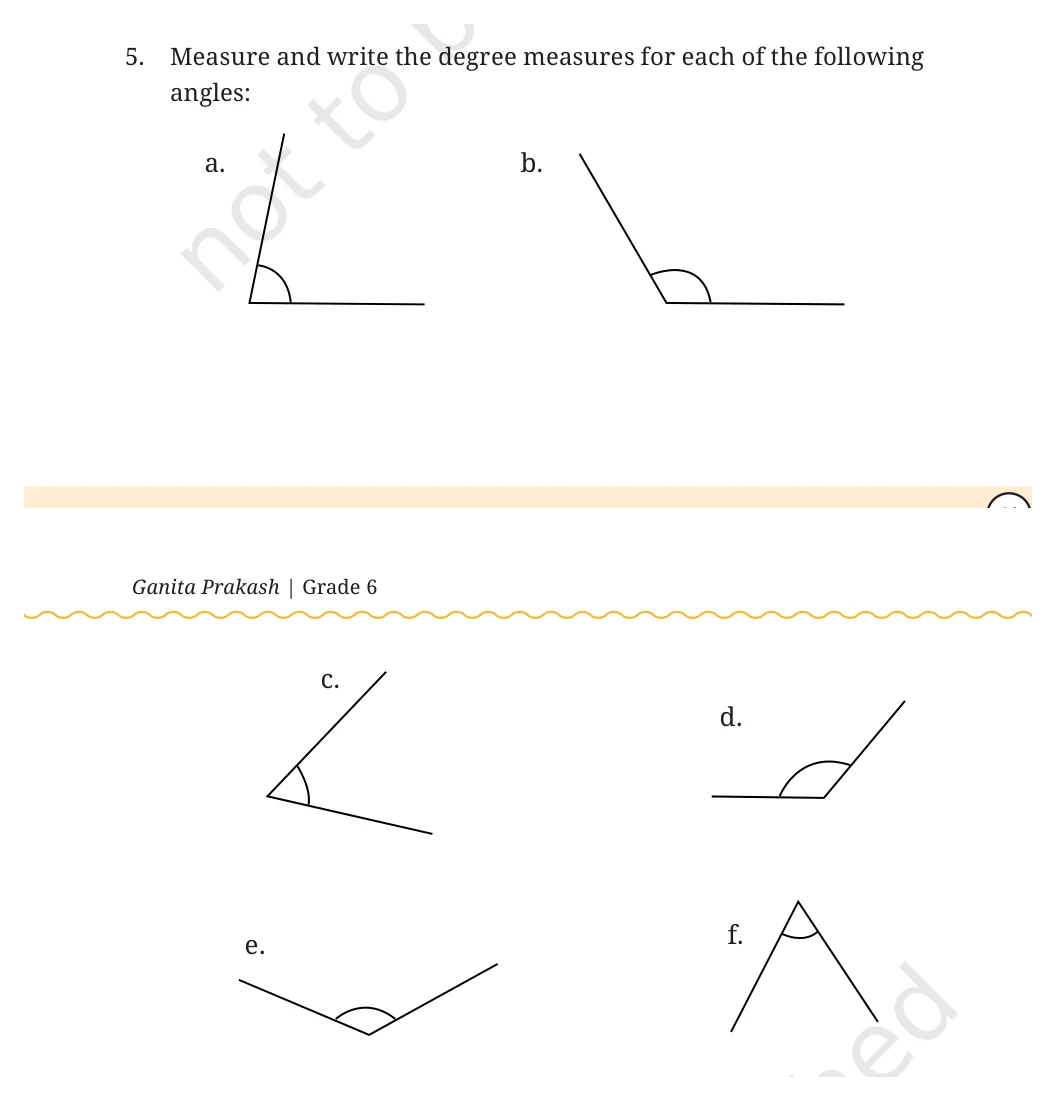
5. Measure and write the degree measures for each of the following angles:
Show solution
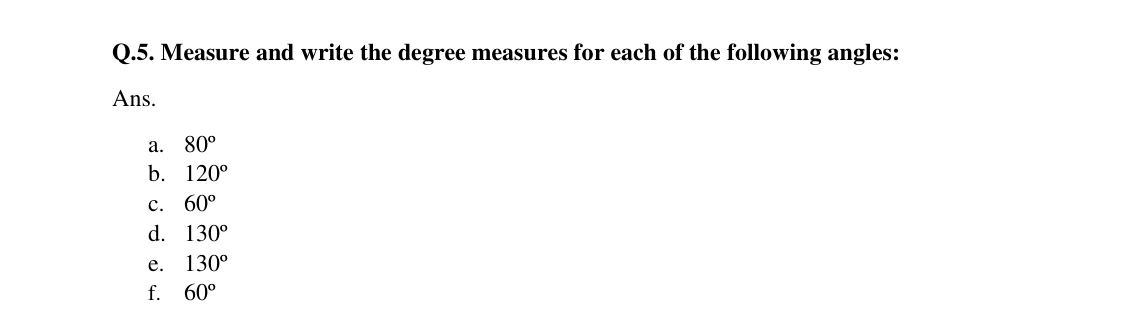
a. 80º b. 120º c. 60º d. 130º e. 130º f. 60º
Source solution page 50
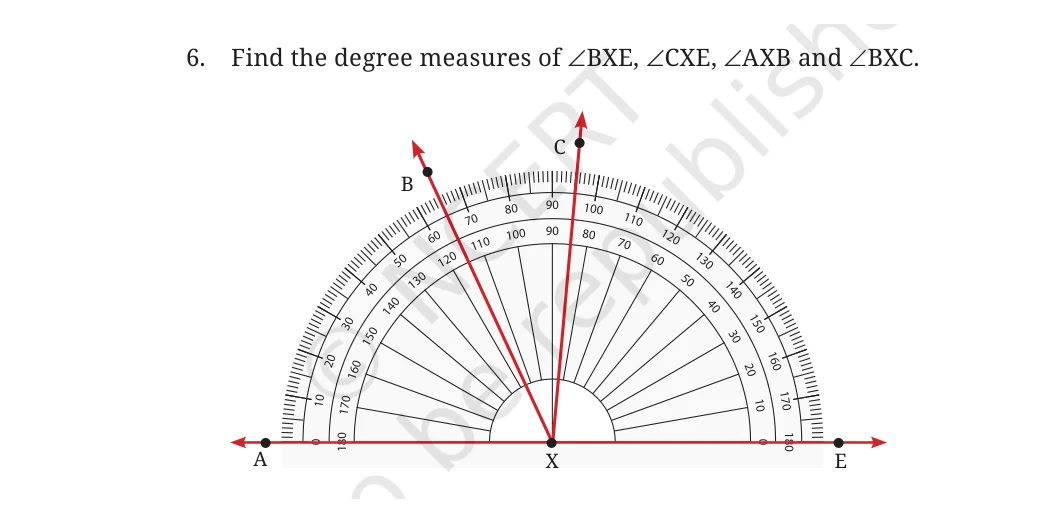
6. Find the degree measures of ∠BXE, ∠CXE, ∠AXB and ∠BXC.
Show solution
∠BXE = 115º, ∠CXE = 85º, ∠AXB = 65º ∠BXC = 30º

Source solution page 50
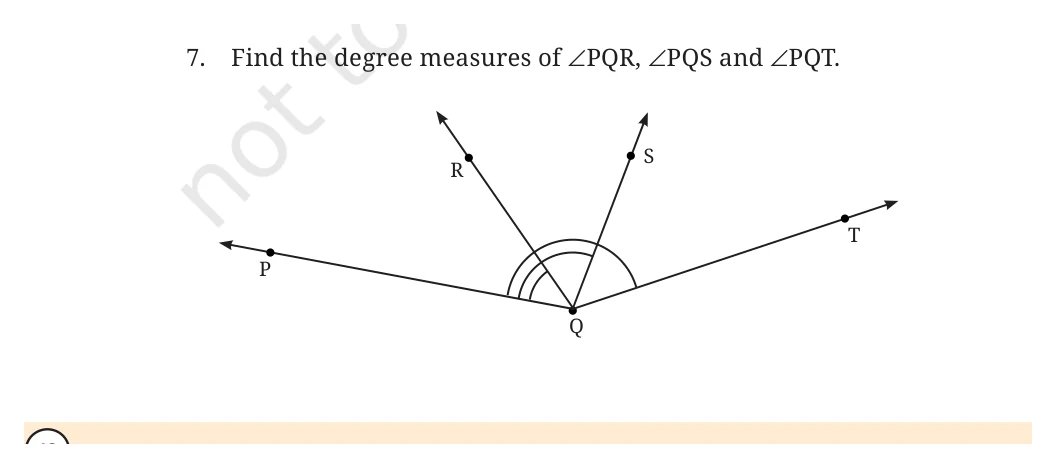
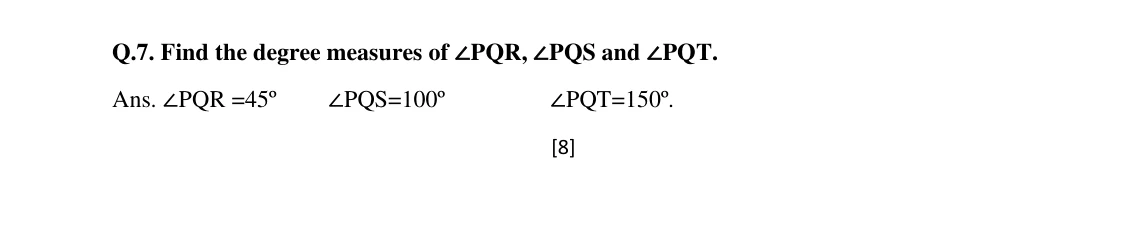
7. Find the degree measures of ∠PQR, ∠PQS and ∠PQT.
Show solution
∠PQR =45º ∠PQS=100º ∠PQT=150º. [8] Page 45 Figure it Out

Reviewed source answers
Solution sheet 9
Page 45 · Figure it Out
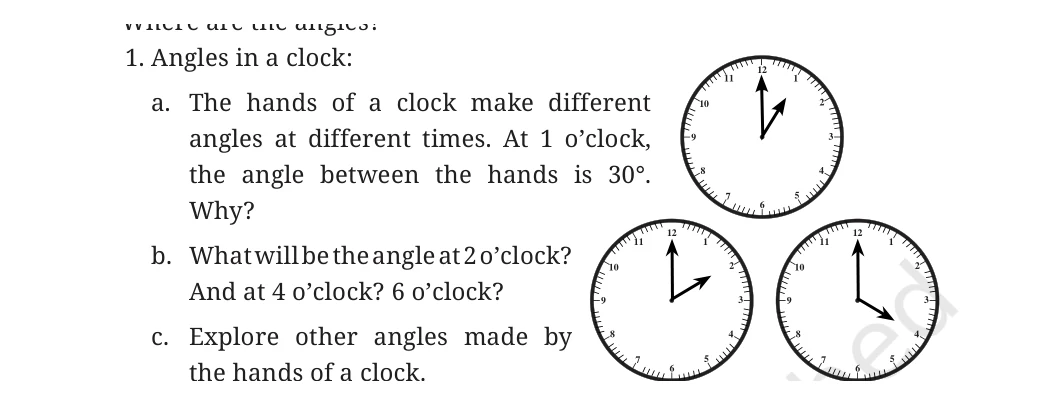
1. Angles in a clock: a. The hands of a clock make different angles at different times. At 1 o’clock, the angle between the hands is 30°. Why? b. What will be the angle at 2 o’clock? And at 4 o’clock? 6 o’clock? c. Explore other angles made by the hands of a clock.
Show solution
(a) The angles at the centre of the clock is 360º which is divided into 12 equal parts. So. 360 The angle between two successive numbers = 12 = 30º (b) At 2’O clock = 60º = 2×30 At 4’O clock = 120º = 4×30 At 6’O clock = 180º = 6×30 (c) At 3’O clock = 90º At 9’O clock = 270º Try for other angles made by the hands of a clock.
Source solution page 51
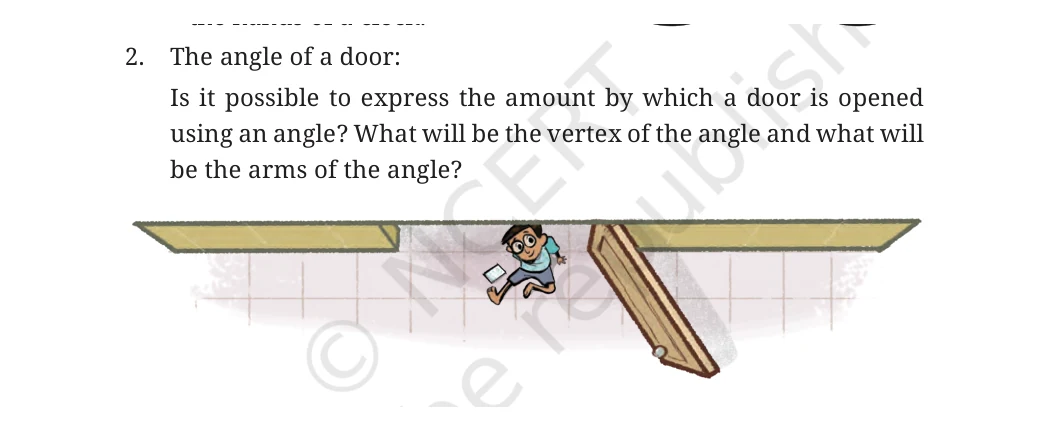
2. The angle of a door: Is it possible to express the amount by which a door is opened using an angle? What will be the vertex of the angle and what will be the arms of the angle?
Show solution
Yes, the vertex of the angle will be the point where door meets the wall. The arms will be the edges of the door and the wall.
Source solution page 51
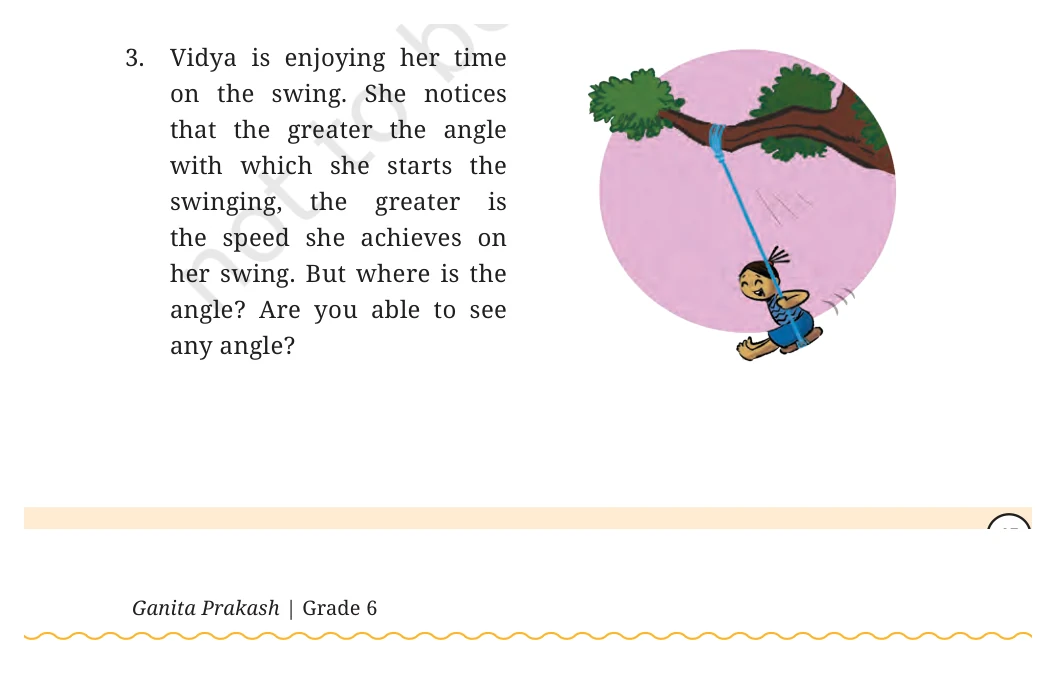
3. Vidya is enjoying her time on the swing. She notices that the greater the angle with which she starts the swinging, the greater is the speed she achieves on her swing. But where is the angle? Are you able to see any angle?
Show solution
Student may not see the angle, but when the starting arm is fixed as the position where she starts swinging. The angle can be thought to be between positions where she starts the swinging (the initial position) and the position where she attains the greatest position of the swing at any one side.
Source solution page 51
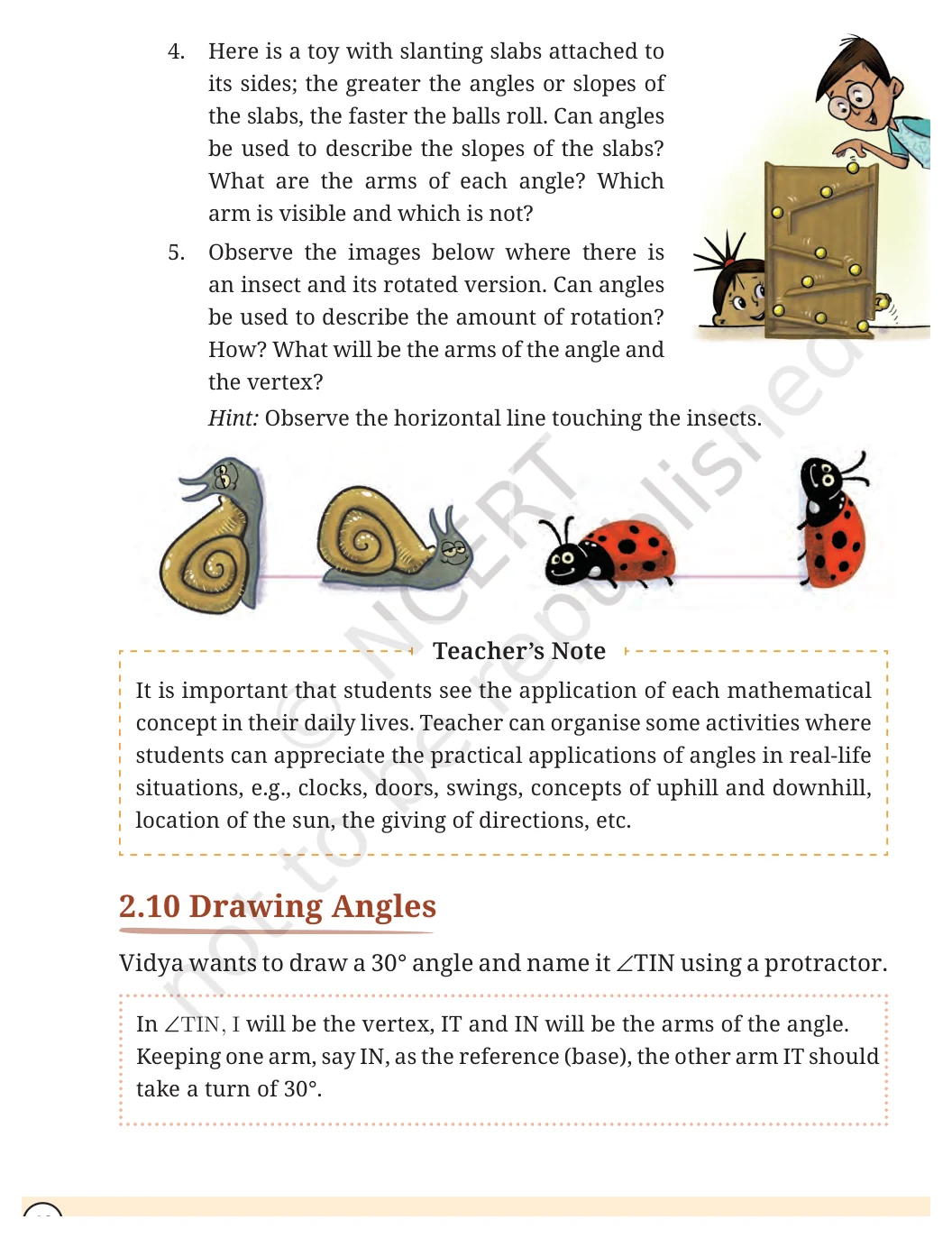
4. Here is a toy with slanting slabs attached to its sides; the greater the angles or slopes of the slabs, the faster the balls roll. Can angles be used to describe the slopes of the slabs? What are the arms of each angle? Which arm is visible and which is not?
Show solution
Yes, angles can be used directly to describe slopes of the slab, larger the angle, greater the slope of the slab. For each angle, one arm is a side and one arm is the slope. The vertical arm is not visible, whereas the other arm is visible. Here in this toy, edges of the slabs are the arms of the angles. Top horizontal ray is not visible, other arms in the form of edges of the slab are visible. Teacher should motivate students to get other possible answers. [9] Page 49 Section 2.10 Figure it Out
Reviewed source answers
Solution sheet 10
Section 2.10 · Figure it Out
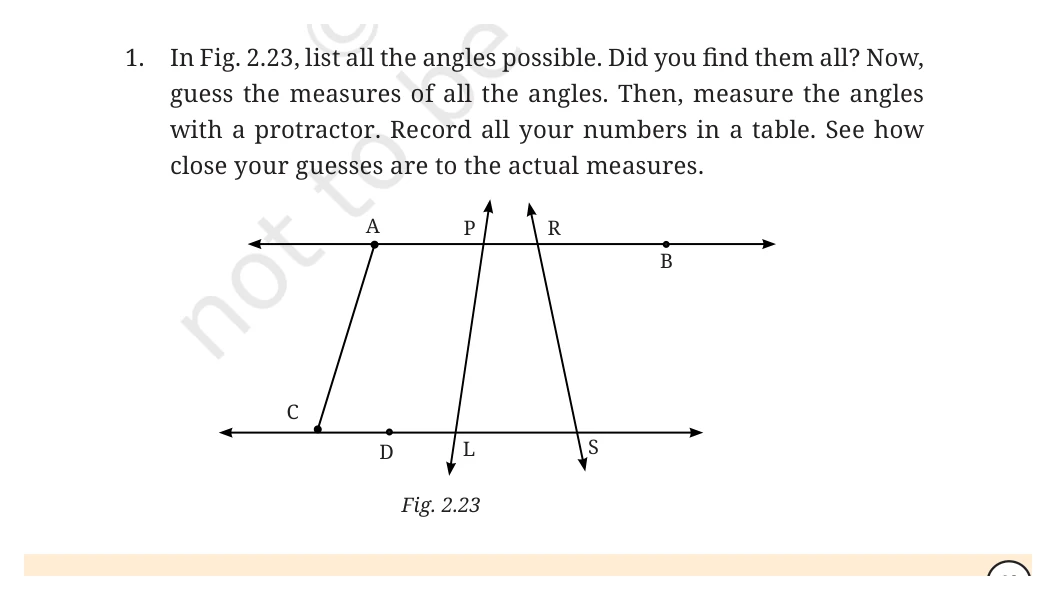
1. In Fig. 2.23, list all the angles possible. Did you find them all? Now, guess the measures of all the angles. Then, measure the angles with a protractor. Record all your numbers in a table. See how close your guesses are to the actual measures.
Show solution
∠CAP, ∠ACD, ∠APL, ∠DLP, ∠RPL, ∠SLP, ∠PRS, ∠LSR, ∠BRS, ∠CLP Try more! Page 52 Section 2.11 Figure it Out
Section 2.11 · Figure it Out
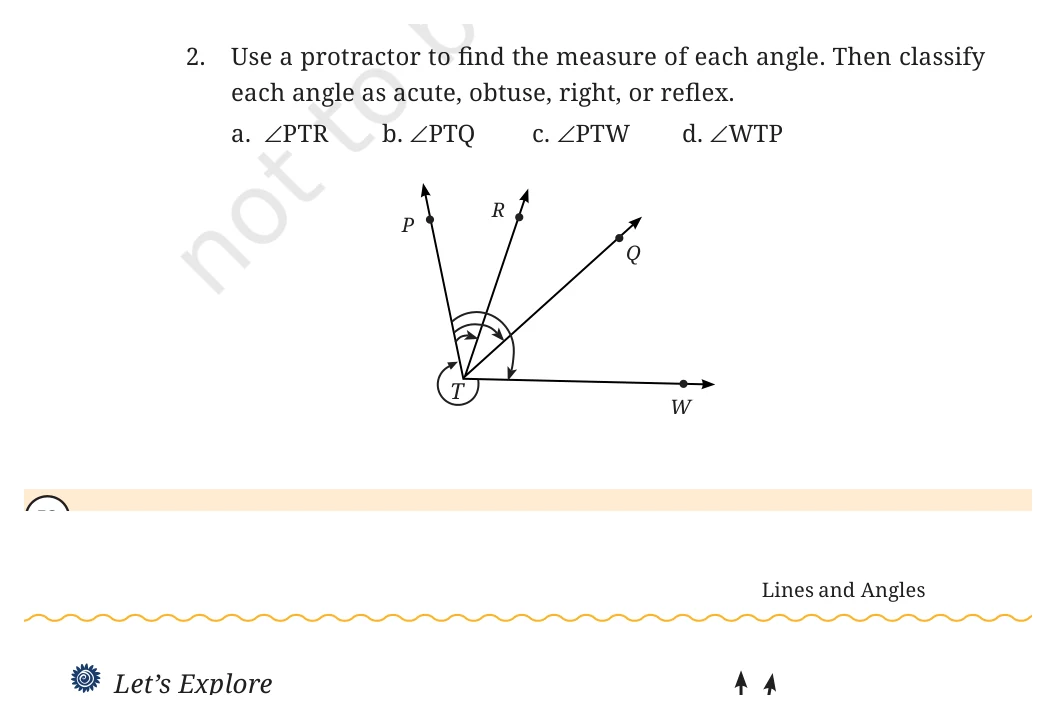
2. Use a protractor to find the measure of each angle. Then classify each angle as acute, obtuse, right or reflex.
Show solution
a. ∠PTR = 30º (Acute angle) b. ∠PTQ = 60º (Acute angle) c. ∠PTW = 102º (Obtuse angle) d. ∠WTP = 258º (Reflex angle) Let’s Explore:
Source solution page 52
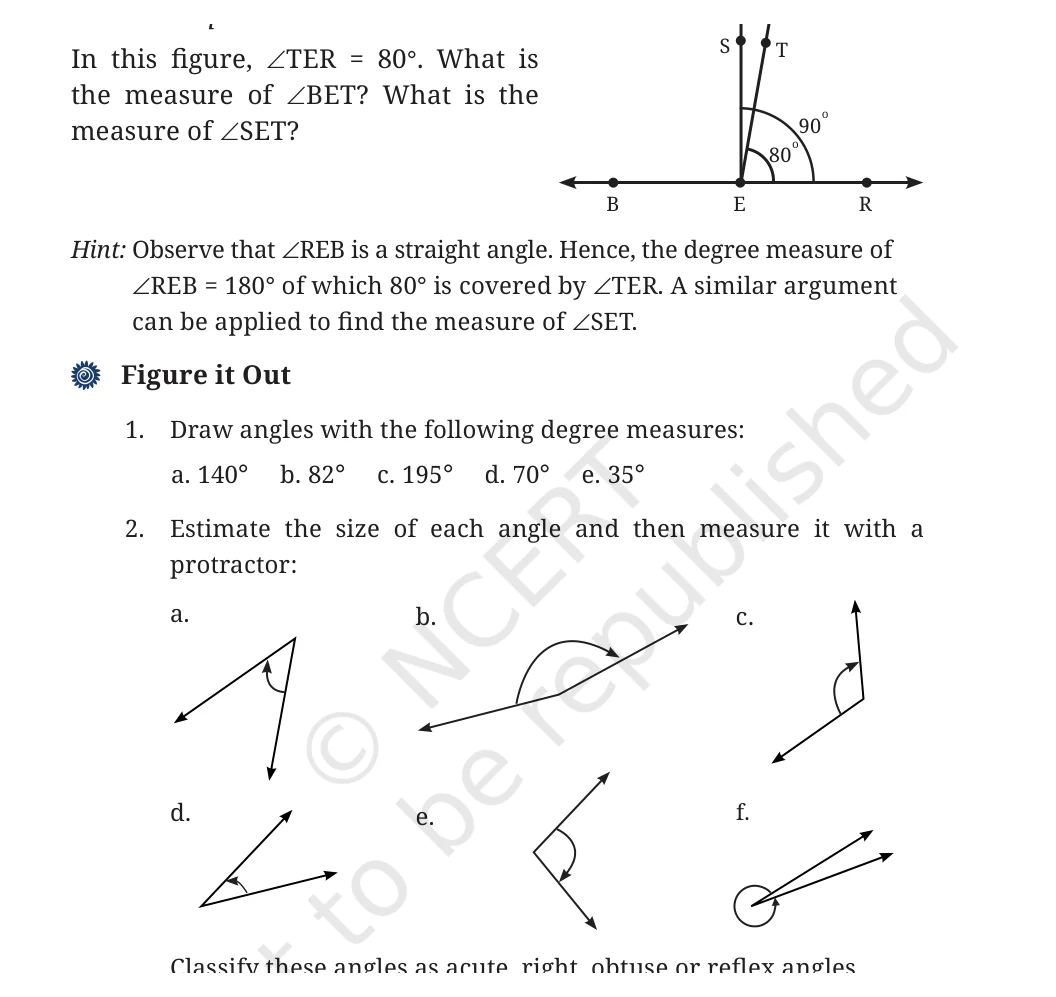
In this figure, ∠TER = 80°. What is the measure of ∠BET? What is the measure of ∠SET?
Show solution
∠BET = 100º, ∠SET = 10º Page – 53 Figure it out
Page – 53 · Figure it out

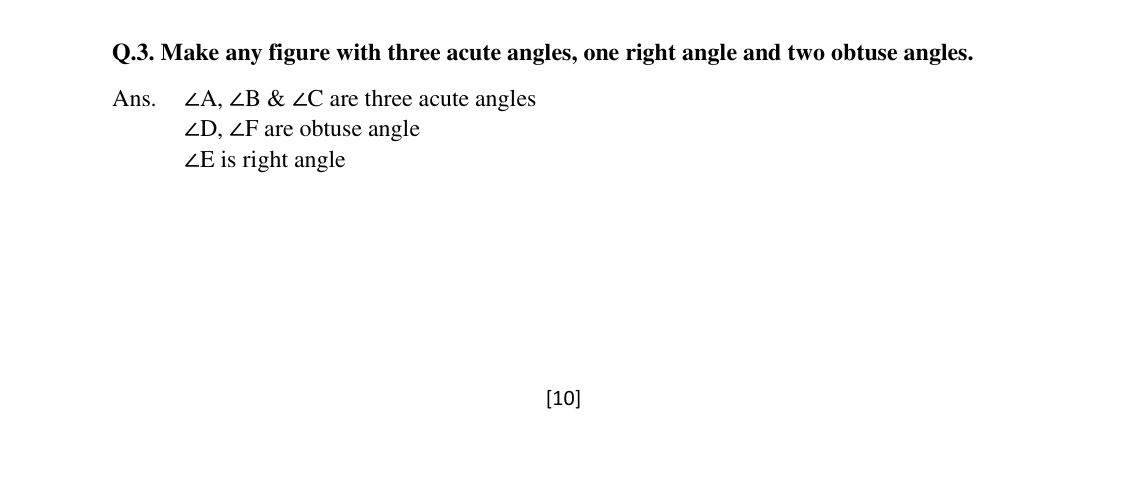
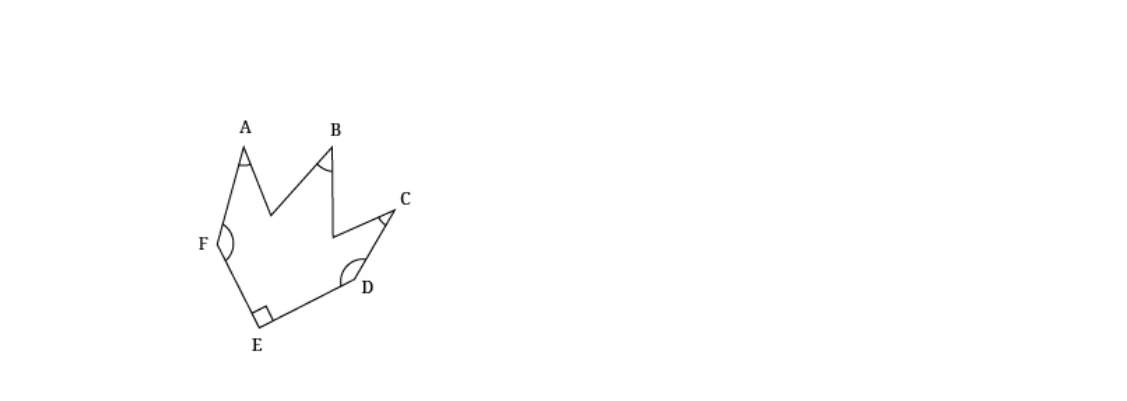
3. Make any figure with three acute angles, one right angle and two obtuse angles.
Show solution
∠A, ∠B & ∠C are three acute angles ∠D, ∠F are obtuse angle ∠E is right angle [10]
Reviewed source answers
Solution sheet 11
Page – 53 · Figure it out

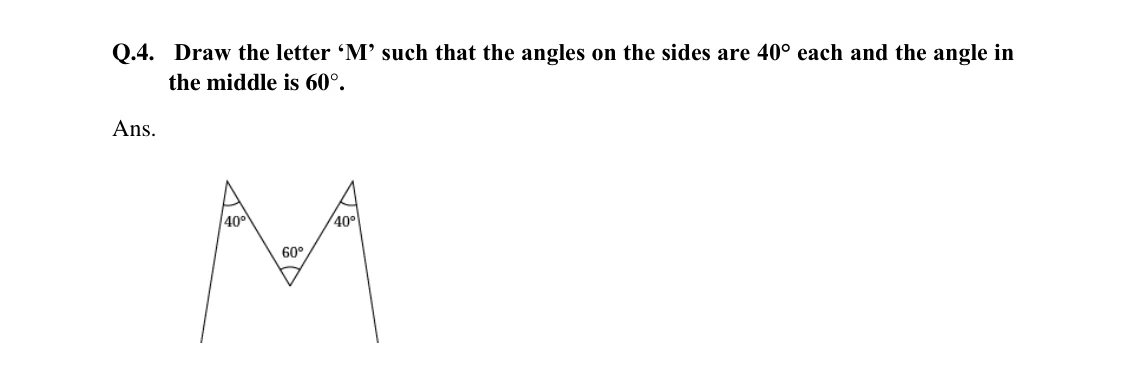
4. Draw the letter ‘M’ such that the angles on the sides are 40° each and the angle in the middle is 60°.
Show solution
Refer to the worked source solution below.
Source solution page 53
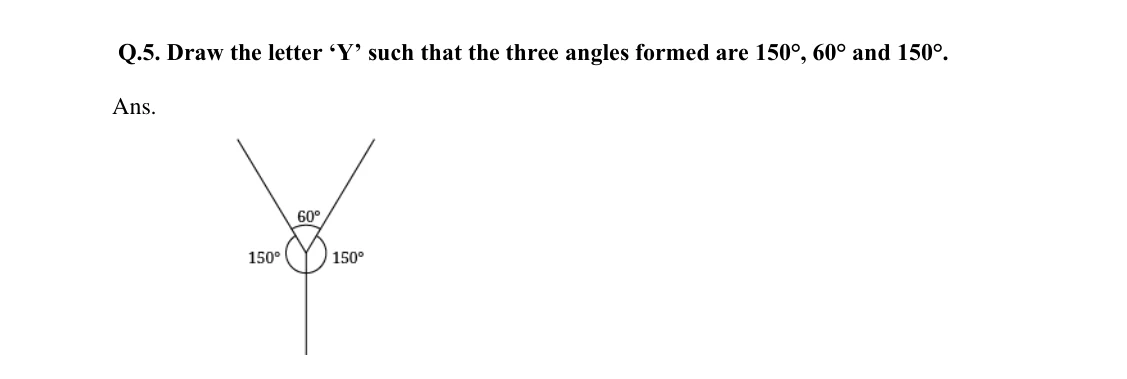
5. Draw the letter ‘Y’ such that the three angles formed are 150°, 60° and 150°.
Show solution
Refer to the worked source solution below.
Source solution page 53

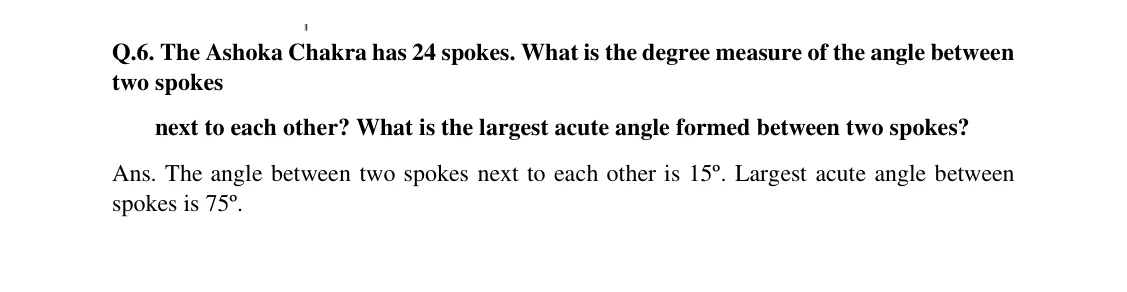
6. The Ashoka Chakra has 24 spokes. What is the degree measure of the angle between two spokes next to each other? What is the largest acute angle formed between two spokes?
Show solution
The angle between two spokes next to each other is 15º. Largest acute angle between spokes is 75º.
Source solution page 53
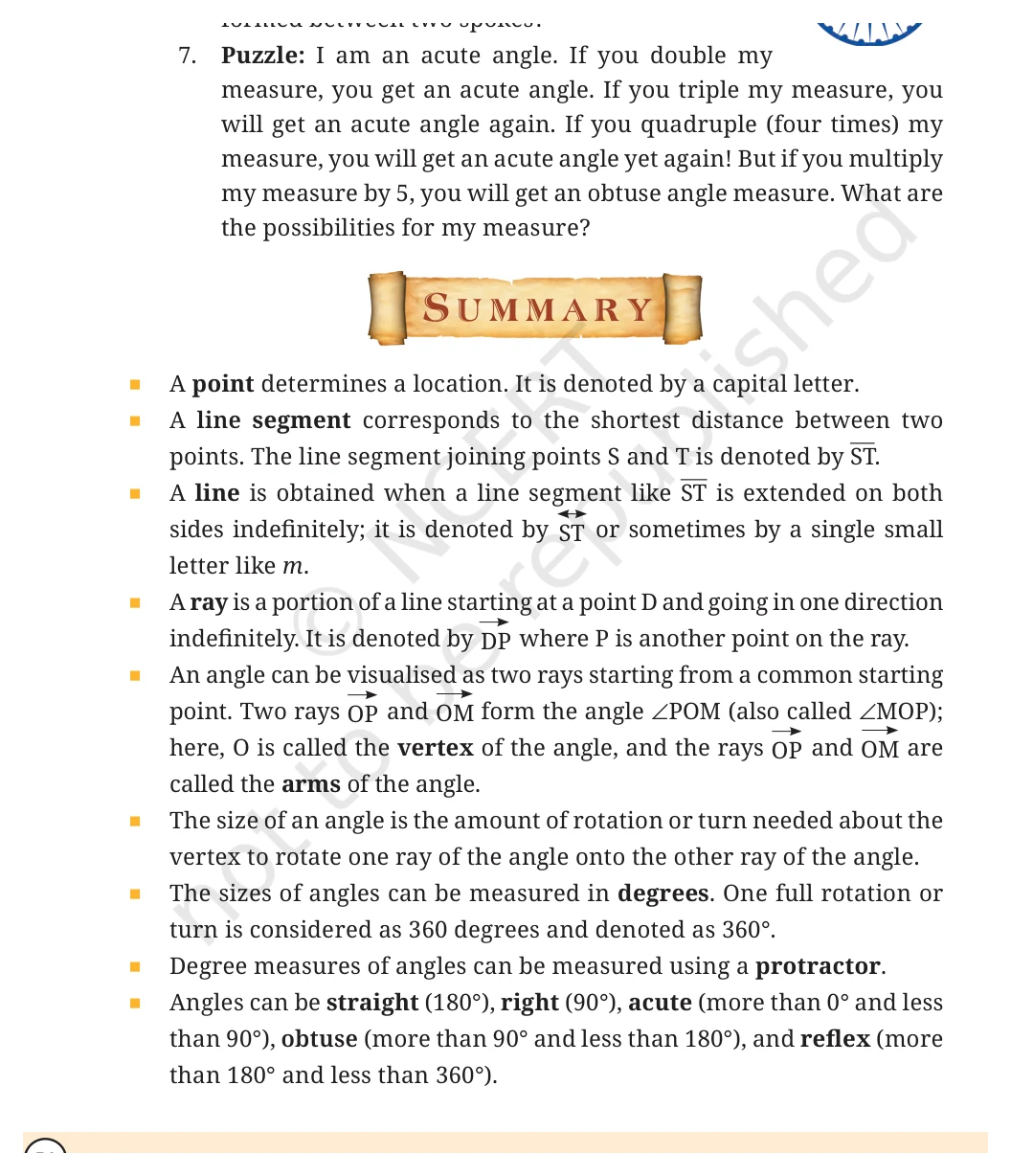
7. Puzzle: I am an acute angle. If you double my measure, you get an acute angle. If you triple my measure, you will get an acute angle again. If you quadruple (four times) my measure, you will get an acute angle yet again! But if you multiply my measure by 5, you will get an obtuse angle measure. What are the possibilities for my measure?
Show solution
The acute angle can be 19º, 20º, 21º & 22º. [11]