

Before you begin
The chapter in one minute
A pattern is a rule that repeats or develops predictably. This chapter moves from number sequences to visual arrangements and then asks the important mathematical question: why does the rule work?
Question wording below is shortened and paraphrased. Page and section references help you match each solution with the NCERT textbook.
Textbook page 2
1.1 What is Mathematics?
Figure it Out · Question 1

Give examples of mathematics helping us in everyday life.
Show solution
Many answers are possible. Good examples include:
- comparing prices and checking change while shopping;
- measuring ingredients and cooking time;
- reading a clock and planning how long a journey will take;
- measuring length, area and material while making furniture or a room;
- using scores, averages and distances in sports;
- reading temperature and rainfall information.
This is open-ended. An answer is valid when it names a real situation and explains what is counted, measured or compared.
Figure it Out · Question 2
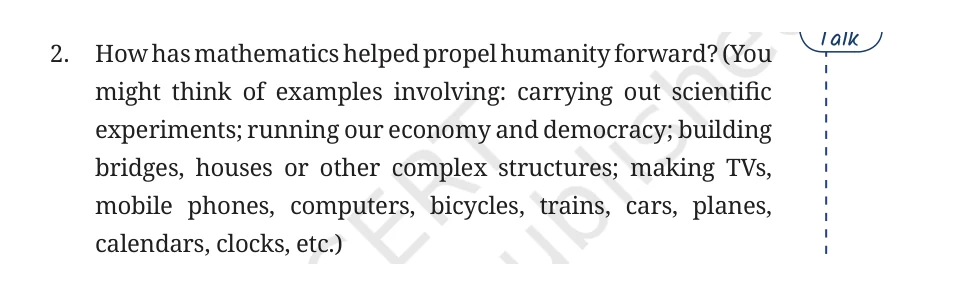
Explain how mathematics has helped humanity progress.
Show solution
Mathematics lets people describe patterns precisely and predict what may happen. Engineers use calculation and geometry to design safe bridges and buildings. Scientists use measurement and statistics to test ideas. Computers and mobile phones depend on mathematical logic. Calendars and clocks use repeating astronomical patterns, while transport systems use distance, speed and timing.
A strong response gives two or three examples and connects each invention or system to a mathematical idea.
Textbook page 3
1.2 Patterns in Numbers
Figure it Out · Question 1
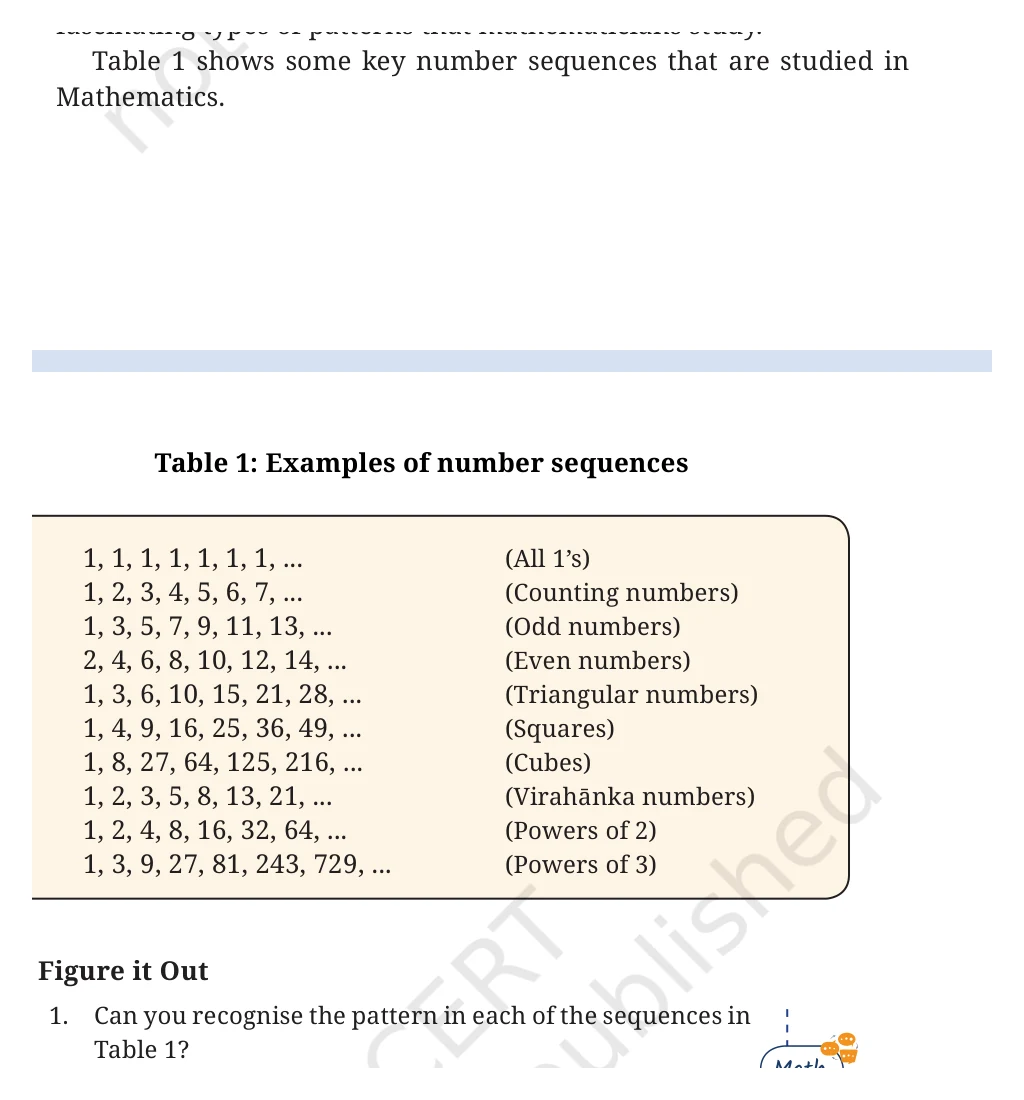
Recognise the rule in each sequence from Table 1.
Show solution
| Sequence | Rule |
|---|---|
| All 1s | Every term is 1. |
| Counting numbers | Add 1 each time. |
| Odd numbers | Start at 1 and add 2. |
| Even numbers | Start at 2 and add 2. |
| Triangular numbers | Add 2, then 3, then 4, and so on. |
| Squares | Multiply each counting number by itself. |
| Cubes | Multiply each counting number by itself three times. |
| Virahanka numbers | After 1, 2, each term is the sum of the previous two. |
| Powers of 2 | Multiply by 2 each time. |
| Powers of 3 | Multiply by 3 each time. |
Figure it Out · Question 2
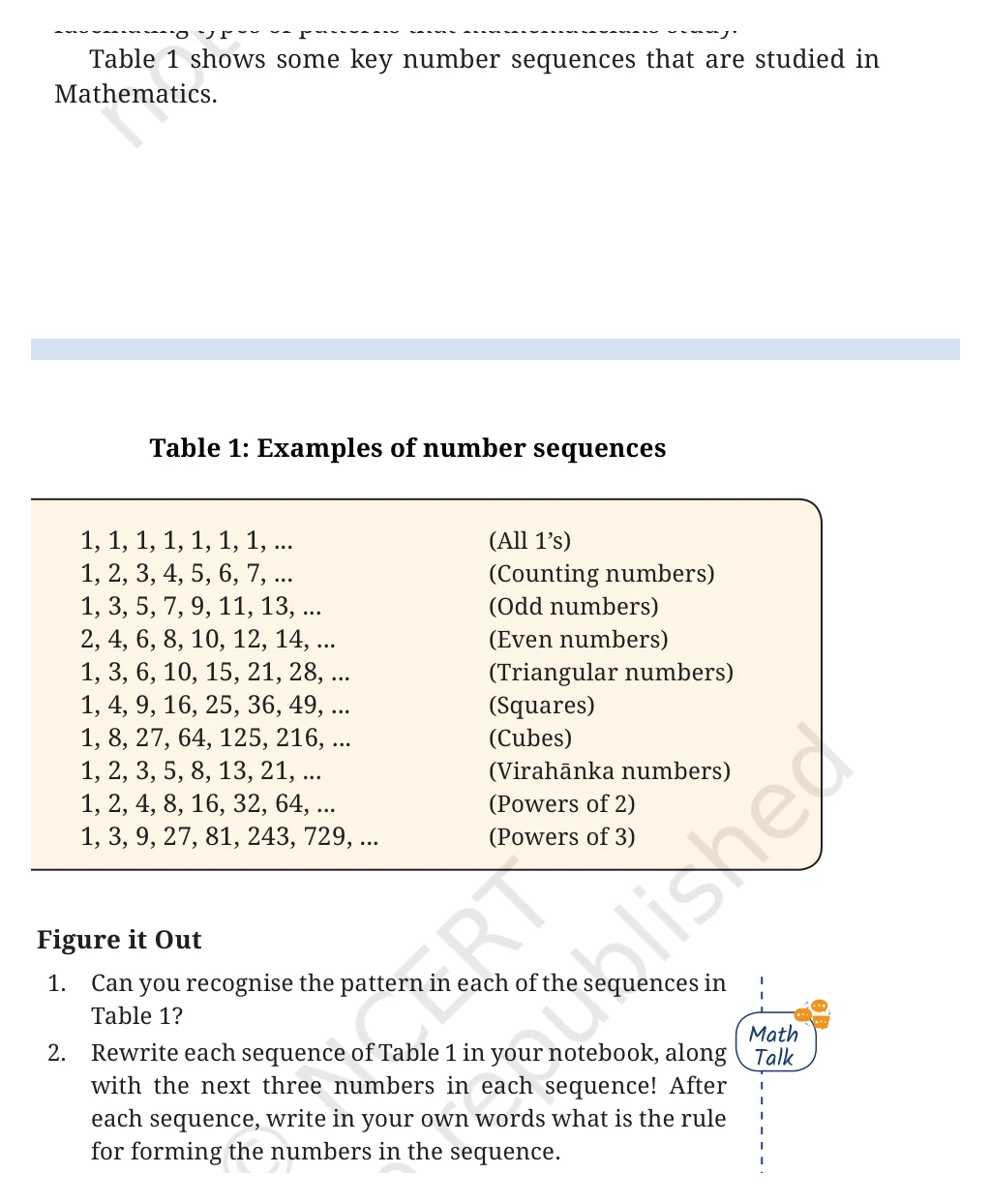
Write the next three terms of every sequence and state the rule.
Show solution
| Sequence | Next three terms |
|---|---|
| All 1s | 1, 1, 1 |
| Counting numbers | 8, 9, 10 |
| Odd numbers | 15, 17, 19 |
| Even numbers | 16, 18, 20 |
| Triangular numbers | 36, 45, 55 |
| Squares | 64, 81, 100 |
| Cubes | 343, 512, 729 |
| Virahanka numbers | 34, 55, 89 |
| Powers of 2 | 128, 256, 512 |
| Powers of 3 | 2187, 6561, 19683 |
For triangular numbers, the next additions are 8, 9 and 10. For example, 28 + 8 = 36 and 36 + 9 = 45.
Textbook page 5
1.3 Visualising Number Sequences
Figure it Out · Question 1
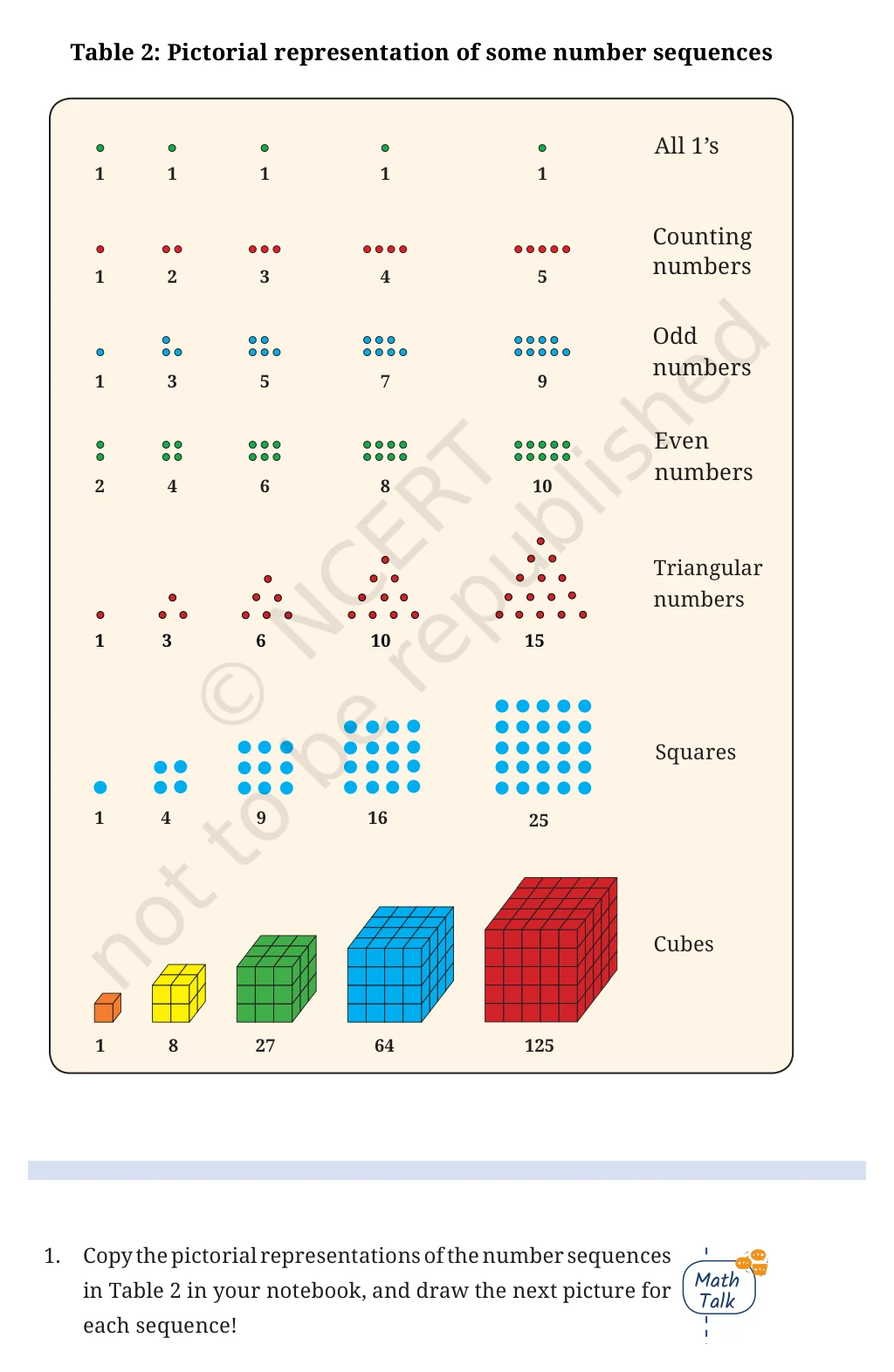
Extend each picture sequence in Table 2 by one figure.
Show solution
The next picture must use the next number of objects in that sequence:
- All 1s: one object again.
- Counting: 6 objects.
- Odd and even: 11 objects and 12 objects.
- Triangular: 21 dots in 6 rows.
- Squares: 36 dots in a 6 × 6 grid.
- Cubes: 216 small cubes in a 6 × 6 × 6 cube.
The exact drawing style may differ; the arrangement and count must follow the same rule as the textbook figures.
Figure it Out · Question 2
Why are the three sequences called triangular numbers, square numbers and cubes?
Show solution
Triangular numbers can be arranged in rows that form a triangle: 1; 1 + 2 = 3; 1 + 2 + 3 = 6, and so on. Square numbers form equal rows and columns, such as 4 = 2 × 2 and 9 = 3 × 3. Cube numbers form equal length, width and height, such as 8 = 2 × 2 × 2 and 27 = 3 × 3 × 3.
Figure it Out · Question 3
Show how 36 can be both triangular and square.
Show solution
For the triangle, arrange dots in rows of 1, 2, 3, 4, 5, 6, 7 and 8. Their total is 36. For the square, arrange the same 36 dots in 6 equal rows of 6.

Figure it Out · Question 4
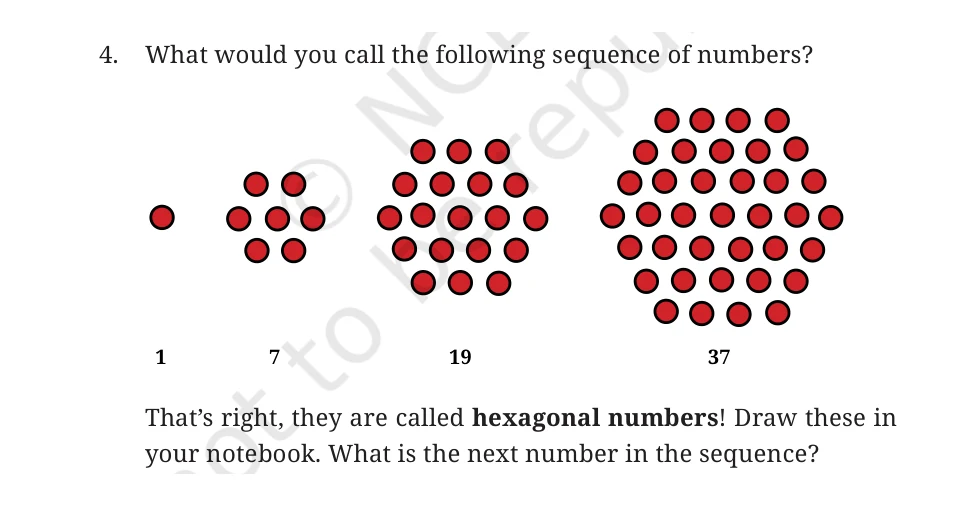
Continue the hexagonal sequence 1, 7, 19, 37.
Show solution
The increases are 6, 12 and 18. The amount added grows by 6 each time, so add 24 next.
37 + 24 = 61
The next hexagonal number is 61.
Figure it Out · Question 5

Suggest pictures for powers of 2 and powers of 3.
Show solution
For powers of 2, start with one square and replace every square with two squares at each stage: 1, 2, 4, 8, 16. For powers of 3, replace each object with three objects: 1, 3, 9, 27. A branching tree is another correct picture: every branch splits into two or three new branches.
This is a creative question. Any drawing that makes repeated doubling or tripling visible is valid.
Textbook pages 7-9
1.4 Relations among Number Sequences
Think about it · Page 7

Find the sum of the first 10 odd numbers.
Show solution
The sum of the first n odd numbers is an n by n square. With 10 odd numbers, the square has side 10.
1 + 3 + 5 + ... + 19 = 10 × 10 = 100
Think about it · Page 7

Find the sum of the first 100 odd numbers.
Show solution
Using the same square pattern, 100 odd-number layers make a 100 by 100 square.
1 + 3 + 5 + ... + 199 = 100 × 100 = 10,000
Figure it Out · Question 1

Explain pictorially why counting up and then down gives square numbers.
Show solution
Take the fourth expression: 1 + 2 + 3 + 4 + 3 + 2 + 1. Arrange these as seven rows, centred from the shortest to the longest and back. Move the extra parts of the shorter rows into the missing spaces. They fill a 4 × 4 square exactly, so the sum is 16.
The same rearrangement works for every size: a peak of n gives an n by n square.
Figure it Out · Question 2

Evaluate the up-and-down sum whose largest term is 100.
Show solution
An up-and-down sum peaking at 100 forms a 100 × 100 square.
1 + 2 + ... + 99 + 100 + 99 + ... + 2 + 1 = 100² = 10,000
Figure it Out · Question 3

What sequences appear when all 1s are added up, and when they are added up and down?
Show solution
Partial sums of all 1s are 1, 1 + 1, 1 + 1 + 1, ... so they give 1, 2, 3, 4, ..., the counting numbers.
Going up and down uses 1 object, then 3 objects, then 5 objects, and so on. It gives 1, 3, 5, 7, ..., the odd numbers.
Figure it Out · Question 4

What do partial sums of counting numbers produce?
Show solution
They produce triangular numbers:
1; 1 + 2 = 3; 1 + 2 + 3 = 6; 1 + 2 + 3 + 4 = 10
A picture uses rows of 1, 2, 3, 4, ... dots. Each new row adds the next counting number and keeps the triangular shape.
Figure it Out · Question 5

Add consecutive triangular numbers and identify the result.
Show solution
The sums are:
1 + 3 = 4, 3 + 6 = 9, 6 + 10 = 16, 10 + 15 = 25
These are square numbers. Two consecutive triangular dot arrangements fit together to make a square: Tn + Tn+1 = (n + 1)².
Figure it Out · Question 6
Add powers of 2 from 1, then add 1 to every result.
Show solution
The partial sums are 1, 3, 7, 15, 31, .... Adding 1 gives 2, 4, 8, 16, 32, ..., which are powers of 2.
Each partial sum is one less than the next power of 2. For example:
1 + 2 + 4 + 8 = 15 = 16 − 1
Figure it Out · Question 7

Multiply triangular numbers by 6 and add 1.
Show solution
Using 1, 3, 6, 10, 15, ...:
6×1+1=7, 6×3+1=19, 6×6+1=37, 6×10+1=61, 6×15+1=91
This continues the centred hexagonal sequence after its first term 1. Each new triangular stage accounts for six equal triangular sectors around a centre dot.
Figure it Out · Question 8
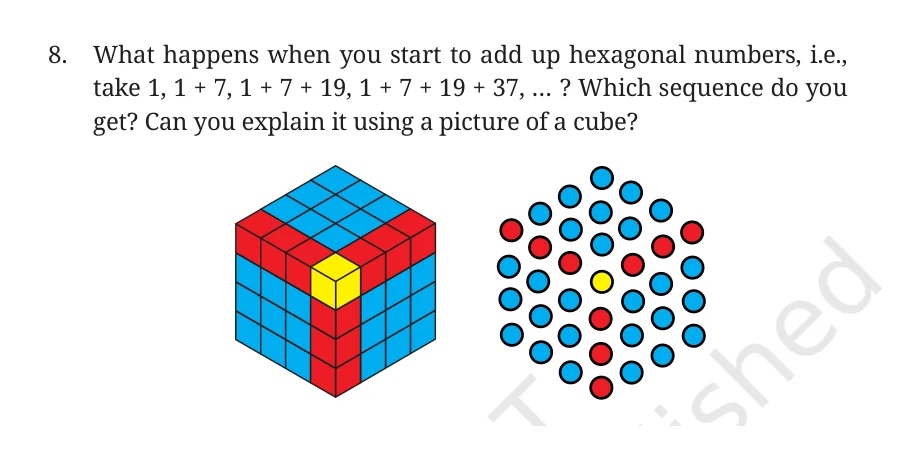
Add successive hexagonal numbers.
Show solution
The partial sums are:
1; 1+7=8; 1+7+19=27; 1+7+19+37=64
So the sequence is 1, 8, 27, 64, ..., the cube numbers. Geometrically, each new centred-hexagonal layer is the extra set of unit cubes needed to grow an n × n × n cube into the next cube.
Figure it Out · Question 9

Find and explain another relationship among the number sequences.
Show one valid solution
One relationship is that the difference between consecutive square numbers is always the next odd number:
4−1=3, 9−4=5, 16−9=7, 25−16=9
In a dot picture, an n × n square becomes an (n+1) × (n+1) square by adding one row and one column. After avoiding the double-counted corner, that border contains 2n+1 dots, an odd number.
Other correctly explained relationships are also valid.
Textbook page 11
1.5 Patterns in Shapes
Figure it Out · Question 1
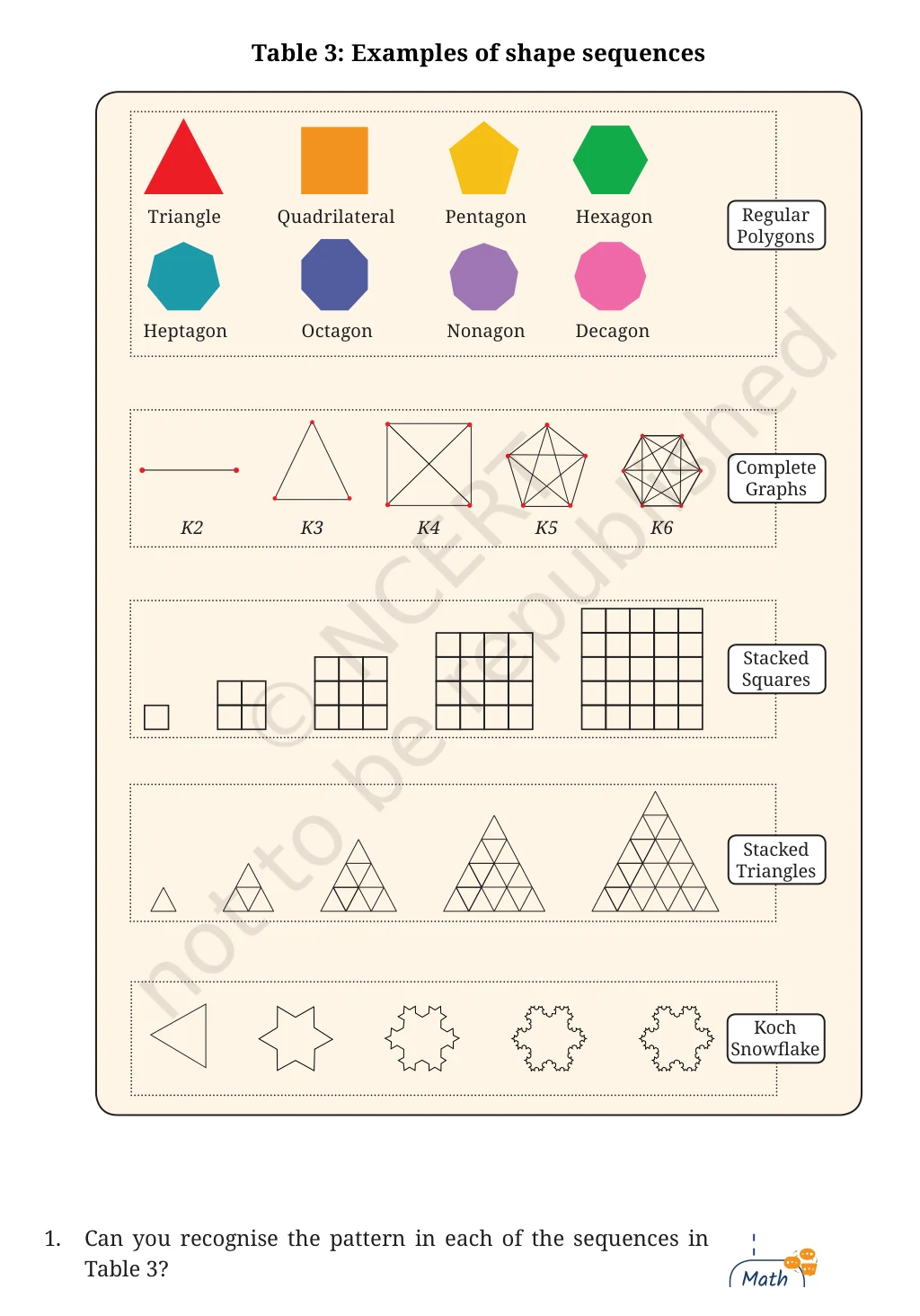
Recognise the rule in every shape sequence from Table 3.
Show solution
- Regular polygons: add one side and one corner each time.
- Complete graphs: add one point and join it to every existing point.
- Stacked squares: increase the stack so the total small-square count follows 1, 4, 9, 16, 25.
- Stacked triangles: add a new layer so the small-triangle count follows 1, 4, 9, 16, 25.
- Koch snowflake: replace every line segment with four shorter segments forming a bump.
Figure it Out · Question 2
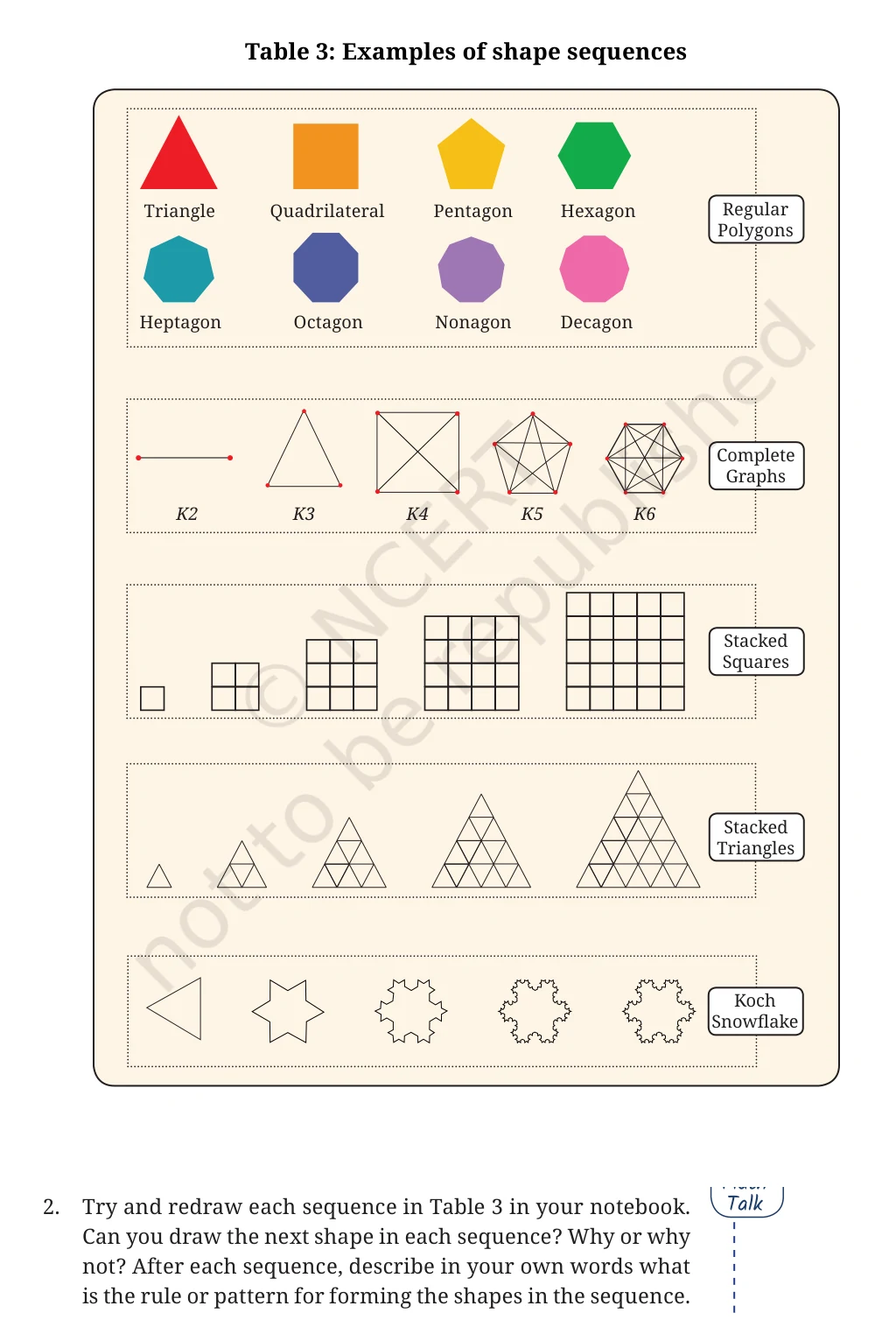
Draw or describe the next shape in each sequence.
Show solution
- After the decagon comes a regular 11-sided polygon.
- After K6 comes K7: seven points with every pair joined.
- The next stacked square stage contains 36 little squares.
- The next stacked triangle stage contains 36 little triangles.
- The next Koch stage replaces each of the current segments with the same four-segment bump.
The first four can be sketched directly. The Koch figure is possible to draw, but it requires many small accurate segments, so a ruler or drawing software helps.
Textbook pages 11-12
1.6 Relation to Number Sequences
Figure it Out · Question 1
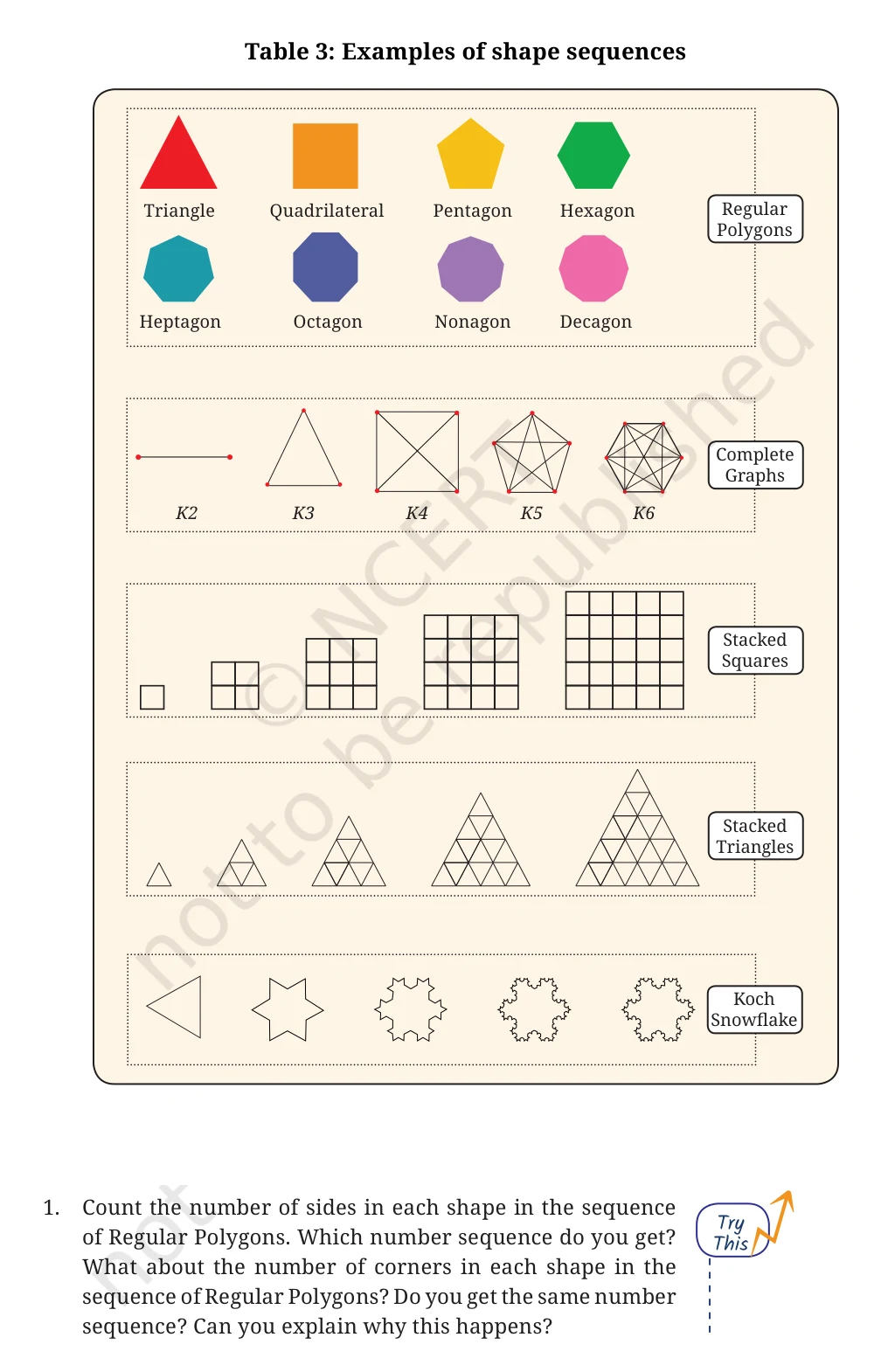
Count sides and corners in the regular-polygon sequence.
Show solution
Both counts are 3, 4, 5, 6, 7, 8, 9, 10, .... Every side meets the next side at one corner, so a closed polygon has exactly as many corners as sides.
Figure it Out · Question 2
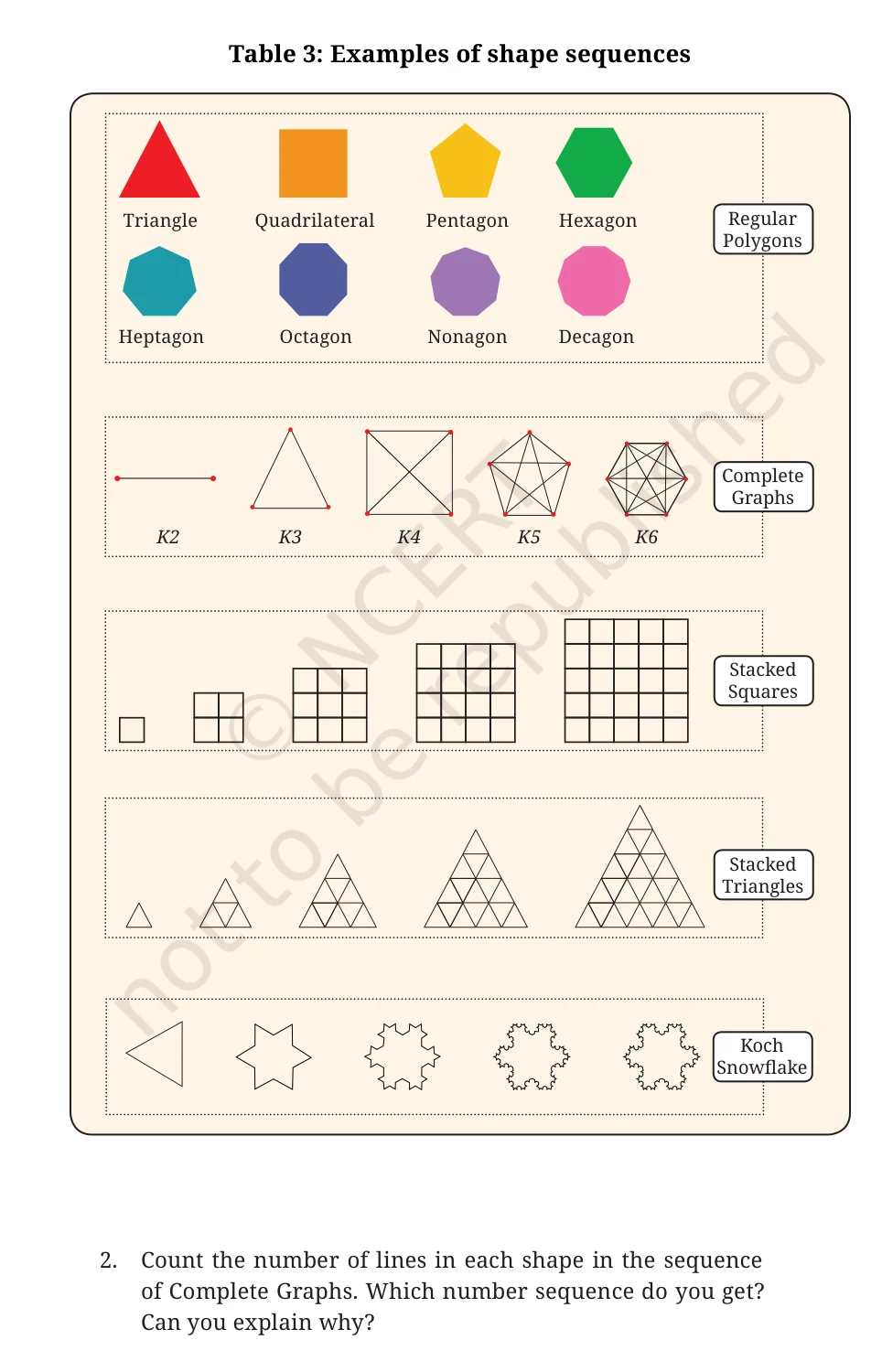
Count the lines in successive complete graphs.
Show solution
K2, K3, K4, K5 and K6 have 1, 3, 6, 10 and 15 lines. These are triangular numbers.
Each new point connects to all earlier points. The added line counts are therefore 2, then 3, then 4, then 5, producing the successive triangular totals.
Figure it Out · Question 3
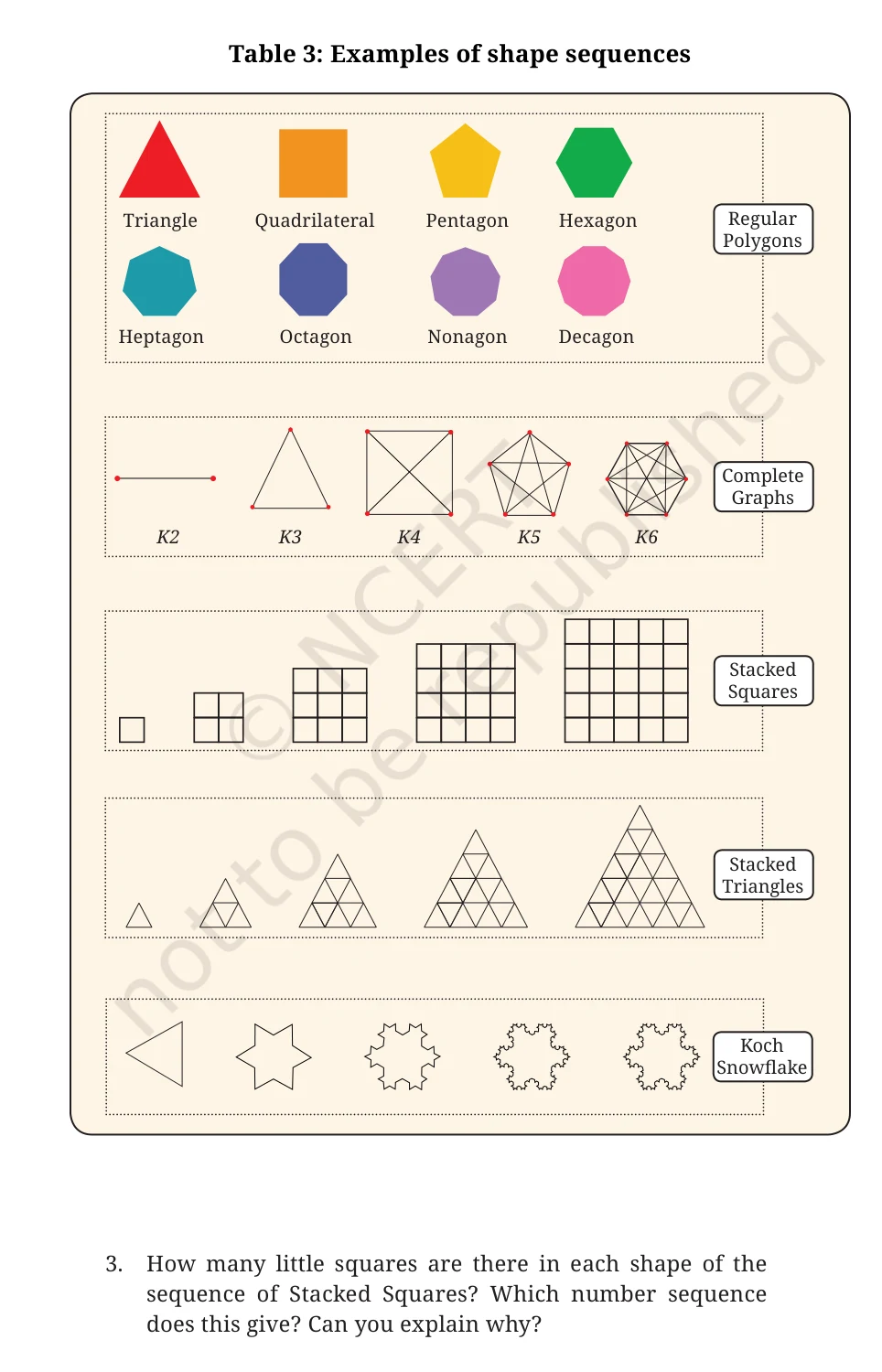
Count the little squares in the stacked-square sequence.
Show solution
The totals are 1, 4, 9, 16, 25, .... They are square numbers because the nth arrangement can be rearranged into n rows of n little squares, giving n × n.
Figure it Out · Question 4
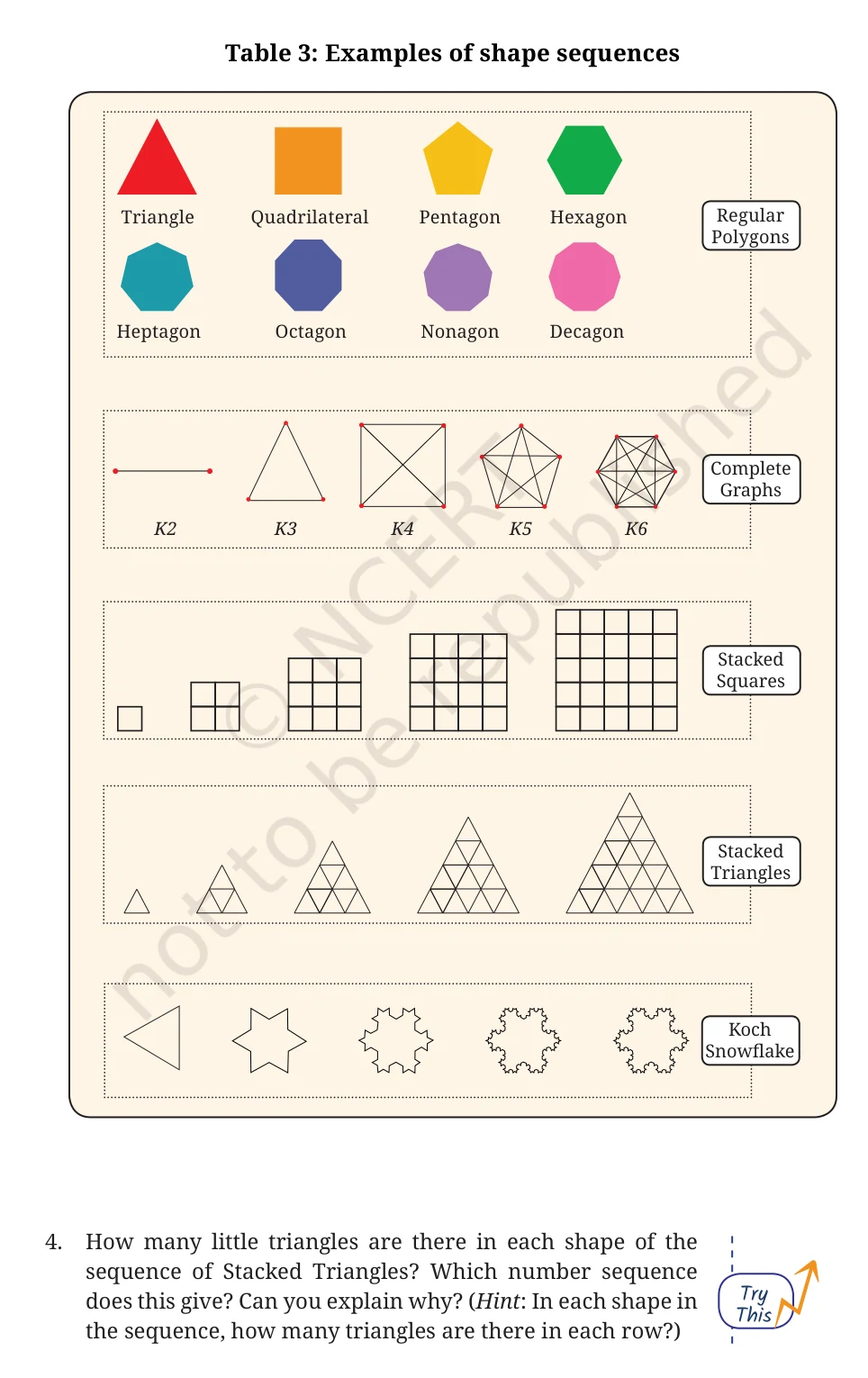
Count the little triangles in the stacked-triangle sequence.
Show solution
The totals are also 1, 4, 9, 16, 25, .... The row counts go up and down:
1; 1+2+1; 1+2+3+2+1; ...
As shown earlier, a counting-up-and-down sum peaking at n equals n².
Figure it Out · Question 5
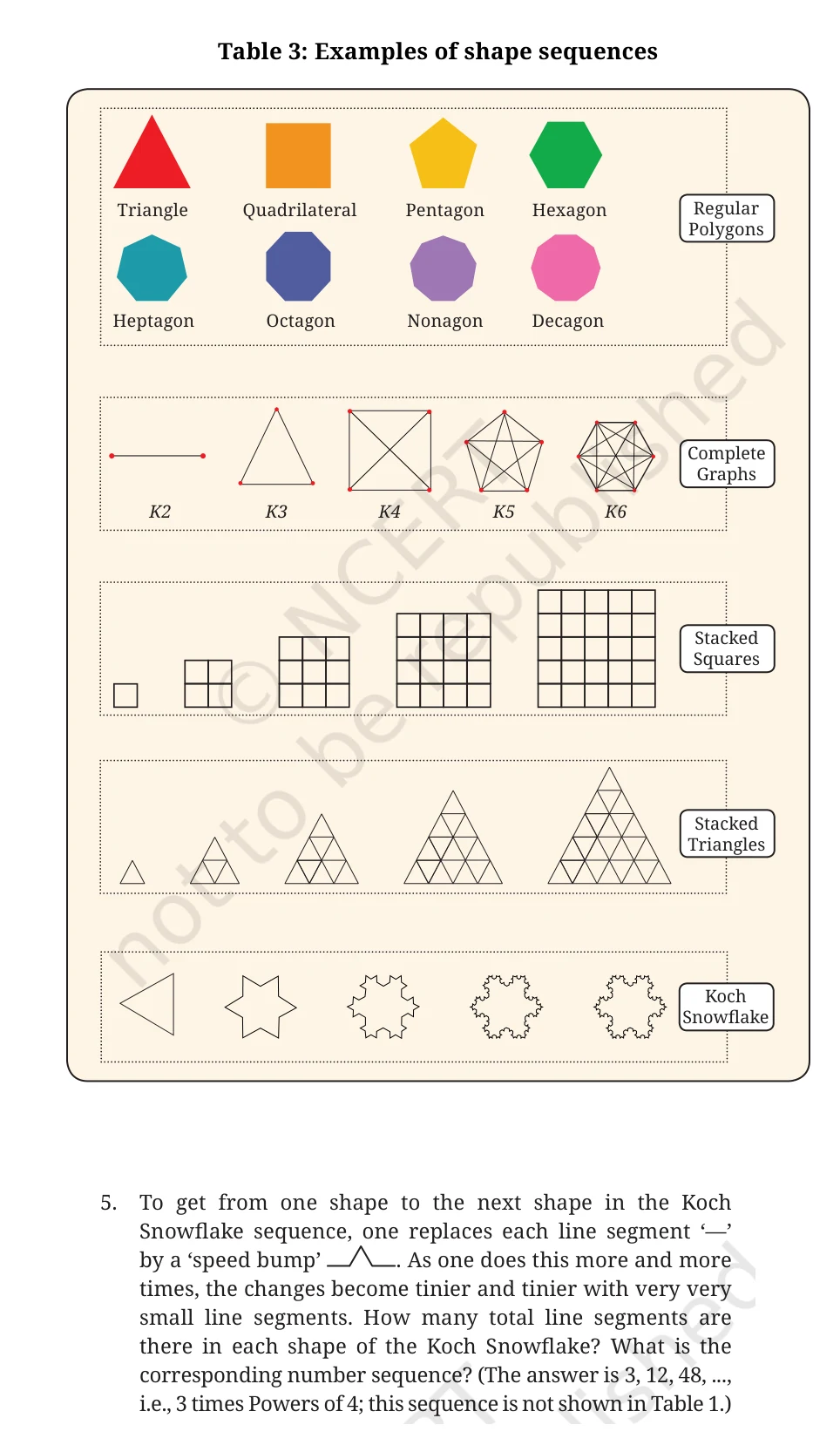
Count line segments in successive Koch snowflake stages.
Show solution
The counts are 3, 12, 48, 192, 768, .... Every old segment is replaced by four new segments, so the count is multiplied by 4 at each stage.
3, 3×4, 3×4², 3×4³, 3×4⁴, ...
Check your understanding
Common mistakes
Not from the textbook
Original practice
Try these before opening the answer.
1. The sequence is 2, 6, 12, 20, 30. What comes next, and what is the rule?
42. The terms are 1×2, 2×3, 3×4, 4×5, 5×6, so the next is 6×7.
2. Without adding term by term, find 1 + 3 + 5 + ... + 39.
39 is the 20th odd number, so the sum is 20² = 400.
3. A complete graph has 7 points. How many lines join every pair?
Continue the triangular counts: K₆ has 15 lines, so K₇ adds 6 more. It has 21 lines.
4. Is the 10th triangular number also a square number?
The 10th triangular number is 1+2+...+10 = 55, which is not a square. So the 10th triangular number is not a square number. This checks whether the claim is true before accepting it.
5. A Koch-style figure starts with 5 segments and triples every segment at each stage. Write the first four counts.
5, 15, 45, 135. Multiply by 3 each time.