How to use these solutions
Match, attempt, then check
Use the source crop to match the question in your book. Attempt it first, then open the worked answer. Text remains in HTML so the page is searchable and accessible.
Reviewed source answers
Solution sheet 1
Page no. 132 · Figure it Out
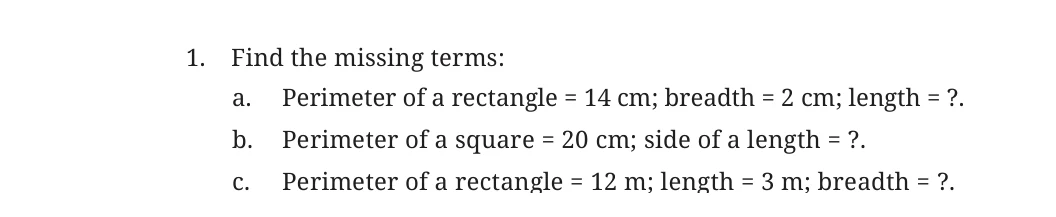
1. Find the missing terms: a. Perimeter of a rectangle = 14 cm; breadth = 2 cm; length = ? b. Perimeter of a square = 20 cm; side of a length = ? c. Perimeter of a rectangle = 12 m; length = 3 m; breadth = ?
Show solution
(a) length = 5 cm (b) length of a side = 5 cm (c) breadth = 3cm
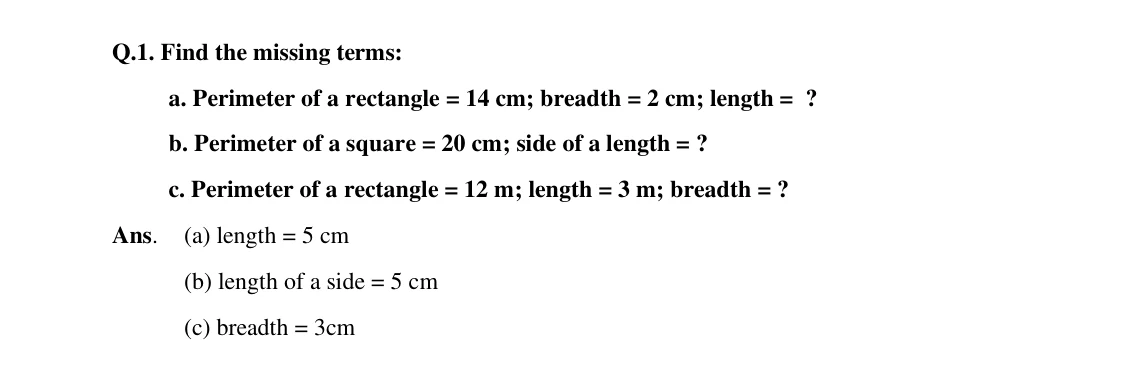
Figure it Out

2. A rectangle having side lengths 5 cm and 3 cm is made using a piece of wire. If the wire is straightened and then bent to form a square, what will be the length of a side of the square?
Show solution
Length of a side of square = 4 cm

Source solution page 23

3. Find the length of the third side of a triangle having a perimeter of 55 cm and having two sides of length 20 cm and 14 cm, respectively?
Show solution
Length of the third side of triangle = 21 cm

Source solution page 23

4. What would be the cost of fencing a rectangular park whose length is 150 m and breadth is 120 m, if the fence costs Rs.40 per metre?
Show solution
P = 2 × (150+120) = 540; So, 540 × 40 = Rs. 21,600

Source solution page 23
5. A piece of string is 36 cm long. What will be the length of each side, if it is used to form: a. A square, b. A triangle with all sides of equal length, and c. A hexagon (a six sided closed figure) with sides of equal length?
Show solution
(a) Length of each side of square = 9 cm (b) Length of each side of regular triangle = 12 cm (c) Length of each side of regular hexagon = 6 cm [1]

Reviewed source answers
Solution sheet 2
Source solution page 24
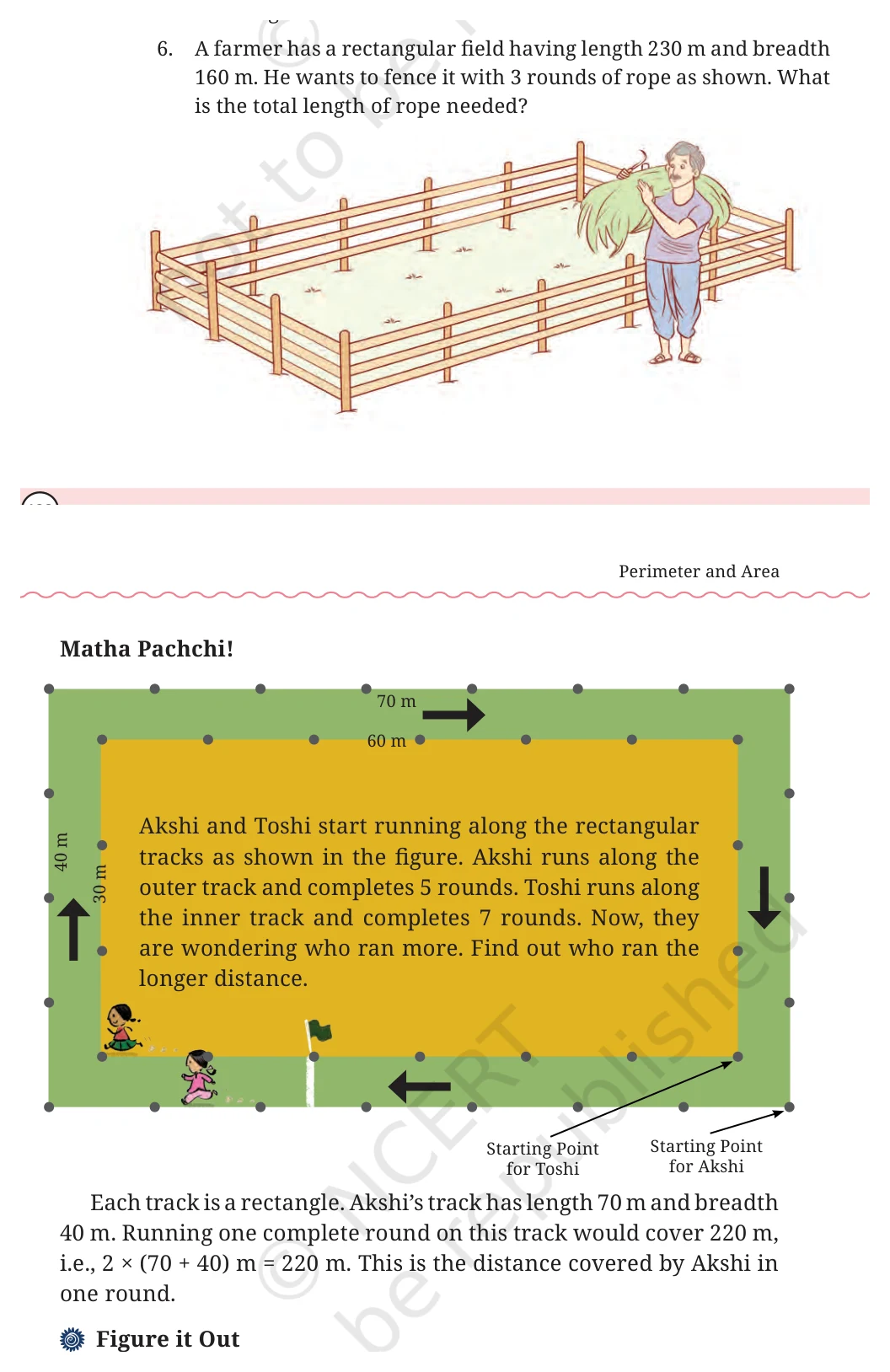
6. A farmer has a rectangular field having length 230 m and breadth 160 m. He wants to fence it with 3 rounds of rope as shown. What is the total length of rope needed?
Show solution
Perimeter of the field = 780 m Total length of the rope needed = 2340 m Section 6.1 Page No. 133 Figure it out
Page No. 133 · Figure it out

1. Find out the total distance Akshi has covered in 5 rounds.
Show solution
Perimeter of the outer track = 220 m Total distance Akshi has covered in 5 rounds = 1100 m

Page No. 133 · Figure it out
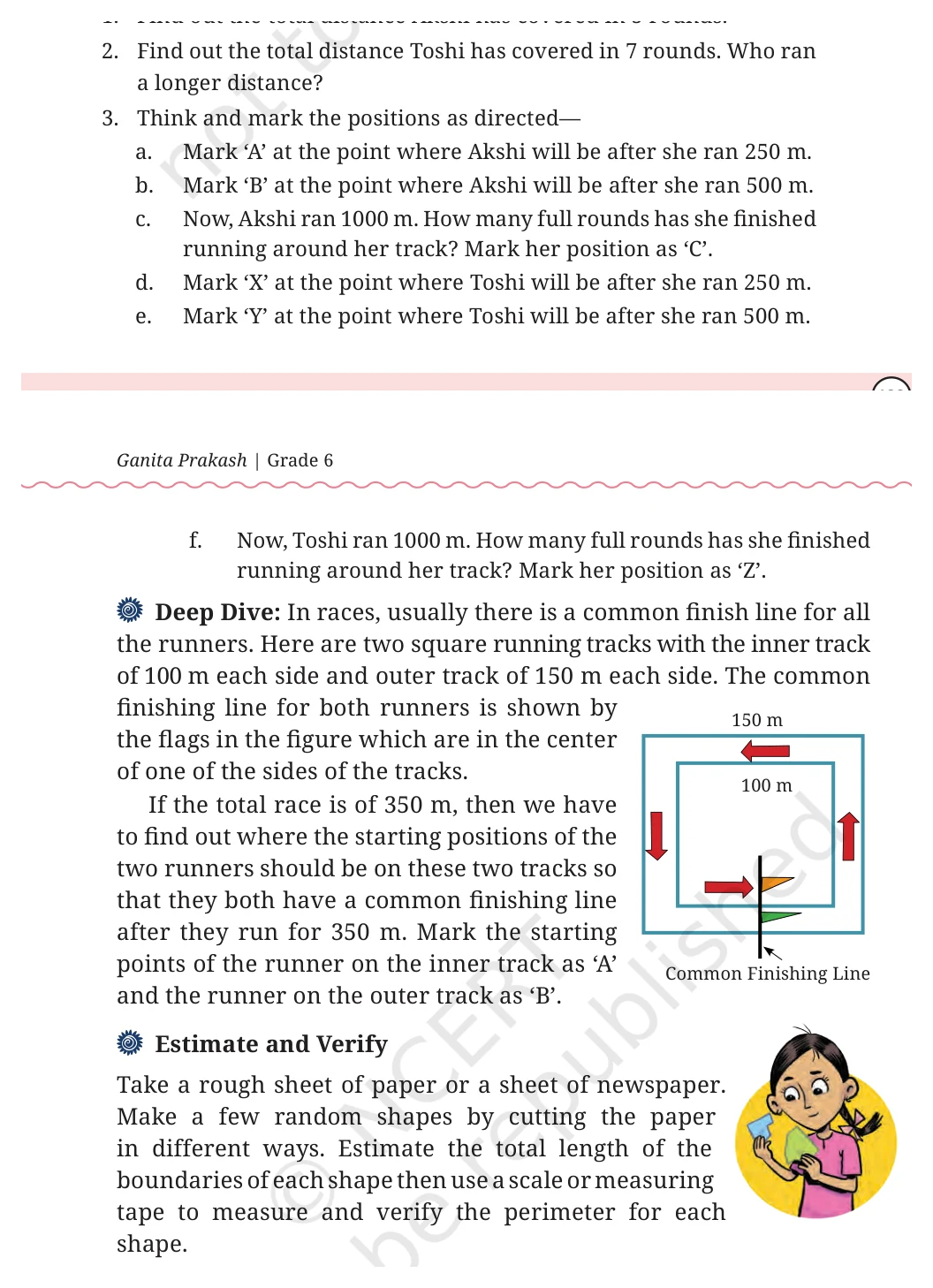
2. Find out the total distance Toshi has covered in 7 rounds. Who ran a longer distance?
Show solution
Perimeter of the inner track = 180 m Total distance Toshi has covered in 7 rounds = 1260 m Toshi ran longer distance Deep Dive Page No. 134 Ans. From point A to flag: 100 + 100 + 100 + 50 = 350 m From point B to flag: 125 + 150 + 75 = 350 m Section 6.1 Page no. 134
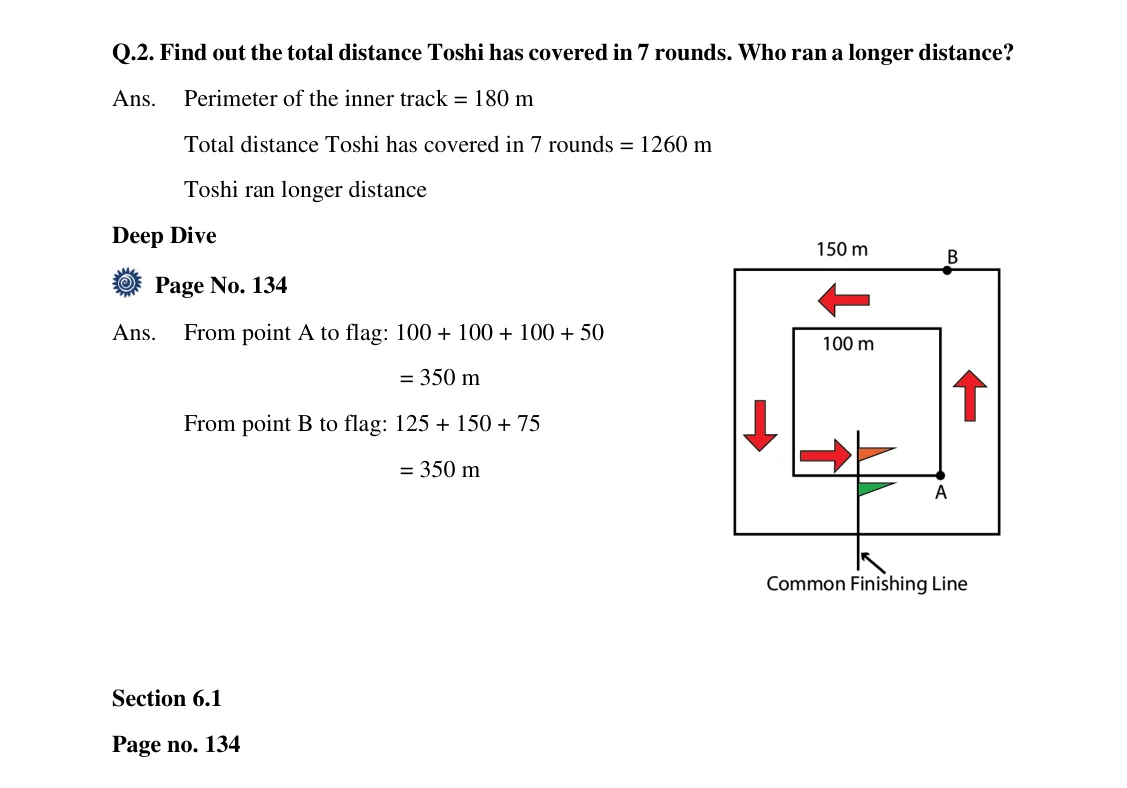
Section 6.1 · Page no. 134
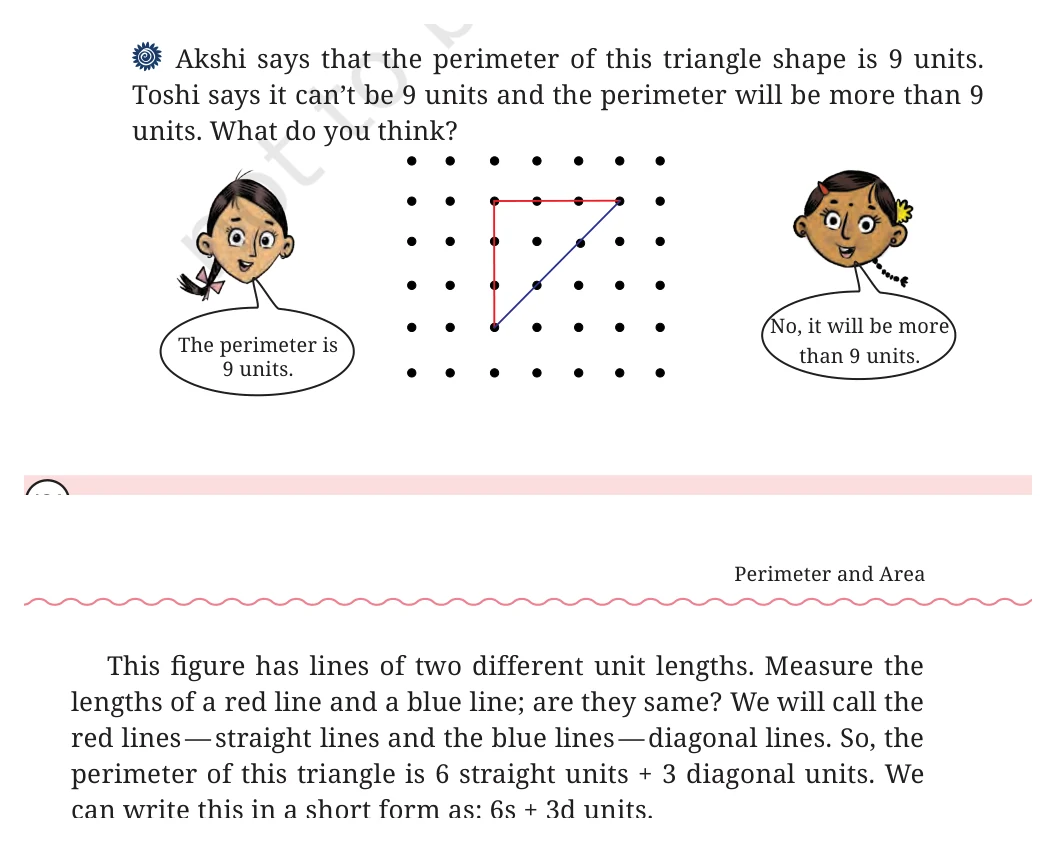
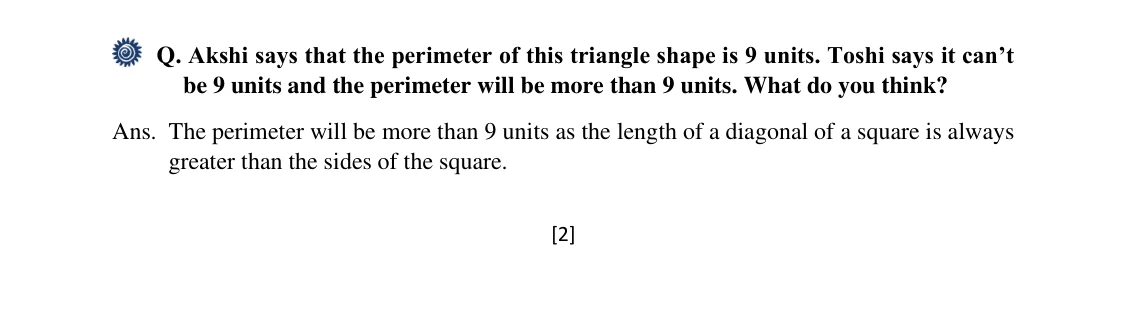
Akshi says that the perimeter of this triangle shape is 9 units. Toshi says it can’t be 9 units and the perimeter will be more than 9 units. What do you think?
Show solution
The perimeter will be more than 9 units as the length of a diagonal of a square is always greater than the sides of the square. [2] P.135

Reviewed source answers
Solution sheet 3
Page no. 134 · be 9 units and the perimeter will be more than 9 units. What do you think?
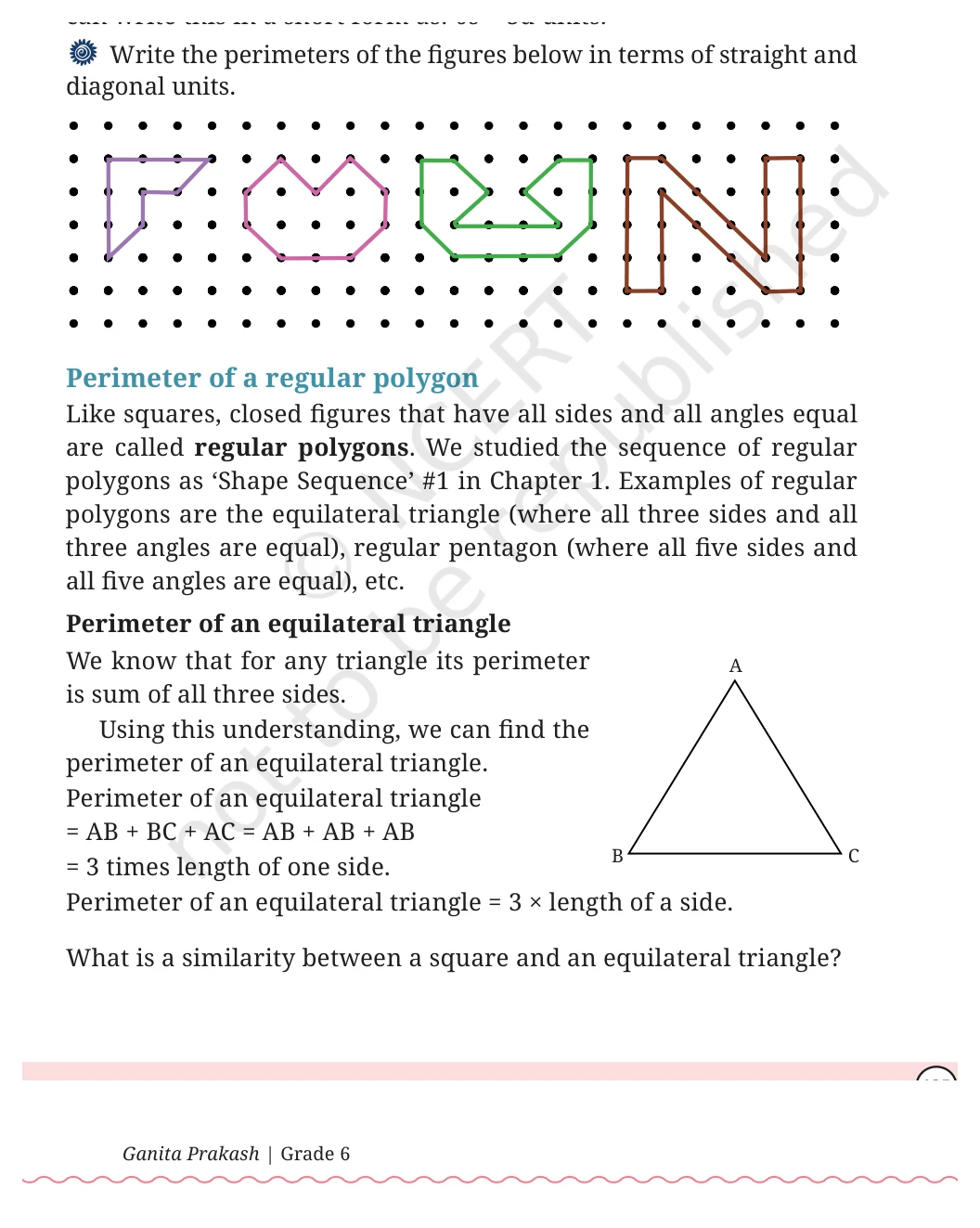
Write the perimeters of the figures below in terms of straight and diagonal units.
Show solution
The perimeters of the figures: 8s + 2d, 4s + 6d, 12s + 6d, 18s + 6d.

be 9 units and the perimeter will be more than 9 units. What do you think?
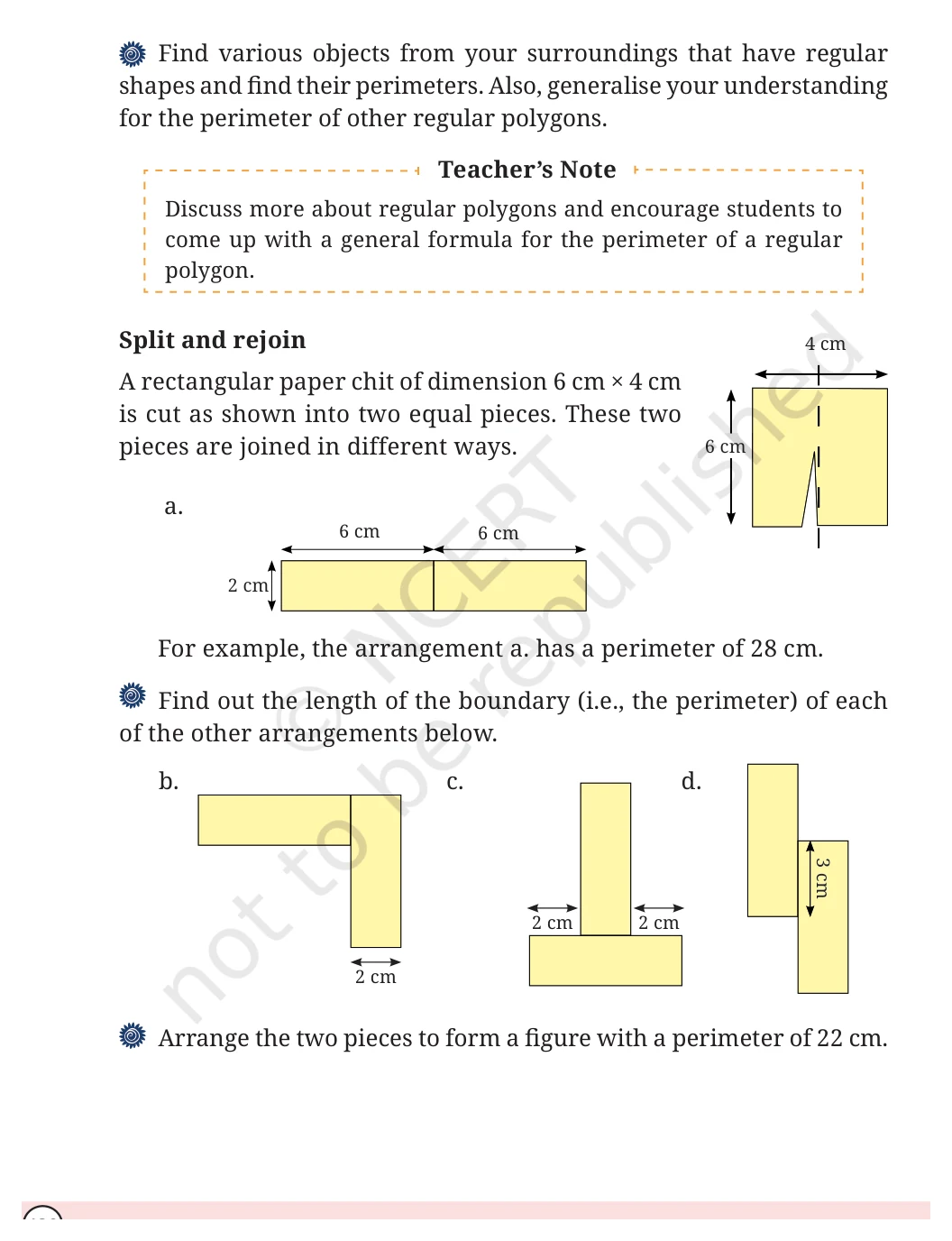
Find various objects from your surroundings that have regular shapes and find their perimeters. Also, generalise your understanding for the perimeter of other regular polygons.
Show solution
In general perimeter of regular polygons = Number of sides × Length of a side. Section 6.2 Page No. 138 Figure it out

Page No. 138 · Figure it out

1. The area of a rectangular garden 25 m long is 300 sq m. What is the width of the garden?
Show solution
Width of the garden = 300 25 = 12 m.

Page No. 138 · Figure it out

2. What is the cost of tiling a rectangular plot of land 500 m long and 200 m wide at the rate of Rs.8 per hundred sq. m?
Show solution
Cost of tiling = Rs. 8000

Source solution page 25

3. A rectangular coconut grove is 100 m long and 50 m wide. If each coconut tree requires 25 sq m, what is the maximum number of trees that can be planted in this grove?
Show solution
200.

Source solution page 25
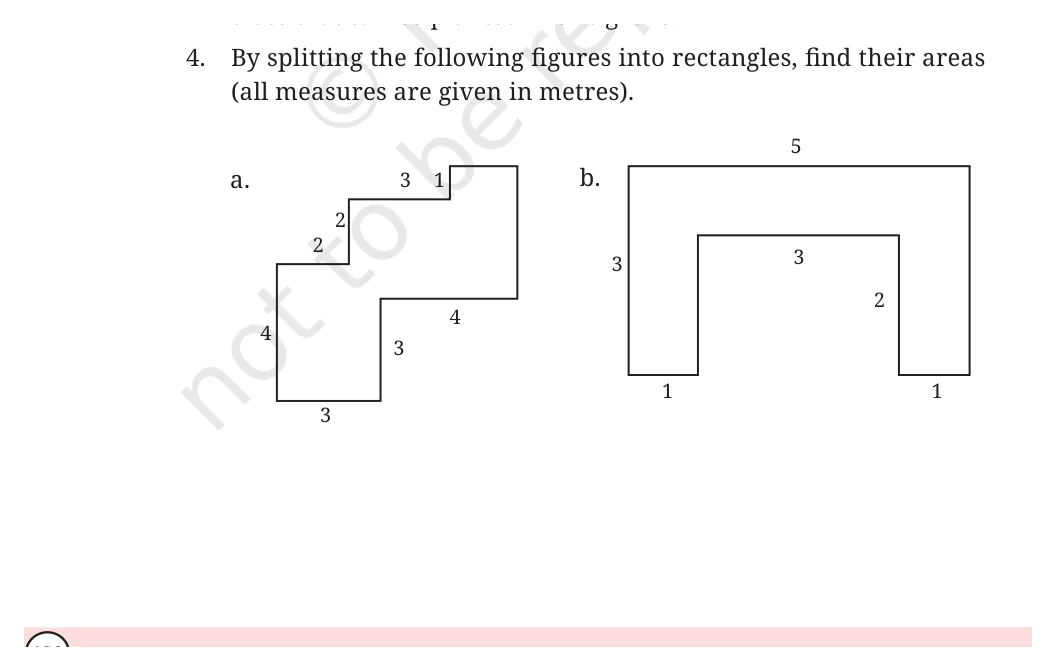
4. By splitting the following figures into rectangles, find their areas (all measures are given in meters):
Show solution
(a) 28 sq. m. (b) 9 sq. m. Page No. 140
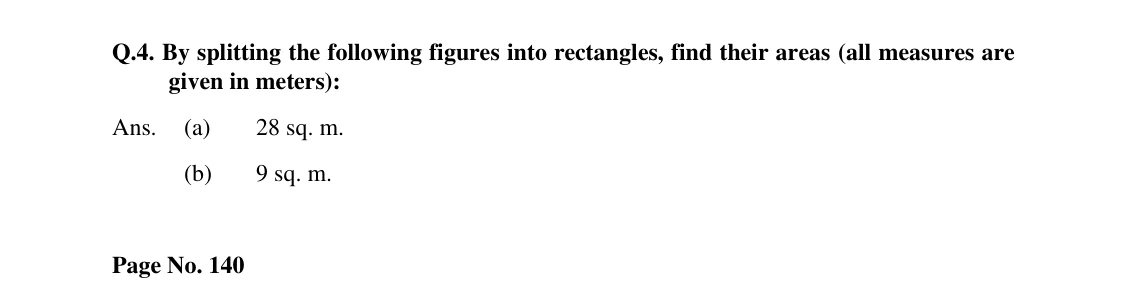
Page No. 140
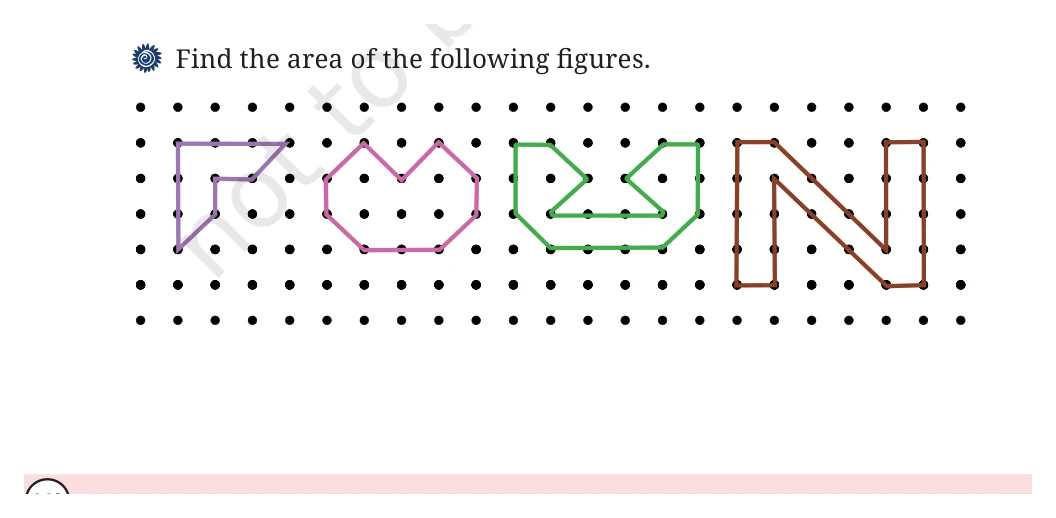
Find the area of the following figures.
Show solution
4 sq. units, 9 sq. units, 10 sq. units, 11 sq. units. [3] Let’s Explore! Page No. 141 Section 6.3 Figure it Out Page No. 144
Reviewed source answers
Solution sheet 4
Figure it Out · Page No. 144
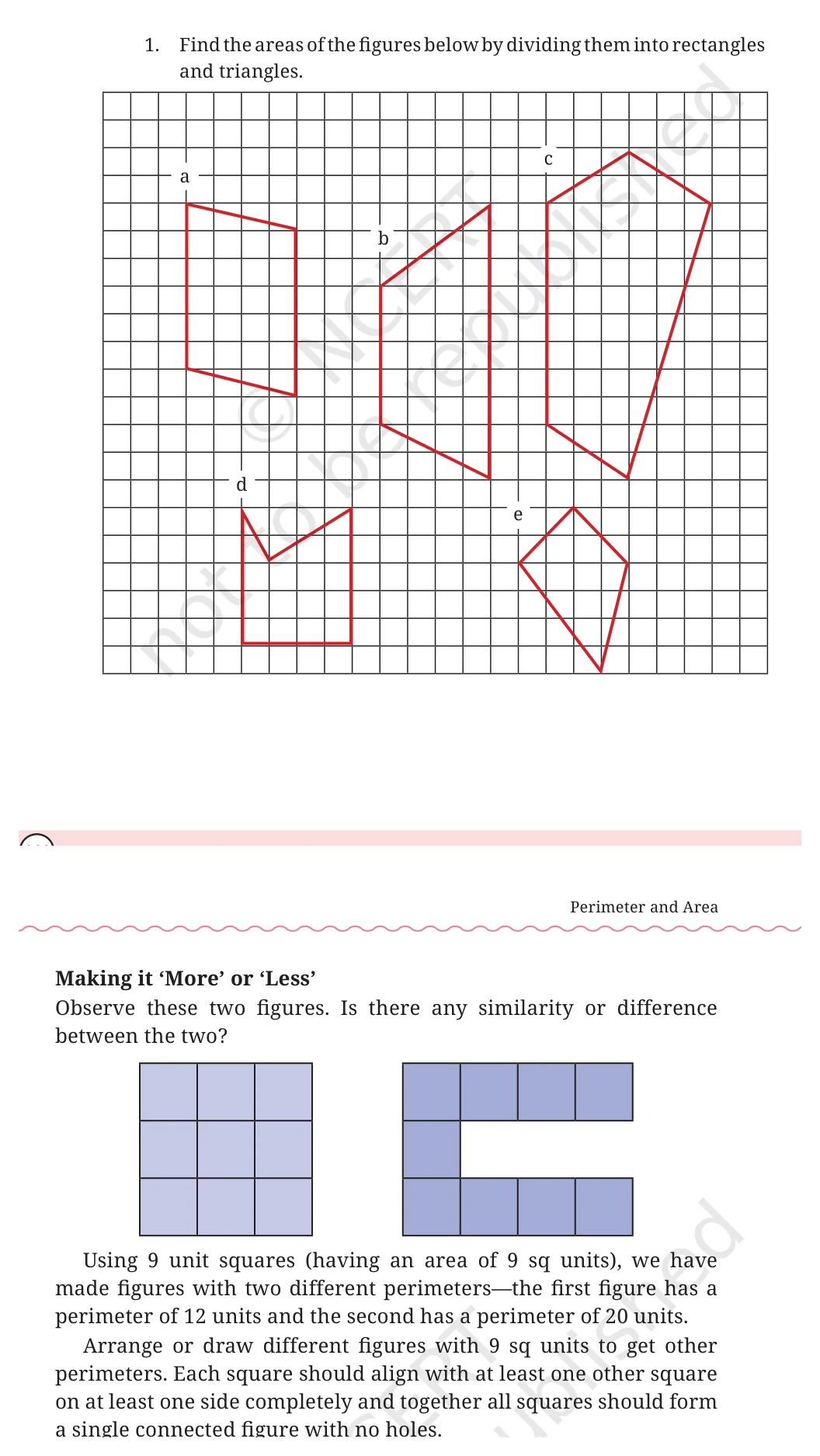
1. Find the areas of the figures below by dividing them into rectangles.
Show solution
a. 24 sq. units. b. 30 sq. units. c. 48 sq. units d. 16 sq. units e. 12 sq. units. Page No. 145

Page No. 145
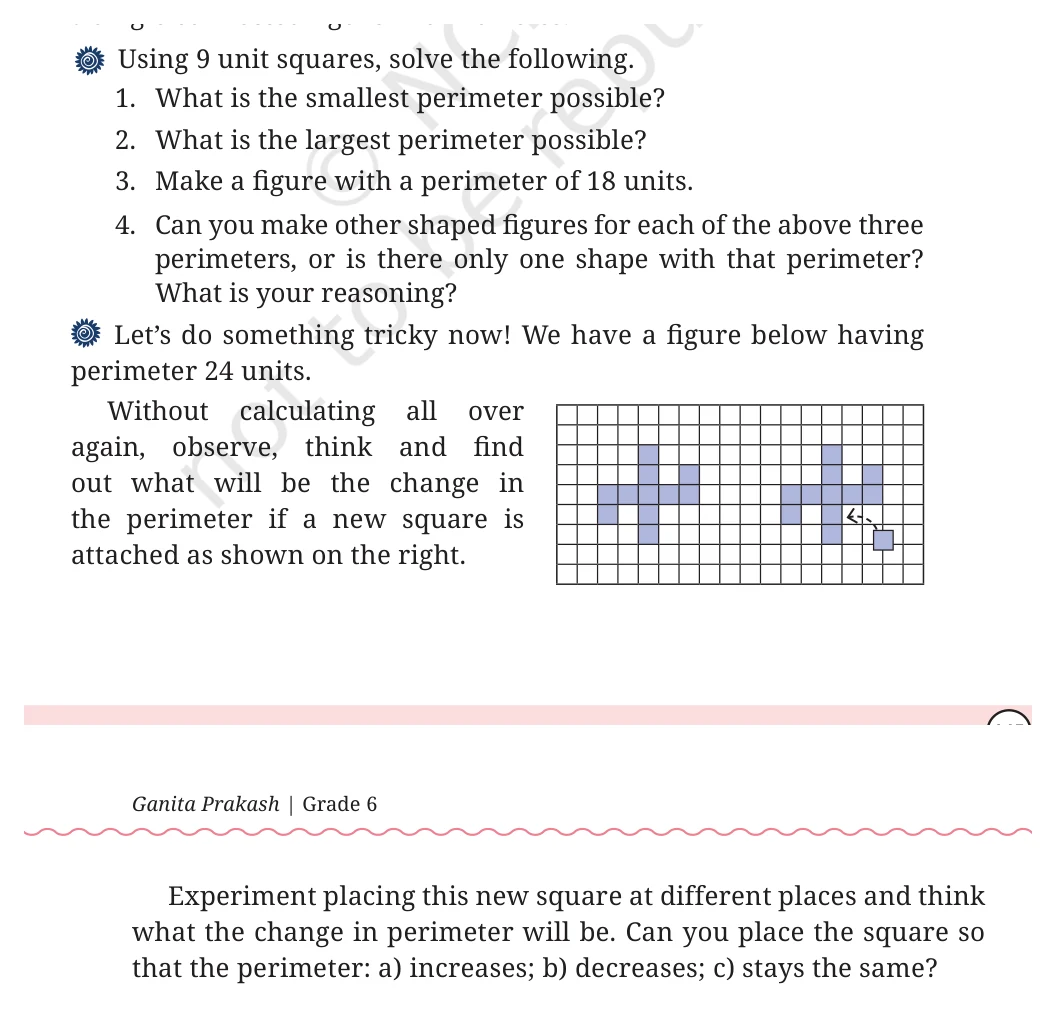
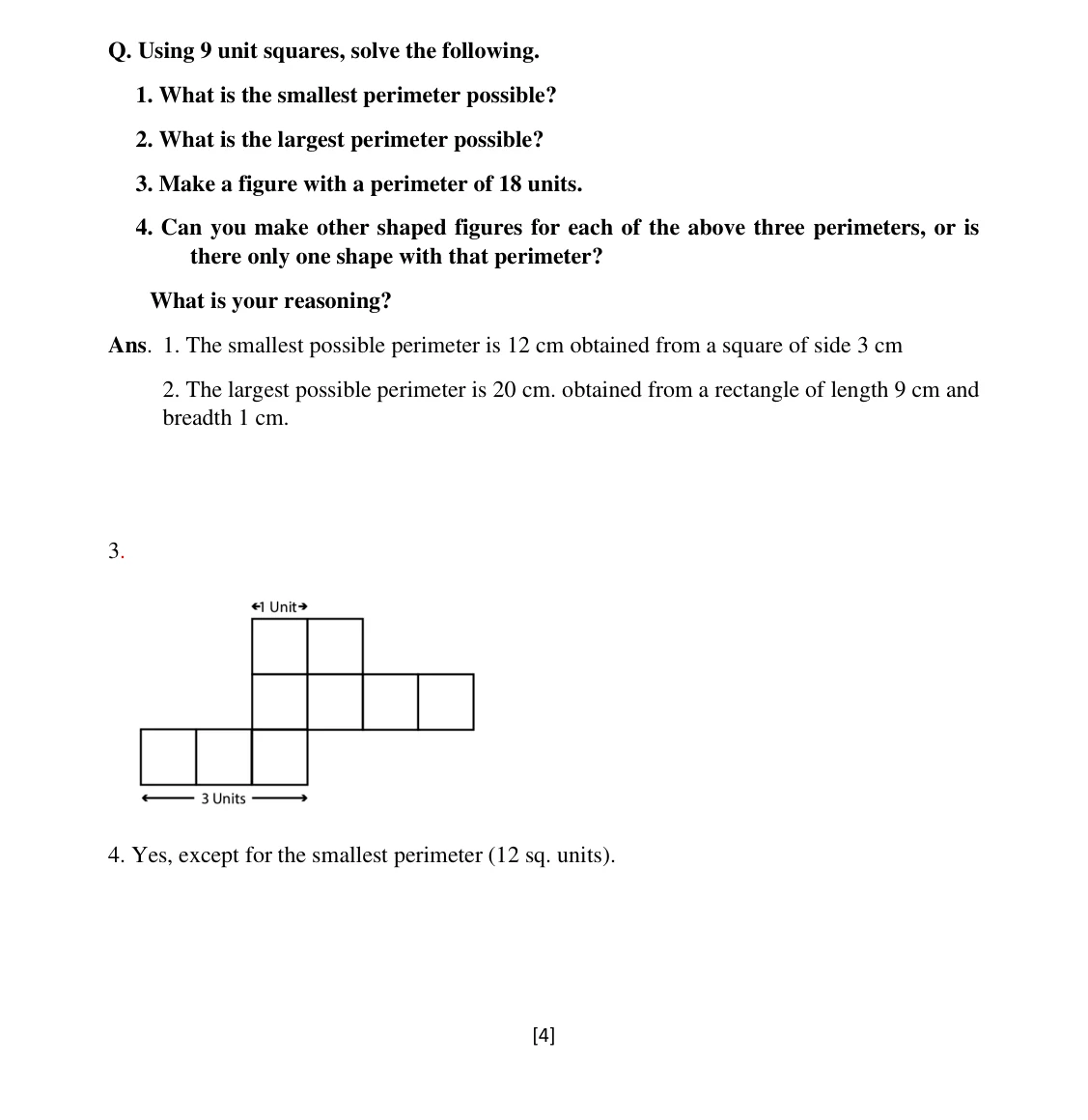
Using 9 unit squares, solve the following. 1. What is the smallest perimeter possible? 2. What is the largest perimeter possible? 3. Make a figure with a perimeter of 18 units. 4. Can you make other shaped figures for each of the above three perimeters, or is there only one shape with that perimeter? What is your reasoning?
Show solution
1. The smallest possible perimeter is 12 cm obtained from a square of side 3 cm 2. The largest possible perimeter is 20 cm. obtained from a rectangle of length 9 cm and breadth 1 cm. 3. 4. Yes, except for the smallest perimeter (12 sq. units). [4] Page No. 146

Reviewed source answers
Solution sheet 5
Page No. 146
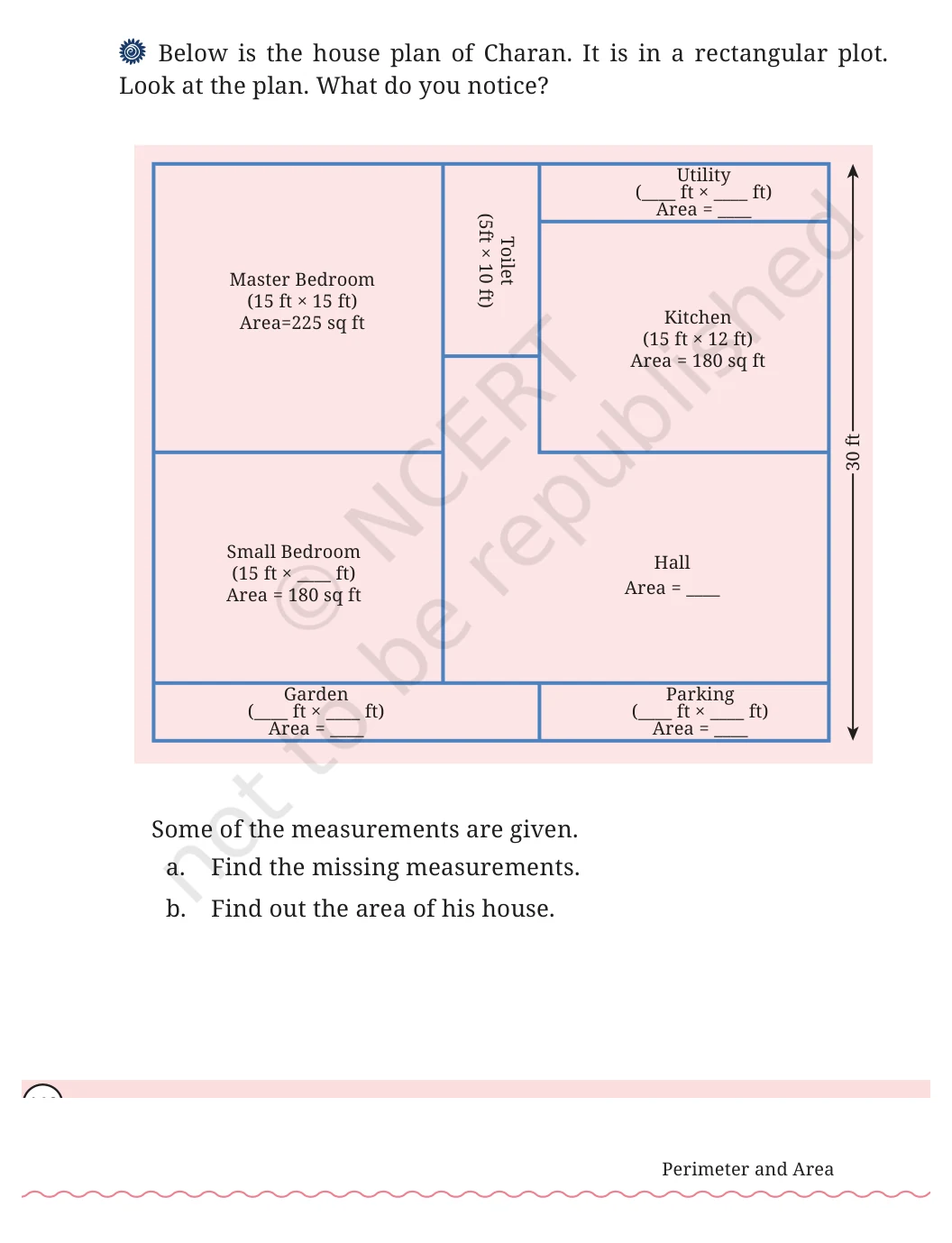
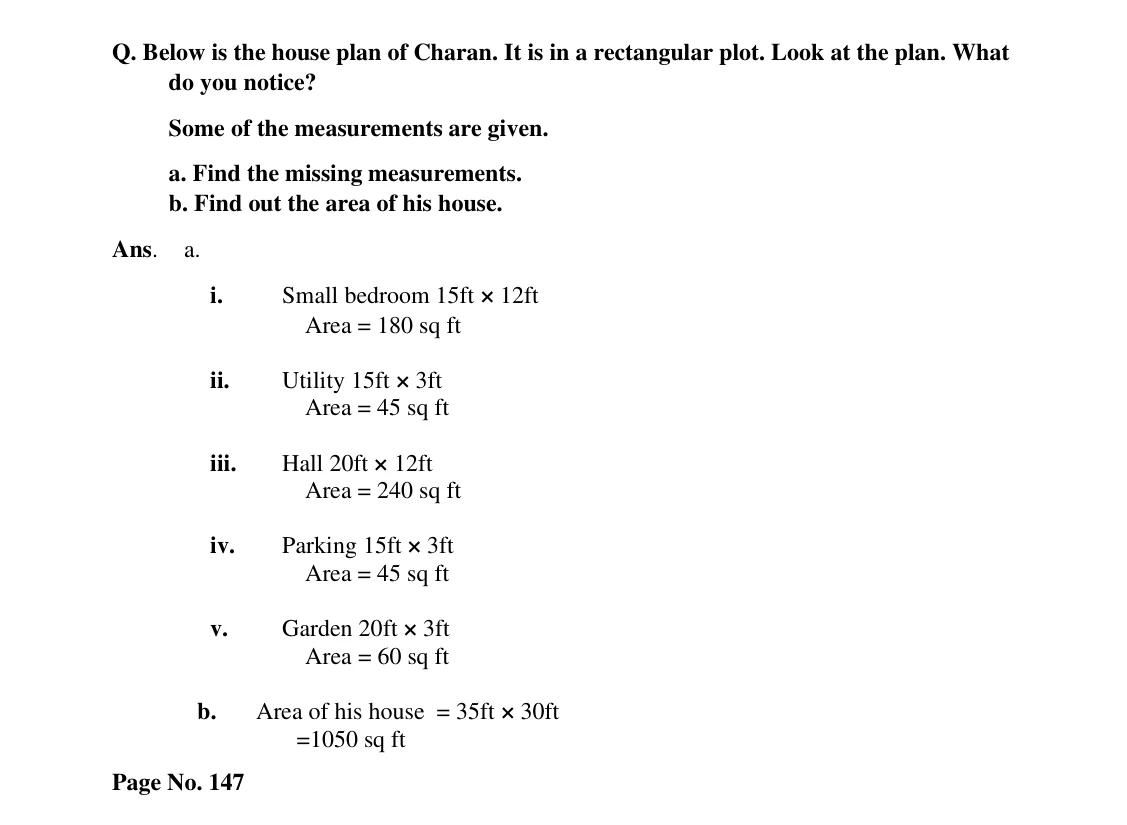
Below is the house plan of Charan. It is in a rectangular plot. Look at the plan. What do you notice? Some of the measurements are given. a. Find the missing measurements. b. Find out the area of his house.
Show solution
a. i. Small bedroom 15ft × 12ft Area = 180 sq ft ii. Utility 15ft × 3ft Area = 45 sq ft iii. Hall 20ft × 12ft Area = 240 sq ft iv. Parking 15ft × 3ft Area = 45 sq ft v. Garden 20ft × 3ft Area = 60 sq ft b. Area of his house = 35ft × 30ft =1050 sq ft Page No. 147
Page No. 147
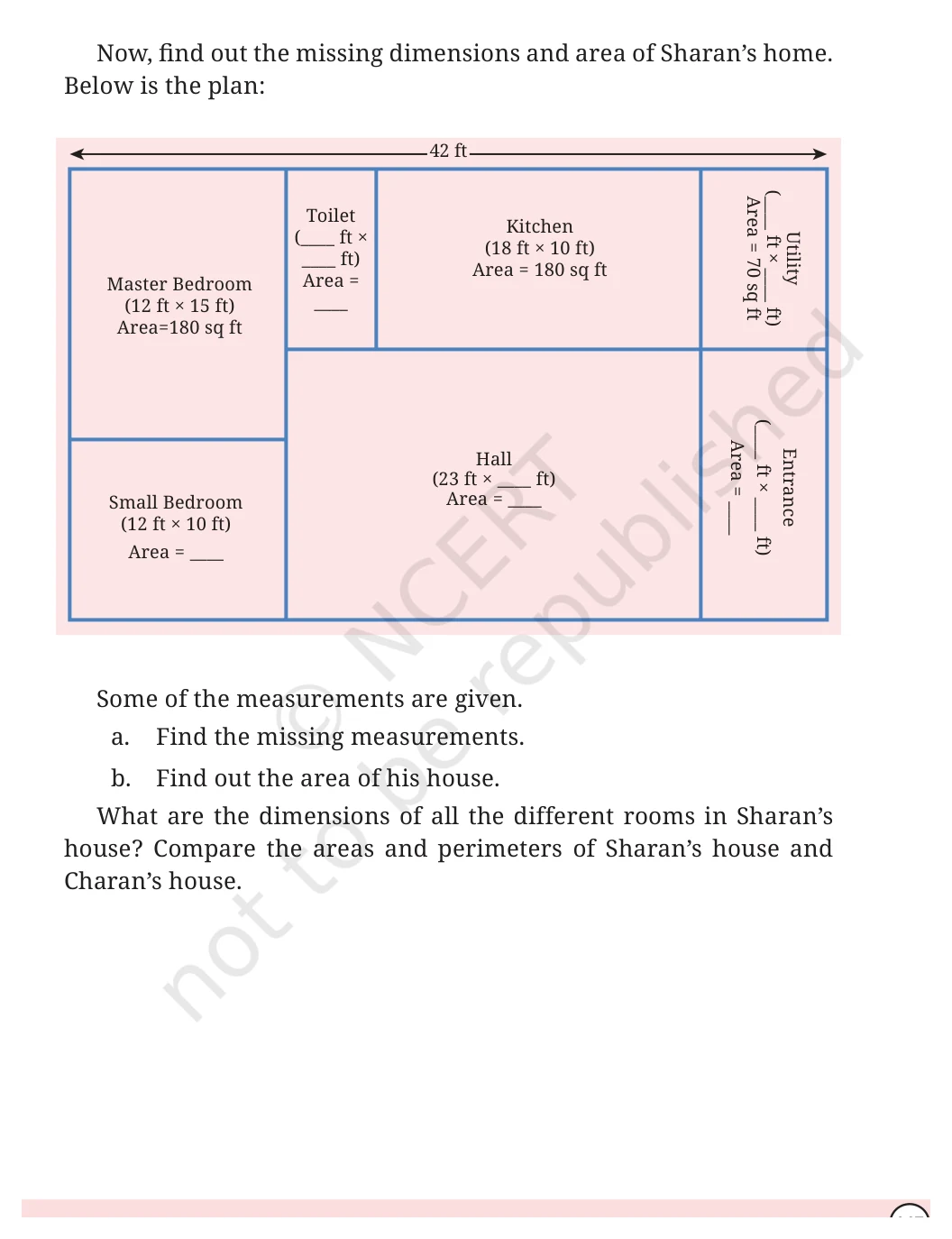
Now, find out the missing dimensions and area of Sharan’s home. Below is the plan: Some of the measurements are given. a. Find the missing measurements. b. Find out the area of his house. What are the dimensions of all the different rooms in Sharan’s house? Compare the areas and perimeters of Sharan’s house and Charan’s house.
Show solution
a. Dimensions of Sharan’s house. i. Utility 7ft × 10 ft Area = 70 sq ft ii. Hall 23ft × 15 ft Area = 345 sq ft iii. Entrance 7 ft × 15ft Area = 105 sq ft iv. Small bedroom 12ft × 10ft Area = 120 sq ft v. Toilet 5ft × 10 ft [5] Area = 50 sq ft b. Area of his house = 42 ft × 25 ft = 1050 sq ft Area of Charan’s house = 35ft × 30 ft = 1050 sq ft Area of Sharan’s house = 42 ft × 25ft = 1050 sq ft Area of both the houses are equal. Now, Perimeter of Charan’s house = 130 ft Perimeter of Sharan’s house = 134 ft Perimeter of Sharan’s house is greater than the Perimeter of Charan’s house. Page No. 148 Area Maze Puzzles In each fig. find the missing value of either the length of the side or the area of the region. Ans. a. 30 sq cm. b. 9 sq cm. c. 16 sq cm. d. 5 cm. Section 6.3 Page No. 149 Figure it Out
Reviewed source answers
Solution sheet 6
Page No. 149 · Figure it Out

1. Give the dimensions of a rectangle whose area is the sum of the areas of these two rectangles having measurements: 5 m × 10 m and 2 m × 7 m.
Show solution
Possible dimensions are 16 m and 4 m Or 32 m and 2m Or 8 m and 8 m

Page No. 149 · Figure it Out

2. The area of a rectangular garden that is 50 m long is 1000 sq m. Find the width of the garden?
Show solution
20 m.

Figure it Out

3. The floor of a room is 5 m long and 4 m wide. A square carpet whose sides are 3 m in length is laid on the floor. Find the area that is not carpeted.
Show solution
Area of floor not carpeted = 11 sq. m. [6]


Reviewed source answers
Solution sheet 7
Source solution page 29

4. Four flower beds having sides 2 m long and 1 m wide are dug at the four corners of a garden that is 15 m long and 12 m wide. How much area is now available for laying down a lawn?
Show solution
Available area for lawn = 172 sq. m.
Source solution page 29
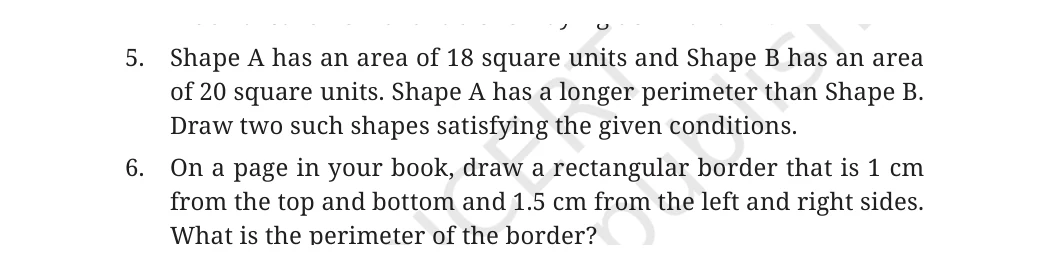
5. Shape A has an area of 18 square units and Shape B has an area of 20 square units. Shape A has a longer perimeter than Shape B. Draw two such shapes satisfying the given conditions.
Show solution
Possible dimensions of shape A are 6m and 3m; 2m and 9m; 18m and 1m Corresponding Perimeters =18 m, 22m, 38m respectively Possible dimensions of shape B are 5m and 4m; 10m and 2m; 20m and 1m Corresponding Perimeters =18m, 24m, 42m respectively Given P(A) > P(B) We may take P(A) = 22m or 38m and P(B) = 18 m and draw the figures accordingly.
Source solution page 29

7. Draw a rectangle of size 12 units × 8 units. Draw another rectangle inside it, without touching the outer rectangle that occupies exactly half the area.
Show solution
Area of outer rectangle = 96 sq. units. Area of inner rectangle = 48 sq. units. Draw the rectangles accordingly.
Source solution page 29
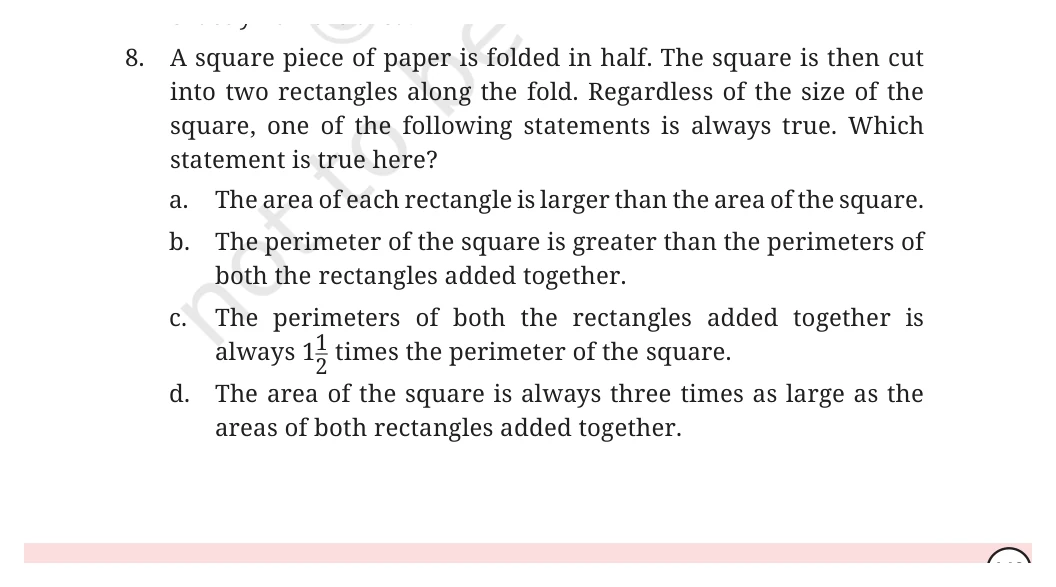
8. A square piece of paper is folded in half. The square is then cut into two rectangles along the fold. Regardless of the size of the square, one of the following statements is always true. Which statement is true here? a. The area of each rectangle is larger than the area of the square. b. The perimeter of the square is greater than the perimeters of both the rectangles added together. 𝟏 c. The perimeters of both the rectangles added together is always 𝟏 𝟐 times the perimeter of the square. d. The area of the...
Show solution
Only C is true. [7]