
Use the textbook context
Match, attempt, then check
Each crop extends to the next solved item, so diagrams, tables and connected instructions stay with the question.
Complete worked answers
Textbook page 2
Textbook page 2 · solved item 1

Which scale helped you measure the length of the screws accurately? Why?
Show solution
The scale with millimeter markings helped measure the length of the screws accurately because it allows for more precise and detailed measurements compared to scales with only centimeter markings.
Textbook page 2 · solved item 2
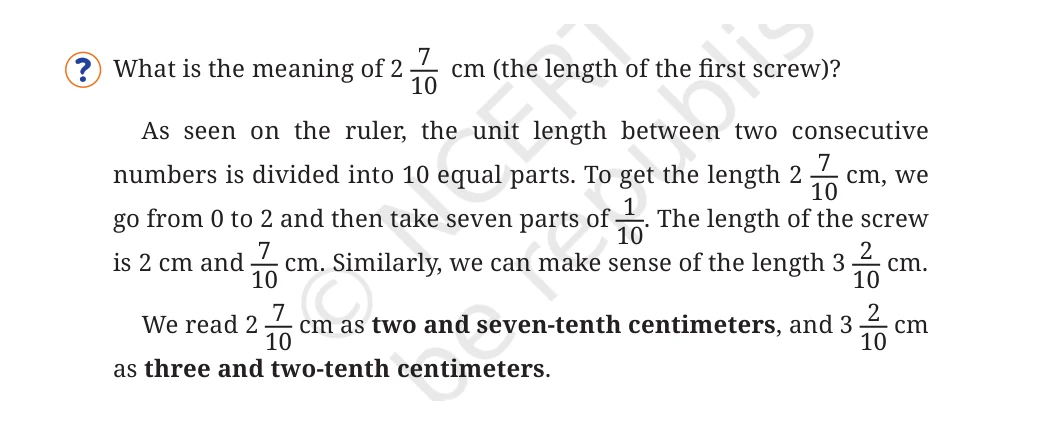
What is the meaning of 2 7 10 cm (the length of the first screw)?
Show solution
It means that the length of the screw is two and seven-tenth centimeters.
Textbook page 2 · solved item 3

Can you explain why the unit was divided into smaller parts to measure the screws?
Show solution
The unit was divided into smaller parts because the lengths of the screws were not whole centimetres. Smaller divisions, like millimetres, were needed to measure them more accurately.
Textbook page 2 · solved item 4

Measure the following objects using a scale and write their measurements in centimeters (as shown earlier for the lengths of the screws): pen, sharpener, and any other object of your choice.
Show solution
Pen: 14 cm Sharpener: 3.2 cm Eraser: 4.0 cm Notebook: 21cm
Textbook page 2 · solved item 5
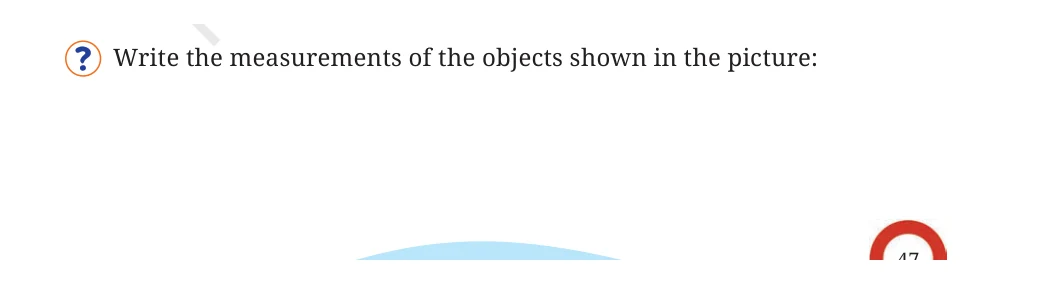
Write the measurements of the objects shown in the picture:
Show solution
Eraser: 2.4 cm Pencil: 4.5 cm Chalk: 1.4 cm
Complete worked answers
Textbook page 4
Textbook page 4 · solved item 6
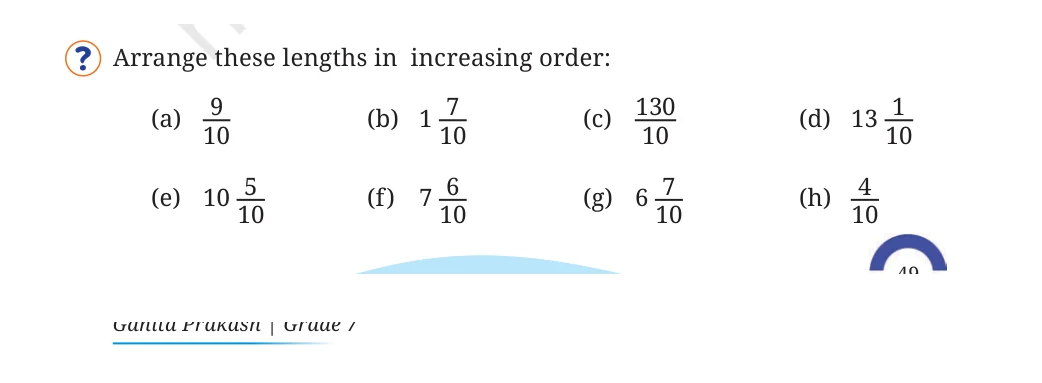
Arrange these lengths in increasing order: (a) 9 10 (b) 1 7 10 (c) 130 10 (d) 13 1 10 (e) 10 5 10 (f) 7 6 10 (g) 6 7 10 (h) 4 10
Show solution
(a) 9 10 = 0.9 (b) 1 7 10 = 17 10 = 1.7 (c) 130 10 = 13.0 (d) 13 1 10 = 131 10 = 13.1 (e) 10 5 10 = 105 10 = 10.5 (f) 7 6 10 = 76 10 = 7.6 (g) 6 7 10 = 67 10 = 6.7 (h) 4 10 = 0.4 0.4 < 0.9 < 1.7 < 6.7 < 7.6 < 10.5 < 13.0 < 13.1 or 4 10 < 9 10 < 1 7 10 < 6 7 10 < 7 6 10 < 10 5 10 < 130 10 < 13 1 10
Complete worked answers
Textbook page 5
Textbook page 5 · solved item 7

Arrange the following lengths in increasing order: 4 1 10, 4 10, 41 10, 41 1 10.
Show solution
4 1 10 = 41 10 = 4.1 4 10 = 0.4 41 10 = 4.1 41 1 10 = 411 10 = 41.1 0.4 < 4.1 = 4.1 < 41.1 or 4 10 < 4 1 10 = 41 10 < 41 1 10
Textbook page 5 · solved item 8
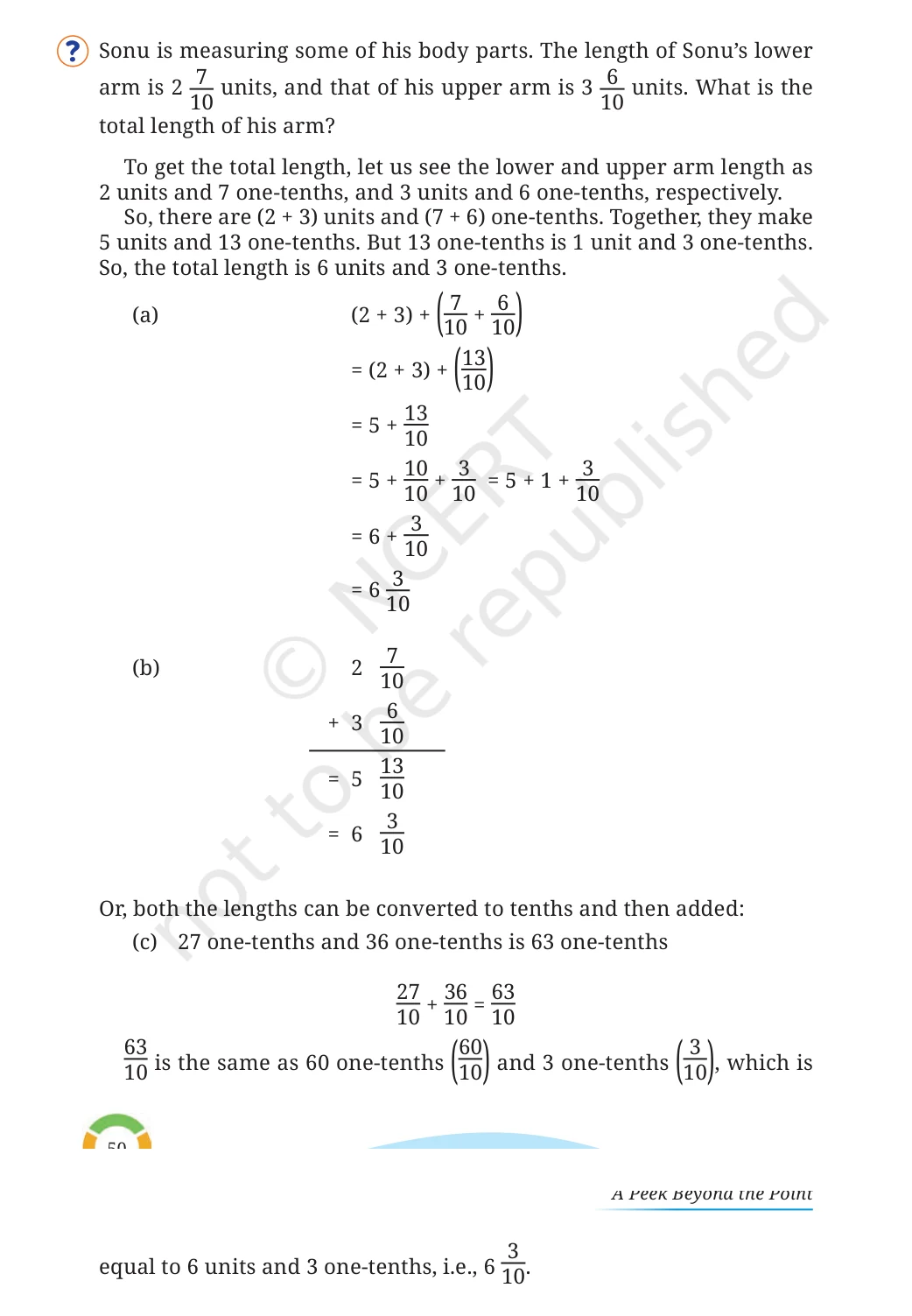
Sonu is measuring some of his body parts. The length of Sonu’s lower arm is 2 7 10 units, and that of his upper arm is 3 6 10 units. What is the total length of his arm?
Show solution
Lower arm = 2 7 10 units Upper arm = 3 6 10 units Total length of arms = 2 7 10 + 3 6 10 = (2 + 3) + ( 7 10 + 6 10) = 5 + 13 10 = 5 + 10 10 + 3 10 = 5 + 1 + 3 10 = 6 3 10 units.
Complete worked answers
Textbook page 6
Textbook page 6 · solved item 9
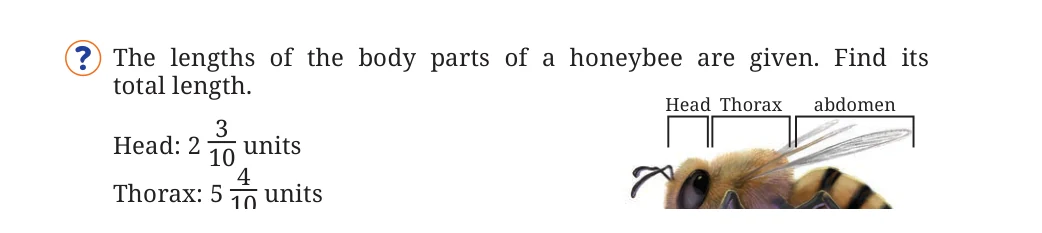
The lengths of the body parts of a honeybee are given. Find its total length. Head: 2 3 10 units Thorax: 5 4 10 units Abdomen: 7 5 10 units
Show solution
Total length of bee = Head + Thorax + Abdomen = 2 3 10 + 5 4 10 + 7 5 10 = (2 + 5 + 7) + ( 3 10 + 4 10 + 5 10) = 14 + ( 3+4+5 10 ) = 14 + 12 10 = 14 + 10 10 + 2 10 = 14 + 1 + 2 10 = 15 2 10 units.
Textbook page 6 · solved item 10
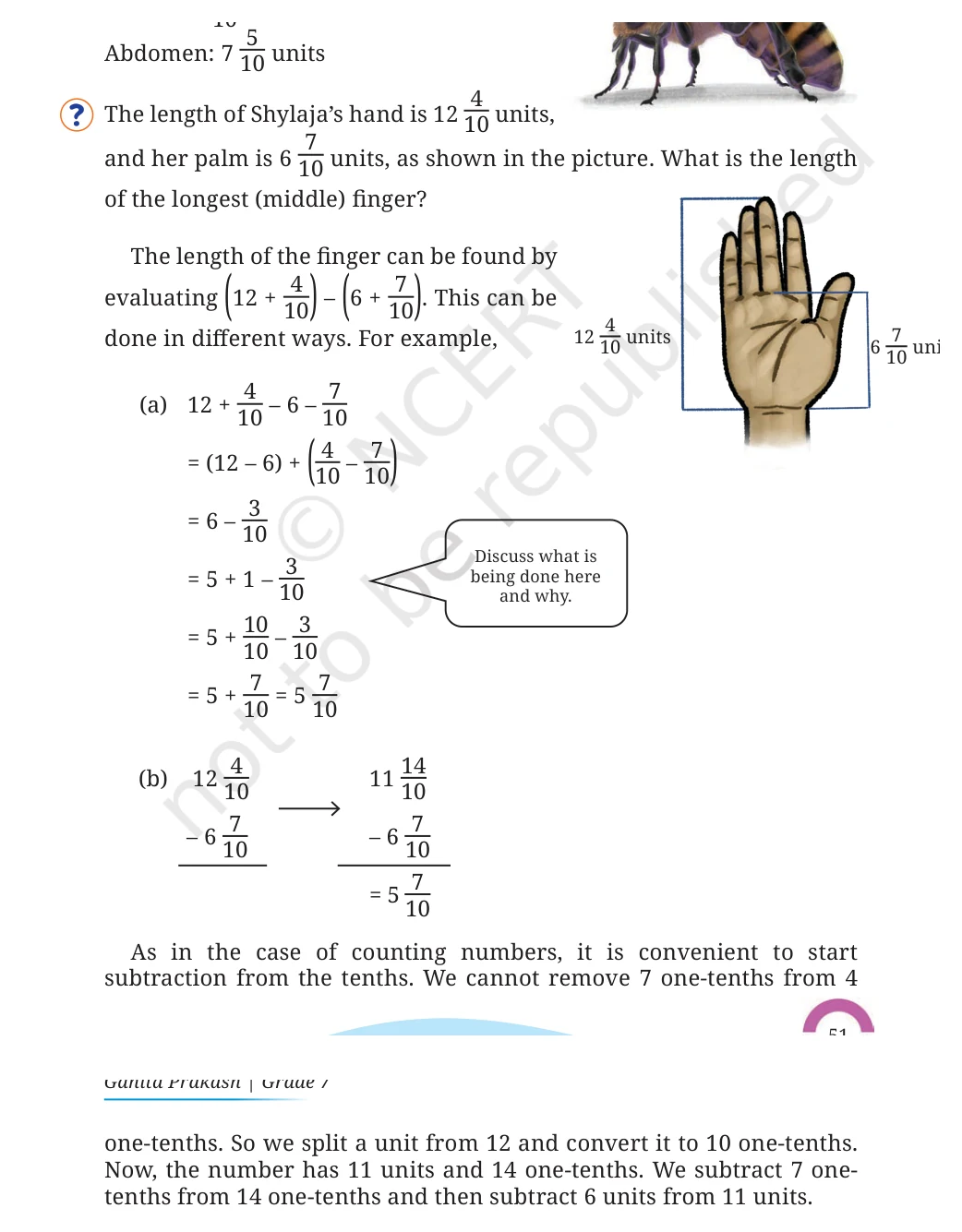
The length of Shylaja’s hand is 12 4 10 units, and her palm is 6 7 10units, as shown in the picture. What is the length of the longest (middle) finger?
Show solution
Length of hand = 12 4 10 units Length of palm = 6 7 10units Length of longest finger = Hand – Palm = 12 4 10 - 6 7 10 = (12 – 6) + ( 4 10 − 7 10) = 6 + −3 10 = 6 - 3 10 = 5 + 1 - 3 10 = 5 + 10 10 - 3 10 = 5 + 10− 3 10 = 5 + 7 10 = 5 7 10 units.
Complete worked answers
Textbook page 7
Textbook page 7 · solved item 11

Try computing the difference by converting both lengths to tenths. Length of hand = 12 4 10 units Length of palm = 6 7 10units
Show solution
Length of hand = 12 4 10 units = 124 10 units Length of palm = 6 7 10units = 67 10 units Length of longer finger = Hand – Palm = 124 10 - 67 10 = 124− 67 10 = 57 10 = 50 10 + 7 10 = 5 + 7 10 = 5 7 10 units.
Textbook page 7 · solved item 12

A Celestial Pearl Danio’s length is 2 4 10 cm, and the length of a Philippine Goby is 9 10 cm. What is the difference in their lengths?
Show solution
Celestial Pearl Dino’s length = 2 4 10 cm = 24 10 cm Philippine Goby’s length = 9 10 cm Difference in length = 24 10 - 9 10 = 24− 9 10 = 15 10 = 10 10 + 5 10 = 1 + 5 10 = 1 5 10 cm.
Textbook page 7 · solved item 13
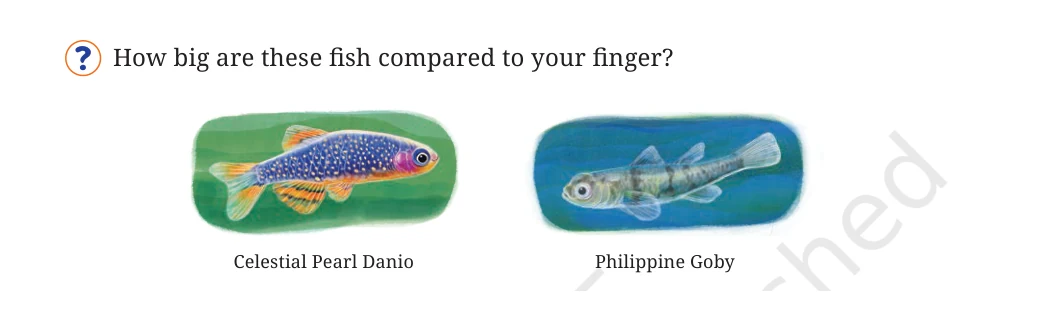
How big are these fish compared to your finger?
Show solution
Celestial Pearl Dino = 24 10 cm = 2.4 cm Philippine Goby = 9 10 = 0.9 cm Little finger’s length = 2.7 cm Celestial Pearl Dino is 0.3 cm (2.7 – 2.4 = 0.3 cm) smaller than my little finger. Philippine Goby is 1.8 cm (2.7 – 0.9 = 1.8 cm) smaller than my little finger.
Textbook page 7 · solved item 14
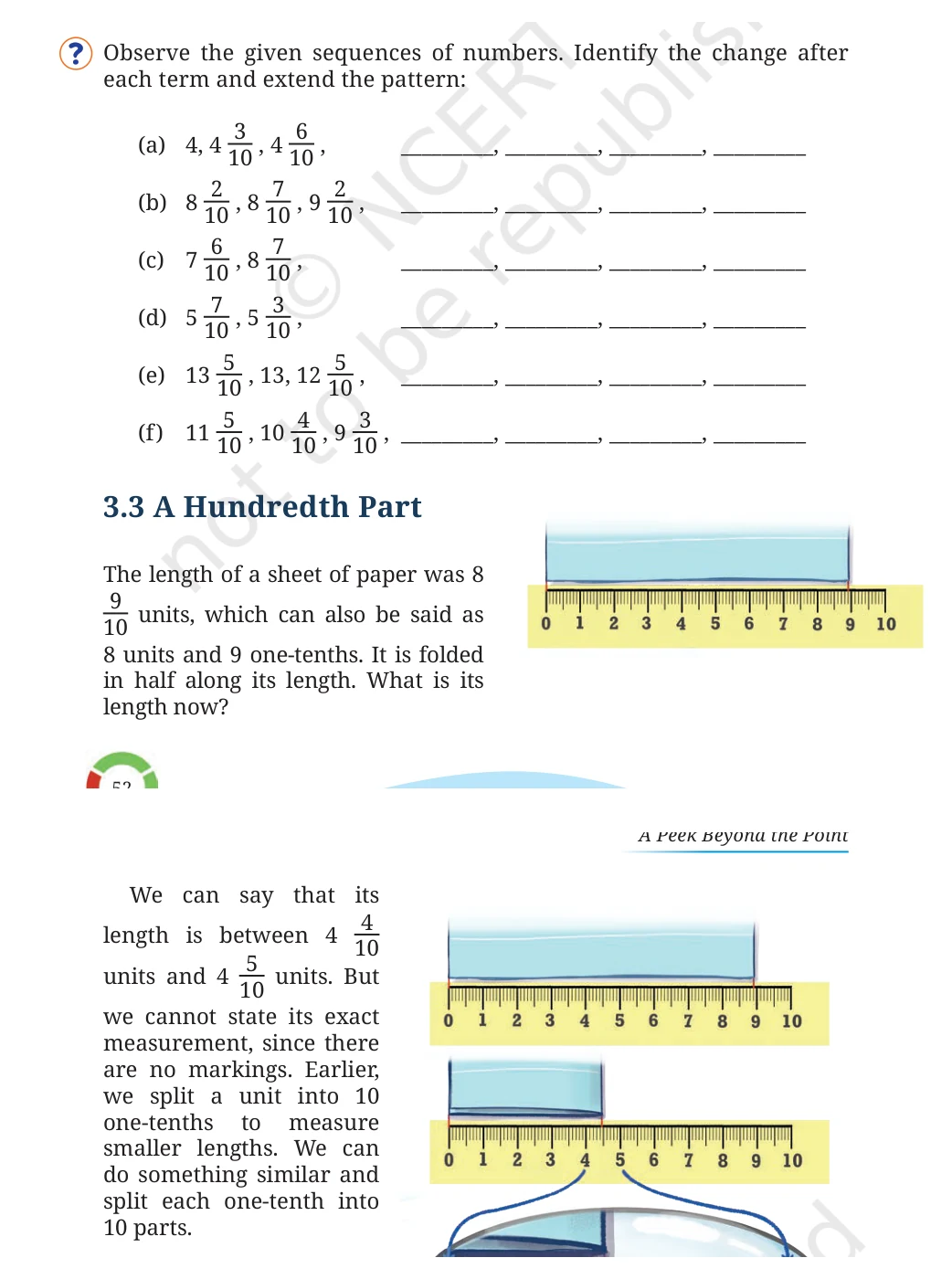
Observe the given sequences of numbers. Identify the change after each term and extend the pattern: (a) 4, 4 3 10 , 4 6 10 , ………. (b) 8 2 10, 8 7 10, 9 2 10, ……….. (c) 7 6 10, 8 7 10, ……….. (d) 5 7 10, 5 4 10, ……….. (e) 13 5 10 ,13, 12 5 10 , ………. (f) 11 5 10 , 10 4 10 , 9 3 10 , ………..
Show solution
(a) 4, 4 3 10 , 4 6 10, ……….. Change = Addition of 3 10. 4, 4 3 10 , 4 6 10, 4 9 10, 5 2 10, 5 5 10, …… (b) 8 2 10, 8 7 10, 9 2 10, ……….. Change = Addition of 5 10. 8 2 10, 8 7 10, 9 2 10, 9 7 10 , 10 2 10, 10 7 10, …… (c) 7 6 10, 8 7 10, ……….. Change = Addition of 1 1 10. 7 6 10, 8 7 10, 9 8 10, 10 9 10, 12, 13 1 10, …….
(d) 5 7 10, 5 3 10, …… Change = Subtraction of 4 10. 5 7 10, 5 3 10, 4 9 10, 4 5 10, 4 1 10, 3 7 10, ……… (e) 13 5 10 ,13, 12 5 10 , ………. Change = Subtraction of 5 10. 13 5 10 ,13, 12 5 10 , 12, 11 5 10, 11, 10 5 10, 10, ……… (f) 11 5 10 , 10 4 10 , 9 , ……….. Change = Subtraction of 1 1 10. 11 5 10 , 10 4 10 , 9 3 10, 8 2 10, 7 1 10, 6, ……..
Complete worked answers
Textbook page 8
Textbook page 8 · solved item 15
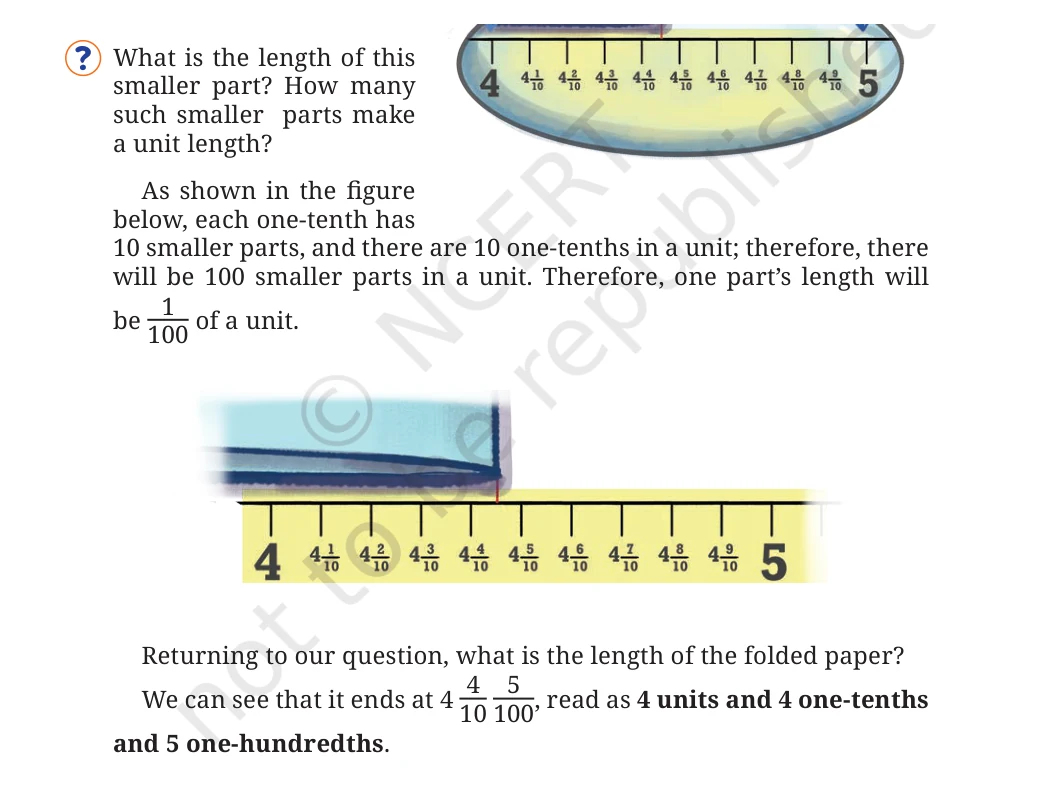
What is the length of this smaller part? How many such smaller parts make a unit length?
Show solution
Length of each smaller part on splitting each one-tenth into 10 parts = 1 100. 100 such smaller parts make a unit length.
Textbook page 8 · solved item 16
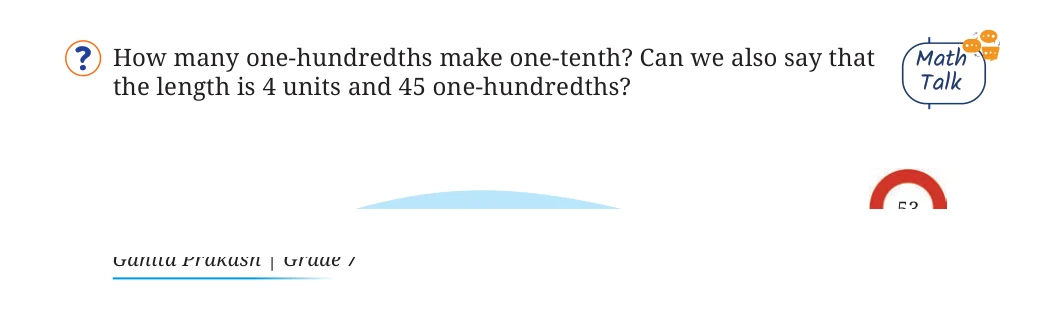
How many one-hundredths make one-tenth? Can we also say that the length is 4 units and 45 one-hundredths? (Length is 4 units and 4 one-tenths and 5 one-hundredths)
Show solution
Number of one-hundredths in one-tenth = 1 100 ÷ 1 10 = 10. 4 units and 4 one-tenths and 5 one-hundredths = 4 + 4 10 + 5 100 = 4 + 0.4 + 0.45 = 4.45 units. 4 units and 45 one-hundredths = 4 + 45 100 = 4 + 0.45 = 4.45 units. Hence, 4 units and 4 one-tenths and 5 one-hundredths can also be written as 4 units and 45 one-hundredths.
Complete worked answers
Textbook page 9
Textbook page 9 · solved item 17
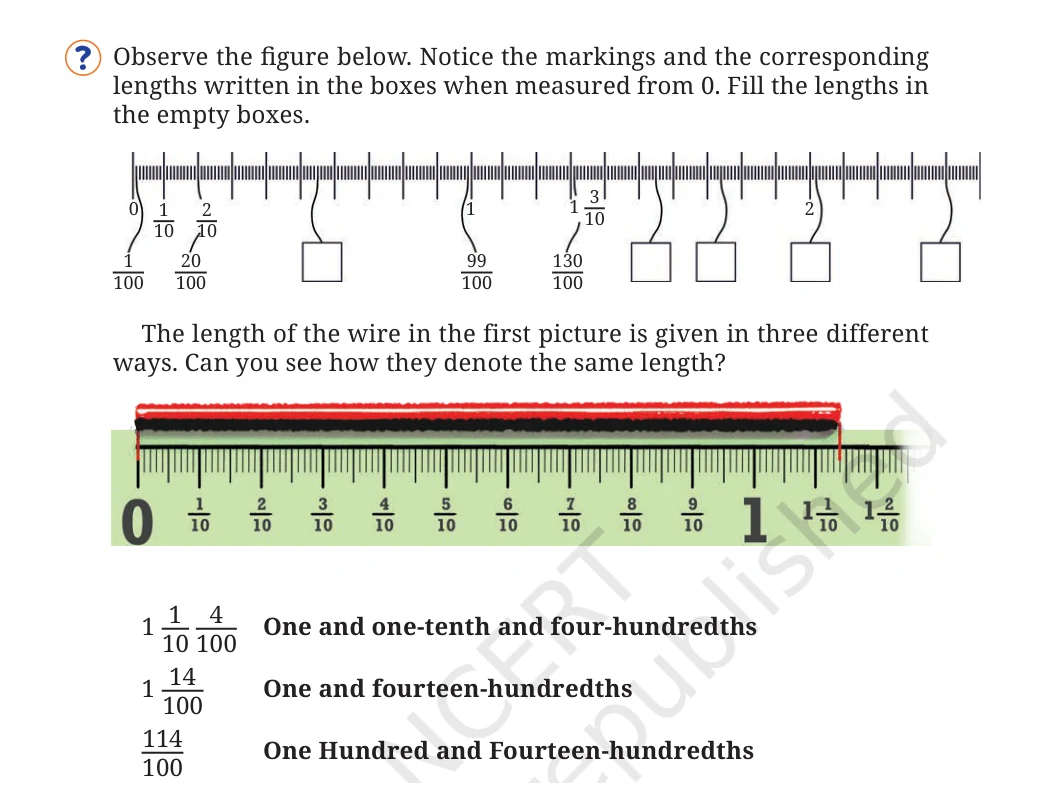
Observe the figure below. Notice the markings and the corresponding lengths written in the boxes when measured from 0. Fill the lengths in the empty boxes.
Show solution
From left to right, the empty boxes are 55/100, 155/100, 164/100, 202/100, and 240/100.
Textbook page 9 · solved item 18

For the lengths shown below write the measurements and read out the measures in words.
Show solution
5 3 10 7 100 = Five and three-tenths and seven-hundredths. 15 3 100 = Fifteen and three-hundredths.
Textbook page 9 · solved item 19
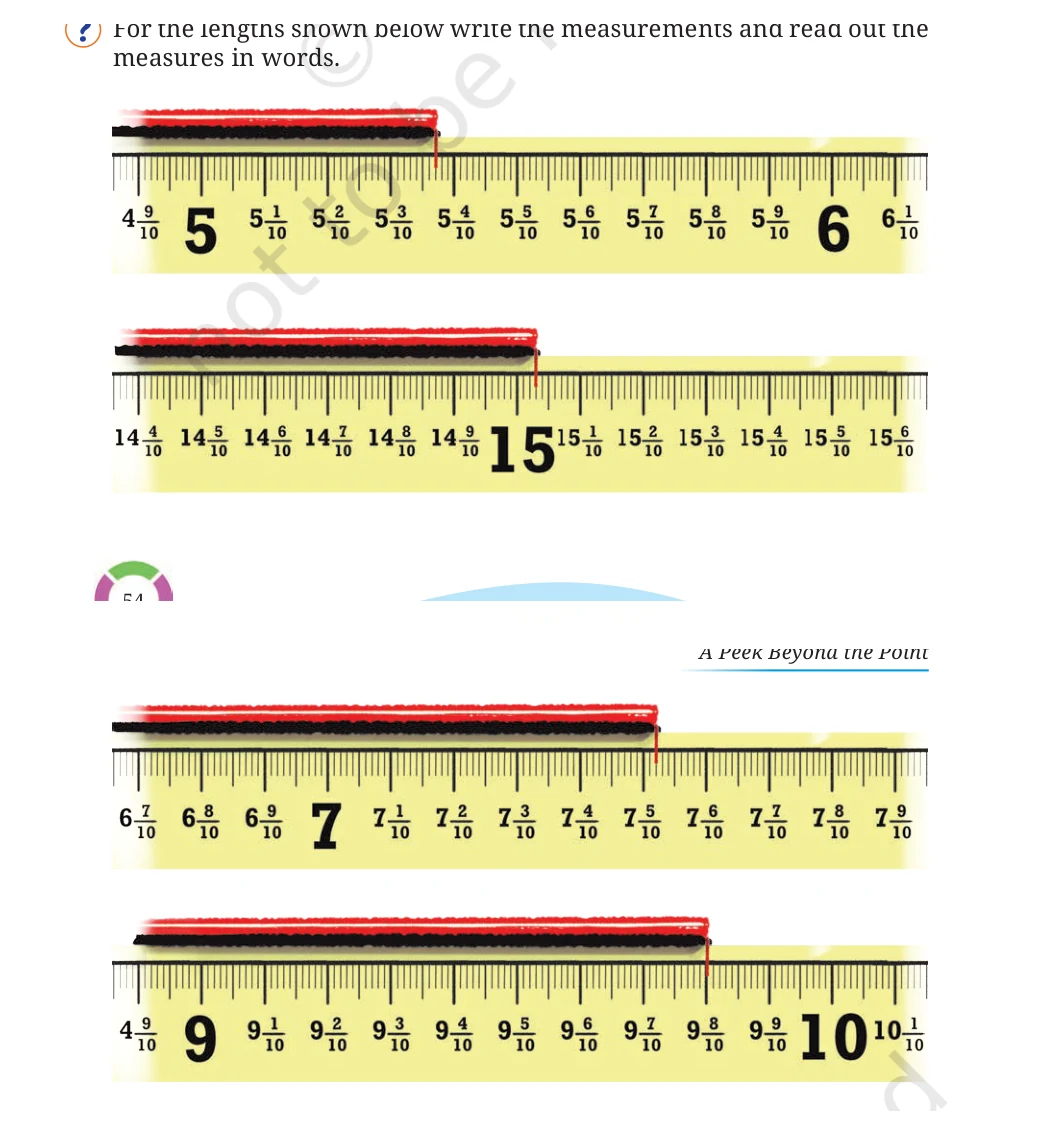
For the lengths shown below write the measurements and read out the measures in words. 55 100 155 100 164 100 202 100 240 100
Show solution
7 5 10 2 100 = Seven and five-tenths and two-hundredths. 9 80 100 = Nine and eighty-hundredths.
Complete worked answers
Textbook page 10
Textbook page 10 · solved item 20
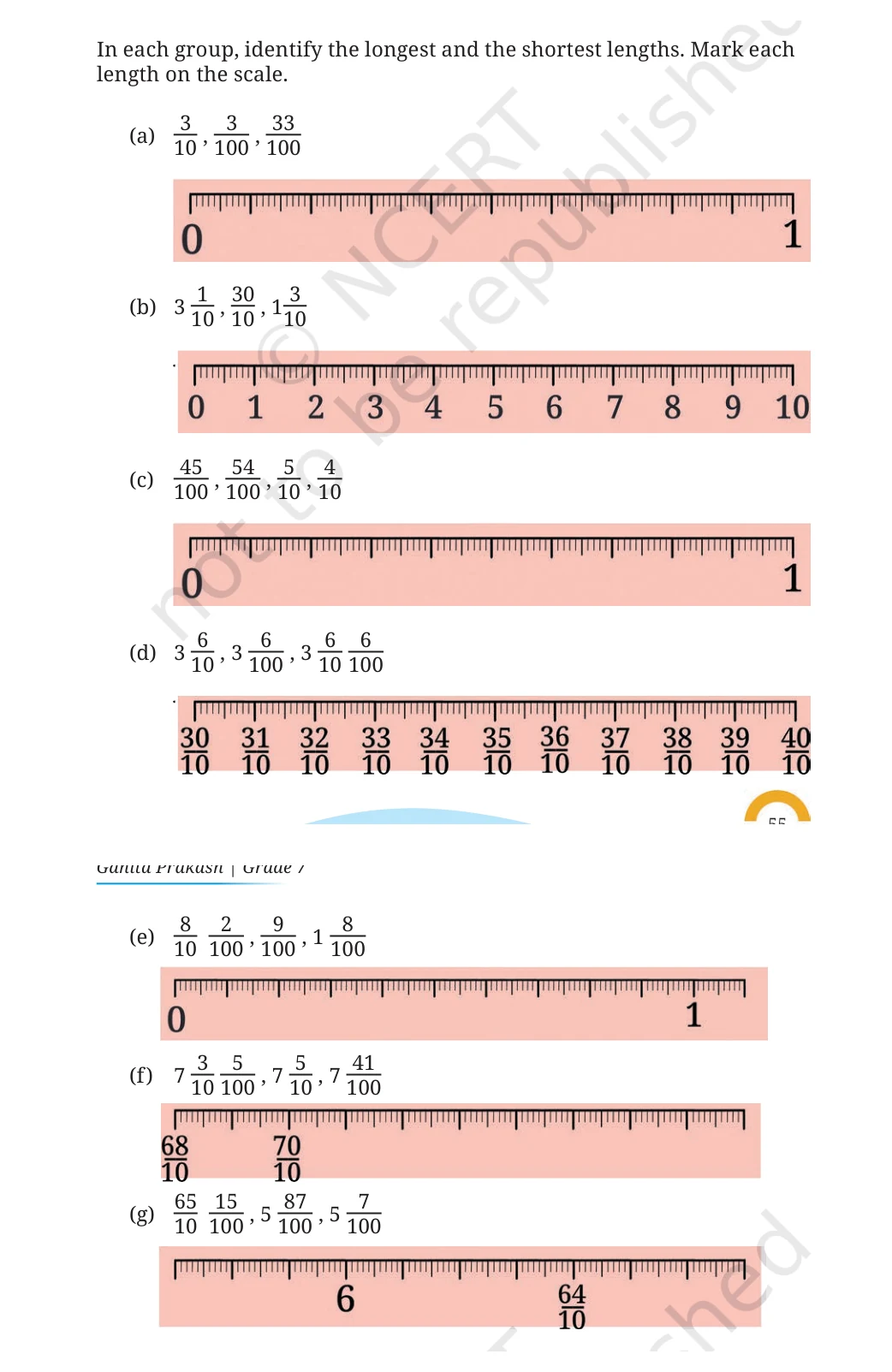
In each group, identify the longest and the shortest lengths. Mark each length on the scale. (a) 3 10 , 3 100, 33 100 (b) 3 1 10, 30 10 , 1 3 10 (c) 45 100, 54 100, 5 10, 4 10 (d) 3 6 10, 3 6 100, 3 6 10 6 100 (e) 8 10 2 100, 9 100, 1 8 100 (f) 7 3 10 5 100, 7 5 10, 7 41 100 (g) 65 10 15 100, 5 87 100, 5 7 100
Show solution
(a) 3 10 , 3 100, 33 100 3 10 = 30 100 ; 3 100 ; 33 100 Longest length = 33 100 Shortest length = 3 100 (b) 3 1 10, 30 10 , 1 3 10 3 1 10 = 31 10 = 3.1 ; 30 10 = 3 ; 1 3 10 = 13 10 = 1.3 Longest length = 3 1 10 3 10 3 100 33 100 Shortest length = 1 3 10 (c) 45 100, 54 100, 5 10, 4 10 45 100 ; 54 100 ; 5 10 = 50 100 ; 4 10 = 40 100 Longest length = 54 100 Shortest length = 40 100 (d) 3 6 10, 3 6 100, 3 6 10 6 100 3 6 10 = 36 10 ; 3 6 100 = 30 10 6 100 ; 3 6 10 6 100 = 36 10 6 100 Largest number = 3 6 10 6 100 Smallest number = 3 6 100 30 10 1 3 10 3 1 10 4 10 45 10 5 10 54 10 3 6 100 3 6 10 3 6 10 6 100 (e) 8 10 2 100, 9 100, 1 8 100 Largest number = 1 8 100 Smallest number = 9 100 (f) 7 3 10 5 100, 7 5 10, 7 41 100 7 3 10 5 100 = 73 10 5 100 ; 7 5 10 = 75 10 7 41 100 = 7 + 41 100 = 70 10 + 41 100 = 70 10 + 40 100 + 1 100 = 70 10 + 4 10 + 1 100 = 74 10 + 1 100 = 74 10 1 100 Largest number = 7 5 10 Smallest number = 7 3 10 5 100 (g) 65 10 15 100, 5 87 100, 5 7 100 65 10 15 100 = 65 10 + 15 100 = 65 10 + 10 100 + 5 100 = 65 10 + 1 10 + 5 100 = 66 10 + 5 100 = 66 10 5 100 5 87 100 = 5 + 87 100 = 5 + 80 100 + 7 100 = 5 + 8 10 + 7 100 = 5 8 10 7 100 5 7 100 Largest number = 65 10 15 100 Smallest number = 5 7 100 9 100 8 10 2 100 1 8 100 7 3 10 5 100 7 41 100 7 5 10
Complete worked answers
Textbook page 11
Textbook page 11 · solved item 21
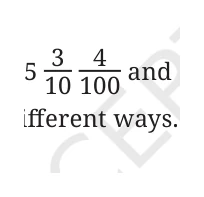
What will be the sum of 15 3 10 4 100 and 2 6 10 8 100?
Show solution
Method 1: 15 3 10 4 100 + 2 6 10 8 100 = (15 + 2) + ( 3 10 + 6 10 ) + ( 4 100 + 8 100 ) = 17 + 9 10 + 12 100 = 17 + 9 10 + 10 100 + 2 100 = 17 + 9 10 + 1 10 + 2 100 = 17 + 10 10 + 2 100 = 17 + 1 + 2 100 = 18 + 2 100. Method 2: 15 3 10 4 100 + 2 6 10 8 100 = 15 3 10 4 100 + 2 6 10 8 100 = 17 9 10 12 100 = 17 10 10 2 100 = 18 2 100.
Complete worked answers
Textbook page 12
Textbook page 12 · solved item 22
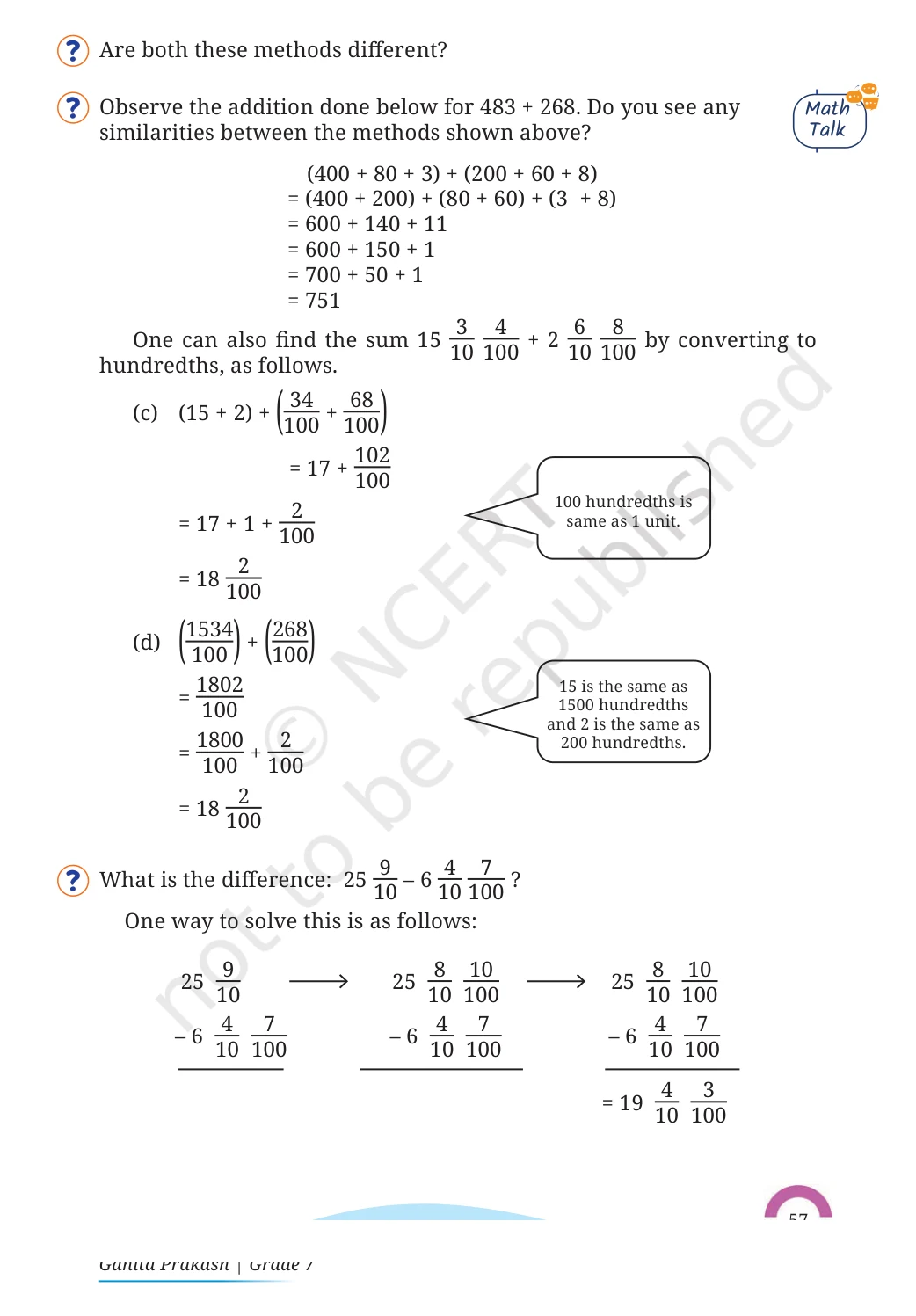
Are both these methods different?
Show solution
No, both methods are the same in logic and result but differ in structure. Method 1 uses a step-by-step horizontal layout for addition, while Method 2 uses a vertical layout.
Complete worked answers
Textbook page 13
Textbook page 13 · solved item 23

Solve this by converting to hundredths. 25 9 10 - 6 4 10 7 100
Show solution
25 9 10 = 25 90 100 ; 6 4 10 7 100 = 6 47 100 25 9 10 - 6 4 10 7 100 = 25 90 100 - 6 47 100 = (25 – 6) + ( 90 100 − 47 100 ) = 19 + 43 100 = 19 43 100 . 65 10 15 100 7 41 100 Figure it out
Textbook page 13 · solved item 24
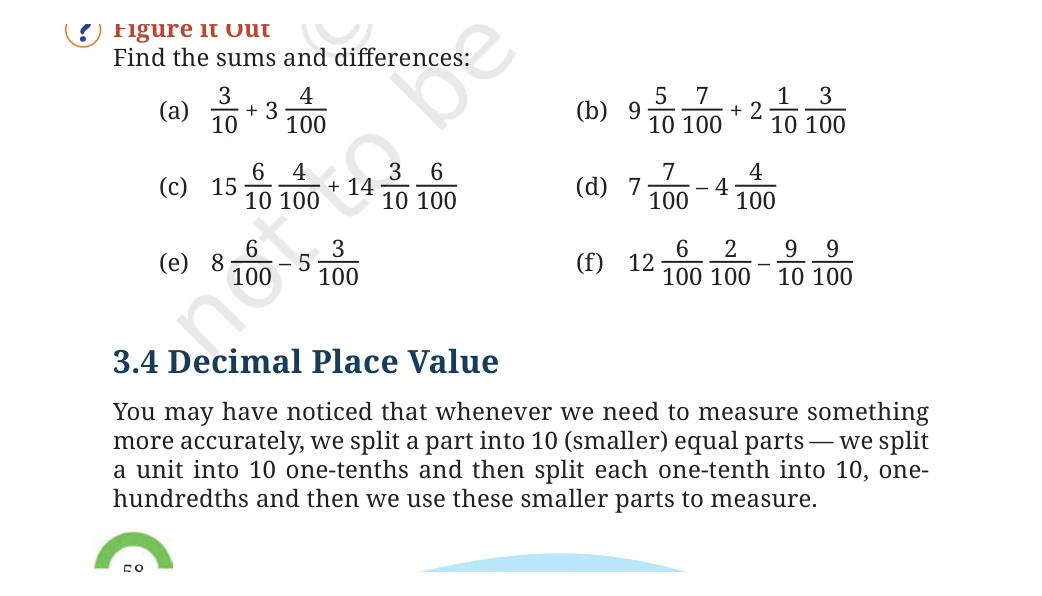
Find the sums and differences: (a) 3 10 + 3 4 100 (b) 9 5 10 7 100 + 2 1 10 3 100 (c) 15 6 10 4 100 + 14 3 10 6 100 (d) 7 7 100 – 4 4 100 (e) 8 6 100 – 5 3 100 (f) 12 6 100 2 100 - 9 10 9 100
Show solution
(a) 3 10 + 3 4 100 = 30 100 + 3 + 4 100 = 3 + ( 30 100 + 4 100 ) = 3 + 34 100 = 3 34 100. (b) 9 5 10 7 100 + 2 1 10 3 100 = (9 + 2) + ( 5 10 + 1 10 ) + ( 7 100 + 3 100 ) = 11 + ( 5+1 10 ) + ( 7+3 100 ) = 11 + 6 10 + 10 100 = 11 + 6 10 + 1 10 = 11 + 7 10 = 11 7 10. (c) 15 6 10 4 100 + 14 3 10 6 100 = (15 + 14) + ( 6 10 + 3 10 ) + ( 4 100 + 6 100 ) = 29 + ( 6+3 10 ) + ( 4+6 100) = 29 + 9 10 + 10 100 = 29 + 9 10 + 1 10 = 29 + 10 10 = 29 + 1 = 30.
(d) 7 7 100 – 4 4 100 = (7 – 4) + ( 7 100 − 4 100 ) = 3 + 3 100 = 3 3 100 . (e) 8 6 100 – 5 3 100 = (8 – 5) + ( 6 100 − 3 100 ) = 3 + 3 100 = 3 3 100 . (f) 12 6 10 2 100 - 9 10 9 100 = 12 62 100 – 99 100 = 11 + 1 + 62 100 – ( 99 100 ) = 11 + 100 100 + 62 100 – ( 99 100 ) = 11 + 162 100 - ( 99 100 ) = 11 + ( 162 100 − 99 100 ) = 11 + 63 100 = 11 63 100.
Complete worked answers
Textbook page 15
Textbook page 15 · solved item 25
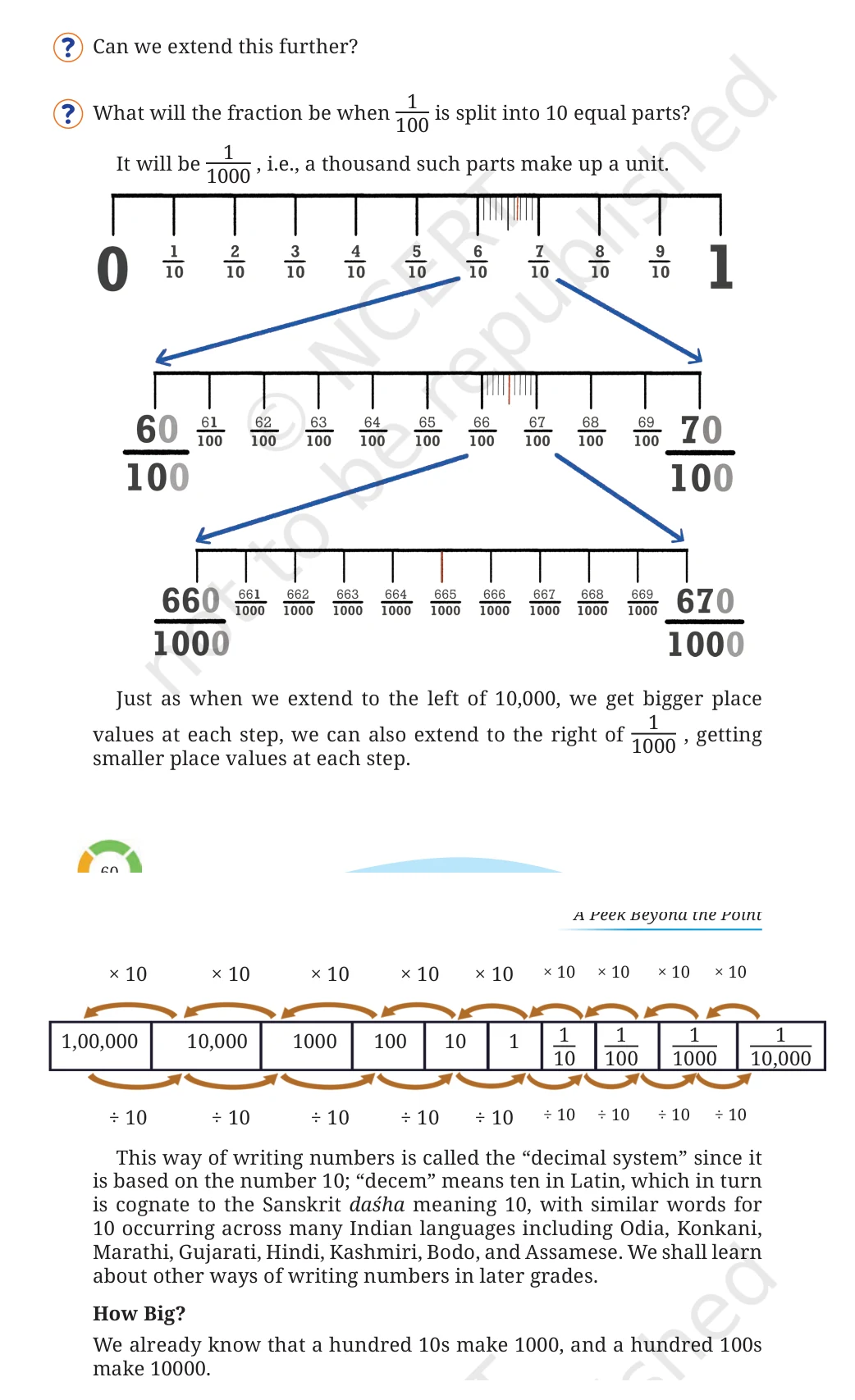
Can we extend this further?
Show solution
Yes, it can be extended on both sides infinitely.
Complete worked answers
Textbook page 16
Textbook page 16 · solved item 26

We can ask similar questions about fractional parts: (a) How many thousandths make one unit? (b) How many thousandths make one tenth? (c) How many thousandths make one hundredth? (d) How many tenths make one ten? (e) How many hundredths make one ten?
Show solution
(a) Since, 1 1000 × 1000 = 1. Therefore, 1000 thousandths make one unit. (b) Since, 1 1000 × 100 = 1 10. Therefore, 100 thousandths make one tenth. (c) Since, 1 1000 × 10 = 1 100. Therefore, 10 thousandths make one hundredth. 1 1000 1 10,000 1,00,000 10,00,000 (d) Since, 1 10 × 100 = 10. Therefore, 100 tenths make one ten.
(e) Since, 1 100 × 1000 = 10. Therefore, 1000 tenths make one ten.
Textbook page 16 · solved item 27
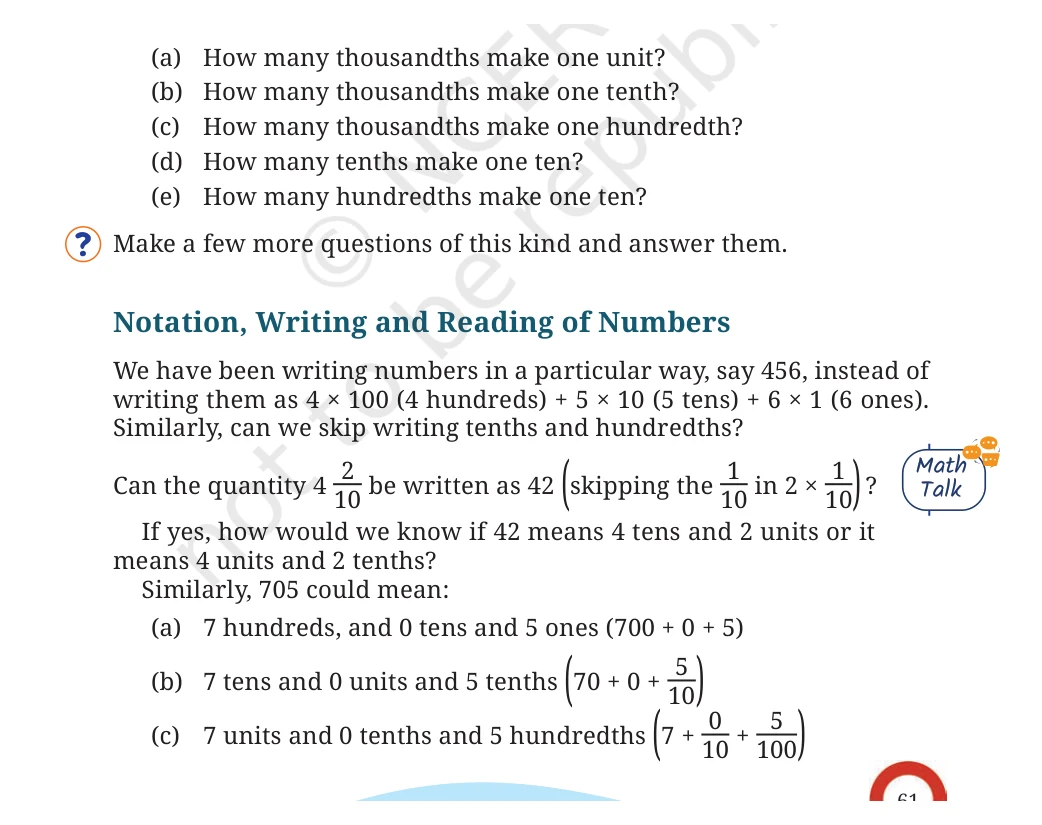
We can ask similar questions about fractional parts: (a) How many hundredths make one unit? (b) How many tenths make one unit? (c) How many tenths make one hundredth? (d) How many hundredths make one tenth?
Show solution
(a) Since, 1 100 × 100 = 1. Therefore, 100 hundredths make one unit. (b) Since, 1 10 × 10 = 1. Therefore, 10 tenths make one unit. (c) Since, 1 10 × 1 10 = 1 100. Therefore, 1 10 tenths make one hundredth. (d) Since, 1 100 × 10 = 1 10. Therefore, 10 hundredths make one tenth.
Complete worked answers
Textbook page 18
Textbook page 18 · solved item 28
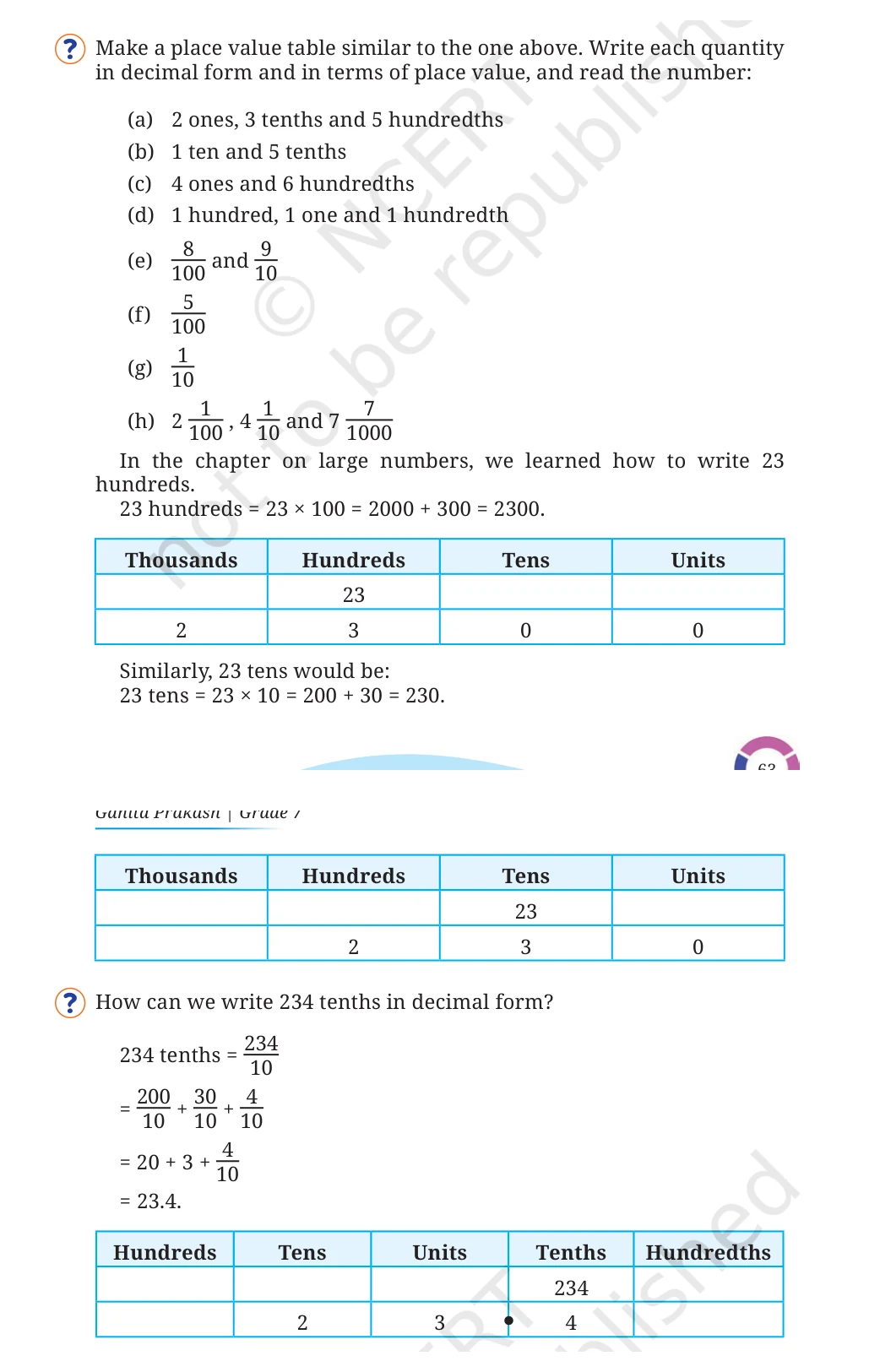
Make a place value table similar to the one above. Write each quantity in decimal form and in terms of place value and read the number: (a) 2 ones, 3 tenths and 5 hundredths (b) 1 ten and 5 tenths (c) 4 ones and 6 hundredths (d) 1 hundred, 1 one and 1 hundredth (e) 8 100 and 9 10 (f) 5 100 (g) 1 10 (h) 2 1 100, 4 1 10 and 7 1 1000
Show solution
Quantity Decimal Notation (a) 2 ones, 3 tenths and 5 hundredths (2 + 3 10 + 5 100) 2.35 b) 1 ten and 5 tenths (10 + 0 + 5 10) 10.5 (c) 4 ones and 6 hundredths (4 + 0 + 6 100) 4.06 (d) 1 hundred, 1 one and 1 hundredth (100 + 0 + 1 + 0 + 1 100) 101.01 (e) 8 100 and 9 10 ( 9 10 + 8 100) 0.98 (f) 5 100 0.05 (g) 1 10 0.1 (h) 2 1 100, 4 1 10 and 7 1 1000 ( 4 10 + 2 100 + 7 1000) 0.427 (a) 2.35 – Two point three five.
(b) 10.35 – Ten point three five. (c) 4.06 – Four point zero six. (d) 101.01 – One hundred one point zero one. (e) 0.98 – zero point nine eight. (f) 0.05 – zero-point zero five. (g) 0.1 – zero point one. (h) 0.427 – zero point four two seven. Decimal Number Hundreds Tens Units Tenths Hundredths Thousandths (a) 2.35 2 × 1 3 × 1 10 5 × 1 100 (b) 10.5 1 × 10 0 × 1 5 × 1 10 (c) 4.06 4 × 1 0 × 1 10 6 × 1 100 (d) 101.01 1 × 100 0 × 10 1 × 1 0 × 1 10 1 × 1 100 (e) 0.98 9 × 1 10 8 × 1 100 (f) 0.05 0 × 1 10 5 × 1 100 (g) 0.1 1 × 1 10 (h) 0.427 4 × 1 10 2 × 1 100 7 × 1 1000
Complete worked answers
Textbook page 19
Textbook page 19 · solved item 29

Write these quantities in decimal form: (a) 234 hundredths, (b) 105 tenths.
Show solution
(a) 234 hundredths = 234 100 = 2.34 (b) 105 tenths = 105 10 = 10.5
Complete worked answers
Textbook page 20
Textbook page 20 · solved item 30
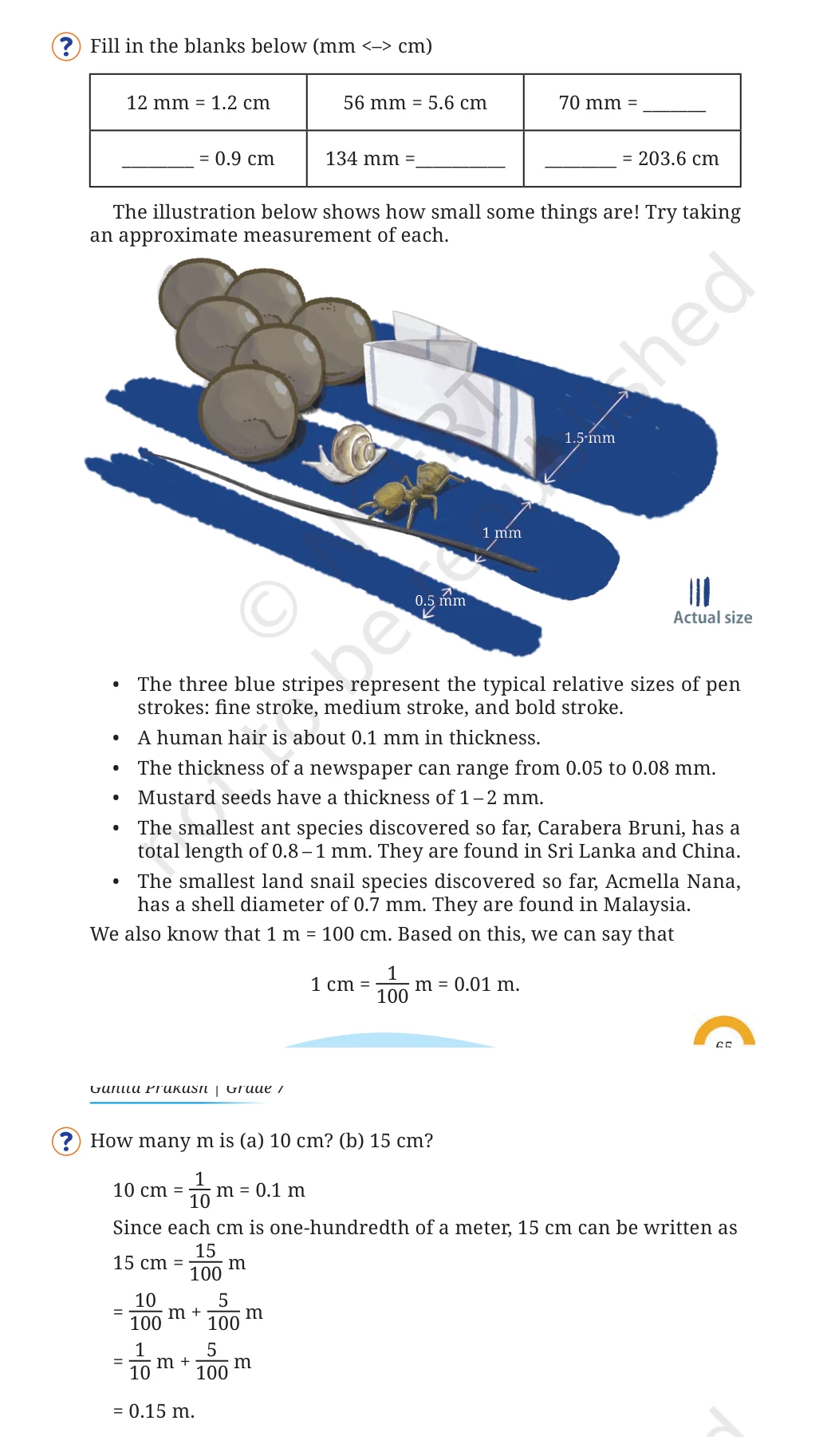
Fill in the blanks below (mm <–> cm) 12 mm = 1.2 cm 56 mm = 5.6 cm 70 mm = _______ ________ = 0.9 cm 134 mm =__________ ________ = 203.6 cm
Show solution
70 mm = 70 10 cm = 7cm 0.9 cm = (0.9 × 10) mm = ( 9 10 × 10) mm = 9 mm 134 mm = 134 10 cm = 13.4 cm 203.6 cm = (203.6 × 10) mm = ( 2036 10 × 10) mm = 2036 mm 12 mm = 1.2 cm 56 mm = 5.6 cm 70 mm = 7cm 9 mm = 0.9 cm 134 mm = 13.4 cm 2036 mm = 203.6 cm
Complete worked answers
Textbook page 21
Textbook page 21 · solved item 31
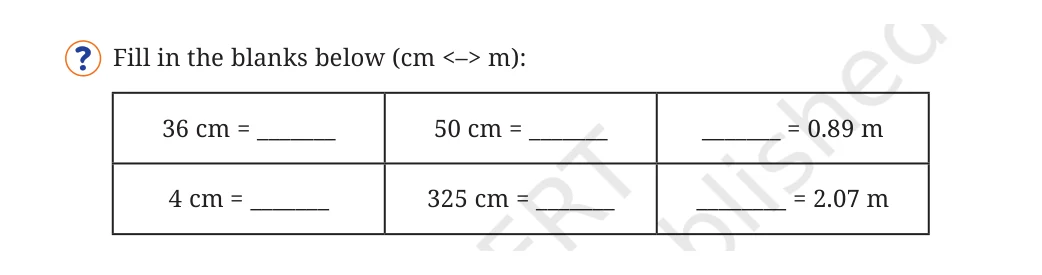
Fill in the blanks below (cm <–> m): 36 cm = _______ 50 cm = _______ _______ = 0.89 m 4 cm = _______ 325 cm = _______ ________ = 2.07 m
Show solution
36 cm = 36 100 m = ( 30 100 + 6 100) m = ( 3 10 + 6 100) m = 0.36 m 50 cm = 50 100 m = 5 10 m = 0.5 m 0.89 m = (0.89 × 100) cm = ( 89 100 × 100) cm = 89 cm 4 cm = 4 100 m = 0.04 m 325 cm = 325 100 m = ( 300 100 + 20 100 + 5 100) m = (3 + 2 10 + 5 100) m = 3.25 m 2.07 m = (2.07 × 100) cm = ( 207 100 × 100) cm = 207 cm 36 cm = 0.36 m 50 cm = 0.5 m 89 cm = 0.89 m 4 cm = 0.04 m 325 cm = 3.25 m 207 cm = 2.07 m
Textbook page 21 · solved item 32

How many mm does 1 meter have?
Show solution
1 m = (1 × 100) cm = 100 cm = (100 × 10) mm = 1000 mm.
Textbook page 21 · solved item 33
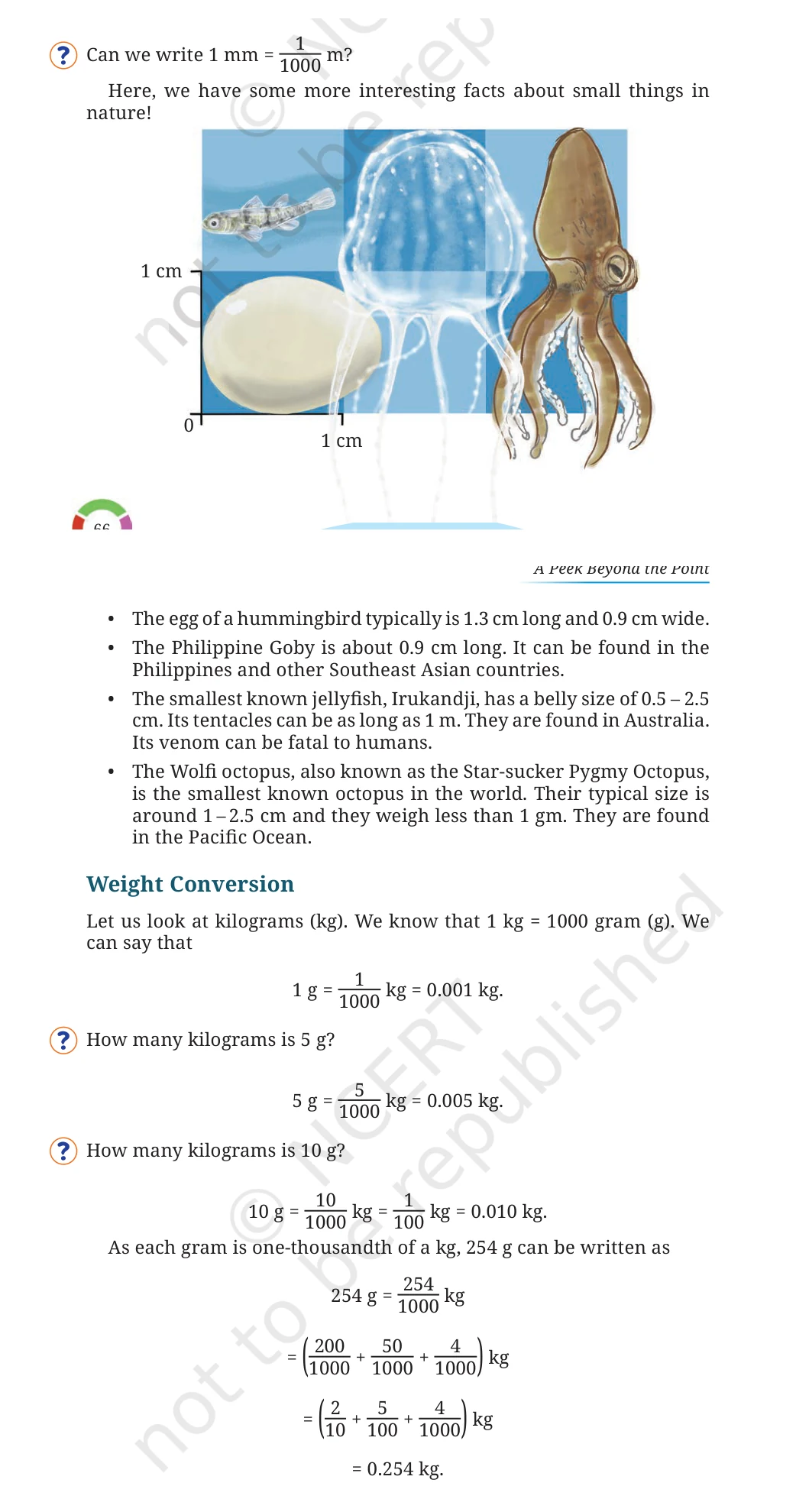
Can we write 1 mm = 1 1000 m?
Show solution
Yes, 1 mm can be written as 1 1000 m. Because 1 mm = 1 10 cm = 1 10 × 100 m = 1 1000 m
Complete worked answers
Textbook page 22
Textbook page 22 · solved item 34
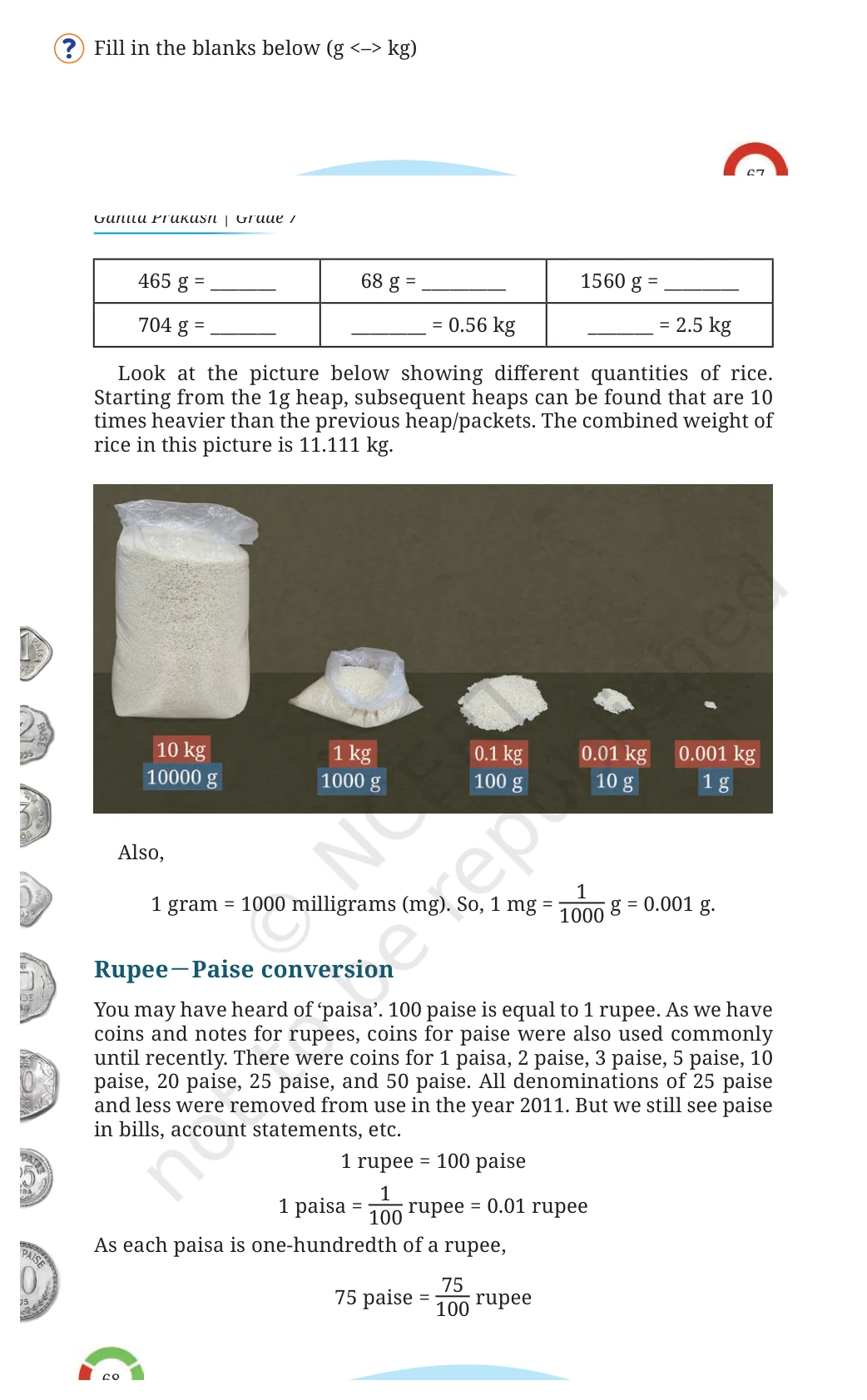
Fill in the blanks below (g <–> kg) 465 g = _______ 68 g = _________ 1560 g = ________ 704 g = _______ ________ = 0.56 kg _______ = 2.5 kg
Show solution
465 g = 465 1000 kg = ( 400 1000 + 60 1000 + 5 1000) kg = ( 4 10 + 6 100 + 5 1000) kg = 0.465 kg 68 g = 68 1000 kg = ( 60 1000 + 8 1000) kg = ( 6 100 + 8 1000) kg = 0.068 kg 1560 g = 1560 1000 kg = ( 1000 1000 + 500 1000 + 60 1000) kg = (1 + 5 10 + 6 100) kg = 1.56 kg 704 g = 704 1000 kg = ( 700 1000 + 4 1000) kg = ( 7 10 + 4 1000) kg = 0.704 kg 0.56 kg = (0.56 × 1000) g = ( 56 100 × 1000) g = 560 g 2.5 kg = (2.5 × 1000) g = ( 25 10 × 1000) g = 2500 g 465 g = 0.465 kg 68 g = 0.068 kg 1560 g = 1.56 kg 704 g = 0.704 kg 560 g = 0.56 kg 2500 g = 2.5 kg
Complete worked answers
Textbook page 24
Textbook page 24 · solved item 35

Fill in the blanks below (rupee <–> paise) 10 p = __________ _______p = ₹ 0.05 ________p = ₹ 0.36 _________ = ₹ 0.50 99 p = _________ 250 p = _________
Show solution
10 p = ₹ 10 100 = ₹ 1 10 = ₹ 0.1 ₹ 0.05 = (0.05 × 100) p = ( 5 100 × 100) p = 5 p ₹ 0.36 = (0.36 × 100) p = ( 36 100 × 100) p = 36 p ₹ 0.50 = (0.50 × 100) p = ( 50 100 × 100) p = 50 p 99 p = ₹ 99 100 = ₹ ( 90 100 + 9 100) = ₹ ( 9 10 + 9 100) = ₹ 0.99 250 p = ₹ 250 100 = ₹ ( 200 100 + 50 100) = ₹ (2 + 5 10) = ₹ 2.5 10 p = ₹ 0.1 5 p = ₹ 0.05 36 p = ₹ 0.36 50 p = ₹ 0.50 99 p = ₹ 0.99 250 p = ₹ 2.5
Complete worked answers
Textbook page 25
Textbook page 25 · solved item 36

Name all the divisions between 1 and 1.1 on the number line.
Show solution
1 – 1.01 – 1.02 – 1.03 – 1.04 – 1.05 – 1.06 – 1.07 – 1.08 – 1.09 -1.1
Textbook page 25 · solved item 37
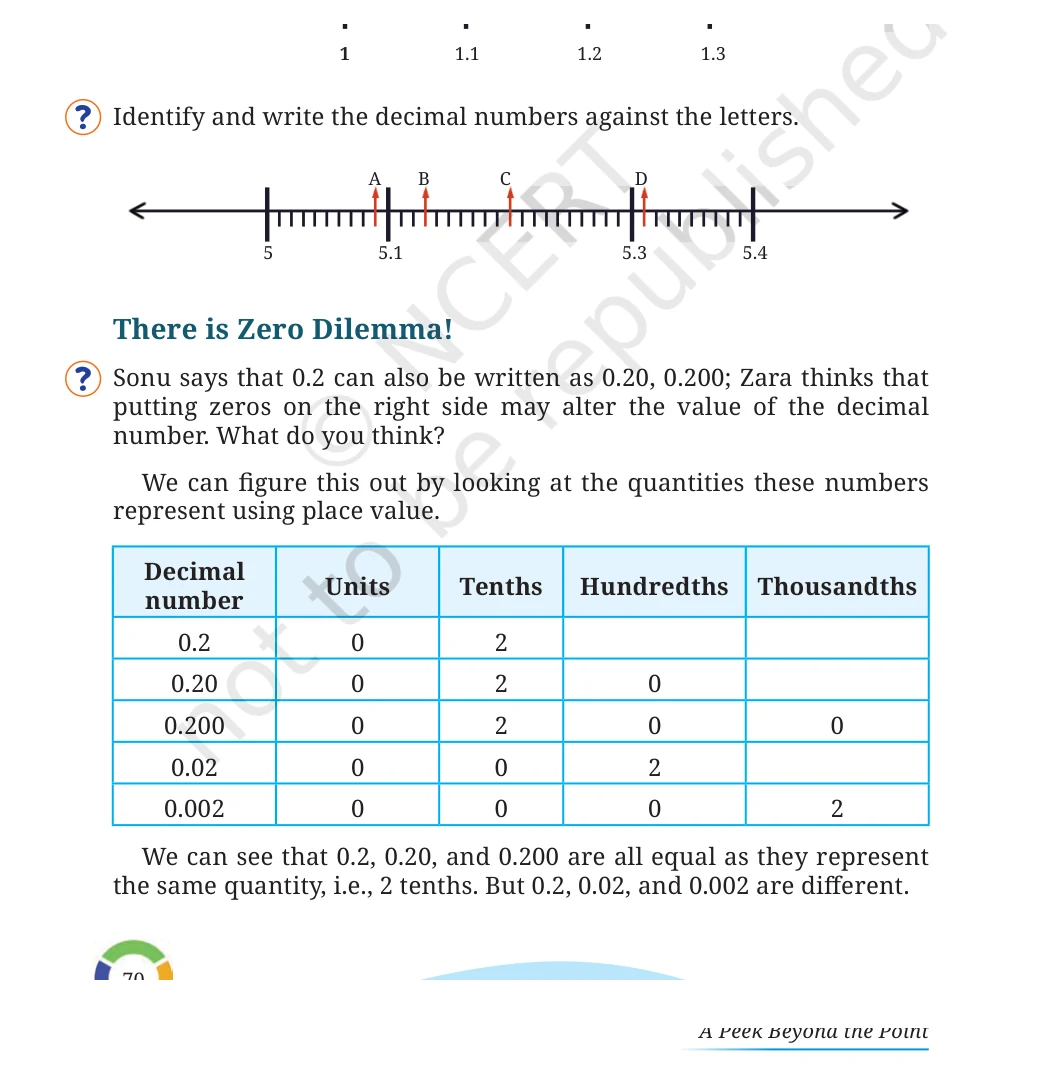
Identify and write the decimal numbers against the letters.
Show solution
The marked decimals are A = 5.09, B = 5.13, C = 5.20, and D = 5.31.
Complete worked answers
Textbook page 26
Textbook page 26 · solved item 38

Can you tell which of these is the smallest and which is the largest? 0.2, 0.20, 0.200, 0.02, 0.002
Show solution
0.002 < 0.02 < 0.2 = 0.20 = 0.200 Smallest = 0.002 Largest = 0.2 5.09 5.13 5.2 5.31
Textbook page 26 · solved item 39

Which of these are the same: 4.5, 4.05, 0.405, 4.050, 4.50, 4.005, 04.50?
Show solution
Decimal Number Units Tenths Hundredths Thousandths 4.5 4 5 4.05 4 0 5 0.405 0 4 0 5 4.050 4 0 5 0 4.50 4 5 0 4.005 4 0 0 5 04.50 4 5 0 Therefore, 4.50 = 04.50 & 4.05 = 4.050
Textbook page 26 · solved item 40
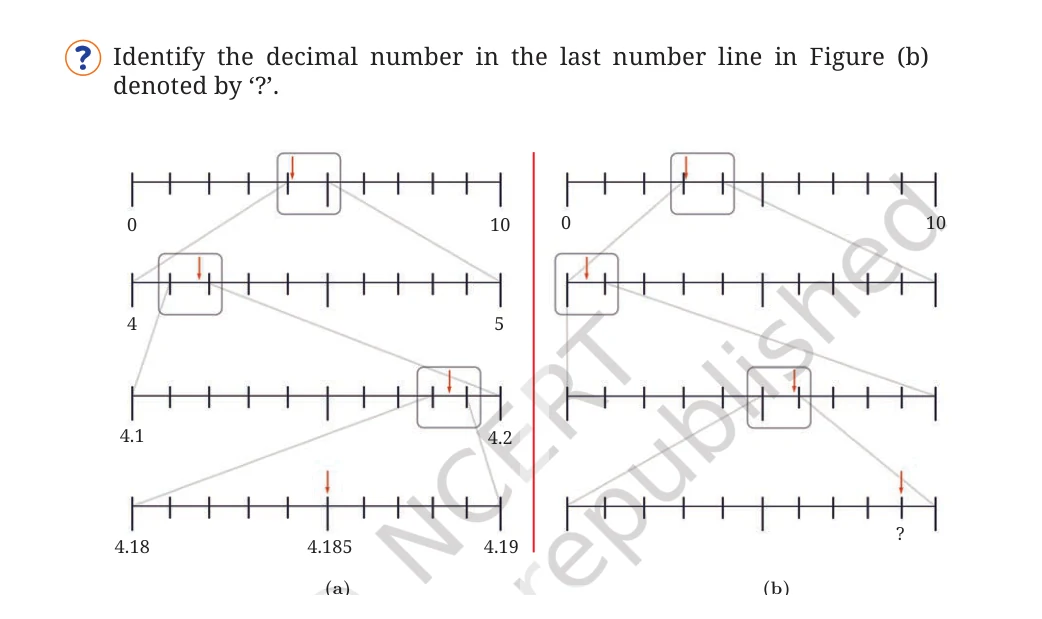
Identify the decimal number in the last number line in Figure (b) denoted by ‘?’.
Show solution
The successive number lines narrow the interval from 3 to 4, then 3.0 to 3.1, and then 3.05 to 3.06. The marked value is 3.059.
Textbook page 26 · solved item 41

Make such number lines for the decimal numbers: (a) 9.876 (b) 0.407.
Show solution
(a) 9.876 (b) 0.407 3 4 3.0 3.1 3.05 3.06 3.059 0 10 9 10 9.8 9.9 9.87 9.88 9.876 0 10 0 1 0.4 0.5 0.40 0.41 0.407
Textbook page 26 · solved item 42
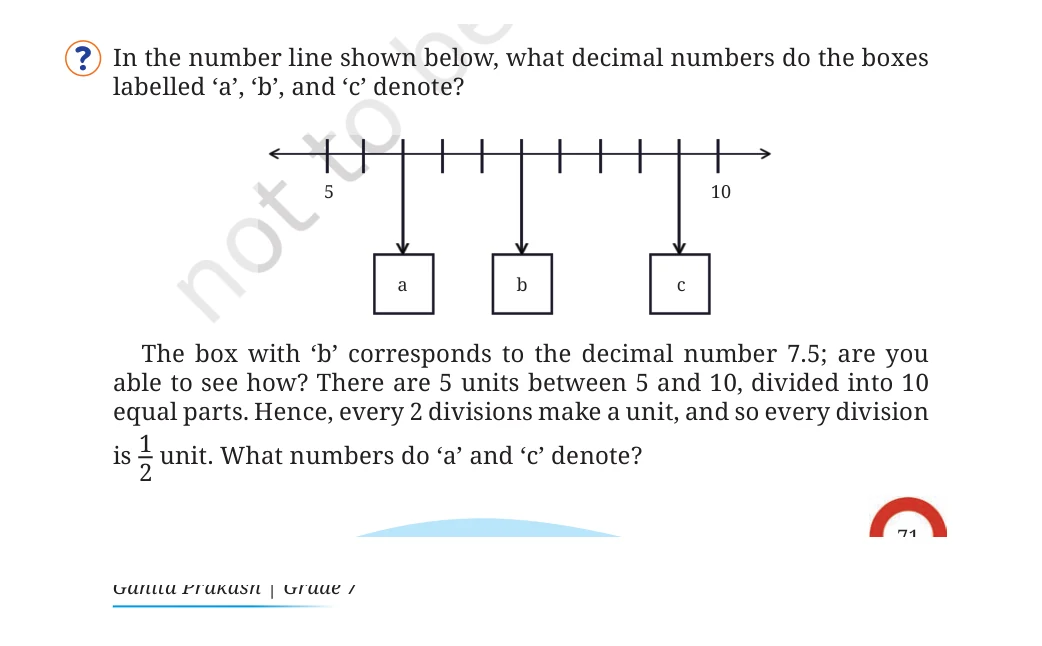
In the number line shown below, what decimal numbers do the boxes labelled ‘a’, ‘b’, and ‘c’ denote?
Show solution
Divisions between 5 and 10 = 10 Each division= 10−5 10 = 5 10 = 0.5 units Therefore, a = 5 + (2 × 0.5) = 5 + 1 = 6 b = 5 + (5 × 0.5) = 5 + 2.5 = 7.5 c = 5 + (9 × 0.5) = 5 + 4.5 = 9.5
Complete worked answers
Textbook page 27
Textbook page 27 · solved item 43
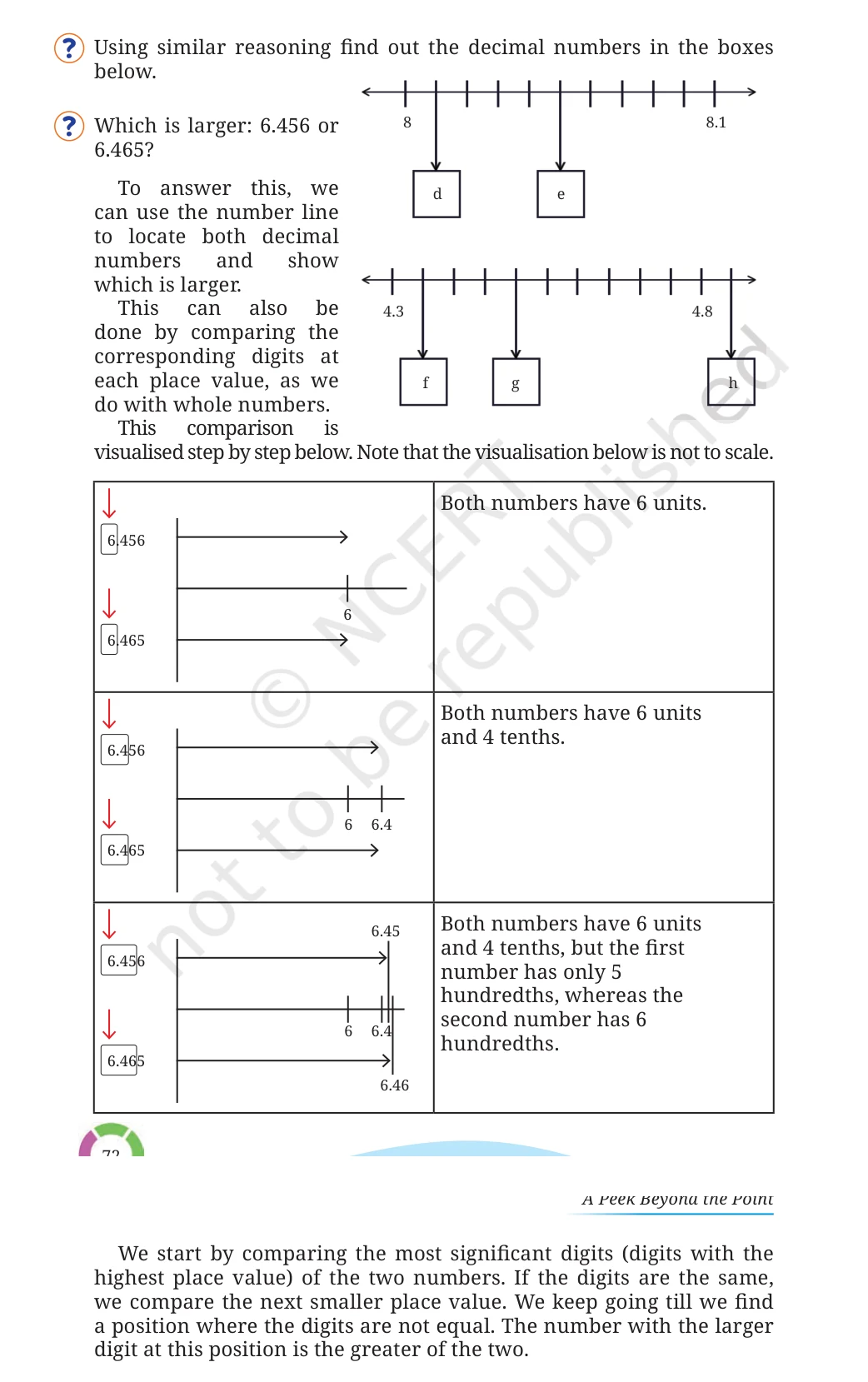
Using similar reasoning find out the decimal numbers in the boxes below.
Show solution
(i) Divisions between 8 and 8.1 = 10 Each division = (8.1 – 8) ÷ 10 = 0.1 ÷ 10 = 1 10 × 1 10 = 1 100 = 0.01 Therefore, d = 8 + 0.01 = 8.01. e = 8 + (5 × 0.01) = 8 + 0.05 = 8.05. (ii) Divisions between 4.3 and 4.8 = 10 Each division = (4.8 – 4.3) ÷ 10 = 0.5 ÷ 10 = 5 10 × 1 10 = 5 100 = 0.05 Therefore, f = 4.3 + 0.05 = 4.35. g = 4.3 + (4 × 0.05) = 4.3 + 0.2 = 4.50. h = 4.3 + (11 × 0.05) = 4.3 + 0.55 = 4.85.
Q. Which is larger: 6.456 or 6.465? Solution Comparing both numbers: Units place – Both have 6 in the units place. Tenths place – Both have 4 in the tenths place. Hundredths place – 6.456 has 5 in the hundredths place, while 6.465 has 6. Since 6 > 5, 6.465 is greater than 6.456 at the hundredths place.
Therefore, 6.465 is the larger number.
Complete worked answers
Textbook page 28
Textbook page 28 · solved item 44

Why can we stop comparing at this point? Can we be sure that whatever digits are there after this will not affect our conclusion?
Show solution
When comparing decimal numbers, stop at the place value where the digits are different. The number with the larger digit at that place is the greater number.
Textbook page 28 · solved item 45
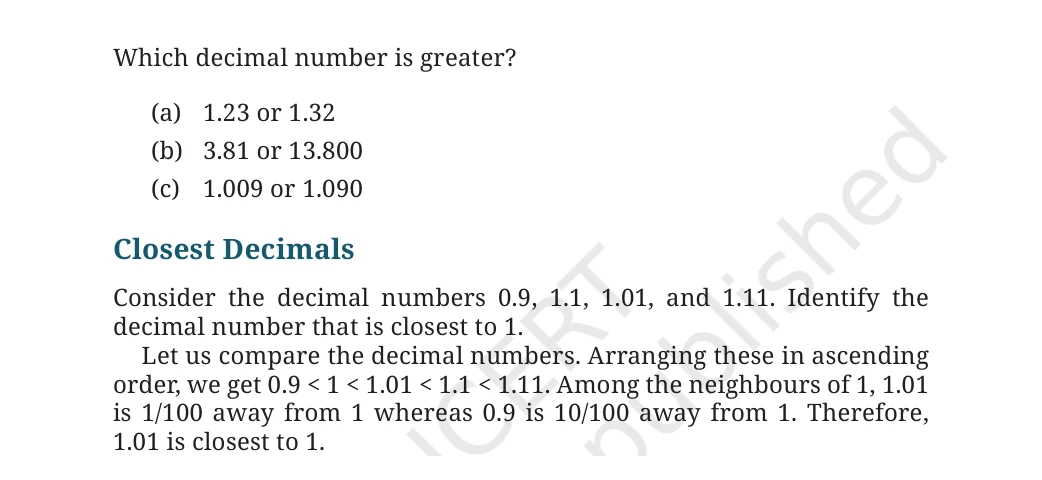
Which decimal number is greater? (a) 1.23 or 1.32 (b) 3.81 or 13.800 (c) 1.009 or 1.090
Show solution
(a) 1.23 or 1.32 Comparing both numbers: Units place – Both have 1 in the units place. Tenths place – 1.23 has 2 in the tenths place, while 1.32 has 3. Since 3 > 2, 1.32 is greater than 1.23 at the tenths place. Therefore, 1.32 is the larger number. (b) 3.81 or 13.800 = 03.81 or 13.800 Comparing both numbers: Tenths place – 3.81 has 0 in the tens place while 13.800 has 1.
Since 0 < 1, 13.800 is greater than 3.81 at the tens place. Therefore, 13.800 is the larger number. (c) 1.009 or 1.090 Comparing both numbers: Units place – Both have 1 in the units place. Tenths place – Both have 0 in the tenths place. Hundredths place – 1.009 has 0 in the hundredths place while 1.090 has 9.
Since 0 < 9, 1.090 is greater than 1.009 at the hundredths place. Therefore, 1.090 is the larger number.
Textbook page 28 · solved item 46

Which of the above is closest to 1.09? (Decimal numbers: 0.9, 1.1, 1.01, and 1.11)
Show solution
Arranging all numbers in ascending order: 0.9 < 1.01 < 1.09 < 1.1 < 1.11 Here, neighbours of 1.09 are 1.01 and 1.1. 1.1 (or 1.10) is 1 100 away from 1.09 1.01 is 8 100 away from 1.09 Therefore, 1.1 is closest to 1.09.
Textbook page 28 · solved item 47

Which among these is closest to 4: 3.56, 3.65, 3.099?
Show solution
Arranging all numbers in ascending order: 3.099 < 3.56 < 3.65 Now, compare the distance of each number from 4: 4 − 3.099 = 0.901 4 − 3.56 = 0.44 4 − 3.65 = 0.35 Among these, 3.65 is the smallest distance from 4. Therefore, 3.65 is closest to 4.
Textbook page 28 · solved item 48

Which among these is closest to 1: 0.8, 0.69, 1.08?
Show solution
Arranging all numbers in ascending order: 0.69 < 0.8 < 1.08 Now, compare the distance of each number from 1: 1 − 0.69 = 0.31 1 − 0.8 = 0.2 1.08 − 1 = 0.08 Among these, 1.08 is the smallest distance from 1. Therefore, 1.08 is closest to 1
Textbook page 28 · solved item 49
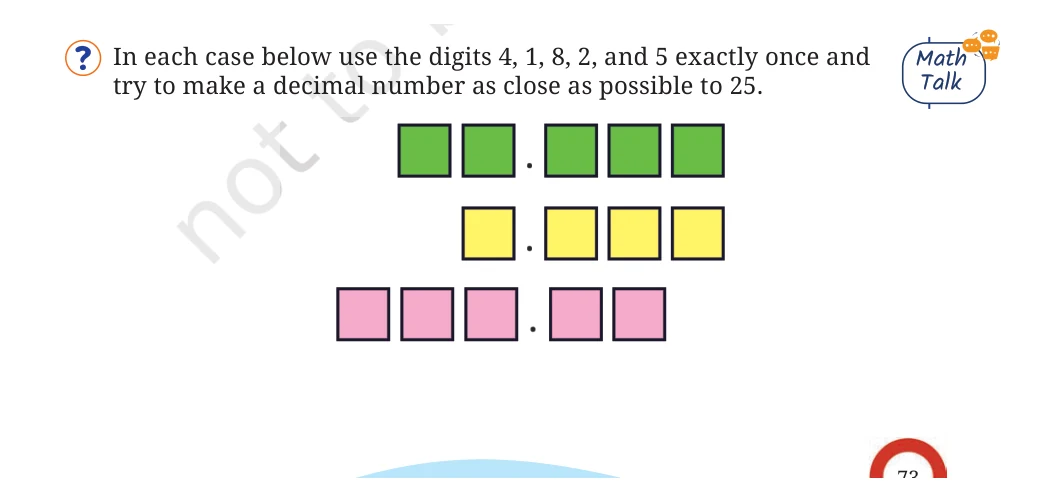
In each case below use the digits 4, 1, 8, 2, and 5 exactly once and try to make a decimal number as close as possible to 25.
Show solution
Using each digit once, the entries shown are 25.148, 8.542, and 124.58 for the three box arrangements.
Complete worked answers
Textbook page 30
Textbook page 30 · solved item 50
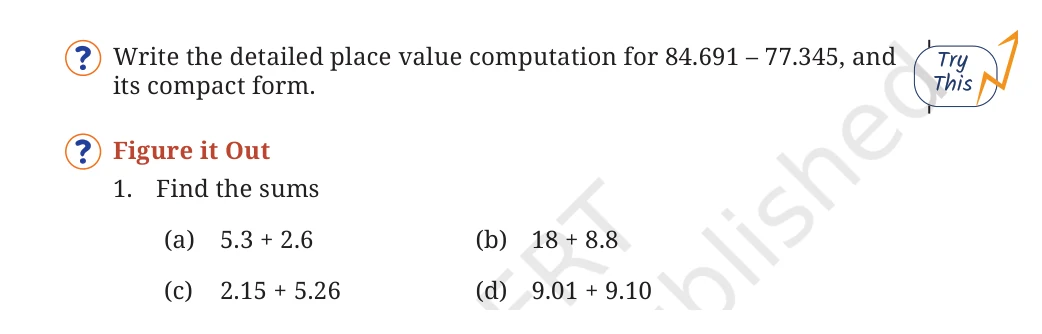
Write the detailed place value computation for 84.691 – 77.345, and its compact form.
Show solution
Figure it Out
Textbook page 30 · solved item 51

1. Find the sums: (a) 5.3 + 2.6 (b) 18 + 8.8 (c) 2.15 + 5.26 (d) 9.01 + 9.10 (e) 29.19 + 9.91 (f) 0.934 + 0.6 (g) 0.75 + 0.03 (h) 6.236 + 0.487
Show solution
(a) 5.3 + 2.6 = 7.9 2 5 1 4 8 8 5 4 2 1 2 4 5 8 5.3 + 2.6 7.9 84.691 - 77.345 7.346 7 1 8 1 (b) 18 + 8.8 = 18.0 + 8.8 = 26.8 (c) 2.15 + 5.26 = 7.41 (d) 9.01 + 9.10 = 18.11 (e) 29.19 + 9.91 = 39.10 (f) 0.934 + 0.6 = 1.534 (g) 0.75 + 0.03 = 0.78 18.0 + 8.8 26.8 1 2.15 + 5.26 7.41 1 09.01 + 9.10 18.11 1 29.19 + 9.91 39.10 1 1 1 0.934 + 0.6 1.534 1 0.75 + 0.03 0.78 (h) 6.236 + 0.
487 = 6.723
Textbook page 30 · solved item 52
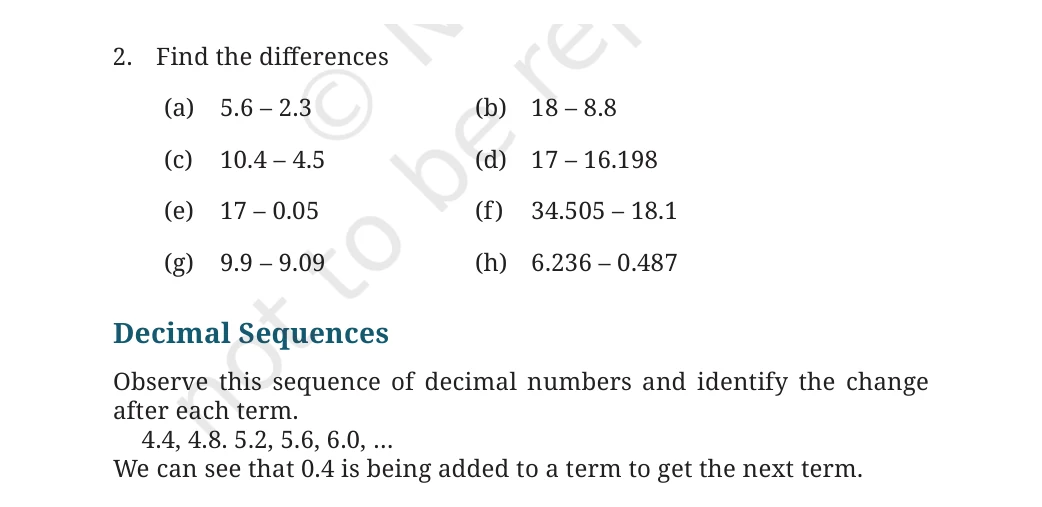
Find the differences: (a) 5.6 – 2.3 (b) 18 – 8.8 (c) 10.4 – 4.5 (d) 17 – 16.198 (e) 17 – 0.05 (f) 34.505 – 18.1 (g) 9.9 – 9.09 (h) 6.236 – 0.487
Show solution
(a) 5.6 – 2.3 = 3.3 (b) 18 – 8.8 = 9.2 (c) 10.4 – 4.5 = 5.9 (d) 17 – 16.198 = 0.802 6.236 + 0.487 6.723 1 1 5.6 - 2.3 3.3 17.000 - 16.198 0.802 6 9 9 10 18.0 - 8.8 9.2 7 10 10.4 - 4.5 5.9 0 9 14 (e) 17 – 0.05 = 16.95 (f) 34.505 – 18.1 = 16.405 (g) 9.9 – 9.09 = 0.81 (h) 6.236 – 0.487 = 5.749
Textbook page 30 · solved item 53

Continue this sequence and write the next 3 terms. (Sequence - 4.4, 4.8. 5.2, 5.6, 6.0, ...)
Show solution
Sequence: 4.4, 4.8, 5.2, 5.6, 6.0, ... Each term increases by 0.4. Next after 6.0: 6.0 + 0.4 = 6.4 Next: 6.4 + 0.4 = 6.8 Next: 6.8 + 0.4 = 7.2 Therefore, Next 3 terms are 6.4, 6.8, 7.2. 17.00 - 0.05 6 9 10 16.95 9.90 - 9.09 8 10 0.81 6.236 - 0.487 5 11 12 16 5.749 34.505 - 18.100 16.405 2 14
Complete worked answers
Textbook page 31
Textbook page 31 · solved item 54
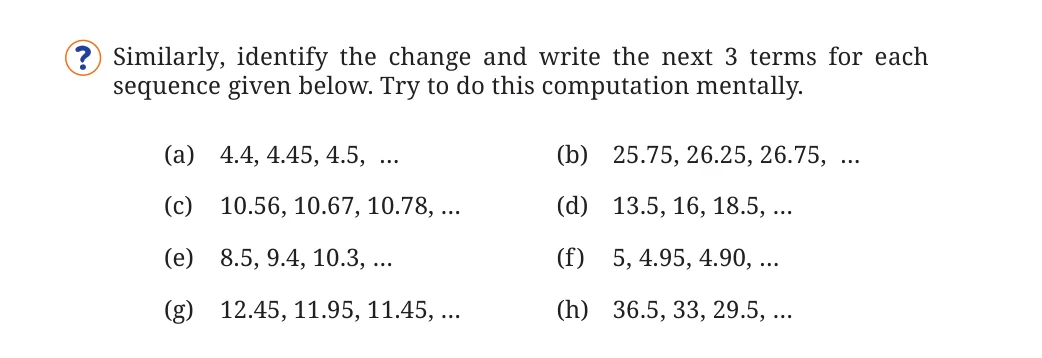
Similarly, identify the change and write the next 3 terms for each sequence given below. Try to do this computation mentally. (a) 4.4, 4.45, 4.5, ... (b) 25.75, 26.25, 26.75, ... (c) 10.56, 10.67, 10.78, ... (d) 13.5, 16, 18.5, ... (e) 8.5, 9.4, 10.3, ... (f) 5, 4.95, 4.90, ... (g) 12.45, 11.95, 11.45, ... (h) 36.5, 33, 29.5, ….
Show solution
(a) 4.4, 4.45, 4.5, ... Each term increases by 0.05 Next after 4.5: 4.5 + 0.05 = 4.55 Next: 4.55 + 0.05 = 4.6 Next: 4.6 + 0.05 = 4.65 Therefore, Next 3 terms are 4.55, 4.6, 4.65 (b) 25.75, 26.25, 26.75, ... Each term increases by 0.5 Next after 26.75: 26.75 + 0.5 = 27.25 Next: 27.25 + 0.5 = 27.75 Next: 27.75 + 0.5 = 28.25 Therefore, Next 3 terms are 27.25, 27.75, 28.25 (c) 10.56, 10.67, 10.78, ...
Each term increases by 0.11 Next after 10.78: 10.78 + 0.11 = 10.89 Next: 10.89 + 0.11 = 11.00 Next: 11.00 + 0.11 = 11.11 Therefore, Next 3 terms are 10.89, 11.00, 11.11 (d) 13.5, 16, 18.5, ... Each term increases by 2.5 Next after 18.5: 18.5 + 2.5 = 21.0 Next: 21.0 + 2.5 = 23.5 Next: 23.5 + 2.5 = 26.0 Therefore, Next 3 terms are 21.0, 23.5, 26.0 (e) 8.5, 9.4, 10.3, ...
Each term increases by 0.9 Next after 10.3: 10.3 + 0.9 = 11.2 Next: 11.2 + 0.9 = 12.1 Next: 12.1 + 0.9 = 13.0 Therefore, Next 3 terms are 11.2, 12.1, 13.0 (f) 5, 4.95, 4.90, ... Each term decreases by 0.05 Next after 4.90: 4.90 − 0.05 = 4.85 Next: 4.85 − 0.05 = 4.80 Next: 4.80 − 0.05 = 4.75 Therefore, Next 3 terms are 4.85, 4.80, 4.75 (g) 12.45, 11.95, 11.45, ...
Each term decreases by 0.5 Next after 11.45: 11.45 − 0.5 = 10.95 Next: 10.95 − 0.5 = 10.45 Next: 10.45 − 0.5 = 9.95 Therefore, Next 3 terms are 10.95, 10.45, 9.95 (h) 36.5, 33, 29.5, … Each term decreases by 3.5 Next after 29.5: 29.5 − 3.5 = 26.0 Next: 26.0 − 3.5 = 22.5 Next: 22.5 − 3.5 = 19.0 Therefore, Next 3 terms are 26.0, 22.5, 19.0
Textbook page 31 · solved item 55
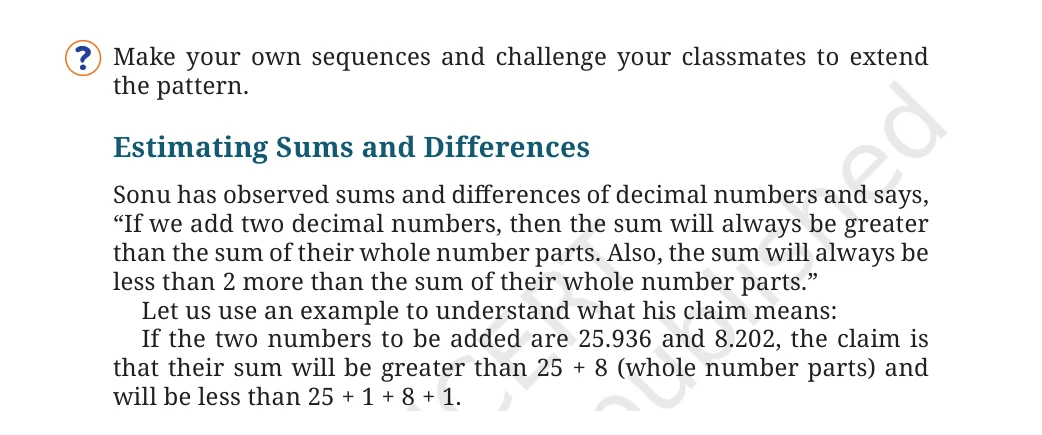
Make your own sequences and challenge your classmates to extend the pattern.
Show solution
Some more sequences and their solutions: (i) 7.2, 7.5, 7.8, ... Each term increases by 0.3 Next after 7.8: 7.8 + 0.3 = 8.1 Next: 8.1 + 0.3 = 8.4 Next: 8.4 + 0.3 = 8.7 Therefore, Next 3 terms are 8.1, 8.4, 8.7 (ii) 15, 14.6, 14.2, ... Each term decreases by 0.4 Next after 14.2: 14.2 − 0.4 = 13.8 Next: 13.8 − 0.4 = 13.4 Next: 13.4 − 0.4 = 13.0 Therefore, Next 3 terms are 13.8, 13.4, 13.0 (iii) 22.1, 23.3, 24.5, ...
Each term increases by 1.2 Next after 24.5: 24.5 + 1.2 = 25.7 Next: 25.7 + 1.2 = 26.9 Next: 26.9 + 1.2 = 28.1 Therefore, Next 3 terms are 25.7, 26.9, 28.1 (iv) 0.5, 1.0, 1.5, ... Each term increases by 0.5 Next after 1.5: 1.5 + 0.5 = 2.0 Next: 2.0 + 0.5 = 2.5 Next: 2.5 + 0.5 = 3.0 Therefore, Next 3 terms are 2.0, 2.5, 3.0 (v) 18.25, 17.75, 17.25, ...
Each term decreases by 0.5 Next after 17.25: 17.25 − 0.5 = 16.75 Next: 16.75 − 0.5 = 16.25 Next: 16.25 − 0.5 = 15.75 Therefore, Next 3 terms are 16.75, 16.25, 15.75
Textbook page 31 · solved item 56

What do you think about this claim? Verify if this is true for these numbers. Will it work for any 2 decimal numbers? (Claim: If we add two decimal numbers, then the sum will always be greater than the sum of their whole number parts. Also, the sum will always be less than 2 more than the sum of their whole number parts.)
Show solution
Both the claims hold true. Verifying for 25.936 and 8.202: Number 1 Number 2 Sum Sum of whole parts Is sum ≥ whole parts? Is sum < whole parts +2 25.936 8.202 34.138 25 + 8 = 33 34.138 > 33 34.138 < 35 Verifying with other numbers:
Textbook page 31 · solved item 57
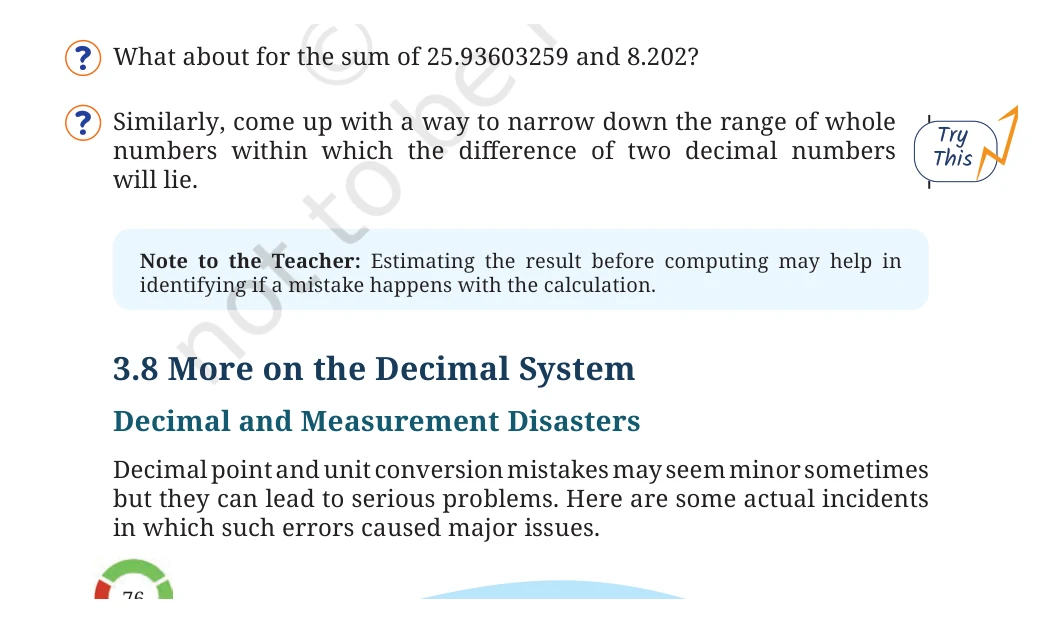
What about for the sum of 25.93603259 and 8.202?
Show solution
Number 1 Number 2 Sum Sum of whole parts Is sum ≥ whole parts? Is sum < whole parts +2 25.93603259 8.202 34.13803259 25 + 8 = 33 34.13803259 > 33 34.13803259 < 35 Number 1 Number 2 Sum Sum of whole parts Is sum ≥ whole parts? Is sum < whole parts +2 3.6 2.4 6.0 3 + 2 = 5 6 > 5 6 < 7 12.34 7.56 19.90 12 + 7 = 19 19.90 > 19 19.90 < 21 7.99 8.99 16.98 7 + 8 = 15 16.98 > 15 16.98 < 17
Complete worked answers
Textbook page 33
Textbook page 33 · solved item 58
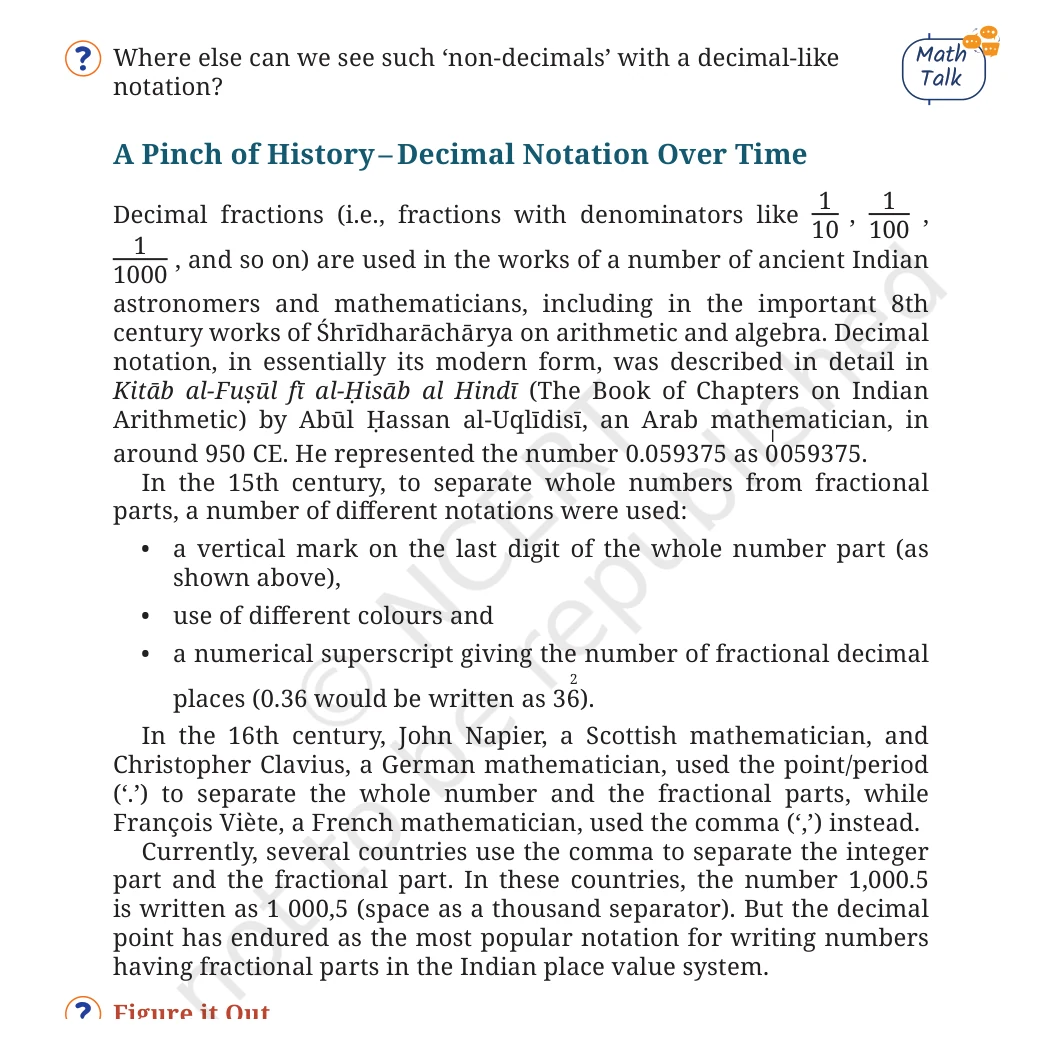
Where else can we see such ‘non-decimals’ with a decimal-like notation?
Show solution
(i) Train or flight schedules like 08.20 or 17.55 are in HH.MM format, not decimal. (ii) Software versions like 3.6.2 version number—not a decimal, but a versioning system (3 major, 6 minor, 2 patch updates). (iii) In books and chapter like Chapter 5.4 = Chapter 5, Section 4. Figure it out
Textbook page 33 · solved item 59
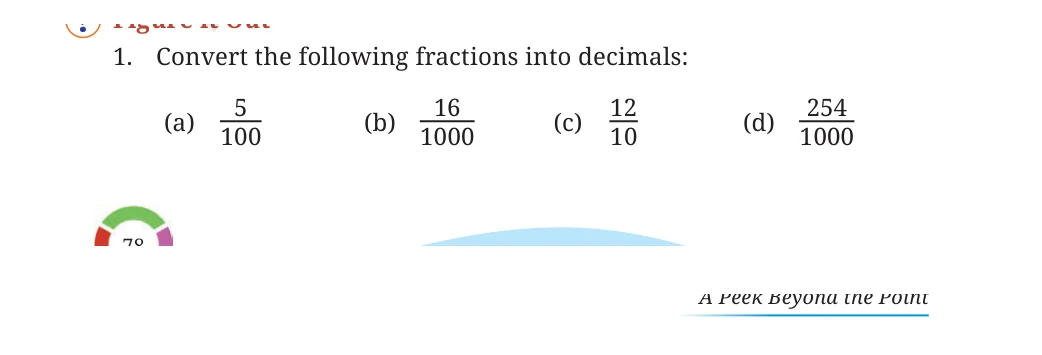
1. Convert the following fractions into decimals: (a) 5 10 (b) 16 1000 (c) 12 10 (d) 254 1000
Show solution
(a) 5 10 = 0.5 (b) 16 1000 = 0.016 (c) 12 10 = 1.2 (d) 254 1000 = 0.254
Complete worked answers
Textbook page 34
Textbook page 34 · solved item 60

2. Convert the following decimals into a sum of tenths, hundredths and thousandths: (a) 0.34 (b) 1.02 (c) 0.8 (d) 0.362
Show solution
(a) 0.34 = (3 × 1 10) + (4 × 1 100). (b) 1.02 = (1 × 1) + (2 × 1 100). (c) 0.8 = (8 × 1 10). (d) 0.362 = (3 × 1 10) + (6 × 1 100) + (2 × 1 1000).
Textbook page 34 · solved item 61
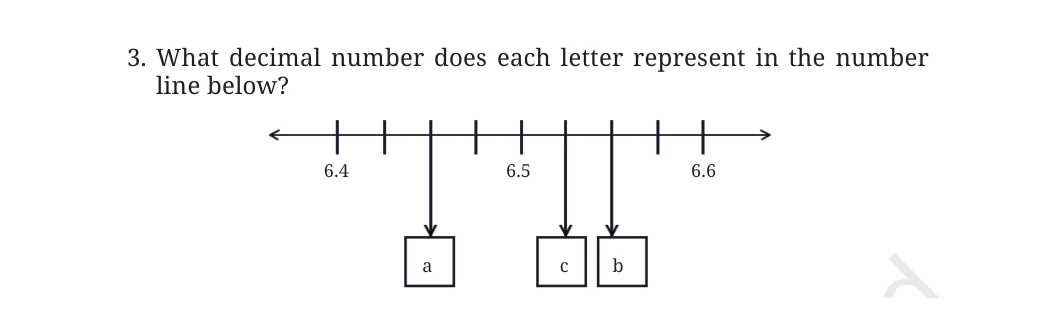
3. What decimal number does each letter represent in the number line below?
Show solution
Divisions between 6.4 and 6.6 = 8 Each division = 6.6−6.4 8 = 0.2 8 = 2 80 = 0.025 Therefore, a = 6.4 + (2 × 0.025) = 6.4 + 0.050 = 6.425. c = 6.4 + (5 × 0.025) = 6.4 + 0.125 = 6.525. b = 6.4 + (6 × 0.025) = 6.4 + 0.150 = 6.550.
Textbook page 34 · solved item 62
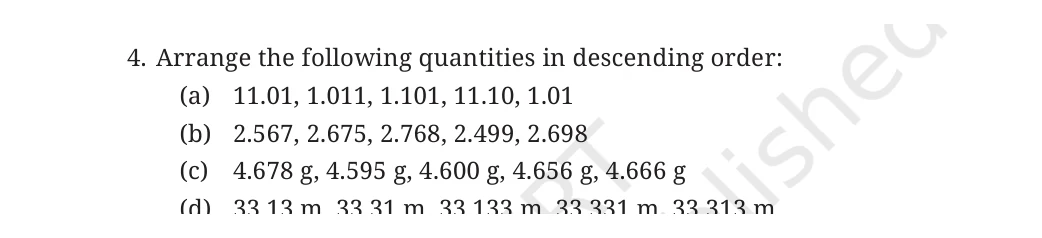
4. Arrange the following quantities in descending order: (a) 11.01, 1.011, 1.101, 11.10, 1.01 (b) 2.567, 2.675, 2.768, 2.499, 2.698 (c) 4.678 g, 4.595 g, 4.600 g, 4.656 g, 4.666 g (d) 33.13 m, 33.31 m, 33.133 m, 33.331 m, 33.313 m
Show solution
(a) 11.10 > 11.01 > 1.101 > 11.011 > 1.01. (b) 2.768 > 2.698 > 2.675 > 2.567 > 2.499. (c) 4.678 g > 4.666 g > 4.656 g > 4.600 g > 4.595 g. (d) 33.331 m > 33.313 m > 33.31 m > 33.133 m > 33.13 m.
Textbook page 34 · solved item 63

5. Using the digits 1, 4, 0, 8, and 6 make: (a) the decimal number closest to 30 (b) the smallest possible decimal number between 100 and 1000.
Show solution
(a) Possible numbers: 14.860, 40.168 30 – 14.860 = 15.14 40.168 – 30 = 10.168 Hence, 40.168 is the closet number to 30. (b) Smallest number between 100 and 1000 = 104.68
Textbook page 34 · solved item 64

6. Will a decimal number with more digits be greater than a decimal number with fewer digits?
Show solution
Not always. A number with more decimal digits may be smaller. Example: 0.9 has 1 decimal digit. 0.89 has 2 decimal digits. But, 0.9 > 0.89.
Textbook page 34 · solved item 65

7. Mahi purchases 0.25 kg of beans, 0.3 kg of carrots, 0.5 kg of potatoes, 0.2 kg of capsicums, and 0.05 kg of ginger. Calculate the total weight of the items she bought.
Show solution
Beans = 0.25 kg Carrots = 0.3 kg Potatoes = 0.5 kg Capsicum = 0.2 kg Ginger = 0.05 kg Total weight = (0.25 + 0.3 + 0.5 + 0.2 + 0.05) kg = 1.3 kg
Textbook page 34 · solved item 66

8. Pinto supplies 3.79 L, 4.2 L, and 4.25 L of milk to a milk dairy in the first three days. In 6 days, he supplies 25 litres of milk. Find the total quantity of milk supplied to the dairy in the last three days.
Show solution
Milk supplied in first 3 days = 3.79 + 4.2 + 4.25 = 12.24 L Milk supplied in 6 days = 25 L Milk supplied in last three days = 25 L – 12.24 L = 12.76.
Textbook page 34 · solved item 67

9. Tinku weighed 35.75 kg in January and 34.50 kg in February. Has he gained or lost weight? How much is the change?
Show solution
Tinku’s weight: In January = 35.75 kg In February = 34.50 kg Change in weight = 35.75 kg − 34.50 kg = 1.25 kg Tinku has lost weight and the change in weight is 1.25 kg.
Textbook page 34 · solved item 68

10. Extend the pattern: 5.5, 6.4, 6.39, 7.29, 7.28, 6.18, 6.17, ____, _____.
Show solution
The current textbook appears to contain a printing error: 6.18 and 6.17 break the alternating pattern. Following the intended pattern of adding 0.90 and then subtracting 0.01 gives 5.5, 6.4, 6.39, 7.29, 7.28, 8.18, 8.17, 9.07, 9.06. Therefore, the blanks are 9.07 and 9.06.
Textbook page 34 · solved item 69

11. How many millimeters make 1 kilometer?
Show solution
1 km = 1000 m = (1000 × 100) cm = (100000 × 10) = 10,00,000 mm. Therefore, 10,00,000 mm make 1 km.
Textbook page 34 · solved item 70

12. Indian Railways offers optional travel insurance for passengers who book e-tickets. It costs 45 paise per passenger. If 1 lakh people opt for insurance in a day, what is the total insurance fee paid?
Show solution
Cost per passenger = ₹0.45 (i.e., 45 paise) Number of passengers = 1,00,000 Total insurance fee = 0.45 × 1,00,000 = 45 100× 1,00,000 = ₹45,000.
Textbook page 34 · solved item 71
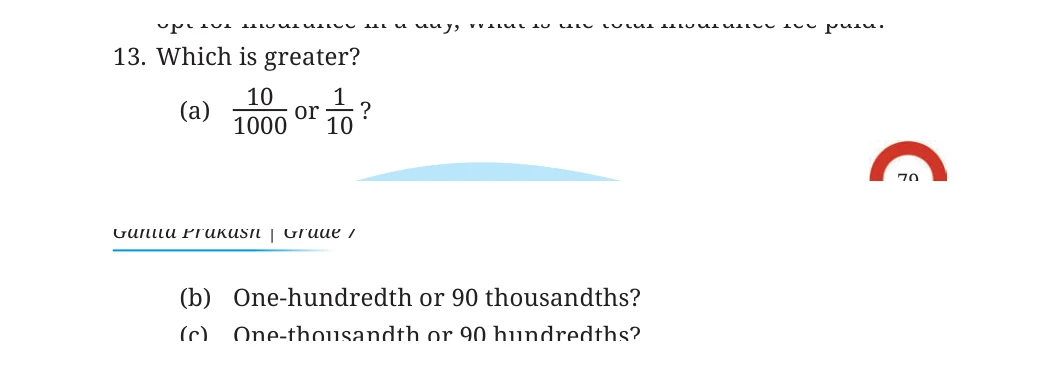
13. Which is greater? (a) 10 1000 or 1 10 ? (b) One-hundredth or 90 thousandths? (c) One-thousandth or 90 hundredths?
Show solution
(a) 10 1000 or 1 10 10 1000 = 1 100 = 0.01 1 10 = 0.1 0.01 < 0.1 Therefore, 10 1000 < 1 10. (b) One-hundredth or 90 thousandths One-hundredth = 1 100 = 0.01 90 thousandths = 90 1000 = 9 100 = 0.09 0.01 < 0.09 Therefore, One-hundredth < 90 thousandths. (c) One-thousandth or 90 hundredths One thousandth = 1 1000 = 0.001 90 hundredths = 90 100 = 9 10 = 0.9 0.001 < 0.9 Therefore, One-thousandth < 90 hundredths.
Complete worked answers
Textbook page 35
Textbook page 35 · solved item 72
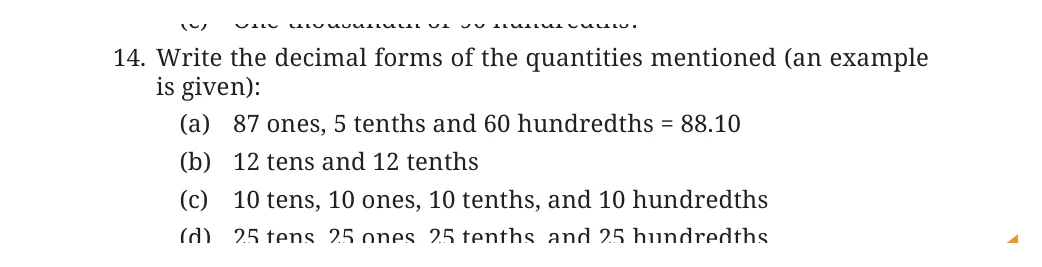
14. Write the decimal forms of the quantities mentioned (an example is given): (a) 87 ones, 5 tenths and 60 hundredths = 88.10 (b) 12 tens and 12 tenths (c) 10 tens, 10 ones, 10 tenths, and 10 hundredths (d) 25 tens, 25 ones, 25 tenths, and 25 hundredths
Show solution
(a) 87 ones, 5 tenths and 60 hundredths = (87 × 1) + (5 × 1 10) + (60 × 1 100) = 87 + 5 10 + 6 10 = 87 + 0.5 + 0.6 = 88.10 (b) 12 tens and 12 tenths = (12 × 10) + (12 × 1 10) = 120 + 12 10 = 120 + 1.2 = 121.2 (c) 10 tens, 10 ones, 10 tenths, and 10 hundredths = (10 × 10) + (10 × 1) + (10 × 1 10) + (10 × 1 100) = 100 + 10 + 1 + 1 10 = 111 + 10 + 1 + 0.1 = 111.1 (d) 25 tens, 25 ones, 25 tenths, and 25 hundredths = (25 × 10) + (25 × 1) + (25 × 1 10) + (25 × 1 100) = 250 + 25 + 25 10 + 25 100 = 250 + 25 + 2.5 + 0.25 = 277.75
Textbook page 35 · solved item 73
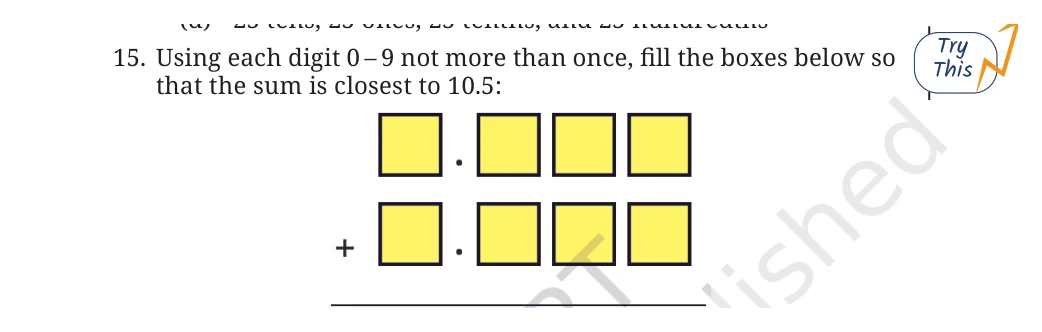
15. Using each digit 0 – 9 not more than once, fill the boxes below so that the sum is closest to 10.5:
Show solution
One exact completion is 4.083 + 6.417 = 10.500. No digit is repeated within the two addends.
Textbook page 35 · solved item 74
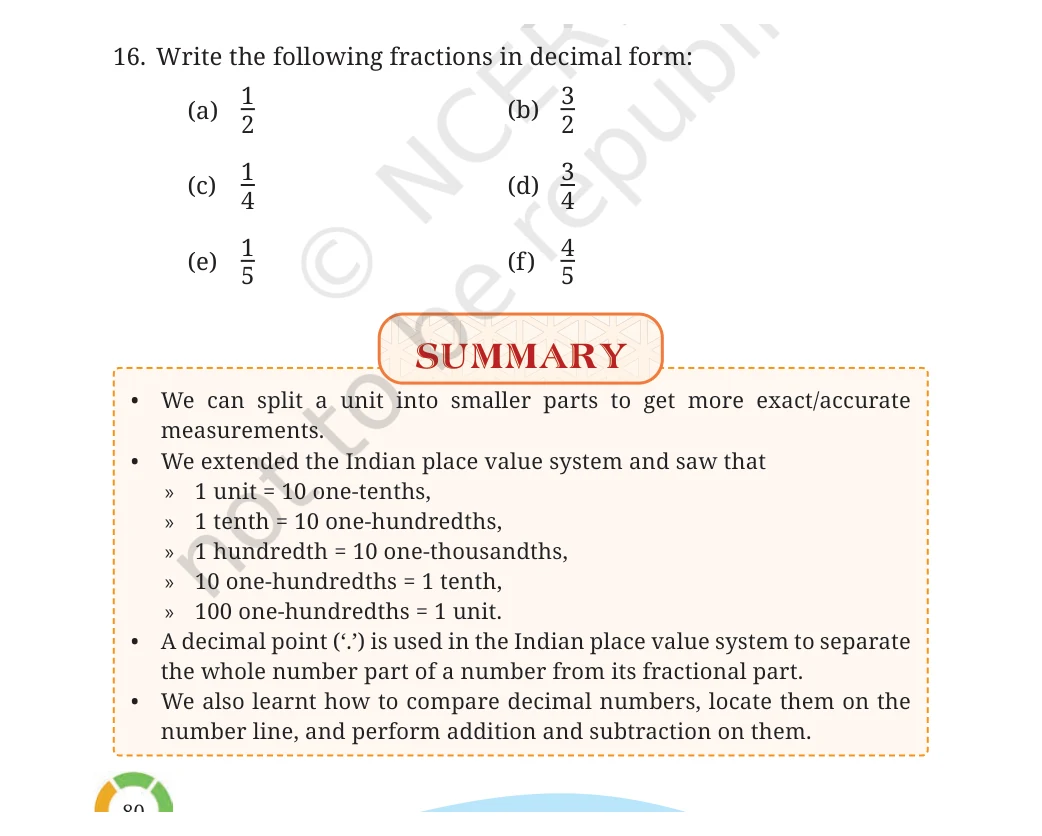
16. Write the following fractions in decimal form: (a) 1 2 (b) 3 2 (c) 1 4 (d) 3 4 (e) 1 5 (f) 4 5
Show solution
(a) 1 2 = 1 2 × 1 4 0 8 3 6 4 1 7 1 0 5 0 0 = 1 2 × 10 10 = 5 10 = 0.5 (b) 3 2 = 3 2 × 1 = 3 2 × 10 10 = 15 10 = 1.5 (c) 1 4 = 1 4 × 1 = 1 4 × 100 100 = 25 100 = 0.25 (d) 3 4 = 3 4 × 1 = 3 4 × 100 100 = 75 100 = 0.75 (e) 1 5 = 1 5 × 1 = 1 5 × 10 10 = 2 10 = 0.2 (f) 4 5 = 4 5 × 1 = 4 5 × 10 10 = 8 10 = 0.8