
Use the textbook context
Match, attempt, then check
Each crop extends to the next solved item, so diagrams, tables and connected instructions stay with the question.
Complete worked answers
Textbook page 1
Textbook page 1 · solved item 1
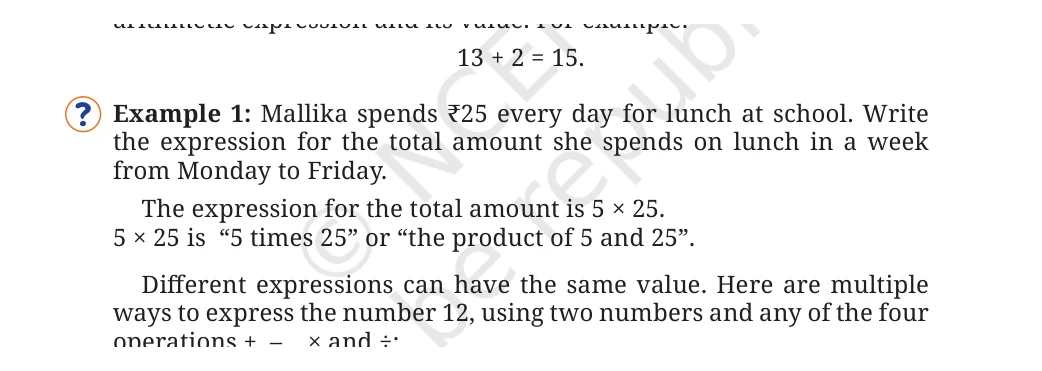
Example 1: Mallika spends ₹25 every day for lunch at school. Write the expression for the total amount she spends on lunch in a week from Monday to Friday.
Show solution
Money spent every day = ₹25 Total amount spent from Monday to Friday = 5 × 25
Textbook page 1 · solved item 2
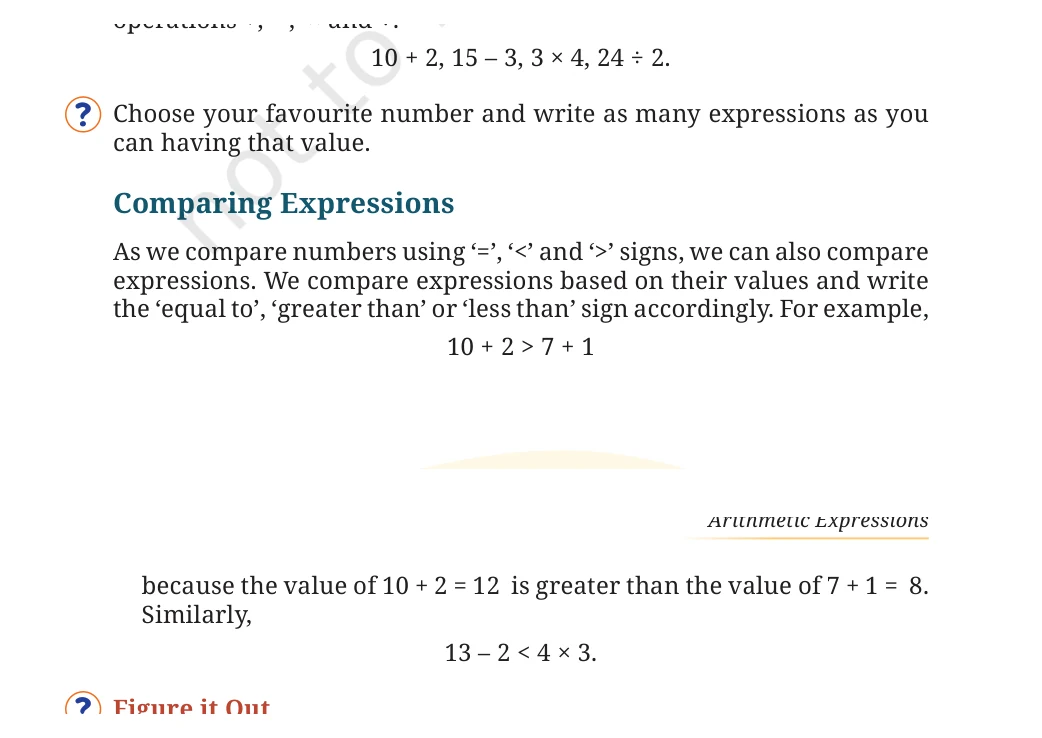
Choose your favourite number and write as many expressions as you can having that value.
Show solution
Let the number be 7. Some expression with 7: 12 – 5 = 7 20 – 13 = 7 42 ÷ 6 = 7 7 × 1 = 7 3 + (9 – 5) = 7 (26 – 13) – (10 – 4) = 7 etc. Figure it out
Complete worked answers
Textbook page 2
Textbook page 2 · solved item 3

1. Fill in the blanks to make the expressions equal on both sides of the = sign: (a) 13 + 4 = ____ + 6 (b) 22 + ____ = 6 × 5 (c) 8 × ____= 64 ÷ 2 (d) 34 – ____= 25
Show solution
(a) 13 + 4 = ____ + 6 17 = + 6 17 – 6 = or = 17 – 6 = 11 (b) 22 + ____ = 6 × 5 22 + = 30 = 30 – 22 = 8 (c) 8 × ____= 64 ÷ 2 8 × = 32 = 32 8 = 4 (d) 34 – ____= 25 34 - = 25 34 -25 = 9 = or = 9
Textbook page 2 · solved item 4
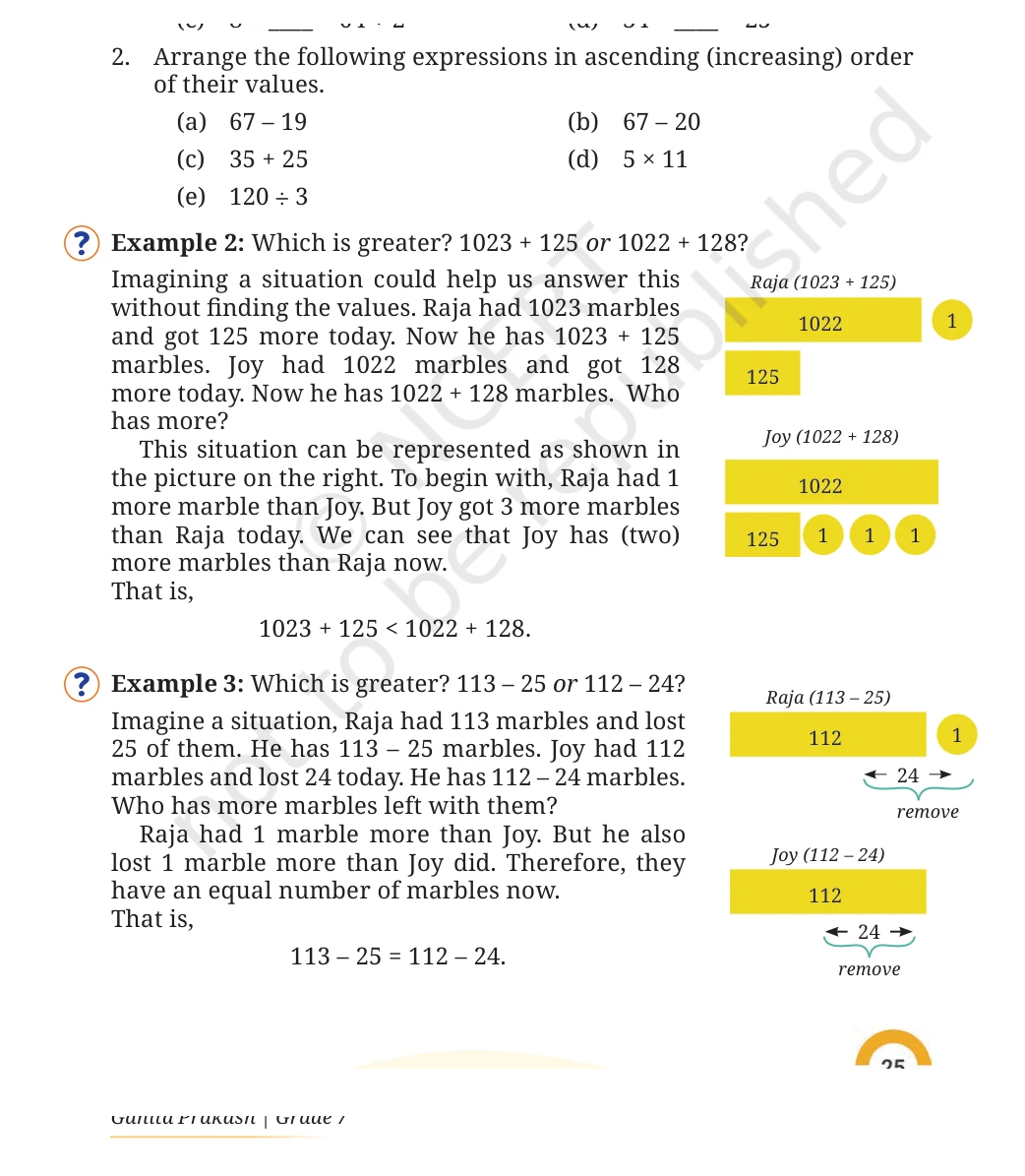
2. Arrange the following expressions in ascending (increasing) order of their values. (a) 67 – 19 (b) 67 – 20 (c) 35 + 25 (d) 5 × 11 (e) 120 ÷ 3
Show solution
(a) 67 – 19 = 48 (b) 67 – 20 = 47 (c) 35 + 25 = 60 (d) 5 × 11 = 55 (e) 120 ÷ 3 = 40 Since, 40 < 47 < 48 < 55 < 60 Therefore, 120 ÷ 3 < 67 – 20 < 67 – 19 < 5 × 11 < 35 + 25.
Complete worked answers
Textbook page 3
Textbook page 3 · solved item 5
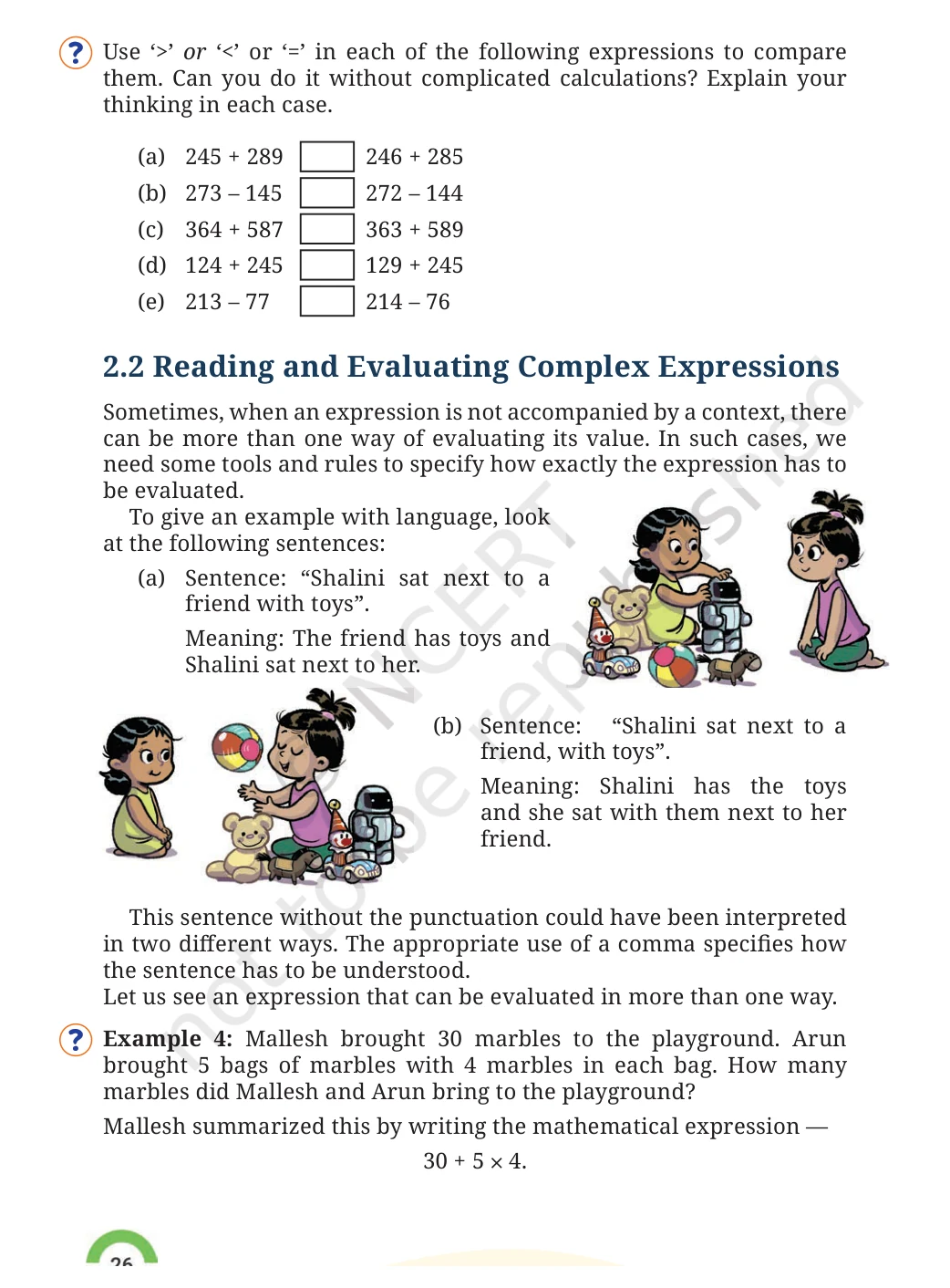
Use ‘>’ or ‘<’ or ‘=’ in each of the following expressions to compare them. Can you do it without complicated calculations? Explain your thinking in each case. (a) 245 + 289 246 + 285 (b) 273 – 145 272 – 144 (c) 364 + 587 363 + 589 (d) 124 + 245 129 + 245 (e) 213 – 77 214 – 76
Show solution
(a) 245 + 289 246 + 285 245 + 1 + 285 + 4 245 + 1 + 285 245 + 285 + 5 1 + 245 + 285 Removing the common terms, 5 > 1 Therefore, 245 + 289 > 246 + 285. (b) 273 – 145 272 – 144 272 + 1 – 144 + 1 272 – 144 272 – 144 + 2 272 – 144 Removing the common terms, 2 > 0 Therefore, 273 – 145 > 272 – 144. (c) 364 + 587 363 + 589 363 + 1 + 587 363 + 587 + 2 363 + 587 + 1 2 + 363 + 587 Removing the common terms, 1 < 2 Therefore, 364 + 587 < 363 + 589.
(d) 124 + 245 129 + 245 124 + 245 124 + 5 + 245 124 + 245 5 + 124 + 245 Removing the common terms, 0 < 5 Therefore, 124 + 245 < 129 + 245. (e) 213 – 77 214 – 76 213 – 76 + 1 213 + 1 – 76 213 – 76 + 1 213 – 76 + 1 Removing the common terms, 1 = 1 Therefore, 213 – 77 = 214 – 76.
Complete worked answers
Textbook page 5
Textbook page 5 · solved item 6

Check if replacing subtraction by addition in this way does not change the value of the expression, by taking different examples. {Expression: 83 – 14 = 83 +( – 14)}
Show solution
17 – 9 = 17 + (-9) 8 – 5 = 8 + (-5) 12 – 4 + 6 × 3 = 12 + (-4) + 6 × 3.
Textbook page 5 · solved item 7
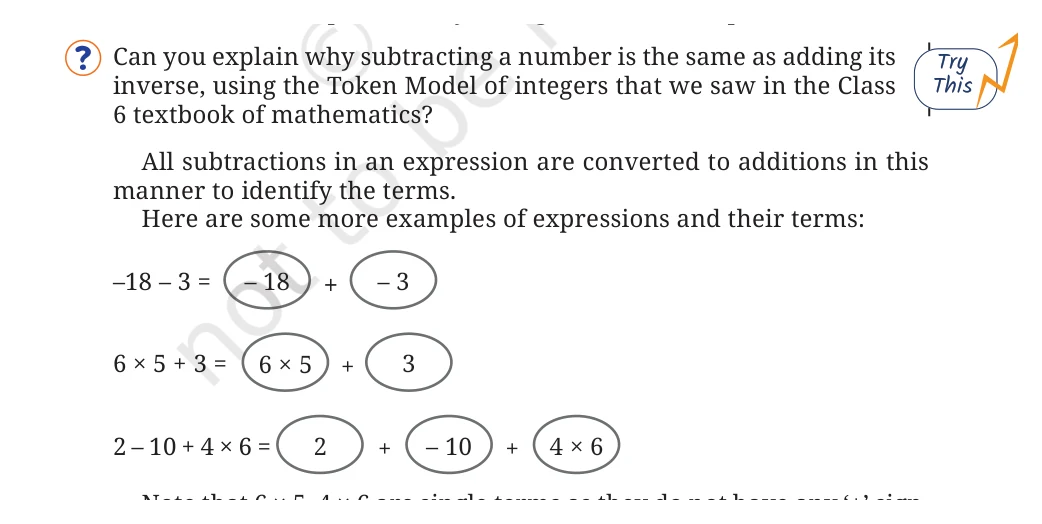
Can you explain why subtracting a number is the same as adding its inverse, using the Token Model of integers that we saw in the Class This 6 textbook of mathematics?
Show solution
Expression: 8 – 3 = 8 + (-3) or (+8) – (+3) = (+8) + (-3) (+8) – (+3) = (+5) (+8) + (-3) = (+5)
Textbook page 5 · solved item 8
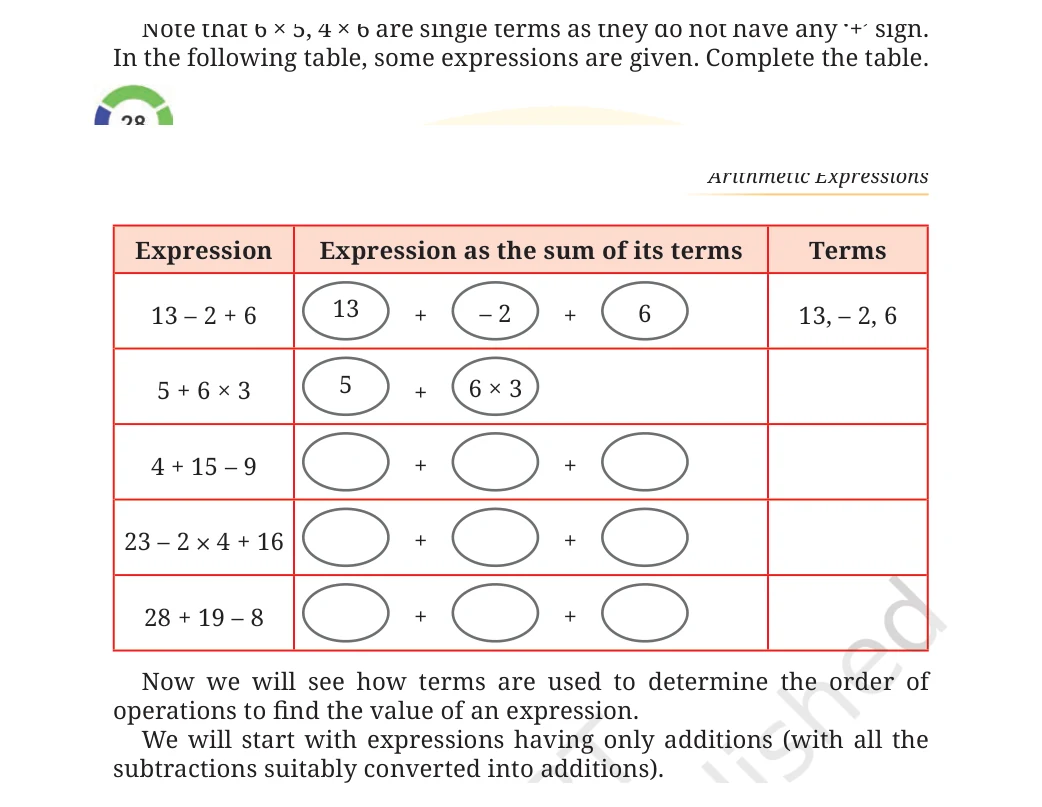
Complete the table:
Show solution
Expression Expression as the sum of its terms Terms 13 – 2 + 6 13 + (-2) + 6 13, -2, 6 5 + 6 × 3 5 + (6 × 3) 5, (6×3) 4 + 15 - 9 4 + 15 + (-9) 4, 15, -9 23 – 2 × 4 + 16 23 + [-2 × 4] + 16 23, (-2×4), 16 28 + 19 - 8 28 + 19 + (-8) 28, 19, -8
Complete worked answers
Textbook page 6
Textbook page 6 · solved item 9
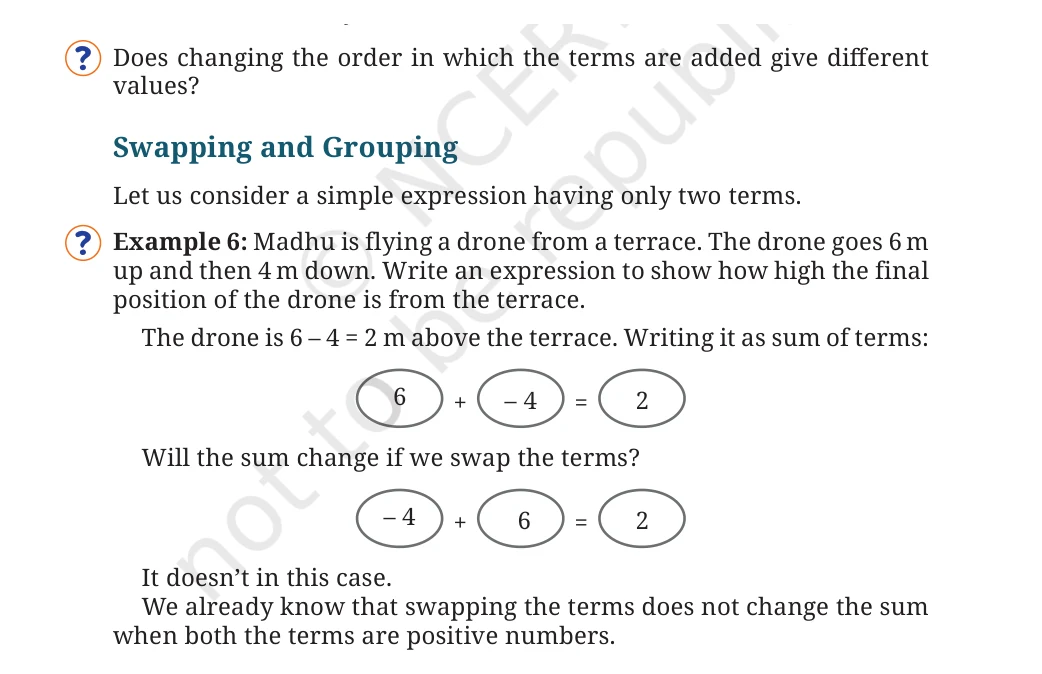
Does changing the order in which the terms are added give different values?
Show solution
No, changing the order in which the terms are added give doesn’t give different values.
Textbook page 6 · solved item 10
Will this also hold when there are terms having negative numbers as well? Take some more expressions and check.
Show solution
No, the sum will not change even on swapping terms with negative numbers. Example 1: (-3) + (-9) = -12. Also, (-9) + (-3) = -12. Example 2: (-5) + 7 = 2. Also, 7 + (-5) = 2.
Complete worked answers
Textbook page 7
Textbook page 7 · solved item 11
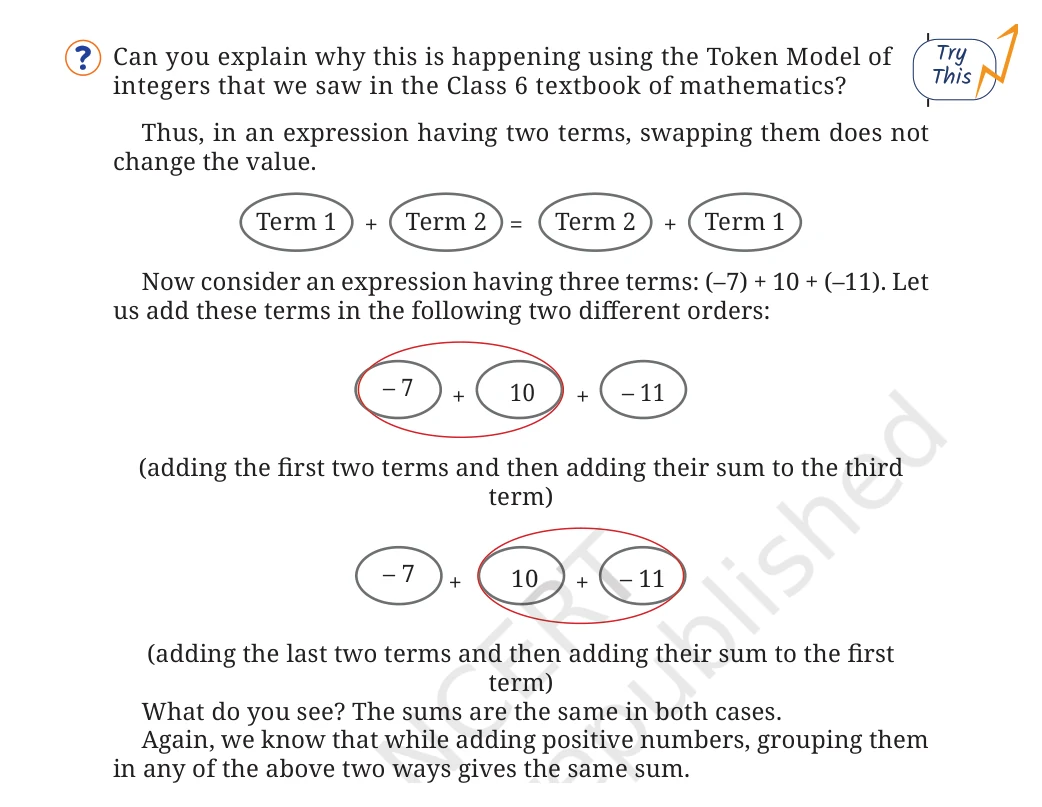
Can you explain why this is happening using the Token Model of integers that we saw in the Class 6 textbook of mathematics?
Show solution
Using token model to explain, (-3) + (-6) = (-6) + (-3) = (-9) (i) (-3) + (-6) = (-9) (ii) (-6) + (-3) = (-9) This proves that the result remains same even on swapping the position of the integers.
Textbook page 7 · solved item 12

Will this also hold when there are terms having negative numbers as well? Take some more expressions and check.
Show solution
Yes, even while adding negative integers grouping them in any order gives the same sum. Example: {(-2) + (-5)} + (-7) = (-2) + {(-5) + (-7)} L.H.S: {(-2) + (-5)} + (-7) = (-7) + (-7) = (-14) R.H.S: (-2) + {(-5) + (-7)} = (-2) + (-12) = (-14) Thus we are getting the same value in both cases.
Textbook page 7 · solved item 13
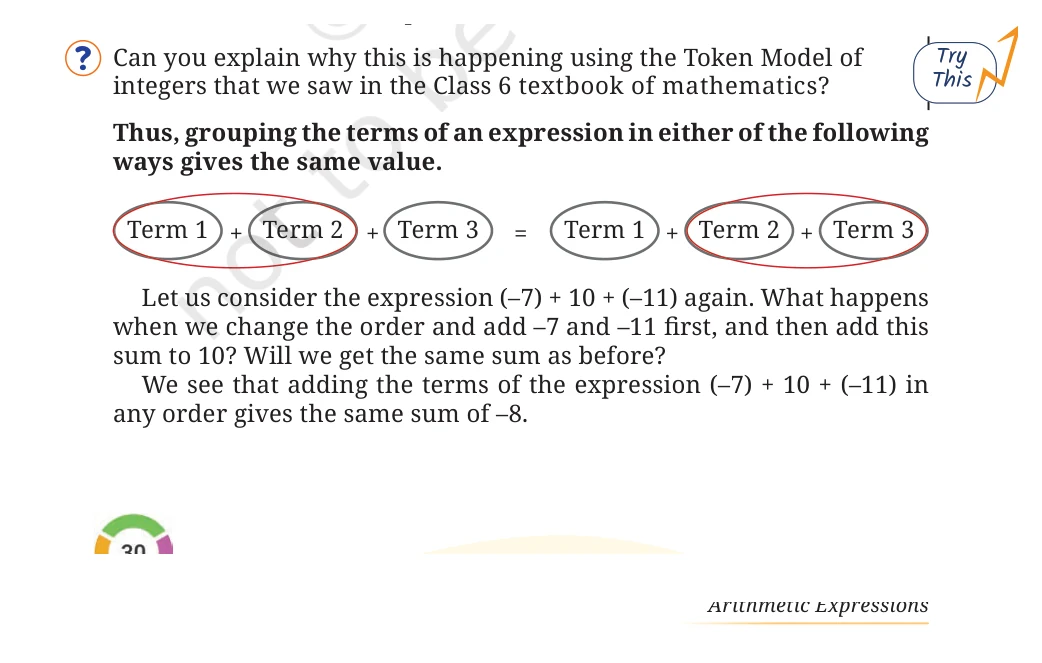
Can you explain why this is happening using the Token Model of integers that we saw in the Class 6 textbook of mathematics?
Show solution
{(-2) + (-3)} + (-5) = (-2) + {(-3) + (-5)} = (-10) L.H.S: {(-2) + (-3)} + (-5) + = (-3) (-6) (-9) + = (-6) (-3) (-9) (-3) + = (-2) (-5) + = (-5) (-5) (-10) + R.H.S: (-2) + {(-3) + (-5)} Both are same.
Complete worked answers
Textbook page 8
Textbook page 8 · solved item 14
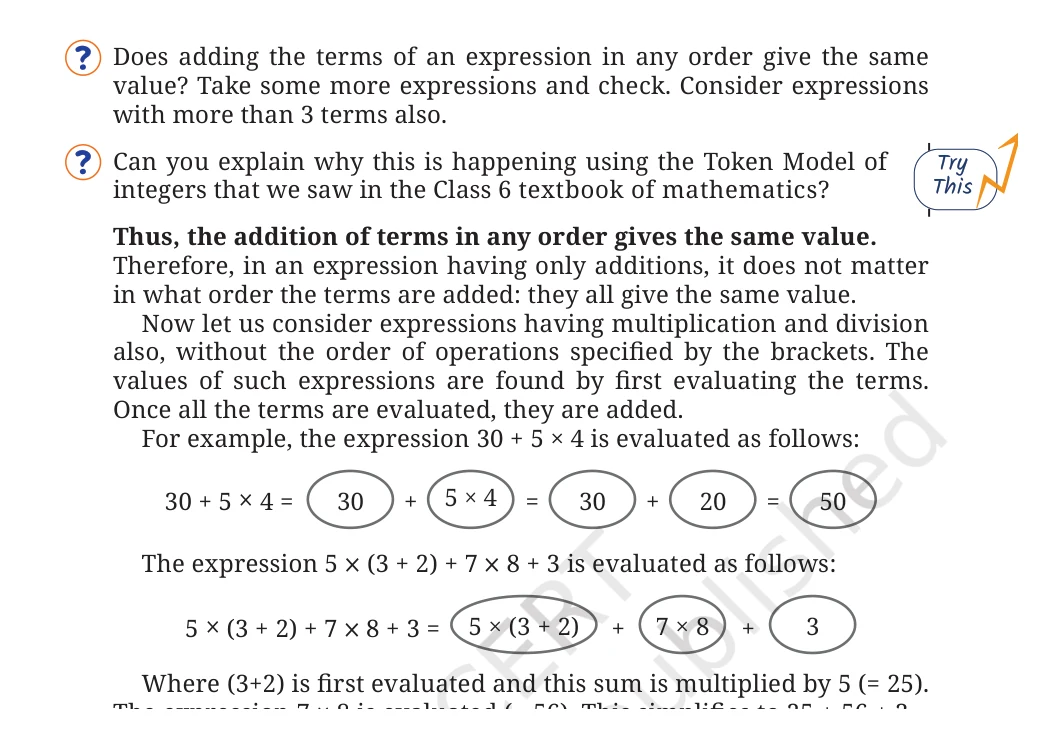
Does adding the terms of an expression in any order give the same value? Take some more expressions and check. Consider expressions with more than 3 terms also.
Show solution
Yes, adding the terms of an expression in any order give the same value. Example: {(-7) + 12} + (-13) + (-5) = (-7) + 12 + {(-13) + (-5)} L.H.S: {(-7) + 12} + (-13) + (-5) = 5 + (-13) + (-5) = -8 + (-5) = -13 R.H.S: (-7) + 12 + {(-13) + (-5)} = (-7) + 12 + (-18) = 5 + (-18) = -13
Textbook page 8 · solved item 15
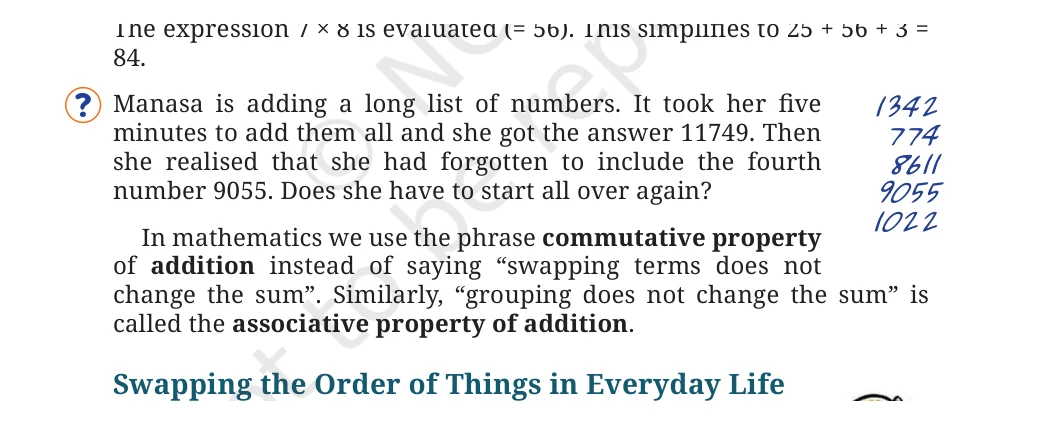
Manasa is adding a long list of numbers. It took her five minutes to add them all and she got the answer 11749. Then she realised that she had forgotten to include the fourth number 9055. Does she have to start all over again? (Numbers list: 1342, 774, 8611, 9055, 1022)
Show solution
No, she doesn’t have to start over again. She can simply add the forgotten number (9055) to the previous sum (11749) to get the final correct answer. Calculation: 11,749 + 9,055 = 20,804.
Textbook page 8 · solved item 16
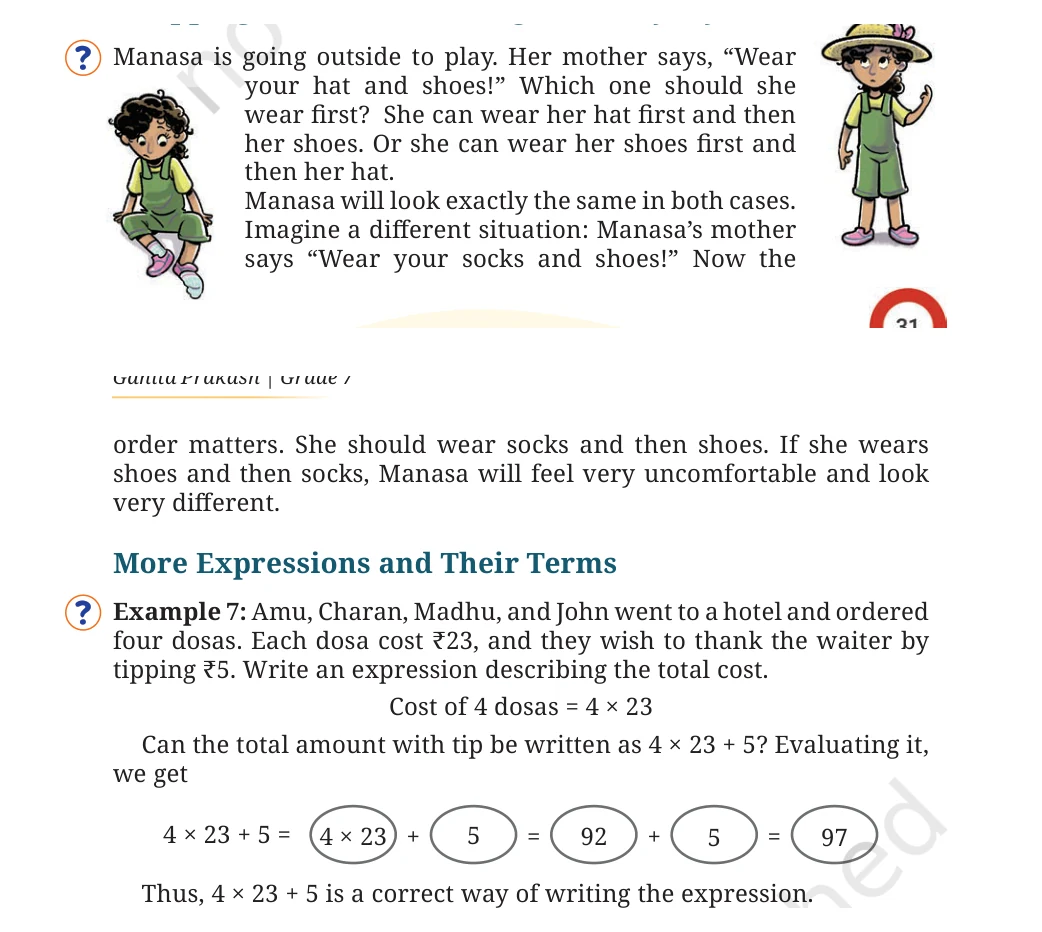
Manasa is going outside to play. Her mother says, “Wear your hat and shoes!” Which one should she wear first?
Show solution
It doesn’t matter what she wears first; both pieces contribute equally to her final look. This situation is commutative in nature. (-3) + = (-2) (-5) + = (-5) (-5) (-10) +
Complete worked answers
Textbook page 9
Textbook page 9 · solved item 17

If the total number of friends goes up to 7 and the tip remains the same, how much will they have to pay? Write an expression for this situation and identify its terms. (Amu, Charan, Madhu, and John went to a hotel and ordered four dosas. Each dosa cost ₹23, and they wish to thank the waiter by tipping ₹5.)
Show solution
Cost of each dosa = ₹23 Cost of 7 dosas = 7 × ₹23 Tip given = ₹5 Total amount with tip = 7 × ₹23 + ₹5 (Expression) = ₹161 + ₹5 = ₹166. Terms in expression: 7 × ₹23, ₹5.
Textbook page 9 · solved item 18
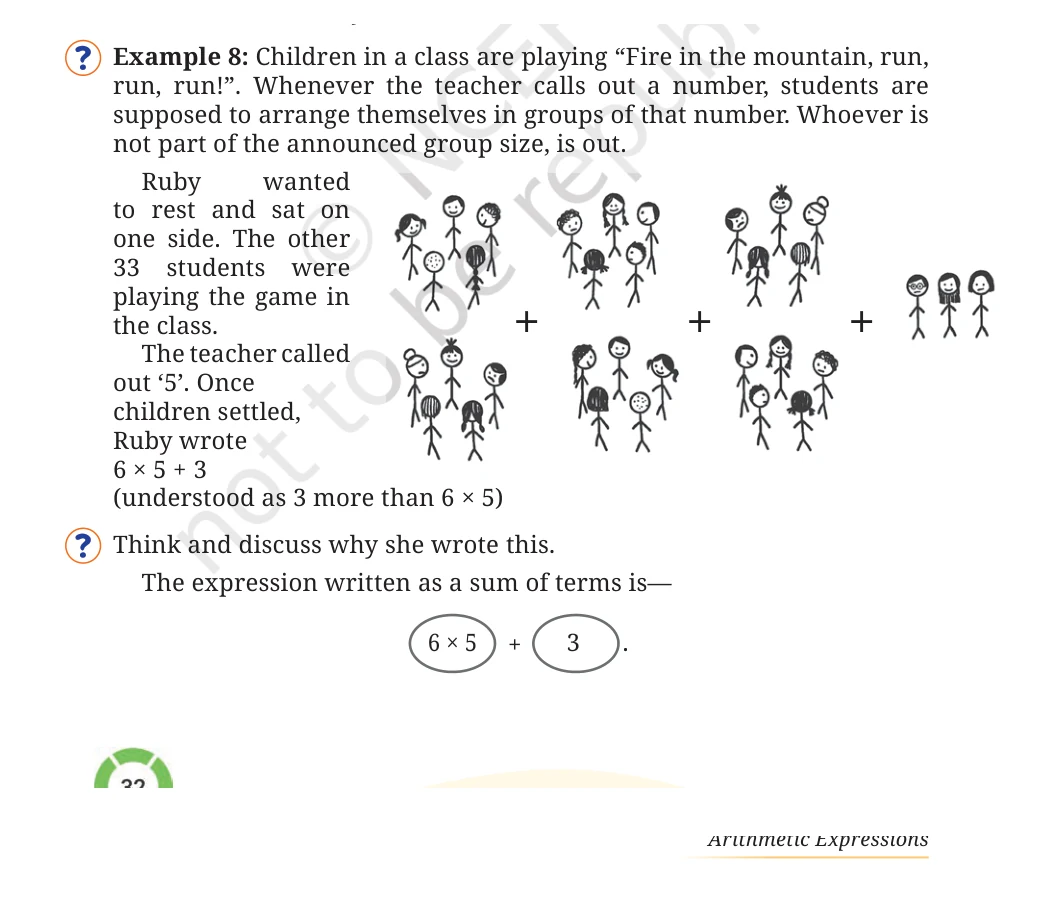
Children playing “Fire in the mountain”. 33 students were playing and ruby didn’t play. Teacher called out ‘5’. Students formed groups of 5. Ruby wrote 6 x 5 + 3. Think and discuss why she wrote this.
Show solution
Ruby wrote 6 × 5 + 3 because the expression (6 × 5) represents the total number of students who grouped themselves in teams of 5, and (3) represents the students who were left over, as they couldn’t form a complete group of 5.
Complete worked answers
Textbook page 10
Textbook page 10 · solved item 19
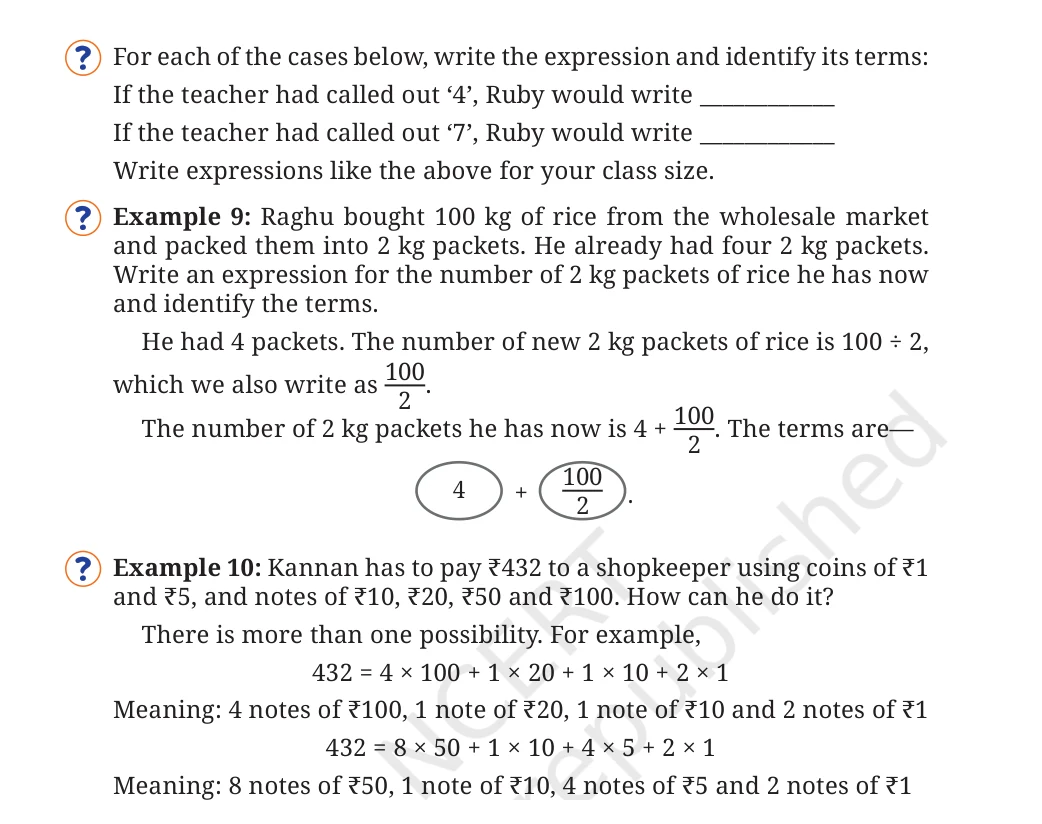
For each of the cases below, write the expression and identify its terms: (i) If the teacher had called out ‘4’, Ruby would write ____________ (ii) If the teacher had called out ‘7’, Ruby would write ____________ (iii) Write expressions like the above for your class size.
Show solution
(i) Since, 33 ÷ 4 give quotient 8 and remainder 1. Therefore, Ruby could write 4 × 8 + 1 . (ii) Since, 33 ÷ 7 gives quotient 4 and remainder 5. Therefore, Ruby could write 7 × 4 + 5 . (iii) Number of students in my class = 43 If the teacher had called out 4, expression would be 4 × 10 + 3 . If the teacher had called out 7, expression would be 7 × 6 + 1 .
Textbook page 10 · solved item 20

Identify the terms in the two expressions above. (Expressions: 432 = 4 × 100 + 1 × 20 + 1 × 10 + 2 × 1 and 432 = 8 × 50 + 1 × 10 + 4 × 5 + 2 × 1)
Show solution
(i) 432 = 4 × 100 + 1 × 20 + 1 × 10 + 2 × 1 Terms: (4 × 100), (1 × 20), (1 × 10) and (2 × 1). (ii) 432 = 8 × 50 + 1 × 10 + 4 × 5 + 2 × 1 Terms: (8 × 50), (1 × 10), (4 × 5) and (2 × 1).
Textbook page 10 · solved item 21
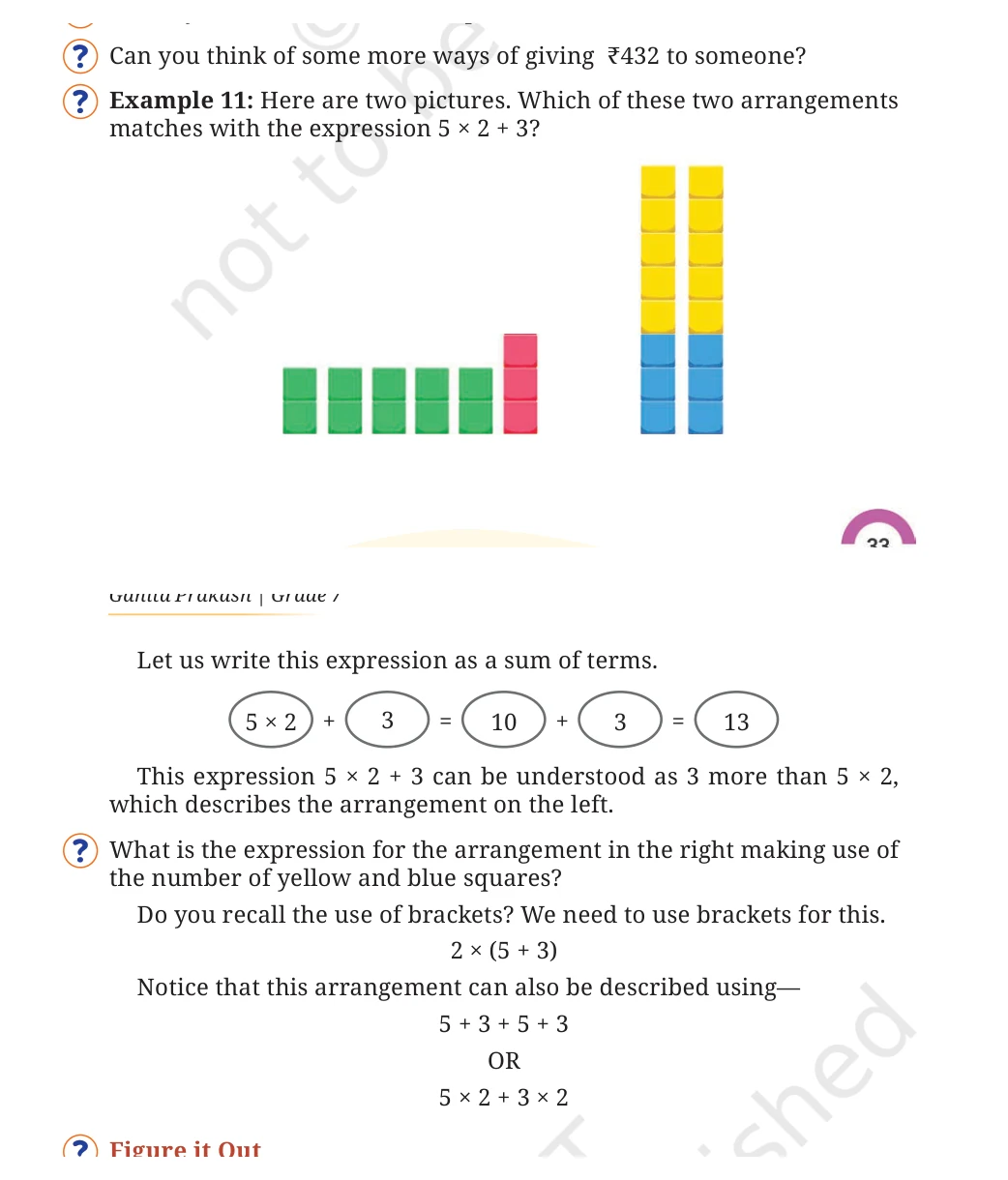
Can you think of some more ways of giving ₹432 to someone?
Show solution
Some ways are: (i) 432 = 8 × 50 + 3 × 10 + 2 × 1. (ii) 432 = 20 × 20 + 2 × 10 + 2 × 5 + 2 × 1. Figure it out
Complete worked answers
Textbook page 11
Textbook page 11 · solved item 22
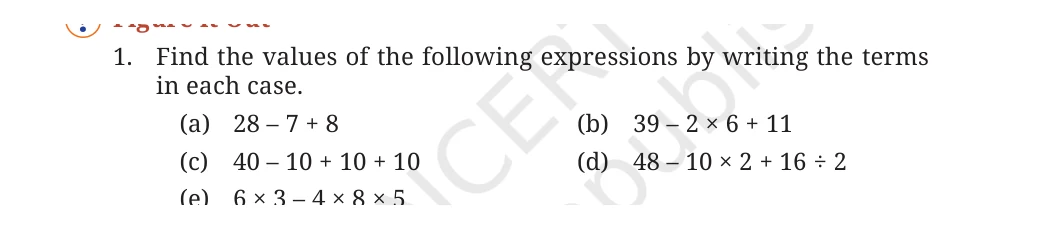
1. Find the values of the following expressions by writing the terms in each case. (a) 28 – 7 + 8 (b) 39 – 2 × 6 + 11 (c) 40 – 10 + 10 + 10 (d) 48 – 10 × 2 + 16 ÷ 2 (e) 6 × 3 – 4 × 8 × 5
Show solution
(a) 28 – 7 + 8 = 28 + (-7) + 8 = 21 + 8 = 29. Terms: 28, (-7) , 8. (b) 39 – 2 × 6 + 11 = 39 + {(-2) × 6} + 11 = 39 +(-12) + 11 = 27 + 11 =38. Terms: 39, (-2 × 6), 11. (c) 40 – 10 + 10 + 10 = 40 + (-10) + 10 + 10 = 30 + 10 + 10 = 30 + 20 = 50. Terms: 40, (-10), 10, 10. (d) 48 – 10 × 2 + 16 ÷ 2 = 48 + (-10 × 2) + (16 ÷ 2) = 48 + (-20) + 8 = 28 + 8 = 36.
Terms: 48, (-10 × 2), (16 ÷ 2). (e) 6 × 3 – 4 × 8 × 5 = (6 × 3) + (-4 × 8 × 5) = 18 + (-160) = -142. Terms: (6 × 3), (-4 × 8 × 5).
Textbook page 11 · solved item 23

2. Write a story/situation for each of the following expressions and find their values. (a) 89 + 21 – 10 (b) 5 × 12 – 6 (c) 4 × 9 + 2 × 6
Show solution
(a) Story: Ramesh had 89 marbles. He got 21 more marbles from his friend and later gave 10 marbles to another friend. Expression: 89 + 21 – 10 = 110 – 10 = 100. (b) Story: There were 5 classrooms, each having 12 desks. One day, 6 desks were found broken and were removed. Expression: 5 × 12 – 6 = 60 – 6 = 54.
(c) Story: A bakery baked 4 trays of cupcakes, with 9 cupcakes on each tray, and 2 trays of cookies, with 6 cookies on each tray. Expression: 4 × 9 + 2 × 6 = 36 + 12 = 48.
Textbook page 11 · solved item 24
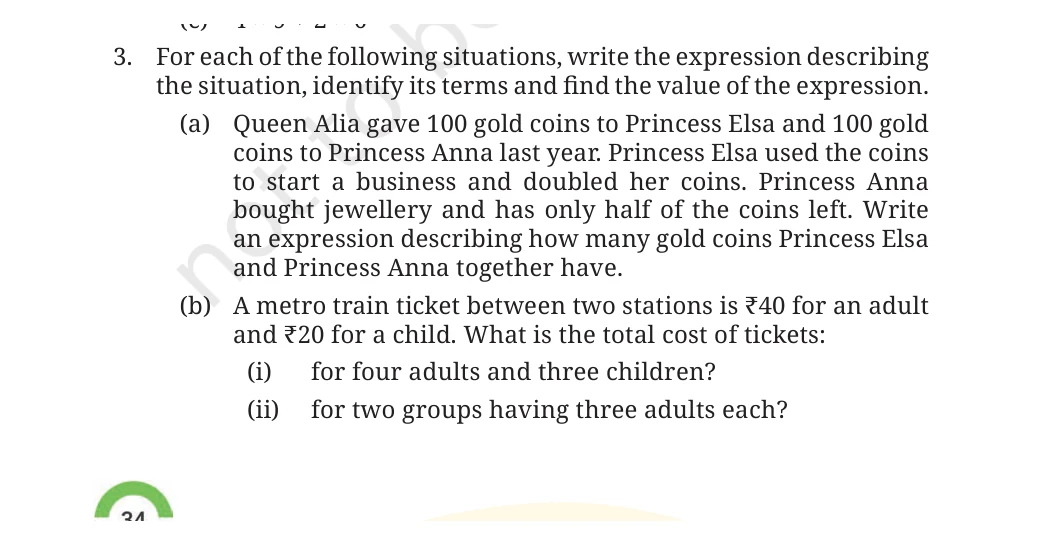
3. For each of the following situations, write the expression describing the situation, identify its terms and find the value of the expression. (a) Queen Alia gave 100 gold coins to Princess Elsa and 100 gold coins to Princess Anna last year. Princess Elsa used the coins to start a business and doubled her coins. Princess Anna bought jewellery and has only half of the coins left. Write an expression describing how many gold coins Princess Elsa and Princess Anna together have. (b) A metro train ticket between two stations is ₹40 for an adult and ₹20 for a child. What is the total cost of tickets: (i) for four adults and three children? (ii) for two groups having three adults each? (c) Find the total height of the window by writing an expression describing the relationship among the measurements shown in the picture.
Show solution
(a) Princess Elsa and Princess Anna both had 100 gold coins each. Elsa doubled her coins, while Anna was left with half of hers. Expression: (2 × 100) + (100 ÷ 2) Terms: (2 × 100), (100 ÷ 2). Value: (2 × 100) + (100 ÷ 2) = 200 + 50 = 250. Therefore, together they have 250 gold coins. (b) Ticket for adults = ₹40 Ticket for a child = ₹20 (i) For four adults and three children: Expression: (4 × 40) + (3 × 20) Terms: (4 × 40), (3 × 20) Value: (4 × 40) + (3 × 20) = 160 + 60 = 220.
Therefore, total cost is ₹220. (ii) For two groups having three adults each: Expression: (3 × 40) + (3 × 40) Terms: (3 × 40), (3 × 40) Value: (3 × 40) + (3 × 40) = 120 + 120 = 240. Therefore, Total cost is ₹240. (c) Border = 3 cm Grill = 2 cm Gap = 5 cm Expression: (6 × 2) + (2 × 3) + (7 × 5) Terms: (6 × 2), (2 × 3), (7 × 5).
Value: (6 × 2) + (2 × 3) + (7 × 5) = 12 + 6 + 35 = 53.
Complete worked answers
Textbook page 14
Textbook page 14 · solved item 25
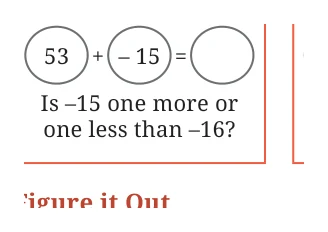
53 + (–16) = 37 53 + (–16) = 37 –87 + (–16) = 54 + (–16) = 38 54 is one more than 53, so the value will be 1 more than 37. 52 + (–16) = 52 is one less than 53, so the value will be 1 less than 37. –88 + (–15) = –86 + (–18) = 53 + (–15) = 53 + (–17) = Is –17 one more or one less than –16? –97 + (–26) =
Show solution
53 + (–16) = 37 53 + (–16) = 37 –87 + (–16) = -103 54 + (–16) = 38 54 is one more than 53, so the value will be 1 more than 37. 52 + (–16) = 36 52 is one less than 53, so the value will be 1 less than 37. –88 + (–15) = -103 (-88) is one less than (-87) and (-15) is one more than (-16). Since, (-1) + (1) = 0, so the value remains the same (-103). –86 + (–18) = -104 (-86) is one more than (-87) and (-18) is two less than (-16).
Since, (+1) + (-2) = (-1), so the value will be 1 less than -103. 53 + (–15) = 38 (-15) is one more than (-16), so the value will be 1 more than 37. 53 + (–17) = 36 (–17) one less than –16, so the value will be 1 less than 37 –97 + (–26) = -123 (-97) is ten less than (-87) and (-26) is also 10 less than (-16).
Since, (- 10) + (-10) = (-20), so the value will be (-20) less than (-103). i.e. (-103) + (-20) = -123. Figure it out
Textbook page 14 · solved item 26
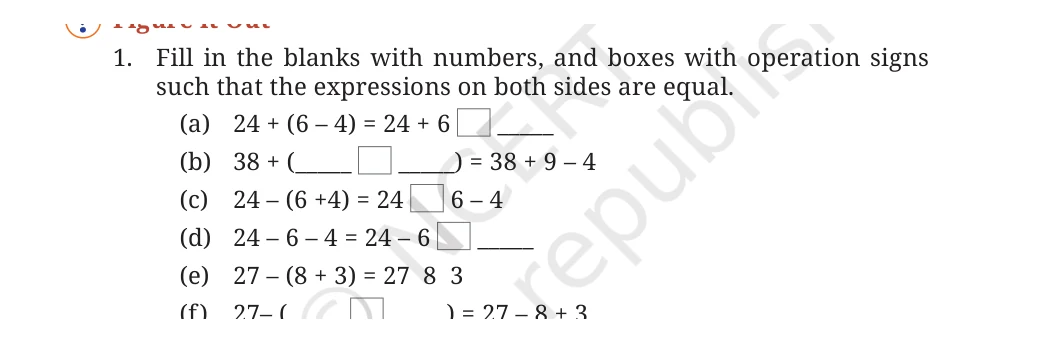
1. Fill in the blanks with numbers, and boxes with operation signs such that the expressions on both sides are equal. (a) 24 + (6 – 4) = 24 + 6 _____ (b) 38 + (_____ _____) = 38 + 9 – 4 (c) 24 – (6 + 4) = 24 6 – 4 (d) 24 – 6 – 4 = 24 – 6 _____ (e) 27 – (8 + 3) = 27 8 3 (f) 27 – (_____ _____) = 27 – 8 + 3
Show solution
(a) 24 + (6 – 4) = 24 + 6 − 4 (b) 38 + (9 − 4) = 38 + 9 – 4 (c) 24 – (6 + 4) = 24 − 6 – 4 (d) 24 – 6 – 4 = 24 – 6 + (−4) (e) 27 – (8 + 3) = 27 − 8 – 3 (f) 27 – (8 − 3) = 27 – 8 + 3
Textbook page 14 · solved item 27
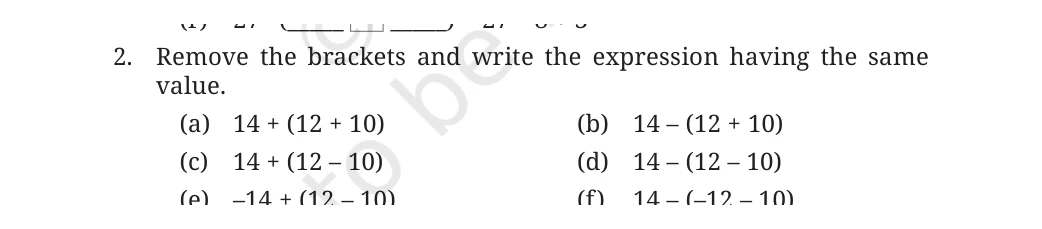
2. Remove the brackets and write the expression having the same value. (a) 14 + (12 + 10) (b) 14 – (12 + 10) (c) 14 + (12 – 10) (d) 14 – (12 – 10) (e) –14 + 12 – 10 (f) 14 – (–12 – 10)
Show solution
(a) 14 + (12 + 10) = 14 + 12 + 10 (b) 14 – (12 + 10) = 14 – 12 – 10 (c) 14 + (12 – 10) = 14 + 12 – 10 (d) 14 – (12 – 10) = 14 – 12 + 10 (e) -14 + 12 – 10 = -14 + 12 – 10 (f) 14 – (-12 – 10) = 14 + 12 + 10
Textbook page 14 · solved item 28
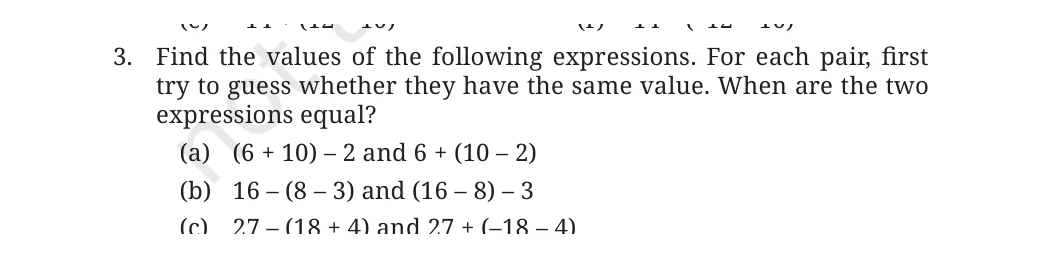
3. Find the values of the following expressions. For each pair, first try to guess whether they have the same value. When are the two expressions equal? (a) (6 + 10) – 2 and 6 + (10 – 2) (b) 16 – (8 – 3) and (16 – 8) – 3 (c) 27 – (18 + 4) and 27 + (–18 – 4)
Show solution
(a) (6 + 10) – 2 and 6 + (10 – 2) 6 + 10 – 2 6 + 10 – 2 16 – 2 16 – 2 14 = 14 Here, the two expressions are equal. (b) 16 – (8 – 3) and (16 – 8) – 3 16 – 8 + 3 16 – 8 – 3 8 + 3 8 – 3 11 ≠ 4 Here, the two expressions are not equal. (c) 27 – (18 + 4) and 27 + (–18 – 4) 27 – 18 – 4 27 – 18 – 4 9 – 4 9 – 4 5 = 5 Here, the two expressions are equal.
Textbook page 14 · solved item 29
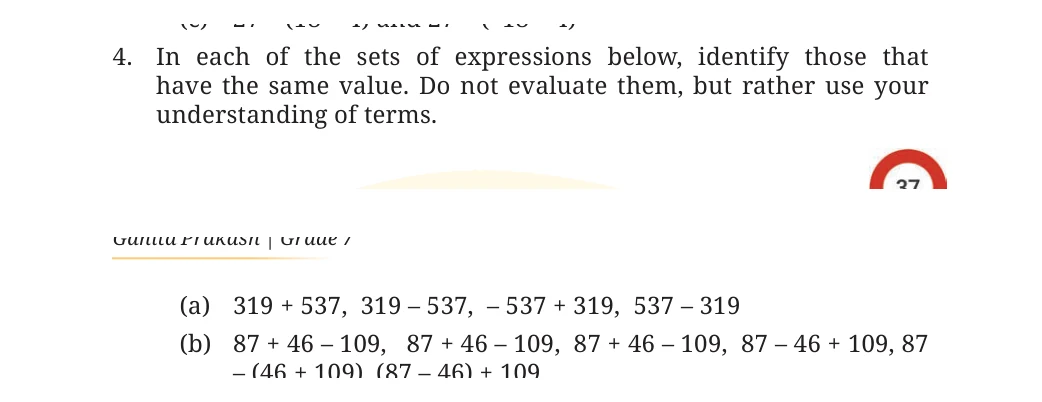
4. In each of the sets of expressions below, identify those that have the same value. Do not evaluate them, but rather use your understanding of terms. (a) 319 + 537, 319 – 537, –537 + 319, 537 – 319 (b) 87 + 46 – 109, 87 + 46 – 109, 87 + 46 – 109, 87 – 46 + 109, 87 – (46 + 109), (87 – 46) + 109
Show solution
(a) 319 + 537, 319 – 537, –537 + 319, 537 – 319 319 – 537 and –537 + 319 → Same value → Follow commutative property of addition. (b) 87 + 46 – 109, 87 + 46 – 109, 87 + 46 – 109, 87 – 46 + 109, 87 – (46 + 109), (87 – 46) + 109 87 – 46 + 109 and (87 – 46) + 109 → Same value → Follow associative property of addition.
87 + 46 – 109, 87 + 46 – 109, 87 + 46 – 109 → Exactly same.
Complete worked answers
Textbook page 15
Textbook page 15 · solved item 30
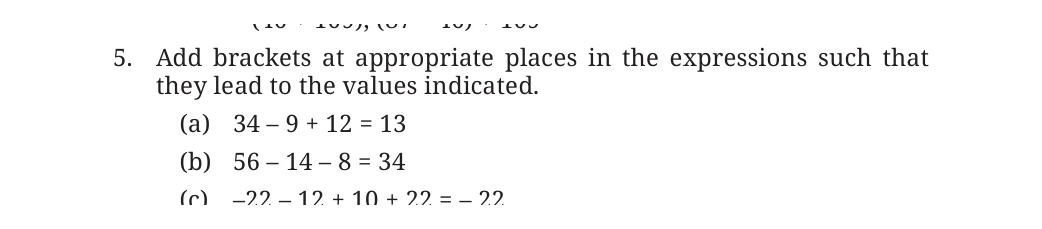
5. Add brackets at appropriate places in the expressions such that they lead to the values indicated. (a) 34 – 9 + 12 = 13 (b) 56 – 14 – 8 = 34 (c) –22 – 12 + 10 + 22 = –22
Show solution
(a) 34 – 9 + 12 = 13 34 – (9 + 12) = 13. (b) 56 – 14 – 8 = 34 (56 – 14) – 8 = 34 (c) –22 – 12 + 10 + 22 = –22 –22 – (12 + 10) + 22 = –22
Textbook page 15 · solved item 31
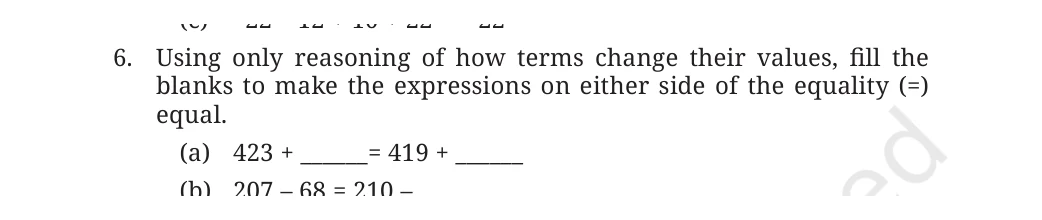
6. Using only reasoning of how terms change their values, fill the blanks to make the expressions on either side of the equality (=) equal. (a) 423 + ______= 419 + ______ (b) 207 – 68 = 210 – ______
Show solution
(a) 423 + ______= 419 + ______ Since 419 is 4 less than 423, we must add 4 more to 419’s side to balance. Therefore, 433 + 2 = 419 + 6. (6 is more than 2). (b) 207 – 68 = 210 – ______ Since 210 is 3 more than 207, subtract 3 more from right-side to balance. Therefore, 207 – 68 = 210 – 71 (71 is 3 more than 68)
Textbook page 15 · solved item 32

7. Using the numbers 2, 3 and 5, and the operators ‘+’ and ‘–’, and brackets, as necessary, generate expressions to give as many different values as possible. For example, 2 – 3 + 5 = 4 and 3 – (5 – 2) = 0.
Show solution
(i) 2 + (3 + 5) = 10 (ii) 2 – (3 + 5) = 2 – 8 = -6 (iii) (-2) – (3 + 5) = -2 – 8 = -10 (iv) (-2) + (3 – 5) = -2 + (-2) = -4 (v) 5 + (3 - 2) = 5 + 1 = 6 Different values obtained are 10, -10, 6, -6, -4.
Textbook page 15 · solved item 33
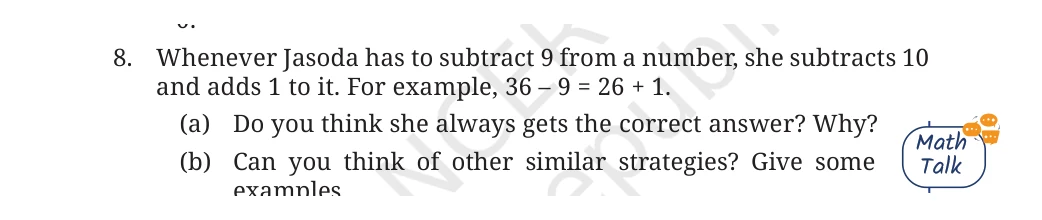
8. Whenever Jasoda has to subtract 9 from a number, she subtracts 10 and adds 1 to it. For example, 36 – 9 = 26 + 1. (a) Do you think she always gets the correct answer? Why? (b) Can you think of other similar strategies? Give some examples.
Show solution
(a) Yes, Jasoda always gets the correct answer. Subtracting 9 is the same as subtracting 10 and adding 1 back, because: –9 = –10 + 1 So, 36 – 9 = 36 – 10 + 1 = 26 + 1 = 27, which is correct. (b) Examples of some similar strategies:- To subtract 19, subtract 20 and add 1: 54 – 19 = 54 – 20 + 1 = 34 + 1 = 35 To subtract 8, subtract 10 and add 2: 43 – 8 = 43 – 10 + 2 = 33 + 2 = 35 To subtract 18, subtract 20 and add 2: 65 – 18 = 65 – 20 + 2 = 45 + 2 = 47
Textbook page 15 · solved item 34
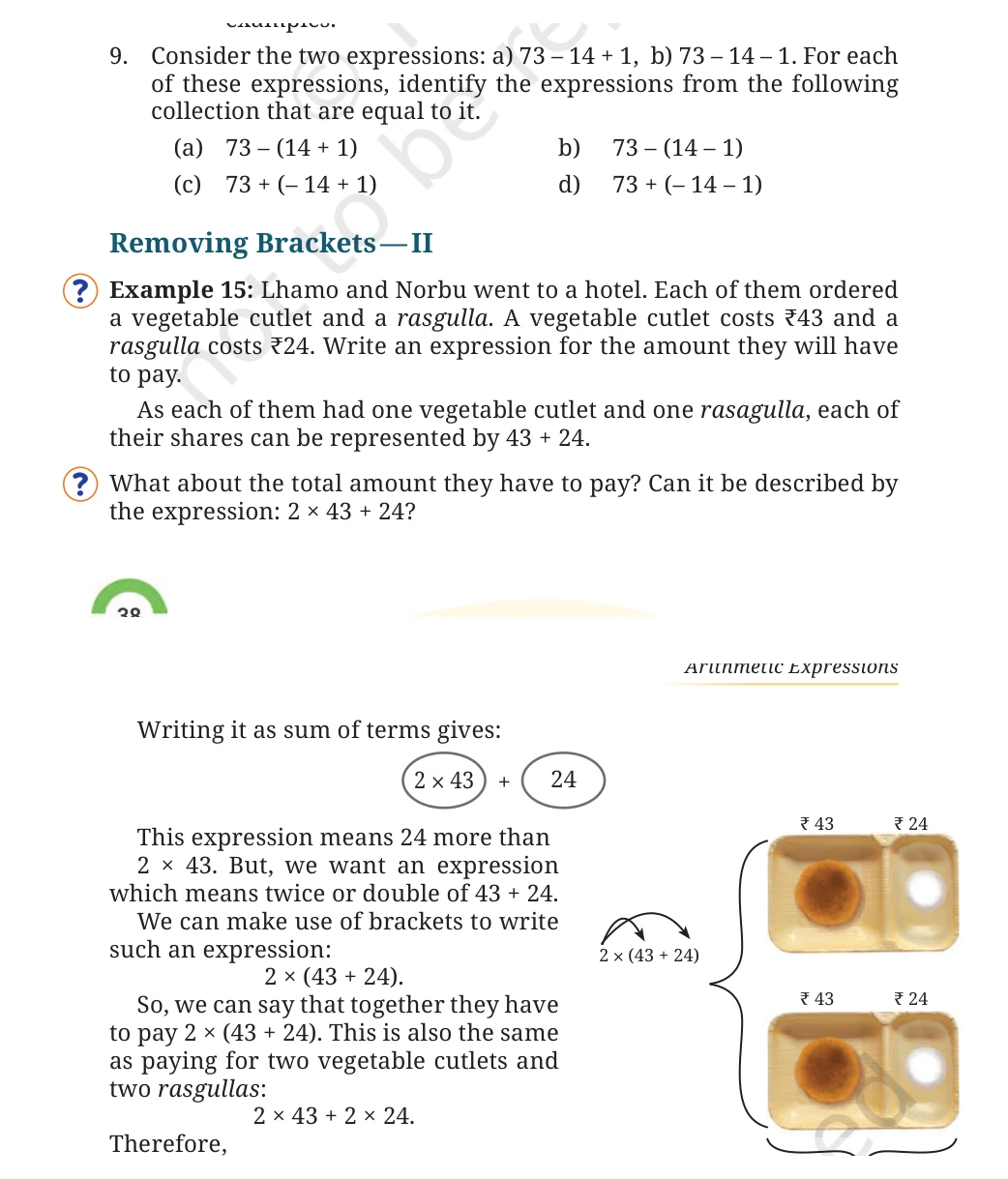
9. Consider the two expressions: a) 73 – 14 + 1, b) 73 – 14 – 1. For each of these expressions, identify the expressions from the following collection that are equal to it. (a) 73 – (14 + 1) (b) 73 – (14 – 1) (c) 73 + (–14 + 1) d) 73 + (–14 – 1)
Show solution
a) 73 – 14 + 1 = 59 + 1 = 60. b) 73 – 14 – 1 = 59 – 1 = 58. (a) 73 – (14 + 1) = 73 – 15 = 58. (b) 73 – (14 – 1) = 73 – 13 = 60. (c) 73 + (–14 + 1) = 73 + (-13) = 60. (d) 73 + (-14 – 1) = 73 + (-15) = 58. Therefore, 73 – 14 + 1 is equal to 73 – (14 – 1) and 73 + (–14 + 1). 73 – 14 – 1 is equal to 73 – (14 + 1) and 73 + (-14 – 1).
Complete worked answers
Textbook page 16
Textbook page 16 · solved item 35
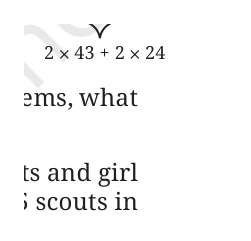
If another friend, Sangmu, joins them and orders the same items, what will be the expression for the total amount to be paid? [Expression for Lhamo and Norbu who each ordered a vegetable cutlet costing ₹43 and a rasgulla costing ₹24 is 2 × (43 + 24)]
Show solution
If another friend, Sangmu joins them and orders the same items. Then, the total amount to be paid is 3 × (43 + 24).
Complete worked answers
Textbook page 17
Textbook page 17 · solved item 36
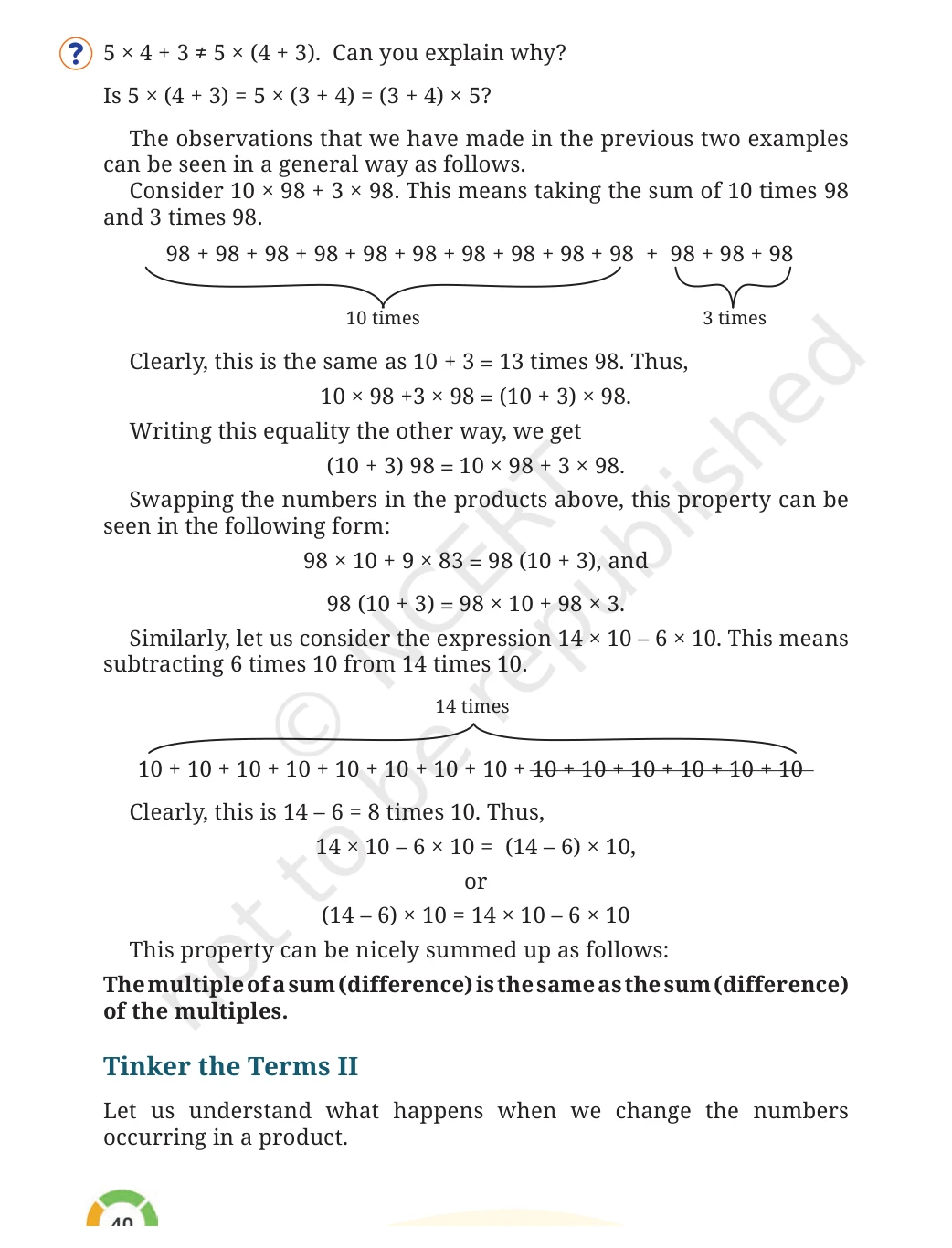
5 × 4 + 3 ≠ 5 × (4 + 3). Can you explain why?
Show solution
L.H.S: 5 × 4 + 3 = 20 + 3 = 23 R.H.S: 5 × (4 + 3) = 5 × 4 + 5 × 3 = 20 + 15 = 35. Since, 23 ≠ 35 Therefore, 5 × 4 + 3 ≠ 5 × (4 + 3).
Textbook page 17 · solved item 37
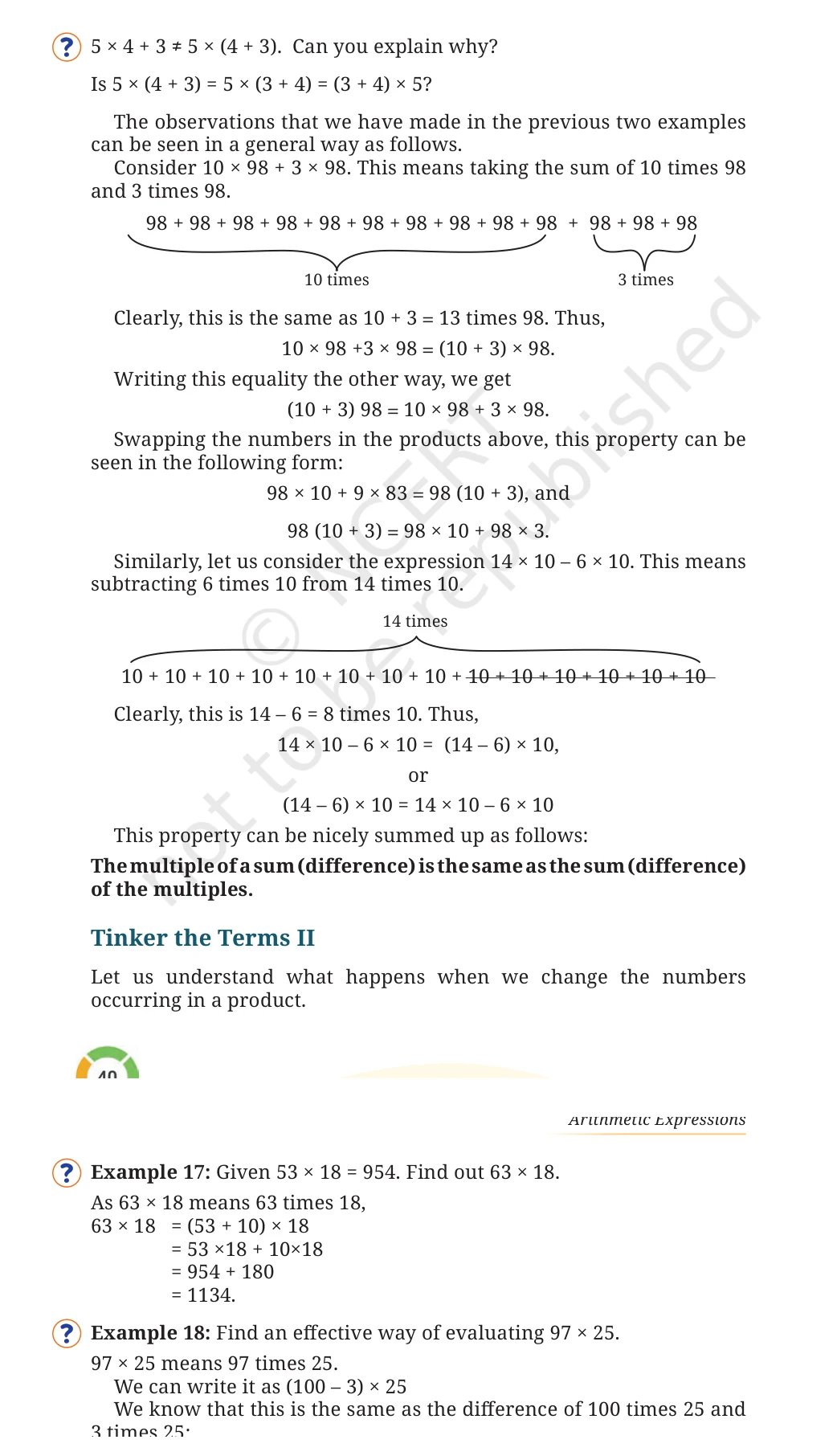
Is 5 × (4 + 3) = 5 × (3 + 4) = (3 + 4) × 5?
Show solution
5 × (4 + 3) = 5 × 4 + 5 × 3 = 20 + 15 = 35. 5 × (3 + 4) = 5 × 3 + 5 × 4 = 15 + 20 = 35. (3 + 4) × 5 = 7 × 5 = 35. Since, all these expressions have 35 as result. Therefore, 5 × (4 + 3) = 5 × (3 + 4) = (3 + 4) × 5.
Complete worked answers
Textbook page 18
Textbook page 18 · solved item 38

97 × 25 = 100 × 25 – 3 × 25. Find this value.
Show solution
97 × 25 = 100 × 25 – 3 × 25 = 2500 – 75 = 2425.
Textbook page 18 · solved item 39
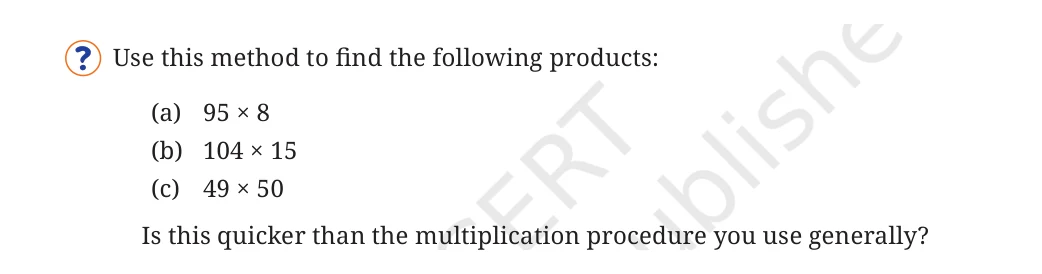
Use this method to find the following products: (a) 95 × 8 (b) 104 × 15 (c) 49 × 50 Is this quicker than the multiplication procedure you use generally?
Show solution
(a) 95 × 8 = 95 × (10 – 2) = 95 × 10 – 95 × 2 = 950 – 190 = 760. (b) 104 × 15 = (100 + 4) × 15 = 100 × 15 + 4 × 15 = 1500 + 60 = 1560. (c) 49 × 50 = (50 – 1) × 50 = 50 × 50 – 1 × 50 = 2500 – 50 = 2450.
Textbook page 18 · solved item 40

Which other products might be quicker to find like the ones above?
Show solution
(i) 36 × 102 = 36 × (100 + 2) = 36 × 100 + 36 × 2 = 3600 + 72 = 3672. (ii) 75 × 98 = 75 × (100 – 2) = 75 × 100 – 75 × 2 = 7500 – 150 = 7350. (iii) 42 × 52 = 42 × (50 + 2) = 42 × 50 + 42 × 2 = 2100 + 84 = 2184. (iv) 995 × 67 = (1000 – 5) × 67 = 67 × 1000 – 67 × 5 = 6700 – 335 = 6365. Figure it out
Textbook page 18 · solved item 41
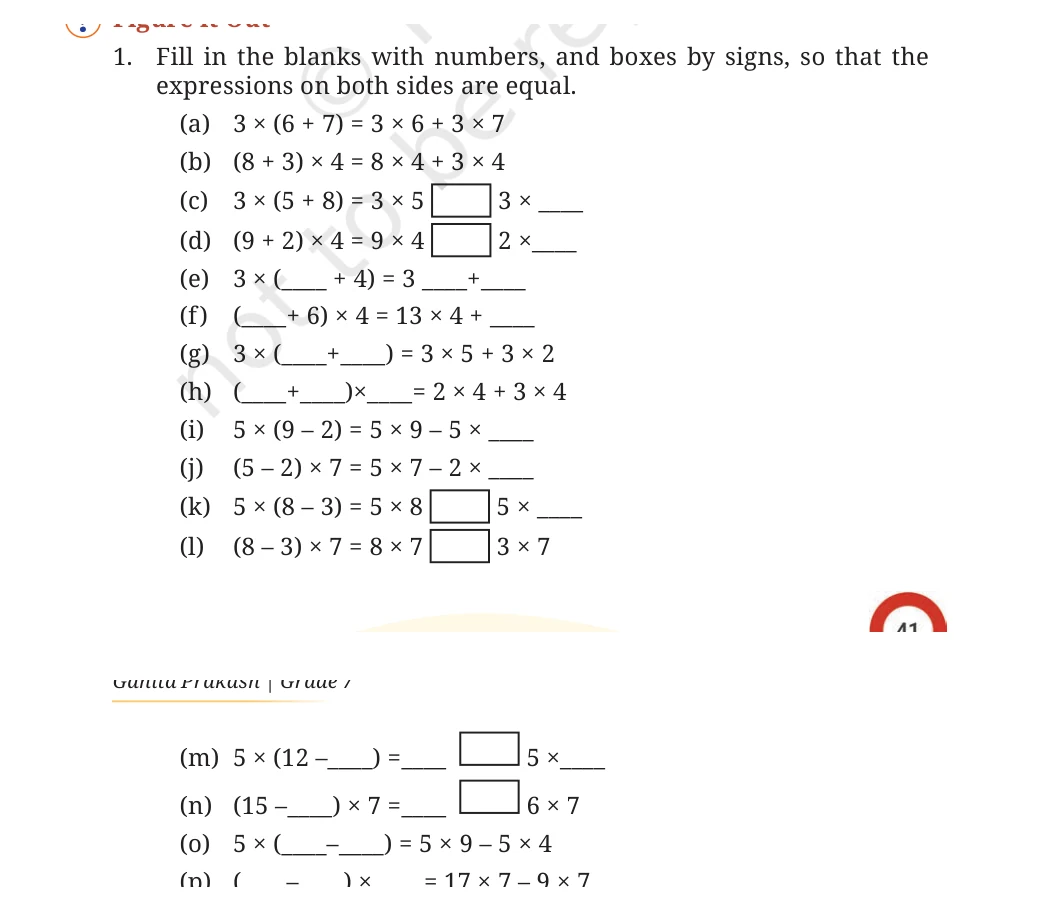
1. Fill in the blanks with numbers, and boxes by signs, so that the expressions on both sides are equal. (a) 3 × (6 + 7) = 3 × 6 + 3 × 7 (b) (8 + 3) × 4 = 8 × 4 + 3 × 4 (c) 3 × (5 + 8) = 3 × 5 3 × ____ (d) (9 + 2) × 4 = 9 × 4 2 × ____ (e) 3 × (____ + 4) = 3 ____+____ (f) (____+ 6) × 4 = 13 × 4 + ____ (g) 3 × (____+____) = 3 × 5 + 3 × 2 (h) (____+____) × ____= 2 × 4 + 3 × 4 (i) 5 × (9 – 2) = 5 × 9 – 5 × ____ (j) (5 – 2) × 7 = 5 × 7 – 2 × ____ (k) 5 × (8 – 3) = 5 × 8 5 × ____ (l) (8 – 3) × 7 = 8 × 7 3 × 7 (m) 5 × (12 –____) =____ 5 ×____ (n) (15 – ____) × 7 = ____ 6 × 7 (o) 5 × (____–____) = 5 × 9 – 5 × 4 (p) (____–____) × ____= 17 × 7 – 9 × 7
Show solution
(c) 3 × (5 + 8) = 3 × 5 + 3 × 8 (d) (9 + 2) × 4 = 9 × 4+ 2 × 4 (e) 3 × (7 + 4) = 3 x 7 + 3 × 4 (f) (13 + 6) × 4 = 13 × 4 + 6 × 4 (g) 3 × (5 + 2) = 3 × 5 + 3 × 2 (h) (2 + 3) × 4= 2 × 4 + 3 × 4 (i) 5 × (9 – 2) = 5 × 9 – 5 × 2 (j) (5 – 2) × 7 = 5 × 7 – 2 × 7 (k) 5 × (8 – 3) = 5 × 8 − 5 × 3 (l) (8 – 3) × 7 = 8 × 7 − 3 × 7 (m) 5 × (12 – 3) =5 × 12 − 5 × 3 (n) (15 – 6) × 7 = 15 × 7 − 6 × 7 (o) 5 × (9 – 4) = 5 × 9 – 5 × 4 (p) (17 – 9) × 7 = 17 × 7 – 9 × 7
Complete worked answers
Textbook page 19
Textbook page 19 · solved item 42
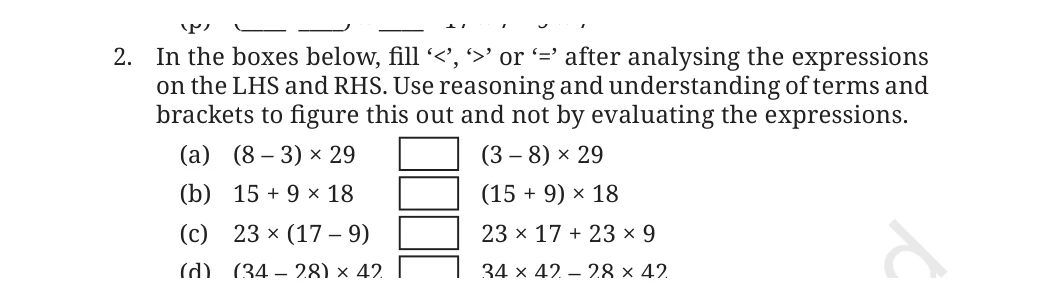
2. In the boxes below, fill ‘<’, ‘>’ or ‘=’ after analysing the expressions on the LHS and RHS. Use reasoning and understanding of terms and brackets to figure this out and not by evaluating the expressions. (a) (8 – 3) x 29 ___ (3 – 8) x 29 (b) 15 + 9 x 18 ___ (15 + 9) x 18 (c) 23 x (17 – 9) ___ 23 x 17 + 23 x 9 (d) (34 – 28) x 42 ___ 34 x 42 – 28 x 42
Show solution
(a) (8 – 3) x 29 ___ (3 – 8) x 29 Positive × 29 > Negative × 29 Therefore, (8 – 3) x 29 > (3 – 8) x 29. (b) 15 + 9 x 18 ___ (15 + 9) x 18 Smaller value (multiplication first) < Bigger Value (addition first) Therefore, 15 + 9 x 18 < (15 + 9) x 18. (c) 23 x (17 – 9) ___ 23 x 17 + 23 x 9 Smaller value (involves subtraction of terms) < Bigger value (involves addition of terms) 23 x (17 – 9) < 23 x 17 + 23 x 9.
(d) (34 – 28) x 42 ___ 34 x 42 – 28 x 42 This is a property called distributive property, so both are equal. (34 – 28) x 42 = 34 x 42 – 28 x 42.
Textbook page 19 · solved item 43
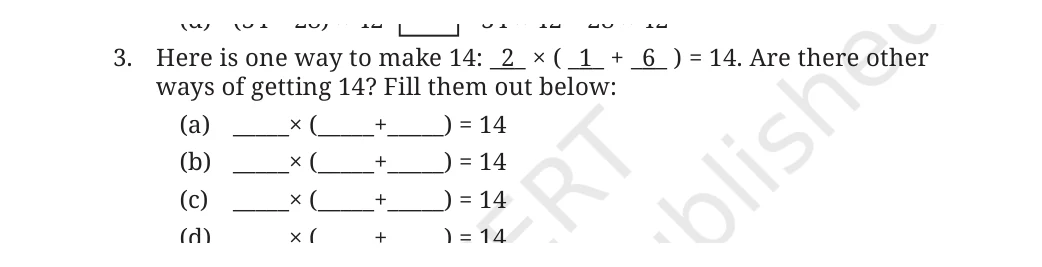
3. Here is one way to make 14: 2 x (1 + 6) = 14. Are there other ways of getting 14? Fill them out below: (a) _____× (_____+_____) = 14 (b) _____× (_____+_____) = 14 (c) _____× (_____+_____) = 14 (d) _____× (_____+_____) = 14
Show solution
(a) 2 × (3 + 4) = 14 (b) 7 × (2 + 0) = 14 (c) 2 × (5 + 2) = 14 (d) 2 × (0 + 7) = 14
Textbook page 19 · solved item 44
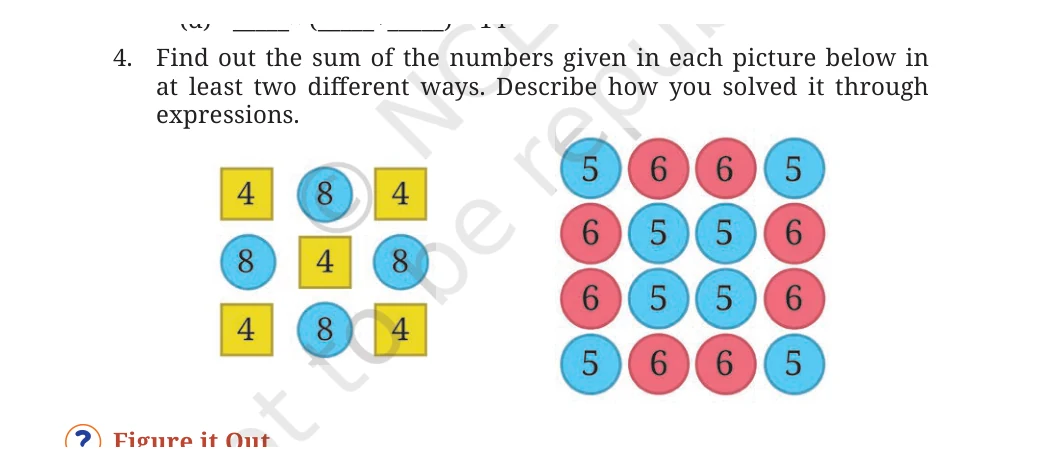
4. Find out the sum of the numbers given in each picture below in at least two different ways. Describe how you solved it through expressions.
Show solution
(i) Sum = 4 × 5 + 8 × 4 = 20 + 32 = 52. Also, Sum = 4 × (5 + 8) = 4 × 13 = 52. (ii) Sum = 5 × 8 + 6 × 8 = 40 + 48 = 88. Also, Sum = 8 × (5 + 6) = 8 × (11) = 88. Figure it out
Textbook page 19 · solved item 45
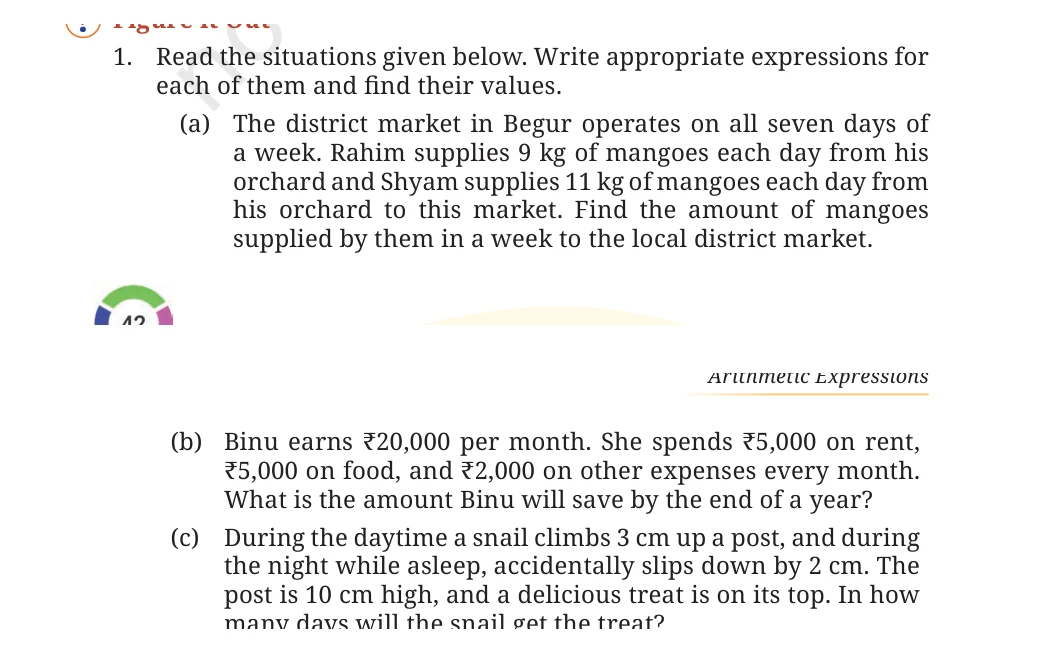
1. Read the situations given below. Write appropriate expressions for each of them and find their values. (a) The district market in Begur operates on all seven days of a week. Rahim supplies 9 kg of mangoes each day from his orchard and Shyam supplies 11 kg of mangoes each day from his orchard to this market. Find the amount of mangoes supplied by them in a week to the local district market. (b) Binu earns ₹20,000 per month. She spends ₹5,000 on rent, ₹5,000 on food, and ₹2,000 on other expenses every month. What is the amount Binu will save by the end of a year? (c) During the daytime a snail climbs 3 cm up a post, and during the night while asleep, accidentally slips down by 2 cm. The post is 10 cm high, and a delicious treat is on its top. In how many days will the snail get the treat?
Show solution
(a) Mangoes supplied by Rahim per day = 9 kg Mangoes supplied by Shyam per day = 11 kg Total amount of mangoes supplied by both in a week = 7 × (9 + 11) kg = 7 × 9 + 7 × 11 = 63 + 77 = 140 kg. (b) Total salary = ₹20,000 Rent expenses = ₹5,000 Food expenses = ₹5,000 Other expenses = ₹2,000 Total amount saved at the end of year = 12 × {20,000 – (5000 + 5000 + 2000)} = 12 × {20,000 – 12,000} = 12 × 8,000 = ₹96,000.
(c) Height of post = 10 cm Climb during the day = 3 cm Slip during the night = 2 cm Let, total days taken by snail = y Therefore, 10 = y × (3 – 2) 10 = y × 1 y = 10. Therefore, the snail will take 10 days to reach the top.
Complete worked answers
Textbook page 20
Textbook page 20 · solved item 46
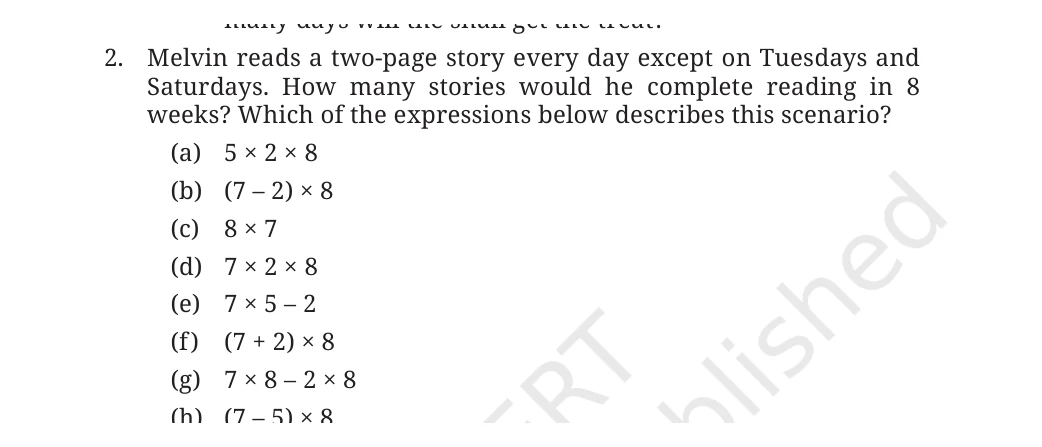
2. Melvin reads a two-page story every day except on Tuesdays and Saturdays. How many stories would he complete reading in 8 weeks? Which of the expressions below describes this scenario? (a) 5 × 2 × 8 (b) (7 – 2) × 8 (c) 8 × 7 (d) 7 × 2 × 8 (e) 7 × 5 – 2 (f) (7 + 2) × 8 (g) 7 × 8 – 2 × 8 (h) (7–5) × 8
Show solution
Stories completed in 8 weeks are represented by the expressions given below: (b) (7 – 2) × 8 (g) 7 × 8 – 2 × 8
Textbook page 20 · solved item 47

3. Find different ways of evaluating the following expressions: (a) 1 – 2 + 3 – 4 + 5 – 6 + 7 – 8 + 9 – 10 (b) 1 – 1 + 1 – 1 + 1 – 1 + 1 – 1 + 1 – 1
Show solution
(a) Way 1: 1 – 2 + 3 – 4 + 5 – 6 + 7 – 8 + 9 – 10 = (1 – 2) + (3 – 4) + (5 – 6) + (7 – 8) + (9 – 10) = (-1) + (-1) + (-1) + (-1) + (-1) = (-5). Way 2: 1 – 2 + 3 – 4 + 5 – 6 + 7 – 8 + 9 – 10 = 1 + 3 + 5 + 7 + 9 – 2 – 4 – 6 – 8 -10 = (1 + 3 + 5 + 7 + 9) – (2 + 4 + 6 + 8 + 10) = 25 – 30 = (-5). Way 3: 1 – 2 + 3 – 4 + 5 – 6 + 7 – 8 + 9 – 10 = -1 + 3 – 4 + 5 – 6 + 7 – 8 + 9 – 10 = 2 – 4 + 5 – 6 + 7 – 8 + 9 – 10 = -2 + 5 – 6 + 7 – 8 + 9 – 10 = 3 – 6 + 7 – 8 + 9 – 10 = -3 + 7 – 8 + 9 – 10 = 4 – 8 + 9 – 10 = -4 + 9 – 10 = 5 – 10 = -5 (b) Way 1: 1 – 1 + 1 – 1 + 1 – 1 + 1 – 1 + 1 – 1 = (1 – 1) + (1 – 1) + (1 – 1) + (1 – 1) + (1 – 1) = 0 + 0 + 0 + 0 + 0 = 0.
Way 2: 1 – 1 + 1 – 1 + 1 – 1 + 1 – 1 + 1 – 1 = 1 + 1 + 1 + 1 + 1 – 1 – 1 – 1 – 1 – 1 = (1 + 1 + 1 + 1 + 1) – (1 + 1 + 1 + 1 + 1) = 5 – 5 = 0. Way 3: 1 – 1 + 1 – 1 + 1 – 1 + 1 – 1 + 1 – 1 = 0 + 1 – 1 + 1 – 1 + 1 – 1 + 1 – 1 = 1 – 1 + 1 – 1 + 1 – 1 + 1 – 1 = 0 + 1 – 1 + 1 – 1 + 1 – 1 = 1 – 1 + 1 – 1 + 1 – 1 = 0 + 1 – 1 + 1 – 1 = 1 – 1 + 1 – 1 = 0 + 1 – 1 = 1 – 1 = 0.
Textbook page 20 · solved item 48
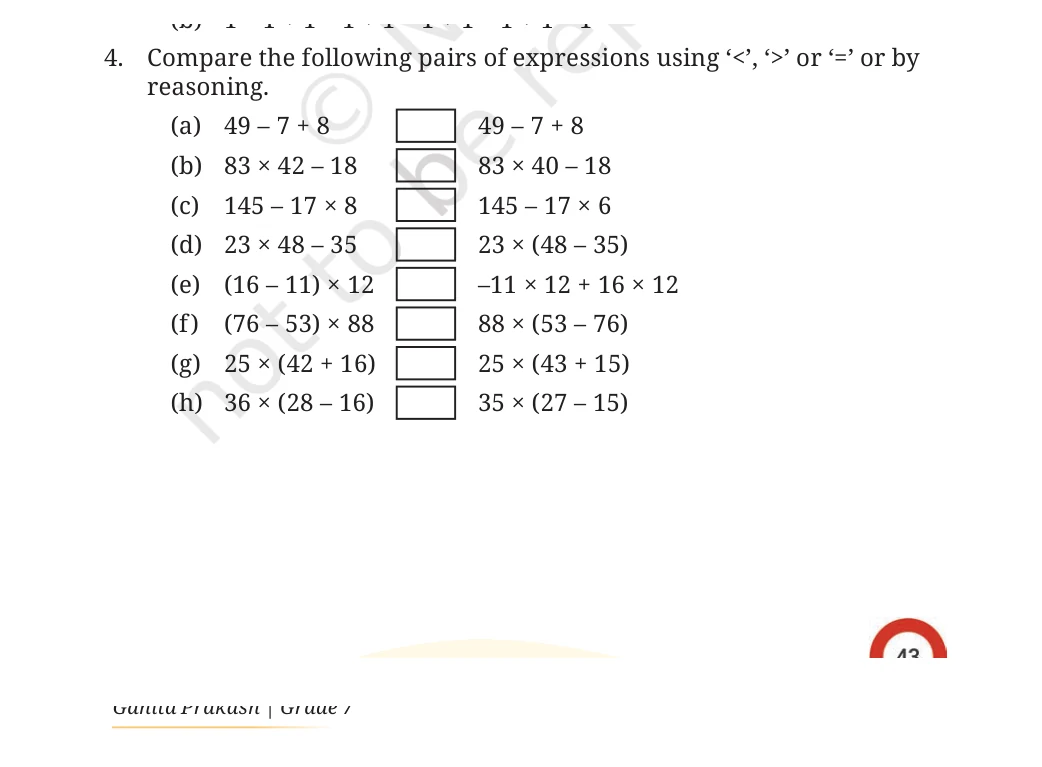
4. Compare the following pairs of expressions using ‘<’, ‘>’ or ‘=’ or by reasoning. (a) 49 – 7 + 8 ___ 49 – 7 + 8 (b) 83 x 42 – 18 ___ 83 x 40 – 18 (c) 145 – 17 x 8 ___ 145 – 17 x 6 (d) 23 x 48 – 35 ___ 23 x (48 – 35) (e) (16 – 11) x 12 ___ -11 x 12 + 16 x 12 (f) (76 – 53) x 88 ___ 88 x (53 – 76) (g) 25 x (42 + 16) ___ 25 x (43 + 15) (h) 36 x (28 – 16) ___ 35 x (27 – 15)
Show solution
(a) 49 – 7 + 8 ___ 49 – 7 + 8 Both sides are exactly the same. Therefore, 49 – 7 + 8 = 49 – 7 + 8 (b) 83 x 42 – 18 ___ 83 x 40 – 18 3486 – 18 3320 – 18 3468 > 3302. Therefore, 83 x 42 – 18 > 83 x 40 – 18 (c) 145 – 17 x 8 ___ 145 – 17 x 6 145 – 136 145 – 102 9 < 43 Therefore, 145 – 17 x 8 < 145 – 17 x 6 (d) 23 x 48 – 35 ___ 23 x (48 – 35) 1104 – 35 23 × 13 1069 > 299 Therefore, 23 x 48 – 35 > 23 x (48 – 35) (e) (16 – 11) x 12 ___ -11 x 12 + 16 x 12 5 × 12 -132 + 192 60 = 60 Therefore, (16 – 11) x 12 = -11 x 12 + 16 x 12 (f) (76 – 53) x 88 ___ 88 x (53 – 76) 23 × 88 88 × -23 2024 > -2024 Therefore, (76 – 53) x 88 > 88 x (53 – 76) (g) 25 x (42 + 16) ___ 25 x (43 + 15) 25 × 58 25 × 58 1450 = 1450 Therefore, 25 x (42 + 16) = 25 x (43 + 15) (h) 36 x (28 – 16) ___ 35 x (27 – 15) 36 × 12 35 × 12 432 > 420 Therefore, 36 x (28 – 16) > 35 x (27 – 15)
Complete worked answers
Textbook page 21
Textbook page 21 · solved item 49
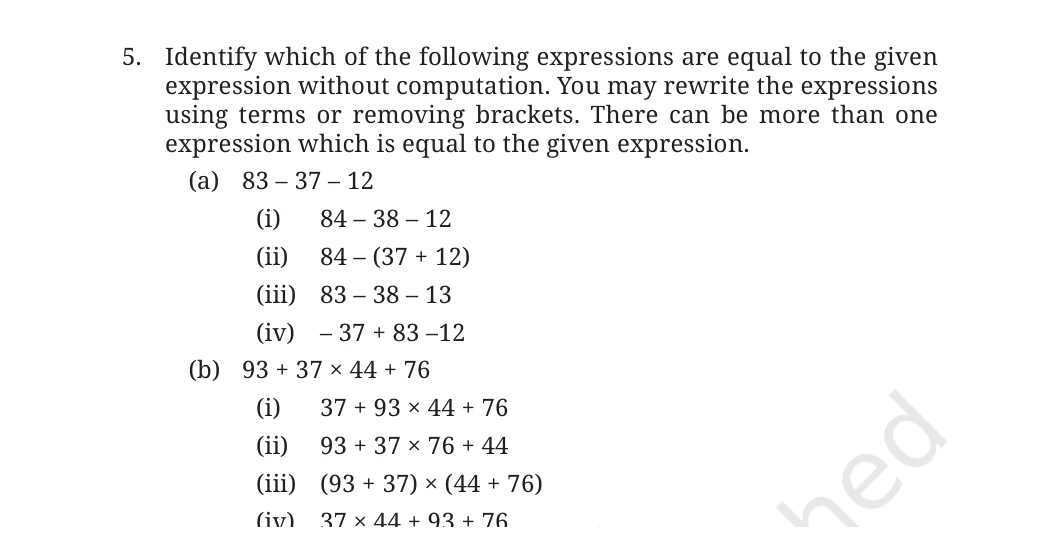
5. Identify which of the following expressions are equal to the given expression without computation. You may rewrite the expressions using terms or removing brackets. There can be more than one expression which is equal to the given expression. (a) 83 – 37 – 12 (i) 84 – 38 – 12 (ii) 84 – (37 + 12) (iii) 83 – 38 – 13 (iv) -37 + 83 – 12 (b) 93 + 37 × 44 + 76 (i) 37 + 93 x 44 + 76 (ii) 93 + 37 x 76 + 44 (iii) (93 + 37) x (44 + 76) (iv) 37 x 44 + 93 + 76
Show solution
(a) 83 – 37 – 12 (i) 84 – 38 – 12 contains different terms than the given expression. Therefore, it is not equal to the original expression. (ii) 84 – (37 + 12) = 84 – 37 – 12 which is same as the given expression. (iii) 83 – 38 – 13 contains different terms than the given expression. Therefore, it is not equal to the original expression.
(iv) -37 + 83 – 12 = 83 – 37 – 12 which is same as the given expression. Therefore, (a) is equal to (ii) and (iv). (b) 93 + 37 × 44 + 76 = 93 + (37 × 44) + 76 (i) 37 + 93 x 44 + 76 = 37 + (93 x 44) + 76. The multiplication uses different numbers than the given expression. Therefore, it is not equal to the original expression.
(ii) 93 + 37 x 76 + 44 = 93 + (37 x 76) + 44. The multiplication uses different numbers than the given expression. Therefore, it is not equal to the original expression. (iii) (93 + 37) x (44 + 76). The grouping and operation order are different than the given expression. Therefore, it is not equal to the original expression.
(iv) 37 x 44 + 93 + 76 = (37 × 44) + 93 + 76 which can be rearranged as 93 + (37 × 44) + 76. Therefore, it is equal to the original expression. Therefore, (b) is equal to (iv).
Textbook page 21 · solved item 50
5. Choose a number and create ten different expressions having that value.
Show solution
Number chosen: 7 (i) 3 + (9 – 5) (ii) (10 – 5) + 2 (iii) 2 × 3 + 1 (iv) (11 – 8) + (15 – 11) (v) (8 × 2) – 9 (vi) 5 + (6 – 4) (vii) 2 + (9 – 4) (viii) (12 × 2) – 17 (ix) 3 + (8 – 4) (x) (7 × 2) – 7