
Use the textbook context
Match, attempt, then check
Each crop extends to the next solved item, so diagrams, tables and connected instructions stay with the question.
Complete worked answers
Textbook page 5
Textbook page 5 · solved item 1
When constructing the perpendicular bisector, is it necessary to have the same radius for the arcs above and below XY? Explore this through construction, and then justify your answer. [Hint 1: Any point that is of the same distance from X and Y lies on the perpendicular bisector. Hint 2: We can draw the whole line if any two of its points are known.]
Show solution
Draw a line segment XY. Choose distances k and k’ which are slightly greater than half of the distance XY. With centres at X and Y, draw arcs of radius ‘k’ below XY. With centres at X and Y, draw arcs of radius ‘k’’ below XY. Let the arcs above XY intersect at A, and the arcs below XY intersect at B.
Join A and B. Let AB intersect XY at O. Join AX, AY, BX, and BY. ∆ABX and ∆ABY are congruent because AX = AY = k, BX = BY = k’, and AB is common. Therefore, ∠XAO = ∠YAO ∆AOX and ∆AOY are congruent because AX = AY = k, ∠XAO = ∠YAO, and OA is common. Therefore, OX = OY and ∠AOX = ∠AOY Also, ∠AOX + ∠AOY = 180° Therefore, 2∠AOX = 180° or ∠AOX = 90° Therefore, OX = OY and ∠AOX = ∠AOY = 90°.
Therefore, AB is the perpendicular bisector of the line XY. Here, A and B are points that are of the same distance from X and Y. Thus, any point that is of the same distance from X and Y lies on the perpendicular bisector.
Textbook page 5 · solved item 2

Is it necessary to construct the pairs of arcs above and below XY? Instead, can we construct both pairs of arcs on the same side of XY? Explore this through construction, and then justify your answer.
Show solution
Draw a line segment XY. Choose distances k and k’ which are slightly greater than half of the distance XY. With centres at X and Y, draw arcs of radius ‘k’ above XY. With centres at A and Y, draw arcs of radius ‘k’’ above XY. Let the arcs intersect at the points A and B. Join A and B and produce this line to intersect XY at O.
Join AX, AY, BX, and BY. ∆ABX and ∆ABY are congruent because AX = AY = k, BX = BY = k’, and AB is common. Therefore, ∠XAO = ∠YAO ∆AOX and ∆AOY are congruent because AX = AY = k, ∠XAO = ∠YAO, and OA is common. Therefore, OX = OY and ∠AOX = ∠AOY Also, ∠AOX + ∠AOY = 180° Therefore, 2∠AOX = 180° or ∠AOX = 90° Therefore, OX = OY and ∠AOX = ∠AOY = 90° Therefore, AB is the perpendicular bisector of the line XY.
Here, the pairs of arcs are both on the same side of XY. Therefore, It is not necessary to construct the pairs of arcs above and below XY.
Textbook page 5 · solved item 3

While constructing one pair of intersecting arcs, is it necessary that we use the same radii for both of them? Explore this through construction, and then justify your answer.
Show solution
Draw a line segment XY. With centres at X and Y, draw arcs of unequal radii, say k and k’. Let the arcs intersect at the point A. Let PQ be the perpendicular bisector of XY. Let R be any point on PQ. Join RX and RY. ∆ROX and ∆ROY are congruent, because OX = OY, ∠ROX = ∠ROY, and OR is common. Therefore, RX = RY Therefore, For any point R on the perpendicular bisector, we have RX = RY.
Therefore, Every point on the perpendicular bisector is equidistant from X and Y. Since AX ≠ AY, the point A is not on the perpendicular bisector. Thus, to construct a perpendicular bisector, we must use the same radius for both arcs of a pair of arcs.
Textbook page 5 · solved item 4
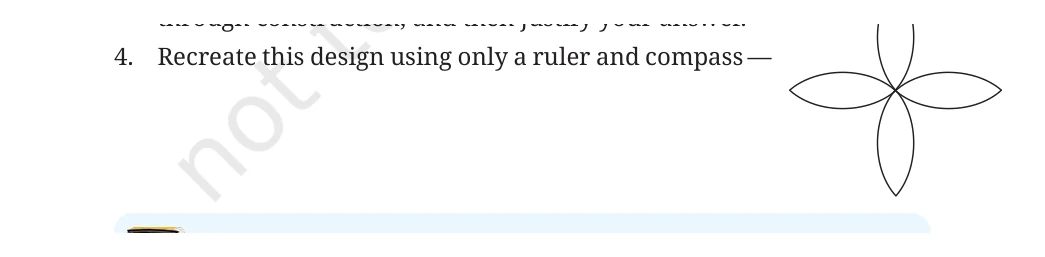
Recreate this design using only a ruler and compass
Show solution
Let ABCD be a square. We draw perpendicular bisectors of the sides AB and BC as shown in the figure. Let the perpendicular bisectors intersect the square at the points P, Q, R, and S. With centres at P, Q, R, and S, draw semicircles in the square with radius equal to AP. Colour the boundary of the design using a coloured pencil.
This will make the design stand out from the supporting lines and curve.
Textbook page 5 · solved item 5
Justify why AB in the figure given below is the perpendicular bisector of the line XY.
Show solution
In the above figure, XAY and XBY are two positions of the rope. Points A and B are at the midpoint of the rope. Therefore, We have AX = AY = BX = BY. ∆AXB and ∆AYB are congruent, because AX = AY, BX = BY, and AB is common. Therefore, ∠XAO = ∠YAO ∆AXO and ∆AYO are congruent, because AX = AY, ∠XAO = ∠YAO, and AO is common.
Therefore, OX = OY and ∠XOA = ∠YOA. Also, ∠XOA + ∠YOA = 180° Therefore, 2∠XOA = 180° or ∠XOA = 90° Therefore, OX = OY and ∠XOA = ∠YOA = 90° Therefore, By definition, AB is the perpendicular bisector of the line XY.
Complete worked answers
Textbook page 7
Textbook page 7 · solved item 6
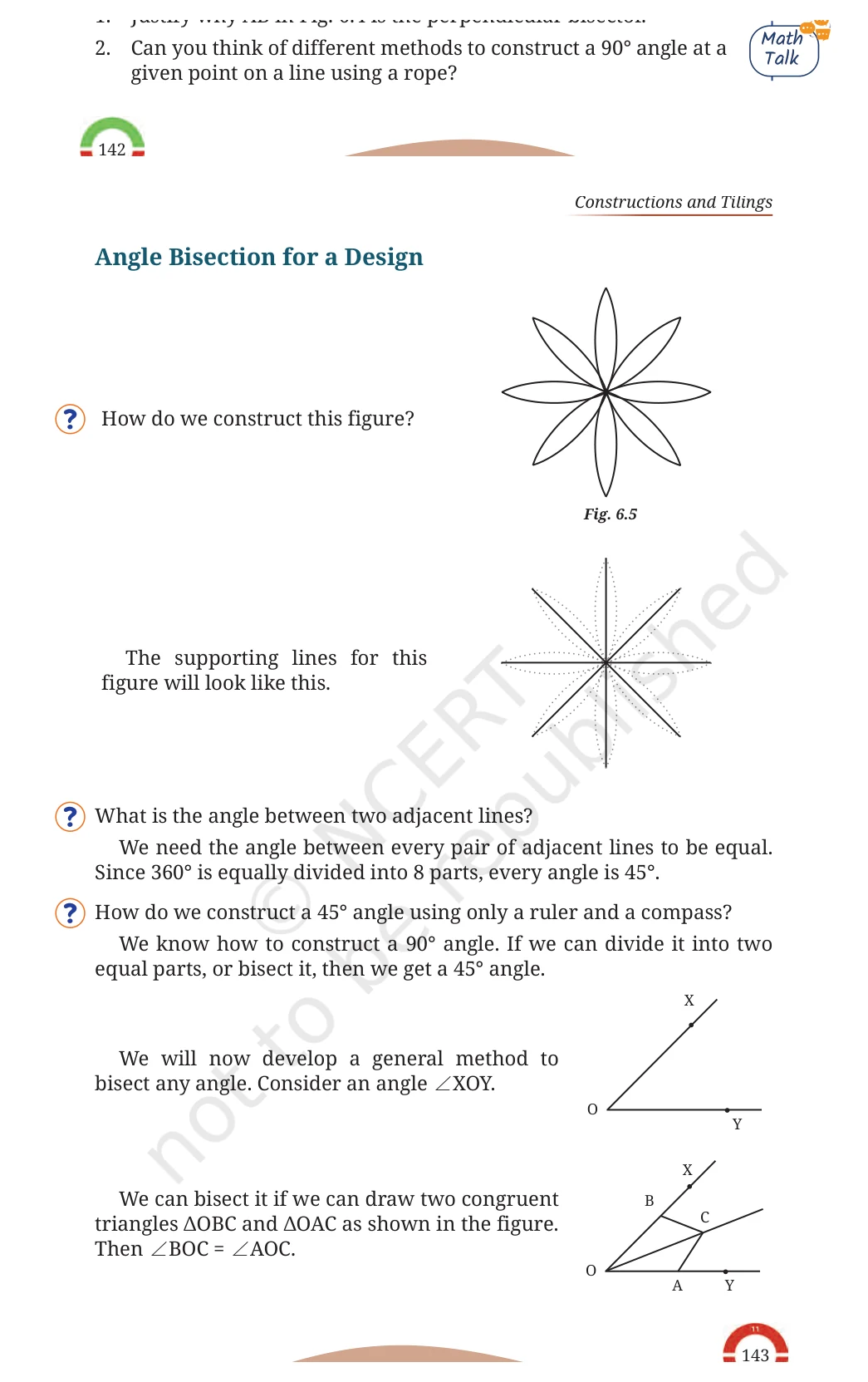
Can you think of different methods to construct a 90° angle at a given point on a line using a rope?
Show solution
In this construction, we shall use the 3-4-5 principle that if the sides of a triangle are in the ratio 3 : 4 : 5, then the angle opposite to the longest side is 90°. In the figure, the sides AB, BC, and CA are in the ratio 3 : 4 : 5 and the angle B, opposite to the longest side AC, is equal to 90°.
Construction: Draw a line XY and take any point A on it. We shall construct a 90° angle at point A, using a rope. Fix a small pole at point A. Take a rope and mark it at 0 units, 3 units, 8 units, and 12 units. Attach the 0 unit mark and 12 unit mark of the rope at A. Attach the 3-unit mark at point B on the line XY, with the help of a pole at B.
Now hold the 8-unit point of the rope and extend it away from XY so that both sides of this point are tight. Place a pole at this point and call this point C, as shown in the figure. In the ∆ABC, the sides are 3 units, 4 units, and 5 units. The angle opposite to the longest side is ∠A. Therefore, By the 3-4-5 principle, ∠A is equal to 90°.
Therefore, The line AC is perpendicular to the line XY at the given point A.
Complete worked answers
Textbook page 9
Textbook page 9 · solved item 7
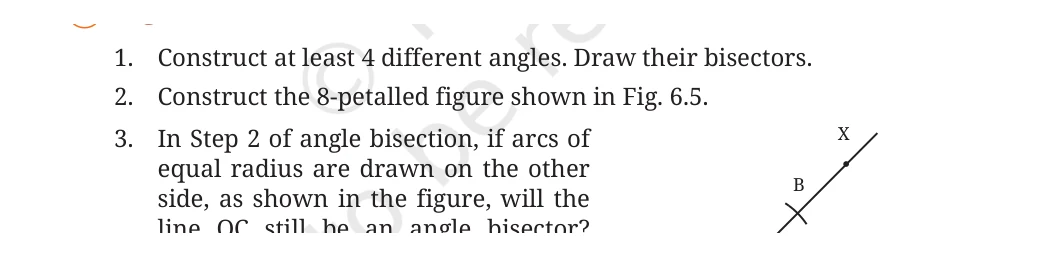
Construct at least 4 different angles. Draw their bisectors.
Show solution
We draw 4 different angles, ∠ABC, ∠DEF, ∠GHI, and ∠JKL, as shown below: We shall draw the bisectors of the above angles. With centres at B, E, H, and K, draw arcs intersecting the arms of the angles. With centres at A’, C’, D’, F’, G’, I’, J’, and L’, draw arcs of the same radius so that the arcs intersect at points B’, E’, H’, and K’.
Join BB’, EE’, HH’, and KK’. In the above figure: BB’ is the bisector of ∠ABC EE’ is the bisector of ∠DEF HH’ is the bisector of ∠GHI KK’ is the bisector of ∠JKL.
Textbook page 9 · solved item 8

Construct the 8-petaled figure shown below.
Show solution
Draw a line AB. With centres at A and B, draw arcs of equal radius above and below the line AB. Let the arcs intersect at the points C and D. Join C and D. Let AB and CD intersect at O. Draw the bisectors of ∠BOC, ∠COA, ∠AOD, and ∠DOB as shown in the figure. Draw a circle with centre at O and radius equal to the length of a petal in the given figure.
Draw dots at the points of intersection of the circle with the lines. Using the dots and the centre of the circle, draw the petals as shown in the given figure. In the next step, we erase the extra lines and arcs. The above figure looks as given below: This is the required 8-petalled figure.
Textbook page 9 · solved item 9
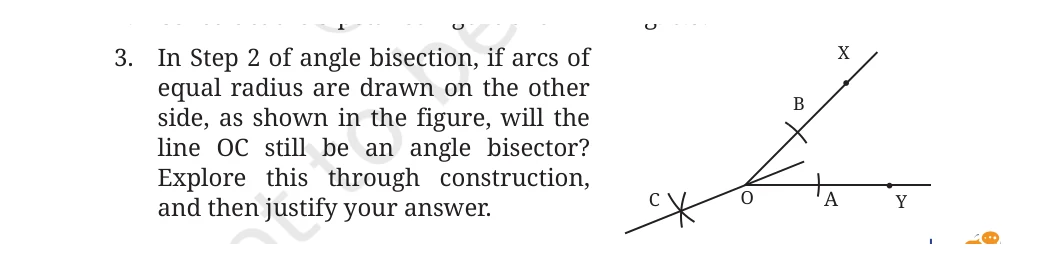
In the process of angle bisection, if arcs of equal radius are drawn on the other side, as shown in the figure, will the line OC still be an angle bisector? Explore this through construction, and then justify your answer.
Show solution
Let ∠XOY be any angle. With centre at O, draw an arc intersecting the lines OX and OY at A and B respectively. With centres at A and B, draw arcs of the same radius so that the arcs intersect at a point, say C. Join AC, BC, and OC. Extend CO to CD. We have OA = OB and AC = BC. In ∆OAC and ∆OBC, we have OA = OB, AC = BC, and OC is common.
Therefore, ∆OAC ≅ ∆OBC (Using SSS rule) Therefore, ∠AOC = ∠BOC Therefore, 180° – ∠AOC = 180° – ∠BOC Therefore, ∠AOD = ∠BOD Therefore, Line OD is the bisector of the angle ∠XOY. Therefore, Line OC is the bisector of the angle ∠XOY.
Textbook page 9 · solved item 10

What are the other angles that can be constructed using angle bisection? Can you construct a 65.5° angle?
Show solution
By using the angle bisector method, we can bisect any given angle. Using a ruler and compass, we know the method of making a 90° angle on a line. We have \frac {90}{2} = 45° and \frac {45}{2} = 22.5°. Therefore, By using an angle bisector, we can make angles of 45° and 22.5°. Also, 90° + 45° = 135°, 90° + 22.5° = 112.5°, 45° + 22.5° = 67.5°.
Therefore, We can also construct angles 135°, 112.5°, and 67.5° using the angle bisector. Therefore, By using angle bisector, we cannot construct angle of 65.5°.
Textbook page 9 · solved item 11
Come up with a method to construct the angle bisector using a rope.
Show solution
Let ∠XOY be the given angle. Fix a small pole at the point O. Take a rope and make a loop at one end. Mark a point at some distance on the rope. Fix the loop of the rope at the pole at O and rotate the rope from OX to OY. Mark points A and B at a fixed distance mark on the rope. Fix small poles at A and B.
Take a rope and make loops on both ends. Fix the loops of this piece of rope with poles at A and B. Mark the midpoint of this rope and hold the rope at the midpoint. Make both ends of the rope tight and mark the point at the midpoint of the rope. Let this point be M. Join AM, BM, and OM. We have OA = OB and AM = BM.
In ∆OAM and ∆OBM, we have OA = OB, AM = BM, and OM is common. Therefore, ∆OAM = ∆OBM (Using SSS-rule) Therefore, ∠AOM = ∠BOM Therefore, ∠XOM = ∠YOM Therefore, OM is the bisector of the given angle ∠XOY.
Complete worked answers
Textbook page 10
Textbook page 10 · solved item 12
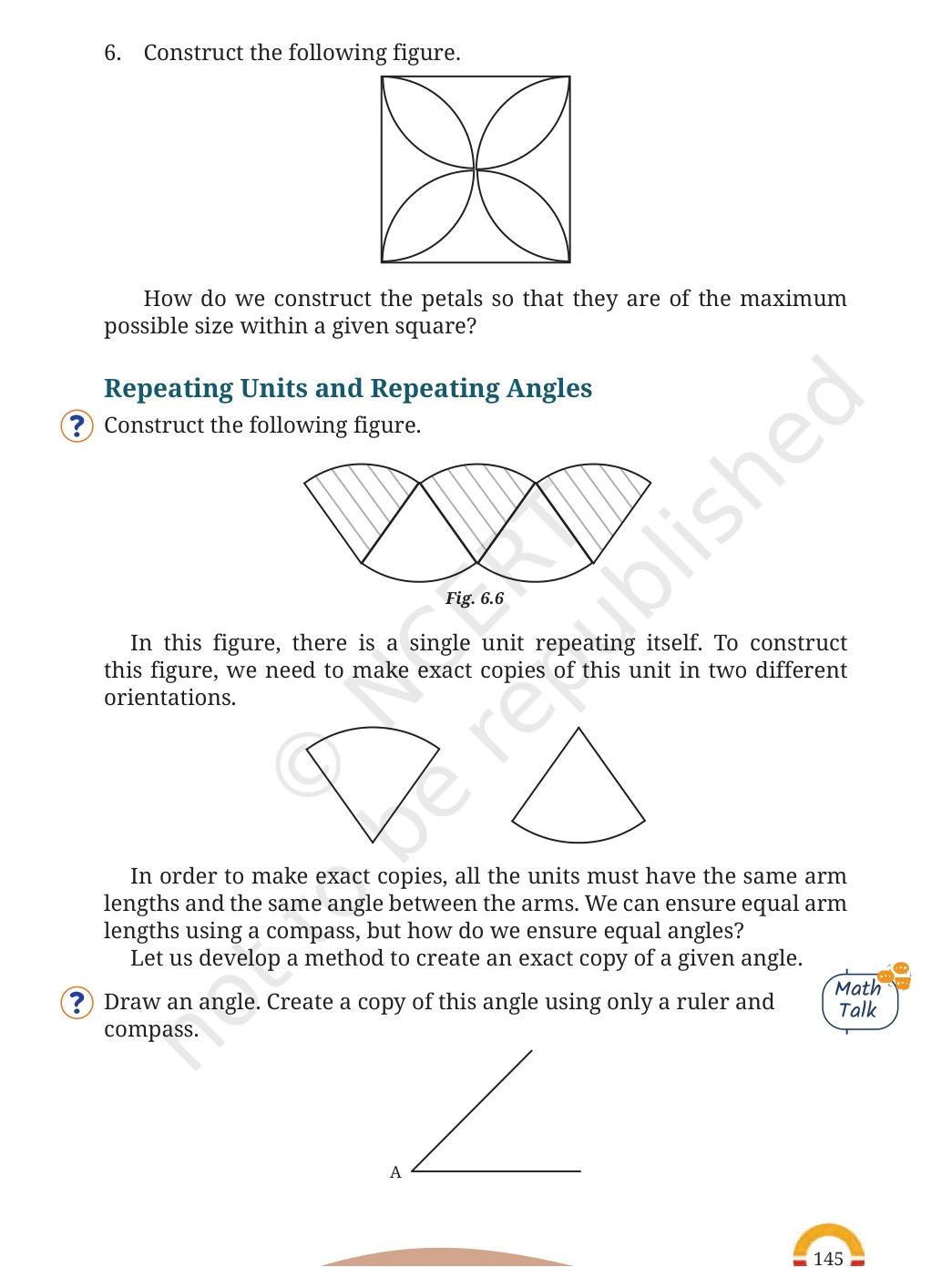
Construct the following figure: How do we construct the petals so that they are of the maximum possible size within a given square?
Show solution
Draw a line and take points A and B on it. With A and B as centres, draw semicircles intersecting the lines at the points C, D, E, and F. With centres at C and D, draw arcs of equal radius to intersect at the point G. With centres at E and F, draw arcs of equal radius to intersect at the point H. Join AG and BH.
Take point I and J on AG and BH, respectively, so that AI = BJ = AB. Join I and J. Here ABJI is a square. Using a ruler and a compass, find perpendicular bisectors of the sides AB and BJ. With centres at K, L, M, and N, draw semicircles in the square with radius equal to AK. Now, we erase the extra lines and arcs.
The above figure looks as given below: This is the required figure with 4 petals in a square. Here we have drawn 4 semicircles in the square, so that the petals are of the maximum possible size.
Complete worked answers
Textbook page 12
Textbook page 12 · solved item 13
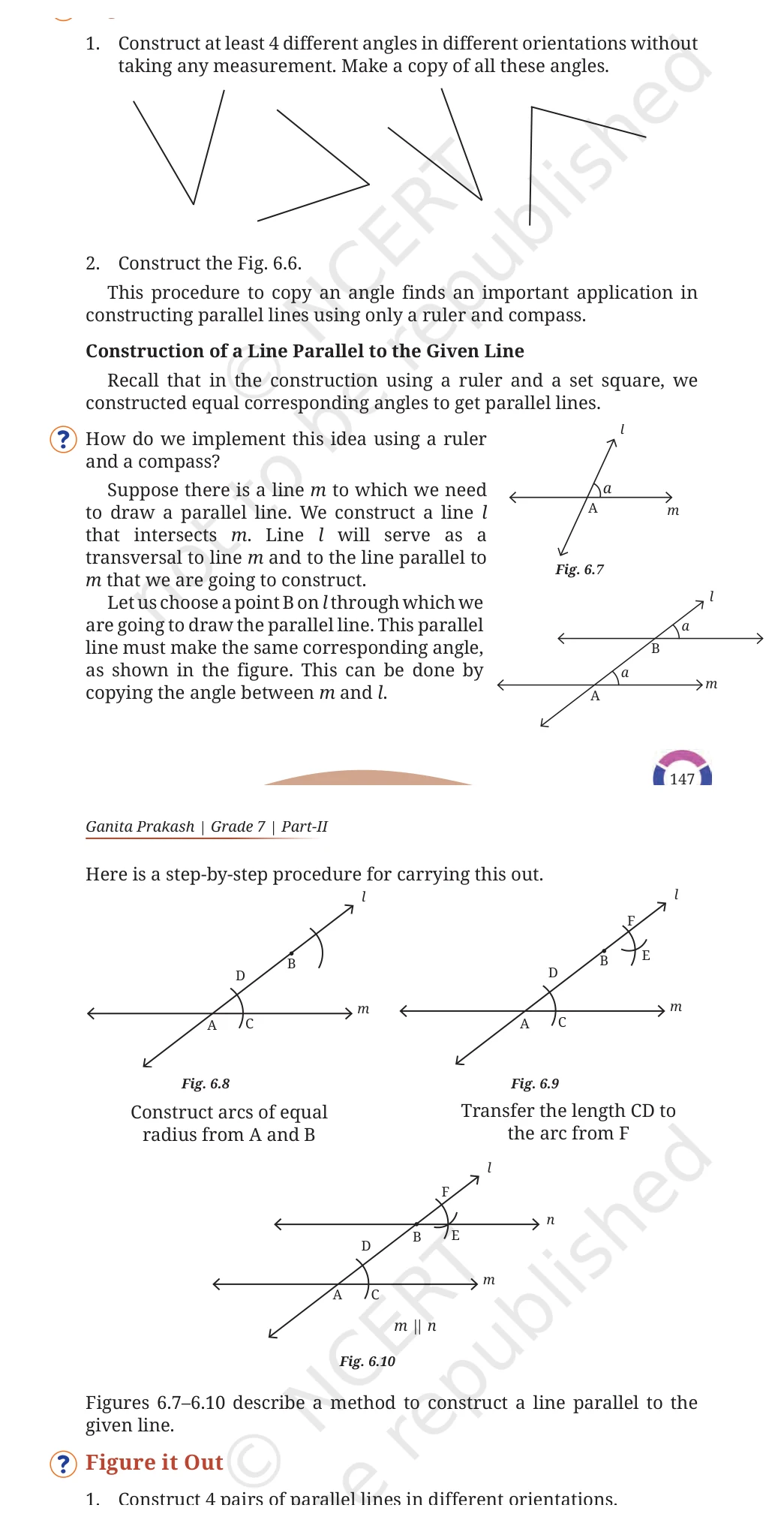
Construct at least 4 different angles in different orientations without taking any measurements. Make a copy of all these angles.
Show solution
The following are the given angles: We shall make a copy of each of the above angles one by one. Angle (i): Draw a line A’B’ along the direction of the line AB. With centre at B and B’, draw arcs of equal radius. Let the arc intersect AB and BC at M and N, respectively. Let the arc intersect A’B’ at M.
Measure MN using a compass. Transfer this length on the arc from M’ to get M’N’ = MN. Join B’ and N’. ∠A’B’C’ is the required angle. Angle (ii): Draw a line D’E’ along the direction of the line DE. With centres at E and E’, draw arcs of equal radius. Let the arc intersect DE and EE at O and P, respectively.
Let the arc intersect D’E’ at O’. Measure OP using a compass. Transfer this length on the arc from O’ to get O’P’ = OP. Join E’ and P’. ∠D’E’F’ is the required angle. Angie (iii): Draw a line G’H’ along the direction of the line GH. With centres at H and H’, draw arcs of equal radius. Let the arc intersect GH and HI at Q and R, respectively.
Let the arc intersect G’H’ and at Q’. Measure QR using a compass. Transfer this length on the arc from Q’ to get Q’R’ = QR. Join H’ and R’. ∠G’H’I’ is the required angle. Angle (iv): Draw a line J’K’ along the direction of the line JK. With centres at K and K’, draw arcs of equal radius. Let the arc intersect JK and KL at S and T, respectively.
Let the arc intersect J’K’ at S’. Measure ST using a compass. Transfer this length on the arc from S’ to get S’T’ = ST. Join K’ and T. ∠J’K’L’ is the required angle.
Complete worked answers
Textbook page 13
Textbook page 13 · solved item 14
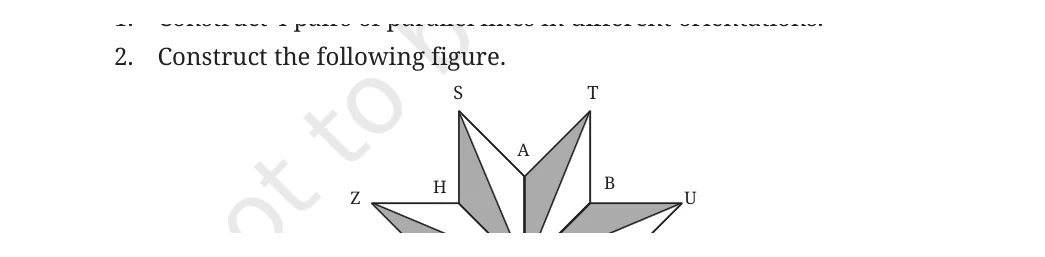
Construct the following figure:
Show solution
We name the vertices of the given figure as A, B, C, D, E, F, G. Draw a line A’B’ equal to AB and along the direction of the line AB. With centre at B’. draw an arc of radius A’B’. Measure AC using a compass. Transfer this length on the arc from A’ to get A’C’ = AC. Join B’ and C’. Shade this sector as shown in the given figure.
With centre at C’, draw an arc of radius B’C’. Measure BD using a compass. Transfer this length on the arc from B’ to get B’D’ = BD. Join C’ and A’. With centre at D’, draw an arc of radius C’D’. Measure CE using a compass. Transfer this length on the arc from C’ to get C’E’ = CE. Join D’ and E’. Shade this sector as shown in the given figure.
With centre at E’, draw an arc of radius D’E’. Measure DF using a compass. Transfer this length on the arc from D’ to get D’F’ = DF. Join E’ and F’. With centre at F’, draw an arc of radius E’F’. Measure EF using a compass. Transfer this length on the arc from E’ to get E’G’ = EG. Join F’ and G’. Shade this sector as shown in the given figure.
Erase the extra arcs from the figure constructed to get the required figure.
Textbook page 13 · solved item 15
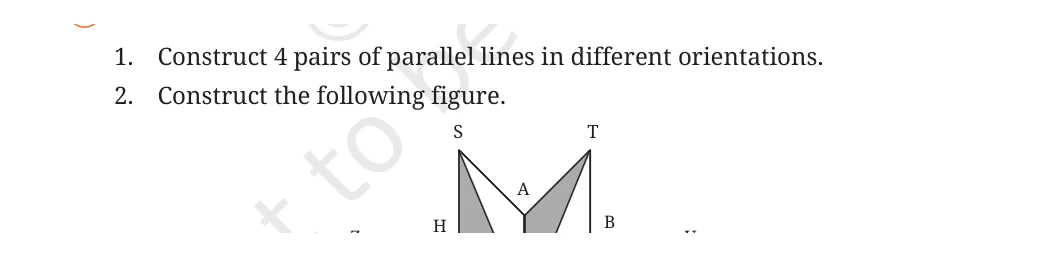
Construct 4 pairs of parallel lines in different orientations.
Show solution
Let AB be a given line; we shall draw a line parallel to the line AB. Draw a line CD intersecting the line AB. Choose a point P on the line CD. We shall draw a line parallel to AB and passing through P. With centres at E and P, draw arcs of equal radius. Measure FG using a compass. Transfer this length on the arc from H to get HI = FG.
Join P and I and extend this line on both sides. Here, CD is a transversal, and the corresponding angles ∠PEB and ∠CPK are equal. Therefore, The lines AB and JK are parallel lines. Similarly, we can draw three other pairs of parallel lines.
Textbook page 13 · solved item 16
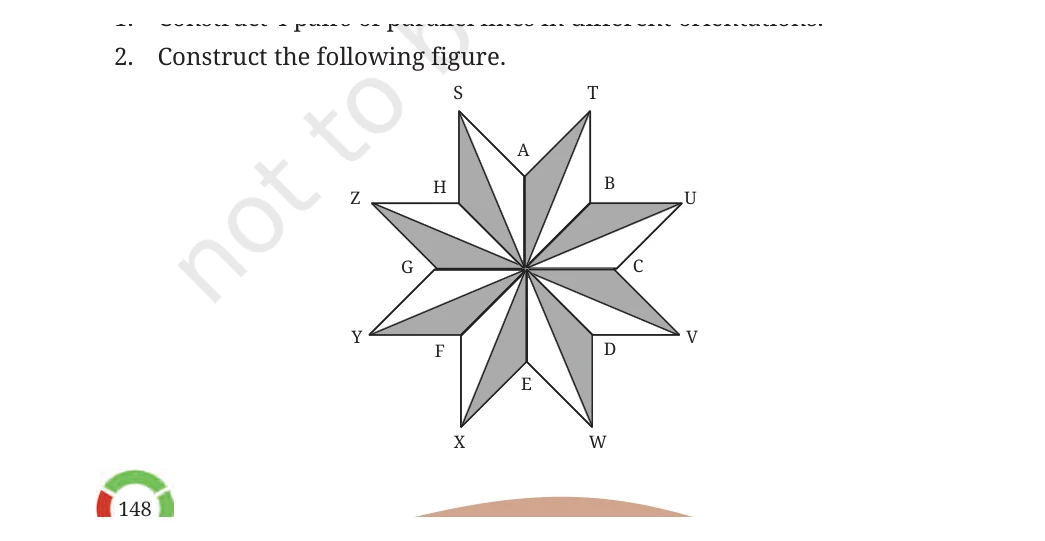
Construct the following figure:
Show solution
The given figure consists of 8 rhombuses. Since \frac {360}{8} = 45°, the acute angle between the adjacent sides of the rhombus is 45°. We shall form 8 rhombuses of the same size and place them together to form the given figure. Draw a line and take a point A on it. With centre at A, draw a semicircle.
With centres at B and C, draw arcs of equal radius. Let the arcs intersect at point D. Join AD. Now, we shall draw the bisector of angle ∠CAD. With centres at C and E, draw arcs of equal radius. Let the arcs intersect at point F. Join AF. With centre at A, draw an arc intersecting AC and AF at G and H respectively.
With centres at G and H, draw arcs of equal radius equal to AG. Let these arcs meet at I. Join AI. Here, AGIH is a rhombus with base angle 45°. Erase the extra arcs and lines, colour the upper triangles AHI using a colour pencil, as shown in the following figure: Using a tracing paper, we make 8 replicas of this figure and place them together without any gaps to get the required figure.
Complete worked answers
Textbook page 16
Textbook page 16 · solved item 17

Use support lines in the given figure to construct a pointed arch. Make different arches by changing the radius of the arcs.
Show solution
The following is the given figure: Draw a vertical line B’D’. With centres at B and B’, draw arcs of equal radius. Measure RS using a compass. Transfer this length on the arc from S’ to get R’S’ = RS. Join B’ and R’ and extend this line. Make B’A’ equal to BA. Measure ST using a compass. Transfer this length on the arc from S’ to get S’T’ = ST.
Join B’ and T’ and extend this line. Make B’C’ equal to BC. Using a compass, find the midpoints M and N of A’B’ and B’C’ respectively. On the lines A’M, MB’, B’N, and NC’, draw similar arcs as shown in the figure. Erase the extra letters, lines, and arcs to get the required pointed arch with given support lines.
Textbook page 16 · solved item 18
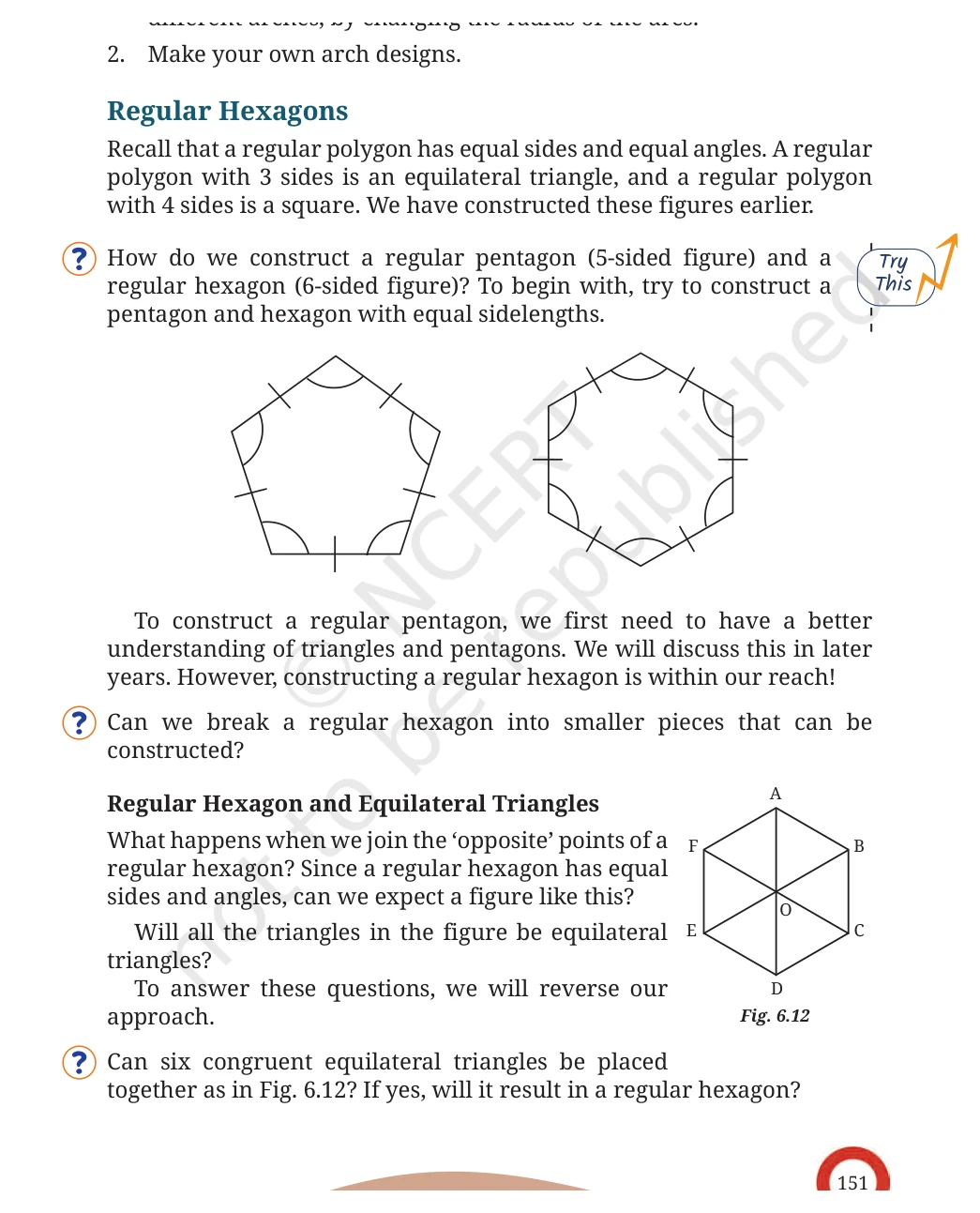
Make your own arch design.
Show solution
Draw a vertical line AB. With the centre at A, draw an arc. With centre at C, draw an arc intersecting the arc at D and E. Join AD and AE and extend these lines. Take points F on AD and G on AE such that AF = AG. Let M and N be the midpoints of AF and AG, respectively. Using a compass, draw semicircles on the lines MF, AM, AN, and NG.
Erase the extra letters, lines, and arcs to get the required arch design.
Complete worked answers
Textbook page 19
Textbook page 19 · solved item 19
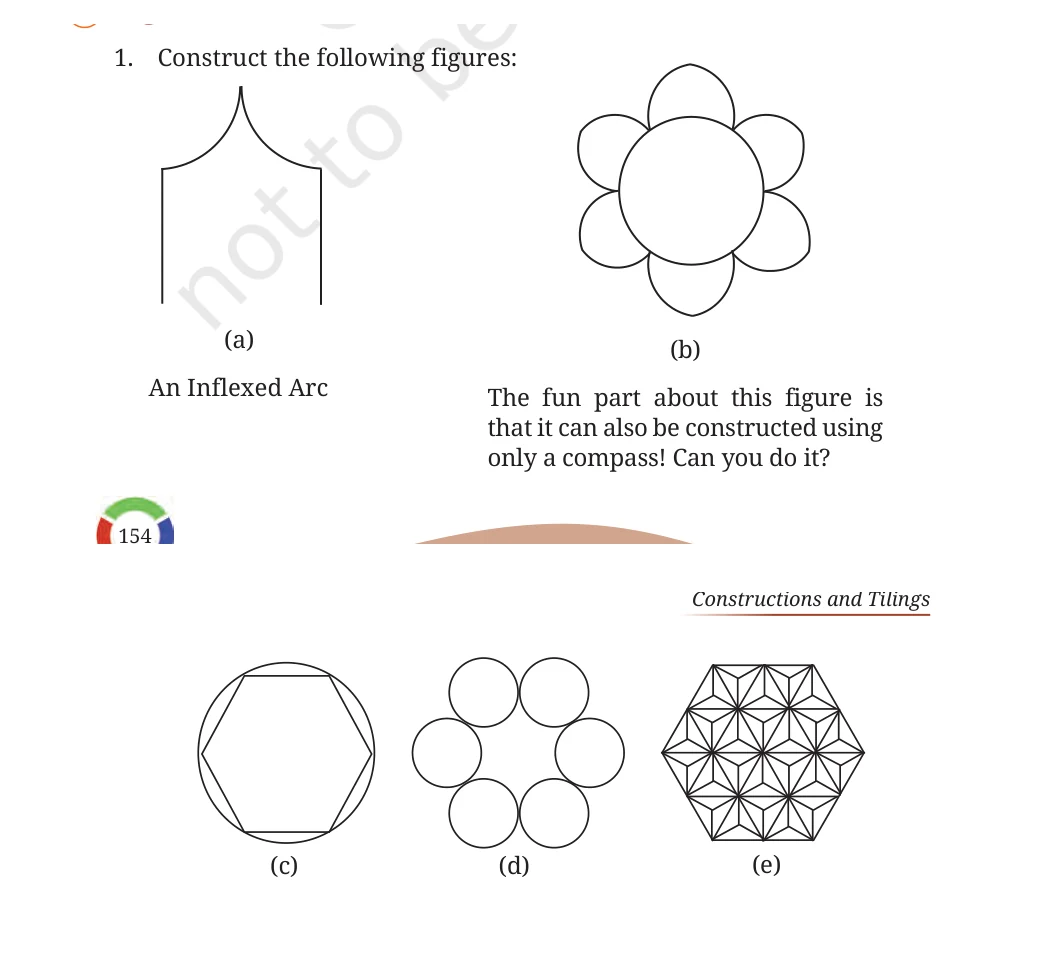
Construct the following figures:
Show solution
(a) Draw a line and take points A and B on it. Draw perpendiculars at A and B below the line using a ruler and a compass as shown in the figure. Draw equal lines AC and BD. Find the mid-point M of the line AB. With centres at A and B and radius AM, draw arcs as shown in the figure. Erase the extra lines, arcs, and letters to get the required figure of an inflexed arc as shown above.
(b) This figure is called the ‘Flower of Life’. Draw a circle. This is called the central circle of the required figure. Take any point A on the circumference and draw an arc of the same radius as that of the circle outside the circle and touching its circumference at B and C. With centre at B, draw an arc of the same radius outside the circle and touching its circumference.
Repeat the process and complete the pattern as shown below: Erase the extra arcs and letters to get the required figure of a ‘Flower of Life’ as shown below. (c) Draw a circle. Take any point A on the circumference and draw an arc with centre at A and radius that to the circle’s and intersecting the circle at B.
With the centre at B and the same radius, draw an arc intersecting the circle at C. Repeat this process and get points of intersection D, E, and F. Join AB, BC, CD, DE, EF, and FA. Erase the arcs and letters to get the required figure as shown above. (d) Draw a circle. Take any point A on the circle and draw an arc of the same radius as that of the circle intersecting the circle at B.
With B as centre, draw an arc of the same radius intersecting the circle at C. Repeat this process and find points D, E, and F. Join O and A. Find the mid-point of OA. Let M be the midpoint of OA. With centres at A, B, C, D, E, and F, draw circles of radius equal to OM. Erase the extra lines, arcs, and letters to get the required figure as shown above.
(e) Draw a circle. Take any point A on the circle and draw an arc with centre at A and radius OA, intersecting the circle at B. With the centre at B and the same radius, draw an arc intersecting the circle at C. Repeat this process and get points of intersection D, E, and F. Draw a circle with centre O and radius twice OA.
Join OA and extend it to intersect the outer circle at A’. Similarly, draw other extended lines. Join the lines as shown in the figure. There are 5, 7, 7, 5 triangles in Ist, IInd, IIIrd, and IVth rows respectively. Join the vertices of each triangle to the centre of the respective triangle. Erase the extra lines, arcs, and letters to get the required figure.
Complete worked answers
Textbook page 20
Textbook page 20 · solved item 20
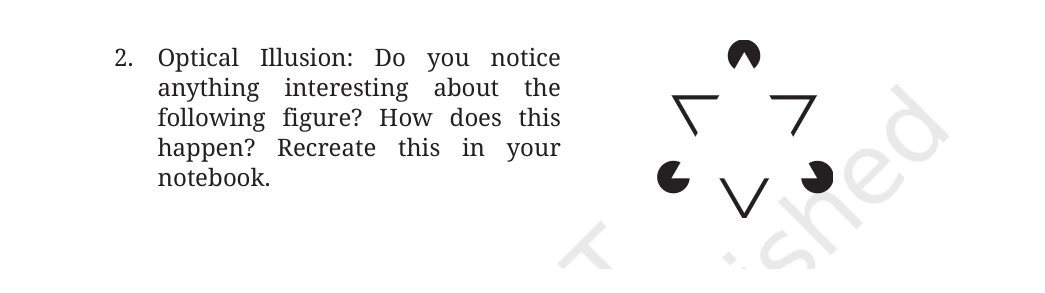
Optical Illusion: Do you notice anything interesting about the following figure? How does this happen? Recreate this in your notebook.
Show solution
Draw a circle. Take any point A on the top of the circle and draw an arc with centre at A and radius as that of the circle and intersecting the circle at B. With the centre at B and the same radius, draw an arc intersecting the circle at C. Repeat this process to get points of intersection D, E, and F.
Join AC, CE, EA, BD, DF, and FB. Draw three equal circles with wedges removed at A, C, and E as shown above. Erase the extra arcs, circle, and letters to get the required figure as shown above. The above figure is called the Kanizsa triangle. The three circles with wedges removed and three V-shaped angles are arranged in such a way that the brain perceives a white equilateral triangle pointing upward-even though no such triangle is actually drawn.
Textbook page 20 · solved item 21
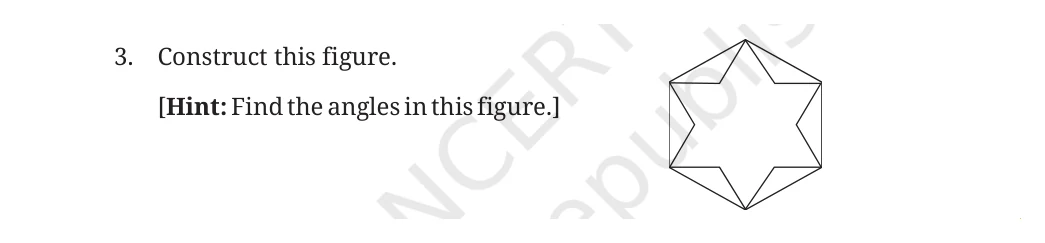
Construct this figure. [Hint: Find the angles in this figure.]
Show solution
Draw a circle. Take any point A on the top of the circle and draw an arc with centre at A and radius as that of the circle and intersecting the circle at B. With the centre at B and the same radius, draw an arc intersecting the circle at C. Repeat this process to get points of intersection D, E, and F.
Join the lines as shown in the figure. Erase the extra arcs, circle, and letters to get the required figure as shown above.
Textbook page 20 · solved item 22
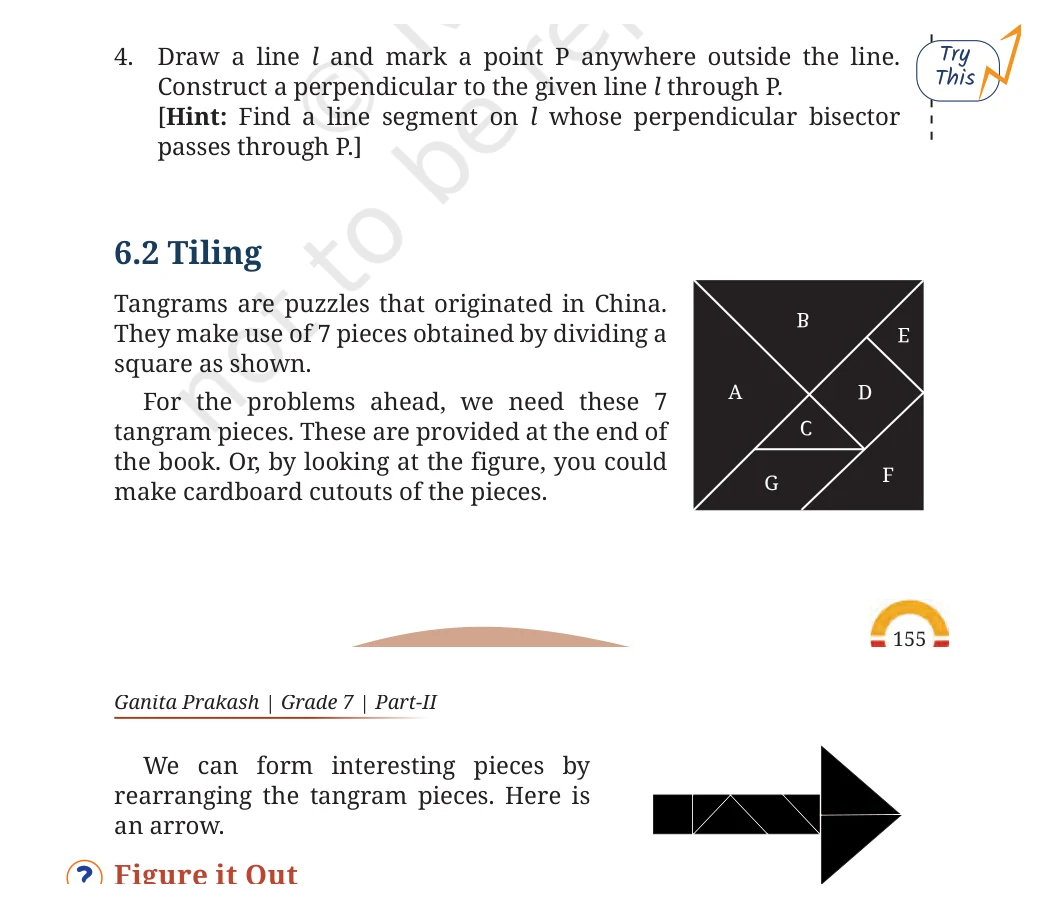
Draw a line l and mark a point P anywhere outside the line. Construct a perpendicular to the given line l through P. [Hint: Find a line segment on l whose perpendicular bisector passes through P.]
Show solution
Draw a line l and take a point P outside l. With centre P, draw an arc so that it cuts the line l at two points, say A and B. We shall find the perpendicular bisector of the line segment AB. With centres at A and B, draw arcs of equal radius above and below AB. Let the arcs intersect at the points C and D.
Join CD and extend it, if P is not on this line. The line CD is perpendicular to the given line l and passes through the given point P.
Complete worked answers
Textbook page 21
Textbook page 21 · solved item 23
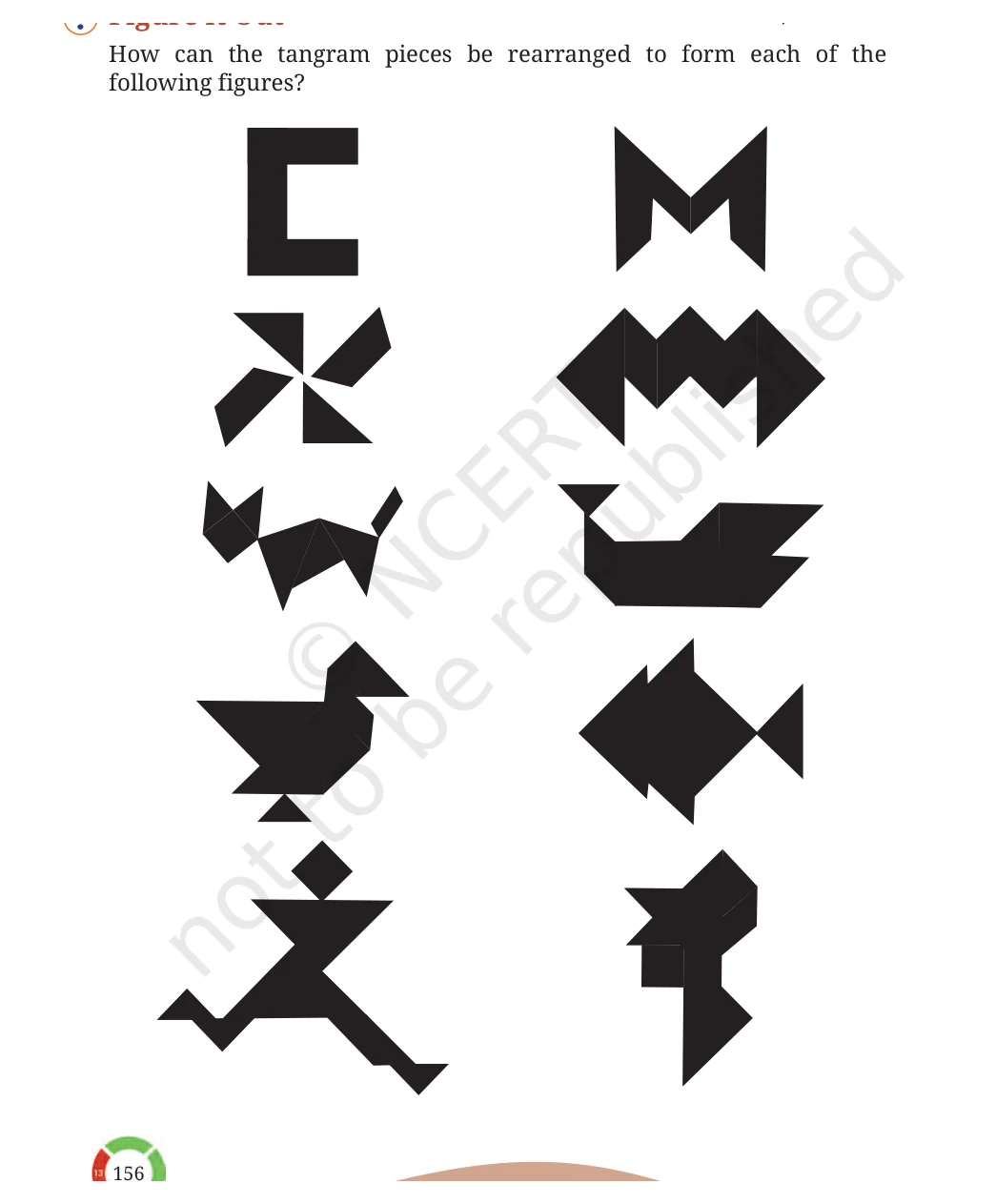
How can the tangram pieces be rearranged to form each of the following figures?
Show solution
To solve this problem, we prepare 10 sets of 7 tans obtained from a tangram-based shape given below:
Complete worked answers
Textbook page 25
Textbook page 25 · solved item 24
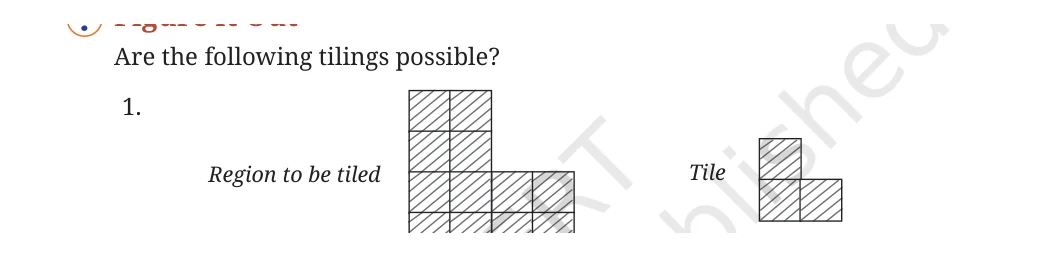
Is the following tiling possible?
Show solution
The given tiles can be used for tiling the region. The tiling shall use 4 tiles of the given shape.
Textbook page 25 · solved item 25
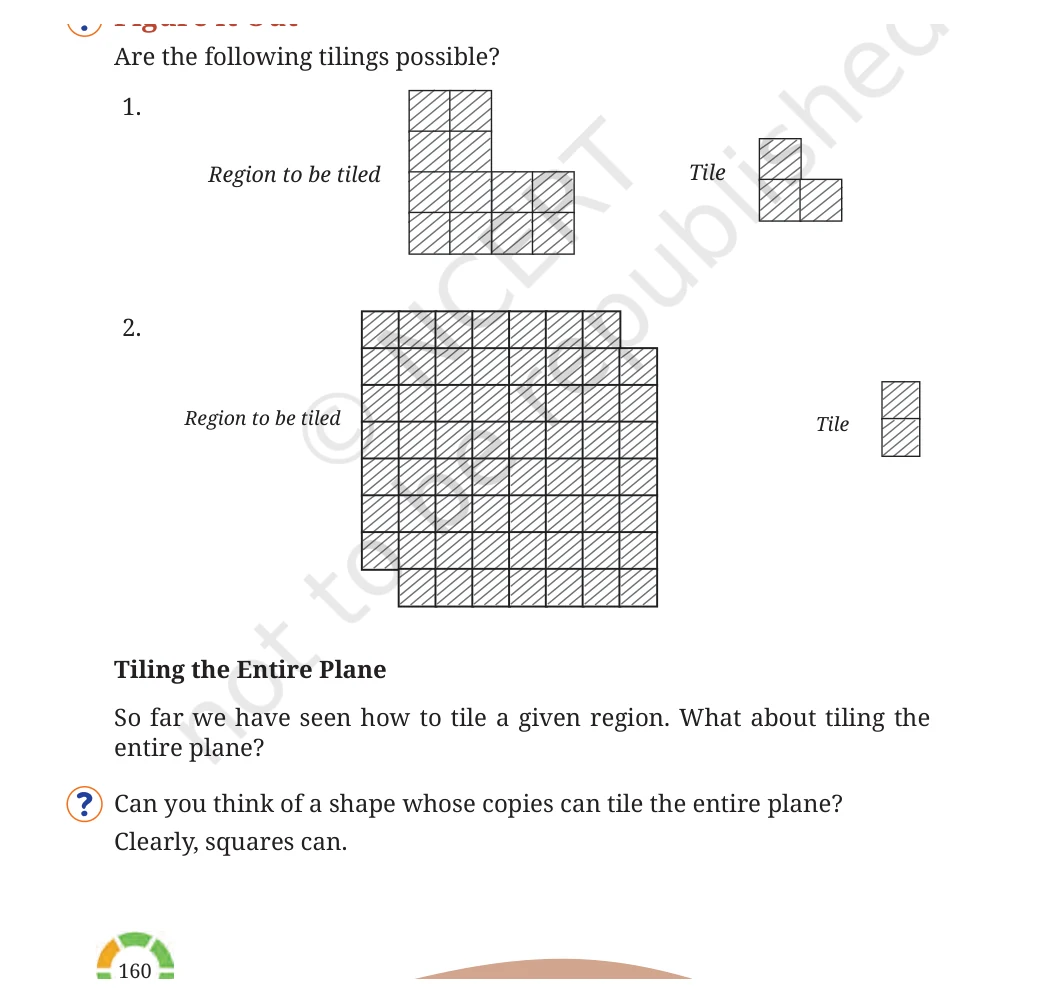
Is the following tiling possible?
Show solution
The black-and-white region of the given region is shown in the figure. This region is to be tiled by tiles of the form shown in the figure. In the given region, there are 30 black squares and 32 white squares. Since these numbers are not equal, the given region cannot be tiled by using the tiles of the given shape.