
Use the textbook context
Match, attempt, then check
Each crop extends to the next solved item, so diagrams, tables and connected instructions stay with the question.
Complete worked answers
Textbook page 2
Textbook page 2 · solved item 1
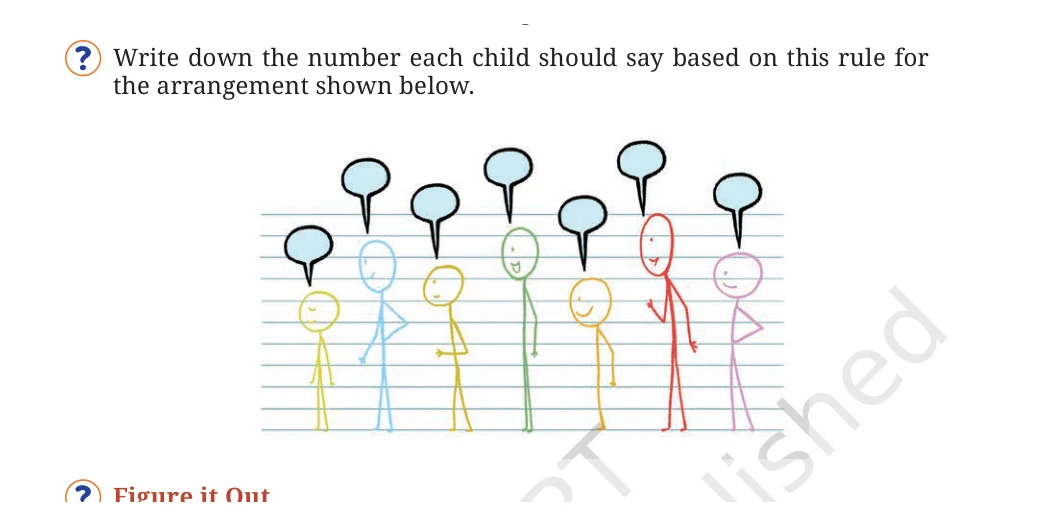
Write down the number each child should say based on this rule for the arrangement shown below.
Show solution
Figure it Out
Textbook page 2 · solved item 2
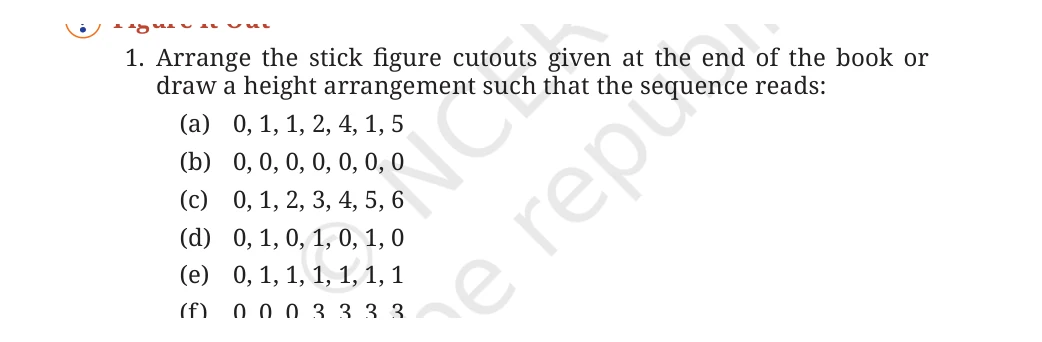
1. Arrange the stick figure cutouts given at the end of the book or draw a height arrangement such that the sequence reads: (a) 0, 1, 1, 2, 4, 1, 5 (b) 0, 0, 0, 0, 0, 0, 0 (c) 0, 1, 2, 3, 4, 5, 6 (d) 0, 1, 0, 1, 0, 1, 0 (e) 0, 1, 1, 1, 1, 1, 1 (f) 0, 0, 0, 3, 3, 3, 3
Show solution
0 0 1 0 3 0 3 (a) 0, 1, 1, 2, 4, 1, 5 (b) 0, 0, 0, 0, 0, 0, 0 (c) 0, 1, 2, 3, 4, 5, 6 0 1 1 2 4 1 5 0 0 0 0 0 0 0 0 1 2 3 4 5 6 (d) 0, 1, 0, 1, 0, 1, 0 (e) 0, 1, 1, 1, 1, 1, 1 (f) 0, 0, 0, 3, 3, 3, 3 0 1 0 1 0 1 0 0 1 1 1 1 1 1 0 0 0 3 3 3 3
Textbook page 2 · solved item 3
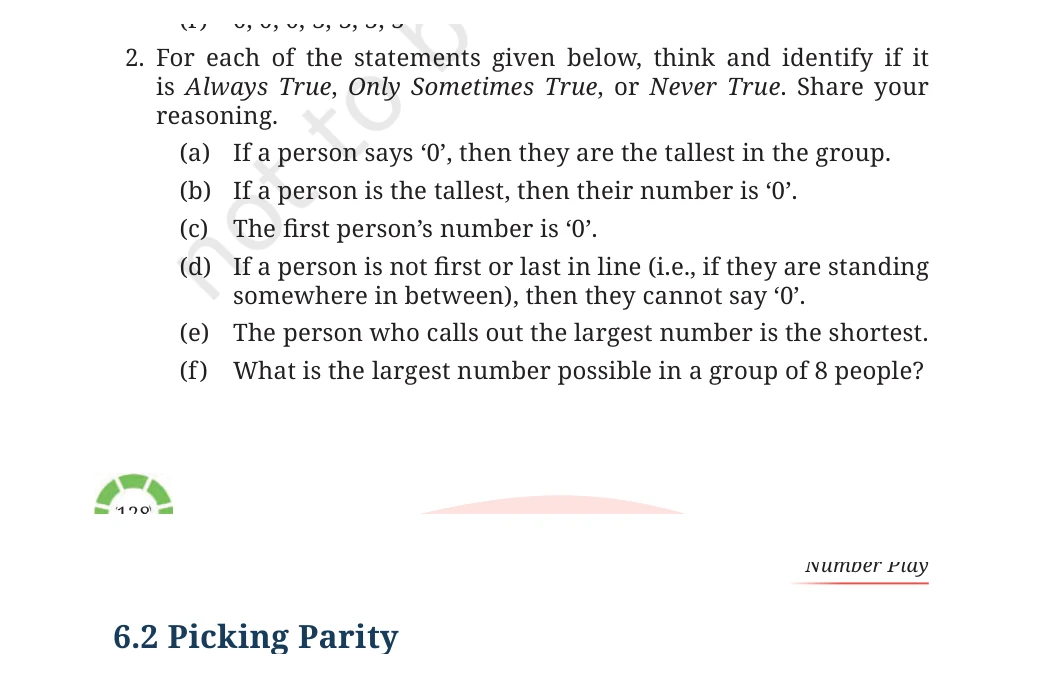
2. For each of the statements given below, think and identify if it is Always True, Only Sometimes True, or Never True. Share your reasoning. (a) If a person says ‘0’, then they are the tallest in the group. (b) If a person is the tallest, then their number is ‘0’. (c) The first person’s number is ‘0’. (d) If a person is not first or last in line (i.e., if they are standing somewhere in between), then they cannot say ‘0’. (e) The person who calls out the largest number is the shortest. (f) What is the largest number possible in a group of 8 people?
Show solution
(a) It’s only sometimes true because a tall person might say '0' if there’s no one taller in front of them, but a short person can also say '0' if they are at the front or if no one taller is ahead of them. (b) It’s always true because the tallest person never has anyone taller in front of them and would always say ‘0’.
(c) It’s always true because there is no one taller in front of the first person, so they will always say ‘0’. (d) It’s only sometimes true because a person standing somewhere in the middle of the line can say ‘0’ if no one taller is in front of them. (e) It’s only sometimes true because the shortest person can even call out ‘0’ when they are standing first in the line, and the second shortest person could be at the back and still call out the largest number.
(f) The largest possible number in a group of 8 people is 7 because the shortest person, standing at the end of the line, can see 7 taller people in front of them.
Complete worked answers
Textbook page 3
Textbook page 3 · solved item 4
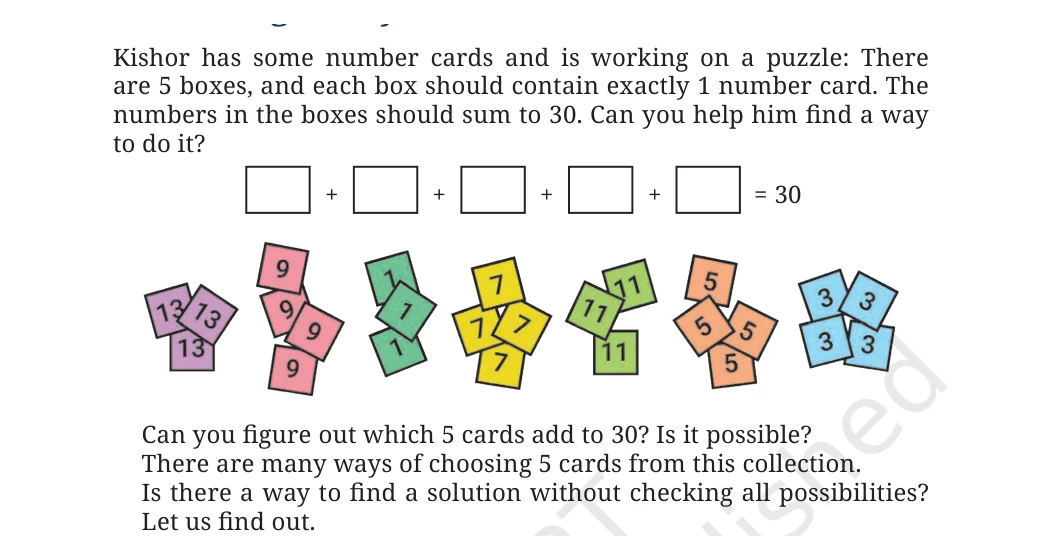
Kishor has some number cards and is working on a puzzle: There are 5 boxes, and each box should contain exactly 1 number card. The numbers in the boxes should sum to 30. Can you help him find a way to do it? Can you figure out which 5 cards add to 30? Is it possible?
Show solution
Adding odd numbers for an odd number of times gives odd numbers. Since 30 is an even number, it is impossible to add five odd numbers to get an even number.
Textbook page 3 · solved item 5
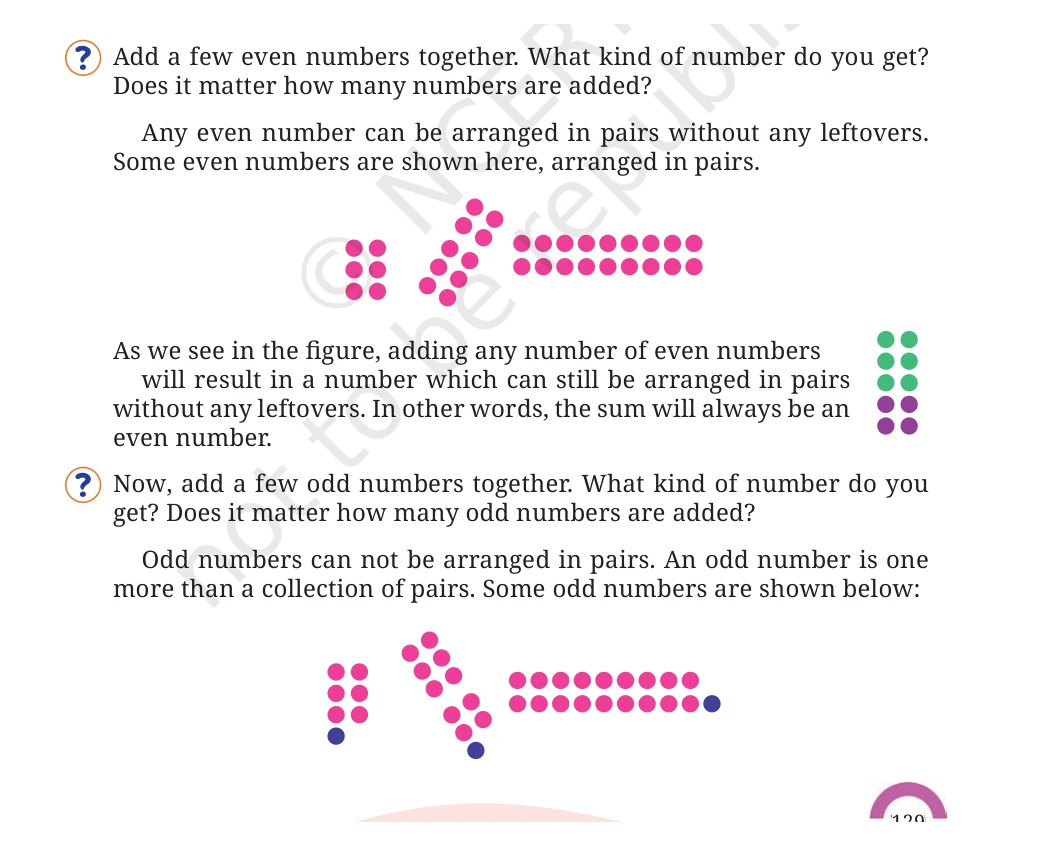
Add a few even numbers together. What kind of number do you get? Does it matter how many numbers are added?
Show solution
Even numbers, when added together, always result in an even number. It doesn’t matter how many even numbers are added—their sum will always be even. Figure it out
Complete worked answers
Textbook page 5
Textbook page 5 · solved item 6
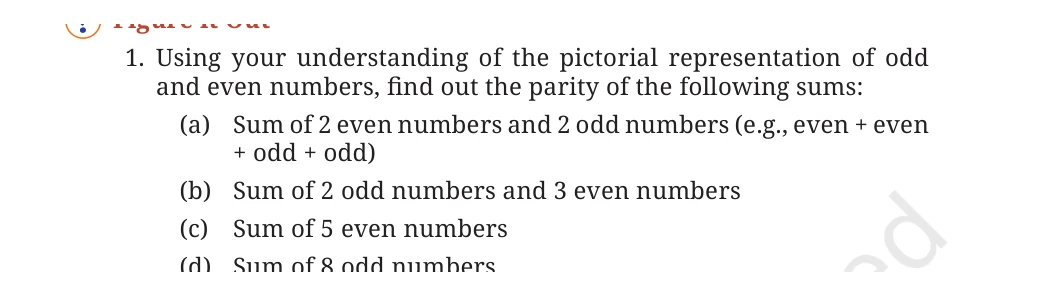
1. Using your understanding of the pictorial representation of odd and even numbers, find out the parity of the following sums: (a) Sum of 2 even numbers and 2 odd numbers (e.g., even + even + odd + odd) (b) Sum of 2 odd numbers and 3 even numbers (c) Sum of 5 even numbers (d) Sum of 8 odd numbers
Show solution
(a) Sum of 2 even numbers and 2 odd numbers Even + Even = Even, and Odd + Odd = Even. Since Even + Even = Even, the total sum is Even. Therefore, the parity of the sum of 2 even numbers and 2 odd numbers is even. Example: 2 + 4 + 1 + 3 = 6 + 4 = 10 (even). (b) Sum of 2 odd numbers and 3 even numbers Odd + Odd = Even, and Even + Even + Even = Even.
Even + Even = Even, so the total sum is Even. Therefore, the parity of the sum of 2 odd numbers and 3 even numbers is even. Example: 1 + 3 + 2 + 4 + 6 = 4 + 12 = 16 (even). (c) Sum of 5 even numbers The sum of any number of even numbers is always an even number. Therefore, the parity of the sum of 5 even numbers is even.
Example: 2 + 4 + 6 + 8 + 10 = 30 (even). (d) Sum of 8 odd numbers When an even number of odd numbers are added, the result is even. Therefore, the parity of the sum of 8 odd numbers is even. Example: 1 + 3 + 5 + 7 + 9 + 11 + 13 + 15 = 64 (even).
Textbook page 5 · solved item 7

2. Lakpa has an odd number of ₹1 coins, an odd number of ₹5 coins and an even number of ₹10 coins in his piggy bank. He calculated the total and got ₹205. Did he make a mistake? If he did, explain why. If he didn’t, how many coins of each type could he have?
Show solution
The total value of an odd number of ₹1 coins is odd. The total value of an odd number of ₹5 coins is odd. The total value of an even number of ₹10 coins is even. Adding the values of all the coins: Odd + Odd + Even = Even + Even = Even. Therefore, the parity of the sum of ₹1 coins, ₹5 coins, and ₹10 coins is even.
But Lakpa calculated a total of ₹205, which is odd. Therefore, Lakpa must have made a mistake! The total can never be ₹205 with the given coin counts.
Textbook page 5 · solved item 8
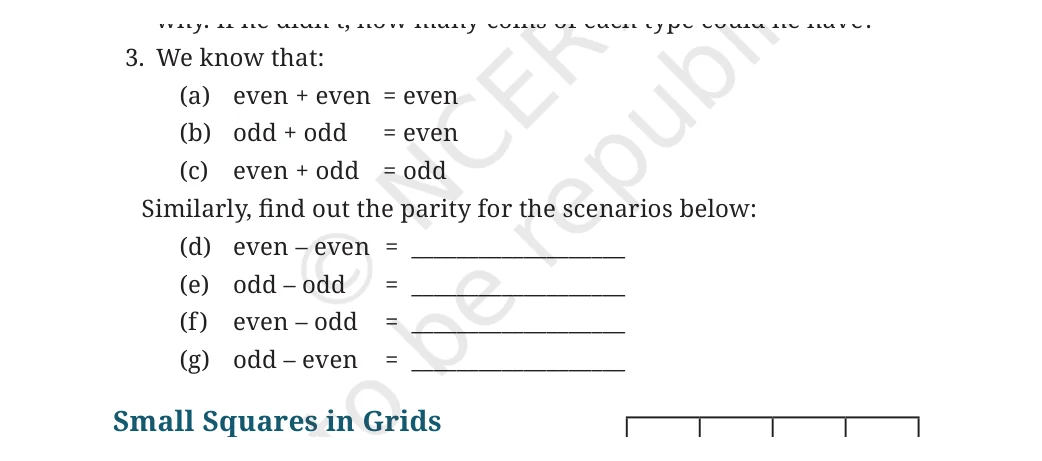
3. We know that: (a) even + even = even (b) odd + odd = even (c) even + odd = odd Similarly, find out the parity for the scenarios below: (d) even – even = ______________ (e) odd – odd = ______________ (f) even – odd = ______________ (g) odd – even = _____________
Show solution
(d) Since 8 – 4 = 4 (even) 10 – 4 = 6 (even) Therefore, Even – even = even . (e) Since 11 – 7 = 4 (even) 13 – 5 = 8 (even) Therefore, Odd – odd = even . (f) Since 8 – 5 = 3 (odd) 10 – 5 = 5 (odd) Therefore, Even – odd = odd . (g) Since 9 – 4 = 5 (odd) 11 – 6 = 5 (odd) Therefore, Odd – even = odd . Small Squares in Grids
Textbook page 5 · solved item 9
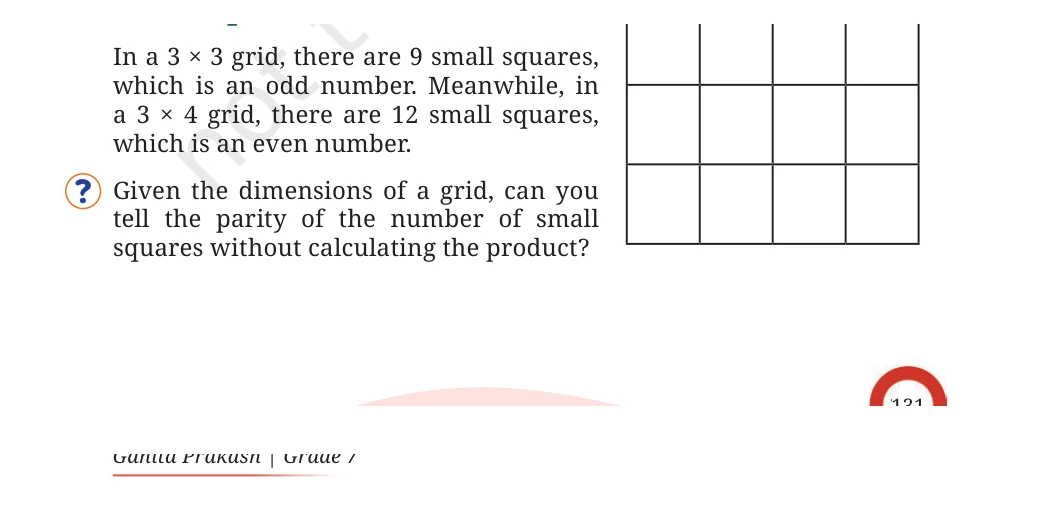
In a 3 × 3 grid, there are 9 small squares, which is an odd number. Meanwhile, in a 3 × 4 grid, there are 12 small squares, which is an even number. Given the dimensions of a grid, can you tell the parity of the number of small squares without calculating the product?
Show solution
The parity of the number of small squares in a grid (with m rows and n columns) is: (i) Even if at least one of the numbers (either m or n) is even. (ii) Odd if both numbers (m and n) are odd. (iii) Even if both numbers (m and n) are even.
Complete worked answers
Textbook page 6
Textbook page 6 · solved item 10
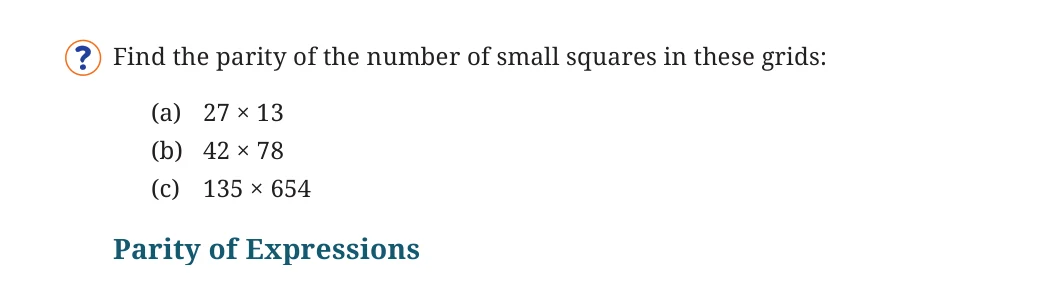
Find the parity of the number of small squares in these grids: (a) 27 × 13 (b) 42 × 78 (c) 135 × 654
Show solution
(a) 27 × 13 27 and 13 are both odd numbers. Since, Odd × Odd = Odd Therefore, the parity of the small squares in 27 × 13 grid is odd. (b) 42 × 78 42 and 78 are both even numbers. Since, Even × Even = Even. Therefore, the parity of the small squares in 42 × 78 grid is even. (c) 135 × 654 135 is odd and 654 is even.
Since, Odd × Even = Even. Therefore, the parity of the small squares in 135 × 654 grid is even. Parity of Expressions
Textbook page 6 · solved item 11
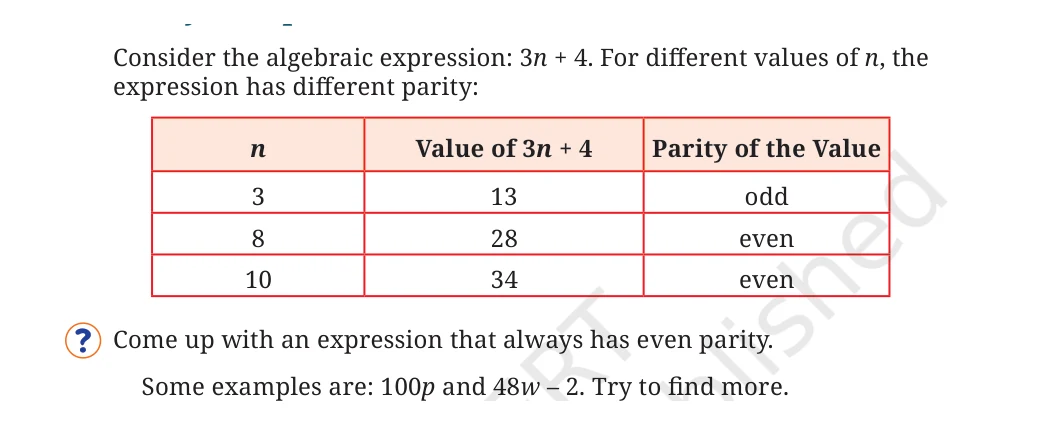
Consider the algebraic expression: 3n + 4. For different values of n, the expression has different parity: Come up with an expression that always has even parity.
Show solution
4n, 8n + 6, 6n + 2 etc.
Textbook page 6 · solved item 12

Come up with expressions that always have odd parity.
Show solution
4n + 3, 6n + 5, 2n + 9 etc.
Textbook page 6 · solved item 13

Come up with other expressions, like 3n + 4, which could have either odd or even parity.
Show solution
5n + 2, 9n + 4, 7n + 8 etc.
Textbook page 6 · solved item 14
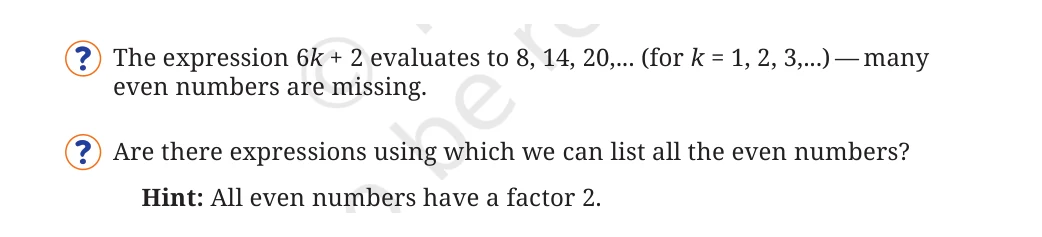
The expression 6k + 2 evaluates to 8, 14, 20,... (for k = 1, 2, 3,...) — many even numbers are missing. Are there expressions using which we can list all the even numbers?
Show solution
The expression 2n evaluates to 2, 4, 6, 8, 10,…… (for n = 1, 2, 3, 4, 5,….). Therefore, 2n is the expression that can list all even numbers.
Textbook page 6 · solved item 15

Are there expressions using which we can list all odd numbers?
Show solution
The expression 2n -1 evaluates to 1, 3, 5, 7, 9,…. (for n = 1, 2, 3, 4, 5,….). Therefore, 2n – 1 is the expression that can list all odd numbers.
Textbook page 6 · solved item 16
What would be the nth term for multiples of 2? Or, what is the nth even number?
Show solution
The nth term for multiples of 2 or the nth even number is 2n. 6.3 Some Explorations in Grids
Complete worked answers
Textbook page 7
Textbook page 7 · solved item 17
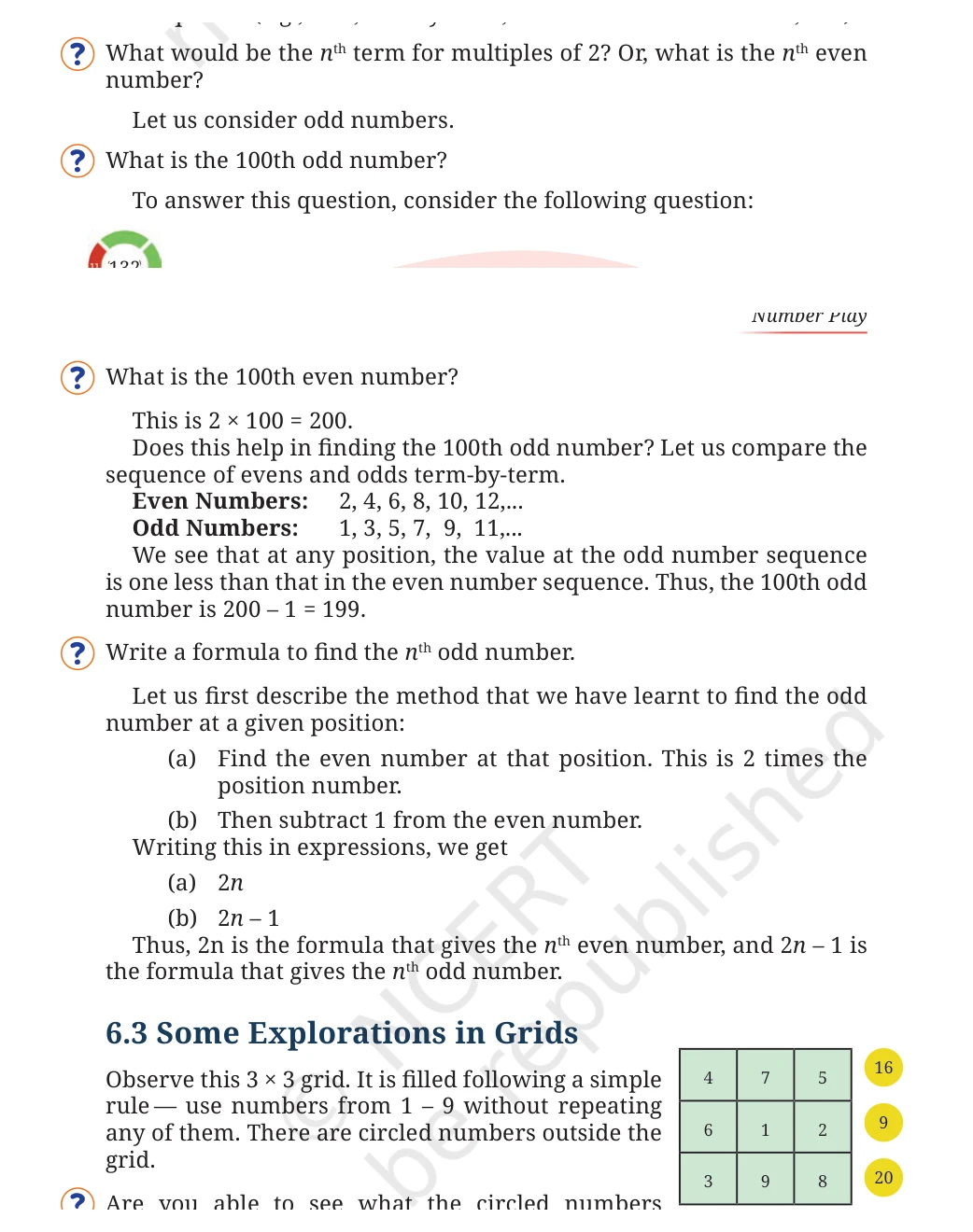
The numbers in the yellow circles are the sums of the corresponding rows and columns. Fill the grids below based on the rule mentioned above:
Show solution
Figure it out
Complete worked answers
Textbook page 10
Textbook page 10 · solved item 18

1. How many different magic squares can be made using the numbers 1 – 9?
Show solution
There is exactly one unique magic square with numbers 1-9 if we ignore rotations and reflections. 1 3 8 7 2 6 4 7 8 9 6 5 1 2 1 9 8 3 4 6 7 2 5
Textbook page 10 · solved item 19

2. Create a magic square using the numbers 2 – 10. What strategy would you use for this? Compare it with the magic squares made using 1 – 9.
Show solution
Magic square made using numbers 1-9: Now, if we add 1 to each number of the magic square 1-9, we will get a magic square with numbers 2-10. Both squares are structurally identical. The only difference is that the magic square with numbers 2–10 has 18 as the magic sum, while the magic square with numbers 1–9 has 15 as the magic sum.
Textbook page 10 · solved item 20
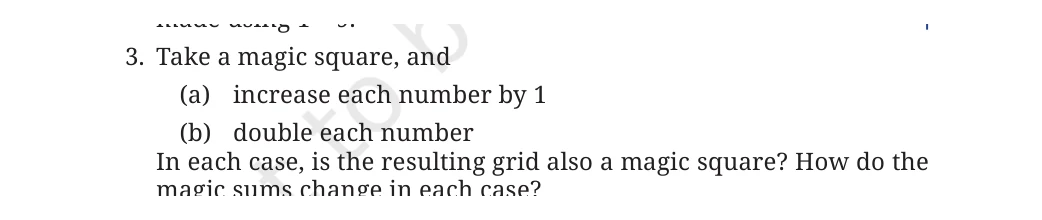
3. Take a magic square, and (a) increase each number by 1 (b) double each number In each case, is the resulting grid also a magic square? How do the magic sums change in each case?
Show solution
Magic square: (a) After increasing each number by 1, we will get a new magic square with the magic sum 18. 1 9 8 3 4 6 7 2 5 2 10 9 4 5 7 8 3 6 1 9 8 3 4 6 7 2 5 (b) After doubling each number, we will get a new magic square with the magic sum 30.
Textbook page 10 · solved item 21

4. What other operations can be performed on a magic square to yield another magic square?
Show solution
Operations like Addition, subtraction, multiplication and division can be performed on a magic square to yield another magic square.
Textbook page 10 · solved item 22
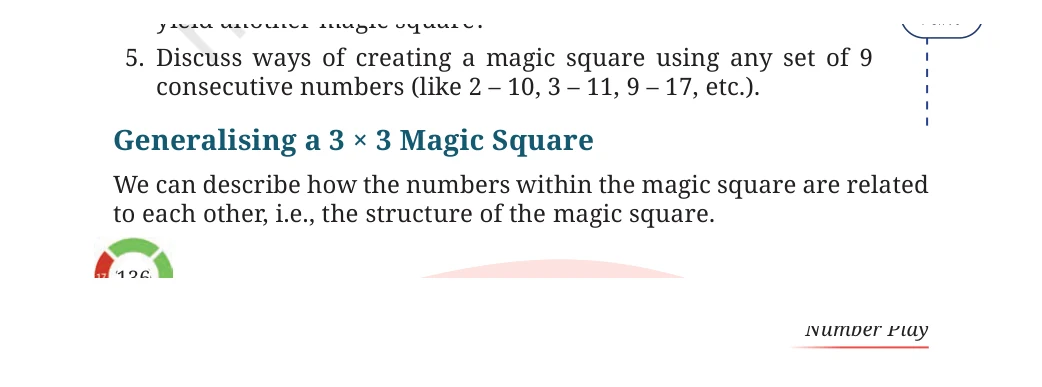
5. Discuss ways of creating a magic square using any set of 9 consecutive numbers (like 2 – 10, 3 – 11, 9 – 17, etc.).
Show solution
Magic square with numbers 1-9: Magic square with numbers 2–10: It is created by adding 1 to each number of the magic square 1–9. 2 10 9 4 5 7 8 3 6 2 18 16 6 8 12 14 4 10 1 9 8 3 4 6 7 2 5 Magic square with numbers 3-11: It is created by adding 2 to each number of the magic square 1-9. Magic square with numbers 9-17: It is created by adding 8 to each number of the magic square 1-9.
Generalising a 3 × 3 Magic Square
Complete worked answers
Textbook page 11
Textbook page 11 · solved item 23
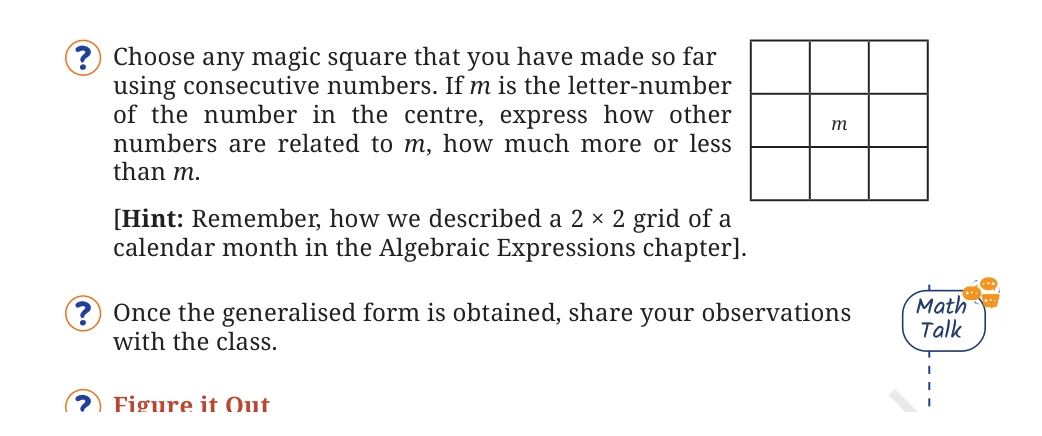
Choose any magic square that you have made so far using consecutive numbers. If m is the letter-number of the number in the centre, express how other numbers are related to m, how much more or less than m. [Hint: Remember, how we described a 2 × 2 grid of a calendar month in the Algebraic Expressions chapter]. 2 10 9 4 5 7 8 3 6 3 11 10 5 6 8 9 4 7 9 17 16 11 12 14 15 10 13
Show solution
Considering magic square with numbers 2-10: Taking ‘m’ as the letter-number of the number in the centre and expressing other numbers in relation to ‘m’. Figure it out
Textbook page 11 · solved item 24

1. Using this generalised form, find a magic square if the centre number is 25.
Show solution
Generalised form: A magic square with the center value 25, where other numbers in the grid are expressed in relation to 25. 2 10 9 4 5 7 8 3 6 m+1 m m-2 m-1 m-4 m+3 m-3 m+2 m+4 m+1 m m-2 m-1 m-4 m+3 m-3 m+2 m+4 26 25 23 24 21 28 22 27 29 2 10 9 4 5 7 8 3 6
Textbook page 11 · solved item 25

2. What is the expression obtained by adding the 3 terms of any row, column or diagonal?
Show solution
Row Sum (1st row): 28 + 21 + 26 = 75. Column Sum (1st column): 28 + 23 + 24 = 75. Diagonal sum (1st diagonal): 28 + 25 + 22 = 75. Expression = 3m (where m is the letter-number of the number in the centre).
Textbook page 11 · solved item 26

3. Write the result obtained by— (a) adding 1 to every term in the generalised form. (b) doubling every term in the generalised form.
Show solution
Generalised form: (a) Adding 1 to every term in the generalised form: (b) Doubling every term in the generalised form: m+1 m m-2 m-1 m-4 m+3 m-3 m+2 m+4 m+2 m+1 m-1 m m-3 m+4 m-2 m+3 m+5 2m+2 2m 2m-4 2m-2 2m-8 2m+6 2m-6 2m+4 2m+8
Textbook page 11 · solved item 27

4. Create a magic square whose magic sum is 60.
Show solution
Magic square with numbers 1-9 has a magic sum of 15. To get a magic square with a magic sum of 60, we need to multiply each number of the magic square 1-9 by 4. Therefore, magic square with magic sum 60 is:
Textbook page 11 · solved item 28

5. Is it possible to get a magic square by filling nine non-consecutive numbers?
Show solution
Yes, it is possible to get a magic square with non-consecutive numbers. The First-ever 4 × 4 Magic Square
Textbook page 11 · solved item 29
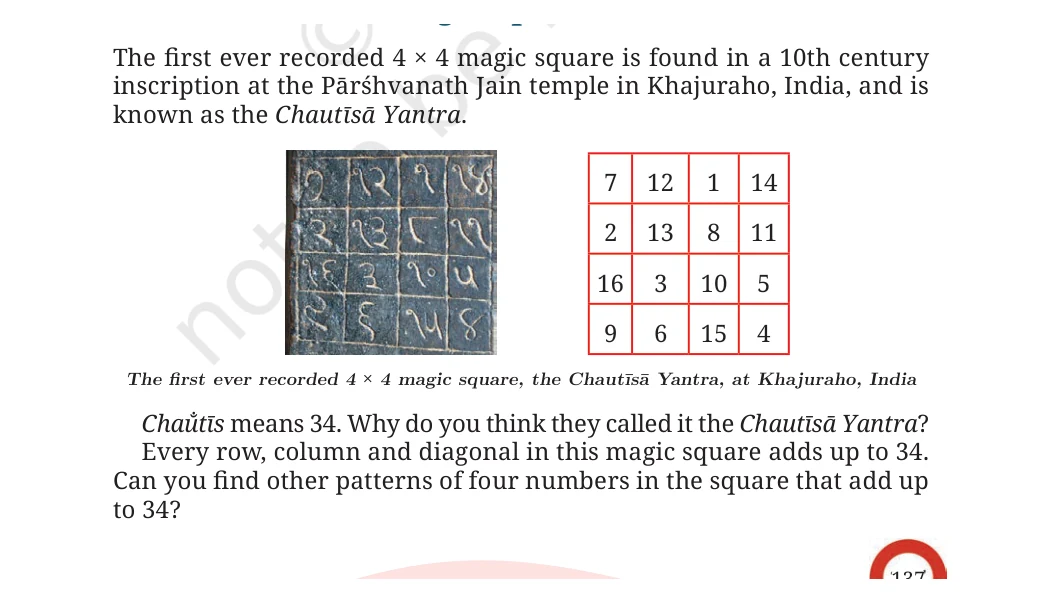
The first ever recorded 4 × 4 magic square is found in a 10th century inscription at the Pārśhvanath Jain temple in Khajuraho, India, and is known as the Chautīsā Yantra. Chau̐ tīs means 34. Why do you think they called it the Chautīsā Yantra? Every row, column and diagonal in this magic square adds up to 34. Can you find other patterns of four numbers in the square that add up to 34? 1 9 8 3 4 6 7 2 5 4×8 4×1 4×6 4×3 4×5 4×7 4×4 4×9 4×2 32 4 24 12 20 28 16 36 8
Show solution
Different patterns of four numbers in the square that add up to 34 are: (i) Sum of four corner numbers 7 + 14 + 4 + 9 is 34. (ii) Sum of four central numbers 13 + 8 + 10 + 3 is 34. (iii) Sum of four number in any 2×2 square is 34.
Complete worked answers
Textbook page 15
Textbook page 15 · solved item 30
Use the systematic method to write down all 6-beat rhythms, i.e., write 6 as the sum of 1’s and 2’s in all possible ways. Did you get 13 ways?
Show solution
Yes, we got a total of 13 ways. Different Ways Number of Ways n = 6 1 + 1 + 1 + 1 + 1 +1 1 + 2 + 1 + 1 + 1 1 + 1 + 2 + 1 + 1 1 + 1 + 1 + 2 + 1 1 + 1 + 1 + 1 + 2 1 + 2 + 2 + 1 1 + 1 + 2 + 2 1 + 2 + 1 + 2 2 + 1 + 1 + 1 + 1 2 + 2 + 2 2 + 2 + 1 + 1 2 + 1 + 2 + 1 2 + 1 + 1 + 2 13
Complete worked answers
Textbook page 16
Textbook page 16 · solved item 31
Write the next 3 numbers in the sequence: 1, 2, 3, 5, 8, 13, 21, 34 , 55, 89, ____, ____, ____, ... If you have to write one more number in the sequence above, can you tell whether it will be an odd number or an even number (without adding the two previous numbers)?
Show solution
The next number is: 55 + 89 = 144. After that: 89 + 144 = 233. And then: 144 + 233 = 377. The sequence would become: 1, 2, 3, 5, 8, 13, 21, 34 , 55, 89, 144 , 233 , 377 ,…… By examining the parity of the sequence: 1 (odd), 2 (even), 3 (odd), 5 (odd), 8 (even), 13 (odd), 21 (odd), 34 (even), 55 (odd), 89 (odd), 144 (even), 233 (odd), 377 (odd).
Therefore, the next term in the sequence after 377 will be an even number following the parity cycle.
Textbook page 16 · solved item 32
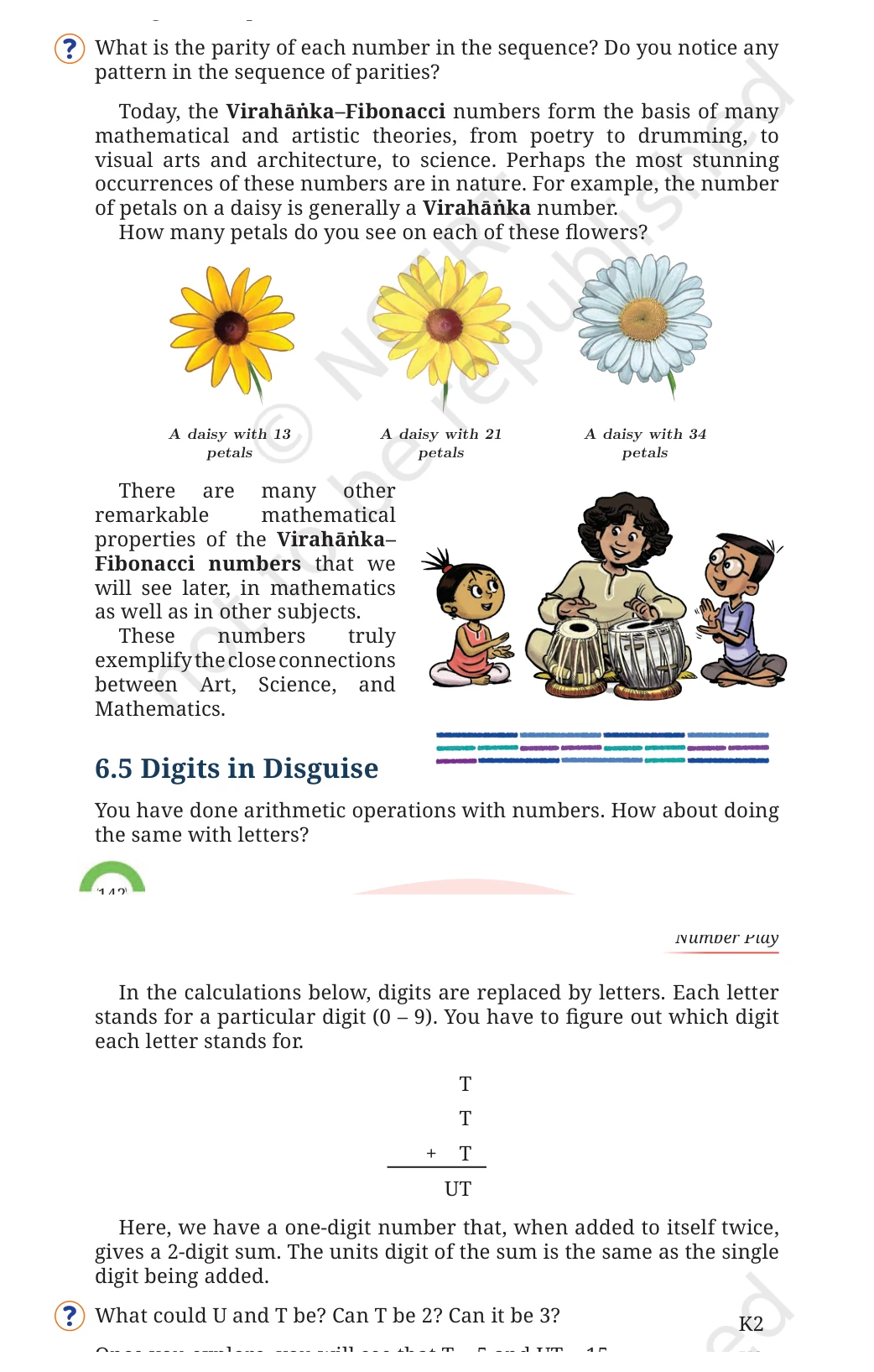
What is the parity of each number in the sequence? Do you notice any pattern in the sequence of parities?
Show solution
The parity of the sequence: 1 (odd), 2 (even), 3 (odd), 5 (odd), 8 (even), 13 (odd), 21 (odd), 34 (even), 55 (odd), 89 (odd), 144 (even), 233 (odd), 377 (odd). Pattern in the sequence of parities: odd, odd, even i.e. two odd numbers are followed by an even number.
Complete worked answers
Textbook page 17
Textbook page 17 · solved item 33
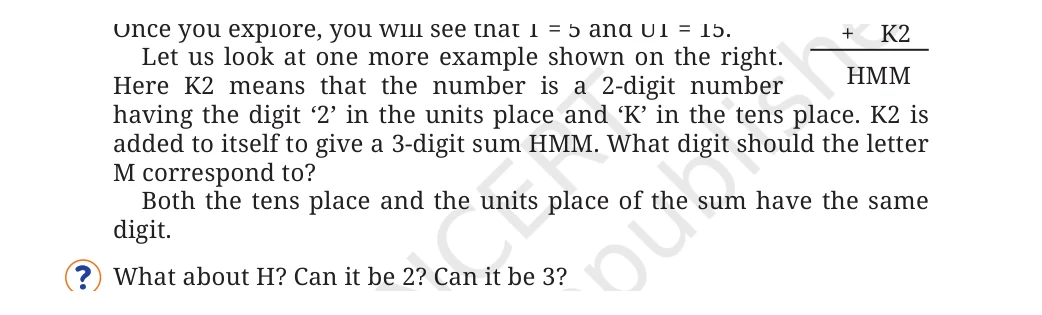
Let us look at one more example shown on the right. Here K2 means that the number is a 2-digit number having the digit ‘2’ in the units place and ‘K’ in the tens place. K2 is added to itself to give a 3-digit sum HMM. What digit should the letter M correspond to? Both the tens place and the units place of the sum have the same digit. What about H? Can it be 2? Can it be 3?
Show solution
Here, H = 1, M = 4, K = 7, so HMM = 144. H=2 or H=3 do not work because they make K a 2-digit number, which is invalid.
Textbook page 17 · solved item 34
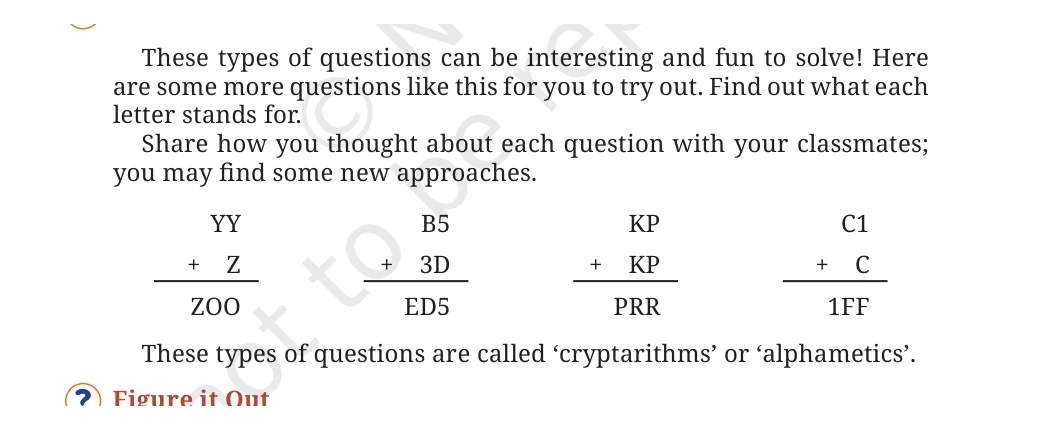
These types of questions can be interesting and fun to solve! Here are some more questions like this for you to try out. Find out what each letter stands for. Share how you thought about each question with your classmates; you may find some new approaches. 72 + 72 144
Show solution
(i) Here, Y = 9, Z = 1, and O = 0. (ii) Here, D = 0, B = 7 and E = 1. (iii) Here, K=6, P=1, R=2. (iv) Here, C=9, F=0. Figure It Out
Textbook page 17 · solved item 35
1. A light bulb is ON. Dorjee toggles its switch 77 times. Will the bulb be on or off? Why?
Show solution
Starting from the initial ON state of the bulb: 1st toggle → OFF 2nd toggle → ON 3rd toggle → OFF …and so on. Thus, odd number of toggles will make the bulb ‘OFF’ and even number of toggles will make the bulb ‘ON’. Since 77 is an odd number, the bulb will end up in the OFF state. 99 + 1 100 75 + 30 105 61 + 61 122 91 + 9 100
Complete worked answers
Textbook page 18
Textbook page 18 · solved item 36

2. Liswini has a large old encyclopaedia. When she opened it, several loose pages fell out of it. She counted 50 sheets in total, each printed on both sides. Can the sum of the page numbers of the loose sheets be 6000? Why or why not?
Show solution
Total sheets = 50 Each sheet has one even and one odd page number. Thus, the total of 50 sheets consists of 50 even numbers and 50 odd numbers. The sum of the even numbers is even. (because adding any number of even numbers is even). The sum of the odd numbers is even. (because adding even number of odd numbers is even).
Thus, the total sum is even + even = even. Since 6000 is an even number, it is possible for the sum of the page numbers of the loose sheets to be 6000.
Textbook page 18 · solved item 37

3. Here is a 2 × 3 grid. For each row and column, the parity of the sum is written in the circle; ‘e’ for even and ‘o’ for odd. Fill the 6 boxes with 3 odd numbers (‘o’) and 3 even numbers (‘e’) to satisfy the parity of the row and column sums.
Show solution
A valid filling is: top row odd, even, even; bottom row odd, even, odd. This uses three odd and three even entries and gives the required row and column parities.
Textbook page 18 · solved item 38

4. Make a 3 × 3 magic square with 0 as the magic sum. All numbers cannot be zero. Use negative numbers, as needed.
Show solution
Using numbers from -4 to 4 to create a 3 × 3 magic square with 0 as the magic sum. e o o o e e 2 -2 -3 4 -1 1 -4 3 0 Rows: (−3) + 2 + 1 = 0 4 + 0 + (−4) = 0 (−1) + (−2) + 3 = 0 Columns: (−3) + 4 + (−1) = 0 2 + 0 + (−2) = 0 1 + (−4) + 3 = 0 Diagonals: (−3) + 0 + 3 = 0 1 + 0 + (−1) = 0
Textbook page 18 · solved item 39
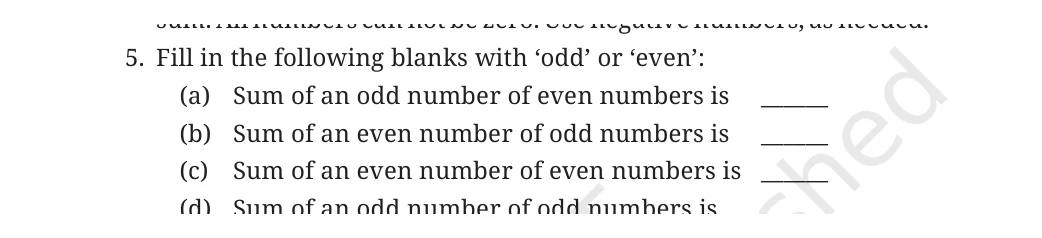
5. Fill in the following blanks with ‘odd’ or ‘even’: (a) Sum of an odd number of even numbers is ______ (b) Sum of an even number of odd numbers is ______ (c) Sum of an even number of even numbers is ______ (d) Sum of an odd number of odd numbers is ______
Show solution
(a) Even (b) Even (c) Even (d) Odd
Textbook page 18 · solved item 40

6. What is the parity of the sum of the numbers from 1 to 100?
Show solution
There are 100 numbers from 1 to 100. Parity: odd, even, odd, even… There are exactly 50 odd numbers and 50 even numbers. Adding 50 odd numbers gives an even sum (because an even number of odd numbers sums to even). Adding 50 even numbers gives an even sum. Total sum: even + even = even. Therefore, the parity of the sum of numbers from 1 to 100 is even.
Textbook page 18 · solved item 41

7. Two consecutive numbers in the Virahāṅka sequence are 987 and 1597. What are the next 2 numbers in the sequence? What are the previous 2 numbers in the sequence?
Show solution
In the Virahanka sequence, the next number is obtained by adding the two previous numbers. Given that two consecutive numbers in sequence are 987 and 1597. The next two numbers are: 987 + 1597 = 2584. 1597 + 2584 = 4181. The previous two numbers are: 1597 – 987 = 610. 987 – 610 = 377.
Textbook page 18 · solved item 42

8. Angaan wants to climb an 8-step staircase. His playful rule is that he can take either 1 step or 2 steps at a time. For example, one of his paths is 1, 2, 2, 1, 2. In how many different ways can he reach the top?
Show solution
Different ways by which Angaan can climb the 8-step staircase by taking either 1 step or 2 steps at a time are: Steps Different Ways Number of Ways n = 8 No 2s 1 + 1 + 1 + 1 + 1 + 1 + 1 + 1 1 1 + 7 + 15 + 10 + 1 = 34 One 2s 2 + 1 + 1 + 1 + 1 + 1 + 1 1 + 2 + 1 + 1 + 1 + 1 + 1 1 + 1 + 2 + 1 + 1 + 1 + 1 1 + 1 + 1 + 2 + 1 + 1 + 1 1 + 1 + 1 + 1 + 2 + 1 + 1 1 + 1 + 1 + 1 + 1 + 2 + 1 1 + 1 + 1 + 1 + 1 + 1 + 2 7 Two 2s 2 + 2 + 1 + 1 + 1 + 1 2 + 1 + 2 + 1 + 1 + 1 2 + 1 + 1 + 2 + 1 + 1 2 + 1 + 1 + 1 + 2 + 1 2 + 1 + 1 + 1 + 1 + 2 1 + 2 + 2 + 1 + 1 + 1 1 + 2 + 1 + 2 + 1 + 1 1 + 2 + 1 + 1 + 2 + 1 1 + 2 + 1 + 1 + 1 + 2 1 + 1 + 2 + 2 + 1 + 1 1 + 1 + 2 + 1 + 2 + 1 1 + 1 + 2 + 1 + 1 + 2 1 + 1 + 1 + 2 + 2 + 1 1 + 1 + 1 + 2 + 1 + 2 1 + 1 + 1 + 1 + 2 + 2 15 Three 2s 2 + 2 + 2 + 1 + 1 2 + 2 + 1 + 2 + 1 2 + 2 + 1 + 1 + 2 2 + 1 + 2 + 2 + 1 2 + 1 + 2 + 1 + 2 2 + 1 + 1 + 2 + 2 10 1 + 2 + 2 + 2 + 1 1 + 2 + 2 + 1 + 2 1 + 2 + 1 + 2 + 2 1 + 1 + 2 + 2 + 2 Four 2s 2 + 2 + 2 + 2 1
Textbook page 18 · solved item 43

9. What is the parity of the 20th term of the Virahāṅka sequence?
Show solution
Virahāṅka sequence: 1, 2, 3, 5, 8, 13, 21, 34, 55, 89,… 1(odd), 2(even), 3(odd), 5(odd), 8(even), 13(odd), 21(odd), 34(even), 55(odd), 89(odd),… Parity cycle: odd, even, odd This pattern repeats every 3 terms. 20 ÷ 3 = 6 remainder 2. This means the 20th term corresponds to the second position in the parity cycle, which is: odd, even, odd Thus, the parity of the 20th term is even.
Textbook page 18 · solved item 44
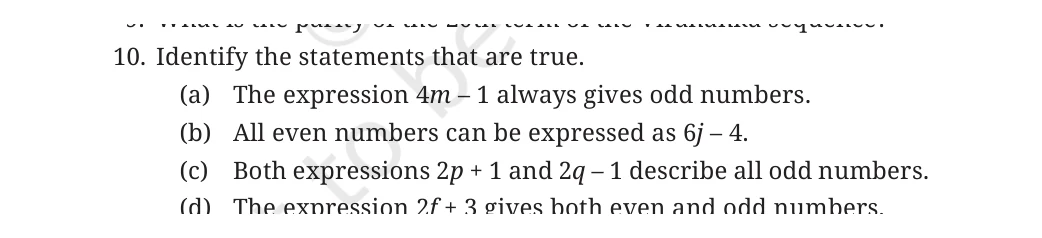
10. Identify the statements that are true. (a) The expression 4m – 1 always gives odd numbers. (b) All even numbers can be expressed as 6j – 4. (c) Both expressions 2p + 1 and 2q – 1 describe all odd numbers. (d) The expression 2f + 3 gives both even and odd numbers.
Show solution
(a) Substituting m = 1 in 4m – 1 = 4(1) – 1 = 4 – 1 = 3 (odd). Substituting m = 3 in 4m -1 = 4(3) – 1 = 12 – 1 = 11 (odd). 4m is always even, so 4m − 1 is always odd. Thus, the statement is True. (b) Substituting j = 1 in 6j – 4 = 6(1) – 4 = 2 (even). Substituting j = 2 in 6j – 4 = 6(2) – 4 = 12 – 4 = 8 (even).
Substituting j = 3 in 6j – 4 = 6(3) – 4 = 18 – 4 = 14 (even). Since, some even numbers can be expressed in the form 6j – 4 but not all. Thus, the statement is False. (c) For 2p + 1: If p = 1, 2(1) + 1 = 2 + 1 = 3 (odd) If p = 2, 2(2) + 1 = 4 + 1 = 5 (odd) If p =3, 2(3) + 1 = 6 + 1 = 7 (odd) Similarly, for 2q−1: If q = 1, 2(1) – 1 = 2 – 1 = 1 (odd) If q = 2, 2(2) – 1 = 4 – 1 = 3 (odd) If q = 3, 2(3) – 1 = 6 – 1 = 5 (odd) Thus, the statement is True.
(d) For 2f + 3 If f = 1, 2(1) + 3 = 2 + 3 = 5 (odd) If f = 2, 2(2) + 3 = 4 + 3 = 7 (odd) If f = 3, 2(3) + 3 = 6 + 3 = 9 (odd) This is always odd because 2f is always even, and adding 3 makes it odd. Thus, the statement is False.
Textbook page 18 · solved item 45
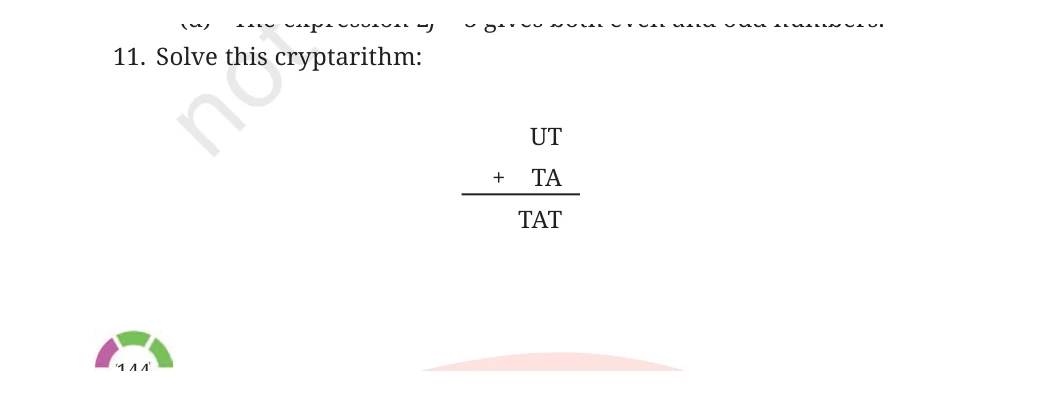
11. Solve this cryptarithm:
Show solution
Here, T = 1, A = 0 and U = 9. 91 + 10 101