
Use the textbook context
Match, attempt, then check
Each crop extends to the next solved item, so diagrams, tables and connected instructions stay with the question.
Complete worked answers
Textbook page 2
Textbook page 2 · solved item 1
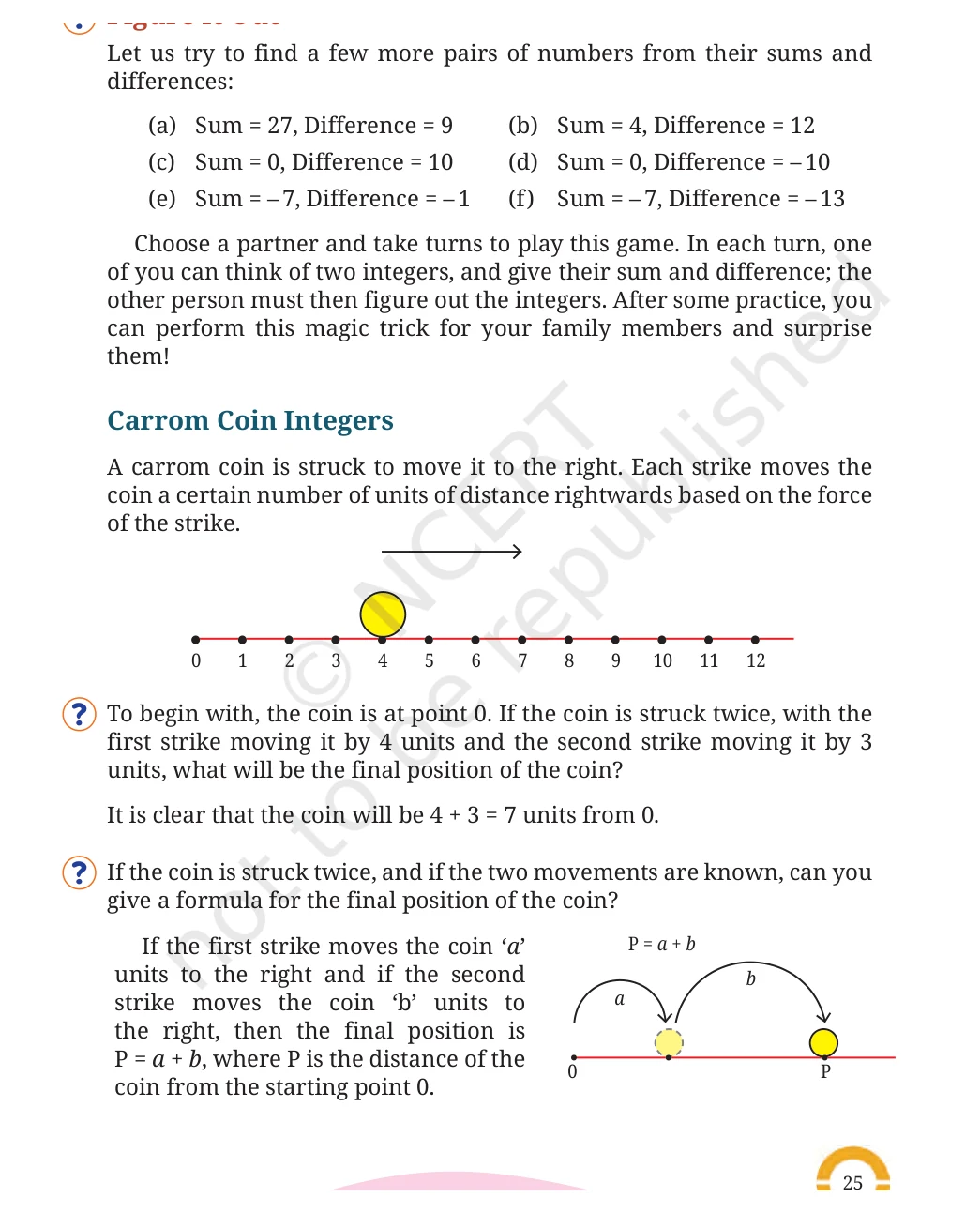
Let us try to find a few more pairs of numbers from their sums and differences: (a) Sum = 27, Difference = 9 (b) Sum = 4, Difference = 12 (c) Sum = 0, Difference = 10 (d) Sum = 0, Difference = -10 (e) Sum = -7, Difference = -1 (f) Sum = -7, Difference = -13
Show solution
(a) Sum = 27, Difference = 9 Hence correct pair is (18, 9). (b) Sum = 4, Difference = 12 Hence correct pair is (8, -4). (c) Sum = 0, Difference = 10 Hence correct pair is (5, -5). (d) Sum = 0, Difference = -10 Hence correct pair is (8, -8). (e) Sum = -7, Difference = -1 Hence, the correct pair is (-4, -3).
(f) Sum = -7, Difference = -13 Hence correct pair is (-10, 3).
Complete worked answers
Textbook page 8
Textbook page 8 · solved item 2

Using the token interpretation, find the values of: (a) 3 × (-2) (b) (-5) × (-2) (c) (-4) × (-1) (d) (-7) × 3
Show solution
(a) 3 × (-2) Two red tokens 3 times = -6 There are now 6 red tokens or 6 negatives in the box, i.e., -6 (b) (-5) × (-2) For (-5) × (-2), we need to remove 2 negatives from the box 5 times. Since there are no red tokens in the bag, we need to place 2 zero pairs and remove 2 negatives, and we need to do this 5 times.
Taking 2 red tokens from the zero pairs 5 times. Therefore, (-5) × (-2) = 10 (c) (-4) × (-1) For (-4) × (-1), we need to remove 1 negative from the box 4 times. Since there are no red tokens in the bag. We need to place 1 zero pair and remove 1 negative, and we need to do this 4 times. Taking 1 red token from the zero pairs 4 times.
Therefore, (-4) × (-1) = 4 (d) (-7) × 3 For (-7) × 3, we need to remove 3 positive numbers from the box 7 times. Taking 3 positives from the zero pairs 7 times = (-7) × 3 = -21.
Textbook page 8 · solved item 3

If 123 × 456 = 56088, without calculating, find the value of: (a) (-123) × 456 (b) (-123) × (-456) (c) (123) × (-456)
Show solution
(a) Given 123 × 456 = 56088 …..(i) Then(a) (-123) × 456 This is the product of a negative and a positive integer, so the result will be negative. i.e. -(123) × 456 = -(123 × 456) = -56088 (b) (-123) × (-456) This is the product of two negative integers, so the result will be positive. Therefore, (-123) × (-456) = 123 × 456 = 56088 (c) 123 × (-456) This is the product of a positive and a negative integer, so the result will be negative.
Therefore, 123 × (-456) = -(123 × 456) = -56088
Textbook page 8 · solved item 4
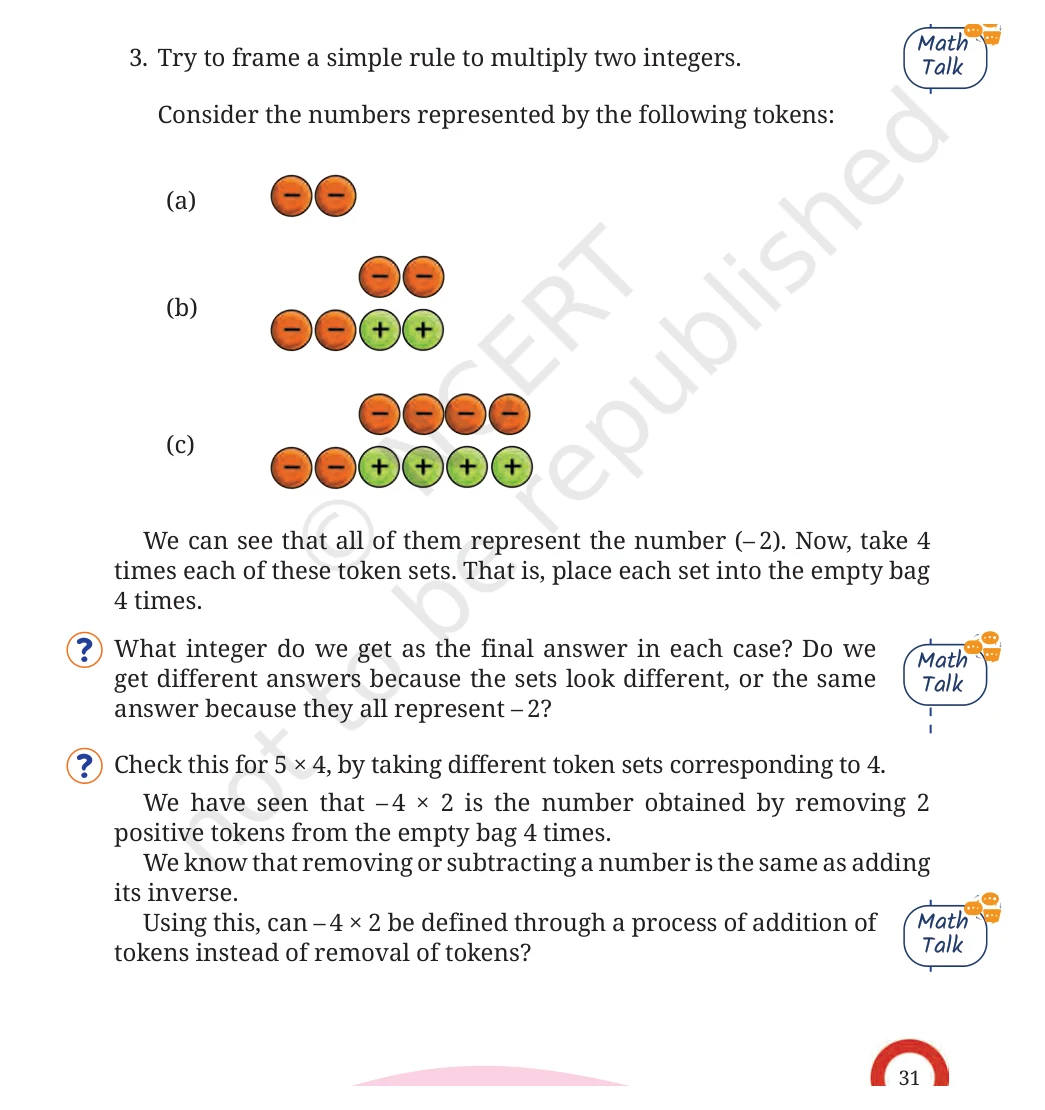
Try to frame a simple rule to multiply two integers.
Show solution
Rule for multiplying two integers: Multiply their absolute values. If the integers have different signs, the product is negative. If both integers have the same sign, the product is positive.
Complete worked answers
Textbook page 10
Textbook page 10 · solved item 5
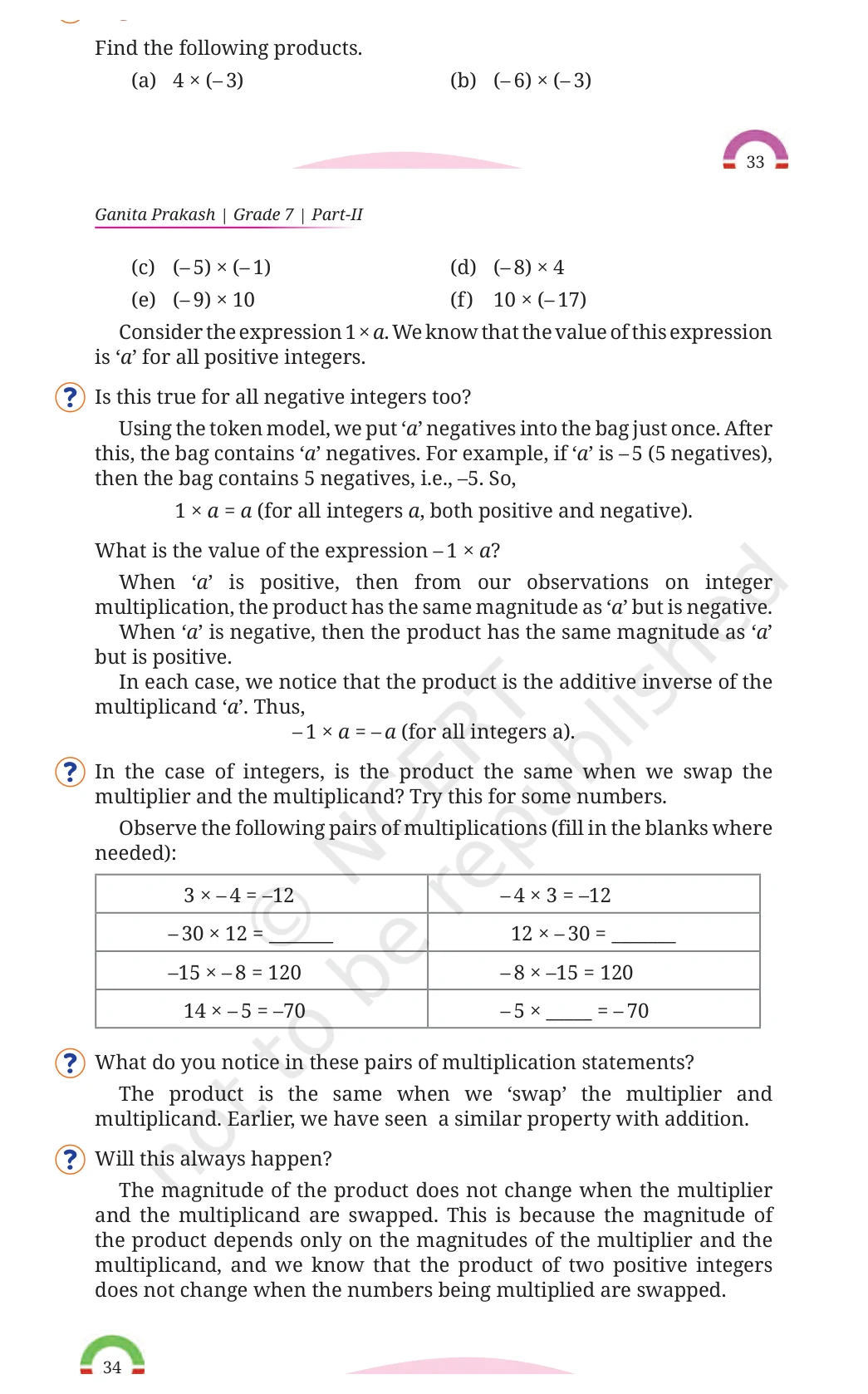
Find the following products. (a) 4 × (-3) (b) (-6) × (-3) (c) (-5) × (-1) (d) (-8) × 4 (e) (-9) × 10 (f) 10 × (-17)
Show solution
(a) Here, 4 × (-3) = – [(4) × (3)] = -12 (because Multiplier is positive and the multiplicand is negative, their product is negative) (b) Here, (-6) × (-3) = 6 × 3 = 18 (because Both the multiplier and multiplicand are negative; their product is positive) (c) Here, (-5) × (-1) = 5 × 1 = 5 (because Both the multiplier and multiplicand are negative; their product is positive) (d) Here, (-8) × 4 = -(8 × 4) = -32 (because Multiplier is negative and multiplicand is positive, their product is negative) (e) Here, (-9) × 10 = -(9 × 10) = -90 (because Multiplier is negative and multiplicand is positive, their product is negative) (f) Here, 10 × (-17) = -(10 × 17) = -170 (because Multiplier is positive and multiplicand is negative, their product is negative)
Complete worked answers
Textbook page 16
Textbook page 16 · solved item 6

Find the values of: (a) 14 × (-15) (b) -16 × (-5) (c) 36 ÷ (-18) (d) (-46) ÷ (-23)
Show solution
(a) To find the value of 14 × (-15), we multiply the numbers and apply the rule that a positive number multiplied by a negative number results in a negative number. Therefore, 14 × (-15) = -(14 × 15) = -210 (b) To find the value of -16 × (-5), we multiply the numbers and apply the rule that a negative number multiplied by a negative number results in a positive number.
Therefore, -16 × (-5) = 80 (c) To find the value of 36 ÷ (-18), we divide the numbers and apply the rule that a positive number divided by a negative number results in a negative number. Therefore, 36 ÷ (-18) = -(36 ÷ 18) = -2 (d) To find the value of (-46) ÷ (-23), we divide the numbers and apply the rule that a negative number divided by a negative number results in a positive number.
Therefore, (-46) ÷ (-23) = 2
Textbook page 16 · solved item 7

A freezing process requires that the room temperature he lowered from 32°C at the rate of 5°C every hour. What will be the room temperature 10 hours after the process begins?
Show solution
The temperature is lowered at the rate of 5°C every hour for 10 hours. Total temperature drop = 5°C/hour × 10 hour = 50°C The initial room temperature is 32°C. To find the final temperature, we have to subtract the initial temperature from the total temperature drop. Therefore, Final temperature = 32 – 50 = -18°C
Textbook page 16 · solved item 8
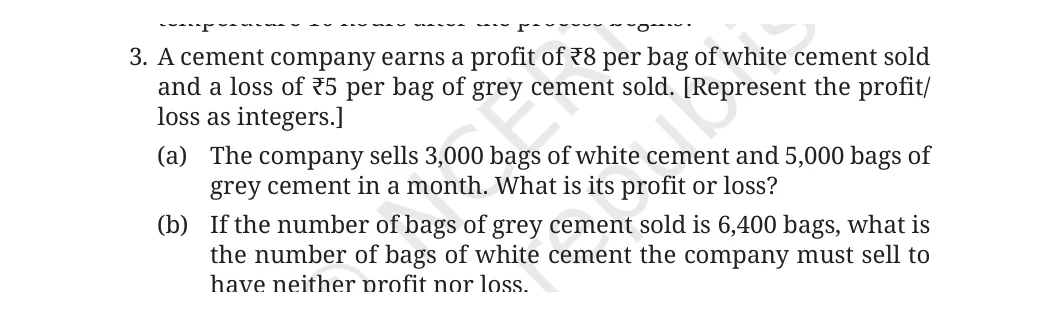
A cement company earns a profit of ₹ 8 per bag of white cement sold and a loss of ₹ 5 per bag of grey cement sold. [Represent the profit/loss as integers.] (a) The company sells 3,000 bags of white cement and 5,000 bags of grey cement in a month. What is its profit or loss? (b) If the number of bags of grey cement sold is 6,400 bags, what is the number of bags of white cement the company must sell to have neither profit nor loss?
Show solution
(a) Profit on one white cement bag = ₹ 8 Loss on one grey cement bag = ₹ 5 Profit from selling white cement = 3000 bags × ₹ 8/bag = ₹ 24000 Loss from selling white cement = 5000 bags × ₹ 5/bag = ₹ 25,000 [because loss is more than profit, i.e., loss] Total loss = 25,000 – 24,000 = 1,000 Therefore, The company has a loss of ₹ 1000.
(b) Let x be the number of white cement bags sold. Total profit/loss is zero. Profit from white cement + Loss from grey cement = 0 ⇒ x × 8 + 6400 × (-5) = 0 ⇒ 8x – 32000 = 0 ⇒ x = 4000 Therefore, The company must sell 4000 bags of white cement to make neither profit nor loss.
Textbook page 16 · solved item 9
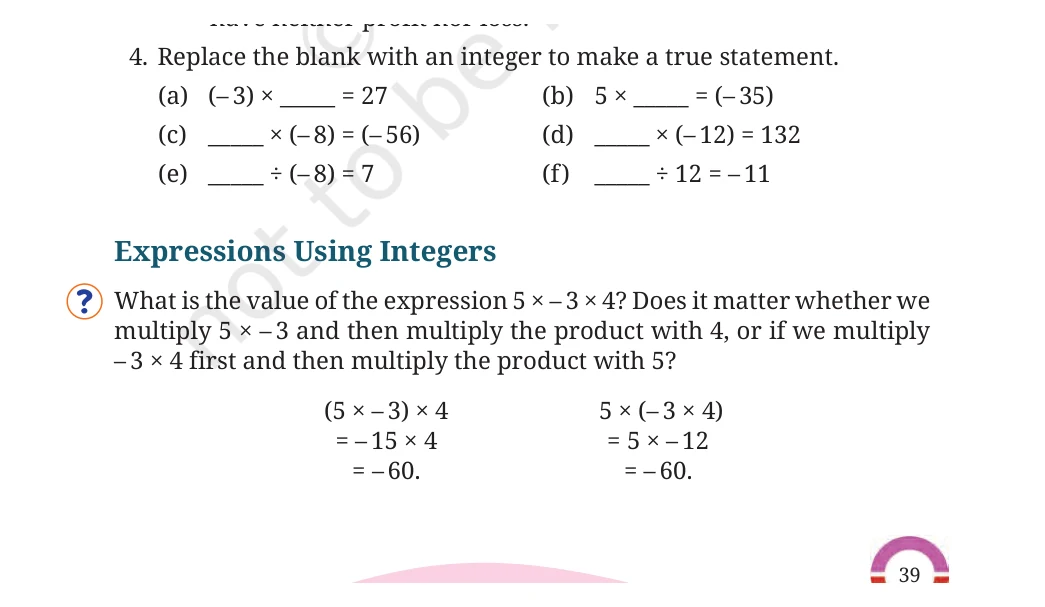
Replace the blank with an integer to make a true statement. (a) (-3) × ________ = 27 (b) 5 × ________ = (-35) (c) ________ × (-8) = (-56) (d) ________ × (-12) = 132 (e) ________ ÷ (-8) = 7 (f) ________ ÷ 12 = -11
Show solution
(a) Let -3 × x = 27 ⇒ x = \frac{27}{-3}=-\frac{(27)}{3} = -9 (b) 5 × x = -35 ⇒ x = \frac{-35}{5}=-\frac{(35)}{5} = -7 (c) x × -8 = -56 ⇒ x = \frac {-56}{-8} = 7 (d) x × (-12) = 132 ⇒ x = \frac{132}{-12}=-\frac{-(132)}{12} = -11 (e) x ÷ (-8) = 7 ⇒ x × \frac {1}{-8} = 7 ⇒ x = 7 × (-8) = -56 (f) x ÷ 12 = -11 ⇒ x × \frac {1}{12} = -11 ⇒ x = -11 × 12 = -132
Complete worked answers
Textbook page 19
Textbook page 19 · solved item 10
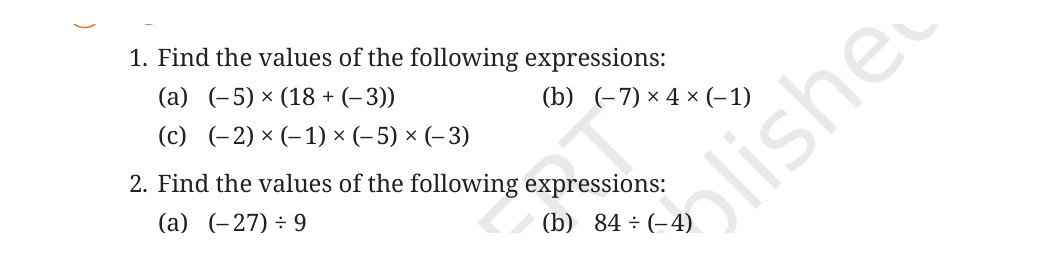
Find the values of the following expressions: (a) (-5) × (18 + (-3)) (b) (-7) × 4 × (-1) (c) (-2) × (-1) × (-5) × (-3)
Show solution
(a) Given (-5) × [(18 + (-3)] = -5 × 18 + (-5) × (-3) [because a(b + c) = ab + ac] = -90 + 15 = -75 (b) Here (-7) × 4 × (-1) = [(-7) × 4] × (-1) = (-28) × (-1) = 28 (c) Here [(-2) × (-1)] × [(-5) × (-3)] = 2 × (-5) × (-3) = 2 × 15 = 30
Textbook page 19 · solved item 11
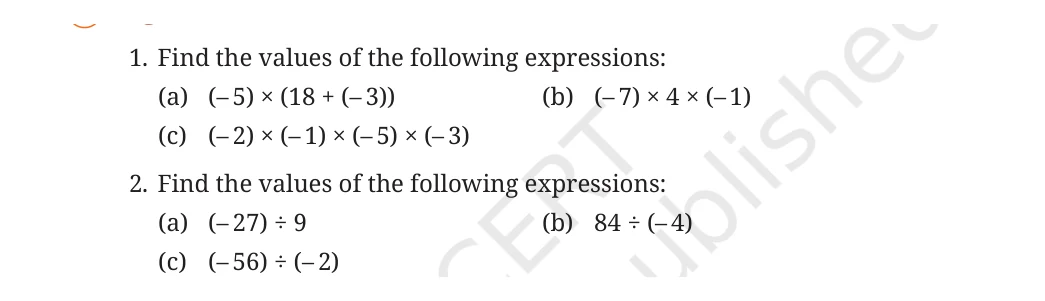
Find the values of the following expressions: (a) (-27) ÷ 9 (b) 84 ÷ (-4) (c) (-56) ÷ (-2)
Show solution
(a) (-27) ÷ 9 or 9 × ________ = -27 We know that, 9 × (-3) = -27 So, (-27) ÷ 9 = -3 (b) 84 ÷ (-4) or (-4) × ________ = 84 We know that, -4 × (-21) = 84 So, 84 ÷ (-4) = -21. (c) (-56) ÷ (-2) or (-2) × ________ = (-56) We know that, (-2) × 28 = -56 So, (-56) ÷ (-2) = 28
Textbook page 19 · solved item 12
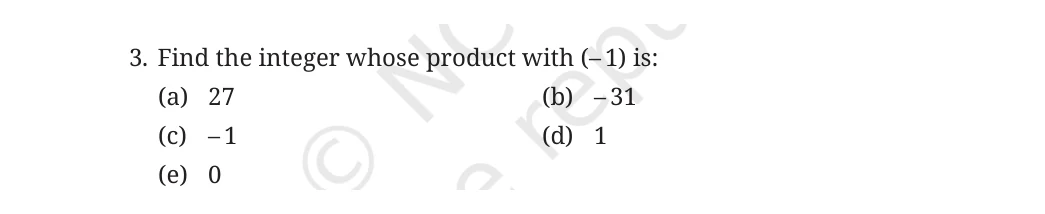
Find the integer whose product with (-1) is: (a) 27 (b) -31 (c) -1 (d) 1 (e) 0
Show solution
(a) Here, (-1) × (-27) = 27 Therefore, -27 is the required integer. (b) Here, (-1) × 31 = -31 Therefore, 31 is the required integer. (c) Here, (-1) × 1 = -1 Therefore, 1 is the required integer. (d) Here, (-1) × (-1) = 1 Therefore, (-1) is the required integer. (e) Here, (-1) × 0 = 1 Therefore, 0 is the required integer.
Textbook page 19 · solved item 13

If 47 – 56 + 14 – 8 + 2 – 8 + 5 = -4, then find the value of -47 + 56 – 14 + 8 – 2 + 8 – 5 without calculating the full expression.
Show solution
Given expression is 47 – 56 + 14 – 8 + 2 – 8 + 5 = -4 = E1 (Let) Here we see that the second expression is the negative of the first expression, then E2 = -47 + 56 – 14 + 8 – 2 + 8 – 5 = -1(47 – 56 + 14 – 8 + 2 – 8 + 5) (Taking -1 common) = -1(68 – 72) = -1(-4) = 4
Textbook page 19 · solved item 14
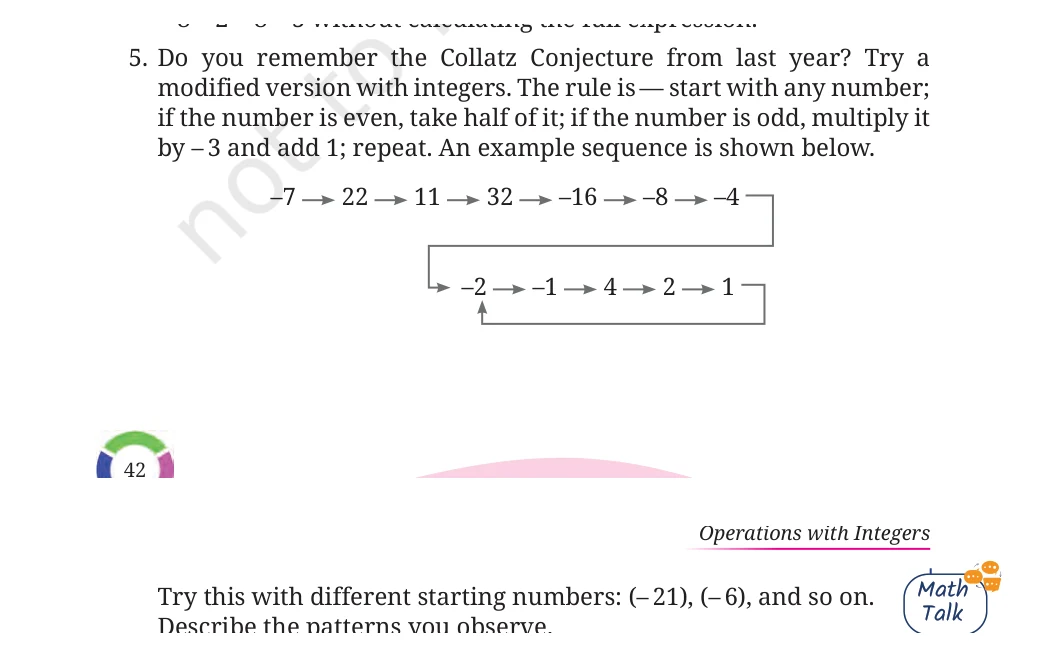
Do you remember the Collatz Conjecture from last year? Try a modified version with integers. The rule is — start with any number; if the number is even, take half of it; if the number is odd, multiply it by -3 and add 1; repeat. An example sequence is shown below. Try this with different starting numbers: (-21), (-6), and so on. Describe the patterns you observe.
Show solution
(a) Following the rules for the sequence starting with -7. The rule is if even, take half, if odd, multiply by -3, and add 1. Start with -7 (odd) [(-7) × (-3)] + 1 = 21 + 1 = 22 (even) then 22 ÷ 2 = 11 (odd) then 11 × (-3) + 1 = -33 + 1 = -32 (even) then (-32) ÷ 2 = -16 (even) then (-16) ÷ 2 = -8 (even) then (-8) ÷ 2 = -4 (even) then (-4) ÷ 2 = -2 (even) then (-2) ÷ 2 = – 1 (odd) then [(-1) × (-3)] + 1 = 4 (even) then 4 ÷ 2 = 2 (even) then 2 ÷ 2 = 1 (odd) (b) (i) Now for the starting number -21 (odd) then [(-21) × (-3)] + 1 = 63 + 1 = 64 (even) then 64 ÷ 2 = 32 (even) then 32 ÷ 2 = 16 (even) then 16 + 2 = 8 (even) then 8 ÷ 2 = 4 (even) then 4 ÷ 2 = 2 (even) then 2 ÷ 2 = 1 (odd) then 1 × (-3) + 1 = -2 (even) then (-2) ÷ 2 = -1 (odd) then [-1 × (-3)] + 1 = 4 (even) then 4 ÷ 2 = 2 (even) then 2 ÷ 2 = 1 (odd) then 1 × (-3) + 1 = -2 (even) Hence the sequence for -21 is (ii) For the sequence, the starting number is -6 6 is even then -6 + 2 = -3 (odd) then [(-3) × (-3)] + 1 = 9 + 1 = 10 (even) then 10 ÷ 2 = 5 (odd) 5 × (-3) + 1 = -15 + 1 = -14 (even) then -14 ÷ 2 = -7 (odd) [(-7) × (-3)] + 1 = +21 + 1 = 22 (even) then 22 ÷ 2 = 11 (odd) then [11 × (-3)] + 1 = -33 + 1 = -32 (even) then -32 ÷ 2 = -16 (even) then -16 ÷ 2 = -8 (even) then -8 ÷ 2 = -4 (even) then -4 ÷ 2 = -2 (even) then (-2) ÷ 2 = -1 (odd) then [(-1) × (-3)] + 1 = 3 + 1 = 4 (even) then 4 ÷ 2 = 2 (even) then 2 ÷ 2 = 1 (odd) then 1 × (-3) + 1 = -2 Hence, the sequence is Observation: For numbers like -21, -6, etc., the sequences eventually reach a repeating loop of -2, -1, 4, 2, 1, -2.
All starting numbers end up in this cycle.
Complete worked answers
Textbook page 20
Textbook page 20 · solved item 15
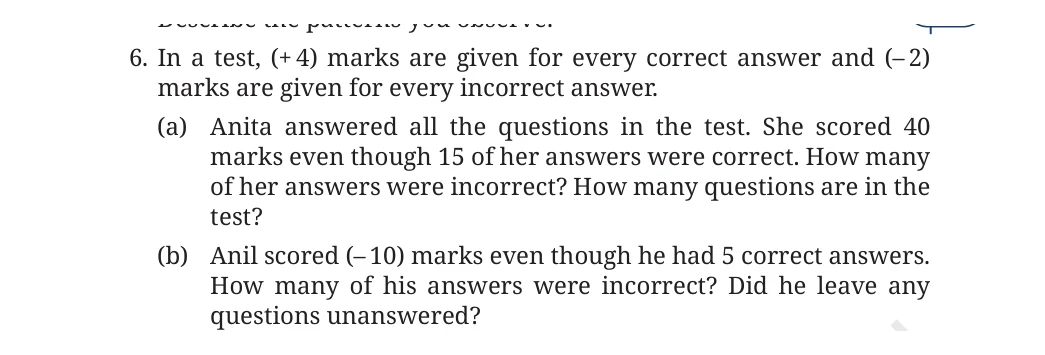
In a test, (+4) marks are given for every correct answer and (-2) marks are given for every incorrect answer. (a) Anita answered all the questions in the test. She scored 40 marks even though 15 of her answers were correct. How many of her answers were incorrect? How many questions are in the test? (b) Anil scored (-10) marks even though he had 5 correct answers. How many of his answers were incorrect? Did he leave any questions unanswered?
Show solution
(a) Anita had 15 correct answers, and each correct answer is worth +4 marks. Marks from correct answers = 15 × 4 = 60 Therefore, Anita total score = 40 Marks lost = 60 – 40 = 20 Each incorrect answer is worth -2 marks Therefore, No. of incorrect answers = \frac {20}{2} = 10 Anita had 10 incorrect answers.
Total no. of questions = sum of correct and incorrect answers = 15 + 10 = 25 Hence, Anita had 10 incorrect answers out of 25 questions on the test. (b) Anil had 5 correct answers, and each correct answer is worth + 4 marks they 5 × 4 = 20 marks. From incorrect answers = -10 – 20 = -30. Each incorrect answer is worth -2 marks Therefore, \frac {-30}{-2} = 15 Hence, Anil had 15 incorrect answers.
Yes, he leaves some questions unanswered. Anil answered the question = (Total No. of Questions) – (Anil’s correct answers + Anil’s incorrect answers) = 25 – (5 + 15) = 25 – 20 = 5 Hence, Anil left 5 questions unanswered.
Textbook page 20 · solved item 16
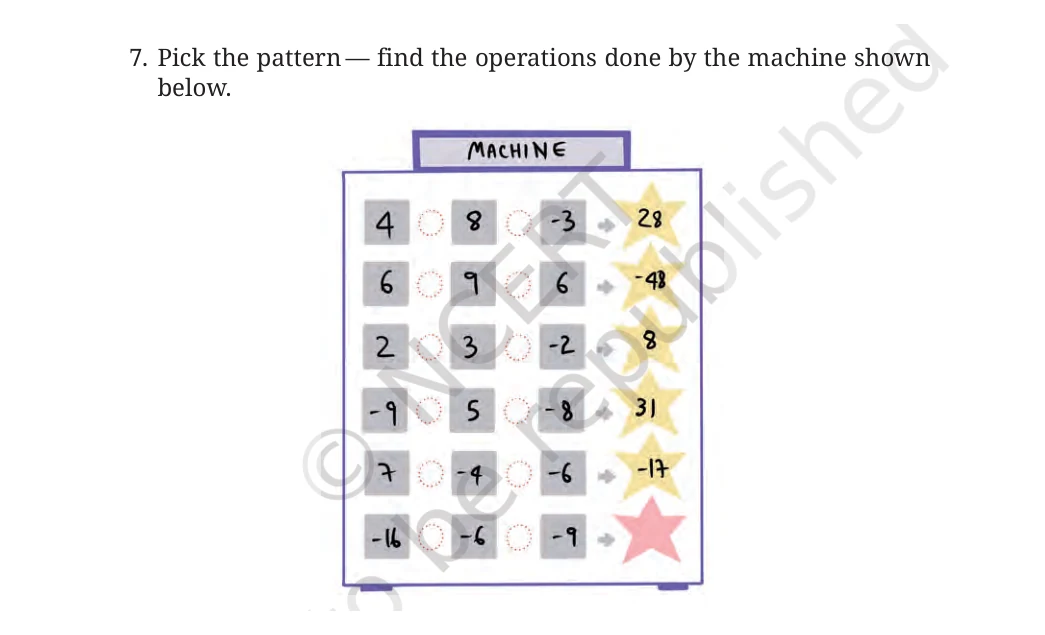
Pick the pattern – find the operations done by the machine shown below:
Show solution
Operation done by machine is (First Number) – [Second number × Third Number] I row: 4 – [(8) × -3] = 4 – [-24] = 4 + 24 = 28. II row: 6 – [9 × 6] = 6 – [54] = 6 – 54 = -48. III row: 2 – [3 × (-2)] = 2 – (-6) = 2 + 6 = 8. IV row: -9 – [5 × (-8)] = -9 – (-40) = -9 + 40 = 31. V row: 7 – (-4 × -6) = 7 – (24) = 7 – 24 = -17.
VI row: -16 – (-6 × -9) = -16 – (54) = -70. Thus, we have found the pattern that satisfies all the values. Hence, the missing operation is -70.
Textbook page 20 · solved item 17

Imagine you’re in a place where the temperature drops by 5°C each hour. If the temperature is currently at 8°C, write an expression that denotes the temperature after 4 hours.
Show solution
Current temperature = 8°C The temperature drops by 5°C each hour Total drop in temperature = Temperature drop in 1 hour × no. of hours = 5 × 4 Temperature after 4 hours = 8 – 4 × 5 Hence required expression is 8 – (5 × 4).
Textbook page 20 · solved item 18
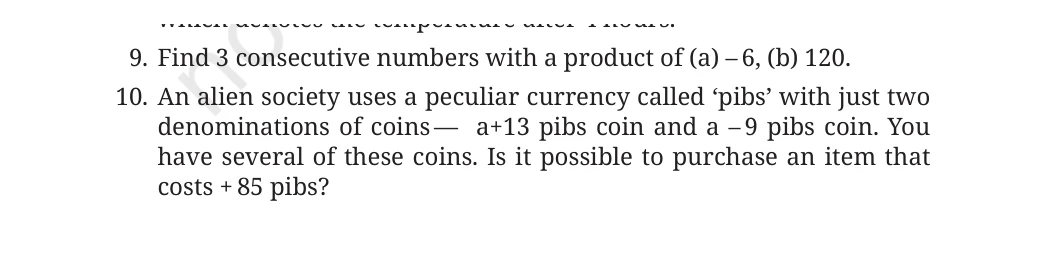
Find 3 consecutive numbers with a product of (a) -6, (b) 120.
Show solution
(a) Let three consecutive numbers be n – 1, n, and n + 1. Then product = (n – 1) (n) (n + 1) = -6 The only consecutive integers whose product is -6 are -2, -1, and 0. But -2 × -1 × o = 0, not possible. Consecutive numbers are integers. The product is negative, so there must be an odd number of negative integers.
Integers are -2, -1, 1. Their product = – 2 × -1 × 1 = 2, not possible Integers are -3, -2, -1. Their product = [-3 × -2] × -1 = 6 × -1 = -6 Hence, consecutive integers are -3, -2, -1. (b) Let three consecutive numbers be n – 1, n, and n + 1. Therefore, (n – 1) (n) (n + 1) = 120 Now the cube root of 120 = 4.93 So n is likely to be 5.
Therefore, (5 – 1) × (5) × (5 + 1) = 4 × 5 × 6 = 120 Hence, consecutive integers are 4, 5, and 6.
Textbook page 20 · solved item 19
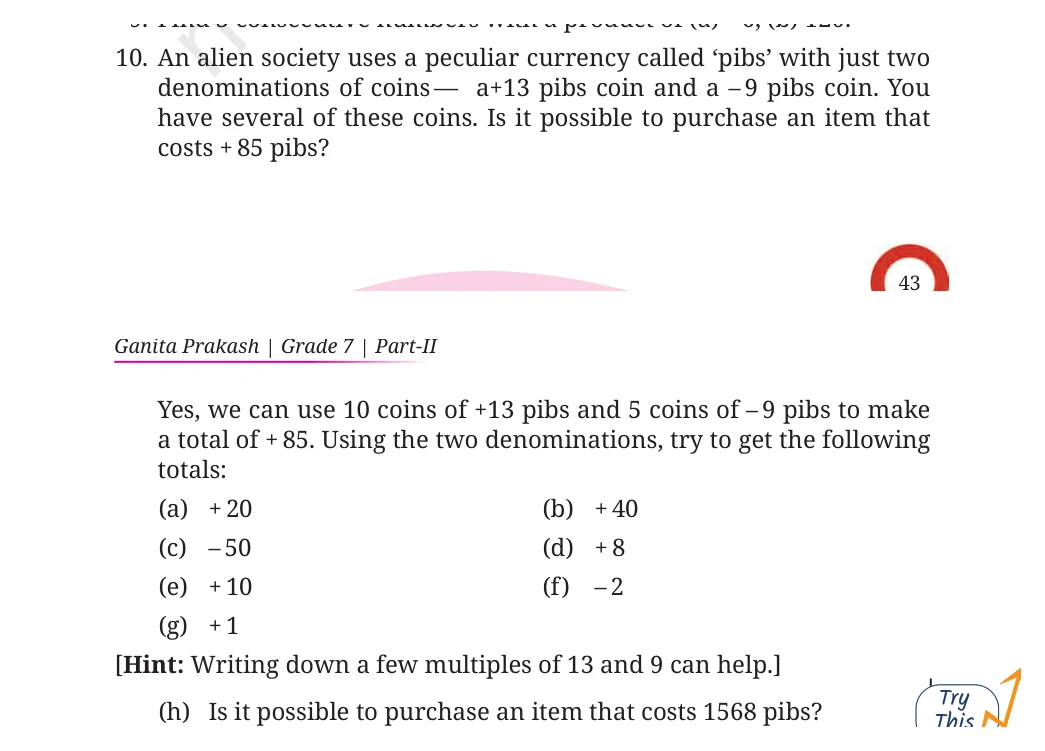
An alien society uses a peculiar currency called ‘pibs’ with just two denominations of coins — a + 13 pibs coin and a – 9 pibs coin. You have several of these coins. Is it possible to purchase an item that costs +85 pibs? Yes, we can use 10 coins of +13 pibs and 5 coins of -9 pibs to make a total of +85. Using the two denominations, try to get the following totals: (a) +20 (b) +40 (c) -50 (d) +8 (e) +10 (f) -2 (g) +1 [Hint: Writing down a few multiples of 13 and 9 can help.] (h) Is it possible to purchase an item that costs 1568 pibs?
Show solution
The currency has two denominations: +13 pibs and -9 pibs. We need to determine if it is possible to make the given totals. This is a linear equation of the form 13x – 9y = total, where x and y are non-negative integers. (a) Now total = +20 Then we need to find integers 13x – 9y = 20, x, y > 0 such that If x = 1, then 13 – 9y = 20 ⇒ -9y = 7.
No solution. If x = 2, then 26 – 9y = 20 ⇒ -9y = -6. No solution. IF x = 3 then 39 – 9y = 20 ⇒ -9y = -19. No solution. If x = 4, then 52 – 9y = 20 ⇒ -9y = -32. No solution. If x = 5 then 65 – 9y = 20 ⇒ -9y = -45 ⇒ y = 5 Hence, x = 5, y = 5 is a valid solution. (b) +40 Take 10 coins of +13 and 10 coins of -9: 10 × 13 – 10 × 9 = 130 – 90 = +40 pibs.
(c) -50 Take 10 coins of +13 and 20 coins of -9: 10 × 13 – 20 × 9 = 130 – 180 = – 50 pibs. (d) +8 Take 2 coins of +13 and 2 coins of -9: 2 × 13 – 2 × 9 = 26 – 18 = +8 pibs. (e) +10 Take 7 coins of +13 and 9 coins of -9: 7 × 13 – 9 × 9 = 91 – 81 = +10 pibs. (f) -2 Take 13 coins of +13 and 19 coins of -9: 13 × 13 – 19 × 9 = 169 – 171 = -2 pibs.
(g) +1 Take 7 coins of +13 and 10 coins of -9: 7 × 13 – 10 × 9 = 91 – 90 = +1 pibs. (h) Yes, it is possible. Take 122 coins of +13 and 2 coins of -9: 122 × 13 – 2 × 9 = 1586 – 18 = 1568 pibs.
Complete worked answers
Textbook page 21
Textbook page 21 · solved item 20

Find the values of: (a) (32 × (-18)) ÷ ((-36)) (b) (32) ÷ ((-36) × (-18)) (c) (25 × (-12)) ÷ ((45) × (-27)) (d) (280 × (-7)) ÷ ((-8) × (-35))
Show solution
(a) Here 32 × (-18) ÷ (-36) = -576 ÷ (-36) = 16 (b) Here 32 ÷ [(-36) × (-18)] = (32) ÷ 648 = \frac {4}{81} (c) Here [25 × (-12)] ÷ [45 × (-27)] = (-300) ÷ (-1215) = \frac {20}{81} (d) Here [280 × (-7)] ÷ [(-8) × (-35)] = (-1960) ÷ 280 = -7
Textbook page 21 · solved item 21

Arrange the expressions given below in increasing order: (a) (-348) + (-1064) (b) (-348) – (-1064) (c) 348 – (-1064) (d) (-348) × (-1064) (e) 348 × (-1064) (f) 348 × 964
Show solution
(a) (-348) + (-1064) Add two negative numbers → keep negative, add absolute values: 348 + (-1064) = -1412. (b) (-348) – (-1064) Subtracting a negative → same as adding positive: 348 – (-1064) = -348 + 1064 = 716. (c) 348 – (-1064) Subtracting a negative → add positive. 348 – (-1064) = 348 + 1064 = 1412.
(d) (-348) × (-1064) Negative × Negative = Positive (-348) × (-1064) = 370272 (e) 348 × (-1064) Positive × Negative = Negative 348 × (-1064) = -370272 (f) 348 × 964 Positive × Positive = Positive 348 × 964 = 335472 Arranging in increasing order: (e) 370272, (a) -1412, (b) 716, (c) 1412, (f) 335472, (d) 370272 Hence, (e) < (a) < (b) < (c) < (f) < (d).
Textbook page 21 · solved item 22
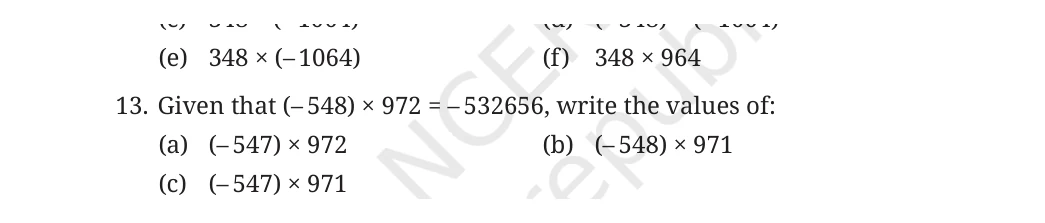
Given that (-548) × 972 = -532656, write the values of: (a) (-547) × 972 (b) (-548) × 971 (c) (-547) × 971
Show solution
(a) Given: (-547) × 972 = -532656 We need to find (-547) × 972 = (-548 + 1) × 972 = -548 × 972 + 972 = -532656 + 972 = -531684 (b) Now -548 × 971 = -548 × (972 – 1) = -548 × 972 – 548 × (-1) = -532656 + 548 = -532108 (c) Here -547 × 971 = (-548 + 1) × (972 – 1) = -548 × 972 + 548 + 972 – 1 = -532656 + 548 + 972 – 1 = -531137
Textbook page 21 · solved item 23

Given that 207 × (-33 + 7) = -5382, write the value of -207 × (33 – 7) = ________
Show solution
Here 207 × (-33 + 7) = 207 × (-26) = -5382 Now -207 × (33 – 7) = -207 × 26 = -(207 × 26) = -5382
Textbook page 21 · solved item 24
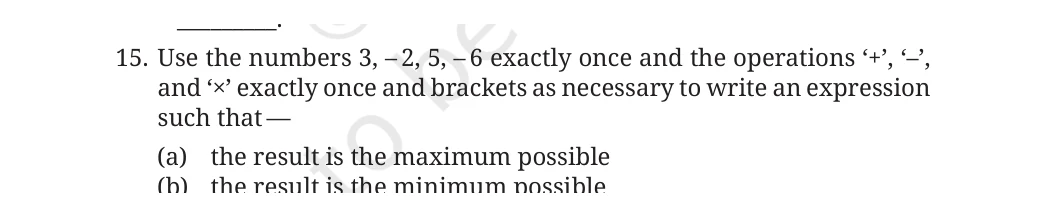
Use the numbers 3, -2, 5, -6 exactly once and the operations ‘+’, ‘-’, and ‘×’ exactly once and brackets as necessary to write an expression such that (a) The result is the maximum possible (b) The result is the minimum possible
Show solution
(a) Maximum possible value = [(-2) – (3 + 5)] × (-6) = (-2 – 8) × (-6) = 60 (b) Minimum possible value = [3 – (-2) + 5)] × (-6) = (3 + 2 + 5) × -6 = -60
Textbook page 21 · solved item 25
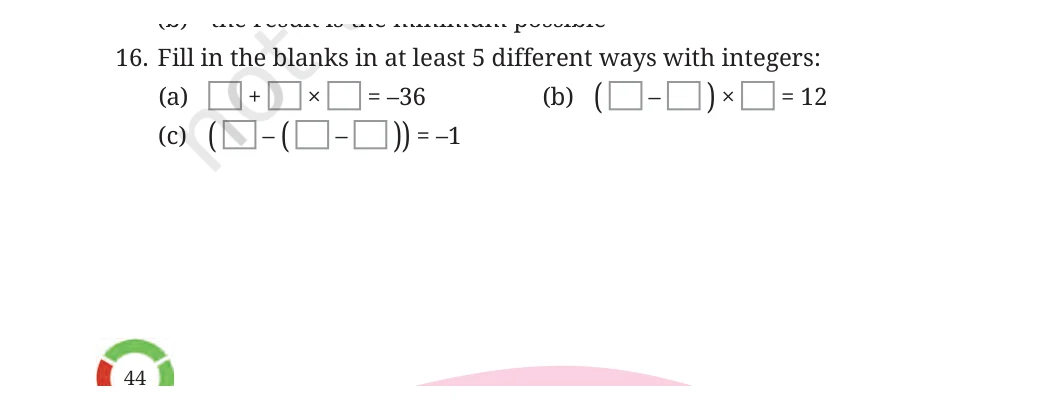
Fill in the blanks in at least 5 different ways with integers:
Show solution
(a) Here (i) 0 + -6 × 6 = -36 (ii) 4 + (-5 × 8) = -36 (iii) -4 + -8 × 4 = -36 (iv) 12 + -8 × 6 = -36 (v) -3 + 3 × (-11) = -36 (b) Here (i) (13 – 1) × 1 = 12 (ii) (10 – 4) × 2 = 12 (iii) (1 – 3) × (-6) = 12 (iv) (14 – 10) × 3 = 12 (v) (16 – 13) × 4 = 12 (c) Here (i) (5 – (10 – 4)) = -1 (ii) (0 – (3 – 2)) = -1 (iii) (-1 – (1 – 1)) = -1 (iv) (-5 – (0 – 4)) = -1 (v) (-10 – (-5 – 4)) = -1