
Use the textbook context
Match, attempt, then check
Each crop extends to the next solved item, so diagrams, tables and connected instructions stay with the question.
Complete worked answers
Textbook page 2
Textbook page 2 · solved item 1

Can two straight lines intersect at more than one point?
Show solution
No, two straight lines cannot intersect at more than one point. If two lines intersect at more than one point, then they are coincident lines.
Textbook page 2 · solved item 2
Activity 1: Draw two lines on a plain sheet of paper so that they intersect. Measure the four angles formed with a protractor. Draw four such pairs of intersecting lines and measure the angles formed at the points of intersection.
Show solution
a b p r s ∠p and ∠r = 130° ∠q and ∠s = 50° c d x y z w ∠x and ∠z = 150° ∠w and ∠y = 30° a h b g d c ∠a and ∠c = 165° ∠p and ∠n = 15° e f m n p o ∠m and ∠o = 110° ∠p and ∠n = 70°
Textbook page 2 · solved item 3
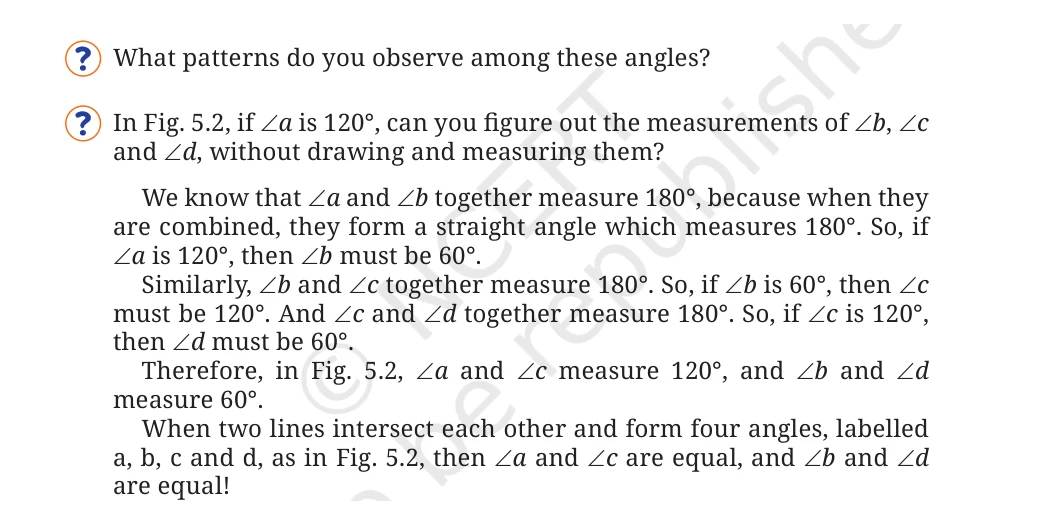
What patterns do you observe among these angles?
Show solution
It is observed that the sum of adjacent angles formed by the intersection of two lines is 180°, and the vertically opposite angles are equal in measure.
Textbook page 2 · solved item 4
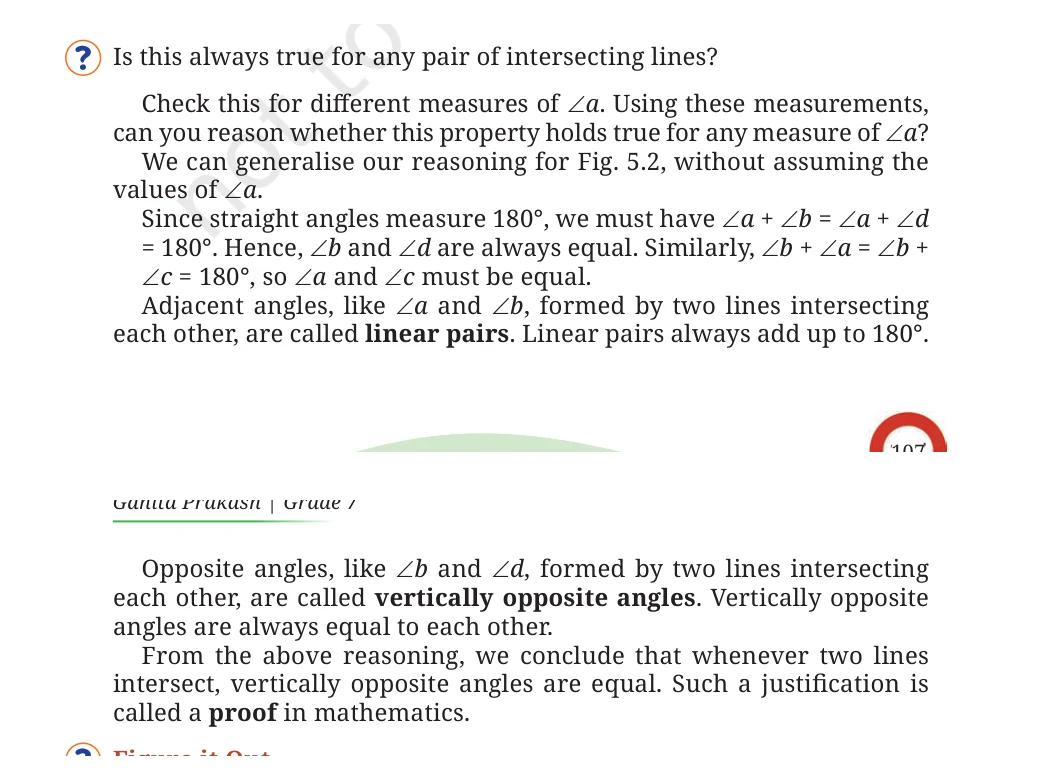
Is this always true for any pair of intersecting lines?
Show solution
Yes, any pair of intersecting lines form vertically opposite angles, which are equal in measure. Figure it out
Complete worked answers
Textbook page 3
Textbook page 3 · solved item 5
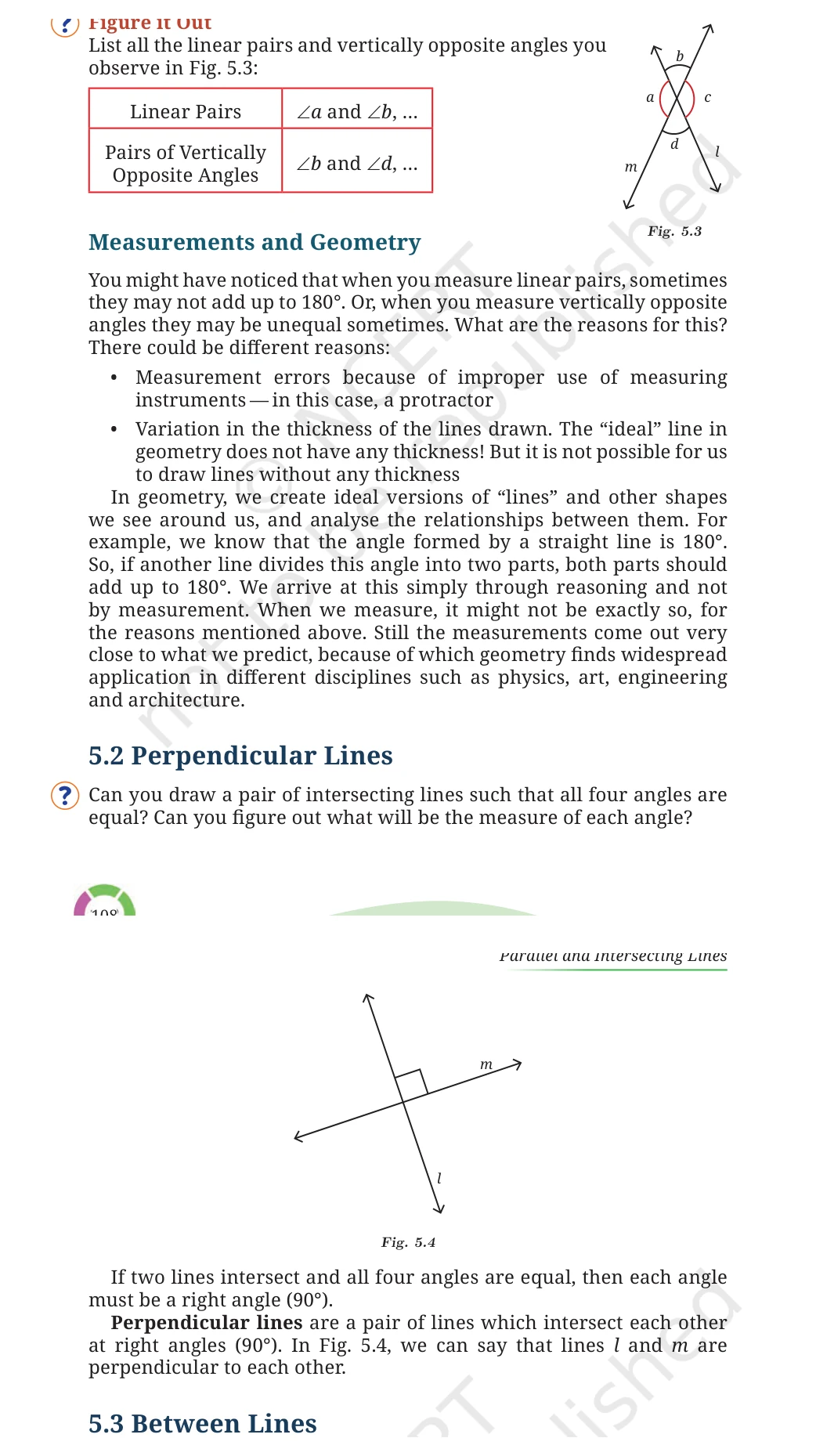
List all the linear pairs and vertically opposite angles you observe in Fig. 5.3:
Show solution
Linear pair angles: ∠a and ∠b; ∠b and ∠c; ∠c and ∠d; ∠a and ∠d. Vertically opposite angles: ∠a and ∠c; ∠b and ∠d. m n e f g h ∠e and ∠g = 90° ∠h and ∠f = 90°
Complete worked answers
Textbook page 4
Textbook page 4 · solved item 6
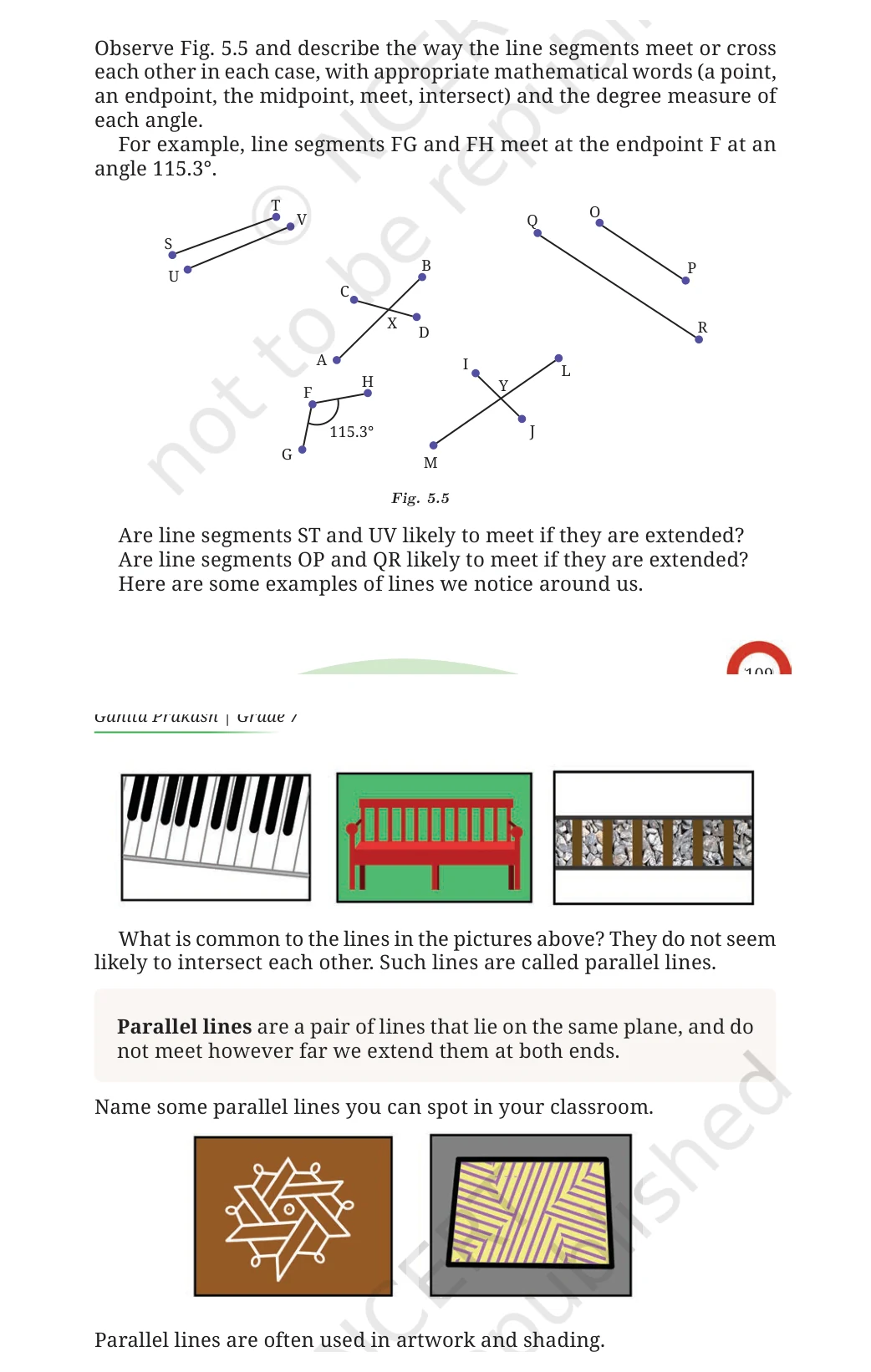
Observe Figure and describe the way the line segments meet or cross each other in each case, with appropriate mathematical words (a point, an endpoint, the midpoint, meet, intersect) and the degree measure of each angle. For example, line segments FG and FH meet at the endpoint F at an angle of 115.3°. Are line segments ST and UV likely to meet if they are extended? Are line segments OP and QR likely to meet if they are extended?
Show solution
No, the line segments ST and UV, as well as OP and QR, will not meet if extended, as they are parallel lines that never intersect.
Complete worked answers
Textbook page 5
Textbook page 5 · solved item 7
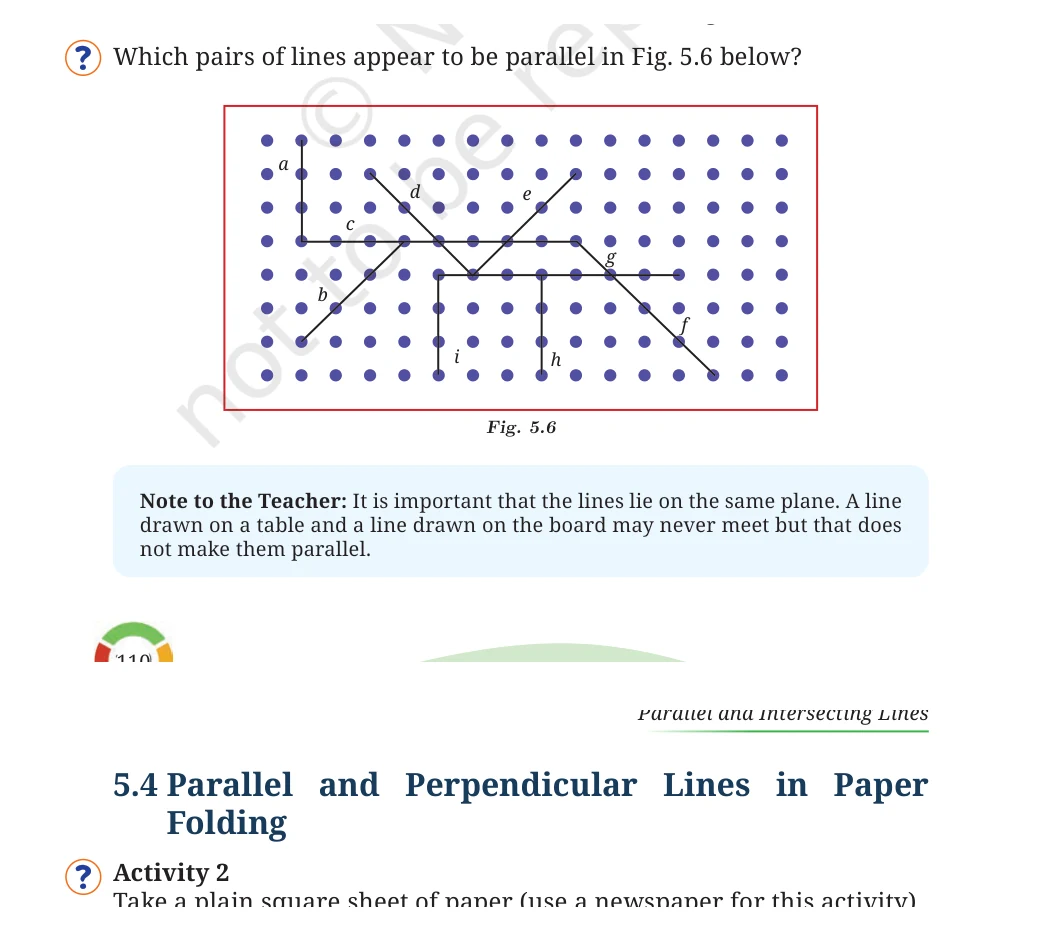
Which pairs of lines appear to be parallel in Fig. 5.6 below?
Show solution
Lines a, I and h are parallel to each other. Line b is parallel to line e. Line c is parallel to line g. Line d is parallel to line f.
Complete worked answers
Textbook page 6
Textbook page 6 · solved item 8

Activity 2: Take a plain square sheet of paper (use a newspaper for this activity). • How would you describe the opposite edges of the sheet? They are _____________ to each other.
Show solution
They are parallel to each other.
Textbook page 6 · solved item 9
• How would you describe the adjacent edges of the sheet? The adjacent edges are ______________ to each other. They meet at a point. They form right angles.
Show solution
The adjacent edges are perpendicular to each other. • Fold the sheet horizontally in half. A new line is formed (see Fig. 5.7).
Textbook page 6 · solved item 10
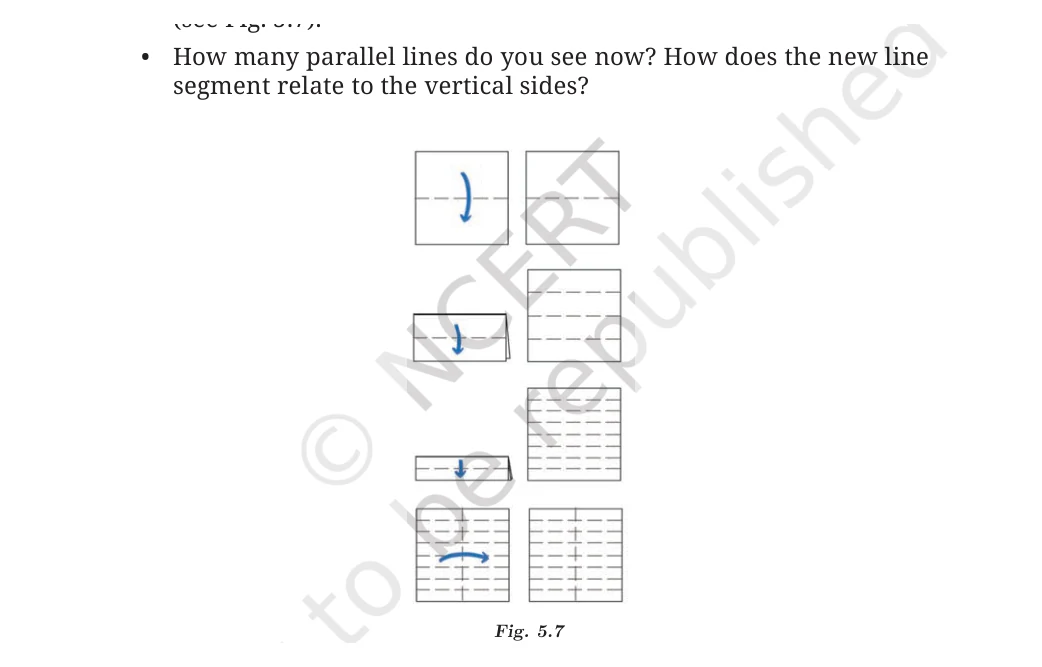
• How many parallel lines do you see now? How does the new line segment relate to the vertical sides?
Show solution
We see three parallel horizontal lines — the top edge, the fold, and the bottom edge. The new horizontal line is perpendicular to the vertical sides.
Textbook page 6 · solved item 11

• Make one more horizontal fold in the folded sheet. How many parallel lines do you see now?
Show solution
Now, we see five parallel horizontal lines.
Textbook page 6 · solved item 12

• What will happen if you do it once more? How many parallel lines will you get? Is there a pattern? Check if the pattern extends further, if you make another horizontal fold.
Show solution
We will get nine parallel lines. The pattern follows: 1st fold → 3 lines 2nd fold → 5 lines 3rd fold → 9 lines So, after each fold, the number of horizontal lines approximately doubles and adds one. The pattern continues as you fold more.
Textbook page 6 · solved item 13

• Make a vertical fold in the square sheet. This new vertical line is ___________ to the previous horizontal lines.
Show solution
The new vertical line is perpendicular to the previous horizontal lines.
Textbook page 6 · solved item 14
• Fold the sheet along a diagonal. Can you find a fold that creates a line parallel to the diagonal line?
Show solution
Yes, we can make a fold parallel to the diagonal by folding the sheet in the same slanting direction at equal angles or by folding a smaller triangle inside the square. Here is another activity for you to try. • Take a square sheet of paper, fold it in the middle and unfold it. • Fold the edges towards the centre line and unfold them. • Fold the top right and bottom left corners onto the creased line to create triangles.
Refer to Fig. 5.8. • The triangles should not cross the crease lines.
Complete worked answers
Textbook page 7
Textbook page 7 · solved item 15
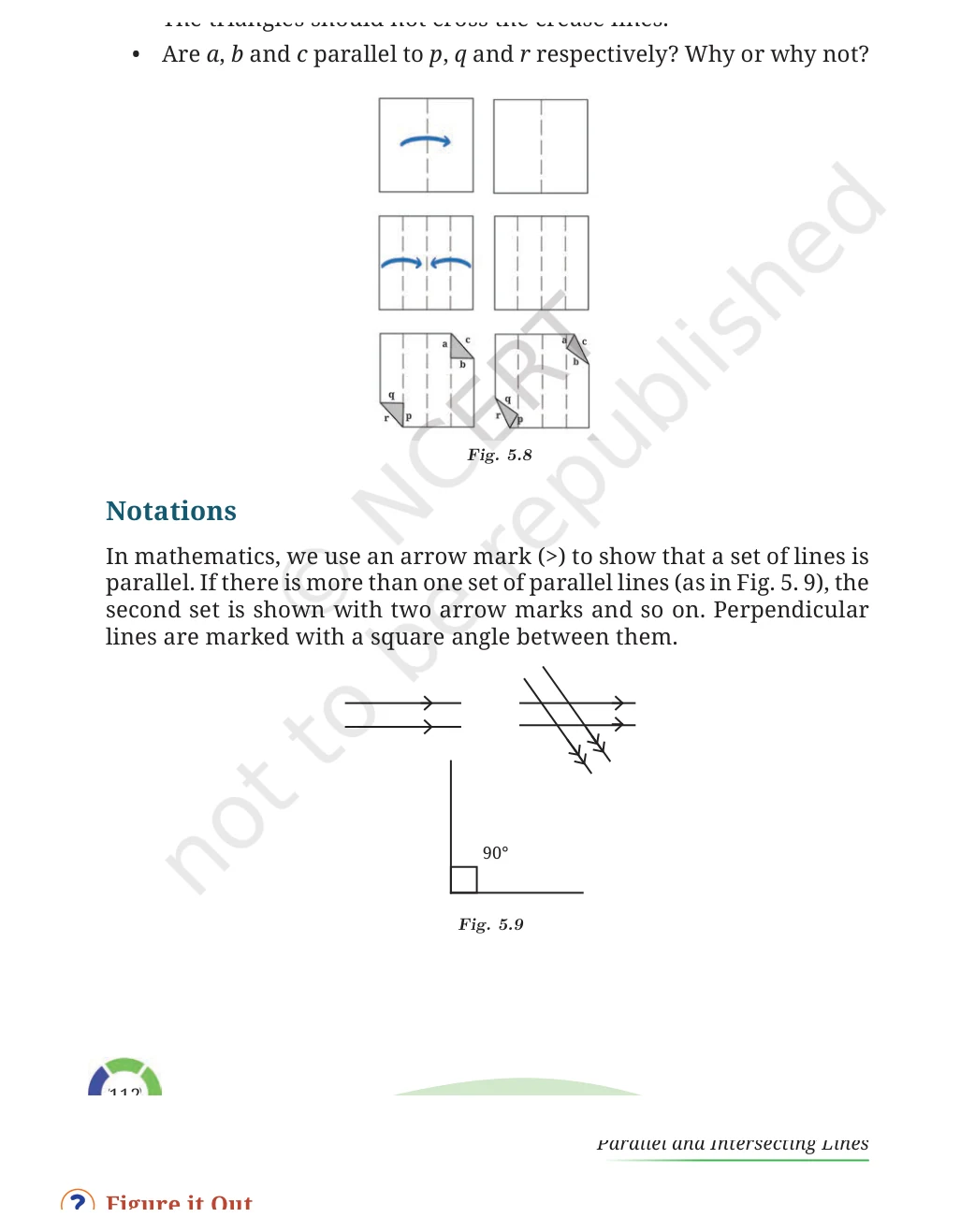
• Are a, b and c parallel to p, q and r respectively? Why or why not?
Show solution
Yes, a, b, and c are parallel to p, q, and r, respectively. a (top edge) is parallel to p (bottom edge). b (right edge) is parallel to q (left edge). c and r are diagonal folds made symmetrically, so they are parallel. Figure it out
Complete worked answers
Textbook page 8
Textbook page 8 · solved item 16
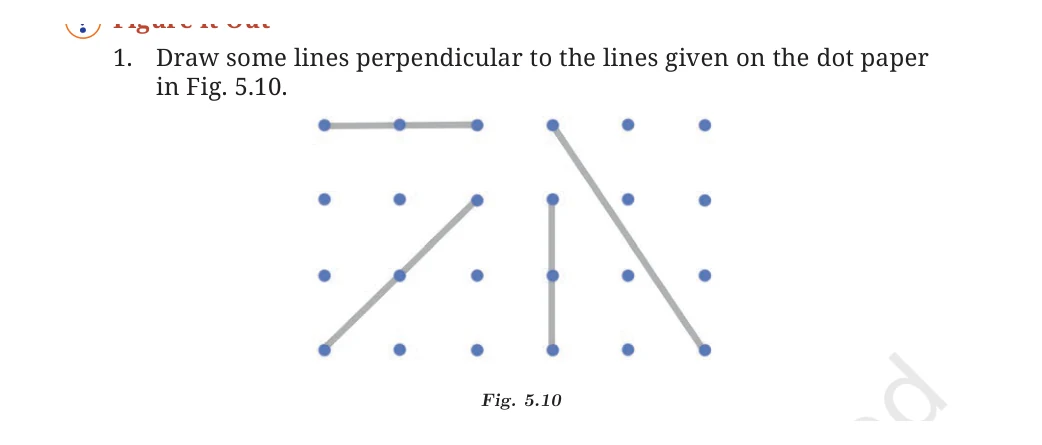
1. Draw some lines perpendicular to the lines given on the dot paper in Fig. 5.10.
Show solution
Do it yourself
Textbook page 8 · solved item 17
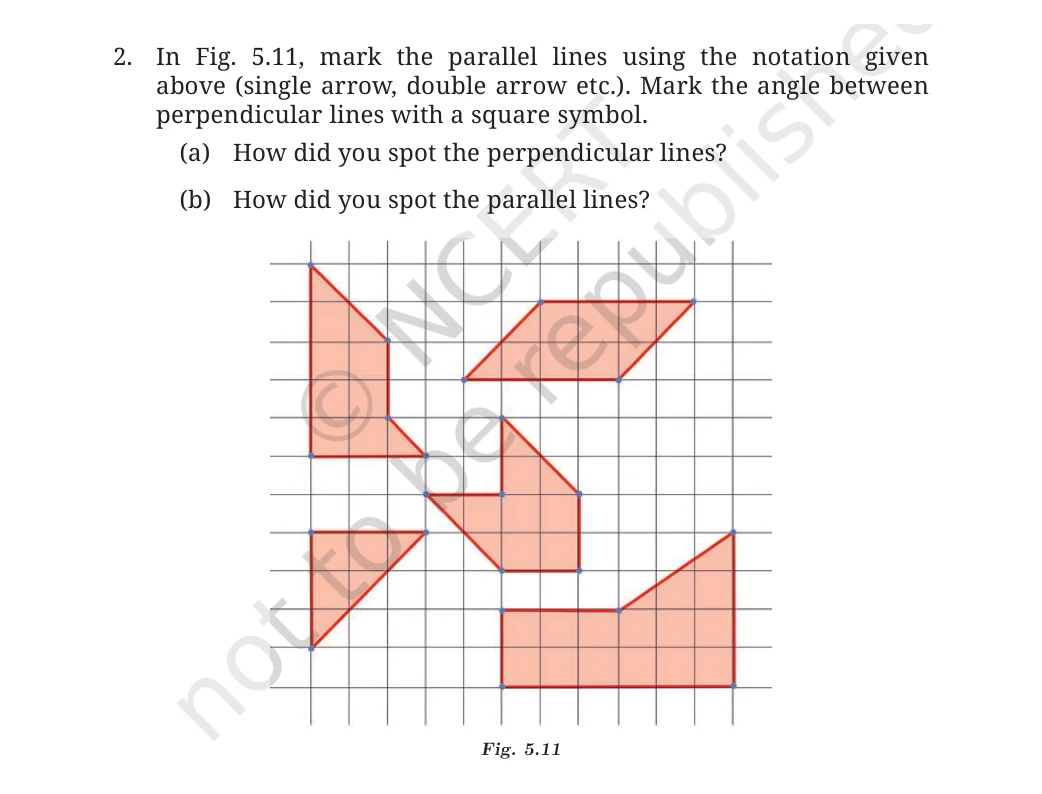
2. In Fig. 5.11, mark the parallel lines using the notation given above (single arrow, double arrow etc.). Mark the angle between perpendicular lines with a square symbol. (a) How did you spot the perpendicular lines? (b) How did you spot the parallel lines?
Show solution
(i) Lines that intersect at a 90° angle are called perpendicular lines. (ii) Lines that do not meet, no matter how far they are extended, are called parallel lines.
Textbook page 8 · solved item 18
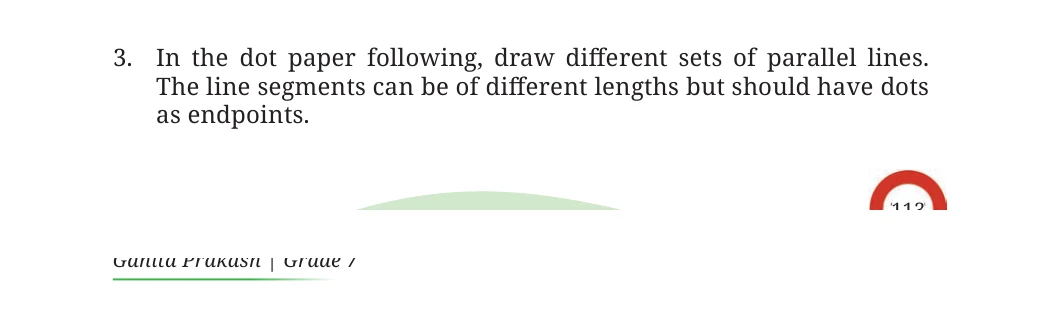
3. In the dot paper following, draw different sets of parallel lines. The line segments can be of different lengths but should have dots as endpoints.
Show solution
Do it yourself
Complete worked answers
Textbook page 9
Textbook page 9 · solved item 19
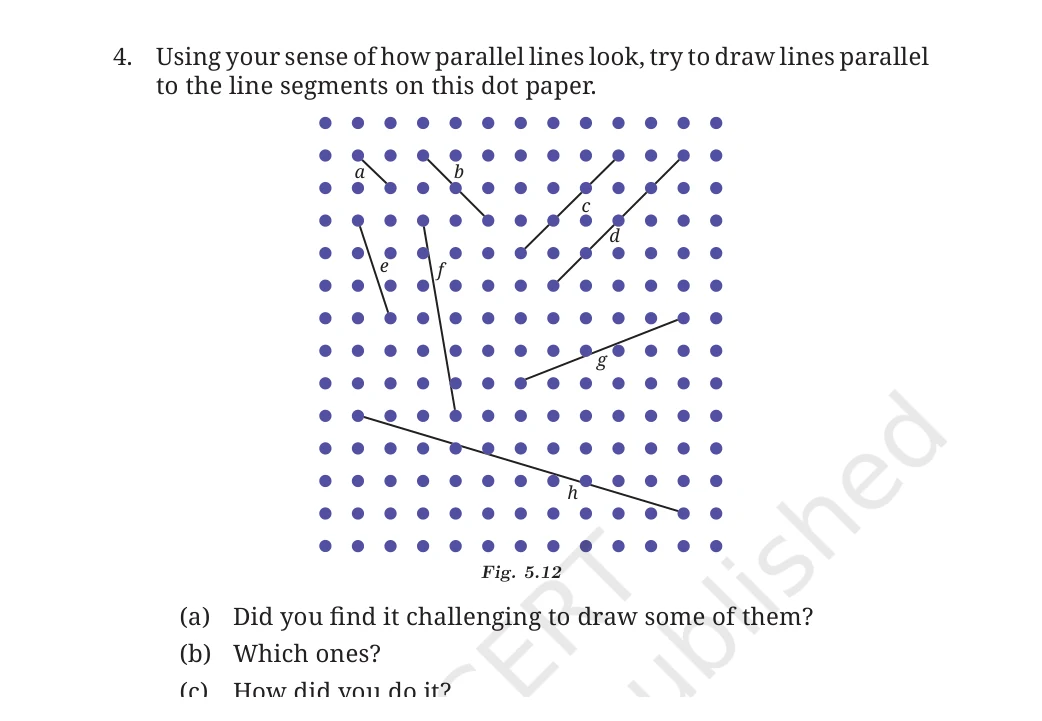
4. Using your sense of how parallel lines look, try to draw lines parallel to the line segments on this dot paper. (a) Did you find it challenging to draw some of them? (b) Which ones? (c) How did you do it?
Show solution
(a) Yes, some line segments are a little more difficult to draw than others. (b) Line segments e, f, h, and g. (c) Parallel lines are drawn by keeping them equidistant from the given line throughout their length.
Textbook page 9 · solved item 20
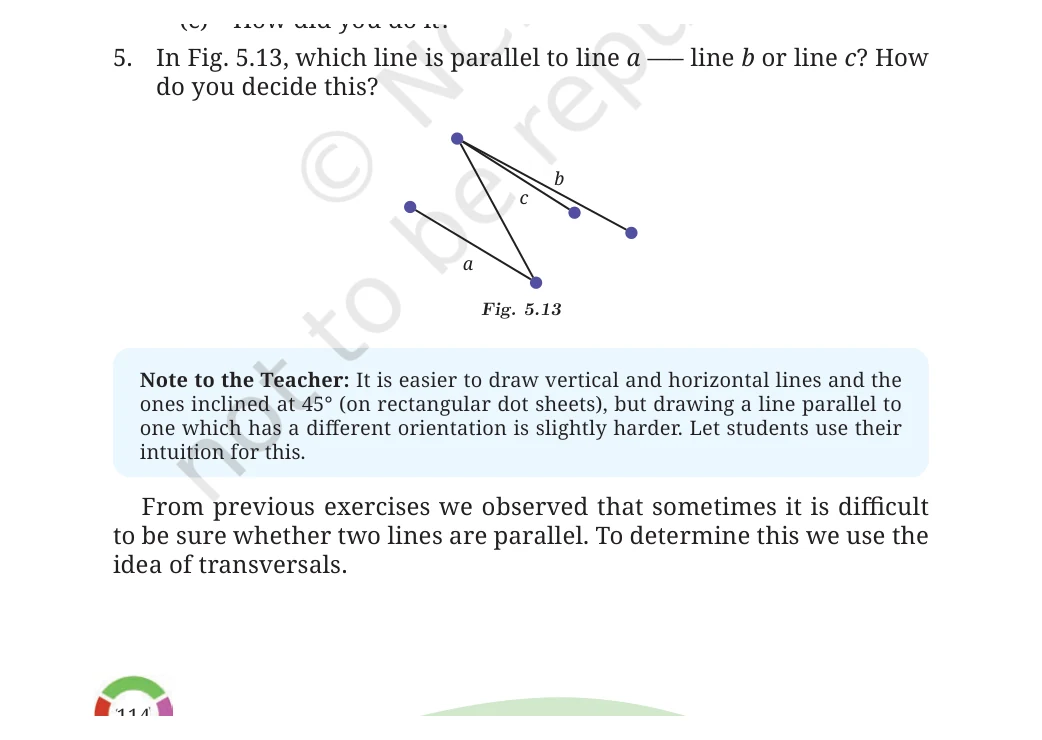
5. In Fig. 5.13, which line is parallel to line a —– line b or line c? How do you decide this?
Show solution
Line a is parallel to line c because both lines remain equidistant from each other and do not intersect, no matter how far they are extended. Figure it out
Complete worked answers
Textbook page 14
Textbook page 14 · solved item 21
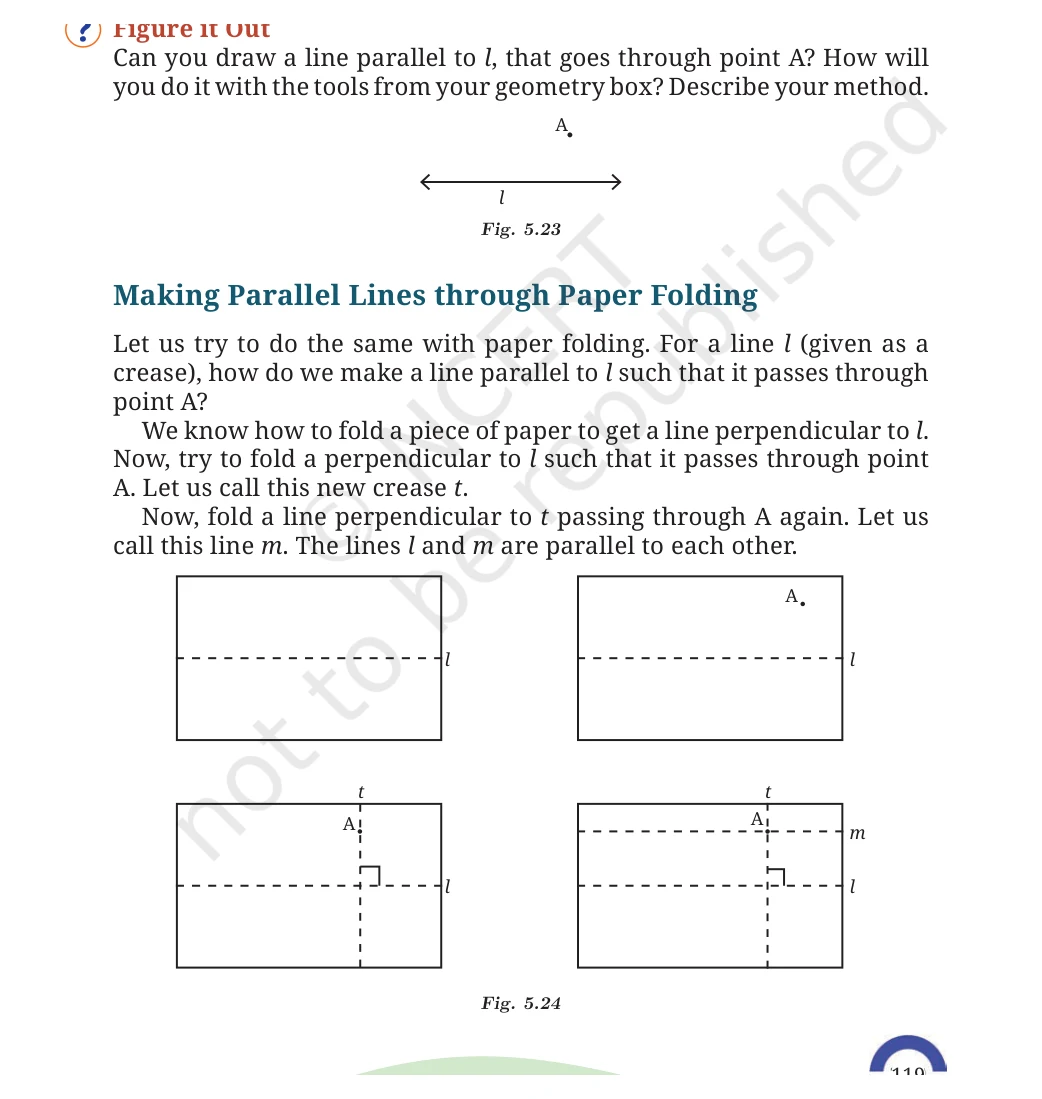
Can you draw a line parallel to l, that goes through point A? How will you do it with the tools from your geometry box? Describe your method.
Show solution
Yes, we can draw a line parallel to l that goes through point A using set squares, ruler and pencil. l A • l A • Steps of construction: (i) Align one edge of the set square with line l. (ii) Place a ruler along the other perpendicular edge. (iii) Slide the set square along the ruler until it reaches point A.
(iv) Draw a line through A along the set square’s edge. (v) This is the required line parallel to l. Figure it out
Complete worked answers
Textbook page 18
Textbook page 18 · solved item 22
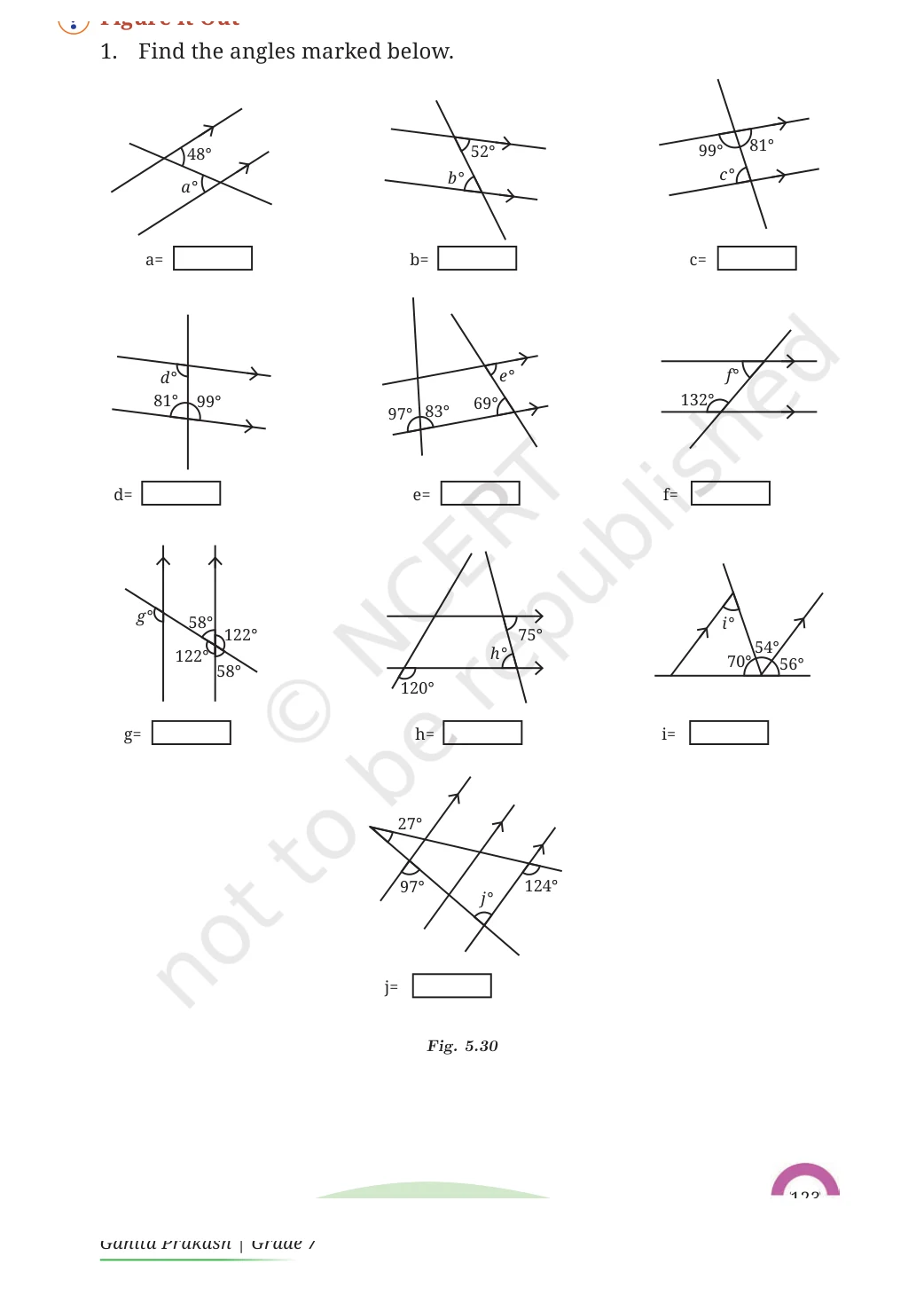
1. Find the angles marked below.
Show solution
1. Since alternate interior angles formed by a transversal intersecting a pair of parallel lines are equal, angle a is 48°. 2. Since alternate interior angles formed by a transversal intersecting a pair of parallel lines are equal, angle b is 52°. 3. Since alternate interior angles formed by a transversal intersecting a pair of parallel lines are equal, angle c is 81°.
4. Since alternate interior angles formed by a transversal intersecting a pair of parallel lines are equal, angle d is 99°. 5. Since alternate interior angles formed by a transversal intersecting a pair of parallel lines are equal, angle e is 69°. 6. Since the sum of interior angles on the same side of a transversal is always equal to 180°.
Therefore, f + 132° = 180° f = 180° - 132° f = 48°. 7. Since corresponding angles formed by a transversal intersecting a pair of parallel sides are equal, angle g is 122°. 8. Since alternate interior angles formed by a transversal intersecting a pair of parallel lines are equal, angle h is 75°. 9. Since alternate interior angles formed by a transversal intersecting a pair of parallel lines are equal, angle i is 54°.
10. Since alternate interior angles formed by a transversal intersecting a pair of parallel lines are equal, angle j is 97°.
Complete worked answers
Textbook page 19
Textbook page 19 · solved item 23
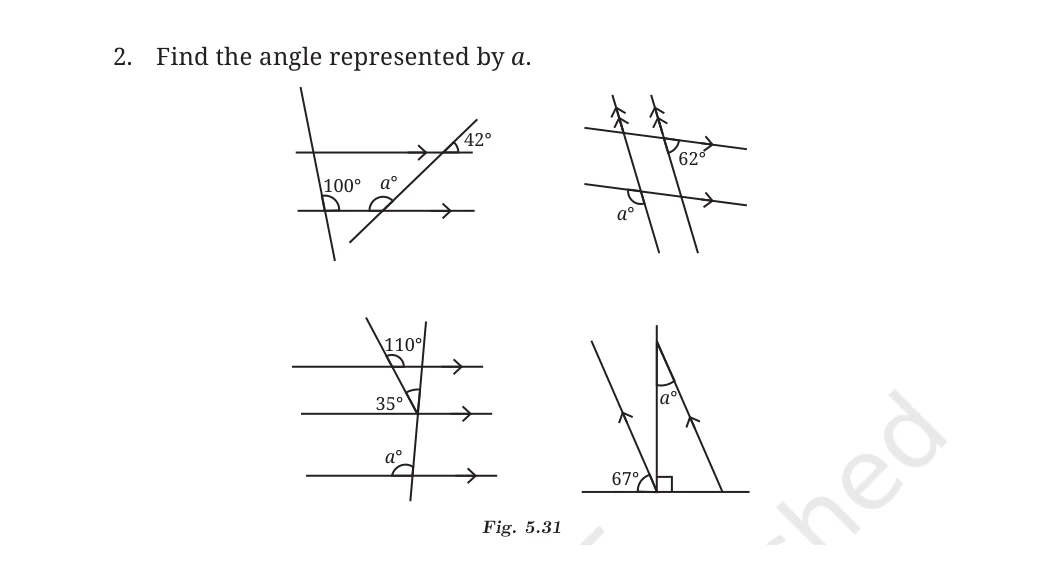
2. Find the angle represented by a.
Show solution
(A) ∠1 = ∠2 = 42° ……….(Vertically opposite angles) Line p is parallel to q and s is a transversal, then a + ∠1 = 180° …………….(Sum of interior angles on the same side of the transversal) a + 42° = 180° a = 180° − 42° a = 138° (B) Line l is parallel to line m and s is a transversal, then ∠1 = ∠2 = 62° ……………(Corresponding angles) Line r is parallel to line s and m is a transversal, then ∠1 = ∠3 = 62° ……………(Corresponding angles) a + ∠3 = 180° …………..(Linear pair angles) a + 62° = 180° a = 180° − 62° a = 118° (C) 1 p q s 2 l m r s 1 3 2 1 2 3 4 x y z b c ∠1 = ∠2 = 110° …… (Vertically opposite angles) Line x is parallel to line y and b is a transversal, then ∠2 = 35° + ∠3 ……… (Alternate interior angles) or 110° = 35° + ∠3 110° - 35° = ∠3 or ∠3 = 75°.
Line y is parallel to line z and c is transversal, then ∠3 = ∠4 = 75° ……. (Corresponding angles) a + ∠4 = 180° ……… (Linear pair angles) a + 75° = 180° a = 180° - 75° a = 105°. (D) ∠1 + 67° + ∠2 = 180° ……… (Sum of angles on a straight line) ∠1 + 67° + 90° = 180° ∠1 + 157° = 180° ∠1 = 180° - 157° ∠1 = 23°. ∠1 = ∠a = 23° …… (Alternate interior angles).
Textbook page 19 · solved item 24
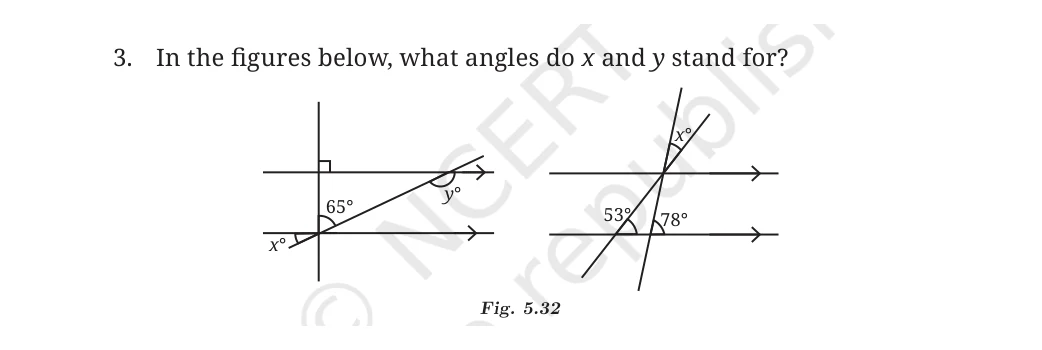
3. In the figures below, what angles do x and y stand for?
Show solution
(A) 1 m n 2 1 2 m n a b Line l is parallel to line n and a is a transversal, then ∠2 = 65° + ∠1 ………(Corresponding angles) 90° = 65° + ∠1 ∠1 = 90° - 65° ∠1 = 25°. ∠1 = x = 25° ………..(Vertically opposite angles) Line m is parallel to line n and b is a transversal, then ∠1 + ∠y = 180° ……………(Sum of interior angles on the same side of the transversal) 25° + ∠y = 180° ∠y = 180° - 25° ∠y = 155°.
(B) Line a is parallel to line b and d is a transversal, then ∠2 = ∠3 = 53° …………..(Alternate interior angles) Also, line a is parallel to line b and c is a transversal, then ∠1 + ∠2 = ∠4 …………. (Alternate interior angles) or ∠1 + 53° = 78° ∠1 = 78° - 53° ∠1 = 25°. Therefore, ∠1 = x = 25° ………….(Vertically opposite angles).
Textbook page 19 · solved item 25
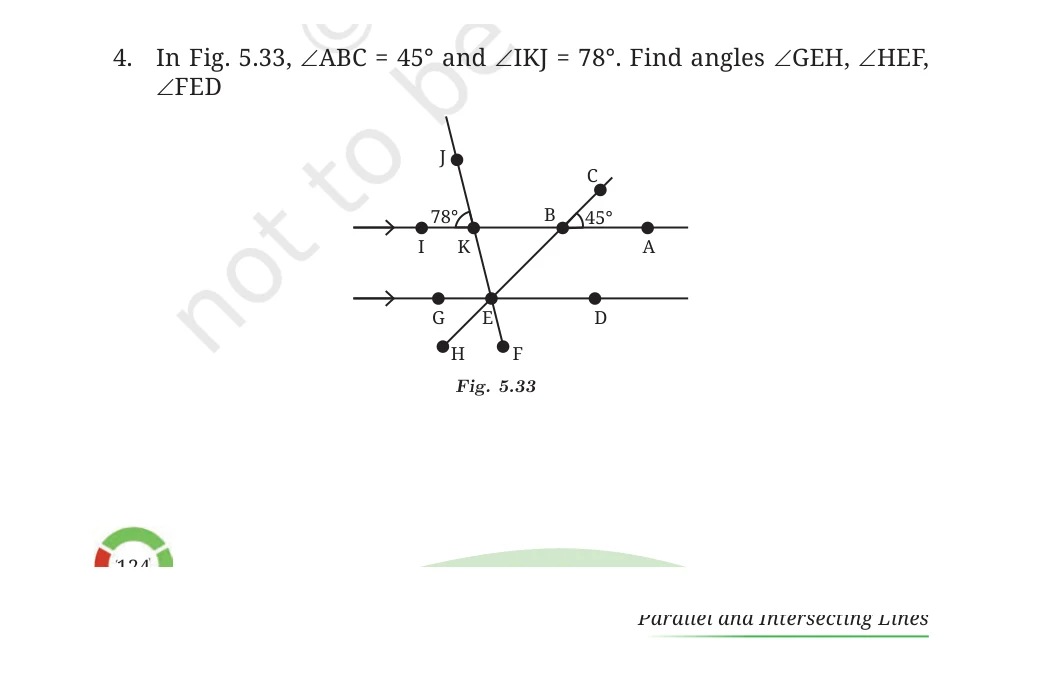
4. In Fig. 5.33, ∠ABC = 45° and ∠IKJ = 78°. Find angles ∠GEH, ∠HEF, ∠FED
Show solution
∠ABC = ∠KBE = 45° …………….(Vertically opposite angles) ∠IKJ = ∠BKE = 78° ………………(Vertically opposite angles) ∠BKE = ∠FED = 78° …………….(Corresponding angles) ∠KBE = ∠BED = 45° …………….(Alternate interior angles) ∠BED = ∠GEH = 45° ……………(Vertically opposite angles) 1 2 3 a b c d 4 ∠GEH + ∠HEF + ∠FED = 180° …………..(Sum of angles on a straight line) 45° + ∠HEF + 78° = 180° 123° + ∠HEF = 180° ∠HEF = 180° - 123° ∠HEF = 57°.
Complete worked answers
Textbook page 20
Textbook page 20 · solved item 26
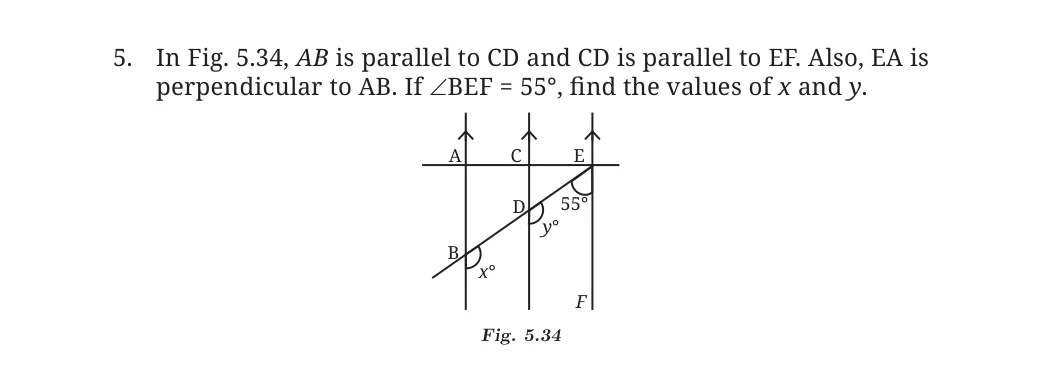
5. In Fig. 5.34, AB is parallel to CD and CD is parallel to EF. Also, EA is perpendicular to AB. If ∠BEF = 55°, find the values of x and y.
Show solution
Since EF is parallel to CD and BE is a transversal, then ∠BEF + y = 180° …………….(Sum of interior angles on the same side of the transversal) 55° + y = 180° y = 180° - 55° y = 125°. Since AB is parallel to CD and BE is a transversal, then x = y = 125° ………… (Corresponding angles).
Textbook page 20 · solved item 27
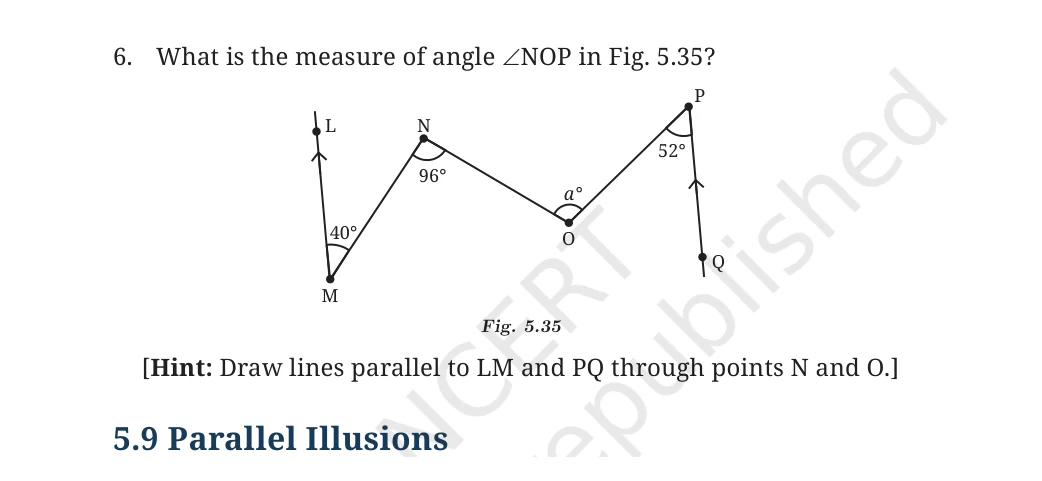
6. What is the measure of angle ∠NOP in Fig. 5.35?
Show solution
N O 1 2 3 4 5 6 E F G H 96° a Construction: Draw lines EF and GH parallel to lines LM and PQ. LM is parallel to EF and MN is a transversal, then ∠1 = ∠2 = 40°…….. (Alternate interior angles) ∠2 + ∠3 = 96° 40° + ∠3 = 96° ∠3 = 96° - 40° ∠3 = 56°. EF is parallel to GH and NO is a transversal, then ∠3 = ∠4 = 56°……..
(Alternate interior angles) Also, GH is parallel to PQ and OP is a transversal, then ∠5 = ∠6 = 52°…….. (Alternate interior angles) a = ∠4 + ∠5 a = 56° + 52° a = 108°.
Textbook page 20 · solved item 28
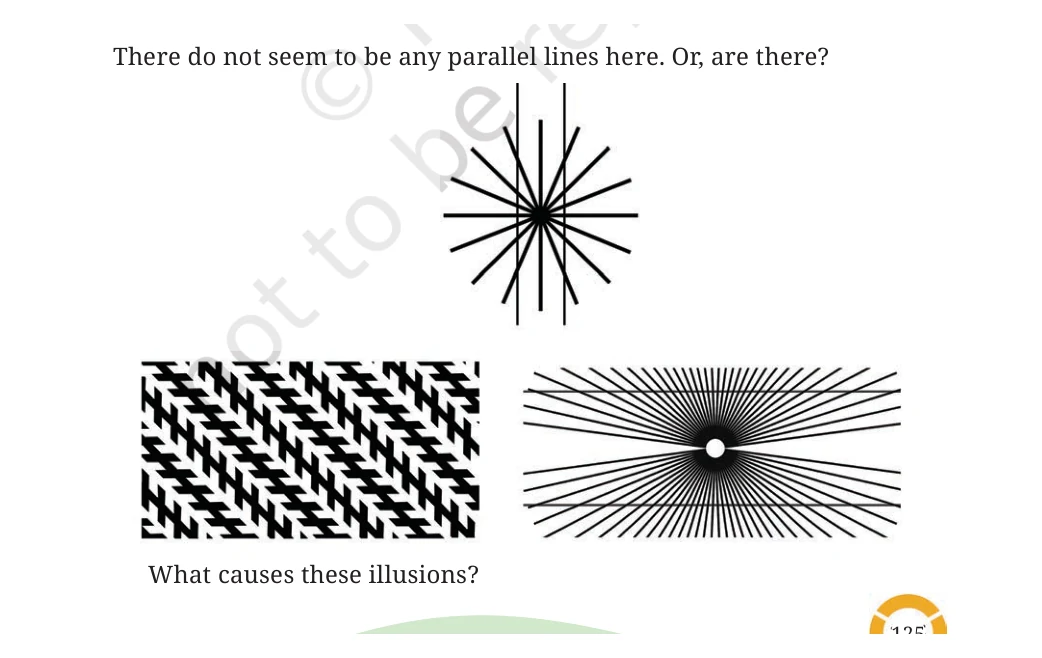
There do not seem to be any parallel lines here. Or, are there? What causes these illusions?
Show solution
Yes — there are parallel lines in all three images. The illusions are created by contextual visual cues (angles, perspective, and intersecting lines) that mislead your brain’s interpretation of space and alignment.