
Use the textbook context
Match, attempt, then check
Each source crop keeps the printed information needed for that item. Compound answer-key entries are separated into individual solutions.
Complete worked answers
Textbook page 1
Textbook page 1 · solved item 1
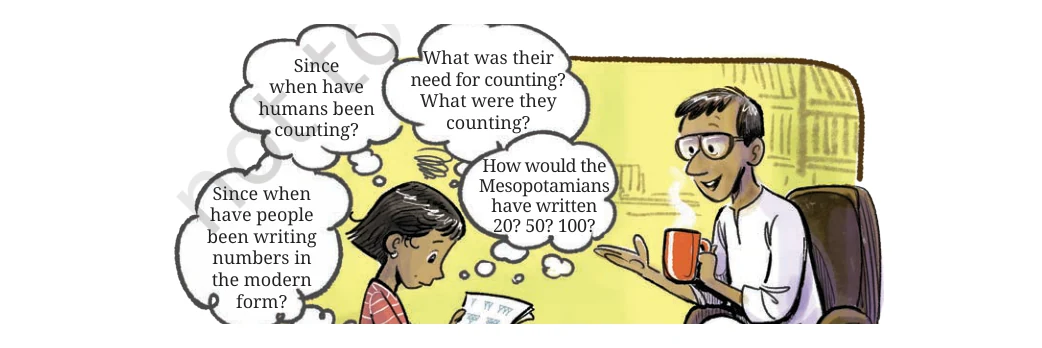
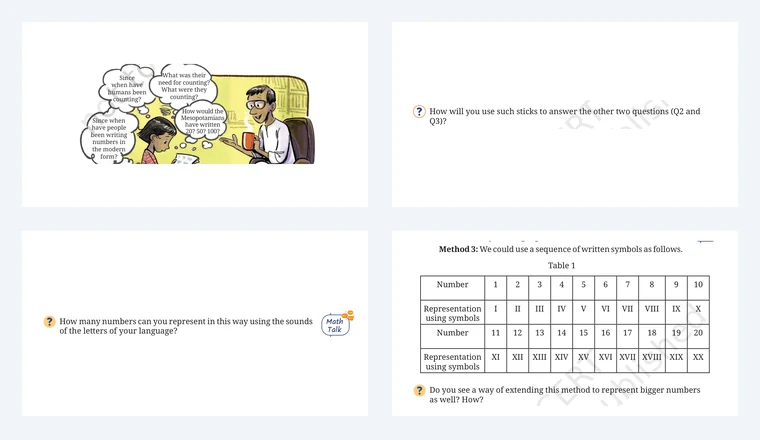
Why did early humans count, and how did the modern Hindu number system develop?
Show solution
Early humans counted food, livestock, trade goods, ritual offerings, and passing days. The modern place-value system using the digits 0-9 developed in India, spread to the Arab world by about 800 CE, and later reached Europe and the rest of the world.
Complete worked answers
Textbook page 5
Textbook page 5 · solved item 2

Using one stick for each cow, how can you compare two herds and find how many more cows one herd needs?
Show solution
Pair one stick from the first herd with one stick from the second. If one collection has sticks left over, that herd is larger. The unpaired sticks give exactly how many cows the smaller herd needs to become equal.
Complete worked answers
Textbook page 6
Textbook page 6 · solved item 3

How many numbers can be represented using the letter sounds of your language in the one-letter method?
Show solution
Exactly as many as there are letters in the chosen ordered alphabet. For English, the one-letter method represents 26 numbers.
Textbook page 6 · solved item 4
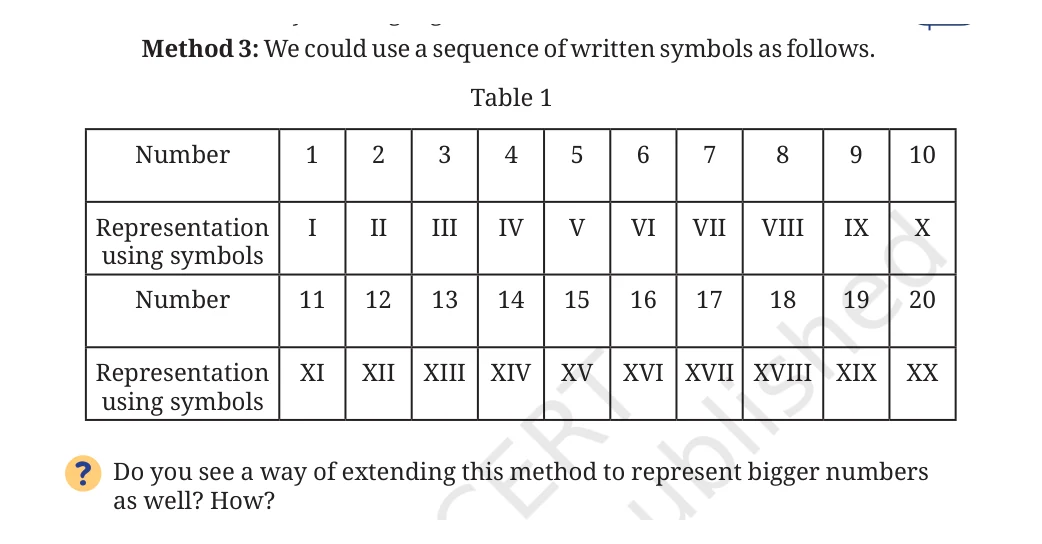
How can the Roman-symbol sequence shown be extended to represent larger numbers?
Show solution
Introduce symbols for further landmark numbers and combine them by fixed rules. Roman numerals do this with L, C, D, and M for 50, 100, 500, and 1000, though ever-larger values still require more conventions.
Complete worked answers
Textbook page 7
Textbook page 7 · solved item 5
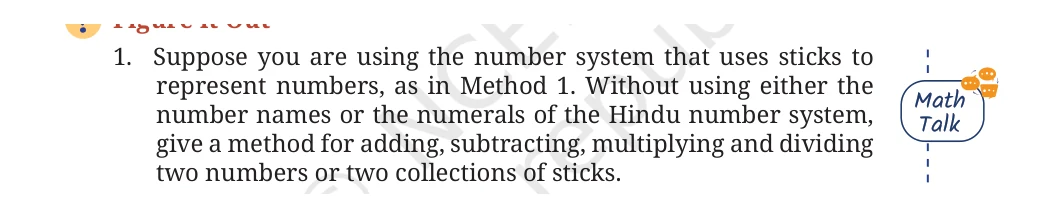
Using only collections of sticks, describe addition, subtraction, multiplication, and division.
Show solution
For addition, join the collections. For subtraction, pair and remove sticks. For multiplication, make equal copies of one collection, one for each stick in the other. For division, repeatedly form equal groups of the divisor size; the number of groups is the quotient and any sticks left are the remainder.
Textbook page 7 · solved item 6

Extend the ordered-letter system beyond z so that it can represent every positive integer.
Show solution
Use strings as place-value digits, as spreadsheet columns do: a through z, then aa, ab, ..., az, ba, and so on. Every positive integer then receives a finite string.
Textbook page 7 · solved item 7

Design a simple number system of your own.
Show solution
One valid design is a base-3 place-value system with digits A, B, C for 0, 1, 2. Read positions from right to left as powers of 3; for example, BCA means 1\times3^2+2\times3+0=15.
Complete worked answers
Textbook page 9
Textbook page 9 · solved item 8
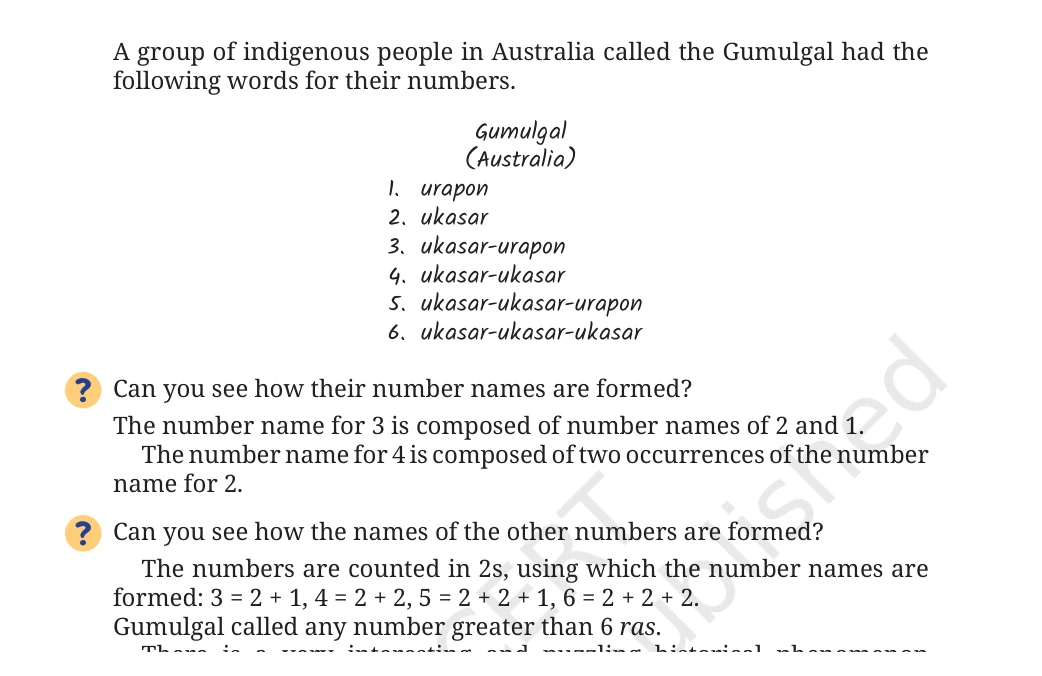
Explain how the Gumulgal number names from 1 to 6 are formed.
Show solution
Urapon means 1 and ukasar means 2. Larger names add these units: 3 is 2+1, 4 is 2+2, 5 is 2+2+1, and 6 is 2+2+2.
Complete worked answers
Textbook page 10
Textbook page 10 · solved item 9
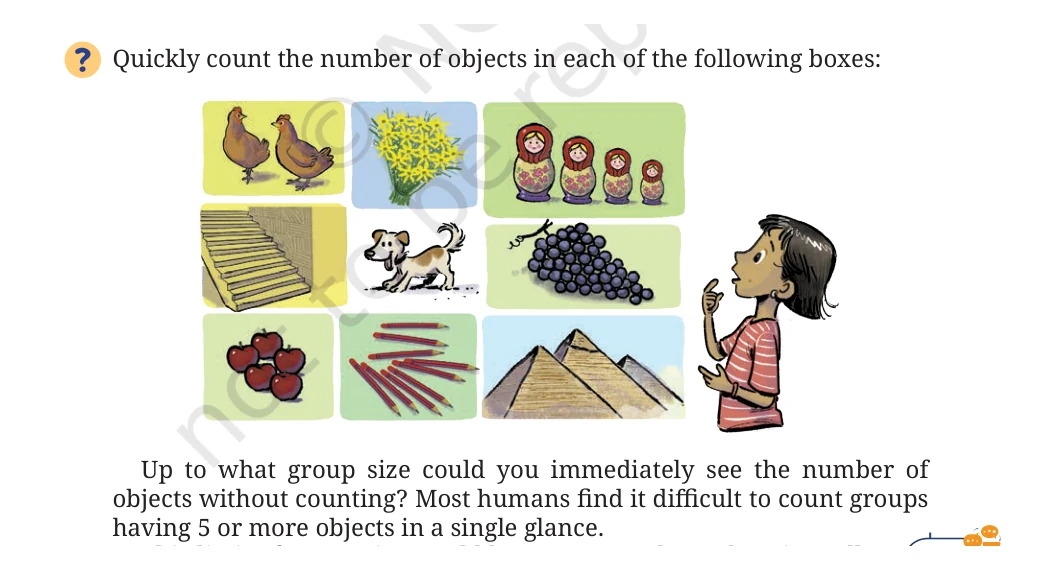
In the quick-look activity, up to what group size can most people recognise the quantity without counting?
Show solution
People commonly recognise groups up to about 4 immediately. At 5 or more, most people begin counting or mentally grouping the objects.
Complete worked answers
Textbook page 11
Textbook page 11 · solved item 10

What is difficult about counting only in groups of 5, and how would 1345 be represented?
Show solution
A single landmark must be repeated too many times as numbers grow. Since 1345=269\times5, a system with only a symbol for a group of 5 would need that symbol 269 times, unless it introduced larger landmarks.
Complete worked answers
Textbook page 12
Textbook page 12 · solved item 11

Write 1222, 2999, 302, and 715 in Roman numerals.
Show solution
(i) MCCXXII; (ii) MMCMXCIX; (iii) CCCII; (iv) DCCXV.
Complete worked answers
Textbook page 13
Textbook page 13 · solved item 12

Add LXXXVII and LXXVIII without first rewriting them as Hindu numerals.
Show solution
Combine like symbols and regroup five Xs as L and two Ls as C. The result is CLXV.
Textbook page 13 · solved item 13

Find the Roman-numeral products V x L, L x D, V x D, and VII x IX.
Show solution
The products are CCL, 25 copies of M, MMD, and LXIII respectively. The second result illustrates why multiplication and very large numbers are awkward in this Roman system.
Textbook page 13 · solved item 14

Multiply CCXXXI by MDCCCLII using the Roman-system grouping idea.
Show solution
The product is 427812. With only the listed additive Roman landmarks, this would require 427 copies of M followed by DCCCXII, showing why an abacus or an extended overbar convention was needed for such calculations.
Textbook page 13 · solved item 15

Why might one community use different number-name sequences for different kinds of objects?
Show solution
Different objects may be counted in customary bundles or with specialised classifiers. Separate sequences can reflect how a community trades, stores, or speaks about those objects.
Textbook page 13 · solved item 16
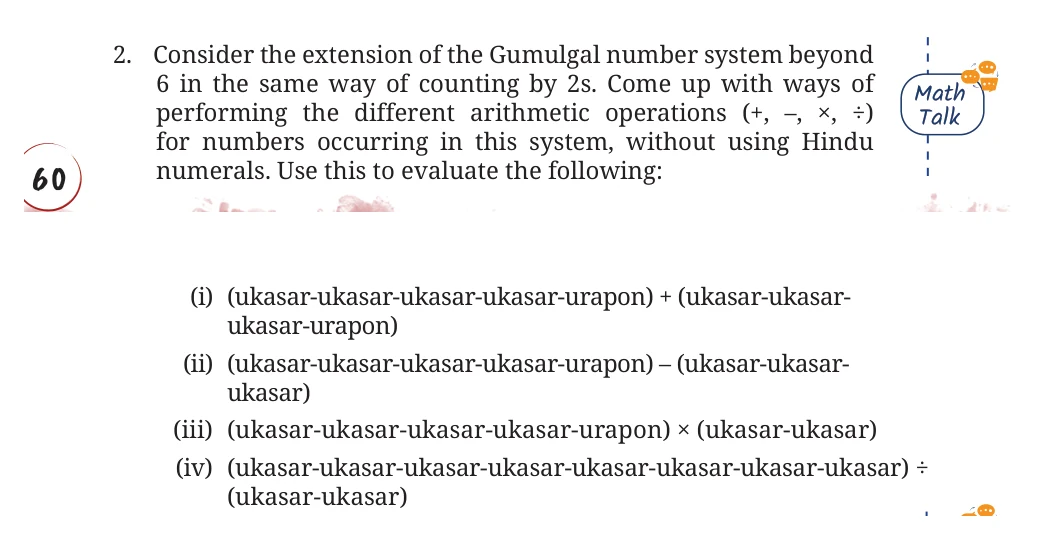
Evaluate the four Gumulgal-system operations shown, using urapon = 1 and ukasar = 2.
Show solution
(i) eight ukasar; (ii) ukasar-urapon; (iii) eighteen ukasar; (iv) four ukasar. These correspond to regrouping entirely in units of 2, with one urapon where needed.
Complete worked answers
Textbook page 14
Textbook page 14 · solved item 17

Which features make the Hindu number system more efficient than Roman numerals?
Show solution
It is a place-value system, uses only ten reusable digits including 0, represents arbitrary sizes compactly, and supports standard algorithms for addition, subtraction, multiplication, and division.
Textbook page 14 · solved item 18

How could an earlier homemade number system be refined?
Show solution
Give it a fixed base, a digit for zero, one digit for each value from 0 to base-1, and place values that are powers of the base. These rules make representation unambiguous and arithmetic systematic.
Complete worked answers
Textbook page 15
Textbook page 15 · solved item 19

Represent 10458, 1023, 2660, 784, 1111, and 70707 in the Egyptian system.
Show solution
Use repeated landmark symbols for these decompositions: 10458=10000+4(100)+5(10)+8; 1023=1000+2(10)+3; 2660=2(1000)+6(100)+6(10); 784=7(100)+8(10)+4; 1111=1000+100+10+1; 70707=7(10000)+7(100)+7.
Textbook page 15 · solved item 20
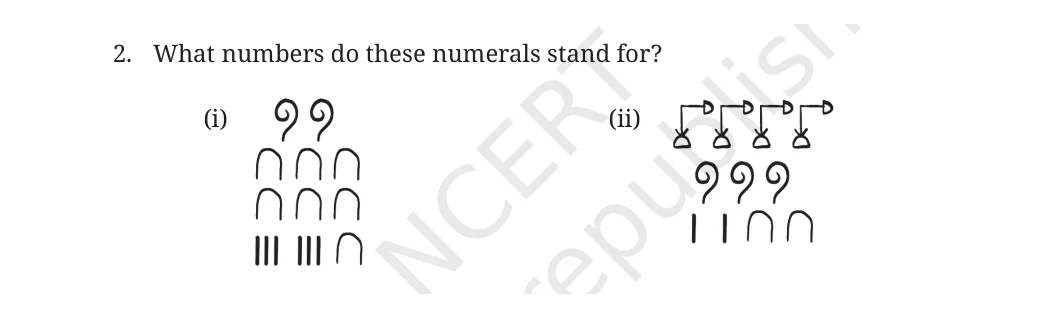
Decode the two Egyptian numerals shown.
Show solution
Counting each landmark symbol gives (i) 276 and (ii) 4322.
Complete worked answers
Textbook page 16
Textbook page 16 · solved item 21
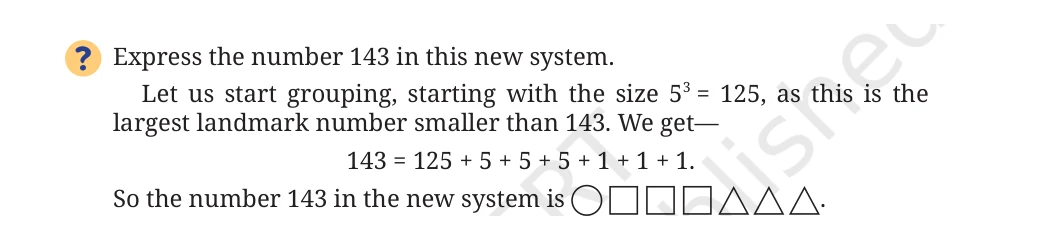
Express 143 in the newly created additive base-5 system.
Show solution
Since 143=1(125)+0(25)+3(5)+3(1), use one 5^3 symbol, no 5^2 symbol, three 5^1 symbols, and three unit symbols.
Textbook page 16 · solved item 22

Write 15, 50, 137, 293, and 651 using the additive base-5 symbols.
Show solution
Their landmark counts are: 15=3(5); 50=2(25); 137=125+2(5)+2; 293=2(125)+25+3(5)+3; 651=625+25+1. Replace each term by the matching symbol shown in the textbook table.
Textbook page 16 · solved item 23

Is any whole number impossible to represent in the additive base-5 system shown?
Show solution
Zero cannot be written because the system has no symbol for it. Every positive integer can be represented by grouping it into powers of 5.
Textbook page 16 · solved item 24

Find the landmark numbers of a base-7 system and state the general base-n pattern.
Show solution
Base 7 has landmarks 7^0=1,7^1=7,7^2=49,7^3=343,\ldots. In general, a base-n system has n^0,n^1,n^2,n^3,\ldots.
Complete worked answers
Textbook page 18
Textbook page 18 · solved item 25
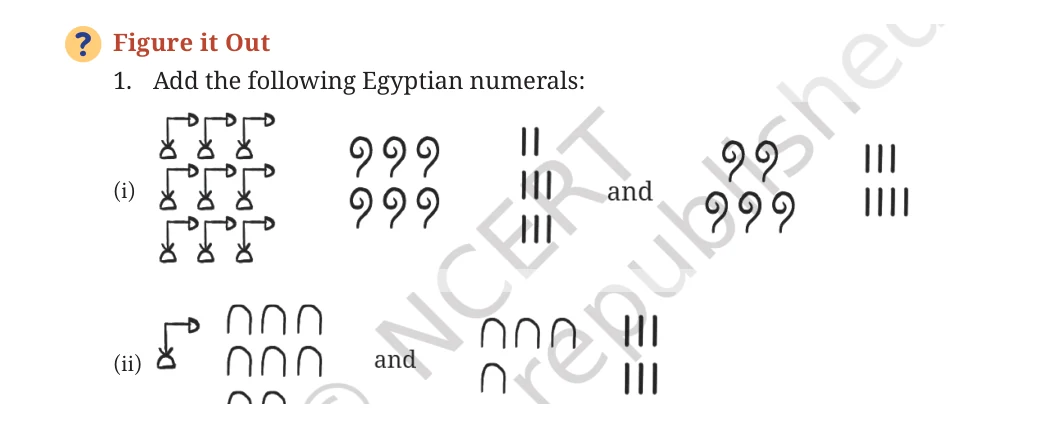
Add the two pairs of Egyptian numerals shown.
Show solution
For (i), the values are 9608 and 507, so the sum is 10115: one 10000 symbol, one 10 symbol, and five unit strokes. For (ii), the values are 1110 and 46, so the sum is 1156: one 1000 symbol, one 100 symbol, five 10 symbols, and six unit strokes.
Textbook page 18 · solved item 26
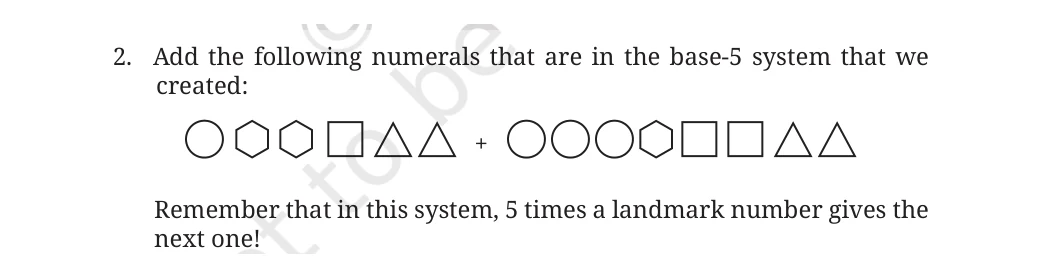
Add the two additive base-5 numerals shown.
Show solution
The first is 125+2(25)+5+2=182, and the second is 3(125)+25+2(5)+2=412. Their sum is 594, represented by four 5^3 symbols, three 5^2 symbols, three 5^1 symbols, and four unit symbols.
Complete worked answers
Textbook page 19
Textbook page 19 · solved item 27
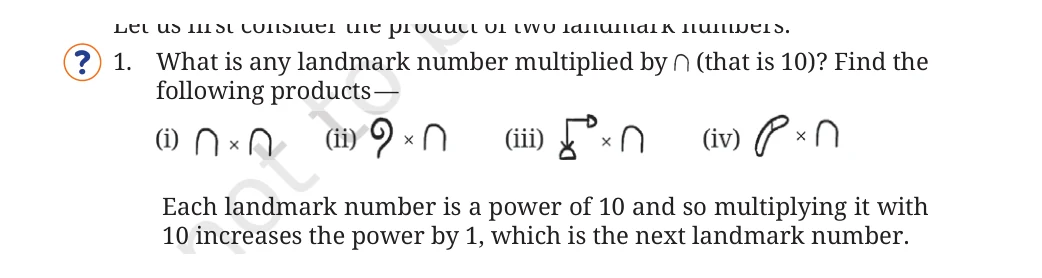
Multiply each shown Egyptian landmark by 10.
Show solution
Multiplication by 10 advances each landmark one place: 10\times10=100, 100\times10=1000, 1000\times10=10000, and 10000\times10=100000.
Textbook page 19 · solved item 28
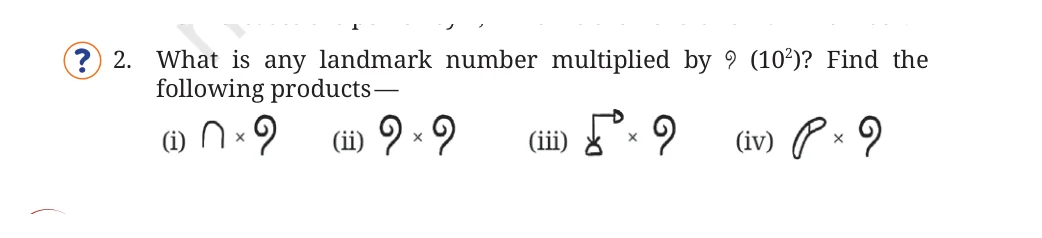
Multiply each shown Egyptian landmark by 100.
Show solution
Multiplication by 10^2 advances two landmarks: 10\times100=1000, 100\times100=10000, 1000\times100=100000, and 10000\times100=1000000.
Complete worked answers
Textbook page 20
Textbook page 20 · solved item 29
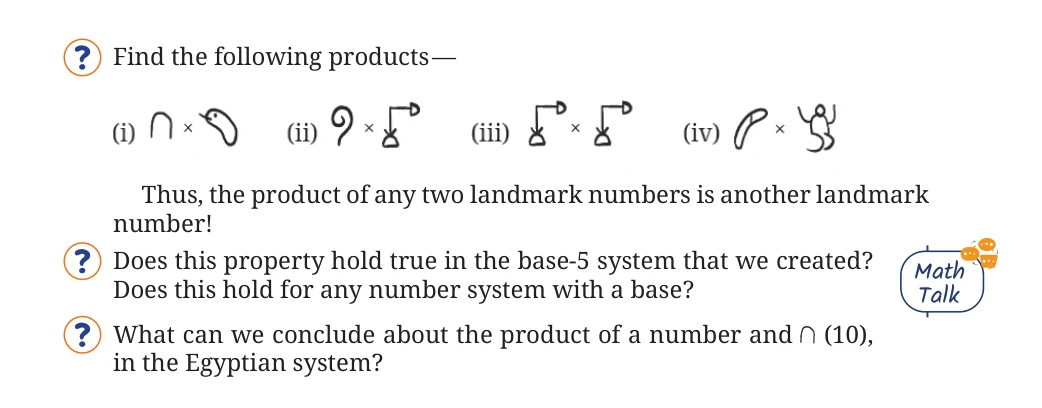
Find the four landmark products shown and decide whether the property holds in every base system.
Show solution
The products are 10^5,10^5,10^6, and 10^{10}. Yes: in any base b, b^m b^n=b^{m+n}, so the product of two landmarks is another landmark. Multiplying by the base moves every landmark to the next one.
Complete worked answers
Textbook page 21
Textbook page 21 · solved item 30
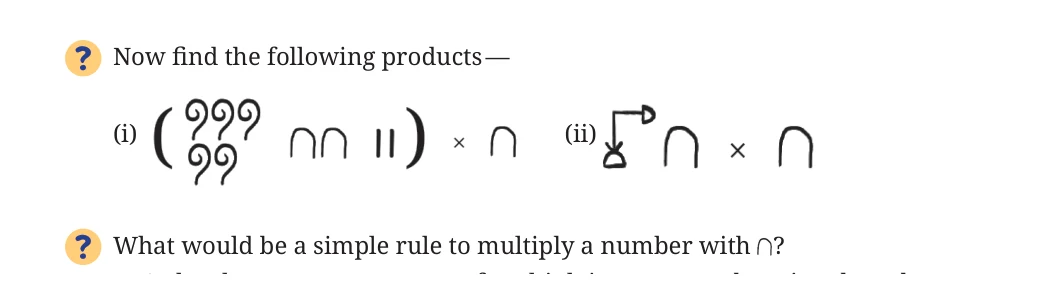
Find the two Egyptian-numeral products shown and give the rule for multiplying by 10.
Show solution
The first number is 522, so its product is 5220; the second is 1010, so its product is 10100. In the additive Egyptian system, replace every symbol by the next higher landmark symbol.
Complete worked answers
Textbook page 22
Textbook page 22 · solved item 31
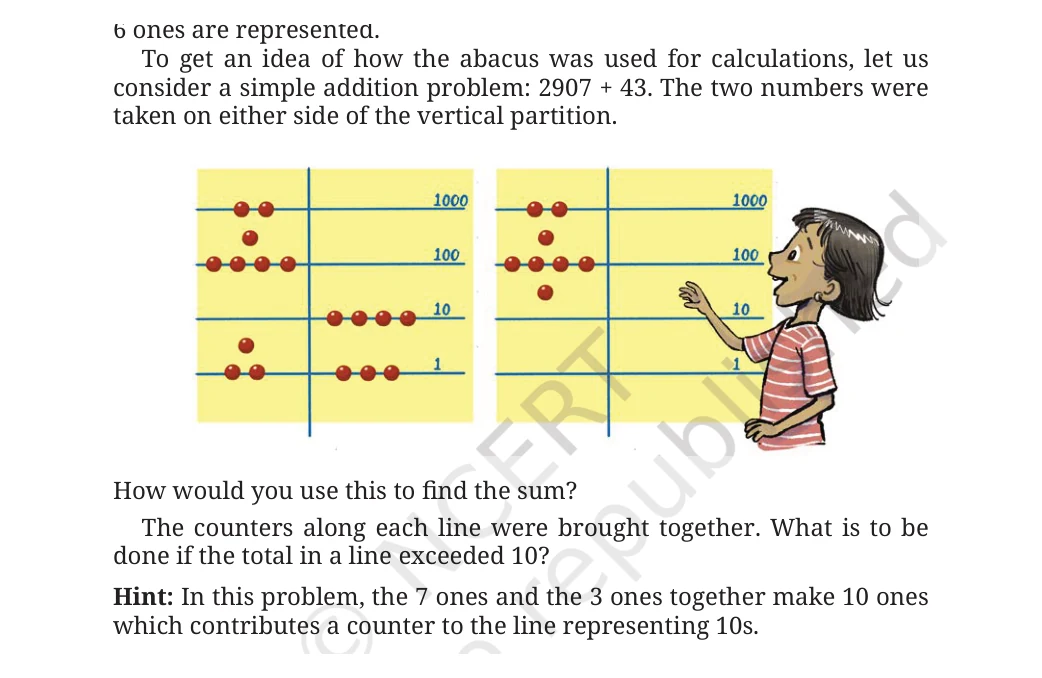
Use the decimal abacus to find 2907 + 43.
Show solution
Bring counters of equal place value together. Ten unit counters exchange for one ten counter; then ten tens exchange for one hundred. The final abacus shows 2950.
Textbook page 22 · solved item 32

Can an Egyptian numeral contain the same landmark symbol 10 or more times?
Show solution
No in a regrouped standard representation. Ten copies of any landmark must be exchanged for one copy of the next landmark.
Complete worked answers
Textbook page 23
Textbook page 23 · solved item 33

Create an additive base-4 system and represent the numbers 1 through 16.
Show solution
Choose symbols U, F, and S for 1, 4, and 16. Then 1-3 are U, UU, UUU; 4 is F; 5-7 are FU, FUU, FUUU; 8-11 are FF, FFU, FFUU, FFUUU; 12-15 are FFF, FFFU, FFFUU, FFFUUU; and 16 is S.
Textbook page 23 · solved item 34

Give a simple rule for multiplying a number by 5 in the additive base-5 system.
Show solution
Replace every landmark symbol by the next higher landmark symbol, because 5\times5^k=5^{k+1}. Regroup if five identical symbols arise.
Complete worked answers
Textbook page 26
Textbook page 26 · solved item 35

Represent 63, 132, 200, 60, and 3605 in the Mesopotamian base-60 system.
Show solution
Using place-value groups: 63=(1,3)_{60}, 132=(2,12)_{60}, 200=(3,20)_{60}, 60=(1,0)_{60}, and 3605=(1,0,5)_{60}. Draw each group with the textbook's symbols for 1 and 10.
Textbook page 26 · solved item 36
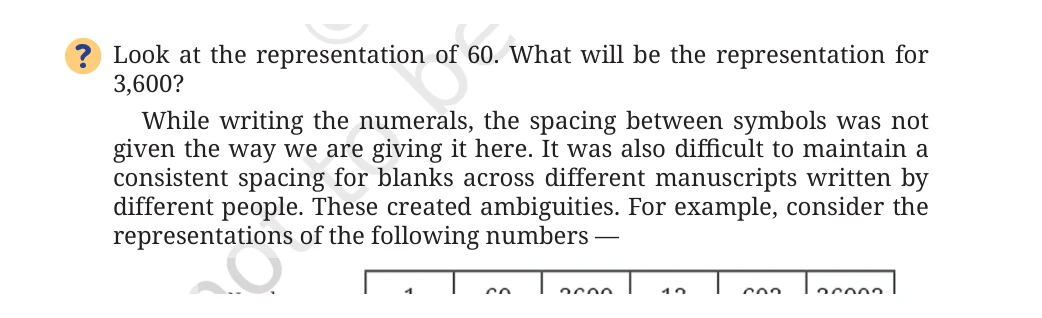
Why could the same Mesopotamian numeral be read as 60 or 3600? How was the blank-place problem addressed?
Show solution
Both may appear as a single unit symbol when trailing empty positions are not marked. Later Mesopotamians introduced a placeholder inside numerals, but because it was not consistently written at the end, some ambiguity remained.
Complete worked answers
Textbook page 29
Textbook page 29 · solved item 37
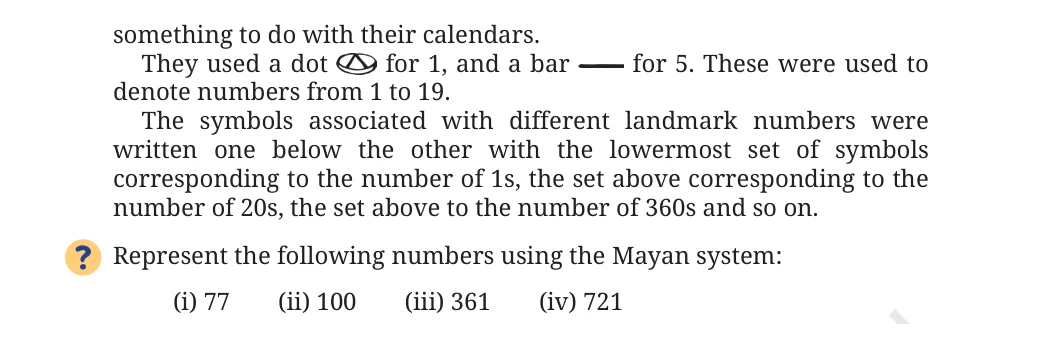
Represent 77, 100, 361, and 721 in the Mayan system.
Show solution
From bottom upward, use the 1, 20, and 360 places: 77=(3,17); 100=(5,0); 361=(1,0,1); and 721=(2,0,1). In each place, dots mean 1, bars mean 5, and the shell is the zero placeholder.
Complete worked answers
Textbook page 30
Textbook page 30 · solved item 38
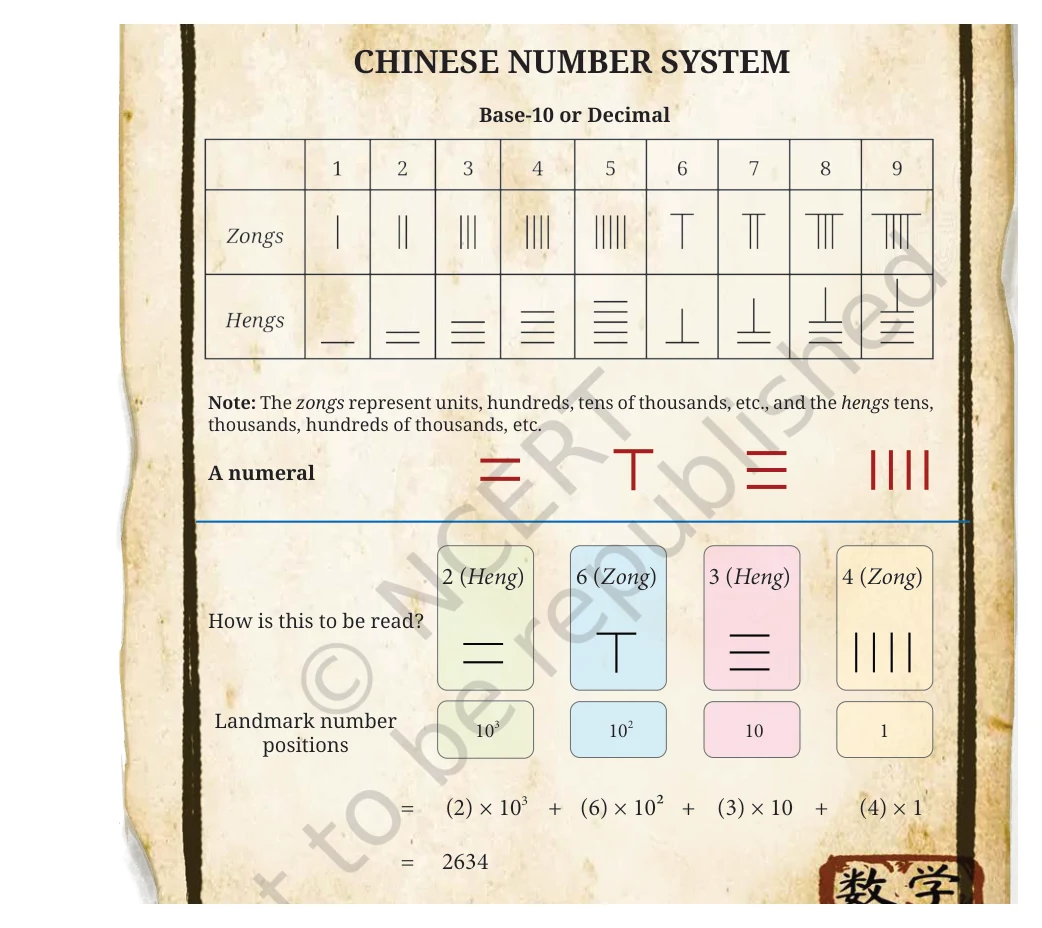
Read the Chinese rod numeral shown using its alternating Heng and Zong positions.
Show solution
The groups are 2 thousands, 6 hundreds, 3 tens, and 4 ones, so the numeral is 2\times10^3+6\times10^2+3\times10+4=2634.
Complete worked answers
Textbook page 31
Textbook page 31 · solved item 39
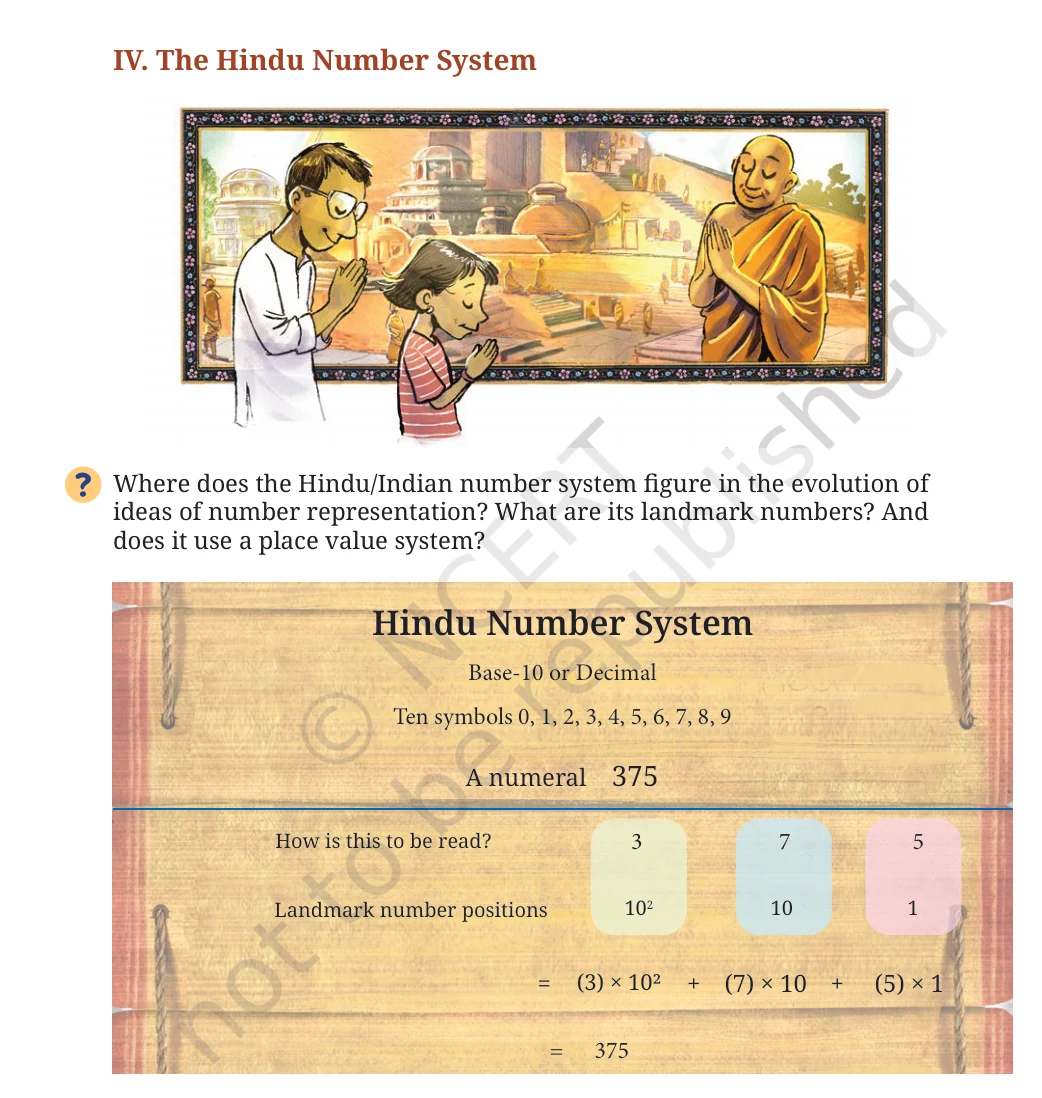
What are the landmark numbers of the Hindu system, and is it a place-value system?
Show solution
Its landmarks are powers of 10: 1,10,100,1000,\ldots. Yes. A digit's position determines which power of 10 it multiplies, and 0 marks an empty position.
Complete worked answers
Textbook page 33
Textbook page 33 · solved item 40
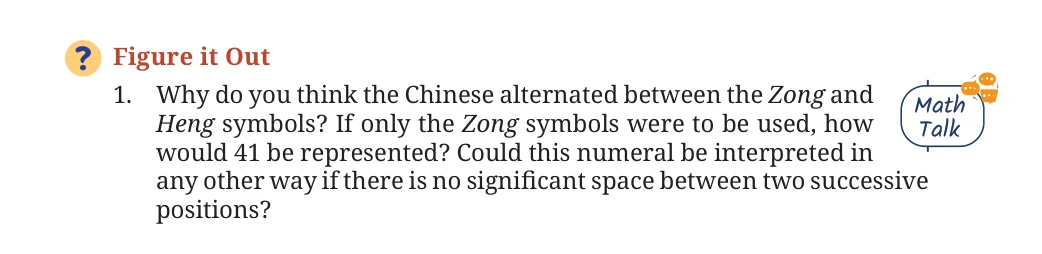
Why did Chinese rod numerals alternate Zong and Heng forms? What ambiguity would arise for 41 using only Zong symbols?
Show solution
Alternating vertical and horizontal forms separates adjacent place values. With only Zong strokes, 41 could merge visually and be misread as another grouping, such as 23, 32, or 122, if spacing is unclear.
Textbook page 33 · solved item 41

Build a base-2 place-value system using ukasar and urapon and compare it with the Gumulgal system.
Show solution
Let urapon be 0 and ukasar be 1. Then 1, 2, 3, 4, ... are ukasar; ukasar-urapon; ukasar-ukasar; ukasar-urapon-urapon; and so on. Unlike the additive Gumulgal names, position now gives powers of 2, making the system compact and unlimited.
Textbook page 33 · solved item 42

Where do Hindu numerals and zero matter in daily life, and what would be difficult without them?
Show solution
They are essential in money, time, measurement, addresses, phones, computing, science, engineering, medicine, accounting, and trade. Without compact place value and zero, calculation, record keeping, digital technology, and scientific work would be far slower and more error-prone.
Textbook page 33 · solved item 43
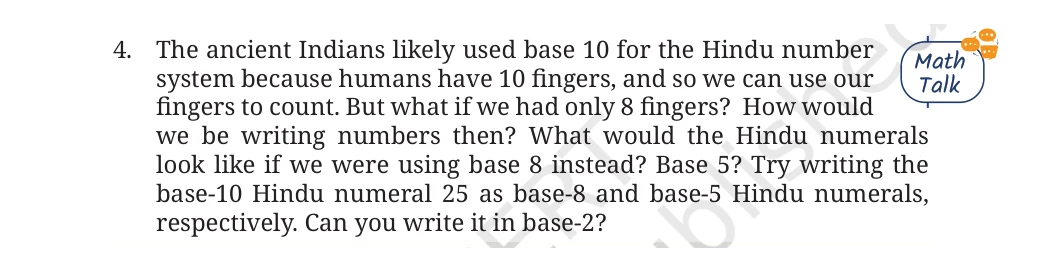
Write decimal 25 in base 8, base 5, and base 2.
Show solution
25=3\times8+1, so it is 31_8. Also 25=1\times5^2, so it is 100_5. Finally, 25=16+8+1, so it is 11001_2.