

Use the textbook context
Match, attempt, then check
Each source crop keeps the printed information needed for that item. Compound answer-key entries are separated into individual solutions.
Complete worked answers
Textbook page 1
Textbook page 1 · solved item 1
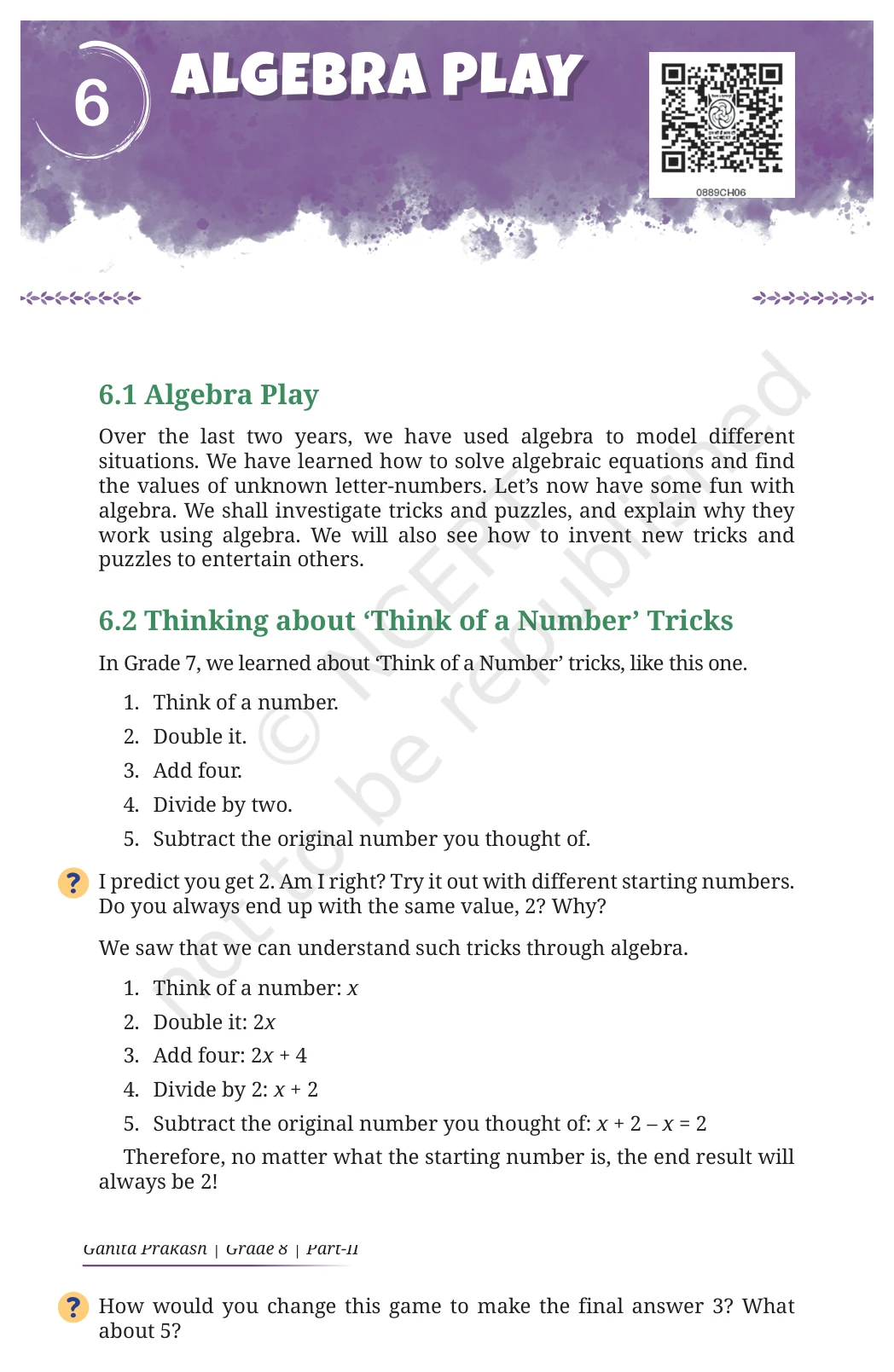
Why does the opening 'Think of a Number' trick always give 2? How can it be changed to give 3 or 5?
Show solution
Let the starting number be (x). The steps give x\to2x\to2x+4\to x+2\to2, so the starting number cancels. To end at 3, add 6 before dividing by 2; to end at 5, add 10. In general, doubling, adding 2k, halving, and subtracting the original number always gives k.
Complete worked answers
Textbook page 2
Textbook page 2 · solved item 2
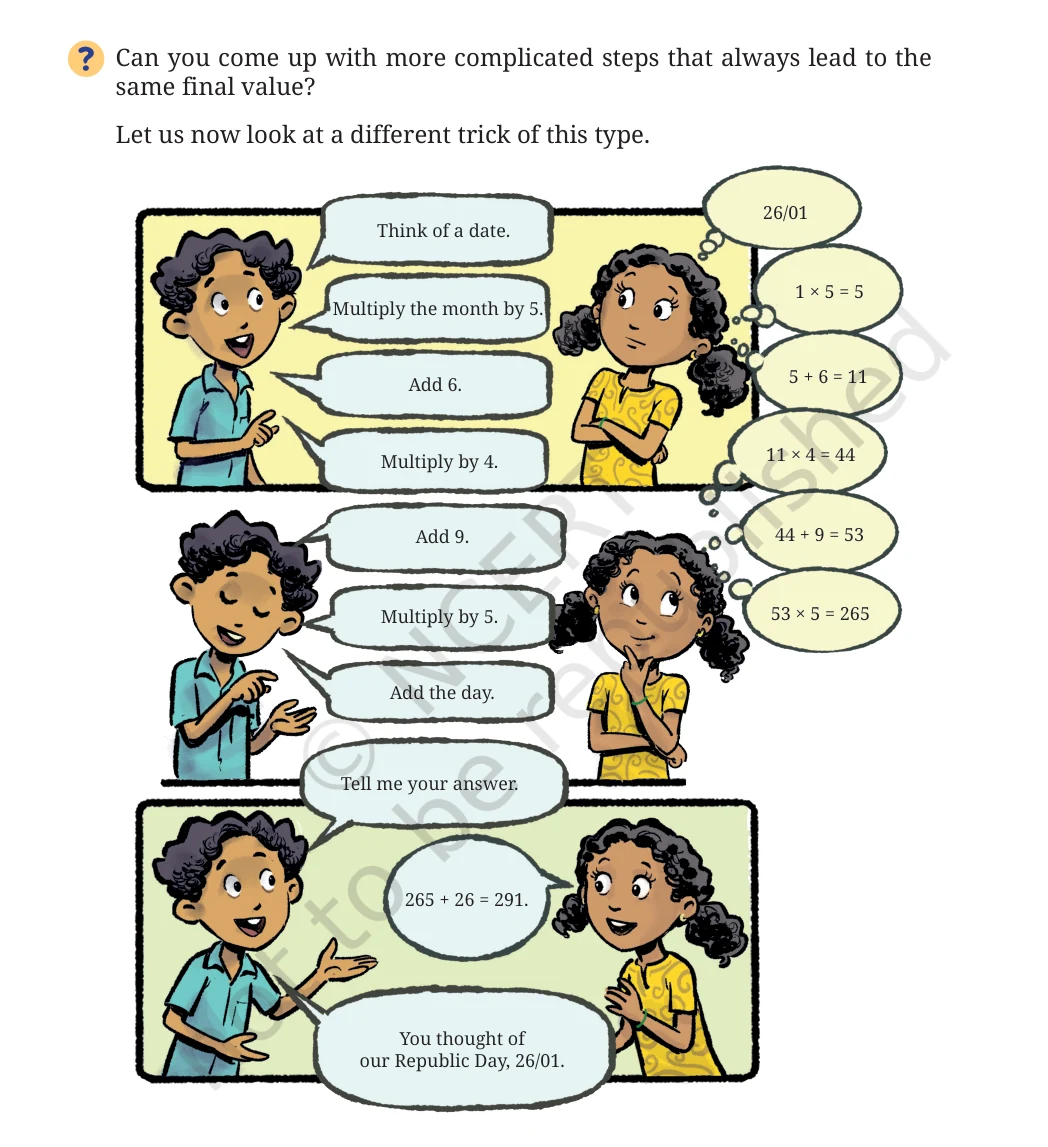
Create a more complicated number trick with a fixed answer.
Show solution
Example: choose (x), multiply by 3, add 12, divide by 3, add 7, then subtract (x). Algebraically this is (3x+12)/3+7-x=x+4+7-x=11. The trick always returns 11.
Textbook page 2 · solved item 3
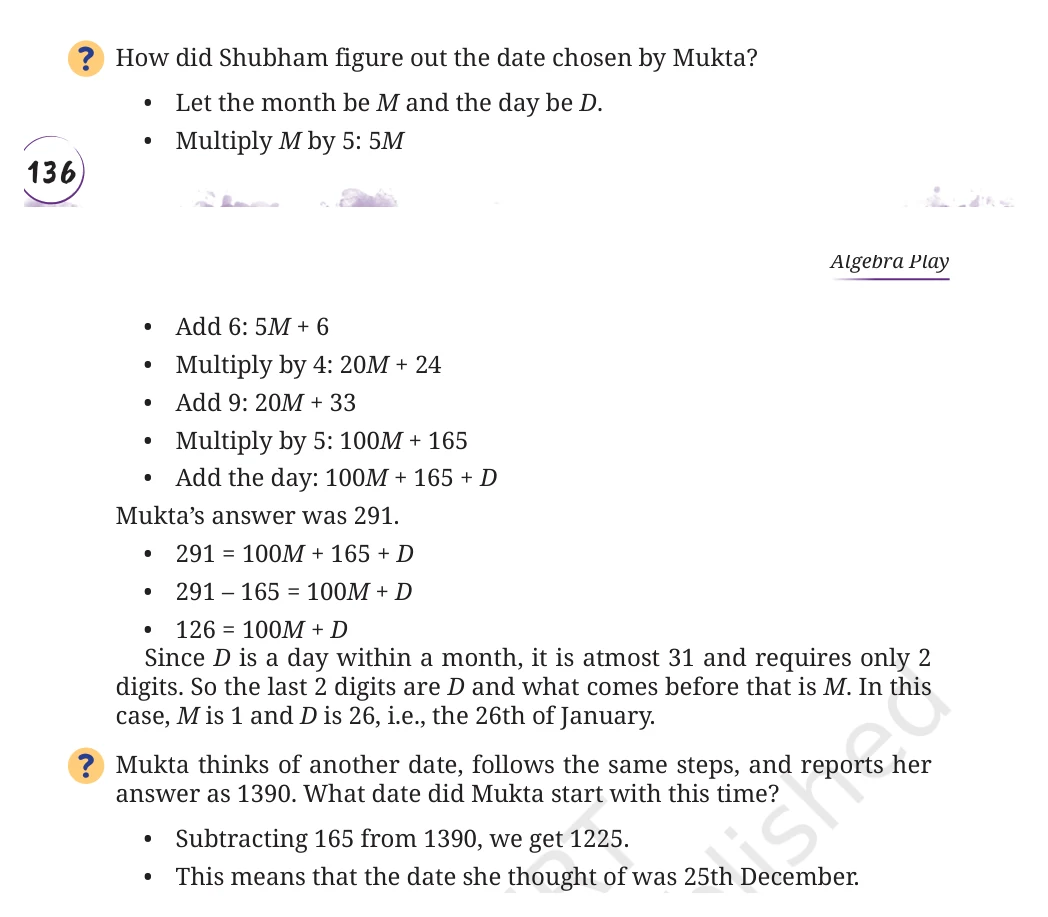
How does the date trick recover the chosen date?
Show solution
If the month is M and day is D, the displayed operations produce 100M+165+D. Subtract 165 from the reported answer to get 100M+D; the last two digits give the day and the preceding digits give the month.
Complete worked answers
Textbook page 3
Textbook page 3 · solved item 4
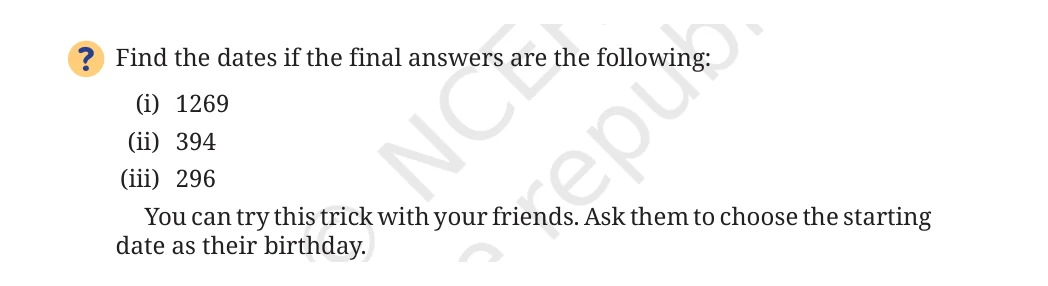
Find the dates corresponding to final answers 1269, 394, and 296.
Show solution
Subtract 165 from each answer. (i) 1269 - 165 = 1104, so the date is 4 November. (ii) 394 - 165 = 229, so it is 29 February (valid in a leap year). (iii) 296 - 165 = 131, so it is 31 January.
Textbook page 3 · solved item 5

Can the date-trick steps be changed while keeping the date recoverable?
Show solution
Yes. The operations must end in 100M+C+D, where C is known. For example: multiply the month by 2, add 3, multiply by 50, then add the day. The result is 100M+150+D; subtract 150 to read M and D.
Complete worked answers
Textbook page 4
Textbook page 4 · solved item 6
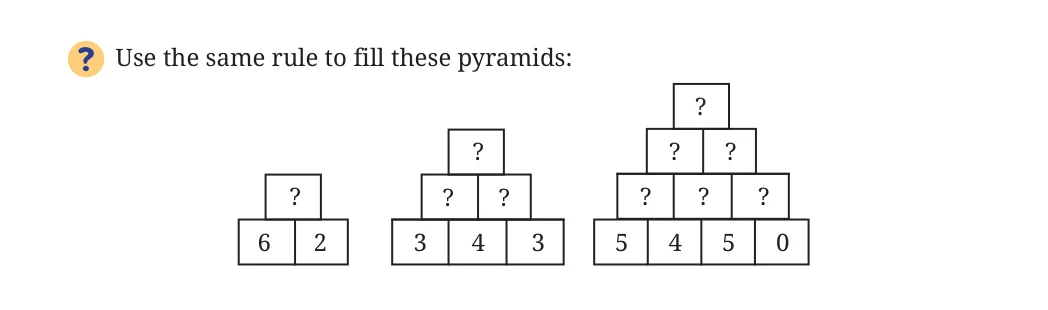
Fill the three number pyramids whose bottom rows are 6,2; 3,4,3; and 5,4,5,0.
Show solution
Each cell is the sum of the two below it. The first top is 8. The second has middle row 7,7 and top 14. The third has rows 9,9,5; then 18,14; and top 32.
Textbook page 4 · solved item 7
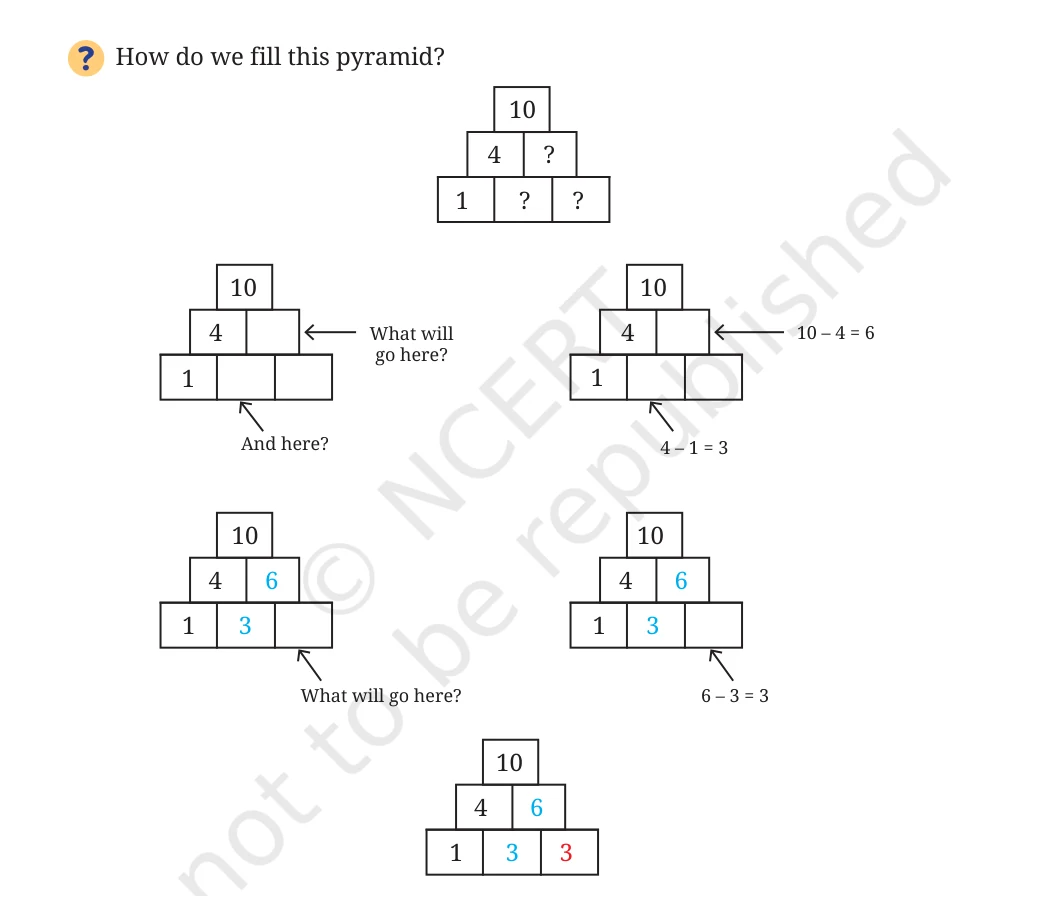
Complete the pyramid with top 10, middle-left 4, and bottom-left 1.
Show solution
The middle-right cell is 10 - 4 = 6. The bottom-middle cell is 4 - 1 = 3. The bottom-right cell is 6 - 3 = 3. Thus the rows are 1,3,3; then 4,6; then 10.
Textbook page 4 · solved item 8
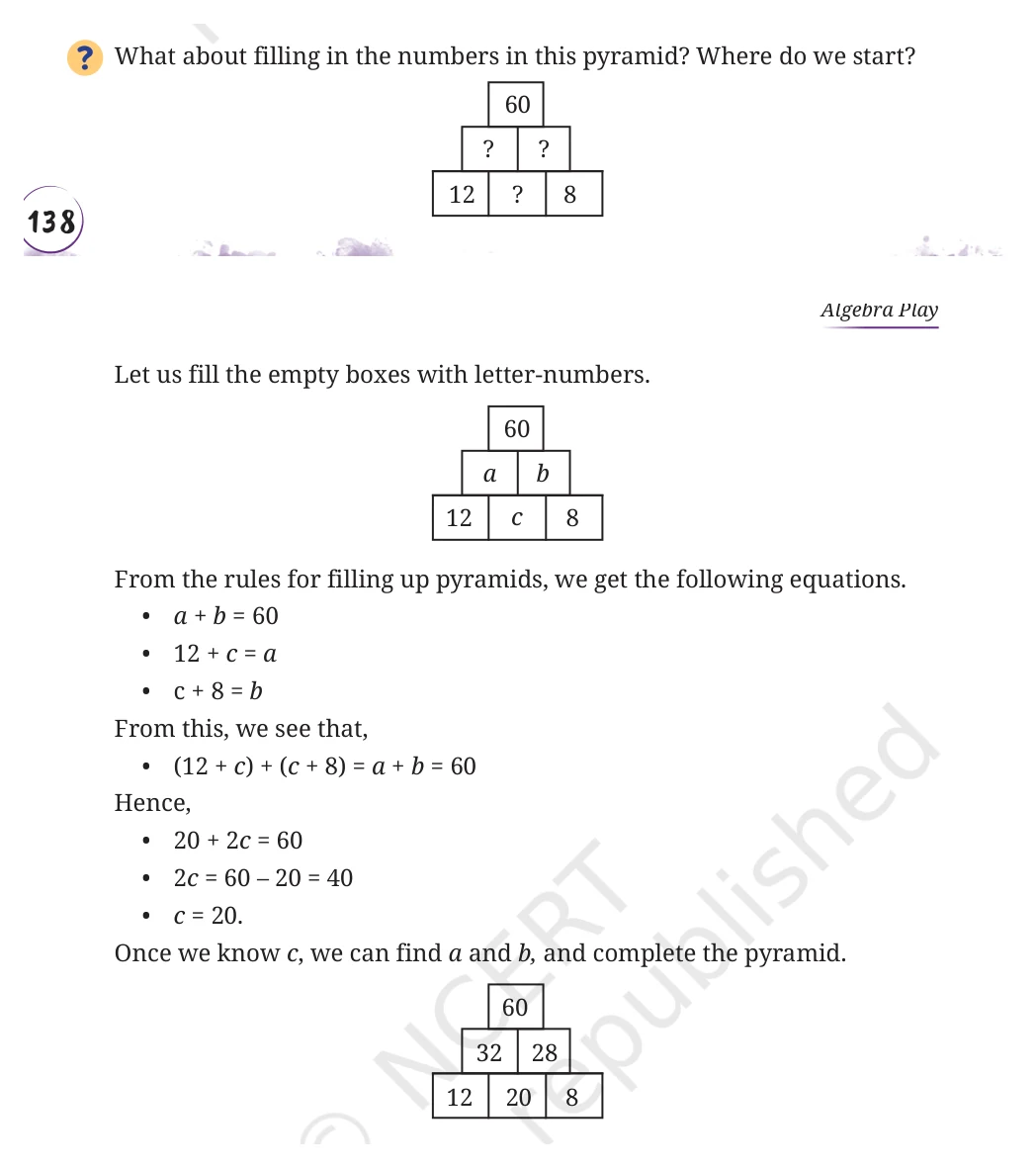
Complete the pyramid with bottom outside values 12 and 8 and top 60.
Show solution
Let the bottom-middle value be c. The top is (12+c)+(c+8)=20+2c. Thus 20+2c=60, so c=20. The middle row is 32,28 and the top is 60.
Complete worked answers
Textbook page 5
Textbook page 5 · solved item 9
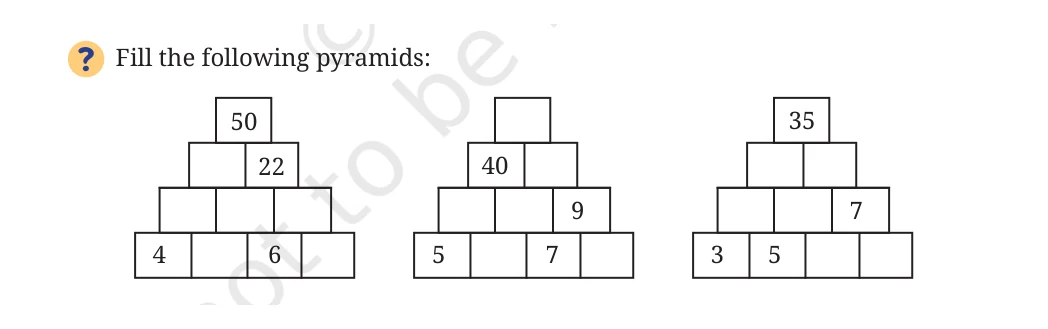
Fill the three partially specified four-row pyramids.
Show solution
Left pyramid: bottom 4,9,6,1; next 13,15,7; next 28,22; top 50. Middle: bottom 5,14,7,2; next 19,21,9; next 40,30; top 70. Right: bottom 3,5,5,2; next 8,10,7; next 18,17; top 35.
Textbook page 5 · solved item 10
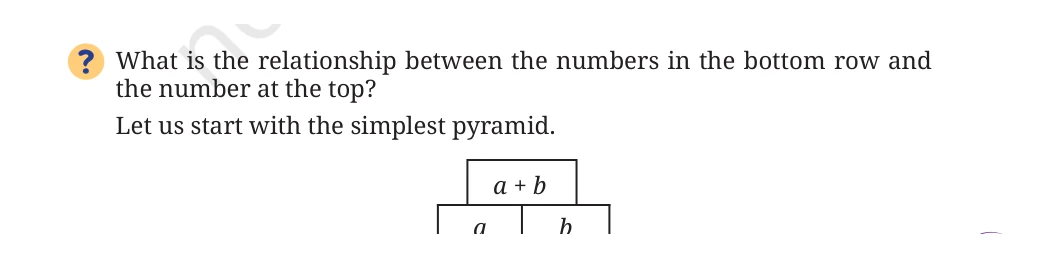
Relate the bottom row to the top of a number pyramid.
Show solution
For two bottom values a,b, the top is a+b. For three values a,b,c, it is a+2b+c. The coefficients are Pascal-triangle coefficients because each interior value contributes along every upward path.
Complete worked answers
Textbook page 6
Textbook page 6 · solved item 11

Find the three-row pyramid tops for bottom rows 4,13,8; 7,11,3; and 10,14,25.
Show solution
Use a+2b+c. The tops are 4+26+8=38, 7+22+3=32, and 10+28+25=63.
Textbook page 6 · solved item 12

Write the top expression for a four-row pyramid.
Show solution
For bottom row a,b,c,d, the successive rows lead to top a+3b+3c+d. The coefficients 1,3,3,1 count the upward paths from each bottom cell.
Textbook page 6 · solved item 13
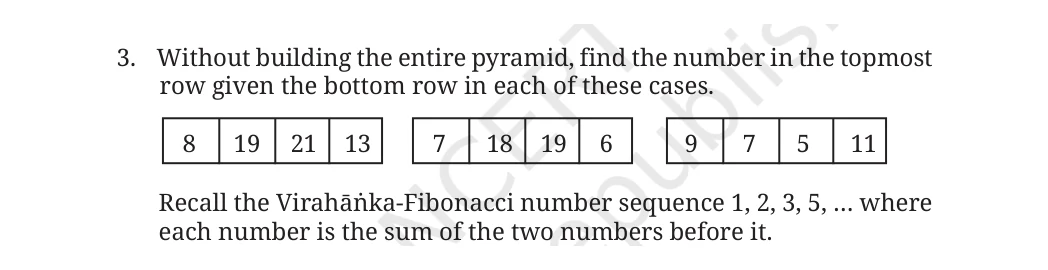
Find the four-row pyramid tops for the three displayed bottom rows.
Show solution
Use a+3b+3c+d. For 8,19,21,13 the top is 141. For 7,18,19,6 it is 124. For 9,7,5,11 it is 56.
Textbook page 6 · solved item 14
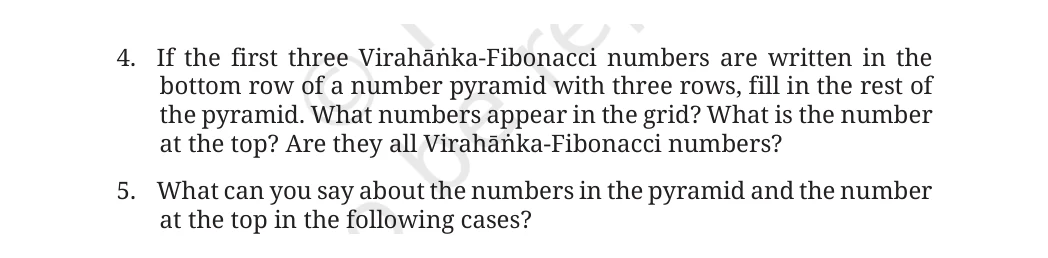
Build the three-row pyramid from the first three Virahanka-Fibonacci numbers.
Show solution
The bottom is 1,2,3; the next row is 3,5; and the top is 8. Every displayed number is in the sequence 1,2,3,5,8,... .
Textbook page 6 · solved item 15

What happens with the first four or first 29 Virahanka-Fibonacci numbers?
Show solution
Adjacent sums are again sequence terms: F_i+F_{i+1}=F_{i+2}. For four rows the pyramid ends at F_7=21. For 29 rows it ends at F_{57}=591286729879, using the book's indexing F_1=1,F_2=2. Every entry remains a Virahanka-Fibonacci number.
Textbook page 6 · solved item 16

Generalise the Virahanka-Fibonacci number pyramid with n rows.
Show solution
If the bottom is F_1,F_2,\ldots,F_n, the next row is F_3,F_4,\ldots,F_{n+1}. Each upward step advances the starting index by 2. Thus all entries are sequence terms and the top is F_{2n-1}.
Complete worked answers
Textbook page 7
Textbook page 7 · solved item 17
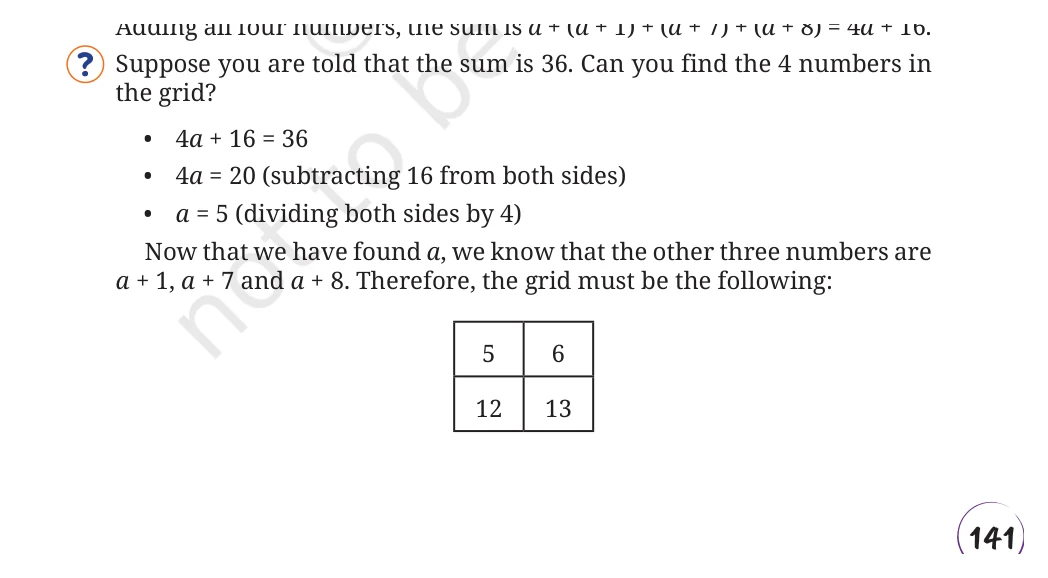
Recover a 2×2 calendar block from its sum.
Show solution
If the top-left date is a, the block is a,a+1,a+7,a+8, with sum 4a+16. Hence a=(S-16)/4. For sum 36, a=5, so the block is 5,6/12,13. A reported sum is possible only when these four dates fit the calendar.
Complete worked answers
Textbook page 8
Textbook page 8 · solved item 18
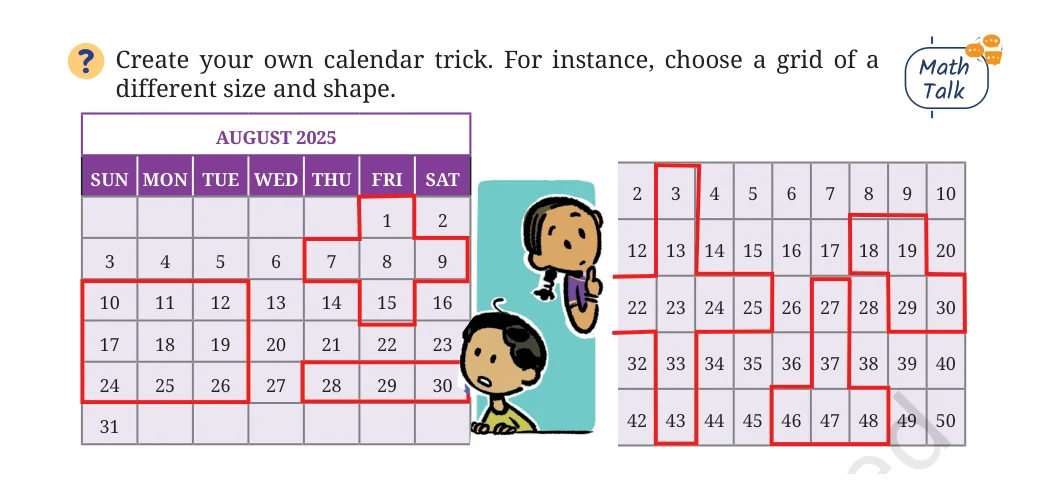
Create another calendar trick.
Show solution
Use three consecutive dates in one row: a,a+1,a+2. Their sum is 3a+3, so from a reported sum S, calculate a=(S-3)/3. For example, sum 42 gives a=13, hence 13,14,15.
Textbook page 8 · solved item 19
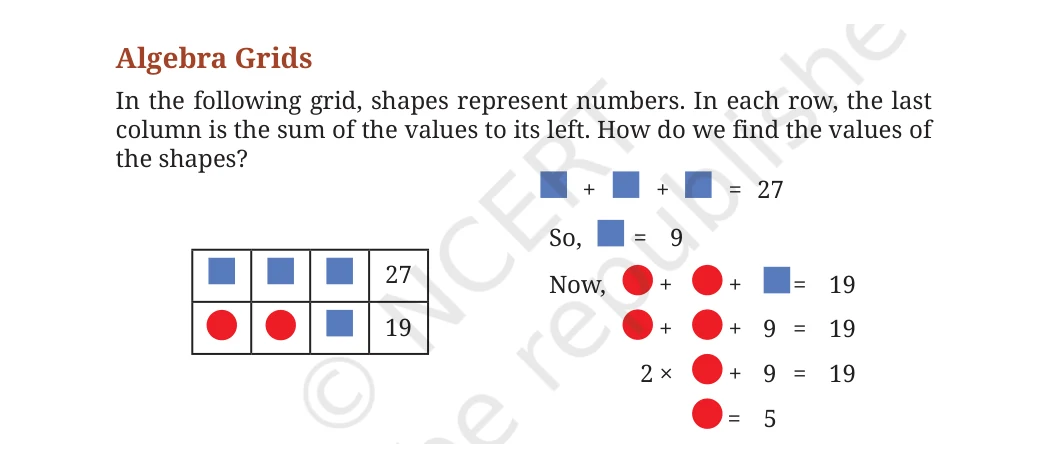
Solve the first algebra grid and fill its missing total.
Show solution
Let the square be s and circle be c. Then 2s+c=27 and s+2c=21. Subtracting gives s-c=6; solving gives s=11,c=5. The last row c+s+c totals 5+11+5=21.
Textbook page 8 · solved item 20
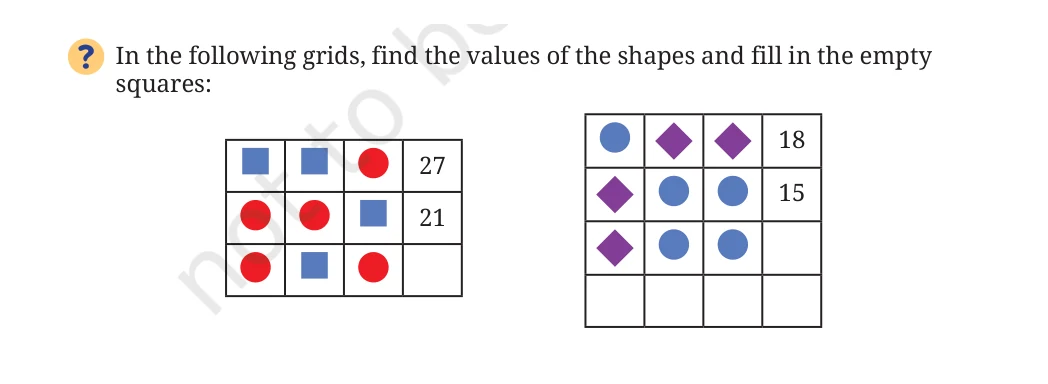
Solve the circle-and-diamond algebra grid and its totals.
Show solution
Let circle be c and diamond be d. The rows give c+2d=18 and d+2c=15, so d=7,c=4. The third row totals 7+4+4=15. The three column totals are 18,15,15.
Textbook page 8 · solved item 21

Use 2, 3, and 5 once to make the largest two-digit-by-one-digit product.
Show solution
The maximum is 32\times5=160. For digits p<q<r, only rq\times p, rp\times q, and qp\times r need comparison. Expanding the last two shows qp\times r=10qr+pr>10qr+pq=rp\times q, so the largest digit is the multiplier and the other two appear in descending order.
Complete worked answers
Textbook page 10
Textbook page 10 · solved item 22
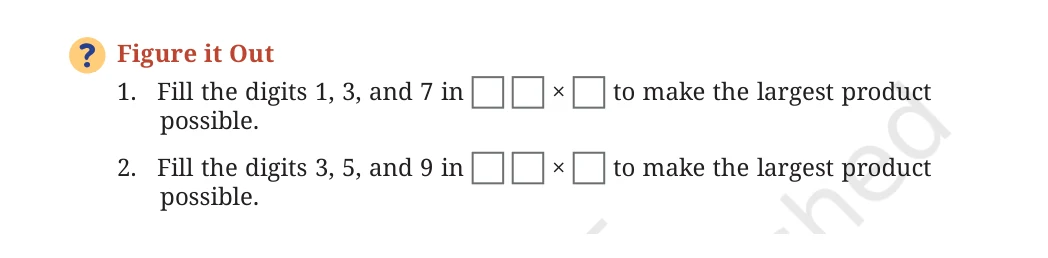
Use 1,3,7 and 3,5,9 to make the largest products.
Show solution
Apply the rule: largest digit as multiplier, remaining digits descending. Thus 31\times7=217 and 53\times9=477.
Complete worked answers
Textbook page 11
Textbook page 11 · solved item 23
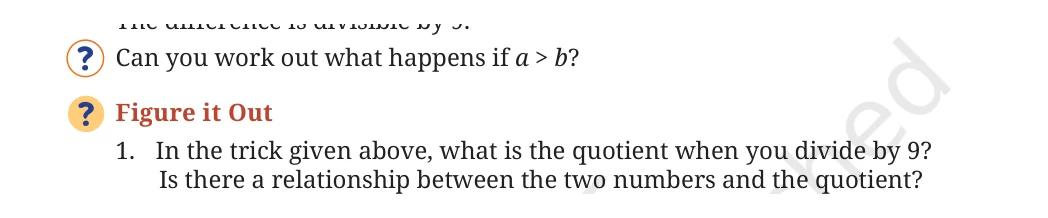
Why is the difference between a two-digit number and its reversal divisible by 9? What is the quotient?
Show solution
For digits a,b, the absolute difference is |10a+b-(10b+a)|=9|a-b|. It is therefore divisible by 9, and the quotient is the absolute difference between the two digits. If a>b, the unsigned difference is 9(a-b).
Textbook page 11 · solved item 24
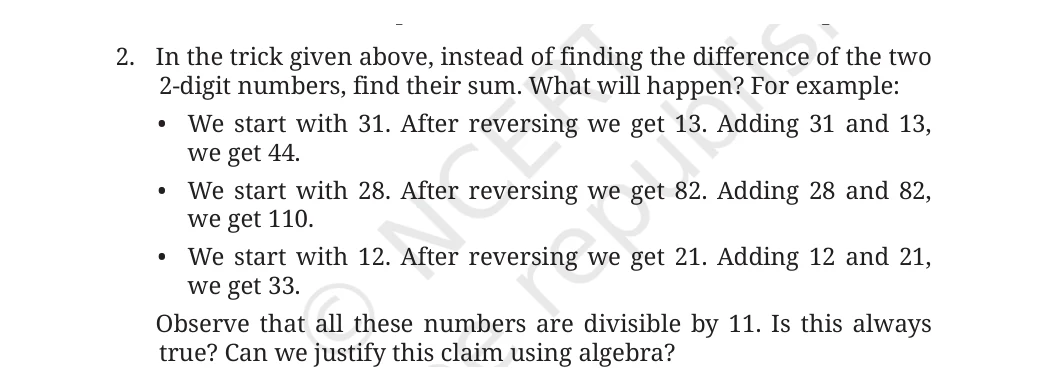
Why is the sum of a two-digit number and its reversal divisible by 11?
Show solution
(10a+b)+(10b+a)=11a+11b=11(a+b). Therefore the sum is always divisible by 11, including examples 31+13=44 and 28+82=110.
Textbook page 11 · solved item 25
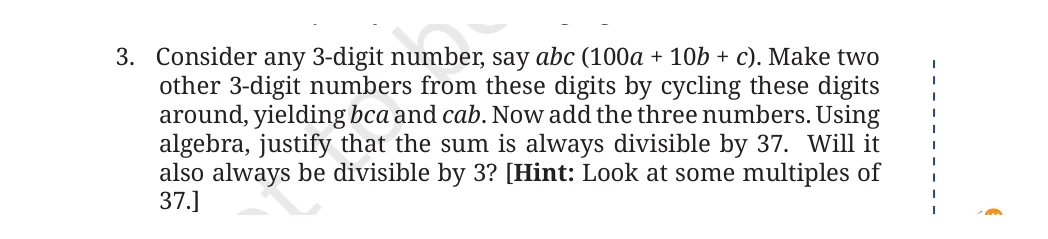
Prove the cyclic sum of a three-digit number is divisible by 37, and decide whether it is always divisible by 3.
Show solution
abc+bca+cab=(100a+10b+c)+(100b+10c+a)+(100c+10a+b)=111(a+b+c)=3\times37(a+b+c). Hence it is always divisible by both 37 and 3.
Textbook page 11 · solved item 26

Why does dividing abcabc successively by 7, 11, and 13 return abc?
Show solution
abcabc=1000(abc)+abc=1001(abc), and 1001=7\times11\times13. Dividing by those three factors therefore leaves the original three-digit number (abc).
Textbook page 11 · solved item 27
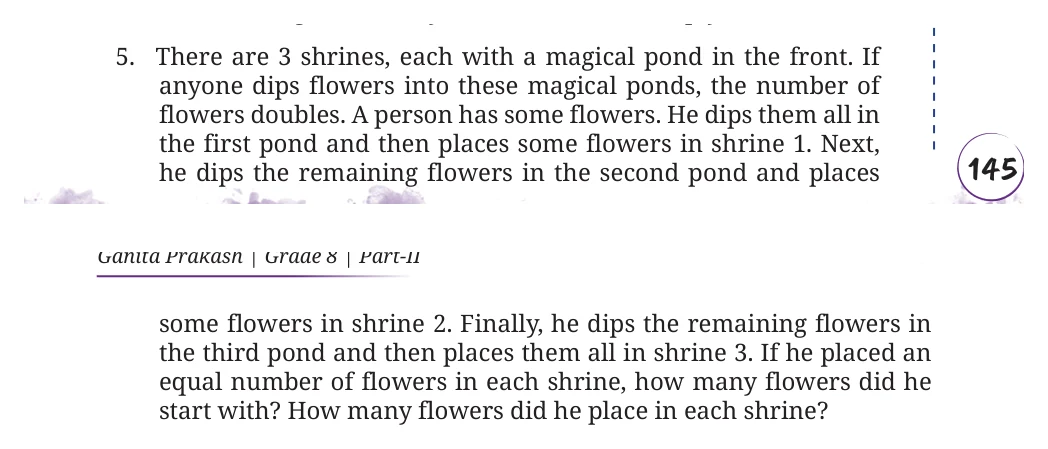
Solve the three-shrine magical-pond problem.
Show solution
Let (x) be the starting flowers and k the equal offering. The remaining amounts after the first two shrines are 2x-k and 4x-3k; after the third doubling, all 8x-6k flowers equal k. Thus 8x=7k. The smallest positive whole-number solution is x=7,k=8: start with 7 and place 8 at each shrine.
Complete worked answers
Textbook page 12
Textbook page 12 · solved item 28
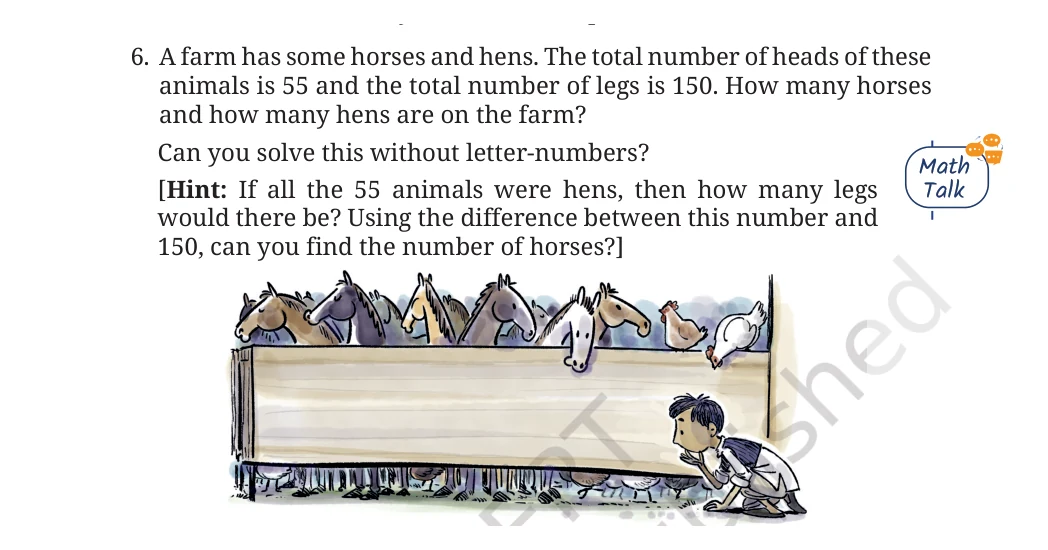
A farm has 55 horses and hens altogether and 150 legs. Find each count.
Show solution
If all 55 were hens, there would be 110 legs. The extra 40 legs come from horses replacing hens, adding 2 legs each, so there are 20 horses and 35 hens. Algebraically, h+r=55 and 2h+4r=150 gives the same result.
Textbook page 12 · solved item 29

A mother is five times her daughter's age and will be three times it in six years. Find the daughter's age.
Show solution
Let the daughter be d; the mother is 5d. Then 5d+6=3(d+6), so 2d=12 and d=6. The daughter is 6 and the mother is 30.
Textbook page 12 · solved item 30
Find Gauri's and Naina's cow counts.
Show solution
Let Gauri have g; Naina has 2g. After Naina gives 3 cows, 2g-3=g+3, so g=6. Gauri has 6 cows and Naina has 12.
Textbook page 12 · solved item 31
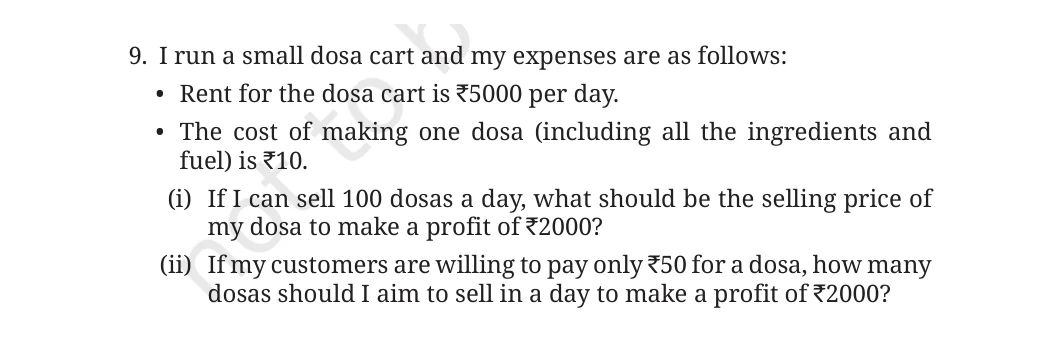
Solve both dosa-cart profit questions.
Show solution
Daily cost for 100 dosas is 5000+10(100)=6000. A ₹2000 profit needs ₹8000 revenue, so price = ₹80 per dosa. At a ₹50 price, profit on n dosas is 50n-(5000+10n)=40n-5000. Setting this to 2000 gives n=175 dosas.
Textbook page 12 · solved item 32
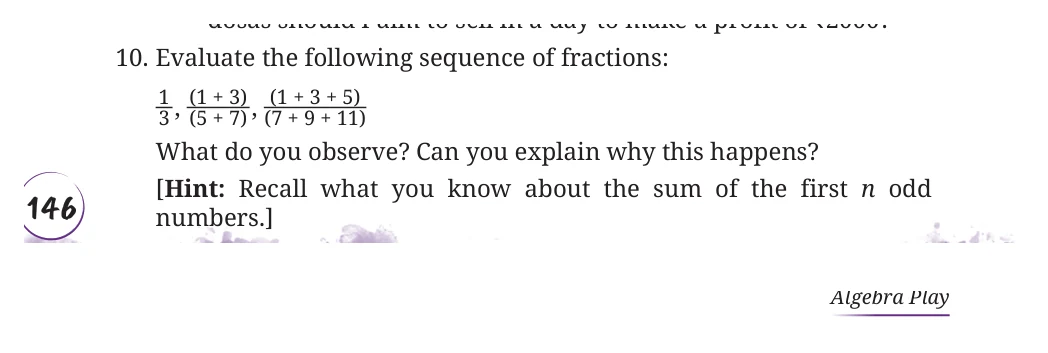
Evaluate and explain the sequence of fractions made from odd-number sums.
Show solution
Every fraction equals 1/3: 1/3, 4/12, and 9/27. In the nth term, the numerator is the sum of the first n odd numbers, n^2. The denominator is the sum of the next n odd numbers beginning at 2n+1, which is (2n)^2-n^2=3n^2. Their ratio is 1/3.
Complete worked answers
Textbook page 13
Textbook page 13 · solved item 33
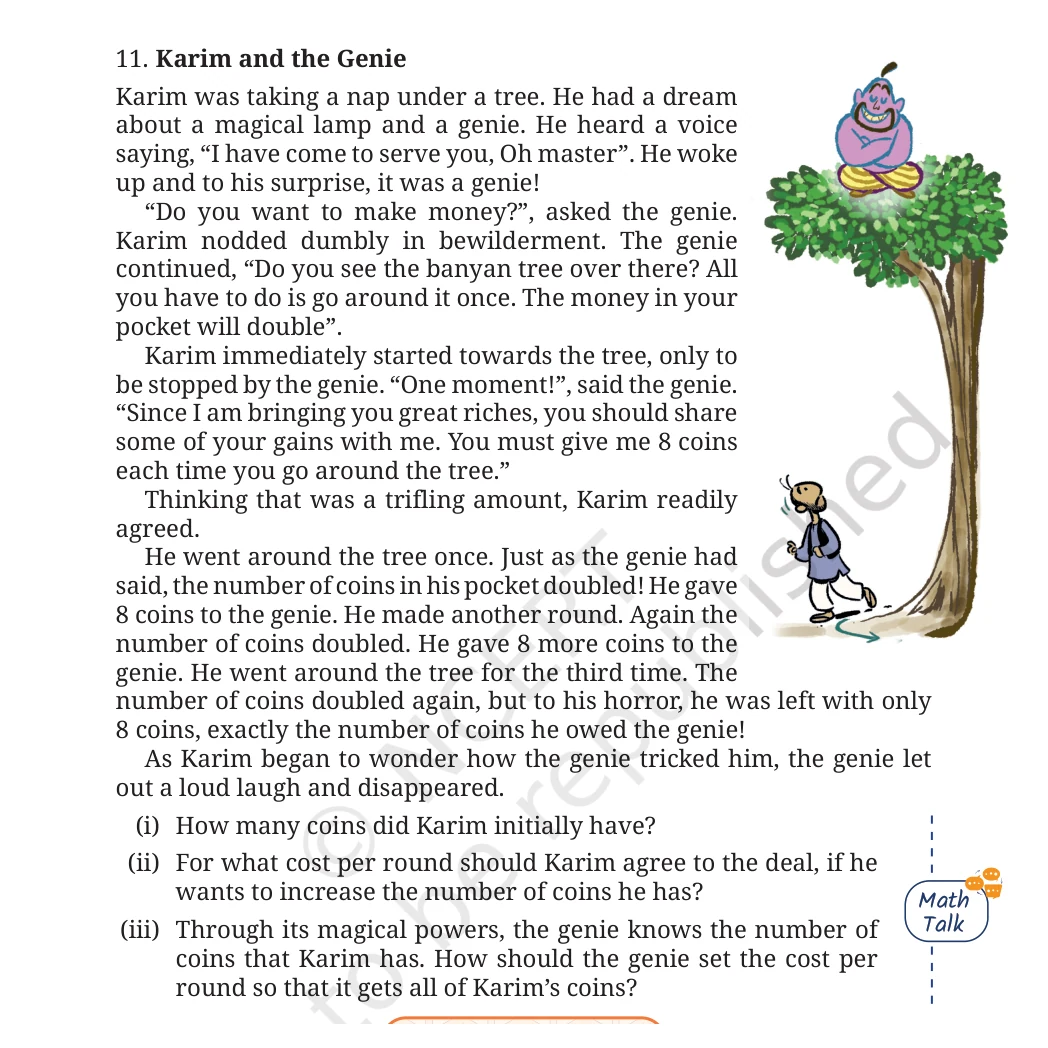
Solve Karim and the Genie.
Show solution
If the fee is 8, work backward from the 8 coins owed after the third doubling: before that doubling Karim had 4; before the second fee he had 12, so before doubling he had 6; before the first fee he had 14, so initially he had 7 coins. For initial amount (x) and fee c, the balance after three paid rounds is 8x-7c.
It exceeds (x) exactly when c<x. To take all the coins after three rounds, the genie sets c=8x/7, when this is a whole number.