
Use the textbook context
Match, attempt, then check
Each source crop keeps the printed information needed for that item. Compound answer-key entries are separated into individual solutions.
Complete worked answers
Textbook page 1
Textbook page 1 · solved item 1
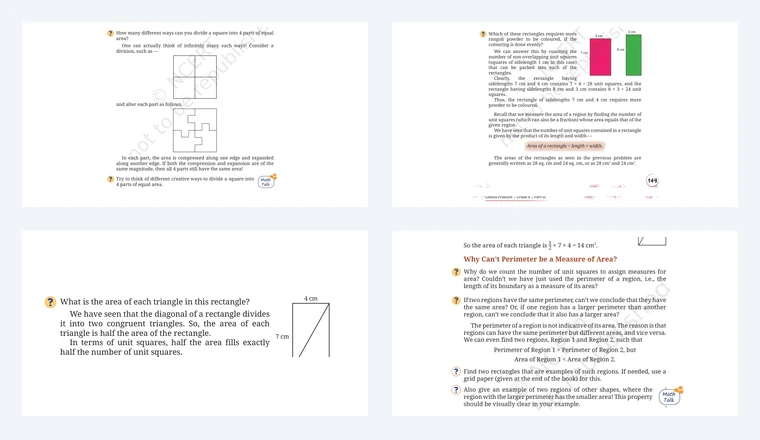
How can a square be divided into four parts of equal area?
Show solution
There are infinitely many ways. Simple examples are two perpendicular midlines, both diagonals, four equal parallel strips, or four regions obtained by making equal-area inward and outward adjustments along shared boundaries. Equal area, not equal shape or perimeter, is the requirement.
Complete worked answers
Textbook page 2
Textbook page 2 · solved item 2
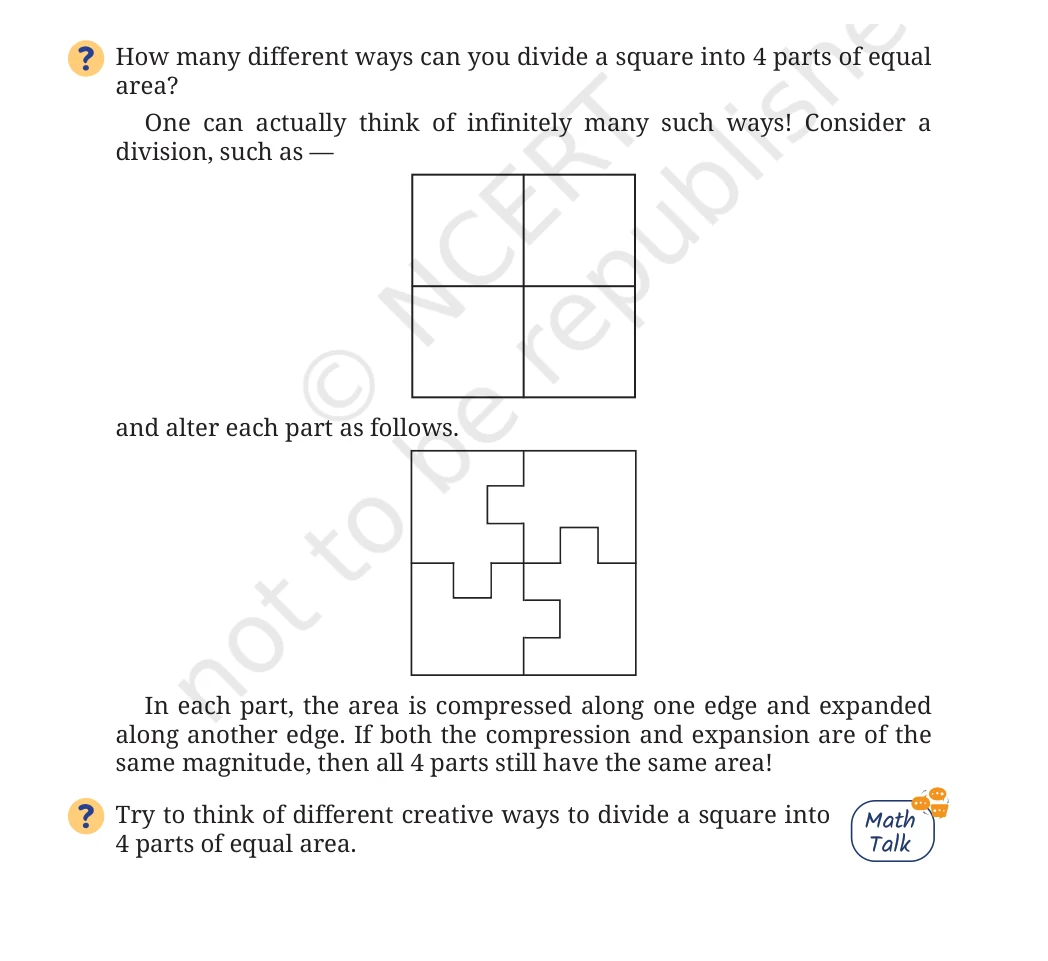
Which rectangle needs more rangoli powder: 7 cm × 4 cm or 8 cm × 3 cm?
Show solution
Their areas are 7\times4=28\text{ cm}^2 and 8\times3=24\text{ cm}^2. With even colouring, the 7 cm × 4 cm rectangle needs more powder.
Complete worked answers
Textbook page 3
Textbook page 3 · solved item 3
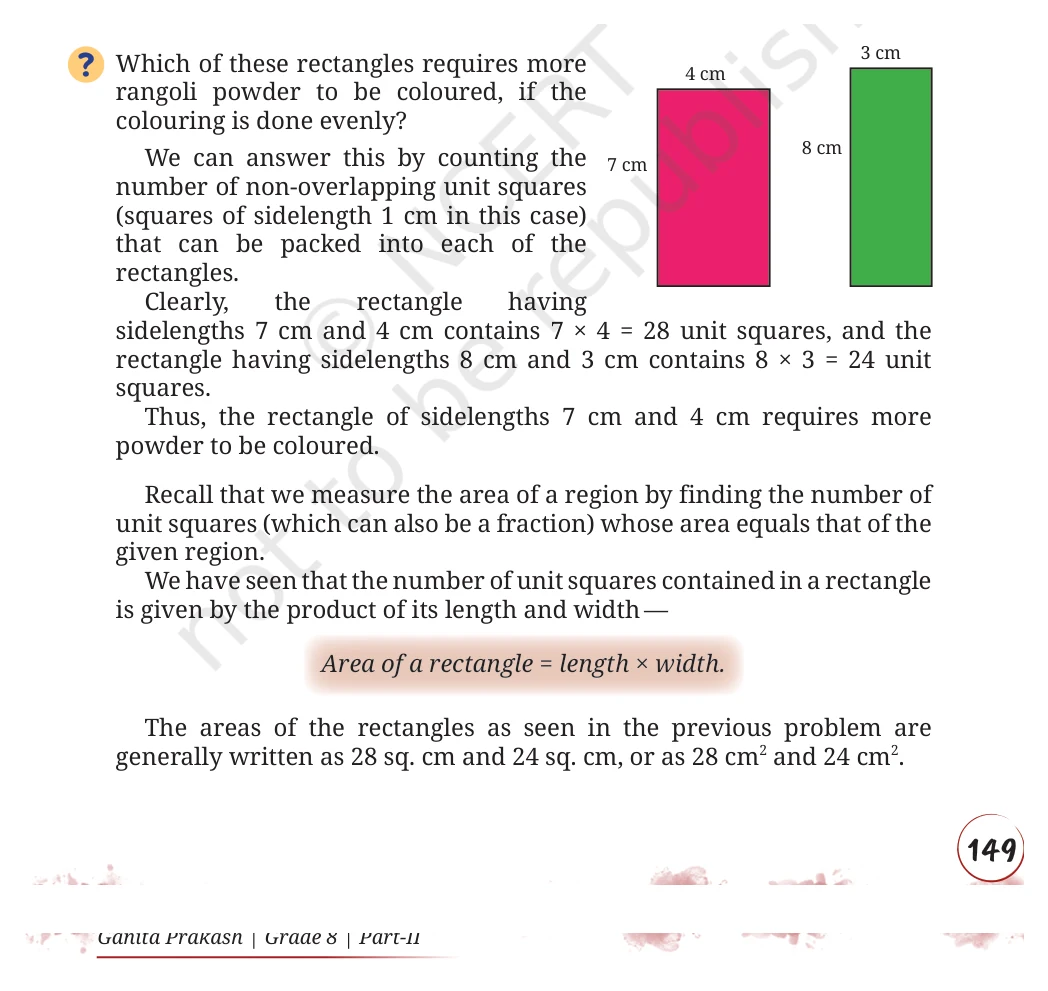
What is the area of each triangle formed by a diagonal of the 7 cm × 4 cm rectangle?
Show solution
A diagonal divides a rectangle into two congruent triangles. Each area is ½ of 7\times4, so each triangle has area 14\text{ cm}^2.
Textbook page 3 · solved item 4
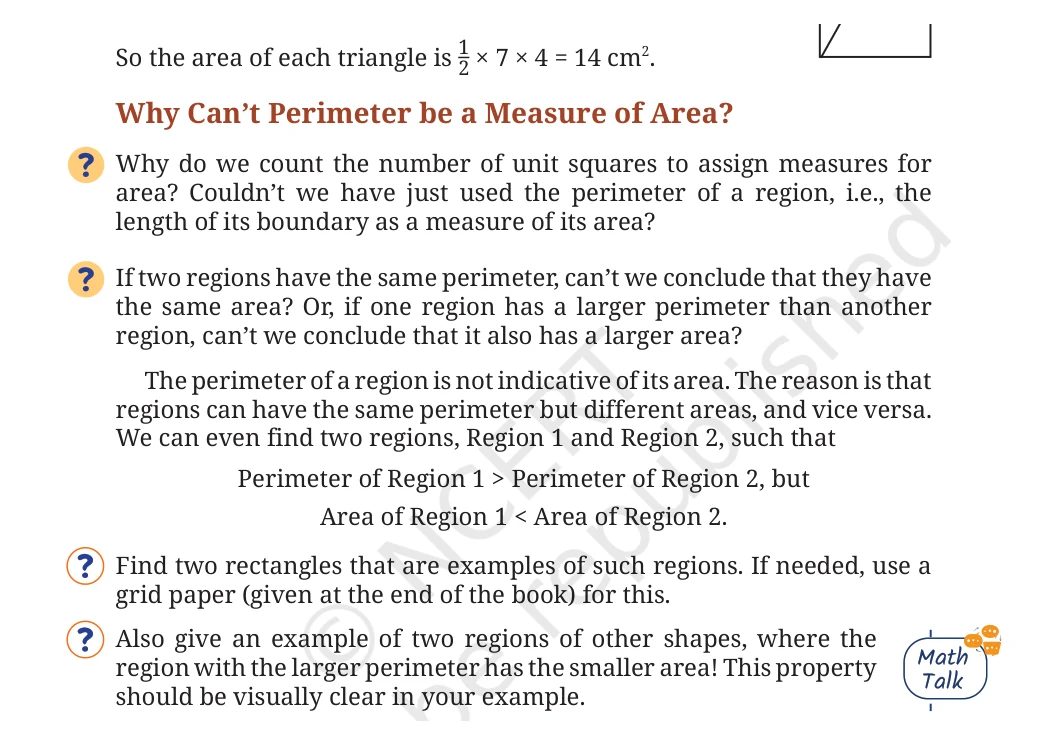
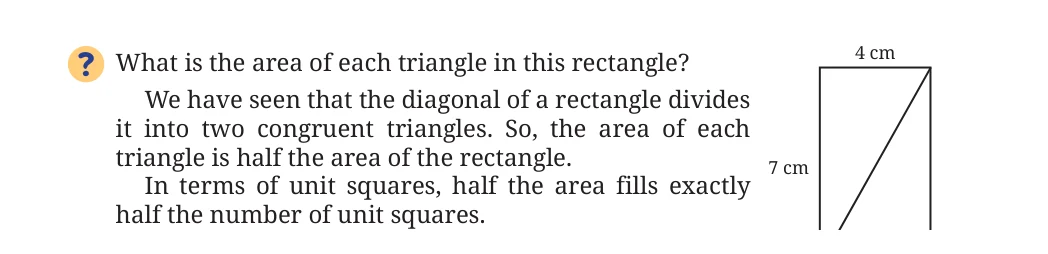
Why cannot perimeter be used as a measure of area? Give counterexamples.
Show solution
Perimeter measures boundary length while area measures covered surface, so neither determines the other. Rectangles 1×10 and 4×4 have perimeters 22 and 16 but areas 10 and 16: the larger perimeter has smaller area. Also, a thin jagged region can have a long boundary while enclosing less area than a compact circle or square.
Textbook page 3 · solved item 5
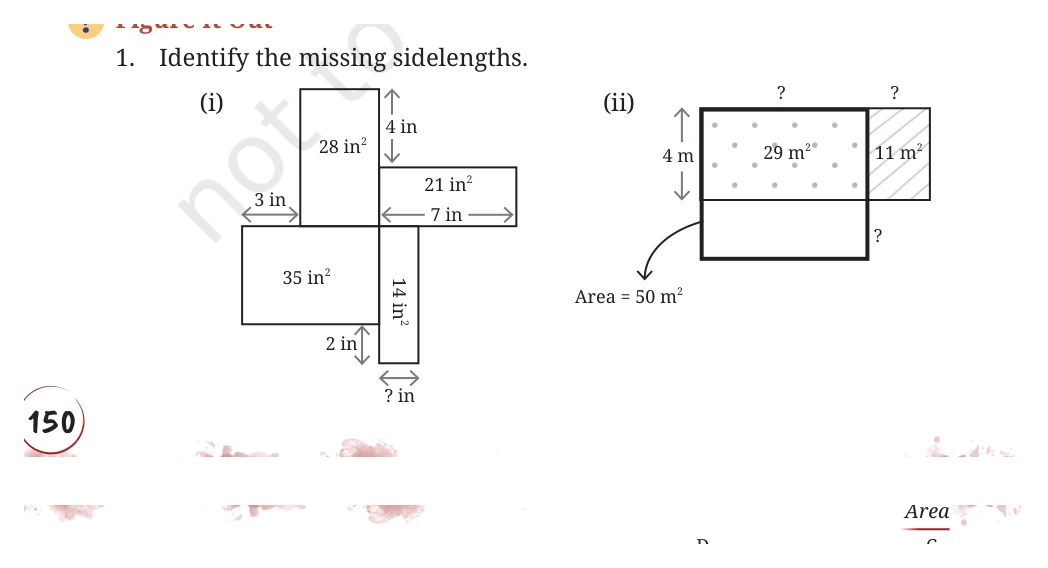
Identify the missing side lengths in the two rectangle diagrams.
Show solution
In (i), use area ÷ known side: 28/4=7 in, 21/7=3 in, the central height is 35/7=5 in, and the vertical 14 in² rectangle has height 5+2=7 in, so its width is 2 in. In (ii), the 29 m² rectangle has width 29/4=7.25 m; the 11 m² rectangle has width 11/4=2.75 m; the lower area is 50-29=21 m², so its height is 21/7.25=84/29\approx2.90 m.
Complete worked answers
Textbook page 4
Textbook page 4 · solved item 6
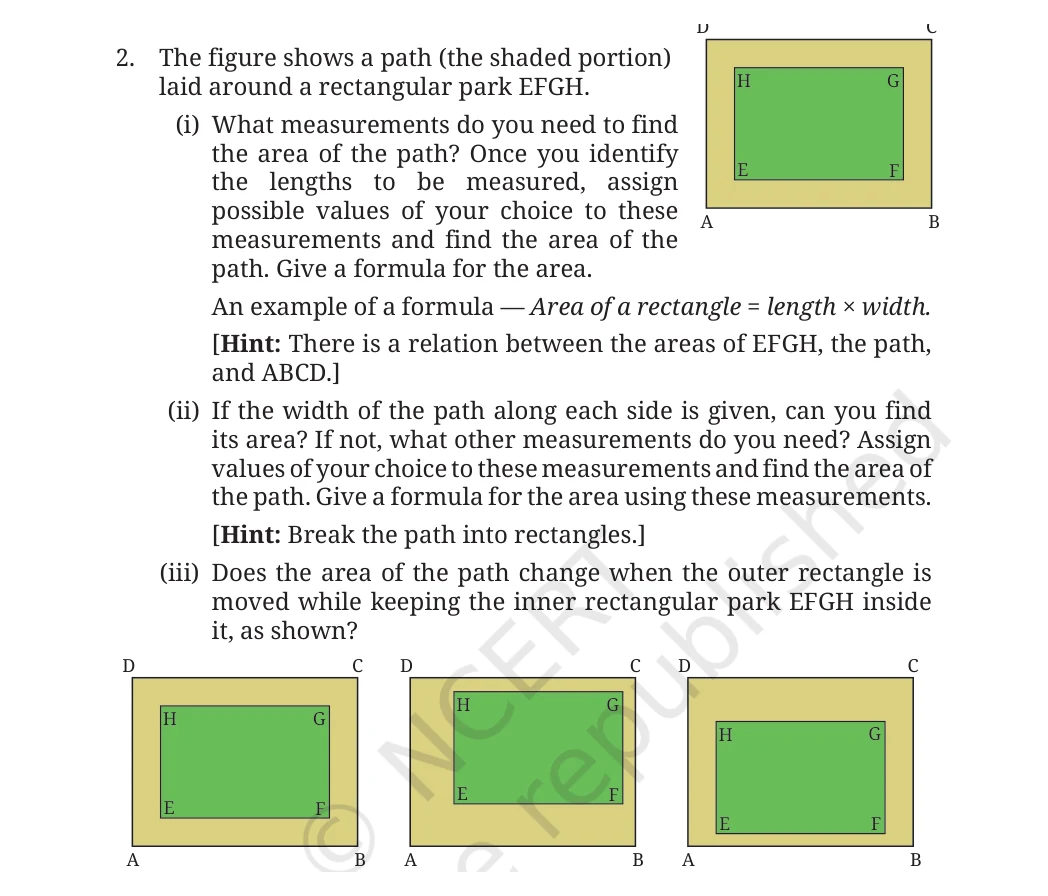
Find formulas for the area of a path around a rectangular park.
Show solution
If outer rectangle dimensions are L,W and inner park dimensions are l,w, path area is LW-lw. If the uniform path width is t, then L=l+2t,W=w+2t, so area =(l+2t)(w+2t)-lw=2t(l+w)+4t^2. Moving the inner park inside a fixed outer rectangle does not change the area difference, provided it remains inside.
Textbook page 4 · solved item 7
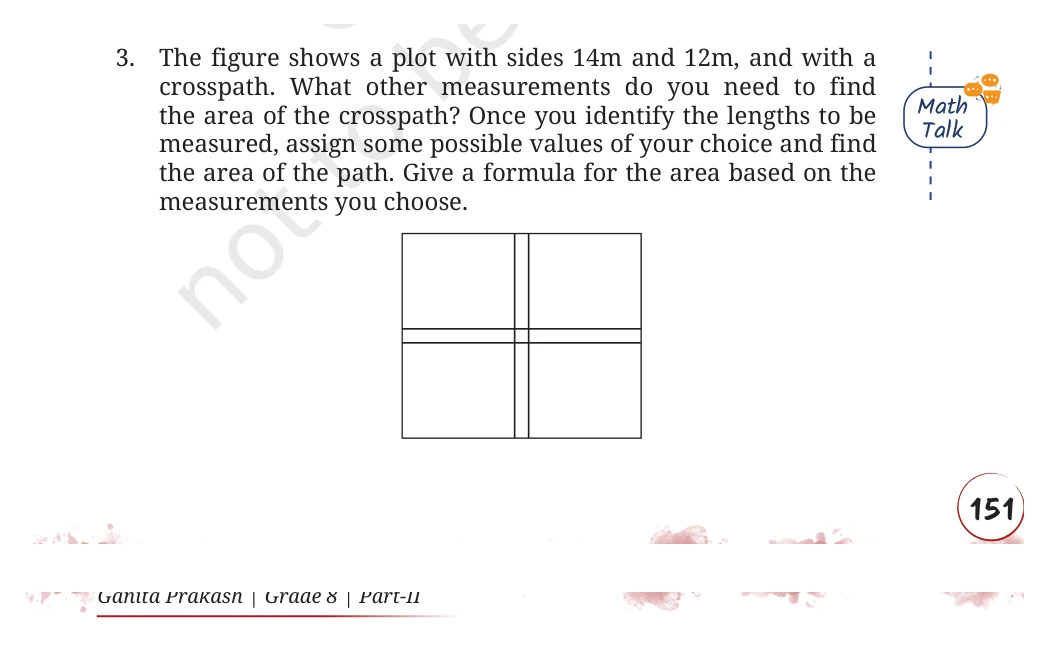
Find a formula for the area of a crosspath in a 14 m × 12 m plot.
Show solution
If the two perpendicular path widths are p and q, their areas are 14p and 12q. Their overlap (pq) is counted twice, so crosspath area is 14p+12q-pq. For equal width t, it is 26t-t^2.
Complete worked answers
Textbook page 5
Textbook page 5 · solved item 8
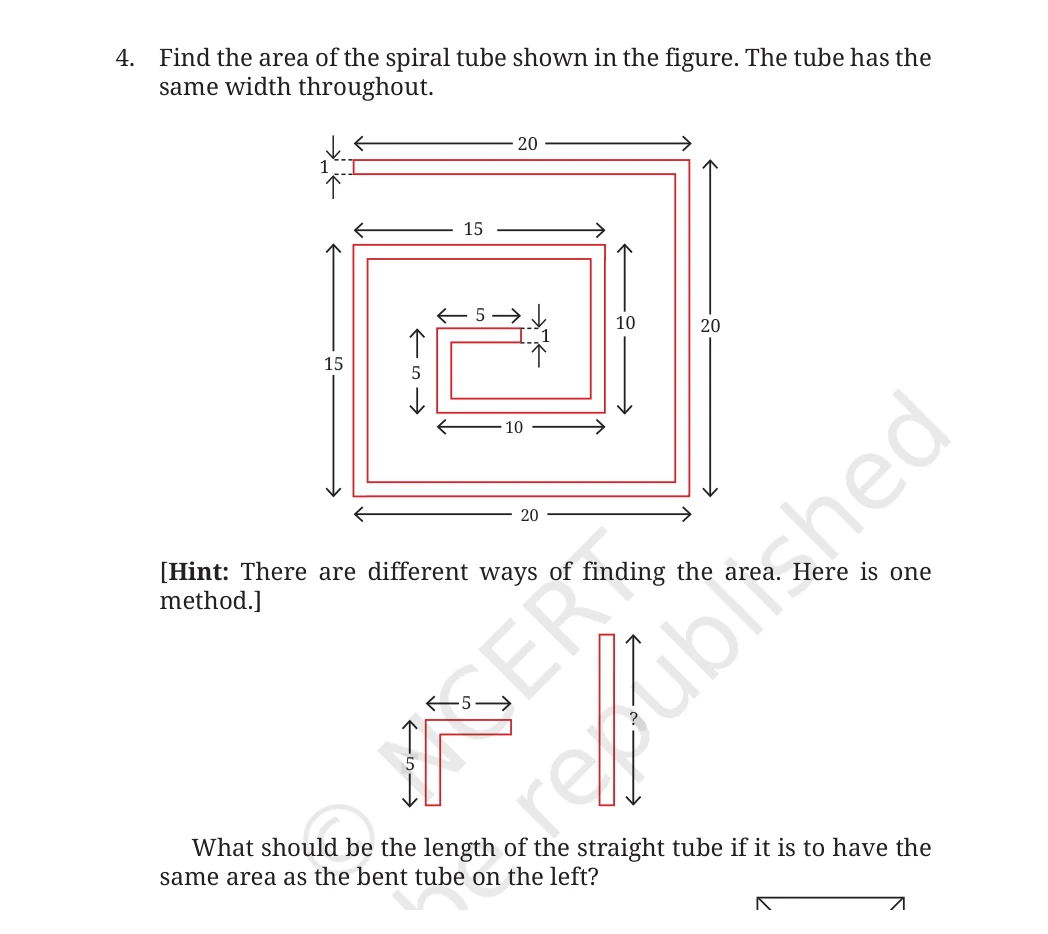
Find the area of the 1-unit-wide spiral tube and the equivalent straight length.
Show solution
Add the nine rectangular runs: 20+20+20+15+15+10+10+5+5=120. Eight 1×1 corner overlaps were counted twice, so area =120-8=112 square units. A straight tube of width 1 therefore needs length 112 units.
Textbook page 5 · solved item 9

If the square's side is doubled, how do the areas of regions 1, 2, and 3 change?
Show solution
Every length is multiplied by 2, so every area is multiplied by 2² = 4. Each region's new area is four times its old area, an increase of three times its original area, regardless of the internal division.
Textbook page 5 · solved item 10
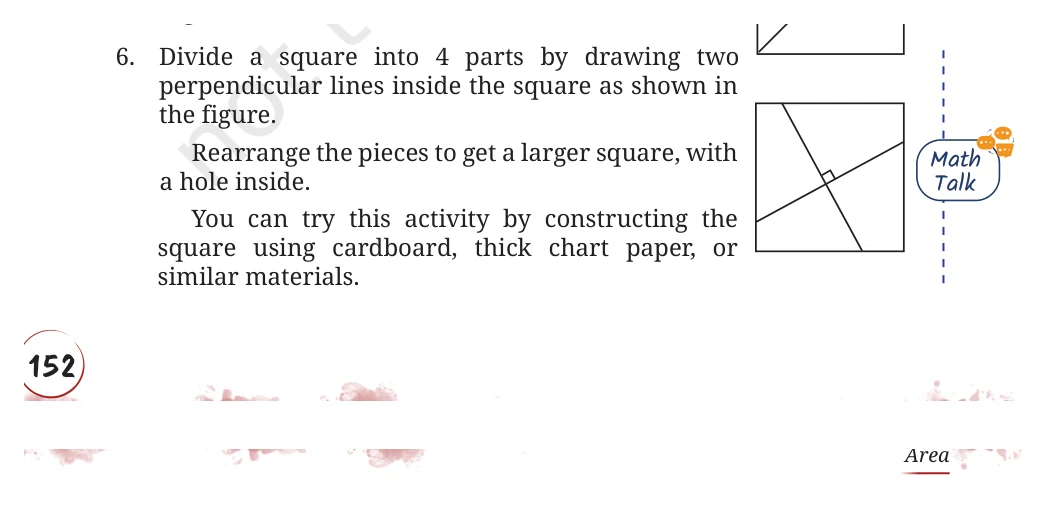
Explain the four-piece square rearrangement with a central hole.
Show solution
Cut along the two perpendicular lines and rotate/rearrange the four pieces so their suitable outer edges form a larger square. Area is preserved by dissection; therefore the central hole's area equals the new outer square's area minus the original square's area.
Complete worked answers
Textbook page 6
Textbook page 6 · solved item 11
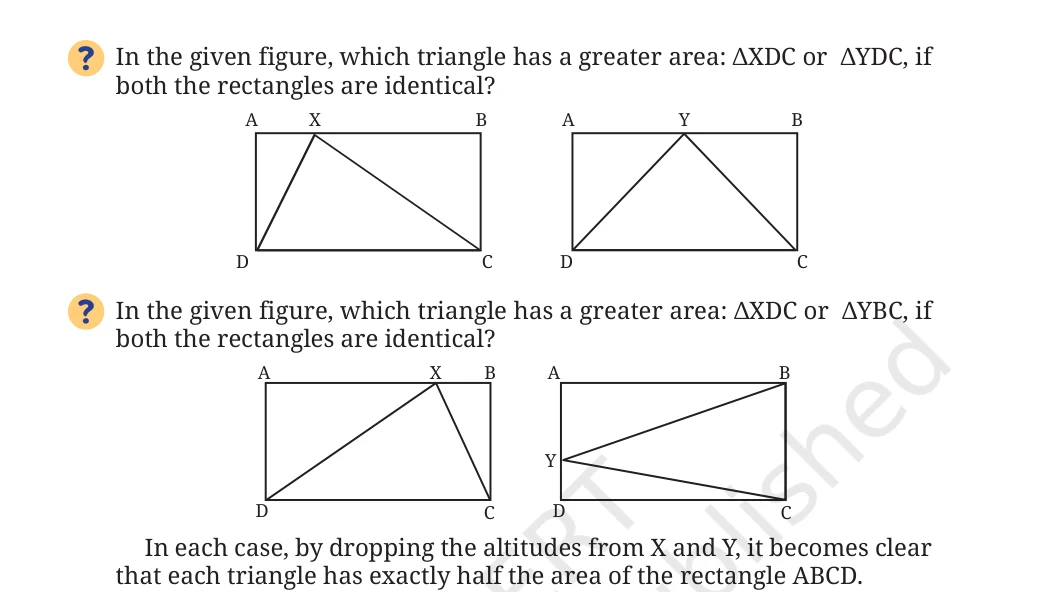
Compare the areas of the displayed triangles inside identical rectangles.
Show solution
All displayed triangles occupy half of an identical rectangle: each uses a full rectangle side as base and has the same corresponding height. Therefore ΔXDC, ΔYDC, and ΔYBC have equal area even though their shapes differ.
Textbook page 6 · solved item 12
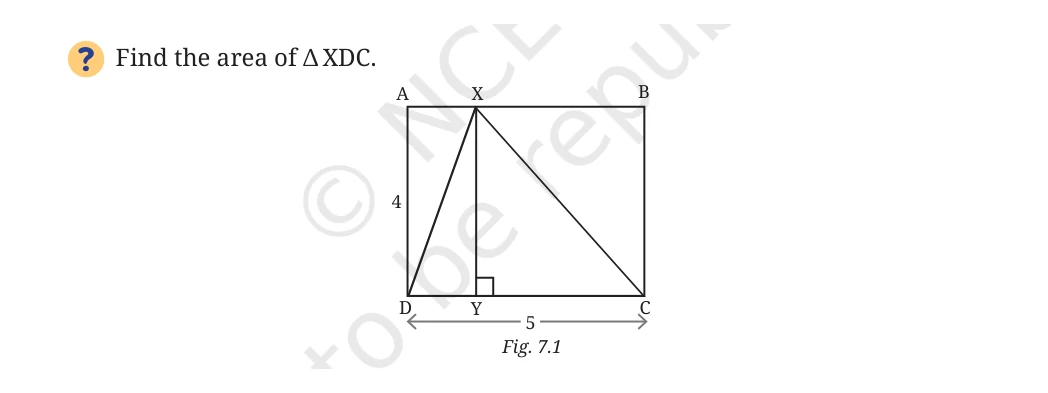
Find the area of triangle XDC in the 5 by 4 rectangle.
Show solution
Taking DC=5 as base and the rectangle's height 4, area =½\times5\times4=10 square units.
Textbook page 6 · solved item 13
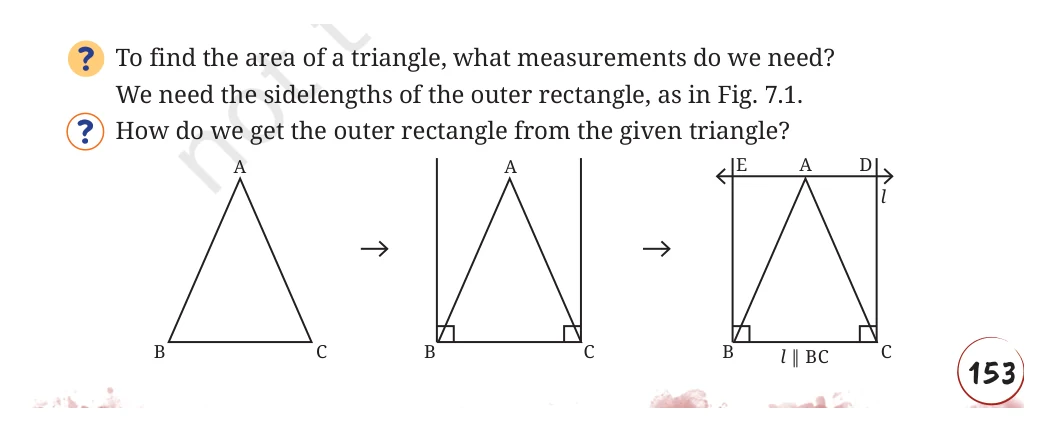
Derive the area formula for every type of triangle.
Show solution
Place or extend the triangle inside a rectangle, or subtract two right triangles for an obtuse case. In every case, the result is ½ of base × perpendicular height: A=½ bh. The height may fall outside the triangle.
Complete worked answers
Textbook page 8
Textbook page 8 · solved item 14
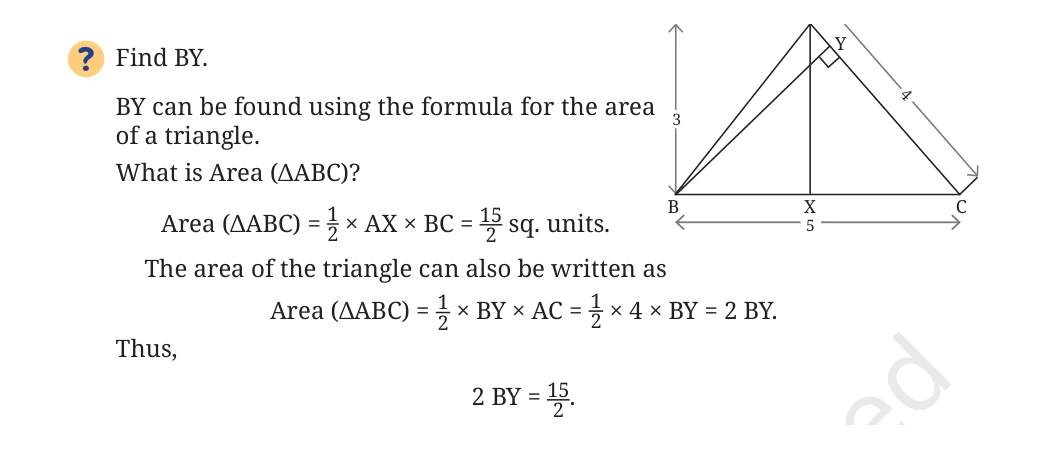
Find BY in the triangle with AX = 3, BC = 5, and AC = 4.
Show solution
Using base (BC), area =½\times5\times3=15/2. Using base (AC), area =½\times4\times BY=2BY. Thus 2BY=15/2, so BY=15/4=3.75 units.
Textbook page 8 · solved item 15
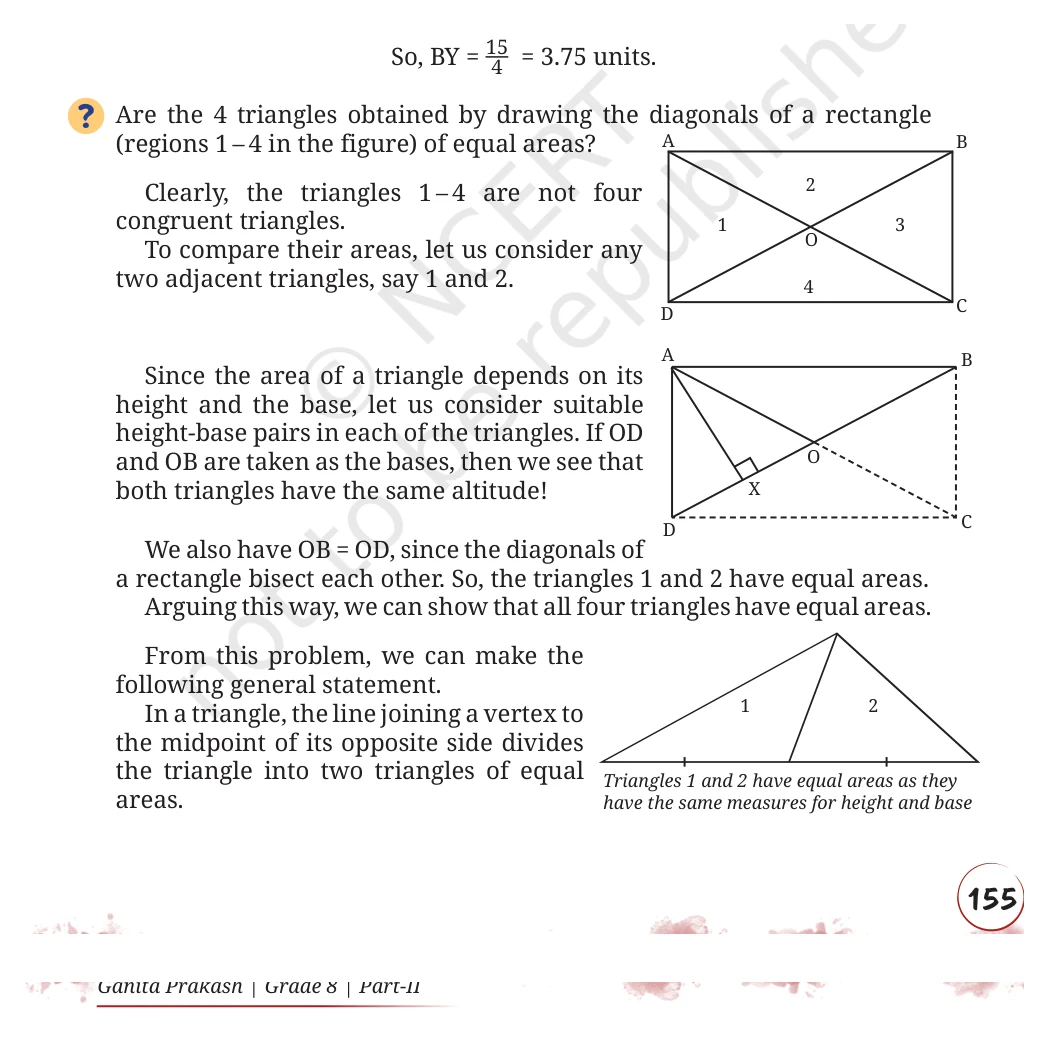
Are the four triangles formed by the diagonals of a rectangle equal in area?
Show solution
Yes. Diagonals bisect each other, so adjacent triangles have equal bases along one diagonal and the same altitude from the opposite vertex. Repeating this argument around the intersection shows each triangle has one-fourth of the rectangle's area.
Complete worked answers
Textbook page 9
Textbook page 9 · solved item 16
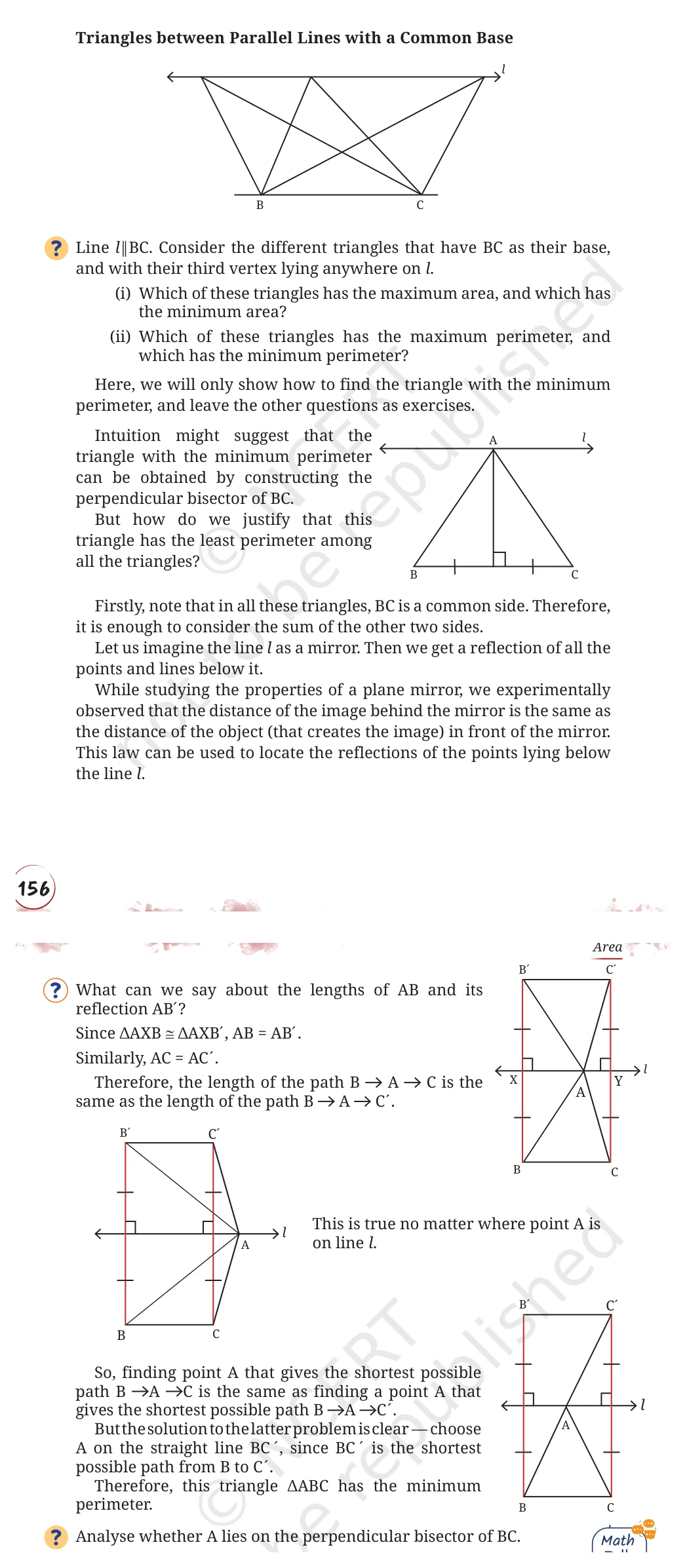
What happens to the areas and perimeters of triangles on a common base between parallel lines?
Show solution
All such triangles have the same base and the same perpendicular height, so all have equal area; none has a maximum or minimum area. Their perimeters vary. Reflecting one endpoint across the parallel line turns the two variable sides into a broken path; the minimum occurs where that path becomes straight.
This point need not lie on the perpendicular bisector unless the geometry is symmetric.
Complete worked answers
Textbook page 10
Textbook page 10 · solved item 17
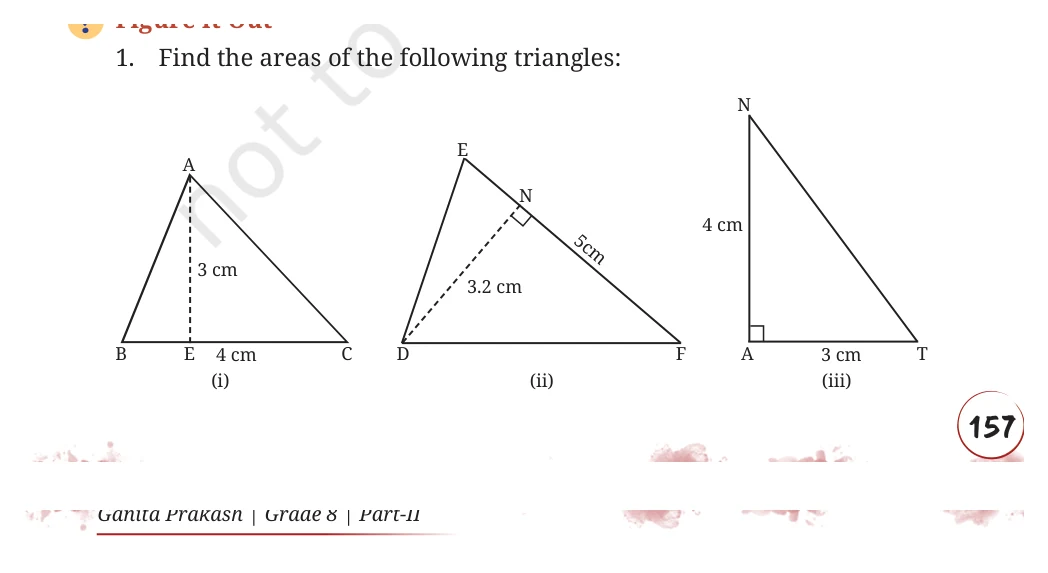
Find the areas of the three displayed triangles.
Show solution
(i) ½×4×3 = 6\text{ cm}^2. (ii) use side EF = 5 cm and perpendicular DN = 3.2 cm: ½×5×3.2 = 8\text{ cm}^2. (iii) ½×3×4 = 6\text{ cm}^2.
Complete worked answers
Textbook page 11
Textbook page 11 · solved item 18
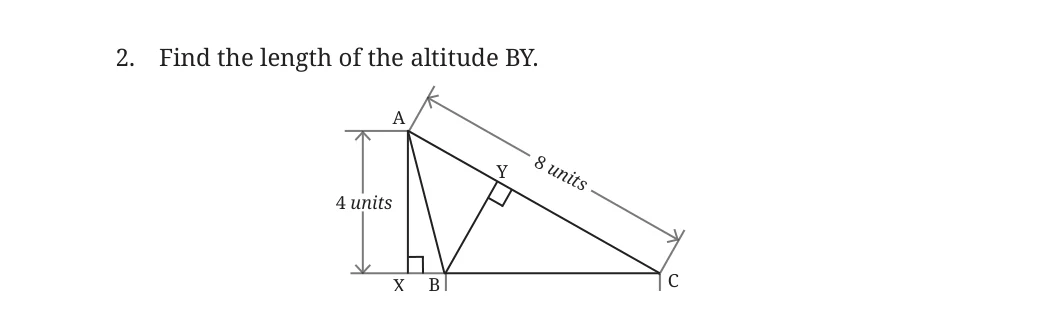
Find altitude BY when BC = 6, AX = 4, and AC = 8.
Show solution
Area using (BC) is ½×6×4 = 12. Using (AC), it is ½×8×BY = 4BY. Hence BY=3 units.
Textbook page 11 · solved item 19

Find the area of isosceles triangle SUB when area of triangle SEB is 24.
Show solution
In an isosceles triangle, the altitude from the apex also bisects the base. Thus triangles SEU and SEB have equal bases and the same height, so equal areas. Total area of ΔSUB is 24 + 24 = 48 square units.
Textbook page 11 · solved item 20

Transform a rectangle into a triangle of equal area and a triangle into a rectangle.
Show solution
Rectangle to triangle: keep the same base and choose a triangle whose perpendicular height is twice the rectangle's height. Triangle to rectangle: keep the triangle's base and use half its height, or keep its height and use half its base. These dimensions give equal areas by ½ bh.
Textbook page 11 · solved item 21
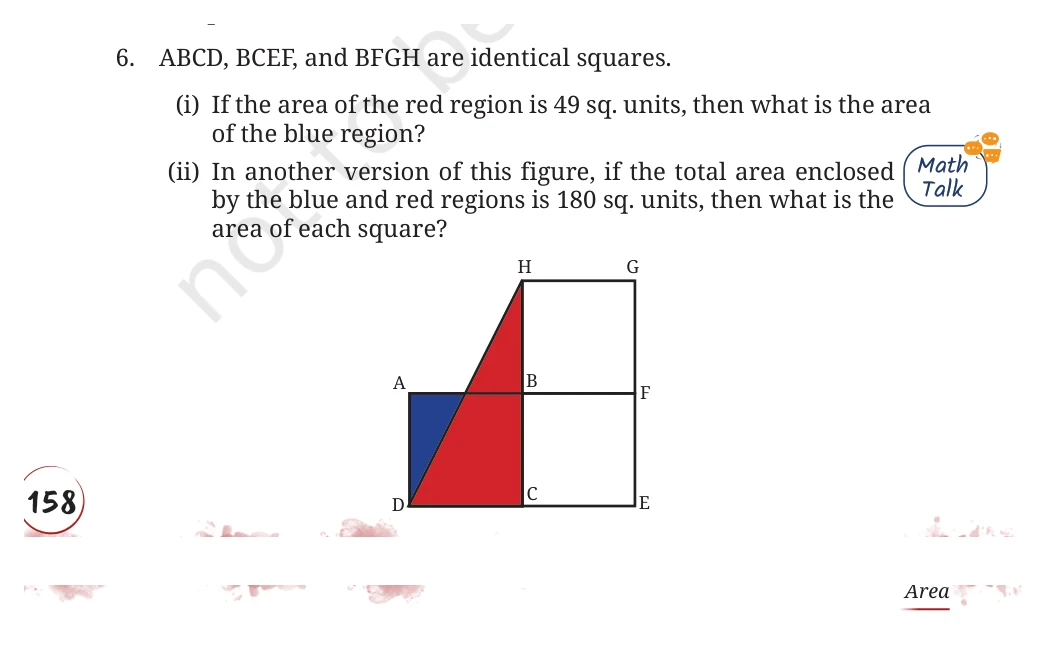
Solve the three-identical-squares red and blue area problem.
Show solution
Let each square have area s^2. The blue triangle has area s^2/4; the full red region has area s^2. Therefore red : blue = 4 : 1. If red is 49, blue is 49/4=12.25 sq units. If red + blue = 180, then 5s^2/4=180, so each square has area 144 sq units.
Complete worked answers
Textbook page 12
Textbook page 12 · solved item 22
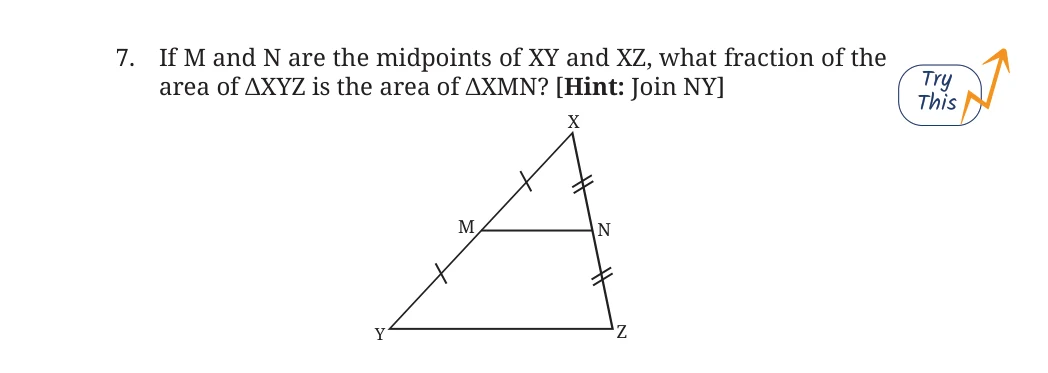
If M and N are midpoints of XY and XZ, what fraction of triangle XYZ is triangle XMN?
Show solution
XM and XN are each half of the corresponding sides from X, so ΔXMN is similar to ΔXYZ with scale factor ½. Areas scale by the square of the factor, giving ¼ of the area of ΔXYZ.
Textbook page 12 · solved item 23
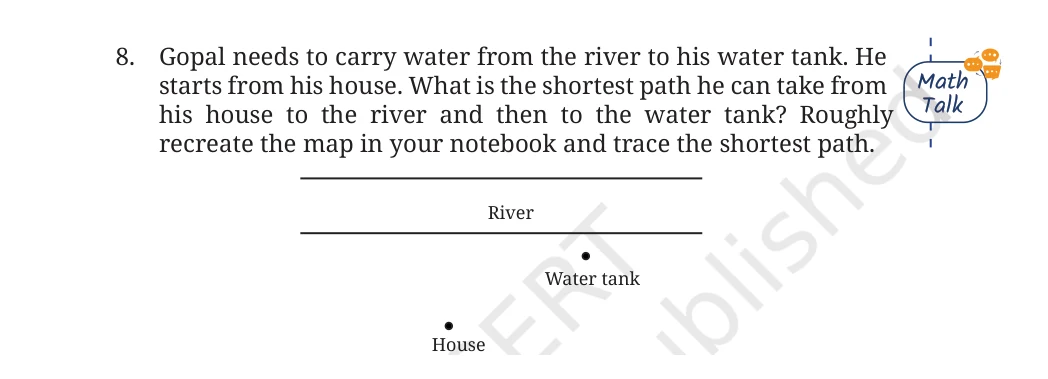
Find the shortest route from a house to a river and then to a water tank.
Show solution
Reflect the water tank across the river line. Join the house to the reflected tank with a straight segment; its intersection with the river is the optimal water-collection point. Reflecting back gives the shortest broken path house → river → tank.
Textbook page 12 · solved item 24
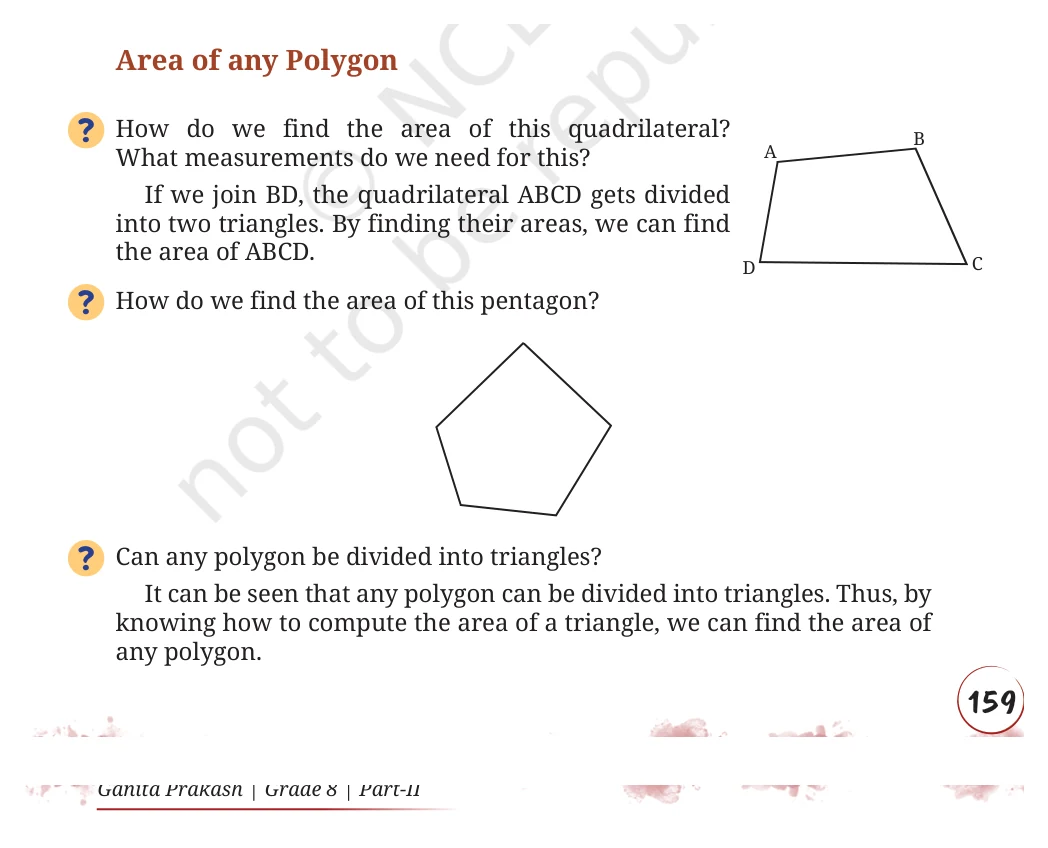
How can the area of any polygon be found?
Show solution
Draw non-crossing diagonals from one vertex to divide a convex polygon into triangles, or triangulate a concave polygon carefully. Measure a base and perpendicular height for each triangle and add their ½ bh areas.
Complete worked answers
Textbook page 13
Textbook page 13 · solved item 25
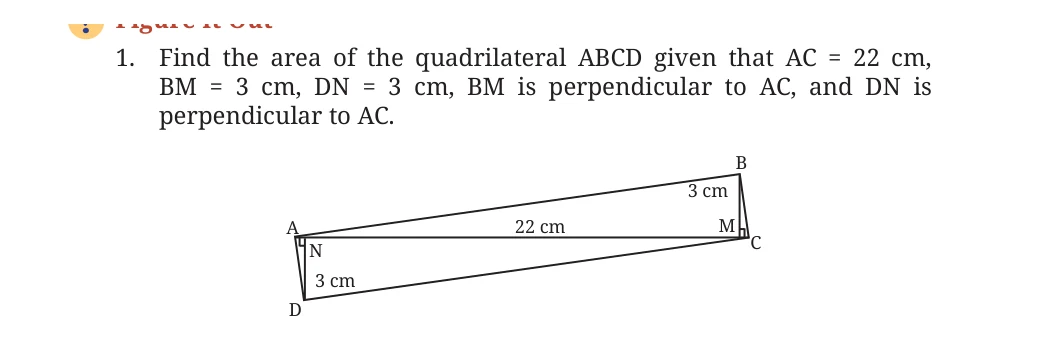
Find the area of quadrilateral ABCD with diagonal AC = 22 cm and perpendicular distances 3 cm on both sides.
Show solution
Split along AC. Area =½\times22\times3+½\times22\times3=66\text{ cm}^2. Equivalently, ½×diagonal×sum of the two perpendicular distances.
Textbook page 13 · solved item 26
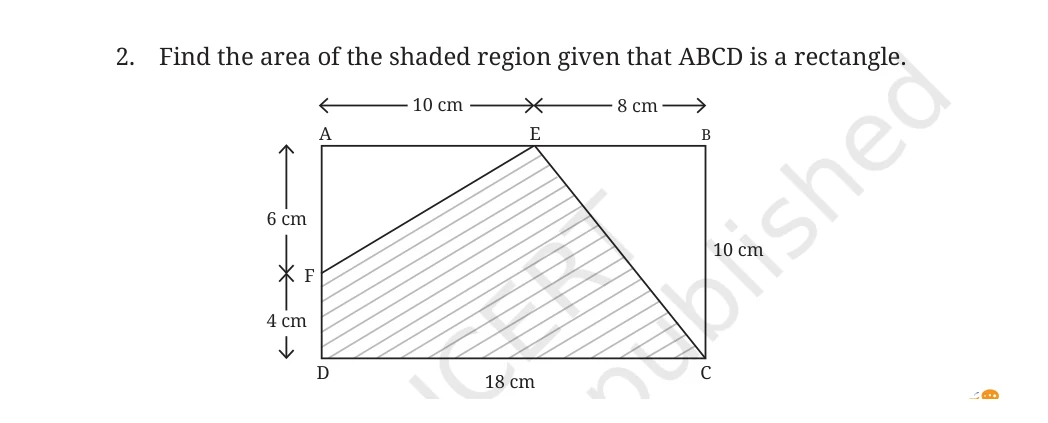
Find the shaded area inside the 18 cm × 10 cm rectangle.
Show solution
Rectangle area is 180 cm². The unshaded left triangle has area ½×10×6 = 30 cm²; the right triangle has area ½×8×10 = 40 cm². Shaded area =180-30-40=110\text{ cm}^2.
Textbook page 13 · solved item 27

What measurements are needed for a regular hexagon's area?
Show solution
Measure side s and apothem a. Divide the hexagon into six triangles to get A=6(½ sa)=3sa. With only side length, a=\sqrt3s/2, so A=3\sqrt3s^2/2.
Textbook page 13 · solved item 28
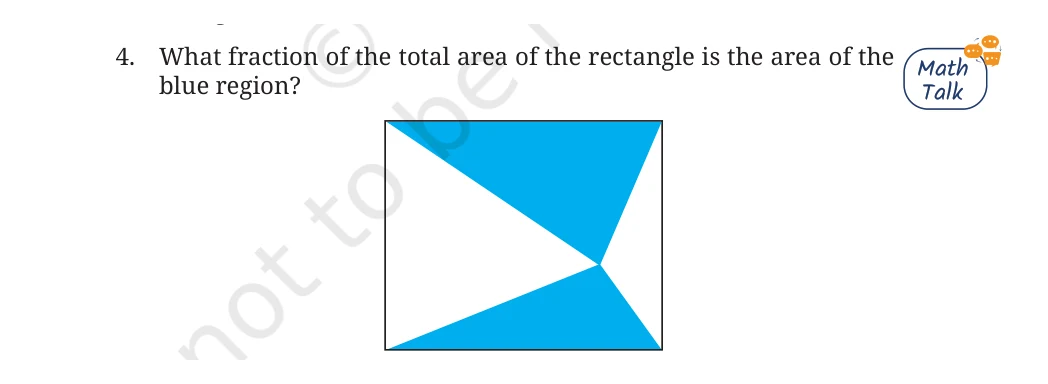
What fraction of the rectangle is the blue bow-tie region?
Show solution
The two blue triangles use the rectangle's full top and bottom as their bases. Their perpendicular heights add to the rectangle's height. Their combined area is therefore ½ × width × height, exactly ½ of the rectangle.
Textbook page 13 · solved item 29

Construct a quadrilateral with half the area of a given quadrilateral.
Show solution
Join the midpoints of the four sides. Varignon's theorem gives a parallelogram whose area is exactly half the original quadrilateral's area. The construction works for any simple convex quadrilateral.
Complete worked answers
Textbook page 14
Textbook page 14 · solved item 30
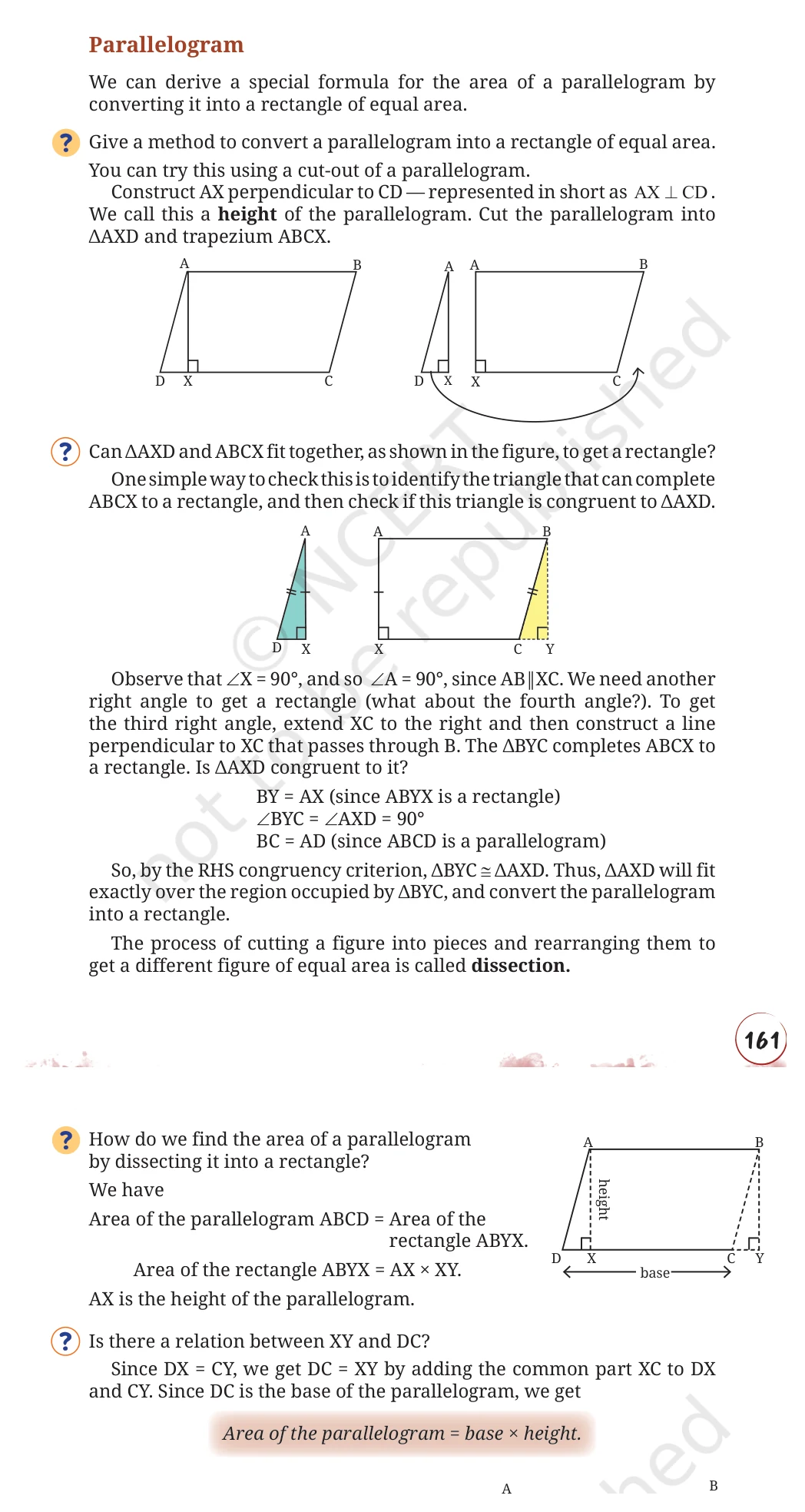
Derive the area of a parallelogram by dissection.
Show solution
Drop a perpendicular height, cut off the resulting end triangle, and move it to the opposite side. The pieces form a rectangle with the same base and height. Hence parallelogram area = base × perpendicular height; any side can serve as base with its matching height.
Complete worked answers
Textbook page 15
Textbook page 15 · solved item 31
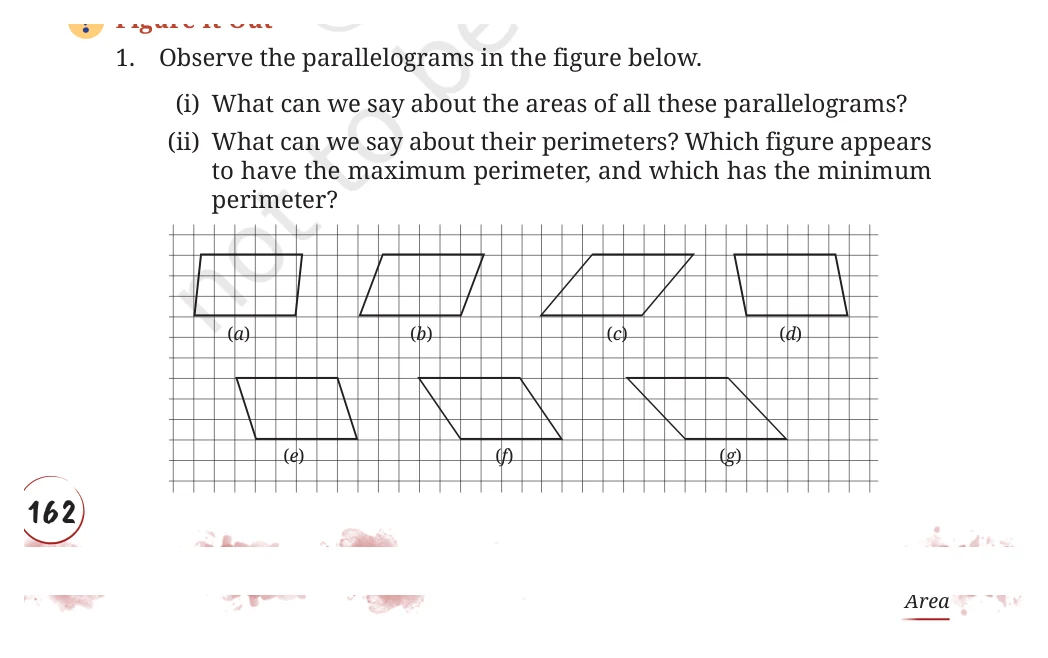
Compare the seven parallelograms drawn on the grid.
Show solution
They share the same base and perpendicular height, so their areas are equal. Their sloping sides, and hence perimeters, differ. Figures c and g appear most slanted and have the maximum perimeter; a and d appear least slanted and have the minimum.
Complete worked answers
Textbook page 16
Textbook page 16 · solved item 32
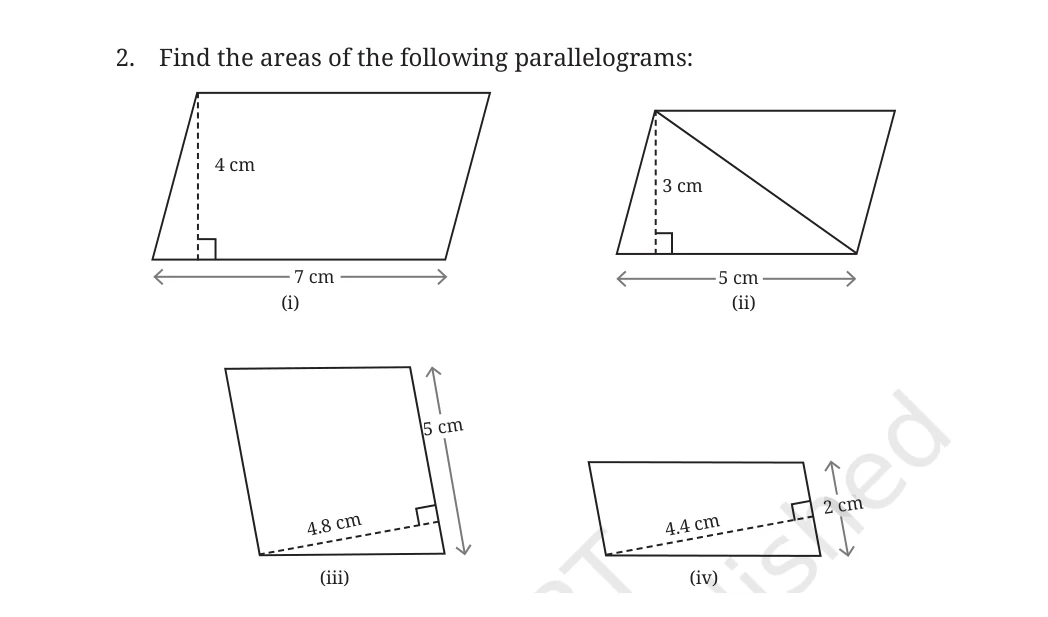
Find the four displayed parallelogram areas.
Show solution
Use base × corresponding perpendicular height: (i) 7\times4=28\text{ cm}^2; (ii) 5\times3=15\text{ cm}^2; (iii) 5\times4.8=24\text{ cm}^2; (iv) 2\times4.4=8.8\text{ cm}^2.
Textbook page 16 · solved item 33
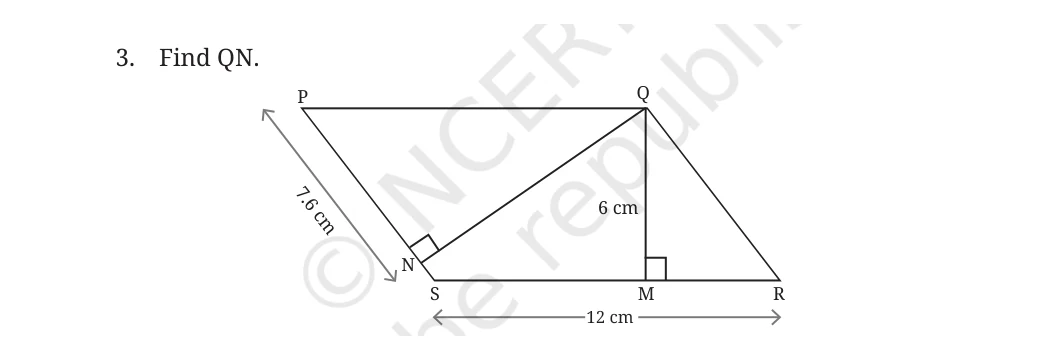
Find QN in parallelogram PQRS.
Show solution
Using base SR = 12 cm and height QM = 6 cm, area is 72 cm². Using base PS = 7.6 cm and height QN, 7.6QN=72. Thus QN=180/19\approx9.47 cm.
Textbook page 16 · solved item 34
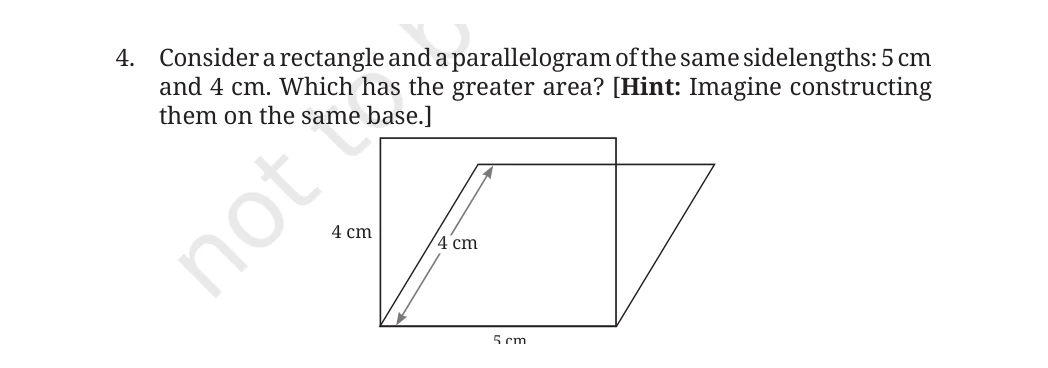
Compare a rectangle and parallelogram with side lengths 5 cm and 4 cm.
Show solution
The rectangle has area 5×4 = 20 cm². A non-rectangular parallelogram with base 5 and sloping side 4 has perpendicular height less than 4, so its area is less than 20 cm². The rectangle has the greater area; equality occurs only when the parallelogram is also a rectangle.
Textbook page 16 · solved item 35
Obtain rectangles with twice or equal the area of a triangle.
Show solution
Twice the triangle's area: use a rectangle with the same base and full perpendicular height. Equal area: use the same base and half the height, or half the base and the full height. A dissection can cut and translate triangle pieces to realize these rectangles.
Complete worked answers
Textbook page 17
Textbook page 17 · solved item 36
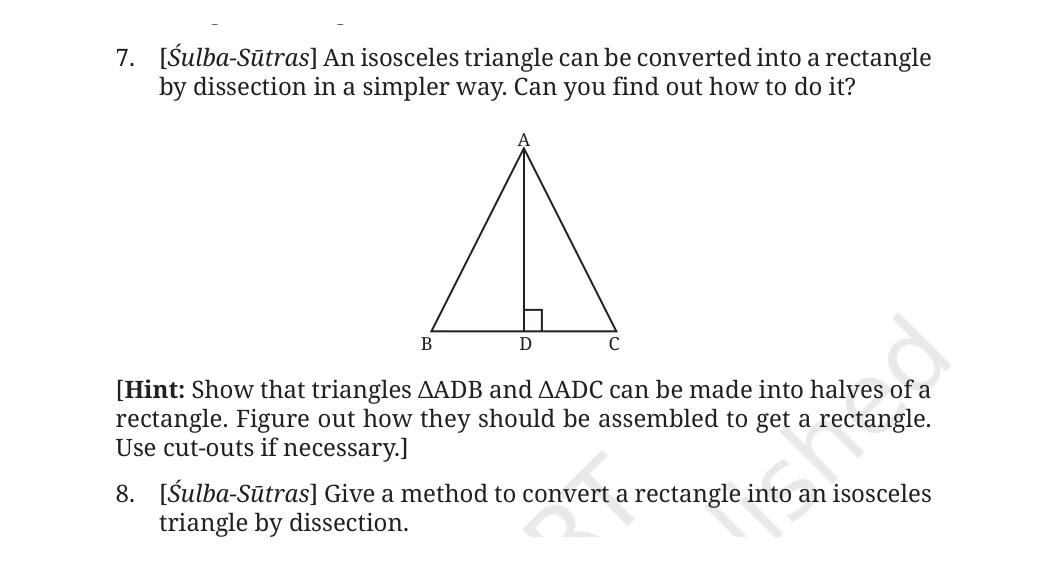
Describe the Sulba-Sutra triangle and rectangle dissections.
Show solution
For a triangle, cut along an altitude, then rearrange the two right triangles to make a rectangle of the same area with half-height or half-base. For an isosceles triangle, split at the apex-to-base midpoint and fit the congruent halves into a rectangle. Reverse these cuts to convert a rectangle into an isosceles triangle.
Textbook page 17 · solved item 37

Compare an equilateral triangle, two such triangles, and a square with the same side length.
Show solution
For side s, one equilateral triangle has area \sqrt3s^2/4\approx0.433s^2, two have \sqrt3s^2/2\approx0.866s^2, and the square has s^2. The square is larger than either one or two of the triangles.
Complete worked answers
Textbook page 19
Textbook page 19 · solved item 38

Derive the rhombus area formula from its diagonals.
Show solution
The diagonals are perpendicular bisectors. Splitting along one diagonal gives two triangles whose combined area is ½×BD×AO+CO = ½×BD×AC. Thus A=½ d_1d_2. The dissection also forms a rectangle with sides one diagonal and half the other.
Textbook page 19 · solved item 39
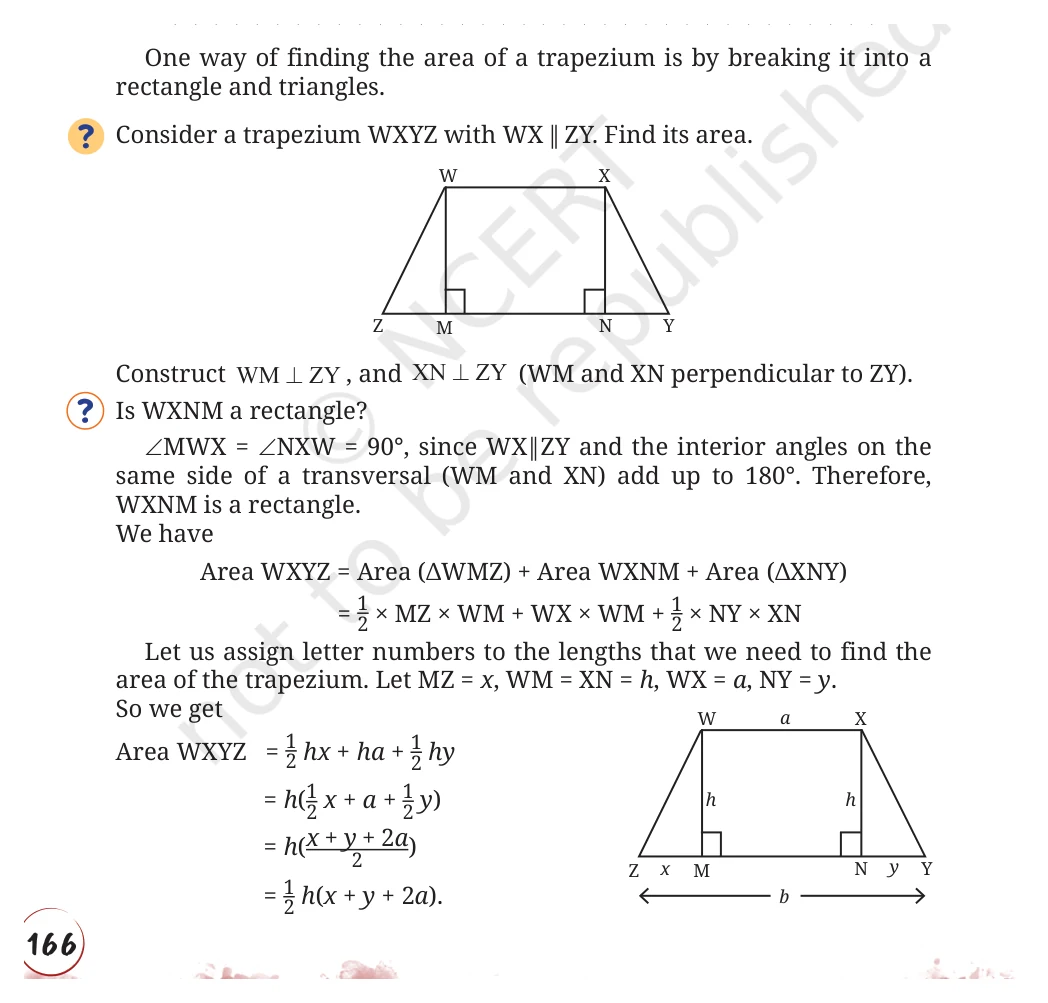
Derive the trapezium area formula.
Show solution
Drop perpendiculars to split the trapezium into a rectangle and two triangles, or join two congruent copies into a parallelogram. If parallel sides are a,b and height is h, two copies have area h(a+b); one has A=½ h(a+b). The result also holds for an overhanging trapezium.
Complete worked answers
Textbook page 22
Textbook page 22 · solved item 40

Find the rhombus area when diagonals are 20 cm and 15 cm.
Show solution
A=½\times20\times15=150\text{ cm}^2.
Textbook page 22 · solved item 41

Convert a rectangle to a rhombus of equal area by dissection.
Show solution
Reverse the rhombus-to-rectangle construction: treat the rectangle's length as one rhombus diagonal and twice its width as the other. Split the rectangle appropriately into the four right-triangle pieces and rearrange them around the diagonal intersection.
Textbook page 22 · solved item 42
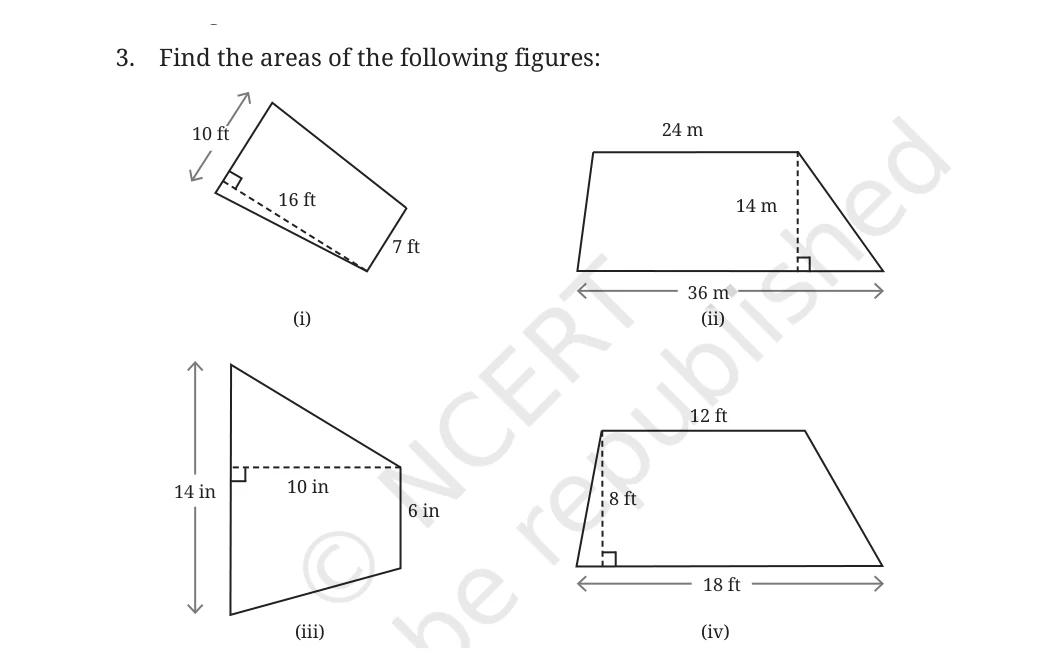
Find the areas of the four figures on textbook page 169.
Show solution
(i) Parallelogram: 16\times10=160\text{ ft}^2. (ii) Trapezium: ½×14×24+36 = 420\text{ m}^2. (iii) Trapezium with parallel sides 14 in and 6 in, distance 10 in: ½×10×20 = 100\text{ in}^2. (iv) ½×8×12+18 = 120\text{ ft}^2.
Textbook page 22 · solved item 43
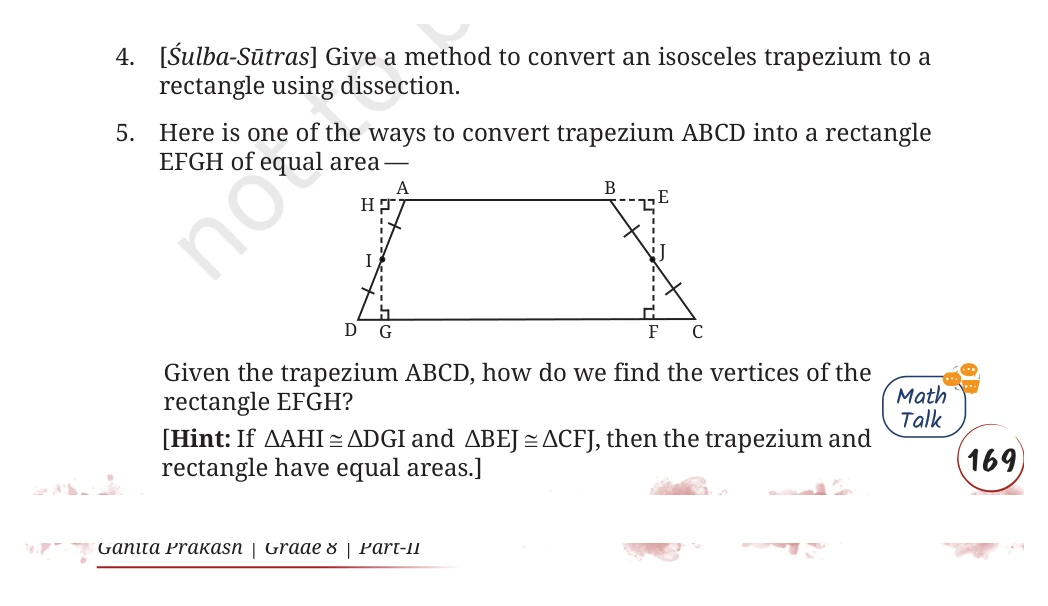
Convert an isosceles trapezium to a rectangle and locate EFGH in the general construction.
Show solution
For an isosceles trapezium, cut the two congruent end triangles and move half of each to the opposite end, forming a rectangle of height h and width a+b/2. In the general figure, mark I and J as midpoints of AD and BC, draw perpendiculars through them to the parallel bases, and extend AB/DC as needed to meet those perpendiculars at H,G,E,F.
The paired corner triangles are congruent, so area is preserved.
Complete worked answers
Textbook page 23
Textbook page 23 · solved item 44

Construct a trapezium of area 144 cm².
Show solution
Choose height 8 cm and parallel sides whose sum is 36 cm, for example 16 cm and 20 cm. Then A=½\times8\times(16+20)=144\text{ cm}^2. Draw the parallel segments 8 cm apart and join their endpoints.
Textbook page 23 · solved item 45

Find the area ratio of the trapezium, equilateral triangle, and rhombus inside the regular hexagon.
Show solution
A regular hexagon consists of six congruent equilateral triangles. The top trapezium contains 3 such units, the lower-left equilateral triangle contains 1, and the lower-right rhombus contains 2. The ratio is 3:1:2.
Textbook page 23 · solved item 46
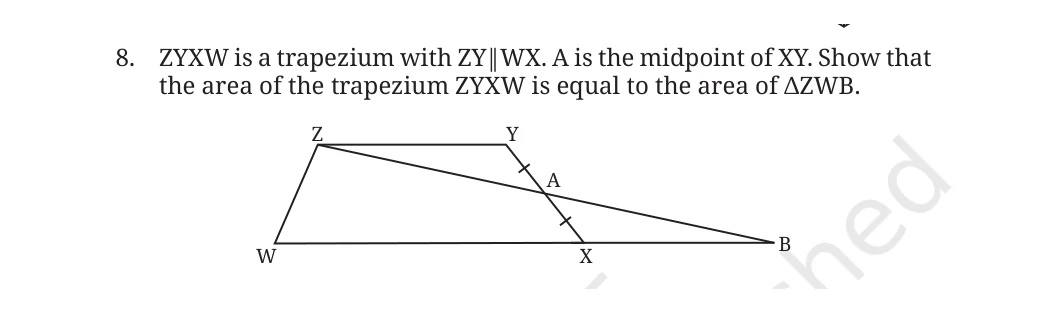
Show trapezium ZYXW and triangle ZWB have equal area.
Show solution
Let the parallel sides be ZY=a, WX=b, with height h. Because A is the midpoint of XY and Z,A,B are collinear, the extension gives triangle ZWB base WB=a+b with the same height h. Thus both areas equal ½h(a+b).
Textbook page 23 · solved item 47
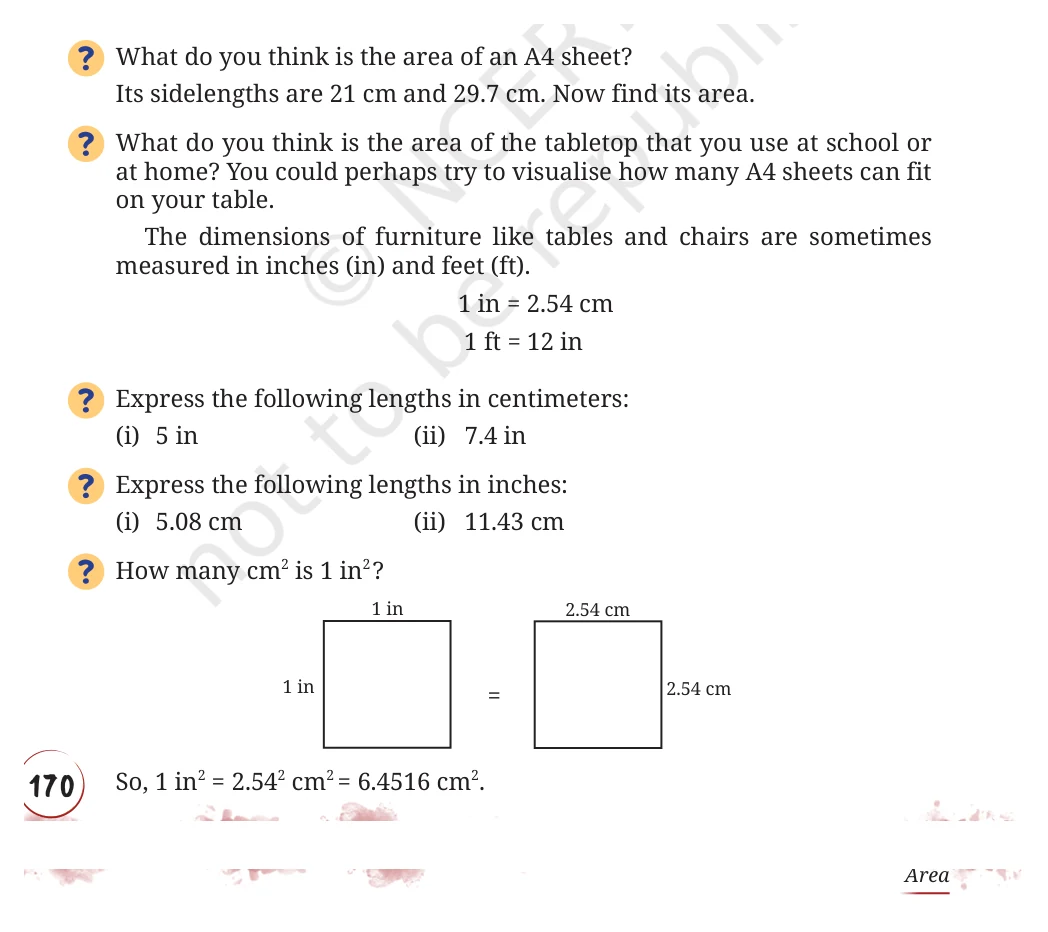
Find the A4 sheet area and perform the displayed inch-centimetre conversions.
Show solution
A4 area =21\times29.7=623.7\text{ cm}^2. Using 1 in = 2.54 cm: 5 in = 12.7 cm; 7.4 in = 18.796 cm; 5.08 cm = 2 in; 11.43 cm = 4.5 in. Also 1\text{ in}^2=2.54^2=6.4516\text{ cm}^2.
Complete worked answers
Textbook page 24
Textbook page 24 · solved item 48
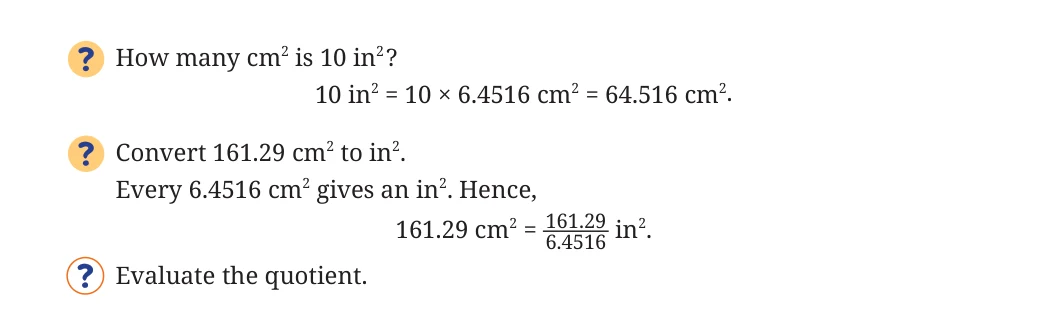
Complete the remaining area-unit conversions.
Show solution
10\text{ in}^2=64.516\text{ cm}^2. 161.29\text{ cm}^2=161.29/6.4516=25\text{ in}^2. 1\text{ ft}^2=12^2=144\text{ in}^2. 1\text{ km}^2=1000^2=1,000,000\text{ m}^2.
Textbook page 24 · solved item 49
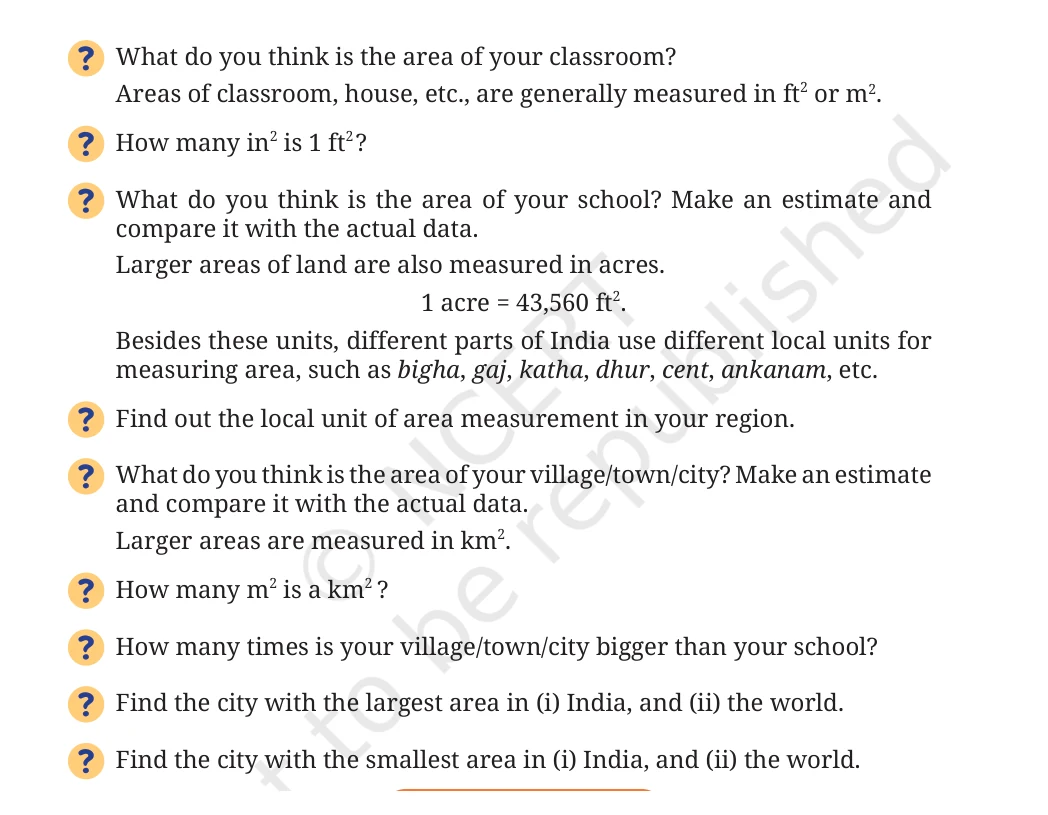
How should the open-ended classroom, school, local-unit, and city-area investigations be completed?
Show solution
Measure or obtain consistent boundary data, convert every quantity to one unit, and state whether the figure is floor area, campus area, or administrative area. For irregular regions, triangulate a scaled map or use an official GIS/municipal source. City rankings depend on how 'city' and its boundary are defined, so cite the source and date rather than treating one ranking as universal.