
Use the textbook context
Match, attempt, then check
Each source crop keeps the printed information needed for that item. Compound answer-key entries are separated into individual solutions.
Complete worked answers
Textbook page 1
Textbook page 1 · solved item 1

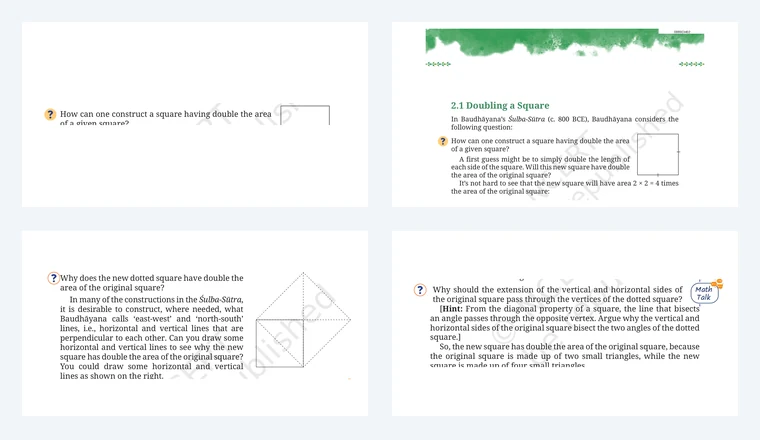
How can we construct a square with double the area of a given square?
Show solution
Construct the new square on a diagonal of the original square. If the old side is a, the diagonal has length a\sqrt2, so the new area is (a\sqrt2)^2=2a^2.
Textbook page 1 · solved item 2
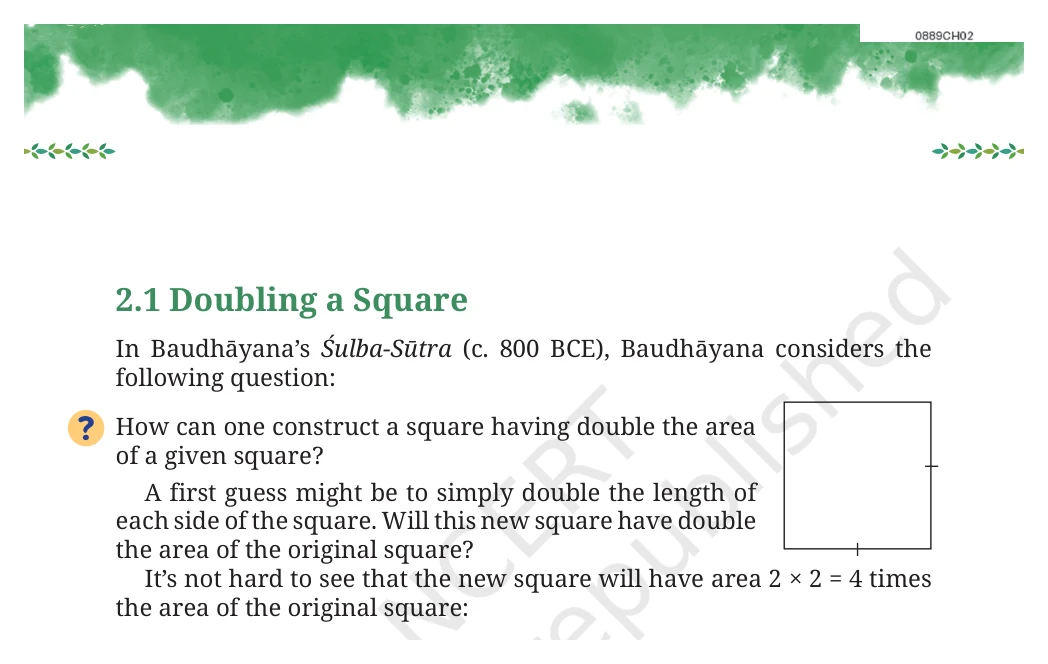
Will doubling every side of a square double its area?
Show solution
No. A square of side a has area a^2, while one of side 2a has area 4a^2. The area becomes four times as large.
Complete worked answers
Textbook page 2
Textbook page 2 · solved item 3
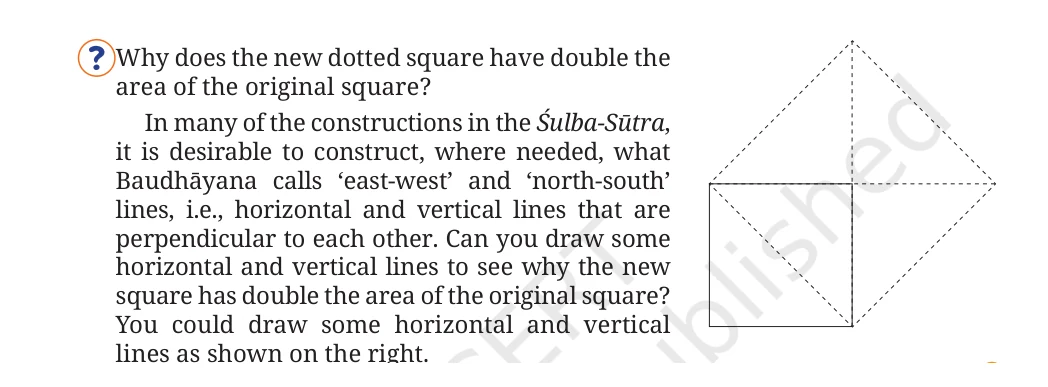
Why does the dotted square on the diagonal have double the original area?
Show solution
The original square contains two congruent small right triangles. The dotted square contains four copies of the same triangle, so its area is twice the original area.
Textbook page 2 · solved item 4
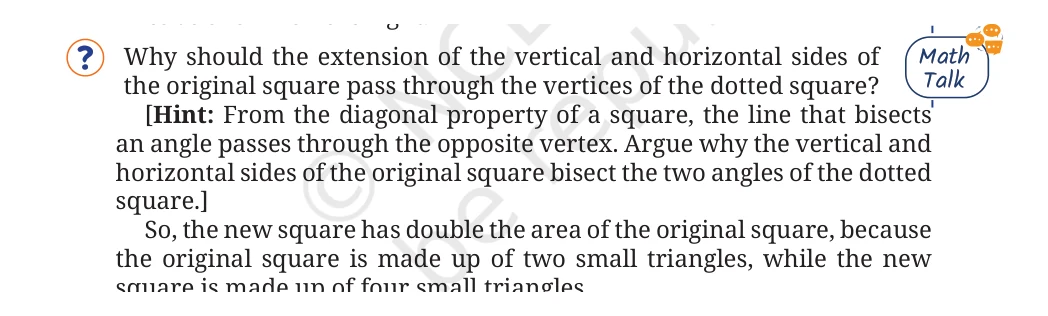
Why do the extended horizontal and vertical sides pass through the dotted square's vertices?
Show solution
Each side of the original square bisects a right angle of the dotted square. In a square, an angle bisector through one vertex passes through the opposite vertex, so each extension reaches the required dotted-square vertex.
Textbook page 2 · solved item 5
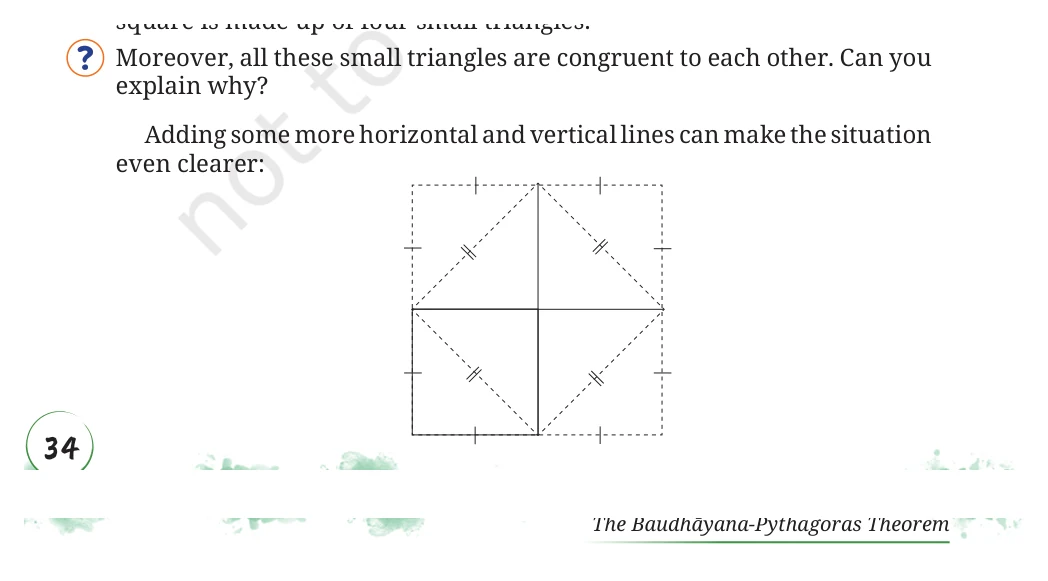
Why are all the small triangles in the doubling construction congruent?
Show solution
Each is a right isosceles triangle whose two legs equal half a diagonal of the original square. Thus corresponding legs and the included right angle are equal, so the triangles are congruent by SAS.
Complete worked answers
Textbook page 3
Textbook page 3 · solved item 6
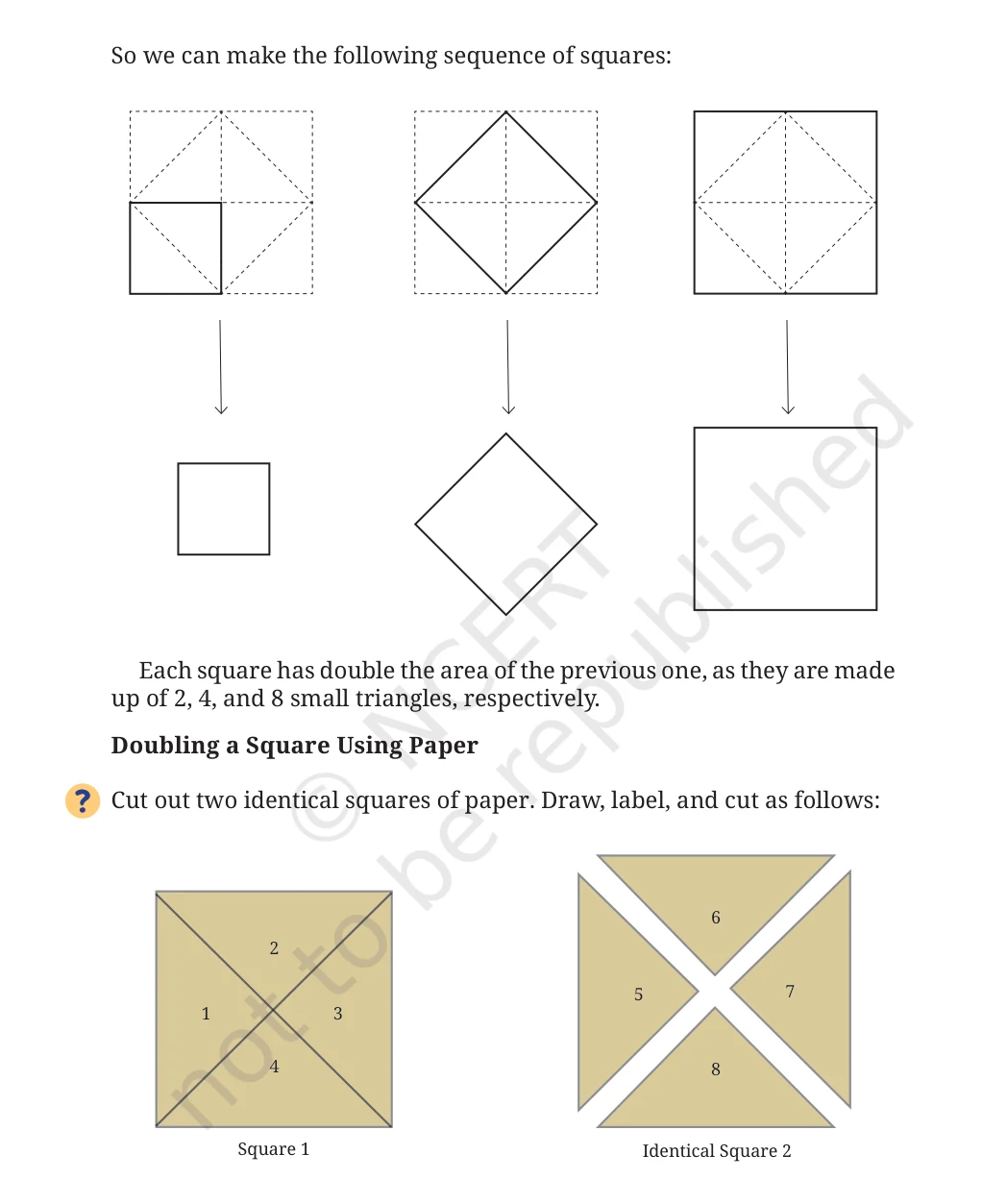
Explain the sequence of squares made from 2, 4, and 8 small triangles.
Show solution
Each new square uses twice as many copies of the same small triangle as the preceding square. Therefore its area is twice the preceding area.
Textbook page 3 · solved item 7
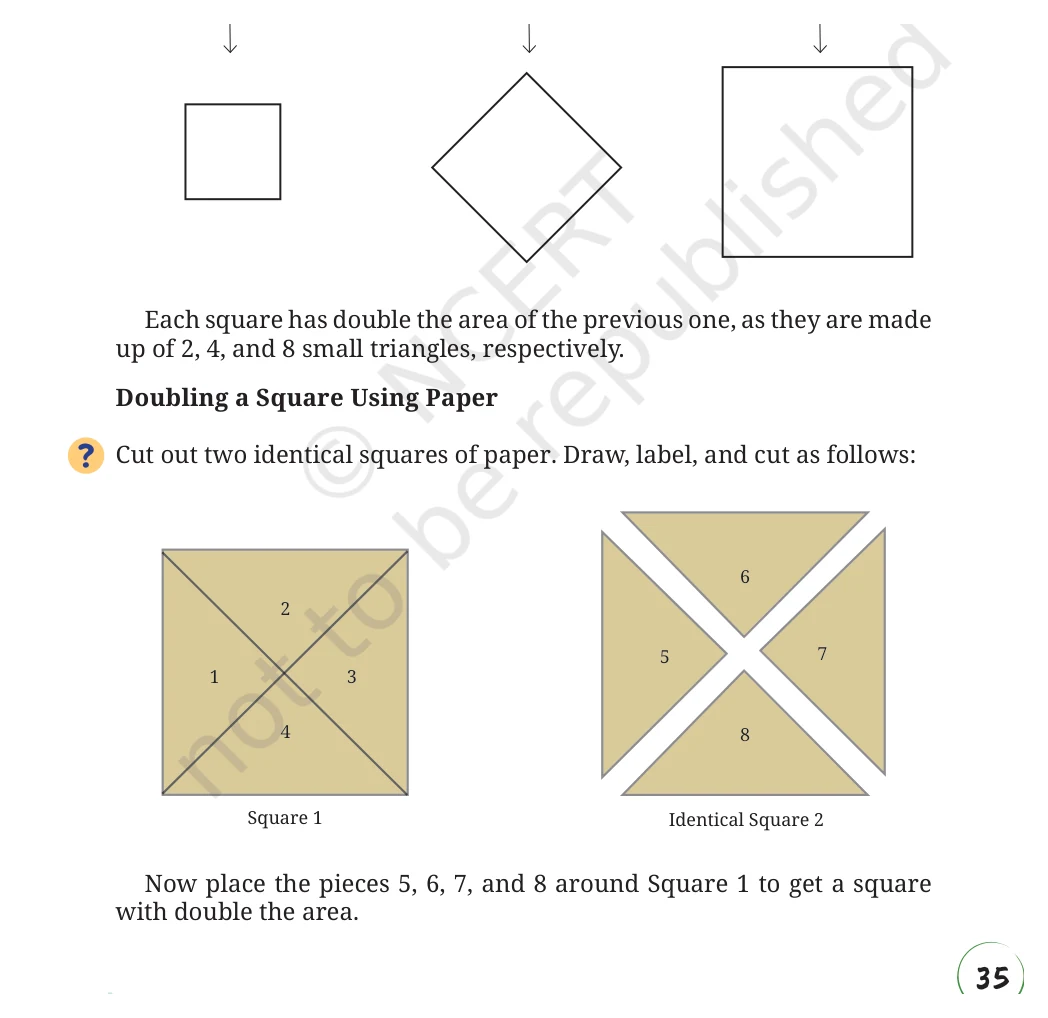
How do pieces 5, 6, 7, and 8 make a square of double the area?
Show solution
Place one triangular piece along each side of Square 1, with their hypotenuses forming the four outer sides. The four pieces have the area of one complete square, so together with Square 1 the new square has double the original area.
Complete worked answers
Textbook page 4
Textbook page 4 · solved item 8
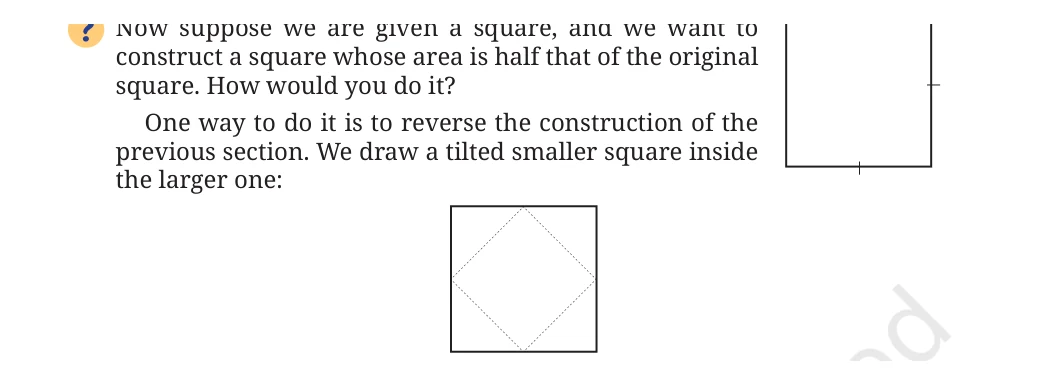
How can we construct a square with half the area of a given square?
Show solution
Join the midpoints of the four sides. The inner tilted quadrilateral is a square, and the four corner triangles together occupy half of the original square, leaving the other half inside.
Textbook page 4 · solved item 9
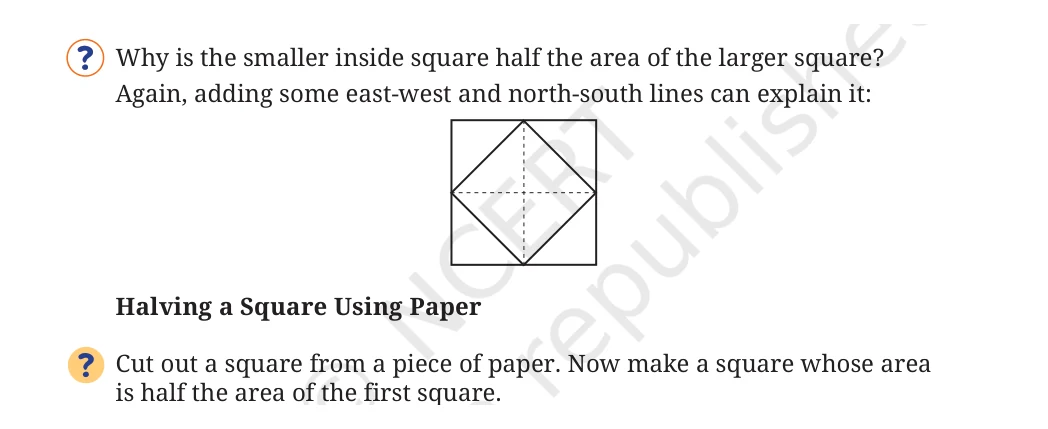
Why is the smaller tilted square half the area of the larger square?
Show solution
The larger square splits into eight congruent small right triangles. Four form the inner square and four remain at the corners, so the inner square occupies half the total area.
Textbook page 4 · solved item 10
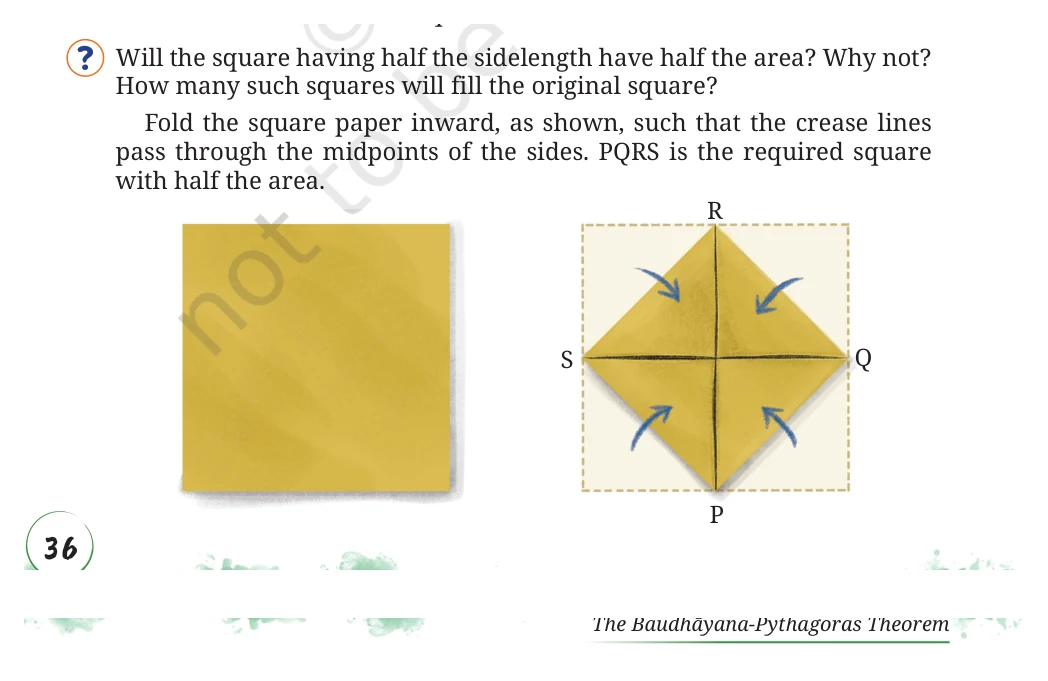
Does halving the side of a square halve its area?
Show solution
No. The area factor is (1/2)^2=1/4. Four squares with half the side length fill the original square.
Complete worked answers
Textbook page 5
Textbook page 5 · solved item 11
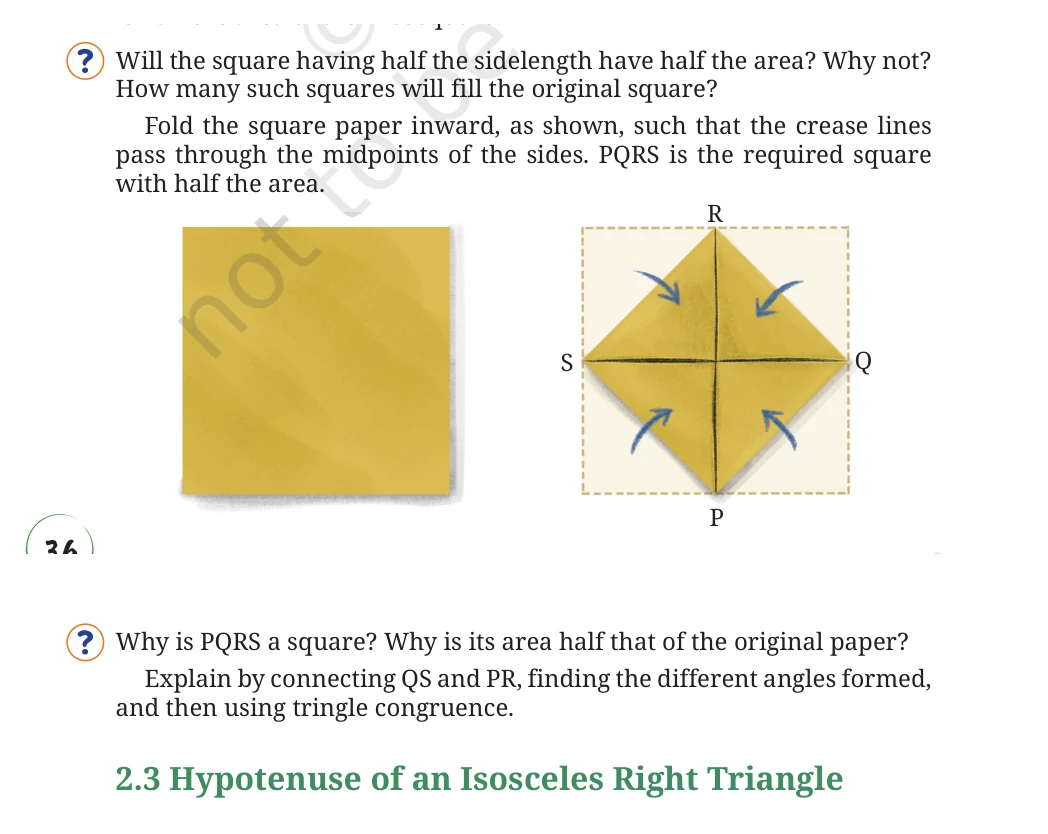
Why is folded PQRS a square, and why is its area half the original?
Show solution
Its vertices are the side midpoints. The four corner triangles are congruent right triangles, so PQRS has four equal sides. Adjacent acute angles of those triangles add to 90 degrees, making every angle of PQRS a right angle. The four corner triangles occupy half the paper, so PQRS occupies the other half.
Textbook page 5 · solved item 12
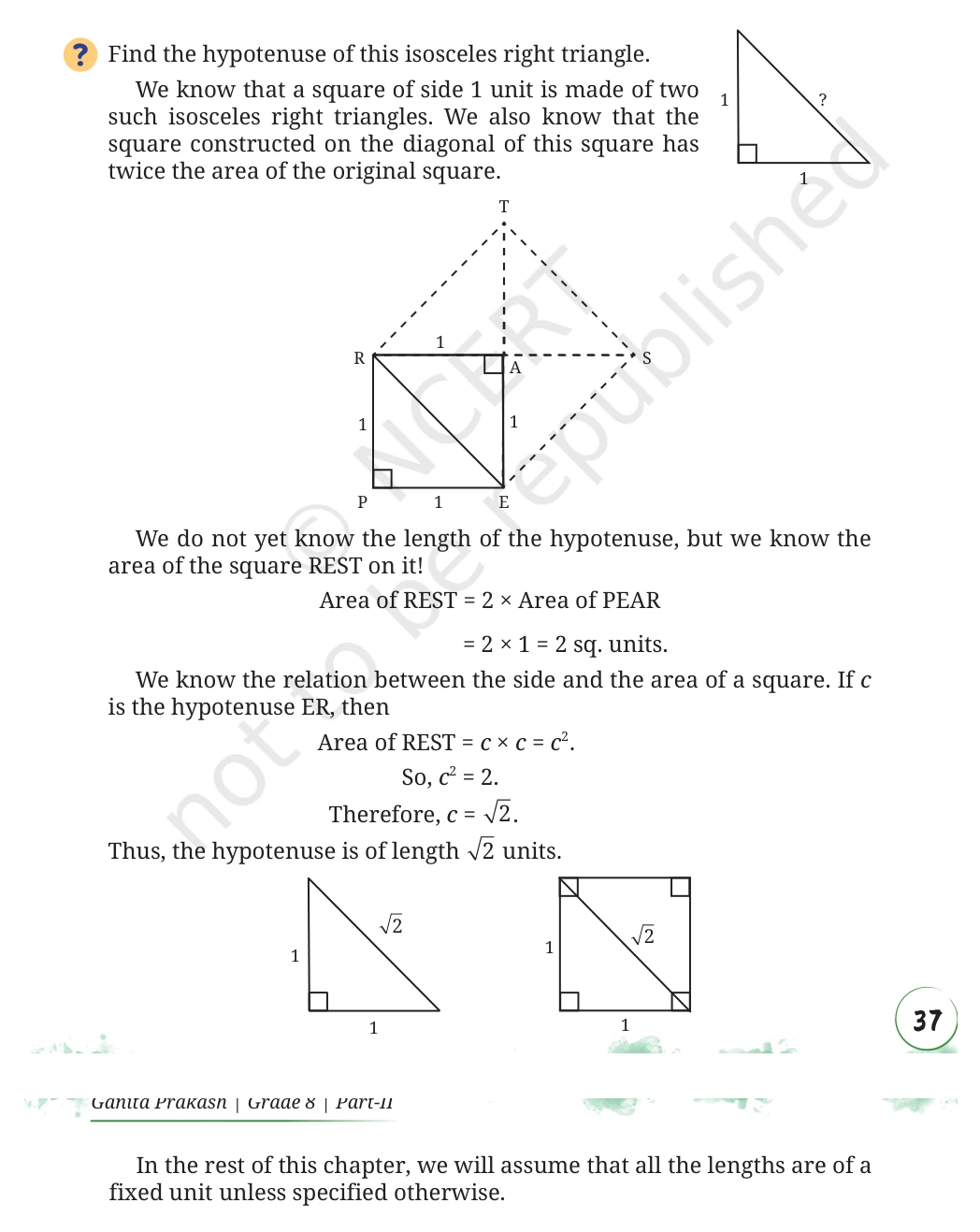
Find the hypotenuse of an isosceles right triangle with equal sides 1.
Show solution
If the hypotenuse is c, the square on it has twice the area of a unit square. Hence c^2=2, so c=\sqrt2.
Complete worked answers
Textbook page 6
Textbook page 6 · solved item 13
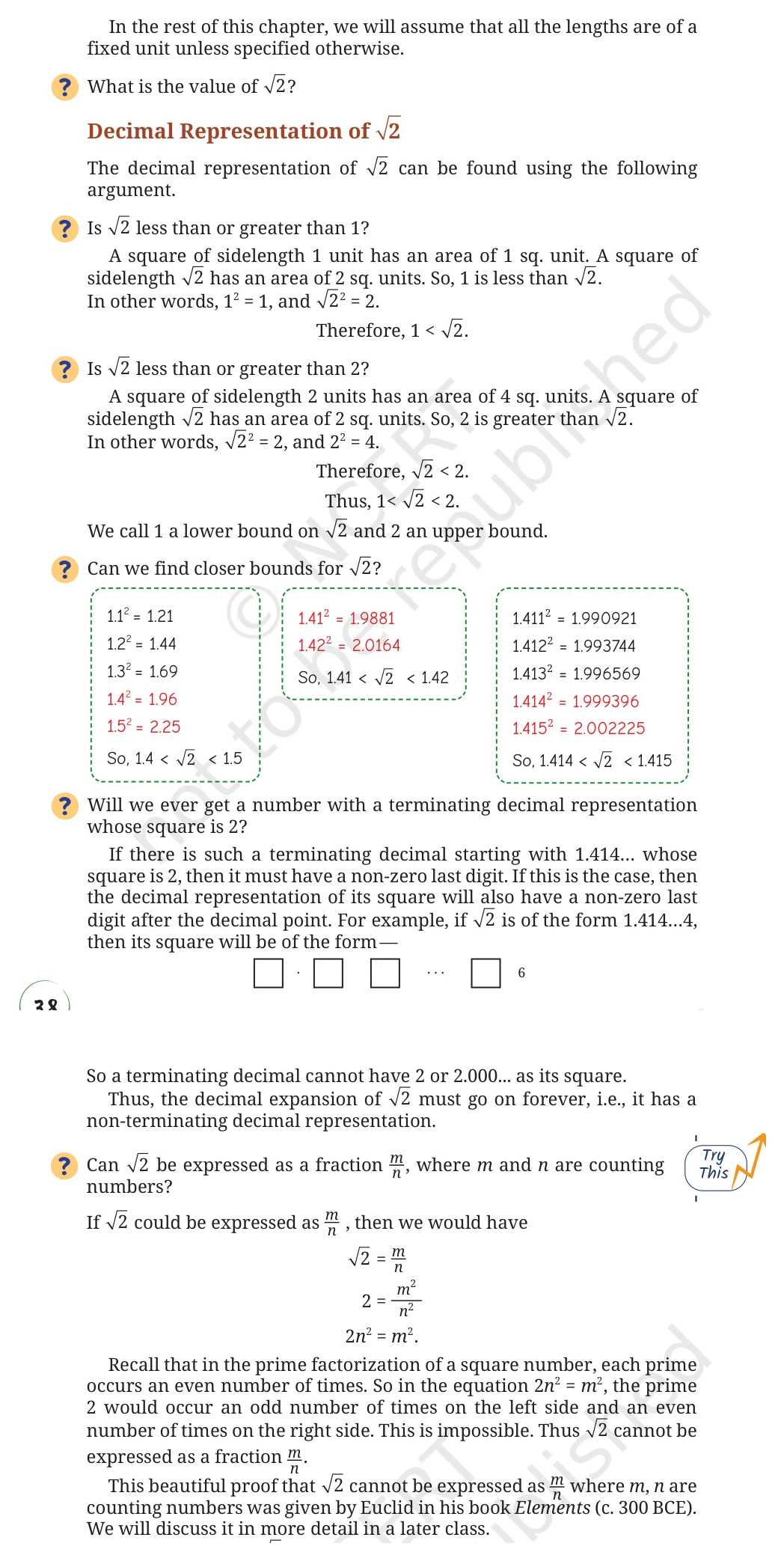
Bound √2 and explain why it is neither a terminating decimal nor a fraction.
Show solution
Squaring decimals gives 1.414^2=1.999396<2<2.002225=1.415^2, so 1.414<\sqrt2<1.415. A terminating decimal with a non-zero last digit cannot square to exactly 2.000\ldots. If \sqrt2=m/n in lowest terms, then m^2=2n^2, which gives incompatible parity for the exponent of prime 2. Thus \sqrt2 is irrational and non-terminating.
Complete worked answers
Textbook page 7
Textbook page 7 · solved item 14
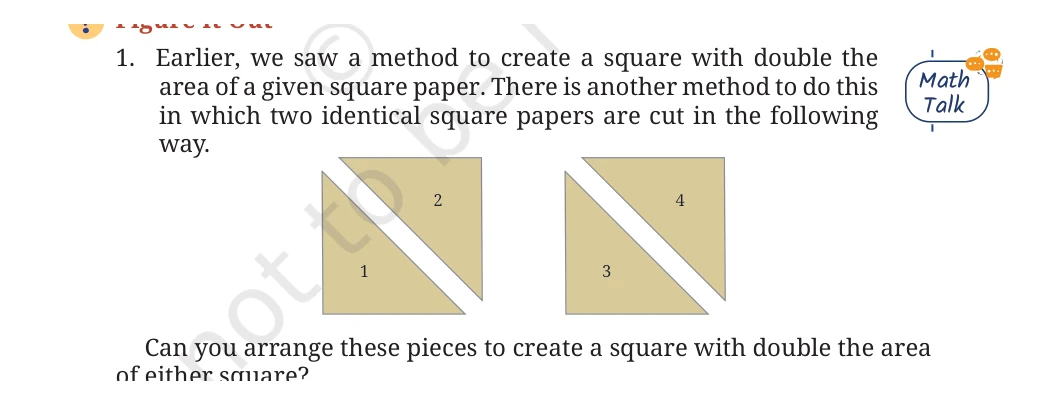
Arrange the four cut pieces to make a square of double the area of either original square.
Show solution
Rotate the four congruent pieces so their long sloping edges form the outer boundary of one square and their shorter edges meet at the centre. Since all four pieces from both original squares are used, the new square has the combined, hence doubled, area.
Textbook page 7 · solved item 15
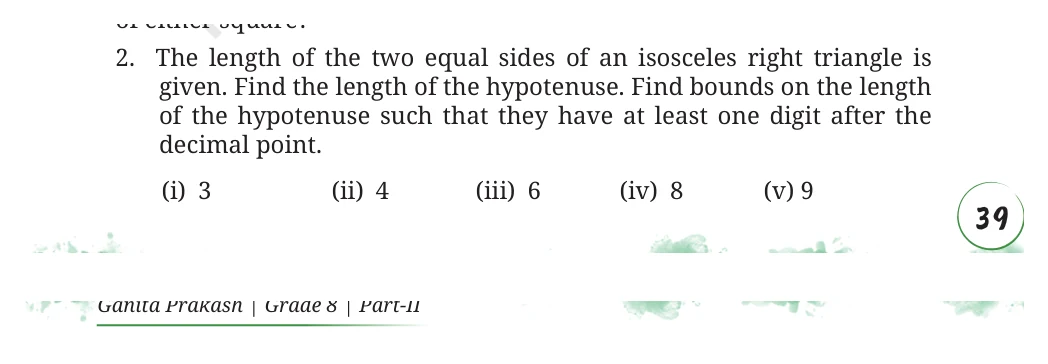
Find hypotenuses and one-decimal bounds for isosceles right triangles with equal sides 3, 4, 6, 8, and 9.
Show solution
Use c=a\sqrt2. The results are: 3\sqrt2, with 4.2<c<4.3; 4\sqrt2, with 5.6<c<5.7; 6\sqrt2, with 8.4<c<8.5; 8\sqrt2, with 11.3<c<11.4; and 9\sqrt2, with 12.7<c<12.8.
Complete worked answers
Textbook page 8
Textbook page 8 · solved item 16
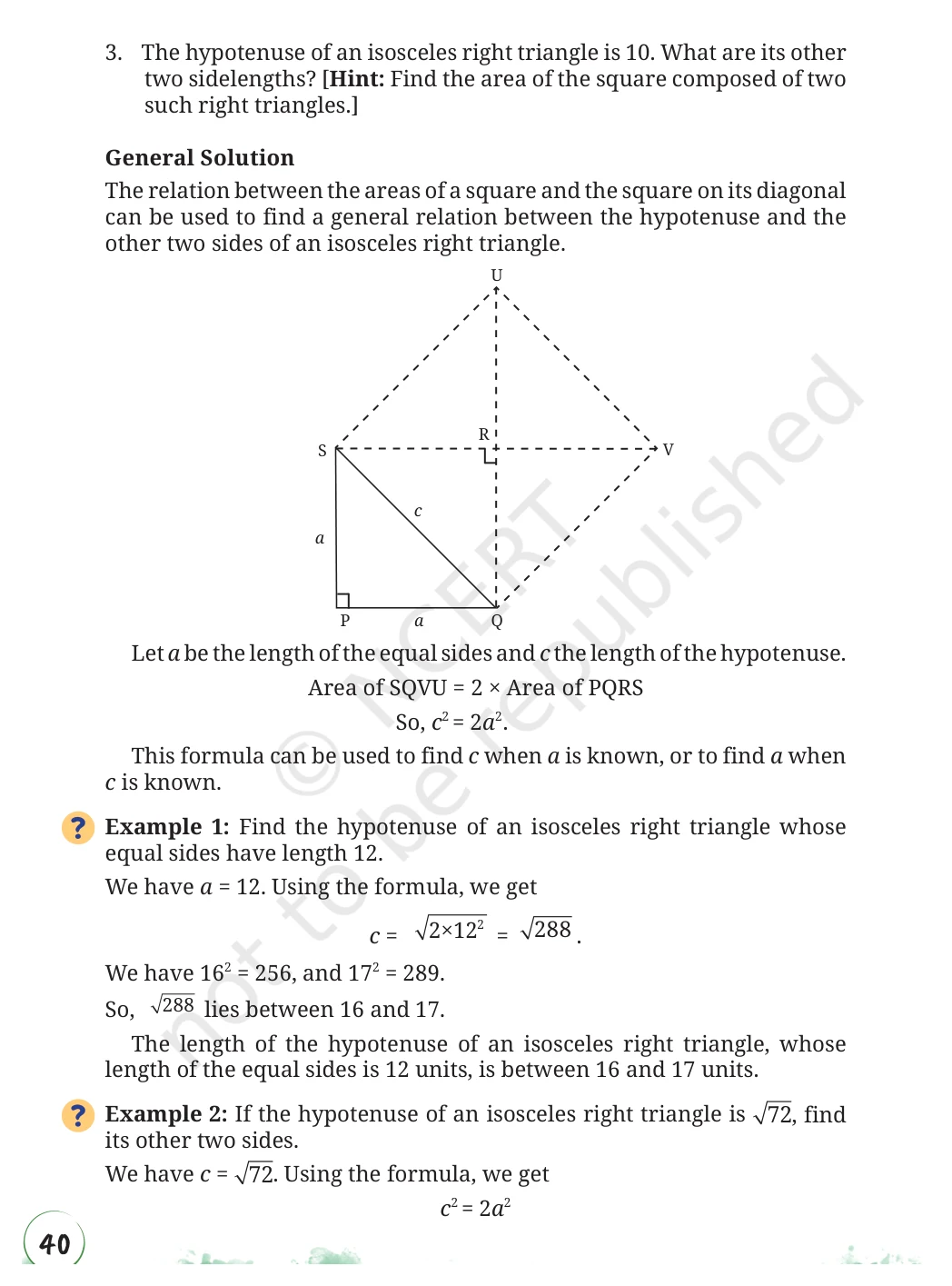
An isosceles right triangle has hypotenuse 10. Find its equal sides.
Show solution
For equal side a, 2a^2=10^2=100. Thus a^2=50 and a=5\sqrt2, approximately 7.071.
Complete worked answers
Textbook page 10
Textbook page 10 · solved item 17
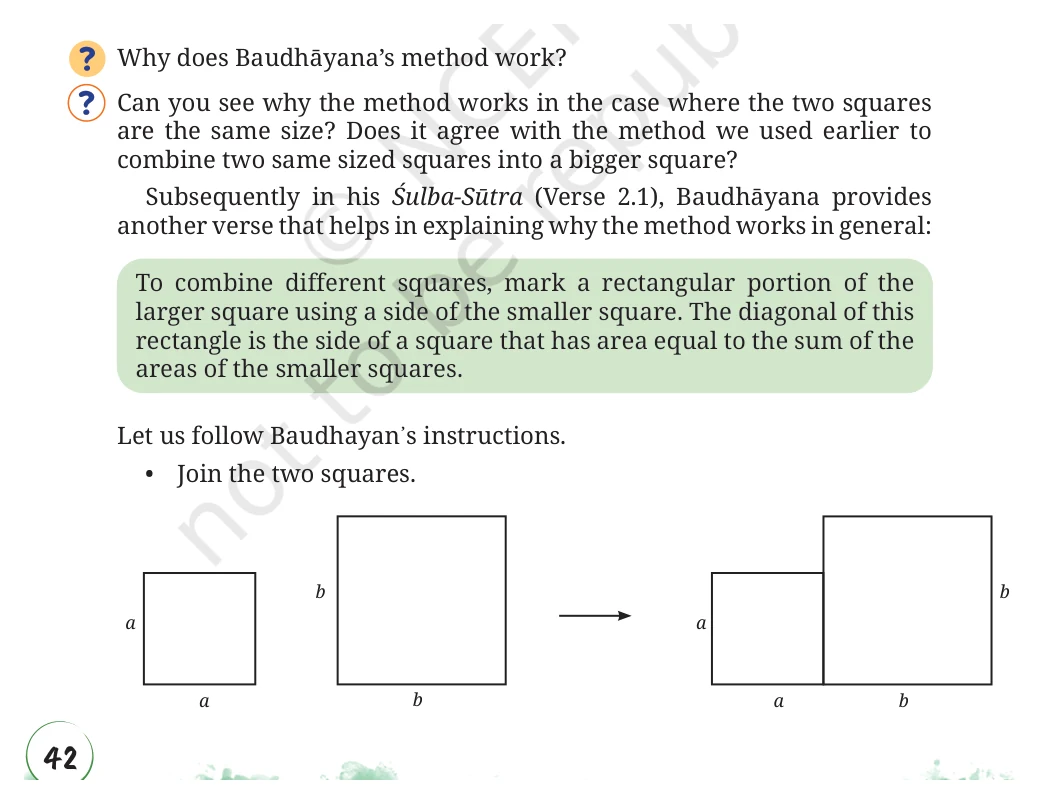
Why does Baudhayana's method for combining two squares work, including when the squares are equal?
Show solution
For perpendicular sides a,b and hypotenuse c, the rearrangement shows that the square on c has the combined areas a^2+b^2. When a=b, this becomes c^2=2a^2, exactly the earlier diagonal construction.
Complete worked answers
Textbook page 12
Textbook page 12 · solved item 18
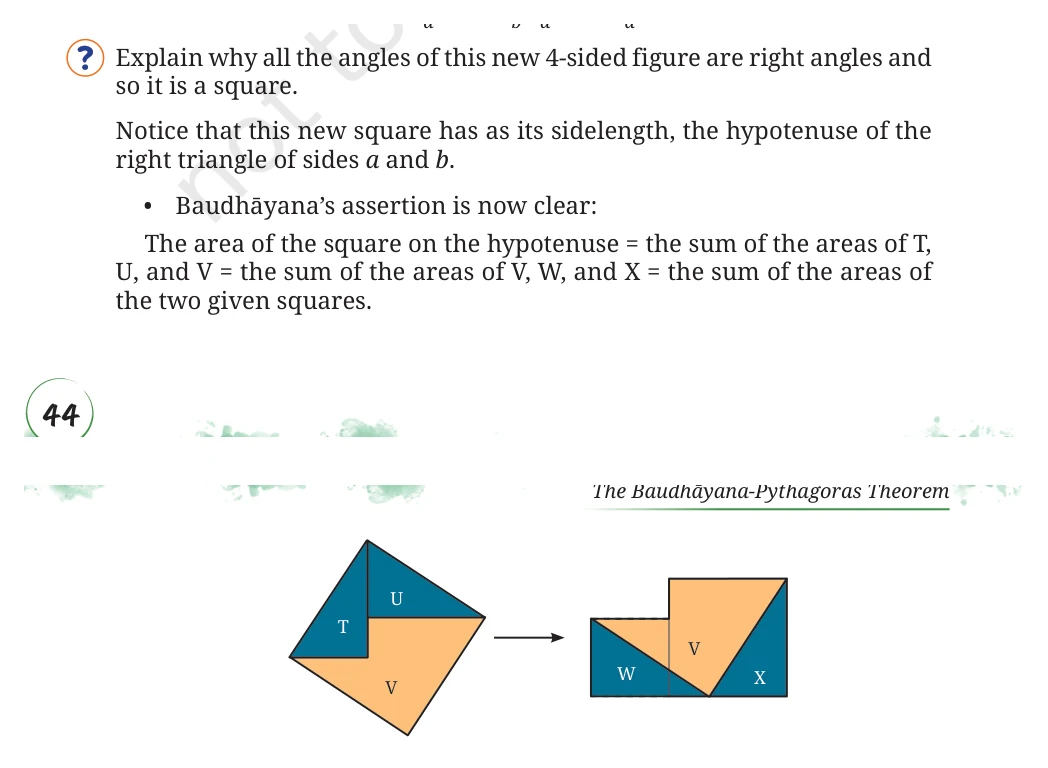
Why is the four-sided figure over the hypotenuse a square?
Show solution
The four surrounding right triangles are congruent, so all four boundary sides are equal. At each vertex, the two acute angles come from a right triangle and sum to 90 degrees. The figure therefore has four equal sides and four right angles, so it is a square.
Complete worked answers
Textbook page 13
Textbook page 13 · solved item 19
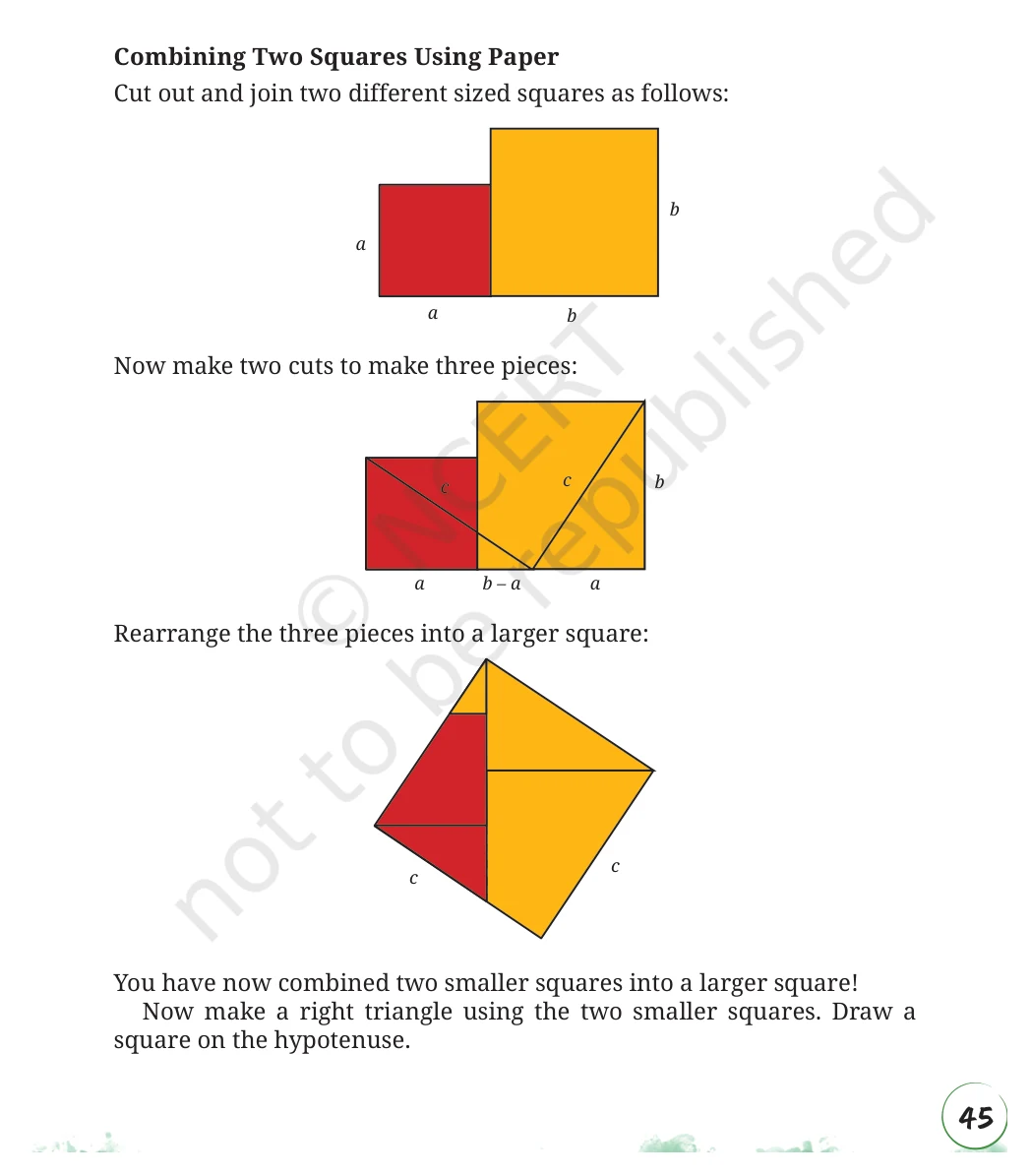
How does the three-piece paper rearrangement prove the theorem?
Show solution
The two starting squares have total area a^2+b^2. Cutting and rearranging changes neither area nor overlap, and the pieces exactly cover a square of side c, the hypotenuse. Therefore a^2+b^2=c^2.
Complete worked answers
Textbook page 15
Textbook page 15 · solved item 20

Find the hypotenuse when the shorter sides are 5 cm and 12 cm.
Show solution
c=\sqrt{5^2+12^2}=\sqrt{25+144}=\sqrt{169}=13 cm.
Textbook page 15 · solved item 21

Find the third side when a short side is 8 cm and the hypotenuse is 17 cm.
Show solution
b=\sqrt{17^2-8^2}=\sqrt{289-64}=\sqrt{225}=15 cm.
Textbook page 15 · solved item 22

Construct squares with three and five times the area of a given square.
Show solution
For original side a, first construct a diagonal a\sqrt2. Use perpendicular legs a\sqrt2 and a; their hypotenuse is a\sqrt3, giving area 3a^2. For five times, use perpendicular legs 2a and a; the hypotenuse is a\sqrt5, giving area 5a^2.
Textbook page 15 · solved item 23
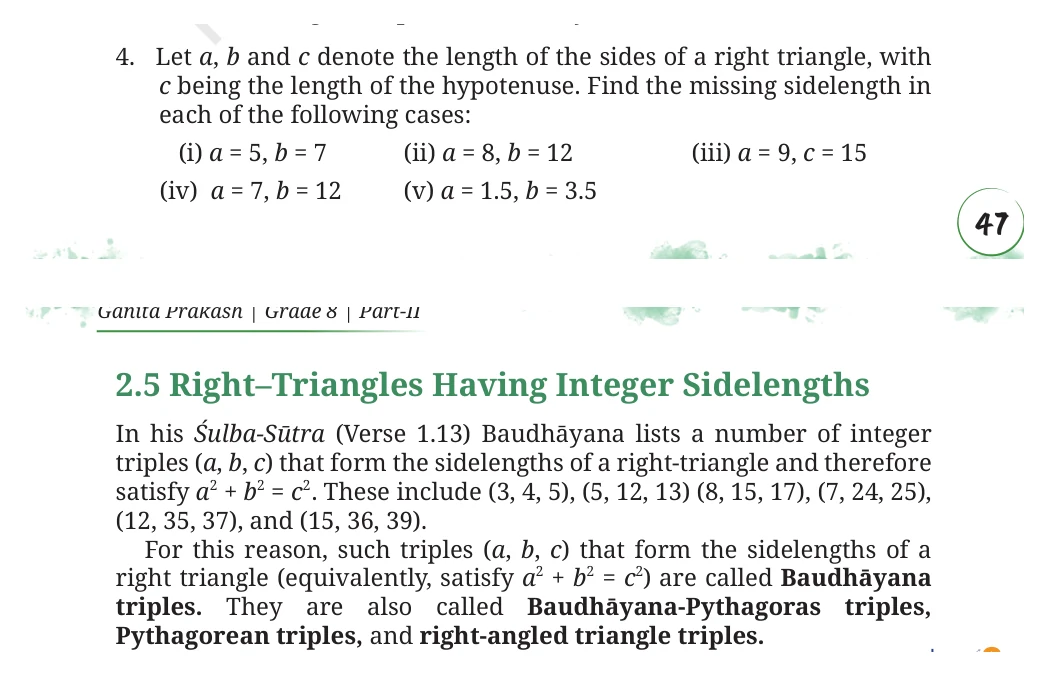
Find the five missing right-triangle side lengths.
Show solution
(i) c=\sqrt{5^2+7^2}=\sqrt{74}. (ii) c=\sqrt{8^2+12^2}=4\sqrt{13}. (iii) b=\sqrt{15^2-9^2}=12. (iv) c=\sqrt{7^2+12^2}=\sqrt{193}. (v) c=\sqrt{1.5^2+3.5^2}=\sqrt{14.5}.
Complete worked answers
Textbook page 16
Textbook page 16 · solved item 24
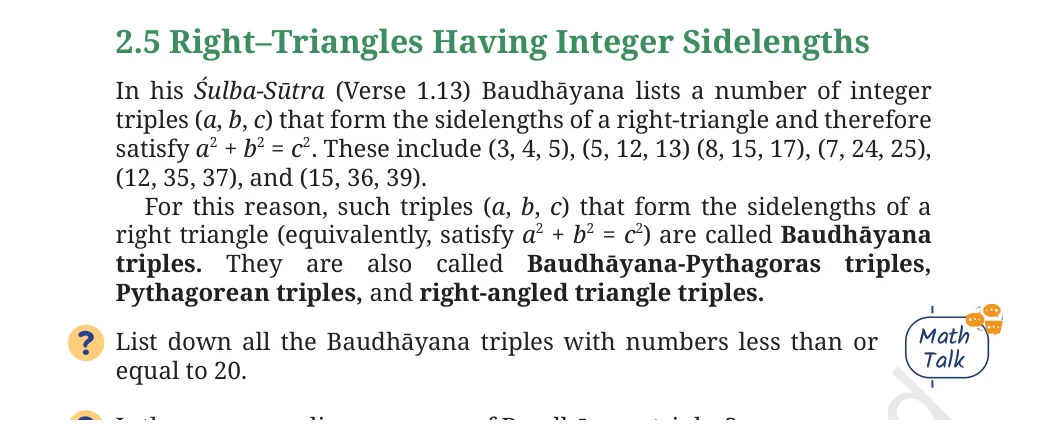
List all Baudhayana triples whose entries are at most 20.
Show solution
The triples, with legs interchangeable, are (3,4,5), (5,12,13), (6,8,10), (8,15,17), (9,12,15), and (12,16,20).
Textbook page 16 · solved item 25
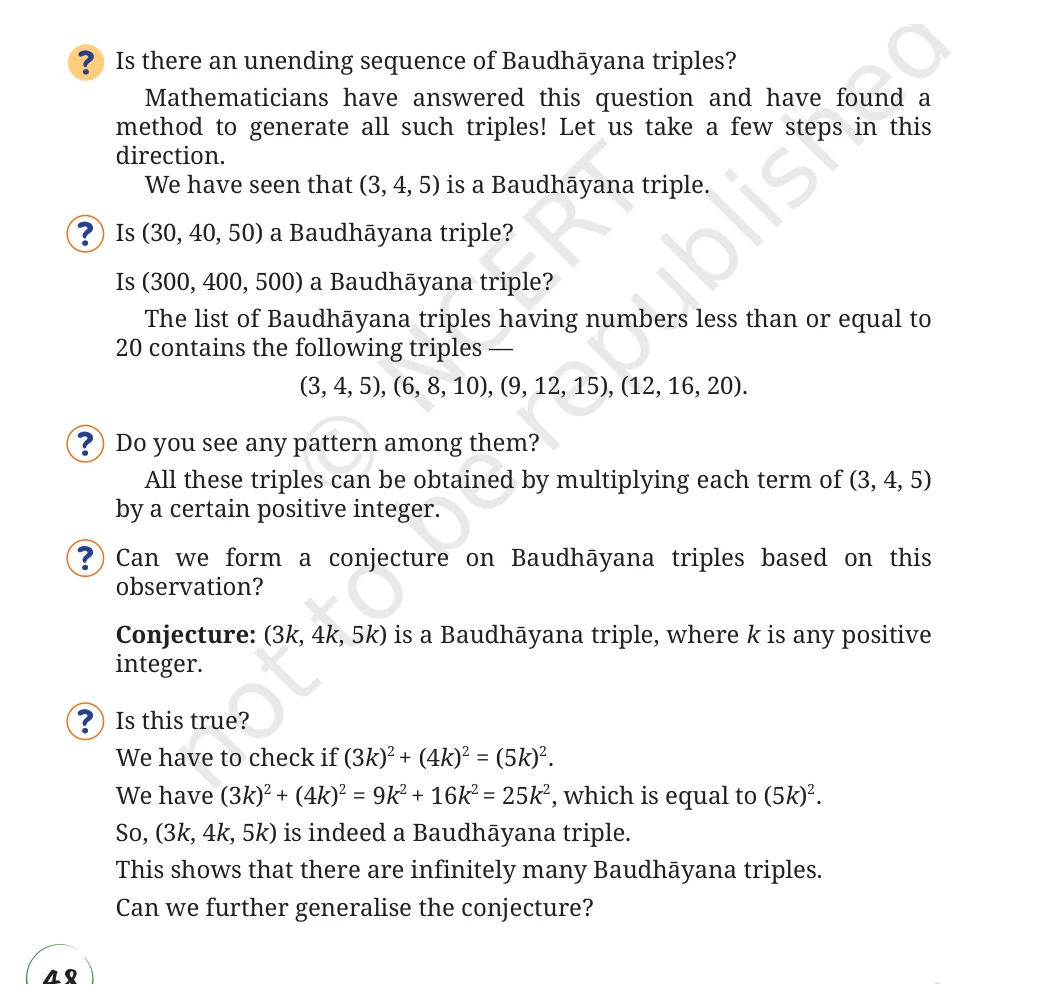
Are (30, 40, 50) and (300, 400, 500) Baudhayana triples?
Show solution
Yes. They are 10(3,4,5) and 100(3,4,5). Scaling all three sides by the same positive number preserves a^2+b^2=c^2.
Complete worked answers
Textbook page 17
Textbook page 17 · solved item 26
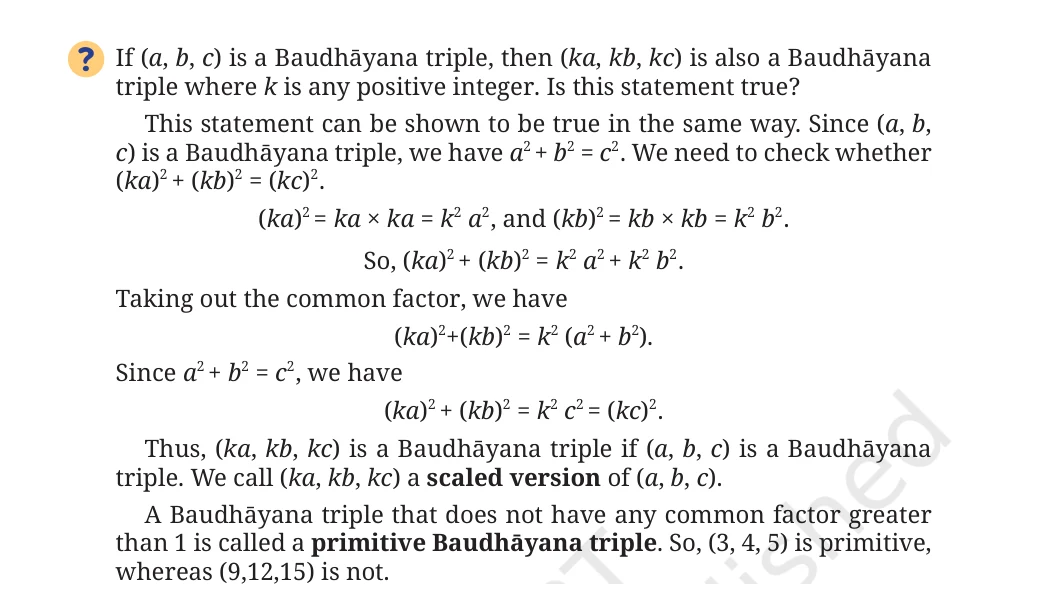
Prove that scaling a Baudhayana triple produces another triple.
Show solution
If a^2+b^2=c^2, then (ka)^2+(kb)^2=k^2(a^2+b^2)=k^2c^2=(kc)^2. Hence (ka,kb,kc) is also a triple.
Textbook page 17 · solved item 27

Is (5, 12, 13) primitive, and what are the other primitive triples up to 20?
Show solution
Yes, because \gcd(5,12,13)=1. The primitive triples with every entry at most 20 are (3,4,5), (5,12,13), and (8,15,17).
Textbook page 17 · solved item 28

Generate five scaled versions of each primitive triple up to 20.
Show solution
Using scale factors 2 through 6: from (3,4,5): (6,8,10),(9,12,15),(12,16,20),(15,20,25),(18,24,30). From (5,12,13): (10,24,26),(15,36,39),(20,48,52),(25,60,65),(30,72,78). From (8,15,17): (16,30,34),(24,45,51),(32,60,68),(40,75,85),(48,90,102). None is primitive because the scale factor is a common factor.
Textbook page 17 · solved item 29
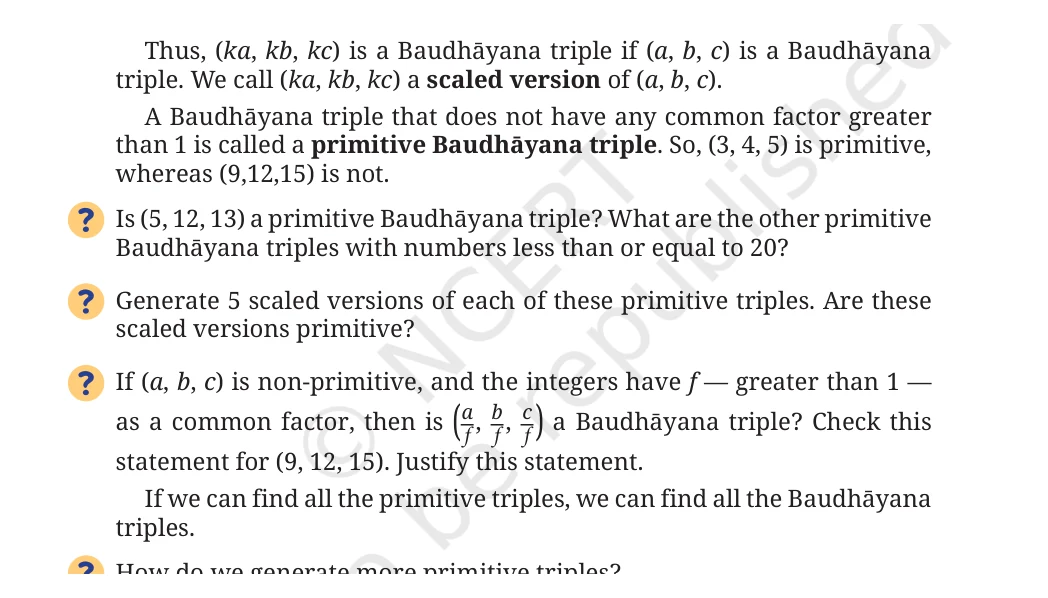
If a non-primitive triple has common factor f, does dividing by f give another triple?
Show solution
Yes. Divide a^2+b^2=c^2 by f^2 to obtain (a/f)^2+(b/f)^2=(c/f)^2. For (9,12,15) with f=3, this gives (3,4,5).
Complete worked answers
Textbook page 18
Textbook page 18 · solved item 30
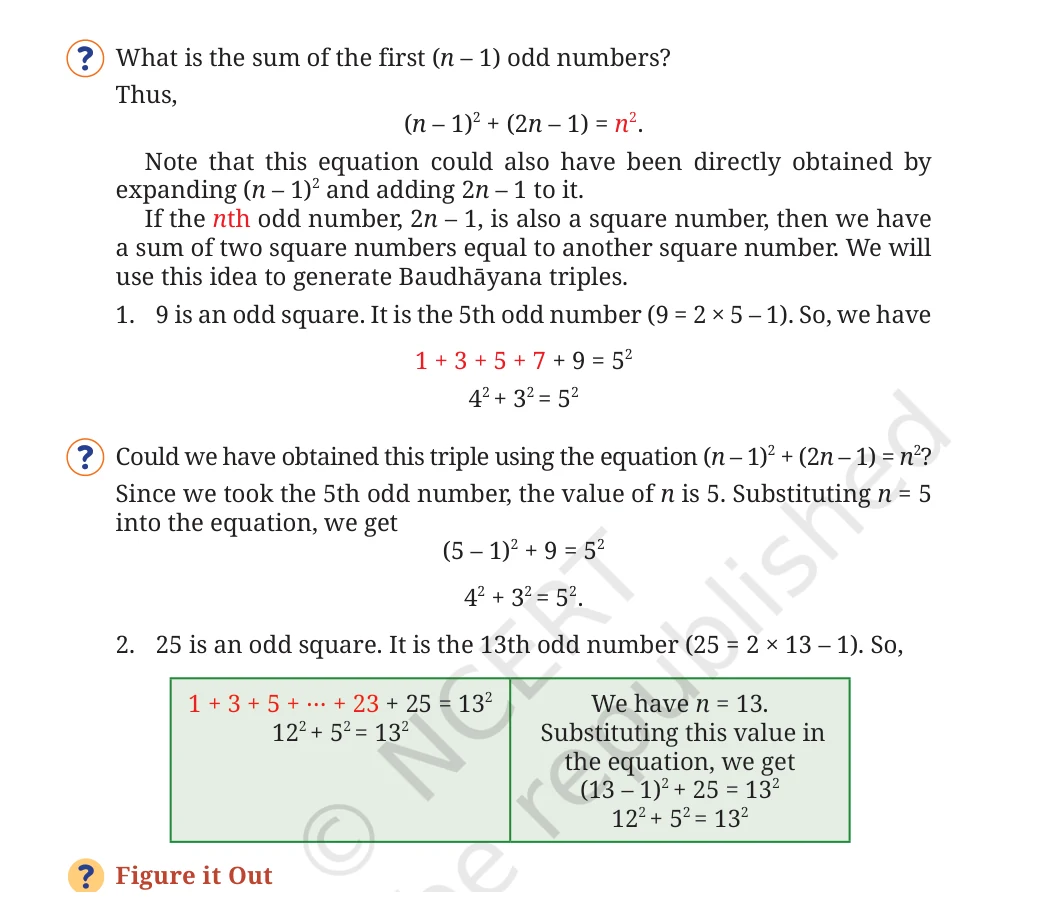
What is the nth odd number and the sum of the first n−1 odd numbers?
Show solution
The nth odd number is 2n-1. The sum of the first n-1 odd numbers is (n-1)^2, so (n-1)^2+(2n-1)=n^2.
Textbook page 18 · solved item 31
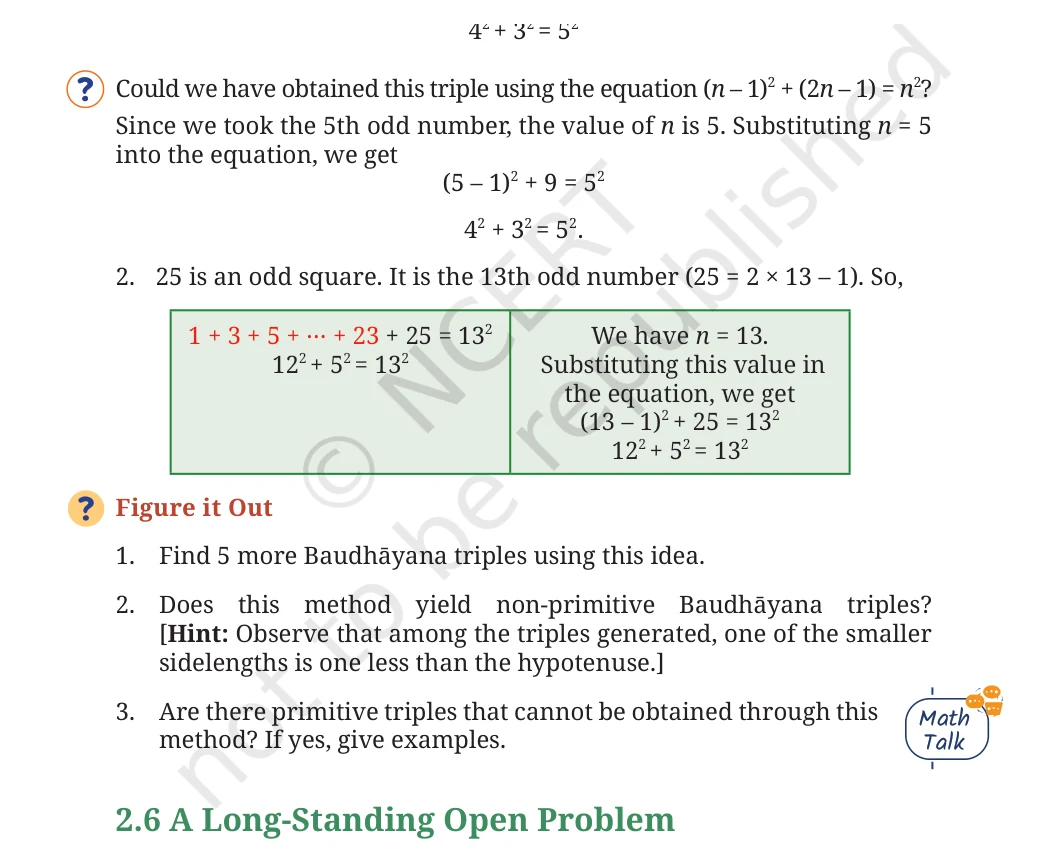
Generate five more Baudhayana triples using odd square numbers.
Show solution
For an odd m, set 2n-1=m^2. Then (n-1,m,n) is a triple. Taking m=7,9,11,13,15 gives (24,7,25), (40,9,41), (60,11,61), (84,13,85), and (112,15,113).
Textbook page 18 · solved item 32

Can the odd-square method produce non-primitive triples?
Show solution
No. In every generated triple, one leg is exactly one less than the hypotenuse. Consecutive integers have no common factor greater than 1, so all three entries cannot share such a factor.
Textbook page 18 · solved item 33
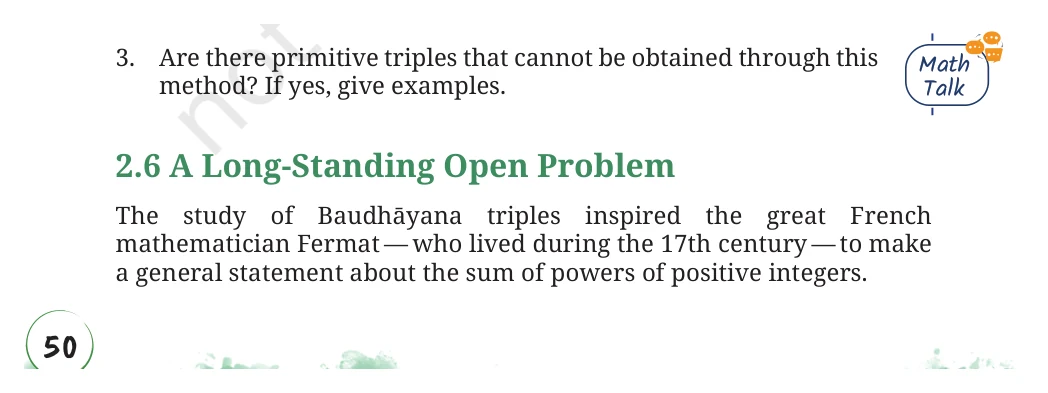
Are there primitive triples that the odd-square method cannot produce?
Show solution
Yes. For example, (8,15,17) is primitive, but neither leg is 16, one less than the hypotenuse, so this method does not generate it.
Complete worked answers
Textbook page 20
Textbook page 20 · solved item 34

Find the diagonal of a square with side 5 cm.
Show solution
The diagonal is the hypotenuse of a right triangle with legs 5 and 5: d=\sqrt{5^2+5^2}=5\sqrt2 cm.
Textbook page 20 · solved item 35
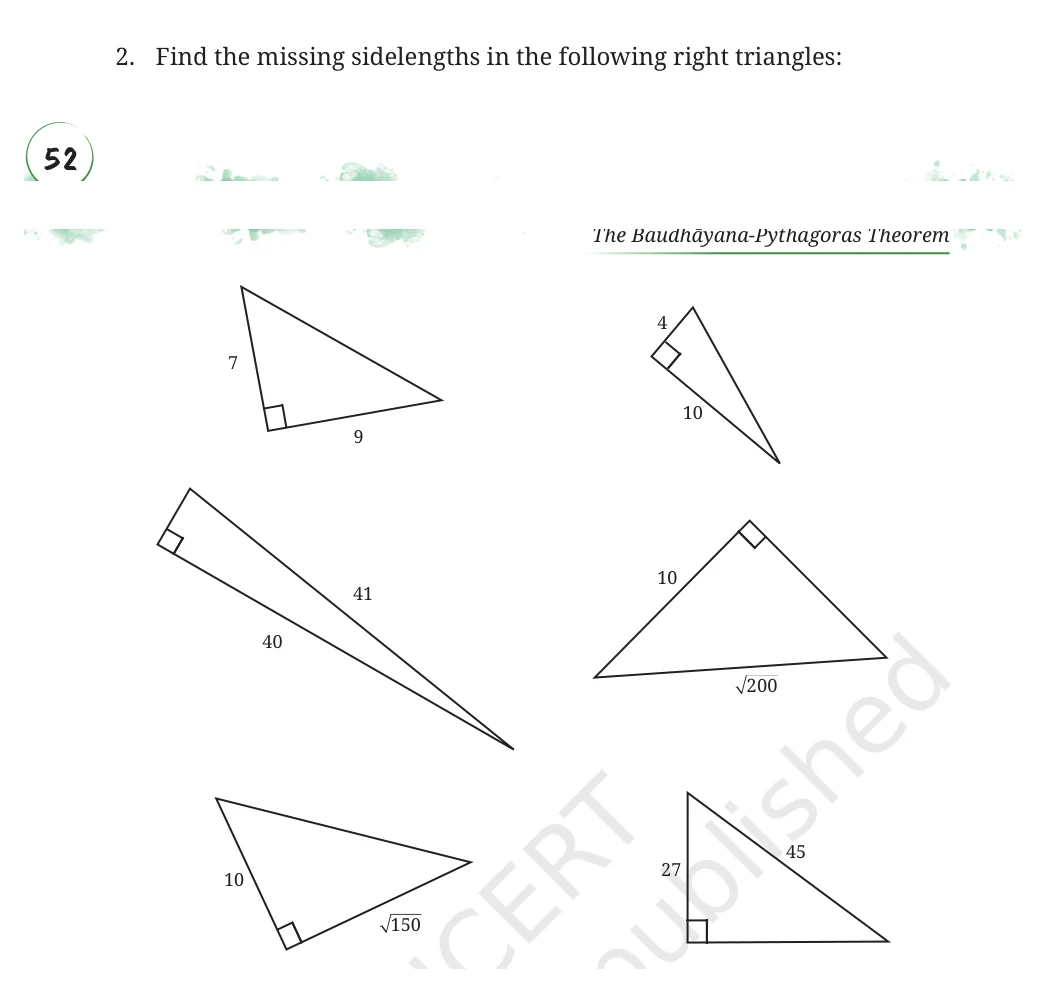
Find the six missing side lengths in the pictured right triangles.
Show solution
Top left: \sqrt{7^2+9^2}=\sqrt{130}. Top right: \sqrt{4^2+10^2}=2\sqrt{29}. Middle left: \sqrt{41^2-40^2}=9. Middle right: \sqrt{200-10^2}=10. Bottom left: \sqrt{150-10^2}=5\sqrt2. Bottom right: \sqrt{45^2-27^2}=36.
Complete worked answers
Textbook page 21
Textbook page 21 · solved item 36

Find the side of a rhombus whose diagonals are 24 and 70 units.
Show solution
Rhombus diagonals bisect each other at right angles. A side is therefore \sqrt{12^2+35^2}=\sqrt{1369}=37 units.
Textbook page 21 · solved item 37

Is the hypotenuse always the longest side of a right triangle?
Show solution
Yes. Since c^2=a^2+b^2, we have c^2>a^2 and c^2>b^2. All side lengths are positive, so c>a and c>b.
Textbook page 21 · solved item 38

True or false: every Baudhayana triple is primitive or a scaled primitive triple.
Show solution
True. Divide all three entries by their greatest common divisor. The resulting integer triple has no common factor and is primitive; the original is its scaled version.
Textbook page 21 · solved item 39

Give five rectangles whose sides and diagonals are all integers.
Show solution
Use the legs and hypotenuse of any five triples: rectangles 3×4, 5×12, 8×15, 7×24, and 9×40 have diagonals 5, 13, 17, 25, and 41 respectively.
Textbook page 21 · solved item 40

Construct a square whose area is the difference between squares of sides 7 and 5.
Show solution
Construct a right triangle with hypotenuse 7 and one leg 5. Its other leg is \sqrt{7^2-5^2}=\sqrt{24}=2\sqrt6. A square on that leg has area 24=49-25 square units.
Textbook page 21 · solved item 41
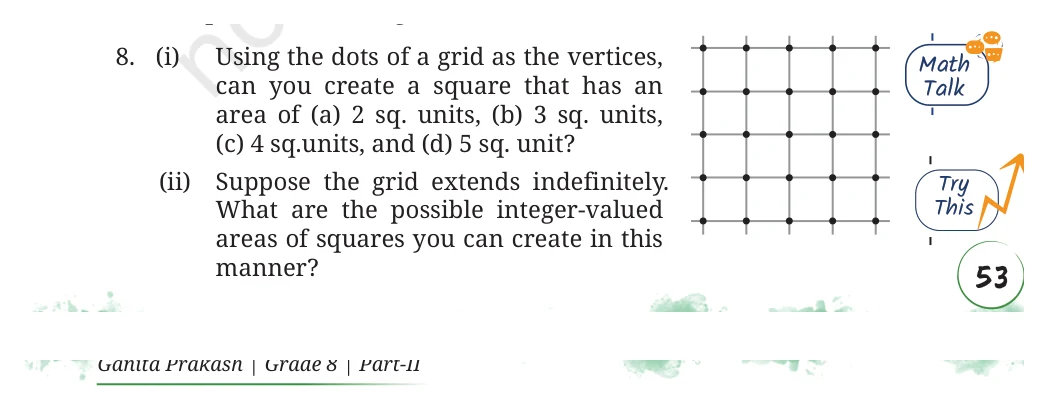
Which integer-area squares can be made using grid dots?
Show solution
A grid square based on the vector (a,b) has side squared, and hence area, a^2+b^2. Area 2 is possible with (1,1); 3 is impossible; 4 is possible with (2,0); and 5 with (1,2). On an unlimited grid, the possible positive integer areas are exactly the integers expressible as a sum of two integer squares.
Complete worked answers
Textbook page 22
Textbook page 22 · solved item 42
Find the area of an equilateral triangle with side 6.
Show solution
The altitude bisects the base, giving a right triangle with hypotenuse 6 and one leg 3. Its height is \sqrt{6^2-3^2}=3\sqrt3. Thus the area is \frac12\times6\times3\sqrt3=9\sqrt3 square units.
Textbook page 22 · solved item 43
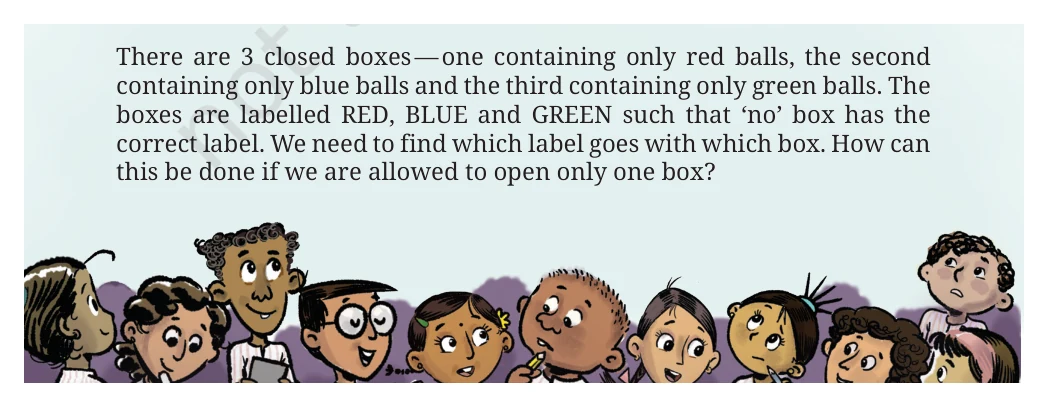
Solve the three incorrectly labelled colour boxes puzzle by opening only one box.
Show solution
Open the box labelled RED. It cannot contain red. If the ball drawn is blue, that box is BLUE; the box labelled GREEN must then be RED, and the box labelled BLUE is GREEN. If the drawn ball is green, swap blue and green in that reasoning.