
Use the textbook context
Match, attempt, then check
Each source crop keeps the printed information needed for that item. Compound answer-key entries are separated into individual solutions.
Complete worked answers
Textbook page 2
Textbook page 2 · solved item 1
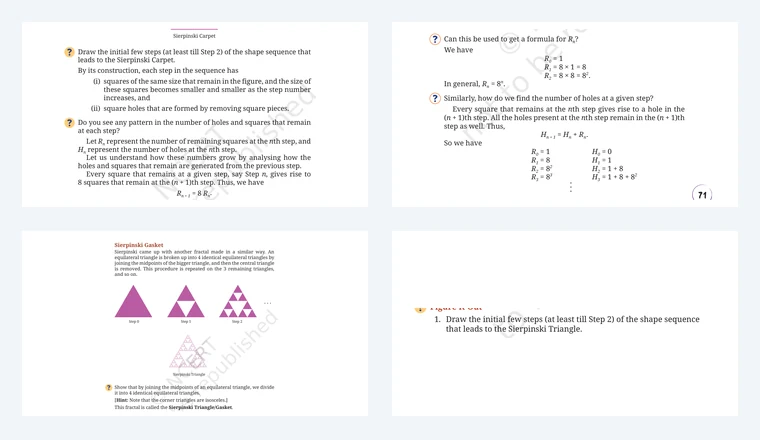
Draw Steps 0, 1, and 2 of the Sierpinski Carpet.
Show solution
Step 0 is one filled square. For Step 1, divide it into a 3×3 grid and remove the centre. For Step 2, repeat that operation independently in each of the eight remaining squares.
Textbook page 2 · solved item 2
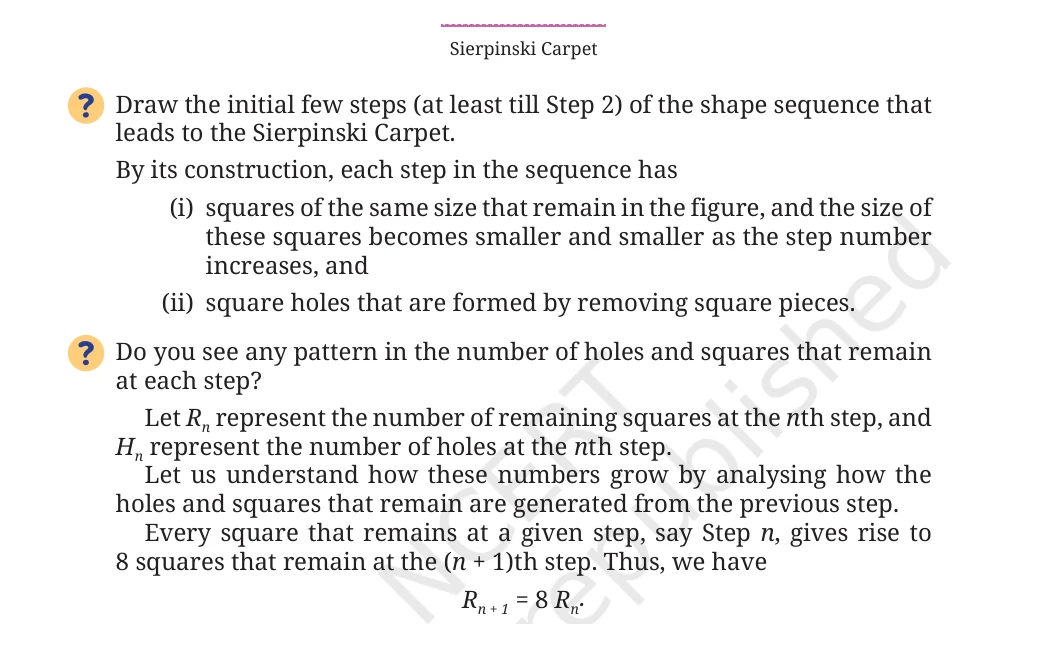
Find formulas for the remaining squares and holes in the Sierpinski Carpet.
Show solution
Each remaining square creates eight at the next step, so R_n=8^n. Also H_{n+1}=H_n+R_n, with H_0=0. Hence H_n=1+8+\cdots+8^{n-1}=(8^n-1)/7.
Complete worked answers
Textbook page 3
Textbook page 3 · solved item 3
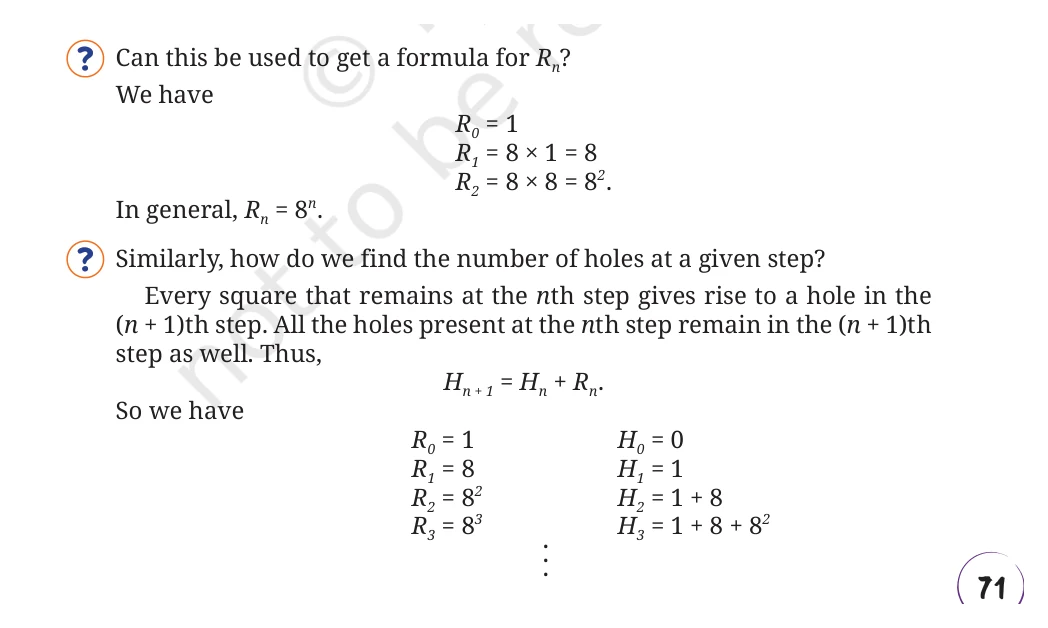
Show that joining the midpoints of an equilateral triangle makes four identical equilateral triangles.
Show solution
Each midpoint segment is parallel to the third side and half its length. Every small triangle therefore has three sides equal to half the original side, so all four are equilateral and congruent by SSS.
Textbook page 3 · solved item 4

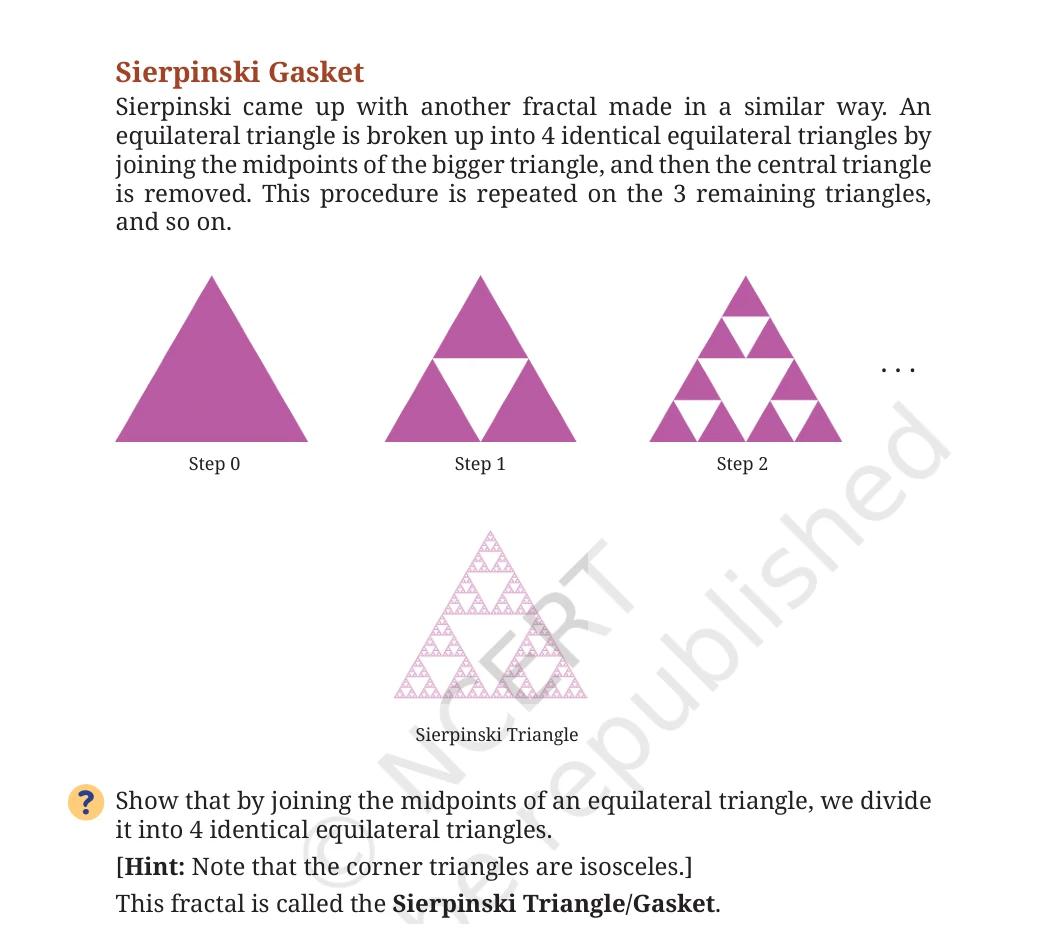
Draw Steps 0, 1, and 2 of the Sierpinski Triangle.
Show solution
Step 0 is one filled equilateral triangle. At Step 1 join the side midpoints and remove the central inverted triangle. At Step 2 repeat this in each of the three remaining corner triangles.
Textbook page 3 · solved item 5

Count the holes and remaining triangles in the Sierpinski Triangle.
Show solution
At Step n, R_n=3^n. Each remaining triangle creates one new hole, so H_n=1+3+\cdots+3^{n-1}=(3^n-1)/2. Thus (R,H) begins (1,0),(3,1),(9,4),(27,13).
Textbook page 3 · solved item 6

Find the remaining area at Step n for both Sierpinski fractals, starting from area 1.
Show solution
The Carpet retains 8/9 of each surviving area per step, so A_n=(8/9)^n. The Triangle retains 3/4, so A_n=(3/4)^n.
Complete worked answers
Textbook page 4
Textbook page 4 · solved item 7
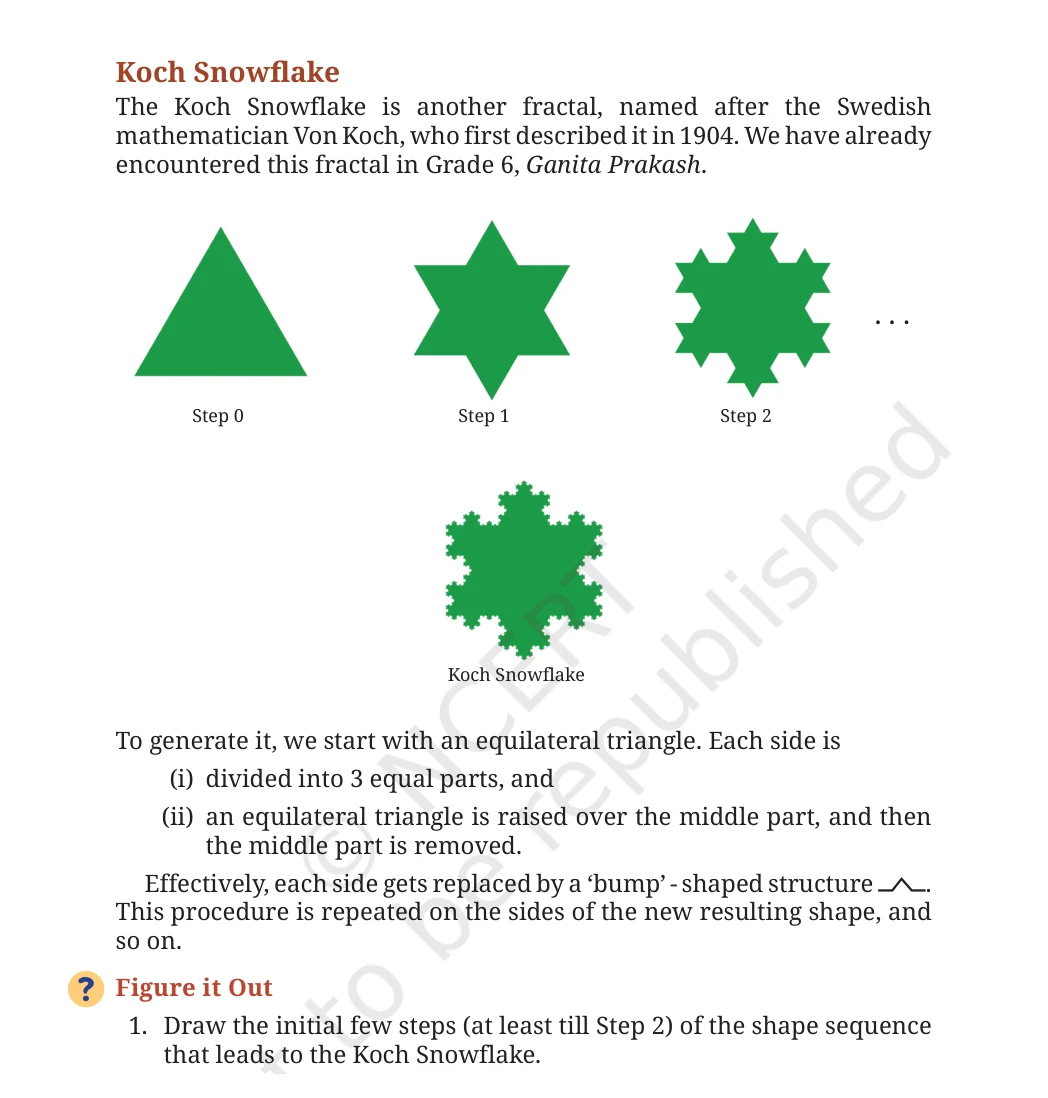
Draw Steps 0, 1, and 2 of the Koch Snowflake.
Show solution
Start with an equilateral triangle. Replace the middle third of every side by the other two sides of an outward equilateral triangle. Repeat the same four-segment replacement on every new side for Step 2.
Textbook page 4 · solved item 8

Find the number of sides in Step n of the Koch Snowflake.
Show solution
Step 0 has 3 sides and every side becomes 4 sides. Therefore N_n=3\cdot4^n.
Textbook page 4 · solved item 9

Find the Koch Snowflake perimeter at Step n when the starting side is 1.
Show solution
Each new side is one-third as long while the count is multiplied by 4. Hence P_n=3(4/3)^n. The perimeter grows without bound.
Complete worked answers
Textbook page 6
Textbook page 6 · solved item 10
Visualise a written name backwards.
Show solution
Reverse the visible letter order, not the sounds. For example, MATHWISE becomes ESIWHTAM. The result for the learner depends on the chosen name.
Complete worked answers
Textbook page 7
Textbook page 7 · solved item 11

Cut the four corners from a square at adjacent side midpoints. What remains, and how can the corners form a square?
Show solution
The remaining figure is a smaller square rotated 45 degrees. The four removed congruent isosceles right triangles can be arranged with their right-angle vertices together; their hypotenuses form the boundary of another square.
Textbook page 7 · solved item 12

Cut each corner from an equilateral triangle at one-third marks. What remains?
Show solution
A hexagon remains. For an equilateral starting triangle, all six new boundary segments have equal length and the angles are 120 degrees, so it is a regular hexagon.
Textbook page 7 · solved item 13

Cut the corners from a square at one-third marks. What remains?
Show solution
An octagon remains. It is not regular: the four horizontal/vertical sides have length one-third of the original side, while the four sloping cuts have length \sqrt2/3 of it.
Complete worked answers
Textbook page 8
Textbook page 8 · solved item 14

Give a solid and viewpoint with a square profile.
Show solution
Look straight at a face of a cube. Its outline is a square. A square prism viewed along its axis is another example.
Textbook page 8 · solved item 15

Give a solid and viewpoint with a circular profile.
Show solution
A sphere has a circular profile from every direction. A cylinder viewed along its axis also has a circular outline.
Textbook page 8 · solved item 16
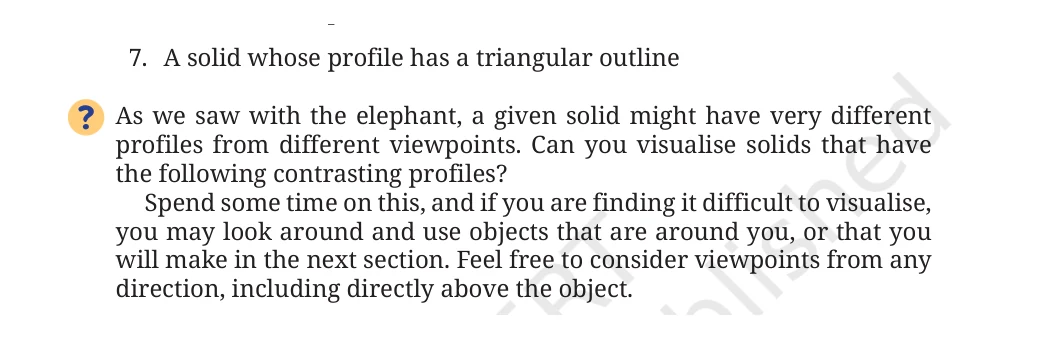
Give a solid and viewpoint with a triangular profile.
Show solution
A cone viewed from the side has a triangular outline. A triangular prism viewed along its length is another example.
Textbook page 8 · solved item 17

Name a solid with rectangular and circular profiles.
Show solution
A right circular cylinder: viewed from the side its profile is a rectangle, and viewed along its axis it is a circle.
Textbook page 8 · solved item 18

Name a solid with circular and triangular profiles.
Show solution
A right circular cone: the base view is a circle and a side view through its axis is a triangle.
Textbook page 8 · solved item 19

Name a solid with rectangular and triangular profiles.
Show solution
A triangular prism: viewed along its length it is a triangle; viewed perpendicular to a rectangular lateral face it is a rectangle.
Textbook page 8 · solved item 20

Name a solid with trapezium and circular profiles.
Show solution
A frustum of a right circular cone: viewed along its axis it is circular, while an axial side view is an isosceles trapezium.
Textbook page 8 · solved item 21

Name a solid with pentagonal and rectangular profiles.
Show solution
A pentagonal prism: its end view is a pentagon and a side view is a rectangle.
Textbook page 8 · solved item 22
Are the solids satisfying each pair of profiles unique?
Show solution
No. Profiles lose depth information. Dimensions, slants, hollows, and added features hidden behind the same outline can vary, so multiple solids can share the stated profiles.
Complete worked answers
Textbook page 10
Textbook page 10 · solved item 23

Count faces, edges, and vertices of a 10-sided prism and an n-sided prism.
Show solution
An n-gonal prism has n+2 faces, 3n edges, and 2n vertices. For n=10, these are 12 faces, 30 edges, and 20 vertices.
Textbook page 10 · solved item 24

Count faces, edges, and vertices of a 10-sided pyramid and an n-sided pyramid.
Show solution
An n-gonal pyramid has n+1 faces, 2n edges, and n+1 vertices. For n=10, these are 11 faces, 20 edges, and 11 vertices.
Complete worked answers
Textbook page 11
Textbook page 11 · solved item 25
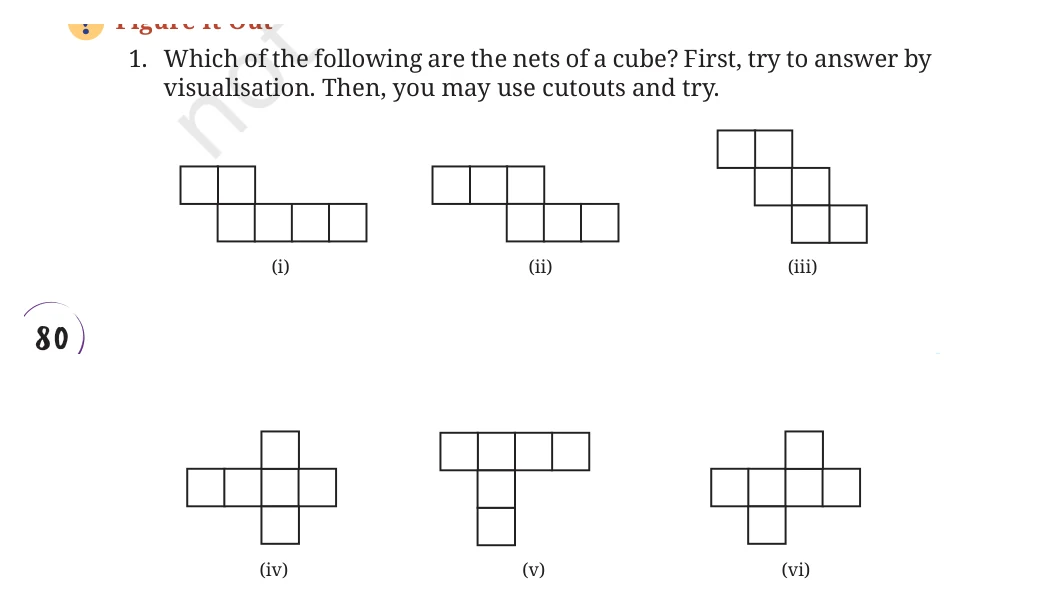
Which of the six displayed arrangements are cube nets?
Show solution
Arrangements (ii), (iii), (iv), and (vi) fold into a cube. In (i) and (v), two squares try to occupy the same cube face.
Complete worked answers
Textbook page 12
Textbook page 12 · solved item 26

How can all 11 distinct cube nets be found?
Show solution
Enumerate connected arrangements of six unit squares, discard any arrangement whose folded faces overlap, then identify rotations and reflections as the same. The 11 survivors are the complete set; the crop provides the square-grid format for drawing them.
Textbook page 12 · solved item 27

Draw nets for cuboids 5×3×1 cm and 6×3×2 cm.
Show solution
For each, use a strip of the four lateral rectangles in alternating dimensions, then attach the two congruent base rectangles on opposite usable edges. The first needs pairs of 5×3, 5×1, and 3×1 faces; the second needs pairs of 6×3, 6×2, and 3×2 faces.
Textbook page 12 · solved item 28
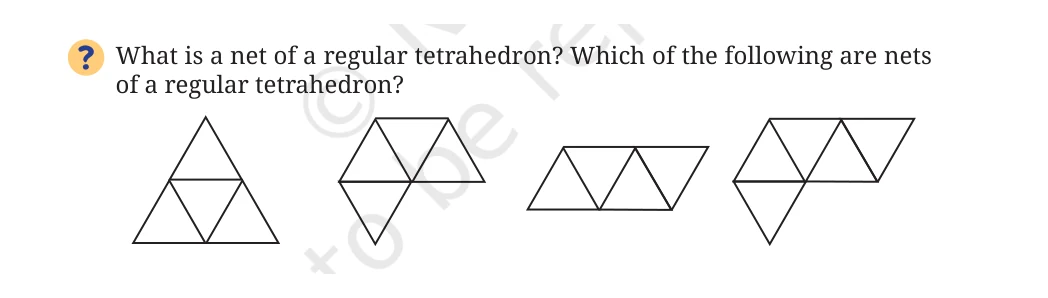
Which displayed arrangements are nets of a regular tetrahedron?
Show solution
The first and third displayed arrangements are the two net types: one central equilateral triangle with three attached, and a chain of four alternating equilateral triangles. The other displayed arrangements create overlap or invalid face adjacency.
Textbook page 12 · solved item 29

Draw a measured net for a regular tetrahedron.
Show solution
Choose a side length s. Draw four congruent equilateral triangles of side s, either one with three attached to its sides or a four-triangle alternating chain. Fold along the shared edges.
Textbook page 12 · solved item 30

Draw a measured net for a square pyramid.
Show solution
Draw a square of side s. Attach one congruent isosceles triangle to each side; all four equal triangle sides must equal the desired slant edges. Fold the triangles upward so their apex vertices meet.
Complete worked answers
Textbook page 13
Textbook page 13 · solved item 31
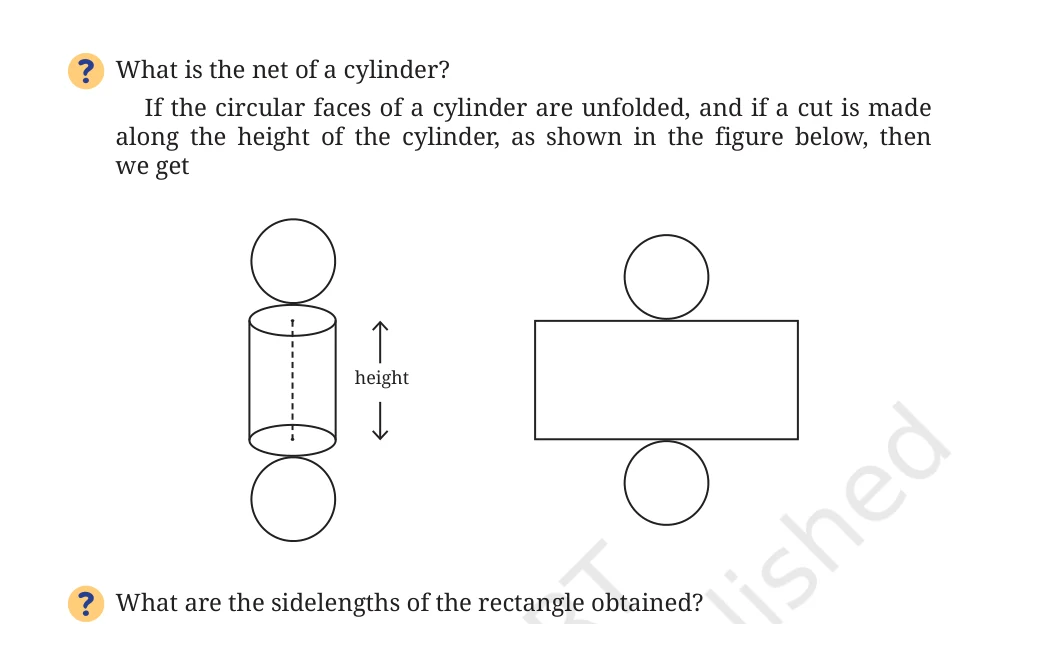
What are the rectangle dimensions in a cylinder net?
Show solution
For radius r and height h, the curved surface unfolds to a rectangle of height h and width equal to the base circumference 2\pi r. Add two circles of radius r.
Textbook page 13 · solved item 32
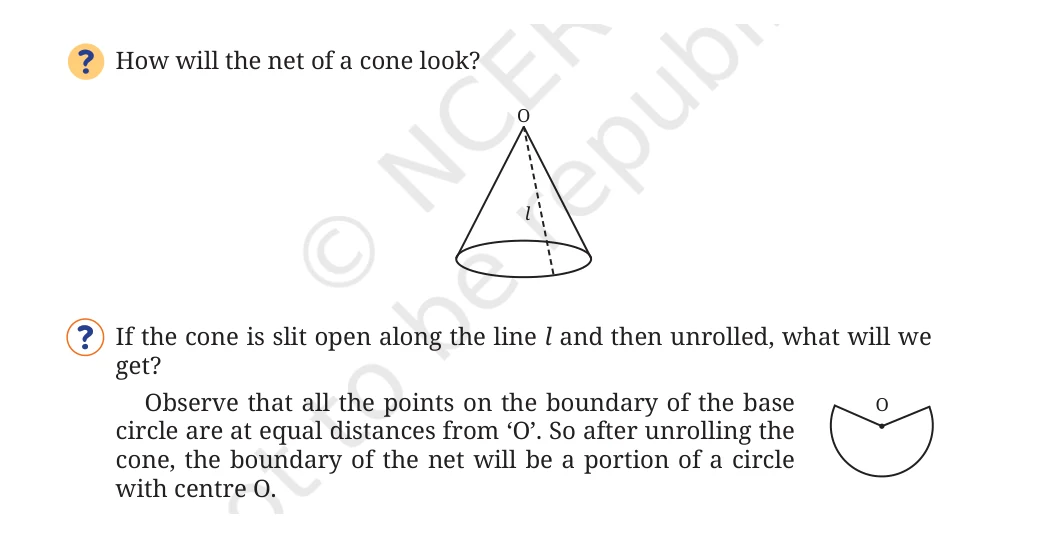
What is the net of a cone?
Show solution
For base radius r and slant height l, the curved surface is a sector of radius l whose arc length is 2\pi r, together with the base circle. Its sector angle is 360^\circ r/l.
Textbook page 13 · solved item 33

What surface results when O is not the centre of the boundary circle in the shown net?
Show solution
Joining the straight edges produces an oblique cone-like surface: the apex is not vertically above the centre of the circular base. A physical paper model makes the unequal slant directions visible.
Textbook page 13 · solved item 34

Draw a measured net for a triangular prism.
Show solution
Draw three rectangles in a strip, with widths equal to the three triangle side lengths and common height equal to the prism length. Attach two congruent triangles to suitable opposite edges of the strip.
Complete worked answers
Textbook page 14
Textbook page 14 · solved item 35

How does the shown octahedron net fold?
Show solution
The eight equilateral triangles form two groups of four meeting at opposite apexes. Fold the triangles around the central chain so corresponding free edges meet; this makes two square pyramids joined base-to-base.
Complete worked answers
Textbook page 15
Textbook page 15 · solved item 36

Can a flat paper net wrap a sphere perfectly?
Show solution
No exact finite polygonal net can cover a sphere without stretching, wrinkling, gaps, or overlap because a sphere has non-zero Gaussian curvature while paper is flat. Narrow gores only approximate it.
Textbook page 15 · solved item 37
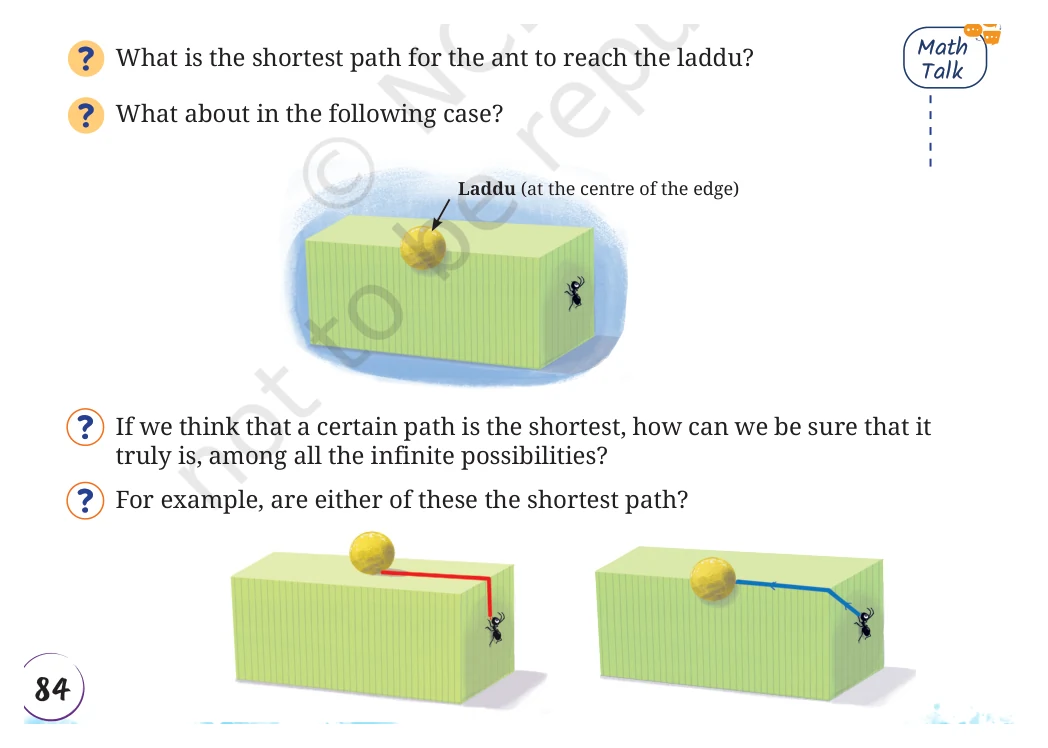
How does a net prove the shortest ant-to-laddu path in the first two cube examples?
Show solution
Unfold every crossed face into one plane. A surface path keeps the same length on the net, so the shortest valid path is a straight segment between the corresponding points. A bent segment on a chosen net cannot be shortest if a valid straight segment exists.
Complete worked answers
Textbook page 17
Textbook page 17 · solved item 38
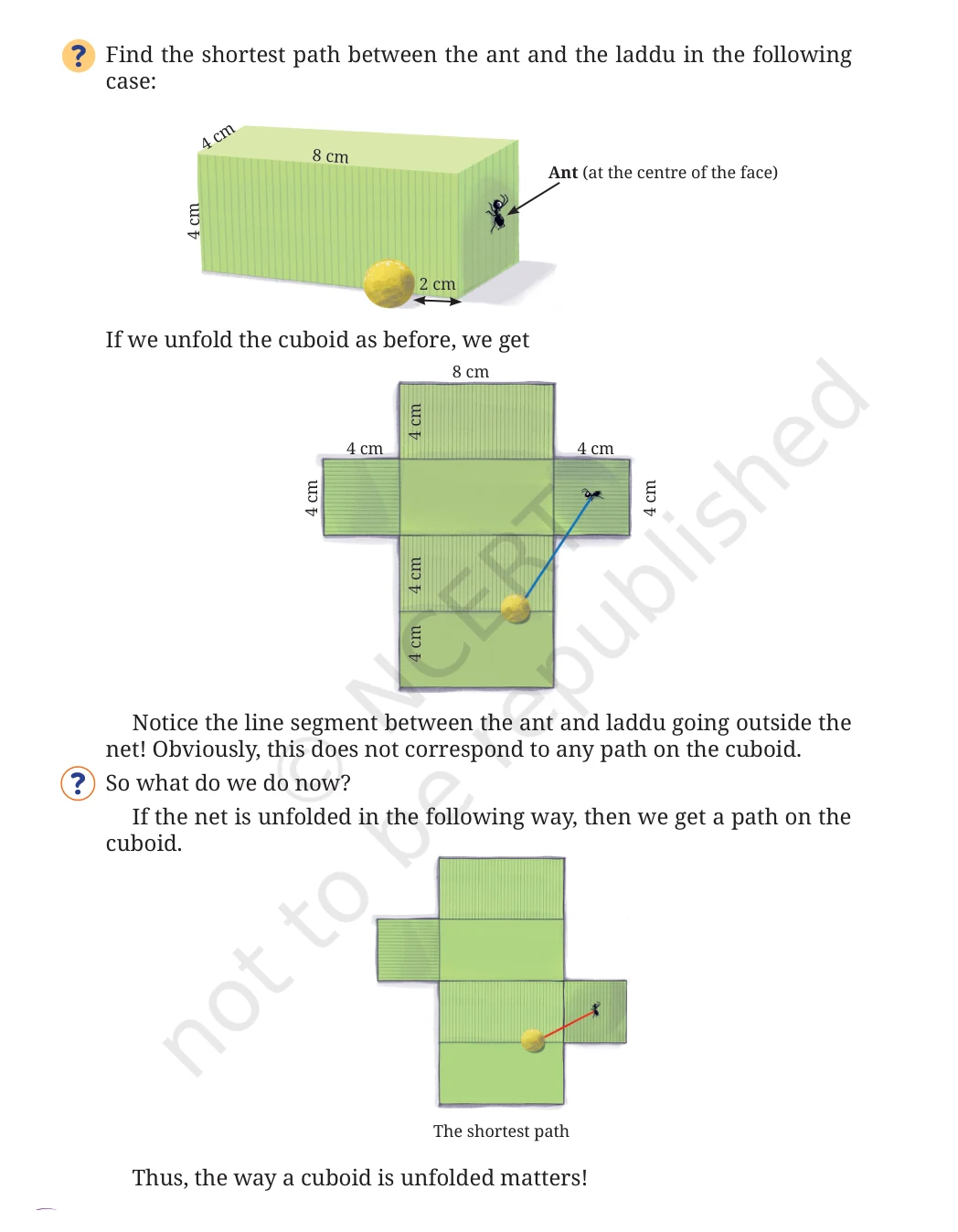
Find the shortest path in the 8 cm × 4 cm × 4 cm cuboid case.
Show solution
Use the valid unfolding shown. The two points are separated by 4 cm across the joined faces and 2 cm vertically, so the straight net distance is \sqrt{4^2+2^2}=2\sqrt5 cm. The earlier blue segment leaves its net and is not a valid surface route.
Complete worked answers
Textbook page 18
Textbook page 18 · solved item 39
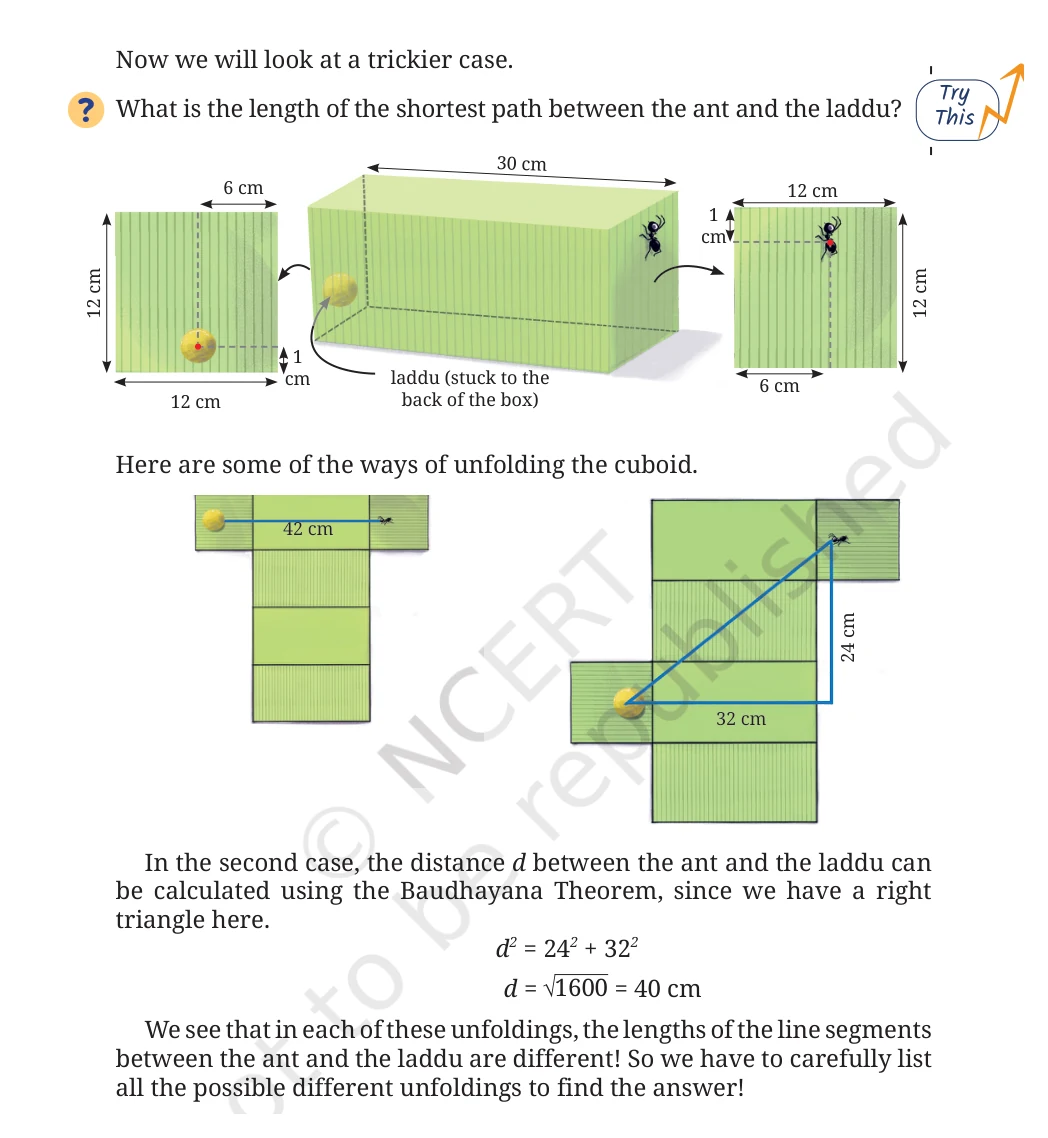
Find the shortest path in the 30 cm × 12 cm × 12 cm box case.
Show solution
Compare the distinct valid unfoldings. One route is 42 cm. The displayed diagonal unfolding gives d=\sqrt{24^2+32^2}=\sqrt{1600}=40 cm, which is the minimum among the distinct cases.
Complete worked answers
Textbook page 20
Textbook page 20 · solved item 40

Compare a line's actual length l with projected length p.
Show solution
In the right triangle from the construction, l is the hypotenuse and p is a leg, so 0\le p\le l. Equality holds when the line is parallel to the projection plane; p=0 when it is perpendicular.
Textbook page 20 · solved item 41

What projections can a square have?
Show solution
A face-on square projects to a square. Tilting it generally gives a parallelogram, including rectangles and rhombi as special cases; an edge-on orientation degenerates to a line segment.
Textbook page 20 · solved item 42
Can a parallelogram project to a non-parallelogram quadrilateral?
Show solution
No, under parallel orthogonal projection. Each pair of parallel opposite sides remains parallel, so any non-degenerate quadrilateral projection is still a parallelogram. It may degenerate to a segment.
Textbook page 20 · solved item 43
What can be said about the projection of a regular n-gon?
Show solution
It is formed by projecting its n sides. It generally becomes an n-sided, not necessarily regular, polygon; some consecutive projected sides may become collinear or vanish in special orientations, reducing the visible side count.
Textbook page 20 · solved item 44
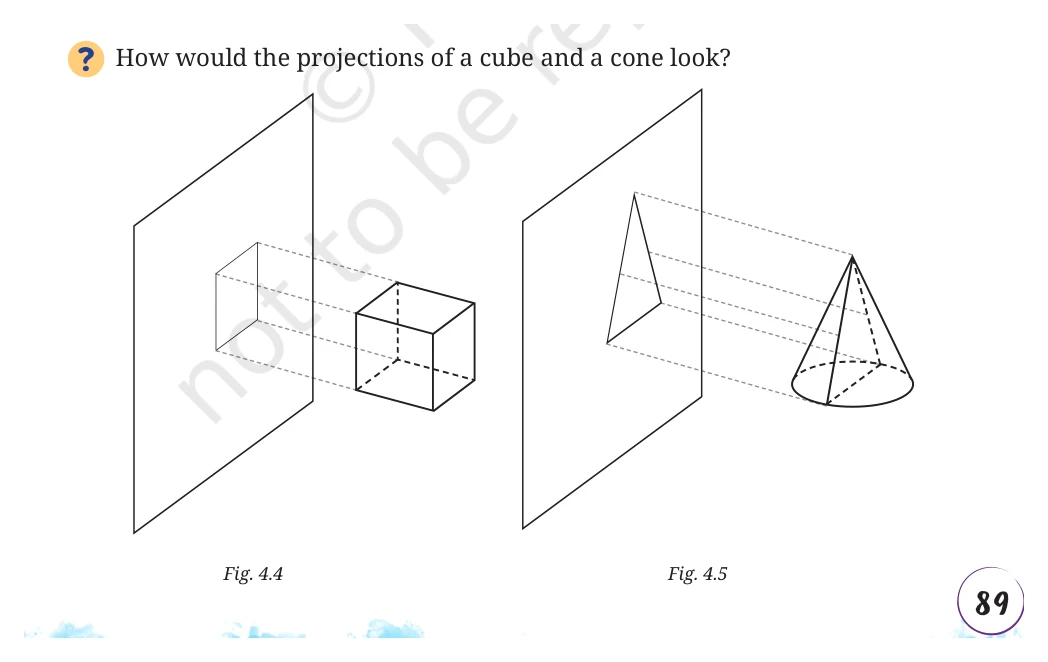
Describe possible projections of a cube and a cone.
Show solution
A cube generally projects to a centrally symmetric hexagon, with squares or other parallelograms in special orientations. A right cone gives a circle from the base direction and a triangle from the side, with other orientations giving curved oval-like outlines.
Complete worked answers
Textbook page 22
Textbook page 22 · solved item 45

Give another object with the same projection as a cone.
Show solution
A triangular lamina can match a cone's triangular side projection, and a circular disc or cylinder can match its circular top projection. A single projection therefore does not identify the original solid uniquely.
Complete worked answers
Textbook page 23
Textbook page 23 · solved item 46

Relate the front, top, and side projection lengths of a line.
Show solution
If the line vector is (x,y,z), then p_F^2=x^2+z^2, p_T^2=x^2+y^2, and p_S^2=y^2+z^2. Hence p_F^2+p_T^2+p_S^2=2(x^2+y^2+z^2)=2l^2, and each view is at most l.
Textbook page 23 · solved item 47
Find standard front, top, and side views of the listed solids.
Show solution
Cube: squares in aligned views. Cuboid: rectangles. Vertical cylinder: rectangle, circle, rectangle. Vertical cone: triangle, circle, triangle. A prism shows its base polygon along its axis and parallelogram/rectangular lateral views. A pyramid shows its base polygon from above and triangular side views.
A parallelepiped gives parallelogram or rectangular outlines depending on alignment.
Complete worked answers
Textbook page 24
Textbook page 24 · solved item 48
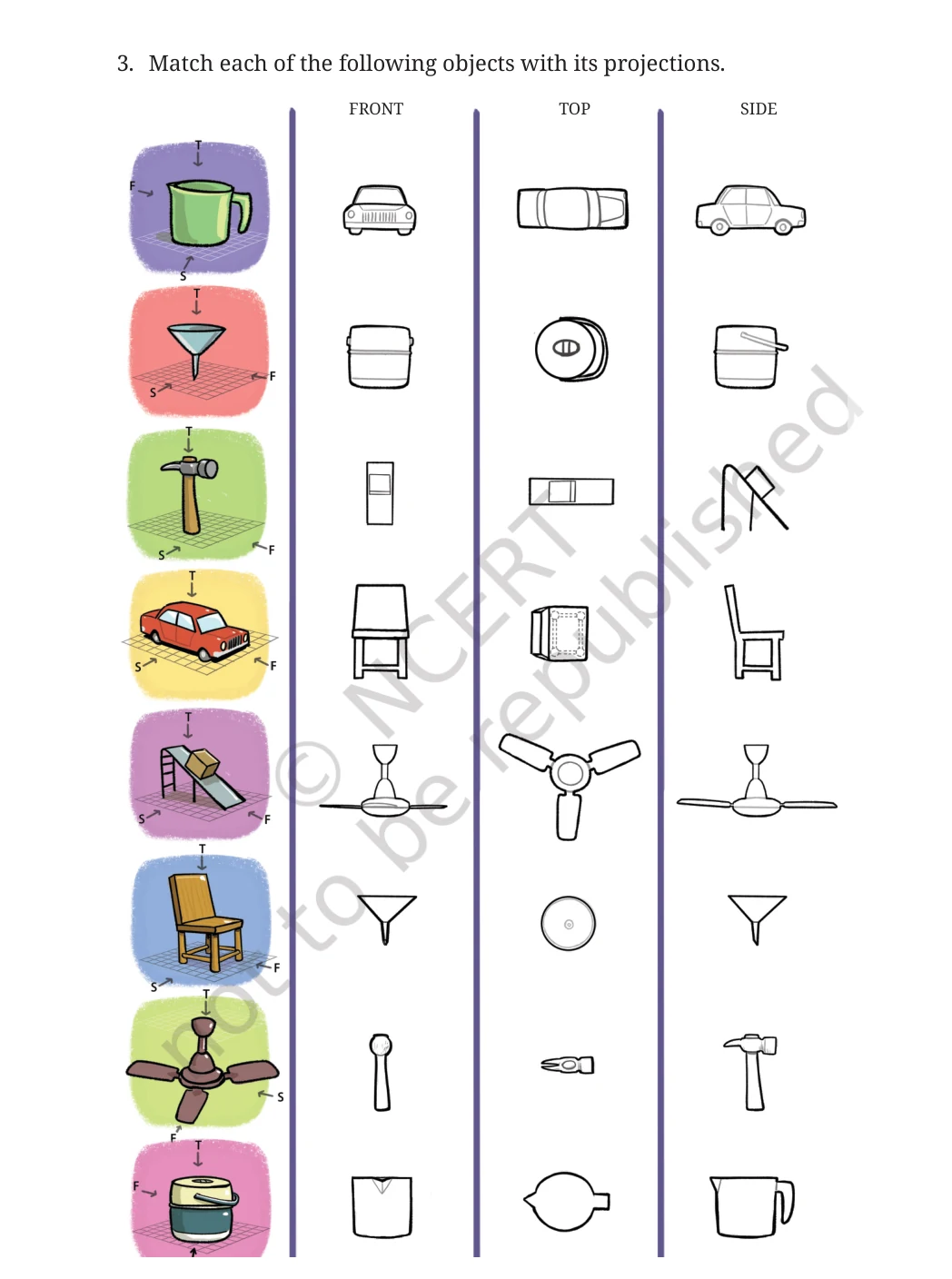
Match the eight objects with their projection rows.
Show solution
Numbering the projection rows from top to bottom: mug → 8, funnel → 6, hammer → 7, car → 1, slide → 3, chair → 4, ceiling fan → 5, and the lidded container → 2.
Complete worked answers
Textbook page 25
Textbook page 25 · solved item 49
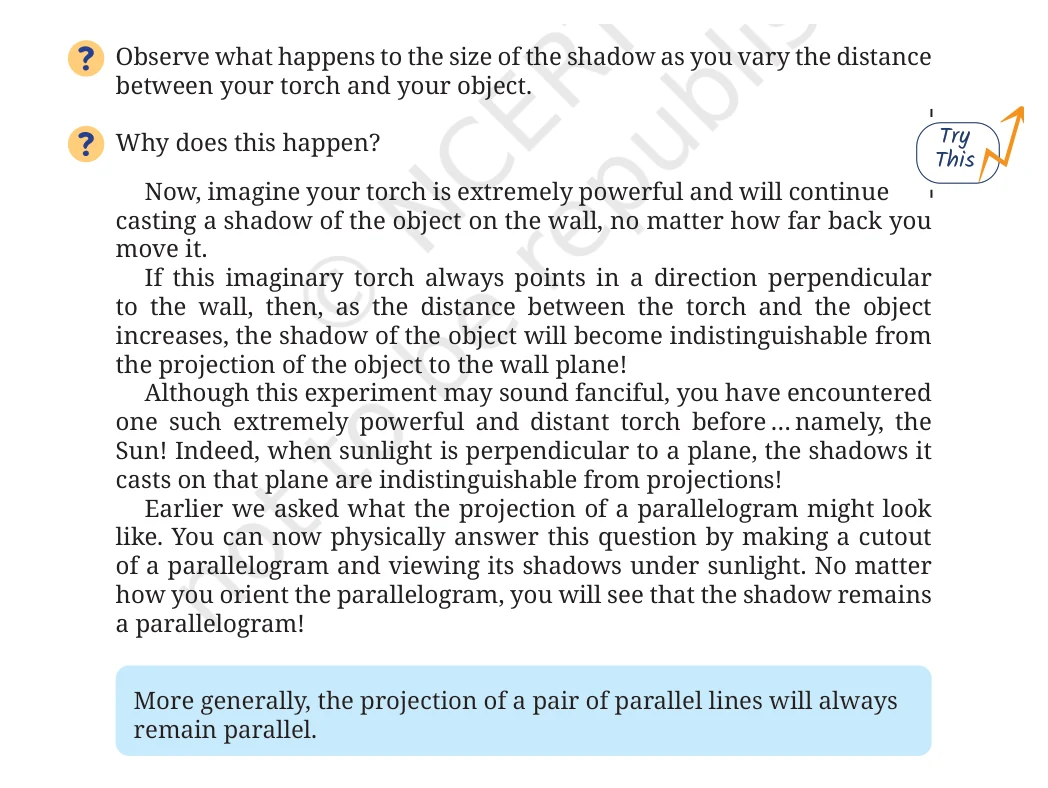
Why does a nearby torch make a larger shadow, and what happens as it moves away?
Show solution
Light rays diverge from a nearby torch, so the object intercepts a wider cone of rays and magnifies the shadow. Increasing torch distance makes the rays more nearly parallel; with perpendicular parallel rays, the shadow approaches the orthogonal projection.
Complete worked answers
Textbook page 26
Textbook page 26 · solved item 50
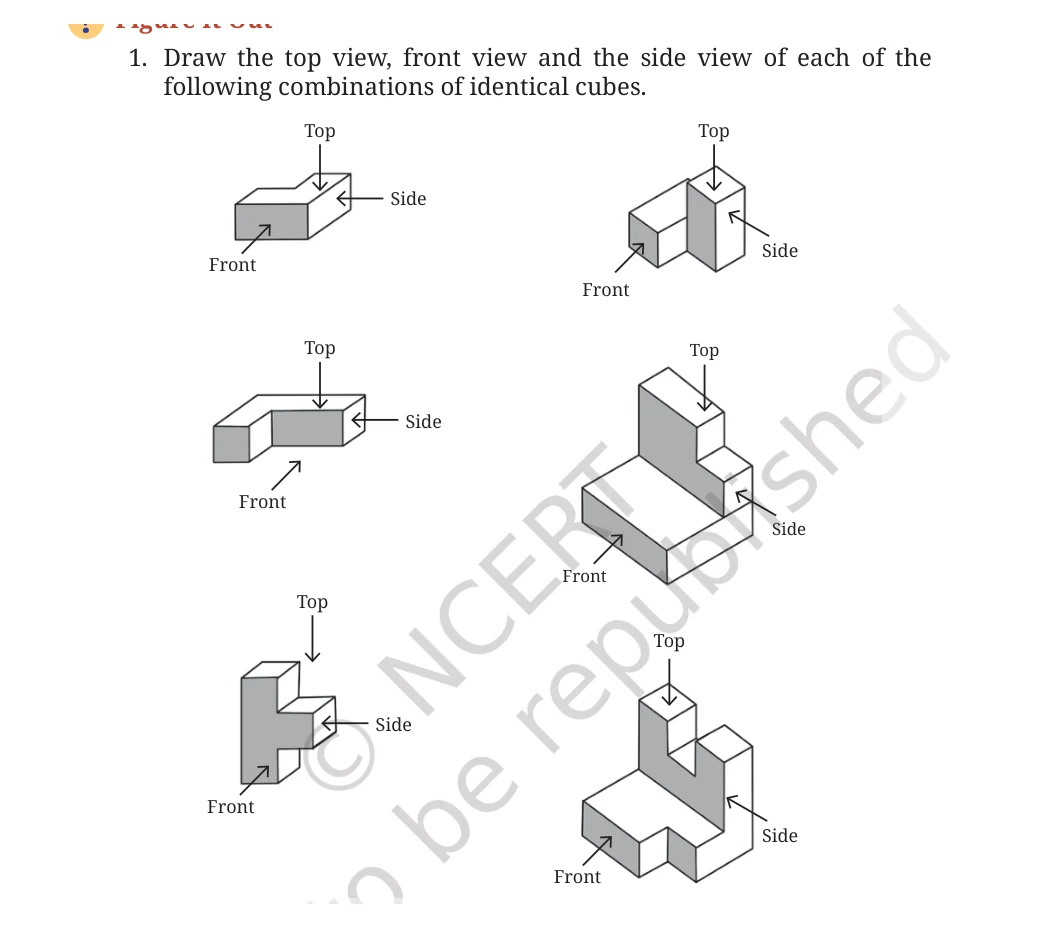
Draw the three views of each displayed combination of cubes.
Show solution
For the top view, mark every occupied floor position. For the front view, use the maximum stack height in each left-right column. For the side view, use the maximum height in each front-back row. Applying these three scans to each cropped model gives the required outlines without showing hidden internal edges.
Textbook page 26 · solved item 51
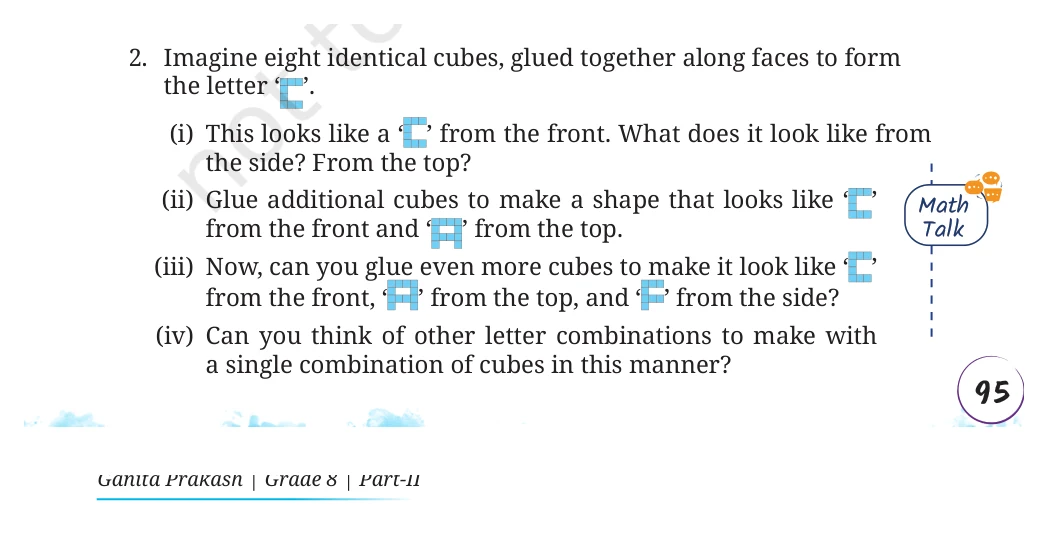
Solve the eight-cube letter-view construction.
Show solution
Treat each view as a binary silhouette. Start with one cube for every occupied cell in the front view, assign depths so the top silhouette is met, then add cubes only where they do not change an already-correct outline. Multiple solutions are possible; verify each candidate by rescanning from all three arrows.
Complete worked answers
Textbook page 27
Textbook page 27 · solved item 52
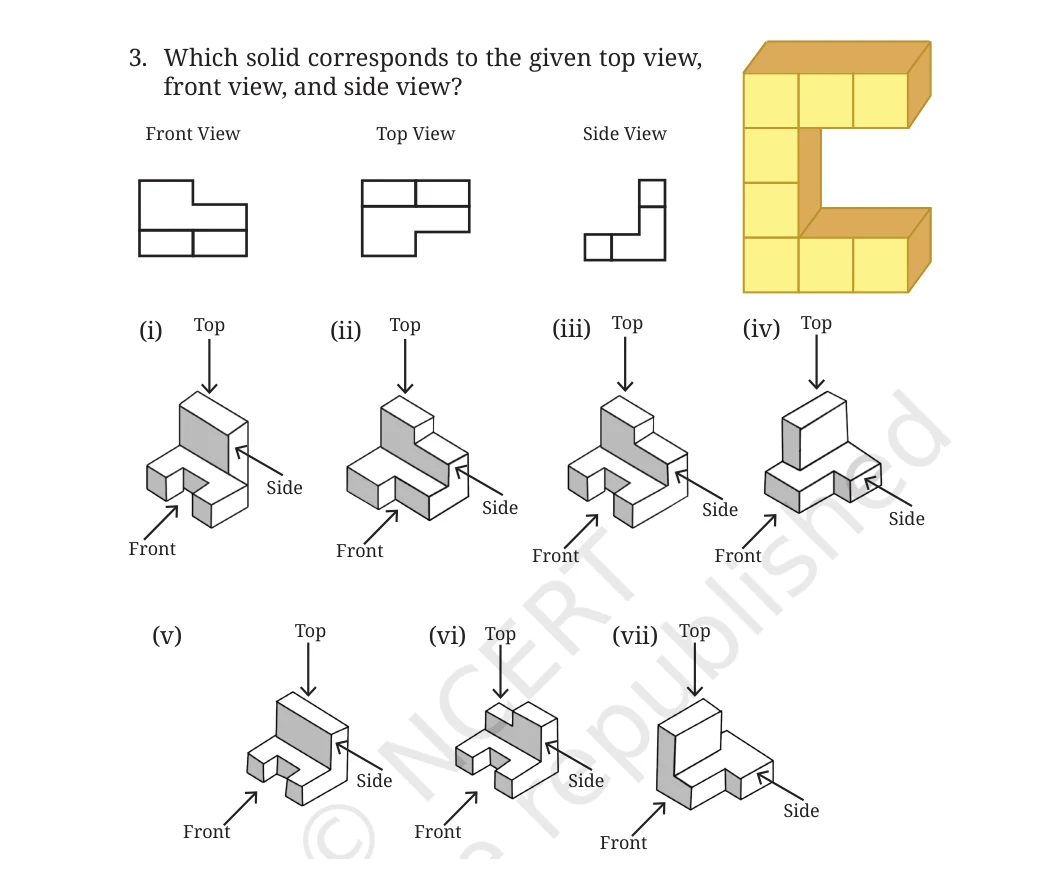
Which candidate solid matches the given front, top, and side views?
Show solution
Candidate (vi) matches all three silhouettes. Its occupied floor cells reproduce the top view, while the maximum heights along the two horizontal directions reproduce the stepped front and side outlines.
Textbook page 27 · solved item 53
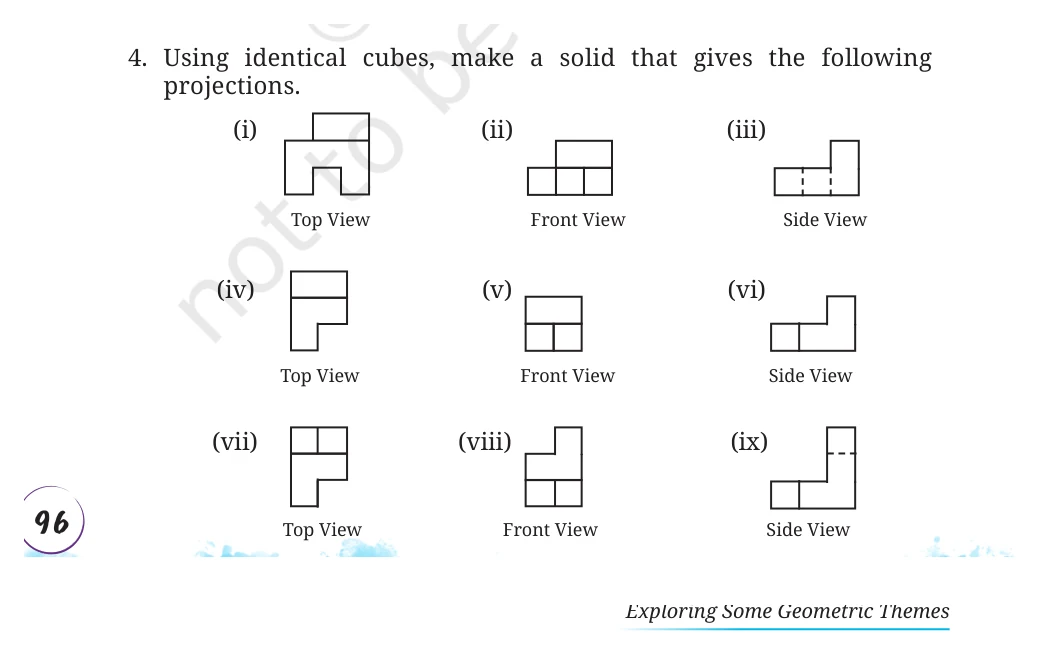
Build solids for the nine given projection sets.
Show solution
Each row of three drawings is a constraint set. Use the top view as the occupied-cell footprint, then assign positive integer heights so column maxima equal the front view and row maxima equal the side view. Hidden cubes are allowed, so more than one solid may satisfy a set; the three checks must all agree.
Complete worked answers
Textbook page 28
Textbook page 28 · solved item 54
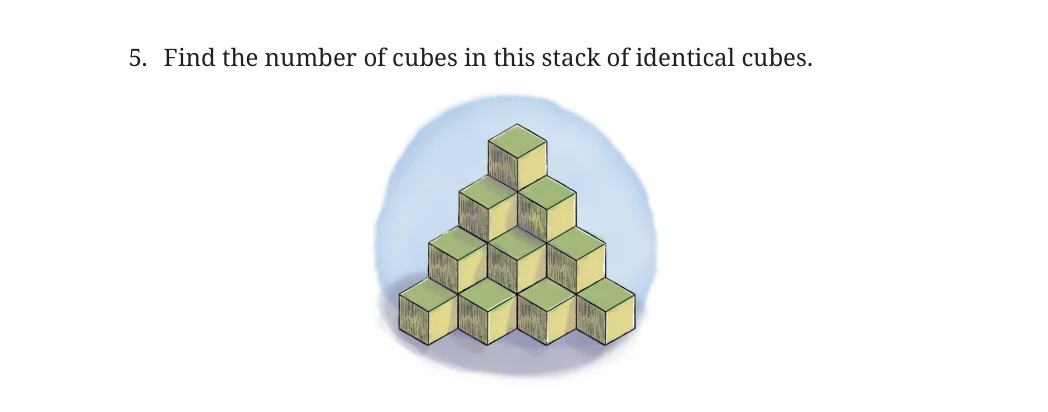
Find the number of cubes in the triangular stack.
Show solution
The visible rows contain 4+3+2+1=10 cubes. No extra hidden depth layer is indicated, so the stack contains 10 cubes.
Textbook page 28 · solved item 55

What shapes can a cube's projection make?
Show solution
A generic orientation gives a centrally symmetric hexagon. Special orientations give a parallelogram, including a rectangle, rhombus, or square. Edge coincidences can create degenerate limiting cases, but a true triangular or pentagonal orthogonal outline is impossible.
Textbook page 28 · solved item 56
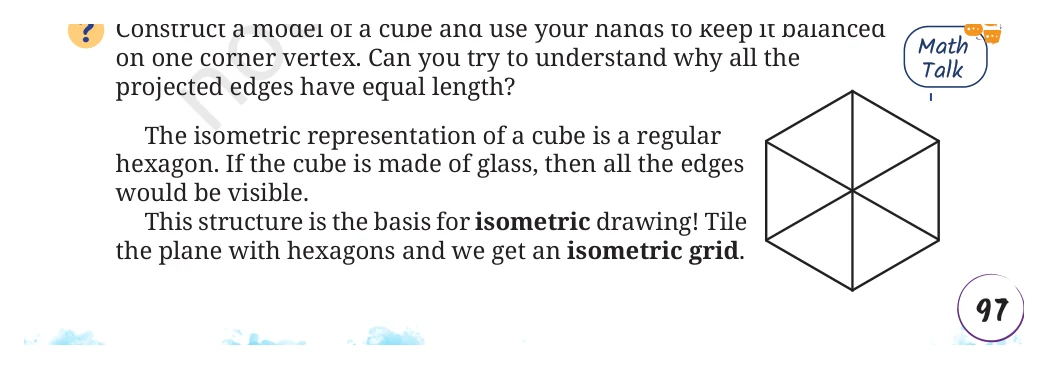
Why are all projected cube edges equal in the isometric orientation?
Show solution
Balancing the cube on a body-diagonal vertex makes the three edge directions symmetric relative to the projection plane. They meet the plane at equal angles, so equal spatial edge lengths receive the same projection scale factor.
Complete worked answers
Textbook page 31
Textbook page 31 · solved item 57

Are there more face-connected four-cube shapes than the five planar Tetris arrangements?
Show solution
Yes. The five shown are planar tetracubes. There are three additional free non-planar tetracubes, obtained by folding cubes out of the plane in the distinct non-equivalent ways. Thus there are 8 free tetracubes in total.
Complete worked answers
Textbook page 32
Textbook page 32 · solved item 58
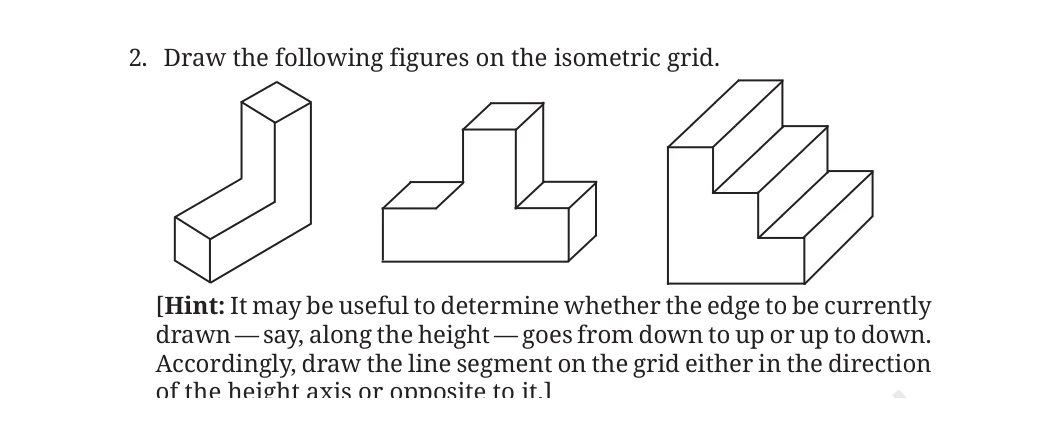
Draw the supplied solids on an isometric grid.
Show solution
Choose the three grid directions as length, depth, and height. Transfer every edge by counting its units along the matching direction, draw nearer visible edges first or lightly draw all edges, then remove hidden segments. Equal spatial unit edges must occupy equal grid steps.
Textbook page 32 · solved item 59
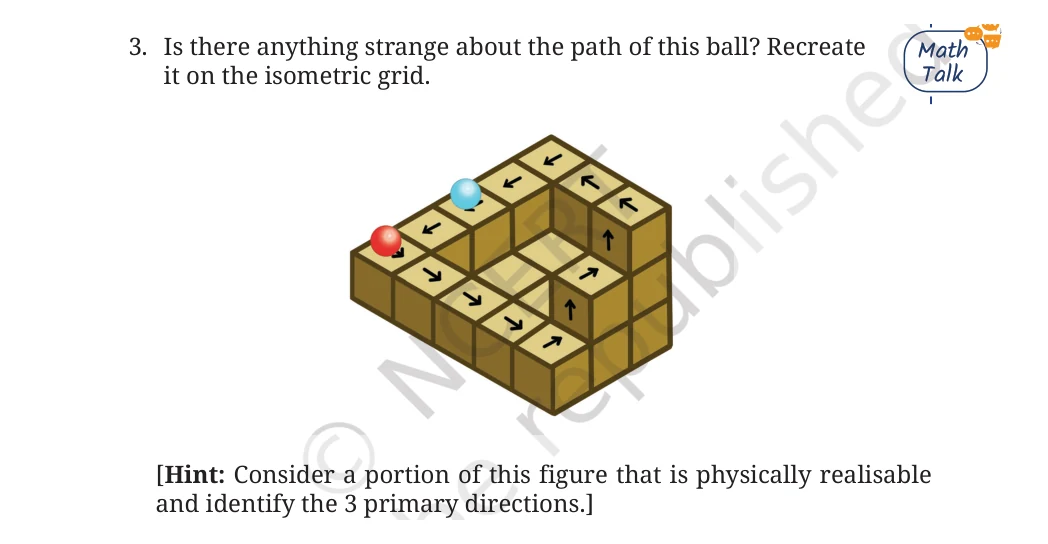
Explain the strange ball path and recreate it on an isometric grid.
Show solution
The drawing joins locally consistent segments that use the three isometric directions, but their depth ordering changes around the loop. Trace one physically consistent portion at a time; the apparent closed path cannot exist as one ordinary 3D track.
Textbook page 32 · solved item 60

Can the impossible cube triangle be built, and why does its illusion work?
Show solution
No. Following the beams around forces contradictory near/far and height relationships at the final corner. Its front, top, and side silhouettes can each look locally plausible, but they cannot come from one globally consistent cube model. Isometric projection hides enough depth information for the incompatible joins to appear continuous.