
Use the textbook context
Match, attempt, then check
Each source crop keeps the printed information needed for that item. Compound answer-key entries are separated into individual solutions.
Complete worked answers
Textbook page 2
Textbook page 2 · solved item 1
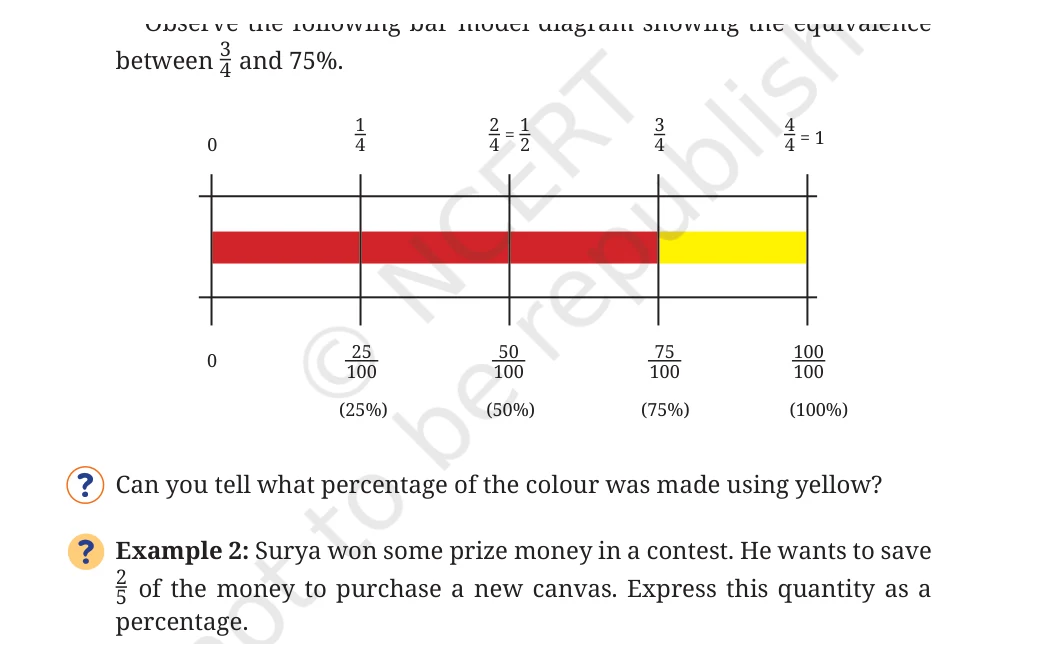
What percentage of Surya's paint mixture is yellow if red makes up three-fourths?
Show solution
Yellow is 1-\frac34=\frac14=25\% of the mixture.
Complete worked answers
Textbook page 3
Textbook page 3 · solved item 2
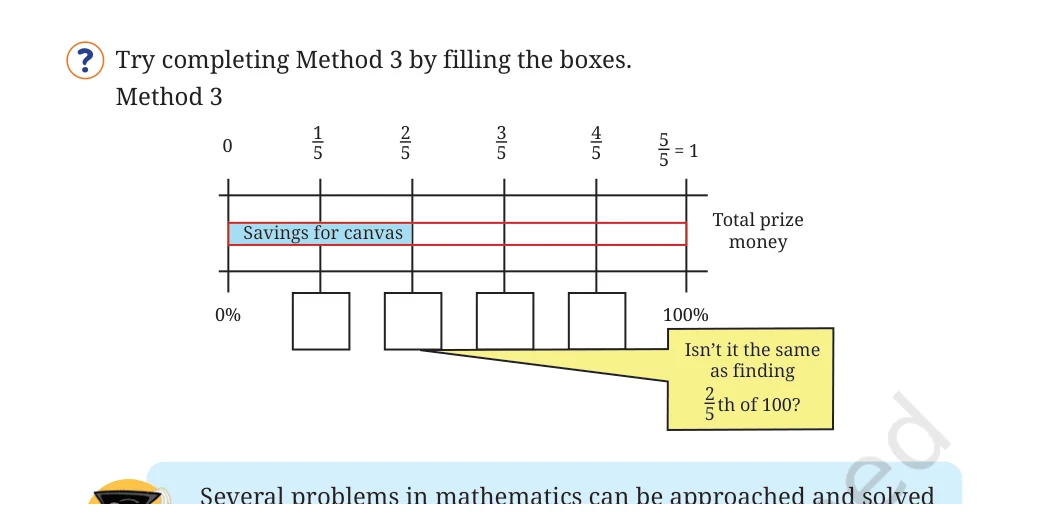
Complete Method 3 for expressing two-fifths as a percentage.
Show solution
Each fifth is 100\%\div5=20\%. Therefore two-fifths is 2\times20\%=40\%.
Textbook page 3 · solved item 3

Express the six given fractions as percentages.
Show solution
(i) \frac35=60\%; (ii) \frac7{14}=50\%; (iii) \frac9{20}=45\%; (iv) \frac{72}{150}=48\%; (v) \frac13=33\frac13\%; (vi) \frac5{11}=45\frac5{11}\%\approx45.45\%.
Textbook page 3 · solved item 4
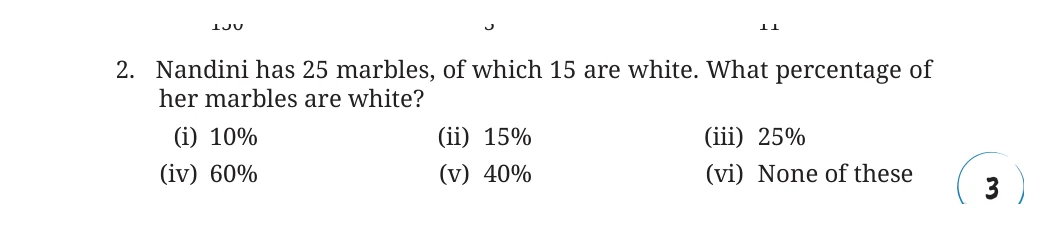
Nandini has 25 marbles and 15 are white. What percentage are white?
Show solution
\frac{15}{25}\times100=60\%. Choice (iv).
Complete worked answers
Textbook page 4
Textbook page 4 · solved item 5

Fifteen of 80 students walk to school. What percentage is that?
Show solution
\frac{15}{80}\times100=18.75\%.
Textbook page 4 · solved item 6
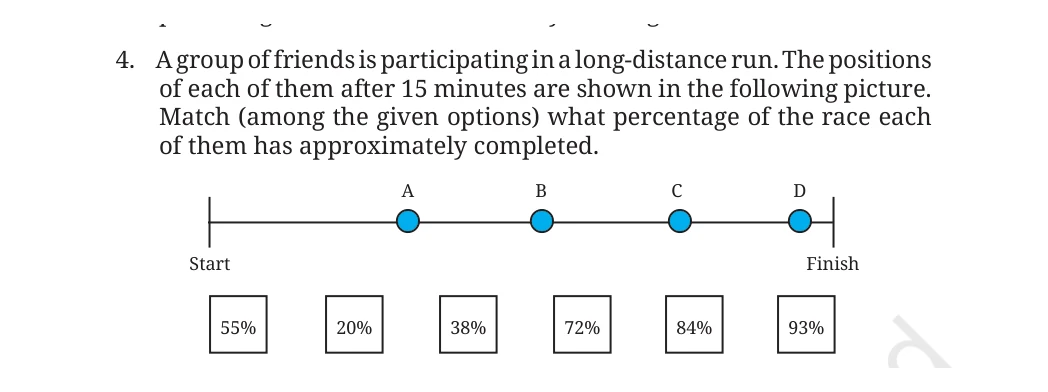
Match runners A, B, C, and D to the approximate percentages completed.
Show solution
Comparing each marked position with the full start-to-finish segment gives A about 38%, B about 55%, C about 72%, and D about 93%.
Textbook page 4 · solved item 7
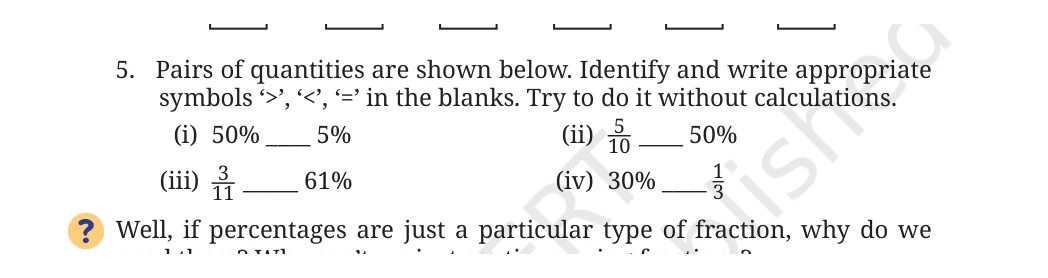
Insert >, <, or = in the four fraction-percentage comparisons.
Show solution
(i) 50\%>5\%; (ii) \frac5{10}=50\%; (iii) \frac3{11}<61\%; (iv) 30\%<\frac13.
Complete worked answers
Textbook page 6
Textbook page 6 · solved item 8
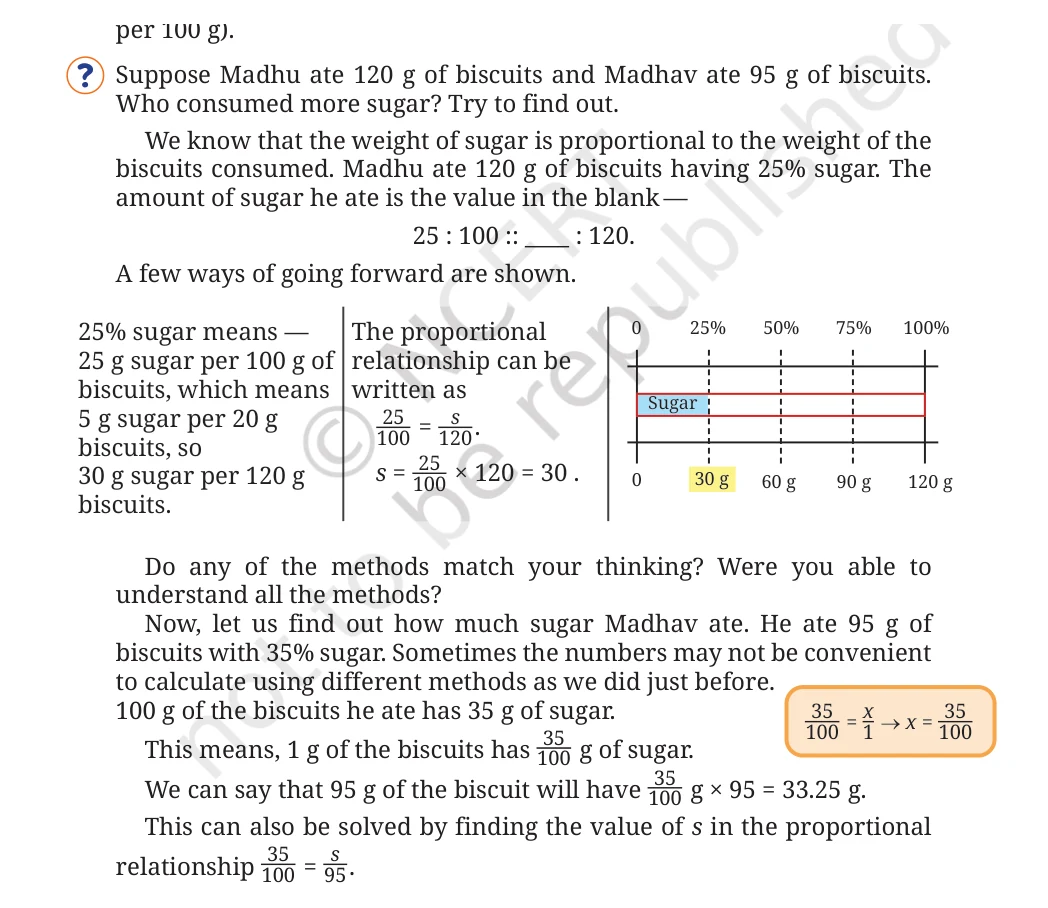
Who ate more sugar: 120 g of 25%-sugar biscuits or 95 g of 35%-sugar biscuits?
Show solution
The amounts are (0.25\times120=30) g and (0.35\times95=33.25) g. Madhav ate 3.25 g more sugar.
Complete worked answers
Textbook page 7
Textbook page 7 · solved item 9
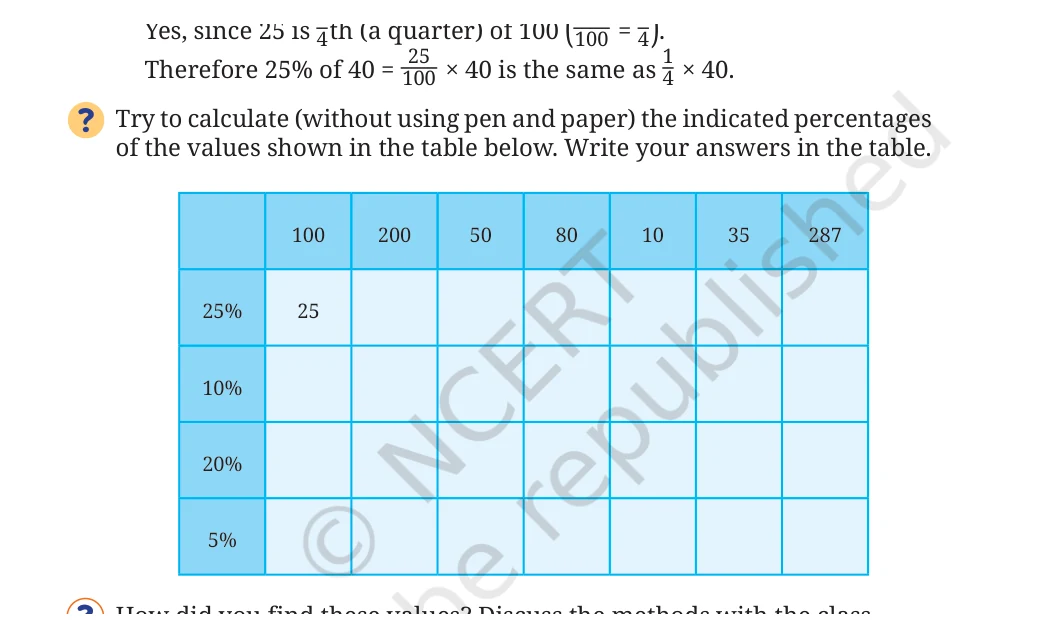
Complete the mental-computation table for 25%, 10%, 20%, and 5% of the listed values.
Show solution
For (100,200,50,80,10,35,287): 25% gives (25,50,12.5,20,2.5,8.75,71.75); 10% gives (10,20,5,8,1,3.5,28.7); 20% gives (20,40,10,16,2,7,57.4); 5% gives (5,10,2.5,4,0.5,1.75,14.35).
Complete worked answers
Textbook page 8
Textbook page 8 · solved item 10
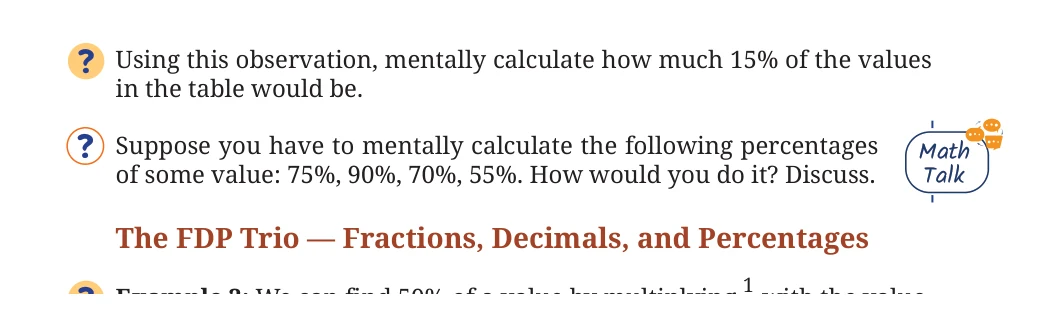
Mentally find 40% and 15% of the same table values.
Show solution
For (100,200,50,80,10,35,287), 40% gives (40,80,20,32,4,14,114.8). Using 15\%=10\%+5\% gives (15,30,7.5,12,1.5,5.25,43.05).
Textbook page 8 · solved item 11
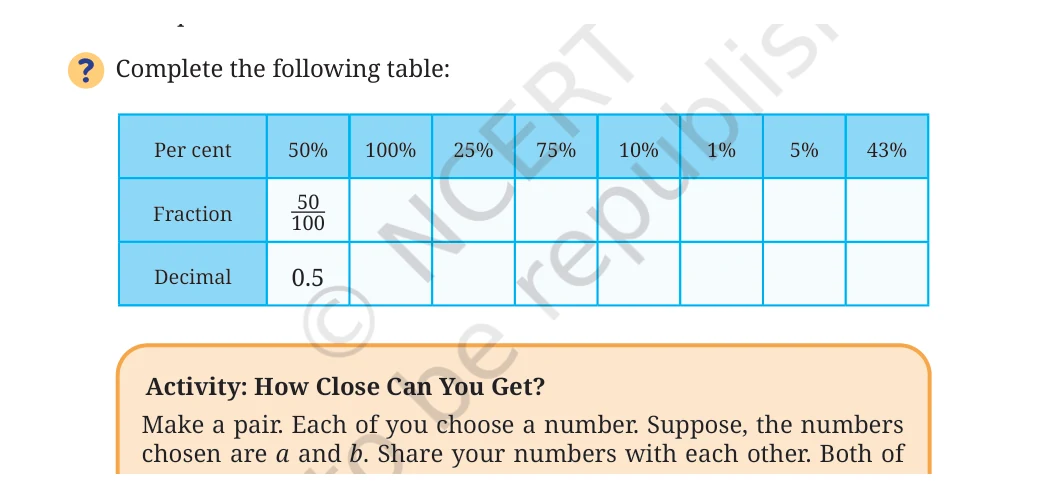
Complete the fraction-decimal-percentage table.
Show solution
(50\%=\frac12=0.5), (100\%=1=1.0), (25\%=\frac14=0.25), (75\%=\frac34=0.75), (10\%=\frac1{10}=0.1), (1\%=\frac1{100}=0.01), (5\%=\frac1{20}=0.05), (43\%=\frac{43}{100}=0.43).
Textbook page 8 · solved item 12
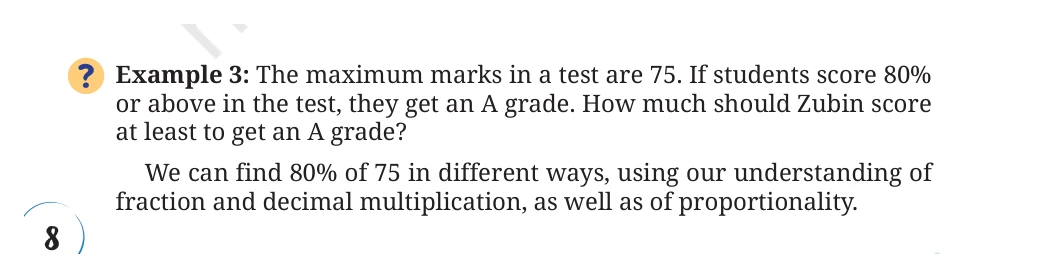
What minimum score out of 75 earns an A grade when the cutoff is 80%?
Show solution
(80\%\times75=\frac45\times75=60). Zubin needs at least 60 marks.
Complete worked answers
Textbook page 9
Textbook page 9 · solved item 13
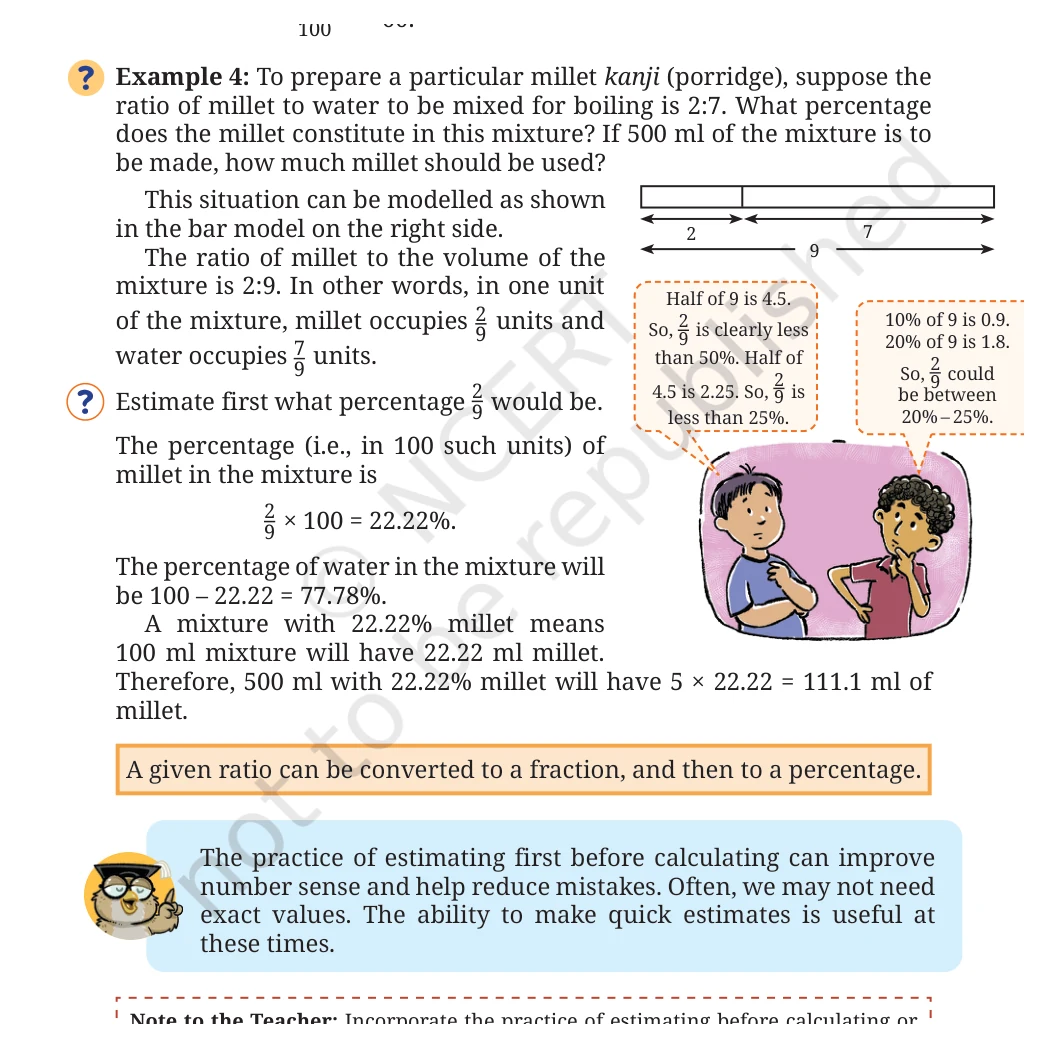
A millet-water mixture has ratio 2 : 7. Find the millet percentage and millet in 500 mL.
Show solution
Millet is \frac2{2+7}=\frac29=22.22\% of the mixture. In 500 mL, the exact amount is (500\times\frac29=111\frac19) mL, about 111.1 mL.
Complete worked answers
Textbook page 10
Textbook page 10 · solved item 14
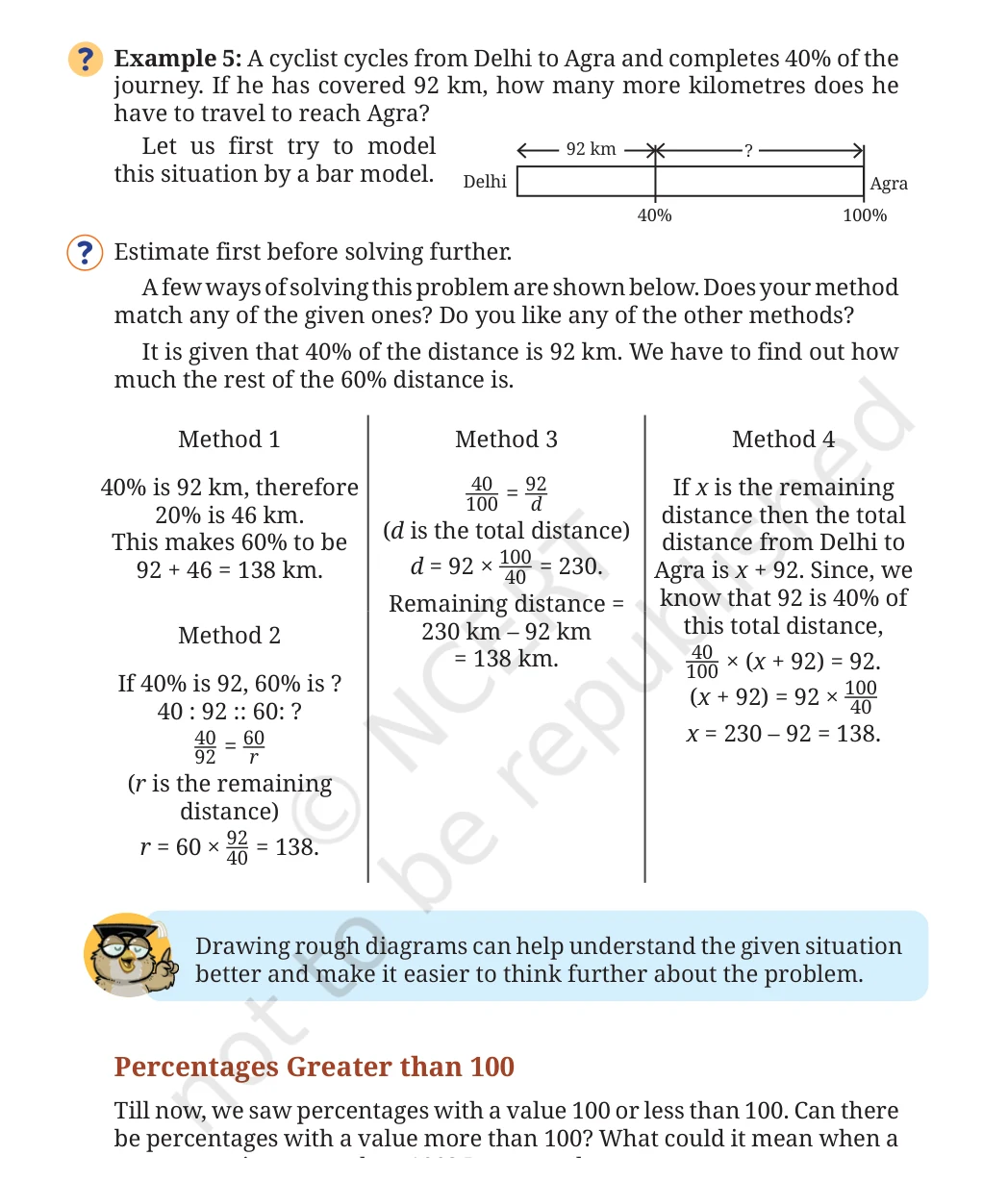
A cyclist has covered 40% of a journey, or 92 km. How much remains?
Show solution
The total is (92\div0.4=230) km. The remaining 60% is (230-92=138) km.
Textbook page 10 · solved item 15
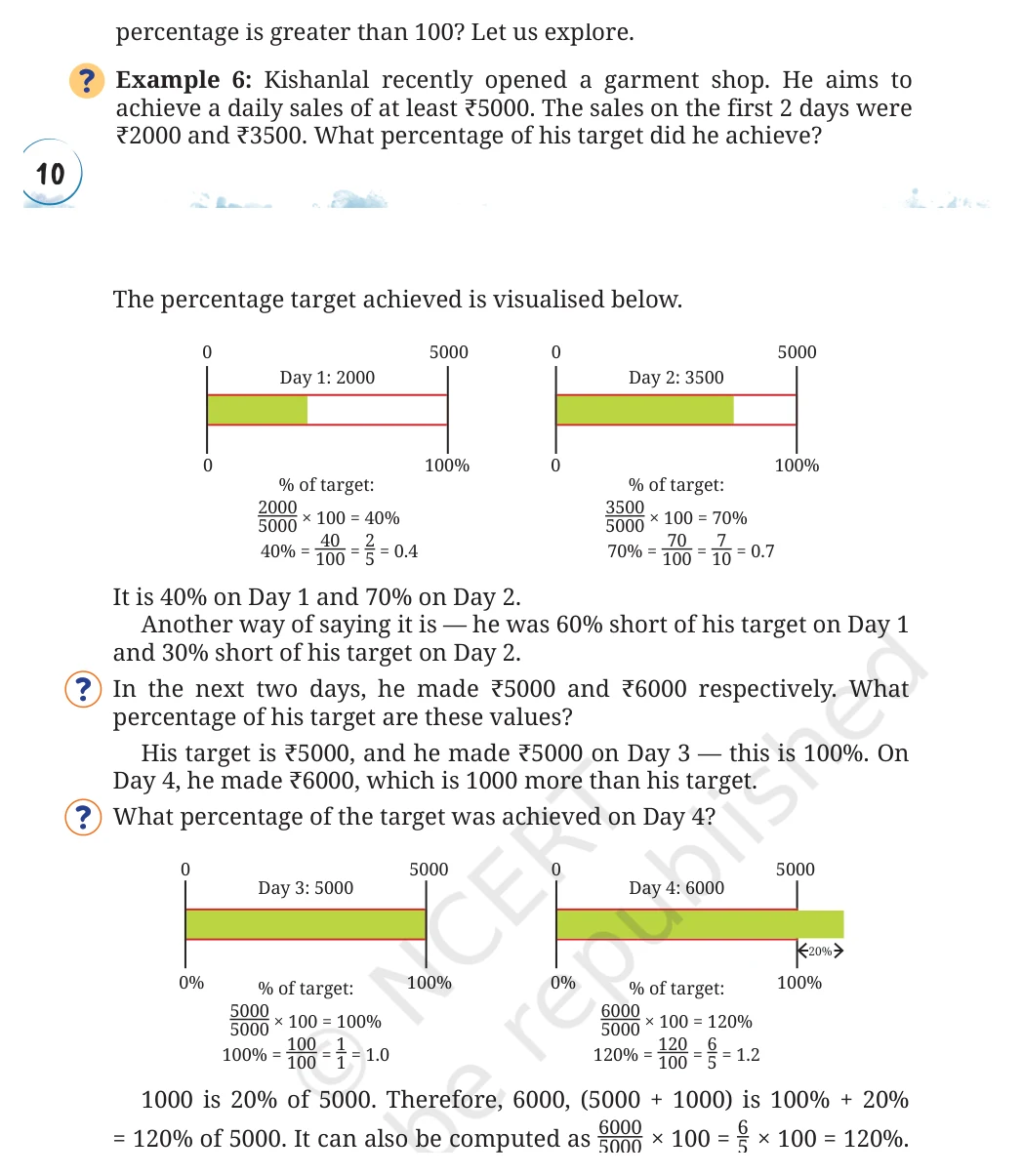
Find the target percentages for sales of ₹2,000, ₹3,500, ₹5,000, and ₹6,000 against a ₹5,000 target.
Show solution
The percentages are 40\%,70\%,100\%,120\%, respectively. The ₹6,000 sale is 20% above target.
Complete worked answers
Textbook page 11
Textbook page 11 · solved item 16
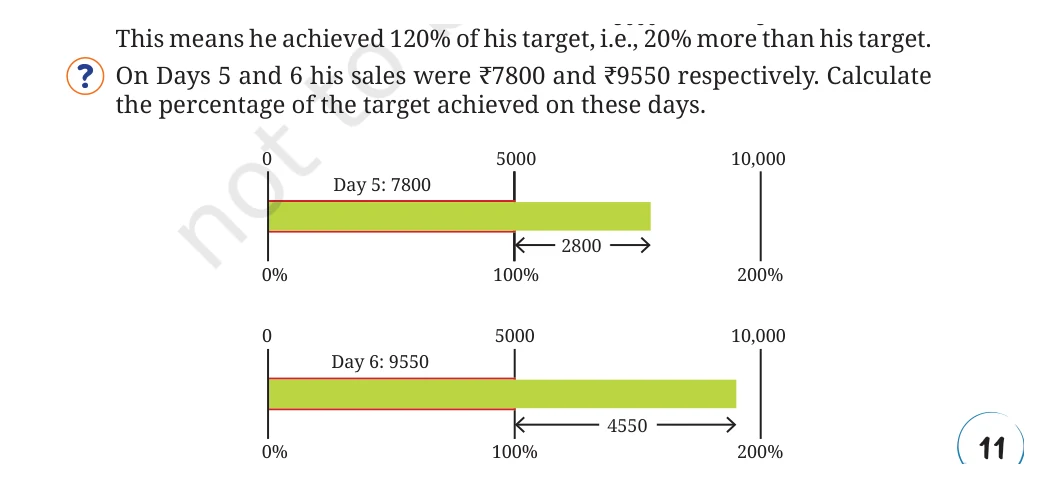
Find the target percentages for ₹7,800 and ₹9,550, and sales corresponding to 150% and 210% of ₹5,000.
Show solution
₹7,800 is 156\%, and ₹9,550 is 191\%. The 150% and 210% sales are ₹7,500 and ₹10,500.
Complete worked answers
Textbook page 12
Textbook page 12 · solved item 17
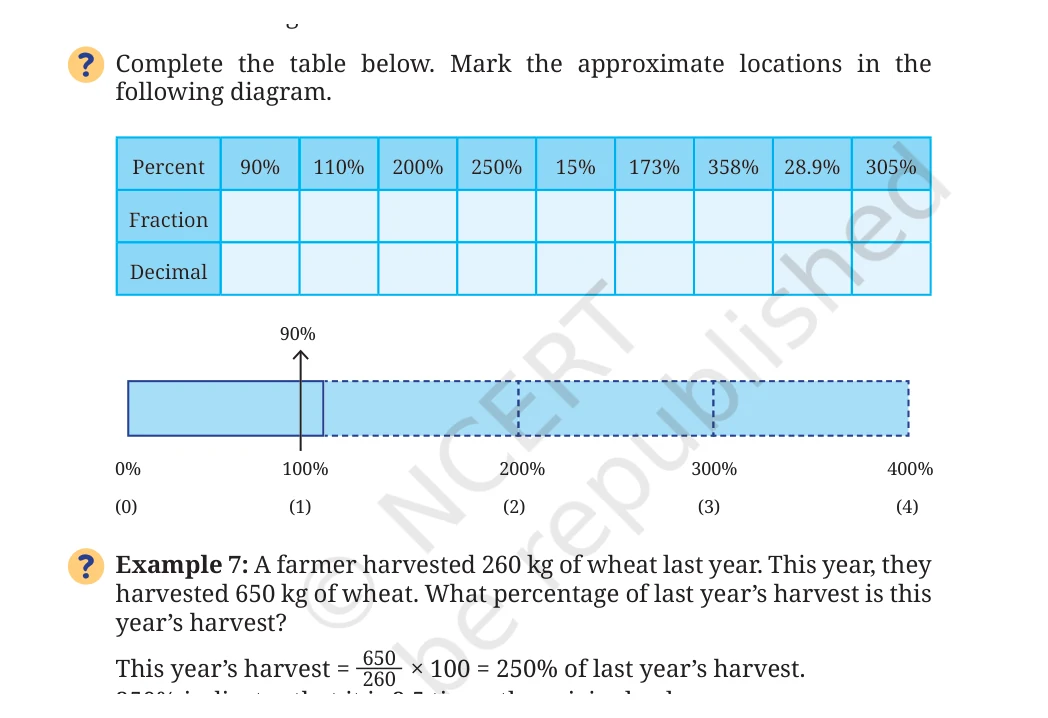
Complete the percent-fraction-decimal table from 15% through 358%.
Show solution
(90\%=\frac9{10}=0.9); (110\%=\frac{11}{10}=1.1); (200\%=2=2.0); (250\%=\frac52=2.5); (15\%=\frac3{20}=0.15); (173\%=\frac{173}{100}=1.73); (358\%=\frac{179}{50}=3.58); (28.9\%=\frac{289}{1000}=0.289); (305\%=\frac{61}{20}=3.05).
Textbook page 12 · solved item 18
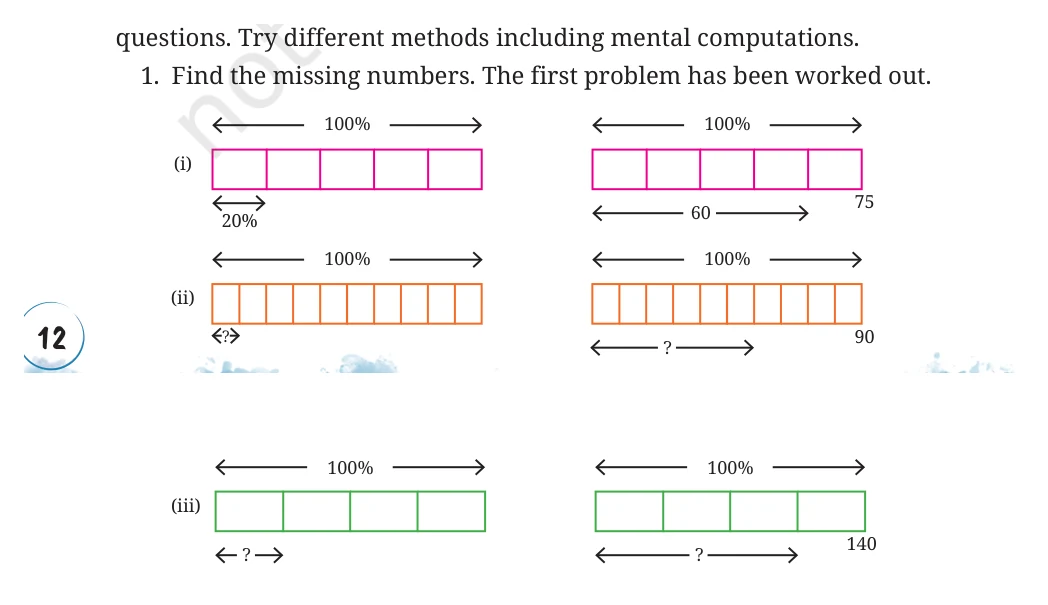
Find the missing values in the three paired bar models.
Show solution
(i) 20% of 75 is 15, and 60 is 80% of 75. (ii) One tenth of 90 is 9, and half is 45. (iii) One fourth of 140 is 35, and three fourths is 105.
Complete worked answers
Textbook page 13
Textbook page 13 · solved item 19

Find the six stated percentages and draw equivalent bar models.
Show solution
(i) 40; (ii) 40; (iii) 223.2; (iv) 56; (v) (0.01\times60=0.6) minute = 36 seconds; (vi) (0.7) kg.
Textbook page 13 · solved item 20

Surya made 60 mL orange paint with red making up three-fourths. How much red?
Show solution
(\frac34\times60=45) mL red paint.
Textbook page 13 · solved item 21
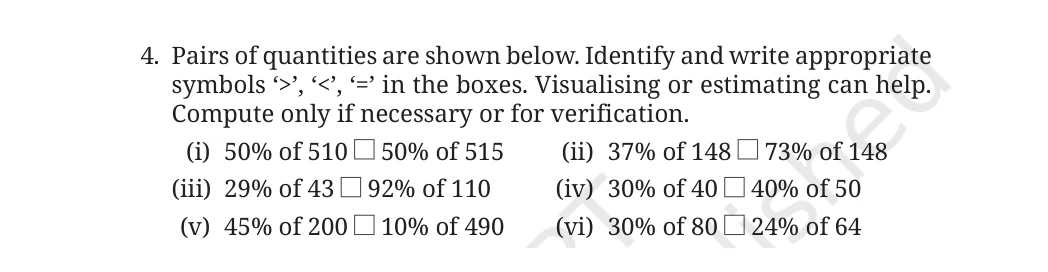
Compare the six pairs of percentage quantities.
Show solution
(i) (<); (ii) (<); (iii) (<); (iv) (<); (v) (>); (vi) (>). For (vi), the values are 24 and 15.36.
Textbook page 13 · solved item 22
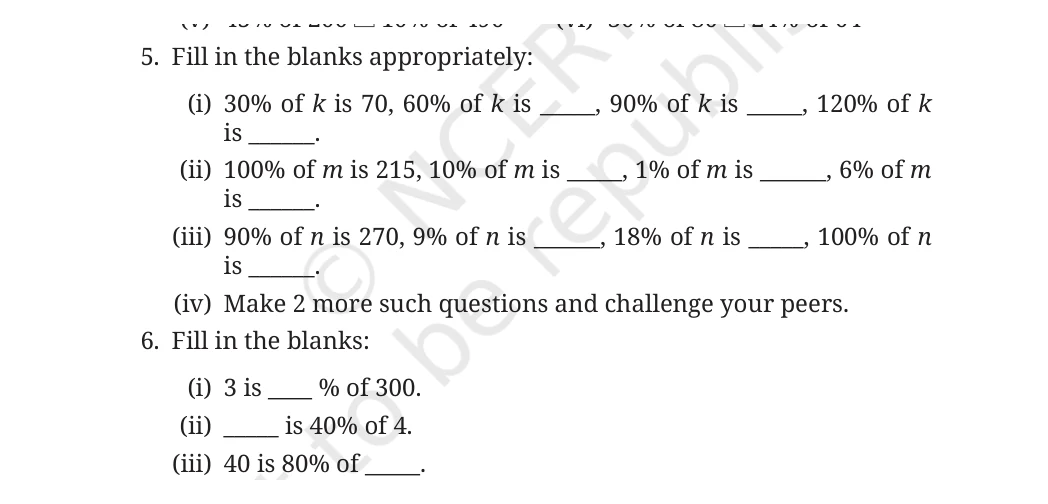
Fill the percentage-chain blanks for k, m, and n.
Show solution
(i) 140, 210, 280. (ii) 21.5, 2.15, 12.9. (iii) 27, 54, 300.
Textbook page 13 · solved item 23
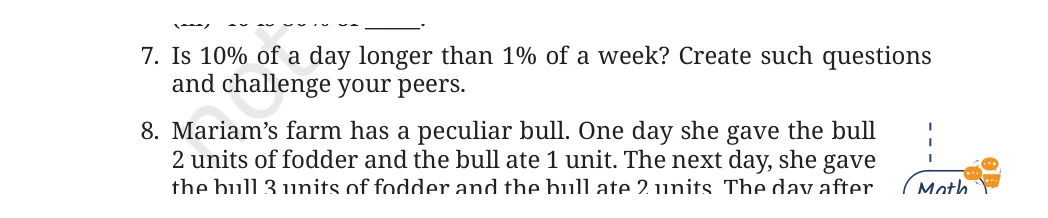
Fill: 3 is __% of 300; __ is 40% of 4; 40 is 80% of __.
Show solution
The answers are 1\%, (1.6), and (50).
Textbook page 13 · solved item 24

Is 10% of a day longer than 1% of a week?
Show solution
Yes. 10% of a day is 2.4 hours or 144 minutes. 1% of a week is 1.68 hours or 100.8 minutes.
Textbook page 13 · solved item 25

Represent the bull's daily fodder consumption as percentages and describe the pattern.
Show solution
On day (n), it eats (n) of (n+1) units, or \frac{n}{n+1}\times100\%. The sequence begins 50%, 66.67%, 75%, and increases toward but never reaches 100%; day 99 is 99%.
Complete worked answers
Textbook page 14
Textbook page 14 · solved item 26

Workers take 18 days for 20% of a plantation. How long for all of it?
Show solution
At a constant work rate, five equal 20% sections take (5\times18=90) days. The assumption is necessary because changing worker count, weather, or crop density would break the proportional relationship.
Textbook page 14 · solved item 27
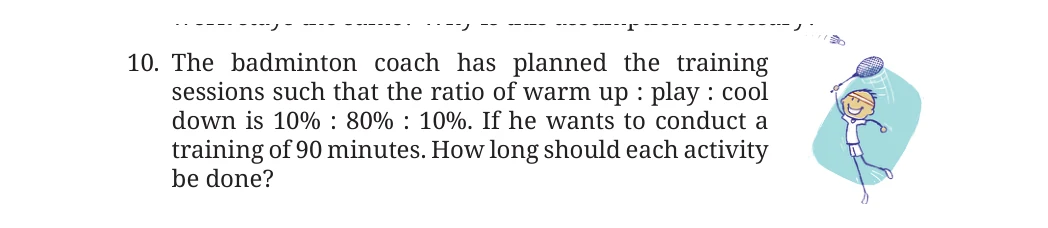
Split a 90-minute badminton session in the ratio 10% : 80% : 10%.
Show solution
Warm-up is 9 minutes, play is 72 minutes, and cool-down is 9 minutes.
Textbook page 14 · solved item 28

Estimate the population living in the Northern Hemisphere if it is 90% of about 8.2 billion.
Show solution
(0.9\times8.2=7.38) billion people, using the chapter's approximate world population.
Textbook page 14 · solved item 29
For halwa with rava 40%, sugar 40%, and ghee 20%, scale to 8 people and split 2 kg.
Show solution
Scaling the number served does not change the proportions. Of 2 kg, rava is 0.8 kg, sugar is 0.8 kg, and ghee is 0.4 kg.
Complete worked answers
Textbook page 15
Textbook page 15 · solved item 30
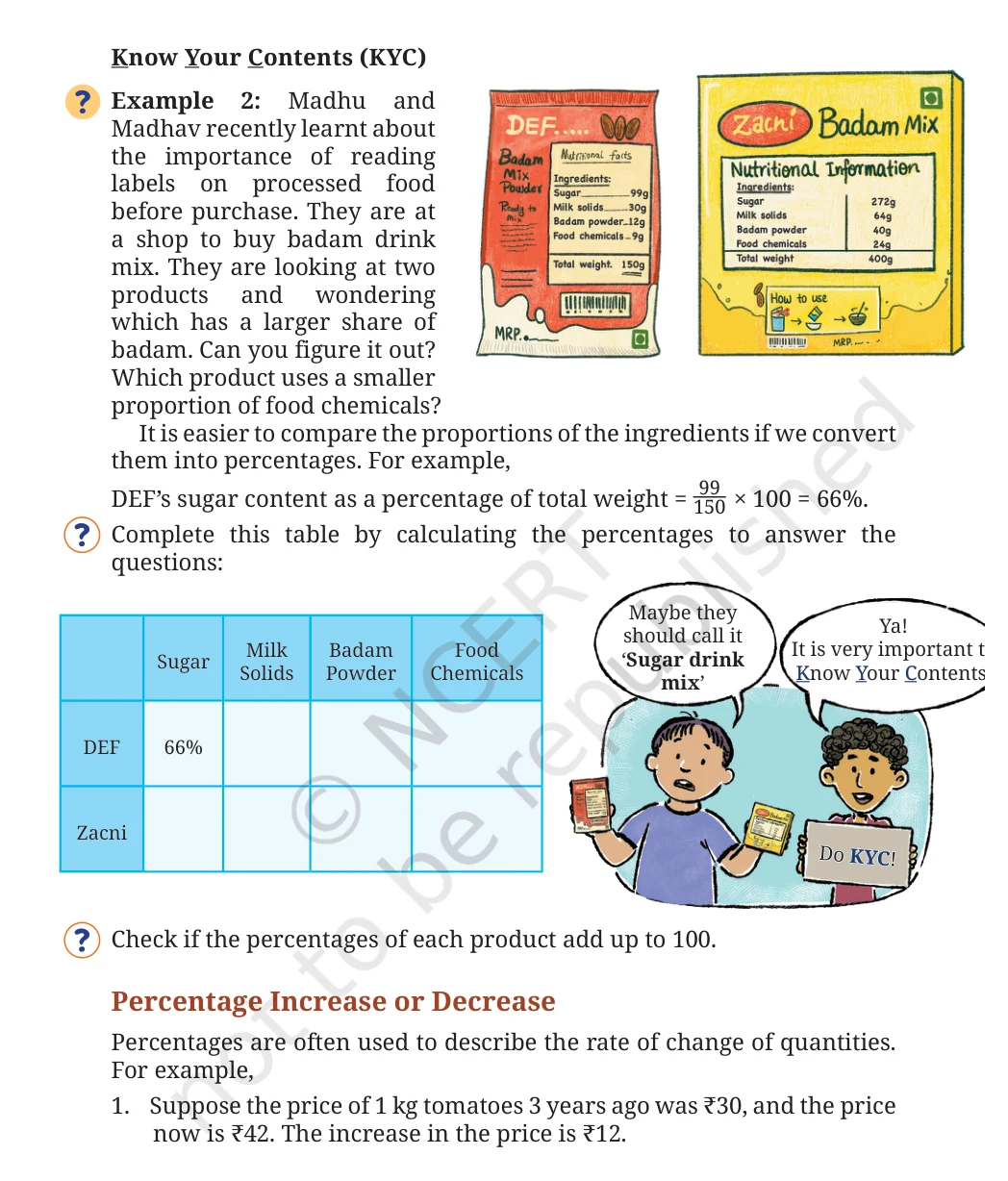
Complete the ingredient percentages for DEF and Zacni badam mixes and compare them.
Show solution
DEF: sugar 66%, milk solids 20%, badam 8%, chemicals 6%. Zacni: sugar 68%, milk solids 16%, badam 10%, chemicals 6%. Zacni has more badam; both have the same chemical proportion. Each row totals 100%.
Complete worked answers
Textbook page 17
Textbook page 17 · solved item 31
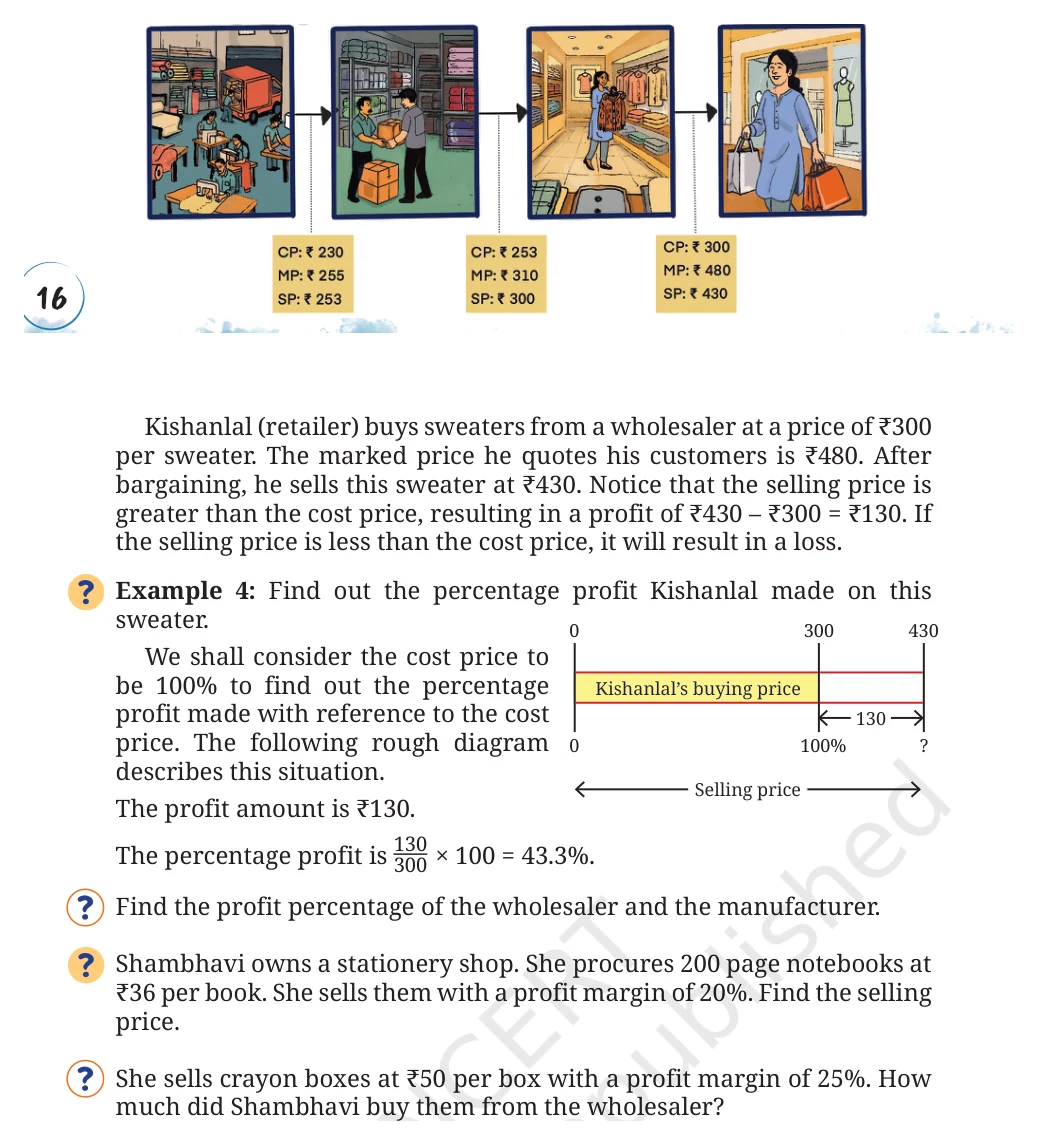
Find the sweater supply-chain profit percentages and the two stationery-shop answers.
Show solution
Manufacturer: (253-230)/230\times100=10\%. Wholesaler: (300-253)/253\times100\approx18.58\%. Kishanlal: (430-300)/300\times100\approx43.33\%. A ₹36 notebook at 20% profit sells for ₹43.20. If ₹50 is 125% of a crayon box's cost, the cost was 50/1.25=₹40.
Textbook page 17 · solved item 32
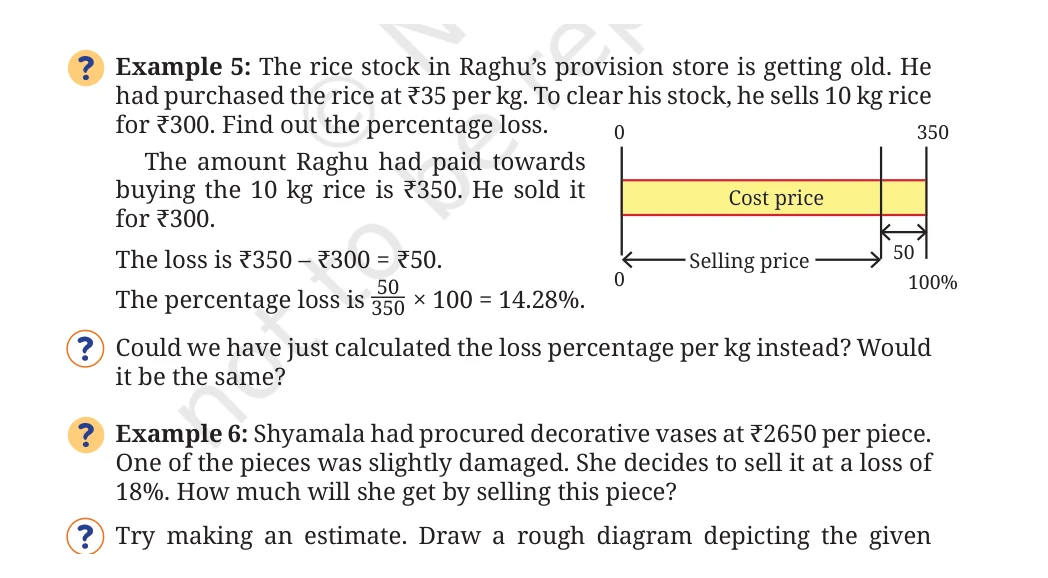
Find the rice loss percentage and the damaged vase's selling price.
Show solution
Rice cost ₹350 and sold for ₹300, so loss is 50/350\times100=14.29\%; calculating per kg gives the same rate. The vase sells for (82\%\times₹2650=₹2173).
Complete worked answers
Textbook page 18
Textbook page 18 · solved item 33
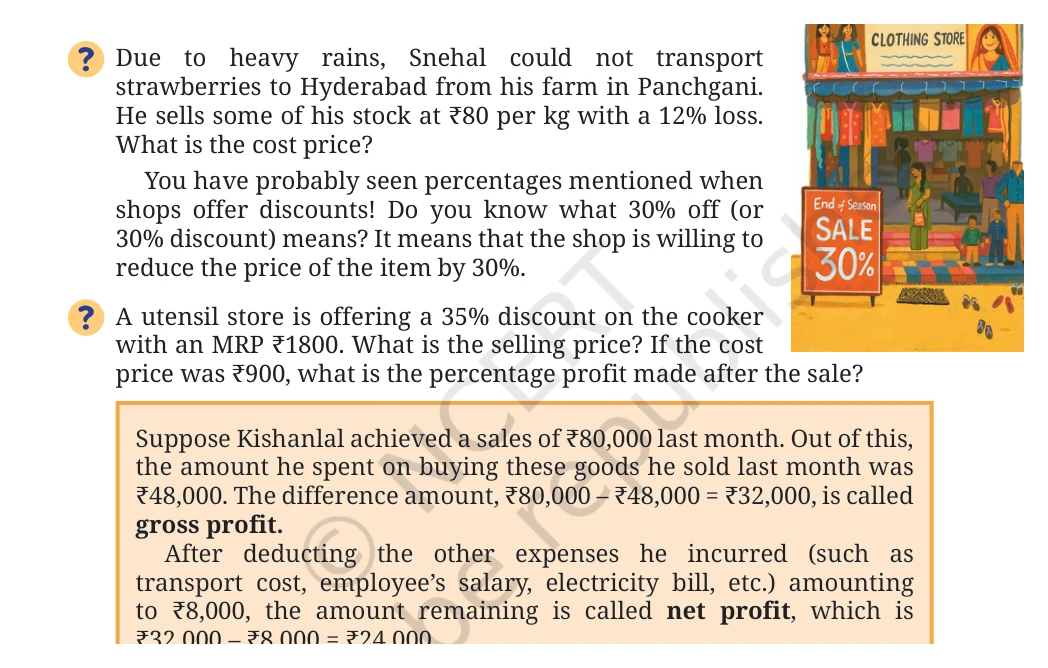
Find the strawberry cost price and the cooker's selling price and profit percentage.
Show solution
₹80 is 88% of the strawberry cost, so CP (=80/0.88\approx₹90.91) per kg. The cooker sells for (65\%\times₹1800=₹1170). Against ₹900 cost, profit is ₹270, or 30%.
Complete worked answers
Textbook page 19
Textbook page 19 · solved item 34
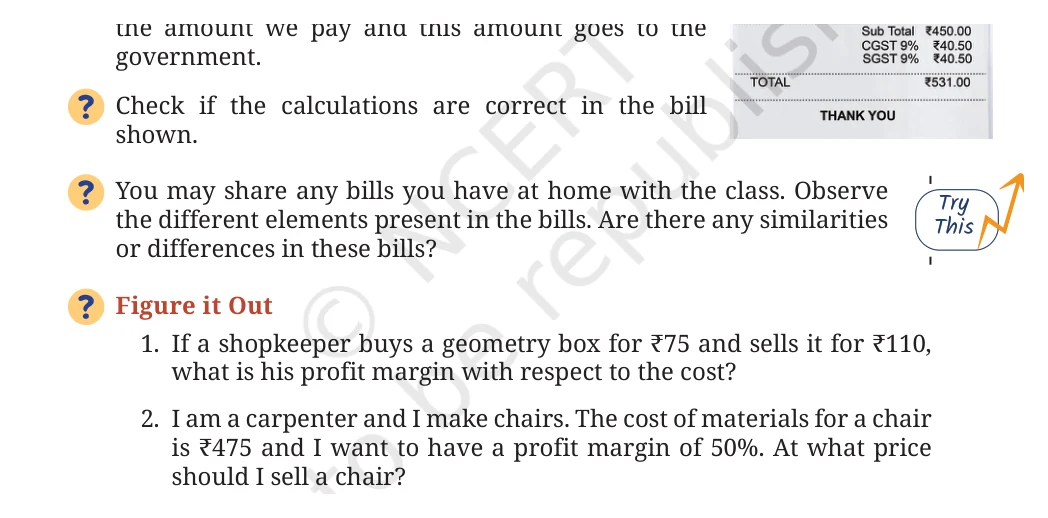
Check the GST bill and distinguish gross from net profit in the examples.
Show solution
The bill is correct: subtotal ₹450, CGST 9% = ₹40.50, SGST 9% = ₹40.50, total ₹531. Kishanlal's gross profit is ₹32,000 and net profit ₹24,000; Manisha's net profit margin on ₹1,50,000 revenue is 30%.
Textbook page 19 · solved item 35
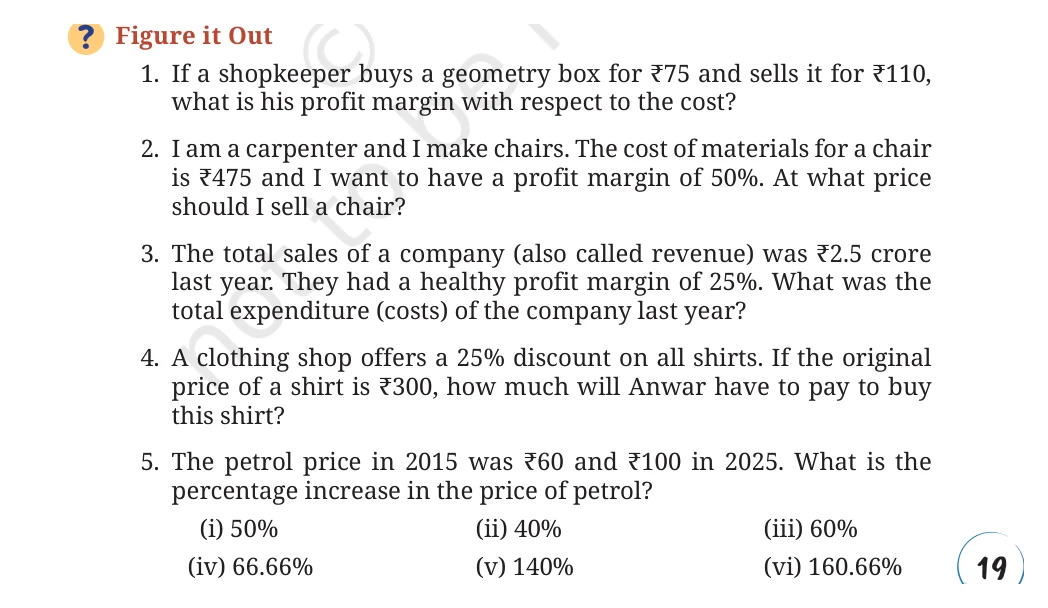
Solve the five profit, expenditure, discount, and petrol questions.
Show solution
(1) 35/75\times100=46.67\% profit. (2) ₹712.50. (3) Profit is 25% of ₹2.5 crore = ₹0.625 crore, so expenditure is ₹1.875 crore. (4) ₹225. (5) 40/60\times100=66.67\%, choice (iv).
Complete worked answers
Textbook page 20
Textbook page 20 · solved item 36
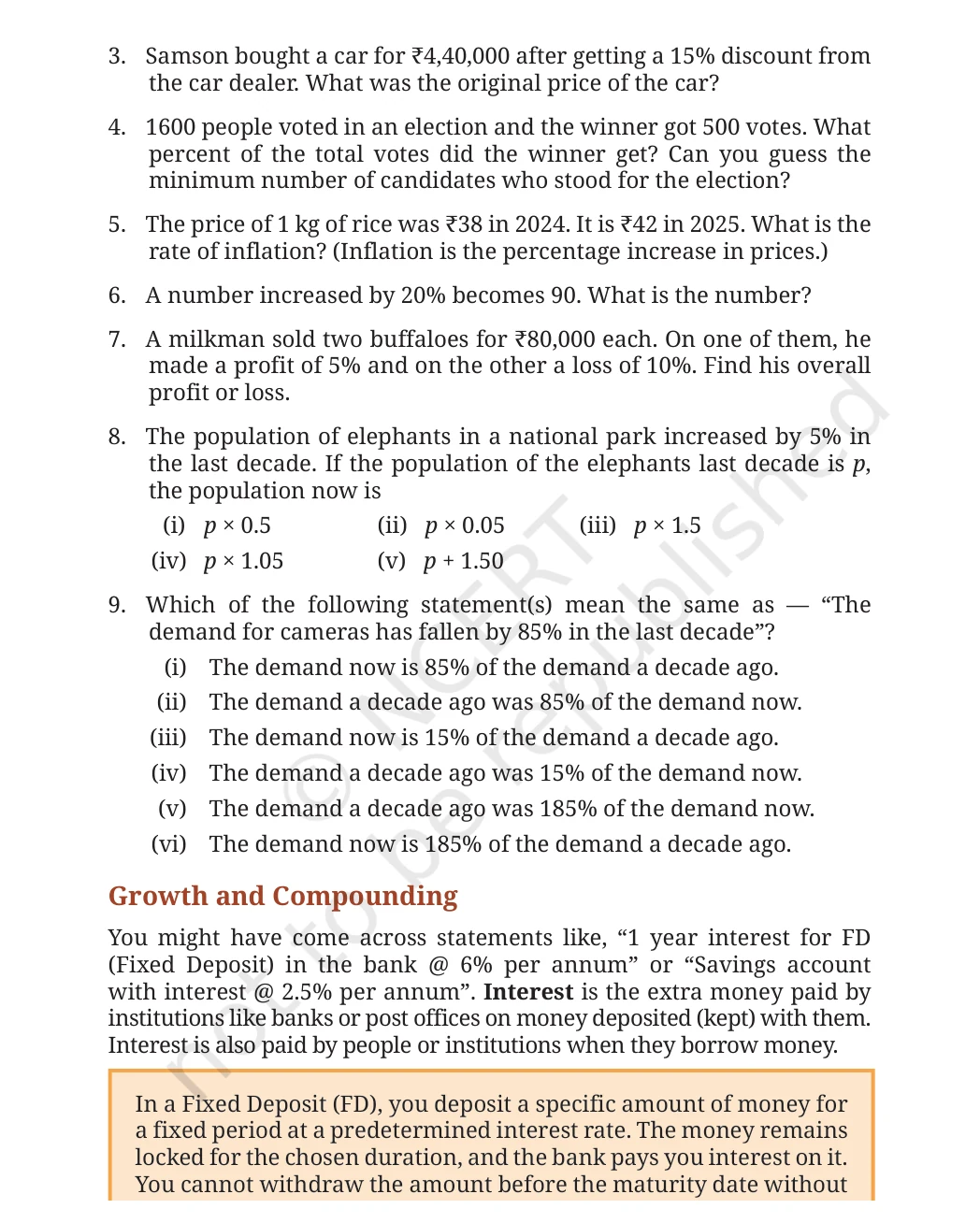
Solve the seven continuation questions about car price, election, inflation, reverse percentage, buffaloes, elephants, and cameras.
Show solution
Car original price (=₹440000/0.85\approx₹5,17,647.06). Winner: 31.25% and at least 4 candidates. Inflation: 4/38\times100\approx10.53\%. Original number: 75. Buffaloes: overall loss about ₹5,079.37 or 3.08%. Elephants: (p\times1.05), choice (iv). Cameras: demand now is 15% of before, choice (iii).
Complete worked answers
Textbook page 22
Textbook page 22 · solved item 37
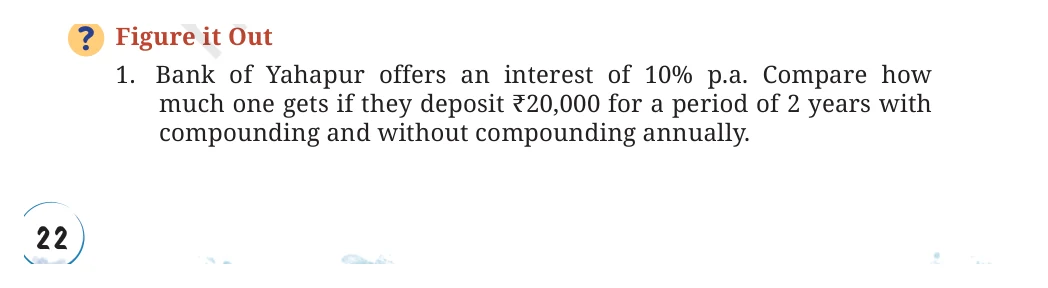
Compare simple and compound returns on ₹20,000 at 10% for two years.
Show solution
Without compounding: ₹24,000. With annual compounding: ₹20,000 × 1.1² = ₹24,200, which is ₹200 more.
Complete worked answers
Textbook page 23
Textbook page 23 · solved item 38
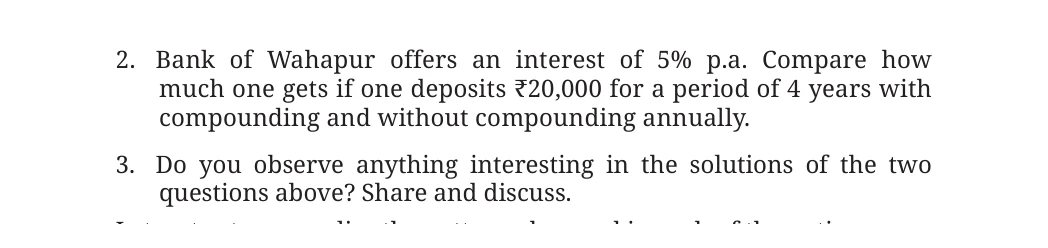
Compare simple and compound returns on ₹20,000 at 5% for four years and note the pattern.
Show solution
Without compounding: ₹24,000. With compounding: ₹20,000 × 1.05⁴ = ₹24,310.13 approximately. Both this and the previous simple-interest case gain 20% overall, but compounding adds interest on earlier interest.
Complete worked answers
Textbook page 24
Textbook page 24 · solved item 39
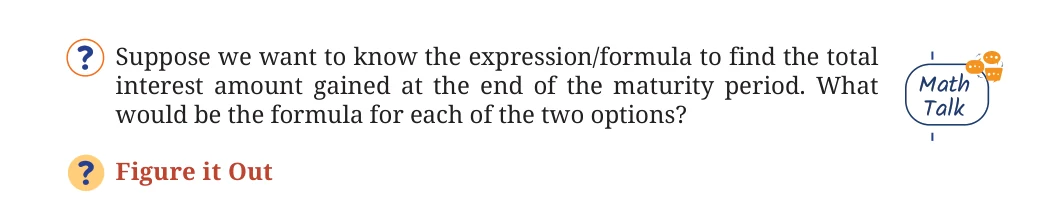
Write formulas for total interest with and without compounding.
Show solution
If rate (r) is written as a decimal, simple interest is (prt). Compound interest is (p(1+r)^t-p). Corresponding total amounts are (p(1+rt)) and (p(1+r)^t).
Textbook page 24 · solved item 40
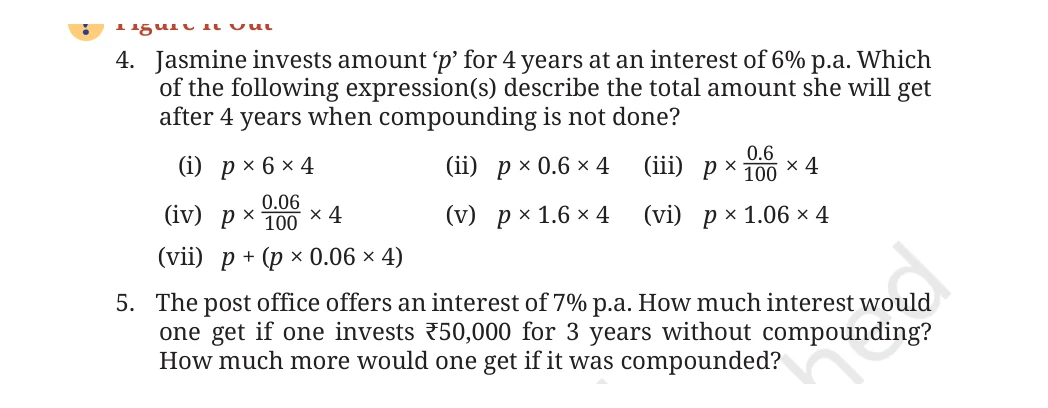
Choose Jasmine's no-compounding expression and solve the post-office investment.
Show solution
Jasmine's total amount is (p+(p\times0.06\times4)), choice (vii). At 7% for 3 years, ₹50,000 earns ₹10,500 simple interest. Compounding gives ₹61,252.15 total, or ₹11,252.15 interest, ₹752.15 more.
Textbook page 24 · solved item 41

Compare Giridhar's simple-interest loan with Raghava's compound-interest loan.
Show solution
Giridhar pays ₹12,500 × 0.12 × 3 = ₹4,500 interest. Raghava pays ₹12,500 × 1.1³ − ₹12,500 = ₹4,137.50. Giridhar pays ₹362.50 more.
Textbook page 24 · solved item 42
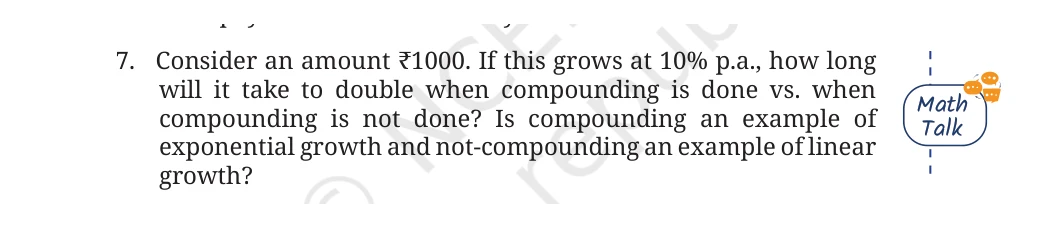
How long does ₹1,000 at 10% take to double with and without compounding?
Show solution
Without compounding it takes 10 years. With annual compounding, (1.1^7<2) but (1.1^8>2), so it first doubles during year 8. Compound growth is exponential; simple growth is linear.
Textbook page 24 · solved item 43
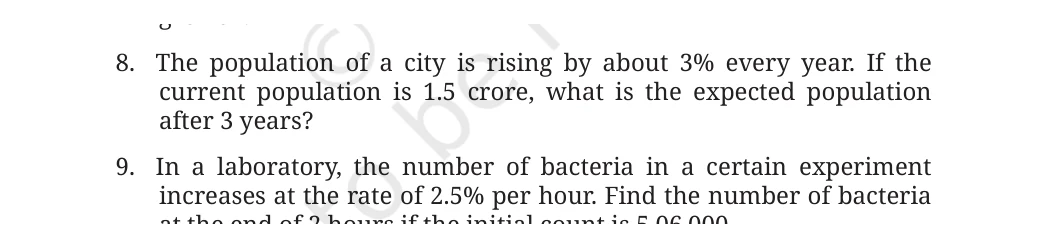
Solve the city-population and bacteria compound-growth questions.
Show solution
City: (1.5\times1.03^3=1.6390905) crore, about 1.64 crore. Bacteria: (506000\times1.025^2=531616.25), about 531,616 bacteria.
Complete worked answers
Textbook page 25
Textbook page 25 · solved item 44
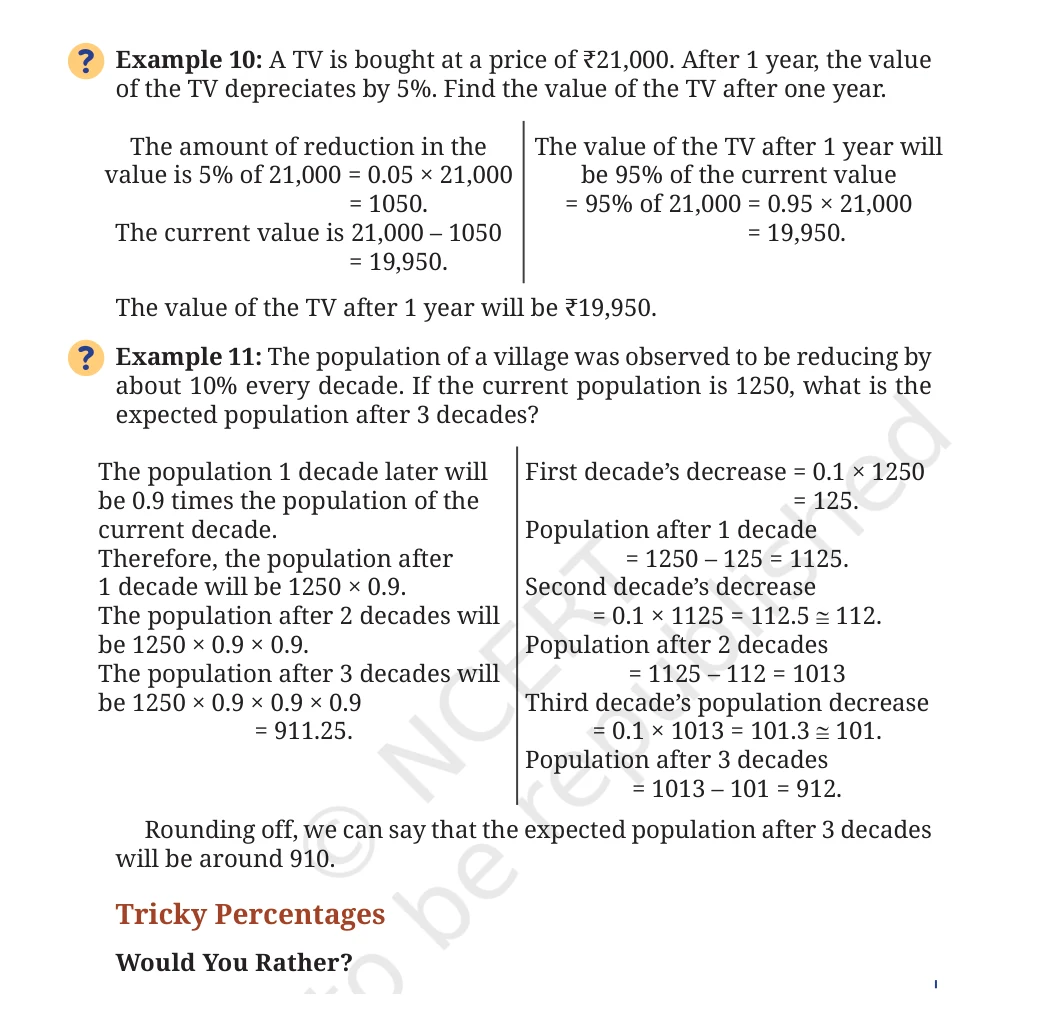
Find the depreciated TV value and village population after three decades.
Show solution
TV: (₹21000\times0.95=₹19,950). Village: (1250\times0.9^3=911.25), so about 911 people, or roughly 910 after sensible rounding.
Textbook page 25 · solved item 45
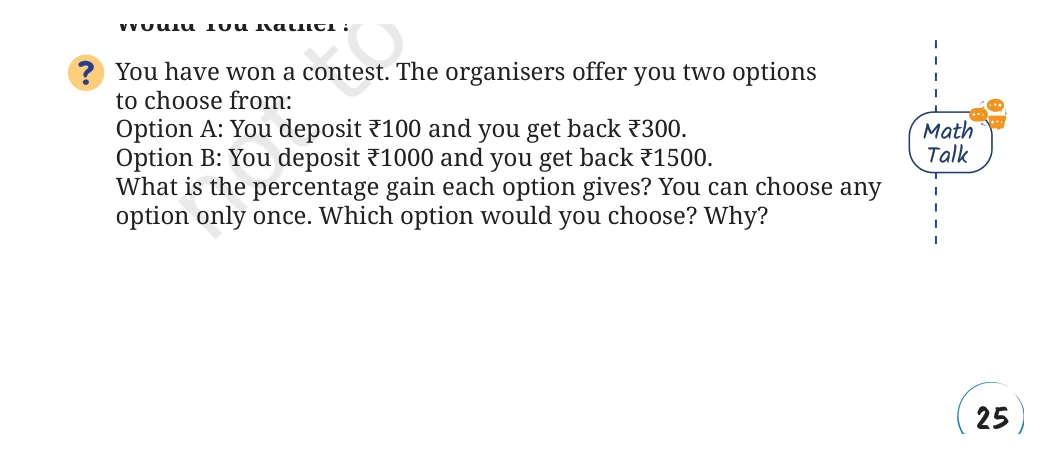
Compare the contest options and the fixed ₹50 versus 20% discounts.
Show solution
Option A gains ₹200, a 200% gain; B gains ₹500, a 50% gain. Choose A for percentage return or B for absolute money. For purchases ₹180, ₹225, ₹300, choose ₹50, ₹50, and 20% (₹60), respectively.
Complete worked answers
Textbook page 26
Textbook page 26 · solved item 46
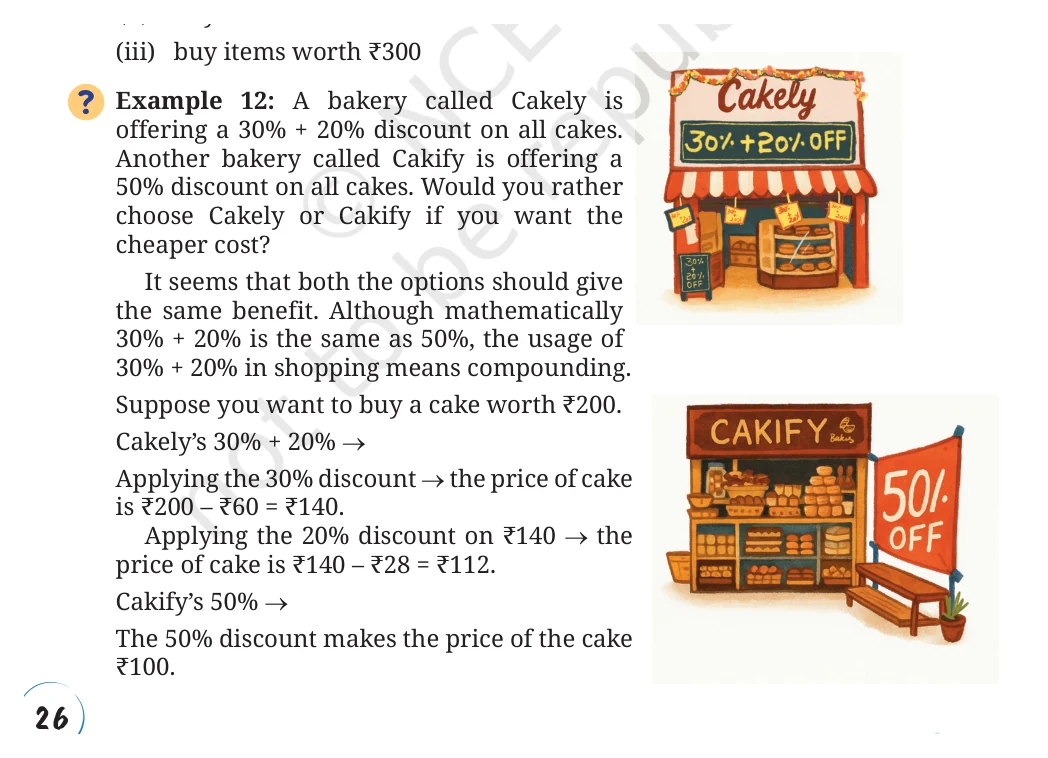
Compare successive 30% and 20% discounts with one 50% discount.
Show solution
On ₹200, successive discounts give ₹200 × 0.7 × 0.8 = ₹112, an effective 44% discount. A direct 50% discount gives ₹100, so Cakify is cheaper.
Complete worked answers
Textbook page 27
Textbook page 27 · solved item 47
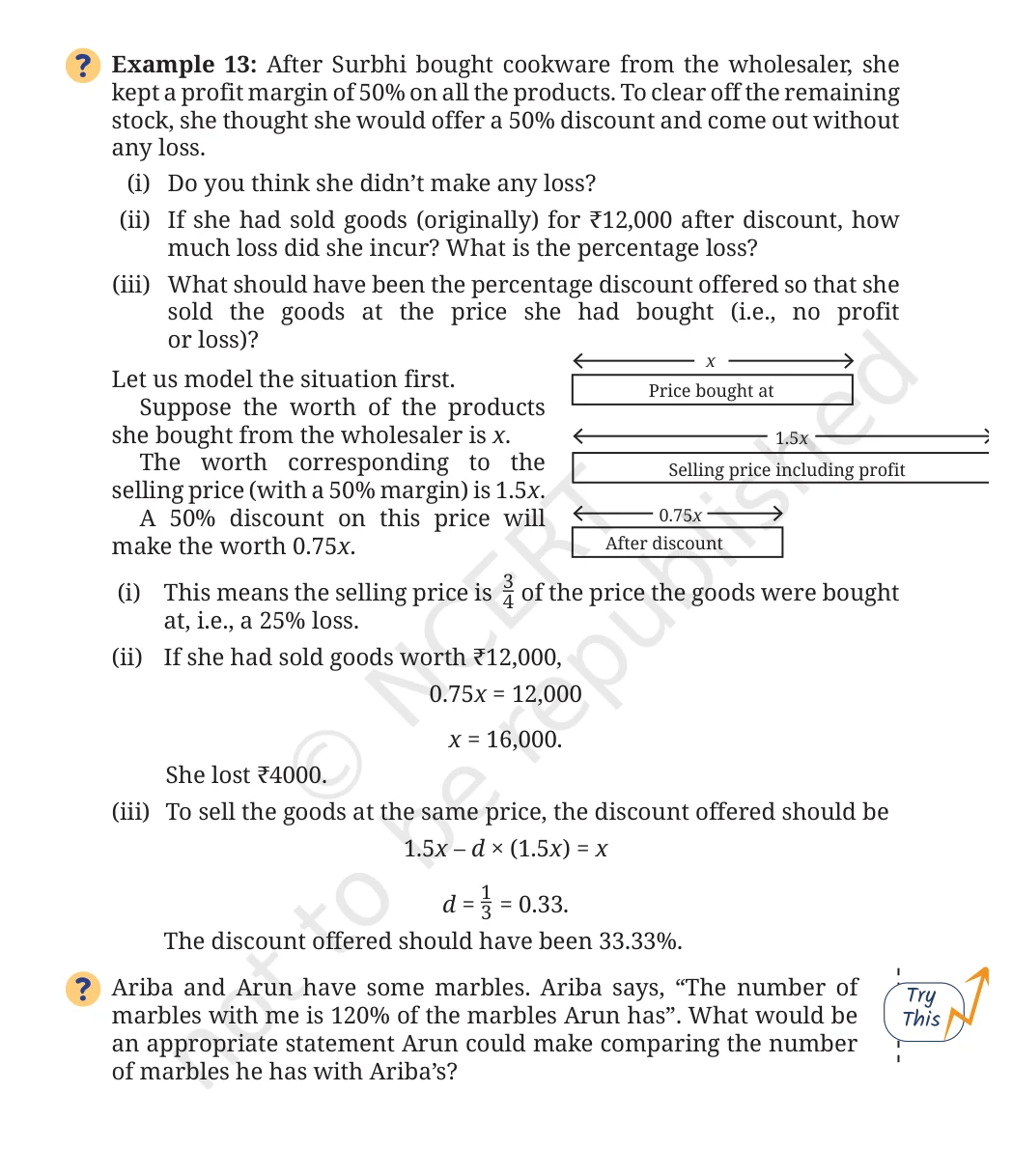
Solve Surbhi's 50%-markup and 50%-discount mishap, then reverse Ariba's 120% comparison.
Show solution
The final factor is (1.5\times0.5=0.75), a 25% loss. A ₹12,000 sale corresponds to ₹16,000 cost, so loss is ₹4,000. Break-even discount is 1-1/1.5=33\frac13\%. If Ariba has 120% of Arun's marbles, Arun has 100/120=83\frac13\% of Ariba's.
Complete worked answers
Textbook page 28
Textbook page 28 · solved item 48
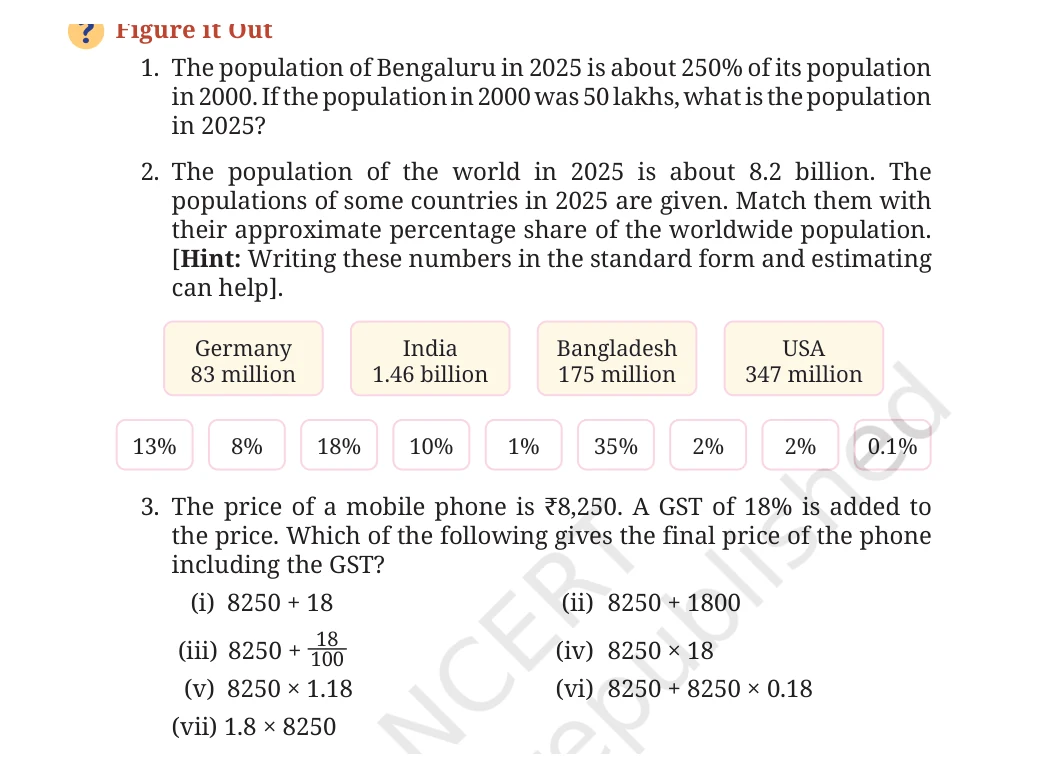
Solve final Figure It Out Questions 1–3: Bengaluru, country shares, and mobile GST.
Show solution
Bengaluru: (250\%\times50=125) lakh = 1.25 crore. Approximate shares: Germany 1%, India 18%, Bangladesh 2%, USA 4%. Mobile final price is (₹8250\times1.18=₹9735); choices (v) and (vi).
Textbook page 28 · solved item 49
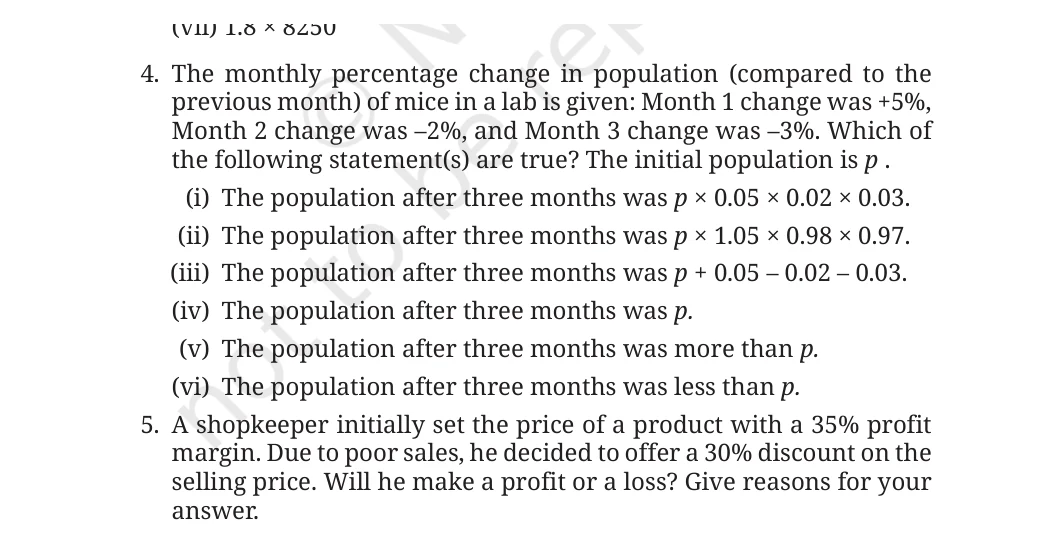
Evaluate the three monthly mice changes and the 35%-markup/30%-discount sale.
Show solution
Mice: (p\times1.05\times0.98\times0.97=0.99813p), so statements (ii) and (vi) are true. Shop: final factor (1.35\times0.70=0.945), so the shopkeeper makes a 5.5% loss.
Textbook page 28 · solved item 50
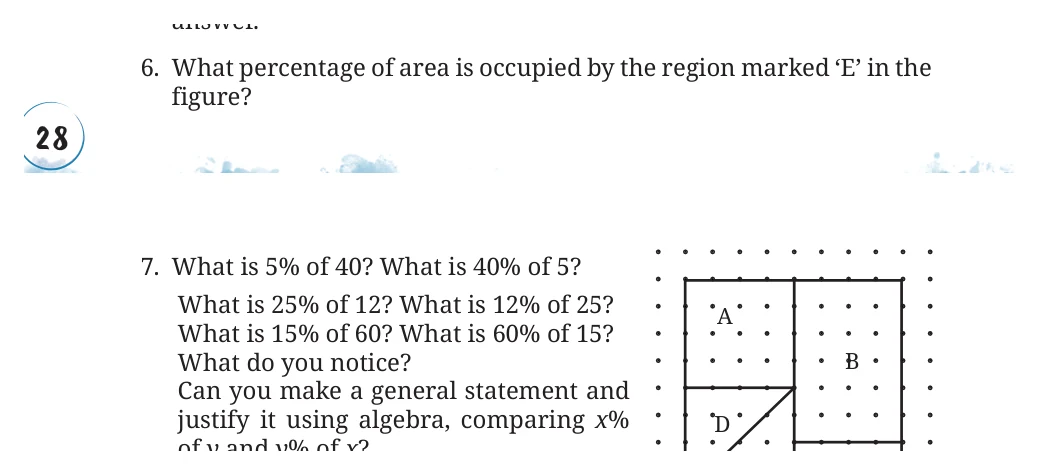
What percentage of the diagram's area is region E?
Show solution
The outer square is (8\times8=64) grid-square units. E is half of a (4\times4) square, so its area is 8 units. Thus E occupies 8/64\times100=12.5\%.
Complete worked answers
Textbook page 29
Textbook page 29 · solved item 51
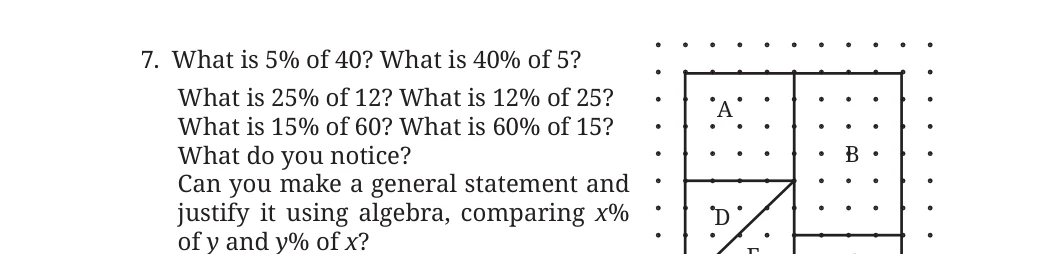
Compare x% of y with y% of x.
Show solution
They are always equal because (x\%\text{ of }y=\frac{x}{100}y=\frac{y}{100}x=y\%\text{ of }x). The three pairs evaluate to 2, 3, and 9 on both sides.
Textbook page 29 · solved item 52
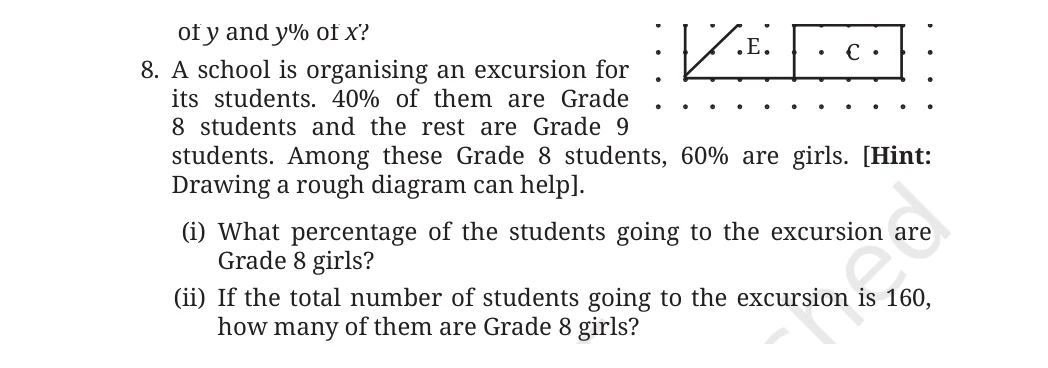
Find the Grade 8 girls on the excursion as a percentage and as a count out of 160.
Show solution
They are 40\%\times60\%=24\% of all students. Applied to 160, this gives 38.4. Since a headcount must be whole, the stated percentages cannot both be exact for a group of 160; an actual count would need clarified or rounded data.
Textbook page 29 · solved item 53
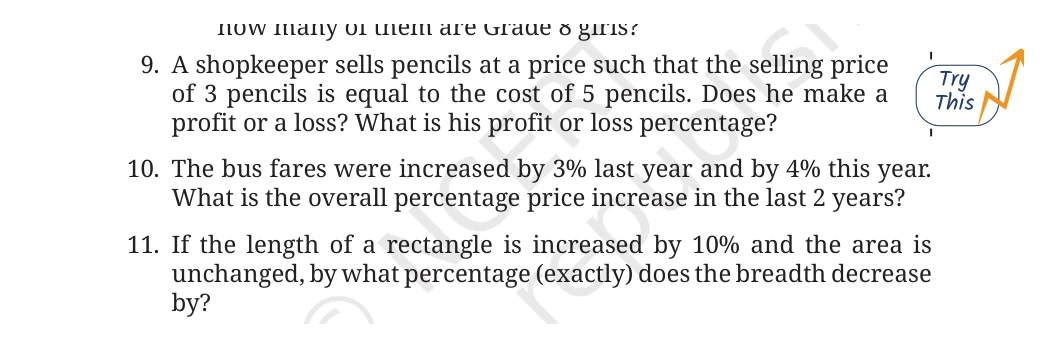
Solve the pencil profit, successive bus fare increase, and constant-area rectangle questions.
Show solution
Pencils: SP per pencil is (5/3) of CP, a 66\frac23\% profit. Bus fares: (1.03\times1.04=1.0712), a 7.12% increase. Breadth factor is (1/1.1=10/11), so it decreases exactly 1/11=9\frac1{11}\%.
Textbook page 29 · solved item 54

Find each ingredient's weight in the 65 g chips packet.
Show solution
Potato 70% = 45.5 g; vegetable oil 24% = 15.6 g; salt 3% = 1.95 g; spices 3% = 1.95 g.
Textbook page 29 · solved item 55
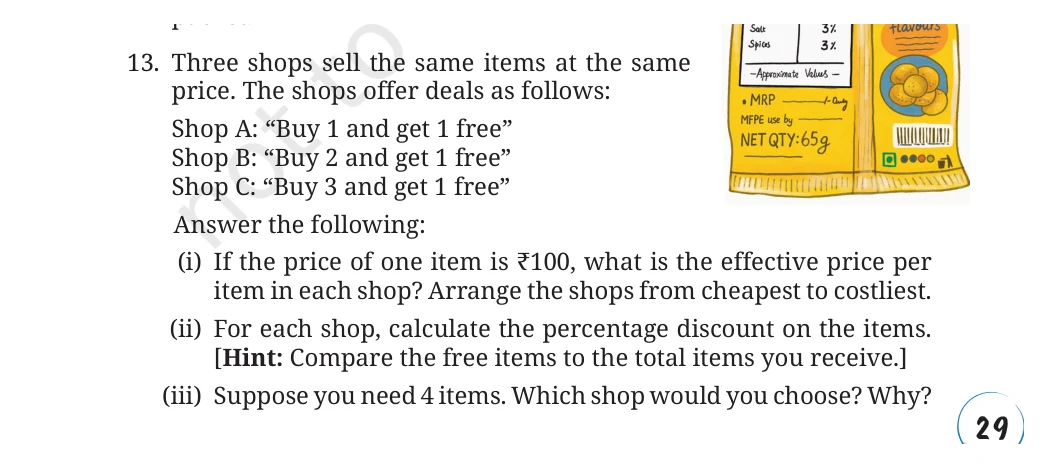
Compare the three buy-and-get-free shop deals.
Show solution
Effective prices: A ₹50, B ₹66.67, C ₹75, so A, B, C from cheapest to costliest. Discounts are 50%, 33.33%, and 25%. For exactly 4 items, A costs ₹200; B and C each cost ₹300, so choose A.
Complete worked answers
Textbook page 30
Textbook page 30 · solved item 56
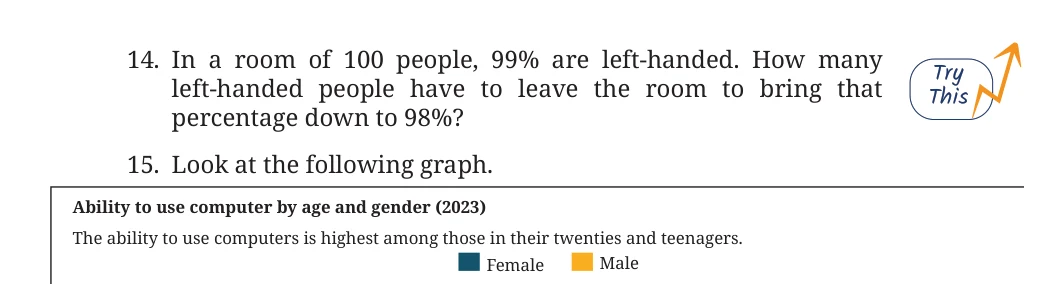
In a room of 100 people, 99 are left-handed. How many left-handed people must leave to make it 98%?
Show solution
If (x) leave, ((99-x)/(100-x)=0.98). Solving gives (x=50). Then 49 of the remaining 50 are left-handed.
Textbook page 30 · solved item 57
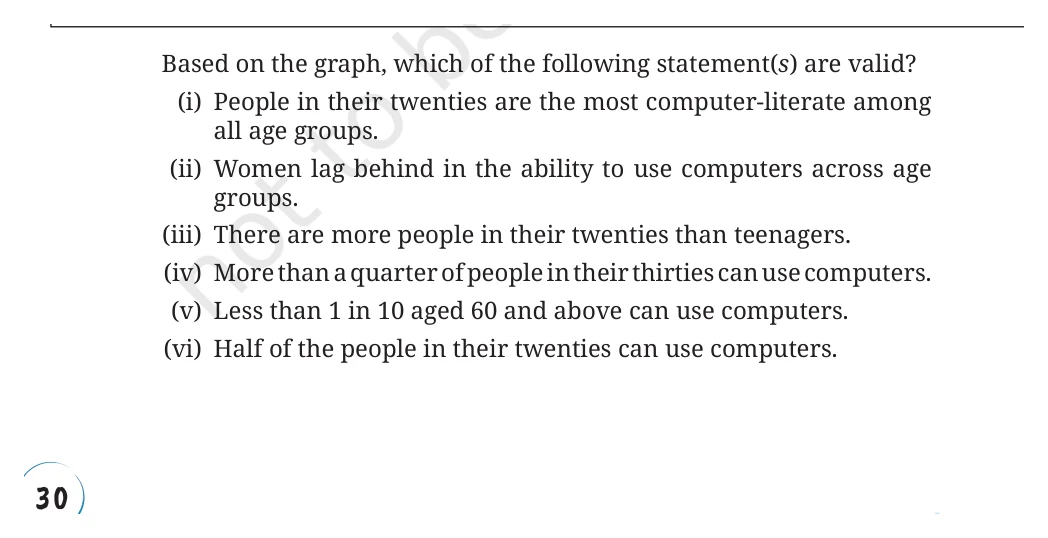
Which statements about the computer-use graph are valid?
Show solution
Statements (i), (ii), and (v) are supported. Twenties lead both gender series; the female percentages are below the male percentages in every shown age group; and both senior values are below 10%. The graph does not show population counts, over 25% in the thirties for both groups, or 50% in the twenties.
Complete worked answers
Textbook page 32
Textbook page 32 · solved item 58
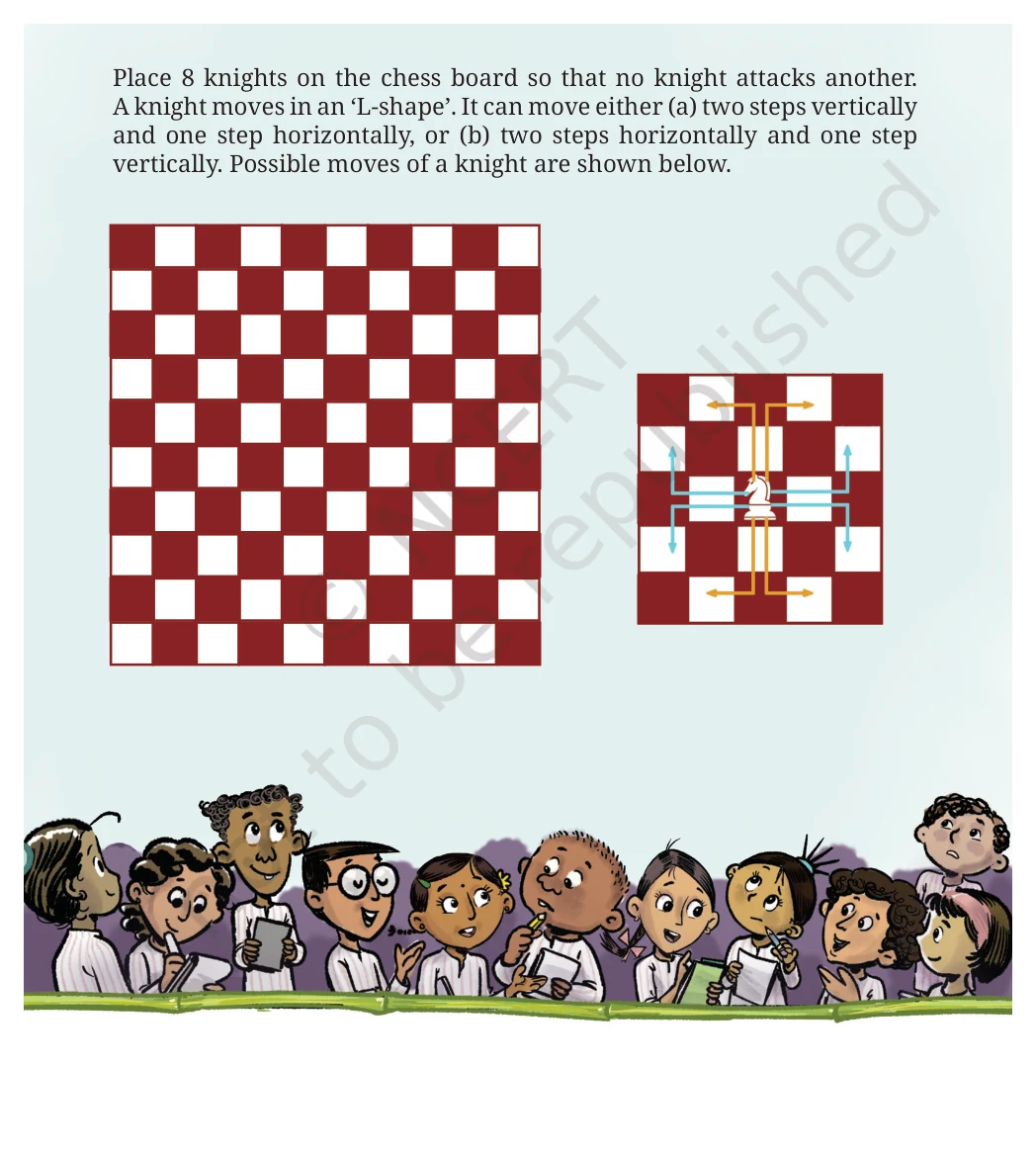
Place eight peaceful knights so none attacks another.
Show solution
Place all eight knights on squares of one colour, for example a1, c1, e1, g1, b2, d2, f2, h2. Every knight move lands on the opposite colour, so no two of these knights attack each other.