
Use the textbook context
Match, attempt, then check
Each source crop keeps the printed information needed for that item. Compound answer-key entries are separated into individual solutions.
Complete worked answers
Textbook page 1
Textbook page 1 · solved item 1
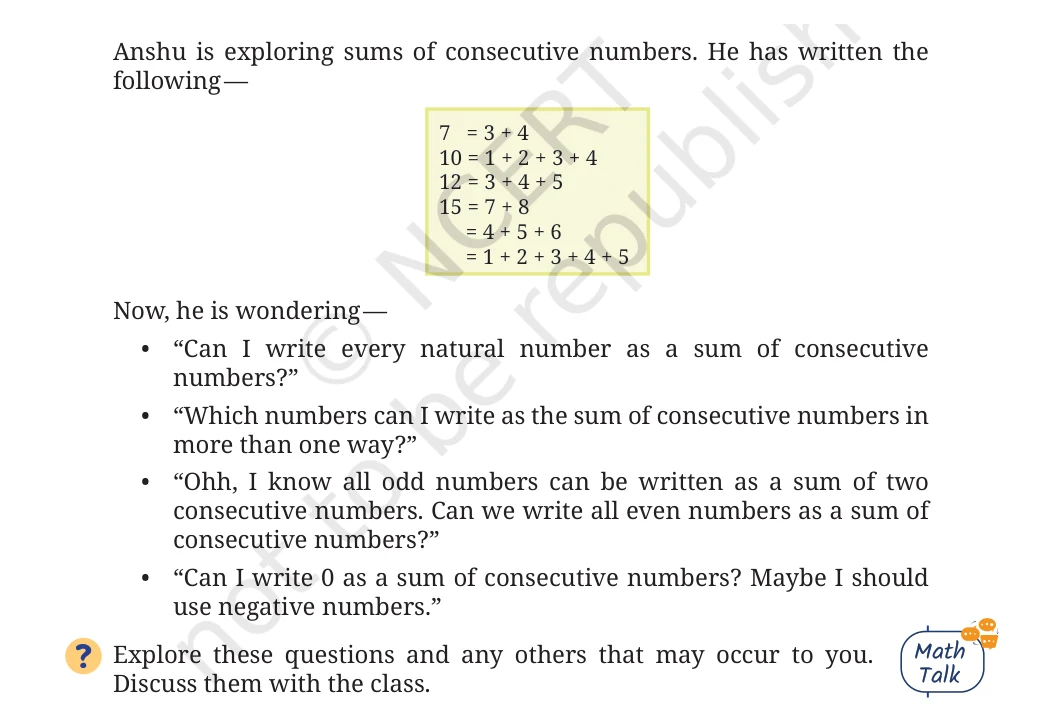
Explore which numbers can be written as sums of consecutive integers.
Show solution
If one-term sums are allowed, every natural number is its own sum. Using at least two positive consecutive integers, exactly the positive integers that are not powers of 2 can be represented. Every odd number greater than 1 is (n-1)/2+(n+1)/2. Some even numbers also work, such as 10=1+2+3+4, but powers of 2 do not.
With negative integers, 0=(-1)+0+1.
Textbook page 1 · solved item 2
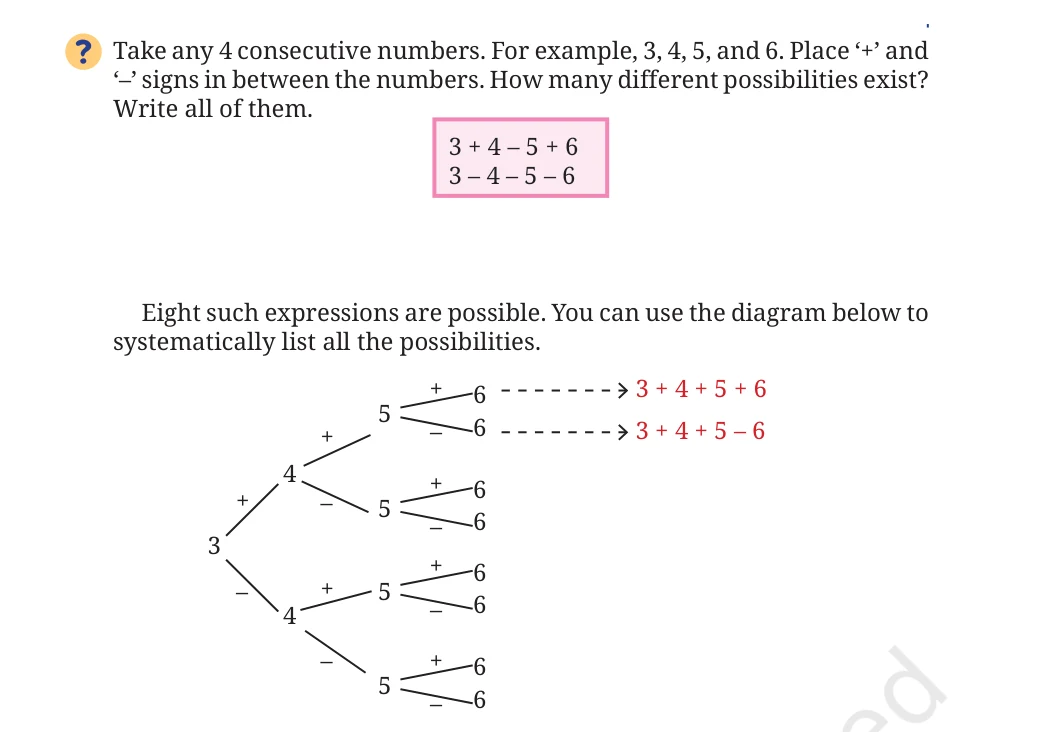
List and evaluate all sign arrangements for 3, 4, 5, and 6.
Show solution
The eight values are: 3+4+5+6=18, 3+4+5-6=6, 3+4-5+6=8, 3+4-5-6=-4, 3-4+5+6=10, 3-4+5-6=-2, 3-4-5+6=0, and 3-4-5-6=-12. All are even.
Complete worked answers
Textbook page 2
Textbook page 2 · solved item 3
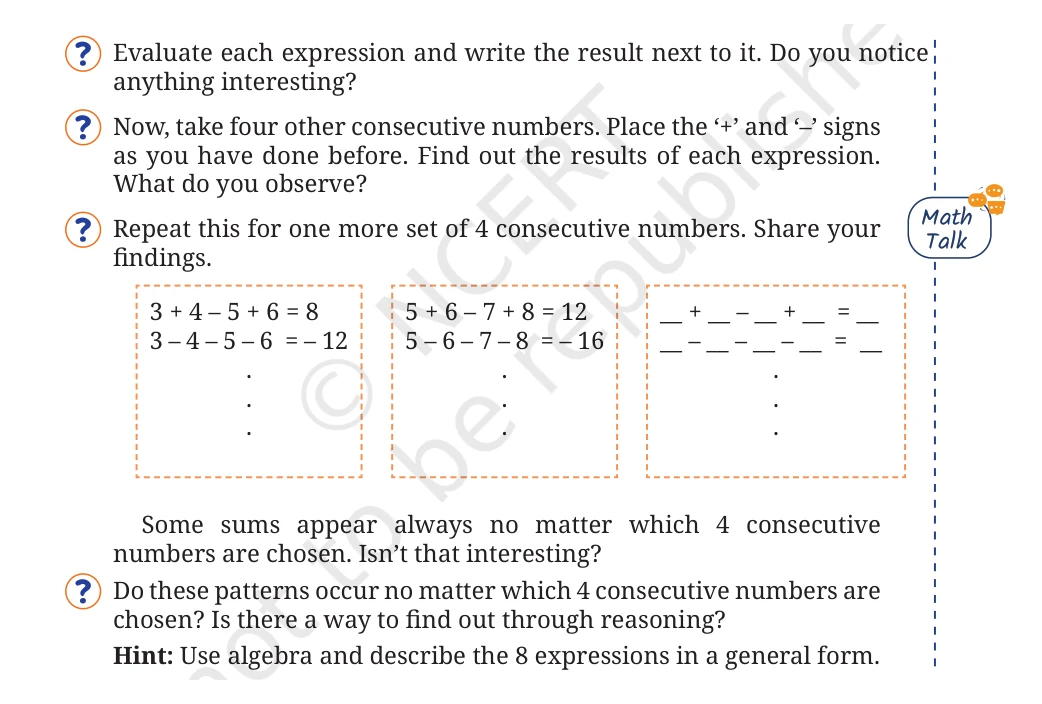
What pattern appears when the eight sign arrangements are evaluated for other sets of four consecutive numbers?
Show solution
Every result is even. Writing the numbers as n,n+1,n+2,n+3, any choice of signs has the same parity as their all-plus sum 4n+6, which is even.
Complete worked answers
Textbook page 3
Textbook page 3 · solved item 4
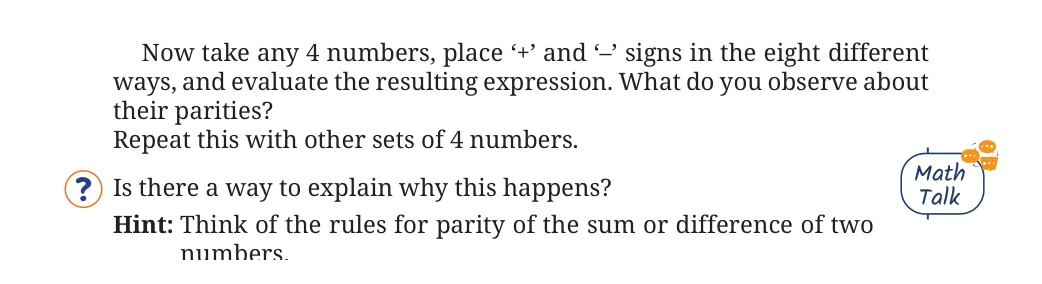
For any four integers, what can be said about the parities of all eight sign arrangements?
Show solution
All eight results have the same parity. Each sign change changes the value by twice an integer, so it cannot change parity. Their common parity is the parity of a+b+c+d.
Textbook page 3 · solved item 5
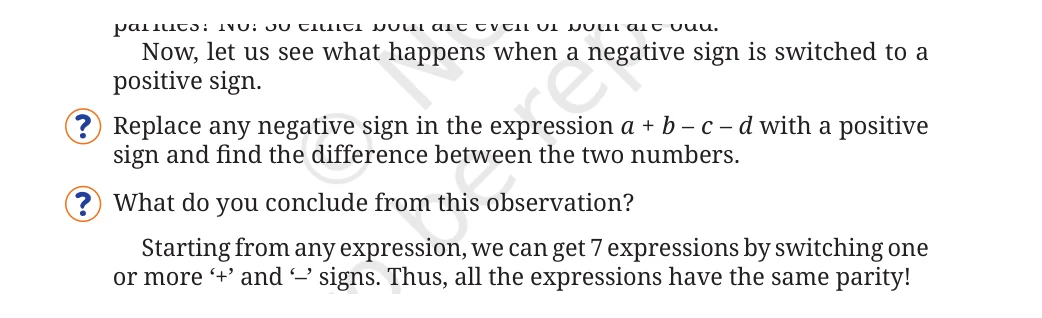
What happens when a negative sign in an expression is switched to positive?
Show solution
Changing -c to +c increases the value by 2c; changing -d to +d increases it by 2d. The change is always even, so parity stays unchanged.
Complete worked answers
Textbook page 4
Textbook page 4 · solved item 6
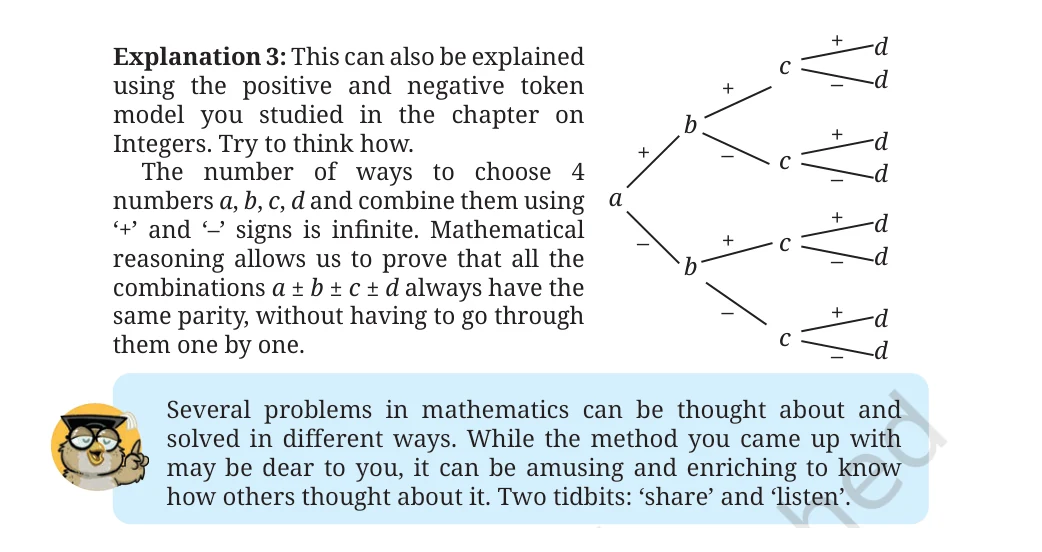
Explain the same-parity result using positive and negative tokens.
Show solution
Switching the sign of a number replaces its tokens by the same number of opposite tokens. The net value changes by two times that number, an even amount. Therefore no sign switch changes parity.
Textbook page 4 · solved item 7

Is the same-parity phenomenon limited to four numbers?
Show solution
No. For any fixed list of integers, changing any selection of plus and minus signs changes the value by a sum of terms of the form 2k. Hence every sign arrangement has the same parity, regardless of how many numbers are used.
Textbook page 4 · solved item 8
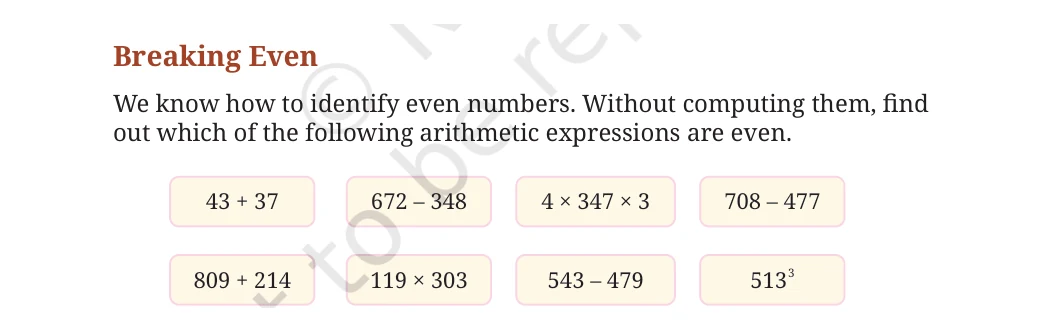
Without fully computing, identify the even arithmetic expressions shown.
Show solution
The even expressions are 43+37, 672-348, 4\times347\times3, and 543-479. The other four are odd: 708-477, 809+214, 119\times303, and 513^3.
Textbook page 4 · solved item 9
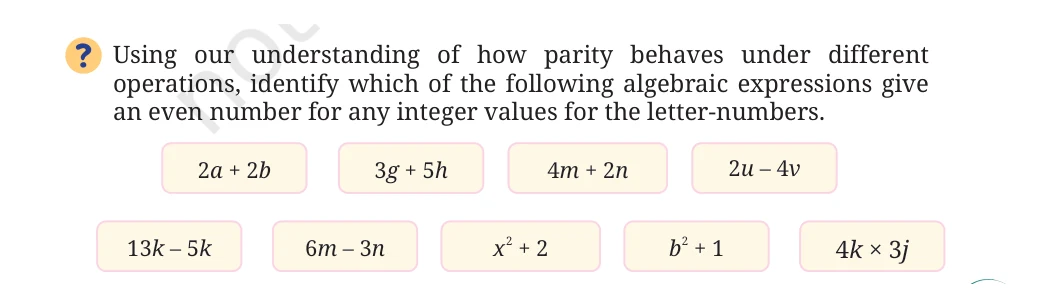
Which algebraic expressions shown are always even for integer values?
Show solution
Always even: 2a+2b, 4m+2n, 2u-4v, 13k-5k=8k, and 4k\times3j=12kj. The expressions 3g+5h, 6m-3n, x^2+2, and b^2+1 are not always even.
Complete worked answers
Textbook page 5
Textbook page 5 · solved item 10
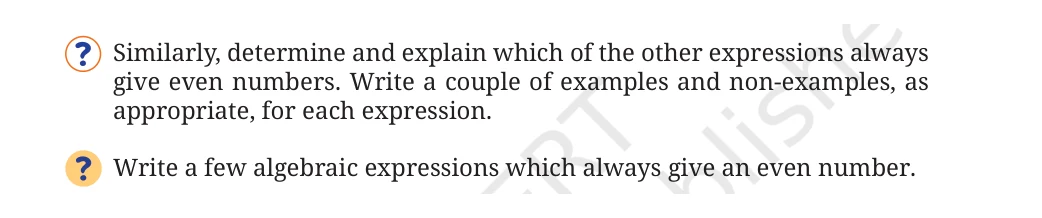
Explain the classifications and write more expressions that are always even.
Show solution
An expression is guaranteed even when 2 can be factored from every term. Examples include 6r+10s=2(3r+5s) and 4x^2-2y=2(2x^2-y). For a non-example such as 3g+5h, g=h=1 gives 8 but g=1,h=2 gives 13.
Textbook page 5 · solved item 11
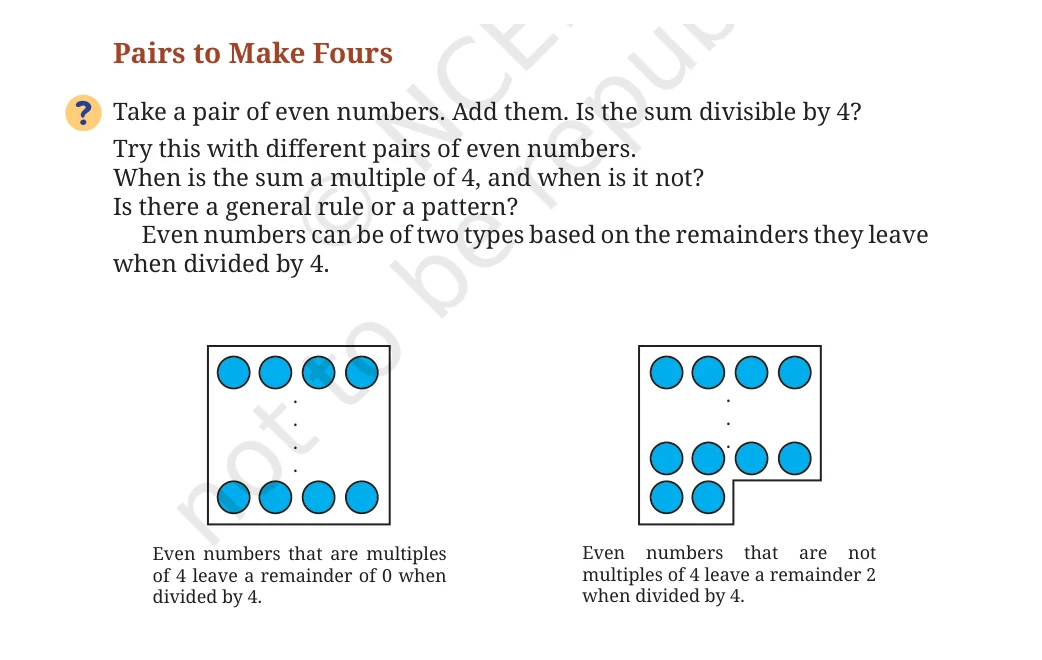
When is the sum of two even numbers divisible by 4?
Show solution
Write each even number as either 4p or 4p+2. The sum is divisible by 4 when both have the same type: 4p+4q, or (4p+2)+(4q+2). If one has each type, the sum leaves remainder 2.
Complete worked answers
Textbook page 6
Textbook page 6 · solved item 12
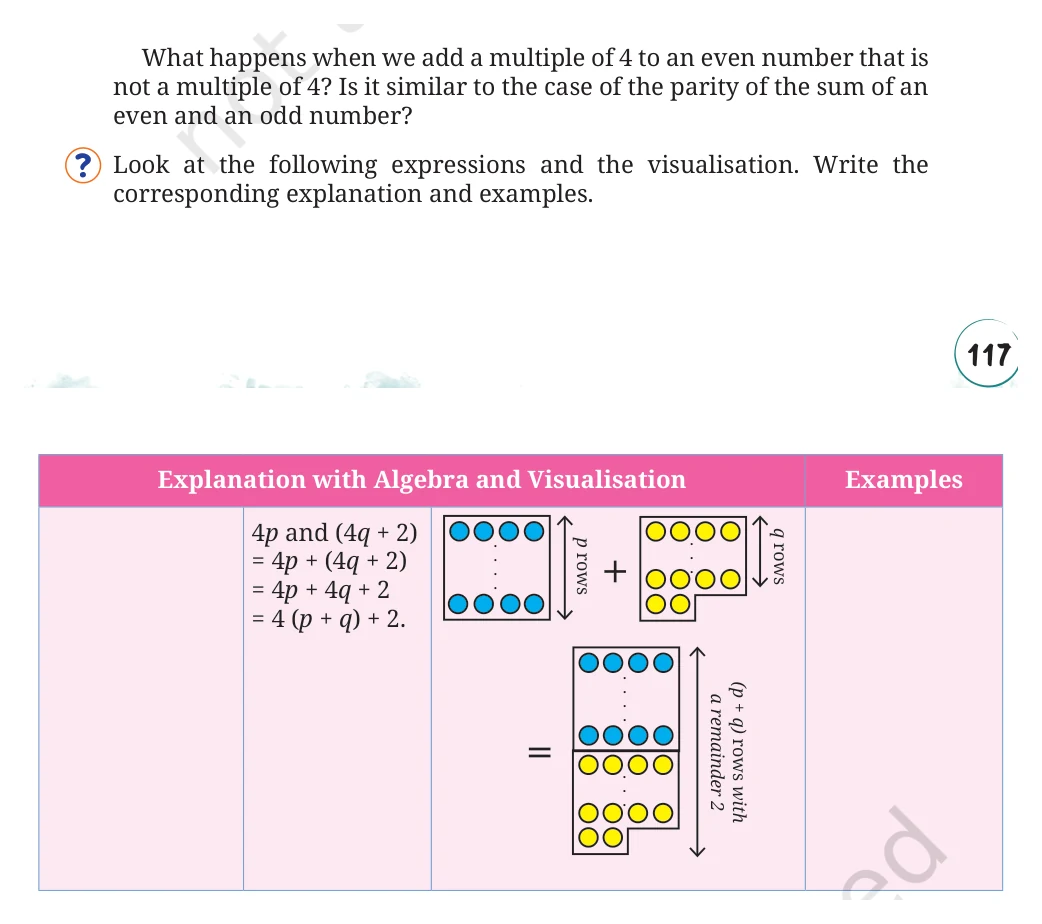
Complete the mixed case for adding a multiple of 4 and an even non-multiple of 4.
Show solution
4p+(4q+2)=4(p+q)+2. It is even but not divisible by 4; for example, 12+6=18.
Complete worked answers
Textbook page 7
Textbook page 7 · solved item 13
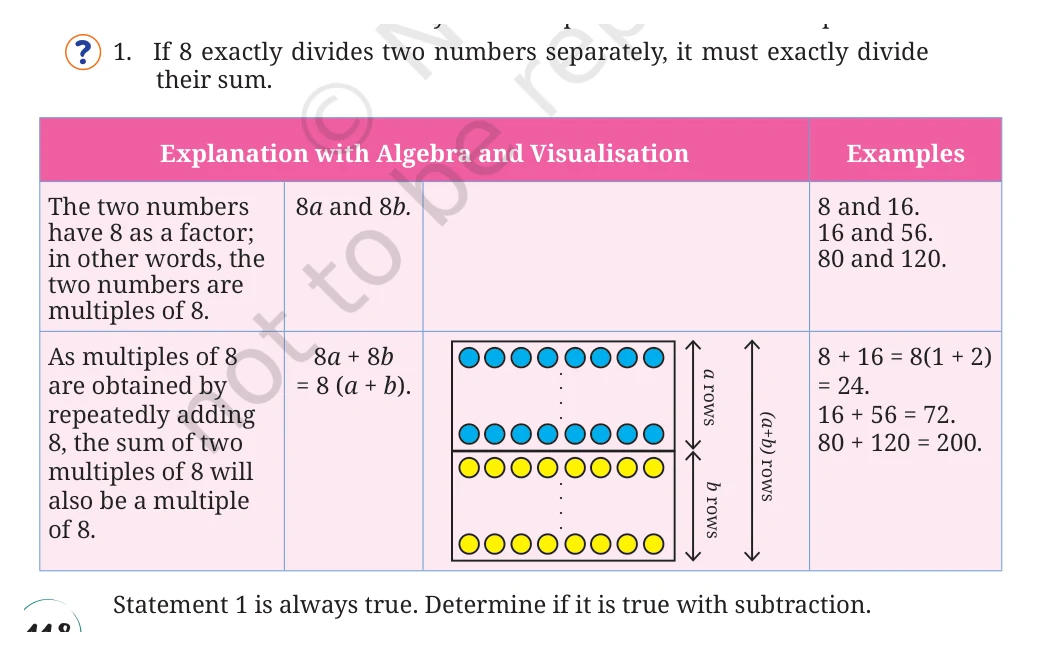
If 8 divides two numbers, does it divide their difference?
Show solution
Always true. If the numbers are 8a and 8b, their difference is 8(a-b), a multiple of 8.
Complete worked answers
Textbook page 8
Textbook page 8 · solved item 14
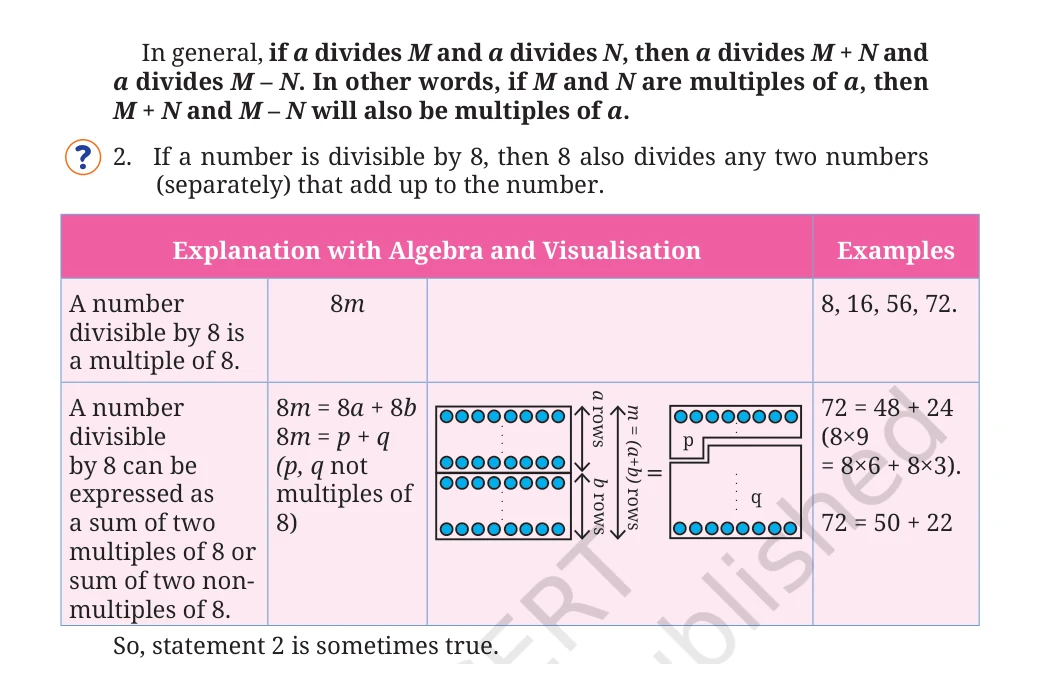
If a number is divisible by 8, must any two addends forming it both be divisible by 8?
Show solution
Sometimes true. For example, 72=48+24 uses two multiples of 8, while 72=50+22 does not.
Textbook page 8 · solved item 15
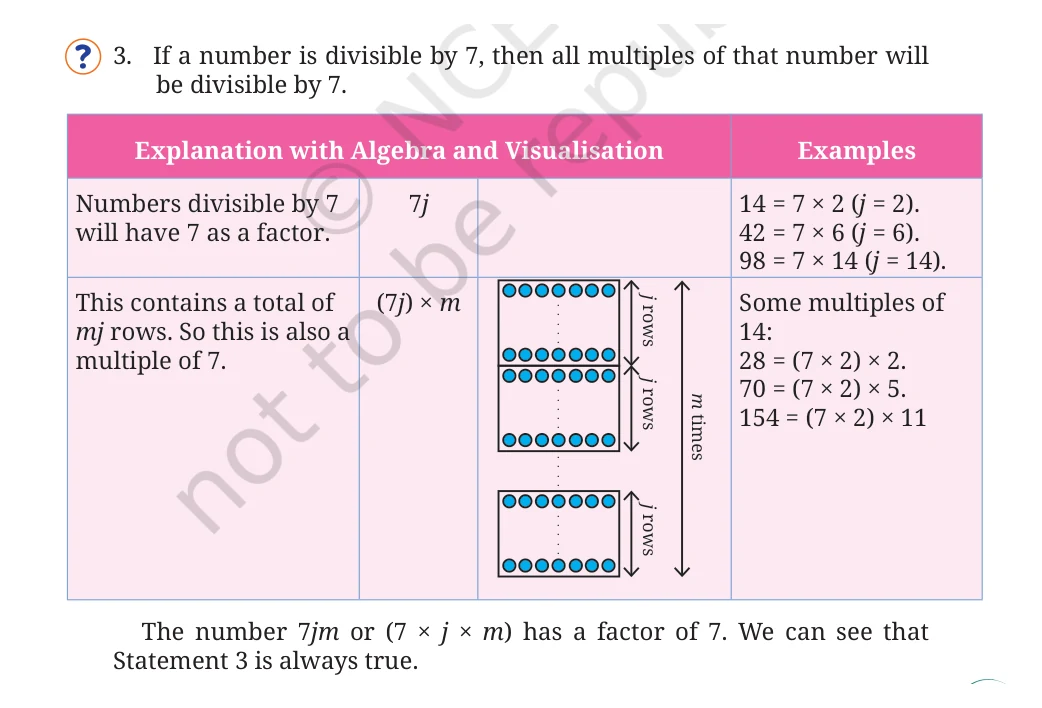
If a number is divisible by 7, are all its multiples divisible by 7?
Show solution
Always true. If A=7j, then any multiple mA=7(jm).
Complete worked answers
Textbook page 9
Textbook page 9 · solved item 16
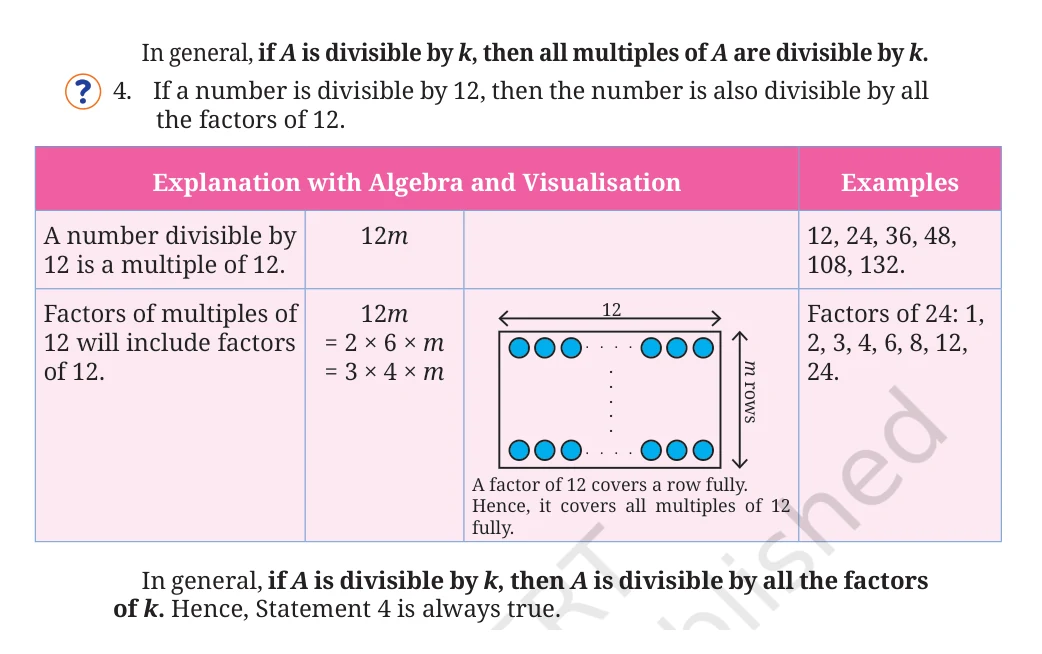
If a number is divisible by 12, is it divisible by every factor of 12?
Show solution
Always true. Writing it as 12m shows that 1, 2, 3, 4, 6, and 12 all divide it.
Textbook page 9 · solved item 17
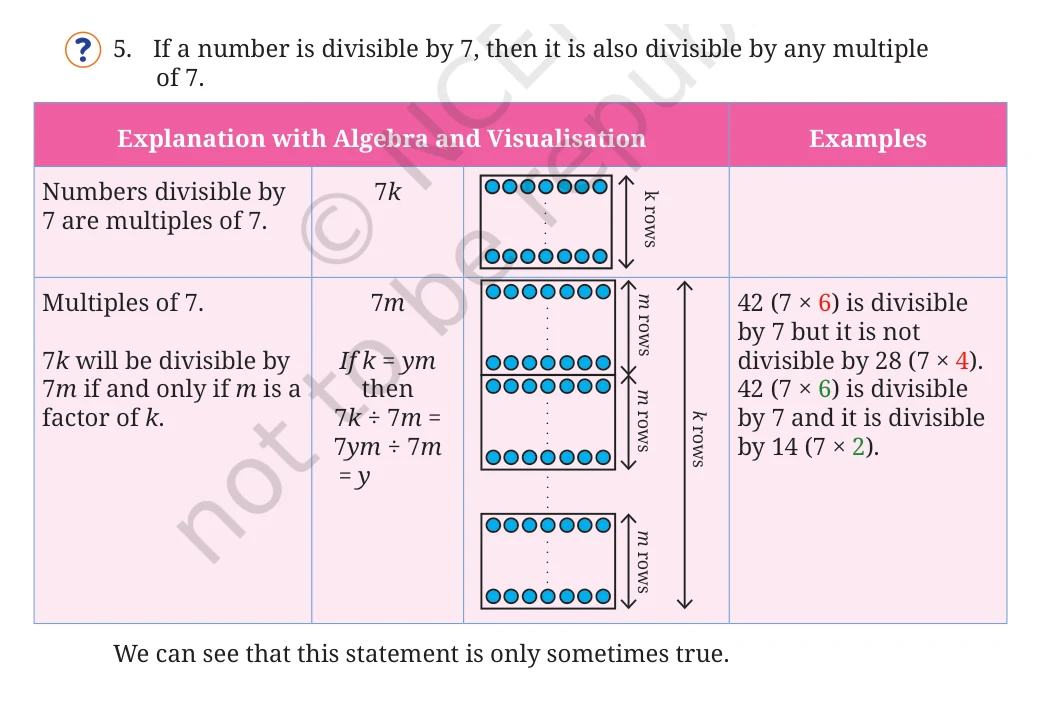
If a number is divisible by 7, is it divisible by every multiple of 7?
Show solution
Sometimes true. For example, 42 is divisible by 14 but not by 28. In general, 7k is divisible by 7m exactly when m divides k.
Complete worked answers
Textbook page 10
Textbook page 10 · solved item 18

A number is divisible by both 9 and 4. Must it be divisible by 36?
Show solution
Always true because \operatorname{lcm}(9,4)=36.
Textbook page 10 · solved item 19
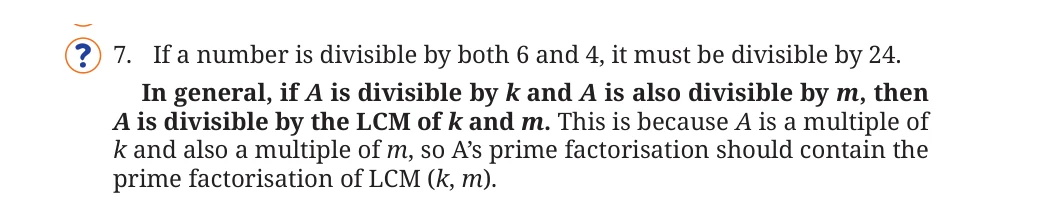
A number is divisible by both 6 and 4. Must it be divisible by 24?
Show solution
Sometimes true. Such a number must be divisible by \operatorname{lcm}(6,4)=12, but not necessarily 24: 12 is a counterexample, while 24 is an example.
Textbook page 10 · solved item 20
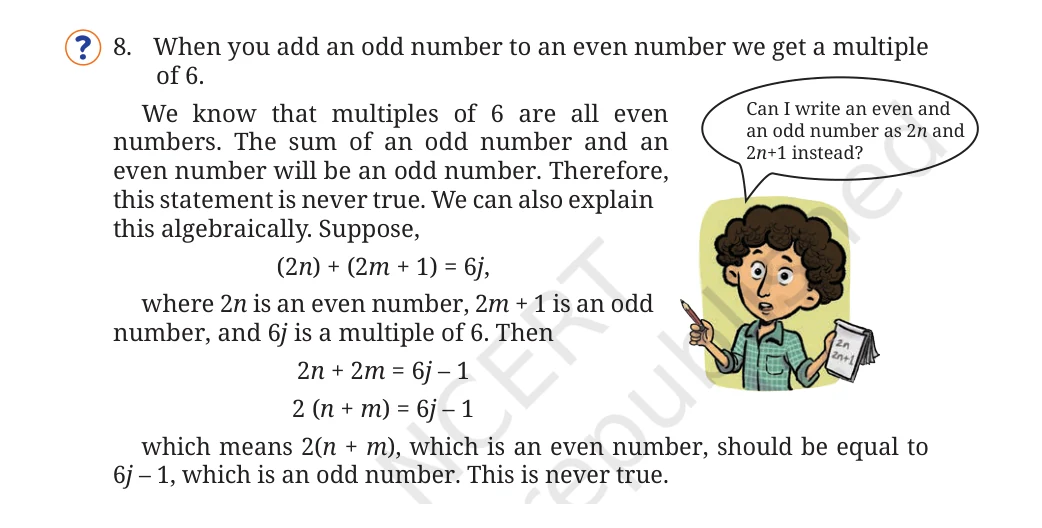
Can an odd number plus an even number be a multiple of 6?
Show solution
Never. Odd plus even is odd, whereas every multiple of 6 is even.
Textbook page 10 · solved item 21
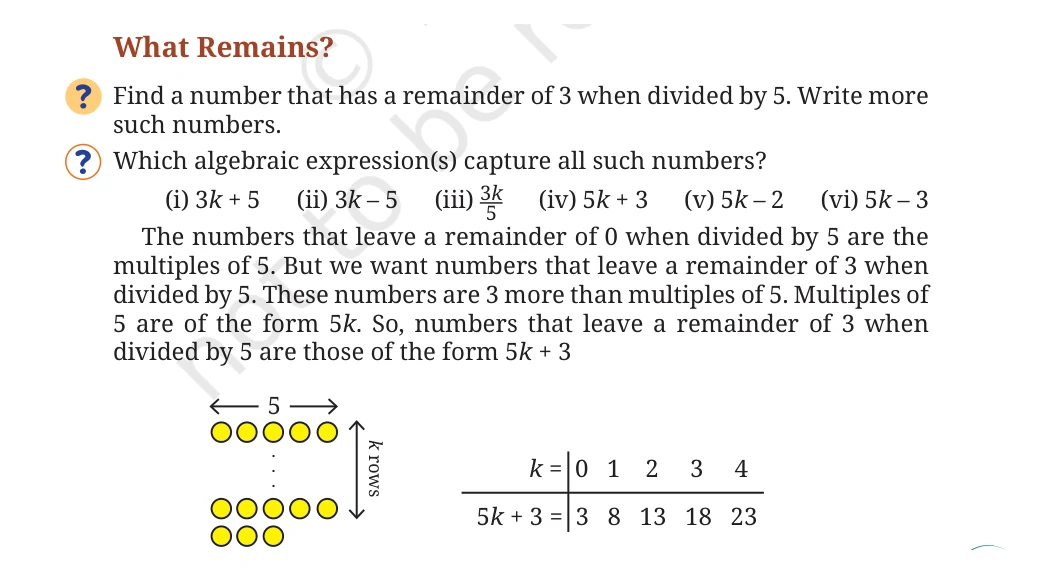
Which expressions generate all numbers leaving remainder 3 when divided by 5?
Show solution
Both 5k+3 for k\ge0 and 5k-2 for k\ge1 generate 3,8,13,18,\ldots. Thus choices (iv) and (v) work.
Complete worked answers
Textbook page 11
Textbook page 11 · solved item 22
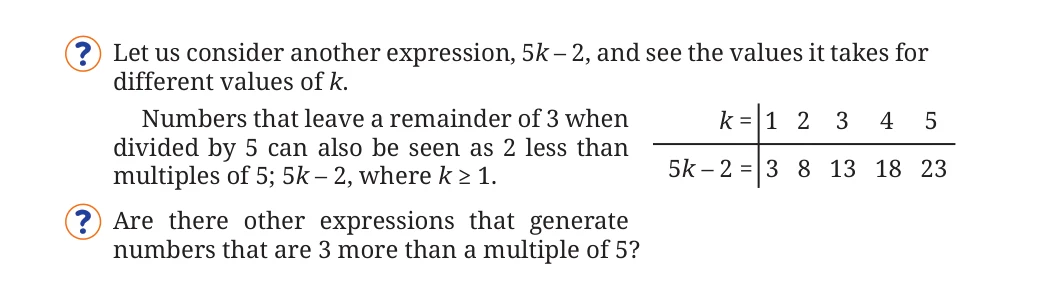
Give other expressions that generate numbers 3 more than a multiple of 5.
Show solution
Equivalent forms include 5(k+1)-2, 5k+8, and 10k+3 together with 10k+8 when the two latter families are combined. The simplest complete form is 5k+3.
Textbook page 11 · solved item 23

The sum of four consecutive numbers is 34. Find them.
Show solution
The numbers are 7, 8, 9, and 10.
Textbook page 11 · solved item 24

If p is the greatest of five consecutive numbers, express the other four.
Show solution
They are p-1,p-2,p-3,p-4.
Textbook page 11 · solved item 25
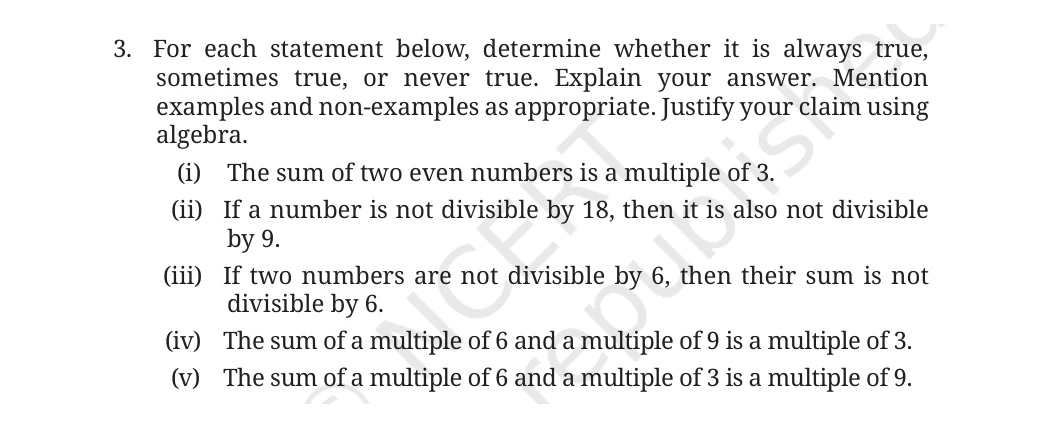
Classify the five always/sometimes/never statements in Question 3.
Show solution
(i) Sometimes: 2+4=6, but 2+6=8. (ii) Sometimes: 30 is divisible by neither 18 nor 9, but 27 is divisible by 9 and not 18. (iii) Sometimes: 8+10=18, while 9+11=20. (iv) Always: 6x+9y=3(2x+3y). (v) Sometimes: 18+9=27, but 12+9=21.
Textbook page 11 · solved item 26

Find all numbers leaving remainder 2 on division by both 3 and 4.
Show solution
Since x-2 must be divisible by both 3 and 4, x=12n+2. Examples are 14, 26, 38, and 50.
Textbook page 11 · solved item 27
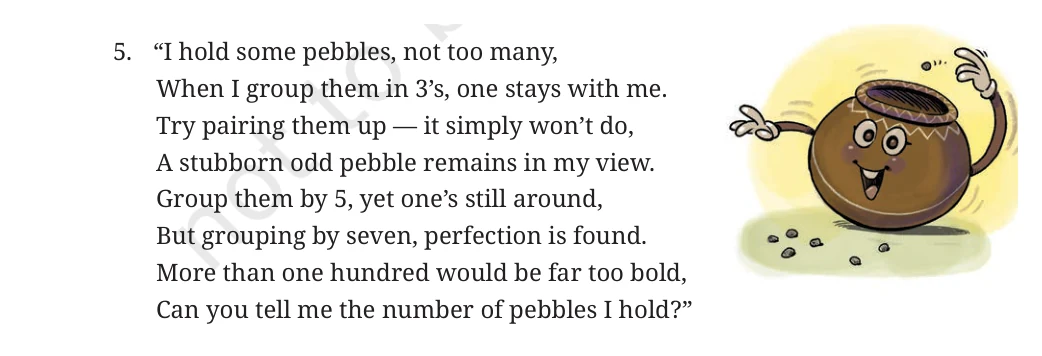
Solve the pebble riddle.
Show solution
The count is odd and leaves remainder 1 modulo 3 and 5, so it is 30k+1: 31, 61, or 91 below 100. Only 91 is divisible by 7. Therefore there are 91 pebbles.
Textbook page 11 · solved item 28

Is Tathagat's claim about three numbers congruent to 2 modulo 6 true?
Show solution
Yes. (6a+2)+(6b+2)+(6c+2)=6(a+b+c+1), which is always divisible by 6.
Complete worked answers
Textbook page 12
Textbook page 12 · solved item 29
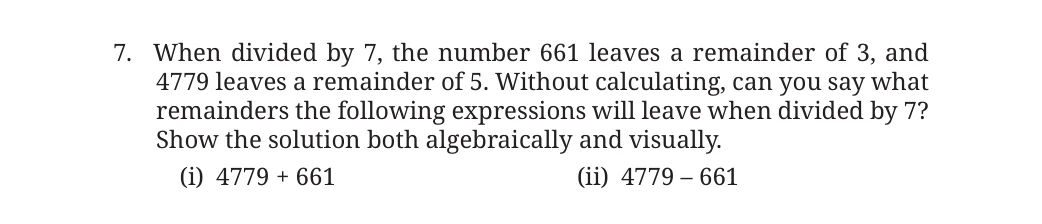
Find the remainders of 4779 + 661 and 4779 - 661 when divided by 7.
Show solution
Since 4779=7p+5 and 661=7q+3, the sum is 7(p+q+1)+1, remainder 1. The difference is 7(p-q)+2, remainder 2.
Textbook page 12 · solved item 30

Find the smallest number leaving remainders 2, 3, and 4 modulo 3, 4, and 5.
Show solution
Each remainder is one less than its divisor, so the number plus 1 is a common multiple of 3, 4, and 5. The smallest is \operatorname{lcm}(3,4,5)-1=60-1=59.
Textbook page 12 · solved item 31
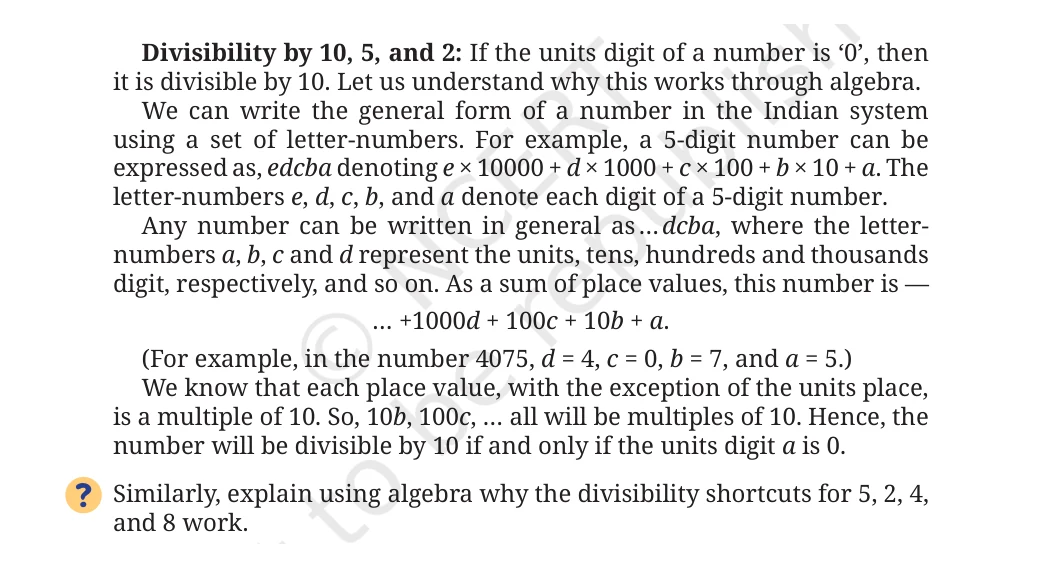
Explain algebraically why the divisibility shortcuts for 5, 2, 4, and 8 work.
Show solution
All place values above units are multiples of 10, so divisibility by 2 or 5 depends only on the units digit. All place values from 100 upward are multiples of 4, so only the last two digits matter. All place values from 1000 upward are multiples of 8, so only the last three digits matter.
Textbook page 12 · solved item 32

Which of 999, 909, 900, 90, and 990 are divisible by 9?
Show solution
All five are divisible by 9; their digit sums are 27, 18, 9, 9, and 18.
Complete worked answers
Textbook page 13
Textbook page 13 · solved item 33
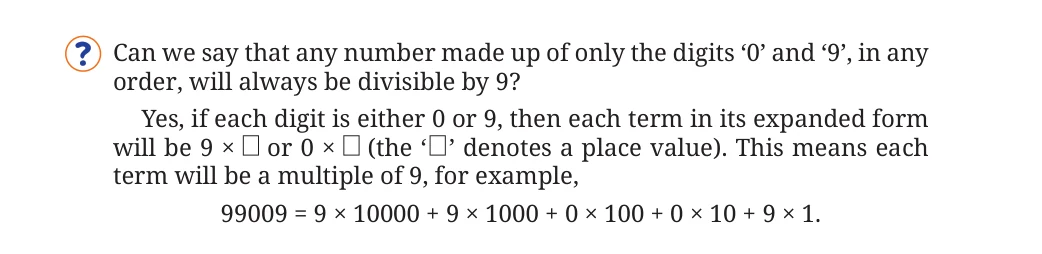
Is every number made only of digits 0 and 9 divisible by 9?
Show solution
Yes. Every non-zero expanded-place-value term contains a factor of 9, and equivalently the digit sum is a multiple of 9.
Textbook page 13 · solved item 34
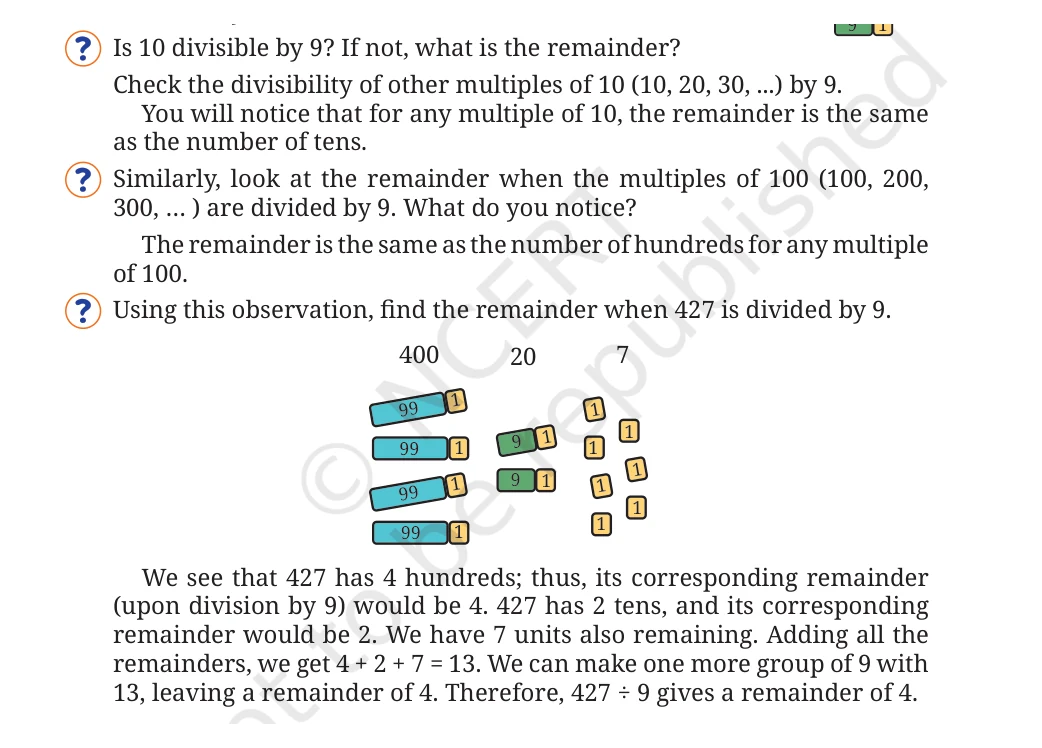
Use place-value remainders to find the remainder when 427 is divided by 9.
Show solution
Because every power of 10 leaves remainder 1 modulo 9, the remainder equals the digit-sum remainder: 4+2+7=13, and 13\equiv4\pmod9.
Complete worked answers
Textbook page 14
Textbook page 14 · solved item 35
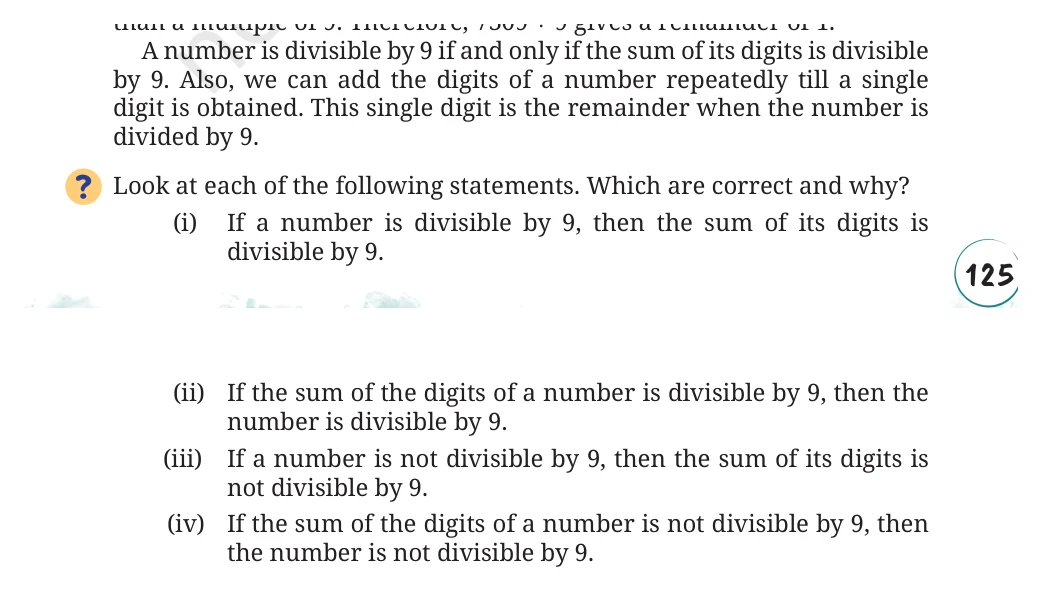
Which four statements relating divisibility by 9 and digit sums are correct?
Show solution
All four are correct. A number and its digit sum have the same remainder modulo 9, so each implication and its contrapositive holds.
Complete worked answers
Textbook page 15
Textbook page 15 · solved item 36

Test the five given numbers for divisibility by 9.
Show solution
Only 405 is divisible by 9. The digit sums are 6, 9, 32, 28, and 30 respectively.
Textbook page 15 · solved item 37

Find the smallest positive multiple of 9 containing no odd digits.
Show solution
It is 288. A digit sum made only from non-zero even digits cannot be 9, so the smallest feasible sum is 18; the smallest arrangement using allowed digits is 288.
Textbook page 15 · solved item 38

Find the multiple of 9 closest to 6000.
Show solution
It is 6003, which is 3 away. The preceding multiple, 5994, is 6 away.
Textbook page 15 · solved item 39

How many multiples of 9 lie strictly between 4300 and 4400?
Show solution
There are 11: from 4302 through 4392.
Textbook page 15 · solved item 40
Explain why the digit-sum test for divisibility by 3 works.
Show solution
Every power of 10 leaves remainder 1 modulo 3. Therefore a number has the same remainder modulo 3 as the sum of its digits.
Complete worked answers
Textbook page 16
Textbook page 16 · solved item 41
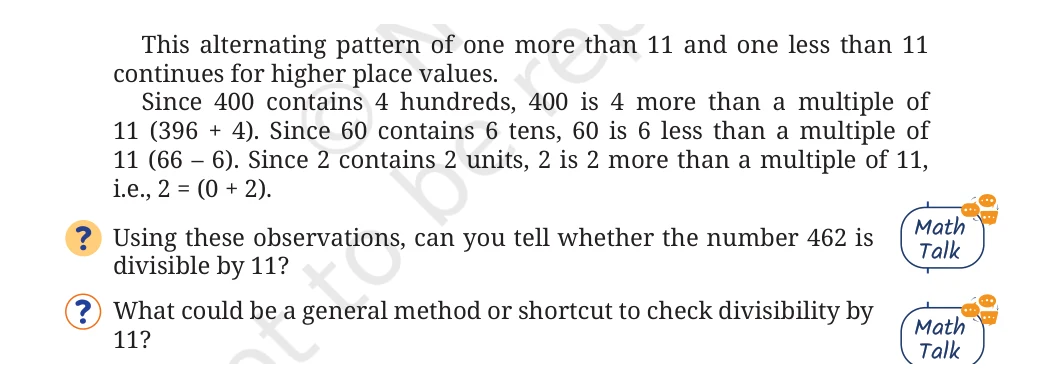
Use the alternating-sum idea to test 462 for divisibility by 11.
Show solution
The alternating sum is 2-6+4=0, a multiple of 11, so 462 is divisible by 11: 462=11\times42. In general, a number is divisible by 11 when its alternating digit sum is a multiple of 11.
Complete worked answers
Textbook page 17
Textbook page 17 · solved item 42

What does an alternating digit-sum difference that is a multiple of 11 mean?
Show solution
It means the original number leaves remainder 0 and is divisible by 11.
Textbook page 17 · solved item 43

Use the shortcut to test 158, 841, 481, 5529, 90904, and 857076 for divisibility by 11.
Show solution
The first four are not divisible; their remainders are 4, 5, 8, and 7. The numbers 90904 and 857076 are divisible by 11.
Complete worked answers
Textbook page 18
Textbook page 18 · solved item 44
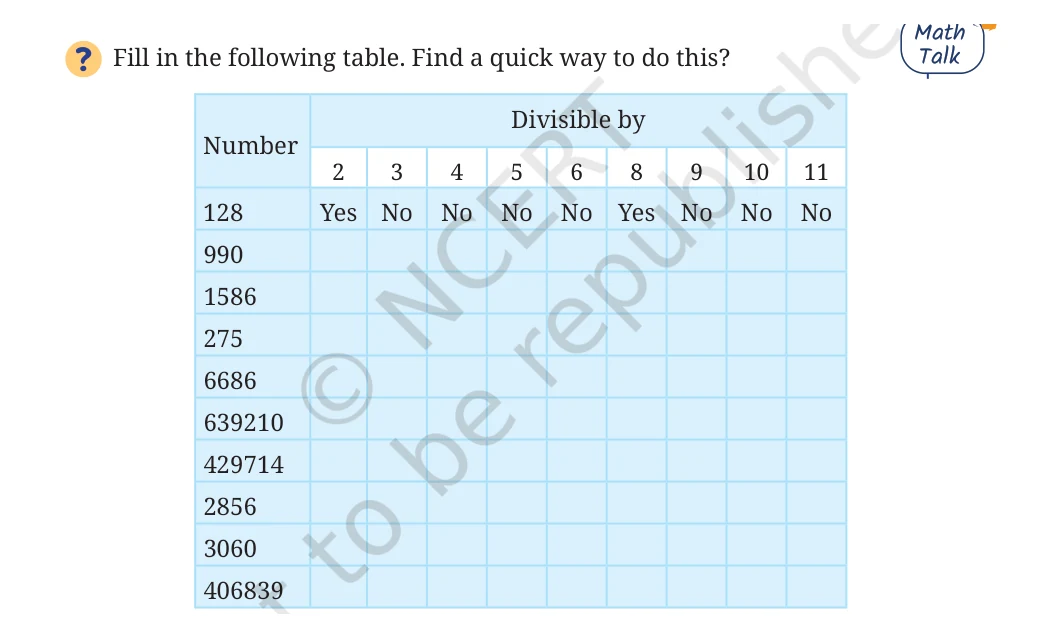
Complete the divisibility table for the nine given numbers.
Show solution
Divisors that work: 128: 2,4,8; 990: 2,3,5,6,9,10,11; 1586: 2; 275: 5,11; 6686: 2; 639210: 2,3,5,6,10,11; 429714: 2,3,6,9; 2856: 2,3,4,6,8; 3060: 2,3,4,5,6,9,10; 406839: 3.
Textbook page 18 · solved item 45
Can divisibility by 6 be checked using divisibility by 2 and 3?
Show solution
Yes, because 2 and 3 are coprime and \operatorname{lcm}(2,3)=6. Of 38, 225, 186, and 64, only 186 is divisible by both 2 and 3, hence by 6.
Complete worked answers
Textbook page 19
Textbook page 19 · solved item 46
Why do tests for 3 and 8 establish divisibility by 24, while tests for 4 and 6 do not?
Show solution
Since 3 and 8 are coprime, their LCM is 24. But \operatorname{lcm}(4,6)=12, so passing both tests guarantees only a multiple of 12; 12 itself is the counterexample.
Textbook page 19 · solved item 47
What property connects a number's digital root with division by 9?
Show solution
The digital root has the same remainder modulo 9 as the number, except that remainder 0 is written as digital root 9 for a positive number.
Textbook page 19 · solved item 48

Between 600 and 700, list the numbers with digital roots 5, 7, and 3.
Show solution
Root 5: 608, 617, 626, 635, 644, 653, 662, 671, 680, 689, 698. Root 7: 601, 610, 619, 628, 637, 646, 655, 664, 673, 682, 691. Root 3: 606, 615, 624, 633, 642, 651, 660, 669, 678, 687, 696.
Textbook page 19 · solved item 49

What happens to digital roots across twelve consecutive numbers?
Show solution
They cycle through 1,2,3,4,5,6,7,8,9 and then repeat. Any block of 12 consecutive integers therefore contains a complete nine-root cycle followed by the first three roots of the next cycle, shifted according to its starting number.
Textbook page 19 · solved item 50

Find the digital-root patterns of consecutive multiples of 3, 4, and 6.
Show solution
Multiples of 3 cycle 3,6,9. Multiples of 4 cycle 4,8,3,7,2,6,1,5,9. Multiples of 6 cycle 6,3,9.
Textbook page 19 · solved item 51

What are the digital roots of numbers one more than a multiple of 6?
Show solution
They cycle 7,4,1 because the multiples of 6 cycle through roots 6,3,9 and adding 1 shifts these to 7,4,1.
Textbook page 19 · solved item 52
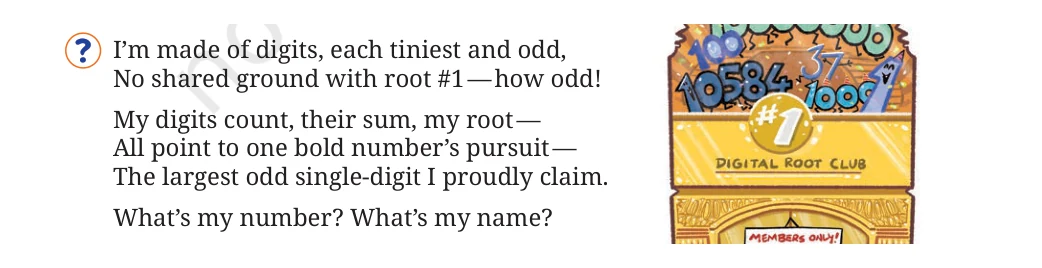
Solve the digital-root number riddle.
Show solution
The number is 11,11,11,111: it has nine digits, all digits are odd, their sum is 9, and its digital root is 9. Its name is eleven crore eleven lakh eleven thousand one hundred eleven.
Complete worked answers
Textbook page 20
Textbook page 20 · solved item 53

An 8-digit number has digital root 5. What is the digital root after adding 10?
Show solution
Since 10 has digital root 1, the new digital root is 6.
Textbook page 20 · solved item 54

What pattern results from repeatedly adding 11 to a number?
Show solution
Each addition changes the digital root by 2 modulo 9. For a starting root of 1, the cycle is 1,3,5,7,9,2,4,6,8 and then repeats.
Textbook page 20 · solved item 55

Find the digital root of 9a + 36b + 13.
Show solution
9a+36b+13=9(a+4b+1)+4, so its digital root is 4.
Textbook page 20 · solved item 56
Relate parity and divisibility remainders to digital roots.
Show solution
Parity has no fixed relation to digital root. Modulo 3, roots 1,4,7 give remainder 1; 2,5,8 give remainder 2; 3,6,9 give remainder 0. Modulo 9, roots 1 through 8 equal the remainder, while root 9 means remainder 0.
Textbook page 20 · solved item 57
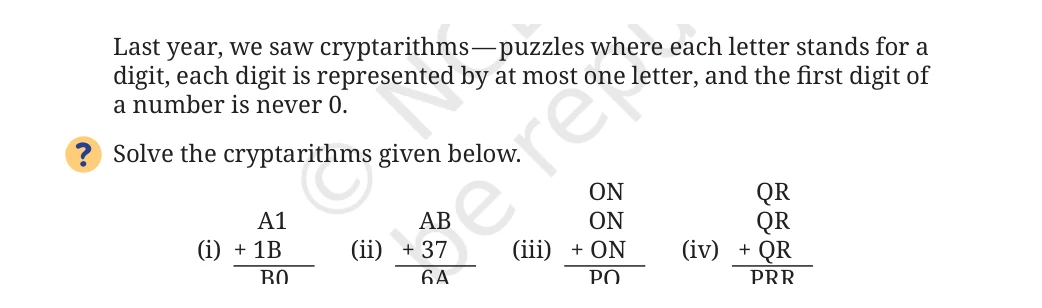
Solve the four addition cryptarithms.
Show solution
(i) A=7,B=9. (ii) A=2,B=5. (iii) N=1,O=3,P=9. (iv) Q=8,R=5,P=2.
Textbook page 20 · solved item 58
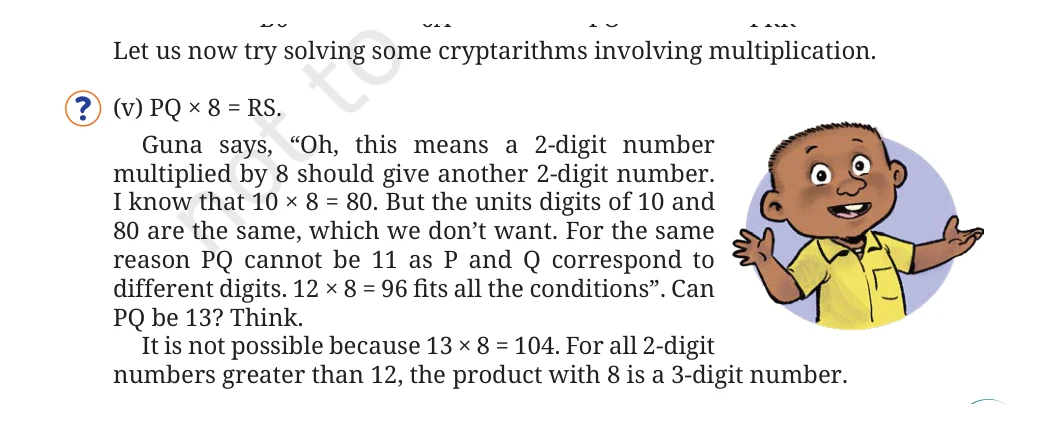
Solve PQ x 8 = RS under the cryptarithm rules.
Show solution
PQ=12 and RS=96, so P=1,Q=2,R=9,S=6. Any larger eligible two-digit input makes a three-digit product.
Complete worked answers
Textbook page 21
Textbook page 21 · solved item 59
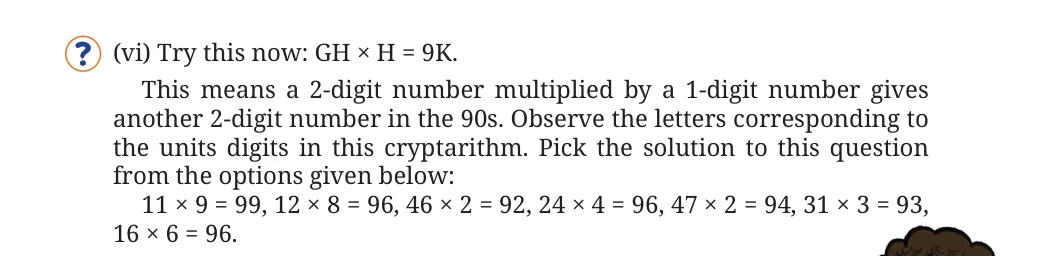
Choose the valid solution of GH x H = 9K.
Show solution
The valid option is 24\times4=96, so G=2,H=4,K=6.
Textbook page 21 · solved item 60
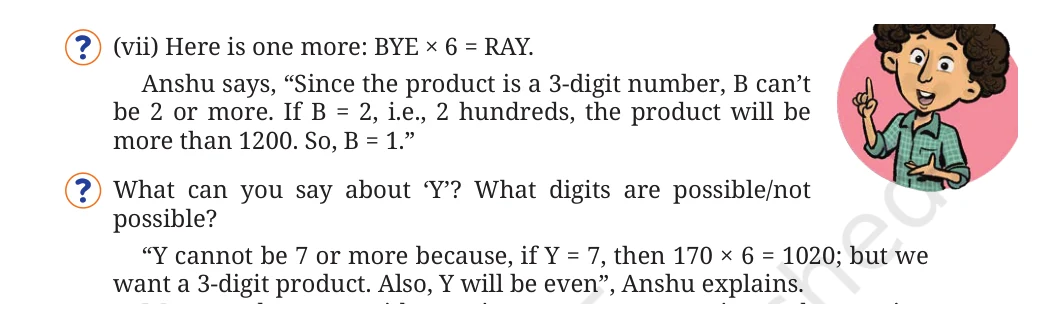
For BYE x 6 = RAY, what can be deduced about Y?
Show solution
The hundreds digit forces B=1. The product must remain three-digit, so Y<7, and its occurrence as the units digit of a product by 6 makes it even. Thus the initial candidates are 0, 2, 4, and 6, subject to the remaining column and distinct-letter constraints.
Textbook page 21 · solved item 61
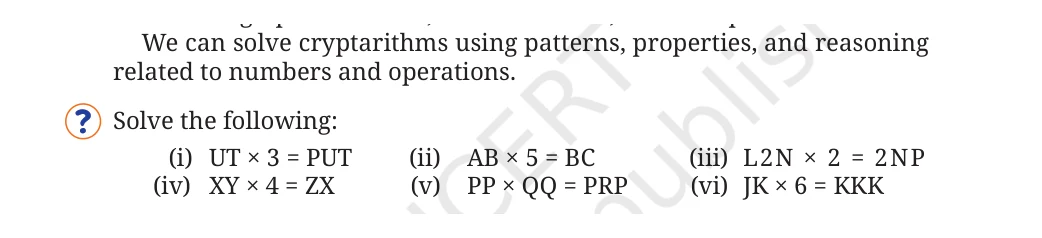
Solve the six multiplication cryptarithms.
Show solution
(i) U=5,T=0,P=1. (ii) A=1,B=9,C=5. (iii) L=1,N=5,P=0. (iv) X=2,Y=3,Z=9. (v) P=2,Q=1,R=4. (vi) J=7,K=4.
Textbook page 21 · solved item 62

If 31z5 is divisible by 9, find z.
Show solution
The digit sum is 9+z, so z=0 or z=9. Both make the sum a multiple of 9.
Textbook page 21 · solved item 63

Examine Snehal's claim about two numbers described modulo 12.
Show solution
The sum is (12n+8)+(12m-4)=12(n+m)+4. It is a multiple of 8 only for some values of n+m, not always. For example, 8+8=16 works, but 20+8=28 does not.
Textbook page 21 · solved item 64

When is the sum of two multiples of 3 also a multiple of 6?
Show solution
Write them as 3m and 3n. Their sum is 3(m+n), which is divisible by 6 exactly when m+n is even, meaning the two multipliers have the same parity.
Textbook page 21 · solved item 65
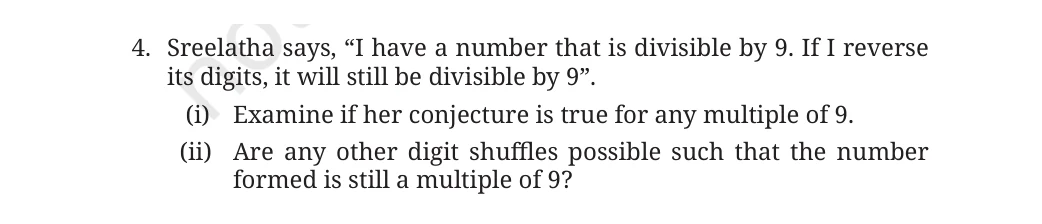
Does reversing or shuffling the digits of a multiple of 9 preserve divisibility by 9?
Show solution
Yes. Every rearrangement has the same digit sum, so it remains divisible by 9, provided leading-zero conventions are handled when interpreting the result as a numeral.
Textbook page 21 · solved item 66

If 48a23b is a multiple of 18, list all digit pairs (a,b).
Show solution
Divisibility by 2 makes b even, and divisibility by 9 requires 17+a+b to be a multiple of 9. The pairs are (1,0),(8,2),(6,4),(4,6),(2,8).
Complete worked answers
Textbook page 22
Textbook page 22 · solved item 67

If 3p7q8 is divisible by 44, list all digit pairs (p,q).
Show solution
The last two digits force q\in\{0,2,4,6,8\}. The divisibility-by-11 condition gives 18-(p+q)=0 or 11. The valid pairs are (7,0),(5,2),(3,4),(1,6).
Textbook page 22 · solved item 68

Find consecutive numbers matching multiples of 2, 3, and 4 in order.
Show solution
One triple is 2,3,4. The conditions repeat modulo \operatorname{lcm}(2,3,4)=12, so all triples are 12k+2,12k+3,12k+4.
Textbook page 22 · solved item 69

Write five multiples of 36 between 45,000 and 47,000.
Show solution
One valid list is 45,036; 45,072; 45,108; 45,144; and 45,180. Consecutive multiples differ by 36.
Textbook page 22 · solved item 70

The middle of five consecutive even numbers is 5p. Express the other four.
Show solution
They are 5p-4,5p-2,5p+2,5p+4. Since the middle number is even, p must be even.
Textbook page 22 · solved item 71

Give a six-digit number divisible by 15 whose reversal is divisible by 6.
Show solution
One example is 200025. It ends in 5 and has digit sum 9, so it is divisible by 15. Its reversal, 520002, is even and has the same digit sum 9, so it is divisible by 6.
Textbook page 22 · solved item 72

Examine Deepak's claim about doubling multiples of 11.
Show solution
The claim is false. If n=11k, then 2n=22k=11(2k), so every doubled multiple of 11 remains a multiple of 11.
Textbook page 22 · solved item 73
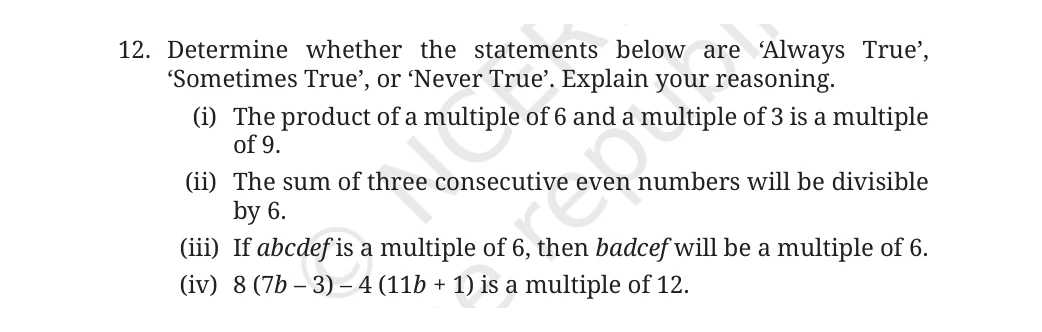
Classify the four final always/sometimes/never statements.
Show solution
(i) Always: (6m)(3n)=18mn, a multiple of 9. (ii) Always: (2n-2)+2n+(2n+2)=6n. (iii) Always: rearranging digits preserves digit sum and the final digit remains even, so divisibility by 6 remains. (iv) Never: the expression simplifies to 12b-28, which leaves remainder 8 modulo 12.
Textbook page 22 · solved item 74

When is the sum of any three integers divisible by 3?
Show solution
Classify each number by remainder 0, 1, or 2 modulo 3. The sum is divisible by 3 when the remainders are all equal, or when they are one each of 0, 1, and 2.
Textbook page 22 · solved item 75
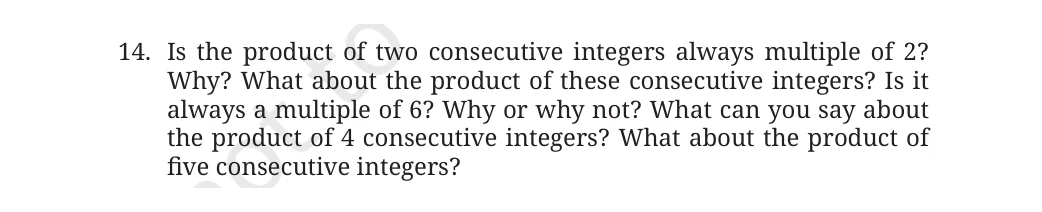
What divisibility is guaranteed by products of consecutive integers?
Show solution
Two consecutive integers have product divisible by 2; three have product divisible by 6; four have product divisible by 24; and five have product divisible by 120. Each block supplies all prime factors in the corresponding factorial.
Textbook page 22 · solved item 76

Solve EF x E = GGG and WOW x 5 = MEOW.
Show solution
For the first, E=3,F=7,G=1, giving 37\times3=111. For the second, W=5,O=7,M=2,E=8, giving 575\times5=2875.
Textbook page 22 · solved item 77
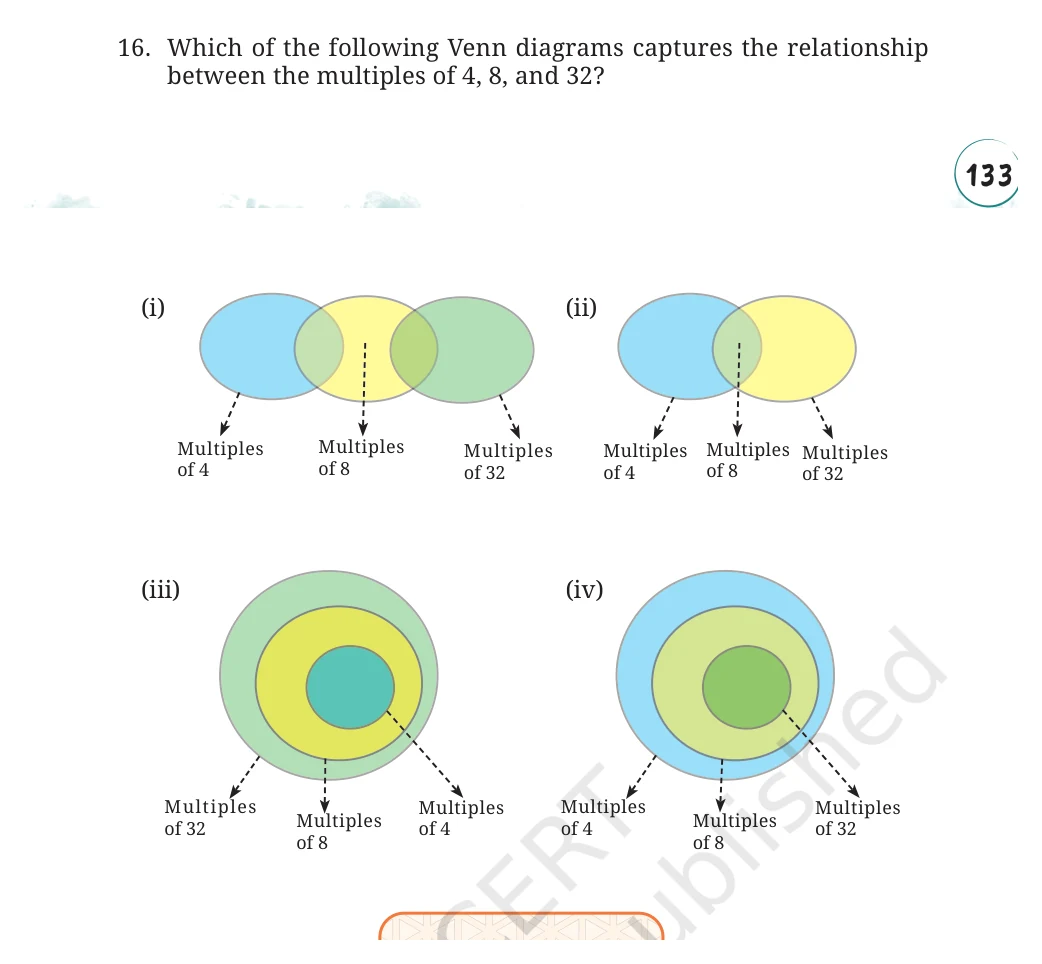
Which Venn diagram correctly relates multiples of 4, 8, and 32?
Show solution
Diagram (iv). Every multiple of 32 is a multiple of 8, and every multiple of 8 is a multiple of 4, so the sets must be nested in that order.