
Use the textbook context
Match, attempt, then check
Each source crop keeps the printed information needed for that item. Compound answer-key entries are separated into individual solutions.
Complete worked answers
Textbook page 4
Textbook page 4 · solved item 1
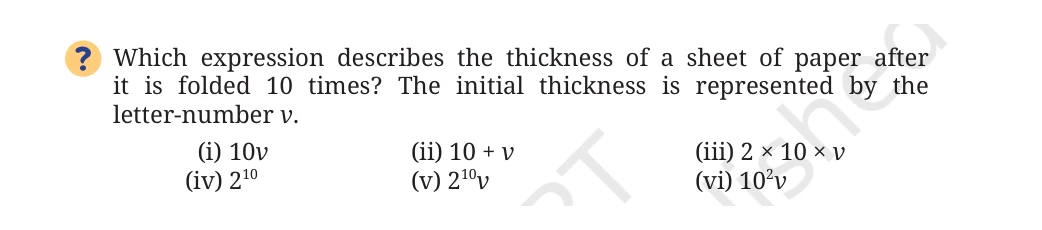
Which expression gives the thickness after a sheet of initial thickness v is folded 10 times?
Show solution
Each fold doubles the thickness. After 10 folds the multiplier is 2^{10}, so the thickness is 2^{10}v. Choice (v) is correct.
Textbook page 4 · solved item 2

Evaluate (-1)^5 and (-1)^{56}. State whether each is positive or negative.
Show solution
An odd power keeps the negative sign, so (-1)^5=-1. An even power pairs all negative factors, so (-1)^{56}=1.
Textbook page 4 · solved item 3

Is (-2)^4=16? Verify.
Show solution
Yes. (-2)^4=(-2)(-2)(-2)(-2)=4\times4=16.
Textbook page 4 · solved item 4
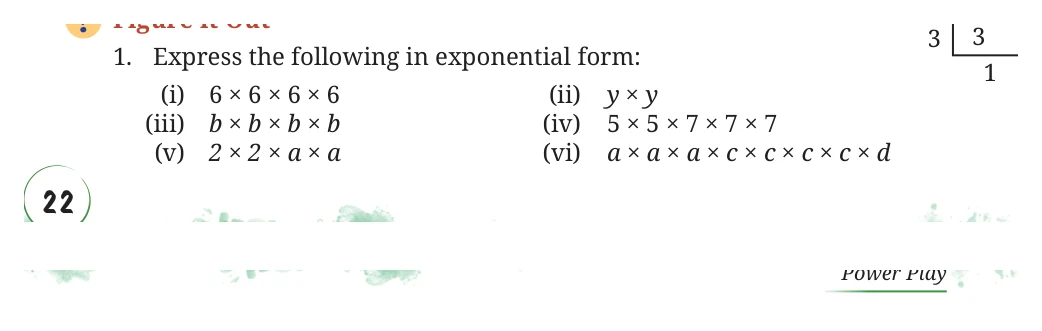
Express the six given repeated products in exponential form.
Show solution
(i) 6^4; (ii) y^2; (iii) b^4; (iv) 5^2\times7^3; (v) 2^2\times a^2; (vi) a^3\times c^4\times d.
Complete worked answers
Textbook page 5
Textbook page 5 · solved item 5

Express 648, 405, 540, and 3600 as products of powers of prime factors.
Show solution
(i) 648=2^3\times3^4; (ii) 405=3^4\times5; (iii) 540=2^2\times3^3\times5; (iv) 3600=2^4\times3^2\times5^2.
Textbook page 5 · solved item 6

Find the numerical values of the six exponential expressions shown.
Show solution
(i) 2\times10^3=2000; (ii) 7^2\times2^3=392; (iii) 3\times4^4=768; (iv) (-3)^2\times(-5)^2=225; (v) 3^2\times10^4=90000; (vi) (-2)^5\times(-10)^6=-32000000.
Complete worked answers
Textbook page 6
Textbook page 6 · solved item 7
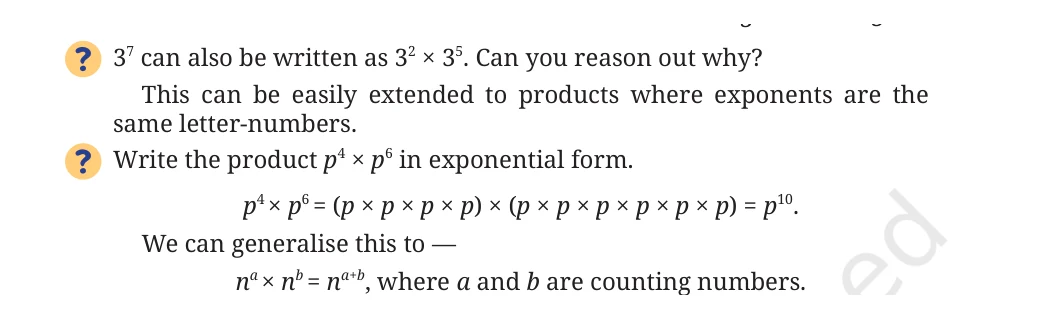
Explain why 3^7 can be written as 3^2\times3^5.
Show solution
3^7 contains seven factors of 3. Splitting them into groups of two and five gives (3\times3)(3\times3\times3\times3\times3)=3^2\times3^5. In general, a^{m+n}=a^m a^n.
Textbook page 6 · solved item 8
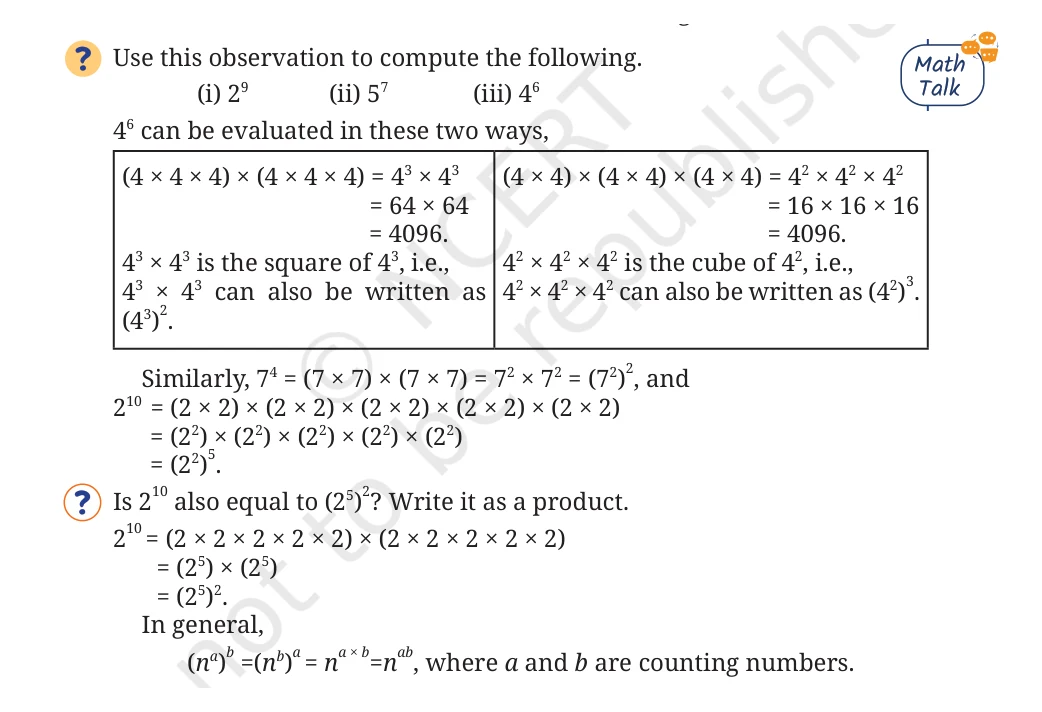
Use exponent splitting to compute 2^9, 5^7, and 4^6.
Show solution
2^9=2^4\times2^5=16\times32=512. 5^7=5^3\times5^4=125\times625=78125. 4^6=(4^3)^2=64^2=4096.
Textbook page 6 · solved item 9

Write 8^6, 7^{15}, 9^{14}, and 5^8 as powers of powers in at least two ways.
Show solution
8^6=(8^2)^3=(8^3)^2; 7^{15}=(7^3)^5=(7^5)^3; 9^{14}=(9^2)^7=(9^7)^2; 5^8=(5^2)^4=(5^4)^2.
Complete worked answers
Textbook page 7
Textbook page 7 · solved item 10

Write the number of lotuses in exponential form when the pond is fully covered and half covered.
Show solution
The number doubles daily. The fully covered pond has 2^{30} lotuses. One day earlier it is half covered, so it has 2^{29} lotuses.
Textbook page 7 · solved item 11

Simplify \frac{10^4}{5^4} and write it in exponential form.
Show solution
Use \frac{a^n}{b^n}=(\frac ab)^n: \frac{10^4}{5^4}=(\frac{10}{5})^4=2^4=16.
Complete worked answers
Textbook page 8
Textbook page 8 · solved item 12

Roxie has 7 dresses, 2 hats, and 3 pairs of shoes. How many outfits can she make?
Show solution
There are 7 choices for the dress, 2 for the hat, and 3 for the shoes. By the multiplication principle, 7\times2\times3=42 outfits.
Complete worked answers
Textbook page 9
Textbook page 9 · solved item 13

How many six-letter passwords are possible using the shown alphabet lock?
Show solution
Each of the 6 positions has 26 choices. Therefore, the number of passwords is 26^6=308915776.
Textbook page 9 · solved item 14

Simplify 2^{100}\div2^{25} as a power of 2.
Show solution
For the same non-zero base, subtract exponents: 2^{100}\div2^{25}=2^{100-25}=2^{75}.
Complete worked answers
Textbook page 10
Textbook page 10 · solved item 15

When deriving a^0=1, why can the base not be zero?
Show solution
The derivation uses a^n\div a^n=a^{n-n}=a^0. This quotient equals 1 only when a\ne0. If a=0, it becomes 0\div0, which is undefined.
Complete worked answers
Textbook page 11
Textbook page 11 · solved item 16

Do the exponent laws continue to hold when the exponents are any integers?
Show solution
Yes. The laws extend to zero and negative integer exponents, provided any base that is divided by or raised to a negative exponent is non-zero.
Textbook page 11 · solved item 17

Write equivalent reciprocal forms for 2^{-4}, 10^{-5}, (-7)^{-2}, (-5)^{-3}, and 10^{-100}.
Show solution
(i) 2^{-4}=\frac1{2^4}; (ii) 10^{-5}=\frac1{10^5}; (iii) (-7)^{-2}=\frac1{(-7)^2}; (iv) (-5)^{-3}=\frac1{(-5)^3}; (v) 10^{-100}=\frac1{10^{100}}.
Textbook page 11 · solved item 18

Simplify the five expressions with negative exponents and write the results in exponential form.
Show solution
(i) 2^{-4}\times2^7=2^3; (ii) 3^2\times3^{-5}\times3^6=3^3; (iii) p^3\times p^{-10}=p^{-7}; (iv) 2^4\times(-4)^{-2}=16\times\frac1{16}=1; (v) 8^p\times8^q=8^{p+q}.
Complete worked answers
Textbook page 12
Textbook page 12 · solved item 19

How many times larger than 4^{-2} is 4^2?
Show solution
Compute the ratio: 4^2\div4^{-2}=4^{2-(-2)}=4^4=256. Thus 4^2 is 256 times as large.
Textbook page 12 · solved item 20
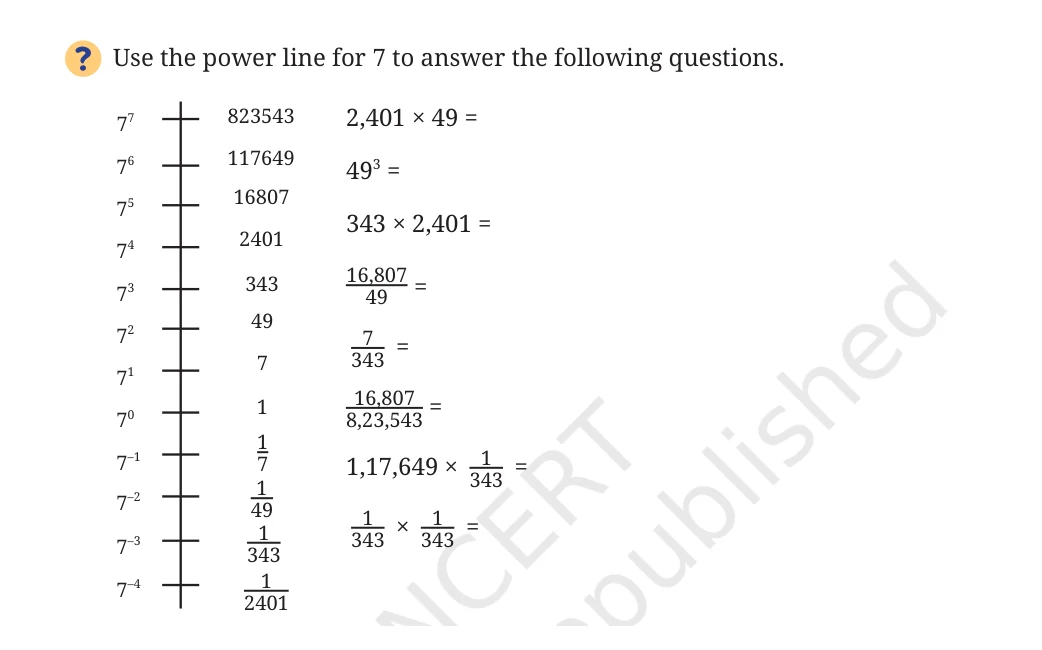
Complete the power-line calculations for base 7.
Show solution
2401\times49=7^6; 49^3=7^6; 343\times2401=7^7; 16807\div49=7^3; 7\div343=7^{-2}; 16807\div823543=7^{-2}; 117649\times\frac1{343}=7^3; and \frac1{343}\times\frac1{343}=7^{-6}.
Textbook page 12 · solved item 21
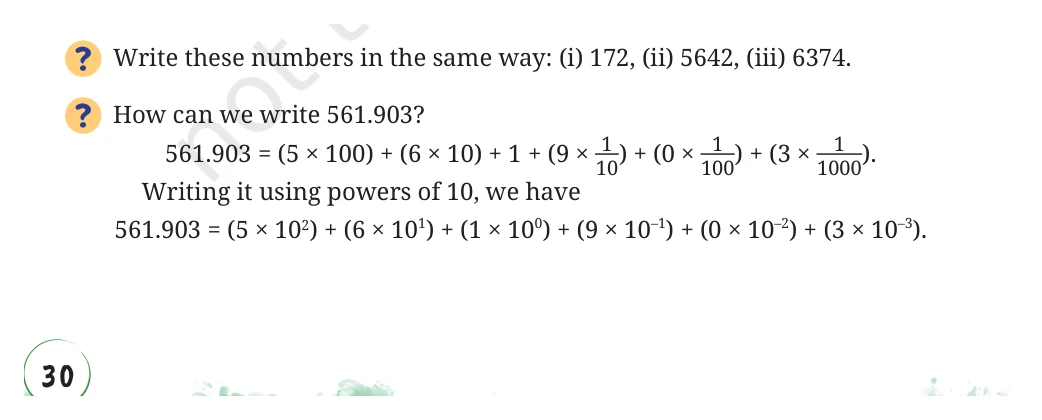
Expand 172, 5642, and 6374 using powers of 10.
Show solution
172=1\times10^2+7\times10^1+2\times10^0. 5642=5\times10^3+6\times10^2+4\times10^1+2\times10^0. 6374=6\times10^3+3\times10^2+7\times10^1+4\times10^0.
Complete worked answers
Textbook page 14
Textbook page 14 · solved item 22
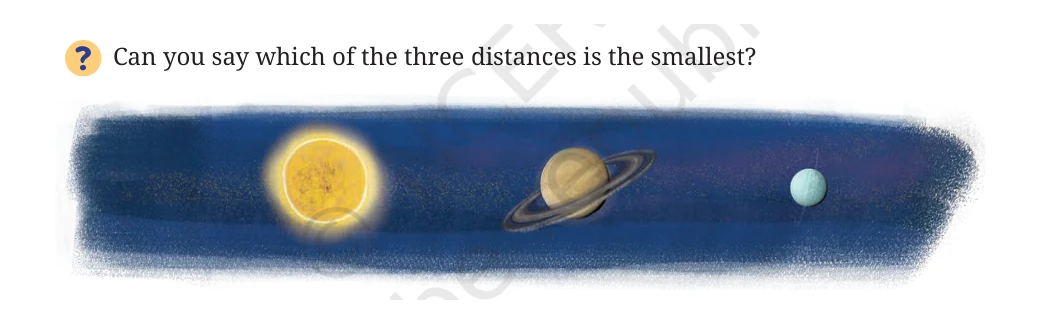
Which of the three astronomical distances shown is the smallest?
Show solution
The distance from the Sun to Earth is the smallest. Its scientific-notation exponent is lower than the Sun-Saturn distance, and its coefficient comparison confirms its position.
Textbook page 14 · solved item 23
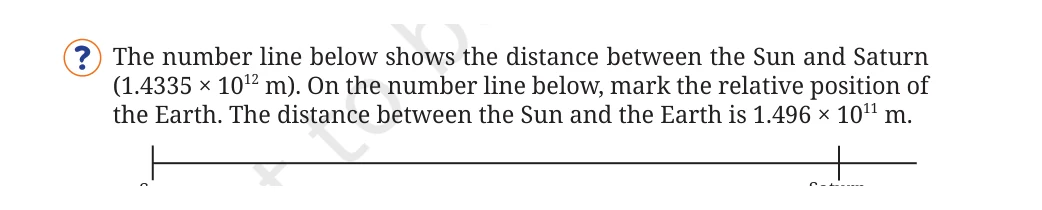
Mark Earth on the number line from the Sun to Saturn, given Sun-Earth is 1.496 × 10^11 m and Sun-Saturn is 1.4335 × 10^12 m.
Show solution
\frac{1.496\times10^{11}}{1.4335\times10^{12}}\approx0.104. Earth should be marked about one-tenth of the way from the Sun toward Saturn.
Textbook page 14 · solved item 24
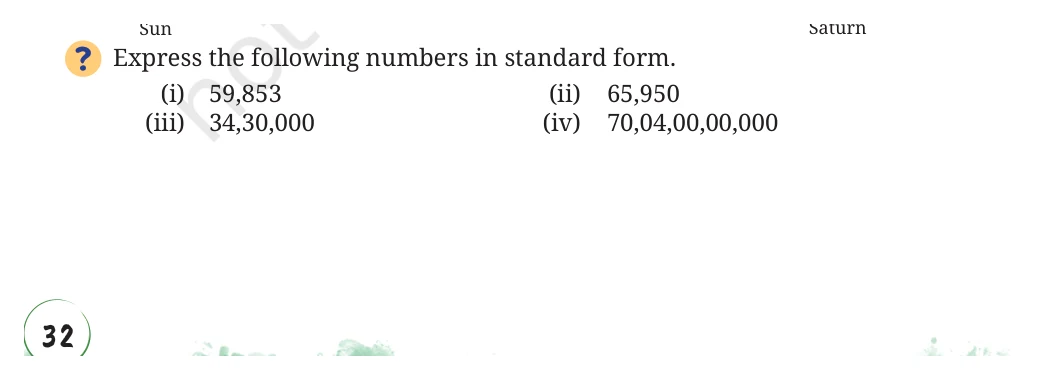
Write 59,853; 65,950; 34,30,000; and 70,04,00,00,000 in scientific notation.
Show solution
(i) 5.9853\times10^4; (ii) 6.595\times10^4; (iii) 3.43\times10^6; (iv) 7.004\times10^{10}.
Complete worked answers
Textbook page 20
Textbook page 20 · solved item 25
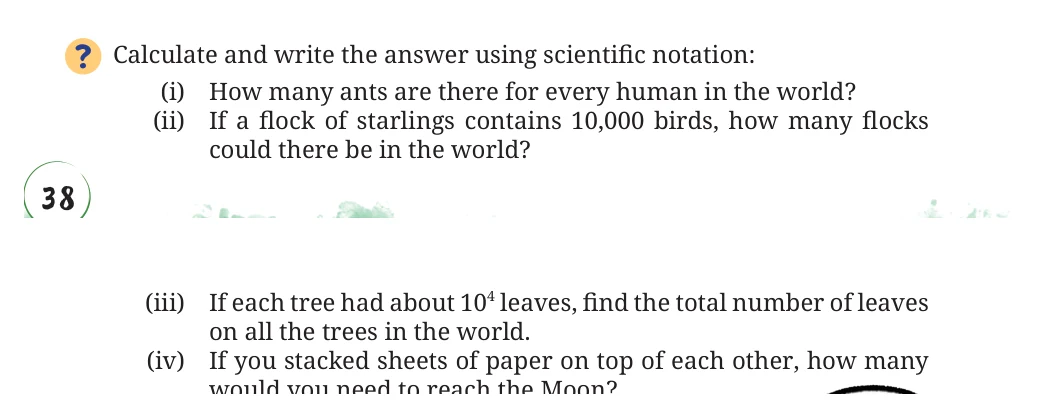
Use scientific notation to answer the four world-scale estimation questions about ants, starlings, leaves, and sheets of paper to the Moon.
Show solution
(i) About 2.5\times10^6 ants per human. (ii) About 1.3\times10^5 flocks. (iii) About 3\times10^{16} leaves. (iv) About 3.844\times10^{13} sheets of paper.
Complete worked answers
Textbook page 21
Textbook page 21 · solved item 26

If you have lived for one million seconds, approximately how old are you?
Show solution
10^6\div86400\approx11.57 days, so you would be approximately 12 days old.
Complete worked answers
Textbook page 24
Textbook page 24 · solved item 27
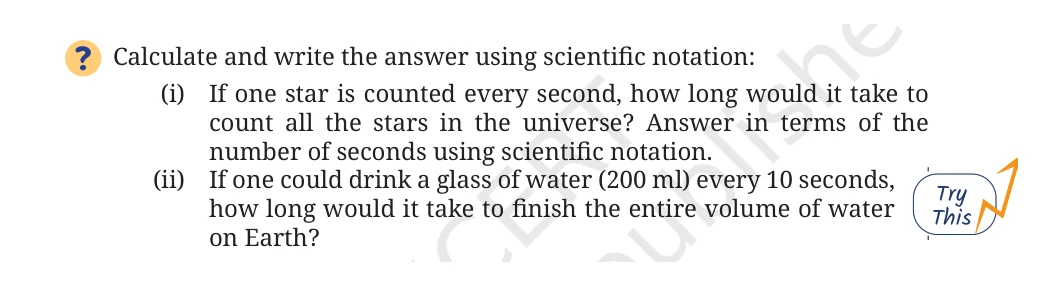
If one star is counted each second, how many seconds would it take to count all the stars in the universe?
Show solution
Using the textbook estimate, the count would take about 2.0\times10^{23} seconds.
Textbook page 24 · solved item 28
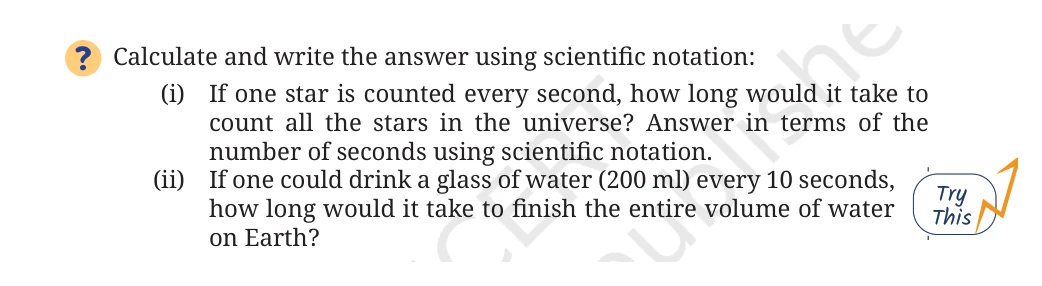
At one 200 ml glass every 10 seconds, how many seconds would it take to drink all the water on Earth?
Show solution
Using the textbook estimate of Earth's water volume and a rate of 0.02 litre per second gives approximately 6.25\times10^{22} seconds.
Complete worked answers
Textbook page 25
Textbook page 25 · solved item 29

In the traditional names for large powers of ten, what does the first part of each name denote?
Show solution
It denotes how many groups of 1000 are multiplied together. Each step therefore advances by a factor of 1000.
Complete worked answers
Textbook page 26
Textbook page 26 · solved item 30

Find the units digit of 2^{224}\div4^{32}.
Show solution
Since 4^{32}=(2^2)^{32}=2^{64}, the quotient is 2^{160}. Powers of 2 repeat units digits every 4 powers, and 160 is divisible by 4, so the units digit is 6.
Textbook page 26 · solved item 31

A container has 5 bottles and one new container arrives daily. How many bottles are there after 40 days?
Show solution
There are 5\times40=200 bottles, which can be written as 2\times10^2.
Textbook page 26 · solved item 32

Write 64^3, 192^8, and 32^{-5} as products of powers in three different ways.
Show solution
Examples: 64^3=2^{10}\times2^8=4^5\times4^4=8^3\times8^3. 192^8=2^{48}\times3^8=2^{40}\times2^8\times3^8=2^{40}\times6^8. 32^{-5}=2^{-10}\times2^{-15}=2^{-5}\times2^{-20}=4^{-12}\times2^{-1}.
Textbook page 26 · solved item 33
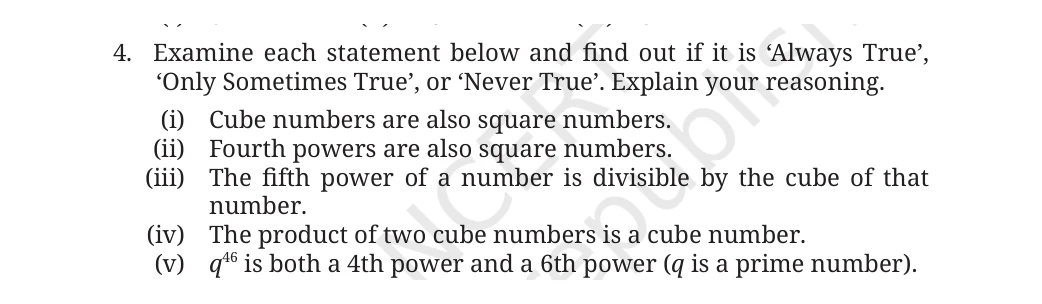
Classify the five statements about square, cube, fourth, fifth, and sixth powers as always, sometimes, or never true.
Show solution
(i) Only sometimes: a cube is also a square when it is a sixth power, such as n^6. (ii) Always: n^4=(n^2)^2. (iii) Always for non-zero n: n^5\div n^3=n^2. (iv) Always: a^3b^3=(ab)^3. (v) Never for prime q: 46 is divisible by neither 4 nor 6, so q^{46} is not both powers.
Textbook page 26 · solved item 34

Simplify the five given expressions and write them in exponential form.
Show solution
(i) 10^{-2}\times10^{-5}=10^{-7}; (ii) 5^7\div5^4=5^3; (iii) 9^{-7}\div9^4=9^{-11}; (iv) (13^{-2})^{-3}=13^6; (v) m^5n^{12}(mn)^9=m^{14}n^{21}.
Textbook page 26 · solved item 35

Given 12^2=144, find 1.2^2, 0.12^2, 0.012^2, and 120^2.
Show solution
Moving the decimal in 12 by one, two, or three places makes the square move by two, four, or six places. Thus the answers are 1.44, 0.0144, 0.000144, and 14400.
Complete worked answers
Textbook page 27
Textbook page 27 · solved item 36

Circle the equal expressions among 2^4\times3^6, 6^4\times3^2, 6^{10}, 18^2\times6^2, and 6^{24}.
Show solution
6^4\times3^2=2^4\times3^6, and 18^2\times6^2=(2\times3^2)^2(2\times3)^2=2^4\times3^6. Therefore, 2^4\times3^6, 6^4\times3^2, and 18^2\times6^2 are equal.
Textbook page 27 · solved item 37

Identify the greater number in each pair: 4^3 or 3^4; 2^8 or 8^2; 100^2 or 2^{100}.
Show solution
(i) 3^4=81>64=4^3. (ii) 2^8=256>64=8^2. (iii) 2^{100} is far greater than 100^2=10000.
Textbook page 27 · solved item 38

A dairy needs unique digit-only codes for 8.5 billion packets. What minimum code length is required?
Show solution
An n-digit code has 10^n possibilities when leading zeroes are allowed. Since 10^9<8.5\times10^9<10^{10}, at least 10 digits are required.
Textbook page 27 · solved item 39

Which numbers are both perfect squares and perfect cubes?
Show solution
They are exactly the sixth powers n^6, because the exponent must be divisible by both 2 and 3. Examples include 1^6=1, 2^6=64, 3^6=729, and 4^6=4096.
Textbook page 27 · solved item 40

How many length-5 alphanumeric passcodes are possible using 26 letters and 10 digits?
Show solution
Each position has 26+10=36 choices. Thus there are 36^5=60466176 possible passcodes.
Textbook page 27 · solved item 41
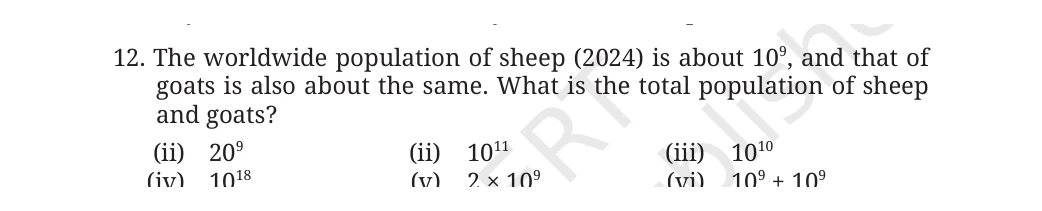
Sheep and goats each number about 10^9. What is their combined population?
Show solution
10^9+10^9=2\times10^9. Both printed choices (v) 2\times10^9 and (vi) 10^9+10^9 represent the same total, although the answer key lists only (vi).
Textbook page 27 · solved item 42
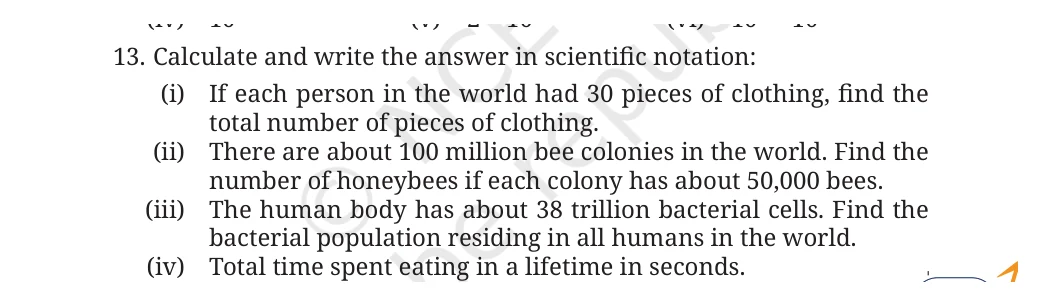
Calculate the four global estimates for clothing, honeybees, bacteria, and lifetime eating time in scientific notation.
Show solution
(i) (8.2\times10^9)\times30=2.46\times10^{11} pieces of clothing. (ii) 10^8\times50000=5.0\times10^{12} honeybees. (iii) (38\times10^{12})(8.2\times10^9)=3.116\times10^{23} bacterial cells. (iv) 3600\times365\times70=9.198\times10^7 seconds spent eating.
Textbook page 27 · solved item 43

What date was one billion seconds ago?
Show solution
10^9 seconds is about 11574.07 days, or 31.69 years. Counting back from 11 August 2026 gives approximately 3 December 1994; the exact time depends on the time of day used.