
Use the textbook context
Match, attempt, then check
Each source crop keeps the printed information needed for that item. Compound answer-key entries are separated into individual solutions.
Complete worked answers
Textbook page 1
Textbook page 1 · solved item 1
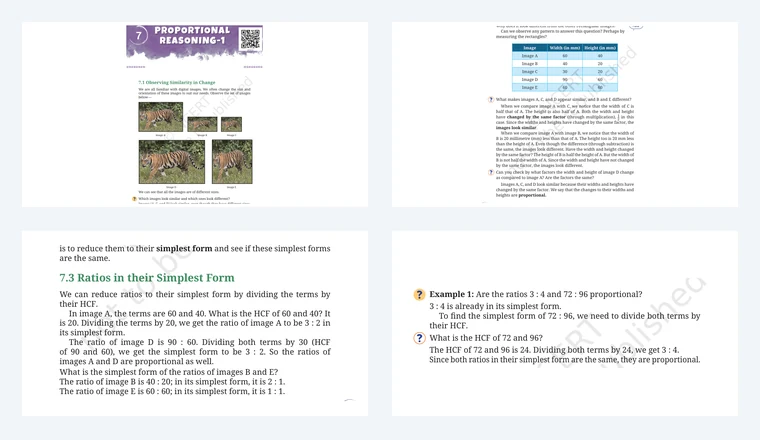
Which tiger images look similar, and why do images B and E look different?
Show solution
Images A, C, and D are similar because their width and height change by the same factor. B is stretched and E is compressed because their width and height do not scale by one common factor.
Complete worked answers
Textbook page 2
Textbook page 2 · solved item 2

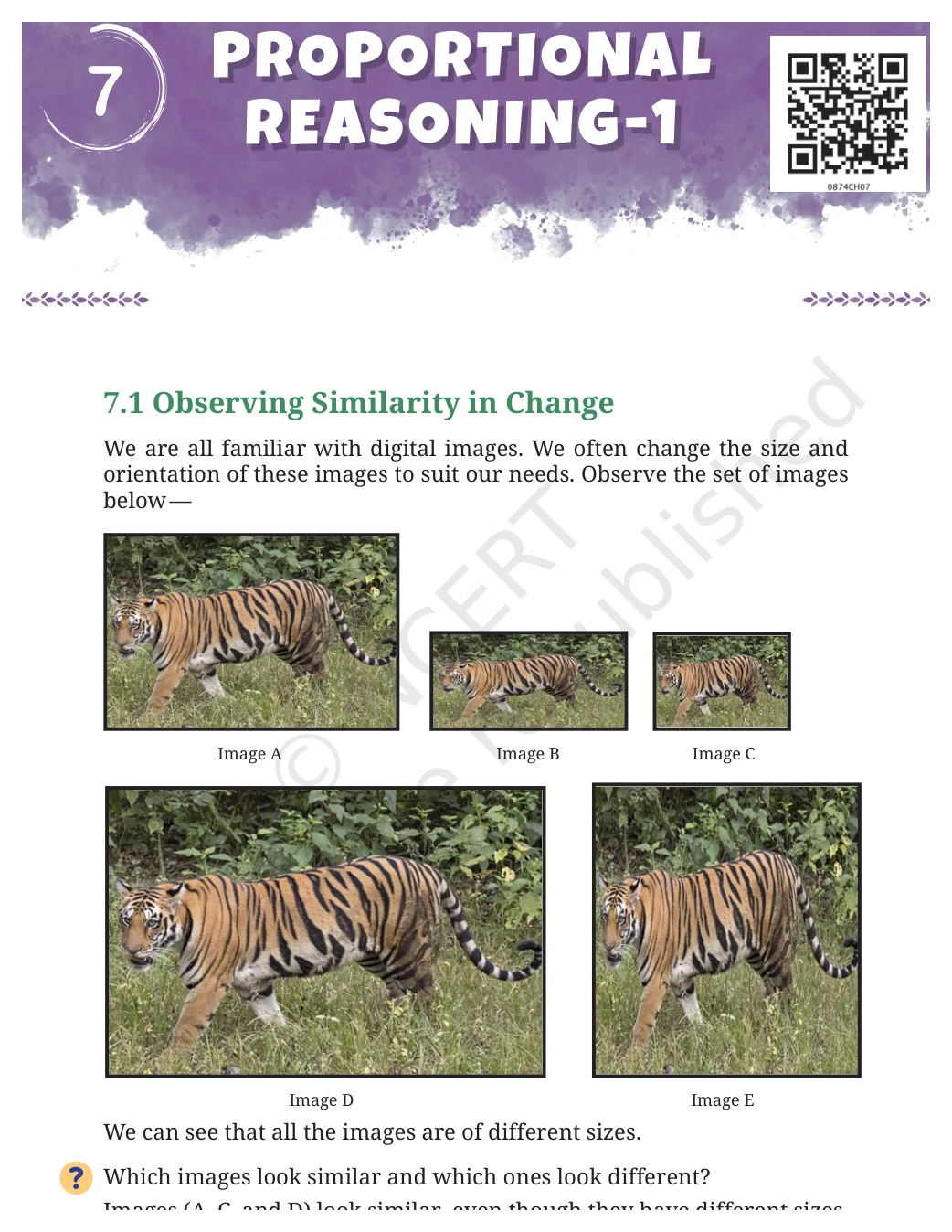
By what factors do the width and height of image D change compared with image A?
Show solution
Image A is (60\text{ mm}\times40\text{ mm}), while D is (90\text{ mm}\times60\text{ mm}). Both dimensions are multiplied by (\\frac{90}{60}=\\frac{60}{40}=\\frac32), so D is proportional to A.
Complete worked answers
Textbook page 3
Textbook page 3 · solved item 3

Find the simplest width-to-height ratios of images B and E.
Show solution
For B, (40:20=2:1). For E, (60:60=1:1). Neither equals the (3:2) ratio of A, C, and D.
Complete worked answers
Textbook page 4
Textbook page 4 · solved item 4

Are the ratios 3 : 4 and 72 : 96 proportional?
Show solution
Yes. The HCF of 72 and 96 is 24, and (72:96=3:4). Equivalently, (3\times96=4\times72=288).
Textbook page 4 · solved item 5
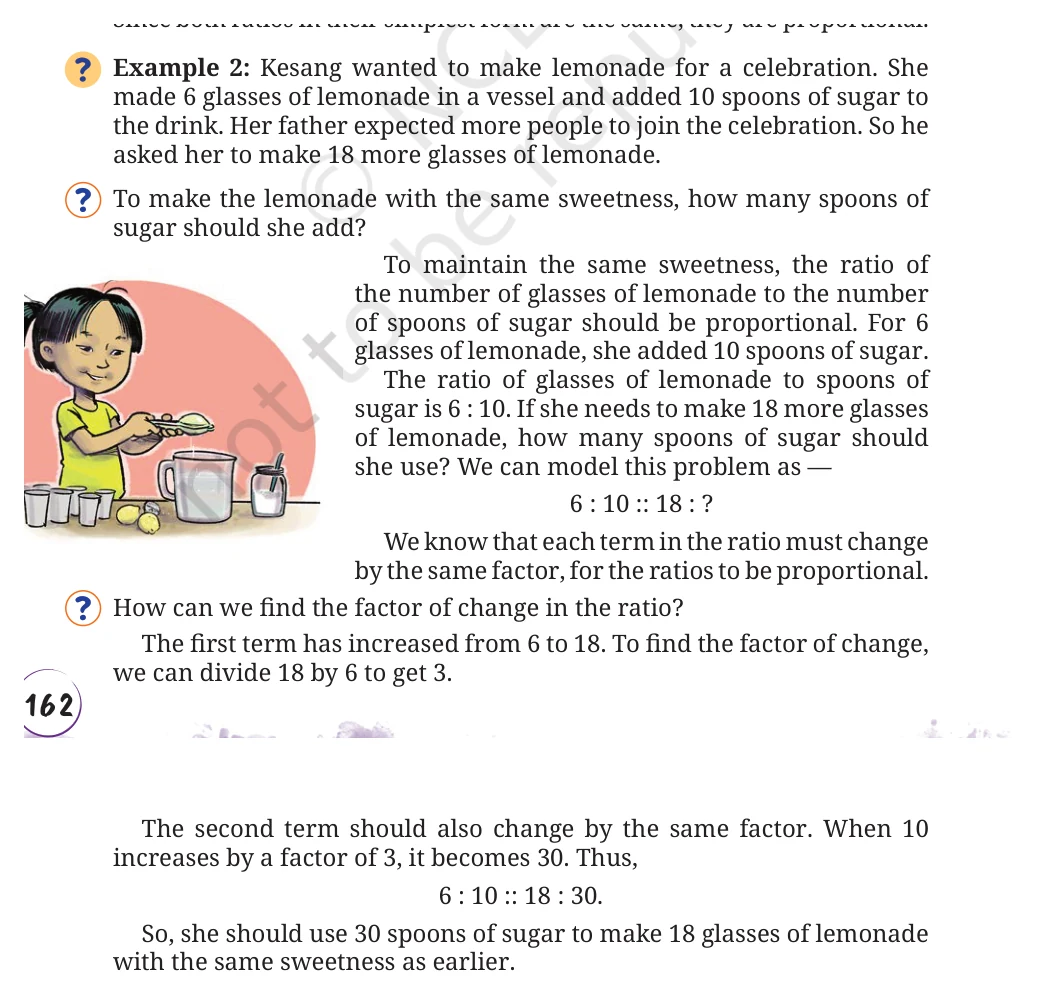
If 6 glasses of lemonade need 10 spoons of sugar, how many spoons are needed for 18 glasses?
Show solution
The number of glasses is multiplied by (18/6=3), so multiply the sugar by the same factor: (10\times3=30) spoons.
Complete worked answers
Textbook page 5
Textbook page 5 · solved item 6
Nitin uses 3 cement bags for a 60 ft wall and Hari uses 2 bags for a 40 ft wall. Is Hari's wall weaker?
Show solution
No. (60:3=20:1) and (40:2=20:1). Both use one bag per 20 ft, so the cement use is proportional and the walls have the same stated strength.
Textbook page 5 · solved item 7

Compare your school's teacher-to-student ratio with 5 : 170.
Show solution
Let your school have (T) teachers and (S) students. Reduce (T:S), or test (170T=5S). The ratios are proportional exactly when this equality holds. The numerical result depends on your school data.
Textbook page 5 · solved item 8

Draw a notebook rectangle proportional to your classroom blackboard.
Show solution
Measure blackboard width (W) and height (H). Choose any convenient scale factor (k), then draw width (kW) and height (kH). Different values of (k) give different-sized but similar rectangles.
Complete worked answers
Textbook page 6
Textbook page 6 · solved item 9
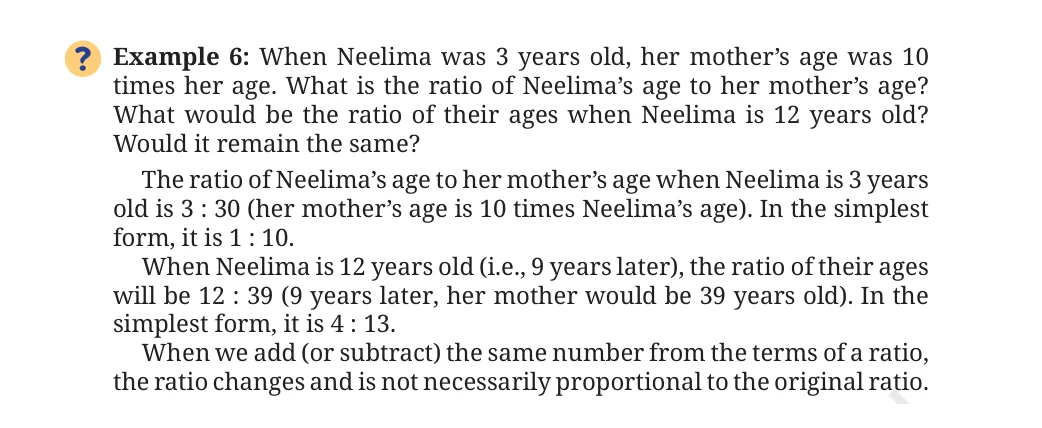
Neelima is 3 and her mother is 30. What is their age ratio then and when Neelima is 12?
Show solution
Initially the ratio is (3:30=1:10). Nine years later it is (12:39=4:13). Adding the same number to both terms does not generally preserve a ratio.
Textbook page 6 · solved item 10

Complete the ratios proportional to 14 : 21: __ : 42, 6 : __, and 2 : __.
Show solution
Since (14:21=2:3), the completed ratios are (28:42), (6:9), and (2:3).
Complete worked answers
Textbook page 7
Textbook page 7 · solved item 11
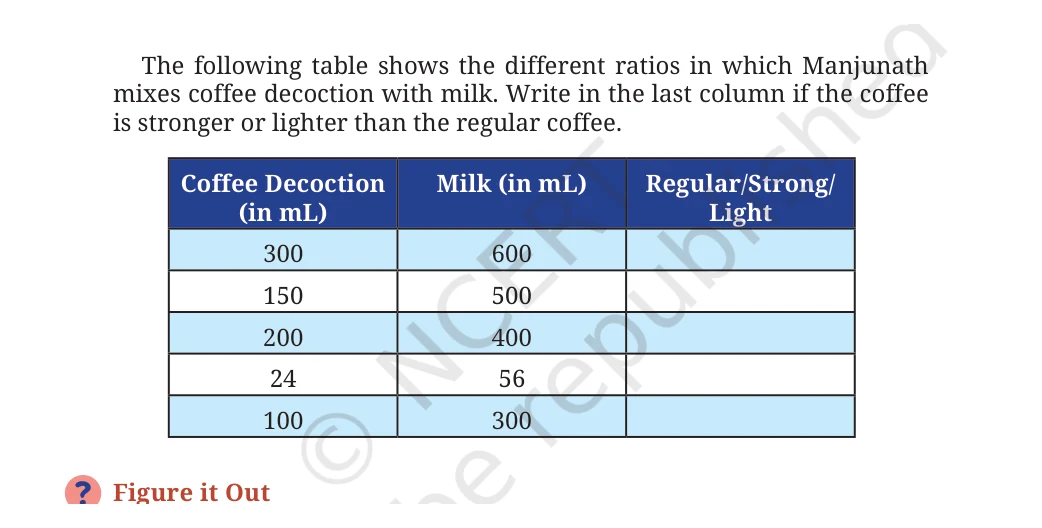
Classify the five coffee mixtures as regular, stronger, or lighter than 15 : 35.
Show solution
Regular coffee has decoction-to-milk ratio (15:35=3:7). The rows are: (300:600=1:2), stronger; (150:500=3:10), lighter; (200:400=1:2), stronger; (24:56=3:7), regular; (100:300=1:3), lighter.
Textbook page 7 · solved item 12

Which of the six statements of proportion are true?
Show solution
Statements (i), (iv), and (vi) are true. Their cross-products match: (4\times21=7\times12), (21\times10=6\times35), and (24\times3=8\times9).
Textbook page 7 · solved item 13

Give three ratios proportional to 4 : 9.
Show solution
Multiplying both terms by 2, 3, and 4 gives (8:18, 12:27,) and (16:36).
Textbook page 7 · solved item 14
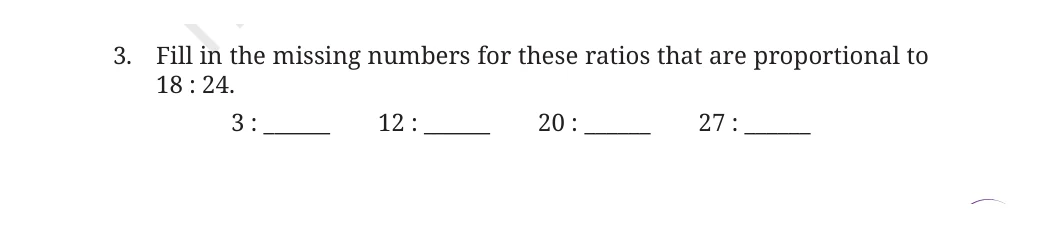
Complete 3 : __, 12 : __, 20 : __, and 27 : __ so each is proportional to 18 : 24.
Show solution
Since (18:24=3:4), the missing terms are (4, 16, \frac{80}{3},) and (36), respectively.
Complete worked answers
Textbook page 8
Textbook page 8 · solved item 15

Which of rectangles A, B, C, D, and E are similar?
Show solution
A, C, and D are similar, allowing for rotation: their longer-side to shorter-side ratios are equal. B and E have different aspect ratios. Measuring the printed sides verifies the comparison.
Textbook page 8 · solved item 16

Draw smaller and larger rectangles with the same width-to-height ratio as the given rectangle.
Show solution
If the printed rectangle measures (W:H), examples are (\\frac12W:\frac12H) and (2W:2H). Classmates may use other common scale factors, so their rectangles can differ in size without being wrong.
Textbook page 8 · solved item 17

Find the simplest ratio of grey bricks to coloured bricks in both wall patterns.
Show solution
In (a), one repeating block has 9 grey and 6 coloured bricks, so the ratio is (9:6=3:2). In (b), a repeating block has 16 grey and 12 coloured bricks, so the ratio is (16:12=4:3).
Complete worked answers
Textbook page 9
Textbook page 9 · solved item 18

Measure a person's body-part ratios and use them to draw a proportional human figure.
Show solution
Record head:torso, torso:arms, and torso:legs. Choose one scale factor (k) and multiply every measured length by (k). The drawing preserves all three ratios only when the same (k) is used throughout.
Textbook page 9 · solved item 19

A school cooks 15 kg of rice for 120 students. How much is needed for 80 students?
Show solution
The scale factor is (80/120=2/3). Therefore the rice needed is (15\times\frac23=10) kg.
Complete worked answers
Textbook page 10
Textbook page 10 · solved item 20

Show that (a:b::c:d) implies (ad=bc), and find the fourth term.
Show solution
Proportional ratios give (\\frac ca=\frac db). Multiplying by (ab) yields (bc=ad). Therefore, when (a\ne0), the fourth term is (d=\frac{bc}{a}).
Complete worked answers
Textbook page 11
Textbook page 11 · solved item 21
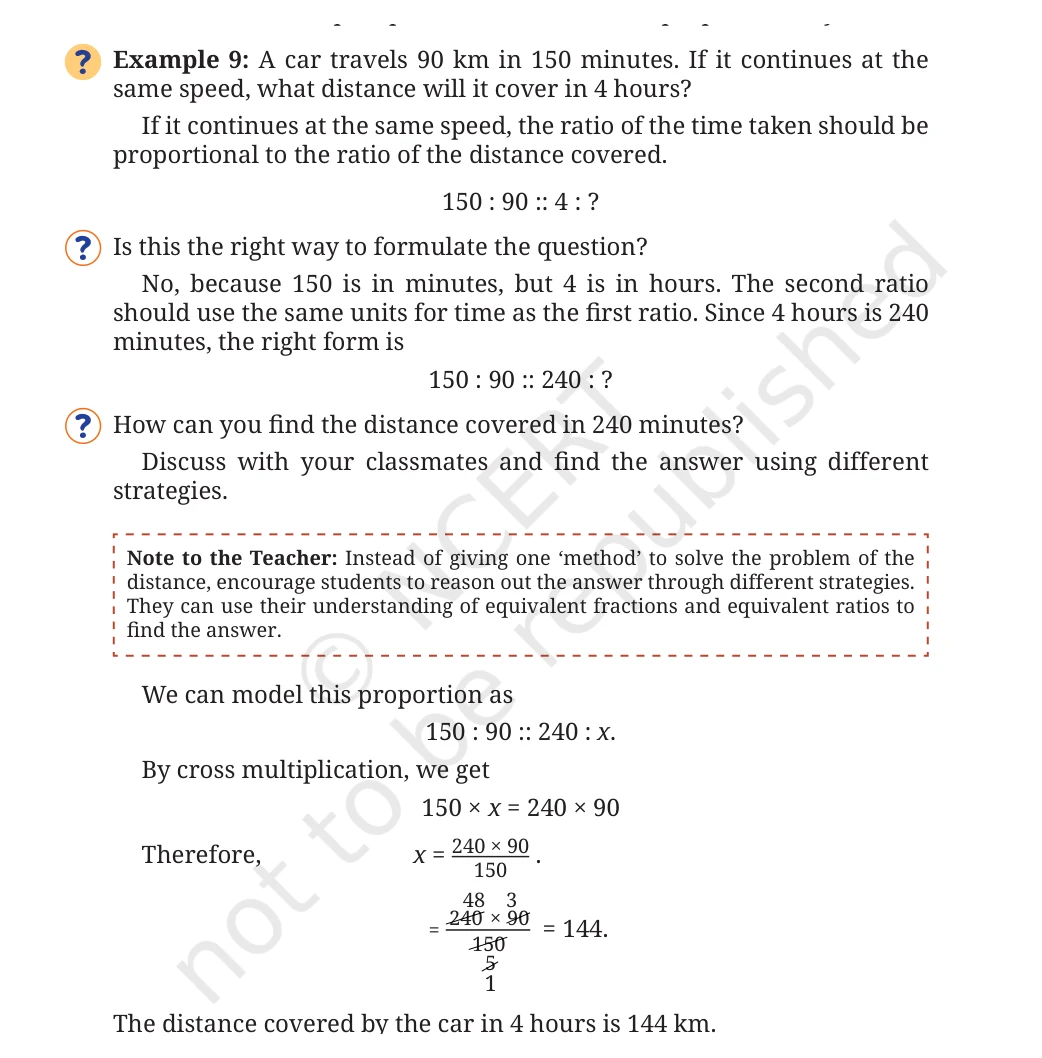
A car covers 90 km in 150 minutes. How far does it travel in 4 hours at the same speed?
Show solution
Convert 4 hours to 240 minutes. Then (150:90::240:x), so (x=\frac{240\times90}{150}=144) km.
Textbook page 11 · solved item 22

Compare tea costing ₹200 for 200 g with tea costing ₹800 for 1 kg.
Show solution
Use the same mass unit. The ratios are (200:200=1:1) and (1000:800=5:4), so they are not proportional. One kilogram of the first tea costs (5\times₹200=₹1000), versus ₹800 for the second; the first is more expensive.
Complete worked answers
Textbook page 12
Textbook page 12 · solved item 23
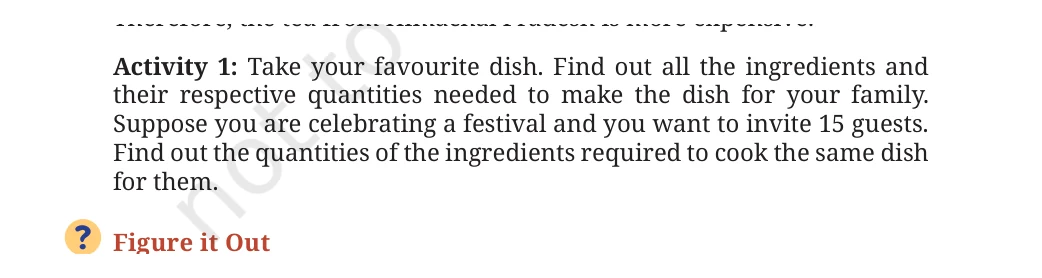
Scale a favourite dish's ingredients from your family size to 15 guests.
Show solution
If an ingredient quantity (q) serves (f) people, the amount for 15 guests is (q\times\frac{15}{f}). Apply the same factor to every ingredient so the recipe proportions remain unchanged.
Textbook page 12 · solved item 24

The Earth travels about 940 million km in a year. How far does it travel in one week?
Show solution
Taking 52 weeks in a year, (\\frac{940{,}000{,}000}{52}\approx18{,}076{,}923) km, or about 18.08 million km.
Textbook page 12 · solved item 25

How many bricks are needed for all the walls in the shown house plan if 10 ft needs 1450 bricks?
Show solution
The outer and inner wall lengths total (108) ft. At (1450/10=145) bricks per foot, the requirement is (108\times145=15{,}660) bricks.
Complete worked answers
Textbook page 13
Textbook page 13 · solved item 26

A 100 km journey takes 2 hours at 50 km/h. How long does it take at 75 km/h? Is 50 : 2 :: 75 : t valid?
Show solution
The relation is inverse, so (50:2::75:t) is not valid. The distance is (50\times2=100) km, and the new time is (100/75=4/3) hour, or 1 hour 20 minutes.
Complete worked answers
Textbook page 14
Textbook page 14 · solved item 27

Are the sample shampoo volumes proportional to their prices, and which package gives the best value?
Show solution
No. The mL per rupee values are (3, 180/154\approx1.17, 340/276\approx1.23,) and (1000/540\approx1.85). The ratios differ, and the sachet gives the most shampoo per rupee in this sample, although it creates much more packaging waste.
Textbook page 14 · solved item 28
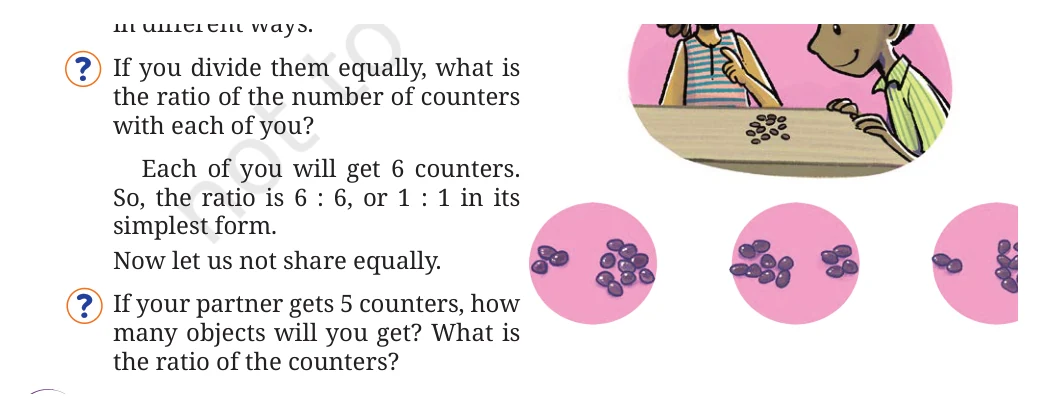
Share 12 counters equally, then with one person receiving 5. State the ratios.
Show solution
Equal sharing gives (6:6=1:1). If one person receives 5, the other receives 7, so the ratio is (5:7).
Complete worked answers
Textbook page 15
Textbook page 15 · solved item 29
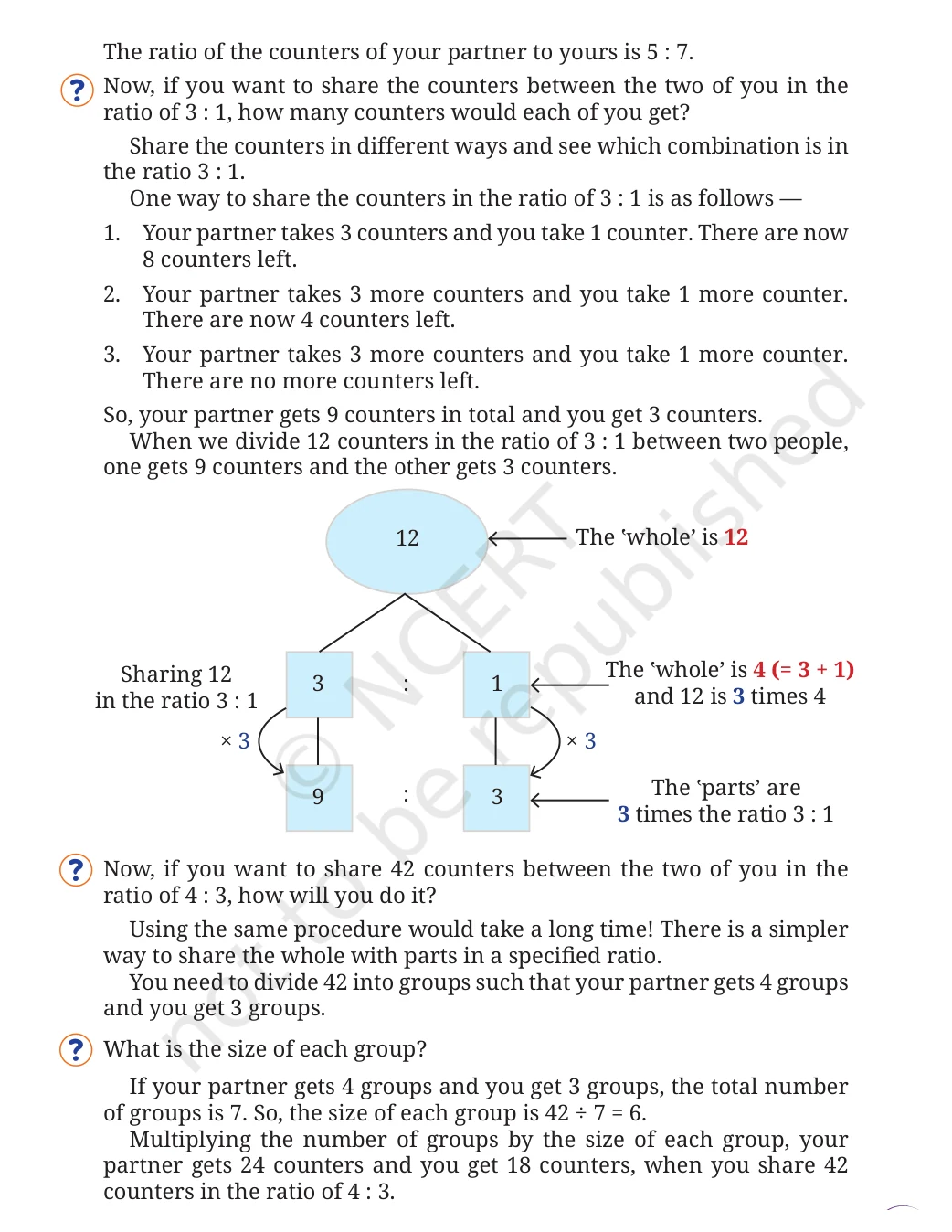
Share 12 counters in the ratio 3 : 1 and 42 counters in the ratio 4 : 3.
Show solution
For 12, there are (3+1=4) units, each worth 3, so the shares are 9 and 3. For 42, there are (4+3=7) units, each worth 6, so the shares are 24 and 18.
Complete worked answers
Textbook page 16
Textbook page 16 · solved item 30
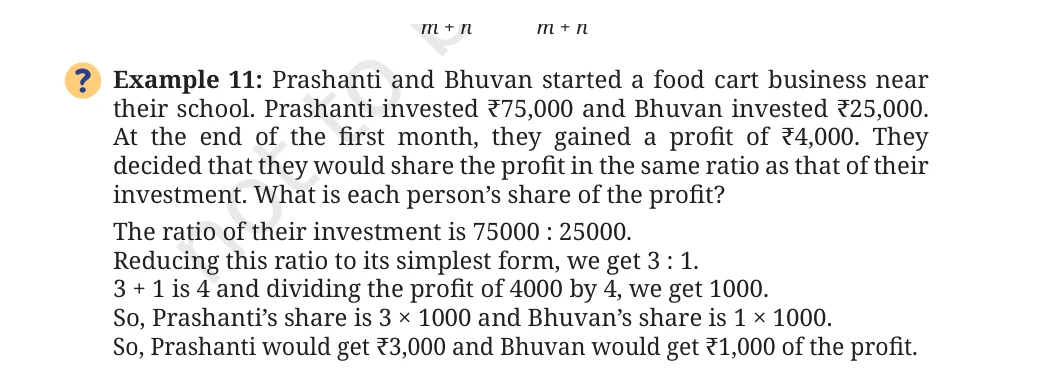
Prashanti invests ₹75,000 and Bhuvan ₹25,000. Divide a ₹4,000 profit in the investment ratio.
Show solution
The investment ratio is (75{,}000:25{,}000=3:1). Four equal units make ₹4,000, so each unit is ₹1,000. Prashanti receives ₹3,000 and Bhuvan ₹1,000.
Textbook page 16 · solved item 31

A 40 kg sand-cement mixture has ratio 3 : 1. How much cement must be added to make it 5 : 2?
Show solution
Initially there are 30 kg sand and 10 kg cement. Keeping sand at 30 kg, (5:2::30:c) gives (c=12) kg. Add (12-10=2) kg cement.
Complete worked answers
Textbook page 17
Textbook page 17 · solved item 32

Divide ₹4,500 in the ratio 2 : 3.
Show solution
There are 5 ratio units, each worth (₹4500/5=₹900). The parts are (2\times₹900=₹1800) and (3\times₹900=₹2700).
Textbook page 17 · solved item 33

A 240 mL solution has acid and water in the ratio 1 : 5. Find both quantities.
Show solution
There are 6 units, each (240/6=40) mL. Acid is 40 mL and water is (5\times40=200) mL.
Textbook page 17 · solved item 34
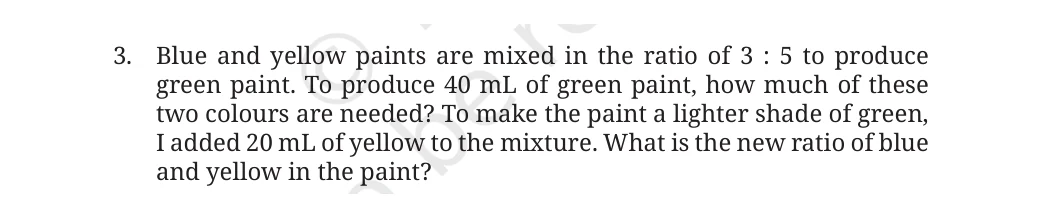
Make 40 mL green paint with blue and yellow in ratio 3 : 5, then add 20 mL yellow. Find the new ratio.
Show solution
Eight units make 40 mL, so blue is 15 mL and yellow is 25 mL. After adding 20 mL yellow, the ratio is (15:45=1:3).
Textbook page 17 · solved item 35

Split 6 cups of idli mixture into rice and urad dal in the ratio 2 : 1.
Show solution
Three units make 6 cups, so each unit is 2 cups. Use 4 cups rice and 2 cups urad dal.
Textbook page 17 · solved item 36

A bucket of orange paint has red and yellow in ratio 3 : 5. Add one full bucket of yellow. Find the new ratio.
Show solution
The original red and yellow amounts are (3/8) and (5/8) bucket. Yellow becomes (5/8+1=13/8) bucket, so the new ratio is (3/8:13/8=3:13).
Complete worked answers
Textbook page 18
Textbook page 18 · solved item 37

Use the chapter's unit conversions, including Celsius and Fahrenheit.
Show solution
Key conversions are (1\text{ m}=3.281\text{ ft}), (1\text{ m}^2=10.764\text{ ft}^2), (1\text{ acre}=43{,}560\text{ ft}^2), (1\text{ hectare}=10{,}000\text{ m}^2=2.471\text{ acres}), and (1\text{ L}=1000\text{ mL}). Temperature uses (F=\frac95C+32) and (C=\frac59(F-32)).
Textbook page 18 · solved item 38

Simplify the ratio of 600 mL orange juice to 900 mL apple juice.
Show solution
Divide both terms by 300: (600:900=2:3).
Textbook page 18 · solved item 39

Three full buses carry 162 people. How many buses are needed for 204 people, and will they be full?
Show solution
Each bus holds (162/3=54) people. Since (204/54=3\frac79), 4 buses are needed. They provide 216 seats, leaving 12 empty.
Textbook page 18 · solved item 40

Delhi has 30 million people in 1,484 km²; Mumbai has 20 million in 550 km². Which is more crowded?
Show solution
Delhi has about (30{,}000{,}000/1484\approx20{,}216) people/km². Mumbai has about (20{,}000{,}000/550\approx36{,}364) people/km². Mumbai is more crowded.
Textbook page 18 · solved item 41

A crane's neck and remaining body are in ratio 4 : 6. What would your neck length be at height h?
Show solution
The neck is 4 of the 10 total ratio units, so its length would be (\\frac4{10}h=0.4h). Substitute your measured height for (h).
Textbook page 18 · solved item 42
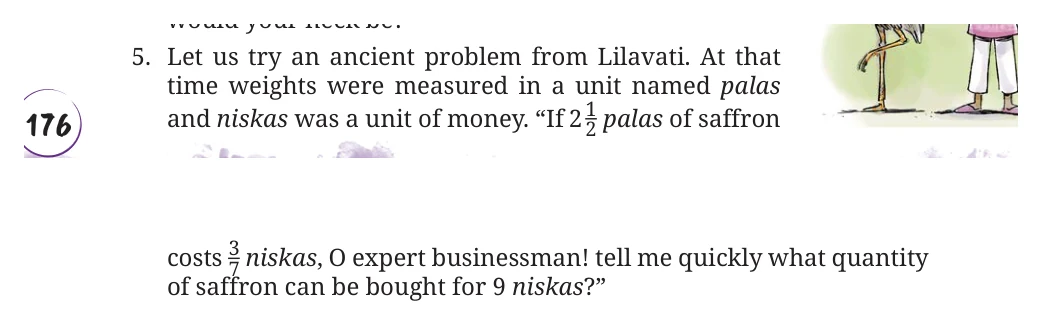
If (2\frac12) palas of saffron cost (\\frac37) niskas, how much can 9 niskas buy?
Show solution
Using direct proportion, (x=\frac{(5/2)\times9}{3/7}=\frac52\times9\times\frac73=52.5) palas.
Complete worked answers
Textbook page 19
Textbook page 19 · solved item 43

Harmain is 1 and her brother is 5. When will their age ratio be 1 : 2?
Show solution
After (x) years, ((x+1):(x+5)=1:2). Thus (2x+2=x+5), so (x=3). Harmain will then be 4 and her brother 8.
Textbook page 19 · solved item 44

Equal volumes of gold and water have mass ratio 37 : 2. If 1 L water is 1 kg, find the mass of 1 L gold.
Show solution
(37:2::x:1), so (2x=37) and (x=18.5) kg.
Textbook page 19 · solved item 45

A 200 ft by 500 ft plot needs manure at 10 tonnes per acre. How much manure is required?
Show solution
The area is (100{,}000\text{ ft}^2). Using (1\text{ acre}=43{,}560\text{ ft}^2), manure needed is (10\times100{,}000/43{,}560\approx22.96) tonnes, or about 22,957 kg.
Textbook page 19 · solved item 46

A tap fills 500 mL in 15 seconds. How long will it take to fill 10 litres?
Show solution
Ten litres is 10,000 mL, or 20 mugs. Time is (20\times15=300) seconds, which is 5 minutes.
Textbook page 19 · solved item 47

One acre costs ₹15,00,000. Find the cost of 2,400 square feet.
Show solution
Using (1\text{ acre}=43{,}560\text{ ft}^2), the cost is (₹15{,}00{,}000\times2400/43560\approx₹82{,}645).
Textbook page 19 · solved item 48
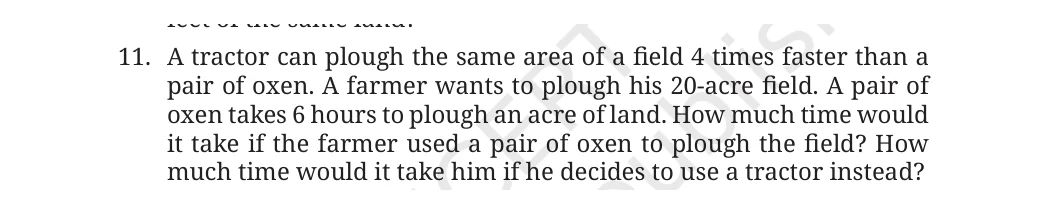
Compare the time for oxen and a tractor to plough a 20-acre field.
Show solution
Oxen take (20\times6=120) hours. A tractor is four times faster, so it takes (120/4=30) hours.
Textbook page 19 · solved item 49

Find the copper and nickel cost in a 7.74 g coin whose metals are in ratio 3 : 1.
Show solution
Copper mass is (\\frac34\times7.74=5.805) g and nickel mass is 1.935 g. Their costs are (5.805\times906/1000\approx₹5.26) and (1.935\times1341/1000\approx₹2.59), totaling about ₹7.85.
Complete worked answers
Textbook page 20
Textbook page 20 · solved item 50

Solve the three 6×6 Binairo puzzles using H for horizontal and V for vertical lines.
Show solution
Puzzle 1 rows: HVHHVV, VHVVHH, VHHVHV, HVVHVH, HVHVHV, VHVHVH. Puzzle 2: HHVVHV, HVVHVH, VHHVHV, HVVHHV, VHHVVH, VVHHVH. Puzzle 3: HVHVHV, VHVHVH, HVHVVH, VHVHHV, HHVVHV, VVHHVH. Each row and column has three of each symbol, no run of three, and no duplicate row or column.