
Use the textbook context
Match, attempt, then check
Each source crop keeps the printed information needed for that item. Compound answer-key entries are separated into individual solutions.
Complete worked answers
Textbook page 1
Textbook page 1 · solved item 1
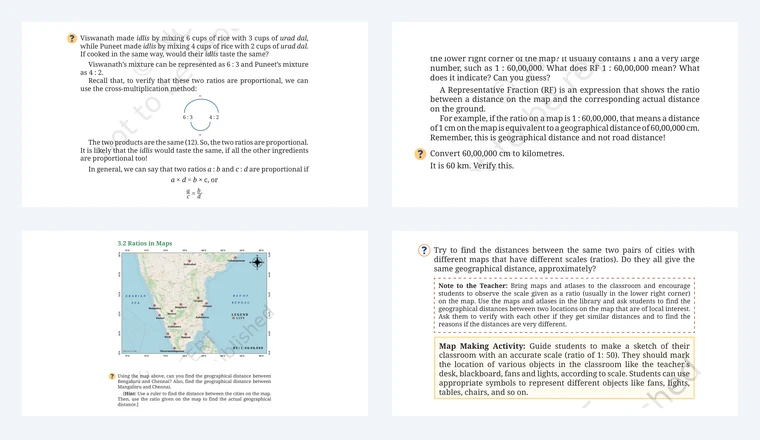
Will idlis made with rice and urad dal in ratios 6:3 and 4:2 taste the same?
Show solution
Yes, if the other ingredients and cooking are alike. Both simplify to 2:1, and cross-products agree: 6\times2=3\times4=12.
Complete worked answers
Textbook page 2
Textbook page 2 · solved item 2
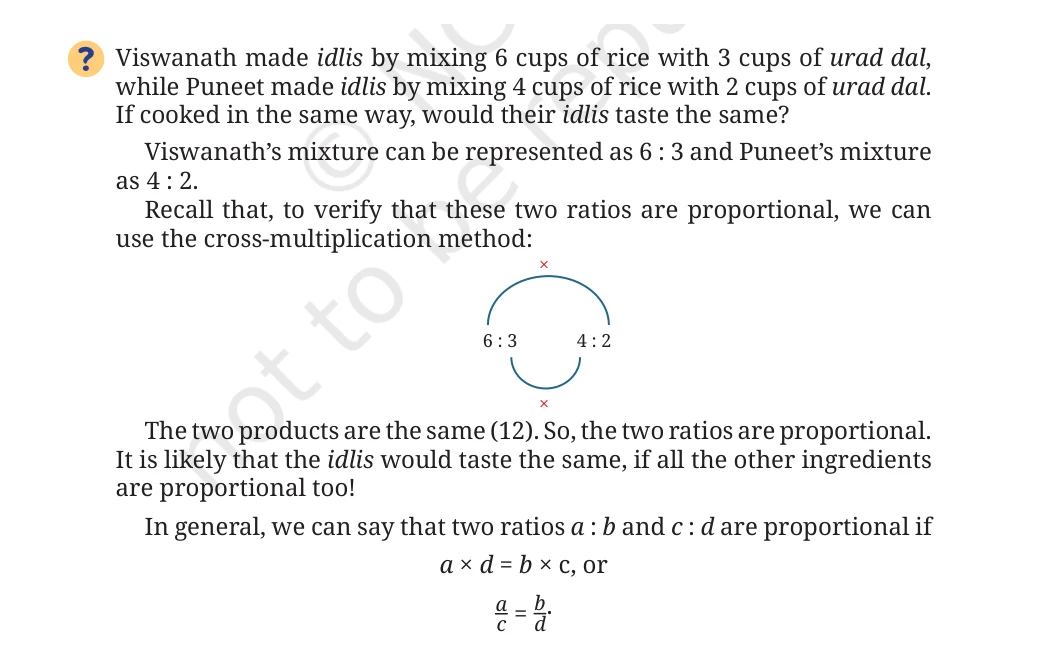
What does RF 1:60,00,000 mean, and how many kilometres is 60,00,000 cm?
Show solution
It means 1 cm on the map represents 60,00,000 cm on the ground. Since 1\text{ km}=100{,}000\text{ cm}, 60{,}00{,}000\text{ cm}=60\text{ km}.
Textbook page 2 · solved item 3
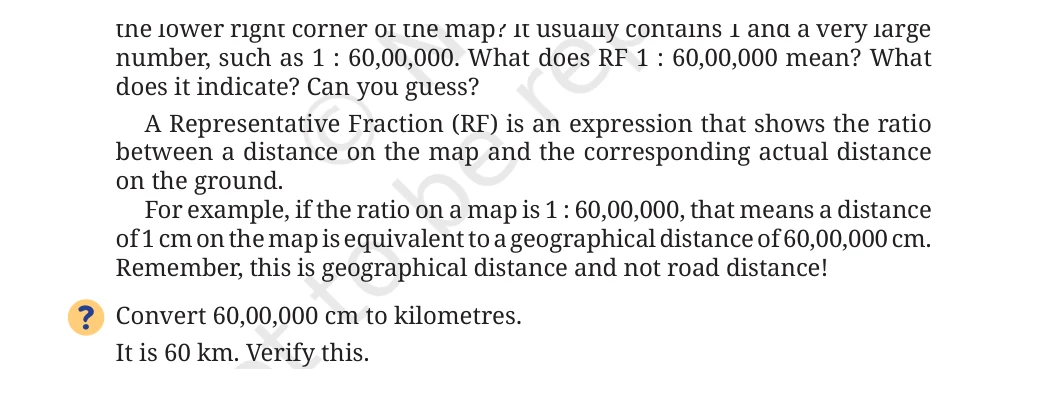
Use the map scale to estimate the geographical distances from Bengaluru and Mangaluru to Chennai.
Show solution
Measure each straight map segment in centimetres and multiply by 60\text{ km/cm}. Depending on ruler placement and print scaling, the map gives roughly 290 km from Bengaluru to Chennai and 590 km from Mangaluru to Chennai. These are geographical, not road, distances.
Complete worked answers
Textbook page 3
Textbook page 3 · solved item 4
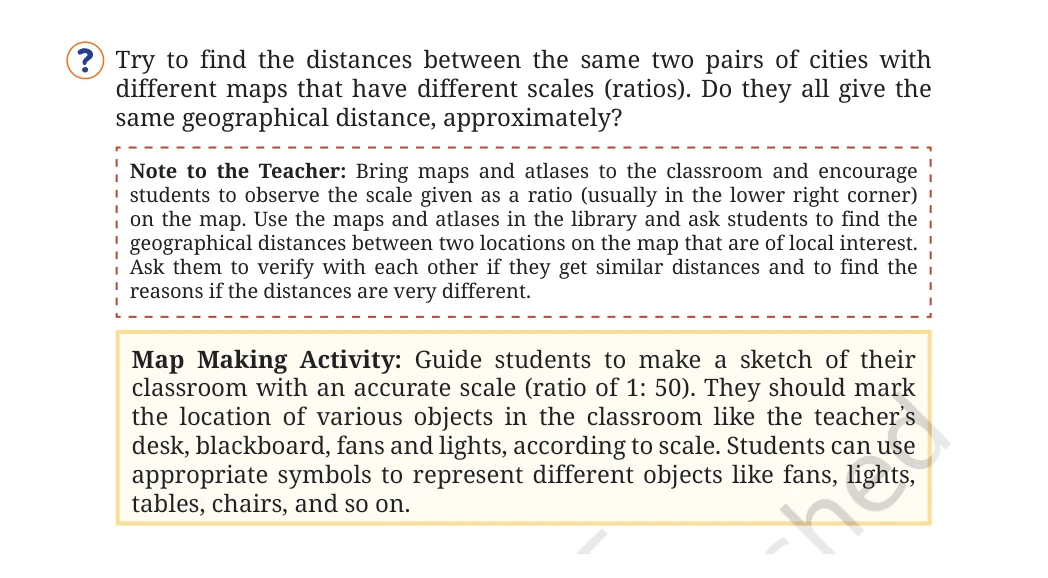
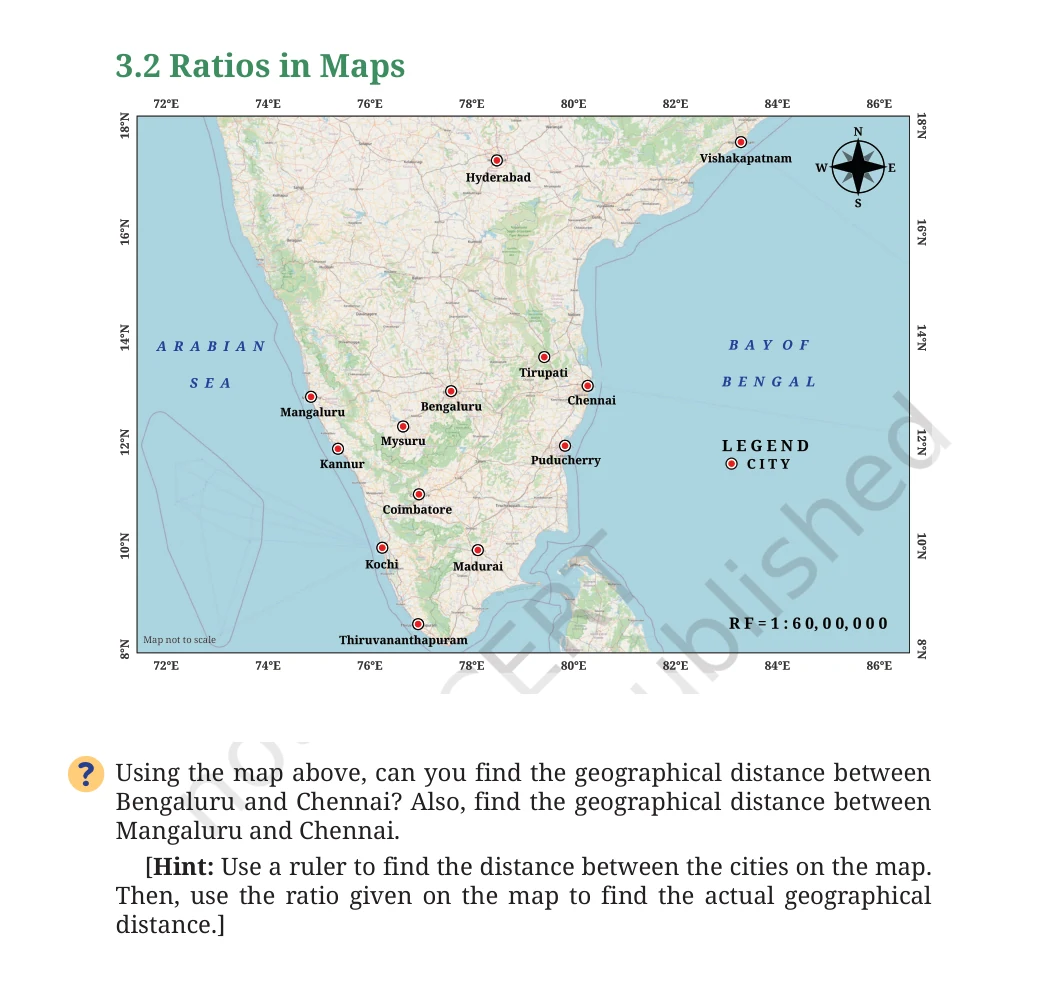
Why may different maps give slightly different measured distances, and how should a 1:50 classroom map be made?
Show solution
After converting each measurement with its own scale, results should be close. Small differences come from print scaling, line thickness, ruler placement, projection, and rounding. At 1:50, divide every actual classroom length by 50 using the same units, draw the boundary, and place each object at its correspondingly scaled location.
Textbook page 3 · solved item 5
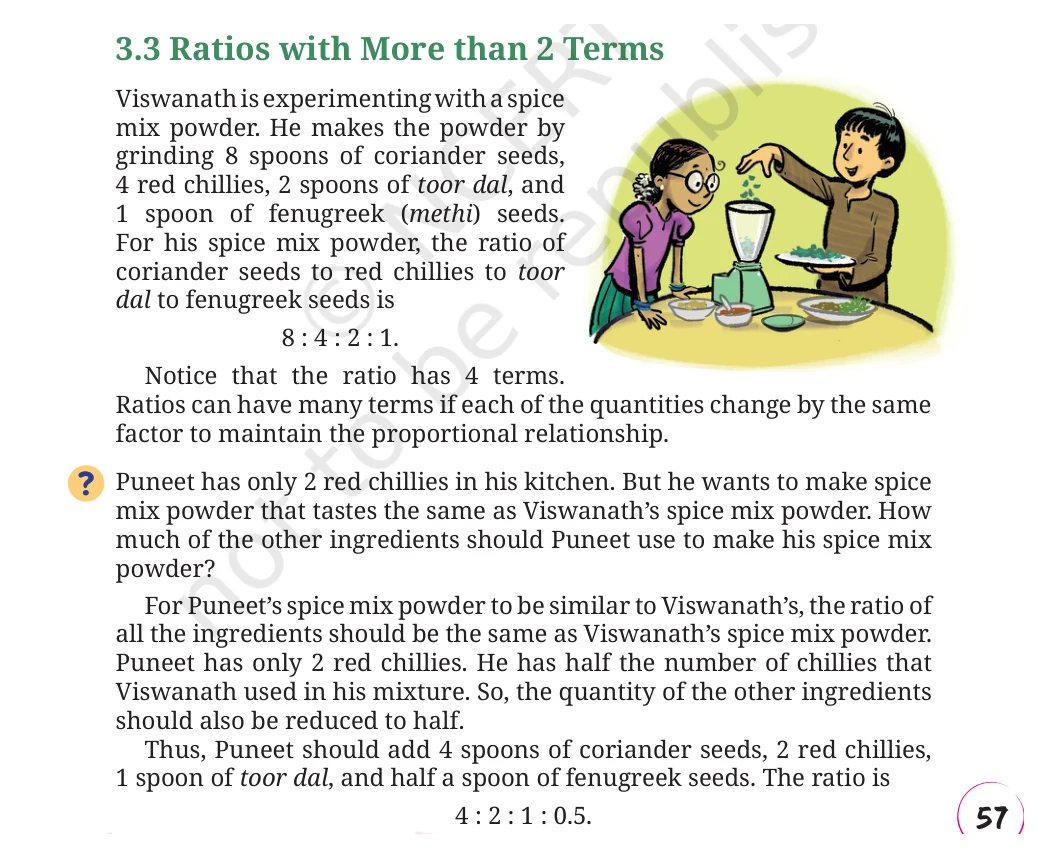
Puneet has 2 chillies. How much of every ingredient preserves the 8:4:2:1 spice ratio?
Show solution
Two chillies are half of four, so halve every term: 4 spoons coriander, 2 chillies, 1 spoon toor dal, and 1/2 spoon fenugreek. The ratio is 4:2:1:0.5.
Complete worked answers
Textbook page 4
Textbook page 4 · solved item 6
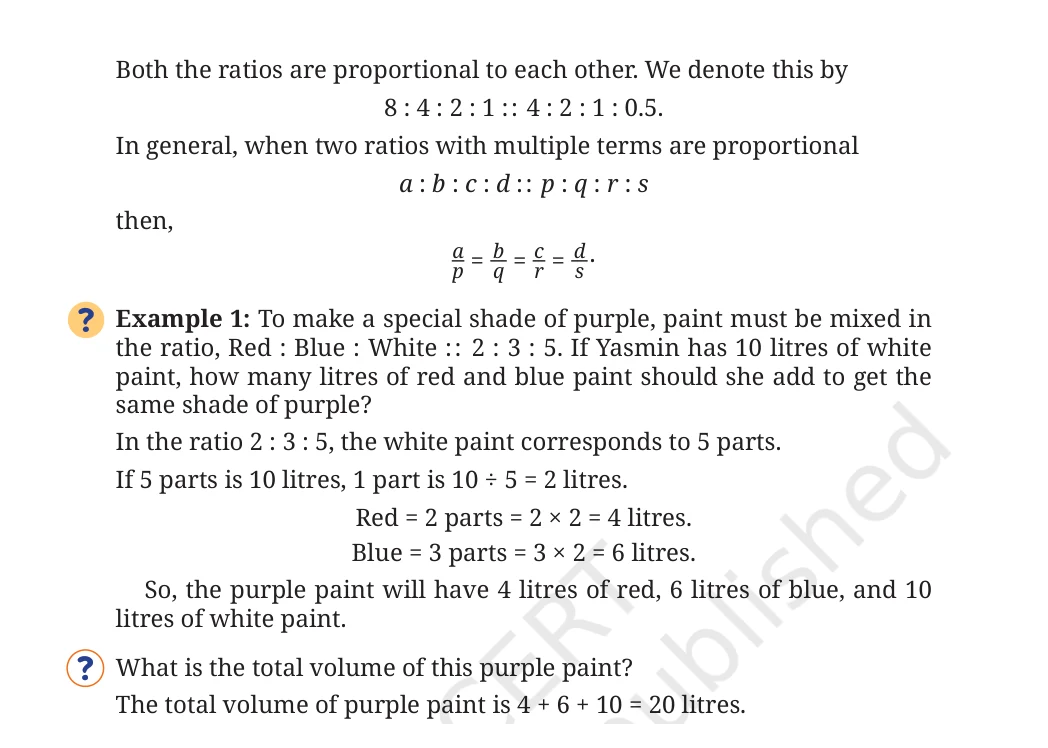
A purple paint mix has red:blue:white = 2:3:5 and 10 L white. Find each colour and the total.
Show solution
Five parts equal 10 L, so one part is 2 L. Red is 4 L, blue is 6 L, and white is 10 L. Total volume is 4+6+10=20 L.
Textbook page 4 · solved item 7
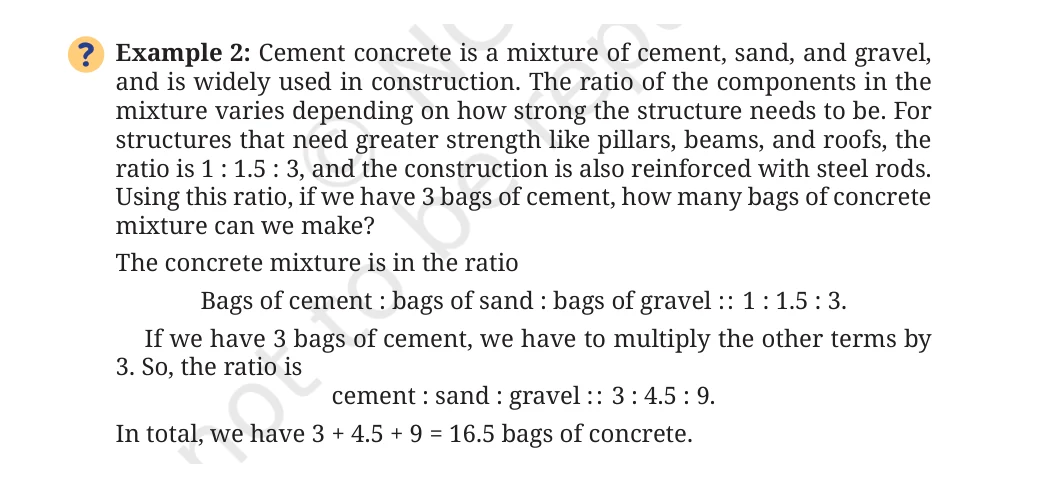
With cement:sand:gravel = 1:1.5:3, how much concrete comes from 3 bags of cement?
Show solution
Scale every term by 3: cement 3 bags, sand 4.5 bags, and gravel 9 bags. Total mixture is 3+4.5+9=16.5 bag-equivalents.
Complete worked answers
Textbook page 6
Textbook page 6 · solved item 8

Divide a 150-minute cricket session in the ratio 3:4:3:5.
Show solution
The ratio has 3+4+3+5=15 parts, so each part is 10 minutes. Warm-up/cool-down takes 30 minutes, batting 40, bowling 30, and fielding 50.
Textbook page 6 · solved item 9

A library has Odiya:Hindi:English books = 3:2:1 and 288 Odiya books. Find the others.
Show solution
Three parts equal 288, so one part is 96. The library has 2\times96=192 Hindi books and 96 English books.
Textbook page 6 · solved item 10

There are 100 coins in the count ratio ₹10:₹5:₹2:₹1 = 4:3:2:1. Find their total value.
Show solution
The 10 ratio parts give counts 40, 30, 20, and 10. Their values total 40(10)+30(5)+20(2)+10(1)=₹600.
Textbook page 6 · solved item 11

Construct triangles with side ratio 3:4:5. Are all such triangles congruent?
Show solution
Choose any scale k>0 and construct sides 3k,4k,5k; the triangle is right-angled. All such triangles are similar, but they are congruent only when they use the same k, because different scale factors give different side lengths.
Textbook page 6 · solved item 12

Can a triangle have side ratio 1:3:5?
Show solution
No. The two shorter sides would total 1+3=4 parts, which is less than 5 parts. This violates the triangle inequality.
Complete worked answers
Textbook page 7
Textbook page 7 · solved item 13
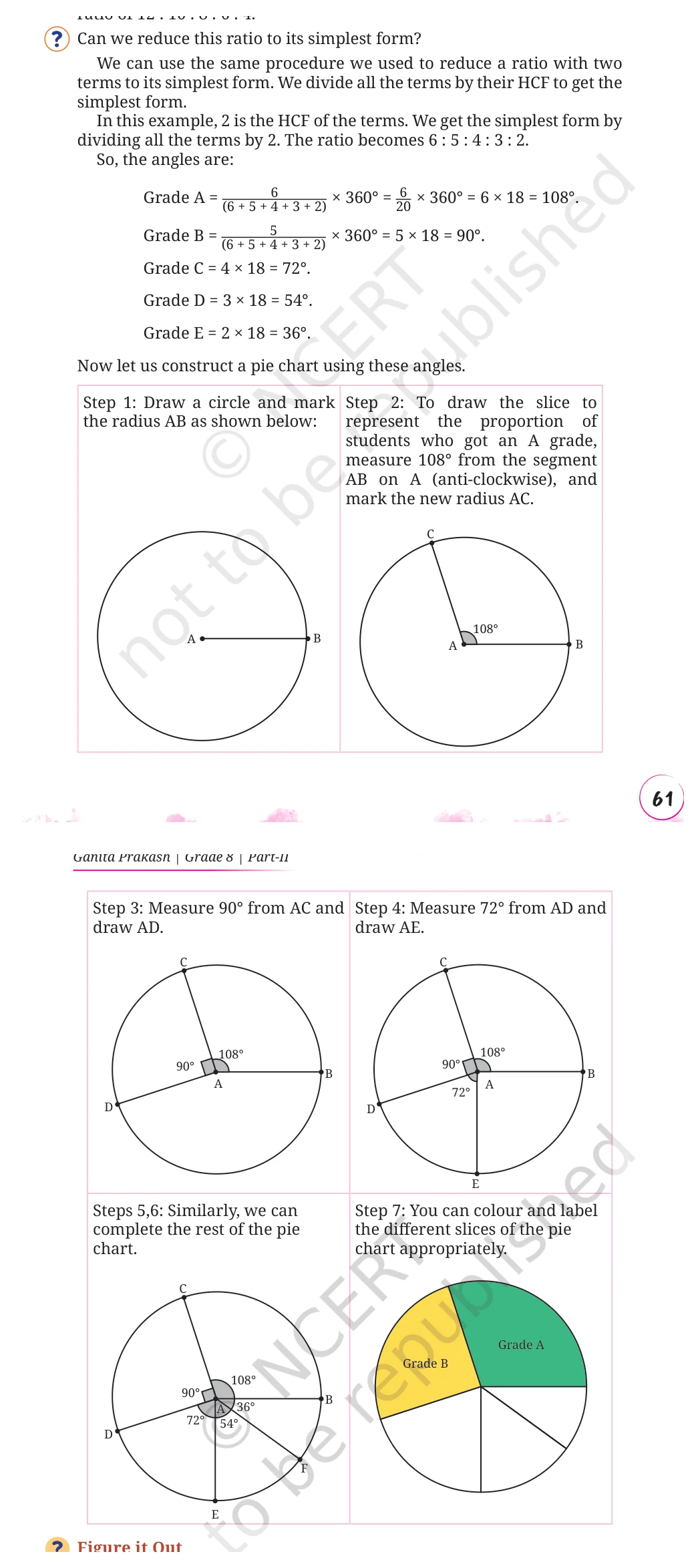
Simplify 12:10:8:6:4 and find the pie-chart angles.
Show solution
The HCF is 2, so the ratio is 6:5:4:3:2, totalling 20 parts. Each part is 360^\circ/20=18^\circ. Thus A, B, C, D, E have angles 108^\circ,90^\circ,72^\circ,54^\circ,36^\circ.
Complete worked answers
Textbook page 8
Textbook page 8 · solved item 14

Draw a pie chart for 360 people: summer 90, rainy 120, and the rest winter.
Show solution
Winter has 360-90-120=150 people. Since the total count equals 360, the sector angles are numerically the same: summer 90^\circ, rainy 120^\circ, winter 150^\circ.
Textbook page 8 · solved item 15

Draw the TV-channel pie chart for Entertainment 50%, Sports 25%, News 15%, Information 10%.
Show solution
Multiply each percentage by 360^\circ: Entertainment 180^\circ, Sports 90^\circ, News 54^\circ, and Information 36^\circ.
Textbook page 8 · solved item 16
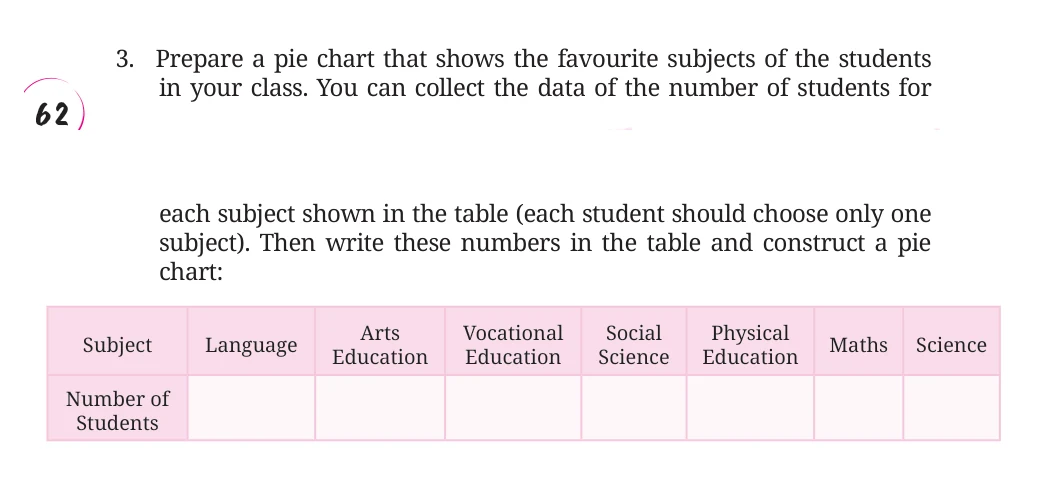
How should a class favourite-subject pie chart be constructed?
Show solution
Let the collected counts be n_1,\ldots,n_7, with total N. For each subject draw a sector of angle (n_i/N)\times360^\circ. The angles must total 360^\circ; label each sector with its subject and count or percentage.
Complete worked answers
Textbook page 9
Textbook page 9 · solved item 17
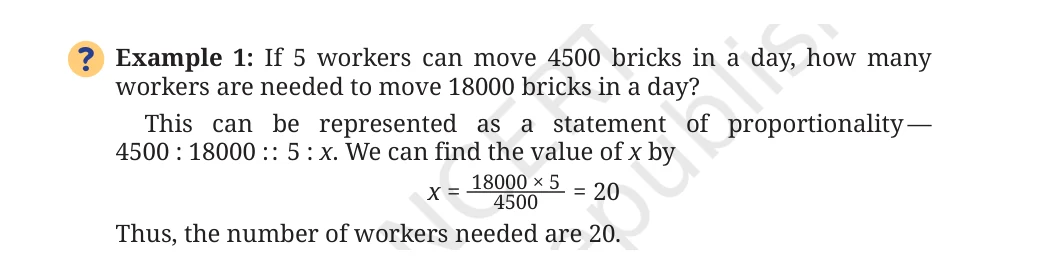
If 5 workers move 4,500 bricks per day, how many move 18,000 bricks per day?
Show solution
This is direct proportion: x=18{,}000\times5/4{,}500=20. Therefore 20 workers are needed, assuming equal productivity.
Textbook page 9 · solved item 18
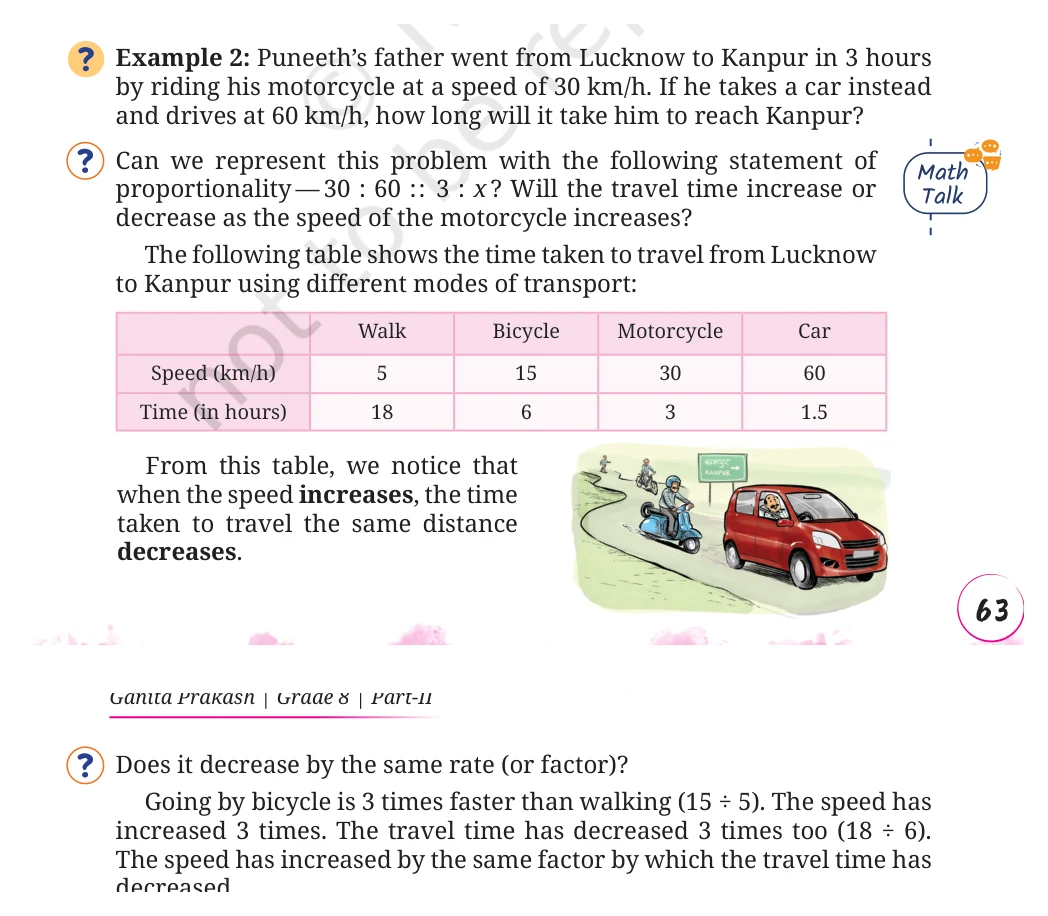
A 90 km journey takes 3 hours at 30 km/h. How long at 60 km/h?
Show solution
Speed and time are inversely proportional for fixed distance. Thus 30\times3=60t, giving t=1.5 hours.
Complete worked answers
Textbook page 10
Textbook page 10 · solved item 19
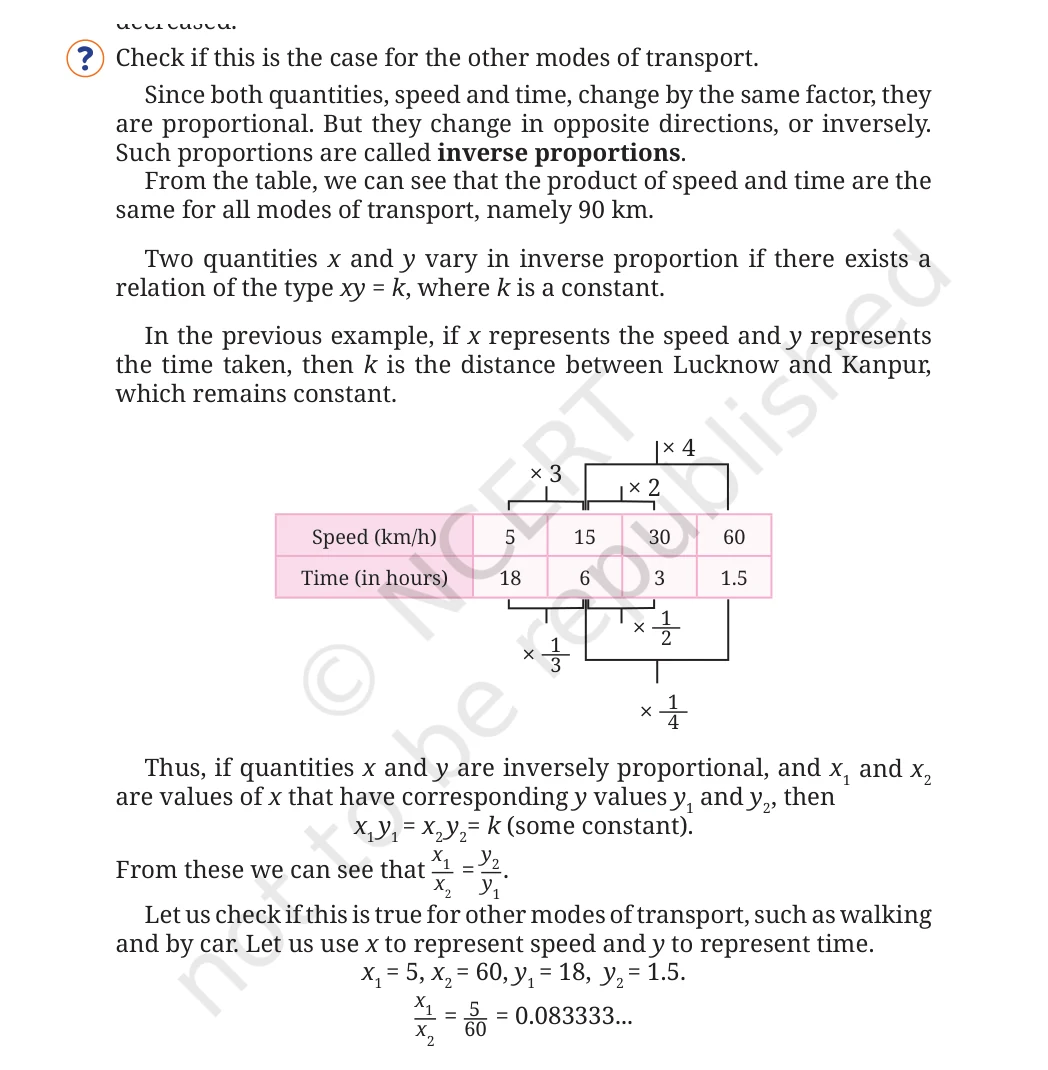
Verify the speed-time factors for walking, bicycle, motorcycle, and car.
Show solution
Every product is 90: 5\times18=15\times6=30\times3=60\times1.5=90. Multiplying speed by 3, 2, or 2 divides time by the same factor, confirming inverse proportion.
Textbook page 10 · solved item 20

Evaluate 1.5/18 and compare it with 5/60.
Show solution
1.5/18=1/12=0.08333\ldots, and 5/60=1/12. They are equal, as inverse proportion requires.
Complete worked answers
Textbook page 11
Textbook page 11 · solved item 21
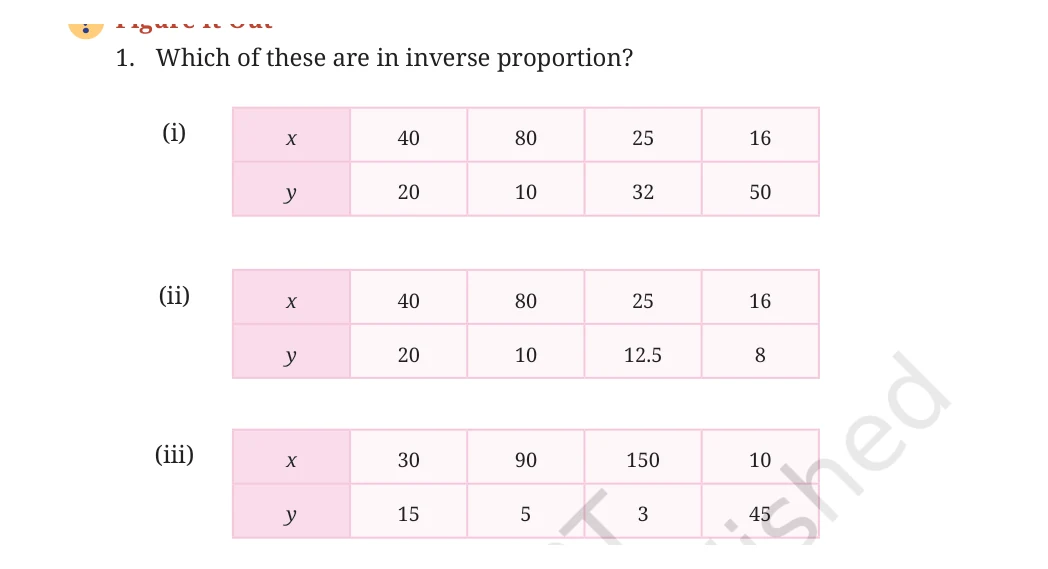
Which of the three x-y tables show inverse proportion?
Show solution
Tables (i) and (iii). In (i), every product is 800. In (iii), every product is 450. Table (ii) has products 800, 800, 312.5, and 128, so it is not inverse proportion.
Textbook page 11 · solved item 22
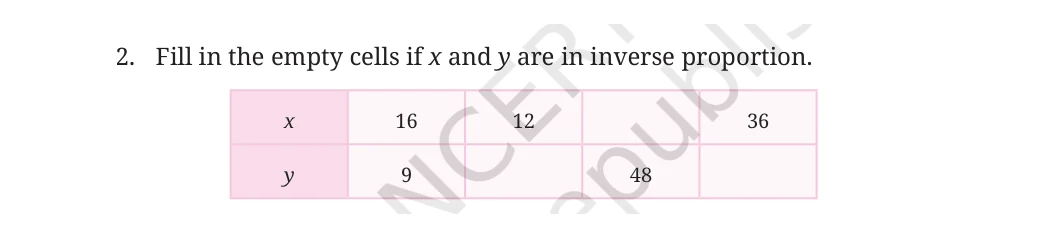
Fill the inverse-proportion table with x = 16, 12, blank, 36 and y = 9, blank, 48, blank.
Show solution
The constant product is 16\times9=144. Therefore the missing entries are y=144/12=12, x=144/48=3, and y=144/36=4.
Complete worked answers
Textbook page 12
Textbook page 12 · solved item 23
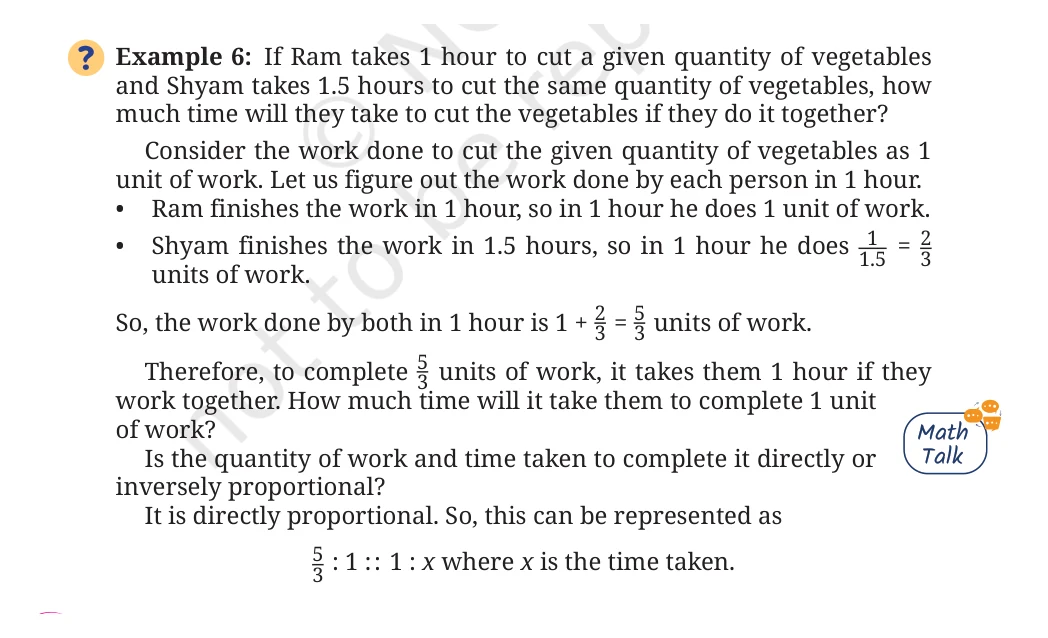
Ram takes 1 hour and Shyam 1.5 hours. How long do they take together, and is work proportional to time?
Show solution
Their hourly rates are 1 and 2/3 jobs, so together they do 5/3 jobs per hour. One job takes 1/(5/3)=3/5 hour, or 36 minutes. At a fixed combined rate, work completed is directly proportional to time.
Complete worked answers
Textbook page 13
Textbook page 13 · solved item 24
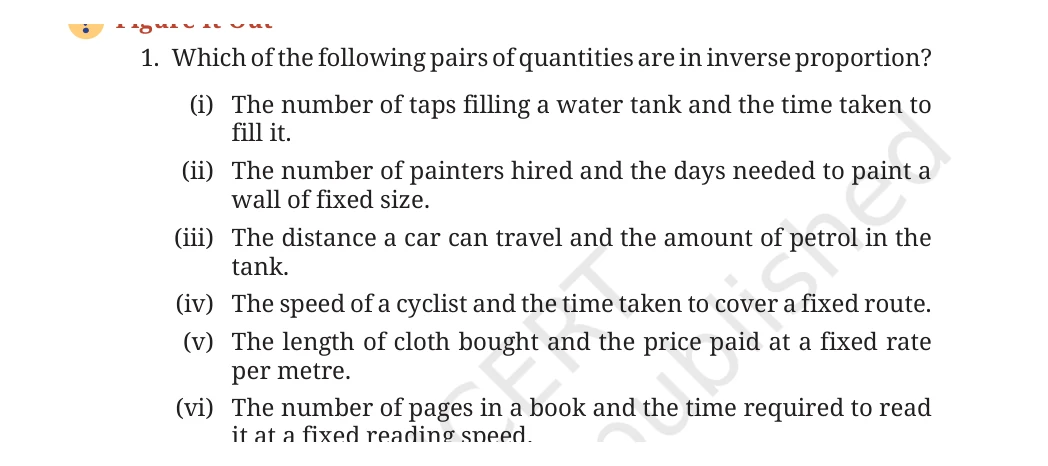
Which listed quantity pairs are inversely proportional?
Show solution
Pairs (i), (ii), and (iv): taps versus filling time, painters versus days for a fixed wall, and speed versus time for a fixed route. Pairs (iii), (v), and (vi) are direct under the stated fixed-rate assumptions.
Textbook page 13 · solved item 25

If 24 pencils cost ₹120, what do 20 pencils cost?
Show solution
At a fixed unit price, one pencil costs ₹5. Therefore 20 pencils cost 20\times₹5=₹100.
Textbook page 13 · solved item 26

Water supplies 20 families for 6 days. How long for 30 families?
Show solution
With equal daily use per family and no replenishment or wastage, family-days stay constant: 20\times6=30d. Hence d=4 days.
Textbook page 13 · solved item 27
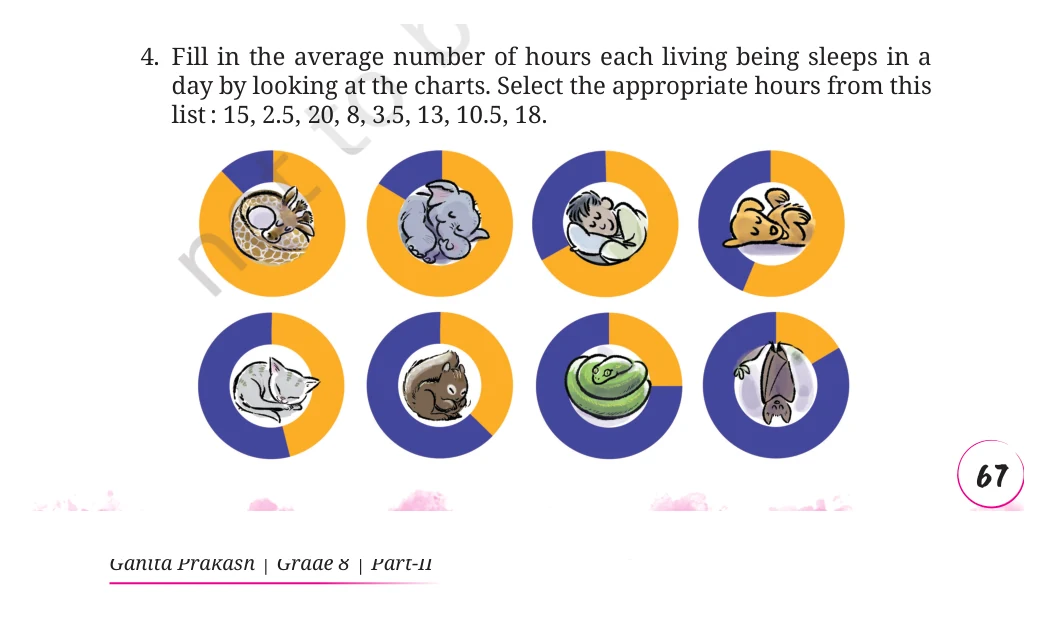
Match the eight sleep charts to the listed hours.
Show solution
Reading the purple portion as sleep time out of 24 hours, from top-left to bottom-right the values are 2.5, 3.5, 8, 10.5, 13, 15, 18, and 20 hours.
Complete worked answers
Textbook page 14
Textbook page 14 · solved item 28
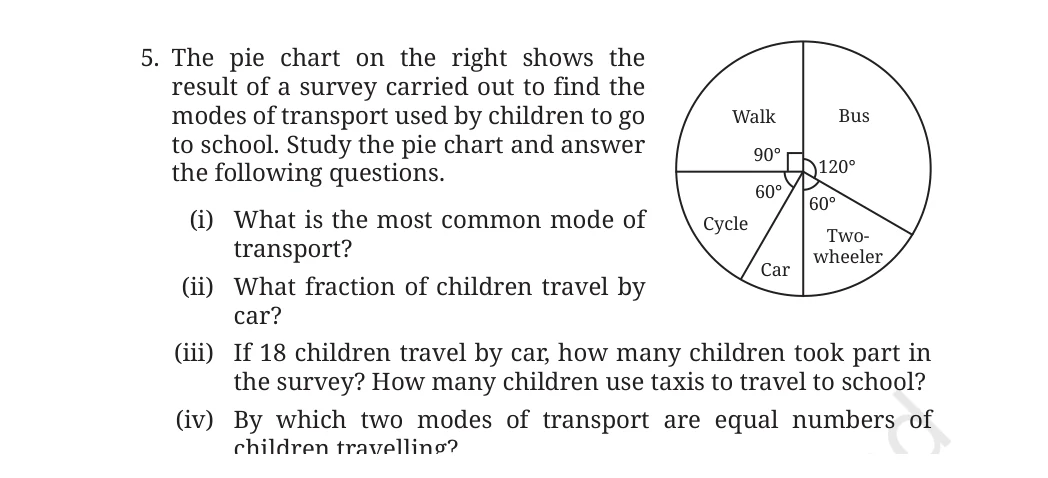
Answer the questions from the school-transport pie chart.
Show solution
Bus is most common at 120^\circ. Car is the remaining 30^\circ, or 1/12 of the children. If 18 travel by car, the total is 18\times12=216; the 60^\circ two-wheeler sector represents 36 children. Cycle and two-wheeler have equal 60^\circ sectors. The question says “taxis,” but the chart labels that sector “Two-wheeler.”
Textbook page 14 · solved item 29

Three workers paint a fence in 4 days. How long with four workers?
Show solution
Total work is 3\times4=12 worker-days. Four equally productive workers need 12/4=3 days, assuming equal rates, full attendance, and no interference between workers.
Textbook page 14 · solved item 30

A pump fills 2 equal tanks in 6 hours. How long for 5 tanks?
Show solution
At a fixed pump rate, time is directly proportional to tank count: 6\times5/2=15 hours.
Textbook page 14 · solved item 31

Chairs form 25 rows of 12. How many rows when there are 20 per row?
Show solution
There are 25\times12=300 chairs. At 20 chairs per row, 300/20=15 rows are needed.
Textbook page 14 · solved item 32

Eight school periods last 45 minutes each. How long are nine equal periods in the same school day?
Show solution
Teaching time is 8\times45=360 minutes. Dividing by 9 gives 360/9=40 minutes per period.
Textbook page 14 · solved item 33

Small and large pumps fill a tank in 3 and 2 hours. How long together?
Show solution
The rates are 1/3 and 1/2 tank per hour, totalling 5/6. Time is 1/(5/6)=6/5 hour, or 1 hour 12 minutes.
Textbook page 14 · solved item 34
A factory needs 42 machines for 63 days. How many machines for 54 days?
Show solution
Machine-days are fixed: 42\times63=m\times54. Thus m=49 machines, assuming identical machines and constant operating time and output.
Textbook page 14 · solved item 35
A car takes 2 hours at 60 km/h. How long at 80 km/h?
Show solution
The distance is fixed at 60\times2=120 km. At 80 km/h, time is 120/80=1.5 hours.