
Use the textbook context
Match, attempt, then check
Each source crop keeps the printed information needed for that item. Compound answer-key entries are separated into individual solutions.
Complete worked answers
Textbook page 1
Textbook page 1 · solved item 1
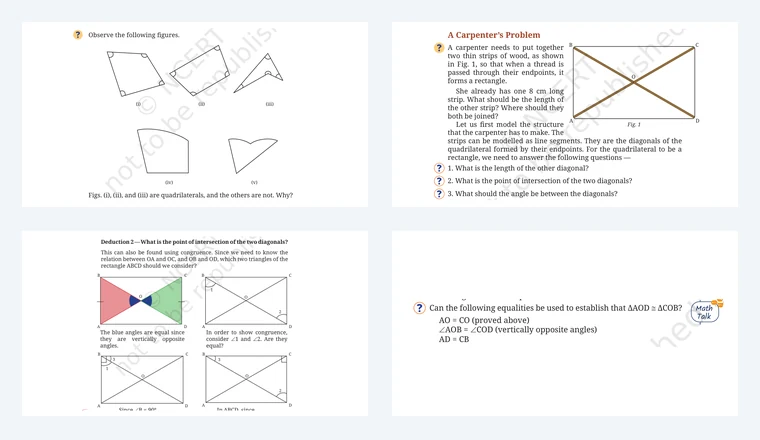
Why are figures (i), (ii), and (iii) quadrilaterals while (iv) and (v) are not?
Show solution
The first three are closed polygons made from exactly four line segments. Figure (iv) has a curved side, and figure (v) is not a single simple four-sided closed polygon.
Complete worked answers
Textbook page 2
Textbook page 2 · solved item 2
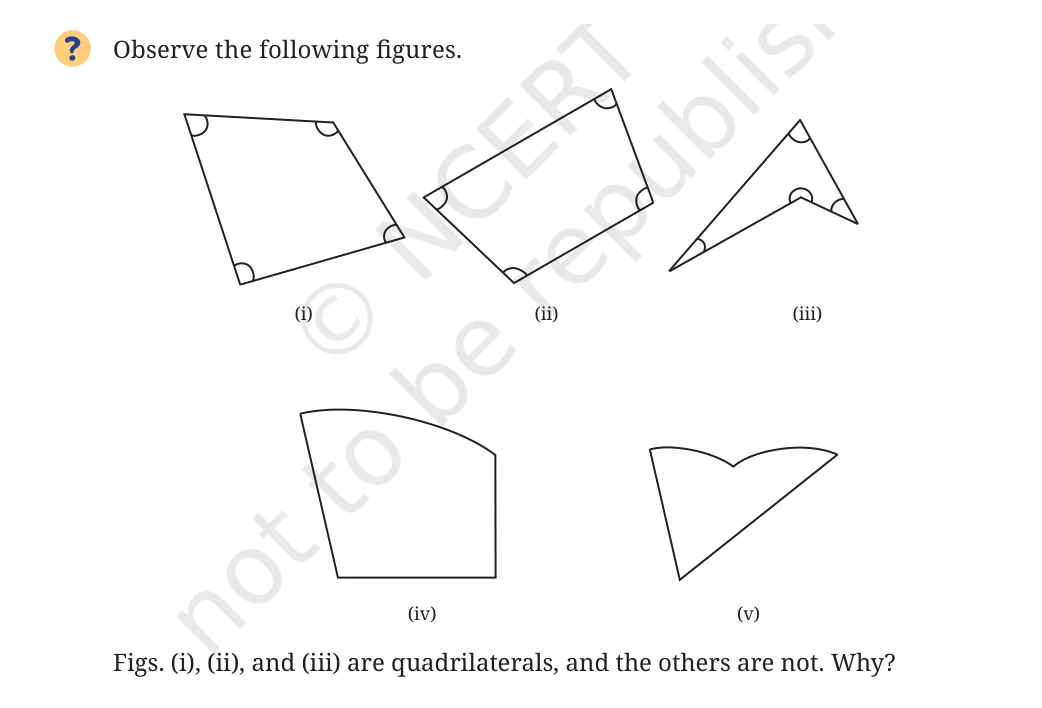
For the carpenter's 8 cm diagonal, determine the other diagonal's length, their joining point, and whether their angle is fixed.
Show solution
Use another 8 cm strip and join the strips at both midpoints. Their angle can be any non-zero, non-straight angle: equal diagonals that bisect each other always form a rectangle.
Complete worked answers
Textbook page 3
Textbook page 3 · solved item 3
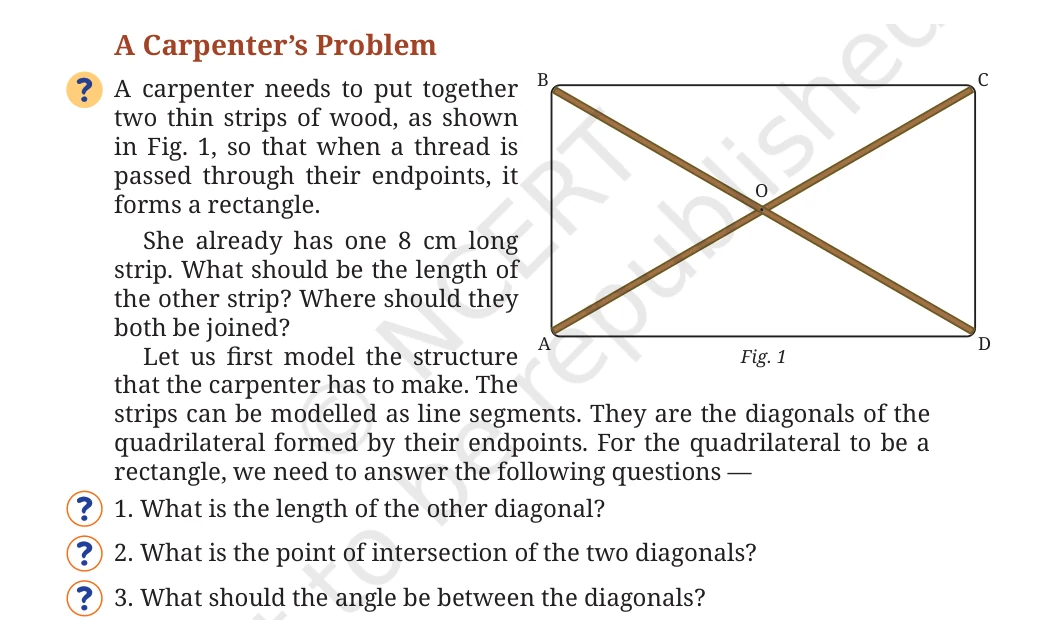
Which triangles should be compared to prove that the diagonals of rectangle ABCD bisect each other?
Show solution
Compare triangles AOB and COD. Vertically opposite angles at O are equal, and the remaining angle relation gives AAS congruence; hence OA = OC and OB = OD.
Complete worked answers
Textbook page 4
Textbook page 4 · solved item 4

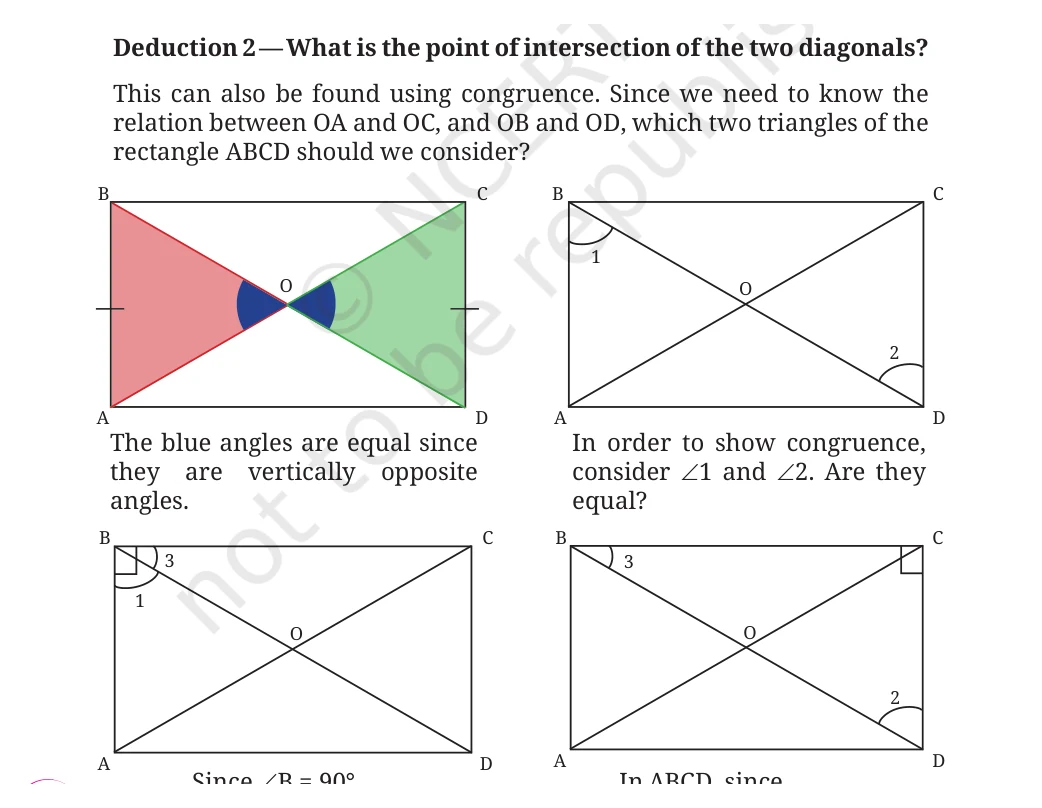
Do AO = CO, a pair of vertically opposite angles, and AD = CB prove triangles AOD and COB congruent?
Show solution
No. Those three facts give SSA, which is not a valid general congruence test. Instead, use the angle relations from the rectangle to obtain AAS congruence, or use another already-proved corresponding side with a valid congruence condition.
Textbook page 4 · solved item 5
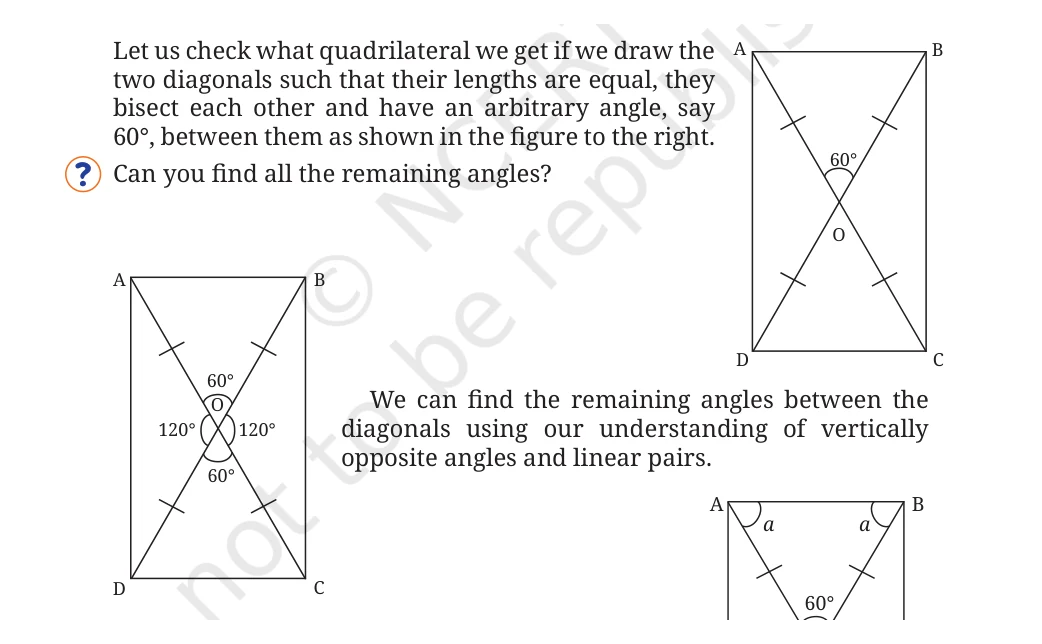
When equal diagonals bisect each other at 60 degrees, find all diagonal and triangle angles.
Show solution
The four angles at O are 60, 120, 60, and 120 degrees. Each triangle with vertex angle 60 degrees has base angles 60 degrees; each with vertex angle 120 degrees has base angles 30 degrees. Thus every corner of the quadrilateral is 90 degrees.
Complete worked answers
Textbook page 5
Textbook page 5 · solved item 6
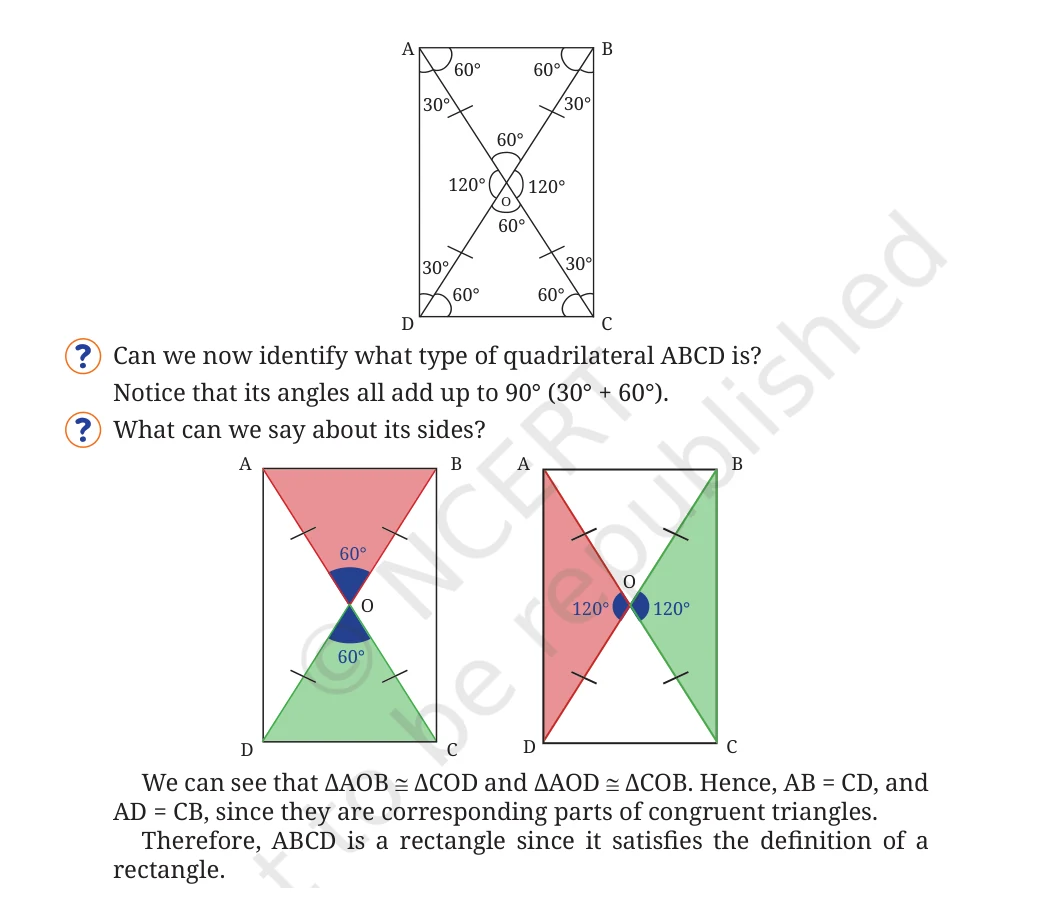
Identify ABCD when its equal diagonals bisect each other at 60 degrees, and describe its sides.
Show solution
ABCD is a rectangle. All four vertex angles are 90 degrees, with AB = CD and AD = BC by congruent opposite triangles.
Textbook page 5 · solved item 7
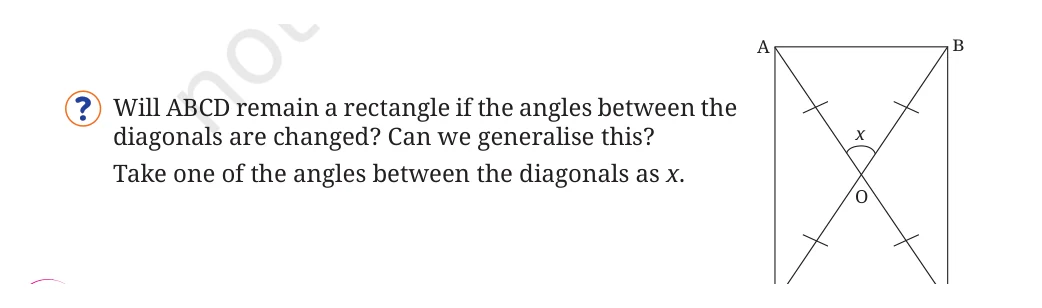
Does ABCD remain a rectangle if the angle between equal bisecting diagonals changes?
Show solution
Yes. If one intersection angle is x, the adjacent one is 180 - x. The base angles in the resulting isosceles triangles combine to 90 degrees at every vertex, so the quadrilateral remains a rectangle.
Complete worked answers
Textbook page 6
Textbook page 6 · solved item 8
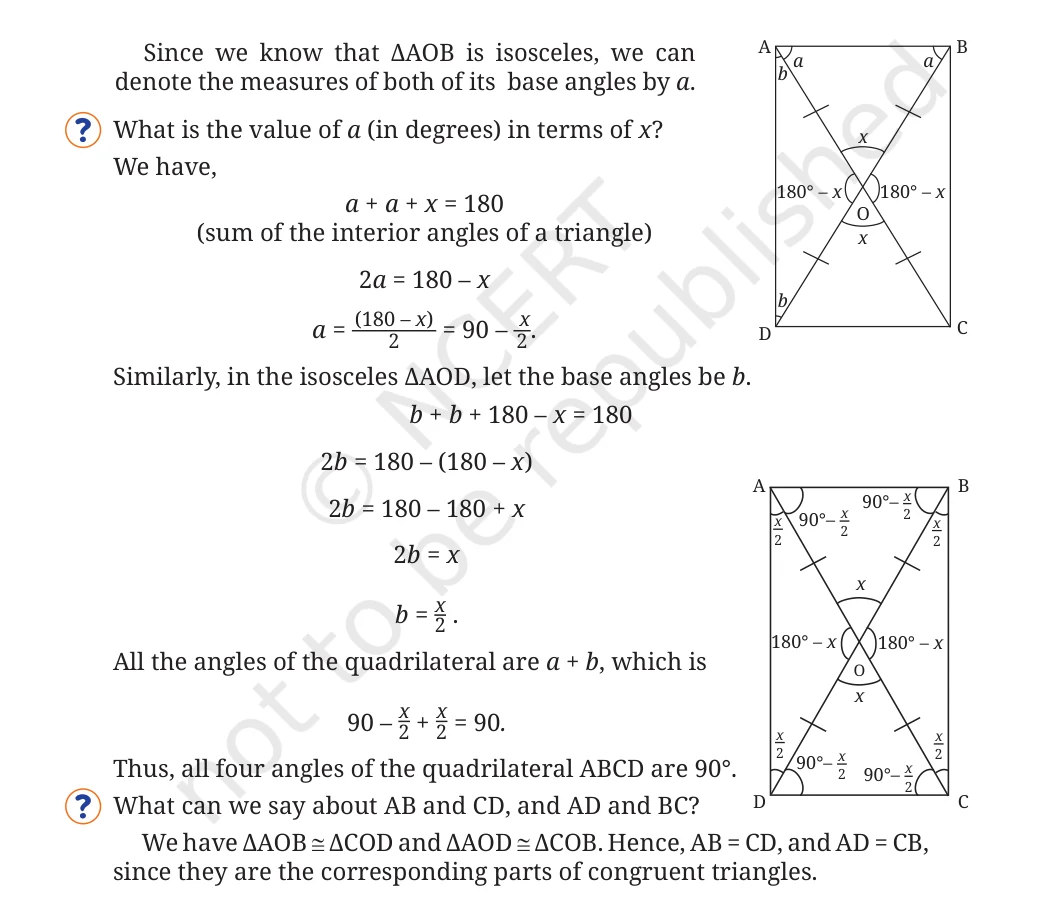
For intersection angle x, find the other angles and the opposite-side relations.
Show solution
At O the angles are x,x,180^\circ-x,180^\circ-x. The relevant base angles are 90^\circ-\frac{x}{2} and \frac{x}{2}, so each vertex angle is 90 degrees. Also, AB=CD and AD=BC.
Complete worked answers
Textbook page 8
Textbook page 8 · solved item 9
Can a quadrilateral have four right angles but unequal opposite sides?
Show solution
No. Drawing a diagonal creates two congruent triangles, forcing both pairs of opposite sides to be equal. Such a quadrilateral is necessarily a rectangle.
Textbook page 8 · solved item 10
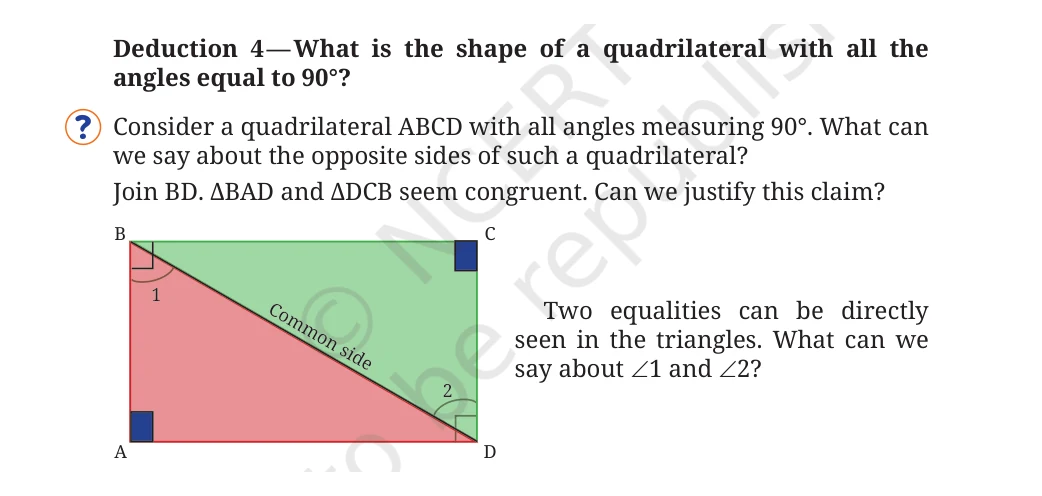
How can we justify that triangles BAD and DCB are congruent in a quadrilateral with four right angles?
Show solution
BD is common, angles BAD and DCB are both 90 degrees, and the complementary angle argument gives angle ABD = angle BDC. Therefore the triangles are congruent by AAS.
Complete worked answers
Textbook page 9
Textbook page 9 · solved item 11
Is it correct to write triangle BAD congruent to triangle CDB?
Show solution
No. The order must match corresponding vertices. The correct statement is triangle BAD congruent to triangle DCB; writing CDB pairs B with D and A with C incorrectly.
Textbook page 9 · solved item 12
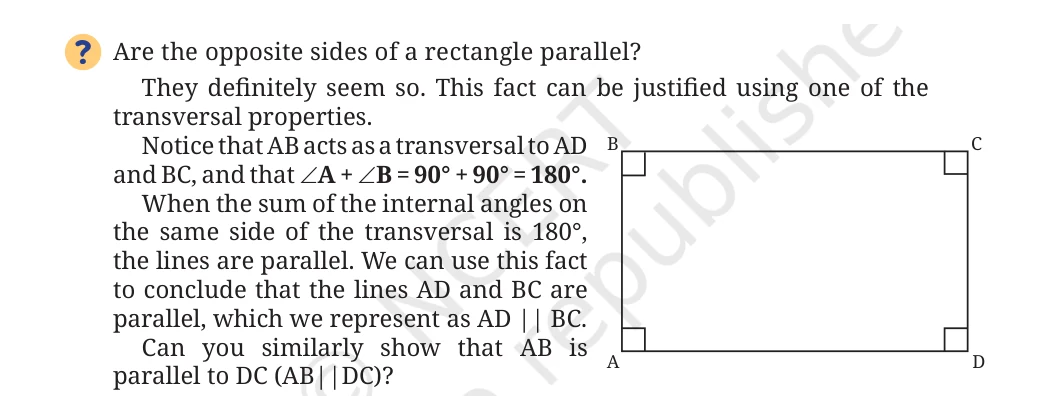
Show that AB is parallel to DC in a rectangle.
Show solution
AD is a transversal of AB and DC, and angles DAB and ADC are 90 degrees. Their same-side interior sum is 180 degrees, so AB is parallel to DC.
Textbook page 9 · solved item 13
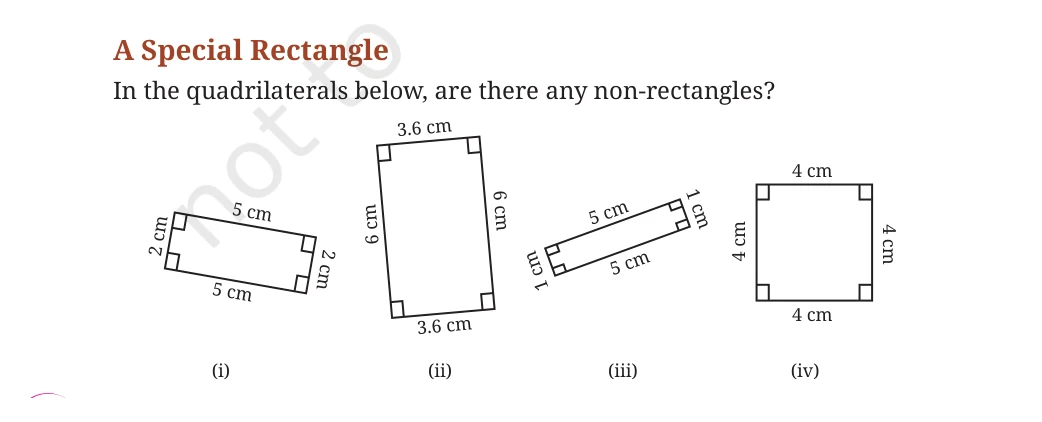
Which of the four shown quadrilaterals are rectangles?
Show solution
All four are rectangles because each has four right angles. Figure (iv) is also a square, which is a special rectangle.
Complete worked answers
Textbook page 11
Textbook page 11 · solved item 14
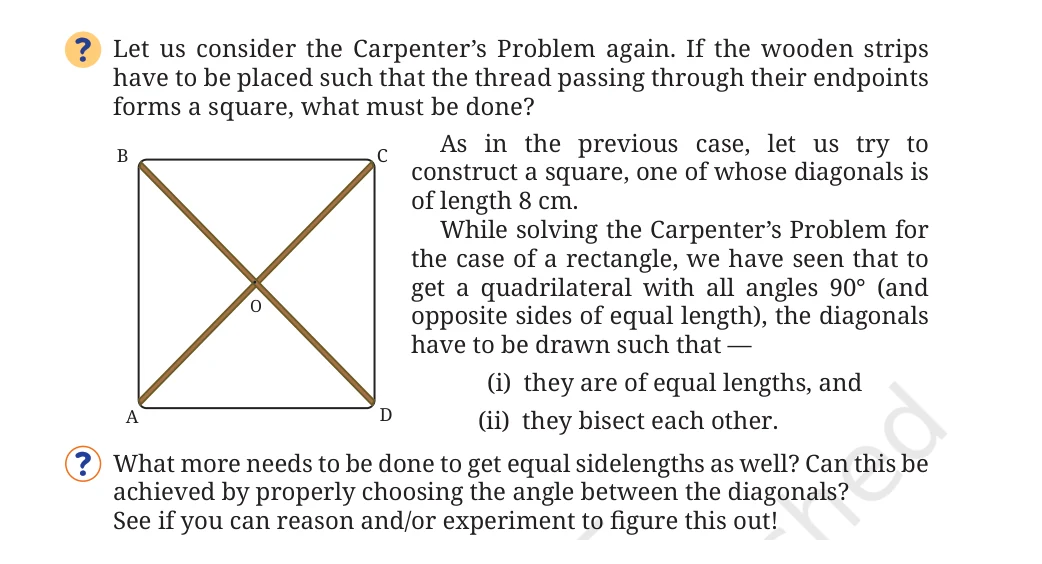
How must equal diagonals be placed so that their endpoints form a square?
Show solution
They must be equal, bisect each other, and meet at 90 degrees. The right-angle condition makes all four sides equal in addition to producing four right vertex angles.
Textbook page 11 · solved item 15
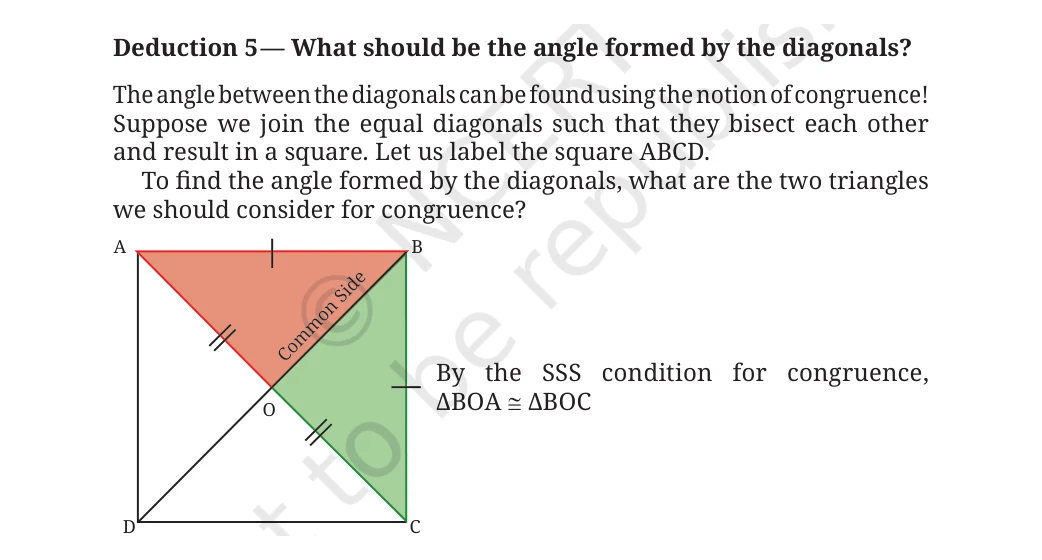
Which triangles establish the angle between a square's diagonals?
Show solution
Compare triangles BOA and BOC. They have BO common, OA = OC, and BA = BC, so they are congruent by SSS.
Textbook page 11 · solved item 16
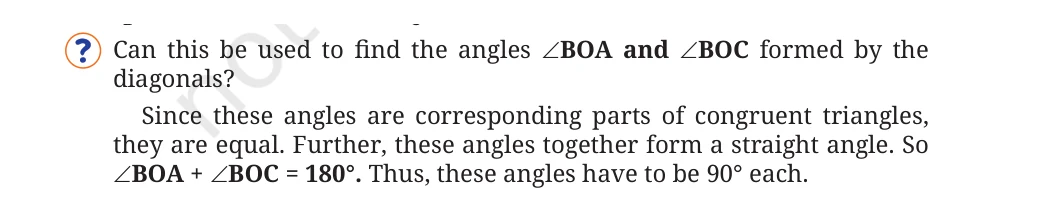
Use the congruent triangles to find angles BOA and BOC.
Show solution
They are equal corresponding angles and form a linear pair. Therefore each is 90 degrees.
Complete worked answers
Textbook page 12
Textbook page 12 · solved item 17

Construct a square whose diagonal is 8 cm.
Show solution
Draw AC = 8 cm and construct its perpendicular bisector at midpoint O. Mark B and D on it with OB = OD = 4 cm, then join A-B-C-D-A.
Textbook page 12 · solved item 18
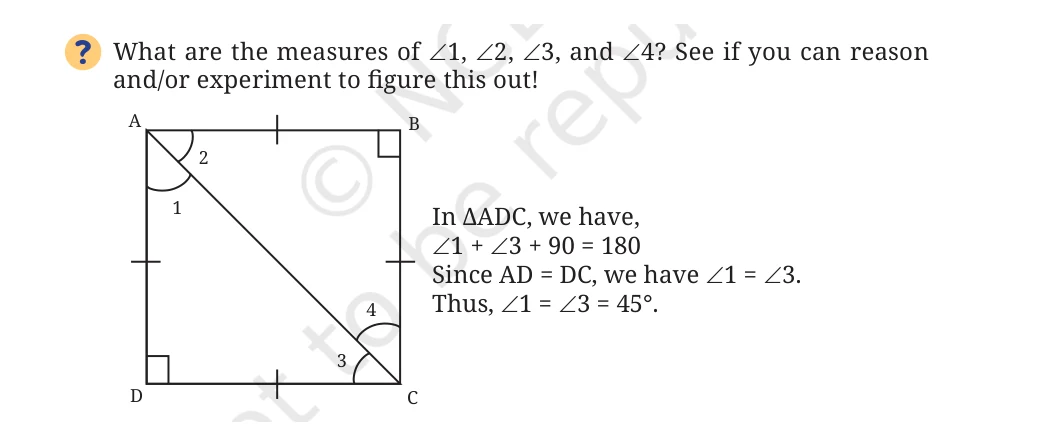
Find angles 1, 2, 3, and 4 made by a square's diagonal.
Show solution
Each is 45 degrees. A diagonal divides the square into isosceles right triangles and therefore bisects the two 90-degree corner angles.
Complete worked answers
Textbook page 13
Textbook page 13 · solved item 19
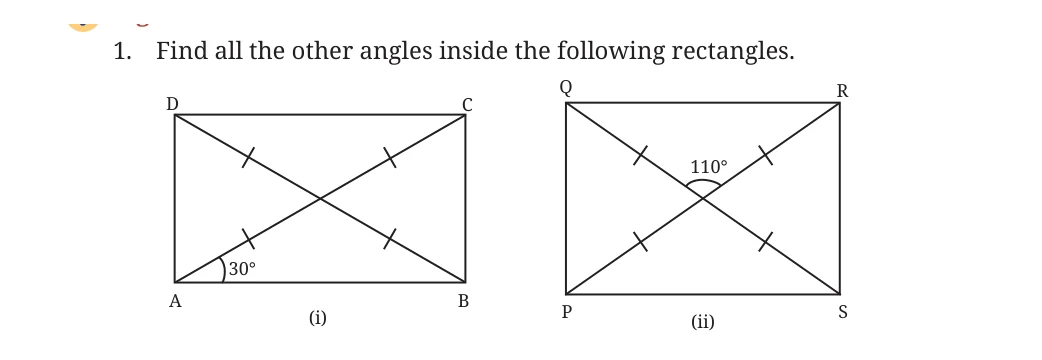
Find all the missing angles inside the two rectangles shown.
Show solution
(i) angle ABD = 30, CAD = 60, ADB = 60, BDC = 30, ACD = 30, and ACB = 60 degrees. (ii) angle POS = 110, QOP = ROS = 70, OQR = ORQ = 35, and OQP = OPQ = ORS = OSR = 55 degrees.
Textbook page 13 · solved item 20

Construct quadrilaterals with equal 8 cm diagonals that bisect each other at 30, 40, 90, and 140 degrees.
Show solution
Draw one 8 cm diagonal and mark its midpoint O. Through O draw a line at the required angle; mark 4 cm on both sides of O for the second diagonal, then join the four endpoints. Each result is a rectangle; the 90-degree case is a square.
Textbook page 13 · solved item 21

Perpendicular diameters PL and AM lie in a circle. What quadrilateral is APML?
Show solution
APML is a square. Its diagonals are equal diameters, bisect each other at the centre, and are perpendicular.
Textbook page 13 · solved item 22

Make an exact 90-degree angle using two equal sticks and a thread.
Show solution
Join the equal sticks at their midpoints. Pass a taut thread through their four endpoints to form the quadrilateral. Equal diagonals bisecting each other make a rectangle, so every thread corner is exactly 90 degrees.
Textbook page 13 · solved item 23

Can 'opposite sides parallel and equal' be used as the definition of a rectangle?
Show solution
No. Those conditions define a parallelogram, which may have oblique angles. A non-rectangular parallelogram is a counterexample.
Textbook page 13 · solved item 24
Can a quadrilateral have exactly three right angles?
Show solution
No. Quadrilateral angles total 360 degrees. Three right angles total 270 degrees, leaving 90 degrees for the fourth.
Complete worked answers
Textbook page 14
Textbook page 14 · solved item 25
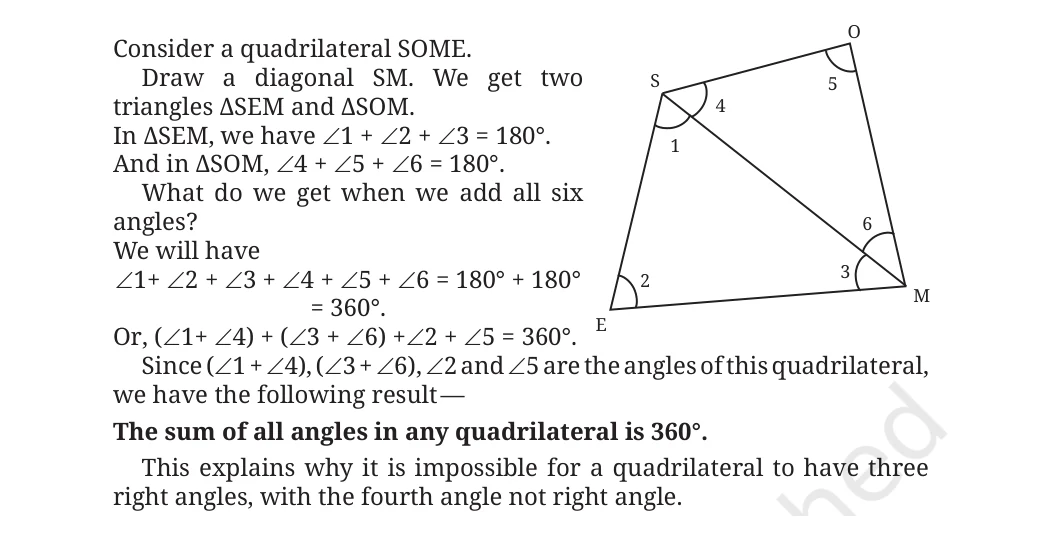
What follows when the six triangle angles formed by a quadrilateral's diagonal are added?
Show solution
The two triangles contribute 180 + 180 = 360 degrees. Regrouping those six angles at the four vertices proves that every quadrilateral has angle sum 360 degrees.
Textbook page 14 · solved item 26
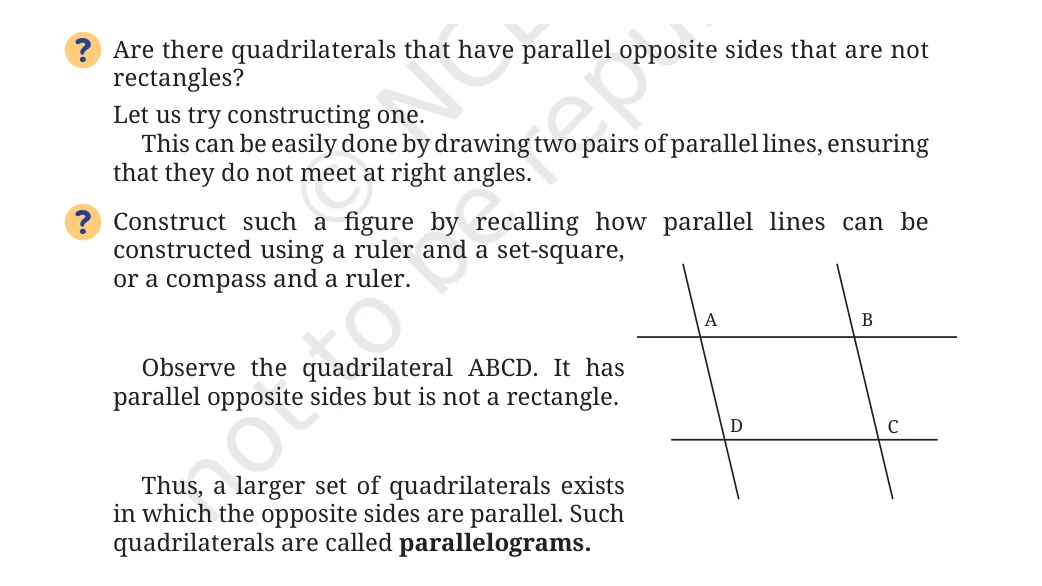
Construct a quadrilateral with both pairs of opposite sides parallel that is not a rectangle.
Show solution
Draw two parallel lines, then another pair of parallel lines crossing them at an angle other than 90 degrees. Their four intersections form a non-rectangular parallelogram.
Complete worked answers
Textbook page 15
Textbook page 15 · solved item 27
Is every rectangle a parallelogram?
Show solution
Yes. A rectangle has both pairs of opposite sides parallel, so it satisfies the definition of a parallelogram.
Textbook page 15 · solved item 28
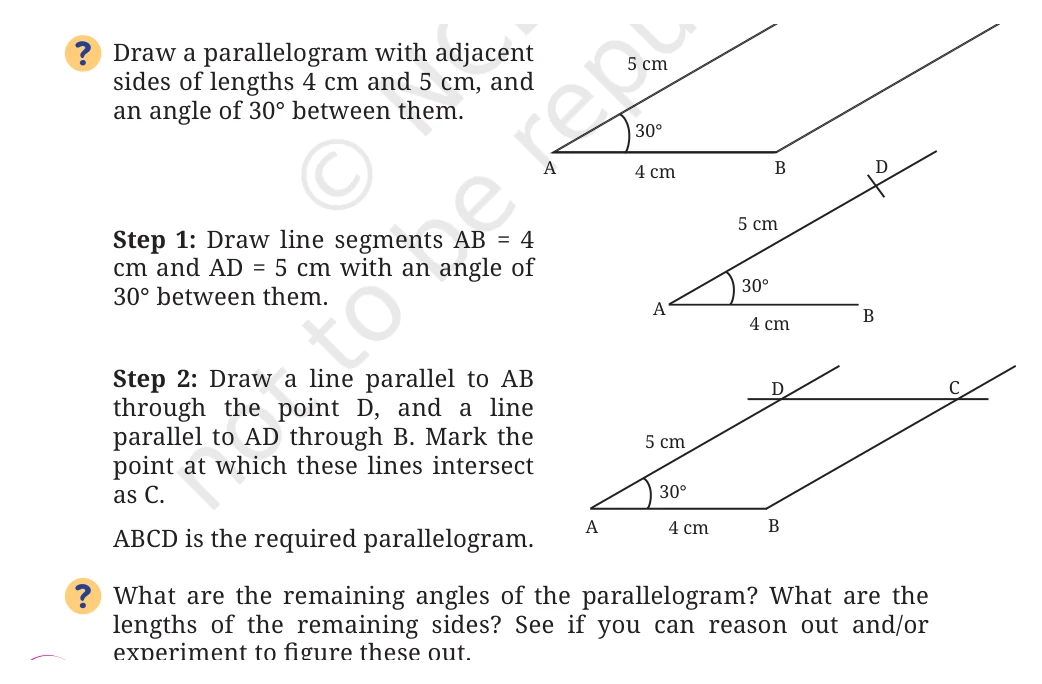
A parallelogram has adjacent sides 4 cm and 5 cm with one angle 30 degrees. Find its other sides and angles.
Show solution
The opposite sides are 4 cm and 5 cm. Opposite angles are equal and adjacent angles are supplementary, so the angles are 30, 150, 30, and 150 degrees.
Complete worked answers
Textbook page 16
Textbook page 16 · solved item 29
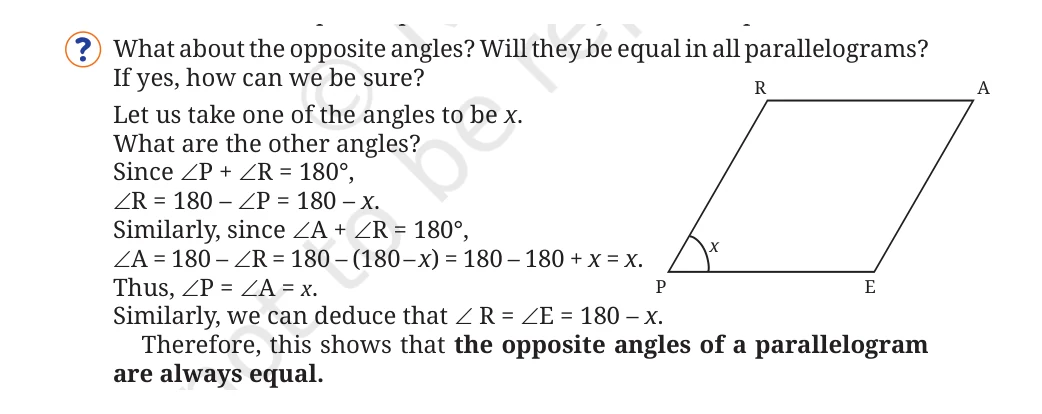
If one angle of parallelogram PARE is x, find all four angles.
Show solution
The opposite angle is also x, and each adjacent angle is 180^\circ-x. Thus P = A = x and R = E = 180 degrees - x.
Textbook page 16 · solved item 30
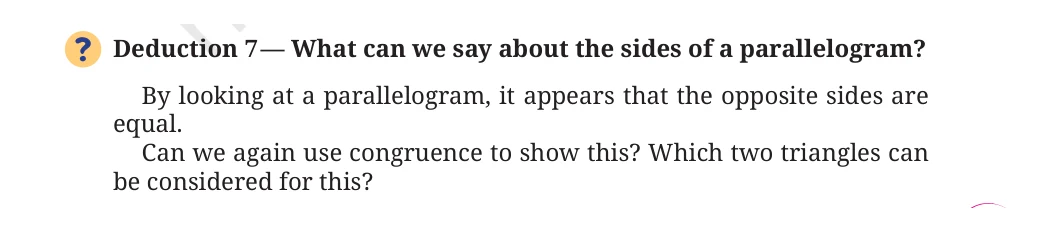
Which triangles prove that opposite sides of a parallelogram are equal?
Show solution
Draw diagonal BD and compare triangles ABD and CDB. Alternate angles from the two pairs of parallel sides are equal and BD is common, giving congruence by AAS; hence AD = CB and AB = CD.
Complete worked answers
Textbook page 17
Textbook page 17 · solved item 31
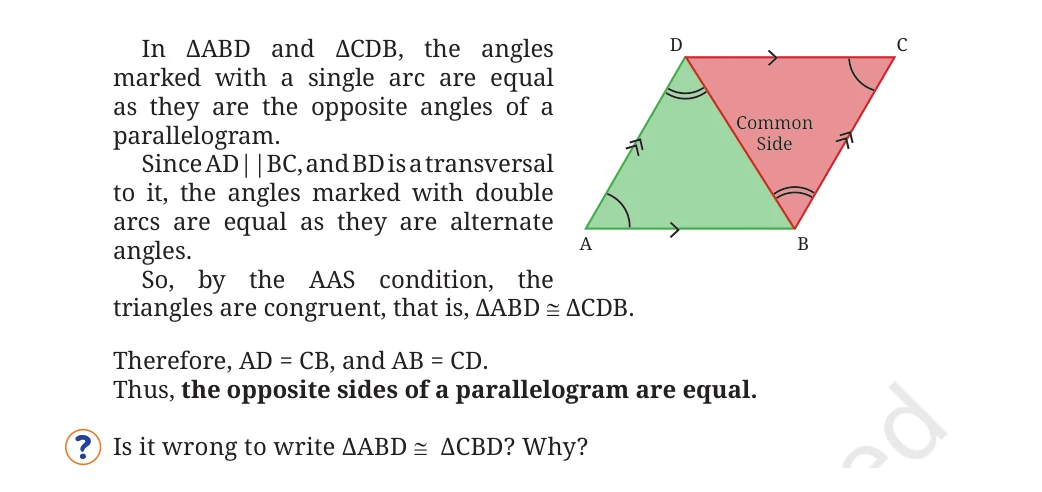
Is triangle ABD congruent to triangle CBD in the stated order?
Show solution
No. The correct correspondence is triangle ABD congruent to triangle CDB. The order ABD-CBD mismatches A with C but B with B, which is inconsistent with the equal angles used.
Textbook page 17 · solved item 32

Are a parallelogram's diagonals always equal?
Show solution
No. They are equal in special parallelograms such as rectangles, but a general slanted parallelogram can have diagonals of different lengths.
Textbook page 17 · solved item 33
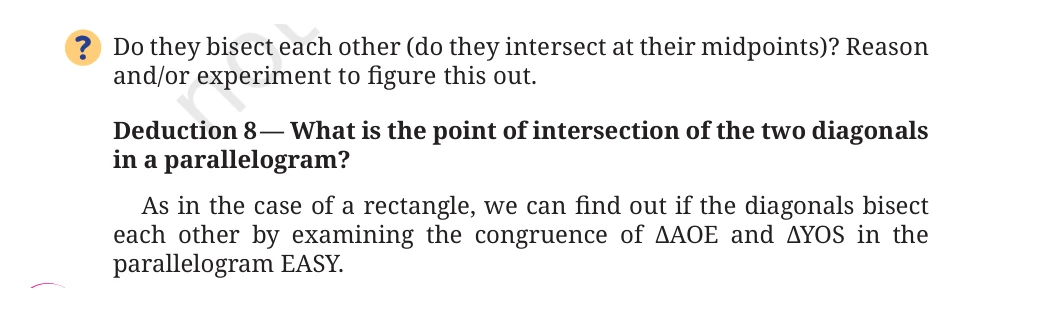
Do the diagonals of every parallelogram bisect each other?
Show solution
Yes. Opposite sides and alternate angles make the two triangles across the intersection congruent, so each diagonal is divided into two equal parts.
Complete worked answers
Textbook page 18
Textbook page 18 · solved item 34
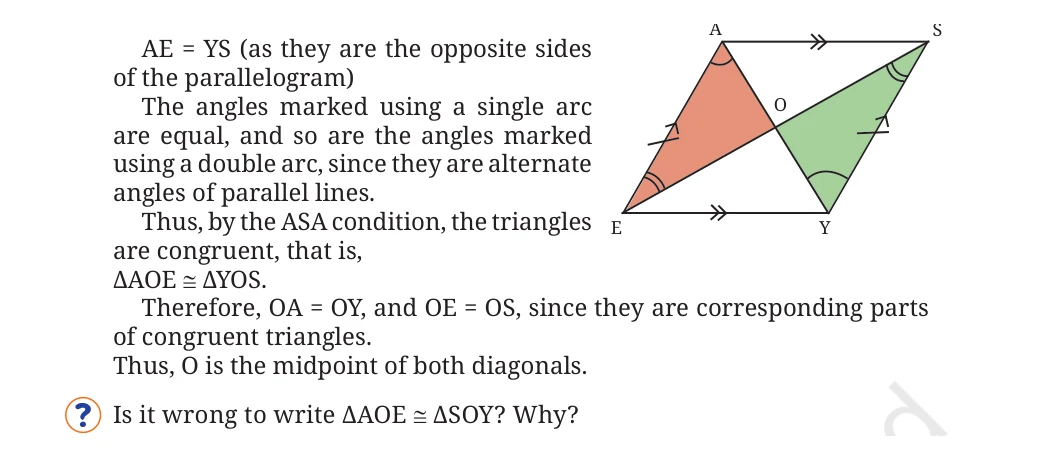
Is triangle AOE congruent to triangle SOY in that order?
Show solution
No. From the marked angles and sides, the correct correspondence is triangle AOE congruent to triangle YOS. The alternative order pairs the wrong vertices.
Textbook page 18 · solved item 35

Do a general parallelogram's diagonals meet at a fixed angle?
Show solution
No. They bisect each other, but their intersection angle varies with the parallelogram's shape.
Textbook page 18 · solved item 36
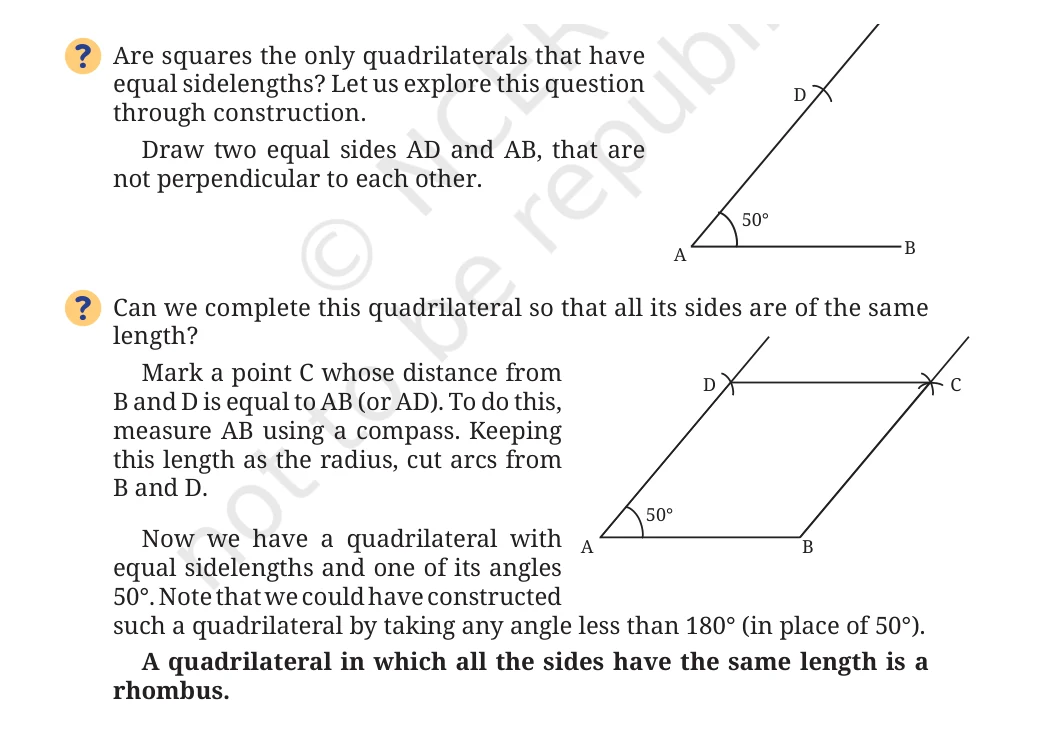
Are squares the only quadrilaterals with four equal sides, and how can another be constructed?
Show solution
No. Draw two equal adjacent sides at any angle other than 90 degrees, then locate the fourth vertex at the same distance from both free endpoints. The result is a non-square rhombus.
Complete worked answers
Textbook page 19
Textbook page 19 · solved item 37

A rhombus has one angle 50 degrees. Find the other three angles.
Show solution
Opposite angles are equal and adjacent angles sum to 180 degrees. The angles are therefore 50, 130, 50, and 130 degrees.
Textbook page 19 · solved item 38
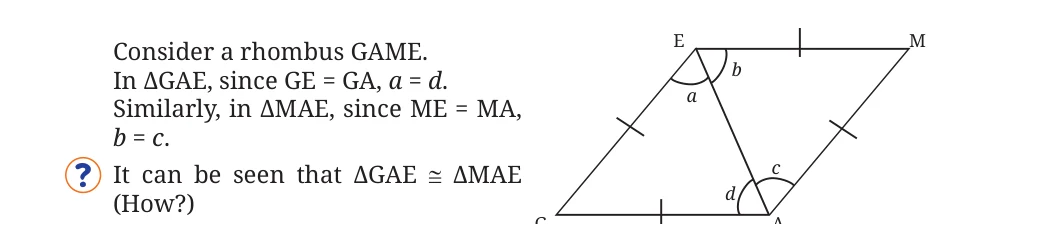
Why are triangles GAE and MAE congruent in rhombus GAME?
Show solution
GE = ME and GA = MA because all rhombus sides are equal, while AE is common. Thus the triangles are congruent by SSS.
Complete worked answers
Textbook page 20
Textbook page 20 · solved item 39
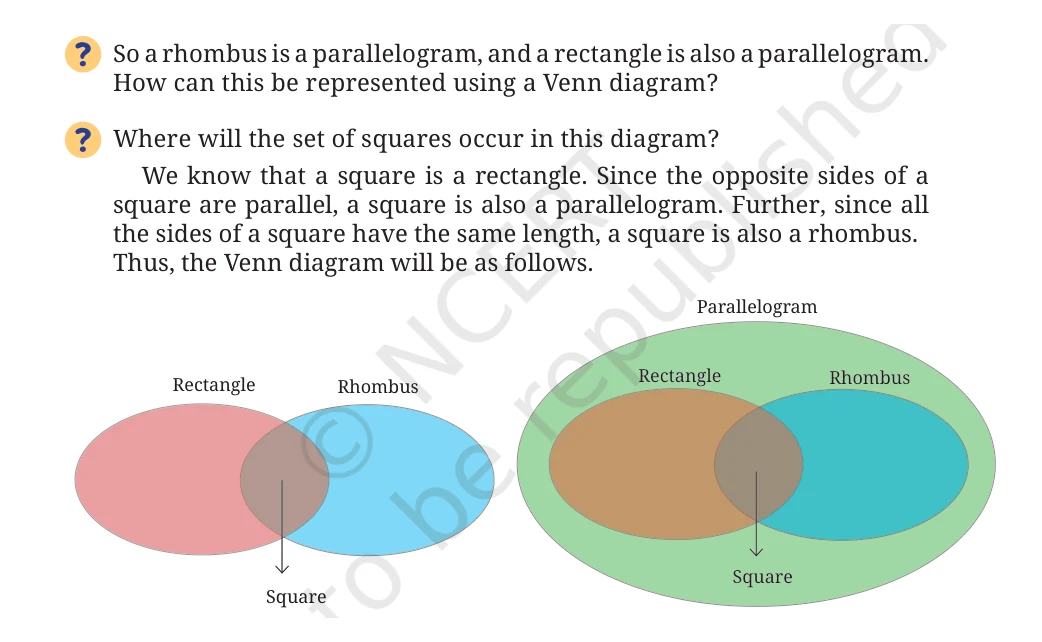
Place parallelograms, rectangles, rhombuses, and squares in a Venn diagram.
Show solution
Rectangles and rhombuses are overlapping subsets of parallelograms. Their overlap is exactly the set of squares.
Textbook page 20 · solved item 40

Are the diagonals of a rhombus always equal?
Show solution
No. They are equal only in the special case when the rhombus is a square. They always bisect each other, but generally have different lengths.
Complete worked answers
Textbook page 21
Textbook page 21 · solved item 41

At what angle do a rhombus's diagonals intersect?
Show solution
They intersect at 90 degrees.
Textbook page 21 · solved item 42
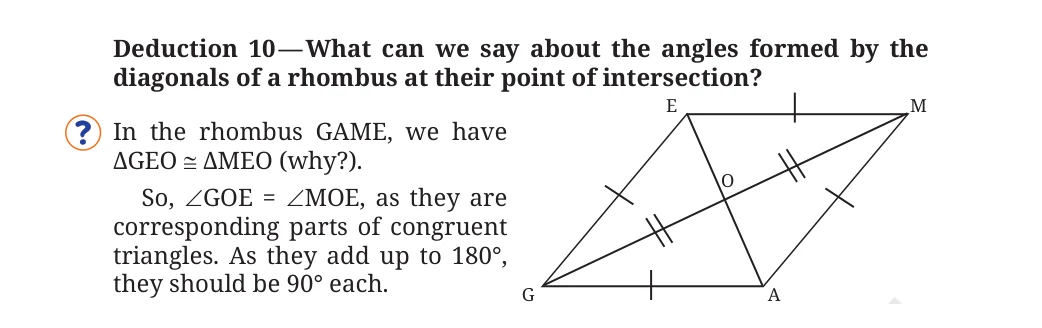
Why are triangles GEO and MEO congruent in rhombus GAME?
Show solution
GE = ME, GO = OM because the diagonal is bisected, and EO is common. Thus they are congruent by SSS, making the adjacent angles at O equal; as a linear pair, each is 90 degrees.
Textbook page 21 · solved item 43
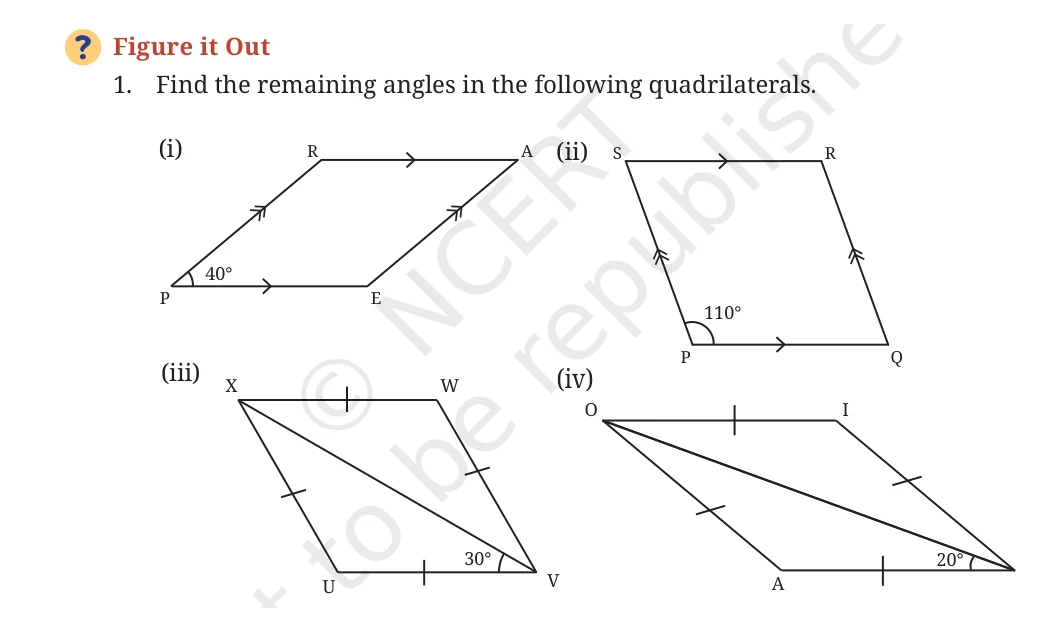
Find the remaining angles in the four quadrilaterals shown.
Show solution
(i) E = R = 140 and A = P = 40 degrees. (ii) Q = S = 70 and R = 110 degrees. (iii) the diagonal halves the 60-degree acute angles into 30-degree parts, while U = W = 120 degrees. (iv) OEI = AOE = EOI = 20 and A = I = 140 degrees.
Textbook page 21 · solved item 44

Construct a parallelogram with diagonals 7 cm and 5 cm intersecting at 140 degrees.
Show solution
Draw a 7 cm diagonal and mark midpoint O. Through O draw a 140-degree line, mark 2.5 cm on both sides for the second diagonal, then join the endpoints in order.
Textbook page 21 · solved item 45

Construct a rhombus with diagonals 4 cm and 5 cm.
Show solution
Draw a 5 cm diagonal and its perpendicular bisector at O. Mark 2 cm on both sides of O along the perpendicular, then join the four endpoints.
Complete worked answers
Textbook page 22
Textbook page 22 · solved item 46
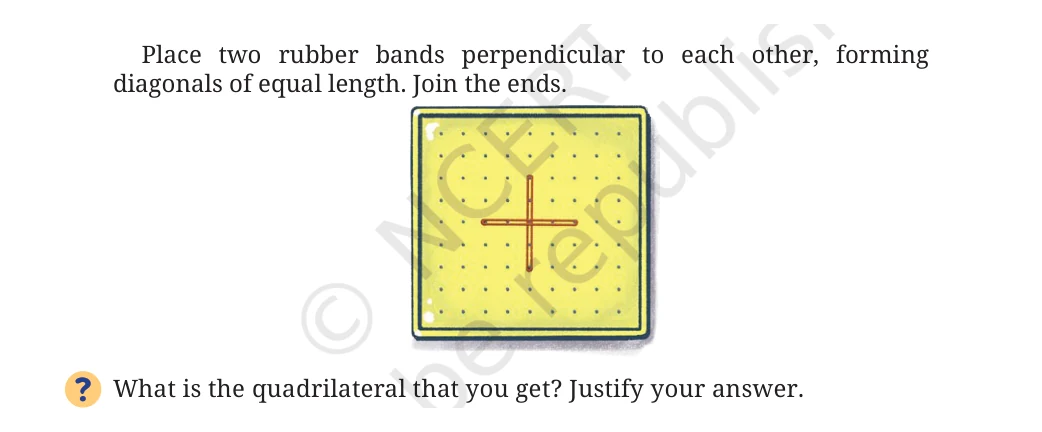
Equal perpendicular diagonals on a geoboard are joined at their ends. What quadrilateral results?
Show solution
A square, because the diagonals are equal, bisect each other, and meet at 90 degrees.
Textbook page 22 · solved item 47
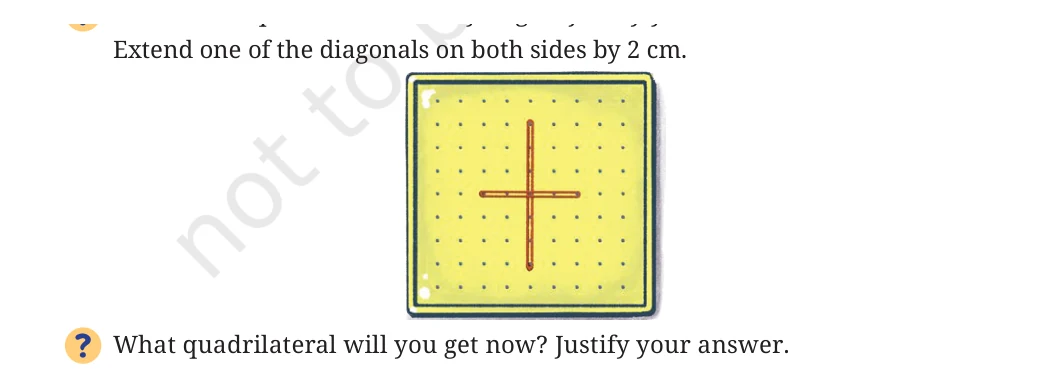
If one of those equal perpendicular diagonals is extended equally at both ends, what quadrilateral results?
Show solution
A rhombus. The diagonals remain perpendicular and bisect each other, but are no longer equal.
Complete worked answers
Textbook page 23
Textbook page 23 · solved item 48
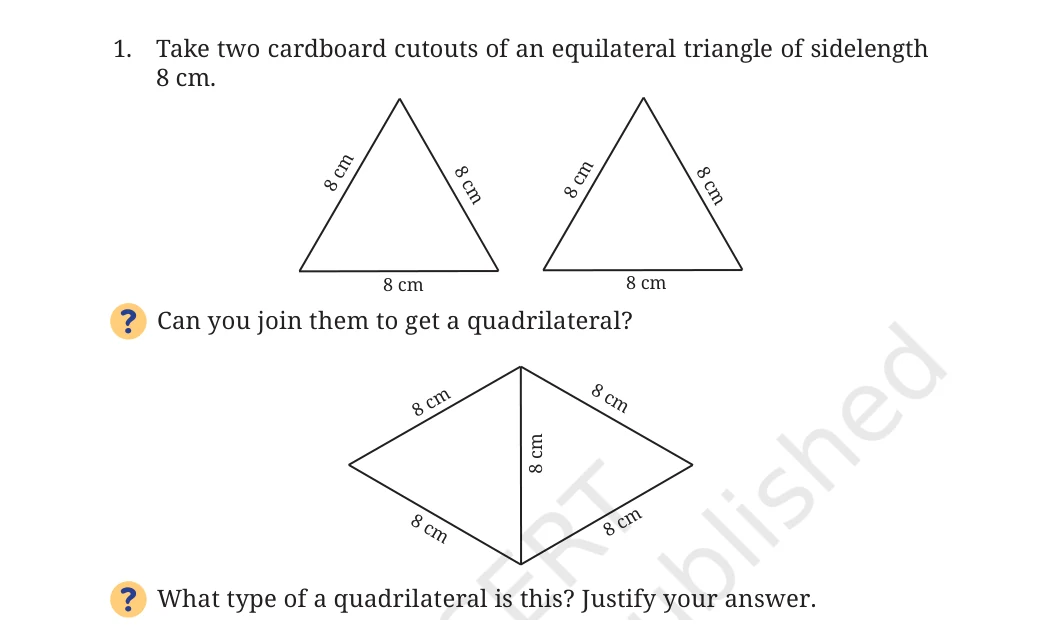
Join two equilateral triangles of side 8 cm along one side. What quadrilateral is formed?
Show solution
A rhombus. Its outer boundary has four sides of 8 cm, and its opposite angles are equal.
Textbook page 23 · solved item 49
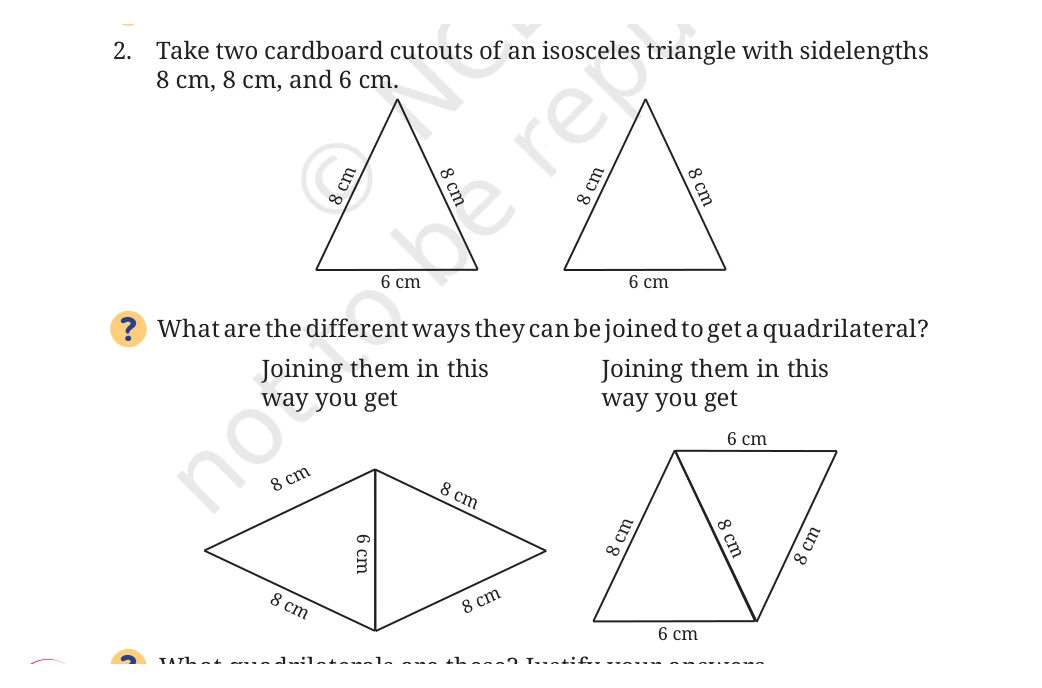
Join two congruent isosceles triangles with sides 8, 8, and 6 cm in the shown ways. Classify the quadrilaterals.
Show solution
Joining along the 6 cm bases gives a rhombus with four 8 cm sides. Joining along an 8 cm side gives a kite with adjacent pairs 8-8 and 6-6.
Complete worked answers
Textbook page 24
Textbook page 24 · solved item 50
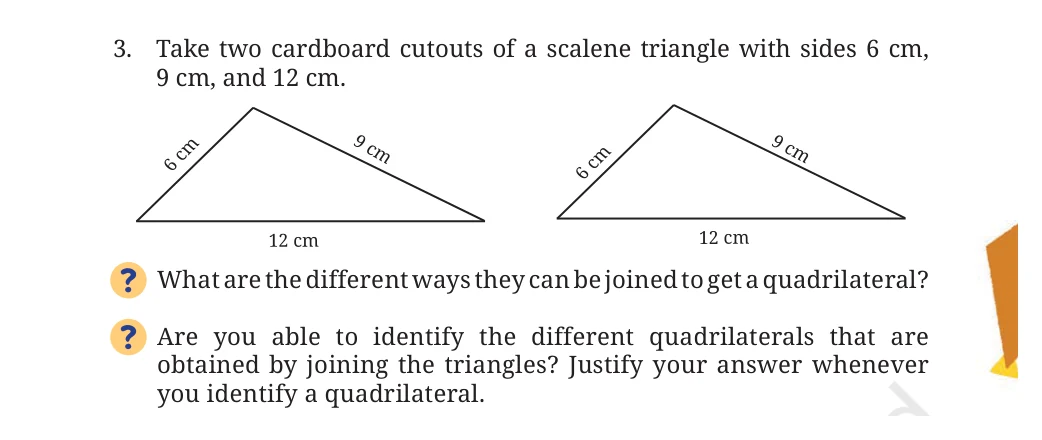
Join two congruent scalene triangles with sides 6, 9, and 12 cm in different ways. What quadrilaterals can result?
Show solution
Joining equal corresponding sides can produce three kites: the remaining boundary pairs are 6-6 and 9-9, 6-6 and 12-12, or 9-9 and 12-12. Other flipped arrangements can produce general parallelograms when opposite corresponding sides align.
Textbook page 24 · solved item 51
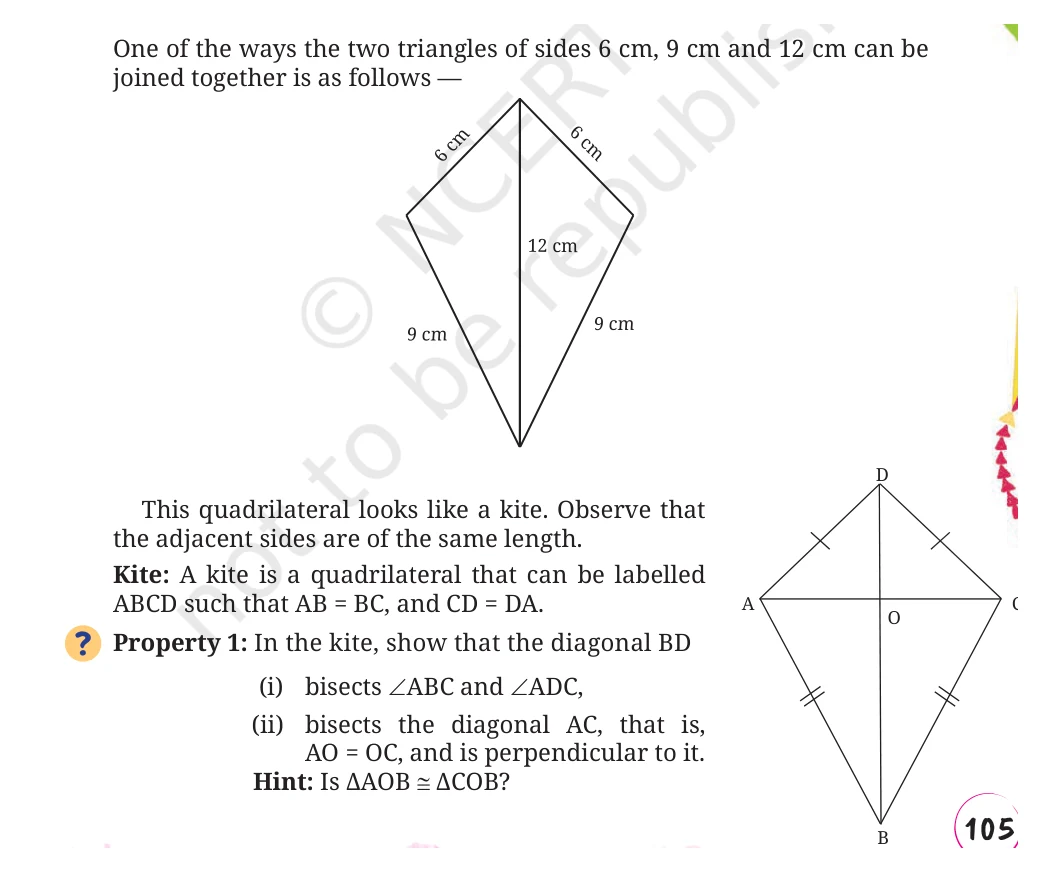
Prove the stated diagonal properties of kite ABCD.
Show solution
Triangles ABD and CBD are congruent by SSS: AB = CB, AD = CD, and BD is common. Hence BD bisects angles ABC and ADC. The two smaller triangles on either side are congruent, giving AO = OC and equal adjacent angles at O; since they form a linear pair, BD is perpendicular to AC.
Complete worked answers
Textbook page 25
Textbook page 25 · solved item 52
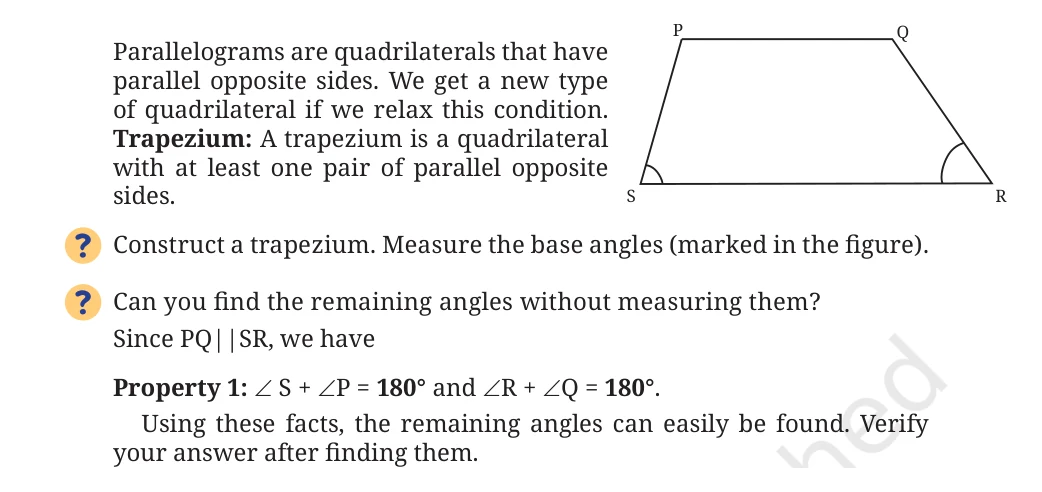
Find the remaining angles of a trapezium from its base angles.
Show solution
Angles on the same leg are supplementary because the bases are parallel: S = 180 degrees - P and R = 180 degrees - Q.
Textbook page 25 · solved item 53
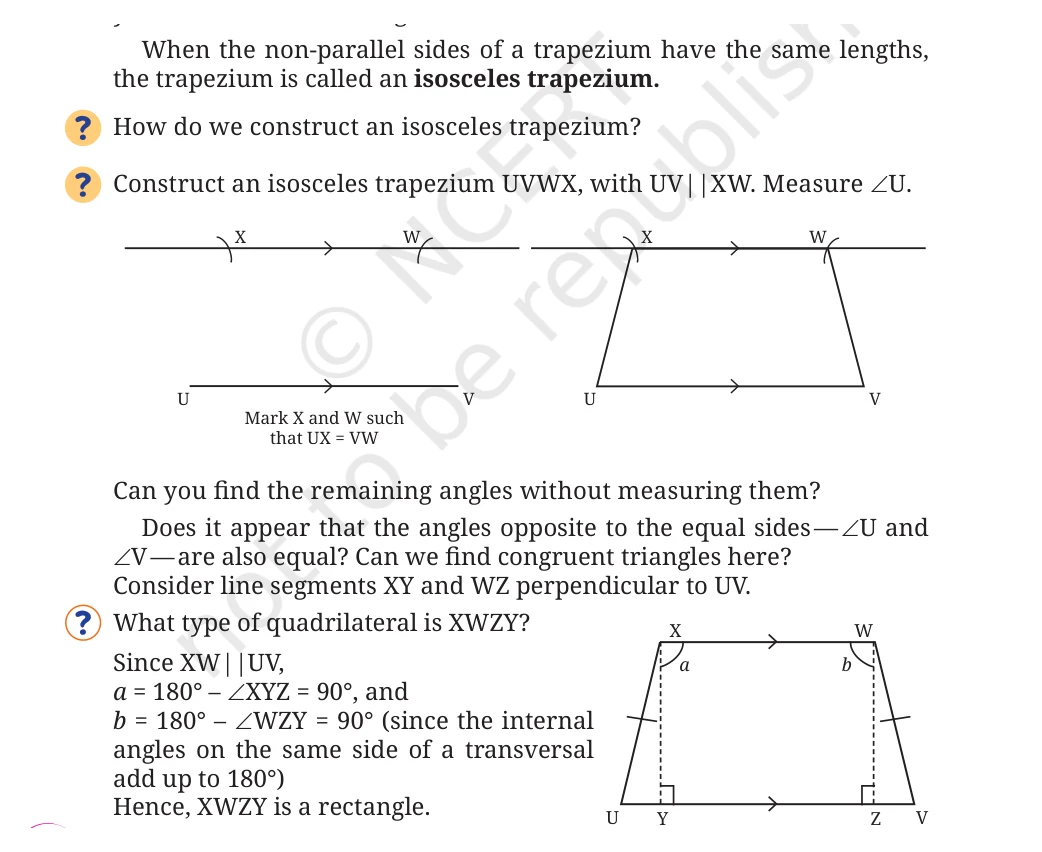
Construct an isosceles trapezium and deduce its remaining angles and equal base-angle property.
Show solution
Draw parallel bases UV and XW, placing X and W so UX = VW. Drop perpendiculars XY and WZ to UV. Rectangle XWZY and congruent right triangles UXY and VWZ show U = V; similarly X = W, while angles along each leg are supplementary.
Complete worked answers
Textbook page 26
Textbook page 26 · solved item 54

Find all sides and angles after joining two equilateral triangles of side 4 cm.
Show solution
The quadrilateral is a rhombus with four sides of 4 cm. Its angles are 60, 120, 60, and 120 degrees.
Textbook page 26 · solved item 55

Construct a kite with diagonals 6 cm and 8 cm.
Show solution
Draw PQ = 6 cm and construct its perpendicular bisector at O. On that perpendicular, mark R and S so that OR = OS = 4 cm, then join P-R-Q-S-P. The result is a rhombus, which is also a kite, with diagonals 6 cm and 8 cm.
Textbook page 26 · solved item 56
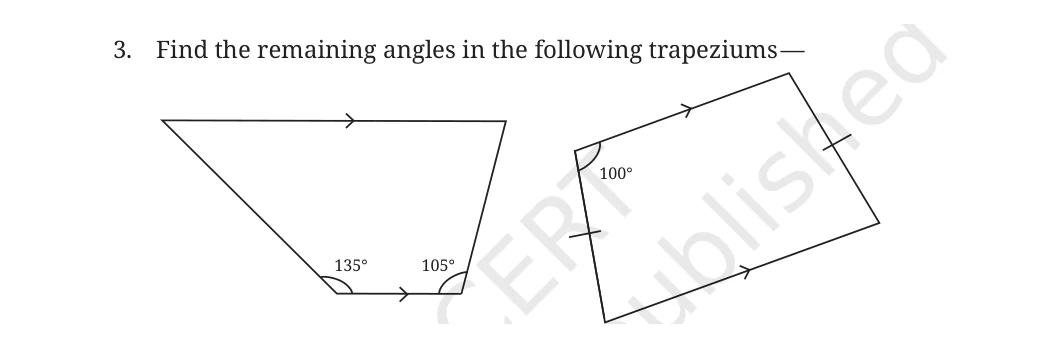
Find the missing angles in the two trapeziums shown.
Show solution
(i) With bases parallel, R = 75 and S = 45 degrees. (ii) The equal legs make an isosceles trapezium, so A = B = 80 degrees while C = D = 100 degrees.
Textbook page 26 · solved item 57
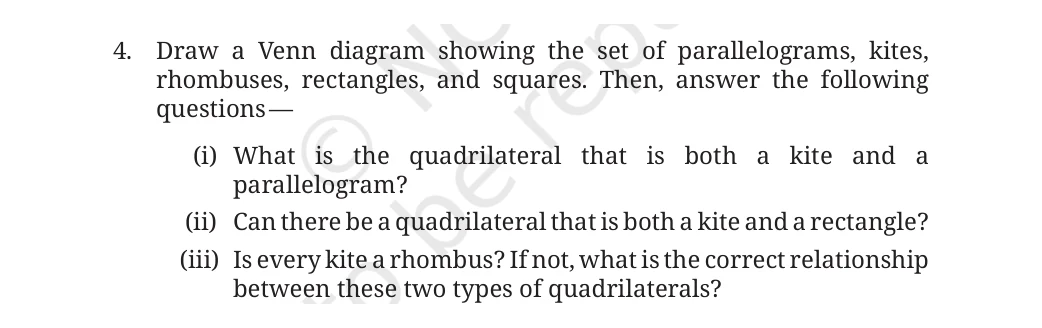
Draw the Venn diagram for parallelograms, kites, rhombuses, rectangles, and squares, and answer its three questions.
Show solution
Rhombuses lie in both the kite and parallelogram sets; squares are also rectangles inside that overlap. A non-square rectangle is not a kite. Every rhombus is a kite, but not every kite is a rhombus.
Textbook page 26 · solved item 58
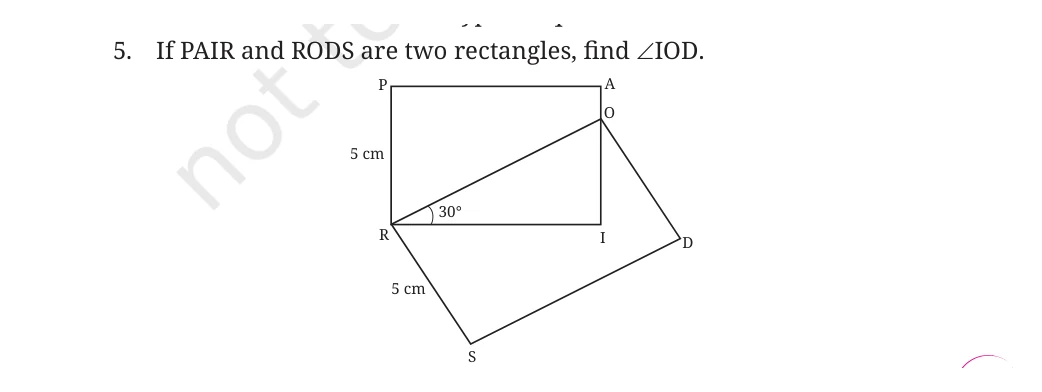
PAIR and RODS are rectangles. Find angle IOD.
Show solution
Angle IOD is 30 degrees. The equal diagonal/isosceles-triangle angle relations in the two rectangles transfer the marked 30-degree angle to the angle at O.
Complete worked answers
Textbook page 27
Textbook page 27 · solved item 59

Construct a square with diagonal 6 cm without using a protractor.
Show solution
Draw the 6 cm diagonal and construct its perpendicular bisector with a compass. From midpoint O mark 3 cm in both perpendicular directions, then join the four endpoints.
Textbook page 27 · solved item 60
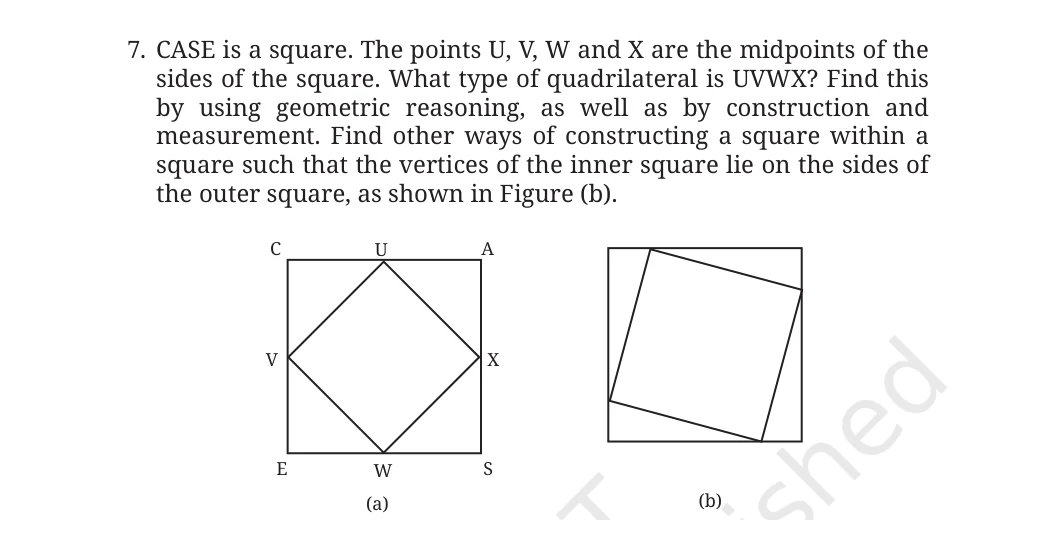
In square CASE, what is the quadrilateral formed by joining side midpoints U, V, W, and X?
Show solution
UVWX is a square. If the outer side is s, each inner side is \sqrt{(s/2)^2+(s/2)^2}=s/\sqrt2. The four sides are equal, and adjacent 45-degree parts combine to make each inner angle 90 degrees.
Textbook page 27 · solved item 61

If a quadrilateral has four equal sides and one right angle, must it be a square?
Show solution
Yes. It is a rhombus, so opposite angles are equal and adjacent angles are supplementary. One 90-degree angle forces all four angles to be 90 degrees, making it a square.
Textbook page 27 · solved item 62

What type of quadrilateral has both pairs of opposite sides equal?
Show solution
It is a parallelogram. A diagonal gives two SSS-congruent triangles; equal alternate angles then prove both pairs of opposite sides parallel.
Textbook page 27 · solved item 63
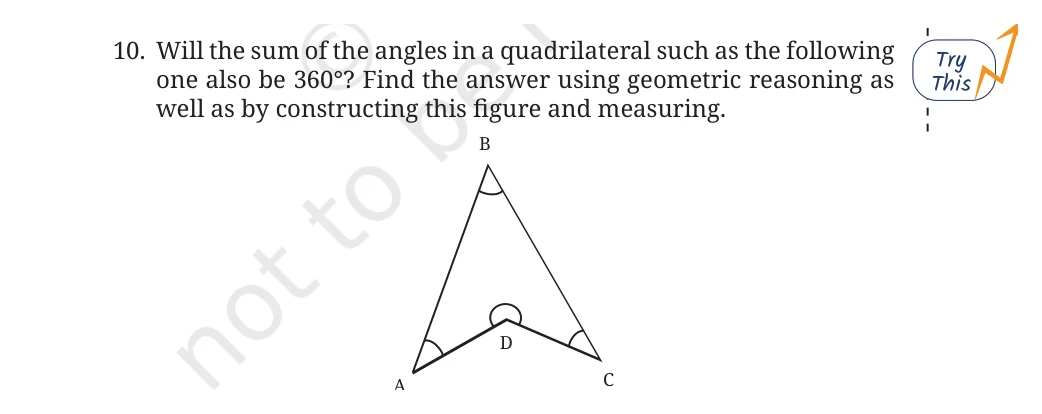
Does the shown concave quadrilateral also have angle sum 360 degrees?
Show solution
Yes. A diagonal divides it into two triangles; counting the interior angles of both triangles gives 180 + 180 = 360 degrees, including the reflex interior angle correctly.
Textbook page 27 · solved item 64
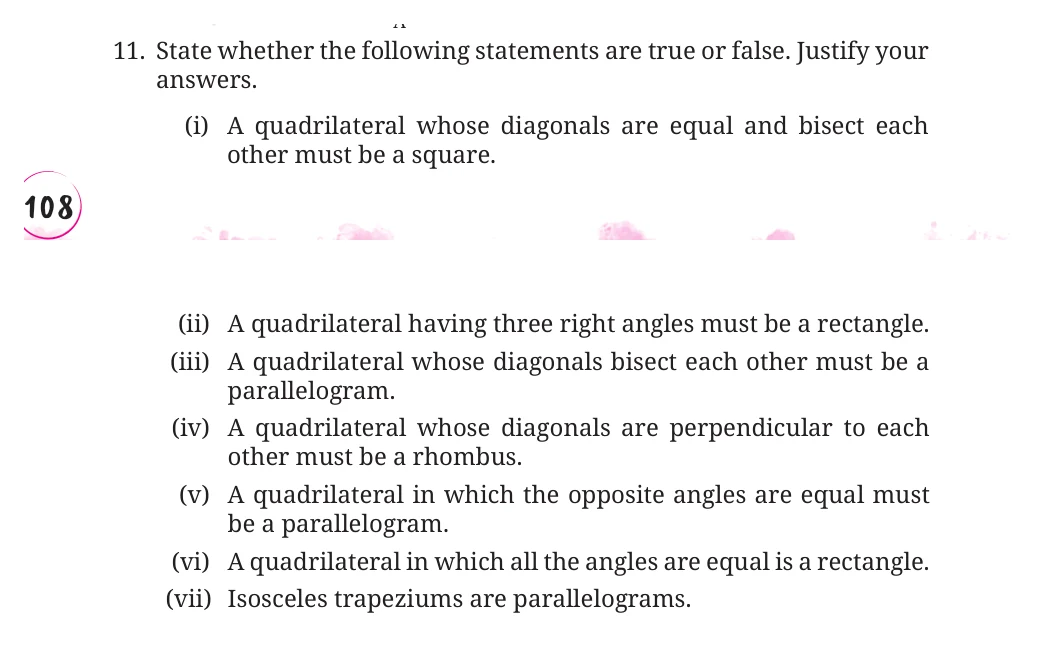
Decide whether the seven statements about quadrilaterals are true or false.
Show solution
(i) False: the figure may be a non-square rectangle. (ii) True: the fourth angle is also 90 degrees. (iii) True: bisecting diagonals characterise a parallelogram. (iv) False: a kite can have perpendicular diagonals. (v) True. (vi) True: each equal angle is 90 degrees. (vii) False: an isosceles trapezium need not have both pairs of opposite sides parallel.
Complete worked answers
Textbook page 30
Textbook page 30 · solved item 65
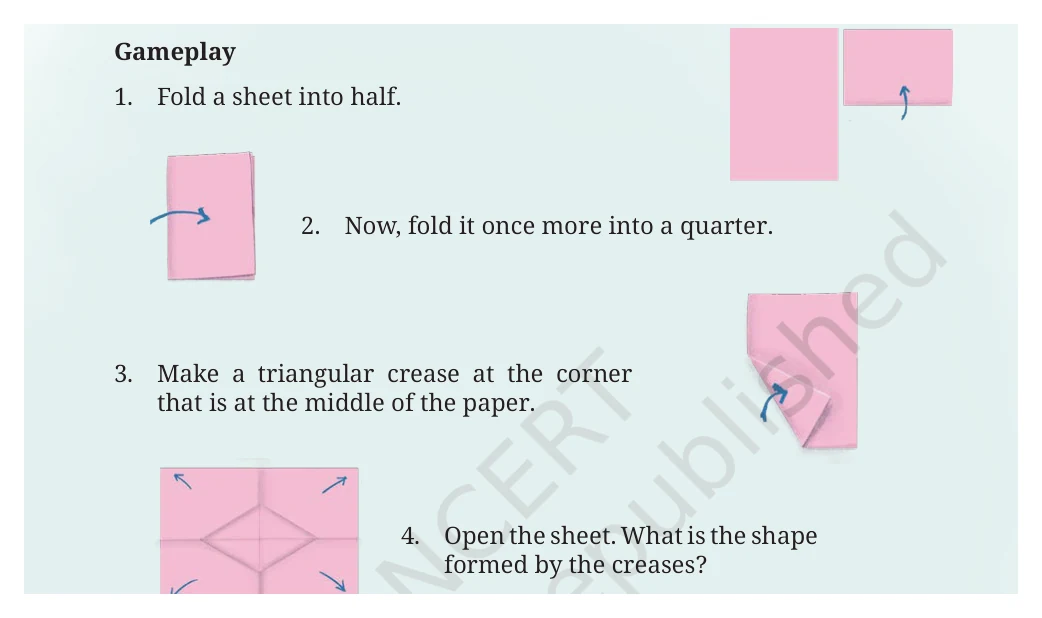
After the first three paper-folding steps, what shape do the creases form?
Show solution
Opening the sheet produces a symmetric quadrilateral pattern; the central closed figure is a rhombus (a square in the special equal-diagonal fold).
Textbook page 30 · solved item 66
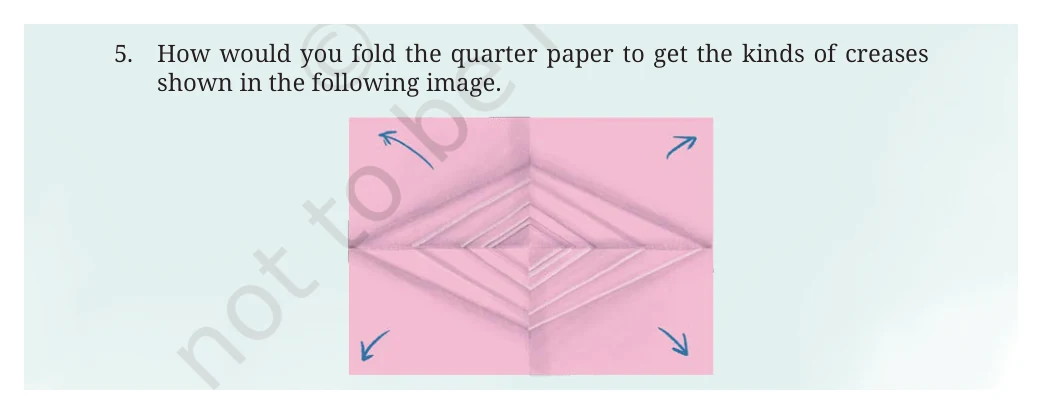
How can the quarter sheet be folded to obtain the shown crease pattern?
Show solution
Align the intended vertices or edges while the paper is quarter-folded, make the diagonal crease through the folded corner, and reopen. Reflection across the two earlier folds reproduces the crease symmetrically in all four quarters.
Textbook page 30 · solved item 67

How should the quarter sheet be folded so that opening it forms a square?
Show solution
Make the new crease at 45 degrees to both existing perpendicular fold lines and at equal distance from their intersection. Reflections of that crease across the two folds form four equal sides and four right angles.