
Use the textbook context
Match, attempt, then check
Each source crop keeps the printed information needed for that item. Compound answer-key entries are separated into individual solutions.
Complete worked answers
Textbook page 1
Textbook page 1 · solved item 1
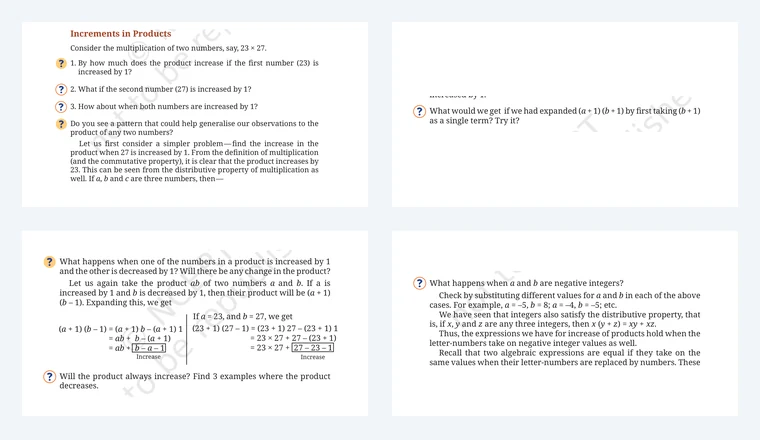
For (23\times27), find the increase in the product when the first number, the second number, and both numbers are increased by 1. Generalise.
Show solution
The original product is (621). Increasing 23 gives (24\times27=648), an increase of 27. Increasing 27 gives (23\times28=644), an increase of 23. Increasing both gives (24\times28=672), an increase of 51. In general, (a(b+1)-ab=a), ((a+1)b-ab=b), and ((a+1)(b+1)-ab=a+b+1).
Complete worked answers
Textbook page 3
Textbook page 3 · solved item 2

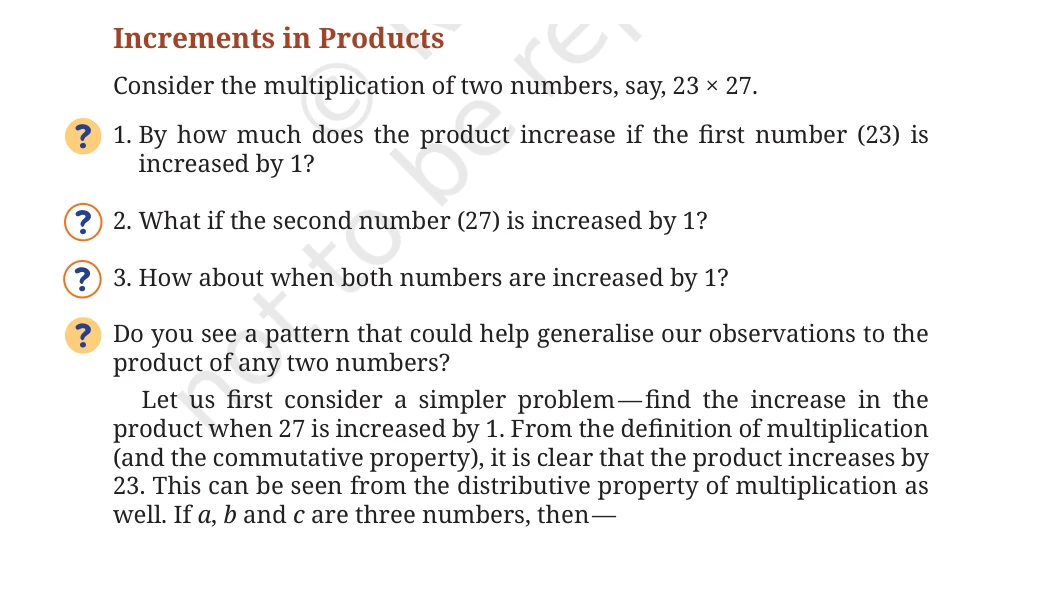
Expand ((a+1)(b+1)) by first treating ((b+1)) as a single term.
Show solution
Distribute in the other order: ((a+1)(b+1)=a(b+1)+1(b+1)=ab+a+b+1). This is the same result as distributing ((a+1)) first.
Textbook page 3 · solved item 3
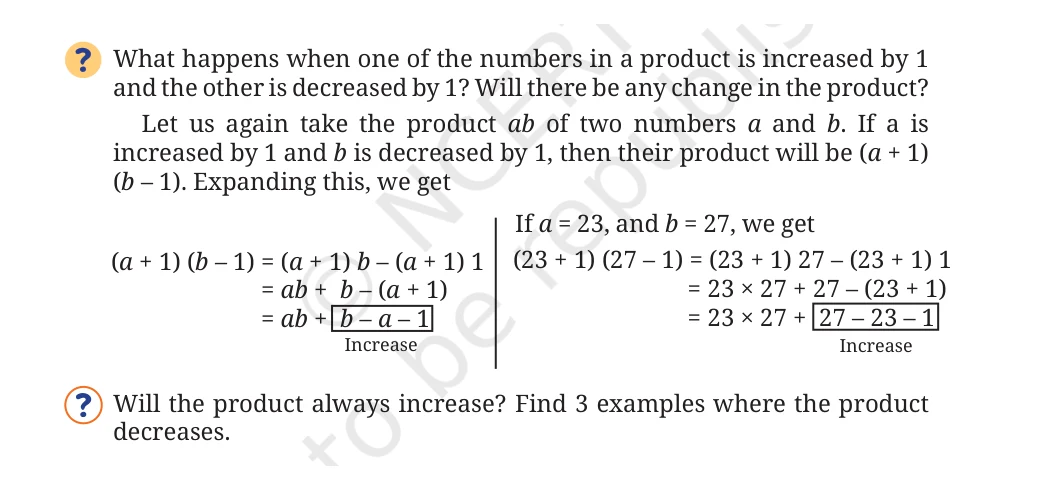
What happens to (ab) when (a) is increased by 1 and (b) is decreased by 1? Give three examples where the product decreases.
Show solution
The new product is ((a+1)(b-1)=ab+b-a-1), so the change is (b-a-1). It decreases whenever (b<a+1). Examples: (10\times3=30) becomes (11\times2=22); (8\times5=40) becomes (9\times4=36); (6\times2=12) becomes (7\times1=7).
Textbook page 3 · solved item 4
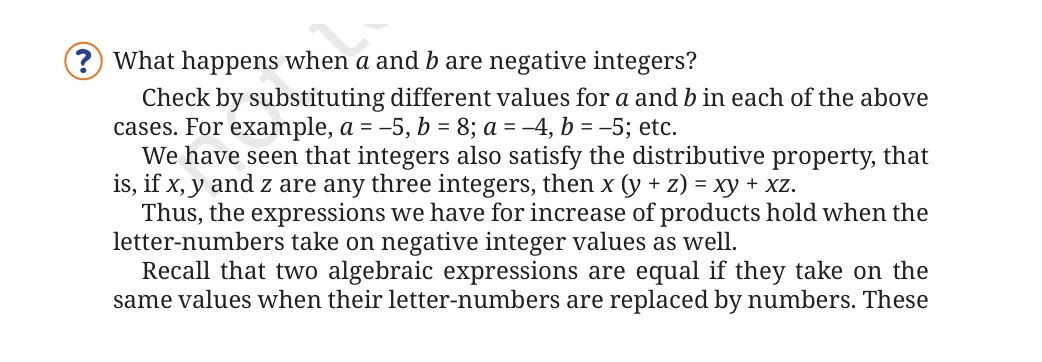
Do the product-change identities still work when the letter-numbers are negative integers?
Show solution
Yes. Integers satisfy distributivity, so the same identities hold. For example, with (a=-5,b=8), ((a+1)(b-1)-ab=(-4)(7)-(-40)=12), which also equals (b-a-1=8-(-5)-1=12).
Complete worked answers
Textbook page 4
Textbook page 4 · solved item 5
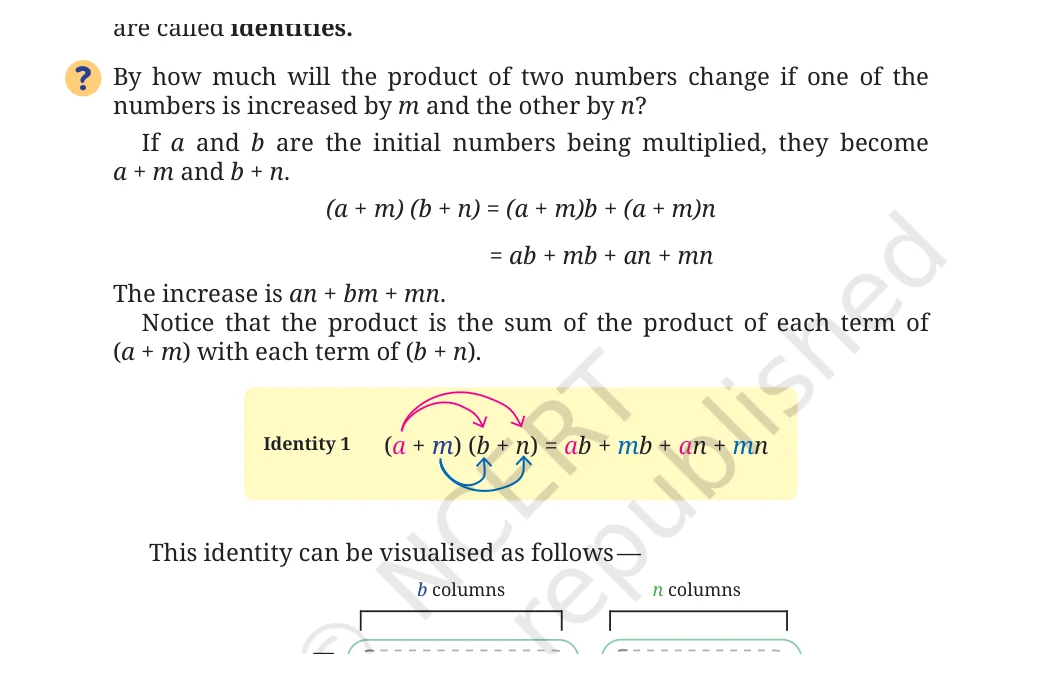
By how much does a product change if one factor is increased by (m) and the other by (n)?
Show solution
((a+m)(b+n)=ab+an+bm+mn). Therefore the change from (ab) is (an+bm+mn). This signed expression also covers decreases when (m) or (n) is negative.
Complete worked answers
Textbook page 5
Textbook page 5 · solved item 6
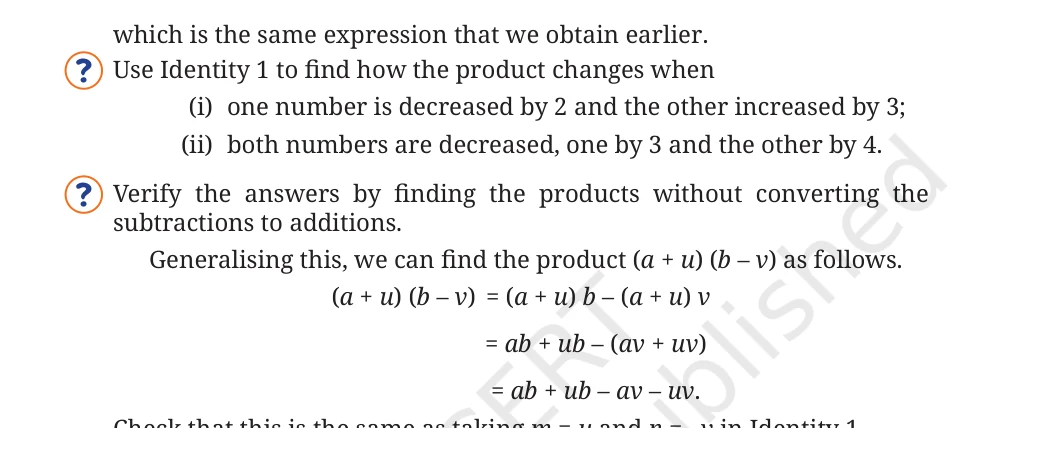
Use Identity 1 when one number decreases by 2 and the other increases by 3, and when both decrease by 3 and 4.
Show solution
(i) Set (m=-2,n=3): ((a-2)(b+3)=ab+3a-2b-6), so the change is (3a-2b-6). (ii) Set (m=-3,n=-4): ((a-3)(b-4)=ab-4a-3b+12), so the change is (-4a-3b+12). Direct expansion gives the same results.
Textbook page 5 · solved item 7

Expand (i) ((a-u)(b+v)) and (ii) ((a-u)(b-v)).
Show solution
(i) ((a-u)(b+v)=ab+av-ub-uv). (ii) ((a-u)(b-v)=ab-av-ub+uv). Each result is obtained by multiplying every term in the first bracket by every term in the second.
Textbook page 5 · solved item 8
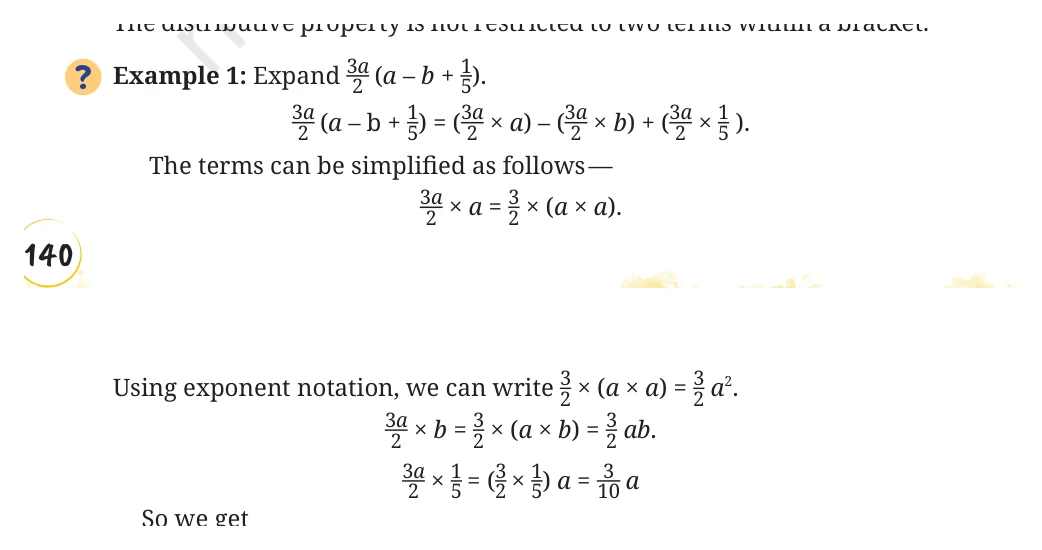
Expand (\\frac{3a}{2}\left(a-b+\\frac15\right)).
Show solution
Distributing (\\frac{3a}{2}) gives (\\frac32a^2-\\frac32ab+\\frac3{10}a).
Complete worked answers
Textbook page 6
Textbook page 6 · solved item 9
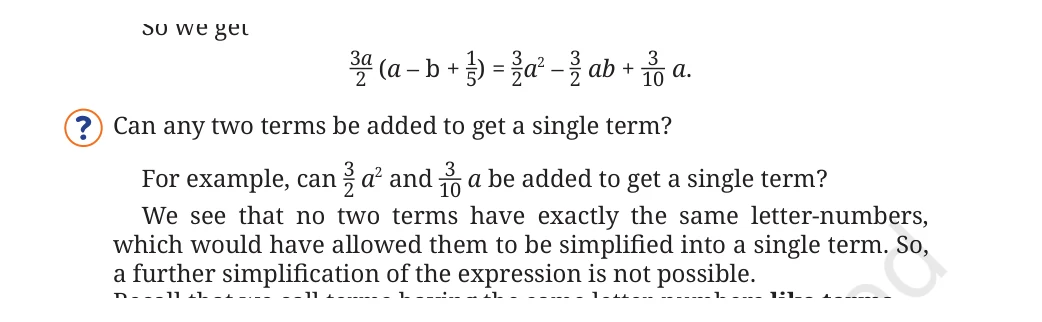
Can any two terms in (\\frac32a^2-\\frac32ab+\\frac3{10}a) be combined?
Show solution
No. The terms contain different letter parts, so none are like terms. The expression is already in its simplest collected form.
Textbook page 6 · solved item 10
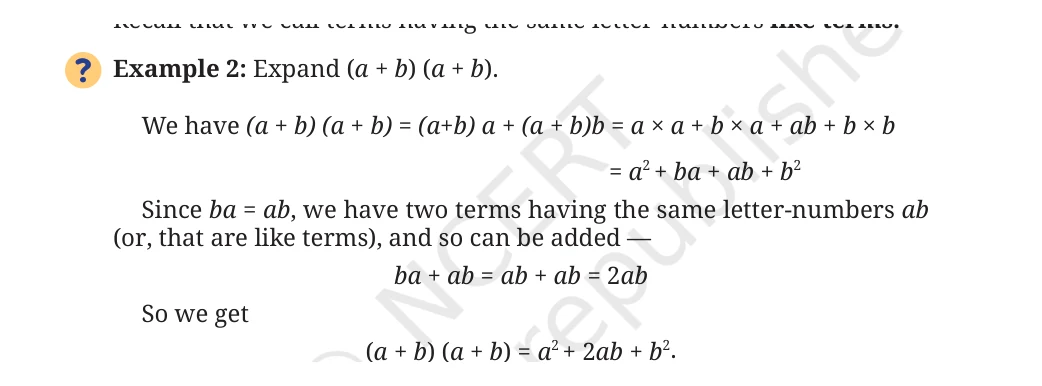
Expand ((a+b)^2).
Show solution
((a+b)^2=(a+b)(a+b)=a^2+ab+ba+b^2=a^2+2ab+b^2).
Textbook page 6 · solved item 11
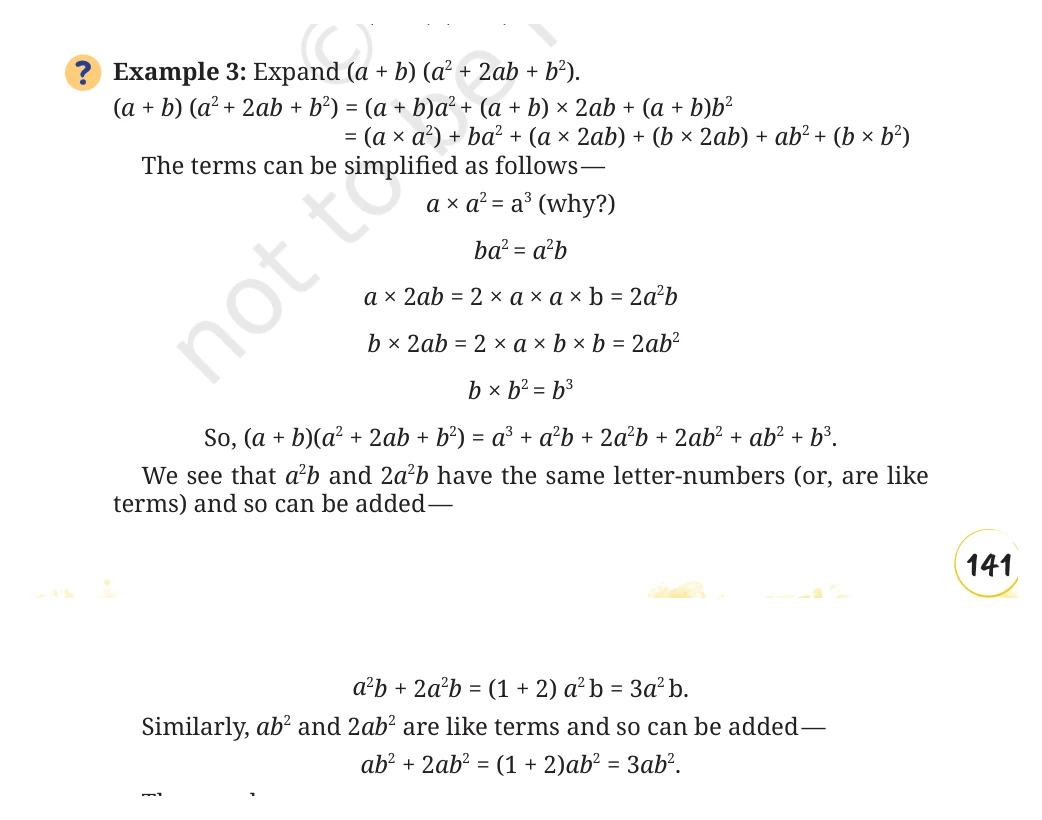
Expand ((a+b)(a^2+2ab+b^2)).
Show solution
Distributing and collecting like terms gives (a^3+a^2b+2a^2b+2ab^2+ab^2+b^3=a^3+3a^2b+3ab^2+b^3).
Complete worked answers
Textbook page 7
Textbook page 7 · solved item 12
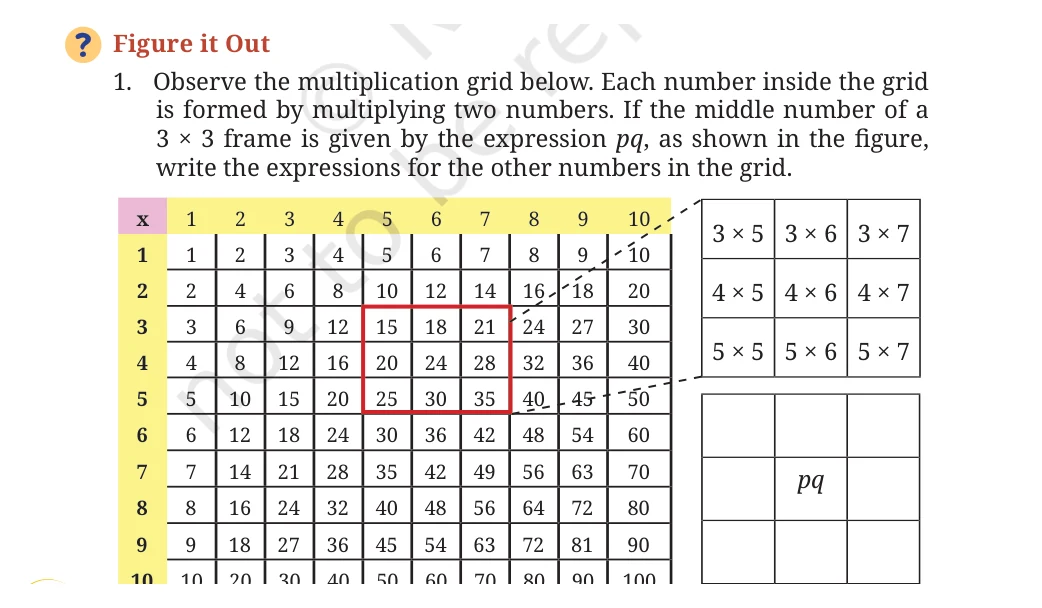
Complete the (3\times3) multiplication frame whose centre is (pq).
Show solution
The rows are ((p-1)(q-1),(p-1)q,(p-1)(q+1)); (p(q-1),pq,p(q+1)); and ((p+1)(q-1),(p+1)q,(p+1)(q+1)).
Complete worked answers
Textbook page 8
Textbook page 8 · solved item 13
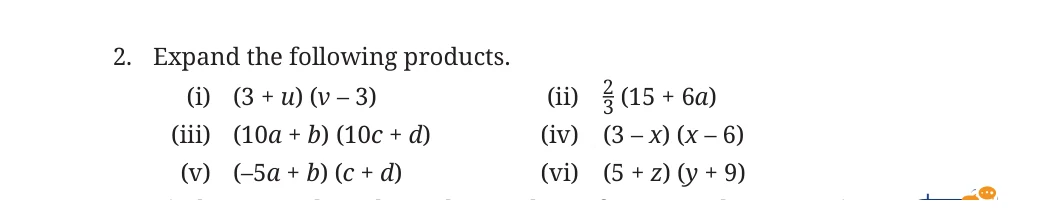
Expand the six products in Figure It Out Question 2.
Show solution
(i) (uv+3v-3u-9); (ii) (10+4a); (iii) (100ac+10ad+10bc+bd); (iv) (-x^2+9x-18); (v) (-5ac-5ad+bc+bd); (vi) (yz+5y+9z+45).
Textbook page 8 · solved item 14

Find three examples where increasing one factor by 2 and decreasing the other by 4 leaves the product unchanged.
Show solution
We need ((a+2)(b-4)=ab), which simplifies to (b=2a+4). Hence examples are (1\times6=3\times2=6), (2\times8=4\times4=16), and (3\times10=5\times6=30).
Textbook page 8 · solved item 15

Expand (i) ((a+ab-3b^2)(4+b)) and (ii) ((4y+7)(y+11z-3)).
Show solution
(i) (4a+5ab+ab^2-12b^2-3b^3). (ii) (4y^2+44yz-5y+77z-21).
Textbook page 8 · solved item 16
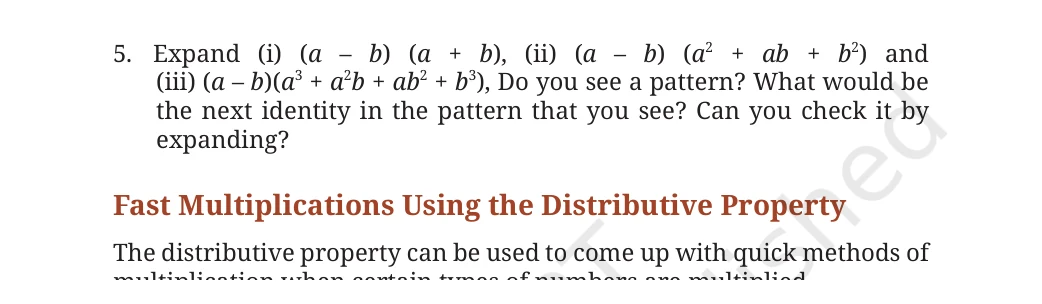
Expand the three difference patterns and write the next identity.
Show solution
The products are (a^2-b^2), (a^3-b^3), and (a^4-b^4). The next identity is ((a-b)(a^4+a^3b+a^2b^2+ab^3+b^4)=a^5-b^5).
Textbook page 8 · solved item 17
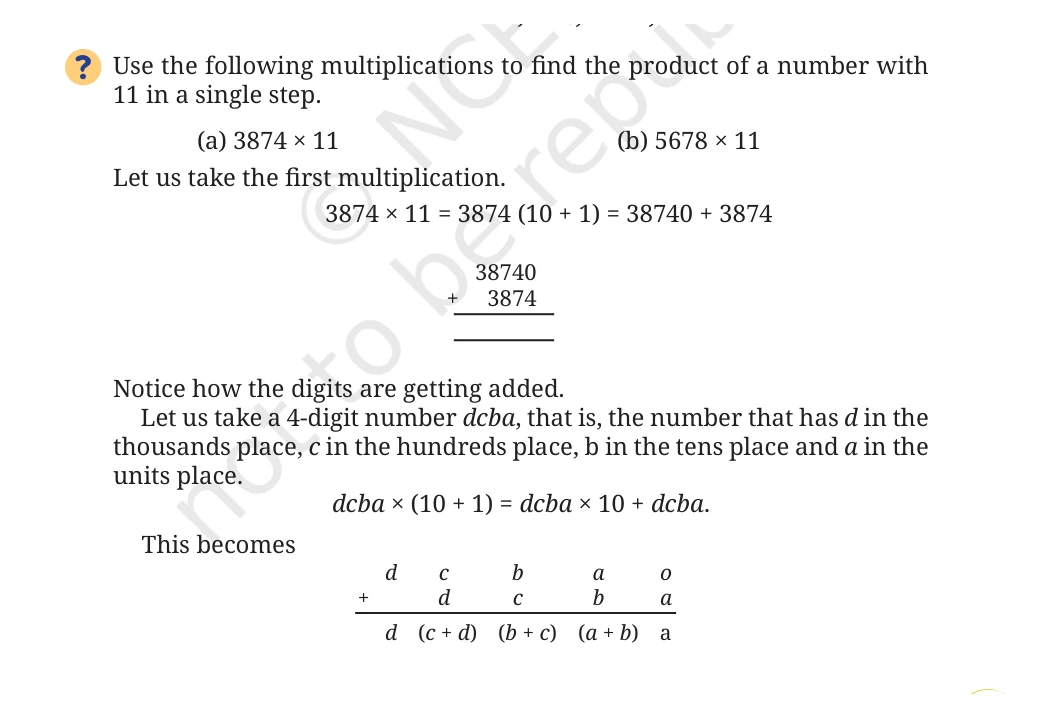
Find (3874 imes11) and (5678 imes11), then describe the general rule for multiplying by 11.
Show solution
(3874\times11=42614) and (5678\times11=62458). Multiply by 10 and add the original number. Digitwise, keep the end digits and add adjacent digits from right to left, carrying whenever a sum is at least 10.
Complete worked answers
Textbook page 9
Textbook page 9 · solved item 18

Evaluate (94 imes11), (495 imes11), (3279 imes11), and (4791256 imes11).
Show solution
The products are (1034, 5445, 36069,) and (52703816), respectively.
Textbook page 9 · solved item 19
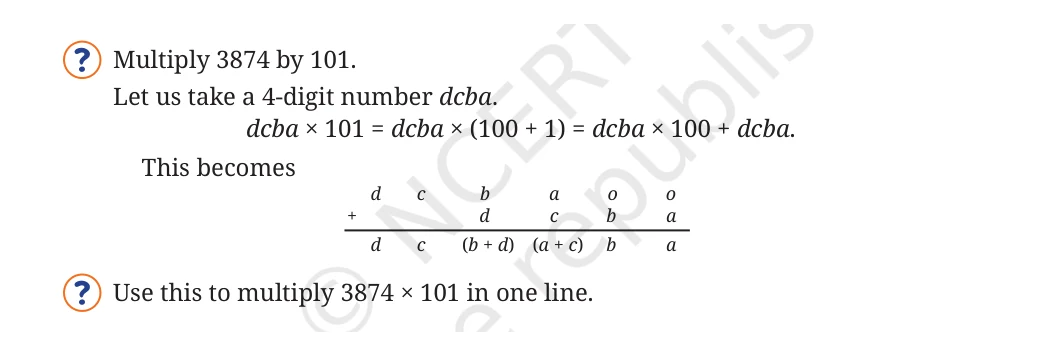
Multiply 3874 by 101 and state the place-value idea.
Show solution
(3874\times101=3874\times(100+1)=387400+3874=391274). Multiplying by 101 shifts the number two places left and adds the original number.
Textbook page 9 · solved item 20
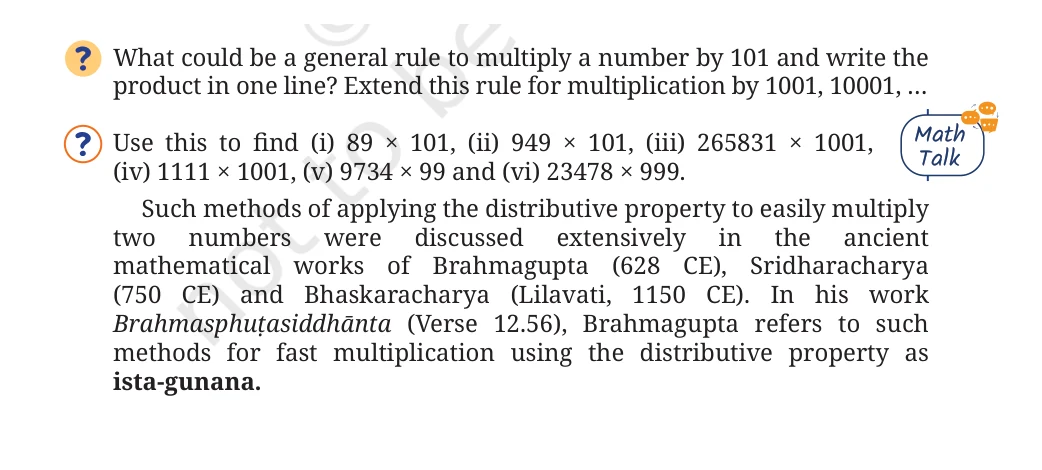
Extend the rule to 1001, 10001, and evaluate the six given products.
Show solution
For (10^k+1), shift by (k) places and add; for (10^k-1), shift and subtract. Thus: (i) 8989; (ii) 95849; (iii) 266096831; (iv) 1112111; (v) 963666; (vi) 23454522.
Complete worked answers
Textbook page 10
Textbook page 10 · solved item 21
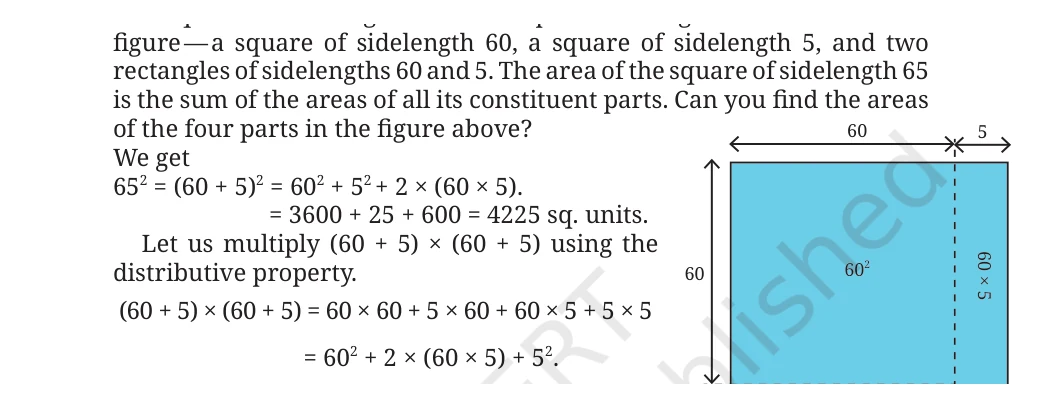
Find the four component areas in the square of side 65 and hence calculate its area.
Show solution
The parts have areas (60^2=3600), (60\times5=300), (5\times60=300), and (5^2=25). Their sum is (4225), so (65^2=4225).
Textbook page 10 · solved item 22
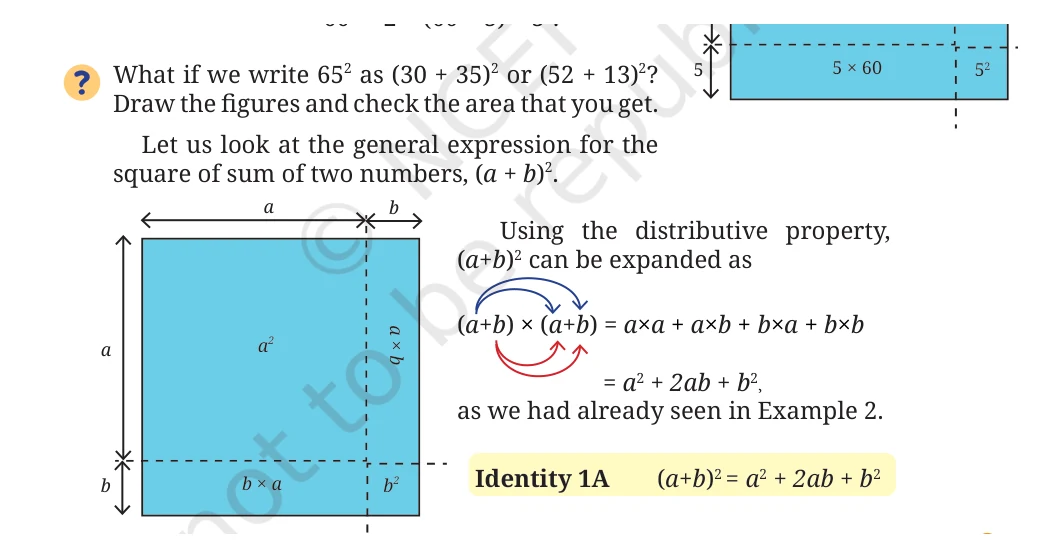
Check (65^2) using ((30+35)^2) and ((52+13)^2).
Show solution
((30+35)^2=900+2100+1225=4225). Also, ((52+13)^2=2704+1352+169=4225). Both decompositions give the same area.
Textbook page 10 · solved item 23

When is ((a+b)^2) greater than (a^2+b^2)?
Show solution
Their difference is (2ab). Therefore ((a+b)^2>a^2+b^2) when (ab>0), they are equal when (ab=0), and the left side is smaller when (ab<0).
Textbook page 10 · solved item 24

Use the square identities to find (104^2) and (37^2).
Show solution
(104^2=(100+4)^2=10000+800+16=10816). Also, (37^2=(40-3)^2=1600-240+9=1369).
Complete worked answers
Textbook page 11
Textbook page 11 · solved item 25
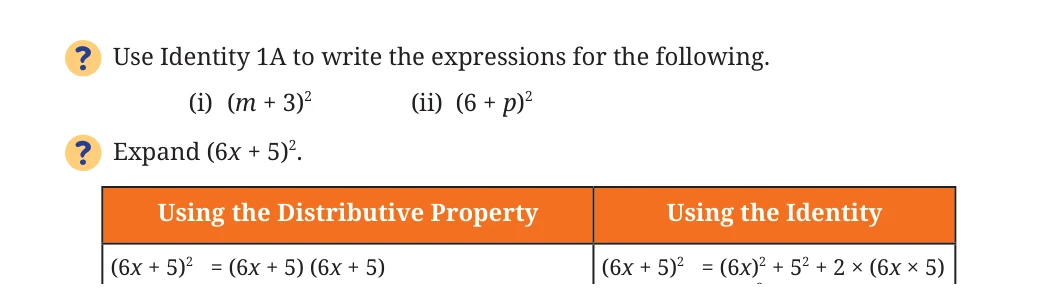
Expand ((m+3)^2), ((6+p)^2), ((6x+5)^2), and ((3j+2k)^2).
Show solution
The results are (m^2+6m+9), (p^2+12p+36), (36x^2+60x+25), and (9j^2+12jk+4k^2), respectively.
Textbook page 11 · solved item 26
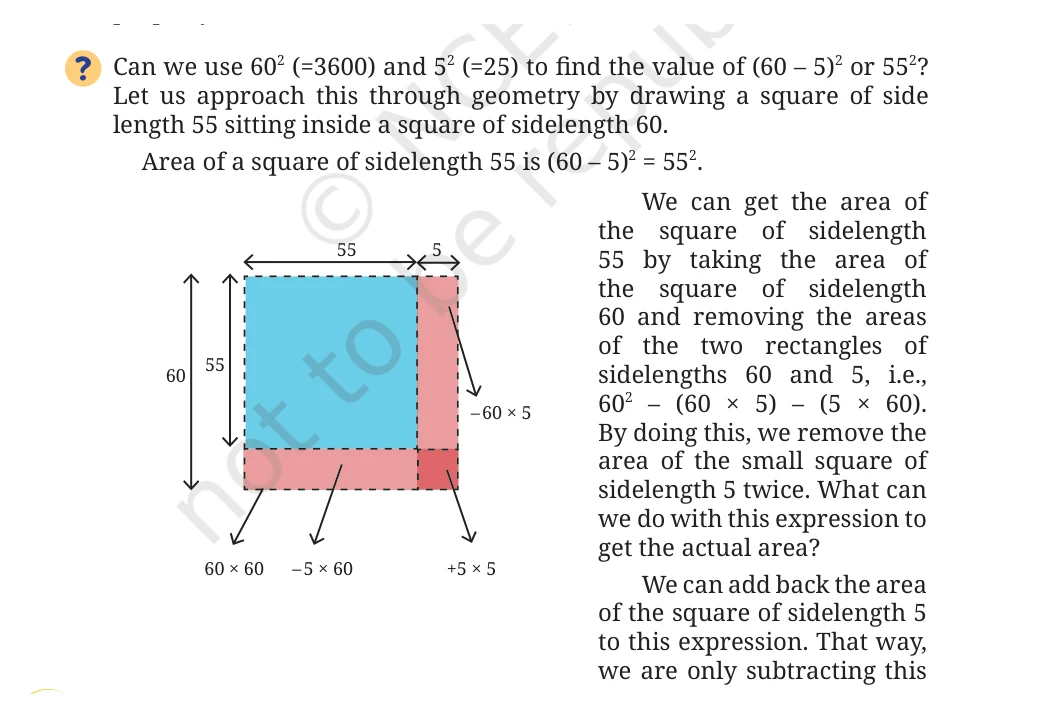
Use the geometric subtraction method to calculate ((60-5)^2). Why is (5^2) added back?
Show solution
Subtracting the two (60\times5) strips removes their overlapping (5\times5) square twice, so add it back once: (60^2-2(60\times5)+5^2=3600-600+25=3025).
Complete worked answers
Textbook page 12
Textbook page 12 · solved item 27

Find the general expansion of ((a-b)^2), including its geometric interpretation.
Show solution
From a square of side (a), remove two (a\times b) strips and add back the (b\times b) overlap. Hence ((a-b)^2=a^2-2ab+b^2).
Textbook page 12 · solved item 28

Use ((a-b)^2) to find (99^2) and (58^2).
Show solution
(99^2=(100-1)^2=10000-200+1=9801). (58^2=(60-2)^2=3600-240+4=3364).
Textbook page 12 · solved item 29
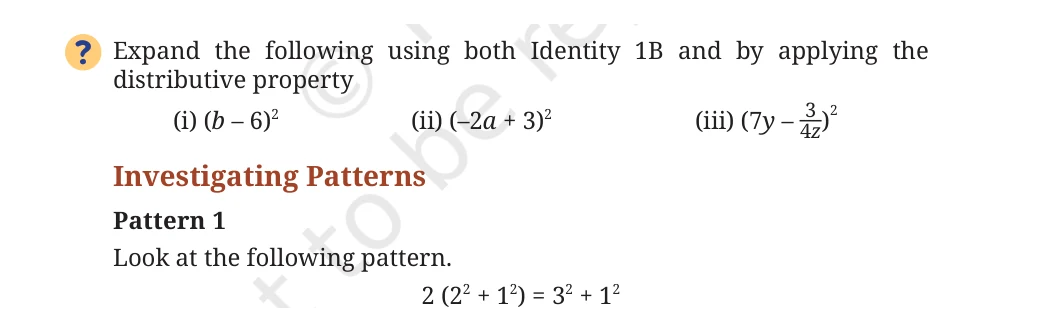
Expand ((b-6)^2), ((-2a+3)^2), and ((7y-\frac34z)^2).
Show solution
The expansions are (b^2-12b+36), (4a^2-12a+9), and (49y^2-\frac{21}{2}yz+\frac9{16}z^2).
Complete worked answers
Textbook page 13
Textbook page 13 · solved item 30
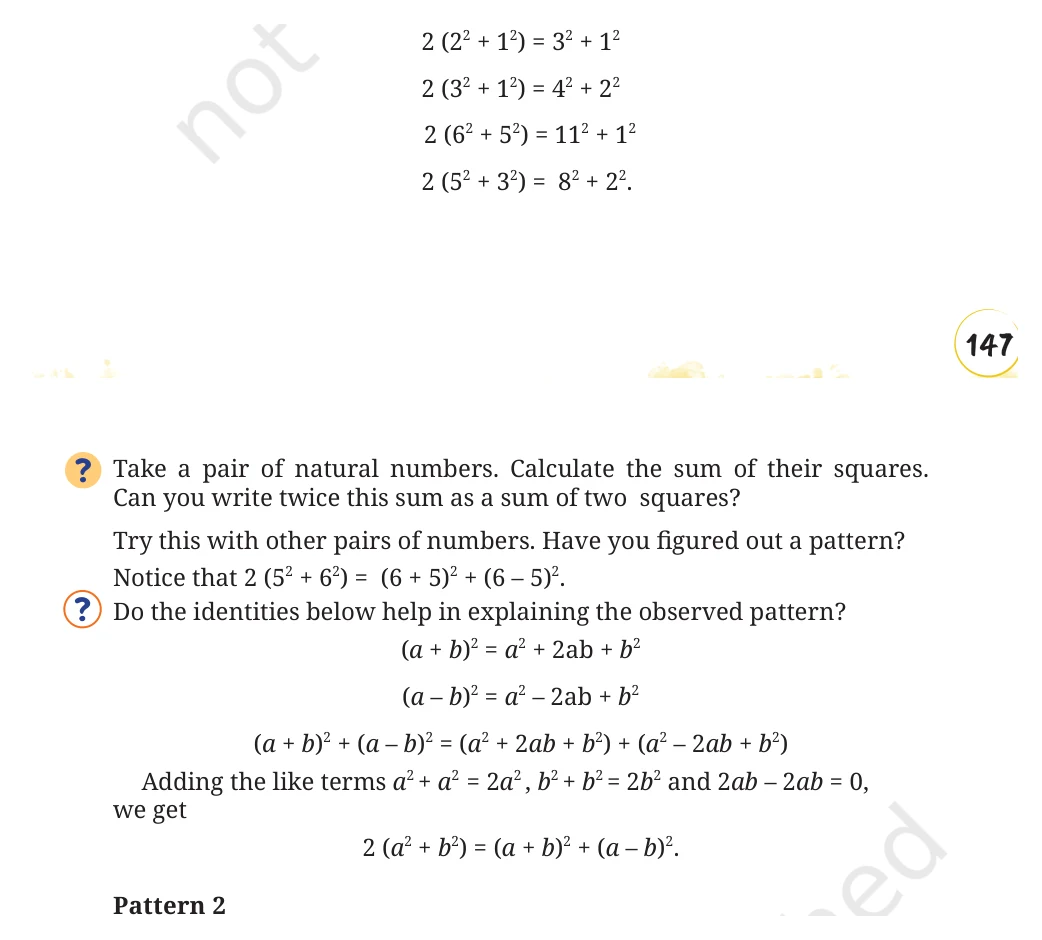
Explain Pattern 1: twice the sum of two squares is a sum of two squares.
Show solution
For any numbers (a,b), add the two square identities: ((a+b)^2+(a-b)^2=2a^2+2b^2=2(a^2+b^2)). Thus the two required squares are ((a+b)^2) and ((a-b)^2).
Textbook page 13 · solved item 31
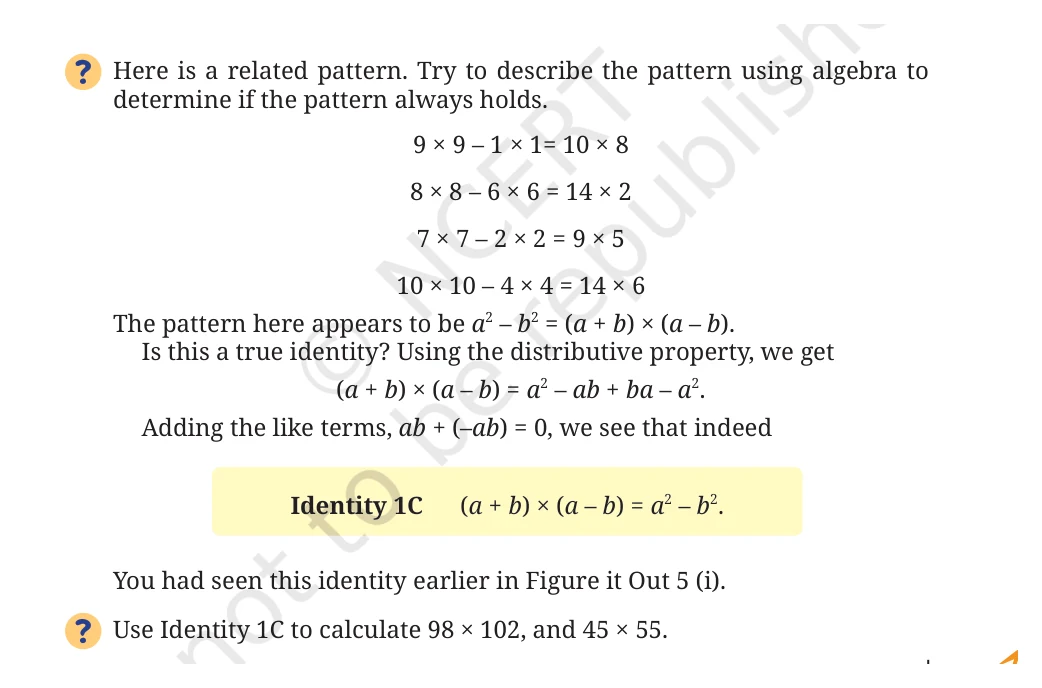
Explain Pattern 2 and use it to calculate (98\times102) and (45\times55).
Show solution
The identity is ((a+b)(a-b)=a^2-b^2). Hence (98\times102=(100-2)(100+2)=10000-4=9996), and (45\times55=(50-5)(50+5)=2500-25=2475).
Textbook page 13 · solved item 32
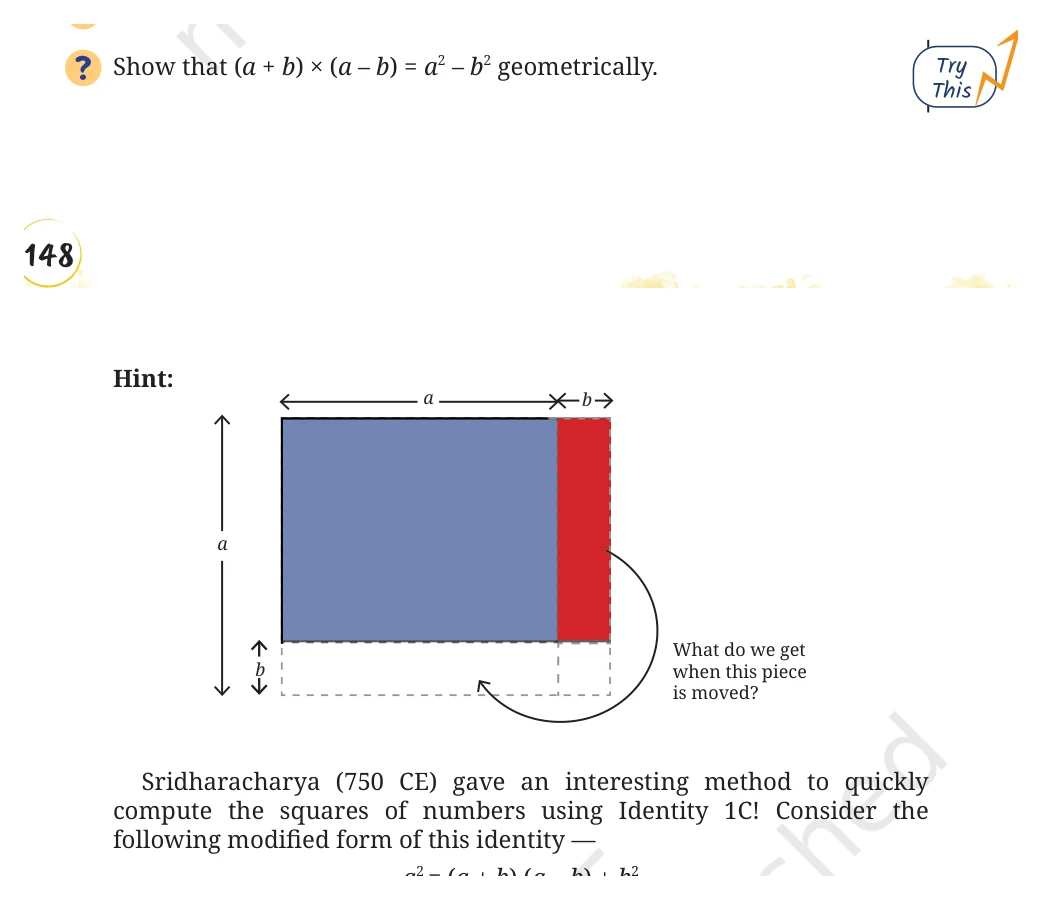
Give a geometric justification of ((a+b)(a-b)=a^2-b^2).
Show solution
Start with an (a\times a) square and remove a (b\times b) square. Rearrange the remaining L-shaped region into a rectangle with sides (a+b) and (a-b). Equal areas give (a^2-b^2=(a+b)(a-b)).
Complete worked answers
Textbook page 14
Textbook page 14 · solved item 33
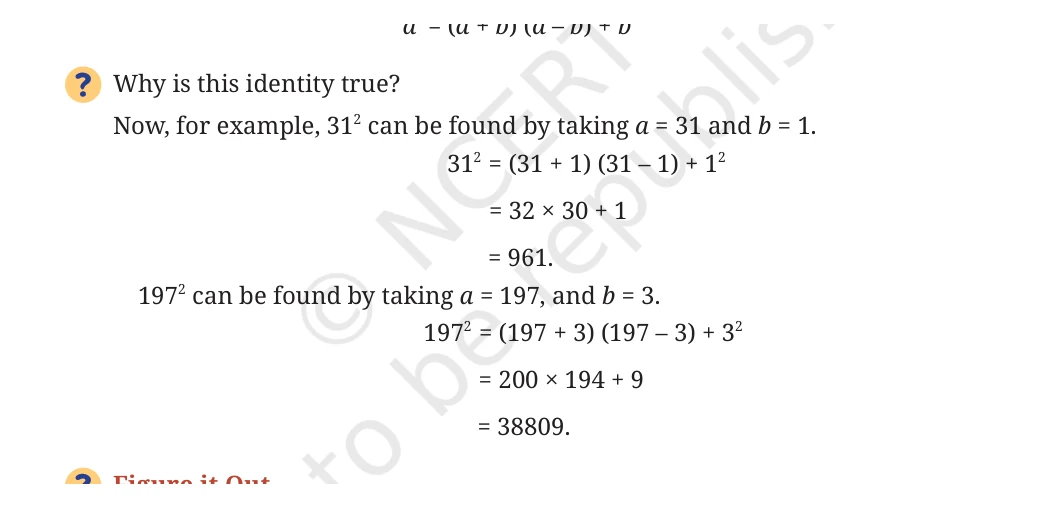
Why is Sridharacharya's identity (a^2=(a+b)(a-b)+b^2) true?
Show solution
It is Identity 1C rearranged: ((a+b)(a-b)=a^2-b^2). Adding (b^2) to both sides gives (a^2=(a+b)(a-b)+b^2).
Textbook page 14 · solved item 34

Which is greater: ((a-b)^2) or ((b-a)^2)?
Show solution
They are equal because (b-a=-(a-b)), and squaring removes the sign: ((b-a)^2=(a-b)^2).
Textbook page 14 · solved item 35

Express 100 as the difference of two squares.
Show solution
One answer is (26^2-24^2=(26+24)(26-24)=50\times2=100).
Textbook page 14 · solved item 36

Find (406^2,72^2,145^2,1097^2,) and (124^2) using identities.
Show solution
The values are (164836, 5184, 21025, 1203409,) and (15376), respectively.
Textbook page 14 · solved item 37

Do Patterns 1 and 2 hold for negative integers and fractions?
Show solution
Yes. Their proofs use only addition, subtraction, multiplication, and distributivity, so they are polynomial identities valid for integers, rational numbers, and real numbers, not only counting numbers.
Complete worked answers
Textbook page 15
Textbook page 15 · solved item 38
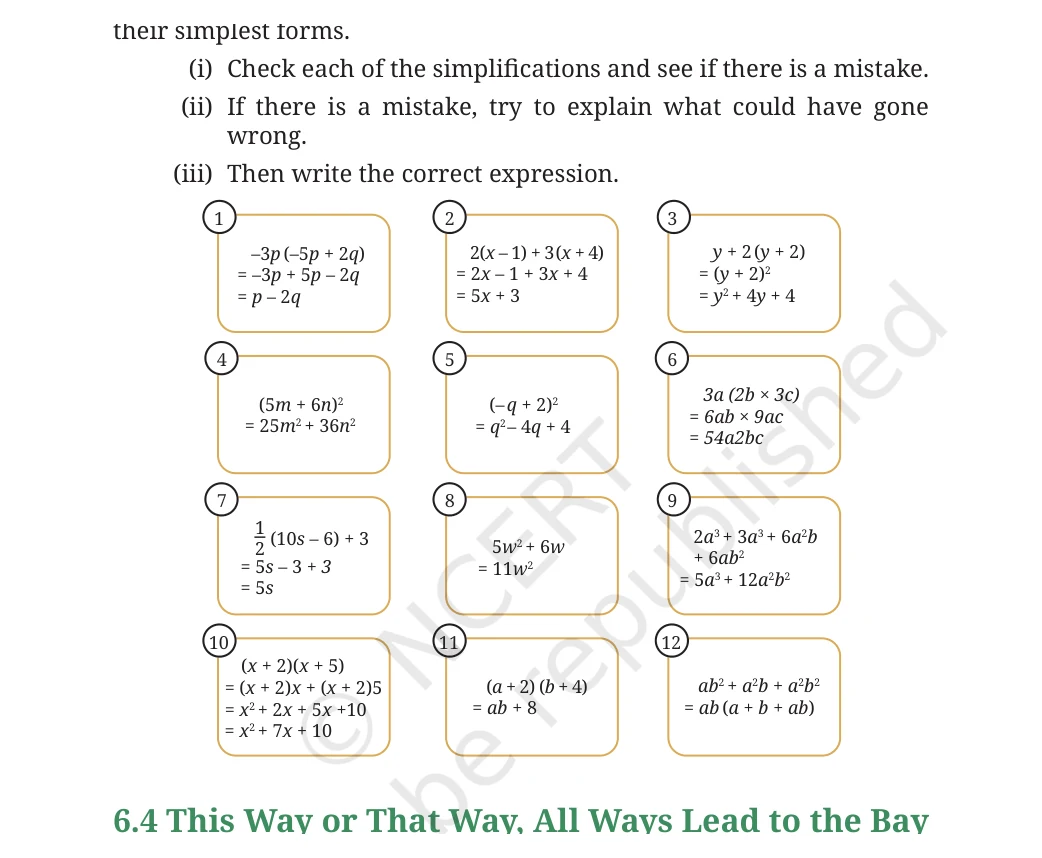
Check all 12 simplifications in 'Mind the Mistake' and correct the wrong ones.
Show solution
Correct results: (1) (15p^2-6pq); (2) (5x+10); (3) (3y+4); (4) (25m^2+60mn+36n^2); (5) (q^2-4q+4) is correct; (6) (18abc); (7) (5s) is correct; (8) (5w^2+6w) cannot be combined; (9) (5a^3+6a^2b+6ab^2); (10) (ab+4a+2b+8); (11) (ab(a+b+ab)) is correct; (12) (x^2+7x+10) is correct.
Textbook page 15 · solved item 39
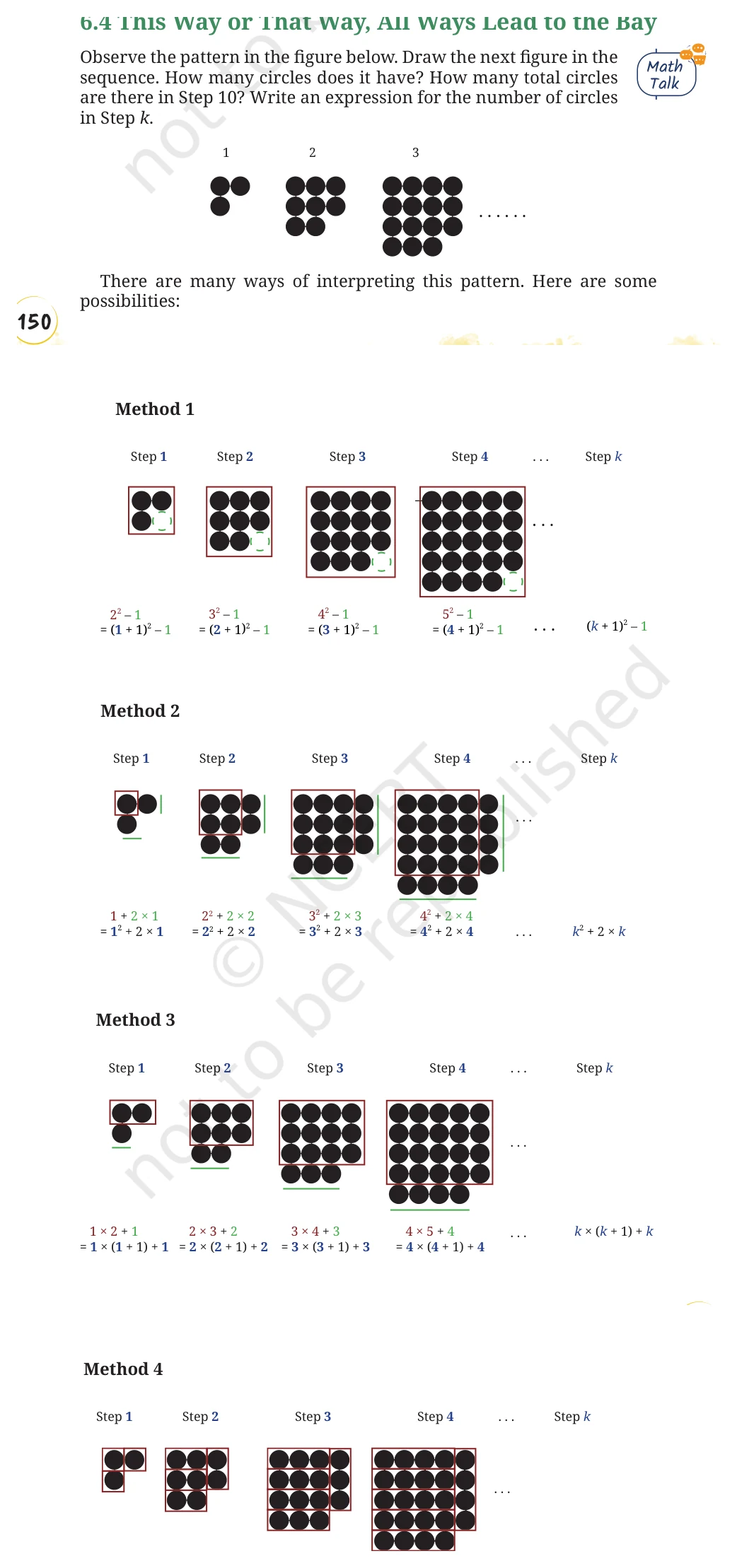
For the circle pattern, draw the next step and find the counts at Step 10 and Step k.
Show solution
All four shown methods simplify to (k^2+2k=k(k+2)). The next figure, Step 4, has (4^2+2(4)=24) circles. Step 10 has (10^2+20=120) circles.
Complete worked answers
Textbook page 17
Textbook page 17 · solved item 40

Use the circle-pattern formula to find the number of circles in Step 15.
Show solution
(15^2+2(15)=225+30=255) circles.
Complete worked answers
Textbook page 18
Textbook page 18 · solved item 41
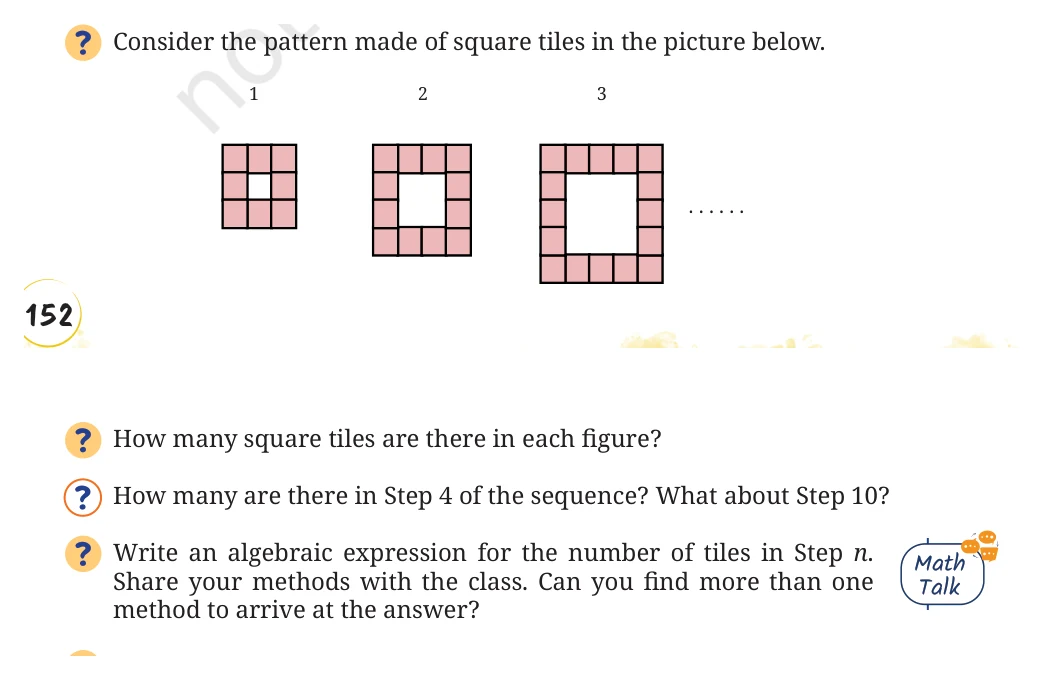
Find the square-tile counts at Steps 4 and 10, and write a formula for Step n.
Show solution
The first counts are 8, 12, 16, so Step (n) has ((n+2)^2-n^2=4n+4) tiles. Step 4 has 20 tiles and Step 10 has 44 tiles. Counting the four arms gives the same formula.
Textbook page 18 · solved item 42
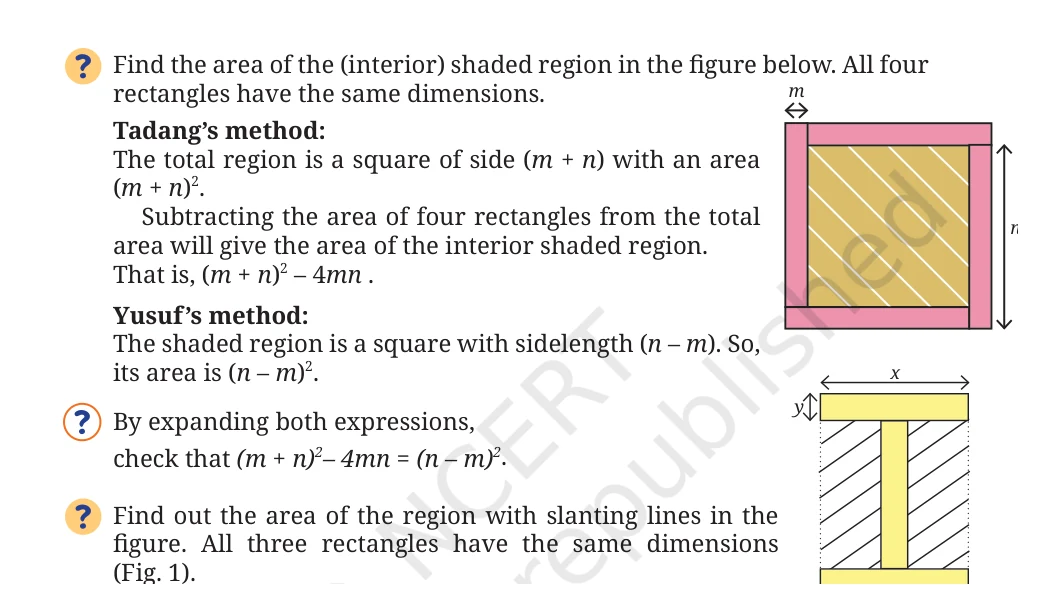
Find the interior shaded area and verify the two expressions are equal.
Show solution
Subtracting the four rectangles gives ((m+n)^2-4mn=m^2-2mn+n^2=(n-m)^2). Thus the shaded square has area ((n-m)^2).
Complete worked answers
Textbook page 19
Textbook page 19 · solved item 43
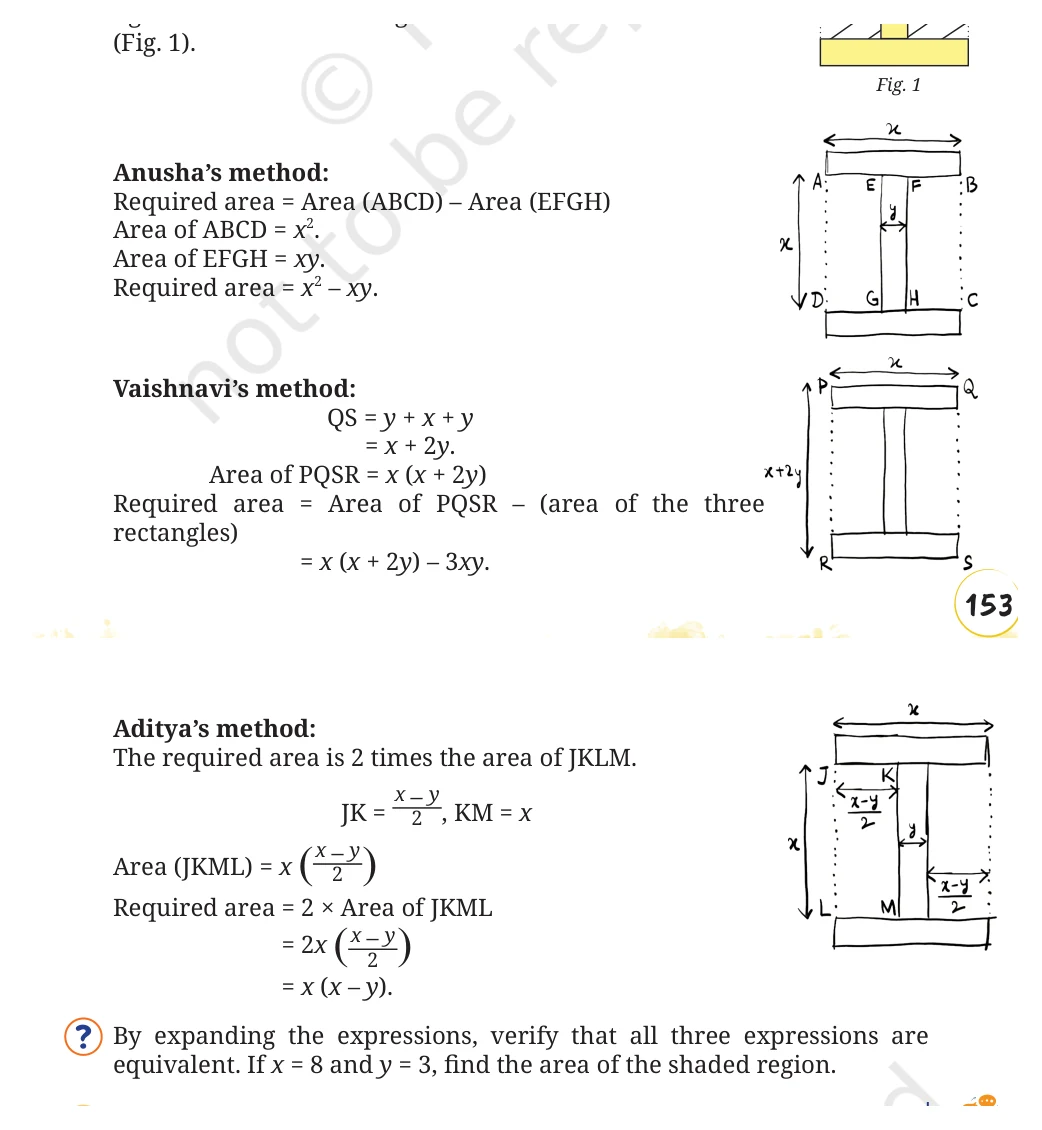
Verify the three expressions for the slanted region and evaluate the area for x = 8, y = 3.
Show solution
The expressions are (x^2-xy), (x(x+2y)-3xy), and (x(x-y)). Each simplifies to (x^2-xy=x(x-y)). At (x=8,y=3), the area is (8(8-3)=40) square units.
Textbook page 19 · solved item 44
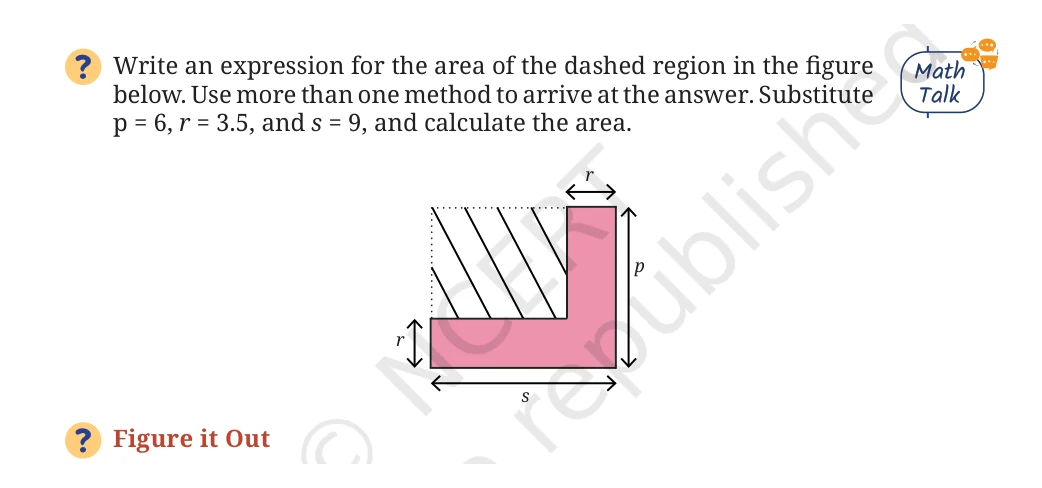
Write the dashed-region area in more than one way and evaluate it for p = 6, r = 3.5, s = 9.
Show solution
Subtracting the two overlapping strips gives (ps-pr-sr+r^2). Factoring gives the equivalent expression ((p-r)(s-r)). Substitution gives ((6-3.5)(9-3.5)=2.5\times5.5=13.75) square units.
Textbook page 19 · solved item 45
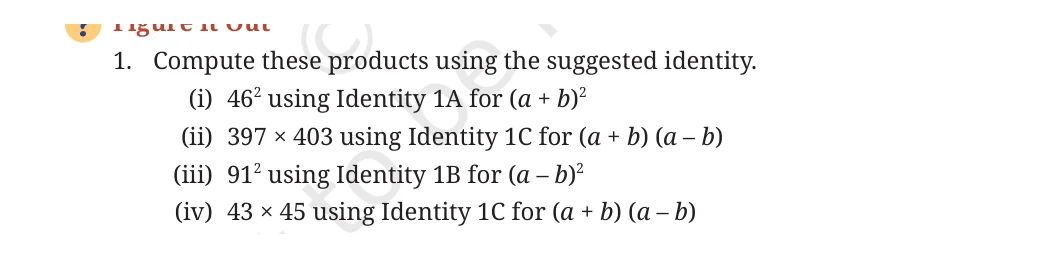
Compute the four products in Figure It Out Question 1 using the suggested identities.
Show solution
(i) (46^2=(40+6)^2=2116). (ii) (397\times403=(400-3)(400+3)=159991). (iii) (91^2=(100-9)^2=8281). (iv) (43\times45=(44-1)(44+1)=1935).
Textbook page 19 · solved item 46
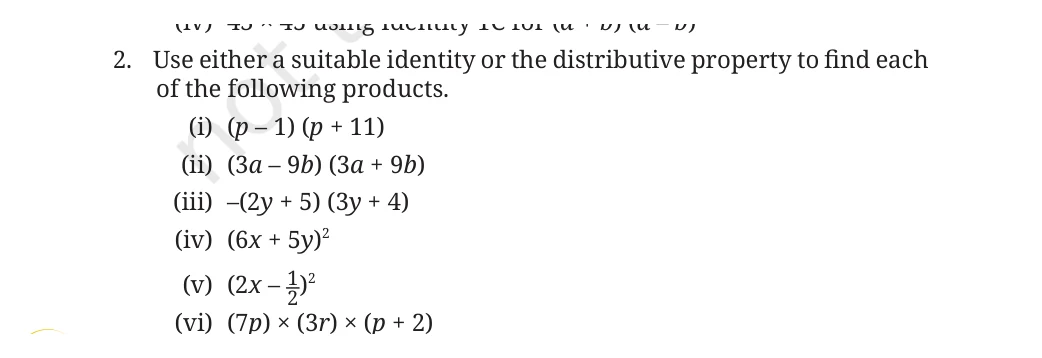
Expand the six products in Figure It Out Question 2.
Show solution
(i) (p^2+10p-11); (ii) (9a^2-81b^2); (iii) (-6y^2-23y-20); (iv) (36x^2+60xy+25y^2); (v) (4x^2-2x+\frac14); (vi) (21p^2r+42pr).
Complete worked answers
Textbook page 20
Textbook page 20 · solved item 47
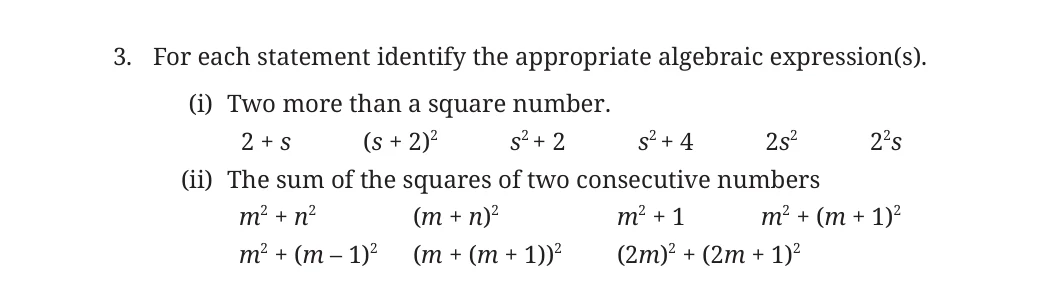
Choose the appropriate expressions for the two verbal statements in Question 3.
Show solution
(i) Two more than a square number is (s^2+2). (ii) The sum of squares of two consecutive numbers can be (m^2+(m+1)^2) or (m^2+(m-1)^2). The option (m^2+(m+1)^2) uses (m) as the smaller number.
Textbook page 20 · solved item 48
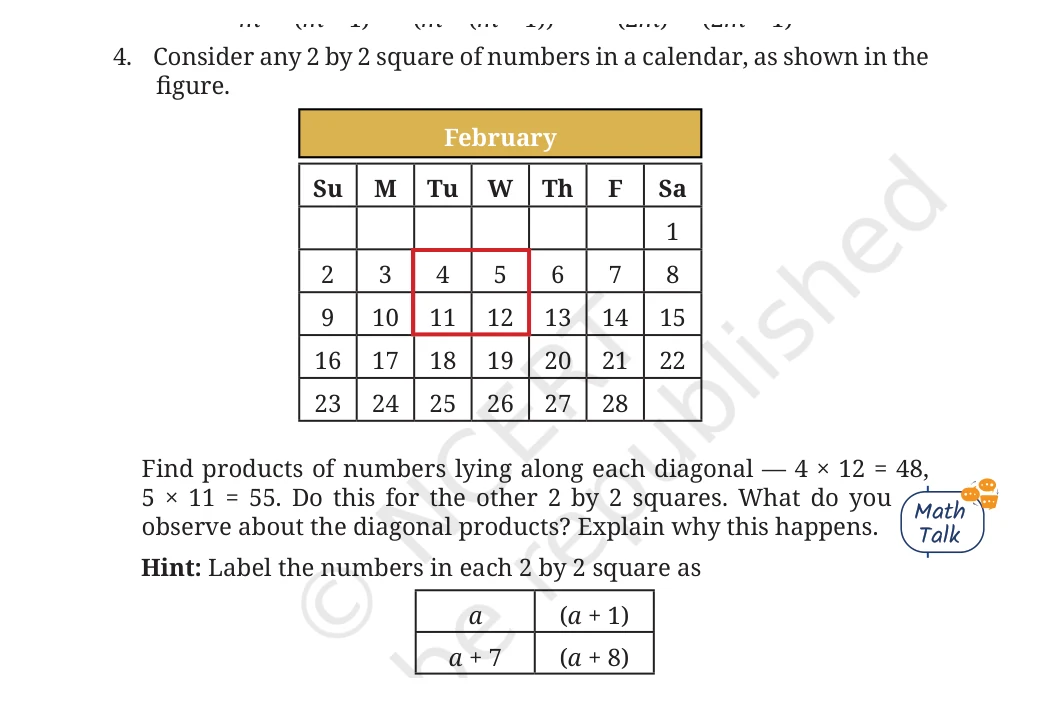
Compare the diagonal products in any 2 by 2 calendar square and explain the pattern.
Show solution
For entries (a,a+1,a+7,a+8), the diagonal products differ by ((a+1)(a+7)-a(a+8)=a^2+8a+7-(a^2+8a)=7). The top-right to bottom-left product is always 7 larger.
Textbook page 20 · solved item 49
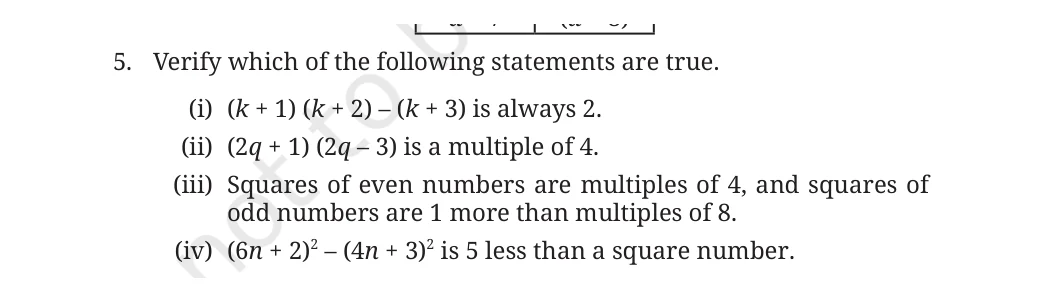
Decide which of the four algebraic statements are true.
Show solution
(i) False: it simplifies to (k^2+2k-1). (ii) False: it is (4q^2-4q-3), which leaves remainder 1 on division by 4. (iii) True: ((2m)^2=4m^2), while ((2m+1)^2=8\frac{m(m+1)}2+1). (iv) False; for (n=1) the difference is 15, which is not 5 less than a square.
Textbook page 20 · solved item 50

Two numbers leave remainders 3 and 5 on division by 7. Find the remainders of their sum, difference, and product.
Show solution
Modulo 7, the sum is (3+5=8\equiv1), and the product is (15\equiv1). The second number minus the first leaves (5-3=2); the first minus the second leaves (3-5\equiv5).
Textbook page 20 · solved item 51
Square the middle of three consecutive numbers and subtract the product of the other two. What identity results?
Show solution
Let the numbers be (n-1,n,n+1). Then (n^2-(n-1)(n+1)=n^2-(n^2-1)=1). The result is always 1.
Complete worked answers
Textbook page 21
Textbook page 21 · solved item 52

Write and prove the expression obtained by multiplying the sum of two numbers by half their sum.
Show solution
For numbers (a,b), the expression is ((a+b)\cdot\frac{a+b}{2}=\frac12(a+b)^2), exactly half the square of their sum.
Textbook page 21 · solved item 53

Without fully multiplying, decide which product is larger in each pair.
Show solution
(i) (16\times24=(20-4)(20+4)=400-16=384), while (14\times26=400-36=364); (16\times24) is larger. (ii) (26\times74=(50-24)(50+24)=2500-576=1924), while (25\times75=1875); (26\times74) is larger.
Textbook page 21 · solved item 54
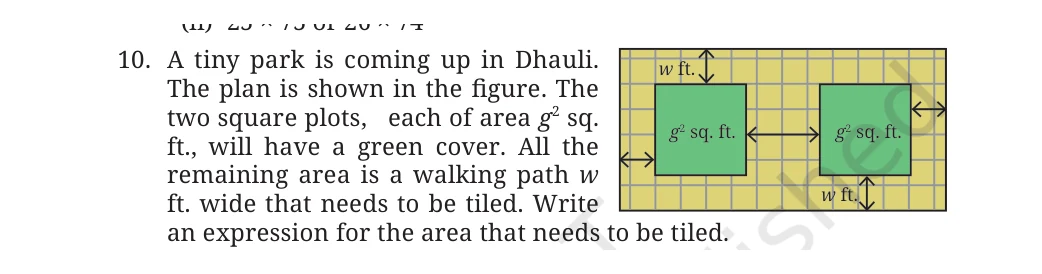
Find an expression for the tiled walking path around the two square green plots.
Show solution
The outer rectangle has dimensions (2g+2w) and (g+2w). Subtracting the two green squares gives ((2g+2w)(g+2w)-2g^2=8w(g+w)) square feet.
Textbook page 21 · solved item 55
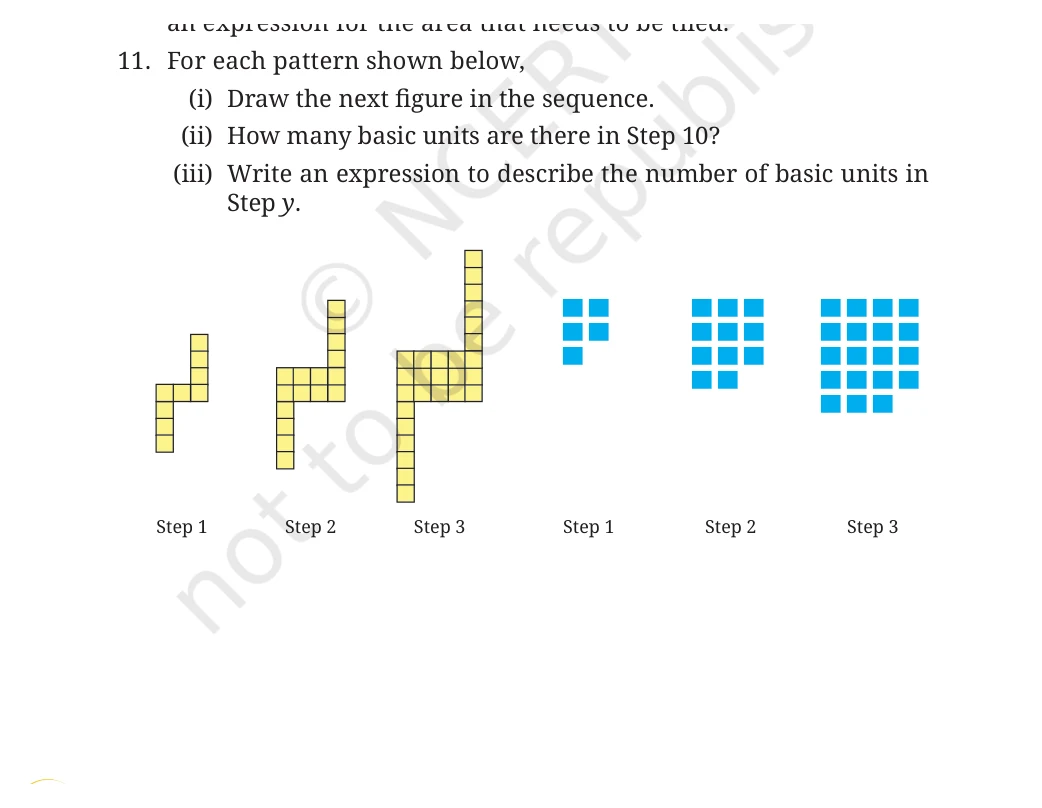
For both visual patterns in Question 11, find Step 4, Step 10, and a formula for Step y.
Show solution
(a) The counts follow ((y+2)^2): Step 4 has 36 and Step 10 has 144 basic units. (b) The counts follow ((y+1)^2+y=y^2+3y+1): Step 4 has 29 and Step 10 has 131 basic units.
Complete worked answers
Textbook page 23
Textbook page 23 · solved item 56
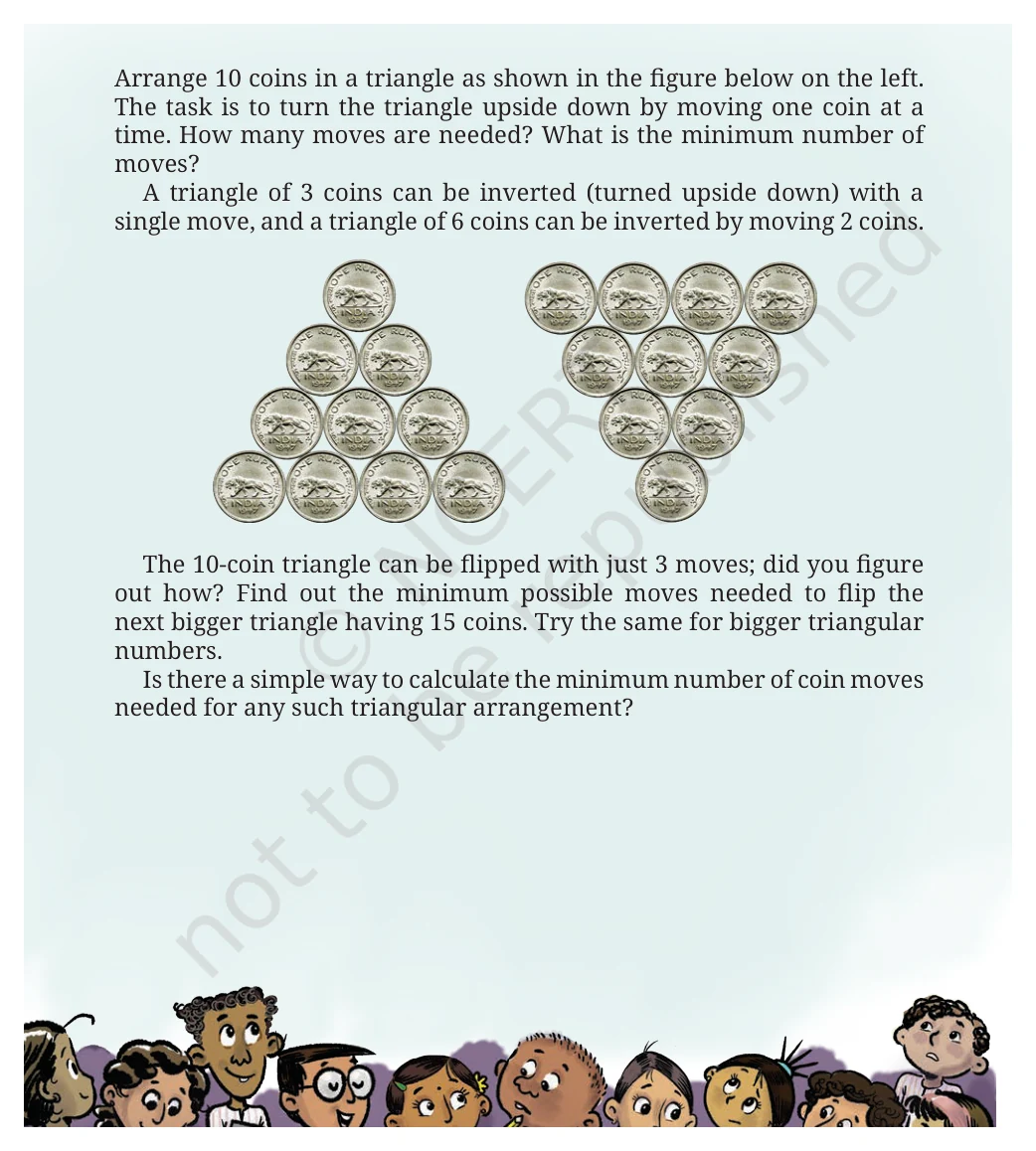
Flip the 10-coin triangle, then find the minimum moves for the 15-coin triangle and describe the general strategy.
Show solution
The 10-coin triangle can be inverted in 3 moves, as stated. The 15-coin triangle requires a minimum of 5 moves: align the inverted triangle to maximise the coins that remain in place, then move only the non-overlapping coins. For larger triangles, the same maximum-overlap construction gives the minimum; draw the two orientations on the triangular lattice and count the unmatched positions.