
Question-by-question working
Read the prompt, attempt it, then check each step
Every exercise subpart and table row is a separate item. Shared figures are repeated in the crop whenever they are needed to understand that question.
Detailed worked answers
Textbook page 69
Textbook page 69 · solved item 1
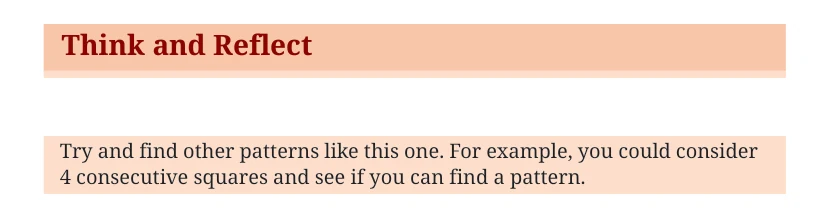
Think and Reflect: Find a pattern using four consecutive square numbers.
Show detailed solution
- Step 1: Write four consecutive integers as n,n+1,n+2,n+3, so their squares are n^2,(n+1)^2,(n+2)^2,(n+3)^2
- Step 2: Compare the two outside squares with the two inside squares: n^2+(n+3)^2-(n+1)^2-(n+2)^2
- Step 3: Expanding gives n^2+n^2+6n+9-(n^2+2n+1)-(n^2+4n+4)=4
- Answer: The sum of the first and fourth squares is always 4 more than the sum of the middle two squares.
Detailed worked answers
Textbook page 71
Textbook page 71 · solved item 2
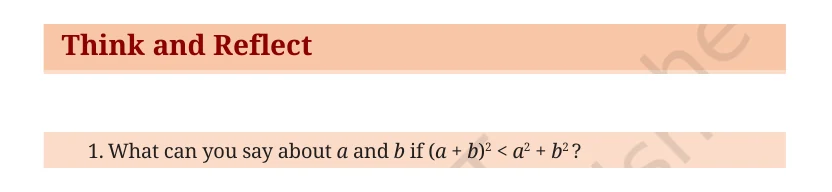
Think and Reflect 1: What can be said about a and b if (a+b)^2<a^2+b^2?
Show detailed solution
- Step 1: Use (a+b)^2=a^2+2ab+b^2
- Step 2: The inequality becomes a^2+2ab+b^2<a^2+b^2, hence 2ab<0
- Step 3: Therefore ab<0, which happens when a and b are non-zero and have opposite signs.
- Answer: a and b must have opposite signs.
Textbook page 71 · solved item 3
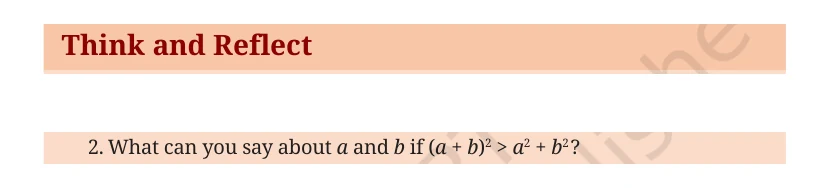
Think and Reflect 2: What can be said about a and b if (a+b)^2>a^2+b^2?
Show detailed solution
- Step 1: Replace (a+b)^2 by a^2+2ab+b^2
- Step 2: Cancelling a^2+b^2 from both sides leaves 2ab>0
- Step 3: Thus ab>0, so the two non-zero numbers have the same sign.
- Answer: a and b are either both positive or both negative.
Textbook page 71 · solved item 4
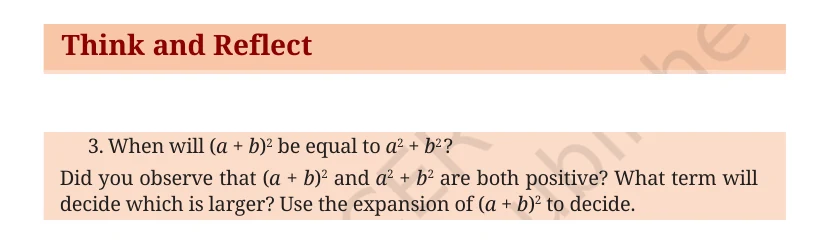
Think and Reflect 3: When is (a+b)^2=a^2+b^2?
Show detailed solution
- Step 1: Expand the left side to get a^2+2ab+b^2=a^2+b^2
- Step 2: Cancelling equal terms gives 2ab=0, or ab=0
- Step 3: A product is zero exactly when at least one factor is zero.
- Answer: Equality holds when a=0, b=0, or both are zero.
Textbook page 71 · solved item 5
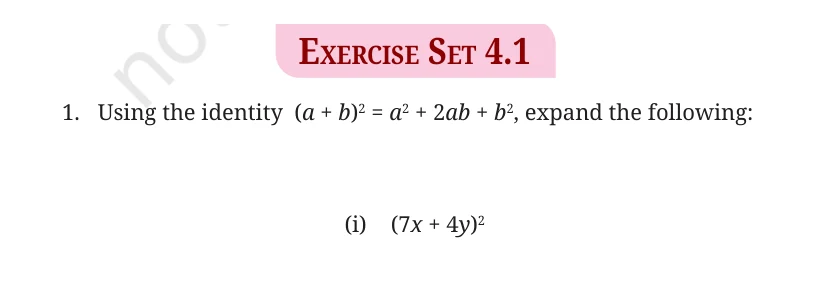
Exercise Set 4.1, 1(i): Expand (7x+4y)^2
Show detailed solution
- Step 1: Take a=7x and b=4y in (a+b)^2=a^2+2ab+b^2
- Step 2: (7x)^2=49x^2, 2(7x)(4y)=56xy, and (4y)^2=16y^2
- Answer: (7x+4y)^2=49x^2+56xy+16y^2
Textbook page 71 · solved item 6
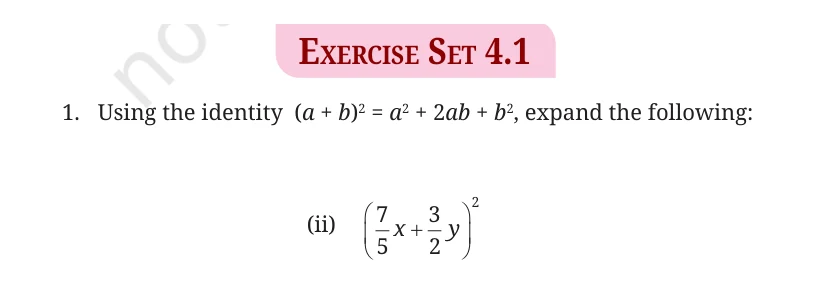
Exercise Set 4.1, 1(ii): Expand (7x/5+3y/2)^2
Show detailed solution
- Step 1: Let a=\frac75x and b=\frac32y
- Step 2: The square terms are \frac{49}{25}x^2 and \frac94y^2, while 2ab=2\cdot\frac75x\cdot\frac32y=\frac{21}{5}xy
- Answer: \left(\frac75x+\frac32y\right)^2=\frac{49}{25}x^2+\frac{21}{5}xy+\frac94y^2
Textbook page 71 · solved item 7
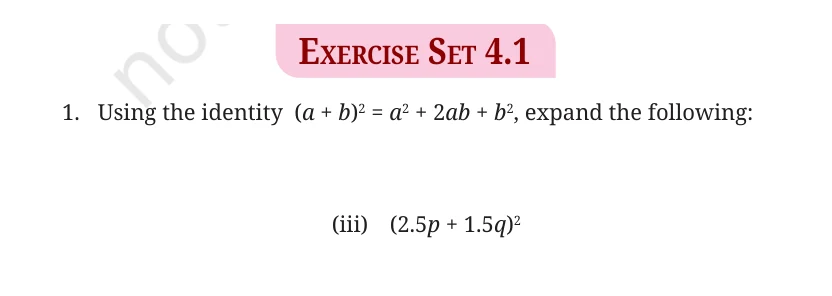
Exercise Set 4.1, 1(iii): Expand (2.5p+1.5q)^2
Show detailed solution
- Step 1: Apply (a+b)^2=a^2+2ab+b^2 with a=2.5p and b=1.5q
- Step 2: Compute (2.5p)^2=6.25p^2, 2(2.5p)(1.5q)=7.5pq, and (1.5q)^2=2.25q^2
- Answer: (2.5p+1.5q)^2=6.25p^2+7.5pq+2.25q^2
Detailed worked answers
Textbook page 72
Textbook page 72 · solved item 8
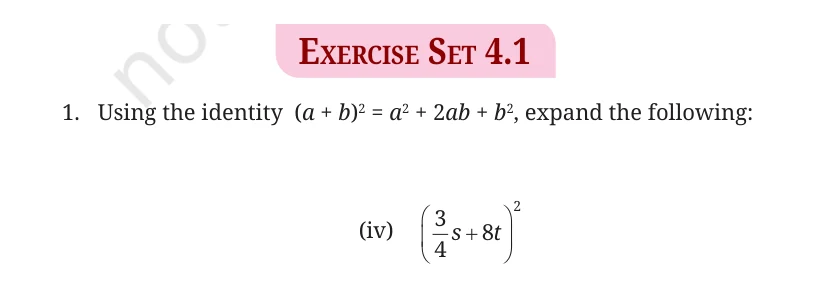
Exercise Set 4.1, 1(iv): Expand (3s/4+8t)^2
Show detailed solution
- Step 1: Use a=\frac34s and b=8t
- Step 2: a^2=\frac9{16}s^2, 2ab=2\cdot\frac34s\cdot8t=12st, and b^2=64t^2
- Answer: \left(\frac34s+8t\right)^2=\frac9{16}s^2+12st+64t^2
Textbook page 72 · solved item 9
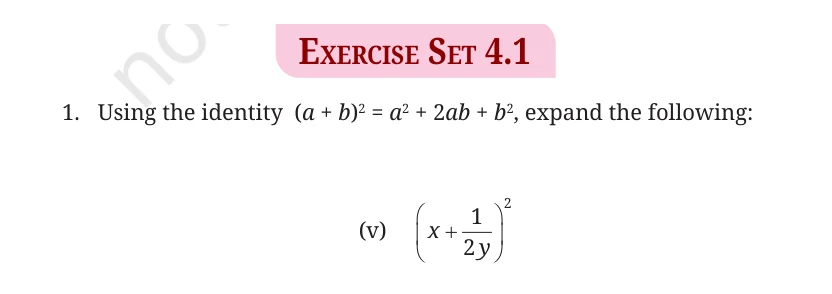
Exercise Set 4.1, 1(v): Expand (x+1/(2y))^2
Show detailed solution
- Step 1: Take a=x and b=\frac1{2y}
- Step 2: The middle term is 2ab=2x\cdot\frac1{2y}=\frac{x}{y}, and b^2=\frac1{4y^2}
- Answer: \left(x+\frac1{2y}\right)^2=x^2+\frac{x}{y}+\frac1{4y^2}
Textbook page 72 · solved item 10
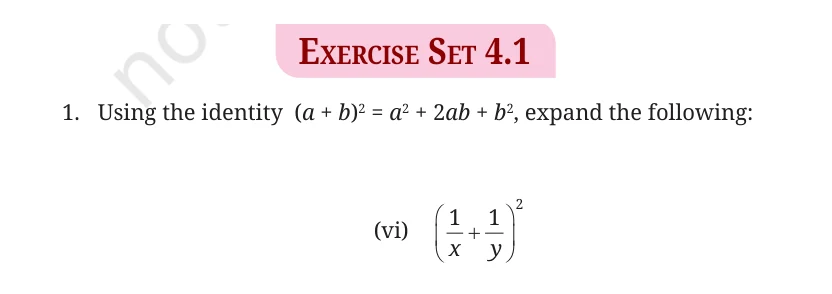
Exercise Set 4.1, 1(vi): Expand (1/x+1/y)^2
Show detailed solution
- Step 1: Use a=\frac1x and b=\frac1y
- Step 2: Then a^2=\frac1{x^2}, 2ab=\frac2{xy}, and b^2=\frac1{y^2}
- Answer: \left(\frac1x+\frac1y\right)^2=\frac1{x^2}+\frac2{xy}+\frac1{y^2}
Textbook page 72 · solved item 11
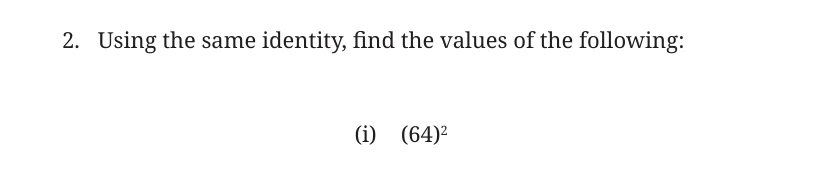
Exercise Set 4.1, 2(i): Find 64^2 using an identity.
Show detailed solution
- Step 1: Write 64=60+4
- Step 2: (60+4)^2=60^2+2(60)(4)+4^2=3600+480+16
- Answer: 64^2=4096
Textbook page 72 · solved item 12
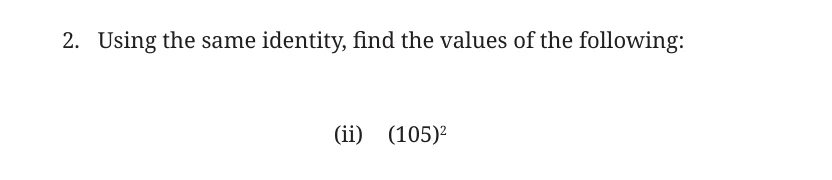
Exercise Set 4.1, 2(ii): Find 105^2 using an identity.
Show detailed solution
- Step 1: Write 105=100+5
- Step 2: (100+5)^2=10000+1000+25
- Answer: 105^2=11025
Textbook page 72 · solved item 13
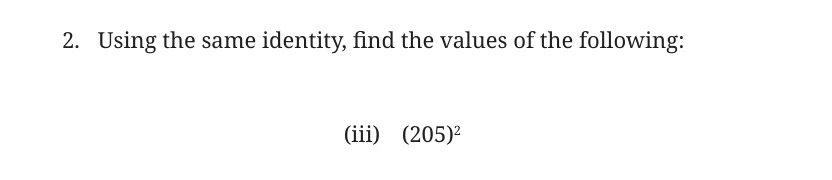
Exercise Set 4.1, 2(iii): Find 205^2 using an identity.
Show detailed solution
- Step 1: Write 205=200+5
- Step 2: (200+5)^2=40000+2000+25
- Answer: 205^2=42025
Detailed worked answers
Textbook page 73
Textbook page 73 · solved item 14
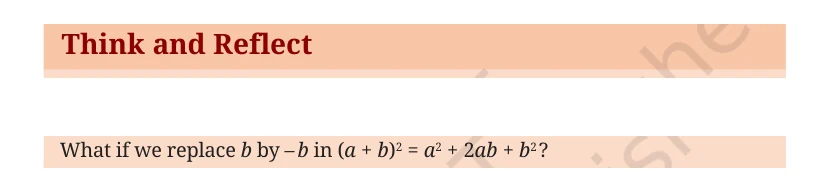
Think and Reflect: Replace b by -b in (a+b)^2=a^2+2ab+b^2
Show detailed solution
- Step 1: Substitute -b wherever b occurs: [a+(-b)]^2=a^2+2a(-b)+(-b)^2
- Step 2: Simplify the signs: a+(-b)=a-b, 2a(-b)=-2ab, and (-b)^2=b^2
- Answer: The resulting identity is (a-b)^2=a^2-2ab+b^2
Detailed worked answers
Textbook page 74
Textbook page 74 · solved item 15
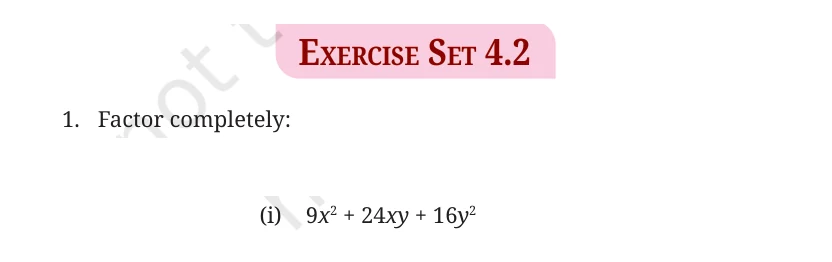
Exercise Set 4.2, 1(i): Factor 9x^2+24xy+16y^2 completely.
Show detailed solution
- Step 1: Recognise 9x^2=(3x)^2 and 16y^2=(4y)^2
- Step 2: The middle term is 2(3x)(4y)=24xy, so the expression is a perfect-square trinomial.
- Answer: 9x^2+24xy+16y^2=(3x+4y)^2
Textbook page 74 · solved item 16
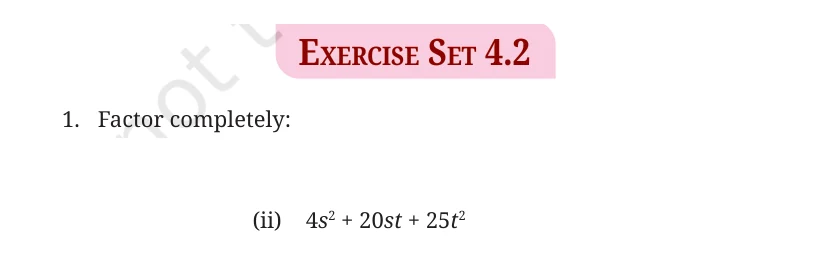
Exercise Set 4.2, 1(ii): Factor 4s^2+20st+25t^2 completely.
Show detailed solution
- Step 1: The outer terms are (2s)^2 and (5t)^2
- Step 2: Their double product is 2(2s)(5t)=20st
- Answer: 4s^2+20st+25t^2=(2s+5t)^2
Detailed worked answers
Textbook page 75
Textbook page 75 · solved item 17
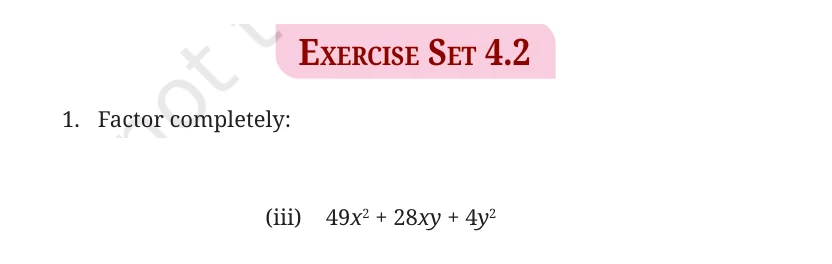
Exercise Set 4.2, 1(iii): Factor 49x^2+28xy+4y^2 completely.
Show detailed solution
- Step 1: Write the square terms as (7x)^2 and (2y)^2
- Step 2: Since 2(7x)(2y)=28xy, the middle term matches the positive-square identity.
- Answer: 49x^2+28xy+4y^2=(7x+2y)^2
Textbook page 75 · solved item 18
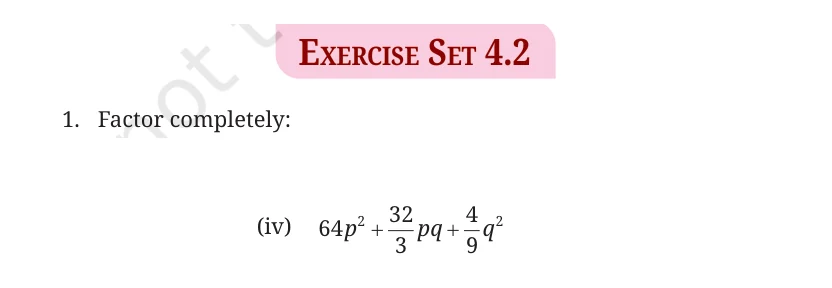
Exercise Set 4.2, 1(iv): Factor 64p^2+(32/3)pq+(4/9)q^2 completely.
Show detailed solution
- Step 1: The outer terms are (8p)^2 and (\frac23q)^2
- Step 2: Their double product is 2(8p)(\frac23q)=\frac{32}{3}pq
- Answer: 64p^2+\frac{32}{3}pq+\frac49q^2=\left(8p+\frac23q\right)^2
Textbook page 75 · solved item 19
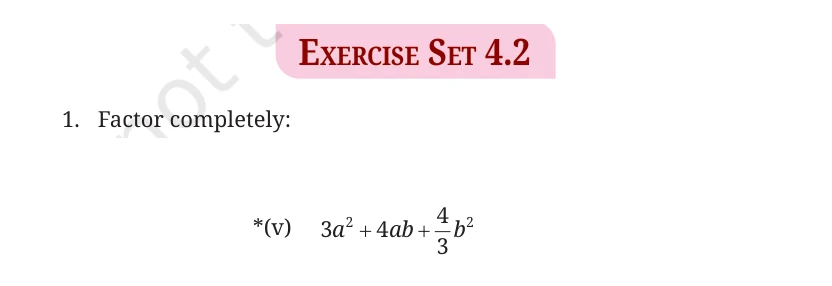
Exercise Set 4.2, 1(v): Factor 3a^2+4ab+(4/3)b^2 completely.
Show detailed solution
- Step 1: Factor out \frac13: 3a^2+4ab+\frac43b^2=\frac13(9a^2+12ab+4b^2)
- Step 2: The bracket is (3a+2b)^2 because its middle term is 2(3a)(2b)=12ab
- Answer: 3a^2+4ab+\frac43b^2=\frac13(3a+2b)^2
Textbook page 75 · solved item 20
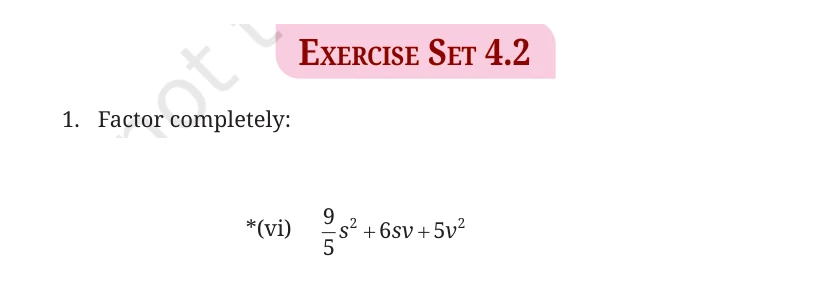
Exercise Set 4.2, 1(vi): Factor (9/5)s^2+6sv+5v^2 completely.
Show detailed solution
- Step 1: Factor out \frac15: \frac95s^2+6sv+5v^2=\frac15(9s^2+30sv+25v^2)
- Step 2: The bracket is the perfect square (3s+5v)^2
- Answer: \frac95s^2+6sv+5v^2=\frac15(3s+5v)^2
Textbook page 75 · solved item 21
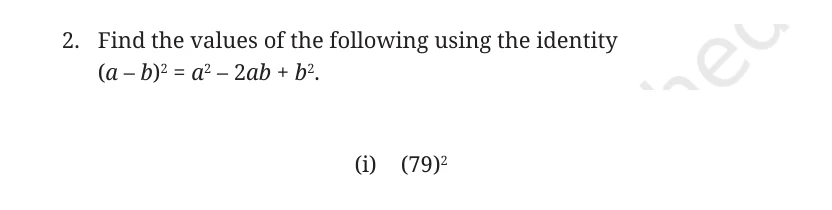
Exercise Set 4.2, 2(i): Find 79^2 using (a-b)^2
Show detailed solution
- Step 1: Write 79=80-1
- Step 2: (80-1)^2=80^2-2(80)(1)+1=6400-160+1
- Answer: 79^2=6241
Textbook page 75 · solved item 22
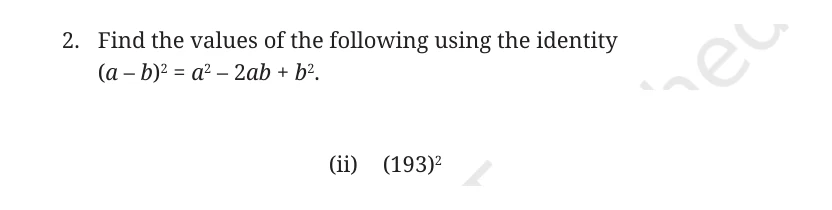
Exercise Set 4.2, 2(ii): Find 193^2 using (a-b)^2
Show detailed solution
- Step 1: Write 193=200-7
- Step 2: (200-7)^2=40000-2800+49
- Answer: 193^2=37249
Textbook page 75 · solved item 23
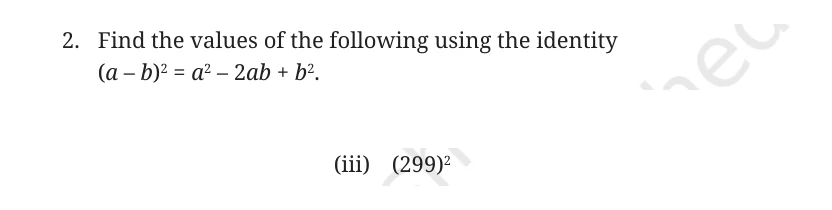
Exercise Set 4.2, 2(iii): Find 299^2 using (a-b)^2
Show detailed solution
- Step 1: Write 299=300-1
- Step 2: (300-1)^2=90000-600+1
- Answer: 299^2=89401
Detailed worked answers
Textbook page 76
Textbook page 76 · solved item 24
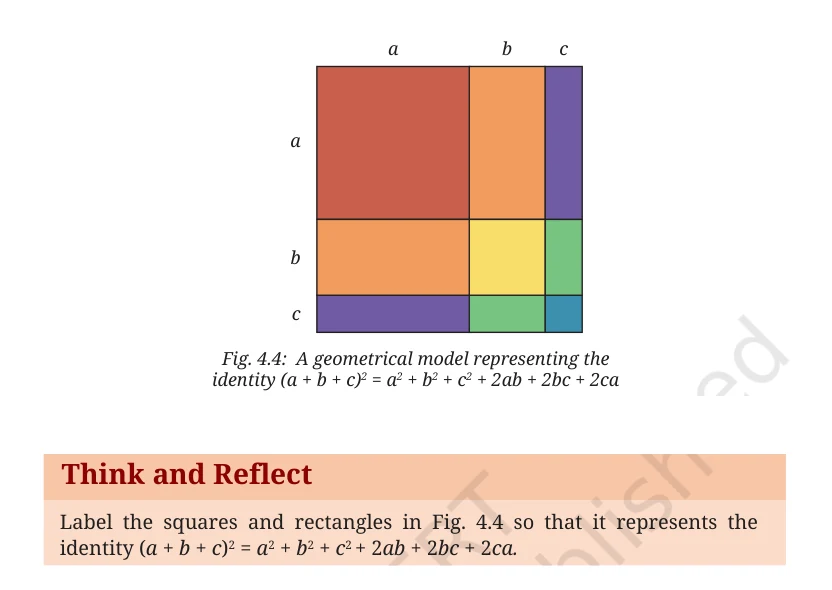
Think and Reflect: Label Fig. 4.4 to show (a+b+c)^2=a^2+b^2+c^2+2ab+2bc+2ca
Show detailed solution
- Step 1: Label the three diagonal squares a^2, b^2, and c^2, according to their side lengths.
- Step 2: The two rectangles with sides a,b contribute 2ab; similarly the paired rectangles contribute 2bc and 2ca
- Step 3: Adding all nine regions gives a^2+b^2+c^2+2ab+2bc+2ca
- Answer: This sum equals the area (a+b+c)^2 of the complete outer square.
Textbook page 76 · solved item 25
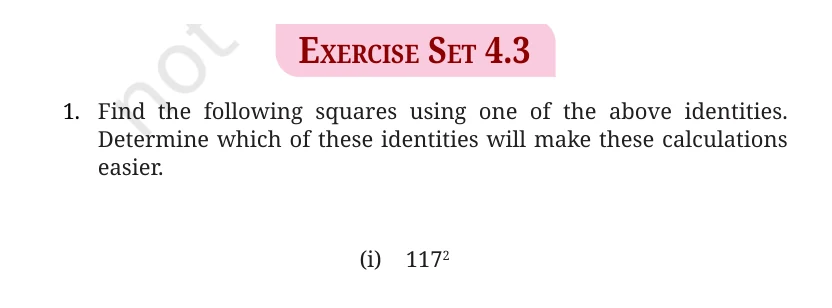
Exercise Set 4.3, 1(i): Find 117^2 using a suitable identity.
Show detailed solution
- Step 1: Use 117=100+10+7 with the three-term square identity.
- Step 2: 117^2=10000+100+49+2000+140+1400
- Answer: 117^2=13689
Textbook page 76 · solved item 26
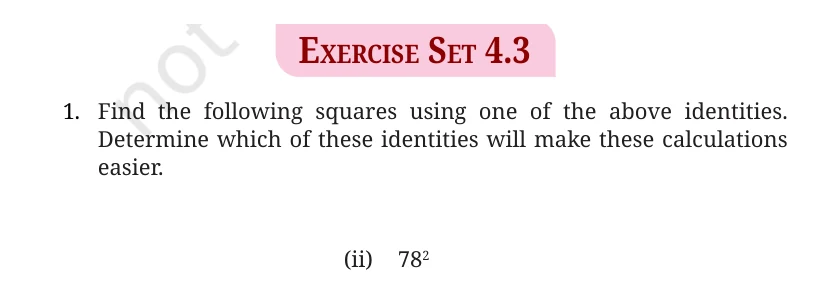
Exercise Set 4.3, 1(ii): Find 78^2 using a suitable identity.
Show detailed solution
- Step 1: Write 78=80-2
- Step 2: (80-2)^2=6400-320+4
- Answer: 78^2=6084
Textbook page 76 · solved item 27
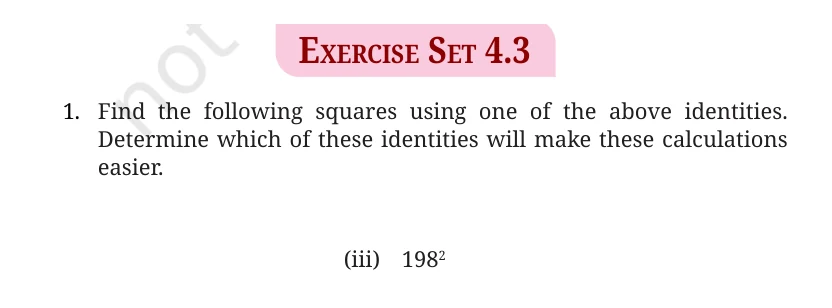
Exercise Set 4.3, 1(iii): Find 198^2 using a suitable identity.
Show detailed solution
- Step 1: Write 198=200-2
- Step 2: (200-2)^2=40000-800+4
- Answer: 198^2=39204
Textbook page 76 · solved item 28
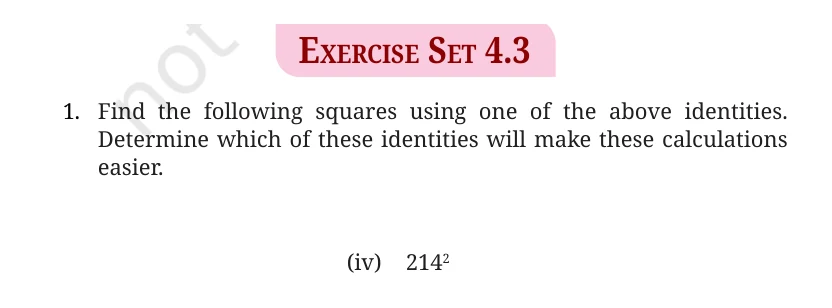
Exercise Set 4.3, 1(iv): Find 214^2 using a suitable identity.
Show detailed solution
- Step 1: Write 214=200+14
- Step 2: (200+14)^2=40000+5600+196
- Answer: 214^2=45796
Textbook page 76 · solved item 29
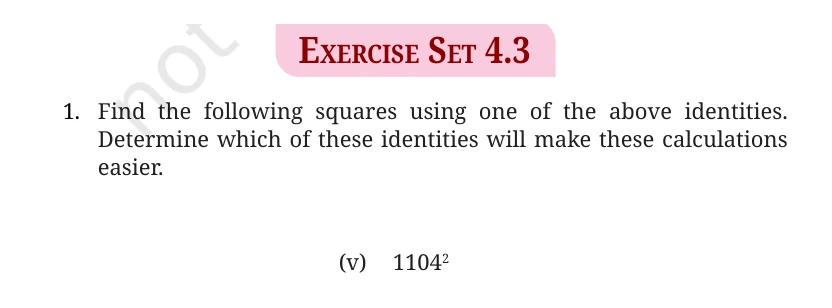
Exercise Set 4.3, 1(v): Find 1104^2 using a suitable identity.
Show detailed solution
- Step 1: Write 1104=1100+4
- Step 2: (1100+4)^2=1210000+8800+16
- Answer: 1104^2=1218816
Textbook page 76 · solved item 30
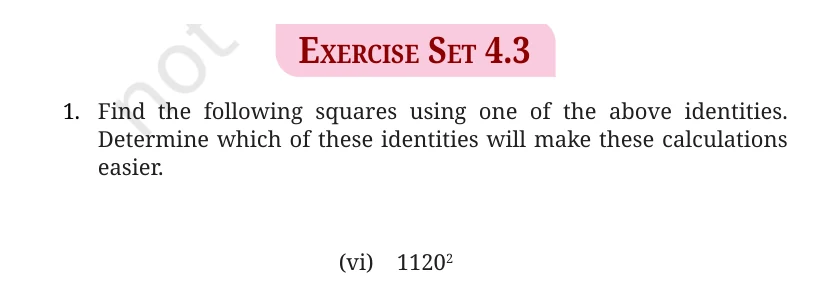
Exercise Set 4.3, 1(vi): Find 1120^2 using a suitable identity.
Show detailed solution
- Step 1: Write 1120=1100+20
- Step 2: (1100+20)^2=1210000+44000+400
- Answer: 1120^2=1254400
Detailed worked answers
Textbook page 77
Textbook page 77 · solved item 31
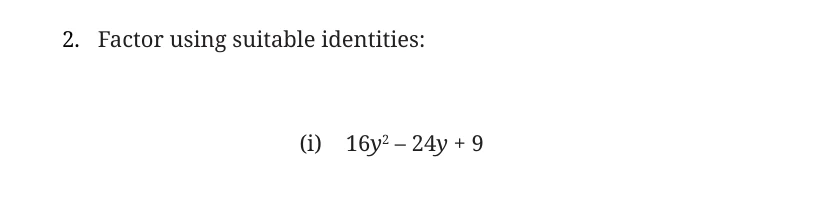
Exercise Set 4.3, 2(i): Factor 16y^2-24y+9
Show detailed solution
- Step 1: The outer terms are (4y)^2 and 3^2
- Step 2: The middle term is -2(4y)(3)=-24y
- Answer: 16y^2-24y+9=(4y-3)^2
Textbook page 77 · solved item 32
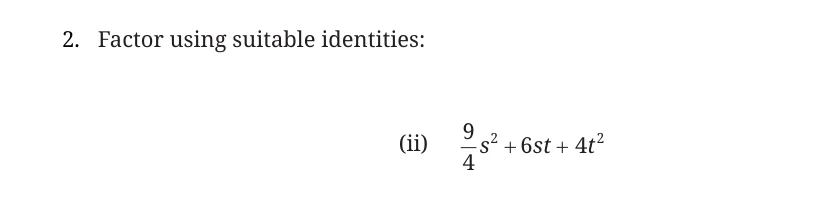
Exercise Set 4.3, 2(ii): Factor (9/4)s^2+6st+4t^2
Show detailed solution
- Step 1: Write the outer terms as (\frac32s)^2 and (2t)^2
- Step 2: The middle term is 2(\frac32s)(2t)=6st
- Answer: \frac94s^2+6st+4t^2=\left(\frac32s+2t\right)^2
Textbook page 77 · solved item 33
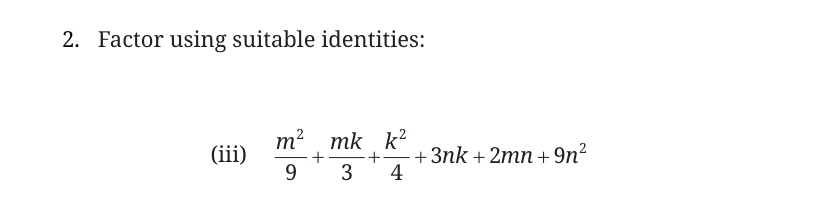
Exercise Set 4.3, 2(iii): Factor m^2/9+mk/3+k^2/4+3nk+2mn+9n^2
Show detailed solution
- Step 1: Match the square terms with a=\frac m3, b=\frac k2, and c=3n
- Step 2: Their pairwise double products are 2ab=\frac{mk}{3}, 2bc=3nk, and 2ca=2mn
- Answer: The expression is \left(\frac m3+\frac k2+3n\right)^2
Textbook page 77 · solved item 34
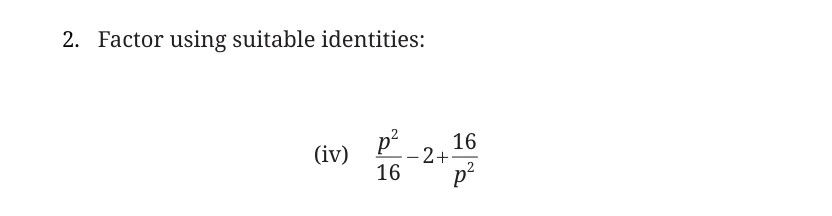
Exercise Set 4.3, 2(iv): Factor p^2/16-2+16/p^2
Show detailed solution
- Step 1: The square terms are (p/4)^2 and (4/p)^2
- Step 2: The middle term is -2(p/4)(4/p)=-2
- Answer: \frac{p^2}{16}-2+\frac{16}{p^2}=\left(\frac p4-\frac4p\right)^2
Textbook page 77 · solved item 35

Exercise Set 4.3, 2(v): Factor 9a^2+4b^2+c^2-12ab+6ac-4bc
Show detailed solution
- Step 1: Use the three terms 3a, -2b, and c
- Step 2: Their squares give 9a^2+4b^2+c^2, and their double products give -12ab+6ac-4bc
- Answer: The factorisation is (3a-2b+c)^2
Textbook page 77 · solved item 36
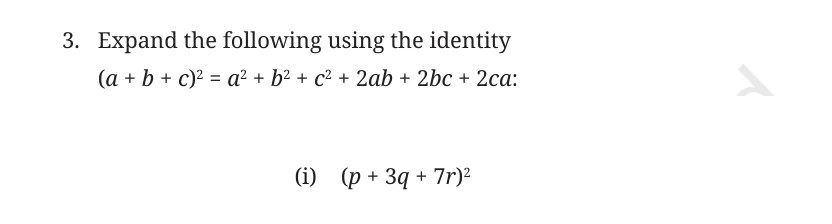
Exercise Set 4.3, 3(i): Expand (p+3q+7r)^2
Show detailed solution
- Step 1: Square the three terms to obtain p^2+9q^2+49r^2
- Step 2: Add the double products 6pq+42qr+14pr
- Answer: (p+3q+7r)^2=p^2+9q^2+49r^2+6pq+42qr+14pr
Textbook page 77 · solved item 37
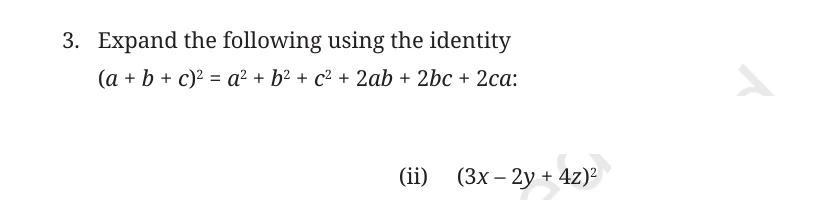
Exercise Set 4.3, 3(ii): Expand (3x-2y+4z)^2
Show detailed solution
- Step 1: The square terms are 9x^2+4y^2+16z^2
- Step 2: The double products are -12xy-16yz+24xz
- Answer: (3x-2y+4z)^2=9x^2+4y^2+16z^2-12xy-16yz+24xz
Textbook page 77 · solved item 38

Exercise Set 4.3, 4: Is (a+b-c)^2+(a-b+c)^2+(a-b-c)^2=2a^2+2b^2+2c^2 an identity?
Show detailed solution
- Step 1: Test a=b=c=1, which is sufficient to disprove an alleged identity.
- Step 2: The left side is 1^2+1^2+(-1)^2=3, while the right side is 2+2+2=6
- Step 3: Since the two sides differ for this valid substitution, the equation is not true for all values.
- Answer: No, it is not an identity.
Detailed worked answers
Textbook page 78
Textbook page 78 · solved item 39
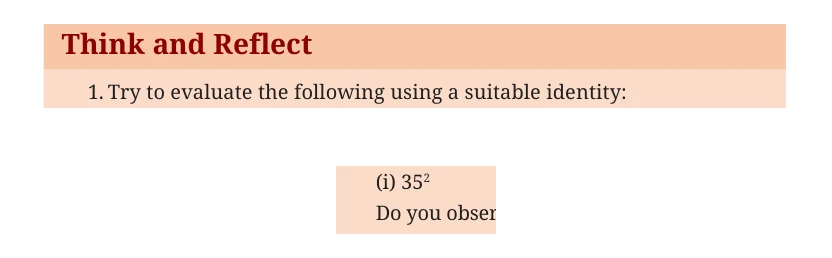
Think and Reflect 1(i): Evaluate 35^2 using a suitable identity.
Show detailed solution
- Step 1: Write 35=30+5
- Step 2: (30+5)^2=900+300+25
- Answer: 35^2=1225. Its final two digits are 25, as expected for a number ending in 5.
Textbook page 78 · solved item 40
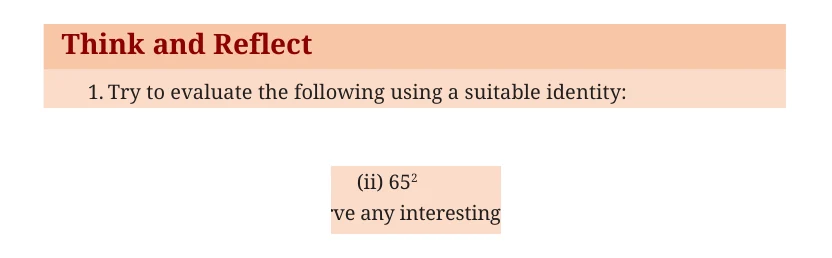
Think and Reflect 1(ii): Evaluate 65^2 using a suitable identity.
Show detailed solution
- Step 1: Write 65=60+5
- Step 2: (60+5)^2=3600+600+25
- Answer: 65^2=4225. The leading part 42 is 6\times7
Textbook page 78 · solved item 41
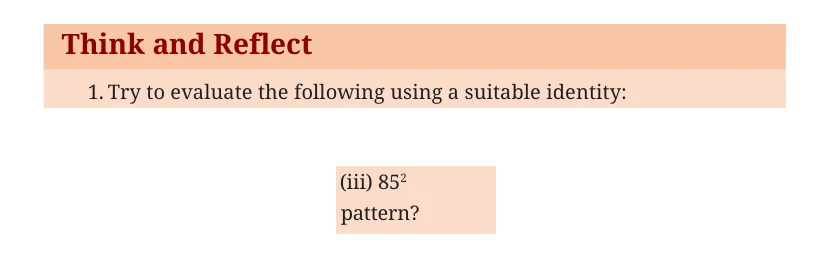
Think and Reflect 1(iii): Evaluate 85^2 using a suitable identity.
Show detailed solution
- Step 1: Write 85=80+5
- Step 2: (80+5)^2=6400+800+25
- Answer: 85^2=7225. The leading part 72 is 8\times9
Textbook page 78 · solved item 42
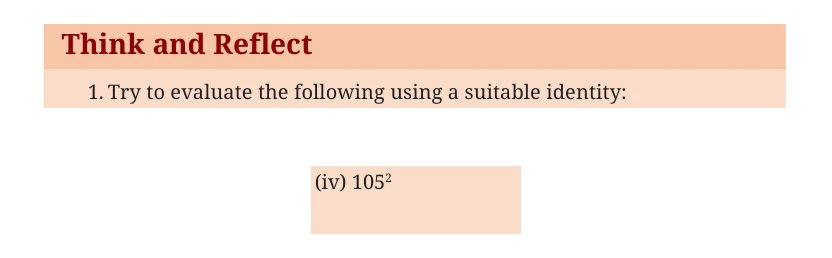
Think and Reflect 1(iv): Evaluate 105^2 and describe the pattern for squares of numbers ending in 5.
Show detailed solution
- Step 1: Write 105=100+5, so (100+5)^2=10000+1000+25=11025
- Step 2: In general, (10n+5)^2=100n^2+100n+25=100n(n+1)+25
- Step 3: Therefore multiply the digits before the final 5 by the next integer, then append 25
- Answer: 105^2=11025; here 10\times11=110, followed by 25
Textbook page 78 · solved item 43
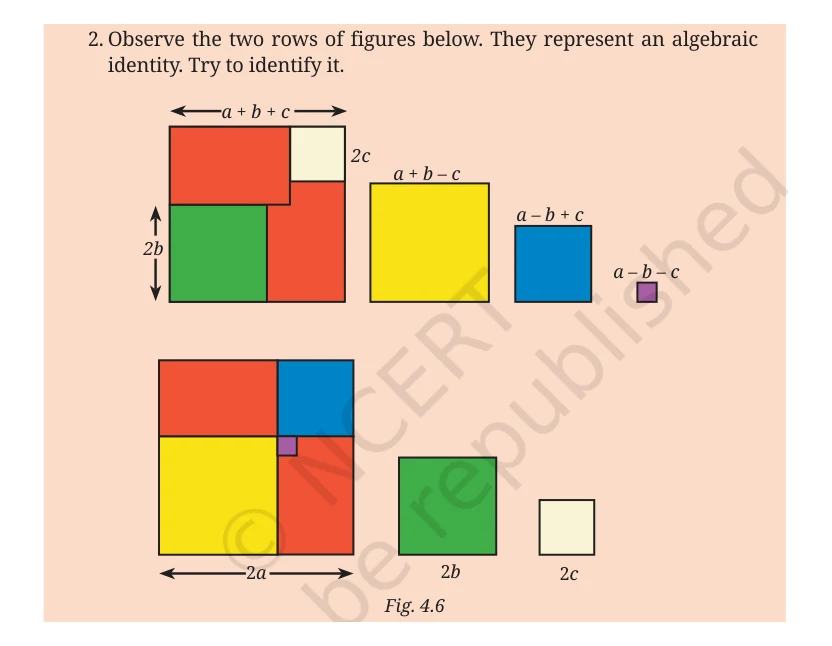
Think and Reflect 2: Identify the algebraic identity represented by Fig. 4.6.
Show detailed solution
- Step 1: The top row contains squares with sides a+b+c, a+b-c, a-b+c, and a-b-c
- Step 2: The rearranged bottom row contains squares with sides 2a, 2b, and 2c. Rearrangement preserves total area.
- Step 3: Equating the two total areas gives the identity shown by the pieces.
- Answer: (a+b+c)^2+(a+b-c)^2+(a-b+c)^2+(a-b-c)^2=4a^2+4b^2+4c^2
Detailed worked answers
Textbook page 79
Textbook page 79 · solved item 44
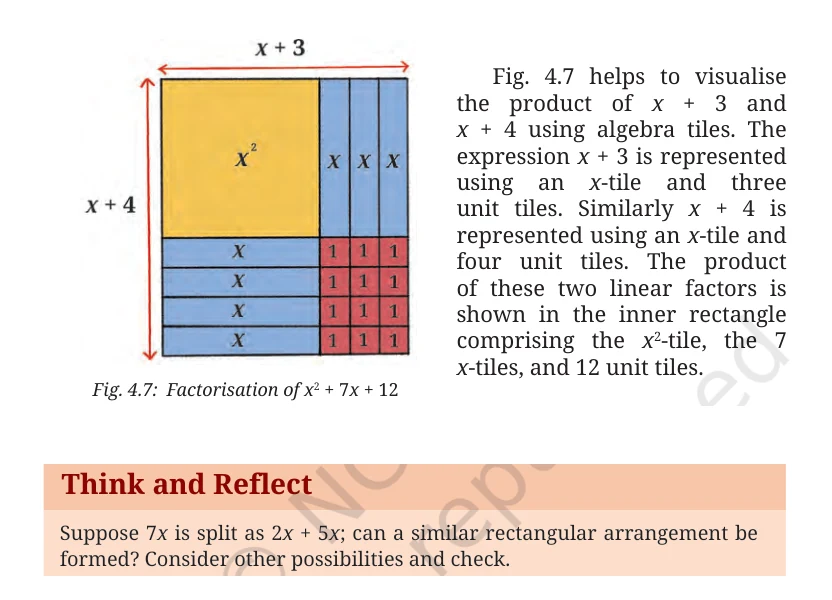
Think and Reflect: If 7x in x^2+7x+12 is split as 2x+5x, can the same rectangular algebra-tile arrangement be formed?
Show detailed solution
- Step 1: A rectangular arrangement needs two numbers whose sum is 7 and whose product is 12
- Step 2: The proposed numbers satisfy 2+5=7, but 2\times5=10, not 12
- Step 3: The factor pair 3,4 satisfies both 3+4=7 and 3\times4=12
- Answer: No. The 2x+5x split leaves two unit tiles unmatched; the complete rectangle uses 3x+4x
Textbook page 79 · solved item 45
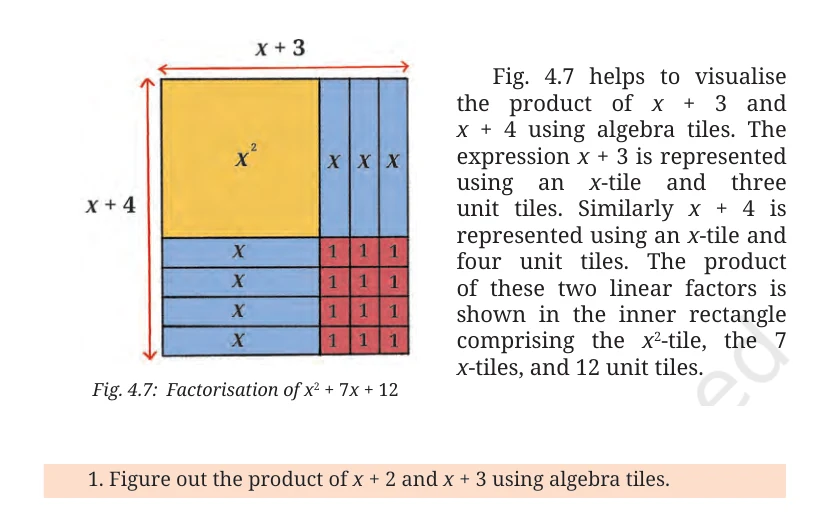
Think and Reflect 1: Find the product of x+2 and x+3 using algebra tiles.
Show detailed solution
- Step 1: The x-by-x tile contributes x^2
- Step 2: Two x-tiles on one side and three on the other contribute 2x+3x=5x; the corner needs 2\times3=6 unit tiles.
- Answer: (x+2)(x+3)=x^2+5x+6
Textbook page 79 · solved item 46
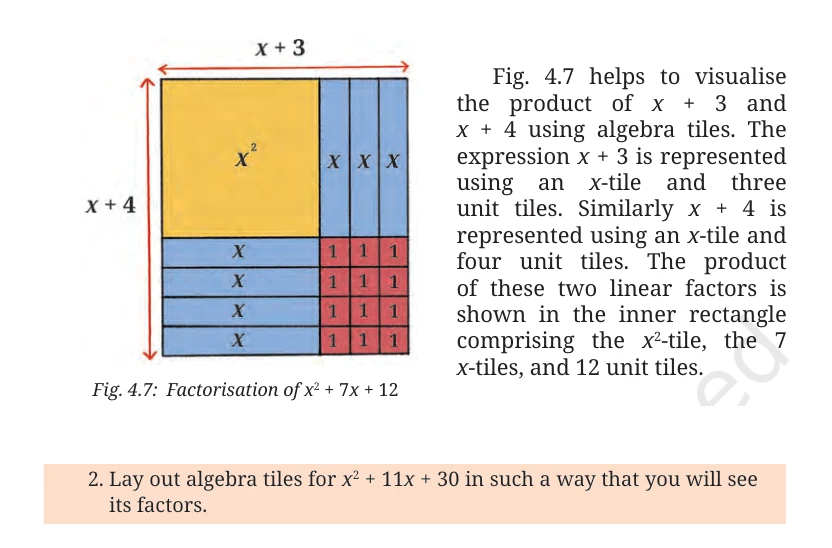
Think and Reflect 2: Arrange algebra tiles for x^2+11x+30 to reveal its factors.
Show detailed solution
- Step 1: Find two numbers with sum 11 and product 30
- Step 2: The pair is 5 and 6, so split 11x into 5x+6x and arrange 30 unit tiles as a 5-by-6 corner.
- Answer: The rectangle has sides x+5 and x+6, hence x^2+11x+30=(x+5)(x+6)
Detailed worked answers
Textbook page 80
Textbook page 80 · solved item 47
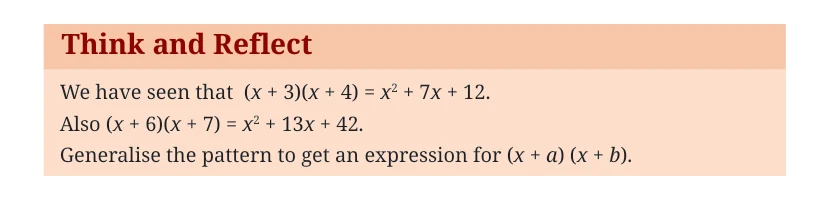
Think and Reflect: Generalise the pattern to expand (x+a)(x+b)
Show detailed solution
- Step 1: Distribute the first factor: x(x+b)+a(x+b)
- Step 2: This gives x^2+bx+ax+ab
- Step 3: Combine the two linear terms as (a+b)x
- Answer: (x+a)(x+b)=x^2+(a+b)x+ab
Textbook page 80 · solved item 48
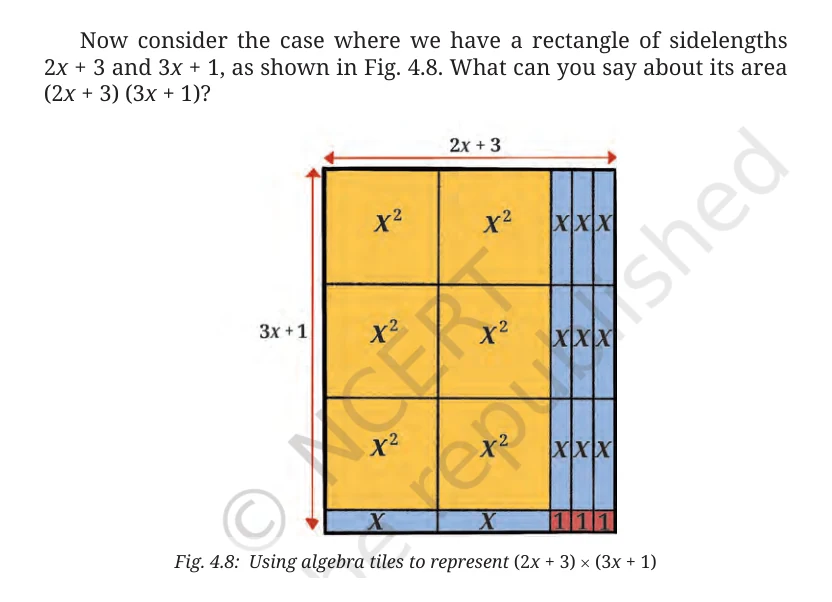
Find the area represented by the algebra-tile rectangle with sides 2x+3 and 3x+1 in Fig. 4.8.
Show detailed solution
- Step 1: Multiply using distributivity: (2x+3)(3x+1)=2x(3x+1)+3(3x+1)
- Step 2: This becomes 6x^2+2x+9x+3
- Answer: The area is 6x^2+11x+3 square units.
Textbook page 80 · solved item 49
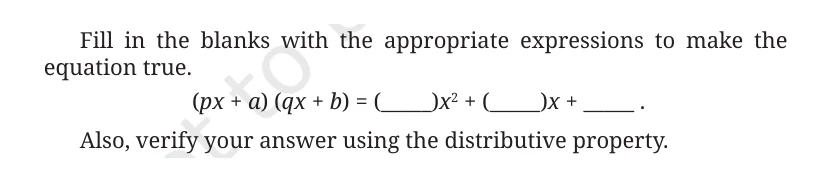
Fill the blanks and verify: (px+a)(qx+b)=(\_\_)x^2+(\_\_)x+\_\_
Show detailed solution
- Step 1: Distribute: (px)(qx)+(px)b+a(qx)+ab
- Step 2: Simplify the terms to pqx^2+pbx+aqx+ab
- Step 3: Combine the middle terms: (pb+aq)x
- Answer: (px+a)(qx+b)=(pq)x^2+(pb+aq)x+ab
Detailed worked answers
Textbook page 81
Textbook page 81 · solved item 50
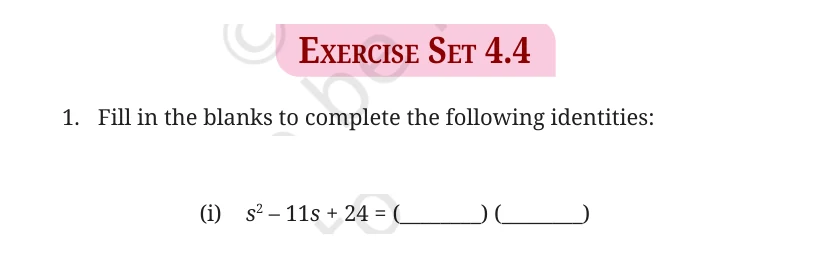
Exercise Set 4.4, 1(i): Complete s^2-11s+24=(\_\_)(\_\_)
Show detailed solution
- Step 1: Find two numbers with sum -11 and product 24
- Step 2: The numbers are -3 and -8
- Answer: s^2-11s+24=(s-3)(s-8)
Textbook page 81 · solved item 51
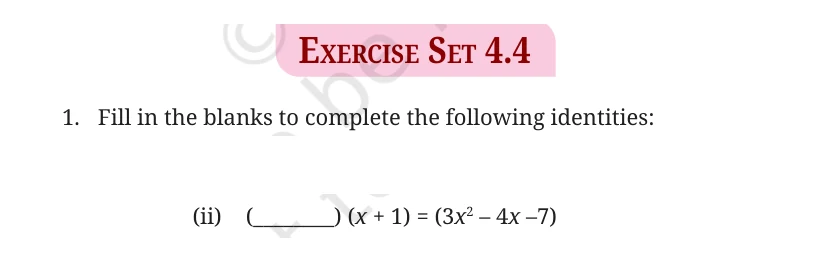
Exercise Set 4.4, 1(ii): Complete (\_\_)(x+1)=3x^2-4x-7
Show detailed solution
- Step 1: Factor by grouping: 3x^2-4x-7=3x^2+3x-7x-7
- Step 2: 3x(x+1)-7(x+1)=(3x-7)(x+1)
- Answer: The missing factor is 3x-7
Textbook page 81 · solved item 52
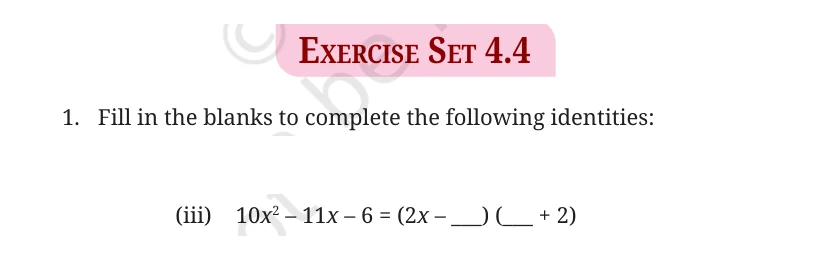
Exercise Set 4.4, 1(iii): Complete 10x^2-11x-6=(2x-\_\_)(\_\_+2)
Show detailed solution
- Step 1: Factor 10x^2-11x-6 as 10x^2-15x+4x-6
- Step 2: Group to obtain 5x(2x-3)+2(2x-3)=(2x-3)(5x+2)
- Answer: The blanks are 3 and 5x
Textbook page 81 · solved item 53
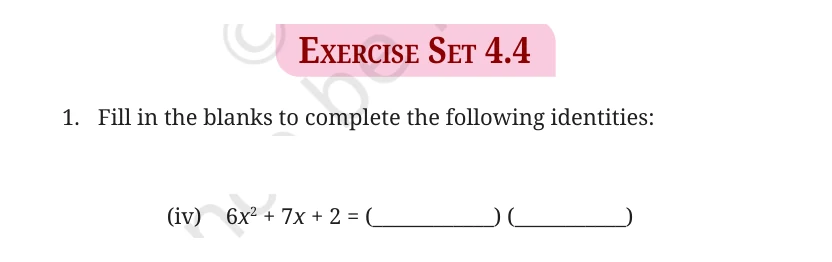
Exercise Set 4.4, 1(iv): Complete 6x^2+7x+2=(\_\_)(\_\_)
Show detailed solution
- Step 1: Split 7x as 3x+4x: 6x^2+3x+4x+2
- Step 2: Group to get 3x(2x+1)+2(2x+1)
- Answer: 6x^2+7x+2=(3x+2)(2x+1)
Textbook page 81 · solved item 54
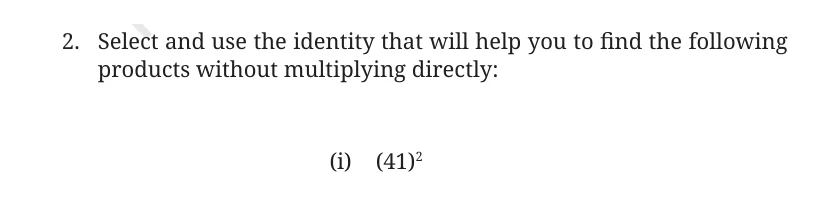
Exercise Set 4.4, 2(i): Find 41^2 without direct multiplication.
Show detailed solution
- Step 1: Write 41=40+1
- Step 2: (40+1)^2=1600+80+1
- Answer: 41^2=1681
Textbook page 81 · solved item 55
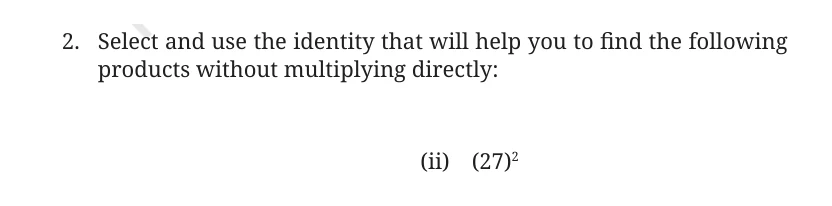
Exercise Set 4.4, 2(ii): Find 27^2 without direct multiplication.
Show detailed solution
- Step 1: Write 27=30-3
- Step 2: (30-3)^2=900-180+9
- Answer: 27^2=729
Textbook page 81 · solved item 56
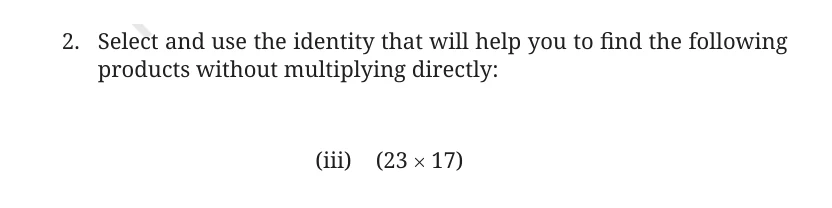
Exercise Set 4.4, 2(iii): Find 23\times17 using an identity.
Show detailed solution
- Step 1: Write the product as (20+3)(20-3)
- Step 2: Apply (a+b)(a-b)=a^2-b^2: 400-9
- Answer: 23\times17=391
Textbook page 81 · solved item 57
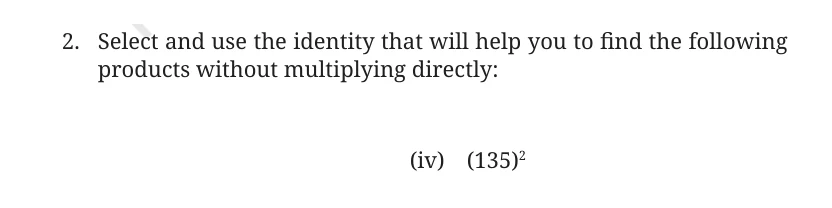
Exercise Set 4.4, 2(iv): Find 135^2 without direct multiplication.
Show detailed solution
- Step 1: Write 135=100+30+5
- Step 2: Square the three terms: 10000+900+25+6000+300+1000
- Answer: 135^2=18225
Detailed worked answers
Textbook page 82
Textbook page 82 · solved item 58
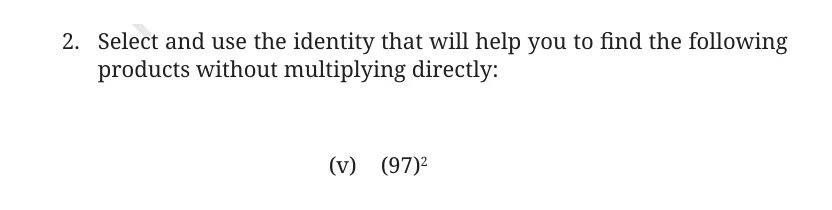
Exercise Set 4.4, 2(v): Find 97^2 without direct multiplication.
Show detailed solution
- Step 1: Write 97=100-3
- Step 2: (100-3)^2=10000-600+9
- Answer: 97^2=9409
Textbook page 82 · solved item 59
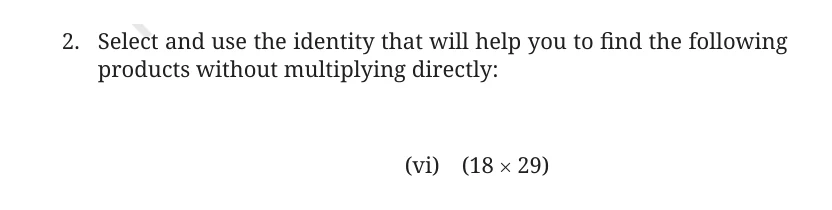
Exercise Set 4.4, 2(vi): Find 18\times29 using an identity.
Show detailed solution
- Step 1: Write 29=30-1
- Step 2: Use distributivity: 18(30-1)=540-18
- Answer: 18\times29=522
Textbook page 82 · solved item 60
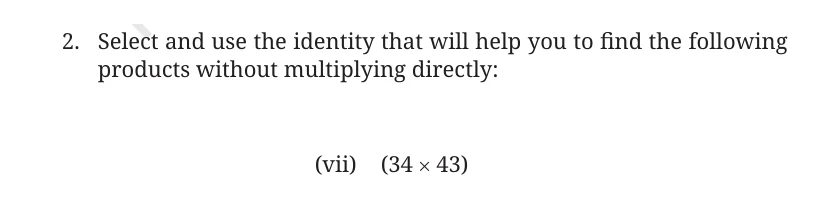
Exercise Set 4.4, 2(vii): Find 34\times43 using an identity.
Show detailed solution
- Step 1: Write the factors as (30+4)(40+3)
- Step 2: Distribute: 1200+90+160+12
- Answer: 34\times43=1462
Textbook page 82 · solved item 61
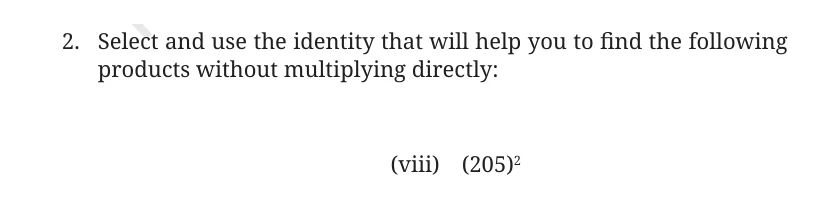
Exercise Set 4.4, 2(viii): Find 205^2 without direct multiplication.
Show detailed solution
- Step 1: Write 205=200+5
- Step 2: (200+5)^2=40000+2000+25
- Answer: 205^2=42025
Textbook page 82 · solved item 62
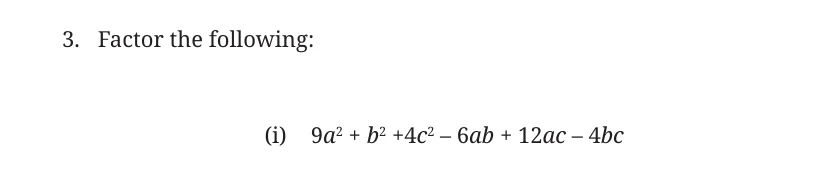
Exercise Set 4.4, 3(i): Factor 9a^2+b^2+4c^2-6ab+12ac-4bc
Show detailed solution
- Step 1: Use the three terms 3a, -b, and 2c
- Step 2: Their squares give 9a^2+b^2+4c^2, and the double products are -6ab+12ac-4bc
- Answer: The expression factors as (3a-b+2c)^2
Textbook page 82 · solved item 63
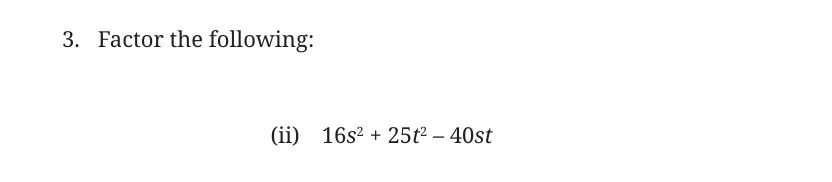
Exercise Set 4.4, 3(ii): Factor 16s^2+25t^2-40st
Show detailed solution
- Step 1: Recognise the square terms (4s)^2 and (5t)^2
- Step 2: The middle term is -2(4s)(5t)=-40st
- Answer: 16s^2+25t^2-40st=(4s-5t)^2
Textbook page 82 · solved item 64
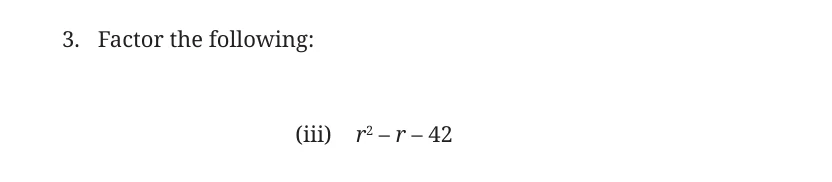
Exercise Set 4.4, 3(iii): Factor r^2-r-42
Show detailed solution
- Step 1: Find two integers whose sum is -1 and product is -42
- Step 2: The pair is -7 and 6
- Answer: r^2-r-42=(r-7)(r+6)
Textbook page 82 · solved item 65
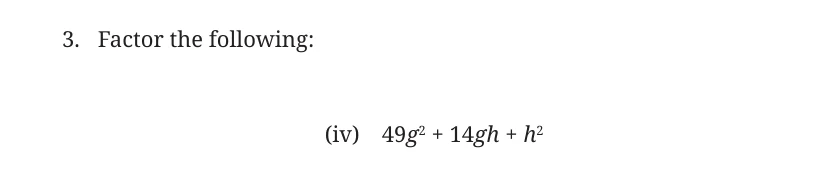
Exercise Set 4.4, 3(iv): Factor 49g^2+14gh+h^2
Show detailed solution
- Step 1: The outer terms are (7g)^2 and h^2
- Step 2: Their double product is 2(7g)h=14gh
- Answer: 49g^2+14gh+h^2=(7g+h)^2
Textbook page 82 · solved item 66
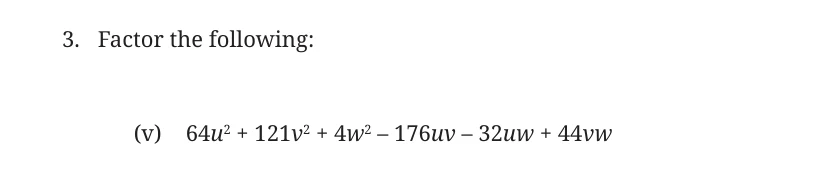
Exercise Set 4.4, 3(v): Factor 64u^2+121v^2+4w^2-176uv-32uw+44vw
Show detailed solution
- Step 1: Choose the terms 8u, -11v, and -2w
- Step 2: Their double products are -176uv, -32uw, and +44vw, matching the expression.
- Answer: The factorisation is (8u-11v-2w)^2
Textbook page 82 · solved item 67
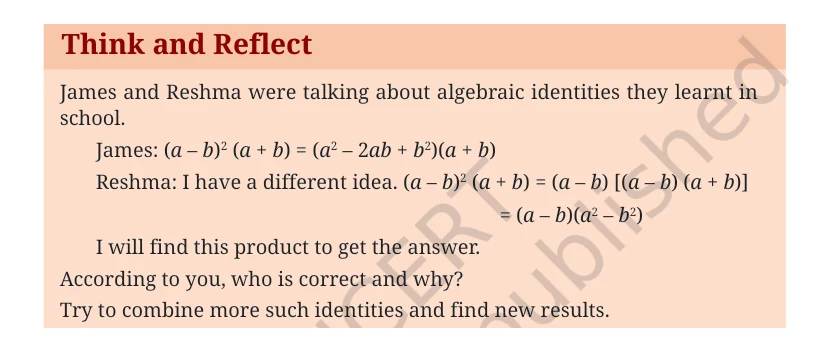
Think and Reflect: Who is correct about expanding (a-b)^2(a+b), James or Reshma, and why?
Show detailed solution
- Step 1: James correctly replaces (a-b)^2 by a^2-2ab+b^2 before multiplying by a+b
- Step 2: Reshma also works correctly because (a-b)^2(a+b)=(a-b)[(a-b)(a+b)]=(a-b)(a^2-b^2)
- Step 3: Either route expands to a^3-a^2b-ab^2+b^3
- Answer: Both are correct; they group the same factors differently and obtain the same identity.
Detailed worked answers
Textbook page 84
Textbook page 84 · solved item 68
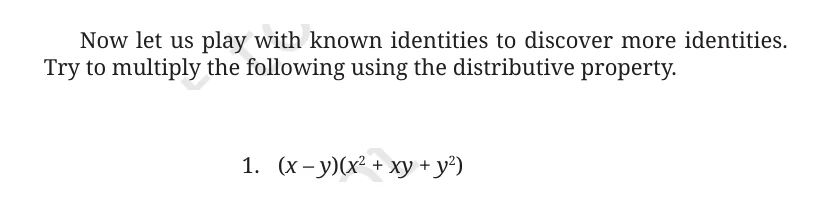
Finding New Identities 1: Multiply (x-y)(x^2+xy+y^2)
Show detailed solution
- Step 1: Distribute x: x(x^2+xy+y^2)=x^3+x^2y+xy^2
- Step 2: Distribute -y: -y(x^2+xy+y^2)=-x^2y-xy^2-y^3
- Step 3: The middle terms cancel.
- Answer: (x-y)(x^2+xy+y^2)=x^3-y^3
Textbook page 84 · solved item 69
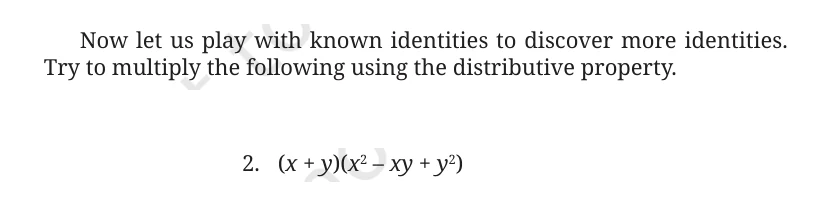
Finding New Identities 2: Multiply (x+y)(x^2-xy+y^2)
Show detailed solution
- Step 1: Distribute x to get x^3-x^2y+xy^2
- Step 2: Distribute y to get x^2y-xy^2+y^3
- Step 3: The opposite middle terms cancel.
- Answer: (x+y)(x^2-xy+y^2)=x^3+y^3
Detailed worked answers
Textbook page 85
Textbook page 85 · solved item 70

Verify (x-y)(x^2+xy+y^2)=x^3-y^3 using chosen values of x and y
Show detailed solution
- Step 1: Choose x=3 and y=2
- Step 2: The left side is (3-2)(3^2+3\cdot2+2^2)=1(9+6+4)=19
- Step 3: The right side is 3^3-2^3=27-8=19
- Conclusion: Both sides agree for this check, while the distributive expansion proves the identity generally.
Textbook page 85 · solved item 71

Predict the product (x+y)(x^2-xy+y^2)
Show detailed solution
- Step 1: Expand as x(x^2-xy+y^2)+y(x^2-xy+y^2)
- Step 2: This is x^3-x^2y+xy^2+x^2y-xy^2+y^3
- Step 3: Cancel the two pairs of opposite middle terms.
- Answer: (x+y)(x^2-xy+y^2)=x^3+y^3
Textbook page 85 · solved item 72
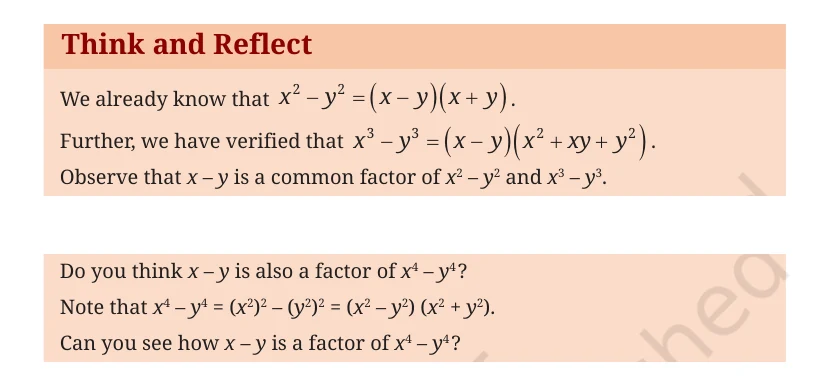
Think and Reflect: Show that x-y is a factor of x^4-y^4
Show detailed solution
- Step 1: Treat the expression as a difference of squares: x^4-y^4=(x^2-y^2)(x^2+y^2)
- Step 2: Factor x^2-y^2=(x-y)(x+y)
- Step 3: Therefore x^4-y^4=(x-y)(x+y)(x^2+y^2)
- Answer: The displayed product contains x-y, so it is a factor.
Textbook page 85 · solved item 73
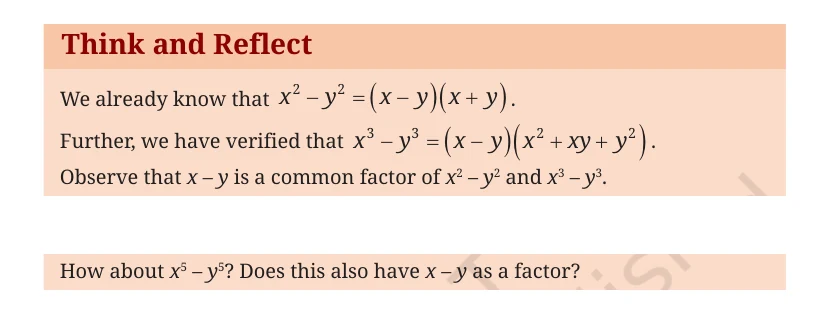
Think and Reflect: Is x-y also a factor of x^5-y^5?
Show detailed solution
- Step 1: Use the difference-of-powers pattern obtained by polynomial division.
- Step 2: x^5-y^5=(x-y)(x^4+x^3y+x^2y^2+xy^3+y^4)
- Step 3: Multiplying the two factors makes all middle terms cancel, leaving x^5-y^5
- Answer: Yes, x-y is a factor of x^5-y^5
Detailed worked answers
Textbook page 87
Textbook page 87 · solved item 74
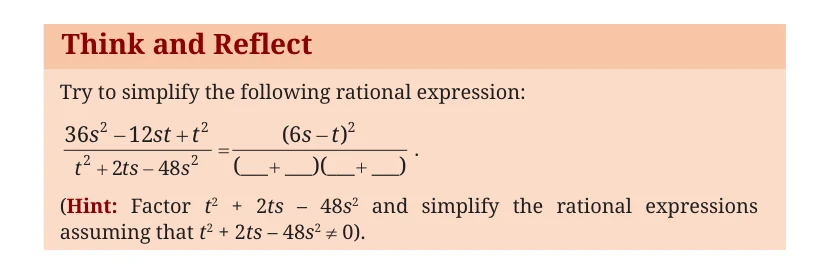
Think and Reflect: Simplify (36s^2-12st+t^2)/(t^2+2ts-48s^2)
Show detailed solution
- Step 1: Factor the numerator: 36s^2-12st+t^2=(6s-t)^2=(t-6s)^2
- Step 2: Factor the denominator using numbers with sum 2 and product -48: t^2+2ts-48s^2=(t+8s)(t-6s)
- Step 3: Cancel one non-zero factor t-6s
- Answer: \frac{36s^2-12st+t^2}{t^2+2ts-48s^2}=\frac{t-6s}{t+8s}, for values where the original denominator is non-zero.
Textbook page 87 · solved item 75
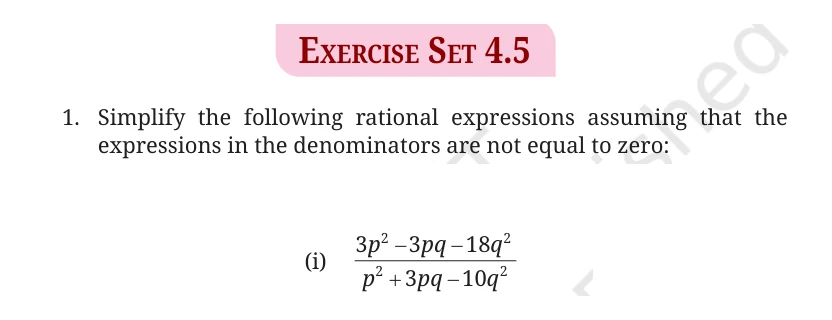
Exercise Set 4.5, 1(i): Simplify (3p^2-3pq-18q^2)/(p^2+3pq-10q^2)
Show detailed solution
- Step 1: Factor the numerator: 3p^2-3pq-18q^2=3(p-3q)(p+2q)
- Step 2: Factor the denominator: p^2+3pq-10q^2=(p+5q)(p-2q)
- Step 3: There is no common factor to cancel.
- Answer: \frac{3(p-3q)(p+2q)}{(p+5q)(p-2q)}, with the original denominator non-zero.
Textbook page 87 · solved item 76
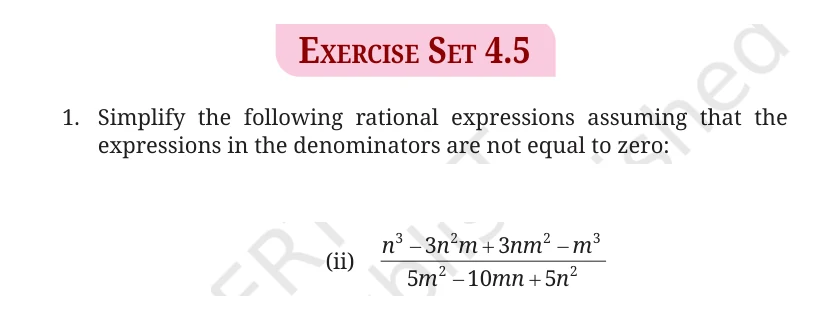
Exercise Set 4.5, 1(ii): Simplify (n^3-3n^2m+3nm^2-m^3)/(5m^2-10mn+5n^2)
Show detailed solution
- Step 1: The numerator is (n-m)^3
- Step 2: The denominator is 5(m-n)^2=5(n-m)^2
- Step 3: Cancel (n-m)^2, which is non-zero under the denominator condition.
- Answer: The simplified expression is \frac{n-m}{5}
Textbook page 87 · solved item 77
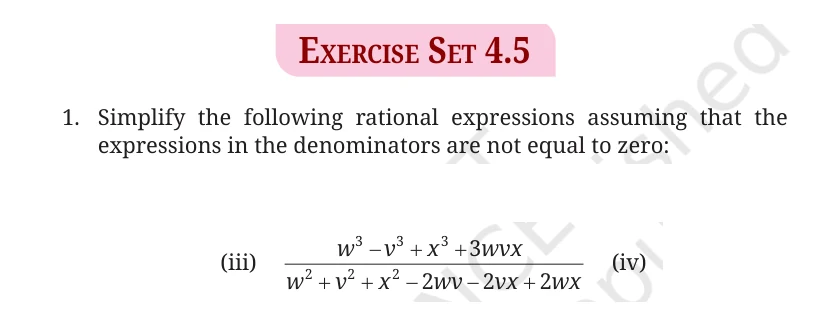
Exercise Set 4.5, 1(iii): Simplify the rational expression involving w^3-v^3+x^3+3wvx
Show detailed solution
- Step 1: Set a=w, b=-v, and c=x. The numerator is a^3+b^3+c^3-3abc
- Step 2: Factor it as (w-v+x)(w^2+v^2+x^2+wv+vx-wx). The denominator is (w-v+x)^2
- Step 3: Cancel one non-zero factor w-v+x
- Answer: \frac{w^2+v^2+x^2+wv+vx-wx}{w-v+x}
Textbook page 87 · solved item 78
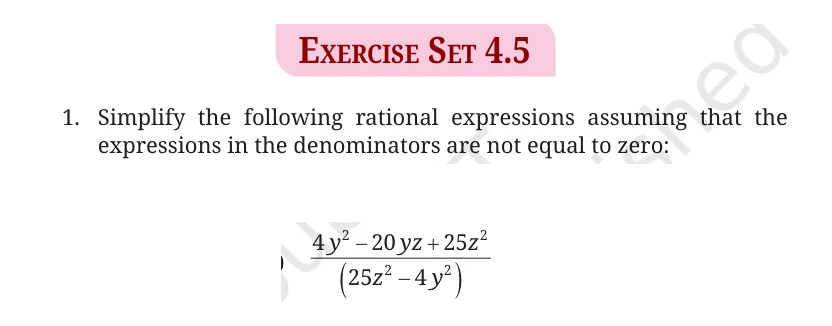
Exercise Set 4.5, 1(iv): Simplify (4y^2-20yz+25z^2)/(25z^2-4y^2)
Show detailed solution
- Step 1: The numerator is (5z-2y)^2
- Step 2: The denominator is (5z-2y)(5z+2y)
- Step 3: Cancel the common non-zero factor 5z-2y
- Answer: The result is \frac{5z-2y}{5z+2y}
Textbook page 87 · solved item 79
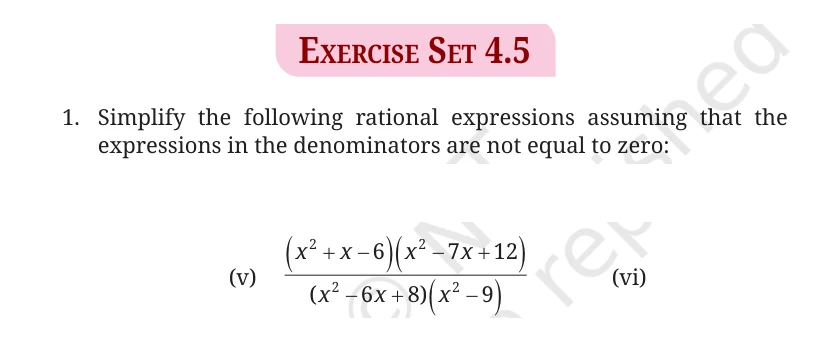
Exercise Set 4.5, 1(v): Simplify the product of two quadratic expressions divided by two quadratic expressions.
Show detailed solution
- Step 1: Factor the numerator as (x+3)(x-2)(x-3)(x-4)
- Step 2: Factor the denominator as (x-2)(x-4)(x-3)(x+3)
- Step 3: Every factor cancels where the original denominator is non-zero.
- Answer: The simplified value is 1
Textbook page 87 · solved item 80
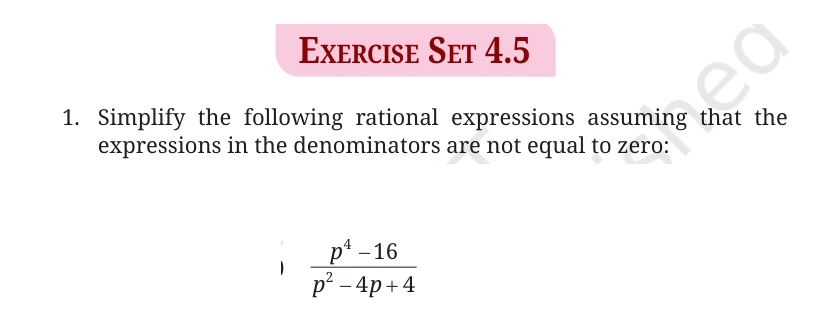
Exercise Set 4.5, 1(vi): Simplify (p^4-16)/(p^2-4p+4)
Show detailed solution
- Step 1: Factor p^4-16=(p^2-4)(p^2+4)=(p-2)(p+2)(p^2+4)
- Step 2: Factor the denominator as (p-2)^2
- Step 3: Cancel one factor p-2, noting that p\ne2
- Answer: \frac{(p+2)(p^2+4)}{p-2}
Detailed worked answers
Textbook page 88
Textbook page 88 · solved item 81
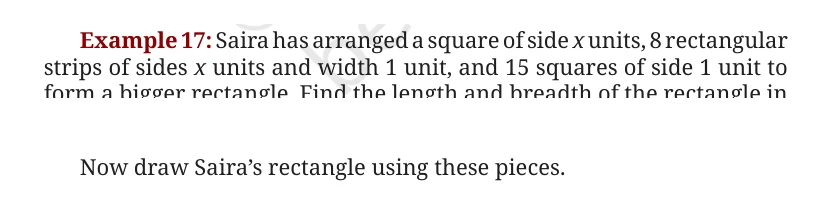
Draw Saira's algebra-tile rectangle made from x^2+8x+15
Show detailed solution
- Step 1: Factor x^2+8x+15 by finding two numbers with sum 8 and product 15: they are 3 and 5
- Step 2: Place the x^2-tile in one corner, three x-tiles along one side, and five x-tiles along the adjacent side.
- Step 3: Fill the remaining corner with the 3\times5=15 unit tiles.
- Answer: The completed rectangle has dimensions x+3 by x+5
Textbook page 88 · solved item 82
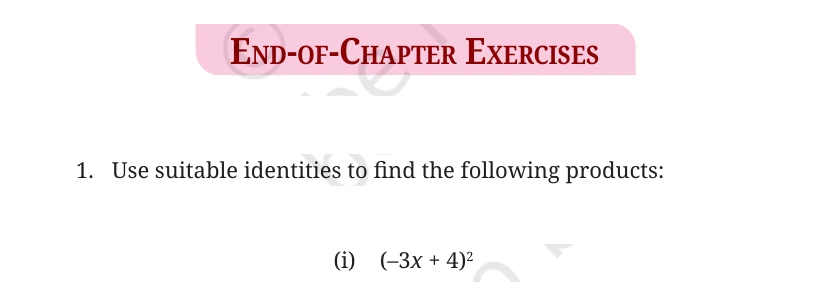
End-of-Chapter Exercise 1(i): Expand (-3x+4)^2
Show detailed solution
- Step 1: Use (a+b)^2 with a=-3x and b=4
- Step 2: The terms are 9x^2, -24x, and 16
- Answer: (-3x+4)^2=9x^2-24x+16
Textbook page 88 · solved item 83
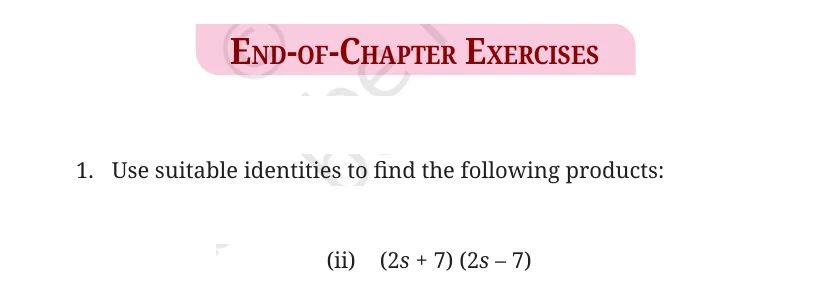
End-of-Chapter Exercise 1(ii): Find (2s+7)(2s-7)
Show detailed solution
- Step 1: Apply the difference-of-squares identity (a+b)(a-b)=a^2-b^2
- Step 2: Here a=2s and b=7
- Answer: (2s+7)(2s-7)=4s^2-49
Textbook page 88 · solved item 84
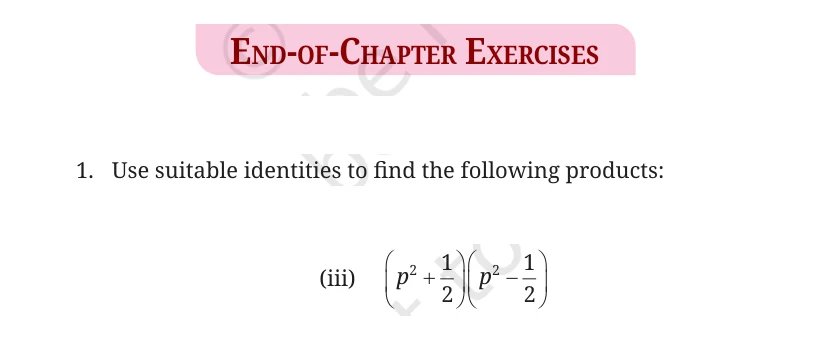
End-of-Chapter Exercise 1(iii): Find (p^2+1/2)(p^2-1/2)
Show detailed solution
- Step 1: Treat the factors as (a+b)(a-b) with a=p^2 and b=\frac12
- Step 2: The product is a^2-b^2=p^4-\frac14
- Answer: (p^2+\frac12)(p^2-\frac12)=p^4-\frac14
Textbook page 88 · solved item 85
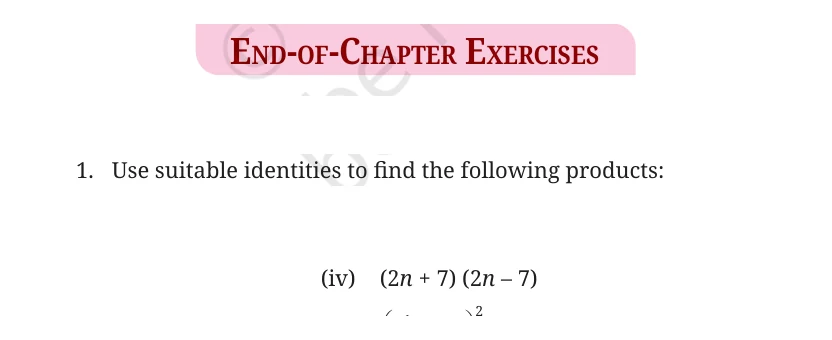
End-of-Chapter Exercise 1(iv): Find (2n+7)(2n-7)
Show detailed solution
- Step 1: Use the difference-of-squares identity.
- Step 2: Square 2n and 7: (2n)^2-7^2
- Answer: (2n+7)(2n-7)=4n^2-49
Textbook page 88 · solved item 86
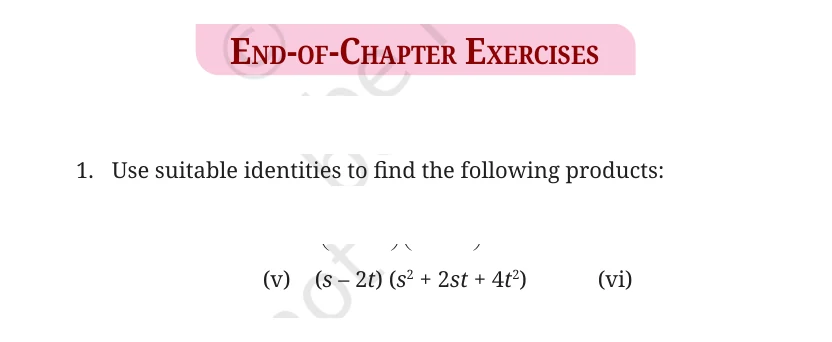
End-of-Chapter Exercise 1(v): Find (s-2t)(s^2+2st+4t^2)
Show detailed solution
- Step 1: Match (a-b)(a^2+ab+b^2)=a^3-b^3
- Step 2: Set a=s and b=2t
- Answer: The product is s^3-(2t)^3=s^3-8t^3
Textbook page 88 · solved item 87
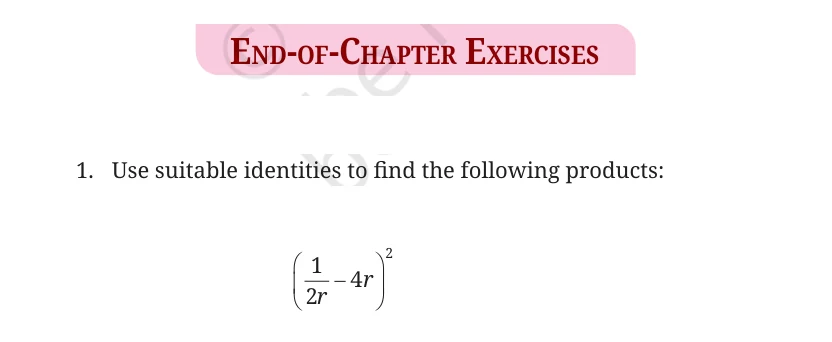
End-of-Chapter Exercise 1(vi): Expand (1/(2r)-4r)^2
Show detailed solution
- Step 1: Square the terms to obtain \frac1{4r^2} and 16r^2
- Step 2: The middle term is -2\cdot\frac1{2r}\cdot4r=-4
- Answer: \left(\frac1{2r}-4r\right)^2=\frac1{4r^2}-4+16r^2
Textbook page 88 · solved item 88
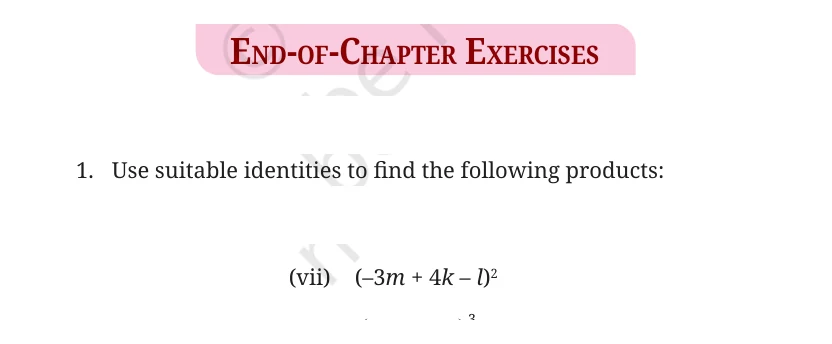
End-of-Chapter Exercise 1(vii): Expand (-3m+4k-l)^2
Show detailed solution
- Step 1: Square the three terms: 9m^2+16k^2+l^2
- Step 2: Add the pairwise double products -24mk-8kl+6ml
- Answer: (-3m+4k-l)^2=9m^2+16k^2+l^2-24mk-8kl+6ml
Textbook page 88 · solved item 89
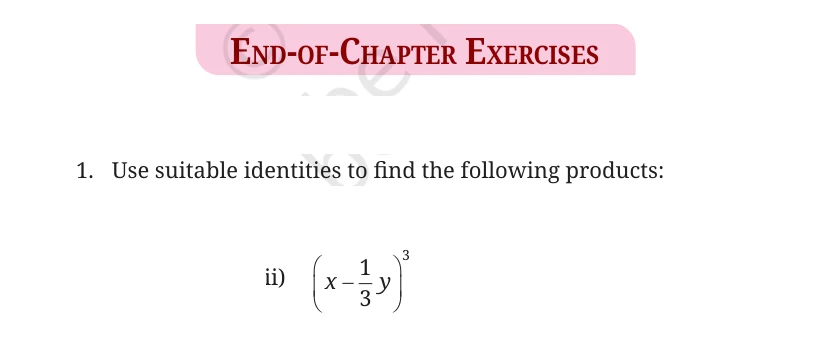
End-of-Chapter Exercise 1(viii): Expand (x-y/3)^3
Show detailed solution
- Step 1: Use (a-b)^3=a^3-3a^2b+3ab^2-b^3 with a=x, b=y/3
- Step 2: Simplify the four terms carefully.
- Answer: \left(x-\frac y3\right)^3=x^3-x^2y+\frac13xy^2-\frac1{27}y^3
Textbook page 88 · solved item 90
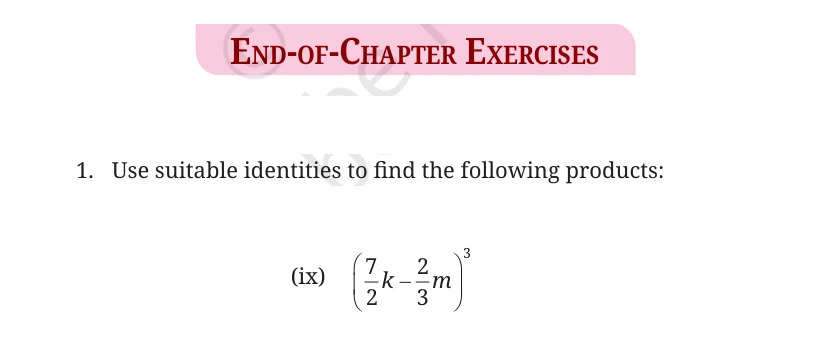
End-of-Chapter Exercise 1(ix): Expand (7k/2-2m/3)^3
Show detailed solution
- Step 1: Apply the cube-of-a-difference identity with a=\frac72k and b=\frac23m
- Step 2: The four terms are a^3, -3a^2b, +3ab^2, and -b^3
- Answer: \left(\frac72k-\frac23m\right)^3=\frac{343}{8}k^3-\frac{49}{2}k^2m+\frac{14}{3}km^2-\frac8{27}m^3
Detailed worked answers
Textbook page 89
Textbook page 89 · solved item 91
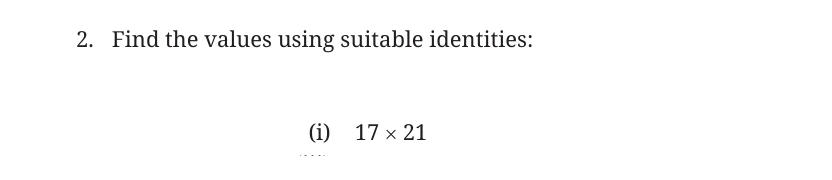
End-of-Chapter Exercise 2(i): Find 17\times21 using an identity.
Show detailed solution
- Step 1: Write 17=19-2 and 21=19+2
- Step 2: (19-2)(19+2)=19^2-2^2=361-4
- Answer: 17\times21=357
Textbook page 89 · solved item 92
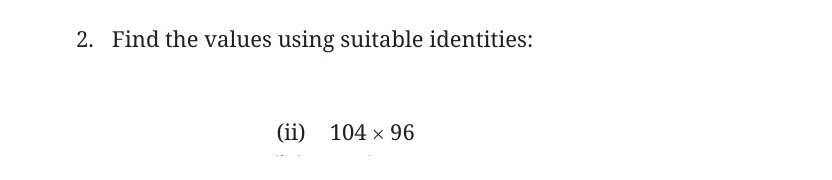
End-of-Chapter Exercise 2(ii): Find 104\times96 using an identity.
Show detailed solution
- Step 1: Write the product as (100+4)(100-4)
- Step 2: Apply the difference of squares: 10000-16
- Answer: 104\times96=9984
Textbook page 89 · solved item 93
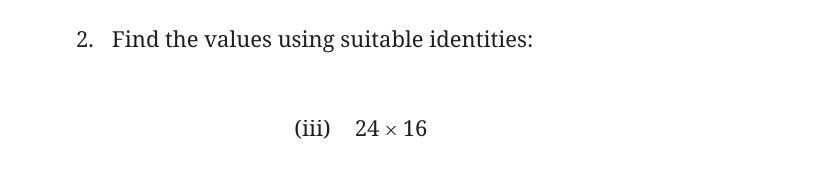
End-of-Chapter Exercise 2(iii): Find 24\times16 using an identity.
Show detailed solution
- Step 1: Write 24=20+4 and 16=20-4
- Step 2: (20+4)(20-4)=20^2-4^2=400-16
- Answer: 24\times16=384
Textbook page 89 · solved item 94
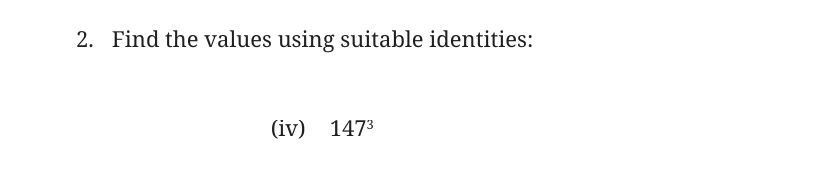
End-of-Chapter Exercise 2(iv): Find 147^3 using an identity.
Show detailed solution
- Step 1: Write 147=150-3
- Step 2: (150-3)^3=150^3-3(150)^2(3)+3(150)(3^2)-3^3
- Step 3: This is 3375000-202500+4050-27
- Answer: 147^3=3176523
Textbook page 89 · solved item 95
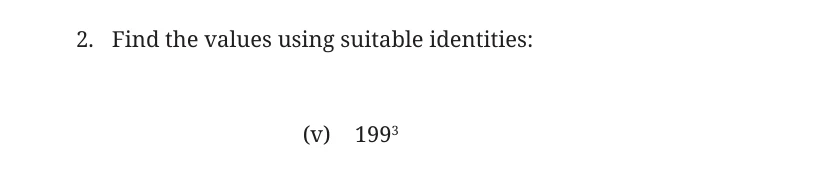
End-of-Chapter Exercise 2(v): Find 199^3 using an identity.
Show detailed solution
- Step 1: Write 199=200-1
- Step 2: (200-1)^3=8000000-120000+600-1
- Answer: 199^3=7880599
Textbook page 89 · solved item 96
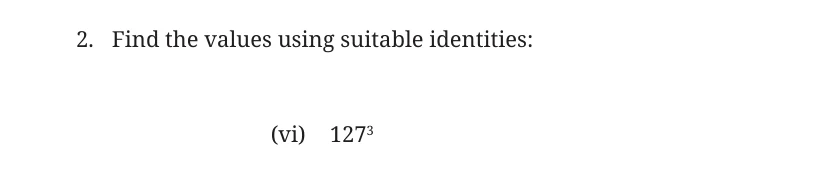
End-of-Chapter Exercise 2(vi): Find 127^3 using an identity.
Show detailed solution
- Step 1: Write 127=120+7
- Step 2: (120+7)^3=120^3+3(120)^2(7)+3(120)(7^2)+7^3
- Step 3: This is 1728000+302400+17640+343
- Answer: 127^3=2048383
Textbook page 89 · solved item 97
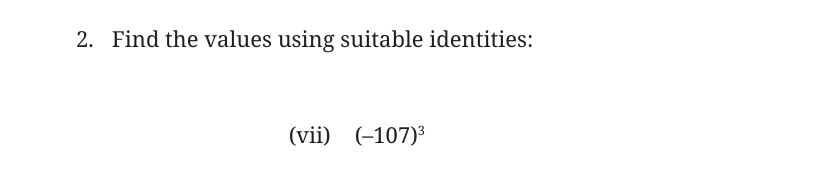
End-of-Chapter Exercise 2(vii): Find (-107)^3 using an identity.
Show detailed solution
- Step 1: Since the exponent is odd, (-107)^3=-107^3
- Step 2: 107^3=(100+7)^3=1000000+210000+14700+343
- Answer: (-107)^3=-1225043
Textbook page 89 · solved item 98
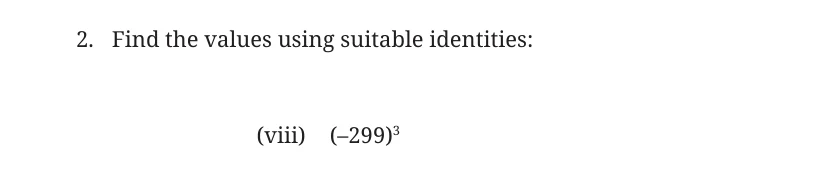
End-of-Chapter Exercise 2(viii): Find (-299)^3 using an identity.
Show detailed solution
- Step 1: (-299)^3=-(300-1)^3
- Step 2: (300-1)^3=27000000-270000+900-1=26730899
- Answer: (-299)^3=-26730899
Textbook page 89 · solved item 99
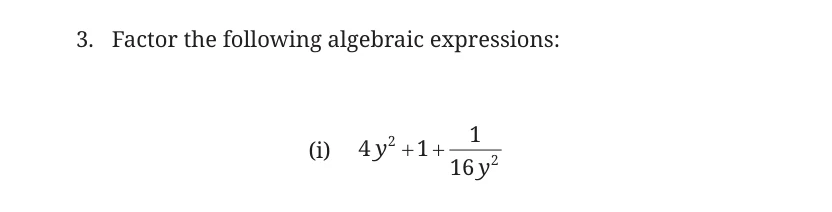
End-of-Chapter Exercise 3(i): Factor 4y^2+1+1/(16y^2)
Show detailed solution
- Step 1: The square terms are (2y)^2 and (\frac1{4y})^2
- Step 2: Their double product is 2(2y)(\frac1{4y})=1
- Answer: 4y^2+1+\frac1{16y^2}=\left(2y+\frac1{4y}\right)^2
Textbook page 89 · solved item 100
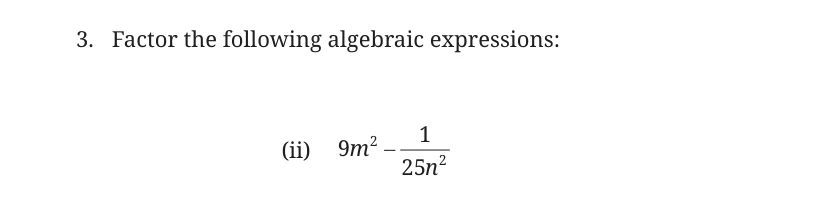
End-of-Chapter Exercise 3(ii): Factor 9m^2-1/(25n^2)
Show detailed solution
- Step 1: Recognise a difference of squares: (3m)^2-(\frac1{5n})^2
- Step 2: Apply a^2-b^2=(a-b)(a+b)
- Answer: 9m^2-\frac1{25n^2}=\left(3m-\frac1{5n}\right)\left(3m+\frac1{5n}\right)
Textbook page 89 · solved item 101
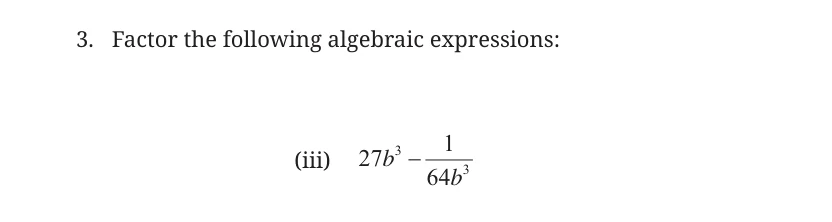
End-of-Chapter Exercise 3(iii): Factor 27b^3-1/(64b^3)
Show detailed solution
- Step 1: Write the expression as (3b)^3-(\frac1{4b})^3
- Step 2: Use a^3-b^3=(a-b)(a^2+ab+b^2)
- Answer: \left(3b-\frac1{4b}\right)\left(9b^2+\frac34+\frac1{16b^2}\right)
Textbook page 89 · solved item 102
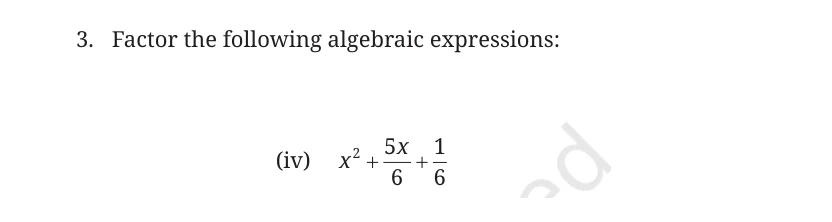
End-of-Chapter Exercise 3(iv): Factor x^2+(5/6)x+1/6
Show detailed solution
- Step 1: Find two numbers with sum \frac56 and product \frac16
- Step 2: The numbers are \frac12 and \frac13
- Answer: x^2+\frac56x+\frac16=\left(x+\frac12\right)\left(x+\frac13\right)
Textbook page 89 · solved item 103
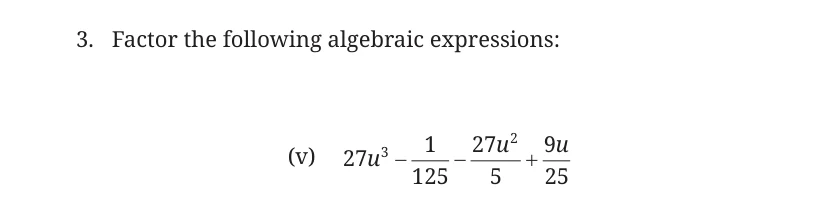
End-of-Chapter Exercise 3(v): Factor 27u^3-1/125-(27/5)u^2+(9/25)u
Show detailed solution
- Step 1: Compare with (a-b)^3=a^3-3a^2b+3ab^2-b^3
- Step 2: Set a=3u and b=\frac15; every term then matches the printed expression.
- Answer: 27u^3-\frac1{125}-\frac{27}{5}u^2+\frac9{25}u=\left(3u-\frac15\right)^3
Textbook page 89 · solved item 104
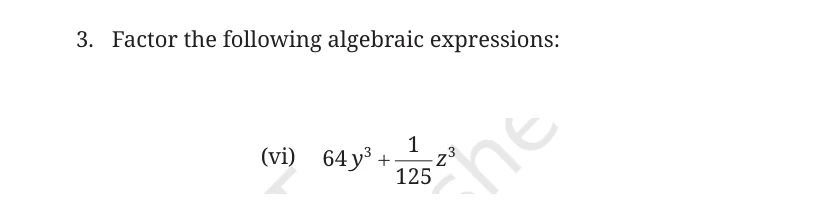
End-of-Chapter Exercise 3(vi): Factor 64y^3+(1/125)z^3
Show detailed solution
- Step 1: Write the expression as (4y)^3+(z/5)^3
- Step 2: Apply a^3+b^3=(a+b)(a^2-ab+b^2)
- Answer: \left(4y+\frac z5\right)\left(16y^2-\frac45yz+\frac1{25}z^2\right)
Textbook page 89 · solved item 105
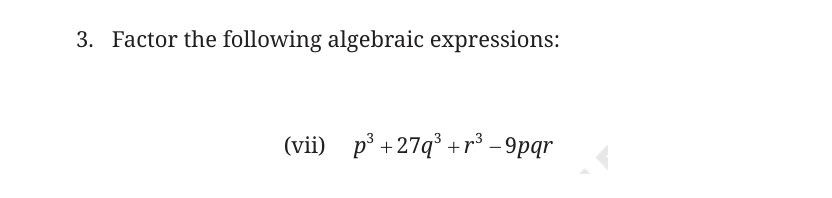
End-of-Chapter Exercise 3(vii): Factor p^3+27q^3+r^3-9pqr
Show detailed solution
- Step 1: Set a=p, b=3q, and c=r in the three-cube identity.
- Step 2: The second factor is a^2+b^2+c^2-ab-bc-ca
- Answer: (p+3q+r)(p^2+9q^2+r^2-3pq-3qr-pr)
Textbook page 89 · solved item 106
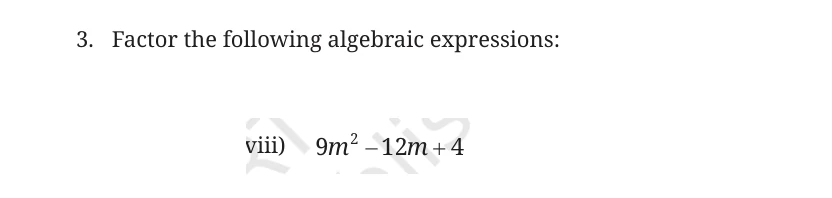
End-of-Chapter Exercise 3(viii): Factor 9m^2-12m+4
Show detailed solution
- Step 1: The square terms are (3m)^2 and 2^2
- Step 2: The middle term is -2(3m)(2)=-12m
- Answer: 9m^2-12m+4=(3m-2)^2
Textbook page 89 · solved item 107
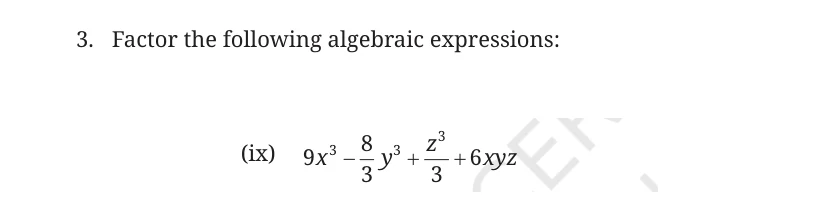
End-of-Chapter Exercise 3(ix): Factor 9x^3-(8/3)y^3+(1/3)z^3+6xyz
Show detailed solution
- Step 1: Factor out \frac13 to get \frac13(27x^3-8y^3+z^3+18xyz)
- Step 2: Use the three-cube identity with a=3x, b=-2y, and c=z
- Answer: \frac13(3x-2y+z)(9x^2+4y^2+z^2+6xy+2yz-3xz)
Textbook page 89 · solved item 108
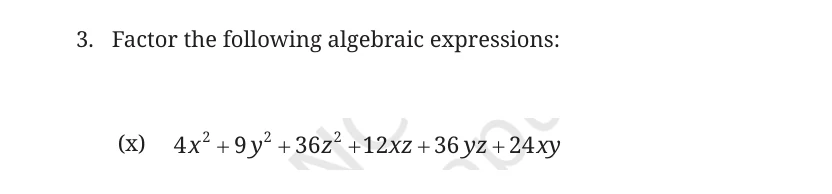
End-of-Chapter Exercise 3(x): Factor 4x^2+9y^2+36z^2+12xz+36yz+24xy
Show detailed solution
- Step 1: The square terms force the candidate linear terms to have magnitudes 2x, 3y, and 6z
- Step 2: Their square would have mixed terms 12xy+24xz+36yz, but the printed expression instead has 24xy+12xz+36yz
- Step 3: Therefore the printed expression is not a perfect square and does not factor into real linear factors by the chapter identities.
- Answer: It is not factorable as printed. If the xy and xz coefficients were 12 and 24, respectively, the likely intended factorisation would be (2x+3y+6z)^2
Textbook page 89 · solved item 109
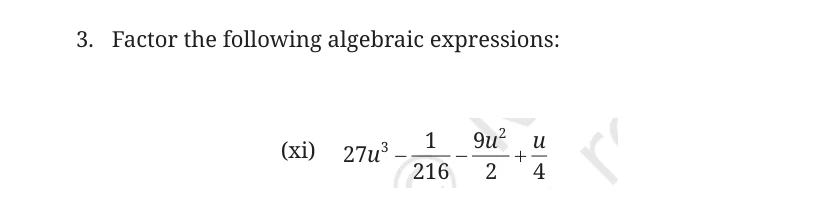
End-of-Chapter Exercise 3(xi): Factor 27u^3-1/216-(9/2)u^2+u/4
Show detailed solution
- Step 1: Compare the expression with (a-b)^3
- Step 2: Taking a=3u and b=\frac16 gives -3a^2b=-\frac92u^2, 3ab^2=\frac14u, and -b^3=-\frac1{216}
- Answer: 27u^3-\frac1{216}-\frac92u^2+\frac14u=\left(3u-\frac16\right)^3
Textbook page 89 · solved item 110
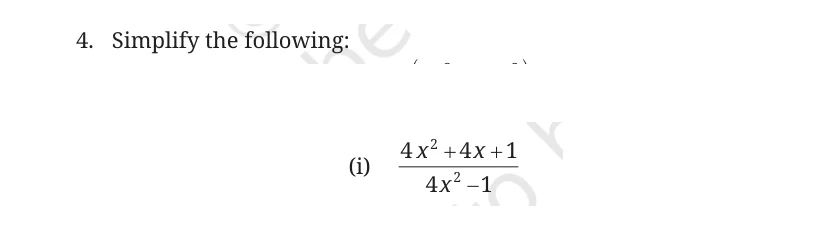
End-of-Chapter Exercise 4(i): Simplify (4x^2+4x+1)/(4x^2-1)
Show detailed solution
- Step 1: Factor the numerator as (2x+1)^2
- Step 2: Factor the denominator as (2x-1)(2x+1)
- Step 3: Cancel the common non-zero factor 2x+1
- Answer: \frac{2x+1}{2x-1}
Textbook page 89 · solved item 111
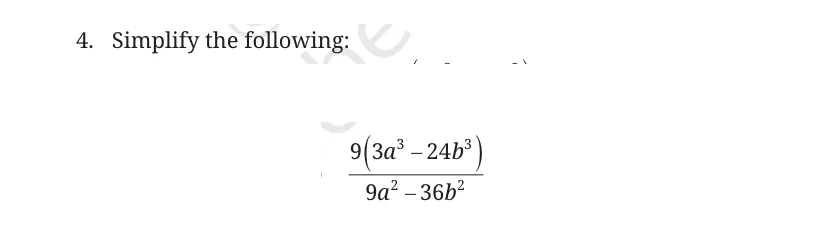
End-of-Chapter Exercise 4(ii): Simplify 9(3a^3-24b^3)/(9a^2-36b^2)
Show detailed solution
- Step 1: Rewrite the numerator as 27(a^3-8b^3)=27(a-2b)(a^2+2ab+4b^2)
- Step 2: Factor the denominator as 9(a^2-4b^2)=9(a-2b)(a+2b)
- Step 3: Cancel 9(a-2b)
- Answer: \frac{3(a^2+2ab+4b^2)}{a+2b}
Textbook page 89 · solved item 112
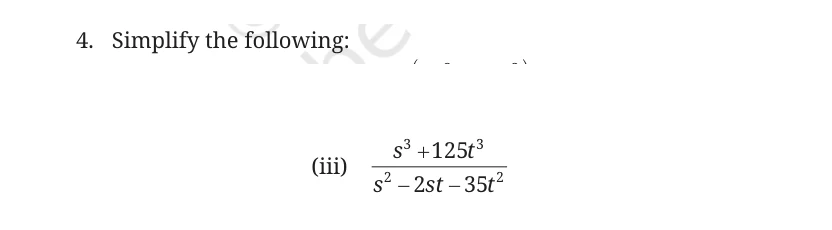
End-of-Chapter Exercise 4(iii): Simplify (s^3+125t^3)/(s^2-2st-35t^2)
Show detailed solution
- Step 1: Factor the numerator as (s+5t)(s^2-5st+25t^2)
- Step 2: Factor the denominator as (s+5t)(s-7t)
- Step 3: Cancel the common non-zero factor s+5t
- Answer: \frac{s^2-5st+25t^2}{s-7t}
Textbook page 89 · solved item 113
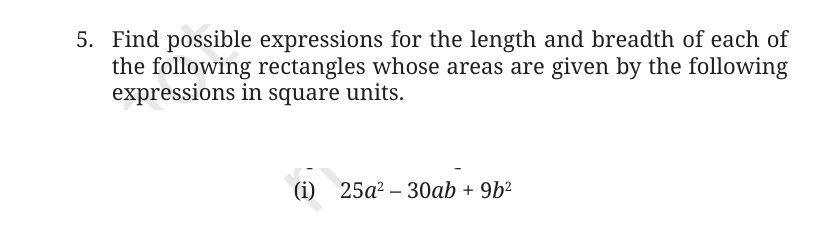
End-of-Chapter Exercise 5(i): Give possible length and breadth for area 25a^2-30ab+9b^2
Show detailed solution
- Step 1: Recognise 25a^2=(5a)^2 and 9b^2=(3b)^2
- Step 2: The middle term is -2(5a)(3b)=-30ab
- Answer: The area is (5a-3b)^2, so possible dimensions are 5a-3b and 5a-3b
Textbook page 89 · solved item 114
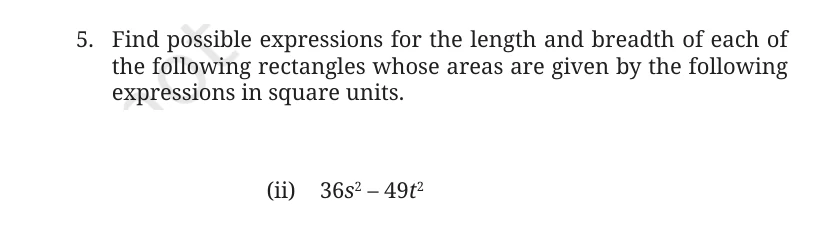
End-of-Chapter Exercise 5(ii): Give possible length and breadth for area 36s^2-49t^2
Show detailed solution
- Step 1: Write the area as (6s)^2-(7t)^2
- Step 2: Factor the difference of squares.
- Answer: 36s^2-49t^2=(6s-7t)(6s+7t), so these factors are possible dimensions.
Textbook page 89 · solved item 115
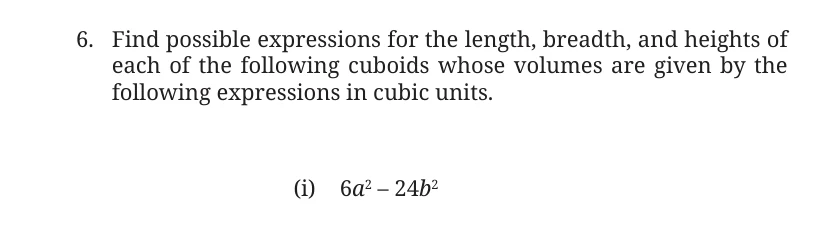
End-of-Chapter Exercise 6(i): Give possible cuboid dimensions for volume 6a^2-24b^2
Show detailed solution
- Step 1: Factor out 6: 6a^2-24b^2=6(a^2-4b^2)
- Step 2: Factor the difference of squares: a^2-4b^2=(a-2b)(a+2b)
- Answer: One possible set of dimensions is 6, a-2b, and a+2b
Textbook page 89 · solved item 116
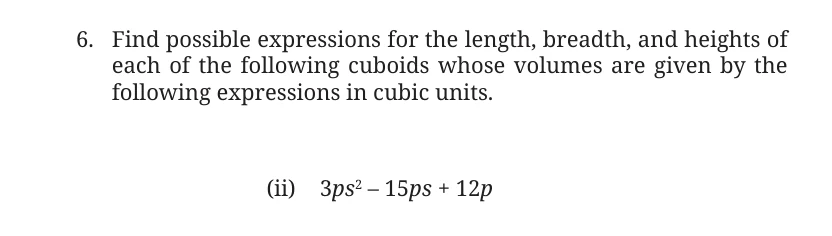
End-of-Chapter Exercise 6(ii): Give possible cuboid dimensions for volume 3ps^2-15ps+12p
Show detailed solution
- Step 1: Factor out 3p: 3p(s^2-5s+4)
- Step 2: Factor the quadratic: s^2-5s+4=(s-1)(s-4)
- Answer: One possible set of dimensions is 3p, s-1, and s-4
Detailed worked answers
Textbook page 90
Textbook page 90 · solved item 117

End-of-Chapter Exercise 7: A path of width s metres surrounds a square playground of side 40 metres. Find the path area.
Show detailed solution
- Step 1: The outside square has side 40+2s because the path adds s on both sides.
- Step 2: Subtract the playground area from the outer area: (40+2s)^2-40^2
- Step 3: Expand and simplify: 1600+160s+4s^2-1600
- Answer: The path area is 4s^2+160s=4s(s+40) square metres.
Textbook page 90 · solved item 118

End-of-Chapter Exercise 8: If a number plus its reciprocal is 10/3, find the number.
Show detailed solution
- Step 1: Let the non-zero number be x. Then x+\frac1x=\frac{10}{3}
- Step 2: Multiply by 3x: 3x^2-10x+3=0
- Step 3: Factor: (3x-1)(x-3)=0
- Answer: The number can be x=\frac13 or x=3
Textbook page 90 · solved item 119

End-of-Chapter Exercise 9: A pool has area 2x^2+7x+3 square hastas and width 2x+1 hastas. Find its length.
Show detailed solution
- Step 1: Factor the area: 2x^2+7x+3=2x^2+6x+x+3
- Step 2: Group: 2x(x+3)+1(x+3)=(2x+1)(x+3)
- Step 3: Divide the area by the given width 2x+1
- Answer: The length is x+3 hastas.
Textbook page 90 · solved item 120

End-of-Chapter Exercise 10: If x-2 and x-1/2 are factors of px^2+5x+r, show that p=r
Show detailed solution
- Step 1: A quadratic with those factors is p(x-2)(x-\frac12)
- Step 2: Expand: p(x^2-\frac52x+1)=px^2-\frac{5p}{2}x+p
- Step 3: Compare the coefficient of x: -\frac{5p}{2}=5, so p=-2. The constant term is therefore r=p=-2
- Conclusion: p=r
Textbook page 90 · solved item 121

End-of-Chapter Exercise 11: If a+b+c=5 and ab+bc+ca=10, prove a^3+b^3+c^3-3abc=-25
Show detailed solution
- Step 1: Use a^3+b^3+c^3-3abc=(a+b+c)(a^2+b^2+c^2-ab-bc-ca)
- Step 2: The second factor is (a+b+c)^2-3(ab+bc+ca)=25-30=-5
- Step 3: Multiply by a+b+c=5: 5(-5)=-25
- Hence a^3+b^3+c^3-3abc=-25, as required.
Textbook page 90 · solved item 122

End-of-Chapter Exercise 12: Show that n^3-n is divisible by 6 for every natural number n
Show detailed solution
- Step 1: Factor n^3-n=n(n^2-1)=n(n-1)(n+1)
- Step 2: These are three consecutive integers, so one of them is divisible by 3
- Step 3: At least one of three consecutive integers is even, so the product is also divisible by 2
- Conclusion: The product is divisible by 2\times3=6
Textbook page 90 · solved item 123
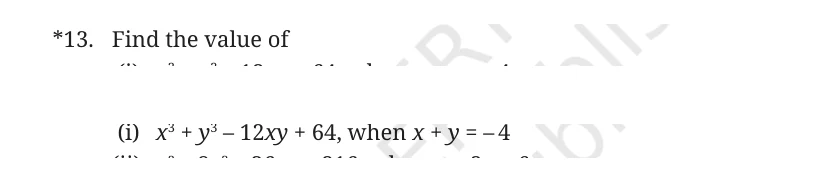
End-of-Chapter Exercise 13(i): Find x^3+y^3-12xy+64 when x+y=-4
Show detailed solution
- Step 1: Use x^3+y^3=(x+y)^3-3xy(x+y)
- Step 2: With x+y=-4, this becomes -64+12xy
- Step 3: Substitute into the expression: (-64+12xy)-12xy+64=0
- Answer: The value is 0
Textbook page 90 · solved item 124
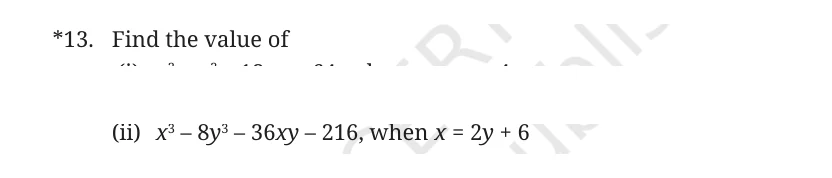
End-of-Chapter Exercise 13(ii): Find x^3-8y^3-36xy-216 when x=2y+6
Show detailed solution
- Step 1: Rewrite the expression as x^3+(-2y)^3+(-6)^3-3x(-2y)(-6)
- Step 2: By the three-cube identity it has factor x-2y-6
- Step 3: The condition x=2y+6 makes this factor zero.
- Answer: The value is 0