
Question-by-question working
Read the prompt, attempt it, then check each step
Every exercise subpart and table row is a separate item. Shared figures are repeated in the crop whenever they are needed to understand that question.
Detailed worked answers
Textbook page 17
Textbook page 17 · solved item 1
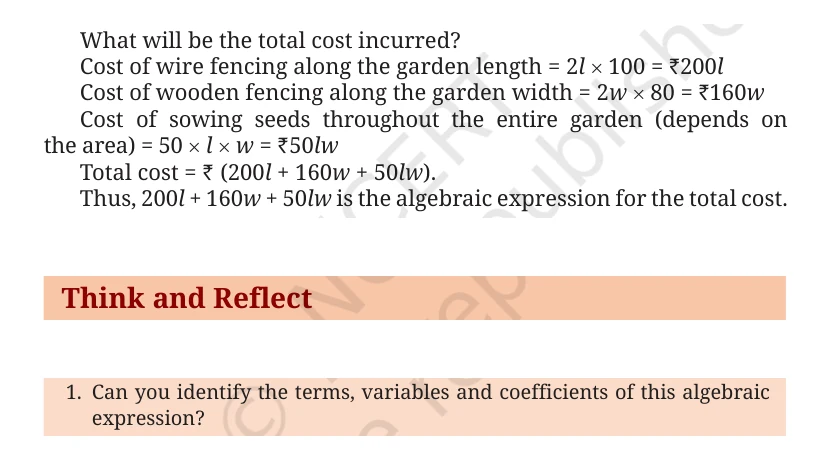
Think and Reflect after Example 2 (1): Identify the terms, variables, and coefficients of 200l+160w+50lw.
Show detailed solution
- Step 1: Separate the expression at addition signs. Its terms are 200l, 160w, and 50lw.
- Step 2: The letters that can vary are l and w, so these are the variables.
- Step 3: The numerical factors are 200, 160, and 50, respectively.
- Answer: Terms: 200l,160w,50lw; variables: l,w; coefficients: 200,160,50.
Textbook page 17 · solved item 2
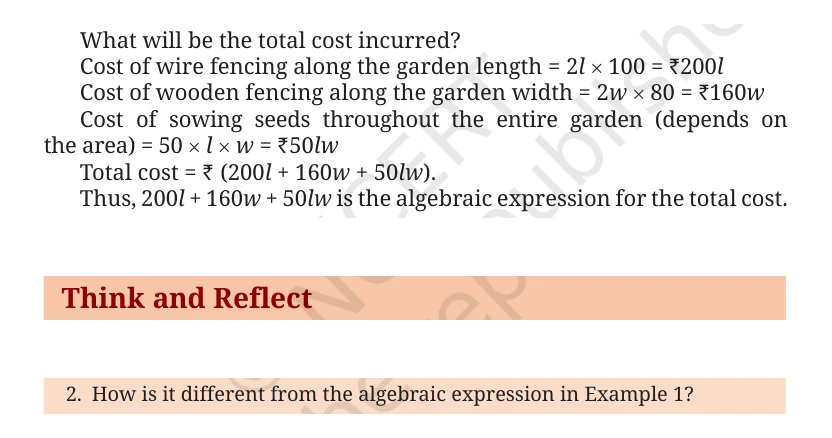
Think and Reflect after Example 2 (2): How is 200l+160w+50lw different from the expression in Example 1?
Show detailed solution
- Step 1: Example 1 gives 4x+5y+3, which has two first-degree variable terms and a constant term.
- Step 2: Example 2 gives 200l+160w+50lw. The term 50lw contains a product of two variables.
- Step 3: Therefore Example 1 is linear in its variables, while Example 2 includes a degree-2 term and has no constant term.
- Answer: Both use two variables, but only Example 2 contains a product term lw.
Textbook page 17 · solved item 3
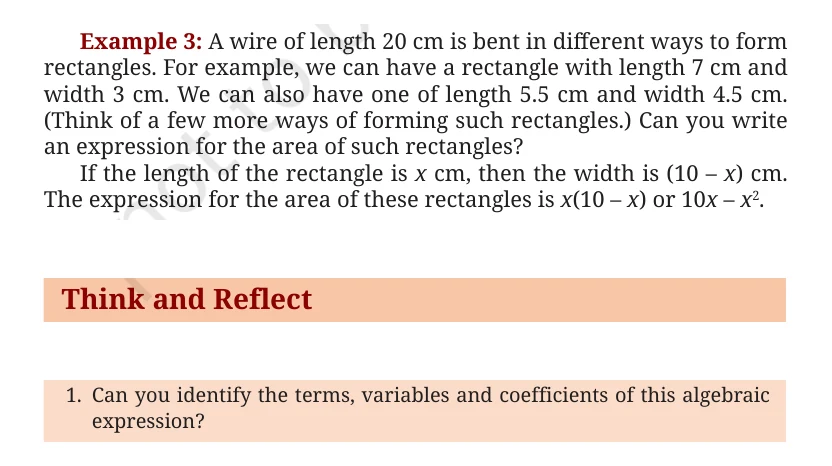
Think and Reflect after Example 3 (1): Identify the terms, variable, and coefficients of 10x-x^2.
Show detailed solution
- Step 1: Write the expression as 10x+(-x^2), so its terms are 10x and -x^2.
- Step 2: The only variable is x.
- Step 3: The coefficient of x is 10, and the coefficient of x^2 is -1.
- Answer: Terms: 10x,-x^2; variable: x; coefficients: 10,-1.
Textbook page 17 · solved item 4
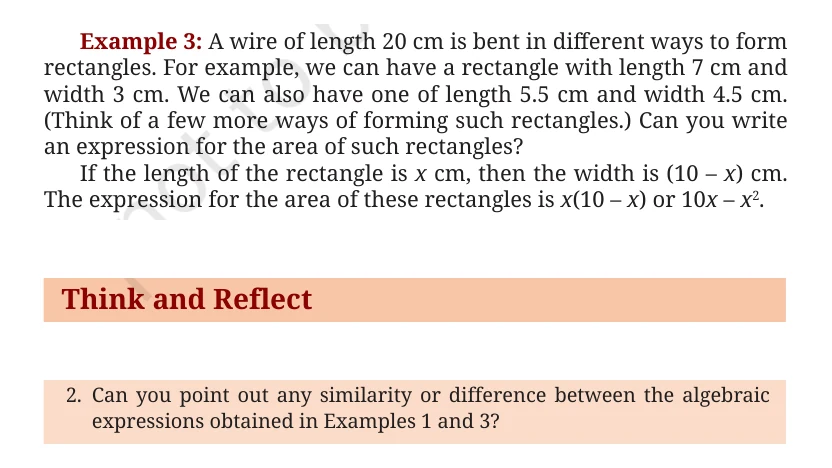
Think and Reflect after Example 3 (2): Compare the expressions in Examples 1 and 3.
Show detailed solution
- Step 1: Both are algebraic expressions made from variables, coefficients, and addition or subtraction.
- Step 2: Example 1, 4x+5y+3, uses two variables and has highest total degree 1.
- Step 3: Example 3, 10x-x^2, uses one variable and has highest power 2.
- Answer: Example 1 is a two-variable linear expression; Example 3 is a one-variable quadratic polynomial.
Detailed worked answers
Textbook page 18
Textbook page 18 · solved item 5
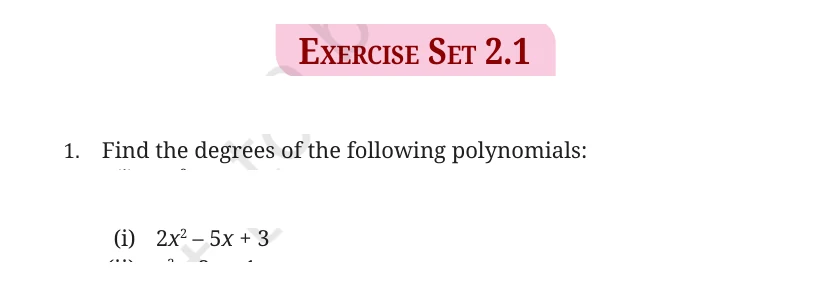
Exercise Set 2.1, 1(i): Find the degree of 2x^2-5x+3.
Show detailed solution
- Step 1: The powers of x present are 2, 1, and 0.
- Step 2: The highest power with a non-zero coefficient is 2.
- Answer: The polynomial has degree 2.
Textbook page 18 · solved item 6
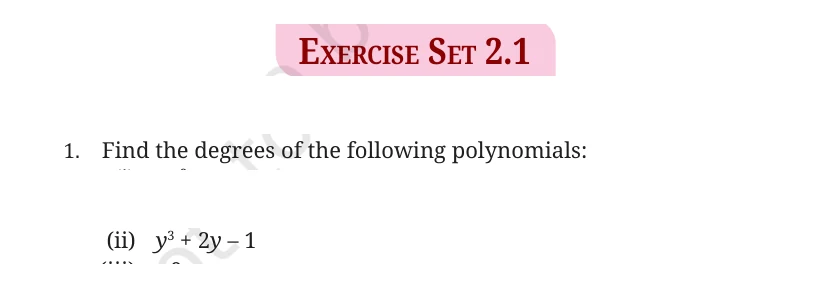
Exercise Set 2.1, 1(ii): Find the degree of y^3+2y-1.
Show detailed solution
- Step 1: The term y^3 has exponent 3.
- Step 2: The other terms have degrees 1 and 0, which are lower.
- Answer: The polynomial has degree 3.
Textbook page 18 · solved item 7
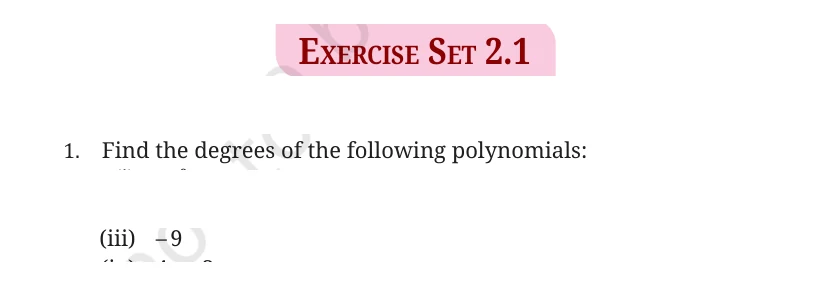
Exercise Set 2.1, 1(iii): Find the degree of the constant polynomial -9.
Show detailed solution
- Step 1: A non-zero constant can be written as -9x^0.
- Step 2: Its variable exponent is therefore 0.
- Answer: The polynomial has degree 0.
Textbook page 18 · solved item 8
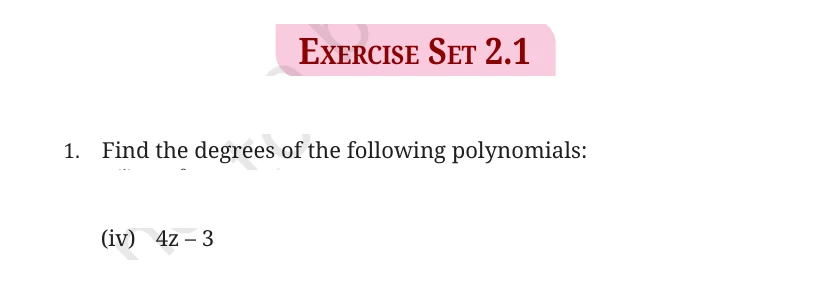
Exercise Set 2.1, 1(iv): Find the degree of 4z-3.
Show detailed solution
- Step 1: The variable term is 4z=4z^1.
- Step 2: The constant term has degree 0, so the highest exponent is 1.
- Answer: The polynomial has degree 1.
Textbook page 18 · solved item 9

Exercise Set 2.1, 2: Write polynomials of degrees 1, 2, and 3.
Show detailed solution
- Step 1: A degree-1 example is 2x+1, because its highest power is x^1.
- Step 2: A degree-2 example is x^2-4, because its highest power is x^2.
- Step 3: A degree-3 example is 3x^3+x, because its highest power is x^3.
- Answer: One valid set is 2x+1,\ x^2-4,\ 3x^3+x. Many other answers are possible.
Textbook page 18 · solved item 10
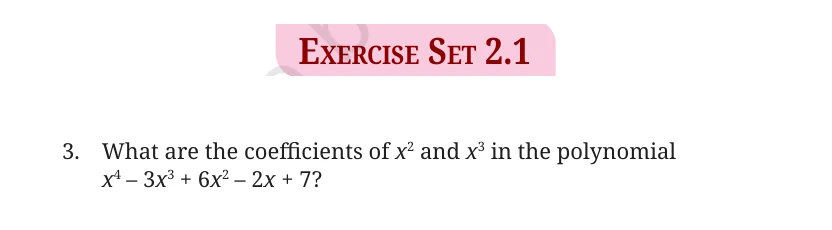
Exercise Set 2.1, 3: Find the coefficients of x^2 and x^3 in x^4-3x^3+6x^2-2x+7.
Show detailed solution
- Step 1: Locate the x^2 term: it is 6x^2, so its coefficient is 6.
- Step 2: Locate the x^3 term: it is -3x^3, so its coefficient is -3.
- Step 3: Keep each sign with its numerical factor.
- Answer: Coefficient of x^2=6; coefficient of x^3=-3.
Detailed worked answers
Textbook page 19
Textbook page 19 · solved item 11

Exercise Set 2.1, 4: Find the coefficient of z in 4z^3+5z^2-11.
Show detailed solution
- Step 1: A z-term would have the form az.
- Step 2: No first-power z-term is written, so it is understood as 0z.
- Answer: The coefficient of z is 0.
Textbook page 19 · solved item 12

Exercise Set 2.1, 5: Find the constant term of 9x^3+5x^2-8x-10.
Show detailed solution
- Step 1: The constant term is the term containing no variable.
- Step 2: In the given polynomial, that term is -10.
- Answer: The constant term is -10.
Textbook page 19 · solved item 13

Think and Reflect after Example 4: Find the perimeters for the listed square sides and describe the change for each 0.5 cm increase.
Show detailed solution
- Step 1: Use the square-perimeter rule P=4s.
- Step 2: For sides 1,1.5,2,2.5,3 cm, the perimeters are 4,6,8,10,12 cm.
- Step 3: Consecutive perimeters differ by 2 cm because 4\times0.5=2.
- Answer: 4,6,8,10,12 cm; the perimeter increases by 2 cm each time.
Textbook page 19 · solved item 14
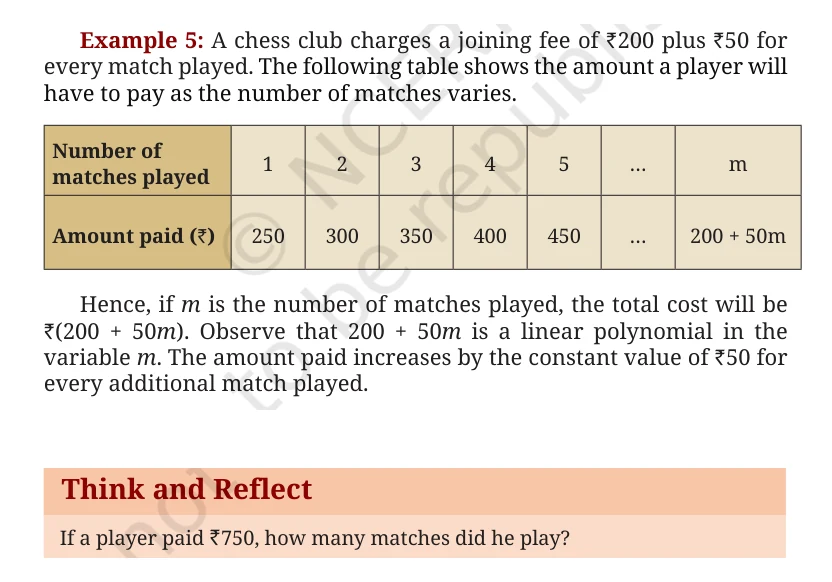
Think and Reflect after Example 5: A player paid Rs 750. How many matches did the player play?
Show detailed solution
- Step 1: The payment rule is 200+50m, where m is the number of matches.
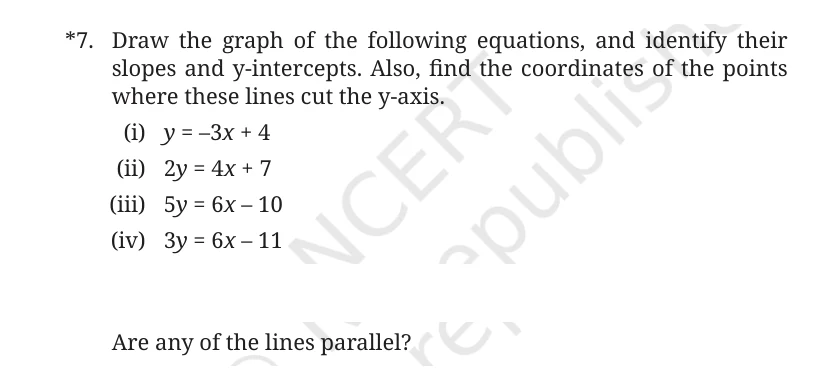
- Step 2: Set 200+50m=750, then subtract 200: 50m=550.
- Step 3: Divide by 50: m=11.
- Answer: The player played 11 matches.
Detailed worked answers
Textbook page 20
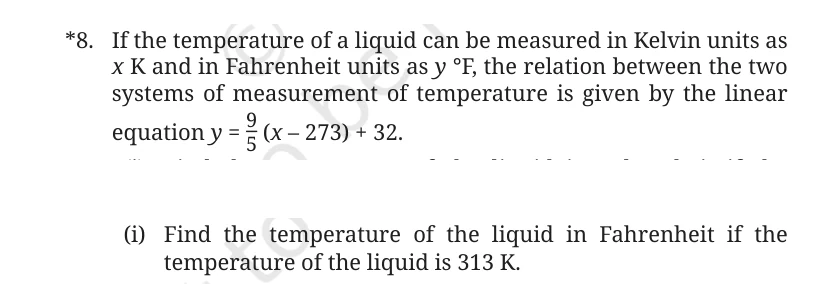
Textbook page 20 · solved item 15
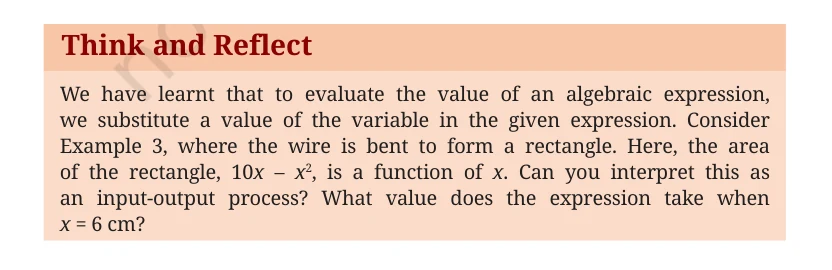
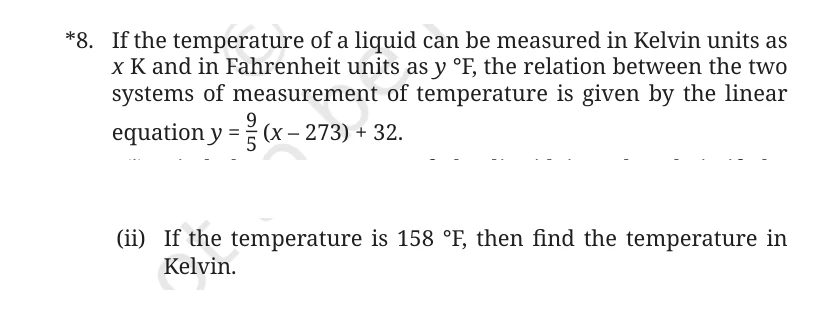
Think and Reflect after Fig. 2.3: Interpret 10x-x^2 as an input-output process and evaluate it at x=6 cm.
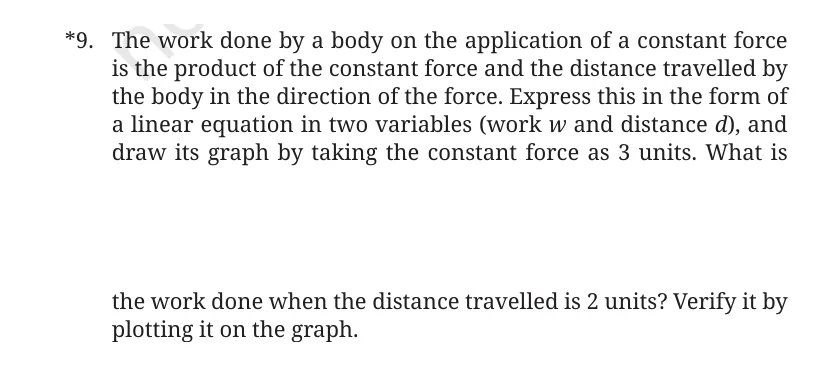
Show detailed solution
- Step 1: Treat the rectangle length x as the input. The fixed perimeter makes its width 10-x.
- Step 2: The output is the area A(x)=x(10-x)=10x-x^2.
- Step 3: Substitute x=6: A(6)=10(6)-6^2=60-36=24.
- Answer: Input 6 cm produces output 24\text{ cm}^2.
Detailed worked answers
Textbook page 21
Textbook page 21 · solved item 16
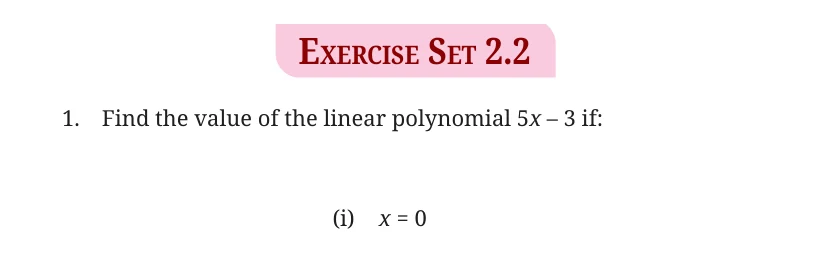
Exercise Set 2.2, 1(i): Evaluate 5x-3 at x=0.
Show detailed solution
- Step 1: Substitute x=0: 5(0)-3.
- Step 2: 5(0)=0.
- Answer: 0-3=-3.
Textbook page 21 · solved item 17
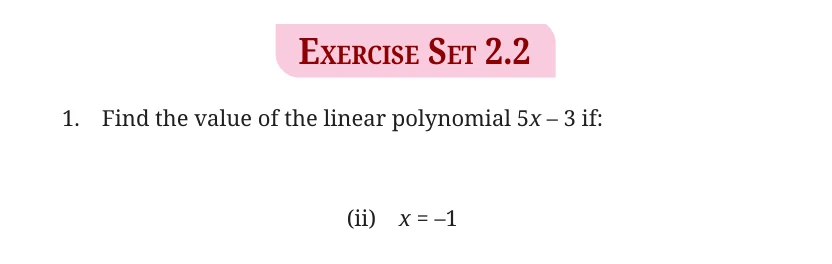
Exercise Set 2.2, 1(ii): Evaluate 5x-3 at x=-1.
Show detailed solution
- Step 1: Substitute x=-1: 5(-1)-3.
- Step 2: Multiply first: 5(-1)=-5.
- Answer: -5-3=-8.
Textbook page 21 · solved item 18
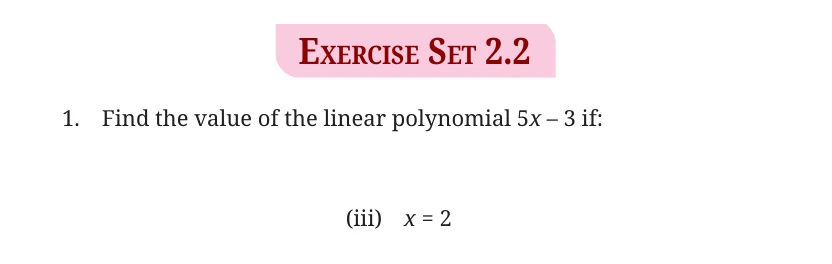
Exercise Set 2.2, 1(iii): Evaluate 5x-3 at x=2.
Show detailed solution
- Step 1: Substitute x=2: 5(2)-3.
- Step 2: Multiply: 5(2)=10.
- Answer: 10-3=7.
Textbook page 21 · solved item 19
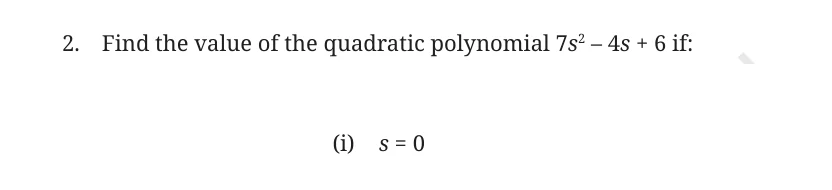
Exercise Set 2.2, 2(i): Evaluate 7s^2-4s+6 at s=0.
Show detailed solution
- Step 1: Substitute s=0: 7(0)^2-4(0)+6.
- Step 2: Both variable terms become 0.
- Answer: The value is 6.
Textbook page 21 · solved item 20
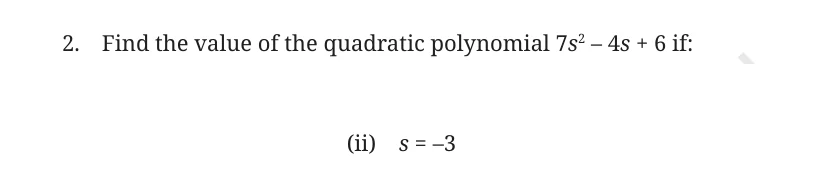
Exercise Set 2.2, 2(ii): Evaluate 7s^2-4s+6 at s=-3.
Show detailed solution
- Step 1: Substitute carefully: 7(-3)^2-4(-3)+6.
- Step 2: This becomes 7(9)+12+6=63+12+6.
- Answer: The value is 81.
Textbook page 21 · solved item 21
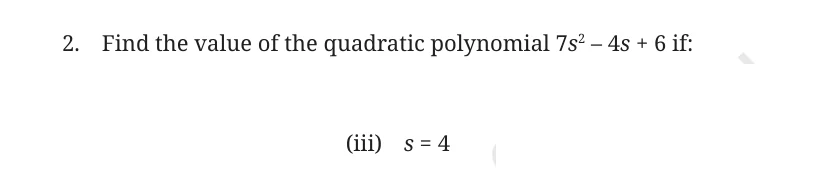
Exercise Set 2.2, 2(iii): Evaluate 7s^2-4s+6 at s=4.
Show detailed solution
- Step 1: Substitute s=4: 7(4)^2-4(4)+6.
- Step 2: This is 7(16)-16+6=112-16+6.
- Answer: The value is 102.
Textbook page 21 · solved item 22

Exercise Set 2.2, 3: Find Salil's and his mother's present ages.
Show detailed solution
- Step 1: Let Salil's present age be x. His mother's age is 3x.
- Step 2: After 5 years, (x+5)+(3x+5)=70, so 4x+10=70.
- Step 3: 4x=60, hence x=15, and 3x=45.
- Answer: Salil is 15 years old and his mother is 45 years old.
Textbook page 21 · solved item 23

Exercise Set 2.2, 4: Two positive integers differ by 63 and are in the ratio 2:5. Find them.
Show detailed solution
- Step 1: Write the integers as 2k and 5k.
- Step 2: Their difference is 5k-2k=3k=63, giving k=21.
- Step 3: The integers are 2(21)=42 and 5(21)=105.
- Answer: 42 and 105.
Textbook page 21 · solved item 24

Exercise Set 2.2, 5: Find how many five-rupee and two-rupee coins Ruby has.
Show detailed solution
- Step 1: Let the number of five-rupee coins be x. Then the number of two-rupee coins is 3x.
- Step 2: Their total value is 5x+2(3x)=11x=88.
- Step 3: Thus x=8, and 3x=24.
- Answer: Ruby has 8 five-rupee coins and 24 two-rupee coins.
Textbook page 21 · solved item 25

Exercise Set 2.2, 6: A 300-foot fence is cut so that the longer piece is four times the shorter. Find both lengths.
Show detailed solution
- Step 1: Let the shorter piece be x feet; the longer piece is 4x feet.
- Step 2: Their sum is x+4x=300, so 5x=300.
- Step 3: x=60 and 4x=240.
- Answer: The pieces are 60 feet and 240 feet long.
Textbook page 21 · solved item 26

Exercise Set 2.2, 7: A rectangle has length three more than twice its width and perimeter 24 cm. Find its dimensions.
Show detailed solution
- Step 1: Let width be w cm. Then length is 2w+3 cm.
- Step 2: 2[(2w+3)+w]=24, so 6w+6=24.
- Step 3: 6w=18, hence w=3 and length =2(3)+3=9.
- Answer: Width 3 cm and length 9 cm.
Detailed worked answers
Textbook page 22
Textbook page 22 · solved item 27
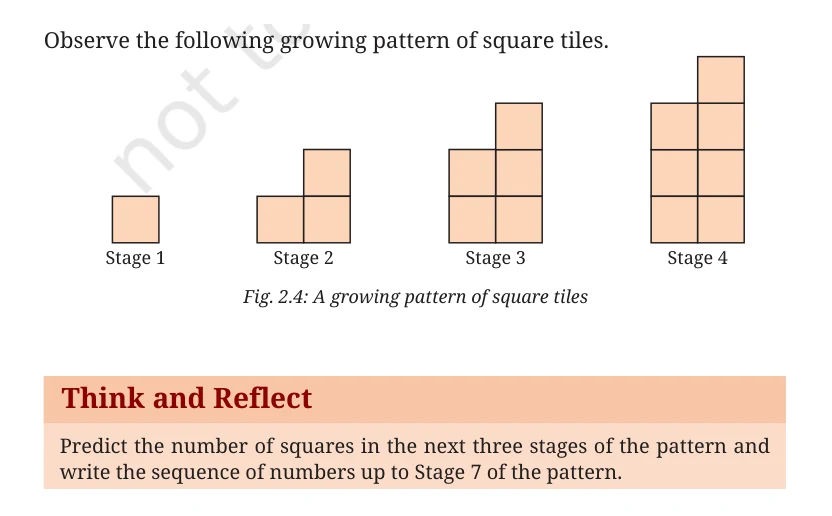
Think and Reflect after Fig. 2.4: Predict Stages 5-7 and write the sequence through Stage 7.
Show detailed solution
- Step 1: The visible counts are 1,3,5,7. Each stage adds 2 tiles.
- Step 2: Continue the pattern: Stage 5 has 9, Stage 6 has 11, and Stage 7 has 13.
- Step 3: List the counts in stage order.
- Answer: 1,3,5,7,9,11,13.
Textbook page 22 · solved item 28
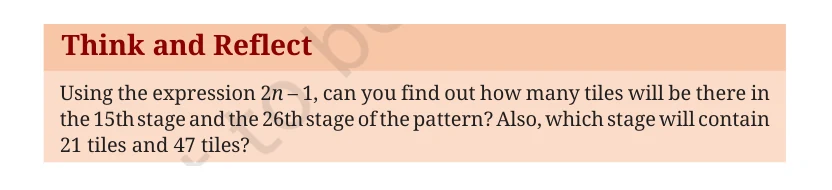
Think and Reflect: How many tiles are in Stage 15 of the pattern 2n-1?
Show detailed solution
- Step 1: Use T_n=2n-1.
- Step 2: Substitute n=15: T_{15}=2(15)-1.
- Answer: Stage 15 has 29 tiles.
Textbook page 22 · solved item 29
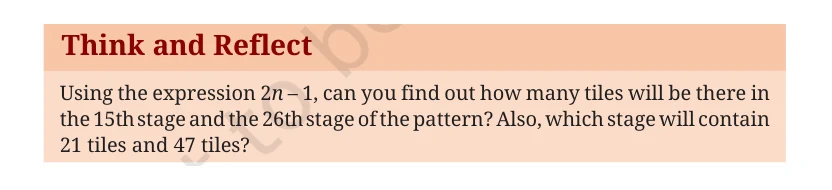
Think and Reflect: How many tiles are in Stage 26 of the pattern 2n-1?
Show detailed solution
- Step 1: Use T_n=2n-1.
- Step 2: Substitute n=26: T_{26}=52-1.
- Answer: Stage 26 has 51 tiles.
Textbook page 22 · solved item 30
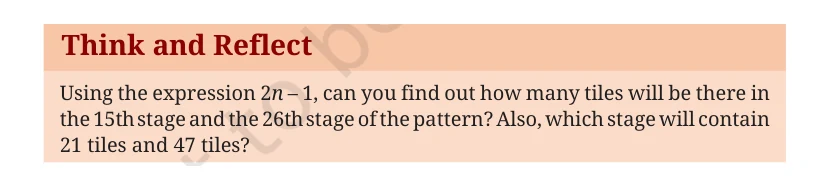
Think and Reflect: Which stage contains 21 tiles?
Show detailed solution
- Step 1: Set the pattern equal to 21: 2n-1=21.
- Step 2: Add 1: 2n=22, then divide by 2.
- Answer: n=11, so Stage 11 contains 21 tiles.
Textbook page 22 · solved item 31
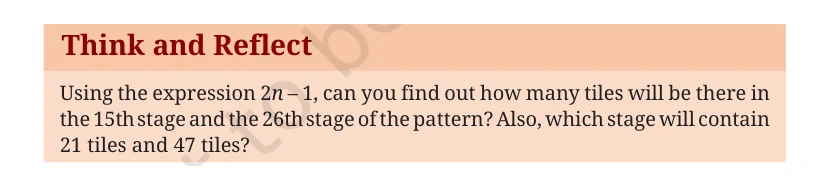
Think and Reflect: Which stage contains 47 tiles?
Show detailed solution
- Step 1: Solve 2n-1=47.
- Step 2: 2n=48, so n=24.
- Answer: Stage 24 contains 47 tiles.
Detailed worked answers
Textbook page 23
Textbook page 23 · solved item 32

Think and Reflect after Example 7: How much money is left on the 15th day?
Show detailed solution
- Step 1: The amount after n days is 100-5n.
- Step 2: At n=15, it is 100-5(15)=100-75.
- Answer: Rs 25 is left.
Textbook page 23 · solved item 33

Think and Reflect after Example 7: After how many days is the entire Rs 100 spent?
Show detailed solution
- Step 1: Set the remaining amount to zero: 100-5n=0.
- Step 2: Then 5n=100.
- Answer: n=20, so the money is fully spent after 20 days.
Textbook page 23 · solved item 34
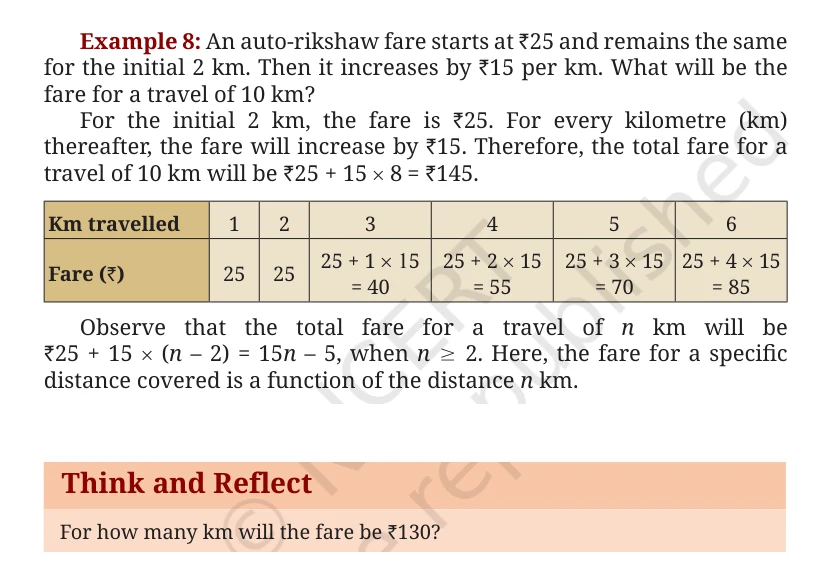
Think and Reflect after Example 8: For how many kilometres is the auto-rickshaw fare Rs 130?
Show detailed solution
- Step 1: For n\ge2, the fare is 15n-5.
- Step 2: Solve 15n-5=130: 15n=135.
- Step 3: Divide by 15: n=9, which satisfies n\ge2.
- Answer: The fare is Rs 130 for 9 km.
Textbook page 23 · solved item 35
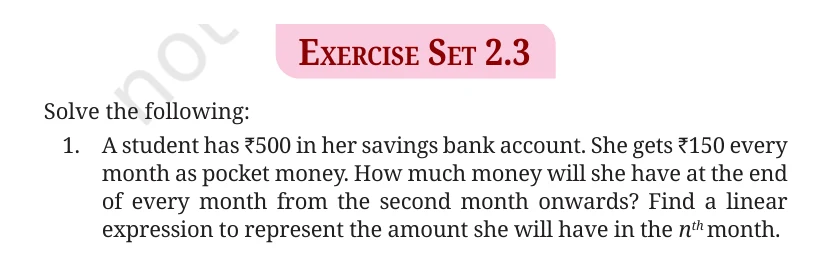
Exercise Set 2.3, 1: Find the student's monthly savings amounts and a rule for the nth month.
Show detailed solution
- Step 1: The account starts with Rs 500, and each completed month adds Rs 150.
- Step 2: After n months, A_n=500+150n.
- Step 3: From the second month onward the amounts are A_2=800, A_3=950, A_4=1100, and so on.
- Answer: A_n=500+150n rupees.
Detailed worked answers
Textbook page 24
Textbook page 24 · solved item 36
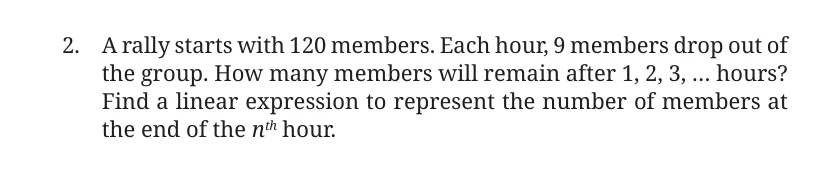
Exercise Set 2.3, 2: Describe the rally membership after 1, 2, 3, ... hours and find the nth-hour rule.
Show detailed solution
- Step 1: Subtract 9 members per hour from the initial 120.
- Step 2: After 1, 2, and 3 hours the counts are 111,102,93.
- Step 3: After n hours the count is M_n=120-9n.
- Answer: 111,102,93,\ldots, with rule M_n=120-9n.
Textbook page 24 · solved item 37

Exercise Set 2.3, 3(i): Find the area when the rectangle breadth is 12 cm and length is 13 cm.
Show detailed solution
- Step 1: Use A=lb.
- Step 2: Substitute l=13 and b=12: A=13(12).
- Answer: A=156\text{ cm}^2.
Textbook page 24 · solved item 38

Exercise Set 2.3, 3(ii): Find the area when the breadth is 10 cm.
Show detailed solution
- Step 1: Use A=13b.
- Step 2: Substitute b=10: A=13(10).
- Answer: A=130\text{ cm}^2.
Textbook page 24 · solved item 39

Exercise Set 2.3, 3(iii): Find the area when the breadth is 8 cm.
Show detailed solution
- Step 1: Use A=13b.
- Step 2: Substitute b=8: A=13(8).
- Answer: A=104\text{ cm}^2.
Textbook page 24 · solved item 40

Exercise Set 2.3, 3: Find the linear pattern relating the rectangle's area and breadth.
Show detailed solution
- Step 1: The length stays fixed at 13 cm.
- Step 2: If breadth is b, then area is A=13b.
- Step 3: Reducing breadth by 2 reduces area by 13(2)=26, giving 156,130,104,\ldots.
- Answer: The linear relationship is A(b)=13b.
Textbook page 24 · solved item 41
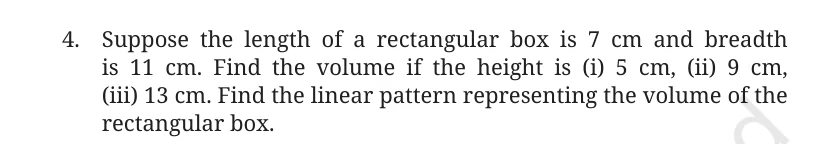
Exercise Set 2.3, 4(i): Find the box volume when its height is 5 cm.
Show detailed solution
- Step 1: The base area is 7\times11=77\text{ cm}^2.
- Step 2: Multiply by height: V=77(5).
- Answer: V=385\text{ cm}^3.
Textbook page 24 · solved item 42
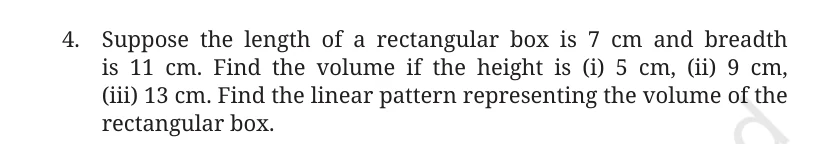
Exercise Set 2.3, 4(ii): Find the box volume when its height is 9 cm.
Show detailed solution
- Step 1: The fixed base area is 77\text{ cm}^2.
- Step 2: V=77(9).
- Answer: V=693\text{ cm}^3.
Textbook page 24 · solved item 43
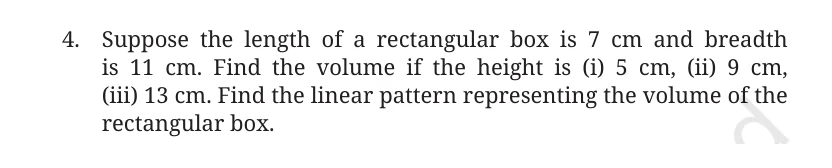
Exercise Set 2.3, 4(iii): Find the box volume when its height is 13 cm.
Show detailed solution
- Step 1: Use V=77h.
- Step 2: V=77(13)=77(10)+77(3).
- Answer: V=1001\text{ cm}^3.
Textbook page 24 · solved item 44
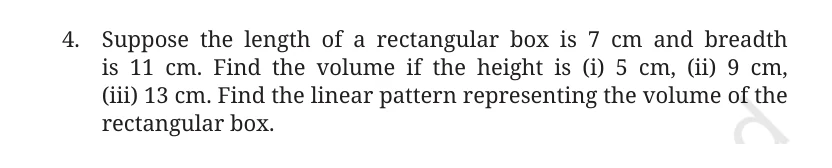
Exercise Set 2.3, 4: Find the linear pattern relating box volume and height.
Show detailed solution
- Step 1: Length and breadth are fixed, so the base area is 7\times11=77.
- Step 2: For height h, volume is V=77h.
- Step 3: The listed heights increase by 4, so the volumes increase by 77(4)=308: 385,693,1001,\ldots.
- Answer: The linear relationship is V(h)=77h.
Textbook page 24 · solved item 45

Exercise Set 2.3, 5: How many pages remain after Sarita reads 20 pages daily for 15 days?
Show detailed solution
- Step 1: Pages read in 15 days are 20(15)=300.
- Step 2: Subtract from the 500-page total: 500-300.
- Answer: 200 pages remain.
Textbook page 24 · solved item 46

Exercise Set 2.3, 5: Express Sarita's remaining pages as a linear pattern.
Show detailed solution
- Step 1: Start with 500 pages.
- Step 2: After n days, 20n pages have been read.
- Step 3: Remaining pages are P_n=500-20n, valid until the book is finished.
- Answer: P_n=500-20n.
Textbook page 24 · solved item 47
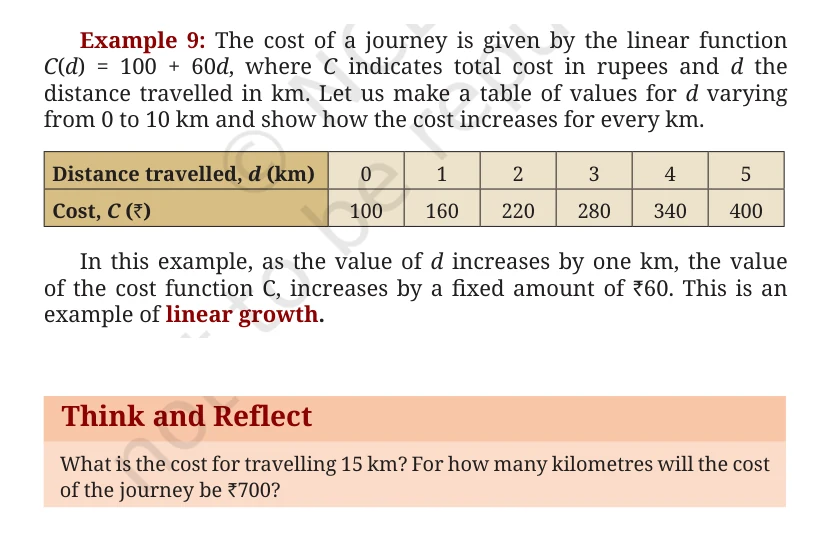
Think and Reflect after Example 9: What is the journey cost for 15 km?
Show detailed solution
- Step 1: Use C(d)=100+60d.
- Step 2: C(15)=100+60(15)=100+900.
- Answer: The cost is Rs 1000.
Textbook page 24 · solved item 48
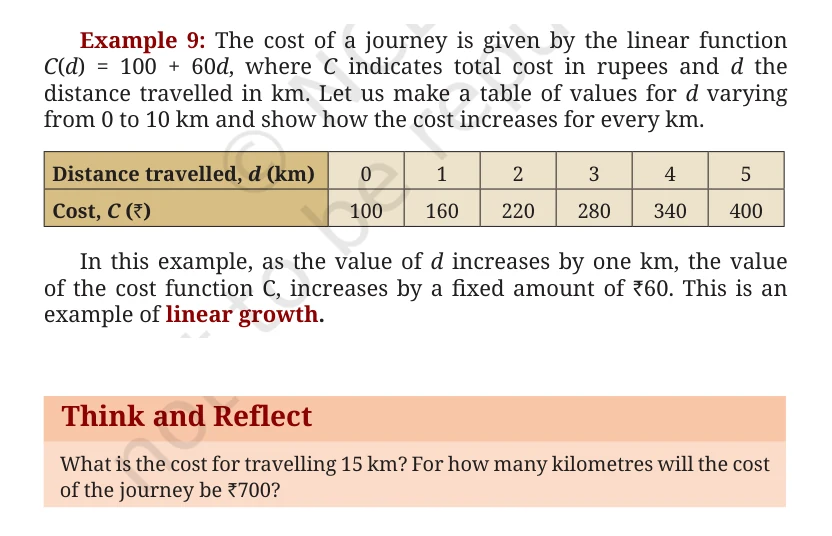
Think and Reflect after Example 9: For how many kilometres is the journey cost Rs 700?
Show detailed solution
- Step 1: Set 100+60d=700.
- Step 2: Subtract 100: 60d=600.
- Step 3: Divide by 60: d=10.
- Answer: The journey is 10 km.
Detailed worked answers
Textbook page 25
Textbook page 25 · solved item 49

Think and Reflect after Example 10: Find the water height after 5 months.
Show detailed solution
- Step 1: Use the decay rule h(t)=3-0.5t.
- Step 2: Substitute t=5: h(5)=3-0.5(5)=3-2.5.
- Answer: The water height is 0.5 m.
Textbook page 25 · solved item 50
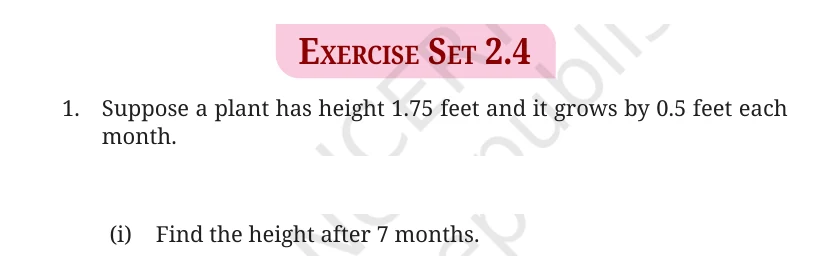
Exercise Set 2.4, 1(i): Find the plant's height after 7 months.
Show detailed solution
- Step 1: The initial height is 1.75 ft and the monthly increase is 0.5 ft.
- Step 2: Growth in 7 months is 0.5(7)=3.5 ft.
- Step 3: 1.75+3.5=5.25.
- Answer: The plant is 5.25 ft tall.
Textbook page 25 · solved item 51
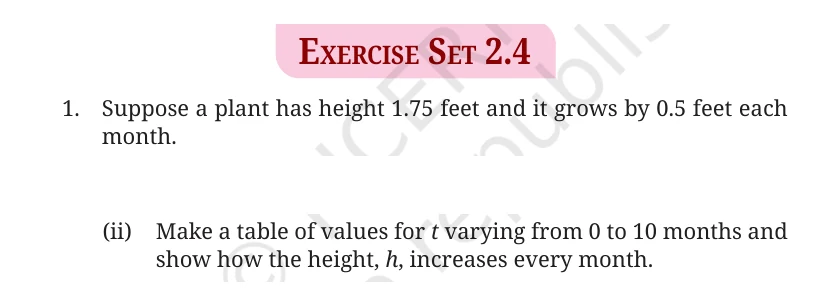
Exercise Set 2.4, 1(ii): Make the plant-height table for t=0 to 10 months.
Show detailed solution
- Step 1: Use h=1.75+0.5t.
- Step 2: Increase the height by 0.5 for each next month.
- Step 3: For t=0,1,\ldots,10, the heights are 1.75,2.25,2.75,3.25,3.75,4.25,4.75,5.25,5.75,6.25,6.75 ft.
- Answer: The table has constant first difference 0.5 ft.
Textbook page 25 · solved item 52
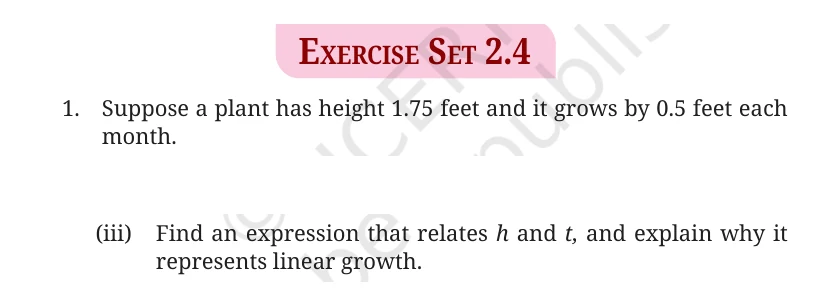
Exercise Set 2.4, 1(iii): Find the plant-height expression and explain why it is linear growth.
Show detailed solution
- Step 1: Initial height at t=0 is 1.75 ft.
- Step 2: Add 0.5t for growth over t months, giving h(t)=1.75+0.5t.
- Step 3: The coefficient 0.5>0 is a constant monthly increase, so the relationship is linear growth.
- Answer: h(t)=1.75+0.5t.
Textbook page 25 · solved item 53
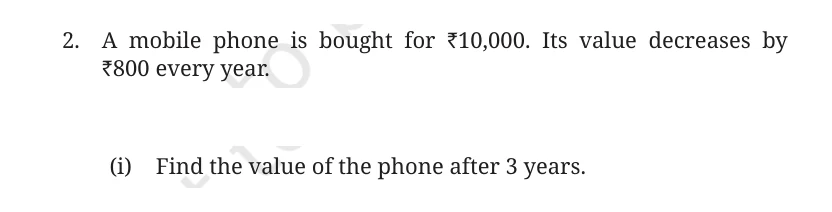
Exercise Set 2.4, 2(i): Find the mobile phone's value after 3 years.
Show detailed solution
- Step 1: Depreciation over 3 years is 800(3)=2400 rupees.
- Step 2: Subtract this from the purchase value: 10000-2400.
- Answer: The phone is worth Rs 7600.
Textbook page 25 · solved item 54
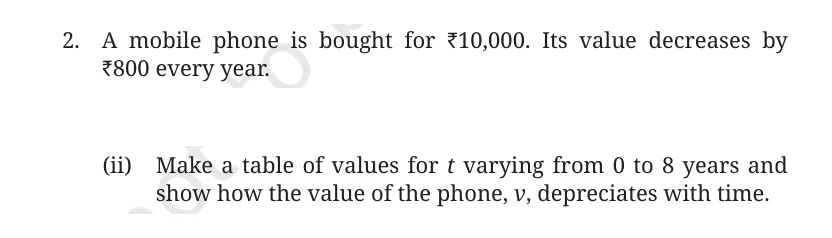
Exercise Set 2.4, 2(ii): Make the phone-value table for t=0 to 8 years.
Show detailed solution
- Step 1: Use v=10000-800t.
- Step 2: Subtract 800 for each successive year.
- Step 3: For t=0,1,\ldots,8, values are 10000,9200,8400,7600,6800,6000,5200,4400,3600 rupees.
- Answer: The table decreases by Rs 800 each year.
Textbook page 25 · solved item 55
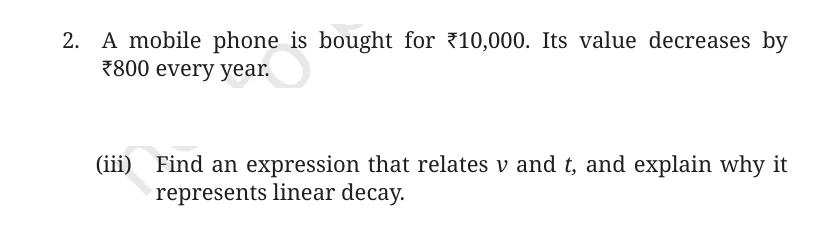
Exercise Set 2.4, 2(iii): Find the phone-value expression and explain why it is linear decay.
Show detailed solution
- Step 1: The starting value is Rs 10000.
- Step 2: After t years, total depreciation is Rs 800t, so v(t)=10000-800t.
- Step 3: The constant rate is -800 rupees per year, so this is linear decay.
- Answer: v(t)=10000-800t.
Textbook page 25 · solved item 56
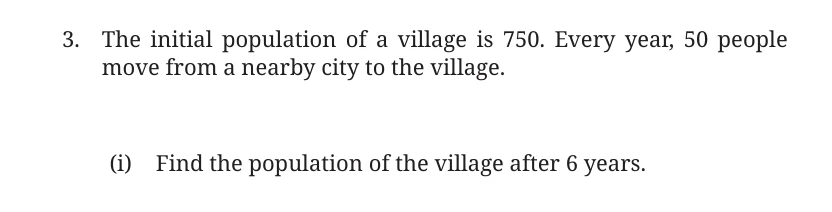
Exercise Set 2.4, 3(i): Find the village population after 6 years.
Show detailed solution
- Step 1: The village begins with 750 people.
- Step 2: Six years add 50(6)=300 people.
- Answer: The population is 750+300=1050.
Detailed worked answers
Textbook page 26
Textbook page 26 · solved item 57
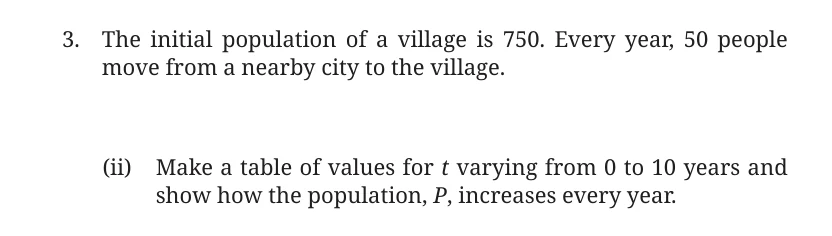
Exercise Set 2.4, 3(ii): Make the village-population table for t=0 to 10 years.
Show detailed solution
- Step 1: Use P=750+50t.
- Step 2: Add 50 for each next year.
- Step 3: For t=0,1,\ldots,10, populations are 750,800,850,900,950,1000,1050,1100,1150,1200,1250.
- Answer: The table has constant increase 50 people per year.
Textbook page 26 · solved item 58
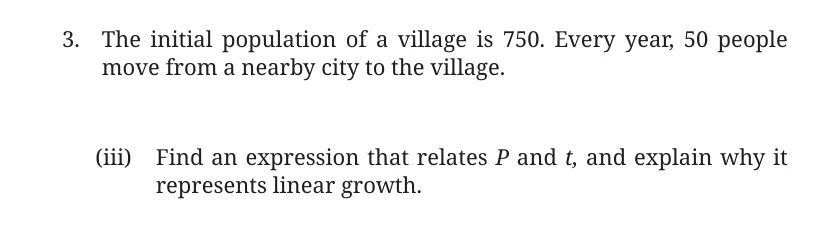
Exercise Set 2.4, 3(iii): Find the population expression and explain why it is linear growth.
Show detailed solution
- Step 1: At t=0, the population is 750.
- Step 2: Immigration adds 50t after t years, so P(t)=750+50t.
- Step 3: The positive constant rate 50 makes this linear growth.
- Answer: P(t)=750+50t.
Textbook page 26 · solved item 59
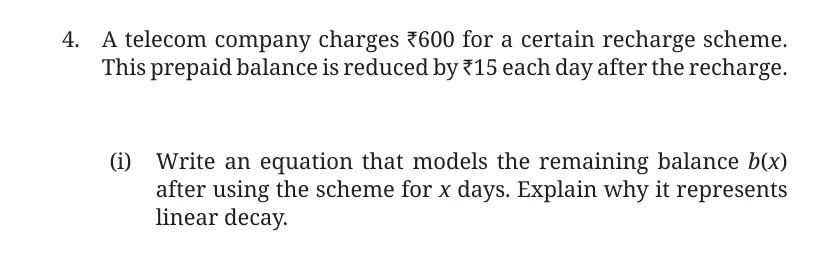
Exercise Set 2.4, 4(i): Model the prepaid balance after x days and explain the decay.
Show detailed solution
- Step 1: The balance starts at Rs 600.
- Step 2: Usage removes Rs 15 per day, or Rs 15x after x days.
- Step 3: Therefore b(x)=600-15x. Its constant negative rate -15 makes it linear decay.
- Answer: b(x)=600-15x.
Textbook page 26 · solved item 60
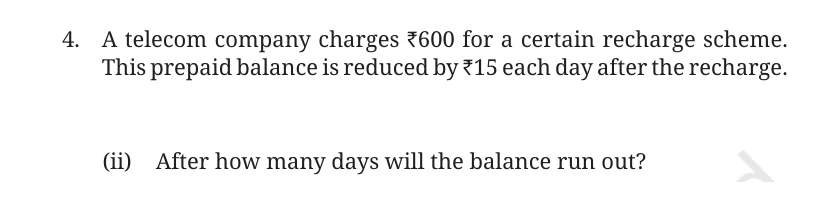
Exercise Set 2.4, 4(ii): After how many days will the prepaid balance run out?
Show detailed solution
- Step 1: The balance runs out when b(x)=0.
- Step 2: Solve 600-15x=0, giving 15x=600.
- Answer: x=40, so it runs out after 40 days.
Textbook page 26 · solved item 61
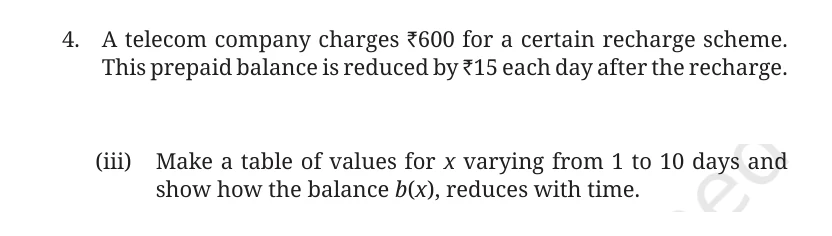
Exercise Set 2.4, 4(iii): Make the prepaid-balance table for days 1 through 10.
Show detailed solution
- Step 1: Evaluate b(x)=600-15x for x=1,2,\ldots,10.
- Step 2: The balances are 585,570,555,540,525,510,495,480,465,450 rupees.
- Step 3: Each entry is Rs 15 less than the preceding entry.
- Answer: The table shows a constant daily decay of Rs 15.
Detailed worked answers
Textbook page 27
Textbook page 27 · solved item 62

Think and Reflect after Example 11: What do 20 and 150 represent in y=20x+150?
Show detailed solution
- Step 1: The coefficient 20 multiplies the data usage x, so it is the charge per GB.
- Step 2: The constant 150 remains even when x=0, so it is the fixed monthly fee.
- Step 3: The bill is therefore fixed fee plus usage charge.
- Answer: Rs 20 per GB and a fixed monthly fee of Rs 150.
Textbook page 27 · solved item 63
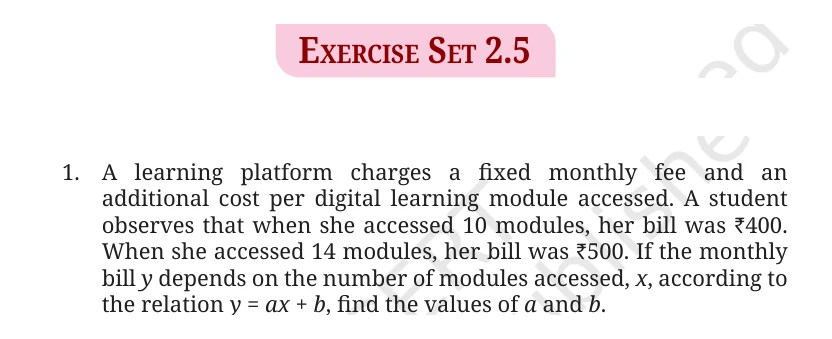
Exercise Set 2.5, 1: Find a and b for the learning-platform bill y=ax+b.
Show detailed solution
- Step 1: The observations give 400=10a+b and 500=14a+b.
- Step 2: Subtract the first equation from the second: 100=4a, so a=25.
- Step 3: Substitute back: 400=250+b, so b=150.
- Answer: a=25, b=150, and y=25x+150.
Textbook page 27 · solved item 64
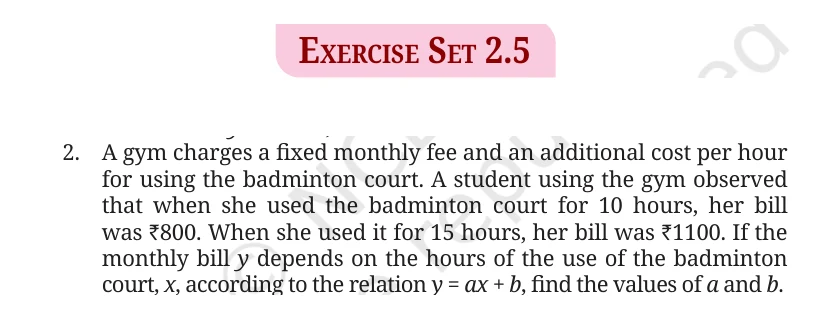
Exercise Set 2.5, 2: Find a and b for the gym bill y=ax+b.
Show detailed solution
- Step 1: The two bills give 800=10a+b and 1100=15a+b.
- Step 2: Subtract: 300=5a, hence a=60.
- Step 3: Use the first equation: 800=600+b, so b=200.
- Answer: a=60, b=200, and y=60x+200.
Textbook page 27 · solved item 65
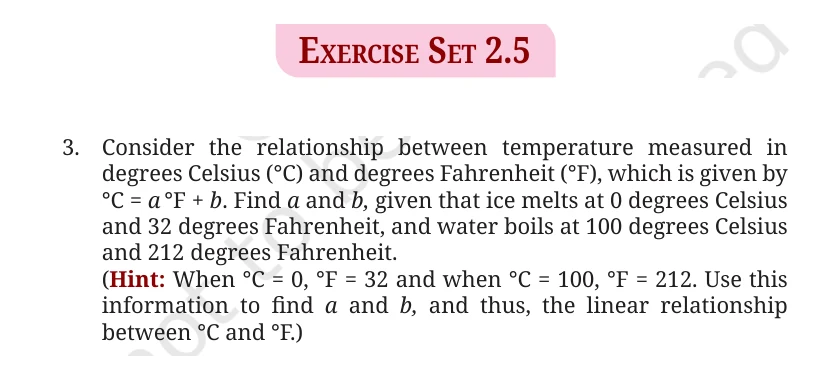
Exercise Set 2.5, 3: Find the linear relation C=aF+b between Celsius and Fahrenheit.
Show detailed solution
- Step 1: Use the points (F,C)=(32,0) and (212,100).
- Step 2: a=(100-0)/(212-32)=100/180=5/9.
- Step 3: From 0=(5/9)(32)+b, obtain b=-160/9.
- Answer: C=(5/9)F-160/9=(5/9)(F-32).
Detailed worked answers
Textbook page 28
Textbook page 28 · solved item 66
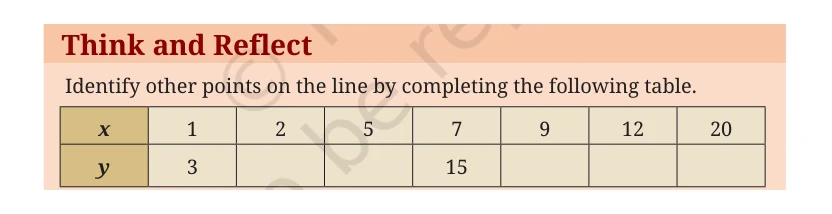
Think and Reflect table: Find y when x=2 on y=2x+1.
Show detailed solution
- Step 1: Substitute x=2 into y=2x+1.
- Step 2: y=2(2)+1=4+1.
- Answer: y=5.
Textbook page 28 · solved item 67
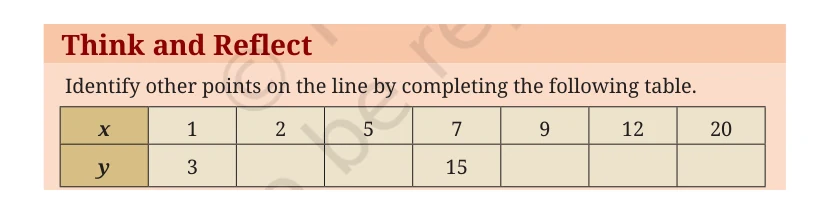
Think and Reflect table: Find y when x=5 on y=2x+1.
Show detailed solution
- Step 1: Substitute x=5.
- Step 2: y=2(5)+1=10+1.
- Answer: y=11.
Textbook page 28 · solved item 68
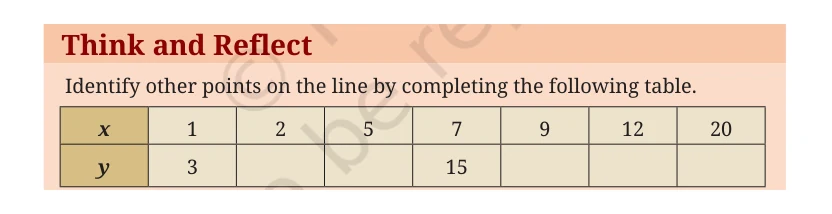
Think and Reflect table: Find y when x=9 on y=2x+1.
Show detailed solution
- Step 1: Substitute x=9.
- Step 2: y=2(9)+1=18+1.
- Answer: y=19.
Textbook page 28 · solved item 69
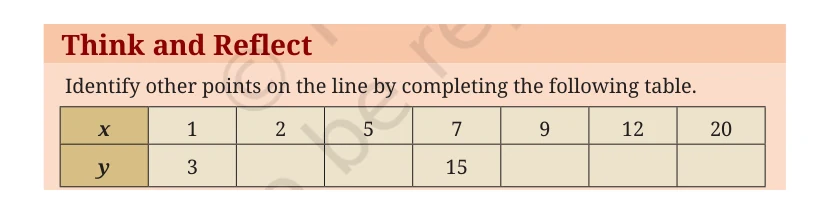
Think and Reflect table: Find y when x=12 on y=2x+1.
Show detailed solution
- Step 1: Substitute x=12.
- Step 2: y=2(12)+1=24+1.
- Answer: y=25.
Textbook page 28 · solved item 70
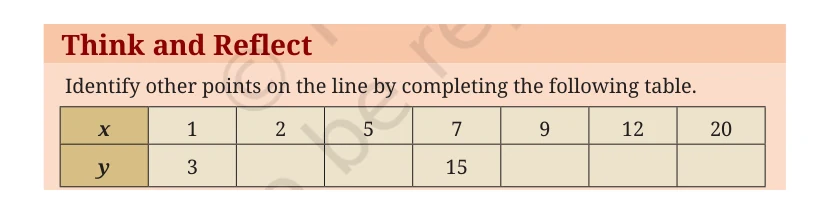
Think and Reflect table: Find y when x=20 on y=2x+1.
Show detailed solution
- Step 1: Substitute x=20.
- Step 2: y=2(20)+1=40+1.
- Answer: y=41.
Textbook page 28 · solved item 71
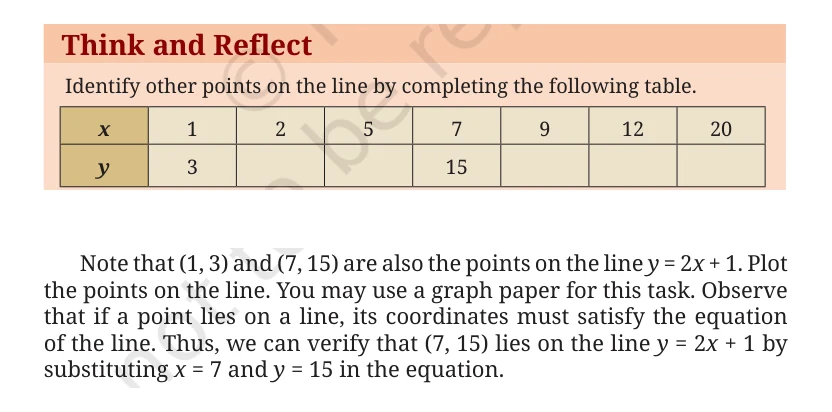
Think and Reflect: Plot the completed table points for y=2x+1.
Show detailed solution
- Step 1: The completed ordered pairs are (1,3),(2,5),(5,11),(7,15),(9,19),(12,25),(20,41).
- Step 2: Choose scales that include x=20 and y=41, then mark each pair on graph paper.
- Step 3: Join the points with a ruler; they lie on the same straight line because every pair satisfies y=2x+1.
- Answer: The plot is the straight line y=2x+1.
Textbook page 28 · solved item 72
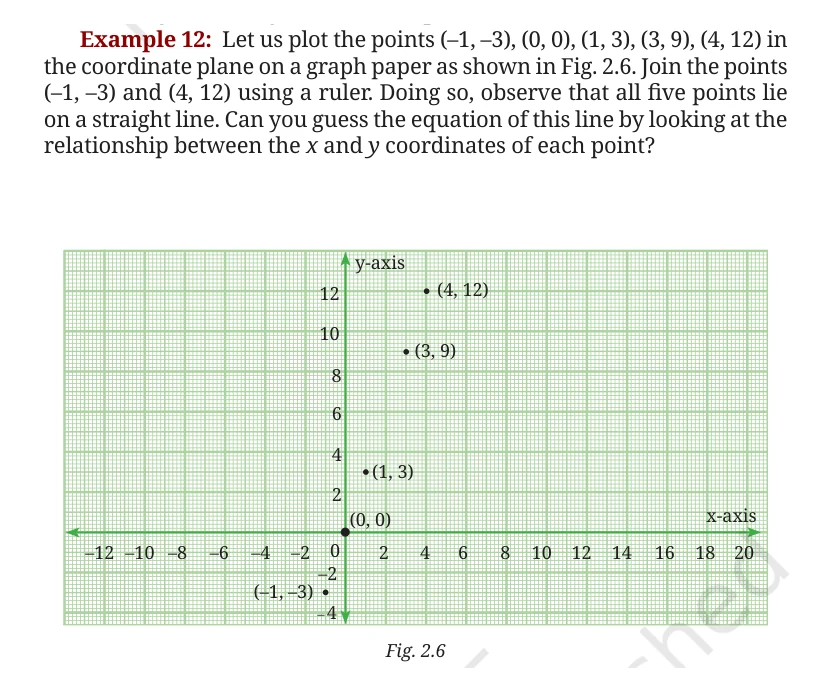
Example 12: Find the equation through (-1,-3),(0,0),(1,3),(3,9),(4,12).
Show detailed solution
- Step 1: Compare each coordinate pair: in every case the y-coordinate is three times the x-coordinate.
- Step 2: This gives the rule y=3x.
- Step 3: Substitution checks all five points, for example 3(4)=12 and 3(-1)=-3.
- Answer: The equation is y=3x.
Detailed worked answers
Textbook page 29
Textbook page 29 · solved item 73
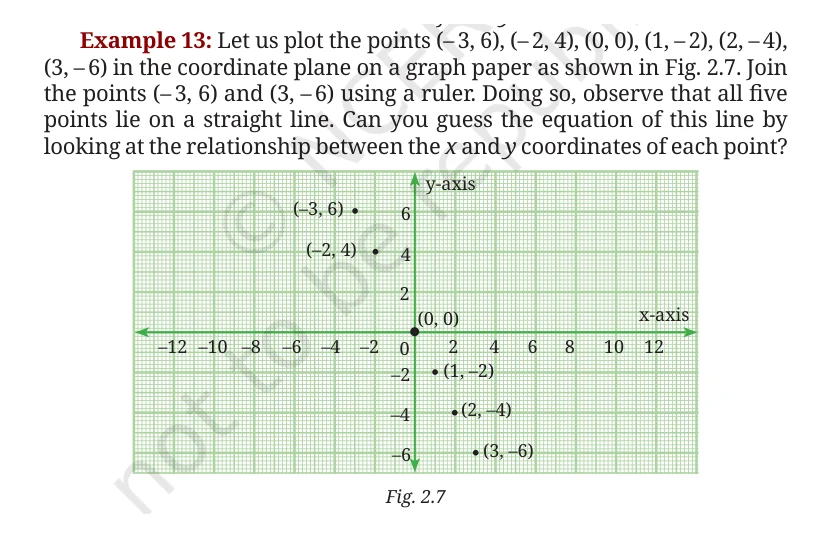
Example 13: Find the equation through the plotted points (-3,6),(-2,4),(0,0),(1,-2),(2,-4),(3,-6).
Show detailed solution
- Step 1: For each point, the y-coordinate is -2 times the x-coordinate.
- Step 2: Therefore the relationship is y=-2x.
- Step 3: Check, for example, -2(-3)=6 and -2(3)=-6.
- Answer: The equation is y=-2x.
Textbook page 29 · solved item 74
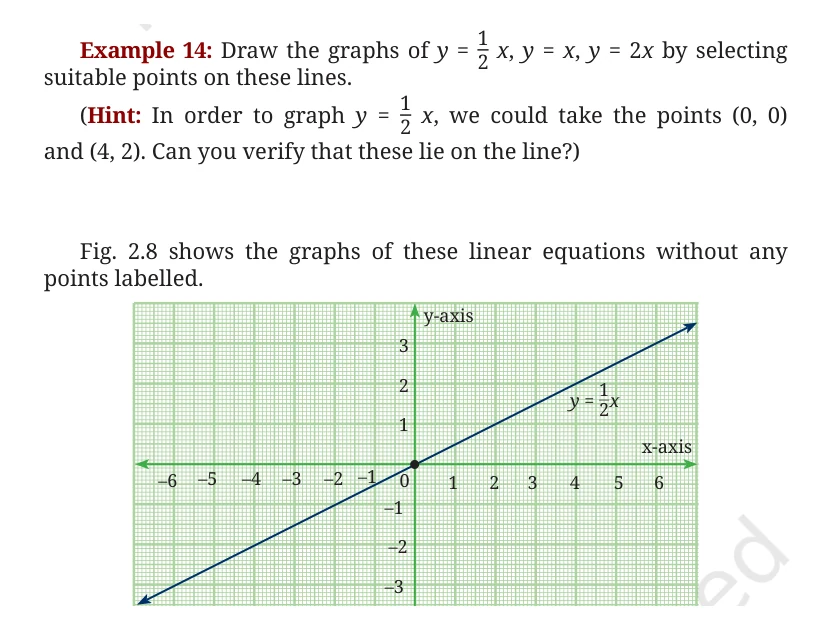
Example 14: Draw the graph of y=\frac12x using suitable points.
Show detailed solution
- Step 1: Choose even x-values so the y-values are integers, for example x=-2,0,2,4.
- Step 2: The corresponding points are (-2,-1),(0,0),(2,1),(4,2).
- Step 3: Plot the points and join them with a straight line through the origin.
- Answer: The line has slope 1/2 and passes through (0,0).
Textbook page 29 · solved item 75
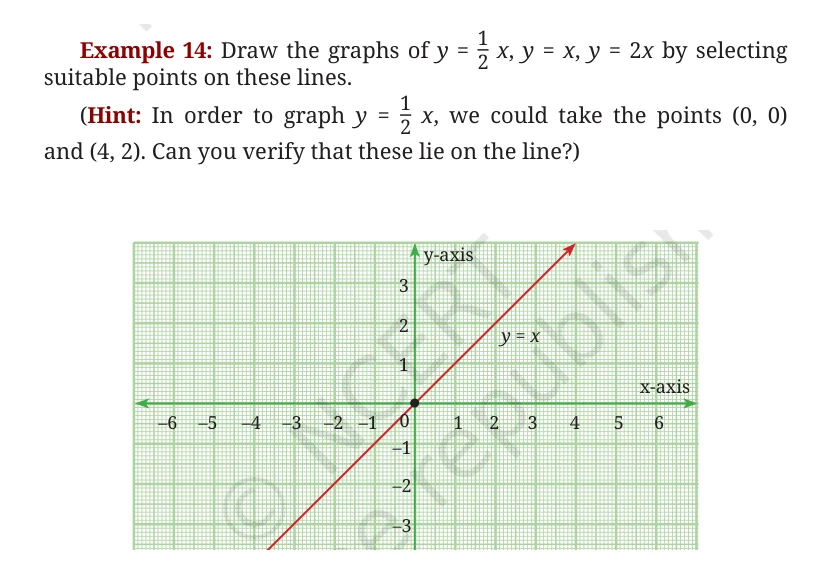
Example 14: Draw the graph of y=x using suitable points.
Show detailed solution
- Step 1: Choose x=-2,0,2.
- Step 2: Since y=x, the points are (-2,-2),(0,0),(2,2).
- Step 3: Plot and join them to obtain a straight line equally inclined to both axes.
- Answer: The line has slope 1 and passes through the origin.
Textbook page 29 · solved item 76
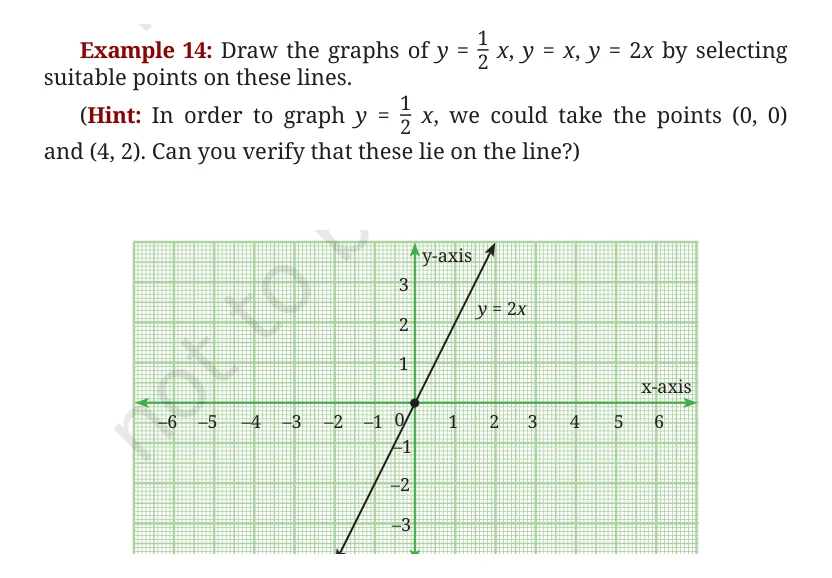
Example 14: Draw the graph of y=2x using suitable points.
Show detailed solution
- Step 1: Choose x=-1,0,1,2.
- Step 2: The corresponding points are (-1,-2),(0,0),(1,2),(2,4).
- Step 3: Plot and join them with a straight line.
- Answer: The line has slope 2, passes through the origin, and is steeper than y=x.
Detailed worked answers
Textbook page 31
Textbook page 31 · solved item 77
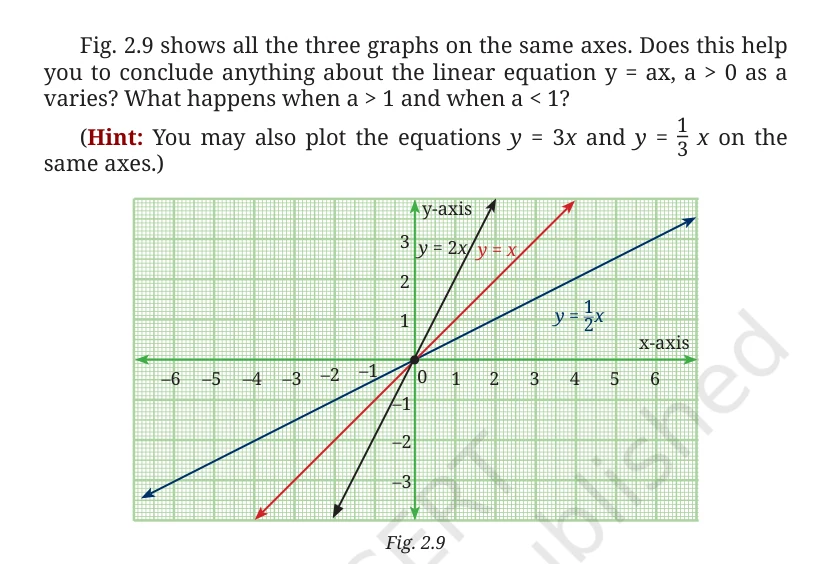
What do the graphs show about y=ax for a>0?
Show detailed solution
- Step 1: Setting x=0 gives y=0, so every such line passes through the origin.
- Step 2: Since a>0, y increases as x increases; the graph rises from left to right.
- Step 3: If a>1, the line is steeper than y=x; if 0<a<1, it is less steep. At a=1, it is y=x.
- Answer: a controls the positive slope while the intercept remains 0.
Detailed worked answers
Textbook page 33
Textbook page 33 · solved item 78
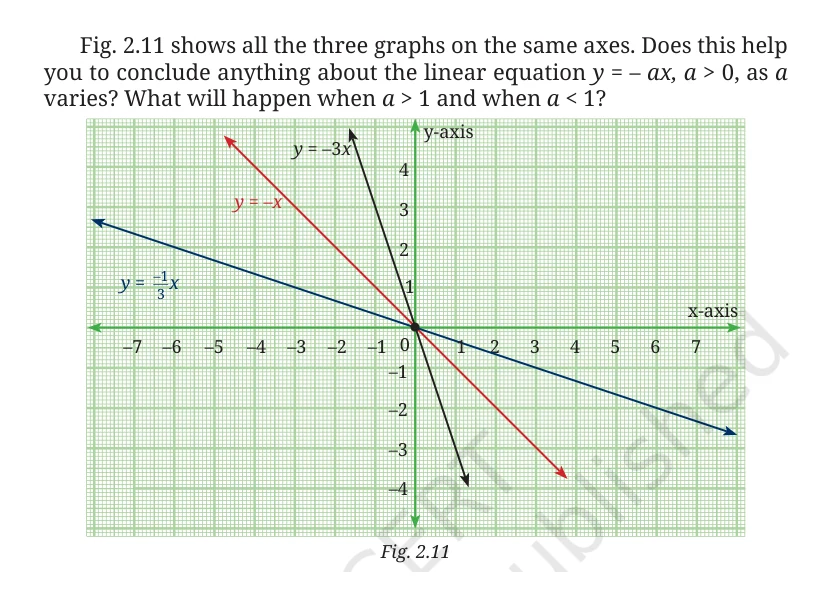
What do the graphs show about y=-ax for a>0?
Show detailed solution
- Step 1: At x=0, y=0, so every line passes through the origin.
- Step 2: The slope is -a<0, so each graph falls from left to right.
- Step 3: If a>1, its absolute slope is greater than 1 and the line is steeper than y=-x; if 0<a<1, it is less steep.
- Answer: Increasing a increases steepness while keeping a negative slope and zero intercept.
Textbook page 33 · solved item 79

Think and Reflect: Differentiate the graphs of y=3x+1 and y=-3x+1.
Show detailed solution
- Step 1: Both equations have y-intercept 1, so both pass through (0,1).
- Step 2: Their slopes are 3 and -3. The first rises; the second falls at the same steepness.
- Step 3: Replacing x by -x in 3x+1 gives -3x+1, so the graphs are reflections in the y-axis.
- Answer: Same y-intercept and steepness, opposite slope directions.
Textbook page 33 · solved item 80
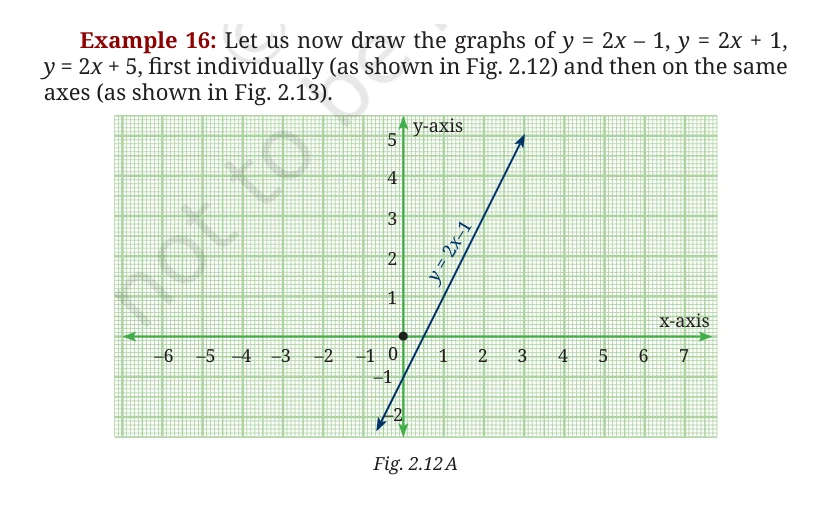
Example 16: Draw the graph of y=2x-1.
Show detailed solution
- Step 1: Choose x=0,1,2.
- Step 2: The values are y=-1,1,3, giving (0,-1),(1,1),(2,3).
- Step 3: Plot and join these points with a straight line.
- Answer: The line has slope 2 and y-intercept -1.
Textbook page 33 · solved item 81
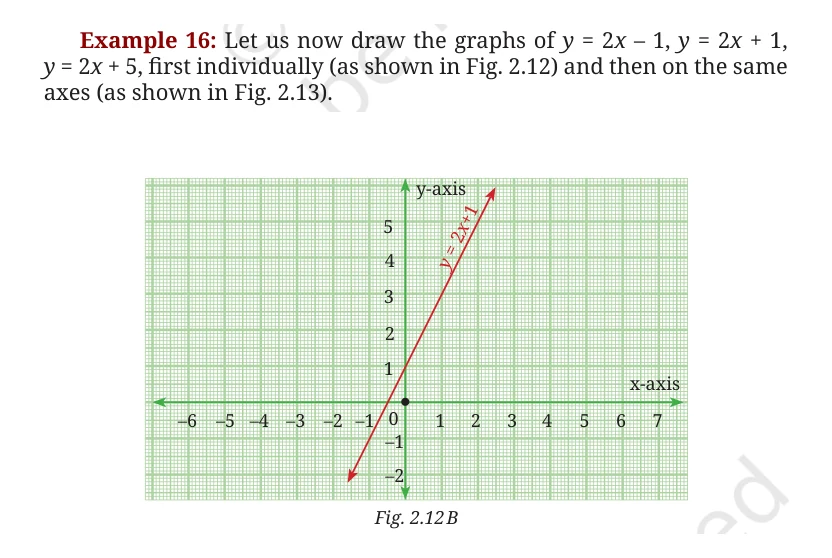
Example 16: Draw the graph of y=2x+1.
Show detailed solution
- Step 1: Choose x=0,1,2.
- Step 2: The points are (0,1),(1,3),(2,5).
- Step 3: Plot and join them; the line has the same rise of 2 for each unit moved right.
- Answer: Slope 2, y-intercept 1.
Textbook page 33 · solved item 82
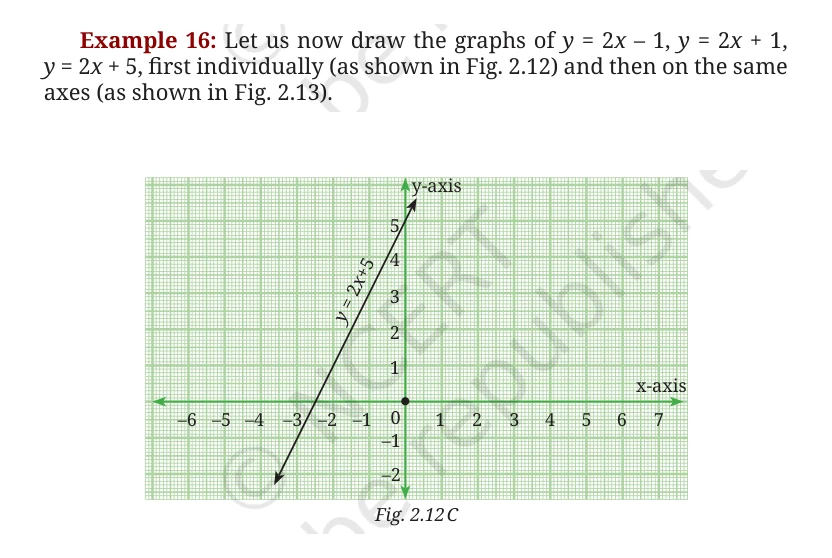
Example 16: Draw the graph of y=2x+5.
Show detailed solution
- Step 1: Choose convenient values x=-2,-1,0.
- Step 2: The corresponding points are (-2,1),(-1,3),(0,5).
- Step 3: Plot and join them; this line is parallel to the other slope-2 lines.
- Answer: Slope 2, y-intercept 5.
Detailed worked answers
Textbook page 35
Textbook page 35 · solved item 83
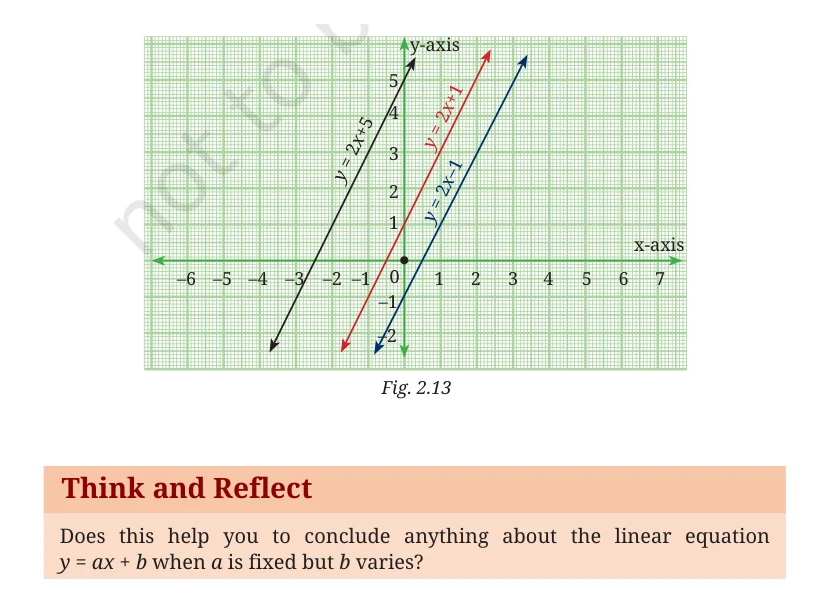
Think and Reflect: What happens to y=ax+b when a is fixed but b varies?
Show detailed solution
- Step 1: Fixing a keeps the slope unchanged.
- Step 2: Changing b changes the y-intercept from (0,b_1) to (0,b_2).
- Step 3: Lines with equal slopes and different intercepts never meet, so they are parallel vertical shifts of one another.
- Answer: The lines remain parallel while moving up or down as b changes.
Detailed worked answers
Textbook page 36
Textbook page 36 · solved item 84
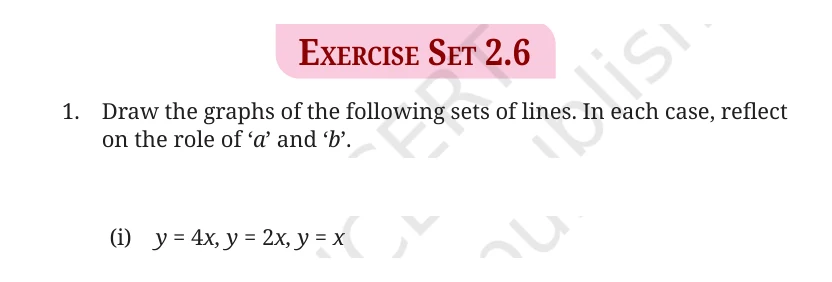
Exercise Set 2.6, 1(i): Graph y=4x,y=2x,y=x and explain the roles of a and b.
Show detailed solution
- Step 1: All three have b=0, so they pass through (0,0).
- Step 2: Plot a second point for each: (1,4), (1,2), and (1,1).
- Step 3: Their slopes are 4,2,1; larger positive a makes the line steeper.
- Answer: Same y-intercept 0, different positive slopes.
Textbook page 36 · solved item 85
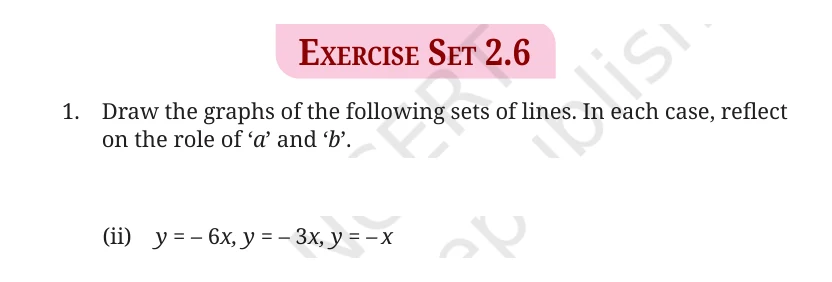
Exercise Set 2.6, 1(ii): Graph y=-6x,y=-3x,y=-x and explain a and b.
Show detailed solution
- Step 1: Here b=0 for every line, so all pass through the origin.
- Step 2: Use second points (1,-6),(1,-3),(1,-1).
- Step 3: Slopes are -6,-3,-1; each line falls, and a larger absolute value makes it steeper.
- Answer: Same intercept 0, different negative slopes.
Textbook page 36 · solved item 86
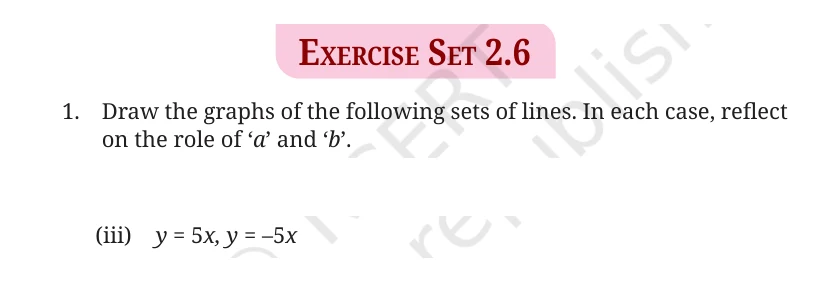
Exercise Set 2.6, 1(iii): Graph y=5x and y=-5x and compare them.
Show detailed solution
- Step 1: Both have b=0, so both contain (0,0).
- Step 2: Plot (1,5) for y=5x and (1,-5) for y=-5x.
- Step 3: Their slopes have equal magnitude and opposite signs, so the graphs are mirror images in the x-axis or y-axis.
- Answer: Same intercept and steepness; one rises and the other falls.
Textbook page 36 · solved item 87
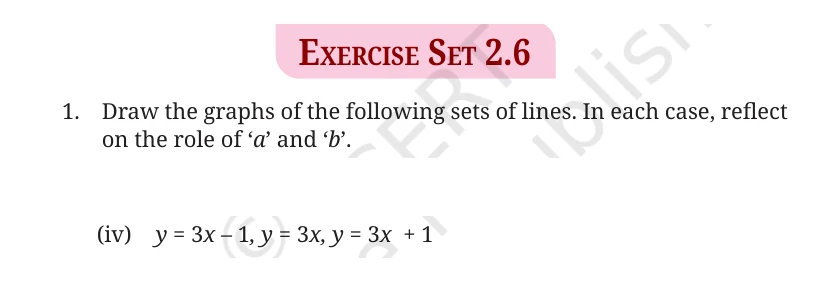
Exercise Set 2.6, 1(iv): Graph y=3x-1,y=3x,y=3x+1 and explain a and b.
Show detailed solution
- Step 1: Each equation has slope a=3.
- Step 2: Their y-intercepts are -1,0,1, giving points (0,-1),(0,0),(0,1).
- Step 3: Equal slopes and different intercepts produce three parallel lines.
- Answer: a fixes the slope; changing b shifts the line vertically.
Textbook page 36 · solved item 88
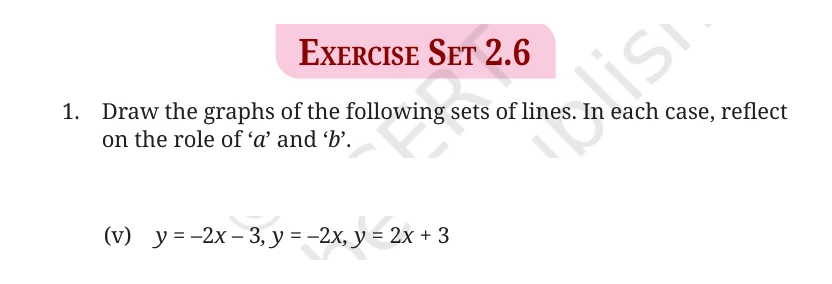
Exercise Set 2.6, 1(v): Graph y=-2x-3,y=-2x,y=2x+3 and explain a and b.
Show detailed solution
- Step 1: The first two lines have slope -2, with intercepts -3 and 0; they are parallel.
- Step 2: The third has slope 2 and intercept 3, so it rises instead of falling.
- Step 3: Useful pairs are (0,-3),(1,-5); (0,0),(1,-2); and (0,3),(1,5).
- Answer: Both a and b vary; only the first two graphs are parallel.
Textbook page 36 · solved item 89
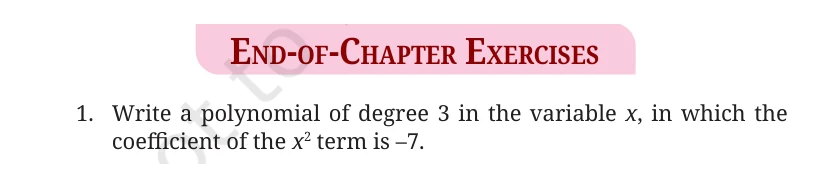
End-of-Chapter Exercise 1: Write a degree-3 polynomial in x whose x^2 coefficient is -7.
Show detailed solution
- Step 1: Include a non-zero cubic term so the degree is 3, for example x^3.
- Step 2: Include the required term -7x^2.
- Step 3: Lower-degree terms may be chosen freely; take +2.
- Answer: One valid polynomial is x^3-7x^2+2.
Textbook page 36 · solved item 90
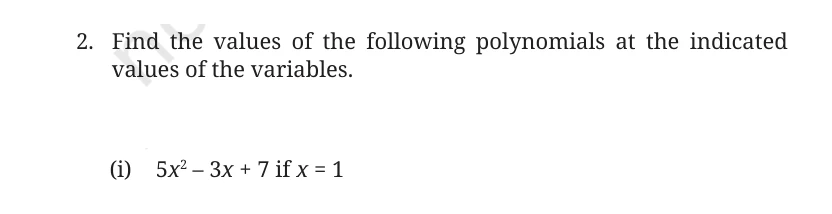
End-of-Chapter Exercise 2(i): Evaluate 5x^2-3x+7 at x=1.
Show detailed solution
- Step 1: Substitute x=1: 5(1)^2-3(1)+7.
- Step 2: Simplify: 5-3+7.
- Answer: The value is 9.
Textbook page 36 · solved item 91
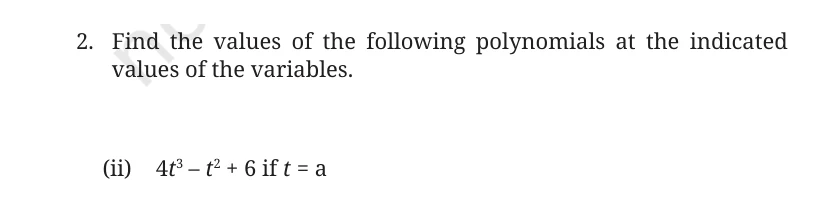
End-of-Chapter Exercise 2(ii): Evaluate 4t^3-t^2+6 at t=a.
Show detailed solution
- Step 1: Replace every occurrence of t by a.
- Step 2: This gives 4(a)^3-(a)^2+6.
- Answer: 4a^3-a^2+6.
Detailed worked answers
Textbook page 37
Textbook page 37 · solved item 92

End-of-Chapter Exercise 3: Solve \frac52x+\frac23=-\frac7{12}.
Show detailed solution
- Step 1: Subtract 2/3: (5/2)x=-7/12-8/12=-15/12=-5/4.
- Step 2: Multiply both sides by 2/5: x=(-5/4)(2/5).
- Step 3: Cancel common factors to get x=-1/2.
- Answer: The number is -\\frac12.
Textbook page 37 · solved item 93

End-of-Chapter Exercise 4: One positive number is five times another. After adding 21 to each, one becomes twice the other. Find the numbers.
Show detailed solution
- Step 1: Let the smaller positive number be x; the larger is 5x.
- Step 2: The larger new number must be twice the smaller new number: 5x+21=2(x+21).
- Step 3: 5x+21=2x+42, so 3x=21 and x=7.
- Answer: The numbers are 7 and 35.
Textbook page 37 · solved item 94

End-of-Chapter Exercise 5(i): Starting with Rs 800 and saving Rs 250 monthly, find the amount after 6 months.
Show detailed solution
- Step 1: Savings added in 6 months are 250(6)=1500 rupees.
- Step 2: Add the initial Rs 800: 800+1500.
- Answer: The amount is Rs 2300.
Textbook page 37 · solved item 95

End-of-Chapter Exercise 5(ii): Find the amount after 2 years.
Show detailed solution
- Step 1: Convert 2 years to 24 months.
- Step 2: Savings added are 250(24)=6000 rupees.
- Step 3: Add Rs 800: 800+6000=6800.
- Answer: The amount is Rs 6800.
Textbook page 37 · solved item 96

End-of-Chapter Exercise 5: Express the savings amount as a linear pattern.
Show detailed solution
- Step 1: At month 0, the amount is Rs 800.
- Step 2: Each month contributes Rs 250, so m months contribute Rs 250m.
- Step 3: Combine the starting amount and monthly savings.
- Answer: A_m=800+250m rupees.
Textbook page 37 · solved item 97

End-of-Chapter Exercise 6: The digits of a two-digit number differ by 3, and the number plus its reverse is 143. Find both numbers.
Show detailed solution
- Step 1: Let the digits be a and b. The number and reverse sum to (10a+b)+(10b+a)=11(a+b)=143.
- Step 2: Thus a+b=13, and the condition gives |a-b|=3.
- Step 3: Solving gives the digit pair 8,5. Either digit can be in the tens place.
- Answer: The two numbers are 85 and 58.
Textbook page 37 · solved item 98
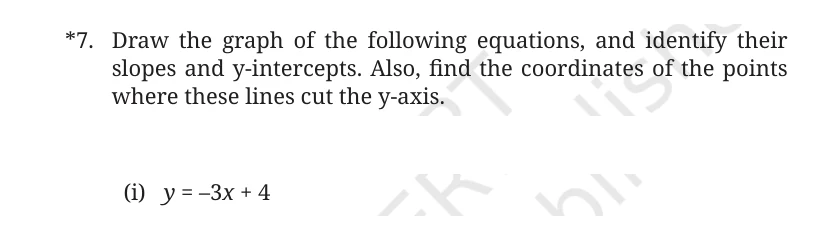
End-of-Chapter Exercise 7(i): Graph y=-3x+4, and identify its slope, y-intercept, and y-axis point.
Show detailed solution
- Step 1: Compare with y=ax+b: a=-3, b=4.
- Step 2: The y-axis point is (0,4). Another point is (1,1).
- Step 3: Plot these points and join them with a straight line.
- Answer: Slope -3, y-intercept 4, y-axis point (0,4).
Textbook page 37 · solved item 99
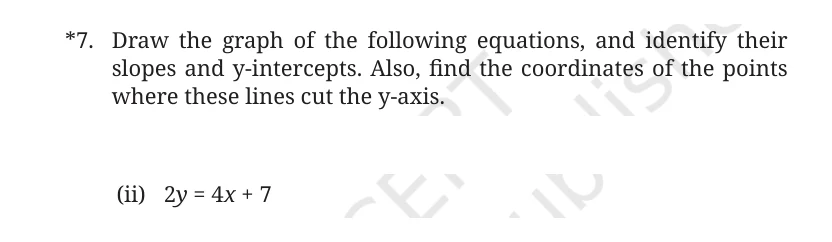
End-of-Chapter Exercise 7(ii): Analyse and graph 2y=4x+7.
Show detailed solution
- Step 1: Divide by 2: y=2x+7/2.
- Step 2: Thus slope is 2, y-intercept is 7/2, and the y-axis point is (0,7/2).
- Step 3: A second point is (1,11/2); plot and join the two points.
- Answer: Slope 2, y-intercept 7/2, point (0,7/2).
Textbook page 37 · solved item 100
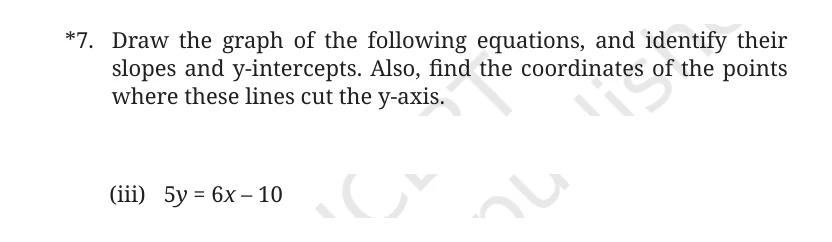
End-of-Chapter Exercise 7(iii): Analyse and graph 5y=6x-10.
Show detailed solution
- Step 1: Divide by 5: y=(6/5)x-2.
- Step 2: Slope is 6/5, y-intercept is -2, and the y-axis point is (0,-2).
- Step 3: Use (5,4) as a convenient second point and draw the line.
- Answer: Slope 6/5, y-intercept -2, point (0,-2).
Textbook page 37 · solved item 101
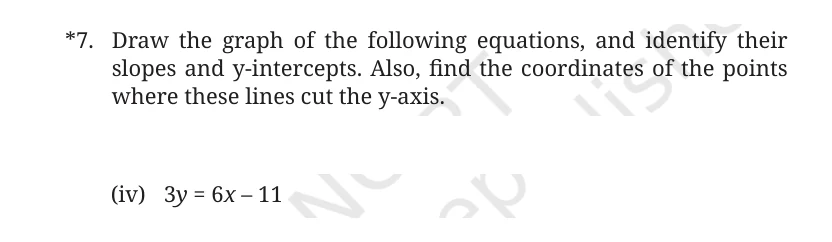
End-of-Chapter Exercise 7(iv): Analyse and graph 3y=6x-11.
Show detailed solution
- Step 1: Divide by 3: y=2x-11/3.
- Step 2: Slope is 2, y-intercept is -11/3, and the y-axis point is (0,-11/3).
- Step 3: Use another point such as (1,-5/3), then draw the line.
- Answer: Slope 2, y-intercept -11/3, point (0,-11/3).
Textbook page 37 · solved item 102
End-of-Chapter Exercise 7: Are any of the four lines parallel?
Show detailed solution
- Step 1: Parallel non-identical lines have equal slopes.
- Step 2: The four slopes are -3,2,6/5,2.
- Step 3: Only equations (ii) and (iv) share slope 2, and their intercepts differ.
- Answer: Yes. 2y=4x+7 and 3y=6x-11 are parallel.
Textbook page 37 · solved item 103
End-of-Chapter Exercise 8(i): Convert 313 K to degrees Fahrenheit using the given equation.
Show detailed solution
- Step 1: Substitute x=313 in y=(9/5)(x-273)+32.
- Step 2: x-273=40, so (9/5)(40)=72.
- Step 3: Add 32: 72+32=104.
- Answer: 313\text{ K}=104^\\circ\text{F}.
Textbook page 37 · solved item 104
End-of-Chapter Exercise 8(ii): Convert 158^\circ\text{F} to Kelvin using the given equation.
Show detailed solution
- Step 1: Put y=158: 158=(9/5)(x-273)+32.
- Step 2: Subtract 32: 126=(9/5)(x-273).
- Step 3: Multiply by 5/9: x-273=70, so x=343.
- Answer: 158^\\circ\text{F}=343\text{ K}.
Textbook page 37 · solved item 105
End-of-Chapter Exercise 9: Model work for force 3, draw the graph, and find the work at distance 2.
Show detailed solution
- Step 1: Work equals force times distance. With constant force 3, w=3d.
- Step 2: Plot points such as (d,w)=(0,0),(1,3),(2,6) and join them to form a straight line.
- Step 3: At d=2, w=3(2)=6; the graph contains (2,6), verifying the result.
- Answer: w=3d, and the work at distance 2 is 6 units.
Detailed worked answers
Textbook page 38
Textbook page 38 · solved item 106
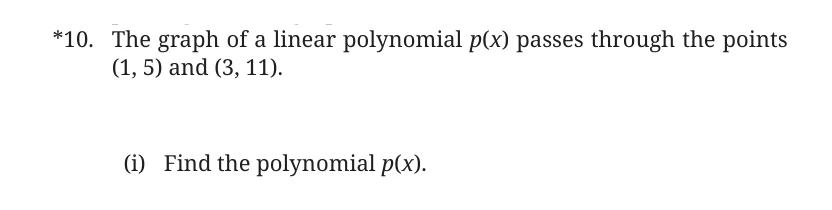
End-of-Chapter Exercise 10(i): Find the linear polynomial through (1,5) and (3,11).
Show detailed solution
- Step 1: Let p(x)=ax+b. The slope is a=(11-5)/(3-1)=6/2=3.
- Step 2: Use (1,5): 5=3(1)+b, so b=2.
- Step 3: Check p(3)=9+2=11.
- Answer: p(x)=3x+2.
Textbook page 38 · solved item 107
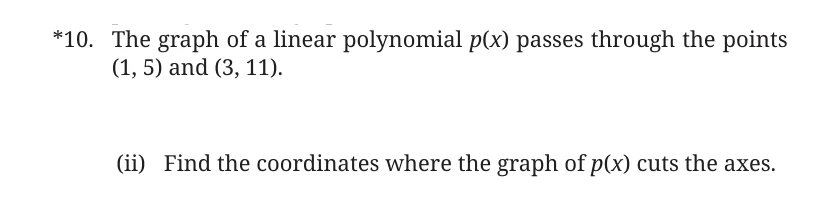
End-of-Chapter Exercise 10(ii): Find where the graph of p(x) cuts both axes.
Show detailed solution
- Step 1: From part (i), p(x)=3x+2. At x=0, y=2, so the y-intercept is (0,2).
- Step 2: On the x-axis, y=0: 3x+2=0.
- Step 3: Thus x=-2/3, giving (-2/3,0).
- Answer: x-axis (-2/3,0); y-axis (0,2).
Textbook page 38 · solved item 108
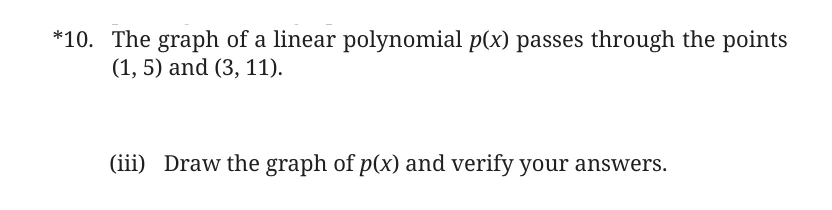
End-of-Chapter Exercise 10(iii): Draw the graph of p(x) and verify the answers.
Show detailed solution
- Step 1: Plot the given points (1,5) and (3,11).
- Step 2: Also plot the intercepts (0,2) and (-2/3,0), then draw one straight line through them.
- Step 3: Every plotted point satisfies y=3x+2, verifying the polynomial and intercepts.
- Answer: The graph is the straight line y=3x+2.
Textbook page 38 · solved item 109
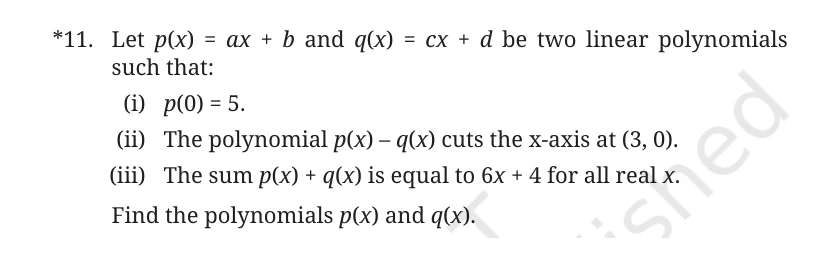
End-of-Chapter Exercise 11: Find the linear polynomials p(x) and q(x).
Show detailed solution
- Step 1: Write p=ax+b, q=cx+d. Since p(0)=5, b=5. From p+q=6x+4, obtain a+c=6 and b+d=4, so d=-1.
- Step 2: p-q=(a-c)x+(b-d)=(a-c)x+6. Its x-intercept (3,0) gives 3(a-c)+6=0, so a-c=-2.
- Step 3: Solve a+c=6 and a-c=-2: a=2, c=4.
- Answer: p(x)=2x+5 and q(x)=4x-1.
Textbook page 38 · solved item 110
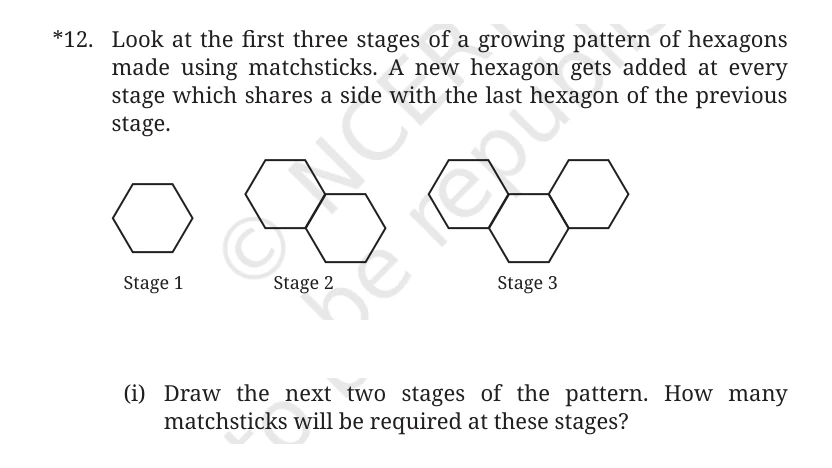
End-of-Chapter Exercise 12(i): Draw Stages 4 and 5 of the matchstick pattern and count their matchsticks.
Show detailed solution
- Step 1: Stage 1 uses 6 matchsticks.
- Step 2: Each new hexagon shares one side, so it contributes 5 new matchsticks.
- Step 3: Stage 4 uses 6+3(5)=21, and Stage 5 uses 6+4(5)=26.
- Answer: Stage 4 needs 21 and Stage 5 needs 26 matchsticks.
Textbook page 38 · solved item 111
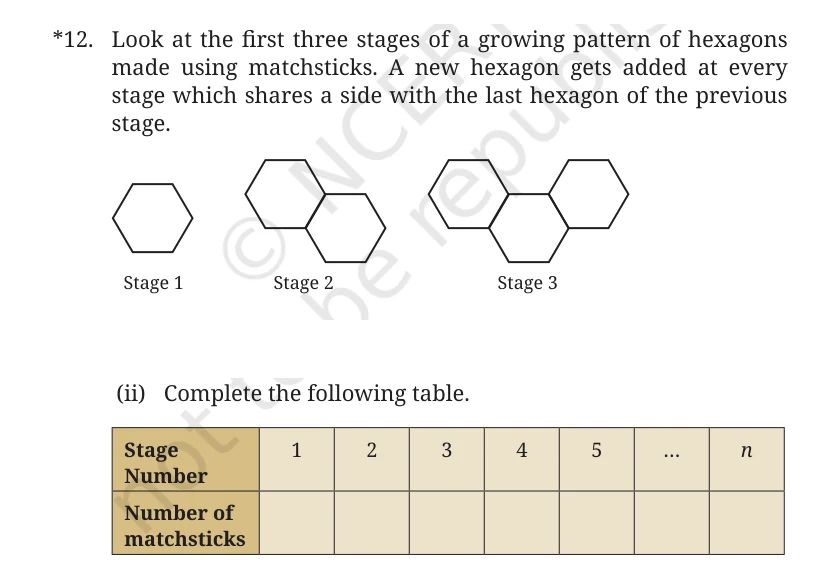
End-of-Chapter Exercise 12(ii): Complete the matchstick table through Stage 5 and for Stage n.
Show detailed solution
- Step 1: Begin with 6 at Stage 1.
- Step 2: Add 5 at each stage: 6,11,16,21,26.
- Step 3: The nth entry is 6+5(n-1)=5n+1.
- Answer: 6,11,16,21,26,\ldots,5n+1.
Textbook page 38 · solved item 112
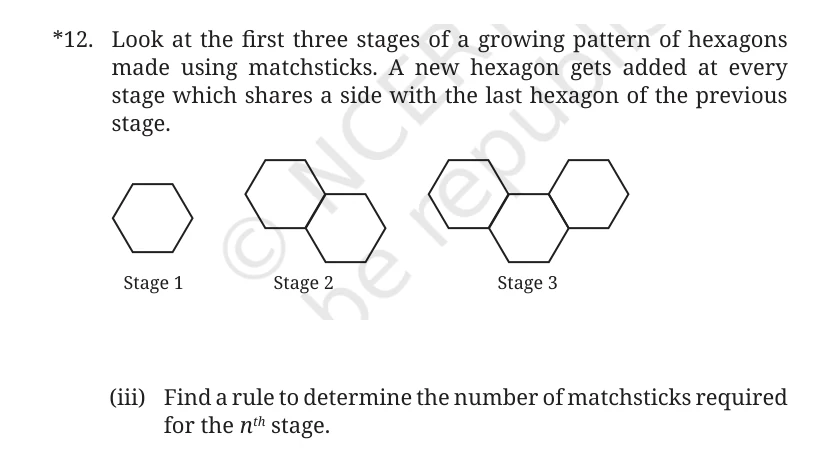
End-of-Chapter Exercise 12(iii): Find the nth-stage matchstick rule.
Show detailed solution
- Step 1: Stage 1 has 6 matchsticks.
- Step 2: The remaining n-1 hexagons each add 5, so M_n=6+5(n-1).
- Step 3: Simplify: M_n=6+5n-5=5n+1.
- Answer: M_n=5n+1.
Detailed worked answers
Textbook page 39
Textbook page 39 · solved item 113
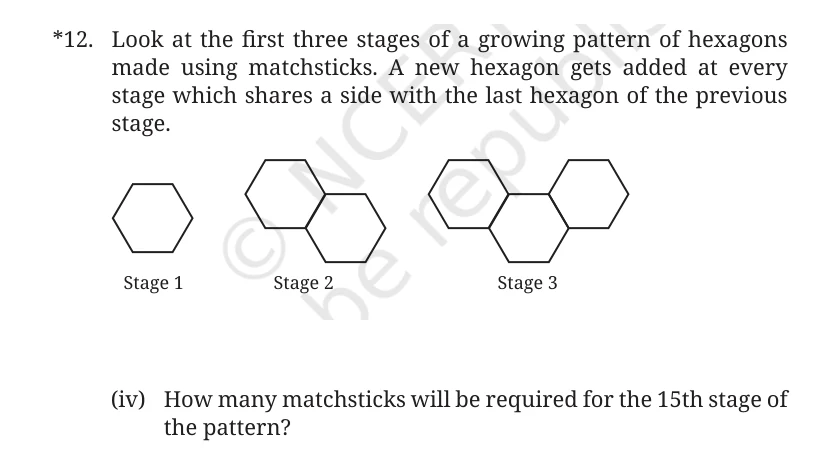
End-of-Chapter Exercise 12(iv): How many matchsticks are required for Stage 15?
Show detailed solution
- Step 1: Use M_n=5n+1.
- Step 2: M_{15}=5(15)+1=75+1.
- Answer: Stage 15 requires 76 matchsticks.
Textbook page 39 · solved item 114
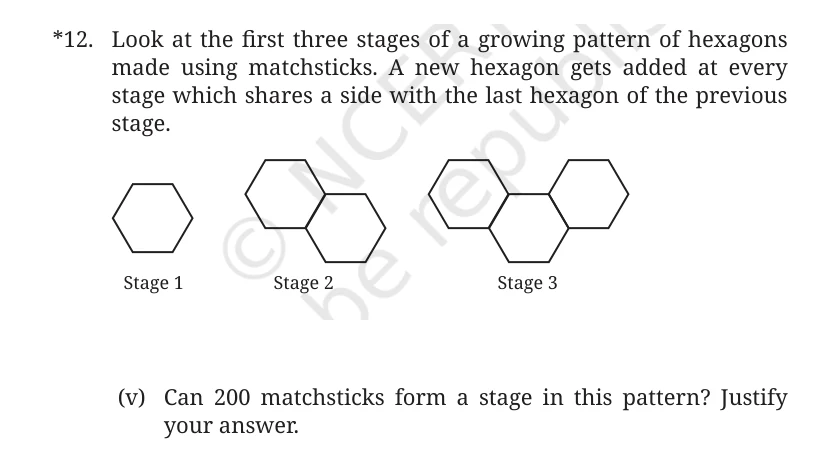
End-of-Chapter Exercise 12(v): Can 200 matchsticks form a stage in this pattern?
Show detailed solution
- Step 1: Set 5n+1=200.
- Step 2: Then 5n=199, so n=199/5=39.8.
- Step 3: A stage number must be a positive integer; equivalently, every valid count is 1 more than a multiple of 5, but 200 is not.
- Answer: No, 200 matchsticks cannot form a complete stage.
Textbook page 39 · solved item 115
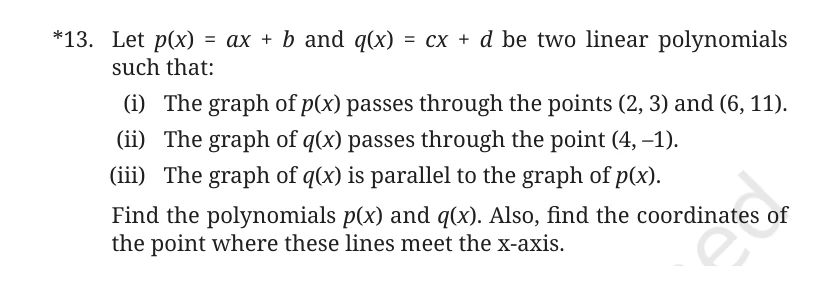
End-of-Chapter Exercise 13: Find p(x), q(x), and both x-axis intercepts.
Show detailed solution
- Step 1: For p, slope a=(11-3)/(6-2)=2. Using (2,3), 3=2(2)+b, so p(x)=2x-1.
- Step 2: A parallel q has slope 2. Since it passes through (4,-1), -1=2(4)+d, so q(x)=2x-9.
- Step 3: Set each polynomial to zero: 2x-1=0 gives (1/2,0); 2x-9=0 gives (9/2,0).
- Answer: p(x)=2x-1, q(x)=2x-9; x-intercepts (1/2,0) and (9/2,0).
Textbook page 39 · solved item 116

End-of-Chapter Exercise 14: What do all functions f(x)=ax+a, a>0, have in common?
Show detailed solution
- Step 1: Factor: f(x)=a(x+1).
- Step 2: At x=-1, f(-1)=a(0)=0, regardless of the positive value of a.
- Step 3: Therefore every graph passes through the fixed point (-1,0). Each also has slope a and y-intercept a.
- Answer: All the lines share the x-intercept (-1,0).