
Question-by-question working
Read the prompt, attempt it, then check each step
Every exercise subpart and table row is a separate item. Shared figures are repeated in the crop whenever they are needed to understand that question.
Detailed worked answers
Textbook page 156
Textbook page 156 · solved item 1
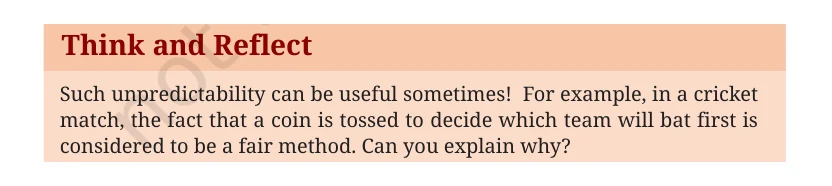
Think and Reflect: Why is a coin toss a fair way to decide which cricket team bats first?
Show detailed solution
- Step 1: A fair coin has two possible outcomes, heads and tails.
- Step 2: Symmetry gives each outcome probability 1/2, so neither team is favoured.
- Step 3: The result cannot be chosen in advance when the toss is performed openly and without interference.
- Answer: Assigning one team to each side gives both teams an equal, unpredictable chance. The method is fair only if the coin and tossing procedure are unbiased.
Detailed worked answers
Textbook page 157
Textbook page 157 · solved item 2
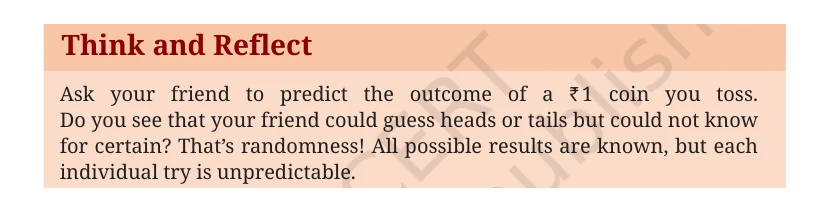
Think and Reflect: Ask a friend to predict a one-rupee coin toss. What does the activity show about randomness?
Show detailed solution
- Step 1: Before the toss, the known sample space is S=\{H,T\}.
- Step 2: Your friend may guess either result, but the exact result cannot be known beforehand.
- Step 3: A correct guess does not prove prediction; it is one possible outcome occurring by chance.
- Answer: Randomness means all possible outcomes are known while the outcome of an individual fair toss remains unpredictable.
Detailed worked answers
Textbook page 159
Textbook page 159 · solved item 3
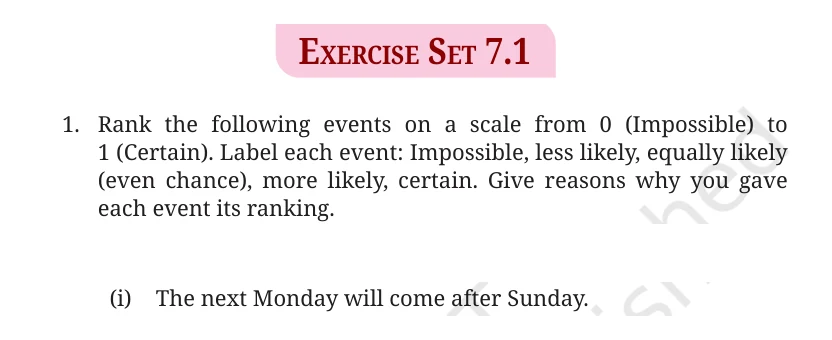
Exercise 7.1, 1(i): Rank the event that the next Monday will come after Sunday.
Show detailed solution
- Step 1: In the standard calendar, every Sunday is followed by Monday.
- Step 2: There is no random choice among alternative weekdays in this statement.
- Step 3: A certain event has probability 1.
- Answer: Certain; place it at 1 on the probability scale.
Textbook page 159 · solved item 4
Exercise 7.1, 1(ii): Rank the event that it will snow in Mumbai in July.
Show detailed solution
- Step 1: Mumbai in July is warm and humid, with monsoon rain rather than freezing surface conditions.
- Step 2: Ordinary snowfall requires temperatures and atmospheric conditions that Mumbai does not normally have.
- Step 3: For this classroom probability scale, the event is treated as having probability 0 under normal conditions.
- Answer: Impossible in the intended everyday model; place it at 0. In a scientific model, one could instead say extraordinarily unlikely rather than logically impossible.
Textbook page 159 · solved item 5
Exercise 7.1, 1(iii): Rank the event that an elephant will walk through your classroom today.
Show detailed solution
- Step 1: Elephants do not normally enter school classrooms.
- Step 2: A specially arranged visit is conceivable, so the event is not a logical impossibility.
- Step 3: Its likelihood is therefore very close to 0 but not equal to 0 in an unrestricted real-world model.
- Answer: Less likely; place it near 0 and explain the assumptions about an ordinary school day.
Textbook page 159 · solved item 6
Exercise 7.1, 1(iv): Rank the event that you will greet at least one friend at school tomorrow.
Show detailed solution
- Step 1: On a normal school day, you are likely to meet at least one friend.
- Step 2: Absence, a school closure, or another unusual circumstance could prevent it.
- Step 3: The probability should therefore be above 1/2 but below 1.
- Answer: More likely, but not certain; place it between 0.5 and 1.
Detailed worked answers
Textbook page 163
Textbook page 163 · solved item 7
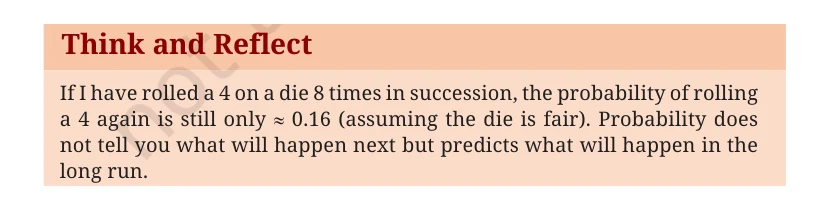
Think and Reflect: After rolling a 4 eight times in a row, what is the probability of rolling a 4 again on a fair die?
Show detailed solution
- Step 1: Each fair-die roll is independent, so earlier rolls do not alter the next roll.
- Step 2: Only one of the six equally likely faces shows 4.
- Step 3: Therefore P(4)=1/6\approx0.1667, or about 16.7\%.
- Answer: The probability is still 1/6. A long streak does not make another 4 either due or forbidden.
Detailed worked answers
Textbook page 165
Textbook page 165 · solved item 8
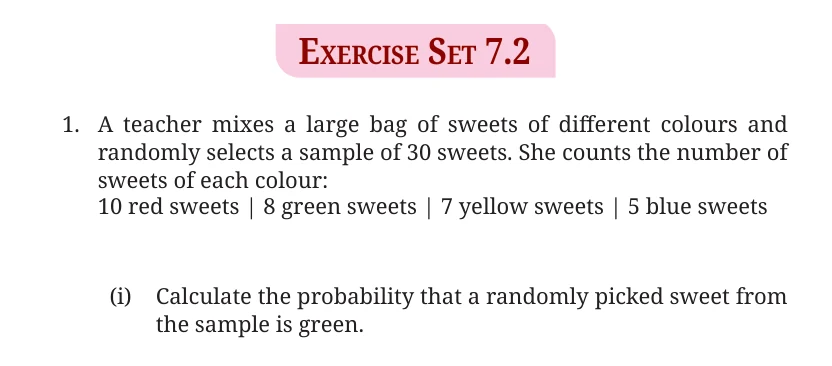
Exercise 7.2, 1(i): Find the probability that a randomly picked sweet from the sample is green.
Show detailed solution
- Step 1: The sample contains 30 sweets in total.
- Step 2: Eight of them are green, so there are 8 favourable observed outcomes.
- Step 3: Experimental probability =8/30=4/15\approx0.267.
- Answer: P(\text{green})=4/15, about 26.7\%.
Textbook page 165 · solved item 9
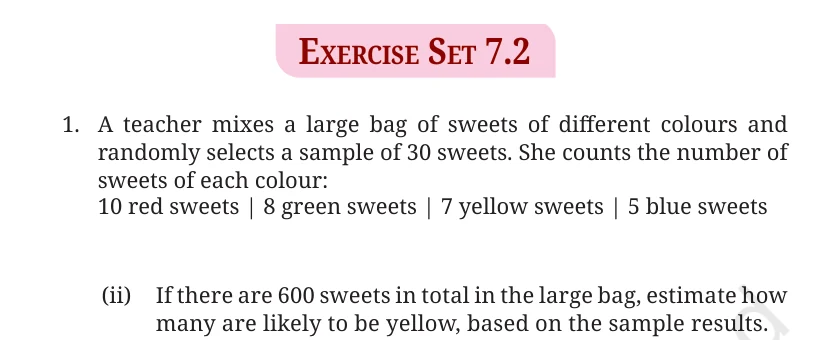
Exercise 7.2, 1(ii): Estimate how many of 600 sweets are yellow from the sample results.
Show detailed solution
- Step 1: Seven of the 30 sampled sweets are yellow.
- Step 2: Estimate the yellow proportion as 7/30.
- Step 3: Apply it to 600 sweets: (7/30)\times600=7\times20=140.
- Answer: About 140 sweets are likely to be yellow, assuming the sample represents the bag.
Textbook page 165 · solved item 10
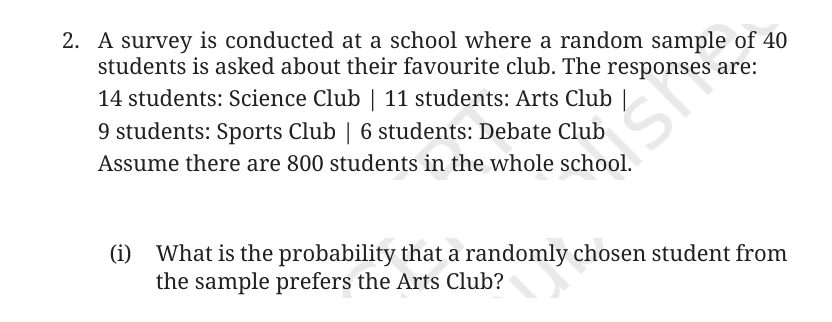
Exercise 7.2, 2(i): Find the probability that a sampled student prefers the Arts Club.
Show detailed solution
- Step 1: The sample size is 40 students.
- Step 2: Eleven students chose the Arts Club.
- Step 3: Experimental probability =11/40=0.275.
- Answer: P(\text{Arts})=11/40=27.5\%.
Textbook page 165 · solved item 11
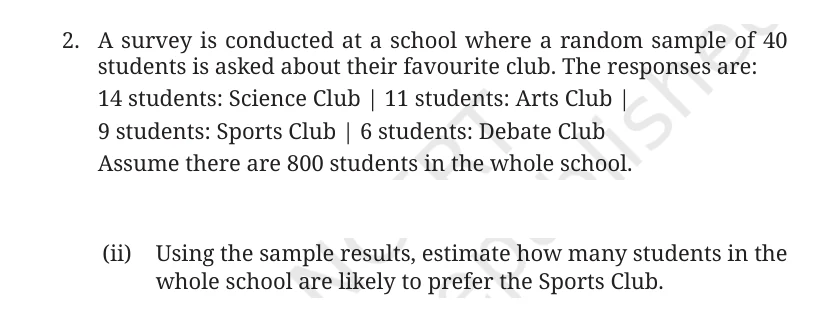
Exercise 7.2, 2(ii): Estimate how many of 800 students prefer the Sports Club.
Show detailed solution
- Step 1: Nine of the 40 sampled students chose the Sports Club.
- Step 2: The estimated proportion is 9/40=0.225.
- Step 3: Estimated school count =(9/40)\times800=9\times20=180.
- Answer: About 180 students, assuming the sample is representative.
Textbook page 165 · solved item 12

Exercise 7.2, 3(i): Toss a coin 20 times. How many heads did you get?
Show detailed solution
- Step 1: Perform 20 independent tosses and record H or T after each toss.
- Step 2: Count the entries marked H; call this observed count h.
- Step 3: Check that 0\le h\le20.
- Answer: The answer is your observed value h; no fixed number can be known before the experiment.
Textbook page 165 · solved item 13

Exercise 7.2, 3(ii): Toss a coin 20 times. How many tails did you get?
Show detailed solution
- Step 1: Count the recorded entries marked T; call this number t.
- Step 2: Every toss is either H or T, so h+t=20.
- Step 3: Hence t=20-h, which also checks the record.
- Answer: The answer is your observed tail count t, equal to 20-h.
Textbook page 165 · solved item 14

Exercise 7.2, 3(iii): Calculate the experimental probability of heads in your 20 tosses.
Show detailed solution
- Step 1: Let h be the number of heads actually recorded.
- Step 2: The number of trials is 20.
- Step 3: Experimental probability is observed frequency divided by trials: P_{\mathrm{exp}}(H)=h/20.
- Answer: h/20, or 5h\%. Substitute your observed head count.
Textbook page 165 · solved item 15
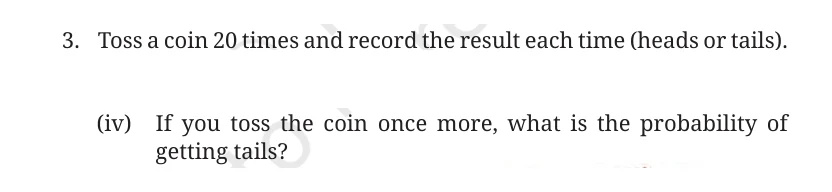
Exercise 7.2, 3(iv): If you toss the fair coin once more, what is the probability of tails?
Show detailed solution
- Step 1: The next toss is independent of the preceding 20 tosses.
- Step 2: A fair coin has two equally likely outcomes, H and T.
- Step 3: One of the two outcomes is tails, so P(T)=1/2.
- Answer: 1/2=0.5=50\%, regardless of the experimental counts so far.
Textbook page 165 · solved item 16
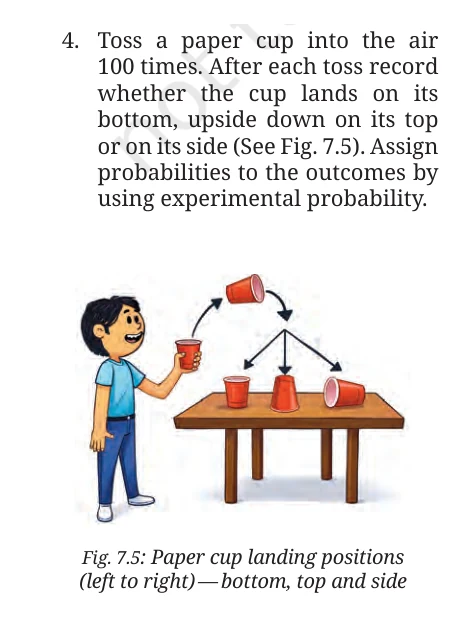
Exercise 7.2, 4: Toss a paper cup 100 times and assign experimental probabilities to bottom, top, and side landings.
Show detailed solution
- Step 1: Record each landing in exactly one category: bottom, top, or side.
- Step 2: Let the three frequencies be b,t,s. Check that b+t+s=100.
- Step 3: Calculate P_{\mathrm{exp}}(B)=b/100, P_{\mathrm{exp}}(T)=t/100, and P_{\mathrm{exp}}(S)=s/100.
- Step 4: Check that the three probabilities add to 1.
- Answer: The numerical probabilities depend on your experiment; report b/100,t/100,s/100 with the recorded counts.
Textbook page 165 · solved item 17
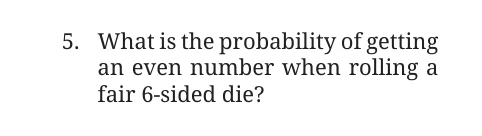
Exercise 7.2, 5: What is the probability of rolling an even number on a fair six-sided die?
Show detailed solution
- Step 1: The sample space is S=\{1,2,3,4,5,6\}, with six equally likely outcomes.
- Step 2: The even outcomes are E=\{2,4,6\}, so n(E)=3.
- Step 3: P(E)=3/6=1/2.
- Answer: 1/2=0.5=50\%.
Detailed worked answers
Textbook page 166
Textbook page 166 · solved item 18
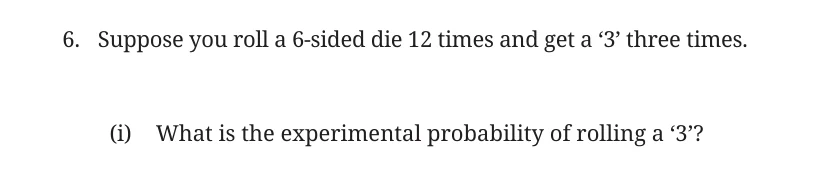
Exercise 7.2, 6(i): A 3 appeared three times in 12 die rolls. Find its experimental probability.
Show detailed solution
- Step 1: The observed frequency of 3 is 3.
- Step 2: The total number of trials is 12.
- Step 3: P_{\mathrm{exp}}(3)=3/12=1/4.
- Answer: 1/4=0.25=25\%.
Textbook page 166 · solved item 19
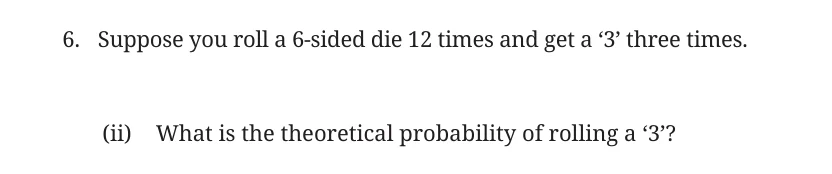
Exercise 7.2, 6(ii): Find the theoretical probability of rolling a 3 on a fair die.
Show detailed solution
- Step 1: A fair die has six equally likely faces.
- Step 2: Exactly one face shows 3.
- Step 3: P_{\mathrm{theory}}(3)=1/6.
- Answer: 1/6\approx0.1667, or about 16.7\%.
Textbook page 166 · solved item 20
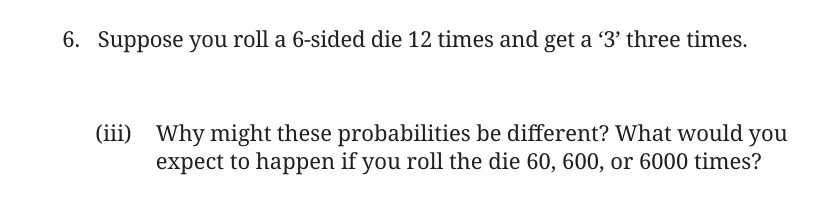
Exercise 7.2, 6(iii): Why do the experimental and theoretical probabilities differ, and what happens with more rolls?
Show detailed solution
- Step 1: Twelve rolls are a small random sample, so its relative frequency 1/4 can fluctuate away from 1/6.
- Step 2: Theoretical probability describes the long-run proportion for an ideal fair die, not a required count in every short run.
- Step 3: With 60, 600, and 6000 rolls, random variation remains, but its proportion usually becomes smaller.
- Answer: The experimental probability should tend toward 1/6 as the number of rolls grows, though exact equality is not guaranteed.
Detailed worked answers
Textbook page 167
Textbook page 167 · solved item 21
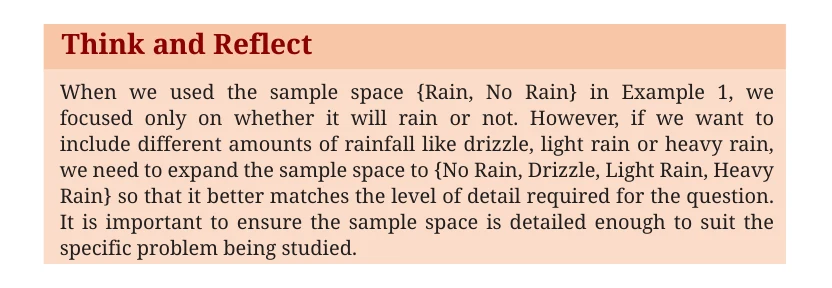
Think and Reflect: Why must the detail in a sample space match the question being studied?
Show detailed solution
- Step 1: \{\text{Rain},\text{No Rain}\} is exhaustive for a yes-or-no rain question.
- Step 2: It cannot distinguish drizzle, light rain, and heavy rain when the amount matters.
- Step 3: Then a useful sample space is \{\text{No Rain},\text{Drizzle},\text{Light Rain},\text{Heavy Rain}\}.
- Answer: Outcomes must be mutually exclusive, exhaustive, and detailed enough for the event being measured; otherwise probabilities answer a different question.
Textbook page 167 · solved item 22
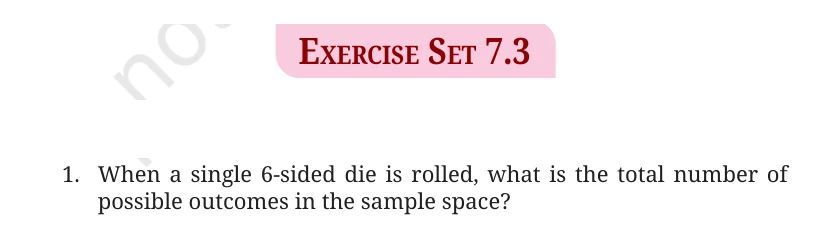
Exercise 7.3, 1: How many outcomes are in the sample space for one roll of a six-sided die?
Show detailed solution
- Step 1: List every face: S=\{1,2,3,4,5,6\}.
- Step 2: No face is omitted or repeated.
- Step 3: Count the elements: n(S)=6.
- Answer: There are 6 possible outcomes.
Textbook page 167 · solved item 23
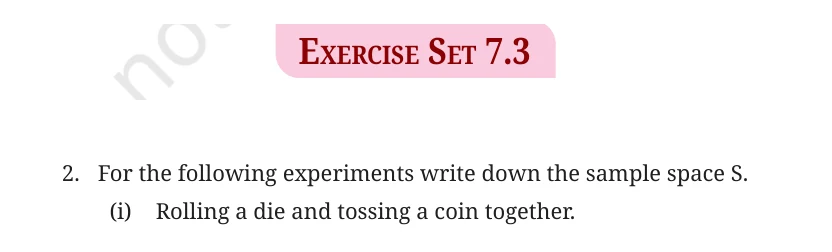
Exercise 7.3, 2(i): Write the sample space for rolling a die and tossing a coin together.
Show detailed solution
- Step 1: Pair each die result with each coin result.
- Step 2: Use ordered pairs (d,c), where d\in\{1,2,3,4,5,6\} and c\in\{H,T\}.
- Step 3: S=\{(1,H),(1,T),(2,H),(2,T),(3,H),(3,T),(4,H),(4,T),(5,H),(5,T),(6,H),(6,T)\}.
- Answer: The sample space has 6\times2=12 outcomes.
Detailed worked answers
Textbook page 168
Textbook page 168 · solved item 24
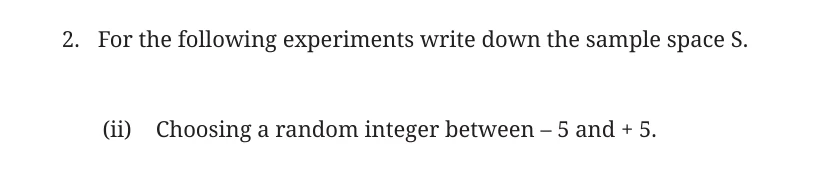
Exercise 7.3, 2(ii): Write the sample space for choosing a random integer between -5 and +5.
Show detailed solution
- Step 1: The wording must specify whether the endpoints are included.
- Step 2: If inclusive, S=\{-5,-4,-3,-2,-1,0,1,2,3,4,5\}, so n(S)=11.
- Step 3: If 'strictly between' is intended, remove the endpoints and use S=\{-4,-3,-2,-1,0,1,2,3,4\}, so n(S)=9.
- Answer: Use the inclusive 11-element set unless the teacher or question explicitly says 'strictly between'.
Textbook page 168 · solved item 25
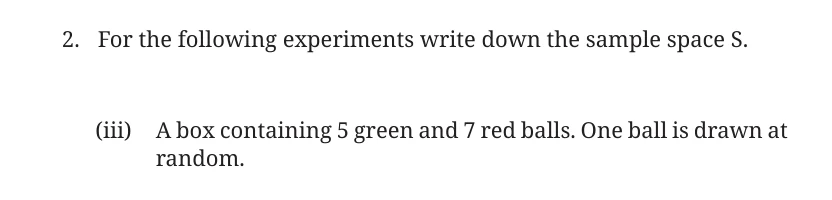
Exercise 7.3, 2(iii): Write the sample space when one ball is drawn from a box with 5 green and 7 red balls.
Show detailed solution
- Step 1: The experiment records only the colour of the selected ball.
- Step 2: The possible colour outcomes are green and red, so S=\{G,R\}.
- Step 3: The counts affect the probabilities, not the colour sample space.
- Answer: S=\{G,R\}, with P(G)=5/12 and P(R)=7/12 if probabilities are also requested.
Textbook page 168 · solved item 26
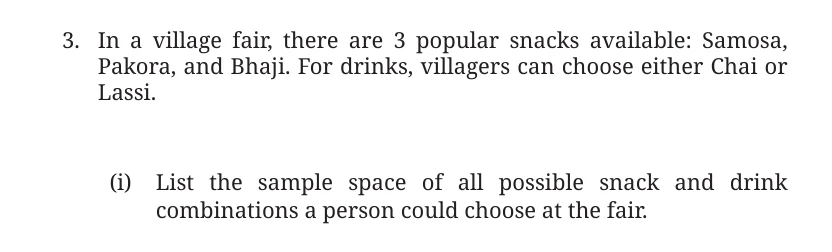
Exercise 7.3, 3(i): List all snack-and-drink combinations at the village fair.
Show detailed solution
- Step 1: There are three snack choices and two drink choices.
- Step 2: Pair every snack with Chai and with Lassi.
- Step 3: S=\{(\text{Samosa},\text{Chai}),(\text{Samosa},\text{Lassi}),(\text{Pakora},\text{Chai}),(\text{Pakora},\text{Lassi}),(\text{Bhaji},\text{Chai}),(\text{Bhaji},\text{Lassi})\}.
- Answer: The sample space contains 6 combinations.
Textbook page 168 · solved item 27
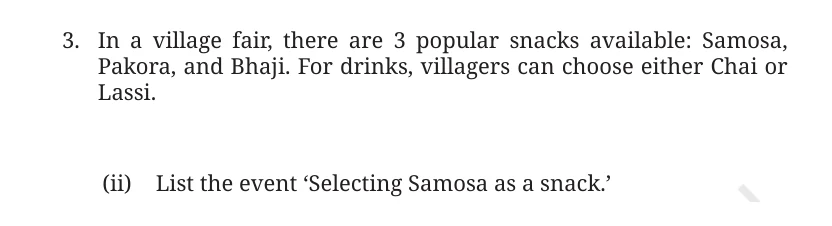
Exercise 7.3, 3(ii): List the event 'selecting Samosa as a snack.'
Show detailed solution
- Step 1: Keep only outcomes whose snack coordinate is Samosa.
- Step 2: The drink can still be either Chai or Lassi.
- Step 3: E=\{(\text{Samosa},\text{Chai}),(\text{Samosa},\text{Lassi})\}.
- Answer: The event contains 2 of the 6 sample-space outcomes.
Detailed worked answers
Textbook page 169
Textbook page 169 · solved item 28

Think and Reflect: What is the probability of getting one head and one tail in two fair coin tosses?
Show detailed solution
- Step 1: The equally likely sample space is S=\{HH,HT,TH,TT\}.
- Step 2: One head and one tail occurs in HT or TH.
- Step 3: There are 2 favourable outcomes out of 4, so P=2/4=1/2.
- Answer: 1/2=0.5=50\%.
Textbook page 169 · solved item 29
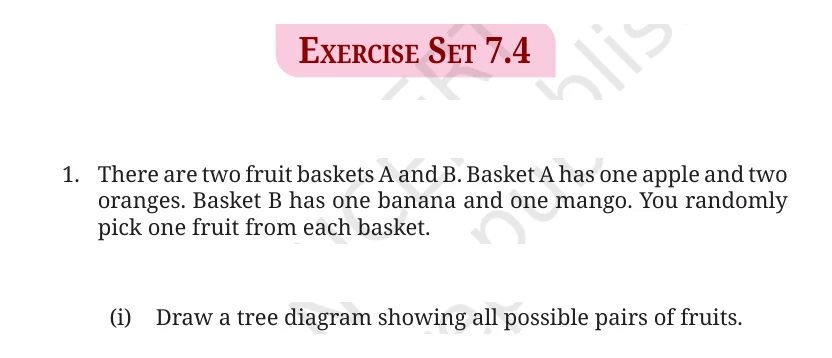
Exercise 7.4, 1(i): Draw a probability tree for choosing one fruit from each basket.
Show detailed solution
- Step 1: Basket A gives Apple with probability 1/3 and Orange with probability 2/3.
- Step 2: From each branch, Basket B gives Banana with probability 1/2 and Mango with probability 1/2.
- Step 3: The terminal paths are AB:1/6, AM:1/6, OB:1/3, and OM:1/3.
- Answer: Draw the two Basket A branches, split each into the two Basket B branches, and label each terminal pair with the product shown.
Textbook page 169 · solved item 30
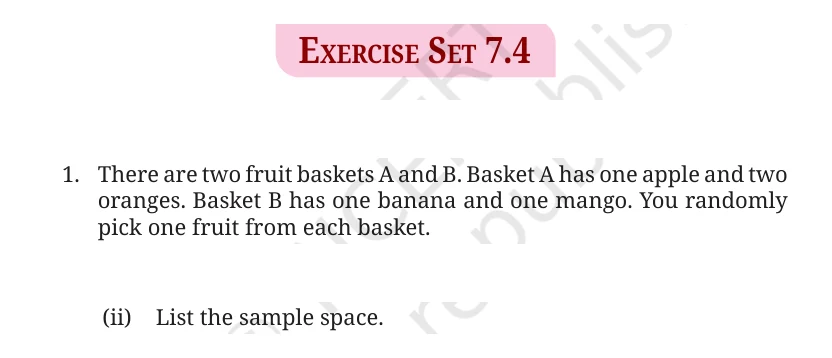
Exercise 7.4, 1(ii): List the sample space for the pairs of fruit.
Show detailed solution
- Step 1: Use the first position for Basket A and the second for Basket B.
- Step 2: S=\{(A,B),(A,M),(O,B),(O,M)\}, where A,O,B,M mean apple, orange, banana, and mango.
- Step 3: These four fruit-type outcomes are possible, but they are not equally likely because Basket A has two oranges.
- Answer: The sample space is \{AB,AM,OB,OM\} with probabilities 1/6,1/6,1/3,1/3.
Textbook page 169 · solved item 31
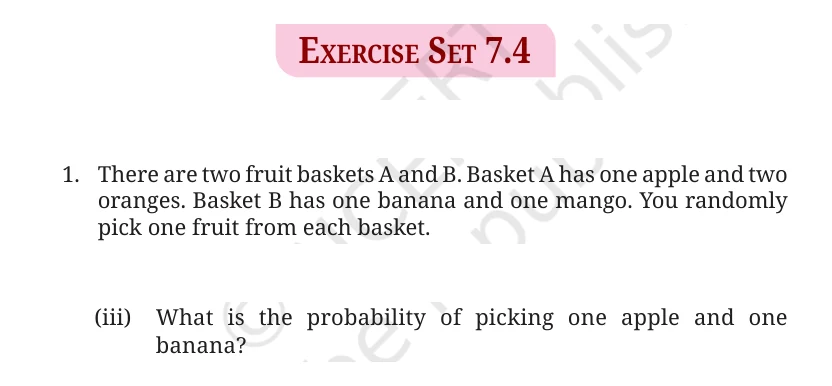
Exercise 7.4, 1(iii): Find the probability of choosing one apple and one banana.
Show detailed solution
- Step 1: P(\text{Apple from A})=1/3.
- Step 2: P(\text{Banana from B})=1/2.
- Step 3: The selections are from separate baskets, so multiply: (1/3)(1/2)=1/6.
- Answer: 1/6\approx16.7\%.
Textbook page 169 · solved item 32
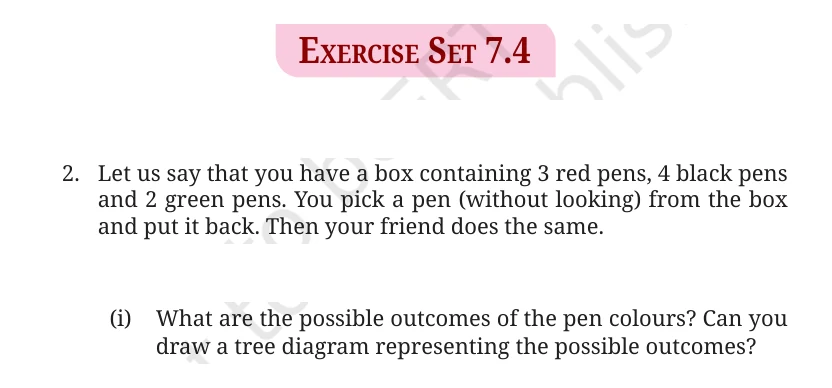
Exercise 7.4, 2(i): List the pen-colour outcomes and describe their probability tree.
Show detailed solution
- Step 1: On each draw, P(R)=3/9=1/3, P(B)=4/9, and P(G)=2/9.
- Step 2: The pen is replaced, so the same three branches leave every first-draw branch.
- Step 3: S=\{RR,RB,RG,BR,BB,BG,GR,GB,GG\}.
- Step 4: Label each terminal path by multiplying its two branch probabilities; for example, P(RB)=(1/3)(4/9)=4/27.
- Answer: The tree has 3 first branches, each splitting into R, B, and G, for 9 ordered outcomes.
Textbook page 169 · solved item 33
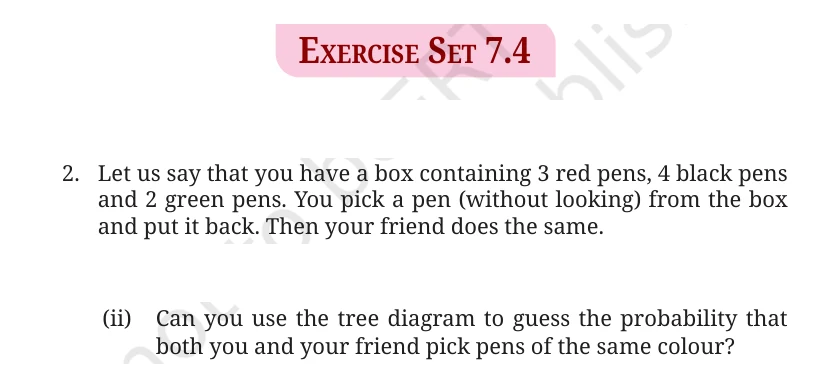
Exercise 7.4, 2(ii): Find the probability that both people choose pens of the same colour.
Show detailed solution
- Step 1: The same-colour event is E=\{RR,BB,GG\}.
- Step 2: P(RR)=(3/9)^2=9/81, P(BB)=(4/9)^2=16/81, and P(GG)=(2/9)^2=4/81.
- Step 3: Add the disjoint paths: (9+16+4)/81=29/81.
- Answer: 29/81\approx0.358, or about 35.8\%.
Textbook page 169 · solved item 34
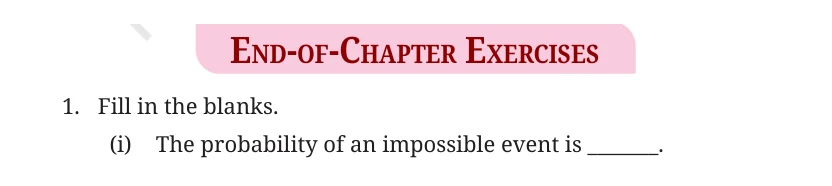
End-of-Chapter Exercise 1(i): Fill in the probability of an impossible event.
Show detailed solution
- Step 1: An impossible event has no outcomes in the sample space.
- Step 2: Its number of favourable outcomes is 0.
- Step 3: Therefore P(\text{impossible})=0/n(S)=0.
- Answer: 0.
Detailed worked answers
Textbook page 170
Textbook page 170 · solved item 35
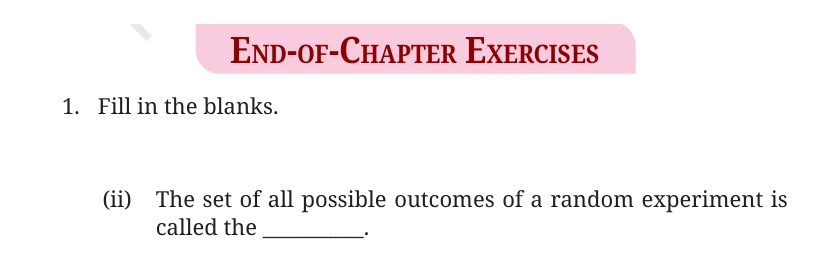
End-of-Chapter Exercise 1(ii): Name the set of all possible outcomes of a random experiment.
Show detailed solution
- Step 1: List every possible outcome of the experiment.
- Step 2: Ensure no possible outcome is omitted or repeated.
- Step 3: Probability names this complete set the sample space.
- Answer: Sample space.
Textbook page 170 · solved item 36
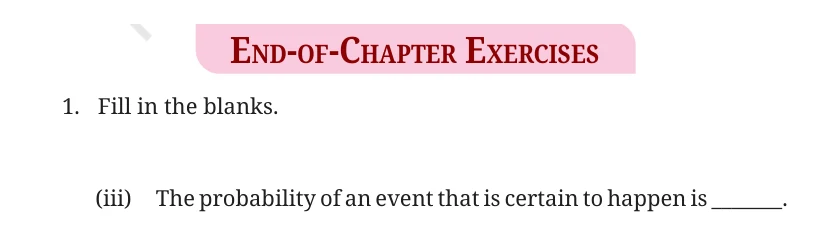
End-of-Chapter Exercise 1(iii): Fill in the probability of a certain event.
Show detailed solution
- Step 1: A certain event contains every outcome in the sample space.
- Step 2: The favourable and total outcome counts are equal.
- Step 3: Hence P(\text{certain})=n(S)/n(S)=1.
- Answer: 1.
Textbook page 170 · solved item 37
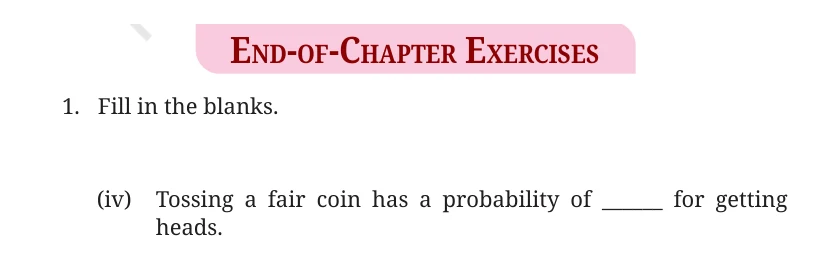
End-of-Chapter Exercise 1(iv): Fill in the probability of heads when tossing a fair coin.
Show detailed solution
- Step 1: The sample space is S=\{H,T\}.
- Step 2: The fair outcomes are equally likely and one is heads.
- Step 3: P(H)=1/2.
- Answer: 1/2, or 0.5.
Textbook page 170 · solved item 38

End-of-Chapter Exercise 2: Complete the frequency statement for 15 football choices among 50 students.
Show detailed solution
- Step 1: The number 15 is the frequency, because it is a raw count.
- Step 2: Relative frequency is frequency divided by the total number surveyed.
- Step 3: 15/50=3/10=0.3.
- Answer: The frequency is 15, and the relative frequency is 15/50=0.3, or 30%.
Textbook page 170 · solved item 39
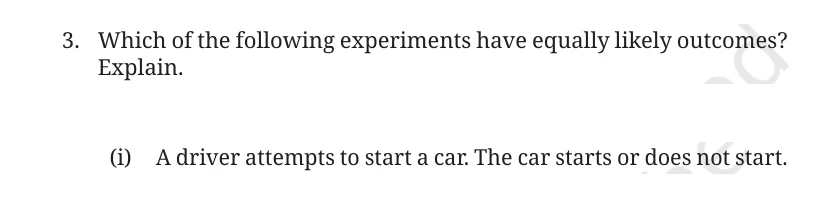
End-of-Chapter Exercise 3(i): Are 'car starts' and 'car does not start' equally likely?
Show detailed solution
- Step 1: The two outcomes are exhaustive, but that alone does not make them equally likely.
- Step 2: A functioning car normally starts much more often than it fails.
- Step 3: Equal likelihood would require evidence that each outcome has probability 1/2, which is not given.
- Answer: No; the outcomes are not necessarily equally likely.
Textbook page 170 · solved item 40
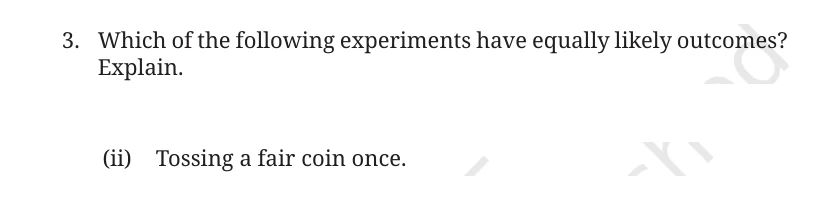
End-of-Chapter Exercise 3(ii): Does one toss of a fair coin have equally likely outcomes?
Show detailed solution
- Step 1: The outcomes are H and T.
- Step 2: A fair coin is symmetric and unbiased.
- Step 3: P(H)=P(T)=1/2.
- Answer: Yes, heads and tails are equally likely.
Textbook page 170 · solved item 41
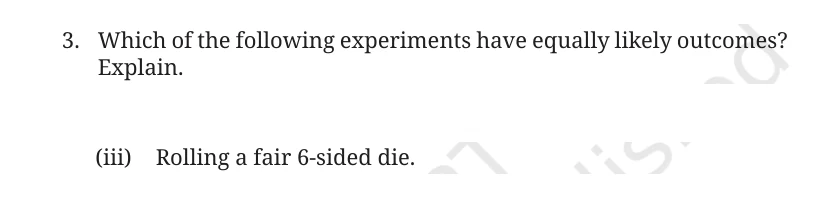
End-of-Chapter Exercise 3(iii): Does rolling a fair six-sided die have equally likely outcomes?
Show detailed solution
- Step 1: The possible faces are 1 through 6.
- Step 2: A fair die has no face favoured over another.
- Step 3: Each face has probability 1/6.
- Answer: Yes, all six face outcomes are equally likely.
Textbook page 170 · solved item 42
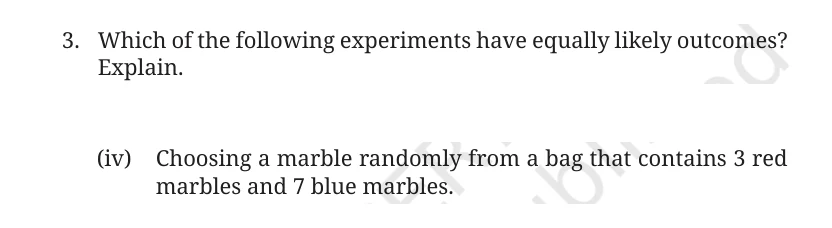
End-of-Chapter Exercise 3(iv): Are the colours equally likely when drawing from 3 red and 7 blue marbles?
Show detailed solution
- Step 1: There are 10 marbles in total.
- Step 2: P(R)=3/10 and P(B)=7/10.
- Step 3: These probabilities are unequal because the colour counts differ.
- Answer: No; blue is more likely than red.
Textbook page 170 · solved item 43
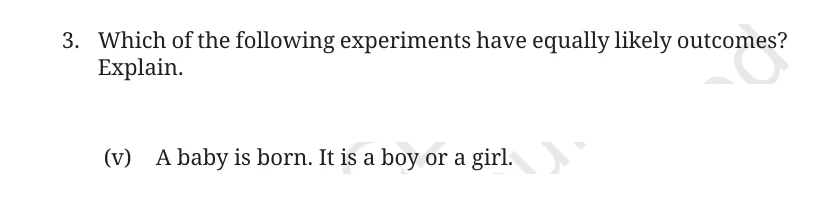
End-of-Chapter Exercise 3(v): Are 'boy' and 'girl' equally likely outcomes for a birth?
Show detailed solution
- Step 1: The question gives only two categories, but it gives no mathematical assumption that their probabilities are exactly equal.
- Step 2: Real birth data show the proportions are close to, but not exactly, 50-50 and vary by population.
- Step 3: Therefore an exact equal-likelihood claim requires an explicit simplified model.
- Answer: Not strictly from the information given. They may be treated as approximately equally likely only under the textbook's simplified model.
Textbook page 170 · solved item 44
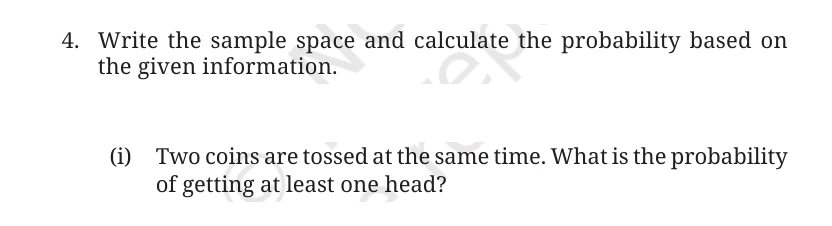
End-of-Chapter Exercise 4(i): Two coins are tossed. Find the probability of at least one head.
Show detailed solution
- Step 1: S=\{HH,HT,TH,TT\}, with four equally likely outcomes.
- Step 2: At least one head occurs in E=\{HH,HT,TH\}.
- Step 3: P(E)=3/4.
- Answer: 3/4=0.75=75\%.
Textbook page 170 · solved item 45
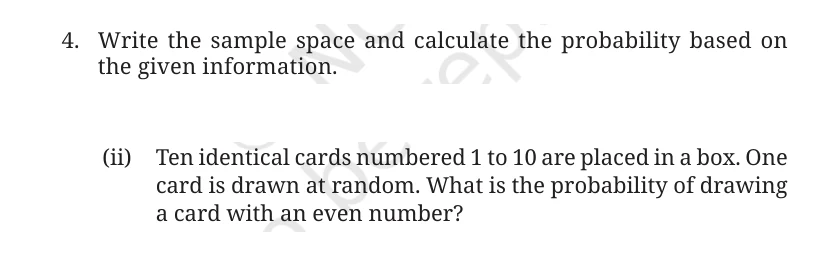
End-of-Chapter Exercise 4(ii): Draw one of ten cards numbered 1 to 10. Find the probability of an even number.
Show detailed solution
- Step 1: S=\{1,2,3,4,5,6,7,8,9,10\}, so n(S)=10.
- Step 2: The even event is E=\{2,4,6,8,10\}, so n(E)=5.
- Step 3: P(E)=5/10=1/2.
- Answer: 1/2=50\%.
Textbook page 170 · solved item 46
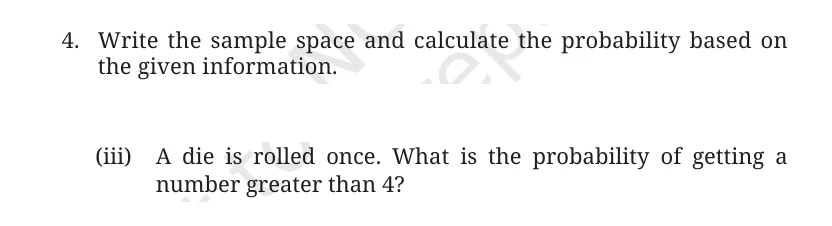
End-of-Chapter Exercise 4(iii): Roll a die once. Find the probability of a number greater than 4.
Show detailed solution
- Step 1: S=\{1,2,3,4,5,6\}.
- Step 2: Numbers greater than 4 are E=\{5,6\}.
- Step 3: P(E)=2/6=1/3.
- Answer: 1/3\approx33.3\%.
Textbook page 170 · solved item 47
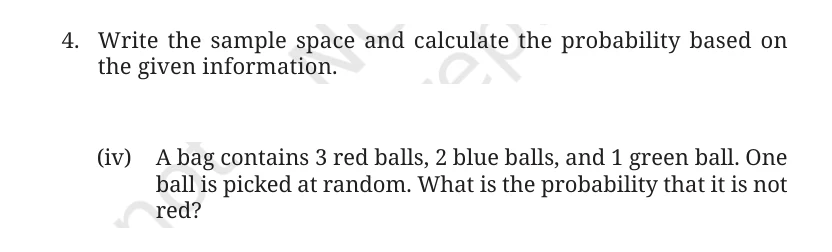
End-of-Chapter Exercise 4(iv): A bag has 3 red, 2 blue, and 1 green ball. Find the probability of not red.
Show detailed solution
- Step 1: There are 3+2+1=6 balls.
- Step 2: Not red means blue or green, giving 2+1=3 favourable balls.
- Step 3: P(\text{not red})=3/6=1/2.
- Answer: 1/2=50\%.
Textbook page 170 · solved item 48
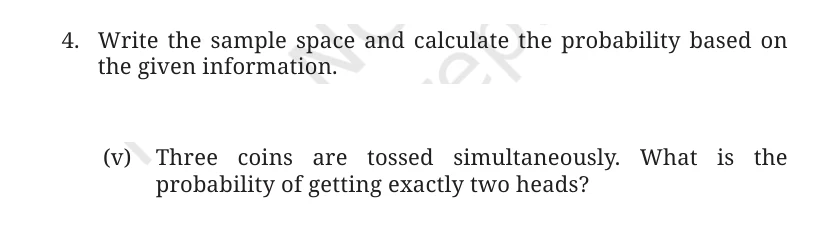
End-of-Chapter Exercise 4(v): Three coins are tossed. Find the probability of exactly two heads.
Show detailed solution
- Step 1: The eight equally likely outcomes are HHH,HHT,HTH,HTT,THH,THT,TTH,TTT.
- Step 2: Exactly two heads occurs in E=\{HHT,HTH,THH\}.
- Step 3: P(E)=3/8.
- Answer: 3/8=0.375=37.5\%.
Textbook page 170 · solved item 49

End-of-Chapter Exercise 5: A bag has strawberry, lemon, and mint candies. Find the probability of strawberry.
Show detailed solution
- Step 1: There are three candies and one is chosen at random.
- Step 2: Exactly one of the three candies is strawberry.
- Step 3: P(\text{strawberry})=1/3.
- Answer: 1/3\approx33.3\%.
Detailed worked answers
Textbook page 171
Textbook page 171 · solved item 50

End-of-Chapter Exercise 6: List all outfits from 2 shirts and 3 types of pants in a table.
Show detailed solution
- Step 1: Pair the red shirt with jeans, khakis, and shorts.
- Step 2: Pair the blue shirt with the same three pants choices.
- Step 3: The table rows are (R,J),(R,K),(R,S),(B,J),(B,K),(B,S).
- Step 4: The multiplication principle confirms 2\times3=6 combinations.
- Answer: The six rows are Red-Jeans, Red-Khakis, Red-Shorts, Blue-Jeans, Blue-Khakis, and Blue-Shorts.
Textbook page 171 · solved item 51
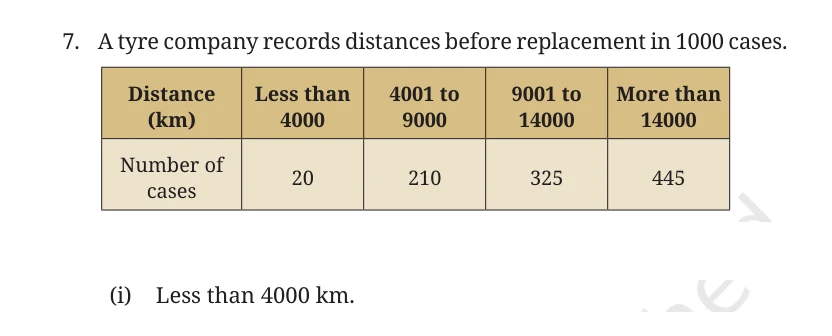
End-of-Chapter Exercise 7(i): Find the probability that a tyre lasts less than 4000 km.
Show detailed solution
- Step 1: The table records 1000 cases.
- Step 2: Twenty tyres lasted less than 4000 km.
- Step 3: P=20/1000=1/50=0.02.
- Answer: 0.02, or 2%.
Textbook page 171 · solved item 52
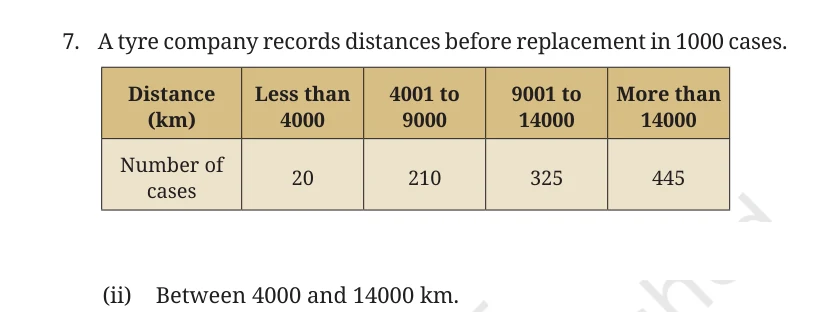
End-of-Chapter Exercise 7(ii): Find the probability that a tyre lasts between 4000 and 14000 km.
Show detailed solution
- Step 1: Use the 4001-9000 and 9001-14000 groups.
- Step 2: Their combined frequency is 210+325=535.
- Step 3: P=535/1000=107/200=0.535.
- Answer: 0.535, or 53.5%.
Textbook page 171 · solved item 53
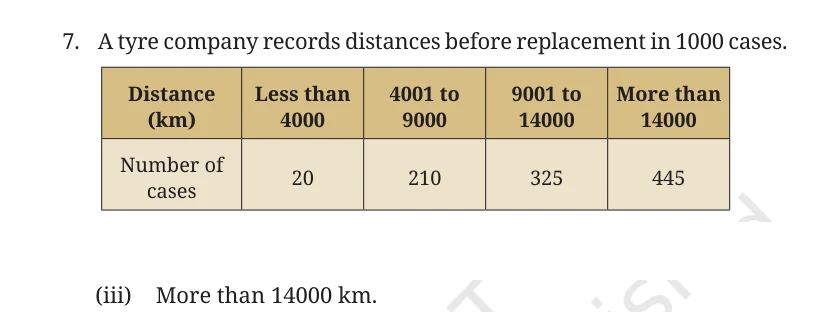
End-of-Chapter Exercise 7(iii): Find the probability that a tyre lasts more than 14000 km.
Show detailed solution
- Step 1: The relevant table frequency is 445.
- Step 2: The total number of recorded cases is 1000.
- Step 3: P=445/1000=89/200=0.445.
- Answer: 0.445, or 44.5%.
Textbook page 171 · solved item 54
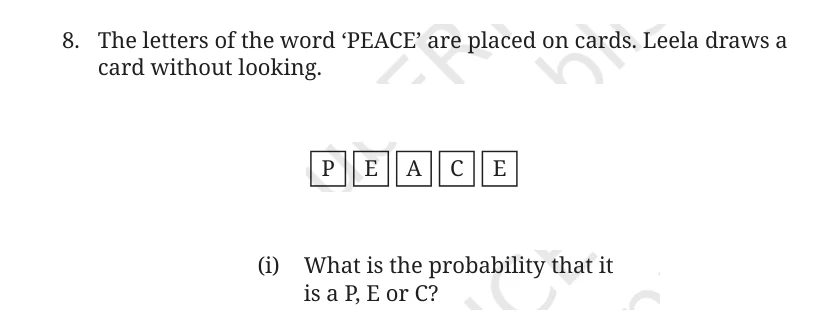
End-of-Chapter Exercise 8(i): A card is drawn from the letters of PEACE. Find the probability of P, E, or C.
Show detailed solution
- Step 1: The five physical cards are P, E, A, C, E.
- Step 2: Favourable cards are P, both E cards, and C, for a count of 4.
- Step 3: P(P\text{ or }E\text{ or }C)=4/5.
- Answer: 4/5=0.8=80\%.
Textbook page 171 · solved item 55
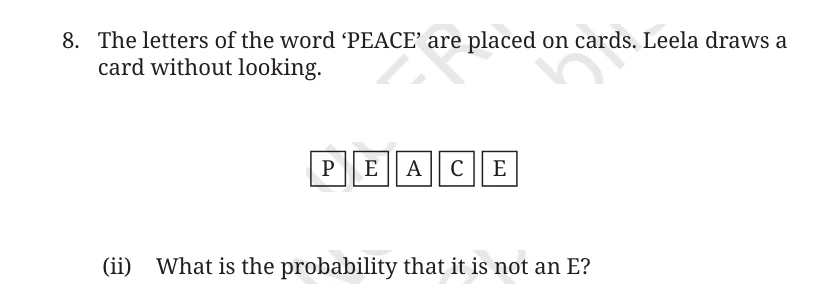
End-of-Chapter Exercise 8(ii): Find the probability that the PEACE card is not E.
Show detailed solution
- Step 1: The five cards are P, E, A, C, E.
- Step 2: P, A, and C are the three cards that are not E.
- Step 3: P(\text{not E})=3/5.
- Answer: 3/5=0.6=60\%.
Textbook page 171 · solved item 56
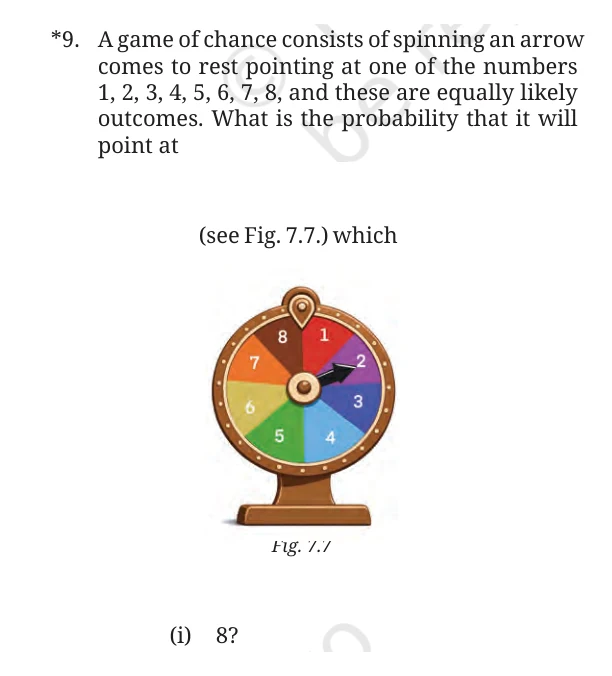
End-of-Chapter Exercise 9(i): Find the probability that the spinner points at 8.
Show detailed solution
- Step 1: The spinner has eight equally likely numbered outcomes.
- Step 2: Only one sector is numbered 8.
- Step 3: P(8)=1/8.
- Answer: 1/8=12.5\%.
Textbook page 171 · solved item 57
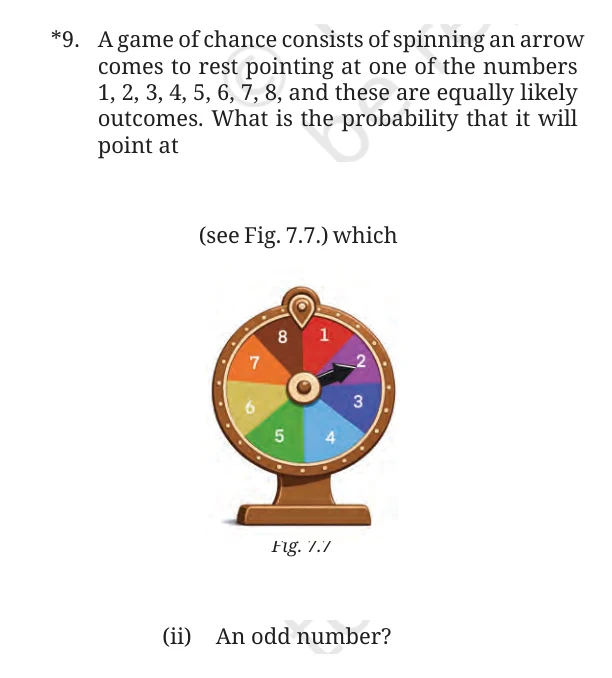
End-of-Chapter Exercise 9(ii): Find the probability that the spinner points at an odd number.
Show detailed solution
- Step 1: The odd outcomes are \{1,3,5,7\}.
- Step 2: There are 4 favourable sectors out of 8.
- Step 3: P(\text{odd})=4/8=1/2.
- Answer: 1/2=50\%.
Textbook page 171 · solved item 58
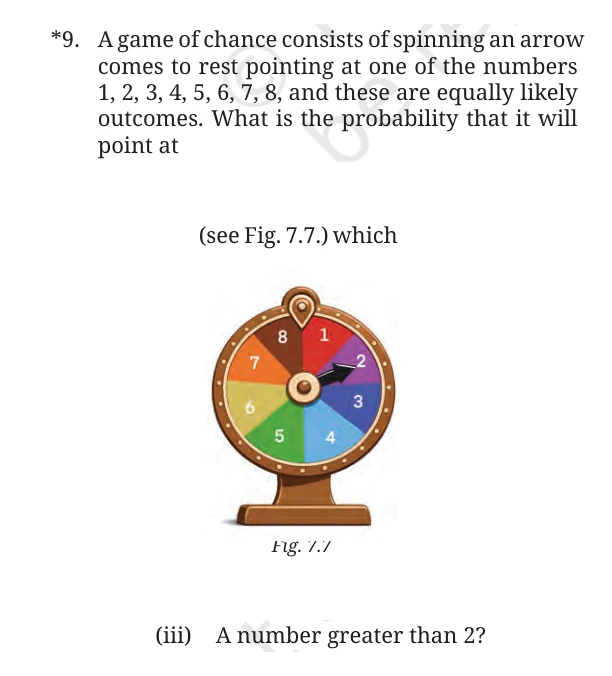
End-of-Chapter Exercise 9(iii): Find the probability that the spinner points at a number greater than 2.
Show detailed solution
- Step 1: The favourable outcomes are \{3,4,5,6,7,8\}.
- Step 2: There are 6 favourable sectors out of 8.
- Step 3: P(>2)=6/8=3/4.
- Answer: 3/4=75\%.
Textbook page 171 · solved item 59
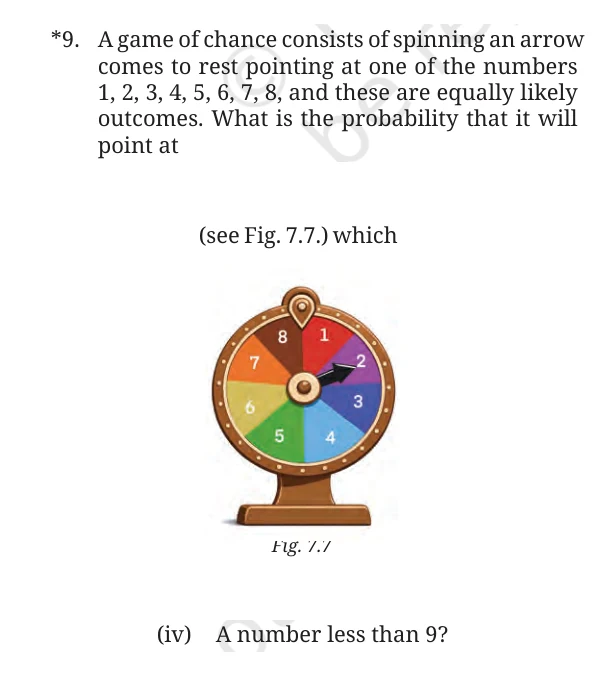
End-of-Chapter Exercise 9(iv): Find the probability that the spinner points at a number less than 9.
Show detailed solution
- Step 1: Every spinner number from 1 through 8 is less than 9.
- Step 2: All 8 outcomes are favourable.
- Step 3: P(<9)=8/8=1.
- Answer: 1; the event is certain.
Textbook page 171 · solved item 60
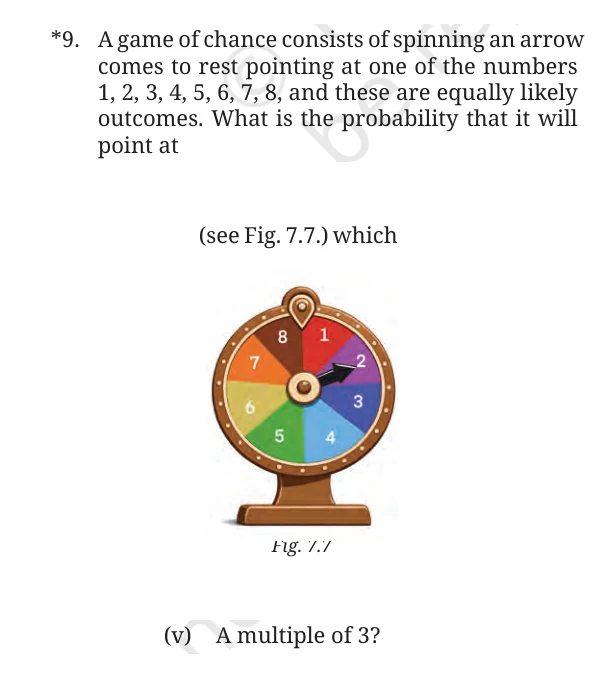
End-of-Chapter Exercise 9(v): Find the probability that the spinner points at a multiple of 3.
Show detailed solution
- Step 1: Among 1 through 8, the multiples of 3 are \{3,6\}.
- Step 2: There are 2 favourable sectors out of 8.
- Step 3: P(\text{multiple of 3})=2/8=1/4.
- Answer: 1/4=25\%.
Textbook page 171 · solved item 61

End-of-Chapter Exercise 10: Draw the probability tree for two balls drawn without replacement from 4 red and 5 blue balls.
Show detailed solution
- Step 1: First-draw branches are R:4/9 and B:5/9.
- Step 2: After R, branch to R:3/8 and B:5/8; after B, branch to R:4/8 and B:4/8.
- Step 3: Terminal probabilities are P(RR)=1/6, P(RB)=5/18, P(BR)=5/18, and P(BB)=5/18.
- Step 4: The terminal probabilities add to 1, checking the tree.
- Answer: Use the four terminal paths RR, RB, BR, and BB with the branch and path probabilities above.
Detailed worked answers
Textbook page 172
Textbook page 172 · solved item 62
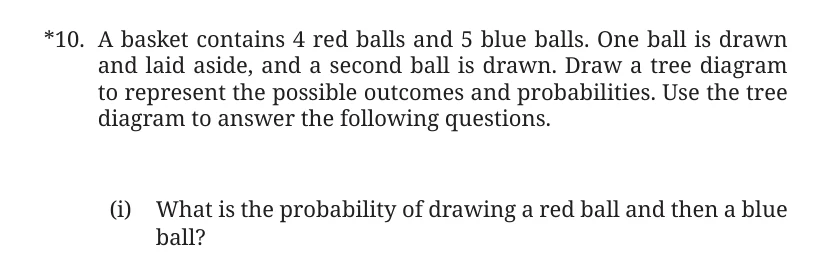
End-of-Chapter Exercise 10(i): Find the probability of red followed by blue without replacement.
Show detailed solution
- Step 1: P(R\text{ first})=4/9.
- Step 2: After a red ball is removed, 5 of the remaining 8 balls are blue, so P(B\mid R)=5/8.
- Step 3: P(RB)=(4/9)(5/8)=20/72=5/18.
- Answer: 5/18\approx27.8\%.
Textbook page 172 · solved item 63
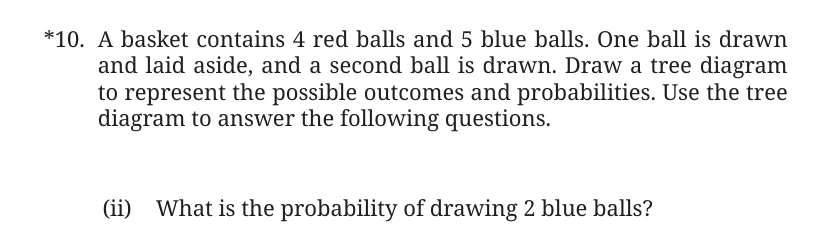
End-of-Chapter Exercise 10(ii): Find the probability of drawing two blue balls without replacement.
Show detailed solution
- Step 1: P(B\text{ first})=5/9.
- Step 2: Four blue balls remain among 8 balls, so P(B\text{ second}\mid B\text{ first})=4/8.
- Step 3: P(BB)=(5/9)(4/8)=20/72=5/18.
- Answer: 5/18\approx27.8\%.
Textbook page 172 · solved item 64

End-of-Chapter Exercise 11: Give an impossible and a certain event when two fair dice are thrown.
Show detailed solution
- Step 1: A two-dice sum can range only from 2 through 12.
- Step 2: Therefore 'the sum is 13' is impossible and has probability 0.
- Step 3: 'The sum is between 2 and 12 inclusive' contains every ordered-pair outcome and has probability 1.
- Answer: One valid pair is P(\text{sum }13)=0 and P(2\le\text{sum}\le12)=1. The question says 'an outcome' of probability 1, but strictly this is a certain event, not a single ordered outcome.
Textbook page 172 · solved item 65
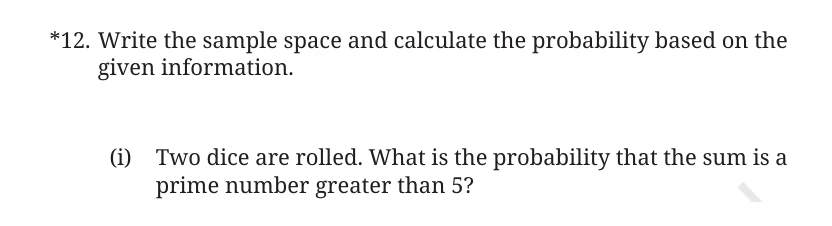
End-of-Chapter Exercise 12(i): Two dice are rolled. Find the probability that their sum is a prime greater than 5.
Show detailed solution
- Step 1: There are 6\times6=36 equally likely ordered outcomes.
- Step 2: Possible prime sums greater than 5 are 7 and 11.
- Step 3: Sum 7 has 6 ordered pairs and sum 11 has 2, giving 8 favourable outcomes.
- Answer: 8/36=2/9\approx22.2\%.
Textbook page 172 · solved item 66
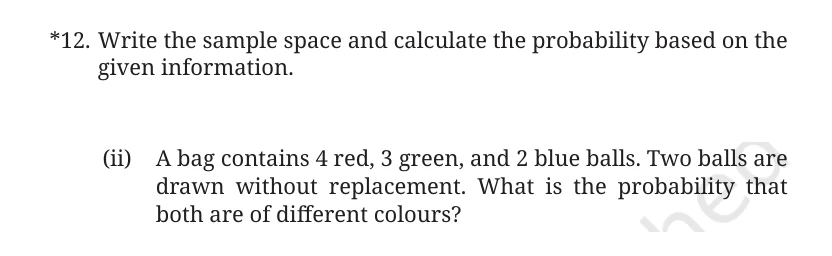
End-of-Chapter Exercise 12(ii): From 4 red, 3 green, and 2 blue balls, find the probability that two draws without replacement have different colours.
Show detailed solution
- Step 1: There are \binom{9}{2}=36 unordered pairs of balls.
- Step 2: Same-colour pairs total \binom{4}{2}+\binom{3}{2}+\binom{2}{2}=6+3+1=10.
- Step 3: Different-colour pairs total 36-10=26.
- Answer: 26/36=13/18\approx72.2\%.
Textbook page 172 · solved item 67
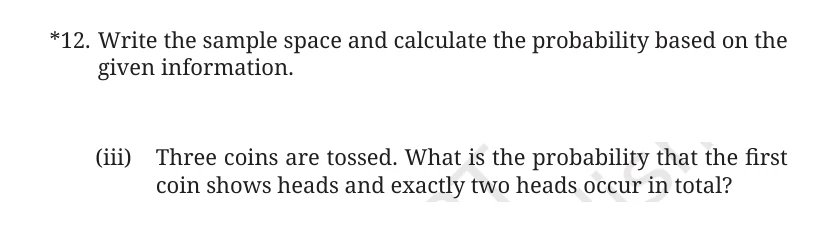
End-of-Chapter Exercise 12(iii): Three coins are tossed. Find the probability that the first is heads and exactly two heads occur.
Show detailed solution
- Step 1: The eight equally likely outcomes are HHH,HHT,HTH,HTT,THH,THT,TTH,TTT.
- Step 2: First H and exactly two total heads occurs in HHT and HTH.
- Step 3: There are 2 favourable outcomes out of 8.
- Answer: 2/8=1/4=25\%.
Textbook page 172 · solved item 68
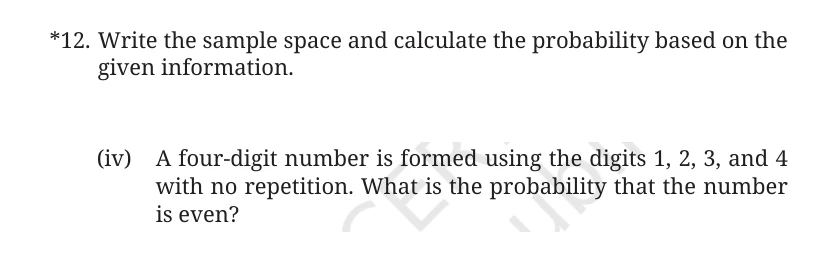
End-of-Chapter Exercise 12(iv): Form a four-digit number from 1, 2, 3, 4 without repetition. Find the probability it is even.
Show detailed solution
- Step 1: The total number of permutations is 4!=24.
- Step 2: An even number must end in 2 or 4, giving 2 choices for the last digit.
- Step 3: Arrange the remaining three digits in 3!=6 ways, so favourable numbers total 2\times6=12.
- Answer: 12/24=1/2=50\%.
Textbook page 172 · solved item 69
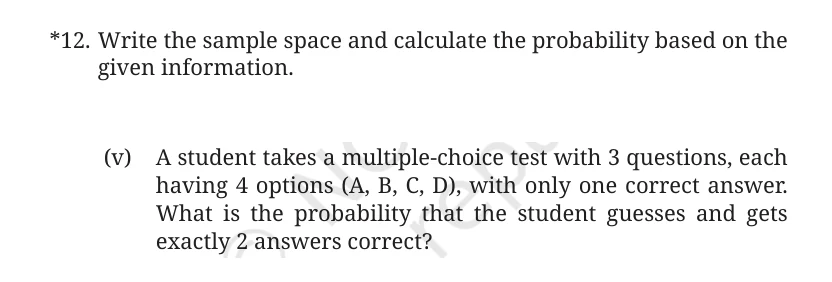
End-of-Chapter Exercise 12(v): A student guesses on three four-option questions. Find the probability of exactly two correct answers.
Show detailed solution
- Step 1: For each question, P(C)=1/4 and P(W)=3/4.
- Step 2: Choose which two of the three questions are correct in \binom{3}{2}=3 ways.
- Step 3: Each such pattern has probability (1/4)^2(3/4)=3/64.
- Step 4: Multiply by 3 patterns: 3(3/64)=9/64.
- Answer: 9/64\approx14.1\%.
Textbook page 172 · solved item 70
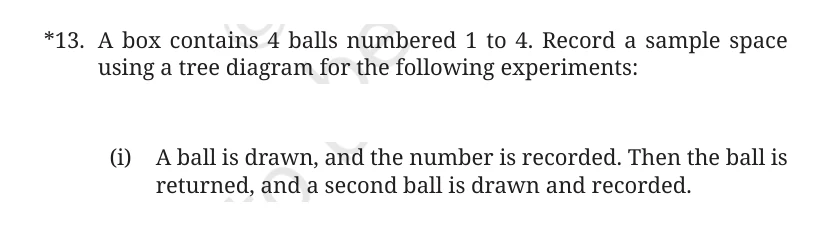
End-of-Chapter Exercise 13(i): List the two-draw sample space for balls 1 to 4 when the first ball is replaced.
Show detailed solution
- Step 1: Each draw can produce any of 1, 2, 3, or 4.
- Step 2: Represent an outcome by the ordered pair of recorded numbers.
- Step 3: S=\{(1,1),(1,2),(1,3),(1,4),(2,1),(2,2),(2,3),(2,4),(3,1),(3,2),(3,3),(3,4),(4,1),(4,2),(4,3),(4,4)\}.
- Answer: Replacement gives 4\times4=16 ordered outcomes; the tree has four second branches from every first branch.
Textbook page 172 · solved item 71
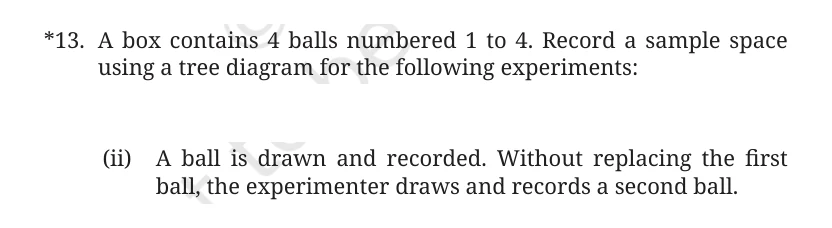
End-of-Chapter Exercise 13(ii): List the two-draw sample space for balls 1 to 4 without replacement.
Show detailed solution
- Step 1: The first draw has four possible numbers.
- Step 2: The second draw can use any of the other three numbers but cannot repeat the first.
- Step 3: S=\{(1,2),(1,3),(1,4),(2,1),(2,3),(2,4),(3,1),(3,2),(3,4),(4,1),(4,2),(4,3)\}.
- Answer: The tree has 4\times3=12 ordered outcomes.
Textbook page 172 · solved item 72
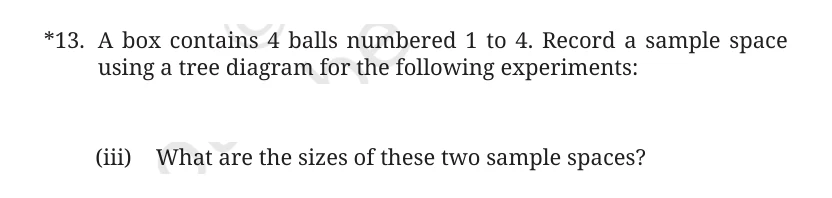
End-of-Chapter Exercise 13(iii): Find the sizes of the with-replacement and without-replacement sample spaces.
Show detailed solution
- Step 1: With replacement, each of 4 first outcomes has 4 second outcomes.
- Step 2: Therefore n(S_{\mathrm{with}})=4\times4=16.
- Step 3: Without replacement, only 3 balls remain after each first draw.
- Answer: n(S_{\mathrm{with}})=16 and n(S_{\mathrm{without}})=4\times3=12.
Textbook page 172 · solved item 73

End-of-Chapter Exercise 14: List the sample space for tossing a coin and drawing a card numbered 1 through 6.
Show detailed solution
- Step 1: The coin result is H or T and the card result is 1 through 6.
- Step 2: Represent each combined outcome as an ordered pair.
- Step 3: S=\{(H,1),(H,2),(H,3),(H,4),(H,5),(H,6),(T,1),(T,2),(T,3),(T,4),(T,5),(T,6)\}.
- Answer: The sample space contains 2\times6=12 outcomes.
Detailed worked answers
Textbook page 173
Textbook page 173 · solved item 74
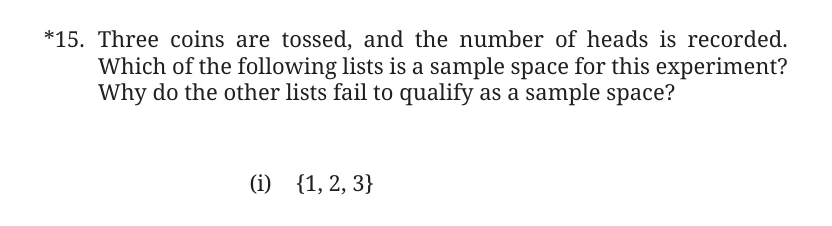
End-of-Chapter Exercise 15(i): Can {1, 2, 3} be the sample space for the number of heads in three coin tosses?
Show detailed solution
- Step 1: Three coin tosses can produce 0, 1, 2, or 3 heads.
- Step 2: The proposed set includes 1, 2, and 3.
- Step 3: It omits the possible outcome 0 heads, which occurs for TTT.
- Answer: No; it is not exhaustive because 0 is missing.
Textbook page 173 · solved item 75
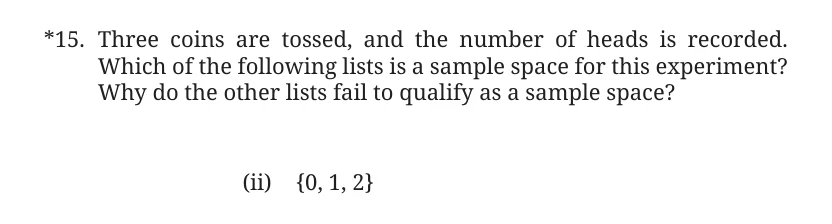
End-of-Chapter Exercise 15(ii): Can {0, 1, 2} be the sample space for the number of heads in three coin tosses?
Show detailed solution
- Step 1: The possible head counts are 0, 1, 2, and 3.
- Step 2: The set includes the first three of these counts.
- Step 3: It omits 3 heads, which occurs for HHH.
- Answer: No; it is not exhaustive because 3 is missing.
Textbook page 173 · solved item 76
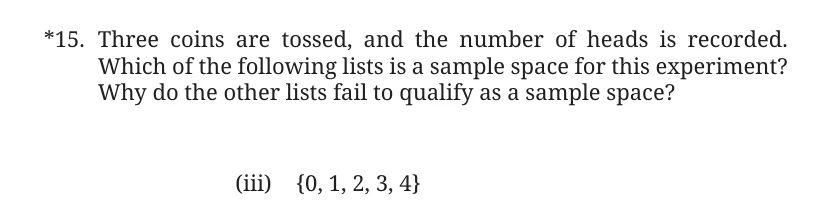
End-of-Chapter Exercise 15(iii): Can {0, 1, 2, 3, 4} be the sample space for the number of heads in three coin tosses?
Show detailed solution
- Step 1: With only three coins, the number of heads cannot exceed 3.
- Step 2: The listed value 4 is impossible.
- Step 3: A sample space should contain possible outcomes only.
- Answer: No; it includes the impossible outcome 4.
Textbook page 173 · solved item 77
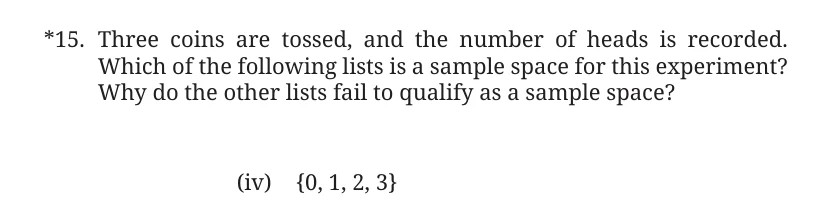
End-of-Chapter Exercise 15(iv): Can {0, 1, 2, 3} be the sample space for the number of heads in three coin tosses?
Show detailed solution
- Step 1: Zero heads occurs for TTT and three heads occurs for HHH.
- Step 2: One or two heads also occur in several outcomes.
- Step 3: The set lists each possible recorded head count exactly once.
- Answer: Yes. The correct sample space is S=\{0,1,2,3\}.
Textbook page 173 · solved item 78
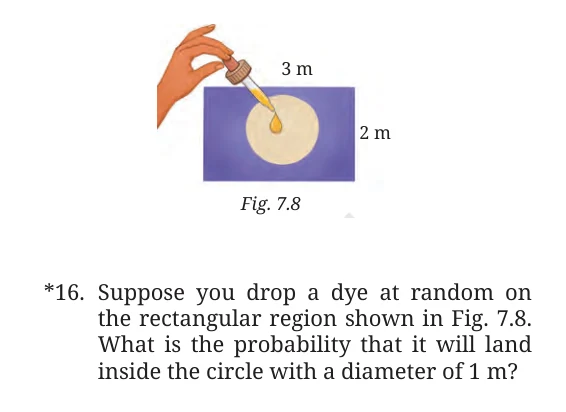
End-of-Chapter Exercise 16: A point is dropped uniformly on a 3 m by 2 m rectangle. Find the probability that it lands inside the circle of diameter 1 m.
Show detailed solution
- Step 1: Uniform geometric probability is favourable area divided by total area.
- Step 2: The rectangle area is 3\times2=6\text{ m}^2.
- Step 3: The circle radius is 1/2\text{ m}, so its area is \pi(1/2)^2=\pi/4\text{ m}^2.
- Step 4: P=(\pi/4)/6=\pi/24.
- Answer: \pi/24\approx0.1309, or about 13.1\%, assuming the point is equally likely to land anywhere in the rectangle.