
Question-by-question working
Read the prompt, attempt it, then check each step
Every exercise subpart and table row is a separate item. Shared figures are repeated in the crop whenever they are needed to understand that question.
Detailed worked answers
Textbook page 118
Textbook page 118 · solved item 1

Think and Reflect: Does a 200 m track need a smaller stagger than a 400 m track for the same 4 x 100 m relay race?
Show detailed solution
- Step 1: On one lap, the straight portions add no adjacent-lane difference, while the two bends make one full turn. The extra outer-lane distance is 2\pi w for lane width w.
- Step 2: A 400 m relay on a 400 m track covers one lap, so it needs compensation for one full turn: 2\pi w.
- Step 3: The same 400 m relay on a 200 m track covers two laps, so it accumulates two full turns: 4\pi w.
- Step 4: This assumes the runners remain in their assigned lanes and both tracks have the same lane width and semicircular layout.
- Answer: No. Under those assumptions, the 200 m track needs twice the adjacent-lane stagger, not a smaller one.
Detailed worked answers
Textbook page 119
Textbook page 119 · solved item 2

Think and Reflect: How is the perimeter of a circle connected with the 400 m athletics-track problem?
Show detailed solution
- Step 1: Each end of the track is a semicircle.
- Step 2: The two semicircular running paths together have the length of one complete circle.
- Step 3: That curved distance is therefore a circumference, C=2\pi r.
- Answer: Finding the circle's perimeter lets us calculate the curved part of each lane and hence the required stagger.
Detailed worked answers
Textbook page 127
Textbook page 127 · solved item 3
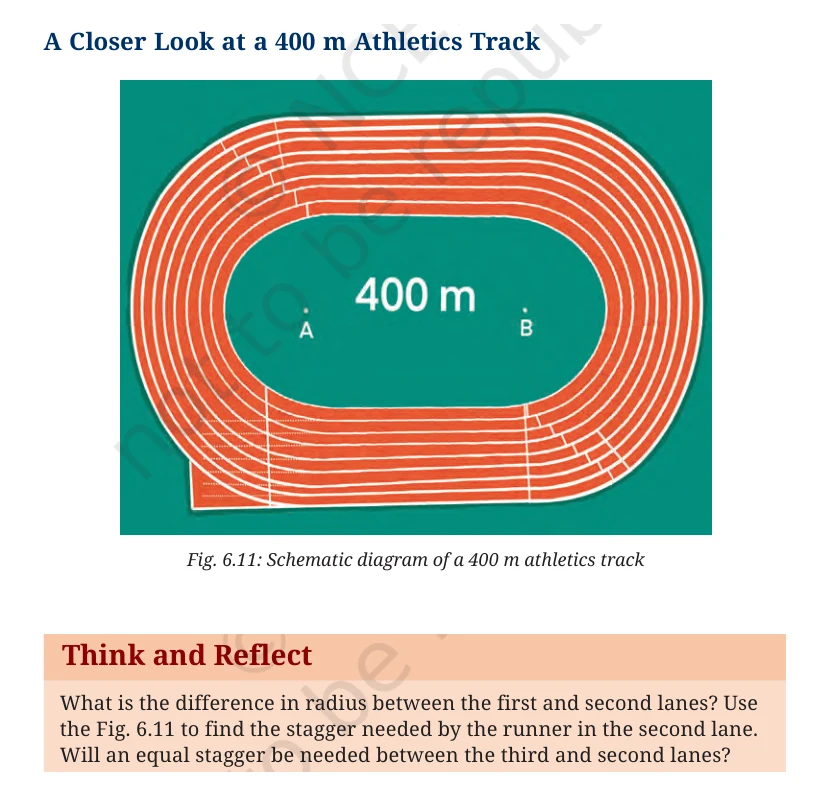
Think and Reflect: Find the stagger from lane 1 to lane 2, and decide whether the lane 2 to lane 3 stagger is equal.
Show detailed solution
- Step 1: The runners keep the same offset from their inner borders, so the radius increases by exactly the lane width: \Delta r=1.22\text{ m}.
- Step 2: The two semicircular bends make one full circle, so the extra distance is 2\pi\Delta r.
- Step 3: Using \pi\approx3.1416, the stagger is 2\times3.1416\times1.22\approx7.67\text{ m}.
- Step 4: Every adjacent pair has the same 1.22 m radial difference.
- Answer: The stagger is about 7.67\text{ m}, and the same stagger is needed from lane 2 to lane 3.
Detailed worked answers
Textbook page 131
Textbook page 131 · solved item 4
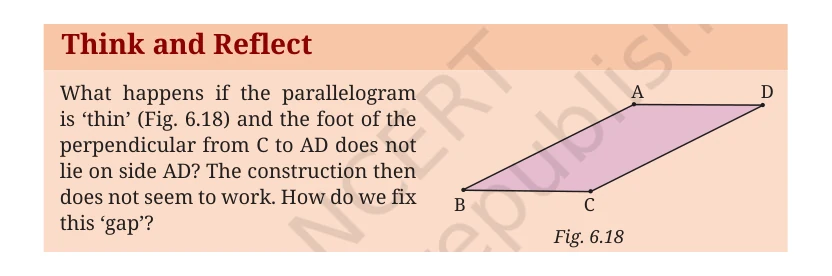
Think and Reflect: How can the area argument be repaired for a thin parallelogram whose perpendicular falls outside the base?
Show detailed solution
- Step 1: Choose D' on DA and A' on the extension beyond A so that A'A=D'D.
- Step 2: The end triangles \triangle BAA' and \triangle CDD' are congruent, so moving one from the right to the left does not change the area.
- Step 3: This replaces ABCD by the equal-area parallelogram A'BCD', shifted enough for the usual cut-and-move construction.
- Step 4: Repeat the shift if necessary until the perpendicular lies within the new base.
- Answer: The thin parallelogram still has area bh; translate congruent end triangles before converting it to a rectangle.
Textbook page 131 · solved item 5
Think and Reflect: Can the area of a parallelogram be found from only its side lengths?
Show detailed solution
- Step 1: If adjacent sides are a and b, the height relative to base a is b\sin\theta, where \theta is their included angle.
- Step 2: Its area is therefore ab\sin\theta.
- Step 3: Keeping the side lengths fixed while changing the angle changes the height and hence the area.
- Answer: No. The side lengths alone are insufficient; an angle, height, or equivalent extra measurement is needed.
Detailed worked answers
Textbook page 133
Textbook page 133 · solved item 6
Think and Reflect: Can triangle ABD be cut into pieces and rearranged to cover equal-area triangle ACD?
Show detailed solution
- Step 1: Because AD is a median, BD=DC, and both triangles have the same altitude from A. Let the common base be b and height be h.
- Step 2: In \triangle ABD, draw the midline parallel to BD, then cut the small top triangle along its altitude. This gives three pieces.
- Step 3: Move the two small right triangles to the ends of the lower trapezium. They form a rectangle of dimensions b by h/2.
- Step 4: Apply the same three-piece construction to \triangle ACD; it produces the same b\times h/2 rectangle.
- Answer: Yes. Rearrange ABD into the common rectangle, then reverse the ACD dissection to cover ACD.
Detailed worked answers
Textbook page 134
Textbook page 134 · solved item 7
Think and Reflect: Can any two equal-area polygons be cut by straight lines and rearranged to cover each other?
Show detailed solution
- Step 1: A square and an equal-area rectangle can be transformed into one another using the rectangle-squaring construction and its reverse.
- Step 2: Any triangle can be cut into three pieces and rearranged into a rectangle with the same base and half its height.
- Step 3: Thus two equal-area triangles can both be converted to the same rectangle; a triangle and square can be connected through the same rectangle construction.
- Step 4: The general statement is the Bolyai-Gerwien theorem: any two polygons of equal area are scissors-congruent using finitely many straight cuts.
- Answer: Yes for polygons. The examples support the general theorem, although its full proof is beyond this chapter.
Textbook page 134 · solved item 8
Think and Reflect 1: How many rectangles have perimeter 40 units?
Show detailed solution
- Step 1: If the side lengths are x and y, then 2(x+y)=40, so x+y=20.
- Step 2: For every real x with 0<x<20, choosing y=20-x gives a rectangle.
- Step 3: That interval contains infinitely many possible values.
- Answer: There are infinitely many such rectangles.
Textbook page 134 · solved item 9
Think and Reflect 2: Which rectangle of perimeter 40 units has the largest area?
Show detailed solution
- Step 1: With sides x and 20-x, the area is A=x(20-x).
- Step 2: Complete the square: A=100-(x-10)^2.
- Step 3: The squared term is smallest at x=10, so the maximum area is 100\text{ square units}.
- Answer: The 10\times10 square has the largest area, 100\text{ square units}.
Textbook page 134 · solved item 10
Think and Reflect 3: Is there a smallest-area rectangle of perimeter 40 units?
Show detailed solution
- Step 1: Again, A=x(20-x) for 0<x<20.
- Step 2: Taking x closer and closer to 0 makes the area closer and closer to 0.
- Step 3: A genuine rectangle must have both side lengths positive, so area 0 is never attained.
- Answer: There is no smallest non-degenerate rectangle. The infimum is 0, approached by dimensions x\times(20-x) as x\to0^+.
Detailed worked answers
Textbook page 142
Textbook page 142 · solved item 11
Think and Reflect: Give a construction for a square equal in area to a given triangle.
Show detailed solution
- Step 1: Choose a base b of the triangle and construct its perpendicular height h. Its area is bh/2.
- Step 2: Construct a rectangle with sides b and h/2; it has the same area as the triangle.
- Step 3: Apply the rectangle-squaring construction: place the two rectangle sides on one line, draw the semicircle on their sum, and erect the perpendicular at their junction.
- Step 4: The perpendicular is the geometric mean \sqrt{b(h/2)}.
- Answer: A square with side \sqrt{bh/2} has exactly the same area as the triangle.
Textbook page 142 · solved item 33
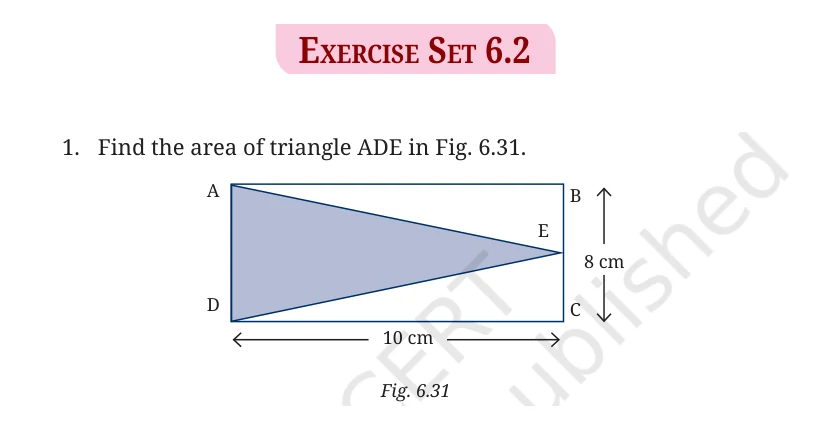
Exercise Set 6.2, 1: Find the area of triangle ADE in the 10 cm by 8 cm rectangle.
Show detailed solution
- Step 1: Take AD as the base. Since it is a side of the rectangle, AD=8\text{ cm}.
- Step 2: Point E lies on the opposite side, so its perpendicular distance from AD is the rectangle's width, 10\text{ cm}.
- Step 3: Area =(1/2)\times8\times10.
- Answer: 40\text{ cm}^2.
Textbook page 142 · solved item 34
Exercise Set 6.2, 2: Find the area of an isosceles trapezium with parallel sides 40 cm and 20 cm and equal sides 26 cm.
Show detailed solution
- Step 1: Dropping perpendiculars from the shorter base leaves two right triangles, each with horizontal leg (40-20)/2=10\text{ cm}.
- Step 2: The height is h=\sqrt{26^2-10^2}=\sqrt{576}=24\text{ cm}.
- Step 3: Area =(1/2)(40+20)\times24.
- Answer: 720\text{ cm}^2.
Textbook page 142 · solved item 35

Exercise Set 6.2, 3: Find the area of a triangle with two sides 8 cm and 11 cm and perimeter 32 cm.
Show detailed solution
- Step 1: The third side is 32-8-11=13\text{ cm}.
- Step 2: The semiperimeter is s=32/2=16\text{ cm}.
- Step 3: Heron's formula gives A=\sqrt{16(16-8)(16-11)(16-13)}.
- Step 4: A=\sqrt{16\times8\times5\times3}=8\sqrt{30}\text{ cm}^2.
- Answer: 8\sqrt{30}\text{ cm}^2\approx43.8\text{ cm}^2.
Textbook page 142 · solved item 36
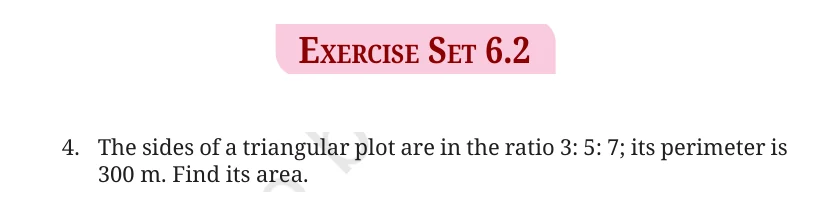
Exercise Set 6.2, 4: A triangular plot has side ratio 3:5:7 and perimeter 300 m. Find its area.
Show detailed solution
- Step 1: The ratio has 3+5+7=15 parts, so one part is 300/15=20\text{ m}.
- Step 2: The sides are 60\text{ m},100\text{ m},140\text{ m}, and s=150\text{ m}.
- Step 3: A=\sqrt{150(90)(50)(10)}.
- Step 4: A=\sqrt{6{,}750{,}000}=1500\sqrt3\text{ m}^2.
- Answer: 1500\sqrt3\text{ m}^2\approx2598\text{ m}^2.
Textbook page 142 · solved item 37
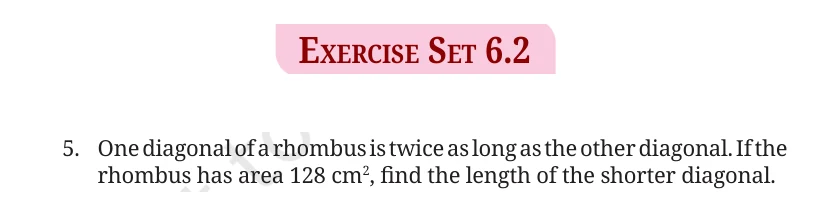
Exercise Set 6.2, 5: One diagonal of a rhombus is twice the other, and its area is 128 square centimetres. Find the shorter diagonal.
Show detailed solution
- Step 1: Let the shorter diagonal be x\text{ cm}; the longer is 2x\text{ cm}.
- Step 2: Area of a rhombus is (1/2)d_1d_2.
- Step 3: 128=(1/2)x(2x)=x^2.
- Answer: x=\sqrt{128}=8\sqrt2\text{ cm}\approx11.3\text{ cm}.
Textbook page 142 · solved item 38

Exercise Set 6.2, 6: In parallelogram ABCD, P and Q lie on AB. Find area(PCD):area(QCD).
Show detailed solution
- Step 1: Both triangles have the same base CD.
- Step 2: Since AB\parallel CD, every point on AB, including P and Q, has the same perpendicular distance from CD.
- Step 3: Equal base and equal height give equal triangle areas.
- Answer: \operatorname{area}(\triangle PCD):\operatorname{area}(\triangle QCD)=1:1.
Textbook page 142 · solved item 39
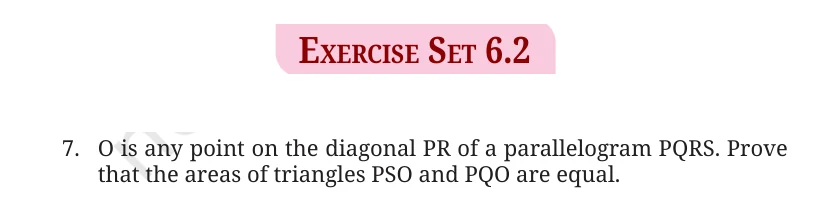
Exercise Set 6.2, 7: In parallelogram PQRS, O lies on diagonal PR. Prove that triangles PSO and PQO have equal area.
Show detailed solution
- Step 1: Diagonal PR divides the parallelogram into equal-area triangles \triangle PSR and \triangle PQR.
- Step 2: These triangles share base PR, so the perpendicular distances of S and Q from line PR are equal.
- Step 3: Triangles PSO and PQO share base PO on that same line and have those equal heights.
- Answer: \operatorname{area}(\triangle PSO)=\operatorname{area}(\triangle PQO).
Textbook page 142 · solved item 40
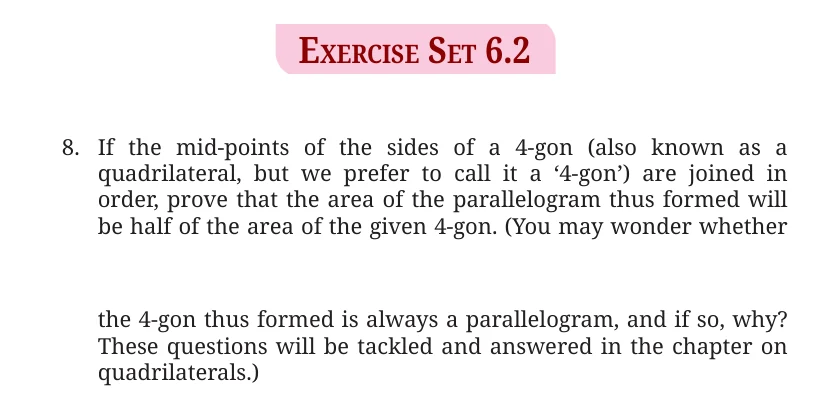
Exercise Set 6.2, 8: Prove that joining the side midpoints of a 4-gon forms a region with half the original area.
Show detailed solution
- Step 1: Name the 4-gon ABCD and its side midpoints P,Q,R,S. Draw diagonal AC.
- Step 2: In \triangle ABC, corner triangle \triangle BPQ has both corresponding side lengths halved, so its area is one quarter of \triangle ABC. Apply the same fact at all four corners.
- Step 3: The sum of the four corner areas is one quarter of [ABC]+[BCD]+[CDA]+[DAB].
- Step 4: The bracketed sum is twice the area of ABCD, because each diagonal decomposition contributes the whole 4-gon once.
- Answer: The four corner triangles occupy half the 4-gon, so midpoint region PQRS occupies the other half.
Detailed worked answers
Textbook page 129
Textbook page 129 · solved item 12
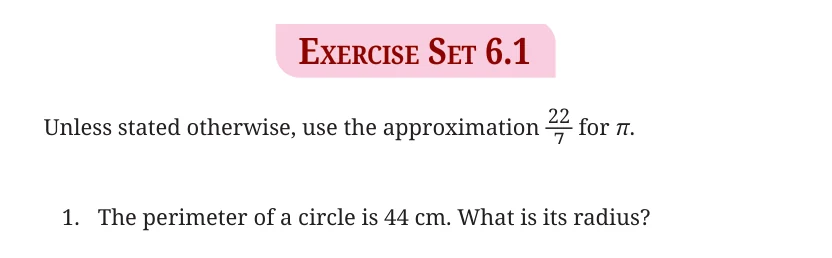
Exercise Set 6.1, 1: A circle has circumference 44 cm. Find its radius.
Show detailed solution
- Step 1: Use C=2\pi r with C=44\text{ cm} and \pi\approx22/7.
- Step 2: 44=2\times(22/7)\times r=(44/7)r.
- Step 3: Divide by 44/7: r=44\times7/44=7\text{ cm}.
- Answer: The radius is 7\text{ cm}.
Textbook page 129 · solved item 13

Exercise Set 6.1, 2(i): Find the circumference when the radius is 7 cm, correct to 3 significant figures.
Show detailed solution
- Step 1: C=2\pi r.
- Step 2: C=2\times(22/7)\times7=44\text{ cm}.
- Step 3: Written to three significant figures, this is 44.0\text{ cm}.
- Answer: 44.0\text{ cm}.
Textbook page 129 · solved item 14

Exercise Set 6.1, 2(ii): Find the circumference when the radius is 10 cm, correct to 3 significant figures.
Show detailed solution
- Step 1: C=2\pi r=2\times(22/7)\times10.
- Step 2: C=440/7\approx62.857\text{ cm}.
- Step 3: The first three significant digits are 6, 2, and 8; the next digit rounds the 8 up.
- Answer: 62.9\text{ cm} to 3 significant figures.
Textbook page 129 · solved item 15

Exercise Set 6.1, 2(iii): Find the circumference when the radius is 12 cm, correct to 3 significant figures.
Show detailed solution
- Step 1: C=2\pi r=2\times(22/7)\times12.
- Step 2: C=528/7\approx75.4286\text{ cm}.
- Step 3: The fourth significant digit is 2, so the third digit stays unchanged.
- Answer: 75.4\text{ cm} to 3 significant figures.
Textbook page 129 · solved item 16

Exercise Set 6.1, 3(i): Find the arc length for radius 3.5 cm and central angle 60 degrees.
Show detailed solution
- Step 1: Use L=2\pi r\times\theta/360^\circ.
- Step 2: L=2\times(22/7)\times3.5\times60/360.
- Step 3: This simplifies to 11/3\text{ cm}.
- Answer: 11/3\text{ cm}=3\tfrac{2}{3}\text{ cm}.
Textbook page 129 · solved item 17

Exercise Set 6.1, 3(ii): Find the arc length for radius 6.3 m and central angle 120 degrees.
Show detailed solution
- Step 1: L=2\pi r\times120/360.
- Step 2: L=(2/3)\times(22/7)\times6.3.
- Step 3: Since 6.3/7=0.9, L=(2/3)\times22\times0.9=13.2\text{ m}.
- Answer: 13.2\text{ m}.
Textbook page 129 · solved item 18
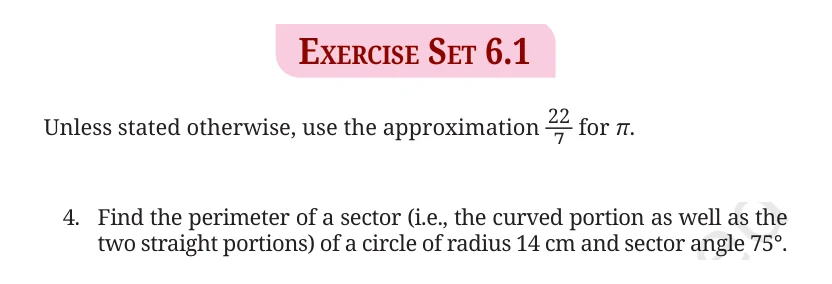
Exercise Set 6.1, 4: Find the perimeter of a sector with radius 14 cm and angle 75 degrees.
Show detailed solution
- Step 1: Arc length L=2\pi r\times75/360.
- Step 2: L=2\times(22/7)\times14\times75/360=55/3\text{ cm}.
- Step 3: Add the two radii: P=L+2r=55/3+28.
- Answer: P=139/3\text{ cm}=46\tfrac{1}{3}\text{ cm}.
Textbook page 129 · solved item 19
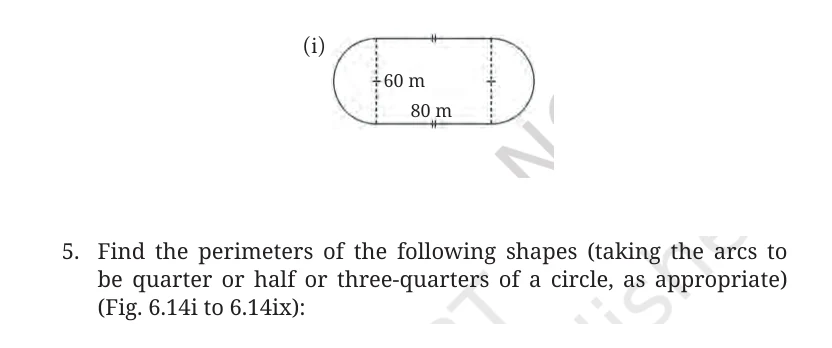
Exercise Set 6.1, 5(i): Find the perimeter of the stadium-shaped figure.
Show detailed solution
- Step 1: The two straight portions contribute 2\times80=160\text{ m}.
- Step 2: The two semicircles form one circle of diameter 60\text{ m}, contributing 60\pi\text{ m}.
- Step 3: Using \pi=22/7, P=160+1320/7.
- Answer: P=2440/7\text{ m}=348\tfrac{4}{7}\text{ m}.
Textbook page 129 · solved item 20
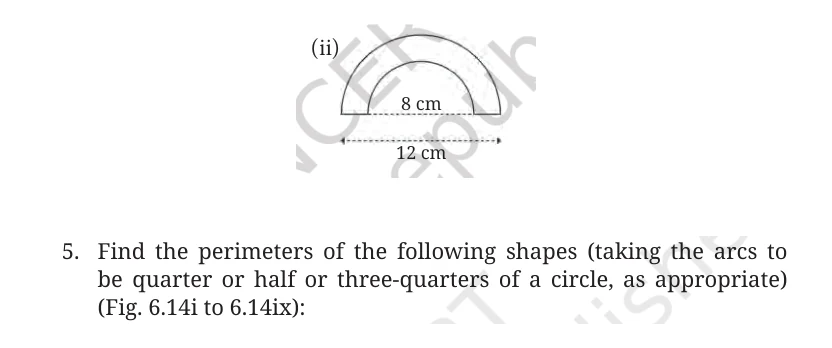
Exercise Set 6.1, 5(ii): Find the perimeter of the semi-annular figure.
Show detailed solution
- Step 1: The outer semicircle has diameter 12\text{ cm}, so its arc is 6\pi\text{ cm}.
- Step 2: The inner semicircle has diameter 8\text{ cm}, so its arc is 4\pi\text{ cm}.
- Step 3: The two straight end pieces total 12-8=4\text{ cm}.
- Answer: P=10\pi+4=248/7\text{ cm}=35\tfrac{3}{7}\text{ cm}.
Textbook page 129 · solved item 21
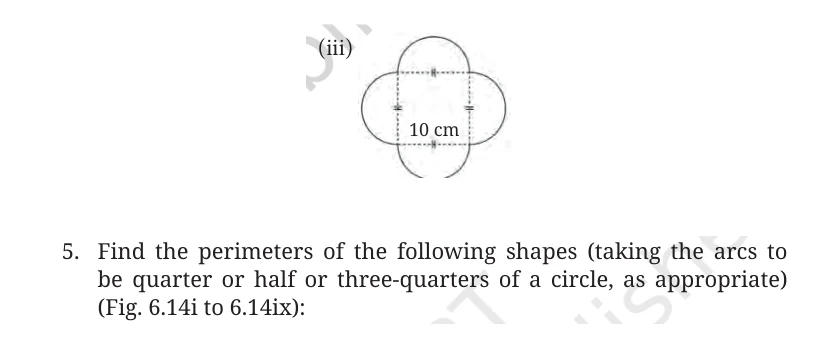
Exercise Set 6.1, 5(iii): Find the perimeter of the four-semicircle figure with diameter 10 cm for each arc.
Show detailed solution
- Step 1: Each semicircle has radius 5\text{ cm}.
- Step 2: One semicircular arc has length 5\pi\text{ cm}.
- Step 3: Four such arcs give P=20\pi\text{ cm}.
- Answer: P=440/7\text{ cm}=62\tfrac{6}{7}\text{ cm}.
Textbook page 129 · solved item 22
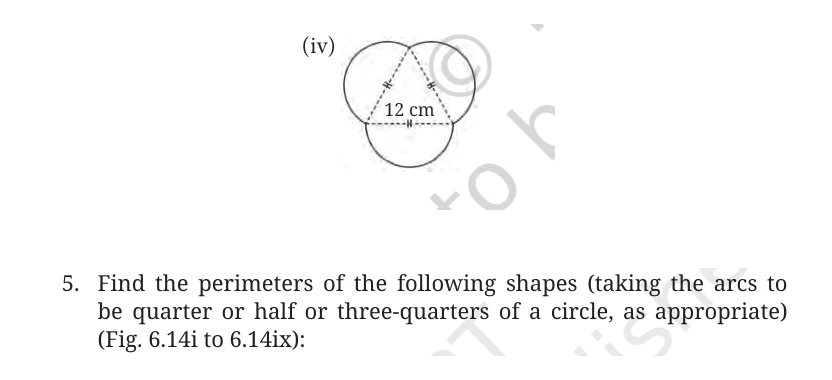
Exercise Set 6.1, 5(iv): Find the perimeter of the three-petal figure based on an equilateral triangle of side 12 cm.
Show detailed solution
- Step 1: Each boundary arc is a semicircle with diameter 12\text{ cm}.
- Step 2: Each arc length is 6\pi\text{ cm}.
- Step 3: There are three arcs, so P=18\pi\text{ cm}.
- Answer: P=396/7\text{ cm}=56\tfrac{4}{7}\text{ cm}.
Textbook page 129 · solved item 23

Exercise Set 6.1, 5(v): Find the perimeter of the rounded grid figure when each marked interval is 14 cm.
Show detailed solution
- Step 1: The four large corner arcs are quarter-circles of radius 14\text{ cm}; together they make one full circle, length 28\pi\text{ cm}.
- Step 2: The four smaller bulges are semicircles of diameter 14\text{ cm}, or radius 7\text{ cm}.
- Step 3: Their combined length is 4\times7\pi=28\pi\text{ cm}.
- Answer: P=56\pi=176\text{ cm}.
Textbook page 129 · solved item 24
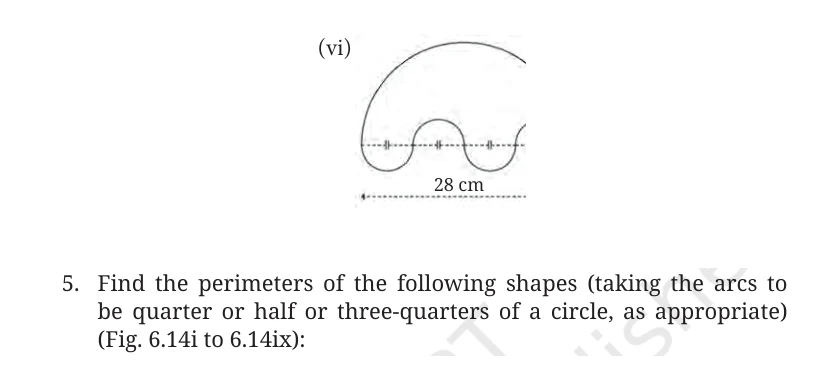
Exercise Set 6.1, 5(vi): Find the perimeter of the figure with total diameter 28 cm and four equal inner semicircles.
Show detailed solution
- Step 1: The outer semicircle has diameter 28\text{ cm}, so its arc length is 14\pi\text{ cm}.
- Step 2: The four equal inner diameters total 28\text{ cm}; their semicircular arc lengths therefore total (\pi/2)\times28=14\pi\text{ cm}.
- Step 3: Add the outer and inner arcs: P=28\pi\text{ cm}.
- Answer: P=88\text{ cm}.
Textbook page 129 · solved item 25
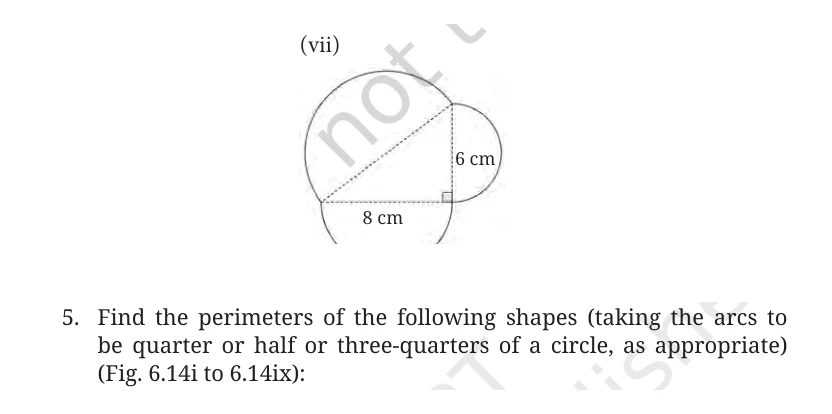
Exercise Set 6.1, 5(vii): Find the perimeter of the three semicircles drawn on a right triangle with legs 6 cm and 8 cm.
Show detailed solution
- Step 1: The hypotenuse is \sqrt{6^2+8^2}=10\text{ cm}.
- Step 2: A semicircle with diameter d has arc length \pi d/2.
- Step 3: The three diameters total 6+8+10=24\text{ cm}, so P=(\pi/2)\times24=12\pi\text{ cm}.
- Answer: P=264/7\text{ cm}=37\tfrac{5}{7}\text{ cm}.
Textbook page 129 · solved item 26
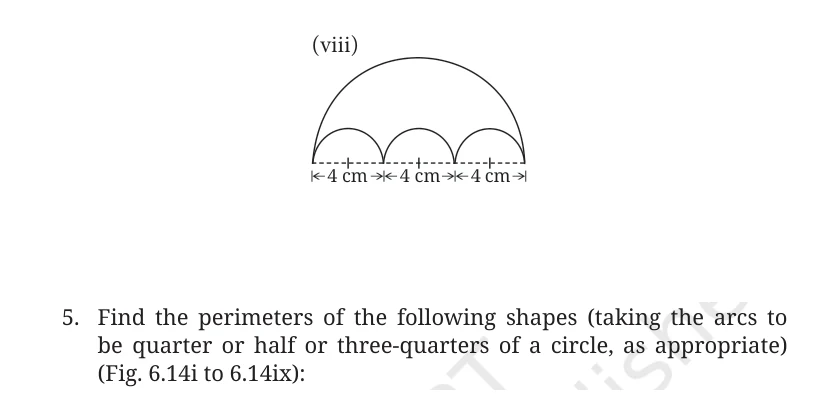
Exercise Set 6.1, 5(viii): Find the perimeter of the large semicircle and three inner semicircles of diameter 4 cm each.
Show detailed solution
- Step 1: The large diameter is 4+4+4=12\text{ cm}, so the large arc is 6\pi\text{ cm}.
- Step 2: Each small semicircle contributes 2\pi\text{ cm}; three contribute 6\pi\text{ cm}.
- Step 3: Thus P=12\pi\text{ cm}.
- Answer: P=264/7\text{ cm}=37\tfrac{5}{7}\text{ cm}.
Textbook page 129 · solved item 27
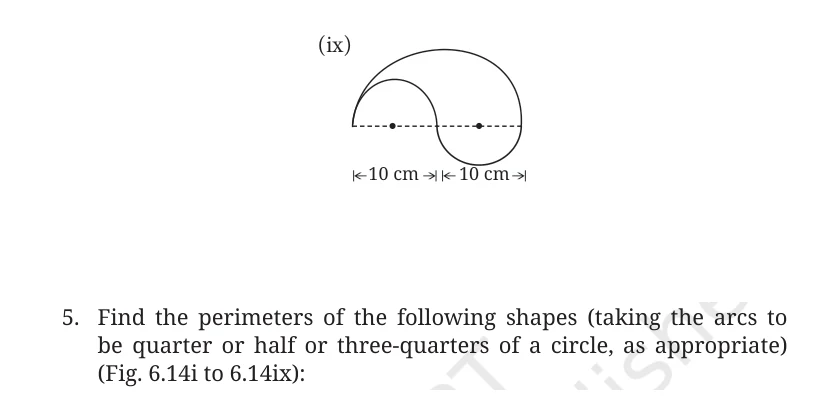
Exercise Set 6.1, 5(ix): Find the perimeter formed by a semicircle of diameter 20 cm and two semicircles of diameter 10 cm.
Show detailed solution
- Step 1: The large semicircle contributes 10\pi\text{ cm}.
- Step 2: The two smaller semicircles contribute 2\times5\pi=10\pi\text{ cm}.
- Step 3: All three arcs form the boundary, so P=20\pi\text{ cm}.
- Answer: P=440/7\text{ cm}=62\tfrac{6}{7}\text{ cm}.
Detailed worked answers
Textbook page 130
Textbook page 130 · solved item 28

Exercise Set 6.1, 6(i): How far does a car travel in one revolution of a tyre of diameter 56 cm?
Show detailed solution
- Step 1: One revolution covers one circumference, C=\pi d.
- Step 2: C=(22/7)\times56\text{ cm}.
- Step 3: 56/7=8, so C=22\times8=176\text{ cm}.
- Answer: The car travels 176\text{ cm}=1.76\text{ m}.
Textbook page 130 · solved item 29

Exercise Set 6.1, 6(ii): How many revolutions does the tyre make over 10 km?
Show detailed solution
- Step 1: Convert 10\text{ km} to centimetres: 10\times1000\times100=1{,}000{,}000\text{ cm}.
- Step 2: One revolution covers 176\text{ cm}.
- Step 3: Revolutions =1{,}000{,}000/176=62{,}500/11\approx5681.82.
- Answer: About 5682 revolutions, or exactly 62{,}500/11 revolutions.
Textbook page 130 · solved item 30
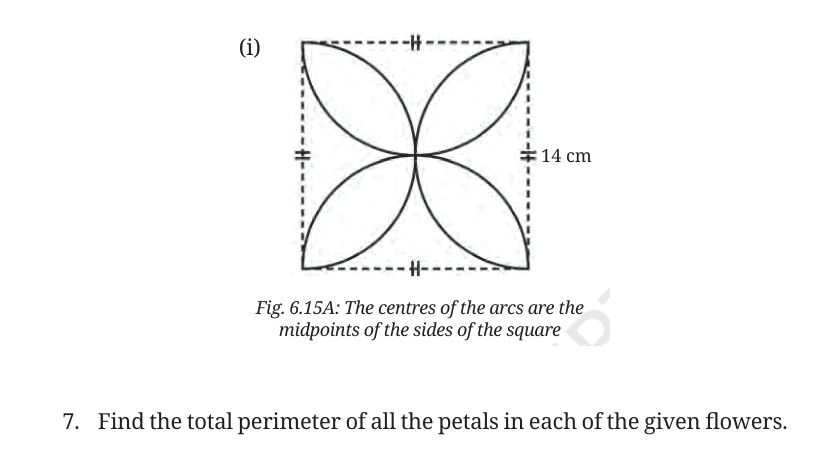
Exercise Set 6.1, 7(i): Find the total perimeter of the four petals in the square of side 14 cm.
Show detailed solution
- Step 1: Each petal is bounded by two quarter-circle arcs of radius 7\text{ cm}, because the arc centres are side midpoints.
- Step 2: The four petals contain eight quarter-circle arcs, equal to two full circles of radius 7\text{ cm}.
- Step 3: Total perimeter =2\times2\pi\times7=28\pi\text{ cm}.
- Answer: The total petal perimeter is 88\text{ cm}.
Textbook page 130 · solved item 31
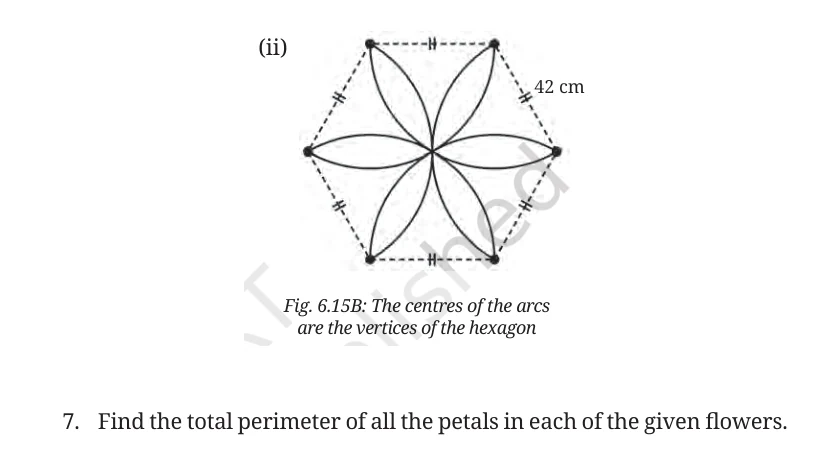
Exercise Set 6.1, 7(ii): Find the total perimeter of the six petals in the regular hexagon of side 42 cm.
Show detailed solution
- Step 1: Each petal has two 60^\circ arcs of radius 42\text{ cm}.
- Step 2: One such arc has length 2\pi\times42\times60/360=14\pi\text{ cm}.
- Step 3: Six petals contain twelve arcs, so the total is 12\times14\pi=168\pi\text{ cm}.
- Answer: The total petal perimeter is 528\text{ cm}.
Textbook page 130 · solved item 32

Exercise Set 6.1, 8: The circumferences of two circles are in the ratio 5:4. Find the ratio of their radii.
Show detailed solution
- Step 1: For each circle, C=2\pi r.
- Step 2: Therefore C_1/C_2=(2\pi r_1)/(2\pi r_2)=r_1/r_2.
- Step 3: The common factor 2\pi cancels.
- Answer: The radii are also in the ratio 5:4.
Detailed worked answers
Textbook page 143
Textbook page 143 · solved item 41
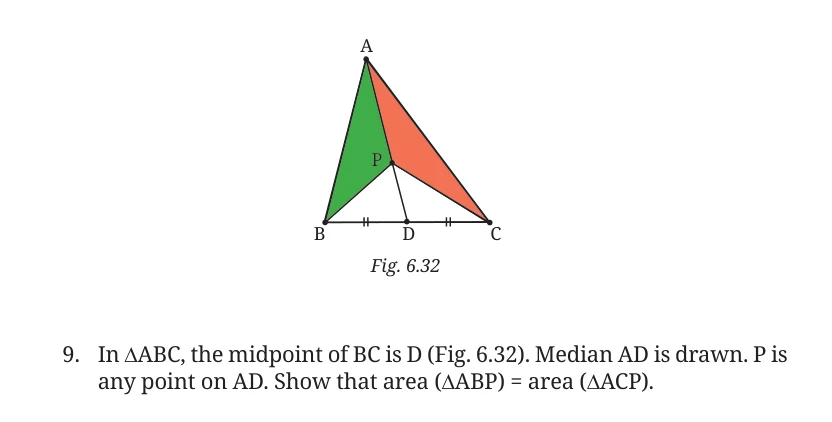
Exercise Set 6.2, 9: If D is the midpoint of BC and P lies on median AD, prove that area(ABP) equals area(ACP).
Show detailed solution
- Step 1: Since BD=DC, triangles \triangle ABD and \triangle ACD have equal bases and the same height from A; hence their areas are equal.
- Step 2: Triangles \triangle PBD and \triangle PCD also have equal bases BD,DC and the same height from P.
- Step 3: Subtract the second pair from the first pair: [ABD]-[PBD]=[ACD]-[PCD].
- Answer: The remaining regions are \triangle ABP and \triangle ACP, so their areas are equal.
Textbook page 143 · solved item 42
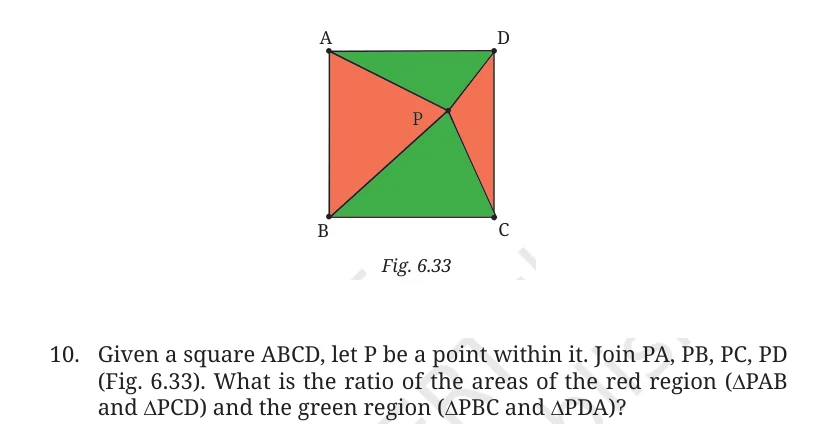
Exercise Set 6.2, 10: A point P inside square ABCD is joined to every vertex. Compare the red and green total areas.
Show detailed solution
- Step 1: Let the square side be s, and let the distances from P to AB and CD be h_1,h_2. Then h_1+h_2=s.
- Step 2: Red area =[PAB]+[PCD]=(1/2)s(h_1+h_2)=s^2/2.
- Step 3: The distances from P to BC and DA also sum to s, so the green area is likewise s^2/2.
- Answer: Red : green =1:1.
Textbook page 143 · solved item 43
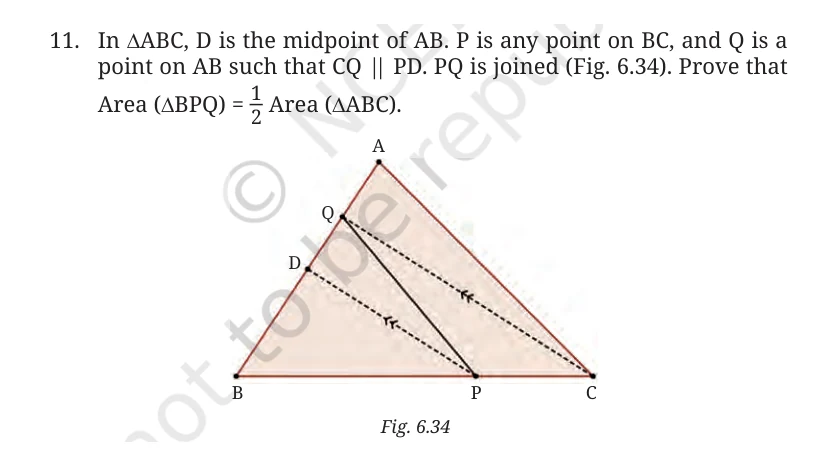
Exercise Set 6.2, 11: Prove that area(BPQ) is half of area(ABC) in the given construction.
Show detailed solution
- Step 1: Since DP\parallel QC, triangles \triangle BDP and \triangle BQC are similar.
- Step 2: Hence BD/BQ=BP/BC. Because D is the midpoint of AB, BD=AB/2.
- Step 3: Rearranging gives (BQ/BA)(BP/BC)=1/2.
- Step 4: Triangles BPQ and ABC share angle B, so their area ratio is the product of the two adjacent-side ratios: [BPQ]/[ABC]=(BQ/BA)(BP/BC).
- Answer: \operatorname{area}(\triangle BPQ)=\tfrac12\operatorname{area}(\triangle ABC).
Detailed worked answers
Textbook page 144
Textbook page 144 · solved item 44
Think and Reflect: Why have people used circular shapes, and what are some practical and non-practical uses?
Show detailed solution
- Step 1: A circle is easy to construct from a fixed centre and radius, and every boundary point is equally far from the centre.
- Step 2: Circular wheels, rollers, gears, pulleys, pots, wells, towers, domes, and tracks use symmetry, smooth rotation, or an efficient enclosure.
- Step 3: Circular layouts can also distribute attention or access evenly around a centre, as in meeting spaces and settlements.
- Step 4: The sun, moon, cycles, and symmetry have also given circles artistic, ceremonial, and symbolic importance.
- Answer: Circular forms were chosen for both practical geometry and cultural or aesthetic reasons; many valid examples are possible.
Detailed worked answers
Textbook page 148
Textbook page 148 · solved item 45
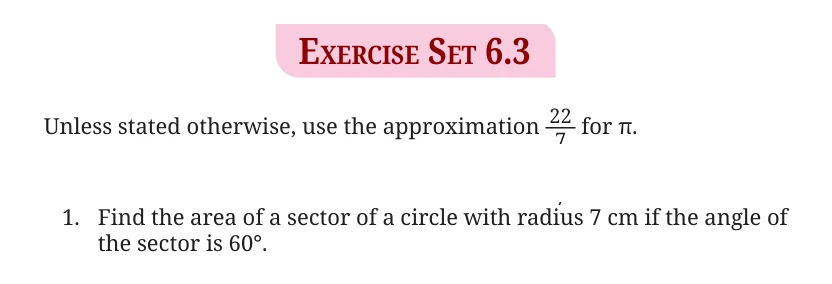
Exercise Set 6.3, 1: Find the area of a 60-degree sector of radius 7 cm.
Show detailed solution
- Step 1: A=(\theta/360^\circ)\pi r^2.
- Step 2: A=(60/360)\times(22/7)\times7^2.
- Step 3: A=(1/6)\times154=77/3\text{ cm}^2.
- Answer: 25\tfrac{2}{3}\text{ cm}^2.
Textbook page 148 · solved item 46
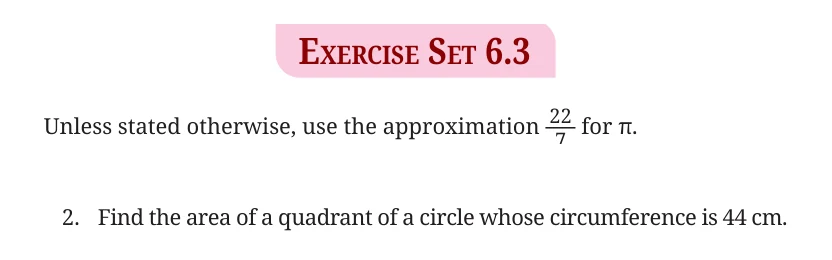
Exercise Set 6.3, 2: Find the area of a quadrant whose circle has circumference 44 cm.
Show detailed solution
- Step 1: From 2\pi r=44, r=7\text{ cm}.
- Step 2: Circle area =\pi r^2=(22/7)\times49=154\text{ cm}^2.
- Step 3: A quadrant is one quarter of the circle.
- Answer: 154/4=38.5\text{ cm}^2.
Textbook page 148 · solved item 47
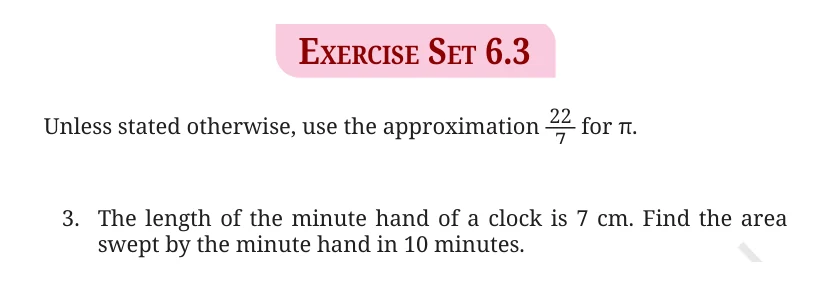
Exercise Set 6.3, 3: A 7 cm minute hand sweeps for 10 minutes. Find the swept area.
Show detailed solution
- Step 1: Ten minutes is 10/60 of a full turn, or 60^\circ.
- Step 2: The swept area is a sector: A=(60/360)\times(22/7)\times7^2.
- Step 3: A=77/3\text{ cm}^2.
- Answer: 25\tfrac{2}{3}\text{ cm}^2.
Textbook page 148 · solved item 48
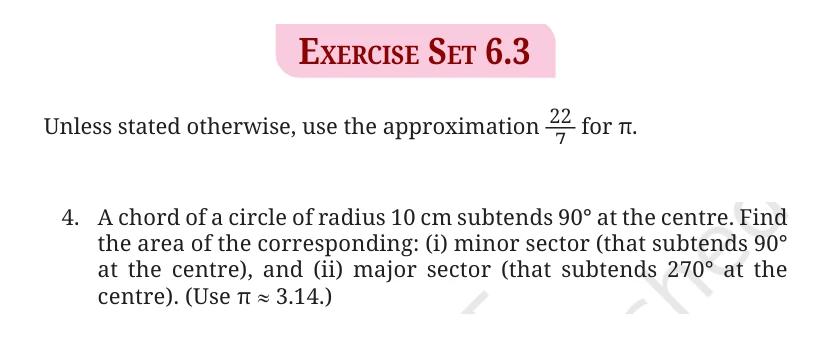
Exercise Set 6.3, 4(i): Find the minor-sector area for radius 10 cm and angle 90 degrees, using pi approximately 3.14.
Show detailed solution
- Step 1: A 90^\circ sector is one quarter of a circle.
- Step 2: A=(90/360)\times3.14\times10^2.
- Step 3: A=(1/4)\times314.
- Answer: 78.5\text{ cm}^2.
Textbook page 148 · solved item 49
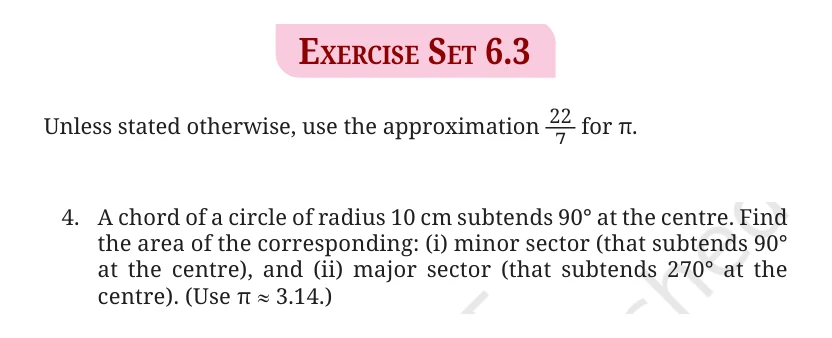
Exercise Set 6.3, 4(ii): Find the major-sector area for radius 10 cm and angle 270 degrees, using pi approximately 3.14.
Show detailed solution
- Step 1: A 270^\circ sector is three quarters of a circle.
- Step 2: A=(270/360)\times3.14\times10^2.
- Step 3: A=(3/4)\times314.
- Answer: 235.5\text{ cm}^2.
Textbook page 148 · solved item 50
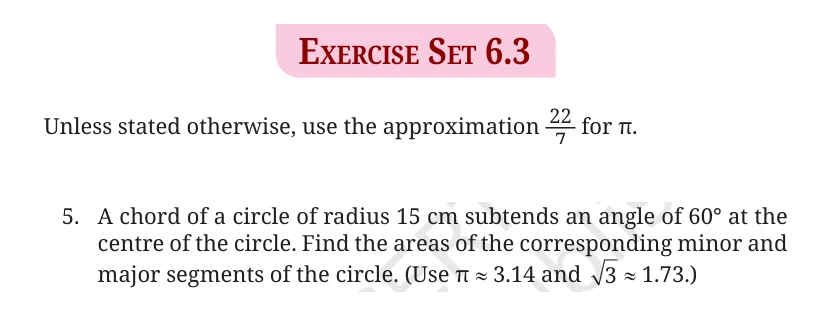
Exercise Set 6.3, 5: A 15 cm chord subtends 60 degrees at the centre of a circle of radius 15 cm. Find the minor and major segment areas.
Show detailed solution
- Step 1: The two radii and the chord form an equilateral triangle, so its area is (\sqrt3/4)15^2\approx(1.73/4)225=97.3125\text{ cm}^2.
- Step 2: The 60^\circ sector area is (60/360)\times3.14\times225=117.75\text{ cm}^2.
- Step 3: Minor segment =117.75-97.3125=20.4375\text{ cm}^2.
- Step 4: The circle area is 3.14\times225=706.5\text{ cm}^2, so the major segment is 706.5-20.4375=686.0625\text{ cm}^2.
- Answer: Minor \approx20.44\text{ cm}^2; major \approx686.06\text{ cm}^2.
Textbook page 148 · solved item 51
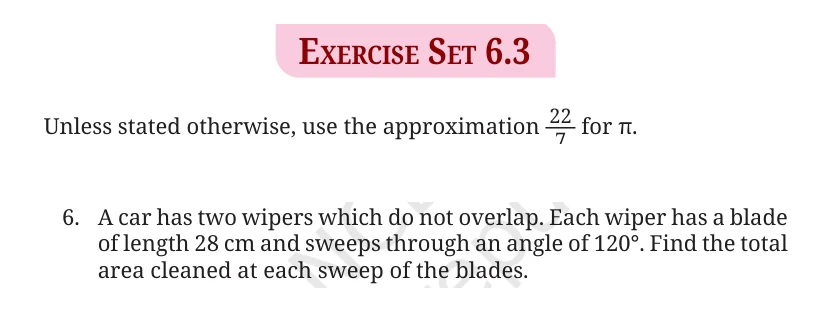
Exercise Set 6.3, 6: Two non-overlapping wipers of length 28 cm each sweep through 120 degrees. Find the total cleaned area.
Show detailed solution
- Step 1: One wiper cleans a sector of area (120/360)\pi(28)^2.
- Step 2: With \pi=22/7, one area is (1/3)\times(22/7)\times784=2464/3\text{ cm}^2.
- Step 3: The sectors do not overlap, so double this area.
- Answer: Total area =4928/3\text{ cm}^2=1642\tfrac{2}{3}\text{ cm}^2.
Textbook page 148 · solved item 52
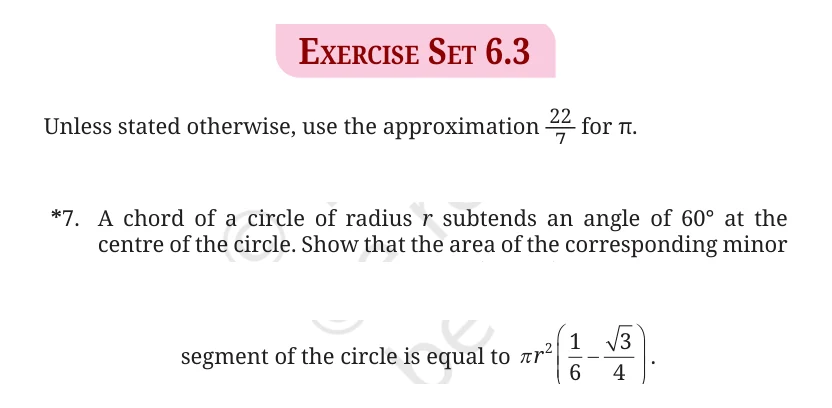
Exercise Set 6.3, 7: Prove the formula for the minor segment cut off by a chord subtending 60 degrees in a circle of radius r.
Show detailed solution
- Step 1: The 60^\circ sector has area (60/360)\pi r^2=\pi r^2/6.
- Step 2: The two radii and chord form an equilateral triangle of side r.
- Step 3: Its area is \sqrt3r^2/4.
- Step 4: Segment area equals sector area minus triangle area. Factoring out \pi r^2 also requires dividing the second term by \pi.
- Answer: A=r^2\left(\tfrac\pi6-\tfrac{\sqrt3}{4}\right)=\pi r^2\left(\tfrac16-\tfrac{\sqrt3}{4\pi}\right). The printed form omits this denominator \pi.
Textbook page 148 · solved item 53
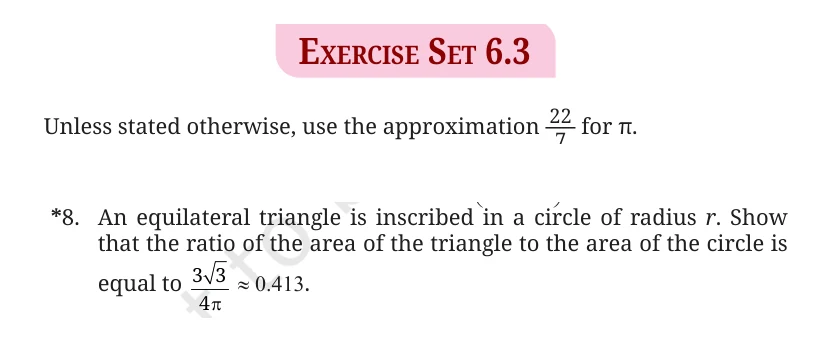
Exercise Set 6.3, 8: Find the ratio of the area of an inscribed equilateral triangle to the area of its circle of radius r.
Show detailed solution
- Step 1: The circumradius of an equilateral triangle of side a is a/\sqrt3, so a=\sqrt3r.
- Step 2: Triangle area =(\sqrt3/4)a^2=(\sqrt3/4)(3r^2)=3\sqrt3r^2/4.
- Step 3: Circle area is \pi r^2.
- Answer: The ratio is \dfrac{3\sqrt3}{4\pi}\approx0.413.
Textbook page 148 · solved item 54
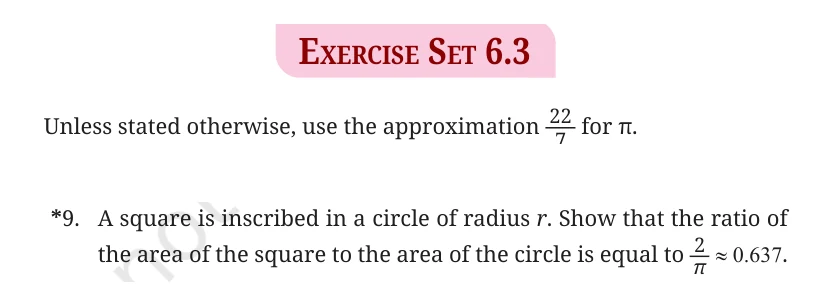
Exercise Set 6.3, 9: Find the ratio of the area of an inscribed square to the area of its circle of radius r.
Show detailed solution
- Step 1: The square's diagonal is the circle's diameter, 2r.
- Step 2: If the side is a, then a\sqrt2=2r, so a=\sqrt2r.
- Step 3: Square area =a^2=2r^2; circle area =\pi r^2.
- Answer: The ratio is 2/\pi\approx0.637.
Textbook page 148 · solved item 55
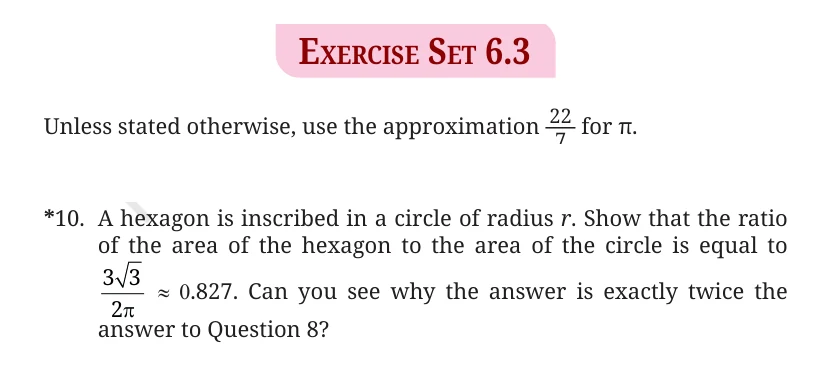
Exercise Set 6.3, 10: Find the ratio of the area of an inscribed regular hexagon to its circle and compare it with Question 8.
Show detailed solution
- Step 1: Joining the centre to the vertices makes six equilateral triangles of side r.
- Step 2: Hexagon area =6(\sqrt3r^2/4)=3\sqrt3r^2/2.
- Step 3: Divide by circle area \pi r^2 to get 3\sqrt3/(2\pi)\approx0.827.
- Step 4: The inscribed equilateral triangle consists of three such central triangles, while the hexagon consists of six.
- Answer: The ratio is 3\sqrt3/(2\pi), exactly twice the ratio in Question 8.
Detailed worked answers
Textbook page 149
Textbook page 149 · solved item 56
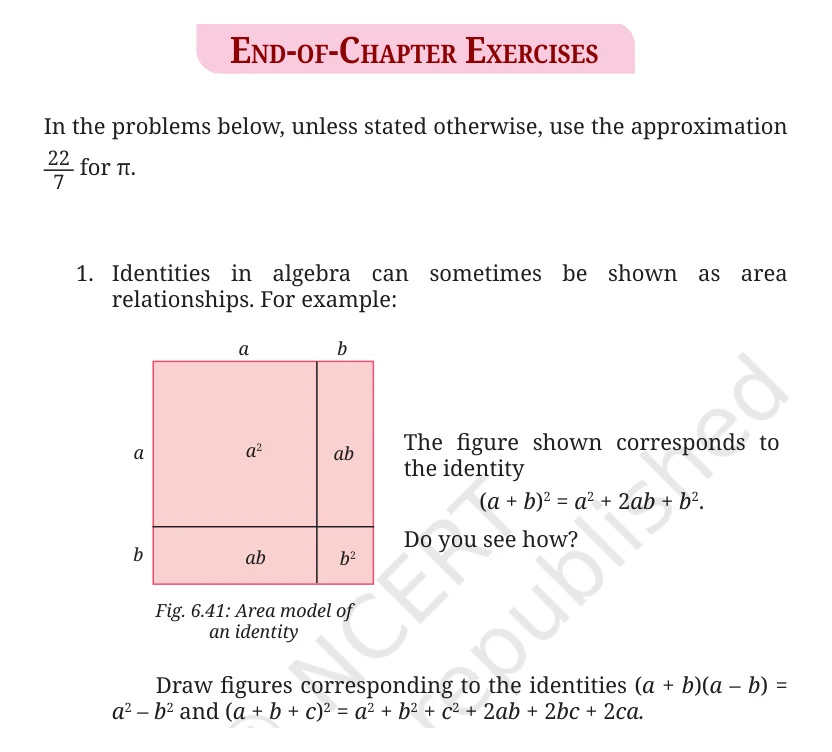
End-of-Chapter Exercise 1: Draw area models for two algebraic identities.
Show detailed solution
- Step 1: For (a+b)(a-b)=a^2-b^2, start with an a\times a square, remove a b\times b corner, and rearrange the two remaining rectangles into one rectangle of sides a+b and a-b.
- Step 2: Both arrangements therefore have area a^2-b^2=(a+b)(a-b).
- Step 3: For (a+b+c)^2, draw a square of side a+b+c and make horizontal and vertical cuts after lengths a,b,c.
- Step 4: The nine pieces are squares a^2,b^2,c^2 and two rectangles of each area ab,bc,ca.
- Answer: Adding the pieces gives (a+b+c)^2=a^2+b^2+c^2+2ab+2bc+2ca.
Textbook page 149 · solved item 57
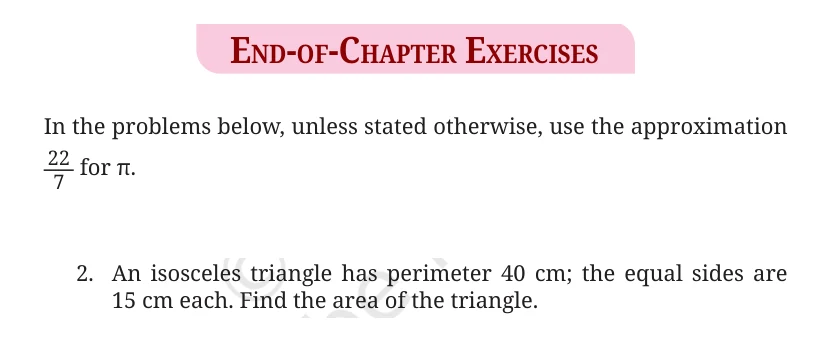
End-of-Chapter Exercise 2: An isosceles triangle has perimeter 40 cm and equal sides 15 cm. Find its area.
Show detailed solution
- Step 1: The base is 40-15-15=10\text{ cm}.
- Step 2: The altitude bisects the base, giving a right triangle with hypotenuse 15 and base 5.
- Step 3: h=\sqrt{15^2-5^2}=\sqrt{200}=10\sqrt2\text{ cm}.
- Answer: Area =(1/2)\times10\times10\sqrt2=50\sqrt2\text{ cm}^2\approx70.7\text{ cm}^2.
Textbook page 149 · solved item 58
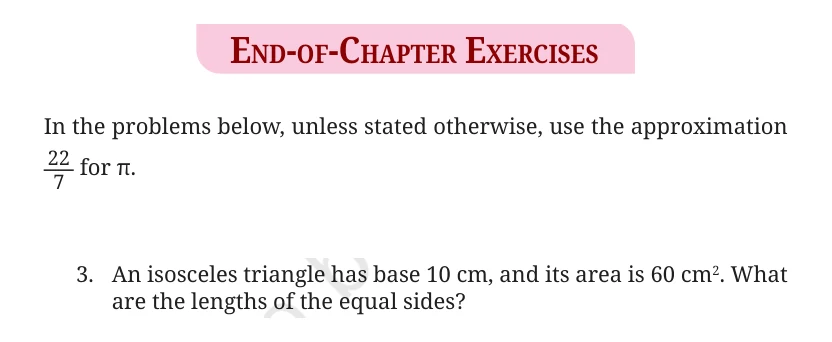
End-of-Chapter Exercise 3: An isosceles triangle has base 10 cm and area 60 square centimetres. Find the equal sides.
Show detailed solution
- Step 1: 60=(1/2)\times10\times h, so h=12\text{ cm}.
- Step 2: The altitude bisects the base into two 5\text{ cm} segments.
- Step 3: Each equal side is \sqrt{12^2+5^2}=\sqrt{169}=13\text{ cm}.
- Answer: The equal sides are 13\text{ cm} each.
Textbook page 149 · solved item 59
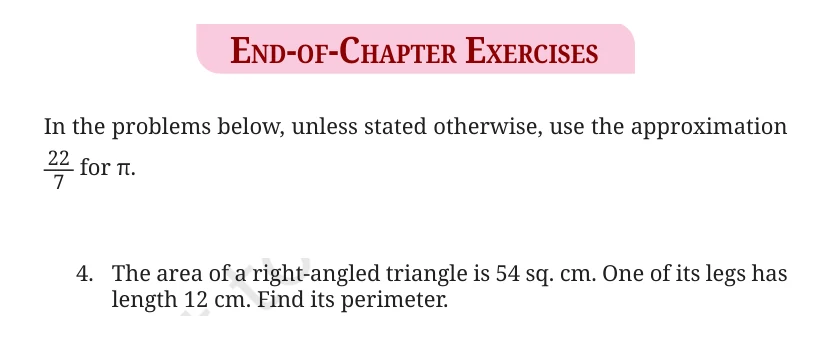
End-of-Chapter Exercise 4: A right triangle has area 54 square centimetres and one leg 12 cm. Find its perimeter.
Show detailed solution
- Step 1: If the other leg is x, then (1/2)\times12\times x=54.
- Step 2: Thus 6x=54, so x=9\text{ cm}.
- Step 3: The hypotenuse is \sqrt{12^2+9^2}=15\text{ cm}.
- Answer: Perimeter =12+9+15=36\text{ cm}.
Textbook page 149 · solved item 60
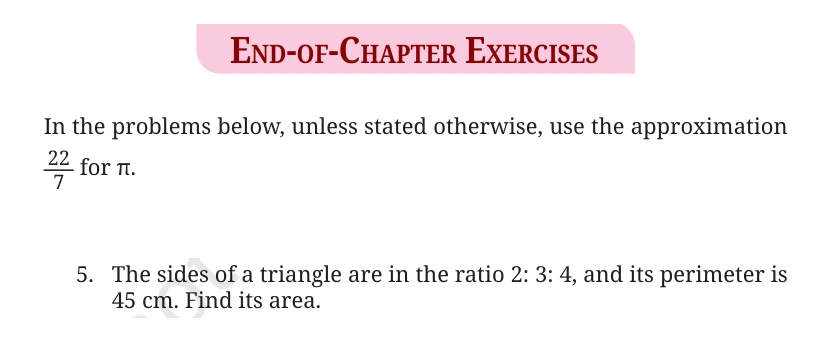
End-of-Chapter Exercise 5: A triangle has side ratio 2:3:4 and perimeter 45 cm. Find its area.
Show detailed solution
- Step 1: One ratio part is 45/9=5\text{ cm}, so the sides are 10,15,20\text{ cm}.
- Step 2: The semiperimeter is s=45/2\text{ cm}.
- Step 3: Heron's formula gives A=\sqrt{(45/2)(25/2)(15/2)(5/2)}.
- Answer: A=75\sqrt{15}/4\text{ cm}^2\approx72.6\text{ cm}^2.
Textbook page 149 · solved item 61
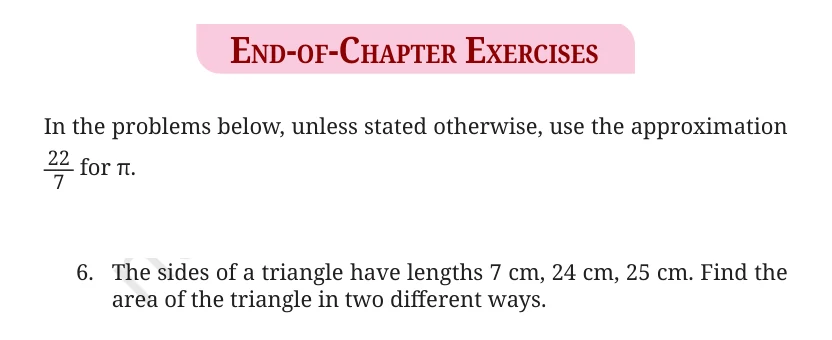
End-of-Chapter Exercise 6: Find the area of the 7 cm, 24 cm, 25 cm triangle in two ways.
Show detailed solution
- Step 1: Since 7^2+24^2=25^2, the triangle is right-angled, so A=(1/2)\times7\times24=84\text{ cm}^2.
- Step 2: For Heron's formula, s=(7+24+25)/2=28\text{ cm}.
- Step 3: A=\sqrt{28(21)(4)(3)}=\sqrt{7056}=84\text{ cm}^2.
- Answer: Both methods give 84\text{ cm}^2.
Textbook page 149 · solved item 62
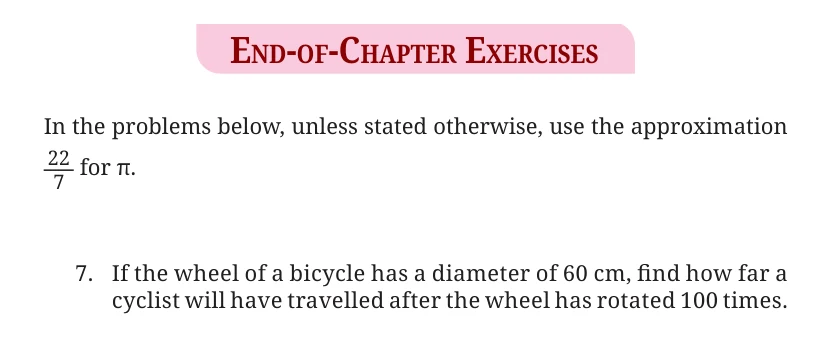
End-of-Chapter Exercise 7: A bicycle wheel of diameter 60 cm turns 100 times. Find the distance travelled.
Show detailed solution
- Step 1: One turn covers circumference \pi d=(22/7)\times60=1320/7\text{ cm}.
- Step 2: One hundred turns cover 132000/7\text{ cm}.
- Step 3: Divide by 100 to convert centimetres to metres.
- Answer: 1320/7\text{ m}=188\tfrac47\text{ m}\approx188.6\text{ m}.
Detailed worked answers
Textbook page 150
Textbook page 150 · solved item 63

End-of-Chapter Exercise 8: Find the area of a quadrant whose circle has circumference 66 cm.
Show detailed solution
- Step 1: 2\pi r=66, so r=66\times7/44=10.5\text{ cm}.
- Step 2: Quadrant area =(1/4)\pi r^2.
- Step 3: A=(1/4)(22/7)(10.5)^2.
- Answer: A=693/8\text{ cm}^2=86.625\text{ cm}^2.
Textbook page 150 · solved item 64

End-of-Chapter Exercise 9: A car wheel has radius 28 cm. Find one-turn distance and turns per kilometre.
Show detailed solution
- Step 1: One turn covers 2\pi r=2\times(22/7)\times28=176\text{ cm}.
- Step 2: One kilometre is 100{,}000\text{ cm}.
- Step 3: Turns =100{,}000/176=6250/11\approx568.18.
- Answer: 176\text{ cm} per turn and about 568.18 turns per kilometre.
Textbook page 150 · solved item 65

End-of-Chapter Exercise 10: If two rectangles have the same area and perimeter, must they be congruent?
Show detailed solution
- Step 1: Let one rectangle have sides x,y. Its semiperimeter is s=x+y, and its area is p=xy.
- Step 2: The side lengths are the two roots of t^2-st+p=0.
- Step 3: A fixed sum and product determine the same unordered pair of roots.
- Answer: Yes. The rectangles have the same pair of side lengths, possibly interchanged, so they are congruent.
Textbook page 150 · solved item 66
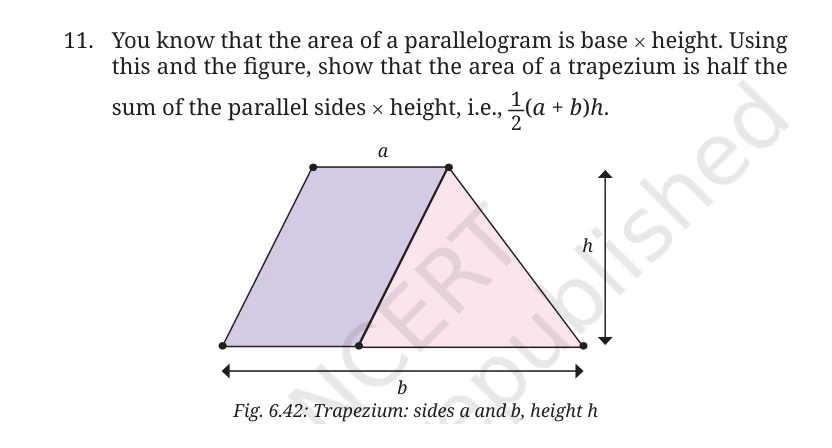
End-of-Chapter Exercise 11: Use the parallelogram-area formula and the figure to derive the trapezium-area formula.
Show detailed solution
- Step 1: Cut the triangular piece from one end of the trapezium as shown.
- Step 2: Move it to the other end. The pieces form a parallelogram of height h.
- Step 3: Its base is the average of the two parallel sides, (a+b)/2.
- Answer: Trapezium area =((a+b)/2)h=\tfrac12(a+b)h.
Textbook page 150 · solved item 67

End-of-Chapter Exercise 12: Derive the trapezium-area formula by dividing it into two triangles.
Show detailed solution
- Step 1: Draw a diagonal across the trapezium.
- Step 2: One triangle has base a and height h, so its area is ah/2.
- Step 3: The other has base b and the same height, so its area is bh/2.
- Answer: Total area =ah/2+bh/2=\tfrac12(a+b)h.
Textbook page 150 · solved item 68

End-of-Chapter Exercise 13: Use two identical trapezia to derive the trapezium-area formula.
Show detailed solution
- Step 1: Rotate a second copy through 180^\circ and place it beside the first.
- Step 2: Together they form a parallelogram with base a+b and height h.
- Step 3: The parallelogram area is (a+b)h, twice the area of one trapezium.
- Answer: One trapezium has area \tfrac12(a+b)h.
Textbook page 150 · solved item 69

End-of-Chapter Exercise 14(i): Prove algebraically that a kite's area is half the product of its diagonals.
Show detailed solution
- Step 1: Let perpendicular diagonals have lengths p and q, with the symmetry diagonal p bisecting q.
- Step 2: The kite is two triangles sharing base q; let their perpendicular heights be h_1,h_2, where h_1+h_2=p.
- Step 3: Total area =(1/2)qh_1+(1/2)qh_2=(1/2)q(h_1+h_2).
- Answer: A=pq/2.
Textbook page 150 · solved item 70

End-of-Chapter Exercise 14(ii): Prove geometrically that a kite's area is half the product of its diagonals.
Show detailed solution
- Step 1: Cut the kite along both diagonals into four right triangles.
- Step 2: Take a second congruent copy of all four pieces and pair matching right triangles.
- Step 3: The eight pieces exactly fill a rectangle whose sides are the diagonal lengths p and q.
- Step 4: Two kites therefore have area pq.
- Answer: One kite has area pq/2.
Textbook page 150 · solved item 71
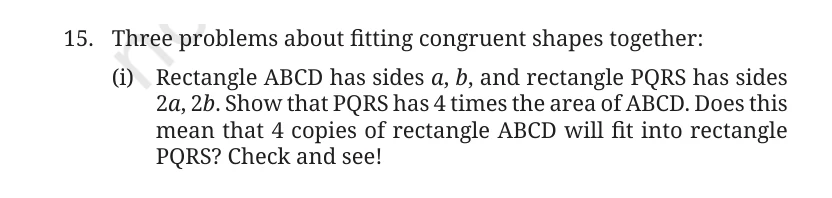
End-of-Chapter Exercise 15(i): Compare rectangles with side lengths a,b and 2a,2b, and tile the larger one.
Show detailed solution
- Step 1: The small rectangle has area ab.
- Step 2: The large rectangle has area (2a)(2b)=4ab.
- Step 3: Divide each side of the large rectangle into two equal parts.
- Answer: The resulting 2\times2 grid contains four congruent a\times b rectangles, so the four copies fit exactly.
Detailed worked answers
Textbook page 151
Textbook page 151 · solved item 72

End-of-Chapter Exercise 15(ii): A triangle's sides are doubled. Show its area becomes four times as large and tile it with four copies.
Show detailed solution
- Step 1: Doubling every side gives a similar triangle with scale factor 2.
- Step 2: Corresponding bases and heights both double, so area scales by 2\times2=4.
- Step 3: Join the three side midpoints of the large triangle.
- Answer: This creates four triangles congruent to the original, so the four copies fit exactly.
Textbook page 151 · solved item 73

End-of-Chapter Exercise 15(iii): A triangle's sides are tripled. Show its area becomes nine times as large and tile it with nine copies.
Show detailed solution
- Step 1: The scale factor is 3, so both a corresponding base and height are multiplied by 3.
- Step 2: Area therefore scales by 3^2=9.
- Step 3: Trisect each side of the large triangle and draw lines through the division points parallel to the other sides.
- Answer: The subdivision produces nine triangles congruent to the original, so nine copies fit exactly.
Textbook page 151 · solved item 74
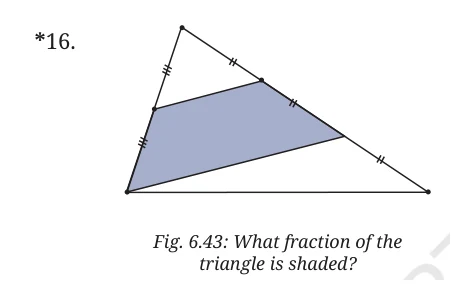
End-of-Chapter Exercise 16, Fig. 6.43: What fraction of the triangle is shaded?
Show detailed solution
- Step 1: Let the large triangle have area K. The point on the left side is its midpoint, while the other side is trisected.
- Step 2: The unshaded top triangle uses fractions 1/2 and 1/3 along the two sides from the top vertex, so its area is K/6.
- Step 3: The unshaded triangle at the right has base one third of the large triangle's right side and the same altitude from the left vertex, so its area is K/3.
- Answer: Shaded fraction =1-1/6-1/3=1/2.
Textbook page 151 · solved item 75
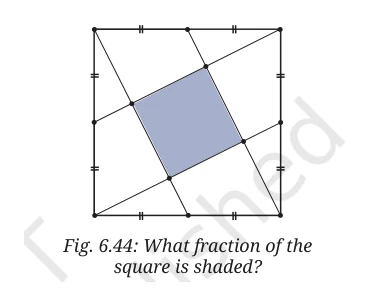
End-of-Chapter Exercise 16, Fig. 6.44: What fraction of the square is shaded?
Show detailed solution
- Step 1: Take the outer square to have side 1 and coordinates at its corners. Each marked boundary point is a midpoint.
- Step 2: The four joining lines meet at (1/5,3/5),(2/5,1/5),(4/5,2/5),(3/5,4/5), after choosing a convenient origin.
- Step 3: Adjacent side vectors of the inner square have squared length (1/5)^2+(2/5)^2=1/5.
- Answer: Its area is 1/5 of the outer square.
Textbook page 151 · solved item 76
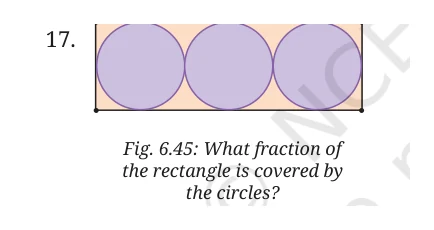
End-of-Chapter Exercise 17, Fig. 6.45: What fraction of the rectangle is covered by the three circles?
Show detailed solution
- Step 1: Let each circle have radius r. The rectangle is 6r long and 2r high.
- Step 2: Rectangle area =(6r)(2r)=12r^2.
- Step 3: The three circles have total area 3\pi r^2.
- Answer: Covered fraction =3\pi r^2/(12r^2)=\pi/4.
Textbook page 151 · solved item 77
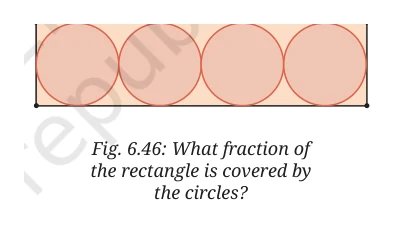
End-of-Chapter Exercise 17, Fig. 6.46: What fraction of the rectangle is covered by the four circles?
Show detailed solution
- Step 1: For circle radius r, the rectangle is 8r long and 2r high.
- Step 2: Rectangle area =16r^2, while four-circle area =4\pi r^2.
- Step 3: Divide the covered area by the rectangle area.
- Answer: Covered fraction =4\pi r^2/(16r^2)=\pi/4.
Textbook page 151 · solved item 78

End-of-Chapter Exercise 18: Conjecture and prove the fraction covered by any row of equal circles fitted tightly in a rectangle.
Show detailed solution
- Step 1: With n circles of radius r, the rectangle has length 2nr and height 2r.
- Step 2: Rectangle area is 4nr^2; total circle area is n\pi r^2.
- Step 3: Their ratio is n\pi r^2/(4nr^2)=\pi/4, independent of n.
- Step 4: Thus 10, 20, and 50 circles all cover the same fraction, about 0.7854.
- Answer: The covered fraction is always \pi/4, or about 78.54\%.
Textbook page 151 · solved item 79
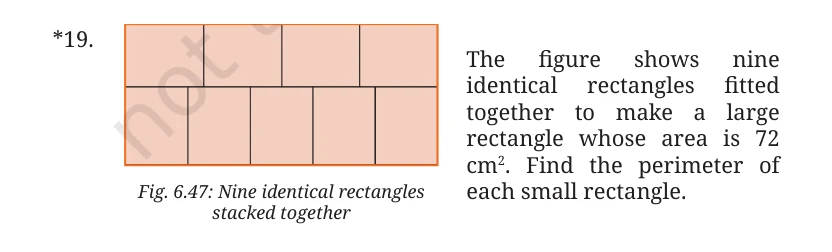
End-of-Chapter Exercise 19: Nine identical rectangles form a larger rectangle of area 72 square centimetres. Find each small rectangle's perimeter.
Show detailed solution
- Step 1: Each small rectangle has area 72/9=8\text{ cm}^2. Let its longer and shorter sides be l,w.
- Step 2: Four long sides span the top row while five short sides span the bottom, so 4l=5w, or l=5w/4.
- Step 3: lw=8 gives (5/4)w^2=8, hence w=4\sqrt{10}/5 and l=\sqrt{10}.
- Answer: Perimeter =2(l+w)=18\sqrt{10}/5\text{ cm}\approx11.38\text{ cm}.
Detailed worked answers
Textbook page 152
Textbook page 152 · solved item 80
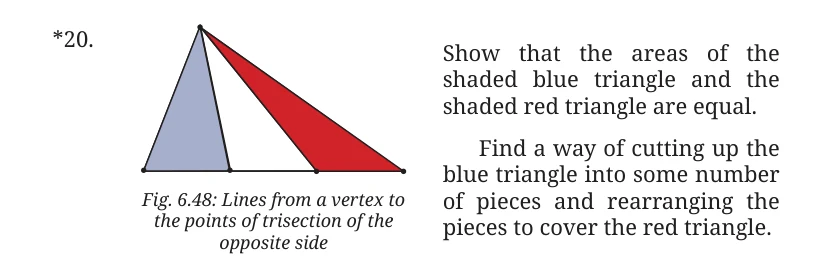
End-of-Chapter Exercise 20: Prove the blue and red triangles have equal area and describe a dissection between them.
Show detailed solution
- Step 1: The opposite side is trisected, so the blue and red triangle bases have the same length b.
- Step 2: Both vertices are the same top vertex, so both triangles have the same altitude h to the baseline.
- Step 3: Each area is bh/2, so they are equal.
- Step 4: For a concrete dissection, cut the blue triangle along the midline parallel to its base, then cut the small top triangle along its altitude. Move the two small right triangles to the ends of the lower trapezium to form a rectangle of dimensions b by h/2.
- Answer: The red triangle has the same three-piece rectangle dissection; reverse that dissection to rearrange the blue pieces into the red triangle.
Textbook page 152 · solved item 81
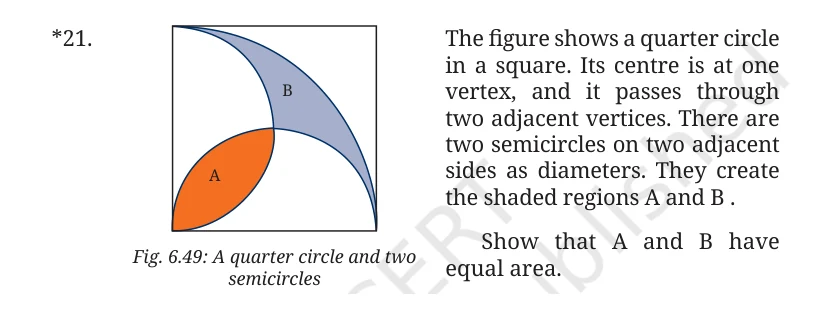
End-of-Chapter Exercise 21: Prove that shaded regions A and B have equal area.
Show detailed solution
- Step 1: Let the square side be s. The quarter-circle area is Q=\pi s^2/4.
- Step 2: Each side-based semicircle has area \pi(s/2)^2/2=\pi s^2/8, so the two semicircle areas sum to Q.
- Step 3: Their union has area (sum of semicircles) minus their overlap A, hence Q-A.
- Step 4: Region B is the part of the quarter circle outside that union, so B=Q-(Q-A)=A.
- Answer: Regions A and B have equal area.
Textbook page 152 · solved item 82
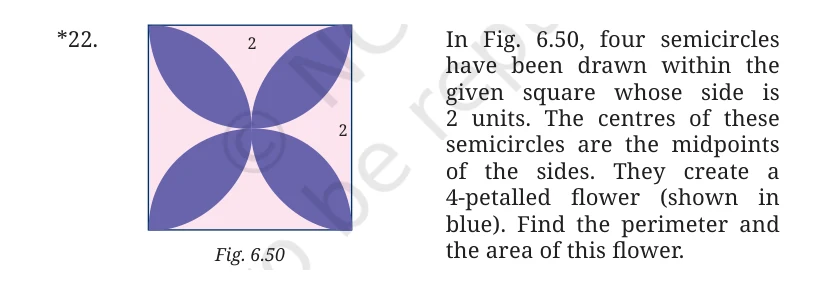
End-of-Chapter Exercise 22: Find the perimeter and area of the four-petalled flower in a square of side 2 units.
Show detailed solution
- Step 1: Each petal is bounded by two quarter-circle arcs of radius 1, so its perimeter is \pi. Four petals give total perimeter 4\pi.
- Step 2: One petal is the overlap of two unit circles whose relevant central angles are 90^\circ.
- Step 3: Its area is two sectors minus two right triangles: 2(\pi/4-1/2)=\pi/2-1.
- Step 4: Four petals have area 4(\pi/2-1)=2\pi-4.
- Answer: Perimeter =4\pi units; area =2\pi-4 square units.
Textbook page 152 · solved item 83
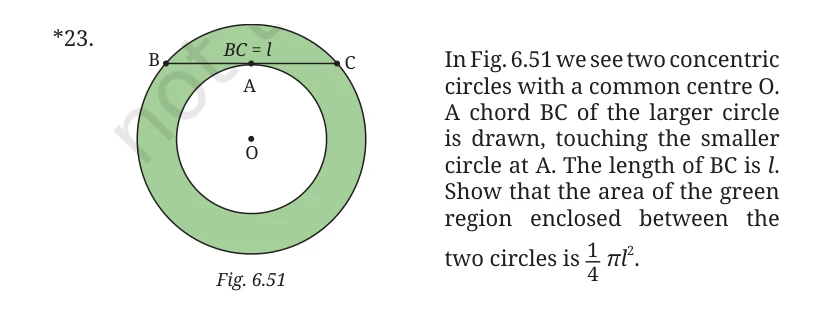
End-of-Chapter Exercise 23: A chord of length l in the larger of two concentric circles touches the smaller circle. Prove the annulus area is pi l squared over 4.
Show detailed solution
- Step 1: Let the radii be R and r, and let A be the tangency point. A radius to a tangent is perpendicular, so OA\perp BC.
- Step 2: The perpendicular from the centre bisects the chord, so AB=l/2.
- Step 3: In right triangle OAB, R^2=r^2+(l/2)^2, hence R^2-r^2=l^2/4.
- Answer: Annulus area =\pi(R^2-r^2)=\pi l^2/4.
Detailed worked answers
Textbook page 153
Textbook page 153 · solved item 84
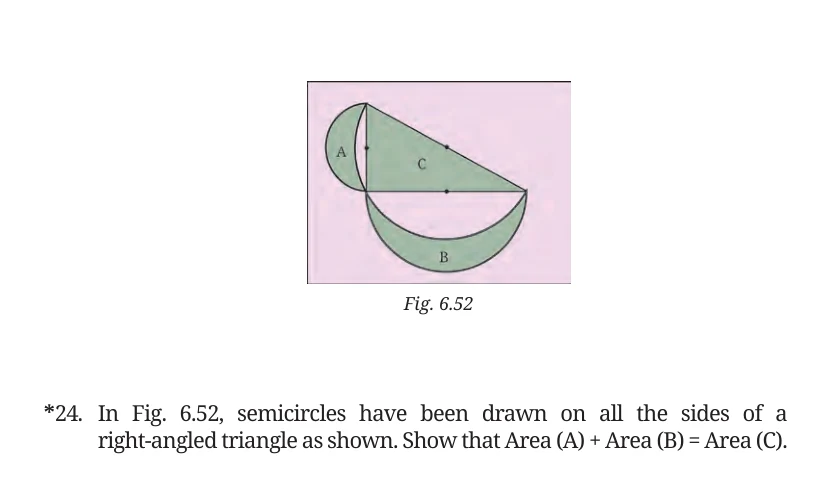
End-of-Chapter Exercise 24: Semicircles are drawn on all sides of a right triangle. Prove area(A)+area(B)=area(C).
Show detailed solution
- Step 1: Semicircle area is proportional to the square of its diameter: S(d)=\pi d^2/8.
- Step 2: If the legs are a,b and hypotenuse is c, then a^2+b^2=c^2, so S(a)+S(b)=S(c).
- Step 3: In the figure, the two smaller semicircles together consist of lunes A and B plus the two circular pieces lying inside the triangle.
- Step 4: The hypotenuse semicircle consists of triangle C plus those same two circular pieces.
- Answer: Subtract the common circular pieces to obtain \operatorname{area}(A)+\operatorname{area}(B)=\operatorname{area}(C).
Textbook page 153 · solved item 85
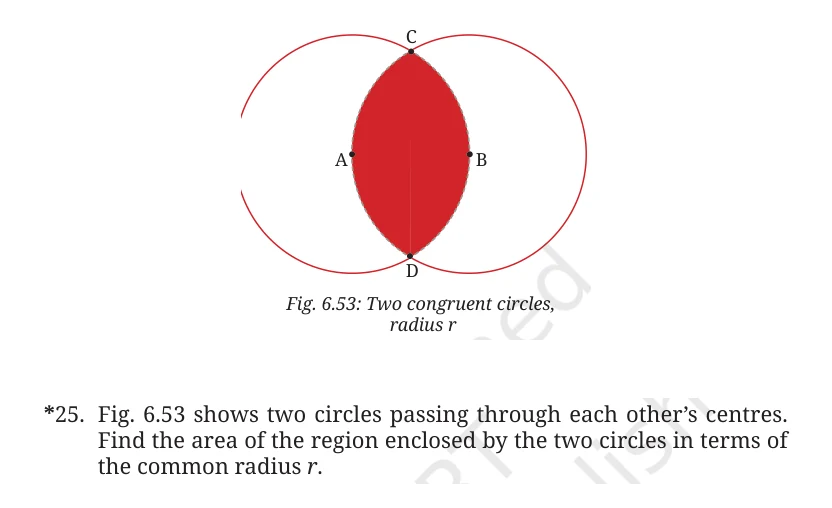
End-of-Chapter Exercise 25: Two circles of radius r pass through each other's centres. Find their overlap area.
Show detailed solution
- Step 1: The radii to the intersection points form two 120^\circ sectors, one in each circle.
- Step 2: One sector area is (120/360)\pi r^2=\pi r^2/3.
- Step 3: The triangle inside each sector has area (1/2)r^2\sin120^\circ=\sqrt3r^2/4.
- Step 4: The lens is two sector-minus-triangle segments.
- Answer: A=2(\pi r^2/3-\sqrt3r^2/4)=r^2(2\pi/3-\sqrt3/2).
Textbook page 153 · solved item 86
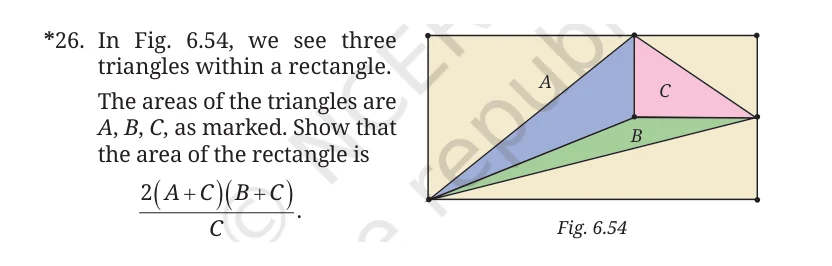
End-of-Chapter Exercise 26: Prove the given formula for the area of the rectangle in terms of triangle areas A, B, C.
Show detailed solution
- Step 1: Let the rectangle have width W, height H; let the vertical division be at x, and the horizontal division be at y from the bottom.
- Step 2: Then A=\tfrac12x(H-y), B=\tfrac12(W-x)y, and C=\tfrac12(W-x)(H-y).
- Step 3: Hence A+C=\tfrac12W(H-y) and B+C=\tfrac12H(W-x).
- Step 4: Substitute these into 2(A+C)(B+C)/C; all factors (W-x)(H-y) cancel.
- Answer: \dfrac{2(A+C)(B+C)}{C}=WH, the area of the rectangle.
Textbook page 153 · solved item 87
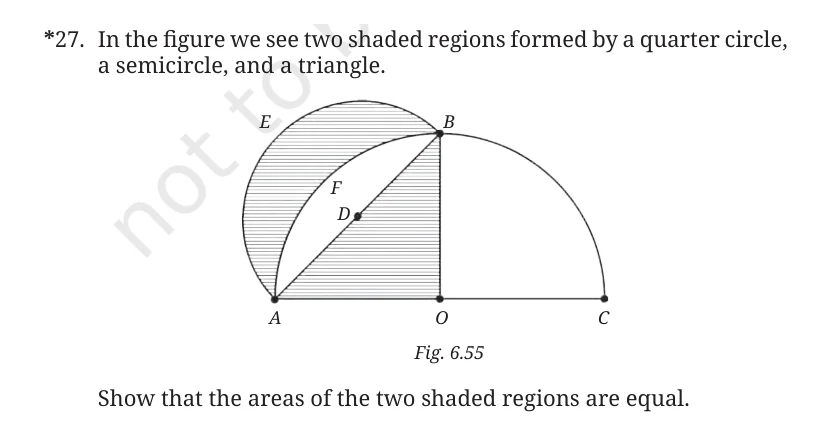
End-of-Chapter Exercise 27: Prove the two shaded regions formed by the quarter circle and semicircle have equal area.
Show detailed solution
- Step 1: Let the quarter circle have radius r. Its area is \pi r^2/4.
- Step 2: Since OA=OB=r and \angle AOB=90^\circ, AB^2=OA^2+OB^2=2r^2.
- Step 3: The semicircle on diameter AB has area \pi(AB/2)^2/2=\pi AB^2/8=\pi r^2/4.
- Step 4: The quarter circle and semicircle have equal total area and share the same unshaded overlap.
- Answer: Subtracting the common overlap leaves the two shaded remainders equal.