
Question-by-question working
Read the prompt, attempt it, then check each step
Every exercise subpart and table row is a separate item. Shared figures are repeated in the crop whenever they are needed to understand that question.
Detailed worked answers
Textbook page 3
Textbook page 3 · solved item 1
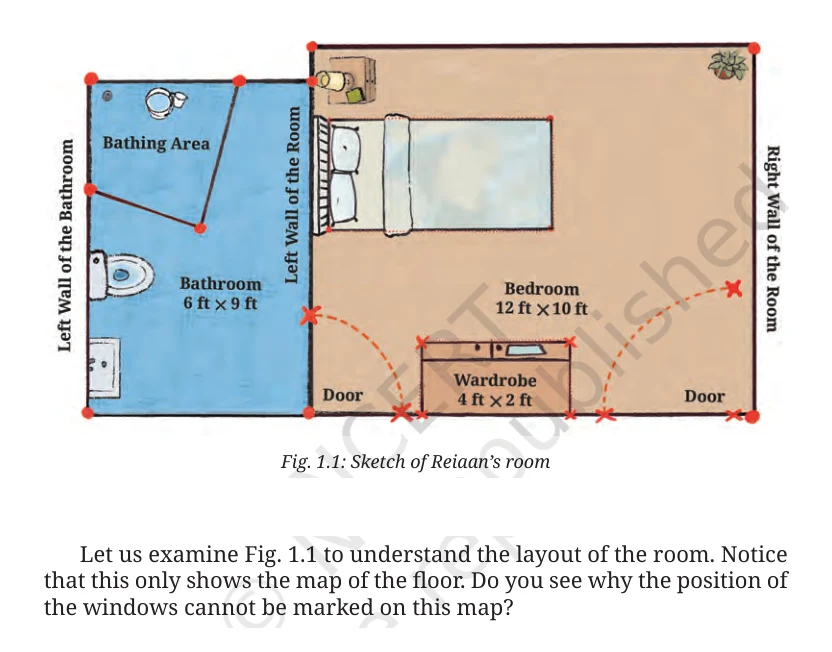
Why can the windows not be marked on the floor map in Fig. 1.1?
Show detailed solution
- Step 1: The sketch records positions on the floor using only two coordinates: left-right and front-back.
- Step 2: A window is above the floor, so its position also needs a height coordinate.
- Conclusion: A two-dimensional floor map cannot show the window height. A three-dimensional description would be needed.
Detailed worked answers
Textbook page 5
Textbook page 5 · solved item 2
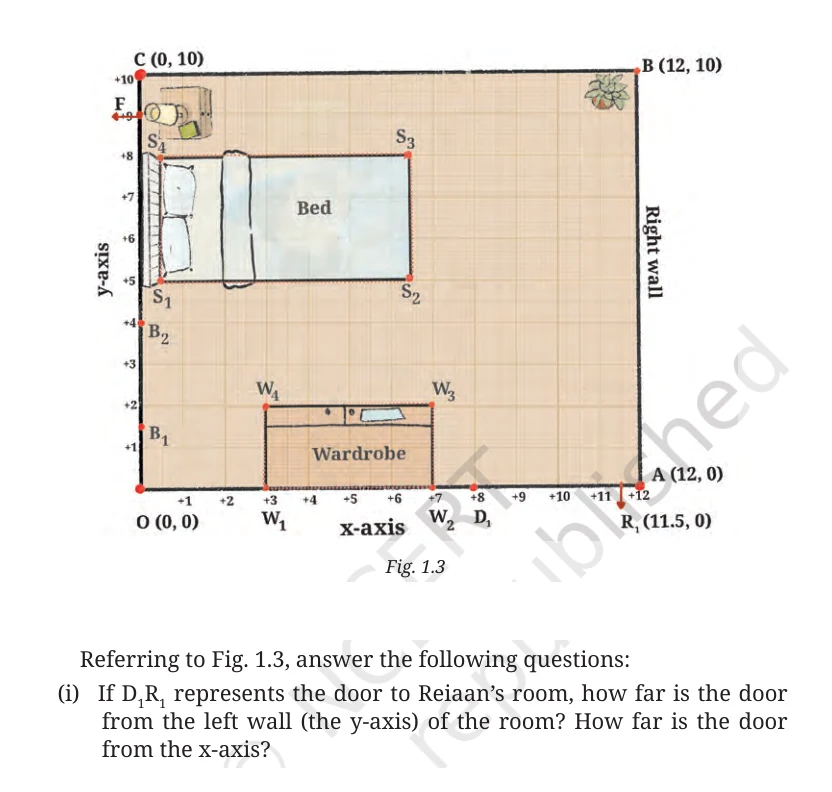
Exercise Set 1.1 (i): How far is door D_1R_1 from the y-axis and from the x-axis?
Show detailed solution
- Step 1: In Fig. 1.3, the nearer end of the door is D_1=(8,0).
- Step 2: Distance from the y-axis is the absolute x-coordinate: |8|=8 ft.
- Step 3: Both endpoints lie on the x-axis, so their y-coordinate is 0.
- Answer: The door begins 8 ft from the y-axis and is 0 ft from the x-axis.
Textbook page 5 · solved item 3
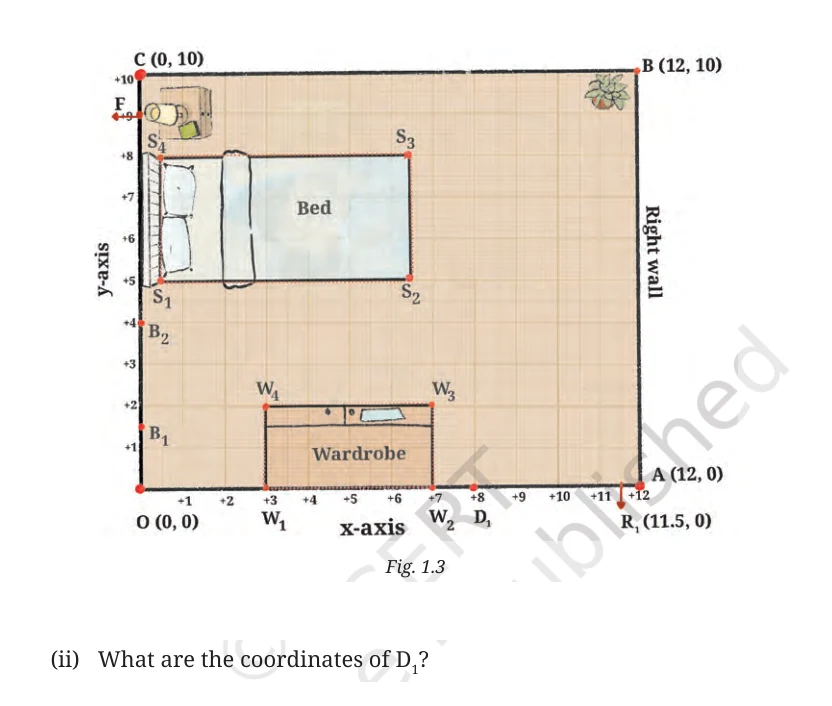
Exercise Set 1.1 (ii): What are the coordinates of D_1?
Show detailed solution
- Step 1: Read the horizontal position from the x-axis. The marked point is at x=8.
- Step 2: The point lies on the x-axis, so y=0.
- Answer: D_1=(8,0).
Textbook page 5 · solved item 4
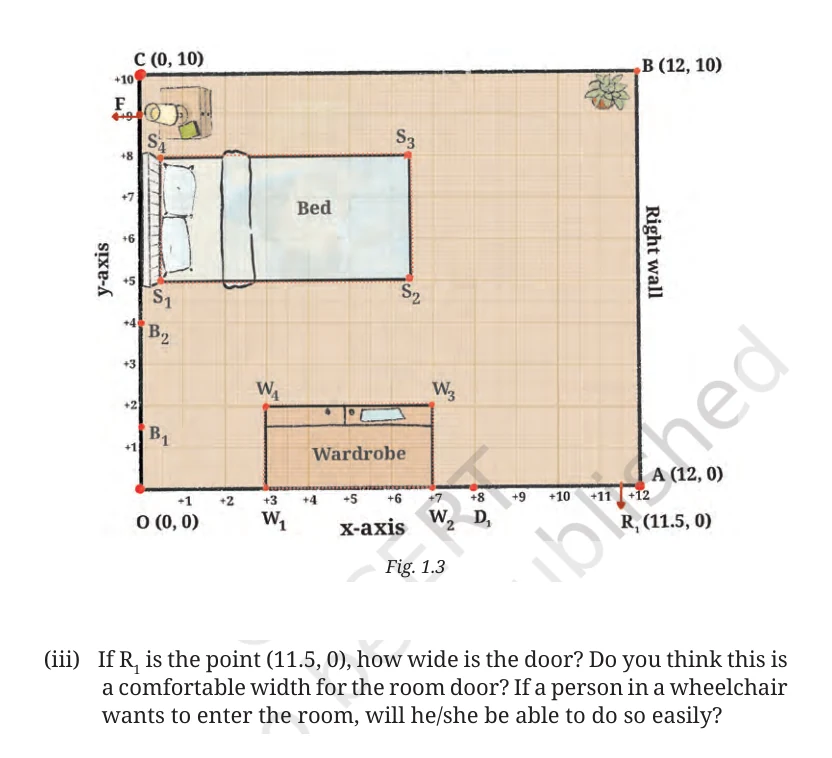
Exercise Set 1.1 (iii): Find the room-door width and assess whether it is comfortable for wheelchair access.
Show detailed solution
- Step 1: The endpoints are D_1=(8,0) and R_1=(11.5,0).
- Step 2: Because the door lies horizontally, subtract the x-coordinates: 11.5-8=3.5 ft.
- Step 3: 3.5 ft is about 1.07 m, which is a generous opening for an ordinary room door and allows a typical wheelchair to pass.
- Answer: The door is 3.5 ft wide. Actual accessibility also depends on the clear opening after hinges, the threshold, and turning space.
Textbook page 5 · solved item 5

Exercise Set 1.1 (iv): Is the bathroom door narrower or wider than the room door?
Show detailed solution
- Step 1: The bathroom-door endpoints are B_1=(0,1.5) and B_2=(0,4).
- Step 2: Its width is the change in y-coordinate: 4-1.5=2.5 ft.
- Step 3: The room door is 3.5 ft wide, so 3.5-2.5=1 ft.
- Answer: The bathroom door is narrower by 1 ft.
Textbook page 5 · solved item 6
Think and Reflect 1: What widths do room doors around your home and school have?
Show detailed solution
- Step 1: Measure the clear opening from the inside edge of the frame to the face of the fully opened door.
- Step 2: Record every result in one unit, such as centimetres, before comparing them.
- Step 3: Use the 3.5 ft opening in Fig. 1.3 as a reference, but report your own measurements because door sizes vary.
- Answer: This is an observation activity, so the final table depends on the doors measured.
Textbook page 5 · solved item 7
Think and Reflect 2: Are the school doors suitable for wheelchair users?
Show detailed solution
- Step 1: Measure the clear doorway width, not only the nominal shutter width.
- Step 2: Check for a high threshold, an obstructed approach, and enough turning space on both sides.
- Step 3: Check whether the handle can be reached and the door can be opened without excessive force.
- Answer: A door is suitable only when the complete route works safely; width alone is not enough.
Detailed worked answers
Textbook page 7
Textbook page 7 · solved item 8
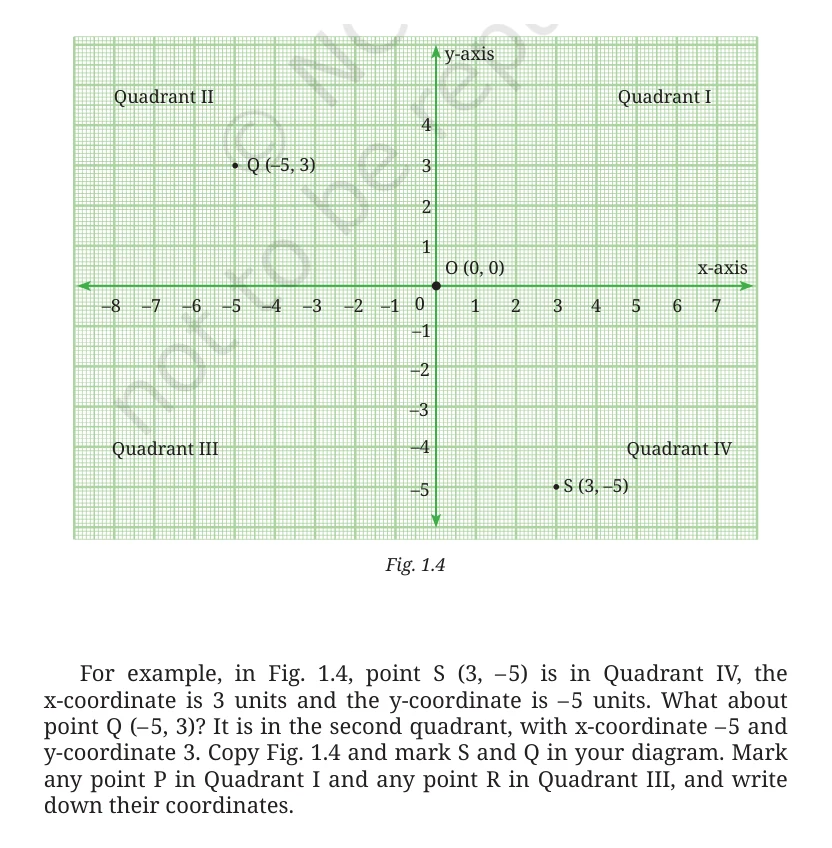
Copy Fig. 1.4, mark S and Q, then choose a point P in Quadrant I and a point R in Quadrant III.
Show detailed solution
- Step 1: Mark S=(3,-5): move 3 units right and 5 units down.
- Step 2: Mark Q=(-5,3): move 5 units left and 3 units up.
- Step 3: One valid choice is P=(2,4), since both coordinates are positive.
- Step 4: One valid choice is R=(-4,-2), since both coordinates are negative.
- Answer: P and R are not unique; any points with the required signs are valid.
Textbook page 7 · solved item 9
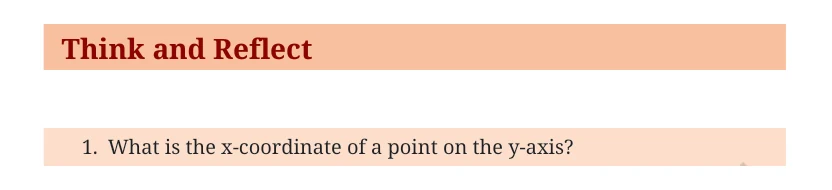
Think and Reflect 1: What is the x-coordinate of a point on the y-axis?
Show detailed solution
- Step 1: The x-coordinate measures horizontal distance from the y-axis.
- Step 2: A point on the y-axis has zero horizontal distance from it.
- Answer: The x-coordinate is always 0, so such a point has the form (0,y).
Textbook page 7 · solved item 10
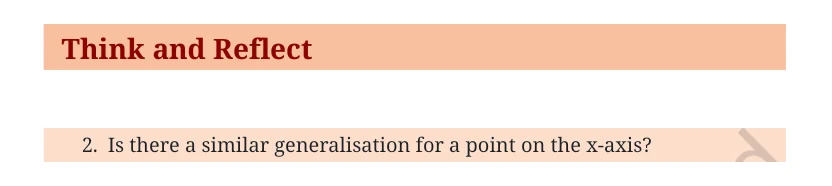
Think and Reflect 2: What is the corresponding rule for a point on the x-axis?
Show detailed solution
- Step 1: The y-coordinate measures vertical distance from the x-axis.
- Step 2: A point on the x-axis has zero vertical distance.
- Answer: Its y-coordinate is 0, so it has the form (x,0).
Textbook page 7 · solved item 11
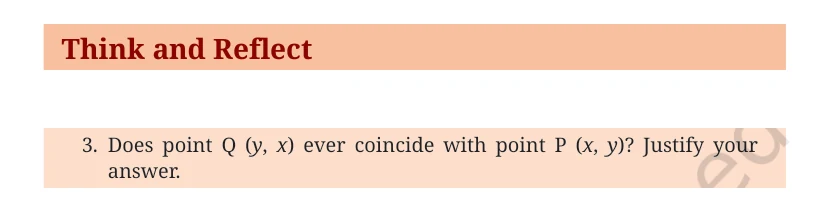
Think and Reflect 3: When does Q=(y,x) coincide with P=(x,y)?
Show detailed solution
- Step 1: Equal ordered pairs must have equal first coordinates and equal second coordinates.
- Step 2: Comparing (y,x) and (x,y) gives y=x in both positions.
- Answer: The points coincide exactly when x=y.
Textbook page 7 · solved item 12
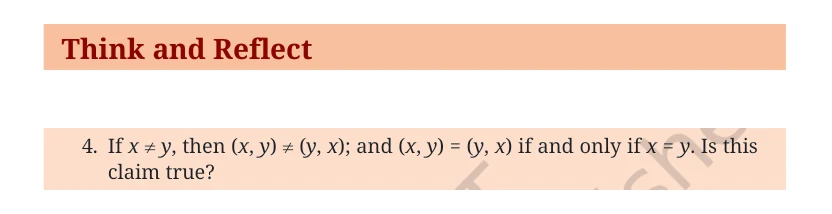
Think and Reflect 4: Is (x,y)=(y,x) if and only if x=y?
Show detailed solution
- Step 1: If x=y, swapping the coordinates changes nothing, so the ordered pairs are equal.
- Step 2: If the ordered pairs are equal, their first coordinates give x=y.
- Conclusion: Both directions are true, so the 'if and only if' claim is correct.
Detailed worked answers
Textbook page 8
Textbook page 8 · solved item 13
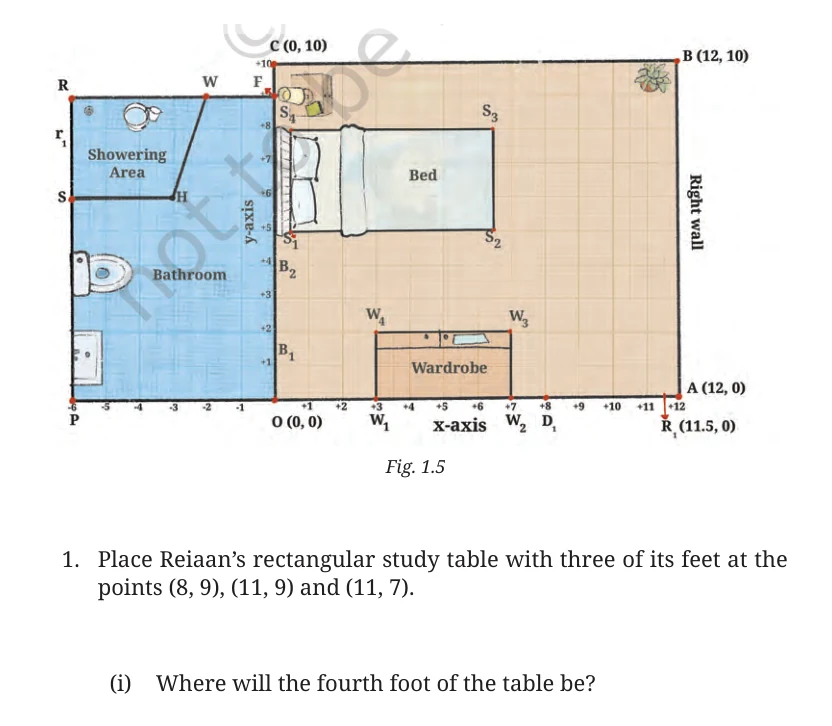
Exercise Set 1.2, 1(i): Where is the fourth foot of the rectangular study table?
Show detailed solution
- Step 1: The three feet are (8,9), (11,9), and (11,7).
- Step 2: Opposite vertical sides of the rectangle have the same x-coordinates, and opposite horizontal sides have the same y-coordinates.
- Step 3: Combine the unused x-coordinate 8 with the unused y-coordinate 7.
- Answer: The fourth foot is at (8,7).
Textbook page 8 · solved item 14
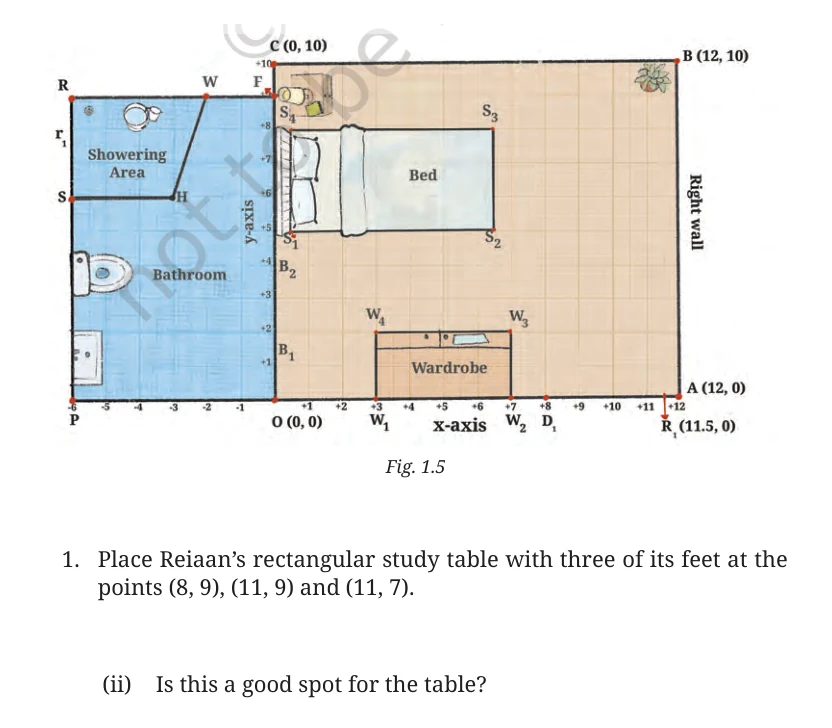
Exercise Set 1.2, 1(ii): Is this a good position for the study table?
Show detailed solution
- Step 1: The table occupies 8\le x\le11 and 7\le y\le9.
- Step 2: Fig. 1.5 shows this region inside the bedroom and away from the bed, wardrobe, and door swing.
- Answer: It is a reasonable position on the given floor plan. A real layout should also preserve chair and walking space.
Textbook page 8 · solved item 15
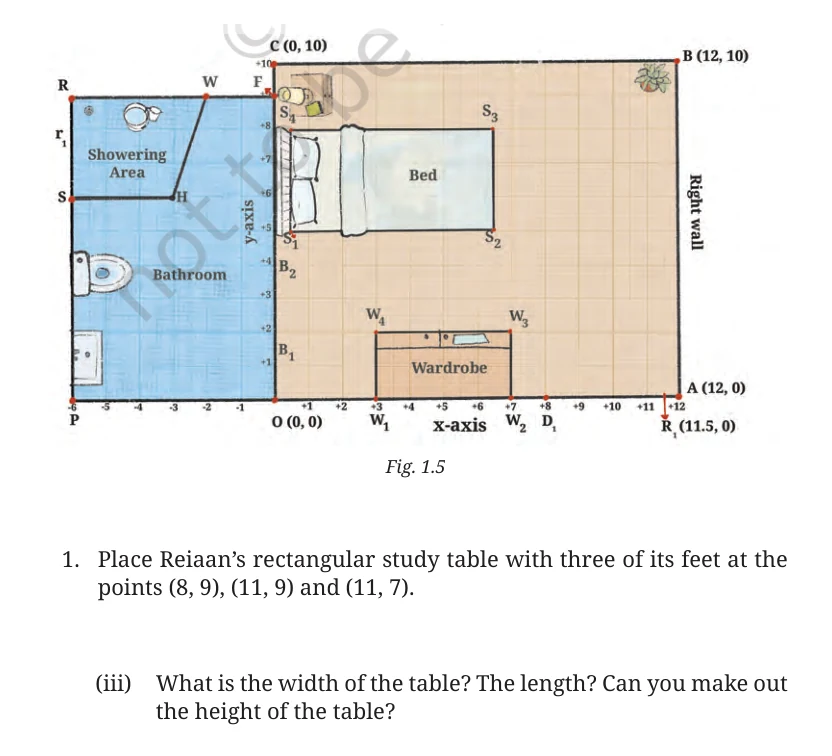
Exercise Set 1.2, 1(iii): Find the table's width and length. Can its height be found?
Show detailed solution
- Step 1: Horizontal span: 11-8=3 ft.
- Step 2: Vertical span on the floor map: 9-7=2 ft.
- Step 3: The longer floor dimension is 3 ft and the shorter is 2 ft.
- Answer: Length 3 ft, width 2 ft. The height cannot be found because the plan supplies no vertical coordinate.
Textbook page 8 · solved item 16
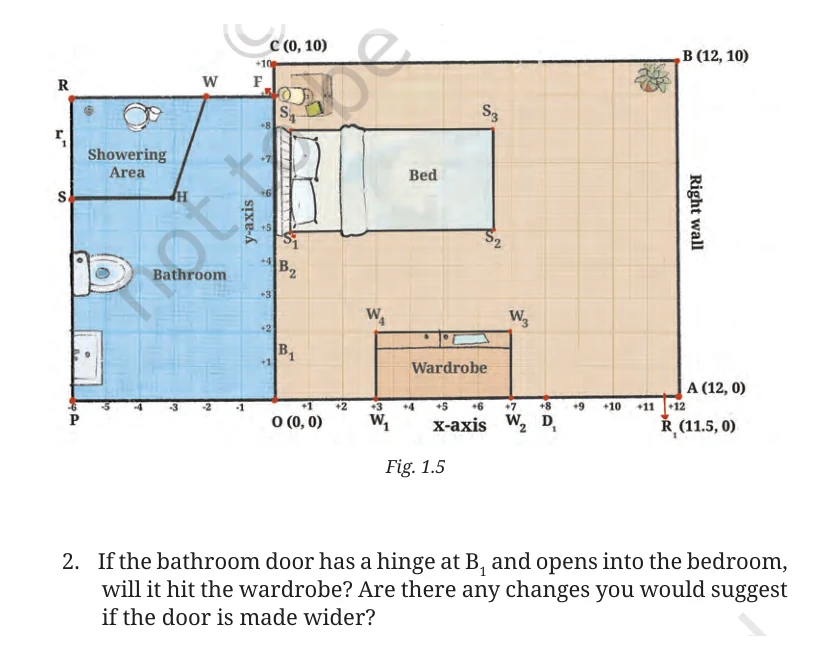
Exercise Set 1.2, 2: Will the bathroom door hit the wardrobe when it opens into the bedroom? What if it is made wider?
Show detailed solution
- Step 1: The door length is 4-1.5=2.5 ft, so its swing from hinge B_1 has radius 2.5 ft.
- Step 2: The nearest wardrobe edge begins at x=3, beyond that radius, so the shown door does not hit it.
- Step 3: A wider door could reach the wardrobe. Before widening, test the new swing arc; alternatives include opening into the bathroom, reversing the hinge, or using a sliding door.
- Answer: The current door clears the wardrobe, but a sufficiently wider one may not.
Textbook page 8 · solved item 17
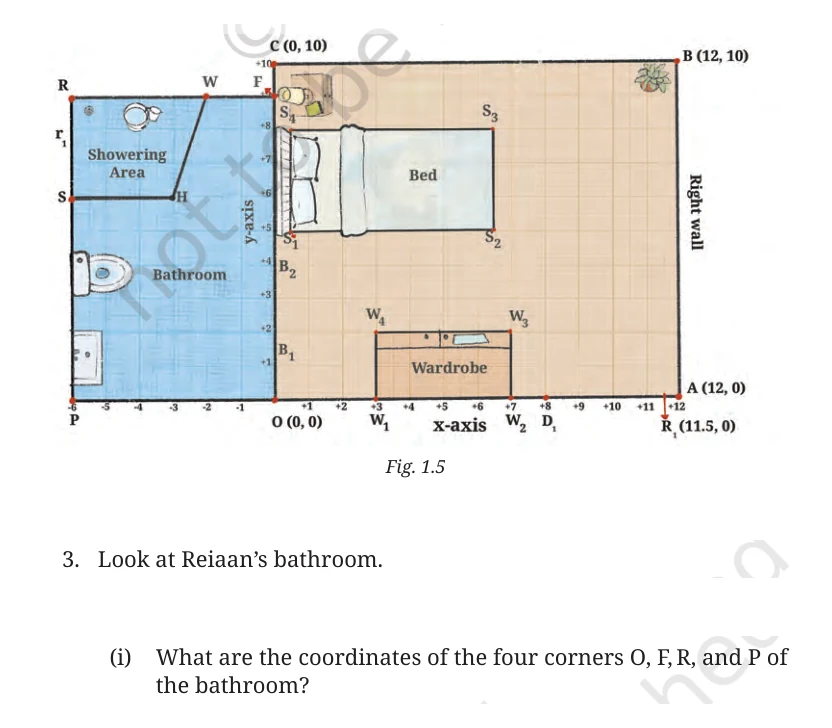
Exercise Set 1.2, 3(i): Find the coordinates of bathroom corners O,F,R,P.
Show detailed solution
- Step 1: Read the two right-hand corners on the y-axis: O=(0,0) and F=(0,9).
- Step 2: The left wall is x=-6, giving R=(-6,9) and P=(-6,0).
- Answer: O=(0,0), F=(0,9), R=(-6,9), P=(-6,0).
Textbook page 8 · solved item 18
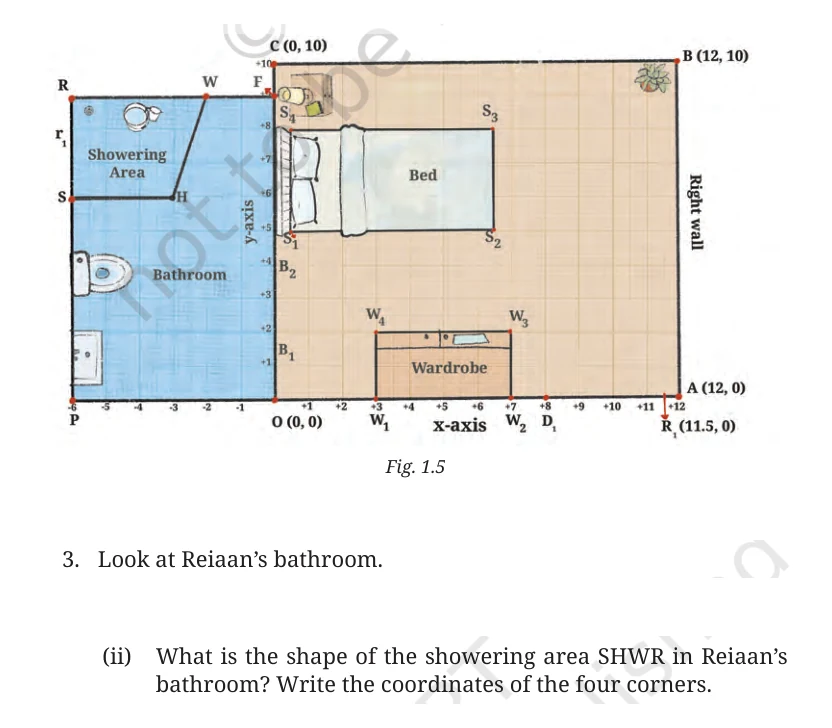
Exercise Set 1.2, 3(ii): Identify showering area SHWR and write its corner coordinates.
Show detailed solution
- Step 1: Read the vertices from Fig. 1.5: S=(-6,5), H=(-3,5), W=(-2,9), and R=(-6,9).
- Step 2: SH and RW are horizontal and therefore parallel.
- Step 3: The other two sides are not parallel.
- Answer: SHWR is a trapezium with the listed vertices.
Textbook page 8 · solved item 19
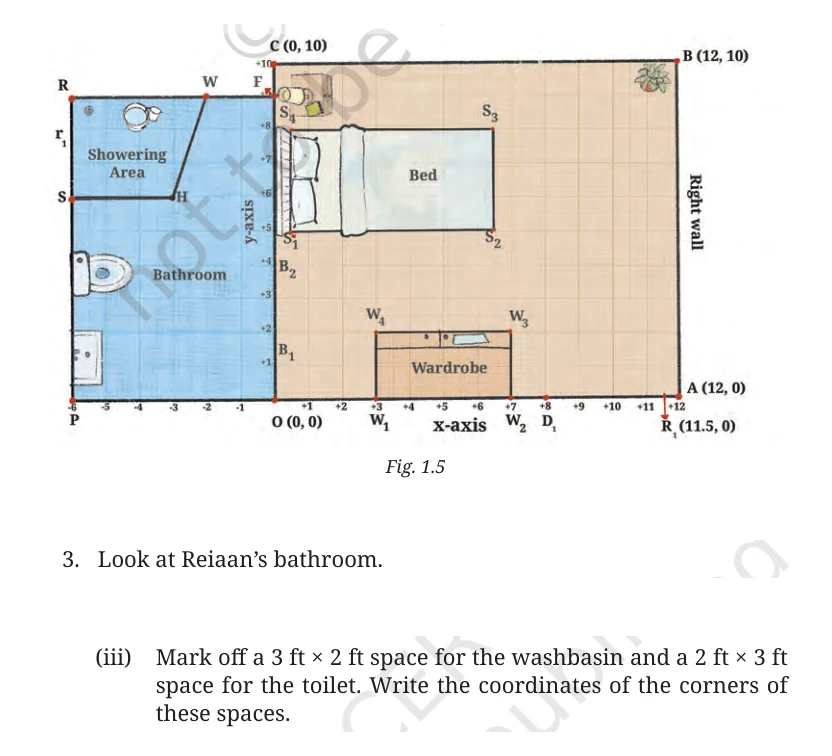
Exercise Set 1.2, 3(iii): Mark a 3\text{ ft}\times2\text{ ft} washbasin space and a 2\text{ ft}\times3\text{ ft} toilet space.
Show detailed solution
- Step 1: One valid washbasin rectangle has corners (-6,0),(-3,0),(-3,2),(-6,2); its dimensions are 3 ft by 2 ft.
- Step 2: One valid toilet rectangle has corners (-6,2),(-4,2),(-4,5),(-6,5); its dimensions are 2 ft by 3 ft.
- Step 3: Both lie inside the bathroom and do not overlap in area.
- Answer: These coordinates are one valid construction; other non-overlapping placements are possible.
Textbook page 8 · solved item 20
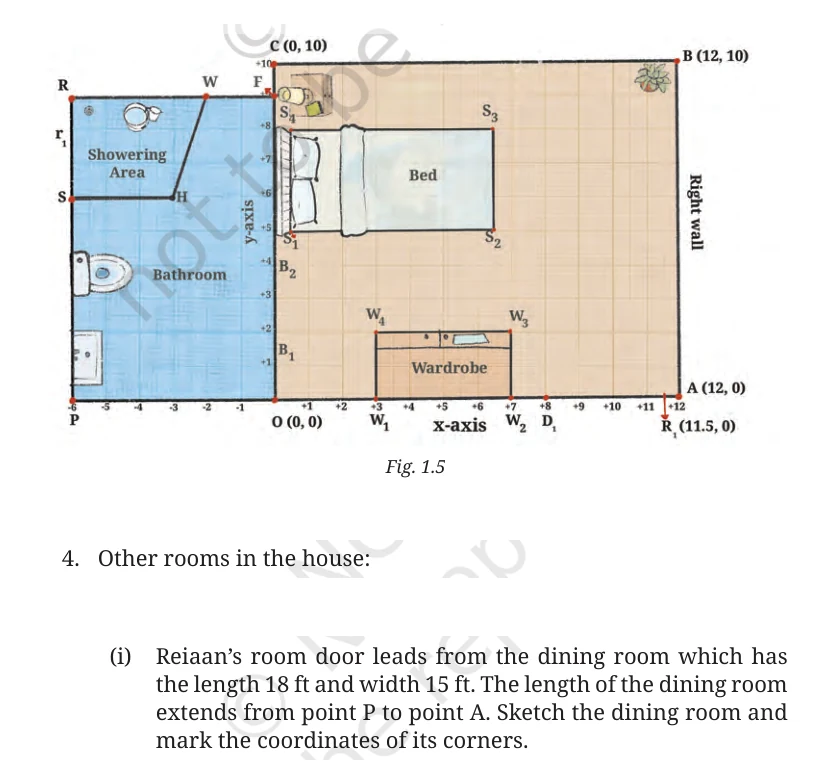
Exercise Set 1.2, 4(i): Sketch the 18\text{ ft}\times15\text{ ft} dining room extending from P to A.
Show detailed solution
- Step 1: From Fig. 1.5, P=(-6,0) and A=(12,0), so PA=12-(-6)=18 ft.
- Step 2: Place the dining room below PA with width 15 ft, so the lower y-coordinate is -15.
- Answer: One valid set of corners is (-6,0),(12,0),(12,-15),(-6,-15).
Textbook page 8 · solved item 21
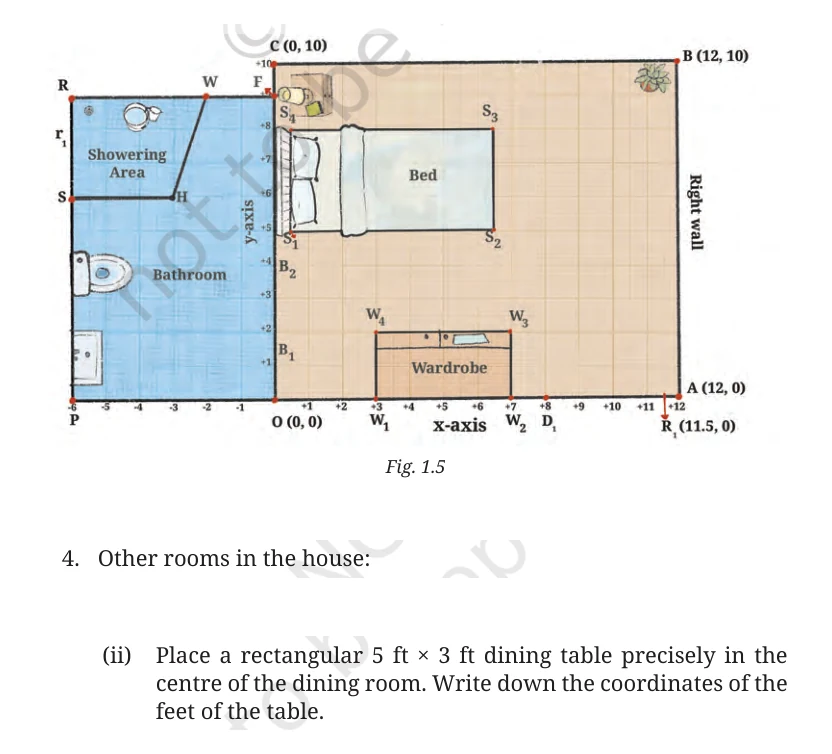
Exercise Set 1.2, 4(ii): Place a 5\text{ ft}\times3\text{ ft} dining table at the centre of that room.
Show detailed solution
- Step 1: The room centre is (( -6+12)/2,(0-15)/2)=(3,-7.5).
- Step 2: Half of 5 ft is 2.5 ft and half of 3 ft is 1.5 ft.
- Step 3: Add and subtract these half-dimensions from the centre.
- Answer: The four feet can be (0.5,-6),(5.5,-6),(5.5,-9),(0.5,-9).
Detailed worked answers
Textbook page 9
Textbook page 9 · solved item 22
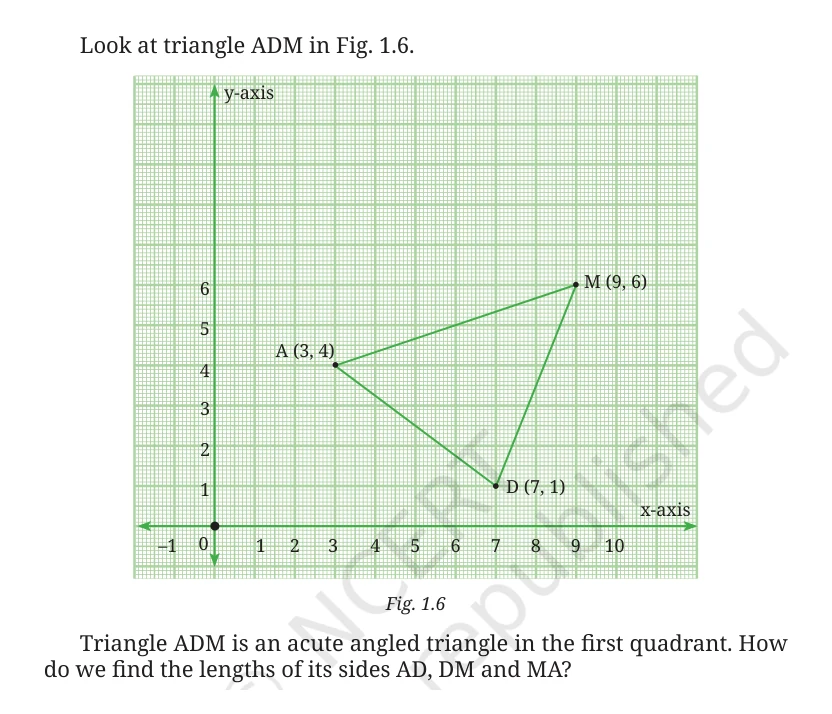
How do we find the side lengths of triangle ADM, where A=(3,4),D=(7,1),M=(9,6)?
Show detailed solution
- Step 1: Use d=\sqrt{(x_2-x_1)^2+(y_2-y_1)^2}.
- Step 2: AD=\sqrt{(7-3)^2+(1-4)^2}=\sqrt{16+9}=5.
- Step 3: DM=\sqrt{(9-7)^2+(6-1)^2}=\sqrt{4+25}=\sqrt{29}.
- Step 4: MA=\sqrt{(3-9)^2+(4-6)^2}=\sqrt{36+4}=\sqrt{40}=2\sqrt{10}.
- Answer: AD=5, DM=\sqrt{29}, and MA=2\sqrt{10} units.
Textbook page 9 · solved item 23
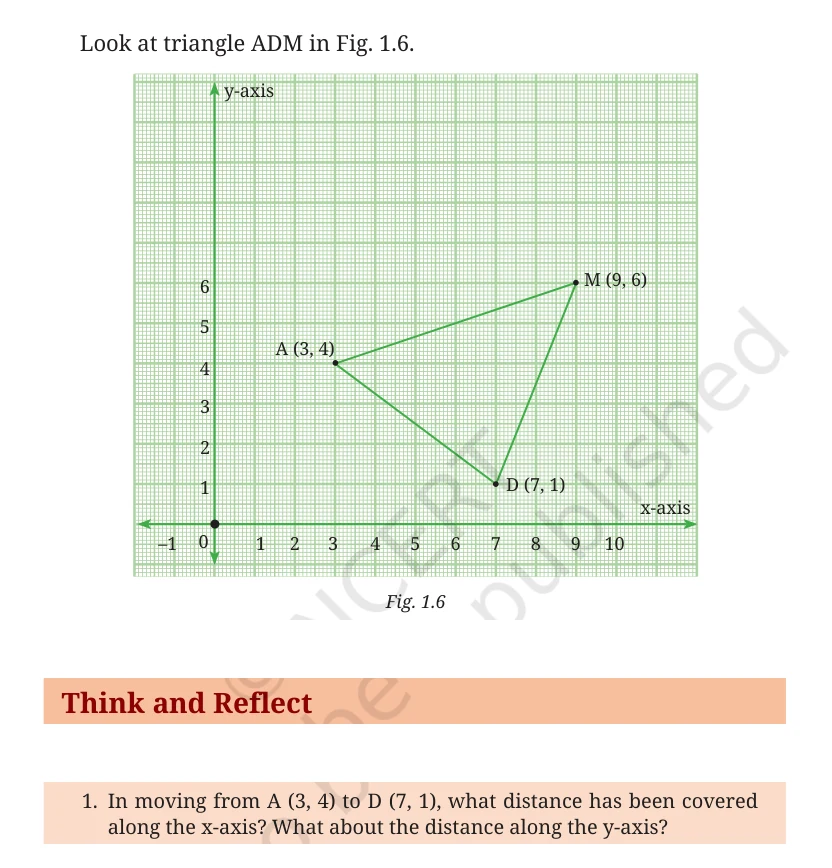
Think and Reflect 1: From A=(3,4) to D=(7,1), what are the horizontal and vertical distances?
Show detailed solution
- Step 1: Horizontal change is 7-3=4, so the distance along the x-direction is 4 units.
- Step 2: Vertical change is 1-4=-3; distance is the absolute value |-3|=3 units.
- Answer: 4 units horizontally and 3 units vertically.
Textbook page 9 · solved item 24

Think and Reflect 2: Use those distances to find AD.
Show detailed solution
- Step 1: The horizontal and vertical shifts are perpendicular legs of a right triangle.
- Step 2: Apply the Baudhāyana-Pythagoras theorem: AD^2=4^2+3^2=25.
- Step 3: Take the positive square root because distance is non-negative.
- Answer: AD=5 units.
Detailed worked answers
Textbook page 11
Textbook page 11 · solved item 25
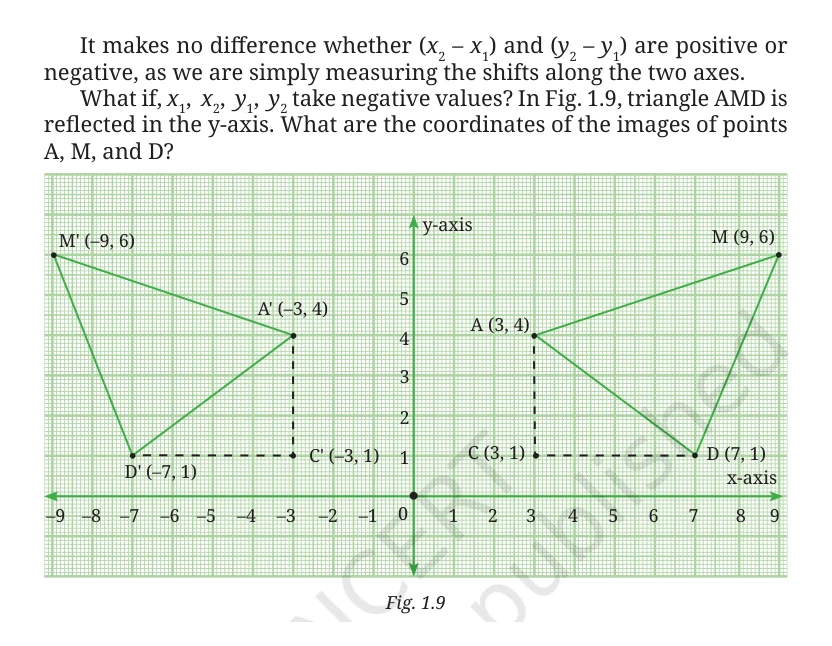
After reflecting triangle AMD in the y-axis, what are the image coordinates?
Show detailed solution
- Step 1: Reflection in the y-axis follows (x,y)\mapsto(-x,y).
- Step 2: A=(3,4) becomes A'=(-3,4).
- Step 3: M=(9,6) becomes M'=(-9,6), and D=(7,1) becomes D'=(-7,1).
- Answer: A'=(-3,4), M'=(-9,6), D'=(-7,1).
Textbook page 11 · solved item 26
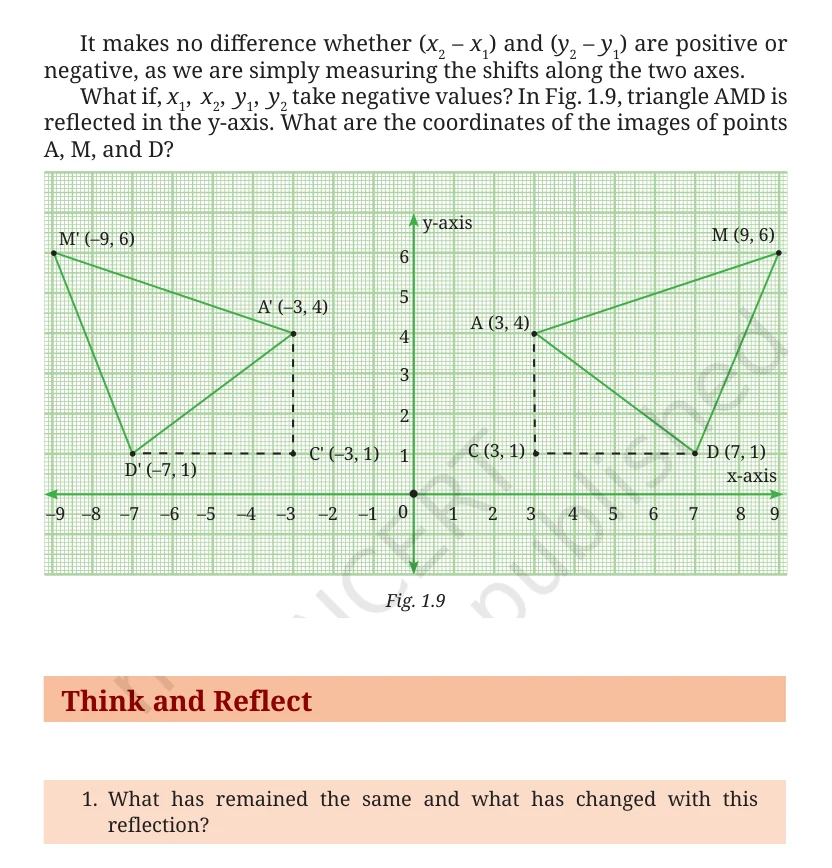
Think and Reflect 1: What remains the same and what changes under reflection in the y-axis?
Show detailed solution
- Step 1: Every x-coordinate changes sign, while every y-coordinate stays the same.
- Step 2: The figure moves to the opposite side of the y-axis and its orientation is reversed.
- Step 3: Distances, side lengths, angle measures, area, and shape remain unchanged.
- Answer: Position and orientation change; size and shape do not.
Textbook page 11 · solved item 27
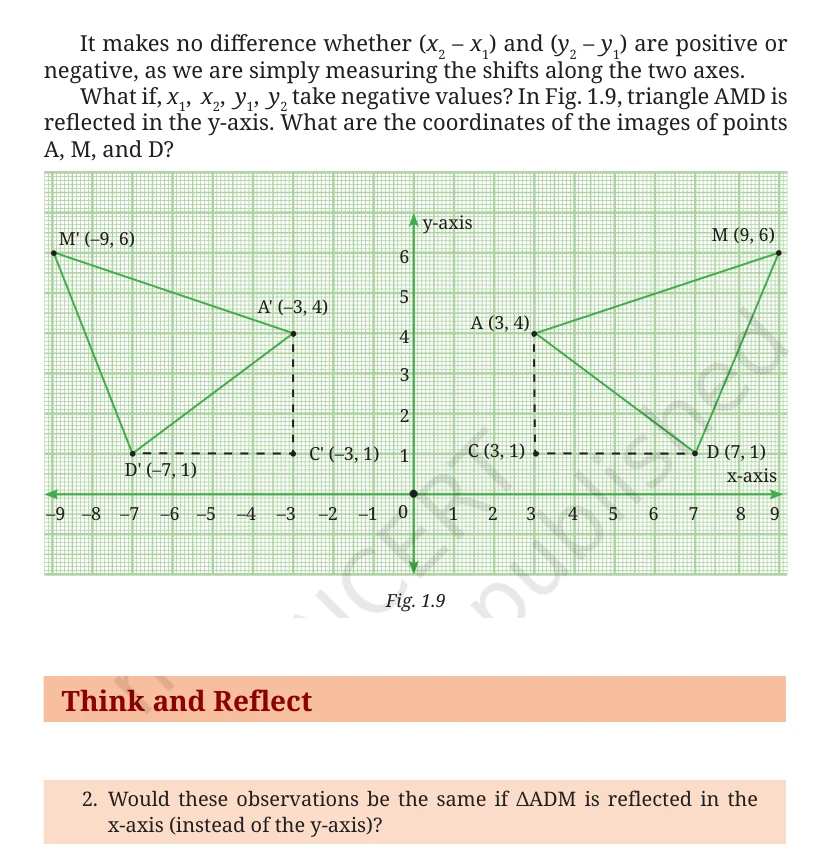
Think and Reflect 2: What happens if \triangle ADM is reflected in the x-axis instead?
Show detailed solution
- Step 1: Reflection in the x-axis follows (x,y)\mapsto(x,-y).
- Step 2: The images are A''=(3,-4), D''=(7,-1), M''=(9,-6).
- Step 3: As before, side lengths, angles, area, and shape are preserved while orientation is reversed.
- Answer: The same geometric properties are preserved, but the y-coordinates change sign instead of the x-coordinates.
Detailed worked answers
Textbook page 12
Textbook page 12 · solved item 28
End-of-Chapter Exercise 1: What are the coordinates of the intersection of the axes?
Show detailed solution
- Step 1: Every point on the x-axis has y-coordinate 0.
- Step 2: Every point on the y-axis has x-coordinate 0.
- Answer: Their intersection is the origin (0,0).
Textbook page 12 · solved item 29

End-of-Chapter Exercise 2: If W has x-coordinate -5, what can be said about a point H on the vertical line through W?
Show detailed solution
- Step 1: A line parallel to the y-axis has a constant x-coordinate.
- Step 2: Therefore H=(-5,h) for any real number h.
- Step 3: If h>0, H is in Quadrant II; if h<0, it is in Quadrant III; if h=0, it lies on the negative x-axis.
- Answer: The exact y-coordinate cannot be predicted from the given information.
Textbook page 12 · solved item 30
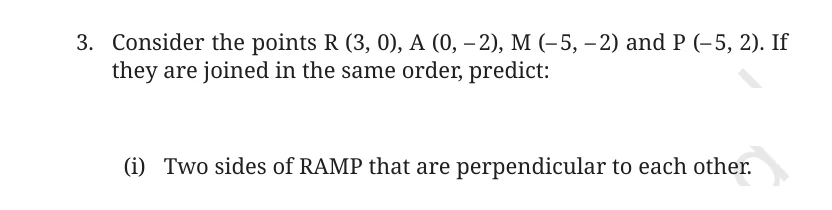
End-of-Chapter Exercise 3(i): Which two sides of RAMP are perpendicular?
Show detailed solution
- Step 1: A=(0,-2) and M=(-5,-2) have the same y-coordinate, so AM is horizontal.
- Step 2: M=(-5,-2) and P=(-5,2) have the same x-coordinate, so MP is vertical.
- Answer: AM\perp MP.
Textbook page 12 · solved item 31
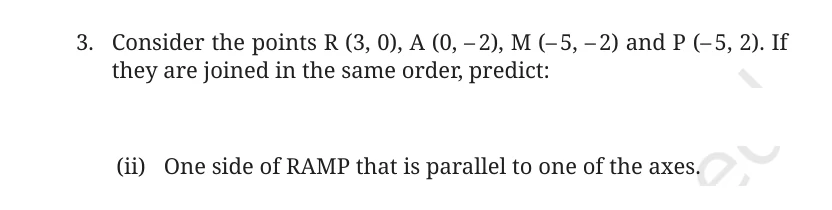
End-of-Chapter Exercise 3(ii): Name a side of RAMP parallel to an axis.
Show detailed solution
- Step 1: Segment AM is horizontal because both endpoints have y-coordinate -2.
- Step 2: A horizontal segment is parallel to the x-axis.
- Answer: AM\parallel x-axis. Also, MP\parallel y-axis is another correct answer.
Textbook page 12 · solved item 32
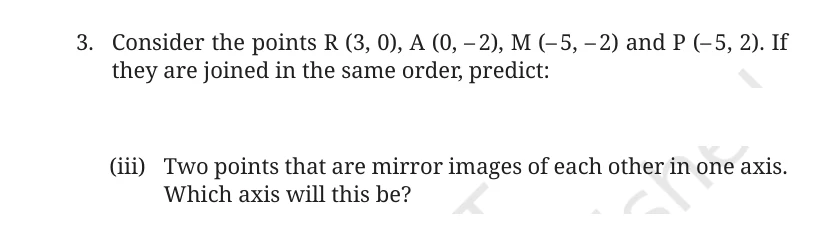
End-of-Chapter Exercise 3(iii): Which vertices are mirror images, and in which axis?
Show detailed solution
- Step 1: M=(-5,-2) and P=(-5,2) have the same x-coordinate.
- Step 2: Their y-coordinates are opposites.
- Answer: M and P are mirror images in the x-axis.
Textbook page 12 · solved item 33

End-of-Chapter Exercise 4: Construct one right triangle using Z=(5,-6) and find all side lengths.
Show detailed solution
- Step 1: Choose I=(5,0) and N=(0,0). Then IZ is vertical and IN is horizontal, so the angle at I is 90^\circ.
- Step 2: IZ=|0-(-6)|=6 and IN=|5-0|=5.
- Step 3: ZN=\sqrt{(5-0)^2+(-6-0)^2}=\sqrt{61}.
- Answer: One valid construction has side lengths 5,6,\sqrt{61} units. Other valid triangles can give different lengths.
Textbook page 12 · solved item 34

End-of-Chapter Exercise 5: Could coordinates without negative numbers locate every point in a plane?
Show detailed solution
- Step 1: With the usual origin and axes, non-negative coordinates describe only points on the positive axes and in Quadrant I.
- Step 2: Points left of the y-axis need negative x-coordinates, and points below the x-axis need negative y-coordinates.
- Answer: No. Without negative numbers, the system cannot name every point in the full plane.
Textbook page 12 · solved item 35

End-of-Chapter Exercise 6: Are M=(-3,-4), A=(0,0), G=(6,8) collinear without plotting?
Show detailed solution
- Step 1: Compute direction vectors: \overrightarrow{MA}=(3,4) and \overrightarrow{AG}=(6,8).
- Step 2: (6,8)=2(3,4), so both vectors have the same direction.
- Check: Their slopes are both 4/3.
- Answer: Yes, M, A, and G lie on one straight line.
Textbook page 12 · solved item 36

End-of-Chapter Exercise 7: Are R=(-5,-1), B=(-2,-5), C=(4,-12) collinear?
Show detailed solution
- Step 1: Slope RB=(-5+1)/(-2+5)=-4/3.
- Step 2: Slope BC=(-12+5)/(4+2)=-7/6.
- Step 3: The slopes are unequal, so the direction changes at B.
- Answer: The three points are not collinear.
Textbook page 12 · solved item 37
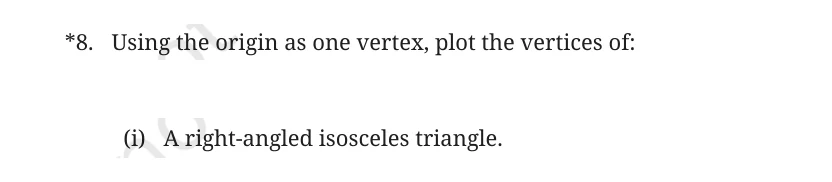
End-of-Chapter Exercise 8(i): Plot a right-angled isosceles triangle with the origin as a vertex.
Show detailed solution
- Step 1: Choose O=(0,0), A=(3,0), B=(0,3).
- Step 2: OA=3 and OB=3, so the two legs are equal.
- Step 3: OA is horizontal and OB is vertical, so \angle AOB=90^\circ.
- Answer: OAB is one valid right-angled isosceles triangle.
Textbook page 12 · solved item 38
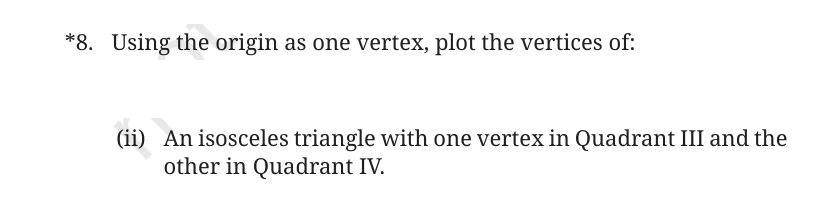
End-of-Chapter Exercise 8(ii): Plot an isosceles triangle with one vertex in Quadrant III and another in Quadrant IV, using the origin as the third vertex.
Show detailed solution
- Step 1: Choose A=(-3,-4) in Quadrant III and B=(3,-4) in Quadrant IV.
- Step 2: OA=\sqrt{(-3)^2+(-4)^2}=5.
- Step 3: OB=\sqrt{3^2+(-4)^2}=5.
- Answer: OAB is isosceles because OA=OB.
Detailed worked answers
Textbook page 13
Textbook page 13 · solved item 39

End-of-Chapter Exercise 9, row 1: Is M=(0,0) the midpoint of S=(-3,0) and T=(3,0)?
Show detailed solution
- Step 1: Average the x-coordinates: (-3+3)/2=0.
- Step 2: Average the y-coordinates: (0+0)/2=0.
- Answer: Yes. The midpoint is (0,0)=M.
Textbook page 13 · solved item 40
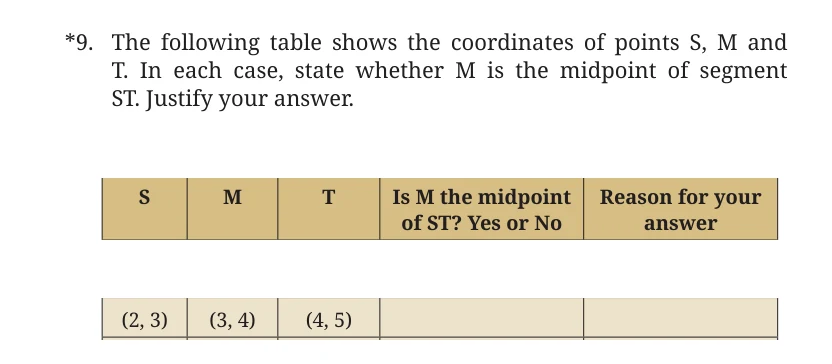
End-of-Chapter Exercise 9, row 2: Is M=(3,4) the midpoint of S=(2,3) and T=(4,5)?
Show detailed solution
- Step 1: Average the x-coordinates: (2+4)/2=3.
- Step 2: Average the y-coordinates: (3+5)/2=4.
- Answer: Yes. The midpoint is (3,4)=M.
Textbook page 13 · solved item 41
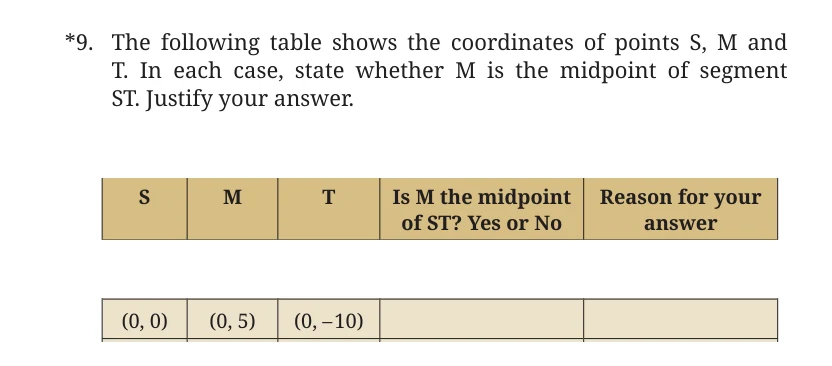
End-of-Chapter Exercise 9, row 3: Is M=(0,5) the midpoint of S=(0,0) and T=(0,-10)?
Show detailed solution
- Step 1: Average the x-coordinates: (0+0)/2=0.
- Step 2: Average the y-coordinates: (0-10)/2=-5.
- Answer: No. The midpoint is (0,-5), not (0,5).
Textbook page 13 · solved item 42
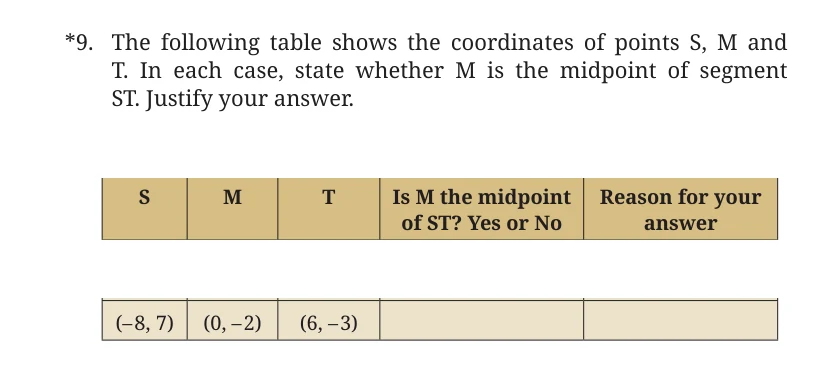
End-of-Chapter Exercise 9, row 4: Is M=(0,-2) the midpoint of S=(-8,7) and T=(6,-3)?
Show detailed solution
- Step 1: Average the x-coordinates: (-8+6)/2=-1.
- Step 2: Average the y-coordinates: (7-3)/2=2.
- Answer: No. The midpoint is (-1,2), not (0,-2).
Textbook page 13 · solved item 43
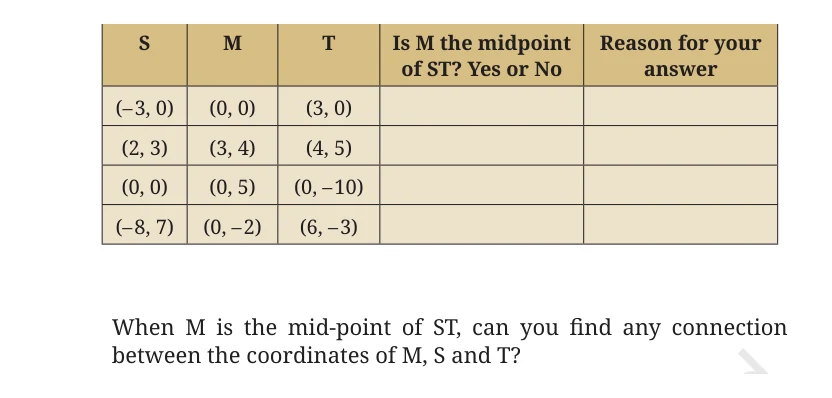
What is the coordinate rule connecting the midpoint M to endpoints S and T?
Show detailed solution
- Step 1: The midpoint is halfway along the horizontal change, so its x-coordinate is the average of the endpoint x-coordinates.
- Step 2: The same reasoning applies vertically.
- Answer: If S=(x_1,y_1) and T=(x_2,y_2), then M=((x_1+x_2)/2,(y_1+y_2)/2).
Textbook page 13 · solved item 44

End-of-Chapter Exercise 10: M=(-7,1) is the midpoint of A=(3,-4) and B=(x,y). Find B.
Show detailed solution
- Step 1: Use the x-coordinate equation (3+x)/2=-7. Thus 3+x=-14, so x=-17.
- Step 2: Use the y-coordinate equation (-4+y)/2=1. Thus -4+y=2, so y=6.
- Check: The midpoint of (3,-4) and (-17,6) is (-7,1).
- Answer: B=(-17,6).
Textbook page 13 · solved item 45

End-of-Chapter Exercise 11: Trisect AB for A=(4,7), B=(16,-2).
Show detailed solution
- Step 1: \overrightarrow{AB}=(16-4,-2-7)=(12,-9).
- Step 2: One-third of this vector is (4,-3).
- Step 3: The nearer trisection point is P=A+(4,-3)=(8,4).
- Step 4: The other is Q=A+2(4,-3)=(12,1).
- Answer: P=(8,4) and Q=(12,1).
Textbook page 13 · solved item 46

End-of-Chapter Exercise 12(i): Show that A=(1,-8),B=(-4,7),C=(-7,-4) lie on a circle centred at the origin.
Show detailed solution
- Step 1: OA^2=1^2+(-8)^2=65.
- Step 2: OB^2=(-4)^2+7^2=65.
- Step 3: OC^2=(-7)^2+(-4)^2=65.
- Conclusion: All three points are the same distance from O, so they lie on one circle.
- Answer: The radius is \sqrt{65} units.
Textbook page 13 · solved item 47
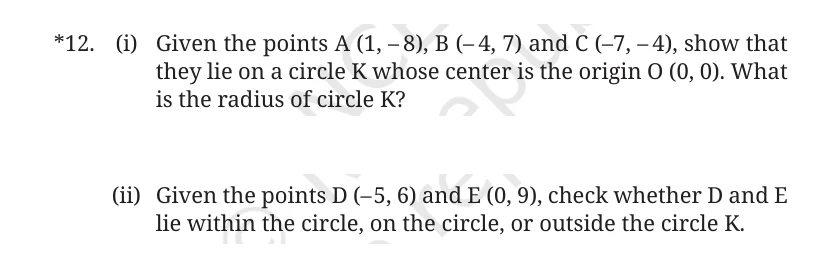
End-of-Chapter Exercise 12(ii): Classify D=(-5,6) and E=(0,9) relative to circle K.
Show detailed solution
- Step 1: Circle K has r^2=65.
- Step 2: OD^2=(-5)^2+6^2=61<65, so D is inside.
- Step 3: OE^2=0^2+9^2=81>65, so E is outside.
- Answer: D lies within K; E lies outside K. Neither lies on the circle.
Textbook page 13 · solved item 48

End-of-Chapter Exercise 13: The side midpoints are D=(5,1),E=(6,5),F=(0,3). Find vertices A, B, C.
Show detailed solution
- Step 1: Take D, E, F as the midpoints of BC, CA, AB respectively. Then A=E+F-D.
- Step 2: A=(6,5)+(0,3)-(5,1)=(1,7).
- Step 3: B=F+D-E=(-1,-1), and C=D+E-F=(11,3).
- Check: The midpoints of BC, CA, and AB are exactly D, E, and F.
- Answer: A=(1,7), B=(-1,-1), C=(11,3).
Textbook page 13 · solved item 49
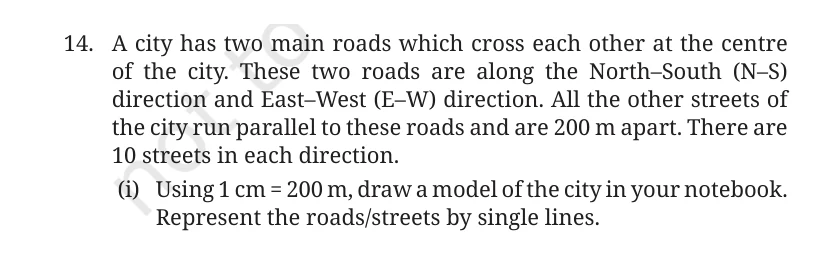
End-of-Chapter Exercise 14(i): Draw the city model at scale 1\text{ cm}=200\text{ m}.
Show detailed solution
- Step 1: Draw 10 parallel North-South lines, each 1 cm from the next.
- Step 2: Draw 10 parallel East-West lines with the same 1 cm spacing, perpendicular to the first set.
- Step 3: Mark the central N-S and E-W main roads distinctly and label the ordered street positions consistently.
- Answer: The model is a square grid; each 1 cm gap represents 200 m.
Detailed worked answers
Textbook page 14
Textbook page 14 · solved item 50
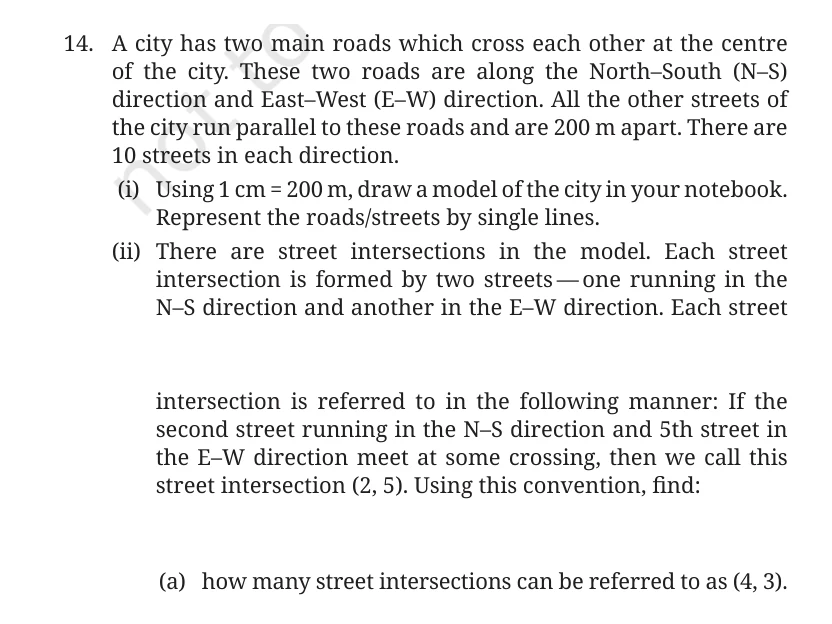
End-of-Chapter Exercise 14(ii)(a): How many intersections can be called (4,3)?
Show detailed solution
- Step 1: The first coordinate selects the 4th N-S street.
- Step 2: The second selects the 3rd E-W street.
- Step 3: One line from each family meets at exactly one point.
- Answer: Exactly 1 intersection is called (4,3).
Textbook page 14 · solved item 51
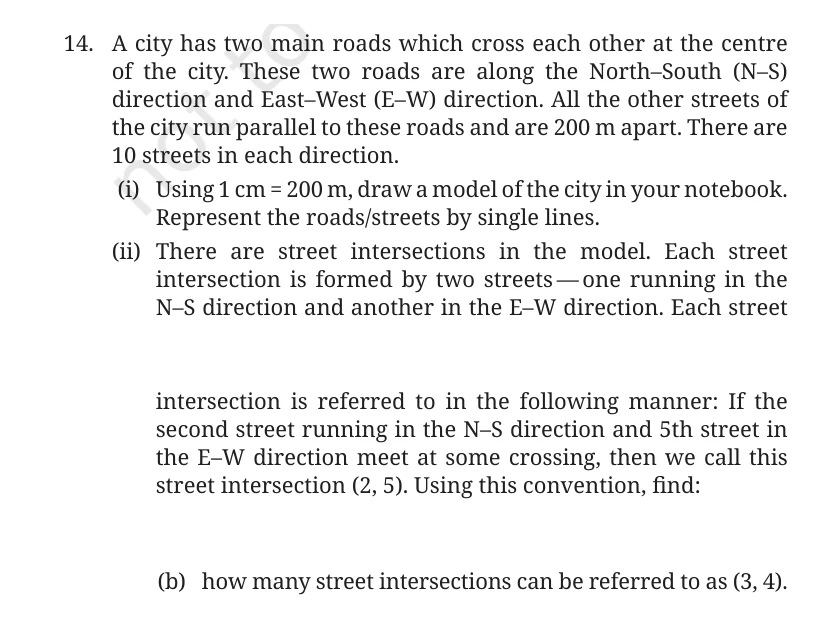
End-of-Chapter Exercise 14(ii)(b): How many intersections can be called (3,4)?
Show detailed solution
- Step 1: Select the 3rd N-S street and the 4th E-W street.
- Step 2: Those two lines meet once.
- Answer: Exactly 1 intersection is called (3,4). It is different from (4,3) because coordinate order matters.
Textbook page 14 · solved item 52
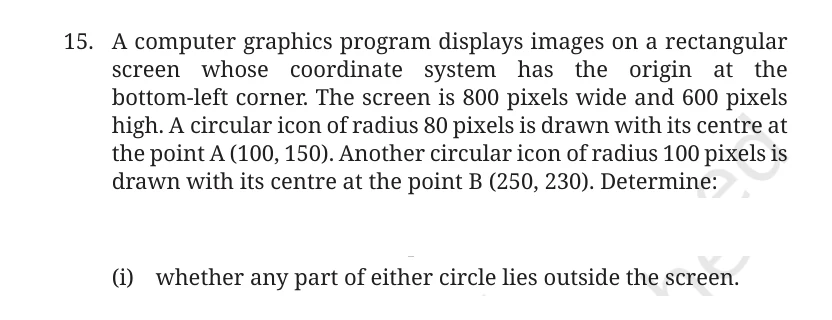
End-of-Chapter Exercise 15(i): Does any part of either circular icon lie outside the 800\times600 screen?
Show detailed solution
- Step 1: Circle A has centre (100,150), radius 80, so its bounds are 20\le x\le180, 70\le y\le230.
- Step 2: Circle B has centre (250,230), radius 100, so its bounds are 150\le x\le350, 130\le y\le330.
- Step 3: Every bound lies within 0\le x\le800, 0\le y\le600.
- Answer: Neither circle extends outside the screen.
Textbook page 14 · solved item 53
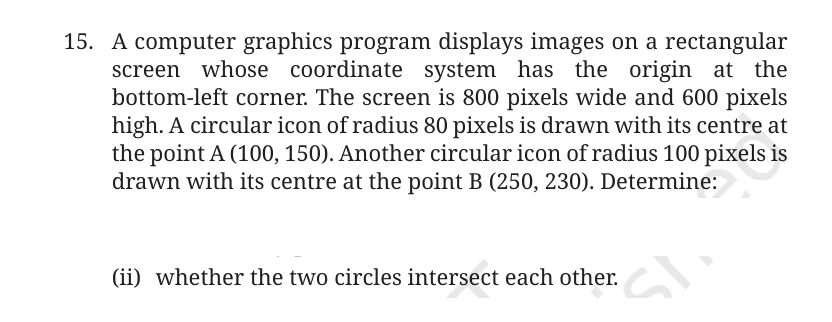
End-of-Chapter Exercise 15(ii): Do the two circular icons intersect?
Show detailed solution
- Step 1: Centre distance AB=\sqrt{(250-100)^2+(230-150)^2}=\sqrt{150^2+80^2}=170.
- Step 2: The radii are 80 and 100, so their sum is 180 and their difference is 20.
- Step 3: Since 20<170<180, neither circle contains the other and their boundaries cross.
- Answer: Yes, the circles intersect at two points.
Textbook page 14 · solved item 54

End-of-Chapter Exercise 16: Is ABCD a square for A=(2,1),B=(-1,2),C=(-2,-1),D=(1,-2)? Find its area.
Show detailed solution
- Step 1: Each side has squared length 10; for example, AB^2=(-3)^2+1^2=10 and BC^2=(-1)^2+(-3)^2=10. The other two give the same result.
- Step 2: Adjacent vectors are perpendicular because \overrightarrow{AB}\cdot\overrightarrow{BC}=(-3)(-1)+(1)(-3)=0.
- Step 3: Four equal sides and one right angle prove ABCD is a square.
- Step 4: Side length is \sqrt{10}, so area is (\sqrt{10})^2=10 square units.
- Answer: Yes, ABCD is a square of area 10 square units.