
Question-by-question working
Read the prompt, attempt it, then check each step
Every exercise subpart and table row is a separate item. Shared figures are repeated in the crop whenever they are needed to understand that question.
Detailed worked answers
Textbook page 174
Textbook page 174 · solved item 1
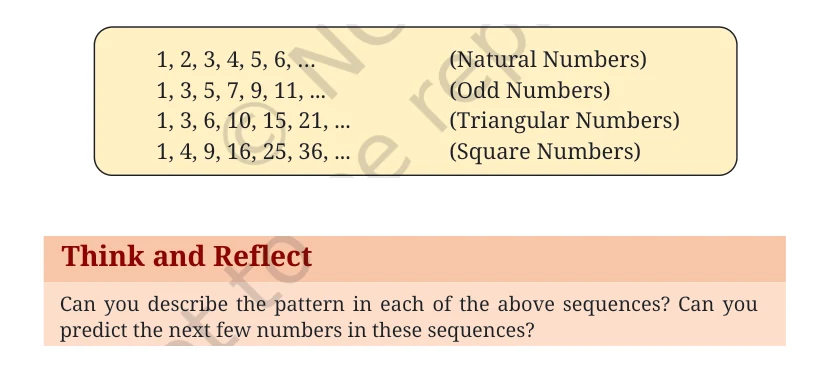
Think and Reflect: Describe the four familiar sequences and predict their next three terms.
Show detailed solution
- Step 1: Natural numbers increase by 1, so 1,2,3,4,5,6,\ldots continues with (7,8,9).
- Step 2: Odd numbers increase by 2, so the next terms after 11 are (13,15,17).
- Step 3: Triangular numbers add consecutive natural numbers. After 21, add (7,8,9) to get (28,36,45).
- Step 4: Square numbers are n^2. After 6^2=36 come 7^2=49, 8^2=64, and 9^2=81.
- Answer: The next triples are 7, 8, 9; 13, 15, 17; 28, 36, 45; and 49, 64, 81.
Textbook page 174 · solved item 2

Give examples of finite sequences found in daily life.
Show detailed solution
- Step 1: A finite sequence has a first term, a last term, and only a fixed number of terms.
- Step 2: The seven days of one week form an ordered finite sequence from Monday through Sunday.
- Step 3: The twelve months of one calendar year form another ordered finite sequence from January through December.
- Answer: Days in a week, months in a year, a school timetable, and a countdown are valid examples because each list ends.
Detailed worked answers
Textbook page 175
Textbook page 175 · solved item 3
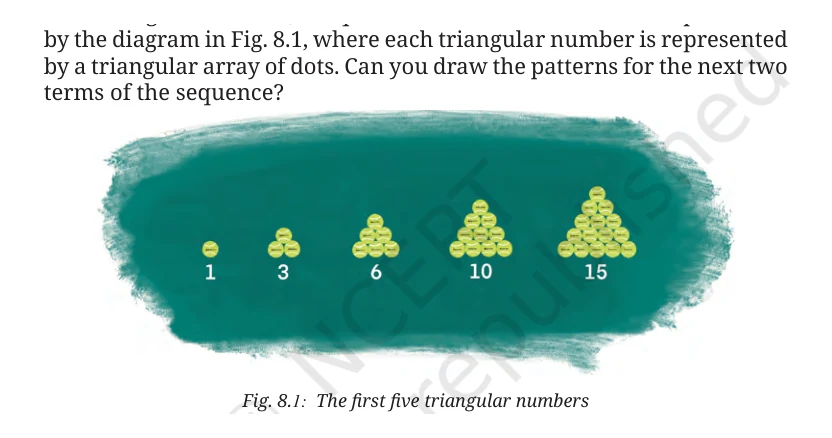
Draw the dot patterns for the sixth and seventh triangular numbers.
Show detailed solution
- Step 1: The (n)th triangular pattern has rows containing 1,2,\ldots,n dots.
- Step 2: The sixth pattern adds a row of 6 dots to 15, giving T_6=15+6=21 dots.
- Step 3: The seventh adds a row of 7 dots, giving T_7=21+7=28 dots.
- Answer: Draw triangular arrays with 6 rows and 21 dots, then 7 rows and 28 dots.
Textbook page 175 · solved item 4
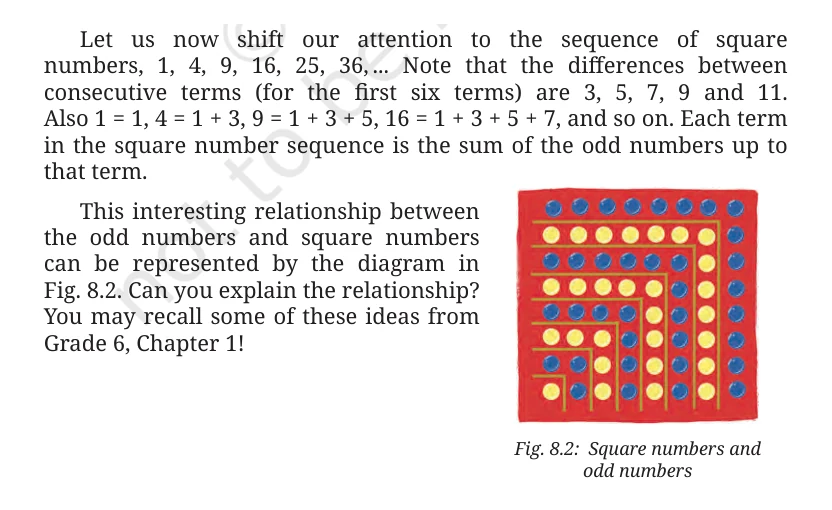
Explain the relationship between odd numbers and square numbers in Fig. 8.2.
Show detailed solution
- Step 1: Begin with 1=1^2. Adding the next odd number gives 1+3=4=2^2.
- Step 2: Adding 5 gives 9=3^2, and adding 7 gives 16=4^2. Each new odd number forms an L-shaped border around the previous square.
- Step 3: In general, 1+3+5+\cdots+(2n-1)=n^2.
- Answer: The sum of the first n odd numbers is the nth square number.
Detailed worked answers
Textbook page 176
Textbook page 176 · solved item 5
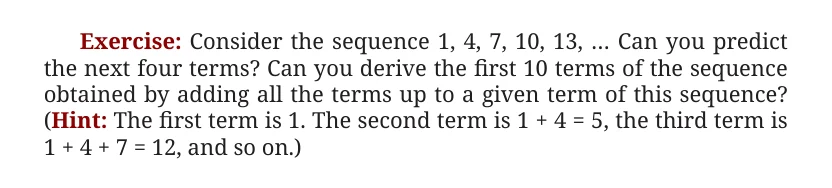
For the sequence 1, 4, 7, 10, 13, ... predict the next four terms.
Show detailed solution
- Step 1: Subtract consecutive terms: each difference is 3.
- Step 2: Continue adding 3 to 13: 16, 19, 22, 25.
- Step 3: The explicit check is t_n=1+3(n-1)=3n-2; t_6,t_7,t_8,t_9 give the same values.
- Answer: 16, 19, 22, 25.
Textbook page 176 · solved item 6
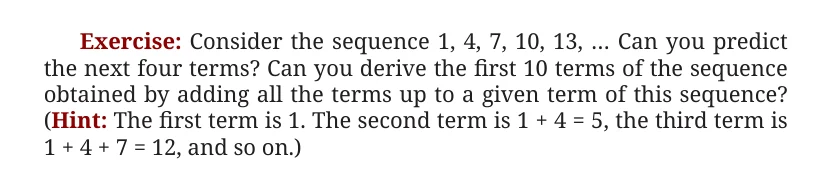
Find the first ten cumulative sums of 1, 4, 7, 10, 13, ... .
Show detailed solution
- Step 1: The original term is t_n=3n-2. Let S_k=t_1+t_2+\cdots+t_k.
- Step 2: Add each new term successively: 1, 1+4, 5+7, 12+10, and so on.
- Step 3: This gives (1,5,12,22,35,51,70,92,117,145). A check is S_k=k(3k-1)/2.
- Answer: 1, 5, 12, 22, 35, 51, 70, 92, 117, 145.
Textbook page 176 · solved item 7

Write t5, t6, t7 and t8 for the triangular-number sequence.
Show detailed solution
- Step 1: The (n)th triangular number is t_n=n(n+1)/2.
- Step 2: t_5=5\times6/2=15 and t_6=6\times7/2=21.
- Step 3: t_7=7\times8/2=28 and t_8=8\times9/2=36.
- Answer: t_5=15, t_6=21, t_7=28, t_8=36.
Textbook page 176 · solved item 8

Think and Reflect: List five different types of sequences and discuss their properties.
Show detailed solution
- Step 1: Even numbers 2,4,6,\ldots form an increasing AP with rule 2n.
- Step 2: Powers of 2, 1,2,4,8,\ldots, form a GP with rule 2^{n-1}; reciprocals 1,1/2,1/3,\ldots decrease toward 0.
- Step 3: The alternating sequence 1,-1,1,-1,\ldots has rule (-1)^{n-1}, while 5,5,5,\ldots is constant.
- Answer: APs, GPs, reciprocal, alternating, and constant sequences are five valid types; their rules describe different kinds of change.
Detailed worked answers
Textbook page 177
Textbook page 177 · solved item 9

Think and Reflect: Why is an explicit formula for the nth term useful?
Show detailed solution
- Step 1: An explicit formula connects a term directly to its position n.
- Step 2: It finds a distant term without calculating every earlier term.
- Step 3: Setting the formula equal to a given number can also test membership and find the number's position.
- Answer: It gives direct access to any term and helps decide whether a value belongs to the sequence.
Textbook page 177 · solved item 10

Using u_n=2n-1, find the 53rd, 108th and 1170th odd numbers.
Show detailed solution
- Step 1: u_{53}=2(53)-1=106-1=105.
- Step 2: u_{108}=2(108)-1=216-1=215.
- Step 3: u_{1170}=2(1170)-1=2340-1=2339.
- Answer: 105, 215 and 2339.
Textbook page 177 · solved item 11

Why must n be a natural number when it represents a term's position?
Show detailed solution
- Step 1: Positions in a sequence are counted as first, second, third, and so on.
- Step 2: A fractional or negative position, such as the 2.5th or -4th term, has no meaning in an ordinary sequence.
- Step 3: Therefore solving an equation for n proves membership only when n is a positive integer.
- Answer: n must be a positive whole-number index; otherwise the value is not a term at a valid position.
Textbook page 177 · solved item 12

Think and Reflect: Find the nth-term rule for the square-number sequence.
Show detailed solution
- Step 1: The terms are 1,4,9,16,\ldots.
- Step 2: They equal 1^2,2^2,3^2,4^2,\ldots.
- Step 3: The term at position n is therefore the square of n.
- Answer: t_n=n^2 for n\ge1.
Textbook page 177 · solved item 13
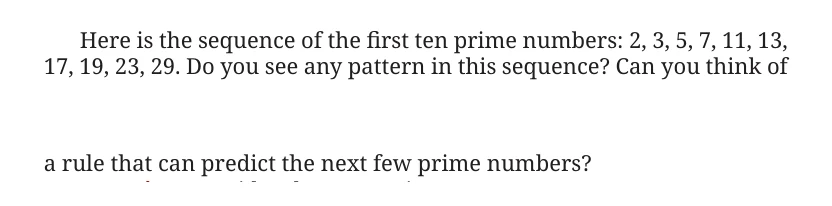
Do the prime numbers show a simple pattern, and what are the next few primes after 29?
Show detailed solution
- Step 1: Consecutive prime gaps are not constant: the early gaps are 1, 2, 2, 4, 2, 4, 2, 4, 6.
- Step 2: Test integers after 29 for divisibility by smaller primes. 30, 32, 33, 34, 35, 36, 38, 39 and 40 are composite.
- Step 3: The next numbers with no divisors except 1 and themselves are 31, 37 and 41.
- Answer: There is no simple constant-step rule like an AP; the next three primes are 31, 37 and 41.
Detailed worked answers
Textbook page 178
Textbook page 178 · solved item 14
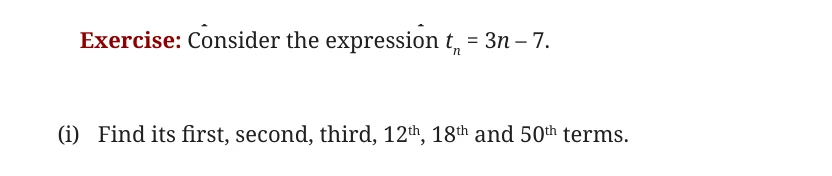
For t_n=3n-7, find the first, second, third, 12th, 18th and 50th terms.
Show detailed solution
- Step 1: Substitute n=1,2,3: t_1=-4, t_2=-1, t_3=2.
- Step 2: t_{12}=36-7=29 and t_{18}=54-7=47.
- Step 3: t_{50}=150-7=143.
- Answer: -4, -1, 2, 29, 47 and 143.
Textbook page 178 · solved item 15
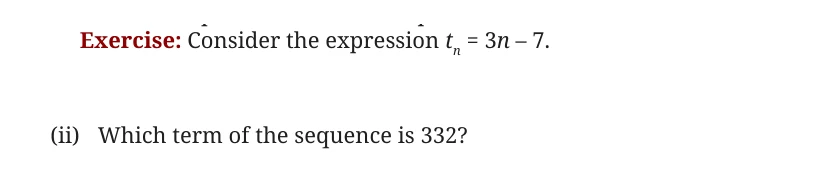
For t_n=3n-7, which term is 332?
Show detailed solution
- Step 1: Set 3n-7=332.
- Step 2: Add 7: 3n=339. Divide by 3: n=113.
- Step 3: Check: t_{113}=3(113)-7=332.
- Answer: 332 is the 113th term.
Textbook page 178 · solved item 16
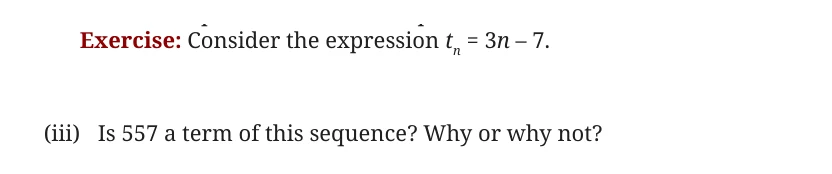
For t_n=3n-7, is 557 a term?
Show detailed solution
- Step 1: Set 3n-7=557.
- Step 2: Then 3n=564, so n=188, a positive integer.
- Step 3: Check: 3(188)-7=564-7=557.
- Answer: Yes. It is the 188th term.
Detailed worked answers
Textbook page 179
Textbook page 179 · solved item 17

Write the next two terms of the Virahanka-Fibonacci sequence 1, 2, 3, 5, 8, 13, 21, 34, ... .
Show detailed solution
- Step 1: Each term is the sum of the preceding two terms.
- Step 2: The next term is 21+34=55.
- Step 3: The following term is 34+55=89.
- Answer: 55 and 89.
Textbook page 179 · solved item 18
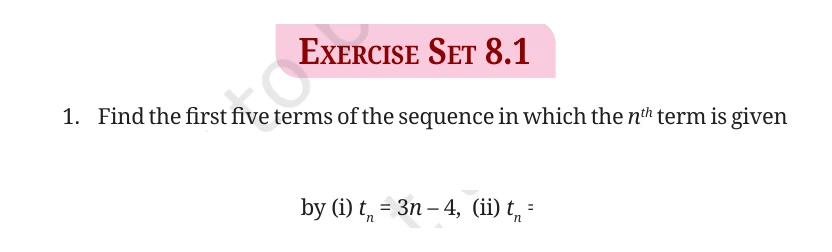
Exercise 8.1, 1(i): Find the first five terms when t_n=3n-4.
Show detailed solution
- Step 1: Substitute n=1,2,3,4,5.
- Step 2: The values are 3-4, 6-4, 9-4, 12-4, 15-4.
- Step 3: Simplify each value.
- Answer: -1, 2, 5, 8, 11.
Textbook page 179 · solved item 19
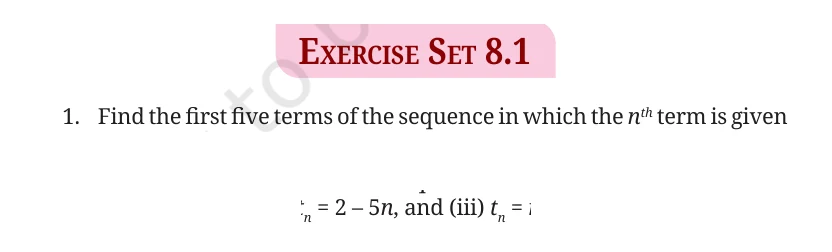
Exercise 8.1, 1(ii): Find the first five terms when t_n=2-5n.
Show detailed solution
- Step 1: Substitute n=1,2,3,4,5.
- Step 2: Compute 2-5, 2-10, 2-15, 2-20, 2-25.
- Step 3: The terms decrease by 5 each time.
- Answer: -3, -8, -13, -18, -23.
Textbook page 179 · solved item 20
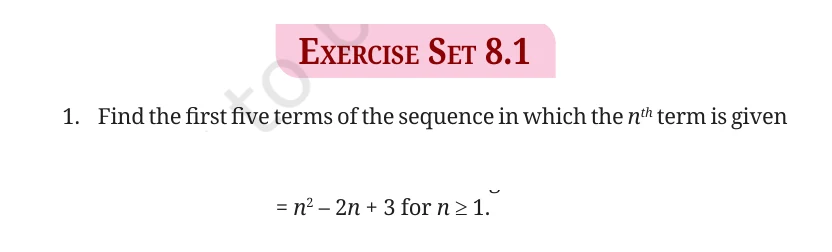
Exercise 8.1, 1(iii): Find the first five terms when t_n=n^2-2n+3.
Show detailed solution
- Step 1: t_1=1-2+3=2 and t_2=4-4+3=3.
- Step 2: t_3=9-6+3=6 and t_4=16-8+3=11.
- Step 3: t_5=25-10+3=18.
- Answer: 2, 3, 6, 11, 18.
Textbook page 179 · solved item 21

Exercise 8.1, 2: Find the 10th and 15th terms of t_n=5n-3.
Show detailed solution
- Step 1: t_{10}=5(10)-3=47.
- Step 2: t_{15}=5(15)-3=72.
- Step 3: Both follow directly from the explicit rule.
- Answer: t_{10}=47 and t_{15}=72.
Textbook page 179 · solved item 22

Exercise 8.1, 3: Determine whether 97 and 172 are terms of t_n=5n-3.
Show detailed solution
- Step 1: For 97, solve 5n-3=97, giving 5n=100 and n=20.
- Step 2: For 172, solve 5n-3=172, giving 5n=175 and n=35.
- Step 3: Both positions are positive integers, so both values belong to the sequence.
- Answer: Yes. 97 is the 20th term and 172 is the 35th term.
Textbook page 179 · solved item 23

Exercise 8.1, 4: Which term of t_n=5n-3 is 607?
Show detailed solution
- Step 1: Set 5n-3=607.
- Step 2: Then 5n=610, so n=122.
- Step 3: Check: 5(122)-3=610-3=607.
- Answer: 607 is the 122nd term.
Textbook page 179 · solved item 24

Exercise 8.1, 5(a): Find the first five terms when t_1=-5 and t_{n+1}=t_n+3.
Show detailed solution
- Step 1: Start with -5 and add 3 to get -2.
- Step 2: Continue adding 3: 1, then 4, then 7.
- Step 3: Equivalently, t_n=-5+3(n-1)=3n-8.
- Answer: -5, -2, 1, 4, 7.
Textbook page 179 · solved item 25
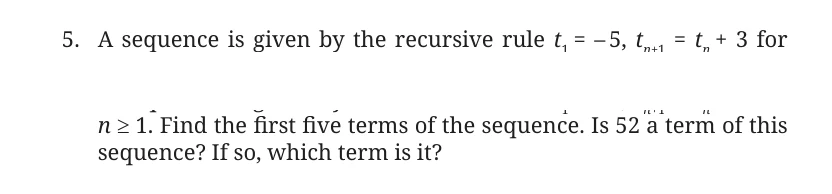
Exercise 8.1, 5(b): Is 52 a term of that recursive sequence, and which term is it?
Show detailed solution
- Step 1: Use the explicit form t_n=3n-8.
- Step 2: Solve 3n-8=52, so 3n=60 and n=20.
- Step 3: Check: t_{20}=60-8=52.
- Answer: Yes. 52 is the 20th term.
Detailed worked answers
Textbook page 180
Textbook page 180 · solved item 26

Exercise 8.1, 6: Find T4 through T8 when each term is the sum of the previous three.
Show detailed solution
- Step 1: T_4=T_3+T_2+T_1=4+2+1=7.
- Step 2: T_5=7+4+2=13 and T_6=13+7+4=24.
- Step 3: T_7=24+13+7=44 and T_8=44+24+13=81.
- Answer: T_4=7, T_5=13, T_6=24, T_7=44, T_8=81.
Textbook page 180 · solved item 27
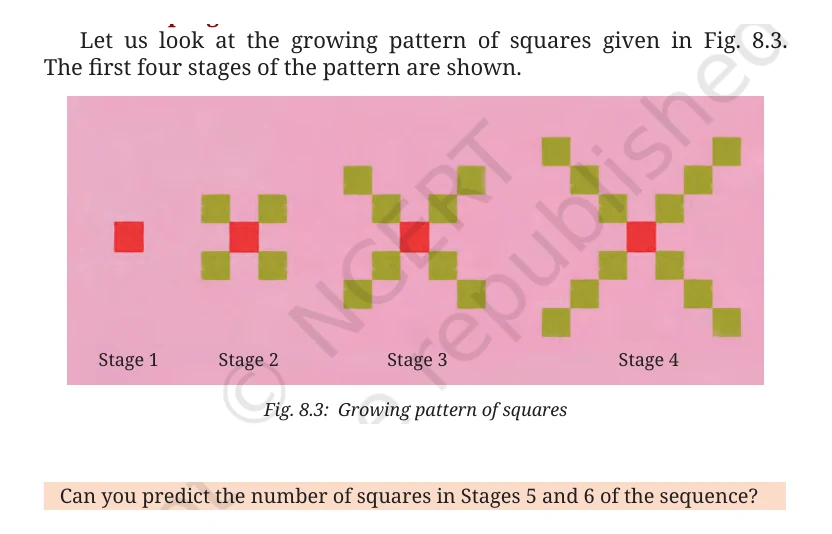
Fig. 8.3: Predict the number of squares in Stages 5 and 6.
Show detailed solution
- Step 1: The counts (1,5,9,13) increase by 4.
- Step 2: Stage 5 has 13+4=17 squares.
- Step 3: Stage 6 has 17+4=21 squares.
- Answer: 17 and 21 squares.
Textbook page 180 · solved item 28
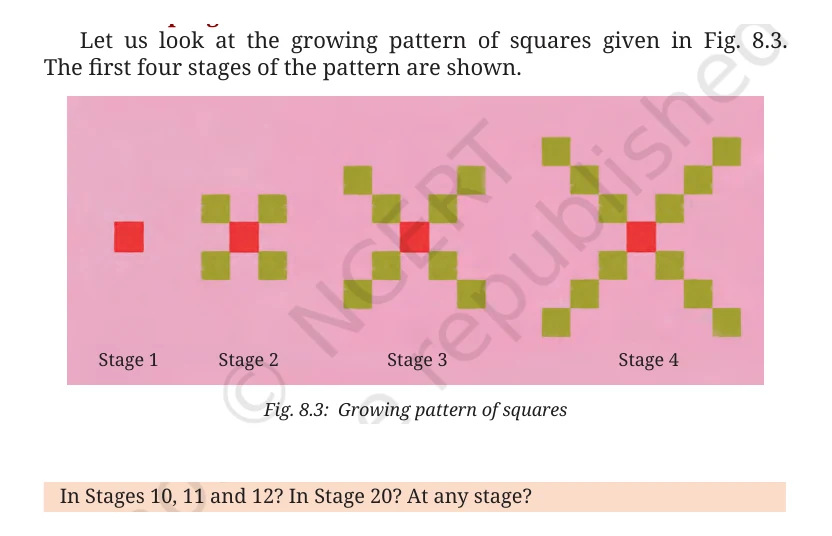
Fig. 8.3: Predict the number of squares in Stages 10, 11 and 12.
Show detailed solution
- Step 1: The nth-stage rule is t_n=1+4(n-1)=4n-3.
- Step 2: t_{10}=40-3=37 and t_{11}=44-3=41.
- Step 3: t_{12}=48-3=45.
- Answer: 37, 41 and 45 squares.
Textbook page 180 · solved item 29
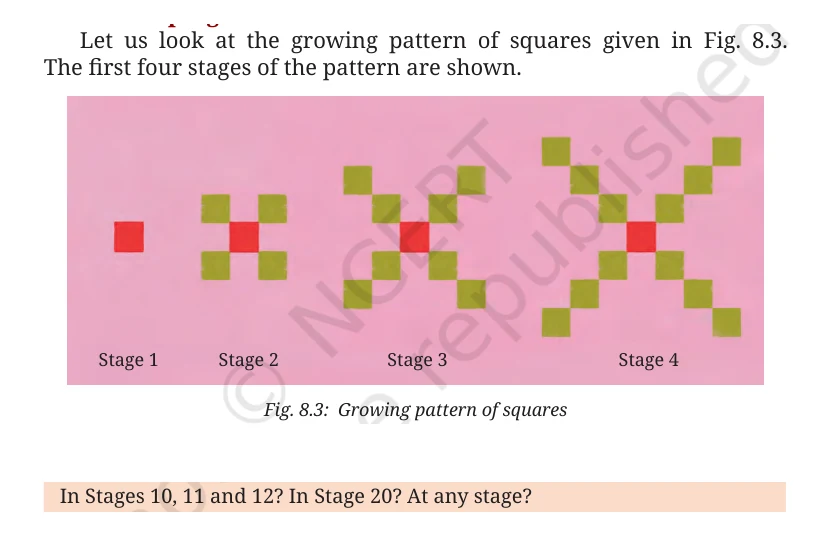
Fig. 8.3: Predict the number of squares in Stage 20.
Show detailed solution
- Step 1: Use t_n=4n-3.
- Step 2: Substitute n=20: t_{20}=4(20)-3.
- Step 3: 80-3=77.
- Answer: Stage 20 has 77 squares.
Textbook page 180 · solved item 30
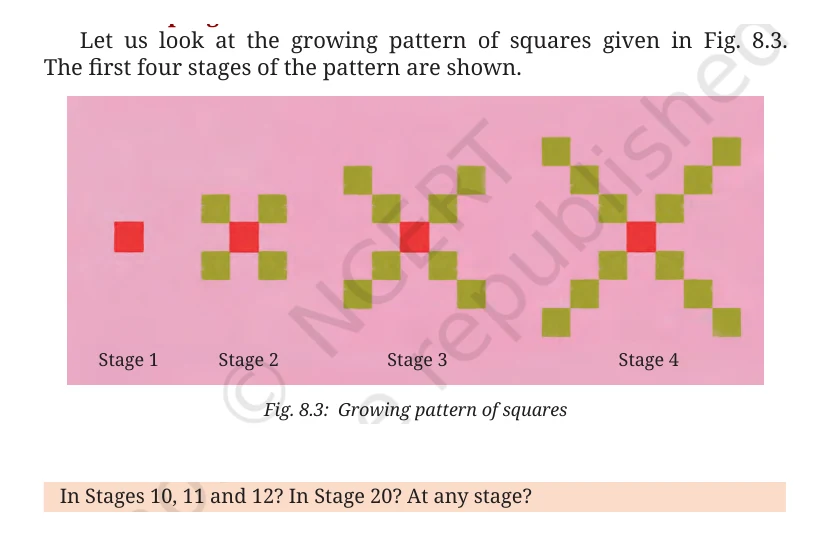
Fig. 8.3: Find the number of squares at any stage n.
Show detailed solution
- Step 1: Stage 1 has one square.
- Step 2: Each move to the next stage adds 4, so Stage n has n-1 additions.
- Step 3: t_n=1+4(n-1)=4n-3.
- Answer: Stage n has 4n-3 squares.
Detailed worked answers
Textbook page 181
Textbook page 181 · solved item 31
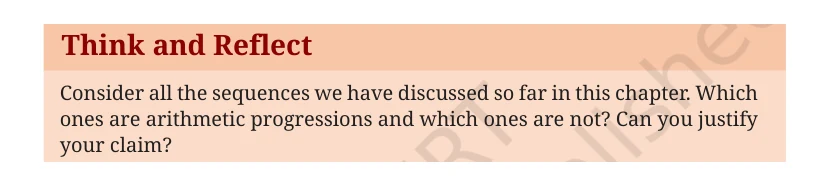
Think and Reflect: Which sequences discussed so far are arithmetic progressions?
Show detailed solution
- Step 1: An AP must have the same difference between every pair of consecutive terms.
- Step 2: Natural numbers, odd numbers, 1, 4, 7, 10, ..., -7, -3, 1, 5, ..., and the Fig. 8.3 counts are APs, with differences 1, 2, 3, 4, and 4 respectively.
- Step 3: Triangular numbers, square numbers, unit fractions, primes, cumulative sums, powers, and the Virahanka-Fibonacci sequence do not have a constant consecutive difference.
- Answer: Exactly the constant-difference sequences are APs; checking differences justifies each classification.
Detailed worked answers
Textbook page 182
Textbook page 182 · solved item 32
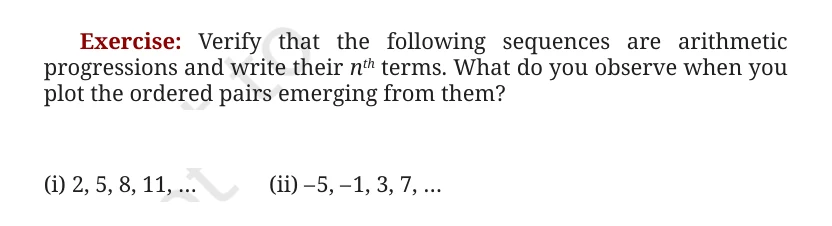
Verify that 2, 5, 8, 11, ... is an AP, find its nth term, and describe its graph.
Show detailed solution
- Step 1: Consecutive differences are 5-2=8-5=11-8=3, so it is an AP.
- Step 2: With a=2,d=3, t_n=2+3(n-1)=3n-1.
- Step 3: The ordered pairs (n,t_n) satisfy y=3x-1, a linear equation.
- Answer: It is an AP with nth term 3n - 1, and its plotted points lie on a straight line.
Textbook page 182 · solved item 33
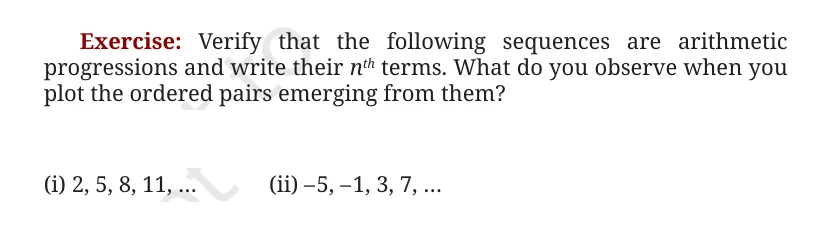
Verify that -5, -1, 3, 7, ... is an AP, find its nth term, and describe its graph.
Show detailed solution
- Step 1: Each consecutive difference is 4, so it is an AP.
- Step 2: With a=-5,d=4, t_n=-5+4(n-1)=4n-9.
- Step 3: Its ordered pairs satisfy y=4x-9, so they are collinear.
- Answer: It is an AP with nth term 4n - 9; its graph consists of points on a straight line.
Textbook page 182 · solved item 34
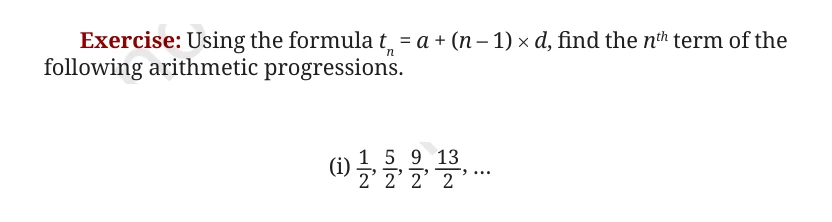
Find the nth term of the AP 1/2, 5/2, 9/2, 13/2, ... .
Show detailed solution
- Step 1: The first term is a=1/2.
- Step 2: The common difference is 5/2-1/2=2.
- Step 3: t_n=1/2+2(n-1)=2n-3/2=(4n-3)/2.
- Answer: t_n=(4n-3)/2.
Textbook page 182 · solved item 35
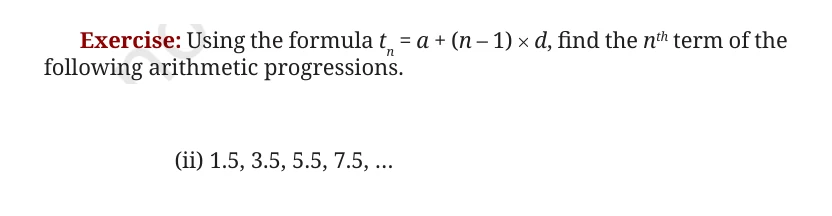
Find the nth term of the AP 1.5, 3.5, 5.5, 7.5, ... .
Show detailed solution
- Step 1: Here a=1.5 and d=2.
- Step 2: t_n=1.5+2(n-1).
- Step 3: Simplifying gives t_n=2n-0.5=(4n-1)/2.
- Answer: t_n=2n-0.5.
Detailed worked answers
Textbook page 183
Textbook page 183 · solved item 36
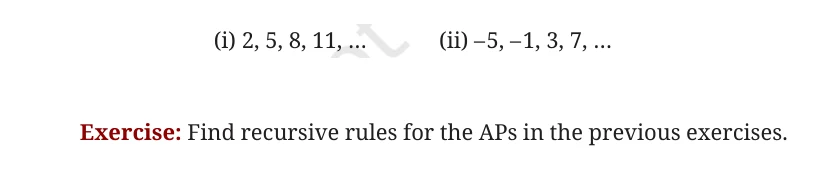
Find a recursive rule for the AP 2, 5, 8, 11, ... .
Show detailed solution
- Step 1: The first term is 2.
- Step 2: Every later term is 3 more than the preceding term.
- Step 3: State both the starting value and recurrence: t_1=2, t_n=t_{n-1}+3 for n\ge2.
- Answer: t_1=2,\ t_n=t_{n-1}+3.
Textbook page 183 · solved item 37
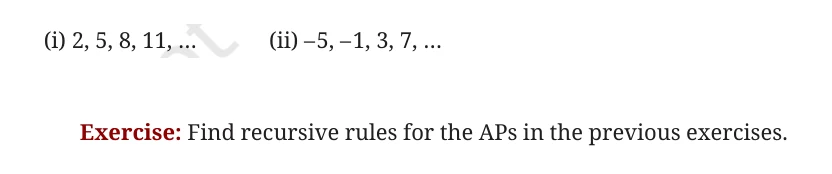
Find a recursive rule for the AP -5, -1, 3, 7, ... .
Show detailed solution
- Step 1: The sequence starts at -5.
- Step 2: Its common difference is 4.
- Step 3: Add 4 to the previous term: t_1=-5, t_n=t_{n-1}+4 for n\ge2.
- Answer: t_1=-5,\ t_n=t_{n-1}+4.
Textbook page 183 · solved item 38
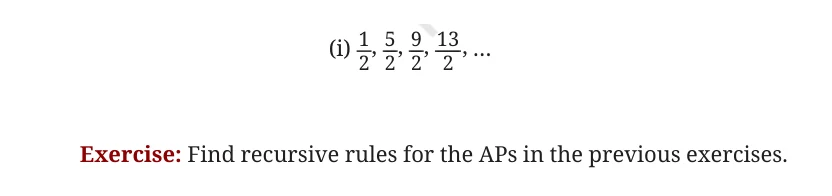
Find a recursive rule for the AP 1/2, 5/2, 9/2, 13/2, ... .
Show detailed solution
- Step 1: The first term is 1/2.
- Step 2: Each term is 2 more than the previous term.
- Step 3: Therefore t_1=1/2, t_n=t_{n-1}+2 for n\ge2.
- Answer: t_1=1/2,\ t_n=t_{n-1}+2.
Textbook page 183 · solved item 39
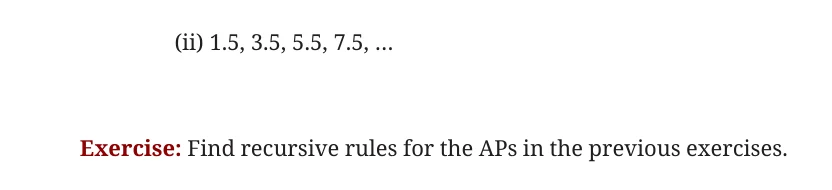
Find a recursive rule for the AP 1.5, 3.5, 5.5, 7.5, ... .
Show detailed solution
- Step 1: The first term is 1.5.
- Step 2: The common difference is 2.
- Step 3: Thus t_1=1.5, t_n=t_{n-1}+2 for n\ge2.
- Answer: t_1=1.5,\ t_n=t_{n-1}+2.
Textbook page 183 · solved item 40

Find the sum of the first ten natural numbers without adding them one by one.
Show detailed solution
- Step 1: Write S=1+2+\cdots+10 and reverse it as S=10+9+\cdots+1.
- Step 2: Adding corresponding terms produces ten pairs, each equal to 11.
- Step 3: Hence 2S=10\times11=110, so S=55.
- Answer: The sum is 55.
Detailed worked answers
Textbook page 184
Textbook page 184 · solved item 41

Think and Reflect: Use the pairing method to find 1 + 2 + 3 + ... + 100.
Show detailed solution
- Step 1: Pair the first and last terms: 1 + 100 = 101, 2 + 99 = 101, and so on.
- Step 2: There are 50 such pairs.
- Step 3: The sum is 50\times101=5050, equivalently 100(101)/2.
- Answer: 5050.
Detailed worked answers
Textbook page 185
Textbook page 185 · solved item 42

Think and Reflect: Use S_n=n(n+1)/2 to find S20, S50 and S1000.
Show detailed solution
- Step 1: S_{20}=20(21)/2=210.
- Step 2: S_{50}=50(51)/2=25\times51=1275.
- Step 3: S_{1000}=1000(1001)/2=500\times1001=500500.
- Answer: S_{20}=210,\ S_{50}=1275,\ S_{1000}=500500.
Textbook page 185 · solved item 43
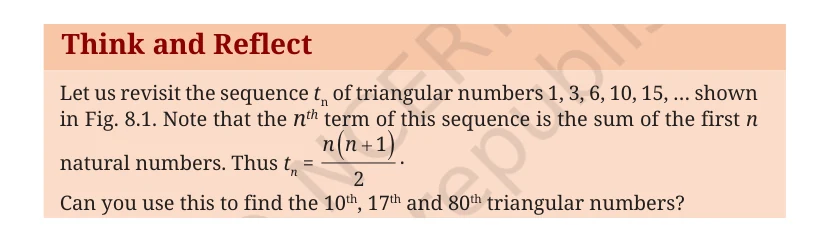
Think and Reflect: Find the 10th, 17th and 80th triangular numbers.
Show detailed solution
- Step 1: Use T_n=n(n+1)/2.
- Step 2: T_{10}=10(11)/2=55 and T_{17}=17(18)/2=153.
- Step 3: T_{80}=80(81)/2=40\times81=3240.
- Answer: T_{10}=55,\ T_{17}=153,\ T_{80}=3240.
Textbook page 185 · solved item 44
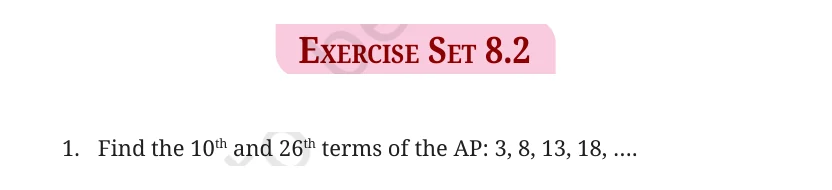
Exercise 8.2, 1: Find the 10th and 26th terms of 3, 8, 13, 18, ... .
Show detailed solution
- Step 1: Here a=3 and d=5.
- Step 2: t_{10}=3+9(5)=48.
- Step 3: t_{26}=3+25(5)=128.
- Answer: t_{10}=48 and t_{26}=128.
Textbook page 185 · solved item 45
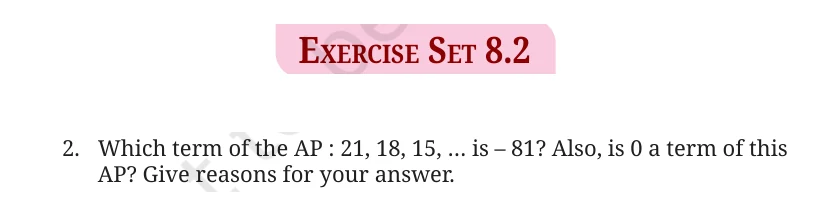
Exercise 8.2, 2(a): Which term of 21, 18, 15, ... is -81?
Show detailed solution
- Step 1: Here a=21,d=-3, so t_n=21-3(n-1).
- Step 2: Solve 21-3(n-1)=-81. Then -3(n-1)=-102, so n-1=34.
- Step 3: Therefore n = 35; checking gives 21 - 102 = -81.
- Answer: -81 is the 35th term.
Textbook page 185 · solved item 46
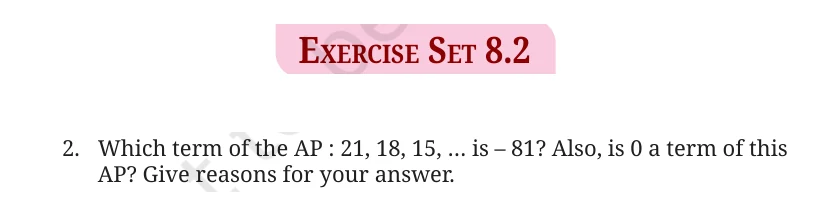
Exercise 8.2, 2(b): Is 0 a term of 21, 18, 15, ...?
Show detailed solution
- Step 1: Set 21-3(n-1)=0.
- Step 2: Then 3(n-1)=21, so n-1=7 and n=8.
- Step 3: Since 8 is a positive integer, this is a valid term position.
- Answer: Yes. 0 is the 8th term.
Textbook page 185 · solved item 47
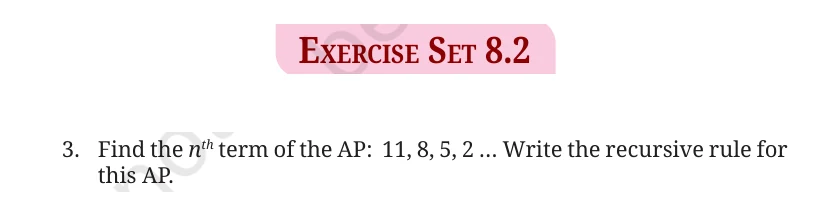
Exercise 8.2, 3: Find the nth term and recursive rule for 11, 8, 5, 2, ... .
Show detailed solution
- Step 1: The first term is a=11 and common difference is d=-3.
- Step 2: t_n=11-3(n-1)=14-3n.
- Step 3: Recursively, begin with 11 and subtract 3: t_1=11,\ t_n=t_{n-1}-3 for n\ge2.
- Answer: t_n=14-3n; recursively t_1=11,\ t_n=t_{n-1}-3.
Textbook page 185 · solved item 48
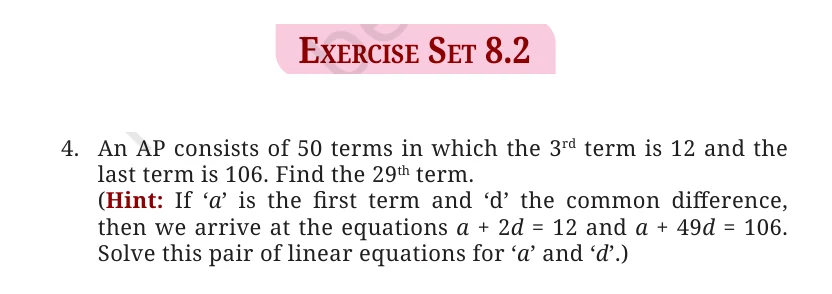
Exercise 8.2, 4: An AP has 50 terms, t3 = 12 and t50 = 106. Find t29.
Show detailed solution
- Step 1: a+2d=12 and a+49d=106.
- Step 2: Subtract the equations: 47d=94, so d=2. Then a=12-4=8.
- Step 3: t_{29}=a+28d=8+56=64.
- Answer: The 29th term is 64.
Detailed worked answers
Textbook page 186
Textbook page 186 · solved item 49

Exercise 8.2, 5(a): How many two-digit numbers are divisible by 3?
Show detailed solution
- Step 1: The first two-digit multiple of 3 is 12 and the last is 99.
- Step 2: These form an AP with a=12,d=3,l=99.
- Step 3: n=(99-12)/3+1=29+1=30.
- Answer: 30 two-digit numbers are divisible by 3.
Textbook page 186 · solved item 50

Exercise 8.2, 5(b): Find the sum of all two-digit numbers divisible by 3.
Show detailed solution
- Step 1: From the first part, there are 30 terms from 12 to 99.
- Step 2: Use S_n=n(a+l)/2.
- Step 3: S=30(12+99)/2=15(111)=1665.
- Answer: The sum is 1665.
Textbook page 186 · solved item 51

Exercise 8.2, 6: When does a salary starting at Rs 5,00,000 with yearly increments of Rs 20,000 reach Rs 7,00,000?
Show detailed solution
- Step 1: In year n, the salary is 500000+(n-1)20000.
- Step 2: Set this equal to 700000: (n-1)20000=200000.
- Step 3: Thus n-1=10, so n=11.
- Answer: It reaches Rs 7,00,000 in the 11th year, after 10 annual increments.
Textbook page 186 · solved item 52

Exercise 8.2, 7: How many marbles are used in rows of 1, 2, 3, ... up to 25?
Show detailed solution
- Step 1: The total is 1+2+\cdots+25.
- Step 2: Use S_n=n(n+1)/2.
- Step 3: S_{25}=25(26)/2=25(13)=325.
- Answer: 325 marbles.
Textbook page 186 · solved item 53
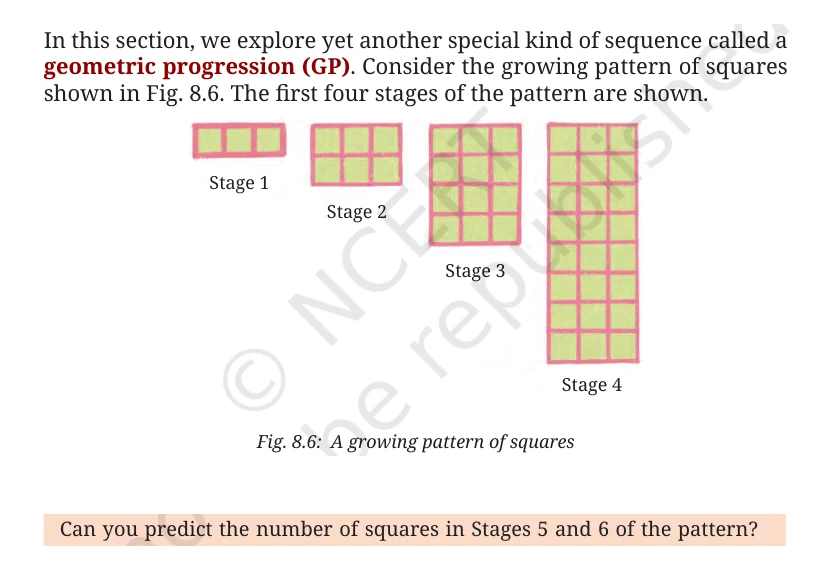
Fig. 8.6: Predict the number of green squares in Stages 5 and 6.
Show detailed solution
- Step 1: The counts 3, 6, 12, 24 double at each stage.
- Step 2: Stage 5 has 24\times2=48 squares.
- Step 3: Stage 6 has 48\times2=96 squares.
- Answer: 48 and 96 squares.
Textbook page 186 · solved item 54
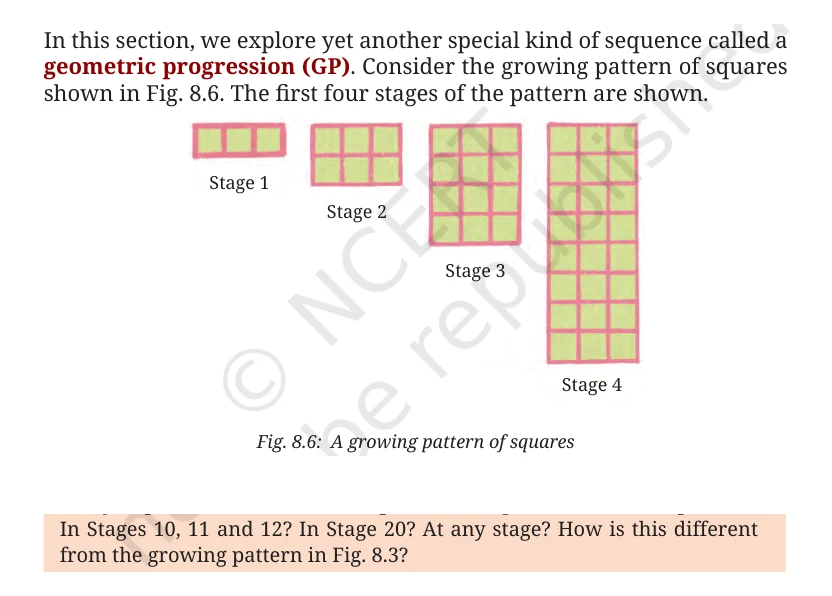
Fig. 8.6: Predict the number of green squares in Stages 10, 11 and 12.
Show detailed solution
- Step 1: The rule is t_n=3\times2^{n-1}.
- Step 2: t_{10}=3\times2^9=1536 and t_{11}=3\times2^{10}=3072.
- Step 3: t_{12}=3\times2^{11}=6144.
- Answer: 1536, 3072 and 6144 squares.
Textbook page 186 · solved item 55
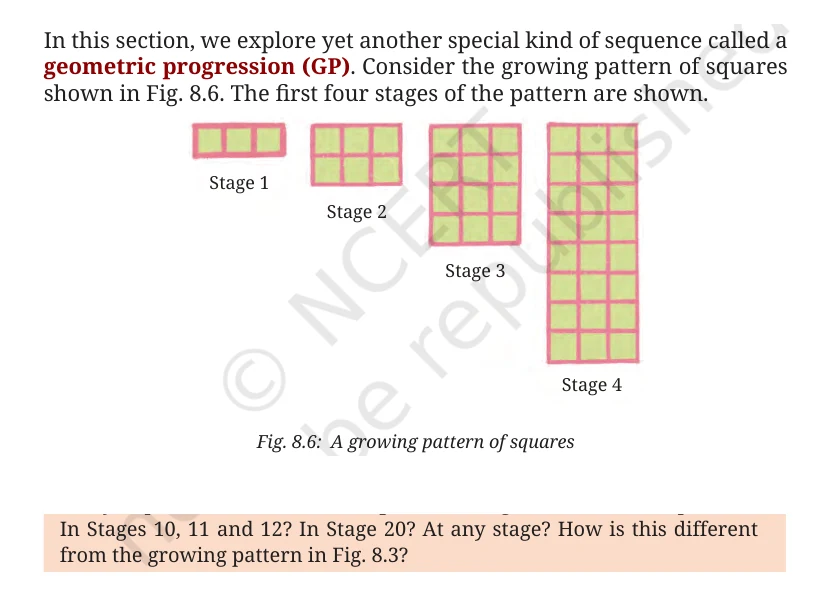
Fig. 8.6: Predict the number of green squares in Stage 20.
Show detailed solution
- Step 1: Use t_n=3\times2^{n-1}.
- Step 2: t_{20}=3\times2^{19}.
- Step 3: Since 2^{19}=524288, the product is 1572864.
- Answer: Stage 20 has 1,572,864 green squares.
Textbook page 186 · solved item 56

Fig. 8.6: Find the number of green squares at any stage n.
Show detailed solution
- Step 1: Stage 1 has 3 squares.
- Step 2: Each stage doubles the previous count, so the common ratio is 2.
- Step 3: A GP with first term 3 and ratio 2 has t_n=3\times2^{n-1}.
- Answer: Stage n has 3\times2^{n-1} green squares.
Textbook page 186 · solved item 57
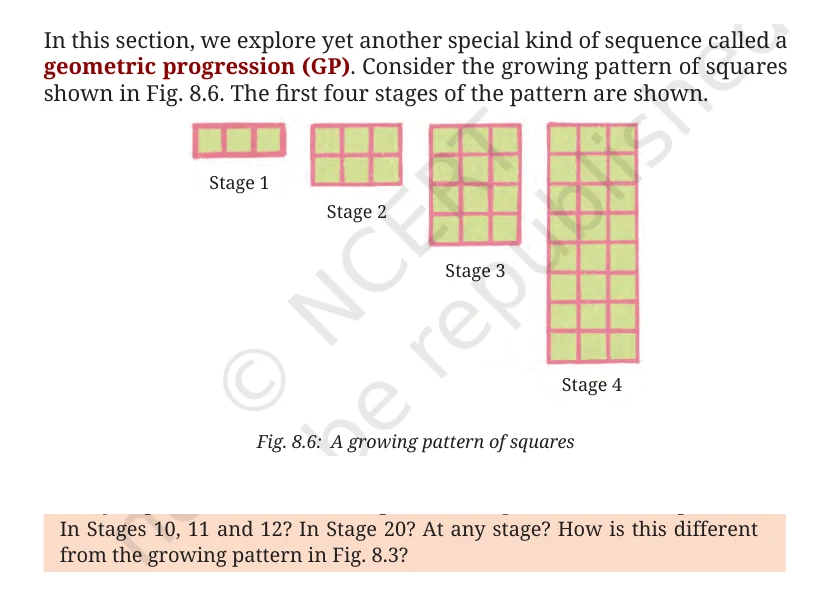
How is the growing pattern in Fig. 8.6 different from Fig. 8.3?
Show detailed solution
- Step 1: Fig. 8.3 adds 4 squares at every stage, producing an AP and linear growth.
- Step 2: Fig. 8.6 multiplies the number of squares by 2, producing a GP and exponential growth.
- Step 3: Their rules are 4n-3 and 3\times2^{n-1}, respectively.
- Answer: Fig. 8.3 grows by a constant difference; Fig. 8.6 grows by a constant ratio.
Detailed worked answers
Textbook page 188
Textbook page 188 · solved item 58
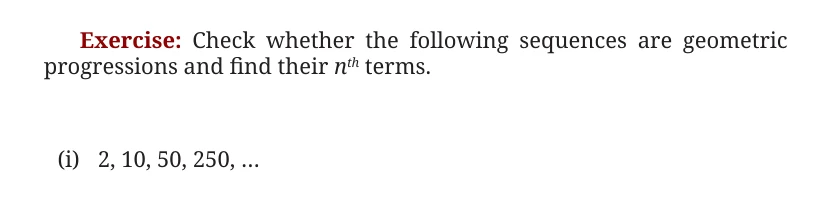
Check whether 2, 10, 50, 250, ... is a GP and find its nth term.
Show detailed solution
- Step 1: Consecutive ratios are 10/2=50/10=250/50=5.
- Step 2: The constant ratio proves it is a GP with a = 2 and r = 5.
- Step 3: Use t_n=ar^{n-1}.
- Answer: It is a GP and t_n=2\times5^{n-1}.
Textbook page 188 · solved item 59
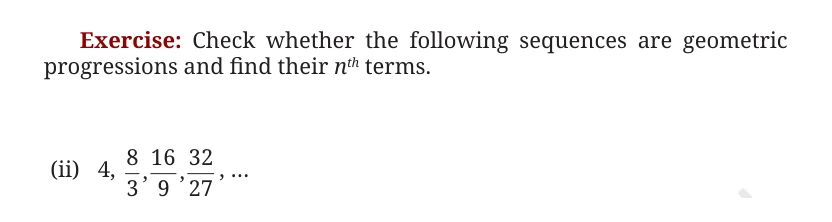
Check whether 4, 8/3, 16/9, 32/27, ... is a GP and find its nth term.
Show detailed solution
- Step 1: (8/3)/4=2/3, and the later consecutive ratios are also 2/3.
- Step 2: Thus a=4 and r=2/3.
- Step 3: Substitute in t_n=ar^{n-1}.
- Answer: It is a GP with t_n=4(2/3)^{n-1}.
Textbook page 188 · solved item 60
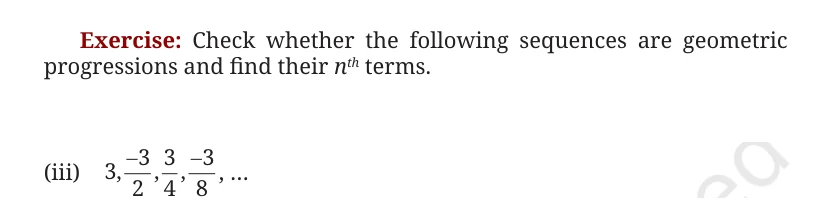
Check whether 3, -3/2, 3/4, -3/8, ... is a GP and find its nth term.
Show detailed solution
- Step 1: Each term divided by the preceding term equals -1/2.
- Step 2: Therefore a=3 and r=-1/2; the negative ratio makes signs alternate.
- Step 3: Use the standard GP formula t_n=ar^{n-1}.
- Answer: It is a GP with t_n=3(-1/2)^{n-1}.
Textbook page 188 · solved item 61

Find a recursive rule for t_n=3\times10^{n-1}, which generates 3, 30, 300, 3000, ... .
Show detailed solution
- Step 1: The starting term is 3.
- Step 2: Every term is 10 times the preceding term.
- Step 3: Record both parts: t_1=3, t_n=10t_{n-1} for n\ge2.
- Answer: t_1=3,\ t_n=10t_{n-1}.
Detailed worked answers
Textbook page 189
Textbook page 189 · solved item 62
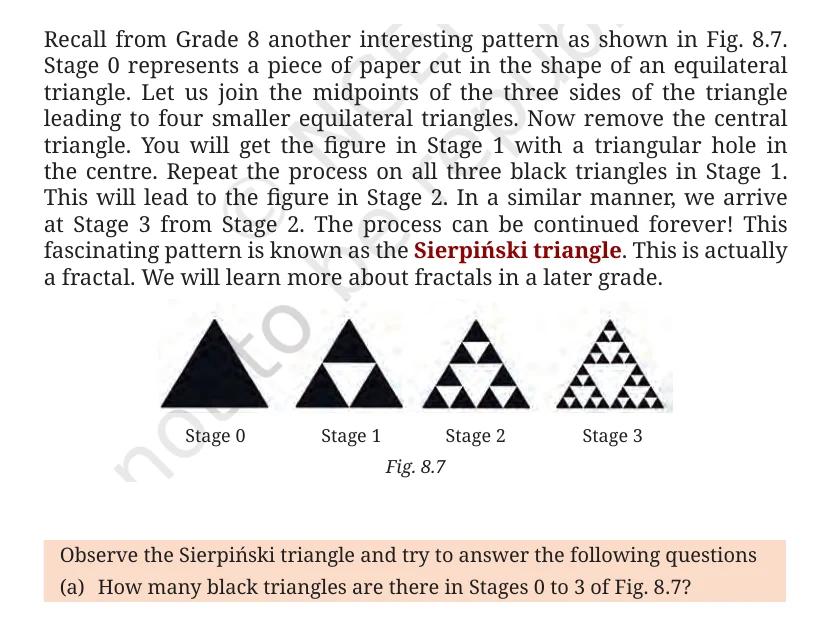
Sierpinski triangle (a): How many black triangles are in Stages 0 to 3?
Show detailed solution
- Step 1: Stage 0 begins with one black triangle.
- Step 2: Each black triangle is replaced by 3 smaller black triangles at the next stage.
- Step 3: The counts are 1,1\times3,1\times3^2,1\times3^3.
- Answer: 1, 3, 9 and 27 black triangles.
Textbook page 189 · solved item 63
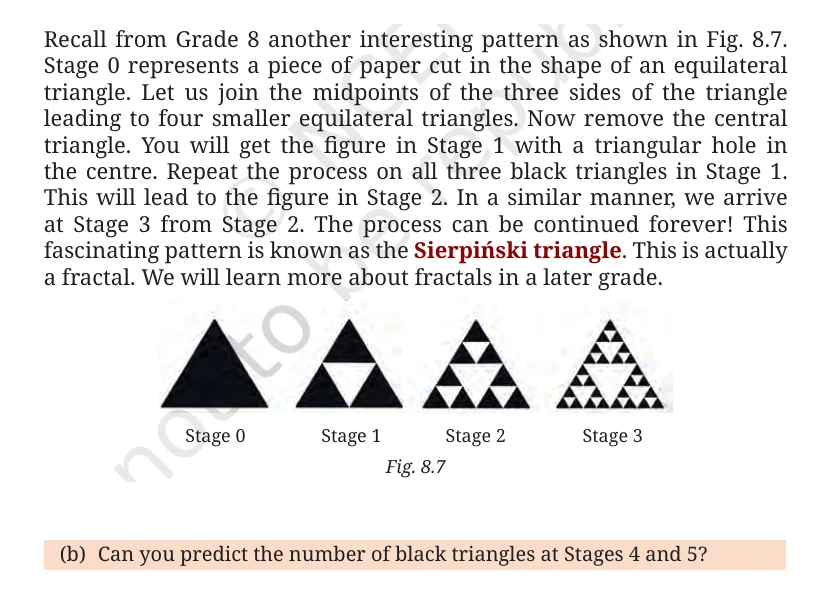
Sierpinski triangle (b): Predict the number of black triangles in Stages 4 and 5.
Show detailed solution
- Step 1: Continue the GP 1,3,9,27,\ldots with common ratio 3.
- Step 2: Stage 4 has 27\times3=81.
- Step 3: Stage 5 has 81\times3=243.
- Answer: 81 and 243 black triangles.
Textbook page 189 · solved item 64
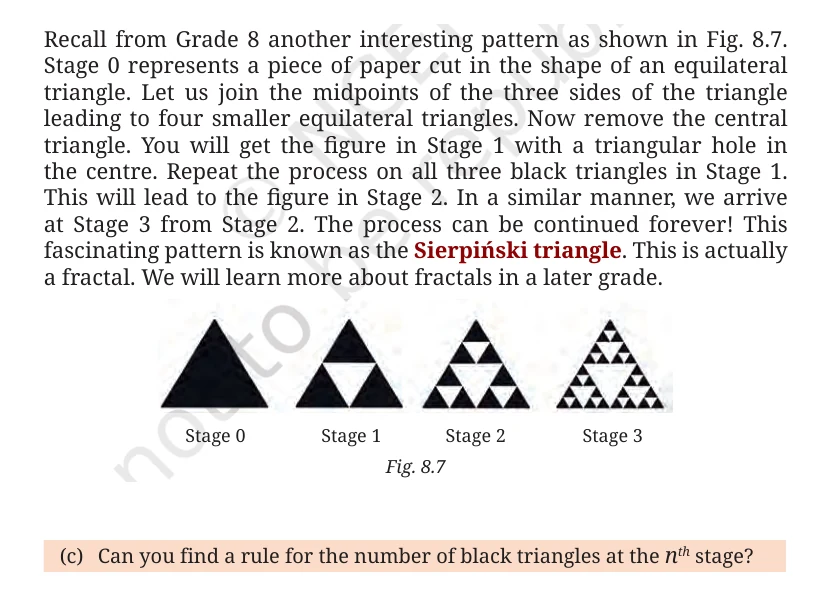
Sierpinski triangle (c): Find a rule for the number of black triangles at Stage n.
Show detailed solution
- Step 1: Stage 0 has one triangle, which is 3^0.
- Step 2: Moving forward one stage multiplies the count by 3.
- Step 3: Therefore B_n=3^n; recursively, B_0=1 and B_n=3B_{n-1}.
- Answer: B_n=3^n for Stage n.
Textbook page 189 · solved item 65
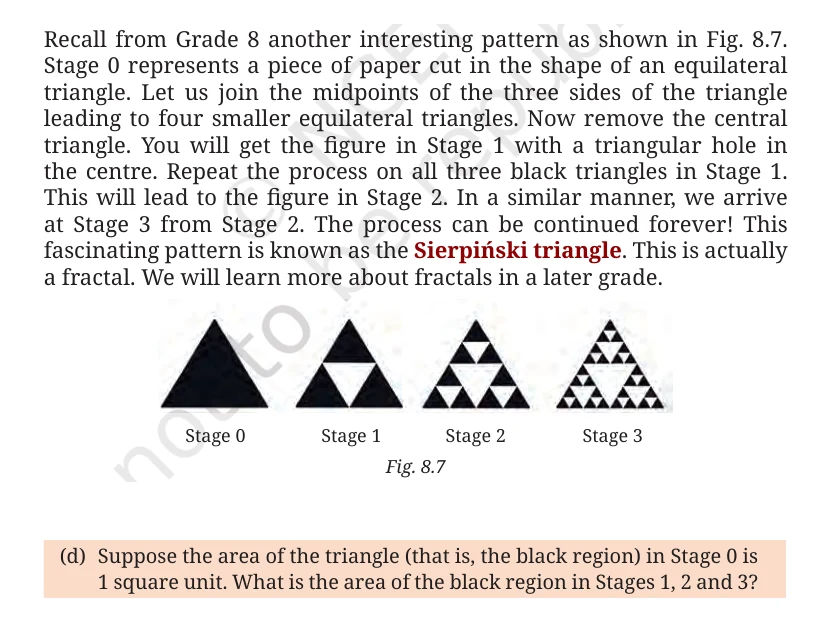
Sierpinski triangle, part (d), question 1: If Stage 0 has area 1, find the black area in Stages 1, 2 and 3.
Show detailed solution
- Step 1: At each stage, three of four equal subtriangles remain, so the area is multiplied by 3/4.
- Step 2: Stage 1 area is 3/4, and Stage 2 area is (3/4)^2=9/16.
- Step 3: Stage 3 area is (3/4)^3=27/64.
- Answer: 3/4, 9/16, 27/64 square units.
Textbook page 189 · solved item 66
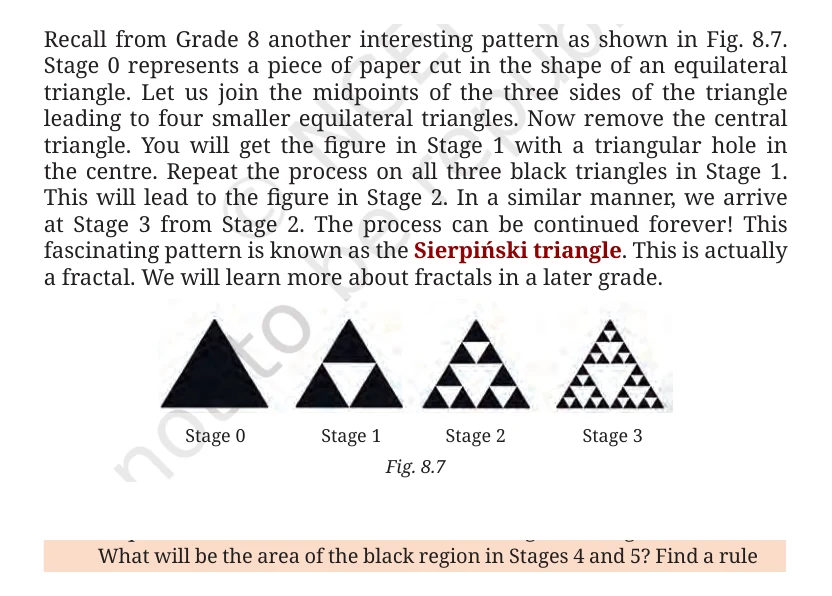
Sierpinski triangle, part (d), question 2: Find the black area in Stages 4 and 5.
Show detailed solution
- Step 1: The area at Stage n is (3/4)^n.
- Step 2: Stage 4 area is (3/4)^4=81/256.
- Step 3: Stage 5 area is (3/4)^5=243/1024.
- Answer: 81/256 and 243/1024 square units.
Textbook page 189 · solved item 67
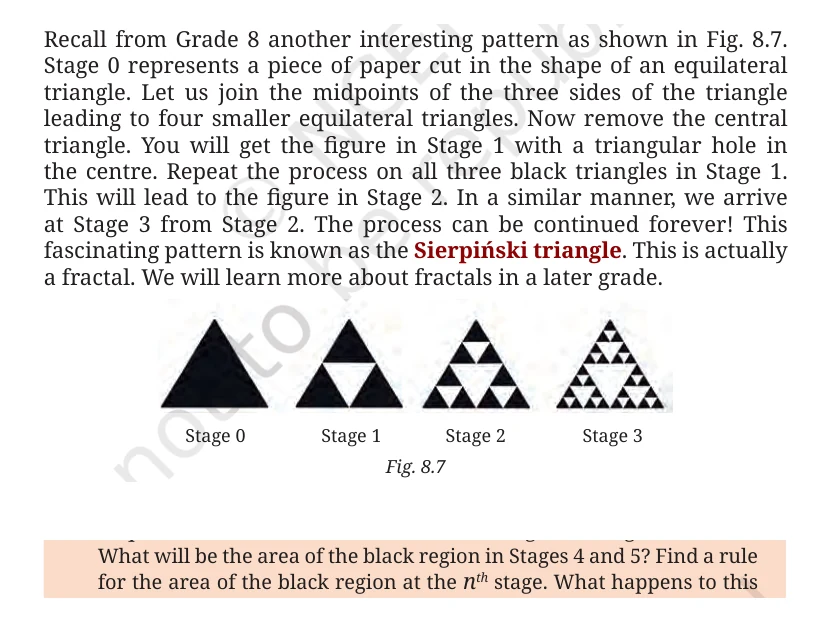
Sierpinski triangle, part (d), question 3: Find a rule for the black area at Stage n.
Show detailed solution
- Step 1: The initial area is A_0=1.
- Step 2: Each construction retains 3/4 of the preceding black area.
- Step 3: Thus A_n=(3/4)^n; recursively, A_0=1, A_n=(3/4)A_{n-1}.
- Answer: A_n=(3/4)^n square units.
Textbook page 189 · solved item 68
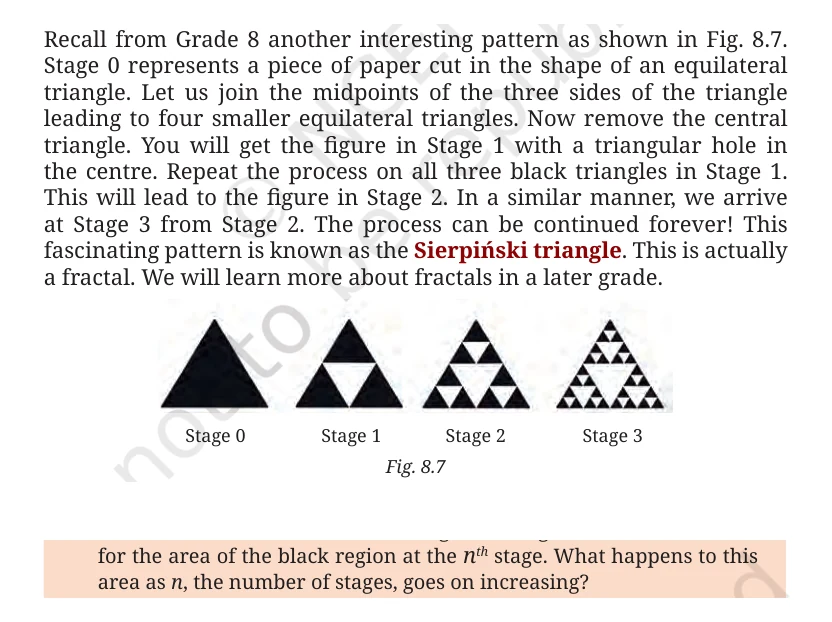
Sierpinski triangle, part (d), question 4: What happens to the black area as the number of stages increases?
Show detailed solution
- Step 1: The area is A_n=(3/4)^n.
- Step 2: Because 3/4 lies between 0 and 1, repeated multiplication makes the value smaller.
- Step 3: Mathematically, \lim_{n\to\infty}(3/4)^n=0.
- Answer: The black area approaches 0, although it remains positive at every finite stage.
Textbook page 189 · solved item 69

Why does the number of black triangles increase so quickly with the stage number?
Show detailed solution
- Step 1: Every black triangle produces three black triangles in the next stage.
- Step 2: Therefore the count is multiplied, not merely increased by a fixed amount: B_n=3^n.
- Step 3: Exponential growth such as 3^n eventually outpaces every linear rule an+b.
- Answer: The count triples at every step, so it grows exponentially.
Textbook page 189 · solved item 70

Explain why the black area at Stage n is (3/4)^n.
Show detailed solution
- Step 1: Stage 0 has area 1.
- Step 2: At each construction, the central one of four equal parts is removed, leaving 3/4 of the earlier black area.
- Step 3: After n stages this multiplier has been applied n times, giving 1\times(3/4)^n.
- Answer: The black area is (3/4)^n square units.
Detailed worked answers
Textbook page 193
Textbook page 193 · solved item 71
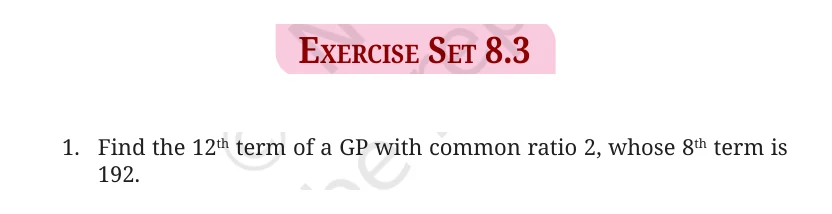
Exercise 8.3, 1: Find the 12th term of a GP with ratio 2 whose 8th term is 192.
Show detailed solution
- Step 1: In four steps from the 8th to the 12th term, multiply by 2^4.
- Step 2: t_{12}=t_8\times2^4=192\times16.
- Step 3: 192\times16=3072.
- Answer: The 12th term is 3072.
Textbook page 193 · solved item 72
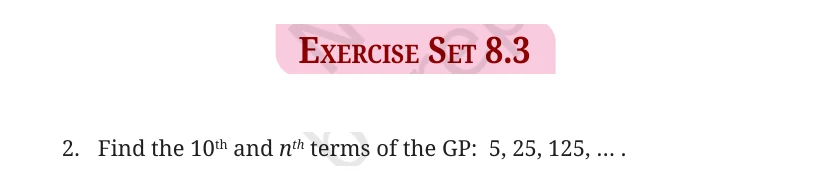
Exercise 8.3, 2: Find the 10th and nth terms of 5, 25, 125, ... .
Show detailed solution
- Step 1: The GP has a=5 and r=5.
- Step 2: t_n=5\times5^{n-1}=5^n.
- Step 3: t_{10}=5^{10}=9765625.
- Answer: t_{10}=9,765,625 and t_n=5^n.
Textbook page 193 · solved item 73
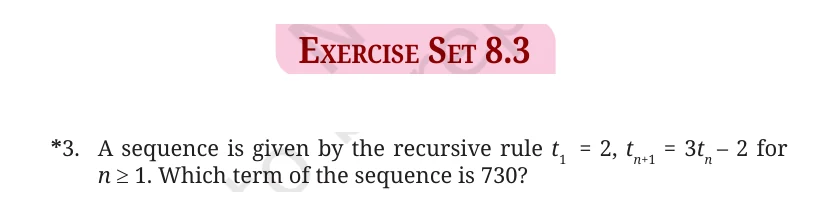
Exercise 8.3, 3: For t_1=2 and t_{n+1}=3t_n-2, which term is 730?
Show detailed solution
- Step 1: Subtract the fixed value 1. If u_n=t_n-1, then u_{n+1}=3u_n and u_1=1.
- Step 2: Hence u_n=3^{n-1} and t_n=1+3^{n-1}.
- Step 3: Set 1+3^{n-1}=730. Then 3^{n-1}=729=3^6, so n=7.
- Answer: 730 is the 7th term.
Textbook page 193 · solved item 74
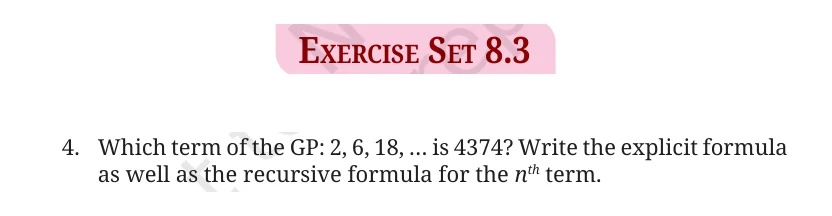
Exercise 8.3, 4: Which term of 2, 6, 18, ... is 4374? Give explicit and recursive rules.
Show detailed solution
- Step 1: Here a=2,r=3, so the explicit rule is t_n=2\times3^{n-1}.
- Step 2: Solve 2\times3^{n-1}=4374. Dividing by 2 gives 3^{n-1}=2187=3^7, so n=8.
- Step 3: The recursive rule is t_1=2,\ t_n=3t_{n-1} for n\ge2.
- Answer: 4374 is the 8th term; the rules are as stated above.
Textbook page 193 · solved item 75
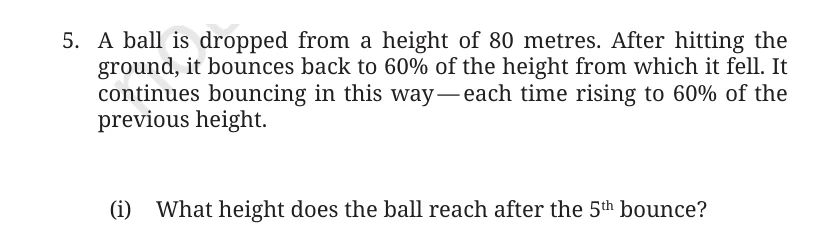
Exercise 8.3, 5(i): An 80 m ball rebounds to 60% each time. What height does it reach after the 5th bounce?
Show detailed solution
- Step 1: After bounce n, the height is h_n=80(0.6)^n.
- Step 2: h_5=80(0.6)^5, and (0.6)^5=0.07776.
- Step 3: 80\times0.07776=6.2208.
- Answer: The ball reaches 6.2208 m after the 5th bounce.
Textbook page 193 · solved item 76
Exercise 8.3, 5(ii): Find the total vertical distance by the time the ball hits the ground for the 6th time.
Show detailed solution
- Step 1: The first ground hit contributes the initial 80 m fall.
- Step 2: Before hits 2 through 6, the ball rises and falls through heights (48,28.8,17.28,10.368,6.2208) m.
- Step 3: Total distance is 80+2(48+28.8+17.28+10.368+6.2208).
- Step 4: The bracketed sum is 110.6688, so the distance is 80+221.3376=301.3376 m.
- Answer: 301.3376 m.
Detailed worked answers
Textbook page 194
Textbook page 194 · solved item 77

Exercise 8.3, 6: Which term of 2,2\sqrt2,4,\ldots is 128?
Show detailed solution
- Step 1: The common ratio is \sqrt2, so t_n=2(\sqrt2)^{n-1}.
- Step 2: Write powers of 2: t_n=2^{1+(n-1)/2} and 128=2^7.
- Step 3: Set 1+(n-1)/2=7. Then n-1=12, so n=13.
- Answer: 128 is the 13th term.
Textbook page 194 · solved item 78
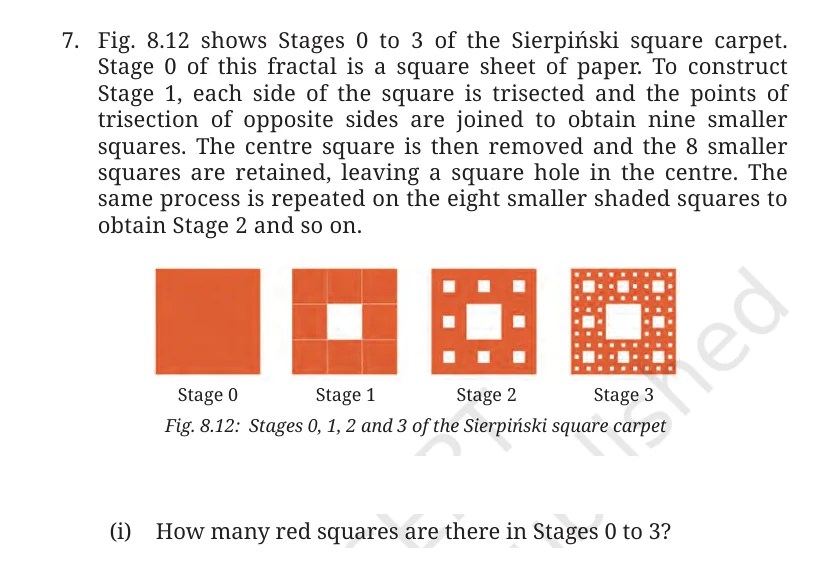
Exercise 8.3, 7(i): How many red squares are in Stages 0 to 3 of the Sierpinski square carpet?
Show detailed solution
- Step 1: Stage 0 has one red square.
- Step 2: Each red square produces 8 retained red squares at the next stage.
- Step 3: The counts are 8^0,8^1,8^2,8^3.
- Answer: 1, 8, 64 and 512 red squares.
Textbook page 194 · solved item 79
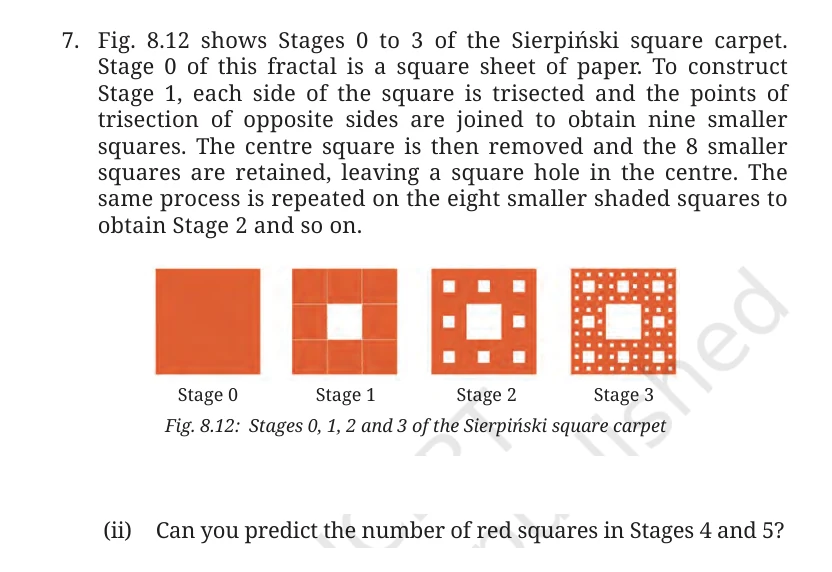
Exercise 8.3, 7(ii): Predict the number of red squares in Stages 4 and 5.
Show detailed solution
- Step 1: Continue multiplying the Stage 3 count, 512, by 8.
- Step 2: Stage 4 has 512\times8=4096 red squares.
- Step 3: Stage 5 has 4096\times8=32768 red squares.
- Answer: 4096 and 32768 red squares.
Textbook page 194 · solved item 80
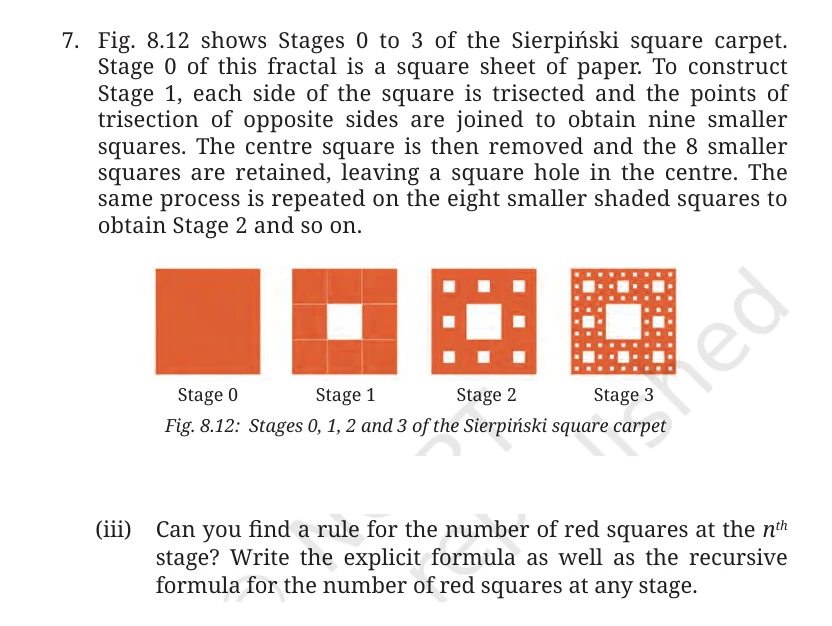
Exercise 8.3, 7(iii): Give explicit and recursive rules for the red-square count at Stage n.
Show detailed solution
- Step 1: Stage 0 contains one red square and each stage multiplies the count by 8.
- Step 2: The explicit rule is R_n=8^n.
- Step 3: The recursive rule is R_0=1,\ R_n=8R_{n-1} for n\ge1.
- Answer: R_n=8^n; recursively, R_0=1,\ R_n=8R_{n-1}.
Textbook page 194 · solved item 81
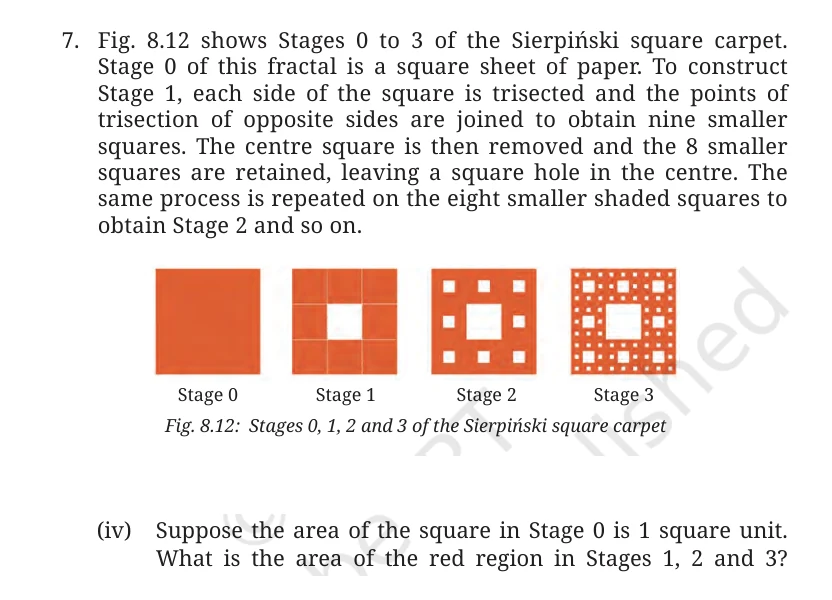
Exercise 8.3, 7(iv), area question 1: If Stage 0 has area 1, find the red area in Stages 1, 2 and 3.
Show detailed solution
- Step 1: Each stage retains 8 of 9 equal subsquares, so the red area is multiplied by 8/9.
- Step 2: Stage 1 and 2 areas are 8/9 and (8/9)^2=64/81.
- Step 3: Stage 3 area is (8/9)^3=512/729.
- Answer: 8/9,\ 64/81,\ 512/729 square units.
Textbook page 194 · solved item 82
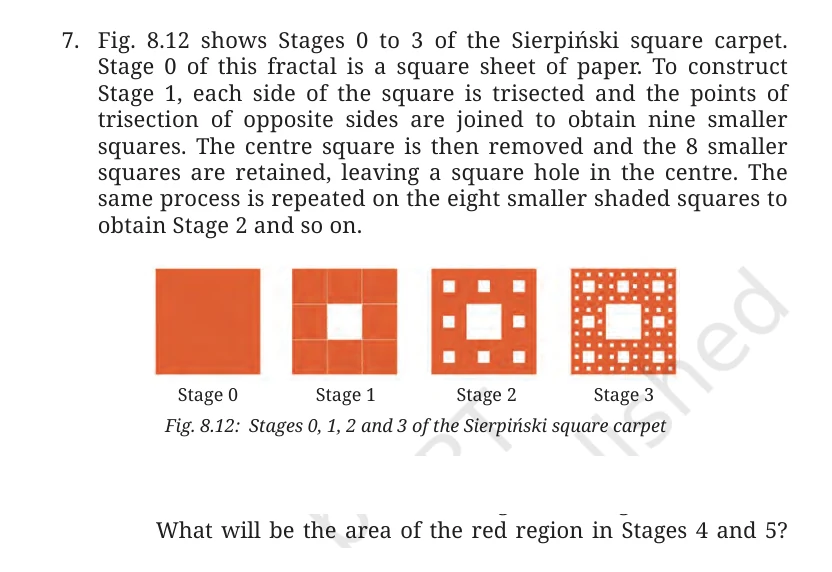
Exercise 8.3, 7(iv), area question 2: Find the red area in Stages 4 and 5.
Show detailed solution
- Step 1: Use A_n=(8/9)^n.
- Step 2: A_4=(8/9)^4=4096/6561.
- Step 3: A_5=(8/9)^5=32768/59049.
- Answer: 4096/6561 and 32768/59049 square units.
Textbook page 194 · solved item 83
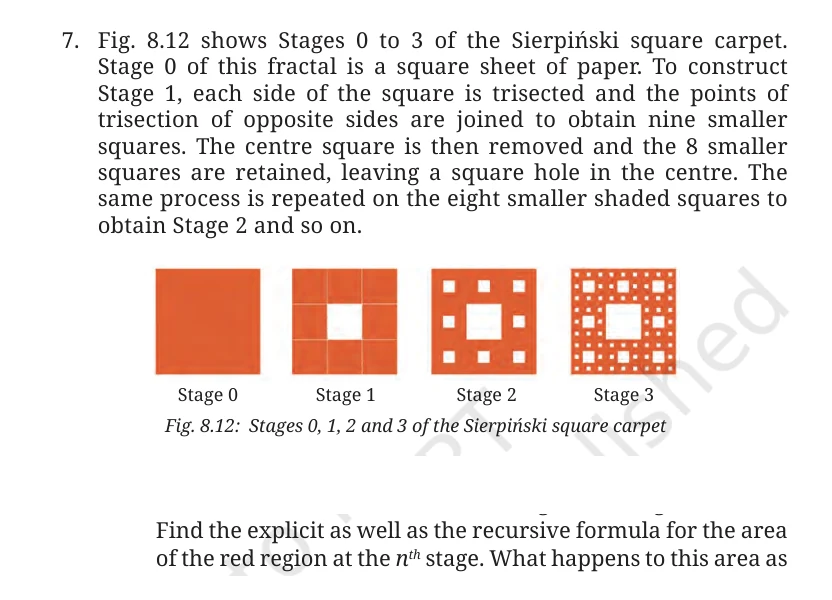
Exercise 8.3, 7(iv), area question 3: Give explicit and recursive rules for the red area at Stage n.
Show detailed solution
- Step 1: The initial red area is 1 square unit.
- Step 2: Each stage retains 8/9 of the preceding red area.
- Step 3: Explicitly, A_n=(8/9)^n. Recursively, A_0=1,\ A_n=(8/9)A_{n-1}.
- Answer: A_n=(8/9)^n; recursively, A_0=1,\ A_n=(8/9)A_{n-1}.
Textbook page 194 · solved item 84
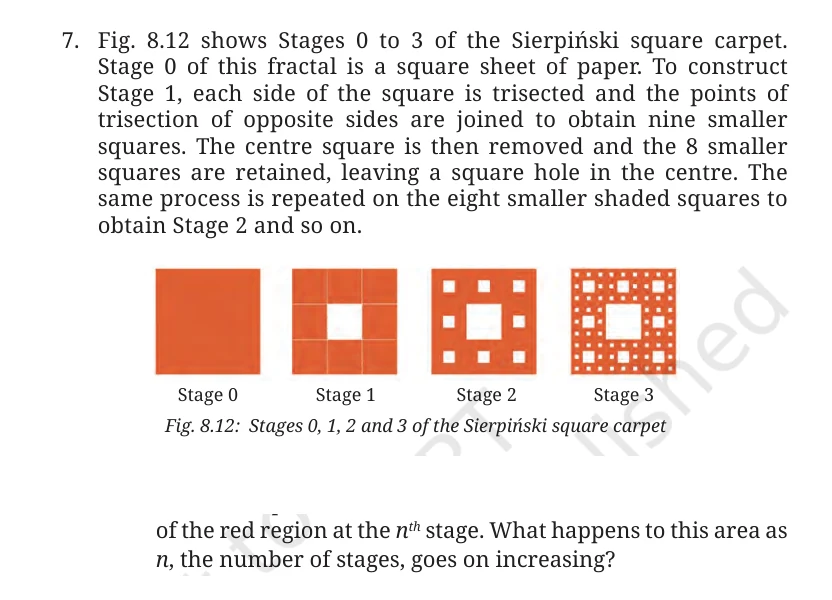
Exercise 8.3, 7(iv), area question 4: What happens to the red area as n increases?
Show detailed solution
- Step 1: The area follows A_n=(8/9)^n.
- Step 2: The ratio 8/9 is positive and less than 1, so every stage has less red area than the preceding stage.
- Step 3: \lim_{n\to\infty}(8/9)^n=0.
- Answer: The red area approaches 0 while remaining positive at every finite stage.
Textbook page 194 · solved item 85
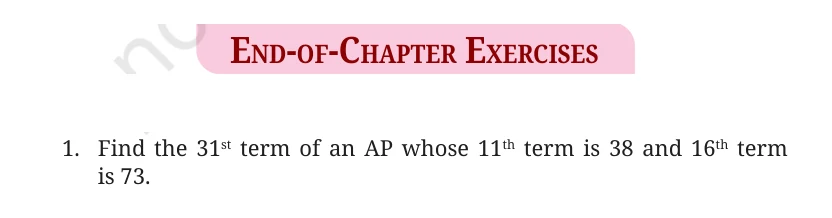
End-of-Chapter Exercise 1: Find the 31st term of an AP with t11 = 38 and t16 = 73.
Show detailed solution
- Step 1: a+10d=38 and a+15d=73.
- Step 2: Subtract: 5d=35, so d=7. Then a=38-70=-32.
- Step 3: t_{31}=a+30d=-32+210=178.
- Answer: The 31st term is 178.
Textbook page 194 · solved item 86
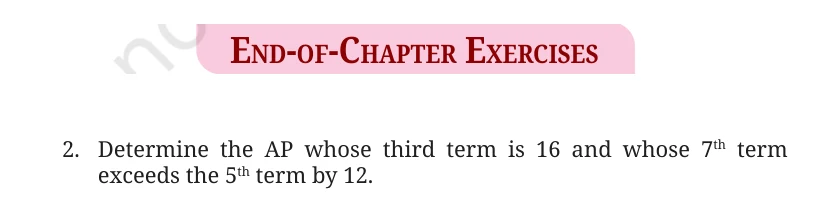
End-of-Chapter Exercise 2: Determine the AP whose t3 = 16 and whose t7 exceeds t5 by 12.
Show detailed solution
- Step 1: t_7-t_5=(a+6d)-(a+4d)=2d=12, so d=6.
- Step 2: Since t_3=a+2d=16, a+12=16, giving a=4.
- Step 3: The nth term is t_n=4+6(n-1)=6n-2.
- Answer: The AP is 4, 10, 16, 22, ... .
Detailed worked answers
Textbook page 195
Textbook page 195 · solved item 87
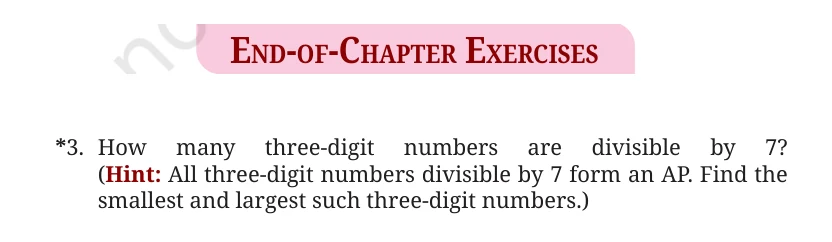
End-of-Chapter Exercise 3: How many three-digit numbers are divisible by 7?
Show detailed solution
- Step 1: The first three-digit multiple is 105 = 7 x 15, and the last is 994 = 7 x 142.
- Step 2: These form an AP with a=105,d=7,l=994.
- Step 3: n=(994-105)/7+1=889/7+1=127+1=128.
- Answer: 128 three-digit numbers are divisible by 7.
Textbook page 195 · solved item 88
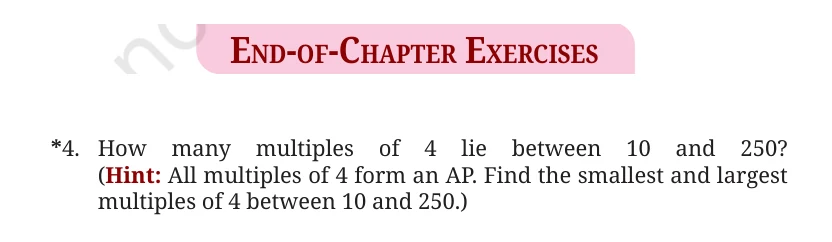
End-of-Chapter Exercise 4: How many multiples of 4 lie between 10 and 250?
Show detailed solution
- Step 1: The smallest such multiple is 12 and the largest is 248.
- Step 2: They form an AP with common difference 4.
- Step 3: n=(248-12)/4+1=236/4+1=59+1=60.
- Answer: 60 multiples of 4.
Textbook page 195 · solved item 89
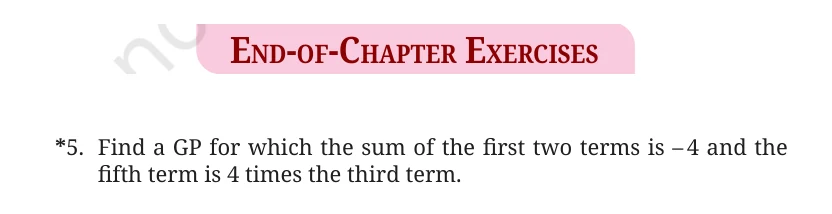
End-of-Chapter Exercise 5: Find a GP whose first two terms sum to -4 and whose fifth term is four times its third.
Show detailed solution
- Step 1: Let the GP begin a,ar,ar^2,\ldots. From ar^4=4ar^2 and nonzero terms, r^2=4, so r=2 or r=-2.
- Step 2: If r=2, then a+ar=3a=-4, so a=-4/3. This gives -4/3,-8/3,-16/3,\ldots.
- Step 3: If r=-2, then a+ar=-a=-4, so a=4. This gives 4,-8,16,-32,64,\ldots.
- Answer: There are two GPs, with (a,r)=-4/3,2 or 4,-2.
Textbook page 195 · solved item 90
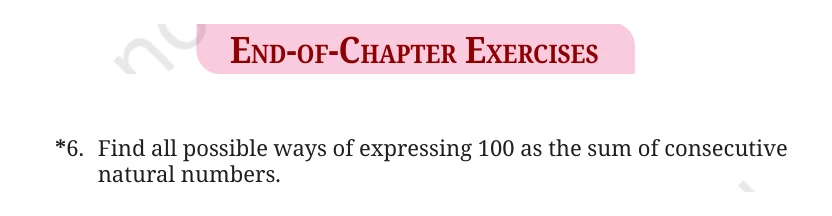
End-of-Chapter Exercise 6: Express 100 in all possible ways as a sum of consecutive natural numbers.
Show detailed solution
- Step 1: For k terms starting at m, 100=k(2m+k-1)/2, so m=(200/k-k+1)/2 must be a positive integer.
- Step 2: Testing positive divisors k of 200 gives k = 1, 5 and 8.
- Step 3: These give m=100,18,9, respectively.
- Answer: (100), 18+19+20+21+22, and 9+10+11+12+13+14+15+16. If at least two addends are required, omit the one-term form.
Textbook page 195 · solved item 91
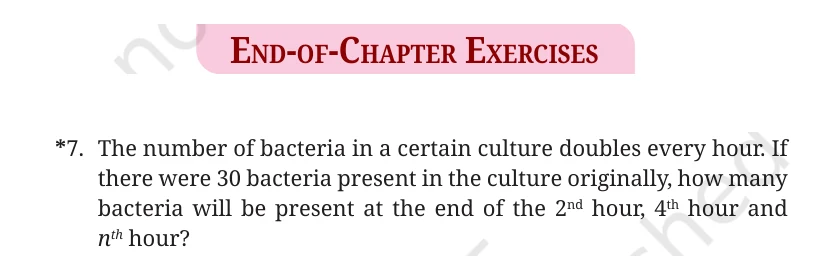
End-of-Chapter Exercise 7: A culture starts with 30 bacteria and doubles hourly. Find the counts after 2 hours, 4 hours and n hours.
Show detailed solution
- Step 1: After h hours, the original count has been doubled h times, so N_h=30\times2^h.
- Step 2: N_2=30\times4=120 and N_4=30\times16=480.
- Step 3: Keep h = n for the general rule.
- Answer: 120, 480 and 30\times2^n bacteria.
Textbook page 195 · solved item 92
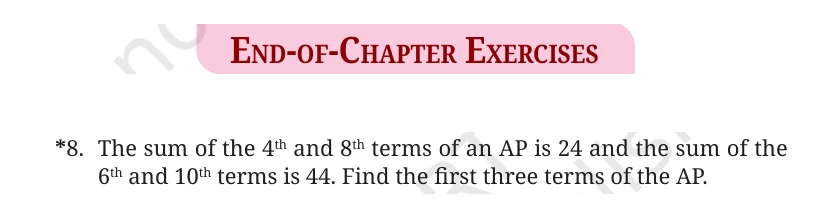
End-of-Chapter Exercise 8: Given t4 + t8 = 24 and t6 + t10 = 44, find the first three AP terms.
Show detailed solution
- Step 1: t_4+t_8=(a+3d)+(a+7d)=2a+10d=24, so a+5d=12.
- Step 2: t_6+t_{10}=2a+14d=44, so a+7d=22. Subtracting gives 2d=10, hence d=5.
- Step 3: Then a+25=12, so a=-13.
- Answer: The first three terms are -13, -8 and -3.
Textbook page 195 · solved item 93
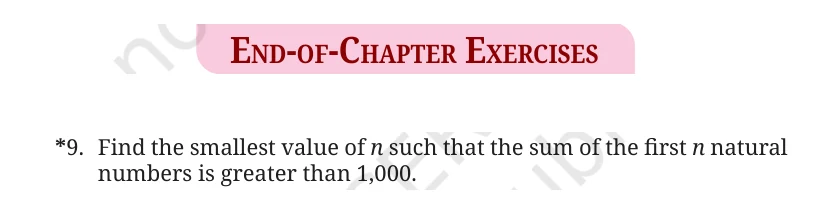
End-of-Chapter Exercise 9: Find the least n for which 1 + 2 + ... + n is greater than 1000.
Show detailed solution
- Step 1: Require n(n+1)/2>1000.
- Step 2: S_{44}=44(45)/2=990, which is not greater than 1000.
- Step 3: S_{45}=45(46)/2=1035, which is greater than 1000.
- Answer: The smallest value is n = 45.
Textbook page 195 · solved item 94
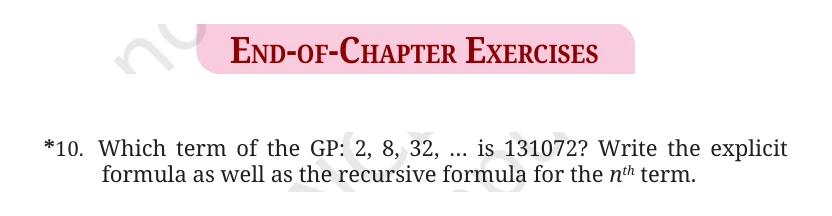
End-of-Chapter Exercise 10: Which term of 2, 8, 32, ... is 131072? Give explicit and recursive rules.
Show detailed solution
- Step 1: The GP has a=2,r=4, so t_n=2\times4^{n-1}.
- Step 2: Write t_n=2^{2n-1} and 131072=2^{17}. Thus 2n-1=17, so n=9.
- Step 3: Recursively, t_1=2,\ t_n=4t_{n-1} for n\ge2.
- Answer: 131072 is the 9th term; the explicit and recursive rules are given above.
Textbook page 195 · solved item 95
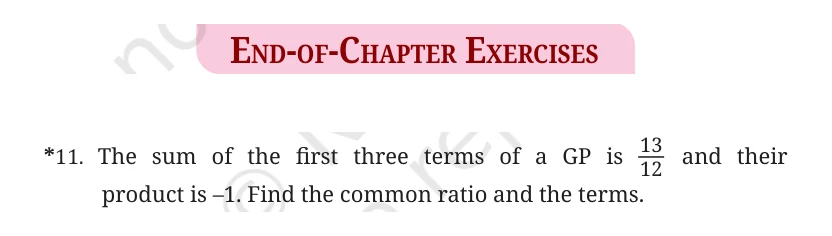
End-of-Chapter Exercise 11: Three GP terms have sum 13/12 and product -1. Find the terms and common ratio.
Show detailed solution
- Step 1: Write the terms as x/r,x,xr. Their product is x^3=-1, so x=-1.
- Step 2: The sum equation is -1/r-1-r=13/12. Multiplying by 12r gives 12r^2+25r+12=0.
- Step 3: Factor: (3r+4)(4r+3)=0, so r=-4/3 or r=-3/4.
- Answer: The terms are 3/4,-1,4/3 with ratio -4/3, or the reverse order 4/3,-1,3/4 with ratio -3/4.
Textbook page 195 · solved item 96
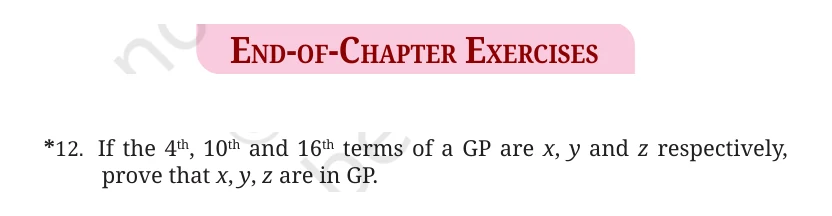
End-of-Chapter Exercise 12: If the 4th, 10th and 16th GP terms are x, y and z, prove that x, y, z are in GP.
Show detailed solution
- Step 1: For a GP with first term a and ratio r, x=ar^3, y=ar^9, and z=ar^{15}.
- Step 2: y^2=(ar^9)^2=a^2r^{18}.
- Step 3: Also xz=(ar^3)(ar^{15})=a^2r^{18}, so y^2=xz.
- Answer: The square of the middle term equals the product of its neighbours, hence x, y, z are in GP.
Textbook page 195 · solved item 97
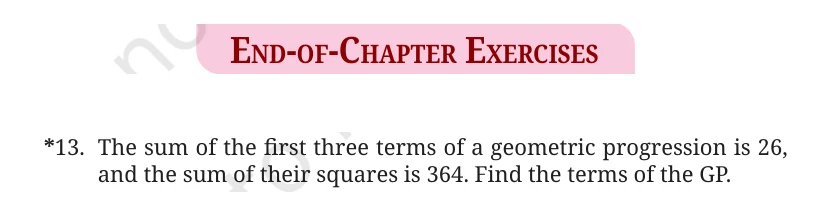
End-of-Chapter Exercise 13: Three GP terms have sum 26 and sum of squares 364. Find the terms.
Show detailed solution
- Step 1: Let the terms be x, y, z. From (x+y+z)^2=364+2(xy+yz+zx), obtain xy+yz+zx=156.
- Step 2: Since they are in GP, xz=y^2. Then xy+yz+xz=y(x+z)+y^2=y(x+y+z)=26y.
- Step 3: Thus 26y=156, so y=6. Now x+z=20 and xz=36, giving (x,z)=(2,18) or (18,2).
- Answer: The terms are 2, 6, 18, or the reverse order 18, 6, 2.
Textbook page 195 · solved item 98
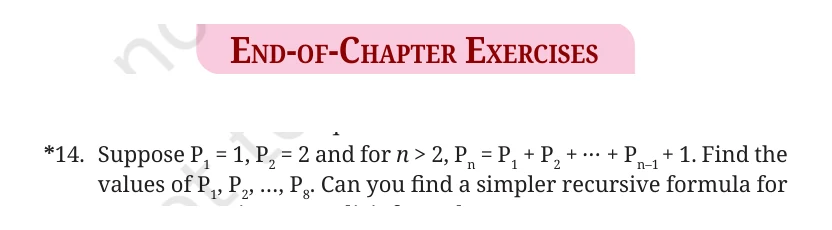
End-of-Chapter Exercise 14(a): Find P1 through P8 for the given recurrence.
Show detailed solution
- Step 1: P_1=1 and P_2=2.
- Step 2: P_3=P_1+P_2+1=4, and P_4=1+2+4+1=8.
- Step 3: Continuing the same rule doubles each preceding value.
- Answer: 1, 2, 4, 8, 16, 32, 64, 128.
Textbook page 195 · solved item 99
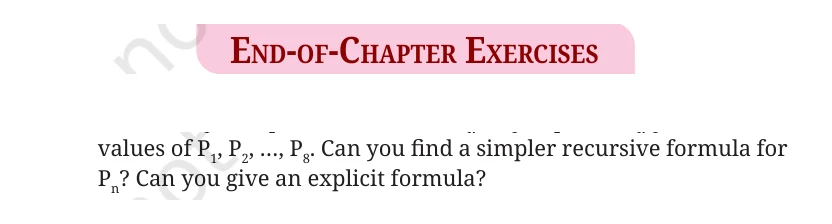
End-of-Chapter Exercise 14(b): Find a simpler recursive formula for P_n.
Show detailed solution
- Step 1: For (n>2), P_n=P_1+\cdots+P_{n-1}+1.
- Step 2: The preceding rule gives P_{n-1}=P_1+\cdots+P_{n-2}+1.
- Step 3: Subtracting shows P_n-P_{n-1}=P_{n-1}, hence P_n=2P_{n-1}.
- Answer: P_1=1,\ P_n=2P_{n-1} for n\ge2.
Textbook page 195 · solved item 100
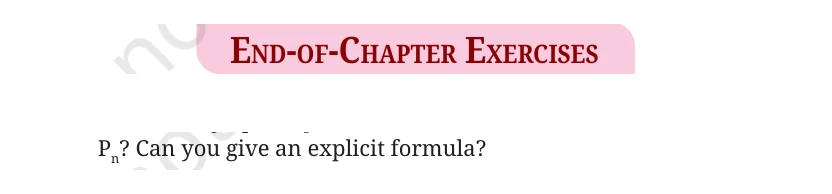
End-of-Chapter Exercise 14(c): Give an explicit formula for P_n.
Show detailed solution
- Step 1: The simpler recurrence has first term 1 and common ratio 2.
- Step 2: A GP has explicit form P_n=P_1r^{n-1}.
- Step 3: Substitute P_1=1,r=2.
- Answer: P_n=2^{n-1}.
Textbook page 195 · solved item 101
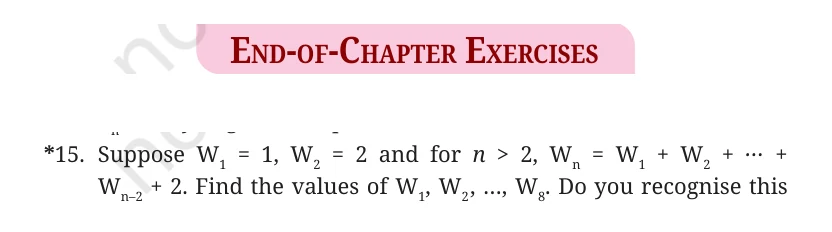
End-of-Chapter Exercise 15(a): Find W1 through W8 for the given recurrence.
Show detailed solution
- Step 1: W_1=1, W_2=2, and W_3=W_1+2=3.
- Step 2: W_4=W_1+W_2+2=5, then W_5=8 and W_6=13.
- Step 3: Continuing gives W_7=21 and W_8=34.
- Answer: 1, 2, 3, 5, 8, 13, 21, 34.
Textbook page 195 · solved item 102
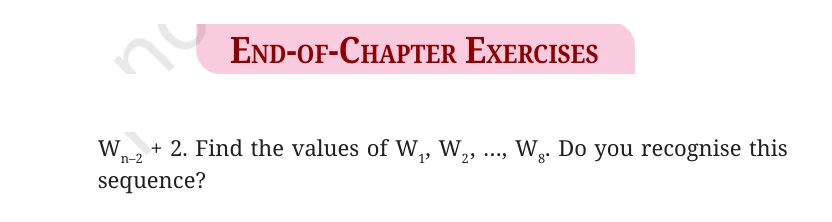
End-of-Chapter Exercise 15(b): Recognise the W_n sequence and give its simpler recurrence.
Show detailed solution
- Step 1: Compare consecutive rules: W_n=W_1+\cdots+W_{n-2}+2 and W_{n-1}=W_1+\cdots+W_{n-3}+2.
- Step 2: Subtract to obtain W_n-W_{n-1}=W_{n-2}.
- Step 3: Hence W_n=W_{n-1}+W_{n-2} with W_1=1,W_2=2.
- Answer: It is the Virahanka-Fibonacci sequence 1, 2, 3, 5, 8, 13, 21, 34, ... .