

Question-by-question working
Read the prompt, attempt it, then check each step
Every exercise subpart and table row is a separate item. Shared figures are repeated in the crop whenever they are needed to understand that question.
Detailed worked answers
Textbook page 43
Textbook page 43 · solved item 1
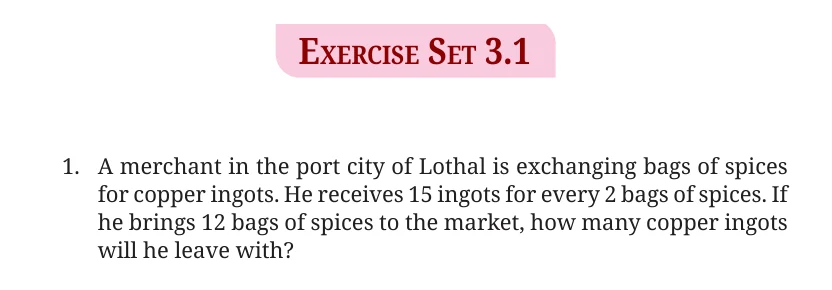
Exercise Set 3.1, 1: A Lothal merchant receives 15 copper ingots for every 2 spice bags. How many ingots does he receive for 12 bags?
Show detailed solution
- Step 1: The exchange rate is 15 ingots for 2 bags.
- Step 2: 12\div2=6, so 12 bags contain six groups of 2 bags.
- Step 3: Multiply the ingots per group by the number of groups: 15\times6=90.
- Answer: The merchant receives 90 copper ingots.
Textbook page 43 · solved item 2
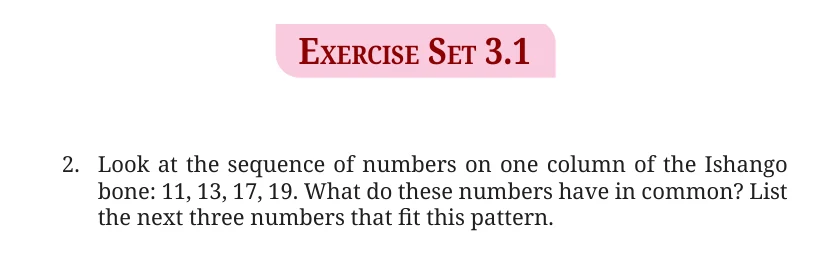
Exercise Set 3.1, 2: What is common to 11, 13, 17, 19, and what are the next three numbers in the pattern?
Show detailed solution
- Step 1: Each listed number is greater than 1 and has exactly two positive factors: 1 and itself.
- Step 2: Therefore the list consists of consecutive prime numbers beginning at 11.
- Step 3: Test the following integers: 20, 21, and 22 are composite; 23 is prime; 29 and 31 are the next primes after 23.
- Answer: They are prime numbers. The next three are 23,29,31.
Textbook page 43 · solved item 3
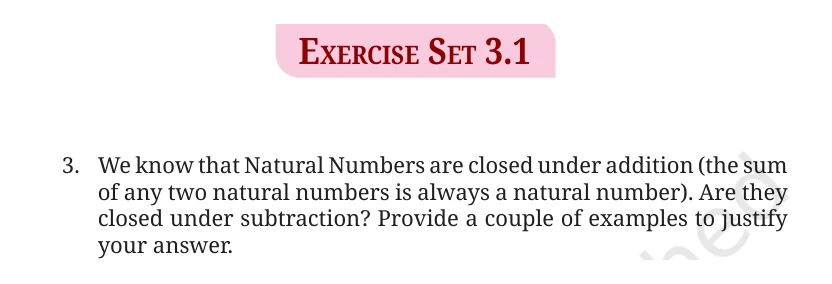
Exercise Set 3.1, 3: Are natural numbers closed under subtraction?
Show detailed solution
- Step 1: Closure would require the difference of every pair of natural numbers to remain natural.
- Step 2: Some subtractions do remain natural, for example 8-3=5.
- Step 3: But 3-8=-5, and -5 is not a natural number.
- Answer: No. One counterexample is enough to show that natural numbers are not closed under subtraction.
Textbook page 43 · solved item 4
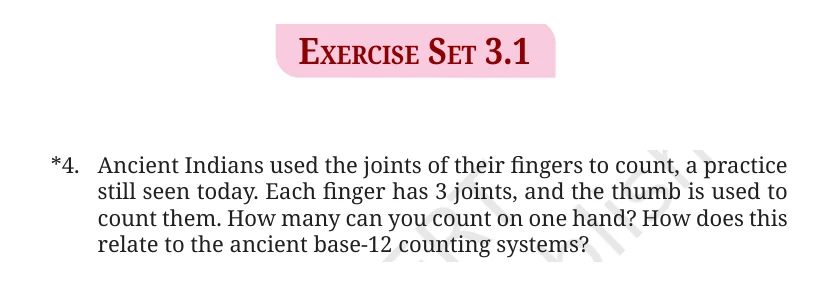
Exercise Set 3.1, 4: How high can one count using the finger joints of one hand, and how does this connect to base 12?
Show detailed solution
- Step 1: Use the thumb as the pointer and count the three joints on each of the other four fingers.
- Step 2: The total is 4\times3=12 joint positions.
- Step 3: Each complete pass therefore records one group of 12 rather than one group of 10.
- Answer: One hand can count to 12, which gives a natural physical model for a base-12 counting system.
Detailed worked answers
Textbook page 46
Textbook page 46 · solved item 5
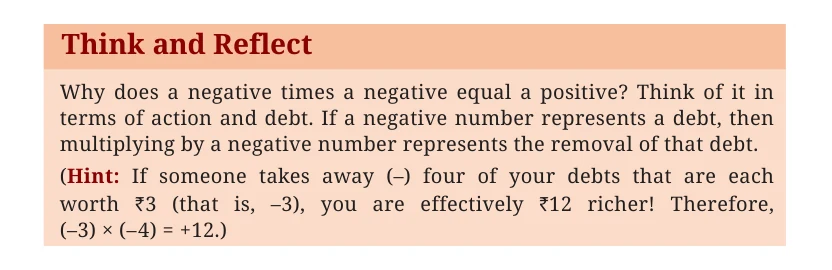
Think and Reflect: Why does a negative number multiplied by a negative number give a positive number?
Show detailed solution
- Step 1: Represent a debt of Rs 3 by -3. Four such debts total 4(-3)=-12.
- Step 2: The second negative sign means removing those four debts: -4 groups of -3.
- Step 3: Removing Rs 12 of debt raises the financial position by Rs 12.
- Answer: (-3)(-4)=+12. More generally, reversing a negative change produces a positive change.
Textbook page 46 · solved item 6
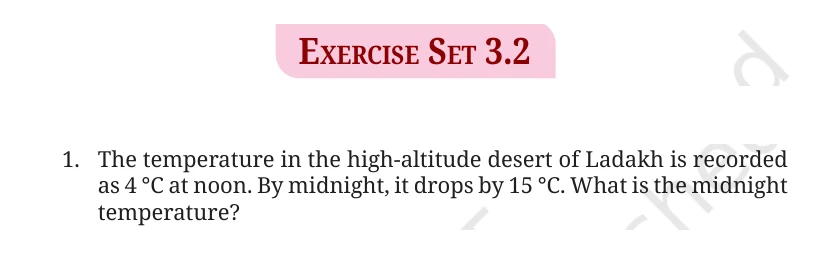
Exercise Set 3.2, 1: The temperature is 4 degrees Celsius and falls by 15 degrees Celsius. What is the midnight temperature?
Show detailed solution
- Step 1: A fall of 15 degrees is represented by adding -15 to the starting temperature.
- Step 2: Calculate 4+(-15)=4-15.
- Step 3: 4-15=-11.
- Answer: The midnight temperature is -11\ ^\circ\mathrm{C}.
Textbook page 46 · solved item 7
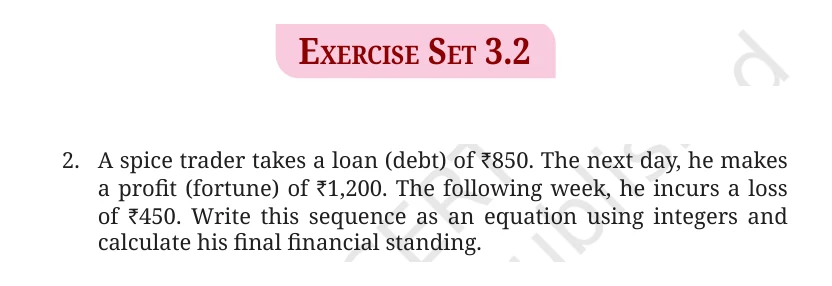
Exercise Set 3.2, 2: Write the trader's loan, profit, and loss as an integer equation and find his final standing.
Show detailed solution
- Step 1: Record the loan as -850, the profit as +1200, and the later loss as -450.
- Step 2: Write the net position as -850+1200-450.
- Step 3: -850+1200=350, and 350-450=-100.
- Answer: -850+1200-450=-100, so the trader ends with a debt of Rs 100.
Textbook page 46 · solved item 8
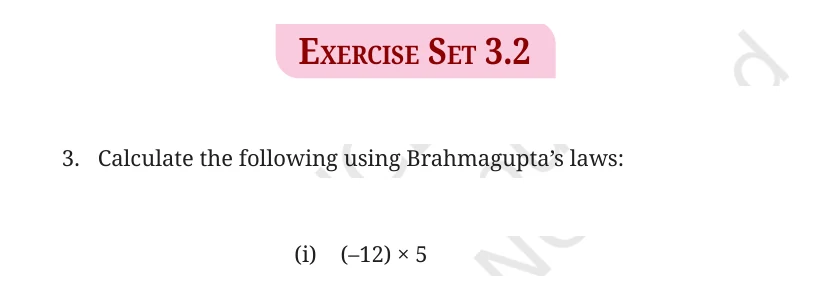
Exercise Set 3.2, 3(i): Calculate (-12)\times5.
Show detailed solution
- Step 1: The factors have unlike signs, so the product is negative.
- Step 2: Multiply the magnitudes: 12\times5=60.
- Answer: (-12)\times5=-60.
Textbook page 46 · solved item 9
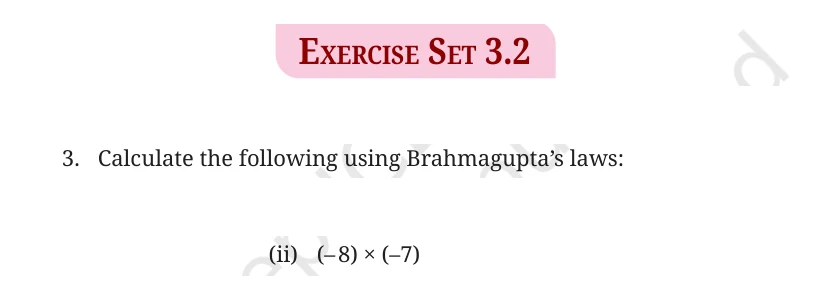
Exercise Set 3.2, 3(ii): Calculate (-8)\times(-7).
Show detailed solution
- Step 1: Both factors are negative, so their product is positive.
- Step 2: Multiply the magnitudes: 8\times7=56.
- Answer: (-8)\times(-7)=56.
Textbook page 46 · solved item 10
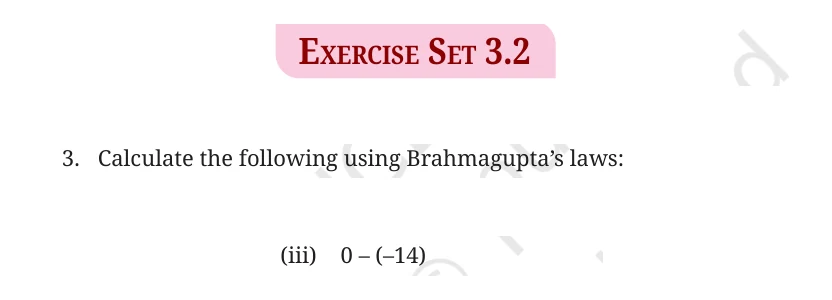
Exercise Set 3.2, 3(iii): Calculate 0-(-14).
Show detailed solution
- Step 1: Subtracting a negative is the same as adding its positive opposite.
- Step 2: Rewrite 0-(-14) as 0+14.
- Answer: 0-(-14)=14.
Textbook page 46 · solved item 11
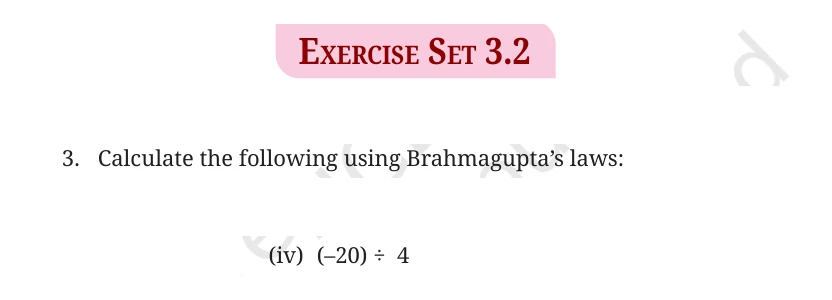
Exercise Set 3.2, 3(iv): Calculate (-20)\div4.
Show detailed solution
- Step 1: The dividend and divisor have unlike signs, so the quotient is negative.
- Step 2: Divide the magnitudes: 20\div4=5.
- Answer: (-20)\div4=-5.
Textbook page 46 · solved item 12
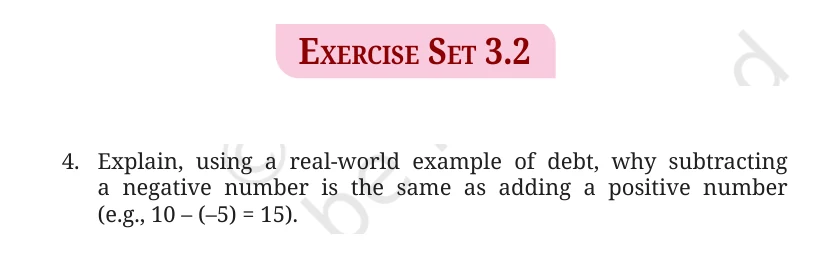
Exercise Set 3.2, 4: Use debt to explain why subtracting a negative equals adding a positive.
Show detailed solution
- Step 1: Suppose a person has Rs 10 and also carries a debt of Rs 5, represented by -5.
- Step 2: Subtracting -5 means removing that Rs 5 debt.
- Step 3: Removing the debt improves the person's position by Rs 5: 10-(-5)=10+5.
- Answer: The new position is Rs 15; removing a negative amount has the same effect as adding its positive opposite.
Detailed worked answers
Textbook page 47
Textbook page 47 · solved item 13
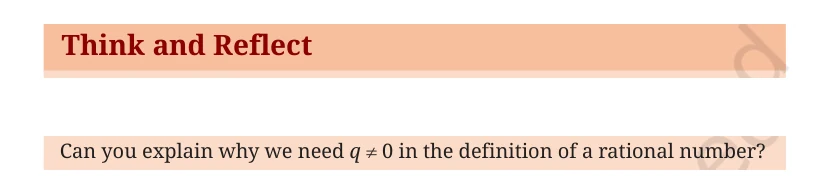
Think and Reflect: Why must the denominator q be non-zero in the definition p/q?
Show detailed solution
- Step 1: Division p/q asks for a number x satisfying qx=p.
- Step 2: If q=0 and p\ne0, then 0x=p is impossible because 0x=0 for every x.
- Step 3: If both are zero, every x would satisfy 0x=0, so no unique quotient is determined.
- Answer: Division by zero is undefined, so a rational number must have q\ne0.
Detailed worked answers
Textbook page 49
Textbook page 49 · solved item 14
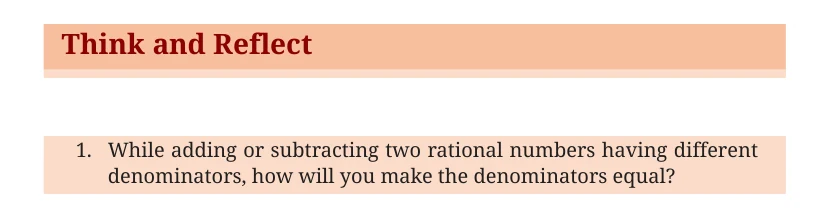
Think and Reflect 1: How can different denominators be made equal before adding or subtracting rational numbers?
Show detailed solution
- Step 1: Find a common multiple of the denominators, preferably their least common multiple.
- Step 2: Multiply each numerator and denominator by the factor needed to reach that common denominator.
- Step 3: Add or subtract the new numerators while keeping the common denominator.
- Example: \frac12+\frac13=\frac36+\frac26=\frac56.
Textbook page 49 · solved item 15
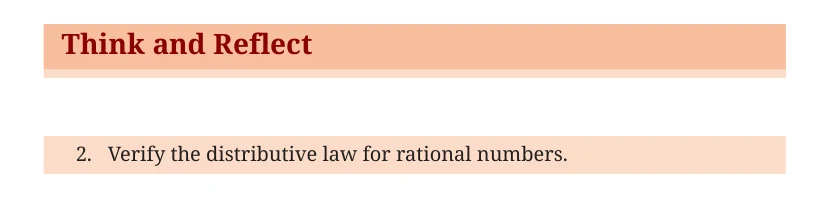
Think and Reflect 2: Verify the distributive law for rational numbers.
Show detailed solution
- Step 1: Choose p=\frac23, q=\frac34, and r=-\frac12.
- Step 2: Left side: p(q+r)=\frac23(\frac34-\frac12)=\frac23\cdot\frac14=\frac16.
- Step 3: Right side: pq+pr=\frac12-\frac13=\frac16.
- Conclusion: Both sides are equal, verifying p(q+r)=pq+pr for this rational example.
Textbook page 49 · solved item 16
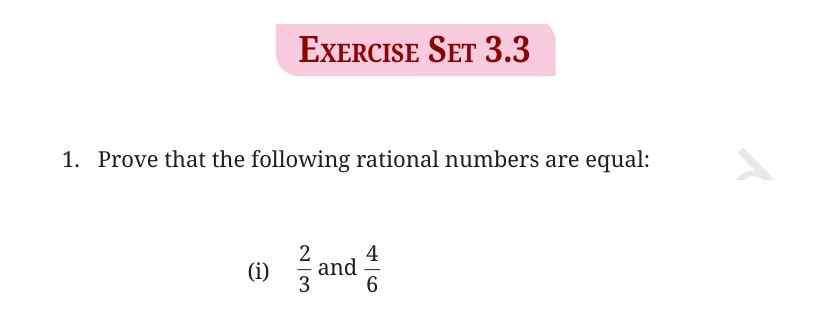
Exercise Set 3.3, 1(i): Prove that 2/3 and 4/6 are equal.
Show detailed solution
- Step 1: For a/b and c/d, test whether ad=bc.
- Step 2: 2\times6=12 and 3\times4=12.
- Answer: The cross-products agree, so \frac23=\frac46.
Textbook page 49 · solved item 17
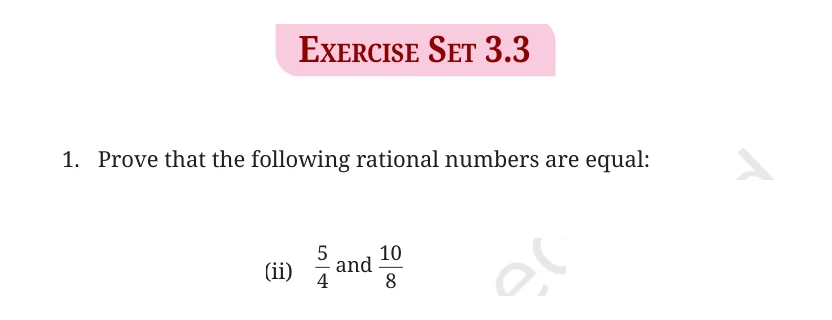
Exercise Set 3.3, 1(ii): Prove that 5/4 and 10/8 are equal.
Show detailed solution
- Step 1: Cross-multiply the two fractions.
- Step 2: 5\times8=40 and 4\times10=40.
- Answer: Since the cross-products are equal, \frac54=\frac{10}{8}.
Textbook page 49 · solved item 18
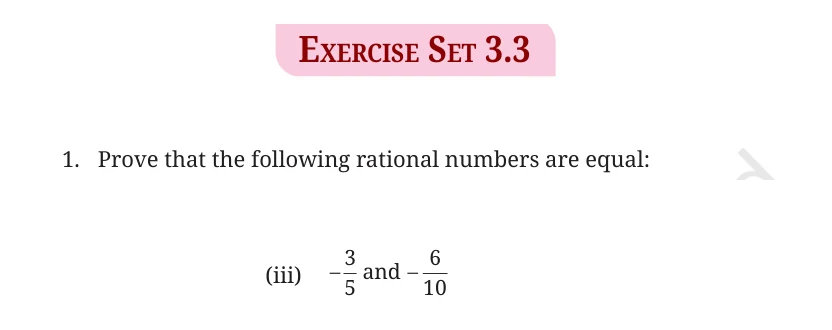
Exercise Set 3.3, 1(iii): Prove that -3/5 and -6/10 are equal.
Show detailed solution
- Step 1: Cross-multiply while retaining both negative signs.
- Step 2: (-3)\times10=-30 and 5\times(-6)=-30.
- Answer: The cross-products match, so -\frac35=-\frac6{10}.
Textbook page 49 · solved item 19
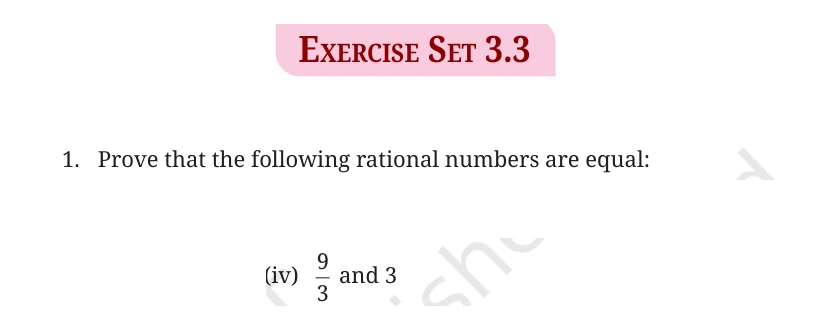
Exercise Set 3.3, 1(iv): Prove that 9/3 and 3 are equal.
Show detailed solution
- Step 1: Write the integer as 3=3/1.
- Step 2: Cross-products are 9\times1=9 and 3\times3=9.
- Answer: \frac93=3.
Textbook page 49 · solved item 20
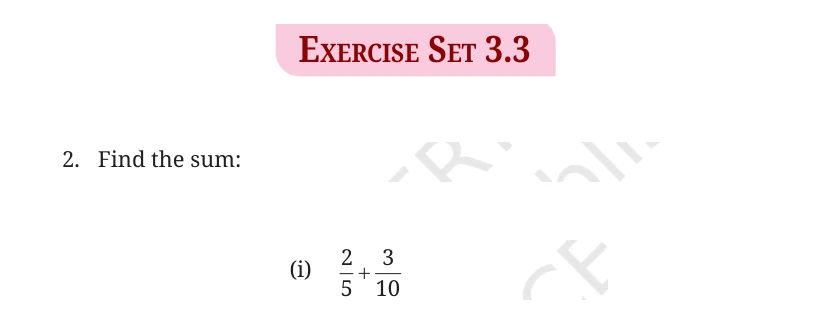
Exercise Set 3.3, 2(i): Find 2/5+3/10.
Show detailed solution
- Step 1: Use denominator 10: \frac25=\frac4{10}.
- Step 2: Add: \frac4{10}+\frac3{10}=\frac7{10}.
- Answer: \frac7{10}.
Textbook page 49 · solved item 21
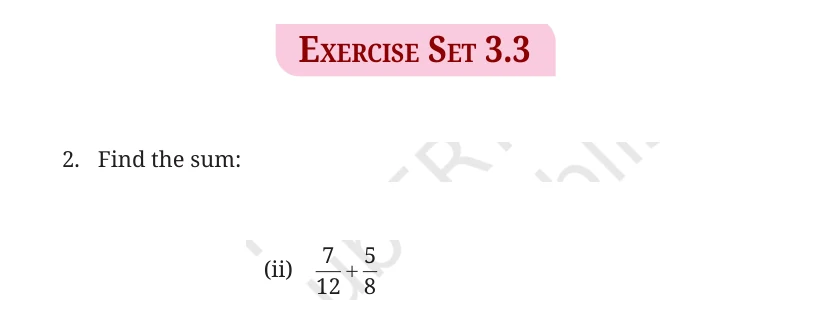
Exercise Set 3.3, 2(ii): Find 7/12+5/8.
Show detailed solution
- Step 1: The least common denominator of 12 and 8 is 24.
- Step 2: \frac7{12}=\frac{14}{24} and \frac58=\frac{15}{24}.
- Step 3: \frac{14}{24}+\frac{15}{24}=\frac{29}{24}.
- Answer: \frac{29}{24}=1\frac5{24}.
Textbook page 49 · solved item 22
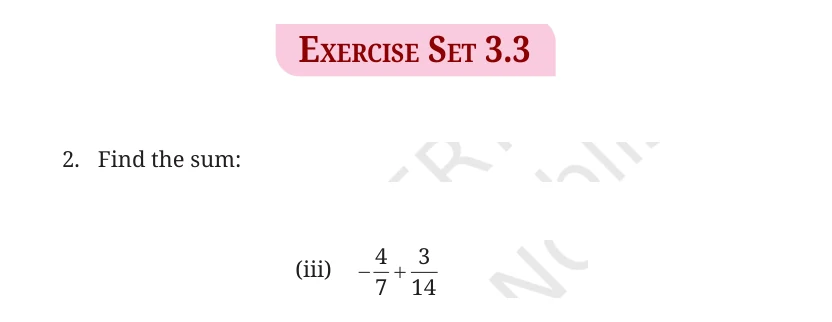
Exercise Set 3.3, 2(iii): Find -4/7+3/14.
Show detailed solution
- Step 1: Use denominator 14: -\frac47=-\frac8{14}.
- Step 2: Add: -\frac8{14}+\frac3{14}=-\frac5{14}.
- Answer: -\frac5{14}.
Textbook page 49 · solved item 23
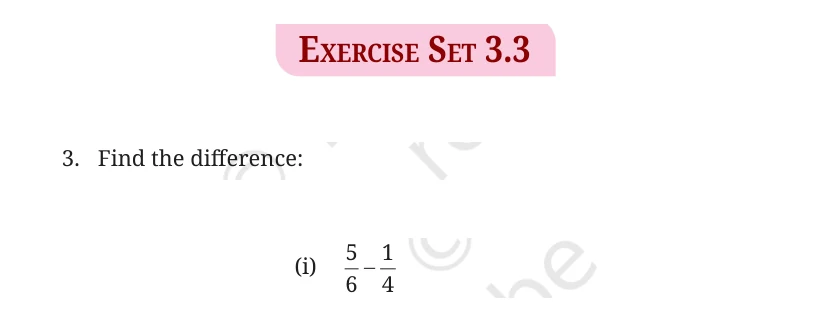
Exercise Set 3.3, 3(i): Find 5/6-1/4.
Show detailed solution
- Step 1: The least common denominator is 12.
- Step 2: \frac56=\frac{10}{12} and \frac14=\frac3{12}.
- Step 3: \frac{10}{12}-\frac3{12}=\frac7{12}.
- Answer: \frac7{12}.
Textbook page 49 · solved item 24
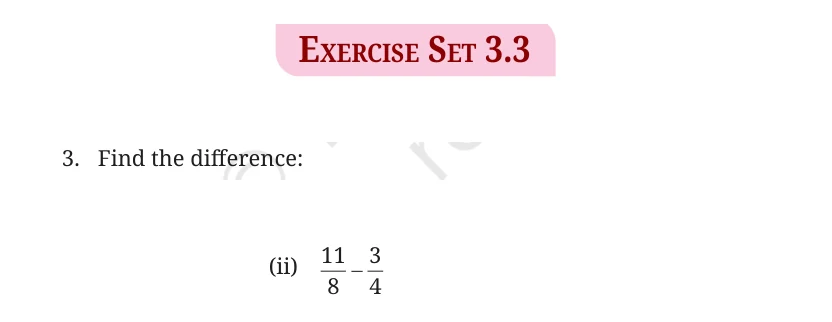
Exercise Set 3.3, 3(ii): Find 11/8-3/4.
Show detailed solution
- Step 1: Convert \frac34 to eighths: \frac34=\frac68.
- Step 2: Subtract: \frac{11}{8}-\frac68=\frac58.
- Answer: \frac58.
Textbook page 49 · solved item 25
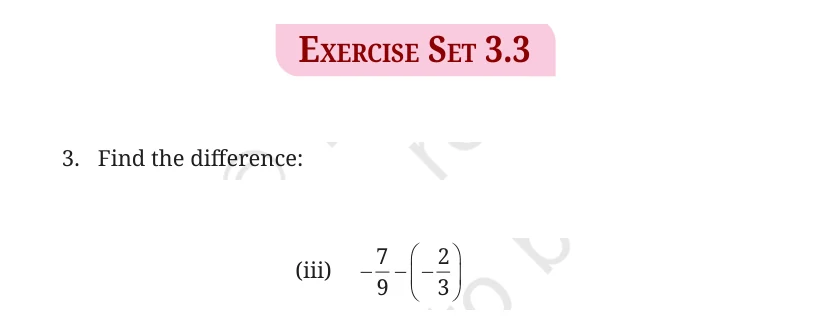
Exercise Set 3.3, 3(iii): Find -7/9-(-2/3).
Show detailed solution
- Step 1: Subtracting a negative gives -\frac79+\frac23.
- Step 2: Convert \frac23 to ninths: \frac23=\frac69.
- Step 3: -\frac79+\frac69=-\frac19.
- Answer: -\frac19.
Textbook page 49 · solved item 26
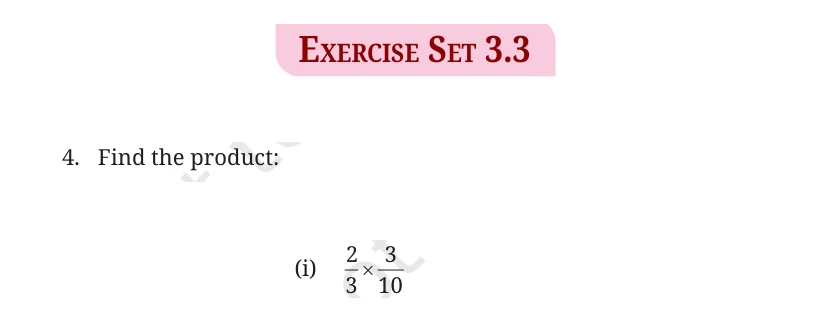
Exercise Set 3.3, 4(i): Find (2/3)\times(3/10).
Show detailed solution
- Step 1: Multiply numerators and denominators: \frac{2\times3}{3\times10}.
- Step 2: Cancel the common factor 3 and then simplify 2/10.
- Answer: \frac15.
Textbook page 49 · solved item 27
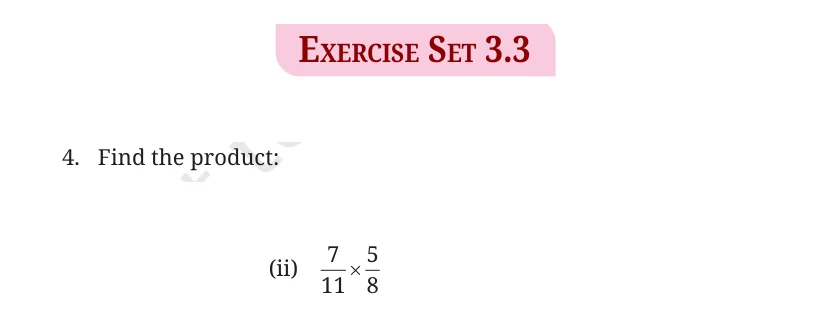
Exercise Set 3.3, 4(ii): Find (7/11)\times(5/8).
Show detailed solution
- Step 1: Multiply the numerators: 7\times5=35.
- Step 2: Multiply the denominators: 11\times8=88.
- Step 3: 35 and 88 have no common factor greater than 1.
- Answer: \frac{35}{88}.
Textbook page 49 · solved item 28
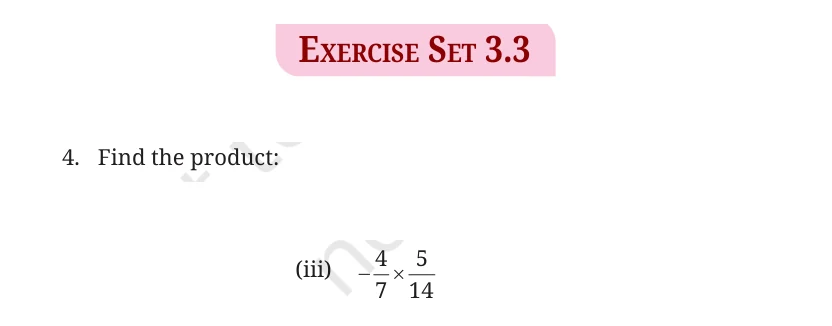
Exercise Set 3.3, 4(iii): Find (-4/7)\times(5/14).
Show detailed solution
- Step 1: Multiply: -\frac{4\times5}{7\times14}=-\frac{20}{98}.
- Step 2: Divide numerator and denominator by 2.
- Answer: -\frac{10}{49}.
Textbook page 49 · solved item 29
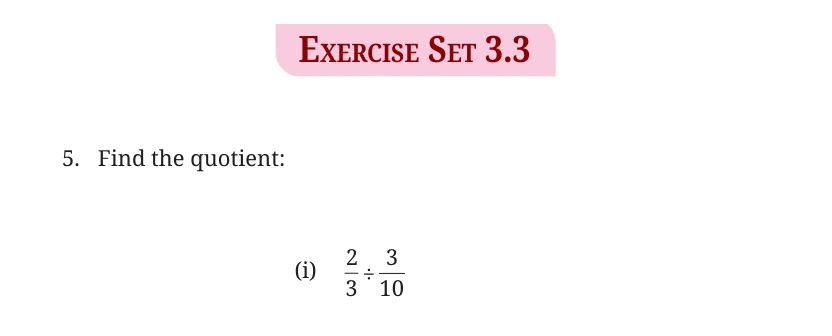
Exercise Set 3.3, 5(i): Find (2/3)\div(3/10).
Show detailed solution
- Step 1: Replace division by multiplication by the reciprocal.
- Step 2: \frac23\div\frac3{10}=\frac23\times\frac{10}{3}=\frac{20}{9}.
- Answer: \frac{20}{9}=2\frac29.
Textbook page 49 · solved item 30
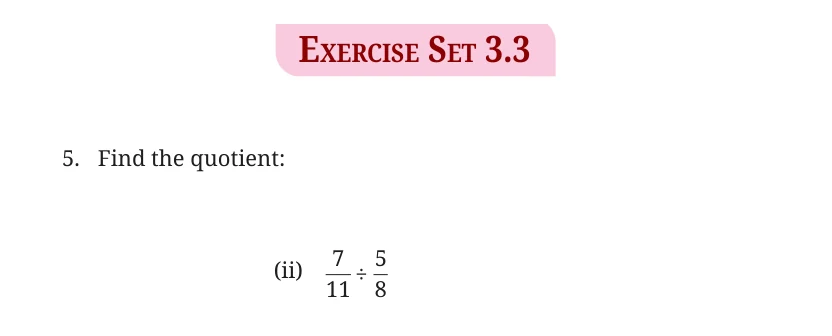
Exercise Set 3.3, 5(ii): Find (7/11)\div(5/8).
Show detailed solution
- Step 1: Use the reciprocal 8/5 of the divisor.
- Step 2: \frac7{11}\times\frac85=\frac{56}{55}.
- Answer: \frac{56}{55}=1\frac1{55}.
Detailed worked answers
Textbook page 50
Textbook page 50 · solved item 31
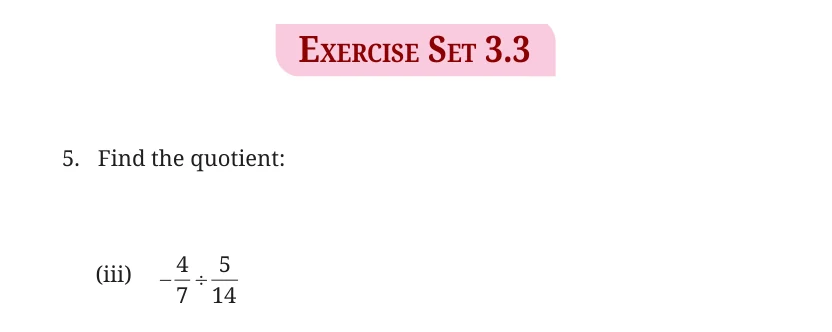
Exercise Set 3.3, 5(iii): Find (-4/7)\div(5/14).
Show detailed solution
- Step 1: Multiply by the reciprocal: -\frac47\times\frac{14}{5}.
- Step 2: Cancel 14/7=2, giving -\frac{4\times2}{5}.
- Answer: -\frac85.
Textbook page 50 · solved item 32

Exercise Set 3.3, 6: Verify (1/2+3/4)\times8/3=(1/2)\times8/3+(3/4)\times8/3.
Show detailed solution
- Step 1: Left side: (\frac12+\frac34)\frac83=\frac54\cdot\frac83=\frac{10}{3}.
- Step 2: Right side: \frac12\cdot\frac83+\frac34\cdot\frac83=\frac43+2.
- Step 3: \frac43+2=\frac{10}{3}.
- Conclusion: Both sides equal 10/3, so the distributive identity is verified.
Textbook page 50 · solved item 33

Exercise Set 3.3, 7: Simplify (7/9)(6/7-3/4) using distributivity.
Show detailed solution
- Step 1: Distribute 7/9: \frac79\cdot\frac67-\frac79\cdot\frac34.
- Step 2: Simplify each product: \frac23-\frac7{12}.
- Step 3: Use denominator 12: \frac8{12}-\frac7{12}=\frac1{12}.
- Answer: \frac1{12}.
Textbook page 50 · solved item 34

Exercise Set 3.3, 8: Find rational x satisfying (5/6)(x+3/5)=(5/6)x+1/2.
Show detailed solution
- Step 1: Distribute on the left: \frac56x+\frac56\cdot\frac35.
- Step 2: \frac56\cdot\frac35=\frac12, so the left side becomes \frac56x+\frac12.
- Step 3: This is exactly the right side for every rational value of x.
- Answer: The equation is an identity; every rational number x is a solution.
Detailed worked answers
Textbook page 51
Textbook page 51 · solved item 35

Think and Reflect: Represent 8/5 on a number line.
Show detailed solution
- Step 1: Convert \frac85=1\frac35, so the point lies between 1 and 2.
- Step 2: Divide the interval from 1 to 2 into five equal parts.
- Step 3: Move three parts to the right of 1.
- Answer: Mark the point 1\frac35=1.6.
Textbook page 51 · solved item 36

Think and Reflect: Represent -7/4 on a number line.
Show detailed solution
- Step 1: Convert -\frac74=-1\frac34, so the point lies between -2 and -1.
- Step 2: Divide that unit interval into four equal parts.
- Step 3: The point is one quarter to the right of -2, equivalently three quarters to the left of -1.
- Answer: Mark -1.75 on the number line.
Detailed worked answers
Textbook page 52
Textbook page 52 · solved item 37
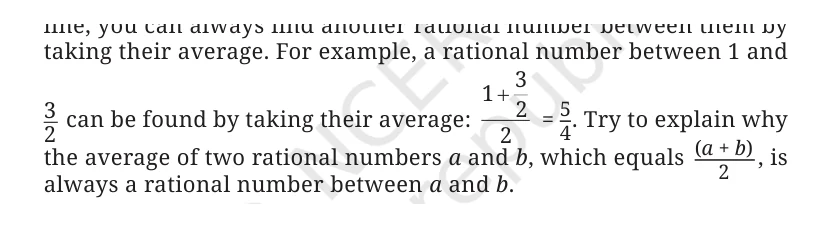
Explain why the average (a+b)/2 is a rational number strictly between rational numbers a<b.
Show detailed solution
- Step 1: Rational numbers are closed under addition and division by the non-zero rational number 2, so (a+b)/2 is rational.
- Step 2: Its distance above a is \frac{a+b}{2}-a=\frac{b-a}{2}>0.
- Step 3: Its distance below b is b-\frac{a+b}{2}=\frac{b-a}{2}>0.
- Conclusion: a<\frac{a+b}{2}<b.
Textbook page 52 · solved item 38
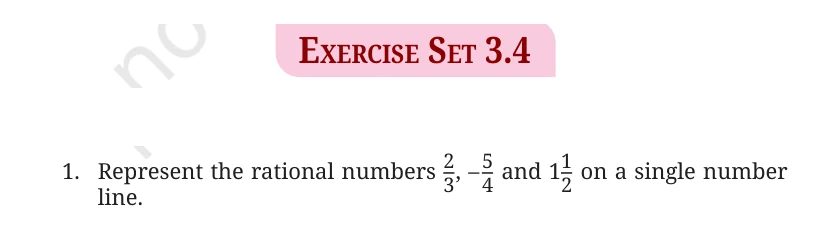
Exercise Set 3.4, 1: Represent 2/3, -5/4, and 1\tfrac12 on one number line.
Show detailed solution
- Step 1: -\frac54=-1.25, so place it between -2 and -1, one quarter left of -1.
- Step 2: \frac23 lies between 0 and 1, two of three equal parts to the right of 0.
- Step 3: 1\frac12=1.5, the midpoint between 1 and 2.
- Answer: From left to right the marked points are -\frac54,\frac23,\frac32.
Textbook page 52 · solved item 39
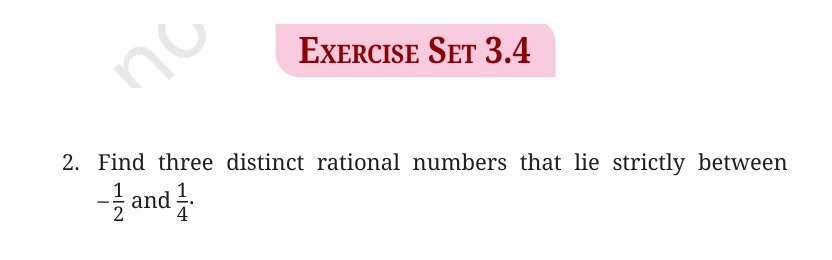
Exercise Set 3.4, 2: Find three distinct rational numbers strictly between -1/2 and 1/4.
Show detailed solution
- Step 1: Express both bounds in eighths: -\frac12=-\frac48 and \frac14=\frac28.
- Step 2: Choose three integer numerators strictly between -4 and 2, such as -2,0,1.
- Step 3: These give -\frac28,\frac08,\frac18.
- Answer: One valid set is -\frac14,0,\frac18.
Detailed worked answers
Textbook page 53
Textbook page 53 · solved item 40
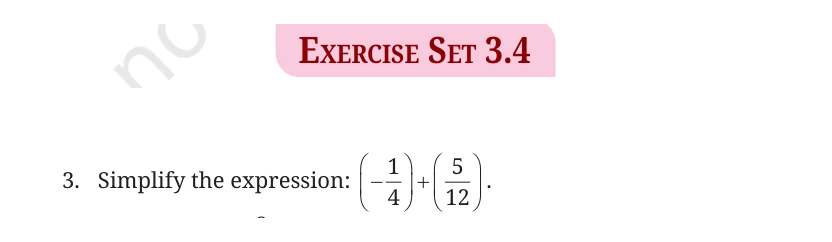
Exercise Set 3.4, 3: Simplify (-1/4)+(5/12).
Show detailed solution
- Step 1: Use denominator 12: -\frac14=-\frac3{12}.
- Step 2: Add: -\frac3{12}+\frac5{12}=\frac2{12}.
- Step 3: Reduce by dividing by 2.
- Answer: \frac16.
Textbook page 53 · solved item 41
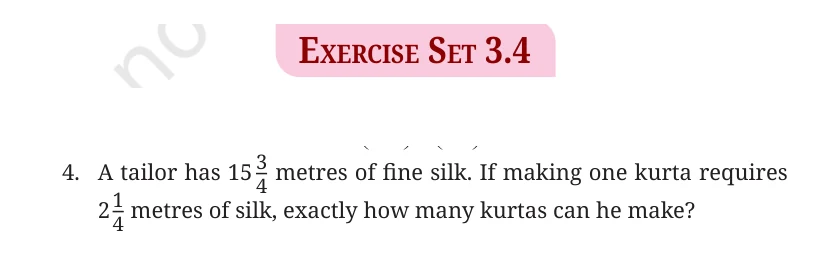
Exercise Set 3.4, 4: A tailor has 15\tfrac34 m of silk and uses 2\tfrac14 m per kurta. How many kurtas can be made?
Show detailed solution
- Step 1: Convert the mixed numbers: 15\frac34=\frac{63}{4} and 2\frac14=\frac94.
- Step 2: Divide the total by the amount per kurta: \frac{63}{4}\div\frac94.
- Step 3: \frac{63}{4}\times\frac49=\frac{63}{9}=7.
- Answer: The tailor can make exactly 7 kurtas.
Textbook page 53 · solved item 42
Exercise Set 3.4, 5: Find three rational numbers between 3.1415 and 3.1416.
Show detailed solution
- Step 1: Write the endpoints to five decimal places: 3.14150 and 3.14160.
- Step 2: Choose terminating decimals with fifth decimal digits strictly between 0 and 10.
- Step 3: For example, 3.14151<3.14152<3.14153, and all are below 3.14160.
- Answer: One valid set is 3.14151,3.14152,3.14153.
Textbook page 53 · solved item 43
Exercise Set 3.4, 6: Give another method for finding a rational number between any two rational numbers.
Show detailed solution
- Step 1: Let a<b be the given rational numbers.
- Step 2: Choose positive integers m,n and form the weighted average \frac{ma+nb}{m+n}.
- Step 3: Because both weights are positive, this value is greater than a, less than b, and rational.
- Example: \frac{2a+b}{3} is a rational number between a and b.
Textbook page 53 · solved item 44

Think and Reflect: Can \sqrt2 be written as a rational number p/q?
Show detailed solution
- Step 1: Assume \sqrt2=p/q in lowest terms.
- Step 2: Squaring gives p^2=2q^2, which forces p to be even; substituting p=2k then forces q to be even.
- Step 3: That contradicts p/q being in lowest terms.
- Answer: No. \sqrt2 is irrational.
Detailed worked answers
Textbook page 55
Textbook page 55 · solved item 45

Think and Reflect: Prove that \sqrt3 is irrational by contradiction.
Show detailed solution
- Step 1: Assume \sqrt3=p/q in lowest terms, where q\ne0. Squaring gives p^2=3q^2.
- Step 2: Since the prime 3 divides p^2, it divides p. Write p=3k.
- Step 3: Substitution gives 9k^2=3q^2, hence q^2=3k^2, so 3 also divides q.
- Conclusion: p and q share factor 3, contradicting lowest terms. Therefore \sqrt3 is irrational.
Textbook page 55 · solved item 46

Think and Reflect: Does the contradiction method prove that \sqrt5 is irrational?
Show detailed solution
- Step 1: Assume \sqrt5=p/q in lowest terms, so p^2=5q^2.
- Step 2: Because 5 is prime, 5\mid p^2 implies 5\mid p. Let p=5k.
- Step 3: Then 25k^2=5q^2, so q^2=5k^2 and 5\mid q.
- Answer: Yes. The shared factor 5 contradicts lowest terms, so \sqrt5 is irrational.
Textbook page 55 · solved item 47

Think and Reflect: Does the contradiction method prove that \sqrt7 is irrational?
Show detailed solution
- Step 1: Assume \sqrt7=p/q in lowest terms; then p^2=7q^2.
- Step 2: Primality of 7 makes 7\mid p. Write p=7k.
- Step 3: Substitution yields q^2=7k^2, so 7\mid q as well.
- Answer: Yes. This contradicts lowest terms, proving \sqrt7 irrational.
Textbook page 55 · solved item 48

Think and Reflect: Does the contradiction method prove that \sqrt{10} is irrational?
Show detailed solution
- Step 1: Assume \sqrt{10}=p/q in lowest terms, giving p^2=10q^2.
- Step 2: Then p^2 is divisible by both 2 and 5, so p is divisible by both and p=10k.
- Step 3: Substitution gives 100k^2=10q^2, hence q^2=10k^2; therefore 2 and 5 also divide q.
- Answer: Yes. The common factors contradict lowest terms, so \sqrt{10} is irrational.
Textbook page 55 · solved item 49

Think and Reflect: How can a line segment with irrational length be constructed?
Show detailed solution
- Step 1: Construct a right triangle whose perpendicular legs have known constructible lengths.
- Step 2: By the Baudhāyana-Pythagoras theorem, its hypotenuse has length \sqrt{a^2+b^2}.
- Step 3: Choose a,b so that a^2+b^2 is not a perfect square; for a=b=1, the hypotenuse is \sqrt2.
- Answer: A ruler and compass can construct the right triangle and then transfer its irrational hypotenuse length.
Detailed worked answers
Textbook page 56
Textbook page 56 · solved item 50
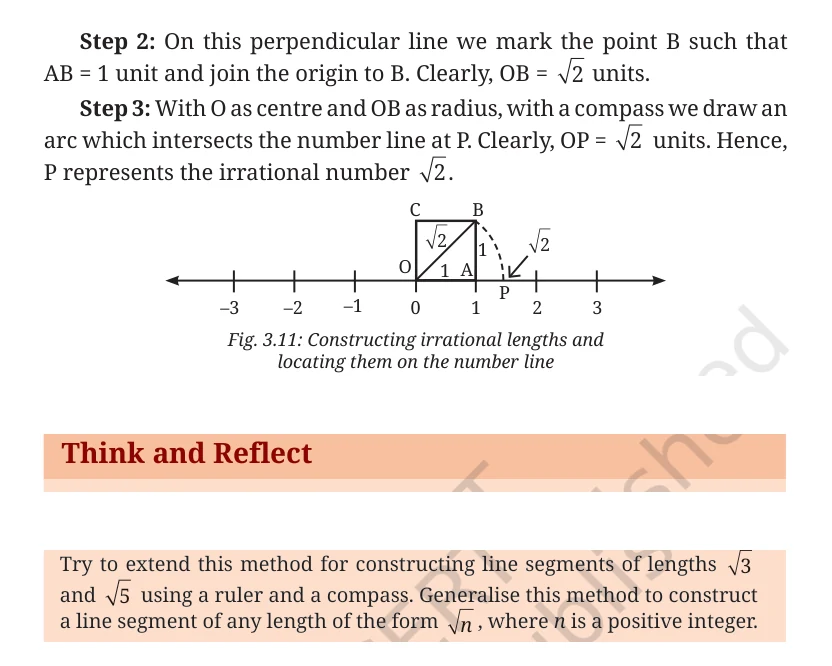
Think and Reflect: Extend Fig. 3.11 to construct a segment of length \sqrt3.
Show detailed solution
- Step 1: Begin with the already constructed segment of length \sqrt2.
- Step 2: At its endpoint, construct a perpendicular segment of length 1 and join its new endpoint to the original origin.
- Step 3: The new hypotenuse satisfies h^2=(\sqrt2)^2+1^2=3.
- Answer: The new segment has length \sqrt3; transfer it with a compass if it must be marked on a number line.
Textbook page 56 · solved item 51
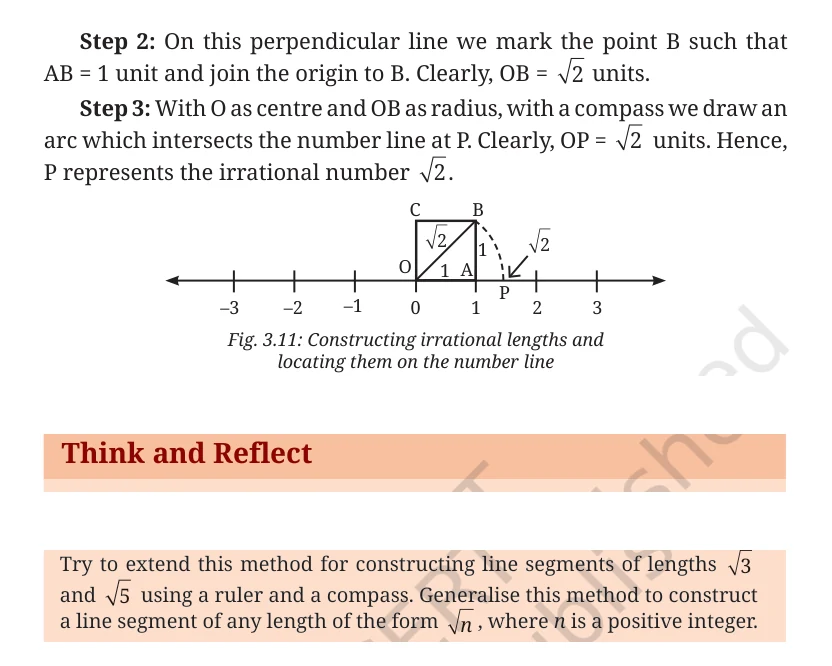
Think and Reflect: Extend the construction to obtain a segment of length \sqrt5.
Show detailed solution
- Step 1: Continue the spiral: from \sqrt3, add a perpendicular unit segment to obtain \sqrt4=2.
- Step 2: At the endpoint of the length-2 segment, add another perpendicular unit segment.
- Step 3: The next hypotenuse satisfies h^2=2^2+1^2=5.
- Answer: The resulting segment has length \sqrt5.
Textbook page 56 · solved item 52
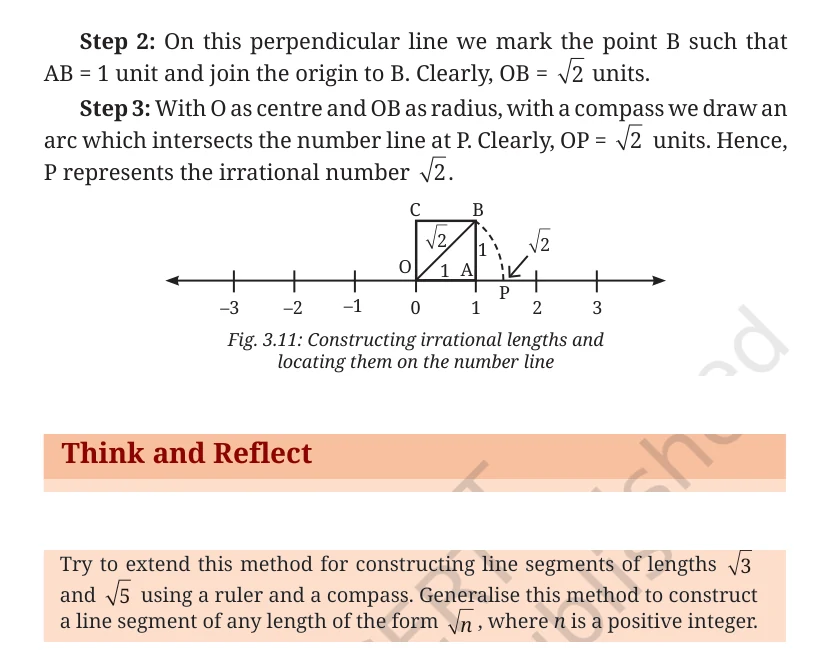
Think and Reflect: Generalise the construction for a segment of length \sqrt n.
Show detailed solution
- Step 1: Start with a segment of length \sqrt1=1.
- Step 2: If a segment of length \sqrt k has been constructed, add a unit segment perpendicular at its endpoint.
- Step 3: Join the new endpoint to the origin. Its length is \sqrt{(\sqrt k)^2+1^2}=\sqrt{k+1}.
- Conclusion: Repeating this step constructs \sqrt n for every positive integer n.
Detailed worked answers
Textbook page 57
Textbook page 57 · solved item 53
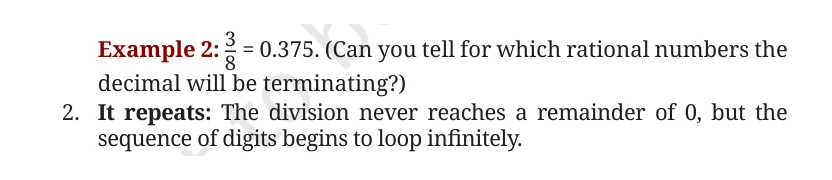
Example 2 prompt: For which rational numbers will the decimal expansion terminate?
Show detailed solution
- Step 1: First write p/q in lowest terms.
- Step 2: Factor q. A terminating decimal is possible exactly when every prime factor of q is 2 or 5.
- Step 3: Then the denominator can be multiplied to a power of 10, since 10^k=2^k5^k.
- Answer: The lowest-form denominator must be 2^m5^n for non-negative integers m,n.
Textbook page 57 · solved item 54
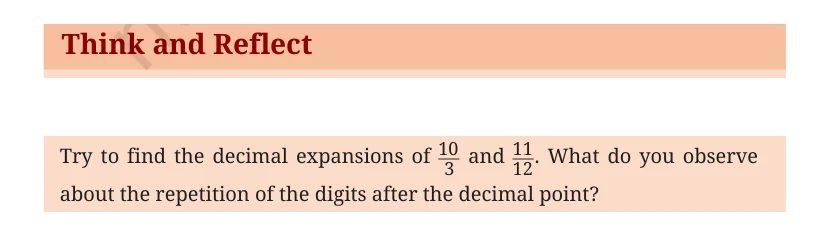
Think and Reflect: Find the decimal expansion of 10/3.
Show detailed solution
- Step 1: Divide 10 by 3. The first quotient digit is 3 with remainder 1.
- Step 2: Bringing down a zero recreates 10, so the same quotient digit and remainder repeat forever.
- Step 3: Therefore 10/3=3.333\ldots.
- Answer: \frac{10}{3}=3.\overline3, a pure repeating decimal.
Textbook page 57 · solved item 55
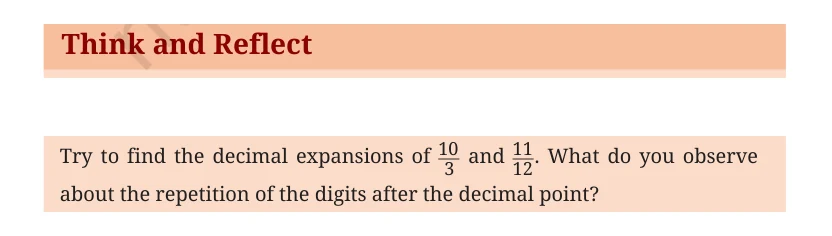
Think and Reflect: Find the decimal expansion of 11/12.
Show detailed solution
- Step 1: Long division gives 11/12=0.91 with the division continuing.
- Step 2: After the digits 9 and 1, the remainder produces a 6 and then repeats the same remainder.
- Step 3: Thus 11/12=0.916666\ldots.
- Answer: \frac{11}{12}=0.91\overline6, a mixed repeating decimal.
Textbook page 57 · solved item 56
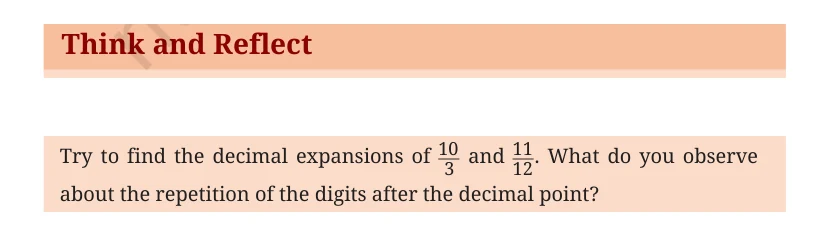
Think and Reflect: Compare the repeating digits in 10/3 and 11/12.
Show detailed solution
- Step 1: 10/3=3.\overline3 begins repeating immediately after the decimal point.
- Step 2: 11/12=0.91\overline6 has two non-repeating digits before 6 repeats.
- Step 3: Neither decimal terminates, but their repeating parts begin at different positions.
- Answer: The first is pure repeating; the second is mixed repeating.
Detailed worked answers
Textbook page 58
Textbook page 58 · solved item 57
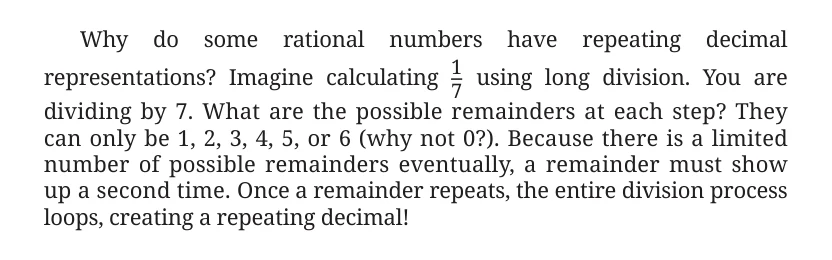
Why does long division of a rational number such as 1/7 produce a repeating decimal when it does not terminate?
Show detailed solution
- Step 1: Dividing by 7 can leave only the remainders 0,1,2,3,4,5,6.
- Step 2: Remainder 0 would end the division, so a non-terminating calculation uses only 1 through 6.
- Step 3: With finitely many possible non-zero remainders, one must eventually repeat.
- Conclusion: The repeated remainder recreates all later quotient digits, making the decimal periodic.
Textbook page 58 · solved item 58
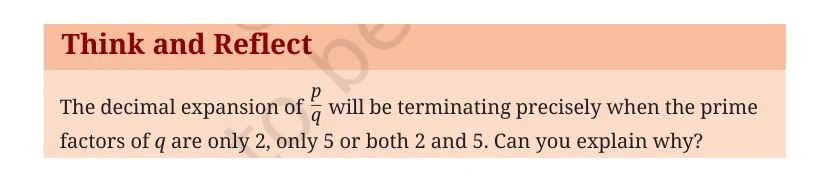
Think and Reflect: Why does p/q terminate exactly when the lowest-form denominator has only factors 2 and 5?
Show detailed solution
- Step 1: If q=2^m5^n, multiply by missing factors until the denominator becomes 10^{\max(m,n)}. This gives a finite decimal.
- Step 2: Conversely, a decimal terminating after k places equals an integer divided by 10^k=2^k5^k.
- Step 3: Reducing that fraction can remove factors but cannot introduce any prime other than 2 or 5.
- Conclusion: The condition is both sufficient and necessary.
Detailed worked answers
Textbook page 61
Textbook page 61 · solved item 59
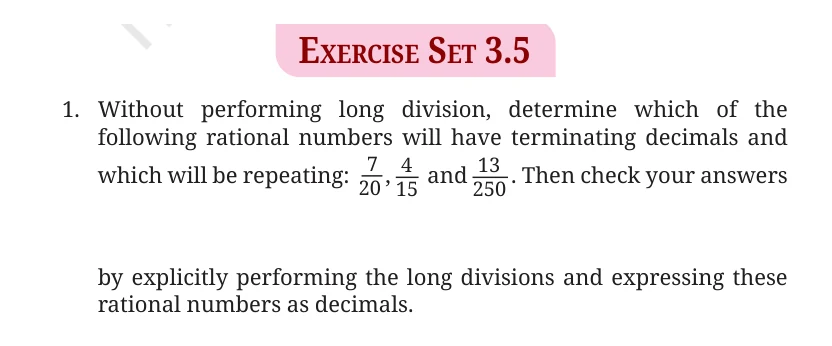
Exercise Set 3.5, 1(a): Predict and calculate the decimal expansion of 7/20.
Show detailed solution
- Step 1: The denominator 20=2^2\times5 contains only factors 2 and 5, so the decimal terminates.
- Step 2: Make denominator 100: \frac7{20}=\frac{35}{100}.
- Step 3: Long division likewise reaches remainder 0 after two decimal places.
- Answer: \frac7{20}=0.35, terminating.
Textbook page 61 · solved item 60
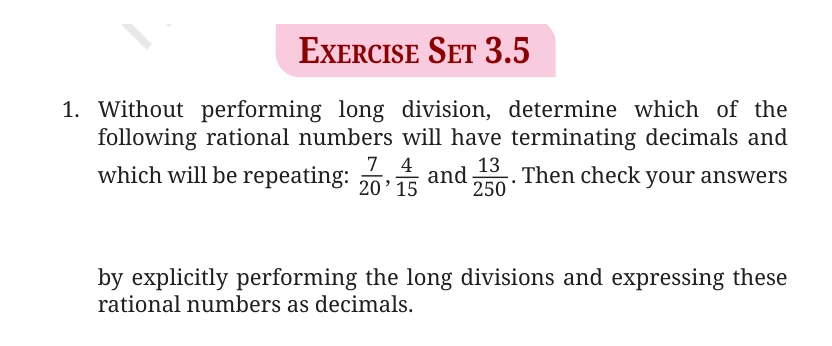
Exercise Set 3.5, 1(b): Predict and calculate the decimal expansion of 4/15.
Show detailed solution
- Step 1: 15=3\times5 contains the prime factor 3, so the lowest-form fraction cannot terminate.
- Step 2: Long division gives 0.2 with remainder 1, after which the digit 6 repeats.
- Step 3: The repeating remainder confirms the prediction.
- Answer: \frac4{15}=0.2\overline6, non-terminating repeating.
Textbook page 61 · solved item 61
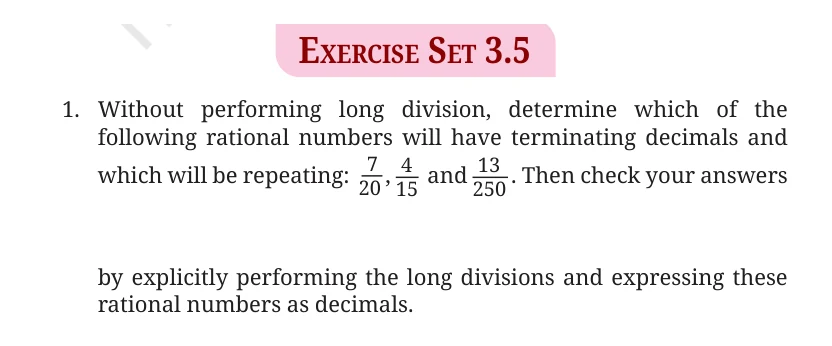
Exercise Set 3.5, 1(c): Predict and calculate the decimal expansion of 13/250.
Show detailed solution
- Step 1: 250=2\times5^3 has only factors 2 and 5, so the decimal terminates.
- Step 2: Multiply by 4: \frac{13}{250}=\frac{52}{1000}.
- Step 3: Long division reaches remainder 0 after three decimal places.
- Answer: \frac{13}{250}=0.052, terminating.
Detailed worked answers
Textbook page 62
Textbook page 62 · solved item 62
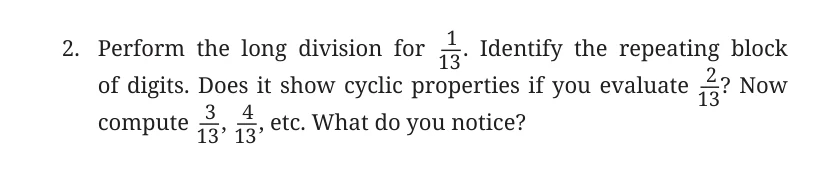
Exercise Set 3.5, 2(a): Perform long division for 1/13 and identify its repeating block.
Show detailed solution
- Step 1: Long division successively produces the digits 0,7,6,9,2,3 after the decimal point.
- Step 2: After six digits, the remainder returns to 1, so the same process begins again.
- Step 3: Hence 1/13=0.076923076923\ldots.
- Answer: \frac1{13}=0.\overline{076923}; the repeating block is 076923.
Textbook page 62 · solved item 63
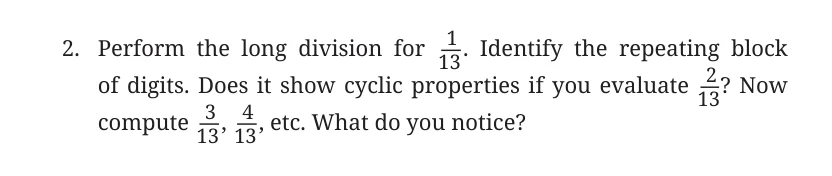
Exercise Set 3.5, 2(b): Evaluate 2/13 and compare its repeating block with 1/13.
Show detailed solution
- Step 1: Long division gives 2/13=0.153846153846\ldots.
- Step 2: Its repeating block is 153846.
- Step 3: This is not a cyclic rotation of 076923, so multiplying by 2 moves to a second digit family.
- Answer: \frac2{13}=0.\overline{153846}.
Textbook page 62 · solved item 64
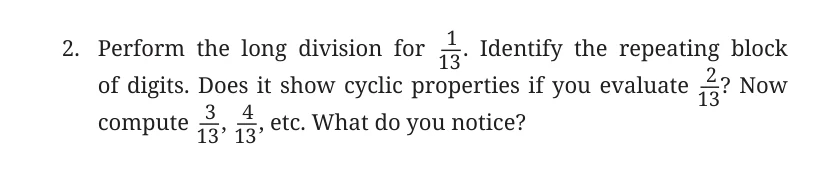
Exercise Set 3.5, 2(c): Compute 3/13.
Show detailed solution
- Step 1: Long division produces 0.230769230769\ldots.
- Step 2: The remainder repeats after the six-digit block 230769.
- Step 3: This block is a cyclic rotation of 076923, the block for 1/13.
- Answer: \frac3{13}=0.\overline{230769}.
Textbook page 62 · solved item 65
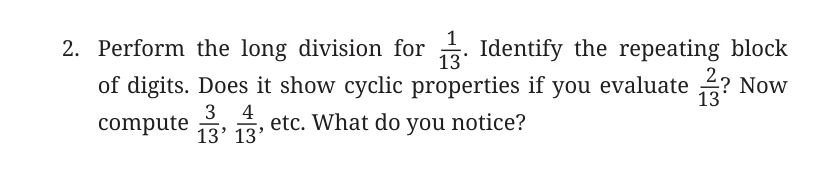
Exercise Set 3.5, 2(d): Compute 4/13.
Show detailed solution
- Step 1: Long division gives 0.307692307692\ldots.
- Step 2: The six-digit block 307692 repeats.
- Step 3: It is another cyclic rotation of 076923.
- Answer: \frac4{13}=0.\overline{307692}.
Textbook page 62 · solved item 66
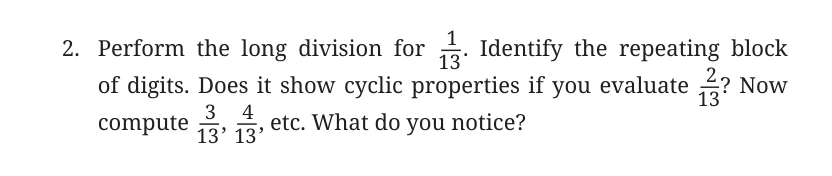
Exercise Set 3.5, 2(e): What cyclic pattern appears among the multiples of 1/13?
Show detailed solution
- Step 1: The block for 1/13 is 076923, while 2/13 begins a second block, 153846.
- Step 2: Multiples 1,3,4,9,10,12 of 1/13 use rotations of 076923.
- Step 3: Multiples 2,5,6,7,8,11 use rotations of 153846.
- Answer: The non-zero multiples split into two six-number cyclic families rather than one family containing every multiplier.
Textbook page 62 · solved item 67
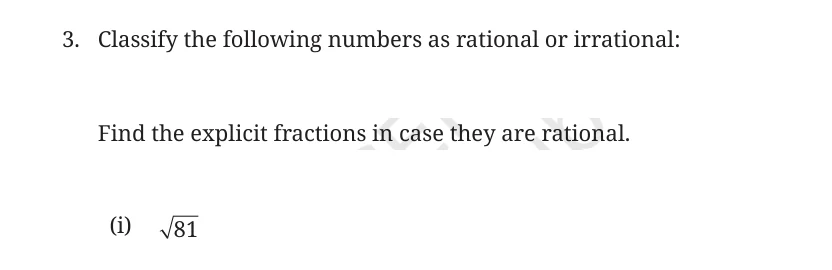
Exercise Set 3.5, 3(i): Classify \sqrt{81} and give a fraction if rational.
Show detailed solution
- Step 1: 81=9^2.
- Step 2: Therefore \sqrt{81}=9.
- Answer: It is rational, and an explicit fraction is 9/1.
Textbook page 62 · solved item 68
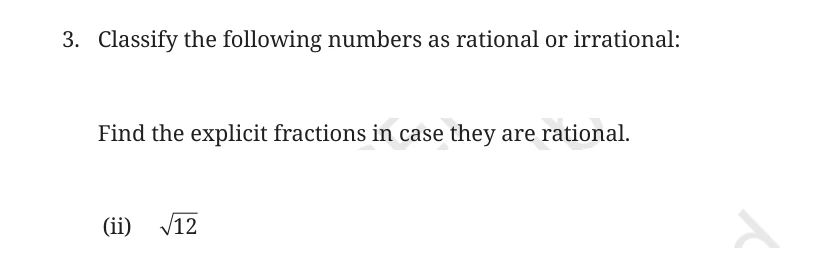
Exercise Set 3.5, 3(ii): Classify \sqrt{12}.
Show detailed solution
- Step 1: Factor the radicand: 12=4\times3.
- Step 2: \sqrt{12}=2\sqrt3.
- Step 3: Since \sqrt3 is irrational, multiplying it by non-zero rational 2 remains irrational.
- Answer: \sqrt{12} is irrational.
Textbook page 62 · solved item 69
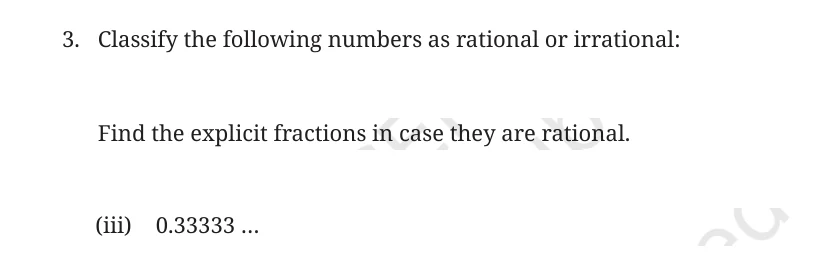
Exercise Set 3.5, 3(iii): Classify 0.33333\ldots and give its fraction.
Show detailed solution
- Step 1: Let x=0.33333\ldots. Then 10x=3.33333\ldots.
- Step 2: Subtract: 10x-x=3, so 9x=3.
- Step 3: x=1/3.
- Answer: It is rational and equals \frac13.
Textbook page 62 · solved item 70
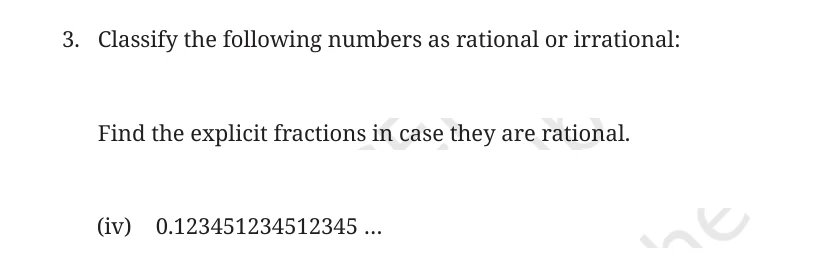
Exercise Set 3.5, 3(iv): Classify 0.123451234512345\ldots and give its fraction.
Show detailed solution
- Step 1: The fixed block 12345 repeats, so the decimal is rational.
- Step 2: Let x=0.\overline{12345}. Then 100000x=12345.\overline{12345}.
- Step 3: Subtract to get 99999x=12345, so x=12345/99999.
- Answer: It is rational and simplifies to \frac{4115}{33333}.
Textbook page 62 · solved item 71
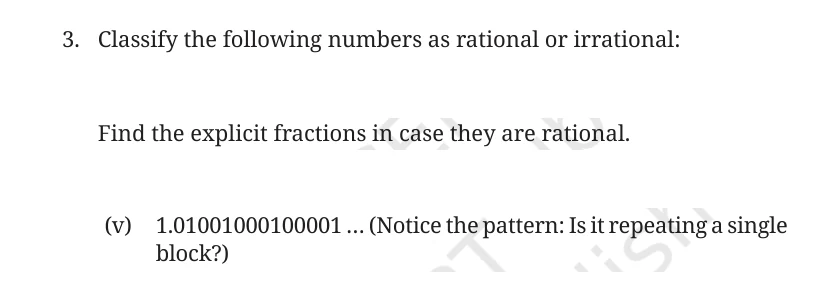
Exercise Set 3.5, 3(v): Classify 1.01001000100001\ldots.
Show detailed solution
- Step 1: The number of zeros between successive 1s keeps increasing.
- Step 2: Therefore no fixed finite block of digits repeats forever.
- Step 3: A non-terminating decimal is rational only when it is eventually periodic.
- Answer: The decimal is irrational.
Textbook page 62 · solved item 72
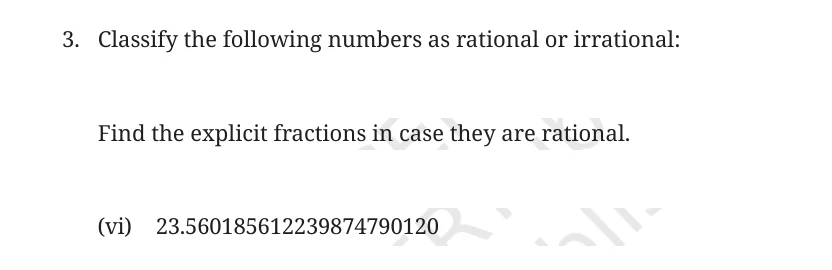
Exercise Set 3.5, 3(vi): Classify 23.560185612239874790120 and give its fraction.
Show detailed solution
- Step 1: The decimal has finitely many digits, so it is terminating and therefore rational.
- Step 2: Write it over 10^{21}: 23560185612239874790120/10^{21}.
- Step 3: Reduce the numerator and denominator by their greatest common factor 40.
- Answer: It is rational and equals \frac{589004640305996869753}{25000000000000000000}.
Textbook page 62 · solved item 73

Exercise Set 3.5, 4: Use algebra to prove that 0.\overline9=1.
Show detailed solution
- Step 1: Let x=0.99999\ldots.
- Step 2: Multiply by 10: 10x=9.99999\ldots.
- Step 3: Subtract the original equation: 10x-x=9, so 9x=9.
- Answer: x=1, hence 0.\overline9=1.
Textbook page 62 · solved item 74
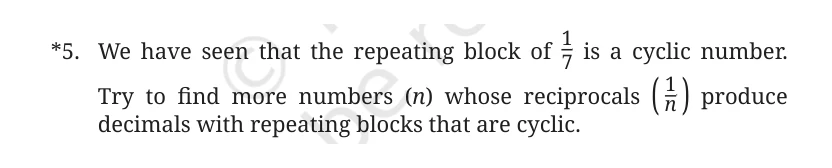
Exercise Set 3.5, 5: Find more denominators whose reciprocals have cyclic repeating blocks.
Show detailed solution
- Step 1: Look for primes whose reciprocal has the maximum possible period p-1; these are full-reptend primes in base 10.
- Step 2: For example, 1/17=0.\overline{0588235294117647}. Its non-zero multiples rotate the same 16-digit block.
- Step 3: Also 1/19=0.\overline{052631578947368421}, with an 18-digit cyclic block.
- Answer: Examples include n=17 and n=19; further examples include 23,29,47.
Detailed worked answers
Textbook page 64
Textbook page 64 · solved item 75
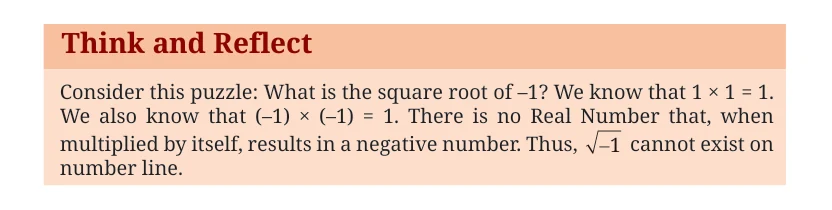
Think and Reflect: What is \sqrt{-1}, and why is it not a real number?
Show detailed solution
- Step 1: The square of every positive real number is positive, and the square of every negative real number is also positive.
- Step 2: Zero squared is zero, so no real number has square -1.
- Step 3: Mathematicians define the imaginary unit i by i^2=-1.
- Answer: \sqrt{-1}=i in the complex-number system, but it is not on the real number line.
Textbook page 64 · solved item 76
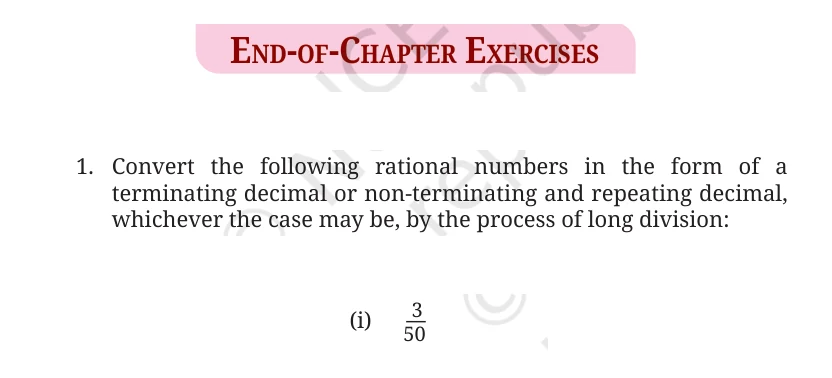
End-of-Chapter Exercise 1(i): Convert 3/50 by long division.
Show detailed solution
- Step 1: 3\div50 begins with 0; append a decimal zero to consider 30, which is still less than 50.
- Step 2: Append another zero: 300\div50=6 with remainder 0.
- Step 3: The division stops after two decimal places.
- Answer: \frac3{50}=0.06, a terminating decimal.
Textbook page 64 · solved item 77
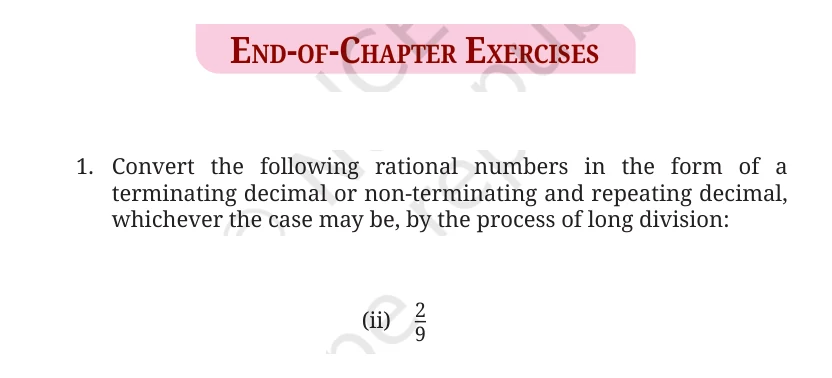
End-of-Chapter Exercise 1(ii): Convert 2/9 by long division.
Show detailed solution
- Step 1: 2\div9=0 remainder 2, so place a decimal point and bring down 0.
- Step 2: 20\div9=2 remainder 2; the identical remainder returns at every step.
- Step 3: Therefore the digit 2 repeats forever.
- Answer: \frac29=0.\overline2, non-terminating repeating.
Textbook page 64 · solved item 78

End-of-Chapter Exercise 2: Prove that \sqrt5 is irrational.
Show detailed solution
- Step 1: Assume \sqrt5=p/q in lowest terms. Then p^2=5q^2.
- Step 2: Since 5 is prime, 5\mid p^2 implies 5\mid p. Put p=5k.
- Step 3: Substitution gives q^2=5k^2, so 5\mid q too.
- Conclusion: This contradicts lowest terms; therefore \sqrt5 is irrational.
Textbook page 64 · solved item 79
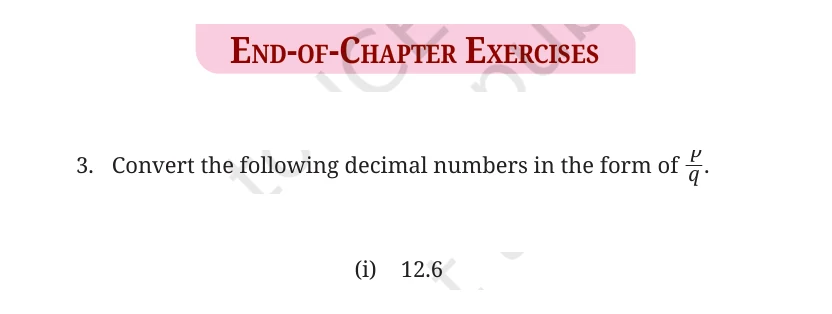
End-of-Chapter Exercise 3(i): Convert 12.\overline6 to p/q.
Show detailed solution
- Step 1: Let x=12.6666\ldots. Then 10x=126.6666\ldots.
- Step 2: Subtract: 10x-x=126.666\ldots-12.666\ldots=114.
- Step 3: 9x=114, so x=114/9.
- Answer: 12.\overline6=\frac{38}{3}.
Textbook page 64 · solved item 80

End-of-Chapter Exercise 3(ii): Convert terminating decimal 0.0120 to p/q.
Show detailed solution
- Step 1: There are four written decimal places, so 0.0120=120/10000.
- Step 2: Divide numerator and denominator by 40.
- Step 3: 120\div40=3 and 10000\div40=250.
- Answer: 0.0120=\frac3{250}.
Textbook page 64 · solved item 81
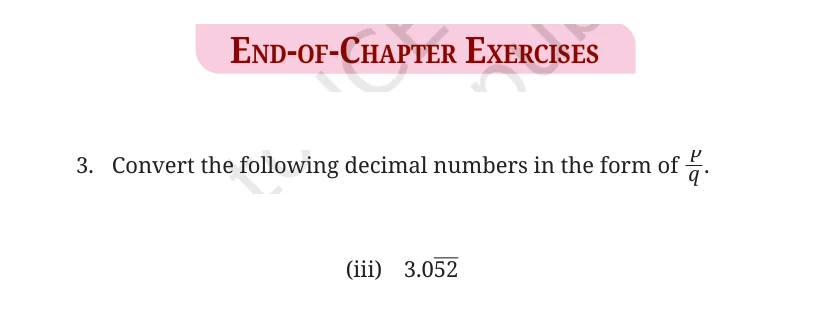
End-of-Chapter Exercise 3(iii): Convert 3.0\overline{52} to p/q.
Show detailed solution
- Step 1: Let x=3.0525252\ldots. Since one digit is non-repeating, 10x=30.525252\ldots.
- Step 2: Move one two-digit cycle: 1000x=3052.525252\ldots.
- Step 3: Subtract: 990x=3022, so x=3022/990.
- Answer: 3.0\overline{52}=\frac{1511}{495}.
Textbook page 64 · solved item 82
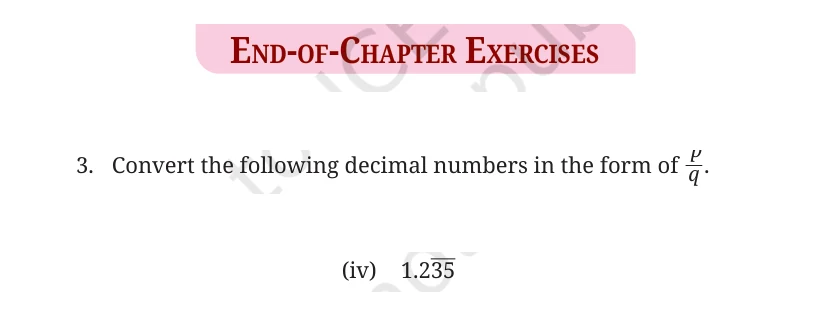
End-of-Chapter Exercise 3(iv): Convert 1.\overline{235} to p/q.
Show detailed solution
- Step 1: Let x=1.235235\ldots.
- Step 2: Multiply by 1000: 1000x=1235.235235\ldots.
- Step 3: Subtract to get 999x=1234.
- Answer: 1.\overline{235}=\frac{1234}{999}.
Textbook page 64 · solved item 83
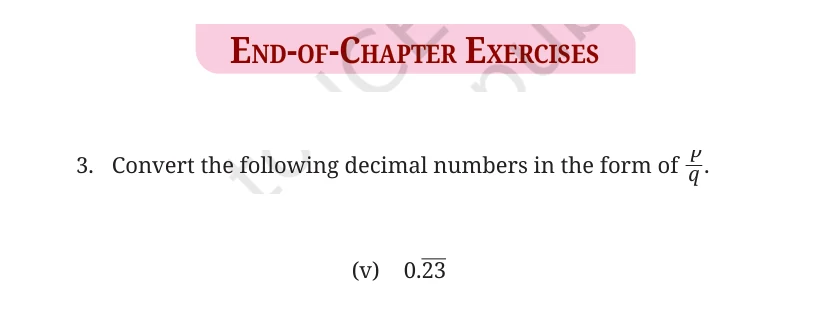
End-of-Chapter Exercise 3(v): Convert 0.\overline{23} to p/q.
Show detailed solution
- Step 1: Let x=0.232323\ldots.
- Step 2: Multiply by 100: 100x=23.232323\ldots.
- Step 3: Subtract: 99x=23.
- Answer: 0.\overline{23}=\frac{23}{99}.
Textbook page 64 · solved item 84
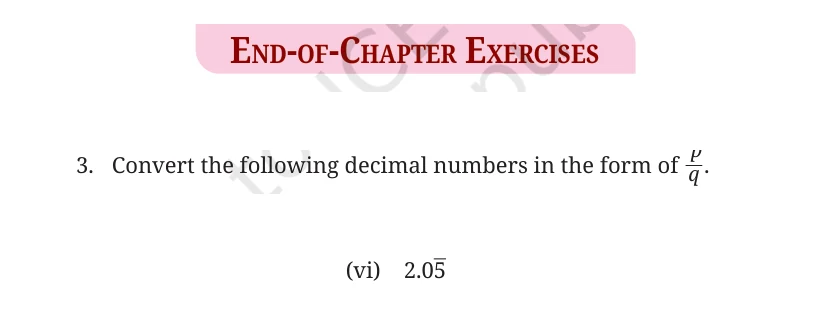
End-of-Chapter Exercise 3(vi): Convert 2.0\overline5 to p/q.
Show detailed solution
- Step 1: Let x=2.05555\ldots. Then 10x=20.5555\ldots.
- Step 2: Multiply once more by 10: 100x=205.5555\ldots.
- Step 3: Subtract: 90x=185, so x=185/90.
- Answer: 2.0\overline5=\frac{37}{18}.
Textbook page 64 · solved item 85
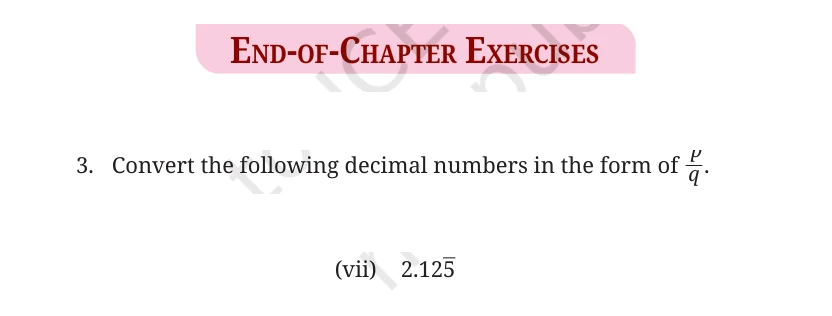
End-of-Chapter Exercise 3(vii): Convert 2.12\overline5 to p/q.
Show detailed solution
- Step 1: Let x=2.125555\ldots. The two non-repeating digits give 100x=212.5555\ldots.
- Step 2: Move the one-digit cycle: 1000x=2125.5555\ldots.
- Step 3: Subtract: 900x=1913.
- Answer: 2.12\overline5=\frac{1913}{900}.
Textbook page 64 · solved item 86
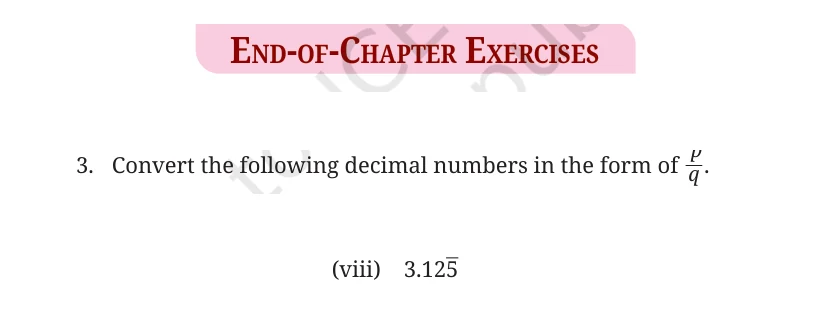
End-of-Chapter Exercise 3(viii): Convert 3.12\overline5 to p/q.
Show detailed solution
- Step 1: Let x=3.125555\ldots. Then 100x=312.5555\ldots.
- Step 2: Also 1000x=3125.5555\ldots.
- Step 3: Subtract: 900x=2813.
- Answer: 3.12\overline5=\frac{2813}{900}.
Textbook page 64 · solved item 87
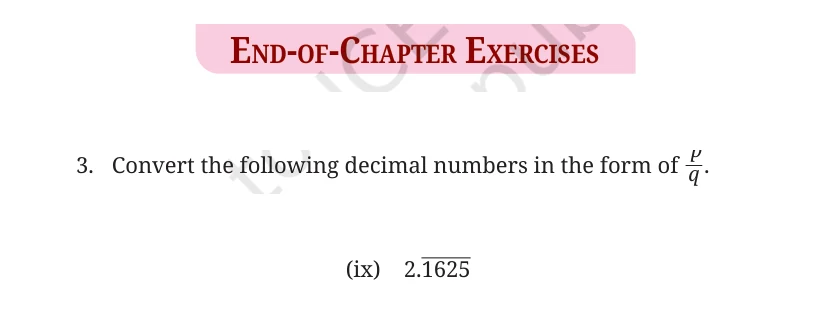
End-of-Chapter Exercise 3(ix): Convert 2.\overline{1625} to p/q.
Show detailed solution
- Step 1: Let x=2.16251625\ldots.
- Step 2: Multiply by 10000: 10000x=21625.16251625\ldots.
- Step 3: Subtract: 9999x=21623.
- Answer: 2.\overline{1625}=\frac{21623}{9999}.
Textbook page 64 · solved item 88
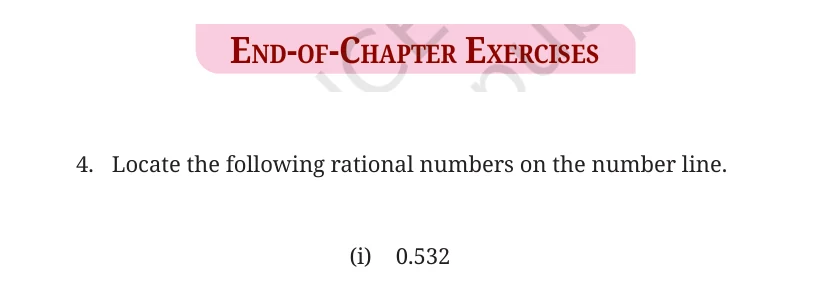
End-of-Chapter Exercise 4(i): Locate 0.532 on the number line.
Show detailed solution
- Step 1: Convert 0.532=532/1000=133/250.
- Step 2: The point lies between 0 and 1.
- Step 3: Divide the unit into 1000 equal parts and move 532 parts right from 0, or into 250 parts and move 133 parts.
- Answer: Mark the point at 0.532.
Textbook page 64 · solved item 89
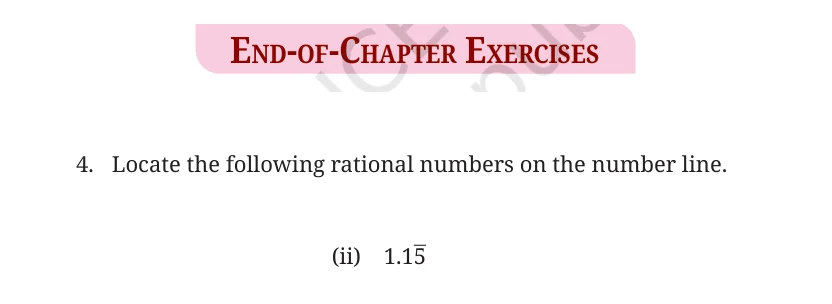
End-of-Chapter Exercise 4(ii): Locate 1.1\overline5 on the number line.
Show detailed solution
- Step 1: Let x=1.15555\ldots. Then 10x=11.555\ldots and 100x=115.555\ldots.
- Step 2: Subtract to get 90x=104, hence x=52/45=1+7/45.
- Step 3: Divide the interval from 1 to 2 into 45 equal parts and move 7 parts right from 1.
- Answer: Mark \frac{52}{45}=1.1\overline5.
Detailed worked answers
Textbook page 65
Textbook page 65 · solved item 90

End-of-Chapter Exercise 5: Find six rational numbers between 3 and 4.
Show detailed solution
- Step 1: Write the bounds in tenths: 3=30/10 and 4=40/10.
- Step 2: Choose six integer numerators strictly between 30 and 40.
- Step 3: Numerators 31 through 36 give six distinct rational numbers.
- Answer: \frac{31}{10},\frac{32}{10},\frac{33}{10},\frac{34}{10},\frac{35}{10},\frac{36}{10}.
Textbook page 65 · solved item 91

End-of-Chapter Exercise 6: Find five rational numbers between 2/5 and 3/5.
Show detailed solution
- Step 1: Use denominator 50: \frac25=\frac{20}{50}, \frac35=\frac{30}{50}.
- Step 2: Choose five numerators strictly between 20 and 30.
- Step 3: Use 21, 22, 23, 24, and 25.
- Answer: \frac{21}{50},\frac{22}{50},\frac{23}{50},\frac{24}{50},\frac{25}{50}.
Textbook page 65 · solved item 92

End-of-Chapter Exercise 7: Find five rational numbers between 1/6 and 2/5.
Show detailed solution
- Step 1: Use denominator 30: \frac16=\frac5{30}, \frac25=\frac{12}{30}.
- Step 2: The numerators 6, 7, 8, 9, and 10 lie strictly between 5 and 12.
- Step 3: Keep the common denominator 30.
- Answer: \frac6{30},\frac7{30},\frac8{30},\frac9{30},\frac{10}{30}.
Textbook page 65 · solved item 93

End-of-Chapter Exercise 8: If x/3+x/5=16/15, find x.
Show detailed solution
- Step 1: Use denominator 15: \frac{x}{3}+\frac{x}{5}=\frac{5x+3x}{15}=\frac{8x}{15}.
- Step 2: Set 8x/15=16/15, so 8x=16.
- Step 3: Divide by 8.
- Answer: x=2.
Textbook page 65 · solved item 94

End-of-Chapter Exercise 9: If non-zero rationals a,b satisfy a+1/b=0, is ab positive or negative?
Show detailed solution
- Step 1: Rearrange a+1/b=0 to a=-1/b.
- Step 2: Multiply by non-zero b: ab=-1.
- Step 3: Since -1<0, the product is negative regardless of the individual values.
- Answer: ab is negative; in fact, ab=-1.
Textbook page 65 · solved item 95
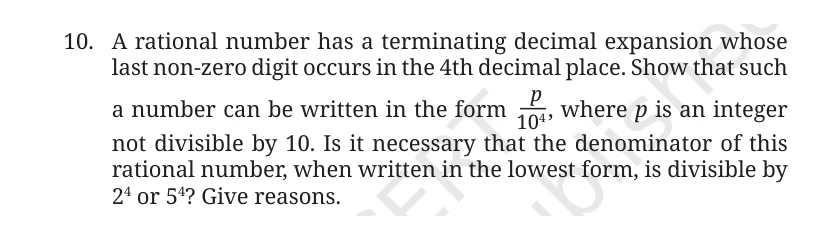
End-of-Chapter Exercise 10: Analyse a terminating decimal whose last non-zero digit is in the fourth decimal place.
Show detailed solution
- Step 1: Such a number is p/10^4, where integer p is not divisible by 10; otherwise its last non-zero digit would occur earlier.
- Step 2: Since 10^4=2^4 5^4 and p is not divisible by both 2 and 5, reduction cannot cancel the full powers of both primes.
- Step 3: The lowest-form denominator must therefore retain 2^4 or 5^4, though it need not retain both.
- Examples: 16/10^4=1/625 retains 5^4, while 625/10^4=1/16 retains 2^4.
Textbook page 65 · solved item 96

End-of-Chapter Exercise 11: Without division, decide whether 18/125 terminates and state the number of decimal places.
Show detailed solution
- Step 1: The fraction is already in lowest terms and 125=5^3.
- Step 2: Its denominator contains only factor 5, so the decimal terminates.
- Step 3: Multiply by 2^3=8: \frac{18}{125}=\frac{144}{1000}.
- Answer: It terminates as 0.144, with 3 decimal places.
Textbook page 65 · solved item 97

End-of-Chapter Exercise 12: A lowest-form denominator is 2^3\times5. How many decimal places result?
Show detailed solution
- Step 1: The denominator contains only factors 2 and 5, so the decimal terminates.
- Step 2: Balance the powers by multiplying numerator and denominator by 5^2.
- Step 3: The denominator becomes 2^3 5^3=10^3.
- Answer: The decimal expansion has 3 decimal places.
Textbook page 65 · solved item 98
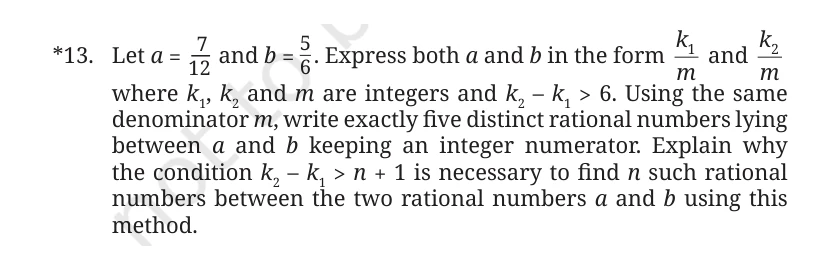
End-of-Chapter Exercise 13: Use a common denominator to place five rationals between 7/12 and 5/6, then analyse the gap condition.
Show detailed solution
- Step 1: Choose m=36: 7/12=21/36 and 5/6=30/36, so k_2-k_1=9>6.
- Step 2: Five valid fractions are 22/36,23/36,24/36,25/36,26/36, all strictly between the endpoints.
- Step 3: If the numerator gap is d=k_2-k_1, exactly d-1 integer numerators lie strictly between the endpoints.
- Correction: To guarantee n such fractions, the exact necessary and sufficient condition is d\ge n+1. The printed condition d>n+1 is sufficient but stronger than necessary.
Textbook page 65 · solved item 99

End-of-Chapter Exercise 14: If x+y+z=0 and xy+yz+zx=0, prove x=y=z=0.
Show detailed solution
- Step 1: Square the first equation: (x+y+z)^2=0.
- Step 2: Expand: x^2+y^2+z^2+2(xy+yz+zx)=0.
- Step 3: Use xy+yz+zx=0 to obtain x^2+y^2+z^2=0.
- Conclusion: Squares of rational numbers are non-negative, so their sum is zero only when x=y=z=0.
Detailed worked answers
Textbook page 66
Textbook page 66 · solved item 100

End-of-Chapter Exercise 15: Show that (a+b)/2 lies between rational numbers a and b.
Show detailed solution
- Step 1: Assume a<b; the case b<a follows by swapping their names.
- Step 2: \frac{a+b}{2}-a=\frac{b-a}{2}>0, so the average is greater than a.
- Step 3: b-\frac{a+b}{2}=\frac{b-a}{2}>0, so the average is less than b.
- Answer: a<\frac{a+b}{2}<b. If a=b, the average equals both endpoints.
Textbook page 66 · solved item 101
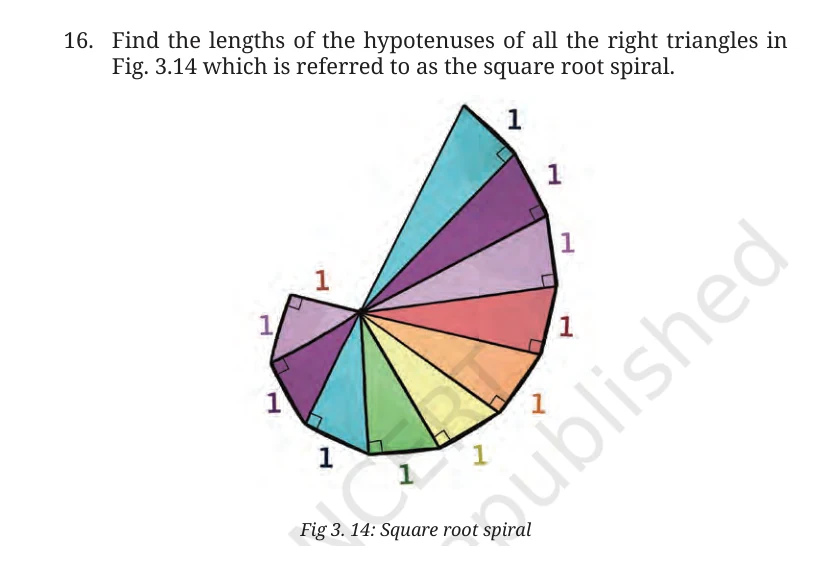
End-of-Chapter Exercise 16: Find every hypotenuse length in the square root spiral in Fig. 3.14.
Show detailed solution
- Step 1: The first right triangle has legs 1 and 1, so its hypotenuse is \sqrt{1^2+1^2}=\sqrt2.
- Step 2: Each new triangle uses the preceding hypotenuse \sqrt n as one leg and a new unit segment as the perpendicular leg.
- Step 3: Its new hypotenuse is \sqrt{(\sqrt n)^2+1^2}=\sqrt{n+1}.
- Answer: The first six hypotenuses are \sqrt2,\sqrt3,\sqrt4,\sqrt5,\sqrt6,\sqrt7. The remaining five are \sqrt8,\sqrt9,\sqrt{10},\sqrt{11},\sqrt{12}, with \sqrt4=2 and \sqrt9=3.