
Question-by-question working
Read the prompt, attempt it, then check each step
Every exercise subpart and table row is a separate item. Shared figures are repeated in the crop whenever they are needed to understand that question.
Detailed worked answers
Textbook page 93
Textbook page 93 · solved item 1
Think and Reflect: How can Jamuna locate the centre of a circular piece of paper?
Show detailed solution
- Step 1: Fold the circle so that one part of its boundary exactly overlaps the opposite part.
- Step 2: Open it. The crease is a diameter because it is a line of reflection symmetry of the circle.
- Step 3: Make a second, different fold in the same way to obtain another diameter.
- Answer: The intersection of the two creases is the centre of the circular paper.
Detailed worked answers
Textbook page 94
Textbook page 94 · solved item 2
Think and Reflect 1: State the rotational and reflection symmetries of a square, a regular pentagon, and a regular hexagon.
Show detailed solution
- Step 1: A square matches itself after rotations through 0^\circ,90^\circ,180^\circ,270^\circ, and then 360^\circ; it has 4 reflection axes.
- Step 2: A regular pentagon matches after multiples of 72^\circ, giving 5 rotational positions and 5 reflection axes.
- Step 3: A regular hexagon matches after multiples of 60^\circ, giving 6 rotational positions and 6 reflection axes.
- Answer: The orders of rotational symmetry are 4, 5, and 6, and the numbers of reflection axes are also 4, 5, and 6, respectively.
Textbook page 94 · solved item 3
Think and Reflect 2: What is the longest chord in a circle of radius 5 units, and is there a smallest chord?
Show detailed solution
- Step 1: A chord is longest when it passes through the centre, so the longest chord is a diameter.
- Step 2: Its length is 2r=2\times5=10 units.
- Step 3: Moving a chord closer to the boundary can make its positive length as small as desired.
- Answer: The longest chord is 10 units. There is no smallest positive chord; the limiting length is 0.
Textbook page 94 · solved item 4
Think and Reflect 3: What is the locus of points equidistant from two given points?
Show detailed solution
- Step 1: Let the given points be A and B. A point P on the perpendicular bisector satisfies PA=PB
- Step 2: Conversely, if PA=PB, then \triangle PAB is isosceles, so the altitude from P bisects AB at right angles.
- Step 3: Therefore every qualifying point lies on the perpendicular bisector, and every point on that line qualifies.
- Answer: The locus is the perpendicular bisector of AB
Detailed worked answers
Textbook page 95
Textbook page 95 · solved item 5
Think and Reflect 1: How many circles pass through two distinct points on a plane?
Show detailed solution
- Step 1: A centre of such a circle must be equidistant from the two points A and B
- Step 2: All points on the perpendicular bisector of AB are equidistant from A and B
- Step 3: The perpendicular bisector contains infinitely many points, and each can serve as a different centre.
- Answer: Infinitely many circles pass through two distinct points.
Textbook page 95 · solved item 6
Think and Reflect 2: Which radii are possible for circles through two points, and what are the smallest and largest radii?
Show detailed solution
- Step 1: Write AB=d. A radius must reach both ends, so it cannot be less than d/2
- Step 2: The midpoint of AB gives the smallest circle, with radius d/2 and diameter AB
- Step 3: Moving the centre along the perpendicular bisector gives every radius greater than d/2
- Answer: Exactly the radii r\ge d/2 are possible. The smallest is d/2, and there is no largest radius.
Textbook page 95 · solved item 7
Think and Reflect 3: What happens to the radius as the centre moves away from segment AB along its perpendicular bisector?
Show detailed solution
- Step 1: If M is the midpoint of AB and the centre is O, then OA^2=OM^2+AM^2
- Step 2: The length AM is fixed while OM increases as the centre moves away.
- Step 3: Therefore OA=\sqrt{OM^2+AM^2} increases.
- Answer: The radii increase.
Textbook page 95 · solved item 8
Think and Reflect 4: Does the circle through A and B look more or less curved as its centre moves away along the perpendicular bisector?
Show detailed solution
- Step 1: Moving the centre away increases the radius of the circle.
- Step 2: Over the fixed chord AB, an arc of a larger circle bends by a smaller amount.
- Step 3: In the limit of a very large radius, the short arc looks nearly straight.
- Answer: The circle appears less curved near A and B.
Textbook page 95 · solved item 9
Think and Reflect 5: How many squares can have A and B on their boundary, and how many can have A and B as vertices?
Show detailed solution
- Step 1: If A and B may lie anywhere on the boundary, the side length, orientation, and their positions on the sides can vary continuously.
- Step 2: Hence infinitely many squares can have both points on their boundary.
- Step 3: If A and B are adjacent vertices, there are two squares, one on each side of AB.
- Step 4: If A and B are opposite vertices, AB is a diagonal and determines one more square.
- Answer: Infinitely many have A and B on the boundary; exactly 3 have A and B as vertices.
Detailed worked answers
Textbook page 98
Textbook page 98 · solved item 10
Exercise Set 5.1, 1: Construct \triangle ABC with AB=5\text{ cm}, \angle A=70^\circ, \angle B=60^\circ, and draw its circumcircle.
Show detailed solution
- Step 1: Draw AB=5\text{ cm}. At A, draw a 70^\circ ray; at B, draw a 60^\circ ray. Their intersection is C
- Step 2: Construct perpendicular bisectors of two sides. Their intersection O is the circumcentre.
- Step 3: Draw the circle with centre O and radius OA; it also passes through B and C.
- Answer: \angle C=50^\circ, so the triangle is acute and O lies inside it.
Textbook page 98 · solved item 11
Exercise Set 5.1, 2: Construct \triangle ABC with AB=5\text{ cm}, \angle A=100^\circ, AC=4\text{ cm}, and draw its circumcircle.
Show detailed solution
- Step 1: Draw AB=5\text{ cm}, construct a 100^\circ ray at A, and mark C on it so that AC=4\text{ cm}
- Step 2: Construct perpendicular bisectors of two sides to locate circumcentre O.
- Step 3: Draw the circle with centre O and radius OA; it passes through all three vertices.
- Answer: Since \angle A=100^\circ is obtuse, O lies outside the triangle.
Textbook page 98 · solved item 12
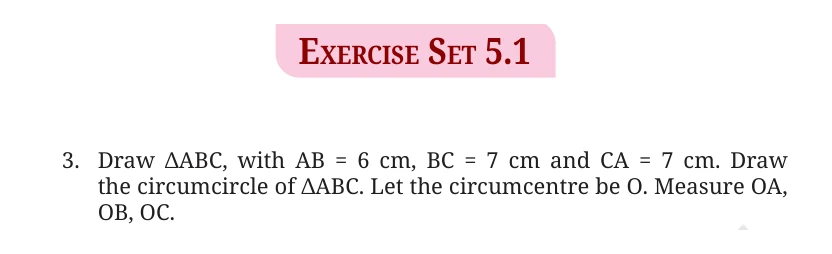
Exercise Set 5.1, 3: Construct the circumcircle of the triangle with sides 6\text{ cm},7\text{ cm},7\text{ cm}, and measure OA,OB,OC
Show detailed solution
- Step 1: Draw AB=6\text{ cm}. Draw arcs of radius 7\text{ cm} from A and B; their intersection is C.
- Step 2: Intersect perpendicular bisectors of two sides to obtain circumcentre O, then draw the circle with radius OA.
- Step 3: All radii are equal. The altitude is \sqrt{7^2-3^2}=2\sqrt{10}, so area is 6\sqrt{10}\text{ cm}^2
- Step 4: R=abc/(4\Delta)=49/(4\sqrt{10})\approx3.87\text{ cm}
- Answer: OA=OB=OC\approx3.9\text{ cm}
Textbook page 98 · solved item 13
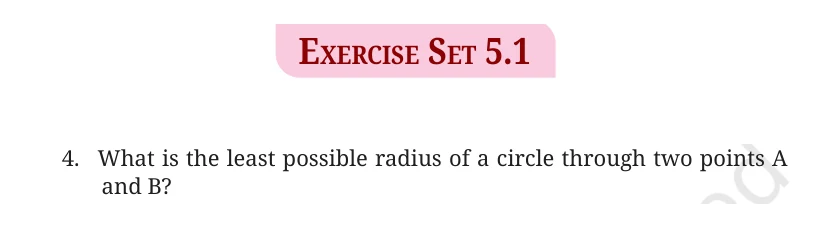
Exercise Set 5.1, 4: What is the least possible radius of a circle through two points A and B?
Show detailed solution
- Step 1: The centre must lie on the perpendicular bisector of AB
- Step 2: The nearest such centre to A and B is their midpoint M
- Step 3: Then MA=MB=AB/2, and any other centre is farther from both endpoints.
- Answer: The least possible radius is AB/2
Textbook page 98 · solved item 14
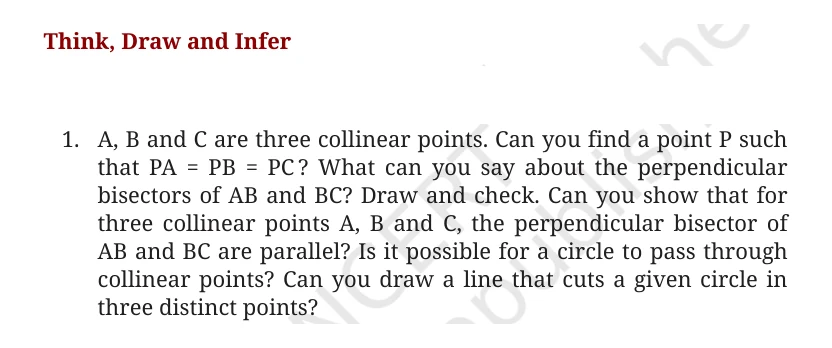
Think, Draw and Infer 1: Analyse perpendicular bisectors and circles for three distinct collinear points A, B, and C.
Show detailed solution
- Step 1: A point satisfying PA=PB must lie on the perpendicular bisector of AB; satisfying PB=PC puts it on the perpendicular bisector of BC
- Step 2: Because AB and BC lie on the same straight line, their perpendicular bisectors are distinct parallel lines and do not meet.
- Step 3: Therefore no point P has PA=PB=PC, so no circle passes through all three collinear points.
- Step 4: A line can meet a circle in at most two points, so it cannot cut a circle in three distinct points.
- Answer: The requested P and circle do not exist; the two perpendicular bisectors are parallel.
Textbook page 98 · solved item 15
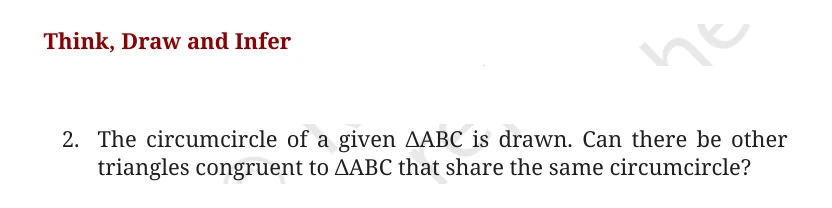
Think, Draw and Infer 2: Can other triangles congruent to a given \triangle ABC share its circumcircle?
Show detailed solution
- Step 1: Rotate the triangle about the centre of its circumcircle through any angle.
- Step 2: Rotation preserves all side lengths and angles, so the image triangle is congruent to the original.
- Step 3: Rotation also keeps every vertex on the same circle.
- Answer: Yes. Infinitely many rotated copies, and their reflected copies, share the same circumcircle.
Detailed worked answers
Textbook page 100
Textbook page 100 · solved item 16
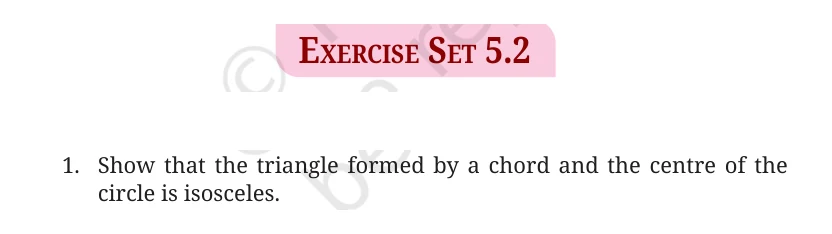
Exercise Set 5.2, 1: Show that the triangle formed by a chord and the centre of a circle is isosceles.
Show detailed solution
- Step 1: Let AB be the chord and O the centre; join OA and OB.
- Step 2: OA=OB because both are radii of the same circle.
- Step 3: A triangle with two equal sides is isosceles.
- Answer: \triangle OAB is isosceles, with base AB
Textbook page 100 · solved item 17
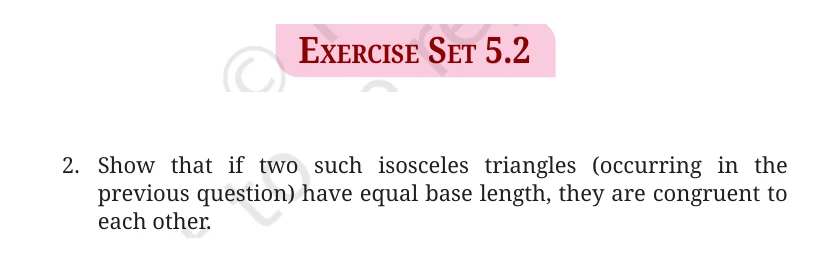
Exercise Set 5.2, 2: Show that two centre-chord isosceles triangles with equal bases are congruent.
Show detailed solution
- Step 1: Let the equal chords be AB and CD, with common centre O, so AB=CD
- Step 2: OA=OB=OC=OD because all four are radii.
- Step 3: Thus the three sides of \triangle OAB equal the corresponding sides of \triangle OCD
- Answer: The triangles are congruent by SSS.
Detailed worked answers
Textbook page 101
Textbook page 101 · solved item 18
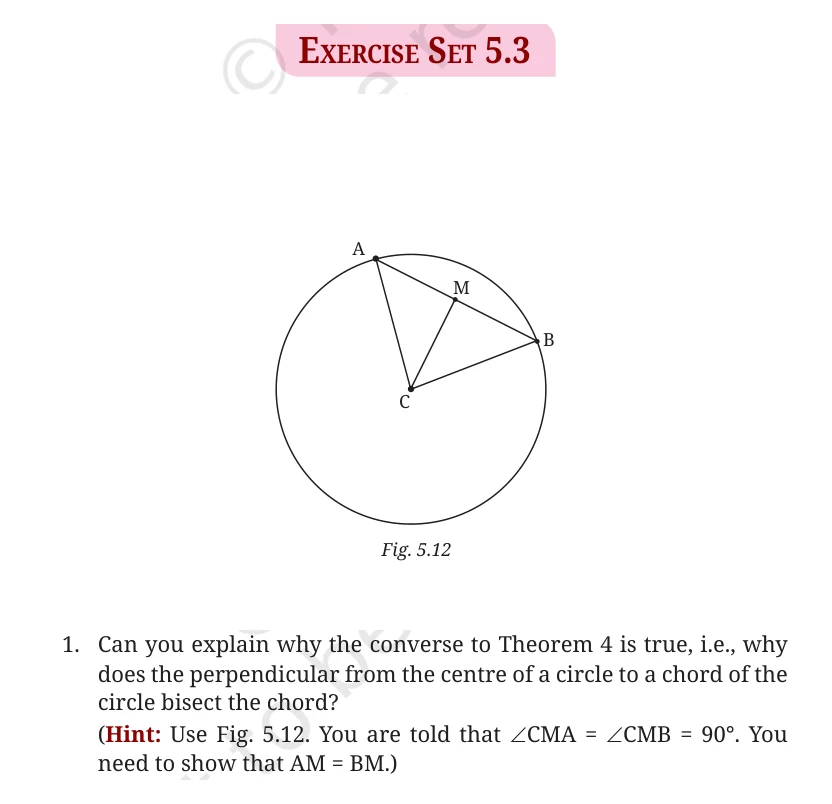
Exercise Set 5.3, 1: Prove that a perpendicular from the centre to a chord bisects the chord.
Show detailed solution
- Step 1: In Fig. 5.12, CM\perp AB, so \angle CMA=\angle CMB=90^\circ
- Step 2: CA=CB as radii, and CM is common to \triangle CMA and \triangle CMB
- Step 3: The two right triangles are congruent by RHS.
- Answer: Corresponding sides AM=BM, so M bisects chord AB.
Textbook page 101 · solved item 19
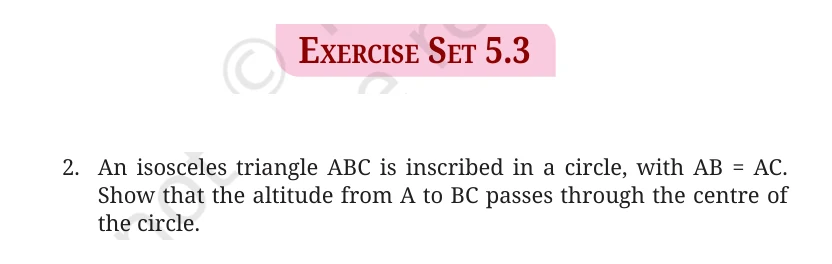
Exercise Set 5.3, 2: If isosceles \triangle ABC is inscribed in a circle with AB=AC, prove that the altitude from A passes through the centre.
Show detailed solution
- Step 1: Since AB=AC, point A is equidistant from B and C and lies on the perpendicular bisector of BC.
- Step 2: The circle centre O satisfies OB=OC, so O also lies on the perpendicular bisector of BC.
- Step 3: The unique line through A and O is therefore that perpendicular bisector.
- Answer: AO is perpendicular to BC, so the altitude from A passes through O.
Textbook page 101 · solved item 20
Exercise Set 5.3, 3: Find the distance between the midpoints of opposite-side parallel chords of lengths 6 cm and 8 cm in a circle of radius 5 cm.
Show detailed solution
- Step 1: The perpendicular from the centre bisects each chord, giving half-lengths 3\text{ cm} and 4\text{ cm}
- Step 2: Their distances from the centre are \sqrt{5^2-3^2}=4\text{ cm} and \sqrt{5^2-4^2}=3\text{ cm}
- Step 3: The chords lie on opposite sides, so the midpoint separation is the sum of these distances.
- Answer: 4+3=7\text{ cm}
Detailed worked answers
Textbook page 104
Textbook page 104 · solved item 21
Exercise Set 5.4, 1: Use the Baudhāyana-Pythagoras theorem to prove that equal chords are equidistant from the centre.
Show detailed solution
- Step 1: For equal chords AB and FG, their half-chords satisfy AE=FH
- Step 2: With radius r, the right triangles give CE^2=r^2-AE^2 and CH^2=r^2-FH^2
- Step 3: Since AE=FH, we get CE^2=CH^2, and both distances are non-negative.
- Answer: CE=CH, so the equal chords are equidistant from the centre.
Textbook page 104 · solved item 22
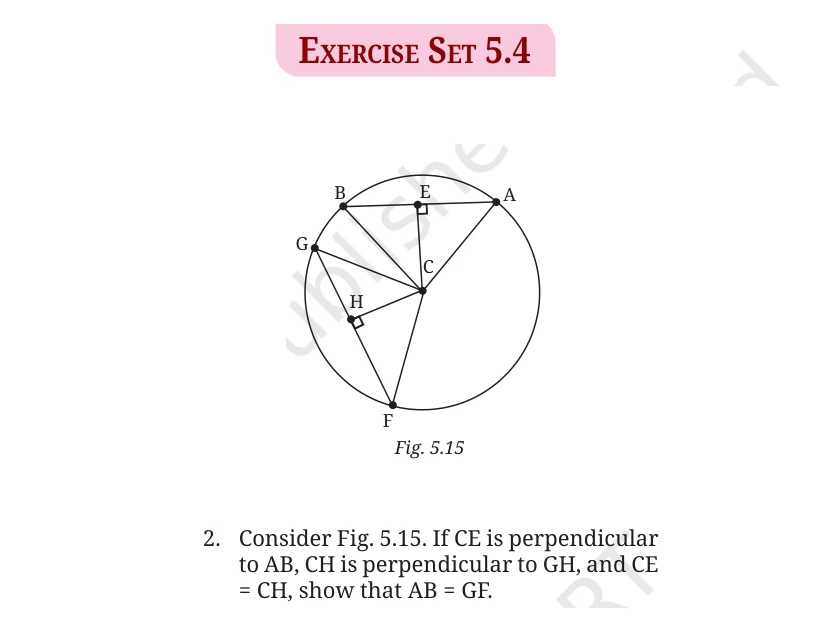
Exercise Set 5.4, 2: In Fig. 5.15, prove that chords AB and GF are equal when CE and CH are equal perpendicular distances.
Show detailed solution
- Step 1: The perpendiculars bisect the chords, so AE=EB and GH=HF
- Step 2: In right triangles \triangle CEA and \triangle CHG, CA=CG as radii and CE=CH is given.
- Step 3: The triangles are congruent by RHS, so AE=GH
- Answer: AB=2AE=2GH=GF
Textbook page 104 · solved item 23
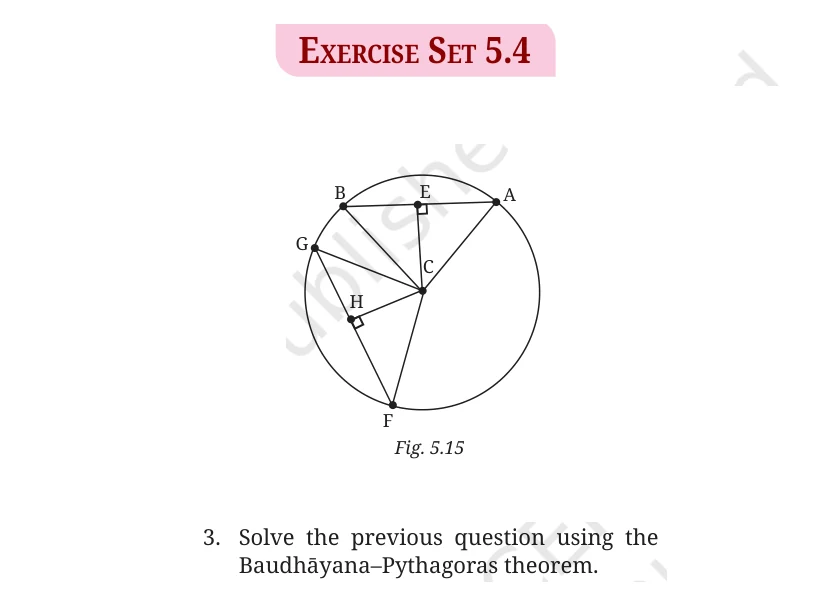
Exercise Set 5.4, 3: Prove the previous equal-chord result using the Baudhāyana-Pythagoras theorem.
Show detailed solution
- Step 1: In the two right triangles, AE^2=CA^2-CE^2 and GH^2=CG^2-CH^2
- Step 2: CA=CG because they are radii, and CE=CH is given.
- Step 3: Therefore AE^2=GH^2, hence AE=GH
- Answer: AB=2AE=2GH=GF
Detailed worked answers
Textbook page 105
Textbook page 105 · solved item 24
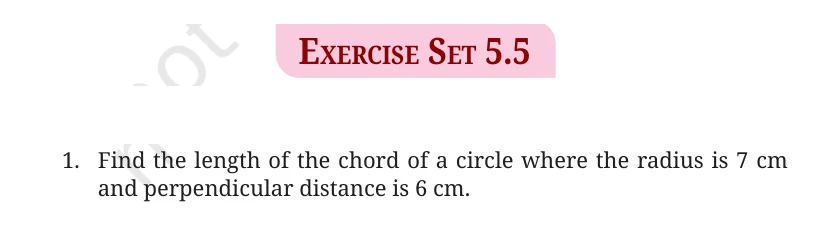
Exercise Set 5.5, 1: Find the chord length when the radius is 7 cm and its perpendicular distance from the centre is 6 cm.
Show detailed solution
- Step 1: The perpendicular from the centre bisects the chord. Let half the chord be x.
- Step 2: The right triangle gives x^2+6^2=7^2, so x^2=13
- Step 3: Thus x=\sqrt{13}\text{ cm}, and the complete chord is twice this length.
- Answer: 2\sqrt{13}\text{ cm}\approx7.21\text{ cm}
Textbook page 105 · solved item 25
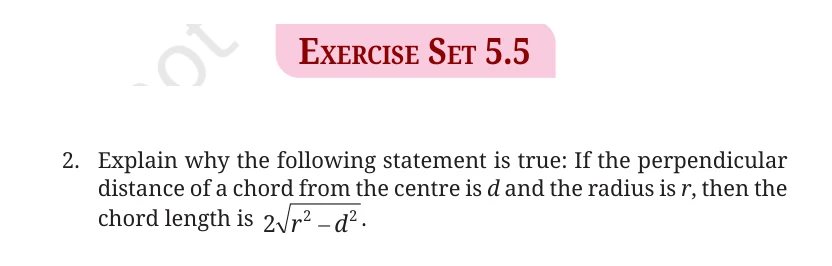
Exercise Set 5.5, 2: Derive the chord-length formula 2\sqrt{r^2-d^2}
Show detailed solution
- Step 1: Drop the perpendicular from the centre O to chord AB at M; it bisects the chord.
- Step 2: In right triangle OMA, OA=r, OM=d, and AM=AB/2
- Step 3: By the Baudhāyana-Pythagoras theorem, AM^2=r^2-d^2
- Answer: AB=2AM=2\sqrt{r^2-d^2}
Detailed worked answers
Textbook page 106
Textbook page 106 · solved item 26

Exercise Set 5.5, 3: If chord AB is twice as far from the centre as chord CD, must CD equal twice AB?
Show detailed solution
- Step 1: Chord length depends on distance d by L=2\sqrt{r^2-d^2}, which is not an inverse-proportion rule.
- Step 2: For example, take r=5, distance of CD =2, and distance of AB =4
- Step 3: Then CD=2\sqrt{25-4}=2\sqrt{21}, while AB=2\sqrt{25-16}=6
- Answer: No. 2AB=12\ne2\sqrt{21}=CD
Detailed worked answers
Textbook page 107
Textbook page 107 · solved item 27
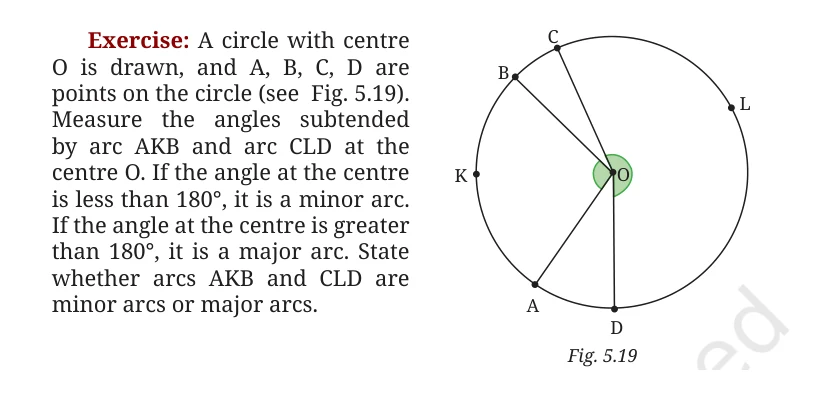
Exercise on Fig. 5.19: Measure the central angles of arcs AKB and CLD, and classify each arc.
Show detailed solution
- Step 1: Place a protractor at O and measure the smaller sweep from OA to OB through K; it is about 96^\circ
- Step 2: Since 96^\circ<180^\circ, arc AKB is a minor arc.
- Step 3: Measure the sweep from OC to OD through L; it is about 204^\circ
- Answer: Arc CLD is a major arc because its central angle is about 204^\circ>180^\circ. Small variations are possible when measuring the printed figure.
Detailed worked answers
Textbook page 110
Textbook page 110 · solved item 28
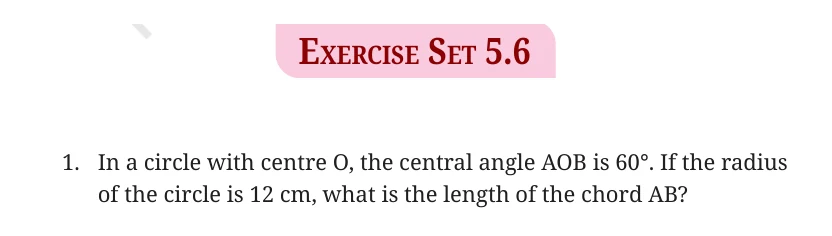
Exercise Set 5.6, 1: A chord subtends 60^\circ at the centre of a circle of radius 12 cm. Find the chord length.
Show detailed solution
- Step 1: Join OA and OB. Then OA=OB=12\text{ cm}
- Step 2: Since \angle AOB=60^\circ, the other two equal angles of isosceles \triangle AOB sum to 120^\circ, so each is 60^\circ
- Step 3: The triangle is equilateral, so its three sides are equal.
- Answer: AB=12\text{ cm}
Detailed worked answers
Textbook page 111
Textbook page 111 · solved item 29
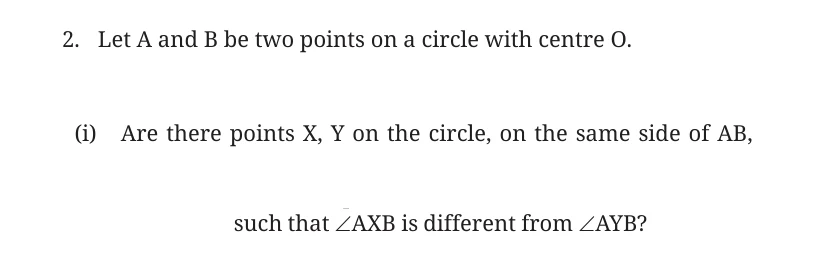
Exercise Set 5.6, 2(i): Can two points X and Y on the same side of chord AB subtend different angles at the circle?
Show detailed solution
- Step 1: Points X and Y on the same side of AB lie on the same arc segment determined by chord AB.
- Step 2: The angle-in-the-same-segment theorem gives \angle AXB=\angle AYB
- Step 3: Therefore choosing different positions on that same arc does not change the subtended angle.
- Answer: No, provided X and Y are on the circle and on the same side of AB.
Textbook page 111 · solved item 30
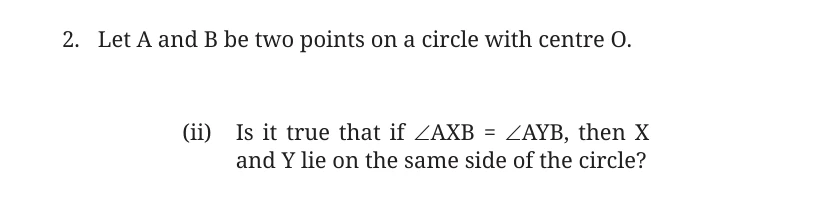
Exercise Set 5.6, 2(ii): If \angle AXB=\angle AYB, must X and Y lie on the same side of AB?
Show detailed solution
- Step 1: Normally, points on opposite arcs give supplementary angles rather than equal ones.
- Step 2: If AB is a diameter, however, every angle subtended at the circle is 90^\circ
- Step 3: Choose X and Y on opposite semicircles; then both \angle AXB and \angle AYB equal 90^\circ
- Answer: No. A diameter provides a counterexample.
Textbook page 111 · solved item 31
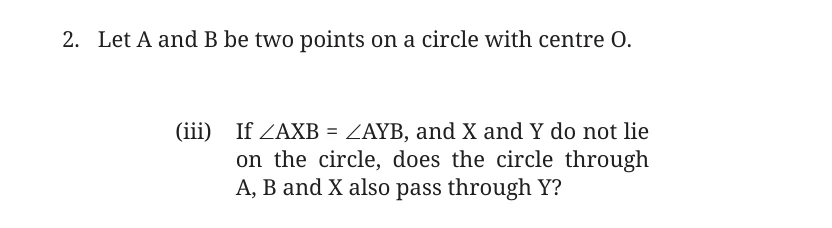
Exercise Set 5.6, 2(iii): If \angle AXB=\angle AYB but X and Y are not known to lie on one circle, must the circle through A, B, and X pass through Y?
Show detailed solution
- Step 1: Equal angles imply concyclicity only when X and Y lie on the same side of AB, as required by Theorem 10.
- Step 2: Reflect X across line AB to a point Y on the opposite side; the two angles have equal measure.
- Step 3: In general, the reflected point lies on the reflected circumcircle, not on the original circle through A, B, and X.
- Answer: No. The same-side condition is essential.
Textbook page 111 · solved item 32
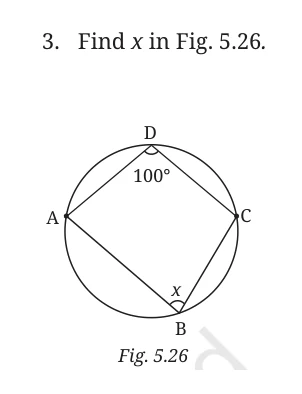
Exercise Set 5.6, 3: Find x in Fig. 5.26.
Show detailed solution
- Step 1: The four vertices form a cyclic quadrilateral, so opposite angles are supplementary.
- Step 2: The angle opposite x is 100^\circ, hence x+100^\circ=180^\circ
- Step 3: Subtract 100^\circ from both sides.
- Answer: x=80^\circ
Detailed worked answers
Textbook page 113
Textbook page 113 · solved item 33

Exercise on cyclic quadrilaterals: Can a quadrilateral have angles 80 degrees, 110 degrees, 100 degrees, and 70 degrees in order?
Show detailed solution
- Step 1: Opposite angles A and C give 80^\circ+100^\circ=180^\circ
- Step 2: Opposite angles B and D give 110^\circ+70^\circ=180^\circ
- Step 3: A quadrilateral whose opposite angles are supplementary is cyclic by the converse theorem.
- Answer: Yes, such a cyclic quadrilateral can be drawn.
Detailed worked answers
Textbook page 114
Textbook page 114 · solved item 34
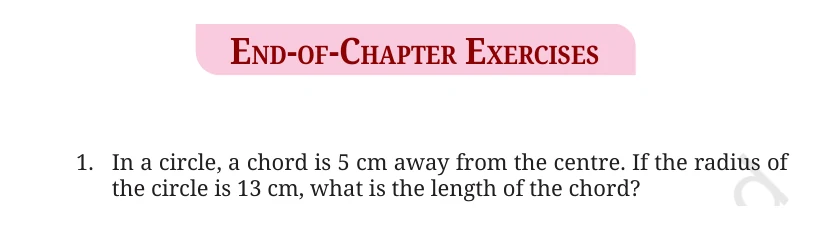
End-of-Chapter Exercise 1: A chord is 5 cm from the centre of a circle of radius 13 cm. Find its length.
Show detailed solution
- Step 1: The centre-to-chord perpendicular bisects the chord; let half-length be x.
- Step 2: x^2+5^2=13^2, so x^2=169-25=144
- Step 3: x=12\text{ cm}, and the full chord is 2x
- Answer: 24\text{ cm}
Textbook page 114 · solved item 35
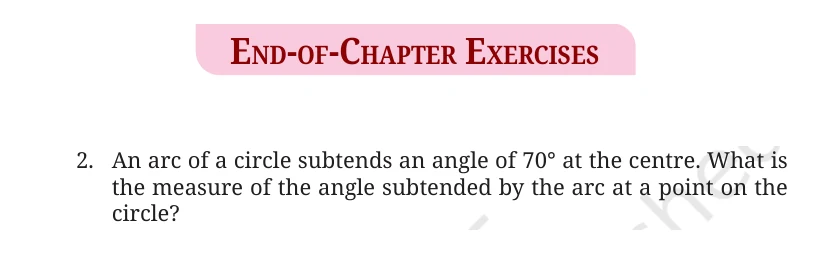
End-of-Chapter Exercise 2: An arc subtends 70^\circ at the centre. What angle does it subtend at a point on the circle outside the arc?
Show detailed solution
- Step 1: The angle at the centre is twice the angle at the circumference on the remaining arc.
- Step 2: Let the required angle be x; then 2x=70^\circ
- Step 3: Divide by 2 to obtain x=35^\circ
- Answer: 35^\circ
Textbook page 114 · solved item 36
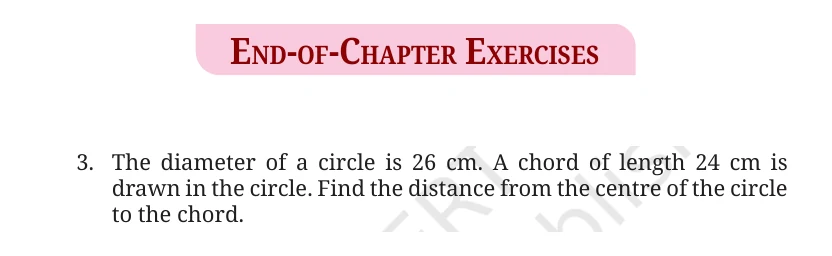
End-of-Chapter Exercise 3: A circle has diameter 26 cm and a chord of length 24 cm. Find the chord's distance from the centre.
Show detailed solution
- Step 1: Radius r=26/2=13\text{ cm}, and half-chord =24/2=12\text{ cm}
- Step 2: The radius, half-chord, and perpendicular distance d form a right triangle.
- Step 3: d^2=13^2-12^2=169-144=25
- Answer: d=5\text{ cm}
Textbook page 114 · solved item 37
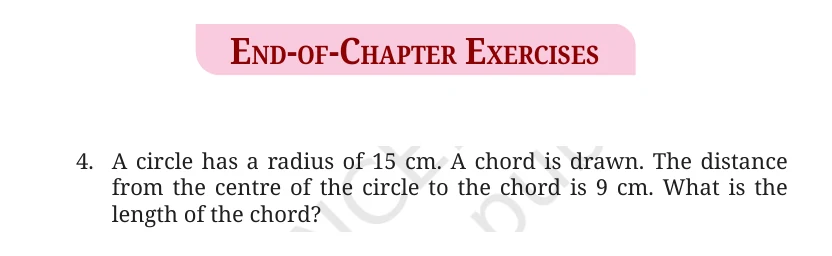
End-of-Chapter Exercise 4: A circle has radius 15 cm and a chord 9 cm from its centre. Find the chord length.
Show detailed solution
- Step 1: Let half the chord be x. Then x^2+9^2=15^2
- Step 2: x^2=225-81=144, so x=12\text{ cm}
- Step 3: The perpendicular bisects the chord, so double the half-length.
- Answer: The chord is 24\text{ cm} long.
Textbook page 114 · solved item 38
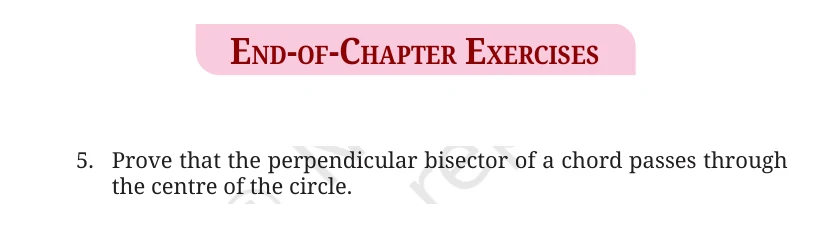
End-of-Chapter Exercise 5: Prove that the perpendicular bisector of a chord passes through the circle's centre.
Show detailed solution
- Step 1: Let M be the midpoint of chord AB, so AM=BM
- Step 2: The centre O satisfies OA=OB, and OM is common to triangles OMA and OMB.
- Step 3: The triangles are congruent by SSS, so the adjacent angles at M are equal.
- Step 4: They also form a straight angle, hence each is 90^\circ
- Answer: OM is the perpendicular bisector of AB and therefore passes through O.
Textbook page 114 · solved item 39
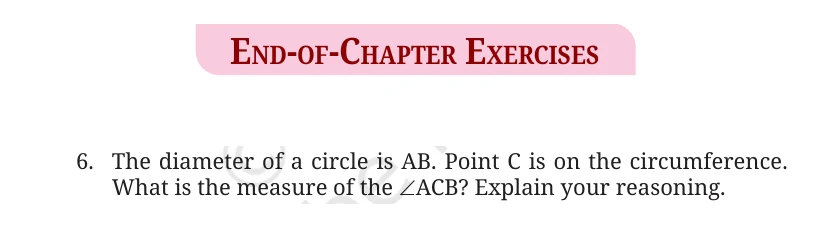
End-of-Chapter Exercise 6: If AB is a diameter and C is on the circle, find \angle ACB
Show detailed solution
- Step 1: Diameter AB subtends the straight central angle \angle AOB=180^\circ
- Step 2: An angle at the circle is half the central angle standing on the same arc.
- Step 3: \angle ACB=\frac12\times180^\circ
- Answer: \angle ACB=90^\circ
Textbook page 114 · solved item 40
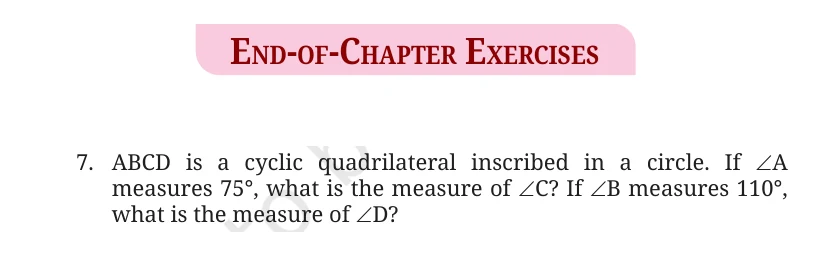
End-of-Chapter Exercise 7: In cyclic ABCD, find \angle C if \angle A=75^\circ, and find \angle D if \angle B=110^\circ
Show detailed solution
- Step 1: Opposite angles of a cyclic quadrilateral sum to 180 degrees.
- Step 2: \angle C=180^\circ-75^\circ=105^\circ
- Step 3: \angle D=180^\circ-110^\circ=70^\circ
- Answer: \angle C=105^\circ and \angle D=70^\circ
Textbook page 114 · solved item 41
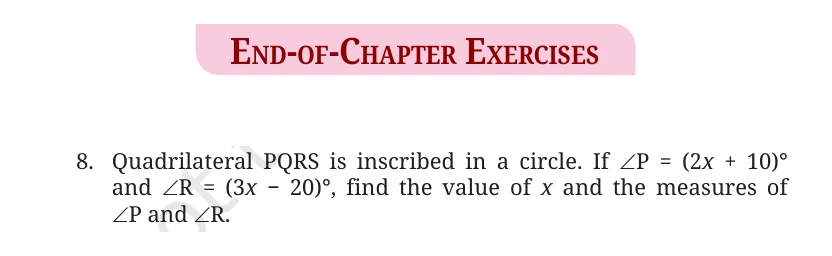
End-of-Chapter Exercise 8: If opposite angles are \angle P=(2x+10)^\circ and \angle R=(3x-20)^\circ, find x, P, and R.
Show detailed solution
- Step 1: Since PQRS is cyclic, (2x+10)+(3x-20)=180
- Step 2: 5x-10=180, so 5x=190 and x=38
- Step 3: \angle P=2(38)+10=86^\circ and \angle R=3(38)-20=94^\circ
- Check: 86^\circ+94^\circ=180^\circ
- Answer: x=38, \angle P=86^\circ, \angle R=94^\circ
Textbook page 114 · solved item 42
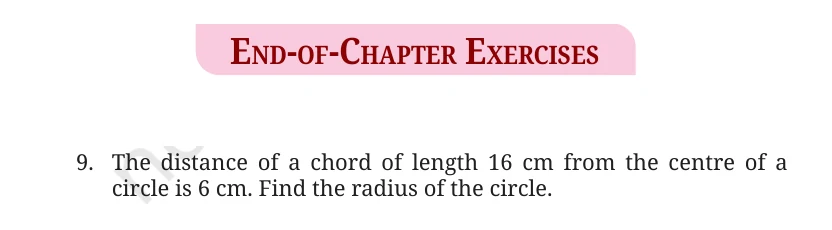
End-of-Chapter Exercise 9: A chord of length 16 cm is 6 cm from the centre. Find the radius.
Show detailed solution
- Step 1: Half the chord is 8\text{ cm}
- Step 2: Radius r is the hypotenuse of a right triangle with legs 8 cm and 6 cm.
- Step 3: r^2=8^2+6^2=64+36=100
- Answer: r=10\text{ cm}
Textbook page 114 · solved item 43
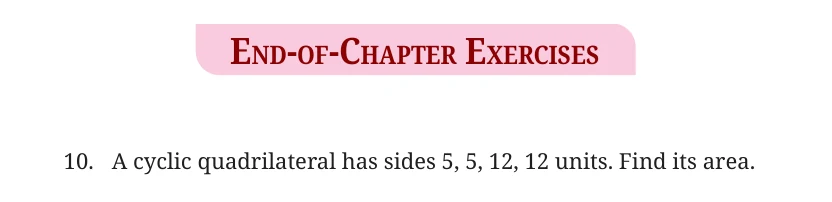
End-of-Chapter Exercise 10: A cyclic quadrilateral has side lengths 5, 5, 12, and 12 units. Find its area.
Show detailed solution
- Step 1: Its semiperimeter is s=(5+5+12+12)/2=17
- Step 2: Brahmagupta's formula for a cyclic quadrilateral is K=\sqrt{(s-a)(s-b)(s-c)(s-d)}
- Step 3: K=\sqrt{12\times12\times5\times5}=\sqrt{3600}
- Answer: The area is 60 square units.
Textbook page 114 · solved item 44
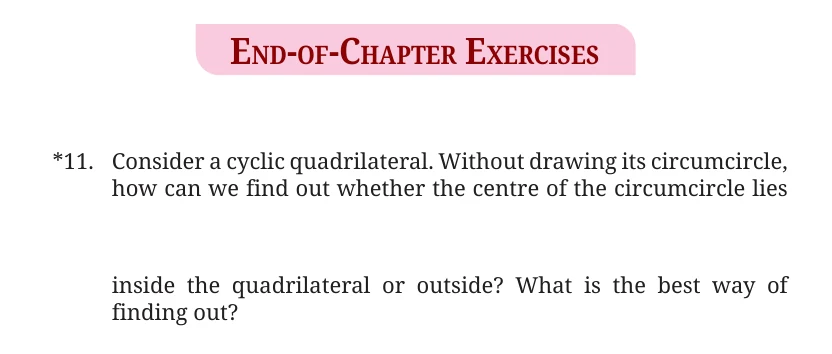
End-of-Chapter Exercise 11: Without drawing the circumcircle, determine whether its centre lies inside or outside a cyclic quadrilateral.
Show detailed solution
- Step 1: Treat any two sides or diagonals as chords of the unknown circumcircle.
- Step 2: Construct their perpendicular bisectors; their intersection O is the unique circumcentre.
- Step 3: Compare O with the quadrilateral's boundary, or use a point-in-polygon check in an accurate drawing.
- Answer: The direct construction of two perpendicular bisectors is the most reliable method; no circle needs to be drawn.
Detailed worked answers
Textbook page 115
Textbook page 115 · solved item 45

End-of-Chapter Exercise 12: Prove that equal intersecting chords are divided into equal corresponding segments.
Show detailed solution
- Step 1: Let equal chords AB and CD intersect at P, with their endpoints occurring alternately around the circle.
- Step 2: Equal chords AB and CD cut equal arcs. Cancelling their common intervening arc gives equal arcs AC and DB, hence AC=DB
- Step 3: In triangles \triangle APC and \triangle DPB, \angle CAP=\angle BDP because both stand on arc CB, and \angle APC=\angle DPB are vertical.
- Step 4: With AC=DB, the triangles are congruent by AAS.
- Answer: Corresponding sides give AP=DP and CP=BP
Textbook page 115 · solved item 46

End-of-Chapter Exercise 13: Construct a circle having a 6 cm chord at a distance of 3 cm from the centre.
Show detailed solution
- Step 1: Draw chord AB=6\text{ cm} and construct its midpoint M, so AM=3\text{ cm}
- Step 2: Draw a perpendicular to AB at M and mark O on it with OM=3\text{ cm}
- Step 3: Join OA. The Baudhāyana-Pythagoras theorem gives OA=\sqrt{3^2+3^2}=3\sqrt2\text{ cm}
- Step 4: Draw the circle with centre O and radius OA; it passes through A and B.
- Answer: The required circle has radius 3\sqrt2\text{ cm}; the reflected choice of O gives the other valid construction.
Textbook page 115 · solved item 47

End-of-Chapter Exercise 14: Prove that a rectangle is the only parallelogram that can be inscribed in a circle.
Show detailed solution
- Step 1: Opposite angles of a parallelogram are equal.
- Step 2: Opposite angles of a cyclic quadrilateral are supplementary.
- Step 3: If one such angle is x, then x+x=180^\circ, so x=90^\circ
- Step 4: The same holds for every angle.
- Answer: A cyclic parallelogram has four right angles and is therefore a rectangle.
Textbook page 115 · solved item 48

End-of-Chapter Exercise 15: Show that the diagonals of a rectangle inscribed in a circle meet at the centre.
Show detailed solution
- Step 1: The diagonals of a rectangle bisect each other; let their intersection be P.
- Step 2: Rectangle diagonals are equal, so AC=BD, and hence PA=PC=AC/2 and PB=PD=BD/2
- Step 3: Therefore P is equidistant from all four vertices on the circle.
- Answer: The unique point equidistant from the circle's points is its centre, so P is the centre.
Textbook page 115 · solved item 49

End-of-Chapter Exercise 16: What locus is formed by the midpoints of all chords of a fixed length?
Show detailed solution
- Step 1: Let the circle radius be R and each chord length be l. If M is a midpoint, then OM\perp the chord.
- Step 2: A right triangle gives OM^2=R^2-(l/2)^2
- Step 3: R and l are fixed, so every midpoint is the same fixed distance from O.
- Answer: The midpoints form a concentric circle of radius \sqrt{R^2-l^2/4}. For diameter-length chords, this degenerates to the centre point.
Textbook page 115 · solved item 50

End-of-Chapter Exercise 17: If chords AB and AC are equal, prove that the centre O lies on the angle bisector of \angle BAC
Show detailed solution
- Step 1: Compare \triangle AOB and \triangle AOC
- Step 2: AB=AC is given, OB=OC are radii, and OA is common.
- Step 3: The triangles are congruent by SSS.
- Answer: Corresponding angles \angle BAO=\angle OAC, so AO bisects \angle BAC
Textbook page 115 · solved item 51

End-of-Chapter Exercise 18: Parallel chords of lengths 10 cm and 24 cm lie on the same side of the centre and are 7 cm apart. Find the radius.
Show detailed solution
- Step 1: Let distances of the shorter and longer chords from the centre be a and b. Since the longer chord is closer, a-b=7
- Step 2: Half-chords are 5 and 12, so r^2=a^2+25=b^2+144
- Step 3: Thus a^2-b^2=119, so (a-b)(a+b)=119. With a-b=7, a+b=17
- Step 4: Solving gives a=12, b=5, and r^2=12^2+5^2=169
- Answer: r=13\text{ cm}
Textbook page 115 · solved item 52

End-of-Chapter Exercise 19: A regular hexagon is inscribed in a circle of radius r. Find its side length and its distance from the centre.
Show detailed solution
- Step 1: Adjacent vertices subtend 360^\circ/6=60^\circ at the centre.
- Step 2: The triangle formed by two radii and one side is equilateral, so the side length equals r.
- Step 3: The perpendicular to a side bisects it, making a right triangle with hypotenuse r and half-side r/2
- Answer: Side length =r, and centre-to-side distance =\sqrt{r^2-(r/2)^2}=\frac{\sqrt3}{2}r
Textbook page 115 · solved item 53

End-of-Chapter Exercise 20: In cyclic quadrilateral MNOP, MN is a diameter. Determine \angle MOP and \angle MNP
Show detailed solution
- Step 1: Both \angle MOP and \angle MNP have the same endpoints M and P.
- Step 2: In quadrilateral order M-N-O-P, vertices N and O lie on the same arc segment cut off by chord MP.
- Step 3: Angles subtended by the same chord at points in the same segment are equal.
- Answer: \angle MOP=\angle MNP. Their numerical measure is not fixed; the fact that MN is a diameter additionally gives \angle MPN=90^\circ
Textbook page 115 · solved item 54

End-of-Chapter Exercise 21: Explain why an exterior angle of a cyclic quadrilateral equals its opposite interior angle.
Show detailed solution
- Step 1: At vertex D, the interior angle \angle CDA and its exterior angle form a linear pair, so their sum is 180^\circ
- Step 2: In cyclic ABCD, opposite interior angles also satisfy \angle CDA+\angle ABC=180^\circ
- Step 3: Subtracting the common interior angle at D gives equality of the exterior angle and the opposite interior angle.
- Answer: The exterior angle at D equals \angle ABC. The printed example's point E must lie on the extension of AD; placing E on CD would make \angle CDE a straight angle.
Textbook page 115 · solved item 55

End-of-Chapter Exercise 22: Justify that no chord can be longer than a diameter.
Show detailed solution
- Step 1: For a chord at perpendicular distance d from the centre of a radius-r circle, L=2\sqrt{r^2-d^2}
- Step 2: Since d^2\ge0, r^2-d^2\le r^2, so L\le2r
- Step 3: Equality occurs exactly when d is zero, meaning the chord passes through the centre.
- Answer: Every chord is at most 2r long, and the diameter is the unique maximum-length chord direction.
Textbook page 115 · solved item 56

End-of-Chapter Exercise 23: For an interior point A, prove that the shortest chord through A is perpendicular to OA.
Show detailed solution
- Step 1: For any chord line through A, let d be its perpendicular distance from centre O.
- Step 2: Since A lies on that line, d\le OA, with equality precisely when the line through A is perpendicular to OA.
- Step 3: Chord length 2\sqrt{r^2-d^2} decreases as d increases.
- Answer: The maximum possible distance is OA, so the perpendicular chord is shortest. If A=O, every chord through A is a diameter and all are equal.
Detailed worked answers
Textbook page 116
Textbook page 116 · solved item 57
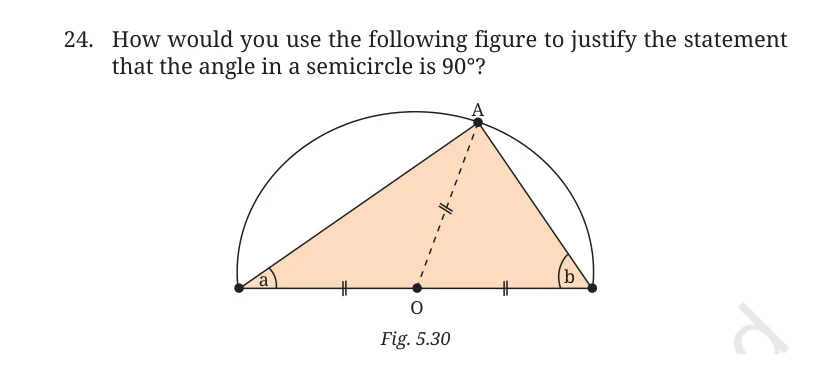
End-of-Chapter Exercise 24: Use Fig. 5.30 to prove that the angle in a semicircle is 90 degrees.
Show detailed solution
- Step 1: Join the point A on the semicircle to centre O. The two smaller triangles have pairs of equal radii and are isosceles.
- Step 2: If the base angles at the diameter endpoints are a and b, the two parts of the angle at A are also a and b.
- Step 3: In the large triangle, a+b+(a+b)=180^\circ, so a+b=90^\circ
- Answer: The angle at A, which is a+b, equals 90 degrees.
Textbook page 116 · solved item 58

End-of-Chapter Exercise 25: Chords CC' and DD' are perpendicular to diameter AB. Prove that the segment joining the midpoints of CD and C'D' is perpendicular to AB.
Show detailed solution
- Step 1: Reflection in diameter AB preserves the circle and every line perpendicular to AB.
- Step 2: Hence the reflection pairs are C\leftrightarrow C' and D\leftrightarrow D'
- Step 3: Reflection sends the midpoint M of CD to the midpoint M' of C'D'
- Step 4: The segment joining a point to its mirror image is perpendicular to the mirror line.
- Answer: MM'\perp AB
Textbook page 116 · solved item 59
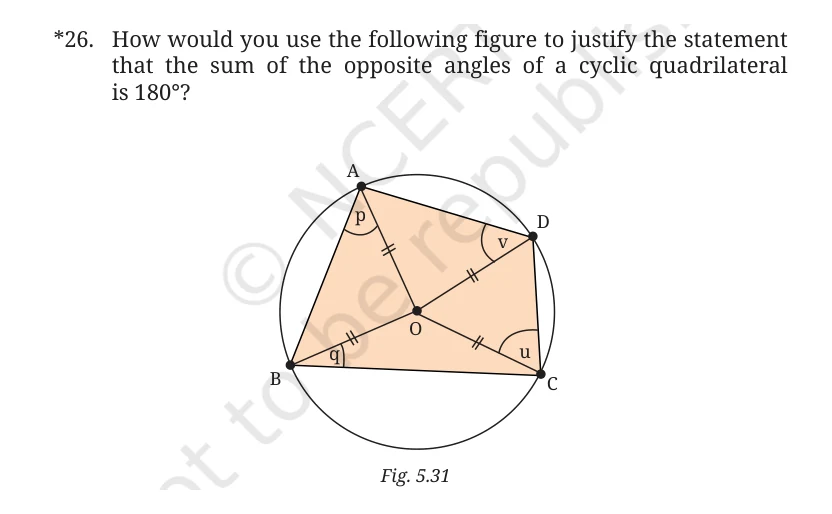
End-of-Chapter Exercise 26: Use Fig. 5.31 to prove that opposite angles of a cyclic quadrilateral sum to 180 degrees.
Show detailed solution
- Step 1: Angle A subtends the arc BCD, so it equals half the central angle swept from OB to OD through C.
- Step 2: Opposite angle C subtends the remaining arc DAB, so it equals half the other central sweep from OD to OB through A.
- Step 3: Those two central sweeps make a complete 360^\circ turn around O.
- Answer: \angle A+\angle C=\frac12(360^\circ)=180^\circ. The same argument gives \angle B+\angle D=180^\circ